

Submitted:
18 November 2025
Posted:
19 November 2025
You are already at the latest version
Abstract
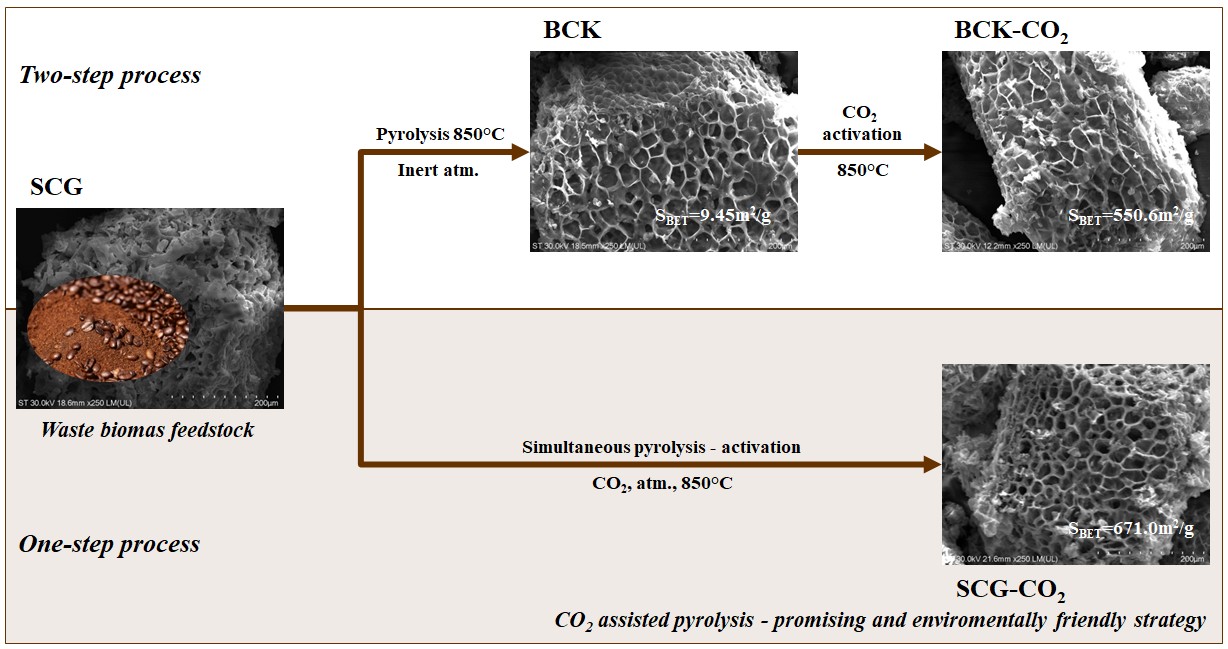
Spent coffee grounds (SCG) are an abundant, carbon-rich residue suitable for converting into biochar through a thermochemical process. In this study, biochar was produced from SCG using a two-step pyrolysis-CO2 activation process and a one-step CO2 assisted pyrolysis method to compare their physicochemical and structural properties. Results showed that CO2 activation significantly increases the porosity and surface area, from 9.8 m²/g for non-activated biochar (BCK) to 550.6 m²/g for BCK-CO2 and 671.0 m²/g for SCG-CO2. FTIR and Boehm titration analyses confirmed a decrease in surface oxygenated groups after CO2 treatment, and SEM-EDX and XRD analyses indicated a structural reorganization. The one-step CO2 assisted pyrolysis produces biochar with a more uniform pore structure, a higher degree of carbonization, and better textural properties than the two-step method. Therefore, using CO2 directly during pyrolysis can be an efficient and sustainable method to obtain highly porous biochar from spent coffee grounds, reduce energy demands, and make valuable organic waste.
Keywords:
biochar
; spent coffee grounds
; one-step CO2 activation
; surface area
; porous carbon
; waste valorization
1. Introduction
Biochar is a carbonaceous material obtained from biomass through thermochemical processes including pyrolysis, hydrothermal carbonization, and gasification [1,2]. Due to its unique physicochemical and structural properties, biochar is a versatile material used in environmental remediation, agriculture, catalysis, and electrochemical applications [3,4].
In environmental remediation, biochar improves soil and water quality by adsorbing heavy metals [5], organic pollutants [6,7], excess nutrients [8], and emerging contaminants [9]. It also improves soil properties by increasing porosity and water retention [10,11], promotes microbial activity and soil fertility [12,13,14]. In catalysis, biochar is used both as a support for metal nanoparticles, improving their dispersion, stability, and reusability [15,16], and as an active catalyst due to its surface functional groups [17]. This includes reactions such as biodiesel production [18] through transesterification [19], biomass conversion [20], and chemical transformations, including hydrolysis, isomerization, and dehydration [16]. In electrochemical applications [21], its high porosity and electrical conductivity make it a suitable electrode material for supercapacitors [22], batteries [23], electroanalytical sensors [24], and microbial fuel cells, promoting electron transfer and energy generation [25]. Biochar contributes to sustainability, enabling carbon capture and storage [26,27], waste valorization [28], and supporting circular economy strategies [29,30]. It is a stable medium for atmospheric carbon sequestration [31], is an efficient CO2 adsorbent [32], and contributes to circular and climate-resilient industries [33]. An overview of the main applications of biochar is illustrated briefly in Figure 1.
Biochar production from renewable biomass residues supports circular bioeconomy principles and enhances waste management strategies [34]. By converting organic waste into a valuable and stable carbon form, biochar keeps biomass out of landfills and incineration [35], sequestrates carbon in soils, and reduces greenhouse gas emissions [36,37].
A wide variety of biomass feedstocks has been investigated for biochar production, including agricultural residues (e.g., crop stalks and straws [38], husks [39], sugarcane bagasse [40], and fruit or vegetable wastes [41]), seed-derived materials such as soy hulls [42] and sunflower residues [43], forestry byproducts including sawdust, bark, and branches [44].
With an estimated global production of 60 million tons annually [45], spent coffee grounds (SCG) are known for their high carbon and volatile matter content and are rich in bioactive compounds such as cellulose, lignin, proteins, lipids, and polyphenols [46,47]. When discarded in landfills, it contributes to methane emissions and environmental problems [48,49]. Converting SCG into activated biochar not only prevents these negative impacts but also creates valuable materials with environmental and technological applications.
The quality and performance of biochar depend on its surface area, pore structure, and surface functional groups [50,51]. Activation is essential in biochar production, as non-activated biochar exhibits limited surface area and low porosity [52,53]. Two main activation strategies are commonly employed: (i) physical activation using oxidizing gases such as CO2 or steam at high temperatures [53,54], and (ii) chemical activation using reagents such as acids (HNO3, H2SO4, HCl, H3PO4, or organic acids like citric and oxalic acid [55,56]), alkalis (KOH, NaOH [57,58]), metallic salts (ZnCl2, FeCl3 [59]), or oxidizers like H2O2 [60,61]. While chemical activation generally produces biochar with higher surface areas and more developed porosity [62], it involves corrosive reagents that generate hazardous waste and are challenging to recover [63]. In contrast, physical activation is simpler, cleaner, and easier to scale up, since it depends on a controlled gas-solid reaction [64,65]. Carbon dioxide is favored in physical activation because it is economical [66], avoids harmful chemicals, and allows valorization of greenhouse gas, contributing to circular carbon management [67,68]. Physical activation with CO2 is therefore widely recognized as a greener alternative, producing high-porosity biochar, suitable for adsorption and catalytic applications [69,70].
CO2 activation is generally carried out in a two-step process, where pyrolysis and activation are performed sequentially: the biomass is first pyrolyzed under an inert gas (e.g., N₂ or Ar) and then activated under a CO2 flow at high temperatures [71]. Alternatively, one-step activation uses CO2 as an activating agent, combining biomass pyrolysis and activation in a single process [72,73]. Despite its economic and environmental advantages, one-step CO2 activation has received relatively limited scientific attention. Available studies indicate its potential to integrate pyrolysis and activation in a single step; however, further research is required to explore its applicability for diverse biomass and to optimize process parameters [66].
In this study, we present a comparative investigation of conventional two-step and integrated one-step CO2 assisted pyrolysis to elucidate the effect of activation mode on the structural and textural properties of biochar and to better understand the CO2 assisted carbon formation. Spent coffee grounds (SCG) were chosen as a representative feedstock due to their availability, uniform composition, and high carbon content. Using CO2 as the activating agent not only promotes pore development but also provides a way to valorize a greenhouse gas. This work demonstrates that one-step CO2 assisted pyrolysis can produce biochar with physicochemical properties comparable to or even superior to those obtained in the two-step process, reducing time and energy requirements, and offering a more efficient and sustainable route for biochar production.
2. Materials and Methods
2.1. Production of Biochar from Spent Coffee Grounds
Spent coffee grounds (SCG) collected from a coffee machine used in our workplace were dried for 4 h at 150 °C. The dried SCG was introduced into a tubular quartz reactor and subjected to pyrolysis in a Nabertherm RHTC 80-230/15 furnace at 850 °C for 2 h under an inert gas atmosphere. The resulting biochar was labeled as BCK. Then, this biochar was activated in a CO2 flow of 200 mL min⁻¹ at 850 °C for 1.5 h, and the sample was denoted as BCK-CO2. The one-step CO2 pyrolysis-activation was performed under identical conditions (850 °C, 2 h, CO2 flow rate 200 mL min⁻¹), and the biochar sample was named SCG-CO2.
2.2. Determination of Biochar Yield and Proximate Composition
The biochar yield was determined as the ratio between the mass of the obtained biochar and the initial dry mass of the biomass, expressed as a percentage. The ash content (ASH) of each biochar sample was measured according to the ASTM D3174 standard by combusting 1 g of biochar in an open crucible at 750 °C for 6 h in a muffle furnace (Nabertherm LE4/11/R6). The volatile matter content (VM) was determined following the ASTM D1762-84 procedure by combusting 1 g of biochar in a closed crucible at 950 °C for 10 min in a muffle furnace (Nabertherm LE4/11/R6), and calculating the mass loss corresponding to volatile components. The fixed carbon content (FC) was calculated by the difference between 100 and the sum of ASH and VM content using the following equation:
The thermal stability (TS) of biochar was estimated as the ratio between fixed carbon and the sum of fixed carbon and volatile matter, as shown in the equation:
2.3. Surface Characterization of Biochar
N2 sorption analysis was performed at -196°C (BelSorp MaxX, Microtrac BEL Corporation, Japan), after sample preparation by degassing at 200°C under vacuum for 4 h. The standard BET method was used to evaluate the specific surface area (p/p0 range of 0.025 – 0.25), total pore volume was estimated at p/p0 = 0.95, and pore size distribution was analyzed by the Barrett-Joyner-Halenda (BJH) method from the desorption branch.
Functional groups present in the biochar were identified by Fourier-transform infrared (FTIR) spectroscopy using a JASCO 6100 FT-IR spectrometer (JASCO International Co., Ltd., Tokyo, Japan) in the 4000 to 400 cm-1 spectral domains with 4 cm-1 resolution, using the KBr pellet technique. Each sample has been dispersed in about 300 mg of anhydrous KBr and mixed in an agate mortar; the mixtures were pressed into an evacuated die. The collection and analysis of spectral data was carried out using Jasco Spectra Manager v.2 software.
Additionally, the surface acidic and basic functional groups of the biochar were quantitatively determined by Boehm titration [74,75]. For the determination of acidic sites, 0.5 g of biochar was added to 50 mL of 0.1 M NaOH solution, while for basic sites, 0.5 g of biochar was added to 50 mL of 0.1 M HCl solution. The suspensions were shaken for 48 h at room temperature to ensure complete interaction between the solid and liquid phases. After equilibration, the samples were filtered, and aliquots of the filtrates were titrated: the remaining NaOH with 0.1 M HCl, and the remaining HCl with 0.1 M NaOH. The total amounts of acidic and basic groups were calculated from the volumes of titrant required to neutralize the remaining base or acid, respectively.
The surface characteristics and elemental composition of the biochar samples were analyzed by scanning electron microscopy (SEM) and EDS analysis, using a Hitachi SU8230 microscope, with an electron acceleration of 30 kV (Hitachi Ltd., Tokyo, Japan), equipped with an EDX spectrometer, operated with Aztec software version 5.1 (Oxford Analytics, Oxford, UK).
The structural order of the biochar samples was evaluated by X-ray diffraction (XRD). Measurements were performed at room temperature using a Rigaku SmartLab multipurpose diffractometer equipped with a 9 kW rotating anode and Cu Kα₁ radiation (λ = 1.54056 Å). Data acquisition was carried out with SmartLab Guidance software. Before analysis, the samples were finely ground in an agate mortar and pestle to ensure homogeneity and then loaded into the sample holder. Diffraction patterns were recorded over a 2θ range of 5–75° with a step size of 0.01°.
3. Results and Discussion
3.1. Determination of Biochar Yield and Proximate Composition
The biochar yield from spent coffee grounds (SCG) was 20%, in agreement with literature reports [76,77]. Subsequent CO2 activation of the pre-formed biochar (BCK-CO2) resulted in a yield of 60% relative to the initial biochar, whereas one-step CO2 assisted pyrolysis of SCG (SCG-CO2) produced a lower yield of 16%. This decrease reflects a higher reactivity of CO2 and the simultaneous occurrence of devolatilization and gasification during the one-step process [66].
CO2 activation led to a slight increase in ash content (from 7.7% in BCK to 8.4% in BCK-CO2 and 9.6% in SCG-CO2), due to the concentration of inorganic residues [78]. Volatile matter (VM) also increased progressively (11.9%, 14.4%, and 17.3%, respectively), showing the formation of a more porous and reactive carbon structure. This behavior is attributed to the gasification process, which promotes the release of light organic fragments during heating [79,80]. The increase in VM correlates with the observed increase in surface area and pore volume of the activated samples (Table 1). In contrast, fixed carbon decreased from 80.4% in BCK to 77.2% in BCK-CO2 and 73.1% in SCG-CO2. A similar trend is observed for thermal stability, which decreases from 0.87 in BCK to 0.84 in BCK-CO2 and 0.80 in SCG-CO2.
3.2. Surface Characterization of Biochar
The N₂ adsorption-desorption isotherms and corresponding BJH pore size distributions of the biochar samples are presented in Figure 2, while the main textural parameters are summarized in Table 1. The non-activated biochar (BCK) shows a very low specific surface area (9.8 m2/g) and negligible pore volume (0.005 cm3/g), indicating that the porosity generated during pyrolysis at 850 °C was limited. After CO2 activation, a remarkable increase in surface area and pore volume was observed, reaching 550.6 m2/g and 0.291 cm3/g for BCK-CO2 and 671.0 m2/g and 0.331 cm3/g for SCG-CO2, respectively. The isotherms of the activated biochar display a typical type IV(a) shape according to the IUPAC classification [81], with an evident H4-type hysteresis loop, which is characteristic of mesoporous materials containing both micro- and mesopores formed during the activation process. The sharp increase in nitrogen uptake at low relative pressures (P/P₀ < 0.1) indicates the presence of micropores, while the hysteresis loop at higher relative pressures (0.4 < P/P₀ < 0.9) is associated with capillary condensation in mesopores. The pore size distribution curves (Figure 2, right) confirm the predominance of narrow mesopores centered around 3.6-4 nm, in agreement with the BJH mean pore diameters. The slightly higher specific surface area of SCG-CO2 compared to BCK-CO2 suggests that the one-step process was more effective in developing the pore structure than the two-step pyrolysis-activation of preformed biochar.
The FTIR spectra of the biochar samples, shown in Figure 3, exhibit a broad and intense absorption band in the 3600–3000 cm-1 region, with a maximum at 3432 cm-1, corresponding to the stretching vibrations of –OH and N–H groups from water, alcohols and/or phenols, carbohydrates, carboxylic structures, and amino acids [82,83]. The bands at 2924 and 2854 cm-1 are attributed to the asymmetric and symmetric stretching vibrations of aliphatic CH3 and CH2 groups [82,84]. The weak band at 1711 cm-1 is assigned to amide C=O vibrations, while the medium-intensity band at 1629 cm-1 is associated with –O–H and C=C vibrations [83]. The absorption at 1456 cm-1 corresponds to aromatic C=C stretching and asymmetric stretching of COO– groups [85,86].
The spectral region between 1400 and 900 cm-1 is characterized by bands related to C–O, C–H, and C=C stretching, bending vibrations of C–O–H, C–O–C, and C–C–H groups, as well as stretching vibrations of C–C, C–O, and C–O–H in saccharides [82,86]. Compared with BCK, the spectra of BCK-CO2 and SCG-CO2 show decreased intensity and broadening of the resolved bands, indicating an enhancement of the amorphous character of the biochar after CO2 treatment. Furthermore, comparison between BCK-CO2 and SCG-CO2 reveals a decrease in the intensity of the 1629 cm-1 band and an increase in the intensity of the broad band in the 1400–900 cm-1 region.
The surface acid and basic functional groups of the biochar samples, determined by Boehm titration, are summarized in Table 1. The non-activated biochar (BCK) shows a total acidic group of 4.6 mmol/g and a total basic group of 2.2 mmol/g. After CO2 activation, both concentrations of acidic and basic groups decreased to 3.2 mmol/g and 1.9 mmol/g, respectively, for BCK-CO2 and SCG-CO2. Since both pyrolysis and activation were performed at the same temperature (850 °C), this decrease cannot be attributed to thermal degradation of surface functionalities, but rather to gas–solid reactions between CO2 and the carbon matrix [87]. The reaction (C + CO₂ → 2CO) consumes less stable oxygenated groups (e.g., carboxylic, lactonic, phenolic), “cleaning” the biochar surface and generating new pores [88]. Therefore, the SCG-CO2 sample shows higher surface areas and pore volumes, despite a lower total concentration of surface functional groups.
This interpretation is supported by the FTIR spectra of the biochar samples (Figure 3). Compared with BCK, both BCK-CO2 and SCG-CO2 show a decrease in intensity and broadening of the absorption bands, suggesting a lower abundance of oxygen-containing surface groups. The attenuation of the band at 1629 cm-1 (–O–H and C=C vibrations) and the relative strengthening of the broad band in the 1400-900 cm-1 region (C–O and C–C stretching in aromatic and saccharide structures) confirm the partial removal or transformation of surface oxygen groups observed in the Boehm titration results. Together, the FTIR and Boehm analyses indicate that CO2 activation increases porosity and modifies surface chemistry, producing biochar with higher surface area and improved textural properties, but with a reduced number of reactive acidic and basic sites.
The surface morphology and elemental composition of the spent coffee grounds (SCG) and the corresponding biochar samples were analyzed by scanning electron microscopy coupled with energy-dispersive X-ray spectroscopy (SEM–EDX), as shown in Figure 4. A representative SEM image of raw SCG was included for comparison, illustrating the morphological transformation of the biomass after pyrolysis and activation. The raw SCG show a compact and irregular structure with partially collapsed cell walls and limited visible porosity, typical of lignocellulosic residues [89]. After pyrolysis at 850 °C (BCK), the structure became more rigid and carbonaceous, with the formation of the pores due to the decomposition and volatilization of organic components. Both activated samples (BCK-CO2 and SCG-CO2) show highly developed and interconnected pore networks with a characteristic honeycomb texture, in contrast to the dense morphology of the raw SCG. This confirms that CO2 treatment effectively promotes pore formation through gasification reactions (C + CO2 → 2CO), which gradually open up the carbon framework and generate new micro- and mesopores [90]. SCG-CO2 exhibited a more open and uniformly porous structure than BCK-CO2, suggesting that simultaneous pyrolysis and activation facilitate a more homogeneous pore system. These morphological observations are consistent with the BET results, which showed higher specific surface area and pore volume for SCG-CO2.
The EDX spectra show that carbon and oxygen are the main elements in all samples. Small amounts of inorganic components such as K, Mg, Ca, and P are also identified, originating from the natural minerals in the coffee biomass. After activation, the relative content of these elements increased slightly, due to the concentration of residual ash as some of the carbon was removed during gasification.
The SEM–EDX results are consistent with the trends observed in the BET and FTIR analyses, showing that CO2 activation leads to a clear structural reorganization and an increase in carbon content at the biochar surface. These changes give a highly porous material suitable for adsorption and catalytic applications.
The X-ray diffraction (XRD) patterns of the biochar samples (BCK, BCK-CO2, and SCG-CO2) are shown in Figure 5. All samples show two broad diffraction peaks around 2θ ≈ 23–26° and 43-44°, corresponding to the (002) and (100) planes associated with turbostratic carbon [91]. The wide and low-intensity peaks suggest that the carbon structure is mostly amorphous, with only limited ordering of graphene-like layers, a common characteristic of biochar obtained from lignocellulosic biomass [92].
The (002) reflection corresponds to the stacking of aromatic layers, while the peak intensity reflects the crystallite size, showing the degree of order present in the graphitic structure of the biochar [93]. The broad and weak feature at 43-44° corresponds to highly defective porous carbons characterized by disordered stacking of graphitic layers [91]. Besides the main peaks, a few weaker crystalline signals were also observed. In the BCK sample, small peaks appeared at around 2θ ≈ 30-31° and 56°, whereas BCK-CO2 displayed a peak near 34°. These are most likely due to residual inorganic minerals, such as potassium or calcium compounds, left from the original coffee biomass [94].
The XRD results show that all samples are predominantly composed of disordered, amorphous carbon with a small graphitic structure. Variations in peak shape and intensity indicate that CO2 activation increases structural disorder and promotes the formation of a more defect carbon network, in agreement with the enhanced porosity observed in the BET analysis.
To provide a comparative perspective, Table 2 highlights the key differences between the two-step pyrolysis - CO2 activation and the one-step CO2 assisted pyrolysis employed in this study. Although the one-step process is not novel, our results emphasize its practical advantages over the traditional method. By integrating pyrolysis and activation in a single CO2 atmosphere step, the process eliminates the need for reheating, reduces energy consumption, and allows continuous CO2 interaction throughout pyrolysis. Despite its simplicity, the one-step process generates biochar with highly developed porosity and surface characteristics, indicating that CO2 serves efficiently as both a reaction medium and an activating agent.
Based on these results, the one-step CO2 assisted pyrolysis process can be regarded as an efficient and sustainable alternative for biochar activation, providing comparable structural and textural properties while reducing process complexity and energy consumption.
4. Conclusion
The comparative evaluation of two-step pyrolysis - CO2 activation and one-step CO2 assisted pyrolysis of spent coffee grounds shows that both methods produce porous biochar. However, the one-step process yielded materials with higher surface area, pore volume, and carbon content, due to the simultaneous pyrolysis and activation in a CO2 atmosphere. CO2 treatment increased porosity through gasification reactions and facilitated the removal of unstable oxygenated surface groups, resulting in a more amorphous and more defect carbon network. Overall, these results demonstrate that direct CO2 assisted pyrolysis is a promising, efficient, and environmentally friendly strategy for converting coffee waste into valuable biochar suitable for adsorption and catalytic applications.
Author Contributions
"Conceptualization, A.B.; Methodology, A.B., C.M., M.M., I.K., S.T., and A.T.; Software, J.-Z.S.-B.; Validation, A.B., M.M., and J.-Z.S.-B.; Formal Analysis, M.M., I.K., S.T., and A.T.; Investigation, A.B.; Resources, J.-Z.S.-B.; Data Curation, A.B.; Writing – Original Draft Preparation, A.B.; Writing – Review & Editing, A.B., C.M., M.M.; Visualization, A.B.; Supervision, A.B.; Project Administration, J.-Z.S.-B.; Funding Acquisition, J.-Z.S.-B.” All authors have read and agreed to the published version of the manuscript.
Acknowledgments
This work was supported through the “Nucleu” Program within the National Research Development and Innovation Plan 2022–2027, Romania, carried out with the support of MEC, project no. 27N/03.01.2023, component project code PN 23 24 01 05, and through the Installations and Special Objectives of National Interest (IOSIN), IZOSTAB.
Data Availability Statement
The data presented in this study are available on request from the corresponding author.
Conflicts of Interest
The authors declare no conflicts of interest.
References
- Varkolu, M.; Gundekari, S.; Omvesh; Palla, V.C.S.; Kumar, P.; Bhattacharjee, S.; Vinodkumar, T. Recent advances in biochar production, characterization, and environmental applications. Catalysts 2025, 15, 243. [CrossRef]
- Zhang, P.; Huang, P.; Ma, M.; Meng, X.; Hao, Y.; Sun, H. Effects of biochar on the environmental behavior of pesticides. In Biochar in Agriculture for Achieving Sustainable Development Goals; Tsang, D.C.W., Ok, Y.S., Academic Press, 2022, pp. 129-138. [CrossRef]
- Dong, M.; He, L.; Jiang, M.; Zhu, Y.; Wang, J.; Gustave, W.; Wang, S.; Deng, Y.; Zhang, X.; Wang, Z. Biochar for the removal of emerging pollutants from aquatic systems: A review. Int. J. Environ. Res. Public Health 2023, 20, 1679. [Google Scholar] [CrossRef]
- Dong, M.; Jiang, M.; He, L.; Zhang, Z.; Gustave, W.; Viththika, M.; Niazi, N.K.; Chen, B.; Zhang, X.; Wang, H.; He, F. Challenges in safe environmental applications of biochar: identifying risks and unintended consequence. Biochar 2025, 7, 12. [Google Scholar] [CrossRef]
- Chen, Q.; Zhang, Z.; Wang, Y.; Mu, G.; Wu, X.; Liu, Y.; Luo, W.; Wen, X. Remediation of soil contaminated by heavy metals using biochar: strategies and future prospects. Pol. J. Environ. Stud. 2023, 32, 27–40. [Google Scholar] [CrossRef]
- Qiu, B.; Shao, Q.; Shi, J.; Yang, C.; Chu, H. Application of biochar for the adsorption of organic pollutants from wastewater: Modification strategies, mechanisms and challenges. Sep. Purif. Technol. 2022, 300, 121925–121950. [Google Scholar] [CrossRef]
- Beljin, J.; Đukanović, N.; Anojčić, J.; Simetić, T.; Apostolović, T.; Mutić, S.; Maletić, S. Biochar in the remediation of organic pollutants in water: A review of polycyclic aromatic hydrocarbon and pesticide removal. Nanomaterials 2025, 15, 26–44. [Google Scholar] [CrossRef] [PubMed]
- Vasseghian, Y.; Nadagouda, M.M.; Aminabhavi, T.M. Biochar-enhanced bioremediation of eutrophic waters impacted by algal blooms. J. Environ. Manage. 2024, 367, 122044–122057. [Google Scholar] [CrossRef]
- Tripathi, A.; Ekanayake, A.; Tyagi, V.K.; Vithanage, M.; Singh, R.; Rao, Y.R.S. Emerging contaminants in polluted waters: Harnessing Biochar's potential for effective treatment. J. Environ. Manage. 2025, 373, 123778–123806. [Google Scholar] [CrossRef] [PubMed]
- Jia, A.; Song, X.; Li, S.; Liu, Z.; Liu, X.; Han, Z.; Gao, H.; Gao, Q.; Zha, Y. , Liu, Y.; Wu, X.; Wang, G. Biochar enhances soil hydrological function by improving the pore structure of saline soil. Agric. Water Manag. 2024, 306, 109170–109182. [Google Scholar] [CrossRef]
- Ndede, E.O.; Kurebito, S.; Idowu, O.; Tokunari, T.; Jindo, K. The potential of biochar to enhance the water retention properties of sandy agricultural soils. Agronomy 2022, 12, 311–323. [Google Scholar] [CrossRef]
- Ighalo, J.O.; Ohoro, C.R.; Ojukwu, V.E.; Oniye, M.; Shaikh, W.A.; Biswas, J.K.; Seth, C.S.; Mohan, G.B.M.; Chandran, S.A.; Rangabhashiyam, S. Biochar for ameliorating soil fertility and microbial diversity: From production to action of the black gold. iScience 2025, 28, 111524–111560. [Google Scholar] [CrossRef]
- Sharma, M.; Kaushik, R.; Pandit, M.K.; Lee, Y.-H. Biochar-induced microbial shifts: Advancing soil sustainability. Sustainability 2025, 17, 1748–1763. [Google Scholar] [CrossRef]
- Nepal, J.; Ahmad, W.; Munsif, F.; Khan, A.; Zou, Z. Advances and prospects of biochar in improving soil fertility, biochemical quality, and environmental applications. Front. Environ. Sci. 2023, 11, 1114752–1114769. [Google Scholar] [CrossRef]
- Lopes, R.P.; Astruc, D. Biochar as a support for nanocatalysts and other reagents: Recent advances and applications. Coord. Chem. Rev. 2021, 426, 213585–213622. [Google Scholar] [CrossRef]
- Garg, U.; Azim, Y. Biochar-Based Catalysts for the Production of Chemical and Energy. In: Biochar. Sustainable Materials and Technology; Bhawani, S.A., Bhat, A.H., Wahi, R., Ngaini, Z., Eds.; Springer, Singapore, 2024; pp. 169-189. [CrossRef]
- Yadav, S.; Ponnada, S.; Kumari, I.; Sharma, R.K. Biochar as Catalyst. In Biochar-Based Catalysts. Sustainable Materials and Technology; Bhawani, S.A., Umar, K., Mohamad Ibrahim, M.N., Alotaibi, K.M. Springer, Singapore, 2024; pp. 17-28. [CrossRef]
- Azman, N.S.; Khairuddin, N.; Tengku Azmi, T.S.M.; Seenivasagam, S.; Hassan, M.A. Application of biochar from woodchip as catalyst support for biodiesel production. Catalysts 2023, 13, 489–504. [Google Scholar] [CrossRef]
- Kumar, U.; Paul, S.J.; Jain, S. Biochar: A source of nano catalyst in transesterification process. Mater. Today Proc. 2021, 46, 5501–5505. [Google Scholar] [CrossRef]
- Jagadale, M.; Sarangi, P.K.; Jose, N.; Ray, D.P.; Jadhav, M.; Shrivastava, P.; Kumar T, N.; Debnath, S.; Shakyawar, D.B. A comprehensive review on biochar catalyst for advancement of pyrolytic conversion of biomass into valuable biofuels. J. Taiwan Inst. Chem. Eng. 2025, In Press, Corrected Proof, 106232–106256. [Google Scholar] [CrossRef]
- Kalinke, C.; De Oliveira, P.R.; Bonacin, J.A.; Janegitz, B.C.; Mangrich, A.S.; Marcolino-Junior, L.H.; Bergamini, M.F. State-of-the-art and perspectives in the use of biochar for electrochemical and electroanalytical applications. Green Chem. 2021, 23, 5272–5301. [Google Scholar] [CrossRef]
- Khedulkar, A.P.; Dang, V.D.; Thamilselvan, A.; Doong, R.; Pandit, B. Sustainable high-energy supercapacitors: Metal oxide-agricultural waste biochar composites paving the way for a greener future. J. Energy Storage 2024, 77, 109723–109740. [Google Scholar] [CrossRef]
- Liang, H; Gong, X.; Jia, L.; Chen, F.; Rao, Z.; Jing, S.; Tsiakaras, P. Highly efficient Li-O2 batteries based on self-standing NiFeP@NC/BC cathode derived from biochar supported Prussian blue analogues. J. Elecroanal. Chem. 2020, 867, 114124–114132. [CrossRef]
- Shyam, S.; Daimary, M.; Narayan, M.; Sarma, H. Biochar-based electroanalytical materials: Towards sustainable, high-performance electrocatalysts and sensors. Next Materials 2025, 8, 100873–100887. [Google Scholar] [CrossRef]
- Anitha, A.; Devi, N.R. Prospects of biochar as a renewable resource for electricity. In Biochar - productive technologies, properties and applications; Bartoli, M., Giorcelli, M., Tagliaferro, A., Eds.; IntechOpen, London, 2022. [CrossRef]
- Biswal, B.K.; Balasubramanian, R. Use of biomass-derived biochar as a sustainable material for carbon sequestration in soil: recent advancements and future perspectives. NPJ Mater. Sustain. 2025, 3, 26. [Google Scholar] [CrossRef]
- Shyam, S.; Ahmed, S.; Joshi, S.J.; Sarma, H. Biochar as a soil amendment: implications for soil health, carbon sequestration, and climate resilience. Discov. Soil 2025, 2, 18. [Google Scholar] [CrossRef]
- Martiny, T.R.; Avila, L.B.; Rodrigues, T.L.; Tholozan, L.V.; Meili, L.; Felk de Almeida, A.R.; Silveira da Rosa, G. From waste to wealth: Exploring biochar’s role in environmental remediation and resource optimization. J. Clean. Prod. 2024, 453, 142237–142261. [Google Scholar] [CrossRef]
- Velasquez-Pinas, J.A.; Ghofrani-Isfahani, P.; Maya, D.Y.; Ravenni, G.; Castro, L.E.N.; Angelidaki, I.; Forster-Carneiro, T. Biochar in the circular bioeconomy: a bibliometric analysis of technologies, applications, and trends. Biofpr 2025. [Google Scholar] [CrossRef]
- Kapoor, R.T.; Ahmad, P.; Rafatullah, M. Insights into Biochar Applications: A Sustainable Strategy toward Carbon Neutrality and Circular Economy. In Catalytic applications of biochar for environmental remediation: Sustainable strategies towards a circular economy; Kapoor, R.T., Sillanpää, M., Rafatullah, M., Eds.; ACS Publications, 2024; Volume 2, pp. 1-30. [CrossRef]
- Sinyoung, S.; Jeeraro, A.; Udomkun, P.; Kunchariyakun, K.; Graham, M.; Kaewlom, P. Enhancing CO2 sequestration through corn stalk biochar-enhanced mortar: A synergistic approach with algal growth for carbon capture applications. Sustainability 2025, 17, 342–372. [Google Scholar] [CrossRef]
- Singh, R.; Wang, L.; Ostrikov, K.; Huang, J. Designing carbon-based porous materials for carbon dioxide capture. Adv. Mater. Interfaces. 2023, 11, 2202290–2202318. [Google Scholar] [CrossRef]
- Ibitoye, S.E.; Loha, C.; Mahamood, R.M.; Jen, T.-C.; Alam, M.; Sarkar, I.; Das, P.; Akinlabi, E.T. An overview of biochar production techniques and application in iron and steel industries. Bioresour. Bioprocess. 2024, 11, 65. [Google Scholar] [CrossRef]
- Ngaba, M.J.Y., Yemele, O.M., Hu, B.; Rennenberg, H.; Biochar application as a green clean-up method: bibliometric analysis of current trends and future perspectives. Biochar 2025, 7, 83. [CrossRef]
- Afshar, M.; Mofatteh, S. Biochar for a sustainable future: Environmentally friendly production and diverse applications. RINENG 2024, 23, 102433–102449. [Google Scholar] [CrossRef]
- Waheed, A.; Xu, H.; Qiao, X.; Aili, A.; Yiremaikebayi, Y.; Haitao, D.; Muhammad, M. Biochar in sustainable agriculture and Climate Mitigation: Mechanisms, challenges, and applications in the circular bioeconomy. Biomass&Bioenergy 2025, 193, 107531–107545. [Google Scholar] [CrossRef]
- Bai, J.; De Almeida Moreira, B.R.; Bai, Y.; Nadar, C.G.; Feng, Y.; Yadav, S. Assessing biochar's impact on greenhouse gas emissions, microbial biomass, and enzyme activities in agricultural soils through meta-analysis and machine learning. Sci. Total Environ. 2025, 963, 178541–178554. [Google Scholar] [CrossRef] [PubMed]
- Li, Y.; Gupta, R.; Zhang, Q.; You, S. Review of biochar production via crop residue pyrolysis: Development and perspectives. Bioresour. Technol. 2023, 369, 128423–128437. [Google Scholar] [CrossRef]
- Flammini, A.; Brundin, E.; Grill, R.; Zellweger, H. Supply chain uncertainties of small-scale coffee husk-biochar production for activated carbon in Vietnam. Sustainability 2020, 12, 8069–8096. [Google Scholar] [CrossRef]
- Nazbakhsh, M.; Nabavi, S.R.; Jafarian, S. Optimized production of high-performance activated biochar from sugarcane bagasse via systematic pyrolysis and chemical activation. Sustainability 2025, 17, 1554–1575. [Google Scholar] [CrossRef]
- Sial, T.A.; Rajpar, I.; Khan, M.N.; Ali, A.; Shan, M.; Rajput, A.B.; Shah, P.A.N. Impact of fruit and vegetable wastes on the environment and possible management strategies. In Planet Earth: Scientific proposals to solve urgent issues. Núñez-Delgado, A. Eds.; Springer, Cham., 2024; pp. 307-330. https://doi.org/10.1007/978-3-031-53208-5_14. [CrossRef]
- Ganesan, K.; Guin, B.; Wilbanks, E.; Sternberg, J. Synthesis and characterization of soy hull biochar-based flexible polyurethane foam composites. Materials 2025, 18, 2006. [Google Scholar] [CrossRef]
- Tsvetanova, F.; Naydenova, G.; Boyadzhieva, S. Sunflower seed hulls and meal—A waste with diverse biotechnological benefits. Biomass 2025, 5, 47. [Google Scholar] [CrossRef]
- Ghosh, D.; Page-Dumroese, D.S.; Han, H.-S.; Anderson, N. Role of biochar made from low-value woody forest residues in ecological sustainability and carbon neutrality. Soil Sci. Soc. Am. J. 2025, 89, e20793. [Google Scholar] [CrossRef]
- Forcina, A.; Petrillo, A.; Travaglioni, M.; di Chiara, S.; De Felice, F. A comparative life cycle assessment of different spent coffee grounds reuse strategies and a sensitivity analysis for verifying the environmental convenience based on the location of sites. J. Clean. Prod. 2023, 385, 135727–135743. [Google Scholar] [CrossRef]
- Zhao, N.; Liu, Z. , Yu, T., Yan, F. Spent coffee groundss: Present and future of environmentally friendly applications on industries-A review. Trends Food Sci. Tech. 2024, 143, 104312–104325. [Google Scholar] [CrossRef]
- Ahmed, H.; Abolore, R.S.; Jaiswal, S.; Jaiswal, A.K. Toward circular economy: Potentials of spent coffee groundss in bioproducts and chemical production. Biomass 2024, 4, 286–312. [Google Scholar] [CrossRef]
- United States Environmental Protection Agency. Food Waste Research. https://www.epa.gov/land-research/food-waste-research.
- Smith, A.; Brown, K.; Ogilvie, S.; Rushton, K.; Bates, J. Waste Management Options and Climate Change. Final report to the European Commission, DG Environment. https://ec.europa.eu/environment/pdf/waste/studies/climate_change.pdf.
- Skic, K.; Adamczuk, A.; Gryta, A.; Boguta, P.; Tóth, T.; Jozefaciuk, G. Surface areas and adsorption energies of biochars estimated from nitrogen and water vapour adsorption isotherms. Sci. Rep. 2024, 14, 30362. [Google Scholar] [CrossRef] [PubMed]
- Amalina, F.; Razak, A.S.A.; Krishnan, S.; Zularisam, A.W.; Nasrullah, M. A comprehensive assessment of the method for producing biochar, its characterization, stability, and potential applications in regenerative economic sustainability – A review. Cleaner Materials 2022, 3, 100045–100063. [Google Scholar] [CrossRef]
- Braghiroli, F.L.; Bouafif, H.; Neculita, C.M.; Koubaa, A. Influence of pyro-gasification and activation conditions on the porosity of activated biochars: A literature review. Waste Biomass Valor. 2020, 11, 5079–5098. [Google Scholar] [CrossRef]
- Li, L.; Wang, J.; Sun, W.; Peng, X.; Qi, X. Production of algae-derived biochar and its application in pollutants adsorption - A Mini Review. Separations 2025, 12, 32. [Google Scholar] [CrossRef]
- Díaz, B.; Sommer-Márquez, A.; Ordoñez, P.E.; Bastardo-González, E.; Ricaurte, M.; Navas-Cárdenas, C. Synthesis methods, properties, and modifications of biochar-based materials for wastewater treatment: A Review. Resources 2024, 13, 8. [Google Scholar] [CrossRef]
- Fakhar, A.; Canatoy, R.C.; Galgo, S.J.C.; Rafique, M.; Sarfraz, R. Advancements in modified biochar production techniques and soil application: a critical review. Fuel 2025, 400, 135745–135762. [Google Scholar] [CrossRef]
- Lonappan, L.; Liu, Y.; Roussi, T.; Brar, S.K.; Surampalli, R.Y. Development of biochar-based green functional materials using organic acids for environmental applications. J. Clean. Prod. 2020, 244, 118841–118851. [Google Scholar] [CrossRef]
- Chen, H.; Gao, Y.; Li, J.; Fang, Z.; Bolan, N.; Bhatnagar, A.; Gao, B.; Hou, D.; Wang, S.; Song, H.; Yang, X.; Shaheen, S.M.; Meng, J.; Chen, W.; Rinklebe, J.; Wang, H. Engineered biochar for environmental decontamination in aquatic and soil systems: a review. Carbon Res. 2022, 1, 4. [Google Scholar] [CrossRef]
- Murtaza, G.; Ahmed, Z.; Valipour, M.; Ali, I.; Usman, M.; Iqbal, R.; Zulfiqar, U.; Rizwan, M.; Mahmood, S.; Ullah, A.; Arslan, M.; Habib ur Rehman, M.; Ditta, A.; Tariq, A. Recent trends and economic significance of modified/functionalized biochars for remediation of environmental pollutants. Sci. Rep. 2024, 14, 217. [Google Scholar] [CrossRef]
- Guo, T.; Tian, W.; Wang, Y. Effect of Pore Structure on CO2 adsorption performance for ZnCl2/FeCl3/H2O(g) co-activated walnut shell-based biochar. Atmosphere 2022, 13, 1110. [Google Scholar] [CrossRef]
- Zhang, Y.; Zheng, Y.; Yang, Y.; Huang, J.; Zimmerman, A.R.; Chen, H.; Hu, X.; Gao, B. Mechanisms and adsorption capacities of hydrogen peroxide modified ball milled biochar for the removal of methylene blue from aqueous solutions. Bioresour. Technol. 2021, 337, 125432–125439. [Google Scholar] [CrossRef]
- Goh, S.M.X.; Chin, B.L.F.; Huang, M.M.; Yiin, C.L.; Kurnia, J.C; Lam, S.S.; Tan, Y.H.; Chai, Y.H.; Rashidi, N.A. Harnessing bamboo waste for high-performance supercapacitors: A comprehensive review of activation methods and applications. J. Energy Storage 2025, 105, 114613–114631. [Google Scholar] [CrossRef]
- Yameen, M.Z. , Naqvi, S.R., Juchelková, D.; Khan, M.N.A. Harnessing the power of functionalized biochar: progress, challenges, and future perspectives in energy, water treatment, and environmental sustainability. Biochar 2024, 6, 25. [Google Scholar] [CrossRef]
- Sajjadi, B.; Zubatiuk (Klimenko), T.A.; Leszczynska, D.; Chen, W.-Y. Chemical activation of biochar for energy and environmental applications: A comprehensive review. Rev. Chem. Eng. 2019, 35, 777–815. [Google Scholar] [CrossRef]
- Mishra, R.K.; Singh, B.; Acharya, B. A comprehensive review on activated carbon from pyrolysis of lignocellulosic biomass: An application for energy and the environment. Carbon Resour. Convers. 2024, 7, 100228–100253. [Google Scholar] [CrossRef]
- Shahcheragh, S.K. , Bagheri Mohagheghi, M.M. & Shirpay, A. Effect of physical and chemical activation methods on the structure, optical absorbance, band gap and urbach energy of porous activated carbon. SN Appl. Sci. 2023, 5, 313. [Google Scholar] [CrossRef]
- Rashidi, N.A. , Yusup, S. Production of palm kernel shell-based activated carbon by direct physical activation for carbon dioxide adsorption. Environ. Sci. Pollut. Res. 2019, 26, 33732–33746. [Google Scholar] [CrossRef]
- Nagireddi, S.; Agarwal, J.R.; Vedapuri, D. Carbon dioxide capture, utilization, and sequestration: current status, challenges, and future prospects for global decarbonization. ACS Eng. Au 2023, 4, 22–48. [Google Scholar] [CrossRef]
- Maniarasu, R.; Rathore, S.K.; Murugan, S. Biomass-based activated carbon for CO2 adsorption–A review. Energ. Environ. 2022, 34, 1674–1721. [Google Scholar] [CrossRef]
- Alcaraz-Ruiz, A.; Maisano, S.; Chiodo, V.; Urbani, F.; Dorodo, F. , Sanchez-Silva, L. Enhancing CO2 capture performance through activation of olive pomace biochar: A comparative study of physical and chemical methods. Sustain. Mater Techno. 2024, 42, e01177. [Google Scholar] [CrossRef]
- Tsai, C.-H.; Tsai, W.-T. Optimization of physical activation process by CO2 for activated carbon preparation from Honduras mahogany pod husk. Materials 2023, 16, 6558. [Google Scholar] [CrossRef] [PubMed]
- Hai, A.; Daud, W.M.A.W.; Patah, M.F.A.; Bharath, G.; AlMohamadi, H.; Tang, D.Y.Y.; Show, P.L.; Banat, F. A comprehensive insight on activated carbon production from agricultural biomass: Parametric analysis, challenges, future recommendations & machine learning modelling. Resour. Cons. Recy. Adv. 2025, 27, 200284–200301. [Google Scholar] [CrossRef]
- Greco, G.; Canavesi, R.L.S.; Di Stasi, C.; Celzard, A.; Fierro, V.; Manyà, J.J. Biomass-derived carbons physically activated in one or two steps for CH4/CO2 separation. Renew. Energy 2022, 191, 122–133. [Google Scholar] [CrossRef]
- Yek, P.N.Y.; Peng, W.; Wong, C.C.; Liew, R.K.; Ho, Y.L.; Mahari, W.A.W.; Azwar, E.; Yuan, T.Q.; Tabatabaei, M.; Aghbashlo, M.; Sonne, C.; Lam, S.S. Engineered biochar via microwave CO2 and steam pyrolysis to treat carcinogenic Congo red dye. J. Hazard. Mater. 2020, 395, 122636–122345. [Google Scholar] [CrossRef]
- Rostamian, R.; Heidarpour, M.; Mousavi, S.F.; Afyuni, M. Characterization and sodium sorption capacity of biochar and activated carbon prepared from rice husk. J. Agric. Sci. Technol. 2015, 17, 1057–1069. [Google Scholar]
- Kim, Y.S.; Park, C.R. Titration method for the identification of surface functional groups. In Materials Science and Engineering of Carbon, Inagaki, M., Kang, F., Butterworth-Heinemann, 2016, 273-286. [CrossRef]
- De Souza, L.Z.M.; Pinto, B.C.; Alves, A.B.; De Oliveira Ribeiro, A.V.; Feliciano, D.C.T.; Da Silva, L.H.; Dias, T.T.M.; Yilmaz, M.; De Oliveira, M.A.; Da Silva Bezerra, A.C.; Ferreira, O.E.; De Lima, R.P.; Do Santos Pimenta, L.P.; Machado, A.R.T. Ecotoxicological effects of biochar obtained from spent coffee groundss. Mat. Res. 2022, 225 (Suppl 2). [Google Scholar] [CrossRef]
- Othman, N.A.N.N.; Ahmad, R.; Ani, A.Y.; Ismail, S.N.A.S. Pyrolysis of spent coffee grounds: optimization of operating parameters on product yield. IOP Conf. Ser.: Earth Environ. Sci. 2025, 1495, 012007. [CrossRef]
- Illingworth, J.M.; Rand, B.; Williams, P.T. Understanding the mechanism of two-step, pyrolysis-alkali chemical activation of fibrous biomass for the production of activated carbon fibre matting. Fuel Process. Technol. 2022, 235, 107348. [Google Scholar] [CrossRef]
- Mukherjee, A.; Okolie, J.A.; Niu, C.; Dalai, A.K. Experimental and modeling studies of torrefaction of spent coffee groundss and coffee husk: effects on surface chemistry and carbon dioxide capture performance. ACS Omega. 2021, 7, 638–653. [Google Scholar] [CrossRef]
- Spokas, K.A.; Novak, J.M.; Stewart, C.E.; Cantrell, K.B.; Uchimiya, M.; DuSaire, M.G.; Ro, K.S. Qualitative analysis of volatile organic compounds on biochar. Chemosphere 2011, 85, 869–882. [Google Scholar] [CrossRef]
- Thommes, M.; Kaneko, K.; Neimark, A.V. , Olivier, J. P.; Rodriguez-Reinoso, F.; Rouquerol, J.; Sing K.S.W. Physisorption of gases, with special reference to the evaluation of surface area and pore size distribution (IUPAC Technical Report), Pure Appl. Chem. 2015, 87, 1051–1069. [Google Scholar] [CrossRef]
- Tala, W.; Chantara, S. Use of spent coffee grounds biochar as ambient PAHs sorbent and novel extraction method for GC-MS analysis. Environ Sci Pollut Res 2019, 26, 13025–13040. [Google Scholar] [CrossRef]
- Capunitan, J.A.; Capareda, S.C. Assessing the potential for biofuel production of corn stover pyrolysis using a pressurized batch reactor. Fuel 2012, 95, 563–572. [Google Scholar] [CrossRef]
- Liu, Y.; He, Z.; Uchimiya, M. Comparison of biochar formation from various agricultural by-products using FTIR spectroscopy. Mod. Appl. Sci. 2015, 9, 246–253. [Google Scholar] [CrossRef]
- Wong, S.; Yac’cob, N.A.N.; Ngadi, N.; Hassan, O.; Inuwa, I.M. From pollutant to solution of wastewater pollution: Synthesis of activated carbon from textile sludge for dye adsorption. Chin. J. Chem. Eng. 2018, 26, 870–878. [Google Scholar] [CrossRef]
- Yang, J.; Zhao, Z.; Hu, Y.; Abbey, L.; Cesarino, I.; Goonetilleke, A.; He, Q. Exploring the properties and potential uses of biocarbon from spent coffee groundss: A comparative look at dry and wet processing methods. Processes 2023, 11, 2099. [Google Scholar] [CrossRef]
- Quan, C.; Zhou, Y.; Wang, J.; Wu, C.; Gao, N. Biomass-based carbon materials for CO2 capture: A review. J. CO2 Util. 2023, 68, 102373–102390. [Google Scholar] [CrossRef]
- Roncancio, R.; Gore, J.P. CO2 char gasification: A systematic review from 2014 to 2020. Energy Convers. Manag. X 2021, 10, 100060–100077. [Google Scholar] [CrossRef]
- França, E.d.S.; de Souza, A.F.; Rodríguez, D.M.; de Paula, N.Z.; Neves, A.G.D.; Cardoso, K.B.B.; Campos-Takaki, G.M.d.; de Lima, M.A.B.; Porto, A.L.F. Valorization of Spent Coffee Groundss as a Substrate for Fungal Laccase Production and Biosorbents for Textile Dye Decolorization. Fermentation 2025, 11, 396. [Google Scholar] [CrossRef]
- Longo, L.; Baldassin, D.; Di Michele, A.; Bittencourt, C.; Menegazzo, F.; Signoretto, M. Activation strategies for rice husk biochar: enhancing porosity and performance as a support for Pd catalysts in hydrogenation reactions. Catal. Sci. Technol. 2025, 15, 5101–5116. [Google Scholar] [CrossRef]
- Ivanichok, N.; Kolkovskyi, P.; Ivanichok, O.; Kotsyubynsky, V.; Boychuk, V.; Rachiy, B.; Bembenek, M.; Warguła, Ł.; Abaszade, R.; Ropyak, L. Effect of thermal activation on the structure and electrochemical properties of carbon material obtained from walnut shells. Materials 2024, 17, 2514. [Google Scholar] [CrossRef]
- Wang, J.; Zhang, Q.; Deng, M. Eco-friendly preparation of biomass-derived porous carbon and its electrochemical properties. ACS Omega 2022, 7, 22689–22697. [Google Scholar] [CrossRef] [PubMed]
- Cano, F.J.; Reyes-Vallejo, O.; Sánchez-Albores, R.M.; Sebastian, P.J.; Cruz-Salomón, A.; Hernández-Cruz, M.d.C.; Montejo-López, W.; González Reyes, M.; Serrano Ramirez, R.d.P.; Torres-Ventura, H.H. Activated biochar from pineapple crown biomass: A high-efficiency adsorbent for organic dye removal. Sustainability 2025, 17, 99. [Google Scholar] [CrossRef]
- Sahoo, S.; Yadav, A.; Rangari, V. Surface tailored spent coffee grounds derived carbon reinforced waste HDPE composites for 3D printing application. Compos. Part C-Open 2025, 16, 100570–100583. [Google Scholar] [CrossRef]
Figure 1.
Schematic representation of the main application of biochar.
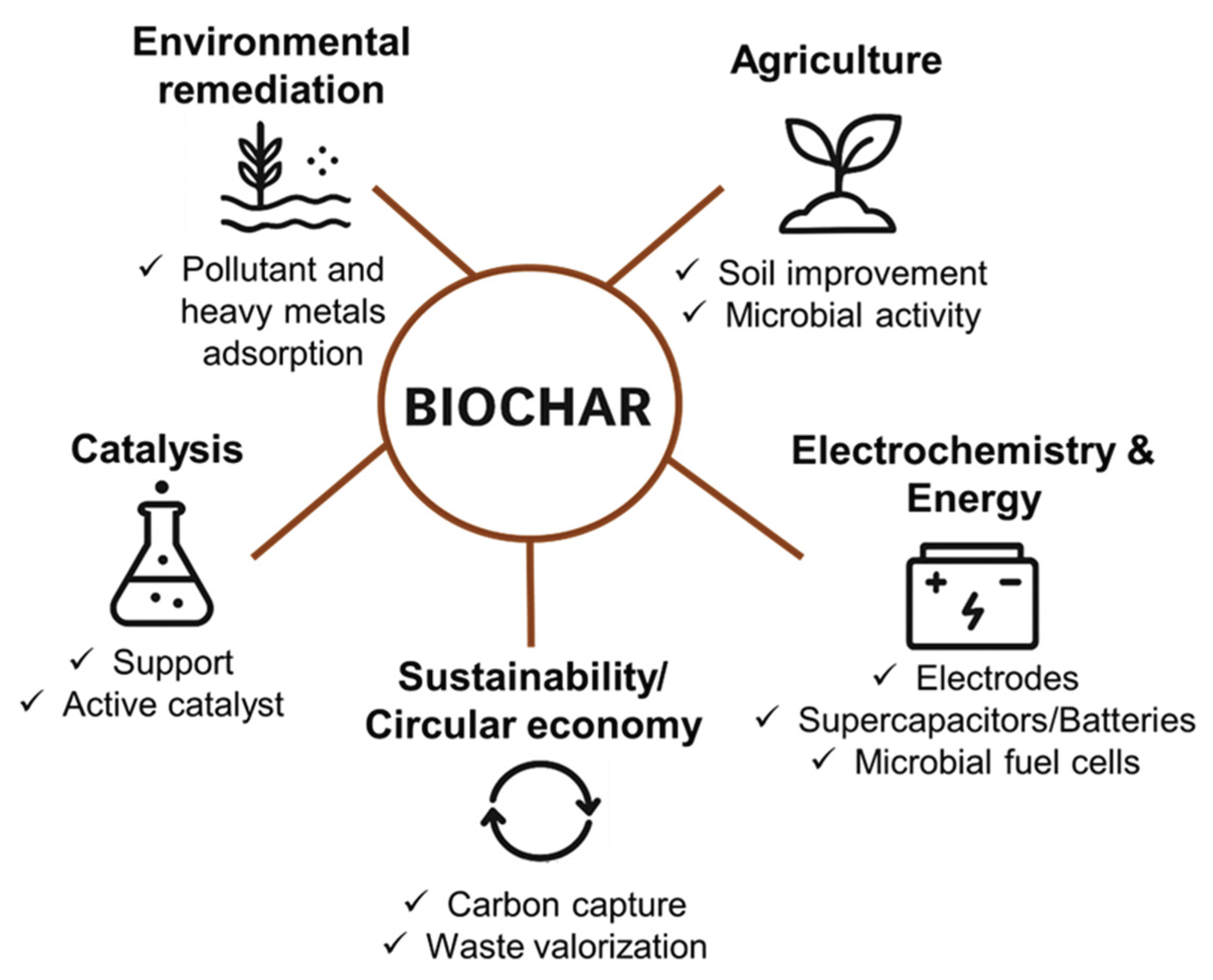
Figure 2.
N2 adsorption-desorption isotherms (a) and pore size distribution (b) for biochar samples.
Figure 2.
N2 adsorption-desorption isotherms (a) and pore size distribution (b) for biochar samples.
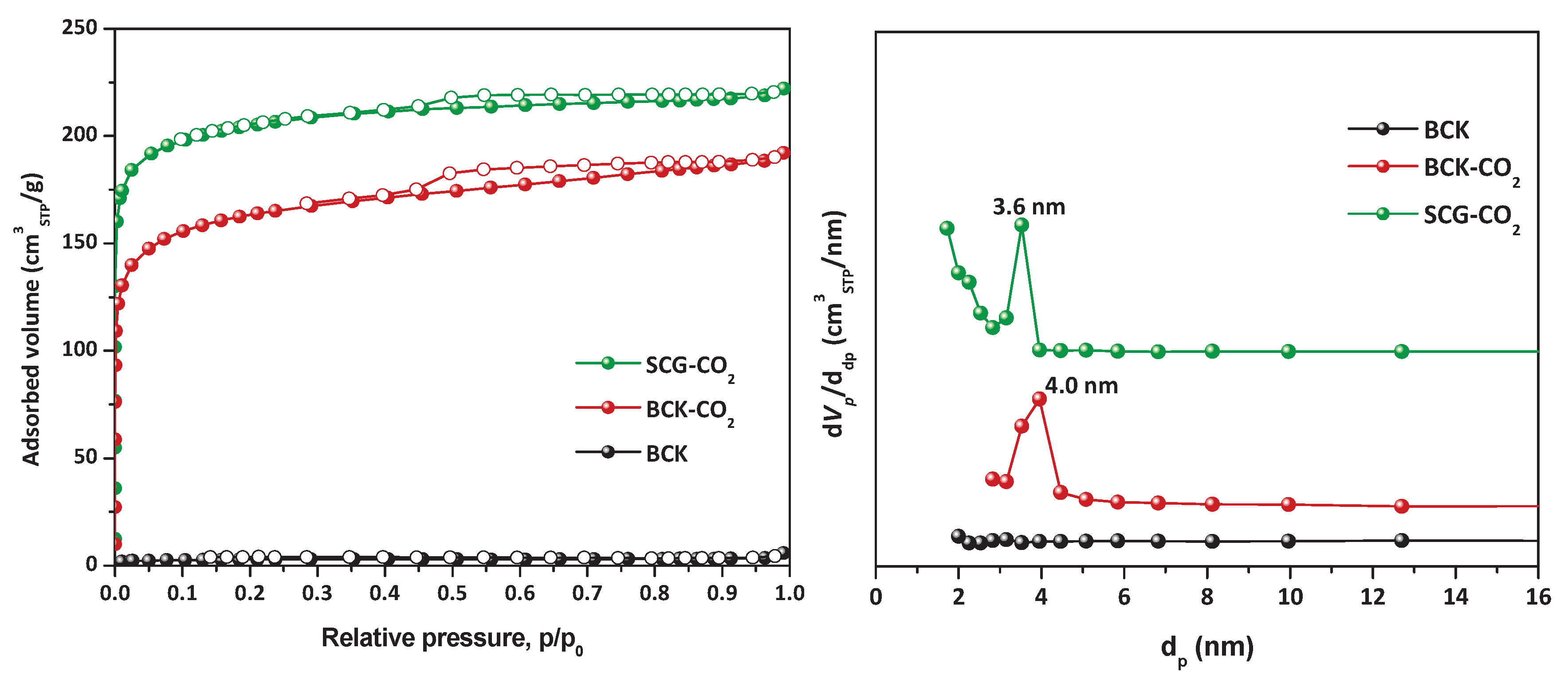
Figure 3.
FTIR spectra of biochar samples.
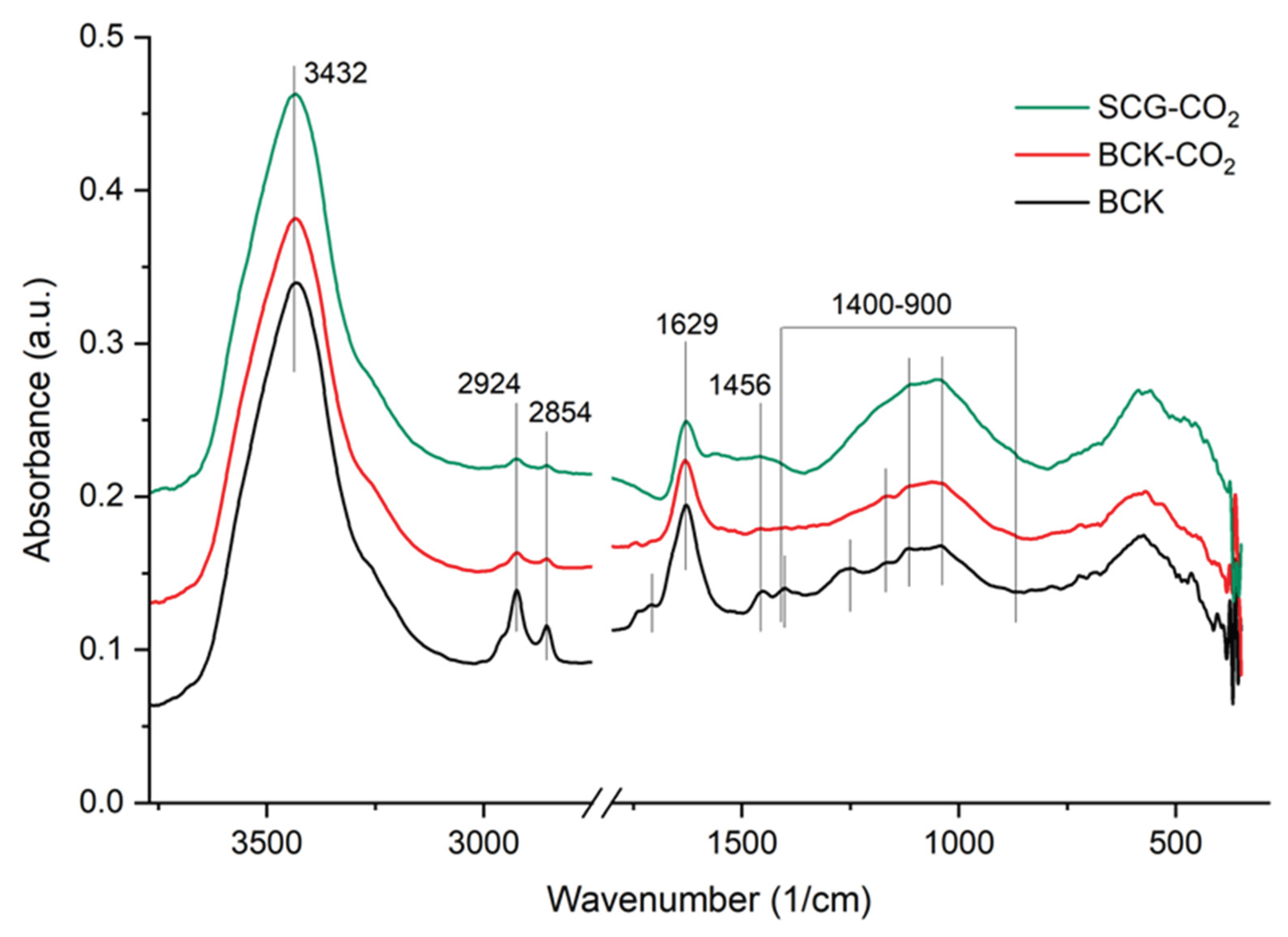
Figure 4.
SEM micrographs and corresponding EDX spectra.
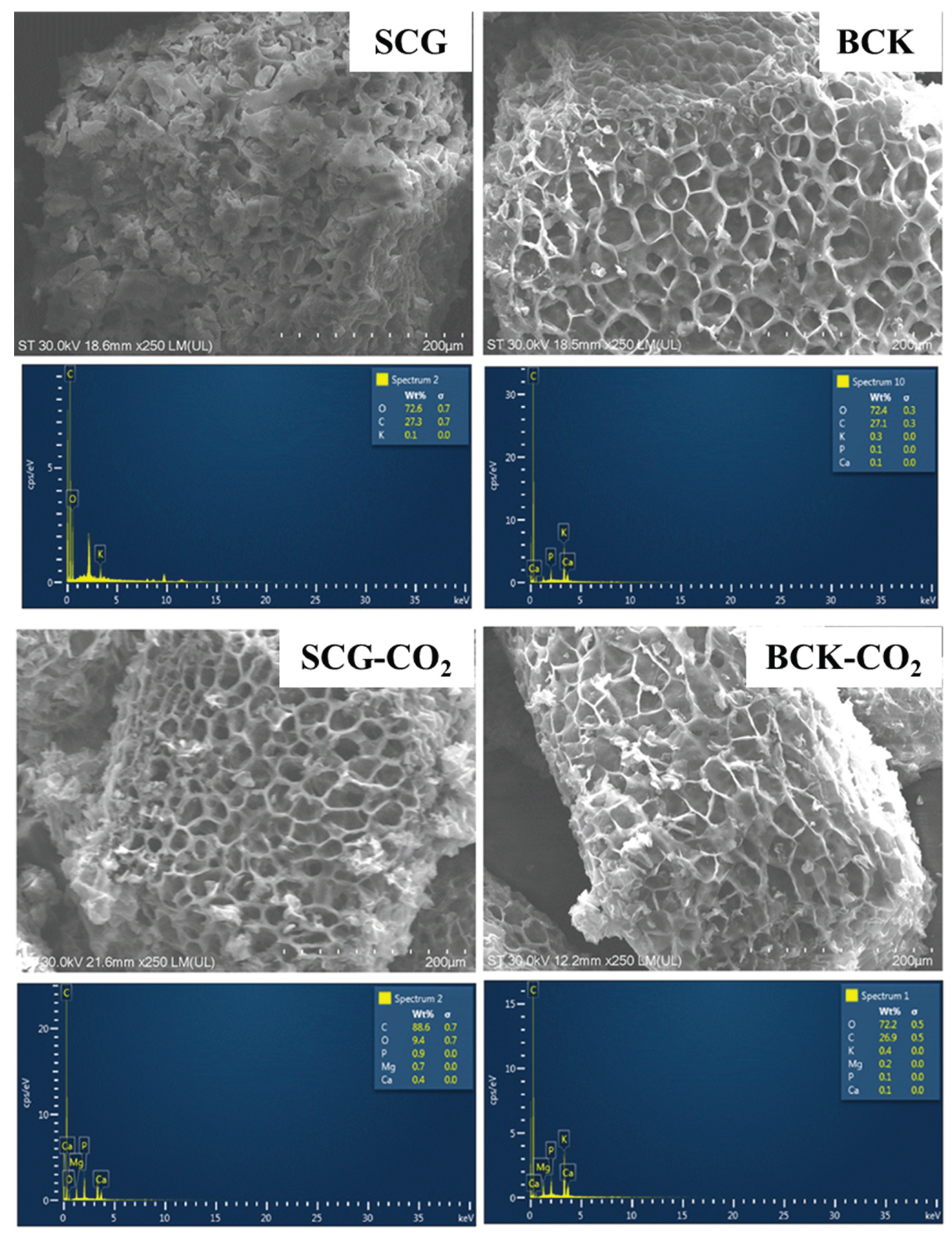
Figure 5.
X-ray diffraction (XRD) patterns of the biochar samples.
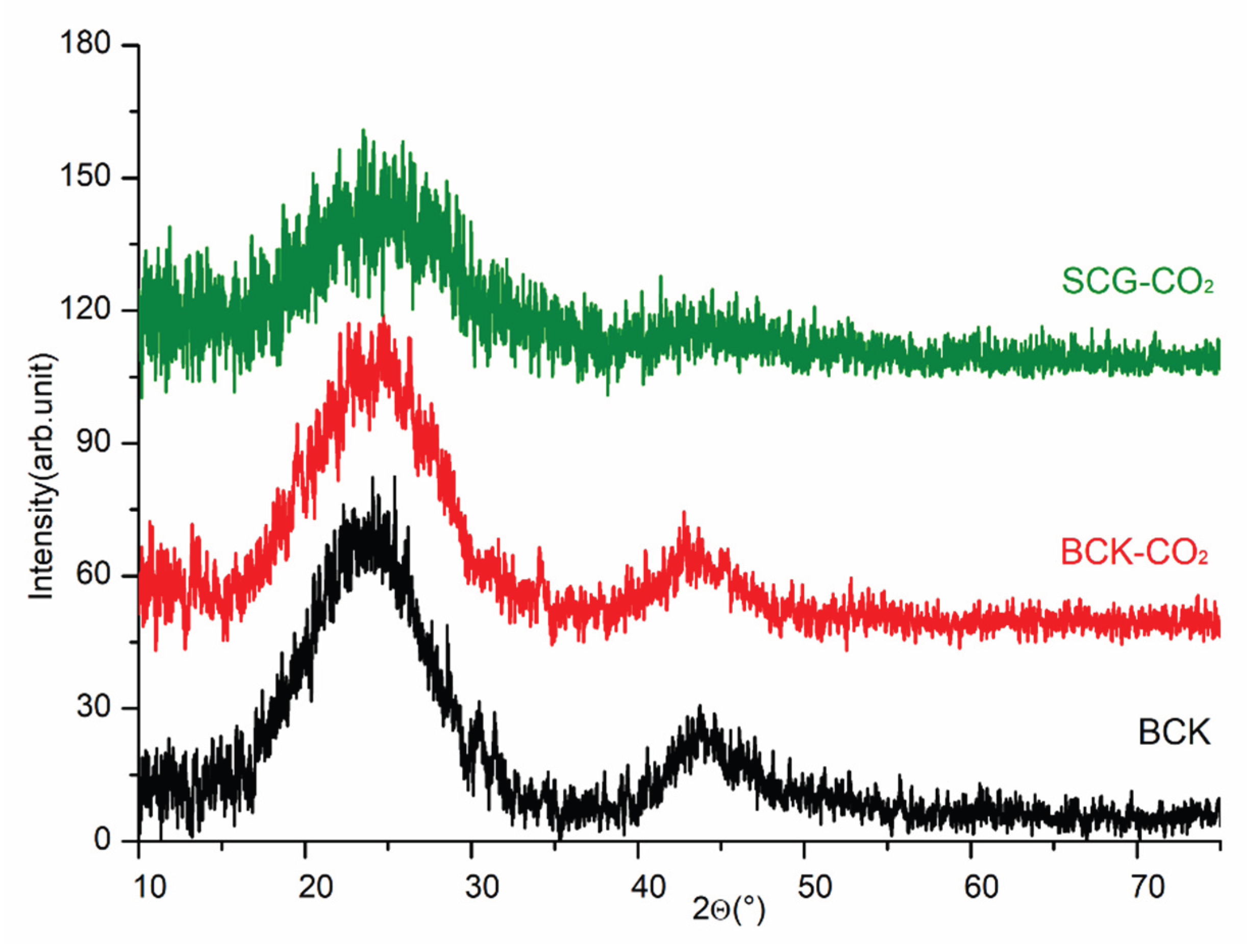

Table 1.
Proximate composition and surface characteristics of the biochar samples.
| Sample | Proximate composition | Textural characterisation | Surface acid-base properties | ||||||
|---|---|---|---|---|---|---|---|---|---|
| ASH (%) | VM (%) | FC (%) | TC | SBETa (m2/g) | Vpb (cm3/g) | dp (nm) |
Total acidity (mmol/g) | Total basicity (mmol/g) | |
| BCK | 7.7 | 11.9 | 80.4 | 0.87 | 9.75 | 0.005 | - | 4.6 | 2.2 |
| BCK-CO2 | 8.4 | 14.4 | 77.2 | 0.84 | 550.59 | 0.291 | 4 | 3.2 | 1.9 |
| SCG-CO2 | 9.6 | 17.3 | 73.1 | 0.80 | 671.04 | 0.331 | 3.6 | 3.2 | 1.9 |
Table 2.
Comparison between two-step pyrolysis - CO2 activation and one-step CO2 assisted pyrolysis.
Table 2.
Comparison between two-step pyrolysis - CO2 activation and one-step CO2 assisted pyrolysis.
| Parameter | Two-step pyrolysis - CO2 activation | One-step CO2 assisted pyrolysis |
|---|---|---|
| Process design | Pyrolysis under inert gas + separate CO2 activation | Integrated pyrolysis and activation under CO2 |
| Number of thermal stages | 2 | 1 |
| Energy demand | High (requires reheating) | Lower (single heating step) |
| CO2 utilization | Only during activation | During the entire thermal process |
| Time efficiency | Longer (two distinct stages) | Shorter (one-step process) |
| Environmental footprint | Higher (greater energy input) | Reduced (lower energy, CO2 valorization) |
| Textural properties | Relative high surface area | Superior |
Disclaimer/Publisher’s Note: The statements, opinions and data contained in all publications are solely those of the individual author(s) and contributor(s) and not of MDPI and/or the editor(s). MDPI and/or the editor(s) disclaim responsibility for any injury to people or property resulting from any ideas, methods, instructions or products referred to in the content. |
© 2025 by the authors. Licensee MDPI, Basel, Switzerland. This article is an open access article distributed under the terms and conditions of the Creative Commons Attribution (CC BY) license (http://creativecommons.org/licenses/by/4.0/).
Copyright: This open access article is published under a Creative Commons CC BY 4.0 license, which permit the free download, distribution, and reuse, provided that the author and preprint are cited in any reuse.


