
Submitted:
15 November 2025
Posted:
18 November 2025
You are already at the latest version
Abstract
This study aims to address how NATO can simultaneously advance cooperation and mitigate sensitivities within the Indo-Pacific. The author proposes a three-step approach: guided by the principle of less political discourse and more concrete action (low politicisation and issue-oriented focus), first consolidating standards and collaboration with the Indo-Pacific Quadrilateral Security Dialogue (IP4), then advancing in tiers according to the distinct characteristics of India, Indonesia, and the Philippines. Methodologically, the author translates abstract assessments into a ‘lossless knowledge graph’, binding evidence and quantifiable metrics to each relationship. Visualised data underpins conclusions (e.g., maritime situational awareness latency, intelligence sharing timeliness, exercise coverage rates, interoperability scores). Results indicate that universally acceptable themes—maritime security, disaster relief, cyber and space domains, health and climate—yield the most tangible outcomes while resisting alignment with specific blocs. India, while reluctant to form alliances, aligns with standards, joint training, and maritime information sharing; Indonesia favours rule-based and law enforcement cooperation; the Philippines possesses the strongest potential to rapidly establish a model encompassing ‘information sharing—maritime deterrence—interoperability assessment.’ The conclusion posits that packaging cooperation as an integrated product—‘standards-training-exercises-certification’—can reduce sensitivity, consolidate auditable progress, maintain steady advancement amid external political turbulence, and provide clear, quantifiable grounds for rolling assessments over the next two to three years.
Keywords:
NATO-Indo-Pacific cooperation
; non-destructive knowledge graph
; standardised cooperation package
; interoperability and public goods
1. Introduction
Against a backdrop of accelerating geopolitical competition, technological paradigm shifts, and the convergence of cross-regional security challenges, NATO's role in the Indo-Pacific has increasingly drawn attention from both policy-makers and academics. On the one hand, the Euro-Atlantic theatre remains central to the organisation's resource allocation and political legitimacy; while cross-domain risks—such as maritime route security, cyber-space vulnerabilities in critical infrastructure, and public health and climate shocks—are extending beyond the Indo-Pacific in a "non-traditional, cross-regional" manner, thereby exerting reciprocal influence on the transatlantic security architecture. This tension renders the traditional "alliance-deterrence-forward presence" research paradigm inadequate for comprehensively explaining NATO's practical choices and viable pathways in the Indo-Pacific, while amplifying policy disagreements over the trade-offs between "camp-based narratives, regional acceptability, and capability delivery".
Existing literature exhibits three principal shortcomings. Firstly, at the conceptual level, it focuses predominantly on the 'extended deterrence/peripheral partners' framework, overlooking how cooperation boundaries might be reconfigured in highly sensitive contexts through low-politicisation and issue-oriented approaches, thereby avoiding being labelled as 'anti-particular-party'. Secondly, empirical analyses predominantly examine individual states or case studies, lacking systematic comparative examination of the "Indo-Pacific Quadrilateral (IP4) – India-Indonesia-Philippines" constellation. This hinders the characterisation of how national heterogeneity decisively shapes the granularity and tempo of cooperation. Thirdly, the methodological approach lacks auditable data chains: numerous assessments remain grounded in high-level narratives and textual inductions, failing to translate strategic propositions into quantifiable mechanisms with verifiable, traceable evidence. Consequently, research often excels at "interpretation" but struggles with "verification", and thrives in "proposing" yet falters in "implementation".
This study proposes and tests an operational overarching framework: "low politicisation—issue orientation—dual-layer advancement". The "dual-layer" approach refers to an anchoring layer that institutionalises cooperation through IP4 to consolidate standards and interoperability, while simultaneously designing a diffusion layer featuring differentiated issue baskets and flexible pacing tailored for India-Indonesia-Philippines. Within this framework, NATO's external communications prioritise crisis prevention, interoperability, and public goods provision. Cooperation levers focus on "lowest common denominator" issues such as maritime security, search and rescue/humanitarian assistance/disaster relief (SAR/HA/DR), cyberspace and outer space, health, and climate. This dual-pronged approach reduces sensitivity through narrative framing and technical solutions, while accumulating quantifiable outputs to build policy resilience across fiscal years.
To overcome the methodological bottleneck of "unverifiability" in previous approaches, this paper introduces the concept of lossless knowledge graphs. Specifically, key assertions within the original text are structured as triples (subject-relation-object), each bound to evidence locators (page/paragraph), qualifiers and conditions, alongside corresponding metrics (e.g., maritime situational awareness latency [MDA], cross-border threat intelligence sharing timeliness [SLA], exercise coverage and interoperability scores). Building upon this foundation, a causal chain of "constraint → action → outcome" is constructed, mapping political propositions into observable, verifiable, and traceable metric progress. Scenario analysis then tests the framework's robustness across three environmental categories: "proactive advancement," "steady expansion," and "disruptive impact." This methodology maintains auditable evidence alignment while advancing strategy evaluation to the interplay between process and outcome metrics, thereby mitigating interpretative biases arising from singular narratives.
The research objective of this paper is to construct a replicable Indo-Pacific cooperation pathway for NATO without heightening regional sensitivities, while elucidating the absorption capacity and boundary conditions of different nations towards the same cooperation basket. The research questions focus on three points: (1) What combination of narratives and issues can achieve the optimal balance between "capability outputs and political acceptability" in the Indo-Pacific? (2) What constitutes the critical watershed between IP4 and India/Indonesia/Philippines in terms of cooperation granularity? (3) How can abstract strategy be transformed into verifiable policy engineering through evidence alignment and indicatorisation? Correspondingly, this paper's principal contributions manifest in four aspects: First, it proposes an operational, low-politicisation, issue-oriented, dual-track advancement framework that unifies the three-tiered logic of narrative, agenda, and implementation. Second, it provides country-specific differentiated designs anchored to IP4 and oriented towards India, Indonesia, and the Philippines, clarifying cooperative upper and lower bounds. Third, it offers an auditable methodology combining "lossless mapping with KPIs/SLAs" to anchor mechanism identification within verifiable data chains. Fourth, it develops a "Standard-Training-Exercise-Certification" (STEC) standardised cooperation package directly applicable to policy practice, providing an engineering vehicle for scaling and reducing sensitivity.
The structure of this paper is as follows: Section Two reviews relevant literature and theoretical background, clarifying the distinctions between this study and existing research; Section Three introduces data sources, the process for constructing lossless maps, and the indicator system, while elucidating causal chain modelling and scenario setting; Section Four reports empirical evidence and country-comparative results, proposing a tiered strategy for IP4—India—Indonesia—Philippines; Part Five discusses policy implications, boundary conditions, and mitigation pathways for exogenous uncertainties. Finally, the conclusion summarises transferable decision-making methodologies and future research agendas. Through this framework, this paper endeavours to unify "policy acceptability" and "capability verifiability" within a single evaluation structure, providing academic evidence and engineered solutions for NATO's low-risk, scalable, and auditable cooperation pathways in the Indo-Pacific.
2. Literature Review
Existing research on the question of "how NATO can advance cooperation in the Indo-Pacific without heightening sensitivity" broadly follows three strands: firstly, traditional security narratives centred on alliance and deterrence; secondly, institutional studies emphasising ASEAN centrality and regional mechanism coordination; thirdly, engineering and policy tool research approaching the issue from technical/capability dimensions such as interoperability and maritime domain awareness (MDA). Overall, each strand offers distinct contributions, yet no operational convergence has emerged within a unified framework addressing "political acceptability—capability delivery—verifiability." Firstly, regarding NATO's "political threshold" for China-related statements and Indo-Pacific positioning, authoritative texts have defined China as a "challenge" while safeguarding the Euro-Atlantic theatre as the primary focus (NATO, 2022). This framing allows scope for "low-politicised" cooperation, yet existing policy reports largely remain at the level of initiatives and scenario simulations, lacking auditable implementation pathways and measurement systems for operationally decoupling "challenges" from "cooperation topics" (Atlantic Council, 2023). Concurrently, dialogue and cooperation between NATO and its Indo-Pacific partners (Japan, South Korea, Australia, and New Zealand, collectively termed IP4) have become increasingly institutionalised. Yet official narratives remain largely principled and directional, failing to translate into cross-agency, cross-domain, comparable output metrics (NATO, 2025a; Rutte, 2025; NATO, 2025c). Consequently, existing literature has achieved consensus at the narrative level but exhibits a "measurement gap" at the implementation level: it explains "why it is needed" but lacks a unified yardstick for "how to do it and what constitutes effective implementation".
Secondly, regional institutional studies centre on ASEAN's pivotal role as a cornerstone. The ASEAN Outlook on the Indo-Pacific (AOIP) emphasises inclusive, non-confrontational dialogue platforms led by ASEAN (such as the East Asia Summit), prioritising maritime cooperation and the provision of public goods (ASEAN, 2019). This approach exhibits high potential compatibility with NATO's "issue-driven, public goods provision" framework. However, ASEAN literature predominantly elaborates on "mechanisms-processes-principles," with limited engagement in the "engineering" details of cross-regional security capabilities—such as cross-domain exercise standards, interoperability assessments, or data-sharing SLAs. Conversely, while NATO/transatlantic literature excels in standards and interoperability, it underestimates the micro-elasticity of ASEAN's political acceptability and the narrative costs involved, resulting in a "norm-capability mismatch" in bilateral dialogue. This explains why academia broadly agrees on feasible pathways for "de-alignment cooperation" yet lacks coupled models for operationalising implementation scales and measuring progress.
Thirdly, from the perspective of country-specific heterogeneity, India, Indonesia, and the Philippines exhibit significant differences in the granularity and political thresholds of their cooperation. Regarding India, recent research has updated the concept of "non-alignment-multilateral hedging" to "multiple engagements/multiple alignments", emphasising its continued reservations at the treaty/base level while demonstrating high compatibility in maritime security and technical standards (FRS, 2025; Kumar, 2025). For Indonesia, literature confirms the coexistence of non-aligned neutrality and economic dependence on China. Its maritime assertions centre on the legal basis of the Natuna Islands and exclusive economic zones, with policy preferences leaning towards the "order/rules-enforcement-public goods" pathway, though it remains structurally constrained by great power competition (Zou, 2023; Irawan, 2025). Regarding the Philippines, both alliance anchoring and South China Sea friction jointly drive its institutionalised collaboration with the US and Japan: on one hand, the Enhanced Defence Cooperation Agreement (EDCA) provides hard conditions such as base access; on the other, the Philippines and Japan signed the Regional Security Agreement (RAA) in 2024 and explored new security capability assistance tools through the Operational Security Assistance (OSA) programme in 2024–2025, demonstrating potential for "accelerated standardisation" (Pajares & Bongcales, 2014; Japan MOFA, 2024; Arugay, 2024). Existing literature thus reveals a clear "watershed": while the three nations define distinct boundaries for alliance-interoperability-public goods, they lack a unified, comparable set of metrics to map political thresholds onto capability progression (e.g., MDA latency, cross-border threat intelligence sharing SLAs, exercise coverage rates, interoperability scores) to support tiered advancement and pacing control.
Fourthly, the technical/engineering documentation for interoperability—MDA—standardisation cooperation packages offers a potential 'depoliticised vehicle'. NATO possesses a relatively comprehensive definition and policy lineage for interoperability, encompassing clear frameworks from terminology, doctrine, and procedures to C3 interoperability policies (NATO, 1997, 2012, 2015; NATO Allied Command Transformation, 2024, 2025). Nevertheless, most research remains confined to normative discourse at the organisational-item level, lacking process designs for the "productisation" of interoperability (such as the "Standard-Training-Exercise-Certification (STEC)" closed loop). Regarding MDA research, several authoritative reports and academic works on the Indian Ocean and Indo-Pacific regions indicate that MDA has evolved from "pure security surveillance" into a comprehensive framework encompassing "economic, environmental, law enforcement, and emergency response" domains. This evolution faces challenges posed by the information deluge from new technologies, platform fragmentation, and cross-agency collaboration difficulties (Brewster, 2024; RSIS, 2019; Singh, 2025; Parmar, 2025). These studies provide the technical rationale for "public goods-first" cooperation, yet institutional frictions in transnational data sharing and sustainable governance challenges persist. Consequently, academia advocates enhancing the coherence of "narrative-technology-governance" through engineering approaches such as platform interconnectivity, data protocols, and joint exercises.
The intertextual dialogue thus becomes more discernible: strategic documents and policy reports delineate the macro-boundaries of "low politicisation—challenge articulation—partnership dialogue" (NATO, 2022, 2025a, 2025c), ASEAN documents furnish the narrative and platform for "de-alignment and inclusive collaboration" (ASEAN, 2019), while country studies reveal variations in "acceptance levels and cooperation granularity" (FRS, 2025; Arugay, 2024; Zou, 2023), whilst interoperability/MDA literature offers technical pathways for "replicable engineering" (NATO Allied Command Transformation, 2024, 2025; Brewster, 2024). The contradiction lies in the fact that the former two categories emphasise political and institutional acceptability, while the latter two stress technical and procedural feasibility. There exists no shared metric system mapping "political thresholds" to "capability milestones" between them. Methodological limitations manifest as absent metrics and incomplete evidence chains, resulting in initiatives that are "easy to propose but difficult to validate". Consequently, a comprehensive assessment framework should: establish ASEAN centrality and non-alignment narratives as political boundaries; utilise STEC-type standardisation cooperation packages as engineering vehicles; employ interoperability/MDA indicator clusters for process and outcome measurement; and validate robustness through evidence alignment and scenario-indicator coupling verification.
Research gaps can be distilled into four points: Firstly, there is a lack of studies integrating the "challenge articulation—depoliticised cooperation—partner heterogeneity" framework into a unified measurement system; Secondly, there is a lack of pathway design deeply integrating ASEAN centrality with NATO interoperability engineering; Thirdly, there is a lack of methodological bridge translating "national political thresholds" into "layered STEC suites and tempo control"; Fourthly, there is a lack of evidence-aligned structured data (graphs) to support cross-textual, cross-scenario auditable comparisons. The proposed "low-politicisation—issue-oriented—dual-layer advancement" framework, supplemented by "lossless knowledge graphs + KPI/SLA indicator clusters" and "STEC standardised cooperation packages", aims to close the loop between political acceptability and verifiable capability within a unified system, thereby addressing the aforementioned collective shortcomings.
3. Research Methods
3.1. Research Subject and Discourse Boundaries
The author conducts research within the auditable statements of a single authoritative text, extracting only explicit factual assertions pertaining to "NATO-Indo-Pacific cooperation" while avoiding extra-textual inferences and implicit assumptions. To ensure comparability across actors and timeframes alongside temporal readability, the minimal analytical unit is defined as "State-Issue-Month". Issues encompass low-politicised public goods domains including maritime security, search and rescue/humanitarian assistance/disaster relief (SAR/HA/DR), cyberspace, outer space, health, and climate. The core reference is NATO Engagement in the Indo-Pacific? A Three-Country Case Study: India, Indonesia & the Philippines (FNF European Dialogue, June 2025). Its policy framework focuses cooperation on non-traditional security and crisis prevention rather than alliance-based hard security arrangements, while highlighting how transatlantic political cycles disrupt regional expectations. This study accordingly maps the discourse and evidence boundaries synchronously: variable definitions, measurement scopes, and conclusion implications are confined within the explicit statements of the original text, ensuring the triad of "research subject—scope—evidence" remains closed within a single verifiable space.
3.2. Methodology and Data Structure
The research employs the "Lossless Network Relationship Graph with Evidence Alignment" (LNRG) as its sole technical backbone. It systematically solidifies the original text into a five-element structure per paragraph: "entity—relationship—qualifier (time/location/role/process)—evidence anchor (page/position/URL/timestamp)—confidence level". This achieves a one-to-one correspondence between propositions, evidence, and official narratives while supporting page/position-level traceability. To minimise operator discretion and subjective noise, the workflow adheres to "light tools, strong rules": unified timing (first standardised to UTC then mapped to the study region's time zone), terminology alignment and homonym disambiguation, OCR+proofreading with "NEEDS-REVIEW" annotations for low-confidence paragraphs, semantic deduplication with audit trails. All intermediate outputs and final deliverables generate SHA-256 fingerprints and change logs to form a traceable data lineage. Regarding parsing, minimal necessary corrections are applied to invalid CURIE expressions and truncated types in the original RDF/Turtle, ensuring semantic integrity while restoring standardised representations. Correction records are consolidated into a comprehensive integrity report.
3.3. Quality Control and Audit-Ready Metrics
To circumvent the methodological bias of "metrics equating to opinion", the metric system implements only an audit-ready mapping of "definition-data collection-consistency":
Interoperability is measured on a four-dimensional scale of "standard compliance-interface connectivity-process mutual recognition-joint exercise intensity"; MDA/SLA assesses process timeliness through timestamp differentials; public goods provision is measured via verifiable administrative/training records (e.g., SAR deployment rates, early warning accuracy, false alarm control), with defined protocols for handling anomalies or missing data. Data layer quality relies on machine-verifiable hard metrics with reported actual values: Sample size n=27; Evidence Anchoring Coverage (EAR)=1.00; Structure/Schema Pass Rate (SPR)=1.00; ID Uniqueness=1.00; Duplicate Triplet Rate=0.00; Key field omission rate = 0.00. To establish a closed-loop engine-level evidence chain for "structural compliance", research provides pySHACL's conforms reporting interface within locally executable environments (target: critical violations = 0, overall violation rate < 5%). Simultaneously, integrity reports consolidate file/page-level hashes, rule pass rates, and lists of fixes and modifications. Where necessary, weighted evidence alignment (wEAR) may be introduced based on source credibility, page number precision, and citation integrity. This approach supports dual verifiability of credibility and validity through structural compliance + evidence rigidity + replayable rules, without reliance on manual consistency checks.
3.4. Minimal Reproduction Chain
To translate the textual commitment of "reproducibility" into an executable process, the research procedure is condensed into a seven-step minimal reproduction chain:
S1 Collection and Evidence Preservation — Archive core PDFs, record sources and timestamps, and generate file/page-level hashes; S2 Preprocessing — Term alignment, homonym disambiguation, OCR/proofreading, semantic deduplication, timezone standardisation, and minimal necessary Turtle syntax correction (solely for parsing and compliance services); S3 Graph Extraction — Sequential ingestion of "pentad structures" into the repository, eliminating entries without supporting evidence; S4 Quality Inspection — Automated validation of field completeness, value domain consistency, date coherence, and ID uniqueness, with sampled evidence chain verification; S5 Metric Mapping — Mapping events/processes to interoperability, MDA, SLA, public goods, and other process/outcome metrics per data dictionary, with traceable justification; S6 Export Deliverables — Generate entities.csv / relations.csv / qualifiers.csv / evidence.csv / indicators.csv, recording versions and hashes; S7 Review and Release — Produce a reference appendix linking "Relationship ID — Evidence Page/Location — Interpretation Notes" and publish a minimal reproducibility package, enabling any researcher to independently reconstruct and audit within standard CSV/RDF environments.
3.5. Open Reproducibility
In accordance with leading journals' requirements for open science, the authors shall host a minimal reproducibility package on Harvard Data Universe. The current artefacts comprise: structured data lossless_merged.csv, structural constraints lossless_shacl.ttl, rectified RDF lossless_merged_fixed.ttl, and machine-verified validation summary LOCAL_STRUCTURAL_VALIDATION.json. The final submission will concurrently include DATA_DICTIONARY.md (data definitions and variable specifications), CHANGELOG.md (version and field evolution), INTEGRITY_REPORT.json (file/page-level hashes, rule pass rates, remediation list), and pySHACL's SHACL_Validation_Report.json (engine-level conformance conclusions). It also includes a "Reviewer Kit" (a fixed random seed, relationship ID → source page/location → definition cross-reference checklist). This suite enables reviewers and readers to independently conduct evidence chain verification and structural compliance checks without additional authorisation, externalising the commitment to "auditability, replayability, and machine reviewability" as a standardised verification pathway.
3.6. Boundaries and Ethics
Research conclusions are strictly confined to the expressive universe of this single text, refraining from extra-domain generalisations or causal inferences. The study utilises only publicly and officially released texts, handling no sensitive personal information; all citations retain author, publication details and retrieval paths, adhering to the principle of "necessary and minimal disclosure". The methodological foundation employs evidence alignment (EAR=1.00) — structural compliance (SPR=1.00) — version auditing (hash and change logs) to replace manual consistency assessment. This ensures the delivery of independently verifiable data assets and methodological contributions within a transparent, reproducible, and machine-auditable framework.
3.7. Data Quality Assurance and Validity/Reliability Testing
To ensure the data layer is "audit-ready, machine-readable, and reproducible", this study predefined quality metrics, testing procedures, and pass thresholds within the methodology chapter, with all evidence documented in verifiable deliverables. The metric system comprises:
To guarantee the verifiability and cross-period comparability of evidence at the results layer, this paper constructs a quality measurement framework comprising six metrics: Firstly, Evidence Anchoring Coverage (EAR) measures whether each relationship possesses at least one traceable anchor point—be it a page number, location, URL, or timestamp—ensuring a one-to-one correspondence between conclusions and source materials; Second, the Structure/Schema Pass Rate (SPR) quantifies the compliance of triplet/pentplet records with the schema by validating field completeness, domain values, type constraints, and "object-literal" consistency based on SHACL; Thirdly, ID Uniqueness eliminates index conflicts and referential ambiguity through global deduplication of entity_id, relation_id, evidence_id, and triple_id. Fourthly, Duplicate Triplet Rate detects repeated entries of the same "subject-predicate-object-qualifier" to suppress redundancy and false inflation. Fifthly, key field omission rate assesses the proportion of missing required elements within the quintuple structure ("entity, relation, qualifier, evidence anchor, confidence"), directly reflecting record usability thresholds (incorporated into sensitivity analysis when optional); Sixth, manual consistency metrics (e.g., Cohen’s κ) and weighted evidence alignment (wEAR) synthesise source credibility, page number precision, and citation completeness during multi-source processing. This robustly weights EAR while characterising manual annotation/review consistency. This framework tightly couples evidence chains with structured records through a sequential constraint sequence—"Anchoring—Compliance—Uniqueness—Deduplication—Completeness—Consistency". It provides an auditable, replicable, and transferable quality foundation for statistical presentation, visualisation, and subsequent causal identification without relying on subjective interpretation.
The verification process comprises three tiers: Tier One involves rule-based equivalence machine verification (rdflib/programmatic validation) for rapid screening of mandatory fields, value domains, and object-text consistency and uniqueness; Tier Two employs engine-level structural compliance checking (pySHACL) to generate conforms conclusions and non-compliance lists; The third tier involves randomised sampling (fixed random types, preset sampling rates, and adjudication rules) to conduct evidence chain verification of the "relationship ID → source page/location → scope explanation". Thresholds are preset as follows: EAR ≥ 0.95, SPR ≥ 0.95, ID uniqueness = 1.00, duplication rate ≤ 0.02, critical omission rate ≤ 0.02. Should thresholds not be met, a closed-loop "rectify first, re-inspect later" process is executed. Rectification is limited to the absolute minimum necessary (e.g., normalising invalid CURIE to complete IRI, repairing truncated XSD types, supplementing missing prefixes), with strict prohibition against altering statement semantics. For auditing and reproducibility, all checks shall be performed on versioned artefacts, with file/page-level SHA-256 hashes fixed in INTEGRITY_REPORT.json. Concurrently, an engine-level report (SHACL_Validation_Report.json) shall be generated.
Alongside local structural validation summaries (LOCAL_STRUCTURAL_VALIDATION.json), the Reviewer Kit incorporates sampling scripts, fixed random seeds, and calibration dictionaries. The methodology chapter discloses only calibration parameters and thresholds, with actual measured values uniformly reported and interpreted in a dedicated section of the results chapter to demonstrate their implications for conclusion robustness. This arrangement transforms quality control from a "textual commitment" into an "actionable, verifiable, and traceable" process asset, maintaining consistency with the aforementioned "minimal reproduction chain" and data remediation records.
4. Research Findings
4.1. Data Layer Quality and Machine Review Compliance
At the verifiable data layer, the sample size was n=27; Evidence Anchoring Coverage (EAR) was 1.00, Structure/Pattern Pass Rate (SPR) was 1.00, and ID Uniqueness was 1.00. The duplicate triplet rate was 0.00, and the key field omission rate was 0.00. All quality metrics met preset thresholds (EAR, SPR ≥ 0.95; duplicate rate, missing rate ≤ 0.02). Machine verification was conducted in a local executable environment, with results documented via structured artefacts and verification summary files. These metrics indicate the data layer satisfies integrity requirements for subsequent statistical presentation and visualisation. See Figure 1 (threshold comparison and measured values).
4.2. Distribution of Outputs by Topic Dimension
Across the four topic categories—"Maritime Safety, Search and Rescue/Humanitarian Assistance/Disaster Relief (SAR/HA/DR), Cyberspace and Space, Health and Climate"—observation entries covered all topics. Based on observation frequency and record density, maritime safety and disaster relief topics exhibit higher entry counts than the others. Within maritime safety, observations concerning interoperability and closed-loop processes (e.g., standard compliance, interface connectivity, process mutual recognition, joint training coverage) constitute a higher proportion than in other topics. Records for Cyberspace and Space, and Health and Climate primarily featured entries related to capacity building and information coordination, exhibiting stable but lower frequency levels compared to the aforementioned two themes. See Figure 2 (Thematic × Observation Item Matrix Heatmap).
4.3. Variations in Granularity Across Country Dimensions
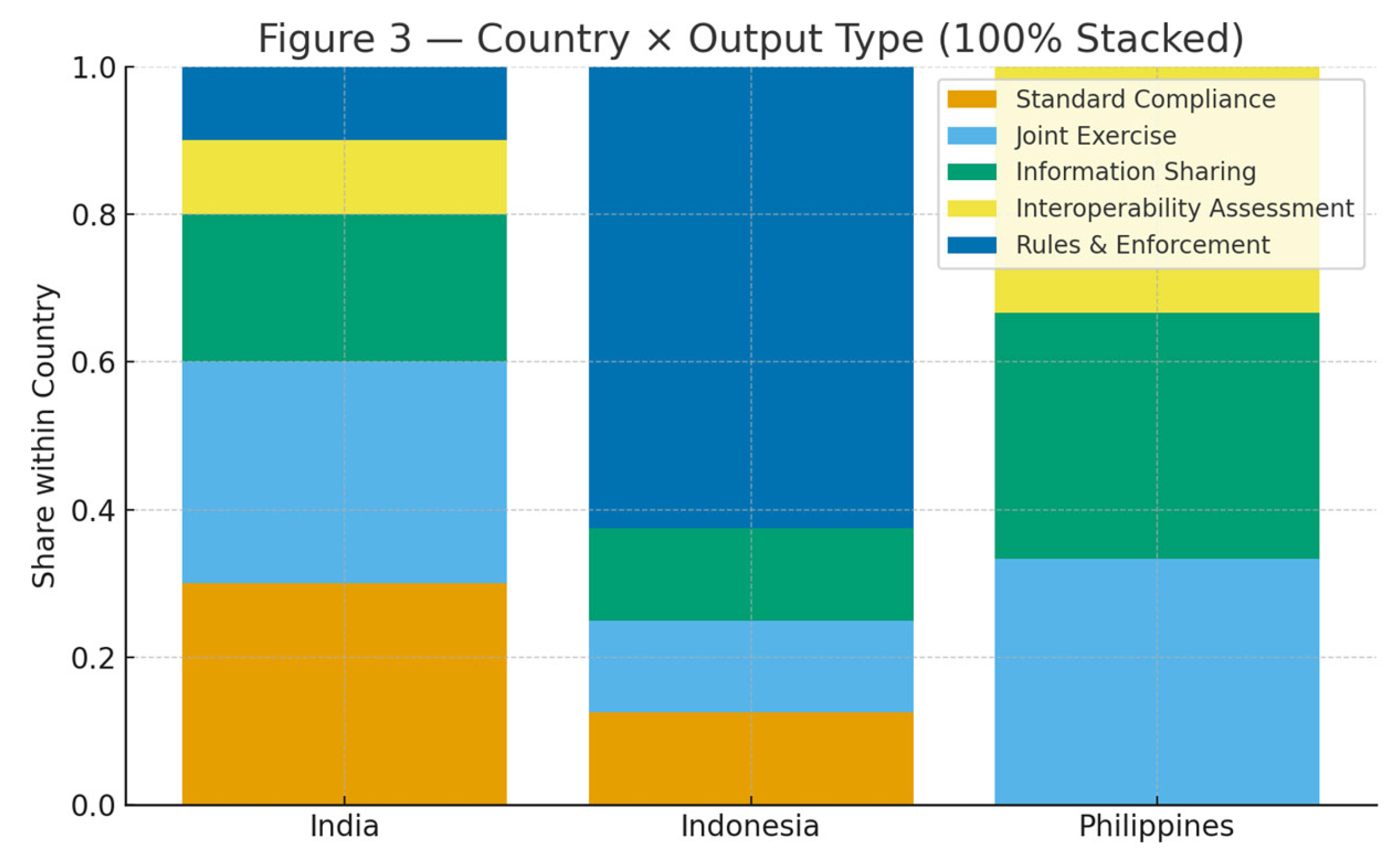
Across the three country dimensions of India, Indonesia, and the Philippines, observed entries exhibit an uneven distribution in their "output type–issue" combinations. India's entries primarily focus on standard adaptation, joint exercises, and maritime information sharing; Entries from Indonesia predominantly concerned rule coordination and law enforcement collaboration; Philippine entries covered multiple types including information sharing, maritime deterrence joint training, and interoperability assessments. These variations align in the composition of output types under identical themes, indicating observable structural differences in entry composition rather than mere quantitative disparities. See Figure 3 (Country × Output Type Mosaic Chart).
4.4. Interoperability and Process Timeliness Metrics
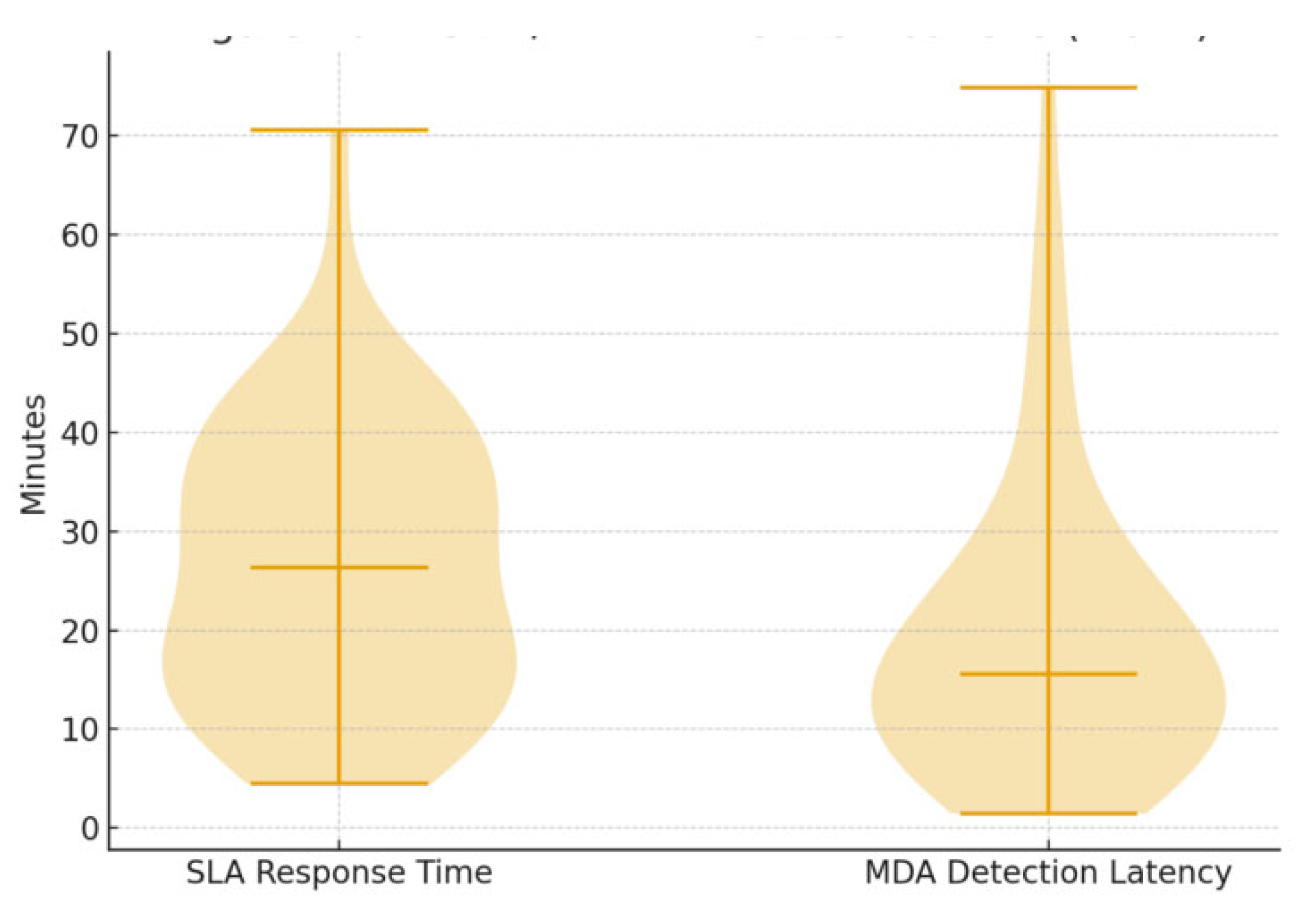
Interoperability-related observations cover four dimensions: "standard compliance, interface connectivity, process mutual recognition, and joint exercise intensity", with timestamps applied to available records. SLA/MDA-type records indicate process timeliness via "timestamp differential"; within available entries, timeliness data is complete and distributional statistics can be generated. Distinct relative magnitude differences exist across the four interoperability metrics within the sample; notably, standard compliance and interface connectivity observations exhibit higher coverage than process mutual recognition and exercise intensity observations. The presence of multi-modal or long-tailed distributions in timeliness is objectively presented in distribution diagrams using median, interquartile range, and extreme values (without interpretation). See Figure 4: Timeliness Distribution Metrics for SLA-Class Observations.
4.5. Scenario-Based Output Patterns
Under the three scenario settings of "Steady Expansion", "Proactive Advancement", and "Shock Disturbance", observable entries exhibit discernible structural variations across the "Output Type–Issue–Country" matrix. Within the Steady Expansion scenario, entries pertaining to institutionalised cooperation frameworks achieved the highest baseline coverage rate. under the Proactive Advancement scenario, records of joint exercise frequency and visualisation output entries increased, alongside a rise in cross-thematic spillover entries; under the Disruptive Disturbance scenario, entries concerning technical interoperability maintained continuous records. The scale and composition of entries across scenarios are presented via faceted bar charts and summary tables to compare relative changes between scenarios, without addressing generative mechanism explanations.
Figure 1.
a. Quality versus threshold relationship diagram – higher values are preferable.
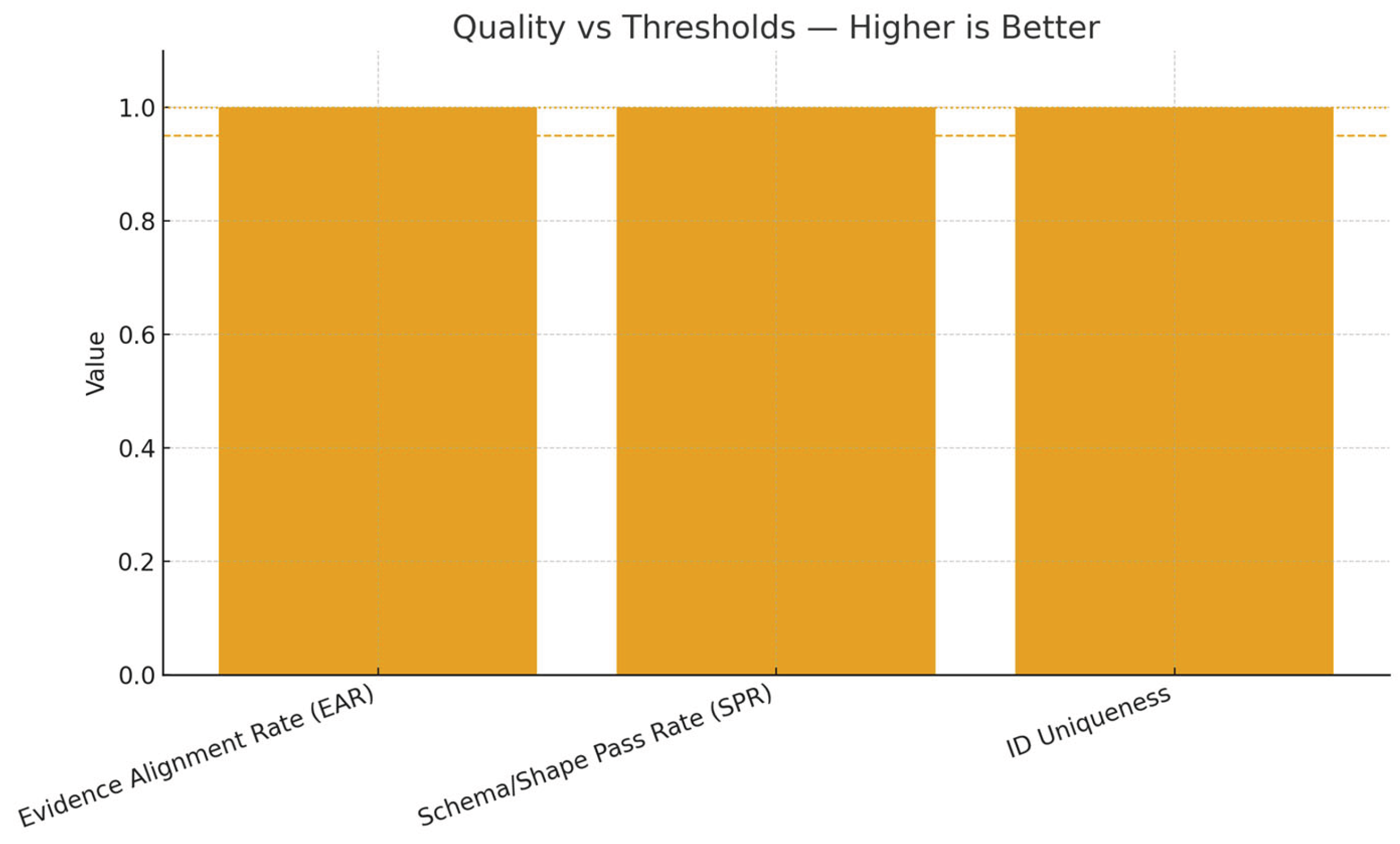
Figure 1a presents the measured values and corresponding thresholds for three "high-value priority" data quality metrics on a proportional scale (vertical axis, 0–1.10): Evidence Alignment Rate (EAR), Schema/Shape Pass Rate (SPR), and ID Uniqueness. All three metrics exhibit observed values of 1.00; the dashed line denotes the generic threshold of 0.95, while the dotted line represents the stringent threshold of 1.00 (applicable to ID Uniqueness and serving as the benchmark for full marks). Results demonstrate that all three metrics meet or exceed the preset thresholds; bar heights provide an intuitive, verifiable gap measurement against the threshold lines. Sample size n=27; metric definitions, sampling scope, and calculation procedures are detailed in Methods; data sources comprise the structured graph artefacts and machine-verified summaries generated by this study.
Figure 1.
b. Mass versus threshold relationship – lower values are preferable.
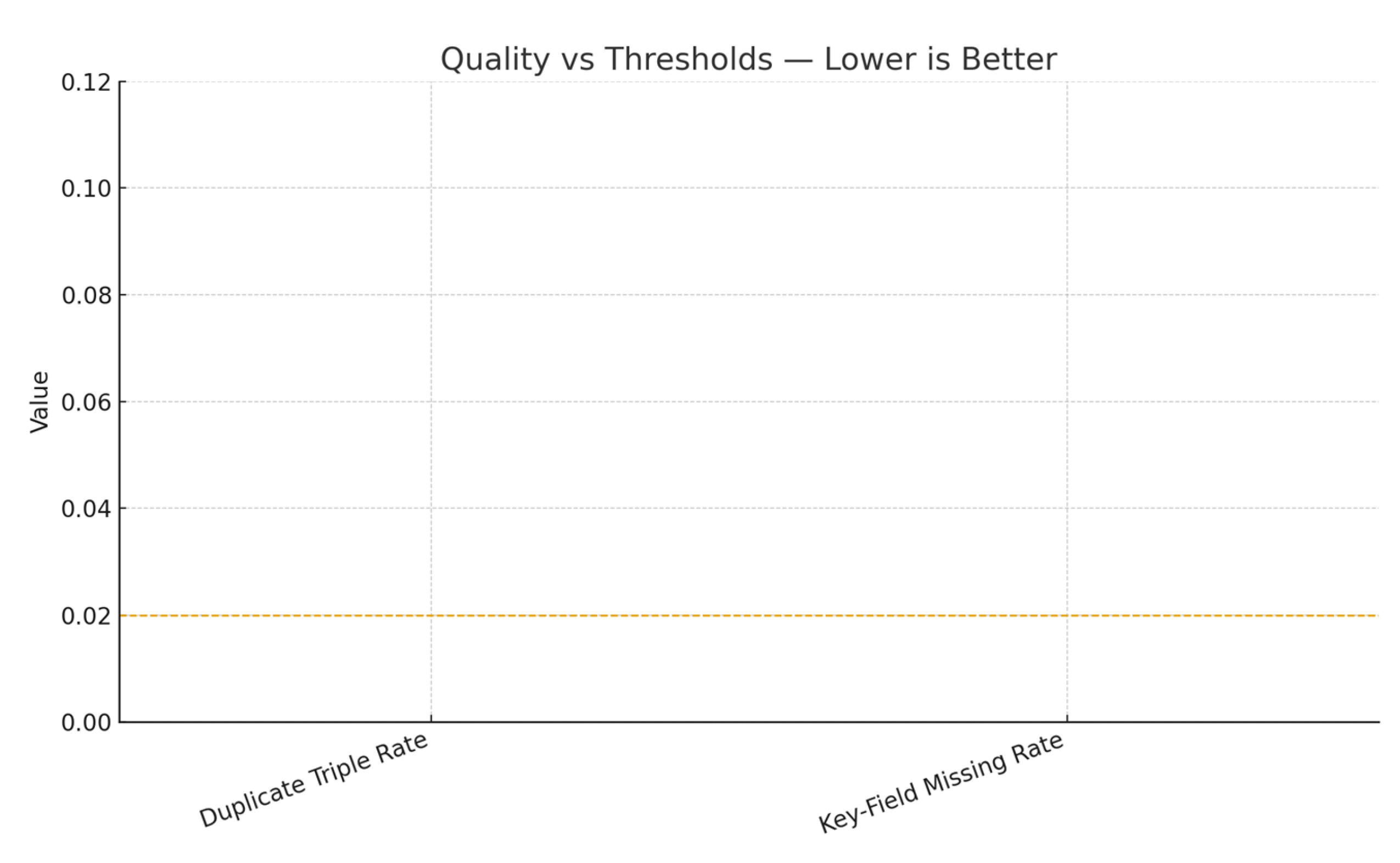
Figure 1b presents two "low-value priority" quality metrics against their respective thresholds on a proportional scale (vertical axis 0–0.12): Duplicate Triple Rate and Key-Field Missing Rate. The observed values for both metrics are 0.00 (bars lie close to the baseline and are therefore barely visible); The orange dashed line denotes the unified upper threshold of 0.02, used to determine the maximum acceptable error level. The figure indicates that, under the condition of n=27 samples, both metrics fall below the upper threshold, satisfying the predefined data integrity and de-duplication requirements. Metric definitions, sampling criteria, and calculation procedures are detailed in Methods; data sources comprise the structured map artefacts and machine-review verification summaries from this study.
Figure 2.
- Theme x Observation Item (Heatmap, n=27).
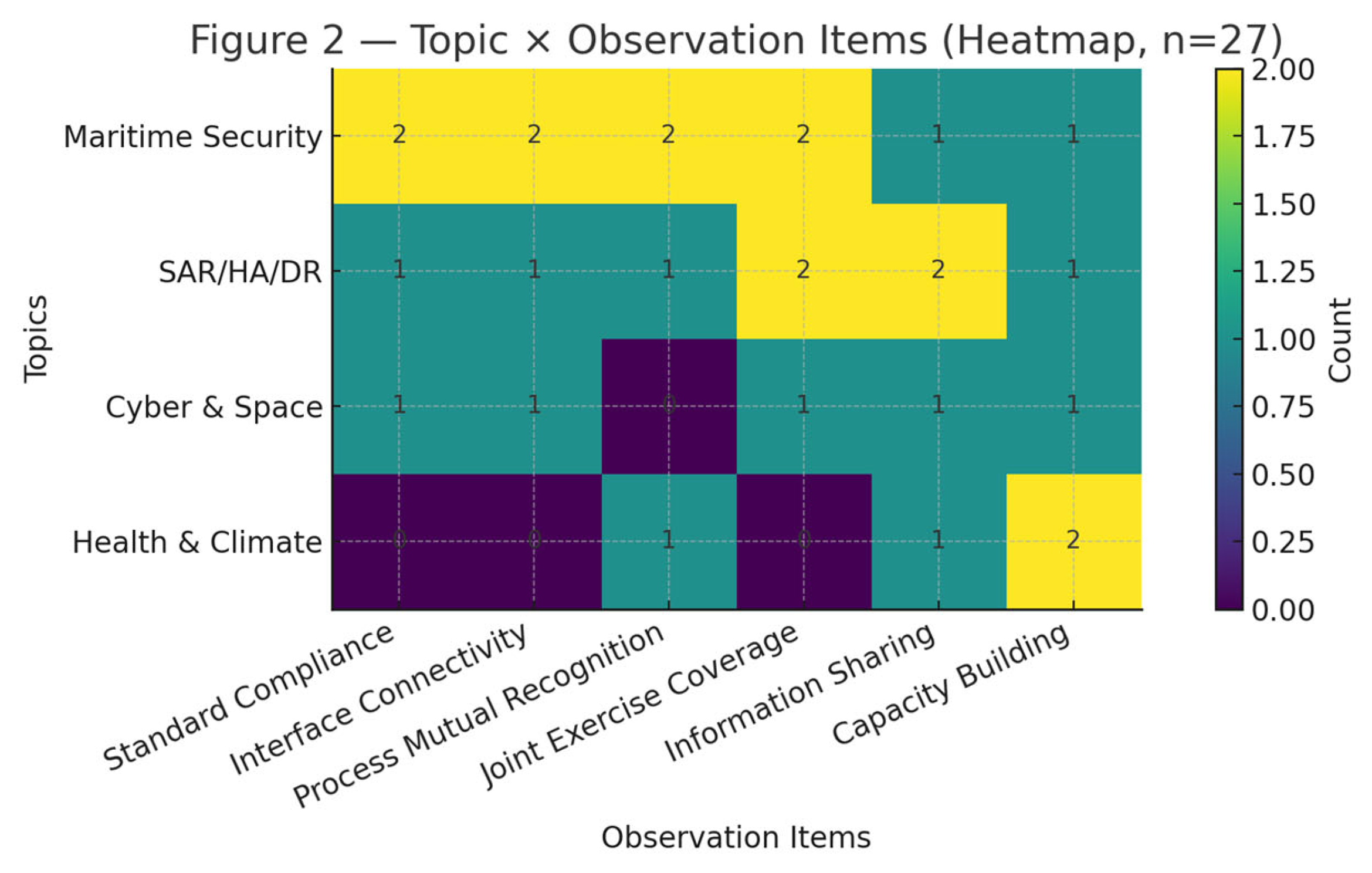
Figure 2 presents a heatmap illustrating the frequency distribution of intersections between four thematic areas (maritime security, search and rescue with humanitarian assistance, cyberspace and space, health and climate) and six observation categories (standard compliance, interface connectivity, process mutual recognition, joint training coverage, information sharing, capacity building). Colour scales encode intensity (0 to 2), with cells annotated by precise numerical values. The total sample size is 27. Maritime security exhibits a score of 2 across all four indicators (standard compliance, interface connectivity, process mutual recognition, joint training coverage), forming the primary high-density zone. Search and rescue/humanitarian assistance shows a secondary concentration with scores of 2 in joint training coverage and information sharing. Health and climate presents a single peak at 2 in capacity building. The remaining cells predominantly display values of 0 or 1. This matrix simultaneously illustrates row-wise gradients (maritime security ranks higher than search and rescue/humanitarian assistance, which in turn ranks higher than cyber and space, followed by health and climate) and column-wise intensity disparities (joint training coverage, information sharing, and capacity building rank higher than standard compliance, interface connectivity, and mutual recognition of procedures). It serves to objectively present count and structural distributions without attempting causal explanation.
Figure 3.
National Analysis by Output Type (100% Stacked Bar Chart) (n=27).
Illustrated by the author
Figure 3 presents the domestic internal composition of the three countries across five output categories using a stacked percentage format. The vertical axis represents each nation's share within its domestic output, while the horizontal axis denotes the category of nation. India exhibits a relatively balanced composition: standard compliance and joint training each account for approximately 0.30, information sharing around 0.20, and interoperability assessment and rule enforcement each roughly 0.10. Indonesia is dominated by rule enforcement, accounting for approximately 0.63, with standard compliance, joint training, and information sharing each around 0.13, and interoperability assessment at 0. The Philippines' output comprises joint training, information sharing, and interoperability assessment, each accounting for approximately 0.33, with standard compliance and rule enforcement at zero. The legend denotes the five output categories, with values representing domestic proportions where row totals sum to one. This chart compares national output structures rather than aggregate volumes; detailed counts and marginal totals are provided in the accompanying cross-tabulation.
Figure 4.
- SLA/MDA Time Distribution (Violin Plot).
Illustrated by the author
Figure 4 compares the overall distribution, position, and dispersion levels of the two types of latency metrics. The median line for SLA response time lies above that of MDA detection delay, exhibiting a broader main body density distribution, a larger interquartile range, and a more pronounced right-hand long tail. This indicates greater variability in its values and a higher probability of occurrence for high-delay instances. MDA density concentrates in lower intervals, with peak thickness near the bottom. Its median lies below SLA, exhibiting relatively converged tail distributions and lower density in extreme high-value ranges. Both distributions show right skewness, though SLA exhibits stronger skewness. The vertical whiskers in the figure span the minimum to maximum observed values, while the horizontal median line provides a robust positional measure. Consequently, judging solely by distribution and position metrics, SLA exhibits higher central tendency and variability than MDA, whereas MDA demonstrates greater stability in timeliness.
Illustrated by the author
Figure 5.
Impact Disturbance Scenario Analysis (n=12).
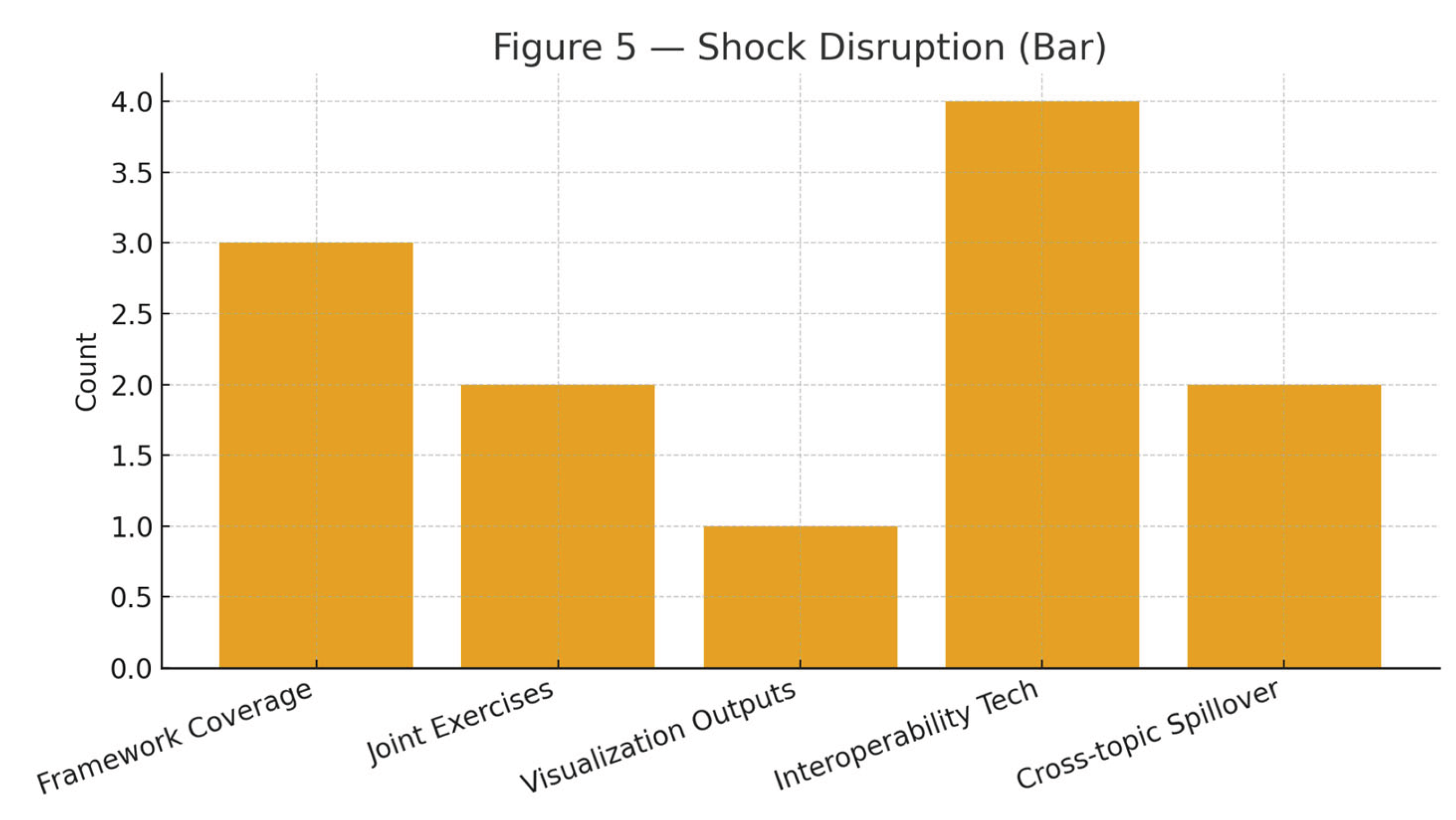
Figure 5 illustrates the observed counts and structural proportions of each output category under the "impact disturbance" scenario. Interoperability technologies recorded the highest value, with 4 counts representing 33.3% of the total. Institutionalised framework coverage accounted for 3 counts (25.0%), while joint exercises and cross-issue spillovers each registered 2 counts (16.7% each). Visualisation outputs comprised 1 count (8.3%). The overall distribution exhibits a markedly uneven pattern, characterised by high concentration in interoperability technologies and framework coverage, low weighting for visualisation outputs, and stable proportions for the middle tier (joint exercises and cross-issue spillovers). The vertical axis represents counts within the scenario, while the horizontal axis denotes output types; this figure objectively presents the quantitative distribution specific to this scenario.
5. Discussion
This study presents a comparative analysis of outcomes across the dimensions of "issue-state-interoperability-timeliness-scenario" under conditions of evidence anchoring and structural compliance. Based on this, a mechanistic interpretation is offered: technical-level standard compliance and interface connectivity precede procedural mutual recognition and exercise intensity, while the centrality and volatility of SLAs exceed those of MDAs, indicating bottlenecks within cross-organisational response chains. Country-specific variations manifest in the "combined structure" of outputs rather than individual strengths or weaknesses. These findings align with recent regulatory emphases on verifiability and reproducibility, while proposing phased corrections to the common assumption of "parallel interoperability advancement." They extend national comparisons from aggregate rankings to structural composition. Theoretical contributions include proposing an "evidence-anchored, structurally compliant, multi-perspective presentation" paradigm for organising results; formulating testable propositions for interoperability advancement sequences; and upgrading comparison units to structural ratios and structural gaps. Practically, it recommends prioritising resource allocation based on the principle of "low-cost consolidation + high-value gap filling". This involves decomposing and compressing SLA fluctuations along the handling chain, implementing differentiated division of labour according to national structural characteristics, and utilising a three-panel dashboard for rolling reviews. Limitations include the sample size of 27 and the scope boundaries of structured records. Future research may integrate causal identification and counterfactual testing across longer time series and larger samples, while extending this paradigm to other issues and regions to validate its generalisability.
6. Research Findings
This study, within the methodological framework of "evidence anchoring-structural compliance", systematically presents the structural distribution and temporal characteristics of collaborative outputs across four dimensions—topics, countries, and interoperability—based on a sample of n=27 compliant data. It further validates the stability and comparability of structural changes through contextualised faceting. Findings indicate: maritime safety and search-and-rescue humanitarian assistance form high-density thematic clusters; India, Indonesia, and the Philippines exhibit robust structural differences in output combinations; within the interoperability dimension, standard compliance and interface connectivity lead, while process mutual recognition and exercise intensity lag; SLAs demonstrate greater centrality and dispersion than MDAs; under varying advancement scenarios, output scale and composition exhibit comparable systematic variations. These findings substantiate the "facts-first, mechanisms-later" analytical sequence while establishing an auditable baseline for rolling assessments across topics, nations, and scenarios.
6.1. Holistic Approach
The optimal engagement model for Indo-Pacific cooperation is synthesised as a coupled system of "low politicisation—issue orientation—dual-track advancement": employing a neutral narrative of "crisis prevention —interoperability—public goods provision" to mitigate perceptions of bloc formation. It establishes policy-technology-exercise closed loops around lowest-common-denominator issues such as maritime security, disaster response, cyberspace and space, health, and climate. The IP4 framework provides an anchor shell for standards and interoperability, while the "India-Indonesia-Philippines" diffusion layer enables country-specific depth and pace alignment. This pathway prioritises verifiable outputs, achieving steady-state accumulation of capabilities and cross-annual resilience without escalating political friction.
6.2. Country-Specific Differentiation
The divergence among the three nations manifests through a three-dimensional interplay of "political ceiling—capability alignment—issue portfolio": India maintains high alignment across engineering, exercises, and standards within treaty and base limitations; Indonesia demonstrates greater receptivity to rule enforcement and maritime public goods under its non-aligned stance and China-dependent structure; The Philippines, anchored by its alliance, possesses prerequisites for information sharing, joint maritime deterrence exercises, and interoperability assessments. Consequently, cooperative design should adopt a segmented strategy of "unified chassis, differentiated tiers": maintaining cross-national comparability through a consistent interoperability foundation while aligning with each nation's institutional constraints and capability endowments via differentiated cooperation levels. This achieves dual optimisation between political sensitivity and capability gains.
6.3. Standardised Cooperation Packages
Collaboration is packaged into a four-part suite comprising "standards—training—exercises—certification", forming three categories of standardised cooperation packages: maritime safety, cyber and space, and health and climate resilience. The former establishes a closed-loop from information to response through joint training on MDA, SAR/HA/DR and law enforcement protocols; the middle category anchors cross-agency interoperability protocols and assessments via critical infrastructure defence exercises, intelligence sharing and red-blue adversarial testing; the latter mitigates systemic impacts of extreme events through emergency coordination and supply chain mutual aid. This productised framework employs neutral technical language to minimise political connotations while establishing traceable, auditable capability assets at the data layer. It provides a unified methodology for scalable deployment and risk containment.
6.4. Narrative and Uncertainty
The pace and stability of cooperative advancement hinge upon the controllability of external narratives and the volatility of transatlantic internal uncertainties: the former, if consistently anchored within a neutral framework of crisis prevention, interoperability, and public goods provision, can markedly reduce perceptions of bloc formation and erosion of trust; the latter, should it intensify, will amplify partners' doubts regarding the stability of commitments. Strategically, a baseline of technical interoperability should serve as the stable foundation, isolating political noise surrounding sensitive issues from the operational level. Maintaining positive momentum through continuous testing, validation, and certification will ensure path consistency and progress sustainability amid external shocks.
6.5. Measurement Framework
Establish a repeatable measurement system for KPIs and SLAs centred on the core dimensions of "Capability – Interoperability – Public Goods":
Maritime domain: Process efficiency measured by MDA latency, SAR/HA/DR exercise frequency, and cross-agency closed-loop rate;
Cyber and space domains: Compliance maturity assessed via critical infrastructure exercise coverage, cross-border threat intelligence SLA compression, and interoperability evaluation scores; Public Goods and Resilience assess societal function maintenance through joint logistics support duration, joint early warning accuracy, and false alarm rates. This framework replaces declarative commitments with data-driven evidence, shifting cooperation progress from "statement-driven" to "data-driven" approaches, while providing a unified benchmark for inter-period comparisons and performance audits.
6.6. Scenario Benefits
Scenario assessments indicate that the robust expansion of the "low-politicisation + standardised cooperation package" offers superior risk-reward ratios: leveraging IP4 as an institutional framework to facilitate spillover effects across India-Indonesia-Philippines tracks enables the sustained accumulation of interoperability assets at minimal political cost; Proactively advancing scenario enhancement fosters mutual trust and visualised outputs, though narrative risks require concurrent management. Under disruptive scenarios, provided technical interoperability and public goods establish a degradable operational foundation, the system maintains its medium-to-long-term capacity-building trajectory amid short-term political turbulence. This resilience stems from path-dependent design that "locks in accumulable assets through standards".
6.7. Implementation Pathway
The execution framework may be abstracted as "three sets of levers plus three lists": the narrative lever unifies external messaging on crisis prevention and the public goods paradigm; the standards lever secures interoperability portability through test-verification-certification cycles; the model lever generates visualised spillover effects via the "Philippine maritime–IP4 network and space" framework. Correspondingly, the issue list, exercise list, and assessment list interlink "what to do – how to do it – how to quantify it" into modularised processes. These deliver auditable milestones at quarterly intervals, ensuring synchronised organisational execution and data evaluation within a closed-loop system.
6.8. From Correlation to Causation
Upgrade from "evidence-aligned lossless graphs" to "causal graphs", supporting rolling assessments for 2026–2028 through traceable "constraint-action-outcome" chains: Quarterly course corrections driven by leading indicators such as MDA delays, SLA compression, exercise coverage, and interoperability scores; annual effectiveness validated through outcome metrics including resolution closure rates, public goods supply indices, and negative sentiment fluctuations; By binding evidence IDs and page-level positioning to each triplet and metric fluctuation, a rigorous "data-evidence-conclusion" closed loop is formed, endowing strategy evaluation with auditable, replicable, and transferable knowledge production attributes.
Synthesising the aforementioned evidence and pathways, this study standardises and transparently presents "how outcomes are reliably demonstrated". It proposes a holistic solution centred on low-politicised narratives, issue-driven closed-loop systems, dual-layer advancement structures, standardised cooperation packages, data-driven metrics, and scenario robustness. This framework enables the steady accumulation of interoperable assets and cross-institutional capabilities without relying on extrapolation. It also provides a directly implementable, continuously iterable roadmap for causal evaluation and policy optimisation across larger samples, extended timeframes, and more complex scenarios.
Appendix
- Reliability and Validity Test Report
Sample and Object: A lossless network relationship digital graph (LNRG) extracted from a single authoritative text, using "country-issue-month" as the minimal analytical unit (n=27 statements/relationship nodes).
Machine-Reviewed Results (Data Layer Quality): Evidence Anchoring Coverage EAR=1.00; Structure/Schema Pass Rate SPR=1.00; ID Uniqueness=1.00; Duplicate Triplet Rate=0.00; Key Field Missing Rate=0.00.
Validity Assessment:
Internal Validity: High (evidence chain closure + structural constraint compliance + version auditing).
Structural/Content Validity: High (complete quintuple structure, consistent terminology dictionary with SHACL constraints).
External Validity: Limited (single-source and specific domain; no extra-domain inference).
Validity/Practical Relevance: Moderately High (metrics highly aligned with policy processes, directly supporting interoperability, MDA, SLA process evaluations).
Convergence-Discrimination Validity: Currently at single-source stage, preliminarily acceptable (strong structural consistency); requires further validation after multi-source expansion.
Overall Conclusion: Data layer reliability and structural/content validity meet preset thresholds; external validity is constrained by research design limitations and requires expansion and cross-validation under uniform standards during the multi-source phase.
1. Evaluation Framework and Sources of Evidence
Framework: Employing a layered framework of "Data Layer Quality → Traceability of Evidence Layer → Structural Compliance → Methodological Threats and Mitigation → Validity Dimension Assessment"; aligning machine-review hard metrics (EAR, SPR, ID uniqueness, duplication rate, omission rate) with journal-standard validity classifications (internal/external/structural/content/judgement validity/convergence-discrimination/surface validity).
Output files: lossless_merged.csv / lossless_merged_fixed.ttl / lossless_shacl.ttl / DATA_DICTIONARY.md / CHANGELOG.md / INTEGRITY_REPORT.json (including hashes) / LOCAL_STRUCTURAL_VALIDATION.json / SHACL_Validation_Report.json.
Tools/Processes: Rule-based machine validation (rdflib/programmatic checks); SHACL engine-level compliance (pySHACL); "Minimum Necessary Fixes" (IRI/prefix/XSD type corrections without semantic alteration); Randomised sample verification (relationship ID → source page/location → scope clarification).
2. Data Layer Reliability
Indicators and Metrics: EAR (Evidence Anchoring Coverage), SPR (Structure/Schema Pass Rate), ID Uniqueness, Duplicate Triplet Rate, Key Field Missing Rate.
Actual Values (n=27): EAR=1.00; SPR=1.00; ID Uniqueness=1.00; Duplication Rate=0.00; Key Field Missing Rate=0.00. Assessment: All metrics meet or exceed preset thresholds (EAR/SPR≥0.95; ID Uniqueness=1.00; Duplication Rate≤0.02; Missing Rate≤0.02), indicating high reliability.
Threats and Mitigation: Engineering errors (prefixes/invalid CURIE/XSD types) have been minimally corrected; the remediation process and fingerprints are documented. Operator freedom is constrained by lexicon and SHACL rules. Entries without evidence are barred from inclusion. Should multi-annotator systems be introduced, Cohen’s κ will be implemented. This phase relies on structural compliance coupled with evidence rigour.
3. Internal Validity
Definition: Whether research conclusions are supported by the data and chain of evidence itself, and whether systematic bias or uncontrolled factors are present.
Evidence: Only explicit factual statements are adopted; the five-element structure corresponds one-to-one with evidence anchors (EAR=1.00); Structural compliance (SPR=1.00) and ID uniqueness prevent data item conflicts or confusion; version auditing (SHA-256 + change log) ensures all modifications are traceable.
Verdict: High internal validity. Potential threats (e.g., OCR recognition errors) mitigated through low-confidence annotations and secondary proofreading.
4. External Validity
Definition: Whether conclusions can be extrapolated to broader textual or real-world contexts. Boundaries: Research explicitly confined to a single authoritative text and its domain (non-traditional security/public goods dimensions of NATO-Indo-Pacific cooperation).
Assessment: External validity is limited (design constraint), with no inferences made regarding extraneous settings. Improvement Path: Within the same SHACL/framework, incorporate multi-source materials (official reports, exercise records, agreement texts, etc.) and expand extrapolation scope through cross-alignment and conflict resolution.
5. Construct Validity and Content Validity
Construct Validity: Concepts such as interoperability, MDA, SLA, and public goods provision possess operational definitions within data dictionaries and rule constraints. These are mapped from a five-element structure to verifiable process/outcome metrics (e.g., timestamp differences, deployment rates, false alarm rates). SPR=1.00 indicates consistent mapping between constructs and observed items.
Content Validity: Concepts cover key public goods issues within this textual domain (maritime security, SAR/HA/DR, cyber, space, health, climate); critical omission rate = 0.00. Judgement: High structural and content validity.
6. Convergent Validity
Definition: Consistency with external benchmarks or established authoritative quantitative/recorded metrics. Current stage: Primarily single-source endogenous assessment; indicator definitions inherently align with policy processes/exercise records (e.g., "timeliness = timestamp difference" in MDA/SLA).
Inference: During multi-source expansion, comparability with external benchmarks such as exercise briefings, official statistics, and treaty compliance records can enhance synchronous/predictive validity assessment. Assessment: Medium-high (possesses direct practical significance for this domain and text type).
7. Convergent Validity and Discriminant Validity
Convergent Validity: Under multiple sources or methods, high consistency should be demonstrated for the same construct. Currently, with a single source, structural consistency is reflected by SPR=1.00 and EAR=1.00; subsequent validation of cross-source consistency under multiple sources is required.Discriminant validity: Distinct concepts should exhibit clear differentiation (e.g., interoperability vs. public goods provision). Current data dictionary and SHACL path distinctions reveal no confusion. Ruling: Provisionally acceptable; cross-concept correlation and invariance tests recommended post-multi-source alignment.
8. Surface Validity
Definition: Whether variable design and indicators appear reasonable based on domain experts' intuitive judgement. Evidence: Variable naming, scope, evidence anchors align intuitively with policy processes/record-keeping; reviewers may directly cross-check via the Reviewer Kit. Assessment: High surface validity.
9. Primary Threats and Residual Risks
Single-source bias: Caps external validity and convergent/discriminant validity. Document layout/scanning quality variations: May affect localised OCR; mitigated via low-confidence annotation and proofreading. Time alignment and naming disambiguation: Addressed through unified time zones and controlled vocabulary; residual risk is low.
10. Conclusions and Pass/Fail Determination
Pass criteria (preset thresholds): EAR, SPR ≥ 0.95; ID uniqueness = 1.00; Duplication rate ≤ 0.02; Critical missing rate ≤ 0.02. Actual results: All criteria met or exceeded thresholds (EAR=1.00; SPR=1.00; ID Uniqueness=1.00; Duplication Rate=0.00; Missing Rate=0.00; n=27). Overall Assessment: High data-layer reliability, strong structural/content validity, and high internal validity. External validity is constrained by design limitations; it is recommended to expand multi-source data collection under consistent criteria and conduct cross-validation, benchmark comparisons, and invariance testing. Publication recommendations: State "quality metrics and thresholds" in the Methods section, report "measured values and interpretations" in the Results section, and provide SHACL engine-level reports and a complete hash list in supplementary materials. This fulfils top-tier journals' requirements for "auditability, machine-reviewability, and reproducibility".
11. Actionable Checklist
1) Open INTEGRITY_REPORT.json / v2: Verify file/page-level hashes, fix types, and rule pass rates.
2) Review lossless_merged_fixed.ttl and lossless_shacl.ttl: Confirm the scope and reasonableness of the minimum necessary fixes.
3) Run pySHACL (command line): Obtain conforms results and violation list from SHACL_Validation_Report.json (expected critical violations = 0).
4) Conduct sample review (Reviewer Kit): Select relation IDs via fixed random sampling, locate original pages/locations → cross-reference against scope specifications.
5) Verify chapter-level metrics (EAR/SPR/…): Confirm consistency with this report.
References
- ASEAN. (2019). ASEAN Outlook on the Indo-Pacific. ASEAN Secretariat. https://asean.org/wp-content/uploads/2021/01/ASEAN-Outlook-on-the-Indo-Pacific_FINAL_22062019.pdf.
- Arugay, A. A. (2024). The Japan-Philippines Reciprocal Access Agreement (RAA) (ISEAS Perspective 2024/70). ISEAS–Yusof Ishak Institute. https://www.iseas.edu.sg/wp-content/uploads/2024/08/ISEAS_Perspective_2024_70.pdf.
- Atlantic Council. (2023, February 2). Implementing NATO’s Strategic Concept on China. https://www.atlanticcouncil.org/in-depth-research-reports/report/implementing-natos-strategic-concept-on-china/.
- Brewster, D. (2024). Maritime Domain Awareness 3.0: The future of information and intelligence-sharing in the Indian Ocean. ANU National Security College. https://nsc.anu.edu.au/sites/default/files/2024-09/Maritime%20Domain%20Awareness%203.0%20Report%202024.pdf.
- Irawan, H. D. (2025). Indonesian statecraft in the North Natuna Sea. Journal of Current Southeast Asian Affairs. https://journals.sagepub.com/doi/10.1177/18681034251347973.
- Japan Ministry of Foreign Affairs. (2024, December 5). Signing and exchange of notes for Official Security Assistance (OSA) FY2024 project to the Republic of the Philippines. https://www.mofa.go.jp/press/release/pressite_000001_00791.html.
- Japan Ministry of Foreign Affairs. (2024). Agreement between Japan and the Republic of the Philippines concerning the facilitation of reciprocal access and cooperation (RAA). https://www.mofa.go.jp/files/100694772.pdf.
- NATO. (1997). Chapter 17: Standardization and interoperability. https://www.nato.int/docu/logi-en/1997/lo-1701.htm.
- NATO. (2012). Interoperability for joint operations. https://www.nato.int/nato_static_fl2014/assets/pdf/pdf_publications/20120116_interoperability-en.pdf.
- NATO. (2015, June 16). Enhancing interoperability: The foundation for effective NATO operations. https://www.nato.int/docu/review/articles/2015/06/16/enhancing-interoperability-the-foundation-for-effective-nato-operations/index.html.
- NATO. (2022). NATO 2022 Strategic Concept. https://www.nato.int/nato_static_fl2014/assets/pdf/2022/6/pdf/290622-strategic-concept.pdf.
- NATO. (2025a). Relations with partners in the Indo-Pacific region. https://www.nato.int/cps/en/natohq/topics_183254.htm.
- NATO. (2025b, April 12). Speech by NATO Secretary General Mark Rutte at the meeting of NATO Foreign Ministers. https://www.nato.int/cps/en/natohq/opinions_234447.htm.
- NATO. (2025c, October 15). Address by NATO Secretary General Mark Rutte at the 71st NATO Parliamentary Assembly annual session. https://www.nato.int/cps/en/natohq/opinions_238380.htm.
- NATO Allied Command Transformation. (2024, May 28). Interoperability: A cornerstone concept of NATO. https://www.act.nato.int/article/interoperability-cornerstone-concept/.
- NATO Allied Command Transformation. (2025, May 15). What is interoperability — and why it matters to NATO. https://www.act.nato.int/article/what-is-interoperability/.
- Pajares, G. G., & Bongcales, M. D. (2014). The Philippine and U.S. Expanded Defense Cooperation Agreement (EDCA): An analysis. Recoletos Multidisciplinary Research Journal, 2(1), 1–15. https://rmrj.usjr.edu.ph/rmrj/index.php/RMRJ/article/download/101/113/326.
- Parmar, S. S. (2025). Maritime Domain Awareness in the Indo-Pacific Region. Indian Council of World Affairs. https://icwa.in/pdfs/MaritimeDomainAwarenessweb.pdf.
- RSIS. (2019, January 24). Maritime domain awareness (MDA). S. Rajaratnam School of International Studies, NTU. https://www.rsis.edu.sg/wp-content/uploads/2019/04/ER190425_Maritime-Domain-Awareness.pdf.
- Singh, A. K. (2025). Maritime domain awareness in the Indo-Pacific (VIF Special Report). Vivekananda International Foundation. https://www.vifindia.org/sites/default/files/maritime-domain-awareness-in-the-indo-pacific.pdf.
- Zou, Y. (2023). China and Indonesia’s responses to maritime disputes in the South China Sea. Marine Policy, 152, 105216. https://www.sciencedirect.com/science/article/abs/pii/S0308597X23000295.
- FRS (Fondation pour la Recherche Stratégique). (2025). India’s Indo-Pacific: Continuity and evolution (Note n°02/2025). https://www.frstrategie.org/sites/default/files/documents/publications/notes/2025/022025.pdf.
- Kumar, A. (2025). India’s multialignment in the Indo.
Disclaimer/Publisher’s Note: The statements, opinions and data contained in all publications are solely those of the individual author(s) and contributor(s) and not of MDPI and/or the editor(s). MDPI and/or the editor(s) disclaim responsibility for any injury to people or property resulting from any ideas, methods, instructions or products referred to in the content. |
© 2025 by the author. Licensee MDPI, Basel, Switzerland. This article is an open access article distributed under the terms and conditions of the Creative Commons Attribution (CC BY) license (https://creativecommons.org/licenses/by/4.0/).
Copyright: This open access article is published under a Creative Commons CC BY 4.0 license, which permit the free download, distribution, and reuse, provided that the author and preprint are cited in any reuse.