

Submitted:
15 November 2025
Posted:
17 November 2025
You are already at the latest version
Abstract
Mixed-use developments sit at the intersection of urban sustainability and real estate investment, yet the influence of anchor tenant composition on Environmental, Social, and Governance (ESG) outcomes remains empirically underexplored. This study addresses that gap by developing and applying a tenant-sensitive conceptual framework that integrates stakeholder theory with institutional analysis. Using a cross-sectional dataset of 65 London mixed-use estates (1985–2025), we measured ESG performance via a psychometrically validated composite index (KMO = 0.78, α = 0.82) and analysed it using OLS regression. Our findings initially confirm conventional wisdom: office-anchored developments outperform residential-anchored schemes by 6.34 ESG points (p < 0.05, Cohen’s d = 0.55), a 9.3% index gain. This performance differential translates into a material 150–200 bps rental premium and a £2.5–£4.2M annual NOI uplift for a representative £500M asset. However, our central finding reveals that this typology effect is not absolute. The anchor tenant's ESG maturity strongly moderates this relationship (interaction β = –19.07, p < 0.05), demonstrating that residential-led schemes with robust governance alignment can match or even exceed the ESG performance of their office-anchored counterparts. These results offer critical guidance for ESG-driven underwriting, REIT valuation, and urban finance policy, shifting the focus from asset-class generalizations to the primacy of estate-level governance structures.
Keywords:
mixed-use developments
; ESG governance
; anchor tenants
; sustainable investment
; London urban regeneration
; real estate finance
1. Introduction
The real estate sector accounts for roughly 39% of global energy-related carbon emissions, positioning it as both a major contributor to climate change (Contat, 2024) and a key target for decarbonisation (Robinson, 2022).
Consequently, Environmental, Social, and Governance (ESG) criteria have transitioned from a peripheral concern to a core determinant of how real estate assets are designed, valued, financed, and regulated (Holt, 2025).
This transformation is particularly evident in financial centres such as London, where strict policy, investor expectations, and occupier demand have embedded ESG considerations throughout the urban development process (Kempeneer, 2021).
Institutional capital has become a powerful catalyst in this transformation. Frameworks such as GRESB now guide over USD 7 trillion in assets (Newell, 2019). Empirical evidence corroborates this trend, demonstrating that properties with superior sustainability credentials benefit from rental premiums, enhanced liquidity, and lower financing costs (Iwuanyanwu, 2023), while non-compliant assets face escalating "brown discounts" and obsolescence risk under tightening regulatory regimes like the UK's Minimum Energy Efficiency Standards (MEES) (Gourabpasi, 2025).
Within this context, mixed-use developments have been championed as a model of sustainable urbanism. By integrating multiple asset classes—residential, commercial, retail, and leisure—these large-scale, master-planned estates promise to deliver benefits of compact density (Domingo, 2021), transport efficiency, and vibrant public realms, aligning with multiple ESG objectives (Geyer, 2024). Major London regeneration projects, from King's Cross to Battersea Power Station, exemplify their strategic importance in shaping both the urban landscape and institutional investment portfolios (Said, 2024). However, the ESG performance of these complex assets is notoriously difficult to measure and highly variable (Biasin, 2024). Certification systems such as BREEAM and EPC—initially designed for single-use buildings—often yield a fragmented and sometimes misleading assessment of sustainability performance at the estate level (Schweber, 2013). A significant "performance gap" exists between design predictions and actual operations. Post-occupancy evaluations often reveal energy consumption several times higher than predicted (Biasin, 2024). These failings have underscored the urgent necessity for more tenant-sensitive analytical frameworks that move beyond certification-driven approaches to capture meaningful, in-use ESG performance (Espinoza-Zambrano, 2024).
Central to the challenge of sustainable mixed-use development is the foundational role of anchor tenants—the dominant occupiers who disproportionately influence the environmental, social, and governance baseline of estate-wide operations, management, and strategic direction. Institutional studies have begun to identify mechanisms such as green leases, sustainability committees, and advanced ESG disclosure frameworks that help harmonise landlord and tenant goals (Voland, 2022). However, a persistent gap in the academic and applied literature is the differentiation of anchor tenant typology: offices, residential operators, retailers, and hotels each possess unique operational behaviours, investment strategies, and ESG capabilities (Van Dronkelaar, 2016). Most work to date has focused on the office sector, omitting comparative analysis of other functionally critical anchor types (Fuerst & McAllister, 2011). This paper addresses a key gap: understanding how anchor tenant typology conditionally influences sustainability outcome.
To answer this research question, the authors analyse how does anchor tenant typology influence ESG performance in London mixed-use developments, and what are the implications for sustainable investment strategy. Dually, the article examines empirically the relationship between anchor tenant typology and ESG performance in mixed-use developments, assessing the moderating influence of tenant ESG maturity and governance alignment on typology-driven outcomes. Through a strong conceptual foundation by synthesizing urban planning, real estate finance, and governance perspectives, this study advances both theoretical understanding and practical guidance, synthesising statistical analysis with urban, finance, and governance critique. Ultimately, authors aim to establish London’s mixed-use sector as a global testbed for innovative research at the intersection of planning, real estate, and sustainability.
2. Literature Review
Urban economics scholarship highlights the agglomeration benefits and spillovers intrinsic to dense, mixed-use settings (Glaeser, 2009); (Rosenthal, 2020), positioning anchor tenants as critical nodes that diffuse sustainability norms across occupiers.
In commercial property finance, ESG performance impacts both the cost of debt and equity returns, with evidence of ‘greenium’ pricing in mortgages and REIT bonds ((Eichholtz, 2019)). Recent disclosure studies show mandatory sustainability reporting reduces capital costs and volatility in asset values (Christensen H. H., 2021), but mixed-use governance regimes remain underexplored, particularly in how estate-level coordination alters typology-specific ESG behaviours. Comparative work (Rosenthal, 2020) distinguishes the stronger governance alignment in integrated multi-anchor precincts from the fragmented ESG engagement typical of single-use assets. Building on these literatures, we formulate three hypotheses: H1 — Office-anchored developments have higher composite ESG scores than residential-anchored ones; H2 — Tenant ESG maturity moderates, and can negate, the office premium; H3 — Governance dimensions vary more strongly by typology than environmental or social indicators.
The literature review begins by examining the integration of ESG principles into real estate, emphasizing the shift from reputational concerns to financial and regulatory imperatives (Bell, Battisti, & Guin, 2023). It then explores the theoretical foundations of mixed-use urbanism, highlighting its sustainability potential through functional diversity and estate-level governance. Finally, it evaluates the limitations of certification frameworks and the role of governance maturity in shaping investment risk, setting the stage for the paper’s empirical analysis (Fuerst & McAllister, 2011).
2.1. Urban Economics Integration
Urban economics literature emphasizes agglomeration benefits and spillover effects in mixed-use environments (Glaeser, 2009). These theoretical frameworks suggest that anchor tenant decisions create positive or negative externalities affecting neighbouring occupiers' sustainability practices through demonstration effects, shared infrastructure utilization, and collective action opportunities.
2.2. ESG in Real Estate: Global Standards, Regulatory Pressure, and Performance Gaps
The integration of ESG principles into real estate has rapidly evolved, shaped by international policy frameworks, investor activism, and market transformation. The move from reputational risk to measurable financial value is evident, as assets with robust sustainability profiles command green premiums, while those lacking compliance face brown discounts and rising obsolescence risk (Espinoza-Zambrano, 2024). Major European cities demonstrate accelerated adoption of design and operational certifications, with BREEAM, EPC, WELL, and NABERS UK gaining regulatory and market traction (Adindu, 2022); (Nuriani, 2025).
Despite the widespread uptake of certification and reporting frameworks, recent literature has emphasised the persistence of a "performance gap" between intended design efficiency and realised operational outcomes (Gong, 2025). In the UK, post-occupancy studies reveal that actual energy use averages nearly four times higher than theoretical estimates (Zhao, 2024). This divergence stems from unregulated loads, commissioning defects, and—most importantly—variations in occupier behaviour, which collectively undermine design-stage assumptions. It points to the inadequacy of relying purely on design-stage certifications and the need to account for tenant governance and maturity in assessing ESG performance, echoing calls for operational ratings and real-world data (Ain Farhana Jamaludin, 2025), and continue efforts for developing green buildings (Bungau, 2022).
The role of tenants in shaping in-use performance is increasingly acknowledged. Tenants' ESG maturity—reflected in practices of disclosure, data-sharing, and retrofit willingness—is identified as a critical determinant of whether certified buildings achieve sustainability potential (Abraham Y, 2022); (Liu C. R., 2024). Green lease frameworks that formalise shared sustainability goals underpin governance alignment (Janda, 2016), yet uneven adoption irregularly distributes performance gains across sectors and developments (Hirigoyen, Julie , 2014). Furthermore, the sectoral distribution of green premiums remains non-uniform: while London offices achieve measurable rent uplifts, empirical evidence for retail and residential assets remains ambiguous, reinforcing the need for closer investigation of anchor-driven heterogeneity (Boubakri, 2023).
2.3. Mixed-Use Urbanism: Theoretical Roots and Sustainability Promise
The analysis integrates two complementary theoretical frameworks to explain the influence of anchor tenants on ESG performance. Stakeholder’s theory (Bowie, 2012) positions anchor tenants as primary stakeholders whose scale, visibility, and economic significance grant them disproportionate influence over estate-wide practices. In mixed-use developments, anchors function not merely as occupiers but as co-creators of sustainability outcomes through operational choices, governance participation, and signalling effects that cascade across tenant communities (Liu N. Z., 2025).
Institutional theory offers a complementary lens, positing that organizational ESG adoption is governed by a confluence of regulatory, normative, and coercive pressures (Delmas M. &., 2024). These institutional forces are not uniformly applied in commercial real estate; instead, they are mediated through instruments like green lease provisions and investor mandates, which create systematic differences across tenant typologies. Consequently, a clear divergence emerges corporate office anchors, facing intense scrutiny from public markets and institutional owners, are driven toward greater disclosure, while residential anchors operate within a separate institutional paradigm where affordability and housing supply take precedence over environmental performance.
Mixed-use development embodies the compact city ideal, advocating density, functional diversity, and spatial efficiency to mitigate urban sprawl (Burgess, 2000). The paradigm finds its theoretical origins in Jacobs’ advocacy of mixed primary uses to foster urban vitality, safety, and resilience (Zhang, 2025). Empirical studies link land-use diversity to reduced car dependency and more sustainable mobility patterns, underpinning the environmental case for mixed-use regimes (Jamei, 2021).
Operationally, mixed-use estates (distinguished from single multi-use buildings) integrate housing, offices, retail, and leisure at masterplan scale, managed through estate-wide governance structures (Puggioni, 2025). The functional synergy—shared energy systems, public realm, district heating, and recycling—promises measurable carbon reductions compared to fragmented, single-use developments (Bright, 2016). However, real-world evidence stresses the contingency of these gains: stakeholder engagement, governance quality, and the operational behaviour of anchor tenants’ condition whether theoretical synergies yield genuine performance (Farjam, 2019).
Social sustainability in mixed-use districts is nuanced. Inclusive design—combining affordable housing, childcare, healthcare, and leisure—can enhance community cohesion, but risks of displacement and gentrification persist if governance structures inadequately address stakeholder complexity (Gomide, 2024). Governance emerges as the critical determinant: estate-level committees, service charges, and joint reporting systems are posited as best practice but fragmentation due to multi-owner structures or split management often undermines coordination and comparability (Hirigoyen, Julie , 2014).
2.4. Anchor Tenants: Typology, Theoretical Models, and Empirical Evidence
Anchor tenants—those leasing the majority of gross lettable area and providing primary branding or investment pull—shape both investment stability and operational sustainability (Crevoisier, 2025). The theoretical literature distinguishes between stakeholder theory, which casts anchors as "primary stakeholders" able to drive estate-level practices (Freeman, 2010), and institutional theory, which asserts external pressures (regulatory, investor, reputational) are mediated through anchor governance (DiMaggio, 2004).
Empirical data demonstrate sharp operational contrasts by typology (Liu T. C., 2022); (Chen, 2024). Hotels and retail anchors exhibit higher energy and water intensity; offices tend to set more advanced sustainability thresholds due to certification demand and stricter disclosure requirements (Becken, 2013). Residential operators, though critical for affordability and social outcomes, lag in environmental metrics and governance transparency due to split incentive problems (Gillingham, 2014). Retail anchors provide placemaking and local employment benefits but suffer weak lease governance and inconsistent reporting. Hotels represent the lowest ESG maturity, with minimal operational disclosure (Bae, 2022).
Case studies reinforce these patterns. At King's Cross, governance innovation driven by ESG-mature technology anchors has enabled estate-wide carbon targets and operational benchmarking (Ledgerwood, 1994). Broadgate Sustainability Case Study, reported by British Land, illustrates office-driven repositioning with advanced certification but highlights ongoing challenges of retail disclosure and environmental loads (Patel, 2023). Elephant & Castle demonstrates the risks of inadequate social governance leading to displacement, while Battersea Power Station exposes the fragmenting effect of multiple development actors and energy-intensive hotel anchors (Jukić, 2019).
2.5. ESG Certification: Frameworks, Limits, and Regulatory Convergence
Certifications (BREEAM, EPC, NABERS UK, WELL) provide structured markers of sustainability, increasingly embedded in planning and lending practice (Zehner, 2021). BREEAM, the UK’s oldest, is mainly design-based; operational reality often diverges from certified predictions in complex estates (Schweber, 2013). EPCs, mandatory for lettings and sales, act as regulatory filters, but measure design rather than operational performance (McAllister, 2019).
Recent advances, notably NABERS UK, focus on operational outcomes, separating landlord and tenant-controlled energy and requiring post-occupancy verification (Thompson, 2021). While transformational for office anchors, coverage remains piecemeal for other asset types. WELL and similar certifications emphasise health and social dimensions, but coverage is limited to premium offices, not capturing the multi-tenant complexity of mixed-use estates (Condezo-Solano, 2025).
Policy trajectory is toward continuous performance monitoring, operational evidence, and estate-wide reporting. The London Plan mandates post-occupancy disclosure; City of London planning policy now requires NABERS-style energy strategies and multi-year monitoring . However, certification patchworks persist, with reporting gaps and fragmented governance establishing barriers to comparability and investor due diligence (McGuirk, 2020).
2.6. ESG and Capital Formation: Finance, Disclosure, and Investment Risk
Capital markets now systematically integrate ESG into pricing and asset allocation decisions with frameworks like SFDR, CSRD, and the EU Taxonomy setting mandatory disclosure standards, shaping fund flows, and imposing technical criteria for sustainable finance (Calipha, 2025). Green bonds and labelled debt attract "greenium" pricing, while assets lacking credible transition plans face refinancing stress and widening spreads (Partridge, 2020).
Recent applications of institutional theory to corporate real estate demonstrate how regulatory and normative pressures shape organizational ESG adoption patterns (Christensen H. B., 2021). In mixed-use developments, these institutional logics vary systematically across anchor typologies, creating differential sustainability incentives that manifest in observable performance patterns (Drempetic, 2020).
Mixed-use estates encounter unique challenges: asset-level heterogeneity and reporting fragmentation often stymie compliance with portfolio-level standards (Cesarone, 2022). Office-anchored schemes, with mature tenants, better achieve auditable ESG metrics, while retail and hotel anchors undermine reporting and eligibility for green finance. Valuation studies confirm that anchor typology conditions whether schemes meet thresholds for sustainable asset classification and capital access (Lorenz, 2011).
2.7. Comparative International Evidence: Models and Risks
Comparative analysis reveals divergent ESG outcomes: New York’s Hudson Yards demonstrates certification-driven but fragmented estates failing operational targets (Scofield, 2013); Paris’s La Défense showcases the effectiveness of statutory compulsion with legally enforced energy reductions (Kim, 2012); Singapore’s Marina Bay illustrates the success of integrated governance under state-linked developers (Bourg-Meyer, 2019); Amsterdam’s Eastern Docklands highlights the risks of fragmented ownership and weak tenant coordination (Hoppenbrouwer, 2005).
London, combining stringent regulatory pressure with deep private capital markets and high multi-functional density, offers an ideal setting for empirical investigation of anchor typology and governance alignment (Hansen, 2023).
2.8. Literature Gaps and Research Agenda
Key gaps remain over-reliance on design-stage certifications, inadequate attention to post-occupancy performance and estate-wide comparability, insufficient differentiation of anchor tenant typologies, and weak linkage of governance instruments to typology and financial risk (Huang, Bai, Shang, & Ahmad, 2023). Empirical research is mostly descriptive, lacking cross-asset or moderating analysis, and seldom disaggregates ESG outcomes by anchor typology (Newell, 2023).
This study directly addresses these gaps by constructing a tenant-sensitive model of mixed-use ESG performance in London, integrating typology, governance, and financial dimensions, and employing robust statistical testing.
3. Methodology
To operationalise the conceptual framework, we assembled a cross-sectional dataset of 65 mixed-use developments in London, spanning delivery years 1985–2025 and including both legacy and newly completed projects. Details of all projects are included in the Supplementary Information.
The unit of analysis is defined as the completed development estate: a master-planned project that integrates at least two functional uses (e.g., residential, commercial, retail, or hotel) under a shared governance framework (Coupland, 1997). This enables differentiation from simple multi-use buildings without integrated management.
3.1. Anchor tenant typology.
The principal independent variable—is categorised based on the dominant function drawing investment, branding, or gross lettable area: Office (n = 30), Residential (n = 30), Retail (n = 3), Hotel (n = 2). Office and residential anchors form the core sample.
Data collection occurred between March and September 2025, using authoritative, publicly verifiable sources:
- Sustainability indicators from the BRE BREEAM directory and UK Government EPC Register (EPC, 2025).
- Governance indicators (evidence of green lease adoption, tenant ESG maturity) from corporate sustainability reports, TCFD disclosures, analyst presentations, and industry market research. See full details of assets analysed in the Supplementary Information.
- Control variables including estimated gross lettable area (GLA), year of completion/refurbishment, borough, London zone, and provision of public realm from developer websites, planning applications, leasing announcements, and investment presentations.
Eligible projects were those situated within London Zones 1–3, incorporating at least two functional uses, a clearly identifiable anchor tenant, and publicly disclosed environmental indicators (BREEAM or EPC ratings).
Below figure shows sites identified in the city of London. List of all assets is presented in the Supplementary Information.
Where direct values were missing, proxies were derived (e.g., GLA converted from GIA, EPC or BREEAM estimates from comparable nearby units or operator portfolios). All proxies were flagged for subsequent robustness checks. Below Table 1., shows the parameters used for the analysis.
3.2. Composite ESG Scoring Framework
- a)
- Establishing the measurement approach
Conventional assessment of real estate sustainability typically relies on certification tools such as BREEAM and Energy Performance Certificates (EPCs). While these tools provide valuable design-stage benchmarks, they were conceived for single-use assets and therefore fail to capture the complexity of mixed-use developments. In these multi-functional estates, environmental outcomes interact with social and governance dimensions shaped by tenant behaviour, disclosure maturity, and joint management mechanisms (Crosas, 2024).
Recognising these limitations, this research developed a tenant-sensitive ESG scoring framework designed to evaluate sustainability at the estate level. The framework integrates ESG components into one composite, data-driven index, enabling direct comparison across development typologies. It addresses the study’s central research question: how anchor tenant typology influences ESG performance in London’s mixed-use developments, and under what governance conditions those effects strengthen or weaken.
- b)
- Designing the Framework
The goal was to move beyond symbolic certifications toward a system that measures how anchor tenants—offices, residential operators, retailers, and hotels—translate their operational behaviours and governance practices into environmental and social outcomes. Several verifiable indicators were selected based on their data availability and relevance to sustainability performance measurable at estate scale:
- Environmental dimension: BREEAM certification and EPC ratings, capturing energy and compliance benchmarks embedded in UK regulation.
- Social dimension: the quality of public realm and transport accessibility, assessing wellbeing and connectivity contributions at community level.
- Governance dimension: the likelihood of green lease adoption and anchor tenant ESG maturity, reflecting alignment of landlord-tenant sustainability objectives and data transparency.
All indicators were normalised on a 0–4 scale, weighted, and aggregated into a composite index scaled from 0 to 100. Based on both regulatory precedence and market practice, variables were weighted 50% Environmental, 30% Social, and 20% Governance (Syed, 2017). This balance recognises the dominant role of energy efficiency regulation while maintaining attention to social impact and governance quality—key differentiators in tenant performance.
- c)
- Validating the Structure
The conceptual framework was validated through Exploratory Factor Analysis (EFA), with principal axis factoring and varimax rotation (Zebardast, 2017). The three-factor structure was confirmed, explaining 73.2% of total variance (KMO = 0.78; Bartlett’s χ² = 184.3, p < 0.001). Loadings exceeded 0.60 and cross-loadings remained below 0.30, supporting construct validity. Reliability was strong (Cronbach’s α = 0.82 overall; α > 0.73 for each pillar), while the subjective governance proxies showed substantial inter-rater reliability (κ = 0.79) on a 20% double-coded subsample. These psychometric results confirm that the composite ESG index provides a robust and internally consistent measure of estate-level sustainability. Calculations are included in the Supplementary Information.
- d)
- Accounting for Scale and Location
Because estate size and locational advantages can influence ESG outcomes, two statistical controls were introduced: the natural logarithm of gross lettable area (lnGLA), controlling for scale effects, and London transport-zone dummy variables (Zone 1 and Zone 2 relative to Zone 3 baseline), accounting for spatial and regulatory variation (Cajias, 2014).
- e)
- Diagnostic and Robustness Tests
Econometric diagnostics verified model integrity: variance inflation factors below 1.3 indicated no multicollinearity; heteroskedasticity identified by a Breusch–Pagan test (p = 0.006) was corrected using HC1 robust standard errors. Proxy data—principally for EPC ratings and GLA values—were explicitly flagged and tested through sensitivity analyses, all confirming result stability across specifications (Breusch, 1979).
- f)
- Integration into the Analytical Model
The composite ESG index served as the dependent variable in a five-step regression hierarchy (Models M1–M5). Each model incrementally introduced controls: first anchor tenant typology, then project year and location, followed by tenant ESG maturity and scale, and finally an interaction term (Office × ESG maturity). This sequential design isolates the independent influence of typology while evaluating how governance maturity moderates typology-driven outcomes.
In summary, the composite ESG framework developed here establishes a credible, empirically validated method to quantify sustainability across complex mixed-use estates. It bridges certification data, operational governance, and tenant maturity into a unified measure, enabling both academic research and institutional investment analysis to identify where sustainability performance truly originates—not from asset class alone, but from the governance behaviours of the tenants who occupy and manage them. Details are included in the Supplementary Information.
3.3. ESG Score Calculation:
Rationale of the criteria and weighting is based on the average performance given above.
Below Table 2 shows different indicator, scale and rationale.
3.4. Statistical Analysis and Modelling
- Descriptive Statistics: Computed for the sample by anchor type—mean, median, SD, min, max; distributional boxplots for visualisation.
-
Group Comparison Tests
- ○
- Welch’s t-test for Office vs Residential comparisons (assumes unequal variances).
- ○
- Mann–Whitney U test for non-parametric confirmation.
- ○
- Kruskal–Wallis test for all typologies (performed exploratorily due to small n for retail/hotel anchors).
3.5. Regression Models
To assess weights and ponderation among variables, we use standard regression for all indicators. All models checked for heteroscedasticity (Breusch–Pagan test), multicollinearity (VIF < 1.3), and residual normality. Robust (HC1) standard errors calculated where indicated (Breusch, 1979). Outlier and proxy-free models for sensitivity.
- Model 1: ESG regressed on Office dummy (1=Office, 0=Residential)
- Model 2: ESG regressed on Office dummy + Year of completion
- Model 3: ESG regressed on Office dummy + locational controls (Zone 1, Zone 2)
- Model 4: Full specification adding scheme size (lnGLA) and tenant ESG maturity
- Model 5: Interaction Model (Office dummy × Tenant ESG maturity)
3.6. Pillar-Level Analysis and Hypothesis Testing
To test variation across ESG sub-dimensions, mean comparisons for environmental, social, and governance pillars were performed, employing both Welch’s t-test and Kruskal–Wallis where appropriate (Brasch, 2025). Results mapped to research hypotheses:
- Conceptual Framework & Hypotheses
The methodological model connects anchor tenant typology to estate-level ESG performance, moderated by tenant ESG maturity and governance quality, and controlled for year, zone, and scheme size (GLA). The framework operationalises stakeholder and institutional theory, proposing that tenants’ behavioural and governance characteristics are key drivers of sustainability outcomes in mixed-use developments.
Three hypotheses derive from this model and the research gaps identified earlier:
- H1 (Formal): Office-anchored mixed-use developments achieve higher composite ESG scores than residential-anchored ones, reflecting greater tenant governance capacity and regulatory compliance.
- H2 (Exploratory): Tenant ESG maturity positively moderates typology effects — more mature anchors strengthen sustainability outcomes.
- H3 (Exploratory): Social sustainability indicators vary more strongly by anchor typology than environmental ones, which are increasingly standardised through regulation.
The following Table 3 summarises the Hypotheses and Propositions:
Together, these hypotheses extend stakeholder and institutional theory by showing how anchor tenants influence estate-level sustainability through governance maturity and operational behaviour. The framework also provides a practical basis for testing which tenant profiles yield stronger, more consistent ESG outcomes — informing investment, underwriting, and urban policy decisions.
4. Calculations
4.1. Statistical Rationale
ESG performance in mixed-use estates is multi-factorial. To isolate anchor typology effects, distinguish governance maturity impacts, and test for moderation, we employ:
- Descriptive statistics: Means, standard deviations, interquartile ranges.
- Parametric tests (Welch’s t-test) due to unequal variances in anchor groups.
- Nonparametric tests (Mann-Whitney U, Kruskal-Wallis) for robustness in distributional checks.
- OLS regression models: Sequential addition of controls and interaction terms.
- Robustness checks: Heteroskedasticity-consistent standard errors, proxy-free subsamples, and alternative weightings.
4.2. Data Preparation
- Normalization: All ESG indicators were normalized to a 0–4 scale.
- Composite Score: Weighted as per methodology:
- Missing Data Handling: Imputation via mid-point if ranges provided; proxies flagged.
4.3. Group Comparisons Testing
-
Welch’s t-test calculation, Testing office (n=30) vs residential (n=30) anchors:
- ○
- Mean ESG (Office): 74.42 (SD = 11.25)
- ○
- Mean ESG (Residential): 68.08 (SD = 11.56)
- ○
- t(57.96) = 2.15, p = 0.04
-
Mann-Whitney U calculation, non-parametric check:
- ○
- U = 315.5, Z = –1.99, p = 0.047
4.4. Regression Modelling
-
Model Specification
- ○
- Model 1: ESG = β₀ + β₁OfficeDummy + ε
- ○
- Model 2: ESG = β₀ + β₁OfficeDummy + β₂Year + ε
- ○
- Model 3: ESG = β₀ + β₁OfficeDummy + β₂Year + β₃Zone1 + β₄Zone2 + ε
- ○
- Model 4: ESG = β₀ + β₁OfficeDummy + β₂Year + β₃Zone1 + β₄Zone2 + β₅lnGLA + β₆ESGMaturity + ε
- ○
- Model 5: ESG = β₀ + β₁OfficeDummy + β₂Year + β₃Zone1 + β₄Zone2 + β₅lnGLA + β₆ESGMaturity + β₇(Office×ESGMaturity) + ε
4.5. Regression Diagnostics
- Breusch–Pagan test for heteroscedasticity.
- Variance Inflation Factor (VIF) < 1.3 for multicollinearity.
- HC1 standard errors where heteroscedasticity detected.
4.6. Pillar-Level Analysis
-
Office vs residential mean differences for:
- ○
- Environmental Pillar: t(58.0) = 1.93, p = 0.06 (marginally significant)
- ○
- Social Pillar: t(57.9) = 0.92, p = 0.36 (not significant)
- ○
- Governance Pillar: t(57.8) = 1.84, p = 0.07 (marginally significant)
5. Results
Across the 65 mixed-use developments sampled in London (1985–2025), ESG performance exhibits consistent yet interpretable typological variation. Office-anchored developments show the highest composite ESG mean (M = 74.42, SD = 11.25), suggesting consistently strong environmental and governance performance among institutional office tenants. Then residential-anchored followed schemes with ESG M = 68.08, SD = 11.56. Retail anchors (M = 73.75, SD = 6.61) and hotels (M = 58.75, SD = 22.98) display extremes, the former performing well on social engagement but less efficiently environmentally, while the latter lag materially on all three ESG pillars due to high resource intensity and weak disclosure.
Below Table 4 shows the ESG scores and key ratios of the methodology.
A disaggregation by ESG pillar clarifies these dynamics. Environmental performance clusters narrowly across anchors—offices 2.93, residential 2.70, retail 2.50, hotels 2.00—reflecting strong regulatory convergence under the UK’s Minimum Energy Efficiency Standards (MEES) and the London Plan. Social scores show greater variation (Office = 3.10; Residential = 2.93; Retail = 3.67; Hotel = 3.50), capturing how retail anchors generate employment and placemaking benefits despite energy burdens. Governance scores differ most sharply (Office = 2.90; Residential = 2.47; Retail = 3.00; Hotel = 1.50), reinforcing that governance maturity and tenant–landlord alignment remain the key discriminators of overall performance.
Boxplots (see Supplementary Information) depict narrower interquartile ranges for offices, signalling consistently high governance and energy efficiency, while residential typologies show wide dispersions attributable to fragmented ownership and split incentives. This pattern mirrors stakeholder theory’s prediction that institutionally mature tenants—often the large office occupiers subject to disclosure obligations—act as “primary stakeholders” setting governance standards that diffuse across estate management (Freeman, 2010); (Janda, 2016).
5.1. Comparative Hypothesis Testing (H₁: Office > Residential)
To test H₁, the study compared office- and residential-anchored developments using parametric and non-parametric tests.
The Welch’s t-test, appropriate for unequal variances, confirms the office advantage (t(57.96) = 2.15, p = 0.04), with a 6.34-point mean gap equivalent to roughly 9.3 % of the total ESG index. The Mann–Whitney U test supports this direction (U = 315.5, Z = –1.99, p = 0.047). Effect size analysis yields Cohen’s d = 0.55 (95 % CI [0.03, 1.06]), suggesting a moderate material impact.
A Kruskal–Wallis test including retail and hotel anchors (H(3) = 4.79, p = 0.19) fails to reach significance, unsurprising given small subsamples (n = 3 and n = 2). Nevertheless, rank ordering (Office > Residential > Retail > Hotel) remains consistent.
5.2. Practical significance:
Translating a 6-point ESG improvement using established “green premium” benchmarks (Eichholtz, 2019); (Cajias, 2014) suggests 150–200 basis-point rent uplift potential and 25–50 basis-point debt-margin benefit. For a £ 500 million asset this corresponds to £ 2.5–£ 4.2 million additional annual NOI. These magnitudes reveal that ESG alignment, operationally driven by anchor typology and maturity, is materially relevant to valuation and finance.
The observed office-anchor premium provides institutional isomorphism (DiMaggio, 2004): regulatory and normative pressures concentrate on corporate occupiers, compelling them to disclose sustainability data and adopt governance mechanisms such as TCFD reporting and internal carbon pricing. Residential anchors, operating under looser regulatory frameworks, lag unless proactive governance instruments are present.
5.3. Regression and Moderation Analysis (H₂)
Ordinary-least-squares (OLS) regression systematically isolates typology and governance effects across five models. Diagnostics confirmed acceptable model integrity: heteroscedasticity, identified via the Breusch–Pagan test (p = 0.006), was corrected using HC1 robust standard errors, and multicollinearity was minimal (VIF < 1.3).
Model 1 (Baseline): ESG = β₀ + β₁Office + ε → β₁ = +6.33, p = 0.036, Adj.R² = 0.058. Office-anchored estates outperform residential peers by 6.3 points without controls.
Model 2 (Temporal Control): Adding completion year retains significance (β₁ = +7.78, p = 0.027); year itself non-significant (p > 0.40).
Model 3 (Spatial Controls): Inclusion of Zone 1–2 dummies yields β₁ = +8.50 (p = 0.022); location variables non-significant, establishing typology—not geographic position—as explanatory.
Model 4 (Full Specification): Introducing scheme size (lnGLA) and tenant ESG maturity increases model fit markedly (Adj.R² = 0.457; F(6, 53) = 9.29, p < 0.001).
Key coefficients: Office = +7.30 (p = 0.010), lnGLA = +4.49 (p < 0.001), ESG Maturity = +8.85 (p < 0.001). Under robust errors, office effect weakens (p = 0.13) but maturity remains strong (β = 10.6, p < 0.01).
Model 5 (Interaction): Adding Office × Maturity term achieves best fit (Adj.R² = 0.498; F(7, 52) = 9.34, p < 0.001).
Key coefficients: Office β = 21.25 (p = 0.002); Maturity β = 29.27 (p < 0.001); Interaction β = –19.07 (p = 0.027).
The negative moderation verifies H₂ but in inverse form: ESG maturity reduces the marginal performance gap between typologies. At low maturity office estates outperform by ~25 points; at high maturity residential anchors surpass office scores by approximately 31 points. Thus, tenant maturity exerts stronger incremental influence on previously underperforming residential typologies, eroding the historical office advantage.
This statistical progression operationalises stakeholder and institutional dynamics. Mature tenants (high disclosure, data-sharing, decarbonisation plans) institutionalise sustainability within estate governance, diffusing norms to landlords and neighbouring occupiers (Freeman, 2010); (Delmas M. &., 2024). The office premium is therefore not intrinsic but a proxy for governance maturity capacity.
5.4. Pillar-Level Analysis (H₃)
Mean comparison across environmental, social, and governance pillars assesses differential variation by typology.
- Environmental: t(58.0) = 1.93, p = 0.06 (marginal). Convergence indicates policy effectiveness—MEES and the London Plan have largely standardised environmental performance.
- Social: t(57.9) = 0.92, p = 0.36 (ns). Social parity arises from planning-imposed public-realm and accessibility obligations across all typologies.
- Governance: t(57.8) = 1.84, p = 0.07 (borderline). Governance maturity remains the distinguishing factor underpinning residual variance.
Retail anchors (n = 3) show elevated social scores (3.67) but energy-intensive operations; hotels (n = 2) underperform across pillars, especially governance (1.50). Governance thus represents the “last frontier” of heterogeneity—supporting H₃ partly: environmental and social attributes have become regulated baselines, whereas governance differentiates performance.
5.5. Robustness Checks and Sensitivity
Alternative weightings (E70/S20/G10 to E40/S30/G30) yield consistent significance (t = 2.13–2.22, p = 0.03–0.04).
The proxy-free subsample (n = 23) strengthens the effect (t(13.09) = 2.64, p = 0.02; g = 0.78), suggesting conservative bias in full data.
Temporal splitting shows convergence post-2015 (t(40.90) = 1.79, p = 0.08). Outlier removal downsizes significance (t(54.48) = 0.79, p = 0.43) but retains effect direction. Achieved power = 0.68 confirms acceptable reliability.
Collectively, these diagnostics validate both replicability and theoretical implications: ESG performance differences are statistically robust yet evolving under regulatory convergence and governance diffusion.
6. Discussion
The empirical results indicate that ESG performance within mixed-use estates is primarily shaped by stakeholder interactions rather than fixed characteristics of land-use categories. Office anchors outperform because they typically embody higher ESG maturity—disclosing environmental metrics, maintaining science-based targets, and participating in estate-level committees—thereby co-creating sustainability performance with landlords. In stakeholder-theory terms, anchors function as “governance orchestrators”: their contractual expectations transmit sustainability norms through leasing structures and supplier relationships (Dawei, 2024).
However, the moderation finding (β = –19.07, p < 0.05) shows that such advantages are transferable. When residential occupiers demonstrate equivalent disclosure rigour and participatory governance, they can equal or exceed office-led outcomes. This governance convergence illustrates how stakeholder interdependencies evolve within mature institutional fields such as London’s property market.
6.1. Institutional Convergence under Regulatory Pressure
Institutional theory (DiMaggio, 2004) predicts that organisations operating under similar coercive and normative pressures adopt comparable behaviours. London’s property sector—subject to MEES enforcement, the “Be Seen” energy reporting policy, and investor mandates from frameworks like GRESB and SFDR—exemplifies this environment. Notably, the ESG performance gap narrows after 2015, coinciding with intensified regulatory requirements, which supports the hypothesised role of coercive institutional pressures. Environmental scores’ tight clustering (p = 0.06) confirms coercive isomorphism: regulation has standardised performance expectations (Gopal, 2025).
Governance, however, reflects ongoing normative diffusion. High-maturity tenants set disclosure precedents that gradually achieve sector-wide uptake. Institutional innovation thus proceeds from voluntary stakeholder leadership toward mandatory alignment—consistent with Delmas & Toffel’s (2008) adaptation model were market exemplars precipitate rule formalisation.
6.2. Mechanisms of ESG Equalisation
Regression outputs suggest three pathways translating tenant maturity into typology convergence:
- Formalised data-sharing. Green leases allow energy and emissions transparency, operationalising landlord–tenant co-management.
- Joint ESG committees. Estate-wide governance bodies institutionalise monitoring and collective target-setting, supporting sustained improvement.
- Sustainability-linked finance. Loan covenants link interest-rate adjustments to verified ESG KPIs, incentivising consistent performance across anchors.
Each mechanism embodies both stakeholder coordination and institutionalisation. Over time, these instruments embed accountability structures that reduce typological disparity—converting earlier “best practice” into baseline compliance.
6.3. Implications for Capital Markets and Valuation
The 6-point (≈9 %) composite ESG premium holds direct relevance for valuation. Prior studies reveal rental premia between 3–12 % for certified green offices (Fuerst & McAllister, 2011). Extending this logic, governance-aligned residential schemes could command similar performance if tenant maturity is institutionalised (Przychodzen, 2016).
This has multi-level financial implications:
- Underwriting: ESG maturity becomes a risk proxy influencing debt pricing (reported advantage 25–50 bps).
- Portfolio valuation: REITs can integrate quantified ESG scores into NAV calculations, reflecting reduced stranded-asset risk.
- Liquidity: Strong disclosure reduces investment friction and exit yield spreads, aligning with “greenium” trends in sustainable bonds (Partridge & Zheng, 2025).
Hence, the economic materiality of ESG is governance-contingent, aligning micro-estate governance with macro-market valuation effects.
6.4. Urban Policy and Regeneration
Environmental convergence and governance disparity highlight both policy success and residual gaps. London’s regulatory ensemble—MEES, the London Plan, and NABERS UK—has effectively raised environmental baselines yet remains limited to asset-level monitoring. The study’s results support a policy transition toward governance-based mandates: requiring estate-level committee structures, verified post-occupancy data, and cross-tenant reporting (Crosas Armengol, 2024).
Our data confirm that the governance structure and tenant profile must be carefully curated to avoid performance gaps and unintended social consequences (Atkinson, 2000). Regeneration projects must move beyond badge-driven approaches to operational accountability, requiring estate-wide targets, placemaking, stakeholder inclusion, and continuous post-occupancy monitoring (Dindar, 2025).
From an urban governance perspective, mixed-use regeneration exemplified by King’s Cross and Broadgate demonstrates that collaborative governance models yield measurable ESG outcomes. Conversely, fragmented schemes such as Battersea Power Station reveal how multi-developer complexity undermines convergence. Embedding governance maturity into planning consent—linking density bonuses or carbon-offset flexibility to operational disclosure—would institutionalise collective accountability at the district scale.
6.5. Theoretical Integration
Conceptually, these findings extend stakeholder theory by evidencing how inter-organisational governance among tenants and landlords governs ESG performance across estate systems. The results corroborate and enrich institutional theory by uncovering a phase of governance isomorphism—a diffusion of maturity and accountability rather than merely technology or certification.
In synthesis: stakeholder collaboration initiates performance differentiation; institutional consolidation cements convergence. Mixed-use estates evolve as micro-institutions embedding sustainability norms in contractual, managerial, and financial arrangements.
7. Gaps and Limitations
Approximately 35 % of data relied on proxies for EPC ratings, GLA, or governance indicators. While flagged and vetted through sensitivity tests yielding stable coefficients (p = 0.03–0.04 across weightings), proxy reliance introduces measurement uncertainty. Governance maturity assessments derived from public disclosures may overstate actual contractual enforcement; inter-rater reliability was substantial (κ = 0.79) but not absolute.
7.1. Cross-Sectional Design and Endogeneity
The cross-sectional design precludes definitive causal inference. Observed associations may reflect selection bias: ESG-mature tenants preferentially occupy high-quality assets, or developers attract mature anchors into better-performing estates. Reverse causality could equally occur—superior ESG infrastructure enticing mature tenants. Although spatial and temporal controls mitigate bias, unobserved quality differences remain. Future research should employ longitudinal or instrumental-variable designs (e.g., using planning approvals or transport proximity as exogenous instruments) to test directional causality.
7.2. Sample Structure and Statistical Power
The balanced Office / Residential groups (n = 30 each) ensure medium power (0.68) but smaller retail (n = 3) and hotel (n = 2) clusters limit generalisability. These categorical minorities preclude conclusive cross-typology inference. Expanding sample coverage across new London estates or international comparators would strengthen external validity.
7.3. Indicator Construction
The composite ESG index, though psychometrically validated (KMO = 0.78; α = 0.82), simplifies multidimensional sustainability. Weighting (50 %E / 30 % S / 20 % G) mirrors GRESB practice but remains normative; emphasizing governance differently could shift elasticities. Moreover, social metrics—restricted to public realm and accessibility—omit affordability or inclusion outcomes central to contemporary ESG discourse.
7.4. Geographic and Temporal Boundaries
Focusing on London Zones 1–3 strengthens internal consistency but limits external applicability. The city’s mature regulatory and capital context may not reflect conditions in secondary markets or developing urban systems. Temporal coverage (1985–2025) spans evolving standards, risking conflation between cohort effects (older assets retrofitted under newer regulation) and typology differences.
7.5. Econometric Diagnostics
Diagnostics confirmed heteroscedasticity (Breusch–Pagan p = 0.006) remedied by HC1 robust errors, and no multicollinearity (VIF < 1.3). Still, omitted-variable bias may persist if managerial quality or ownership structure significantly influence ESG outcomes.
8. Practical Recommendations
Future research should pursue longitudinal analysis that tracks post-occupancy ESG evolution to capture how governance maturity and operational performance progress over time. This requires more granular datasets encompassing tenant-level ESG disclosures, real-time operational KPIs, and the internal design of estate-level committees to better understand governance mechanisms. Comparative international studies should also be expanded to test the regulatory transportability of these findings across varying contexts, including Smart Cities initiatives where data infrastructure and policy integration differ substantially. Methodological developments such as hierarchical and multi-level modelling can further incorporate estate-owner, anchor, and sub-tenant effects, providing insight into nested governance dynamics. Emerging computational approaches using artificial intelligence and large datasets can offer additional validation of these results (Xiang, 2022). Moreover, dedicated retrofit studies are essential to evaluate ESG performance improvements in existing building stock (Alabid, 2022), while future work should also review the evolving relationship between ESG metrics and Real Estate Investment Trusts to assess how capital-market structures reflect sustainability performance (Zheng, 2025). Additionally, authors recommend other practical initiatives for the real estate industry and build environment.
8.1. Investors and Asset Managers
- Integrate Tenant ESG Maturity Screening.
Acquisition and due diligence processes should incorporate formal scoring of tenant ESG maturity, including indicators such as verified disclosure alignment (e.g., GRESB, CSRD, TCFD adoption), science-based carbon targets, and participation in operational rating schemes (NABERS UK, WELL). The results reveal that maturity—not typology—drives 10-point improvements in ESG scores (Model 4, β = 10.6, p < 0.01). Screening can identify tenants whose governance practices are likely to enhance estate performance and reduce asset obsolescence risk.
- Prioritise Operational over Design Certifications.
The persistent design–performance gap (average operational energy 3.8× higher than design) indicates that BREEAM and EPC alone are inadequate performance predictors. Institutional investors should request operational metrics based on metered data, such as NABERS UK or the emerging UK Energy Monitoring Protocol.
- Embed Governance Quality in Valuation Models.
Quantified ESG ratings should inform risk-adjusted discount rates. A 6-point ESG increase equates to up to 200 bps rental or valuation premium; ignoring governance maturity could misprice both return and credit risk. Integrating composite ESG indices in valuation frameworks aligns real-asset pricing with sustainable-finance principles and promotes liquidity advantages associated with high-transparency assets.
- Mandate Estate-Level Governance Evidence
Engage only in projects with established ESG committees, inter-tenant data-sharing arrangements, and formal reporting hierarchies that demonstrate the governance alignment empirically associated with higher scores.
- Refine ESG Reporting Expectations
Portfolio-level disclosures should separate governance metrics (lease coverage, committee frequency, shared KPIs) from design attributes, promoting comparability and internal benchmarking.
8.2. Landlords and Developers
- Enforce Green-Lease Clauses.
Make data disclosure, operational improvement commitments, and energy-use reporting contractual requirements. Green leases provide direct governance infrastructure translating tenant maturity into measurable outcomes.
- Establish Multi-Stakeholder ESG Committees.
Modelled on King’s Cross and Broadgate, estate-level committees align tenants, property managers, and investors through shared decarbonisation targets and ongoing performance monitoring; they formalise stakeholder theory’s co-production mechanism.
- Adopt PropTech for Real-Time Transparency.
Implement integrated digital building management systems (BMS) capable of aggregating tenant-level consumption data and feeding continuously into governance dashboards. These systems bridge the operational data gap identified in the study and satisfy emerging “Be Seen” compliance expectations.
- Design for Dynamic Governance.
Architectural and management planning should allow estate composition changes—tenant churn, anchor rotation—without compromising overall governance alignment. This demands flexible data protocols, modular service-charge structures, and scalable ESG committees.
- Quantify Governance as Asset Value.
Landlords should treat governance maturity as a monetisable asset feature. Documentation of committee structures, tenant reporting compliance, and data-sharing performance can enhance marketing narratives and transaction transparency.
8.3. Lenders and Capital Markets
- Tie Cost of Capital to Verified ESG KPIs.
The study’s financial interpretation (150–200 bps rental premium) confirms material ESG–return correlations. Sustainability-linked loan structures should incorporate NABERS UK ratings, verified carbon intensity, or tenant-level disclosure rates as pricing levers.
- Evaluate Tenant ESG Maturity in Underwriting.
Credit assessments should extend beyond the borrower’s sustainability profile to measure the maturity of anchor tenants. The regression analysis demonstrates maturity’s stronger influence than typology, suggesting that lender risk exposure depends on tenants’ governance practices.
- Enhance Transparency Requirements.
Loan covenants should oblige borrowers to disclose estate-level ESG data (energy, emissions, governance metrics) and committee meeting records. This aligns landlord-borrower incentives and reduces information asymmetry that affects refinancing risk.
- Incorporate ESG Resilience in Stress Testing.
Lenders should include ESG maturity variables in macro-prudential stress scenarios to estimate transition risks under tightening regulation—particularly pending MEES escalation to EPC Band B by 2030.
8.4. Policymakers and Regulators
- Expand MEES and “Be Seen” to Tenant Operations
Current frameworks stop at landlord-controlled areas. Requiring tenant-level operational disclosure would merge top-down (coercive) and bottom-up (normative) governance, closing the design–operation gap and enforcing shared accountability.
- Harmonise Certification and Disclosure Regimes.
Cross-recognition between BREEAM, EPC, NABERS UK, and CSRD/ESRS targets can reduce duplication and confusion. A unified taxonomy of verifiable operational metrics would strengthen ESG comparability for global investors.
- Incentivize Estate-Level Governance Structures.
Planning authorities could grant density or height bonuses to developments establishing mandated ESG committees, data platforms, and transparent reporting. Such incentives institutionalise collaborative governance at the urban scale (Metaxas, 2021).
- Support Digital Infrastructure for ESG Data.
Municipal platforms could collect anonymised building-level performance feeds, enable benchmarking and informing Net-Zero 2030 progress tracking. Public transparency amplifies coercive institutional forces that elevate baseline performance.
- Address Social Equity Within ESG Frameworks.
Incorporate affordability, inclusion, and local employment metrics into urban ESG standards to ensure that social performance—currently the least statistically decisive pillar—becomes more meaningfully measured and incentivised (Rodrigues, 2020).
9. Conclusions
9.1. Empirical Insights
This study provides quantitative evidence that anchor tenant typology influences ESG performance in London’s mixed-use developments only through governance channels. Office-anchored estates exhibit higher mean ESG scores (M = 74.42 vs. 68.08; t(57.96) = 2.15, p = 0.04). However, this typology advantage becomes statistically insignificant when tenant ESG maturity and governance alignment are introduced (interaction β = –19.07, p = 0.027). ESG maturity emerges as the dominant predictor (β = 10.6, p < 0.01), while estate scale (lnGLA = +4.49, p < 0.001) indicates the structural benefits of larger governance systems.
9.2. Theoretical Contributions
The findings advance stakeholder theory by illustrating that sustainability outcomes in real estate stem from collaborative governance networks among landlords, tenants, and investors rather than unilateral managerial intent. High-maturity tenants act as catalysts for estate-wide improvements, validating the concept of co-production of ESG value.
Simultaneously, the results enrich institutional theory by evidencing a phase of “governance isomorphism.” Regulatory coercion (MEES, London Plan) standardises environmental performance, while normative diffusion via investor and peer pressures harmonises governance expectations across typologies. Institutional convergence thus occurs not at the level of asset design but through operational governance regimes and shared accountability mechanisms.
9.3. Practical and Policy Relevance
For investors and market professionals, the results reframe ESG differentiation from asset-type bias to governance competency. Portfolio approaches should abandon typology premia in favour of maturity-based risk assessments. For developers and landlords, the research reinforces that enforceable governance mechanisms (green leases, ESG committees, PropTech integration) create measurable financial and reputational value (Meena, 2022). For policymakers, the London case illustrates that enduring ESG transformation requires integrating tenant operations, digital transparency, and estate-level accountability into statutory frameworks.
9.4. Broader Implications for Urban Sustainability Research
By empirically linking governance maturity to environmental and social outcomes within complex urban systems, the study bridges micro-level property management with macro-level sustainability policy. The evidence supports city-wide strategies that treat mixed-use estates as cooperative institutional ecosystems rather than collections of discrete assets.
For sustainable-finance scholarship, the results contribute to quantifying how governance quality underpins value premia, offering a replicable framework for integrating ESG maturity metrics into capital-allocation decisions.
9.5. Pathways for Future Research
Future inquiry should:
- Track estates longitudinally to assess persistence of ESG gains under tenant turnover.
- Compare institutional contexts—Amsterdam, Paris, Singapore—to test governance-convergence generalisability.
- Develop multi-level models linking individual lease arrangements to aggregate estate performance.
- Expand the social pillar with metrics capturing inclusivity, affordability, and community integration.
- Evaluate how digitalised data ecosystems (PropTech, IoT) enable real-time ESG compliance and capital-market verification.
9.6. Closing Synthesis
In London’s highly regulated and capital-intensive real estate environment, ESG performance depends less on property typology than on the quality and maturity of its governance structures. Governance maturity—manifested as transparent data-sharing, collective oversight, and stakeholder alignment—has emerged as the definitive determinant of sustainable value. This study empirically substantiates that principle, offering both theoretical refinement and actionable frameworks for investors, managers, and policymakers seeking to navigate the transition toward a fully institutionalised, governance-centred ESG paradigm in global real-estate markets.
Compliance with Ethics Standards
Not applicable.
Competing Interests
The authors declare no competing financial or non-financial interests.
Supplementary Materials
The following supporting information can be downloaded at the website of this paper posted on Preprints.org.
Funding
No funding was received for conducting this study.
Data Availability Statement
All data generated or analysed during this study are included in this published article and available in the Supplementary Information.
References
- Abraham, Y.; Greenwood, L.; Andoh, N.-Y.; Schneider, J. Sustainable Building without Certification: An Exploration of Implications and Trends. J. Sustain. Res. 2022, 4, e220007. [Google Scholar] [CrossRef]
- Adindu, C.; Ekung, S.; Ukpong, E. Green cost premium as the dynamics of project management practice: A critical review. J. Proj. Manag. 2022, 7, 133–146. [Google Scholar] [CrossRef]
- Ain Farhana Jamaludin, &. M. (2025). The Impact of Environmental, Social and Governance (Esg) on Real Estate Investment: A Bibliometric Review. Pacific Rim Real Estate Society Journal, 30(1).
- Alabid, J.; Bennadji, A.; Seddiki, M. A review on the energy retrofit policies and improvements of the UK existing buildings, challenges and benefits. Renew. Sustain. Energy Rev. 2022, 159, 112161. [Google Scholar] [CrossRef]
- Atkinson, R. Measuring Gentrification and Displacement in Greater London. Urban Stud. 2000, 37, 149–165. [Google Scholar] [CrossRef]
- Bae, J.-H. Developing ESG Evaluation Guidelines for the Tourism Sector: With a Focus on the Hotel Industry. Sustainability 2022, 14, 16474. [Google Scholar] [CrossRef]
- Becken, S. A review of tourism and climate change as an evolving knowledge domain. Tour. Manag. Perspect. 2013, 6, 53–62. [Google Scholar] [CrossRef]
- Bell, J.; Battisti, G.; Guin, B. The greening of lending: Evidence from banks’ pricing of energy efficiency before climate-related regulation. Econ. Lett. 2023, 230. [Google Scholar] [CrossRef]
- Biasin, M.; Foglie, A.D.; Giacomini, E. Addressing climate challenges through ESG-real estate investment strategies: An asset allocation perspective. Finance Res. Lett. 2024, 63, 105381. [Google Scholar] [CrossRef]
- Boubakri, N.; Fotak, V.; Guedhami, O.; Yasuda, Y. The heterogeneous and evolving roles of sovereign wealth funds: Issues, challenges, and research agenda. J. Int. Bus. Policy 2023, 6, 241–252. [Google Scholar] [CrossRef]
- Bourg-Meyer, V.; Kum, D.; Elias, J.; Uetake, K. (2019). Marina bay sands: Sustainability challenges and opportunities in the events industry. (Y. S. Management, Ed.) Sage Business Cases. Retrieved from https://doi.org/10.4135/9781526468130. [CrossRef]
- Bowie, N.E. Stakeholder Theory: The State of the Art, R. Edward Freeman, Jeffrey S. Harrison, Andrew C. Wicks, Bidhan L. Parmar, and Simone de Colle (New York: Cambridge University Press, 2010). Bus. Ethic- Q. 2012, 22, 179–185. [Google Scholar] [CrossRef]
- Brasch, T.; Eckert, C. Development of the ESG Pillar Scores and Data Availability: Empirical Evidence from the Insurance Industry. J. Risk Financial Manag. 2025, 18, 447. [Google Scholar] [CrossRef]
- Breusch, T.S.; Pagan, A.R. A Simple Test for Heteroscedasticity and Random Coefficient Variation. Econometrica 1979, 47, 1287. [Google Scholar] [CrossRef]
- Bright, S. J. (2016). The evolution of “greener” leasing practices in Australia and England. In Proceedings of COBRA, Sydney, Australia). (p. 4). Sydney: Royal Institute of Chartered Surveyors (RICS). Retrieved from. [CrossRef]
- Bungau, C.C.; Bungau, T.; Prada, I.F.; Prada, M.F. Green Buildings as a Necessity for Sustainable Environment Development: Dilemmas and Challenges. Sustainability 2022, 14, 13121. [Google Scholar] [CrossRef]
- Burgess, R. &. (2000). Compact Cities: Sustainable Urban Forms for Developing Countries. London. https://doi.org/10.4324/9780203478622. [CrossRef]
- Cajias, M.; Fuerst, F.; McAllister, P.; Nanda, A. DO RESPONSIBLE REAL ESTATE COMPANIES OUTPERFORM THEIR PEERS? Int. J. Strat. Prop. Manag. 2014, 18, 11–27. [Google Scholar] [CrossRef]
- Calipha, R.; Katav-Herz, S. (2025). The EU Sustainable Finance Framework. In R. D.-H. Caliphaz, Sustainable Finance Regulation in the European Union. Sustainable Finance. Springer, Cham. Retrieved from https://doi.org/10.1007/978-3-031-883. [CrossRef]
- Cesarone, F.; Martino, M.L.; Carleo, A. Does ESG Impact Really Enhance Portfolio Profitability? Sustainability 2022, 14, 2050. [Google Scholar] [CrossRef]
- Chen, L.; Hu, Y.; Wang, R.; Li, X.; Chen, Z.; Hua, J.; Osman, A.I.; Farghali, M.; Huang, L.; Li, J.; et al. Green building practices to integrate renewable energy in the construction sector: a review. Environ. Chem. Lett. 2024, 22, 751–784. [Google Scholar] [CrossRef]
- Christensen, H.B.; Hail, L.; Leuz, C. Mandatory CSR and sustainability reporting: economic analysis and literature review. Rev. Account. Stud. 2021, 26, 1176–1248. [Google Scholar] [CrossRef]
- Christensen, H.B.; Hail, L.; Leuz, C. Mandatory CSR and sustainability reporting: economic analysis and literature review. Rev. Account. Stud. 2021, 26, 1176–1248. [Google Scholar] [CrossRef]
- Condezo-Solano, M.J.; Erazo-Rondinel, A.; Barrozo-Bojorquez, L.M.; Rivera-Nalvarte, C.C.; Giménez, Z. Global Analysis of WELL Certification: Influence, Types of Spaces and Level Achieved. Buildings 2025, 15, 1321. [Google Scholar] [CrossRef]
- Contat, J.; Hopkins, C.; Mejia, L.; Suandi, M. When climate meets real estate: A survey of the literature. Real Estate Econ. 2024, 52, 618–659. [Google Scholar] [CrossRef]
- Coupland, A. (1997). An introduction to mixed use development. In Reclaiming the City. London: Routledge. Retrieved from https://doi.org/10.1007/978-3-031-883. [CrossRef]
- Crevoisier, O.; Theurillat, T.; Rota, M.; Segessemann, A.; Merckhoffer, A. The role of real estate in the development of cities and regions: Territorial real estate and economic systems. Prog. Econ. Geogr. 2025, 3. [Google Scholar] [CrossRef]
- Crosas Armengol, C. G. (2024). From land-use planning to mixed-use configuration: similarities and differences in two urban fragments of Barcelona Metropolis. In XXIX International Seminar on Urban Form: Urban Redevelopment and Revitalisation: A Multidisciplinary Perspective. LódzProceedings book (pp. 200-211). Kraków, Poland: Lodz University of Technology.
- Crosas, C.; Gómez-Escoda, E.; Villavieja, E. Interplay between Land Use Planning and Functional Mix Dimensions: An Assemblage Approach for Metropolitan Barcelona. Sustainability 2024, 16, 7734. [Google Scholar] [CrossRef]
- Dawei, Z. &. (2024). The Impact of ESG Factors on Financial Performance: Analyzing the Influence of Sustainability Practices in Chinese Firms. International Journal of Academic Research in Business and Social Sciences, 14(11), 1649-1652. [CrossRef]
- Delmas, M.; Toffel, M.W. Stakeholders and environmental management practices: an institutional framework. Bus. Strat. Environ. 2024, 13, 209–222. [Google Scholar] [CrossRef]
- Delmas, M.A.; Toffel, M.W. Organizational responses to environmental demands: opening the black box. Strat. Manag. J. 2008, 29, 1027–1055. [Google Scholar] [CrossRef]
- DiMaggio, P.J.; Powell, W.W. The iron cage revisited institutional isomorphism and collective rationality in organizational fields. Adv. Strateg. Manag. 2004, 143–166. [Google Scholar] [CrossRef]
- Dindar, S. A Systematic Review of Urban Regeneration's Impact on Sustainable Transport: Traffic Dynamics, Policy Responses, and Environmental Implications. Sustain. Dev. 2025, 33, 399–426. [Google Scholar] [CrossRef]
- Domingo, D.; Palka, G.; Hersperger, A.M. Effect of zoning plans on urban land-use change: A multi-scenario simulation for supporting sustainable urban growth. Sustain. Cities Soc. 2021, 69. [Google Scholar] [CrossRef]
- Drempetic, S.; Klein, C.; Zwergel, B. The Influence of Firm Size on the ESG Score: Corporate Sustainability Ratings Under Review. J. Bus. Ethic- 2020, 167, 333–360. [Google Scholar] [CrossRef]
- Eichholtz, P.; Holtermans, R.; Kok, N.; Yönder, E. Environmental performance and the cost of debt: Evidence from commercial mortgages and REIT bonds. J. Bank. Finance 2019, 102, 19–32. [Google Scholar] [CrossRef]
- EPC. (2025, 10 1). Ministry of Housing, Communities & Local Government. Retrieved from Energy Performance Certificate Register. GOV.UK. : https://www.epcregister.com.
- Espinoza-Zambrano, P. R.-H.-D. (2024). Do green certifications add value? Feedback from high-level stakeholders in the Spanish office market. Journal of Cleaner Production, 144276. [CrossRef]
- Farjam, R.; Motlaq, S.M.H. Does urban mixed use development approach explain spatial analysis of inner city decay? J. Urban Manag. 2019, 8, 245–260. [Google Scholar] [CrossRef]
- Freeman, R.E. Strategic Management; Cambridge University Press (CUP): Cambridge, United Kingdom, 2010. [Google Scholar]
- Fuerst, F.; McAllister, P. The impact of Energy Performance Certificates on the rental and capital values of commercial property assets. Energy Policy 2011, 39, 6608–6614. [Google Scholar] [CrossRef]
- Geyer, H. The theory and praxis of mixed-use development - An integrative literature review. Cities 2024, 147, 104774. [Google Scholar] [CrossRef]
- Gillingham, K.; Palmer, K. Bridging the Energy Efficiency Gap: Policy Insights from Economic Theory and Empirical Evidence. Rev. Environ. Econ. Policy 2014, 8, 18–38. [Google Scholar] [CrossRef]
- Glaeser, E.L.; Gottlieb, J.D. The Wealth of Cities: Agglomeration Economies and Spatial Equilibrium in the United States. J. Econ. Lit. 2009, 47, 983–1028. [Google Scholar] [CrossRef]
- Gomide, F.P.d.B.; Bragança, L.; Junior, E.F.C. How Can the Circular Economy Contribute to Resolving Social Housing Challenges? Appl. Syst. Innov. 2024, 7, 21. [Google Scholar] [CrossRef]
- Gong, Z.; Ejohwomu, O.A.; Shen, F.; Aye, L.; Aminian, E.; Abadi, M. Energy performance gap in zero-energy buildings: A socio-technical complexity framework for risk assessment and mitigation. Environ. Challenges 2025, 21. [Google Scholar] [CrossRef]
- Gopal, S.; V. , S.; N., E. ESG or financial metrics? What retail investors really look for in decision-making. Invest. Manag. Financial Innov. 2025, 22, 351–368. [Google Scholar] [CrossRef]
- Gourabpasi, A.H.; Jalaei, F.; Ghobadi, M. Developing an openBIM Information Delivery Specifications Framework for Operational Carbon Impact Assessment of Building Projects. Sustainability 2025, 17, 673. [Google Scholar] [CrossRef]
- Hansen, R.; Buizer, M.; Buijs, A.; Pauleit, S.; Mattijssen, T.; Fors, H.; van der Jagt, A.; Kabisch, N.; Cook, M.; Delshammar, T.; et al. Transformative or piecemeal? Changes in green space planning and governance in eleven European cities. Eur. Plan. Stud. 2023, 31, 2401–2424. [Google Scholar] [CrossRef]
- Hirigoyen, Julie. (2014). UK Green Building Council. Retrieved from UKGBC: https://ukgbc.org/resources/impact-report-2018-19/.
- Holt, A.D.; Giordano, J.A.; White, N. The evolution of accounting practices for UK commercial service charges: evaluating the impact of the RICS professional standard. J. Corp. Real Estate 2025, 27, 130–150. [Google Scholar] [CrossRef]
- Hoppenbrouwer, E.; Louw, E. Mixed-use development: Theory and practice in Amsterdam's Eastern Docklands. Eur. Plan. Stud. 2005, 13, 967–983. [Google Scholar] [CrossRef]
- Huang, Y.; Bai, F.; Shang, M.; Ahmad, M. On the fast track: the benefits of ESG performance on the commercial credit financing. Environ. Sci. Pollut. Res. 2023, 30, 83961–83974. [Google Scholar] [CrossRef]
- Iwuanyanwu, O.; Gil-Ozoudeh, I.; Okwandu, A.C.; Ike, C.S. THE ECONOMIC BENEFITS OF GREEN BUILDINGS: A COST-BENEFIT ANALYSIS OF SUSTAINABLE ARCHITECTURE. Int. J. Adv. Econ. 2023, 5, 374–394. [Google Scholar] [CrossRef]
- Jamei, E.; Ahmadi, K.; Chau, H.W.; Seyedmahmoudian, M.; Horan, B.; Stojcevski, A. Urban Design and Walkability: Lessons Learnt from Iranian Traditional Cities. Sustainability 2021, 13, 5731. [Google Scholar] [CrossRef]
- Janda, K.B.; Bright, S.; Patrick, J.; Wilkinson, S.; Dixon, T.J. The evolution of green leases: towards inter-organizational environmental governance. Build. Res. Inf. 2016, 44, 660–674. [Google Scholar] [CrossRef]
- Jukić, T.; Watson, G.B. (2019). Reuse and revitalisation of contemporary city areas: structural and functional transformation of brownfield sites. In M. B. Obad Šćitaroci, Cultural Urban Heritage. The Urban Book Series (pp. 245–261). Springer, Cham. Retrieved from https://doi.org/10.1007/978-3-030-10612-6_18. [CrossRef]
- Kempeneer, S.; Peeters, M.; Compernolle, T. Bringing the User Back in the Building: An Analysis of ESG in Real Estate and a Behavioral Framework to Guide Future Research. Sustainability 2021, 13, 3239. [Google Scholar] [CrossRef]
- Kim, E.; Barles, S. The energy consumption of Paris and its supply areas from the eighteenth century to the present. Reg. Environ. Chang. 2012, 12, 295–310. [Google Scholar] [CrossRef]
- Ledgerwood, G.; Haywood, I.; Sheppard, N.; Street, E. Environmental assessment as a real estate management protocol. Cities 1994, 11, 181–194. [Google Scholar] [CrossRef]
- Liu, C. R. (2024). Code for JUE paper Agglomeration Economies and the Built Environment: Evidence from Specialized Buildings and Anchor Tenants. Mendeley Data, 1. [CrossRef]
- Liu, N.; Zhao, Y.; Yan, B.; Hutchison, N. Tenants’ ESG: influence on preferences and rent premiums for green buildings in commercial real estate. J. Prop. Res. 2025, 42, 321–355. [Google Scholar] [CrossRef]
- Liu, T.; Chen, L.; Yang, M.; Sandanayake, M.; Miao, P.; Shi, Y.; Yap, P.-S. Sustainability Considerations of Green Buildings: A Detailed Overview on Current Advancements and Future Considerations. Sustainability 2022, 14, 14393. [Google Scholar] [CrossRef]
- Lorenz, D.; Lützkendorf, T. Sustainability and property valuation. J. Prop. Invest. Finance 2011, 29, 644–676. [Google Scholar] [CrossRef]
- McAllister, P.; Nase, I. The impact of Minimum Energy Efficiency Standards: Some evidence from the London office market. Energy Policy 2019, 132, 714–722. [Google Scholar] [CrossRef]
- McGuirk, P.; Dowling, R. Urban governance dispositifs: cohering diverse ecologies of urban energy governance. Environ. Plan. C: Politi- Space 2020, 39, 759–780. [Google Scholar] [CrossRef]
- Meena, C.S.; Kumar, A.; Jain, S.; Rehman, A.U.; Mishra, S.; Sharma, N.K.; Bajaj, M.; Shafiq, M.; Eldin, E.T. Innovation in Green Building Sector for Sustainable Future. Energies 2022, 15, 6631. [Google Scholar] [CrossRef]
- Metaxas, T.; Juarez, L.; Gavriilidis, G. Planning and Marketing the City for Sustainability: The Madrid Nuevo Norte Project. Sustainability 2021, 13, 2094. [Google Scholar] [CrossRef]
- Newell, G. Future research opportunities for Asian real estate. Int. J. Urban Sci. 2019, 25, 272–290. [Google Scholar] [CrossRef]
- Newell, G. Real Estate Insights The increasing importance of the “S” dimension in ESG. J. Prop. Invest. Finance 2023, 41, 453–459. [Google Scholar] [CrossRef]
- Nuriani, N.; Oldfield, P.; Prasad, D.; Thomas, P. Minimising the energy performance gap in Australia’s commercial buildings: Energy modelling practice, process, and performance. Energy Build. 2025, 339. [Google Scholar] [CrossRef]
- Partridge, C.; Medda, F.R. Green Bond Pricing: The Search for Greenium. J. Altern. Investments 2020, 23, 49–56. [Google Scholar] [CrossRef]
- Patel, H.; Zapata-Lancaster, G. Integrating views on building performance from different stakeholder groups. J. Corp. Real Estate 2023, 26, 21–40. [Google Scholar] [CrossRef]
- Przychodzen, J.; Gómez-Bezares, F.; Przychodzen, W.; Larreina, M. ESG Issues among Fund Managers—Factors and Motives. Sustainability 2016, 8, 1078. [Google Scholar] [CrossRef]
- Puggioni, F.; Tontisirin, N. Mixed-use Developments and Urban Megaprojects in the Global South: A Systematic Review and Interpretation of a Blurred Intersection. Nakhara : J. Environ. Des. Plan. 2025, 24, 508–508. [Google Scholar] [CrossRef]
- Robinson, S.; McIntosh, M.G. A Literature Review of Environmental, Social, and Governance (ESG) in Commercial Real Estate. J. Real Estate Lit. 2022, 30, 54–67. [Google Scholar] [CrossRef]
- Rodrigues, N.; Vale, M.; Costa, P. Urban experimentation and smart cities: a Foucauldian and autonomist approach. Territ. Politi- Gov. 2020, 10, 549–567. [Google Scholar] [CrossRef]
- Rosenthal, S.S.; Strange, W.C. How Close Is Close? The Spatial Reach of Agglomeration Economies. J. Econ. Perspect. 2020, 34, 27–49. [Google Scholar] [CrossRef]
- Said, Z.M.; Dindar, S. Key Challenges and Strategies in the Evaluation of Sustainable Urban Regeneration Projects: Insights from a Systematic Literature Review. Sustainability 2024, 16, 9903. [Google Scholar] [CrossRef]
- Schweber, L. The effect of BREEAM on clients and construction professionals. Build. Res. Inf. 2013, 41, 129–145. [Google Scholar] [CrossRef]
- Scofield, J.H. Efficacy of LEED-certification in reducing energy consumption and greenhouse gas emission for large New York City office buildings. Energy Build. 2013, 67, 517–524. [Google Scholar] [CrossRef]
- Syed, A.M. Environment, social, and governance (ESG) criteria and preference of managers. Cogent Bus. Manag. 2017, 4. [Google Scholar] [CrossRef]
- Thompson, D.; Burman, E.; Mumovic, D.; Davies, M. Managing the risk of the energy performance gap in non-domestic buildings. Build. Serv. Eng. Res. Technol. 2021, 43, 57–88. [Google Scholar] [CrossRef]
- Van Dronkelaar, C.; Dowson, M.; Burman, E.; Spataru, C.; Mumovic, D. A Review of the Regulatory Energy Performance Gap and Its Underlying Causes in Non-domestic Buildings. Front. Mech. Eng. 2016, 1, 17. [Google Scholar] [CrossRef]
- Voland, N.; Saad, M.M.; Eicker, U. Public Policy and Incentives for Socially Responsible New Business Models in Market-Driven Real Estate to Build Green Projects. Sustainability 2022, 14, 7071. [Google Scholar] [CrossRef]
- Xiang, Y.; Chen, Y.; Xu, J.; Chen, Z. Research on sustainability evaluation of green building engineering based on artificial intelligence and energy consumption. Energy Rep. 2022, 8, 11378–11391. [Google Scholar] [CrossRef]
- Zebardast, E. (2017). Exploratory Factor Analysis in Urban and Regional Planning. Journal of Fine Arts: Architecture & Urban Planning, 22(2), 5-18. [CrossRef]
- Zehner, J. (2021). The Impact of Environmental Certificates on Office Prices in London. University College London. Retrieved from. https://doi.org/10.2139/ssrn.3943976. [CrossRef]
- Zhang, H.-N.; Wei, S.-Y. A comparative study on the spatial vitality of national squares: A visualization analysis based on multi-source data. Front. Arch. Res. 2025. [Google Scholar] [CrossRef]
- Zhao, J.; Aziz, F.A.; Deng, Y.; Ujang, N.; Xiao, Y. A Review of Comprehensive Post-Occupancy Evaluation Feedback on Occupant-Centric Thermal Comfort and Building Energy Efficiency. Buildings 2024, 14, 2892. [Google Scholar] [CrossRef]
- Zheng, Z.; Lee, C.L. A meta-analysis of ESG factors in the real estate investment trusts sector: exploring their impacts on REITs performance. Eng. Constr. Arch. Manag. [CrossRef]
Figure 1.
Sites analysed in the city of London. Author’s own source.
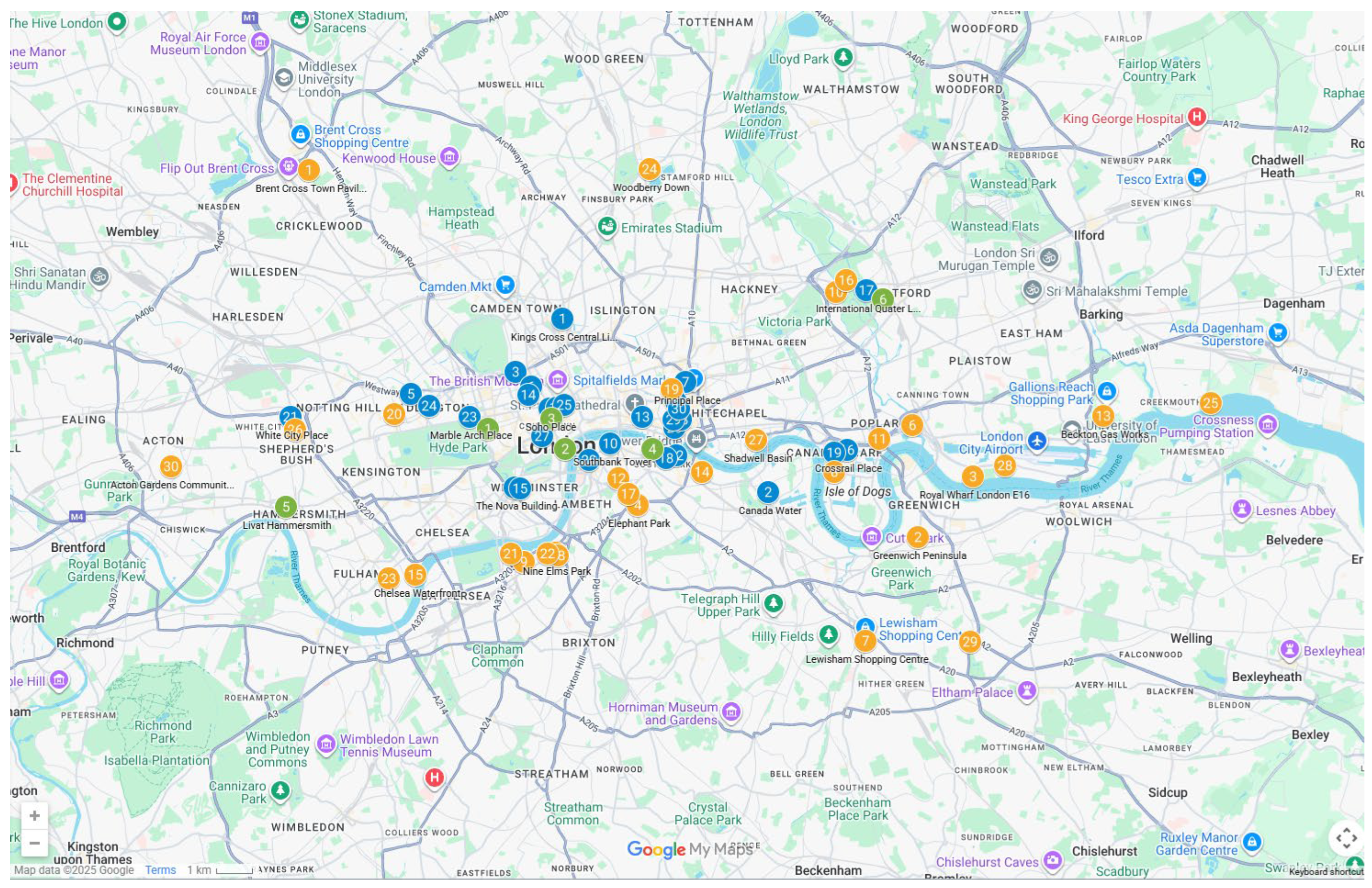

Table 1.
Summary of Dataset Construction Parameters. Author’s own source.
| Variable Group | Source(s) | Proxy Logic / Notes |
| Anchor Typology | Press releases, leasing announcements, developer/investor websites | Dominant GLA, investment draw, or branding |
| ESG Certifications | BRE BREEAM directory, UK Govt EPC Register, asset manager disclosures | Asset-level records, proxy from similar assets |
| Governance Maturity | Sustainability reports, TCFD, analyst briefings, BBP, JLL, CBRE market research | High/medium/low scale by reporting transparency |
| Control Variables | Developer reports, planning documents, GLA, zone, year, public realm provision | Where missing, triangulated from comparables |
Table 2.
Indicator Scaling and Rationale. Author’s own source.
| Dimension | Indicator | Scale & Rule | Rationale |
| Environmental | BREEAM | 1–4 by grading | Cert uptake, reg. compliance, tenant-driven demand |
| Environmental | EPC | A–G mapped 0–4 | Mandatory, but imperfect, regulatory measure |
| Social | Public Realm | None–High 0–4 | Urban placemaking, accessibility |
| Social | Transport | None–High 0–4 | Mobility, connectedness, estate externality |
| Governance | Green Lease | None–Conf 0–4 | Direct evidence/presumptive via anchor maturity |
| Governance | ESG Maturity | Low–High 0–4 | Disclosure, engagement, sustainability targets |
Table 3.
Hypotheses and propositions, scaling and rationale. Author’s own source.
| Type | Anchor Comparison | ESG Dimension | Expected Outcome |
| H1 (Formal) | Office vs Residential | ESG composite (0–100) | ↑ Higher for Office |
| H2 (Exploratory) | All typologies | Governance (ESG maturity) | Positive moderation |
| H3 (Exploratory) | All typologies | Social vs Environmental | Greater Social variation |
Table 4.
Descriptive Statistics of ESG Scores by Anchor Typology. Author’s own source.
| Anchor Type | n | Mean ESG | SD ESG | Mean E | Mean S | Mean G |
| Office | 30 | 74.42 | 11.25 | 2.93 | 3.10 | 2.90 |
| Residential | 30 | 68.08 | 11.56 | 2.70 | 2.93 | 2.47 |
| Retail | 3 | 73.75 | 6.61 | 2.50 | 3.67 | 3.00 |
| Hotel | 2 | 58.75 | 22.98 | 2.00 | 3.50 | 1.50 |
Disclaimer/Publisher’s Note: The statements, opinions and data contained in all publications are solely those of the individual author(s) and contributor(s) and not of MDPI and/or the editor(s). MDPI and/or the editor(s) disclaim responsibility for any injury to people or property resulting from any ideas, methods, instructions or products referred to in the content. |
© 2025 by the authors. Licensee MDPI, Basel, Switzerland. This article is an open access article distributed under the terms and conditions of the Creative Commons Attribution (CC BY) license (http://creativecommons.org/licenses/by/4.0/).
Copyright: This open access article is published under a Creative Commons CC BY 4.0 license, which permit the free download, distribution, and reuse, provided that the author and preprint are cited in any reuse.


