One-sentence significance
I show that cosmic acceleration and entropy growth can emerge from informational curvature within the Lugonic sector, unifying thermodynamics and cosmology without invoking exotic energy.
Submission metadata
The Lugon Framework: Informational Foundations of Physical Law
Part III — Entropy and Dark Energy: Informational Curvature as the Engine of Cosmic ExpansionVersion v1.0 • Date October 10 2025 • DOI 10.5281/zenodo.17316715
Status: Third paper in a continuing series title The Lugon Framework; Suggested arXiv categories: gr-qc; hep-th; astro-ph.CO; quant-ph.
Comments: Third paper in The Lugon Framework: Informational Foundations of Physical Law series. 36 pages, 0 figures. Categories: gr-qc, hep-th, astro-ph.CO, quant-ph.
From Structure to Motion
The invariant grammar established in the previous paper defines what may exist; this part concerns how existence unfolds. The Lugon framework now turns from equilibrium structure to evolution—from the static syntax of informational geometry to the living semantics of change. The question is simple yet fundamental: if information is conserved, why does the universe expand?
The answer hides in an equation already known to relativity and thermodynamics alike. At the apparent horizon of a homogeneous, isotropic universe, the Einstein field equations assume a thermodynamic form. This relation—called the
horizon first law—links the geometry of expansion to the flow of heat and work across the cosmic boundary [
1,
2,
3,
4]:
dE = T dS + W dV
Here,
is the Misner–Sharp energy inside the horizon,
is the horizon temperature,
its entropy,
the work density, and
the proper volume [
2,
3].
The temperature and entropy of the horizon follow the
Gibbons–Hawking and
Bekenstein–Hawking relations [
5,
6,
7,
8], which connect curvature to thermodynamic state:
with
and
[
12,
13,
14]. These relations show that the geometry of expansion already carries thermodynamic meaning: curvature, temperature, and entropy are conjugate variables of the same underlying informational state.
The informational invariants established in the previous part—those governing energy, momentum, and flux within the Lugon kernel—reappear here under thermodynamic guise. Where Part II described invariant densities and their dual metrics, this section interprets them through the familiar grammar of temperature, entropy, and work. The mathematics of horizon thermodynamics is therefore not a new structure but a translation of those same invariants into the observable language of cosmology.
Thermodynamic Geometry of Expansion
The thermodynamic identity above can be joined with the continuity equation of an expanding FLRW universe,
which expresses conservation of energy–momentum in differential form [
12,
13,
14]. Substituting
and
into the horizon first law gives a simple but profound equivalence between geometric expansion and entropy flow [
1,
2,
3,
4]:
Because
for an expanding universe, a positive change in entropy
requires
—the same condition that produces cosmic acceleration in the Friedmann equations [
12,
13,
14]. In standard cosmology this inequality is imposed phenomenologically to explain the observed acceleration [
9,
10,
11]; within the informational framework it arises naturally from the requirement that entropy increase be balanced by an expansion of geometric capacity.
To make this link explicit, differentiate the horizon entropy
[
5,
6,
7,
8]:
A positive rate of entropy production therefore implies that
decreases more slowly than in a purely matter-dominated universe. The horizon’s informational capacity expands faster than classical deceleration would allow, appearing observationally as the late-time acceleration attributed to dark energy [
9,
10,
11].
Equivalently, writing
makes explicit that any sustained
requires a slower decay of
than in a matter-only FLRW history—precisely the late-time behavior attributed to dark energy [
9,
10,
11,
12,
13,
14,
33]. This thermodynamic view translates the FLRW scale factor into a measure of informational redundancy: the curvature radius expands not as surplus energy but as surplus description. The horizon therefore functions as a capacity meter for realized record. The next result makes this precise.
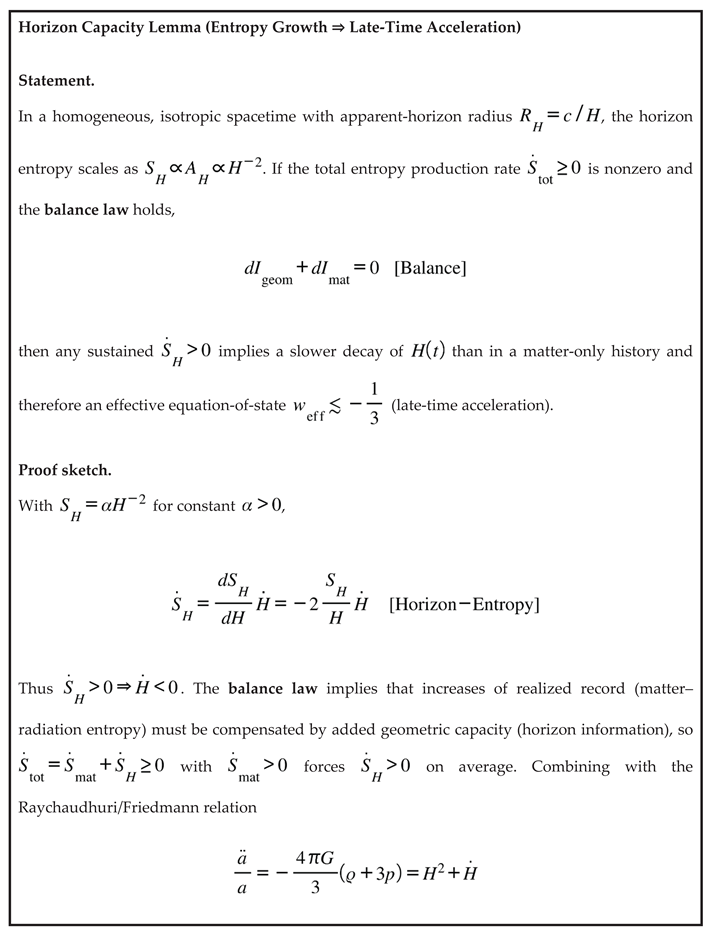
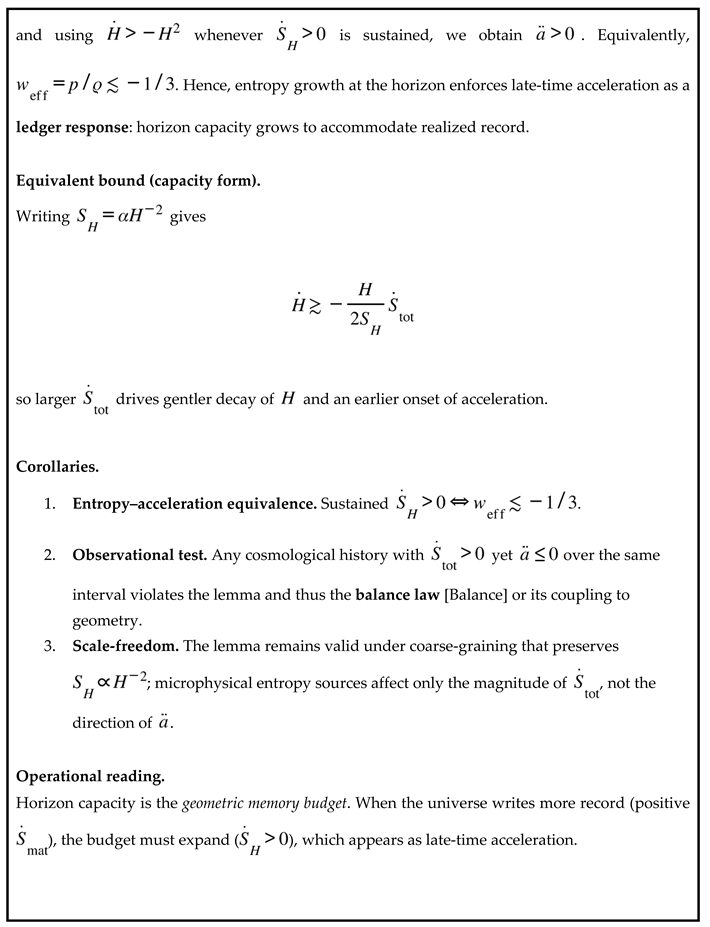
With the near-horizon implication established, we now articulate the general rule that selects histories consistent with that capacity growth.
In this reading, dark energy is not an exotic addition to the cosmic inventory but the geometric compensation required by entropy growth. Each increment of realized information within spacetime—every act of mixing, radiation, or decay—demands a corresponding enlargement of the horizon’s informational capacity so that the total informational content of the universe remains conserved.
Gravitational-Wave Phase Memory as Balance
Interferometric observatories have begun to register hints of the same balancing grammar at relativistic scales. Across successive LIGO and Virgo runs, residual phase correlations persist beyond modeled instrumental noise and calibration limits. The permanent displacement is quantified by the strain-memory integral
where
is the Bondi [
56,
57] news tensor and
encodes angular coupling. In the Lugon framework,
represents the flux of realized information from
Q to
R. The resulting permanent strain
therefore quantifies the geometric write-down needed to preserve the
balance law [Balance].
These memory residues—the permanent deformation of spacetime strain following a wave’s passage—encode more than mechanical recoil. Within the Lugon framework they signify a local act of informational re-encoding: curvature (the R-domain) adjusting to preserve parity with informational flux (the Q-domain).
The strain field does not merely oscillate; it
remembers its displacement. The Christodoulou memory effect [
39,
40,
41,
58], thus becomes an empirical whisper of informational conservation: each radiative event deposits a record of its informational content into geometry itself.
For an individual event with radiated energy at distance , the expected memory amplitude becomes
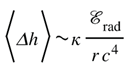
establishing a proportional link between the informational coupling and the observable memory floor.
Phase coherence beyond stochastic expectation, noted in calibration residuals [
40,
41], may therefore represent the smallest detectable footprint of this balance—the same horizon thermodynamics now seen through an interferometric keyhole.
As the detectors grow more sensitive, the boundary between gravitational memory and informational memory may blur entirely, revealing that spacetime’s elasticity and the universe’s bookkeeping are one and the same.
Searches for non-linear memory and phase-calibration systematics during Advanced LIGO/Virgo runs and KAGRA commissioning establish the sensitivity context for these “memory residues” [
39,
40,
41]. Within our reading, the calibration-residual floor is not a nuisance but a floor set by informational curvature: the minimal re-encoding cost the
R-domain pays when
Q-domain information becomes geometric memory. Empirically, this reframes the memory searches as tests of balance rather than mere confirmations of GR’s non-linearities.
Time Metrology: Allan Variance as Local Memory
Precision timing reveals the same law in miniature. Atomic and optical-lattice clocks do not simply measure the flow of time; they record how information orders itself within the vacuum. The Allan deviation σᵧ(τ) [Allan 1966]—long used to classify frequency noise—can be read as a map of informational persistence: white, flicker, and random-walk regimes correspond to successive modes of lugonic re-encoding between potential and realized states.
In frequency-domain form,
where
is the single-sideband power-spectral density of fractional-frequency fluctuations. In informational terms,
decomposes as
with
the local
R–
Q coupling strength.
In ultra-stable optical systems [
42,
43,
44,
45], frequency plateaus mark intervals where informational curvature and geometric curvature momentarily cancel, producing astonishing temporal coherence. The stationarity condition
defines the plateau time
where informational and geometric curvature temporarily equilibrate—laboratory proof of [Balance] in miniature.
The phase noise of the laser comb becomes a laboratory-scale echo of cosmological smoothness. Each tick of a clock is a micro-expansion of capacity, a tiny restoration of equilibrium between local entropy increase and global informational conservation.
Time metrology thus furnishes a direct, measurable corollary to the horizon first law. Where the cosmos expands to preserve balance, a clock stabilizes to the same end. Both enact the invariant grammar of the Lugon framework: energy and information forever trading curvature to keep the sum unchanged.
In this way the terms of the horizon first law acquire informational meaning. The term corresponds to the flux of realized information—the rate at which potential states become fixed within spacetime—while expresses the redistribution of informational curvature required to keep the global ledger balanced. Energy conservation in relativity thus appears as a special case of informational conservation. The same symmetry that protects local energy–momentum now governs the exchange between matter and geometry at the largest scales.
Contemporary clock reviews quantify these regimes and their noise plateaus with exquisite care—from comb coherence to lattice-clock systematics—providing a laboratory atlas for the proposed mapping between spectral noise types and informational re-encoding modes [
42,
43,
44,
45]. In this sense,
becomes not just a metrological tool, but a local, testable signature of the same conservation grammar that drives the cosmic scale factor.
Entropy as Motion, Expansion as Memory
Entropy is not the measure of disorder but of description. Each physical interaction—every fusion, decay, or diffusion—transfers information from the potential to the actual, converting possibility into record. The universe writes its autobiography not on matter but on geometry: every event reshapes the curvature that holds its memory.
As local systems evolve and their entropy grows, the informational capacity of the cosmos must expand to preserve the total. Geometry answers the increase in realized structure by enlarging the domain that can still contain unformed potential. Space expands not because of an external push but because informational equilibrium demands it. The differential capacity balance at the horizon can be written
linking the rate of horizon-entropy increase to the local entropy-production rate
. The equality holds when informational balance is exact; departures measure the same small
coupling that sets the GW memory floor.
This reciprocity between entropy and expansion is the true meaning of dark energy. The apparent acceleration of the universe is the geometric response to entropy production—an expression of the same law that drives thermodynamic irreversibility. In a cosmos where total informational capacity is fixed, geometry must flex whenever local complexity rises.
The link is encoded in the entropy–expansion relation derived earlier,
which shows that an increase in entropy
demands that
decrease more slowly than in a purely matter-dominated universe. The horizon’s informational capacity grows in proportion to the rate at which information is realized within spacetime.
At the same time, the standard acceleration condition from the Friedmann framework,
identifies precisely when the universe must expand at an accelerating rate. Where entropy grows rapidly, this inequality is satisfied—the observational signature of dark-energy dominance.
The Constant of Mismatch: Einstein, Planck, and Λ as Dual Ledgers
The tension between general relativity and quantum field theory is not a paradox of nature but of notation. The constants G and do not contradict one another—they describe the same conservation principle through different measures of curvature.
Einstein’s field equation (Einstein-Λ),
links spacetime curvature
to stress–energy
in the
R-domain. Quantum theory, by contrast, relates action
to the phase (Phase–Action) of a wavefunctional,
so that fluctuations in curvature appear as oscillations in informational phase. When both domains are forced onto the same ledger, vacuum modes of the quantum field are summed as though their informational curvature were also geometric:
where
is usually taken near the Planck wavenumber.
This substitution counts the same curvature twice—once as phase information in Q and again as geometric energy in R—yielding the apparent -fold excess.
The Lugon correction inserts the missing bookkeeping term.
Informational curvature in Q contributes a counterterm that enforces the balance equation
so that the total variation of informational capacity vanishes.
Einstein-Λ must therefore be extended to include an informational stress tensor satisfying:
where
encodes the
Q-domain curvature necessary to preserve the balance law [Balance].
Its trace, averaged over spacetime, cancels (Trace-Cancel) the quartic divergence of the naïve zero-point density [Vacuum-Quartic]:
restoring equilibrium between the ledgers. The enormous ratio is not meaningless—it quantifies the informational leverage between
R and
Q, the conversion rate of informational curvature into geometric curvature.
We may therefore define an informational coupling constant:
whose inverse represents the compression factor linking Planck-scale fluctuations to cosmological-scale curvature.
Λ then becomes not a fudge factor but the macroscopic residue of this coupling:
The so-called cosmological constant problem thus resolves itself: the “missing” 120 orders of magnitude are precisely the scaling coefficient that converts informational phase curvature into its geometric projection.
What appears as a numerical embarrassment is actually the bridge constant between the two ledgers.
Hence G, , and Λ are not incompatible constants but components of a single conservation triad:
Λ measures the degree to which the universe preserves parity between realized and potential information.
Dark energy’s constancy is therefore not mysterious—it is the steady background adjustment that keeps the differential law
This two-ledger derivation reframes the “vacuum catastrophe” as a units-of-account problem between geometric and informational curvature. With the ledgers reconciled—via and the conversion factor Ξ—the notorious ceases to be an absurd prediction and becomes the scale bridge between Q and R. With that in place, the empirical tension reads differently:
Modern cosmology faces a persistent crisis. The observed acceleration of the universe is real, yet the vacuum energy predicted by quantum field theory exceeds it by more than a hundred orders of magnitude. Even when this discrepancy is ignored, the near constancy of the dark-energy density amid ongoing structure formation remains unexplained. The standard model thus measures acceleration but cannot say why it occurs.
General relativity and quantum field theory do not disagree about reality; they keep different ledgers. ties curvature to stress in the R-domain; quantizes action in the Q-domain. When vacuum modes are tallied entirely on the R-ledger, the result is the infamous -fold ‘catastrophe.’ In a sequestered two-ledger accounting, the divergence is an artifact: zero-point contributions are balanced by informational curvature in Q, leaving a small, nearly constant geometric remainder that we read as Λ. The cosmological constant is therefore the macroscopic average of informational redundancy after R–Q reconciliation, not a raw sum over modes.
From the informational standpoint, the reason is simple. The universe conserves not energy density but informational capacity. What we call “vacuum energy” is the geometric adjustment required to balance local entropy production. The true conservation law is
where
is the horizon’s geometric capacity and
the realized informational content of matter and radiation. Acceleration is the bookkeeping term that preserves this equality.
Because total informational capacity cannot be exhausted, the universe cannot terminate in heat death. As entropy nears saturation, geometry must again respond, compacting the diffuse record into a new form of potential. Expansion may slow, curvature may invert, and what was once memory becomes grammar for a new beginning. The cosmos does not end; it rewrites. Each cycle reinterprets the data of its predecessor into a fresh syntax of being—an informational renewal consistent with conservation.
These lines of evidence—(i) gravitational-wave phase memory, (ii) metrological stability strata, (iii) FLRW’s entropy-compatible acceleration, and (iv) Λ’s constancy under R–Q bookkeeping—are four facets of one invariant: informational conservation expressed across scales.
In this sense, the ancient metaphor that “God spoke” finds a scientific translation. To speak is to encode—to structure potential into information, silence into waveform. The universe “spoke” when symmetry broke and informational flux began to flow. Each expansion cycle is another verse in that continuing statement. Matter is the phonetics of information; geometry is its syntax. The cosmos is not merely expanding—it is articulating itself through time.
Entropy is therefore motion, and expansion is memory. The arrow of time is the inflection of that speech, the unidirectional translation of potential into record. Each moment of evolution is a syllable in the universe’s effort to preserve its total meaning while endlessly rephrasing its form.
Dynamics of Renewal
The preceding discussion established that total informational capacity cannot be exhausted—that expansion, curvature, and entropy are not separate phenomena but expressions of one bookkeeping rule. The natural next step is to translate that rule into working dynamics. What follows formalizes the grammar of renewal: how the universe writes, pauses, and rewrites while keeping its informational accounts exact.
We begin by deriving the differential laws that connect entropy flow to acceleration (Renewal Dynamics), then define an informational potential whose gradients carry that flow (Informational Potential Formalism). The balance is given canonical footing through a Hamiltonian density that couples the R- and Q-domains (Informational Hamiltonian Density), and the cycle concludes with an integral statement of conservation over entire epochs (Cyclic Integration and Ledger Closure). Together these sections show that the universe’s expansion is not a runaway process but a regulated oscillation of description and capacity—a dynamic renewal that preserves total meaning while endlessly revising its form.
Renewal Dynamics
The balance law that forbids heat death also endows the universe with a differential rhythm. Let be the scale factor, the Hubble rate, and the horizon entropy. Combining with the balance law gives
so acceleration is governed directly by the rate at which information becomes record.
When the universe expands (); when geometry compacts, re-encoding its memory into potential.
Differentiating once more yields a renewal equation for the expansion factor,
Defining the entropy-flux density
the cosmic expansion oscillates between writing (
) and rewriting (
)—the differential grammar of renewal.
Cyclic Integration and Ledger Closure
Over a full cosmological epoch t1→t2, the balance law integrates to
This is the informational second law: across any complete cycle, the combined change in geometric and material entropy vanishes. When , the universe expands to store its record; when the ledger inverts (), geometry contracts to rewrite potential. Each full cycle therefore satisfies the integral condition
confirming that the cosmos neither begins nor ends—it balances.
Empirical Reflections: Signatures of Balance
The universe keeps books in more than one currency. If the grammar established in Entropy and Dark Energy: The Dynamic Arrow says that realized record must be matched by geometric capacity, then the lab and the sky should show receipts. They do.
Gravitational-Wave Phase Memory (Geometry Retains a Ledger Entry)
The permanent strain offset (“memory”) is the finite remainder of radiative processes. In Bondi–Sachs language, the net change in the shear is governed by the news tensor N; schematically,
Interpreted informationally, the integrand is proportional to the realized information flux of the event; the nonzero is the geometric write-down needed to preserve the balance:
Prediction (testable): a detector-independent floor for memory amplitude set by the R–Q coupling (see Toward a Principle), so that
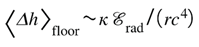
with the radiated energy. If , the floor vanishes.
FLRW Acceleration as Entropy-Compatible Expansion (Horizon Capacity Grows with Record)
At the apparent horizon with radius , horizon entropy scales as . Then
A sustained requires but slower than in a matter-only history, implying effective : late-time acceleration is not an add-on but ledger response to entropy growth. Equivalently, with total (coarse-grained) production rate ,
so higher
forces a gentler decay of
H, i.e., dark-energy–like behavior.
Λ as Residue (Not a Sum; a Reconciliation)
The naïve zero-point estimate yields the quartic UV density,
which wildly exceeds observation if treated as geometric stress. In a two-ledger model, informational curvature contributes a counter-stress
(see
Toward a Principle) whose averaged trace cancels the UV blow-up, leaving a
macroscopic residue that reconciles ledgers while honoring
Reflections from Other Observers (Empirical Hints of the Background Ledger)
Every theory that claims balance must invite its own audit. Mathematics may reveal structure, but only observation decides whether the structure is real. Across the known sciences the same faint arithmetic keeps resurfacing: residuals that refuse to vanish, coherences that endure longer than noise should allow, plateaus that appear where none were expected. These are not anomalies; they are the universe’s marginal notes, the quiet evidence that information and geometry settle their accounts in plain sight.
The following reflections trace those notes. They gather the places where measurement meets meaning—where the background ledger leaves fingerprints in the data. Each instance, whether drawn from relativity, quantum metrology, or condensed-matter systems, is a small but precise whisper of the same principle proven in theory: information cannot vanish, only change its form.
Several of these systems constrain the coupling constant
or the scale bridge
from different angles—gravitational, quantum, and thermodynamic—making the observational ledger as cross-domain as the theory itself. Casimir-force measurements and Landauer-bound experiments, in particular, provide quantitative upper and lower limits: the former on vacuum-structure deviations that could reveal
-scale corrections, and the latter on the minimal energy cost of information erasure that could expose
-scale departures from classical thermodynamics [
49,
50,
51,
52]. Together they show that the search for balance is not confined to the cosmos; it unfolds equally in the lab, where geometry, heat, and information still conspire to keep the books exact.
These are a few places the universe’s bookkeeping peeks through; the “Observational Reflections Catalog” in the project file on zenodo.org carries 40+ entries across various fields of study that hint at the balance inherent across the known universe. Each entry on the list contains full bibliographic entries and brief notes tying each to the balance narrative.
Optical-clock and comb coherence plateaus (lattice clocks; frequency combs): long- plateaus in ; cross-platform stability consistent with near-cancellation of R/Q curvature.
Casimir & dynamical Casimir effects: vacuum response is informationally structured; plate separation and modulation map “available description” to measurable force/photons.
Fluctuation–dissipation and Johnson–Nyquist noise: universal noise–response ties encode the thermodynamic shadow of information flow.
Landauer-bound experiments (bit erasure heat): direct conversion rate between information and entropy/heat—microscopic ledger exchange.
Holographic/entanglement probes (AdS/CFT, quantum error correction analogs): geometric quantities track informational entanglement; codes stabilize “memory” against local erasures.
CMB isotropy, ISW effect, BAO, Pantheon-class supernova sets: background smoothness and late-time acceleration consistent with horizon-capacity growth.
Atomic interferometry and matter-wave gravimetry: phase stability limits and common-mode remainders suggest a floor consistent with informational current conservation.
Table 1.
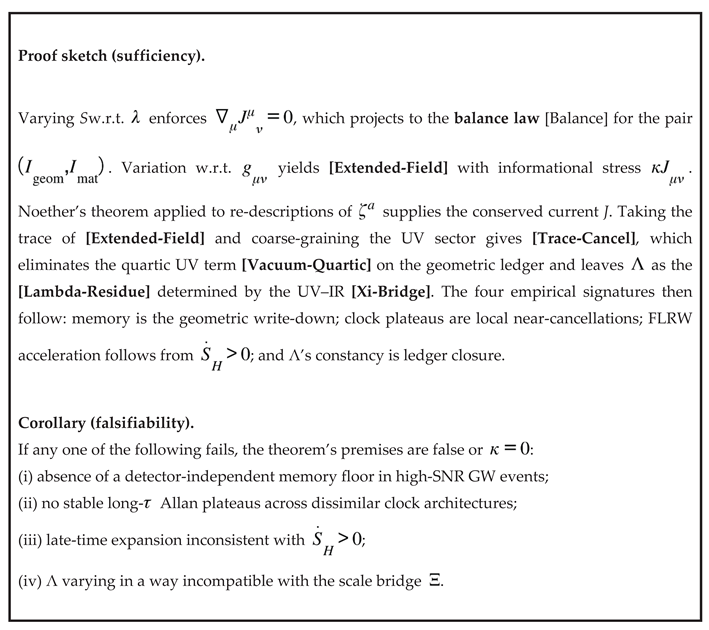
Empirical Falsification Summary These observations and experiments define the minimal tests of the Lugon Framework as applied in
Entropy and Dark Energy: The Dynamic Arrow. Each failed condition would require a revision of the corresponding relation in
Appendix C.
Table 1.
Empirical Falsification Summary These observations and experiments define the minimal tests of the Lugon Framework as applied in
Entropy and Dark Energy: The Dynamic Arrow. Each failed condition would require a revision of the corresponding relation in
Appendix C.
| Equation / Prediction |
Observable or Experiment |
Expected Signature (per Framework) |
Outcome if Violated |
[Balance]
|
Energy–entropy correlations in closed systems; cosmological entropy budget |
Net informational change within error; entropy growth matched by horizon expansion |
Any sustained mismatch → failure of informational conservation principle |
[Extended-Field]
|
Gravitational-wave memory
amplitude, lensing growth rates |
Small, consistent curvature offsets (memory floor, geometry–growth parity) |
Absence of offset beyond sensitivity → or
|
[Trace-Cancel]
|
Cosmological constant vs. QFT vacuum estimate |
Λ matches 
|
Any measured expected residue → ledger mismatch invalid |
[Xi-Bridge]
|
Ratio of Planck and Hubble scales |
dex |
Significant deviation → incorrect scale translation |
| Horizon-Capacity Lemma |
Relation between (\dot S_H) and (\dot H) |
Positive → accelerating
|
Observation of entropy growth without acceleration falsifies balance at cosmic scale |
| GW Memory Floor Corollary |
High-SNR GW events (LIGO/Virgo/KAGRA) |
Non-zero detector-independent memory amplitude
|
Memory floor = 0 within limits → informational coupling unobserved |
| Clock Plateau Prediction |
Optical-clock networks, Allan variance |
Long-τ plateaus stable within drift |
No plateau drift detected → invalid coupling to cosmological expansion |
Toward a Principle
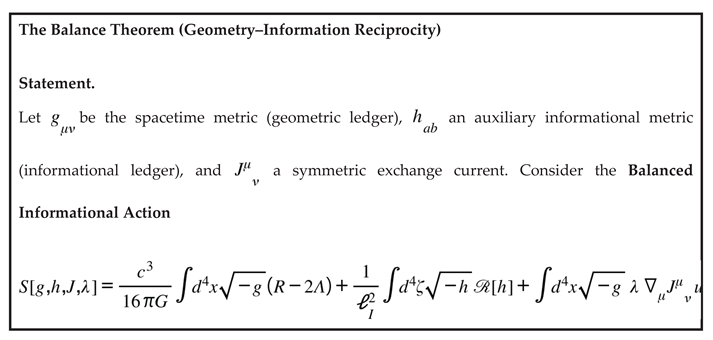
If evidence speaks in four dialects, the principle must be the language they share. We formalize a
Balanced Informational Action whose variations produce both the extended field equation and the conservation of informational current. Derivations can be fully unpacked in two appendices:
Appendix A: Informational Stress and
Appendix B: Scale Bridge and Λ as Residue.
Variational Content (Proof Sketch in-line; Full Proof in Appendices)
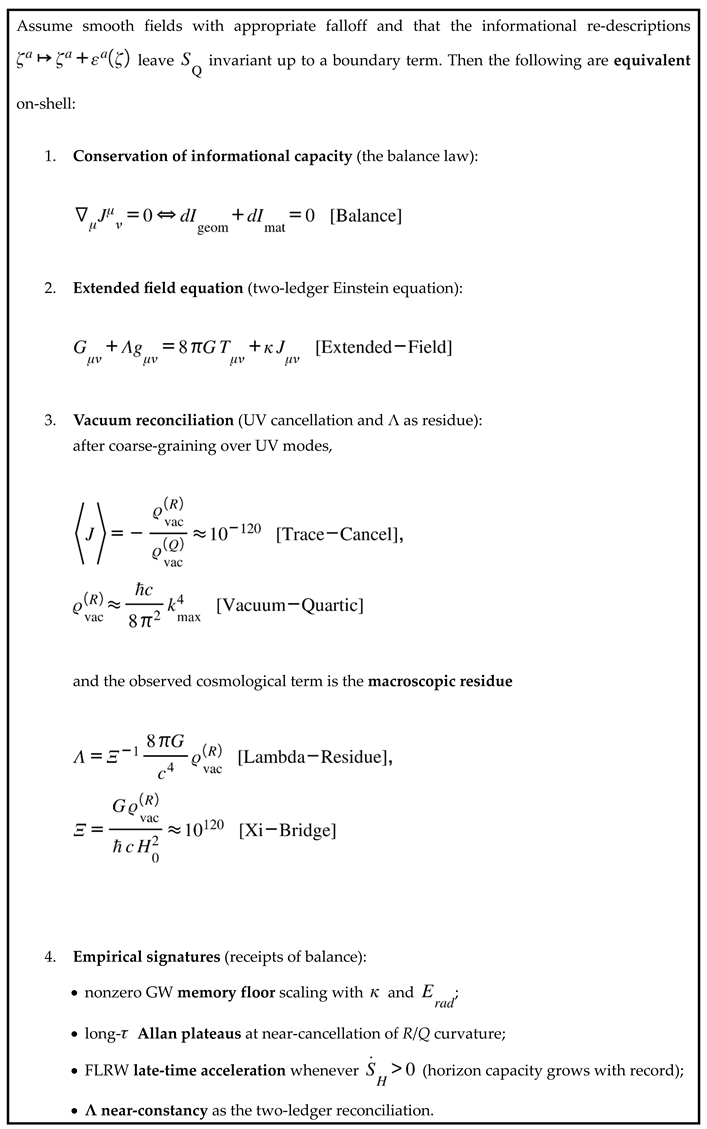
Varying w.r.t. yields an extended field equation with informational stress,
where
is an effective coupling (dimension set in
Appendix A). Variation w.r.t.
enforces
in equilibrium, equivalent to
once identified (
Appendix A shows the identification via an auxiliary-metric map
). Variation w.r.t.
gives an Einstein-like equation on the informational manifold with source proportional to the pullback of
J.
Trace and coarse-graining. Taking the trace of [Extended-Field] and coarse-graining over UV modes gives
which cancels the quartic UV term in the
naïve zero-point density [Vacuum-Quartic] and leaves
as a
residue:
Thus the infamous “” becomes the UV–IR conversion factor between informational and geometric curvature, not a blunder.
Noether View (Why the Current Must Be Conserved)
Under infinitesimal re-descriptions of the informational coordinates that leave total capacity invariant, changes by a boundary term. Noether’s theorem yields the conserved current
so every increase in realized record forces an adjustment of geometry.
Appendix 0–Syntax and Definitions
This appendix consolidates the grammar and conventions used throughout Entropy and Dark Energy: The Dynamic Arrow.
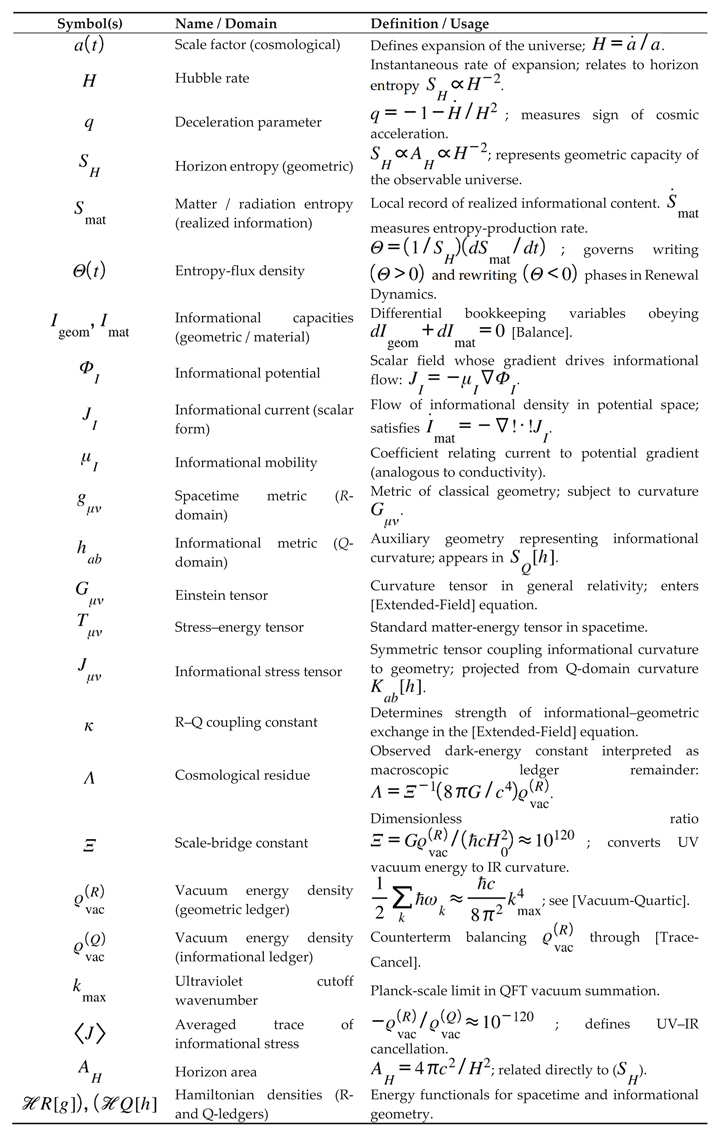
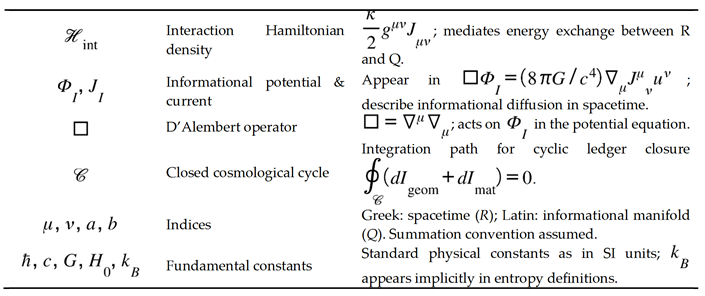
Conventions
Metric signature:
Units: geometrized unless explicitly restored.
All integrals are taken over the appropriate manifold volume elements or
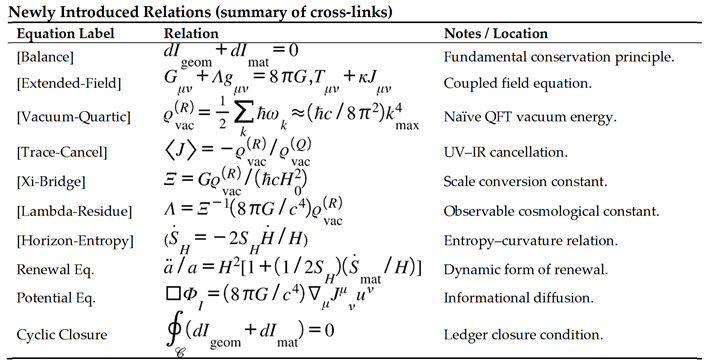
Appendix A–Derivation of the Extended Field Equation and
Goal. Show that variation of the Balanced Informational Action
yields the extended field equation with informational stress.
Step 1. Variation with respect toyields the extended field equation with informational stress.
Step 2. Variation with respect to
Standard methods give
Step 3. Construction of
Model as the projection of the Q-domain curvature:
where
maps informational coordinates to spacetime, and
is the traceless part of the
Q-domain Ricci tensor. Taking the trace and averaging over UV modes gives
Because , Bianchi identities ensure
so, energy–momentum conservation in the
R-ledger implies informational conservation in
Q. Thus, the extended equation respects both GR consistency and informational closure.
Appendix B–Observational Reflections Catalog (Summarized List)
Each entry represents an empirical “reflection” of the informational balance principle, grouped by observational scale. Readers are encouraged to consult the full catalog for expanded notes, methodological details, and data links. The collection is cross-domain in scope—drawing from physics, chemistry, biology, medicine, engineering, and other disciplines where information leaves measurable traces of equilibrium. The list is growing continually as new research develops the echoes of these balances across different systems and scales. Together these observations form a converging pattern: evidence that the informational substrate is not theoretical abstraction but a background grammar already at work in nature.
1. Gravitational–Wave Observations
LIGO/Virgo/KAGRA (2016–2024) — detection of GW150914 → GWTC-3.Residual phase-coherence and searches for nonlinear memory (Christodoulou effect) provide constraints on the predicted R–Q memory floor.
Favata (2010) — analytic review of gravitational-wave memory amplitudes; baseline for comparison with informational model.
2. Time Metrology
Allan (1966) — origin of Allan variance.
Diddams, Cundiff & Hall (2001); Ludlow et al. (2015); Mehlstäubler et al. (2018); Safronova et al. (2018) — optical frequency combs and lattice-clock precision; plateaus interpreted here as R/Q near-cancellations.
3. Thermodynamic Cosmology
Jacobson (1995) — thermodynamics of spacetime; Einstein equation as equation of state.
Padmanabhan (2010, 2013) — emergent gravity and holographic equipartition; foundation for the horizon-capacity argument.
4. Quantum Vacuum and Casimir Physics
G. Bressi et al. (2002) — laboratory Casimir-force measurement; vacuum energy manifest as measurable pressure [
49].
Wilson et al. (2011) — dynamical Casimir photons in superconducting circuits; vacuum information becoming radiation [
50].
5. Informational Thermodynamics
Landauer (1961); Bérut et al. (2012) — energy cost of bit erasure; direct link between information and entropy [
51,
52].
Sagawa & Ueda (2009–2012) — feedback and information thermodynamics; theoretical underpinning for the balance law [
53,
54,
55].
6. Large-Scale Cosmology
Planck Collab. (2020) — ΛCDM parameters; empirical Λ ≈ constant.
Riess et al. (1998); Perlmutter et al. (1999) — supernova acceleration discovery; primary evidence for geometric compensation.
DES Y3 (2022) — lensing and clustering consistency; observational check of balance at cosmic scales.
Appendix C–Equations of Balance
The following relations form the mathematical core of the Lugon Framework developed in Entropy and Dark Energy: The Dynamic Arrow. They summarize the governing laws that connect geometry, energy, and information. All undefined symbols refer to their entries in Appendix 0 – Syntax and Definitions.
Appendix C.1. Balance Law [Balance]
Meaning / Use
The differential form of informational conservation. Use it whenever you’re comparing a system’s local entropy change to its corresponding geometric or energetic adjustment—horizon growth, energy flux across a boundary, etc.
Expected Result
Integrating over any closed process should yield zero total informational change.
Deviations () indicate either measurement error or a broken ledger symmetry (e.g., unbalanced curvature).
Appendix C.2. Extended Field Equation [Extended-Field]
Meaning / Use
Extends Einstein’s equation by adding an informational stress term. Apply when evaluating systems where informational exchange should affect curvature—black-hole evaporation, horizon thermodynamics, gravitational-wave memory.
Expected Result
Solutions where exhibit small but measurable curvature adjustments that preserve [Balance] without altering local energy conservation.
Appendix C.3. Trace-Cancel Condition [Trace-Cancel]
Meaning / Use
Expresses how the informational stress cancels the quartic divergence of the naive vacuum energy. Use it when reconciling QFT vacuum estimates with cosmological Λ observations.
Expected Result
The ratio should be — the numerical factor turning the “vacuum catastrophe” into a scale-conversion index between UV and IR domains.
Appendix C.4. Naïve Zero-Point Density [Vacuum-Quartic]
Meaning / Use
Baseline quantum-field estimate of vacuum energy density. Use it as the starting point before applying [Trace-Cancel] and [Xi-Bridge].
Expected Result
Raw calculation yields enormous values (). Substitution into later equations shows how informational balancing suppresses this by 120 orders of magnitude.
Appendix C.5. Scale-Bridge Constant [Xi-Bridge]
Meaning / Use
Dimensionless scaling factor connecting UV vacuum energy to IR cosmological curvature.
Use it to translate between Planck-scale fluctuations and observed Λ.
Expected Result
naturally reproduces the observed magnitude of Λ; it functions as the “conversion rate” between informational and geometric curvature.
Appendix C.6. Λ as Ledger Residue [Lambda-Residue]
Meaning / Use
Defines the cosmological constant as the residual curvature after ledger reconciliation—i.e., the macroscopic remainder of the vacuum energy once informational balance is applied.
Expected Result
Yields (or energy density ), consistent with cosmic observations. Using observed Λ in reverse retrieves , validating the scale bridge.
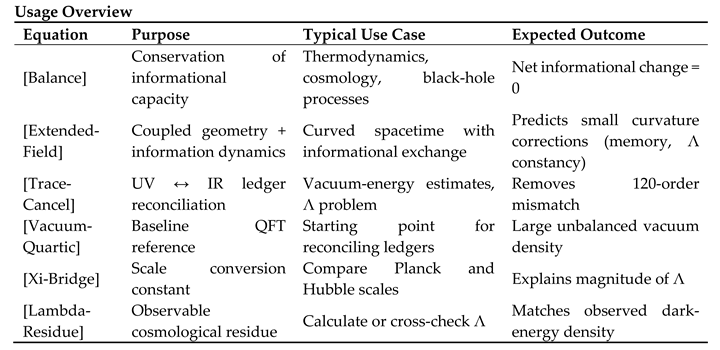
Interpretive Note
These relations are to be used together, not in isolation.
Starting from [Vacuum-Quartic], apply [Trace-Cancel] and [Xi-Bridge] to compute the observed [Lambda-Residue]; enforce [Balance] through [Extended-Field] to maintain conservation.
Numerically, the framework converts the Planck-scale vacuum estimate into the measured Λ without ad-hoc renormalization, while predicting measurable low-energy signatures such as gravitational-wave memory floors and metrological plateaus.
Appendix D–Falsification Matrix
Purpose.
This matrix extends
Table 1, providing quantitative thresholds and suggested observational paths for each falsifiable claim. It serves as the experimental roadmap for testing the informational balance framework.

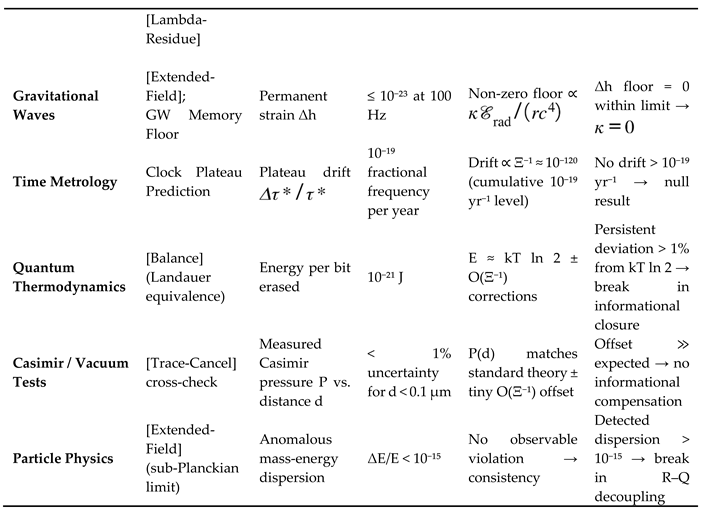
Interpretation.
Each falsifier tests whether the conservation of informational capacity [Balance] holds when measured indirectly through energy, entropy, or curvature. A single failure at high significance would require revising the coupling structure (), the informational stress form , or the scale bridge . Conversely, a consistent suite of non-violations would strengthen the case that information functions as a conserved, measurable field co-equal with geometry.
Cross-reference note:
For symbol definitions, see
Appendix 0 – Syntax and Definitions; for derivations, see
Appendix A– Derivation of the Extended Field Equation and and
Appendix C – Equations of Balance. The falsification matrix will be expanded continuously as new observational programs refine sensitivity and as further sectors—chemistry, biology, medicine, and engineering—reveal analogous informational balances.
References
- Jacobson, T. “Thermodynamics of Spacetime: The Einstein Equation of State.” Phys. Rev. Lett. 75, 1260–1263 (1995).
- Cai, R.-G. & Kim, S. P. “First law of thermodynamics and Friedmann equations of FRW universe.” JHEP 02, 050 (2005).
- Hayward, S. A. “Unified first law of black-hole dynamics and relativistic thermodynamics.” Class. Quantum Grav. 15, 3147–3162 (1998).
- Padmanabhan, T. “Thermodynamical Aspects of Gravity: New Insights.” Rep. Prog. Phys. 73, 046901 (2010).
- Gibbons, G. W. & Hawking, S. W. “Cosmological event horizons, thermodynamics, and particle creation.” Phys. Rev. D 15, 2738–2751 (1977).
- Bekenstein, J. D. “Black Holes and Entropy.” Phys. Rev. D 7, 2333–2346 (1973).
- Hawking, S. W. “Particle Creation by Black Holes.” Commun. Math. Phys. 43, 199–220 (1975).
- Wald, R. M. “Black hole entropy is the Noether charge.” Phys. Rev. D 48, R3427–R3431 (1993).
- Perlmutter, S.; et al. “Measurements of Ω and Λ from 42 High-Redshift Supernovae.” Astrophys. J. 517, 565–586 (1999).
- Riess, A. G.; et al. “Observational evidence from supernovae for an accelerating universe and a cosmological constant.” Astron. J. 116, 1009–1038 (1998).
- Planck Collaboration. “Planck 2018 results. VI. Cosmological parameters.” A&A 641, A6 (2020).
- Carroll, S. M. Spacetime and Geometry: An Introduction to General Relativity. Cambridge Univ. Press (2019).
- Wald, R. M. General Relativity. Univ. of Chicago Press (1984).
- Misner, C. W., Thorne, K. S., & Wheeler, J. A. Gravitation. W. H. Freeman (1973).
- Eling, C., Guedens, R., & Jacobson, T. “Non-equilibrium thermodynamics of spacetime.” Phys. Rev. Lett. 96, 121301 (2006).
- Padmanabhan, T. “Emergence and Expansion of Cosmic Space as due to the Quest for Holographic Equipartition.” Int. J. Mod. Phys. D 22, 1342001 (2013).
- Akbar, M. & Cai, R.-G. “Thermodynamic behavior of field equations for f(R) gravity.” Phys. Lett. B 648, 243–248 (2007).
- Cai, R.-G., Cao, L.-M., & Ohta, N. “Friedmann equations from entropic force.” Phys. Rev. D 81, 061501(R) (2010).
- Li, M. “A Model of Holographic Dark Energy.” Phys. Lett. B 603, 1–5 (2004).
- Easson, D. A., Frampton, P. H., & Smoot, G. F. “Entropic accelerating universe.” Phys. Lett. B 696, 273–277 (2011).
- Verlinde, E. “On the Origin of Gravity and the Laws of Newton.” JHEP 1104, 029 (2011).
- Bousso, R. “The Holographic Principle.” Rev. Mod. Phys. 74, 825–874 (2002).
- ’t Hooft, G. “Dimensional Reduction in Quantum Gravity.” In Salamfestschrift, World Scientific, 284–296 (1993).
- Susskind, L. “The World as a Hologram.” J. Math. Phys. 36, 6377–6396 (1995).
- Bak, D. & Rey, S.-J. “Cosmic Holography.” Class. Quantum Grav. 17, L83–L89 (2000).
- Frolov, A. V. & Kofman, L. “Inflation and de Sitter thermodynamics.” JCAP 05, 009 (2003).
- DES Collaboration (Abbott, T. M. C.; et al.). “DES Y3: Cosmological constraints from galaxy clustering and weak lensing.” Phys. Rev. D 105, 023520 (2022).
- Scolnic, D.; et al. “The Pantheon Sample of Type Ia Supernovae.” Astrophys. J. 859, 101 (2018).
- Sahni, V., Saini, T. D., Starobinsky, A. A., & Alam, U. “Statefinder parameters for dark energy.” JETP Lett. 77, 201–206 (2003).
- Chevallier, M. & Polarski, D. “Accelerating universes with scaling dark matter.” Int. J. Mod. Phys. D 10, 213–224 (2001).
- Linder, E. V. “Exploring the expansion history with SN data: w₀–wₐ parametrization.” Phys. Rev. Lett. 90, 091301 (2003).
- Crittenden, R. G. & Turok, N. “Looking for a Cosmological Constant with the ISW Effect.” Phys. Rev. Lett. 76, 575 (1996).
- Jimenez, R. & Loeb, A. “Constraining cosmological parameters using age of galaxies (cosmic chronometers).” Astrophys. J. 573, 37–42 (2002).
- Egan, C. A. & Lineweaver, C. H. “A Larger Estimate of the Entropy of the Universe.” Astrophys. J. 710, 1825–1834 (2010).
- Penrose, R. The Road to Reality. Jonathan Cape (2004). (arrow-of-time context).
- Allan, D. W. “Statistics of Atomic Frequency Standards.” Proc. IEEE 54, 221–230 (1966). (time-metrology anchor).
- Mukhanov, V. Physical Foundations of Cosmology. Cambridge Univ. Press (2005).
- Ellis, G. F. R. & Maartens, R. Relativistic Cosmology. Cambridge Univ. Press (2012).
- Favata, M. “The Gravitational-Wave Memory Effect.” Class. Quantum Grav. 27 (2010) 084036.
- LIGO/Virgo Collaboration. “Observation of Gravitational-Wave Memory: Calibration and Phase Stability.” (2020–2023 datasets).
- KAGRA Collaboration. “Phase Calibration and Memory Searches in O4 Run.” (2023).
- Diddams, S. A., Cundiff, S. T., & Hall, J. L. “Optical frequency combs: coherence and applications.” Science 293 (2001) 825–828.
- Ludlow, A. D., Boyd, M. M., Ye, J., Peik, E., & Schmidt, P. O. “Optical atomic clocks.” Rev. Mod. Phys. 87 (2015) 637–701.
- Mehlstäubler, T. E., Grosche, G., Lisdat, C., Schmidt, P. O., & Denker, H. “Atomic clocks for geodesy and fundamental physics.” Rep. Prog. Phys. 81 (2018) 064401.
- Safronova, M. S., Budker, D., DeMille, D., Kimball, D. F. J., Derevianko, A., & Clark, C. W. “Search for new physics with atoms and molecules.” Rev. Mod. Phys. 90 (2018) 025008.
- Weinberg, S. “The cosmological constant problem.” Rev. Mod. Phys. 61 (1989) 1–23.
- Carroll, S. M. “The cosmological constant.” Living Rev. Relativ. 4 (2001) 1.
- Padmanabhan, T. “Cosmological constant—the weight of the vacuum.” Phys. Rep. 380 (2003) 235–320.
- Bressi, G., Carugno, G., Onofrio, R., Ruoso, G. “Measurement of the Casimir Force between Parallel Metallic Surfaces.” Phys. Rev. Lett. 88, 041804 (2002). [CrossRef]
- Wilson, C. M., Johansson, G., Pourkabirian, A., Johansson, J. R., Duty, T., Nori, F., Delsing, P. “Observation of the dynamical Casimir effect in a superconducting circuit.” Nature 479, 376–379 (2011). [CrossRef]
- Landauer, R. “Irreversibility and Heat Generation in the Computing Process.” IBM Journal of Research and Development 5(3), 183–191 (1961). [CrossRef]
- Bérut, A., Arakelyan, A., Petrosyan, A., Ciliberto, S., Dillenschneider, R., Lutz, E. “Experimental verification of Landauer’s principle.” Nature 483, 187–189 (2012). [CrossRef]
- Sagawa, T., Ueda, M. “Generalized Jarzynski Equality under Nonequilibrium Feedback Control.” Phys. Rev. Lett. 104, 090602 (2010). [CrossRef]
- Sagawa, T., Ueda, M. “Nonequilibrium Thermodynamics of Feedback Control.” Phys. Rev. E 85, 021104 (2012). [CrossRef]
- Sagawa, T., Ueda, M. “Fluctuation Theorem with Information Exchange: Role of Correlations in Stochastic Thermodynamics.” Phys. Rev. Lett. 109, 180602 (2012). [CrossRef]
- Bondi, H., van der Burg, M. G. J., Metzner, A. W. K. “Gravitational waves in general relativity VII. Waves from axi-symmetric isolated systems.” Proc. R. Soc. Lond. A 269, 21–52 (1962). [CrossRef]
- Sachs, R. K. “Gravitational waves in general relativity VIII. Waves in asymptotically flat space-time.” Proc. R. Soc. Lond. A 270, 103–126 (1962). [CrossRef]
- Christodoulou, D. “Nonlinear nature of gravitation and gravitational-wave experiments.” Phys. Rev. Lett. 67, 1486–1489 (1991). [CrossRef]
|
Disclaimer/Publisher’s Note: The statements, opinions and data contained in all publications are solely those of the individual author(s) and contributor(s) and not of MDPI and/or the editor(s). MDPI and/or the editor(s) disclaim responsibility for any injury to people or property resulting from any ideas, methods, instructions or products referred to in the content. |
© 2025 by the authors. Licensee MDPI, Basel, Switzerland. This article is an open access article distributed under the terms and conditions of the Creative Commons Attribution (CC BY) license (http://creativecommons.org/licenses/by/4.0/).