

Submitted:
13 November 2025
Posted:
17 November 2025
You are already at the latest version
Abstract
Climate change and the resulting abiotic stresses that emerge due to anthropogenic activities are the main causes of agricultural losses worldwide. Abiotic stresses such as water scarcity, extreme temperatures, high irradiance, saline soils, nutrient deprivation and heavy metal contamination compromise the development and productivity of crops on a global scale. In this scenario, understanding the response of C4 plants to different abiotic stresses is of utmost importance, as they constitute major pillars of the global economy. To further our understanding of the response of C4 monocots, Setaria viridis and Setaria italica have gradually emerged as powerful model species for elucidating the physiological, biochemical, and molecular mechanisms of plant adaptation to abiotic stresses. This review integrates recent findings on the morphophysiological, transcriptomic, and metabolic responses of S. viridis and S. italica to drought, elevated heat and light, saline soils, nutrient deficiencies and heavy metal contamination. Comparative analyses highlight conserved and divergent stress-response pathways between the domesticated S. italica and its wild progenitor S. viridis. Together, these findings reinforce Setaria as a versatile C4 model for unraveling mechanisms of abiotic stress tolerance and highlight its potential as a genetic resource for developing climate-resilient cereal and bioenergy crops.
Keywords:
abiotic stress tolerance
; Setaria viridis
; Setaria itálica
; C4 photosynthesis
; climate resilience
1. Introduction
Climate change constitutes one of the most significant threats to the current global socioeconomic model, affecting multiple sectors and especially agriculture. The rising atmospheric concentration of carbon dioxide ([CO₂]) has been directly linked to the increase in global mean temperature, which in turn lead to a greater frequency and intensity of extreme climatic events [1]. Given continuous population growth and the concomitant increase in demand for food, biofuels, and other agricultural goods, implementing strategies to mitigate the effects of climate change on agriculture is imperative to ensure global food security and socioeconomic stability [2,3]. Agriculture in particular is highly susceptible to climate variability, confronting critical challenges such as elevated temperatures, altered precipitation patterns resulting in droughts and floods, and an increasing frequency of extreme weather events projected for future decades [4].
According to the Intergovernmental Panel on Climate Change (IPCC) report, global mean temperature rose by approximately 1.1 °C between the late nineteenth century and the early twenty-first century, and projections indicate an additional increase of around 2.0 °C by the end of the 21st century [5]. Among the principal abiotic stresses impairing agricultural productivity, high temperatures and water deficit are prominent, accounting for annual crop yield losses estimated between 51% to 82% globaly [6]. Water availability is widely recognized as one of the most critical factors for crop productivity, with projections suggesting that over the next five decades water stress may limit productivity on more than 50% of the planet's arable land [7].
Given the necessity of preserving crop productivity under a changing climate scenario, one of the central themes in plant biology is uncovering how plants adapt to oxidative stress induced by abiotic factors. Accordingly, understanding the adaptive responses and molecular mechanisms underlying plant-environment interactions is essential for devising management strategies and advancing genetic improvement in agricultural crops [8]. Plants are exposed to diverse abiotic stresses, such as drought, excessive or limited light, extreme temperature, heavy metals, hypoxia or anoxia, nutrient deficiency or toxicity and UV light exposure which negatively impacts normal plant growth and development [9]. These stresses are frequently associated with elevated production and/or accumulation of reactive oxygen species (ROS) and thus pose a risk of oxidative stress, although the specific outcome depends on stress severity, plant species, affected organs and antioxidant capacity [10]. Moreover, photosynthetic machinery is also severely affected, wherein the chemical reactions mediated by photosystem I (PSI) and photosystem II (PSII), as well as chlorophyll biosynthesis, undergo significant alterations [11].
Stress events predominantly limit plant photosynthesis by reducing CO2 assimilation via the ribulose-1,5-bisphosphate carboxylase/oxygenase (Rubisco) pathway [11], thereby triggering the production of abundant ROS in organelles such as plastids, peroxisomes and mitochondria. ROS serve as critical signaling compounds in key cellular mechanisms affecting overall plant growth and development [12]. ROS molecules such as H2O2, singlet oxygen, hydroxyl radicals (OH-) and superoxide radicals (O2-) [12] are produced in excess under stress conditions. To mitigate ROS accumulation, plants deploy antioxidant enzymes, including catalase (CAT), superoxide dismutase (SOD), ascorbate peroxidase (APX) and glutathione peroxidase (GPX) [13]. Additionally, plants have developed other protective mechanisms such as photorespiration, antioxidant systems, and alternative and cyclic electron flow to avoid photosynthetic losses [14].
C4 plants possess a specialized photosynthetic apparatus that is particularly responsive to abiotic stress. They employ distinct physiological and biochemical mechanisms to cope with stressors, yet their advanced photosynthetic system also presents limitations. Abiotic stresses affect the photosynthetic mechanism by reducing stomatal conductance, inducing oxidative stress and decreasing Rubisco activity [15]. For example, the CO2 concentrating mechanism in C4 plants confers greater photosynthetic efficiency under moderate heat stress and water limitation, but assimilation declines rapidly when temperature or drought exceed optimal thresholds Opoku. Under drought conditions, C4 species often respond with increased root-to-shoot ratios, osmolyte accumulation, and enhanced antioxidant defenses, although mesophyll and bundle sheath coordination frequently limits carbon fixation earlier than in many C3 species [17]. Heat stress tolerance in C4 grass has been linked to maintaining Rubisco activase function at elevated temperatures, emphasizing the importance of isoform variation in these taxa [18]. Under salinity stress, chloroplasts become primary targets, and tolerance depends on ion homeostasis, proteome changes and the capacity to mitigate oxidative damage [19]. These findings indicate that the resilience of C4 plants to abiotic stress merits deeper exploration as a potential tool for crop improvement.
In this context, Setaria viridis and Setaria italica – also known as green foxtail and foxtail millet respectively – emerge as model plants for Panicoid grasses [20,21], especially due to their phylogenetic and metabolic proximity to economically important species in the Panicoideae family. Their small diploid genome [22], short stature, rapid life cycle, and prolific seed production render them suitable model systems for other C4 monocots. Moreover, since their adoption as model plants, systems for Agrobacterium-mediated transformation and CRISPR-Cas9 gene editing have been developed, thereby enhancing their establishment as model organisms [23,24].
It is widely accepted that S. italica was domesticated in China from its wild ancestor, S. viridis, between 9,000 and 6,000 years before present time [25]. Following domestication, S. italica became a widespread staple crop in Chinese history, being referred to as one of the “Five Grains”, essential crops accounting for the majority of plant fossils in archaeological sites in China [26]. Presently, it is cultivated primarily in China and parts of India, as well as in the USA, Japan, Indonesia, Australia and other countries [27]. Its extended cultivation across different geographies has produced a vast diversity of genetically and morphologically distinct landraces and cultivars, which researchers used to interrogate the genetic basis of diverse plant traits [28]. In contrast to S. italica, which is a cultivated crop, S. viridis is a globally distributed invasive weed, which poses competition to cereals in several settings [29]. In recent years, however, since its proposal as a model system for other C4 grasses, numerous studies have used S. viridis to investigate root development [30], responses to abiotic stresses [31], biomass accumulation [32] and other traits. Though distinct in many aspects, the two species form a unique sister-pair: one domesticated by humans and the other remaining wild, yet both are now increasingly adopted as model systems for studying abiotic stress responses.
Although plants have been widely studied for their physiological and molecular responses to abiotic stresses, a central question remains unresolved: how do C4 plants respond to these stressors? In particular, the responses of Setaria species under conditions of drought, heat and salinity remain incompletely understood. Recent studies suggest that these plants exhibit genotype- and species-specific adaptations, including adjustments in photosynthetic efficiency, osmolyte accumulation, antioxidant activity and gene expression related to stress tolerance [33,34,35]. The present review therefore aims to provide a comprehensive overview of the current knowledge on the physiological, biochemical and molecular mechanisms by which Setaria spp. respond to abiotic stresses, highlighting potential pathways for crop improvement and climate-resilient agriculture.
2. Drought Stress
Drought is arguably the most intensively studied abiotic stress in plants. Indeed, according to a report by the Food and Agriculture Organization of the United Nations (FAO), drought accounts for approximately 34% of global losses in crop and livestock production [36]. Drought events are severely detrimental, as elevated temperatures and reduced water availability compromise plant metabolism, impair growth and reduce both quality and yield of crops [37] (Figure 1). In this section, we focus on the water deficit component of drought; high temperature effects will be addressed in a subsequent section.
The absence of water impairs development in all plants, including monocots, and the Setaria genus is no exception. Prolonged water deficit in S. italica and S. viridis stunts overall growth, as evidenced by reduced shoot length [38], decreased shoot dry weight [39,40], and impaired emergence of leaves and tillers [41]. Another effect of water deficit is premature panicle emergence, indicating early transition to the reproductive phase, which suggests that S. viridis may employ a “drought escape” strategy [30]. Moreover, yield is compromised under drought stress, as reductions in the number of panicles and the weight of individual panicles and grains have been documented [38,42].
Although many studies emphasize leaf and shoot responses to drought, it is crucial to evaluate root responses, as they are the first structures to perceive reduced water availability. In foxtail millet (S. italica), withholding water for eight days resulted in increased total root length and surface area, which may be a strategy to maximize water uptake [35]. Conversely, in multiple accessions of S. viridis, considerable reductions in the root system have been described, due to suppressed post-emergence growth of crown roots [30]. In contrast to S. viridis, S. italica was able to maintain growth of a small number of crown roots during water deficit; this difference likely originates from the domestication process of S. italica, since arrest of crown root emergence appears to be a conserved drought response among other Poaceae species such as sorghum, maize and switchgrass [30].
Given that a reduction in water uptake compromises tissue water accumulation, drought severity is frequently assessed by measuring leaf relative water content (RWC). This approach has applied effectively in S. italica [35,39] and S. viridis [30]. Another water status metric is leaf water potential (LWP), which has also been measured in S. italica [43] and S. viridis [40]. Both parameters have been used to distinguish between drought-tolerant and drought-sensitive genotypes in both species [31,38,44], indicating that they are suited for this type of screening.
To mitigate reduced water availability and transpiration losses, grasses often adopt leaf rolling and reduce exposed leaf area [45,46]. In S. italica, various cultivars such as Yugu1, Jigu39, Jingu21, and Longgu16 exhibit these traits under drought [35,39,47]. In S. viridis, reduced exposed leaf area has been observed following air-drying treatment [48], although not following a milder water deficit induced by seven hours of polyethylene glycol (PEG) exposure [44]. Another visible sign of drought stress in Poaceae is leaf turgor loss or and/or bleaching, which has been documented in S. italica [39,47] and S. viridis [41]. Additionally, drought-sensitive varieties often display earlier leaf rolling, wilting and bleaching, compared to tolerant ones after water deficit [38,43].
Another consequence of water deficit is reduced photosynthetic activity. Since stomatal closure occurs even under mild water limitation, photosynthesis is limited by reduced diffusion of CO2 to the carboxylation site [49]. Accordingly, gas exchange measures are commonly used to assess photosynthetic activity in stressed plants. In S. viridis and S. italica, CO₂ assimilation (A), transpiration (E) and stomatal conductance (gs) decline proportionally with increasing water deficit severity [39,50]. Consequently, gas exchange measurements serve as powerful tools to identify drought tolerant accessions [39,50].
For instance, in S. italica, Zhang et al. (2022) demonstrated this capability. In drought-sensitive S. viridis accessions such as Ast-1, water deficit induced a more pronounced decrease in A, E and gs compared to drought-tolerant accessions such as A10.1 [31]. By contrast, Duarte et al. (2022) reported that Ast-1 exhibited higher resistance to dehydration than A10.1 by maintaining higher A under prolonged water deficit, contradicting earlier observations [31,44]. Water use efficiency (WUE), defined as the ratio of A over E, is also used to evaluate drought tolerance, since it signifies how much CO2 is assimilated per water molecule lost to transpiration. An interspecific S. viridis × S. italica recombinant inbred line (RIL) population was employed by Feldman et al. (2018) to model relationships between WUE and plant size, high heritability of WUE. The study also showed that WUE responds to soil water availability, as previously documented. In C4 monocots, particularly drought-tolerant cultivars, WUE may increase under water-limiting conditions, as shown in S. viridis and S. italica [43,50]. Another cause for reduced photosynthesis under drought is pigment and electron transport chain component degradation in thylakoid membranes.
Chlorophyll degradation has been characterized in both S. viridis [31,44] and S. italica [35,52]. In drought-sensitive foxtail millet cultivars, degradation is more intense than in tolerant ones, indicating greater susceptibility of the photosynthetic apparatus under water deficit [47]. In S. viridis this degradation coincided with strong repression of chlorophyll synthase gene expression [31]. In both species, chlorophyll a (Chl a) is preferentially degraded relative to chlorophyll b (Chl b) under water-limited conditions [44,53]. During drought stress, Chl a is more exposed to excess excitation energy and ROS formation due to its central role in the reaction centres of PSI and PSII, which becomes exaggerated under stomatal closure and reduced CO₂ assimilation [54].
The degradation of components of the electron transport chain and diminished CO2 uptake reduces the pool of oxidized electron acceptors (quinones and plastoquinones). Environmental stress also accelerates photoinhibition of PSII [55]. Consequently, under drought the non-photochemical dissipation of chlorophyll excitation energy is increased, primarily as heat and fluorescence, which is monitored via chlorophyll fluorescence kinetics. In both S. viridis and S. italica, water limitation leads to reduced maximum photochemical efficiency of PSII (Fv/Fm) and effective photochemical efficiency (ΦPSII) [41,43,44]. It is noteworthy that although C4 plants exhibit higher WUE than C3 plants and are generally considered more photosynthetically efficient, they often display lower Fv/Fm values [55]. In S. italica and S. viridis this phenomenon is frequently accompanied by increased non-photochemical quenching (NPQ), representing thermal dissipation of excess energy, and decreased photochemical quenching coefficient (qP), which indicates the proportion of open PSII reaction centers [39,48]. In S. viridis an exposure of three to ten days to drought also resulted in decreased electron transport quantum yield (ΦE0) and efficiency (ΨE0) [41]. These chlorophyll fluorescence parameters can differentiate drought-tolerant and drought-sensitive accessions and cultivars, as shown in S. italica [43] and S. viridis [44].
Reductions in photochemical efficiency are often attributed to photoinhibition caused by increased ROS under drought stress. Several methods assess oxidative damage indirectly, such as quantification of the malondialdehyde (MDA), a product of ROS-induced lipid peroxidation. Increased MDA content is well documented in numerous species and in S. viridis and S. italica [35,39,40,56]. Another useful metric is relative electrolyte leakage, reflecting cell membrane damage from ROS. Under varying water deficit conditions, increased electrolyte leakage has been observed in leaves of S. viridis and S. italica [35,43,44,48]. Interestingly, in roots, reduced electrolyte leakage levels were observed after six and ten days of exposure to PEG-8000 (7.5%) [41].
To respond to elevated ROS levels during water deficit, plants frequently increase synthesis of ROS-scavenging enzymes such as SOD, CAT, POD, GPx and lipoxygenase (LOX), among others. In S. italica cultivar Yugu1, drought exposure induced APX expression in seedlings [35]. In mature plants of the same cultivar, increased SOD and POD activities were detected, as well as up-regulation of LOX1 and LOX5 [53]. These LOX genes are implicated in stomatal closure, antioxidant enzyme activation, and osmoprotectant synthesis, helping to mitigate ROS accumulation and limit cellular damage under drought. LOX1/LOX5-derived oxylipins also contribute to jasmonic acid (JA) biosynthesis, regulating drought-responsive gene expression and enhancing plant survival and physiological maintenance [57,58]. Compared to Yugu1, the drought-sensitive S. italica variety AN04 exhibited substantially lower POD activity [56]. In the drought-tolerant S. italica genotype M79, drought resulted in up-regulation of 63 differentially expressed genes (DEGs) involved in redox regulation (e.g., encoding SOD, LOX, APX, GPx and POD) [43]. This genotype also showed enhanced CAT activity relative to its parental genotypes. Similar patterns have been observed in drought-tolerant S. viridis accessions Zha-1, A10.1 and Ula-1, which exhibited higher CAT expression and catalase activity after seven to ten days of water withholding compared to drought-sensitive accessions [31].
Another plant response to drought-induced oxidative stress is increased synthesis and accumulation of osmolytes and antioxidant metabolites. Among these, proline is perhaps the most well-studied. Proline functions as an osmoregulator, protecting cellular molecules, organelles and membranes from ROS-induced damage and also serves as a carbon and nitrogen storage pool in stressed plants [59]. In both S. italica and S. viridis, various water deficit treatments have been shown to induce proline accumulation in leaves [31,52]. Up-regulation of the proline biosynthesis pathway genes, such as pyrroline-5-carboxylate reductase (P5CR) and delta-1-pyrroline-5-carboxylate synthase 2 (P5CS2), has also been reported under water deficit [31,39,44]. In roots there is less information, but exposure S. viridis to PEG-8000 (7.5%) for six and ten days caused only a slight induction of P5CS2 expression and no significant change in the proline content [41]. In addition to proline, other osmoregulatory metabolites accumulate during drought in foxtail millet and green foxtail [39]. More tolerant cultivars of both species have higher levels of soluble proteins and soluble sugars, which contribute to osmoprotection [31,38,47]. Elevated levels of glycine betaine and gliadin have also been reported in S. italica under drought conditions [42,52]. Glycine betaine functions as an osmoprotectant, stabilizing proteins and membranes, maintaining enzymatic activity, and reducing oxidative damage during dehydration. Gliadin is a storage protein whose accumulation may be affected under drought, potentially altering protein composition and grain quality. [42,52]. In roots of S. italica (Yugu1), Gao et al. (2023) reported more pronounced alterations in protein abundance under drought than in leaves. On recovery after re-watering, leaf protein abundance was dominated by photosynthetic activity proteins, while root protein abundance chiefly linked to regulation of secondary metabolism.
Plants possess multiple signaling mechanisms that transduce the water deficit stimulus into physiological and molecular responses. Phytohormones constitute a primary component of drought signal transduction; among them, abscisic acid (ABA) plays a major role in the regulation of desiccation signaling. ABA content has been shown to increase under water deficit in S. italica [39]. In S. viridis, drought-sensitive accessions exhibited higher ABA levels under drought, along with strong up-regulation of zeaxanthin epoxidase (ZEP) and 9-cis-epoxycarotenoid dioxygenase (NCED), enzymes involved in ABA biosynthesis [31]. The activation of ABA-responsive genes depends on a signaling cascade comprised of three principal components: ABA receptors of the PYR/PYL/RCAR family, type 2C protein phosphatases (PP2Cs) and Snf1-related protein kinases 2 (SnRK2s) [60]. Recently, de Oliveira et al. (2024) characterized the ABA signaling pathway in S. viridis and S. italica, finding high conservation among the three families. Apart from a single PP2C gene duplication in S. viridis, all other genes exhibited a one-to-one orthology between the two species. The primary differences between orthologues were due to the shorter 5’ and 3’ untranslated regions (UTRs) of the S. italica copies. Studies in both species report that PYL genes are down-regulated by water deficit [61,62], while PP2C genes have been reported as either up-regulated [62,63] or down-regulated [31], depending on experimental conditions. The expression patterns of SnRK2 genes vary considerably under drought, but are predominantly up regulated [31,61,62]. The ABA signaling cascade culminates in SnRK2-activation of various transcription factors, which in turn orchestrate expression of numerous drought-responsive genes. In S. italica, promoters of drought-induced DEGs are enriched for ABA-responsive elements (ABREs) binding sites for ABF (ABA-responsive element binding factors), which are themselves induced under drought [63]. Earlier studies in S. viridis also revealed ABRE motifs in promoters of ABA signaling genes [62], suggesting a possible positive feedback regulation of ABA response.
In addition to ABFs, several transcription factors (TF) families play major regulatory roles in drought-induced gene expression. These include MYB, NAC (NAM, ATAF1/2, CUC2), DREB/CBF (Dehydration-Responsive Element Binding/C-repeat Binding Factor), WRKY, bZIP, HD-ZIP and HSF (Heat Shock Factor) families. RNA-seq experiments in S. italica have shown that TFs from these families are differentially expressed under water deficit [43,63,64]. In S. viridis, reliable drought-marker genes, such as NAC6 and DREB1C, have been identified; both are up-regulated under PEG or air-drying-induced water deficit and appear to facilitate adaptation [41,48]. It is noteworthy that drought-marker genes repressed by water deficit have also been documented. For instance, WRKY1 functions as a negative regulator of drought response by repressing MYB2 and DREB1A and inhibiting ABA-mediated stomatal closure [65]. In S. viridis, WRKY1 is repressed after seven hours of PEG-8000 exposure in the drought-tolerant A10.1 accession but is induced in the sensitive Ast-1 accession [44]. Beyond the major TF families, transcriptomic studies have also identified DEGs from less studied families such as bHLH, DOF, C2H2 and ERF [47,64]. Recently, Zhao et al. (2021) characterized the MADS-Box family of TFs in foxtail millet and green foxtail. Although MADS-Box TFs are not typically associated with drought response, many SiMADS promoters included dehydration-responsive cis-elements. Moreover, overexpression of SiMADS51 in Arabidopsis and rice resulted in reduced drought tolerance, indicating that SiMADS51 may act as a negative regulator of drought response [66].
Although transcription factors are frequently the focus of stress-response gene expression studies, non-coding RNAs (ncRNAs), including long non-coding RNAs (lncRNA), small interfering RNAs (siRNAs) and micro RNAs (miRNAs), represent a rising research area. Although studies are still limited in the Setaria genus, some investigations have examined their regulation under drought. Qi et al. (2013) identified differentially expressed siRNAs and lncRNAs in S. italica seedlings treated with PEG-6000 for seven hours. Although few lncRNAs were regulated by water stress, clusters of 21-nt and 24-nt siRNAs were enriched in gene-rich regions of the genome, suggesting roles in transcription regulation during drought. More recently, in S. viridis small RNA deep sequencing under water deficit identified miRNAs targeting TFs from MADS-Box, MYB and NAC families; notably, several novel miRNAs targeted genes involved in cell-wall synthesis and remodeling — perhaps an early adaptive mechanism to water deprivation [50].
Multiple classes of genes are regulated in response to drought stimuli. Generally, photosynthesis-related genes are down-regulated under water stress, as seen in S. viridis, where multiple photosynthesis-related genes were repressed, especially in the drought-sensitive Ast-1 accession [31]. The list of repressed genes included photosystem I subunits (PS1), ribulose bisphosphate carboxylase small subunit (RbcS) and phosphoenolpyruvate carboxylase (PEPC), among others. Similar observations were made in S. italica, where water deficit induced down-regulation of PSII, PSI and cytochrome b6/f complex-related genes [47]. Furthermore, RNA-seq in foxtail millet revealed that down-regulation of photosynthesis-related genes under water deficit is often accompanied by repression of carbohydrate metabolism genes [47,63].
Several genes normally regulated under drought also offer biotechnological promise. Heat-shock proteins (HSPs), for instance, act as molecular chaperones, ensuring correct protein folding and have been shown to be up-regulated under water deficit in both foxtail millet [38,63] and green foxtail [41]. Late embryogenesis abundant (LEA) proteins are another notable group; they protect cellular components from dehydration induced damage, assist with protein folding and serve as molecular chaperones [67]. Among them, Group II LEA proteins (dehydrins) are especially prominent, as their overexpression has been shown to confer tolerance to multiple abiotic stresses [68]. RNA-seq data analyses in S. italica recorded up-regulation of several LEA proteins and dehydrins following water deficit [43,63], while in S. viridis SvDHN1 and SvLEA were induced by PEG stress [41,48]. Another group with significant biotechnological potential comprises aquaporins (membrane water channels). In S. italica aquaporin genes are frequently up-regulated by drought, enhancing water uptake and transport [43,63]; in S. viridis drought-sensitive accessions exhibited lowest expression of aquaporins PIP-1, PIP1-2 and PIP2-1 compared to to tolerant accessions [31].
The fact that S. italica was domesticated from its wild relative S. viridis permits the use of interspecific recombinant inbred line (RIL) populations to study various aspects of drought response. As previously mentioned, Feldman et al. (2018) applied this strategy to identify QTLs associated with WUE and found that alleles from both parental species contribute to WUE, indicating that neither species is entirely optimized. This approach was also used by Qie et al. (2014) to study drought tolerance in a RIL population derived from S. italica cultivar Yugu1 × S. viridis W53, identifying 18 QTLs, eight of which involved alleles from S. viridis that contributed to drought tolerance. A S. viridis × S. italica RIL population has also been used to investigate crown root responses to water loss [30]. QTL mapping in this population revealed that crown root responses to water deficit are regulated by a small number of specific loci. These loci were likely selected during the domestication of S. italica and may contribute to its greater tolerance of crown root desiccation compared to S. viridis.
Given the expanding genomic resources for the genus Setaria, the application of genome-wide association studies (GWAS) represents a powerful approach to dissect the genetic architecture of drought responses in both S. italica and S. viridis. The study by a genome resource for green millet enables discovery of agronomically valuable loci [70] produced a platinum-quality genome assembly of S. viridis and de novo assemblies for 598 wild accessions, thereby enabling the identification of loci underlying agronomic and climate-related traits in panicoid grasses. By leveraging this natural variation and combining phenotype data from water-deficit experiments with dense genotypic datasets, GWAS can pinpoint alleles controlling key traits such as phenology, WUE, root and shoot architectural responses, chlorophyll degradation, ROS scavenging and other drought-associated adaptive mechanisms. In the foxtail-millet/green-foxtail system, which already provides contrasting domesticated and wild taxa and a wide set of physiological metrics (e.g., RWC, LWP, root architecture, photosynthetic decline, fluorescence and antioxidant enzyme activity), GWAS offers a route toward identifying candidate genes for drought resilience. These insights can then translate into molecular markers or gene-editing targets not only in Setaria but also in related C₄ grasses, thereby bridging fundamental genetics with applied crop improvement under water-limited agriculture. In summary, integrating detailed phenotyping of drought responses in S. italica and S. viridis with GWAS will enhance the resolution of trait–gene associations, accelerate discovery of loci that underlie drought adaptation, and open paths toward functional validation and breeding applications in this model C₄ system.
3. Heat Stress
The increasing frequency of high-temperature events, attributable to anthropogenic climate change, has resulted in substantial losses in agricultural productivity, compromising the sustainability of agricultural systems and global food security [71]. Temperatures exceeding optimal thresholds induce stress that disrupts plant cellular homeostasis, impairing growth, development and metabolism [72] (Figure 2). A detailed understanding of morphophysiological, biochemical and molecular responses to heat stress is essential for developing biotechnological strategies to mitigate the adverse impacts of elevated temperatures on plant growth and productivity [73]. Such approaches include identification of metabolic pathways and key genes involved in heat adaptation, enabling the development of more tolerant cultivars to extreme climatic conditions [74].
Studies have shown that Setaria species exhibit significant morphophysiological changes under heat stress. Alterations in germination [75], morphology [76,77], and molecular responses [78] have been reported. Under heat stress conditions, Setaria spp. display height variations, ranging from 15 to 130.3 cm across vegetative, flowering and grain filling stages; elevated temperatures significantly reduce plant height, particularly under extreme thermal regimes [79]. In S. viridis exposed to 42 °C/32 °C (day/night), root and dry biomass decreased by 50%, with no change in root/shoot ratio. The typical phenotype included pronounced dwarfism and atrophy; hormonal analyses indicated that salicylic acid (SA), jasmonic acid (JA), indole-3-acetic acid (IAA) and phenylacetic acid (PAA, an auxin analogue) levels remained unchanged under those conditions [80].
Comparisons between control conditions and high temperature treatment revealed reductions in biomass during flowering and grain-filling stages, attributed to decreased height, reduced leaf area and shortened growth period [81,82]. Elevated temperatures directly impact leaf area, with significant reductions undermining photosynthetic capacity and productivity [81]. The strong correlation between reduced leaf area and leaf narrowing reflects a defense strategy against photo-oxidative damage and is also observed in other crops such as maize [83], rice [84] and sorghum [85].
Rubisco, the primary enzyme responsible for CO₂ fixation in plants, exhibits reduced activation under high temperatures, compromising balance between its carboxylase and oxygenase activities [86]. This enzyme displays complex kinetics in response to temperature, catalyzing reactions in photosynthetic and photorespiratory pathways; reaction rates increase with rising temperature [87]. When CO₂ fixation is inhibited at high temperatures, thylakoid energization is disrupted, as evidenced by changes in electrochromic absorption, non-photochemical quenching and light scattering, indicating that energy destined for the Calvin cycle is not properly utilized [88]. Reduced Rubisco activation at elevated temperatures is associated with thermal instability of its activase [89]; thus, decline in Rubisco activity is a key factor underlying negative heat stress impacts on photosynthesis [15]. Nonetheless, plants possess certain plasticity in adjusting photosynthesis to optimized growth temperatures, which includes modification of the optimal temperature for photosynthesis in response to seasonal variation, thereby improving efficiency under new thermal regimes [90]. In S. viridis, Rubisco exhibits kinetic responses to elevated temperatures comparable to those observed in C3 species, suggesting evolutionary conservation of enzyme kinetics across photosynthetic types [91].
Under moderate heat stress, ATP synthesis primarily derives from Rubisco activation and photorespiration [18]. Moderate heat significantly impairs reactions of the cytochrome complex and PSI (which is more susceptible than PSII under heat stress), whereas PSII and the stroma undergo oxidation, indicating redox imbalance across photosynthetic compartments [92] The ability of plants to maintain optimal rates of CO₂ assimilation and leaf gas exchange is directly proportional to heat tolerance. Stomatal conductance and transpiration rate are closely linked to leaf temperature; maintenance of net CO₂ assimilation is a reliable indicator of thermal resilience [93]. Temperatures above optimal levels affect stomatal conductance, intracellular CO₂ concentration and leaf water status. Stomatal closure under heat stress alters intracellular CO₂ concentration, inhibiting net photosynthesis [94]. Additionally, changes in leaf vapor pressure deficit (VPD) under elevated temperature modify plant hydraulic conductance and water supply to leaves [95,96]. Chlorophyll biosynthesis in plastids is significantly compromised under heat stress, leading to chlorophyll degradation [97]. At elevated temperatures (35-45 °C), induction of cyclic electron transport thylakoid membrane leakage occurs, compromising photosynthetic machinery integrity [98]. While mild heat stress causes reversible damage, severe temperatures may cause irreversible impairment. Nevertheless, cyclic electron flow under high temperature maintains the proton gradient across thylakoids, preserves ATP homeostasis and prevents substantial structural damage [99]. This energetic stability is critical to the effective functioning of PSI and PSII, CO₂ reduction pathways, photosynthetic pigments and electron transport systems.
PSI, PSII, CO₂ reduction pathways, photosynthetic pigments and electron transport systems collective constitute the photosynthetic machinery; deficiency in any of these components leads to systemic inhibition of photosynthesis [100]. The photosynthetic apparatus functions as an environmental stress sensor, responding to cellular energy imbalances and changes in the redox state. Among responses to heat stress, photosynthesis is among the most sensitive processes, and PSII is the first structure to be inhibited relative to other cellular components [93]. PSII is especially vulnerable to heat stress because of two primary factors: (i) increased fluidity of thylakoid membranes, which displaces the light-harvesting complex, and (ii) dependency of PSII reaction centers on dynamic electron flow integrity. High temperatures may cause dissociation of the water-oxidizing complex, displacement of the light-harvesting complex and destabilization of PSII reaction centers [101].
Heat also promotes dissociation of ions such as Cl⁻, Mn²⁺, and Ca²⁺ from the PSII pigment-protein complex, and release of extrinsic polypeptides from thylakoid membranes, further impairing PSII structure and function [102]. Among intrinsic PSII proteins, D1 is especially sensitive, undergoing cleavage by the FtsH protease that migrates from the stroma to grana for degradation [103,104]. Diffusion of photodamaged D1 proteins is impeded by loss of membrane integrity at extreme temperatures, reducing repair efficiency. Genetic analyses suggest that manipulation of fatty acid saturation in thylakoid lipids may enhance resilience by improving repair processes [105]. In contrast, PSI exhibits greater thermal stability compared to PSII. Under elevated temperatures, cyclic electron flow around PSI is intensified, contributing to maintenance of the proton gradient in the thylakoids and promoting ATP production as a protective mechanism [106]. Thus, PSI plays a central role in safeguarding photosynthetic machinery from heat-induced damage.
Exposure of S. viridis to high temperatures and high light intensities yields significant reductions in net CO₂ assimilation rates; high light intensities induce pronounced photoinhibition in leaves [107]. During a four-hour treatment at 40 °C, leaf temperature increased from 31 °C to 37 °C [108]. This thermal increase directly impacted photosynthetic parameters such as PSII operating efficiency, stomatal conductance, transpiration rate and electron transport rate, as assessed by gas exchange measures and chlorophyll fluorescence [109]. Transcriptomic changes also occurred, involving genes associated with metabolic pathways for photosynthesis, and structural alterations in chloroplasts were observed.
Under heat stress the Heat Shock Factor (HSF) TF family acts as the central command hub initiating the molecular heat stress response. A comparative study between maize and S. viridis revealed that while the core heat-responsive HSF subfamilies (e.g., HSFA2a, HSFA6a) are conserved, significant species-specific regulation exists, with subfamilies like HSFA4d responding to heat exclusively in S. viridis. This indicates an evolutionary diversification in how these master regulators are deployed, allowing for specialized stress responses in different species [110]. Promoters of up-regulated HSFs under heat stress exhibit accessible TF-binding sites even under control conditions, allowing for near-instantaneous gene expression regulation under elevated temperatures, highlighting a sophisticated regulatory mechanism where the chromatin state primes the plant for a swift reaction [110].
Overexpression of the heterotrimeric G-protein γ-subunit AGG3 in S. viridis confers robust heat stress tolerance by priming the molecular stress response and safeguarding photosynthetic efficiency [111]. AGG3-overexpressing plants exhibit enhanced expression of HSPs and antioxidant enzymes, coupled with enhanced PSII function and electron transport maintenance, and CO₂ assimilation under elevated temperatures [111]. This integrated protection at the molecular and physiological levels results in minimal yield loss, highlighting the potential of manipulating G-protein signaling to develop climate-resilient crops. Furthermore, a GWAS study in S. italica revealed induction of SiFKBP17-1 and SiCYP19-3 — molecular chaperones and signaling regulators — under heat stress, highlighting their roles in adaptation mechanisms and providing promising biotechnological targets to enhance thermotolerance [112].
4. Light Stress
Light is a critical environmental signal that regulates photosynthesis, carbon assimilation and overall plant growth. However, fluctuations in light intensity represent significant abiotic stress, impacting primary metabolism through disruption of physiological, biochemical and molecular processes [113] (Figure 2). Light stress occurs when the absorption of light energy exceeds the usage capacity in photosynthesis; this over-excitation at the photosystems leads to photoinhibition, characterized by functional failure of PSII reaction centers and decline in photochemical efficiency [114,115]. A key damage mechanism involves the highly oxidizing potential within PSII, which targets core proteins such as D1. When the rate of D1 degradation exceeds its repair, PSII centers become inactivated [116].
Excess light leads to production of ROS, which damage both PSI and PSII, reduce mitochondrial activity and force plants to dissipate surplus energy as heat or fluorescence [15,117]. This negatively affects key photosynthetic parameters such as maximum quantum efficiency of PSII, electron transport rate, and the chlorophyll/carotenoid ratio [118]. To mitigate excessive ROS generation, plants employ antioxidant enzymes, protective compounds and repair mechanisms [119,120]. Protective compounds include plastoquinone-9, which acts as an antioxidant to reduce PSII photoinhibition [121], and secondary metabolites such as anthocyanins [122]. Conversely, low light stress also impairs photosynthesis, primarily by reducing stomatal conductance and disrupting the photosynthetic mechanism. Consequently, intercellular CO₂ concentration rises dramatically and net photosynthetic rate, transpiration rate and WUE decline [123,124,125].
Henry et al. (2019) evaluated changes in carbon metabolism and the transcriptome of S. viridis leaves acclimated to high (1,000 µmol m-2 s-1), medium (500 µmol m-2 s-1) and low (50 µmol m-2 s-1) light intensities. Under low light conditions, photosynthetic efficiency was substantially impaired, leading to reduced growth, diminished turgor and lower photosynthetic capacity. This was coupled with a significant reduction in key signaling sugars — glucose, sucrose, and trehalose-6-phosphate (T6P) which are essential for downstream metabolic regulation. Conversely, under high light intensity the photosynthetic apparatus remained robust despite marked sugar accumulation. Sugar accumulation under high light did not suppress photosynthesis; rather, it suggests that S. viridis employs protective and compensatory mechanisms to mitigate potential photoinhibitory effects. While low light primarily triggers a decline in energetic and metabolic status, high light intensity drives a re-allocation of carbon resources that may support enhanced resilience. Expression of sugar-signaling components is closely intertwined with light-driven gene regulation in S. viridis. Low light caused pronounced down-regulation of anabolic gene expression and up-regulation of catabolic process genes, indicating a metabolic shift toward energy conservation [126]. Central to this response is the modulation of hexokinase (HXK) and sucrose non-fermenting 1 (Snf1)-related protein kinase (SnRK1). Under low light sugar depletion activates SnRK1 targets in an attempt to restore energy homeostasis. In contrast, sugar accumulation under high light represses SnRK1 signaling pathways, suggesting that sugar availability may buffer energy-sensing regulatory mechanisms. Moreover, HXK expression differed under varying light conditions, underscoring the role of glucose sensing in fine-tuning metabolism based on light intensity [126].
While light intensity is a major determinant of photosynthetic performance and sugar metabolism, its impact is further modulated by interactions with other abiotic stresses, such as heat. Anderson et al. (2021) investigated how S. viridis responded to a four-hour period of high light and elevated temperature. Their findings indicated comparable reductions in photosynthetic efficiency under both stresses. Transcriptomic analysis revealed key differences in DEGs between mesophyll and bundle-sheath cells; under high light, ROS-scavenging genes and HSPs were up-regulated in mesophyll cells, while bundle-sheath-specific DEGs were down-regulated. Under high temperature however, the inverse was true for ROS-scavenging genes, while HSPs were up-regulated in both cell types. The differential responses between mesophyll and bundle-sheath cells warrant further investigation to understand how cellular compartmentalization contributes to overall resilience of C4 photosynthetic systems [107].
Beyond light intensity, light quality also serves as a critical environmental cue that intersects with stress signaling pathways. Exposure to end-of-day far-red (EOD-FR) light primes plants for enhanced stress resilience. In S. viridis, phytochrome signaling components such as PHYA and PHYB, and transcription factors such as PIF8 and BBX2 are up-regulated in response to EOD-FR light and chilling stress [127]. The convergence of EOD-FR- and cold-responsive gene networks, particularly those involving trehalose metabolism and redox homeostasis, suggests a molecular mechanism by which far-red light perception can augment cold tolerance, illustrating a sophisticated crosstalk between light quality and temperature stress signaling [127].
Comparative studies in S. italica provide additional insight into how light stress influences photosynthesis and yield determinants. A field study conducted during grain-filling demonstrated that increased shading led to marked reductions in net photosynthetic rate, stomatal conductance, effective quantum yield of PSII, and electron transport rate [128]. Conversely, intercellular CO2 concentration increased, reflecting a shift in the balance between CO2 supply and assimilation. Low light intensity also altered diurnal photosynthetic profiles from double-peak to single-peak curves, indicating changes in light absorption and energy conversion processes [128] These alterations not only diminished assimilate availability for grain filling but also directly impacted yield by reducing fresh-grain mass per panicle [128]. The sensitivity of S. italica to low light thus parallels the metabolic constraints observed in S. viridis, although the consequences are more directly measurable in terms of crop productivity.
5. Salt Stress
Saline soils contain soluble salts and most studies on salinity stress focus on sodium chloride (NaCl), given its non-nutritional nature for plants [129] Salt stress may be divided into two major components: osmotic stress, resulting from decreased soil osmotic potential, and ionic stress, caused by excessive uptake of Na+ and Cl- ions [130] (Figure 3). Soil salinization arises from natural processes (e.g., mineral weathering) or anthropogenic activities, notably irrigation, which is the largest contributor [129]. Given the mounting challenges of climate change and growing artificial irrigation needs, soil salinity is becoming increasingly important and demands more research to identify sustainable mitigation alternatives.
Part of the ionic stress induced by soil salinity arises from competition for ionic channels: Na+ competes with essential cations such as Ca2+, K+ and NH4+, while Cl- competes with anions such as NO3-, potentially resulting in nutrient deficiency [129] Ionic toxicity further compromises photosynthesis, as indicated by reductions in CO2 assimilation and PSII activity [131,132]. As salinity increases, its adverse effects on germination, morphology and biomass accumulation become more severe.
Recent studies have explored salinity effects in Setaria species, ranging from morphophysiological outcomes to underlying molecular mechanisms. Seed germination, a critical life cycle stage, is particularly sensitive to salt stress. Salinity typically reduces germination rates, often through modulation of ABA and ethylene levels, both of which regulate seed dormancy [133,134]. Negative effects of elevated salinity on germination of S. viridis and S. italica seeds have been documented: in S. viridis, elevated NaCl delays germination, and higher concentrations significantly reduce germination rates, whereas low salt levels have minimal impact [135,136]. Similarly, S. italica germination under salinity has been reported with comparable effects, and tolerance variation among accessions exists [137,138]. Han et al. (2022) evaluated 104 S. italica accessions under 170 mM NaCl and reported reductions in germination rate, and plumule and radicle length, underscoring the importance of genetic diversity in salt tolerance. In the S. viridis A10.1 accession, nine days after sowing under 90 mM NaCl showed substantial foliar area reduction [136].
Salinity also impairs post-germination growth through diminished water uptake, stomatal closure and reduced carbon assimilation [130,139]. In S. viridis, salt stress significantly reduced biomass accumulation [136,140]. Valeriano et al. (2021) investigated long-term salinity effects on three S. viridis accessions, A10.1, ME034V, and Ast-1, and observed varying degrees of tolerance; Ast-1 was consistently the most sensitive. While all accessions exhibited total dry weight reductions, only Ast-1 showed a drastic decrease in shoot-to-root ratio, whereas A10.1 and ME034V exhibited an increased ratio under stress [140]. Acharya et al. (2017) reported significant reductions in root and coleoptile length for S. viridis seedlings grown in 50 mM and 100 mM NaCl media.
In addition to reduced biomass, salt stress induces distinct morphological changes, including lesions on primary and crown roots, yellowing and swelling of roots, reduced crown-root number, and in aerial tissues leaf curling, burnt margins and chlorosis [140] Moderate salt stress prompted epidermal cell flattening, while severe stress led to increased leaf thickness and intercellular spaces [141]. Severe salinity may totally halt growth and cause leaf necrosis [140]. Ferreira et al. (2020) observed complete plant mortality within five days of irrigating S. viridis with saline solutions exceeding 25.8 dS/m (approximately 250 mM NaCl).
Similarly to drought, salinity reduces water availability by lowering soil osmotic potential [139] Moreover, accumulated Na+ and Cl- ions in the plant sap increase osmotic pressure, affecting water availability in leaf tissues [129]. This reduction in tissue water content triggers stomatal closure, a hallmark response of plants to water stress [142]. In S. viridis under salt stress, stomatal closure is associated with reduced CO₂ assimilation rates [136,143]. Qu et al. (2020) demonstrated that S. viridis exposed to 100 mM NaCl failed to recover when grown under elevated CO₂ conditions, emphasizing the severe osmotic impact on carbon assimilation.
Given its detrimental effect on water balance and carbon assimilation, salinity also inhibits photosynthesis. Abiotic stresses typically reduce photosynthetic efficiency through disruption to gas exchange, pigment biosynthesis and the electron transport chain [142]. Chlorophyll fluorescence, a key indicator of photosynthetic performance [145], shows substantial declines in PSII activity under salt stress. For example, S. viridis displays reductions in net assimilation rate (A) ranging from 30% (after 96 hours under 100 mM NaCl) to 60% (200 mM NaCl) [62]. Declines in ϕPSII, Fv/Fm and Fm are commonly accompanied by increased initial fluorescence (F0) and NPQ under salt stress [136,143].
Qu et al. (2020) also investigated the electron transport dynamics of S. viridis under salt stress, providing evidence of photoinhibitory damage at moderate salinity (50 mM NaCl). Under severe and prolonged stress, a larger proportion of oxidized PSI reaction centers (P700) and with increased amounts of active P700 were reported, suggesting a mechanism to maintain PSI activity under adverse conditions [143]. Nonetheless, this damage resulted in a significant reduction in electron transport chain conductance, reflecting an overall decline in photosynthetic efficiency under high salinity [143]. In addition to damage to the photosynthetic machinery, salt stress intensifies ROS production, common across abiotic stress conditions, including salinity [142]. Lyu, et al. (2020) showed that moderate salt stress (50 mM NaCl) caused ROS accumulation in S. viridis due to reduced molecular oxygen availability in chloroplasts.
Salt stress has also been shown to perturb chloroplast ultrastructure in S. viridis. Qu et al. (2020) reported that even moderate salinity deformed bundle-sheath cells, where chloroplasts appeared compressed and elongated due to vacuoles expansion, and the appearance of blank spaces within the cells suggested indicated intracellular salt deposition. Within chloroplasts, salt stress increased the size and number of starch grains while reducing the number of thylakoid membranes [143]. Mendes Bezerra et al. (2021) further documented reduced chloroplast number under severe salinity, underscoring profound structural impacts of salt stress on chloroplast integrity.
Abiotic stress, such as salinity threatens plant survival by disrupting cellular homeostasis; to counter adverse conditions plants deploy defense mechanisms including phytohormone regulation [146]. Phytohormones, particularly ABA, play central roles in coordinating stress responses, including activation of stress-responsive genes and regulation of stomatal guard cells to preserve water balance [62,146]. Despite its importance, relatively few studies have investigated phytohormone roles in S. italica under salt stress, representing a significant knowledge gap.
Duarte et al. (2019) assessed ABA signaling in S. viridis under various stress conditions including salinity. They observed that ABA levels increased in leaves of A10.1 and Ast-1 accessions after salt treatments; notably Ast-1 plants exhibited a two-fold higher increase in ABA levels compared to A10.1 under high salinity. Exogenous ABA treatments revealed differing sensitivities: A10.1 plants responded to 100 µM ABA with reduced carbon assimilation, Ast-1 required 200 µM for a similar effect [62]. These findings suggest that A10.1 is more sensitive to ABA signaling, perhaps explaining its distinct physiological response to salt stress.
Besides phytohormone signaling, plants employ active ion-homeostasis mechanisms to mitigate salt stress. Ion channels expel Na⁺ and Cl- into the soil or sequester them into vacuoles to prevent cytoplasmic toxicity, and some species possess specialized mechanisms such as leaf salt glands [129,147]. In S. viridis, Qu et al. (2020) demonstrated that vacuole expansion under salt stress can alter chloroplast structure, emphasizing the importance of ion compartmentalization in stress responses.
One well-studied salt tolerance mechanism in S. viridis involves roots’ selective uptake and accumulation of Na+ and K+ [140,141]. Maintaining a favorable Na+/K+ ratio is critical under salinity, as K+ is essential for osmotic regulation and nutrient homeostasis [148]. Valeriano et al. (2021) investigated potassium supplementation to alleviate salt stress in S. viridis; plants treated with 5 mM KCl displayed improved biomass and healthier roots under 150 mM NaCl, especially in accessions A10.1 and ME034V [140]. Complementing these findings, Mendes Bezerra et al. (2021) reported that KCl supplementation mitigated effects of salinity on photochemical performance; it reduced chlorophyll fluorescence peaks in both untreated and salt-stressed plants, improved the performance index derived from fluorescence analysis, increased catalase activity in 9 mM KCl treatments and reduced electrolyte leakage, a marker of membrane damage caused by oxidative stress [141]. These results suggest that potassium enhances stress resilience by stabilizing membrane integrity. Nevertheless, KCl had limited effect under severe salinity, indicating that potassium-mediated tolerance may be effective chiefly under moderate salinity [143]. Further research is required to clarify K⁺ homeostasis mechanisms and their interplay with other stress mitigation strategies in S. viridis.
At the molecular level, the morphophysiological salt stress responses are underpinned by complex molecular transcriptional networks. Changes in gene expression triggered by abiotic stress often represent adaptive responses with biotechnological potential [64]. In S. italica, molecular studies have shown that gene families such as lipoxygenases (LOX) are responsive to salt stress. Lipoxygenases play a role in JA pathways associated with salt stress and JA enhance salt tolerance in plants [149,150]. Zhang Q. et al. (2021) found that SiLOX2, SiLOX6, SiLOX8 and SiLOX9 up-regulated under salt stress, with SiLOX10 and SiLOX11 further induced in the salt-tolerant cultivar QH2 [56]. MADS-Box genes and TCP TFs — targets of miR319, known to regulate salt stress [64,151] — have also been implicated: [66] reported significant induction of SiMADS01 and SiMADS51 under salinity; Xiong et al. (2022) found among 22 TCP genes studied, SiTCP2, SiTCP3, SiTCP4, SiTCP5, and SiTCP12 were repressed under salt stress.
Non-specific lipid transfer proteins (LTPs) have also been associated with salt tolerance responses. Pan et al. (2016) characterized SiLTP in S. italica and demonstrated that it overexpression in tobacco increased germination and survival under 100 mM salinity, as well as greater levels of proline and soluble sugar accumulation [153]; overexpression in S. italica improved root and shoot growth under 100 mM salinity, while RNAi knock-down increased sensitivity [153].
ABA signaling is again pivotal to salt stress molecular responses [64]. Duarte et al. (2019) reported changes in SnRKs and PP2C expression in S. viridis after 48 hours of salt stress, with PP2Cs showing strong responsiveness. Genes such as SnRK2.1, SnRK2.9, PP2C6, PP2C8, and PP2C7.1 were highly expressed in A10.1; Ast-1 exhibited significant induction of PYL genes, contrasting with their down-regulation in A10.1 [62].
Transcriptome analyses provide broad insight into salt stress regulatory networks. Qu et al. (2020), observed over 6000 DEGs in S. viridis under salinity stress, enriched for oxidation-reduction processes, carbohydrate metabolism and hydrolase activity. Many TFs including MYB, WRKY, ERF, HSF and HD-ZIP were involved. 109 TFs were up-regulated and 58 repressed, with induced MYB TFs being particularly prominent [143]. In S. italica, Muthamilarasan et al. (2020) analyzed five gene families related to the C4 pathway and found only SiαCaH1 (carbonic anhydrase) and SiPEPC2 (phosphoenolpyruvate carboxylase) induced under salt in the tolerant cultivar IC-4, while SiMDH8 (NADP-dependent malate dehydrogenase) was induced in the sensitive cultivar IC-41 [154]. Overexpression of SiNADP-ME5 (NADP-dependent malic enzyme) in yeast enhanced salt tolerance despite not being induced in planta under salinity [154]. Qu, et al. (2020) examined gene expression related to the C4 pathway, photorespiration, and oxidative stress responses in S. viridis compared to the halophyte Spartina alterniflora. In S. viridis, PEP-CK1 and CAT2 were significantly induced, along with genes encoding peroxidase superfamily protein and flavonol synthase/flavonone 3-hydroxylase. Conversely, genes related to oxidation-reduction processes such as ATLOX2, ACSF, CZSOD2, PORA, FAD8, and GAPB were strongly down-regulated. The halophyte was much more stable in its transcript analysis in contrast to S. viridis, emphasizing the susceptibility of S. viridis to salt stress [143].
Zhang D. et al. (2021) explored the transcriptional responses in two S. italica cultivars, Chigu 10 and Fenghong 3, during germination under salinity; the tolerant Chigu 10 exhibited fewer DEGs during seed imbibition and during radicle protrusion stages compared to the sensitive Fenghong 3. Several transcription factors belonging to the ERF, bHLH, MYB, HD-ZIP and bZIP families are also responsive to salt stress [155]. Numerous DEGs were associated with phytohormone signaling and biosynthesis, primary metabolism and energy production, underscoring the critical role of metabolic activity during germination under stress. Genes related to photosynthesis, chloroplast development, and cell wall modification were up-regulated, suggesting anticipatory autotrophic growth as a stress tolerance strategy [155]. Functional validation showed that SiDRM2 (involved in hormone regulation) overexpression enhanced Arabidopsis germination under salinity, while SiKOR1 (involved in cell wall modification) overexpression reduced it [155]. Similarly, Han et al. (2022) assessed 104 S. italica accessions and compared two genotypes — FM6 (tolerant) and FM90 (sensitive) — under salinity. The tolerant cultivar exhibited fewer DEGs and maintained photosynthesis-related gene expression and ion-transport enrichment, whereas the sensitive genotype exhibited extensive gene repression, repressed ribosomal-protein hub networks and slower growth [137]. In contrast sugar metabolism hub genes dominated the tolerant genotype network, suggesting alternative energy production pathways to mitigate stress [137], similar to the observations on autotrophic growth made by Zhang D. et al. (2021).
6. Nutrient Deficiency
Plant mineral nutrition is a complex and multifaceted topic. Essential nutrients are classified as macro or micronutrients based on quantities requirements and play critical roles in plant physiology [156]. Nutrient deficiencies can cause severe outcomes, compromising growth and yield (Figure 3). Despite the importance of mineral nutrition, responses of Setaria species to nutritional stress remain under-explored. Existing studies primarily address nitrogen (N), phosphorus (P), and potassium (K) deficiencies, especially in S. italica, which is known for its tolerance to low-fertility soils [157,158].
Nitrogen is indispensable for plant life, forming proteins, nucleic acids, vitamins and other essential molecules [156]. Plants primarily absorb nitrogen as nitrate; ammonium is an alternative source [159]. Nitrogen deficiency manifests as leaf chlorosis, necrosis, growth inhibition, reduced pigments, and declines in amino acid and protein content [156]. In S. viridis and S. italica nitrogen starvation causes fewer leaves to develop, leaf discoloration from reduced chlorophyll and carotenoid levels [135,160], reduced shoot and root growth, and decreased shoot dry weight [158,160]. Root architecture is altered under low nitrogen: lateral and crown roots become fewer and shorter [158]. Nitrogen stress also hampers reproductive output, producing pale, thin panicles and reduced seed production in S. viridis [135,161] Seed nutritional quality is also affected; for example, folate content drops under nitrogen starvation in S. italica [161].
Beyond morphological changes, nitrogen starvation in S. italica casuses significant drops in nitrogen content in shoots [160] and roots [158]. The decrease in root nitrogen content is greater than in shoots, suggesting root-to-shoot N mobilization under stress [158] Nitrogen starvation also triggers metabolic shifts: in roots, soluble proteins increase while total amino acid content declines; in shoots both parameters drop [158,160]. Enzymes involved in nitrogen metabolism are differentially regulated: glutamate synthase (GOGAT) activity increases, whereas glutamine synthetase (GS), nitrate reductase and nitrite reductase activities decline [160]. These changes reflect shifts in nitrogen use efficiency (NUE) in S. italica under low nitrogen. Nadeem et al. (2018) reported a three-fold increase in shoot NUE and two-fold in roots under low nitrogen, suggesting shoot-directed N mobilization may mitigate low nitrogen stress and support photosynthetic demand.
At the molecular level, nitrogen starvation down-regulates chloroplast-related genes including SiPEPC, important in carbon assimilation [160]. Genes responsible for nitrogen transport and assimilation are dynamically regulated: for instance, SiNRT1.11 and SiNRT1.12 are up-regulated in shoots, whereas SiNRT1.1, SiNRT2.1, SiNAR2.1 and SiAMT1.1 are induced in roots, enhancing nitrate and ammonium uptake and mobilization [158]. Comprehensive analyses of the NITRATE TRANSPORTER 1/PEPTIDE TRANSPORTER (NPF) gene family in S. italica reveal its key role in nitrogen transport during stress. Most NPF genes are induced under low nitrogen, particularly in shoots, with increasing expression over time [157]. Interestingly, both S. italica and S. viridis possess tandem duplications of NRT1.1B, unlike rice and sorghum; both copies are highly expressed in vegetative tissues [157]. These findings suggest that this duplication event may have contributed to the higher tolerance of Setaria species to low fertility soils. The nitrate-transporting ability of SiNRT1.1 was confirmed in transgenic Arabidopsis complementing the nrt1.1 mutant phenotype; a chlorate sensitivity assay [138] showed transgenic plants had better nitrate uptake than wild type [157].
In addition to nitrate transporters, other genes respond to low nitrogen and play key roles in the response of S. italica to nitrogen deficiency. SiATG8a, involved in autophagy pathways, is induced by nitrogen deficit [162,163]. Overexpression of SiATG8a increased tolerance to low nitrogen in rice [163] and Arabidopsis [162] Transgenic rice overexpressing SiATG8a exhibited improved survival rates, shoot dry weight and height compared to wild type under stress, while soluble protein content decreased significantly [163]. These results suggest that soluble proteins function as important nitrogen reserves and their rapid degradation via autophagy plays a fundamental role in coping with nitrogen dedficiency.
Transcription factors also mediate nitrogen starvation responses. SiMYB30 is induced in S. italica after 24 hours under low nitrogen [164]. Rice plants overexpressing SiMYB30 demonstrated a low-nitrogen-tolerant phenotype, with higher fresh and dry weight, greater shoot height and larger root area compared to wild type under stress. Seed nitrogen content also increased, indicating improved NUE [164]. Interestingly, NRT1, NIA2 and GOGAT1 were all induced under low nitrogen in the transgenic plants, while NPF2.4, NRT1.1B and GOGAT2 were induced regardless of treatment [164]. Promoter analysis MYB binding elements in these gene promoters; luciferase assays showed that OsGOGAT2 is directly regulated by SiMYB30 [164].
Phosphorus is another essential macronutrient; it forms a critical component of nucleic acids, amino acids, phospholipids and ATP molecules [156]. It is primarily available in soil as inorganic phosphate [156]. Phosphorus deficiency typically leads to reduced growth, mainly because of impaired ATP synthase activity and NADPH regeneration often accompanied by anthocyanin accumulation, leaf necrosis and reduced yield [156]. In S. italica, adaptive responses to low phosphate include development of an expanded root system (in contrast to root growth inhibition under low nitrogen). Lateral roots increase in number, length and density, although aerial growth is significantly reduced [165]. Plant phosphate levels decline across tissues meanwhile phosphate use efficiency (PUE) increases especially in roots [165]. Phosphorus deficiency also induces hormonal changes in S. italica: auxin and gibberellin levels rise in roots, ABA levels increase sharply in roots but decrease in shoots, demonstrating a complex hormonal interplay under stress [165].
Phosphate starvation induces expression of several phosphate-transporter genes such as SiPHT1;1, SiPHT1;2 and SiPHT1;4 [165,166]. Roch et al. (2020) analyzed the expression of PHT1 family genes in 20 S. italica accessions under low phosphate and found that the most efficient genotypes showed positive correlations between expression of SiPHT1;1, SiPHT1;2, SiPHT1;3, SiPHT1;8 and plant phosphorus content [166]. These findings highlight the importance of PHT1 transporters for phosphate uptake and transport during deficiency. Nevertheless, their potential utilization for developing tolerant cultivars remains largely unexplored, presenting an avenue for future research. Phosphorus deficiency also induces increased free amino acid content in S. italica, suggesting elevated protein degradation as an adaptive response [165]. Supporting this, He et al. (2023) showed that SiATG8a is induced by low phosphate as well, and transgenic wheat overexpressing SiATG8a exhibited increased spike number, grain yield and phosphorus content in leaves and roots compared to wild type [167]. Analyses further revealed that SiATG8a overexpression induced expression of several phosphate-transporter genes (e.g., PHR1 and PT9 in the whole plant, PHR2 and PT3 in shoots, PAP10 and IPS1 in roots) [167]. Collectively, these findings emphasize the key role of autophagy and protein degradation in nutrient deficiency responses and the possibility that soluble proteins serve as important reserves during stress.
In addition to nitrogen and phosphorus, potassium completes the trifecta of major essential macronutrients for plant growth and development. Potassium is indispensable for meristematic growth, cell wall expansion, maintenance of cell turgor, enzyme activation, pH regulation and stomatal aperture control [156]. Plants absorb potassium as K⁺ ions; deficiency most markedly affects older leaves, causing chlorosis, curling, necrosis and shorter, weaker internodes. Potassium deprivation also adversely affects nitrogen availability, disrupting amino acid and protein synthesis [156]. Despite its significance, research on potassium deprivation in Setaria species remains sparse, reflecting a significant knowledge gap in Setaria mineral nutrition.
In S. italica, potassium deficiency leads to reductions in both shoot and root growth, culminating in decreased fresh and dry biomass [168,169]. Cao et al. (2019) identified Longgu 25 as a S. italica accession particularly tolerant to low potassium conditions. Transcriptomic analysis revealed 1,982 DEGs under low potassium, including transcription factors from MYB, AP2, NAC, Homeobox, bHLH, WRKY and bZIP families [169]. Among these, SiMYB3 was strongly induced by potassium deprivation. Arabidopsis plants overexpressing SiMYB3 exhibited enhanced tolerance to potassium starvation, including increased fresh weight, longer primary roots and a larger root area than wild type [169]. These findings suggest that SiMYB3 promotes root elongation and low potassium tolerance, making it a promising candidate for crop improvement.
More recently, Ma X. et al. (2024) identified S. italica accession Yugu28 as another genotype exhibiting high tolerance to low potassium. Over 4,000 DEGs were identified under low potassium, many of which were transcription factors [168]. Consistent with Cao et al. (2019), MYB TFs were heavily represented among DEGs [168]. Most potassium transporter genes were up-regulated under stress, while a specific ion-binding protein was repressed, suggesting their involvement in potassium homeostasis and stress response [168]. DEGs related to hormonal pathways were also prominent in Yugu28; auxin-related growth regulators (AUX/IAA genes), ethylene- and gibberellin-responsive genes were particularly prevalent [168]. Notably, SiSnRK2.6 (associated with ABA signaling), was highly induced by low potassium stress, and transgenic rice overexpressing SiSnRK2.6 showed enhanced tolerance, with larger root systems and taller shoots [168]. These findings highlight the critical role of hormonal regulation in potassium deficiency responses and underscore the contribution of the ABA signaling pathway to plant survival in potassium-depleted soils.
7. Heavy Metals
Anthropogenic activities, particularly the application of inorganic fertilizers and pesticides, are major sources of heavy metal contamination in agricultural soils [170]. Industrial processes such as mining, smelting and refining further amplify this issue by releasing heavy metals into the environment via effluents, aerosols and leaching, thereby contaminating soils, water bodies and groundwater [171,172]. Plants grown in these contaminated substrates readily absorb heavy metals, initiating a cascade of toxic effects (Figure 3).
Heavy metals disrupt primary metabolism across various phenological stages, inducing a wide spectrum of physiological and metabolic alterations [173]. Among primary phytotoxic effects are inhibition of germination and root system development, often as a result of impaired cell division and elongation. Metals such as Hg, Cd, Co, Cu, Pb and Zn are known to suppress germination, root elongation and shoot growth [174,175,176], with root elongation inhibition being a particularly sensitive toxicity parameter. The order of toxicity often reflects the stability of metal-organic complexes formed between metal cations and plant constituents [177].
Photosynthesis is a critical target of heavy metal toxicity. Although many metals are essential as enzyme cofactors, excess metals cause foliar chlorosis, related to reduced chloroplast density and size [178]. Metal toxicity also damages chloroplast ultrastructure and disrupts the finely tuned electron transport chain and its integration with carbon fixation [179,180]. This is compounded by reduced leaf area and leaf number — adaptations reflecting oxidative stress but also stunted growth and reduced nitrogen uptake [15]. Heavy metals further inhibit photosynthetic pigment biosynthesis via enzymatic degradation pathways [181].
At the molecular level, heavy metal accumulation induces structural damage in chloroplast membranes, lipids and photosystems (PSI & PSII), Leading to impaired photosynthetic electron transport (PET), reduced chlorophyll synthesis and down-regulation of carbon fixation [182]. The water-splitting complex of PSII (oxidizing side) and ferredoxin-NADP+ reductase of PSI (reducing side) are particularly metal-sensitive [183]. Frequently reported loss of chlorophyll directly impairs the photosynthetic apparatus [104]. Specific metals such as cadmium (Cd) directly inhibit chlorophyll biosynthesis [184,185,186] and disrupt proper chloroplast development [187,188], which suppresses net photosynthesis and impairs key enzymes such as Rubisco [53].
Despite the widespread detrimental effects of heavy metal contamination, tolerance mechanisms and remediation strategies remain under-explored in C4 species; studies on S. viridis have helped advance our understanding of heavy metal stress. Ribeiro et al. (2017) showed that transgenic S. viridis plants over-expressing a BdMATE gene from Brachypodium distachyon exhibited enhanced aluminum (Al) tolerance, characterized by sustained root growth and exclusion of Al from the root apex, a process linked to increased citrate exudation into the rhizosphere, suggesting metal chelation as the key tolerance mechanism.
Symbiotic relationships can also modulate metal stress responses. Zhang et al. (2023) found that inoculation of S. viridis with the arbuscular mycorrhizal fungus Funneliformis mosseae mitigated Cd toxicity: the fungal symbiont promoted antioxidant enzyme activity, reduced ROS accumulation and maintained greater plant biomass under stress. Furthermore, S. viridis shows potential in phytoremediation: the plant grew in soil amended with 40% coal gangue, and the amendment enhanced its resistance to metal and oxidative stress, underscoring its suitability for contaminated soil restoration [190].
Studies in S. italica further illuminate heavy metal stress in crop settings. Jadid et al. (2022) observed that Cd stress significantly disrupted morphophysiological parameters in foxtail millet including shoot and root length reduction, decreased leaf number, panicle biomass and chlorophyll content, with the most severe effects at 1.5 µM Cd. At the molecular level, Yang et al. (2023) conducted a comprehensive analysis of the Natural Resistance-Associated Macrophage Protein (Nramp) gene family in foxtail millet, identifying 12 SiNramp genes with tissue-specific expression under Cd stress. The study linked SiNramp12 (up-regulated in roots under high Cd) with accumulation of Cd, Fe and Cu, suggesting a role in transporting these metals; SiNramp6 displayed unique expression positively correlated with Ca, Zn, and Mg accumulation, pointing to a role in essential nutrient homeostasis, possibly competing with toxic Cd uptake. This functional differentiation, alongside gene duplication evidence and diverse protein structures, underscores expansion and specialization of the SiNramp family in foxtail millet's metal ion stress response.
Remediation strategies have also been tested in foxtail millet. Kang et al. (2022) demonstrated that biochar application (mainly pyrolyzed at 500 °C, BC500) significantly mitigated Cd and Zn phytotoxicity: BC500 treatment reduced bioavailable metal content, enhanced millet growth, lowered oxidative stress and reduced Cd translocation from roots to shoots, producing the highest plant biomass and photosynthetic rates. Moreover, expression analysis under copper and aluminum (ionic and nanoparticle forms) in foxtail millet seedlings revealed concentration dependent responses: low metal concentrations (e.g., 0.4 mg L⁻¹) stimulated growth and expression of stress-related genes (ACT-1, CDPK and P5CS) while higher concentrations were inhibitory, highlighting complex transcriptional responses to nanometal stress [194].
Collectively, these studies demonstrate that key mechanisms underlying heavy metal stress responses include metal chelation and exclusion via root exudates, symbiotic enhancement of antioxidant defense, and coordinated action of specific transporter gene families which manage the balance between essential nutrient uptake and toxic metal accumulation.
8. Conclusion and Future Perspectives
Drought, extreme temperatures, high irradiance, saline soil, nutrient deficiencies and heavy metal contamination are among the most significant constraints affecting agricultural production. Moreover, concerns related to climate change and environmental degradation have intensified research into abiotic stresses. Studies employing S. viridis and S. italica as model systems have revealed a convergent resilience strategy for abiotic stress resilience, centered on protecting photosynthesis and optimizing resource allocation. Across drought, salinity, heat, and light stress, plants prioritize defense of the photosynthetic apparatus through mechanisms such as stomatal regulation, enhanced antioxidant capacity and energy dissipation. At the same time, precise management of ions and nutrients, whether excluding toxic Na⁺ or Al³⁺, scavenging for phosphorus, or remobilizing nitrogen via autophagy, underscores a core principle of maintaining metabolic homeostasis under extreme conditions.
Underlying these physiological adaptations is a highly conserved molecular toolkit. Signaling pathways — particularly those involving ABA — and key transcription factor families, including NAC and MYB, orchestrate stress-responsive transcriptional reprogramming. The functional diversification of transporter genes for nutrients and metals provides the genetic foundation for efficient resource management. Collectively, the findings reviewed here not only decode the core mechanisms of resilience in C4 grasses but also deliver a validated set of genetic targets — such as SiATG8a for nutrient remobilization and BdMATE for metal exclusion — for engineering next-generation crops capable of enduring a multi-stress environment. In conclusion, while both S. viridis and S. italica have shown a myriad of morphophysiological and molecular responses to abiotic stresses, their unique relationship as sister species with very high phylogenetic proximity adds extra value, and with one (S. italica) being domesticated and the other (S. viridis) remaining a wild relative, they present a powerful paired system for studying abiotic stress biology. This dual system allows interrogation of how domestication may have altered stress-response networks and enables comparative genetics between wild and cultivated forms. Therefore, future research should focus on under-explored stress types, identify key regulatory nodes within these stress-response networks, leverage genome-wide association studies across diverse accessions of both species, and exploit the extensive genetic diversity of the Setaria genus to identify further traits of agricultural importance.
Author Contributions
Both JDFG and JMFE authors contributed equally to this work. Conception, JDFG, JMFE, JTL and AFGA; investigation, JDFG, JMFE, JTL and AFGA; redaction—original version, JDFG and JMFE redaction—proofreading and editing, JDFG, JMFE, TSR, and MAF. All authors read and agreed with the final version of the manuscript. Equal contribution: JDFG and JMFE contributed equally to this work.
Funding
This research was supported by Conselho Nacional de Desenvolvimento Científico e Tecnológico (CNPq) (MA-F process 316821/2021-7), Instituto Nacional de Ciência e Tecnologia (INCT Biotec Seca-Pragas; 465480/2014-4), Fundação de Amparo à Pesquisa do Rio de Janeiro (FAPERJ CNE; E-26/200.464/2023). JDFG was supported by CNPq (process 140128/2022-0), JMFE was supported by CNPq (process 383097/2025-8), JTL was supported by CAPES/PROEX (process 88887.992682/2024-00), AFGA was supported by CNPq (process 116883/2024-3).
Data Availability Statement
All data generated and analyzed during this study is included in this published article and its supplementary files.
Acknowledgments
The authors would like to express their gratitude to the anonymous reviewers for their valuable time and insightful comments, which significantly contributed to improving the quality of the manuscript. All figures were created using the BioRender platform (https://www.biorender.com/).
Conflicts of Interest
The authors declare that there are no conflicts of interest.
References
- Knutti, R.; Rogelj, J.; Sedlácek, J.; Fischer, E.M. A Scientific Critique of the Two-Degree Climate Change Target. Nat Geosci 2016, 9, 13–18. [Google Scholar] [CrossRef]
- Coustenis, A.; Taylor, F.W.; Plainaki, C. Climate Issues from the Planetary Perspective and Insights for the Earth. In Global Change and Future Earth; Cambridge University Press; pp. 40–54.
- Govindan, K. Sustainable Consumption and Production in the Food Supply Chain: A Conceptual Framework. Int J Prod Econ 2018, 195, 419–431. [Google Scholar] [CrossRef]
- Abberton, M.; Batley, J.; Bentley, A.; Bryant, J.; Cai, H.; Cockram, J.; Costa de Oliveira, A.; Cseke, L.J.; Dempewolf, H.; De Pace, C.; et al. Global Agricultural Intensification during Climate Change: A Role for Genomics. Plant Biotechnol J 2016, 14, 1095–1098. [Google Scholar] [CrossRef]
- IPCC AR6 Synthesis Report: Climate Change 2023. Available online: https://www.ipcc.ch/report/ar6/syr/ (accessed on 1 November 2025).
- Oshunsanya, S.O.; Nwosu, N.J.; Li, Y. Abiotic Stress in Agricultural Crops Under Climatic Conditions. In Sustainable Agriculture, Forest and Environmental Management; Springer Singapore: Singapore, 2019; pp. 71–100. [Google Scholar]
- Kumar, L.; Chhogyel, N.; Gopalakrishnan, T.; Hasan, M.K.; Jayasinghe, S.L.; Kariyawasam, C.S.; Kogo, B.K.; Ratnayake, S. Climate Change and Future of Agri-Food Production. In Future Foods; Elsevier, 2022; pp. 49–79. [Google Scholar]
- Ghadirnezhad Shiade, S.R.; Fathi, A.; Taghavi Ghasemkheili, F.; Amiri, E.; Pessarakli, M. Plants’ Responses under Drought Stress Conditions: Effects of Strategic Management Approaches—a Review. J Plant Nutr 2023, 46, 2198–2230. [Google Scholar] [CrossRef]
- Seikh, T.A.; Liontou, P.; Korres, N.E. The Response of Weeds under Abiotic Stress as a Tool for Green Strategies in Agriculture; 2025; pp. 1–28. [Google Scholar]
- Zandalinas, S.I.; Sengupta, S.; Fritschi, F.B.; Azad, R.K.; Nechushtai, R.; Mittler, R. The Impact of Multifactorial Stress Combination on Plant Growth and Survival. New Phytologist 2021, 230, 1034–1048. [Google Scholar] [CrossRef]
- Sharma, A.; Kumar, V.; Shahzad, B.; Ramakrishnan, M.; Singh Sidhu, G.P.; Bali, A.S.; Handa, N.; Kapoor, D.; Yadav, P.; Khanna, K.; et al. Photosynthetic Response of Plants Under Different Abiotic Stresses: A Review. J Plant Growth Regul 2020, 39, 509–531. [Google Scholar] [CrossRef]
- Waszczak, C.; Carmody, M.; Kangasjärvi, J. Reactive Oxygen Species in Plant Signaling. Annu Rev Plant Biol 2018, 69, 209–236. [Google Scholar] [CrossRef]
- Hasanuzzaman, M.; Bhuyan, M.H.M.; Zulfiqar, F.; Raza, A.; Mohsin, S.; Mahmud, J.; Fujita, M.; Fotopoulos, V. Reactive Oxygen Species and Antioxidant Defense in Plants under Abiotic Stress: Revisiting the Crucial Role of a Universal Defense Regulator. Antioxidants 2020, 9, 681. [Google Scholar] [CrossRef]
- Pinnola, A.; Bassi, R. Molecular Mechanisms Involved in Plant Photoprotection. Biochem Soc Trans 2018, 46, 467–482. [Google Scholar] [CrossRef]
- Chauhan, J.; Prathibha, M.; Singh, P.; Choyal, P.; Mishra, U.N.; Saha, D.; Kumar, R.; Anuragi, H.; Pandey, S.; Bose, B.; et al. Plant Photosynthesis under Abiotic Stresses: Damages, Adaptive, and Signaling Mechanisms. Plant Stress 2023, 10, 100296. [Google Scholar] [CrossRef]
- Opoku, E.; Sahu, P.P.; Findurová, H.; Holub, P.; Urban, O.; Klem, K. Differential Physiological and Production Responses of C3 and C4 Crops to Climate Factor Interactions. Front Plant Sci 2024, 15. [Google Scholar] [CrossRef] [PubMed]
- Monson, R.K.; Li, S.; Ainsworth, E.A.; Fan, Y.; Hodge, J.G.; Knapp, A.K.; Leakey, A.D.B.; Lombardozzi, D.; Reed, S.C.; Sage, R.F.; et al. <scp> C 4 </Scp> Photosynthesis, Trait Spectra, and the Fast-efficient Phenotype. New Phytologist 2025, 246, 879–893. [Google Scholar] [CrossRef]
- Stainbrook, S.C.; Aubuchon, L.N.; Chen, A.; Johnson, E.; Si, A.; Walton, L.; Ahrendt, A.J.; Strenkert, D.; Jez, J.M. C4 Grasses Employ Distinct Strategies to Acclimate Rubisco Activase to Heat Stress. Biosci Rep 2024, 44. [Google Scholar] [CrossRef] [PubMed]
- Wang, X.; Chen, Z.; Sui, N. Sensitivity and Responses of Chloroplasts to Salt Stress in Plants. Front Plant Sci 2024, 15. [Google Scholar] [CrossRef]
- Brutnell, T.P.; Wang, L.; Swartwood, K.; Goldschmidt, A.; Jackson, D.; Zhu, X.-G.; Kellogg, E.; Van Eck, J. Setaria viridis: A Model for C4 Photosynthes. Plant Cell 2010, 22, 2537–2544. [Google Scholar] [CrossRef] [PubMed]
- Li, P.; Brutnell, T.P. Setaria viridis and Setaria italica, Model Genetic Systems for the Panicoid Grasses. J Exp Bot 2011, 62, 3031–3037. [Google Scholar] [CrossRef]
- Bennetzen, J.L.; Schmutz, J.; Wang, H.; Percifield, R.; Hawkins, J.; Pontaroli, A.C.; Estep, M.; Feng, L.; Vaughn, J.N.; Grimwood, J.; et al. Reference Genome Sequence of the Model Plant Setaria. Nat Biotechnol 2012, 30, 555–561. [Google Scholar] [CrossRef]
- Van Eck, J. The Status of Setaria viridis Transformation: Agrobacterium-Mediated to Floral Dip. Front Plant Sci 2018, 9. [Google Scholar] [CrossRef]
- Weiss, T.; Wang, C.; Kang, X.; Zhao, H.; Elena Gamo, M.; Starker, C.G.; Crisp, P.A.; Zhou, P.; Springer, N.M.; Voytas, D.F.; et al. Optimization of Multiplexed CRISPR/Cas9 System for Highly Efficient Genome Editing in Setaria viridis. The Plant Journal 2020, 104, 828–838. [Google Scholar] [CrossRef]
- Hu, H.; Mauro-Herrera, M.; Doust, A.N. Domestication and Improvement in the Model C4 Grass, Setaria. Front Plant Sci 2018, 9. [Google Scholar] [CrossRef]
- Liu, Y.; Xi, Y.; Zhang, F.; Wang, Z.; Wang, C.; Yu, S.; Chen, X. Charring-Induced Morphological Changes of Chinese “Five Grains”: An Experimental Study. Front Plant Sci 2023, 14. [Google Scholar] [CrossRef]
- Singh, R.K.; Muthamilarasan, M.; Prasad, M. Foxtail Millet: An Introduction; 2017; pp. 1–9. [Google Scholar]
- Diao, X.; Jia, G. Foxtail Millet Germplasm and Inheritance of Morphological Characteristics; 2017; pp. 73–92. [Google Scholar]
- Dekker, J. The Foxtail (Setaria) Species-Group. Weed Sci 2003, 51, 641–656. [Google Scholar] [CrossRef]
- Sebastian, J.; Yee, M.-C.; Goudinho Viana, W.; Rellán-Álvarez, R.; Feldman, M.; Priest, H.D.; Trontin, C.; Lee, T.; Jiang, H.; Baxter, I.; et al. Grasses Suppress Shoot-Borne Roots to Conserve Water during Drought. Proceedings of the National Academy of Sciences 2016, 113, 8861–8866. [Google Scholar] [CrossRef]
- Saha, P.; Sade, N.; Arzani, A.; Rubio Wilhelmi, M. del M.; Coe, K.M.; Li, B.; Blumwald, E. Effects of Abiotic Stress on Physiological Plasticity and Water Use of Setaria viridis (L.). Plant Science 2016, 251, 128–138. [Google Scholar] [CrossRef]
- Mauro-Herrera, M.; Doust, A.N. Development and Genetic Control of Plant Architecture and Biomass in the Panicoid Grass, Setaria. PLoS One 2016, 11, e0151346. [Google Scholar] [CrossRef] [PubMed]
- Zhou, W.; Cao, X.; Li, H.; Cui, X.; Diao, X.; Qiao, Z. Genomic Analysis of Hexokinase Genes in Foxtail Millet (Setaria italica): Haplotypes and Expression Patterns Under Abiotic Stresses. Int J Mol Sci 2025, 26, 1962. [Google Scholar] [CrossRef]
- Supriya, L.; Shukla, P.; Dake, D.; Gudipalli, P.; Muthamilarasan, M. Physio-Biochemical and Molecular Analyses Decipher Distinct Dehydration Stress Responses in Contrasting Genotypes of Foxtail Millet (Setaria italica L.). J Plant Physiol 2025, 311, 154549. [Google Scholar] [CrossRef] [PubMed]
- Gao, H.; Ge, W.; Bai, L.; Zhang, T.; Zhao, L.; Li, J.; Shen, J.; Xu, N.; Zhang, H.; Wang, G.; et al. Proteomic Analysis of Leaves and Roots during Drought Stress and Recovery in Setaria italica L. Front Plant Sci 2023, 14. Front Plant Sci 2023, 14. [Google Scholar] [CrossRef]
- Unknown The Impact of Disasters and Crises on Agriculture and Food Security: 2021; FAO, 2021; ISBN 978-92-5-134071-4.
- Gupta, A.; Rico-Medina, A.; Caño-Delgado, A.I. The Physiology of Plant Responses to Drought. Science (1979) 2020, 368, 266–269. [Google Scholar] [CrossRef]
- Zhang, R.; Zhi, H.; Li, Y.; Guo, E.; Feng, G.; Tang, S.; Guo, W.; Zhang, L.; Jia, G.; Diao, X. Response of Multiple Tissues to Drought Revealed by a Weighted Gene Co-Expression Network Analysis in Foxtail Millet [Setaria italica (L.) P. Beauv.]. Front Plant Sci 2022, 12. [Google Scholar] [CrossRef]
- Zhang, X.; Duan, Y.; Xing, Q.; Duan, R.; Shen, J.; Zong, Y.; Zhang, D.; Shi, X.; Li, P.; Hao, X. Elevated CO2 Concentration Enhances Drought Tolerance by Mitigating Oxidative Stress and Enhancing Carbon Assimilation in Foxtail Millet (Setaria italica). J Agron Crop Sci 2024, 210. [Google Scholar] [CrossRef]
- Saha, P.; Sade, N.; Arzani, A.; Rubio Wilhelmi, M. del M.; Coe, K.M.; Li, B.; Blumwald, E. Effects of Abiotic Stress on Physiological Plasticity and Water Use of Setaria viridis (L.). Plant Science 2016, 251, 128–138. [Google Scholar] [CrossRef]
- Valença, D. da C.; de Moura, S.M.; Travassos-Lins, J.; Alves-Ferreira, M.; Medici, L.O.; Ortiz-Silva, B.; Macrae, A.; Reinert, F. Physiological and Molecular Responses of Setaria viridis to Osmotic Stress. Plant Physiology and Biochemistry 2020, 155, 114–125. [Google Scholar] [CrossRef]
- Li, J.; Li, X.; Yang, Q.; Luo, Y.; Gong, X.; Zhang, W.; Hu, Y.; Yang, T.; Dong, K.; Feng, B. Proteomic Changes in the Grains of Foxtail Millet (Setaria italica (L.) Beau) under Drought Stress. Spanish Journal of Agricultural Research 2019, 17, e0802. [Google Scholar] [CrossRef]
- Shi, W.; Cheng, J.; Wen, X.; Wang, J.; Shi, G.; Yao, J.; Hou, L.; Sun, Q.; Xiang, P.; Yuan, X.; et al. Transcriptomic Studies Reveal a Key Metabolic Pathway Contributing to a Well-Maintained Photosynthetic System under Drought Stress in Foxtail Millet ( Setaria italica L.). PeerJ 2018, 6, e4752. [Google Scholar] [CrossRef]
- Travassos-Lins, J.; de Oliveira Rocha, C.C.; de Souza Rodrigues, T.; Alves-Ferreira, M. Evaluation of the Molecular and Physiological Response to Dehydration of Two Accessions of the Model Plant Setaria viridis. Plant Physiology and Biochemistry 2021, 169, 211–223. [Google Scholar] [CrossRef]
- Cal, A.J.; Sanciangco, M.; Rebolledo, M.C.; Luquet, D.; Torres, R.O.; McNally, K.L.; Henry, A. Leaf Morphology, Rather than Plant Water Status, Underlies Genetic Variation of Rice Leaf Rolling under Drought. Plant Cell Environ 2019, 42, 1532–1544. [Google Scholar] [CrossRef]
- O’Toole, J.C.; Cruz, R.T.; Singh, T.N. Leaf Rolling and Transpiration. Plant Sci Lett 1979, 16, 111–114. [Google Scholar] [CrossRef]
- Guo, Y.; Hao, D.; Wang, X.; Wang, H.; Wu, Z.; Yang, P.; Zhang, B. Comparative Transcriptomics Reveals Key Genes Contributing to the Differences in Drought Tolerance among Three Cultivars of Foxtail Millet (Setaria italica). Plant Growth Regul 2023, 99, 45–64. [Google Scholar] [CrossRef]
- Rodrigues, T. de S.; Lins, J.T.; Cattem, M.V.; Jardim, V.C.; Buckeridge, M.S.; Grossi-de-Sá, M.F.; Reinert, F.; Alves-Ferreira, M. Evaluation of Setaria viridis Physiological and Gene Expression Responses to Distinct Water-Deficit Conditions. Biotechnology Research and Innovation 2019, 3, 42–58. [Google Scholar] [CrossRef]
- Pinheiro, C.; Chaves, M.M. Photosynthesis and Drought: Can We Make Metabolic Connections from Available Data? J Exp Bot 2011, 62, 869–882. [Google Scholar] [CrossRef] [PubMed]
- Duarte, K.E.; Basso, M.F.; de Oliveira, N.G.; da Silva, J.C.F.; de Oliveira Garcia, B.; Cunha, B.A.D.B.; Cardoso, T.B.; Nepomuceno, A.L.; Kobayashi, A.K.; Santiago, T.R.; et al. MicroRNAs Expression Profiles in Early Responses to Different Levels of Water Deficit in Setaria viridis. Physiology and Molecular Biology of Plants 2022, 28, 1607–1624. [Google Scholar] [CrossRef]
- Feldman, M.J.; Ellsworth, P.Z.; Fahlgren, N.; Gehan, M.A.; Cousins, A.B.; Baxter, I. Components of Water Use Efficiency Have Unique Genetic Signatures in the Model C 4 Grass Setaria. Plant Physiol 2018, 178, 699–715. [Google Scholar] [CrossRef]
- Ajithkumar, I.P.; Panneerselvam, R. Osmolyte Accumulation, Photosynthetic Pigment and Growth of Setaria italica (L.) P. Beauv. under Drought Stress. Asian Pacific Journal of Reproduction 2013, 2, 220–224. [Google Scholar] [CrossRef]
- Zhang, X.; Chen, J.; Wang, W.; Zhu, L. Photosynthetic Mechanisms of Carbon Fixation Reduction in Rice by Cadmium and Polycyclic Aromatic Hydrocarbons. Environmental Pollution 2024, 344, 123436. [Google Scholar] [CrossRef]
- Nour, M.M.; Aljabi, H.R.; AL-Huqail, A.A.; Horneburg, B.; Mohammed, A.E.; Alotaibi, M.O. Drought Responses and Adaptation in Plants Differing in Life-Form. Front Ecol Evol 2024, 12. [Google Scholar] [CrossRef]
- Guidi, L.; Lo Piccolo, E.; Landi, M. Chlorophyll Fluorescence, Photoinhibition and Abiotic Stress: Does It Make Any Difference the Fact to Be a C3 or C4 Species? Front Plant Sci 2019, 10. [Google Scholar] [CrossRef]
- Zhang, Q.; Zhao, Y.; Zhang, J.; Li, X.; Ma, F.; Duan, M.; Zhang, B.; Li, H. The Responses of the Lipoxygenase Gene Family to Salt and Drought Stress in Foxtail Millet (Setaria italica). Life 2021, 11, 1169. [Google Scholar] [CrossRef] [PubMed]
- Cong, L.; Deng, L.; Yao, H.; Zhang, Y.; Li, H.; Wang, H.; Zhang, B.; Han, Y.; Wang, J. Responses of the Lipoxygenase Gene Family to Drought Stress in Broomcorn Millet (Panicum Miliaceum L.). Genes (Basel) 2025, 16, 368. [Google Scholar] [CrossRef]
- Weng, Y.; Wang, Y.; Wang, K.; Wu, F.; Wei, Y.; Jiang, J.; Zhu, Y.; Wang, F.; Xie, H.; Xiao, Y.; et al. OsLOX1 Positively Regulates Seed Vigor and Drought Tolerance in Rice. Plant Mol Biol 2025, 115, 16. [Google Scholar] [CrossRef] [PubMed]
- Rejeb, K. Ben; Abdelly, C.; Savouré, A. How Reactive Oxygen Species and Proline Face Stress Together. Plant Physiology and Biochemistry 2014. [CrossRef]
- Rai, G.K.; Khanday, D.M.; Choudhary, S.M.; Kumar, P.; Kumari, S.; Martínez-Andújar, C.; Martínez-Melgarejo, P.A.; Rai, P.K.; Pérez-Alfocea, F. Unlocking Nature’s Stress Buster: Abscisic Acid’s Crucial Role in Defending Plants against Abiotic Stress. Plant Stress 2024, 11, 100359. [Google Scholar] [CrossRef]
- de Oliveira, I.P.; Schaaf, C.; de Setta, N. Drought Responses in Poaceae: Exploring the Core Components of the ABA Signaling Pathway in Setaria italica and Setaria viridis. Plants 2024, 13, 1451. [Google Scholar] [CrossRef]
- Duarte, K.E.; de Souza, W.R.; Santiago, T.R.; Sampaio, B.L.; Ribeiro, A.P.; Cotta, M.G.; da Cunha, B.A.D.B.; Marraccini, P.R.R.; Kobayashi, A.K.; Molinari, H.B.C. Identification and Characterization of Core Abscisic Acid (ABA) Signaling Components and Their Gene Expression Profile in Response to Abiotic Stresses in Setaria viridis. Sci Rep 2019, 9, 4028. [Google Scholar] [CrossRef]
- Qi, X.; Xie, S.; Liu, Y.; Yi, F.; Yu, J. Genome-Wide Annotation of Genes and Noncoding RNAs of Foxtail Millet in Response to Simulated Drought Stress by Deep Sequencing. Plant Mol Biol 2013, 83, 459–473. [Google Scholar] [CrossRef]
- Zhang, H.; Zhu, J.; Gong, Z.; Zhu, J.-K. Abiotic Stress Responses in Plants. Nat Rev Genet 2022, 23, 104–119. [Google Scholar] [CrossRef]
- Qiao, Z.; Li, C.-L.; Zhang, W. WRKY1 Regulates Stomatal Movement in Drought-Stressed Arabidopsis Thaliana. Plant Mol Biol 2016, 91, 53–65. [Google Scholar] [CrossRef] [PubMed]
- Zhao, W.; Zhang, L.-L.; Xu, Z.-S.; Fu, L.; Pang, H.-X.; Ma, Y.-Z.; Min, D.-H. Genome-Wide Analysis of MADS-Box Genes in Foxtail Millet (Setaria italica L.) and Functional Assessment of the Role of SiMADS51 in the Drought Stress Response. Front Plant Sci 2021, 12. [Google Scholar] [CrossRef]
- Gao, J.; Lan, T. Functional Characterization of the Late Embryogenesis Abundant (LEA) Protein Gene Family from Pinus Tabuliformis (Pinaceae) in Escherichia Coli. Sci Rep 2016, 6, 19467. [Google Scholar] [CrossRef]
- Liu, Y.; Song, Q.; Li, D.; Yang, X.; Li, D. Multifunctional Roles of Plant Dehydrins in Response to Environmental Stresses. Front Plant Sci 2017, 8. [Google Scholar] [CrossRef]
- Qie, L.; Jia, G.; Zhang, W.; Schnable, J.; Shang, Z.; Li, W.; Liu, B.; Li, M.; Chai, Y.; Zhi, H.; et al. Mapping of Quantitative Trait Locus (QTLs) That Contribute to Germination and Early Seedling Drought Tolerance in the Interspecific Cross Setaria italica×Setaria viridis. PLoS One 2014, 9, e101868. [Google Scholar] [CrossRef] [PubMed]
- Mamidi, S.; Healey, A.; Huang, P.; Grimwood, J.; Jenkins, J.; Barry, K.; Sreedasyam, A.; Shu, S.; Lovell, J.T.; Feldman, M.; et al. A Genome Resource for Green Millet Setaria viridis Enables Discovery of Agronomically Valuable Loci. Nat Biotechnol 2020, 38, 1203–1210. [Google Scholar] [CrossRef]
- Fischer, E.M.; Knutti, R. Anthropogenic Contribution to Global Occurrence of Heavy-Precipitation and High-Temperature Extremes. Nat Clim Chang 2015, 5, 560–564. [Google Scholar] [CrossRef]
- Zhu, J.-K. Abiotic Stress Signaling and Responses in Plants. Cell 2016, 167, 313–324. [Google Scholar] [CrossRef]
- Kan, Y.; Mu, X.-R.; Gao, J.; Lin, H.-X.; Lin, Y. The Molecular Basis of Heat Stress Responses in Plants. Mol Plant 2023, 16, 1612–1634. [Google Scholar] [CrossRef]
- Zhou, Y.; Xu, F.; Shao, Y.; He, J. Regulatory Mechanisms of Heat Stress Response and Thermomorphogenesis in Plants. Plants 2022, 11, 3410. [Google Scholar] [CrossRef]
- Setyowati, N.; Lestari, P.; Wawo, A.H. Tracking Optimum Temperature for Germination and Seedling Characterization of Three Millet (Setaria italica) Accessions. IOP Conf Ser Earth Environ Sci 2020, 591, 012014. [Google Scholar] [CrossRef]
- Aidoo, M.K.; Bdolach, E.; Fait, A.; Lazarovitch, N.; Rachmilevitch, S. Tolerance to High Soil Temperature in Foxtail Millet (Setaria italica L.) Is Related to Shoot and Root Growth and Metabolism. Plant Physiology and Biochemistry 2016, 106, 73–81. [Google Scholar] [CrossRef]
- Gowsiga, S.; Vijayalakshmi, D.; Santhosh, G.; Srividhya, S.; Sivakumar, R.; Iyanar, K.; Kokiladevi, E.; Sivakumar, U. Dissecting the Tolerance to Combined Drought and High Temperature Stress in Foxtail Millet (Setaria italica ) Using Gas Exchange Response and Plant Water Status. Plant Science Today 2024, 11. [Google Scholar] [CrossRef]
- Huang, Y.-C.; Wang, Y.; Choong, Y.; Huang, H.; Chen, Y.; Hsieh, T.-F.; Lin, Y. How Ambient Temperature Affects the Heading Date of Foxtail Millet (Setaria italica). Front Plant Sci 2023, 14. [Google Scholar] [CrossRef] [PubMed]
- R, D.; S, P.; Ga, D.; S, K. Effect of Elevated Temperature on Growth Parameters of Foxtail Millet (Setaria italica). MADRAS AGRICULTURAL JOURNAL 2019, 106, 349–352. [Google Scholar] [CrossRef]
- Zhang, H.; Wu, Z.; Wang, X.; Zhao, X. Antioxidant Defense Response of Arbuscular Mycorrhizal Fungi and Setaria viridis. Pak J Bot 2023, 55. [Google Scholar] [CrossRef] [PubMed]
- R, D.; S, P.; Ga, D.; S, K. Effect of Elevated Temperature on Growth Parameters of Foxtail Millet (Setaria italica). MADRAS AGRICULTURAL JOURNAL 2019, 106, 349–352. [Google Scholar] [CrossRef]
- Gowsiga, S.; Vijayalakshmi, D.; Santhosh, G.; Srividhya, S.; Sivakumar, R.; Iyanar, K.; Kokiladevi, E.; Sivakumar, U. Dissecting the Tolerance to Combined Drought and High Temperature Stress in Foxtail Millet (Setaria italica ) Using Gas Exchange Response and Plant Water Status. Plant Science Today 2024, 11. [Google Scholar] [CrossRef]
- Li, Y.; Xu, W.; Ren, B.; Zhao, B.; Zhang, J.; Liu, P.; Zhang, Z. High Temperature Reduces Photosynthesis in Maize Leaves by Damaging Chloroplast Ultrastructure and Photosystem II. J Agron Crop Sci 2020, 206, 548–564. [Google Scholar] [CrossRef]
- Yang, D.; Qiu, H.; Pei, Y.; Hu, S.; Ma, S.; Liu, Z.; Zhang, Y.; Cao, M. Spatial and Temporal Evolution of the Infiltration Characteristics of a Loess Landslide. ISPRS Int J Geoinf 2020, 9, 26. [Google Scholar] [CrossRef]
- Smith, A.; Gentile, B.R.; Xin, Z.; Zhao, D. The Effects of Heat Stress on Male Reproduction and Tillering in Sorghum Bicolor. Food Energy Secur 2023, 12. [Google Scholar] [CrossRef]
- Cocon, K.D.; Luis, P. The Potential of RuBisCO in CO2 Capture and Utilization. Prog Energy Combust Sci 2024, 105, 101184. [Google Scholar] [CrossRef]
- Lobo, A.K.M.; Orr, D.J.; Carmo-Silva, E. Regulation of Rubisco Activity by Interaction with Chloroplast Metabolites. Biochemical Journal 2024, 481, 1043–1056. [Google Scholar] [CrossRef]
- Murchie, E.H.; McAusland, L.; Burgess, A.J. Abiotic Stress, Acclimation, and Adaptation in Carbon Fixation Processes. In Photosynthesis in Action; Elsevier, 2022; pp. 103–132. [Google Scholar]
- Jespersen, D. Heat Shock Induced Stress Tolerance in Plants: Physiological, Biochemical, and Molecular Mechanisms of Acquired Tolerance. In Priming-Mediated Stress and Cross-Stress Tolerance in Crop Plants; Elsevier, 2020; pp. 161–174. [Google Scholar]
- Nowicka, B.; Ciura, J.; Szymańska, R.; Kruk, J. Improving Photosynthesis, Plant Productivity and Abiotic Stress Tolerance – Current Trends and Future Perspectives. J Plant Physiol 2018, 231, 415–433. [Google Scholar] [CrossRef] [PubMed]
- Boyd, R.A.; Gandin, A.; Cousins, A.B. Temperature Response of C4 Photosynthesis: Biochemical Analysis of Rubisco, Phosphoenolpyruvate Carboxylase and Carbonic Anhydrase in Setaria viridis. Plant Physiol 2015. [Google Scholar] [CrossRef]
- Lysenko, E.A.; Kozuleva, M.A.; Klaus, A.A.; Pshybytko, N.L.; Kusnetsov, V. V. Lower Air Humidity Reduced Both the Plant Growth and Activities of Photosystems I and II under Prolonged Heat Stress. Plant Physiology and Biochemistry 2023, 194, 246–262. [Google Scholar] [CrossRef]
- Zahra, N.; Hafeez, M.B.; Ghaffar, A.; Kausar, A.; Zeidi, M. Al; Siddique, K.H.M.; Farooq, M. Plant Photosynthesis under Heat Stress: Effects and Management. Environ Exp Bot 2023, 206, 105178. [Google Scholar] [CrossRef]
- Jha, Y. Regulation of Photosynthesis under Stress. In Improving Stress Resilience in Plants; Elsevier, 2024; pp. 35–48. [Google Scholar]
- Sack, L.; Holbrook, N.M. LEAF HYDRAULICS. Annu Rev Plant Biol 2006, 57, 361–381. [Google Scholar] [CrossRef] [PubMed]
- Yang, Z.; Sinclair, T.R.; Zhu, M.; Messina, C.D.; Cooper, M.; Hammer, G.L. Temperature Effect on Transpiration Response of Maize Plants to Vapour Pressure Deficit. Environ Exp Bot 2012, 78, 157–162. [Google Scholar] [CrossRef]
- Yamori, W. Photosynthesis and Respiration. In Plant Factory; Elsevier, 2020; pp. 197–206. [Google Scholar]
- Nobel, P.S. Temperature and Energy Budgets. In Physicochemical and Environmental Plant Physiology; Elsevier, 2020; pp. 357–407. [Google Scholar]
- Heldt, H.-W.; Piechulla, B. Photosynthesis Is an Electron Transport Process. In Plant Biochemistry; Elsevier, 2021; pp. 63–105. [Google Scholar]
- Mathur, S.; Agrawal, D.; Jajoo, A. Photosynthesis: Response to High Temperature Stress. J Photochem Photobiol B 2014, 137, 116–126. [Google Scholar] [CrossRef]
- Sirhindi, G.; Mushtaq, R.; Gill, S.S.; Sharma, P.; Abd_Allah, E.F.; Ahmad, P. Jasmonic Acid and Methyl Jasmonate Modulate Growth, Photosynthetic Activity and Expression of Photosystem II Subunit Genes in Brassica Oleracea L. Sci Rep 2020, 10, 9322. Sci Rep 2020, 10, 9322. [Google Scholar] [CrossRef]
- Zavafer, A.; Mancilla, C. Concepts of Photochemical Damage of Photosystem II and the Role of Excessive Excitation. Journal of Photochemistry and Photobiology C: Photochemistry Reviews 2021, 47, 100421. [Google Scholar] [CrossRef]
- Yoshioka-Nishimura, M.; Yamamoto, Y. Quality Control of Photosystem II: The Molecular Basis for the Action of FtsH Protease and the Dynamics of the Thylakoid Membranes. J Photochem Photobiol B 2014, 137, 100–106. [Google Scholar] [CrossRef]
- Li, X.; Zhang, W.; Niu, D.; Liu, X. Effects of Abiotic Stress on Chlorophyll Metabolism. Plant Science 2024, 342, 112030. [Google Scholar] [CrossRef]
- Pospíšil, P.; Yamamoto, Y. Damage to Photosystem II by Lipid Peroxidation Products. Biochimica et Biophysica Acta (BBA) - General Subjects 2017, 1861, 457–466. [Google Scholar] [CrossRef]
- Toshiharu Shikanai Regulation of Photosynthesis by Cyclic Electron Transport around Photosystem I. In Advances in Botanical Research; Kyoto, 2020; pp. 177–204.
- Anderson, C.M.; Mattoon, E.M.; Zhang, N.; Becker, E.; McHargue, W.; Yang, J.; Patel, D.; Dautermann, O.; McAdam, S.A.M.; Tarin, T.; et al. High Light and Temperature Reduce Photosynthetic Efficiency through Different Mechanisms in the C4 Model Setaria viridis. Commun Biol 2021, 4, 1092. [Google Scholar] [CrossRef]
- Wang, L.; Peterson, R.B.; Brutnell, T.P. Regulatory Mechanisms Underlying C 4 Photosynthesis. New Phytologist 2011, 190, 9–20. [Google Scholar] [CrossRef]
- Hu, M.; Yang, M.; Liu, J.; Huang, H.; Luan, R.; Yue, H.; Zhang, C. Physiological Investigation and Transcriptome Analysis Reveals the Mechanisms of Setaria italica’s Yield Formation under Heat Stress. Int J Mol Sci 2024, 25, 3171. [Google Scholar] [CrossRef]
- Myers, Z.A.; Wootan, C.M.; Liang, Z.; Zhou, P.; Engelhorn, J.; Hartwig, T.; Nathan, S.M. Conserved and Variable Heat Stress Responses of the Heat Shock Factor Transcription Factor Family in Maize and <scp> Setaria viridis </Scp>. Plant Direct 2023, 7. [Google Scholar] [CrossRef]
- Torres Rodríguez, M.D.; Bhatnagar, N.; Pandey, S. Overexpression of a Plant-Specific Gγ Protein, AGG3, in the Model Monocot Setaria viridis Confers Tolerance to Heat Stress. Plant Cell Physiol 2023, 64, 1243–1256. [Google Scholar] [CrossRef]
- Jiang, Z.; Zhang, M.; Pan, J.; Wu, J.; Yuan, M. Genome-Wide Identification and Expression Analyses of FKBP and CYP Gene Family under Salt and Heat Stress in Setaria italica L. Physiology and Molecular Biology of Plants 2024, 30, 1871–1887. [Google Scholar] [CrossRef] [PubMed]
- Dey, P.; Datta, D.; Pattnaik, D.; Dash, D.; Saha, D.; Panda, D.; Bhatta, B.B.; Parida, S.; Mishra, U.N.; Chauhan, J.; et al. Physiological, Biochemical, and Molecular Adaptation Mechanisms of Photosynthesis and Respiration under Challenging Environments. In Plant Perspectives to Global Climate Changes; Elsevier, 2022; pp. 79–100. [Google Scholar]
- Dou, H.; Niu, G. Plant Responses to Light. In Plant Factory; Elsevier, 2020; pp. 153–166. [Google Scholar]
- Erickson, E.; Wakao, S.; Niyogi, K.K. Light Stress and Photoprotection in Chlamydomonas Reinhardtii. The Plant Journal 2015, 82, 449–465. [Google Scholar] [CrossRef] [PubMed]
- Shi, Y.; Ke, X.; Yang, X.; Liu, Y.; Hou, X. Plants Response to Light Stress. Journal of Genetics and Genomics 2022, 49, 735–747. [Google Scholar] [CrossRef] [PubMed]
- Sembada, A.A.; Faizal, A.; Sulistyawati, E. Photosynthesis Efficiency as Key Factor in Decision-Making for Forest Design and Redesign: A Systematic Literature Review. Ecological Frontiers 2024, 44, 1128–1139. [Google Scholar] [CrossRef]
- Krieger-Liszkay, A.; Kirilovsky, D. Transport of Electrons. In Photosynthesis in Action; Elsevier, 2022; pp. 17–29. [Google Scholar]
- Falk, J.; Munné-Bosch, S. Tocochromanol Functions in Plants: Antioxidation and Beyond. J Exp Bot 2010, 61, 1549–1566. [Google Scholar] [CrossRef]
- Pospíšil, P. The Role of Metals in Production and Scavenging of Reactive Oxygen Species in Photosystem II. Plant Cell Physiol 2014, 55, 1224–1232. [Google Scholar] [CrossRef]
- Ksas, B.; Becuwe, N.; Chevalier, A.; Havaux, M. Plant Tolerance to Excess Light Energy and Photooxidative Damage Relies on Plastoquinone Biosynthesis. Sci Rep 2015, 5, 10919. [Google Scholar] [CrossRef] [PubMed]
- Gould, K.S. Nature′s Swiss Army Knife: The Diverse Protective Roles of Anthocyanins in Leaves. Biomed Res Int 2004, 2004, 314–320. [Google Scholar] [CrossRef]
- Fu, Y.; Li, H.; Yu, J.; Liu, H.; Cao, Z.; Manukovsky, N.S.; Liu, H. Interaction Effects of Light Intensity and Nitrogen Concentration on Growth, Photosynthetic Characteristics and Quality of Lettuce ( Lactuca Sativa L. Var. Youmaicai). Sci Hortic 2017, 214, 51–57. [Google Scholar] [CrossRef]
- Jonwal, S.; Verma, N.; Sinha, A.K. Regulation of Photosynthetic Light Reaction Proteins via Reversible Phosphorylation. Plant Science 2022, 321, 111312. [Google Scholar] [CrossRef] [PubMed]
- Zhang, H.; Zhong, H.; Wang, Ji.; Sui, X.; Xu, N. Adaptive Changes in Chlorophyll Content and Photosynthetic Features to Low Light in Physocarpus Amurensis Maxim and Physocarpus Opulifolius “Diabolo. ” PeerJ 2016, 4, e2125. [Google Scholar] [CrossRef]
- Henry, C.; Watson-Lazowski, A.; Oszvald, M.; Griffiths, C.; Paul, M.J.; Furbank, R.T.; Ghannoum, O. Sugar Sensing Responses to Low and High Light in Leaves of the C4 Model Grass Setaria viridis. J Exp Bot 2019. [CrossRef]
- Sun, S.; Liu, Q.; Dai, X.; Wang, X. Transcriptomic Analysis Reveals the Correlation between End-of-Day Far Red Light and Chilling Stress in Setaria viridis. Genes (Basel) 2022, 13, 1565. [Google Scholar] [CrossRef]
- Yuan, X.Y.; Zhang, L.G.; Huang, L.; Qi, X.; Wen, Y.Y.; Dong, S.Q.; Song, X.E.; Wang, H.F.; Guo, P.Y. Photosynthetic and Physiological Responses of Foxtail Millet (Setaria italica L.) to Low-Light Stress during Grain-Filling Stage. Photosynthetica 2017, 55, 491–500. [Google Scholar] [CrossRef]
- Stavi, I.; Thevs, N.; Priori, S. Soil Salinity and Sodicity in Drylands: A Review of Causes, Effects, Monitoring, and Restoration Measures. Front Environ Sci 2021, 9. [Google Scholar] [CrossRef]
- Zhao, C.; Zhang, H.; Song, C.; Zhu, J.-K.; Shabala, S. Mechanisms of Plant Responses and Adaptation to Soil Salinity. The Innovation 2020, 1, 100017. [Google Scholar] [CrossRef] [PubMed]
- Sui, N.; Yang, Z.; Liu, M.; Wang, B. Identification and Transcriptomic Profiling of Genes Involved in Increasing Sugar Content during Salt Stress in Sweet Sorghum Leaves. BMC Genomics 2015, 16, 534. [Google Scholar] [CrossRef]
- Yang, Z.; Li, J.-L.; Liu, L.-N.; Xie, Q.; Sui, N. Photosynthetic Regulation Under Salt Stress and Salt-Tolerance Mechanism of Sweet Sorghum. Front Plant Sci 2020, 10. [Google Scholar] [CrossRef] [PubMed]
- EL-MAAROUF-BOUTEAU, H.; SAJJAD, Y.; BAZIN, J.; LANGLADE, N.; CRISTESCU, S.M.; BALZERGUE, S.; BAUDOUIN, E.; BAILLY, C. Reactive Oxygen Species, Abscisic Acid and Ethylene Interact to Regulate Sunflower Seed Germination. Plant Cell Environ 2015, 38, 364–374. [Google Scholar] [CrossRef] [PubMed]
- Wang, T.; Tohge, T.; Ivakov, A.; Mueller-Roeber, B.; Fernie, A.R.; Mutwil, M.; Schippers, J.H.M.; Persson, S. Salt-Related MYB1 Coordinates Abscisic Acid Biosynthesis and Signaling during Salt Stress in Arabidopsis. Plant Physiol 2015, 169, 1027–1041. [Google Scholar] [CrossRef]
- Acharya, B.R.; Roy Choudhury, S.; Estelle, A.B.; Vijayakumar, A.; Zhu, C.; Hovis, L.; Pandey, S. Optimization of Phenotyping Assays for the Model Monocot Setaria viridis. Front Plant Sci 2017, 8. [Google Scholar] [CrossRef]
- Ferreira, T.M.M.; Santos, M. de L.; Lopes, C.L.; Sousa, C.A.F. de; Souza Junior, M.T. Effect of Salinity Stress in Setaria viridis (L.) P. Beauv. Accession A10.1 during Seed Germination and Plant Development. Ciência e Agrotecnologia 2020, 44. [Google Scholar] [CrossRef]
- Han, F.; Sun, M.; He, W.; Guo, S.; Feng, J.; Wang, H.; Yang, Q.; Pan, H.; Lou, Y.; Zhuge, Y. Transcriptome Analysis Reveals Molecular Mechanisms under Salt Stress in Leaves of Foxtail Millet (Setaria italica L.). Plants 2022, 11, 1864. [Google Scholar] [CrossRef]
- Karunarathne, S.D.; Han, Y.; Zhang, X.-Q.; Dang, V.H.; Angessa, T.T.; Li, C. Using Chlorate as an Analogue to Nitrate to Identify Candidate Genes for Nitrogen Use Efficiency in Barley. Molecular Breeding 2021, 41, 47. [Google Scholar] [CrossRef]
- Ma, Y.; Dias, M.C.; Freitas, H. Drought and Salinity Stress Responses and Microbe-Induced Tolerance in Plants. Front Plant Sci 2020, 11. [Google Scholar] [CrossRef]
- Valeriano, F.R.; de Moura, S.M.; Travassos-Lins, J.; Alves-Ferreira, M.; Vieira, R.C.; Ortiz-Silva, B.; Reinert, F. Evaluation of Setaria viridis Responses to Salt Treatment and Potassium Supply: A Characterization of Three Contrasting Accessions. Brazilian Journal of Botany 2021, 44, 821–836. [Google Scholar] [CrossRef]
- Mendes Bezerra, A.C.; da Cunha Valença, D.; da Gama Junqueira, N.E.; Moll Hüther, C.; Borella, J.; Ferreira de Pinho, C.; Alves Ferreira, M.; Oliveira Medici, L.; Ortiz-Silva, B.; Reinert, F. Potassium Supply Promotes the Mitigation of NaCl-Induced Effects on Leaf Photochemistry, Metabolism and Morphology of Setaria viridis. Plant Physiology and Biochemistry 2021, 160, 193–210. [Google Scholar] [CrossRef]
- Sharma, A.; Kumar, V.; Shahzad, B.; Ramakrishnan, M.; Singh Sidhu, G.P.; Bali, A.S.; Handa, N.; Kapoor, D.; Yadav, P.; Khanna, K.; et al. Photosynthetic Response of Plants Under Different Abiotic Stresses: A Review. J Plant Growth Regul 2020, 39, 509–531. [Google Scholar] [CrossRef]
- Essemine, J.; Qu, M.; Lyu, M.-J.A.; Song, Q.; Khan, N.; Chen, G.; Wang, P.; Zhu, X.-G. Photosynthetic and Transcriptomic Responses of Two C4 Grass Species with Different NaCl Tolerance. J Plant Physiol 2020, 253, 153244. [Google Scholar] [CrossRef]
- Essemine, J.; Lyu, M.-J.A.; Qu, M.; Perveen, S.; Khan, N.; Song, Q.; Chen, G.; Zhu, X.-G. Contrasting Responses of Plastid Terminal Oxidase Activity Under Salt Stress in Two C4 Species With Different Salt Tolerance. Front Plant Sci 2020, 11. [Google Scholar] [CrossRef]
- Murchie, E.H.; Lawson, T. Chlorophyll Fluorescence Analysis: A Guide to Good Practice and Understanding Some New Applications. J Exp Bot 2013, 64, 3983–3998. [Google Scholar] [CrossRef] [PubMed]
- Fahad, S.; Hussain, S.; Matloob, A.; Khan, F.A.; Khaliq, A.; Saud, S.; Hassan, S.; Shan, D.; Khan, F.; Ullah, N.; et al. Phytohormones and Plant Responses to Salinity Stress: A Review. Plant Growth Regul 2015, 75, 391–404. [Google Scholar] [CrossRef]
- Khan, A.; Khan, A.L.; Muneer, S.; Kim, Y.-H.; Al-Rawahi, A.; Al-Harrasi, A. Silicon and Salinity: Crosstalk in Crop-Mediated Stress Tolerance Mechanisms. Front Plant Sci 2019, 10. [Google Scholar] [CrossRef] [PubMed]
- van Zelm, E.; Zhang, Y.; Testerink, C. Salt Tolerance Mechanisms of Plants. Annu Rev Plant Biol 2020, 71, 403–433. [Google Scholar] [CrossRef]
- Ding, H.; Lai, J.; Wu, Q.; Zhang, S.; Chen, L.; Dai, Y.-S.; Wang, C.; Du, J.; Xiao, S.; Yang, C. Jasmonate Complements the Function of Arabidopsis Lipoxygenase3 in Salinity Stress Response. Plant Science 2016, 244, 1–7. [Google Scholar] [CrossRef]
- Kuo, H.-Y.; Kang, F.-C.; Wang, Y.-Y. Glucosinolate Transporter1 Involves in Salt-Induced Jasmonate Signaling and Alleviates the Repression of Lateral Root Growth by Salt in Arabidopsis. Plant Science 2020, 297, 110487. [Google Scholar] [CrossRef]
- Zhou, M.; Li, D.; Li, Z.; Hu, Q.; Yang, C.; Zhu, L.; Luo, H. Constitutive Expression of a MiR319 Gene Alters Plant Development and Enhances Salt and Drought Tolerance in Transgenic Creeping Bentgrass. Plant Physiol 2013, 161, 1375–1391. [Google Scholar] [CrossRef] [PubMed]
- Xiong, W.; Zhao, Y.; Gao, H.; Li, Y.; Tang, W.; Ma, L.; Yang, G.; Sun, J. Genomic Characterization and Expression Analysis of TCP Transcription Factors in Setaria italica and Setaria viridis. Plant Signal Behav 2022, 17. [Google Scholar] [CrossRef]
- Pan, Y.; Li, J.; Jiao, L.; Li, C.; Zhu, D.; Yu, J. A Non-Specific Setaria italica Lipid Transfer Protein Gene Plays a Critical Role under Abiotic Stress. Front Plant Sci 2016, 7. [Google Scholar] [CrossRef]
- Muthamilarasan, M.; Singh, R.K.; Suresh, B.V.; Rana, S.; Dulani, P.; Prasad, M. Genomic Dissection and Expression Analysis of Stress-Responsive Genes in C4 Panicoid Models, Setaria italica and Setaria viridis. J Biotechnol 2020, 318, 57–67. [Google Scholar] [CrossRef]
- Zhang, D.; He, S.; Fu, Y.; Yu, R.; Gao, X.; Wang, Z.; Liu, Z.; Guo, Y.; Chen, M. Transcriptome Analysis Reveals Key Genes in Response to Salinity Stress during Seed Germination in Setaria italica. Environ Exp Bot 2021, 191, 104604. [Google Scholar] [CrossRef]
- Abbas, S.; Amna, *!!! REPLACE !!!*; Javed, M.T.; Ali, Q.; Azeem, M.; Ali, S. Nutrient Deficiency Stress and Relation with Plant Growth and Development. In Engineering Tolerance in Crop Plants Against Abiotic Stress; CRC Press: Boca Raton, 2021; pp. 239–262. [Google Scholar]
- Cheng, J.; Tan, H.; Shan, M.; Duan, M.; Ye, L.; Yang, Y.; He, L.; Shen, H.; Yang, Z.; Wang, X. Genome-Wide Identification and Characterization of the NPF Genes Provide New Insight into Low Nitrogen Tolerance in Setaria. Front Plant Sci 2022, 13. [Google Scholar] [CrossRef]
- Nadeem, F.; Ahmad, Z.; Wang, R.; Han, J.; Shen, Q.; Chang, F.; Diao, X.; Zhang, F.; Li, X. Foxtail Millet [Setaria italica (L.) Beauv.] Grown under Low Nitrogen Shows a Smaller Root System, Enhanced Biomass Accumulation, and Nitrate Transporter Expression. Front Plant Sci 2018, 9. [Google Scholar] [CrossRef] [PubMed]
- Xu, G.; Fan, X.; Miller, A.J. Plant Nitrogen Assimilation and Use Efficiency. Annu Rev Plant Biol 2012, 63, 153–182. [Google Scholar] [CrossRef] [PubMed]
- Nadeem, F.; Mahmood, R.; Sabir, M.; Khan, W.-D.; Haider, M.S.; Wang, R.; Zhong, Y.; Ishfaq, M.; Li, X. Foxtail Millet [Setaria italica (L.) Beauv.] over-Accumulates Ammonium under Low Nitrogen Supply. Plant Physiology and Biochemistry 2022, 185, 35–44. [Google Scholar] [CrossRef] [PubMed]
- Wang, Y.; Wang, J.; Dong, E.; Liu, Q.; Wang, L.; Chen, E.; Jiao, X.; Diao, X. Foxtail Millet [Setaria italica (L.) P. Beauv.] Grown under Nitrogen Deficiency Exhibits a Lower Folate Contents. Front Nutr 2023, 10. [Google Scholar] [CrossRef]
- Li, W.; Chen, M.; Zhong, L.; Liu, J.; Xu, Z.; Li, L.; Zhou, Y.-B.; Guo, C.-H.; Ma, Y.-Z. Overexpression of the Autophagy-Related Gene SiATG8a from Foxtail Millet (Setaria italica L.) Confers Tolerance to Both Nitrogen Starvation and Drought Stress in Arabidopsis. Biochem Biophys Res Commun 2015, 468, 800–806. [Google Scholar] [CrossRef]
- Li, W.; Chen, M.; Wang, E.; Hu, L.; Hawkesford, M.J.; Zhong, L.; Chen, Z.; Xu, Z.; Li, L.; Zhou, Y.; et al. Genome-Wide Analysis of Autophagy-Associated Genes in Foxtail Millet (Setaria italica L.) and Characterization of the Function of SiATG8a in Conferring Tolerance to Nitrogen Starvation in Rice. BMC Genomics 2016, 17, 797. [Google Scholar] [CrossRef] [PubMed]
- Zhang, Y.; He, Z.; Qi, X.; Li, M.; Liu, J.; Le, S.; Chen, K.; Wang, C.; Zhou, Y.; Xu, Z.; et al. Overexpression of MYB-like Transcription Factor SiMYB30 from Foxtail Millet (Setaria italica L.) Confers Tolerance to Low Nitrogen Stress in Transgenic Rice. Plant Physiology and Biochemistry 2023, 196, 731–738. [Google Scholar] [CrossRef] [PubMed]
- Ahmad, Z.; Nadeem, F.; Wang, R.; Diao, X.; Han, Y.; Wang, X.; Li, X. A Larger Root System Is Coupled With Contrasting Expression Patterns of Phosphate and Nitrate Transporters in Foxtail Millet [Setaria italica (L.) Beauv.] Under Phosphate Limitation. Front Plant Sci 2018, 9. [Google Scholar] [CrossRef]
- Roch, G.V.; Maharajan, T.; Krishna, T.P.A.; Ignacimuthu, S.; Ceasar, S.A. Expression of PHT1 Family Transporter Genes Contributes for Low Phosphate Stress Tolerance in Foxtail Millet (Setaria italica) Genotypes. Planta 2020, 252, 98. [Google Scholar] [CrossRef]
- He, Z.; Chen, M.; Ling, B.; Cao, T.; Wang, C.; Li, W.; Tang, W.; Chen, K.; Zhou, Y.; Chen, J.; et al. Overexpression of the Autophagy-Related Gene SiATG8a from Foxtail Millet (Setaria italica L.) in Transgenic Wheat Confers Tolerance to Phosphorus Starvation. Plant Physiology and Biochemistry 2023, 196, 580–586. [Google Scholar] [CrossRef]
- Ma, X.; Khan, N.U.; Dai, S.; Qin, N.; Han, Z.; Guo, B.; Li, J. Transcriptome Analysis and Identification of the Low Potassium Stress-Responsive Gene SiSnRK2. 6 in Foxtail Millet (Setaria italica L.). Theoretical and Applied Genetics 2024, 137, 22. [Google Scholar] [CrossRef]
- Cao, X.; Hu, L.; Chen, X.; Zhang, R.; Cheng, D.; Li, H.; Xu, Z.; Li, L.; Zhou, Y.; Liu, A.; et al. Genome-Wide Analysis and Identification of the Low Potassium Stress Responsive Gene SiMYB3 in Foxtail Millet (Setariaitalica L.). BMC Genomics 2019, 20, 136. [Google Scholar] [CrossRef]
- Nagajyoti, P.C.; Lee, K.D.; Sreekanth, T.V.M. Heavy Metals, Occurrence and Toxicity for Plants: A Review. Environ Chem Lett 2010, 8, 199–216. [Google Scholar] [CrossRef]
- Kumar, V.; Parihar, R.D.; Sharma, A.; Bakshi, P.; Singh Sidhu, G.P.; Bali, A.S.; Karaouzas, I.; Bhardwaj, R.; Thukral, A.K.; Gyasi-Agyei, Y.; et al. Global Evaluation of Heavy Metal Content in Surface Water Bodies: A Meta-Analysis Using Heavy Metal Pollution Indices and Multivariate Statistical Analyses. Chemosphere 2019, 236, 124364. [Google Scholar] [CrossRef]
- Singh, H.P.; Mahajan, P.; Kaur, S.; Batish, D.R.; Kohli, R.K. Chromium Toxicity and Tolerance in Plants. Environ Chem Lett 2013, 11, 229–254. [Google Scholar] [CrossRef]
- Narayanan, M.; Ma, Y. Mitigation of Heavy Metal Stress in the Soil through Optimized Interaction between Plants and Microbes. J Environ Manage 2023, 345, 118732. [Google Scholar] [CrossRef]
- Bhat, S.A.; Bashir, O.; Ul Haq, S.A.; Amin, T.; Rafiq, A.; Ali, M.; Américo-Pinheiro, J.H.P.; Sher, F. Phytoremediation of Heavy Metals in Soil and Water: An Eco-Friendly, Sustainable and Multidisciplinary Approach. Chemosphere 2022, 303, 134788. [Google Scholar] [CrossRef] [PubMed]
- Iqbal, B.; Ahmad, N.; Li, G.; Jalal, A.; Khan, A.R.; Zheng, X.; Naeem, M.; Du, D. Unlocking Plant Resilience: Advanced Epigenetic Strategies against Heavy Metal and Metalloid Stress. Plant Science 2024, 349, 112265. [Google Scholar] [CrossRef]
- Sarwar, N.; Imran, M.; Shaheen, M.R.; Ishaque, W.; Kamran, M.A.; Matloob, A.; Rehim, A.; Hussain, S. Phytoremediation Strategies for Soils Contaminated with Heavy Metals: Modifications and Future Perspectives. Chemosphere 2017, 171, 710–721. [Google Scholar] [CrossRef]
- Rachappanavar, V.; Gupta, S.K.; Jayaprakash, G.K.; Abbas, M. Silicon Mediated Heavy Metal Stress Amelioration in Fruit Crops. Heliyon 2024, 10, e37425. [Google Scholar] [CrossRef]
- Shahzad, B.; Tanveer, M.; Hassan, W.; Shah, A.N.; Anjum, S.A.; Cheema, S.A.; Ali, I. Lithium Toxicity in Plants: Reasons, Mechanisms and Remediation Possibilities – A Review. Plant Physiology and Biochemistry 2016, 107, 104–115. [Google Scholar] [CrossRef] [PubMed]
- Poli, A.; Schmitt, C.; Moulouel, B.; Mirmiran, A.; Puy, H.; Lefèbvre, T.; Gouya, L. Iron, Heme Synthesis and Erythropoietic Porphyrias: A Complex Interplay. Metabolites 2021, 11, 798. [Google Scholar] [CrossRef] [PubMed]
- Zhao, P.; Wu, Z.; Zheng, Y.; Shen, J.; Zhu, Y.; Chen, Q.; Wang, B.; Yang, F.; Ding, Y.; Liu, H.; et al. Selenite Affected Photosynthesis of Oryza Sativa L. Exposed to Antimonite: Electron Transfer, Carbon Fixation, Pigment Synthesis via a Combined Analysis of Physiology and Transcriptome. Plant Physiology and Biochemistry 2023, 201, 107904. [Google Scholar] [CrossRef]
- Parmar, P.; Kumari, N.; Sharma, V. Structural and Functional Alterations in Photosynthetic Apparatus of Plants under Cadmium Stress. Bot Stud 2013, 54, 45. [Google Scholar] [CrossRef]
- Giannakoula, A.; Therios, I.; Chatzissavvidis, C. Effect of Lead and Copper on Photosynthetic Apparatus in Citrus (Citrus Aurantium L.) Plants. The Role of Antioxidants in Oxidative Damage as a Response to Heavy Metal Stress. Plants 2021, 10, 155. [Google Scholar] [CrossRef]
- Singh, S.; Yadav, V.; Arif, N.; Singh, V.P.; Dubey, N.K.; Ramawat, N.; Prasad, R.; Sahi, S.; Tripathi, D.K.; Chauhan, D.K. Heavy Metal Stress and Plant Life: Uptake Mechanisms, Toxicity, and Alleviation. In Plant Life Under Changing Environment; Elsevier, 2020; pp. 271–287. [Google Scholar]
- Liu, J.; Ni, J.; Mo, A.; Fan, X.; Jiang, Y.; Xie, H.; Hu, J.; Zhu, Y.; Peng, C.; Yang, F. Cadmium Affects the Growth, Antioxidant Capacity, Chlorophyll Content, and Homeostasis of Essential Elements in Soybean Plants. South African Journal of Botany 2023, 162, 604–610. [Google Scholar] [CrossRef]
- Song, C.; Manzoor, M.A.; Mao, D.; Ren, X.; Zhang, W.; Zhang, Y. Photosynthetic Machinery and Antioxidant Enzymes System Regulation Confers Cadmium Stress Tolerance to Tomato Seedlings Pretreated with Melatonin. Sci Hortic 2024, 323, 112550. [Google Scholar] [CrossRef]
- Yang, H.; Wu, Y.; Che, J.; Lyu, L.; Wu, W.; Cao, F.; Li, W. Effects of Cadmium Stress on the Growth, Physiology, Mineral Uptake, Cadmium Accumulation and Fruit Quality of “Sharpblue” Blueberry. Sci Hortic 2024, 337, 113593. [Google Scholar] [CrossRef]
- An, T.; Kuang, Q.; Wu, Y.; Gao, Y.; Zhang, Y.; Mickan, B.S.; Xu, B.; Zhang, S.; Deng, X.; Yu, M.; et al. Variability in Cadmium Stress Tolerance among Four Maize Genotypes: Impacts on Plant Physiology, Root Morphology, and Chloroplast Microstructure. Plant Physiology and Biochemistry 2023, 205, 108135. [Google Scholar] [CrossRef]
- Liang, L.; Chenchang, W.; Tao, C. Advances in Understanding Cadmium Stress and Breeding of Cadmium-Tolerant Crops. Rice Sci 2024, 31, 507–525. [Google Scholar] [CrossRef]
- Ribeiro, A.P.; de Souza, W.R.; Martins, P.K.; Vinecky, F.; Duarte, K.E.; Basso, M.F.; da Cunha, B.A.D.B.; Campanha, R.B.; de Oliveira, P.A.; Centeno, D.C.; et al. Overexpression of BdMATE Gene Improves Aluminum Tolerance in Setaria viridis. Front Plant Sci 2017, 8. [Google Scholar] [CrossRef]
- Wang, Y.; Bai, D.; Luo, X.; Zhang, Y. Effects of Setaria viridis on Heavy Metal Enrichment Tolerance and Bacterial Community Establishment in High-Sulfur Coal Gangue. Chemosphere 2024, 351, 141265. [Google Scholar] [CrossRef] [PubMed]
- Jadid, N.; Puspaningtyas, I.; Jannah, A.L.; Safitri, C.E.; Hutahuruk, V.H.D. Growth Responses of Indonesian Foxtail Millet ( Setaria italica (L.) Beauv.) to Cadmium Stress. Air, Soil and Water Research 2022, 15. [Google Scholar] [CrossRef]
- Yang, Y.; Zheng, J.; Liang, Y.; Wang, X.; Li, K.; Chen, L.; Aduragbemi, A.; Han, Y.; Sun, Z.; Li, H.; et al. Natural Resistance-Associated Macrophage Protein (Nramp) Family in Foxtail Millet (Setaria italica): Characterization, Expression Analysis and Relationship with Metal Content under Cd Stress. Agronomy 2023, 13, 2000. [Google Scholar] [CrossRef]
- Kang, X.; Geng, N.; Li, X.; Yu, J.; Wang, H.; Pan, H.; Yang, Q.; Zhuge, Y.; Lou, Y. Biochar Alleviates Phytotoxicity by Minimizing Bioavailability and Oxidative Stress in Foxtail Millet (Setaria italica L.) Cultivated in Cd- and Zn-Contaminated Soil. Front Plant Sci 2022, 13. [Google Scholar] [CrossRef] [PubMed]
- Kulasza, M.; Sielska, A.; Szenejko, M.; Soroka, M.; Skuza, L. Effects of Copper, and Aluminium in Ionic, and Nanoparticulate Form on Growth Rate and Gene Expression of Setaria italica Seedlings. Sci Rep 2024, 14, 15897. [Google Scholar] [CrossRef] [PubMed]
Figure 1.
Overview of multi-level drought stress responses in Setaria spp. Water preservation is achieved via morpho-physiological adaptations such as stomatal closure, leaf rolling, altered root architecture and improved water use efficiency. Photoinhibitory damage is mitigated by increased non-photochemical quenching (NPQ) and adjustments to the photosynthetic machinery. Biochemical defense systems to protect organelles and cellular structures involve the accumulation of osmoprotectants and osmolytes such as proline, and the activation of antioxidant enzymes (e.g., SOD, CAT, POD). Finally, molecular responses are orchestrated by ABA signaling and transcription factor activation (e.g., NAC, DREB, MYB), leading to the regulation of protective genes (e.g., LEA, HSPs, Aquaporins).
Figure 1.
Overview of multi-level drought stress responses in Setaria spp. Water preservation is achieved via morpho-physiological adaptations such as stomatal closure, leaf rolling, altered root architecture and improved water use efficiency. Photoinhibitory damage is mitigated by increased non-photochemical quenching (NPQ) and adjustments to the photosynthetic machinery. Biochemical defense systems to protect organelles and cellular structures involve the accumulation of osmoprotectants and osmolytes such as proline, and the activation of antioxidant enzymes (e.g., SOD, CAT, POD). Finally, molecular responses are orchestrated by ABA signaling and transcription factor activation (e.g., NAC, DREB, MYB), leading to the regulation of protective genes (e.g., LEA, HSPs, Aquaporins).
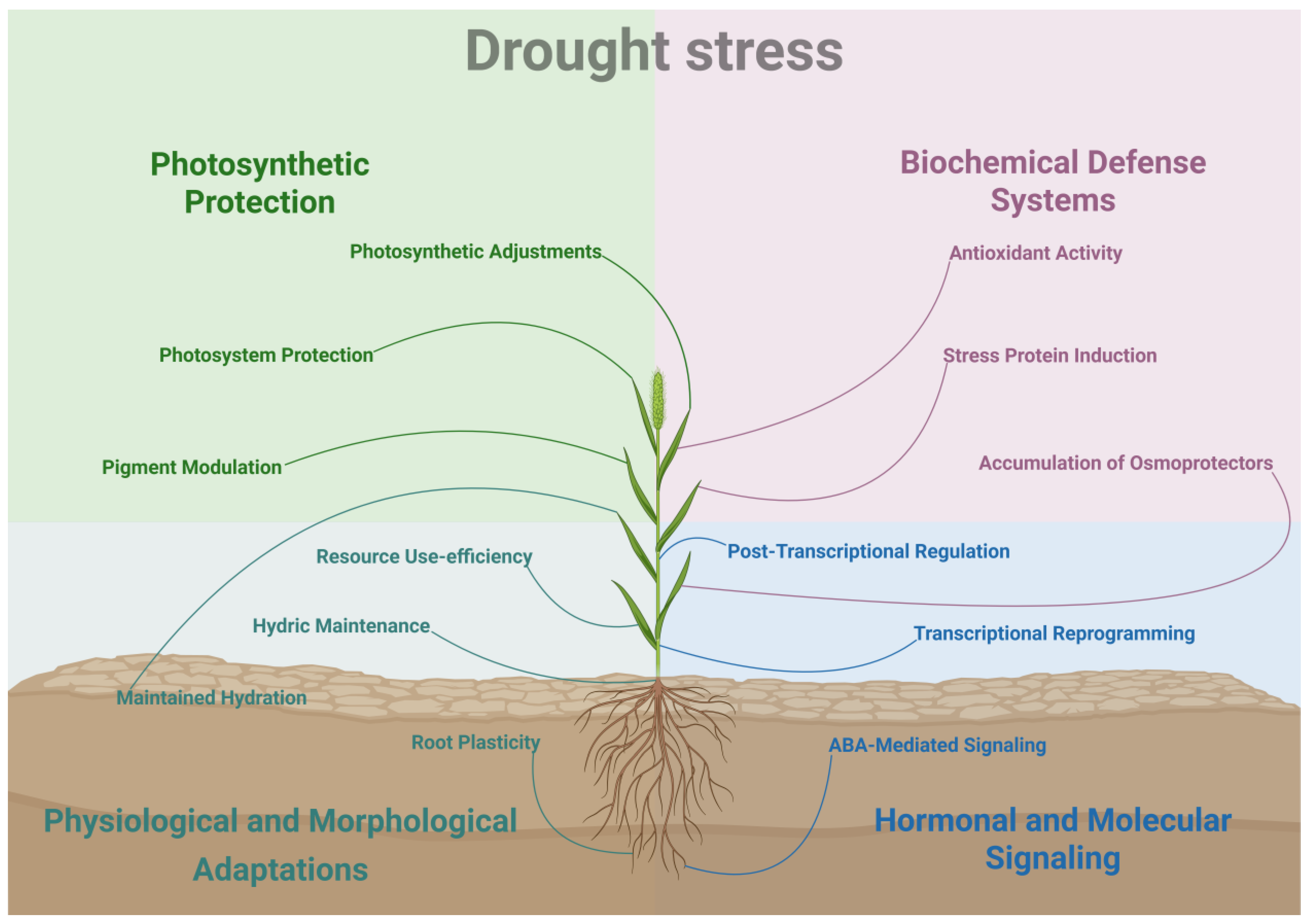
Figure 2.
Integrated responses to elevated temperature and irradiance in Setaria spp. Heat and light stress usually co-occur and thus elicit similar responses such as photoprotection mechanisms, antioxidant enzymes and metabolic shifts. Heat stress results in reduced stomatal conductance and increased photorespiration and cyclic electron flow. Excessive light intensity directly modulates sugar-signaling pathways (e.g., SnRK1, HXK), carbon allocation and ROS-scavenging mechanisms. Compartmentalization of photosynthetic processes has given C 4 plants unique mitigation strategies against both stresses.
Figure 2.
Integrated responses to elevated temperature and irradiance in Setaria spp. Heat and light stress usually co-occur and thus elicit similar responses such as photoprotection mechanisms, antioxidant enzymes and metabolic shifts. Heat stress results in reduced stomatal conductance and increased photorespiration and cyclic electron flow. Excessive light intensity directly modulates sugar-signaling pathways (e.g., SnRK1, HXK), carbon allocation and ROS-scavenging mechanisms. Compartmentalization of photosynthetic processes has given C 4 plants unique mitigation strategies against both stresses.
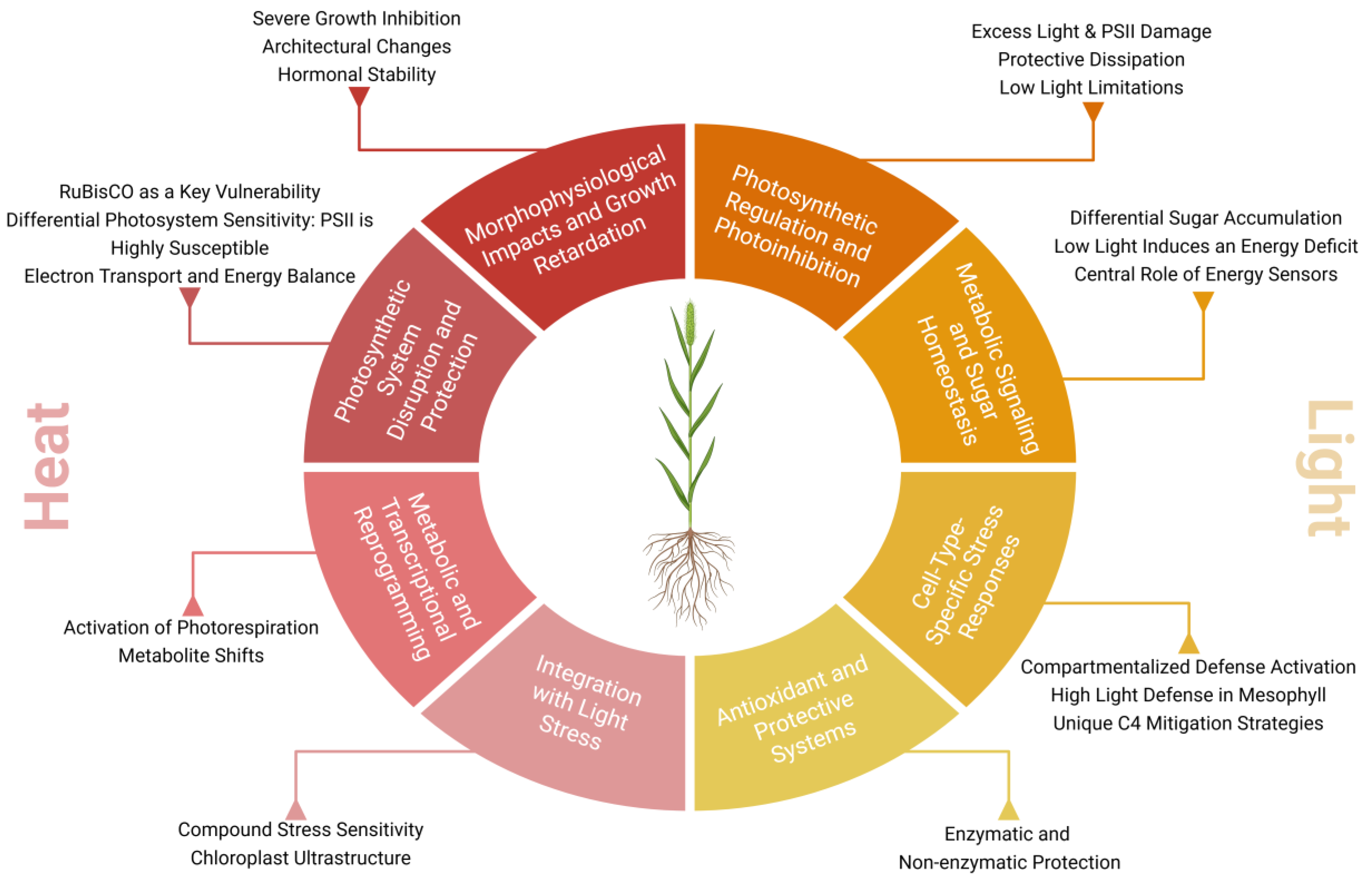
Figure 3.
Setaria spp. stress responses to salinity, nutrient deficiency, and heavy metal toxicity. Under saline soils, ion homeostasis is central; Na⁺ is excluded through the roots or sequestered into the vacuole, while K⁺ uptake is prioritized. Several TF families (MYB, NAC, WRKY, bZIP) respond to salt stress and modulate the molecular defenses against it. Root architectural changes are key under nutrient starvation: while low nitrogen reduces root growth, phosphorus deficiency promotes lateral root proliferation and enhanced foraging. Autophagy pathways (e.g., SiATG8a) are deployed under nitrogen or phosphorus scarcity, and soluble proteins act as nutritional reserves. Moreover, integrated hormonal and transcriptional regulation are critical for N, P and K deficiencies. Heavy metal stress is mitigated by ion chelation and compartmentalization/exclusion via metal transporters (e.g., Nramp). Remediation strategies such as soil amendment with biochar and phytoremediation strategies show promise in contaminated soils.
Figure 3.
Setaria spp. stress responses to salinity, nutrient deficiency, and heavy metal toxicity. Under saline soils, ion homeostasis is central; Na⁺ is excluded through the roots or sequestered into the vacuole, while K⁺ uptake is prioritized. Several TF families (MYB, NAC, WRKY, bZIP) respond to salt stress and modulate the molecular defenses against it. Root architectural changes are key under nutrient starvation: while low nitrogen reduces root growth, phosphorus deficiency promotes lateral root proliferation and enhanced foraging. Autophagy pathways (e.g., SiATG8a) are deployed under nitrogen or phosphorus scarcity, and soluble proteins act as nutritional reserves. Moreover, integrated hormonal and transcriptional regulation are critical for N, P and K deficiencies. Heavy metal stress is mitigated by ion chelation and compartmentalization/exclusion via metal transporters (e.g., Nramp). Remediation strategies such as soil amendment with biochar and phytoremediation strategies show promise in contaminated soils.
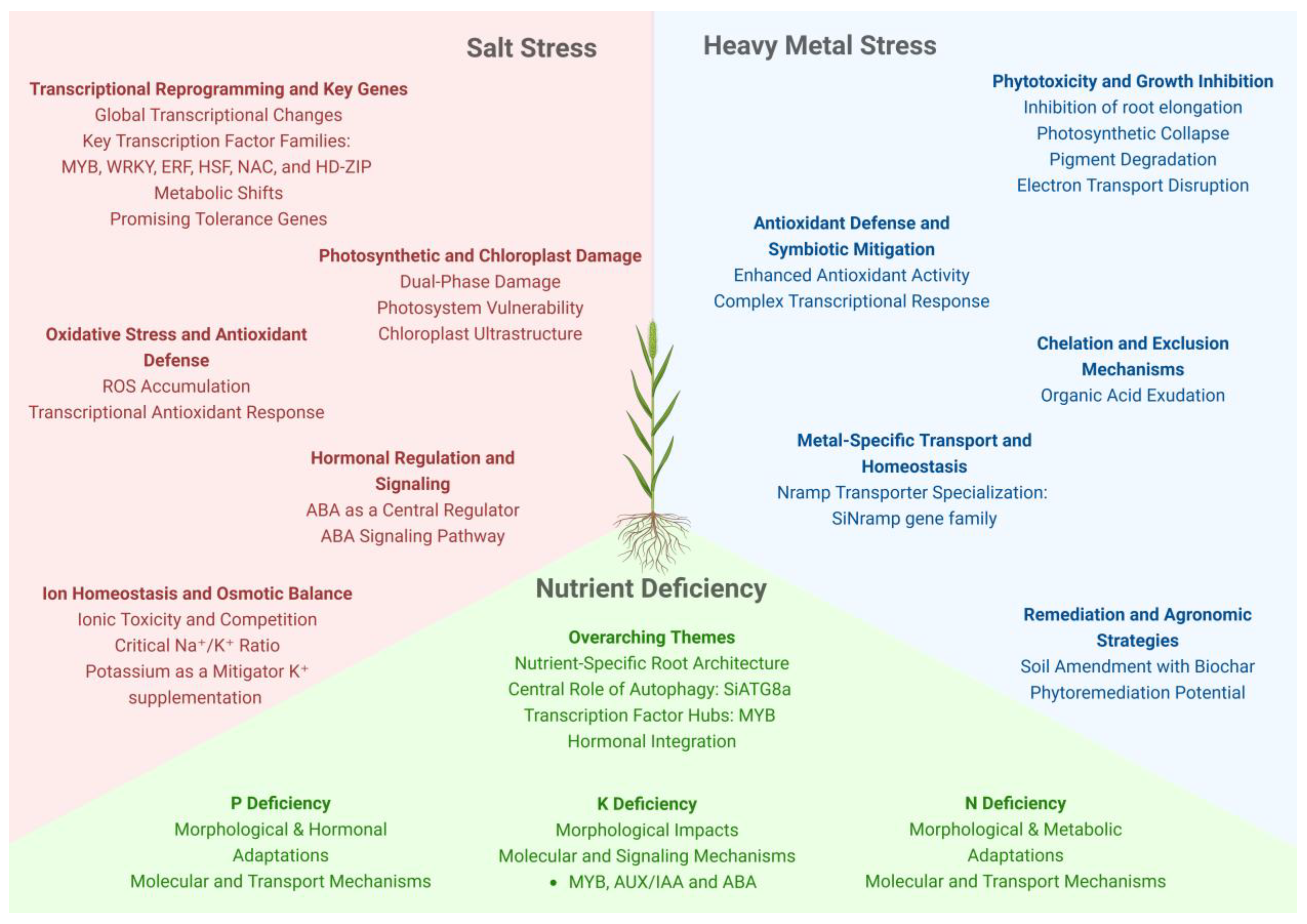
Disclaimer/Publisher’s Note: The statements, opinions and data contained in all publications are solely those of the individual author(s) and contributor(s) and not of MDPI and/or the editor(s). MDPI and/or the editor(s) disclaim responsibility for any injury to people or property resulting from any ideas, methods, instructions or products referred to in the content. |
© 2025 by the authors. Licensee MDPI, Basel, Switzerland. This article is an open access article distributed under the terms and conditions of the Creative Commons Attribution (CC BY) license (http://creativecommons.org/licenses/by/4.0/).
Copyright: This open access article is published under a Creative Commons CC BY 4.0 license, which permit the free download, distribution, and reuse, provided that the author and preprint are cited in any reuse.


