Preprint
Article

This version is not peer-reviewed.

Physiological and Metabolite Responses of Alfalfa to Cold Stress under Saline-Alkali Conditions

  † These authors contributed equally to this work.

Submitted:

13 November 2025

Posted:

14 November 2025

You are already at the latest version

Abstract

Alfalfa (Medicago sativa L.), a perennial leguminous herb, exhibits robust cold and saline-alkali tolerance. In this study, two alfalfa cultivars, LJ and 218TR, were treated with saline-alkali stress, cold stress, and combined saline-alkali-cold stress, and phenotype, physiology, key metabolite and stress-responsive genes were analyzed. The results showed malondialdehyde, soluble sugar, proline content, and the activities of phenylalanine ammonia-lyase (PAL), superoxide dismutase, catalase, and peroxidase initially increased under individual stresses but declined after combined stress. The maximum photochemical efficiency of photosystem II and chlorophyll content declined under individual and combined stresses. The staining of leaves revealed that combined stress induced significantly higher cell mortality and accumulation of superoxide anion compared to individual stresses. LJ exhibited superior resistant to saline-alkali, cold, and combined stress compared to 218TR. Metabolite analysis showed salicylic acid (SA) in two alfalfa was the most responsive metabolite to combined stress. The isochorismate synthase (ICS) and PAL as critical genes for SA biosynthesis were up-regulated in expression under single or combined stress, and promoted SA accumulation, thereby improving alfalfa resilience to combined saline-alkali-cold stress. This study elucidates the physiological and molecular mechanisms underlying alfalfa’s response to combined saline-alkali and cold stress, providing a theoretical basis for breeding stress-tolerant cultivars.

Keywords: 
;  ;  ;  ;  

1. Introduction

Soil salinization-alkalization, characterized by the accumulation of soluble salts from subsoil and groundwater in the surface layer, is a severe global ecological and agricultural issue that significantly inhibits plant growth, reduces crop yield, and compromises quality [1]. Saline-alkaline soils disrupt organ development, dry matter accumulation, and critical physiological processes in plants [2], such as damaging antioxidant defense systems, suppressing photosynthesis, and impairing the balance of mineral/ion absorption, utilization, distribution, and translocation in roots [3], as well as reducing nutrient uptake efficiency [4]. In saline-alkaline environments, elevated soil pH exacerbates osmotic stress, leading to plant dehydration, ionic imbalance, soil compaction, and restricted root growth and nutrient absorption, ultimately causing leaf wilting and plant mortality [5,6].
Northeast China, particularly the Songnen Plain, is a major saline-alkaline soil region where soil salts primarily consist of Na2CO3, NaHCO3, Na2SO4, and NaCl [7,8], with pH levels ranging from 8.5 to 10.5 [9]. Additionally, the prolonged cold winters in this region result in low overwintering rates, instability in plant survival, and frequent cold/freeze damage. Cold stress harms plants by inducing membrane damage, metabolic dysregulation, water imbalance, oxidative stress, and growth inhibition. Low temperatures reduce membrane fluidity, increase permeability, suppress photosynthesis and respiration, disrupt water balance, and trigger reactive oxygen species (ROS) accumulation, ultimately impairing plant growth and development. To counteract cold stress, plants employ complex physiological and molecular mechanisms, including calcium signaling, hormonal regulation, activation of cold-responsive genes, accumulation of osmolytes, and synthesis of protective proteins, which collectively mitigate damage and maintain cellular stability [10].
Alfalfa, a vital leguminous forage crop [11], is renowned for its high yield, strong regrowth, long lifespan, and palatability, playing a pivotal role in China’s livestock industry. While alfalfa exhibits moderate saline-alkaline tolerance and contributes to soil remediation, its cultivation in cold, high-latitude northern regions faces challenges from combined saline-alkaline and cold stresses. Severe cold stress inhibits growth, disrupts metabolism, and can lead to plant death. Therefore, breeding alfalfa cultivars with dual tolerance to saline-alkaline and cold stresses is critical for advancing alfalfa production in northern China.
This study investigates two alfalfa cultivars, LJ and 218TR, with contrasting saline-alkaline tolerance, under three saline-alkaline soil treatments (3BS:1AS, 1BS:1AS, 1BS:3AS; BS as control) with cold stress. The resistance of the two cultivars was analyzed by phenotype and physiological characteristics, and key metabolite pathways and saline-alkaline-cold responsive genes were identified through metabolomics and RT-qPCR, unraveling the molecular basis of alfalfa’s adaptation to combined stress. The findings provide theoretical and practical insights for breeding saline-alkali-cold-resistant alfalfa germplasm and advancing molecular breeding strategies, supporting the sustainable development of the alfalfa industry in challenging environments.

2. Results

2.1. Phenotype of Alfalfa to Saline-Alkali and Cold Stress

As shown in Figure 1, both LJ and 218TR were able to grow in the four types of saline-alkali soils at 25°C. With the increase in saline-alkali stress, the plant growth of both LJ and 218TR alfalfa varieties gradually was inhibited. Saline-alkali stress inhibited the growth of alfalfa, but the extent of inhibition on LJ was lower than 218TR. After exposure to 0°C low-temperature stress, no significant wilting was observed in the leaves of LJ and 218TR under different saline-alkali conditions. Slight lodging was observed in 218TR, while no obvious lodging occurred in LJ (Figure 1). This suggests that LJ exhibits better tolerance to combined saline-alkali and low-temperature stress.

2.2. Physiological Characteristics of Alfalfa to Saline-Alkali and Cold Stress

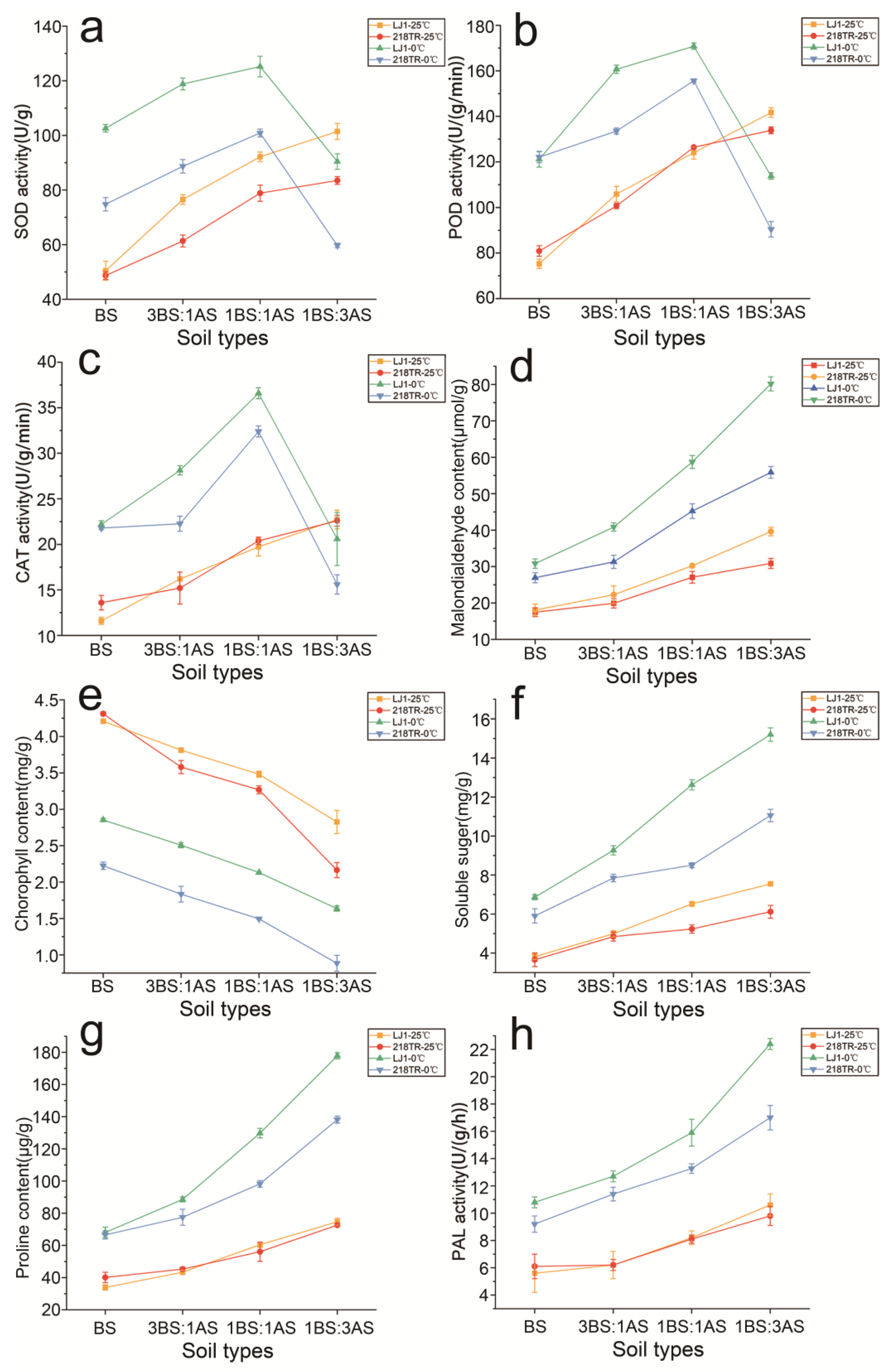
The activities of SOD, POD, CAT, PAL and the contents of MDA, SS, Pro of both alfalfa varieties exhibited an increasing trend with the intensification of saline-alkali stress, reaching its peak under 1BS:3AS conditions. The Chl content of both alfalfa varieties exhibited a declining trend with increasing saline-alkali stress, reaching its lowest level under 1BS:3AS conditions at 25°C. After exposure to 0°C low-temperature stress, the SOD, POD, CAT activity of both alfalfa varieties gradually increased in BS, 3BS:1AS, 1BS:1AS, and then decreased in 1BS:3AS. The increase in in SOD, POD, and CAT activities for LJ was greater than that for 218TR under combined saline-alkali and cold stress (Figure 2a-c). In addition, the MDA, Pro, SS contents and PAL activity of both alfalfa varieties continued to rise. The Pro, SS contents and PAL activity of LJ varieties were higher than those of 218TR, but the extent of MDA content increase in 218TR was consistently higher than that in LJ under combined saline-alkali and cold stress (Figure 2d, f, g, h).
Subsequently, LJ and 218TR were subjected to 0°C low-temperature stress, and the Chl content of both varieties continued to decline. Comparing the Chl content under different soil conditions at 25°C and after 0°C low-temperature stress, the reductions in Chl content for LJ under BS, 3BS:1AS, 1BS:1AS, and 1AS:3BS conditions were higher than 218TR (Figure 2e).

2.3. Chlorophyll Fluorescence of Alfalfa to Saline-Alkali and Cold Stress

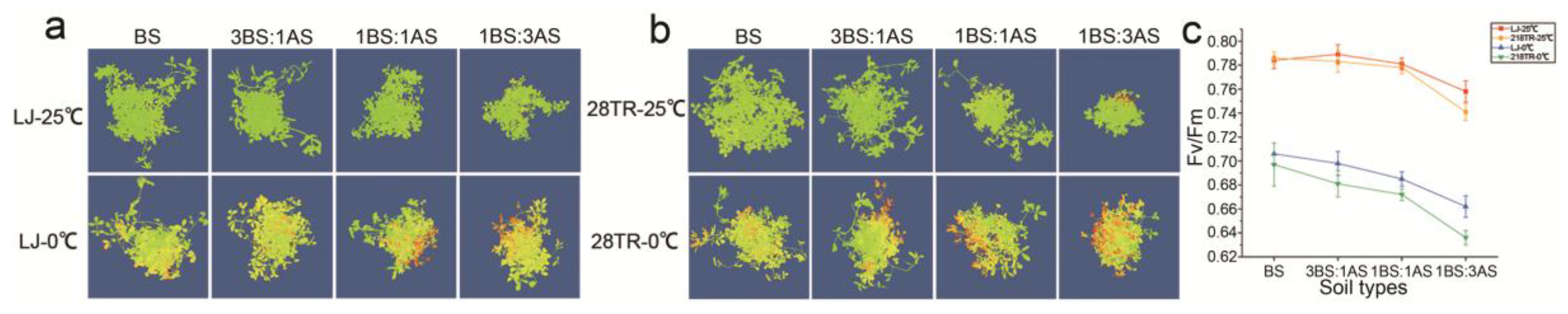
LJ and 218TR presented the similar photosystem II complex under BS, 1BS:3AS, and 1BS:1AS conditions, but the PSII of 218TR was more damaged and photoinhibited than that of LJ under 1BS:3AS conditions (Figure 3a, b). The Fv/Fm of 218TR was slightly lower than that of LJ at saline-alkali and temperature stresses (Figure 3c).

2.4. NBT Staining of Alfalfa to Saline-Alkali and Cold Stress

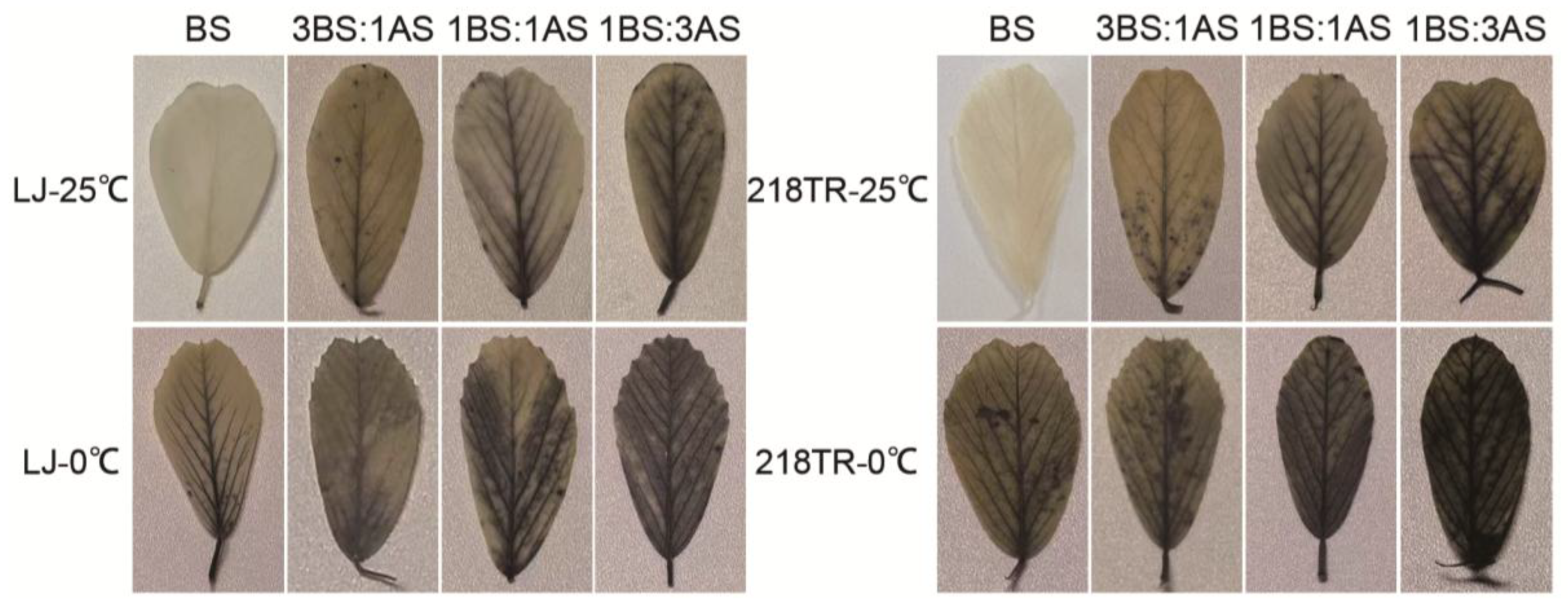
The principle of the NBT staining method is that NBT reacts with intracellular O2- to form blue spots, which can be used to visualize the presence of O2- in situ [12]. To assess the extent of cellular damage in alfalfa under saline-alkali, cold, and combined saline-alkali and cold stress, NBT staining was employed to measure the accumulation of O2- in the leaf cells of two alfalfa varieties, LJ and 218TR. At 25°C, the accumulation of O2- in both LJ and 218TR increased with the intensification of saline-alkali stress, reaching its maximum level under 1BS:3AS saline-alkali conditions. After exposure to 0°C low-temperature stress, the accumulation of O2- in LJ and 218TR significantly increased compared to single saline-alkali stress. Comparing the levels of O2- accumulation under different saline-alkali conditions at 25°C and 0°C, the order of O2- accumulation in both LJ and 218TR from highest to lowest was: 1BS:3AS > 1BS:1AS > 3BS:1AS > BS. Additionally, the level of O2- accumulation in 218TR was consistently higher than that in LJ under all conditions (Figure 4).

2.5. Metabolite Analysis of Alfalfa to Saline-Alkali and Cold Stress

The up-regulation and down-regulation results of 49 metabolites measured in both LJ and 218TR alfalfa varieties were statistically analyzed. As shown in Table 1, in the comparison between the LJ-BS-25°C group and the LJ-1BS:3AS-25°C group, 18 metabolites were upregulated, and 31 metabolites were downregulated. In the comparison between the LJ-BS-25°C group and the LJ-BS-0°C group, 27 metabolites were upregulated, and 22 metabolites were downregulated. In the comparison between the LJ-1BS:3AS-25°C group and the LJ-1BS:3AS-0°C group, 30 metabolites were upregulated, and 19 metabolites were downregulated. In the comparison between the LJ-BS-0℃ group and the LJ-1BS:3AS-0°C group, 33 metabolites were upregulated, and 16 metabolites were downregulated.
In addition, in the comparison between the 218TR-BS-25°C group and the 218TR-1BS:3AS-25°C group, 14 metabolites were upregulated, and 35 metabolites were downregulated. In the comparison between the 218TR-BS-25°C group and the 218TR-BS-0°C group, 20 metabolites were upregulated, and 29 metabolites were downregulated. In the comparison between the 218TR-1BS:3AS-25°C group and the 218TR-1BS:3AS-0°C group, 36 metabolites were upregulated, and 13 metabolites were downregulated. In the comparison between the 218TR-BS-0°C group and the 218TR-1BS:3AS-0°C group, 34 metabolites were upregulated, and 15 metabolites were downregulated. The implied that contents of more metabolites were induced to increase under combined saline-alkali-cold stress.

2.6. Heatmap of Metabolite Expression Levels to Saline-Alkali and Cold Stress

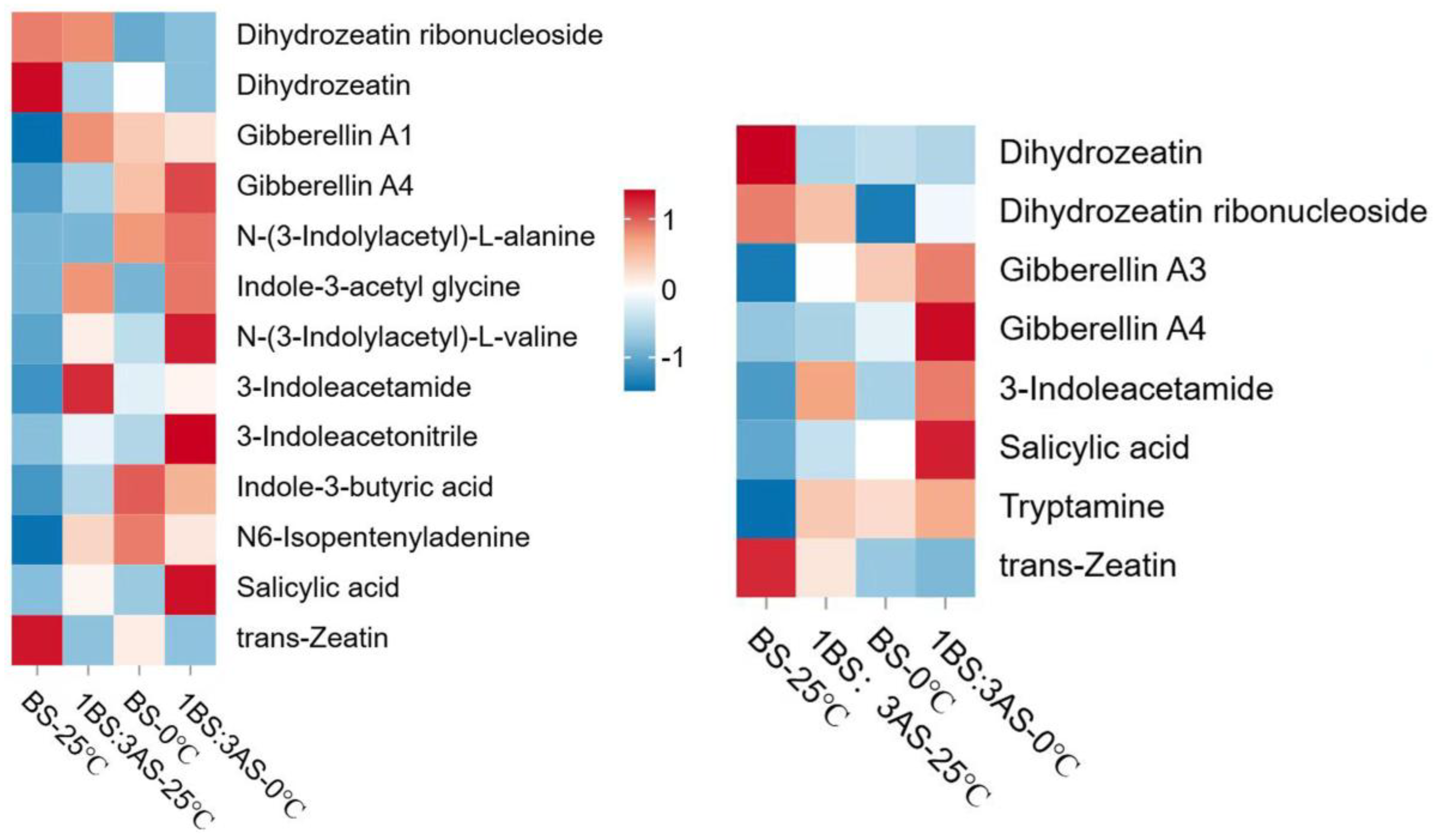
Among all metabolites in LJ, it was observed that gibberellin GA4, N-(3-Indolylacetyl)-L-alanine, Indole-3-acetyl glycine, N-(3-Indolylacetyl)-L-valine, 3-Indoleacetonitrile, salicylic acid (SA) had higher contents under saline-alkali and cold stress (Figure 5, left).
Among all metabolites in 218TR, gibberellin phytohormones GA3 and GA4, 3-Indoleacetamide, and SA showed significant responses to combined saline-alkali and cold stress, and the contents of GA4 and salicylic acid had significantly increased under combined saline-alkali and cold stress (Figure 5, right).
It is evident that SA both exhibited the highest expression level in LJ and 218TR, indicating that SA plays a significant role in resisting saline-alkali and cold stress.

2.7. Expression Analysis of Key Genes in the SA Biosynthesis Pathway

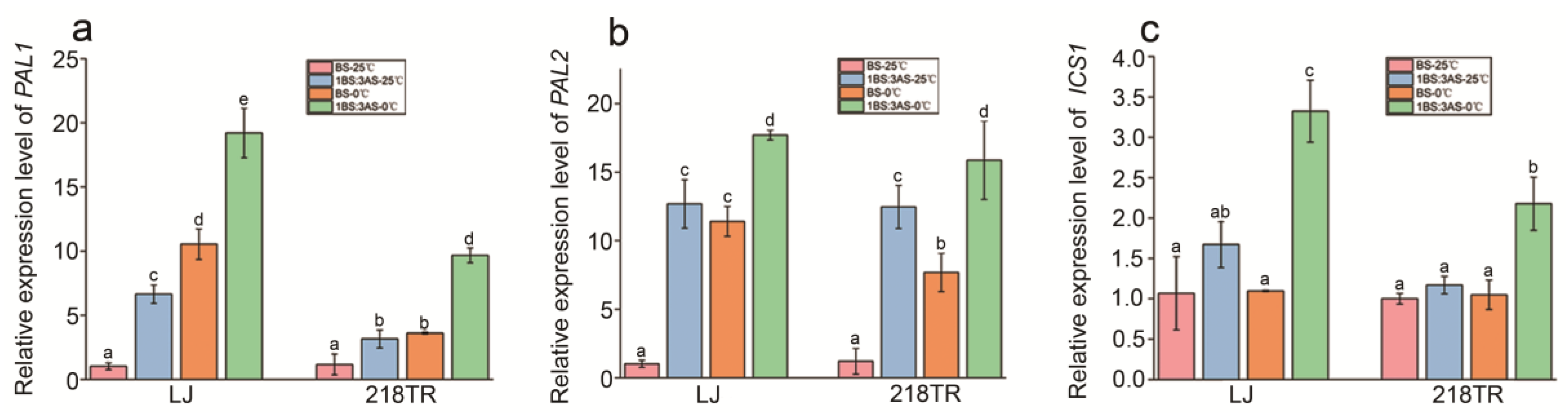
The Isochorismate Synthase (ICS) pathway and the Phenylalanine Ammonia-Lyase (PAL) pathway are two critical routes for SA biosynthesis. In this study, the key gene ICS1 from the ICS pathway and the pivotal gene PAL1 and PAL2 from the PAL pathway were selected for RT-qPCR analysis to evaluate their expression levels in LJ1 and 218TR under different treatment conditions. The expression level of the PAL1 and PAL2 gene in LJ1 and 218TR was significantly upregulated under saline-alkali stress, low-temperature stress, and combined saline-alkali and low-temperature stress, compared to the control group (Figure 6a, b). Similarly, the expression levels of the ICS1 gene in LJ1 and 218TR was significantly upregulated under combined saline-alkali and low-temperature stress (Figure 6c).

3. Discussion

3.1. Physiological Responses of Alfalfa to Saline-Alkali and Cold Stress

Photosynthesis is an essential physiological process in plant life activities, and Chl is the foundation of photosynthesis and a marker of plant photosynthetic capacity [13]. Under normal growth conditions, Chl content remains in dynamic equilibrium, but environmental stress can disrupt this balance, leading to changes in Chl content [14]. These changes can reflect the extent of stress factors on plants and measure their stress tolerance [15]. Previous report showed that the Chl content of alfalfa varieties was significant decreased under saline-alkali stress [16,17]. Our studies also stated that Chl content also significantly reduced as the severity of saline-alkali stress and low temperatures increase. The decrease in Chl content for LJ was consistently lower than that for 218TR under saline-alkali stress and cold stress.
Chl fluorescence is considered an intrinsic probe that reflects the relationship between plant photosynthesis and the environment [18,19], and it can reflect the photosynthetic physiology of plants [20]. Saline-alkali stress reduces the Fv/Fm value, affecting PSII efficiency, and can serve as an indicator of the degree of saline-alkali stress [21]. Previous studies pointed out the Fv/Fm value of five Bromus inermis seedlings decreased under salt stress [22]. The dual stress of salt and low temperature in melon seedlings severely disrupted the growth and decreased the Fv/Fm values [23]. In this study, the Fv/Fm values of both alfalfa varieties decreased with increasing saline-alkali stress at 25°C, but the difference before and after stress was small, indicating that alfalfa can effectively maintain PSII activity and the potential maximum photochemical efficiency under certain levels of saline-alkali stress, stabilizing the photosynthetic reaction to prevent a significant decline in net photosynthetic rate [24]. However, when saline-alkali stress reaches a certain level, the Fv/Fm value decreases rapidly. Similarly, at 0°C, the Fv/Fm value is particularly affected by saline-alkali stress, with a significant decrease as the stress intensifies. LJ exhibited better tolerance to combined saline-alkali and cold stress than 218TR.
Stress conditions can lead to excessive production of ROS in plants, resulting in the accumulation of free radicals, enhanced membrane lipid peroxidation, and inactivation or degradation of critical enzymes and proteins, thereby harming plant growth and development [24,25,26]. Plants possess a membrane-protective enzyme system capable of scavenging ROS, primarily including SOD, POD, and CAT [27]. These enzymes convert excess ROS into harmless substances such as H2O, maintaining the balance of ROS metabolism in plants and protecting them from ROS-induced damage. Changes in antioxidant enzyme activity reflect the extent of oxidative damage in plants and serve as an important indicator for studying abiotic stress responses [28]. Previous study found that peanut seedlings in treated with single high salinity or drought stress increased the activities of SOD, CAT, and POD, but the activities of these enzymes initially increased and then decreased. The results were similar with our data [29]. This indicates that the intensification of saline-alkali stress disrupts the balance of the enzyme system, exacerbates membrane lipid peroxidation, and causes membrane damage [30]. Among them, salt-alkali-tolerant genotypes (such as LJ cultivar) maintained relatively higher enzyme activities under stress, thereby mitigating the damage caused by membrane lipid peroxidation.
Comprehensive analysis of various indicators reveals an interaction between saline-alkali and cold stress. Saline-alkali stress enhances the inhibitory effect of cold stress on alfalfa, and the combined stress of saline-alkali and cold further suppresses the growth and development of alfalfa through additive effects. Under stress, LJ exhibited greater increases in soluble sugars, proline, PAL activity, SOD activity, POD activity, and CAT activity compared to 218TR, while the increase in MDA content was lower in LJ than in 218TR. These results indicate that LJ has better tolerance to saline-alkali stress, low-temperature stress, and combined saline-alkali and low-temperature stress.
The accumulation of the ROS elements (O2-) in leaves under stress conditions can reflect the extent of leaf damage. The NBT staining was localized at the positions where the ROS are distributed [31]. In this experiment, NBT staining were performed on the leaves of LJ and 218TR to detect cell death and the accumulation of O2- in cells after single or combined stress.
Osmotic regulation is one of the most fundamental characteristics of plant stress tolerance, and the enhancement of this ability is an important mechanism for improving plant stress resistance [32]. The most common osmotic regulators include Pro, SS, and PAL. Previous researches showed ryegrass seedlings had increasing contents of SS, Pro, and PAL activity under freeze-thaw or NaHCO3 stress, and combined stress were higher than single stress [33]. In addition, the contents of Pro and MDA in creeping bentgrass under combined high temperature and drought stress were higher than single stress [34]. In this experiment, the levels of SS, Pro, and PAL activity all showed an increasing trend after stress, and the increase in MDA, SS, Pro content, and PAL activity under combined stress was significantly higher than under single saline-alkali or single low-temperature stress [33,34].

3.2. Metabolite Responses of Alfalfa to Saline-Alkali and Cold Stress

Numerous studies have demonstrated that endogenous hormones play a crucial role in plant responses to stress conditions. Previous reports found that in pea roots under stress, the content of endogenous hormones decreased, while the levels of ABA and IAA increased in pea roots under drought stress [35]. SA also plays a significant role in plant responses to abiotic stresses such as high and low temperatures, saline-alkali conditions, and heavy metals. Scott discovered that in Arabidopsis, endogenous SA rapidly accumulated after low-temperature stress [36]. In this study, IAA-Ala, IAA-Gly, IAA-Val, gibberellin GA4, 3-indoleacetamide in LJ and gibberellin GA3, GA4, 3-indoleacetamide exhibited significant responses to saline-alkali, cold, and combined stress. In addition, SA showed high expression levels in both LJ and 218TR, indicating that hormone and SA were the most relevant metabolite in responding to saline-alkali, cold, and combined stress in these two alfalfa varieties.
The ICS pathway and the PAL pathway are two important routes for SA biosynthesis in plants. Previous studies demonstrated that in Arabidopsis, the ICS pathway is the most common route for SA synthesis in response to biotic and abiotic stresses [37,38]. In soybeans, the PAL and ICS pathways contribute equally to SA biosynthesis [39]. However, Ogawa et al. found that the PAL pathway is the primary route for SA synthesis in tobacco by investigating the expression of ICS and PAL genes [40]. In this study, the expression levels of PAL1 and PAL2 were induced to up-regulated under saline-alkali, cold, and combined stress, and ICS1 also had higher expression level than the control in treated with combined stress. The results suggest that the PAL and ICS pathway may play a significant role in tolerating saline-alkali and cold stress in alfalfa through promoting SA biosynthesis and accumulation.

4. Materials and Methods

4.1. Materials and Treatment

The saline-alkali-tolerant cultivar LJ and sensitive cultivar 218TR of alfalfa were provided by the Forage Breeding Laboratory, Institute of Forage and Grassland Sciences, Heilongjiang Academy of Agricultural Sciences. The two cultivars were selected through preliminary screening from 15 alfalfa germplasm resources based on their differential saline-alkali stress responses (data not shown). Based on pH values [41], saline-alkaline conditions were classified as mild (pH 7.5–8.5), moderate (pH 8.5–9.5), and severe (pH > 9.5). To simulate these stress levels, black soil (BS) and alkaline soil (AS) were mixed at mass ratios of 3:1 (mild), 1:1 (moderate), and 1:3 (severe), with pure BS serving as the control. Seeds of two alfalfa cultivars, 218TR and LJ, were sown in pots (11 cm diameter × 11 cm depth) containing the four soil treatments. Each treatment comprised six replicates, totaling 48 experimental units. Plants were cultivated under controlled conditions: light intensity 15,000 lx, 16h light/8h dark photoperiod, temperature 25°C (day)/22°C (night), and regular watering.
During the 3–4 true leaf stage, three replicates per treatment were transferred to a cold acclimation, while the remaining three replicates were maintained under ambient conditions. For cold acclimation, plants were subjected to stepwise temperature reductions in a climate chamber (15,000 lx, 16h light/8h dark cycle). Starting at 25°C, temperatures were decreased in 5°C increments (20°C, 15°C, 10°C, 5°C) at a rate of 1°C/h, with each temperature held for 24 h to prevent thermal shock. Following acclimation, plants were exposed to cold stress at 0°C for 24 h. Leaf tissues from all treatments were immediately collected and stored in an ultra-low temperature freezer (-80°C) for subsequent analyses.

4.2. The Determination of Phenotype, Physiological Indices and Metabolites

After same saline-alkali and cold treatments, the phenotype of the two cultivars (LJ and 218TR) was observed and photographed, and leaf tissues of the two cultivars were used to analyze the physiological indices. The SOD activity was assayed through the inhibition of NBT photochemical reduction [42]. POD activity was quantified via guaiacol oxidation monitoring at 470 nm [43], while CAT levels were determined through ultraviolet spectrophotometric tracking of H2O2 decomposition at 240 nm [44]. Lipid peroxidation status was evaluated by measuring MDA content through TBA reactive substance formation, and free proline accumulation was assessed using sulfosalicylic acid extraction coupled with ninhydrin staining [45,46]. Photosynthetic pigments were extracted through ethanol immersion and quantified spectrophotometrically at specific wavelengths (663 nm, 645 nm, and 470 nm) [47]. Chlorophyll fluorescence parameters (Fv/Fm) were captured using the PlantExplorer PRO+ multifunctional phenotyping platform (PhenoTrait, Beijing, China). Soluble carbohydrate levels were determined via anthrone-sulfuric acid colorimetric assay[48]. The proline contents were determined using acidic ninhydrin method [49]. The determination of Phenylalanine Ammonia-Lyase (PAL) activity was performed using Ultraviolet Spectrophotometry (Puxi, Beijing, China). Reactive oxygen species (ROS) localization was visualized through histochemical staining: NBT for superoxide radicals (O2-) for membrane integrity assessment [50].
The quantification of target metabolites from nine phytohormone categories (abscisic acid, auxin, cytokinins, ethylene, gibberellins, jasmonic acid, salicylic acid, strigolactones, and brassinosteroids) under different treatment conditions was performed using ultra-high-performance liquid chromatography coupled with multiple reaction monitoring tandem mass spectrometry (UHPLC-MRM-MS/MS)​ with isotope-labeled internal standards for precise quantification.
For molecular analyses, total RNA was isolated with TRIzol reagent (Invitrogen, USA), followed by genomic DNA removal and cDNA synthesis using the TransScript One-Step SuperMix Kit (Transgen, Beijing, China). Gene-specific primers designed with Primer 5.0 were employed in RT-qPCR reactions performed on a Roche LightCycler 96 system (Basel, Switzerland). Relative gene expression levels were calculated from threshold cycle (Ct) values using the 2−ΔΔCT method, and normalized against reference genes with three independent biological replicates.

4.3. Data Processing and Analysis

The experimental data were processed using Excel 2020, and the results are expressed as mean ± standard error (SE). SPSS 27.0 software was employed for analysis of variance (ANOVA), with significance tested at the 95% confidence level using one-way ANOVA. The Duncan Post-hoc Test was applied to assess the significance of differences among treatments in multiple comparisons (P < 0.05). Origin 2022 software was utilized for graphical representation of the data.

5. Conclusions

In summary, this study reveals the synergistic inhibitory effects of combined saline-alkali and cold stress on two alfalfa cultivars. The saline-alkali-tolerant variety LJ exhibits superior stress resistance compared to 218TR through higher levels of osmotic regulation (accumulation of Pro and SS), antioxidant enzyme activity (SOD/POD/CAT), and phenylpropanoid metabolism (enhanced PAL activity). SA is the core metabolite responding to combined stress, with its biosynthesis dominated by the PAL pathway. The significant upregulation of the PAL1, PAL2, and ICS1 gene enhances plant stress tolerance by promoting SA biosynthesis. This study provides critical targets for breeding saline-alkali and cold-tolerant alfalfa germplasm.

Author Contributions

Conceptualization, X.Z., Y.Y., W.H., J.W.and J.Y.; methodology, X.Z., Y.Y.and W.H.; software, X.Z., Y.Y., W.H.and D.Z.; validation, X.Z., Y.Y., W.H., D.Z., L.M., Z.S., G.D. and Y.L.; resources, D.Z., L.M. and Y.L.; writing—original draft preparation, X.Z., Y.Y. and W.H.; funding acquisition, J.W. and J.Y. All authors have read and agreed to the published version of the manuscript.

Funding

This research was funded by “Science and Technology Innovation 2030-Major Project, 2022ZD040120403”, ”Breeding of Salt-Alkali Tolerant Alfalfa Varieties in Northeast China, CCPTZX2024GJ02-2” ,”Supported by the Project of Laboratory of Advanced Agricultural Sciences,Heilongjiang Province, ZY04JD05-004” and “Agricultural Science and Technology Innovation Leap Project of Heilongjiang Province, CX23GG06”.

Institutional Review Board Statement

Not applicable.

Informed Consent Statement

Not applicable.

Data Availability Statement

Data are contained within the article.

Acknowledgments

We would like to express our sincere gratitude to Dr. Jenine Wang for the invaluable guidance and support throughout the manuscript preparation and submission process.

Conflicts of Interest

The authors declare no conflicts of interest.

References

  1. Zhou, X.L.; Qin, C . Effects of different amendments on improvement of saline-alkali soil and cotton growth in Xinjiang. Chin. Agric. Sci. Bull. 2022, 38, 91–96.
  2. Zhao, T.J.; Gai, J.Y. Progress and discussion on breeding of super-high-yielding soybeans. Sci. Agric. Sin. 2006, 1, 29–37. [Google Scholar]
  3. Lyu, H.Y.; Wang, D.W. Innovation trends in soybean breeding industry. J. Plant Genet. Resour. 2018, 19, 464–467. [Google Scholar]
  4. Zha, T.; Zhong, X.B. Current status and revitalization strategies of soybean industry in China. Soybean Sci. 2018, 37, 458–463. [Google Scholar]
  5. Zhang, J.; Chen, L.X. Analysis and evaluation of soil salinization characteristics under different land use types in Daqing region. J. Soil Water Conserv. 2011, 25, 171–179. [Google Scholar]
  6. Tian, C.X.; Zhang, Y.M. Response of anatomical structure of Medicago sativa to NaHCO3 saline-alkali stress. Acta Prataculturae Sin. 2014, 23, 133–142. [Google Scholar]
  7. Hai, X.; Liu, J.H. Effects of salt stress on Na+, K+ absorption and ion accumulation in oat seedlings. J. Triticeae Crops 2019, 39, 613–620. [Google Scholar]
  8. Fan, F.; Zhang, Q.G. Formation and classification of saline-alkali land in Tongliao City. J. Inn. Mong. Univ. Nat. Sci. 2009, 24, 409–413. [Google Scholar]
  9. Deng, W.; Qiu, S.W. Background of Regional Eco-Environment in Da’an Sodic Land Experiment Station of China; Science Press: Beijing, China, 2006. [Google Scholar]
  10. Li, J.; Guo, Y.J. Research on improvement technology of soda saline-alkali soil in Northeast China. Agric. Technol. 2019, 39, 21–24. [Google Scholar]
  11. He, H.F.; Ma, J.Y. Study on the relationship between photosynthetic fluorescence parameters and quality of Medicago sativa in saline-alkali soil. Acta Agrestia Sin. 2025, 1–12. [Google Scholar]
  12. Romero-Puertas, M.C.; Rodríguez-Serrano, M. Cadmium-induced subcellular accumulation of O2 and H2O2 in pea leaves. Plant Cell Environ. 2004, 27, 1122–1134. [Google Scholar] [CrossRef]
  13. Zhang, J.Y.; Miao, N.S. Changes in chlorophyll content and antioxidant enzyme activities of diploid potato under salt stress. Crops 2014, 5, 59–63. [Google Scholar]
  14. Guo, H.J.; Hu, T. Physiological effects of soda alkali stress on perennial ryegrass. Acta Prataculturae Sin. 2012, 21, 118–125. [Google Scholar]
  15. Zhao, X.; Ye, L. Effects of saline-alkali stress on growth, quality, and photosynthetic characteristics of Medicago sativa. Jiangsu Agric. Sci. 2017, 45, 176–180. [Google Scholar]
  16. Zhu, C.C.; Shi, K. Response of Medicago sativa cv. Zhongmu No.1 seedlings to mixed saline-alkali stress. Chin. J. Grassl. 2024, 46, 1–9. [Google Scholar]
  17. Feng, J.C.; Hu, X.L. Application of chlorophyll fluorescence kinetics in plant stress physiology research. Nonwood For. Res. 2002, 4, 14–18, 30. [Google Scholar]
  18. Liu, L.Z.; Wu, J.J. Research progress on chlorophyll fluorescence and its application in drought stress monitoring. Spectrosc. Spectr. Anal. 2017, 37, 2780–2787. [Google Scholar]
  19. Fang, Y.R.; Xue, L. Research progress on the effects of salt stress on plant chlorophyll fluorescence. Ecol. Sci. 2019, 38, 225–234. [Google Scholar]
  20. Rao, L.; Li, S. Leaf morphology and chlorophyll fluorescence characteristics of mulberry seedlings under waterlogging stress. Sci. Rep. 2021, 11, 13379. [Google Scholar] [CrossRef]
  21. Xing, Q.Z.; Yu, S.L.N. Effects of salt stress on photosynthetic physiology and chlorophyll fluorescence characteristics of grape (Red Globe) seedlings. Agric. Res. Arid Areas 2011, 29, 96–100. [Google Scholar]
  22. Wang, X.L.; Li, H. Identification of salt tolerance during seed germination and seedling stage of five Poaceae forage species. Seed 2016, 35, 27–31. [Google Scholar]
  23. Su, L.X.; Bai, T.Y. Effects of salt stress on growth and photosynthetic fluorescence characteristics of two Artocarpus species seedlings. Sci. Agric. Sin. 2019, 52, 2140–2150. [Google Scholar]
  24. Sun, G.; Lu, Y.S. Effects of salt and low-temperature dual stress on growth and chlorophyll fluorescence parameters of melon seedlings. Anhui Agric. Sci. Bull. 2017, 23, 31–34. [Google Scholar]
  25. Yildiztugay, E.; Sekmen, A.H. Elucidation of physiological and biochemical mechanisms of an endemic halophyte Centaurea tuzgoluensis under salt stress. Plant Physiol. Biochem. 2011, 49, 816–824. [Google Scholar] [CrossRef]
  26. Malenčić, D.; Kiprovski, B. Changes in antioxidant systems in soybean as affected by Sclerotinia sclerotiorum (Lib.) de Bary. Plant Physiol. Biochem. 2010, 48, 903–908. [Google Scholar] [CrossRef] [PubMed]
  27. Wang, Q.; Wu, C. Model analysing the antioxidant responses of leaves and roots of switchgrass to NaCl-salinity stress. Plant Physiol. Biochem. 2012, 58, 288–296. [Google Scholar] [CrossRef]
  28. Sun, W.Z.; Han, B. Changes of malondialdehyde content in alfalfa under different salt stress concentrations. Anhui Agric. Sci. 2009, 37, 1905–1911. [Google Scholar]
  29. Deinlein, U.; Stephan, A.B. Plant salt-tolerance mechanisms. Trends Plant Sci. 2014, 19, 371–379. [Google Scholar] [CrossRef]
  30. Zhang, G.C.; Zhang, Z.M. Effects of drought and salt stress on osmotic adjustment and antioxidant enzyme activities in peanut. Acta Agric. Boreali-Sin. 2018, 33, 176–181. [Google Scholar]
  31. Bhattacharjee, S. Heat and chilling induced disruption of redox homeostasis and its regulation by hydrogen peroxide in germinating rice seeds (Oryza sativa L., cultivar Ratna). Physiol. Mol. Biol. Plants 2013, 19, 199–207. [Google Scholar] [CrossRef]
  32. Luo, D.; Liu, J. NUCLEAR TRANSPORT FACTOR 2-LIKE improves drought tolerance by modulating leaf water loss in alfalfa (Medicago sativa L.). Plant J. 2022, 112, 429–450. [Google Scholar] [CrossRef]
  33. Gong, Z.; Bao, G.Z. Physiological responses of ryegrass seedlings under freeze-thaw and NaHCO3 composite stress. J. Jilin Univ. Sci. Ed. 2017, 55, 451–457. [Google Scholar]
  34. Qu, Y.N.; Yang, Z.M. Effects of high temperature and drought stress on antioxidant metabolism in creeping bentgrass. J. Shandong Agric. Univ. Nat. Sci. 2014, 45, 489–494. [Google Scholar]
  35. Yan, Z.L.; Xuan, C.X. Effects of drought stress and rewatering on endogenous hormone content in pea roots. Chin. J. Eco-Agric. 2009, 17, 297–301. [Google Scholar] [CrossRef]
  36. Scott, I.M.; Clarke, S.M. Salicylate accumulation inhibits growth at chilling temperature in Arabidopsis. Plant Physiol. 2004, 135, 1040–1049. [Google Scholar] [CrossRef]
  37. Xu, L.; Zhao, H. ABNORMAL INFLORESCENCE MERISTEM1 functions in salicylic acid biosynthesis to maintain proper reactive oxygen species levels for root meristem activity in rice. Plant Cell 2017, 29, 560–574. [Google Scholar] [CrossRef]
  38. Ding, P.; Ding, Y. Stories of salicylic acid: A plant defense hormone. Trends Plant Sci. 2020, 25, 549–565. [Google Scholar] [CrossRef]
  39. Shine, M.B.; Yang, J. Cooperative functioning between phenylalanine ammonia lyase and isochorismate synthase activities contributes to salicylic acid biosynthesis in soybean. New Phytol. 2016, 212, 627–636. [Google Scholar] [CrossRef]
  40. Ogawa, D.; Nakajima, N. The phenylalanine pathway is the main route of salicylic acid biosynthesis in tobacco mosaic virus-infected tobacco leaves. Plant Biotechnol. 2006, 23, 395–398. [Google Scholar] [CrossRef]
  41. Oster, J.; Shainberg, I. Reclamation of salt-affected soils. In Agricultural Drainage; 1999; 38, 659–691.
  42. Guo, F.X.; Zhang, M.X. Relation of several antioxidant enzymes to rapid freezing resistance in suspension cultured cells from alpine Chorispora bungeana. Cryobiology 2006, 52, 241–250. [Google Scholar] [CrossRef]
  43. Shi, J.; Fu, X.Z. Spermine pretreatment confers dehydration tolerance of citrus in vitro plants via modulation of antioxidative capacity and stomatal response. Tree Physiol. 2010, 30, 914–922. [Google Scholar] [CrossRef]
  44. Li, Z.F.; Wu, X.D. Experimental design for determination of malondialdehyde content in plants. Tianjin Agric. Sci. 2016, 22, 49–51. [Google Scholar]
  45. Wang, S.; Wan, C. The characteristics of Na+, K+ and free proline distribution in several drought-resistant plants of the Alxa Desert, China. J. Arid Environ. 2004, 56, 525–539. [Google Scholar] [CrossRef]
  46. Wang, A.Y.; Zhang, C.Q. Rapid determination method of chlorophyll content in maize. J. Maize Sci. 2008, 2, 97–100. [Google Scholar]
  47. Liu, H.Y.; Wang, H.H. Improvement of soluble sugar content determination (anthrone method) experiment. Lab. Sci. 2013, 16, 19–20. [Google Scholar]
  48. Abrahám, E.; Hourton-Cabassa, C.; Erdei, L.; Szabados, L. Methods for determination of proline in plants. Plant stress tolerance: Methods and protocols. 2010, 639, 317–331. [Google Scholar]
  49. Solekha, R.; Susanto, F.A. Phenylalanine ammonia lyase (PAL) contributes to the resistance of black rice against Xanthomonas oryzae pv. oryzae. J. Plant Pathol. 2020, 102, 359–365; Correction to J. Plant Pathol. 2020, 102, 367. [Google Scholar] [CrossRef]
  50. Jacyn Baker, C.; Mock, N.M. An improved method for monitoring cell death in cell suspension and leaf disc assays using Evans blue. Plant Cell Tissue Organ Cult. 1994, 39, 7–12. [Google Scholar] [CrossRef]
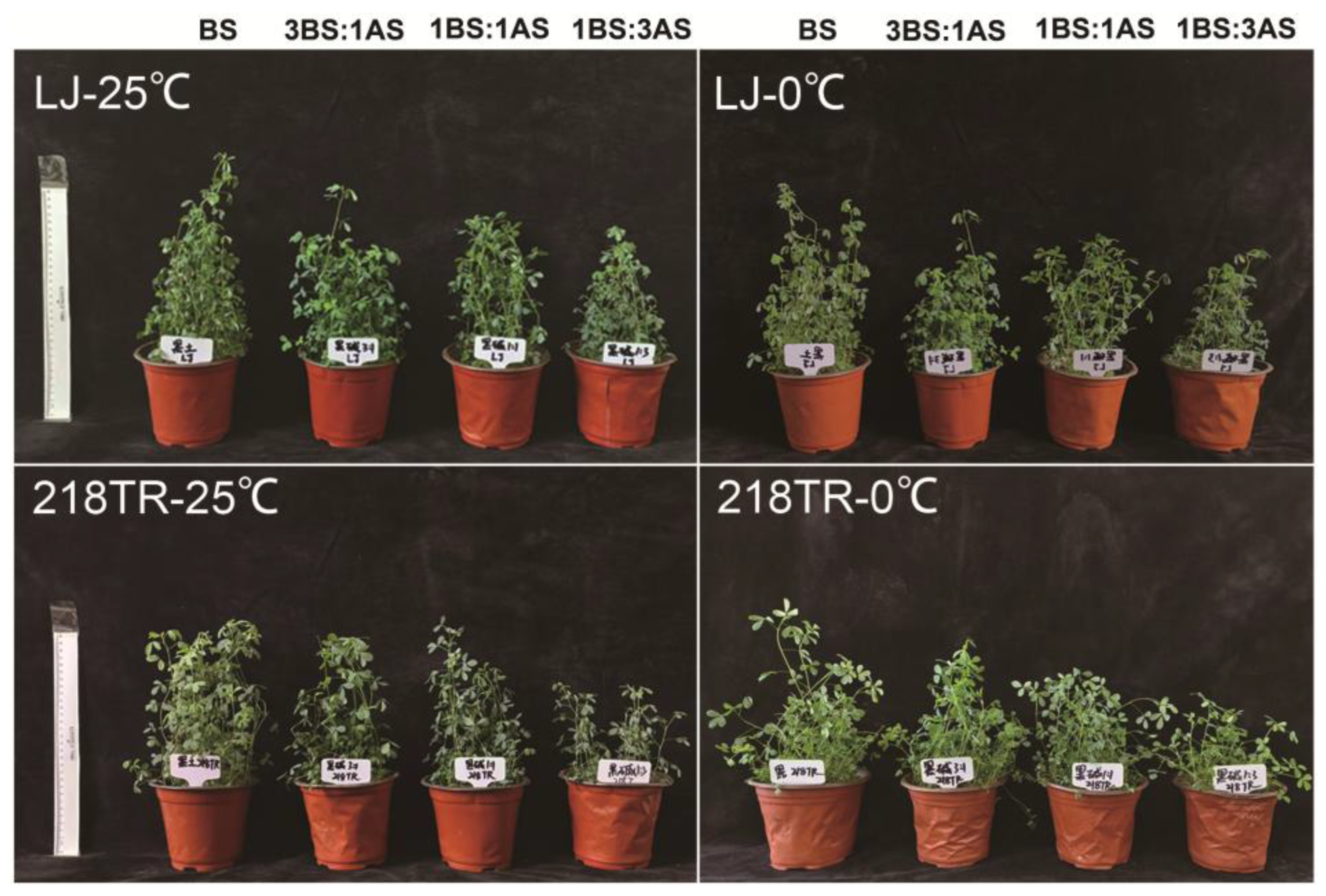
Figure 1. Phenotypes of two alfalfa species LJ and 218TR in treated with different saline-alkali and temperature stresses.
Preprints 184975 g001
Figure 2. Physiological indices of two alfalfa species LJ and 218TR in treated with different saline-alkali and temperature stresses.
Preprints 184975 g002
Figure 3. Chlorophyll fluorescence images of two alfalfa species LJ and 218TR under different saline-alkali and temperature stresses.
Preprints 184975 g003
Figure 4. NBT staining of of two alfalfa species LJ and 218TR under different saline-alkali and temperature stresses.
Preprints 184975 g004
Figure 5. Heat map of metabolite expression in LJ (left) and 218TR (right) under different saline-alkali and temperature stresses.
Preprints 184975 g005
Figure 6. Relative expression level of PAL1, PAL2, and ICS1 in LJ and 218TR under different saline-alkali and temperature stresses.
Preprints 184975 g006
Table 1. Statistical results of up-regulation and down-regulation of metabolites in LJ and 218TR under different saline-alkali and temperature stresses.
Control group Total substance count detection The number of upregulated substances The number of downregulated substances
LJ-BS-25℃ group vs LJ-1BS:3AS-25℃ group 49 18 31
LJ-BS-25℃ group vs LJ-BS-0℃ group 49 27 22
LJ-1BS:3AS-25℃ group vs LJ-1BS:3AS-0℃ group 49 30 19
LJ-BS-0℃ group vs LJ-1BS:3AS-0℃ group 49 33 16
218TR-BS-25℃ group vs 218TR-1BS:3AS-25℃ group 49 14 35
218TR-BS-25℃ group vs 218TR-BS-0℃ group 49 20 29
218TR-1BS:3AS-25℃ group vs 218TR-1BS:3AS-0℃ group 49 36 13
218TR-BS-0℃ group vs 218TR-1BS:3AS-0℃ group 49 34 15
Disclaimer/Publisher’s Note: The statements, opinions and data contained in all publications are solely those of the individual author(s) and contributor(s) and not of MDPI and/or the editor(s). MDPI and/or the editor(s) disclaim responsibility for any injury to people or property resulting from any ideas, methods, instructions or products referred to in the content.
Copyright: This open access article is published under a Creative Commons CC BY 4.0 license, which permit the free download, distribution, and reuse, provided that the author and preprint are cited in any reuse.
Prerpints.org logo

Preprints.org is a free preprint server supported by MDPI in Basel, Switzerland.

Subscribe

Disclaimer

Terms of Use

Privacy Policy

Privacy Settings

© 2025 MDPI (Basel, Switzerland) unless otherwise stated