
Submitted:
11 November 2025
Posted:
13 November 2025
You are already at the latest version
Abstract
The establishment of pilot free trade zones represents a significant step in trade liberalization. Exploring its influence on urban digital innovation, as well as the mechanisms involved, holds crucial theoretical and practical significance for enhancing urban competitiveness and achieving economic development. Drawing from panel data spanning 2000 to 2023 from 281 prefecture-level cities, this study constructs a staggered DID model to systematically examine the effects and mechanisms through which free trade zone policies promote urban digital innovation. The research findings suggest that the construction of free trade zones significantly boosts urban digital innovation. Mechanism analysis reveals that free trade zones empower urban digital innovation through three pathways: promoting industrial collaborative agglomeration, strengthening knowledge spillover effects, and optimizing the business environment. Heterogeneity tests indicate that the effects of digital innovation are more pronounced in cities with relatively advanced digital infrastructure and higher levels of opening-up. Further investigations show that free trade zones has significant spatial spillover effects. Therefore, it is imperative to continue refining the top-level design of free trade zones, unleashing their positive effects on industrial collaborative agglomeration, knowledge spillover, and optimization of the business environment, fully harnessing the catalytic role of trade liberalization in driving urban digital innovation.
Keywords:
trade liberalization
; pilot free trade zones
; digital industry innovation
1. Introduction
In the current context of profound adjustments in the global economic landscape, trade liberalization has become a key pathway for China to foster a new development pattern (Xue, 2024). Under the new development paradigm, China is gradually advancing its trade liberalization process to promote the optimization of open mode structures and the enhancement of quality. This effort effectively propels the domestic reform and innovation process at the institutional level, precisely dismantling the institutional barriers within the existing economic cycle system, further expanding the domestic market size, enhancing its quality, stimulating technological innovation vitality, and achieving a new “qualitative change”. As a pioneering front and experimental field of trade liberalization, the Pilot Free Trade Zones (hereinafter referred to as “FTZs”) bear the crucial mission of leading the way and exploring innovations. By December 2024, eight batches of FTZs has been established, distributed across various regions of the country (Ma et al., 2021). Moreover, as the forefront of institutional innovation, FTZs urgently require leveraging digital innovation to enhance their competitiveness and development levels. Promoting digital innovation within FTZs can revive traditional industries, propel the emergence of new industries, optimize regional industrial structures, and strengthen competitiveness (Li, 2025). Rational institutional innovation is conducive to enhancing resource allocation efficiency and driving high-quality development (Pang et al., 2025). The construction of FTZs also provides a favorable platform and environment for digital innovation. With its preferential policies and favorable business environment, FTZs attract a multitude of enterprises, fostering inter-industry exchanges and cooperation, and propelling urban digital innovation (Lin and Qiu, 2021).
In the current era where globalization and digitization are deeply intertwined, the global economic landscape is undergoing significant transformation. International trade rules are rapidly evolving, moving beyond the traditional facilitation of goods trade to a more sophisticated form of trade liberalization. This shift towards trade liberalization is proving to be a critical strategic choice for nations looking to enhance their competitiveness (Ma and Xiang, 2025). Simultaneously, the rapid development of digital technologies is reshaping industries, social governance models, and residents’ lifestyles in cities. The ability for cities to innovate digitally has emerged as a fundamental indicator of the region’s development potential and dynamism. As the Fourth Industrial Revolution surges forward, information technology is progressing at an unprecedented rate, presenting abundant opportunities for the flourishing of digital technologies. These technologies are expanding rapidly, with their significance in national economies only growing (Ciarli et al., 2021).
In the sphere of academic exploration discussed in this study, scholars have predominantly delved into two primary dimensions: The first dimension centers on the comprehensive analyses conducted by scholars regarding the impacts of FTZs. This encompasses the manifold positive roles of FTZs in fostering economic growth, propelling industrial structural advancements, and championing green development initiatives. When scrutinizing economic growth, Hendrawan (2012) posited that the establishment of FTZs can allure foreign investments and other vital factors to amplify import-export activities, thereby catalyzing advancements in regional economic prosperity. Cai et al. (2021) unearths that FTZs resulted in a surge of 1.2 to 1.8 percentage points in Shanghai’s per capita GDP growth rate in 2014, with a significant portion of this growth stemming from the tertiary sector. When examining industrial structural upgrades, Zhao et al. (2022) delved into the impacts of FTZ establishments on industrial restructuring, shedding light on how the innovative and foreign investment dynamics within such zones fortify their role in driving industrial structural upgrades. Lastly, contemplating green development, research by Ling et al. (2024) posit that FTZs, with their emphasis on high-level institutional innovation, emerge as pioneering grounds for green and low-carbon development, hastening regional green proliferation and uplifting urban green initiatives. The second dimension of research accentuates the investigation on factors influencing digital innovation, predominantly conducted at the enterprise level. Scholars delve into the characteristics at the helm of enterprise management (Uršič, D. and Čater,2025), organizational attributes (Sun et al., 2025), and the policy landscapes (Shao et al., 2025) influencing digital innovation endeavors.
Review of the existing research outcomes exposes three primary issues necessitating deeper exploration: Firstly, prevailing studies predominantly focus on the enterprise level, emphasizing the managerial and organizational levels, as well as policy environments on digital innovation within enterprises. However, this micro-level perspective inadequately reflects the impact of digital innovation from the urban perspective resulting in a lack of systematic analysis concerning mid-level digital innovation within urban settings. Secondly, existing research concerning the effects of FTZs predominantly centers on industrial structural upgrades green development and so on, with limited exploration regarding digital innovation. Furthermore, the studies on digital innovation often operate independently from trade liberalization policy effects, lacking a unified analytical framework that incorporates both aspects. This gap makes it challenging to fully comprehend the developmental patterns of digital innovation within the context of trade liberalization. Lastly, while some studies touch upon the influence of policy environments on digital innovation, there remains a dearth of in-depth analysis regarding the intrinsic transmission mechanisms. Factors such as industrial collaborative agglomeration, knowledge spillovers, and business environments serve as pivotal pillars for urban digital innovation, yet existing studies fail to fully elucidate how these elements influence digital innovation within the context of trade liberalization policies.
Building upon this foundation, constructing a staggered DID model to investigate the impact and mechanisms of FTZs construction on urban digital innovation. Consequently, this paper potentially contributes to the academic discourse are as follows: Firstly, by innovatively shifting the focus to the mid-level urban perspective, it further broadens the existing scholars’ research dimensions on issues of digital innovation. Secondly, by evaluating the policy effects of trade liberalization from the standpoint of digital innovation, integrating urban digital innovation and trade liberalization into a unified analytical framework. Thirdly, by systematically exploring the intrinsic transmission mechanisms between trade liberalization and urban digital innovation from the perspectives of industrial collaborative agglomeration, knowledge spillovers, and business environments, it deepens the understanding of the causal logic between trade liberalization and urban digital innovation.
2. Theoretical Analysis and Hypotheses
2.1. The Direct Influence of FTZ Development on Urban Digital Innovation
According to the theory of New Institutional Economics, the reduction in transaction costs is conducive to improving the efficiency of resource allocation. FTZs are instrumental in mitigating the institutional transaction burdens faced by market entities, which encompass challenges like contract enforcement, information search, negotiation coordination, and more. In doing so, they are able to reconfigure the underlying micro-dynamic mechanisms of urban digital innovation (He et al., 2025).
On one hand, FTZs catalyze urban digital innovation through institutional dividends generated by regulatory system optimization and data governance innovation(Su and Wang, 2024). Regarding regulatory refinement, FTZs significantly reduce institutional friction for enterprises engaging in digital innovation through streamlined administrative approvals, enhanced intellectual property protection, and established international commercial arbitration mechanisms. These reforms eliminate systemic barriers, redirecting corporate R&D resources toward technological breakthroughs while diminishing non-productive expenditures on compliance and contractual oversight (Zang et al., 2025). Concerning data governance, trade liberalization facilitates the transformation of data from mere resource to strategic asset, establishing it as the core driver of urban digital innovation. As a novel production factor, data’s efficient allocation relies on trade liberalization that perfects data ownership frameworks, circulation protocols, and marketization mechanisms. This paradigm shift emphasizes legally delineating boundaries of data ownership, usage rights, and benefit entitlement—eliminating obstructive bureaucratic barriers and regulatory ambiguities that historically impeded data flows. It establishes standardized, transparent procedures while cultivating equitable, multi-stakeholder data exchange ecosystems that incentivize diverse participation. Such institutional safeguards enable cross-sectoral and interdisciplinary data mobility, thereby accelerating urban digital innovation (Broekhuizen, 2021) (He et al., 2023).
Conversely, FTZs bolster enterprise innovation capacity by deploying tailored policy instruments that directly reduce R&D expenditures and intensify digital technology development. Regarding fiscal incentives, FTZs implement robust tax preferential frameworks that comprehensively accelerate digital innovation. Enterprises specializing in digital technologies benefit from corporate income tax exemptions or reductions, coupled with elevated super-deduction ratios for R&D expenditures—measures that substantially diminish taxable income bases and liberate capital for innovation reinvestment. In the customs domain, numerous FTZs eliminate import tariffs on essential digital R&D equipment—including integrated circuits and high-performance servers—significantly curtailing hardware procurement costs and alleviating financial constraints (Ma et al., 2025).
Through targeted fiscal support, the FTZs have launched a Digital Innovation Special Fund coupled with a competitive “Unveiling-the-Challenge” selection model, driving cross-sectoral engagement in technological breakthroughs. By offering direct support to crucial sectors, these initiatives attract diverse digital technology talents and infuse urban digital innovation with a constant influx of skilled individuals. Simultaneously, the specialized funding enables a more focused approach to tackling the critical technological challenges within digital innovation. Through collaborative competition among multiple innovative entities, there is a promising outlook for expedited breakthroughs in the bottlenecks of the digital technology domain. This, in turn, furnishes robust technological support for the digital industry, propelling urban digital innovation forward. The following hypothesis is posited:
H1:
The construction of FTZs plays a significant catalytic role in urban digital innovation.
2.2. Analysis of the Mechanisms by Which FTZ Development Influences Urban Digital Innovation
Benefiting from its unique policy advantages, robust infrastructure, and superior investment environment, FTZs have attracted enterprises of various sectors and scales, fostering highly concentrated commercial ecosystems within their boundaries. Within these ecosystems, inter-industrial linkages are intensifying, leading to enhanced efficiency in resource allocation and utilization. This trend has profound implications for urban digital innovation.
2.2.1. Industrial Collaborative Agglomeration
In accordance with the new economic geography, the spatial clustering of industries fundamentally arises from the combined effects of increasing returns to scale, spatial flow of factors and knowledge spillovers (Meng and Xu, 2022). The agglomeration effects in urban areas reinforce the concentration of economic activities geographically, thereby enhancing market competitiveness (Chen and Sun, 2025). Within FTZs, the sharing of resources among various industries, tax relief, and the optimization of production layouts gradually foster a trend towards industrial collaborative agglomeration (Li and Liu, 2024). For instance, the open nature of FTZs facilitates the convergence and clustering of advanced manufacturing with modern service industries. Manufacturing entities within these zones gain easier access to modern services such as finance, logistics, and information technology, while modern service enterprises, in turn, secure stable business sources by catering to the needs of manufacturing enterprises. This synergy of industrial agglomeration within FTZs is further consolidated, giving rise to distinctive industrial ecosystems. Specially:
Initially, viewed from the lens of refining the supply chain, industrial agglomeration leads diverse enterprises to reside in close proximity in geographical terms, fostering the exchange and dissemination of technology and information among them. Different enterprises within FTZs establish mechanisms for sharing information based on shared market demands, complementary resources, and the intrinsic drive for innovative collaboration. This continual enhancement of communication, exchange, and collaborative fusion serves to refine the supply chain. For example, strategic partnerships arising between manufacturing entities and technology research firms, deep collaborations between traditional trading entities and cross-border e-commerce enterprises, and financial institutions providing favorable support and risk management for the innovative activities of various enterprises. The optimization and integration of supply chain processes across different industries within FTZs facilitate the efficient flow and shared circulation of information, goods, and finances. The deep cross-industry integration fosters highly favorable conditions for digital innovation, yielding a multitude of opportunities. Concurrently, the economies of scale stemming from industrial agglomeration effectively mitigate operational costs and risks for enterprises, reduce transactional burdens, enhance profitability, furnish financial backing for digital innovation, and propel urban digital innovation development.
Moreover, in terms of heightening enterprise competitiveness, industrial agglomeration intensifies intra-enterprise competitive pressures. Faced with the expansive market within FTZs, enterprises leverage digital technologies to optimize production processes and refine management practices, thereby improving efficiency and quality to enhance their competitive edge. Additionally, enterprises are presented with expanded cooperative avenues, which enable the integration of diverse resources through collaborative research and technological alliances. This collaborative joint effort serves to overcome technical challenges swiftly, accelerate the conversion of experimental innovative outcomes, and elevate the digital innovation capabilities of the surrounding region.
Finally, concerning the attraction of innovative resources, FTZs serve as magnets for talent, capital, and technological equipment through favorable tax policies, abundant job opportunities, and other incentives. These factors collectively provide robust material infrastructure and intellectual backing to bolster urban digital innovation. In this dynamic, the swift translation of digital technologies from theoretical research to practical application accelerates the dissemination of digital knowledge and expertise. Industrial agglomeration drives knowledge spillovers within the region, consequently catalyzing regional innovation. Through radiation effects, the digital technology prowess of neighboring areas and entire industries is elevated, injecting vigorous impetus into economic development. Hypothesis is formulated:
H2:
The establishment of FTZs can catalytically foster urban digital innovation through industrial collaborative agglomeration.
2.2.2. Knowledge Spillover Effect
FTZs, as dynamic and open special zones within cities, leverage their unique policy combinations to exert significant knowledge spillover effects in driving the development of urban digital innovation. Through key channels such as talent mobility networks, collaborative platforms linking academia, industry, research, and government, and ecosystems for shared information, FTZs play a prominent role in fostering knowledge spillover effects.
On one hand, the vibrant economic ecosystem of FTZs leads to a frequent exchange of talent within and beyond the region. Talent from various fields not only moves between enterprises but also interacts with diverse entities such as universities, research institutions, and government departments, providing theoretical and practical experiences for urban digital innovation and enhancing the overall digital innovation capacity of the city. Additionally, FTZs often serve as pioneering demonstration areas for industrial-academic-research-government cooperation in cities. Breakthroughs in digital technology achieved by universities and research institutions in basic research areas, such as new encryption algorithms and foundational theories of quantum communication, are swiftly implemented in FTZ enterprises through joint laboratories and technology transfer centers to be transformed into actual products or services (Zhu et al., 2023). Enterprises provide prompt feedback on market demands, guiding precise adjustments in research directions, leading to the development of digital innovation outcomes that better cater to the city’s development needs. Subsequently, with the government’s promotional channels and policy support, these innovations radiate to other areas of the city, promote urban digital innovation (Ye et al. 2022).
Furthermore, concerning the aspect of information-sharing ecosystems, within the framework of urban industrial development, FTZs serve as crucial nodes for information aggregation and flow. Industry associations, chambers of commerce, and other organizations frequently hold various digital technology seminars, product launches, and supply-demand matchmaking events within FTZs. Enterprises are able to showcase their digital innovation achievements and application needs fully in these events, ensuring smooth information exchange among different entities. Simultaneously, the big data platforms established in FTZs break down information barriers among enterprises(Wu et al., 2025). By integrating operational data, market transaction data, and industry dynamics in a standardized and visual manner, these platforms open up to enterprises within the zone and even city-wide, providing precise guidance and utilizing shared information to enhance knowledge and drive urban digital innovation to new heights (Goldfarb and Tucker, 2019). Hypothesis is formulated:
H3:
The establishment of FTZs promotes urban digital innovation by driving knowledge spillover effect.
2.2.3. Optimizing Business Environment
By harnessing its policy advantages and institutional innovations, FTZs optimize the business environment across multiple dimensions, thereby injecting robust impetus into urban digital innovation. Specifically:
In the realm of improving government services, authorities leverage digital technologies to offer more convenient and effective assistance(Liu et al.,2025). Moreover, tailored support policies for digital innovation are formulated and enacted to guide enterprises in enhancing their investments in digital technologies, providing financial support, and fostering the growth of the digital technology. Additionally, the government spearheads the establishment of various digital innovation service platforms, facilitating diverse innovation, entrepreneurship, and technological exchange activities to encourage the pooling and exchange of talents, technologies, funds, and other essential elements, providing strong support for urban digital innovation (Zhang et al., 2024).
In terms of optimizing the market environment, reducing market entry barriers, streamlining approval processes, and attracting more digital technology enterprises and innovation projects to settle in FTZs are key strategies. Initiatives such as “one-stop online services” reforms are implemented to reduce procedural steps and time, boosting the activity level of market entities and propelling digital innovation development. Moreover, while ensuring data security, promoting open data sharing richly supplies digital innovation with diverse data resources, driving integration of digital technologies with various industries and fostering urban digital innovation (Wang et al., 2025).
Strengthening legal guarantees involves fostering a fair and just legal environment, bolstering enforcement efforts, and rigorously conducting affairs in accordance with the law to enable enterprises to carry out digital innovation activities with peace of mind. Tailored laws and regulations are formulated in alignment with the characteristics of FTZs and the requirements of digital technology development, providing clear legal norms and protections for digital innovation. By safeguarding intellectual property rights, encourage enterprises and researchers to actively engage in digital technology research and innovation and innovative drive is spurred, thus propelling digital innovation. Based on these points, Hypothesis 4 is posited.
H4:
The establishment of FTZs can drive urban digital innovation development through enhancing the business environment.
3. Research Design
3.1. Model Specification
To investigate the influence of FTZ development on urban digital innovation, establishing the following baseline regression model
where,
β0= the constant term;
FTZit= the core explanatory variable;
μi=the urban fixed effect;
σt=the time fixed effect;
εit =the random error term.
To further explore the underlying mechanisms through which FTZ development influences urban digital innovation, the following model is constructed for mechanism testing:
where,
Mkit=the mechanism variable, comprising industrial collaborative agglomeration (ICA), knowledge spillover (FLOW), and business environment (ENV);
δ1= the influence of FTZ development on the mechanism variable;
μi=the urban fixed effect;
σt=the time fixed effect;
εit=the random error term.
To further delve into the spatial spillover effects of FTZ development, the following model is formulated for spatial spillover effects testing:
where,
λ= the spatial autoregressive coefficient;
W=the spatial weight matrix selected based on economic - geographical distance;
γk= the coefficients of spatial lag control variables;
μi=the urban fixed effect;
σt=the time fixed effect;
εit=the random error term.
3.2. Variable Description
3.2.1. Dependent Variable
Digital Innovation (DI). Drawing from the research of Feng et al. (2024) and Moretti (2021), this study measures digital innovation using the number of invention applications related to the digital economy filed in the current year. By referencing IPC codes from government-related documents and listing custom keywords in the patent search formula, search criteria are defined through the coupling of patent codes and keywords. Results are obtained using the “Advanced Search” function on the National Intellectual Property Office’s patent retrieval.
3.2.2. Core Explanatory Variable
Free Trade Zone (FTZ). This variable is a dummy variable coded as follows: using the year of the FTZ establishment in a specific city as the critical point, the value is uniformly assigned as 1 for the year of establishment and subsequent years, and 0 for the years prior to establishment.
3.2.3. Control Variables
Drawing on Hong (2020), Shen et al.(2025) ’s researches, control variables are as follows: economic growth (GDP), represented by the logarithm of regional GDP; technology investment (SCIENCE), measured by the proportion of scientific expenditure in local fiscal general budget revenue; education development (EDUCATION), measured by the ratio of educational expenditure to local fiscal fiscal general budget expenditure; opening to the outside world (TRADE), quantified by the ratio of total imports and exports to regional GDP; industrial structure (INDUSTRY), evaluated by the proportion of value added from the secondary sector to regional GDP.
3.2.4. Mediating Variables
This study examines the mechanisms through which trade liberalization impacts urban digital innovation from three perspectives. 1. Industrial Collaborative Agglomeration (ICA): According to the method of Wu and Xu (2025). The formula for calculation is:
where, Smi and Smj respectively represent the agglomeration levels of the digital industry and manufacturing industry. 2. Knowledge Spillover (FLOW): Drawing from the study of Criscuolo and Verspagen (2008), the number of patent citations is selected to measure knowledge spillover effects. Specifically, patent citation information is utilized to assess knowledge spillovers among cities. Each instance of one city citing another city’s patent is considered a knowledge flow, and the total knowledge flow instances are aggregated to measure the knowledge spillover effects among cities. 3. Business Environment (ENV): Refer to the study of Zhang (2023), constructing an indicator system to evaluate business environment using the entropy method. The business environment is assessed from four aspects: administrative environment, entrepreneurial environment, financial environment, and innovation environment. Indicators include the proportion of employment in public administration, the logarithm of the number of newly registered industrial and commercial enterprises in the city, the proportion of the year-end balance of loans from financial institutions to GDP and the proportion of R&D expenditure to GDP.
3.3. Data Sources
This study’s data sample spans from 2000 to 2023, drawing upon information from 281 cities for empirical analysis. Among these cities, 54 have established FTZs, while the remainder, totaling 227 cities, have not. The dataset is primarily sourced from the China City Statistical Yearbook. To address any instances of missing data, interpolation techniques have been employed for data supplementation. Table 1 below shows the descriptive statistical results.
4. Empirical Analysis
4.1. Baseline Regression Analysis
By gradually incorporating control variables for regression estimation, the relevant results are evidenced in Table 2. Across different variable combinations, the regression coefficients for FTZ consistently exhibit positive values and consistently pass a 1% statistical significance test. Furthermore, based on the estimation results in column (6) of Table 2, this study reveals that when the treatment group regions undergo the policy shock of FTZ construction compared to the control group regions that have never established FTZs, the number of patents in the treatment group regions has increased, averaging 3.8983 pieces in the specific time period after the policy implementation. The results demonstrate that the FTZ coefficient significantly leans positively at the 1% level, thereby preliminarily affirming the H1 posited in this study.
4.2. Endogeneity Test
When investigating the influence of establishing FTZs on urban digital innovation, a potential issue of reverse causality arises. This implies that regions with higher levels of digital innovation may attract policymakers’ attention more readily due to their innovative strengths, making them more likely candidates for FTZ development selection. Consequently, it becomes uncertain whether it is the establishment of FTZs that drives urban digital innovation or if it is the existing innovation that attracts the FTZ designation.
FTZs trigger the concentration of diverse enterprises, populations, and capital within regions, thereby increasing economic activities. Nighttime light data reflects the intensity of economic activities and population density in a given region. Higher average light values are indicative of more frequent economic engagements at the local level, offering a tangible gauge of urban development standards (Yu, 2021). Moreover, these light values are predominantly shaped by broader macro-level factors like regional economic activities, population distribution, and infrastructure development, rather than being directly impacted by urban digital innovation. This alignment with the exogeneity assumption of instrumental variables underscores the robustness of the analytical framework adopted. In order to mitigate any potential endogeneity stemming drawing on the insights of Wu et al. (2022), strategically utilizes urban nighttime light data spanning from 2000 to 2023 as a pivotal instrumental variable (LIGHTS).
The study employs 2SLS method for instrumental variable regression. As shown in Table 3 column (1), the coefficient of the instrumental variable (LIGHTS) is 0.0146, significantly positive. Firstly, the Anderson canon. corr. LM statistic is 294.2299, significantly positive, suggesting no issues of weak instrument identification. Secondly, the Cragg-Donald Wald F statistic is 293.5105, markedly higher than the Stock-Yogo weak identification test at the 10% level, rejecting the weak instrument hypothesis. Table 3 column (2) displays the second-stage instrumental variable regression results. The coefficient of FTZ variable is 8.6671, also significantly positive. This indicates that after addressing endogeneity, the regression results are still dependable and effective, further validating the H1 of this study.
4.3. Robustness Test
4.3.1. Test of Parallel Trends
A prerequisite for identifying the causal effect using the DID method is to satisfy the parallel trends assumption. As illustrated in Figure 1, the coefficients of DI were mostly insignificant before policy implementation, but all became significantly positive after policy implementation.
4.3.2. Placebo Test
The core explanatory variable FTZ is randomly sampled 500 times in this study to generate pseudo-core explanatory variables. As is shown in Figure 2, the coefficients are distributed around zero as the mean, significantly diverging from the baseline regression coefficient (3.8983). Furthermore, most p-values are not significant, indicating the regression passes the placebo test. This signifies that the establishment of FTZs can indeed foster urban digital innovation.
4.3.3. Heterogeneity Treatment Effects
Employing a coefficient decomposition approach proposed by Goodman (2021), this study utilizes a Bacon decomposition method to break down the policy effects across different time periods to identify the presence of heterogeneity treatment effects. As is shown in Figure 3, the weights of the average treatment effects obtained from categorizing FTZ cities are relatively low compared to the total effects, denoted by the small weight of the cross symbol. This signifies that the regression results pass this heterogeneity test.
4.3.4. Propensity Score Matching
The PSM-DID test is employed to accurately identify the causal relationship. Following the matching of the samples, regression analysis is conducted once again. As is shown in Table 4, indicate an FTZ regression coefficient of 0.9390, consistently significant at the 1% level. Affirming the robustness of the baseline regression results.
4.3.5. Additional Robustness Checks
(1) Excluding Relevant Policies. When studying FTZ policies, to avoid omitted variable bias and eliminate the impacts of other policies, the “Belt and Road Initiative” (BRI), the Comprehensive Big Data Experimental Zone Policy (BIGDATA), the Smart City Pilot Policy (SMART), and the Innovative City Pilot Policy (INN) are successively included in Model (1) (Xia et al., 2024). The results shown in Table 5, columns (1) to (4) present the regression outcomes after adding each of the four policy dummy variables separately. Across different variable combinations, the regression results consistently show significant positive coefficients, passing a 1% significance test. Furthermore, column (5) displays the regression results after simultaneously incorporating all four policy dummy variables, with an FTZ regression coefficient of 3.3874, significantly positive indicating after excluding relevant policies, FTZs significantly drive urban digital innovation development.
(2) Altering the Time Window. The global pandemic serves as a significant external shock impacting various aspects of the economy and society, including digital innovation, with widespread and profound effects. In this study, uncertainties and systemic risks brought about by the pandemic may obscure or distort the policy effects of FTZs. Therefore, the decision is made to exclude samples from 2020 onwards. As portrayed in Table 6, column (1), after excluding samples from 2020 onwards, the FTZ regression coefficient is 3.5116, consistently significant, indicating the robustness of the baseline regression results.
(3) Adjusting the Research Sample. 1) Eliminating Sub-Provincial Cities. Given that these cities often receive more financial support and policy bias, their resource advantage in research may overshadow or magnify the actual impacts of other variables. Eliminating sub-provincial cities can reduce interference from resource differences due to administrative levels and focus the study more on the genuine effects of other core variables (Wu et al., 2025). As per Table 6, column (2), after excluding sub-provincial cities, the FTZ regression coefficient is 2.6778, consistently significant. 2) Excluding Special FTZs. Excluding the earliest established Shanghai FTZ and the largest in terms of area the Hainan FTZ to minimize the influence of abnormal samples on the results. As illustrated in Table 6, column (3), the FTZ regression coefficient is 3.7432, consistently significant.
In summary, through multi-dimensional robustness tests as described above, the H1 is validated from various aspects, providing ample evidence of the stability and reliability of the initial hypothesis.
5. Expansive Analysis
5.1. Mechanism Examination
The prior theoretical narrative posited that industrial collaborative agglomeration, knowledge spillover effects, and an optimized business environment are integral components of the core mechanism transmission chain. Initially, consider the mechanism of industrial collaborative agglomeration. As showcased in Table 7, column (1), the FTZ coefficient stands at 1.4143, show significant positive coefficients, passing a 1% significance test, demonstrating that FTZs can catalyze urban digital innovation through fostering industrial collaborative agglomeration, thereby validating the H2 put forth in this study.
Moreover, when exploring the intrinsic relationship between FTZ development and urban digital innovation, the significant role played by knowledge spillover effect emerges as a key factor. The regression outcomes outlined in Table 7, column (2), reveal a FTZ coefficient of 2.1918, show significant positive coefficients, passing a 1% significance test. This finding underscores that FTZ development can effectively promote urban digital innovation by stimulating knowledge spillover effect, thereby affirming the H3 under investigation in this study.
Lastly, FTZ development contributes to optimizing the business environment through streamlining administrative approval processes, implementing liberalized trade policies, and reinforcing intellectual property protection measures. As delineated in Table 7, column (3), the FTZ coefficient is recorded as 0.0037, show significant positive coefficients, passing a 1% significance test. This result suggests that FTZ development can improve urban digital innovation by leveraging an optimized business environment, thus validating the H4 put forward in this study.
5.2. Heterogeneity Analysis
When delving into the influence of FTZ development on urban digital innovation, the presence of numerous complex factors in the real economic environment may lead to significant differences in this impact under varying conditions.
Initially, this study selects the level of regional opening-up as a classification criterion. By utilizing the proportion of foreign trade volume as a quantifiable metric to measure the degree of opening-up, the sample is divided into three groups for heterogeneity analysis (Shao et al., 2025). As is shown in the Table 8, the coefficients for regions with low, medium, and high levels of opening-up are 0.2978, 1.1552, and 5.6702 respectively. By comparing these coefficients, it can be found that the higher the level of opening-up of the cities where FTZs are located, the more significant the positive impact of FTZs construction on digital innovation. The potential reasons behind this phenomenon lie in the fact that regions with moderate and high degrees of opening-up possess economies oriented towards external markets, accumulating international trade experience and resources. FTZs can attract foreign enterprises bringing cutting-edge digital technologies and concepts, showcasing a stimulative effect that inspires local enterprises to imitate, learn, and innovate, accelerating technological diffusion (Zeng et al., 2024). Moreover, opening-up encourages frequent talent mobility and aggregation, attracting both foreign and local high-end digital talent, enriching the local talent pool, and exposing local talent to international trends, fostering innovative ideas. Furthermore, intense market competition compels local enterprises to capitalize on the advantages of FTZ policies, increase research and development investments, explore digital innovation applications, and drive the development of regional digital innovation ecosystems (Wu et al., 2019 ).
Secondly, drawing insights from the research of Yang et al.(2021), this study employs the annual median of the proportion of telecommunications business revenue to the annual average population to differentiate between the levels of development of urban digital infrastructure when conducting group tests. As is shown in the Table 8, the results indicate that in regions with relatively inadequate digital infrastructure, the coefficient is -0.0577. Conversely, in areas with more well-established digital infrastructure, the coefficient of influence on urban digital innovation is 4.2825, passing the 1% statistical significance test. This implies that in regions with more advanced digital infrastructure, the enhancement of urban digital innovation capacity through FTZ development is more pronounced. This is because in advanced regions, the availability of abundant data resources and sufficient computing power enables efficient customs clearance, smart logistics, promote the agglomeration of digital industries (Qin et al., 2024). This promotes the digital transformation of traditional industries, creating innovative demands. Additionally, breaking geographical barriers deepens collaboration between FTZs and domestic and international universities, research institutions, and enterprises, promoting technology exchange and project collaboration. This, in turn, attracts digital talent influx, provides intellectual support for the innovative development of FTZs, and comprehensively drives urban digital innovation forward (Liu and Ju, 2023).
5.3. Spatial Spillover Effects
As a frontier of opening-up and institutional innovation, FTZs extend their influence beyond their designated areas. The institutional innovations in these regions influence surrounding areas through radiation effects.
To explore the spatial spillover effects of FTZ development, this study begins with a global Moran’s I test on the spatial correlation of urban digital innovation spaces based on a economic -geographical distance matrix. The Moran’s I indices consistently show significant positive values. Furthermore, to determine the suitability of various spatial econometric models, Wald and LR tests are conducted. Both tests yield significant results. Hence, the spatial Tobit model is selected for subsequent regression.
The results in Table 9 reveal that in Column (1), the spatial autoregressive coefficient (RHO) stands at 0.400, consistently significant, indicating a significant spatial autocorrelation in urban digital innovation. This suggests that FTZ development not only directly boosts urban digital innovation in the host city but also significantly stimulates digital innovation in neighboring cities. The effect decomposition in Columns (3) and (4) further elucidates this phenomenon, with Column (3) showing a direct effect where the FTZ coefficient is 3.4236, consistently significant, signifying that FTZ development significantly improve the digital innovation locally. In Column (4), the indirect effect with the FTZ coefficient at 9.7647, consistently significant, illustrates that FTZs not only positively impacts digital innovation in the host city but also catalyzes digital innovation in other cities.
The core reason behind the spatial spillover effects of FTZ development lies in its dual impetus driven by institutional innovation and policy dividends, which break down barriers to factor mobility and foster a dual process of resource agglomeration and radiation (Huang et al., 2024). For one thing, policies in FTZs such as trade liberalization, investment facilitation, and financial openness attract innovative elements like digital technology enterprises, research institutions, and high-end talents, accelerating their convergence and forming digital industry clusters. The spillover of technology and diffusion of knowledge from these clusters permeate into neighboring cities. For another, the pioneering efforts of FTZs in areas such as the market-oriented allocation of data factors and digital infrastructure construction facilitate interregional convergence of digital technology standards and collaborative innovation, driving technological applications and pattern innovations in neighboring cities in sectors such as digital industry upgrades and smart city development (Tian and Guo, 2020) (Xu, 2025). Additionally, the market expansion effects derived from logistics hubs and cross-border e-commerce platforms fostered by FTZs also stimulate neighboring cities to engage in technological innovations in areas revolving around digital supply chains, intelligent logistics, and more.
6. Conclusions and Implications
Delving deeper into the impacts of trade liberalization proves beneficial in propelling urban digital innovation and facilitating industrial structural evolution. Through the construction of a staggered DID model, this study scrutinizes how FTZ development influences urban digital innovation within the context of trade liberalization. The findings showcase a notable positive correlation between FTZ development and urban digital innovation. The test results on mechanisms reveal that FTZ development drives urban digital innovation through three key means: industrial collaborative agglomeration, knowledge spillover effects, and the optimization of the business environment. Heterogeneity assessments highlight that regions with higher levels of opening-up and robust digital infrastructure exhibit a competitive edge in fostering urban digital innovation. Additionally, a deeper exploration uncovers significant spatial spillover effects of FTZ development onto neighboring cities. Drawing from the research outcomes, a series of policy recommendations are proposed:
First and foremost, it is imperative to expedite innovative measures in trade liberalization to establish a robust foundation for urban digital innovation. This involves streamlining the configuration of FTZs, fully capitalizing on their policy benefits, implementing tailored strategies for opening up, strategically outlining FTZ layouts, expanding their reach, and intensifying experimental trade liberalization. Notably, for well-developed FTZs along the eastern coastal regions, an emphasis should be placed on aligning with international high-standard trade regulations, piloting innovative schemes like cross-border data flow, and enhancing digital intellectual property protection. Conversely, less developed FTZs in the central and western territories should adopt a phased opening approach, prioritizing the digital transition of manufacturing sectors, and incorporating progressive experiences through collaborative mechanisms with developed FTZ areas. Narrowing regional gaps will pave the way for a more harmonized progression of the national digital economy.
Secondly, there is a critical need to fortify influencing mechanisms to augment urban digital innovation capabilities. Heightening industrial collaborative agglomeration is key in fostering an innovative ecosystem. Promoting the convergence of the digital and tangible economies, particularly in cutting-edge domains like artificial intelligence and blockchain. Strengthening partnerships between industry, academia, research, and governmental sectors will catalyze joint innovation endeavors, facilitating knowledge spillover effects, technological breakthroughs, and invigorating the sphere of digital innovation. Additionally, optimizing governmental services, alleviating market entry barriers, reinforcing legal protections, and cultivating a business-friendly atmosphere conducive to digital innovation will attract a plethora of digital technology enterprises and pioneering projects, thereby amplifying the dynamism and drive of urban digital innovation.
Lastly, it is essential to address heterogeneity disparities to nurture the synchronized advancement of urban digital innovation. Cities endowed with higher degrees of opening-up and well-polished digital infrastructures ought to escalate investments in FTZ development, leveraging their inherent advantages to attract foreign enterprises with state-of-the-art digital technologies and paradigms. By harnessing advanced digital infrastructures, these cities can hasten cross-border data circulation, technical collaborations, and drive urban digital innovation forward. For cities with lower levels of opening-up and delicate digital foundations, governmental efforts should focus on bolstering investments, fortifying digital infrastructure setups, supporting the deployment of new infrastructural elements like 5G base stations and data centers. Furthermore, piloting market-oriented reforms within FTZs, promoting pioneering rules for data flow and transactions, and ensuring ample resource provisions for digital technology innovations.
References
- Broekhuizen TLJ, Emrich O, Gijsenberg MJ, Broekhuis M, Donkers B and Sloot LM (2021) Digital platform openness: Drivers, dimensions and outcomes. Journal of Business Research 122, 902-914. [CrossRef]
- Cai J, Xin K, and Zhou Y (2021) A dynamic panel data approach and HCW's method: Assessing the effect of China (Shanghai) Free Trade Zone on local GDP. Journal of Management Science and Engineering 6(3), 249-267. [CrossRef]
- Chen YX and Sun WH (2025) Research on the Role of Digital Economy in Promoting Rural Revitalization: A Study from the Perspective of Industrial Agglomeration. Advances in Management and Intelligent Technologies 1(3).
- Ciarli T, Kenney M, Massini S and Piscitello L (2021) Digital technologies, innovation, and skills: emerging trajectories and challenges. Research Policy 50:104289. [CrossRef]
- Criscuolo P and Verspagen B (2008) Does it matter where patent citations come from? Inventor vs. examiner citations in European patents. Research Policy 37(10):1892-1908. [CrossRef]
- Feng Y, Li Y and Nie CF (2024) Digital technology innovation and synergy of pollution control and carbon reduction: empirical evidence from digital patents in Chinese cities. Economic Change and Restructuring 57:235. [CrossRef]
- Goldfarb A and Tucker C (2019) Digital economics. Journal of Economic Literature 57(1):3-43.
- Goodman-Bacon A (2021) Difference-in-differences with variation in treatment timing. Journal of Econometrics 225(2):254-277. [CrossRef]
- Guan CH, Huang JY, Jiang RY and Xu WT (2023) The impact of pilot free trade zone on service industry structure upgrading. Economic Analysis and Policy 78:472-491. [CrossRef]
- He B, Tian SS and Zhang XY (2023) Does the pilot free trade zone policy increase regional innovation ability? Evidence from China. Applied Economics Letters 32(4):576-581. [CrossRef]
- He MY, Chen AZ, Han YT, He CY and Geng XX (2025) Effects of chief economists in financial institutions on capital market development. International Review of Financial Analysis 105:104403. [CrossRef]
- Hendrawan B (2012) The Small Medium-Sized Enterprise's Characteristic in Batam Free Trade Zone that Able to Acquire Debt. Procedia Economics and Finance 4:76-85. [CrossRef]
- Hong Y, Lyu X, Chen Y and Li W (2020) ‘Industrial agglomeration externalities, local governments’ competition and environmental pollution: Evidence from Chinese prefecture - level cities. Journal of Cleaner Production 277:123455. [CrossRef]
- Huang YP, Chen ZG and Yin S (2024) Spatial spillover effects of the digital economy on the green total factor productivity of China's manufacturing industry. Environmental Research Communications 6(6):065006. [CrossRef]
- Li XX and Liu Y (2024) The Economic Spillover Effect of the Collaborative Agglomeration between Manufacturing and Producer Services. Sustainability 16(13):5343.
- Li Y (2025) Can institutional openness policies enhance corporate technology innovation efficiency? Evidence from the establishment of Free Trade Zone. International Review of Economics & Finance (97)103754. [CrossRef]
- Lin X, Leng LP and Qiu Y (2021) Research on the policy effect of Free Trade Zone on regional innovation capability: evidence from China. Applied Economics Letters 30(5):689-694. [CrossRef]
- Ling JJ, Peng JZ, and Peng, TQ (2024) Can trade liberalization promote green development in cities? Evidence from China's Pilot Free Trade Zones. Journal of Cleaner Production (473)143573.
- Liu Q, Chen RM, Gao QL and Yue WW (2025) Improving sustainable development performance of new energy industry through green innovation network evolution empowered by digitalization: Based on temporal exponential random graph model Energy Conversion and Management 324:119253. [CrossRef]
- Liu ZZ and Ju B (2023) Network infrastructure construction and heterogeneous enterprise innovation quasi-natural experiment based on ‘Broadband China’. Information Economics and Policy 65:101066.
- Ma CY and Xiang YJ (2025) Can trade liberalization enhance enterprise innovation quality? International Review of Economics & Finance 101:104200.
- Ma MJ, Yu ZL, Ma LL and Guo WY (2025) Institutional openness and city cross-border e-commerce: Evidencefrom China's pilot free trade zones. Economic Analysis and Policy 85:558-570. [CrossRef]
- Ma QS, Zhang YM, Yang KX and He LY (2021) Have China’s Pilot Free Trade Zones Improved Green Total Factor Productivity? International Journal of Environmental Research and Public Health 18(21):11681. [CrossRef] [PubMed]
- Meng XN and Xu SC (2022) Can industrial collaborative agglomeration reduce carbon intensity? Empirical evidence based on Chinese provincial panel data. Environmental Science and Pollution Research International 29(40):61012-61026.
- Moretti E (2021) The effect of high-tech clusters on the productivity of top inventors. American Economic Review 111(10):3328-3375. [CrossRef]
- Pang GG, Li L and Guo D (2025) Does the integration of the digital economy and the real economy enhance urban green emission reduction efficiency? Evidence from China. Sustainable Cities and Society 122:106269. [CrossRef]
- Qin BT, Yu YW, Ge LM, Liu YT, Zheng Y and Liu ZT (2024) The role of digital infrastructure construction on green city transformation: Does government governance matters? Cities 155:105462. [CrossRef]
- Shao XF, Xi K, and Chen ZJ (2025) Science and Technology Financial Policies and Enterprise Digital Technology Innovation Finance Research Letters 83:107646.
- Shen N, Zhou JW, Zhang GP, Wu LJ and Zhang L (2025) How does data factor marketization influence urban carbon emission efficiency? A new method based on double machine learning. Sustainable Cities and Society 119:106106. [CrossRef]
- Su X and Wang SW (2024) Impact of China’s free trade zones on the innovation performance of firms: evidence from a quasi-natural experiment. Humanities and Social Sciences Communications 11:17.
- Sun Y, Mou SY, Zhu MY and Jeyaraj A (2025) Impact of digital technology affordance on organizational resilience: An ambidextrous innovation perspective using a mixed-methods approach. Journal of Business Research 197:115450. [CrossRef]
- Tian GJ and Guo ZM (2020) Free Trade Zone Development, Spatial Spillover Effects and Industrial Location Differentiation in Southern Jiangsu. Journal of Suzhou University (Philosophy and Social Sciences Edition) 41(4):103-112.
- Uršič D and Čater T (2025) Digital innovation in management and business: A comprehensive review, multi-level framework, and future research agenda. Journal of Business Research 197:115475. [CrossRef]
- Wang YF, Shi M, Liu JN, Huang HH and Yu K (2025) Environmental pollution management effects of technological convergence between digital and real economy industries: A perspective of tripartite co - governance by company, government, and public. Journal of Cleaner Production 501:145201. [CrossRef]
- Wu BW and Xu YZ (2025) Towards sustainable development: can industrial collaborative agglomeration become an accelerator for green and low - carbon transformation of resource - based cities in China? Journal of Environmental Management 381:125199.
- Wu CQ and Deng ML (2019) Technological Innovation, Opening - up and High - quality Development of the Yangtze River Economic Belt. Science and Technology Progress and Policy 36(3):33-41.
- Wu MG, Liu YH, Huang LS and Wang YW (2025) Impact of the low-carbon city pilot policy on green total factor productivity: a quasi-natural experimental design using an epsilon-based measure. Frontiers in Environmental Science 13:2296-665X. [CrossRef]
- Wu S, Zou MQ and Jin TG (2025) Data element marketization and corporate investment efficiency: Evidence from China. International Review of Financial Analysis 104:104329. [CrossRef]
- Wu YZ, Shi KF, Chen ZQ, Liu SR and Chang ZJ (2022) Developing Improved Time - Series DMSP - OLS - Like Data (1992-2019) in China by Integrating DMSP-OLS and SNPP-VIIRS. IEEE Transactions on Geoscience and Remote Sensing 60:1-14.
- Xia SY, Han JY, Li AL, Y PH and Zhang HR (2024) Impact of Free Trade (Pilot) Zone Establishment on Urban Land Use Efficiency - Empirical Evidence from Cities in China. Land 13(7):1-25. [CrossRef]
- Xu L (2025) The Impact of Free Trade Zones Establishment on Urban Environmental Pollution: Evidence from China. Polish Journal of Environmental Studies 34(1):879-889. [CrossRef]
- Xue F (2024) Driving economic transition: The impact of cross - border e - commerce policy on the upgrading of service industry structure. Economic Analysis and Policy, 84:941-956. [CrossRef]
- Yang HM and Jiang L (2021) Digital Economy, Spatial Effects and Total Factor Productivity. Statistical Research 38(4):3-15.
- Ye JF, Wan QC, Li RD, Yao Z and Huang DJ (2022) How do R&D agglomeration and economic policy uncertainty affect the innovative performance of Chinese high - tech industry? Technology in Society 69:101957. [CrossRef]
- Yu L (2021) Study on Treatment Effects and Spatial Spillover Effects of Beijing–Shanghai HSR on the cities along the line. The Annals of Regional Science 67:671-695. [CrossRef]
- Zang JX, Teruki N, Ong SYY and Wang Y (2025) Can Enterprise Digitalization Promote Green Technological Innovation? Evidence from China’s Manufacturing Sector. Sustainability 17(3):1222. [CrossRef]
- Zeng J, Zhang BQ and Li KK (2024) The impact of free trade zones on ESG performance: Evidence from China. International Review of Economics & Finance 91:1110-1122. [CrossRef]
- Zhang CR, Li ZH, Xu JQ and Luo YY (2024) Accounting information quality, firm ownership and technology innovation: Evidence from China. International Review of Financial Analysis 93:103118. [CrossRef]
- Zhang LQ, Li JS and Sun WZ (2023) Institutional Innovation, Business Environment and Urban Entrepreneurship Vitality - Evidence from China's Free Trade Zones. The Journal of Quantitative and Technical Economics 40(10):93-114.
- Zhao AW, Wang JY and Guan HJ (2022) Has the Free Trade Zone Construction Promoted the Upgrading of the City's Industrial Structure? Sustainability 14:5482. [CrossRef]
- Zhu LB, Sindakis S and Showkat G (2023) Examining the Influence of Mayoral Overconfidence on Government Innovation Investment and City Innovation Power: an Environmental Boundary Model Approach. Journal of the Knowledge Economy 15(3):14420-14451. [CrossRef]
Figure 1.
Test of Parallel Trends.
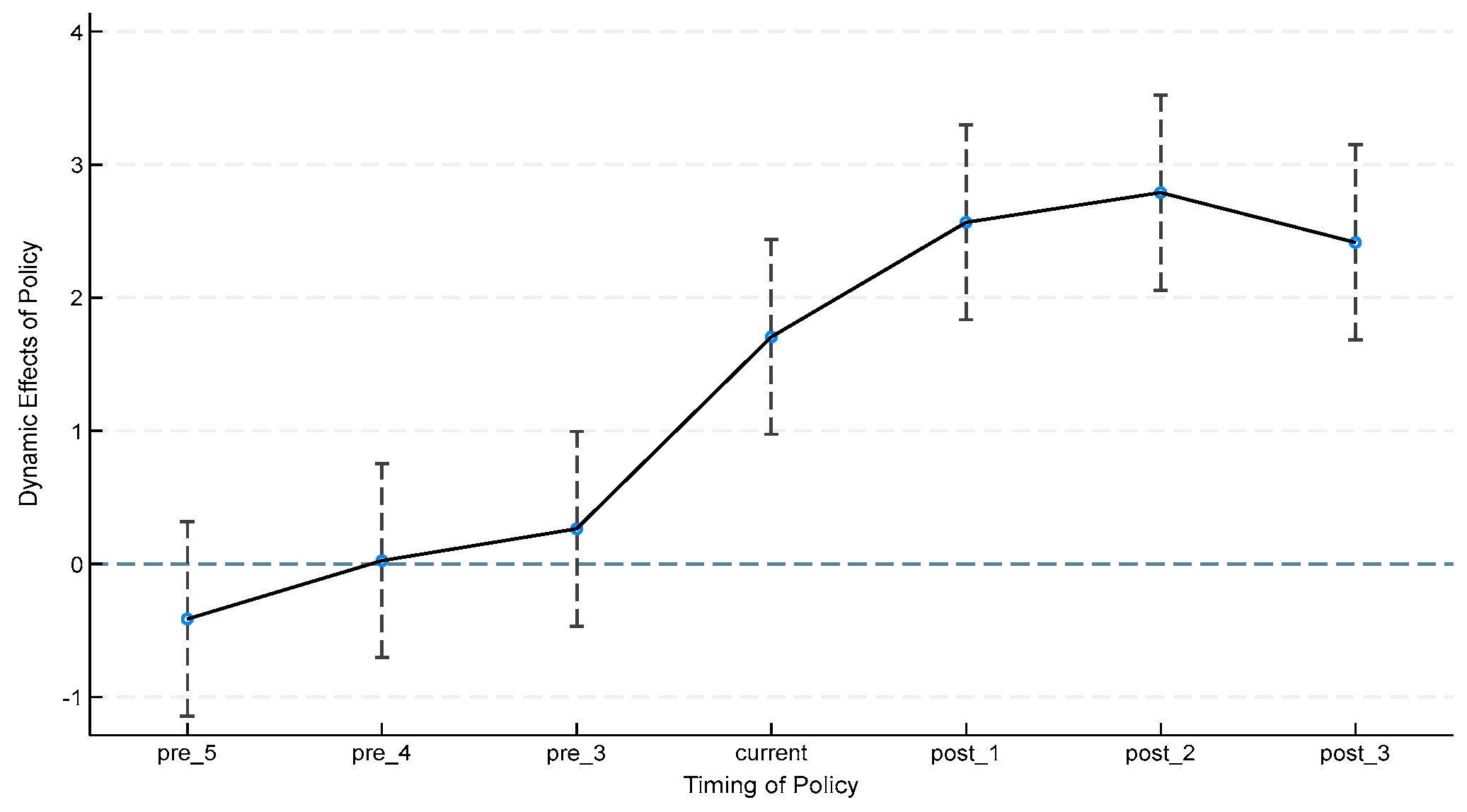
Figure 2.
Placebo Test.
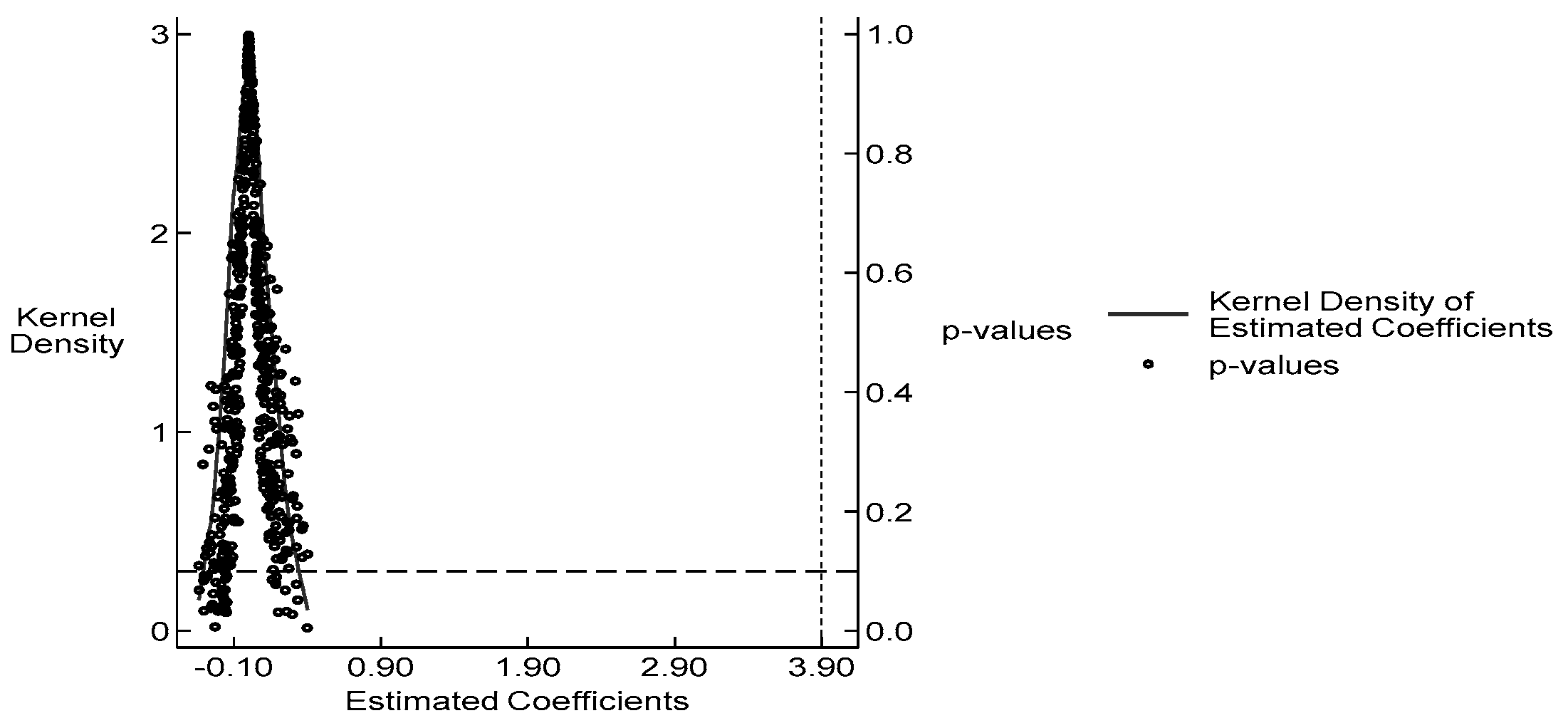
Figure 3.
Bacon Decomposition Chart.


Table 1.
Descriptive Statistics of Variables (N=6744).
| Variable Type | Variable Name | Variable Symbol | Mean | Standard Deviation | Minimum Value | Maximum Value |
| Dependent Variable | Digital Innovation | DI | 0.7337 | 4.1237 | 0 | 106.6570 |
| Core Explanatory Variable | FTZ Establishment | FTZ | 0.0482 | 0.2142 | 0 | 1 |
| Control Variables | Economic Growth | GDP | 16.0578 | 1.2100 | 12.0969 | 19.9729 |
| Technological Investment | SCIENCE | 0.0271 | 0.0291 | 0 | 0.9367 | |
| Education Development | EDUCATION | 0.1861 | 0.0494 | 0.0146 | 0.6268 | |
| International Trade | TRADE | 0.4779 | 1.2177 | 0 | 28.3674 | |
| Industrial Structure | INDUSTRY | 0.4575 | 0.1140 | 0.1068 | 0.9097 | |
| Mediating Variables | Industrial Collaboration | ICA | 4.5254 | 2.0613 | 0.8026 | 24.8980 |
| Knowledge Spillover | FLOW | 0.2917 | 2.6698 | 0 | 81.4550 | |
| Business Environment | ENV | 0.0290 | 0.0243 | 0.0043 | 0.8484 |
Table 2.
Baseline Regression Results.
| (1) | (2) | (3) | (4) | (5) | (6) | |
| DI | DI | DI | DI | DI | DI | |
| FTZ | 4.9148*** | 4.8083*** | 4.6621*** | 4.5159*** | 3.9962*** | 3.8983*** |
| (25.6314) | (25.0265) | (24.2664) | (23.7795) | (21.8757) | (21.3822) | |
| GDP | 1.0551*** | 0.7927*** | 0.7082*** | 0.2089 | 0.9337*** | |
| (5.8313) | (4.3283) | (3.9163) | (1.2010) | (4.7290) | ||
| SCIENCE | 12.5222*** | 11.8308*** | 8.8971*** | 8.2508*** | ||
| (7.8748) | (7.5355) | (5.9120) | (5.4983) | |||
| EDUCATION | 16.0086*** | 11.4856*** | 9.6596*** | |||
| (13.2151) | (9.8011) | (8.1115) | ||||
| TRADE | -0.9843*** | -0.9531*** | ||||
| (-24.7688) | (-23.9621) | |||||
| SECOND | -5.4068*** | |||||
| (-7.6470) | ||||||
| Constant Term | 0.4968*** | -16.4409*** | -12.5599*** | -14.1571*** | -4.7231* | -13.5396*** |
| (14.5012) | (-5.6599) | (-4.2825) | (-4.8875) | (-1.6905) | (-4.4966) | |
| Urban Fixed Effect | Yes | Yes | Yes | Yes | Yes | Yes |
| Time Fixed Effect | Yes | Yes | Yes | Yes | Yes | Yes |
| Adjusted R2 | 0.5684 | 0.5706 | 0.5746 | 0.5858 | 0.6218 | 0.6251 |
| Sample Size | 6744 | 6744 | 6744 | 6744 | 6744 | 6744 |
Note: * , ** , *** denote significance at 10%, 5%, 1% levels respectively, with t-statistics in parentheses.
Table 3.
Endogeneity Test Results.
| (1) | (2) | |
| FTZ | DI | |
| FTZ | 8.6671*** | |
| (9.4404) | ||
| LIGHTS | 0.0146*** | |
| (17.1317) | ||
| Anderson canon. corr. LM statistic | 294.2299*** | |
| [0.0000] | ||
| Cragg-Donald Wald F statistic | 293.5105 | |
| {16.38} | ||
| Control Variables | Yes | Yes |
| Urban Fixed Effect | Yes | Yes |
| Time Fixed Effect | Yes | Yes |
| Sample Size | 6744 | 6744 |
Note: Values in [ ] represent p-values, and values in { } denote the critical values for the Stock-Yogo weak identification test at the 10% level. * , ** , *** denote significance at 10%, 5%, 1% levels respectively, with t-statistics in parentheses.4.3Robustness Test.
Table 4.
Propensity Score Matching Regression Results.
| DI | |
| FTZ | 0.9390*** |
| (7.0669) | |
| Control Variables | Yes |
| Urban Fixed Effect | Yes |
| Time Fixed Effect | Yes |
| Adjusted R2 | 0.2186 |
| Sample Size | 3201 |
Note: * , ** , *** denote significance at 10%, 5%, 1% levels respectively, with t-statistics in parentheses.
Table 5.
Results of Other Robustness Checks I.
| (1) | (2) | (3) | (4) | (5) | |
| DI | DI | DI | DI | DI | |
| FTZ | 3.8721*** | 3.7345*** | 3.8885*** | 3.6065*** | 3.3874*** |
| (21.1499) | (20.6366) | (21.3150) | (19.6649) | (18.5255) | |
| BRI | 0.2036 | 0.3791*** | |||
| (1.5548) | (2.9234) | ||||
| BIGDATA | 1.9170*** | 1.9797*** | |||
| (11.6902) | (12.0856) | ||||
| SMART | 0.1799 | -0.0155 | |||
| (1.4149) | (-0.1227) | ||||
| INN | 1.3930*** | 1.4023*** | |||
| (9.8250) | (9.9174) | ||||
| Control Variables | Yes | Yes | Yes | Yes | Yes |
| Urban Fixed Effect | Yes | Yes | Yes | Yes | Yes |
| Time Fixed Effect | Yes | Yes | Yes | Yes | Yes |
| Adjusted R2 | 0.6252 | 0.6329 | 0.6252 | 0.6306 | 0.6388 |
| Sample Size | 6744 | 6744 | 6744 | 6744 | 6744 |
Note: * , ** , *** denote significance at 10%, 5%, 1% levels respectively, with t-statistics in parentheses.
Table 6.
Results of Other Robustness Checks II.
| (1) | (2) | (3) | |
| Altering the Time Window | Adjusting the Research Sample: Eliminating Sub-Provincial Cities |
Adjusting the Research Sample: Excluding Special FTZs |
|
| FTZ | 3.5116*** | 2.6778*** | 3.7432*** |
| (17.4356) | (14.9516) | (20.5149) | |
| Temporal Trends | |||
| Control Variables | Yes | Yes | Yes |
| Urban Fixed Effect | Yes | Yes | Yes |
| Time Fixed Effect | Yes | Yes | Yes |
| Adjusted R2 | 0.6192 | 0.5712 | 0.6174 |
| Sample Size | 5620 | 6384 | 6672 |
Note: * , ** , *** denote significance at 10%, 5%, 1% levels respectively, with t-statistics in parentheses.
Table 7.
Mechanism Examination Results.
| (1) | (2) | (3) | |
| ICA | FLOW | ENV | |
| FTZ | 1.4143*** | 2.1918*** | 0.0037*** |
| (14.4090) | (15.0062) | (2.7466) | |
| Control Variables | Yes | Yes | Yes |
| Urban Fixed Effect | Yes | Yes | Yes |
| Time Fixed Effect | Yes | Yes | Yes |
| Adjusted R2 | 0.5651 | 0.4260 | 0.4145 |
| Sample Size | 6744 | 6744 | 6744 |
Note: * , ** , *** denote significance at 10%, 5%, 1% levels respectively, with t-statistics in parentheses.
Table 8.
Heterogeneity Analysis Results.
| (1) | (2) | (3) | (4) | (5) | |
| Low Level of Opening-up | Moderate Level of Opening-up | High Level of Opening-up | Low Level of Digital Infrastructure Construction | High Level of Digital Infrastructure Construction | |
| FTZ | 0.2978*** | 1.1552*** | 5.6702*** | -0.0557*** | 4.2825*** |
| (10.3383) | (14.4042) | (11.3078) | (-3.2355) | (14.3840) | |
| Control Variables | Yes | Yes | Yes | Yes | Yes |
| Urban Fixed Effect | Yes | Yes | Yes | Yes | Yes |
| Time Fixed Effect | Yes | Yes | Yes | Yes | Yes |
| Adjusted R2 | 0.6742 | 0.7627 | 0.6522 | 0.5338 | 0.6425 |
| Sample Size | 2240 | 2240 | 2245 | 3365 | 3362 |
Note: * , ** , *** denote significance at 10%, 5%, 1% levels respectively, with t-statistics in parentheses.
Table 9.
Results of Spatial Spillover Effects Testing.
| (1) | (2) | (3) | (4) | |
| Main | Total Effect | Direct Effect | Indirect Effect | |
| FTZ | 3.1129*** | 13.1883*** | 3.4236*** | 9.7647*** |
| (17.2871) | (12.2314) | (18.3257) | (9.4714) | |
| RHO | 0.4000*** | |||
| (13.3091) | ||||
| Control Variables | Yes | Yes | Yes | Yes |
| Urban Fixed Effect | Yes | Yes | Yes | Yes |
| Time Fixed Effect | Yes | Yes | Yes | Yes |
| R2 | 0.0994 | 0.0994 | 0.0994 | 0.0994 |
| Sample Size | 6744 | 6744 | 6744 | 6744 |
Note: * , ** , *** denote significance at 10%, 5%, 1% levels respectively, with t-statistics in parentheses.
Disclaimer/Publisher’s Note: The statements, opinions and data contained in all publications are solely those of the individual author(s) and contributor(s) and not of MDPI and/or the editor(s). MDPI and/or the editor(s) disclaim responsibility for any injury to people or property resulting from any ideas, methods, instructions or products referred to in the content. |
© 2025 by the authors. Licensee MDPI, Basel, Switzerland. This article is an open access article distributed under the terms and conditions of the Creative Commons Attribution (CC BY) license (http://creativecommons.org/licenses/by/4.0/).
Copyright: This open access article is published under a Creative Commons CC BY 4.0 license, which permit the free download, distribution, and reuse, provided that the author and preprint are cited in any reuse.


