

Submitted:
18 August 2023
Posted:
22 August 2023
You are already at the latest version
Abstract
This study empirically examines the spatial spillover effect of various environmental regulations on green technology innovation using panel data from 284 county-level cities in China between 2007 and 2019. A geographical-economic spatial weight matrix is constructed, and the spatial Durbin model is employed to identify the specific characteristics of this spillover effect. The findings indicate that the spatial spillover effect of green technology innovation primarily occurs through geographical transmission. However, there is no significant spatial autocorrelation when using the economic distance weight matrix. Various types of environmental regulations influence the spatial spillover effect of green technology innovation in distinct ways. Specifically, Market-motivated environmental regulation exhibits a U-shaped relationship with the spatial spillover effect, while Command-controlled environmental regulation demonstrates an inverted U-shaped relationship, suggesting a complementary effect. Additional research shows that the upgrading of industrial structure acts as a mediator between command environmental regulation and the spatial spillover effect of green technology innovation. Government departments should comprehensively coordinate Market-motivated environmental regulation and Command-controlled environmental regulation, accurately assess the intensity of Command-controlled measures, and prevent the migration of green technology innovation elements caused by excessive regulatory measures within enterprises.
Keywords:
Environmental regulation
; Green technology innovation
; Spatial spillovers
1. Introduction
In recent years, the Chinese government has placed significant emphasis on green development. In 2020, it introduced the "double carbon" objective, aiming to reach the peak of carbon emissions by 2030 and achieve carbon neutrality by 2060.Green technology innovation serves as a crucial driving force in attaining the "double carbon" goal. However, these activities come with dual externalities.While enterprises investing considerable amounts in R&D innovation costs can generate certain benefits through green technology innovation, the spillover of technological knowledge prevents enterprises from fully capturing these benefits. Consequently, enterprises often lack the motivation to engage in green technology innovation. In this regard, the government should implement appropriate policy interventions to incentivize enterprises to undertake research and development and apply green technology innovation.Thus, it holds immense importance for the government to analyze the characteristics of the spatial spillover effect of environmental regulation on green technological innovation in order to foster the advancement of enterprise-driven green innovation.
Numerous studies have explored the influence of environmental regulation on green technology innovation; however, these studies yield diverse results. Moreover, there is a scarcity of research focusing specifically on the spatial spillover effect of green technology innovation.Green technological innovation differs from conventional technological innovation due to its unique external characteristics. Consequently, the findings derived from existing research on ordinary technological innovation do not directly elucidate the spatial spillover effect observed in green technological innovation.Consequently, incorporating the concept of spatial spillover effect in the investigation of environmental regulation's influence on green technology innovation allows for a more comprehensive understanding of the impact exerted by environmental regulation.This study employs panel data from 284 Chinese cities spanning from 2007 to 2019. By constructing a geographical and economic weight matrix, it investigates the association between environmental regulation and the spatial spillover effect of green technology innovation.
This study offers several notable contributions. Firstly, it focuses on a different research object compared to prior studies, which often employed provincial panel data. Instead, this study utilizes panel data from prefecture-level cities, enabling a more precise examination of the spillover effects of green technology innovation.Secondly, this study examines the influence of environmental regulation on the spillover effects of green technology innovation from a spatial perspective. By doing so, it establishes a theoretical foundation for local governments to effectively promote green economic development using various approaches.Thirdly, this study delves into the mechanism by exploring the mediating role of industrial structure. It investigates how environmental regulation affects green technology innovation through the intermediary effect of industrial structure.
2. Literature Review and Comment
2.1. Environmental Regulation and Green Technology Innovation
The impact of Market-motivated and Command-controlled environmental regulation on green technology innovation is a prominent topic that garners significant attention from researchers. However, substantial disparities exist among the existing research findings.
Regarding the impact of Market-motivated environmental regulation on green innovation, studies indicate that both R&D investment and government subsidies positively influence green technological innovation [1,2].Nevertheless, when it comes to government subsidies, there exist disagreements due to their potential adverse effects on green technology innovation[3,4,5].Certain studies suggest that government subsidies impede green technology innovation, possibly due to excessive financial support, thereby diminishing enterprises' autonomous R&D investments [6,7]. Another perspective highlights the unpredictable nature of government subsidies' role in green technology innovation. Moreover, the impact of financial support on green technology innovation can vary based on changes in enterprise operations, R&D investment, and market demand[8,9].
Recent research has presented three distinct perspectives regarding the impact of command-controlled environmental regulation on green innovation in enterprises. Firstly, it is argued that such regulation can foster green innovation [10,11,12]. Secondly, there is a viewpoint suggesting that it may hinder green innovation [13,14]. Additionally, another perspective suggests a non-linear relationship between the two, characterized by a U-shaped pattern of initial inhibition followed by promotion or an inverted U-shaped pattern of initial promotion followed by inhibition[15,16]. Furthermore, some scholars express skepticism and believe that the impact of environmental regulation on green technological innovation in enterprises remains uncertain[17].
2.2. Spatial Spillover Effect of Innovation
Research on the spatial spillover of technological innovation primarily investigates its effects by constructing geographical and economic distance matrices. Existing research commonly acknowledges the prominent spillover effect of technological innovation in both geographical and economic dimensions. Nonetheless, studies focusing on the spatial spillover effect of green innovation are relatively scarce, with a lack of corresponding empirical research examinations.
Regarding the spatial spillover of general innovation, certain scholars have validated the presence of a regional technological innovation spillover effect through geospatial matrix construction[18,19]. The regional technological innovation spillover effect demonstrates a notable trend of distance attenuation[20,21]. Concerning economic spatial spillover effects, China's innovation resources are mainly concentrated in the economically developed regions of the east, resulting in economic spatial agglomeration phenomena. Relevant studies have also revealed the presence of economic spatial autocorrelation in technological innovation. Some scholars further examined the influence of economic spatial distance on technological innovation through the construction of an economic distance matrix. They concluded that technological innovation tends to spill over to regions with closer economic distances, while areas with substantial economic disparities face challenges in generating significant spillover effects due to constraints related to technical talent and industrial foundations[22,23].
There is limited research on the spatial spillover effect of green technology innovation. Existing studies primarily approach green technology innovation from the perspective of regional heterogeneity and suggest that environmental regulation has varying impacts on green technology innovation across different regions[24]. Some scholars analyze this phenomenon through the spatial spillover effect of environmental regulation policies. They argue that increased intensity of environmental policies can stimulate interregional industrial transfer, leading to changes in industrialization processes and the industrial structure of neighboring regions. This promotes economic development and R&D investment in the regions experiencing industrial transfer while enhancing the green innovation capacity of adjacent areas[25].
3. Theoretical Analysis and Research Hypothesis
Economic activities in a region are frequently interconnected with its neighboring regions, leading to manifestations of spatial equilibrium, competition, diffusion, and other phenomena. These phenomena partly represent the spatial correlation and interdependence between regions[26].The spatial equilibrium between regions is influenced by factors such as geographical and natural conditions, scale benefits resulting from agglomeration of enterprises, regional costs of material and information circulation, etc.Spatial competition between regions is primarily characterized by the fact that closer distances correspond to more intense competition among manufacturers[27].The spatial diffusion effect between regions occurs when the economic center disseminates and shares technical knowledge with neighboring regions[28].Regional economies exhibit complex structures as they intertwine and interact, forming intricate and diverse networks. These networks generate various effects, including direct impacts, indirect effects, spillover effects, and more[29].
3.1. Spatial Spillover Effect of Green Technological Innovation
By analyzing spatial diffusion, we can observe the spillover of innovation in terms of geographical space. This allows for the rapid dissemination of new technologies, products, and processes from one region to another, facilitating development across different geographical areas[30].The primary mechanism of innovation spillover involves generating knowledge spillover through interactions between innovative entities within a region, which includes mutual learning and exchange. Consequently, shorter geographical distances facilitate greater exchange and interaction, thereby promoting innovation spillover in geographical space[31].The spatial interdependence of economic and social development among neighboring regions increases the likelihood of innovation producing spatial spillover effects[28].Green technological innovation, as a form of innovation, is similarly subject to widespread spillover effects due to regional exchanges and interactions.
Considering externality theory, green technology innovation imposes costs on enterprises without fully capturing all the associated benefits. While enterprise-driven green technology innovation aims to maximize social benefits, it falls short of achieving Pareto optimality due to limited initiative[32]. The large-scale spillover of green technological innovation requires adequate external intervention. Meanwhile, enterprises, as the primary drivers and carriers of green technology innovation, engage in interregional transfers, facilitating spillover. Enterprises, seeking cost reduction, tend to relocate from economically advanced regions to less developed ones [2].Consequently, the components of green technology innovation accompany enterprise transfers.As a result, spillover of green technological innovation is unlikely to happen between regions with comparable levels of economic development.Based on the aforementioned analysis, we propose that:
Hypothesis 1: There is a geographical spatial spillover effect of green innovation.
3.2. Environmental Regulation and Space Spillover Effect of Green Technology Innovation
Market-based environmental regulations can guide enterprises by providing incentives for investments in environmental protection, technological transformation, and through various means such as special investments, fiscal subsidies, tax relief, loan incentives, green procurement, among other preferential policies. These measures aim to offset the costs incurred by enterprises in energy conservation and consumption reduction [33]. In terms of spatial competition, when there is a significant disparity between the intensity of market-based environmental regulation incentives and the costs associated with green innovation R&D investments, enterprises may opt to adopt existing technologies, leading to a "siphon effect" that negatively impacts green technology innovation in neighboring areas.If the intensity of environmental regulation incentives is sufficient to offset enterprises' investments in green innovation R&D, enterprises are encouraged to engage in green technology innovation. This, in turn, enhances their green technology innovation capabilities, resulting in positive spillover effects.Based on the aforementioned analysis, we propose:
Hypothesis 2: The geographical spillover effect of market-based environmental regulation on green innovation exhibits a U-shaped pattern.
Command-controlled environmental regulation enforces rigorous energy conservation and emission reduction measures on enterprises through mandatory measures, such as enhancing environmental assessment in planning, upgrading emission standards, and phasing out outdated production capacity.From a spatial equilibrium standpoint, enterprise costs play a crucial role in achieving spatial balance.If the cost increase resulting from the strength of Command-controlled environmental regulation falls within enterprises' manageable range, they will upgrade their technologies to comply with environmental protection requirements and enhance regional green technology innovation capability. However, if the cost increase surpasses enterprises' capacity, they may face elimination as obsolete production capacity, prompting industrial relocation. Consequently, the components of green technology innovation will also relocate along with the enterprises, thereby reducing regional green technology innovation capacity [34].Based on the aforementioned analysis, we propose:
Hypothesis 3: The geospatial spillover effect of Command-controlled environmental regulation on green innovation exhibits an inverted U-shaped pattern.
3.3. Intermediary Effect of Industrial Structure
As government environmental regulations become increasingly stringent, enterprises are required to adhere to stricter laws and regulations. Consequently, the production costs of enterprises significantly increase, thereby diminishing the competitiveness of local businesses and prompting them to consider options such as cross-regional transfer or industrial transformation.In comparison to industrial transformation, cross-regional transfer offers advantages including shorter completion time, lower costs, and reduced development uncertainty[35].Hence, when there are changes in the local environmental regulatory framework, an enhancement in the local supervision level prompts highly resource-dependent polluting enterprises to relocate to regions with less stringent regulations. This triggers adjustments in both their own industrial structure and that of neighboring areas. Simultaneously, the elements of green innovation are relocated to these neighboring areas for redistribution.Based on the aforementioned analysis, we propose:
Hypothesis 4: Command-controlled environmental regulation induces adjustments in regional industrial structure, consequently resulting in the spatial spillover of green innovation.
4. Research Design
4.1. Model Settings
Spatial econometric models encompass various models, such as the spatial autoregressive model (SAR), spatial error model (SEM), and spatial Durbin model (SDM).In spatial econometric model selection, the LM test is commonly utilized for model identification [36]. However, the LM test has certain limitations associated with its characteristics.Simulation analysis reveals that the LM test effectively distinguishes between SAR and SEM models, but its reliability is limited for other tests [37].Thus, when choosing models, the SDM model can be directly selected for regression analysis [38].The spatial Durbin model (SDM) combines the characteristics of both the SAR and SEM models while incorporating a spatial lag term for both the explanatory and dependent variables.Introducing these spatial lag variables offers several advantages. Firstly, it helps reduce errors arising from missing variables during the modeling process. Secondly, it enhances the effectiveness of addressing spatial differences [39].Hence, this study employs the spatial Durbin model, incorporating both spatial and temporal characteristics, for analysis as it addresses the double fixed nature of the data [39].
Considering the time lag in patent applications, we incorporate environmental regulation with a one-phase lag (ER it-1) and introduce its secondary term (ERit-12) to explore the nonlinear association between environmental regulation and innovation in green technology. CONTR represents the set of control variables.λi denotes the individual fixed effect, ηt represents the time fixed effect, and εit refers to the random disturbance term conforming to εit~ N(0, σ2). W represents the spatial weight matrix, where W1ij is the geographical distance spatial weight matrix defined as 1/dij. Here, dij represents the distance in terms of longitude and latitude between cities. The economic distance spatial weight matrix, denoted as W2ij, is defined as 1/| Gi - Gj |, where Gi and Gj represent the average per capita GDP of cities i and j during the period from 2007 to 2019.
4.2. Variable Definition
4.2.1. Interpreted Variable
Green technology innovation (GTP): Green technology innovation can be measured in various ways, such as using principal component analysis to assess its efficiency or utilizing green patents to evaluate innovation performance. Comparatively, green patents provide richer information regarding green technology innovation and offer a better reflection of regional capabilities and levels of green innovation. In this study, the number of green patent applications is employed to measure the regional capacity for green technology innovation.
4.2.2. Explanatory Variable
Environmental regulation (ER): This study focuses on government-led initiatives, thus Market-motivated environmental regulation and Command-controlled environmental regulation are chosen as the primary areas of investigation.
Market-motivated environmental regulation (MER): It is primarily assessed based on the level of government investment in environmental protection and the subsidies provided to businesses for environmental protection purposes. As the study utilizes urban panel data, the availability of environmental pollution control investment data for individual cities beyond 2007 from the China Urban Statistical Yearbook is limited. Thus, considering local data availability, this study adopts the measurement approach introduced by Zhang and Xu (2022) [40], which estimates the intensity of Market-motivated environmental regulation using the product of the government's public financial budget expenditure and the natural logarithm of the solid waste utilization rate.
Command and control environmental regulation (CER): It can be measured using various indicators, including industrial wastewater, industrial sulfur dioxide, industrial solid waste emissions, energy consumption per unit of GDP, and analyzing the government work report to gauge the intensity of environmental regulation. Often, the intensity of environmental regulation is assessed by calculating a comprehensive index based on multiple pollutant indicators. In this study, the methodology proposed by Qiang, et al. [41] is adopted.
First, the unit pollutant emissions of each city are linearly standardized.
Among them, P ij is the pollutant emission per unit output value of j pollutant in city i, max(Pj) and min (Pj) are the maximum and minimum values of each indicator in all cities, and Psij is the standardized value of the indicator.
Secondly, the adjustment coefficient is calculated. The proportion of pollutant emissions and the emission intensity of different pollutants in different cities differ greatly. The adjustment coefficient is used to approximate the difference of pollutant characteristics. The calculation formula of adjustment coefficient is:
Is the urban average value of j pollutant emission per unit output value during the sample period.
Finally, the intensity of command and control environmental regulation of each city is calculated.
CERi is the order controlled environmental regulation intensity of city i.
4.2.3. Control Variable
n order to enhance the accuracy of the estimation, this study incorporates various control variables. These variables include the level of economic development, measured by per capita GDP; the degree of opening up, measured by the proportion of output value from foreign-invested enterprises in the total industrial output value; the degree of marketization, measured by the ratio of private and individual employees to the total number of employees; infrastructure, measured by the ratio of actual paved road area to the land area of the prefecture-level city; greening rate of built-up areas, measured by the ratio of green area to built-up area; scientific research investment, measured by the ratio of R&D expenditure to GDP; and the degree of financial development, measured by the ratio of financial institutions' loan balance at the end of the year to GDP.
4.3. Data Source and Descriptive Statistics
This study analyzes two sets of data. The first set is derived from the Statistical Yearbook of Chinese Cities, with exclusions made for regions with severe data deficiencies (Tibet Autonomous Region, Turpan City in Xinjiang Uygur Autonomous Region, Haidong City in Qinghai Province, Bijie City in Guizhou Province, Qinzhou City in Guangxi Zhuang Autonomous Region, Chaohu City in Anhui Province, Sansha City in Hainan Province). The second set of data is obtained from the Green Patent Research Database (GPRD) of the China Research Data Service Platform (CNRDS) and is matched with local and municipal data.Since 2007, the country has actively promoted green development. Additionally, taking into account the impact of the COVID-19 epidemic in 2020, the flow of green innovation factors among regions has been constrained. Consequently, panel data for 284 prefecture-level cities spanning the period from 2007 to 2019 were collected.Because spatial econometric model analysis has a low tolerance for missing values, linear interpolation is used to fill in the gaps in the data.
Table 1 presents the descriptive statistics for the main variables. The relatively large standard deviations of each variable indicate noticeable differences between cities and regions. Additionally, the examination of the variable variance inflation factor reveals values below 2.5, with a mean of 1.64, indicating the absence of multicollinearity. Figure 1 illustrates the temporal and spatial distribution of green technological innovation in China. The data from six time intervals between 2007 and 2019 were selected for mapping. The figure reveals a progression of China's green technological innovation from weak to strong. Throughout this process, the growth of green innovation has generally improved, with no apparent polarization phenomenon. The development of green technology innovation capacity has shown a comprehensive strengthening trend extending from core cities to regions, resulting in reduced regional disparities in green innovation capacity.
5. Research Results and Analysis
5.1. Spatial Correlation Test
The study employs the Moran index to examine the global spatial autocorrelation of green technology innovation using various spatial weight matrices from 2007 to 2019. The results are presented in Table 2. Regardless of the distance weight matrix or the economic weight matrix, green technology innovation exhibits significant positive spatial correlation across different years, indicating clear spatial dependence. Therefore, the introduction of a spatial econometric model for analysis is warranted. The study conducted additional analysis on the local spatial autocorrelation of green technology innovation using the Moran Scatter Chart, depicted in Figure 2. Whether utilizing the distance weight matrix or the economic weight matrix, urban areas exhibited agglomerations of both high-high and low-low patterns for green innovation, with the geographic weight matrix displaying a more pronounced agglomeration effect. The upper right quadrant of the graph indicates cities with high levels of green innovation, while the surrounding cities also exhibit high-high clustering, suggesting a potential spatial spillover effect.
5.2. Basic Regression
Refer to Table 3 for the estimated outcomes of the spatial Durbin model. With respect to the geographic weight matrix, the spatial autoregressive coefficient ρ for models in columns (1) and (2) is significantly positive at a 1% level, indicating a positive spatial autocorrelation of green technology innovation. Conversely, under the economic weight matrix, the spatial term coefficient ρ in models of columns (3) and (4) is statistically insignificant, suggesting the absence of spatial autocorrelation for green technology innovation in terms of economic weight matrix. Therefore, there is no spillover of green technology innovation from cities with high economic development to cities with similar economic development levels. This outcome supports hypothesis 1. The inconsistency with the previous Moran index test could stem from the overlap between the geographic weight matrix and the economic weight matrix in the distribution of green technological innovation. The introduction of additional variable controls can yield more accurate and realistic results.
Under the geographical distance weight matrix, the coefficients of Market-motivated environmental regulation and Command-controlled environmental regulation, along with their secondary terms in columns (1) and (2), are not significant. This indicates that the direct impact of Market-motivated environmental regulation on the city itself is insignificant. However, the coefficient of the spatial lag term of Market-motivated environmental regulation is significantly negative at a 1% level, while its secondary terms are significantly positive at a 5% level. These results demonstrate a U-shaped cumulative proximity effect (feedback effect) of Market-motivated environmental regulation. Specifically, the impact of urban Market-motivated environmental regulation on surrounding cities, in turn, affects their own green technology innovation in a U-shaped manner. The spatial autoregressive coefficient of Command-controlled environmental regulation is significantly positive at a 1% level, whereas its quadratic term is significantly negative at a 5% level, indicating an inverted U-shaped cumulative proximity effect. There is a significant cumulative proximity effect under the geographical distance weight matrix, suggesting the presence of spatial spillover effects. These findings can be attributed to the proximity between regions within the geographical feature matrix, whereby environmental regulation induces changes in the market environment, leading to the flow of green innovation elements and even the transfer of productive enterprises as carriers of green innovation. This aspect will be further analyzed below.
5.3. Spatial Effect Decomposition
Table 4 presents the direct effect, indirect effect, and total effect of Market-motivated environmental regulation. The direct effect represents the combined impact of the main effect and feedback effect of Market-motivated environmental regulation on the city where it is implemented. The indirect effect refers to the influence of Market-motivated environmental regulation on the green innovation of the studied city in neighboring cities. In column (1), the coefficient for the intensity of Market-motivated regulation and its secondary term direct effect are not statistically significant, indicating that the direct impact of Market-motivated regulation intensity on the city's green technology innovation is not significant. In column (2), the coefficient for the indirect effect of Market-motivated regulation intensity is significantly negative at a 5% level, while the coefficient for its secondary term indirect effect is significantly positive at a 5% level. These findings suggest a U-shaped relationship between the Market-motivated regulation intensity of neighboring cities and its impact on the studied city. Therefore, Hypothesis 2 is confirmed, stating that increasing the intensity of Market-motivated regulation in neighboring cities will initially reduce the green technological innovation of the studied cities but will eventually improve it. This may be attributed to the "siphon effect" caused by the intensified Market-motivated regulation, which attracts green innovation elements to concentrate in neighboring cities. Once the Market-motivated regulation intensity reaches a certain threshold in neighboring cities, a positive "spillover effect" occurs, enhancing the local green technology innovation capacity.
As depicted in Table 5, the direct effect coefficient of order control regulation intensity in column (1) is positively but insignificantly related to green technology innovation in the city. However, its secondary term exhibits a significant negative relationship at the 10% significance level, indicating an inverted U-shaped pattern. When the intensity of order control regulation increases, enterprises in the city tend to reduce costs and seek green technology innovation as a means to mitigate the impact of command and control regulation. Nevertheless, green technology innovation necessitates long-term and uncertain investments, leading to enterprises' reluctance to bear additional costs. Consequently, they may introduce green innovation elements from neighboring cities, resulting in a "siphon effect." Beyond a certain threshold, higher levels of command and control regulation can lead to the gradual relocation of enterprises to regions with less stringent environmental regulations. As key drivers and enablers of green technology innovation, enterprises also transfer their green technology innovation elements, ultimately diminishing the capacity for green technology innovation.
Furthermore, in column (2), the indirect effect coefficient of order control regulation intensity is significantly positive at the 5% level, while the indirect effect coefficient of its quadratic term is significantly negative at the 1% level. This finding confirms hypothesis 3 and demonstrates an inverted U-shaped relationship between the order control regulation intensity in neighboring cities and local cities. The industry exhibits agglomeration effects, attracting related enterprises along the industry chain and supporting businesses to concentrate in both cities and surrounding areas. The spillover effect of green innovation induced by command and control regulations in neighboring cities propagates to the industry chain enterprises located in focal cities, thus exhibiting similar trends in green innovation. These results highlight that enhancing the intensity of command and control regulation elicits an inverted U-shaped direct and indirect effect on green technology innovation. Importantly, command and control environmental regulations can prompt regulated enterprises to relocate, leading to the outflow of green innovation elements and subsequent transformations in the urban industrial structure.
5.4. An Analysis of the Intermediary Effect of Industrial Structure
Most of the "three high" enterprises primarily belong to the secondary industry, which comprises productive industrial enterprises. The relocation of these enterprises results in alterations in the local industrial structure. Therefore, this study examines the urban industrial structure to analyze the transfer of "three high" enterprises within cities. To test the hypothesis regarding the influence of environmental regulations on the transfer of polluting enterprises, this paper adopts the intermediary effect test method described by Wen et al. (2004) [42]. By employing a geographical distance spatial matrix, we construct the following spatial Durbin model to explore the impact of environmental regulation on the transfer of polluting industries. The measurement of industrial structure (Struc) entails calculating the ratio of tertiary industry value-added to secondary industry value-added. The remaining model settings are as follows.
The regression results presented in Table 6 represent the direct effects of explanatory variables on the explained variables, encompassing both main effects and feedback effects. Given the lack of significance regarding the direct effects of Market-motivated environmental regulation in the previous regression results (Table 4), we focus solely on examining the intermediary effects of Command-controlled environmental regulation. In column (1), a significantly inverted U-shaped relationship is observed between Command-controlled environmental regulation and green technology innovation. In column (2), a significantly U-shaped relationship emerges between Command-controlled environmental regulation and industrial structure. However, in column (3), the impact of Command-controlled environmental regulation is found to be insignificant, whereas industrial structure significantly diminishes green technology innovation at a 1% level of significance. These findings indicate a mediating effect of the industrial structure. Since the Command-controlled environmental regulation in column (3) is not significant, it can be concluded that the industrial structure fully mediates the relationship. Hypothesis 4 is thus validated. Command-controlled environmental regulation facilitates the reconfiguration of regional industrial structure, consequently reducing green technological innovation. This process leads to the transfer of low-end industries and a spillover effect on green technological innovation. Although the intermediary effect test yields complete mediation, considering the regional heterogeneity in the impact of environmental regulation on green technology innovation, the overall regression exhibits an insignificant pattern. Therefore, it can be inferred that the spillover effect of environmental regulation on green technology innovation is primarily manifested through changes in the industrial structure resulting from the transfer of low-end industries.
6. Robustness Test
6.1. Replacement Space Weight Matrix
The research further verifies the regression results by replacing the spatial weight matrix, and the replacement geographical distance weight matrix is an adjacency matrix (W3ij). When city i and city j are adjacent, W3ij=1; If it is not adjacent, W3ij=0. The degree of urban economic development is also closely related to the number of local talents. Considering that the spatial spillover of ordinary innovation will spill over to cities with similar economies and talents, in order to distinguish the different spillover characteristics of green technology innovation and ordinary innovation, a talent weight matrix (W4ij) is constructed. W4ij =1/|Hi-Hj|, Hi, Hj represents the average higher education rate of city i and city j from 2007 to 2019, respectively. It can be seen from Table 7 that the spatial autoregression coefficient ρ The regression results of are consistent with the significance of the benchmark regression results in Table 3, which verifies the robustness and reliability of the benchmark model estimation results.
6.2. Add The Time Lag Term of The Explained Variable
To mitigate the issue of endogeneity, the explanatory variables of the model include a time lag term for green technological innovation. The regression results are presented in Table 8, and they demonstrate consistency with the benchmark regression results, thereby further confirming the robustness of the model.
The study conducted regression tests using the spatial autoregression model (SAR) and spatial error model (SEM). The regression results for the main variables were largely consistent with the previous findings, thereby confirming the robustness of the research results.
7. Research Conclusions and Policy Recommendations
7.1. Research Conclusion
Green technological innovation exhibits spatial spillover primarily through geographical proximity and does not extend to cities with similar economic development as observed in ordinary technological innovation. This distinction arises from the unique characteristics of green innovation and the transfer of green technology innovation elements from economically advanced regions to those with lower economic development.he direct effect of Market-motivated environmental regulation on green innovation within a city is not statistically significant. However, it manifests predominantly through a U-shaped spatial spillover effect. Market-motivateds in neighboring cities generate a negative "siphon effect," attracting green innovation elements from the surrounding areas. When Market-motivated environmental regulations reach a sufficient level, the enterprise's motivation for green technological innovation increases, enhancing its capacity for green innovation. This process also yields a positive "spillover effect" on neighboring cities.Command-controlled environmental regulation has both an inverted U-shaped direct effect and a spatial spillover effect on urban green technological innovation. Such regulation prompts enterprises to actively engage in green technology innovation and upgrade their technologies to comply with environmental protection standards. If the cost increase resulting from the intensity of Command-controlled environmental regulation goes beyond what enterprises can bear, they may opt for industrial relocation. Consequently, the elements of green technological innovation are transferred alongside these enterprises, leading to the upgrading of the city's industrial structure. The upgrading of the industrial structure serves as an intermediary variable in the relationship between command and control environmental regulation and green technology innovation.The spillover effect of green technology innovation resulting from command and control environmental regulation primarily occurs through the transfer of low-end industries prompted by such regulation, which subsequently leads to the transfer of green innovation elements.
7.2. Policy recommendations
Firstly, it is crucial to increase investment in green technology research and development (R&D) as well as green technology demonstration. Given the external nature of green technology innovation, government promotion becomes particularly significant. However, green innovation does not actively generate spillover effects among regions with similar economic development. Investing in green innovation R&D is an effective approach to facilitate independent green technology innovation by enterprises. Considering the characteristics of local industries, the government should provide support for green innovative technologies that promote energy conservation, emission reduction, and industrial upgrading. By implementing demonstration projects, the government can effectively leverage the geographical spillover effect of green technological innovation to drive the advancement and transformation of relevant enterprises' green technologies.
Secondly, it is essential to establish comprehensive frameworks for both Market-motivated environmental regulation and Command-controlled environmental regulation. To prevent the "crowding out effect" on enterprises resulting from the cost increase caused by Command-controlled environmental regulation, offsetting measures through incentives provided by Market-motivated environmental regulation should be implemented. Introducing indirect approaches like green finance and utilizing financial funds as leverage can stimulate larger-scale financial capital, thereby promoting green credit, guarantees, bonds, and funds to support green technology innovation and facilitate the development and application of green technology.
Thirdly, it is crucial to appropriately manage the intensity of Command-controlled environmental regulation to foster industrial upgrading and transformation. Implementation of science-based policies and measures is necessary to ensure effective policy implementation, prevent industry transfer and pollution resulting from inadequate policy implementation, reduce the hollowing of regional economies, sustain small and medium-sized enterprises' vitality, provide increased support to enterprises, encourage their active involvement in green innovation, enhance their capabilities in green technology innovation, and achieve sustainable development at the regional level.
Fourthly, it is essential to develop environmental protection policies that align with local industries and innovative development while considering the environmental regulations of surrounding cities. Measures should be taken to prevent the occurrence of policy "depressions" resulting from inappropriate environmental policy settings, which can lead to the formation of "pollution shelters" in the region and make it a destination for the transfer of high-energy consumption and high-pollution capacity. Additionally, avoiding the transfer of green innovation elements alongside industries due to excessive or unreasonable environmental regulations is crucial for maintaining sustainable development of the regional economy.
Funding
This paper is supported by the National Social Science Foundation of China (21BJL21).
Institutional Review Board Statement
Not applicable.
Informed Consent Statement
Not applicable.
Data Availability Statement
Not applicable.
Conflicts of Interest
The authors declare no conflict of interest.
References
- Ren, Y.M.; Industrial Investment Funds, Government R&D Subsidies, and Technological Innovation: Evidence from Chinese Companies. Front. Psychol., 2022, 13: 890208. [CrossRef]
- Zhang, Y.; CHEN, H.; HE, Z.; Environmental Regulation, R&D Investment, and Green Technology Innovation in China: Based on The Pvar Model. Plos One, 2022, 17(10): e0275498. [CrossRef]
- Cohen, M.C.; LOBEL, R.; PERAKIS, G.; The Impact of Demand Uncertainty on Consumer Subsidies for Green Technology Adoption. Manag. Sci., 2016, 62(5): 1235-1258. [CrossRef]
- Wang, P.; Dong, C.; Chen, N.; Qi, M.; Yang, S.; Nnenna, A.B.; Li, W. Environmental Regulation, Government Subsidies, and Green Technology Innovation—a Provincial Panel Data Analysis From China. Int. J. Environ. Res. Public Health, 2021, 18(22): 11991. [CrossRef]
- Shen, L.; Fan, R.; Wang, Y.; Yu, Z.; Tang, R. Impacts of Environmental Regulation on The Green Transformation and Upgrading of Manufacturing Enterprises. Int. J. Environ. Res. Public Health, 2020, 17(20): 7680. [CrossRef]
- Philipp, B.; The Allocation and Effectiveness of China’s R&D Subsidies - Evidence from Listed Firms. Res. Policy, 2016, 45(9): 1774-1789. [CrossRef]
- Zhang, M.; Xie, W.; Gao, W.; Have Environmental Regulations Promoted Green Technological Innovation in Cities? Evidence from China’s Green Patents. Plos One, 2022, 17(12): e0278902. . Plos One, 2022, 17. [CrossRef]
- Lee, C.Y.; . Technovation, 2011, 31(5-6): 256-269. 2: 31(5-6).
- Christos, D.; Geoff, P.; The Effectiveness of R&D Subsidies: A Meta-regression Analysis of the Evaluation Literature. Res. Policy, 2016, 45(4): 797-815. [CrossRef]
- Hattori, K.; Optimal Combination of Innovation and Environmental Policies under Technology Licensing. Econ. Model., 2017, 64: 601-609. [CrossRef]
- Fang, Y.; Shao, Z.; Whether Green Finance Can Effectively Moderate The Green Technology Innovation Effect of Heterogeneous Environmental Regulation. Int. J. Environ. Res. Public Health, 2022, 19(6): 3646. [CrossRef]
- Niu, H.; Zhao, X.; Luo, Z.; Gong, Y.; Zhang, X. Green Credit and Enterprise Green Operation: Based on The Perspective of Enterprise Green Transformation. Front. Psychol., 2022, 13: 1041798. 1: 13. [CrossRef]
- Hu, Y.; Sun, S.; Dai, Y.; Environmental Regulation, Green Innovation,and International Competitiveness of Manufacturing Enterprises in China: from The Perspective of Heterogeneous Regulatory Tools. Plos One, 2021, 16(3): e0249169. [CrossRef]
- Cai, W.G.; LI, G.P.; The Drivers of Eco-innovation and Its Impact on Performance: Evidence from China. J. Clean. Prod., 2018, 176: 110-118. [CrossRef]
- Zhang, H.; Wang, Y.; Li, R.; Si, H.; Liu, W. Can Green Finance Promote Urban Green Development? Evidence from Green Finance Reform and Innovation Pilot Zone in China. Environ. Sci. Pollut. Res., 2023, 30(5): 12041-12058. [CrossRef]
- Zhu, Y.; Sun, Z.; Zhang, S.; Wang, X. Economic Policy Uncertainty, Environmental Regulation, and Green Innovation—An Empirical Study Based on Chinese High-Tech Enterprises. Int. J. Environ. Res. Public Health, 2021, 18(18): 9503. [CrossRef]
- Rexhäuser, S.; Rammer, C.; Environmental Innovations and Firm Profitability: Unmasking The Porter Hypothesis. Environ. Resour. Econ., 2014, 57(1): 145-167. [CrossRef]
- Lim, U.; The Spatial Distribution of Innovative Activity in U.S. Metropolitan Areas: Evidence from Patent Data. J. Reg. Anal. Policy, 2003, 33(2): 97-126. 33.
- Zhang, P.; Chen, P.; Xiao, F.; Sun, Y.; Ma, S.; Zhao, Z. The Impact of Information Infrastructure on Air Pollution: Empirical Evidence from China. Int. J. Environ. Res. Public Health, 2022, 19(21): 14351. [CrossRef]
- Keller, W.; Geographic Localization of International Technology Diffusion. Am. Econ. Rev., 2002, 92(1): 120-142. 1. [CrossRef]
- Huang, S.; Bai, Y.; Tan, Q.; How Does The Concentration of Determinants Affect Industrial Innovation Performance?–An Empirical Analysis of 23 Chinese Industrial Sectors. Plos One, 2017, 12(1): e0169473. [CrossRef]
- Zhang, P.; Yu, H.; Shen, M.; Guo, W. Evaluation of Tourism Development Efficiency and Spatial Spillover Effect Based on Ebm Model: The Case of Hainan Island, China. Int. J. Environ. Res. Public Health, 2022, 19(7): 3755. [CrossRef]
- Yang, G.; Gong, G.; Luo, Y.; Yang, Y.; Gui, Q. Spatiotemporal Characteristics and Influencing Factors of Tourism–Urbanization–Technology–Ecological Environment on The Yunnan–Guizhou–Sichuan Region: An Uncoordinated Coupling Perspective. Int. J. Environ. Res. Public Health, 2022, 19(14): 8885. [CrossRef]
- Franco, C.; Marin, G.; The Effect of Within-Sector, Upstream and Downstream Environmental Taxes on Innovation and Productivity. Environ. Resour. Econ., 2015, 66(2): 261-291. [CrossRef]
- Yao, M.; Duan, J.; Wang, Q.; Spatial and Temporal Evolution Analysis of Industrial Green Technology Innovation Efficiency in The Yangtze River Economic Belt. Int. J. Environ. Res. Public Health, 2022, 19(11): 6361. [CrossRef]
- Qin, C.L.; Liu, Y.X.; Li, C.; Spatial Spillovers and The Convergence of Regional Economic Growth: A Case Study Based on The Yangtze River Delta. Soc. Sci. China, 2013, 34(3): 159-173. 1: 34(3). [CrossRef]
- An, H.; Some Theoretical Problems of Space Economics. J. Hebei Univ. Econ. Trade, 2021, 42(01): 71-78+89.
- Li, S.; Fu, Q.; Liu, K.; Innovation Driven Spatial Spillovers and Regional Economic Convergence: Based on Spatial Econometric Analysis. J. Manag. Eng., 2020, 34(6): 191-201. [CrossRef]
- Martin, R.; Sunley, P.; Slow Convergence? The New Endogenous Growth Theory and Regional Development. Econ. Geogr., 1998, 74(3): 201-207. [CrossRef]
- Hagerstrand, T.; Innovation Diffusion as a Spatial Process. University of Chicago Press, 1968.
- Beckmann, M.J.; The Analysis of Spatial Diffusion Processes. Papers Reg. Sci. Assoc., 1970, 25: 108-117. 1: 25. [CrossRef]
- Shen, L.; et al.; Impacts of Environmental Regulation on The Green Transformation and Upgrading of Manufacturing Enterprises. Int. J. Environ. Res. Public Health, 2020, 17(20): 7680. [CrossRef]
- Wu, Q.; Li, Y.; Wu, Y.; Li, F.; Zhong, S. The Spatial Spillover Effect of Environmental Regulation on The Total Factor Productivity of Pharmaceutical Manufacturing Industry in China. Sci. Rep., 2022, 12(1): 11642. [CrossRef]
- Fang, Y.; Shao, Z.; Whether Green Finance Can Effectively Moderate The Green Technology Innovation Effect of Heterogeneous Environmental Regulation. Int. J. Environ. Res. Public Health, 2022, 19(6): 3646. 3646. [CrossRef]
- Feng, Z.; Zeng, B.; Ming, Q.; Environmental Regulation, Two-Way Foreign Direct Investment, and Green Innovation Efficiency in China’s Manufacturing Industry. Int. J. Environ. Res. Public Health, 2018, 15(10): 2292. [CrossRef]
- Anselin, L.; Bera, A.K.; Florax, R.; Mann, J.; Yoon, M.J.; Simple Diagnostic Tests for Spatial Dependence. Reg. Sci. Urban Econ., 1996, 26(1): 77-104. [CrossRef]
- Tao, C.; Yang, H.; Spatial Econometric Model Selection and Simulation Analysis. Stat. Res., 2014, 31(8): 88-96. 8: 31(8).
- Zhang, K.; Yang, M.; Review, Progress and Review of Foreign Spatial Econometrics Research. Ind. Econ. Rev., 2016, 7(1): 5-21.
- Lesage, J.; Pace, R.K.; Introduction to Spatial Econometrics. CRC Press, 2009.
- Zhang, X.; Xu, F.; Impact of Environmental Regulation on Green Technology Innovation: Regional Heterogeneity Analysis Based on The Perspective of Government Intervention. Urban Issues, 2022(09): 55-64.
- Qiang, O.; Tian-Tian, W.; Ying, D.; Zhu-Ping, L.; Jahanger, A.; The Impact of Environmental Regulations on Export Trade at Provincial Level in China: Evidence from Panel Quantile Regression. Environ. Sci. Pollut. Res., 2021, 1-14. [CrossRef]
- Wen, Z.; Zhang, L.; Hou, J.; Liu, H.; Mediation Effect Test Procedure and Its Application. J. Psychol., 2004, (05): 614-620.
Figure 1.
Spatial and temporal distribution of green innovation. Note: The base map is from the standard map service website of the Ministry of Natural Resources
Figure 1.
Spatial and temporal distribution of green innovation. Note: The base map is from the standard map service website of the Ministry of Natural Resources
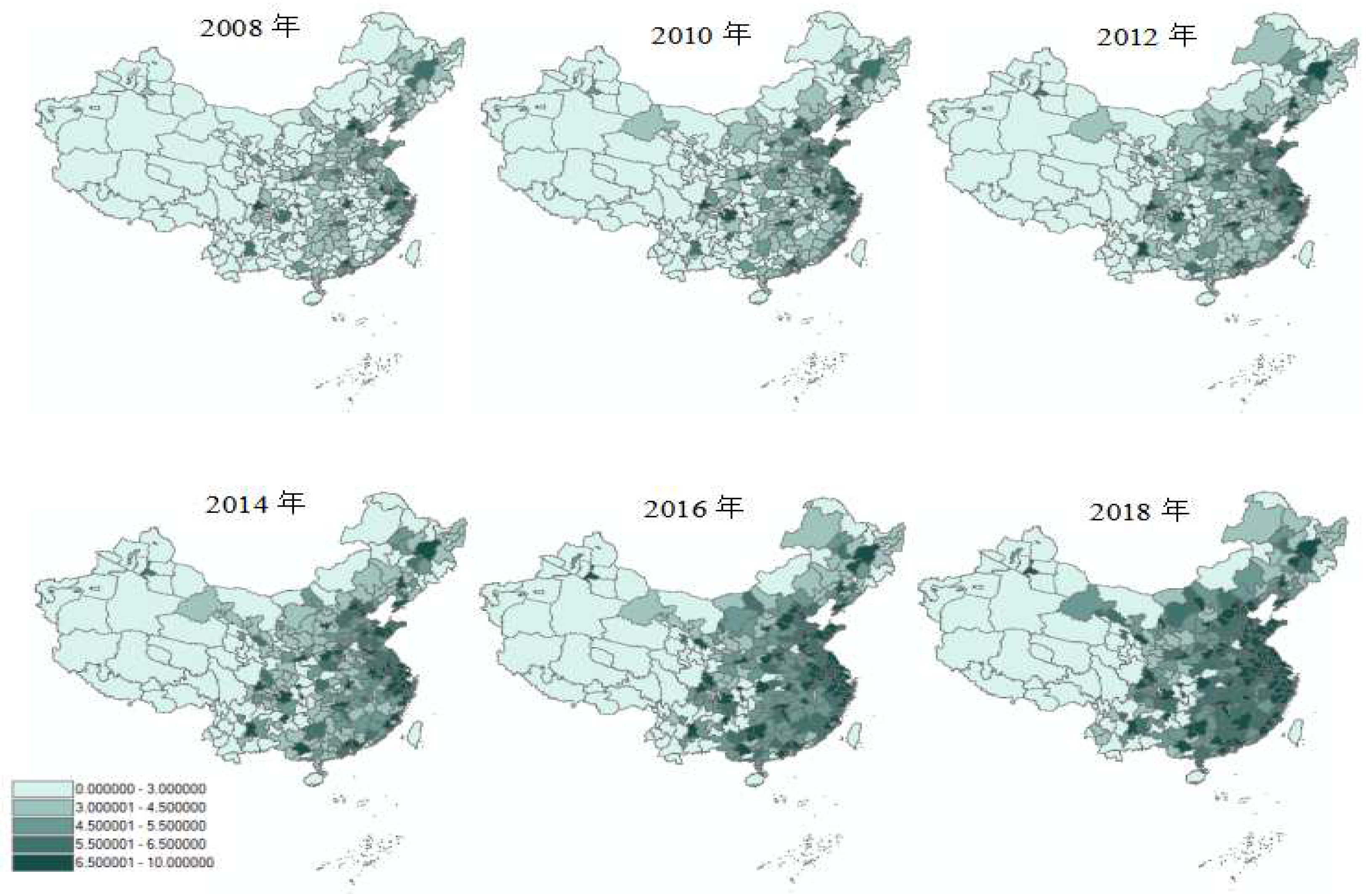
Figure 2.
Moran Scatter.
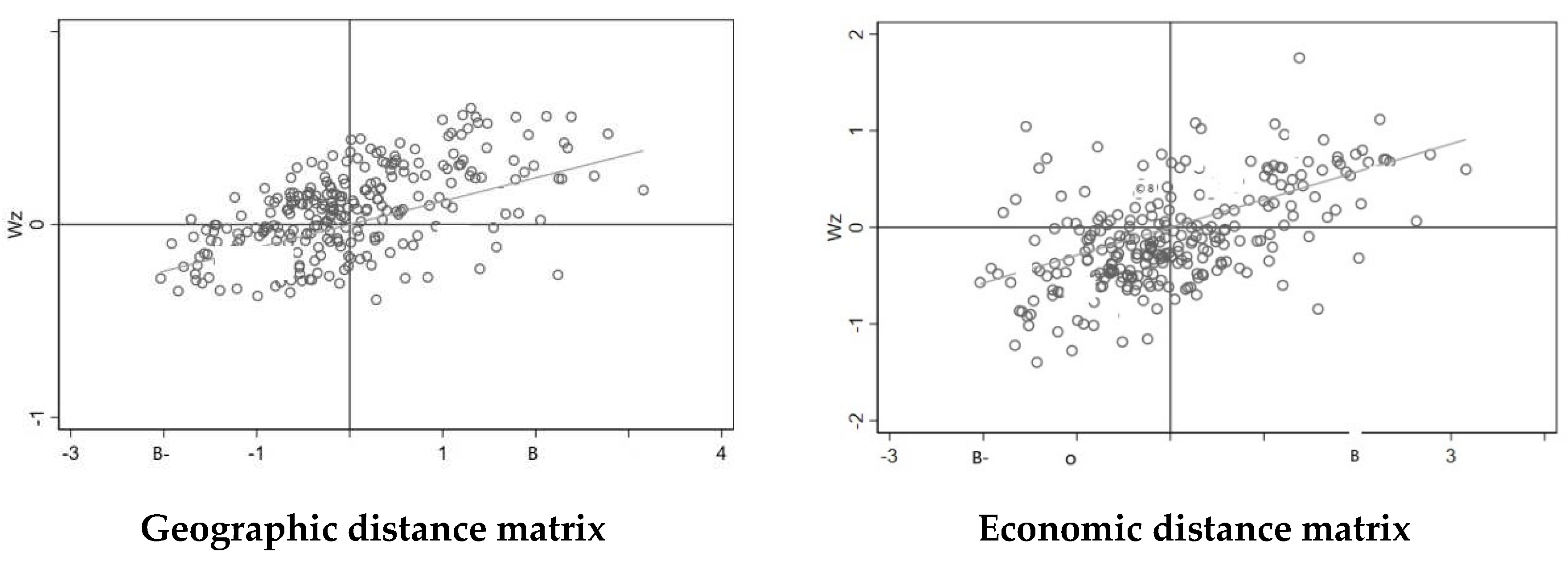

Table 1.
Descriptive statistics of main variables.
| Variable | Obs | Ave | Std | Min | Max |
|---|---|---|---|---|---|
| Green technology innovation(GTP) | 3396 | 0.09 | 0.04 | 0.02 | 0.20 |
| Market-motivated environmental regulation intensity(MER) | 3396 | 10.05 | 0.59 | 4.81 | 11.67 |
| Command-controlled environmental regulation intensity(CER) | 3396 | 0.62 | 0.44 | 0.00 | 1.83 |
| industrial structure(IS) | 3396 | 0.88 | 0.43 | 0.26 | 2.79 |
| Economic development level(ED) | 3396 | 4.27 | 2.99 | 0.69 | 15.55 |
| Openness(OP) | 3396 | 0.12 | 0.16 | 0.00 | 0.80 |
| Marketization degree(MD) | 3396 | 0.96 | 0.59 | 0.13 | 3.21 |
| infrastructure(INF) | 3396 | 1.12 | 1.20 | 0.03 | 6.14 |
| Greening rate of built-up area(GB) | 3396 | 2.35 | 3.20 | 0.00 | 15.52 |
| Investment in scientific research(RD) | 3396 | 0.00 | 0.00 | 0.00 | 0.01 |
| Financial development degree(FD) | 3396 | 0.86 | 0.49 | 0.27 | 2.90 |
Table 2.
Global Moran Index.
| Moran index | Geographic distance matrix | Economic distance matrix |
|---|---|---|
| 2007 | 0.103*** | 0.234*** |
| 2008 | 0.102*** | 0.25*** |
| 2009 | 0.121*** | 0.28*** |
| 2010 | 0.114*** | 0.27*** |
| 2011 | 0.12*** | 0.271*** |
| 2012 | 0.119*** | 0.265*** |
| 2013 | 0.106*** | 0.274*** |
| 2014 | 0.112*** | 0.27*** |
| 2015 | 0.12*** | 0.267*** |
| 2016 | 0.117*** | 0.288*** |
| 2017 | 0.124*** | 0.267*** |
| 2018 | 0.132*** | 0.263*** |
| 2019 | 0.109*** | 0.269*** |
Table 3.
Benchmark Regression Results.
| Variables | Weight matrix of geographical distance | Weight matrix of economic distance | |||
|---|---|---|---|---|---|
| (1) | (2) | (3) | (4) | ||
| ρ | 0.873*** (0.025) |
0.859*** (0.029) |
0.027 (0.043) |
0.031 (0.042) |
|
| MER t-1 | 0.003 (0.032) |
-0.018 (0.034) |
|||
| MER t-12 | -0.000 (0.003) |
0.002 (0.003) |
|||
| W × MER t-1 | -0.996*** (0.379) |
-0.210** (0.085) |
|||
| W × MER t-12 | 0.086** (0.036) |
0.020** (0.008) |
|||
| CER t-1 | 0.0384 (0.094) |
0.113 (0.098) |
|||
| CER t-12 | -0.020 (0.051) |
-0.068 (0.054) |
|||
| W × CER t-1 | 3.507*** (0.998) |
0.000 (0.299) |
|||
| W × CER t-12 | -2.411*** (0.583) |
-0.071 (0.156) |
|||
| ED | 0.005 (0.013) |
0.008 (0.013) |
0.011 (0.014) |
0.009 (0.014) |
|
| OP | 0.216 (0.318) |
0.143 (0.314) |
0.386 (0.328) |
0.355 (0.324) |
|
| MD | 0.040 (0.026) |
0.042 (0.026) |
0.038 (0.029) |
0.034 (0.028) |
|
| INF | -0.034* (0.018) |
-0.041** (0.018) |
-0.025 (0.017) |
-0.024 (0.017) |
|
| GB | 0.007* (0.004) |
0.008** (0.004) |
0.007* (0.004) |
0.008* (0.004) |
|
| RD | 90.100*** (13.570) |
93.770*** (13.800) |
103.300*** (13.850) |
102.600*** (13.950) |
|
| FD | -0.015 (0.051) |
-0.023 (0.049) |
-0.041 (0.055) |
-0.044 (0.054) |
|
| Yearand individual fixed effects | Yes | Yes | Yes | Yes | |
| R2 | 0.253 | 0.251 | 0.319 | 0.314 | |
| Obs | 3113 | 3113 | 3113 | 3113 | |
Note: *, * * and * * * represent 10%, 5% and 1% significance levels respectively, and Z value is in brackets. The following table is the same.
Table 4.
Spatial spillover effect of green technology innovation (MER).
| Variables | Direct effect | Indirect effect | Total effect |
|---|---|---|---|
| (1) | (2) | (3) | |
| MER t-1 | -0.026 (0.035) |
-8.082** (3.549) |
-8.108** (3.562) |
| MER t-12 | 0.002 (0.003) |
0.707** (0.330) |
0.709** (0.332) |
| ρ | 0.873*** (0.025) |
0.873*** (0.025) |
0.873*** (0.025) |
| Control | Yes | Yes | Yes |
| Yearand individual fixed effects | Yes | Yes | Yes |
| R2 | 0.374 | 0.374 | 0.374 |
| Obs | 3113 | 3113 | 3113 |
Note: The control variables are the level of economic development, the degree of openness, the degree of marketization, infrastructure, the greening rate of built-up areas, the intensity of scientific research investment, and the degree of financial development. The same is true for the following table.
Table 5.
Spatial spillover effect of green technology innovation (CER).
| Variables | Direct effect | Indirect effect | Total effect |
|---|---|---|---|
| (1) | (2) | (3) | |
| CER t-1 | 0.144 (0.100) |
27.080** (10.990) |
27.230** (11.020) |
| CER t-12 | -0.092* (0.055) |
-18.640*** (7.152) |
-18.730*** (7.171) |
| ρ | 0.859*** (0.029) |
0.859*** (0.029) |
0.859*** (0.029) |
| Control | Yes | Yes | Yes |
| Yearand individual fixed effects | Yes | Yes | Yes |
| R2 | 0.161 | 0.161 | 0.161 |
| Obs | 3113 | 3113 | 3113 |
Table 6.
Test of intermediary effect of industrial structure.
| Variables | GTP | IS | GTP | ||
|---|---|---|---|---|---|
| (1) | (2) | (3) | |||
| CER t-1 | 0.144 (0.0996) |
-0.0896** (0.0426) |
0.115 (0.103) |
||
| CER t-12 | -0.0924* (0.0552) |
0.0483** (0.0228) |
-0.0742 (0.0569) |
||
| Industrial structure t-1 | -0.229*** (0.0841) |
||||
| ρ | 0.832*** (0.0375) |
0.829*** (0.0358) |
0.852*** (0.0322) |
||
| Control | Yes | Yes | Yes | ||
| Yearand individual fixed effects | Yes | Yes | Yes | ||
| R2 | 0.161 | 0.452 | 0.160 | ||
| Obs | 3113 | 3113 | 3113 |
Table 7.
Robustness test (replacement weight matrix).
| Variables | adjacency matrix | Talent Matrix | |||
|---|---|---|---|---|---|
| (1) | (2) | (3) | (4) | ||
| ρ | 0.320*** (0.033) |
0.320*** (0.034) |
-0.039 (0.052) |
-0.037 (0.053) |
|
| Control | Yes | Yes | Yes | Yes | |
| Yearand individual fixed effects | Yes | Yes | Yes | Yes | |
| R2 | 0.262 | 0.242 | 0.345 | 0.337 | |
| Obs | 3113 | 3113 | 3113 | 3113 | |
Table 8.
Robustness test (add time lag item).
| Variables | (1) | (2) |
|---|---|---|
| W × MER t-1 | 1.572*** (0.332) |
|
| W × MER t-12 | -0.159*** (0.032) |
|
| W × CER t-1 | -9.051*** (0.826) |
|
| W × CER t-12 | 8.123*** (0.501) |
|
| ρ | 1.875*** (0.088) |
15.490*** (0.088) |
| GTPt-1 | 0.116*** (0.041) |
-0.028 (0.041) |
| Control | Yes | Yes |
| Yearand individual fixed effects | Yes | Yes |
| R2 | 0.172 | 0.163 |
| Obs | 3113 | 3113 |
Disclaimer/Publisher’s Note: The statements, opinions and data contained in all publications are solely those of the individual author(s) and contributor(s) and not of MDPI and/or the editor(s). MDPI and/or the editor(s) disclaim responsibility for any injury to people or property resulting from any ideas, methods, instructions or products referred to in the content. |
© 2023 by the authors. Licensee MDPI, Basel, Switzerland. This article is an open access article distributed under the terms and conditions of the Creative Commons Attribution (CC BY) license (http://creativecommons.org/licenses/by/4.0/).
Copyright: This open access article is published under a Creative Commons CC BY 4.0 license, which permit the free download, distribution, and reuse, provided that the author and preprint are cited in any reuse.


