

Submitted:
20 November 2025
Posted:
21 November 2025
You are already at the latest version
Abstract
Today’s understanding of the information relates information to elementary particles. Recent research suggested that there is around 6 × 1080 bits of information stored in all the particles of the observable universe. The open question is how information is related to time. We do not have any experimental evidence that this universe and elementary particles exist in some physical time that is the 4th dimension of space. Several eminent physicists' research denies the existence of physical time. Non-physicality of time opens a new perspective where time is only information that exists in Einstein’s Now.
Keywords:
information
; time
; psychological time
; space
; universe
1. Introduction
Since the famous quote of St. Augustine “What, then, is time? If no one asks me, I know what it is. If I wish to explain what it is to him who asks me, I do not know”, the concept of time has received the attention philosophers and scientists. If all history of physics can be seen as an evolution of the models regarding the background of processes, today the debate about the role of time is far from being concluded. The most important problem probably regards whether or not time is a fundamental quantity of nature (namely a primary physical dimension which flows on its own in the universe, i.e., an external parameter with respect to which the dynamics of events takes place). This issue acquires a relevant significance when one attempts to provide a treatment of the quantum gravity regime, since general relativity does not seem to possess a natural time variable, in the sense that implies that the material change is described in terms of a relation among equal footing variables associated to specific physical clocks, while quantum theory relies quite heavily on a preferred time, an absolute idealized time as a medium where events take place.
In order to throw new light about the time conundrum, we start by the consideration that, in Special Theory of Relativity, developed by Einstein in 1905, time was introduced as a 4th dimension of space, according to the following equation
where is time as a 4th dimension of space, the so-called coordinate time, is an imaginary number, , is velocity of light, and is time as duration of light motion on distance . In the original version of Special Relativity, is an imaginary coordinate. This peculiar feature of time in Einstein’s theory implicitly encodes the understanding that past and future do not exist as physical realities but are only man-made inventions in order to organize events. Einstein was aware that there is no physical past and no physical future; a photon moves only in space. Therefore, he developed a model where the 4th coordinate of space-time is imaginary. In his book The Special and General Relativity, he wrote: “If we replace x, y, z, ct by x1, x2, x3 ,x4, we also obtain the result that is independent of the choice of the body of reference. We call the magnitude the “distance” apart of two events or four-dimensional points. Thus, if we choose as time variable the imaginary variable ct instead of the real quantity t, we can regard the continuum space-time, in accordance with the special theory of relativity, as an “Euclidean” four-dimensional continuum” [1]. In the original version of Special Relativity, the space-time continuum is imaginary, a model only, which means it does not have a physical existence.
Einstein’s introduction of coordinate time in physics led to the view that time is the fourth dimension of space, which is an oversimplification. In Special Relativity, we have to distinguish between coordinate time and proper time , which is the duration of photon motion in space. After Einstein published special relativity, the view prevailed that time is the 4th dimension of space, although nobody has observed time as a dimension of space. In Newton’s physics, time was an abstract physical quantity that runs in the universe, that plays the role of the independent variable of physical evolution; with Einstein, time became a part of space, a medium in which material change runs. This misunderstanding regarding the interpretation of time happened because, in the 20th century, physicists missed the fact that coordinate time is Einstein’s theoretical invention, and proper time is the duration of material change that runs in space, and we measure them by clocks. Now, in the 21st century, several eminent physicists are denying the existence of time as a 4th dimension of space, namely that time is the medium in which material changes run, by suggesting that, at a fundamental level, the background of events is timeless and time exists as an emergent quantity. In this article, we explore the 21st-century view that coordinate time and proper time both have no physical existence; they exist only as information. This view supports Einstein’s original vision of time. He denied the existence of the past and the future. That is why he introduced a model of space-time continuum, which was misunderstood by most of the physicists of the 20th century.
Since the pioneering study of Szilard in 1929 suggesting that information fixes the modalities of evolution of a system, the issue of information content of physical processes has attracted several scientists [2]. In particular, in 1961 Rolf Landauer stated that information is physical, i.e., can be considered as a physical aspect of the world, in that the physical state of a system incorporates the “information” which has the potential to be processed and transferred thus creating time intended as information flow through evolving systems [3]. Later, J.A. Wheeler considered that each entity of the universe acquires its features from information, i.e., that space, time and matter as vehicled expressions of an informational matrix “at the bottom of the world” and therefore, that information is the primary constituent of the world, by suggesting the view of “it from bit” [4]. The idea of a physical information has then led to several puzzling developments such as the black hole information paradox and the holographic principle [5].
However, if time emerges from the information flow through evolving systems, how is this information flow processed and transferred? What is the intermediary of this information and what are the real fundamental features of this information flow?
Today’s physics view is that information is stored in elementary particles. By utilizing Shannon’s information theory, recent research has computed that each particle in the observable universe contains 1.509 bits of information and that all the baryonic matter in the observable universe stores around bits of information [6]. This result raises a question about how many bits of information are in the entire universe, which also includes the unobservable part of the universe. In this regard, NASA measured that the universe has an Euclidean shape [7], and so the number of bits of information in the infinite universe should be infinite. The important question of our research lies in providing a new understanding of the features of information, i.e., in asking ourselves whether information exists also in time or only in space.
Special relativity teaches us that the photon can be seen as a classical carrier of information. In a similar way, quantum physics implies that elementary particles are carriers of information whose bits (represented by their specific properties, such as spin, charge, etc.) interact each other according to quantum laws and this information about particles and their interactions is transmitted by fields permeating the universe. The transfer of information generated by photons or massive elementary particles occurs in space and time is only a mathematical measure of this transfer which enters existence when it is measured by the observer.
Let us consider, for example, a photon coming from the Sun. As well known, this photon takes 8 minutes and 27 seconds to reach from the Sun to the Earth. The fact is that we do not have any perception and any experimental confirmation that this photon moves in time. Time is a duration of photon motion in space when measured by the observer [8]. This simple experimental fact confirms that a photon carries information only in space, and the duration of photon motion is information that describes motion.
In [9] Liu and Zhu developed a unifying treatment of the information in cognition and Shannon information, by suggesting a General Information Theory where information can be seen as probability and time is interpreted as a special measure of space probability and therefore as a measure of information. Liu’s and Zhu’s General Information Theory seems to contradict the fact that information exists only in space and time is information that describes the motion of the system into consideration. In fact, it proposes that information exists in time and that the entropy of information increases in time. The weak point of this model is that there is no experimental evidence to support the existence of information in time and the increase in information entropy in time. In general, we do not have experimental data in physics proving that time is a medium in which the entropy of a given system increases. We observe an increase in the entropy of a given system only in space. According to the authors of the present paper, the idea that time is just information is plausible and needs in-depth research. This paper aims to introduce some considerations about this topic that have the potential to further fuel the debate regarding the nature of time.
The structure of the paper is the following. In chapter 2 we analyse the concepts of time and information in a time-invariant space. In chapter 3 we make some considerations as regards the parallelisms of our view of time with other famous views of time that are present in the literature. Finally, in chapter 4 we summarize the main results of the paper.
2. Psychological Time and Time as Information
Recent research confirms, clocks and time are human inventions to measure the velocity of motion of different physical objects in space. Universe exists in time-invariant space that we humans experience as Now. From an ontological point of view, matter has a higher ontological status than time. The increase of entropy of a given system occurs only in space, and we measure the increase of entropy with clocks that are invented by humans. In physics, we do not have any evidence about the existence of physical time. The linear time past-present-future exists only as a psychological frame in which we experience the increase of entropy of a given physical system that exists in time-invariant space [8], see Figure 1:
The entire universe is entangled via time-invariant space [10]. Seeing entanglement occurring in some physical time generates unsolvable problems, and seeing information occurring in time also leads to misunderstandings. Today’s understanding of information is bound to elementary particles [6], and these particles exist only in time-invariant space. With the understanding that elementary particles and information are immanent elements of the universe, and psychological time exists only in the human brain [8], we have a new perspective on the information that allows us a better understanding of the universe.
Fundamental unit of information 1 bit is time-invariant; it exists only in time-invariant space that humans experience as Now [11]. Information, elementary particles and entire universe exist in time-invariant space [8].
Imagine we have a source of information and the receiver of information (see Figure 2). On the way from the source to the receiver, a part of the information is lost due to the technical properties of the information line. In this case, the entropy of information increases, but not in time; it increases only in time-invariant space.
Our research suggests, time has the equal ontological status as information, that time is information.
Vlatko Vedral published an article where he explored what came first, physics or information: “In this paper, I discuss the question: what comes first, physics or information?” [12]. This question is of great importance because it shows the main misunderstanding of today’s physics, namely, that things happen before and after in time. His question shows that he sees physics development in some physical time in which things appear. We have another view where physics and information exist in the time-invariant space, which we experience as Now. All things happen in Now, yes, some happen before, others later, but only in the sense of the numerical order. The fundamental unit of numerical order of events that run in time-invariant space is Planck time [13]. In this perspective, time is the information about the numerical order of events that run in time-invariant space. There is no physical time; time is a man-made information that serves as an indispensable tool of physics to describe the flow of events that occur in time-invariant space, which we experience as Now.
We can therefore write the following fundamental equation:
Equation (2) is valid from the microscale of elementary particles to the macroscale of supermassive black holes. There is no proper time, there is no coordinate time, there is no arrow of time, there is no cosmological time, and there is no thermodynamical time [9]. The only time that exists in physical reality is the numerical order of events that run in time-invariant space.
In [14,15,16] Elze proposed that time can be considered as an emergent discrete quantity related to the increasing number of incidents, i.e., observable unit changes, corresponding to the coincidences of points of the trajectory of the system with appropriate detectors. In Elze’s model, only the observable unit changes which correspond to the results provided by opportune detectors have physical reality and the duration associated with these changes is only a man-made construct that enters existence when it is measured by an observer: time measured by clocks provide only the information regarding the numerical order of these observable unit changes that run in a time-invariant space that we experience of Now.
In a similar way, in [17] Caticha suggested that time emerges as a device to keep track of the accumulation of small changes and it is only the correlations among the particles of interest and the clock that are observable and not their “absolute” order. The treatment of Caticha seems to anticipate the view of time as information about the numerical order of events in a time-invariant space: time is a mechanism that aims to keep track of the accumulation of small changes in the sense that is a mathematical quantity which measures the information which can be obtained from the small elementary changes of the evolving system into consideration.
Finally, in [18] Prati showed that, by considering in a timeless Hamiltonian framework a complex physical system S that can be separated in a subsystem S2 whose dynamics is described, and another cyclic subsystem S1 which behaves as a clock, by changing the separation inside S we obtain different measuring systems of the dynamics taking place in S. The fact that the ticking of each subsystem which acts as a clock provides a different reference system in order to describe the dynamics means that time does not exist as a physical reality but provides only a mathematical measure of the information associated with the dynamics of the evolving system, which is entangled with the system acting as a clock.
The relation between time and information was examined in detail by Scott M. Hitchcock in [19] where he suggested that time can be seen as the result of conversion of the flow of energy between evolving systems into information. According to Hitchcock’s model, time is a label or number associated with processed signal information which is stored in a detector or a memory. Hitchcock concluded his analysis affirming that “this flow of information can be computed inside a ‘time independent’ quantum computer in which fundamental irreversible quantum processes coupled to reversible information flow in the classical environment can be used to build complex hierarchical systems through the phenomena of collective excitations” [19]. The view of time as information about the numerical order of events that run in a time-invariant space, introduced in this paper, can go a step ahead with respect to Hitchcock’s model. It explains that the flow of information associated with time can be computed in the picture of a time-independent computer because this information – which implies an elementary coupling between fundamental irreversible quantum processes and reversible classical processes, thus giving rise to complex hierarchical systems – runs in a time-invariant space where time does not exist as a primary physical reality. Our model explains in a clear way in what sense time emerges from conversion of energy into information. This occurs because time is not a physical reality but exists only as a sequential numerical order that allows us to keep track of the accumulation of small change in a time-invariant space, that we experience as Now.
In the view explored in this paper, the numerical order of events that take place in a time-invariant space can be defined as the fundamental time, whose most elementary unit is Planck time. Time, as the duration of events, is an emergent time that enters existence in the process of measurement. Emergent time can be therefore seen as the amount of information regarding the dynamics of the evolving system into consideration, which is given by a sum of elementary Planck times on the basis of the following equation [13]:
In this picture, Planck time is the one bit of information. Planck time is a discrete unit of numerical order of change. Every elapsed time is the sum of Planck times. Similarly, light is composed of discrete quanta of energy called photons.
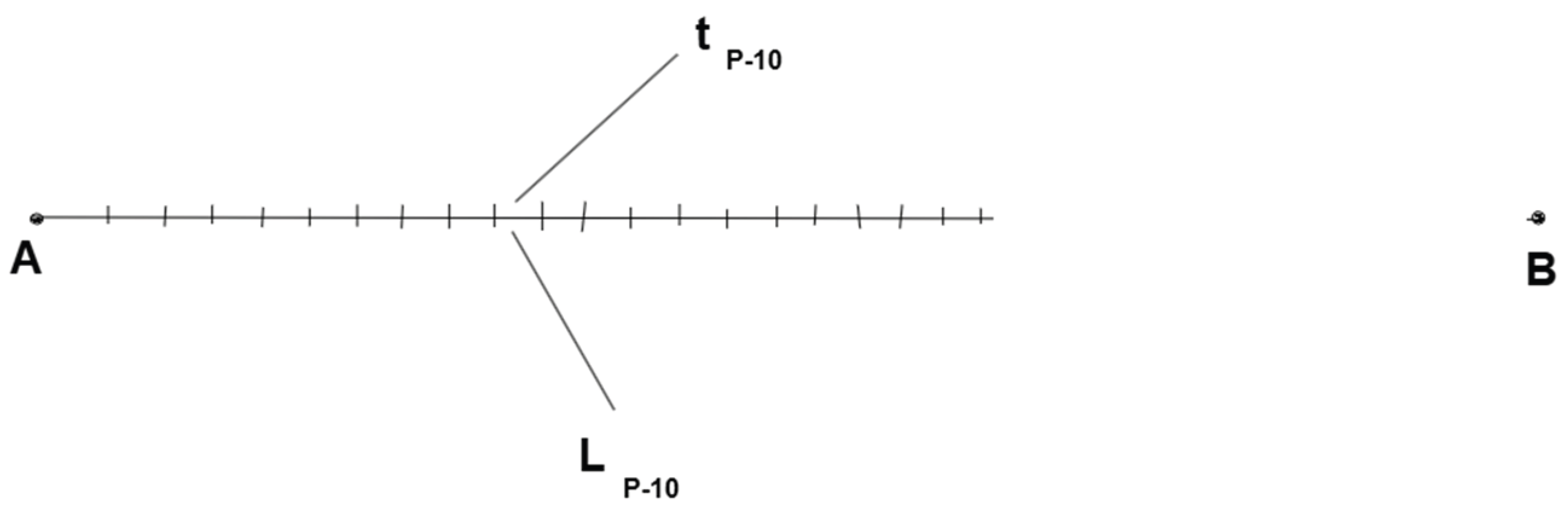
Imagine you are the observer who moves in space from point A to point B. The distance between A and B is composed of n Planck lengths. Each Planck length corresponds to one Planck time. You move from one Planck length to another Planck length. In the time-invariant space you experience as Now, you can only be on the one Planck length(see Figure 3). When you are on the Planck length n, you cannot be on n-1 or n+1. No matter which Planck length you are in, you are in the Now. Each Planck length corresponds exactly to one Planck time. Duration of your motion from A to B is the sum of Planck times according to Equation (3).
Every motion and every material change in the universe has the fundamental unit of change, which is Planck time. The paradigm shift is the insight that change and motion run in time-invariant space and that time is merely the numerical order of change, i.e., motion. Einstein’s famous quote has to be fully considered as a scientific fact: “The distinction between the past, present, and future is only a stubbornly persistent illusion”. Material changes in the universe run in time-invariant space that we experience as Now. There is no flow of some physical time in which changes run; the only flow in space is the flow of changes.
German philosopher Rudolf Carnap exchanged several letters with Einstein and he wrote in his biography that Einstein was worried about the Now: “Einstein said the problem of the Now worried him seriously. He explained that the experience of the Now means something special for man, something essentially different from the past and the future, but that this important difference does not and cannot occur within physics. That this experience cannot be grasped by science seemed to him a matter of painful but inevitable resignation. So he concluded ‘that there is something essential about the Now which is just outside the realm of science” [20]. With the model of time-invariant space where time is information, Einstein’s Now is integrated in physics.
3. Discussion
In a famous quote Hermann Bondi said: “Time must never be thought of as pre-existing in any sense; it is a manufactured quantity” [21]. The view of time as numerical order which evaluates the information regarding the dynamics of evolving systems can be considered a direct development of Hermann Bondi’s quote, in that it explicitly expresses the fact that what we call “time” is easily our way of organizing, of manufacturing events through information in a time-invariant space.
Lee Smolin, in his book Time Reborn, attempts to present time as something that has a real physical existence [22]. Change and motion have real physical existence, and time is their numerical order and exists only as a mathematical parameter quantifying the amount of information associated with the material changes of evolving systems. Numerical order is information, and in this respect, time is just information. The realization that time has no physicality is a leap in the paradigm of physics that we urgently need if we want to step out of the perspective of space-time, which is the paradigm of the 20th century. The paradigm of the 21st century is a time-sensitive space where time is just information about material changes that run in time-invariant space.
Physicists who denied the existence of physical time had the idea that the past and the future coexist in the present: “Hoyle: “All moments of time exist together.” “There is no such thing as ‘waiting’ for the future.” “It could be that when we make subjective judgments we’re using connections that are non-local … there is a division, the world divides into two, into two completely disparate stacks of pigeon holes.” Ballard: “Think of the world as a simultaneous structure. Everything that’s ever happened, all the events that will ever happen, are taking place together.” “It’s possible to imagine that everything is happening at once, all the events ‘past’ and ‘future’ which constitute the universe are taking place together. Perhaps our sense of time is a primitive mental structure that we inherited from our less intelligent forbears” [23]. The idea that the past and future coexist in the present affirms that authors believe that the past and future exist, which – according to the view presented in this paper – can be considered wrong. Events run in time-invariant space. When an event X is in existence, the event X-1 is not in existence anymore, and the event X+1 is not in existence yet. When an event X+1 enters existence, the event X is not in existence anymore, and the event X+2 is not in existence yet. Past and future do not exist because they are non-existent. The flow of change runs in a time-invariant space and is irreversible.
Carlo Rovelli denies the existence of physical time [24], but he provides no clear explanation of what we measure with clocks. We can deny the existence of physical time, but we cannot deny that the existence of time in physics is the result of the measurement outcome. Carlo Rovelli has no clear interpretation of time as duration, which, in physics, is indispensable. In a similar way, Barbour published an article about the nonexistence of physical time in 2009 [25], and he also did not give a clear interpretation of the duration that we obtain by clocks.
Our model presents time as information that has only a mathematical character, because duration has the attribute of energy as elementary particles do. Time as duration is an emergent physical quantity that enters existence in the process of measurement. No measurement means no time. The idea that with clocks we measure a time that runs in the universe on its own belongs to the history of physics. Information can be carried by elementary particles [6] or it can have exclusively a mathematical character, as is the case with time as the numerical order of events that run in space; time as information exists only on the mathematical level of the universe:
- -
- Information based on energy substratum stored in elementary particles [6]
- -
- Nonmaterial information that exists only in mathematical universe (Planck time as fundamental unit of numerical order of events, number , fine structure constant , and entire mathematics is a kind of information that has no energy substratum).
The model of the mathematical universe was developed by Max Tegmark. In his model, we have several layers of the universe: matter, energy, and a mathematical layer that exists without the energy substratum; it is similar to the Platon’s Theory of Forms [26].
Time is information of a mathematical character, because time has no attribute of energy as elementary particles do. It is not time that is relative, but the velocity of material changes. Twin on the Moon ages faster than his brother on Earth because gravity on the Moon is weaker. Both twins age in the time-invariant space we experience as Now [27]. There is no physical past and there is no physical future. The only universe that exists is the one we experience in Now. Ervin Schrödinger’s famous quote shows he deeply understood the nature of time: “For eternity and always there is only now, one and the same now; the present is the only thing that has no end” [28].
In 2003, Penrose and Hameroff used a space-time model for the description of consciousness: “The quantum gravity threshold for self-collapse is relevant to consciousness, according to our arguments, because macroscopic superposed quantum states each have their own space-time geometries. These geometries are also superposed, and in some way “separated”, but when sufficiently separated, the superposition of space-time geometries becomes significantly unstable, and reduce to a single universe state. Quantum gravity determines the limits of the instability; we contend that the actual choice of state made by Nature is non-computable. Thus each Orch OR event is a self-selection of space-time geometry, coupled to the brain through microtubules and other biomolecules” [29]. Their model of consciousness confirms that the space-time model is a suborn and persistent scientific illusion. Nothing exists in space-time because time has no physical existence and cannot be 4th dimension of space. The space-time model where time is supposed to exist as the 4th dimension of space belongs to the history of physics. The space-time model is replaced by the time-invariant space, where time enters existence when measured by clocks [8].
The idea that time flows and has a direction is still alive in today’s physics. An article was published discussing that, at the quantum level, time can have two arrows, one pointing from past to future, and the other pointing from future to past [30]. Elementary perception confirms that quanta and supermassive black holes move only in space and that time is the duration of their motion. Time-symmetry model [31] is a scientific misunderstanding that is the result of the false idea that motion occurs in some physical time. Motion occurs in time-invariant space only and time travel on micro and macro level are categorically excluded [32]. Closed time-like curves of Kurt Gödel are a theoretical model that is non-existent in physical reality [33]. The idea that someone could move in past and kill his father is out of question. Hawking’s chronology protection conjecture [34] is a theoretical model that attempts to prevent something (time travel) that is impossible on the micro and macro level.
The idea that the space-time model described some existent physical reality was rooted so deeply in the minds of the physicists that even Feynman believed that space-time exists. He describes a positron as an electron that moves backwards in time [35]. Feynman was one of the brightest minds of 20th-century physics, and he fell into the mental trap of space-time, which is a stubborn scientific illusion that needs to be overcome to progress physics. Positron was discovered by Anderson in 1932 in a magnet cloud chamber [36] in which there is no evidence of some space-time where time would run in the direction from the future to the past. Electrons and positrons both exist in the time-invariant space.
Albert Einstein’s, Ervin Schrödinger’s, Rovelli’s and Barbour’s insight about the nonexistence of physical time is fully integrated in the model of the time-invariant space, which we experience as Now. The energy substratum of time-invariant space is a fundamental quantum vacuum that is an immediate medium of quantum entanglement. Quantum entanglement cannot be fully understood in the model of space-time, where time is a 4th dimension of space. Quantum entanglement occurs in time-invariant space, not in time. The energy substratum of time-invariant space is a fundamental quantum vacuum that is an immediate medium of quantum entanglement [10]. Through the time-invariant space, all elements of entire universe are entangled. The only existing universe exists in time-invariant space where irreversible universal changes run. The only universe that exists is the one we can perceive [8].
What has happened in some remote physical past that is non-existent is only a scientific illusion because the universe has no physical past. The past is merely a human memory of events that occurred in the same time-invariant space in which we contemplate them. Everything has happened in the same time-invariant space in which everything will happen. With the model of time-invariant space as the fundamental arena of the universe, Einstein’s Now is fully integrated into physics. The introduction of Einstein’s Now into science coincides with the insight of each scientist that he experiences through the psychological time, and that material changes run in Now [37]. This is a great leap for each individual and a great leap for all of humanity.
In the space-time continuum of the Special Theory of Relativity, past, present, and future are coexisting [38]. Space-time continuum is the theoretical basis for Block Universe, in which past, present, and future coexist. The common view in physics is that Einstein’s Relativity support eternalism [39]. Einstein’s view on Now, however, suggests that Einstein advocated an eternalist philosophical view, where only the present moment is real. A rigorous empirical approach proves that the flow of physical change in the universe is irreversible and flows in the present moment. The present moments do not follow each other. Material changes follow each other in the same present moment we experience as Now. This is what our everyday scientific experience is telling us.
Insisting on the idea that past material changes exist in some hidden past and that future material changes are hidden in some invisible future does not have scientific empiricism in it. Presentism is closer to today’s scientific thought than eternalism, because it is affirmed by empiricism.
4. Conclusions
The space-time model, where time is the 4th dimension of space, has never been experimentally proven. It was accepted in physics at the beginning of the 20th century as the best solution for the time conundrum. Time as a dimension of space belongs to the history of physics. The introduction of the time-invariant spatial model and time as information associated with the numerical order of events taking place in time-invariant space is a paradigm shift that will help science to step out of psychological time. Today’s science sees the universe, life, and society from the perspective of some linear time that runs only in people’s heads. Einstein and Schrödinger were right. The changes in this world runs in Now; all the rest is human memory and imagination. The history of the universe and human history occurred in the same time-invariant space we experience as Now.
References
- Einstein, A. (1920). Relativity: The Special and General Theory (Methuen & Co., London, 1920), Chap. XXII. 11The International System of Units (SI), edited by BN Taylor, NIST Special Publication(330), 5. https://web.pdx.edu/~pmoeck/lectures/einstein.pdf.
- Szilard, L. über die Entropieverminderung in einem thermodynamischen System bei Eingriffen intelligenter Wesen. Z. Physik 53, 840–856 (1929). [CrossRef]
- R. Landauer, “Irreversibility and heat generation in the computing process”, IBM Journal of Research and Development, 5 (3): 183–191, (1961). https://ieeexplore.ieee.org/document/5392446.
- J.A. Wheeler, “Information, physics, quantum: The search for links”. In: Complexity, Entropy, and the Physics of Information, W. Zurek ed., Addison-Wesley, Redwood City, California (1990). https://philarchive.org/rec/WHEIPQ.
- J.D. Bekenstein, “Black holes and information theory”, Contemporary Physics, 45:1, 31-43, (2004). [CrossRef]
- Melvin M. Vopson, Estimation of the information contained in the visible matter of the universe, AIP Advances, Volume 11, Issue 10 (2021). [CrossRef]
- NASA (2025) https://map.gsfc.nasa.gov/universe/uni_shape.html.
- Amrit Sorli, Implications of Time-Invariant Superfluid Quantum Space Model in Fundamental Physics and Cosmology, Applied physics research, Vol. 17, No. 1, 2025 10.5539/apr.v17n1p98.
- Yilun Liu, Lidong, General Information Theory: Time and Information Zhu (2019) https://arxiv.org/pdf/1908.00301v1.
- Fiscaletti, D., Sorli, A. Searching for an adequate relation between time and entanglement. Quantum Stud.: Math. Found. 4, 357–374 (2017). [CrossRef]
- Šorli, Amrit; Čelan, Štefan, Time, observer, and consciousness, Physics Essays, Volume 35, Number 2, June 2022, pp. 123-126(4) https://www.ingentaconnect.com/content/pe/pe/2022/00000035/00000002/art00004;jsessionid=2pnutn6h6ol0l.x-ic-live-02 Entire article is available here https://bijective-physics.org/pdf/2022-Time-observer-and-consciousness.pdf.
- Vedral, V. Information and Physics. Information 2012, 3, 219-223. [CrossRef]
- Fiscaletti, D., Sorli, A. Perspectives of the Numerical Order of Material Changes in Timeless Approaches in Physics. Found Phys 45, 105–133 (2015). [CrossRef]
- Elze, HT. Quantum Mechanics and Discrete Time from “Timeless” Classical Dynamics. In: Elze, HT. (eds) Decoherence and Entropy in Complex Systems. Lecture Notes in Physics, vol 633. Springer, Berlin, Heidelberg. (2004). [CrossRef]
- H.T. Elze, and O. Schipper, “Time without time: a stochastic clock model”, Physical Review D 66, 044020 (2002). [CrossRef]
- H.T. Elze, “Emergent discrete time and quantization: relativistic particle with extra dimensions”, Physics Letters A 310, 2-3, 110-118 (2003). [CrossRef]
- A. Caticha, “Entropic dynamics, time and quantum theory”, Journal of Physics A: Mathematical and Theoretical 44, 22, 225303 (2011). https://iopscience.iop.org/article/10.1088/1751-8113/44/22/225303.
- E. Prati, “The nature of time: from a timeless Hamiltonian framework to clock time of metrology”, [physics.class-ph] (2009). arxiv.org/abs/0907.1707v1.
- S.M. Hitchcock, “Time and information” (2001). https://arxiv.org/abs/quant-ph/0012017.
- Ferreira, P. Physics: Clockwork cosmos. Nature 496, 430–431 (2013). [CrossRef]
- P. Davies, “About time: Einstein’s unfinished revolution”, Simon and Schuster, New York (1995). https://www.raptisrarebooks.com/product/about-time-einsteins-unfinished-revolution-paul-davies-first-edition-signed/.
- Wesson, P.S. (2010). Time as an Illusion. In: Petkov, V. (eds) Minkowski Spacetime: A Hundred Years Later. Fundamental Theories of Physics, vol 165. Springer, Dordrecht. [CrossRef]
- Jaffe Andrew, The illusion of time, Nature, Volume 556, Issue 7701, p.304-305 (2018) 10.1038/d41586-018-04558-7.
- Julian Barbour, The Nature of Time (2009) https://arxiv.org/abs/0903.3489.
- Tegmark, M. The Mathematical Universe. Found Phys 38, 101–150 (2008). [CrossRef]
- Amrit S. Sorli, Einstein Legacy: Ether Relativity and Cosmology, International Journal of Quantum Foundations, Volume 11, Issue 4, pages 527-559 (2025) https://ijqf.org/archives/7583.
- Ervin Schrodinger quotes https://www.azquotes.com/quote/552624 (2025).
- Hameroff &Penrose, Conscious Events as Orchestrated Space-Time Selections, NeuroQuantology 1: 10-35 (2003) https://www.neuroteoretica.org/html_sezioni/pdf/Hameroff_ConsciousEvents.pdf.
- Guff, T., Shastry, C.U. & Rocco, A. Emergence of opposing arrows of time in open quantum systems. Sci Rep 15, 3658 (2025). [CrossRef]
- Amrit Šorli, Štefan Čelan, Inconsistency of time-symmetry model, Physics Essays, 34 (2021), no. 4. [CrossRef]
- Niko Gorjup, Rado Gorjup, Amrit Srecko Sorli, End of time travel, Advanced Studies in Theoretical Physics, Vol. 18, no. 3, 109-116 (2024) https://www.m-hikari.com/astp/astp2024/astp1-4-2024/92131.html.
- Kurt Gödel, “An Example of a New Type of Cosmological Solution of Einstein’s Field Equations of Gravitation”. Rev. Mod. Phys. 21 (3): 447–450.(1949). [CrossRef]
- Hawking, S. W. “Chronology protection conjecture”. Phys. Rev. D. 46 (2): 603–611(1992). PMID 10014972. [CrossRef]
- R.P. Feynman, The Theory of Positrons, Phys. Rev. 76, 749 – Published 15 September, (1949). [CrossRef]
- Anderson, C. D. “The Positive Electron”. Physical Review. 43 (6): 491–494. (1933). [CrossRef]
- Richard A. Muller, Now — And The Physics Of Time, Cosmos & Culture (2016) https://www.npr.org/sections/13.7/2016/09/27/495608371/now-and-the-physics-of-time.
- Davide Fiscaletti, Amrit Sorli, The Infinite History of NOW: A Timeless Background for Contemporary Physics, NOVA (2014) ISBN: 978-1-63117-283-0 https://novapublishers.com/shop/the-infinite-history-of-now-a-timeless-background-for-contemporary-physics/.
- Peterson, D., Silberstein, M. (2010). Relativity of Simultaneity and Eternalism: In Defense of the Block Universe. In: Petkov, V. (eds) Space, Time, and Spacetime. Fundamental Theories of Physics, vol 167. Springer, Berlin, Heidelberg. [CrossRef]
- Le Bihan, B. String theory, loop quantum gravity and eternalism. Euro Jnl Phil Sci 10, 17 (2020). [CrossRef]
Figure 1.
Elementary particles, information, and psychological time.
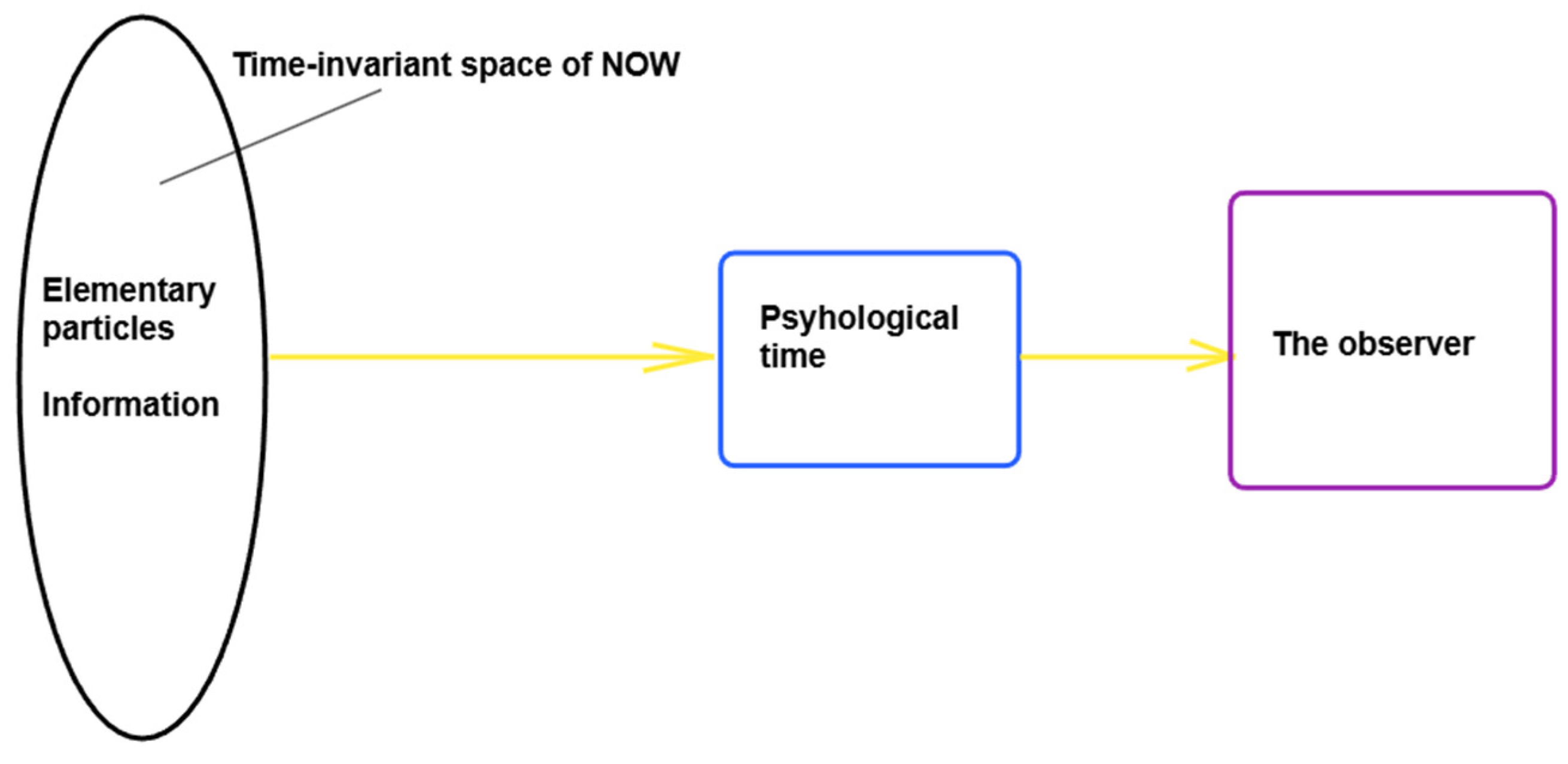
Figure 2.
Entropy of information occurs only in time-invariant space.
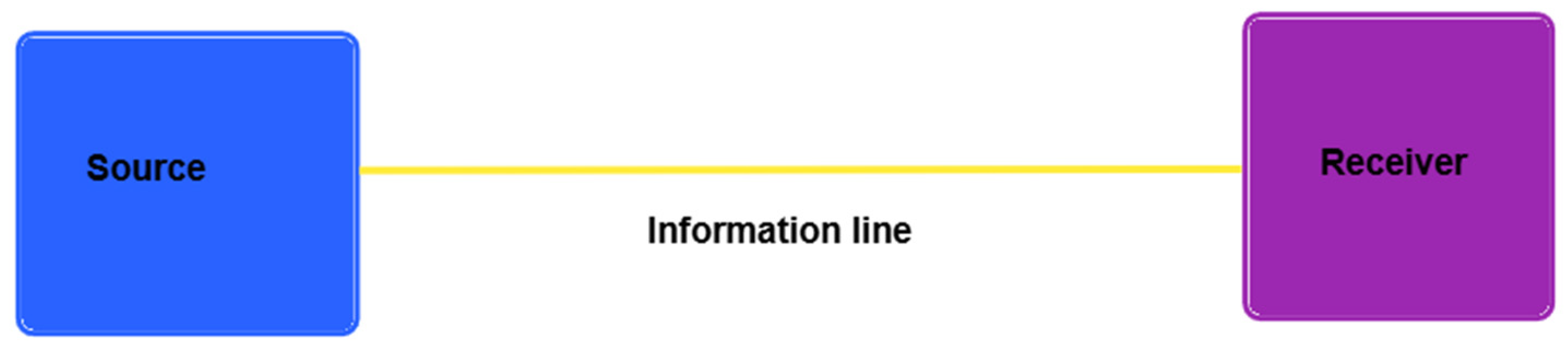
Figure 3.
Motion of the observer from one Planck length to another Planck length.
Disclaimer/Publisher’s Note: The statements, opinions and data contained in all publications are solely those of the individual author(s) and contributor(s) and not of MDPI and/or the editor(s). MDPI and/or the editor(s) disclaim responsibility for any injury to people or property resulting from any ideas, methods, instructions or products referred to in the content. |
© 2025 by the authors. Licensee MDPI, Basel, Switzerland. This article is an open access article distributed under the terms and conditions of the Creative Commons Attribution (CC BY) license (http://creativecommons.org/licenses/by/4.0/).
Copyright: This open access article is published under a Creative Commons CC BY 4.0 license, which permit the free download, distribution, and reuse, provided that the author and preprint are cited in any reuse.


