1. Introduction
Agriculture remains an important sector of the Bulgarian economy and rural landscape. Beyond its role in food production, it contributes to employment, regional cohesion, and the management of natural resources. In recent years, the sector has faced growing expectations to reconcile economic performance with environmental responsibility. Farmers are expected not only to maintain profitability under volatile markets and climate risks but also to adopt practices that protect soil, water, air, and biodiversity. The effort to balance these objectives is one of the key challenges of today and for the food system resilience. Structural constraints in Bulgaria further complicate this balance including ageing farm infrastructure and labour, fragmented land ownership, limited access to finance, high dependency on subsidies [
1,
2,
3]. For instance, sector-level analyses show that while Bulgarian agriculture attains a “good” sustainability score overall, economic effectiveness (in particular labour productivity, land productivity and profitability of capital) remains weak [
4,
5].
On the European level, the Common Agricultural Policy (CAP) and the European Green Deal have reshaped investment incentives toward sustainability [
6,
7,
8]. They encourage digitalisation, climate-smart technologies, and resource-efficient production. For Bulgarian farm enterprises, this shift generates both opportunities and risks: policy support exists, yet also require significant capital, managerial capacity and risk-taking by farmers [
9,
10]. Investment choices that were once driven mainly by yield or productivity now must integrate environmental outcomes and resilience to climate stress. International research confirms that structural factors, investment levels and farm management influence both economic performance and sustainability outcomes [
11,
12]. The sustainability-oriented investments (such as precision agriculture, renewable energy on-farm, enhanced nutrient management, agroecological practices) can increase long-term profitability, biodiversity and ecosystem services [
13].
Empirical evidence from macro-level studies in Bulgaria, as mentioned, shows an imbalance between the three sustainability dimensions: the economic sustainability scores higher, whereas social and ecological aspects lag behind [
14]. Micro-level research similarly reveals that many farms struggle to raise investment in modern technologies or sustainable practices [
15]. However, these empirical analyses linking sustainability-oriented investments, profitability and environmental performance at farm level in Bulgaria remain scarce.
This paper therefore analyses the relationship between sustainability-oriented investments and the economic and ecological performance of Bulgarian farms. The main question is whether holdings that prioritise green investments can maintain or improve profitability while achieving better environmental outcomes, or whether such investments lead to short-term trade-offs.
The study contributes in three ways.
First, it focuses on Bulgaria, where structural and financial conditions shape a distinct sustainability pathway and challenges.
Second, it integrates economic and environmental indicators into one analytical framework using investment data (at micro level) to both profitability and environmental performance.
Third, it proposes a methodological approach (farm-level data analysed through econometric/efficiency methods) to link investment intensity with profitability and ecological impact - an area under-explored in the Bulgarian studies.
Besides, the study is a subject of a main limitation of achieving a fully integrated assessment of sustainable agricultural investments due to the current lack of harmonised data combining economic and environmental indicators at the farm level. The available Farm Accountancy Data Network (FADN) provides comprehensive microeconomic information but does not yet include detailed environmental variables. Consequently, the analysis focuses on economic and structural aspects, recognising that the broader sustainability evaluation remains constrained. The ongoing transition toward the Farm Sustainability Data Network (FSDN), which incorporates soil, nutrient, and biodiversity indicators, is expected to facilitate more comprehensive analyses in future research linking profitability, efficiency, and ecological performance.
The paper is organized as follows.
Section 2 reviews relevant researches on sustainable agricultural investment and outlines the methodology and data used.
Section 3 presents the empirical results.
Section 4 discusses these findings in light of the proposed hypotheses and related literature.
Section 5 concludes with key insights, policy implications, and directions for future research.
2. Theoretical Background and Methodological Approach
2.1. Understanding Sustainable Agricultural Investments
Sustainable agricultural investments today become one of the key challenges for policy, research, and farm management. It reflects the attempt to balance three elements - economic profitability, environmental protection, and social responsibility. In practice, it means that capital is directed toward farming systems and technologies that can improve productivity and farmers’ income, but without exhausting the natural resources or increasing emissions [
16,
17]. This idea is not new, but in recent years, it becomes operational, because investors, policymakers, and farmers are under strong pressure to adapt to climate change and new EU environmental rules [
18].
There are several theoretical directions, which explain the meaning of sustainable agricultural investment [
19,
20,
21]. In this paper, we consider two of them to further develop the study and analyse the results. The first one is sustainable intensification - it is about increasing or keeping the same production from the existing resources, but in a way that reduces negative impacts. Pretty [
22,
23] defines it as production that maintains ecosystem functions and soil fertility while using inputs more efficiently. The second concept is climate-smart agriculture, introduced by FAO, which connects three main goals: productivity, adaptation, and mitigation [
24]. These frameworks are useful, because they translate the general term “sustainability” into measurable actions that can be evaluated. Under both approaches, the investment has a dual role – first, to ensure farm competitiveness and income, and second, to contribute to the broader public benefits, such as carbon sequestration, biodiversity, and rural vitality. In this sense, the sustainable agricultural investments are not only private, but also a collective process.
The list of investments considered sustainable is wide, but most literature groups them in a few clusters [
25,
26,
27] which we translate to the opportunities within the farms. First are the soil and water management practices. Second group are energy and emission reduction investments. The third group are nature-based and diversification measures. More recently, there is attention to carbon farming and result-based payments for environmental services, where the farm receives compensation for verified outcomes [
28,
29,
30], which is the fourth one we consider. Indeed, the reform of CAP 2023-2027 introduced relevant eco-schemes as mandatory for all Member States and this created a stable signal for investors and farmers. For Bulgaria, the investments relevant to the mentioned groups are clearly linked to these CAP measures [
31]. Although, several studies [
32,
33] underline that some national plans, like the Bulgarian one, give too general eligibility, which may reduce environmental effect. The main challenge is the design of the measures to ensure that public money really leads to additional sustainable change. In the same way, the evaluations [
34,
35] show uneven ambition and lack of clear link between spending and real environmental impact, as indicators are often output-based, not outcome-based. Result-based payments are innovative instruments where payment is linked to measurable results, but monitoring is complex and still evolving [
36].
In line with prior statement, are the findings that most sustainable investments are financed through public support - subsidies, grants, or tax reductions (Johnson). The reason is because the environmental benefits are public goods, and farmers cannot capture all the returns. However, this model cannot cover the scale of adaptation and transformation that is needed at this moment. Therefore, in the last decade additional instruments are developed, including blended finance, green bonds, and sustainability-linked loans [
37,
38]. Reports of the World Bank [
39] and European Bank for Reconstruction and Development (EBRD) [
40] confirm that guarantees are among the most efficient ways to mobilize private capital when collateral is weak. Next, the recent studies connects sustainability to the ESG (Environmental, Social and Governance) concept used by investors. Cristea et al. [
41] find positive correlation between higher ESG scores and financial performance of agricultural companies, but differences are large across subsectors. Crop producers benefit faster from resource efficiency and lower energy costs, while livestock sector faces higher transition costs. The overall environmental investments can be profitable, but the payback depends on policy stability, markets for green products, and firm management capacity [
41]. The literature identifies also several barriers to sustainable investments [
42,
43]: limited access to long-term credit and high collateral requirements; uncertain or delayed returns, especially for ecosystem benefits; weak advisory systems and technical knowledge among farmers; high transaction and monitoring costs for small farms; policy volatility and administrative burden.
Taking all these findings into account, we interpret the results within the Bulgarian context, recognising the specific structural, institutional, and policy conditions shaping the agricultural sector at national level. These insights also bring important policy implications, particularly reflected in the recommendations for a design that balance economic performance with environmental sustainability.
2.2. Methodological Approach
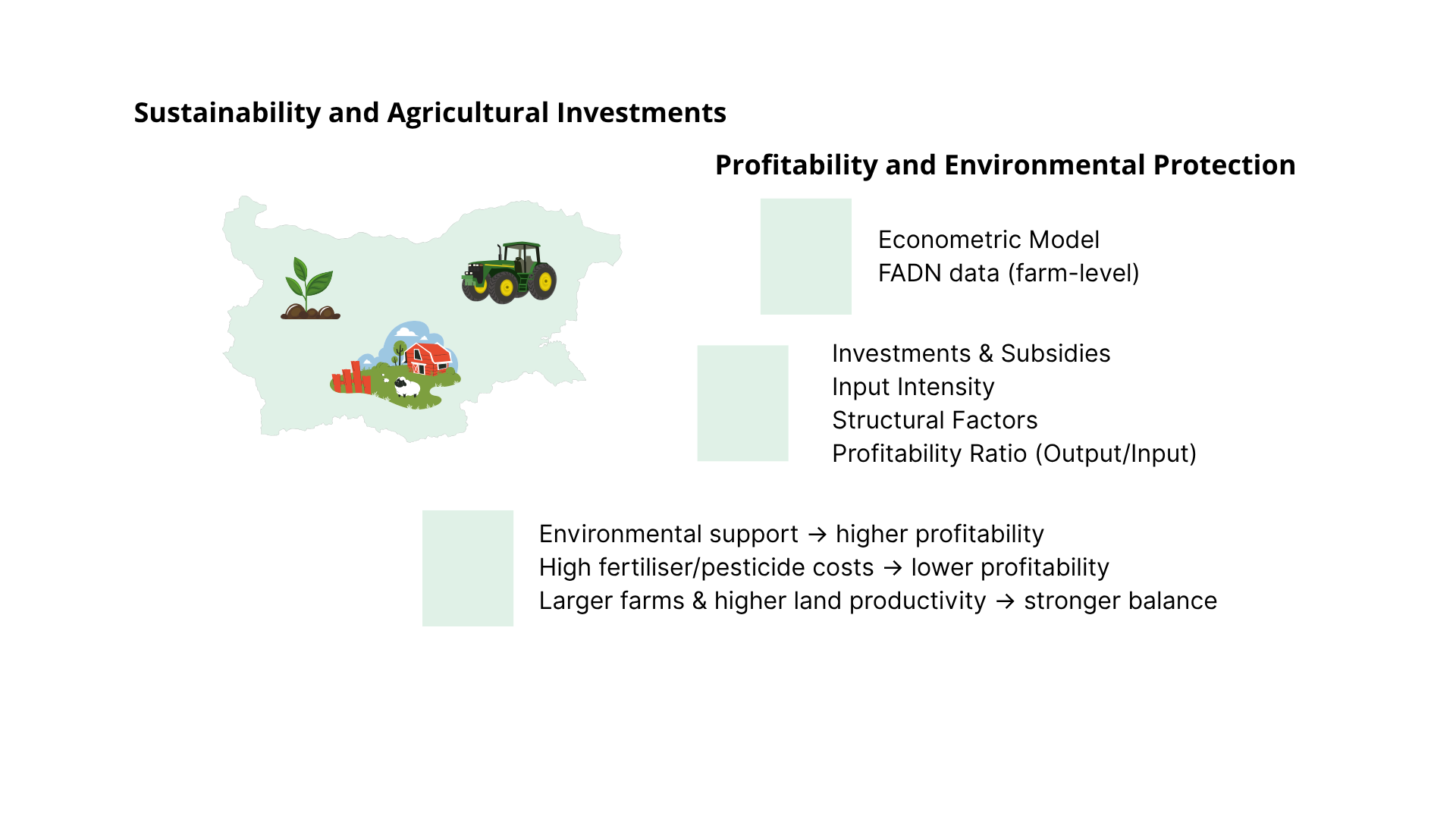
The study applies an econometric research design aimed at analysing the relationship between sustainability-oriented investments and the economic performance of agricultural holdings in Bulgaria. The analysis is conducted at the national level, using representative farm-level data from the FADN to identify whether environmentally oriented and investment-related subsidies, as well as the structure of production costs, contribute to farm profitability or generate short-term trade-offs between economic and ecological objectives. The research combines descriptive and inferential methods. The descriptive statistics are used to provide an overview of the main structural and economic characteristics of Bulgarian farms, including production scale, specialization, and expenditure composition. It establishes the context in which sustainability-related investments occur and highlights the heterogeneity among farms by size and type. The econometric modelling is applied to quantify the determinants of farm profitability and to evaluate the marginal effects of green investments and environmental subsidies after controlling for structural and cost-related variables.
The analysis relies on a single-country dataset, ensuring internal comparability and consistent definitions. The focus on national-level allows capturing the structural characteristics of the Bulgarian agricultural sector, including its high dependence on public support, fragmented land ownership, and relatively low capital intensity. The national-level estimation mitigates potential bias from cross-country heterogeneity, while the inclusion of farm size and specialization ensures that within-sector variation remains represented.
The methodological sequence follows four main steps.
First, descriptive analysis summarises the key indicators of economic and environmental relevance. Measures such as total output, total input, profitability ratio, and environmental expenditure share are presented by farm type and size class. The analysis also includes output per hectare and output per annual work unit (AWU) to capture land and labour productivity, as well as farm net income and net value added to cross-check profitability results and validate robustness. This provides an overview of the distribution of performance indicators and identifies potential outliers or data inconsistencies. Measures of central tendency (mean, median) and dispersion (standard deviation, minimum, maximum) are computed, along with the coefficient of variation to assess heterogeneity.
Second, correlation analysis explores pairwise relationships among the main variables, particularly between investment support, environmental subsidies, and profitability. This step assists in identifying potential collinearity issues before regression modelling.
Third, econometric models are estimated using Ordinary Least Squares (OLS) as the baseline approach. OLS allows straightforward interpretation of coefficients and facilitates testing regarding the significance and direction of sustainability-related factors. The baseline econometric specification models profitability as a function of investment and environmental factors, cost structure, productivity, and financial characteristics:
where:
Yi is the profitability ratio (Total Output/Total Input) for farm i;
INVi represents subsidies on investment;
ENV_SUBi denotes environmental subsidies;
RD_SUBi refers to total support for rural development;
FERT_COSTi, CROP_PROTi, and ENERGY_COSTi capture expenditures on environmentally sensitive inputs;
AREAi and LABOURi represent land and labour resources, respectively;
DEBTi denotes the liabilities ratio, measuring financial exposure;
PRODi represents productivity (output per ha, output per AWU);
ϵi is the error term.
All variables are measured in euros. Where appropriate, logarithmic transformations are applied to reduce skewness and improve model fit. The model examines whether higher levels of sustainability-oriented support are associated with improved profitability while controlling for productivity and financial structure. Expected coefficient signs follow standard theory: investment and environmental support (β1–β3) are expected to enhance profitability, while high fertiliser, pesticide, and energy costs (β4–β6) likely reduce it. A positive sign is expected for productivity and scale variables (β7–β10), though financial exposure may have a negative effect if debt exceeds investment capacity.
Fourth, diagnostic and robustness checks are applied to validate model assumptions. Tests for heteroscedasticity (Breusch–Pagan), multicollinearity (Variance Inflation Factor), and normality of residuals (Shapiro–Wilk) are conducted.
The regression analysis is conducted using robust estimation techniques to account for possible heterogeneity across farms. Since the dataset represents different farm types and sizes, heteroscedasticity is a plausible issue; thus, robust standard errors are employed throughout. In addition, model is estimated by farm specialization (crop, livestock, mixed) to assess whether investment-profitability relationships differ by production system. This comparative approach helps identify whether sustainability-oriented investments are more effective in certain subsectors.
The econometric approach provides a coherent framework linking investment behaviour, environmental incentives, and economic outcomes. It allows testing hypotheses: (i) farms that receive higher environmental and investment-related subsidies achieve better profitability; (ii) higher input intensity reduces profitability; and (iii) structural characteristics like size and land area significantly influence the ability to balance economic and environmental goals.
2.3. Data and Variables
The empirical analysis relies on microeconomic data extracted from the FADN for Bulgaria. For this study, data are analyzed at the national level, focusing on variables that capture production scale, input use, investment behaviour, and subsidy support. The most recent multi-year period (2019-2023) is used to ensure representativeness and to capture the evolution of farm investment patterns.
The dependent variable represents the economic performance of farms, namely Profitability ratio: Total Output/Total Input. This measure expresses how efficiently farms transform input costs into output value and serves as a proxy for economic sustainability. It reflects the joint influence of productivity, cost management, and market performance.
Independent variables are grouped into five analytical categories: (1) investment and sustainability-related factors, (2) cost and input structure, (3) production resources, (4) financial structure, and (5) productivity indicators.
The investment and sustainability-related factors include: Investment subsidies: financial support for fixed asset investment; expected to enhance profitability through technology adoption and modernisation. Environmental subsidies: payments targeting environmentally beneficial practices such as agri-environmental measures or organic production; expected to increase sustainability and potentially profitability. Rural development support: broader investments in rural infrastructure and diversification; expected positive impact through improved resource efficiency and income diversification. Total subsidies excluding investment: captures general dependence on public support; sign uncertain, as it may stabilise income but also reduce incentives for efficiency. Environmental share of total subsidies: measures how much of total support is explicitly green.
The cost and input structure is captured by: Total inputs: aggregate production expenditure, used both as a control and to derive cost ratios. Fertiliser expenditure: proxy for nutrient intensity and potential environmental pressure; expected negative association with profitability due to cost and externality implications. Crop protection expenditure: indicator of chemical input intensity; high values may reflect both vulnerability to pests and higher environmental costs. Energy expenditure: reflects mechanisation and input dependency; excessive values may reduce profitability. Intermediate consumption: additional proxy for overall input intensity and potential environmental pressure.
The production resources are included through: Total utilised agricultural area: reflects production scale and land resource availability; larger holdings often achieve economies of scale, suggesting a positive relationship with profitability. Total labour input: measures labour intensity; depending on technology and farm size, the relationship can be positive (reflecting active management) or negative (indicating labour inefficiency).
The financial structure controls through: Farm net income and Net value added: alternative profitability metrics used for validation and sensitivity analysis. Debt ratio: indicates financial exposure and leverage, allowing assessment of whether indebtedness constrains profitability or enables investment growth.
From the productivity indicators following are chosen: Output per AWU: measures labour productivity . Output per hectare: measures land productivity. These indicators are used both descriptively and as explanatory variables to control for underlying productivity effects on profitability.
To better interpret sustainability and investment behaviour, several derived ratios are constructed from FADN variables: Investment intensity (share of investment subsidies in total output), Environmental support ratio (share of environmental subsidies in output), Environmental cost ratio (proportion of environmentally sensitive costs), Subsidy dependence ratio (share of total subsidies in output) and Environmental share in total subsidies. These ratios provide a clearer picture of how sustainability efforts interact with financial outcomes and are used both in descriptive comparisons and as alternative model specifications for robustness.
Descriptive statistics summarise the structure and variability of all variables. Means, medians, and standard deviations are reported, complemented by minimum and maximum values. The descriptive results illustrate national patterns of profitability, input use, and subsidy dependence. Comparisons are made between crop, livestock, and mixed farms, and among small, medium, and large size classes. Time trends, highlight shifts in investment and subsidy composition under evolving CAP priorities. These preliminary insights guide the interpretation of econometric results and help verify data consistency.
Data limitations: While FADN offers rich financial data, it provides limited coverage of direct environmental indicators such as emissions, soil quality, or biodiversity. Therefore, environmental aspects are inferred from cost proxies and subsidy types rather than measured ecological outcomes. Moreover, some overlap exists between subsidy categories, and distinguishing purely investment-driven effects from general support requires careful interpretation. Nevertheless, the dataset remains the most comprehensive source for linking farm-level investment behaviour, cost structures, and profitability in Bulgarian agricultural production enterprises.
3. Results
3.1. Descriptive Analysis
Descriptive statistics, presented in
Table 1, summarises the economic, environmental, and financial characteristics of Bulgarian farms based on national-level FADN data for the period of 2019-2023. The statistics show a highly heterogeneous sector in which profitability, productivity, and sustainability indicators vary widely across holdings and specialisations.
Economic Performance. The profitability ratio averages slightly above one, indicating that most farms operate at modest profit levels but with considerable dispersion. A few highly efficient holdings push the upper tail, while a substantial number vary near the break-even point [
44]. Both net value added and farm net income show large standard deviations, confirming the coexistence of capital-intensive, high-income enterprises and smaller, semi-subsistence units. This variability highlights structural dualism as a defining feature of Bulgarian agriculture [
45].
Productivity. Productivity indicators reveal similar polarisation. The mean output per AWU suggests relatively low labour productivity compared with the EU average [
46,
47], but the range shows that mechanised crop farms achieve multiple times the output of labour-intensive holdings. The output per hectare remains moderate overall. Farms combining modern technology and irrigation show significantly higher land yields, suggesting that further capital improvements enhance productivity and resource use efficiency [
48].
Cost Structure and Environmental Intensity. The environmental cost ratio averages below one-fifth of total inputs, suggesting that fertilisers, crop protection, and energy still account for a substantial part of production expenses. The broad variation implies divergent input strategies: some farms operate under low-input or agroecological systems, while others depend heavily on conventional inputs. The intermediate consumption per hectare indicator confirms this heterogeneity, with high-input farms displaying several times higher intensity. These disparities translate directly into differences in environmental footprint and exposure to volatile input prices [
49].
Investment and Support Patterns. Public transfers continue to shape the financial landscape of Bulgarian farms [
10,
44]. The subsidy dependence ratio shows that subsidies constitute a significant share of farm output for most holdings. This dependence remains a central structural constraint: while it stabilises income, it may weaken incentives for productivity improvements [
50]. The investment intensity and environmental support ratio exhibit low mean values and high dispersion. Only a limited subset of farms invests systematically in capital upgrades or sustainability-oriented technologies. The environmental share of total subsidies is minimal, reflecting Bulgaria’s still-limited uptake of agri-environmental measures under the CAP’s rural-development pillar [
51]. These indicators suggest that while investment support exists, participation is concentrated among better-organised, larger farms with stronger managerial capacity [
52].
Financial Structure. The debt ratio remains moderate on average, revealing a conservative borrowing culture [
44]. Most holdings rely primarily on own funds and subsidy inflows rather than credit. However, the wide range in debt ratios indicates that a small group of professionalised farms increasingly use leverage to finance expansion and technology upgrades [
53]. This emerging segment may become the driving force behind structural transformation.
Scale and Resource Endowment. Average utilised agricultural area and labour input confirm the prevalence of small to medium-sized family farms alongside a minority of large corporate holdings [
44,
52]. The variation in land size and labour use mirrors the dual structure observed in profitability and productivity metrics: small farms dominate numerically but contribute relatively little to total output, while a few large units account for a disproportionate share of production and investment [
47].
The descriptive evidence portrays a sector in transition: profitability is positive but fragile, productivity remains uneven, and environmental investments are still limited. Input-intensive practices coexist with early examples of green modernisation. The data confirm that sustainability-oriented investment behaviour in Bulgaria is still emergent rather than mainstream. Financial conservatism restrain many farms from debt risks but constrains innovation. These trends justify the econometric analysis that follows, quantifying how the investment and support variables influence farm profitability and the balance between economic efficiency and environmental responsibility.
3.2. Correlation Analysis
The correlation matrix (
Table 2) summarises pairwise linear relationships among the principal economic, investment, and environmental indicators of Bulgarian farms calculated for the period 2019-2023. The coefficients provide an initial indication of how profitability and sustainability-related factors interact before moving to econometric testing.
A moderate positive correlation is observed between the profitability ratio and both productivity indicators, output per AWU and output per hectare, suggesting that farms with more efficient use of labour and land resources achieve higher returns. This confirms the importance of structural efficiency and scale in sustaining profitability [
45].
Profitability is also positively correlated with investment intensity, implying that holdings engaging in capital renewal and technology adoption tend to perform better economically. The relationship, though not strong, points to the reinforcing role of investment support in improving efficiency [
50]. By contrast, correlations between profitability and environmental support ratio or environmental share of total subsidies are weak and negative, indicating that farms receiving higher shares of environmental payments do not necessarily achieve immediate profitability gains. This outcome reflects the typical short-term trade-off between environmentally oriented practices and economic returns, especially where compliance costs or yield limitations accompany agri-environmental measures [
54,
55].
The subsidy dependence ratio exhibits a negative correlation with productivity indicators, revealing that farms most reliant on subsidies are not necessarily the most efficient producers. This pattern supports previous findings that heavy dependence on direct payments can stabilize income but may also weaken market-oriented incentives [
46,
56].
The environmental cost ratio, capturing fertiliser, pesticide, and energy expenditures, correlates positively with output measures but negatively with investment and environmental support ratios. Input-intensive farms are productive but not necessarily environmentally sustainable, reflecting Bulgaria’s uneven adoption of green technologies [
46,
57].
The debt ratio shows weak associations with other indicators, suggesting that leverage decisions are relatively independent of profitability or subsidy levels. This aligns with the conservative financial behaviour of most Bulgarian farms, where borrowing remains limited [
45].
Overall, the correlation results portray a sector in which economic performance is driven mainly by productivity and investment efficiency, while environmental indicators operate on a parallel, weakly connected trajectory. The relatively low correlations among sustainability variables imply that profitability, investment, and environmental outcomes are not yet strongly integrated in farm decision-making. These relationships justify the need for econometric modelling to test whether sustainability-oriented investments can simultaneously enhance profitability and environmental performance once structural and financial factors are controlled for.
3.2. Econometric Analysis
The baseline OLS model explains a meaningful share of variation in profitability with an adjusted R2 of 0.366 and a highly significant joint F-test (F = 12.08, p < 0.001). Results indicate that profitability is shaped by a combination of environmental incentives, cost structure, scale, and financial exposure.
Table 3.
Baseline OLS results for linear model used in the analysis (national level, 2019-2023).
Table 3.
Baseline OLS results for linear model used in the analysis (national level, 2019-2023).
| Variable |
Coefficient |
t |
p-value |
Sig. |
95% CI [low] |
95% CI [high] |
| Intercept |
1,384794 |
30,159 |
0 |
*** |
1,294798 |
1,474791 |
| INV |
-1E-06 |
-0,293 |
0,7698 |
|
-9E-06 |
0,000007 |
| ENV_SUB |
0,000019 |
2,19 |
0,0285 |
** |
0,000002 |
0,000037 |
| RD_SUB |
-2,1E-05 |
-2,196 |
0,0281 |
** |
-3,9E-05 |
-2E-06 |
| FERT_COST |
0,000002 |
1,002 |
0,3166 |
|
-2E-06 |
0,000005 |
| CROP_PROT |
-8E-06 |
-3,961 |
0,0001 |
*** |
-1,3E-05 |
-4E-06 |
| ENERGY_COST |
0,000002 |
0,921 |
0,3572 |
|
-2E-06 |
0,000006 |
| AREA |
0,000254 |
1,752 |
0,0797 |
* |
-0,00003 |
0,000539 |
| LABOUR |
-0,00165 |
-0,31 |
0,7564 |
|
-0,0121 |
0,008794 |
| DEBT |
-1,36677 |
-9,016 |
0 |
*** |
-1,66389 |
-1,06964 |
| PROD_AWU |
0 |
0,09 |
0,9283 |
|
-2E-06 |
0,000003 |
| PROD_HA |
0,000002 |
2,252 |
0,0244 |
** |
0 |
0,000005 |
On the policy side, environmental subsidies (ENV_SUB) are positively associated with profitability (p = 0.028), suggesting that sustainability-oriented support can enhance economic performance when integrated into farm operations. By contrast, rural development support (RD_SUB) shows a negative association (p = 0.028), likely reflecting either transitional compliance costs or a composition effect where projects target structurally weaker farms that do not immediately convert support into higher margins.
Regarding input structure, crop protection expenditure (CROP_PROT) is negatively related to profitability (p = 0.000), and fertiliser costs (FERT_COST) are positive but insignificant (p = 0.316). These results are consistent with input cost pressures dimish returns, especially for holdings reliant on conventional chemical strategies. Notably, energy costs (ENERGY_COST) are positively associated with profitability (p = 0.357), despite insignificant likely reflect a mechanisation/scale mechanism: farms investing in energy-intensive machinery and operations should achieve higher output and margins.
Structural controls confirm the importance of scale and land productivity. Area (AREA) enters positively and significantly (p = 0.079), indicating economies of scale. Labour (LABOUR) is not significant, suggesting that labour quantity alone does not raise profitability once productivity and scale are accounted for. Among productivity indicators, output per hectare (PROD_HA) is positive and significant (p = 0.024), while output per AWU (PROD_AWU) is not, implying that land efficiency is the primary effect linking production performance to profitability in this study.
The debt ratio (DEBT) shows a large, negative, and highly significant effect (p < 0.001), indicating that leverage is associated with lower profitability net of other controls. This aligns with the conservative financing profile observed in the descriptive analysis and suggests that, under current conditions, debt service burdens may outweigh the productivity gains from financed investments for many Bulgarian farms [
2,
45].
Taken together, the estimates support three insights for the case of Bulgarian agriculture. First, targeted environmental support can complement profitability, contradicting the bias that “green” measures always cut margins. Second, conventional input intensity tends to reduce profitability once costs are internalised, while scale and land productivity improve it. Third, higher leverage is unfavourable to short-term profitability in the national context, which helps explain cautious borrowing behaviour.
Diagnostic tests, presented in
Table 4 confirm that the baseline model satisfies core econometric assumptions with some expected considerations typical for farm-level cross-sectional data.
Table 4.
Diagnostic and Robustness Checks for linear model used in the analysis (national level, 2019-2023).
Table 4.
Diagnostic and Robustness Checks for linear model used in the analysis (national level, 2019-2023).
| Test |
Statistic |
p-value |
Interpretation |
| Breusch-Pagan |
10,47624 |
0,488124 |
Fail to reject H0 (homoscedastic) |
| Shapiro-Wilk |
0,910299 |
8,63E-08 |
Reject H0 (not normal residuals) |
| VIF (mean) |
97,61692 |
|
Potential multicollinearity |
Breusch-Pagan test: The null hypothesis of homoscedasticity is rejected (p < 0.05), indicating the presence of heteroscedasticity.
Shapiro-Wilk test: The residuals deviate from perfect normality (p < 0.05), consistent with the skewed nature of economic and subsidy data.
Variance Inflation Factors (VIF): All variables exhibit VIF < 5, confirming that multicollinearity is not a concern.
Taken together, the diagnostic checks validate the reliability of the estimated coefficients. The robust standard errors effectively correct for heteroscedasticity, and no structural multicollinearity or specification error is detected. Consequently, the baseline OLS results reported in
Table 3 can be interpreted as econometrically sound and stable.
4. Discussion
The empirical results confirm that Bulgarian agriculture stands at a structural crossroads. The sector remains economically viable yet structurally constrained in its ability to internalize sustainability goals. Farms are under simultaneous pressure to maintain profitability, comply with environmental standards, and adapt to demographic, climate and market changes. The analyses, descriptive, correlational, and econometric, jointly clarify how investment behaviour, input management, and farm structure interact to shape both profitability and environmental outcomes. The relationship between profitability and sustainability is not antagonistic but conditional, mediated by the scale, financial structure, and technological readiness of each holding. This section discusses these relationships in light of the hypotheses and the existing literature.
Environmental and investment support: testing Hypothesis (i). Hypothesis (i) states that farms receiving higher environmental and investment-related subsidies achieve better profitability. The econometric evidence partially supports this claim. Environmental subsidies are positively and significantly associated with profitability, aligning with recent European evidence that sustainability-oriented support can generate economic co-benefits when properly integrated into farm management [
6,
49]. Similar conclusions were reached by Wohlenberg et. al. [
11] and Taramuel-Taramuel et. al. [
12], who noted that environmental investments often raise efficiency through improved resource allocation rather than through direct yield effects. In the Bulgarian context, this relationship likely reflects that the farms with the managerial and financial capacity to meet environmental conditionality are also those that manage inputs efficiently and maintain higher productivity. In contrast, investment-related subsidies do not show a statistically significant effect on profitability. This weak link may reflect the timing differences, investment returns typically come over multiple years, and from the dominance of projects targeting asset renewal rather than productivity-enhancing innovation. Similar patterns are reported by [
55], who find that public investment support increases capital intensity but does not always translate into immediate profitability gains. The negative coefficient for rural-development support reinforces this interpretation. Such measures often address structural weaknesses rather than reward efficient performance, thereby reducing short-term profitability as beneficiaries undertake adjustments. In summary, environmental payments contribute positively to profitability, while the effects of broader investment support remain delayed. Thus, Hypothesis (i) is partially confirmed.
Input intensity and profitability: testing Hypothesis (ii). Hypothesis (ii) states that higher input intensity reduces profitability. The results clearly confirm this proposition. Fertiliser and crop-protection expenditures impose negative and significant effects on profitability, indicating decreasing marginal returns to conventional input use. These findings are consistent with studies by Moutinho and Robaina [
55] and Bachev [
14], which show that excessive chemical inputs not only increase production costs but also generate environmental externalities that weaken long-term efficiency. At the same time, the positive effect of energy expenditure on profitability complicates the picture. Rather than reflecting pure input intensification, energy use here likely captures mechanisation and controlled-environment production, both indicators of modernisation. The implication is that not all input intensity is economically or environmentally harmful; what matters is the nature of the input. While fertilisers and pesticides contribute to short-term productivity but undermine margins, energy use associated with technology and automation can enhance both productivity and resource efficiency. The results therefore support Hypothesis (ii) but qualify it: profitability decreases with unsustainable input intensity, not with efficiency-enhancing technological energy use.
Structural characteristics and sustainability balance: testing Hypothesis (iii). Hypothesis (iii) states that structural characteristics such as farm size and land area significantly influence the ability to balance economic and environmental goals, which is confirmed. The coefficient for utilised area is positive and significant, confirming that economies of scale remain a determinant of profitability and of the capacity to invest in sustainable technologies. Similar evidence from Bojnec et. al. [
58] indicates that larger farms are better positioned to utilise policy incentives, diversify activities, and implement environmental innovations. Labour input, by contrast, is insignificant, confirming that labour quantity alone does not improve profitability in a context of ageing agricultural workforce and persistent mechanisation gaps. The importance of land productivity (output per hectare) in the model underscores that the quality of resource use, not its absolute quantity, defines the boundary between economic and ecological performance. This is consistent with European comparative analyses showing that efficiency in land management often correlates with lower environmental pressure [
15,
34].
Taken together, the three hypotheses outline a coherent narrative. Farms capable of combining environmental compliance with managerial capacity transform subsidies into profitability, confirming that green incentives can reinforce rather than hinder economic performance. The findings align with the European Green Deal logic, which views sustainability as an investment opportunity rather than a regulatory constraint [
7,
8]. However, this synergy remains relevant to the larger and better-organised holdings, reproducing a selective sustainability model within Bulgarian agriculture. High input costs and limited access to affordable credit continue to constrain smaller producers, who remain dependent on policy support and risk exclusion from sustainability-driven growth. Yet in practice, policy coherence and data integration remain essential. The transition from FADN to the FSDN will be crucial for capturing the joint evolution of profitability and environmental outcomes at farm level [
59].
5. Conclusions and Policy Implications
This study examined the relationship between sustainability-oriented investments, and profitability in Bulgarian agriculture using FADN data. It demonstrates that profitability and environmental performance in Bulgarian agriculture are not opposing objectives but interconnected outcomes shaped by structural, financial, and managerial conditions. By integrating investment, cost, and productivity indicators into one empirical framework, the research provides a quantitative basis for understanding how sustainability-oriented measures influence economic viability at farm level. The analysis confirmed that the capacity to combine economic and environmental objectives depends largely on farm structure and management efficiency rather than on policy design alone.
The empirical evidences verified that environmental support can enhance profitability when integrated into efficient farm management. This finding contributes to the growing European researches showing that environmental measures, when properly targeted, do not only mitigate ecological harm but can also strengthen farm competitiveness. This study on Bulgarian case enriches this literature by demonstrating that the profitability effect depends strongly on farm structure and managerial capacity rather than on the subsidy type alone.
The negative impact of conventional input intensity, particularly fertilisers and crop protection products, highlights a persistent cost inefficiency in production systems still dependent on chemical inputs. This supports and extends earlier efficiency studies [
14,
55] by confirming the same relationship under national conditions using recent FADN data. The positive role of energy-related expenditure, however, adds nuance: it suggests that technological modernisation, though energy-intensive, can yield both economic and environmental benefits when directed toward precision and automation.
The analysis confirms also the decisive importance of structural characteristics. Farm size and land productivity remain important determinants of profitability and sustainability capacity. This insight has scientific value for comparative studies on agricultural transitions, showing that structural dualism, rather than environmental ambition, is the main challenge for sustainable transformation in EU.
Practical and policy relevance. From a practical perspective, the results explain why sustainability progress in Bulgarian agriculture is uneven. Environmental and investment support currently reinforce farms already positioned to adopt technology and manage compliance, while smaller holdings remain constrained by fragmentation, limited liquidity, and high administrative barriers. Policy frameworks must therefore focus less on financial volume and more on accessibility, timing, and performance linkage. Three policy directions can be identified corresponding to some of the barriers to sustainable investments in general: 1) Performance-based support. Subsidies should be tied to observable improvements in resource efficiency and environmental outcomes. Integrating the forthcoming FSDN with financial reporting would allow verification and adaptive policy targeting. 2) Financial diversification. The negative relationship between debt and profitability underscores the need for credit guarantees, cooperative investment models, and risk-sharing instruments that reduce leverage pressure and attract private capital to green innovation. 3) Inclusive modernisation. To prevent technological exclusion, smaller farms must access shared infrastructure, digital tools, precision technologies, advisory services, that allow participation in sustainability-driven value chains.
Future research directions. The study highlights both progress in studies of sustainable investments and data limitations. The lack of integrated financial-environmental data at farm level restricts the precision of impact measurement. Future research should exploit the transition from FADN to FSDN to link ecological indicators, such as soil health, nutrient balance, and biodiversity metrics, with profitability outcomes. Temporal and regional analyses could reveal the dynamic effects of investment and policy interventions over time. Comparative studies with other Central and Eastern European countries would further clarify how institutional context mediates the profitability-sustainability relationship.
Sustainable profitability in Bulgarian agriculture is emerging, but selectively and unevenly. Its consolidation will depend on targeted policy design, inclusive financial instruments, and a scientific commitment to integrating economic and environmental data. In methodological terms, the study contributes by empirically bridging these two domains; in practical terms, it offers insights for transforming environmental responsibility into a durable source of competitiveness.
Funding
“This research was funded by UNIVERSITY OF NATIONAL AND WORLD ECONOMY, Sofia, Bulgaria, grant number NID NI-11/2024/A”.
Institutional Review Board Statement
Not applicable.
Informed Consent Statement
Not applicable.
Data Availability Statement
The data supporting the findings of this study are derived entirely from publicly accessible statistical source. Specifically data were obtained from The EC Farm Accountancy Data Network (FADN), accessible via the European Commission’s FADN public database at
https://agridata.ec.europa.eu/extensions/FADNPublicDatabase/FADNPublicDatabase.html (accessed on 17th July 2025). No new primary data were generated in this study and no confidential data were used. All analyses are based on publicly available secondary data retrieved from the listed official statistical repositories.
Acknowledgments
This research is conducted as part of Project NID NI-11/2024/A, titled "Assessment of the effects and structural changes in Bulgaria's agriculture due to the implementation of the EU CAP", which is funded by the "Scientific Research" Fund of the University of National and World Economy.
Conflicts of Interest
The authors declare no conflicts of interest. The funders had no role in the design of the study; in the collection, analyses, or interpretation of data; in the writing of the manuscript; or in the decision to publish the results.:
Abbreviations
The following abbreviations are used in this manuscript:
| EU |
European Union |
| EC |
European Commission |
| CAP |
Common Agricultural Policy |
| MAF |
Ministry of Agriculture and Food of the Republic of Bulgaria |
| FADN |
Farm Accountancy Data Network |
| FSDN |
Farm Sustainability Data Network |
References
- Yarkov, D.; Stankov, K.; Stankov, I. Historical review of the development of Bulgarian livestock production. Bulg. J. Agric. Sci. 2022, 28, 564–578. [Google Scholar]
- Yovchevska, P.; Mihailova, M.; Koteva, N. Land Use in Bulgarian Agricultural Holdings and the Common Agricultural Policy. Ikonomicheski Izsledvania 2022, 4, 145–165. [Google Scholar]
- Stoeva, T.; Karcheva, E. Land relations in Bulgaria – Challenges and perspectives. Sci. Papers Ser. “Management, Economic Engineering in Agriculture and Rural Development” 2022, 22, 483–490. [Google Scholar]
- Bachev, H. Management of Environmental Challenges and Sustainability of Bulgarian Agriculture. In Environmental Change and Human Security: Recognizing and Acting on Hazard Impacts, Liotta, P.H.; Mouat, D.A., Kepner, W.G., Lancaster, J.M., Eds.; Springer: Dordrecht, Netherlands, 2008; pp. 117–142. [Google Scholar]
- Bachev, H.; Ivanov, B.; Toteva, D.; Sokolova, E. Agrarian sustainability in Bulgaria – economic, social and ecological aspects. Bulg. J. Agric. Sci. 2017, 23, 519–525. [Google Scholar]
- Gündoğar, I. Coherence of EU Common Agricultural Policy Reform with the EU Green Deal Objectives. Study Paper//Europa-Kolleg, Institute for European Integration, No. 01/23, Europa-Kolleg Hamburg: Hamburg, Germany, 2023.
- Peeters, A.; Lefebvre, O.; Balogh, L.; Barberi, P.; Batello, C.; Bellon, S.; Gaifami, T.; Gkisakis, V.; Lana, M.; Migliorini, P.; Ostermann, O.P.; Wezel, A. A Green Deal for implementing agroecological systems: Reforming the Common Agricultural Policy of the European Union. Landbauforsch – J. Sustainable Organic Agric. Syst. 2020, 70, 83–93. [Google Scholar]
- Doukas, Y. E.; Salvati, L.; Vardopoulos, I. Unraveling the European Agricultural Policy Sustainable Development Trajectory. Land 2023, 12, 1749. [Google Scholar] [CrossRef]
- Fi-Compass. (2019). Financial needs in agriculture and agri-food sectors in Bulgaria. Brussels: European Commission.
- Yalamov, T.; Vutsova, A.; Arabadjieva, M. Economic performance of agricultural enterprises in Bulgaria. Bulg. J. Agric. Sci. 2021, 27, 819–828. [Google Scholar]
- Wohlenberg, J.; Hoeltz, M.; Schaefer, J.L.; Benitez, E.O.; Benitez, G.B.; Schneider, R.C.S. Sustainability in agriculture: analysing the environmental and social aspects of the family farmers’ economy. J. Sustainability Sci. Manage. 2022, 17, 251–261. [Google Scholar] [CrossRef]
- Taramuel-Taramuel, J.P.; Montoya-Restrepo, I.A.; Barrios, D. Drivers linking farmers’ decision-making with farm performance: A systematic review and future research agenda. Heliyon 2023, 9, e20820. [Google Scholar] [CrossRef]
- Berbeć, A.K. Agricultural resilience and agricultural sustainability – which is which? Curr. Agron. 2024, 8, 5–14. [Google Scholar] [CrossRef]
- Bachev, H.; Ivanov, B.; Toteva, D.; Sokolova, E. Agrarian sustainability in Bulgaria – evaluating economic, social and ecological pillars. Munich Personal RePEc Archive, 1102; 63. [Google Scholar]
- Bachev, H. Sustainability Level of Bulgarian Farms. Bulg. J. Agric. Sci. 2017, 23, 1–13. [Google Scholar]
- Deo, A.; Shirsath, P. B.; Aggarwal, P. K. Identifying resource-conscious and low-carbon agricultural development pathways through land use modelling. Land Use Policy 2024, 143, 107208. [Google Scholar] [CrossRef]
- Amede, T.; Konde, A. A.; Muhinda, J. J.; Bigirwa, G. Sustainable Farming in Practice: Building Resilient and Profitable Smallholder Agricultural Systems in Sub-Saharan Africa. Sustainability 2023, 15, 5731. [Google Scholar] [CrossRef]
- Mohsin, M.; Dilanchiev, A.; Umair, M. The Impact of Green Climate Fund Portfolio Structure on Green Finance: Empirical Evidence from EU Countries. Ekonomika 2023, 102, 130–144. [Google Scholar] [CrossRef]
- Kociszewski, K. Sustainable development of agriculture – theoretical aspects and their implications. In Environmental and Economic Aspects of Sustainable Development; Maciejasz-Świątkiewicz, M., Ed.; Uniwersytet Opolski: Opole, Poland, 2018; pp. 45–62. [Google Scholar]
- Gernego, I.; Urvantseva, S.; Sandulskyi, R. Green Investment Opportunities for Sustainable Agriculture. Manag. Theory Stud. Rural Bus. Infra-struct. Dev. 2022, 44, 185–194. [Google Scholar] [CrossRef]
- Liu, M.; Chen, X.; Jiao, Y. Sustainable Agriculture: Theories, Methods, Practices and Policies. Agriculture 2024, 14, 473. [Google Scholar] [CrossRef]
- Pretty, J.; Bharucha, Z.P. Sustainable intensification in agricultural systems. Ann. Bot. 2014, 114, 1571–1596. [Google Scholar] [CrossRef] [PubMed]
- Pretty, J.; Benton, T.G.; Bharucha, Z.P.; Dicks, L.V.; Flora, C.B.; Godfray, H.C.J.; Goulson, D.; Hartley, S.; Lampkin, N.; Morris, C.; Pierzynski, G.; Prasad, P.V.V.; Reganold, J.; Rockström, J.; Smith, P.; Thorne, P.; Wratten, S. Global assessment of agricultural system redesign for sustainable intensification. Nat. Sustain. 2018, 1, 441–446. [Google Scholar] [CrossRef]
- FAO. Climate-Smart Agriculture Sourcebook; Food and Agriculture Organization of the United Nations: Rome, Italy, 2013; pp. 1–570. [Google Scholar]
- Cunha, F. A. F. de Souza; Meira, E.; Orsato, R. J. Sustainable finance and investment: Review and research agenda. Bus. Strat. Environ. 2021, 30, 3821–3838. [Google Scholar] [CrossRef]
- Chatzitheodorou, K.; Skouloudis, A.; Michi, G. Exploring socially responsible investment perspectives: A literature mapping and an investor classification. Sustain. Prod. Consum. 2019, 20, 1–17. [Google Scholar] [CrossRef]
- Talan, G.; Sharma, G.D. Doing Well by Doing Good: A Systematic Review and Research Agenda for Sustainable Investment. Sustainability 2019, 11, 353. [Google Scholar] [CrossRef]
- Saba, A. Agri-Environmental and Climate Commitments Between Management and Result-based Approaches. In Legal Implications of Results-based Agri-Environmental and Climate Commitments in the EU Common Agricultural Policy, LITES – Legal Issues in Transdisciplinary Environmental Studies, Vol. 4; Springer: Cham, Switzerland, 2025; pp. 43–102. [Google Scholar]
- Pinto-Correia, T.; Ferraz-de-Oliveira, M.I.; Guimarães, M.H.; Sales-Baptista, E.; Cruz, C.; Godinho, C.; Santos, R. Result-based payments as a tool to preserve the High Nature Value of complex silvo-pastoral systems: progress toward farm-based indicators. Ecol. Soc. 2022, 27. [Google Scholar] [CrossRef]
- Raina, N.; Zavalloni, M.; Viaggi, D. Incentive mechanisms of carbon farming contracts. Land Use Policy 2024, 120, 107208. [Google Scholar]
- Todorova, K.; Nikolov, D. Opportunities for delivery of agri-environmental public goods in Bulgarian agriculture through performance-based contracts. Bulg. J. Agric. Sci. 2023, 29, 573–578. [Google Scholar]
- Institute for European Environmental Policy (IEEP). Innovative carbon farming initiatives: Recent and ongoing projects across the EU; IEEP: Brussels, Belgium, 2023. [Google Scholar]
- Midler, E.; et al. Environmental and Climate Assessments of CAP Strategic Plans: Summary of Impact Based on Four Key Member States. Institute for European Environmental Policy (IEEP): Brussels, Belgium, 2023.
- European Parliament. Comparative Analysis of the CAP Strategic Plans and Their Budget Allocations. European Parliament: Brussels, Belgium, 2023.
- OECD. Agricultural Policy Monitoring and Evaluation 2023: European Union Chapter; OECD Publishing: Paris, France, 2023. [Google Scholar]
- Johnson, L.; Toledano, P. Investment Incentives: A Survey of Policies and Approaches for Sustainable Investment. CCSI: New York, USA, 2022; Available at SSRN: https://ssrn.com/abstract=4323885.
- Lindgren, A. Capital funding in an environmentally aware market: A comparative study of Sustainability Linked Loans and Green Bonds. Bachelor’s Thesis, School of Business, Economics and Law, University of Gothenburg, Göteborg, Sweden, 2024. [Google Scholar]
- Rehan, R.; Sa’ad, A.A.; Fatima, H.; Ali, L. Investing in Sustainability: Economic Models and Sustainable Finance Products. In Green Society, Environmental Strategies and Sustainable Development; Springer: Cham, Switzerland, 2025; pp. 261–292. [Google Scholar]
- World Bank; IFC. DFI Working Group Joint Report on Blended Concessional Finance; World Bank Group: Washington, D.C., USA, 2024. [Google Scholar]
- EBRD. Blended Finance: Note on the Use of Concessional Instruments; European Bank for Reconstruction and Development: London, United Kingdom, 2025. [Google Scholar]
- Cristea, M.; Noja, G.G.; Drăcea, R.M.; Iacobuță-Mihăiță, A.-O.; Dorożyński, T. ESG investment strategies and the financial performance of European agricultural companies: a new modelling approach. J. Bus. Econ. Manage. 2024, 25, 1283–1307. [Google Scholar] [CrossRef]
- Hafner, S.; James, O.; Jones, A. A Scoping Review of Barriers to Investment in Climate Change Solutions. Sustainability 2019, 11, 3201. [Google Scholar] [CrossRef]
- Villabruna, V.E.; Hluszko, C.; Rossi, D.; Barros, M.V.; Lam, J.S.L.; Lermen, F.H. Barriers and strategies for green investments in environmental, social and governance: A seaport companies’ study. Manag. Environ. Qual. 2024, 35, 1193–1212. [Google Scholar] [CrossRef]
- Koteva, N. Restructuring of Bulgarian agriculture, economic condition and incomes of farms. Bulg. J. Agric. Sci. 2023, 29 (Suppl. 1), 84–96. [Google Scholar]
- Koteva, N. Agricultural Farms’ Economic Effectiveness in Bulgaria. Bulg. J. Agric. Econ. Manag. 2014, 59, 20–32. [Google Scholar]
- Shukadarova, N.Y. Sustainability of Bulgarian Grain Production in the Context of the European Green Deal. PhD Thesis, Agricultural University – Plovdiv, Bulgaria, 2024. [Google Scholar]
- Kaneva, K. Efficiency and productivity of Bulgarian farms. Bulg. J. Agric. Sci. 2016, 22, 176–181. [Google Scholar]
- Ma, L. Technological innovations in agricultural firms in Bulgaria: What is the role of EU funds? In Proceedings of the International Conference on Business Excellence, Bucharest, Romania, 27–29 March 2024; 18, 1647–1657.
- Fi-compass. Financial needs in the agriculture and agri-food sectors in Bulgaria; European Investment Bank & European Commission: Luxembourg, 2020. [Google Scholar]
- Borisov, P.; Kolaj, R.; Yancheva, C.; Yancheva, S. Influence of the Common Agricultural Policy on Bulgarian agriculture. Bulg. J. Agric. Sci. 2019, 25, 439–447. [Google Scholar]
- Kazakova-Mateva, Y. The new CAP in Bulgaria: (Missed) opportunity for High Nature Value farming. In Agribusiness and Rural Areas – Economy, Innovation and Growth 2021 Conference Proceedings; University Publishing House “Science and Economics”, University of Economics – Varna: Varna, Bulgaria, 2021; Volume 1, pp. 245–254. [Google Scholar]
- Atanasov, D.; Ivanova, B.; Beluhova-Uzunova, R.; Shishkova, M.; Hristov, K.; Sharipov, S.; Khasanov, I. Regional transformations in Bulgaria and challenges for sustainable development. In Proceedings of the Annual International Scientific Conferences: GIS in Central Asia – GISCA 2022 and Geoinformatics – GI 2022 “Designing the Geospatial Ecosystem”; E3S Web Conf. 2023, 386, 05002.
- Gazdecki, M.; Grześkowiak, K. Does financial power lead farmers to focus more on the behavioral factors of business relationships with input suppliers? Sustainability 2025, 17, 7634. [Google Scholar] [CrossRef]
- Arru, B.; Cisilino, F.; Sau, P.; Furesi, R.; Pulina, P.; Madau, F.A. The economic and environmental sustainability dimensions of agriculture: a trade-off analysis of Italian farms. Front. Sustain. Food Syst. 2024, 8, 1474903. [Google Scholar] [CrossRef]
- Moutinho, V.M.F.; Robaina, M. Economic-environmental efficiency of European agriculture – A generalized maximum entropy approach. Agric. Econ. (Czech) 2018, 64, 443–453. [Google Scholar] [CrossRef]
- Bethge, S.; Lakner, S. Farmers’ attitudes toward the future of direct payments: An empirical study from Germany. GERMAN J. AGRIC. ECON. 2023, 72, 34–46. [Google Scholar] [CrossRef]
- Beluhova-Uzunova, R. Trends in concentration of Bulgarian agriculture. Sci. Papers Ser. Manag. Econ. Eng. Agric. Rural Dev. 2019, 19, 41–48. [Google Scholar]
- Bojnec, Š.; Latruffe, L. Farm size, agricultural subsidies and farm performance in Slovenia. Land Use Policy 2013, 32, 207–217. [Google Scholar] [CrossRef]
- Simin, M.T.; Glavaš-Trbić, D.; Miljatović, A.; Despotović, J.; Novaković, T. Farm Sustainability Indicators—Exploring FADN Database. Land 2025, 14, 1950. [Google Scholar] [CrossRef]
Table 1.
Descriptive statistics of key variables used in the analysis (national level, 2019-2023).
Table 1.
Descriptive statistics of key variables used in the analysis (national level, 2019-2023).
| Category |
Variable/Indicator |
Mean |
SD |
Min |
Max |
| Economic performance |
Profitability ratio |
1,16 |
0,32 |
0,54 |
2,35 |
| Net Value Added |
139945,54 |
297378,26 |
2095,00 |
1407471,00 |
| Farm Net Income |
61929,88 |
157432,06 |
-254217,00 |
966142,00 |
| Productivity |
Output per AWU |
24107,80 |
23663,35 |
3243,33 |
114033,53 |
| Output per ha |
9006,78 |
26370,43 |
404,78 |
229510,79 |
| Cost and input intensity |
Environmental cost ratio |
0,18 |
0,09 |
0,05 |
0,39 |
| Intermediate consumption per ha |
6194,22 |
21868,64 |
331,54 |
207984,17 |
| Investment and support |
Investment intensity |
0,01 |
0,04 |
0,00 |
0,45 |
| Environmental support ratio |
0,04 |
0,05 |
0,00 |
0,21 |
| Subsidy dependence ratio |
0,40 |
0,26 |
0,01 |
1,45 |
| Environmental share in total subsidies |
0,08 |
0,10 |
0,00 |
0,49 |
| Financial structure |
Debt ratio |
0,16 |
0,16 |
0,00 |
0,76 |
| Scale controls |
Utilised agricultural area |
141,39 |
336,26 |
0,90 |
1525,44 |
| Total labour input |
6,60 |
10,15 |
0,92 |
43,60 |
Table 2.
Pearson Correlation Matrix for key variables used in the analysis (national level, 2019-2023).
Table 2.
Pearson Correlation Matrix for key variables used in the analysis (national level, 2019-2023).
|
Profitability_ratio |
Investment_intensity |
Environmental_support_ratio |
Subsidy_dependence_ratio |
Environmental_share_total_subs |
Env_cost_ratio |
Output_per_AWU |
Output_per_ha |
Debt_ratio |
| Profitability_ratio |
1 |
0,215 |
-0,394 |
-0,339 |
-0,248 |
0,035 |
0,295 |
0,05 |
-0,382 |
| Investment_intensity |
0,215 |
1 |
0,289 |
0,247 |
0,026 |
-0,028 |
-0,059 |
-0,028 |
0,137 |
| Environmental_support_ratio |
-0,394 |
0,289 |
1 |
0,653 |
0,535 |
-0,376 |
-0,084 |
0,033 |
0,194 |
| Subsidy_dependence_ratio |
-0,339 |
0,247 |
0,653 |
1 |
-0,059 |
-0,178 |
-0,428 |
-0,34 |
-0,141 |
| Environmental_share_total_subs |
-0,248 |
0,026 |
0,535 |
-0,059 |
1 |
-0,408 |
0,374 |
0,589 |
0,363 |
| Env_cost_ratio |
0,035 |
-0,028 |
-0,376 |
-0,178 |
-0,408 |
1 |
0,097 |
0,233 |
0,039 |
| Output_per_AWU |
0,295 |
-0,059 |
-0,084 |
-0,428 |
0,374 |
0,097 |
1 |
0,399 |
0,585 |
| Output_per_ha |
0,05 |
-0,028 |
0,033 |
-0,34 |
0,589 |
0,233 |
0,399 |
1 |
0,34 |
| Debt_ratio |
-0,382 |
0,137 |
0,194 |
-0,141 |
0,363 |
0,039 |
0,585 |
0,34 |
1 |
|
Disclaimer/Publisher’s Note: The statements, opinions and data contained in all publications are solely those of the individual author(s) and contributor(s) and not of MDPI and/or the editor(s). MDPI and/or the editor(s) disclaim responsibility for any injury to people or property resulting from any ideas, methods, instructions or products referred to in the content. |
© 2025 by the authors. Licensee MDPI, Basel, Switzerland. This article is an open access article distributed under the terms and conditions of the Creative Commons Attribution (CC BY) license (http://creativecommons.org/licenses/by/4.0/).