

Submitted:
09 November 2025
Posted:
11 November 2025
You are already at the latest version
Abstract
Love of the homeland is a sincere attitude shown by citizens and is manifested in actions for the glory of the homeland and the happiness of the nation. High school students are part of Indonesia’s demographic bonus defined as the productive age population. With a large demographic bonus, the concept of loving the homeland to achieve glory must be well internalized. This study aims to identify students perceptions and consumption behavior towardtowards national products in the personal care and perfume sectors and examine how the practice of consuming domestic products internalizes the value of love for the homeland. The study was conducted in the SMA Komplek Surabaya environment (Jalan Kusuma Bangsa and Wijaya Kusuma) with informants from SMAN 1, SMAN 2, SMAN 5, SMAN 6, and SMAN 9 using a descriptive qualitative approach through short interviews with 12 students. The results of the study indicate that although students have a positive attitude toward Indonesian-made products, the consistency of their use is still low due to the influence of brand image, perceived quality, and social media. These findings emphasize the need for participatory education and contextual digital communication to foster a sense of patriotism while simultaneously strengthening the values of the third principle of Pancasila through economic behavior that supports national industrial independence.
Keywords:
Pancasila
; love of the homeland
; national products
; consumer ethnocentrism
; high school students
Introduction
Pancasila is the foundation of a state’s ability to survive and develop. Pancasila plays a role as a common consensus. The Indonesian nation inspires all areas of development and embodies noble values gleaned from the nation’s culture. With its diverse society, Indonesia must be given proactive freedom to articulate the values of Pancasila and actualize them in everyday life.
Within this framework, a sense of unity and love for the homeland is formed, which is a real manifestation of the Third Principle of Pancasila (Persatuan Indonesia). According to Imam Musbikin’s book “Penguatan Karakter Kemandirian, Tanggung Jawab dan Cinta Tanah Air” (2021), patriotism is the state of thinking, behaving, and acting in ways that demonstrate loyalty, concern, and high regard for the nation and state. Patriotism is an attitude of loving the nation and state without any regional fanaticism. Therefore, it is hoped that every Indonesian citizen will recognize and understand the Indonesian archipelago, maintain its sustainability, and cherish the environment.
As time goes by, globalization becomes more open and technological advancements accelerate, making the younger generation more susceptible to foreign influences and losing awareness of their own national values. This problem leads to a disregard for the core principles of the nation and the assumption that nationalism is limited to physical matters. In reality, the actualization of Pancasila extends beyond battles and guerrilla warfare to defend and revitalize the homeland. Many practices can be applied to build the prosperity of our nation, one of which is by stimulating the domestic economy.
The domestic industry has grown rapidly, particularly in the cosmetics and personal care sectors. The national cosmetics industry experienced rapid growth post-pandemic, growing by over 77% between 2020 and 2024 and employing over 59,000 workers (Ministry of Industry, 2024). From an academic perspective, the consumption behavior of national products can be explained through consumer ethnocentrism— the tendency of consumers to prefer products made in their own country for moral reasons and national pride (Ramadania et al., 2023). Previous research has shown that ethnocentric attitudes can increase purchase intentions for national products, especially when supported by positive perceptions of product quality (De Yusa, 2021). However, traditional marketing approaches have proven to be less effective in reaching the younger generation, who are heavily influenced by social media (Priskila, 2019). This research gap provides the foundation for a field study to explore how educational and participatory approaches can strengthen awareness of love for national products among students.
Method
This research is descriptive and qualitative, with data obtained through observation and interviews. Observations were conducted through the researcher’s observation of the use of personal care products (skincare) and perfume after school, thus using a non-participant-based field study method. Interviews were conducted with randomly selected informants using accidental sampling took into account the suitability criteria, namely being an active student at the high school level. Data collection was conducted at:
Day/date : Tuesday, October 21, 2025
Time : 15.30 WIB
Location : High School Complex (Around Kusuma Bangsa and Wijaya Streets)
Kusuma, Genteng District, Surabaya, East Java)
Participants : Active high school students around the location
On that date, the researcher was present at the location to conduct observations and then interviews with the participants. The informants were given a brief explanation of the research objectives, followed by the following questions:
- What is your name?
- Where did you come from and what grade are you currently in?
- Do you use skincare products and perfumes every day?
- What brand do you use?
- Did you know that Indonesia has many national brands?
- Why haven’t you heard about or tried this local product?
- Are you interested in trying national products in the personal care and perfume sectors?
All field data were carefully recorded in observation sheets and interview recordings for further analysis. This methodological design aims to provide a comprehensive picture of the personal care product usage habits and awareness of local and national products among high school students.
Results and Discussion
Based on observations around the location, the researchers found that most high school students applied perfume upon returning home from school. Furthermore, several female students were also seen applying lip balm before leaving the school grounds. This indicates that high school students represent a significant consumer segment for the cosmetics, personal care, and perfume industries, which can be exploited.
Table 1 shows informant data, including gender, school of origin, and current grade, using the interview method. As with the focus of this study, the sampling focused on high school students. Based on the data, our informants were students from SMAN 1, SMAN 2, SMAN 5, and SMAN 6 Surabaya.
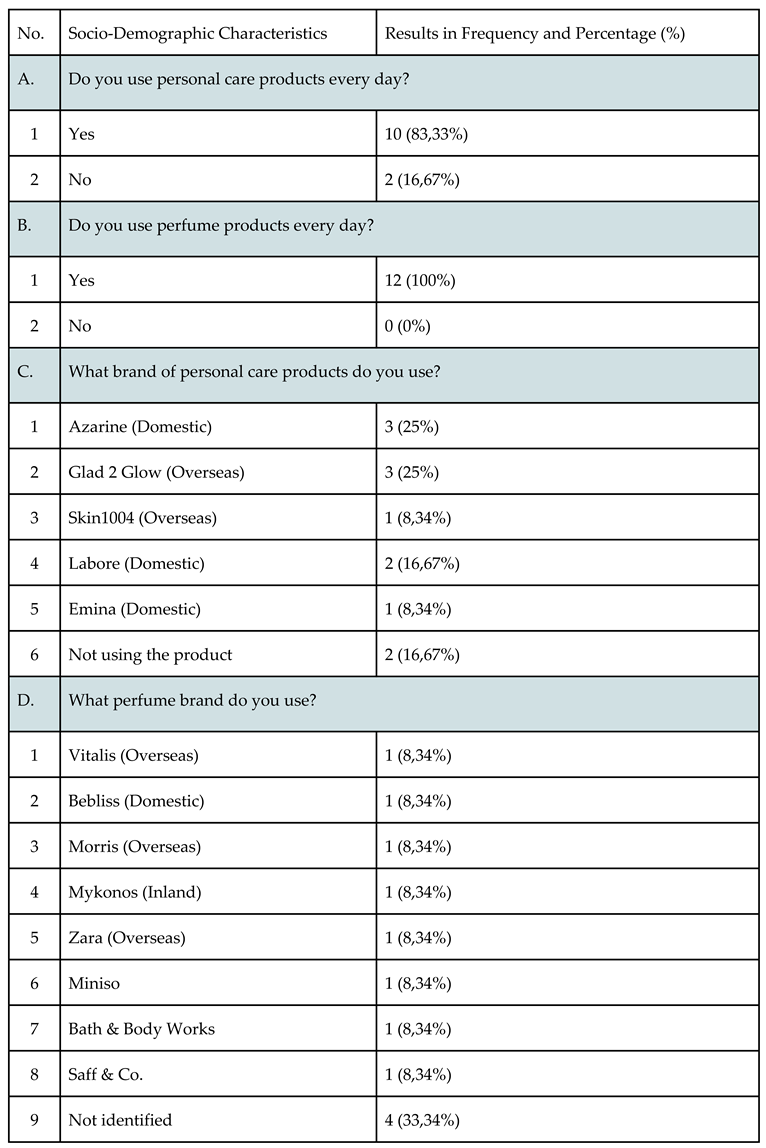
Table 2 shows the use of personal care products and perfume by high school students. Information presented includes whether they use these two product sectors in their daily lives and the brands they use in these two sectors. The data shows that 2 of 12 high school students do not use personal care products in their daily lives. More than 75% of high school students use personal care products. This means that the personal care sector’s market potential is very wide open. The same is true for the use of perfume. All interviewees stated that perfume is part of their daily lives. However, of the 12 female students we interviewed, only 2 of the total interviewees use domestic products in these two sectors, while the rest preferredprefer foreign products. This finding aligns with research by Dhewi (2023) and Sherina (2023), who showed that young Indonesians tend to choose foreign products due to brand image and higher perceived quality. In fact, according to the Ministry of Industry (2025), the national cosmetics industry has grown by more than 77% in the last five years, great potential for domestic products if appropriate education and promotion strategies are implemented.
Based on these results, almost all respondents stated that they were unfamiliar with domestic products. The female students stated that the information they received was very limited, so most of them had not used domestic products. Respondents stated that they needed information regarding domestic products, especially information that could be accessed digitally. In addition to the limited information, some participants were also concerned about the quality offered by these products. This finding aligns with research by Dhewi (2023) and Sherina (2023), which shows that Indonesia’s younger generation tends to choose foreign products due to brand image and higher perceived quality. However, according to the Ministry of Industry (2025), the national cosmetics industry has grown by more than 77% in the past five years, indicating significant potential for domestic products if appropriate educational and promotional strategies are implemented. However, in reality, consumer ethnocentrism can be utilized by domestic industry, considering that Indonesia itself is a very rich country. Conditions on the ground reinforce Ramadania’s (2023) view that consumer ethnocentrism has a positive effect on the intention to purchase local products, but the effect weakens when the perceived quality of domestic products is considered low.
However, it is necessary to reiterate the spirit of patriotism that supports the use of domestic products. Data shows that domestic product consumption in more than one business sector is less than 20%, with less than one in five high school students using products produced in their own country.
Conclusions
This article provides an overview of how patriotism is internalized through the use of domestic products in the personal care and perfume sectors. Observations and interviews show very positive consumption figures in these two sectors. Consumption figures exceed 75%, indicating that these two sectors offer tremendous business opportunities. Unfortunately, this impressive consumption figure is not accompanied by a trend toward domestic products. Therefore, this study encourages all parties, especially industry stakeholders in these sectors, to provide more comprehensive education and information regarding their products, particularly in the digital world.
References
- Ardya, R. P., Dewi, K., Sujanto, J., & Elimmata, E. (2023, January). Gambaran Cinta Tanah Air Melalui Penggunaan Produk Lokal Sebagai Upaya Bela Negara. [CrossRef]
- Agus Widjojo: Pancasila Merupakan Nilai Luhur dari Budaya Bangsa. (2021, June 1). Lemhannas RI. Retrieved November 9, 2025, from https://lemhannas.go.id/berita/berita-utama/1093-agus-widjojo-pancasila-merupakan-nilai-luhur-dari-budaya-bangsa/id.
- Cinta Tanah Air: Pengertian, Contoh Perilaku, dan Manfaatnya bagi Bangsa. (2023, March 12). detikcom. Retrieved November 9, 2025, from https://www.detik.com/edu/detikpedia/d-6613628/cinta-tanah-air-pengertian-contoh-perilaku-dan-manfaatnya-bagi-bangsa.
- Dhewi, T. S., & Oktaviani, R. (2023, April). Does perceived quality mediate the effect of generation Z’s consumer ethnocentrism on local sneakers purchase intention? BISMA (Bisnis dan Manajemen), 15(2), 139-157. [CrossRef]
- Ginting, A. S., Joebagio, H., & Cicilia Dyah. (2019, December). The Effect of Constructive Patriotism on Constructive Thinking Ability in Historical Learning at Students of Senior High School Muhammadiyah Karanganyar Indonesia. ASEAN Journal of Education, 5(2), 32-37. https://so01.tci-thaijo.org/index.php/AJE/article/view/269783.
- Industri Kosmetik Nasional Tumbuh Fenomenal, Pemerintah Dorong Hasilkan Produk Berdaya Saing Global. (2024, February 20). Kompas Money. Retrieved October 27, 2025, from https://money.kompas.com/read/2024/02/20/211327326/industri-kosmetik-nasional-tumbuh-fenomenal-pemerintah-dorong-hasilkan-produk?utm_source=Various&utm_medium=Referral&utm_campaign=Top_Desktop.
- Kemenperin Gadang Potensi Industri Kosmetik Semakin Gemilang. (2025, February 19). Ditjen IKMA. Retrieved October 27, 2025, from https://ikm.kemenperin.go.id/kemenperin-gadang-potensi-industri-kosmetik-semakin-gemilang.
- Kinclong Industri Kosmetik Tanah Air. (2024, February 20). Indonesia.go.id. Retrieved October 27, 2025, from https://indonesia.go.id/kategori/editorial/7984/kinclong-industri-kosmetik-tanah-air?lang=1.
- Mutia, F. A. (2021, October 13). The Role of Consumer Ethnocentrism on Perceived Quality, Perceived Price, and Brand Image towards Local Brand Purchase. Journal of Business, Management, and Social Studies, 1(2), 77-89. [CrossRef]
- PENDIDIKAN KEWARGANEGARAAN (S. S. Kusumawardani, D. Budimansayh, Triyanto, W. Wibowo, & M. Copik, Compilers). (2024). Direktorat Jenderal Pendidikan Tinggi, Riset, dan Teknologi. https://simbelmawa.kemdikbud.go.id/portal/wp-content/uploads/2024/12/BUKU-AJAR-PEMBELAJARAN-MATA-KULIAH-WAJIB-PADA-KURIKULUM-PENDIDIKAN-TINGGI-PENDIDIKAN-KEWARGANEGARAAN.pdf.
- Prakash, G., Sharma, S., Kumar, A., & Luthra, S. (2024). Does the purchase intention of green consumers align with their zero-waste buying behaviour? An empirical study on a proactive approach towards embracing waste-free consumption. 10(3). [CrossRef]
- Priatna, T. (2018). MEMBANGUN KARAKTER BANGSA. CV. Insan Mandiri. https://digilib.uinsgd.ac.id/16413/1/Buku%20Membangun%20Karakter%20Bangsa.pdf.
- Priskila, T. (2018). The Effectiveness of Social Media and Online Marketing in Promoting Indonesian Tourism: Case of Wonderful Indonesia Brand. n Proceedings of the 7th International Conference on Entrepreneurship and Business Management. Scitepress. [CrossRef]
- Prospek Cerah IKM Kosmetik Lokal, Siap Maksimalkan Pasar Dalam dan Luar Negeri. (2024, October 30). Ditjen IKMA. Retrieved October 27, 2025, from https://ikm.kemenperin.go.id/prospek-cerah-ikm-kosmetik-lokal-siap-maksimalkan-pasar-dalam-dan-luar-negeri.
- Ramadania, Jaebeom, S., Rosyadi, Purnomo, B. B., & Rahmawati. (2023). Consumer ethnocentrism, cultural sensitivity, brand credibility on purchase intentions of domestic cosmetics. Cogent Business & Management, 10. Taylor & Francis. [CrossRef]
- Rochimudin, Hadi, M. H. P., & Ahmad Asroni. (2023). PENDIDIKAN PANCASILA. Kementerian Pendidikan, Kebudayaan, Riset, dan Teknologi. https://static.buku.kemdikbud.go.id/content/pdf/bukuteks/kurikulum21/Pendidikan-Pancasila-BS-KLS-X.pdf.
- him, J., Woo, J., Yeo, H., Kang, S., Kwon, B., Lee, E. J., Oh, J., Jeong, E., Lim, J., & Park, S. G. (n.d.). The Clean Beauty Trend Among Millennial and Generation Z Consumers: Assessing the Safety, Ethicality, and Sustainability Attributes of Cosmetic Products. Sage Open, 14(2). Retrieved October 27, 2025, from. [CrossRef]

Table 1.
Socio-Demographic Variables.
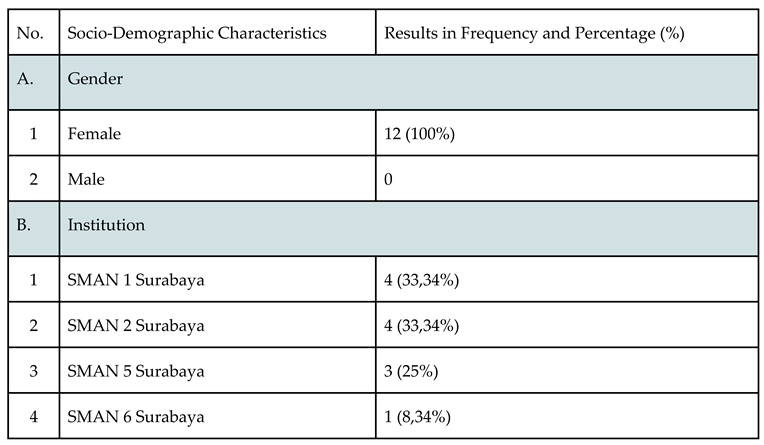 |
Table 2.
Product Usage.
 |
Disclaimer/Publisher’s Note: The statements, opinions and data contained in all publications are solely those of the individual author(s) and contributor(s) and not of MDPI and/or the editor(s). MDPI and/or the editor(s) disclaim responsibility for any injury to people or property resulting from any ideas, methods, instructions or products referred to in the content. |
© 2025 by the authors. Licensee MDPI, Basel, Switzerland. This article is an open access article distributed under the terms and conditions of the Creative Commons Attribution (CC BY) license (https://creativecommons.org/licenses/by/4.0/).
Copyright: This open access article is published under a Creative Commons CC BY 4.0 license, which permit the free download, distribution, and reuse, provided that the author and preprint are cited in any reuse.


