

Submitted:
06 November 2025
Posted:
07 November 2025
You are already at the latest version
Abstract
This article explores the integration of food ethics as a fifth, emerging pillar of food security, complementing the four dimensions established by FAO (availability, accessibility, utilization, and stability). Using Romania as a case study, the research combines statistical analysis, legislative review, and conceptual interpretation to examine how moral responsibility, social equity, and food citizenship leads to sustainable food systems. Quantitative data from Eurostat (2020–2022) reveal that Romania generates over 3.4 million tons of food waste annually, with households accounting for more than half of the total. This wasted abundance coexists with persistent food insecurity, affecting 14.7% of the population who cannot afford a protein-based meal even once every second day. The findings demonstrate that food waste is not merely an issue of economic inefficiency but a profound ethical and social imbalance. The research concludes the need to introduce an ethical pillar in the conceptual framework of food security, linking moral awareness, responsible consumption, and equitable access to food. By advancing food ethics as a normative foundation of sustainable food systems, the article offers a new paradigm for policy design, civic engagement, and collective responsibility, transforming food security from a technical objective into a moral commitment.
Keywords:
food security
; food ethics
; food citizenship
; food waste
; SDGs
; social equity
; moral responsibility
; Romania
; FAO pillars
; sustainable food systems
1. Introduction
This research was originally presented at the 6th International Electronic Conference on Foods - Future Horizons in Foods and Sustainability, Part of the International Electronic Conference on Foods series, 28–30 October 2025, the abstract being published as part of the conference materials [1].
In recent decades, food security has become one of the most discussed topics on the global agenda, in the context of systemic challenges generated by climate change, economic inequalities, armed conflicts and supply chain instability. The classic definition of food security, adopted by the Food and Agriculture Organization of the United Nations (FAO) in 1996, is based on four essential pillars: the availability of food, physical and economic access to it, its use in safe and nutritious conditions, and the stability of these factors over time [2]. This conceptual framework has provided a robust foundation for national and international policies aimed at combating hunger, improving nutrition and strengthening the resilience of agri-food systems.
However, reality demonstrates that the four pillars aren’t sufficient to resolve the ethical and social contradictions of current food systems. Especially in the European space, where the coexistence of excessive food waste and persistent food insecurity calls into question the equity of the food system, a reconfiguration of the theoretical and normative framework becomes necessary. According to data from the European Commission, approximately 20% of all food produced annually in the European Union is lost or wasted, while over 42 million citizens cannot afford a healthy meal every day [3]. This coexistence between excess and lack is not just a statistical imbalance, but reflects a deep moral fracture in food governance, which cannot be remedied solely by technical or economic solutions.
The literature increasingly highlights the limitations of the current food security framework, particularly the absence of explicit considerations regarding moral responsibility, social equity and ethical sustainability of food use [4,5], without proposing an alternative formalized model, which creates space for conceptual innovations such as the one proposed in this article. This concept involves the inclusion of principles of moral responsibility, social equity and civic engagement on the entire food chain, from production, to distribution, consumption, and waste. Initiatives such as the EAT-Lancet report [6], the IPES-Food contributions [7], as well as the FAO debates on the right to food [8] are already shaping a conceptual space in which food security is no longer analyzed exclusively in terms of quantitative access to food, but also in terms of distributive justice, responsibility towards resources and the way in which consumers relate ethically to food. Against this conceptual backdrop, our article proposes the formal conceptualization of an “ethical pillar” of food security, as an extension of the FAO (1996) framework. This new dimension integrates values of equity, responsibility and food citizenship, offering a perspective that complements the traditional approach focused on availability, access, utilization, and stability.
Romania is a revealing case study in this regard. Romania simultaneously faces high levels of food waste and a significant degree of food insecurity among vulnerable populations. According to the Ministry of Agriculture and Rural Development, Romania generates over 2.2 million tons of food waste annually, of which approximately 70% comes from households, retail and the HoReCa sector [9]. At the same time, Eurostat data shows that 14.7% of Romanians cannot afford to consume a meal with meat, chicken, fish (or vegetarian equivalent) every second day [10]. This conjunction between excess and lack, between wasted abundance and daily shortages, expresses an ethical incongruity that cannot be ignored in the formulation of national food policies.
Despite these realities, the Romanian legislative framework is beginning to reflect an increased concern for the institutionalization of responsibility in the food sector. Law no. 217/2016 on reducing food waste, recently amended, imposes obligations on economic operators in the agri-food chain regarding the prevention, donation and reuse of food [11]. At the same time, national platforms such as ‘’We Reduce Waste’’ (orig. ‘’Reducem Risipa’’) promote responsible consumption behaviors and initiatives to redistribute food surplus. However, legislative and institutional changes are not enough if they are not accompanied by a transformation of individual and collective values. Sociological studies show that only 12% of Romanian consumers take ethical aspects into account when deciding to throw away food [12], which indicates a major gap between regulation and social awareness.
For this reason, our article proposes the introduction of a new dimension in the analysis of food security: the “ethical pillar”, centered on the concept of food ethics and the mobilization of food citizenship as an active form of individual involvement in shaping a just, sustainable and inclusive food system. The concept of food citizenship refers to citizens assuming democratic responsibility for the food system, through informed consumption choices, combating waste and supporting fair and sustainable practices [13].
This perspective aims to go beyond the predominantly technocratic approach to food security policies and highlight the fact that individual morality and collective responsibility must play a central role in rebuilding food systems. Thus, the main objective of this article is to demonstrate that a sustainable food security cannot be achieved without a deep ethical anchoring, which includes not only the right to have food, but also the duty not to waste it.
The present article therefore has a double aim: on the one hand, provides a critical analysis of the current food security framework based on the Romania case study, using relevant statistical and legislative data; on the other hand, it proposes a conceptual extension of this framework by integrating the ethical dimension, in an effort to redefine food security as a collective right, shared responsibility and expression of social justice. Specifically, this conceptual and policy analysis article proposes the formal conceptualization of an “ethical pillar” of food security, as an extension of the FAO framework, integrating dimensions such as equity, responsibility and food citizenship.
The article makes an original contribution to the specialized literature by advancing the idea of a “food ethics pillar” and offers a set of concrete recommendations on how this dimension can be operationalized in public policies, educational programs and everyday behaviors. Romania thus becomes a relevant example for other countries at the intersection of strong food traditions, socio-economic challenges and emerging legislative transitions, not only through its national specificity, but also as a representative of a reality common to several states, in transition between emerging regulations and food behaviors deeply anchored in traditions.
2. Conceptual Framework
2.1. The Ethical Dimension of Food Security – What Does Food Ethics Mean?
The concept of food ethics refers to the set of moral principles that should guide practices related to the production, distribution, consumption and waste of food. It is a perspective that goes beyond economic or technical logic and invites reflection on equity in access to food, responsibility towards natural resources, the dignity of those involved in the food chain and the long-term effects on human health and ecosystems.
Essentially, food ethics raises questions such as Who has access to quality food? Who is excluded? What does “fairness” mean in the allocation of food? Is it moral to throw away food while others go hungry? This approach brings together dimensions that have so far been treated separately: food security, environmental sustainability, public health, and human rights. [14]:
The EAT-Lancet report clearly states that food systems must be transformed to become “healthy for people and sustainable for the planet” – a formulation that implies a collective moral commitment [15]. Similarly, contemporary academic literature insists that food should not be viewed simply as an economic good, but as a common good with profound cultural, social and moral valences [16,17].
Integrating the ethical dimension into food security therefore means not only improving access, but also evaluating how this access is provided, at what social and ecological costs, and to what extent it is morally just.
2.2. Food Citizenship – Democratic Responsibility and Participation
Food citizenship is an emerging concept that reflects the idea that individuals are not just passive consumers, but active actors who can positively influence the food system through conscious choices, local activism and civic engagement. The term was first formulated in the works of Wilkins in 2005 [18], then developed by Carolan in 2011 [19] and Renting et al. in 2012 [13], and was gradually adopted within the FAO and IPES-Food programs as a key tool for food democratization [20,21].
Food citizenship involves assuming ethical responsibilities in relation to everyday choices: preferring local and seasonal products, reducing waste, supporting fair and sustainable food systems, getting involved in community initiatives for urban gardening, food education or food redistribution.
It is a form of active citizenship that transcends the formal political sphere and is expressed through informed and supportive food behaviors. Moreover, food citizenship involves awareness of global interdependencies and the fact that the way we eat influences not only our personal health, but also the rights of others and the balance of ecosystems [13].
In the Romanian context, where food behaviors are deeply marked by traditions, but also by the influences of modern consumerism, promoting food citizenship becomes essential for an authentic transition towards sustainability and food justice.
2.3. Ethics, the Right to Food and Collective Responsibility
The right to food is recognized as a fundamental human right in numerous international documents, including the Universal Declaration of Human Rights (art. 25) and the International Covenant on Economic, Social and Cultural Rights (art. 11) [22,23]. According to FAO this right implies not only the absence of hunger, but also constant physical and economic access to nutritionally adequate, culturally acceptable and sustainably obtained food [20].
But the right to food cannot be guaranteed without a collective dimension of responsibility – governmental, community and individual. Food ethics adds a normative component to this right: it is not enough to “provide” food, it is necessary for the whole of society to participate in a system that does not exclude, waste or degrade resources.
Collective responsibility means assuming mechanisms for redistributing food surpluses, supporting vulnerable people, preventing food losses through effective public policies and civic education. In this sense, the concept of food citizenship becomes the link between the ethics of the system and the responsibility of the actors that compose it.
2.4. Recent Literature and Foundations for a New Framework
Over the past decade, a growing body of scientific literature has called for a reassessment of the framework for analyzing food security. IPES-Food warns that predominantly technocratic approaches ignore the social and moral dimensions of the global food crisis. The report The Politics of Protein draws attention to the fact that proposed technological solutions (e.g., cultured meat, protein supplements) may perpetuate inequalities if not accompanied by ethical and democratic reforms [21].
FAO, through its annual SOFI reports, is gradually integrating components such as resilience, agency and sustainability, but without formalizing them into a distinct pillar [24]. EAT-Lancet was perhaps the most radical recent report, which called for the transformation of food systems “through the lens of equity and sustainability” as a precondition for achieving SDG2: Zero Hunger goal [6].
However, despite these contributions, there is still no clear formalization of an “ethical pillar” within the FAO framework. This is where the innovative nature of the present article comes in: proposing an integrated framework that explicitly includes the ethical dimension and food citizenship in the conceptual architecture of food security.
2. Materials and Methods
This research was built on a combination of descriptive quantitative analysis, statistical analysis, legislative review and conceptual interpretation, aiming to integrate the ethical dimension into the food security framework. In particular, the study focused on Romania, using official secondary data, complemented by interpretive analysis of the normative and behavioral context. This research is part of a research-for-policy approach, aiming not only to understand current food phenomena, but also to support the development of more equitable, ethical and sustainable public policies in the field of food security.
Romania was chosen as a case study because it offers a complex and revealing analytical terrain for exploring the ethical dimension of food security [25,26]. On the one hand, the country faces significant challenges related to food insecurity among the vulnerable population, despite being an agrarian state with high production potential [27,28]. On the other hand, data on food waste in the household sector and the HoReCa industry indicate a level of consumption that is unbalanced and, often, disconnected from responsibility towards resources [29]. This coexistence between abundance and deprivation, between wasted surplus and daily shortages, makes Romania a paradigmatic example for analyzing the ethical paradoxes in modern food systems.
Moreover, Romania is at the intersection of Eastern European food traditions and the pressures of European convergence, being simultaneously subject to both local cultural legacies (such as the habit of throwing a little on the plate out of “social respect”) and European food policies oriented towards efficiency, waste reduction and inclusion. Thus, Romanian food behaviors reflect not only a national reality, but also global tensions between consumer individualism and collective responsibility.
This positioning makes Romania function as a microcosm of global food contradictions, especially in transition or middle-developed countries, where economic growth indicators coexist with persistent inequalities and aspirational consumption patterns. Therefore, the study results may be relevant and transferable to other international contexts, especially for countries in Central and Eastern Europe, Central Asia or Latin America, where similar configurations of insufficient access, waste and responsibility in the food sector are found.
3.1. Data Sources
The most recent statistical data from official and international sources were used to ensure coherence and comparability at European level:
All data collected refer to the period 2020–2022, representing the most recent figures reported for Romania in 2024, ensuring the contemporary relevance of the results. The analysis focused on national indicators for Romania, with occasional references to the European Union average for contextual comparison.
3.2. Analytical Methodology
The methodology involved several stages:
-
Descriptive analysis of statistical data. Relevant indicators for the four pillars of food security (availability, accessibility, utilization, stability) were selected and correlated with data on food waste and food insecurity. In particular, the following were analyzed:
- -
- - the amount of food waste generated annually in Romania;
- -
- - the structure of generation sources (households, retail, HoReCa);
- -
- - the share of the population that cannot afford a regular nutritious meal;
- -
- - the proportion of consumers who consider ethical aspects in their eating behavior.
- Regulatory and legislative analysis. The evolution of the legal framework regarding food waste prevention, the obligation of donation/reuse and the incentives offered for responsible food behavior were analyzed. The extent to which these regulations institutionalize ethical responsibility was also evaluated.
- Interpretive and conceptual analysis. The data were interpreted in relation to the central hypothesis of the paper, according to which the current food security framework is insufficient without the integration of an ethical dimension. The correlation between statistics, norms and behaviors was thus traced, to highlight the need to formalize a fifth pillar: the ethical one.
- Graphic illustration and visual synthesis. Tables and figures were produced that summarize the relationship between food ethics, food waste and food security, highlighting the expansion of the FAO framework by including the food ethics pillar.
3.3. Statistical Methodology
The statistical analysis was carried out to assess the relationships between the food chain segments that contribute to the generation of food waste in Romania and to quantify their impact on the total volume of losses. The dataset used comes from the Eurostat database – Food Waste Data Collection (2020–2022, respectively, the latest reported data), which reports data expressed in total tons, in accordance with the official methodology of the European Union. The analysis targeted the five main segments:
- Total (aggregate changing according to the context) - T
- Primary production of food - agriculture, fishing and aquaculture - PPF
- Manufacture of food products and beverages - MFP
- Retail and other distribution of food - RDF
- Restaurants and food services - RFS
- Total activities by households - TAH.
3.3.1. Analysis of the Percentage Contribution of Variables to Total Waste
To calculate the contribution of each segment of the food chain to total waste, the following relationship was used:
where:
Ci [%] - the contribution of the food chain segment ,,i’’ to total waste;
xi- the value of the waste for each variable ,,i’’, compared to the total sum of the differences between years, in absolute value.
By ranking the values Ci, an image of the contribution of each segment of the food chain to the variation in total waste will be obtained.
3.3.2. Correlation Analysis of Each Segment of the Food Chain with Total Waste
The linear correlation coefficient between the annual series of each food chain segment and the annual series of total waste was calculated. This will assess the intensity of the link that each food chain segment has with total waste.
The expression for Pearson’s linear correlation coefficient “ri” for two statistical data series xi and yi is [34]:
where:
- the linear correlation coefficient between the annual series of each food chain segment and the multiannual series of total waste,
k- the index used to traverse the list of food chain segments;
- the value of food waste for each segment of the food chain in year “i”
- the value of total food waste for the entire food chain in year “i”
- the average values of the two series xi and yi.
The interpretation of the “rk” values is as follows: “r” belongs to the interval [−1, - 1] (r∈[−1, 1]). “r” values close to 1 show that the series have the same trend, increasing or decreasing together, so there is a direct correlation. Values close to –1 indicate a reverse trend of evolution, hence an inverse correlation. Values close to 0 indicate the absence of correlation.
3.3.3. PATH Analysis
Because the RFS and TAH segments predominantly reflect individual decision-making and consumer behaviour the variations observed in these areas cannot be explained solely by isolated economic or structural factors. Food waste in these food chain segments results primarily from everyday practices (such as purchasing habits, portioning, storage, and waste management) that are shaped by cultural norms and value perceptions, rather than technological limitations. For this reason, a PATH analysis was needed to identify how changes occurring within the RFS and TAH propagate through the broader food system and influence overall levels of food waste, highlighting the behavioral interdependencies embedded throughout the chain.
Since the statistical data on food waste in Romania are carried out over a period of 3 years, a short period of time, according to the currently existing FAO records (2020-2022), the annual series, for the three years, were the basis for a linear extension for a period of another three years. The trends thus obtained represented the inputs of the PATH analysis. Thus, the extent to which food waste in restaurants and households involves food waste in each segment of the chain was determined. The JASP 0.17.3.0 software application was used with the Structural Equation Modeling procedure. The spreadsheet calculations were performed using Microsoft Excel 365 [35,36].
3.4. Study Limitations
This research is based on secondary data and is therefore limited by its availability and granularity. The lack of recent national surveys on the ethical perception of food consumption in Romania was partially compensated by using indirect sources (European surveys, studies published in the literature). In the future, it would be useful to extend the research through a qualitative focus group study or by applying a questionnaire to a national sample.
In addition, the statistical indicators used in this study refer to the period 2020–2022, which represents the entire set of data reported by Romania, from the beginning until the time of analysis. This temporal limitation means that the study cannot capture any developments that occurred after this period. Although a data series was manually constructed in Excel to ensure continuity and comparability of the indicators, the use of aggregated secondary data, instead of primary data collection, may introduce certain limitations in terms of accuracy and level of interpretative detail. Future research could integrate microdata or household-level monitoring tools to more accurately capture regional and local behavioral variations.
3.5. Ethical Considerations
This research was based exclusively on secondary data, coming from official, public and accessible sources, such as international databases (FAOSTAT, Eurostat), government reports and legislative documents. Therefore, it did not involve the collection of personal data, the performance of experiments on human subjects or the use of methods that would require prior approval by an ethics committee.
At the same time, at all stages of the research, the fundamental principles of scientific integrity were respected, including:
- transparency of sources and correct attribution of ideas and data used;
- objectivity of analysis and avoiding drawing conclusions that are not supported by the data;
- respect for human dignity, through the emphasis on social responsibility in food security;
- commitment to equity, reflected in the proposal of a conceptual framework that integrates food ethics and citizenship as essential elements of public policies.
Also, in interpreting the phenomenon of food waste and insecurity, we avoided stigmatizing vulnerable groups and sought to highlight the structural and systemic causes that generate such imbalances.
4. Results
4.1. Quantitative Assessment of Food Waste and Food Insecurity
Between 2020 and 2022, Romania generated between 3.2 - 3.45 million tons of food waste annually, according to the latest data published by Eurostat, and this figure continues to increase. Relative to the population, this volume corresponds to an increase from 166 kg/person in 2020 to 181 kg/person in 2022, which places Romania slightly below the European Union average (around 185 kg/person), but indicates a more accelerated growth than in other Member States with similar levels of development [10].
Detailed data analysis (Table 1) highlights an unbalanced distribution of food losses along the agri-food chain, reported at the level of the entire population. Households remain the main source of waste, generating between 52% and 55% of the total, with an increase from 1.66 million tons in 2020 to 1.88 million tons in 2022. This upward trend signals the limited effectiveness of national awareness and prevention programs, despite the implementation of Law no. 217/2016 on the reduction of food waste (revised in 2023). The HoReCa sector (restaurants, public food services, catering) ranks second, with values between 0.48 and 0.59 million tons/year, followed by primary production and the food industry, which together account for approximately one third of total waste. These sectors reflect vulnerabilities in post-harvest management, storage and processing, especially in the lack of efficient logistics infrastructures.
Although the total increase of approximately 7.8% over the three years seems moderate from a statistical perspective, its ethical implications are profound. Every ton of wasted food represents not only a loss of resources, labor and energy, but also social inequity, a loss of morality and ethical values, in a society where over 14% of citizens cannot afford a protein meal at least once every two days [38,39]. The coexistence of these two realities – wasted abundance and food deprivation – defines one of the most visible moral paradoxes of the contemporary Romanian food system.
The sectoral analysis highlights contrasting developments. While the processing industry recorded a sharp increase in food waste in 2022 (+40% compared to 2021), probably because of the post-pandemic recovery and realignment of production flows, primary production and retail remained relatively stable, suggesting more efficient inventory management. However, the continued dominance of household waste confirms the existence of a major gap between legislative regulation and effective social behaviors.
The per capita indicator confirms the same trend: household waste increased from 86 kg/person in 2020 to 99 kg/person in 2022, an increase of over 15% in just two years (Table 2).
The Restaurants and food services (HoReCa) sector also recorded an increase from 25 kg/person to 29 kg/person, in parallel with the relaunch of economic activities after the pandemic restrictions. These figures place Romania close to the European median, but at a considerable distance from the target set by the ‘’Farm to Fork’’ Strategy, which provides for halving food waste by 2030.
Figure 1 illustrates the distribution of wood waste in Romania across the food chain segments.
From a food security perspective, these quantitative data reveal a double deficit. On the one hand, public policies focused on reducing food losses have not yet been internalized at the behavioral level, which reflects a weak integration of the ethical dimension in the culture of consumption. On the other hand, the increase in waste coexists with the persistence of food insecurity, manifested by difficulties in accessing nutritious, diversified and safe foods for significant segments of the population.
Therefore, the quantitative assessment confirms that food waste is not just a problem of economic efficiency, but also a problem of social and ethical justice. Every kilogram of food wasted undermines the first two pillars of food security – availability and accessibility – reducing the resources available for equitable distribution and contradicting the principle of collective responsibility implied in the right to food.
4.2. Analysis of the Percentage Contribution of Food Chain Segments to the Variation in Total Waste
The analysis of the variations in the period 2020 - 2021, presented in Table 3, allowed the determination of the share of each sector of the food chain in the total food waste generated in Romania. To calculate them, the calculation relationship (1) was used. It is observed that the RFS variable had an important share, over 35%, in the variation of total waste, and together with TAH (47.27%), it cumulates over 80% of the variation of total waste. This fact shows that total food waste could be reduced by reducing it in the RFS segment. And in the period 2021-2022, a significant share of RFS in the variation of total waste was found, of over 14%, and cumulated with TAH (24.33%), it represents a significant share, even if it is lower than that of the previous year.
4.2.1. Correlation Analysis of Each Segment of the Food Chain with Total Waste
By calculating the linear correlation coefficient, the intensity of the link between two data series is determined, and this fact shows whether the annual series of each food chain segment and the annual series of total waste have a mathematical link. The data can be found in Table 4, along with the coefficient of determination R2. This coefficient indicates how much of the variation in total waste is explained by individual sectors through this model. In this context, it also becomes a qualitative indicator that describes the correlation of the analyzed variables.
The PPF sector indicates a medium-level correlation r = - 0.69 with the annual series of total waste values, but an inverse correlation. Thus, we can say that while for the period 2020 - 2022 PPF decreased, total waste increased. It is also the only inverse correlation observed between economic sectors with total food waste. In all other cases, the values of the correlation coefficients were positive. So, a trend of increasing waste at the level of a sector is also followed by an increase at the level of total waste.
A value r = 0.77 shows that the annual series of waste from RFS is strongly correlated with total waste, and according to the coefficient of determination, 59% of the variation in total waste could be explained by RFS. The most important correlation is observed between TAH series and the annual series of total waste values, r = 0.99. A very significant share, 98%, of the total waste could be explained by the TAH sector.
However, the way in which the food chain segments that predominantly involve individual decision-making - namely RFS and TAH - influence the final variation in total waste cannot be fully explained by descriptive analyses, due to the complex interdependencies between economic sectors. Therefore, to highlight these causal relationships and synergistic effects between segments, a PATH analysis was further applied.
4.2.3. Results of the PATH Analysis
PATH analysis was used to complement the potentially subjective pictures that previously described in a singular way the extent to which a food chain segment explains the total waste. The interactions between variables, the direct and indirect effects between them, can be studied using the PATH diagram below. The total number of pairs/groups of variables representing the interactions is very large. For this reason, this study only analyses the two most relevant models:
- -
- RFS as a causal variable for the other variables,
and
- -
- TAH as a causal variable for the other variables.
4.2.3.1. Model 1: RFS as a Causal Variable
The first model only analyzes how waste in the RFS sector, as a causal variable, can induce changes in waste from other food chain segments, but also some interactions of these dependent food chain segments. Thus, the regression coefficients are indicated in Figure 2.
A change in the waste values in RFS induces a negligible change in food waste in the RDF sector, the regression coefficient being β=0.03. The RFS sector also shows a direct link with the TAH sector, regarding waste. The increase in waste in restaurants is also associated with a similar behavior in households. The regression coefficient β=3.1 shows that if waste from RFS sector increases by 1 ton, waste in households increases by 3.1 tons. An opposite phenomenon was observed by the PPF sector. Waste from PPF level decreased, while waste from RFS increased. Thus, increasing waste, a ton of food product lost in RFS corresponds to a decrease of 1.08 tons of waste in PPF, according to the regression coefficient β=-1.08. The coefficients of determination R2 indicate the proportion of the variation in waste in economic sectors that could be explained by the RFS. The values of the β and R2 coefficients are found in Table 5 [40,41].
However, there are also links between the dependent variables, PPF, MPF, RDF and RFS, which are not explained by the causal variable in this context. These interactions are given by the residual covariance values in Table 6.
4.2.3.2. Model 2: TAH as a Causal Variable
The second model only analyzes how waste in the TAH segment, as a causal variable, can induce changes in waste in other segments of the food chain, respectively other interactions. The PATH diagram is shown in Figure 3.
In a similar way to the behavior of RFS, a change in the waste values in TAH induces a negligible change in food waste in the RDF segment, the regression coefficient being here β=0.01.
The TAH variable, like the RFS, also shows an inversion phenomenon. During the period under analysis, waste decreased in PPF while food waste increased in TAH. Thus, a one-ton increase in waste in TAH corresponds to a 0.39-ton decrease in PPF.
4.3. Legislative and Institutional Analysis – Integrating Ethics into National Food Policy
Romania’s legislative and institutional framework in the field of food safety and food waste has evolved visibly in the last decade, reflecting efforts to harmonize with European directives on the sustainability of food systems. However, although national legislation includes important normative instruments, the ethical dimension of food governance remains insufficiently outlined, being addressed rather indirectly, through the general principles of social responsibility and environmental protection [32,37].
The adoption of Law No. 217/2016 on reducing food waste, subsequently amended by GEO No. 92/2021 and further clarified by HG No. 51/2019 represented a crucial step in the institutionalization of food responsibility [11,42,43]. The law provides explicit obligations for economic operators in the agri-food chain to prevent waste, redirect surplus to human consumption and report annually the quantities of food recovered [8]. However, the implementation of the measures remains partial: only a limited number of economic agents report data, and the logistical infrastructure for food collection and redistribution – donation centers, refrigerated transport, NGO networks – is insufficiently developed [44].
In parallel, the ,,National Plan for Reducing Food Waste’’ [45] establishes directions for action aligned with the European Commission’s ,,Farm to Fork’’ Strategy, which aims to reduce food losses by 50% by 2030 [46]. The document promotes four major axes – prevention, reuse, separate collection and food education – but without including an explicit ethical dimension, likely to transform waste reduction into a moral imperative and not just an economic or environmental obligation. The predominantly technical focus of these policies reflects a vision oriented towards efficiency, not equity.
Romania’s National Strategy for Sustainable Development 2030 [45] mentions food security as a strategic objective associated with SDG 2 (Zero Hunger) and SDG 12 (Responsible Consumption and Production), insisting on “the need for a sustainable and responsible food culture”. However, the implementation of this vision has been limited to specific initiatives, without the creation of a cross-sectoral framework for food ethics – although similar recommendations appear in FAO reports on the right to food [37] and in the IPES-Food analysis on governance ethics in food systems [7].
At the national institutional level, responsibilities are divided between several public entities:
- Ministry of Agriculture and Rural Development (MADR) - coordinator of policies on food loss reduction and redistribution;
- National Sanitary-Veterinary and Food Safety Authority (ANSVSA) - responsible for regulating food safety and food donations;
- Ministry of Environment, Waters and Forests (MMAP) - which integrates food waste into circular economy and waste management policies;
- Ministry of Education and Research (MEC) - limited involvement, through educational programs such as Green Week or waste prevention campaigns in schools [45].
This distribution of powers generates institutional fragmentation and coordination difficulties. Romania does not yet have an advisory council for food ethics, like those in other European countries – for example, the Food Ethics Council in The United Kingdom or the Dutch Council for Animal Affairs (RDA), an independent expert council that advises the Minister of Agriculture on animal welfare and health in public policy [47,48].
In Romania, in the absence of such a body, an increasingly important role is played by civic initiatives. Platforms such as Food Waste Combat Association, ‘’We Reduce Waste’’ (orig. ,,Reducem Risipa’’), ‘’Food Bank’’ (orig. ,,Banca pentru Alimente’’) or ShareFood Romania act as mediators between producers, retailers and vulnerable communities, actively contributing to the redistribution of food and changing behaviors [49,50,51]. These initiatives prefigure the emergence of a form of institutionalized food citizenship, in which solidarity and moral responsibility become components of food governance. However, the lack of unified reporting mechanisms and a national database limits the integration of these efforts into public policies [9,52].
According to the press release of the Ministry of Agriculture and Rural Development, the recent amendments to Law no. 217/2016 on reducing food waste aimed to clarify the obligations of economic operators and introduce measures to stimulate food redistribution through partnerships between retailers, food banks and NGOs. The new provisions also aim at a unified reporting of data at national level and the expansion of educational programs on waste prevention, in line with the principles of the circular economy and the ‘’Farm to Fork’’ Strategy [9,53].
According to the National Sanitary Veterinary and Food Safety Authority (ANSVSA), reducing food losses must be correlated with guaranteeing the safety of redistributed food, by applying the related sanitary and veterinary norms, which gives this issue a double dimension: a technical one and an ethical one. ANSVSA emphasizes that “food that maintains its quality and safety until the expiration date should not be considered waste, but resources that can support people in difficulty”, a principle that fully reflects the spirit of the 2030 Agenda on reducing inequalities and promoting collective responsibility [33].
In the absence of a consolidated institutional culture of moral responsibility, transforming food behaviors at the individual level becomes the most promising space for operationalizing food ethics in Romanian society. By adopting an ethical framework that cuts across all sectors – from production to consumption – Romania can align more firmly with the 2030 Agenda for Sustainable Development, in particular SDG 12 on responsible consumption and production and SDG 2 on eradicating hunger. In this context, public policies must go beyond their purely normative role and become an instrument for cultivating civic and moral engagement with food and resources, strengthening the link between the right to food, resource sustainability and social justice.
4.4. Behavioral and Cultural Insights – Ethical Awareness and Food Citizenship Among Romanian Consumers
Eating behaviors represent the most sensitive and, at the same time, the most ethically relevant dimension of food security. They reflect not only preferences and consumption habits, but also the level of moral awareness regarding the value of food, waste and the impact of individual choices on the community. In Romania, transforming these behaviors remains one of the greatest challenges for the operationalization of food ethics and for the consolidation of an active form of food citizenship.
According to data provided by the European Commission through Flash Eurobarometer 520 – Food Waste and Date Marking and Eurobarometer 535 – Public Opinion in the European Union (Dataset: Food Waste and Responsible Consumption), 71% of Romanian citizens admit to throwing away food at least once a month, while only 29% declare that they do not waste food at all [38,54,55]. The main causes identified are: excessive food purchases (48%), lack of shopping planning (43%) and confusion related to the labels “to be consumed preference before” and “best before” (37%). These data confirm that waste is not the result of a lack of resources, but of everyday behaviors, influenced by education, the perception of comfort and the cultural relationship to food.
The results of recent studies conducted in Romania provide a detailed picture of these behaviors, namely only 11.9% of survey respondents say that they take ethical or sustainability aspects into account when deciding to buy or throw away food, a percentage well below the European average (22%). At the same time, 68% declare themselves willing to donate surplus food, but only 8–9% do so, confirming the existence of a clear discrepancy between intention and action. Studies also show that adults under 25, from urban areas and with higher education, show a greater concern about food waste, but the lack of adequate infrastructure for redistribution limits the transformation of ethical intentions into concrete behaviors [39,56].
Studies of the analyses of food behaviors and motivations associated with waste show that, in Romania, the perception of the value of food is deeply shaped by cultural factors [28,31,57]. In urban households, waste is often associated with the idea of “abundance” and high social status, while in rural areas conservative attitudes and traditional reuse practices (e.g., food waste transformation, composting, animal feeding) prevail [39,56,57]. This polarization between modernity and tradition reflects the tension between the culture of consumption and the culture of care for food, with direct implications for the implementation of waste reduction policies.
FAO data confirm that, in Europe and Central Asia, food education and the degree of nutritional literacy directly influence the level of food losses and ethical behaviors [8]. Countries that have introduced educational modules on food waste and sustainable consumption in school curricula have recorded significant reductions in waste. In Romania, such programs are still limited, taking place sporadically through civic initiatives or school campaigns (e.g., Green Week, Food Waste Combat), without systematic integration into the national educational curriculum [46,49].
From a sociological perspective, food behaviors in Romania can be interpreted in the context of a dual food culture: a traditional one, which values sobriety, agricultural work, and respect for food, and a modern one, associated with urbanization, food industrialization, and aggressive marketing. This duality generates what we could call an “ethical fracture”: people know that waste is wrong, but continue to practice it out of cultural inertia, lack of time or the false perception that food is an inexhaustible resource.
In this context, the concept of food citizenship offers a promising direction for reconnecting individual behaviors and collective responsibility. The food citizen is not just a rational consumer, but a moral actor aware of the implications of his decisions. In Romania, incipient forms of food citizenship are manifested through participation in civic initiatives (food banks, donation programs, local producers’ markets, consumer cooperatives), but these actions still remain marginal compared to the magnitude of the waste phenomenon.
Against the backdrop of these developments, the cultural dimension of food ethics becomes essential. In the Romanian space, food has a symbolic and identity charge, being associated with hospitality, religiosity and collective rituals. Therefore, any strategy for promoting food ethics must consider the cultural meaning of food, capitalizing on positive traditions (respect for bread, the cult of the household, the refusal of waste during fasting periods) and transforming them into modern educational resources.
Thus, the development of an ethical food culture in Romania implies a transition from moralizing discourse to participatory responsibility. Public communication campaigns must go beyond punitive messages (“don’t waste”) and stimulate belonging to a common ideal: that of being part of a fair, sustainable, and solidary food system.
Behavioral and cultural analysis shows that reducing food waste and strengthening food security cannot be achieved through economic or legal instruments alone [58]. A profound change in consciousness is needed – a reconnection between ethics, culture and everyday action. To the extent that each consumer also becomes a food citizen, responsible for his or her choices, food ethics ceases to be an abstract concept and becomes a social practice capable of regenerating the balance between food, resources, and social justice.
The results of this behavioral and cultural analysis show that food ethics cannot be separated from the everyday practices of consumers. Ethical awareness, food education, and civic belonging to a fair food system constitute the basic elements of modern food citizenship. This type of citizenship transcends the individual dimension and extends to a collective responsibility, which integrates equity, sustainability and respect for resources into the very definition of food security.
Therefore, to build a sustainable food system based on social justice and respect for resources, the ethical pillar must be understood as a link between human behaviors and the classical architecture of food security. It directly connects availability with accessibility, use with stability, providing moral coherence to these dimensions. In the absence of an ethical foundation, policies, institutions and laws risk remaining formal, while social practices continue to reproduce inequalities and waste.
4.5. Integrative Synthesis – Strengthening Food Security by Integrating the Ethical Pillar
The integrative analysis of the data and the conceptual framework reveals that food ethics tends to become an emerging pillar of food security, complementary to the four established dimensions: availability, accessibility, utilization and stability. If these four pillars define the functional structure of food systems, the ethical pillar gives them moral meaning, societal coherence and long-term orientation. In a world marked by waste, inequalities and ecological degradation, food security cannot be achieved sustainably without an ethical foundation that regulates the relationship between food, resources and responsibility [7,8].
4.5.1. Food Ethics and Food Availability
The availability pillar refers to the physical existence of food in sufficient quantity for the entire population. In Romania, where food losses and waste exceed 3.4 million tons annually, the availability problem does not stem from a lack of production, but from the inequity of distribution and irresponsibility of consumption [9].
From an ethical perspective, food availability implies not only the production of food, but also the real right of everyone to be fed. Food waste, in this context, becomes a form of structural injustice – an expression of the moral imbalance between abundance and scarcity [37].
Therefore, reducing losses and redistributing surpluses must be understood not only as technical or economic actions, but as moral obligations towards society and the environment.
As The State of Food Security and Nutrition in Europe and Central Asia shows, recovering lost food could meet the nutritional needs of millions of vulnerable people. In this sense, the ethic of availability implies a collective responsibility to produce, distribute, and consume food without waste [59].
4.5.2. Food Ethics and Access to Food
The second pillar, access, reflects people’s effective ability to obtain safe, nutritious food that meets their needs. In Romania, access is still affected by social, territorial and economic inequalities [60].
From an ethical perspective, access to food goes beyond the notion of purchasing power and becomes a matter of human dignity. FAO states that authentic food security only exists when people can choose food in accordance with the values and traditions of their own community [61].
Surplus redistribution programs and food banks illustrate the transformation of ethical principles into institutional mechanisms of social justice [50,62]. However, as IPES-Food shows, the ethics of access is not reduced to charity, but involves systemic equity, which requires public policies that eliminate the root causes of food insecurity – income precariousness, lack of food education and inequality of opportunities [63].
4.5.3. Food Ethics and Food Use
The utilization pillar integrates the nutritional, health and educational dimensions of food security. From an ethical perspective, food utilization represents the moment of individual responsibility in the food chain: the choice, preparation and consumption of food become acts of everyday morality.
According to FAO and European Commission (2020), food quality and safety must be viewed in close connection with moral values: respect for health, the environment and the well-being of others [53,64]. In Romania, although ANSVSA ensures sanitary-veterinary control, ethical responsibility regarding how food is produced and how much is wasted remains insufficiently developed [33].
As IPES-Food notes, “producing safe food is not enough if it comes from systems that destroy ecosystems or exploit people” [7]. Food ethics, therefore, broadens the meaning of the use pillar, adding a moral dimension: responsible consumption and respect for resources become essential indicators of sustainable food use.
4.5.4. Food Ethics and Food System Stability
The stability pillar refers to the ability of food systems to provide consistent access to food, regardless of climatic, economic or political shocks. Stability is currently threatened by climate change, conflict and market volatility [46].
The ethics of sustainability involve intergenerational responsibility – caring for the future through present actions. The Food Waste Index 2024 highlights that reducing food waste is one of the most effective ways to increase global resilience, as it conserves resources, reduces emissions and stabilizes supply [46].
For Romania, integrating ethics into climate change adaptation strategies and agricultural policies is a condition for stability. Food ethics thus offers a framework of moral resilience, in which solidarity and prudence become tools for managing food crises.
4.5.5. Integrative Vision
The interconnection of these four pillars confirms the need for a fifth – the ethical pillar – that unifies them into a coherent and sustainable system. If availability ensures the existence of food, access guarantees equity, use reflects responsibility, and stability expresses sustainability, then food ethics provides the moral foundation that makes them all possible.
As FAO and IPES-Food point out, without a solid ethical foundation, food security remains vulnerable to inequalities, waste and ecological degradation [8,63]. By integrating the ethical pillar, Romania can become a regional model of values-based food governance, in which waste reduction, equity and solidarity are not simple recommendations but founding principles of food security.
4.6. Conceptual Model – Ethical Transition Frameworks Linking Food Ethics, Food Waste, and Food Security
To synthesize the interrelations identified in this study, Figure 4 presents the conceptual model developed by the authors, illustrating how the ethical dimension acts transversally upon the entire food system. The model integrates moral awareness, ethical behavior, technological innovation, and socio-economic resilience into a coherent framework that links food ethics, food waste, and food security.
The conceptual model presented in Figure 4 describes how the ethical dimension influences production, consumption and resource management behaviors, ultimately determining the level of food security. Ethical awareness represents the moral starting point that generates Food Ethics, which, in turn, guides Responsible Production and Ethical Consumption, both of which act to reduce food waste. The mediating socio-technical factors - Technological Innovation, Behavioral Change and Socio-Economic Resilience - facilitate the transition to Sustainable Food Systems, which, in turn, ensure Food Security. Thus, food security appears not only as a functional state, but as the moral outcome of an ethically structured food system.
In this model, solid arrows represent direct causal relationships, while dotted arrows indicate mediated or emergent relationships. It is thus demonstrated that food ethics is not an isolated conceptual component, but a transversal factor that determines the sustainability and moral quality of the entire food architecture. By integrating moral awareness, responsible production, ethical consumption, innovation and resilience, the model aligns with the Agenda 2030 and the SDGs (SDG 2, SDG 12 and SDG 16).
5. Discussion
5.1. Reconceptualizing Food Security Through the Ethical Lens
The results obtained in the analysis applied to Romania highlight a reality that goes beyond national borders: without an explicit ethical dimension, food security remains incomplete. This finding aligns with the international evolution of the concept of food security, which, since the FAO definition in 1996, has migrated from a vision focused on availability to one oriented towards food justice, sustainability and equity [8,65].
This perspective reflects Amartya Sen’s view that hunger and food insecurity are not only effects of lack of resources, but also of inequitable distribution and lack of food rights (“entitlements”), which introduces an ethical foundation into the analysis of food security [65].
Thus, the ethical pillar proposed in this paper is not a local extension, but a universal component of a paradigm in transition. In the vision of FAO and IPES-Food, the transformation of food systems requires not only technological innovation, but also ethical literacy - the capacity of societies to understand and evaluate the moral implications of their own food choices [8,63]. Romania serves here as a representative case study, an example of how traditional values, civic initiatives and public policies can be integrated into an ethical framework of food governance.
Therefore, redefining food security through the lens of ethics is not just a matter of theory, but a necessary step towards achieving the SDGs, especially SDG 2, SDG 12, and SDG 16, which link access to food to social justice, responsible consumption, and strong institutions.
Starting from this conceptual analysis, the proposal of a fifth pillar and the redefinition of food security through the prism of ethics becomes a logical and moral necessity, which can be synthesized by the model presented in Figure 5.
This model extends the classic framework proposed in 1996, by FAO - built on availability, accessibility, utilization, and stability - by adding an ethical pillar (Food Ethics), which provides moral coherence and unifying meaning to the entire food system.
Each pillar contributes to the sustainable and equitable functioning of food systems:
- -
- Availability ensures sufficient, diversified and resilient production, capable of withstanding external shocks;
- -
- Accessibility guarantees equitable and economic access to safe and healthy food for all;
- -
- Utilization focuses on nutritional value, food safety and protecting consumer health;
- -
- Stability aims at the long-term security of food supply, in the face of market fluctuations and climate risks;
- -
- Food Ethics adds the moral dimension, which links all other components through equity, responsibility and social justice.
In this way, the conceptual architecture of food security transforms from a strictly functional model to an ethical model, in which the moral dimension becomes the foundation that supports sustainability, inclusion and solidarity in contemporary food systems.
5.2. Ethical Food Governance – From Compliance to Moral Responsibility
The legislative and institutional results in Romania demonstrate a trend of moving from formal compliance to assuming moral responsibility [11,29,46]. Ethical food governance involves a paradigm shift: not just developing rules but forming collective consciousness around food values.
This perspective aligns with the ideas formulated before, which state that modern food policies must overcome sectoral logic and integrate health, environment, and social equity into a single framework of action [52,57,67]. In the Romanian model, the elements of food ethics are implicitly found in the principles of solidarity, responsibility, and sustainability promoted by the 2030 Agenda. However, what is missing is the institutionalization of this dimension – the creation of a consultative and deliberative framework like the Food Ethics Council in the UK or the Dutch Council on Animal Affairs.
Such structures ensure coherence between economic objectives and moral principles of food systems, providing governments with ethical guidance in decision-making. In this context, Romania – like other Central and Eastern European countries – can become a laboratory for integrating ethics into food governance: through transparency, dialogue between actors, and the inclusion of ethical criteria in the evaluation of public policies. This transition from compliance to moral conscience is, in fact, the essence of the real implementation of SDG 12 (Responsible Consumption and Production) and SDG 16 (Peace, Justice and Strong Institutions), which require transparency, fairness, and civic participation.
5.3. From Consumers to Food Citizens – Social Change Through Ethical Awareness
Behavioral analysis has shown that sustainable change in food systems cannot be achieved without the active involvement of consumers. The concept of food citizenship proposes a reconnection between individual rights and responsibilities, between the freedom to consume and the duty to protect common resources.
This idea resonates with the human capabilities approach proposed by Martha Nussbaum which states that authentic freedom consists in the ability to act in accordance with moral values and to contribute to the common good [68].
In this sense, the study conducted by Balan et al. on a representative sample of 1053 respondents provides a clear empirical picture of how consumption behaviors in Romania reflect an ethical imbalance between needs, resources and the right of others to food. The results highlighted a pronounced preference for animal products, especially pork (over 70% of respondents consume more than the nutritional recommendations), along with a low level of consumption of fruits, vegetables, fish and nuts. This dietary pattern – rich in calories but poor in diversity – has direct consequences both on the health of the population (over half of adults being overweight or obese), and on the sustainability of natural resources and food equity [39].
From the perspective of food ethics, these results confirm that the absence of a moral conscience of consumption amplifies the vulnerabilities of each pillar of food security:
- affects availability, through overexploitation of resources;
- distorts access, by polarizing between abundance and poverty;
- limits use, through unbalanced diets and food waste;
- undermines stability, through inequalities and pressures on the environment.
At the same time, civic Romanian initiatives demonstrate that ethical values can be translated into concrete social action - in education, donations, and circular economy. These experiences confirm what FAO calls “the moralization of food systems”: the transformation of food from a simple consumer good into a common good, managed through solidarity and responsibility [64].
In Romania, the transition from consumer to food citizen is still at its beginning, but the trend is visible, especially in urban areas and among young people. This transformation is not limited to eating habits; it involves the formation of a collective ethical conscience, in which everyone understands the impact of their own decisions on others and on the environment.
Food ethics education thus becomes an essential link between knowledge and action, between the educational system and public policies. Therefore, the transition from consumer to food citizen is a fundamental condition for achieving the SDGs – in particular SDG 2 (Zero Hunger), SDG 12 (Responsible Consumption and Production) and SDG 3 (Good Health and Well-being) – because it transforms food from an individual act into a moral and community commitment.
5.4. Policy Implications and Regional Relevance
Although the analysis was conducted on the case of Romania, its implications are regional and global. The countries of Central and Eastern Europe share a common history of economic transition, a traditional food culture and similar challenges regarding food waste and access [26,27]. The proposed ethical model can be extended to the European Union as a mechanism for strengthening regional food resilience, in full accordance with the 2030 Agenda and the European Green Deal.
Integrating the ethical dimension into public policies offers a perspective of balance between efficiency and equity:
- in the availability pillar, by reducing losses and redistributing food;
- in access, by guaranteeing the right to food for vulnerable groups;
- in use, through food education and transparency;
- in stability, by promoting climate resilience and intergenerational solidarity.
Thus, the ethical pillar does not duplicate the FAO architecture, but complements it, providing moral direction to all its components. This approach resonates with the principles enunciated in the Sustainable Development Report 2024 and with the vision of the UN Agenda 2030, which underlines the need for a value transformation of sustainability policies [69,70].
5.5. Limitations and Future Research
The present research was mainly based on secondary data (FAO, Eurostat, Eurobarometer, MADR), which limits the empirical depth of the conclusions. However, the analysis provides a solid conceptual framework for the development of future measurement tools, such as a Food Ethics Index, to assess the degree of internalization of ethical principles in food policies and consumer behaviors.
Also, future research directions could include:
- comparative studies between EU states on the integration of ethics into food policies;
- assessing ethical perceptions among economic actors in the agri-food chain;
- analysis of the impact of sustainability education on consumer behavior.
Such studies would strengthen not only the theoretical foundation of the ethical pillar, but also the capacity to implement the 2030 Agenda, contributing to the simultaneous achievement of SDG 2, SDG 12 and SDG 13.
Therefore, integrating ethics into food security is not just a conceptual option, but a systemic necessity. The results obtained from the applicative analysis for Romania, but relevant on an international scale, show that the ethical pillar has the potential to transform food security into a common social and moral project, aligned with the principles of the 2030 Agenda.
Considering these findings, it becomes clear that food ethics must, first and foremost, be integrated cross-cuttingly into each of the four existing pillars of food security – availability, accessibility, utilization and stability. Each of these dimensions involves moral decisions about how we produce, distribute, consume and preserve food. However, by its scope and normative character, food ethics goes beyond the role of a simple horizontal component. It gives coherence, meaning and direction to the entire food system, acting as an integrating pillar, an emerging fifth pillar that links the other dimensions together.
Thus, the contemporary understanding of food security should be expanded from a functional architecture to an axiological one, in which food is no longer just an economic good, but a moral and community good. In this framework, the introduction of the ethical pillar does not contradict the FAO definition, but complements and humanizes it, transforming food security from a technical objective into a global ethical commitment, essential for achieving the SDGs (SDG 2, SDG 12, SDG 13 and SDG 16).
6. Conclusions
The results of this study show that food ethics is not a secondary dimension, but a fundamental one of food security. The case of Romania demonstrates how social values, public policies, and civic engagement can converge in an approach to food governance based on moral responsibility. By linking responsibility to rights and justice to sustainability, food ethics redefines food security as a holistic system, in which production, distribution, and consumption are united under the same moral framework [7,8].
The four established pillars of food security - availability, accessibility, utilization and stability - respond to each functional dimension of the food system. However, none of these pillars can ensure sustainable food security in the absence of ethical coherence that guarantees equity, inclusion, and respect for life. Integrating the ethical dimension into each of these pillars transforms food systems from efficiency mechanisms into instruments of justice. At the same time, by virtue of its scope and normative force, food ethics deserves autonomous recognition as an emerging fifth pillar, intended to provide moral structure and coherence to the entire conceptual architecture [64,71].
The implications of this approach go beyond Romania’s borders. In regions undergoing economic or social transition, such as Central and Eastern Europe, ethical food governance can become a stabilizing force, contributing to aligning public policies with the principles of the 2030 Agenda for Sustainable Development. Integrating food ethics into national strategies directly supports the achievement of SDG 2 (Zero Hunger), SDG 12 (Responsible Consumption and Production), SDG 13 (Climate Action) and SDG 16 (Peace, Justice and Effective Institutions) [70].
At the same time, the study highlights the need for future research aimed at operationalizing food ethics through measurable indicators - such as a Food Ethics Index - and at strengthening institutional coordination between the agriculture, education, environment and social protection sectors. Ethical and food literacy, promoted through education and civic participation, is an essential condition for transforming moral principles into concrete public policy outcomes [8,54].
In essence, food ethics transforms food security from a technical objective into a moral mission. It calls for a redefinition of human responsibility for food, not just as a resource, but as a relationship that unites individuals, communities, and the planet. In a world of profound contrasts—between the global North and the global South, but also between neighborhoods within the same city—food ethics becomes a shared consciousness of justice and solidarity. It reminds us that waste and scarcity, abundance and hunger, can coexist within the same borders, and that true sustainability is not measured by production alone, but by equity. By affirming food ethics as a pillar of food security, this study argues that the future of food systems depends not only on our ability to produce enough, but also on the moral maturity to share fairly, to respect resources, and to recognize the interdependencies that connect us, between people, between regions, and between continents.
The true measure of food security is not just about “having something to eat”, but about ensuring that no one goes hungry so that someone else can live in abundance.
Author Contributions
Conceptualization, I.M.B. and T.I.T.; methodology, N.M.-S.; software, C.I.R.; validation, B.P.R., A.D.G. and A.J.; formal analysis, M.O.; investigation, F.B. and L.A.T.; resources, F.B. and A.J.; data curation, C.I.R. and A.D.G.; writing—original draft preparation, I.M.B. and T.I.T.; writing—review and editing, M.O. and B.P.R.; visualization, L.A.T., A.D.G., and A.J.; supervision, N.M.-S. and F.B.; project administration, I.M.B. and T.I.T; funding acquisition, T.I.T. All authors have read and agreed to the published version of the manuscript.
Funding
This research received no external funding.
Institutional Review Board Statement
Not applicable.
Informed Consent Statement
Not applicable.
Data Availability Statement
The original contributions presented in this study are included in the article material. Further inquiries can be directed to the corresponding authors. The statistical data used in this research were obtained from the Eurostat public database. Food waste data by sector were accessed from the env_wasfw dataset, available at https://ec.europa.eu/eurostat/databrowser/view/env_wasfw/default/table?lang=en (accessed on 1 August 2025). Data regarding the population unable to afford a regular quality meal were accessed from the ilc_mdes03 dataset, available at: https://ec.europa.eu/eurostat/databrowser/view/ilc_mdes03/default/table?lang=en&category=livcon.ilc.ilc_md.ilc_mdes (accessed on 1 August 2025). Calculations and graphical representations were performed using Microsoft Excel 365, and the PATH analysis was conducted using JASP version 0.17.3.0 (Structural Equation Modeling module), available at: https://jasp-stats.org/ (accessed on 15 October 2025).
Conflicts of Interest
The authors declare no conflicts of interest.
References
- Balan, I.M.; Trasca, T. Claiming Food Ethics as a Pillar of Food Security—Insights from the Romanian Context, in Proceedings of the 6th International Electronic Conference on Foods, 28–30 October 2025, MDPI: Basel, Switzerland, https://sciforum. net/paper/view/25076. [Google Scholar]
- FAO. Rome Declaration on World Food Security and World Food Summit Plan of Action, 1996. https://www.fao.org/4/w3613e/w3613e00.htm. (accessed at accessed at 9 October 2025).
- European Commission. EU Action Plan on Food Waste. https://food.ec.europa.eu/food-safety/food-waste/eu-actions-against-food-waste_en.
- Gustafson, D.; Gutman, A.; Leet, W.; Drewnowski, A.; Fanzo, J.; Ingram, J. Seven Food System Metrics of Sustainable Nutrition Security. Sustainability 2016, 8, 196. [Google Scholar] [CrossRef]
- Gerten, D.; et al. Feeding ten billion people is possible within planetary boundaries. Nature Sustainability 2020. [Google Scholar] [CrossRef]
- Willett, W.; et al. The Lancet Commissions. Food in the Anthropocene: The EAT–Lancet Commission, 2019. [CrossRef]
- IPES-Food. A Long Food Movement: Transforming Food Systems by 2045, 2021. https://www.ipes-food.org/_img/upload/files/LongFoodMovementEN.pdf. (accessed at 1 October 2025).
- FAO. The Right to Food Guidelines: 20 Years of Implementation, 2024. [CrossRef]
- MADR. Raport național privind risipa alimentară în România, 2023. https://www.madr.ro/comunicare/9165-a-fost-actualizata-legislatia-privind-diminuarea-risipei-alimentare.html. (accessed at 19 September 2025).
- Eurostat. Eurostat regional yearbook 2025 edition. PDF: ISBN 978-92-68-29695-0 ISSN 2363-1716 doi:10.2785/5478134 KS-01-25-037-EN-N. (accessed at 1 October 2025).
- Law, no. 217/2016 on reducing food waste, updated 2024. Official Gazette of Romania, Part I, no. 17/2024. Available at: https://legislatie.just.ro/public/DetaliiDocument/183792. (accessed at ). 19 October.
- Balan, I.M.; Gherman, E.D.; Brad, I.; Gherman, R.; Horablaga, A.; Trasca, T.I. Metabolic Food Waste as Food Insecurity Factor—Causes and Preventions. Foods 2022, 11, 2179. [Google Scholar] [CrossRef] [PubMed]
- Renting, H.; Schermer, M.; Rossi, A. Building Food Democracy: Exploring Civic Food Networks and Newly Emerging Forms of Food Citizenship. International Journal of Sociology of Agriculture and Food 2012, 19, 289–307, https://edepot.wur.nl/319481. [Google Scholar]
- Food Ethics Council. What is Food Ethics? 2020. https://www.foodethicscouncil.org. (accessed on 14 October 2025).
- EAT-Lancet Commission. Healthy Diets from Sustainable Food Systems: Food, Planet, Health. 2019. https://eatforum.org/wp-content/uploads/2025/09/EAT-Lancet_Commission_Summary_Report.pdf. (accessed at 19 October 2025).
- Booth, S.; Coveney, J. Food Democracy: From Consumer to Food Citizen, 2015. Springer International Publishing. [CrossRef]
- Thompson, P.B. The Spirit of the Soil: Agriculture and Environmental Ethics 2nd ed., 2017. Routledge: London, UK. [CrossRef]
- Wilkins, J. L. Eating Right Here: Moving from Consumer to Food Citizen. Agriculture and Human Values 2005, 22(3), 269–273. [Google Scholar] [CrossRef]
- Carolan, M. The Real Cost of Cheap Food, 2011. Routledge: London, UK. [CrossRef]
- FAO. Voluntary Guidelines to Support the Progressive Realization of the Right to Adequate Food in the Context of National Food Security. 2004, Rome: Food and Agriculture Organization of the United Nations. ISBN 978-92-5-105336-2 https://www.fao.org/4/y7937e/y7937e00.pdf. (accessed at 9 October 2025).
- IPES-Food. The Politics of Protein: Examining Claims about Livestock, Fish, ‘Alternative Proteins’ and Sustainability. International Panel of Experts on Sustainable Food Systems, 2022. https://www.ipes-food.org/_img/upload/files/PoliticsOfProtein.pdf.
- United Nations. Universal Declaration of Human Rights, 1948. https://www.un.org/en/about-us/universal-declaration-of-human-rights.
- United Nations. International Covenant on Economic, Social and Cultural Rights, 1966. https://www.ohchr.org/en/instruments-mechanisms/instruments/international-covenant-economic-social-and-cultural-rights.
- FAO. The State of Food Security and Nutrition in the World, 2025. https://www.fao.org/publications/fao-flagship-publications/the-state-of-food-security-and-nutrition-in-the-world/en. (accessed at 1 August 2025).
- Romanian Academy, Presidential Commission for Public Policies for the Development of Agriculture ‘’National Strategic Framework for the Sustainable Development of the Agri-Food Sector and Rural Space in the Period 2014–2020–2030’’, 2013. https://acad.ro/forumuri/doc2013/d0701-02StrategieCadrulNationalRural.pdf. (accessed at 3 August 2025).
- Petroman, C.; Balan, I.M.; Petroman, I.; Orboi, M.D.; Băneș, A.; Trifu, C.; Marin, D. National grading of quality of beef and veal carcasses in Romania according to “EUROP” system, Journal of Food, Agriculture & Environment 2009, 7(3&4), 173–174.
- Mateoc Sirb, N.; Otiman, P.I.; Mateoc, T.; Salasan, C.; Balan, I.M. Balance of Red Meat in Romania—Achievements and Perspectives.” In From Management of Crisis to Management in a Time of Crisis, Proceedings of the 5th Review of Management and Economic Engineering International Management Conference, Cluj-Napoca, Romania 2016, 22-24.
- Eurostat. Inability to afford a meal with meat, chicken, fish (or vegetarian equivalent) every second day, 2025. https://ec.europa.eu/eurostat/databrowser/view/ilc_mdes03/default/table?lang=en&category=livcon.ilc.ilc_md.ilc_mdes https://ec.europa.eu/eurostat/databrowser/view/ilc_mdes03/default/table?lang=en. (accessed on 1 August 2025).
- Romanian Parliament. LAW no. 49 of March 15, 2024, amending and supplementing Law no. 217/2016 on reducing food waste, 2024. https://legislatie.just.ro/public/DetaliiDocument/280058. (accessed on 19 October 2025).
- FAOSTAT. Food and agriculture data, 2025. https://www.fao.org/faostat/en/#home.
- Eurostat. Statistics Explained. Food waste and food waste prevention – estimates, 2025. https://ec.europa.eu/eurostat/statistics-explained/index.php?title=Food_waste_and_food_waste_prevention_-_estimates.
- European Commission. Food, Farming, Fisheries. About Food Waste, 2025. https://food.ec.europa.eu/food-safety/food-waste_en.
- National Veterinary Sanitary and Food Safety Authority (ANSVSA). Risipa alimentară – informații pentru public, 2024. https://www.ansvsa.ro/informatii-pentru-public/risipa-alimentara/. (accessed on 19 September 2025).
- Kent State University. 2021. Pearson Correlation https://libguides.library.kent.edu/SPSS/PearsonCorr.
- PATH JASP Team. JASP, Version 0.16.1, Computer software; JASP Team: Amsterdam online: https://jasp-stats.org/.
- Microsoft, Predict data trends. Microsoft Support, 2024. https://support.microsoft.com/en-us/office/predict-data-trends-96a1d4be-5070-4928-85af-626-fb5421a9a.
- Eurostat. Food waste and food waste prevention by NACE Rev. 2 activity - tonnes of fresh mass, 2025. https://ec.europa.eu/eurostat/databrowser/view/env_wasfw/default/table?lang=en.
- Salasan, C.; Balan, I.M. The environmentally acceptable damage and the future of the EU’s rural development policy. Economics and Engineering of Unpredictable Events, 2022. London: Routledge, 49–56. [CrossRef]
- European Commission. Farm to Fork Strategy: For a fair, healthy and environmentally-friendly food system, 2020. Brussels: European Union. la: https://food.ec.europa.eu/horizontal-topics/farm-fork-strategy_en. (accessed 19 October 2025).
- Bob, F.; Madalina, B.A.; Sircuta, A.; Grosu, I.D.; Schiller, A.; Petrica, L.; Schiller, O.M. (2025). # 2163 Relationship between antioxidant nutrients intake and oxidative stress in patients treated with hemodialysis. Nephrology Dialysis Transplantation 2025, 40 (Supplement_3), gfaf116-0625. [Google Scholar] [CrossRef]
- Palamar, M.; Grosu, I.D.; Schiller, A.; Petrica, L.; Bodea, M.; Sircuta, A.; Gruescu, E.; Matei, O.D.; Tanasescu, M.D.; Golet, I.; et al. Vitamin K-Dependent Proteins as Predictors of Valvular Calcifications and Mortality in Hemodialysis Patients. Biomedicines 2025, 13, 48. [Google Scholar] [CrossRef] [PubMed]
- FAO. Right to Food Guidelines: Implementation Review, 2021. Rome: FAO. https://www.fao.org/right-to-food.
- Romanian Government. Government Emergency Ordinance no. 92/2021 regarding the waste regime, 2021. https://legislatie.just.ro/Public/DetaliiDocument/245846.
- Romanian Government. DECISION no. 51 of 30 January 2019 for the approval of the Methodological Norms for the application of Law no. 217/2016 on the reduction of food waste, 2019. https://legislatie.just.ro/Public/DetaliiDocumentAfis/210623.
- UNEP. United Nations Environment Programme. Food Waste Index Report 2024. Nairobi: United Nations Environment Programme, 2024. https://www.unep.org/resources/publication/food-waste-index-report-2024.
- Romanian Government. Romania’s National Strategy for Sustainable Development 2030. Bucharest: Department for Sustainable Development, General Secretariat of the Government, 2018. https://www.edu.ro/sites/default/files/Strategia-nationala-pentru-dezvoltarea-durabila-a-României-2030.pdf.
- Ministry of Education, Romania. National Program “Green Week”, 2023. https://www.edu.ro/psv.
- Food Ethics Council. Annual Report 2022. Brighton: FEC. https://www.foodethicscouncil.org/insights/impact-report-2022/.
- Dutch Council on Animal Affairs (RDA). Ethical Food Policy in Practice: National frameworks for moral responsibility in food systems, 2022. https://english.rda.nl. (accessed on 10 October 2025).
- Food Waste Combat Association. Reducem Risipa, 2020. https://foodwastecombat.com/despre-risipa/. (accessed on 10 October 2025).
- Food Bank. HELP US reduce poverty and food waste in Romania, 2020. https://bancapentrualimente.ro.
- ShareFood Romania. Share Food App, 2025. https://omasacalda.ro/en/sharefood-app/.
- European Commission. (Date marking and food waste prevention, 2023. https://food.ec.europa.eu/food-safety/food-waste/eu-actions-against-food-waste/date-marking-and-food-waste-prevention_en.
- European Commission. Special Eurobarometer SP535: Discrimination in the European Union – Food Waste and Responsible Consumption, 2023. https://data.europa.eu/data/datasets/s2972_99_2_sp535_eng?locale=en.
- Sircuța, A.F.; Grosu, I.D.; Schiller, A.; Petrica, L.; Ivan, V.; Schiller, O.; Maralescu, F.M.; Palamar, M.; Mircea, M.N.; Nisulescu, D.; Golet, I.; Bob, F. Associations Between Inflammatory and Bone Turnover Markers and Mortality in Hemodialysis Patients. Biomedicines, 2025, May 10; 13(5):1163. PMCID: PMC12109441. [CrossRef] [PubMed]
- Balan, I.M.; Gherman, E.D.; Gherman, R.; Brad, I.; Pascalau, R.; Popescu, G.; Trasca, T.I. Sustainable Nutrition for Increased Food Security Related to Romanian Consumers’ Behavior. Nutrients 2022, 14, 4892. [Google Scholar] [CrossRef] [PubMed]
- Chiurciu, I.A.; Nijloveanu, D.; Bold, N.; Soare, E.; Firăţoiu, A.R. Study on the Perception of Romanian Consumers Regarding Food Waste. Scientific Papers Series Management, Economic Engineering in Agriculture and Rural Development, 2025, 25(1), 167-174. ISSN 2284-7995 (Print), 2285-3952 (Online). https://managementjournal.usamv.ro/pdf/vol.25_1/Art17.pdf.
- Petroman, I.; Untaru, R.C.; Petroman, C.; Orboi, M.D.; Băneș, A.; Marin, D.; Bălan, I.; Negruț, V. The influence of differentiated feeding during the early gestation status on sows prolificacy and stillborns. Journal of Food, Agriculture & Environment 2011, 9, 223–224. [Google Scholar] [CrossRef]
- Zeinstra, G.G.; van der Haar, S.; Bos-Brouwers, H. Behavioural Insights on Food Waste in the European Union, 2021. https://food.ec.europa.eu/system/files/2021-07/fw_lib_stud-rep-pol_swe_behavioral-insights-2021.pdf. (accessed at 1 August 2025).
- FAO. The State of Food Security and Nutrition in Europe and Central Asia, 2024. [CrossRef]
- World Bank Group. Food Security Update | World Bank Solutions to Food Insecurity, 2025. Available online: https://www.worldbank.org/en/topic/agriculture/brief/food-security-update?cid=ECR_GA_worldbank_EN_EXTP_search&s_kwcid=AL!18468!3!704632427690!b!!g!!food%20insecurity&gad_source=1. (accessed on 25 September 2025).
- FAO. The State of Food Security and Nutrition in the World 2022. Repurposing food and agricultural policies to make healthy diets more affordable, 2022. https://openknowledge.fao.org/items/c0239a36-7f34-4170-87f7-2fcc179ef064.
- SURPLUS FOOD REDISTRIBUTION. N.d. Making sure no good food goes to waste. Available online at https://www.wrap.ngo/taking-action/food-drink/actions/surplus-food-waste-redistribution. ((accessed at 15 August 2025).
- IPES-Food. Guiding action for sustainable food systems, 2025. Available online at https://ipes-food.org.
- HLPE. Food Security and Nutrition: Building a Global Narrative Towards 2030. High-Level Panel of Experts on Food Security and Nutrition, FAO, 2020. https://openknowledge.fao.org/server/api/core/bitstreams/8357b6eb-8010-4254-814a-1493faaf4a93/content.
- Sen, A. ; Poverty and Famines: An Essay on Entitlement and Deprivation (Oxford, 1983; online edn, Oxford Academic, 1 Nov. 2003; (accessed 3 September 2025). [Google Scholar] [CrossRef]
- FAO. The State of Food and Agriculture 2023 – Revealing the true cost of food to transform agrifood systems, 2023. Rome. [CrossRef]
- Lang, T.; Barling, D.; Caraher, M. Food Policy: Integrating health, environment and society (Oxford, 2009; online edn, Oxford Academic, 1 Sept. 2009; (accessed 1 September 2025). [Google Scholar] [CrossRef]
- Nussbaum, M.C. Creating Capabilities: The Human Development Approach, 2011, Cambridge: The Belknap Press of Harvard University Press. https://dokumen.pub/creating-capabilities-the-human-development-approach-0674050541-9780674050549-0674061209-9780674061200.html.
- Sachs, J.D.; Lafortune, G.; Fuller, G. The SDGs and the UN Summit of the Future. Sustainable Development Report 2024. 2024. Paris: SDSN, Dublin: Dublin University Press. doi:10.25546/108572 https://files.unsdsn.org/sustainable-development-report-2024.pdf. (accessed at 30 August 2025).
- UN. UN Agenda 2030, 2015. https://sdgs.un.org/2030agenda.
Figure 1.
Percentage distribution of food waste across food chain segments in Romania (2020 - 2022). Source: Original by authors.
Figure 1.
Percentage distribution of food waste across food chain segments in Romania (2020 - 2022). Source: Original by authors.
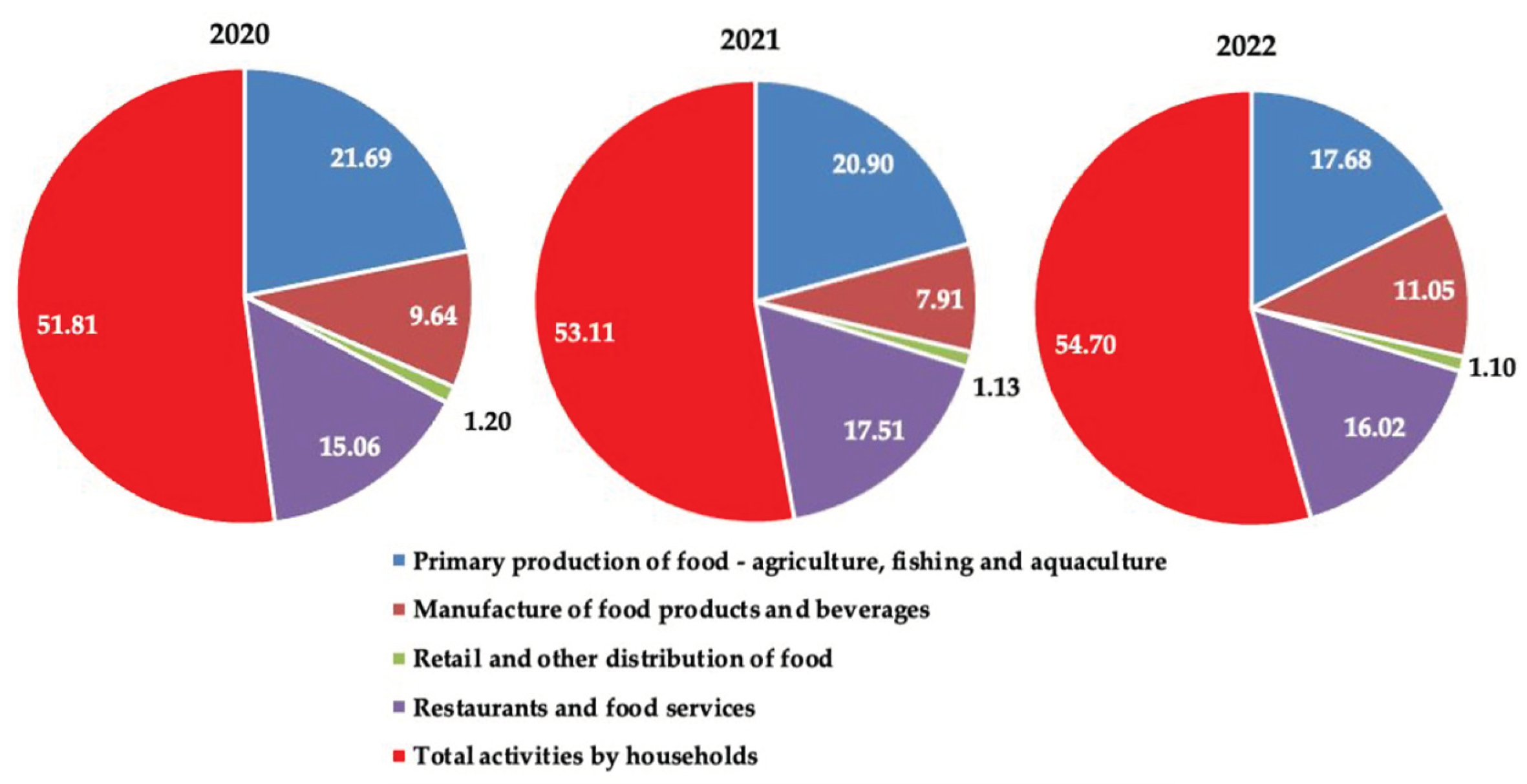
Figure 2.
Regression coefficients of Model 1. RFS as a causal variable. Source: Original by authors.
Figure 2.
Regression coefficients of Model 1. RFS as a causal variable. Source: Original by authors.
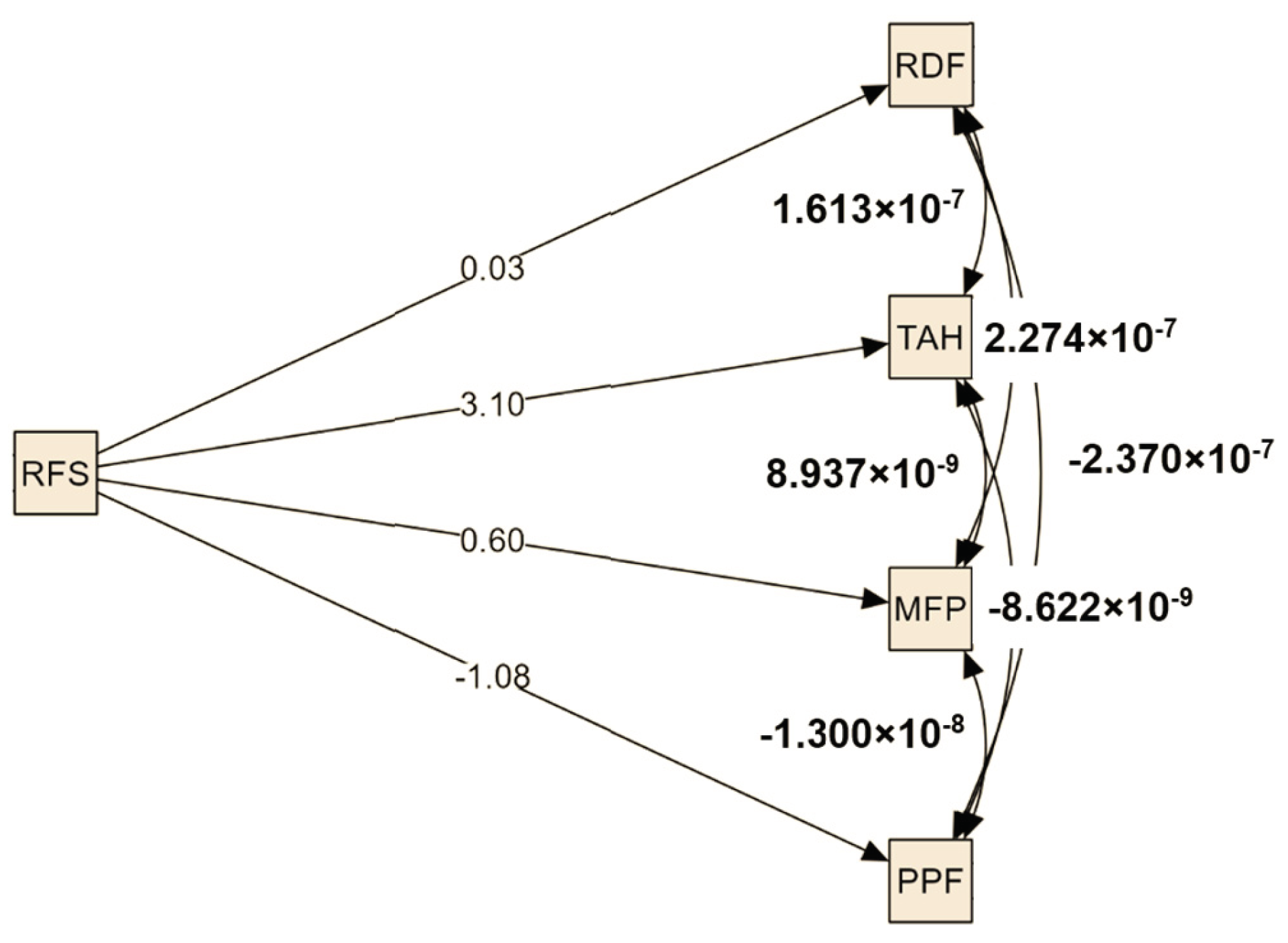
Figure 3.
Regression coefficients of Model 2 TAH as a causal variable. Source: Original by authors.
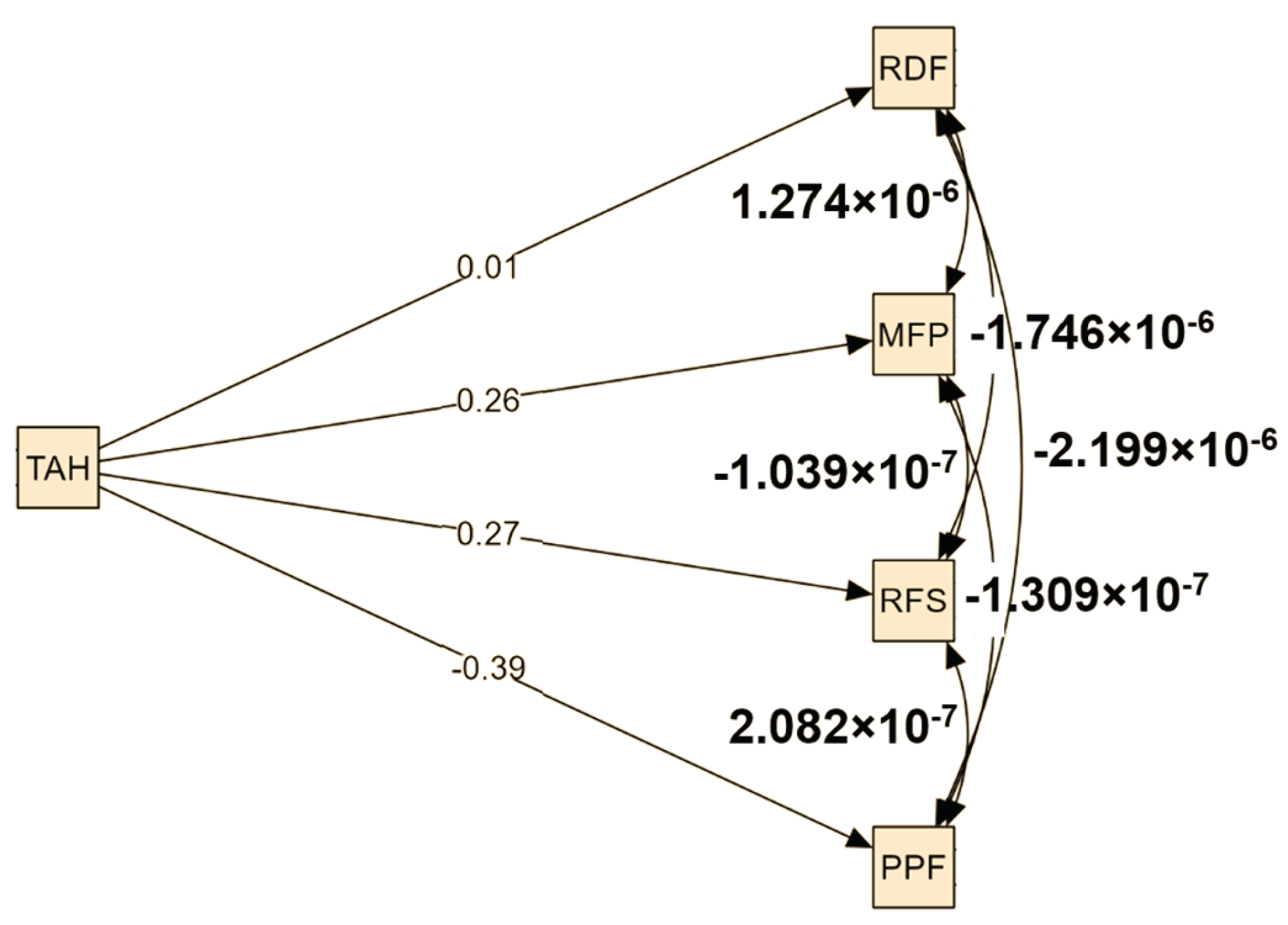
Figure 4.
Conceptual model illustrating the ethical transition frameworks linking food ethics, food waste, and food security. Source: Original by authors.
Figure 4.
Conceptual model illustrating the ethical transition frameworks linking food ethics, food waste, and food security. Source: Original by authors.
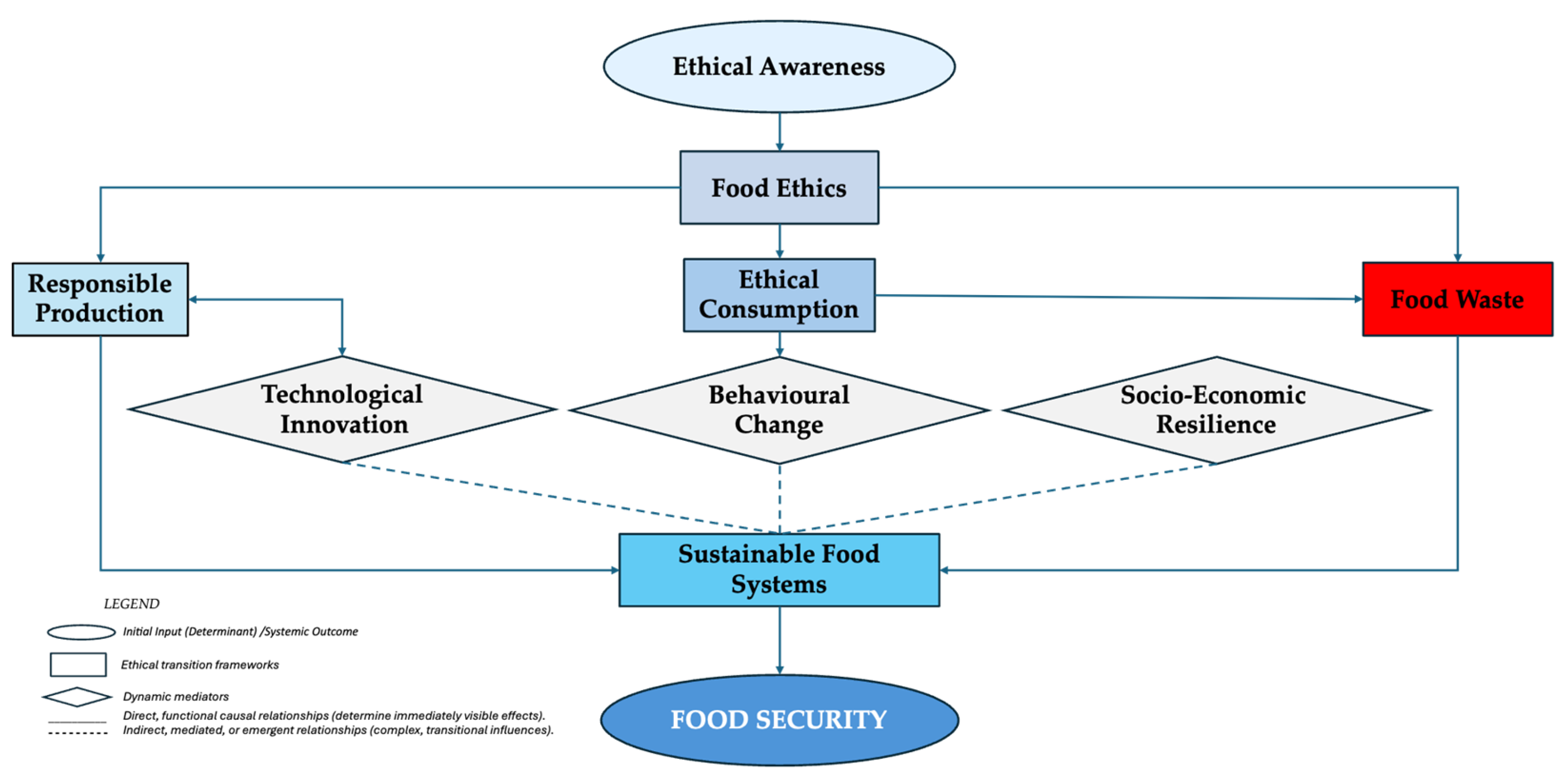
Figure 5.
The five pillars of food security. Source: Original by authors.
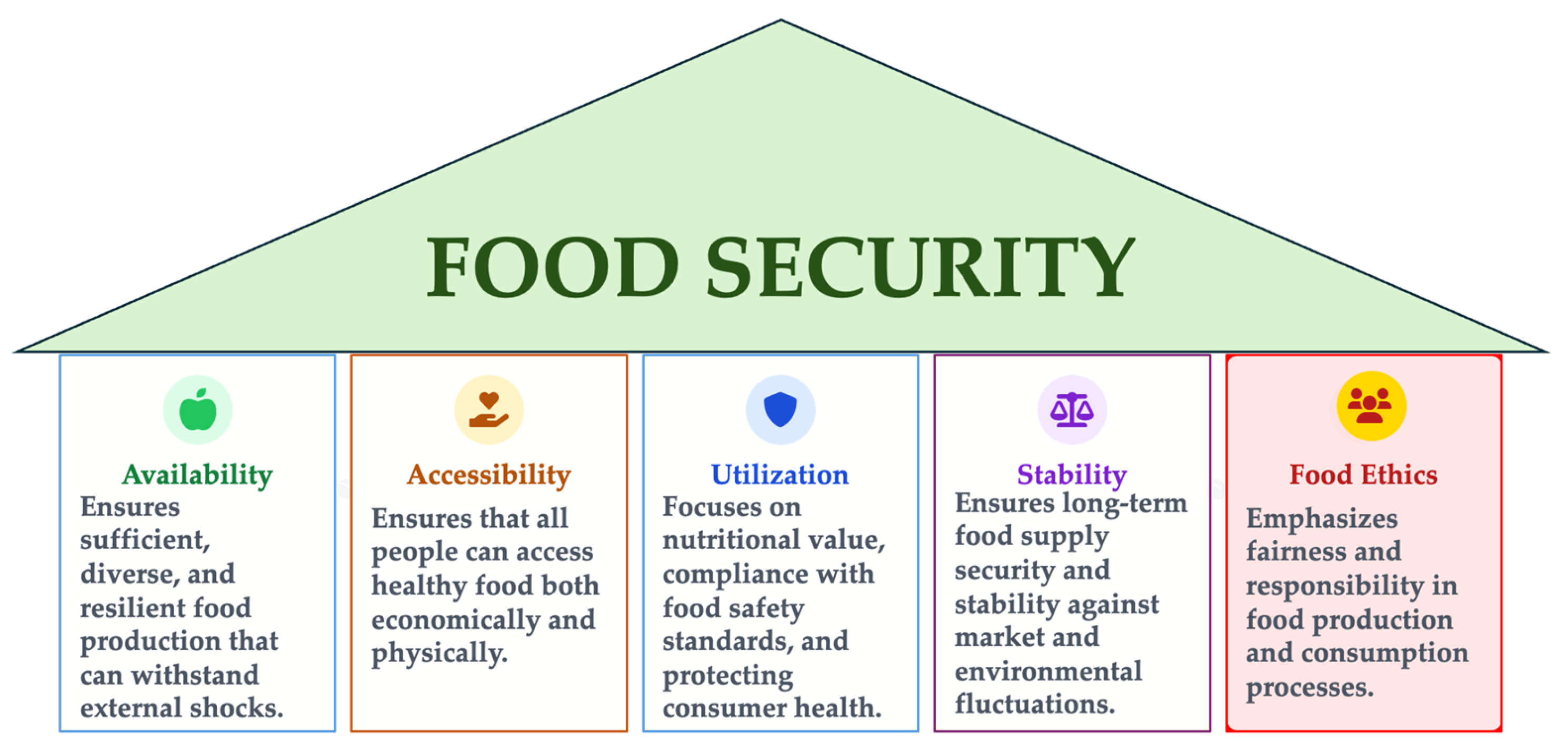

Table 1.
Food waste in Romania by sector in tons [37].
Table 1.
Food waste in Romania by sector in tons [37].
| Year | Total | Primary production of food - agriculture, fishing and aquaculture | Manufacture of food products and beverages | Retail and other distribution of food | Restaurants and food services |
Total activities by households | |
|---|---|---|---|---|---|---|---|
| 2020 | 3,201,048 | 699.92 | 316,507 | 39,787 | 485,827 | 1,659,007 | |
| 2021 | 3,392,056 | 699.92 | 268,349 | 36.51 | 589,365 | 1,797,912 | |
| 2022 | 3,452,143 | 613,337 | 375,577 | 42,864 | 543,244 | 1,877,121 |
Table 2.
Food waste in Romania by sector in kg/capita [37].
Table 2.
Food waste in Romania by sector in kg/capita [37].
| Year | Total | Primary production of food - agriculture, fishing and aquaculture | Manufacture of food products and beverages | Retail and other distribution of food | Restaurants and food services |
Total activities by households |
|---|---|---|---|---|---|---|
| 2020 | 166 | 36 | 16 | 2 | 25 | 86 |
| 2021 | 177 | 37 | 14 | 2 | 31 | 94 |
| 2022 | 181 | 32 | 20 | 2 | 29 | 99 |
Table 3.
Percentage contribution of food waste from food chain segments to the variation in total waste.
Table 3.
Percentage contribution of food waste from food chain segments to the variation in total waste.
| Segment | Ci (2021-2020) (%) | Ci (2022-2021) (%) |
|---|---|---|
| PPF | 0.00 | 26.60 |
| MPF | 16.39 | 32.94 |
| RDF | 1.12 | 1.95 |
| RFS | 35.23 | 14.17 |
| TAH | 47.27 | 24.33 |
Table 4.
The values of the correlation coefficients r and the determination coefficients R2 between the annual series of each food chain segment and the annual series of total waste.
Table 4.
The values of the correlation coefficients r and the determination coefficients R2 between the annual series of each food chain segment and the annual series of total waste.
| Segment | r | R2 |
|---|---|---|
| PPF | -0.69 | 0.47 |
| MPF | 0.29 | 0.08 |
| RDF | 0.21 | 0.04 |
| RFS | 0.77 | 0.59 |
| TAH | 0.99 | 0.98 |
Table 5.
The values of the regression coefficients β and the coefficients of determination R2 used to analyze the interactions of food waste between food chain segments, considering RFS as the causal variable.
Table 5.
The values of the regression coefficients β and the coefficients of determination R2 used to analyze the interactions of food waste between food chain segments, considering RFS as the causal variable.
| Predictor | Outcome | β | R2 |
|---|---|---|---|
| RFS | PPF | -1.079 | 0.621 |
| RFS | MPF | 0.604 | 0.343 |
| RFS | TAH | 3,100 | 0.836 |
| RFS | RDF | 0.029 | 0.275 |
Table 6.
Residual covariance values used to describe interactions between economic sectors regarding food waste, considering RFS as the causal variable.
Table 6.
Residual covariance values used to describe interactions between economic sectors regarding food waste, considering RFS as the causal variable.
| Interaction | Residual covariances |
|---|---|
| PPF - MFP | -1,300×10-8 |
| PPF - TAH | -8.622×10⁻⁹ |
| PPF - RDF | -2.370×10⁻⁷ |
| MFP - TAH | 8.937×10⁻⁹ |
| MFP - RDF | 2.274×10⁻⁷ |
| TAH - RDF | 1.613×10⁻⁷ |
Table 7.
The values of the regression coefficients β and the coefficients of determination R2 used to analyze the interactions of food waste between food chain segments, considering TAH as the causal variable.
Table 7.
The values of the regression coefficients β and the coefficients of determination R2 used to analyze the interactions of food waste between food chain segments, considering TAH as the causal variable.
| Predictor | Outcome | β | R2 |
|---|---|---|---|
| TAH | PPF | -0.392 | 0.941 |
| TAH | RFS | 0.270 | 0.836 |
| TAH | MPF | 0.263 | 0.746 |
| TAH | RDF | 0.014 | 0.680 |
Table 8.
Residual covariance values used to describe interactions between economic sectors regarding food waste, considering TAH as the causal variable.
Table 8.
Residual covariance values used to describe interactions between economic sectors regarding food waste, considering TAH as the causal variable.
| Interaction | Residual covariances |
|---|---|
| PPF - RFS | 2.082×10⁻⁷ |
| PPF - MFP | -1.309×10⁻⁷ |
| PPF - RDF | -2.199×10⁻⁶ |
| RFS - MFP | -1.039×10⁻⁷ |
| RFS - RDF | -1.746×10⁻⁶ |
| MFP - RDF | 1.274×10⁻⁶ |
Disclaimer/Publisher’s Note: The statements, opinions and data contained in all publications are solely those of the individual author(s) and contributor(s) and not of MDPI and/or the editor(s). MDPI and/or the editor(s) disclaim responsibility for any injury to people or property resulting from any ideas, methods, instructions or products referred to in the content. |
© 2025 by the authors. Licensee MDPI, Basel, Switzerland. This article is an open access article distributed under the terms and conditions of the Creative Commons Attribution (CC BY) license (http://creativecommons.org/licenses/by/4.0/).
Copyright: This open access article is published under a Creative Commons CC BY 4.0 license, which permit the free download, distribution, and reuse, provided that the author and preprint are cited in any reuse.


