

Submitted:
06 November 2025
Posted:
07 November 2025
You are already at the latest version
Abstract
Capsicum annuum L. is a solanaceous vegetable with the widest cultivation area in the world. In recent years, the issue of soil salinization has grown increasingly acute, severely restricting the growth and development of plants. Hence, reinforcing the cultivation and utilization of salt tolerance pepper varieties, as well as the research on the salt tolerance mechanism of pepper, holds significant importance for enhancing the quality and yield of peppers and further developing and utilizing peppers in saline–alkali lands. This study reviews the characteristics of stress injury under pepper salt stress, the evaluation and identification methods of pepper salt tolerance, the research progress of related pepper salt tolerance mechanisms, and the research progress of pepper salt tolerance cultivation technology. It summarizes the current status of pepper salt tolerance traits research, intending to provide a theoretical reference for further research on pepper salt tolerance and the cultivation of pepper varieties with strong salt tolerance and excellent comprehensive traits.
Keywords:
salt stress
; Capsicum annuum
; evaluation of salt tolerance
; physiological mechanism of salt tolerance
; cultivation management
1. Introduction
Soil salinization is a process of continuous accumulation of soluble salts on the soil surface, resulting in deterioration of its chemical and physical properties. Unsustainable agricultural practices such as inappropriate cultivation and fertilization accelerate soil salinization, thus restraining crop yield and quality [1,2]. Plants suffer from physiological drought under saline conditions due to the high soil osmotic pressure, which impairs water uptake and disrupts normal physiological processes [3]. This sometimes causes tissue senescence and plant death. Moreover, previous studies have reported that excessive soil salinity not only changes microbial community structure and enzyme activities but also decreases SOC content and crop productivity. In serious cases, it can hasten soil desertification [4]. The FAO estimated that about 1.38 billion hectares of land — 10.7% of the world's total area — are salinized. Of the 1.73 billion hectares of arable land worldwide, nearly 25% has been suffering from salt stress. Simultaneously, unsustainable human activities, poor irrigation measures, and irrational fertilizer application are exacerbating the soil salinization further [5].
Pepper (Capsicum annuum L) is a highly valued vegetable crop belonging to the annual or semi-perennial species of the Capsicum genus under the Solanaceae family. It is rich in bioactive compounds, including vitamin C, carotenoids, and capsaicin, responsible for a sharp pungency that gives a special flavor and has several health benefits, such as anti-inflammatory and anti-cancer activity [6]. Due to these properties, pepper is extensively used in pharmaceuticals, condiments, and cosmetics [7]. It is considered one of the most economically and culturally important vegetable crops in the world [8].
However, pepper cultivation is confronting serious challenges due to soil salinization. In many areas, small natural precipitation, a lack of leaching from cultivated soils, and strengthened secondary salinization have resulted in the expansion of saline-alkali land every year. Similar to most vegetable crops, such as beans, carrots, eggplants, and tomatoes, pepper has a relatively low threshold for soil salinity, mostly with an electrical conductivity of the saturated paste extract (ECt) ranging between 1 and 2.5 dS m⁻¹ [9]. Salt stress seriously inhibits its growth, yield, and quality [10]. Therefore, It is very important to breed salt-tolerant pepper varieties to improve productivity in saline-affected areas and ensure the sustainable use of marginal lands.
This review systematically analyzes the current knowledge on salt tolerance mechanisms in pepper and strategies for improving its resistance. It will provide a scientific basis for the advancement of cultivation techniques, screening, and breeding salt-tolerant genotypes, thus promoting the effective use of saline-alkali soils.
2. The Impact of Salt Stress on the Growth and Development of Pepper
Currently, research on salt stress in peppers has primarily focused on the germination and seedling stages, during which phenotypic characteristics and physiological indicators of different pepper varieties undergo varying degrees of change. [11]. Under salt stress, germination rate, germination potential, and germination index all decreased with increasing duration of salt treatment and concentration, while root length and lateral root number correspondingly diminished [12]. Pepper seedlings exhibit heightened sensitivity to salt stress during their early growth stage [13]. On the one hand, this damage manifests as morphological changes, such as reduced leaf size, intensified leaf colouration, yellowing, and wilting of foliage [14]. On the other hand, physiological indicators such as leaf water content and relative electrical conductivity, alongside biochemical indicators like enzyme activity, were significantly reduced. This severely impaired the growth of the peppers, subsequently affecting flowering and fruiting, ultimately leading to a decline in both yield and quality [14]. Research indicates that when seedlings are exposed to 100 mM and 200 mM sodium chloride, their growth and development are significantly inhibited. As salt concentration increases, this inhibitory effect becomes more pronounced [15]. Additionally, under a 200 mM NaCl treatment, the number of flower buds and branches in pepper plants displayed a notable increase, indicating a reduced growth period for these plants [15].
3. Evaluation and Identification of Salt Tolerance Traits of Pepper
The seed germination period is one of the phases that is most susceptible to salt stress throughout the entire growth and development of crops [16]. A great deal of research shows that the salt tolerance of seeds at the germination stage can reflect the salt tolerance that will be displayed at other stages [17]. During the seed germination period, indicators such as the germination rate, germination potential, germination index, and relative salt injury rate are typically measured to evaluate the seed germination status [18,19]. Relevant studies treated pepper seeds with a concentration gradient of 30 mM NaCl, under 30 mM NaCl treatment the germination rate, relative germination rate, relative germination potential, and germination index of 10 of the 23 pepper varieties were increased, while there were no significant decreases in the indexes of 2 pepper seeds compared to the control [20]. With the increase in NaCl concentration, the germination rate, relative germination rate, relative germination potential, and germination index of 16 of the 23 seeds were all decreased under the 180 mM NaCl treatment, while the salt concentrations tolerated by different pepper varieties at the germination stage varied [20]. Moreover, the relative salt injury rate serves as a crucial indicator for assessing germplasm salt tolerance. This study categorised pepper salt tolerance into five grades—1, 3, 5, 7, and 9—based on the relative salt injury rates of different varieties, providing a significant basis for evaluating salt tolerance in pepper germplasm [21].
Research into salt tolerance during the seedling stage holds considerable significance for enhancing both yield and quality in pepper cultivation. The impairments caused by salt stress to pepper seedlings are visually manifested in certain phenotypes, such as leaf shape, leaf color, and the petiole, among others [22]. Certain research has employed nutrient solution hydroponics to investigate the morphological characteristics of pepper varieties subjected to salt stress. After salt stress treatment, the alterations in pepper plants primarily manifested in leaf color (leaf yellowing), leaf morphology (leaf drooping, leaf edge curling, wilting), petiole morphology (petiole browning), leaf abscission, stem morphology, and so forth. Furthermore, with the elongation of the salt treatment time, the phenotypic changes became more pronounced [22].
Additionally, the current certification method that is domestically used for salt tolerance in pepper mainly comprises the detection of physiological and biochemical indicators, such as chlorophyll, malondialdehyde, free proline, soluble sugar, soluble protein content, and related enzyme activities (including peroxidase, superoxide dismutase, etc.), in plant leaves [23,24]. Furthermore, it also involves the detection of the sodium and potassium ion contents in pepper plants. After salt treatment, the sodium ion contents in different parts of pepper plants increase, and the more pronounced the increase, the greater the damage to the plants [25]. Although the aforementioned physiological and biochemical indicators can precisely reflect the effects of salt stress on pepper seedlings, the determination of these indicators also involves certain issues, such as high determination costs and significant destructiveness to pepper seedlings. The Innovation Team of Fujian Agriculture and Forestry University designed and constructed a high-throughput platform capable of simultaneously collecting multi-fluorescence (multicolor-fluorescence, MF) and multi-spectral reflectance (multispectral reflectance, MF) images of plants. Through optical sensors, this platform can effectively provide plant morphological information, as well as biochemical and physiological information [26]. Compared with the traditional index measurement method, this method can solve the problem of the damage caused to pepper seedlings in measurement.
4. Research Advances Concerning the Salt Tolerance Mechanism of Pepper
In research on the salt tolerance of Solanaceae crops, it was discovered that pepper exhibits a lower salt tolerance in comparison to Solanum melongena L. and Solanum lycopersicum L. [34]. Therefore, investigating the mechanisms underlying pepper's response to salt stress holds significant practical importance for developing new pepper germplasm resources and enhancing both yield and quality. Presently, research into pepper's salt tolerance mechanisms by scholars both domestically and internationally has primarily focused on the following aspects.
4.1. Osmotic Regulation Mechanisms
Under salt stress conditions, the concentration of sodium ions (Na⁺) in the soil increases significantly, forming a steep concentration gradient at the soil-root interface [35]. Consequently, chilli plants activate self-regulating osmotic adjustment mechanisms to mitigate this gradient and maintain physiological functions. Changes in cell membrane permeability—typically assessed through indicators such as relative leaf conductance and malondialdehyde content—constitute a pivotal component of this adaptive process [36].
Plant cell membranes contain multiple ion transporters capable of regulating the flux of sodium ions (Na⁺) and potassium ions (K⁺). For instance, components of the salt over-sensitivity (SOS) signaling pathway—including SOS1 and HKT-type transporters—facilitate the efflux of sodium ions from the cytoplasm [37]. Concurrently, NHX-type transporters promote sodium ion influx into vacuoles or other organelles. Under high sodium conditions, plants typically reduce sodium influx via non-selective cation channels (NSCCs) while enhancing sodium efflux and vacuolar compartmentalisation [8]. Salt stress also promotes sodium influx through NSCCs, which activates outwardly rectifying potassium channels and stimulates potassium efflux. The plasma membrane H+-ATPase generates a proton motive potential by expelling protons, driving sodium/proton countertransport systems such as SOS1 to achieve sodium efflux [38]. The resulting proton flux further promotes membrane potential repolarisation, inhibits potassium leakage through KOR channels, and facilitates potassium reabsorption (KIRC), collectively maintaining ionic homeostasis [39].
To maintain an optimal Na⁺/K⁺ ratio and support normal metabolism, plants selectively absorb and distribute inorganic ions such as Na+, K+, Cl-, and NO3- [40]. Research indicates that Na+ accumulates simultaneously in the roots of both salt-tolerant and sensitive pepper genotypes. For instance, after 14 days of exposure to 70 mM sodium chloride, the salt-tolerant cultivar “A25” exhibited more pronounced root Na+ accumulation than the sensitive line – a trait potentially linked to enhanced compartmentalisation within vesicles or vacuoles [41]. This ion accumulation not only aids osmotic regulation but also maintains turgor pressure, thereby enhancing salt tolerance [42,43]. Furthermore, calcium ions (Ca2+), as key signaling molecules in plant stress responses, participate in salt stress signal transduction and regulate the expression of stress-related genes [44].
The integrity of the cell membrane system is crucial for maintaining the metabolic activities, physiological functions, and osmotic balance of plant cells and organelles. Under salt stress conditions, membrane integrity is typically assessed through indicators such as leaf relative electrical conductivity (closely related to membrane permeability) and malondialdehyde (MDA) content, with MDA levels reflecting the degree of membrane lipid peroxidation [28]. Studies on salt-stressed pepper plants indicate that leaf relative electrical conductivity typically rises initially before declining, whereas MDA content continues to increase with prolonged stress duration. This pattern suggests that extended salt stress enhances membrane permeability and exacerbates oxidative damage [45].
When subjected to osmotic stress, plants accumulate osmotic regulatory substances such as soluble proteins, soluble sugars, and free proline, thereby mitigating the damage caused by salt stress by reducing intracellular osmotic pressure. The levels of these osmolytes generally exhibit a biphasic response, increasing initially under moderate or short-term stress but declining as stress intensity or duration escalates [46,47]. Moreover, salt tolerance in pepper has been linked to efficient chloride ion exclusion, which reduces Cl⁻ accumulation in leaves. This mechanism helps preserve photosynthetic function by minimizing ion-specific toxicity within photosynthetic tissues.
4.2. Regulatory Mechanisms of the Antioxidant System
Certain substances with potent oxidizing properties are found in plants, including ROS. When plants are exposed to adverse circumstances, the equilibrium of the metabolic system regulating the ROS content within the cell will be disrupted, and the antioxidant system will come into operation [48]. This boosts the actions of different antioxidant enzymes that operate to get rid of the ROS to ensure that the plants are growing and developing normally [49]. Under the influence of xanthine oxidase, ROS will generate superoxide anion radicals, which can oxidize and degrade lipids and proteins. SOD is capable of catalyzing the disproportionation reaction of superoxide anion radicals so as to maintain normal physiological functions in plants [50]. Research indicates that when plants are subjected to salt stress, the SOD activity of peppers with poor salt stress resistance will decline, while the SOD activity of plants with strong resistance to saline–alkali environments will increase to eliminate the superoxide anion radicals generated within the body, inhibit the occurrence of membrane lipid peroxidation, and maintain the stability of the intracellular environment; however, as the intensity of the stress deepens, this activity diminishes [51]. Peroxidase is an antioxidant enzyme that cooperates with SOD to decompose the H2O2 produced by the disproportionation reaction of SOD [52]. Studies have demonstrated that the elongation of salt treatment time leads to a gradual increase in POD activity in the leaves of some pepper varieties, somewhat reducing the damage caused by salt to the membrane system of pepper seedlings [53]. In addition, after researchers inoculated the rhizosphere of pepper plants with Magnaporthe oryzae, the activities of peroxidase and ascorbate peroxidase, along with the transcriptional levels of related genes (such as ascorbate peroxidase, peroxidase, etc.), were all significantly upregulated, and this decreased the contents of malondialdehyde and reactive oxygen species in the plants [54]. These findings suggest that when pepper plants are subjected to damage by a salt environment, ion homeostasis is enhanced and the antioxidant defense system is upregulated to mitigate damage [54]. Ethylene response factor (ERF) transcription factors play a critical role in plant responses to salt stress. In chili pepper, for instance, the AP2/ERF-type transcription factor CaERF2 has been shown to enhance salt tolerance by modulating reactive oxygen species (ROS) homeostasis [55]. Under adverse environmental conditions, heat shock transcription factors (HSFs) activate the expression of heat shock proteins (HSPs). These proteins help maintain protein folding homeostasis by binding to misfolded or aggregated proteins, facilitating their restoration to native conformation and thereby minimizing cell damage caused by aggregation. Research indicates that the small heat shock protein CaHsp25.9 significantly enhances plant tolerance to high temperatures, salt stress, and drought stress by reducing reactive oxygen species (ROS) accumulation, enhancing antioxidant enzyme activity, and upregulating the expression of key stress-related genes [56].
4.3. Regulatory Mechanism of Photoreceptors
Light is an indispensable key element in the plant environment, playing a vital role in regulating plant growth and responding to abiotic stresses. Research indicates that factors interacting with phytochromes (PIFs) suppress plant salt tolerance. Under light conditions, phytochrome A (phyA) and phytochrome B (phyB) within plants become activated, thereby enhancing the activity of SOS2 kinase [53]. SOS2 interacts with the photosensitive pigment-interacting factors PIF1 and PIF3, degrading them, thereby eliminating their inhibitory effect on plant salt tolerance. This enhances the plant's stress resistance and adaptation to salt stress [53]. Research has revealed that under salt stress conditions, CaPIF8 exerts a positive effect on enhancing salt tolerance by promoting the expression of key abscisic acid (ABA) biosynthesis genes [57]. In a related study, pepper seedlings at the stage six pieces of true leaves were treated with a 50 mM NaCl concentration gradient (maximum concentration 200 mM), and their photosynthetic rate, fluorescence parameters, and chlorophyll content were measured after treatment. The results show that, with the increase in NaCl concentration and the extension of NaCl treatment time, the net photosynthetic rate and chlorophyll content of pepper leaves decreased, the initial fluorescence Fo increased, and the maximum light energy conversion efficiency Fv/Fm of PSII decreased [58].
Moreover, relevant studies have demonstrated that short-term salt treatment can facilitate the rise in chlorophyll content in pepper leaves, enhance plant photosynthesis, and improve plants’ abilities to resist external salt stress within a short period [8]. Nevertheless, as the treatment time and concentration increase, the chlorophyll content in pepper leaves gradually declines; the degree of decline in varieties with strong salt tolerance is smaller than that in varieties with weak salt tolerance [49].
4.4. Regulatory Mechanism of Signal Transduction
Signal transduction-regulating mechanisms employ many different signals, including ion signaling and hormone signaling. Under salt stress conditions, in addition to sodium and potassium ions, calcium ions act as one of the important salt signals [59]. In plant cells, calcium ions can function as secondary messengers in the transmission of signals in response to a range of abiotic stimuli known to cause adversity [60]. They can be classified into two major types based on whether Ca2+ participates in the signal transduction of plant salt stress. First, there is the Ca2+-dependent signal transduction pathway, which is further classified into two categories: Type I and Type II. The Type I Ca2+-dependent signal transduction pathway mainly comprises the Salt Overly Sensitive (SOS) signal transduction pathway and the Calcium-dependent Protein Kinase (CDPK) cascade reaction pathway [61]. The Type II Ca2+-dependent signal transduction pathway mainly encompasses the abscisic acid (ABA) signal pathway and the phospholipid signal pathway. The second type of signal involves the MAPK cascade reaction pathway, namely, the Ca2+-independent signal transduction pathway [62].
4.4.1. Ca2+-Dependent Signaling Pathways
The SOS signal pathway is a representative mechanism that plants have evolved in adaptation to salt stress. SOS1 controls the Na+/H+ exchange activity by encompassing a broad cytoplasmic domain (CPD), which contrasts it with conventional sodium/proton exchangers [63]. The research provided a molecular basis to explain the mechanism of SOS1-regulated transporter activity as well as the cultivation of salt resistance in plants by studying the structural and functional activities of SOS1 in plants [63]. One of the six main phytohormones, abscisic acid (ABA), is essential to how plants react to harmful external stressors. In response to external adverse stress, regulatory elements that promote ABA synthesis express themselves at higher levels in plants, whereas those that promote ABA breakdown express themselves at lower levels[8]. Meanwhile, the stress activation of ABA biosynthesis genes and the expression genes that feedback and stimulate ABA biosynthesis are all mediated by Ca2+-dependent phosphoprotein cascade reactions [64]. Studies have demonstrated that in under NaCl stress, potassium ions efflux, leading to the closure of the stomata of plant leaves and a decrease in the photosynthetic rate, and at the same time, the ABA content is reduced and the IAA content is increased. The downstream transmission of IAA signals enables guard cells to absorb potassium ions [65]. Thus, under conditions of salt stress, potassium ions interact with calcium signals, IAA, and ABA hormone signals and promote stomata opening. Additionally, potassium ions can control antioxidant enzymes to get rid of the excess ROS introduced by salt stress, which controls the salt tolerance of plants [66].
4.4.2. Mitogen-Activated Protein Kinase (MAPK) Cascade Pathway
The MAPK signaling pathway is essential to pepper growth, and its effects are mostly seen in the contexts of growth and development, as well as in the plant's response to stress [67]. Recent studies have identified specific components of the MAPK signaling cascade (e.g., CaAIMK1) in pepper that can interact with other proteins to synergistically regulate osmotic stress responses [68,69]. In addition, the MAPK kinase CaDIMK1 has been shown to play a role in the signaling pathway in pepper [70]. While the specific downstream targets of MAPKs in pepper remain unknown, the control of the MAPK cascade signaling network is mediated by specific transcription factors, such as WRKYa [71]. Relevant genome-wide studies have found that raf-like proteins involved in the MAPK cascade play important roles in a variety of signaling pathways [72], and the specificity of the MAPK cascade signaling pathway in peppers also plays an important role in regulating the defense responses of peppers to pathogens [73,74]. In addition, the activation of MAPK cascade responses, such as CaADIK1, is also required to facilitate the ethylene signaling pathway in fruit development [75]. The MAPK cascade pathway of pepper is a complex signaling network, and its defense-related genes and pathways have been revealed by certain analytical methods and techniques (such as transcriptomic analysis) to play a crucial role in the growth, development and stress response of pepper.
5. Research Advances in Salt Tolerance Genes Associated with Pepper
Currently, research concerning the molecular mechanisms of salt tolerance associated with pepper predominantly centers on the identification and functional investigation of salt tolerance genes in pepper. Researchers have identified certain genes and proteins associated with the salt tolerance of pepper via techniques such as transcriptomics, proteomics, and genomics.
The development of salt tolerance in pepper is closely linked to the expression of specific functional genes. Through genome-wide identification and bioinformatics analysis of the SBP-box gene family in pepper, combined with virus-induced gene silencing (VIGS) experiments, researchers have preliminarily revealed that two differentially expressed genes, CaSBP11 and CaSBP12, function as positive regulators under salt stress [76].
In another study based on the whole-genome data of the pepper cultivar ‘Zunla-1’, the expression patterns of NAC family genes were analyzed in leaves of a salt-tolerant inbred line ‘H1023’ and a salt-sensitive line ‘XWHJ-M’ under varying durations of stress treatment. The results suggest that NAC genes may regulate multiple physiological processes in pepper, including hormone signaling and abiotic stress responses. Quantitative real-time PCR analysis demonstrated that CaNAC61 responds to all six abiotic stresses tested, indicating a potential role in pepper adaptation to salt stress [77].
Further characterisation of the pepper B-box (BBX) transcription factor family revealed that under salt stress conditions, the expression of CaBBX4, CaBBX5, CaBBX7, and CaBBX10 was significantly upregulated. Conversely, CaBBX1, CaBBX2, CaBBX6, and CaBBX9 exhibited fluctuating expression patterns throughout the time course of treatment [78].
The bHLH transcription factor family plays a crucial role in regulating plant responses to abiotic environmental stresses [79]. Studies indicate that transient expression of CabHLH035 enhances pepper tolerance to external salt stress, whereas reduced expression diminishes salt resistance. Furthermore, CabHLH035 binds to the promoter regions of CaSOS1 and CaP5CS genes, directly and significantly activating their expression. Collectively, CabHLH035 exerts a pivotal role in the pepper's response to external salt stress by regulating the intracellular sodium-potassium ion ratio and proline synthesis [79]. Photochromin interaction factors (PIFs) in the HLH family of transcription factors are negative regulators of photomorphogenesis. By silencing CaPIF4 in peppers, it was found that the dynamic balance between ROS formation and the clearance ability of the antioxidant defense system was disrupted, thereby enhancing salt tolerance. In addition, after the silencing of CaPIF8, the expressions of the CBF1 and ABA biosynthesis genes were inhibited, and the resistance of pepper plants to salt stress was reduced [57,80].
Research has shown that heterologous overexpression of the pepper transcription factor CaPF1 (Pathogen and Cold Tolerance-related Protein 1) significantly improves tolerance to drought, freezing, and salt stress in Pinus densiflora [81]. Another transcription factor, RAV1, originally identified from Xanthomonas-infected leaves, has been demonstrated to play an essential role in resistance to bacterial infection, drought, and salt stress [82]. Similarly, the pepper transcription factor CabZIP1 acts as a core regulatory element, enhancing plant resistance to pathogen invasion and environmental stress [83]. Subsequent studies revealed a physical interaction between the redox enzyme CaOXR1 and CaRAV1, which is crucial for pepper adaptation to salt and osmotic stress [84]. Furthermore, the capsicum RING-type E3 ubiquitin ligase CaFIRF1 (Capsicum annuum FAF1-interacting RING-finger protein 1) has been demonstrated to interact with CaFAF1 and mediate its ubiquitination, thereby promoting degradation of this protein. Under high salt stress conditions, plants with the CaFIRF1 gene silenced exhibited enhanced salt tolerance [85]. Parallel in-gel kinase assays revealed that CaSnRK2.6 phosphorylates CaSAP14 under ABA, dehydration, and high-salinity stress, confirming CaSAP14 as a direct substrate of CaSnRK2.6 and a positive regulator of osmotic stress adaptation [86]. Collectively, the identification and functional analysis of these genes deepen our understanding of the molecular basis underlying salt tolerance in pepper.
Pepper plants display a considerable increase in the expressions of several genes involved in the SOS pathway and the scavenging of reactive oxygen species (ROS) under conditions of external salt stress. In addition, after salt treatment, the roots of varieties salt tolerance expressed more ROS clearance and SOS pathway genes than the roots of salt-sensitive varieties [87]. After silencing the CaAnn9 gene through VIGS and subjecting pepper seedlings to salt stress treatment, it was discovered that the silenced seedlings were more susceptible to salt, with the accumulation of ROS being one of the biochemical indicators of this [88]. Genes in the CUL family have been identified in pepper. After treating pepper seedlings with NaCl, it was found that CUL genes are essential to plant responses to external salt stress since it was discovered that most of them show altered expression levels in both roots and leaves, albeit to different degrees [89]. Studies have shown that CaCP15 functions as a negative regulator of salt and osmotic stress tolerance in pepper, likely through modulating reactive oxygen species (ROS) scavenging processes [90]. Meanwhile, MADS-box transcription factors, known for their crucial roles in plant growth and development, also contribute to stress adaptation. Among them, CaMADS has been identified as a positive regulator in response to cold, salt, and osmotic stress [91]. In addition, CaLEA1 enhances drought and salinity tolerance via an ABA-mediated cellular signaling pathway [92].
Besides the aforementioned, there are also transcription factors, such as MYB, BBX, AP2/ERF, that may play substantial roles in peppers' responses to external salt stress [93]. Furthermore, other genes have also been found, such as CaFtsH06, PepRSH, CaXTH3, CaBZ1, and related ones [94,95]. Some proteins, such as CaHsp25.9, act as vesicles for the formation-related protein CaSec16 [96,97]. Some studies have also found that certain microRNAs (miRNAs) play vital roles in the salt tolerance of peppers.
Overall, certain advancements have been achieved in the ongoing research regarding the molecular mechanisms of salt tolerance in peppers. Nevertheless, more in-depth investigations are still required to reveal the molecular mechanisms of salt tolerance in peppers and to furnish a theoretical foundation for cultivating pepper varieties with salt tolerance.
6. Research Advances in the development of Cultivation Techniques for Pepper Resistant to Saline–Alkali Soil
The research on techniques for cultivating peppers with salt tolerance has been progressing gradually, and has mainly focused on the selection and breeding of varieties with salt tolerance, the utilization of relevant substances with salt tolerance, and the implementation of these practices in cultivation management. Researchers, via large-scale screenings and genetic enhancement, have sought to develop pepper varieties with higher salt–alkali tolerances. These varieties possess a relatively elevated salt–alkali tolerance capacity, and are capable of growing and producing a relatively high yield in a high salt–alkali environment. A wide range of methods and approaches have been introduced to improve salt tolerance in crops, such as high-throughput phenotypic screening methods, molecular genetics, genetic engineering, and different types of “genomics” (genomics, transcriptomics, proteomics, microbiomics, etc.). However, transferring the desired traits via the cultivation of crops remains challenging [112].
6.1. The Application of Relevant Salt Tolerance-Regulatory Substances
Researchers have explored the physiological response mechanisms of pepper under salt stress in order to explore the methods employed in regulating the internal ion balance and water content of plants. For example, studies have shown that certain pepper varieties salt tolerance can accumulate higher amounts of organic solutes, such as proline and soluble sugars, under salt stress, allowing them to maintain the intracellular osmotic balance [36]. The research has sought to determine the tolerance of pepper to salt stress via the application of salty irrigation water. Application of gibberellin via foliar spray can alleviate the adverse effects of salt stress on pepper growth parameters and yield [113]. Soaking the pepper germplasm in gamma-aminobutyric acid (GABA) could improve the salt tolerance of peppers at the seedling stage [114]. Spraying the leaf with salicylic acid and 5-aminolevulinic acid (ALA) is conducive to reducing the harmful effects of salt stress on pepper germplasms or seedlings, thereby resolving the problems related to the interference of endogenous hormones and the lack of available nutrients under salt stress, and generally enhancing the adaptability of pepper to these conditions [115,116,117]. Exogenous application of chlorophyll lactones (SLs) mitigates salt-induced accumulation of hydrogen peroxide (H2O2) and malondialdehyde (MDA), whilst alleviating the detrimental effects of salinity on chlorophyll content and photosynthetic performance [118]. Beyond plant hormone regulation, photoregulation—particularly red light LED pretreatment—has been demonstrated to enhance salt tolerance by improving water and carbon dioxide transport capacity, maintaining stomatal function, and strengthening antioxidant systems [119]. These findings provide practical strategies for sustainable crop management in environments prone to salinisation.
6.2. Application of the Grafting Techniques
Traditional breeding methods typically involve selecting superior varieties through natural variation or artificial mutagenesis, followed by techniques such as hybridisation to cultivate disease-resistant cultivars. Conversely, grafting technology can also effectively enhance plant stress tolerance. Research indicates that grafting pepper seedlings onto rootstocks with strong salt tolerance and normal photosynthetic function leverages the rootstock's extensive root system to ensure normal growth of both scion and rootstock, thereby increasing commercial yields [111]. The application of salt-tolerant rootstocks significantly increases pepper yields in saline-alkali soils by maintaining photosynthetic efficiency and nutrient uptake capacity. This advantage stems from elevated proline levels, which effectively stabilise enzyme activity and counteract salt-induced damage [136].
6.3. Methods for Soil Improvement
Implementing appropriate cultivation management practices is crucial for developing salt-tolerant chilli varieties. Soil improvement measures, such as organic matter and gypsum, can enhance the structure and properties of saline-alkali soils, thereby mitigating the adverse effects of salt stress on chilli growth. Furthermore, scientifically planned irrigation and drainage management, coupled with judicious selection of crop rotation and intercropping systems, can both reduce the impact of salt stress on chillies and improve soil workability [137,138]. These research findings provide a robust theoretical and practical foundation for developing salt-tolerant pepper varieties and harnessing the potential of saline-alkali soils.
7. Concluding Overview
Pepper (Capsicum annuum L.), as a crop of significant economic value, is widely cultivated and consumed globally. However, soil salinisation, triggered by climate change and the expansion of human activities, poses an increasingly severe threat to their cultivation and yield. Consequently, investigating the salt tolerance mechanisms of chilli peppers and developing strategies to enhance their tolerance and productivity in saline-alkali environments has become a critical research focus. Current pepper salt tolerance research faces three major challenges: Firstly, the absence of a systematic research framework has left the molecular regulatory networks governing salt stress responses poorly defined. Existing studies predominantly focus on individual genes or proteins, failing to establish comprehensive models. Secondly, methods for assessing salt tolerance across different varieties are inefficient. Current screening primarily relies on physiological and biochemical indicators, which are not only time-consuming and labour-intensive but also susceptible to environmental interference, operationally complex, and potentially damaging to seedlings. Thirdly, there is a scarcity of salt-tolerant varieties adapted to diverse agricultural environments. Although multiple salt-tolerance-associated genes have been identified, their application in breeding practices remains inadequate. Moving forward, it is imperative to systematically screen pepper germplasm resources for genotypes exhibiting salt stress tolerance, thereby enhancing yield and quality while ensuring robust plant growth in saline-alkali environments.
8. Future Perspectives
To unravel the mechanisms underlying salt tolerance in peppers, future research must advance in three key directions. Firstly, multi-omics technologies—including genomics, transcriptomics, and metabolomics—should be employed to systematically analyse gene expression changes in peppers under salt stress. It will help identify key salt-tolerant genes and signaling pathways, providing a comprehensive understanding of the associated molecular networks and regulatory mechanisms. Secondly, an efficient evaluation system for salt-tolerant cultivars should be established, enhancing testing efficiency while minimising damage to plant material. Finally, genetic improvement research is paramount. Through techniques such as genetic engineering, marker-assisted selection, and gene editing, we can not only develop pepper varieties with enhanced salt tolerance but also improve the salt resistance of existing cultivars while achieving overall yield increases.
In conclusion, current research on salt tolerance in peppers has established a complex and significant framework. Future studies should adopt a multi-faceted approach, aiming both to elucidate the molecular mechanisms underlying salt tolerance and to lay the theoretical groundwork for developing salt-tolerant pepper cultivars.
Author Contributions
Conceptualization, Lixi Deng; methodology, Lixi Deng and Yitong Chen; software, Yitong Chen; validation, Jingjing Zhao; formal analysis, Yitong Chen; investigation, Yani Chen; resources, Xue Li; data curation, Jingjing Zhao; writing—original draft preparation, Lixi Deng; writing—review and editing, Yitong Chen and Sixia Jiang; visualization, Lijun Ou and Yani Chen; supervision, Lijun Ou; project administration, Lixi Deng.; funding acquisition, Xudong Liu. All authors have read and agreed to the published version of the manuscript.
Funding
This research was funded by research Foundation for Scientific Scholars of Moutai Institute (mygccrc [2022]089, mygccrc [2022]088, mygccrc [2023]045), Guizhou Engineering Research Center for Specialty Food Resources (KY[2020]022).
Data Availability Statement
The original contributions presented in this study are included in this article. Further inquiries can be directed to the corresponding author.
Conflicts of Interest
The authors declare no conflict of interest.
References
- Machado, R.M.A.; Serralheiro, R.P.; Alvino, A.; Ferreira, M.I.F.R. Soil Salinity: Effect on Vegetable Crop Growth. Management Practices to Prevent and Mitigate Soil Salinization. Horticulturae 2017, 3. [Google Scholar] [CrossRef]
- Shi, X.; Li, H.; Lu, B.; Zhou, Y.; Zhao, J.; Zhao, M.; Liang, J.; Meng, H. Physiological Responses of Three Tartary Buckwheat Varieties to Salt Stress and Evaluation of Salt Tolerance. Crops 2022, 149–154. [Google Scholar] [CrossRef]
- Usman, B.; Derakhshani, B.; Jung, K.-H. Recent Molecular Aspects and Integrated Omics Strategies for Understanding the Abiotic Stress Tolerance of Rice. Plants 2023, 12, 2019. [Google Scholar] [CrossRef] [PubMed]
- Zied, H.; Tesfay, A.; DongGill, K.; Salem, B.; Jaehyun, L.; Wahida, G.; Yerang, Y.; Hojeong, K.; Kumar, J.M.; Arnab, B.; et al. Soil Salinity and Its Associated Effects on Soil Microorganisms, Greenhouse Gas Emissions, Crop Yield, Biodiversity and Desertification: A Review. Sci. Total Environ. 2022, 843. [Google Scholar]
- Park, H.J.; Kim, W.-Y.; Yun, D.-J. A New Insight of Salt Stress Signalingin Plant. Mol. Cells 2016, 39, 447–459. [Google Scholar] [CrossRef] [PubMed]
- Sa-ren-gao-wa; Hu W. ; Jiang A. Research process in pharmacological function and products of chilli. Sci. Technol. Food Ind. 2012, 33, 371–375. [Google Scholar] [CrossRef]
- Zou, X.; Ma, Y.; Dai, X.; Li, X.; Yang, S. Spread and Industry Development of Pepper in China. Acta Hortic. Sin. 2020, 47, 1715–1726. [Google Scholar] [CrossRef]
- López-Serrano, L.; Calatayud, Á.; López-Galarza, S.; Serrano, R.; Bueso, E. Uncovering Salt Tolerance Mechanisms in Pepper Plants: A Physiological and Transcriptomic Approach. BMC Plant Biol. 2021, 21, 169. [Google Scholar] [CrossRef]
- Behera, T.K.; Krishna, R.; Ansari, W.A.; Aamir, M.; Kumar, P.; Kashyap, S.P.; Pandey, S.; Kole, C. Approaches Involved in the Vegetable Crops Salt Stress Tolerance Improvement: Present Status and Way Ahead. Front. Plant Sci. 2021, 12, 787292. [Google Scholar] [CrossRef]
- Zheng, S. Advancing the Comprehensive Utilisation of Saline-Alkali Land Making the Most of Saline-Alkali Land for Specialised Agriculture 2023, 11.
- Liu, W.; Li, J.; Xu, R.; Guo, Y.; Zuan, Y.; Yang, Z.; Liu, Y. Effect of NaCl Stress on Seed Germination and Seedling Growth of Pepper. Mol. Plant Breed. 2024, 22, 5403–5414. [Google Scholar] [CrossRef]
- Ibrahim, E.A. Seed Priming to Alleviate Salinity Stress in Germinating Seeds. J. Plant Physiol. 2016, 192, 38–46. [Google Scholar] [CrossRef] [PubMed]
- R. , K.M.Iqbal.; Peter, P.; Tibor, J. Salicylic Acid: A Versatile Signaling Molecule in Plants. J. Plant Growth Regul. 2022, 41. [Google Scholar]
- Hu, H.; Du, L.; Zhang, R.; Zhong, Q.; Liu, F.; Gui, M. Research Progress in the Adaptation of Hot Pepper(Capsicum annuum L.)to Abiotic Stress. Biotechnol. Bull. 2022, 38, 58–72. [Google Scholar] [CrossRef]
- Du, X.; Li, S.; Yuan, X.; Cai, Z.; Gu, H.; Chen, X. High-salt Tolerance of Three Pepper Varieties(Capsicum annuum L.)by Salt Domestication. Acta Agric. Jiangxi 2022, 34, 57–64. [Google Scholar] [CrossRef]
- Shelke, D.B.; Pandey, M.; Nikalje, G.C.; Zaware, B.N.; Suprasanna, P.; Nikam, T.D. Salt Responsive Physiological, Photosynthetic and Biochemical Attributes at Early Seedling Stage for Screening Soybean Genotypes. Plant Physiol. Biochem. 2017, 118, 519–528. [Google Scholar] [CrossRef]
- Liu, W.; Gao, L.; Peng, J.; Zhang, X. Salt Tolerance Evaluation of Three Pepper Varieties in Qiubei County. J. Baoshan Univ. 2020, 39, 77–83. [Google Scholar]
- Zhang, H.; Pang, S.; Ji, X.; Guo, X.; Shan, S.; Wang, H. Evaluation of Stress Resistance of Different Dried Pepper Varieties at Seed Germination Stage. North. Hortic. 2019, 1–7. [Google Scholar]
- Qin, J.; Luo, G.; Li, T.; Li, Y.; Hu, T. Analysis of the Resistance to NaCl Stress During Seed Germination and Seedling Growth of 2 Line Peppers. Seed 2016, 35, 24–28. [Google Scholar] [CrossRef]
- Zhou, S.; Diao, W.; Pan, B.; Guo, G.; Yi, W.; Liu, J.; Wang, S. Salt Tolerance Difference and Evaluation of Different Capsicum Cultivars at Seed Germination Stage. Acta Agric. Jiangxi 2020, 32, 16–24. [Google Scholar] [CrossRef]
- Zhang, T.; Liu, Y.; Han, Y.; Chang, X.; Yao, Q. Comprehensive Evaluation on Salt Tolerance of 100 Pepper Germplasm Resources and Screening Salt Tolerant Varieties. Shandong Agric. Sci. 2020, 52, 7–15. [Google Scholar] [CrossRef]
- Zheng, J.; Wan, H.; Wang, W.; Diao, W.; Wu, Y.; Zu, Y.; Liu, Z.; Zhang, L.; Mei, Y. Methodology and comparison of salt tolerance in pepper varieties. J. Zhejiang Agric. Sci. 2023, 64, 1177–1180. [Google Scholar] [CrossRef]
- Zhang, J. Salt tolerance and physiological, biochemical index responses of different pepper varieties under salt stress. Jiangsu Agric. Sci. 2023, 51, 127–133. [Google Scholar] [CrossRef]
- Zhang, L.; Wang, H.; Zhou, J.; Xu, Q. Effects of NaCl stress on chlorophyll fluorescence characteristics and physiological characteristics in seedlings of two pepper cultivars. Acta Agric. Zhejiangensis 2017, 29, 597–604. [Google Scholar]
- Gong, C.; Zheng, Y.; Wang, S.; Liu, J.; Pan, B.; Guo, G.; Gao, C.; Chen, Y.; Diao, W. Ion Response of Different Tissues of Salt-tolerant Pepper Seedlings to NaCl Stress. Acta Agric. Jiangxi 2023, 35, 103–108. [Google Scholar] [CrossRef]
- Li, J.; Zeng, H.; Huang, C.; Wu, L.; Ma, J.; Zhou, B.; Ye, D.; Weng, H. Noninvasive Detection of Salt Stress in Cotton Seedlings by Combining Multicolor Fluorescence-Multispectral Reflectance Imaging with EfficientNet-OB2. Plant Phenomics Wash. DC 2023, 5, 0125. [Google Scholar] [CrossRef]
- Zhang, T.; Ma, X.; Zhu, X.; Liu, Y.; Yang, S.; Yao, Q. Effects of NaCl Stress on Physiological and Biochemical Indexes of Capsicum annuum L. Seedlings with Different Salt Tolerance. Shandong Agric. Sci. 2021, 53, 38–43. [Google Scholar] [CrossRef]
- Zheng, J.; Guo, J.; Mei, Y.; Wu, Y.; Zu, Y.; Wang, W. Response of pepper seed germination and seedling physiological characteristics to salt stress. Jiangsu Agric. Sci. 2016, 44, 182–186. [Google Scholar] [CrossRef]
- Hong, Y. Salt Tolerance and PhysiologicalBiochemical Correspondence to SaltStress in Xianlajiao Chili Pepper. Master, Northwest A&F University, 2019.
- Li, X.; Shang, Q.; Zhang, Z.; Wang, L.; Zhang, B. Evaluation of Salt Tolerance of Pepper Cultivars by Multiple Statistics Analysis. Acta Hortic. Sin. 2008, 351–356. [Google Scholar] [CrossRef]
- Guo, C. Study on the Germination and Seedling Physiological, Biochemical Characteristics of Pepper under Salt tolerance. Master, Henan Institute of Science and Technology, 2012.
- Huang, T.; Zhang, R.; He, Y.; Yang, R.; Song, W.; Lai, Z.; Li, N.; Liu, S. Identification of NAC family members of Capsicum annuum and analysis on expressions of their coding genes under NaCl stress. J. Plant Resour. Environ. 2023, 32, 12–24. [Google Scholar]
- Jia, Q.; Liu, Y.; Wang, F.; Yao, M.; Yu, C.; Shen, S.; Liu, Y.; Li, N. Identification of LACS family genes in Capsicum annuum L. and their response to abiotic stress. J. Yangtze Univ. Sci. Ed. 2022, 19, 117–126. [Google Scholar] [CrossRef]
- L, S.D.; Nydia, C.; S, F.J.F.; Trevor, R.; Devinder, S. Linking Genetic Determinants with Salinity Tolerance and Ion Relationships in Eggplant, Tomato and Pepper. Sci. Rep. 2021, 11. [Google Scholar] [CrossRef]
- Liu, J.; Liu, J.; Aamer, M.; Liao, Y.; Yang, Y.; Yao, F.; Zhu, B.; Gao, Z.; Cheng, C. Regulating Effect of Sodium Selenite Addition on Seed Germination and Growth of Pepper (Capsicum Annuum L.) Under Mixed Salt Stress. J. Soil Sci. Plant Nutr. 2024, 24. [Google Scholar] [CrossRef]
- Li, Z.; Zhang, L.; Wen, L.; Zhang, Z. Effects of Salt Stress on the Physiological Characteristics of Two Pepper Genotypes. Mol. Plant Breed. 2022, 20, 1658–1663. [Google Scholar] [CrossRef]
- Ji, H.; Pardo, J.M.; Batelli, G.; Van Oosten, M.J.; Bressan, R.A.; Li, X. The Salt Overly Sensitive (SOS) Pathway: Established and Emerging Roles. Mol. Plant 2013, 6, 275–286. [Google Scholar] [CrossRef] [PubMed]
- Sadam, H.; Saddam, H.; Basharat, A.; Xiaolong, R.; Xiaoli, C.; Qianqian, L.; Muhammad, S.; Naeem, A. Recent Progress in Understanding Salinity Tolerance in Plants: Story of Na+/K+ Balance and Beyond. Plant Physiol. Biochem. 2021, 160. [Google Scholar] [CrossRef]
- Bojórquez-Quintal, E.; Ruiz-Lau, N.; Velarde-Buendía, A.; Echevarría-Machado, I.; Pottosin, I.; Martínez-Estévez, M. Natural Variation in Primary Root Growth and K+ Retention in Roots of Habanero Pepper (Capsicum Chinense) under Salt Stress. Funct. Plant Biol. 2016, 43, 1114–1125. [Google Scholar] [CrossRef]
- G, iuffrida; F,.Leonardi; Piero, C.L.; A,.R.Petrone; G,. Nitrogen Metabolism and Ion Content of Sweet Pepper under Salt and Heat Stress. Adv. Hortic. Sci. Riv. Dellortoflorofrutticoltura Ital.
- Apse, M.P.; Aharon, G.S.; Snedden, W.A.; Blumwald, E. Salt Tolerance Conferred by Overexpression of a Vacuolar Na+/H+ Antiport in Arabidopsis. Science 1999, 285, 1256–1258. [Google Scholar] [CrossRef]
- Penella, C.; Nebauer, S.G.; Quiñones, A.; San Bautista, A.; López-Galarza, S.; Calatayud, A. Some Rootstocks Improve Pepper Tolerance to Mild Salinity through Ionic Regulation. Plant Sci. Int. J. Exp. Plant Biol. 2015, 230, 12–22. [Google Scholar] [CrossRef]
- Navarro, J.M.; Garrido, C.; Martínez, V.; Carvajal, M. Water Relations and Xylem Transport of Nutrients in Pepper Plants Grown under Two Different Salts Stress Regimes. Plant Growth Regul. 2003, 41, 237–245. [Google Scholar] [CrossRef]
- Yuan, Z.; Chancan, L.; Shuangshuang, Z.; Chongwu, W.; Yan, G. The Glycosyltransferase QUA1 Regulates Chloroplast-Associated Calcium Signaling During Salt and Drought Stress in Arabidopsis. Plant Cell Physiol. 2017, 58. [Google Scholar]
- Ji, X.; Zheng, Q.; Pang, S.; Li, G. Effects of the continuous salt stress on the growth of Capscium. Agric. Res. Arid Areas 2016, 34, 40–46. [Google Scholar]
- Guo, Q.; Wu, P.; Chen, B.; Zhao, L.; Pan, L.; Zhang, B.; Hu, C. Preliminary Study on the Effect of Sodium Salt Stress on the Tolerance of Pepper with Different Pungency Degree. J. Northeast Agric. Sci. 2021, 46, 69–74. [Google Scholar] [CrossRef]
- Bojórquez-Quintal, E.; Velarde-Buendía, A.; Ku-González, Á.; Carillo-Pech, M.; Ortega-Camacho, D.; Echevarría-Machado, I.; Pottosin, I.; Martínez-Estévez, M. Mechanisms of Salt Tolerance in Habanero Pepper Plants (Capsicum Chinense Jacq.): Proline Accumulation, Ions Dynamics and Sodium Root-Shoot Partition and Compartmentation. Front. Plant Sci. 2014, 5. [Google Scholar] [CrossRef] [PubMed]
- Meng, Y.; Zhang, H.; Pan, X.; Chen, N.; Hu, H.; Haq, S.U.; Khan, A.; Chen, R. CaDHN3, a Pepper (Capsicum Annuum L.) Dehydrin Gene Enhances the Tolerance against Salt and Drought Stresses by Reducing ROS Accumulation. Int. J. Mol. Sci. 2021, 22, 3205. [Google Scholar] [CrossRef] [PubMed]
- Zhang, C. Effects of Exogenous Trehalose and Glycine Betaine on the Growth of Aronia melanocarpa Seedlings under NaCl Stress. Master, Xinjiang Agricultural University, 2023.
- Zhu, R.; Ji, X.; Zhang, Z.; Li, H.; Zhang, H. Bioinformatics analysis of Capsicum superoxide dismutase gene family. J. Shihezi Univ. Sci. 2020, 38, 712–717. [Google Scholar] [CrossRef]
- Yang, T. Study on physiological characteristics of Rhodomyrtus tomentosa salt tolerance. Master, Guangdong Ocean University, 2022.
- Feng, Z. Physiological changes and drought resistance of three edible rose cultivars under drought stress. Master, Ningxia University, 2023.
- Ma, L.; Han, R.; Yang, Y.; Liu, X.; Li, H.; Zhao, X.; Li, J.; Fu, H.; Huo, Y.; Sun, L.; et al. Phytochromes Enhance SOS2-Mediated PIF1 and PIF3 Phosphorylation and Degradation to Promote Arabidopsis Salt Tolerance. Plant Cell 2023, 35, 2997–3020. [Google Scholar] [CrossRef]
- Zou, Y.; Zhang, L.; Liu, R.; He, L.; Hu, Z.; Liang, Y.; Lin, F.; Zhou, Y. Endophytic Fungus Falciphora Oryzae Enhances Salt Tolerance by Modulating Ion Homeostasis and Antioxidant Defense Systems in Pepper. Physiol. Plant. 2023, 175. [Google Scholar] [CrossRef]
- Zhao, J.; Huang, M.; Liu, J.; Cai, J.; He, Y.; Zhao, W.; Liu, C.; Wu, Y. Pepper (Capsicum Annuum L.) AP2/ERF Transcription Factor, CaERF2 Enhances Salt Stress Tolerance through ROS Scavenging. TAG Theor. Appl. Genet. Theor. Angew. Genet. 2025, 138, 44. [Google Scholar] [CrossRef]
- Feng, X.-H.; Zhang, H.-X.; Ali, M.; Gai, W.-X.; Cheng, G.-X.; Yu, Q.-H.; Yang, S.-B.; Li, X.-X.; Gong, Z.-H. A Small Heat Shock Protein CaHsp25.9 Positively Regulates Heat, Salt, and Drought Stress Tolerance in Pepper (Capsicum Annuum L.). Plant Physiol. Biochem. PPB 2019, 142, 151–162. [Google Scholar] [CrossRef]
- Yang, Y.; Guang, Y.; Wang, F.; Chen, Y.; Yang, W.; Xiao, X.; Luo, S.; Zhou, Y. Characterization of Phytochrome-Interacting Factor Genes in Pepper and Functional Analysis of CaPIF8 in Cold and Salt Stress. Front. Plant Sci. 2021, 12, 746517. [Google Scholar] [CrossRef]
- Niu, C. Effects of NaCl Stress on Photosynthetic Characteristic of pepper. North. Hortic. 2010, 36–37. [Google Scholar]
- Knight, H.; Trewavas, A.J.; Knight, M.R. Calcium Signalling in Arabidopsis Thaliana Responding to Drought and Salinity. Plant J. Cell Mol. Biol. 1997, 12, 1067–1078. [Google Scholar] [CrossRef]
- Bisht, D.; Mishra, S.; Bihani, S.C.; Seth, T.; Srivastava, A.K.; Pandey, G.K. Salt Stress Tolerance and Calcium Signalling Components: Where We Stand and How Far We Can Go? J. Plant Growth Regul. 2024. [Google Scholar] [CrossRef]
- Chen, S.; Lan, H. Signal Transduction Pathways in Response to Salt Stress in Plants. Plant Physiol. J. 2011, 47, 119–128. [Google Scholar] [CrossRef]
- Yang, J. Study on the function and regulatory mechanism of apple CaCA family in response to cold and salt stresses. Doctor, Northwest A&F University, 2023.
- Yanming, Z.; Jiaqi, Z.; Xuping, N.; Qinrui, W.; Yutian, J.; Xia, X.; Haoyang, W.; Peng, F.; Han, W.; Yan, G.; et al. Structural Basis for the Activity Regulation of Salt Overly Sensitive 1 in Arabidopsis Salt Tolerance. Nat. Plants 2023, 9. [Google Scholar] [CrossRef]
- Zhang, Q.; Wang, J.; Dong, Y.; Xiao, X.; Zhang, M.; Chen, T.; Wu, Y. The vital roles of abscisic acid signal transduction pathway in response to abiotic stress in plants. Chem. Life 2021, 41, 1160–1170. [Google Scholar] [CrossRef]
- Liu, X. Studies on the mechanism of abscisic acid-priming for alkaline stress tolerance in rice. Doctor, University of Chinese Academy of Sciences, 2020.
- Che, Y.; Yao, T.; Wang, H.; Wang, Z.; Zhang, H.; Sun, G.; Zhang, H. Potassium Ion Regulates Hormone, Ca2+ and H2O2 Signal Transduction and Antioxidant Activities to Improve Salt Stress Resistance in Tobacco. Plant Physiol. Biochem. PPB 2022, 186, 40–51. [Google Scholar] [CrossRef]
- Lanping, S.; Kan, Z.; Linjing, X.; Mingxing, Y.; Baixue, X.; Shuilin, H.; Zhiqin, L. The Pepper Mitogen-Activated Protein Kinase CaMAPK7 Acts as a Positive Regulator in Response to Ralstonia Solanacearum Infection. Front. Microbiol. 2021, 12. [Google Scholar]
- Soongon, J.; Woo, L.C.; Chul, L.S. The Pepper MAP Kinase CaAIMK1 Positively Regulates ABA and Drought Stress Responses. Front. Plant Sci. 2020, 11. [Google Scholar] [CrossRef]
- Lim, C.W.; Jeong, S.; Lee, S.C. Differential Expression of MEKK Subfamily Genes in Capsicum Annuum L. in Response to Abscisic Acid and Drought Stress. Plant Signal. Behav. 2020, 15, 1822019. [Google Scholar] [CrossRef]
- Minchae, K.; Soongon, J.; Woo, L.C.; Chul, L.S. Mitogen-Activated Protein Kinase CaDIMK1 Functions as a Positive Regulator of Drought Stress Response and Abscisic Acid Signaling in Capsicum Annuum. Front. Plant Sci. 2021, 12. [Google Scholar]
- Un, H.S.; Gil-Je, L.; Hoon, J.J.; Yunsik, K.; Jin, K.Y.; Kyung-Hee, P. Capsicum Annuum Transcription Factor WRKYa Positively Regulates Defense Response upon TMV Infection and Is a Substrate of CaMK1 and CaMK2. Sci. Rep. 2015, 5. [Google Scholar] [CrossRef]
- Woo, L.C.; Chul, L.S. Genome-Wide Identification and Expression Analysis of Raf-like Kinase Gene Family in Pepper (Capsicum Annuum L.). Plant Signal. Behav. 2022, 17. [Google Scholar]
- Yan, M.; Jade, N. Specificity Models in MAPK Cascade Signalling. FEBS Open Bio 2023, 13. [Google Scholar] [CrossRef]
- Shenghua, G.; Fei, W.; Juntawong, N.; Ning, L.; Yanxu, Y.; Chuying, Y.; Chunhai, J.; Minghua, Y. Transcriptome Analysis Reveals Defense-Related Genes and Pathways against Xanthomonas Campestris Pv. Vesicatoria in Pepper (Capsicum Annuum L.). PloS One 2021, 16. [Google Scholar]
- Liu, Z.; Lv, J.; Liu, Y.; Wang, J.; Zhang, Z.; Chen, W.; Song, J.; Yang, B.; Tan, F.; Zou, X.; et al. Comprehensive Phosphoproteomic Analysis of Pepper Fruit Development Provides Insight into Plant Signaling Transduction. Int. J. Mol. Sci. 2020, 21. [Google Scholar] [CrossRef]
- Zhang, Z. Genome-Wide Analysis, Expression Profile of SBP-BOX Gene Family and Characterization of CASBP11 and CASBP12 in Pepper(Capsicum annuum L.). Master, Northwest A&F University, 2016.
- Wang, Y.; Lin, D.; Yang, Y.; Wang, L.; Ma, J. Cloning and Expression Analysis of CaNAC61 Gene in Pepper (Capsicum annuum L.). Southwest China J. Agric. Sci. 2019, 32, 2502–2508. [Google Scholar] [CrossRef]
- Hu, J.; Ruan, Y.; Gan, L. Identification and Expression Analysis of the B-box Transcription Factor Family in Pepper. Acta Hortic. Sin. 2021, 48, 987–1001. [Google Scholar] [CrossRef]
- Zhang, H.; Guo, J.; Chen, X.; Zhou, Y.; Pei, Y.; Chen, L.; Ul Haq, S.; Lu, M.; Gong, H.; Chen, R. Pepper bHLH Transcription Factor CabHLH035 Contributes to Salt Tolerance by Modulating Ion Homeostasis and Proline Biosynthesis. Hortic. Res. 2022, 9, uhac203. [Google Scholar] [CrossRef]
- Li, H.; Wen, Y.; Wang, Y.; Ji, C.; Shi, G.; Luo, Y.; Zhou, Y.; Li, Z.; Wu, X.; Yang, Y.; et al. Expression Characteristics and Functions of CaPIF4 in Capsicum annuum Under Salt Stress. Biotechnol. Bull. 2024, 40, 148–158. [Google Scholar] [CrossRef]
- Wei, T.; J, N.R.; C, L.; M, C.T. Enhanced Stress Tolerance in Transgenic Pine Expressing the Pepper CaPF1 Gene Is Associated with the Polyamine Biosynthesis. Plant Cell Rep. 2007, 26. [Google Scholar]
- Hoon, S.K.; Chul, L.S.; Won, J.H.; Kyu, H.J.; Kook, H.B. Expression and Functional Roles of the Pepper Pathogen-Induced Transcription Factor RAV1 in Bacterial Disease Resistance, and Drought and Salt Stress Tolerance. Plant Mol. Biol. 2006, 61. [Google Scholar] [CrossRef]
- Chul, L.S.; Woo, C.H.; Sun, H.I.; Seok, C.D.; Kook, H.B. Functional Roles of the Pepper Pathogen-Induced bZIP Transcription Factor, CAbZIP1, in Enhanced Resistance to Pathogen Infection and Environmental Stresses. Planta 2006, 224. [Google Scholar]
- Chul, L.S.; Seok, C.D.; Sun, H.I.; Kook, H.B. The Pepper Oxidoreductase CaOXR1 Interacts with the Transcription Factor CaRAV1 and Is Required for Salt and Osmotic Stress Tolerance. Plant Mol. Biol. 2010, 73. [Google Scholar]
- Bae, Y.; Baek, W.; Lim, C.W.; Lee, S.C. A Pepper RING-Finger E3 Ligase, CaFIRF1, Negatively Regulates the High-Salt Stress Response by Modulating the Stability of CaFAF1. Plant Cell Environ. 2024, 47, 1319–1333. [Google Scholar] [CrossRef]
- Bae, Y.; Lim, C.W.; Lee, S.C. Pepper Stress-Associated Protein 14 Is a Substrate of CaSnRK2.6 That Positively Modulates Abscisic Acid-Dependent Osmotic Stress Responses. Plant J. Cell Mol. Biol. 2023, 113, 357–374. [Google Scholar] [CrossRef]
- Zhang, T.; Sun, K.; Chang, X.; Ouyang, Z.; Meng, G.; Han, Y.; Shen, S.; Yao, Q.; Piao, F.; Wang, Y. Comparative Physiological and Transcriptomic Analyses of Two Contrasting Pepper Genotypes under Salt Stress Reveal Complex Salt Tolerance Mechanisms in Seedlings. Int. J. Mol. Sci. 2022, 23, 9701. [Google Scholar] [CrossRef] [PubMed]
- Xiaoxia, W.; Yan, R.; Hailong, J.; Yan, W.; Jiaxing, Y.; Xiaoying, X.; Fucai, Z.; Haidong, D. Genome-Wide Identification and Transcriptional Expression Analysis of Annexin Genes in Capsicum Annuum and Characterization of CaAnn9 in Salt Tolerance. Int. J. Mol. Sci. 2021, 22. [Google Scholar]
- Jing, M.; Ying, W.; LiYue, W.; Duo, L.; Yanjie, Y. Transcriptomic Analysis Reveals the Mechanism of the Alleviation of Salt Stress by Salicylic Acid in Pepper (Capsicum Annuum L.). Mol. Biol. Rep. 2022, 50. [Google Scholar] [CrossRef] [PubMed]
- Zhou, L.; Yang, S.; Chen, C.; Li, M.; Du, Q.; Wang, J.; Yin, Y.; Xiao, H. CaCP15 Gene Negatively Regulates Salt and Osmotic Stress Responses in Capsicum Annuum L. Genes 2023, 14, 1409. Genes 2023, 14, 1409. [Google Scholar] [CrossRef]
- Chen, R.; Ma, J.; Luo, D.; Hou, X.; Ma, F.; Zhang, Y.; Meng, Y.; Zhang, H.; Guo, W. CaMADS, a MADS-Box Transcription Factor from Pepper, Plays an Important Role in the Response to Cold, Salt, and Osmotic Stress. Plant Sci. Int. J. Exp. Plant Biol. 2019, 280, 164–174. [Google Scholar] [CrossRef] [PubMed]
- Lim, C.W.; Lim, S.; Baek, W.; Lee, S.C. The Pepper Late Embryogenesis Abundant Protein CaLEA1 Acts in Regulating Abscisic Acid Signaling, Drought and Salt Stress Response. Physiol. Plant. 2015, 154, 526–542. [Google Scholar] [CrossRef]
- Chen, R.; Tu, J.; Xu, X.; Chen, X. Research Progress on Salt Stress Response and Salt Tolerance Mechanism of Vegetable Crops. China Veg. 2024, 23–33. [Google Scholar] [CrossRef]
- JingJing, X.; RuiXing, Z.; Abid, K.; Saeed, U.H.; WenXian, G.; ZhenHui, G. CaFtsH06, A Novel Filamentous Thermosensitive Protease Gene, Is Involved in Heat, Salt, and Drought Stress Tolerance of Pepper (Capsicum Annuum L.). Int. J. Mol. Sci. 2021, 22. [Google Scholar]
- Kim, T.-H.; Ok, S.H.; Kim, D.; Suh, S.-C.; Byun, M.O.; Shin, J.S. Molecular Characterization of a Biotic and Abiotic Stress Resistance-Related Gene RelA/SpoT Homologue ( PepRSH ) from Pepper. Plant Sci. 2009, 176. [Google Scholar] [CrossRef]
- Xiao-Hui, F.; Huai-Xia, Z.; Muhammad, A.; Wen-Xian, G.; Guo-Xin, C.; Qing-Hui, Y.; Sheng-Bao, Y.; Xi-Xuan, L.; Zhen-Hui, G. A Small Heat Shock Protein CaHsp25.9 Positively Regulates Heat, Salt, and Drought Stress Tolerance in Pepper (Capsicum Annuum L.). Plant Physiol. Biochem. 2019, 142. [Google Scholar] [CrossRef]
- Yan, B.; Zhang, L.; Jiao, K.; Wang, Z.; Yong, K.; Lu, M. Vesicle Formation-Related Protein CaSec16 and Its Ankyrin Protein Partner CaANK2B Jointly Enhance Salt Tolerance in Pepper. J. Plant Physiol. 2024, 296. [Google Scholar] [CrossRef]
- Zhou, S. Screening of Pepper Salt Tolerance Germplasm Resources and Functional Research of Salt Tolerance Related Transcription Factor CaWRKY12. Master, Nanjing Agricultural University, 2022.
- Wei, X.; Yao, Q.; Yuan, Y.; Zhao, Y.; Wang, Z.; Jiang, J.; Jiang, W.; Zhang, X. Cloning and Expression Analysis of CaWRKY13 Gene from Capsicumannuum L. under Abiotic Stress. Mol. Plant Breed. 2016, 14, 2582–2588. [Google Scholar] [CrossRef]
- WenFeng, N.; Yue, C.; Junjie, T.; Yu, L.; Jianping, L.; Yong, Z.; Youxin, Y. Identification of the 12-Oxo-Phytoeienoic Acid Reductase (OPR) Gene Family in Pepper (Capsicum Annuum L.) and Functional Characterization of CaOPR6 in Pepper Fruit Development and Stress Response. Genome 2022, 65. [Google Scholar]
- Zhang, H.; Ma, F.; Wang, X.; Liu, S.; Saeed, U.H.; Hou, X.; Zhang, Y.; Luo, D.; Meng, Y.; Zhang, W.; et al. Molecular and Functional Characterization of CaNAC035, an NAC Transcription Factor From Pepper (Capsicum Annuum L.). Front. Plant Sci. 2020, 11, 14. [Google Scholar] [CrossRef]
- Diao, W.; Snyder, J.; Wang, S.; Liu, J.; Pan, B.; Guo, G.; Ge, W.; Dawood, M. Genome-Wide Analyses of the NAC Transcription Factor Gene Family in Pepper (Capsicum Annuum L.): Chromosome Location, Phylogeny, Structure, Expression Patterns, Cis-Elements in the Promoter, and Interaction Network. Int. J. Mol. Sci. 2018, 19, 1028. [Google Scholar] [CrossRef]
- Young, C.J.; Sam, S.Y.; Jin, K.S.; Taek, K.W.; Sheop, S.J. Constitutive Expression of CaXTH3, a Hot Pepper Xyloglucan Endotransglucosylase/Hydrolase, Enhanced Tolerance to Salt and Drought Stresses without Phenotypic Defects in Tomato Plants (Solanum Lycopersicum Cv. Dotaerang). Plant Cell Rep. 2011, 30. [Google Scholar]
- Wang, H. Characterization of BiP Gene Family of Pepper(Capsicum annuum L.) and The Role of CaBiP1 in Response to Abiotic stress. Master, Northwest A&F University, 2018.
- Qiu, X.; Xu, M.; Shao, C.; Yang, Y.; Li, D.; Cheng, L.; Wu, C. Identification and Expression Analysis of OSCA Gene Family inPepper. Mol. Plant Breed.
- Gou, B. Expression analysis of CaTPS family genes and functional analysis ofCaTPS1 in response to low temperature and salt stresses in pepper. Master, Gansu Agricultural University, 2022.
- Wei, X.; Li, Y.; Yao, Q.; Yuan, Y.; Zhao, Y.; Wang, Z.; Jiang, J.; Duan, J.; Jiang, W.; Zhang, X. Cloning and Expression Analysis of CaCBF1A Gene from Capsicum annuum L. under Abiotic Stress. J. Henan Agric. Sci. 2016, 45, 110–115. [Google Scholar] [CrossRef]
- He, Y. Genome-wide identification of the BTB domain-containing protein gene family andcharacterization of the related genes under Phytophthora capsici infection and abiotic stressesin pepper (Capsicum annuum L.). Doctor, Northwest A&F University, 2021.
- Choi, H.W.; Hwang, B.K. The Pepper Extracellular Peroxidase CaPO2 Is Required for Salt, Drought and Oxidative Stress Tolerance as Well as Resistance to Fungal Pathogens. PLANTA 2012, 235, 1369–1382. [Google Scholar] [CrossRef] [PubMed]
- Lim, J.; Lim, C.W.; Lee, S.C. Pepper Novel Pseudo Response Regulator Protein CaPRR2 Modulates Drought and High Salt Tolerance. Front. Plant Sci. 2021, 12, 736421. [Google Scholar] [CrossRef] [PubMed]
- Zhang, H.-F.; Liu, S.-Y.; Ma, J.-H.; Wang, X.-K.; Haq, S.U.; Meng, Y.-C.; Zhang, Y.-M.; Chen, R.-G. CaDHN4, a Salt and Cold Stress-Responsive Dehydrin Gene from Pepper Decreases Abscisic Acid Sensitivity in Arabidopsis. Int. J. Mol. Sci. 2019, 21, 26. [Google Scholar] [CrossRef]
- Isayenkov, S.V. Genetic Sources for the Development of Salt Tolerance in Crops. Plant Growth Regul. 2019, 89. [Google Scholar] [CrossRef]
- Abass, A.D.K. Alleviation of Salinity Effects by Poultry Manure and Gibberellin Application on Growth and Peroxidase Activity in Pepper. Int. J. Environ. Agric. Biotechnol. 2017, 2. [Google Scholar] [CrossRef]
- Lin, X.; Wei, Q.; Qin, Z.; Liang, L.; Li, Y. Effect of seed priming with γ-aminobutyric acid(GABA) on seed germination and seedling growth of pepper under salt stress. J. Gansu Agric. Univ. 2024, 59, 154–164. [Google Scholar] [CrossRef]
- Liang, L.; Wei, Q.; Qin, Z.; Lin, X.; Li, Y. Salicylic acid treatment Chaotianpepper seeds and seedlings to salt stress relief effect. J. Gansu Agric. Univ.
- Yang, S.; Zhou, L.; Chen, C.; Du, Q.; Li, J.; Li, M.; Liu, K.; Xiao, H.; Wang, J. Physiological and biochemical characteristics effects of exogenous ALA on pepper seedlings under saline-alkali stress. China Cucurbits Veg. 2023, 36, 51–58. [Google Scholar] [CrossRef]
- Korkmaz, A.; Şirikçi, R.; Kocaçınar, F.; Değer, Ö.; Demirkırıan, A.R. Alleviation of Salt-Induced Adverse Effects in Pepper Seedlings by Seed Application of Glycinebetaine. Sci. Hortic. 2012, 148. [Google Scholar] [CrossRef]
- Yuce, M.; Aydin, M.; Turan, M.; Ilhan, E.; Ekinci, M.; Agar, G.; Yildirim, E. Ameliorative Effects of SL on Tolerance to Salt Stress on Pepper (Capsicum Annuum L.) Plants. Plant Physiol. Biochem. PPB 2025, 223, 109798. [Google Scholar] [CrossRef]
- Zaghdoud, C.; Solano, C.J.; Franco, J.A.; Bañón, S.; Fernández, J.A.; Del Carmen Martínez-Ballesta, M. Supplemental Monochromatic Red Light Mitigates Salt-Induced Stress in Pepper (Capsicum Annuum L.) Plants. Plant Sci. Int. J. Exp. Plant Biol. 2025, 361, 112789. [Google Scholar] [CrossRef] [PubMed]
- AlTaey, D.K.A. Alleviation of Salinity Effects by Poultry Manure and Gibberellin Application on Growth and Peroxidase Activity in Pepper. Int. J. Environ. Agric. Biotechnol. 2017, 2, 1851–1862. [Google Scholar] [CrossRef]
- Ma, J.; Wang, Y.; Wang, L.-Y.; Lin, D.; Yang, Y. Transcriptomic Analysis Reveals the Mechanism of the Alleviation of Salt Stress by Salicylic Acid in Pepper (Capsicum Annuum L.). Mol. Biol. Rep. 2023, 50, 3593–3606. [Google Scholar] [CrossRef]
- Ameliorative Effects of SL on Tolerance to Salt Stress on Pepper (Capsicum Annuum L. ) Plants. Plant Physiol. Biochem. 2025, 223, 109798. [Google Scholar] [CrossRef]
- Jin, Y.; Yang, P.; Li, J.; Yang, Y.; Yang, R.; Fu, H.; Li, J. Brassinosteroids Alleviate Salt Stress by Enhancing Sugar and Glycine Betaine in Pepper (Capsicum Annuum L.). Plants Basel Switz. 2024, 13, 3029. [Google Scholar] [CrossRef]
- Aragão, J.; Lima, G.S. de; Lima, V.L.A. de; Silva, A.A.R. da; Capitulino, J.D.; Caetano, E.J.M.; Silva, F. de A. da; Soares, L.A.D.A.; Fernandes, P.D.; Farias, M.S.S. de; et al. Effect of Hydrogen Peroxide Application on Salt Stress Mitigation in Bell Pepper (Capsicum Annuum L.). Plants Basel Switz. 2023, 12, 2981. [Google Scholar] [CrossRef]
- Shams, M.; Ekinci, M.; Ors, S.; Turan, M.; Agar, G.; Kul, R.; Yildirim, E. Nitric Oxide Mitigates Salt Stress Effects of Pepper Seedlings by Altering Nutrient Uptake, Enzyme Activity and Osmolyte Accumulation. Physiol. Mol. Biol. Plants Int. J. Funct. Plant Biol. 2019, 25, 1149–1161. [Google Scholar] [CrossRef] [PubMed]
- Silva, A.L.J.; de Farias, O.R.; Corrêa, É.B.; de Lacerda, C.F.; de Melo, A.S.; Oliveira, M.D. de M. Biostimulant Modulate the Physiological and Biochemical Activities, Improving Agronomic Characteristics of Bell Pepper Plants under Salt Stress. Sci. Rep. 2025, 15, 14969. [Google Scholar] [CrossRef]
- Abdelaal, K.A.A.; Mazrou, Y.S.A.; Hafez, Y.M. Silicon Foliar Application Mitigates Salt Stress in Sweet Pepper Plants by Enhancing Water Status, Photosynthesis, Antioxidant Enzyme Activity and Fruit Yield. Plants Basel Switz. 2020, 9, 733. [Google Scholar] [CrossRef]
- Hahm, M.-S.; Son, J.-S.; Hwang, Y.-J.; Kwon, D.-K.; Ghim, S.-Y. Alleviation of Salt Stress in Pepper (Capsicum Annum L.) Plants by Plant Growth-Promoting Rhizobacteria. J. Microbiol. Biotechnol. 2017, 27, 1790–1797. [Google Scholar] [CrossRef] [PubMed]
- Roy Choudhury, A.; Choi, J.; Walitang, D.I.; Trivedi, P.; Lee, Y.; Sa, T. ACC Deaminase and Indole Acetic Acid Producing Endophytic Bacterial Co-Inoculation Improves Physiological Traits of Red Pepper (Capsicum Annum L.) under Salt Stress. J. Plant Physiol. 2021, 267, 153544. [Google Scholar] [CrossRef] [PubMed]
- Bakelli, A.; Dif, G.; Djemouai, N.; Bouri, M.; Şahin, F. Plant Growth-Promoting Pseudomonas Sp. TR47 Ameliorates Pepper (Capsicum Annuum L. Var. Conoides Mill) Growth and Tolerance to Salt Stress. Curr. Microbiol. 2025, 82, 231. [Google Scholar] [CrossRef]
- Siddikee, M.A.; Glick, B.R.; Chauhan, P.S.; Yim, W. jong; Sa, T. Enhancement of Growth and Salt Tolerance of Red Pepper Seedlings (Capsicum Annuum L.) by Regulating Stress Ethylene Synthesis with Halotolerant Bacteria Containing 1-Aminocyclopropane-1-Carboxylic Acid Deaminase Activity. Plant Physiol. Biochem. PPB 2011, 49, 427–434. [Google Scholar] [CrossRef]
- Wang, W.; He, Y.; Wu, Z.; Li, T.; Xu, X.; Liu, X. De Novo Transcriptome Sequencing of Capsicum Frutescens. L and Comprehensive Analysis of Salt Stress Alleviating Mechanism by Bacillus Atrophaeus WU-9. Physiol. Plant. 2022, 174, e13728. [Google Scholar] [CrossRef]
- Zou, Y.; Zhang, L.; Liu, R.; He, L.; Hu, Z.; Liang, Y.; Lin, F.; Zhou, Y. Endophytic Fungus Falciphora Oryzae Enhances Salt Tolerance by Modulating Ion Homeostasis and Antioxidant Defense Systems in Pepper. Physiol. Plant. 2023, 175, e14059. [Google Scholar] [CrossRef] [PubMed]
- Bello, A.S.; Ben-Hamadou, R.; Hamdi, H.; Saadaoui, I.; Ahmed, T. Application of Cyanobacteria (Roholtiella Sp.) Liquid Extract for the Alleviation of Salt Stress in Bell Pepper (Capsicum Annuum L.) Plants Grown in a Soilless System. Plants Basel Switz. 2021, 11, 104. [Google Scholar] [CrossRef]
- Yildiztekin, M.; Tuna, A.L.; Kaya, C. Physiological Effects of the Brown Seaweed Ascophyllum Nodosum) and Humic Substances on Plant Growth, Enzyme Activities of Certain Pepper Plants Grown under Salt Stress. Acta Biol. Hung. 2018, 69, 325–335. [Google Scholar] [CrossRef]
- Penella, C.; Landi, M.; Guidi, L.; Nebauer, S.G.; Pellegrini, E.; San Bautista, A.; Remorini, D.; Nali, C.; López-Galarza, S.; Calatayud, A. Salt-Tolerant Rootstock Increases Yield of Pepper under Salinity through Maintenance of Photosynthetic Performance and Sinks Strength. J. Plant Physiol. 2016, 193, 1–11. [Google Scholar] [CrossRef]
- Baath, G.S.; Shukla, M.K.; Bosland, P.W.; Steiner, R.L.; Walker, S.J. Irrigation Water Salinity Influences at Various Growth Stages of Capsicum Annuum. Agric. Water Manag. 2017, 179. [Google Scholar] [CrossRef]
- Penella, C.; Landi, M.; Guidi, L.; Nebauer, S.G.; Pellegrini, E.; Bautista, A.S.; Remorini, D.; Nali, C.; Lopez-Galarza, S.; Calatayud, A. Salt-Tolerant Rootstock Increases Yield of Pepper under Salinity through Maintenance of Photosynthetic Performance and Sinks Strength. J. PLANT Physiol. 2016, 193, 1–11. [Google Scholar] [CrossRef] [PubMed]
Figure 1.
Summarized illustration of Mechanisms of Salt Tolerance in Pepper Plants.
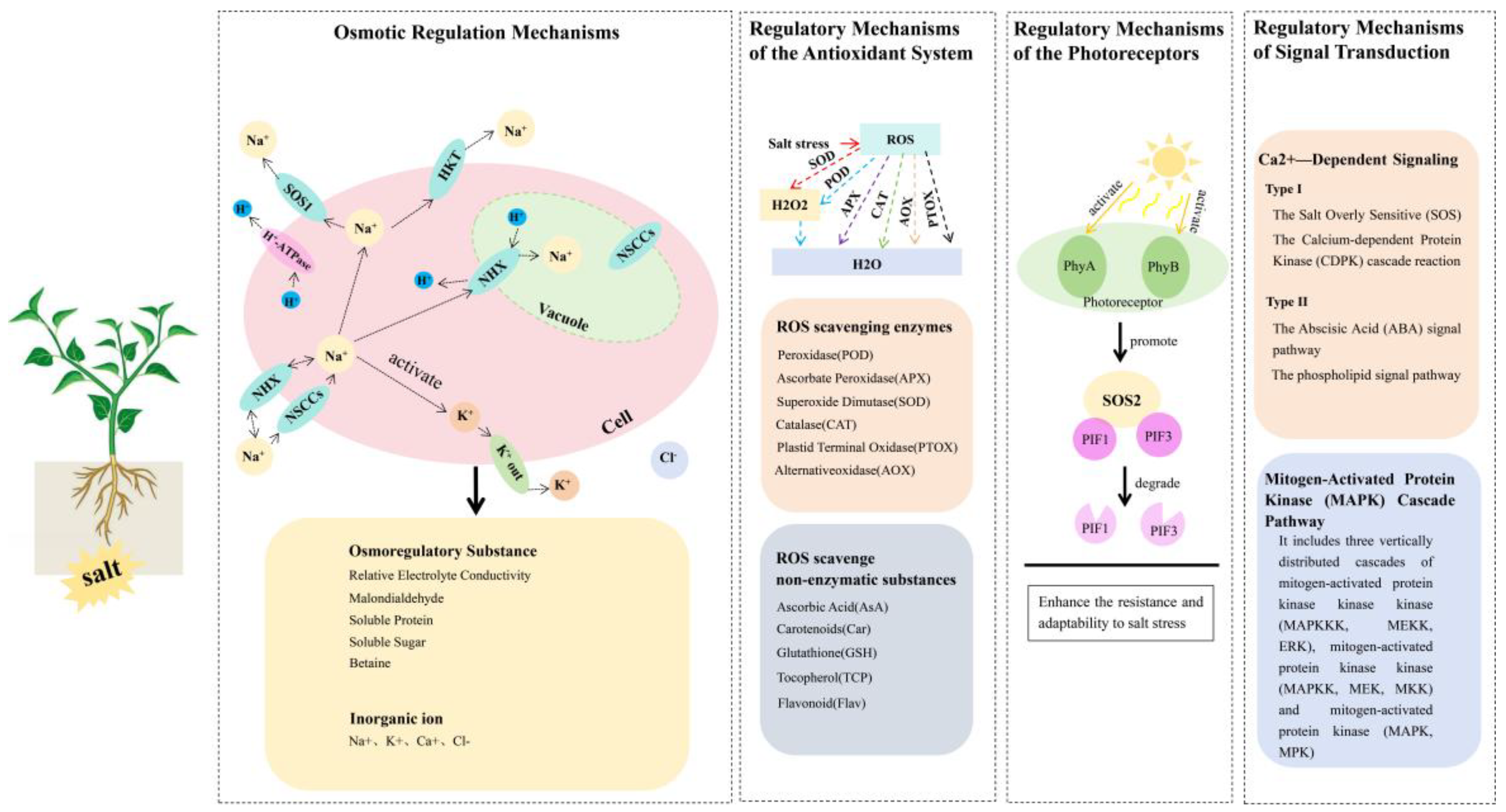

Table 1.
Varieties with salt tolerance, salt sensitivity, and the identification methods.
| Serial No. | Salt tolerance varieties |
Salt sensitive varieties |
Performance | References |
|---|---|---|---|---|
| 1 | 'Xin San Ying Ba Hao'、'Nan Han Tian Hong Yi Hao F1'、'Ka Qi San Ying Jiao' | 'Chao Tian Jiao Chao Ji 808'、'Zhe JiaoXin Yi Dai'、'Kang Chong Cha Xian Feng Ba Hao' | Compared with salt-sensitive varieties, 'Xin San Ying Ba Hao'、'Nan Han Tian Hong Yi Hao F1'、'Ka Qi San Ying Jiao' showed high salt tolerance under 150 mM NaCl salt stress. Physiological indexes and transpiration rates of varieties with salt tolerance were significantly higher than salt-sensitive varieties at 10-15 days after salt stress. | [23] |
| 2 | 'P300' | '323F3' | The 'P300' and '323F3' varieties were treated with 150 mM NaCl, and their growth indexes, antioxidant enzyme activity, and osmoregulatory substances-related indexes were measured. The salt tolerance of 'P300' was better than that of '323F3'. | [27] |
| 3 | 'Y08-27', 'S-322' | 'Y802-2', 'Y08-29' | The seedlings were treated with 150 mM NaCl. By measuring the growth indexes and physiological and biochemical indexes of pepper seeds under salt stress, the tested pepper varieties (lines) were divided into three categories using variance analysis and systematic cluster analysis. Among them, 'Y08-27' and 'S-322' pepper varieties (lines) had strong salt tolerance. 'Y802-2' and 'Y08-29' are salt-sensitive strains. | [28] |
| 4 | '7301', 'D1' | 'GX7', '102' | Varieties '7301' and 'D1' showed high salt tolerance in seed germination tests, among which '7301' could still germinate when treated with 250mM NaCl solution, and the germination rate was 28.7%. | [29] |
| 5 | 'Zhongjiao-6', 'Zhongjiao-13', 'Zhongjiao-16', 'Zhongjiao-10' | 'Zhongjiao-4', 'Zhongjiao-8', 'Zhongjiao-7', 'Zhongjiao-12' | Under NaCl treatment of 150 mM, multivariate analysis of variance, factor analysis, and cluster analysis was performed on 12 indicators, and it was determined that 'Zhongjiao-6', 'Zhongjiao-13', 'Zhongjiao-16' and 'Zhongjiao-10' had excellent salt tolerance. | [30] |
| 6 | 'Niu Jiao Jiao', 'Guo Feng Gan Xian Wang', 'Pi Li Zao Guan', 'Xin You-1', 'Du Ba Tian Xia', 'Qian Jin Huang Jiao', 'Bi Hai Hong', '88 Da Jiao' | 'Ai Nong-6', 'Chao Ji Ju Feng 301', 'Chao Ji Kang Jiao-1', 'Juan Gu', 'Hong Sheng You', 'Gai Liang Te Da Zhong Liu', 'Da Yu Nong Da 40' | The salt treatment concentration of 200 mM NaCl was used to stress pepper seeds. Varieties salt tolerance and salt sensitivity were determined by measuring relative germination potential, relative germination rate, relative germination index, relative vitality index, relative salt damage rate, relative fresh weight, relative dry weight, and relative root length. | [31] |
| 7 | 'H1023' | 'XWHJ-M' | In the research, the expression of target genes of these two materials was investigated by salt stress (250mM). | [32,33] |
| 8 | 'A25' | 'A6' | 'A25' and 'A6' were subjected to a salt treatment of 70 mM NaCl for 14 days. The following physiological parameters were measured:Biomass, Osmotic potential, Ion homeostasis, Photosynthetic parameters, Antioxidant activity. The results showed that 'A25' utilized multiple strategies to cope with salt stress, including increased potassium and proline accumulation, improved growth mechanisms, and effective ionic homeostasis compared to 'A6'. | [8] |
Table 2.
The pepper related salt tolerance regulatory genes.
| Serial No. | Gene Name | Function | References |
|---|---|---|---|
| 1 | CaSBP11 | Play a positive regulatory role in the process of salt stress | [76] |
| CaSBP12 | |||
| 2 | CaWRKY12 | Participating in pepper salt stress response can improve plant salt tolerance | [98] |
| CaWRKY13 | Salt stress can induce CaWRKY13 gene expression | [99] | |
| 3 | CaLACS1 | The expression of varieties with salt tolerance was higher than that of salt-sensitive varieties induced by salt stress | [33] |
| CaLACS2 | |||
| 4 | CaOPR6 | The expression was induced by salt stress, low temperature and pathogen infection | [100] |
| 5 | CaCP1 | Negative regulatory factors mediate plant defense responses to salt stress | [81] |
| CaCP15 | Negative regulation of pepper tolerance to salt stress | [90] | |
| 6 | CaAnn9 | Plays a negative role in salt stress | [88] |
| 7 | CaNAC014 | Positively regulate the tolerance of pepper to salt stress | [32] |
| CaNAC026 | |||
| CaNAC078 | |||
| CaNAC020 | Negative regulation of pepper tolerance to salt stress | ||
| CaNAC075 | |||
| CaNAC035 | Play a positive regulatory role in the process of low temperature、salt and drought stress | [101] | |
| CaNAC36 | Under salt stress , the expression of CaNAC36 gene was up-regulated and then down-regulated in materials with salt tolerance, and down-regulated in materials with salt sensitivity | [102] | |
| CaNAC61 | Expression was significantly upregulated under NaCl treatment | [77] | |
| 8 | CaBBX4 | The transcription of CaBBX4, CaBBX5, CaBBX7 and CaBBX10 was up-regulated under salt stress | [78] |
| CaBBX5 | |||
| CaBBX7 | |||
| CaBBX10 | |||
| CaBBX1 | Under salt stress, the expression levels of CaBBX1, CaBBX2, CaBBX6 and CaBBX9 were only up-regulated at some time points | ||
| CaBBX2 | |||
| CaBBX6 | |||
| CaBBX9 | |||
| CaBBX3 | The transcription of CaBBX4, CaBBX5, CaBBX7 and CaBBX10 was down-regulated under salt stress | ||
| CaBBX8 | |||
| 9 | CaPIF4 | Negative regulation of pepper tolerance to salt stress. | [80] |
| CaPIF8 | Positively regulate the tolerance of pepper to salt stress | [57] | |
| 10 | CaFtsH06 | Salt stress can rapidly induce the expression of CaFtsH06 | [94] |
| 11 | PepRSH | Salt stress can affect the expression of PepRSH | [95] |
| 12 | CaXTH3 | Negative regulation of pepper tolerance to salt stress | [103] |
| 13 | CabZIP1 | Positively regulate the tolerance of pepper to salt stress | [83] |
| 14 | CaBiP1 | Positively regulate the tolerance of pepper to salt stress | [104] |
| 15 | CaOSCA8 | Salt stress induced up-regulation of CaOSCA8 expression | [105] |
| CaOSCA3 | Salt stress induced decreased expression levels of CaOSCA3, CaOSCA7, CaOSCA10 and CaOSCA12 | ||
| CaOSCA7 | |||
| CaOSCA10 | |||
| CaOSCA12 | |||
| 16 | CaTPS1 | The expression was induced in late NaCl stress | [106] |
| CaTPS2 | |||
| CaTPS3 | |||
| CaTPS4 | |||
| CaTPS5 | |||
| CaTPS6 | |||
| CaTPS7 | |||
| CaTPS8 | |||
| CaTPS10 | |||
| CaTPS11 | The expression was induced in the early stage and suppressed in the later stage of NaCl stress treatment | ||
| 17 | CaCBF1A | Salt stress can induce the expression of CaCBF1A, which reaches the peak value quickly and then decreases | [107] |
| 18 | CaBTB27 | Negative regulation of pepper tolerance to salt stress | [108] |
| 19 | CaFIRF1 | Ubiquitination of CaFAF1 by the RING-type E3 ligase CaFIRF1 led to its proteasomal degradation. Silencing of CaFIRF1 enhanced pepper tolerance to high-salt stress, revealing a role for the CaFIRF1-CaFAF1 module in salt stress response. | [85] |
| 20 | CaSnRK2.6 | CaSAP14, a direct substrate of the upstream kinase CaSnRK2.6, functions as a positive regulator of osmotic stress responses to dehydration and high salinity. | [86] |
| 21 | CaMADS | CaMADS functions as a positive regulator that modulates plant responses to multiple abiotic stresses, including cold, salinity, and osmotic stress. | [91] |
| 22 | CaLEA1 | CaLEA1 mediates enhanced salt tolerance by modulating ABA-responsive cellular signaling. | [92] |
| 23 | CaPO2 | Silencing CaPO₂ in pepper plants resulted in sensitivity to salt stress. | [109] |
| 24 | CaPRR2 | CaPRR2 negatively regulates salt stress tolerance. | [110] |
| 25 | CaERF2 | CaERF2 effectively enhances the salt tolerance in pepper by adjusting ROS homeostasis. | [55] |
| 26 | CaDHN3 | Positively regulate the tolerance of pepper to salt stress | [48] |
| CaDHN4 | Positively regulate the tolerance of pepper to salt stress | [111] |
Table 3.
Exogenous regulators enhancing salt tolerance in chilli plants and beneficial bacteria in the plant rhizosphere.
Table 3.
Exogenous regulators enhancing salt tolerance in chilli plants and beneficial bacteria in the plant rhizosphere.
| Serial No. | Material/Bacterial Synthetic Community | Application Method | Function | References |
|---|---|---|---|---|
| 1 | Gibberellin(GA) | Foliar application | That possible to mitigation the negative affect of salt stress by some application like exogenous hormones and Decomposed organic matter to solve the disruption of endohormons and lack of available nutrients under salt stress, and elevation of osmotic stress in soil solution in roots area. | [120] |
| 2 | Salicylic acid(SA) | Foliar application | Salicylic acid alleviates salt stress by modulating key physiological processes, including ion uptake, gene expression, and transcriptional regulation. | [121] |
| 3 | 5-aminolevulinicacid,ALA | Foliar application | Application of ALA (40 mg·L⁻¹) improved salt stress tolerance in pepper by enhancing osmotic regulation. | [116] |
| 4 | Strigolactones (SLs) | Foliar application | Foliar application of 20 μM SL ameliorates the adverse effects of salt stress on pepper plants, mitigating growth inhibition and physiological damage. | [122] |
| Brassinosteroids (BRs) 2,4-epibrassinolide (EBR) |
Foliar application | EBR enhanced the antioxidant defense mechanisms in pepper seedlings by increasing sugar and glycine betaine levels, which contributed to the reduction of reactive oxygen species (ROS) and malondialdehyde (MDA) accumulation. | [123] | |
| γ-aminobutyric acid(GABA) | Germplasm Soaking | GABA promotes seed germination and enhances salt tolerance in peppers by facilitating the accumulation of seed storage reserves and boosting the antioxidant defense system. | [114] | |
| Hydrogen Peroxide | Foliar application | Foliar application of hydrogen peroxide at a concentration of 15 μM mitigated the detrimental effects of salt stress on the photochemical efficiency, biomass accumulation, and production components of sweet pepper plants. | [124] | |
| sodium nitroprusside (SNP), a NO donor, | Foliar application | Exogenous NO treatment enhances pepper resistance to salt stress by regulating mineral nutrient uptake, antioxidant enzyme activity, osmotic sol accumulation, and enhancing LRWC and photosynthetic activity. | [125] | |
| Biostimulant VIUSID Agro | Foliar application | Treatment with Biostimulant VIUSID Agro enhances the photosynthetic capacity of pepper, improves fruit size and quality, strengthens osmotic regulation, and increases antioxidant enzyme activity, thereby effectively mitigating the effects of salt stress. | [126] | |
| Silicon | Foliar application | Foliar application of silicon alleviated lipid peroxidation, electrolyte leakage, and elevated levels of superoxide and hydrogen peroxide induced by salt stress. | [127] | |
| Three PGPR strains (Microbacterium oleivorans KNUC7074, Brevibacterium iodinum KNUC7183, and Rhizobium massiliae KNUC7586) | the inoculation of pepper plants with M. oleivorans KNUC7074, B. iodinum KNUC7183, and R. massiliae KNUC7586 can alleviate the harmful effects of salt stress on plant growth. | [128] | ||
| Pseudomonas koreensis S2CB45 Microbacterium hydrothermale IC37-36 |
Co-inoculation with both bacteria resulted in significantly higher antioxidant enzyme activity and soluble sugar levels than single-bacterium treatments, demonstrating a synergistic improvement in salinity tolerance. | [129] | ||
| the Tamarix gallica L. rhizospheric bacterium TR47 | Inoculation with the Tamarix gallica L. rhizospheric bacterium TR47 promoted the growth of pepper plants under salt stress, leading to greater biomass accumulation and enhanced salt tolerance compared to the control group. | [130] | ||
| Three 1-aminocyclopropane-1-carboxylic acid (ACC) deaminase-producing halotolerant bacteria:Brevibacterium iodinum, Bacillus licheniformis and Zhihengliuela alba | By utilizing three 1-aminocyclopropane-1-carboxylic acid (ACC) deaminase-producing halotolerant bacteria that produce ACC deaminase, thereby reducing the impact of ethylene induced by salt stress on the growth of red pepper plants. | [131] | ||
| Bacillus atrophaeus WU-9 as plant growth-promoting rhizobacteria (PGPR) | Inoculation with Bacillus atrophaeus WU-9 under salt stress primarily enhances pepper plant salt tolerance by regulating ethylene and auxin signaling pathways involved in salt stress response, proline utilization, photosynthesis, and antioxidant enzyme activity. | [132] | ||
| Endophytic fungus Falciphora oryzae | Inoculation with F. oryzae can enhance the salt tolerance of pepper by promoting ion homeostasis and upregulating antioxidant defense systems. | [133] | ||
| Cyanobacteria (Roholtiella sp.) Cyanobacteria Extracts |
Foliar application | Foliar application of Cyanobacteria (Roholtiella sp.) extracts can minimize the adverse effects of salt stress on the vegetative growth, biochemical characteristics, and enzyme activity of sweet peppers. | [134] | |
| Seaweed extract,SW Humic acid,HA |
Under salt stress, treatment with seaweed extract and humic acid enhanced the antioxidant enzyme activity of pepper plants, thereby improving their tolerance to salt stress and protecting them from oxidative stress. | [135] |
Disclaimer/Publisher’s Note: The statements, opinions and data contained in all publications are solely those of the individual author(s) and contributor(s) and not of MDPI and/or the editor(s). MDPI and/or the editor(s) disclaim responsibility for any injury to people or property resulting from any ideas, methods, instructions or products referred to in the content. |
© 2025 by the authors. Licensee MDPI, Basel, Switzerland. This article is an open access article distributed under the terms and conditions of the Creative Commons Attribution (CC BY) license (http://creativecommons.org/licenses/by/4.0/).
Copyright: This open access article is published under a Creative Commons CC BY 4.0 license, which permit the free download, distribution, and reuse, provided that the author and preprint are cited in any reuse.


