

Submitted:
06 November 2025
Posted:
10 November 2025
You are already at the latest version
Abstract
The European Union (EU) Green Deal (EGD) aims to significantly transform and modernise the EU economy, while at the same time it envisages significant changes in agricultural production, especially in livestock farming. Most often, EU Member States implement specific measures that contribute to the achievement of various EGD objectives. Most often, they are part of the national strategies of the EU Common Agricultural Policy. At the same time, it is important to identify the available scientific information on measures that contribute to the achievement of the EGD goals and the multiple impacts of the toe. Usually, each individual measure or practice is aimed at achieving one of the ESD goals, for example, reducing GHG emissions, but in practice, it creates several side effects that can pro-mote or hinder the achievement of other sustainability goals. This study focuses on livestock sector and showcase how key manageable areas where intervention must occur: feeding, housing, grassland/pasture management, manure management, breeding and genetics - interacts and gives contribution to meet EGD targets. In the same time, it ensures a holistic view of the EGD demands on livestock. In this study authors use pictograms and a color-coding system that broadens the scope of impact communication. It translates complex, scientific data into a format that is accessible and easily understood by a wider audience. Results of this study reveal that systematic research is needed on livestock farming measures that could change agricultural policies in the long term, from supporting measures to creating appropriate sustainable farming systems.
Keywords:
EU Green Deal
; sustainable livestock
; trade‐off analysis
; livestock farming practices
1. Introduction
The European livestock sector stands at a critical juncture, confronting an existential sustainability challenge and can by characterized by a multitude of socio-ecological issues and both discursive and legislative pressure to change (Friedrich, 2023). Besides, it must satisfy escalating global protein demands while urgently reducing its substantial environmental footprint. Agriculture generates 30% of the European Union's greenhouse gas emissions, with livestock production responsible for over 80% of this burden, primarily through methane emissions [1] and nitrous oxide emissions from manure and fertilizers, whose reduction possibilities are rapidly increasing [2]. While intensive production systems are simultaneously fueling exceptional biodiversity loss [3]. The main risks are related to the loss of organic matter and greenhouse gas emissions, excessive use of fertilizers, erosion, pollution, acidification, salinization [4]. In the same time the sector plays a critical role in the social economy providing over 4 million jobs and securing the food security of almost 450 million people [5]. Structural impediments, such as fluctuating global commodity markets biased for short-term productivity over long-term sustainability. As well as an aging farming population, in which more than 55% of farmers are over 55 years of age, who are reluctant to embrace new methods or systems, will obstruct any meaningful transformation [6]. In the same time research on sustainable livestock practices remains fragmented across three traditionally isolated dimensions (economy, environment, social), limiting holistic solutions where central are the “human dimension”, associated with science, learning and management [7]. Production focused studies quantify single practice impacts such as the potential of rotational grazing to store carbon (0.5-1 ton C/ha/year in well-managed pastures) and of anaerobic digestion to reduce methane production by 60% from manure [8]. The overlap of the effects of practices and their significance in the wider ecosystem are not modeled equally [9]. Instead, Environmental Impact Assessment look at isolated results such as reductions in greenhouse gas emissions but fail to consider the wider socioeconomic implications [10]. The Farm to Fork Strategy’s target of a 50% reduction for pesticide use, for example, may reduce levels of chemical pollution while increasing production costs by around 15% [11], which risks farm viability in the absence of strong replacement measures or market supports. Policy analyses rigorously critique CAP eco-schemes and greening requirements yet rarely examine how subsidy structures [12], environmental regulations, cross-compliance mechanisms, and international trade policies dynamically interact to enable or hinder transitions at regional scales [13]. Yet it is precisely this ongoing compartmentalization that has led to crucial knowledge gaps with respect to practice interdependencies such as how the integration of manure digestion and agroforestry systems might [14]. It should be noted that in combination, synergistically enhance overall impacts on biodiversity beyond their respective standalone contributions [15]; and the regional scalability impediments explaining why German vs. Bulgarian farms achieve 10-fold differences in the adoption of renewable energy, despite very similar climatic conditions. Importantly, behavioral drivers of farmer decision-making are underexamined [16], yet there is substantial evidence that 70% of dairy farmers say well-being has improved dramatically after adopting sustainable practices [17].
The European Green Deal (EGD) positions livestock systems as central to achieving the EU's legally binding climate neutrality objective by 2050, with stringent 2030 targets demanding nothing short of transformative change across the sector [18]. The Farm to Fork Strategy stipulates that 25% of farmland must be organic, that fertilizer use should decrease by 20% and that pesticide risks need to be reduced by 50%, while the Biodiversity Strategy requires that 10% of agricultural land be set aside for high-diversity landscape features Figure 1. Cattle farming- which accounts for 73% of livestock methane emissions is particularly noticeable by its absence in recent changes to the Industrial Emissions Directive relating to livestock pollution [19].
Ambitious plans mean that there are likely to be conflicting goals, with reducing methane emissions likely to increase ammonia emissions, or reducing pesticide use, for example, leading to reduced productivity. At the same time, there are also contradictions within the EU. There are significant regional disparities, suggesting that the allocation of CAP funds is uneven in its impact across regions. The implications for policymakers are clear: a more tailored approach is required to enhance the effectiveness of CAP funds in meeting diverse regional needs, particularly in promoting economic development while minimizing environmental harm [20]. A worrying trend is evident: EU meat production is decreasing while 80% of future meat growth is attributable to Latin American and Asian countries, where integrated (environmental, economic and social impact) assessment is not fully carried out [21]. The EU's New Open Strategic Autonomy Policy, using a carbon border adjustment mechanism, requires the inclusion of carbon tariffs on goods such as cement, electricity, fertilizer, steel, etc. [22]. At the same time, it must be acknowledged that the mechanism is far from perfect and does not solve many problems related to the import of agricultural products from countries with different carbon pricing policies [23].
This research aims to evaluate EGD targets through their specific impact on main livestock practices (feeding, housing, grassland/pasture management, manure storage and treatment, animal breeding and genetics) and seeks to understand the feasibility, effectiveness and consequences of achieving EGD goals – such as reductions in greenhouse gas (GHG) and ammonia emissions, nutrient losses, animal welfare, etc. – by focusing on the practical on-farm changes required in the livestock sector.
2. Materials and Methods
2.1. Research Framework and Data Sources
The first step of the study was based on the identification of the European Green Deal target indicators and sources where these indicators were set. In total, eight targets were identified, stemming from six strategic documents. For each target, the specific impact on agriculture was identified (Figure 1).
As the second step of this research was selection of livestock practices. As the foundational vocabulary for practice categorization the classification scheme developed by Joint Research Centre [24] were used. The following five groups of practices - animal feeding; animal housing and welfare; grassland and pasture management; manure storage; animal breeding and genetics – were aligned with and nested within the Joint Research Centre’s hierarchical classification tiers. This ensures standardized comparison and aggregation.
2.2. Analysis of Practice and Impact Evaluation
After that each practice was rigorously assessed for its quantitative and/or qualitative impact on various processes and indicators relevant for EGD. For indicators where numerical data is robust (e.g. GHG emissions, nitrogen leaching, feed conversion efficiency), the impact was quantified meta-analysis of peer-reviewed literature, where in most cases results were expressed as a percentage change relative to business as usual baseline. For indicators or processes where quantification is challenging (e.g. specific aspects of biodiversity, soil structure, animal welfare improvements), the impact was determined through a systemic expert judgement process based on synthesis of non-quantitative technical reports and regulatory requirements.
2.3. Data Visualization and Synthesis
To synthesize and communicate the complex, multi-dimensional impact of each practice group, a specific visualization approach was developed.
A unique pictogram was selected for each specific impact and a standardized color-coding system was assigned to each pictogram, reflecting the nature of practice’s impact on the corresponding process (Table 1).
In the developed color-coding system pictogram color reflects result from meta-analysis of peer reviewed literature about quantitative and/or qualitative effect of livestock practice on relevant impact of different dimensions of EDG:
Green color reflects positive effect, which is confirmed by analyzed literature reporting positive impact change relative to business-as-usual baseline;
Grey color reflects knowledge gap, i.e. evidence were found about effect of livestock practice on specific type of impact;
Orange color reflects negative effect, is confirmed by analyzed literature reporting negative impact change relative to business-as-usual baseline;
Blue color reflects unclear effect highlighting conflicting and divergent evidence regarding the effect of the practice on meeting EGD targets.
3. Results
This section studies important livestock farming practice groups through the lens of their documented impacts on European Green Deal (EGD) objectives. Five essential links in the European Green Deal have been identified: Transition to a Circular Economy, Sustainable Resource Management, Technological Innovation, Policy Reforms and Empirical Research and Data-driven Policy [25]. The analysis integrates findings from empirical studies, policy assessments and technological innovations, emphasizing interdependencies between practices and their cumulative effects on environmental, economic, and social sustainability.
3.1. Animal Feeding Practices
Animal feeding practices that could reduce GHG and ammonia emissions, improve or maintain productivity, and contribute to other Green Deal goals can be divided into three groups - the first is related to feed quality and ration optimization; the second is related to the use of feed additives in prepared feed; the third is related with introduction of on-farm feed is possible in extensive farming systems.
Optimizing feed efficiency remains foundational through established practices like improved forage quality [26] such as legume inclusion in silage that minimizes methane produced in the enteric fermentation process and improve feeding methods according to animal requirements [27], thus reducing nitrogen excretion [28]. In every dairy farm, the accuracy of animal feeding is related to the economics of the dairy farm. An unbalanced diet can cause economic losses, because low fat content in milk indicates the cow's inability to consume sufficient amounts of roughage, if it is below 3.50%, milk production is uneconomical, too much concentrate has been used, and while a fat, content above 4.50% may indicate a lack of energy in the feed ration. The above relationships confirm the need to balance the provision of protein and energy in the animal feed ration and to seek solutions on farms to increase the efficiency of feed use, while also ensuring optimal N use on the farm, without creating a surplus that causes GHG or ammonia emissions [29]. Reducing protein intake by 1% can make a significant contribution to reducing GHGs. The feed conversion ratio increased by 1.3% when a one-percentage point reduced crude protein (CP). The same CP reduction decreased daily nitrogen (N) excretion by 10.4%, whereas CP. did not affect N retention [30]. According to the authors' calculations, using the "NorFor" methodology [31], reducing CP feeding by 1% reduces ammonia emissions by 3.7%, while N2O emissions in dairy cows by 18%. Moreover, the reduction in ammonia emissions is characteristic of all stages of lactation, averaging 20-30 g kg-1 DM [32]. For livestock production, where poor quality forage is commonly fed, improving grazing management and diet quality can reduce methane (CH4) emissions by 11% and 5%, on average [33].
The second direction related to animal feed improvements is the use of feed additives. Dietary supplements can reduce CH4 emissions further, with lipids (15% reduction) showing the great potential [33]. The reduction in ammonia emissions in ruminants is relatively small, allowing it to be assessed primarily as a form of methane reduction. Although the ammonia reduction effect in pigs is relatively high at around 20% [34]. The use of algae (Rhodophyceae) could also provide a significant reduction in methane, reducing methane genesis in cattle by 65% [35]. In livestock farms that use pasture, it is possible to reduce ammonia and methane emissions by including tannin plants in the pasture. Tannins reduce methane emissions by 11% for cows [33], and up to 30% for small ruminants (sheep, alpacas, goats) [36]. Dietary tannin additives also reduce ammonia emissions (45.5%) [37]. It should be noted that tannin plants have a beneficial effect on soil structure, abiotic processes in the soil, as well as C/N dynamics in the soil [38], as well as positively affecting biodiversity and pollinators. New technologies consist of methane inhibitors (e.g., 3-NOP, Bovaer) [39] as which are in the very beginning of the development and demonstrate 30%-90% potential of methane reduction but are limited by cost-related scalability issues and regulatory delays. The evidence base of impact evaluation is most developed in the areas of GHG reductions and nitrogen use efficiency. 3-NOP reduces enteric methane emissions by 30% [40, 41], which affects the carbon footprint of milk, reducing it by 12% [42], and also creates a general opinion that NOP3 reduced GHG emissions by approximately 1 tonne CO2e (GWP100) per cow per year [43]. The evidence of impact evaluation remains under-developed in the group of biodiversity co-benefits [44] (e.g. reduced land-use change associated with feed crops) and socioeconomic trade-offs (e.g. affordability of inhibitors by smallholders). At the systemic level, feed additives add to manure management in terms of pollutant load alleviation [45], but synergies with grassland management (e.g., side effects of the interface between grazing and confined systems) have not been explored well [46].
The introduction of on-farm feed is possible in extensive farming systems, provided that additional land is available for production. When total land occupation (LO) was considered, the average surface to produce milk resulted in 1.47 m2/kg of fat- and protein-corrected milk (FPCM); however, the off-farm land occupation was 0.76 m2/kg FPCM (± 0.24 m2/kg). The land occupation per unit of production can be reduced by increasing on-farm feed production, particularly protein components, and to a lesser extent by valorising by-products, while not increasing the on-farm N surplus and carbon footprint [47]. Indirectly, this indicates that the use of farm-produced feed reduces GHG emissions if they are accounted for using the LCA approach, which is more common in scientific discussion, but not for policymakers, as it does not contribute to achieving policy goals. However, the feeding strategy to be adopted, and resulting level of feed autonomy, depend on the land use and production potential (% of PG, capacity to grow grain crops, overall DM yield), which are linked to the local soil and climate conditions, and on the targeted animal performance [48].
In Figure 2 authors give visual summarization of analysed three different groups of animal feeding practices on achieving EGD targets.
3.2. Animal Housing & Welfare Practices
Animal housing practices are related with different improvements in housing conditions of livestock to promote animal welfare, therefore this group of practices fundamentally improve animal welfare, while at the same time, since the production of GHG and ammonia emissions in animals is a complex process, they indirectly also impact other green policy goals such as reducing ammonia and methane emissions. These practices include access to the outdoors (walking areas), shelters, environmental improvements (such as scratching posts), improvements to the barn microclimate, as well as lighting improvements. Established practices include ammonia-reducing designs such as slatted floors with scrapers to mitigate emissions, and enriched environments [49]. Even the temperature of an animal's housing can affect well-being and productivity and contribute to stress-induced illnesses [50]. New advancements include climate-controlled greenhouses with air filtration that lowers the amount of ammonia and methane, however with a higher energy usage [51]. Outdoor access is an important welfare factor in intensive cow farms. The impact of intensification on emissions is usually characterized by a reduction in emissions per unit of output, while increasing the load per unit of output. Increasing livestock intensity increases CH4 ha-1 by 26% and simultaneously reduces CO2e l-1 milk by 19% [52]. Ammonia reduction (up to 30%) [53] and improvements in welfare are studied extensively and results are reliable about impact assessment, but connections to carbon sequestration [54] or biodiversity are less studied and quantified. At a systems scale, the housing design of the animals has a direct correlation to the consistency of manure [55]. In Figure 3 authors give visual summarization of analysed animal housing and welfare practices. It can be concluded that measures to improve animal welfare, while not necessarily contributing to animal welfare, reduce emissions to a lesser extent and do not actually affect the achievement of other sustainability goals.
3.3. Grassland & Pasture Management
Established practices include rotational grazing to preserve soil carbon and reduce erosion, alongside legume incorporation such as clover to provide a fixation of nitrogen and reduce fertilizer needs [56]. Grassland management has the great advantage of being simultaneously the point of convergence of the carbon buffers for riparian management [57]. It should be noted that grazing could reduce methane emissions compared to cows kept in a barn [58]. However, due to the lower digestibility of feed (grass) compared to concentrates, it has been found that organic cows produce higher emissions than [59]. Grazing management has a positive effect on soil carbon formation and can mitigate GHG emissions [60]. At the same time, a positive effect is observed only with light grazing and close to the soil surface (up to 10 cm) [61]. Grassland management, especially regular reseeding, is also essential for a positive carbon sequestration effect [62] at the same time, grass cutting increases GHG emissions and reduces carbon sequestration [63]. The type of grassland and pasture management is very important, extensive management provides advantages and benefits. Therefore, intensity restrictions in pasture management are essential. Managing grazing improve biodiversity and adaptive multi-paddock grazing which improves drought resistance and soil health [64]. Grazing restriction can reduce both N2O and CH4 emissions. Restricted grazing resulted in more efficient conversion of forage into meat and milk, leading to a 22% reduction in annual projected CH4 emissions per animal [52]. Intensively grazed pastures are at increased risk of N losses to waterways and the atmosphere. Nitrate losses increase exponentially with increasing animal urine inputs, which affect dissolved organic N [58]. A successful solution that can reduce the effects of reduced digestibility of grass feed and intensive grazing is rotational grazing. Rotational grazing can potentially reduce GHG emissions from cow-calf farms compared to continuous grazing [65]. Grazing is an important way to reduce ammonia emissions in livestock farming. This is because urine from grazing animals does not usually mix with faces, so the action of urease on urea in urine is minimised, and ammonia emissions are therefore lower compared to animals kept in sheds or even compared to the non-grazing period [66]. In summary (Figure 4), grazing and grassland management provide many benefits and can be an integral part of sustainable agriculture. The most important condition is the intensity of management, while reduced intensity grazing can reduce GHG and ammonia emissions, improve soil fertility and increase biodiversity, while intensive grazing has the opposite and often negative effect on sustainability.
3.4. Manure Storage
Research into livestock manure storage techniques is currently focused on enhancing environmental sustainability, optimizing nutrient retention, and mitigating GHG and ammonia (NH3) emissions. A key area of innovation is manure treatment with additives. While traditional chemical acidification using mineral acids like sulfuric acid (H2SO4) is highly effective – with studies demonstrating significant reduction in CH4 (67-97% reductions) and NH3 (up to 85% reductions) when slurry pH is lowered to 5.5 [67, 68], development is now exploring lower, cost-effective doses and more sustainable alternatives. For instance, binding agents such as zeolites (e.g., clinoptilolite) have been shown to reduce ammonia emissions by binding ammonium ions, while biochar addition is being studied for its potential to reduce methane emissions in composting piles [69].
A promising path involves natural acids and bio-acidification. This latter technique utilizes agro-industrial by-products or simple fermentable substrates to encourage the endogenous microbial production of organic acids, such as lactic acid or acetic acid, which naturally lowers the slurry pH and suppresses volatile emissions. Effective substrates include readily available, low-cost options like sugar beet molasses, cheese whey, or pure glucose [70, 71, 72]. For example, amending slurry with cheese whey has been shown to achieve a NH3 abatement of over 90% [73]. This method avoids the handling risks and potential soil sulfur burden associated with concentrated mineral acids.
Alongside chemical treatments, manure topping or covering has evolved significantly, particularly for liquid slurries. Effective methods range from encouraging and maintaining a natural, high-performing crust on cattle slurry to deploying engineered solutions. Research compares the efficiency and cost-effectiveness of economical floating materials (e.g., straw, clay granules) against highly effective, yet more expensive, flexible HDPE membranes, all aimed at reducing gaseous exchange, odor, and volume increase from precipitation. For solid manure, or farmyard manure, the focus remains on established management practices like proper compaction of manure heaps. This process helps to create anaerobic conditions, which limits gas exchange and can suppress NH3 and nitrous oxide (N2O) volatilization, although advanced chemical methods are less commonly applied to solid heaps than to liquid slurry. Finally, while not a direct storage technique, manure storage using biofilters is integral to holistic management, often employed to treat exhaust air from livestock buildings or manure processing facilities to control odor and NH3 emissions before the air is released into the atmosphere.
Visualizing a common impact of different manure storage technologies on achieving the EGD targets (Figure 5), authors conclude that the impact is mainly focused on reducing GHG and ammonia emissions, while impacts on other EGD targets are not broadly analysed and discussed. This highlight challenge for future research of manure storage techniques - adopt a holistic, life-cycle approach to fully assess the technologies against the complete set of EGD's environmental and sustainability objectives, moving beyond the current focus on only two targets.
3.5. Animal Breeding & Genetics
The general objective of animal breeding is to create a new generation of animals that, in the economic, social and environmental conditions of future farms, will obtain the desired products more efficiently and will be more resistant to interference than the current generation of animals. In the context of EGD targets there can be identified three types of breeding programs - selection of animal characteristics to reduce GHG emissions; selection of animal characteristics for disease resistance; and selection of animal characteristics for longer life expectancy.
Selection of animal characteristics to reduce GHG emissions is usually aimed at ruminants, basically cattle, to reduce the CH4 secreted during digestion. Since the CH4 secreted during digestion depends on the amount of feed per unit of production and the rate at which metagenesis occurs during digestion, then the main characteristic that is selected is animals with higher feed efficiency [74, 75], i.e., the ability to absorb a smaller amount of feed, while maintaining the same level of production and maintenance of the body. Lower feed intake leads to less excretion of CH4, while production and body processes are maintained at the same level as in cows with lower feed efficiency. For example, in the experiment done with Holstein breed cows the low methane-emitting dairy cows saved up to 22% CH4 if compared for high methane emitting cows [75]. The level of feed intake affects the time when the feed remains in the rumen, as well as the volume of the rumen. When the rumen retention time decreases, the amount of CH4 produced will be less. High feed efficiency has differences in behavior and digestion, which leads to changes in microbial communities. This causes the transition from acetate to propionate, which will reduce the amount of hydrogen available for the formation of CH4.
Sick animals consume more feed and water, while growing more slowly. If an animal is lost due to illness, it means that resources must be invested in raising another animal in order to meet market demand. This means that diseases cause higher levels of GHG per unit of milk, meat and eggs, as more animals and resources are ultimately needed to maintain productivity. For example, for cows each avoided clinical mastitis case can reduce potential GHG emissions by 58 kg CO2e/case/ton of milk [76]. Thus, the purpose of certain breeding programs is to promote varieties with natural resistance to diseases, reducing the need for antibiotics or treatment. Genetic selection for disease resistance is already applied all over the world: for dairy cattle - resistance to mastitis and metabolic diseases; in pigs - resistance to pig reproductive and respiratory syndrome (PRRS); in poultry - resistance to Marek's disease and bird flu; in sheep - resistance to internal parasites (worms of the gastrointestinal tract).
In the context of sustainable livestock development and selection of animal characteristics for longer life expectancy, the desired and recommended target is 4 to 5 or more lactating dairy cows [77]. This extended productive service life is a key strategy from both an economic and environmental point of view of improving efficiency. The most significant impact comes from the fact that a large part of the GHG emissions generated during the life of an animal occur during the period of unproductive rearing (from birth to the first lactation). By keeping a cow in the herd for longer, these "fixed" rearing emissions are broken down to more milk, reducing the emission intensity (CO2eq/kg of product).
Visual summary of identified impacts of different animal breeding programs is given in Figure 6. Authors conclude that this group of practices is powerful, multi-faceted tool for achieving the EGD targets as breeding programs offer a permanent and cumulative way to improve livestock efficiency and resilience.
4. Discussion on Cross-Cutting Research Gaps & Systemic Challenges
Impact assessment disproportionately emphasizes GHG metrics [78]. Other sustainability factors have been analyzed less, usually associated with common national goals to achieve climate neutrality, consisting of high public funding intensity (EU CAP support), a common reporting framework (IPCC National Inventory Reports), as well as proven carbon market initiatives. In contrast, biodiversity and social impacts have been analyzed less frequently, which reduces the impact of EU policy on the preservation of biologically valuable areas [79]. Typically, the determination of comprehensive sustainable impacts is based on integrated impact assessment, it should be noted that by reducing negative climate and air quality effects, it is possible to obtain other significant benefits for society [80, 81]. Practice interactions get little attention, and little has been done to measure multi-practice synergies as breeding-feeding interactions [82] on manure composition and soil qualities [83]. The EU's CALP eco-schemes only partially address the trade-off problem, even though the Green Deal policy seems comprehensive. Examples of policy misalignments are eco-schemes in the CAP that lavish practices over systems [84], which are easier to administer and more specifically outline the specific results to be achieved.
The EU Green Deal aims to transform the European Union into a modern, resource-efficient and competitive economy, with a wide range of targets. The European Green Deal (EGD) positions livestock systems as central to achieving the EU's legally binding climate neutrality objective by 2050 [85]. The targets for agriculture include reducing GHG emissions, increasing organic farming areas, reducing nutrient losses and ensuring animal welfare (Table 2), there are also other objectives that are essential for EU green architecture, as described in more detail in Figure 1. Based on a literature review, some of the most effective practices can be identified, as well as co-benefits.
From one perspective, efforts can be observed in two directions, which are essentially related to the intensification of agricultural production, reducing negative externalities and extensification or reducing production intensification, which creates greater positive externalities, but causes economic difficulties for farmers. This could mean that two different directions need to be politically supported. Integrated organic production with low-intensity pasture management, thoughtful feed management and soil fertilizer management on the one hand. Alongside intensive production with precision and digital technologies, methane inhibitors, tethered livestock keeping, including walking areas, on the other. At the same time, neither of them can ensure the achievement of the EGD targets and the transition to sustainable agriculture on their own, so the challenge is for each member state to determine the appropriate proportion. At the same time, the EU has already determined that organically managed areas should account for at least 25% of the total agricultural area, indirectly indicating that organic farming is essential for achieving this goal. Organic farming can also be efficient and implement modern digital technologies that stimulate the achievement of EU goals, while at the same time requiring changes in laws [86]. It is clear that it is not possible to create policy regulatory or support measures that would be equally effective for all farms. They differ significantly in terms of both their initial characteristics and the way in which possible measures can be implemented, so we should focus on measures for groups of farms typical for the country [87]. Overall, there is a growing argument that a multifaceted approach, encompassing policy, technology and innovation, is essential to overcome the challenges of environmental sustainability and climate change. At the same time, difficulties in achieving the goals of the EU Green Deal are caused by the incompletely clear side effects of the measures, as they lack analysis and discussion in the scientific literature (Table 2.2).

Table 3.
Research coverage gaps in livestock practice impact studies.
| Practice Group | GHG | Biodiversity | Nutrients | Welfare |
|---|---|---|---|---|
| Animal Feeding | High | Low | Medium | Medium, Low (methane inhibitors) |
| Animal Housing & Welfare | Medium | Low | Medium | High |
| Grassland & Pasture Management | Medium | Medium | High | High |
| Manure Storage | High | Very Low | Medium | Low |
| Breeding and Genetics | High | Very Low | Low | High |
GHG and ammonia emission reduction measures have been studied relatively extensively in the scientific literature, with the information found in them differing both in the assessment of the numerical effect and the assessment of the overall effect. This provides an opportunity to conduct broader meta-analyses, which allow for the comparison and evaluation of diverse studies, creating new deeper understanding and knowledge. The diversity of such information provides an opportunity to assess the progress of the EU Green Deal [88]. However, other effects of these measures on biodiversity have been relatively poorly studied. On the one hand, for example, animal feeding does not directly affect biodiversity at the national level. On the other hand, focusing on imported concentrated feed may have consequences in the country where it is produced, but remain unnoticed if an LCA approach is not used. Systematic studies are needed that would not only track the entire cycle, for example nitrogen, but also the impact of measures on all processes affecting agriculture, both on farms and in the wider area. This would provide an opportunity to re-evaluate agricultural measures and practices towards locally appropriate management systems, which should be incorporated into the agricultural policies of the EU Member States. The most popular example of a management system would be organic production, which includes both specific conditions, opportunities and support systems, but an integrated view is needed for the entire agricultural sector, which would provide a sufficient set of information for policymakers and the public.
Author Contributions
Conceptualization, D.P.; methodology, D.P.; software, D.P., K.N.L.; validation, K.N.L.; formal analysis, K.N.L.; investigation, D.P., K.N.L., A.R.K.; resources, D.P., K.N.L., A.R.K.; writing—original draft preparation, K.N.L.; writing—review and editing, D.P., K.N.L.; visualization, D.P.; supervision, D.P.; project administration, D.P.; funding acquisition, D.P. All authors have read and agreed to the published version of the manuscript.
Funding
This research and APC was funded by the Ministry of Agriculture of the Republic of Latvia and the Latvian Science Council’s national research programme “Research and Sustainable Use of Local Resources for the Development of Latvia” for 2023–2025, scientific project No. VPP-ZM-VRIIILA-2024/1-0002 Science-based Solutions for a Sustainable Food System to Achieve the Goals of the European Green Deal (GreenAgroRes).
Institutional Review Board Statement
Not applicable.
Informed Consent Statement
Not applicable.
Conflicts of Interest
The authors declare no conflicts of interest.
References
- Mielcarek-Bocheńska, P., & Rzeźnik, W. Greenhouse gas emissions from agriculture in EU countries—state and perspectives. Atmosphere 2021, 12(11), 1396. [CrossRef]
- Nisbet, E. G., Dlugokencky, E. J., Fisher, R. E., France, J. L., Lowry, D., Manning, M. R., Michel, S. E., & Warwick, N. J. Atmospheric methane and nitrous oxide: challenges alongthe path to Net Zero. Philosophical Transactions of the Royal Society A, 2021, 379(2210), 20200457. [CrossRef]
- Kremen, C. Ecological intensification and diversification approaches to maintain biodiversity, ecosystem services and food production in a changing world. Emerging Topics in Life Sciences 2020, 4(2), 229–240. [Google Scholar] [CrossRef]
- Kopittke, P.M., Menzies, N.W., Wang, P., McKenna, B.A., Lombi, E. Soil and the intensification of agriculture for global food security. Environment International 2019, Volume 132. [CrossRef]
- FAO, IFAD, UNICEF, WFP and WHO. The State of Food Security and Nutrition in the World 2025 – Addressing high food price inflation for food security and nutrition. Rome. 2025. [CrossRef]
- Manning, L. Innovating in an uncertain world: understanding the social, technical and systemic barriers to farmers adopting new technologies. Challenges 2024, 15(2), 32. [Google Scholar] [CrossRef]
- Roche, L. M. Grand challenges and transformative solutions for rangeland social-ecological systems–emphasizing the human dimensions. Rangelands 2021, 43(4), 151–158. [Google Scholar] [CrossRef]
- Symeon, G. K. , Akamati, K., Dotas, V., Karatosidi, D., Bizelis, I., & Laliotis, G. P. Manure Management as a Potential Mitigation Tool to Eliminate Greenhouse Gas Emissions in Livestock Systems. Sustainability 2025, 17(2), 586. [Google Scholar]
- Kleijn, D., Bommarco, R., Fijen, T. P., Garibaldi, L. A., Potts, S. G., & Van Der Putten, W. H. Ecological intensification: bridging the gap between science and practice. Trends in ecology & evolution 2019, 34(2) 154-166. [CrossRef]
- Bond, A. , Pope, J., Fundingsland, M., Morrison-Saunders, A., Retief, F., & Hauptfleisch, M. Explaining the political nature of environmental impact assessment (EIA): A neo-Gramscian perspective. Journal of Cleaner Production 2020, 244, 118694. [Google Scholar]
- Silva, V. , Yang, X., Fleskens, L., Ritsema, C. J., & Geissen, V. Environmental and human health at risk–Scenarios to achieve the Farm to Fork 50% pesticide reduction goals. Environment international 2022, 165, 107296. [Google Scholar] [PubMed]
- Lampkin, N., Stolze, M., Meredith, S., De Porras, M., Haller, L., & Mészáros, D. (2020). Using Eco-schemes in the new CAP: a guide for managing authorities. IFOAM EU 2020, pages 73.
- Möhring, N., Ingold, K., Kudsk, P., Martin-Laurent, F., Niggli, U., Siegrist, M., Studer, B., Walter, A., & Finger, R. Pathways for advancing pesticide policies. Nature food 2020, 1(9), 535-540. [CrossRef]
- Singh, P. K., & Dubey, A. Integrated farming system. Test Book of resource conservation practices. 2023, 99-113.
- Smith, P. , Arneth, A., Barnes, D. K., Ichii, K., Marquet, P. A., Popp, A., Pörtner, H. O., Rogers, A. D., Scholes, R. J., & Strassburg, B. How do we best synergize climate mitigation actions to co-benefit biodiversity? Global Change Biology 2022, 28(8), 2555–2577. [Google Scholar]
- Swart, R., Levers, C., Davis, J. T., & Verburg, P. H. Meta-analyses reveal the importance of socio-psychological factors for farmers’ adoption of sustainable agricultural practices. One Earth 2023, 6(12), 1771-1783. [CrossRef]
- Clay, N., Garnett, T., & Lorimer, J. Dairy intensification: Drivers, impacts and alternatives. Ambio 2020, 49(1), 35-48. [CrossRef]
- van Vuuren, D. P. , Zimm, C., Busch, S., Kriegler, E., Leininger, J., Messner, D., Nakicenovic, N., Rockstrom, J., Riahi, K., & Sperling, F. Defining a sustainable development target space for 2030 and 2050. One Earth 2022, 5(2), 142–156. [Google Scholar]
- McGregor, A., Rickards, L., Houston, D., Goodman, M. K., & Bojovic, M. The biopolitics of cattle methane emissions reduction: Governing life in a time of climate change. Antipode 2021, 53(4), 1161-1185. [CrossRef]
- Manta, A.G.; Doran, N.M.; Bădîrcea, R.M.; Badareu, G.; Gherțescu, C.; Lăpădat, C.V.M. Does Common Agricultural Policy Influence Regional Disparities and Environmental Sustainability in European Union Countries? Agriculture 2024, 14, 2242. [Google Scholar] [CrossRef]
- Harrison, M. T., Cullen, B. R., Mayberry, D. E., Cowie, A. L., Bilotto, F., Badgery, W. B., Liu, K., Davison, T., Christie, K. M., & Muleke, A. Carbon myopia: The urgent need for integrated social, economic and environmental action in the livestock sector Global Change Biology 2021, 27(22), 5726-5761.
- Gehrke, T. EU open strategic autonomy and the trappings of geoeconomics. European Foreign Affairs Review 2022, 27(Special). [CrossRef]
- Fournier Gabela, J. G. , Spiegel, A., Stepanyan, D., Freund, F., Banse, M., Gocht, A., Matthews, A. Carbon leakage in agriculture: when can a carbon border adjustment mechanism help? Climate Policy 2024, 24(10), 1410–1425. [Google Scholar] [CrossRef]
- A classification scheme based on farming practices, Publications Office of the European Union, 2024, https://data.europa.eu/doi/10.2760/33560.
- Stefanis, C., Stavropoulos, A., Stavropoulou, E., Tsigalou, C., Constantinidis, T. C., & Bezirtzoglou, E. A spotlight on environmental sustainability in view of the European Green Deal. Sustainability 2024, 16(11), 4654. [CrossRef]
- Wyngaarden, S. L., Lightburn, K. K., & Martin, R. C. Optimizing livestock feed provision to improve the efficiency of the agri-food system. Agroecology and Sustainable Food Systems 2020, 44(2), 188-214. [CrossRef]
- Zhao, Y., Nan, X., Yang, L., Zheng, S., Jiang, L., & Xiong, B. A review of enteric methane emission measurement techniques in ruminants. Animals 2020, 10(6), 1004.
- Guo, Y., Tong, B., Wu, Z., Ma, W., & Ma, L. Dietary manipulation to reduce nitrogen and phosphorus excretion by dairy cows. Livestock Science 2019, 228, 61–66.
- Ipharraguerre, I.R., Clark, J.H. Impacts of the Source and Amount of Crude Protein on the Intestinal Supply of Nitrogen Fractions and Performance of Dairy Cows. Journal of Dairy Science 2005, Volume 88, Supplement, 2005, Pages E22-E37, ISSN 0022-0302. [CrossRef]
- de Rauglaudre, T., Méda, B., Fontaine, S., Lambert, W., Fournel, S., Létourneau-Montminy, M.P. Meta-analysis of the effect of low-protein diets on the growth performance, nitrogen excretion, and fat deposition in broilers. FRONTIERS IN ANIMAL SCIENCE 2023, 4, 1214076. [CrossRef]
- NorFor model 2025 Available: https://www.norfor.info/the-model/the-norfor-model/ Accessed: 15.09.2025.
- Kreismane Dz., Aplocina E., Naglis-Liepa K., Berzina L., Frolova O., Lenerts A. Diet optimization for dairy cows to reduce ammonia emissions. Research for Rural Development 2021, Vol. 36. Pages 36-43. [CrossRef]
- Nayak B., Liu R.H., Tang J. Effect of processing on phenolic antioxidants of fruits, vegetables, and grains--a review. Crit Rev Food Sci Nutr. 2015;55(7):887-919. [CrossRef]
- Moran K., Chamusco, S., Aumiller, T. PSVI-4 Effect of Phytogenic Feed Additives on Ammonia Emission in Finishing Swine. Journal of Animal Science, 2022, Volume 100, Issue Supplement_2, Page 165. [CrossRef]
- Colin, R.L., Sperber, J. L., Buse, K.B., Kononoff, P.J., Watson, A.K., Erickson, G.E. Effect of an algae feed additive on reducing enteric methane emissions from cattle.” Translational Animal Science, 2024, Volume 8, txae109. [CrossRef]
- Martin, C., Morgavi, D.P., Doreau, M. Methane mitigation in ruminants: from microbe to the farm scale. Animal 2010, Volume 4, Issue 3. Pages 351-365. [CrossRef]
- Ti, C., Xia, L., Chang, S.X., Yan, X. Potential for mitigating global agricultural ammonia emission: A meta-analysis. Environmental Pollution 2019, 245:141-148. Epub 2018 Nov 5. [CrossRef] [PubMed]
- Clemensen Andrea , Halvorson Jonathan J. , Christensen Rachael , Kronberg Scott L. Potential benefits of tanniferous forages in integrative crop-livestock agroecosystems. Frontiers in Agronomy 2022, Volume 4 - 2022. [CrossRef]
- Black, J. L., Davison, T. M., & Box, I. Methane emissions from ruminants in Australia: Mitigation potential and applicability of mitigation strategies. Animals 2021, 11(4), 951. [CrossRef]
- Yu, G., Beauchemin, K. A., & Dong, R. A review of 3-nitrooxypropanol for enteric methane mitigation from ruminant livestock. Animals 2021, 11(12), 3540. [CrossRef]
- Kebreab, E., Bannink, A., Pressman, E.M., Walker, N., Karagiannis, A., van Gastelen, S., Dijkstra, J. A meta-analysis of effects of 3-nitrooxypropanol on methane production, yield, and intensity in dairy cattle. Journal of Dairy Science 2023, 106(2), 927-936. [CrossRef]
- Uddin, M., Tricarico, J.M. Kebreab, E. Impact of nitrate and 3-nitrooxypropanol on the carbon footprints of milk from cattle produced in confined-feeding systems across regions in the United States: A life cycle analysis, Journal of Dairy Science 2022,Volume 105, Issue 6, 2022, Pages 5074-5083, ISSN 0022-0302. [CrossRef]
- DSM. Taking action on climate change, together, Summary of scientific research how 3-NOP effectively reduces enteric methane emissions from cows. 7th Greenhouse Gas and Animal Agriculture Conference, August 2019, Brazil. https://www.dsm.com/content/dam/dsm/corporate/en_US/documents/summary-scientific-papers-3nop-booklet.pdf".
- Kok, M., Schoolenberg, M., Löwenhardt, H., Voora, V., van Oorschot, M., Arlikatti, N., & Arts, B. (2023). Assessing the impact of international cooperative initiatives on biodiversity. PBL Netherlands Environmental Assessment Agency 2023, pages 123.
- Chadwick, D. R. , Williams, J. R., Lu, Y., Ma, L., Bai, Z., Hou, Y., Chen, X., & Misselbrook, T. H. Strategies to reduce nutrient pollution from manure management in China. Frontiers of Agricultural Science and Engineering 2020, 7(1), 45–55. [Google Scholar]
- Vertès, F., Delaby, L., Klumpp, K., & Bloor, J. C–N–P uncoupling in grazed grasslands and environmental implications of management intensification. Agroecosystem diversity Elsevier 2019, pp. 15-34.
- Rolando, G. Ferrero, F., Pasinato, S., Comino, L., Giaccone, D., Tabacco, E., Borreani, G. Comparison of frameworks for defining land occupation considering on-farm and off-farm feed production on Italian dairy farms, Journal of Dairy Science 2025, Volume 108, Issue 3, Pages 2595-2609, ISSN 0022-0302. [CrossRef]
- Faux, A.-M., Decruyenaere, V., Guillaume, M., & Stilmant, D. Feed autonomy in organic cattle farming systems: a necessary but not sufficient lever to be activated for economic efficiency. Organic Agriculture 2022, 12(3), 335-352. [CrossRef]
- Cellier, P., Génermont, S., Pierart, A., Agasse, S., Drouet, J.-L., Edouard, N., Eglin, T., Galsomiès, L., Guingand, N., & Loubet, B. Reducing the Impacts of Agriculture on Air Quality. Agriculture and Air Quality: Investigating, Assessing and Managing Springer, 2021, pp. 245-282. [CrossRef]
- Hylander, B. L., Repasky, E. A., & Sexton, S. Using mice to model human disease: understanding the roles of baseline housing-induced and experimentally imposed stresses in animal welfare and experimental reproducibility. Animals 2022, 12(3), 371. [CrossRef]
- Lisette M.C. Leliveld, Brandolese, C., Grotto, M., Marinucci, A., Fossati, N., Lovarelli, D., Riva, E., Provolo. G. Real-time automatic integrated monitoring of barn environment and dairy cattle behaviour: Technical implementation and evaluation on three commercial farms. Computers and Electronics in Agriculture 2024, Volume 216. [CrossRef]
- Llonch, P., Haskell, M.J., Dewhurst, R.J., Turner, S.P. Current available strategies to mitigate greenhouse gas emissions in livestock systems: an animal welfare perspective. Animal 2017, Volume 11, Issue 2, Pages 274-284. [CrossRef]
- Du, H.-L., Chatti, M., Hodgetts, R. Y., Cherepanov, P. V., Nguyen, C. K., Matuszek, K., MacFarlane, D. R., & Simonov, A. N. Electroreduction of nitrogen with almost 100% current-to-ammonia efficiency. Nature 2022, 609(7928), 722-727. [CrossRef]
- Sykes, A. J., Macleod, M., Eory, V., Rees, R. M., Payen, F., Myrgiotis, V., Williams, M., Sohi, S., Hillier, J., & Moran, D. Characterising the biophysical, economic and social impacts of soil carbon sequestration as a greenhouse gas removal technology. Global Change Biology 2020, 26(3), 1085-1108. [CrossRef]
- Liu, Z., & Wang, X. Manure treatment and utilization in production systems. Animal agriculture Elsevier, 2020, pp. 455-467. [CrossRef]
- Kebede, E. Contribution, utilization, and improvement of legumes-driven biological nitrogen fixation in agricultural systems. Frontiers in Sustainable Food Systems 2021, 5, 767998. [Google Scholar] [CrossRef]
- Stutter, M., Kronvang, B., Ó hUallacháin, D., & Rozemeijer, J. Current insights into the effectiveness of riparian management, attainment of multiple benefits, and potential technical enhancements. Journal of Environmental Quality 2019, 48(2), 236-247. [CrossRef]
- Eriksen , J., Ledgard, S., Luo, J., Schils, R., Rasmussen. J. Environmental impacts of grazed pastures. 2010. Available: https://orgprints.org/id/eprint/17879/4/17879.pdf Accessed: 20.09.2025.
- de Boer. I.J.M. Environmental impact assessment of conventional and organic milk production. Livestock Production Science 2003 Volume 80, Issues 1–2, Pages 69-77. [CrossRef]
- Horacio A. Aguirre-Villegas, R., Larson, A., Rakobitsch, N., Wattiaux, M.A., Silva, E. Farm level environmental assessment of organic dairy systems in the U.S. Journal of Cleaner Production 2022, Volume 363, 132390. [CrossRef]
- Lai, LM; Kumar, S. A global meta analysis of livestock grazing impacts on soil properties. PLOS ONE 2020, 15(8), e0236638. [CrossRef]
- Reinsch, T., Loges, R., Kluß, C., Taube, F. Effect of grassland ploughing and reseeding on CO2 emissions and soil carbon stocks. Agriculture, Ecosystems & Environment 2018. Volume 265, Pages 374-383. [CrossRef]
- Vellinga, T. , van den Pol-van Dasselaar, A., Kuikman, P. The impact of grassland ploughing on CO2 and N2O emissions in the Netherlands. Nutrient Cycling in Agroecosystems 2004, 70, 33–45. [Google Scholar] [CrossRef]
- Teague, R., & Kreuter, U. Managing grazing to restore soil health, ecosystem function, and ecosystem services. Frontiers in Sustainable Food Systems 2020, 4, 534187. [CrossRef]
- Wang, T., Teague, W., Park, S., Bevers, S. GHG Mitigation Potential of Different Grazing Strategies in the United States Southern Great Plains 2015. [CrossRef]
- DAERA. (2023). Ammonia emissions and agriculture. Available:https://www.daera-ni.gov.uk/news/ammonia-emissions-and-agriculture Accessed: 22.09.2025.
- Umar, W., Vandenbussche, C., Dinuccio, E., Dong, H., & Amon, B. Acidification of animal slurry in housing and during storage to reduce NH3 and GHG emissions-recent advancements and future perspectives. Waste management, 2025, 203, 114856. [CrossRef]
- Dalby, F. R., Guldberg, L. B., Feilberg, A., & Kofoed, M. V. W. Reducing greenhouse gas emissions from pig slurry by acidification with organic and inorganic acids. PloS one, 17(5), 2022, e0267693. [CrossRef]
- Castro-Herrera, D., Prost, K., Kim, D.-G., Tadese, M., Gebrehiwot, M., Brüggemann, N. Biochar addition reduces non-CO2 greenhouse gas emissions during composting of human excreta and cattle manure. Journal of Environmental Quality, Vol. 52 (4), 2023, pp. 814-828. [CrossRef]
- Prado, J., Chieppe, J., Raymundo, A., Fangueiro, D. Bio-acidification and enhanced crusting as an alternative to sulphuric acid addition to slurry to mitigate ammonia and greenhouse gases emissions during short term storage. Journal of Cleaner Production, 263, 2020. 121443. [CrossRef]
- Silva, A.A., Fangueiro, D., Carvalho, M. Slurry Acidification as a Solution to Minimize Ammonia Emissions from the Combined Application of Animal Manure and Synthetic Fertilizer in No-Tillage. Agronomy 2022, 12, 265. [CrossRef]
- Gioelli, F., Grella, M., Scarpeci, T.E., Rollè, L., Pierre, F.D., Dinuccio, E. Bio-Acidification of Cattle Slurry with Whey Reduces Gaseous Emission during Storage with Positive Effects on Biogas Production. Sustainability 2022, 14, 12331. [CrossRef]
- Chadwick, D. R. Emissions of ammonia, nitrous oxide and methane from cattle manure heaps: effect of compaction and covering. Atmospheric Environment, 2005, 39(4), 787–799. [CrossRef]
- Barwick, S.A., Henzell, A.L., Walmsley, B.J., Johnston, D.J., Banks, R.G. Methods and consequences of including feed intake and efficiency in genetic selection for multiple-trait merit. Journal of Animal Science, 2018 May 4;96(5):1600-1616. [CrossRef]
- Stepanchenko, N., Stefenoni, H., Hennessy, M., Nagaraju, I., Wasson, D.E., Cueva, S.F., Räisänen, S.E., Dechow, C.D., Pitta, D.W., Hristov, A.N. Microbial composition, rumen fermentation parameters, enteric methane emissions, and lactational performance of phenotypically high and low methane-emitting dairy cows. Journal of Dairy Science, Volume 106, Issue 9, 2023, Pages 6146-6170, ISSN 0022-0302. [CrossRef]
- Mostert, P., Bokkers, E.A.M., Boer, I., Middelaar, C. (2019). Estimating the impact of clinical mastitis in dairy cows on greenhouse gas emissions using a dynamic stochastic simulation model: A case study. Animal, 2019, Vol. 13 (12), pp. 2913-2921. [CrossRef]
- Grandl, F., Furger, M., Kreuzer, M., Zehetmeier, M. Impact of longevity on greenhouse gas emissions and profitability of individual dairy cows analysed with different system boundaries. Animal, 2019, Vol. 13 (1), pp. 198–208). [CrossRef]
- Rogelj, J., & Schleussner, C.-F. Unintentional unfairness when applying new greenhouse gas emissions metrics at country level. Environmental Research Letters 2019, 14(11), 114039.
- Loos, J., J. Gallersdörfer, T. Hartel, M. Dolek, and L. Sutcliffe. Limited effectiveness of EU policies to conserve an endangered species in high nature value farmland in Romania. Ecology and Society 2021, 26(3):3. [CrossRef]
- Naglis-Liepa K., Popluga D., Lenerts A., Rivza P., Kreismane Dz. Integrated impact assessment of agricultural GHG abatement measures. Proceedings of the 2018 International Conference "Economic Science for Rural Development" No 49. Jelgava, LLU ESAF, 9 11 May 2018, pp. 77-83. [CrossRef]
- Steinmetz, L., Veysset, P., Benoit, M., & Dumont, B. Ecological network analysis to link interactions between system components and performances in multispecies livestock farms: Ecological network analysis to link interactions between system components and performances in multispecies livestock farms. Agronomy for Sustainable Development 2021, 41(3), 42.
- Raja, T., Khan, A., & Najar, I. Internet of things (IOT) for animal husbandry-an outlook in livestock and poultry. The Pharma innovation journal 2020, SP-9(4): 42-46.
- Loss, A., Couto, R. d. R., Brunetto, G., Veiga, M. d., Toselli, M., & Baldi, E. Animal manure as fertilizer: changes in soil attributes, productivity and food composition. Int. J. Res. Granthaalayah 2019, 7(9), 307. [CrossRef]
- Lampkin N, Stolze M, Meredith S, de Porras M, Haller L, Mészáros D (2020) Using Eco-schemes in the new CAP: a guide for managing authorities. IFOAM EU, FIBL and IEEP, Brussels. Available at: https://orgprints.org/id/eprint/37227/1/lampkin-etal-2020-IFOAM-Eco-schemes-guide-final.pdf.
- Sustelo, M. L. M. G. Examining the Feasibility of Attaining Carbon Neutrality by 2050 and Ensuring a Just Transition: The European Green Deal in the Context of EU Law. Universidade NOVA de Lisboa Portugal 2023.
- Purnhagen, K. P. , Clemens, S., Eriksson, D., Fresco, L. O., Tosun, J., Qaim, M., Visser, R. G., Weber, A. P., Wesseler, J. H., & Zilberman, D. Europe’s farm to fork strategy and its comglomitment to biotechnology and organic farming: conflicting or complementary goals? Trends in plant science 2021, 26(6), 600–606. [Google Scholar]
- Naglis-Liepa K., Popluga D., Rivza P. Typology of Latvian agricultural farms in the context of mitigation of agricultural GHG emissions. 15th International Multidisciplinary Scientific Geoconference. 2015, Vol.2 Pages 513-520. ISSN 13142704.
- Muska A., Pilvere I., Nipers A. European Green Deal Objective for Sustainable Agriculture: Opportunities and Challenges to Reduce Pesticide Use, Emerging Science Journal 2025, Vol.9 No. 4. [CrossRef]
Figure 1.
EGD target indicator, their source and impact designation.
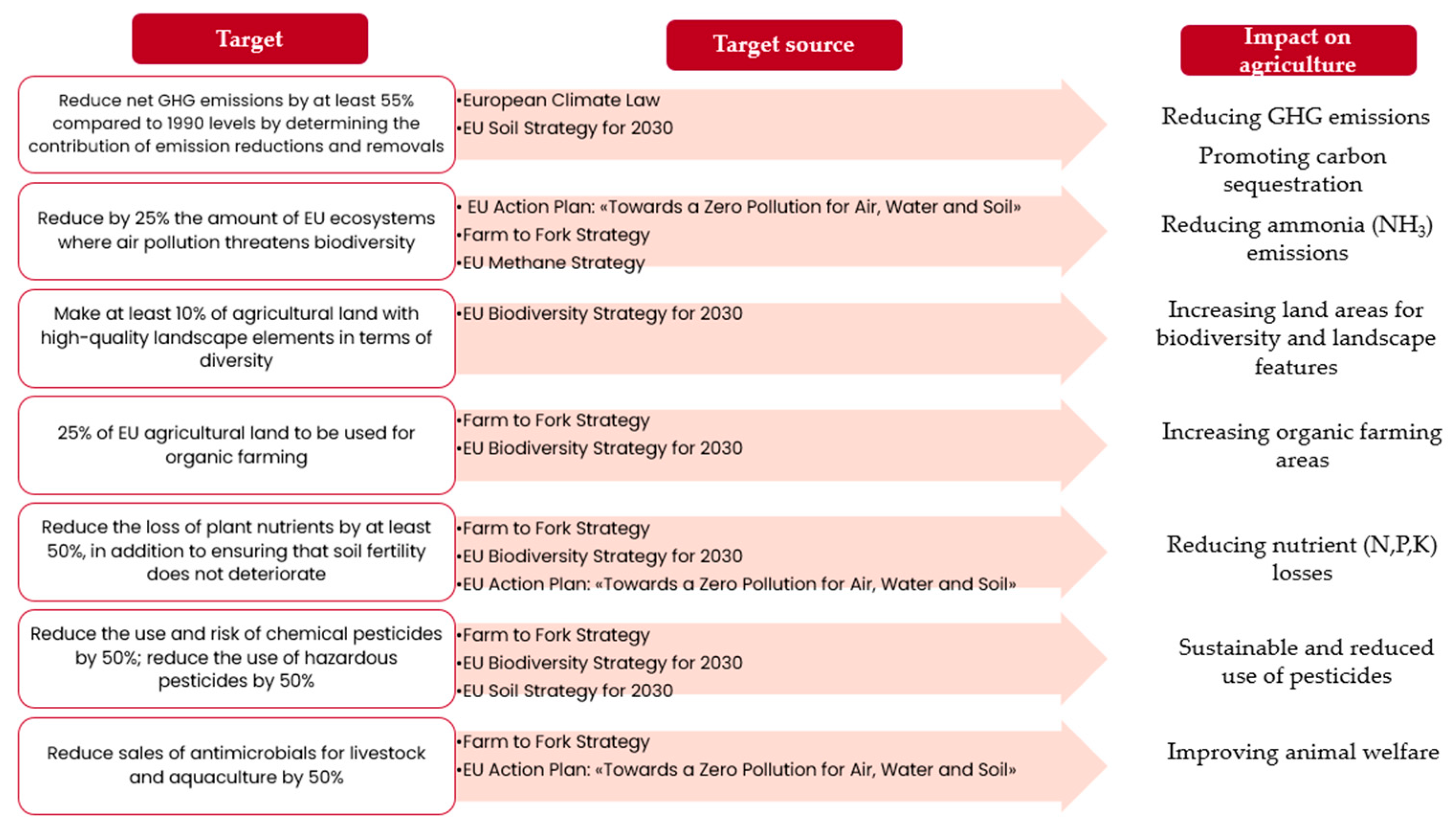
Figure 2.
Impact of animal feed improvement practices on EGD targets.
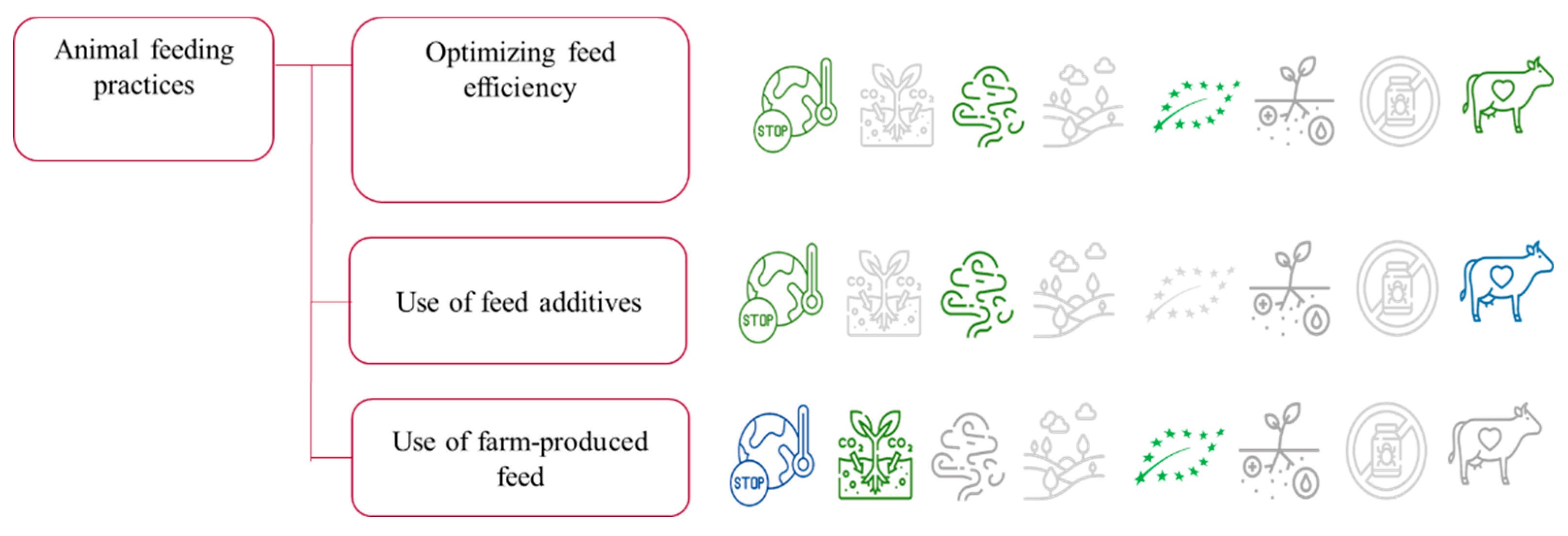
Figure 3.
Impact of animal housing and welfare practices improvement practices on EGD targets.
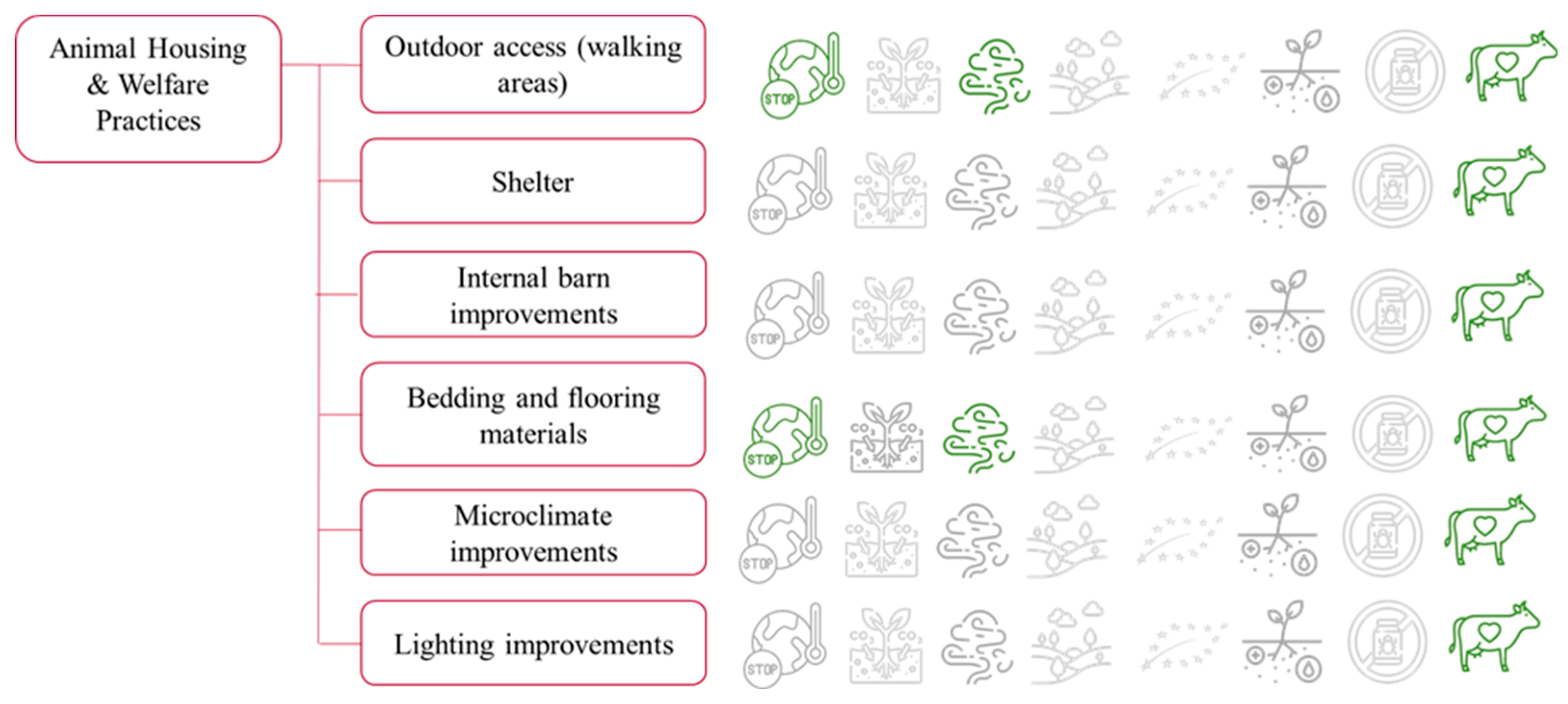
Figure 4.
Impact of grassland and pasture management practices improvement practices on EGD targets.
Figure 4.
Impact of grassland and pasture management practices improvement practices on EGD targets.
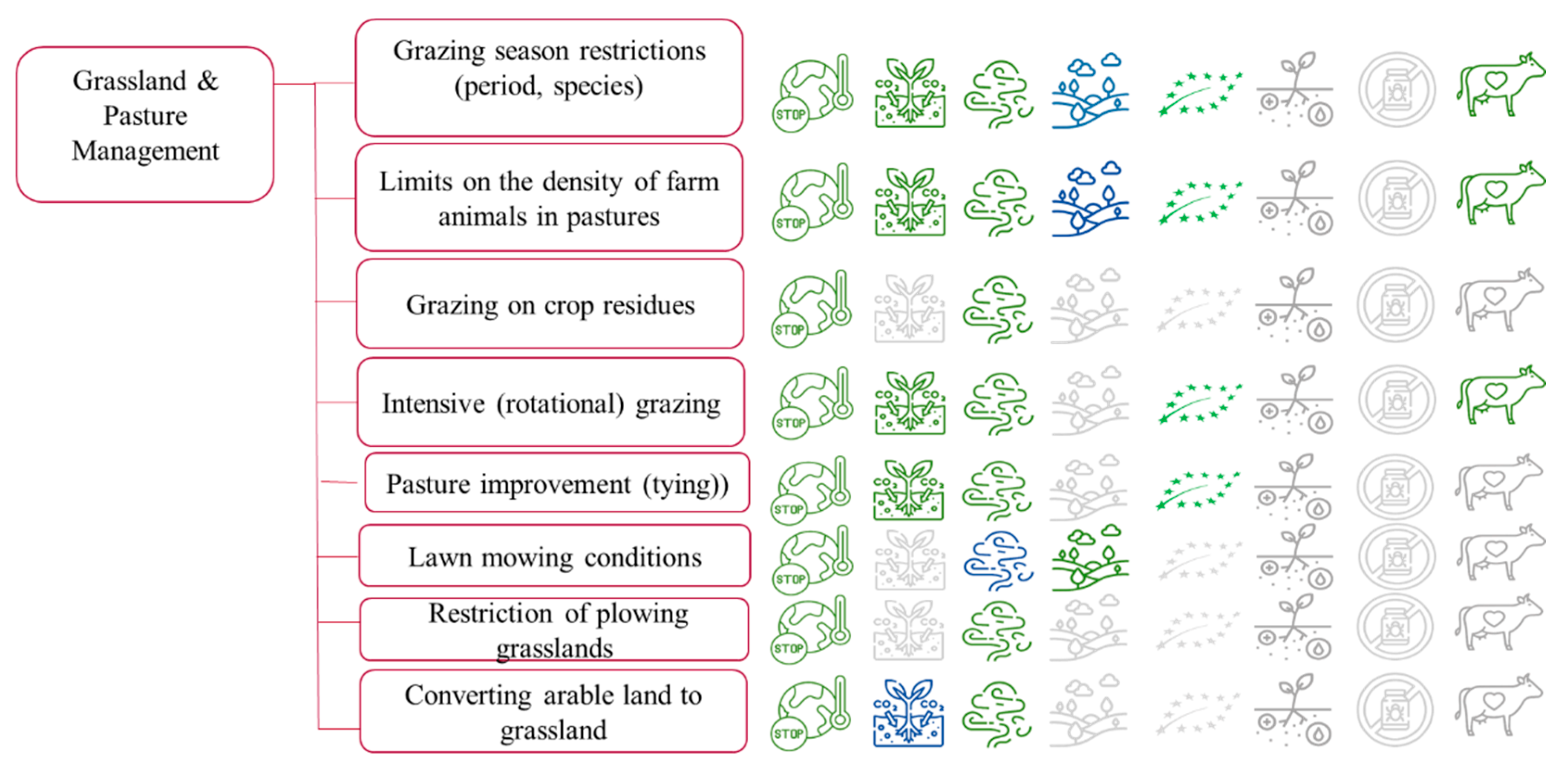
Figure 5.
Impact of manure storage and treatment practices improvement practices on EGD targets.
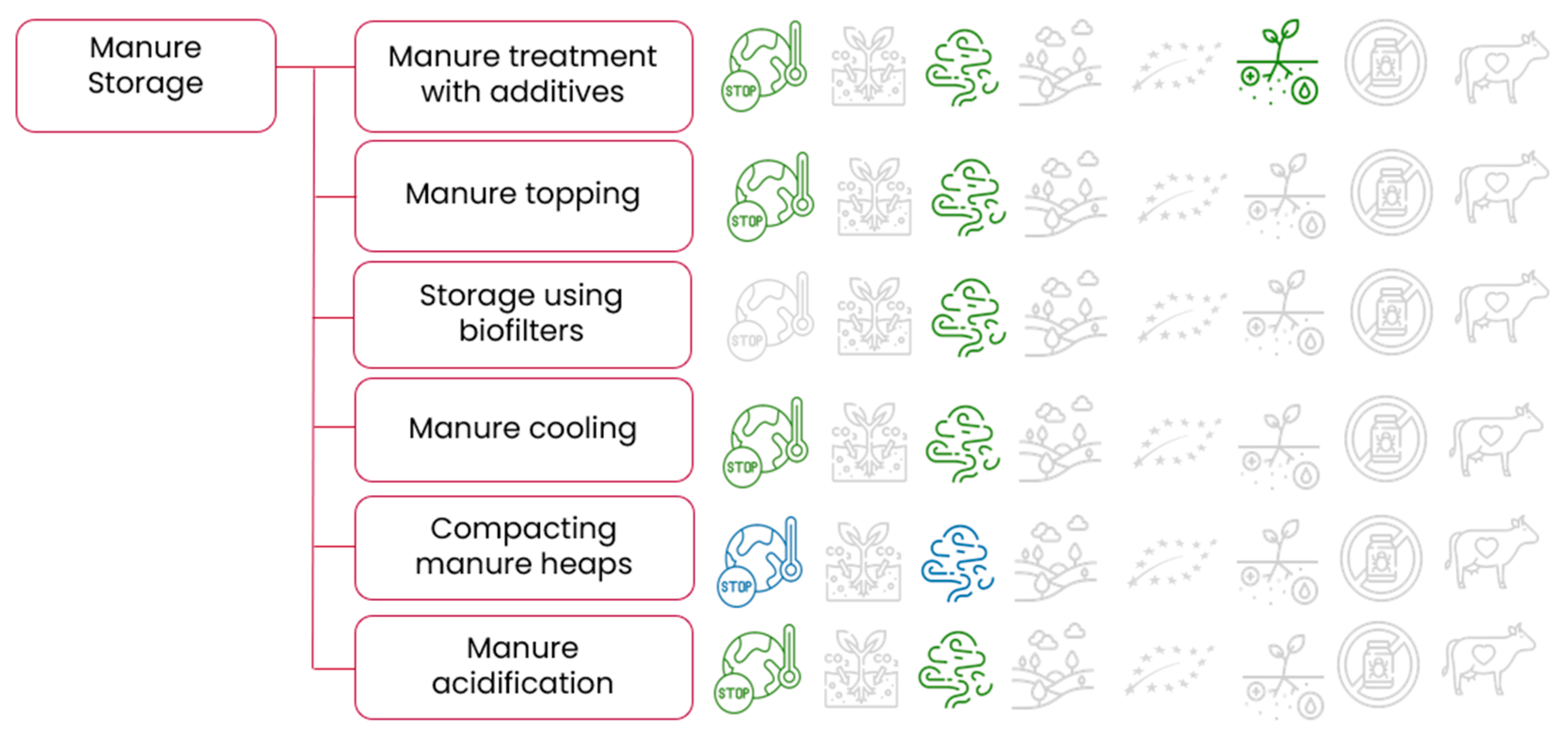
Figure 6.
Impact of animal breeding and genetics practices improvement practices on EGD targets.
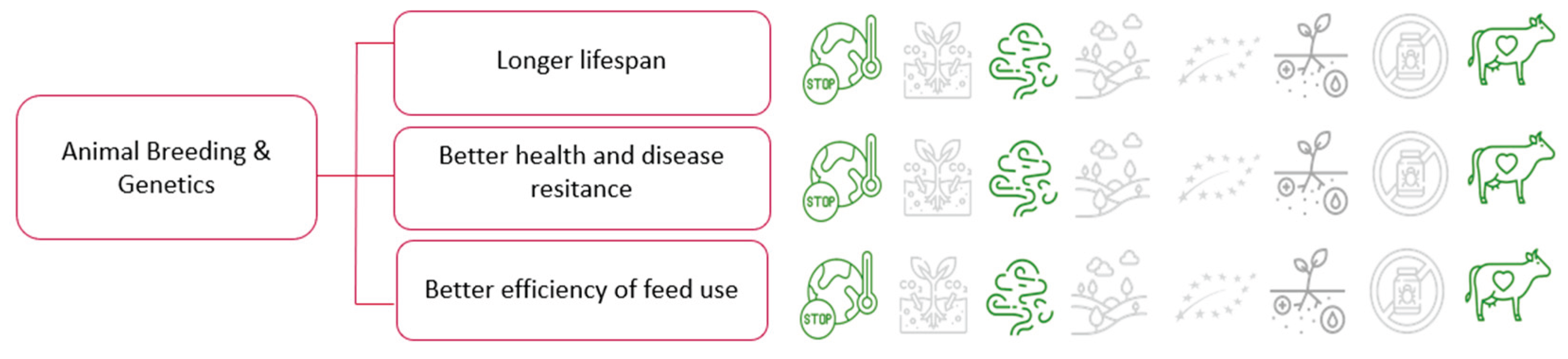
Table 1.
Pictogram selection and color-coding system used in this study for visualizing impact effect on EGD targets.
Table 1.
Pictogram selection and color-coding system used in this study for visualizing impact effect on EGD targets.
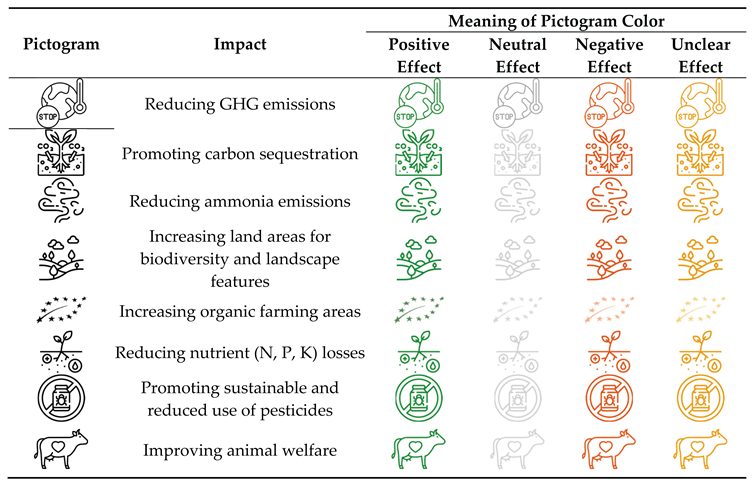 |
Table 2.
High-impact farming Ppractices for key European Green Deal targets.
| EGD Target | Most Effective Practices | Co-Benefits |
|---|---|---|
| GHG Reduction (-55%) | Optimize feed efficiency, Methane inhibitors | Lower synthetic fertilizer use, Improved animal welfare, Reduced ammonia emissions (air quality) |
| Improving air quality (reducing ammonia emissions) (25%) | Outdoor access, bedding and flooring materials, | Improved animal welfare, Reduced GHG emissions, |
| Nutrient Loss Reduction | Grazing season restrictions, limits on the density of farm animals in pasture, Rotational grazing, | Reduced eutrophication, Reduced ammonia emissions (air quality), Improved freshwater Biodiversity enhancement, Soil organic carbon retention quality, Improved Animal welfare, biodiversity and landscape elements |
| Animal Welfare | Outdoor access, Grazing access, bedding and flooring materials, | Lower antimicrobial use, Higher productivity, Reduced veterinary costs |
Disclaimer/Publisher’s Note: The statements, opinions and data contained in all publications are solely those of the individual author(s) and contributor(s) and not of MDPI and/or the editor(s). MDPI and/or the editor(s) disclaim responsibility for any injury to people or property resulting from any ideas, methods, instructions or products referred to in the content. |
© 2025 by the authors. Licensee MDPI, Basel, Switzerland. This article is an open access article distributed under the terms and conditions of the Creative Commons Attribution (CC BY) license (http://creativecommons.org/licenses/by/4.0/).
Copyright: This open access article is published under a Creative Commons CC BY 4.0 license, which permit the free download, distribution, and reuse, provided that the author and preprint are cited in any reuse.


