

Submitted:
05 November 2025
Posted:
06 November 2025
You are already at the latest version
Abstract
Conventional plant breeding relies on the occurrence of chromosomal crossover as well as spontaneous or non-targeted mutations in the genome induced by physical or chemical stressors. However, constraints exist concerning the number and variation of genotypes that can be achieved in this way as the occurrence and combination of mutations are not equally distributed across the genome. The underlying mechanisms and causes of reproductive constraints can be considered the result of evolution to maintain the genomic stability of a species, while at the same time allowing necessary adaptions.
A continuous horizon scan was carried out to identify plants derived from new genomic techniques (NGTs) which show that CRISPR/Cas is able to circumvent at least some of these mechanisms and constraints. The reason for this is the specific mode of action: While physico-chemical mutagens such as radiation or chemicals merely cause a break of DNA, recombinant enzymatic mutagens (REMs) such as CRISPR/Cas additionally interfere with the cellular repair mechanisms. More recently developed REMs even expand the capabilities of NGTs to introduce new genetic variations within the target sequences.
Thus, NGTs allow to introduce genetic changes and combinations that are unknown in the current breeding pool, and that are also unlikely to occur from any previously used breeding methods. The resulting genotypes may need to be considered as ‘new to the environment’.
The reasons for the above can be identified in the mode of action of the REMs. CRISPR/Cas catalysed reactions in particular can interfere with and overcome 1) cytogenic features such as repair mechanisms; 2) factors influencing recombination and stability of the genome such as crossovers; 3) gene copies with and without proximity and 4) certain regulatory elements.
The technical potential of NGTs should also be taken into account in regulatory provisions. Previously unknown genotypes and phenotypes may negatively impact plant health, ecosystems, biodiversity and plant breeding. It must further be acknowledged that the different outcomes of NGTs and conventional breeding are not always evident at first sight. As a starting point, within a process-oriented approval process, molecular characterisation can inform the following steps in risk assessment and guide requests for further data.
Keywords:
new genomic techniques (NGT)
; genetically engineered organisms
; genome editing
; CRISPR/Cas
; recombinant enzymatic mutagens (REMs)
; GMO regulation
; risk assessment
; process‐oriented approval process
1. Introduction
Genome flexibility allows plants to evolve over generations and adapt to changing environmental conditions (Lu et al., 2021). At the same time, genome stability is crucial to ensuring integrity and maintenance (Schubert and Vu, 2016; Sall et al., 2025). Plants have developed an extensive array of mechanisms and structures to cope with DNA damage and ensure proper cell division and genetic exchange (Roy, 2014; Hu et al., 2016). These mechanisms and structures shape the occurrence and combination of mutations, which are not equally distributed across the genome (Quiroz et al., 2023).
Conventional plant breeding also works within this framework, as it relies on the occurrence of crossovers as well as spontaneous or non-targeted mutations induced by physical or chemical stressors. Therefore, constraints exist for the number and variation of genotypes that can be achieved in this way.
Genome editing is a site-directed process that enables the editing of DNA sequences by using recombinant enzymatic mutagens (REMs), such as clustered regulatory interspaced palindromic repeats/CRISPR associated nucleases (CRISPR/Cas), transcription activator-like effector nucleases (TALEN), or zinc finger nucleases (ZFN). These techniques are referred to as new genomic techniques (NGTs). The application of NGTs allows genotypes and phenotypes/traits to be modified within short periods of time. While some of the NGT-derived genotypes will be also achievable using conventional breeding, other genotypes are novel and go beyond what can be expected from conventional breeding (Kawall, 2021b; Eckerstorfer and Heissenberger, 2023; ANSES, 2024; Bohle et al., 2024; Mundorf et al., 2025). For example, specific regulatory units in plant DNA are a highly dynamic research field; it is here that even minor indels (insertions or deletions) are often sufficient to result in significant impacts on gene expression (Hou et al., 2022; Luo and Palmgren, 2023; Yadav et al., 2023). However, many of these specific minor genetic changes achieved by NGTs seem to be hardly achievable with conventional plant breeding techniques. In future, one can expect to see even more novel and increasingly complex genotypes driven by ongoing technical development, increasing knowledge of plant genetics and the diverse applications (see, e.g., (Puchta and Houben, 2024)).
In the following chapters, the review reports findings that explain the differences between NGTs and conventional breeding based on the mode of action of CRISPR/Cas nucleases (Section 1), cytogenic factors that influence the likelihood of mutations occurring in specific genic regions (Section 2.1.), factors influencing recombination and stability of the genome (Section 2.2.) and the role of gene copies (Section 2.3.). In addition, the review provides examples that can be useful in discussions on the potential of NGTs and the differences to conventional breeding (Section 3.).
Finally, implications of the findings in regard to the regulation and risk assessment of NGT plants are discussed.
2. Main Section: CRISPR/Cas Catalysed Reactions Can Overcome Structural Genomic Elements, Cytogenic Factors and Mechanisms
2.1. Mode of Action of CRISPR/Cas
CRISPR/Cas was first discovered as an adaptive immune system in bacteria (Mojica et al., 2005; Barrangou et al., 2007) and successively adapted as a molecular biotechnology tool for genome editing.
CRISPR/Cas is first and foremost a large enzyme complex that can be adapted for different purposes. Currently, CRISPR/Cas9 is the most used tool to alter plant genomes with site-directed nucleases (SDNs) since it is, amongst other things, easy to use and highly versatile. It consists of a targeting component, i.e., the single guide RNA (sgRNA) and the endonuclease Cas9. The endonuclease is a REM that can induce double strand breaks (DSBs) in the DNA, which is the substrate, and thus trigger and interfere with various repair mechanisms in the cells, i.e., non-homologous end joining (NHEJ), microhomology-mediated end joining (MMEJ) and homology-directed repair (HDR), which repair the induced DSBs.
The NHEJ pathway is active throughout the cell cycle and ligates the two broken DNA ends without any homologous repair template. The outcome of NHEJ pathways may be either a DNA sequence that is identical to the one before the DSB, or a sequence with small insertions/deletions (indels) (Gorbunova and Levy, 1999). These indels can have significant effects, such as frameshift mutations, disruptions/alterations of gene functions, or changes in gene expression. Similar to NHEJ, the MMEJ pathway does not require a template to repair the DSB. Instead, the DSB ends are trimmed until short homologous sequences, called microhomologous sequences, are exposed. This can result in very large deletions, as the MMEJ mechanism removes all sequences between the breakpoint and the microhomologous sequence. MMEJ is therefore regarded as highly mutagenic (McVey and Lee, 2008; Puchta and Fauser, 2014; Sfeir and Symington, 2015; Seol et al., 2018). MMEJ activity is significantly elevated in actively cycling cells, i.e., when they enter the S and G2 phase (Truong et al., 2013). It appears that MMEJ repair plays an important role in the repair during genome editing, as DSBs induced via Cas9 through enzymatic activity are more often repaired by MMEJ than DSBs caused by more unspecific stressors, e.g., radiation (Shen et al., 2018; Tan et al., 2020; Xue and Greene, 2021; Sall et al., 2025). The HDR pathway uses homologous sequences from sister chromatids as a repair template, and is therefore more accurate in repair than NHEJ or MMEJ. It is also primarily active in the S and G2 phase of the cell cycle when sister chromatids are available to be used as homologous templates (Choulika et al., 1995; Takata et al., 1998).
In most cases of genome editing, these cellular repair mechanisms are purposed to disrupt and knock out gene functions by inducing DSBs (SDN1). However, in SDN2 and SDN3 approaches the HDR pathway can be utilized to substitute, insert, or replace DNA sequences at the target site in a desired way by using exogenous DNA donor templates (Shan et al., 2013; Svitashev et al., 2015; Zhao et al., 2016).
CRISPR/Cas catalyzed reactions specifically allow certain genomic regions (target sequences) to be cut with the endonuclease Cas9 using one or more sgRNA(s). The sgRNAs are designed individually according to the genomic loci that are to be altered. Cas9 interacts with the sgRNA and is directed to the DNA sequence complementary to the sgRNA (Jinek et al., 2012; Doudna and Charpentier, 2014). The actual binding of the Cas9 to the DNA and its activation further requires the presence of a protospacer adjacent motif (PAM) sequence adjacent to the target sequence (Sternberg et al., 2014). After establishing the DNA/sgRNA/Cas9 complex, Cas9 then introduces a DSB at the target sequence (for more details see, e.g., (Jiang and Doudna, 2017)).
CRISPR/Cas9 mainly induces blunt-end DSBs (Jinek et al., 2012; Jiang and Doudna, 2017; Chauhan et al., 2023), but according to a recent study staggered-ends can also occur in plants (Přibylová et al., 2022). Depending on the time Cas9 stays bound to the cleaved products, it can smooth staggered-ends after DSB (Stephenson et al., 2018; Přibylová and Fischer, 2024). Post cleavage residency of the Cas9 enzyme can last several hours (Richardson et al., 2016; Brinkman et al., 2018; Aldag et al., 2021; Přibylová and Fischer, 2024). It is assumed that the release of Cas9 from the cleavage products is facilitated via certain cellular mechanisms rather than spontaneous dissociation (Feng et al., 2021; Přibylová and Fischer, 2024): The physical collision with enzymes of DNA replication and transcription can, for example, dislodge Cas9 from cleaved DNA ends (Clarke et al., 2018; Feng et al., 2021; Hall et al., 2022). Depending of the dissociation form, these cleaved ends may have different configurations, which in turn influence the result of the repair (Feng et al., 2021).
However, as long as Cas9 is bound to the cleaved DNA, repair of the DSB cannot take place (Clarke et al., 2018; Feng et al., 2021). Therefore, cellular detection, processing and repair of Cas9-induced DSBs is delayed compared to DSBs induced by e.g., radiation (Richardson et al., 2016; Brinkman et al., 2018; Feng et al., 2021; Reginato et al., 2024) (Figure 1). Further, it is assumed that the residency of the Cas9 enzyme and the delay have an impact on the outcome of the subsequent repair (Feng et al., 2021; Liu et al., 2022). This may be one of the reasons why the repair of CRISPR/Cas9-induced DSBs is more error-prone and not representative for spontaneous, naturally occurring, or otherwise induced DSBs (Richardson et al., 2016; Brinkman et al., 2018; Sreekanth et al., 2020; Liu et al., 2022; Reginato et al., 2024). The extent of the error-prone repair is stated differently in the literature, but the results are confirmed in key findings (Brinkman et al., 2018; Ben-Tov et al., 2024). The rates of error-prone repair seem to be locus-dependent and further influencing factors remain to be investigated (Brinkman et al., 2018; Ben-Tov et al., 2024). Once the ends of the DSB are released from Cas9, they can be detected and accessed by DNA repair machinery.
Overall, our understanding of the CRISPR/Cas mechanisms and the subsequent repair of DSBs in the cell is incomplete (Přibylová et al., 2022). However, studies have demonstrated that enzymatic-induced DSBs with Cas9 are distinct from DSBs induced by, for example, ionizing radiation (Feng et al., 2021).
If the DSBs induced by NGTs have been repaired correctly, as long as CRISPR/Cas9 remains active in the cell, it can repeatedly bind and cut the target sequence again (Figure 1). If the substrate (i.e., the binding site) is restored by DNA repair mechanisms, the enzyme CRISPR/Cas will again catalyze the reaction and ultimately force a change. In contrast, a mutation caused by physico-chemical mutagens can also be repaired in such a way that the previous state is restored. As a result, CRISPR/Cas9 mutagens ultimately enriche for mutagenic outcomes (Brinkman et al., 2018; Nambiar et al., 2022). As Feng et al. state, the cell’s own DNA damage response and repair machineries have to respond to unique features of DSBs induced by Cas9 (Feng et al., 2021). And in the context of medical research, Vitor et al. state: “Moreover, the fact that Cas9-induced DSBs may be particularly refractory to repair, and hence biased in terms of repair pathway choice, call for caution when using these systems” (Vítor et al., 2020).
Several findings regarding CRISPR/Cas9-induced DSBs are derived from mammalian cells, but some finding are similarly relevant for NGT applications in plant cells (Přibylová and Fischer, 2024). For example, some studies reported an increase of chromothripsis due to CRISPR/Cas9 applications in mammalian cells (Ledford, 2020; Leibowitz et al., 2021; Amendola et al., 2022; Lazar et al., 2024). Chromothrypsis is a catastrophic event resulting from the formation of DSBs on one or a few chromosome(s) and subsequent error-prone repair generating highly rearranged chromosome(s). The finding was explained to be related to the disturbed or delayed repair of DSBs ((de Groot et al., 2023), see also recently (Cullot et al., 2024)), which is in line with the specific mode of action as reported above. Meanwhile NGT-induced chromothrypsis was also reported in plants (Samach et al., 2023). There are other examples of unintended effects of CRISPR/Cas9 that may be caused by its specific mode of action (Koller and Cieslak, 2023). One specific effect are bi-allelic deletion-inversions (delinvers), which can occur when CRISPR/Cas is used to create knockouts of tandemly arrayed genes (Chen et al., 2023; Liu et al., 2023) and would not be expected to occur as an outcome of conventional breeding.
2.2. Potential of NGTs to Overcome Structural Genomic Elements, Cytogenic Factors and Mechanisms
2.2.1. Cytogenic Features
In the past, evolutionary biology assumed that i) the mutation rate is unbiased, i.e., it varies randomly among genomic loci and irrespective of the fitness consequence, and ii) that the occurrence of mutations is strongly influenced by selection (Loewe, 2008).
Both assumptions were called into question by the findings of Monroe et al. showing that mutation rates in Arabidopsis thaliana are influenced by cytogenic features, and that the probability of de novo mutations is dependent on gene function and fitness consequences (Monroe et al., 2022). Prior studies already indicated a ‘mutational bias’ which is mediated by the DNA sequence itself, epigenetic features and (the targets of the) various DNA repair mechanisms (Martincorena et al., 2012; Schuster-Böckler and Lehner, 2012; Li et al., 2013; Yazdi et al., 2015; Kawall, 2019). Accordingly, the former view of mutations in organisms as occuring entirely random cannot be upheld. The processes and mechanisms behind this observation can be considered the outcome of an evolutionary process to maintain genomic stability of the species while at the same time enabling necessary adaptions (Quiroz et al., 2023).
In detail, a strong bias in the mutation rate was demonstrated: The highest mutation rate was found in genomic regions carrying cytosine methylation and the histone modification H3K9me1 (Monroe et al., 2022). It is lower in guanine-cytosine (GC) rich regions (Arndt et al., 2005; Mugal and Ellegren, 2011; Schuster-Böckler and Lehner, 2012; Monroe et al., 2022) and reduced inside genes (Monroe et al., 2022). Regions containing histone modifications (H3K4me1, H3K27Ac, H3K36me3) that are enriched at actively transcribed genes show fewer mutations (Monroe et al., 2022; Staunton et al., 2023). Other studies also found lower mutation rates in actively transcribed genes (Li et al., 2013; Huang and Li, 2018; Huang et al., 2018). Since actively transcribed regions are more exposed to DNA damage, because they are less condensed and are sites of DNA processing (Bergis-Ser et al., 2024), the observed low mutation frequency indicates that DNA repair mechanisms are especially active and efficient in highly transcribed regions (Kawall, 2019; Bergis-Ser et al., 2024). Another major finding of Monroe et al. is that lower mutation rates correlate with essential genes which are enriched in epigenomic features associated with low mutation (e.g., H3K4me1, H3K36me3) (Monroe et al., 2022).
These findings show that mutation rates across the genome depend on different cytogenetic features, including GC content, DNA methylation, histone modifications, chromatin accessibility, gene expression and DNA repair mechanisms (Kawall, 2021b). The latter is thought to be directed to (essential) genes, e.g., via H3K4me1 or H3K36me3 binding, which regulate the DNA repair machinery, i.e., HR, NHEJ or DNA mismatch repair (MMR) (Sun et al., 2020; Quiroz et al., 2024). Belfield et al. showed that MMR preferentially protects genic parts of the genome (untranslated regions, coding sequence and introns) from de novo mutations in A. thaliana (Belfield et al., 2018; Kawall, 2019). There is also corresponding evidence in Escherichia coli, yeast and human cell lines (Lee et al., 2012; Sun et al., 2016; Frigola et al., 2017; Supek and Lehner, 2017; Foster et al., 2018; Niccum et al., 2018).
Thus, mutations are unevenly distributed across the A. thaliana genome (Kawall, 2021b). Similar patterns were found in wheat and rice after chemical and radiation mutagenesis (Yan et al., 2021; Li et al., 2022a; Quiroz et al., 2023; Bergis-Ser et al., 2024). It is also well known that non-targeted mutagenesis with ethyl methanesulfonate (EMS) often results in multiple mutated alleles for one gene, but none for other genes (Yan et al., 2021).
Different Causes of Mutations Can Result in Different Outcomes
Comparing mutations caused by physico-chemical stressors with those caused by enzymatic site directed nucleases is challenging: The editing efficiency and the outcome of CRISPR/Cas9 applications also seem to be influenced by cytogenic features (van Overbeek et al., 2016; Yarrington et al., 2018; Weiss et al., 2022). For example, editing with CRISPR/Cas9 is less efficient in most types of heterochromatin compared to euchromatin, although certain heterochromatin features seem to promote highly mutagenic MMEJ (Gisler et al., 2019; Schep et al., 2021). In addition, several studies show that editing heterochromatin regions tends to be less effective but possible (Yu et al., 2013; Feng et al., 2016; Kallimasioti-Pazi et al., 2018; Weiss et al., 2022; Přibylová and Fischer, 2024). Further, other tools such as zinc-finger nucleases can edit genome regions which are otherwise inaccessible (Yarrington et al., 2018).
As described above, studies found few mutations in actively transcribed regions when they occurred naturally or were otherwise induced. This was different with CRISPR/Cas-induced mutations: A relatively large number of mutations were found in actively transcribed genes of mammalian cells (Clarke et al., 2018). The authors could show that the RNA polymerase dislodges CRISPR/Cas9 from the cleaved DNA where it was still bound. The collision with RNA polymerase converted Cas9 into a multi-turnover nuclease resulting in repeated cutting and increased mutagenesis (Clarke et al., 2018). A detailed study in A. thaliana revealed further details of how various chromatin features influence Cas9 efficacy and the outcome of the DNA repair (Weiss et al., 2022). They observed, e.g., strong positive correlations between mutagenesis frequency and histone modifications H3K36ac, H3K27ac and H3K36me3 after CRISPR/Cas9 interventions. This is in stark contrast to observations in A. thaliana where the same histone modifications were correlated with fewer mutations when they occurred naturally (Monroe et al., 2022) (Figure 2). These results strongly indicate that CRISPR/Cas9 is able to circumvent mechanisms in the cells that may otherwise protect certain areas of the genome. It can be concluded that CRISPR/Cas9 is a powerful tool that enables enzymatic alterations in the genome that would be effectively unachievable with conventional breeding.
2.2.2. Factors Influencing Recombination and Stability of the Genome
The genome of plants is organized into chromosomes of varying sizes and numbers. During meiosis, the chromosomes provide the structure for genetic linkage groups, as genes or sequences that lie on the same chromosome are inherited as a group (Heslop-Harrison and Schwarzacher, 2011). Recombination can separate genes or other DNA sequences on the same chromosome during meiosis. This requires an initial meiotic DSB and a subsequent crossover repair resulting in an exchange of genetic material across homologous chromosomes. Hundreds of DSBs are induced during meiosis, but only very few result in crossovers (Dluzewska et al., 2018; Lloyd, 2023). The meiotic DSBs and crossover events seem to occur preferentially at narrow hotspots probably defined by a combination of DNA sequences and epigenetic factors (Choi and Henderson, 2015; Fernandes et al., 2024). In general, a crossover pattern is the outcome of a highly complex regulated process, including genome-wide, chromosomal and local regulation (Termolino et al., 2016; Wang and Copenhaver, 2018; Lloyd, 2023). One result is that distant genes are more easily separated by crossover, whereas neighboring genes tend to be genetically linked. The latter group of genes is hardly accessible for breeders since they rely on natural meiotic recombination to generate new favorable allelic combinations, known as ‘linkage drag’ (Figure 3 (1)).
Some genomic regions are strongly crossover-suppressed (“cold regions”) including sex-chromosomes and centromeres (Kejnovsky et al., 2009; Fernandes et al., 2024) (Figure 3 (2)). The centromeres and the surrounding so-called pericentromeric regions are characterized by large arrays of repetitive sequences, which are integral to centromere function and stability (Heslop-Harrison and Schwarzacher, 2011; Hartley and O’Neill, 2019). Specific histone variants and post-translational modifications are enriched at these repetitive sequences (Simon et al., 2015). Recombination was shown to be strongly suppressed in centromeric regions in different plant species (Lloyd, 2023). In barley (Mayer et al., 2012), cotton (Shen et al., 2017), maize (Li et al., 2015), tomato (Sato et al., 2012) and wheat (Appels et al., 2018), there are additional large pericentromeric regions with a low or absent number of crossovers, while at the same time a considerable number of genes are located within this region (Mayer et al., 2012; Bauer et al., 2013; Lloyd, 2023). This lack of recombination results in strong genetic linkage, as genes that lie in centromeric or pericentromeric regions will most likely be inherited together, making these regions effectively inaccessible to breeders (Blary and Jenczewski, 2019; Lloyd, 2023). Different studies show that crossover suppression in the proximity of centromeres is important for fertility (Nambiar and Smith, 2016; Fernandes et al., 2017; Serra et al., 2018).
The mechanisms behind the suppressed recombination in centromeric and pericentromeric regions are not fully understood. In Arabidopsis, the DSB density was shown to be reduced in centromeric regions (Choi et al., 2018). However, this is not sufficient to entirely explain the strong suppression (Lloyd, 2023). The repair of meiotic DSBs in centromeric regions may favor inter-sister or non-crossover repair pathways instead of crossover repair (Fernandes et al., 2019). There is probably an interplay between different mechanisms and factors which suppress meiotic DSBs or crossover repair, namely: epigenetics (e.g., histone modifications such as H3K27me3 or H3K9me2), genetic variation (polymorphism) and centromere specific protein complexes (e.g., the kinetochore) (Fernandes et al., 2019).
The distances between genes to be recombined by crossing over is measured in centimorgan and vary not only between plant species, but also in plant populations within the same species (Bauer et al., 2013). Taken together, there is a fine balance between occurrence and suppression of crossover events in number and position (Lloyd, 2023).
Recombinant Enzymatic Mutagens Can Create Novel Patterns of Crossovers and Bypass Genetic Linkage
REMs can, for example, bypass genetic linkage of specific gene regions. Alterations are induced to circumvent genetic linkage of traits such as, e.g., tomatoes (see Chapter 3, (Soyk et al., 2017)). This technical potential is highly relevant in plant breeding as many genes are associated with linkage drag (Mayer et al., 2012; Bauer et al., 2013; Blary and Jenczewski, 2019; Lloyd, 2023). For example, tandemly arrayed genes (TAGs) with functional redundancy and chromosomal linkage constitute ~14–35% in sequenced plant genomes (Liu et al., 2023).
Dissections of linked genes can also be achieved by technically induced crossovers: The use of CRISPR/Cas makes it possible to change these natural meiotic recombination patterns (Rönspies et al., 2022), thereby manipulating and guiding inheritance. Novel crossing over patterns can also be achieved by targeted crossover or chromosome reconstruction. Both CRISPR/Cas-induced approaches are further explained below.
In contrast to natural crossover events, targeted crossover is mainly induced in somatic cells (Filler Hayut et al., 2017; Kouranov et al., 2022). In this way, competition with naturally occurring crossover events can be avoided, as somatic crossover events occur at a much low rate than during meiosis. CRISPR/Cas9 is used here to induce DSBs which can be subsequently repaired by (rare) somatic homologous recombination (Filler Hayut et al., 2017; Ben Shlush et al., 2020; Filler-Hayut et al., 2021; Samach et al., 2023). This can finally result in somatic crossover and be transmitted to the next generations, but so far the approach has shown low efficiency in A. thaliana, tomato and maize (Samach et al., 2023; Puchta and Houben, 2024). Unintended chromosomal loss and major chromosomal rearrangements (chromothripsis) were detected in addition to somatic crossover, which had various deleterious effects on the plant (Samach et al., 2023). Nevertheless, there were some indications of successful induction of somatic homologous recombination in “cold regions” (Filler-Hayut et al., 2021).
Furthermore, chromosome reconstruction can be used to manipulate genetic exchange when genetic linkages are broken or established (Rönspies et al., 2021). Physical separation of two target genes, which naturally lie in close proximity, can break natural genetic linkage, whereas combination of target genes on the same chromosome in close proximity can establish genetic linkages. In addition, repositioning a gene from a “cold region” might make it accessible for exchange, e.g., of pericentromeric regions into an euchromatic chromosome arm environment (Puchta and Houben, 2024; Khosravi et al., 2025). This can be achieved by changing the order of genes on a chromosome (e.g., inversions) or by reciprocal translocation, i.e., the exchange of parts between non-homologous chromosomes (Beying et al., 2020; Gehrke et al., 2021; Rönspies et al., 2021). Using CRISPR/Cas, simultaneous induction of two DSBs on the same chromosome can lead to inversions, whereas the induction of two DSBs on different chromosomes can lead to reciprocal translocation (Gehrke et al., 2021). The use of an egg-cell-specific Cas9 expression can enable heritable translocations (Beying et al., 2020; Gehrke et al., 2021; Kouranov et al., 2022). Induction of large inversions on chromosomes can result in strongly suppressed (Rönspies et al., 2022) or, in case of reversion of naturally occurred inversions, increased recombination (Schmidt et al., 2020; Schwartz et al., 2020). The technique of chromosomal reconstruction is still in its infancy, but enables a completely new level of targeted chromosome engineering (Lee and Wang, 2020; Rönspies et al., 2021; Puchta and Houben, 2024). In accordance, Schmidt et al. point out that “many […] examples show the potential of targeted modification of chromosome structures for achieving new combinations of alleles out of a pool of species that are not achievable by the use of classical breeding” (Schmidt et al., 2019b).
Using 2017 Previous attempts have shown that it is possible to fix favorable traits by generating new genetic linkages, suppress recombination of whole chromosomes, separate beneficial traits from undesirable traits linked to them or unlock “cold regions” for genetic exchange (Schmidt et al., 2020; Puchta and Houben, 2024). Chromosomal rearrangements also occur in nature and can play an essential role in speciation and chromosome evolution of plants (Huang and Rieseberg, 2020; Lucek et al., 2023). However, chromosomal rearrangements like reciprocal translocation or inversions seem to occur quite rarely and are counter-selected (Farré et al., 2012; Lian et al., 2024). In addition, chromosomal rearrangements may occur non-randomly in hotspots (Zhou et al., 2023b; Escudero et al., 2024; Kileeg et al., 2024; Zhou et al., 2024a, 2024b). Growing evidence suggests that chromosomal rearrangements are frequently associated with heterochromatic regions composed of repetitive DNA sequences (Li et al., 2017; Sall et al., 2025). It is speculated that if those rearrangements occur in plants, they have a minimally deleterious impact on the genome, giving chromosomes a safe place to break or fuse (Li et al., 2017; Escudero et al., 2024). Interestingly, also transposon insertion seems to be tightly correlated to epigenomic features (Quadrana et al., 2019; Roquis et al., 2021; Quiroz et al., 2023).
Using CRISPR/Cas, it is already possible today, or will likely be possible in the near future, to induce genetic exchange at almost every position in the genome, thereby circumventing natural limitations/patterns of meiotic crossover. Targeted chromosomal reconstruction further enables a completely new level of genome engineering. Thereby, the mechanism of inheritance can be overcome and genetic combinations can be achieved that would not occur naturally. In future, researchers expect to achieve even more complex or fine-tuned rearrangements, such as promoter swapping, the construction of artificial centromeres, or mini cargo chromosomes, where beneficial genes can be stacked (Capdeville et al., 2023; Puchta and Houben, 2024).
2.2.3. Gene Copies with and Without Proximity
Gene duplication is common in all investigated species, but the rates are significantly higher in plants compared to most other eukaryotes (Hanada et al., 2008). Gene copies can result from ancient duplication events, such as whole genome duplication (polyploidization), chromosome and subchromosomal duplication (segmental duplication), or local duplication (tandem duplications) (Maher et al., 2006; Panchy et al., 2016). This results in many gene copies: 65% of annotated plant genes have on average at least one copy (Panchy et al., 2016). Depending on how long ago a gene duplication occurred and how many spontaneous mutations have accumulated since then, a duplicated gene can either retain its function, so that the gene is redundant, or develop into a gene with split or new function (sub- and neofunctionalization). Some duplicated genes are located in close proximity (e.g., gene clusters such as tandemly arrayed genes), whereas others are interspersed throughout the genome, depending on their origin and further genome evolution (Panchy et al., 2016).
Using conventional plant breeding techniques, it is difficult, time-consuming and in part impossible to achieve modifications or the knockout of all the different copies of a gene, especially if they are genetically linked, as in gene clusters (Qi et al., 2013) (Figure 3 (3)).
Using CRISPR/Cas it is possible to target and alter all copies or variants of a gene present in the genome, irrespective of how many gene copies are present (Kawall, 2019, 2021b). CRISPR/Cas can also be used to target similar genes from gene families within conserved target sites (Jung et al., 2018). In addition, it also enables the editing of different genomic sites using different sgRNAs in one organism simultaneously or successively in so-called multiplexing approaches (Kawall, 2019, 2021b). These technical potentials may be especially relevant in plants with polyploid genomes such as wheat; for example to achieve resistance to pathogens (Waites et al., 2025), or to reduce the concentration of certain proteins (Rottersman et al., 2025).
2.2.4. Other Genomic Features
As shown in Chapter 3, there are examples of NGT plants with only minor indels in regulatory units resulting in new genotypes, e.g., lettuce (Zhang et al., 2018) and strawberries (Xing et al., 2020). These are previously unknown genotypes. Much of the current research is focused on regulatory units in plant genomes and their effects on the expression of endogenous genes. Attractive targets include small regulatory elements which impact gene expression, e.g., promotors (Hou et al., 2022), upstream open reading frames (uORFs) (Luo and Palmgren, 2023) and microRNA (miRNA) (Yadav et al., 2023). There are further examples of NGT plants with alterations in their regulatory elements, e.g., the deletion of an auto-inhibitory domain of a protein (Nonaka et al., 2017) or the knockout of a regulatory protein (Ortega et al., 2023).
Such changes could theoretically also be expected to result from non-targeted mutagenesis. However, as it e.g., can be assumed from the studies above, they were not known to previously exist within the breeding pool (Nonaka et al., 2017; Zhang et al., 2018; Xing et al., 2020; Ortega et al., 2023). Regarding regulatory elements like promotors, the desired effects often require the introduction of several specific changes within the target sequence, while the deletion of the entire regulatory sequence would often destroy the three-dimensional genomic architecture (Zhou et al., 2023a). Interestingly, current CRISPR/Cas9-induced mutations often failed to alter the promoter function significantly (Tang and Zhang, 2023; Zhou et al., 2023a), but newly developed types of REMs were successful (Tang and Zhang, 2023). Thereby, the genome editing capabilities are further expanded and are going beyond ‘simple’ knock-outs (Tang and Zhang, 2023). New members of REMs are e.g., CRISPR/Cas12a for larger deletions (Zhou et al., 2023a), various base editors for key nucleotide conversion (Molla et al., 2021; Lam et al., 2023) and prime editors for substitution of small DNA sequences via reverse transcription using templates (Lin et al., 2021; Molla et al., 2021; Chen and Liu, 2023; Gupta et al., 2023; Tang and Zhang, 2023).
The specific technical potential of these REMs was also shown in the design of NGT plants developed by artificial intelligence (AI), going beyond what can be expected from conventional breeding (Juhas et al., 2025).
2.3. Examples Showing the Potential of NGTs to Overcome the Constraints of Conventional Breeding
The use of NGTs can result in new genotypes which go beyond what can be expected from conventional breeding, including non-targeted mutagenesis (Kawall, 2021b; Koller et al., 2023; Bohle et al., 2024). The structure of plant genomes together with cytogenic features make some regions of plant genomes less accessible for conventional breeding methods than others (see Chapter 2). REMs can overcome these constraints, thus making the genome more available for genetic changes (see Chapter 1 and 2) (Kawall, 2019; Kawall et al., 2020). To which extent this is the case, i.e., whether the plant genome is totally available for any type of genetic manipulation, will naturally depend on the stage of advancement of NGTs.
This chapter presents examples demonstrating the current potential of NGTs as well as the differences to conventional breeding. They are taken from the continuous horizon scan carried out by the Project Genetic Engineering and the Environment1 since 2019, and are based on published literature and online databases for genome-edited crops. Table 1 contains a summary. The list below is not meant to be exhaustive, but is intended to provide particularly clear examples of NGT-derived plants that would hardly been achieved by conventional breeding.
Tomato with Improved Harvesting Properties and Plant Architecture
Breeders found a phenotype in wild tomatoes (Solanum pimpinellifolium) where the fruit does not detach from the plant (no pedicel abscission), a trait which is of interest for the tomato harvest (Ledford, 2017). Conventional breeding failed to cross this trait into currently marketed fresh tomato breeds, as it comes with unwanted traits such as undesirable fruit shapes (Klee, 2019). Researchers later found a naturally occurring mutation in the gene jointless 2 (j2) responsible for the desired trait (Roldan et al., 2017; Soyk et al., 2017). It is located close to the centromere of chromosome 12, an area with suppressed recombination, explaining the difficulty of separating the desired ‘jointless’ trait from the undesired traits due to genetic linkage (Roldan et al., 2017; Klee, 2019). Using CRISPR/Cas, researchers were able to incorporate the ‘jointless’ trait into marketed fresh tomato breeds (Klee, 2019). In addition, by combining various CRISPR/Cas-induced mutations in j2 and enhancer of jointless 2 (ej2) genes, the researchers were able to fine-tune the plant architecture and number of fruits to an unprecedented degree (Klee, 2017; Soyk et al., 2017).
De Novo Domesticated Tomato
De novo domestication, i.e., the use of NGTs for a rapid conversion of wild relatives into crop plants (Gasparini et al., 2021), was performed in 2018 in the wild form of tomatoes (S. pimpinellifolium) (Zsögön et al., 2018). The researchers simultaneously modified several genes in S. pimpinellifolium, thereby establishing agronomically desirable traits. This multiplex approach resulted in completely novel genotypes, which are not achievable with conventional breeding techniques, especially in crops such as tomatoes, where the linkage drag affects large parts of the genome (Lin et al., 2014). There are further examples of multiplexing in tomatoes hardly achievable with conventional breeding, e.g., the (over-) accumulation of GABA, lycopene and pigments (recoloring) (Li et al., 2018a, 2018b; Yang et al., 2023).
Camelina with Altered Fatty Acid Content
In order to alter fatty acid contents in Camelina sativa, researchers targeted conserved genomic regions to knock out all three fatty acid desaturase genes (fad2) (Morineau et al., 2017). C. sativa is an allohexaploid plant, meaning that the genome is composed of three sub-genomes, and the genes of interest are present in several copies. It is extremely difficult to change several copies of a gene at different locations in the genome using conventional breeding, especially when the copies are located in different parts of the genome (Kawall, 2021a). Other multiplexing approaches in camelina uncovered new flowering and architecture traits targeting up to 20 gene copies/alleles simultaneously (Bellec et al., 2022).
Rice with Modified Flavone Content
Researchers knocked out two genes (flavonoid hydroxylases cyp75b3 and cyp75b4) to produce a rice (Oryza sativa) with altered flavone content (Yan et al., 2022). The genotype would be hardly achievable using conventional breeding methods, as the two targeted genes are genetically linked and probably lie in the pericentromeric region where recombination is known to occur at a low rate (Chen et al., 2002; Sasaki, 2005; Yan et al., 2008; Flowers et al., 2012; Fayos et al., 2019; Song et al., 2021; Peñuela et al., 2023; Shang et al., 2023; Zou et al., 2024).
Wheat with Low Gluten or Asparagine Content
In order to obtain wheat with low gluten content, researchers targeted conserved regions of α-gliadin genes in allohexaploid bread wheat (Triticum aestivum) with CRISPR/Cas9 (Sánchez-León et al., 2018). They were able to simultaneously target up to 35 α-gliadins genes. In contrast, conventional breeding has failed to obtain comparable varieties due to high numbers of gene copies.
In addition, there are approaches to further reduce gluten content in wheat, where researchers target ω- and γ-gliadin gene clusters using CRISPR/Cas9 (Yu et al., 2023; Sánchez-León et al., 2024). Crossing these lines with NGT lines which already had 35 α-gliadin modifications allowed the stacking of even more mutations (Sánchez-León et al., 2024). According to Rottersmann et al., NGTs will be necessary to produce gluten-free wheat (Rottersman et al., 2025).
Other approaches strongly reduced the level of free asparagine in wheat. This was achieved by knocking out all six alleles of asparagine synthetase gene (asn2) (Raffan et al., 2021).
Rice with Low Glutelin Content
Using CRISPR/Cas9, researchers generated rice (O. sativa) with drastically decreased contents of major glutelins by targeting the five major glutelin genes glua3, glub1a, glub1b, glub2, and gluc (Wakasa et al., 2024). In the past, breeders were already able to reduce glutelin content in rice, however, with CRISPR/Cas9 it became possible to achieve genotypes and phenotypes going beyond any prior breeding attempt. Several of the targeted glutelin genes are located in close proximity to each other and are organized in a gene cluster on chromosome 2. This genetic linkage is hardly accessible for conventional breeding.
Sugarcane with Less and Modified Lignin
In order to reduce both total lignin content and the ratio of syringyl to guaiacyl (S/G ratio) thus improving its suitability for use as a biofuel, researchers targeted the lignin biosynthetic caffeic acid O-methyltransferase (comt) genes in sugarcane (Saccharum officinarum) (Kannan et al., 2018). They used TALEN to target a conserved region in comt genes and achieved mutations in more than 100 comt copies/alleles. Modern sugarcane cultivars are highly allo-autopolyploid and have highly complex genomes with up to 130 chromosomes, resulting in a high level of genetic redundancy with around 12 homo(eo)logs at each locus (Kannan et al., 2018; Zhang et al., 2025). Changes on this scale are hardly achievable with conventional breeding methods. This example shows that while CRISPR/Cas is very popular and frequently applied, other REMs, such as TALEN, are not outdated.
Meanwhile, further studies have shown the potential of CRISPR/Cas multiplexing to create novel genotypes and phenotypes in sugarcane, e.g., reduced chlorophyll contents, herbicide tolerance as well as above mentioned low lignin content combined with high S/G ratios (Eid et al., 2021; Oz et al., 2021; Laksana et al., 2024).
Switchgrass with Increased Tiller Production
Researchers targeted three genes (teosinte branched 1(tb1a and tb1b) and phosphoglycerate mutase (pgm)) for increased tiller production in switchgrass (Panicum virgatum) (Liu et al., 2018). Switchgrass is self-incompatible and a highly heterozygous polyploid (tetraploid and octoploid) species (Lu et al., 2013), resulting in severe restrictions for conventional breeding (Lin et al., 2017).
Researchers also demonstrated other approaches to increase tiller number by targeting further members of the tb1/cycloidea/proliferating cell factor gene family (Sun et al., 2025).
Tomato with Increased GABA Content
In a study from 2017, the autoinhibitory domain of two genes (Glutamate decarboxylase genes gad2 and gad3) in γ-Aminobutyric acid (GABA) biosynthesis of tomato (S. lycopersicum) was successfully deleted (Nonaka et al., 2017). A stop codon was introduced immediately upstream of the autoinhibitory domain in the C-terminus, which strongly increased the GABA content in the tomato fruits. Interestingly, the authors also applied chemical mutagenesis which did not lead to comparable genotypes. Although they identified several mutations in gad2 and gad3 genes, all of them were located around the N-terminus of the respective gene.
It is speculated that mutations in this particular part of the target genes may be naturally impeded by MMR activity (Kawall, 2021b).
Early-Flowering Poplar
CRISPR/Cas9 was used to radically shorten the juvenile phase in poplars (Populus spp.) from several years to just a few months (Ortega et al., 2023). They targeted a negative regulator of floral initiation, centroradialis (cen1 and cen2) and a female-specific, type-A response regulator (arr17) to achieve novel phenotypes with early flowering, sex switch and sex morphs. In nature, poplars have a juvenile phase of seven to ten years, resulting in long generation times, which is a major impediment to conventional breeding (Biselli et al., 2022).
Previously, similar attempts in poplar trees using the insertion of transgenes were less effective, and resulted in trees with first flowering just under three years (Mohamed et al., 2010).
Rice with Asexual Reproduction Enabling the Maintenance of Hybrids (Synthetic Apomixis)
Researchers were able to fundamentally change reproduction in rice (O. sativa) (Khanday et al., 2019). They targeted baby boom 1-3 (bbm1-3) genes leading to embryo arrest and abortion, which are fully rescued by the expression of male bbm1 in egg cells. Further combination with a triple knockout of three meiotic genes (rec8, pair1 and osd1) induced mitosis instead of meiosis (MiMe) and resulted in synthetic asexual-propagation. So far, this approach faces some problems, but it could potentially enable the maintenance of hybrids through synthetic apomixes and other approaches that have already been developed, including in maize (Zea mays) (Vernet et al., 2022; Qi et al., 2023). It can be reasonably assumed that such complex changes are impossible to achieve with conventional breeding.
Mustard Greens with Reduced Pungency
In order to reduce pungency in mustard greens (Brassica juncea), researchers targeted the type-I myrosinase multigene family using CRISPR/Cas12 (Karlson et al., 2022). They introduced mutations in all functional and expressed myrosinase genes simultaneously in 34 copies/alleles. B. juncea is an allotetraploid organism with a high number of duplicated genes, which leads to constraints in conventional breeding (Li et al., 2022b).
Maize with increased drought tolerance
In order to increase the drought tolerance of maize (Z. mays), researchers developed a maize variant that overexpresses argos8, a negative regulator of ethylene response (Shi et al., 2016). Using CRISPR/Cas9, they inserted a native maize promotor, which conferred a constitutive expression of the gene. The native promotor was either inserted in the 5′-untranslated region of the native argos8 gene or it was swapped against the native promotor of argos8. This artificial transfer of sequences can be considered to be cisgenesis, as the promoter originates from the same species. Conventional breeding failed to achieve a phenotype with comparable expression of the argos8 gene (Shi et al., 2016). Although the transfer of desirable DNA sequences is theoretically possible with conventional breeding, the genotype is also unlikely to be achieved as transferred DNA normally drags large segments of flanking DNA (Filler Hayut et al., 2017).
Rice with Fine-Tuned Protein Expression
Researchers fine-tuned the expression of various genes in rice (O. sativa) by manipulating upstream open reading frames (uORFs). These regulatory elements repress the translation initiation of the downstream mRNA by sequestering ribosomes (Xue et al., 2023). The researchers used base editing or prime editing to generate de novo uORFs, e.g., by inserting 1–3 bases to create upstream ATGs or to extend existing uORFs by mutating their stop codons. Other studies already introduced the knockout of uORFs using CRISPR/Cas, which increased protein expression (Zhang et al., 2018; Si et al., 2020; Xing et al., 2020).
Conventional breeding seems to be limited due to rare naturally occurring mutations in gene-regulatory regions (Rodríguez-Leal et al., 2017; Luo and Palmgren, 2023). In addition, it would be practically impossible to achieve the introduction of de novo uORFs using conventional breeding.
There are further specific NGT applications to interfere with regulatory units, such as miRNA (see for example (Yadav et al., 2023)) or cis-regulatory elements and altered gene expression (see, for example, (Hou et al., 2022; Tang and Zhang, 2023)) that result in genetic changes that could not be achieved with conventional breeding methods. These applications are based on more recently developed REMs that for example allow the ‘fine-tuning’ of gene expression in plants, going beyond ‘simple’ knock outs (Tang and Zhang, 2023).
3. Discussion: The Relevance of Differences Between NGTs and Conventional Breeding for Risk Assessment and Regulation
The examples presented above show that many of the constraints impacting crossing and selection as well as the outcomes of physico-chemical mutagenesis, are not valid when recombinant enzymatic mutagens (REMs) are applied. Some NGT plants may nevertheless have similar genotypes and phenotypes to those obtained from conventional breeding (EFSA, 2020). Therefore, the regulatory framework for NGT plants should be guided by the comparison with breeding techniques that have a history of safe use and are not subject to mandatory risk assessment (EFSA, 2022).
3.1. Comparison with Conventional Breeding
Conventional breeding is generally considered to introduce traits by crossing and selection which results in new genetic combinations. It can also enrich genetic diversity through the use of physico-chemical stressors in non-targeted mutagenesis (EFSA, 2021).
In comparison to conventional breeding (physico-chemical mutagens), NGTs do not introduce new types of mutations, i.e., genetic modifications, which can be categorized as insertions, substitutions, deletions and inversion (EFSA, 2025). Furthermore, the number of mutations is typically no higher than those obtained from non-targeted mutagenesis (Schnell et al., 2015; Holme et al., 2019; Modrzejewski et al., 2020).
However, as shown above, NGTs can overcome several of the known constraints in conventional breeding, i.e., cytogenic features, factors influencing recombination and stability of the genome, gene copies with or without proximity and certain regulatory elements. They can cause mutations at targeted sites in the genome and specific genetic combinations. This review shows that the potential of NGTs and their special features can be explained by the mode of action of the REMs and the enzymatic processes, e.g., by interfering with repair processes in the cells, thus ultimately leading to targeted mutations. These findings can explain why NGTs can make the genome available to a much greater extent than is the case with conventional breeding (see also (Kawall, 2019)).
Another crucial aspect are recently developed REMs that expand the capabilities of genome editing (Tang and Zhang, 2023). Their specific technical potential, in combination with AI, was also shown to go beyond what is known from conventional breeding (Juhas et al., 2025). AI allows to search large databases to identify and generate specific genetic changes especially in regulatory units (Li et al., 2024). Especially in combination with the new types of REMs, AI opens up for a larger design-room for previously unknown gene variations. Therefore, ‘fine tuning’ in NGT plants can be expected to increase in future.
Regarding the potential of conventional breeding and non-targeted mutagenesis, statements such as “the entire genome can be considered amenable to mutations, providing enough effort and time to achieve and select the desirable mutations” (EFSA, 2025) can be found in the literature. Indeed, non-targeted mutagenesis with e.g., EMS is very effective in mutating plant genetic material (Sikora et al., 2011; Szurman-Zubrzycka et al., 2023; Carrère et al., 2024) and techniques like TILLING can be used for subsequent targeted selection.
However, constraints in breeding are not generally overcome by this way. As shown above, mutations are unevenly distributed in the plant genome, regardless whether they occur naturally or are caused by non-targeted mutagenesis (Kawall, 2021b; Yan et al., 2021; Li et al., 2022a; Monroe et al., 2022; Quiroz et al., 2023; Bergis-Ser et al., 2024). Established EMS libraries often contain multiple mutated alleles for one gene, while other genes may remain unchanged (Fanelli et al., 2021; Yan et al., 2021). Although every gene at least in Arabidopsis can be mutated at least once, 27% of the genes still lack mutations that could impair protein function (Carrère et al., 2024).
In accordance, researchers also report that they did not find particular mutations, such as null alleles (Ndreca et al., 2024), or mutations in specific regions of a gene, e.g., autoinhibitory domains (Nonaka et al., 2017), even if they screened large EMS populations. The above-described biological mechanisms, factors and constraints in conventional breeding raise the question of whether it is merely a statistical problem that certain mutations are not found. In any case, the potential to generate novel genotypes (causing specific phenotypes) in any DNA sequence of interest, including specific combinations of genetic changes, cannot be extrapolated from existing EMS library data. What has been demonstrated, however, is that using NGTs it is possible to obtain desired genotypes that could not be achieved using non-targeted mutagenesis (Nonaka et al., 2017; Romera-Branchat et al., 2020).
To put it bluntly, genetic engineering can make almost everything happen simultaneously in all species, whereas conventional breeding and evolutionary processes only allow the development of a certain selection of characteristics over time. In order to equate EMS with NGTs, it would therefore have to be demonstrated that both methods can achieve certain gene variations and combinations with similar likelihood. Since this can not be demonstrated and, in the light of the current knowledge, it seems to be unlikely, there is a regulatory need to address the differences. In order to come to meaningful results, the regulatory framework for NGT plants should not only address the actual plants derived from NGT interventions, but also the biological mechanisms, factors and constraints in breeding as described above. Therefore, it is argued that new genotypes derived from NGTs, regardless of the number of mutations, should undergo molecular characterization (as a first step in risk assessment) to assess the causes and effects of their specific differences in comparison to the known gene pool of conventionally bred plants.
So far, it is a matter of fact that the products resulting from the application of NGTs evidence the differences also for complex genetic changes, e.g., in wheat with reduced production of α-gliadines (Sánchez-León et al., 2024), rice with less glutelins (Wakasa et al., 2024), sugarcane with less lignin (Kannan et al., 2018), larger inversions (Schmidt et al., 2019a), changed frequency in crossover events (Kouranov et al., 2022) or a combination of several genetic changes in regulatory units (Tang and Zhang, 2023; Zhou et al., 2023a). As Mundorf et al. summarize, there are high hurdles and an extremely low statistical likelihood of conventional breeding including non-targeted mutagenesis ever being able to achieve such complex genotypes (Mundorf et al., 2025).
In several cases, also involving minor genetic changes not occurring in conventionally breed genotypes (Nonaka et al., 2017; Ortega et al., 2023), further research will be needed to fully understand the many factors at molecular and cellular level that constrain conventional breeding. At the same time, it is necessary to further scan the horizon for new applications and developments of NGTs to find out whether their application can overcome breeding constraints to ultimately identify causes and effects that result in novel genotypes and phenotypes.
In result, the existing and known genotypes obtained from conventional plant breeding seem to be the appropriate and practical level of comparison for risk assessment and regulation, rather than the assumed, long-term potential of evolutionary processes. This kind of comparison can help to identify new genotypes or traits that are new to the environment and ecosystems at the time of their release, which therefore requires a certain degree of risk assessment. It also places the burden of proof on the applicant requesting approval.
However, in the light of current knowledge, there is no doubt that the outcomes of NGT applications in plants can deviate substantially from those of conventional breeding and non-targeted mutagenesis. Many of the resulting NGT plants may be considered new to the environment, similarly to transgenic plants, even if no additional genes were inserted.
3.2. Regulatory Implications
The technical potential to create genotypes and phenotypes, which are unknown from previous breeding processes, has regulatory implications. As mentioned above, Quiroz et al. (Quiroz et al., 2023) consider the mechanisms in plant cells as constraints in plant breeding, and as the outcome of evolutionary processes that serve genomic stability and adaptability (see also (Lu et al., 2021)). Therefore, NGT plants that are new to the environment may negatively impact not only plant health, but also ecosystems and biodiversity. In addition, if these NGT plants are introduced into the environment without sufficient risk assessment, and thus into the breeders’ gene pools, further crossings may reveal unintended and adverse effects not present in the original events (Koller et al., 2023).
In short, genetically engineered plants with (intended or unintended) characteristics that are new to the environment will need adequate risk assessment before approval, especially if they may become released at large scale (Koller et al., 2023). On the other hand, some NGT plants may show genotypes and phenotypes similar to those obtained from conventional breeding (EFSA, 2020). Therefore, the actual risks of NGT plants may differ case-by-case. Consequently, there is a requirement for adequate regulation that is not an undue burden on the applicant, but nevertheless foresees in-depth risk assessment of NGT plants with novel genotypes and phenotypes. It also has to be acknowledged that different outcomes between NGTs and conventional breeding are not always evident at first sight—nor their relevance in regard to risk assessment (Koller and Cieslak, 2023). The differences described here highlight the necessity for a process-oriented assessment. This is in line with French authority ANSES which proposes a detailed molecular characterization to identify the need for case-by-case risk assessment (ANSES, 2024). Therefore, the question arises of how adequate regulation can be established to identify the relevant differences in order to protect human health, the environment, plant health and the breeders’ gene pool, but without generally impeding the potential benefits of NGTs to become realized.
3.3. Regulatory Concepts
Currently, the European Union is developing a new regulatory framework for NGT plants. In 2023, the EU Commission made a proposal (European Commission, 2023b, 2023a) which, in late 2025, is still under discussion. As stated in Recital 14 of the Commission proposal (European Commission, 2023b), NGT plants that could also occur naturally or be achieved with conventional breeding should be treated as such, as they are evidently equivalent and have comparable risks.
Annex I defines five criteria to determine when an NGT plant is considered equivalent to conventional plants (‘Category 1 plants’). These criteria mostly relate to the molecular type (substitution, insertion, deletion, inversion) and extent of DNA sequence changes.
In its current form, Annex I cannot fulfill its intended purpose for various reasons: Firstly, a threshold value of 20 genetic changes is set, below which modifications are not considered to pose a risk. However, there is no scientific justification for 20 mutations as, for example, demonstrated by Mundorf et al. (Mundorf et al., 2025). Secondly, genetic modifications are not just characterized by their type and extent, but at least equally by their genomic context, i.e., their location in the genome. Thirdly, limiting the comparison of NGTs and conventional breeding to the type and extent of DNA sequences excludes considering potentials and constraints of both to obtain certain genotypes and decades of practical experience in plant breeding. All these aspects are important to assess the impacts of genetic engineering.
As a result, these criteria mostly relate to the molecular type and extent of DNA sequence changes. As Mundorf et al. state: “Thereby, the criteria follow a paradigm in which genetic changes are isolated from their genomic context and functionality. Accordingly, the proposal neither considers intended and unintended effects nor their phenotypic or risk related outcomes” (Mundorf et al., 2025).
It can be concluded, that such criteria are not a valid scientific basis for the proposal. They do not fulfill the requirements of Recital 14 to ascertain if a NGT plant is equivalent to naturally occurring or conventionally bred plants by establishing objective criteria based on science. Neither is it in line with proposals for case-by-case decision making in regard to similarity or dissimilarity, as proposed by EFSA (EFSA, 2022), the French agency ANSES (ANSES, 2024), or as proposed by the Swiss2 or Norwegian3 legislators.
Current EU GMO regulation (Directive 2001/18) requires the examination of all intended and unintended genetic changes in regard to risks to health and the environment. These requirements could be specified in the case of NGT plants. Previous genetic engineering methods typically resulted in the generation of transgenic plants. However now, in the case of NGTs, plants may be generated that share similarities when compared to conventionally bred plants.
Therefore, based on our above findings, the future regulation of NGT plants should be process-oriented, starting with molecular characterization as a first step in risk assessment to verify differences and similarities of NGT plants in comparison to already known genotypes of conventionally bred plants. For this purpose, methods for genetic analysis and ways to compare the genotype of an NGT plant with its conventional comparators should be defined.
If the result of the molecular characterization does not evidence of a new genotype (in regard to intended or unintended genetic changes), then decisions could be taken to reduce the overall amount of data needed for the market authorization of the respective NGT plants.
However, if the NGT plants are found to have a new genotype, further steps must be taken and more data will be needed to assess the potential impacts on health and the environment. For this purpose, the regulator should define a step-by-step and case-by-case risk assessment that enables robust conclusions on the safety of the NGT plants.
4. Conclusions
As shown, the outcomes of the application of NGTs can largely differ from those of previous breeding methods, including physico-chemical mutagens. The specific mode of action of the used recombinant genetic enzymes (REMs) is one of the main causes for the differences: While physico-chemical mutagens such as radiation or chemicals merely cause a break of DNA, REMs such as CRISPR/Cas additionally interfere with the cellular repair mechanisms. In addition, more recent developed REMs even expand the capabilities of NGTs to introduce new genetic variations within the target sequences.
Due to these technical characteristics of NGTs, the sites of the induced mutations and their genomic context can differ greatly from the known genotypes and phenotypes obtained from conventional breeding methods, even if no additional genes are inserted.
The differences are crucial not only in terms of the innovations to be expected in plant breeding, but also for the risk assessment of the plants in question. The resulting, previously unknown genotypes and phenotypes may negatively impact plant health, ecosystems, biodiversity and the future of plant breeding. However, some NGT plants may also show characteristics that are similar or even equivalent to plants obtained from conventional breeding.
Therefore, the question arises of how adequate regulation can be established to identify the relevant differences in order to protect health and the environment without placing an undue burden on the applicants. Here, it is suggested to perform case-by-case and step-by-step risk assessment, which should be process-oriented. Similar to the practice under current EU regulation, the starting point should be a molecular risk assessment, taking into account the intended and unintended effects caused by the respective NGT application. The molecular characterization should take into account not only the type and number of mutations, but also their genomic context and the resulting genetic combinations and phenotypes.
Concerning the following steps in the risk assessment and approval process, some flexibility could be established in regard to additional data. This flexibility could be organized on a case-by-case basis according to the degree of similarity or dissimilarity of the NGT plants compared to plant varieties obtained from conventional breeding processes with a history of safe use.
Author Contributions
FK planned and wrote the manuscript.
Funding
This research was funded by the German Federal Agency for Nature Conservation (BfN) (Funding code: 3522840500).
Institutional Review Board Statement
Not applicable.
Acknowledgments
Many thanks to the experts of the Bundesamt für Naturschutz (BfN) for giving their feedback.
Conflicts of Interest
The authors declare no conflict of interests.
References
- Aldag, P.; Welzel, F.; Jakob, L.; Schmidbauer, A.; Rutkauskas, M.; Fettes, F.; et al. Probing the stability of the SpCas9–DNA complex after cleavage. Nucleic Acids Res. 2021, 49, 12411–12421. [Google Scholar] [CrossRef]
- Amendola, M.; Brusson, M.; Miccio, A. CRISPRthripsis: The Risk of CRISPR/Cas9-induced Chromothripsis in Gene Therapy. Stem Cells Transl. Med. 2022, 11, 1003–1009. [Google Scholar] [CrossRef]
- ANSES. Risques et enjeux socio-économiques liés aux plantes NTG. 2024. Available online: https://www.anses.fr/fr/system/files/BIORISK2021SA0019Ra.pdf.
- Appels, R.; Eversole, K.; Stein, N.; Feuillet, C.; Keller, B.; Rogers, J.; et al. Shifting the limits in wheat research and breeding using a fully annotated reference genome. Science 2018, 361, eaar7191. [Google Scholar] [CrossRef]
- Arndt, P. F.; Hwa, T.; Petrov, D. A. Substantial regional variation in substitution rates in the human genome: importance of GC content, gene density, and telomere-specific effects. J. Mol. Evol. 2005, 60, 748–763. [Google Scholar] [CrossRef]
- Barrangou, R.; Fremaux, C.; Deveau, H.; Richards, M.; Boyaval, P.; Moineau, S.; et al. CRISPR Provides Acquired Resistance Against Viruses in Prokaryotes. Science 2007, 315, 1709–1712. [Google Scholar] [CrossRef] [PubMed]
- Bauer, E.; Falque, M.; Walter, H.; Bauland, C.; Camisan, C.; Campo, L.; et al. Intraspecific variation of recombination rate in maize. Genome Biol. 2013, 14, R103. [Google Scholar] [CrossRef]
- Belfield, E. J.; Ding, Z. J.; Jamieson, F. J. C.; Visscher, A. M.; Zheng, S. J.; Mithani, A.; et al. DNA mismatch repair preferentially protects genes from mutation. Genome Res. 2018, 28, 66–74. [Google Scholar] [CrossRef]
- Bellec, Y.; Guyon-Debast, A.; François, T.; Gissot, L.; Biot, E.; Nogué, F.; et al. New Flowering and Architecture Traits Mediated by Multiplex CRISPR-Cas9 Gene Editing in Hexaploid Camelina sativa. Agronomy 2022, 12, 1873. [Google Scholar] [CrossRef]
- Ben Shlush, I.; Samach, A.; Melamed-Bessudo, C.; Ben-Tov, D.; Dahan-Meir, T.; Filler-Hayut, S.; et al. CRISPR/Cas9 Induced Somatic Recombination at the CRTISO Locus in Tomato. Genes 2020, 12, 59. [Google Scholar] [CrossRef] [PubMed]
- Ben-Tov, D.; Mafessoni, F.; Cucuy, A.; Honig, A.; Melamed-Bessudo, C.; Levy, A. A. Uncovering the dynamics of precise repair at CRISPR/Cas9-induced double-strand breaks. Nat. Commun. 2024, 15, 5096. [Google Scholar] [CrossRef] [PubMed]
- Bergis-Ser, C.; Reji, M.; Latrasse, D.; Bergounioux, C.; Benhamed, M.; Raynaud, C. Chromatin dynamics and RNA metabolism are double-edged swords for the maintenance of plant genome integrity. Nat. Plants 2024, 10, 857–873. [Google Scholar] [CrossRef] [PubMed]
- Beying, N.; Schmidt, C.; Pacher, M.; Houben, A.; Puchta, H. CRISPR–Cas9-mediated induction of heritable chromosomal translocations in Arabidopsis. Nat. Plants 2020, 6, 638–645. [Google Scholar] [CrossRef]
- Biselli, C.; Vietto, L.; Rosso, L.; Cattivelli, L.; Nervo, G.; Fricano, A. Advanced Breeding for Biotic Stress Resistance in Poplar. Plants 2022, 11, 2032. [Google Scholar] [CrossRef]
- Blary, A.; Jenczewski, E. Manipulation of crossover frequency and distribution for plant breeding. Theor. Appl. Genet. 2019, 132, 575–592. [Google Scholar] [CrossRef]
- Bohle, F.; Schneider, R.; Mundorf, J.; Zühl, L.; Simon, S.; Engelhard, M. Where does the EU-path on new genomic techniques lead us? Front. Genome Ed. 2024, 6. [Google Scholar] [CrossRef]
- Brinkman, E. K.; Chen, T.; de Haas, M.; Holland, H. A.; Akhtar, W.; van Steensel, B. Kinetics and Fidelity of the Repair of Cas9-Induced Double-Strand DNA Breaks. Mol. Cell 2018, 70, 801–813.e6. [Google Scholar] [CrossRef] [PubMed]
- Capdeville, N.; Schindele, P.; Puchta, H. Getting better all the time — recent progress in the development of CRISPR/Cas-based tools for plant genome engineering. Curr. Opin. Biotechnol. 2023, 79, 102854. [Google Scholar] [CrossRef]
- Carrère, S.; Routaboul, J.-M.; Savourat, P.; Bellenot, C.; López, H.; Sahoo, A.; et al. A fully sequenced collection of homozygous EMS mutants for forward and reverse genetic screens in Arabidopsis thaliana. Plant J. 2024, 119, 3015–3026. [Google Scholar] [CrossRef]
- Chauhan, V. P.; Sharp, P. A.; Langer, R. Altered DNA repair pathway engagement by engineered CRISPR-Cas9 nucleases. Proc. Natl. Acad. Sci. 2023, 120, e2300605120. [Google Scholar] [CrossRef] [PubMed]
- Chen, M.; Presting, G.; Barbazuk, W. B.; Goicoechea, J. L.; Blackmon, B.; Fang, G.; et al. An Integrated Physical and Genetic Map of the Rice Genome. Plant Cell 2002, 14, 537–545. [Google Scholar] [CrossRef]
- Chen, P. J.; Liu, D. R. Prime editing for precise and highly versatile genome manipulation. Nat. Rev. Genet. 2023, 24, 161–177. [Google Scholar] [CrossRef] [PubMed]
- Chen, Y.-H.; Sharma, S.; Bewg, W. P.; Xue, L.-J.; Gizelbach, C. R.; Tsai, C.-J. Multiplex Editing of the Nucleoredoxin1 Tandem Array in Poplar: From Small Indels to Translocations and Complex Inversions. CRISPR J. 2023, 6, 339–349. [Google Scholar] [CrossRef]
- Choi, K.; Henderson, I. R. Meiotic recombination hotspots—a comparative view. Plant J. Cell Mol. Biol. 2015, 83, 52–61. [Google Scholar] [CrossRef]
- Choi, K.; Zhao, X.; Tock, A. J.; Lambing, C.; Underwood, C. J.; Hardcastle, T. J.; et al. Nucleosomes and DNA methylation shape meiotic DSB frequency in Arabidopsis thaliana transposons and gene regulatory regions. Genome Res. 2018, 28, 532. [Google Scholar] [CrossRef] [PubMed]
- Choulika, A.; Perrin, A.; Dujon, B.; Nicolas, J.-F. Induction of Homologous Recombination in Mammalian Chromosomes by Using the I-SceI System of Saccharomyces cerevisiae. Mol. Cell. Biol. 1995, 15, 1968–1973. [Google Scholar] [CrossRef]
- Clarke, R.; Heler, R.; MacDougall, M. S.; Yeo, N. C.; Chavez, A.; Regan, M.; et al. Enhanced bacterial immunity and mammalian genome editing via RNA polymerase-mediated dislodging of Cas9 from double strand DNA breaks. Mol. Cell 2018, 71, 42–55.e8. [Google Scholar] [CrossRef]
- Cullot, G.; Aird, E. J.; Schlapansky, M. F.; Yeh, C. D.; van de Venn, L.; Vykhlyantseva, I.; et al. Genome editing with the HDR-enhancing DNA-PKcs inhibitor AZD7648 causes large-scale genomic alterations. Nat. Biotechnol. 2024, 1–5. [Google Scholar] [CrossRef]
- de Groot, D.; Spanjaard, A.; Hogenbirk, M. A.; Jacobs, H. Chromosomal Rearrangements and Chromothripsis: The Alternative End Generation Model. Int. J. Mol. Sci. 2023, 24, 794. [Google Scholar] [CrossRef]
- Dluzewska, J.; Szymanska, M.; Ziolkowski, P. A. Where to Cross Over? Defining Crossover Sites in Plants. Front. Genet. 2018, 9, 609. [Google Scholar] [CrossRef]
- Doudna, J. A.; Charpentier, E. The new frontier of genome engineering with CRISPR-Cas9. Science 2014, 346, 1258096. [Google Scholar] [CrossRef] [PubMed]
- Eckerstorfer, M.; Heissenberger, A. New Genetic Engineering—possible unintended effects. Verlag Arbeiterkammer Wien. 2023. Available online: https://emedien.arbeiterkammer.at/viewer/toc/AC16982244/1/ (accessed on 2 February 2024).
- EFSA. Literature horizon scan for new scientific data on plants and their products obtained by new genomic techniques (January 2022 to May 2025). EFSA J. 2025, 23, e9619. [Google Scholar] [CrossRef]
- EFSA, P. on G. M. In vivo and in vitro random mutagenesis techniques in plants. EFSA J. 2021, 19, e06611. [Google Scholar] [CrossRef]
- EFSA, P. on G. M. Criteria for risk assessment of plants produced by targeted mutagenesis, cisgenesis and intragenesis. EFSA J. 2022, 20, e07618. [Google Scholar] [CrossRef]
- EFSA, P. on G. M. O. (GMO). Applicability of the EFSA Opinion on site-directed nucleases type 3 for the safety assessment of plants developed using site-directed nucleases type 1 and 2 and oligonucleotide-directed mutagenesis. EFSA J. 2020, 18, e06299. [Google Scholar] [CrossRef]
- Eid, A.; Mohan, C.; Sanchez, S.; Wang, D.; Altpeter, F. Multiallelic, Targeted Mutagenesis of Magnesium Chelatase With CRISPR/Cas9 Provides a Rapidly Scorable Phenotype in Highly Polyploid Sugarcane. Front. Genome Ed. 2021, 3. [Google Scholar] [CrossRef]
- Escudero, M.; Marques, A.; Lucek, K.; Hipp, A. L. Genomic hotspots of chromosome rearrangements explain conserved synteny despite high rates of chromosome evolution in a holocentric lineage. Mol. Ecol. 2024, 33, e17086. [Google Scholar] [CrossRef]
- European Commission. Proposal for a REGULATION OF THE EUROPEAN PARLIAMENT AND OF THE COUNCIL on plants obtained by certain new genomic techniques and their food and feed, and amending Regulation (EU) 2017/625. 2023a. Available online: https://eur-lex.europa.eu/legal-content/EN/TXT/?uri=celex:52023PC0411 (accessed on 21 July 2025).
- European Commission. Regulation on new genomic techniques (NGT)—Technical paper on the rationale for the equivalence criteria in Annex I. 2023b. Available online: https://eur-lex.europa.eu/legal-content/DE/TXT/?uri=CONSIL:ST_14204_2023_INIT (accessed on 21 July 2025).
- Fanelli, V.; Ngo, K. J.; Thompson, V. L.; Silva, B. R.; Tsai, H.; Sabetta, W.; et al. A TILLING by sequencing approach to identify induced mutations in sunflower genes. Sci. Rep. 2021, 11, 9885. [Google Scholar] [CrossRef] [PubMed]
- Farré, A.; Cuadrado, A.; Lacasa-Benito, I.; Cistué, L.; Schubert, I.; Comadran, J.; et al. Genetic characterization of a reciprocal translocation present in a widely grown barley variety. Mol. Breed. 2012, 30, 1109–1119. [Google Scholar] [CrossRef]
- Fayos, I.; Mieulet, D.; Petit, J.; Meunier, A. C.; Périn, C.; Nicolas, A.; et al. Engineering meiotic recombination pathways in rice. Plant Biotechnol. J. 2019, 17, 2062–2077. [Google Scholar] [CrossRef] [PubMed]
- Feng, C.; Yuan, J.; Wang, R.; Liu, Y.; Birchler, J. A.; Han, F. Efficient Targeted Genome Modification in Maize Using CRISPR/Cas9 System. J. Genet. Genomics Yi Chuan Xue Bao 2016, 43, 37–43. [Google Scholar] [CrossRef]
- Feng, Y.; Liu, S.; Chen, R.; Xie, A. Target binding and residence: a new determinant of DNA double-strand break repair pathway choice in CRISPR/Cas9 genome editing. J. Zhejiang Univ. Sci. B 2021, 22, 73–86. [Google Scholar] [CrossRef]
- Fernandes, J. B.; Naish, M.; Lian, Q.; Burns, R.; Tock, A. J.; Rabanal, F. A.; et al. Structural variation and DNA methylation shape the centromere-proximal meiotic crossover landscape in Arabidopsis. Genome Biol. 2024, 25, 30. [Google Scholar] [CrossRef]
- Fernandes, J. B.; Séguéla-Arnaud, M.; Larchevêque, C.; Lloyd, A. H.; Mercier, R. Unleashing meiotic crossovers in hybrid plants. Proc. Natl. Acad. Sci. U. S. A 2017, 115, 2431. [Google Scholar] [CrossRef]
- Fernandes, J. B.; Wlodzimierz, P.; Henderson, I. R. Meiotic recombination within plant centromeres. Curr. Opin. Plant Biol. 2019, 48, 26–35. [Google Scholar] [CrossRef]
- Filler Hayut, S.; Melamed Bessudo, C.; Levy, A. A. Targeted recombination between homologous chromosomes for precise breeding in tomato. Nat. Commun. 2017, 8, 15605. [Google Scholar] [CrossRef] [PubMed]
- Filler-Hayut, S.; Kniazev, K.; Melamed-Bessudo, C.; Levy, A. A. Targeted Inter-Homologs Recombination in Arabidopsis Euchromatin and Heterochromatin. Int. J. Mol. Sci. 2021, 22, 12096. [Google Scholar] [CrossRef]
- Flowers, J. M.; Molina, J.; Rubinstein, S.; Huang, P.; Schaal, B. A.; Purugganan, M. D. Natural Selection in Gene-Dense Regions Shapes the Genomic Pattern of Polymorphism in Wild and Domesticated Rice. Mol. Biol. Evol. 2012, 29, 675–687. [Google Scholar] [CrossRef] [PubMed]
- Foster, P. L.; Niccum, B. A.; Popodi, E.; Townes, J. P.; Lee, H.; MohammedIsmail, W.; et al. Determinants of Base-Pair Substitution Patterns Revealed by Whole-Genome Sequencing of DNA Mismatch Repair Defective Escherichia coli. Genetics 2018, 209, 1029–1042. [Google Scholar] [CrossRef]
- Frigola, J.; Sabarinathan, R.; Mularoni, L.; Muiños, F.; Gonzalez-Perez, A.; López-Bigas, N. Reduced mutation rate in exons due to differential mismatch repair. Nat. Genet. 2017, 49, 1684–1692. [Google Scholar] [CrossRef] [PubMed]
- Gasparini, K.; Moreira, J. dos R.; Peres, L. E. P.; Zsögön, A. De novo domestication of wild species to create crops with increased resilience and nutritional value. Curr. Opin. Plant Biol. 2021, 60, 102006. [Google Scholar] [CrossRef]
- Gehrke, F.; Schindele, A.; Puchta, H. Nonhomologous end joining as key to CRISPR/Cas-mediated plant chromosome engineering. Plant Physiol. 2021, 188, 1769–1779. [Google Scholar] [CrossRef]
- Gisler, S.; Gonçalves, J. P.; Akhtar, W.; de Jong, J.; Pindyurin, A. V.; Wessels, L. F. A.; et al. Multiplexed Cas9 targeting reveals genomic location effects and gRNA-based staggered breaks influencing mutation efficiency. Nat. Commun. 2019, 10, 1598. [Google Scholar] [CrossRef]
- Gorbunova, V.; Levy, A. A. How plants make ends meet: DNA double-strand break repair. Trends Plant Sci. 1999, 4, 263–269. [Google Scholar] [CrossRef]
- Gupta, A.; Liu, B.; Chen, Q.-J.; Yang, B. High-efficiency prime editing enables new strategies for broad-spectrum resistance to bacterial blight of rice. Plant Biotechnol. J. 2023, 21, 1454–1464. [Google Scholar] [CrossRef]
- Hall, P. M.; Inman, J. T.; Fulbright, R. M.; Le, T. T.; Brewer, J. J.; Lambert, G.; et al. Polarity of the CRISPR roadblock to transcription. Nat. Struct. Mol. Biol. 2022, 29, 1217–1227. [Google Scholar] [CrossRef] [PubMed]
- Hanada, K.; Zou, C.; Lehti-Shiu, M. D.; Shinozaki, K.; Shiu, S.-H. Importance of lineage-specific expansion of plant tandem duplicates in the adaptive response to environmental stimuli. Plant Physiol. 2008, 148, 993–1003. [Google Scholar] [CrossRef]
- Hartley, G.; O’Neill, R. J. Centromere Repeats: Hidden Gems of the Genome. Genes 2019, 10, 223. [Google Scholar] [CrossRef]
- Heslop-Harrison, J. S.; Schwarzacher, T. Organisation of the plant genome in chromosomes. Plant J. 2011, 66, 18–33. [Google Scholar] [CrossRef] [PubMed]
- Holme, I. B.; Gregersen, P. L.; Brinch-Pedersen, H. Induced Genetic Variation in Crop Plants by Random or Targeted Mutagenesis: Convergence and Differences. Front. Plant Sci. 2019, 10. [Google Scholar] [CrossRef]
- Hou, Q.; Wang, J.; Chen, X. A novel and powerful approach for designing future crops—target editing promoter overcomes tradeoffs caused by gene pleiotropy. Sci. China Life Sci. 2022, 65, 2128–2130. [Google Scholar] [CrossRef] [PubMed]
- Hu, Z.; Cools, T.; Veylder, L. D. Mechanisms Used by Plants to Cope with DNA Damage. Annu. Rev. Plant Biol. 2016, 67, 439–462. [Google Scholar] [CrossRef]
- Huang, K.; Rieseberg, L. H. Frequency, Origins, and Evolutionary Role of Chromosomal Inversions in Plants. Front. Plant Sci. 2020, 11, 296. [Google Scholar] [CrossRef] [PubMed]
- Huang, Y.; Gu, L.; Li, G.-M. H3K36me3-mediated mismatch repair preferentially protects actively transcribed genes from mutation. J. Biol. Chem. 2018, 293, 7811–7823. [Google Scholar] [CrossRef]
- Huang, Y.; Li, G.-M. DNA mismatch repair preferentially safeguards actively transcribed genes. DNA Repair 2018, 71, 82–86. [Google Scholar] [CrossRef] [PubMed]
- Jiang, F.; Doudna, J. A. CRISPR–Cas9 Structures and Mechanisms. Annu. Rev. Biophys. 2017, 46, 505–529. [Google Scholar] [CrossRef] [PubMed]
- Jinek, M.; Chylinski, K.; Fonfara, I.; Hauer, M.; Doudna, J. A.; Charpentier, E. A programmable dual-RNA-guided DNA endonuclease in adaptive bacterial immunity. Science 2012, 337, 816–821. [Google Scholar] [CrossRef]
- Juhas, M.; Rodekohr, B.; Bauer-Panskus, A.; Then, C. Combining AI and new genomic techniques to ‘fine-tune’ plants: challenges in risk assessment. Front. Plant Sci. 2025, 16. [Google Scholar] [CrossRef]
- Jung, C.; Capistrano-Gossmann, G.; Braatz, J.; Sashidhar, N.; Melzer, S. Recent developments in genome editing and applications in plant breeding. Plant Breed. 2018, 137, 1–9. [Google Scholar] [CrossRef]
- Kallimasioti-Pazi, E. M.; Chathoth, K. T.; Taylor, G. C.; Meynert, A.; Ballinger, T.; Kelder, M. J. E.; et al. Heterochromatin delays CRISPR-Cas9 mutagenesis but does not influence the outcome of mutagenic DNA repair. PLOS Biol. 2018, 16, e2005595. [Google Scholar] [CrossRef]
- Kannan, B.; Jung, J. H.; Moxley, G. W.; Lee, S.-M.; Altpeter, F. TALEN-mediated targeted mutagenesis of more than 100 copies/alleles in highly polyploid sugarcane improves saccharification efficiency without compromising biomass yield. Plant Biotechnol. J. 2018, 16, 856–866. [Google Scholar] [CrossRef]
- Karlson, D.; Mojica, J. P.; Poorten, T. J.; Lawit, S. J.; Jali, S.; Chauhan, R. D.; et al. Targeted Mutagenesis of the Multicopy Myrosinase Gene Family in Allotetraploid Brassica juncea Reduces Pungency in Fresh Leaves across Environments. Plants 2022, 11, 2494. [Google Scholar] [CrossRef]
- Kawall, K. New Possibilities on the Horizon: Genome Editing Makes the Whole Genome Accessible for Changes. Front. Plant Sci. 2019, 10, 525. [Google Scholar] [CrossRef]
- Kawall, K. genome-edited Camelina sativa with a unique fatty acid content and its potential impact on ecosystems. Environ. Sci. Eur. 2021a, 33, 38. [Google Scholar] [CrossRef]
- Kawall, K. The Generic Risks and the Potential of SDN-1 Applications in Crop Plants. Plants 2021b, 10, 2259. [Google Scholar] [CrossRef] [PubMed]
- Kawall, K.; Cotter, J.; Then, C. Broadening the GMO risk assessment in the EU for genome editing technologies in agriculture. Environ. Sci. Eur. 2020, 32, 106. [Google Scholar] [CrossRef]
- Kejnovsky, E.; Hobza, R.; Cermak, T.; Kubat, Z.; Vyskot, B. The role of repetitive DNA in structure and evolution of sex chromosomes in plants. Heredity 2009, 102, 533–541. [Google Scholar] [CrossRef] [PubMed]
- Khanday, I.; Skinner, D.; Yang, B.; Mercier, R.; Sundaresan, V. A male-expressed rice embryogenic trigger redirected for asexual propagation through seeds. Nature 2019, 565, 91–95. [Google Scholar] [CrossRef]
- Khosravi, S.; Hinrichs, R.; Rönspies, M.; Haghi, R.; Puchta, H.; Houben, A. Epigenetic state and gene expression remain stable after CRISPR/Cas-mediated chromosomal inversions. New Phytol. 2025, 245, 2527–2539. [Google Scholar] [CrossRef]
- Kileeg, Z.; Wang, P.; Mott, G. A. Chromosome-Scale Assembly and Annotation of Eight Arabidopsis thaliana Ecotypes. Genome Biol. Evol. 2024, 16, evae169. [Google Scholar] [CrossRef]
- Klee, H. J. Genetic Control of Floral Architecture: Insights into Improving Crop Yield. Cell 2017, 169, 983–984. [Google Scholar] [CrossRef]
- Klee, H. J. Loss of function of JOINTLESS2 (J2) due to CRISPR-Cas9 induced mutation. 2019. Available online: https://www.aphis.usda.gov/sites/default/files/19-282-01-a3-air-inquiry-cbidel.pdf.
- Koller, F.; Cieslak, M. A perspective from the EU: unintended genetic changes in plants caused by NGT—their relevance for a comprehensive molecular characterisation and risk assessment. Front. Bioeng. Biotechnol. 2023, 11. [Google Scholar] [CrossRef]
- Koller, F.; Schulz, M.; Juhas, M.; Bauer-Panskus, A.; Then, C. The need for assessment of risks arising from interactions between NGT organisms from an EU perspective. Environ. Sci. Eur. 2023, 35, 27. [Google Scholar] [CrossRef]
- Kouranov, A.; Armstrong, C.; Shrawat, A.; Sidorov, V.; Huesgen, S.; Lemke, B.; et al. Demonstration of targeted crossovers in hybrid maize using CRISPR technology. Commun. Biol. 2022, 5, 53. [Google Scholar] [CrossRef] [PubMed]
- Laksana, C.; Sophiphun, O.; Chanprame, S. Lignin reduction in sugarcane by performing CRISPR/Cas9 site-direct mutation of SoLIM transcription factor. Plant Sci. 2024, 340, 111987. [Google Scholar] [CrossRef] [PubMed]
- Lam, D. K.; Feliciano, P. R.; Arif, A.; Bohnuud, T.; Fernandez, T. P.; Gehrke, J. M.; et al. Improved cytosine base editors generated from TadA variants. Nat. Biotechnol. 2023, 41, 686–697. [Google Scholar] [CrossRef]
- Lazar, N. H.; Celik, S.; Chen, L.; Fay, M. M.; Irish, J. C.; Jensen, J.; et al. High-resolution genome-wide mapping of chromosome-arm-scale truncations induced by CRISPR–Cas9 editing. Nat. Genet. 2024, 56, 1482–1493. [Google Scholar] [CrossRef] [PubMed]
- Ledford, H. Fixing the tomato: CRISPR edits correct plant-breeding snafu. Nature 2017, 545, 394–395. [Google Scholar] [CrossRef]
- Ledford, H. CRISPR gene editing in human embryos wreaks chromosomal mayhem. Nature 2020, 583, 17–18. [Google Scholar] [CrossRef]
- Lee, H.; Popodi, E.; Tang, H.; Foster, P. L. Rate and molecular spectrum of spontaneous mutations in the bacterium Escherichia coli as determined by whole-genome sequencing. Proc. Natl. Acad. Sci. U. S. A 2012, 109, E2774–2783. [Google Scholar] [CrossRef]
- Lee, K.; Wang, K. Level up to chromosome restructuring. Nat. Plants 2020, 6, 600–601. [Google Scholar] [CrossRef]
- Leibowitz, M. L.; Papathanasiou, S.; Doerfler, P. A.; Blaine, L. J.; Sun, L.; Yao, Y.; et al. Chromothripsis as an on-target consequence of CRISPR–Cas9 genome editing. Nat. Genet. 2021, 53, 895–905. [Google Scholar] [CrossRef]
- Li, B.; Zhao, L.; Zhang, S.; Cai, H.; Xu, L.; An, B.; et al. The Mutational, Epigenetic, and Transcriptional Effects Between Mixed High-Energy Particle Field (CR) and 7Li-Ion Beams (LR) Radiation in Wheat M1 Seedlings. Front. Plant Sci. 2022a, 13. [Google Scholar] [CrossRef] [PubMed]
- Li, F.; Mao, G.; Tong, D.; Huang, J.; Gu, L.; Yang, W.; et al. The histone mark H3K36me3 regulates human DNA mismatch repair through its interaction with MutSα. Cell 2013, 153, 590–600. [Google Scholar] [CrossRef]
- Li, J.; Yu, X.; Zhang, C.; Li, N.; Zhao, J. The application of CRISPR/Cas technologies to Brassica crops: current progress and future perspectives. aBIOTECH 2022b, 3, 146–161. [Google Scholar] [CrossRef]
- Li, R.; Li, R.; Li, X.; Fu, D.; Zhu, B.; Tian, H.; et al. Multiplexed CRISPR/Cas9-mediated metabolic engineering of γ-aminobutyric acid levels in Solanum lycopersicum. Plant Biotechnol. J. 2018a, 16, 415–427. [Google Scholar] [CrossRef]
- Li, S.-F.; Su, T.; Cheng, G.-Q.; Wang, B.-X.; Li, X.; Deng, C.-L.; et al. Chromosome Evolution in Connection with Repetitive Sequences and Epigenetics in Plants. Genes 2017, 8, 290. [Google Scholar] [CrossRef]
- Li, T.; Xu, H.; Teng, S.; Suo, M.; Bahitwa, R.; Xu, M.; et al. Modeling 0.6 million genes for the rational design of functional cis-regulatory variants and de novo design of cis-regulatory sequences. Proc. Natl. Acad. Sci. 2024, 121, e2319811121. [Google Scholar] [CrossRef] [PubMed]
- Li, X.; Li, L.; Yan, J. Dissecting meiotic recombination based on tetrad analysis by single-microspore sequencing in maize. Nat. Commun. 2015, 6, 6648. [Google Scholar] [CrossRef] [PubMed]
- Li, X.; Wang, Y.; Chen, S.; Tian, H.; Fu, D.; Zhu, B.; et al. Lycopene Is Enriched in Tomato Fruit by CRISPR/Cas9-Mediated Multiplex Genome Editing. Front. Plant Sci. 2018b, 9. [Google Scholar] [CrossRef]
- Lian, Q.; Huettel, B.; Walkemeier, B.; Mayjonade, B.; Lopez-Roques, C.; Gil, L.; et al. A pan-genome of 69 Arabidopsis thaliana accessions reveals a conserved genome structure throughout the global species range. Nat. Genet. 2024, 56, 982–991. [Google Scholar] [CrossRef]
- Lin, C.-Y.; Donohoe, B. S.; Ahuja, N.; Garrity, D. M.; Qu, R.; Tucker, M. P.; et al. Evaluation of parameters affecting switchgrass tissue culture: toward a consolidated procedure for Agrobacterium-mediated transformation of switchgrass (Panicum virgatum). Plant Methods 2017, 13, 113. [Google Scholar] [CrossRef] [PubMed]
- Lin, Q.; Jin, S.; Zong, Y.; Yu, H.; Zhu, Z.; Liu, G.; et al. High-efficiency prime editing with optimized, paired pegRNAs in plants. Nat. Biotechnol. 2021, 39, 923–927. [Google Scholar] [CrossRef]
- Lin, T.; Zhu, G.; Zhang, J.; Xu, X.; Yu, Q.; Zheng, Z.; et al. Genomic analyses provide insights into the history of tomato breeding. Nat. Genet. 2014, 46, 1220–1226. [Google Scholar] [CrossRef]
- Liu, J.; Wang, F.-Z.; Li, C.; Li, Y.; Li, J.-F. Hidden prevalence of deletion-inversion bi-alleles in CRISPR-mediated deletions of tandemly arrayed genes in plants. Nat. Commun. 2023, 14, 6787. [Google Scholar] [CrossRef]
- Liu, S.-C.; Feng, Y.-L.; Sun, X.-N.; Chen, R.-D.; Liu, Q.; Xiao, J.-J.; et al. Target residence of Cas9-sgRNA influences DNA double-strand break repair pathway choices in CRISPR/Cas9 genome editing. Genome Biol. 2022, 23, 165. [Google Scholar] [CrossRef]
- Liu, Y.; Merrick, P.; Zhang, Z.; Ji, C.; Yang, B.; Fei, S. Targeted mutagenesis in tetraploid switchgrass (Panicum virgatum L.) using CRISPR/Cas9. Plant Biotechnol. J. 2018, 16, 381–393. [Google Scholar] [CrossRef]
- Lloyd, A. Crossover patterning in plants. Plant Reprod. 2023, 36, 55–72. [Google Scholar] [CrossRef] [PubMed]
- Loewe, L. Genetic mutation. In Nat. Educ.; 2008; Volume 113. [Google Scholar]
- Lu, F.; Lipka, A. E.; Glaubitz, J.; Elshire, R.; Cherney, J. H.; Casler, M. D.; et al. Switchgrass genomic diversity, ploidy, and evolution: novel insights from a network-based SNP discovery protocol. PLoS Genet. 2013, 9, e1003215. [Google Scholar] [CrossRef]
- Lu, Z.; Cui, J.; Wang, L.; Teng, N.; Zhang, S.; Lam, H.-M.; et al. Genome-wide DNA mutations in Arabidopsis plants after multigenerational exposure to high temperatures. Genome Biol. 2021, 22, 160. [Google Scholar] [CrossRef]
- Lucek, K.; Giménez, M. D.; Joron, M.; Rafajlović, M.; Searle, J. B.; Walden, N.; et al. The Impact of Chromosomal Rearrangements in Speciation: From Micro- to Macroevolution. Cold Spring Harb. Perspect. Biol. 2023, 15, a041447. [Google Scholar] [CrossRef] [PubMed]
- Luo, G.; Palmgren, M. Fine-tuning of quantitative traits. Sci. China Life Sci. 2023, 66, 1456–1458. [Google Scholar] [CrossRef] [PubMed]
- Maher, C.; Stein, L.; Ware, D. Evolution of Arabidopsis microRNA families through duplication events. Genome Res. 2006, 16, 510–519. [Google Scholar] [CrossRef]
- Martincorena, I.; Seshasayee, A. S. N.; Luscombe, N. M. Evidence of non-random mutation rates suggests an evolutionary risk management strategy. Nature 2012, 485, 95–98. [Google Scholar] [CrossRef] [PubMed]
- Mayer, K. F. X.; Waugh, R.; Langridge, P.; Close, T. J.; Wise, R. P.; Graner, A.; et al. A physical, genetic and functional sequence assembly of the barley genome. Nature 2012, 491, 711–716. [Google Scholar] [CrossRef]
- McVey, M.; Lee, S. E. MMEJ repair of double-strand breaks (director’s cut): deleted sequences and alternative endings. Trends Genet. TIG 2008, 24, 529–538. [Google Scholar] [CrossRef] [PubMed]
- Modrzejewski, D.; Hartung, F.; Lehnert, H.; Sprink, T.; Kohl, C.; Keilwagen, J.; et al. Which Factors Affect the Occurrence of Off-Target Effects Caused by the Use of CRISPR/Cas: A Systematic Review in Plants. Front. Plant Sci. 2020, 11, 574959. [Google Scholar] [CrossRef]
- Mohamed, R.; Wang, C.-T.; Ma, C.; Shevchenko, O.; Dye, S. J.; Puzey, J. R.; et al. Populus CEN/TFL1 regulates first onset of flowering, axillary meristem identity and dormancy release in Populus. Plant J. Cell Mol. Biol. 2010, 62, 674–688. [Google Scholar] [CrossRef]
- Mojica, F. J. M.; Díez-Villaseñor, C.; García-Martínez, J.; Soria, E. Intervening Sequences of Regularly Spaced Prokaryotic Repeats Derive from Foreign Genetic Elements. J. Mol. Evol. 2005, 60, 174–182. [Google Scholar] [CrossRef]
- Molla, K. A.; Sretenovic, S.; Bansal, K. C.; Qi, Y. Precise plant genome editing using base editors and prime editors. Nat. Plants 2021, 7, 1166–1187. [Google Scholar] [CrossRef]
- Monroe, J. G.; Srikant, T.; Carbonell-Bejerano, P.; Becker, C.; Lensink, M.; Exposito-Alonso, M.; et al. Mutation bias reflects natural selection in Arabidopsis thaliana. Nature 2022, 602, 101–105. [Google Scholar] [CrossRef]
- Morineau, C.; Bellec, Y.; Tellier, F.; Gissot, L.; Kelemen, Z.; Nogué, F.; et al. Selective gene dosage by CRISPR-Cas9 genome editing in hexaploid Camelina sativa. Plant Biotechnol. J. 2017, 15, 729–739. [Google Scholar] [CrossRef] [PubMed]
- Mugal, C. F.; Ellegren, H. Substitution rate variation at human CpG sites correlates with non-CpG divergence, methylation level and GC content. Genome Biol. 2011, 12, R58. [Google Scholar] [CrossRef]
- Mundorf, J.; Simon, S.; Engelhard, M. The European Commission’s Regulatory Proposal on New Genomic Techniques in Plants: A Spotlight on Equivalence, Complexity, and Artificial Intelligence. 2025. [Google Scholar] [CrossRef]
- Nambiar, M.; Smith, G. R. Repression of harmful meiotic recombination in centromeric regions. Semin. Cell Dev. Biol. 2016, 54, 188. [Google Scholar] [CrossRef]
- Nambiar, T. S.; Baudrier, L.; Billon, P.; Ciccia, A. CRISPR-Based Genome Editing Through the Lens of DNA Repair. Mol. Cell 2022, 82, 348–388. [Google Scholar] [CrossRef] [PubMed]
- Ndreca, B.; Huttly, A.; Bibi, S.; Bayon, C.; Lund, G.; Ham, J.; et al. Stacked mutations in wheat homologues of rice SEMI-DWARF1 confer a novel semi-dwarf phenotype. BMC Plant Biol. 2024, 24, 384. [Google Scholar] [CrossRef]
- Niccum, B. A.; Lee, H.; MohammedIsmail, W.; Tang, H.; Foster, P. L. The Spectrum of Replication Errors in the Absence of Error Correction Assayed Across the Whole Genome of Escherichia coli. Genetics 2018, 209, 1043–1054. [Google Scholar] [CrossRef]
- Nonaka, S.; Arai, C.; Takayama, M.; Matsukura, C.; Ezura, H. Efficient increase of ɣ-aminobutyric acid (GABA) content in tomato fruits by targeted mutagenesis. Sci. Rep. 2017, 7, 7057. [Google Scholar] [CrossRef]
- Ortega, M. A.; Zhou, R.; Chen, M. S. S.; Bewg, W. P.; Simon, B.; Tsai, C.-J. In vitro floral development in poplar: insights into seed trichome regulation and trimonoecy. New Phytol. 2023, 237, 1078–1081. [Google Scholar] [CrossRef]
- Oz, M. T.; Altpeter, A.; Karan, R.; Merotto, A.; Altpeter, F. CRISPR/Cas9-Mediated Multi-Allelic Gene Targeting in Sugarcane Confers Herbicide Tolerance. In Front. Genome Ed.; 3, 2021. [Google Scholar] [CrossRef]
- Panchy, N.; Lehti-Shiu, M.; Shiu, S.-H. Evolution of Gene Duplication in Plants. Plant Physiol. 2016, 171, 2294–2316. [Google Scholar] [CrossRef]
- Peñuela, M.; Riccio-Rengifo, C.; Finke, J.; Rocha, C.; Gkanogiannis, A.; Wing, R. A.; et al. Prediction of crossover recombination using parental genomes. PLOS ONE 2023, 18, e0281804. [Google Scholar] [CrossRef]
- Přibylová, A.; Fischer, L. How to use CRISPR/Cas9 in plants: from target site selection to DNA repair. J. Exp. Bot. 2024, 75, 5325–5343. [Google Scholar] [CrossRef]
- Přibylová, A.; Fischer, L.; Pyott, D. E.; Bassett, A.; Molnar, A. DNA methylation can alter CRISPR/Cas9 editing frequency and DNA repair outcome in a target-specific manner. New Phytol. 2022, 235, 2285–2299. [Google Scholar] [CrossRef]
- Puchta, H.; Fauser, F. Synthetic nucleases for genome engineering in plants: prospects for a bright future. Plant J. 2014, 78, 727–741. [Google Scholar] [CrossRef]
- Puchta, H.; Houben, A. Plant chromosome engineering—past, present and future. New Phytol. 2024, 241, 541–552. [Google Scholar] [CrossRef]
- Qi, X.; Gao, H.; Lv, R.; Mao, W.; Zhu, J.; Liu, C.; et al. CRISPR/dCas-mediated gene activation toolkit development and its application for parthenogenesis induction in maize. Plant Commun. 2023, 4, 100449. [Google Scholar] [CrossRef]
- Qi, Y.; Li, X.; Zhang, Y.; Starker, C. G.; Baltes, N. J.; Zhang, F.; et al. Targeted Deletion and Inversion of Tandemly Arrayed Genes in Arabidopsis thaliana Using Zinc Finger Nucleases. G3 GenesGenomesGenetics 2013, 3, 1707–1715. [Google Scholar] [CrossRef]
- Quadrana, L.; Etcheverry, M.; Gilly, A.; Caillieux, E.; Madoui, M.-A.; Guy, J.; et al. Transposition favors the generation of large effect mutations that may facilitate rapid adaption. Nat. Commun. 2019, 10, 3421. [Google Scholar] [CrossRef] [PubMed]
- Quiroz, D.; Lensink, M.; Kliebenstein, D. J.; Monroe, J. G. Causes of Mutation Rate Variability in Plant Genomes. Annu. Rev. Plant Biol. 2023, 74, 751–775. [Google Scholar] [CrossRef] [PubMed]
- Quiroz, D.; Oya, S.; Lopez-Mateos, D.; Zhao, K.; Pierce, A.; Ortega, L.; et al. H3K4me1 recruits DNA repair proteins in plants. Plant Cell 2024, 36, 2410–2426. [Google Scholar] [CrossRef] [PubMed]
- Raffan, S.; Sparks, C.; Huttly, A.; Hyde, L.; Martignago, D.; Mead, A.; et al. Wheat with greatly reduced accumulation of free asparagine in the grain, produced by CRISPR/Cas9 editing of asparagine synthetase gene TaASN2. Plant Biotechnol. J. 2021, 19, 1602–1613. [Google Scholar] [CrossRef]
- Reginato, G.; Dello Stritto, M. R.; Wang, Y.; Hao, J.; Pavani, R.; Schmitz, M.; et al. HLTF disrupts Cas9-DNA post-cleavage complexes to allow DNA break processing. Nat. Commun. 2024, 15, 5789. [Google Scholar] [CrossRef] [PubMed]
- Richardson, C. D.; Ray, G. J.; DeWitt, M. A.; Curie, G. L.; Corn, J. E. Enhancing homology-directed genome editing by catalytically active and inactive CRISPR-Cas9 using asymmetric donor DNA. Nat. Biotechnol. 2016, 34, 339–344. [Google Scholar] [CrossRef]
- Rodríguez-Leal, D.; Lemmon, Z. H.; Man, J.; Bartlett, M. E.; Lippman, Z. B. engineering Quantitative Trait Variation for Crop Improvement by Genome Editing. Cell 2017, 171, 470–480.e8. [Google Scholar] [CrossRef] [PubMed]
- Roldan, M. V. G.; Périlleux, C.; Morin, H.; Huerga-Fernandez, S.; Latrasse, D.; Benhamed, M.; et al. Natural and induced loss of function mutations in SlMBP21 MADS-box gene led to jointless-2 phenotype in tomato. Sci. Rep. 2017, 7, 4402. [Google Scholar] [CrossRef]
- Romera-Branchat, M.; Severing, E.; Pocard, C.; Ohr, H.; Vincent, C.; Née, G.; et al. Functional Divergence of the Arabidopsis Florigen-Interacting bZIP Transcription Factors FD and FDP. Cell Rep. 2020, 31. [Google Scholar] [CrossRef]
- Rönspies, M.; Dorn, A.; Schindele, P.; Puchta, H. CRISPR-Cas-mediated chromosome engineering for crop improvement and synthetic biology. Nat. Plants 2021, 7, 566–573. [Google Scholar] [CrossRef]
- Rönspies, M.; Schmidt, C.; Schindele, P.; Lieberman-Lazarovich, M.; Houben, A.; Puchta, H. Massive crossover suppression by CRISPR–Cas-mediated plant chromosome engineering. Nat. Plants 2022, 8, 1153–1159. [Google Scholar] [CrossRef] [PubMed]
- Roquis, D.; Robertson, M.; Yu, L.; Thieme, M.; Julkowska, M.; Bucher, E. Genomic impact of stress-induced transposable element mobility in Arabidopsis. Nucleic Acids Res. 2021, 49, 10431–10447. [Google Scholar] [CrossRef]
- Rottersman, M. G.; Zhang, W.; Zhang, J.; Grigorean, G.; Burguener, G.; Carter, C.; et al. Deletion of wheat alpha-gliadins from chromosome 6D improves gluten strength and reduces immunodominant celiac disease epitopes. TAG Theor. Appl. Genet. Theor. Angew. Genet. 2025, 138, 94. [Google Scholar] [CrossRef]
- Roy, S. Maintenance of genome stability in plants: repairing DNA double strand breaks and chromatin structure stability. Front. Plant Sci. 2014, 5. [Google Scholar] [CrossRef] [PubMed]
- Sall, S. O.; Alioua, A.; Staerck, S.; Graindorge, S.; Pellicioli, M.; Schuler, J.; et al. Characterization of radiations-induced genomic structural variations in Arabidopsis thaliana. Plant J. 2025, 121, e17180. [Google Scholar] [CrossRef] [PubMed]
- Samach, A.; Mafessoni, F.; Gross, O.; Melamed-Bessudo, C.; Filler-Hayut, S.; Dahan-Meir, T.; et al. CRISPR/Cas9-induced DNA breaks trigger crossover, chromosomal loss, and chromothripsis-like rearrangements. Plant Cell 2023, koad209. [Google Scholar] [CrossRef] [PubMed]
- Sánchez-León, S.; Gil-Humanes, J.; Ozuna, C. V.; Giménez, M. J.; Sousa, C.; Voytas, D. F.; et al. Low-gluten, nontransgenic wheat engineered with CRISPR/Cas9. Plant Biotechnol. J. 2018, 16, 902–910. [Google Scholar] [CrossRef]
- Sánchez-León, S.; Marín-Sanz, M.; Guzmán-López, M. H.; Gavilán-Camacho, M.; Simón, E.; Barro, F. CRISPR/Cas9-mediated multiplex gene editing of gamma and omega gliadins: paving the way for gliadin-free wheat. J. Exp. Bot. 2024, 75, 7079–7095. [Google Scholar] [CrossRef]
- Sasaki, T. The map-based sequence of the rice genome. Nature 2005, 436, 793–800. [Google Scholar] [CrossRef]
- Sato, S.; Tabata, S.; Hirakawa, H.; Asamizu, E.; Shirasawa, K.; Isobe, S.; et al. The tomato genome sequence provides insights into fleshy fruit evolution. Nature 2012, 485, 635–641. [Google Scholar] [CrossRef]
- Schep, R.; Brinkman, E. K.; Leemans, C.; Vergara, X.; van der Weide, R. H.; Morris, B.; et al. Impact of chromatin context on Cas9-induced DNA double-strand break repair pathway balance. Mol. Cell 2021, 81, 2216–2230.e10. [Google Scholar] [CrossRef]
- Schmidt, C.; Fransz, P.; Rönspies, M.; Dreissig, S.; Fuchs, J.; Heckmann, S.; et al. Changing local recombination patterns in Arabidopsis by CRISPR/Cas mediated chromosome engineering. Nat. Commun. 2020, 11, 4418. [Google Scholar] [CrossRef]
- Schmidt, C.; Pacher, M.; Puchta, H. Efficient induction of heritable inversions in plant genomes using the CRISPR/Cas system. Plant J. Cell Mol. Biol. 2019a, 98, 577–589. [Google Scholar] [CrossRef]
- Schmidt, C.; Schindele, P.; Puchta, H. From gene editing to genome engineering: restructuring plant chromosomes via CRISPR/Cas. aBIOTECH 2019b, 1, 21–31. [Google Scholar] [CrossRef]
- Schnell, J.; Steele, M.; Bean, J.; Neuspiel, M.; Girard, C.; Dormann, N.; et al. A comparative analysis of insertional effects in genetically engineered plants: considerations for pre-market assessments. Transgenic Res. 2015, 24, 1–17. [Google Scholar] [CrossRef]
- Schubert, I.; Vu, G. T. H. Genome Stability and Evolution: Attempting a Holistic View. Trends Plant Sci. 2016, 21, 749–757. [Google Scholar] [CrossRef]
- Schuster-Böckler, B.; Lehner, B. Chromatin organization is a major influence on regional mutation rates in human cancer cells. Nature 2012, 488, 504–507. [Google Scholar] [CrossRef] [PubMed]
- Schwartz, C.; Lenderts, B.; Feigenbutz, L.; Barone, P.; Llaca, V.; Fengler, K.; et al. CRISPR-Cas9-mediated 75.5-Mb inversion in maize. Nat. Plants 2020, 6, 1427–1431. [Google Scholar] [CrossRef] [PubMed]
- Seol, J.-H.; Shim, E. Y.; Lee, S. E. Microhomology-mediated end joining: Good, bad and ugly. Mutat. Res. 2018, 809, 81–87. [Google Scholar] [CrossRef]
- Serra, H.; Lambing, C.; Griffin, C. H.; Topp, S. D.; Nageswaran, D. C.; Underwood, C. J.; et al. Massive crossover elevation via combination of HEI10 and recq4a recq4b during Arabidopsis meiosis. Proc. Natl. Acad. Sci. U. S. A 2018, 115, 2437. [Google Scholar] [CrossRef] [PubMed]
- Sfeir, A.; Symington, L. S. Microhomology-mediated end joining: a back-up survival mechanism or dedicated pathway? Trends Biochem. Sci. 2015, 40, 701–714. [Google Scholar] [CrossRef]
- Shan, Q.; Wang, Y.; Li, J.; Zhang, Y.; Chen, K.; Liang, Z.; et al. Targeted genome modification of crop plants using a CRISPR-Cas system. Nat. Biotechnol. 2013, 31, 686–688. [Google Scholar] [CrossRef]
- Shang, L.; He, W.; Wang, T.; Yang, Y.; Xu, Q.; Zhao, X.; et al. A complete assembly of the rice Nipponbare reference genome. Mol. Plant 2023, 16, 1232–1236. [Google Scholar] [CrossRef]
- Shen, C.; Li, X.; Zhang, R.; Lin, Z. Genome-wide recombination rate variation in a recombination map of cotton. PLOS ONE 2017, 12, e0188682. [Google Scholar] [CrossRef]
- Shen, M. W.; Arbab, M.; Hsu, J. Y.; Worstell, D.; Culbertson, S. J.; Krabbe, O.; et al. Predictable and precise template-free CRISPR editing of pathogenic variants. Nature 2018, 563, 646–651. [Google Scholar] [CrossRef] [PubMed]
- Shi, J.; Gao, H.; Wang, H.; Lafitte, H. R.; Archibald, R. L.; Yang, M.; et al. ARGOS8 variants generated by CRISPR-Cas9 improve maize grain yield under field drought stress conditions. Plant Biotechnol. J. 2016, 15, 207–216. [Google Scholar] [CrossRef] [PubMed]
- Si, X.; Zhang, H.; Wang, Y.; Chen, K.; Gao, C. Manipulating gene translation in plants by CRISPR–Cas9-mediated genome editing of upstream open reading frames. Nat. Protoc. 2020, 15, 338–363. [Google Scholar] [CrossRef] [PubMed]
- Sikora, P.; Chawade, A.; Larsson, M.; Olsson, J.; Olsson, O. Mutagenesis as a Tool in Plant Genetics, Functional Genomics, and Breeding. Int. J. Plant Genomics 2011, 314829. [Google Scholar] [CrossRef]
- Simon, L.; Voisin, M.; Tatout, C.; Probst, A. V. Structure and Function of Centromeric and Pericentromeric Heterochromatin in Arabidopsis thaliana. Front. Plant Sci. 2015, 6, 1049. [Google Scholar] [CrossRef]
- Song, J.-M.; Xie, W.-Z.; Wang, S.; Guo, Y.-X.; Koo, D.-H.; Kudrna, D.; et al. Two gap-free reference genomes and a global view of the centromere architecture in rice. Mol. Plant 2021, 14, 1757–1767. [Google Scholar] [CrossRef]
- Soyk, S.; Lemmon, Z. H.; Oved, M.; Fisher, J.; Liberatore, K. L.; Park, S. J.; et al. Bypassing Negative Epistasis on Yield in Tomato Imposed by a Domestication Gene. Cell 2017, 169, 1142–1155.e12. [Google Scholar] [CrossRef]
- Sreekanth, V.; Zhou, Q.; Kokkonda, P.; Bermudez-Cabrera, H. C.; Lim, D.; Law, B. K.; et al. Chemogenetic System Demonstrates That Cas9 Longevity Impacts Genome Editing Outcomes. ACS Cent. Sci. 2020, 6, 2228–2237. [Google Scholar] [CrossRef]
- Staunton, P. M.; Peters, A. J.; Seoighe, C. Somatic mutations inferred from RNA-seq data highlight the contribution of replication timing to mutation rate variation in a model plant. Genetics 2023, 225, iyad128. [Google Scholar] [CrossRef]
- Stephenson, A. A.; Raper, A. T.; Suo, Z. Bidirectional Degradation of DNA Cleavage Products Catalyzed by CRISPR/Cas9. J. Am. Chem. Soc. 2018, 140, 3743–3750. [Google Scholar] [CrossRef]
- Sternberg, S. H.; Redding, S.; Jinek, M.; Greene, E. C.; Doudna, J. A. DNA interrogation by the CRISPR RNA-guided endonuclease Cas9. Nature 2014, 507, 62–67. [Google Scholar] [CrossRef] [PubMed]
- Sun, L.; Zhang, Y.; Zhang, Z.; Zheng, Y.; Du, L.; Zhu, B. Preferential Protection of Genetic Fidelity within Open Chromatin by the Mismatch Repair Machinery. J. Biol. Chem. 2016, 291, 17692–17705. [Google Scholar] [CrossRef]
- Sun, Y.; Yang, R.; Liu, M.; Liu, Y.; Yuan, X.; Chen, L. CRISPR/Cas9-mediated knockout of PvTCP19/22 enhances tiller number and biomass yield in switchgrass. Ind. Crops Prod. 2025, 226, 120689. [Google Scholar] [CrossRef]
- Sun, Z.; Zhang, Y.; Jia, J.; Fang, Y.; Tang, Y.; Wu, H.; et al. H3K36me3, message from chromatin to DNA damage repair. Cell Biosci. 2020, 10, 9. [Google Scholar] [CrossRef] [PubMed]
- Supek, F.; Lehner, B. Clustered Mutation Signatures Reveal that Error-Prone DNA Repair Targets Mutations to Active Genes. Cell 2017, 170, 534–547.e23. [Google Scholar] [CrossRef]
- Svitashev, S.; Young, J. K.; Schwartz, C.; Gao, H.; Falco, S. C.; Cigan, A. M. Targeted Mutagenesis, Precise Gene Editing, and Site-Specific Gene Insertion in Maize Using Cas9 and Guide RNA. Plant Physiol. 2015, 169, 931–945. [Google Scholar] [CrossRef]
- Szurman-Zubrzycka, M.; Kurowska, M.; Till, B. J.; Szarejko, I. Is it the end of TILLING era in plant science? Front. Plant Sci. 2023, 14. [Google Scholar] [CrossRef]
- Takata, M.; Sasaki, M. S.; Sonoda, E.; Morrison, C.; Hashimoto, M.; Utsumi, H.; et al. Homologous recombination and non-homologous end-joining pathways of DNA double-strand break repair have overlapping roles in the maintenance of chromosomal integrity in vertebrate cells. EMBO J. 1998, 17, 5497–5508. [Google Scholar] [CrossRef]
- Tan, J.; Zhao, Y.; Wang, B.; Hao, Y.; Wang, Y.; Li, Y.; et al. Efficient CRISPR/Cas9-based plant genomic fragment deletions by microhomology-mediated end joining. Plant Biotechnol. J. 2020, 18, 2161–2163. [Google Scholar] [CrossRef]
- Tang, X.; Zhang, Y. Beyond knockouts: fine-tuning regulation of gene expression in plants with CRISPR-Cas-based promoter editing. New Phytol. 2023, 239, 868–874. [Google Scholar] [CrossRef]
- Termolino, P.; Cremona, G.; Consiglio, M. F.; Conicella, C. Insights into epigenetic landscape of recombination-free regions. Chromosoma 2016, 125, 301–308. [Google Scholar] [CrossRef] [PubMed]
- Truong, L. N.; Li, Y.; Shi, L. Z.; Hwang, P. Y.-H.; He, J.; Wang, H.; et al. Microhomology-mediated End Joining and Homologous Recombination share the initial end resection step to repair DNA double-strand breaks in mammalian cells. Proc. Natl. Acad. Sci. U. S. A 2013, 110, 7720–7725. [Google Scholar] [CrossRef] [PubMed]
- van Overbeek, M.; Capurso, D.; Carter, M. M.; Thompson, M. S.; Frias, E.; Russ, C.; et al. DNA Repair Profiling Reveals Nonrandom Outcomes at Cas9-Mediated Breaks. Mol. Cell 2016, 63, 633–646. [Google Scholar] [CrossRef]
- Vernet, A.; Meynard, D.; Lian, Q.; Mieulet, D.; Gibert, O.; Bissah, M.; et al. High-frequency synthetic apomixis in hybrid rice. Nat. Commun. 2022, 13, 7963. [Google Scholar] [CrossRef] [PubMed]
- Vítor, A. C.; Huertas, P.; Legube, G.; de Almeida, S. F. Studying DNA Double-Strand Break Repair: An Ever-Growing Toolbox. Front. Mol. Biosci. 2020, 7. [Google Scholar] [CrossRef]
- Waites, J.; Achary, V. M. M.; Syombua, E. D.; Hearne, S. J.; Bandyopadhyay, A. CRISPR-mediated genome editing of wheat for enhancing disease resistance. In Front. Genome Ed.; 7, 2025. [Google Scholar] [CrossRef]
- Wakasa, Y.; Kawakatsu, T.; Ishimaru, K.; Ozawa, K. Generation of major glutelin-deficient (GluA, GluB, and GluC) semi-dwarf Koshihikari rice line. Plant Cell Rep. 2024, 43, 51. [Google Scholar] [CrossRef]
- Wang, Y.; Copenhaver, G. P. Meiotic Recombination: Mixing It Up in Plants. Annu. Rev. Plant Biol. 2018, 69, 577–609. [Google Scholar] [CrossRef]
- Weiss, T.; Crisp, P. A.; Rai, K. M.; Song, M.; Springer, N. M.; Zhang, F. Epigenetic features drastically impact CRISPR–Cas9 efficacy in plants. Plant Physiol. 2022, 190, 1153–1164. [Google Scholar] [CrossRef]
- Xing, S.; Chen, K.; Zhu, H.; Zhang, R.; Zhang, H.; Li, B.; et al. Fine-tuning sugar content in strawberry. Genome Biol. 2020, 21, 230. [Google Scholar] [CrossRef]
- Xue, C.; Greene, E. C. DNA repair pathway choices in CRISPR-Cas9 mediated genome editing. Trends Genet. TIG 2021, 37, 639–656. [Google Scholar] [CrossRef]
- Xue, C.; Qiu, F.; Wang, Y.; Li, B.; Zhao, K. T.; Chen, K.; et al. Tuning plant phenotypes by precise, graded downregulation of gene expression. Nat. Biotechnol. 2023, 41, 1758–1764. [Google Scholar] [CrossRef] [PubMed]
- Yadav, B.; Majhi, A.; Phagna, K.; Meena, M. K.; Ram, H. Negative regulators of grain yield and mineral contents in rice: potential targets for CRISPR-Cas9-mediated genome editing. Funct. Integr. Genomics 2023, 23, 317. [Google Scholar] [CrossRef] [PubMed]
- Yan, D.; Tajima, H.; Cline, L. C.; Fong, R. Y.; Ottaviani, J. I.; Shapiro, H.-Y.; et al. Genetic modification of flavone biosynthesis in rice enhances biofilm formation of soil diazotrophic bacteria and biological nitrogen fixation. Plant Biotechnol. J 2022. [Google Scholar] [CrossRef] [PubMed]
- Yan, H.; Talbert, P. B.; Lee, H.-R.; Jett, J.; Henikoff, S.; Chen, F.; et al. Intergenic Locations of Rice Centromeric Chromatin. PLOS Biol. 2008, 6, e286. [Google Scholar] [CrossRef]
- Yan, W.; Deng, X. W.; Yang, C.; Tang, X. The Genome-Wide EMS Mutagenesis Bias Correlates With Sequence Context and Chromatin Structure in Rice. Front. Plant Sci. 2021, 12. [Google Scholar] [CrossRef]
- Yang, T.; Ali, M.; Lin, L.; Li, P.; He, H.; Zhu, Q.; et al. Recoloring tomato fruit by CRISPR/Cas9-mediated multiplex gene editing. Hortic. Res. 2023, 10, uhac214. [Google Scholar] [CrossRef]
- Yarrington, R. M.; Verma, S.; Schwartz, S.; Trautman, J. K.; Carroll, D. Nucleosomes inhibit target cleavage by CRISPR-Cas9 in vivo. Proc. Natl. Acad. Sci. U. S. A 2018, 115, 9351–9358. [Google Scholar] [CrossRef]
- Yazdi, P. G.; Pedersen, B. A.; Taylor, J. F.; Khattab, O. S.; Chen, Y.-H.; Chen, Y.; et al. Increasing Nucleosome Occupancy Is Correlated with an Increasing Mutation Rate so Long as DNA Repair Machinery Is Intact. PloS One 2015, 10, e0136574. [Google Scholar] [CrossRef]
- Yu, Z.; Ren, M.; Wang, Z.; Zhang, B.; Rong, Y. S.; Jiao, R.; et al. Highly Efficient Genome Modifications Mediated by CRISPR/Cas9 in Drosophila. Genetics 2013, 195, 289–291. [Google Scholar] [CrossRef]
- Yu, Z.; Yunusbaev, U.; Fritz, A.; Tilley, M.; Akhunova, A.; Trick, H.; et al. CRISPR-based editing of the ω- and γ-gliadin gene clusters reduces wheat immunoreactivity without affecting grain protein quality. Plant Biotechnol. J. 2023, 22, 892–903. [Google Scholar] [CrossRef]
- Zhang, H.; Si, X.; Ji, X.; Fan, R.; Liu, J.; Chen, K.; et al. Genome editing of upstream open reading frames enables translational control in plants. Nat. Biotechnol. 2018, 36, 894–898. [Google Scholar] [CrossRef]
- Zhang, J.; Qi, Y.; Hua, X.; Wang, Y.; Wang, B.; Qi, Y.; et al. The highly allo-autopolyploid modern sugarcane genome and very recent allopolyploidization in Saccharum. Nat. Genet. 2025, 57, 242–253. [Google Scholar] [CrossRef] [PubMed]
- Zhao, Y.; Zhang, C.; Liu, W.; Gao, W.; Liu, C.; Song, G.; et al. An alternative strategy for targeted gene replacement in plants using a dual-sgRNA/Cas9 design. Sci. Rep. 2016, 6, 23890. [Google Scholar] [CrossRef]
- Zhou, J.; Liu, G.; Zhao, Y.; Zhang, R.; Tang, X.; Li, L.; et al. An efficient CRISPR–Cas12a promoter editing system for crop improvement. Nat. Plants 2023a, 9, 588–604. [Google Scholar] [CrossRef] [PubMed]
- Zhou, X.; Li, J.; Chen, L.; Guo, M.; Liang, R.; Pan, Y. The genomic pattern of insertion/deletion variations during rice improvement. BMC Genomics 2024a, 25, 1263. [Google Scholar] [CrossRef]
- Zhou, X.; Qiang, C.; Chen, L.; Qing, D.; Huang, J.; Li, J.; et al. The Landscape of Presence/Absence Variations during the Improvement of Rice. Genes 2024b, 15, 645. [Google Scholar] [CrossRef] [PubMed]
- Zhou, Y.; Yu, Z.; Chebotarov, D.; Chougule, K.; Lu, Z.; Rivera, L. F.; et al. Pan-genome inversion index reveals evolutionary insights into the subpopulation structure of Asian rice. Nat. Commun. 2023b, 14, 1567. [Google Scholar] [CrossRef]
- Zou, M.; Shabala, S.; Zhao, C.; Zhou, M. Molecular mechanisms and regulation of recombination frequency and distribution in plants. Theor. Appl. Genet. 2024, 137, 86. [Google Scholar] [CrossRef]
- Zsögön, A.; Čermák, T.; Naves, E. R.; Notini, M. M.; Edel, K. H.; Weinl, S.; et al. De novo domestication of wild tomato using genome editing. Nat. Biotechnol. 2018, 36, 1211–1216. [Google Scholar] [CrossRef]
Figure 1.
Comparison of double strand breaks (DSBs) that occur spontaneously or are induced non-targeted by physical or chemical stressors (left) with mutations induced by recombinant enzymatic mutagens (right). Left: The DSB that occurs spontaneously or is induced in a non-targeted way by physical or chemical stressors is detected and repaired by repair proteins (red and yellow circle). Either the previous state is restored or the sequence is altered. Right: After the induction of a DSB, Cas9 stays bound to the cleaved ends until the enzyme is, e.g. dislodged from the DNA. The DSB detection, processing and repair is therefore delayed compared to otherwise introduced DSBs. If the previous state of the DNA sequence is restored by DNA repair process, the enzyme CRISPR/Cas will again catalyze the reaction and ultimately force a change. Left and right: In both cases the more likely outcomes are indicated by bold arrows and blue frames.
Figure 1.
Comparison of double strand breaks (DSBs) that occur spontaneously or are induced non-targeted by physical or chemical stressors (left) with mutations induced by recombinant enzymatic mutagens (right). Left: The DSB that occurs spontaneously or is induced in a non-targeted way by physical or chemical stressors is detected and repaired by repair proteins (red and yellow circle). Either the previous state is restored or the sequence is altered. Right: After the induction of a DSB, Cas9 stays bound to the cleaved ends until the enzyme is, e.g. dislodged from the DNA. The DSB detection, processing and repair is therefore delayed compared to otherwise introduced DSBs. If the previous state of the DNA sequence is restored by DNA repair process, the enzyme CRISPR/Cas will again catalyze the reaction and ultimately force a change. Left and right: In both cases the more likely outcomes are indicated by bold arrows and blue frames.
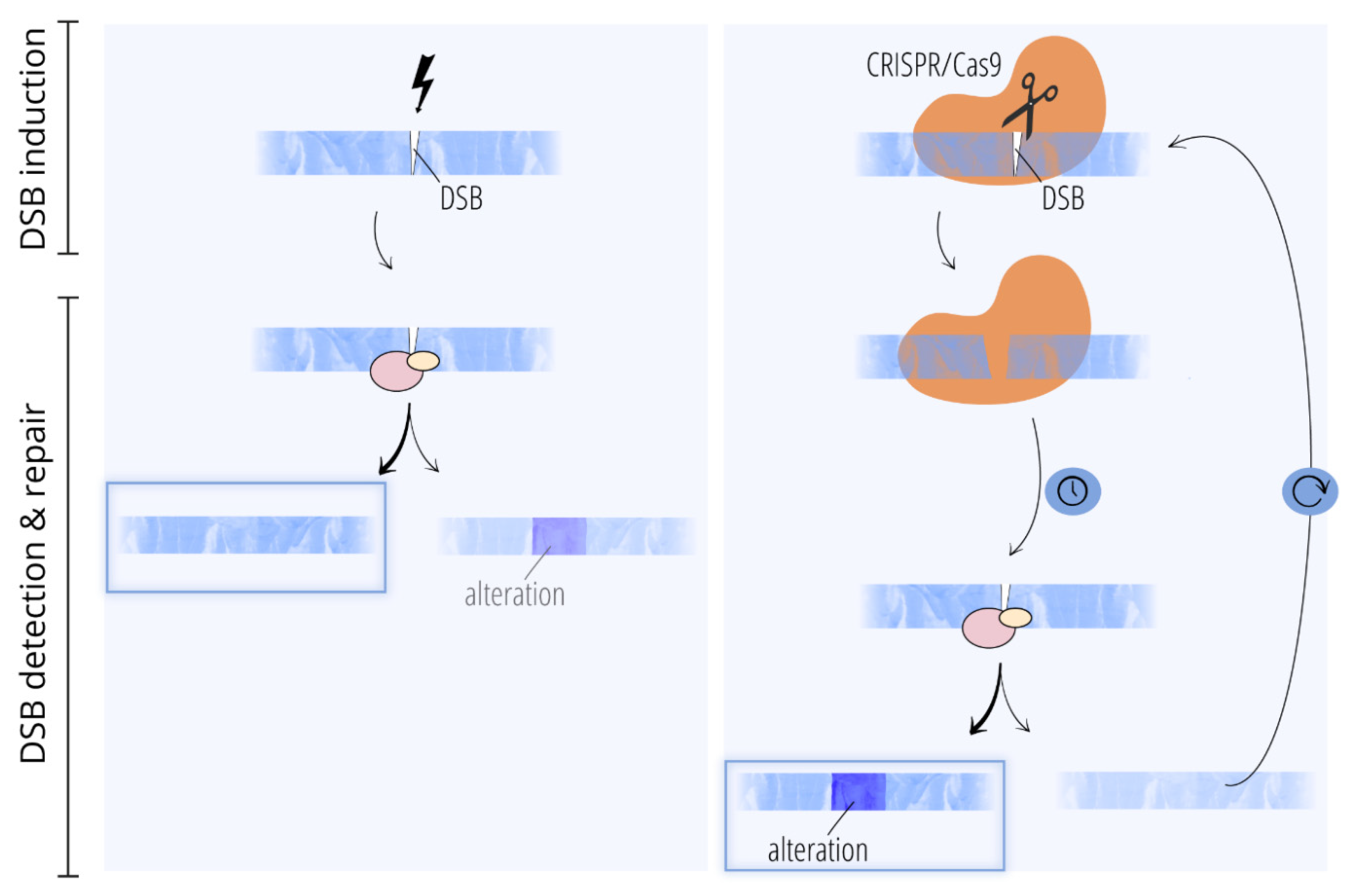
Figure 2.
Histone modifications can influence the outcome of the DNA repair after damage. The repair of DNA damage that occurs spontaneously (Table: left) or that is CRISPR/Cas9-induced (Table: right) correlates with different histone methylations (Me) and acetylations (Ac). Contrary results are highlighted in yellow. Based on data published by Weiss et al. 2022 and Monroe et al. 2022.
Figure 2.
Histone modifications can influence the outcome of the DNA repair after damage. The repair of DNA damage that occurs spontaneously (Table: left) or that is CRISPR/Cas9-induced (Table: right) correlates with different histone methylations (Me) and acetylations (Ac). Contrary results are highlighted in yellow. Based on data published by Weiss et al. 2022 and Monroe et al. 2022.
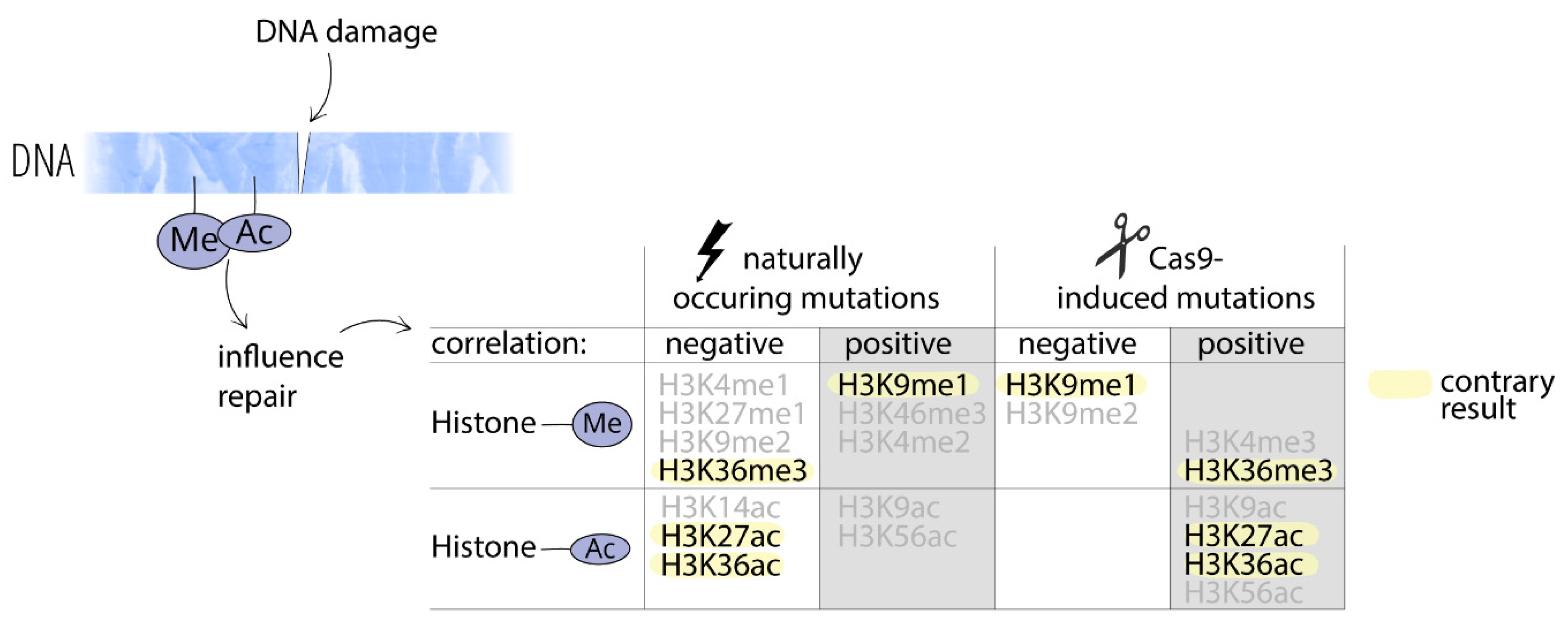
Figure 3.
Constraints of conventional breeding: (1) genetic linkage, (2) recombination and (3) gene copies.
Figure 3.
Constraints of conventional breeding: (1) genetic linkage, (2) recombination and (3) gene copies.
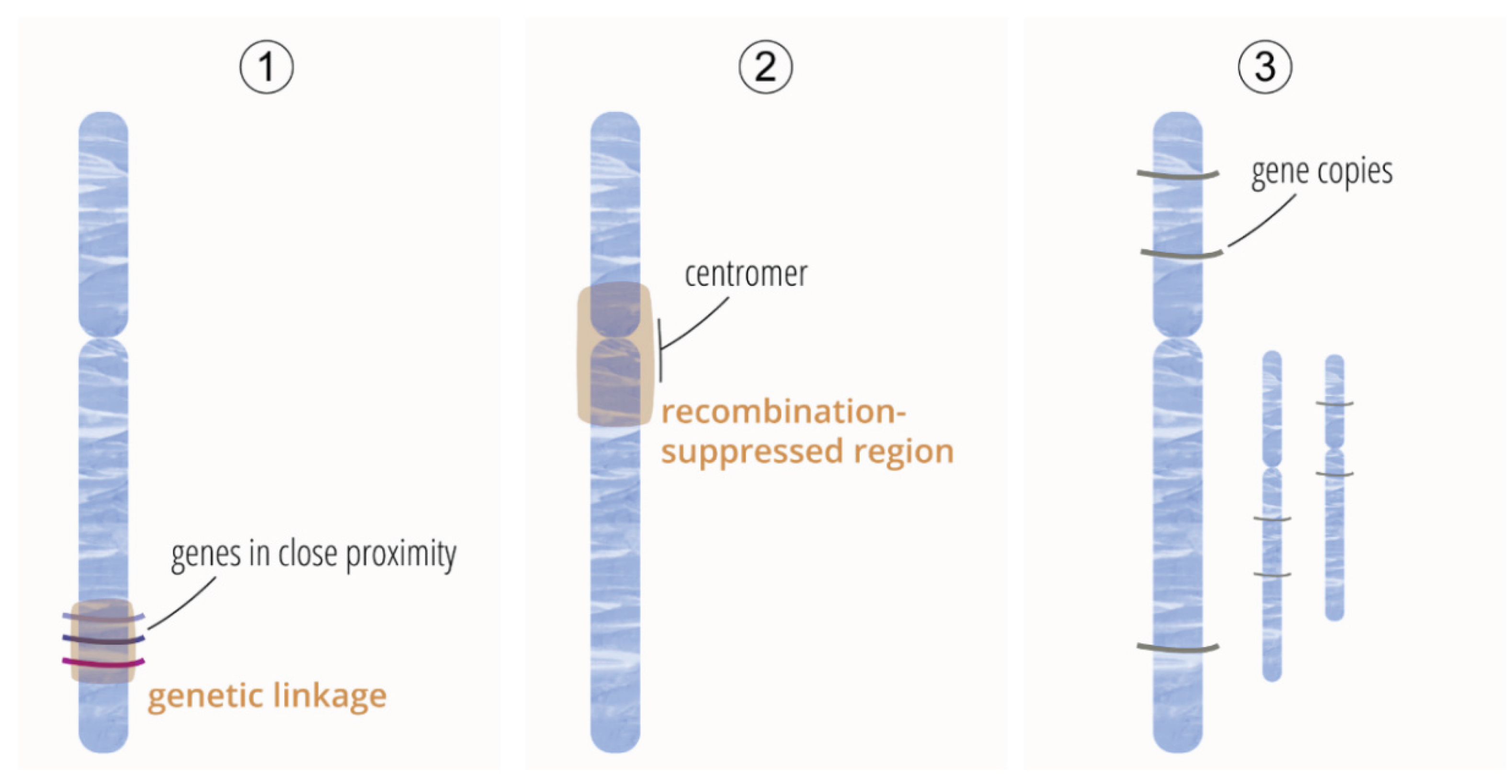

| Reference | Constraints for conventional breeding | Number of genomic alterations | Ploidy level | Altered gene(s) | Traits | Reference | Constraints for conventional breeding | Number of genomic alterations | Ploidy level | Altered gene(s) | Traits | |
|---|---|---|---|---|---|---|---|---|---|---|---|---|
| Bread Wheat (Triticum aestivum) | Rice (Oryza sativa) | |||||||||||
| Sánchez-León et al., 2018 | gene copies, genetic linkage (gene cluster) | up to 35 genes simultaneously | hexaploid | α-gliadins | reduction of gluten content | Yan et al., 2022 | genetic linkage, centromere/suppressed recombination | 2 genes simultaneously in 4 alleles | diploid | flavonoid 3’ hydroxylases (cyp75b3 and cyp75b4) | increase of apigenin content | |
| Yu et al., 2023; Sánchez-León et al., 2024 | gene copies, genetic linkage (gene cluster) | up to 9 ω-gliadin and 12 γ-gliadin genes simultaneously | hexaploid | ω- and γ-gliadins | reduction of gluten content | Strawberry (Fragaria vesca) | ||||||
| Raffan et al., 2021 | gene copies | 3 genes simultaneously in 6 alleles | hexaploid | asparagine synthetase (asn2) | reduction of asparagine content | Xing et al., 2020 | rare naturally occurring mutations in gene-regulatory regions | 1 gene in 2 alleles | diploid | transcription factor basic (region) leucine zipper proteins (FvebZIPs1.1) | increase of sugar content | |
| Sugarcane (Saccarum officinarum) | ||||||||||||
| Camelina / false flax (Camelina sativa) | ||||||||||||
| Kannan et al., 2018 | gene copies | 107 alleles simultaneously | allopolyploid | caffeic acid O-methyltransferases (comt) | reduction of lignin content and syringyl/guaiacyl (S/G) ratio | |||||||
| Bellec et al., 2022 | gene copies, genetic linkage | up to 10 genes simultaneously in up to 20 alleles | hexaploid | flowering locus c (flc), short vegetative phase (svp), like heterochromatin protein 1 (lhp1), terminal flower 1 (tfl1) and early flowering locus 3 (elf3) | early-flowering, shorter stature and/or basal branching | |||||||
| Eid et al., 2021 | gene copies | 49 alleles simultaneously | allopolyploid | magnesium chelatase subunit I (mgch) | reduction in chlorophyll content | |||||||
| Morineau et al., 2017 | gene copies | up to 3 genes simultaneously in up to 6 alleles | hexaploid | fatty acid desaturase 2 (fad2) | reduction of polyunsaturated fatty acids and increase of oleic acid | |||||||
| Oz et al., 2021 | gene copies | 3 alleles simultaneously | allopolyploid | acetolactate synthase (als) | herbicide tolerance | |||||||
| Lettuce (Lactuca sativa L.) | ||||||||||||
| Laskana et al., 2024 | gene copies | not specified | allopolyploid | transcription factor LIM (lim) | reduction of lignin content and increase of S/G ratio | |||||||
| Zhang et al., 2018 | rare naturally occurring mutations in gene-regulatory regions | 1 gene in 2 alleles | diploid | GDP-l-galactose phosphorylase (ggp1 and ggp2) | increase of ascorbic acid content and oxidation stress tolerance | |||||||
| Switchgrass (Panicum virgatum) | ||||||||||||
| Liu et al., 2018 | gene copies, self-incompatible | up to 2 genes simultaneously with multiple alleles for each gene | heterozygous polyploid | teosinte branched 1(tb1a and tbtb) and phosphoglycerate mutase (pgm) | increase of tiller production | |||||||
| Maize (Zea mays) | ||||||||||||
| Shi et al., 2016 | artificial transfer of cisgenic sequences | 1 gene in 2 alleles | diploid | argoS8 | increase in drought tolerance | |||||||
| Sun et al., 2025 | gene copies, self-incompatible | 2 genes simultaneously in 4 alleles | heterozygous polyploid | tb1/cycloidea/proliferating cell factor (tcp19 and tcp 22) | increase of tiller production | |||||||
| Mustard Greens (Brassica juncea) | ||||||||||||
| Tomato (Solanum lycopersicum) | ||||||||||||
| Karlson et al., 2022 | gene copies, genetic linkage | 17 genes simultaneously in 34 alleles | allotetraploid | type-I myrosinase multigene | reduction in pungency | |||||||
| Li et al., 2018a | genetic linkage | up to 4 genes simultaneously in up to 8 alleles | diploid | tomato phytoene desaturase (slyPDS), pyruvate-dependent GABA-T (gaba-tp1, gaba-tp2 and gaba-tp3), transporter cat9 (cat9) and Succinate semialdehyde dehydrogenase (ssadh) | increase of GABA content | |||||||
| Poplar (Populus spp.) | ||||||||||||
| Ortega et al., 2023 | Not known | up to 3 genes simultaneously in different combination of 1 arr17, 8 myb and 4 cen1/cen2 alleles | diploid | centroradialis (cen1 and cen2), type-A response regulator (arr17), MYB transcription factors (myb186/138/38 (Fuzzy3)) | early flowering, sex-switch, hairless seeds | Li et al., 2018b | genetic linkage | up to 4 genes simultaneously in up to 8 alleles | diploid | cyclisation of lycopene (lcy-e, lcy-b1, lcy-b2, and blc) | increase of lycopene content | |
| Yang et al., 2023 | genetic linkage | 3 genes simultaneously in 6 alleles | diploid | phytoene synthase 1 (psy1), R2R3-MYB transcription factor (myb12), stay-green 1 (sgr1) | accumulation of pigments | |||||||
| Rice (Oryza sativa) | ||||||||||||
| Nonaka et al., 2017 | specific alteration in regulatory domain | 2 genes simultaneously in 4 alleles | diploid | glutamate decarboxylase (gad2/3) | increase of γ-aminobutyric acid (GABA) content | |||||||
| Wakasa et al., 2024 | genetic linkage (gene cluster) | 5 genes simultaneously in 10 alleles | diploid | glutelins (glua3, glub1a, glub1b, glub2, and gluc) | reduction of glutelin content | |||||||
| Khanday et al., 2019 | complex multiplexing including expression of male-genome-derived | up to 6 genes simultaneously | diploid | baby boom (bbm1, bbm2 and bbm3) and meiotic genes (rec8, pair1 and osd1) | synthetic apomixes, maintenance of hybrids | |||||||
| Roldan et al. 2017; Soyk et al., 2017; Klee 2019 | genetic linkage, centromere/suppressed recombination | up to 2 genes simultaneously in up to 4 alleles | diploid | jointless 2 (j2), weak enhancer of jointless 2 (ej2) | jointless trait, floral architecture | |||||||
| BBM1 in egg cell | ||||||||||||
| Tomato (S. pimpinellifolium) | ||||||||||||
| Xue et al., 2023 | rare naturally occurring mutations in gene-regulatory regions, de novo sequences | 1 gene | diploid | uORFs of various genes | fine-tuning of gene expression | |||||||
| Zsögön et al., 2018 | genetic linkage | up to 4 genes simultaneously in different homozygous and heterozygous allele combinations | diploid | self-pruning (sp), ovate (o), fruit weight 2.2 (fw2.2), lycopene beta cyclase (cycb), fasciated (fas)/clavata 3 (clv3), multiflora (mult) | de novo domestication | |||||||
Disclaimer/Publisher’s Note: The statements, opinions and data contained in all publications are solely those of the individual author(s) and contributor(s) and not of MDPI and/or the editor(s). MDPI and/or the editor(s) disclaim responsibility for any injury to people or property resulting from any ideas, methods, instructions or products referred to in the content. |
| 1 | |
| 2 | |
| 3 |
© 2025 by the authors. Licensee MDPI, Basel, Switzerland. This article is an open access article distributed under the terms and conditions of the Creative Commons Attribution (CC BY) license (http://creativecommons.org/licenses/by/4.0/).
Copyright: This open access article is published under a Creative Commons CC BY 4.0 license, which permit the free download, distribution, and reuse, provided that the author and preprint are cited in any reuse.


