

Submitted:
04 November 2025
Posted:
05 November 2025
You are already at the latest version
Abstract
Cultural heritage is increasingly framed as a living resource for citizenship and education, although evidence on how in situ AR can cultivate sustainability competences remains limited. This study examines the Art Nouveau Path, a location-based MARG set across eight georeferenced Points of Interest in Aveiro, Portugal, aligned with the GreenComp framework. Using a DBR case study, it was analyzed repeated cross-sectional student questionnaires (S1-PRE N = 221; S2-POST N = 439; S3-FU N = 434), anonymized gameplay logs from 118 collaborative groups (4,248 group–item responses), and 24 teacher field observations (T2-OBS), integrating quantitative summaries with reflexive thematic analysis. References to heritage preservation within students’ sustainability conceptions rose from 28.96% at baseline to 61.05% immediately post-game, remaining above baseline at follow-up (47.93%). AR-supported items were more accurate than non-AR items (81% vs. 73%) and were associated with longer on-site exploration (+10.17 minutes). Triangulation indicates that AR and multimodality amplified attention to architectural details while prompting authenticity debates. Built heritage, mobilized through lightweight AR within a digital teaching and learning ecosystem, can serve as an effective context for Education for Sustainable Development, strengthening preservation literacy and civic responsibility, while generating interoperable cultural traces suitable for future reuse.
Keywords:
art nouveau heritage
; mobile augmented reality game
; digital heritage preservation
; semantic data enrichment
; narrative cartography
; valuing urban heritage
; sustainability education
; cultural heritage interpretation
1. Introduction
There has been a paradigm shift in the understanding of cultural heritage, which is now regarded as more than merely a static collection of monuments, artefacts and traditions [1,2]. International frameworks largely recognize heritage as a living resource for identity, social cohesion, and sustainable futures. The 1972 United Nations Educational, Scientific and Cultural Organization (UNESCO) World Heritage Convention affirmed cultural and natural assets as part of a shared global legacy [3]. More recently, the Council of Europe’s Faro Convention [4] advanced a people-centered perspective that foregrounds the social, civic, and educational roles of heritage. Together, these instruments advance a systemic vision by embedding conservation within broader urban agendas of sustainability, participation, and resilience, consistent with the Sustainable Development Goals (SDGs) [5], particularly SDG 11.4 and SDG 4.7. Heritage is thus regarded not solely as a domain for specialist preservation, but also as a civic resource that cultivates values, competencies, and a shared sense of responsibility.
These policy shifts have been paralleled by similar academic debates. In heritage studies, researchers have argued that heritage is inherently pluralistic and values-based, shaped by social negotiations rather than just expert discourses [6,7,8,9]. Bandarin and van Oers [10] were among those who conceptualized urban heritage as a catalyst for community resilience and cohesion. Recently, Champion and Rahaman [11], have explored how digital storytelling and narrative coherence can mediate how people make meaning. Recent works by Moraitou and colleagues [12] and Katsianis & Gadolou [13] have further reinforced the concept that heritage becomes significant when connected to everyday practices and collective futures. Accordingly, heritage is not only something to preserve but also a ‘living space for learning and participation’ [14] that should be actively mobilized. Also, as Choay [15] critically pointed out, heritage often remains detached from sustainability discussions in our daily lives, risking aestheticization or commodification instead of fostering active civic engagement. Choay’s critique is grounded in the view that heritage, natural, cultural, tangible, and intangible, is unique and therefore non-renewable, a status that is often sidelined in everyday sustainability discourse [16,17]. Bridging this remains a significant challenge for both research and practice.
Digital heritage has experienced rapid progress, altering the strategies for documenting and preserving cultural assets and their dissemination to the public. Initial research focused on photogrammetry and 3D modeling but has since expanded to include immersive media like Augmented Reality (AR), Virtual Reality (VR), and Extended Reality (XR), alongside geographic information systems (GIS) and building information modeling (BIM) [18].
Concurrently, advancements in semantic data and interoperability standards, such as CIDOC-CRM [19] and the FAIR principles [20], underscore the necessity to organize assets in a manner that ensures their reusability, accessibility, and integration across diverse platforms [21,22]. The field is shifting from discrete digital replicas to interconnected ecosystems that integrate heritage with infrastructures for knowledge production, education, and civic participation. In these ecosystems, heritage is intricately integrated into broader infrastructures with the aim of facilitating knowledge dissemination, educational initiatives and civic participation.
Within this context, digital mediation is enabling heritage to be rediscovered in situ [23,24]. Location-based applications and augmented reality have been shown to draw attention to details that would otherwise go unnoticed. These technologies connect contemporary streetscapes with historical imagery, thereby transforming urban exploration into a coherent narrative rather than a series of isolated stops [11,25,26]. Evidence from other studies indicates gains for both interpretation and preservation [2,27,28]. In parallel, semantic and cartographic approaches help maintain continuity across places and media [29,30,31]. These position AR not as a mere technical layer but as a mediational tool that shapes narrative and cultural meaning across contexts.
Building on these possibilities, AR has attracted particular interest for crafting situated experiences. By layering digital information onto in-situ settings, it can cultivate close observation and prompt reflection on authenticity. Empirical studies show that AR can deepen interpretation and sustain attention [32,33,34], while also flagging recurring issues such as distraction and short-lived novelty. Most empirical work has been carried out in museum or tourism contexts and tends to focus on brief engagements. Explicit evidence from formal education is limited, especially regarding long-term competence development [35]. Also, few studies track retention, transfer, or civic dispositions weeks after an intervention. The scarcity of longitudinal or repeated cross-sectional studies constrains understanding of how AR contributes to Education for Sustainable Development (ESD) when embedded in curricula and aligned with competence frameworks [36].
Although the pedagogical discourse on ESD has advanced considerably, continued engagement and awareness-raising activities are necessary. Among the many international efforts, the seminal work of Wiek and his colleagues [37,38] and the GreenComp framework at the European level stand out. This European Sustainability Competence Framework [39] defines sustainability learning as integrating knowledge, skills, values, and agency across four interconnected areas. Designed, among other aims, to guide curriculum innovation, the GreenComp emphasizes that education for sustainability must encompass not only factual knowledge, but also attitudes, behaviors, and dispositions. However, translating GreenComp into practice remains difficult, despite recent implementation efforts [40]. Conventional classrooms often lack the immediacy and contextual relevance necessary to cultivate sustainability values and civic responsibility. Heritage-contextualized environments, with their tangible, unique and symbolic qualities, offer a promising although little explored context for cultivating sustainability competences [41,42].
The city of Aveiro, Portugal, presents an interesting case. Aveiro hosts one of the country’s most significant ensembles of Art Nouveau facades [43,44,45], now recognized as important cultural landmarks and civic symbols. This is evidenced by Aveiro’s membership in the Réseau Art Nouveau Network (RANN), the establishment of the Art Nouveau Museum, and sustained municipal initiatives that safeguard, interpret, and promote this heritage through curated urban paths.
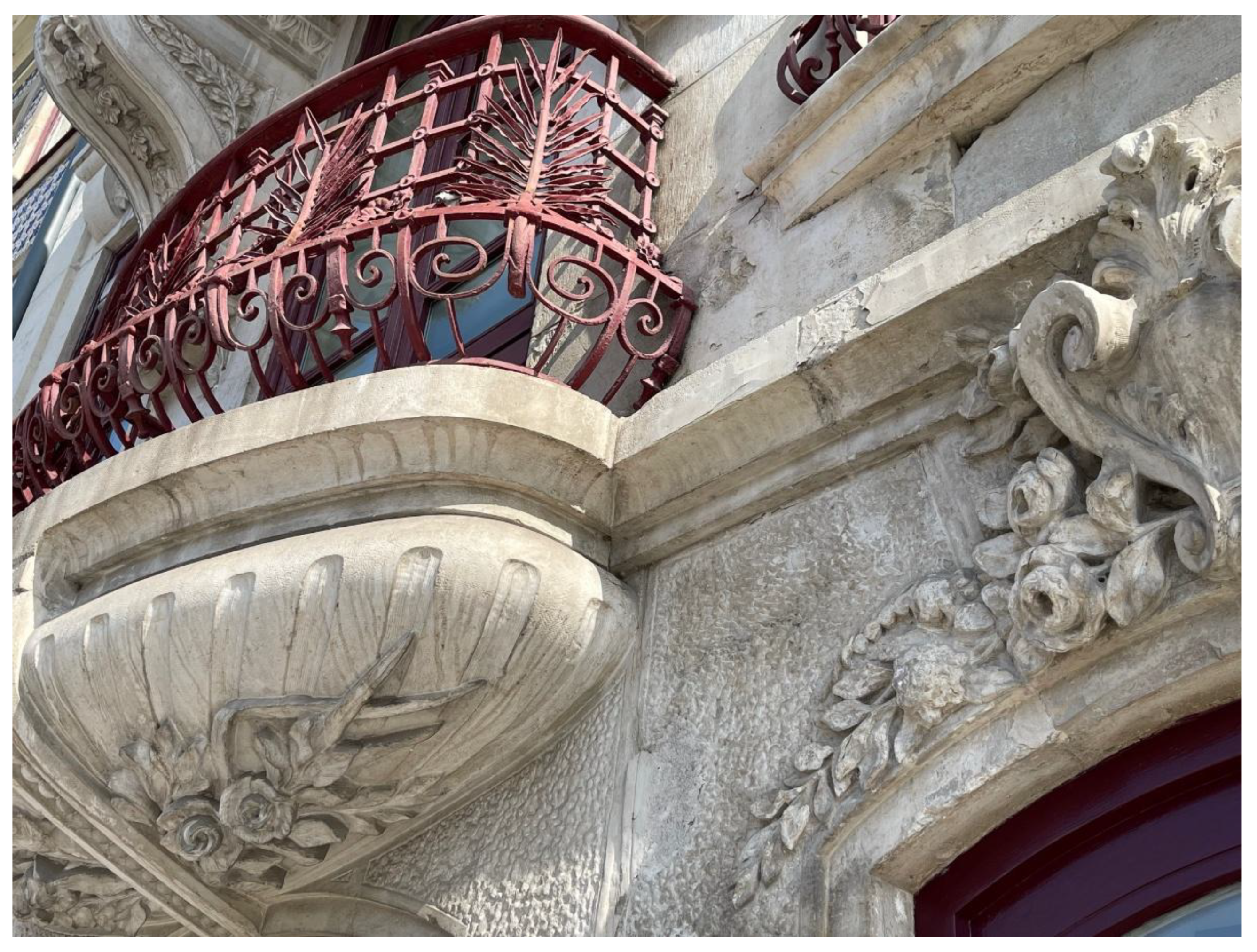
Although their aesthetic value is widely celebrated, educational initiatives tend to rely on guided visits or tourism-oriented narratives, with limited evidence of enduring effects on how young people value the built environment. The real promise for sustainability education lies in the ornamental detail of Aveiro's Art Nouveau local materials and artists, that created buildings decorations based on local fauna and flora. These decorations, mainly concentrated in the building facades, and some public statues and monuments, like the ‘Obelisk of Freedom’ (Figure 1), are focused on wrought iron works, tiles, architectural details (as in Figure 2), and floral motifs. These ornaments invite deeper, close observation and interpretation.
Aligned with Gruenewald’s [46] place-based pedagogy, effective learning occurs when cognitive and emotional processes are anchored in meaningful local contexts. Using Aveiro’s Art Nouveau facades for competence-oriented education is therefore both a distinctive opportunity and a well-suited case study.
Figure 1.
‘Obelisk of Freedom’.
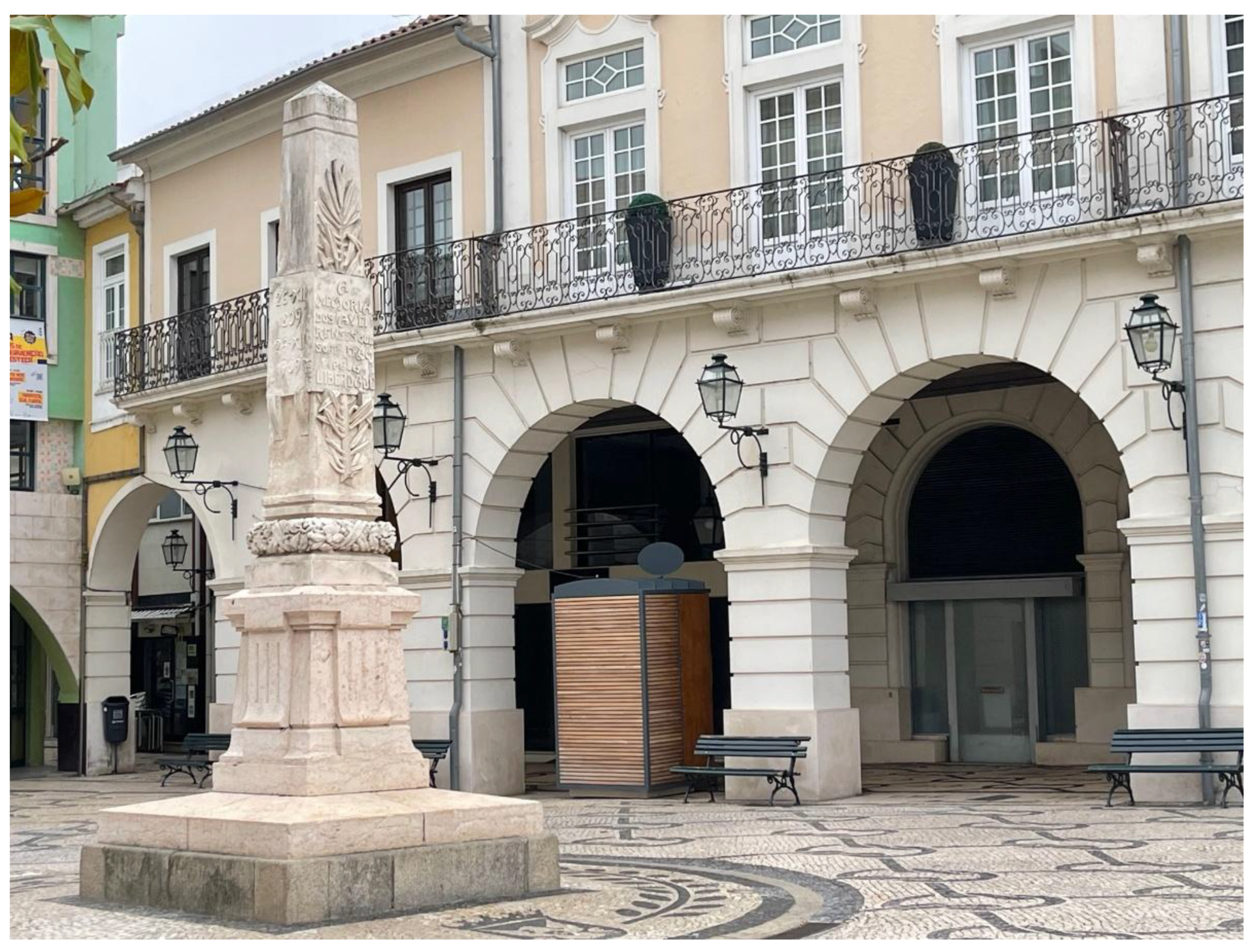
Figure 2.
Architectural details.
This study examines the Art Nouveau Path, a mobile augmented reality game (MARG) developed within the EduCITY Digital Teaching and Learning Ecosystem (DTLE) (https://educity.web.ua.pt/) , to explore its potential. This MARG links GreenComp competences [39] to site-specific tasks by combining AR overlays, multimodal media, and narrative dynamics across eight of Aveiro's Art Nouveau heritage points of interest (POI). Implementation activities were developed based on collaborative work by students’ groups, promoting engagement via MARG and in-place built heritage. Students explored multiple architectural details and connected them via storytelling to local history, historical people, and sustainability competences. This MARG was also designed to promote heritage valorization, connecting it to sustainability reflections and both environment and heritage preservation practices. Teachers accompanied the students and provided structured observations, complementing the gameplay logs and students’ answered questionnaires.
The broader research followed a design-based research (DBR) approach and was implemented in three cross-repeated cross-sectional phases: a baseline (S1-PRE), an immediate post-test (S2-POST), and a follow-up six to eight weeks later (S3-FU). The phases are named after the questionnaires completed by the students. Overall, data sources included three GreenComp-based questionnaires (GCQuest, version tailored for this MARG, available at the project’s Zenodo community page (https://zenodo.org/communities/artnouveaupath/records/, accessed on 28th October 2025), gameplay logs capturing 4,248 group-items responses, and ecological observations from 24 teachers. By triangulating these data sets, it was examined whether a heritage-based AR intervention can both enhance cultural assets and promote sustainability competences within this specific context.
The following research questions (RQs) were formulated to guide this study:
(RQ1) Can heritage serve as an effective context for ESD?;
(RQ2) How do multimodality and augmented reality affect engagement and learning outcomes?; and,
(RQ3) To what extent do students retain and transfer heritage-related sustainability competencies after gameplay?
Addressing these questions advances debate in three areas:
(i) the promotion of cultural heritage as an educational asset;
(ii) the importance of digital heritage preservation; and,
(iii) the value of place-based semantic enrichment.
In parallel, this study aims to analyze the educational value of AR, moving beyond novelty to support long-term competence development. The paper's findings may therefore have implications for the design of educational games and broader strategies that incorporate cultural heritage into sustainable learning ecosystems.
In addition to its educational objectives, this study aims to contribute to heritage preservation practice by providing lightweight digital documentation and structured descriptors of georeferenced cultural assets. The study adopts a pragmatic, findable, accessible, interoperable, and reusable (FAIR)-oriented approach to semantic organization and data stewardship. This approach aims to facilitate interpretive reuse, civic engagement, monitoring, and future interoperability with cultural knowledge bases.
Following the introduction, Section 2 presents a narrative thematic review of the literature and theoretical frameworks. Section 3 describes the methodological design, including the context, the participants, the instruments, and the DBR approach. Section 4 reports the findings. Section 5 discusses the pedagogical and methodological implications of these results. The final section synthesizes the key contributions, identifies limitations, and suggests paths for future research.
2. Theoretical Framework
This section reports a narrative, thematic literature review [47,48,49] conducted in line with established procedures for thematic synthesis, integrating inductive and deductive coding to ensure conceptual coherence across domains [50,51].
Given the interdisciplinary scope of this study spanning, the theoretical framework was organized into five categories regarding:
(1) International frameworks for heritage preservation;
(2) Art Nouveau as a cultural resource and as an urban identity asset;
(3) Extended reality approaches applied to heritage, considering AR as the primary technology;
(4) Semantic and geospatial logics for structuring and linking heritage data; and,
(5) Smart Heritage agendas towards the promotion of interoperability, openness, and long-term preservation.
Besides these categories, a transversal core focus is present in the broader research. This regards Education for Sustainability and competences development, with preservation-relevant data practices positioned as complementary and mutually reinforcing.
Searches were conducted in Scopus and Web of Science and supplemented with exploratory searches in Google Scholar to capture gray literature and institutional reports. Additionally, some literature was previously used in already published works [52,53].
The search period was April–September 2025, targeting works published between 2012 and 2025. Effective keyword combinations included (“augmented reality” OR “mobile augmented reality” OR “mobile augmented reality game” OR MARG) AND “cultural heritage” AND (education OR learning); “Art Nouveau heritage” AND education; (“narrative cartography” OR “spatial storytelling”) AND (mapping OR heritage); (“semantic data enrichment” OR CIDOC-CRM OR “cultural heritage ontology” OR “semantic trajectory”); (“digital heritage preservation” OR “cultural heritage interpretation”); (“valuing urban heritage” OR “heritage valorization”); (“sustainability education” OR “education for sustainable development” OR GreenComp); and (“digital teaching and learning ecosystem” OR DTLE) AND sustainability. Direct searches using “Art Nouveau” predominantly returned art-historical records. We retained only works intersecting education, AR/MARG, geoinformation/trajectory, or competence frameworks and excluded the remainder.
Studies were included if they (1) were peer-reviewed and indexed in Scopus or Web of Science, (2) addressed Education for Sustainable Development and or sustainability competences, such as GreenComp, in formal or non-formal education, and (3) were clearly connected to at least one core focus of this paper. Exclusion criteria comprised (1) AR or XR studies focused solely on technical aspects without pedagogical framing or a link to ESD or competences, (2) tourism-oriented studies and museum studies lacking geoinformation or trajectory components, educational analysis, or in-situ built-heritage context, (3) purely theoretical reflections without empirical or design-based components, (4) VR-only studies without a clear bridge to AR in educational heritage settings, and (5) duplicates or records thematically irrelevant to the study’s scope.
The database search retrieved 74 records. After de-duplication and abstract screening, 24 items were retained for full-text review. Applying the inclusion and exclusion criteria yielded 40 peer-reviewed articles. To ensure conceptual breadth, complementary sources were added. The final corpus comprises 81 sources structured into four categories: (1) 59 peer-reviewed articles (four from prior research outputs), (2) 11 policy and institutional frameworks, (3) 11 books and monographs. Although essential, all sources regarding methodology are not considered in this description (See Appendix A).
A hybrid thematic analysis was undertaken, integrating inductive and deductive coding. Following Boyd [49], multiple reasoning modes were iteratively applied to ensure conceptual coherence across the five previously identified domains. The policy frameworks and the reference works grounded the analysis in internationally recognized sources, while the authorship-related publications secured continuity with prior and broader research.
The following subsections examine the five domains in detail. It begins with international frameworks for heritage preservation and concludes with a broader synthesis.
2.1. International Frameworks for Heritage Preservation
Over the past thirty years, there has been a notable shift in international policy embracing cultural heritage as a key element towards the promotion of urban sustainability, among others, fostering community involvement, and building resilience. This approach, although previous efforts, like the European Convention on the Value of Cultural Heritage for Society, known as the Faro Convention [4] articulates with the UNESCO Recommendation on the Historic Urban Landscape (HUL) [54], which redefines historic cities as living, evolving socio-ecological systems rather than unchanging relics. Within this framework, the HUL methodology promotes conservation practices tailored to each location to ensure heritage is integrated into planning, cultural markets, and broader societal well-being. Also, this framework highlights the increasing importance of digital tools in heritage documentation, evaluation, renovation, and public engagement. The Sustainable Development Goals [5], especially SDG 11.4, regarding protecting cultural and natural heritage, highlight the urgent need to them as part of a strategy to nurture inclusive, secure, adaptable, and sustainable urban environments [5]. Similarly, the New Urban Agenda, adopted in Quito in 2016 [55], emphasizes the essential role of culture and heritage in the promotion of civic identity, values and memory, promoting urban prosperity, and bolstering resilience against environmental and human-induced challenges.
The novelty of the Faro Convention [4] resides on the express recognition of cultural heritage not only as a human right but also as a shared societal resource, underscoring the significance of participation, identity, and overall well-being. Building on this foundation, the European Heritage Strategy for the 21st Century [56] translated these guiding concepts into clear priorities for heritage education, improved access, and the sustainable management of cultural assets. Recently, new initiatives like the Common European Data Space for Cultural Heritage [57] and the Twin it! 3D for Europe’s culture campaign (available at: https://pro.europeana.eu/page/twin-it-3d-for-europe-s-culture, accessed on 24th September 2025) have further established the importance of digitally documenting cultural assets in formats that support interoperability. This is intended to promote long-term preservation, openness, and opportunities for reuse throughout various sectors. These approaches connect heritage preservation with the development of digital ecosystems and semantic infrastructures, structured digital environments that make data sharing and knowledge exchange possible.
These new perspectives are reinforced by academic research. For example, Bandarin and van Oers [10] argued that the HUL approach [54] transforms heritage into a catalyst for sustainable urban development by integrating it into broader socioeconomic and environmental strategies. King's research [58] emphasized the importance of cultural-based efforts regarding digital participation and co-creation, demonstrating that digital engagement broadens the scope of heritage value beyond technical conservation to encompass identity, social cohesion, and civic inclusion. Avrami and colleagues [9] work provided a systematized value-based management. Their work emphasized the importance of recognizing various community stakeholders and the value of contested meanings as an integral part of sustainable heritage-based practices. Ababneh recently [59] revisited the Venice Charter [60] considering new heritage challenges and emphasizes that contemporary conservation cannot ignore the mediation of digital documentation, interoperability, and community-centered approaches.
The Art Nouveau Path translates these structures into a contextualized urban environment and DTLE. Aligned with UNESCO's HUL approach [54], the project incorporates Aveiro's facades into a participatory digital ecosystem where augmented reality content, narrative tasks, and gameplay records integrate documentation and interpretation. Aligned with SDG 11.4 [5] and the Faro Convention [4], among other frameworks, the project positions heritage as a collective civic resource accessible to students, teachers, and the community at large. While the project does not aspire to generate exhaustive 3D documentation or conservation datasets, it supports these objectives by creating multimodal records, including videos, augmented reality overlays, descriptive metadata, student questionnaires, and teacher validations. These various resources have been identified as key factors in enhancing the visibility, interpretation, and long-term cultural significance of the city's Art Nouveau architecture.
In essence, the Art Nouveau Path exemplifies the efficacy of modest, educational initiatives in attaining the objectives of both global and European heritage preservation frameworks.
2.2. Art Nouveau as a Cultural Resource and as an Urban Identity Asset
Emerging at the turn of the 20th century, the Art Nouveau artistic movement became one of the most emblematic artistic and cultural movements of the European Modernism [61]. Conceived as a ‘Gesamtkunstwerk’, or total work of art [62], the movement incorporated architecture, decorative arts, graphic design, and urban culture into a unified aesthetic language of floral motifs, undulating lines, symbolic figures, and organic compositions. This ornamental repertoire expressed ideals of progress, modernization, and harmony between art, nature, and everyday life. This is affirmed by Walter Benjamin's work, ‘Das Passagen-Werk’ [63], written intensively between 1927 and 1940, but left unfinished.
Studies on this artistic movement [64,65] emphasize the movement's dual role: it was cosmopolitan, diffusing internationally through Brussels, Paris, Vienna, Barcelona, and Riga, among many valuable other cities; but it was also regionally distinct, absorbing local traditions, nature-themed inspirations, materials, artists and craft heritage, and also social aspirations.
However, the patrimonialization of Art Nouveau has been uneven [66]. While certain cities have embraced the style as a core element of their cultural identity and tourism strategies, such as Brussels with its UNESCO-listed townhouses, Paris with its metropolitan facades, and Riga with its Jugendstil ensemble, other contexts have remained comparatively marginal.
In Portugal, Aveiro has one of the most concentrated collections of Art Nouveau facades. This collection has been documented by local researcher Amaro Neves in several works from 1980 to mid-2000 (some listed works available at: http://ww3.aeje.pt/avcultur/Avcultur/AmaroNeves/index.htm, accessed on 25th September 2025), and it has been promoted by local associations, such as the ‘Associação para o Estudo e Defesa do Património Natural e Cultural da Região de Aveiro ‘ [Association for the Study and Defense of the Natural and Cultural Heritage of the Aveiro Region ] (ADERAV). Local initiatives, including the Art Nouveau Museum and the local Art Nouveau Route, have established this architectural collection as a civic landmark and driver of cultural branding. The wrought iron, exquisite tiles, and naturalist reliefs on the facades serve as anchors of identity, connecting the city’s urban fabric to stories of early twentieth-century modernization and bourgeois prosperity.
Despite its value, some heritage researchers argue that treating such facades as mere static monuments reduces their cultural potential [67]. Choay [15] critiques the fetishization of patrimony as isolated objects detached from social life and warns against approaches that freeze heritage as aesthetic relics. In contrast, Avrami et al. [9] emphasize heritage as a dynamic, plural, and contested resource whose meanings evolve through community engagement and values-based management. Similarly, Bandarin and van Oers [10] argue that urban heritage contributes to social cohesion and resilience when integrated into daily life and civic practices. Recent literature further highlights how digital documentation and interpretation can expand this integration. For example, Petti and colleagues [24] demonstrate how mobile applications can enhance accessibility for diverse audiences, and Xu and colleagues [68] and Wang and colleagues [69] works confirm that gamification can foster sustained engagement with heritage sites by moving beyond passive appreciation.
The Art Nouveau Path conceptualizes the facades of Aveiro as living cultural resources. Rather than presenting them as mere aesthetic surfaces for tourist consumption, the game situates them within a narrative arc that interweaves historical imagery, sustainability themes, and quiz-based challenges. Players are prompted to observe details often overlooked—architectural motifs, inscriptions, symbolic references—and to link these to broader issues such as water scarcity, environmental change, or civic memory. By this approach, the facades are reactivated as urban identity assets that mediate between past and present, architecture and environment, memory and belonging.
This approach is also consistent with educational perspectives. The Art Nouveau Path is consistent with situated learning theories and place-based pedagogy by anchoring learning in real facades. The facades of Aveiro’s Art Nouveau heritage, when mediated through AR, function as a potential pedagogical interface bridging formal curricula, urban experience, and civic values [70]. Therefore, the Art Nouveau heritage becomes not only an asset but also a multimodal learning environment, offering opportunities for interdisciplinary connections across different fields as History, Natural Sciences, Politics, Geography or the Arts.
In essence, the repositioning of Art Nouveau as both a cultural resource and as an urban identity asset supports the reinterpretation of the Aveiro’s Art Nouveau facades, transcending their mere aesthetic value. Within the Art Nouveau Path, these facades and monuments become interactive anchors of memory and identity, of learning, and sustainability and sustainable discourses, demonstrating how heritage can simultaneously sustain cultural identity and pride, support innovative interpretation, and generate lightweight nevertheless meaningful contributions to long-term preservation.
2.3. Extended Reality for Heritage: Augmented Reality as a Primary Approach
In recent years, XR technologies, comprising AR and VR, have increasingly permeated the heritage field [27]. These methodologies have been applied to a variety of disciplines, including documentation, reconstruction, interpretation, and education, resulting in a substantial body of research [27,32,33,34]. While VR offers immersive reconstructions that transfer users into simulated environments, AR distinguishes itself by enabling in situ mediation. This mediation refers to the layering of digital content directly over existing sites, facades, and artifacts without displacing participants from the physical context. These features position AR as a particularly suitable medium for the visualization and digital preservation of urban heritage. In this context, the interpretation of cultural and historical assets must be balanced with the demands of daily life, education, tourism, and conservation efforts [10,27,54].
Research consistently highlights the potential of AR for accessibility, engagement, and learning. Design studies emphasize the importance of narrative coherence between overlays and the physical context, as well as gamification strategies that scaffold observation and multimodal content that address diverse audiences [11,33,71]. Concurrently, another line of research demonstrates that AR can directly support conservation practices. For example, Ling and colleagues [72] demonstrate how AR visualizations can inform restoration interventions and monitor deterioration processes. Additionally, Sertalp and Sütcü’s work [73] reveal that contextual overlays can digitally preserve historical layers even when physical materials are at risk. Both Abdelmonem and colleagues’ [2], and Pervolarakis and colleagues’ works [74] document cases in which mobile AR reduces the physical strain on heritage sites by providing digital alternatives for exploration and preservation.
Beyond individual case studies, recent reviews emphasize that AR is now part of a growing digital heritage toolkit, not just an experimental novelty. For instance, Petti’s team [24] contend that AR promotes inclusivity by offering multisensory channels of engagement. Meanwhile, Maietti and colleagues [75] and Angelis and colleagues’ [30] works connect AR to semantic and geospatial logics, demonstrating how overlays can be linked to broader information systems. Research focused on education further demonstrates that AR fosters active, inquiry-based learning, in which participants construct knowledge through observation, hypothesis, and reflection [76,77].
The Art Nouveau Path exemplifies this convergence by applying AR as a lightweight preservation and mediation practice within a mobile game. Instead of producing exhaustive 3D scans or digital twins, the project shows how spatially anchored overlays, archival images, and videos can enrich facades in situ. By linking architectural details, floral reliefs, and wrought iron balconies, to historical narratives and sustainability themes, the project shows how AR can transform observation into situated interpretation. In this sense, the overlays serve as interpretive tools and vehicles for digital documentation and cultural valorization, ensuring that urban heritage is incorporated into preservation and educational agendas.
In this work, empirical evidence supports this mediating role. Teachers’s validations (T1-VAL and T1-R) emphasize AR’s ability to encourage critical observation and interdisciplinary connections [52,53]. Student data from S1-PRE, S2-POST, and S3-FU indicate that AR-based interactions increased interest in heritage and sustainability. Follow-up questionnaires revealed that students retained knowledge of architectural details and reflected on their relevance to broader issues of preservation and urban identity. These findings align with literature, positioning AR as an interpretive and preservative technology.
In short, AR on the Art Nouveau Path is not a technical conservation tool for monitoring or material repair. Rather, it functions as a mediated preservation strategy by documenting facades in digital formats, amplifying their cultural value through narrative and gamified observation, and generating empirical records of engagement that contribute to the long-term sustainability of Aveiro’s Art Nouveau heritage.
2.4. Semantic and Geospatial Logics in Heritage Data
The sustainability of digital heritage depends not only on the production of digital representations but also on how these representations are structured, connected, and made interoperable. Semantic and geospatial infrastructures have therefore become central to contemporary approaches to heritage documentation and preservation. Pivotal work like the CIDOC-CRM [19], later developed by others researchers (available at: https://cidoc-crm.org/, accessed on 24th September 2025), and converted as an International Standard (ISO 21127:2023) (https://www.iso.org/standard/85100.html, consulted on 24th September 2025) establishes a common vocabulary for describing cultural heritage entities, events, and relationships in museums, archives, and built environments. According to Moraitou and colleagues [12] work, semantic and graphical knowledge models enable interoperability, advanced queries, and long-term reuse. This ensures that heritage data can circulate between institutions and platforms without losing context or meaning.
Geospatial infrastructures complement semantic approaches by providing the spatial foundation necessary to link heritage data to territory and context. Archaeological and architectural studies are increasingly adopting geographic information system (GIS)-based resources to map sites, analyze spatial relationships, and construct narrative cartographies [13]. Caquard [26] noted in earlier researches that narrative cartography transforms maps from simple indexation tools into storytelling instruments. Such geographical representations can weave in multiple historical, cultural, and social threads. Frequently, these frameworks are aligned with GIS platforms, bridging detailed architectural data with broader urban analysis [78].
These platforms align with broader agendas for linked open data and semantic enrichment. In these agendas, heritage datasets are connected to wider knowledge ecosystems rather than being siloed within isolated repositories. As stated by Maietti and colleagues [75] and Angelis and colleagues’ [30] works, semantic trajectories and augmented metadata can organize visitor navigation and comprehension in different locations, enhancing continuity between tangible experiences and digital repositories. This ensures that semantics and geospatial reasoning serve as cultural tools that promote unity, clarity, and integration, transcending basic technical functions.
Even projects operating at smaller scales can align with these principles by implementing proportionate solutions. The Art Nouveau Path demonstrates how a lightweight approach can incorporate semantic consistency and geospatial anchoring. Rather than implementing full CIDOC-CRM integration or GIS stacks, the MARG -controlled vocabularies (like architects’ names, construction dates, and stylistic features), consistent descriptors (materials, motifs, and symbolic references), and georeferenced navigation through eight POIs. This approach ensures that each facade is framed within a coherent, structured narrative opening it to potential future integration with semantic or GIS infrastructures.
Moreover, the MARG's design is explicitly spatial. The 36 quiz-type questions are linked to specific locations in Aveiro's historic center, and the trajectory between these locations are part of the interpretive experience. This spatial organization corresponds with narrative cartography, wherein urban navigation supports as an educational and documented process. The physical path and the MARG's narrative create a semantic link among location, content, and activity, facilitating analysis of user interpretations, connections, and recollections of heritage through the path.
This exemplifies how the Art Nouveau Path mobilizes semantic and geospatial logic, even in educational interventions. By combining lightweight descriptors, map-based navigation, and narrative structuring, the Art Nouveau Path contributes to the broader effort of ensuring that heritage data is collected, contextualized, coherent, interoperable, and ready to be integrated into the expanding digital heritage ecosystem.
2.5. Smart Heritage Agendas, Interoperability, and Long-Term Preservation
The principle of smart heritage has emerged to portray the convergence of cultural heritage alongside digital ecosystems, identified by their compatibility, openness, and cooperative governance. Within the European context, instruments like the Common European Data Space for Cultural Heritage [57] and the Twin it! 3D for Europe’s culture campaign (available at: https://pro.europeana.eu/page/twin-it-3d-for-europe-s-culture, accessed on 24th September 2025) express the expectation that cultural assets be documented with high quality, shared in interoperable formats, and reused across domains ranging from education to tourism and scientific research. These initiatives reflect the principles of FAIR data management [20], which stipulate that data must be findable, accessible, interoperable, and reusable. This establishes a standard for curating and preserving heritage datasets over time.
Digital preservation requires more than technical storage, according to discussions among experts. Niccolucci [21] and Moullou and colleagues’ work [22], for example, argue that these resources sustainability depends on treating datasets as maintained cultural resources with versioning, provenance, and governance mechanisms that ensure continuity across technological shifts. In this perspective, interoperability is not merely a technical aspiration but a condition for heritage data to function within broader cultural ecosystems, linking archives, museums, built heritage inventories, and community-generated resources. Smart heritage is about more than just digitizing assets, since it is also about integrating them into long-term plans for access, governance, and participation.
The Art Nouveau Path addresses these issues with a lightweight but structured model of data production and preservation. While it does not aim to create full-scale digital twins or exhaustive repositories, the project generates multimodal outputs that align with smart heritage principles such as:
(i) Multimedia documentation, such as archival photographs, AR overlays, videos, and narrative descriptors, records and re-presents Aveiro’s facades in enriched formats;
(ii) Empirical datasets, regarding that gameplay logs capture group decisions and interactions;
(iii) questionnaires that are administered before, immediately after, and months following gameplay (S1-PRE, S2-POST, S3-FU);
(iv) teacher validations and observations (T1-VAL, T1-R, T2-OBS); and,
(v) narrative structures, since curated tasks across eight POI link buildings and monuments, places, historical narratives, and sustainability themes into a consistent storyline.
These outputs constitute a lightweight form of digital heritage governance. They are internally consistent, reflexively documented, and open to potential reuse in research, education, or cultural programming. Importantly, they preserve the facades as architectural objects and the processes of engagement and interpretation, such as how participants observe, learn, and connect urban details to broader values. Accordingly, the Art Nouveau Path shows that even small-scale interventions can contribute to smart heritage agendas by combining documentation with pedagogical and civic elements.
By foregrounding interoperability and openness as guiding principles, the broader project positions its datasets as cultural resources that can outlive the immediate educational context. While not comparable in scale to national digitization campaigns, the Art Nouveau Path illustrates how smart heritage practices can be embedded in educational games and community projects, ensuring that preservation is not confined to experts but distributed across actors and scales.
2.6. Synthesis
The theoretical framework outlined above frames the Art Nouveau Path at the intersection of international preservation agendas, stylistic and urban identity discourses, technological innovation, semantic infrastructures, and smart heritage practices. Across these five strands stands a common logic: cultural heritage is no longer conceived as static monuments but as dynamic cultural ecosystems requiring mediation, documentation, and governance in digital and material domains.
As previously stated, international frameworks articulate heritage as a driver of sustainability and resilience. Meanwhile, European initiatives underscore the importance of interoperability, openness, and reuse. In this context, Art Nouveau is not merely an architectural style, but a living cultural resource that anchors local identity in Aveiro while contributing to broader discussions of patrimonialization and urban culture. Extended reality, particularly augmented reality, enables in-situ mediation that enhances interpretation and preservation. This demonstrates how overlays and multimodal narratives can transform facades into interactive cultural anchors.
Semantic and geospatial logics provide structuring principles for coherence and integration, ensuring that even lightweight projects align with CIDOC-CRM, GIS, and narrative cartography traditions. Finally, smart heritage agendas establish the expectation that all cultural data, whether produced by national institutions or local projects, should be managed consistently, reflexively, and openly. The Art Nouveau Path meets this expectation by producing datasets that document not only facades, but also the processes of learning and engagement. This links heritage preservation with education for sustainability.
3. Materials and Methods
3.1. Research Design and Methodological Orientation
This study uses a DBR approach to explore how a location-based MARG sets urban built heritage as a resource to be preserved, interpreted, and used for educational purposes in authentic settings. DBR incorporates design, enactment, analysis, and redesign cycles in real settings. This approach integrates cultural-heritage content, technological capabilities, and pedagogical objectives while maintaining ecological validity [79,80]. In this context, the Art Nouveau Path functions as both an intervention and an object of study. Successive versions were guided by explicit design principles and preliminary evaluations [52,53]. The research protocol also examined how these iterations influence the consistency and reusability of the resulting cultural data and interpretive experiences, as part of broader research.
Methodologically, this work is framed as an exploratory case study [81,82] centered on the Art Nouveau heritage in Aveiro. This design supports context-sensitive research based on phenomena and boundaries not fully defined, allowing research questions to be refined and propositions to be generated for subsequent cycles [81,82,83]. This allowed both privileged situated understanding and insight [84] and theory-building logics [85]. It is essential to state that this study, and broader research does not pursue exhaustive 3D digitization or Heritage Building Information Modeling (HBIM) pipelines. Instead, the study examines a proportionate, lightweight approach to digital preservation, aimed to promote learning and sustainability awareness by valuing built heritage. This approach involved producing and curating interoperable cultural traces, including map-anchored narratives, AR overlays, archival media, structured descriptors, and after implementation, analysis of gameplay logs, and multiple questionnaires [12,78].
Concerning the multi-component nature of the broader project, the present work outlines a clear analytical scope. The MARG's validation with in-service teachers ensured curricular coherence and informed iterative design. This development stage was previously published [52,53]. In this article, the later papers are referenced only as theoretical and empirical support. Therefore, this article focuses on the implementation context and the heritage-relevant data flows generated by groups of students and their teachers in situ, as well as the digital assets incorporated into MARG and its application, namely the gameplay records. It is important to note that the three administrations of GCQuest constitute a repeated cross-sectional design, with no individual pairing between waves.
3.2. Context of the Study and Intervention
Aveiro, Portugal, provides a compact, walkable urban setting in which distinctive heritage of early twentieth-century, the Art Nouveau facades, is concentrated in the city's historic center. The buildings' features, such as wrought-iron balconies, tiles, and fauna and floral reliefs, are well documented in local studies, municipal catalogues, and by University of Aveiro researchers works. This allows the city of Aveiro to be considered as an ideal setting for Art Nouveau heritage-based, place-anchored learning activities [43,44,86,87]. Art Nouveau's organic vocabulary and craft traditions align with discussions of cultural identity and environmental awareness central to this research aimed sustainability-oriented mediation [64,65].
In this context, the Art Nouveau Path was designed as a location-based MARG that transforms the urban landscape and its built heritage into an information-rich itinerary.
The MARG is based on eight georeferenced POIs located throughout the city center. Each POI combines map-based navigation, on-site AR overlays anchored in architectural details, and a compact set of interpretive resources, including digitized archival photographs, concise narrative prompts, and semantic descriptors. These eight POIs allow the participants engagement with 36 quiz-type items. Each item has a common structure: an orienting cue, a four-option multiple-choice task, and immediate explanatory feedback (Figure 3).
This structure is designed to sustain attention to material details while linking built heritage to themes and dispositions associated with multidisciplinary learning areas, like Mathematics or Natural Sciences, among others, and sustainability discourses and reasoning, based on the GreenComp [39]. AR-contents, historical images, short video clips, and a set of audio prompt are embedded to the specific context, aiming to catalyze curiosity, contextual analysis, and promoting awareness and value-driven self-belonging feeling [88,89,90].
Being structured by POIs, the MARG is conceptually presented in the in-app city map (Figure 4). This in-app city map provides an overview of the city that supports wayfinding and situational awareness, contextualizing, not only the MARG itself, but the overall city context. Meanwhile, the AR camera acts as an interpretive layer that "remaps" selected ornaments and façade elements directly onto the streetscape (Figure 5). To trigger the AR content, the MARG structure includes in-app visual hints of the AR markers (Figure 6).
These MARG features were designed to support well-established movement around Aveiro’s city center, focusing the participants’ efforts on the knowledge and aware tasks instead of searching for the correct POIs. This is facilitated by the in-app map, which provides a visual representation of the path, and by the indication of the movements to follow, through specific "directions" (Figure 7).
This approach overview regards situated interpretation, drawing on narrative cartography to coordinate movement, observation, and meaning-making across the path and the several POIs, rather than confining interpretation to a single [13,26].
Developed between 2023 and 2024 as part of a doctoral research program, the MARG and its intervention, occurred during the February-June 2025, was supported by the EduCITY DTLE (available at: https://educity.web.ua.pt/project.php, accessed on 12th September 2025) and its mobile app (version 1.3), available at: https://educity.web.ua.pt/app.php (accessed on 12th September 2025). The EduCITY project was developed by a multidisciplinary research team and research units from the University of Aveiro.
3.3. Participants
The broader study comprised four cohorts: two teachers’ cohorts: one for the MARG’s validation (T1-VAL) (N=30) and the other for its curricular review (T1-R) (N=3). In addition, students’ cohort that completed the GCQuest at three points was included: baseline S1-PRE (N=221), immediate post-intervention in situ S2-POST (N=439), and follow-up S3-FU (N=434). A cohort of accompanying teachers who supervised fieldwork and completed structured observations (T2-OBS) was also included.
The present article focuses on the student-generated evidence, the T2-OBS observational data, and the anonymous gameplay logs app.
3.3.1. Teachers’ Validation (T1-VAL) and Curricular Review (T1-R)
Thirty in-service teachers (17 female and 13 male) from central Portugal voluntarily participated in a validation workshop (T1-VAL). Meanwhile, three additional in-service teachers, disciplinary experts in History, Natural Sciences, and Visual Arts/Citizenship, conducted a structured curricular review (T1-R). These activities ensured the pedagogical coherence, curricular alignment, and adjustments of the Art Nouveau Path prior to its implementation [52,53].
3.3.2. Students: Implementation Cohort
A total of 439 lower and upper secondary school students, aged 13–18, participated in the field study during regular school hours. The students were recruited through the Municipal Educational Action Program of Aveiro (PAEMA, 2024–2025) (available at: https://tinyurl.com/4uvasw5k, accessed on 12th September 2025). The sample included 19 classes spanning six grade levels: seventh (N = 19), eighth (N = 135), ninth (N = 156), tenth (N = 37), eleventh (N = 20), and twelfth (N = 72). Students played in groups of two to four, and to ensure equal gaming experience and complying with General Data Protection Regulation (GDPR), each group used an EduCITY Android smartphone (version 1.3) promoting collaborative work and interpretation. The MARG’s implementation occurred across 18 field sessions, totaling 118 groups, whose data was automatically and anonymously recorded in the app logs, and later downloaded via university internet network.
3.3.3. Accompanying Teachers-Field Observations (T2-OBS)
During the 18 on-site sessions, the 24 accompanying teachers were co-responsible for logistics and safety, as well as for completing the T2-OBS questionnaire available at the project’s Zenodo community page (https://zenodo.org/communities/artnouveaupath/records/, accessed on 27th October 2025).
3.4. Instruments and Data Collection
This project used a mixed-methods strategy combining self-report instruments, structured field observations [91], automated gameplay logs [92], and curated digital heritage assets, as presented in Table 1.
These instruments support methodological triangulation consistent with DBR process orientation, maintaining the analytic focus on in-situ evidence generated during implementation.
3.4.1. Student Questionnaires (S1-PRE, S2-POST, and S3-FU)
The students’ questionnaires were designed to collect open-ended, dichotomous, and Likert-scale responses. The questionnaire was administered in Portuguese using the official EU translation to ensure linguistic and conceptual accuracy. The open-ended questions focused on heritage settings, attention to architectural details, reflections on preservation and responsibility toward the urban environment, and self-definition of sustainability, among other topics. The Likert-scale section was adapted from the GreenComp framework [39] and was validated in previous work through structural equation modeling (SEM) [92]. Although these instruments followed the same structure, they were designed to be both independent and interconnected.
They were applied across three distinctive moments:
(i) S1-PRE (baseline), which was administered prior to gameplay and aimed to collect perceptions of sustainability, cultural heritage, and AR readiness;
(ii) S2-POST, which was administered immediately after gameplay and aimed to assess engagement, perceived narrative coherence, interest in Art Nouveau, and the development of sustainability competencies; and,
(iii) S3-FU, which was administered six to eight weeks after the MARG implementation and aimed to assess the value of the MARG in transferring knowledge to daily practices, concepts, and reflections on heritage preservation and the retention of sustainability competencies. These instruments are available at the project’s Zenodo community page (https://zenodo.org/communities/artnouveaupath/records/, accessed on 25th October 2025).
3.4.2. Teacher Observations (T2-OBS)
During the 18 field sessions, the 24 accompanying teachers completed the T2-OBS. This structured instrument combines Likert statements, checklists, and open-ended questions. The items targeted the following: (i) on-site collaboration and group dynamics, (ii) attentiveness to architectural details and heritage cues, (iii) interaction with AR content in authentic conditions, and (iv) navigation and pacing across the micro-itinerary. Emphasizing ecological validity, the instrument observes how learning processes unfold in situ and is available as an open resource, at the project’s Zenodo community page (https://zenodo.org/communities/artnouveaupath/records/, accessed on 25th October 2025).
3.4.3. Automated Gameplay Logs
The EduCITY application, in its version 1.3, produced anonymized group-level logs for each session, including start/end timestamps, completion status for the 36 quiz items (P1.1–P8.2), item-level correctness, and for incorrect responses, the selected distractor. In accordance with data minimization principles and GDPR compliance regulations, the logs do not contain any personal identifiers and were stored at the group (device) level exclusively. The temporal resolution facilitates session-level pacing and item-level outcomes; however, it does not permit the precise estimation of dwell time per POI.
3.4.4. Data Stewardship and Interoperability
Multimodal media content, including archival images, AR overlays, short videos, and 3D elements, has minimal metadata. These schemes include the title, POI identifier, coordinates, brief cultural description, and sources when the asset is not the author's own creation. The descriptors follow a lightweight semantic logic, and all items are georeferenced, mapped, and stored with consistent file names on the EduCITY web platform.
3.5. Data Analysis
The data analysis integrates qualitative themes from open-ended answers and quantitative indicators, for example, item difficulty and completion. Integration followed a convergence-coding approach (convergence, complementarity, divergence) to produce meta-inferences about how AR-mediated, place-based tasks interacted with attention to facade details and sustainability sense-making. This integrative approach aligns with the established guidelines for integrating diverse research methods during the analysis and interpretation phases of research [93]. The S1-PRE, S2-POST, and S3-FU administrations are repeated cross-sectional, without individual pairing between waves.
3.5.1. Questionnaires Analysis
A mixed-methods analytical strategy was employed, organized in three layers: quantitative summaries of questionnaire items, reflexive thematic analysis of open responses and field notes, and trajectory-based analytics on gameplay logs. After this, integrative synthesis was employed.
The administration of the GCQuest versions (S1-PRE, S2-POST, S3-FU) and dichotomous items was summarized with descriptive statistics, including means, standard deviations, and absolute and relative frequencies. The indicators reported include completion rates, item-level distributions, and aggregate scores by administration. No inferential testing is presented in this paper regarding the questionnaires, namely the test related to Likert-scale items.
The open-ended responses were then subjected to a reflexive thematic analysis, employing a codebook that integrated both deductive and inductive approaches and was aligned with the GreenComp framework [39], and based on previous works [52,53]. The authors and a second EduCITY project researcher independently coded the data using memos and an audit path. Disagreements were resolved through discussion. In accordance with the principles of reflexive thematic analysis [51], and the inter-coder coefficients were not computed.
3.5.2. Gameplay Logs Analysis
Gameplay logs were analyzed by processing the app-generated, group-level records. The logs allowed us to analyze the following variables: (i) session duration distributions; (ii) completion and correctness by item/POI; (iii) distractor profiles for incorrect responses; and (iv) use of AR contents. Considering the path dynamics, the MARG design incorporated contextual meaning, including the specific site, the designated task, and the prevailing motif [30]. This approach enabled interpretation that transcended the confines of raw coordinates, based on the AR markers. For instance, it facilitated the discernment of narrative cues that precede accurate responses or the identification of detours that cluster around facades or monuments [94].
3.6. Ethical Considerations
The study was conducted in accordance with the ethical protocols established by the University of Aveiro and in compliance with the GDPR. Participation in the study was voluntary, and all participants provided informed consent. Informed consent was obtained from all participating teachers; for students, parental or legal-guardian consent was additionally secured. No personally identifiable information was collected. The datasets are securely stored, and gameplay logs were recorded at the group/device level. In accordance with the principles of data minimization, the study did not collect gender or socioeconomic data. While this restriction limits the possibility of conducting subgroup analyses, it does support the principles of proportionality and ecological validity in an in-situ educational intervention [95,96].
4. Findings
This section presents findings from GCQuest questionnaires (GCQuest-S1-PRE, GCQuest-S2-POST, GCQuest-S3-FU), gameplay logs from 118 collaborative groups, and T2-OBS teachers’ questionnaires.
4.1. Cross-Source Overview and Analytic Rationale
This subsection presents the cross-source results that establish the repeated cross-sectional pattern of change across S1-PRE, S2-POST, and S3-FU. Subsequent subsections contain detailed thematic and specific analyses.
Prior to the MARG’s implementation, it was conducted a validation with 33 in-service teachers (T1-VAL and T1-R). These validations enabled to assess and establish both curricular alignment and interpretive coherence for the Art Nouveau Path MARG across multiple curricular areas, and a specific History, Natural Sciences, Visual Arts, and Citizenship assessment. This process analysis outputs are exclusively used as inputs to model and implement dynamics, considering that comprehensive results have been previously presented [52,53].
The current work analysis focuses on student-generated evidence, in-app gameplay logs, and in-field teachers’ observations collected under the implementation. A total of 439 students, organized in 118 collaborative student groups, produced 4,248 group-item responses across 18 field sessions, accompanied by 24 teachers who completed structured observation forms (T2-OBS).
The MARG’s implementation encompassed a total of 36 items, including 11 AR-based tasks and 25 non-AR tasks. The latter category included seven knowledge-check items, 12 multimedia prompts (static archival/photo/text without AR overlay), and six local-analysis items. The complete Art Nouveau Path MARG is available at: https://doi.org/10.5281/zenodo.16981235.
Baseline conceptions positioned heritage preservation as marginal within sustainability. At the baseline (GCQuest-S1-PRE, N = 221), 28.96% of students (n = 64) explicitly associated sustainability with cultural heritage, while most answers were framed in exclusively environmental terms; 14.03% (n = 31) did not provide a clear response. These results frame S1-PRE as a heritage-oriented baseline rather than an outcome instrument.
Immediately following gameplay (GCQuest-S2-POST, N = 439), references to heritage preservation more than doubled to 61.05% (n = 268), a plus 32.09 percentage-point increase over baseline (Figure 8). In the subsequent assessment (GCQuest-S3-FU, N = 434), mentions declined but remained above baseline at 47.93% (n = 208), indicating an 18.97 percentage-point increase.
Dichotomous indicators show growth across waves. At baseline, related proxies aligned with items of interest increased significantly in S2-POST, and in S3-FU the construct was explicitly measured by A.2.4 (“civic responsibility for local heritage,” 50.92%) and A.2.5 (“city as a shared resource,” 53.92%). Figure 9 summarizes these patterns; the full mapping of labels and items is in Appendix B.
Open-ended responses corroborated and nuanced these shifts. Thematic analysis confirmed a reweighting of sustainability discourses toward heritage preservation. Three non-mutually-exclusive categories were salient and evolved consistently across phases: (i) preservation and care of the built structure, 28.96% (n = 64) at baseline, 61.05% (n = 268) after the game, and 47.93% (n = 208) at follow-up; (ii) heritage within sustainable urban development, 22.17% (n = 49), 43.96% (n = 193), and 35.94% (n = 156); and (iii) environmental frameworks, 57.92% (n = 128) at baseline, 30.98% (n = 136) after the game, and 41.94% (n = 182) at follow-up (see Figure 10). This coexistence suggests a pattern of integration rather than substitution. Illustrative examples include: “Sustainability also means not letting the old facades fall apart; they are part of our city.” [S2-POST]; “Taking care of buildings and not just nature, both matter for the city to last.” [S2-POST]; and “We should maintain these houses; it is sustainable because it preserves culture and avoids waste.” [S3-FU].
Teacher observations corroborated the same trend. In 58.33% of the observation forms (14 of 24 T2-OBS), teachers identified spontaneous discourse on preservation, often prompted by overlays juxtaposing archival photographs with current facades. Micro-dialogues such as “we should protect this” and “it would be unfortunate if this broke” were frequently recorded.
Item-level performance illustrated the same heterogeneity. Using the gameplay logs from 118 groups, the weakest preservation-framed item was POI5.4 at 58.47% correct (69/118). In contrast, the set POI3.5, POI4.3, POI5.5, and POI5.6 yielded 93.22% (110/118), 92.37% (109/118), 89.83% (106/118), and 76.27% (90/118), respectively, with a cluster mean of 87.92% and SD of 7.90, informing the prioritization of on-site interpretive prompts where students historically confuse restoration with repainting, as presented in Figure 11.
The data demonstrates both the scale and the persistence of the observed changes. The salience of preservation exhibited a marked increase from baseline to post-intervention, with a 32.09 percentage-point rise, while partial retention demonstrated an 18.97 percentage-point rise at follow-up. The gains encompassed a triad of objectives: preservation, civic responsibility, and the conceptualization of the city as a shared resource. Notwithstanding the deterioration of post-test gains over time, preservation remained above the baseline, thereby indicating short- to medium-term internalization.
4.2. Art Nouveau as a Cultural Resource and Urban Identity Asset
The Art Nouveau Path posits that Art Nouveau facades and monuments did not emerge as inert monuments, but rather as cultural anchors that served to mediate identity, memory, and belonging [15,88,89,90]. A thorough examination of the extant data, encompassing student questionnaires, open-ended responses, gameplay logs, and teacher observations, unveils four recurrent categories that manifest with high frequency. The categories encompass the recognition of architectural elements, the establishment of a connection to civic identity, the cultivation of affective pride and belonging, and the conceptualization of heritage as a living resource.
4.2.1. Thematic Categories from S1-PRE, S2-POST, and S3-FU
Open-ended responses in S1-PRE resulted in four interconnected categories that remained visible on S2-POST, and S3-FU. The category labels and prevalence are presented in Table 2.
These categories reveal a layered shift: from noticing architectural motifs (C1) to embedding them within civic identity (C2), affective pride (C3), and the recognition of heritage as a dynamic resource for sustainable cities (C4).
4.2.2. Quantitative Patterns from S1-PRE, S2-POST, and S3-FU
At the baseline (GCQuest-S1-PRE, n = 221), only 31.22% (n = 69) of students spontaneously mentioned facades or decorative details when reflecting on sustainability and the city, with most answers centering on natural resources. Following the conclusion of the gameplay phase (GCQuest-S2-POST, n = 439), this proportion increased to 71.98% (n = 316), with frequent mentions of architectural details (41.00%, n = 180), wrought-iron balconies (35.99%, n = 158), and tiles (28.02%, n = 123). In the subsequent study (GCQuest-S3-FU, n = 434), the qualitative coding of open-ended responses revealed that 61.06% (n = 265) explicitly mentioned architectural details (Noticing category), indicating substantial recall of specific features. In contrast, in the closed item A.2.1 [Do you still remember any details, buildings or areas of the city you visited during the game?], 81.94% (n = 356; N = 434) of the participants reported remembering details in general, indicative of broader declarative recall. These complementary data signify both generic and concrete forms of memory retention, as presented in Table 3.
The S3-FU results confirm both generic and concrete recall of architectural features above baseline, consistent with gameplay accuracy and teachers’ observations.
4.2.3. Triangulation with T2-OBS and Gameplay Logs regarding Art Nouveau POIs
The reliability of these findings was further substantiated by teacher observations, which corroborated the observed patterns. In 62.50% of T2-OBS forms (15 of 24), teachers reported overhearing students framing facades as "ours" or "belonging to Aveiro." A substantial proportion of the teachers (54.17%, 13 out of 24) reported observing affective reactions, including enthusiastic pointing, photographing, or verbalized expressions of pride.
The findings were reinforced by gameplay logs (N = 118 collaborative groups; 4,248 group-item responses), which also revealed tensions. At POI4 (Old Agricultural Cooperative), the term "aesthetic repainting" was conflated with "authentic tile preservation," resulting in an accuracy rate of 69.49% (82 of 118 correct). This ambiguity exemplifies how students actively negotiated the boundary between facades as surface appearance and facades as cultural heritage.
The affective and cognitive traces documented across S1-PRE, S2-POST, and S3-FU responses, in conjunction with gameplay logs and T2-OBS field notes, substantiate the hypothesis that Aveiro's Art Nouveau facades, when mobilized through AR mediation, functioned as living resources rather than static monuments.
4.3. Extended Reality for Heritage: Augmented Reality as the Primary Approach
The incorporation of AR within the Art Nouveau Path has emerged as a pivotal catalyst, superimposing interpretive content directly onto the urban landscape and profoundly influencing the way students interacted with facades. The extant evidence, derived from post- and follow-up questionnaires, gameplay logs, and teacher observations, demonstrates three interrelated dynamics:(i) a heightened level of attention is allocated to architectural elements. The integration of AR overlays prompted students to observe elements of the built environment that would have otherwise gone unnoticed, including architectural details, wrought-iron balconies, and tiles; (ii) the implementation of a multimodal and game-based design approach in the educational environment has been demonstrated to promote two key elements: motivated exploration and sustained engagement. In this case, students were encouraged to move attentively through the path, thereby prolonging their focus and generating enthusiasm; and, (iii) the tensions between productivity and authenticity, as well as the challenges posed by distraction, were particularly pronounced. While augmented reality (AR) technology enhanced interpretive depth, it also introduced moments of ambiguity, particularly when students confused surface renovation with heritage preservation.
The significance of AR in its value to function not merely as a technological augmentation but rather as a mediational layer with the potential to profoundly reshape the perceptual and affective experience of heritage is underscored by these dynamics. In this regard, facades emerge as living anchors of sustainability discourse.
4.3.1. Thematic Categories from Open-Ended Answers (S1-PRE, S2-POST, S3-FU)
The reflexive thematic analysis of the open-ended sections of the GreenComp-based questionnaires was conducted, which resulted in the identification of three recurrent categories that articulate how students perceived the role of AR in the Art Nouveau Path. Percentages indicate the proportion of students whose responses were coded in each category at baseline (S1-PRE), immediately after gameplay (S2-POST), and at follow-up (S3-FU), as presented in Table 4.
These categories illustrate AR’s role as both an amplifier and a disruptor: it heightened observation and curiosity while also introducing tensions between digital mediation and the embodied experience of place.
4.3.2. AR as a Key Element: Quantitative Patterns from S2-POST, S3-FU, and Gameplay Logs
In the S2-POST (n = 439), 67.88% (n = 298) of students explicitly cited AR as the element that "helped them notice things better" or "helped them see details." At the S3-FU (n = 434), 52.07% (n = 226) of participants restated that AR had a transformative effect on their perception of buildings. As presented in Table 5, these references underscore the significance of AR in influencing the perception of facades and monuments.
These categories illustrate AR’s role as both an amplifier and a disruptor: it heightened observation and curiosity while also introducing tensions between digital mediation and the embodied experience of place.
Gameplay records corroborated these self-perceptions. AR items had a success rate of 81.00% versus 73.00% for non-AR items. The ranges are reported: 81.00% [95% CI 78.75%–83.01%; n items = 11; n groups = 118] and 73.00% [95% CI 71.39%–74.59%; n items = 25; n groups = 118]. At the group level, the average exploration time was 42.77 minutes (SD 6.08) versus 32.60 minutes (SD 6.77). Table 6 presents a comparative analysis of gameplay metrics.
The AR-score was modeled as continuous in OLS with fixed session effects and robust errors with small-sample correction. The results were qualitatively similar to the bivariate contrast, as can be analyzed in Appendix C.
4.3.3. Triangulation with T2-OBS and Gameplay Logs Regarding AR
Teachers’ observations further substantiated AR's catalytic function. In 83.33% of T2-OBS forms (20 of 24), teachers reported that overlays increased students' attention to facades, often describing learners pointing, comparing digital and material details, and verbally negotiating meanings. Concurrently, 37.50% (9 of 24) of respondents expressed concerns regarding excessive reliance on screens, providing comments such as "some groups focused too much on the phone instead of the building."
This duality is corroborated by the gameplay records. AR tasks demonstrated greater accuracy, 81.00% [95% CI 78.75%–83.01%; n items = 11; n groups = 118], compared to 73.00% [95% CI 71.39%–74.59%; n items = 25; n groups = 118] in non-AR items. The error patterns that emerged from this analysis indicated a notable instance of conceptual confusion, characterized by the erroneous attribution of decorative repainting as original Art Nouveau motifs. These indicate that AR overlays enhance both attention and interpretive depth, but they also introduce risks of screen-centric engagement. The convergence of teacher field notes and gameplay logs underscores the ambivalent role of AR in education. It may be used as an interpretive amplifier that requires meticulous scaffolding to harmonize digital mediation with embodied observation.
4.4. Immediate Post-Game Perceptions from S2-POST
The triangulation of data from teachers’ observations (T2-OBS) and gameplay logs serves to corroborate the categories derived from the student data. The S2-POST questionnaire is available at the project’s Zenodo community page (https://zenodo.org/communities/artnouveaupath/records/, accessed on 25th October 2025). This instrument was designed to capture students' perceptions immediately following gameplay, integrating Yes/No indicators, open-ended reflections, and Likert-scale items.
The data indicates a significant shift in the way facades and monuments are perceived, interpreted, and incorporated into broader sustainability discourses. The students exhibited an elevated level of proficiency in recognizing architectural elements and demonstrated an augmented capacity to articulate the interrelationships between preservation, civic responsibility, and the concept of the city as a shared resource.
4.4.1. Dichotomous Items on S2-POST
The binary responses in the S2-POST (N = 439) dataset indicate a high level of approval for the learning approach and a selective curiosity regarding Aveiro's Art Nouveau heritage. Two key items illustrate these patterns. Most of respondents expressed interest in the prospect of learning sustainability through Art Nouveau. However, the level of interest in exploring Aveiro's Art Nouveau specifically was, in comparison, more moderate. As presented in Table 7, the responses from students are summarized.
The results indicate, in comparison, a distinction. Almost all students’ population demonstrated a recognition of the value of integrating sustainability with Art Nouveau, as evidenced by the findings of the study. The results indicated that 98.45% of the students (n = 432) acknowledged the potential of facades as effective educational entry points. Less, but also the large majority, 94.53% (n = 415) of respondents expressed a desire to continue exploring Aveiro's Art Nouveau specifically. These results demonstrate an overall comprehension of the broader conceptual link between heritage and sustainability, and their engagement with the local case study.
4.4.2. Triangulation Between T2-OBS, S2-POST, and Gameplay Logs
The observations made by the teachers supported the thematic categories that had been previously identified in S2-POST. In 62.50% of the T2-OBS questionnaires (15 of 24), teachers reported dialogues of students overheard framing facades as "ours" or "belonging to Aveiro." A substantial proportion of teachers, specifically 54.17% (13 out of 24), reported observing affective reactions, including enthusiastic pointing, photographing details, and verbalizing pride.
Gameplay logs (N = 118 collaborative groups; 4,248 group-item responses) demonstrated consistently high engagement with detail-recognition tasks (mean accuracy = 83.00%). However, deeper data analysis and cross-checking also unveiled conceptual ambiguities at POI4 (Old Agricultural Cooperative), where respondents exhibited confusion between "aesthetic repainting" and "authentic tile preservation," resulting in 69.49% accuracy (82 of 118 responses were correct).
4.5. Follow-Up Retention and Transfer (S3-FU)
Post-game evidences (from S2-POST) indicates that AR-mediated activities activated facades as cultural interfaces rather than passive backdrops, thereby reframing them as markers of civic identity and everyday cultural resources. A comprehensive review of extant data collection tools, namely, the qualitative data, observational studies, and log files reveals that this place-anchored mediation has been embedded within the discourse on sustainability.
4.5.1. S2-POST and S3-FU Open Responses Analyses
The coding of responses to A.2.1.1 ("Do you remember a detail, building, or area from the game?") in the follow-up dataset (S3-FU, n = 434) yielded three main categories. Table 8 provides a comparison of the prevalence with the immediate post-game phase (GCQuest-S2-POST), thereby offering a repeated cross-sectional perspective on the evolution of heritage engagement over time.
A repeated cross-sectional analysis yielded observations indicating an attenuation in detail recognition, concomitant with an augmentation in experiential transfer. This finding may signal a transition from a focus on detail recognition to the cultivation of civic and everyday sensibilities [97,98].
Regarding these results, follow presents students’ illustrative examples regarding this repeated cross-sectional comparison: “We should maintain these houses; it is sustainable because it preserves culture and avoids waste.” [at S3-FU], linking preservation practices with both cultural continuity and resource efficiency; “I want to show my parents what I learned; it makes me proud.” [at S3-FU], reflecting intergenerational transfer and affective pride in local heritage; and, “Since the game, I pay more attention to the facades when I walk in my neighborhood.” [S3-FU], signaling behavioral change, extending attentiveness beyond the game context into daily life.
4.6. Teachers’ Observations and Micro-Dialogues Report
Teachers frequently recorded student micro-dialogues such as "we should protect this" and "it would be a pity if this broke", particularly at facades where AR overlays juxtaposed archival photographs with contemporary views. Logs identified ambiguity at POI4, where distractors blurred the distinction between repainting and authentic tile preservation, yielding 69.49% accuracy (82 of 118). At POI6 (Art Nouveau Museum), an element of hesitation regarding the definition of 'preservation' was also observed; analysis of gameplay logs revealed that the item with the lowest accuracy in relation to preservation, POI5.4, attained 58.47% accuracy, while the preservation set exhibited an average of 82.05% (SD = 15.12). These patterns are in alignment with the accounts provided by the teachers, thus demonstrating the way students navigated the boundary between surface appearance and cultural heritage.
4.7. Triangulation across Questionnaires, Logs, and Teacher Observations
The triangulation of questionnaires, gameplay logs, and teachers’ observations indicates that the Art Nouveau Path activated facades as cultural interfaces rather than static backdrops [46]. Students expanded sustainability to include preservation, noticed and remembered architectural details, and reported sharing and revisiting beyond the activity. AR and multimodality strengthened attention and accuracy [99], while also producing authentic debates about what counts as preservation [33]. These patterns are consistent with a desirable difficulty profile, although, explicit “civic responsibility” is measured only in S3-FU (A.2.4), while in S1-PRE and S2-POST analysis are used interest proxies (see Appendix B).
5. Discussion
This study explored whether the Art Nouveau Path, a location-based MARG, could promote urban heritage while cultivating sustainability competencies. Three research questions guided the analysis: RQ1, whether heritage can serve as an effective context for Education for Sustainable Development; RQ2, how multimodality and AR affect engagement and learning outcomes; and RQ3, to what extent students retain and transfer heritage-related sustainability competences after gameplay.
5.1. Heritage as a Context for ESD (RQ1)
The results of the study indicate that the built heritage functioned as a meaningful context for sustainability learning. In S1-PRE, 28.96% of students linked sustainability to heritage. In S2-POST, this result increased to 61.05%. In S3-FU, it remained above the baseline at 47.93%. As indicated by the data, ‘civic responsibility for local heritage’ was measured explicitly only in S3-FU [A.2.4: 50.92%]. The values for S1-PRE and S2-POST refer to proxies of interest and not to the same construct; see mapping in Appendix B. Teachers’ reports in T2-OBS (n = 24) substantiate this pattern, with preservation dialogues documented in 58.33% of the responses. These shifts are in alignment with people-centered heritage agendas that conceptualize heritage as a living social resource [4,5,54] and with values-based management perspectives [9,10,58]. In the present work, light-touch, in-situ tasks appear to have operationalized these principles at “street level”, embedding preservation within students' sustainability conceptions. This alignment was anticipated but rarely evidenced longitudinally or repeated cross-sectional in ESD-with-heritage studies [100,101,102].
5.2. The Role of Multimodality and AR in Heritage Learning (RQ2)
Multimodal approaches, especially the combination of archival materials and AR overlays, appear to have promoted attentive observation and sustained engagement. AR-supported items were more accurate, 81.00% [95% CI 78.75%–83.01%; n items = 11; n groups = 118], than non-AR items, 73.00% [95% CI 71.39%–74.59%; n items = 25; n groups = 118] and were associated with longer exploration time (42.77 vs. 32.60 minutes at the group level). These findings align with reviews that position AR as an interpretive amplifier when narratively coherent with place [24,32,33] and with narrative cartography arguments that situated media bind movement, noticing, and meaning-making across stops [26].
At the same time, well-documented tensions emerged. T2-OBS notes overreliance on the screen in 37.5% of cases, and 17.97% of student reflections in S3-FU acknowledge distraction. Authenticity negotiations were salient at POI4 (Old Agricultural Cooperative), where "aesthetic repainting" was mistaken for "authentic tile preservation" (69.49% accuracy). Among preservation-related items, POI5.4 had the lowest accuracy (58.47%), though the preservation set averaged 82.05% (SD = 15.12). Rather than hindering learning, these tensions likely constituted productive difficulty, prompting students to contrast current surfaces with archival evidence, the very type of comparison that AR enables in context [30]. In this sense, AR operated as both an interpretive lens and a preservational representation, documenting and re-contextualizing facade feature without the need for extensive digitization pipelines [2].
5.3. Retention, Transfer, and Long-Term Dispositions (RQ3)
Follow-up evidence indicates a shift from immediate, detailed observations to everyday application and civic sense-making. The S3-FU reports that students shared insights with family and peers and paid more attention to facades in daily life. Meanwhile, the T2-OBS documents revisits with parents or peers in 54.17% of narratives. This trajectory aligns with the goals of competence-oriented ESD and the emphasis on attentiveness, belonging, and stewardship in GreenComp [39]. Items that were challenging in situ (like at POI5.4) resurfaced in follow-up interpretations, suggesting that momentary interpretive struggles helped consolidate durable memory traces. This effect appears to be potentiated by AR-supported comparison [24,33].
5.4. Integrative Implications
Synthesizing evidence across the GCQuests (S1-PRE, S2-POST, and S3-FU), gameplay logs, and T2-OBS, distil four cross-cutting implications linking heritage-based pedagogy, AR-mediated multimodality, and smart-heritage governance namely:
1. Heritage as a driver of ESD: by embedding GreenComp-aligned tasks within authentic facades and micro-narratives, the intervention locally enacted global frameworks [4,5,54], indicating that urban heritage can catalyze sustainability competences related to responsibility, identity, and participation;
2. Multimodality and AR as interpretive scaffolds; considering the coupling of archival images, concise prompts, and spatial overlays supported noticing and retention while inviting debate over authenticity, consistent with narrative cartography and semantic/geospatial integration [26,30];
3. Game design as a central feature: being essential to mitigate screen-centric behavior while keeping the benefits of in-situ comparison [59,74,103]; and,
4. Bridging documentation to civic activation (smart heritage): considering that even with a lightweight system, the Art Nouveau Path generated interoperable cultural traces, like multimedia records, descriptors, gameplay logs, and survey artefacts, consistent with FAIR stewardship and smart-heritage governance [20,21,22]. This indicates a proportionate path for schools and public identities to contribute to national or international data spaces without full HBIM/digital-twin requirements, while strengthening preservation literacy and community engagement.
For heritage professionals, these results may suggest that AR-based paths can deepen interpretation and sustain civic value without intensive digitization. For educators, they show how competence-oriented design converts city fabric into a cross-curricular learning space. For policymakers, they illustrate how small-scale, interoperable interventions can enact international and policy agendas by turning facades and monuments into catalysts of sustainable citizenship.
6. Conclusions
This study explored how the Art Nouveau Path fosters sustainability competencies by analyzing gameplay logs, student questionnaires, and teacher observations.
6.1. Main Conclusions
Initially, the heritage context proved to be an effective strategy for ESD. In the S2-POST study, which included 439 participants, an overwhelming majority (98.45%) found the subject of sustainability as explored through Art Nouveau to be intriguing. A substantial majority (94.53%) indicated an interest in further exploring the topic. T2-OBS (N = 24) documented spontaneous "preservation dialogues" in 58.33% of instances, substantiating heritage's function as a mediational tool for sustainability education.
Secondly, the incorporation of multimodality and AR significantly improved user engagement, thereby promoting a constructive challenge. Analysis of the records (N = 118 groups; 4,248 responses) revealed 81.00% [95% CI 78.75%–83.01%; n items = 11] on AR items versus 73.00% [95% CI 71.39%–74.59%; n items = 25] on non-AR items. The mean accuracy in the ‘architectural detail’ subset was 83.00%. High AR exposure was associated with longer route time, with a mean gap of 10.17 minutes (42.77 vs. 32.60). This association is statistically significant in the OLS specification with session fixed effects and small-sample robust errors (p = 0.004; see Appendix C). In S3-FU (N = 434), 81.94% (at question A.2.1.) recalled building details, with 61.06% explicitly mentioning features (at question A.2.1.1.), indicating desirable difficulty and the need to balance challenge with support.
Thirdly, the retention and transfer of knowledge extended beyond the confines of the classroom. In the S3-FU dataset, 69.35% (at question A.1.2.) reported increased sustainability in their actions, 68.20% (at question A.1.3.) shared ideas with colleagues or family members, and 79.03% (at question A.2.1.) demonstrated a closer attention to architectural details.
6.2. Design Implications for Heritage-Based MARGs
The effectiveness of heritage MARGs depends on intentional multimodality. At each POI, pair a concise historical record (photograph, short video, or audio) with a single, unambiguous prompt and, when relevant, a precise AR overlay that directs attention to the feature under examination. Juxtaposing past and present supports authenticity judgments and reduces ambiguity.
Where feasible, include lightweight metadata (source, date, author) to connect in-situ interpretation with documentation practices and to enable asset reuse. Low-load micro-checks, such as a one-item quiz or a brief justification, reinforce dual coding of verbal and visual information and discourage passive consumption.
It is essential to maintain a coherent narrative throughout the MARG. Replace isolated stops with a coherent arc of opening, discovery, and synthesis or feedback. Recurring motifs gain meaning as they reappear across stops. Sequenced tasks, in which a clue from one site informs interpretation at the next, build continuity and sustain inquiry.
Implementation activities need to be pre-organized. For group work, define a clear synthesis point, such as a square, a familiar street, or a museum entrance. There, each group produces a micro-narrative, for example a captioned photograph or a 30-second audio note that explicitly links identity, authenticity, and preservation to the contemporary city.
It is important to establish a transfer system that is operational daily, extending beyond the designated route. Follow-ups such as identifying and documenting the heritage motifs in the neighborhood or collecting family memories related to specific buildings foster intergenerational bridges and strengthen belonging. A small reusable observation card listing materials, motifs, and conservation clues functions as a heritage-literacy aid. Brief periodic self-reports and, when appropriate, geotagged photographs help monitor the persistence of attentive looking and the occurrence of “preservation dialogues.”
Also, it is important to guide the experience from naked-eye observation to AR and back to naked-eye comparison to counter screen-centricity and privilege in-situ checks of materiality. Overlays should remain restrained and legible, avoiding graphical noise and superfluous animation. Introduce desirable difficulty through graded hints and plausible distractors, paired with a brief “why?” prompt (for example, “Why is this a restoration rather than a repainting?”) to turn ambiguity into interpretive learning.
At last, in the cross-field oh heritage and sustainability domains, the experience must be anchored in international frameworks such as the UNESCO Historic Urban Landscape approach [54], the Faro’s Convention [4], and SDG [5] by using consistent descriptors, identified sources, and reusable formats, even with a lightweight stack. Schools and municipalities can generate interoperable cultural traces, including multimedia records, descriptors, interaction logs, and survey artifacts, aligned with emerging national and international data spaces without requiring full HBIM or digital-twin pipelines. These practices enhance preservation literacy and community attachment, showing that carefully orchestrated AR itineraries can enrich interpretation and sustain civic value with proportionate technical investment.
6.3. Limitations
The evidence presented herein should be interpreted considering several limitations. Firstly, it should be noted that this is a single-case study in one city focused on a specific heritage typology, Art Nouveau facades. This limitation constrains the generalizability of the findings across places, audiences, and heritage categories. Secondly, the conditions surrounding the sampling and implementation process introduce limitations on the external validity of the study. Specifically, classes that were joined through a municipal program during school hours, along with factors such as weather, crowding, and route logistics, were not systematically controlled during the experimental process. Thirdly, the findings are contingent on self-reported data and structured observations; student questionnaires and teacher field notes are vulnerable to social desirability, recall bias, and inter-observer variability. Fourthly, gameplay logs were collected at the group level, which lacked per-student micro-interactions, dwell time per POI, and fine-grained hint-use sequences. This restricted the modeling of attention and individual pathways. Fifthly, the decisions regarding anonymity were in favor of data minimization; however, they impeded panel matching across administrations and precluded moderation analyses by demographics or prior interest. Sixth, the follow-up period was of a relatively brief duration, spanning approximately six to eight weeks following gameplay. Consequently, the extent of long-term retention and the development of civic behaviors remain uncertain. The design of the study did not include a comparison route that was delivered without the application (hereafter, "app") or without augmented reality (hereafter, "AR"). Without a non-AR arm or a crossover condition, the unique contribution of AR and multimodality cannot be isolated from novelty, place-based inquiry, or teacher mediation. Therefore, the estimates are associational rather than causal. The eighth point pertains to the study's placement within an exploratory DBR cycle. It is important to note that there was no pre-registered analysis plan and no multiplicity adjustments typical of confirmatory trials. This aspect of the study necessitates a cautious interpretation of statistical signals. The ninth issue pertains to the delivery of instruments and content in Portuguese, accompanied by a GreenComp-aligned adaptation. However, the evaluation of cross-language invariance and broader transferability remains to be conducted. In the context of data stewardship, a lightweight approach was adopted, characterized by the consistent labeling and georeferencing of assets. However, the implementation of full CIDOC-CRM mapping or HBIM pipelines was not undertaken, a choice that consequently restricts the immediate interoperability with high-fidelity conservation workflows. Consequently, the constraints imposed by the devices and settings may have exerted a significant influence on the observed engagement patterns. In urban public spaces, groups shared a single mobile device, which is subject to factors such as screen glare, ambient noise, and connectivity. These factors have the potential to influence pacing, attention, and the balance between screen-focused and object-focused observation.
6.4. Future Paths
Subsequent iterations should explicitly instrument the route as a research site. The integration of enhanced log analytics, accompanied by fine-grained temporal traces, in conjunction with core multimodal learning analytics, will facilitate a more precise characterization of the evolution of attention and interpretation across points of interest and media. These traces should be systematically triangulated with self-report measures and behavioral indicators, such as on-site actions and hint usage, to strengthen claims about transfer and reduce reliance on perception-based evidence alone.
To expand external validity, future research should implement the design across a broader array of heritage typologies, including industrial, vernacular, and natural contexts. This scaling is best achieved through structured co-creation with teachers, students, and heritage professionals, using iterative design studios to calibrate multimodality, narrative coherence, and cognitive challenge to local curricula and conservation constraints.
Finally, the project's cultural outputs, namely multimedia assets, structured descriptors, and interaction logs, should be curated for interoperability and deposited in European digital-heritage infrastructures. These initiatives facilitate cross-border educational reuse of 3D and AR resources, advance cultural sustainability objectives, and demonstrate how lightweight, school-based interventions can contribute meaningfully to continental preservation ecosystems.
From a methodological perspective, future research endeavors should be designed to include a non-AR comparison or a crossover design, with matched classes and identical prompts on paper. The instrumentation of the application should be adapted to facilitate the capture of anonymized individual taps, dwell time, and hint sequences. Furthermore, the duration of the follow-up period should be extended to range from three to six months, incorporating brief micro-surveys and optional geotagged traces. The collection of minimal, ethics-approved demographics is essential for the testing of moderation. Additionally, pre-registration of confirmatory analyses and adjustment for multiple comparisons is necessary. Finally, the mapping of descriptors to CIDOC-CRM classes should be conducted, while piloting a thin GIS layer to assess the efficacy of plug-and-play interoperability.
Supplementary Materials
The following supporting information can be downloaded at the website of this paper posted on Preprints.org. Partial data are available at the project’s Zenodo community page (https://zenodo.org/communities/artnouveaupath/records/, accessed on 28th October 2025).
Author Contributions
Conceptualization, J.F.-S.; methodology, J.F.-S.; validation, J.F.-S. and L.P.; formal analysis, J.F.-S.; investigation, J.F.-S.; resources, J.F.-S.; data curation, J.F.-S.; writing—original draft, J.F.-S.; writing—review and editing J.F.-S. and L.P.; visualization, J.F.-S.; supervision, L.P.; project administration, J.F.-S. and L.P. All authors have read and agreed to the published version of the manuscript.
Funding
This work was funded by National Funds through the FCT – Fundação para a Ciência e a Tecnologia, I.P., under Grant Number 2023.00257.BD., with the following DOI: https://doi.org/10.54499/2023.00257.BD. The EduCITY project is funded by National Funds through the FCT – Fundação para a Ciência e a Tecnologia, I.P., under the project PTDC/CED-EDG/0197/2021.
Data Availability Statement
The datasets supporting the findings of this study are derived from the Art Nouveau Path implementation in Aveiro, Portugal. Partial data are available at the project’s Zenodo community page (https://zenodo.org/communities/artnouveaupath/records/, accessed on 28th October 2025). The datasets (student questionnaires S1-PRE, S2-POST and S3-FU, T1-R, and T2-OBS records) contain sensitive information and are therefore not publicly available due to participant privacy and ethical restrictions. These anonymized datasets can be made available from the corresponding author upon reasonable request, subject to institutional approval. Additional analyses based on the repeated cross-sectional GCQuest dataset (S1-PRE, S2-POST, and S3-FU) are planned for future publications and are therefore not reported in the present article and will not be available until final broader research publications are public.
Acknowledgments
The authors acknowledge the support of the research team of the EduCITY project. The authors also appreciate the willingness of the participants to contribute to this study. During the preparation of this manuscript, the authors used Microsoft Word, Excel, and PowerPoint (Microsoft 365), DeepL (DeepL Free Translator), and ChatGPT (GPT-5, released 7 August 2025) for the respective purposes of writing text, cleaning and organizing data, designing schemes, translation and text improvement, and checking for redundancies. Quantitative data were initially cleaned and preprocessed in Excel and subsequently analyzed and visualized in R (version 4.4.1) using the tidyverse ecosystem and ggplot2 to generate publication-quality figures, in JASP 0.19.3, and in Julius.ai to confirmation. The authors have reviewed and edited all outputs and take full responsibility for the content of this publication.
Conflicts of Interest
The authors declare no conflicts of interest. The funders had no role in the design of the study; in the collection, analyses, or interpretation of data; in the writing of the manuscript; or in the decision to publish the results.
Abbreviations
The following abbreviations are used in this manuscript:
| MARG | Mobile Augmented Reality Game |
| AR | Augmented Reality |
| CIDOC-CRM | International Committee for Documentation of the International Council of Museums Conceptual Reference Model |
| FAIR | Findable, Accessible, Interoperable, and Reusable Data Principles |
| UNESCO | United Nations Educational, Scientific and Cultural Organization |
| SDG | Sustainable Development Goal |
| VR | Virtual Reality |
| XR | Extended Reality |
| GIS | Geographic Information Systems |
| BIM | Building Information Modeling |
| ESD | Education for Sustainable Development |
| RANN | Réseau Art Nouveau Network |
| DTLE | Digital Teaching and Learning Ecosystem |
| POI | Point of Interest |
| (HBIM) | Heritage Building Information Modeling |
| DBR | Design-based Research |
| RQ | Research Question |
| HUL | Historic Urban Landscape |
| ADERAV | Associação para o Estudo e Defesa do Património Natural e Cultural da Região de Aveiro |
| GDPR | General Data Protection Regulation |
Appendix A

Table A1.
Corpus and use its central use the paper.
| Category | N | Reference | Author(s) (Year) |
|
Peer-reviewed Articles Peer-reviewed Articles |
55 55 |
[1] | Bortolotto et al., 2017 |
| [2] | Abdelmonem, 2017 | ||
| [7] | Avram, Ciolfi & Maye, 2020 | ||
| [8] | Kamjou & Scott, 2025 | ||
| [11] ** | Champion & Rahaman, 2019 | ||
| [12] | Moraitou et al., 2022 | ||
| [13] | Katsianis & Gkadolou, 2024 | ||
| [16] | Fusco Girard & Vecco, 2021 | ||
| [17] ** | Holtorf, 2020 | ||
| [18] | Banfi et al., 2019 | ||
| [19] ** | Doerr, 2003 | ||
| [20] | Wilkinson et al., 2016 | ||
| [21] | Niccolucci, 2020 | ||
| [22] | Moullou et al., 2023 | ||
| [23] ** | Boboc et al., 2022 | ||
| [24] | Petti, Trillo & Makore, 2020 | ||
| [25] | Xu et al., 2023 | ||
| [26] ** | Caquard, 2013 | ||
| [27] ** | Bekele et al., 2018 | ||
| [28] | Ch’ng et al., 2023 | ||
| [29] | Bazargani et al., 2022 | ||
| [30] ** | Angelis et al., 2021 | ||
| [31] ** | Caquard & Cartwright, 2014 | ||
| [32] | Xu & Pan, 2024 | ||
| [34] | Nikolarakis & Koutsabasis | ||
| [35] | Kalla et al., 2022 | ||
| [40] ** | Boeve-de Pauw & Van Petegem, 2017 | ||
| [41] ** | Boeve-de Pauw et al., 2014 | ||
| [42] | Healy, 2020 | ||
| [46] ** | Van Doorsselaere, 2021 | ||
| [58] | King et al., 2016 | ||
| [67] | Burnham, 1998 | ||
| [68] | Xu et al., 2024 | ||
| [69] | Wang et al., 2024 | ||
| [70] | Lim & Habig, 2020 | ||
| [71] ** | Kleftodimos et al., 2023 | ||
| [72] | Ling et al., 2025 | ||
| [73] | Sertalp & Sütcü, 2025 | ||
| [74] | Pervolarakis et al., 2023 | ||
| [75] | Maietti et al, 2021 | ||
| [77] | Wen et al., 2023 | ||
| [78] | Panayiotou & Kontovourkis, 2021 | ||
| [88] | Healy, 2020 | ||
| [89] | Brown et al., 2019 | ||
| [90] ** | Boeve-de-Pauw & Van Petegem, 2017 | ||
| [94] | Parent et al., 2013 | ||
| [95] | Stewart, 2024 | ||
| [96] ** | Boeve-de-Pauw et al, 2014 | ||
| [97] | Ardoin et al., 2023 | ||
| [98] | Metz, 2005 | ||
| [99] | Garzón & Acevedo, 2019 | ||
| [100] | Teixeira et al, 2019 | ||
| [101] | Chatsiopoulou & Michailidis, 2025 | ||
| [102] | Simon et al, 2025 | ||
| [103]** | Kleftodimos & Evagelou, 2025 | ||
|
Policy and institutional frameworks |
11 | [3] ** | UNESCO, 1972 |
| [4] ** | Council of Europe, 2008 | ||
| [5] ** | UN, 2015 | ||
| [39]** | Bianchi et al, 2022 | ||
| [54] ** | UNESCO, 2011 | ||
| [55] ** | UN 2016 New Urban Agenda | ||
| [56] | Council of Europe, 2017 | ||
| [57] | European Commission, 2021 | ||
| [60] | ICOMOS, 1964 | ||
| [61] | Deutsch UNESCO-Kommission, 1988 | ||
| [66] | Berti, 2022 | ||
| Books, Chapters, and monographs | 11 |
[6] ** | Smith, 2006, Uses of Heritage |
| [9] | Avrami et al., 2019 | ||
| [10] | Bandarin & van Oers, 2012 | ||
| [15] ** | Choay, 2019 | ||
| [33] | Mol et al., 2021 | ||
| [43] ** | Neves, 1997 | ||
| [45] ** | Câmara Municipal de Aveiro, 2011 | ||
| [64] ** | Fahr-Becker, 2000 | ||
| [65] ** | Greenhalgh (ed.), 2000 | ||
| [86] ** | Curado, 2019 | ||
| [87] ** | Silva, 2020 | ||
| Prior authors’ works | 4 | [40] * | Martín-Ramos, P., et al., 2025 |
| [53] * | Ferreira-Santos & Pombo, 2025 | ||
| [52] * | Ferreira-Santos & Pombo, 2025 | ||
| [92] * | Marques et al., 2025 |
* Peer-reviewed papers. ** Sourced from previous works.
Appendix B
Table B1 maps every label to the exact instrument and item code: the baseline counterparts are S1-PRE A.3.2 and A.3.3; the post-game items are S2-POST A.2.2 and A.2.3; and the follow-up dichotomous indicators are S3-FU A.2.4 (“civic responsibility for local heritage”) and A.2.5 (“city as a shared resource”). Open-ended responses from S1-PRE, S2-POST, and S3-FU were coded with a shared codebook that allows co-occurrence of categories.
Table B1.
Mapping of analytic labels and questionnaire items and codes.
| Analytic label | Instrument | Item | Wording |
|
Baseline counterpart of interest item |
S1-PRE | A.3.2 | “Do you think it is interesting to learn about sustainability from Art Nouveau heritage?” |
|
Baseline counterpart of curiosity item |
S1-PRE | A.3.3 | “Would you like to learn more about Aveiro's Art Nouveau heritage?” |
| Interest in learning sustainability through Art Nouveau | S2-POST | A.2.2 | “Do you find it interesting to learn about sustainability from Art Nouveau heritage?” |
| Would like to know more about Aveiro’s Art Nouveau | S2-POST | A.2.3 | “Would you like to know more about Aveiro's Art Nouveau heritage?” |
|
Civic responsibility for local heritage |
S3-FU | A.2.4 | “Did the activity lead you to reflect on the importance of preserving local cultural heritage?” |
| City as a shared resource | S3-FU | A.2.5 | “Has the activity increased curiosity or attention about the street, neighborhood or locality where you live?” |
Appendix C
AR exposure operationalization, tests, and robustness
The present appendix presents an analysis of the AR-exposure measure, its associated thresholds, the applied tests, and the robustness checks that serve as the basis for the paper’s main results. The source data summary is available at: https://doi.org/10.5281/zenodo.17507328.
C.1. AR score
The AR-score summarizes group-level interaction with AR tasks in the route. The theoretical maximum is 55 points 11 AR items times 5 points each. The primary exposure split is: (i): High exposure AR-score greater than or equal to 25; and (ii): Low exposure AR-score less than 25. This threshold is pedagogically interpretable close to the mid-range, separates the sample into substantively different engagement profiles, and leaves enough dispersion to estimate effects. To check robustness, it was also examined AR-score greater than or equal to 20 and greater than or equal to 30, and overlay-count proxies greater than or equal to 4 and greater than or equal to 6 when overlay counts are available.
The distribution is right-truncated by design at 55, with a mean near 47 and IQR of 10, indicating substantial between-group variation in AR engagement. The minimum of 15 suggests that even the least engaged groups did interact with multiple AR prompts, but far below the median group (Table C1).
Table C1.
AR-score and distribution.
| Metric | Value |
| Number of groups | 118 |
| Items counted | 11 AR items × 5 points each |
| AR-score minimum – maximum | 15 – 55 |
| Mean ± SD | 46.99 ± 8.60 |
| Median [IQR] | 50 [10] |
Figure C1.
AR-score distribution with primary cut-off.
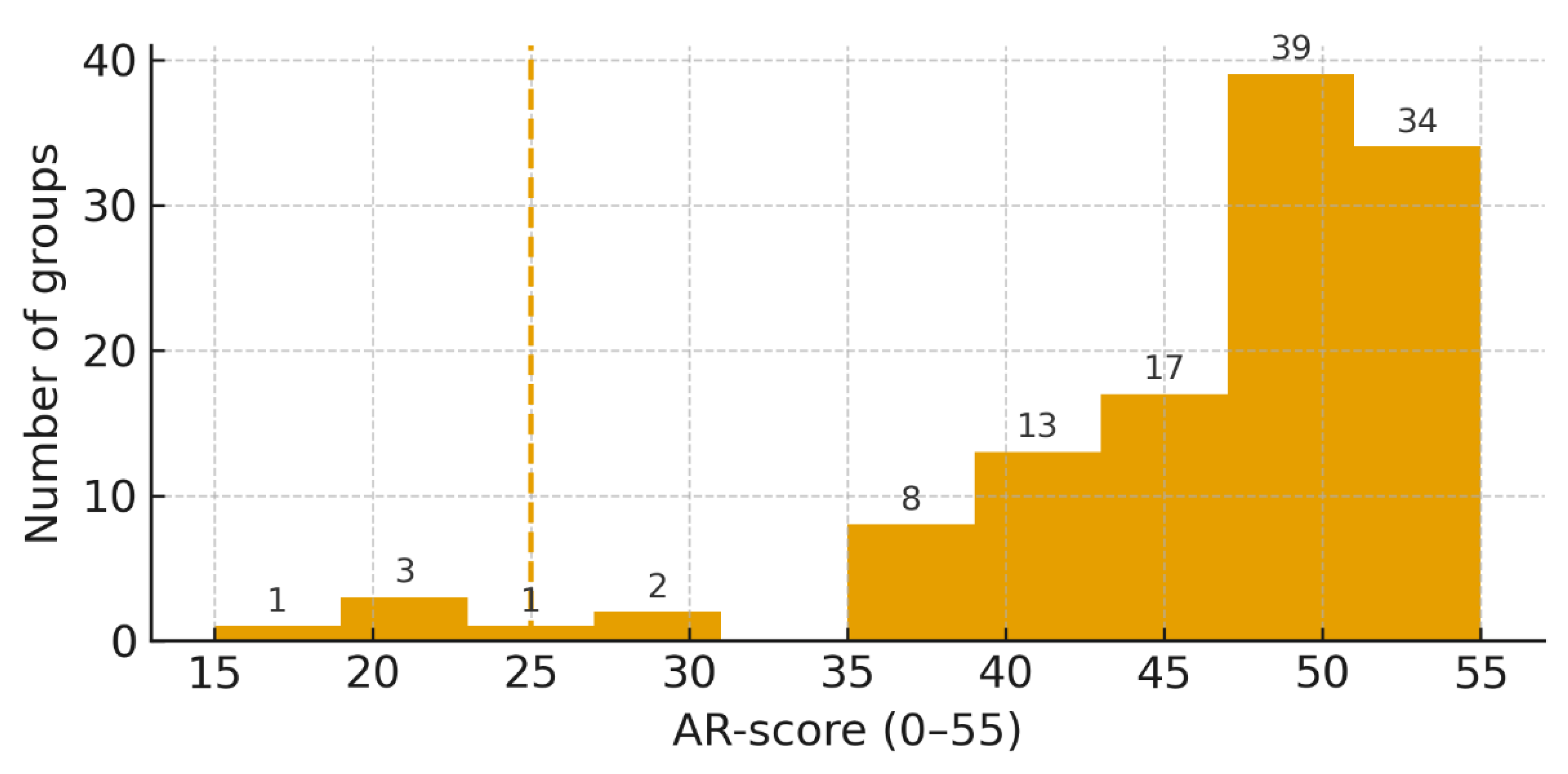
Most groups fall well above the 25-point threshold, but there remains a meaningful low-exposure tail. This justifies the binary contrast for analytic clarity while preserving heterogeneity within groups for sensitivity checks.
High-exposure groups spent on average 10.17 minutes more on the route than low-exposure groups. The SDs are comparable, which helps interpret the mean difference without undue influence from dispersion asymmetry (Table C2).
Table C2.
Group descriptives for total route time minutes by exposure level.
| Exposure group | Mean total route time minutes | SD Minutes |
| Low AR exposure less than 25 | 32.60 | 6.77 |
| High AR exposure greater than or equal to 25 | 42.77 | 6.08 |
High-exposure groups spent on average 10.17 minutes more on the route than low-exposure groups.
Figure C2.
Mean total path time by AR exposure group.
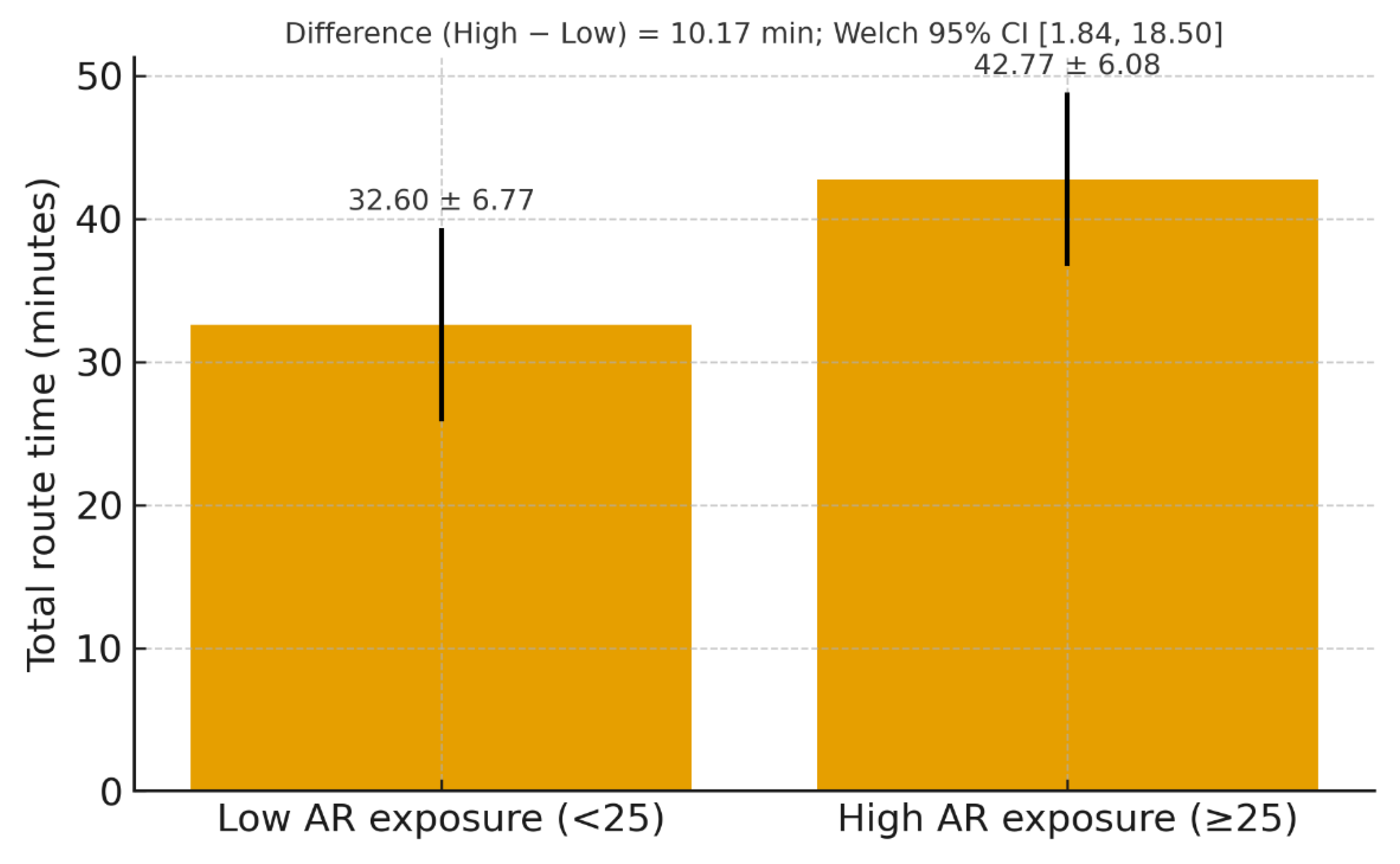
The bar plot with SD error bars displays a clear, practically relevant separation in time-on-task associated with AR engagement. This aligns with the design intent that AR overlays scaffold noticing and sustained in-situ exploration.
C.2. Inferential Tests, Effect Size, and Model-Based Corroboration
Given the strong imbalance between groups in the primary division (≥ 25; N high = 114, N low = 4), we did not report Welch's tests. Instead, we corroborated the mean difference with OLS treating the AR score as continuous, with fixed session effects and robust small-sample-corrected errors. The estimated coefficient was +7.92 min (SE = 2.75, p = 0.004, 95% CI [2.52, 13.31]).
Table C3.
Effect size for total path time.
| Effect size | Value |
| Hedges g | 1.66 |
A Hedges g of 1.66 indicates a large difference in practical terms, consistent with the observed mean separation. Hedges’ g computed on the ≥ 25 split where n-low = 4; interpret with caution due to small n-low.
Table C4.
Cluster-robust OLS with date fixed effects.
| Model | Coefficient High exposure | SE | p value | 95% CI lower | 95% CI upper |
| OLS with date fixed effects and cluster-robust SE | 7.92 | 2.75 | 0.004 | 2.52 | 13.31 |
The model accounts for session-date heterogeneity and clusters standard errors by session. The plus 7.92 minutes coefficient reinforces the bivariate contrast, indicating that the AR-exposure effect is not an artifact of specific session timings or conditions.
Figure C3.
Coefficient for High exposure equals plus 7.92 minutes SE equals 2.75, p equals 0.004, 95% CI [2.52, 13.31]. The vertical dashed line marks zero.
Figure C3.
Coefficient for High exposure equals plus 7.92 minutes SE equals 2.75, p equals 0.004, 95% CI [2.52, 13.31]. The vertical dashed line marks zero.
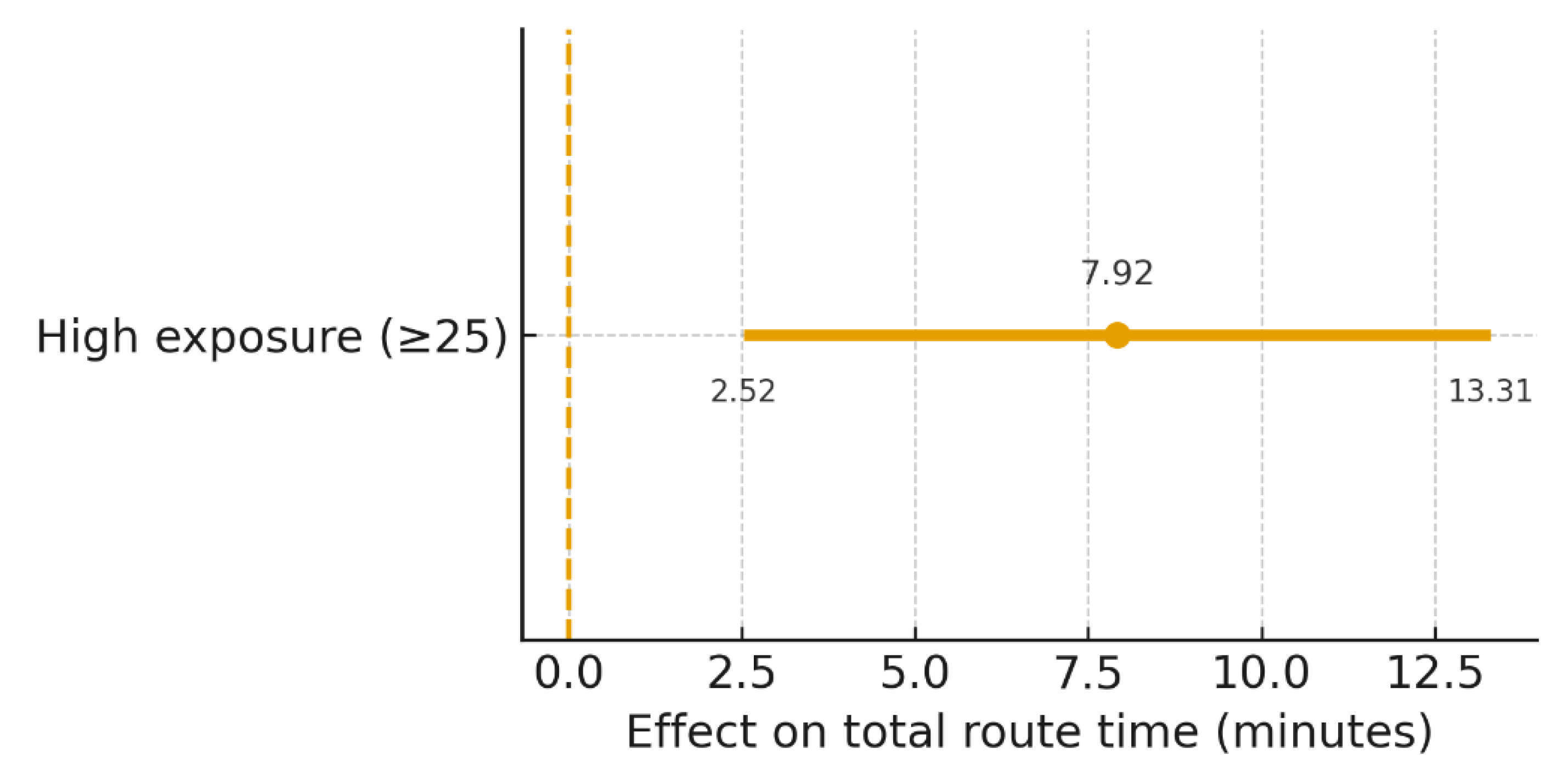
The coefficient plot shows a tight interval entirely to the right of zero, visually reinforcing the robustness of the AR exposure effect under clustered uncertainty and date fixed effects.
C.3. Sensitivity Analyses and Design Inferences
Follow presents the tests on whether the observed AR exposure effect depends on the chosen threshold. We re-estimate contrasts using alternative AR-score cut-offs and overlay-count proxies and then interpret what stable results imply for design decisions in the route and scaffolding.
To assess the robustness of the primary AR-score split (≥ 25), we re-estimated the contrasts at alternative thresholds (≥ 20, ≥ 30). Table C5 presents the group sizes, means, standard deviations, and 95% confidence intervals for mean differences. For specifications with n low < 10, the Welch test is not reported. Instead, it corroborated the direction of the effect using Ordinary Least Squares (OLS) with fixed session effects and small-sample robust errors.
Table C5.
Sensitivity analyses by alternative thresholds.
| Threshold | N High | N Low | Mean High |
SD High |
Mean Low |
SD Low |
Mean diff High/Low |
95% CI lower | 95% CI upper | OLS check (sign) |
| AR-score ≥ 20 | 117 | 1 | 42.45 | 6.18 | 34.00 | n/a | 8.45 | n/a | n/a | Positive |
| AR-score ≥ 25 | 114 | 4 | 42.67 | 6.02 | 34.25 | 6.55 | 8.42 | -1.83 | 18.66 | Positive |
| AR-score ≥ 30 | 113 | 5 | 42.76 | 5.96 | 33.80 | 5.76 | 8.96 | 1.89 | 16.03 | Positive |
Across thresholds, the effect remains positive, indicating that higher AR engagement is consistently associated with longer on-site exploration. The observed discrepancies in statistical significance can be attributed to significant group imbalances at more stringent cut-off values, a phenomenon that leads to inflation of uncertainty despite the presence of stable mean disparities. The pre-specified primary inferential specification models AR-score as a continuous predictor in OLS with session fixed effects and small-sample robust errors, while these sensitivity checks support the inference that AR anchors align with increased time-on-task.
References
- M. C. Bortolotto, J. Díaz-Rodríguez, and L. Alvarado, “Living Legacies: Memories, Identities, and Belonging,” J. Iber. Lat. Am. Res., vol. 23, no. 3, pp. 187–193, Sep. 2017. [CrossRef]
- M. G. Abdelmonem, “Architectural and urban heritage in the digital age: Dilemmas of authenticity, originality and reproduction,” Archnet-IJAR Int. J. Archit. Res., vol. 11, no. 3, pp. 5–15, 2017. [CrossRef]
- UNESCO, “Convention concerning the protection of the world cultural and natural heritage,” 1972. [Online]. Available: CONVENTION CONCERNING THE%0APROTECTION OF THE WORLD CULTURAL%0AAND NATURAL HERITAGE.
- Council of Europe, “Council of Europe Framework Convention on the Value of Cultural Heritage for Society,” 2008. [CrossRef]
- UN, “Transforming our world: the 2030 Agenda for Sustainable Development (A/RES/70/1),” UN General Assembly, 2015. [CrossRef]
- L. Smith, Uses of Heritage. Routledge, 2006.
- G. Avram, L. Ciolfi, and L. Maye, “Creating tangible interactions with cultural heritage: lessons learned from a large scale, long term co-design project,” CoDesign, vol. 16, no. 3, pp. 251–266, 2020. [CrossRef]
- E. Kamjou and M. Scott, “The heritage-climate change nexus: towards a values-based adaptive planning response for cultural landscapes,” J. Environ. Plan. Manag., pp. 1–20, 2025. [CrossRef]
- E. Avrami, S. Macdonald, R. Mason, and D. Myers, Values in Heritage Management, vol. 1, no. 1. Los Angeles: The Getty Conservation Institute, 2019.
- F. Bandarin and R. van Oers, The Historic Urban Landscape. Wiley, 2012.
- E. Champion and H. Rahaman, “3D Digital Heritage Models as Sustainable Scholarly Resources,” Sustainability, vol. 11, no. 8, p. 2425, Apr. 2019. [CrossRef]
- E. Moraitou, Y. Christodoulou, and G. Caridakis, “Semantic models and services for conservation and restoration of cultural heritage: A comprehensive survey,” Semant. Web, vol. 14, no. 2, pp. 261–291, Dec. 2022. [CrossRef]
- M. Katsianis and E. Gkadolou, “9 Archaeological and cultural heritage web mapping resources: linking the Greek experience with wider research considerations,” Archaeol. Reports, vol. 70, pp. 213–238, Nov. 2024. [CrossRef]
- Council of Europe, “European Charter of the Architectural Heritage,” 1975.
- F. Choay, Alegoria do Património, 3rd ed. Edições 70, 2019.
- L. Fusco Girard and M. Vecco, “The ‘Intrinsic Value’ of Cultural Heritage as Driver for Circular Human-Centered Adaptive Reuse,” Sustainability, vol. 13, no. 6, p. 3231, Mar. 2021. [CrossRef]
- C. Holtorf, “Conservation and Heritage As Creative Processes of Future-Making,” Int. J. Cult. Prop., vol. 27, no. 2, pp. 277–290, May 2020. [CrossRef]
- F. Banfi, R. Brumana, and C. Stanga, “Extended reality and informative models for the architectural heritage: from scan-to-BIM process to virtual and augmented reality,” Virtual Archaeol. Rev., vol. 10, no. 21, p. 14, Jul. 2019. [CrossRef]
- M. Doerr, “The CIDOC Conceptual Reference Module an Ontological Approach to Semantic Interoperability of Metadata,” AI Mag., vol. 24, no. 3, pp. 75–92, 2003.
- M. D. Wilkinson et al., “The FAIR Guiding Principles for scientific data management and stewardship,” Sci. Data, vol. 3, no. 1, p. 160018, Mar. 2016. [CrossRef]
- F. Niccolucci, “From Digital Archaeology to Data-Centric Archaeological Research,” magazén, no. 1, Dec. 2020. [CrossRef]
- D. Moullou, R. Vital, S. Sylaiou, and L. Ragia, “Digital Tools for Data Acquisition and Heritage Management in Archaeology and Their Impact on Archaeological Practices,” Heritage, vol. 7, no. 1, pp. 107–121, Dec. 2023. [CrossRef]
- R. G. Boboc, E. Băutu, F. Gîrbacia, N. Popovici, and D.-M. Popovici, “Augmented Reality in Cultural Heritage: An Overview of the Last Decade of Applications,” Appl. Sci., vol. 12, no. 19, p. 9859, Sep. 2022. [CrossRef]
- L. Petti, C. Trillo, and B. N. Makore, “Cultural Heritage and Sustainable Development Targets: A Possible Harmonisation? Insights from the European Perspective,” Sustainability, vol. 12, no. 3, p. 926, Jan. 2020. [CrossRef]
- N. Xu, J. Liang, K. Shuai, Y. Li, and J. Yan, “HeritageSite AR: An Exploration Game for Quality Education and Sustainable Cultural Heritage,” in Extended Abstracts of the 2023 CHI Conference on Human Factors in Computing Systems, Apr. 2023, no. November, pp. 1–8. [CrossRef]
- S. Caquard, “Cartography I,” Prog. Hum. Geogr., vol. 37, no. 1, pp. 135–144, Feb. 2013. [CrossRef]
- M. K. Bekele, R. Pierdicca, E. Frontoni, E. S. Malinverni, and J. Gain, “A Survey of Augmented, Virtual, and Mixed Reality for Cultural Heritage,” J. Comput. Cult. Herit., vol. 11, no. 2, pp. 1–36, Jun. 2018. [CrossRef]
- E. Ch’ng, S. Cai, P. Feng, and D. Cheng, “Social Augmented Reality: Communicating via Cultural Heritage,” J. Comput. Cult. Herit., vol. 16, no. 2, 2023. [CrossRef]
- J. S. Bazargani, M. Zafari, A. Sadeghi-niaraki, and S. Choi, “A Survey of GIS and AR Integration : Applications,” Sustainability, vol. 14, no. 16, pp. 1–14, 2022. [CrossRef]
- S. Angelis, K. Kotis, and D. Spiliotopoulos, “Semantic Trajectory Analytics and Recommender Systems in Cultural Spaces,” Big Data Cogn. Comput., vol. 5, no. 4, p. 80, Dec. 2021. [CrossRef]
- S. Caquard and W. Cartwright, “Narrative Cartography: From Mapping Stories to the Narrative of Maps and Mapping,” Cartogr. J., vol. 51, no. 2, pp. 101–106, May 2014. [CrossRef]
- J. Xu and Y. Pan, “The Future Museum: Integrating Augmented Reality (AR) and Virtual-text with AI-enhanced Information Systems,” J. Wirel. Mob. Networks, Ubiquitous Comput. Dependable Appl., vol. 15, no. 3, pp. 373–394, 2024. [CrossRef]
- A. Mol et al., Virtual Heritage: A Guide. London: ubiquity press, 2021.
- Nikolarakis and P. Koutsabasis, “Mobile AR Interaction Design Patterns for Storytelling in Cultural Heritage: A Systematic Review,” Multimodal Technol. Interact., vol. 8, no. 6, p. 52, Jun. 2024. [CrossRef]
- M. Kalla, M. Jerowsky, B. Howes, and A. Borda, “Expanding Formal School Curricula to Foster Action Competence in Sustainable Development: A Proposed Free-Choice Project-Based Learning Curriculum,” Sustainability, vol. 14, no. 23, p. 16315, Dec. 2022. [CrossRef]
- G. Cebrián, M. Junyent, and I. Mulà, “Current practices and future pathways towards competencies in education for sustainable development,” Sustain., vol. 13, no. 16, p. 8733, 2021. [CrossRef]
- A. Wiek, L. Withycombe, and C. Redman, “Key competencies in sustainability: A reference framework for academic program development,” Sustain. Sci., vol. 6, no. 2, pp. 203–218, 2011. [CrossRef]
- Redman and A. Wiek, “Competencies for Advancing Transformations Towards Sustainability,” Front. Educ., vol. 6, no. November, pp. 1–11, 2021. [CrossRef]
- G. Bianchi, U. Pisiotis, M. Cabrera, Y. Punie, and M. Bacigalupo, The European sustainability competence framework. 2022.
- P. Martín-Ramos et al., “Operationalizing the European sustainability competence framework: Development and validation of learning outcomes for GreenComp,” Open Res. Eur., vol. 5, p. 203, Oct. 2025. [CrossRef]
- J. Van Doorsselaere, “Connecting sustainable development and heritage education? An analysis of the curriculum reform in Flemish public secondary schools,” Sustainability, vol. 13, no. 4, pp. 1–17, 2021. [CrossRef]
- G. Cebrián, M. Junyent, and I. Mulà, “Competencies in Education for Sustainable Development: Emerging Teaching and Research Developments,” Sustainability, vol. 12, no. 2, p. 579, Jan. 2020. [CrossRef]
- A. Neves, A Arte Nova em Aveiro e seu distrito. Aveiro: Câmara Municipal de Aveiro, 1997.
- J. G. Gaspar, Ed., Boletim Municipal de Cultura - Ano . XVII, n.o 33. Aveiro: Câmara Municipal de Aveiro, 1999.
- Câmara Municipal de Aveiro, Dicionário Arte Nova. Câmara Municipal de Aveiro, 2011.
- D. A. Gruenewald, “The Best of Both Worlds: A Critical Pedagogy of Place,” Educ. Res., vol. 32, no. 4, pp. 3–12, May 2003. [CrossRef]
- A. P. Siddaway, A. M. Wood, and L. V. Hedges, “How to Do a Systematic Review: A Best Practice Guide for Conducting and Reporting Narrative Reviews, Meta-Analyses, and Meta-Syntheses,” Annu. Rev. Psychol., vol. 70, pp. 747–770, 2019. [CrossRef]
- J. Thomas and A. Harden, “Methods for the thematic synthesis of qualitative research in systematic reviews,” BMC Med. Res. Methodol., vol. 10, no. 45, pp. 1–10, 2008. [CrossRef]
- P. Boyd, “Reasoning within Hybrid Thematic Analysis,” LINK, vol. 8, no. 2, 2024.
- J. Fereday and E. Muir-Cochrane, “Demonstrating Rigor Using Thematic Analysis: A Hybrid Approach of Inductive and Deductive Coding and Theme Development,” Int. J. Qual. Methods, vol. 5, no. 1, pp. 80–92, Mar. 2006. [CrossRef]
- V. Braun and V. Clarke, “Using thematic analysis in psychology,” Qual. Res. Psychol., vol. 3, no. 2, pp. 77–101, 2003. [CrossRef]
- J. Ferreira-Santos and L. Pombo, “The Art Nouveau Path: Integrating Cultural Heritage into a Mobile Augmented Reality Game to Promote Sustainability Competences Within a Digital Learning Ecosystem,” Sustainability, vol. 17, no. 18, p. 8150, Sep. 2025. [CrossRef]
- J. Ferreira-Santos and L. Pombo, “The Art Nouveau Path: Promoting Sustainability Competences Through a Mobile Augmented Reality Game,” Multimodal Technol. Interact., vol. 9, no. 8, p. 77, Jul. 2025. [CrossRef]
- UNESCO, “Recommendation on the Historic Urban Landscape,” Paris, 2011. [Online]. Available: https://korumakurullari.ktb.gov.tr/TR-133320/arkeolojik-mirasin-korunmasina-iliskin-avrupa-sozlesmes-.html%0Ahttps://whc.unesco.org/uploads/activities/documents/activity-638-98.pdf.
- UN, New urban Agenda. United Nations, 2016.
- Council of Europe, “Recommendation of the Committee of Ministers to member States on the European Cultural Heritage Strategy for the 21st century,” 2017. [Online]. Available: https://rm.coe.int/16806f6a03%0Ahttps://www.coe.int/en/web/culture-and-heritage/-/new-strategy-21-website-how-to-make-heritage-management-inclusive.
- European Commission, “Commission Recommendation on a commom European data space for cultural heritage,” Brussels, 2021.
- L. King, J. F. Stark, and P. Cooke, “Experiencing the Digital World: The Cultural Value of Digital Engagement with Heritage,” Herit. Soc., vol. 9, no. 1, pp. 76–101, Jan. 2016. [CrossRef]
- A. Ababneh, “Digital solutions for cultural heritage: preservation, interpretation, and engagement in line with the Venice charter principles,” CEUR Workshop Proc., vol. 3838, 2024.
- ICOMOS, “International Charter for the Conservation and Restoration of Monuments and Sites - The Venice Charter,” Venice, 1964.
- Deutsche UNESCO-Kommission, Art Nouveau/Jugendstil Architecture in Europe. UNESCO, 1988.
- A. Munch, “The Total Design of Everyday Life: Historical Ideals and Dilemmas of the Gesamtkunstwerk,” Disegno, no. September, 2024. [CrossRef]
- W. Benjamin, “S [Pintura, Arte Nova [Judendstil], Novidade],” in As Passagens de Paris, Assírio & Alvim, 2019, pp. 674–694.
- G. Fahr-Becker, A Arte Nova. Köneman, 2000.
- P. Greenhalgh, Ed., Art Nouveau: 1890-1914. London: Victoria and Albert Museum, 2000.
- E. Berti, “Regular evaluation report: Réseau Art Nouveau Network,” 2022.
- Burnham, “Architectural heritage: the paradox of its current state of risk,” Int. J. Cult. Prop., vol. 7, no. 1, pp. 149–165, 1998. [CrossRef]
- W. Xu, Q.-W. Xing, Y. Yu, and L.-Y. Zhao, “Exploring the influence of gamified learning on museum visitors’ knowledge and career awareness with a mixed research approach,” Humanit. Soc. Sci. Commun., vol. 11, no. 1, p. 1055, Aug. 2024. [CrossRef]
- H. Wang, Z. Gao, X. Zhang, J. Du, Y. Xu, and Z. Wang, “Gamifying cultural heritage: Exploring the potential of immersive virtual exhibitions,” Telemat. Informatics Reports, vol. 15, p. 100150, Sep. 2024. [CrossRef]
- K. Y. T. Lim and S. Habig, “Beyond observation and interaction: Augmented Reality through the lens of constructivism and constructionism,” Br. J. Educ. Technol., vol. 51, no. 3, pp. 609–610, May 2020. [CrossRef]
- A. Kleftodimos, A. Evagelou, A. Triantafyllidou, M. Grigoriou, and G. Lappas, “Location-Based Augmented Reality for Cultural Heritage Communication and Education: The Doltso District Application,” Sensors, vol. 23, no. 10, 2023. [CrossRef]
- J. Ling et al., “Augmented Reality in the Digital Preservation of Cultural Heritage: Case Study in Poland,” in Proceedings of the 2025 European Conference on Computing in Construction, Jul. 2025, vol. 6, p. 8. [CrossRef]
- E. Sertalp and M. S. Sütcü, “Augmented reality application for the preservation of cultural heritage: The case of the Ottoman galley from the Suleiman I period,” Digit. Appl. Archaeol. Cult. Herit., vol. 38, p. e00450, Sep. 2025. [CrossRef]
- Z. Pervolarakis et al., “Visiting Heritage Sites in AR and VR,” Heritage, vol. 6, no. 3, pp. 2489–2502, Feb. 2023. [CrossRef]
- F. Maietti, M. Medici, and F. Ferrari, “From semantic-aware digital models to augmented reality applications for architectural heritage conservation and restoration,” Disegnarecon, vol. 14, no. 26, pp. 17.1-17.11, 2021. [CrossRef]
- H.-Y. Chang et al., “Ten years of augmented reality in education: A meta-analysis of (quasi-) experimental studies to investigate the impact,” Comput. Educ., vol. 191, p. 104641, Dec. 2022. [CrossRef]
- Y. Wen et al., “Integrating augmented reality into inquiry-based learning approach in primary science classrooms,” Educ. Technol. Res. Dev., vol. 71, no. 4, pp. 1631–1651, Aug. 2023. [CrossRef]
- P. N. Panayiotou and O. Kontovourkis, “A Holistic Documentation and Analysis of Timber Roof Structures in Heritage Buildings Using Scan to HBIM Approaches,” Proc. Int. Conf. Educ. Res. Comput. Aided Archit. Des. Eur., vol. 1, no. September, pp. 715–724, 2024. [CrossRef]
- T. Anderson and J. Shattuck, “Design-Based Research,” Educ. Res., vol. 41, no. 1, pp. 16–25, Jan. 2012. [CrossRef]
- S. Mckenney and T. Reeves, “Education Design Research,” in Handbook of Research on Educational Communications and Technology: Fourth Edition, 2014, p. 29.
- R. K. Yin, Case Study Research Design and Methods, 5th ed. Thousand Oaks, CA: SAGE Publications, Inc., 2015.
- M. Barth and I. Thomas, “Synthesising case-study research - ready for the next step?,” Environ. Educ. Res., vol. 18, no. 6, pp. 751–764, 2012. [CrossRef]
- J. Gerring, “What Is a Case Study and What Is It Good for?,” Am. Polit. Sci. Rev., vol. 98, no. 2, pp. 341–354, May 2004. [CrossRef]
- R. E. Stake, The art of case study research. SAGE Publications, Inc., 1995.
- K. M. Eisenhardt and M. E. Graebner, “Theory Building From Cases: Opportunities And Challenges,” Acad. Manag. J., vol. 50, no. 1, pp. 25–32, Feb. 2007. [CrossRef]
- M. J. Curado, Evolução Urbana de Aveiro: Espaços e Bairros com origem entre os séculos XV e XIX. Sana Editora, 2019.
- L. P. Silva, Arte Nova de Aveiro. Estudo Arquitetónico. 2020.
- M. Healy, “The Other Side of Belonging,” Stud. Philos. Educ., vol. 39, no. 2, pp. 119–133, Mar. 2020. [CrossRef]
- K. Brown et al., “Empathy , place and identity interactions for sustainability,” Glob. Environ. Chang., vol. 56, pp. 11–17, 2019. [CrossRef]
- J. Boeve-de Pauw and P. Van Petegem, “Because My Friends Insist or Because It Makes Sense? Adolescents’ Motivation towards the Environment,” Sustainability, vol. 9, no. 5, p. 750, May 2017. [CrossRef]
- R. B. Johnson and A. J. Onwuegbuzie, “Mixed Methods Research: A Research Paradigm Whose Time Has Come,” Educ. Res., vol. 33, no. 7, pp. 14–26, Oct. 2004. [CrossRef]
- M. M. Marques, J. Ferreira-Santos, R. Rodrigues, and L. Pombo, “Mobile Augmented Reality Games Towards Smart Learning City Environments: Learning About Sustainability,” Computers, vol. 14, no. 7, p. 267, Jul. 2025. [CrossRef]
- M. D. Fetters, L. A. Curry, and J. W. Creswell, “Achieving Integration in Mixed Methods Designs—Principles and Practices,” Health Serv. Res., vol. 48, no. 6pt2, pp. 2134–2156, Dec. 2013. [CrossRef]
- Parent et al., “Semantic trajectories modeling and analysis,” ACM Comput. Surv., vol. 45, no. 4, pp. 1–32, Aug. 2013. [CrossRef]
- V. M. Stewart, “Transformative sustainability education in accounting: effects on male and female students’ attitudes toward sustainable development,” Int. J. Sustain. High. Educ., vol. 25, no. 3, pp. 616–630, Feb. 2024. [CrossRef]
- J. Boeve-de Pauw, K. Jacobs, and P. van Petegem, “Gender Differences in Environmental Values: An Issue of Measurement?,” Environ. Behav., vol. 46, no. 3, pp. 373–397, 2014. [CrossRef]
- N. M. Ardoin, A. W. Bowers, E. Gaillard, N. M. Ardoin, A. W. Bowers, and E. G. A, “A systematic mixed studies review of civic engagement outcomes in environmental education,” Environ. Educ. Res., vol. 29, no. 1, pp. 1–26, 2023. [CrossRef]
- C. Metz, “Longitudinal Gains in Civic Development through School-Based Required Service,” Polit. Psychol., vol. 26, no. 3, pp. 413–437, 2005. [CrossRef]
- J. Garzón and J. Acevedo, “Meta-analysis of the impact of Augmented Reality on students ’ learning gains,” Educ. Res. Rev., vol. 27, no. April, pp. 244–260, 2019. [CrossRef]
- J. M. X. N. Teixeira, P. S. Cavalcante, and V. Teichrieb, “Perspectives on how to evaluate augmented reality technology tools for education : a systematic review,” J. ofthe Brazilian Comput. Soc., vol. 25, no. 3, p. 18, 2019.
- A. Chatsiopoulou and P. D. Michailidis, “Augmented Reality in Cultural Heritage : A Narrative Review of Design , Development and Evaluation Approaches,” Heritage, vol. 8, no. 421, p. 33, 2025.
- P. D. Simon, Y. Zhong, I. C. Dela, and C. Luke, “Scoping Review of Research on Augmented Reality in Environmental Education,” J. Sci. Educ. Technol., vol. 34, pp. 919–935, 2025. [CrossRef]
- A. Kleftodimos and A. Evagelou, “Location-Based Augmented Reality in Education,” Encyclopedia, vol. 5, no. 2, p. 54, Apr. 2025. [CrossRef]
Figure 3.
Narrative and question model structure.
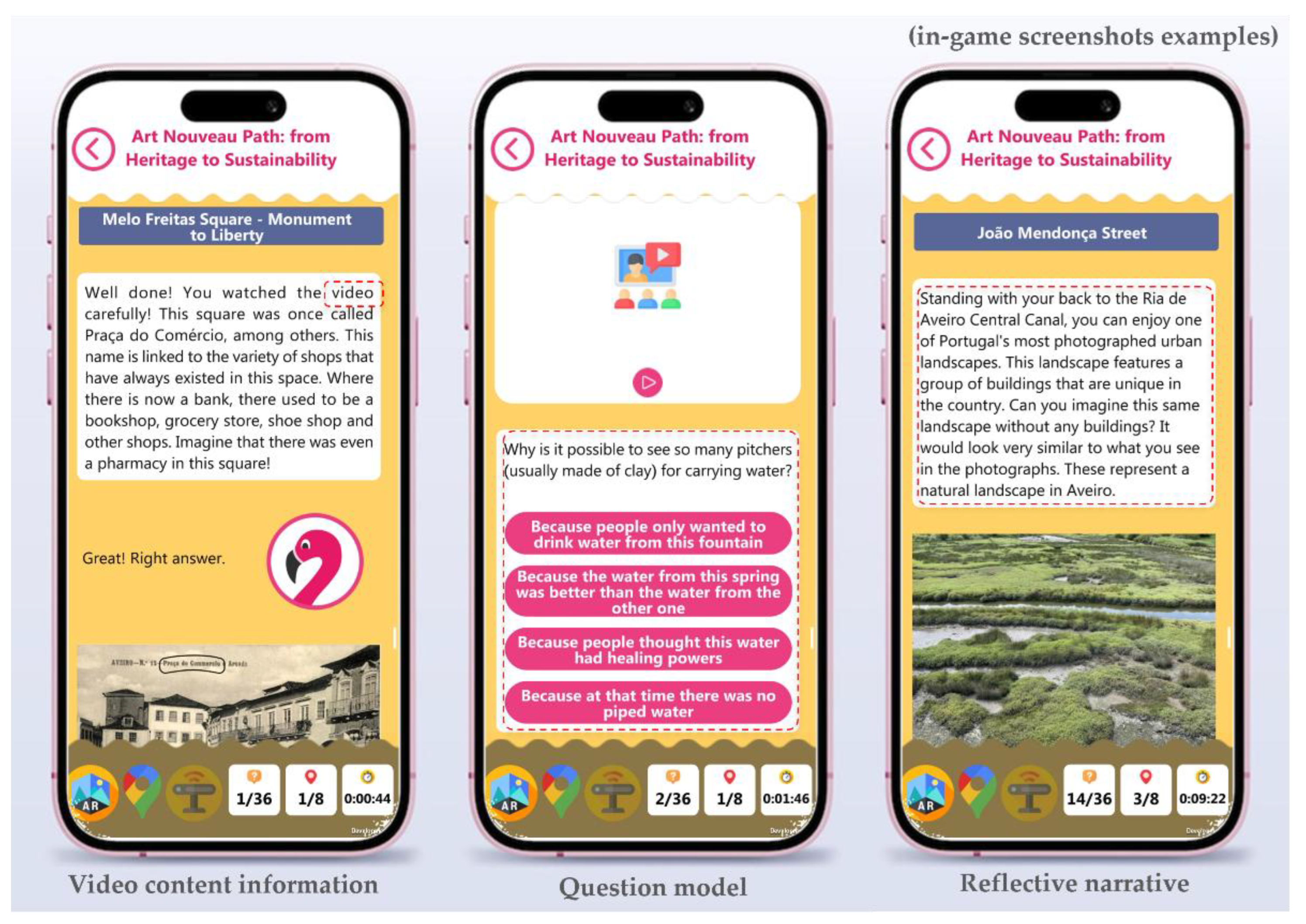
Figure 4.
In-app (version 1.3) city map.
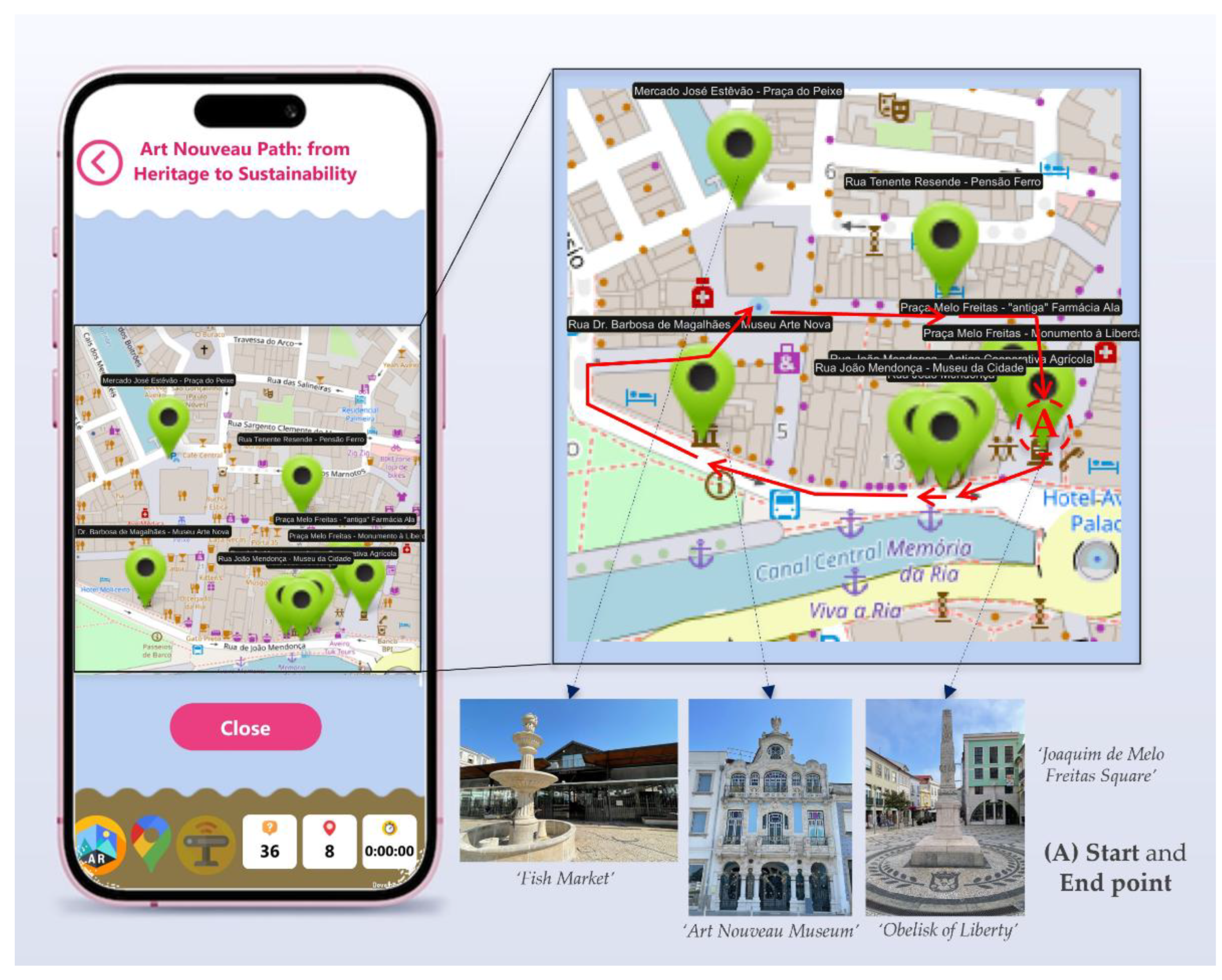
Figure 5.
AR camera as an interpretive layer.
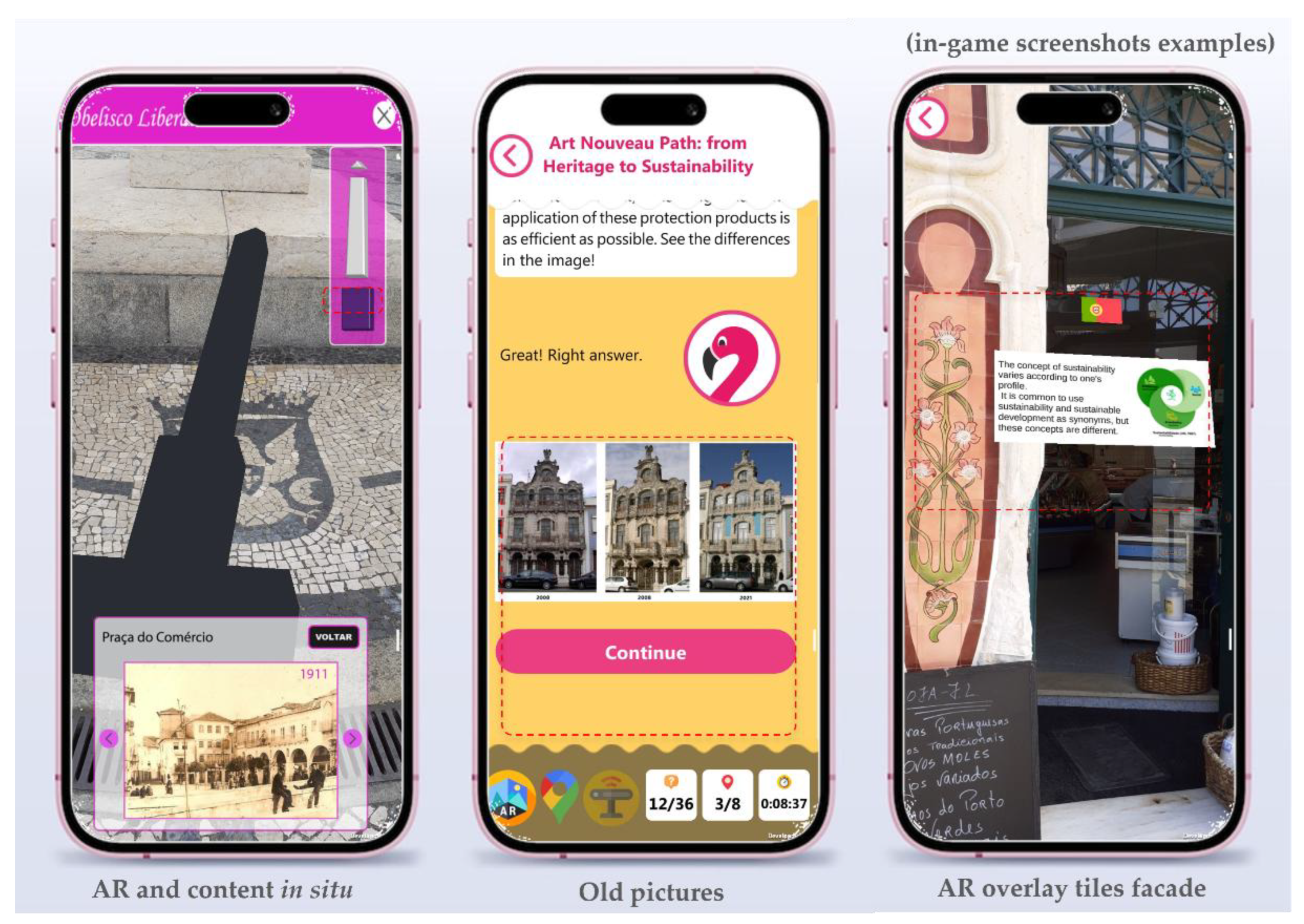
Figure 6.
AR markers (in-app visual hints).
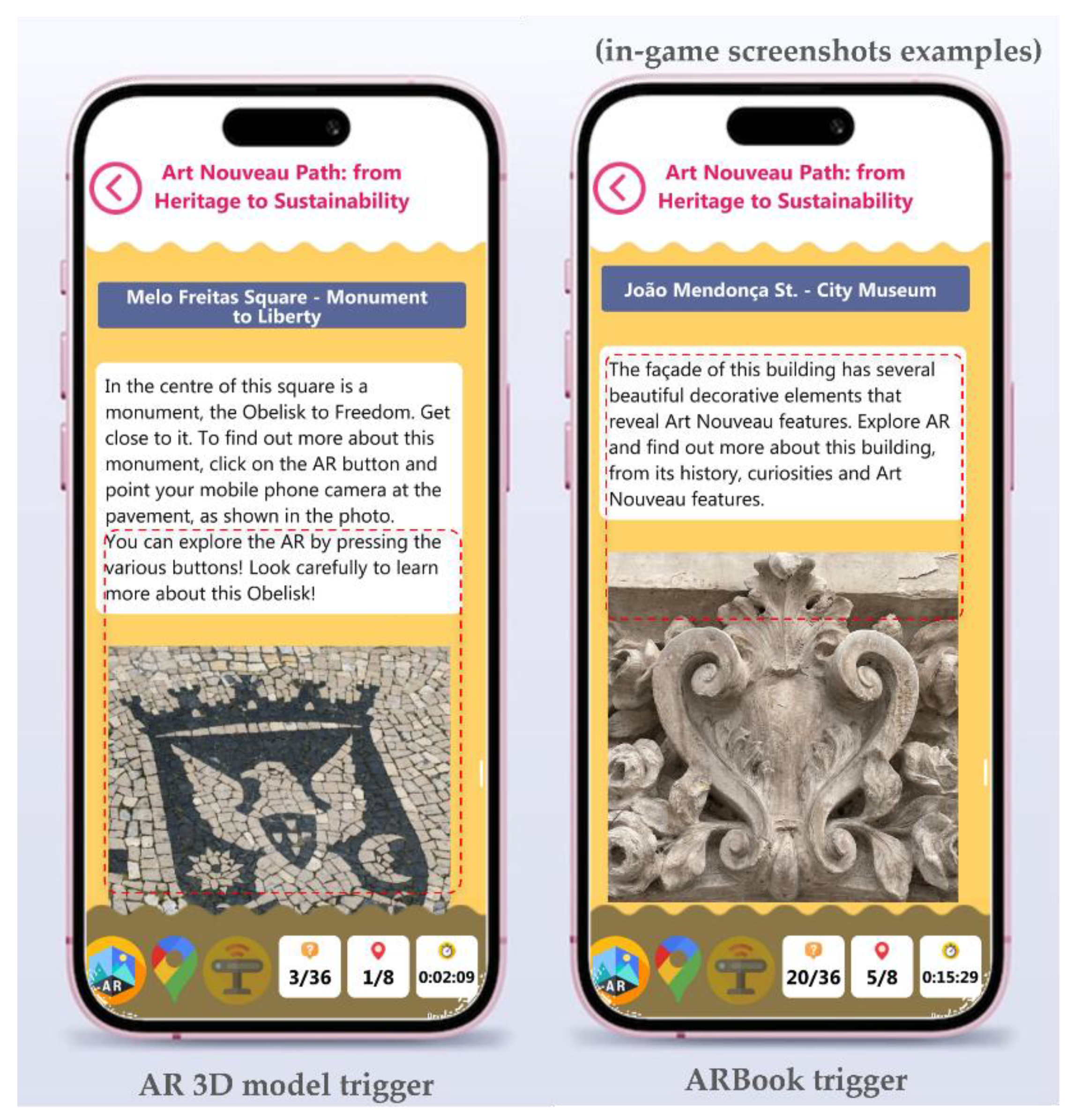
Figure 7.
In-game directions.
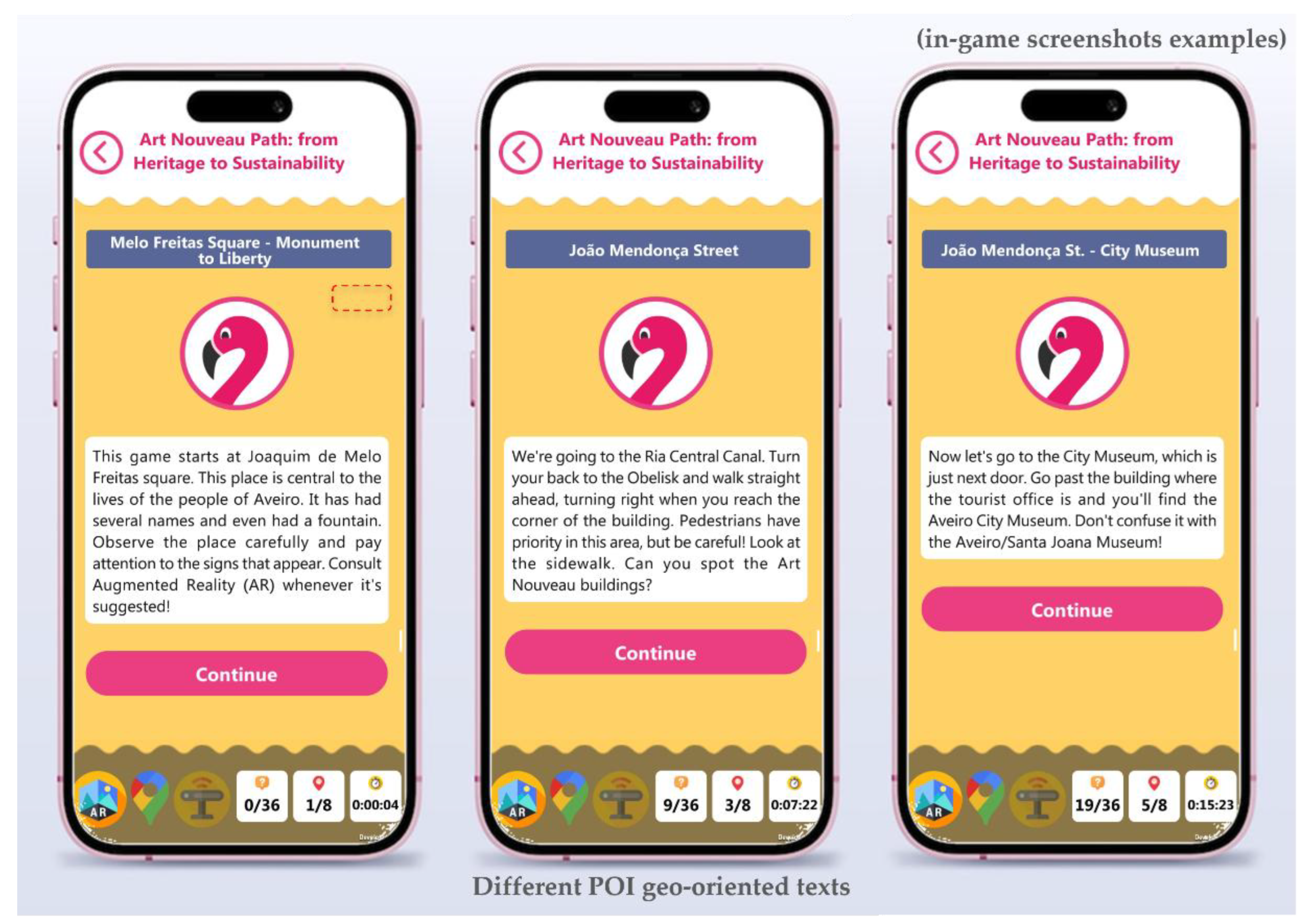
Figure 8.
Percentage of students explicitly linking sustainability to heritage preservation across administrations S1-PRE, S2-POST, and S3-FU.
Figure 8.
Percentage of students explicitly linking sustainability to heritage preservation across administrations S1-PRE, S2-POST, and S3-FU.
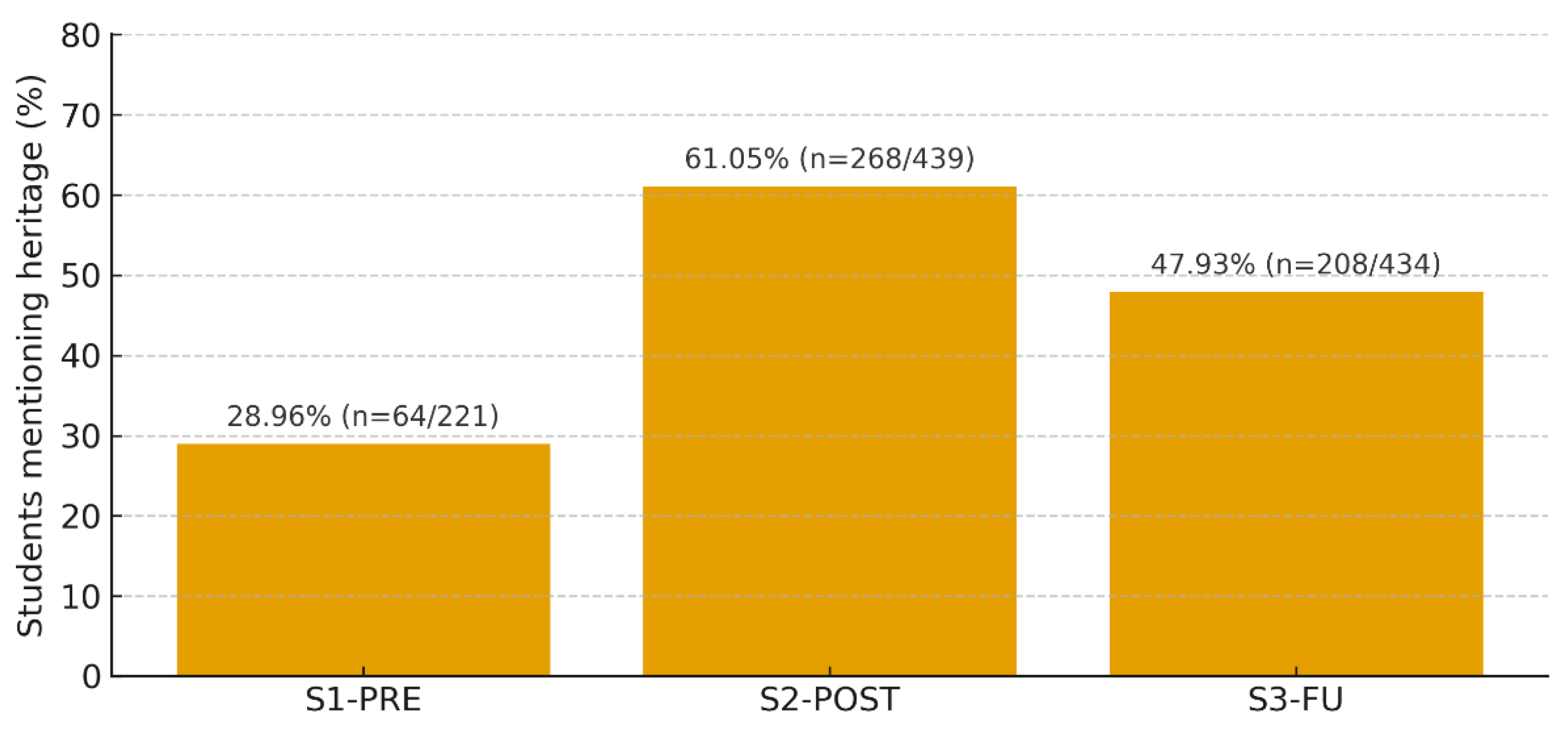
Figure 9.
Percentage of dichotomous indicators across S1-PRE, S2-POST, and S3-FU for civic responsibility for local heritage and city as a shared resource. Each label consolidates one or more questionnaire items or open-ended code families (see Appendix B).
Figure 9.
Percentage of dichotomous indicators across S1-PRE, S2-POST, and S3-FU for civic responsibility for local heritage and city as a shared resource. Each label consolidates one or more questionnaire items or open-ended code families (see Appendix B).
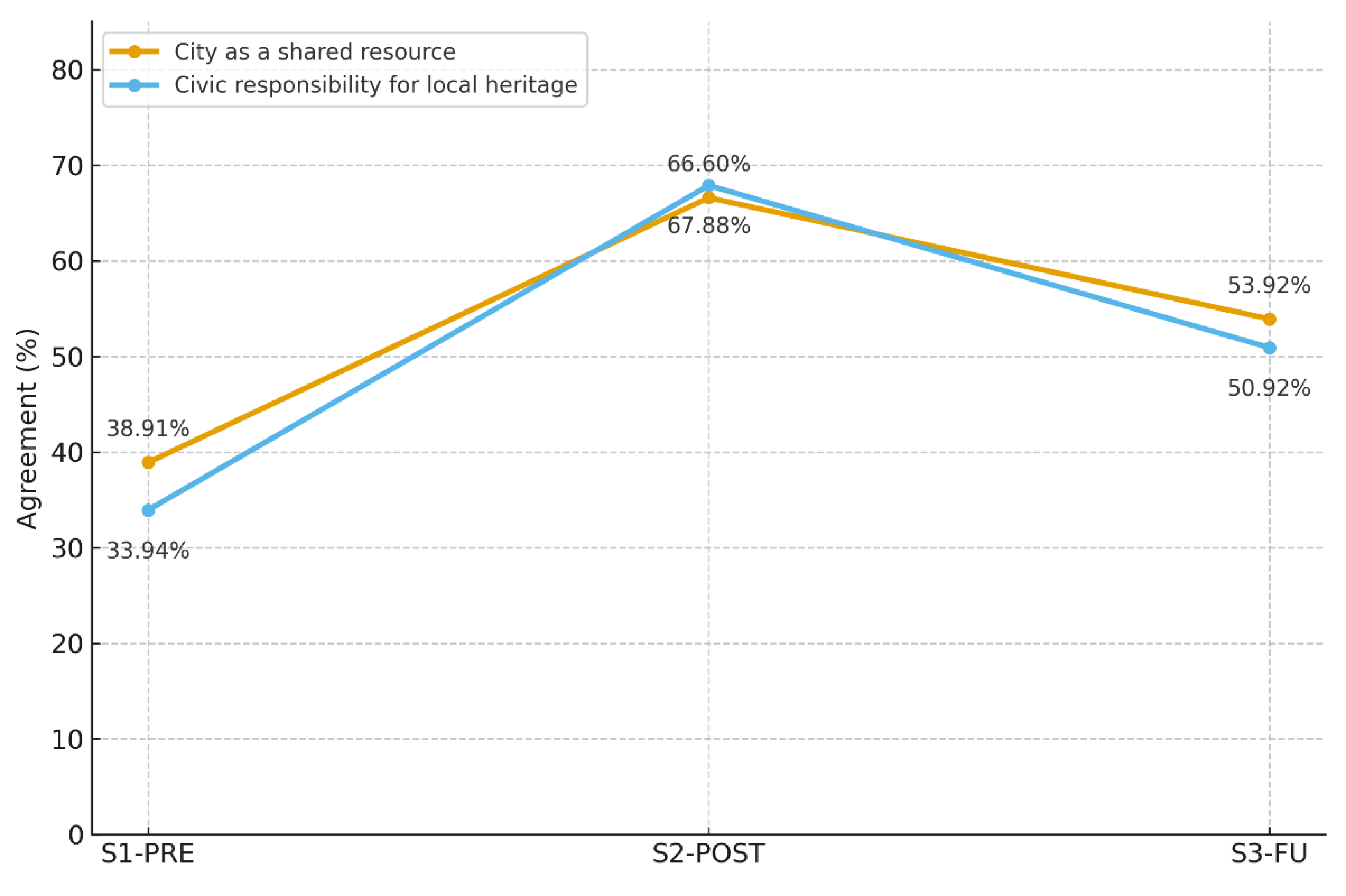
Figure 10.
Prevalence of non-mutually-exclusive thematic categories in open-ended responses across S1-PRE, S2-POST, and S3-FU.
Figure 10.
Prevalence of non-mutually-exclusive thematic categories in open-ended responses across S1-PRE, S2-POST, and S3-FU.
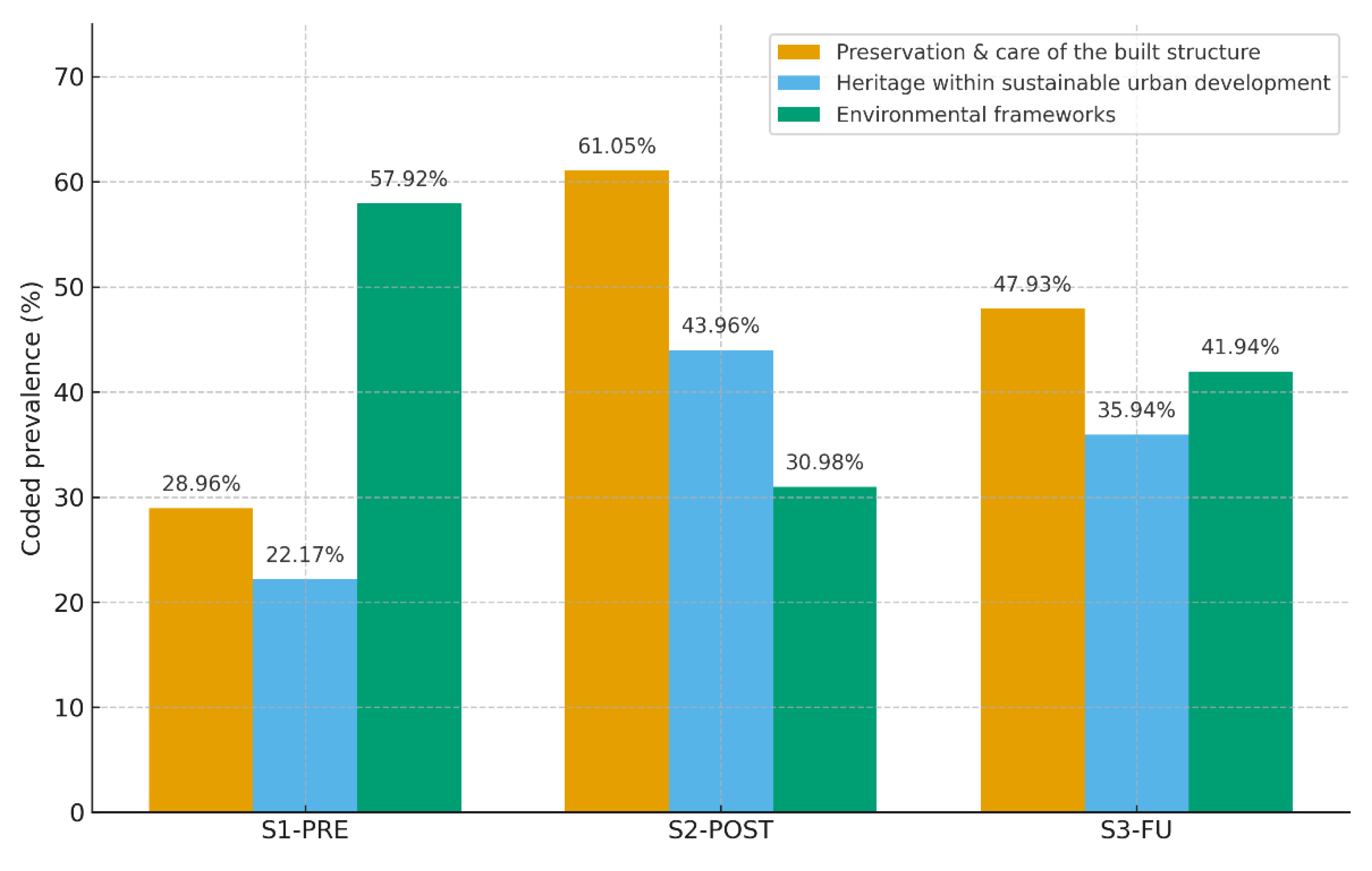
Figure 11.
Accuracy by preservation-framed items from gameplay logs, highlighting the weakest item and high-performing clusters.
Figure 11.
Accuracy by preservation-framed items from gameplay logs, highlighting the weakest item and high-performing clusters.
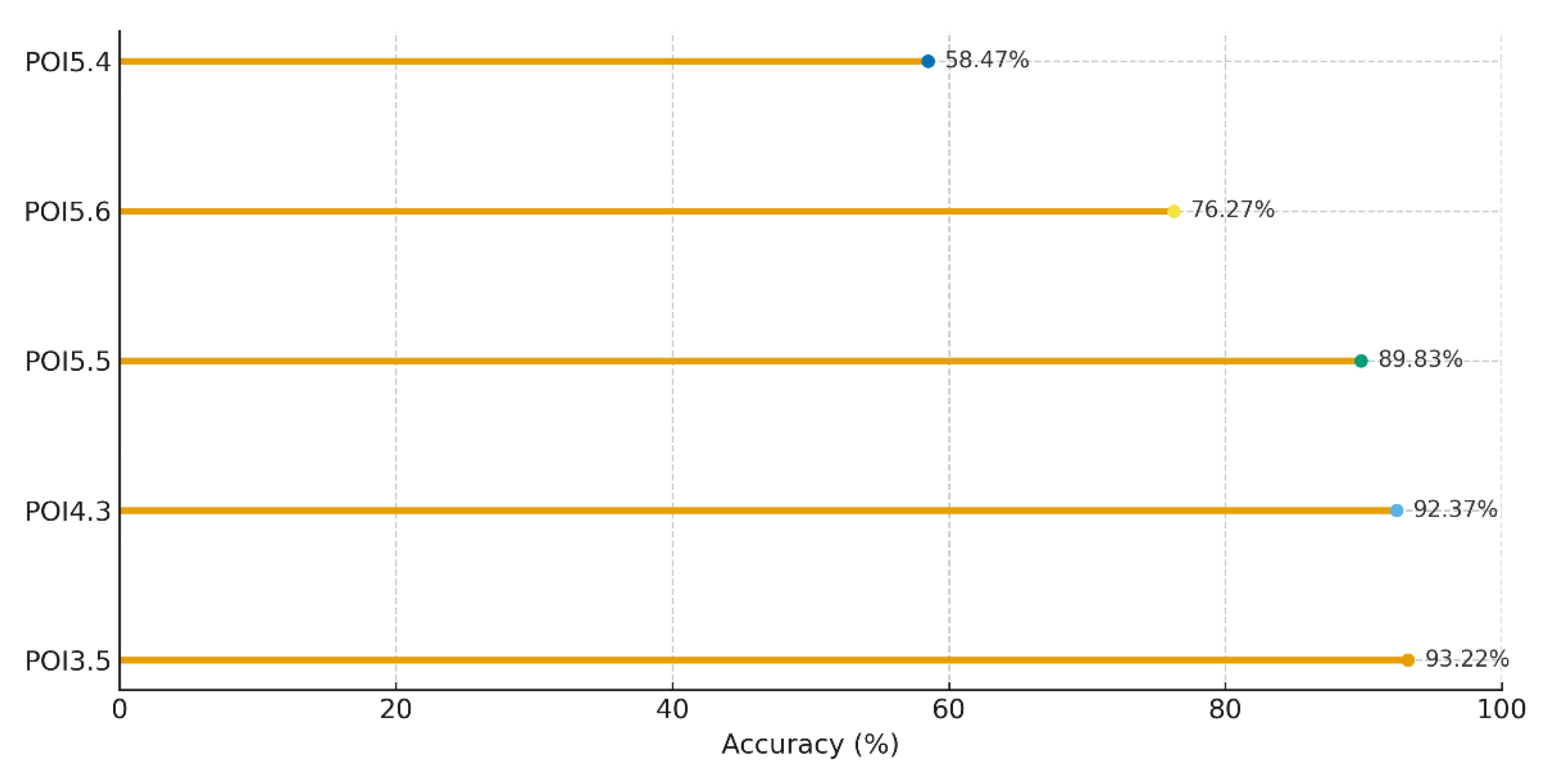
Table 1.
Overview of instruments and datasets used in this article.
| Instrument (code) / dataset |
Participants / Scope |
Focus | Data type |
Aim / Use |
|
GCQuest S1-PRE |
221 Students (baseline) |
Sustainability conceptions; heritage interest; AR readiness | 25 Likert items + open-ended | Baseline diagnostic for context; qualitative prompts inform coding scheme |
|
GCQuest S2-POST |
439 Students (immediate post) |
Engagement; narrative coherence; interest in Art Nouveau | 25 Likert items + open-ended | Primary student self-report during implementation |
|
GCQuest S3-FU |
434 Students (6–8 weeks) |
Retention; transfer; sustained reflections | 25 Likert items + open-ended | Follow-up perspective on persistence of effects |
| T2-OBS | 24 Accompanying teachers | On-site collaboration; AR use; attention to detail; wayfinding | Likert + checklists + open-ended | Ecological evidence under authentic conditions |
| Gameplay logs | Student groups (n=118 groups) | Completion; correctness; distractor choice; path order; duration | App-generated data (group-level, anonymized) | Patterns of pacing and item-level performance; response and trajectory reconstruction |
| Digital assets and descriptors | Eight POIs (content layer, AR markers) | Archival images; AR overlays; narrative prompts; semantic tags | Multimedia and metadata | Cultural-data outputs curated for reuse, with no personal data, and based on community and FAIR data sources |
Table 2.
Prevalence of thematic categories on students’ conceptions of heritage across questionnaires.
Table 2.
Prevalence of thematic categories on students’ conceptions of heritage across questionnaires.
| Category | Description |
S1-PRE (n = 221) |
S2-POST (n = 439) |
S3-FU (n = 434) |
Illustrative Example |
| C1. Recognition of architectural details | Identification of facades and decorative motifs | 31.22% (n = 69) |
71.98% (n = 316) |
61.06% (n = 265) |
“I never noticed the balconies before; now I look for them when I walk in the city.” [S3-FU] |
| C2. Connection to Aveiro and civic identity | Buildings framed as markers of local distinctiveness and memory | 18.10% (n = 40) |
43.96% (n = 193) |
38.02% (n = 165) |
“These houses are Aveiro, if they disappear, the city changes.” [S2-POST] |
| C3. Affective pride and belonging | Emotional investment in heritage as part of self and community identity | 12.22% (n = 27) |
33.03% (n = 145) |
29.03% (n = 126) |
“I want to show my parents what I learned; it makes me proud.” [S3-FU] |
| C4. Heritage as a living resource | Heritage understood as a civic asset, not a static monument | 8.14% (n = 18) |
22.10% (n = 97) |
19.12% (n = 83) |
“Heritage is not only in museums, it is here in our streets.” [S2-POST] |
Table 3.
Student references to architectural features across S1-PRE, S2-POST, and S3-FU, with triangulation from gameplay logs and teacher observations.
Table 3.
Student references to architectural features across S1-PRE, S2-POST, and S3-FU, with triangulation from gameplay logs and teacher observations.
| Dataset / Source | N (total) | n (coded / groups) |
% Mentioning / Accuracy |
Descriptors |
| S1-PRE | 221 | 69 | 31.22% | General facades; few decorative details |
| S2-POST | 439 | 316 | 71.98% | Various details (n = 13); Balconies (n = 158); Tiles (n = 123) |
| S3-FU | 434 | 265 | 61.06% | Recall of at least one feature |
| Gameplay logs | 4 248 group-item responses |
118 groups | 83.00% (mean accuracy, detail-item subset) |
Lower-accuracy motifs linked to distractors |
|
Teachers’ observations (T2-OBS) |
24 teachers | 19 forms rated high/very high | 79.17% | Attention increased when AR overlays highlighted details |
Table 4.
Prevalence of thematic categories on students’ perceptions of AR across S1-PRE, S2-POST, and S3-FU.
Table 4.
Prevalence of thematic categories on students’ perceptions of AR across S1-PRE, S2-POST, and S3-FU.
| Category | Description |
S1-PRE (n = 221) |
S2-POST (n = 439) |
S3-FU (n = 434) |
Illustrative Example |
| C1. AR as amplifier of observation | AR overlays highlighted unnoticed architectural details (facades, balconies, tiles) | 22.17% (n = 49) |
46.92% (n = 206) |
38.94% (n = 169) |
“With the AR camera, I noticed the flowers in the windows; before I would just pass by.” [S2-POST] |
| C2. AR as motivator of curiosity | AR perceived as fun, novel, and motivating, increasing willingness to explore | 18.10% (n = 40) |
41.00% (n = 180) |
32.95% (n = 143) |
“It was fun, like a game, not a class, and it made me want to walk more.” [S2-POST] |
| C3. AR as double-edged experience | AR produced moments of distraction or ambiguity, shifting focus away from the real object | 9.05% (n = 20) |
20.96% (n = 92) |
17.97% (n = 78) |
“Sometimes I only looked at the phone and forgot the real house.” [S3-FU] |
Table 5.
Student references to AR as a key element shaping perception of facades (S2-POST and S3-FU).
Table 5.
Student references to AR as a key element shaping perception of facades (S2-POST and S3-FU).
| Dataset | N (total) | n (coded) |
% Mentioning AR as Key Element |
Illustrative Example |
| S2-POST | 439 | 298 | 67.88% | “Helped me notice things better”; “Helped me see details.” |
| S3-FU | 434 | 226 | 52.07% | “Changed how I look at buildings.” |
Table 6.
Gameplay metrics by AR versus non-AR items and group exploration time.
| Gameplay Metric | AR-Based Items / Groups | Non-AR Items / Groups | Difference |
|
Mean Accuracy (%) |
81.00 | 73.00 | +8.00 pp |
| Mean Exploration Time (minutes, SD) | 42.77 (SD = 6.08) |
32.60 (SD = 6.77) |
+10.17 min |
Table 7.
Dichotomous items from S2-POST: interest in learning sustainability through Art Nouveau and interest in Aveiro’s Art Nouveau.
Table 7.
Dichotomous items from S2-POST: interest in learning sustainability through Art Nouveau and interest in Aveiro’s Art Nouveau.
| Item Code | Examples |
Yes (n, %) |
No (n, %) |
Total (N) |
| A.2.2 | “It is interesting to learn about sustainability through Art Nouveau” | 432 (98.45%) |
7 (1.55%) |
439 |
| A.2.3 | “I would like to know more about Aveiro’s Art Nouveau” | 415 (94.53%) |
24 (5.47%) |
439 |
Table 8.
repeated cross-sectional comparison of A.2.1. categories (S2-POST vs. S3-FU).
| Category |
S2-POST (n = 439) |
S3-FU (n = 434) |
Illustrative Example |
| Noticing heritage details | 76.08% (n = 334) |
56.68% (n = 246) |
“The building details stayed in my memory; I still look for it in the city.” [S3-FU] |
|
Experiential learning and transfer |
15.72% (n = 69) |
31.80% (n = 138) |
“Now when I walk with friends, I explain what Art Nouveau is and why it matters.” [S3-FU] |
| Unclear or other | 8.20% (n = 36) |
11.52% (n = 50) |
“I do not remember exactly, but I know it was interesting.” [S3-FU] |
Disclaimer/Publisher’s Note: The statements, opinions and data contained in all publications are solely those of the individual author(s) and contributor(s) and not of MDPI and/or the editor(s). MDPI and/or the editor(s) disclaim responsibility for any injury to people or property resulting from any ideas, methods, instructions or products referred to in the content. |
© 2025 by the authors. Licensee MDPI, Basel, Switzerland. This article is an open access article distributed under the terms and conditions of the Creative Commons Attribution (CC BY) license (http://creativecommons.org/licenses/by/4.0/).
Copyright: This open access article is published under a Creative Commons CC BY 4.0 license, which permit the free download, distribution, and reuse, provided that the author and preprint are cited in any reuse.


