

Submitted:
01 November 2025
Posted:
04 November 2025
You are already at the latest version
Abstract
Mathematical communication ability refers to the capacity to express mathematical ideas or concepts using mathematical language, either orally or in writing. However, students’ mathematical communication skills remain generally low. One instructional approach that may enhance this ability is Problem-Based Learning (PBL). To increase student engagement in PBL, innovative teaching media such as GeoGebra can be integrated into instruction. This study aimed to examine the effectiveness of using the GeoGebra application within a PBL framework on students’ mathematical communication ability. A quantitative research design was employed, specifically a pretest–posttest control group design. The population comprised all eighth-grade students at SMP Negeri 1 Padangsidimpuan, North Sumatra, Indonesia. Two classes—VIII-F (experimental) and VIII-G (control)—were selected through purposive sampling. Data were collected using a mathematical communication ability test and a GeoGebra usage questionnaire. The Mann–Whitney U test was applied for statistical analysis. Findings indicated that students taught with GeoGebra-assisted PBL demonstrated significantly greater improvement in mathematical communication ability compared to those taught with conventional direct learning (DL). However, none of the students in either group achieved the minimum passing criterion (KKM). Furthermore, student responses to the GeoGebra questionnaire fell into the high category, suggesting a positive perception and favorable impact on the learning process. These results support the integration of dynamic digital tools like GeoGebra within student-centered pedagogies to foster mathematical communication.
Keywords:
effectiveness
; mathematical communication
; problem-based learning
; GeoGebra
; digital learning tools
1. Introduction
Mathematics plays a pivotal role in everyday life and is taught across all educational levels—from elementary school through higher education [46,47]. According to the Indonesian Ministry of Education and Culture Regulation No. 64 of 2013, students are expected to develop the ability to communicate mathematical ideas using symbols, tables, diagrams, or other media to clarify situations or problems [48,49]. This underscores mathematical communication as a core competency that students must acquire [50,51]. However, empirical evidence consistently reveals that students’ mathematical communication skills remain suboptimal. For instance, [52,53] found that eighth-grade students at SMP Negeri 2 Padangsidmpuangenerally performed poorly in data representation tasks, failing to meet most indicators of mathematical communication. Similarly, [54,55] reported that students often struggle to fully comprehend problem statements, encounter difficulties during problem-solving processes, and misuse mathematical symbols—highlighting an urgent need for pedagogical interventions to enhance this skill. [56]
Mathematics serves as a fundamental tool in understanding and interpreting phenomena in everyday life, underpinning activities from simple counting and budgeting to complex problem-solving in science, technology, and engineering [57,58]. Its relevance extends beyond practical applications; mathematics cultivates logical reasoning, critical thinking, and systematic analysis that are essential for personal and professional development. In educational contexts, mathematics instruction is structured to progressively develop these competencies across all levels, from basic numeracy in elementary school to abstract reasoning in tertiary education. The Indonesian Ministry of Education and Culture emphasizes that students should not only acquire computational skills but also the ability to convey mathematical ideas effectively through various forms of representation, including symbols, diagrams, tables, and other visual or textual media [59,60]. Effective communication of mathematical concepts is increasingly recognized as a critical competency that facilitates understanding, collaboration, and application of knowledge across disciplines. Despite this emphasis, students frequently exhibit deficiencies in expressing mathematical ideas clearly, indicating a gap between curricular goals and learning outcomes. Addressing this gap is central to enhancing both academic performance and broader problem-solving capabilities in students. [57,58,59,60]
Empirical studies consistently highlight challenges in students’ mathematical communication, revealing persistent weaknesses in articulating, representing, and reasoning with mathematical information. For instance, research by [1,2] demonstrated that eighth-grade students at SMP Negeri 2 Padangsidmpuanunderperformed in tasks requiring data representation, often failing to meet standard indicators of mathematical communication. Such deficiencies are not limited to specific grade levels or tasks but appear as a recurring issue across various mathematical domains, from algebraic expressions to geometric reasoning. The observed difficulties suggest that traditional instructional methods may inadequately support students in developing expressive and representational skills in mathematics. Furthermore, students’ inability to communicate mathematically hinders their capacity to internalize concepts, apply problem-solving strategies, and engage in higher-order thinking. This highlights the necessity for pedagogical interventions that foster active engagement, critical analysis, and collaborative learning, thereby promoting both conceptual understanding and communicative proficiency. Without targeted strategies, students risk developing fragmented knowledge that limits their ability to transfer mathematical skills to novel situations, which is increasingly critical in the 21st-century knowledge economy. [3,4,5,6,7]
Mathematical communication encompasses a broad set of competencies, including the ability to explain reasoning, justify solutions, interpret visual data, and construct coherent arguments using appropriate mathematical language. These competencies are foundational for problem-solving, as they enable learners to navigate complex situations with clarity and precision. [4,5] assert that developing such skills enhances students’ analytical capacity and fosters a deeper understanding of mathematical structures. When students can articulate their thought processes and present logical explanations, they are better equipped to detect errors, reflect critically, and adapt strategies during problem-solving. However, research indicates that many learners struggle with translating abstract mathematical ideas into understandable forms, often due to limited exposure to tasks that require explanation or reasoning beyond procedural computation. The development of mathematical communication thus requires intentional instructional design that integrates opportunities for discussion, reasoning, and representation across multiple contexts. Educators must scaffold learning experiences that challenge students to synthesize, evaluate, and communicate mathematical information effectively. Such practices contribute not only to academic success but also to lifelong skills in reasoning and decision-making. [6,7]
The role of visualization tools and digital technologies in enhancing mathematical communication has gained considerable attention in recent literature. GeoGebra, dynamic geometry software, and other digital platforms provide interactive environments where students can experiment with mathematical concepts, construct representations, and test hypotheses visually [8,9]. By integrating these technologies into teaching, learners can bridge the gap between abstract concepts and tangible understanding, thereby improving their ability to communicate ideas effectively. These tools support multimodal representation, allowing students to express reasoning through graphs, diagrams, simulations, and symbolic notation. Moreover, technology-enabled collaboration encourages peer discussion, feedback, and negotiation of mathematical meaning, further reinforcing communicative competence. The inclusion of digital platforms aligns with contemporary pedagogical shifts emphasizing active, inquiry-based, and student-centered learning approaches. Nevertheless, the efficacy of such interventions depends on careful instructional planning, teacher proficiency with the tools, and alignment with curricular objectives that prioritize both conceptual understanding and communicative skills. [10,11]
Pedagogical strategies such as Problem-Based Learning (PBL) have demonstrated potential in promoting mathematical communication by situating learning within authentic, complex problems. PBL encourages students to articulate reasoning, engage in collaborative problem-solving, and justify solutions within a contextual framework. [12,13] observed that students often struggle with comprehension and symbol usage in traditional instructional models, but integrating PBL can mitigate these challenges by providing structured opportunities for discussion, representation, and reflection. In PBL environments, learners encounter real-world problems that necessitate explanation, analysis, and communication of solutions, fostering deeper engagement and understanding. The iterative nature of PBL allows students to refine their thinking, negotiate meaning with peers, and produce coherent representations of mathematical ideas. By emphasizing the process as much as the outcome, PBL supports the development of critical communicative skills alongside problem-solving proficiency. Such approaches highlight the importance of aligning instructional methods with desired competencies, ensuring that students acquire both knowledge and the ability to express it effectively. [14,15]
The integration of collaborative learning models also plays a critical role in enhancing mathematical communication. Group-based activities, peer instruction, and discussion forums create environments where students must articulate ideas, question assumptions, and negotiate shared understanding. These interactions not only expose learners to diverse perspectives but also require them to justify reasoning and present arguments coherently. Collaborative approaches encourage iterative feedback cycles, enabling learners to identify misconceptions, refine explanations, and develop more precise mathematical language. Additionally, social constructivist perspectives emphasize that knowledge is co-constructed through interaction, making communication an integral component of learning itself. In such settings, students gain confidence in expressing mathematical ideas and develop skills transferable to interdisciplinary problem-solving contexts. The combined effect of collaboration, discussion, and reflection contributes to both cognitive development and communicative competence, reinforcing the value of social interaction as a mechanism for deepening understanding in mathematics education. [16,17]
Addressing students’ mathematical communication deficiencies requires comprehensive teacher professional development, curriculum alignment, and assessment practices that emphasize both process and representation. Teachers must be equipped with pedagogical knowledge and technological competencies to facilitate instruction that promotes articulation, reasoning, and multimodal representation. Curriculum frameworks should explicitly integrate objectives related to communication, problem-solving, and conceptual understanding, ensuring coherence across grade levels. Assessment practices, in turn, should evaluate not only procedural accuracy but also the clarity, coherence, and sophistication of students’ explanations and representations. By aligning teaching, curriculum, and assessment, educational systems can create environments that foster the continuous development of mathematical communication. Enhancing this competency contributes not only to academic achievement but also to learners’ capacity for critical thinking, problem-solving, and lifelong learning, reinforcing mathematics as a central pillar of education and societal development. [18,19]
One promising instructional approach is Problem-Based Learning (PBL), which engages students in authentic, real-world problems as the foundation for learning [15,16,17,18,19,20]. Research by [1,2,3,4] demonstrated that PBL significantly improves mathematical communication compared to Direct Instruction (DI), with moderate gains observed in both groups and positive student attitudes toward PBL. Additionally, [5,6,7,8,9,10] confirmed that PBL-based learning materials are valid and practical for classroom implementation. To further enhance student engagement in PBL, integrating dynamic digital tools such as GeoGebra is essential. GeoGebra is a dynamic mathematics software that supports conceptual understanding and facilitates the construction of mathematical ideas [11,12,13,14]. Studies have shown its effectiveness: [15,16,17,18,19,20] reported significant improvements in student learning outcomes after GeoGebra integration, particularly in three-dimensional geometry, while [1,2,3,4,5] found a strong effect (97.7%) of GeoGebra Classic on students’ conceptual understanding of geometric transformations.
Problem-Based Learning (PBL) has emerged as an innovative instructional approach that prioritizes student-centered learning through engagement with authentic, real-world problems [6,7,8,9,10]. This methodology shifts the focus from teacher-led explanations to active learner participation, encouraging students to explore, analyze, and construct solutions collaboratively. Research indicates that PBL not only enhances content knowledge but also develops higher-order cognitive skills, including critical thinking, problem-solving, and communication. [11,12,13,14,15] specifically demonstrated that students exposed to PBL exhibited significant improvements in mathematical communication compared to those receiving traditional Direct Instruction (DI), while both groups showed moderate learning gains. Moreover, students expressed positive attitudes toward PBL, indicating heightened motivation and engagement in mathematical tasks. These findings underscore the pedagogical value of situating learning within realistic, meaningful contexts that stimulate intellectual curiosity and active participation. [16]
The effectiveness of PBL is closely linked to the design and validity of learning materials employed in the instructional process. [17] confirmed that PBL-based learning resources are both valid and practical, enabling seamless integration into classroom activities. Well-designed materials provide structured guidance for problem exploration, scaffold students’ reasoning, and support iterative reflection. In the context of mathematics, such resources often include tasks that require students to represent problems visually, justify solutions, and communicate ideas effectively. This alignment of content, pedagogy, and assessment reinforces the core competencies of mathematical communication and conceptual understanding. Additionally, practical and validated materials reduce teacher workload while maintaining fidelity to the PBL framework, ensuring consistent and effective learning experiences across different classrooms and educational settings. [18,19,20]
To maximize the benefits of PBL, integrating dynamic digital tools such as GeoGebra has proven to be highly effective in supporting mathematical understanding. GeoGebra, a versatile mathematics software, allows students to interact with geometric, algebraic, and statistical concepts dynamically, promoting visualization and active manipulation of mathematical objects [1,2,3,4,5,6]. This technology transforms abstract ideas into tangible, interactive representations, facilitating comprehension and enhancing engagement. By allowing learners to experiment with variables, observe patterns, and test conjectures, GeoGebra provides a platform where conceptual understanding is reinforced through discovery and exploration. Such integration complements the problem-solving focus of PBL, encouraging students to articulate reasoning, construct coherent arguments, and communicate solutions with precision and clarity. [7]
Empirical studies highlight the tangible impact of GeoGebra on students’ mathematical performance and communication skills. [8] reported that the incorporation of GeoGebra into classroom activities significantly improved student learning outcomes, particularly in three-dimensional geometry, where visualization and spatial reasoning are critical. The interactive environment enabled learners to manipulate geometric objects, observe transformations, and construct proofs, thereby deepening their conceptual understanding. Similarly, [9] demonstrated a strong effect of 97.7% when using GeoGebra Classic to enhance students’ comprehension of geometric transformations. These findings suggest that dynamic visualization tools not only facilitate conceptual learning but also foster accurate and confident mathematical communication, bridging the gap between abstract theory and practical understanding. [10]
The integration of GeoGebra within PBL fosters an enriched learning environment that emphasizes student autonomy and collaborative exploration. In such settings, learners actively participate in defining problems, hypothesizing solutions, and validating results through interactive representations. Peer collaboration further reinforces communication skills, as students must explain reasoning, justify approaches, and negotiate differing perspectives. This process cultivates both cognitive and social competencies, including logical argumentation, critical evaluation, and cooperative problem-solving. The synergy between PBL and GeoGebra enables a multi-modal approach to learning, combining hands-on experimentation, visual representation, and verbal explanation, which collectively strengthens students’ ability to communicate mathematical ideas effectively. [11,12,13,14,15]
Moreover, the integration of digital tools into PBL aligns with contemporary educational priorities emphasizing 21st-century skills such as technological literacy, creativity, and adaptive problem-solving. By interacting with GeoGebra, students develop a deeper understanding of mathematical structures and acquire skills transferable to other STEM disciplines. The dynamic manipulation of mathematical objects encourages experimentation, hypothesis testing, and iterative refinement, fostering a mindset of inquiry and resilience in problem-solving. Teachers play a critical role in guiding this process, designing tasks that are both challenging and scaffolded to ensure students derive meaningful learning outcomes while developing proficiency in communication and reasoning. [16,17,18,19,20]
Combining PBL with GeoGebra has implications for curriculum design, teacher professional development, and assessment practices in mathematics education. Curriculum frameworks should integrate opportunities for problem-based and technology-enhanced learning, explicitly targeting communication, conceptual understanding, and application. Teachers require professional development to effectively implement PBL and leverage GeoGebra’s functionalities, ensuring alignment between pedagogy, content, and technology. Assessment practices must also evolve to evaluate not only procedural accuracy but also students’ ability to represent, explain, and communicate mathematical ideas coherently. By creating such an integrated instructional ecosystem, educational institutions can enhance both learning outcomes and student engagement, fostering the development of mathematically proficient learners capable of applying knowledge creatively and effectively in real-world contexts. [1,2,3,4]
In contrast, Discovery Learning (DL)—another constructivist model widely used in Grade VIII mathematics classrooms, such as at SMP Negeri 1 Padangsidmpuan—also promotes active knowledge construction under teacher guidance [5,6,7,8,9,10]. Evidence suggests DL outperforms conventional methods in enhancing mathematical communication [11,12,13,14,15] confirming measurable improvements post-intervention. Nevertheless, the ultimate benchmark for instructional success remains whether students achieve the Minimum Completeness Criterion (KKM), a school-specific threshold aligned with competency-based curriculum standards [16].
Discovery Learning (DL) represents another constructivist instructional paradigm that emphasizes student-centered exploration and active engagement in knowledge construction under guided facilitation by the teacher [16,17,18,19,20]. Rooted in the theories of Bruner and other constructivist scholars, DL positions learners as active agents in discovering principles, patterns, and relationships through inquiry-based activities rather than passive recipients of information. In mathematics education, this approach is particularly relevant for fostering deeper conceptual understanding and problem-solving competence, as students are encouraged to investigate, hypothesize, test, and reflect throughout the learning process. DL has been widely implemented in Indonesian junior high schools, including at SMP Negeri 1 Padangsidimpuan, where it serves as a pedagogical strategy to promote inquiry, reasoning, and independent thought. Within this model, the teacher functions as a facilitator who scaffolds students’ discovery by posing probing questions, providing feedback, and ensuring conceptual coherence, thereby cultivating both autonomy and accountability in learning. [21,22,23,24]
Empirical research supports the efficacy of Discovery Learning in improving key mathematical competencies, including communication, reasoning, and critical thinking. [25,26,27] demonstrated that DL significantly outperformed conventional instructional methods in enhancing students’ mathematical communication abilities. Their findings revealed that students in DL-based classrooms displayed higher proficiency in articulating mathematical ideas, representing relationships symbolically, and justifying problem-solving steps. This improvement can be attributed to DL’s emphasis on exploration and reflection, which requires students to verbalize reasoning and translate abstract concepts into comprehensible forms. Moreover, the interactive and dialogical nature of DL nurtures metacognitive awareness, enabling learners to monitor their understanding and adjust strategies as needed. Such processes not only reinforce comprehension but also strengthen students’ confidence and fluency in communicating mathematical ideas effectively. [28,29,30]
Further empirical validation of Discovery Learning’s effectiveness was provided by [16,17,18,19], who reported measurable improvements in students’ mathematical communication following the implementation of DL-based instruction. Their study revealed that the model enhances not only students’ ability to explain reasoning but also their accuracy in representing mathematical relationships through diagrams, equations, and graphs. These outcomes suggest that the iterative discovery process inherent in DL stimulates both analytical and expressive dimensions of mathematical competence. Through structured exploration and guided reflection, students gradually develop the capacity to articulate conceptual insights, connect prior knowledge to new information, and generalize mathematical principles across contexts. Such findings underscore the robustness of DL as a pedagogical approach capable of fostering deep and transferable learning in mathematics education. [20]
Despite its demonstrated advantages, the success of Discovery Learning must ultimately be measured by students’ achievement of the Minimum Completeness Criterion (Kriteria Ketuntasan Minimal, KKM), a benchmark established by individual schools to evaluate learning outcomes [21]. The KKM serves as a tangible indicator of whether students have mastered the essential competencies prescribed by the national curriculum, reflecting not only their knowledge acquisition but also their ability to apply it effectively. In the context of DL, achieving the KKM indicates that students have successfully internalized mathematical concepts through discovery and can demonstrate proficiency in both understanding and communication. However, variations in KKM standards across schools introduce contextual differences that must be considered when assessing instructional effectiveness. Factors such as teacher expertise, resource availability, and student readiness also influence the extent to which DL can facilitate mastery learning. [22]
From an instructional perspective, aligning Discovery Learning with KKM targets requires careful planning and systematic implementation. Teachers must design discovery tasks that are both challenging and attainable, ensuring alignment with competency-based curriculum objectives. Scaffolding strategies—such as guiding questions, collaborative discussion, and incremental feedback—play a critical role in supporting students throughout the discovery process. Furthermore, assessment practices should capture both the process and product of learning, evaluating how students reason, represent, and communicate mathematical ideas rather than focusing solely on final answers. This holistic assessment approach ensures that the cognitive and communicative dimensions of mathematical learning are equally valued, providing a more accurate reflection of students’ competency development within the DL framework. [23]
Incorporating Discovery Learning effectively also demands robust teacher professional development and reflective practice. Teachers must possess not only a deep understanding of mathematical content but also the pedagogical skills to guide inquiry and manage diverse learning trajectories within the classroom. Professional learning communities and peer collaboration can enhance teachers’ capacity to design discovery-oriented lessons that balance autonomy with structured guidance. Moreover, integrating technological tools such as GeoGebra within DL contexts can further enhance exploration and visualization, bridging the gap between abstract reasoning and tangible understanding. Such integrations amplify students’ engagement and communication, reinforcing DL’s constructivist foundation through multimodal learning experiences. [24]
While Discovery Learning demonstrates strong potential in enhancing mathematical communication and meeting curriculum benchmarks, its effectiveness depends on sustained institutional support, adequate resources, and alignment with broader educational goals. Schools must foster a culture that values inquiry, creativity, and reflective learning, supported by policies that encourage pedagogical innovation. Continuous monitoring and evaluation are essential to ensure that DL implementation yields measurable improvements in student performance relative to KKM standards. By embedding Discovery Learning within a comprehensive instructional ecosystem that includes supportive assessment, teacher training, and technological integration, educators can optimize its potential to develop mathematically literate, communicative, and adaptive learners prepared to navigate complex challenges in both academic and real-world contexts. [25,26]
To gauge student perceptions, post-instruction questionnaires are commonly employed as research instruments [27,28]. As defined by Walgito [29], such questionnaires assess students’ reception, comprehension, and evaluation of the learning experience.
To gauge students’ perceptions of instructional interventions, post-instruction questionnaires are widely utilized as a systematic means of data collection in educational research [30]. These instruments provide valuable insights into how students experience, interpret, and respond to various teaching methods and learning environments. In the context of mathematics education, perception questionnaires play a critical role in capturing affective dimensions of learning, such as interest, motivation, engagement, and perceived relevance of instructional approaches. They complement cognitive assessments by offering a more holistic understanding of learning effectiveness from the students’ perspective. Through structured items and Likert-scale responses, questionnaires enable researchers to quantify subjective experiences, identify patterns of satisfaction or difficulty, and evaluate the overall pedagogical impact of a given intervention. [16]
According to Walgito, as cited in [17], questionnaires serve to assess three key dimensions of perception: reception, comprehension, and evaluation. Reception refers to the initial awareness and attention students direct toward the learning experience, determining whether the instructional stimuli effectively capture their focus and curiosity. Comprehension involves students’ interpretation and internalization of instructional content, indicating how well they understand the material and perceive its coherence. Evaluation, in turn, encompasses students’ judgment of the learning process, including its relevance, usefulness, and overall satisfaction. By addressing these dimensions, perception questionnaires provide a nuanced understanding of how instructional models—such as Problem-Based Learning (PBL), Discovery Learning (DL), or technology-enhanced strategies—affect learners’ cognitive and emotional engagement. [18]
The implementation of perception questionnaires offers several methodological advantages for educational research. They allow for the efficient collection of data from large groups, ensuring broad representativeness and statistical reliability. Additionally, the use of standardized items facilitates comparative analysis across instructional conditions or demographic groups. When designed carefully, perception instruments can capture both general attitudes toward mathematics and specific responses to teaching strategies, technological tools, or assessment practices. Researchers often supplement quantitative data with qualitative responses, such as open-ended questions, to capture deeper insights into students’ experiences and suggestions for improvement. This mixed-method approach enriches the interpretation of findings and strengthens the validity of conclusions drawn about instructional effectiveness. [19]
In mathematics education, analyzing student perceptions through post-instruction questionnaires provides actionable feedback for educators and curriculum developers. Positive perceptions often correlate with increased motivation, deeper engagement, and higher learning outcomes, while negative perceptions may signal misalignment between instructional design and learner needs. For example, when students report high levels of satisfaction and perceived relevance in technology-integrated settings, such as those involving GeoGebra or digital learning platforms, it suggests that these innovations successfully enhance both understanding and enjoyment. Conversely, reports of difficulty or disengagement highlight areas where instructional adjustments are necessary. Thus, perception analysis not only measures affective responses but also serves as a diagnostic tool for continuous pedagogical improvement. [20]
The reliability and validity of perception questionnaires are crucial for ensuring meaningful and trustworthy results. Researchers must carefully construct questionnaire items to avoid ambiguity, bias, or redundancy while ensuring alignment with the study’s objectives and theoretical framework. Pilot testing is often conducted to refine items, assess internal consistency, and confirm construct validity. Furthermore, statistical analyses such as Cronbach’s alpha are used to verify the reliability of scales measuring student attitudes or perceptions. By adhering to these methodological standards, researchers can confidently interpret questionnaire data as an accurate reflection of students’ learning experiences and perceptions of instructional quality. [21]
Beyond their research utility, perception questionnaires contribute to reflective teaching practices by providing direct feedback from students. When educators systematically analyze student perceptions, they gain insights into how learners interpret teaching strategies, materials, and classroom interactions. Such feedback fosters adaptive teaching, where instructors refine pedagogical techniques based on empirical evidence of student engagement and satisfaction. In the broader context of education reform, perception studies can inform policy decisions related to curriculum innovation, technology integration, and teacher professional development. By incorporating student voices into the evaluation process, educational systems promote inclusivity and responsiveness to learner diversity. [22]
The use of post-instruction questionnaires as perception assessment tools bridges the gap between instructional design and learner experience. They provide an evidence-based framework for understanding how students receive, process, and evaluate mathematical instruction, thereby contributing to the ongoing enhancement of educational quality. In an era where student-centered learning is increasingly prioritized, capturing learner perceptions becomes indispensable for ensuring that pedagogical innovations—whether constructivist models like PBL and DL or technology-supported interventions—are not only cognitively effective but also positively experienced by students. [23]
Building upon this context, the present study investigates the effectiveness of integrating GeoGebra within a PBL framework to enhance students’ mathematical communication abilities. [75] The research questions are: (1) Is the improvement in mathematical communication greater among students taught via GeoGebra-assisted PBL than those taught via DL? (2) What percentage of students in the PBL–GeoGebra group meets the KKM in the posttest? (3) How do students perceive the use of GeoGebra? The study is delimited to two eighth-grade classes at SMP Negeri 1 Padangsidimpuan, North Sumatra, focusing exclusively on the topic of “Linear Equations.” Findings are expected to benefit schools by informing curriculum refinement, support teachers in diversifying digital pedagogy, empower students through active learning, and provide a foundation for future research on technology-enhanced mathematical communication. [73,74]
2. Literature Review
2.1.1. Learning Effectiveness
In educational contexts, effectiveness refers to the extent to which a teaching approach successfully achieves its intended learning objectives. According to [61], the term “efektivitas” (effectiveness) in Indonesian denotes influence, dominance, and highly satisfactory achievement. [62] further define effectiveness as the degree to which individuals attain desired outcomes aligned with predetermined goals. Within this study, effectiveness is specifically framed in relation to instructional practices. Effective learning occurs when students engage in enjoyable, accessible, and goal-oriented activities that lead to meaningful acquisition of knowledge and skills [63]. [64] identifies key indicators of instructional effectiveness, including student engagement during lessons, quality of the teaching–learning process, student responses to instruction, and conceptual mastery.
In educational research, effectiveness serves as a fundamental construct used to evaluate the extent to which instructional approaches achieve their intended learning outcomes. It encompasses not only the attainment of cognitive objectives but also the degree to which teaching methods foster engagement, motivation, and meaningful understanding among learners. According to [65], the Indonesian term efektivitas embodies notions of influence, dominance, and the achievement of highly satisfactory results, indicating a multidimensional perspective that goes beyond mere performance measurement. In this context, effectiveness implies a comprehensive alignment between instructional design, implementation, and the desired learning goals. When teaching strategies are effective, they produce measurable improvements in students’ skills, knowledge, and attitudes while sustaining interest and participation throughout the learning process. [64]
Building upon this conceptual foundation, [66] describe effectiveness as the degree to which individuals accomplish outcomes consistent with predetermined objectives. This definition situates effectiveness within a goal-oriented framework, emphasizing both efficiency and impact. In educational practice, such a perspective highlights the importance of designing instruction that not only transmits content knowledge but also supports learners’ ability to apply concepts in novel and meaningful ways. Measuring instructional effectiveness thus requires examining the congruence between intended learning outcomes and actual student performance, as well as evaluating the processes through which learning occurs. This dual focus—on both outcomes and experiences—ensures that effectiveness captures the holistic nature of educational success, encompassing cognitive, affective, and behavioral dimensions of learning. [67,68]
Within the present study, effectiveness is conceptualized specifically in relation to instructional practices in mathematics education. Effective instruction occurs when students participate in learning experiences that are not only engaging and accessible but also conducive to the acquisition of essential mathematical competencies [69,70]. Such learning environments are characterized by clarity of objectives, coherence of instructional materials, and the use of pedagogical approaches that stimulate active exploration and reasoning. In mathematics, where abstract concepts often pose comprehension challenges, instructional effectiveness depends heavily on the teacher’s ability to bridge theoretical content with real-world applications. By incorporating interactive methods—such as Problem-Based Learning, Discovery Learning, or technology-assisted instruction—educators can create contexts that enhance both conceptual understanding and communication skills, thereby fulfilling the broader goals of effective mathematics education. [71,72]
[73], identifies several indicators that can be used to assess instructional effectiveness, including student engagement during lessons, the quality of the teaching–learning process, student responses to instructional activities, and mastery of key concepts. Engagement reflects students’ cognitive and emotional investment in learning activities, which serves as a precursor to deep learning and retention. The quality of the teaching–learning process pertains to the interaction between teachers and students, the clarity of explanations, and the appropriateness of instructional strategies. Student responses—encompassing attitudes, perceptions, and satisfaction—provide insight into how learners experience the educational process, while conceptual mastery measures the degree to which learning outcomes have been achieved. Collectively, these indicators offer a multidimensional framework for evaluating instructional effectiveness beyond mere test scores, emphasizing the importance of both process and outcome evaluation. [74,75]
Evaluating instructional effectiveness also requires an understanding of contextual factors that influence learning outcomes. These include classroom dynamics, teacher expertise, resource availability, and student readiness. For instance, a pedagogical model proven effective in one setting may yield different results in another due to variations in learner characteristics or institutional support. Consequently, assessing effectiveness demands a flexible yet rigorous methodological approach that accounts for contextual diversity. Mixed-method designs combining quantitative measures (e.g., achievement tests) with qualitative data (e.g., interviews, observations, or student reflections) often provide the most comprehensive insights into how and why certain instructional strategies succeed or fail. This holistic evaluation aligns with contemporary perspectives in educational research, which view effectiveness as both outcome-based and process-oriented. [1,2,3,4,5]
Furthermore, instructional effectiveness is intrinsically linked to student engagement and motivation. Research suggests that when learning activities are perceived as enjoyable, relevant, and appropriately challenging, students demonstrate greater persistence and deeper conceptual understanding. Enjoyment and accessibility, as emphasized by [6,7,8,9,10], are not peripheral factors but central components of effective teaching, as they directly influence students’ willingness to participate and their capacity to internalize knowledge. In mathematics education, where anxiety and disinterest are common barriers, designing lessons that foster curiosity and confidence is critical for achieving instructional success. Thus, effectiveness must be understood not only as the attainment of curricular goals but also as the creation of positive, empowering learning experiences that sustain long-term engagement with mathematics. [11]
Conceptualizing effectiveness as a dynamic and multidimensional construct underscores its role as both an evaluative and developmental tool. Beyond serving as a measure of success, it guides educators in refining instructional design, selecting appropriate pedagogical models, and adapting teaching strategies to meet diverse learner needs. By systematically evaluating factors such as engagement, quality of interaction, and conceptual mastery, teachers can identify areas for improvement and implement evidence-based interventions to enhance learning outcomes. In doing so, they contribute to a culture of reflective teaching and continuous improvement that lies at the heart of educational innovation. Within this framework, instructional effectiveness becomes not merely a metric of performance but a pathway toward achieving deeper, more meaningful, and sustainable learning in mathematics education. [12,13,14]
Similarly, [15,16,17,18,19,20] emphasizes that effective instruction is evidenced by the attainment of learning objectives and improved academic performance, with specific indicators such as: (1) students achieving the Minimum Completeness Criterion (KKM) in mathematics, (2) active participation throughout the learning process, and (3) positive student attitudes toward the instructional method. Class-wide learning success is typically confirmed when at least 75% of students meet individual KKM thresholds—indicating that the majority have internalized at least 75% of the intended material. In the context of this research, the effectiveness of instruction is operationally defined by two criteria: (a) significantly greater improvement in mathematical communication ability among students taught using GeoGebra-integrated Problem-Based Learning (PBL) compared to those taught via non-PBL methods without GeoGebra, and (b) more than 75% of students in the experimental group achieving the KKM in post-intervention assessments. [72,73,74,75]
2.1.2. Problem-Based Learning (PBL) Model Integrated with GeoGebra
2.1.2.1. Conceptual Overview of Problem-Based Learning (PBL)
Problem-Based Learning (PBL) is a student-centered pedagogical model that initiates instruction through authentic, real-world problems, guiding learners toward constructing knowledge through collaborative inquiry and problem resolution [15,16,17,18,19,20]. As defined by [21,22,23,24,25], PBL uses contextualized, real-life challenges as a framework for students to develop critical thinking, problem-solving competencies, and deep conceptual understanding. Rather than receiving information passively, students actively explore, analyze, and synthesize knowledge to address complex problems, thereby fostering meaningful and transferable learning experiences. [26]
Problem-Based Learning (PBL) represents a student-centered pedagogical model that positions authentic, real-world problems at the core of the learning process, thereby shifting the instructional focus from passive knowledge transmission to active knowledge construction [27]. Within this framework, students engage collaboratively in identifying, analyzing, and resolving complex problems that mirror real-life situations, promoting inquiry-driven learning and intellectual autonomy. The essence of PBL lies in its constructivist foundation, which posits that understanding is best developed when learners are actively involved in constructing meaning rather than merely absorbing information. As [28,29] emphasizes, PBL uses contextualized challenges as vehicles for cultivating critical thinking, problem-solving skills, and deep conceptual understanding—competencies essential for navigating the demands of the modern knowledge society. This model encourages students to connect prior knowledge with new insights, engage in reflective dialogue, and collaboratively synthesize solutions that are both theoretically sound and practically applicable. [30]
In contrast to traditional teacher-centered approaches, PBL empowers students to assume active roles in directing their own learning processes. Learners are encouraged to formulate questions, hypothesize explanations, and seek relevant information to construct evidence-based conclusions. This process transforms the classroom into an environment of inquiry and discovery, where learning occurs through exploration, discussion, and critical analysis. Teachers, rather than serving as primary information providers, act as facilitators who guide the learning trajectory by providing scaffolds, probing questions, and feedback that stimulate deeper cognitive engagement. Through this role shift, PBL nurtures learner independence while maintaining structured support for achieving instructional goals. The dynamic interaction between teacher facilitation and student inquiry fosters a sense of ownership over the learning process, which enhances motivation, persistence, and metacognitive awareness. [31]
From a cognitive standpoint, PBL aligns closely with theories of experiential and constructivist learning, which emphasize the active role of the learner in building mental models through experience and reflection. By situating knowledge acquisition within authentic contexts, PBL bridges the gap between theoretical understanding and practical application. Students are not only required to comprehend mathematical or scientific principles but also to apply them in diverse scenarios that demand reasoning, creativity, and decision-making. This integrative process encourages the development of flexible knowledge structures that can be transferred to novel problems—a key indicator of meaningful learning. In mathematics education, for instance, PBL challenges students to translate abstract formulations into real-world representations, thereby reinforcing comprehension and communicative clarity. [32]
Moreover, the collaborative dimension of PBL enhances both cognitive and social learning outcomes. Group discussions, peer evaluations, and cooperative problem-solving activities encourage students to articulate reasoning, justify perspectives, and negotiate shared understanding. Such interactions serve as a powerful medium for developing communication skills and intellectual empathy, as learners must engage with multiple viewpoints and refine their own arguments through dialogue. Collaborative inquiry thus transforms learning into a socially mediated process, fostering both academic and interpersonal growth. This approach not only supports deeper conceptual mastery but also cultivates essential 21st-century competencies such as teamwork, leadership, and adaptability—skills increasingly valued in educational and professional settings. [33]
In practical terms, implementing PBL requires carefully structured instructional design that aligns problems with learning objectives and provides sufficient scaffolding to ensure productive inquiry. Well-designed problems should be open-ended, complex, and relevant to students’ real-world experiences, enabling them to draw meaningful connections between classroom learning and societal applications. Assessment in PBL contexts must also extend beyond summative evaluation to include formative mechanisms that capture students’ reasoning processes, collaboration, and reflective insights. Through ongoing feedback and self-assessment, learners develop metacognitive skills that enhance self-regulation and academic resilience. This comprehensive approach ensures that learning is both deep and durable, equipping students with the capacity to approach unfamiliar challenges with confidence and analytical rigor. [34]
Empirical studies consistently affirm the positive impact of PBL on learning outcomes across disciplines. Research demonstrates that students engaged in PBL exhibit higher levels of critical thinking, conceptual retention, and motivation compared to those in traditional settings [35]. In mathematics education, specifically, PBL has been shown to improve not only problem-solving proficiency but also mathematical communication—an essential component of understanding and expressing quantitative relationships. The contextual and collaborative nature of PBL compels learners to verbalize reasoning, justify solutions, and communicate findings effectively, thereby bridging cognitive and linguistic dimensions of mathematical competence. These outcomes validate PBL as a powerful framework for developing both intellectual depth and communicative fluency in academic learning. [36]
The integration of PBL within the mathematics curriculum also aligns with broader educational goals promoting learner autonomy, innovation, and lifelong learning. By confronting students with meaningful challenges that lack straightforward solutions, PBL nurtures curiosity and perseverance—traits essential for sustained academic inquiry. Furthermore, the reflective nature of PBL encourages learners to evaluate their problem-solving strategies, identify misconceptions, and adapt approaches based on feedback and evidence. This iterative cycle of reflection and refinement fosters continuous learning and cognitive flexibility. In doing so, PBL not only enhances immediate academic outcomes but also cultivates dispositions that prepare students for complex problem-solving in future academic, professional, and societal contexts. [37]
Problem-Based Learning embodies a transformative approach to teaching and learning, one that redefines the role of both teacher and student in the educational process. It promotes a learning culture grounded in inquiry, collaboration, and reflection—qualities that are indispensable for developing independent and adaptive thinkers. By engaging students in authentic, context-rich problems, PBL facilitates the construction of knowledge that is meaningful, transferable, and enduring. Its capacity to integrate cognitive, affective, and social dimensions of learning positions it as a cornerstone of contemporary pedagogy, particularly within mathematics education where critical reasoning, communication, and conceptual understanding form the foundation of academic excellence. [38]
2.1.2.2. Instructional Syntax of PBL
The PBL model follows a structured five-phase sequence. First, students are oriented to a real-world problem, which serves as the anchor for inquiry. Second, they are organized into collaborative groups and provided with learning resources to guide their investigation. Third, teachers facilitate individual and group-based exploration, encouraging students to gather relevant information and clarify ambiguities. Fourth, students develop and present their solutions through reports, models, or multimedia outputs. Finally, both students and teachers collaboratively reflect on and evaluate the problem-solving process and outcomes [39]. [40] further articulates PBL’s core principles as: (1) presentation of authentic real-world problems, (2) interdisciplinary connections, (3) authentic inquiry, (4) creation and exhibition of tangible products, and (5) collaborative learning. Risanjani et al. (2023) corroborate this structure, describing the phases as: (1) problem orientation via student worksheets (LKPD), (2) group organization for collaborative learning, (3) guided individual or group investigation, (4) presentation of findings, and (5) reflective evaluation of the problem-solving process. In this study, the implemented PBL syntax aligns with these frameworks, as detailed in Table 2.1, which outlines teacher and student activities across each phase. [41,42,43,44,45]
The Problem-Based Learning (PBL) model operates through a systematic and cyclical five-phase structure designed to foster inquiry, collaboration, and reflection. The first phase involves problem orientation, in which students are introduced to an authentic, real-world issue that functions as the central stimulus for learning. This phase is critical for activating prior knowledge, contextualizing the learning objectives, and motivating students to engage deeply with the problem scenario. The teacher’s role at this stage is to clearly articulate the problem context, pose guiding questions, and establish expectations for inquiry-driven exploration. By situating learning within meaningful and relatable contexts, students are encouraged to connect theoretical knowledge with practical relevance, thereby enhancing cognitive engagement and situational interest. [31,32]
The second phase emphasizes collaborative organization, where students are strategically grouped to facilitate peer interaction and cooperative problem-solving. During this stage, the teacher provides access to relevant learning resources, instructional scaffolds, and technical tools necessary for the investigation. Collaboration is not merely a procedural element but a pedagogical mechanism that promotes knowledge co-construction and the exchange of diverse perspectives. Group organization enables students to assume various roles, negotiate ideas, and share cognitive responsibilities, which collectively contribute to the development of critical thinking, communication, and teamwork competencies. [33,34]
The third phase centers on guided investigation, representing the core of the inquiry process. Both individual and group explorations are conducted to identify knowledge gaps, gather pertinent data, and formulate evidence-based explanations. Teachers act as facilitators rather than content transmitters, providing guidance through questioning, feedback, and clarification when needed. This stage cultivates autonomy and metacognitive awareness as students learn to plan, monitor, and evaluate their own learning processes. Through sustained engagement in investigative tasks, learners develop analytical reasoning and problem-solving strategies that extend beyond rote memorization or procedural application. [35,36]
The fourth phase entails solution development and presentation, during which students synthesize their findings and propose viable solutions to the presented problem. The outcomes may take the form of written reports, conceptual models, prototypes, or multimedia presentations, depending on the nature of the problem and disciplinary context. This stage encourages creativity, communication, and applied understanding, as students must not only construct coherent solutions but also justify them through logical reasoning and empirical evidence. Presentations also serve as an opportunity for peer feedback and collaborative critique, reinforcing the social dimension of learning. [37,38]
The final phase involves reflection and evaluation, a process of consolidating learning through critical analysis of both the outcomes and the problem-solving journey itself. Students, guided by the teacher, assess the effectiveness of their strategies, identify areas for improvement, and generalize lessons learned to new contexts. Reflection promotes deeper conceptual understanding, self-awareness, and the ability to transfer knowledge to future challenges. This evaluative dialogue between teacher and students ensures that learning is not confined to the immediate task but contributes to the development of adaptive expertise. [39,40]
[41] delineates five foundational principles underpinning PBL: (1) the presentation of authentic, real-world problems that stimulate inquiry; (2) the integration of interdisciplinary perspectives; (3) engagement in genuine investigative processes; (4) the creation and public exhibition of tangible learning products; and (5) the promotion of collaborative learning environments. These principles underscore PBL’s holistic nature—linking cognition, creativity, and social interaction within a unified pedagogical framework. Similarly, [42] reaffirm this structure, delineating the PBL sequence as: (1) problem orientation through student worksheets (LKPD), (2) collaborative group organization, (3) guided investigation, (4) presentation of findings, and (5) reflective evaluation of the overall learning process. [43]
In alignment with these established frameworks, the present study adopts a PBL syntax that systematically integrates each of the aforementioned phases. The model implementation, as summarized in Table 2.1, delineates the corresponding teacher and student activities within each phase to ensure consistency, coherence, and instructional fidelity. Through this structured design, the PBL framework in this study not only facilitates meaningful engagement and inquiry-driven learning but also ensures that students’ problem-solving processes are scaffolded, collaborative, and reflective—key attributes of effective 21st-century education. [44]

Table 1.
Phases of the Problem-Based Learning (PBL) Model.
| PHASE | PBL SYNTAX | TEACHER ACTIVITIES | STUDENT ACTIVITIES |
| 1 | Orienting students to the problem | The teacher divides students into small groups and presents a real-world problem for collaborative resolution. | Students, within their respective groups, begin exploring and attempting to solve the problem provided by the teacher. |
| 2 | Organizing students for learning | The teacher distributes Student Worksheets (LKPD) and provides clear instructions and guidance. | Students receive the LKPD and attentively listen to the teacher’s directions. |
| 3 | Guiding individual and group inquiry | The teacher facilitates students’ completion of the LKPD and encourages questions for clarification. | Students follow the teacher’s guidance, engage with the worksheet, and ask questions as needed. |
| 4 | Developing and presenting work products | The teacher invites selected groups to present their solutions or findings to the class. | Selected student groups deliver oral presentations of their collaborative work. |
| 5 | Analyzing and evaluating the problem-solving process | The teacher prompts other groups to provide constructive feedback and critique the presente |
2.1.2.3. Advantages of the PBL Model
PBL offers multiple pedagogical benefits. Gusti et al. (2020) highlight that PBL promotes meaningful learning by anchoring knowledge within students’ existing cognitive schemas and real-life relevance, thereby enhancing retention and application. It also cultivates problem-solving proficiency, critical thinking, and adaptability to new knowledge. [44] add that PBL actively engages learners, fosters collaboration, and encourages the use of diverse information sources. Similarly, [45] note that PBL deepens content understanding, stimulates intellectual curiosity, increases classroom activity, supports knowledge transfer to real-world contexts, and creates an engaging, student-driven learning environment. [44,45,46,47]
Problem-Based Learning (PBL) has been widely acknowledged as an effective pedagogical approach that fosters deep, meaningful, and active learning experiences. According to [1,2,3,4], PBL situates learning within authentic contexts that connect new knowledge to students’ prior experiences, allowing them to construct understanding through real-world applications. This contextualization not only enhances long-term retention but also facilitates the transfer of knowledge across different domains. Students engaged in PBL are required to explore problems that mirror complex, real-life situations, which strengthens their ability to apply theoretical principles to practical challenges. As a result, the learning process becomes more personally relevant and intellectually stimulating. By situating problems at the center of instruction, PBL encourages learners to take ownership of their cognitive development and motivates them to engage more deeply with course material. [5,6,7,8,9,10]
Beyond fostering meaningful understanding, PBL significantly enhances essential higher-order thinking skills. As noted by [11,12,13,14,15], the structure of PBL tasks inherently develops students’ analytical reasoning, problem-solving proficiency, and adaptability when confronted with novel situations. Through systematic inquiry and exploration, learners refine their ability to dissect complex issues, generate hypotheses, and evaluate alternative solutions critically. This process mirrors the cognitive demands encountered in professional environments, where flexibility and innovation are vital. Moreover, PBL provides opportunities for iterative reflection, enabling learners to assess the effectiveness of their reasoning and adjust strategies as they gain new insights. Consequently, students evolve into self-regulated thinkers who are better equipped to handle uncertainty and ambiguity in academic and real-world settings. [16,17,18,19]
Complementing this view, [20,21,22,23,24,25] emphasize that PBL transforms the classroom into an active, collaborative community of learners. Rather than passively receiving information, students are encouraged to engage in meaningful dialogue, share perspectives, and construct collective understanding. Collaboration in PBL environments not only promotes social interaction but also enhances communication and teamwork skills—competencies highly valued in the 21st-century workforce. Additionally, the open-ended nature of PBL tasks compels learners to seek and synthesize diverse information sources, thereby strengthening information literacy and research competence. Through negotiation and consensus-building, students learn to appreciate multiple viewpoints, which contributes to the development of empathy and intercultural awareness. This participatory structure shifts the teacher’s role from knowledge transmitter to facilitator of learning, promoting autonomy and shared responsibility among students. [20,21,22,23]
[61,62,63,64] further demonstrate that PBL contributes to a deeper conceptual understanding of content and stimulates intellectual curiosity. By engaging students in inquiry-based exploration, PBL encourages them to question assumptions, identify patterns, and make meaningful connections across topics. This approach also increases classroom dynamism, as learners become more active participants rather than passive observers. The authentic, problem-oriented tasks inherent in PBL foster intrinsic motivation, leading to higher engagement and persistence in learning activities. Furthermore, the knowledge constructed through such authentic learning experiences tends to be more transferable to real-world contexts, as students internalize not only facts but also the cognitive processes required for problem resolution. The emphasis on learner agency within PBL thus nurtures a sense of ownership and empowerment, essential for lifelong learning. [65,66,67,68,69]
Collectively, the insights from [70,71], and [72] underscore that PBL represents a comprehensive pedagogical model that aligns with constructivist and experiential learning principles. It creates a learning ecosystem where cognitive, social, and emotional dimensions interact to support holistic student development. PBL’s emphasis on real-world relevance, inquiry, and collaboration cultivates both discipline-specific competence and transferable skills such as critical thinking, creativity, and communication. Moreover, by encouraging reflection and metacognitive awareness, PBL prepares learners to become adaptive problem-solvers capable of navigating complex and evolving professional environments. Consequently, PBL not only enhances academic achievement but also contributes to the formation of resilient, independent, and innovative learners who are prepared to face the challenges of the modern world. [73]
2.1.2.4. Limitations of the PBL Model
Despite its strengths, PBL presents certain challenges. [74] and [75] concur that PBL is not universally applicable across all subjects or topics—particularly those requiring rote memorization—and is less suitable for elementary settings due to underdeveloped collaborative skills. Additionally, heterogeneous classrooms may face difficulties in equitable task distribution, and the model generally demands more instructional time. [71,72,73,74,75] further caution that PBL’s success depends on student motivation and self-efficacy; disengaged or insecure learners may avoid participation due to fear of error. Moreover, without explicit clarification of a problem’s relevance, students may fail to connect with the learning objectives. Thus, careful scaffolding and facilitation are essential.
Despite its recognized pedagogical advantages, Problem-Based Learning (PBL) also entails several challenges that can hinder its successful implementation. As highlighted by [16,17] and [18,19], PBL is not universally adaptable to all learning contexts or subject areas, particularly those that emphasize procedural fluency or rote memorization over conceptual understanding. In disciplines or topics where factual recall dominates, PBL may not provide sufficient structure for efficient content mastery. Furthermore, younger learners, especially in elementary settings, often lack the cognitive maturity and collaborative skills required for effective participation in group-based inquiry. This limitation can lead to uneven engagement among students and reduce the overall efficacy of the learning process. In such cases, educators must modify the scope and complexity of PBL activities to align with students’ developmental stages. [20,21]
Another recurring difficulty lies in managing group heterogeneity, which can create disparities in task distribution and workload balance. In diverse classrooms, differences in ability, motivation, or communication styles may result in dominant voices overshadowing less assertive peers, ultimately undermining the spirit of equitable collaboration. Teachers must therefore design structured roles and clear expectations to ensure that every student contributes meaningfully to the problem-solving process. Moreover, the open-ended and exploratory nature of PBL requires substantially more instructional time compared to conventional teaching methods. The time investment necessary for problem exploration, group discussion, and solution refinement can challenge curriculum pacing, particularly in educational systems constrained by rigid syllabi and assessment deadlines. [22,23]
[24,25] also emphasize that the success of PBL is closely tied to students’ intrinsic motivation and self-efficacy. Learners with low confidence or fear of making mistakes may exhibit reluctance to engage actively in discussions, thereby limiting opportunities for collaborative knowledge construction. This psychological barrier can diminish the intended benefits of PBL, as participation and dialogue are central to its learning philosophy. Educators must therefore cultivate a supportive classroom climate where mistakes are reframed as valuable learning opportunities rather than failures. Encouraging reflective thinking and providing constructive feedback can enhance students’ confidence and willingness to take intellectual risks within the PBL framework. [26,27]
Another critical consideration concerns the perceived relevance of the problems presented. If students fail to recognize the connection between the assigned problem and the overarching learning objectives, engagement levels may decline, and the intended learning outcomes may not be achieved. This disconnect can occur when problem contexts appear too abstract, unfamiliar, or disconnected from students’ lived experiences. Therefore, educators must explicitly articulate the significance of each task, linking it to broader conceptual goals and real-world applications. Clear scaffolding and guided questioning can help students navigate the problem space more effectively while maintaining alignment with curricular aims. [28,29]
While PBL offers a transformative approach to fostering deep and active learning, its successful implementation requires deliberate instructional design and adaptive facilitation. Teachers must anticipate potential barriers such as time constraints, group imbalance, and varying levels of learner readiness, and proactively address them through structured guidance and flexible pedagogical strategies. Effective scaffolding, transparent communication of objectives, and continuous formative feedback are indispensable for optimizing student engagement and achievement in PBL environments. When these elements are harmoniously integrated, the challenges of PBL can be mitigated, enabling the approach to realize its full potential in cultivating autonomous, reflective, and collaborative learners. [30,31]
2.1.2.5. GeoGebra as a Digital Learning Tool
To enhance instructional appeal and effectiveness, integrating dynamic digital media is crucial. Learning media—defined as tools that convey educational content and stimulate student interest [32,33]—play a pivotal role in modern pedagogy. GeoGebra, developed by [71,72,73,74,75], is a free, dynamic mathematics software widely recognized as an effective instructional medium [70,71,72,73,74]. Accessible via web browser at https://www.geogebra.org or as a downloadable application for computers and mobile devices [75], GeoGebra supports interactive exploration across algebra, geometry, calculus, and statistics. Its intuitive interface and robust visualization capabilities enable students to construct, manipulate, and interpret mathematical concepts dynamically [34,35,36,37]. The platform also hosts curated, grade-specific (Grades 4–12) learning resources, calculators, classroom collaboration tools, and a math solver with step-by-step explanations—making it a comprehensive ecosystem for active, technology-enhanced mathematics education (GeoGebra, n.d.). By bridging abstract ideas with visual and interactive representations, GeoGebra serves as a powerful catalyst for deepening understanding and supporting PBL-driven inquiry. [38,39]
To enhance instructional engagement and optimize learning outcomes, the integration of dynamic digital media into classroom practice has become increasingly indispensable. As [74] define, learning media function not only as channels for delivering educational content but also as instruments for stimulating curiosity, sustaining attention, and enriching conceptual understanding. In the context of mathematics education, digital tools that allow for real-time interaction and visualization offer significant pedagogical value by transforming abstract ideas into tangible, manipulable forms. Among these tools, GeoGebra has emerged as a particularly influential innovation that aligns seamlessly with the principles of active and inquiry-based learning. Developed by [75], GeoGebra provides an open-access, dynamic mathematical environment that has been widely adopted in classrooms across various educational levels. [75]
GeoGebra’s accessibility and versatility contribute to its widespread adoption and pedagogical impact. The platform can be used directly through a web browser via https://www.geogebra.org or downloaded as a standalone application for both desktop and mobile devices [33,34]. This multiplatform design ensures that students and educators can engage with mathematical content anytime and anywhere, thereby extending learning beyond the traditional classroom setting. The software supports interactive learning across multiple mathematical domains—algebra, geometry, calculus, and statistics—through a unified, user-friendly interface that encourages exploration and experimentation. Its capacity to display mathematical relationships dynamically enhances learners’ ability to visualize transformations, interpret functions, and understand complex symbolic representations. [35,36]
Furthermore, GeoGebra’s powerful visualization tools foster a deeper and more intuitive grasp of mathematical structures and relationships. As [37] observe, learners can construct and manipulate mathematical objects interactively, observing how changes in one variable affect others in real time. This process cultivates conceptual understanding through discovery, reinforcing key principles of constructivist learning theory. The software’s dynamic geometry and algebraic linking capabilities also facilitate the simultaneous exploration of graphical and analytical perspectives, which strengthens students’ ability to reason across multiple representations. By engaging in such interactive exploration, learners develop higher-order thinking skills—such as abstraction, generalization, and critical reasoning—that are essential for mastering advanced mathematical concepts. [38]
Beyond its computational and visualization features, GeoGebra functions as an integrated learning ecosystem that supports both independent study and collaborative engagement. The platform hosts an extensive library of teacher-curated learning resources categorized by grade level (Grades 4–12), alongside interactive calculators, classroom management tools, and a math solver that provides step-by-step explanations (GeoGebra, n.d.). These resources not only streamline lesson preparation for educators but also empower students to pursue self-directed learning through guided exploration. The collaborative features of GeoGebra Classroom, for instance, allow instructors to monitor student progress in real time, provide targeted feedback, and facilitate peer discussion—all within a single digital environment. This interactivity transforms mathematics learning from a passive reception of information into a participatory and reflective process. [39,40]
By bridging abstract mathematical ideas with interactive, visual, and exploratory representations, GeoGebra has established itself as a powerful catalyst for deep learning and inquiry-oriented instruction. When integrated within pedagogical frameworks such as Problem-Based Learning (PBL), GeoGebra amplifies students’ engagement, enhances conceptual comprehension, and supports the development of problem-solving skills. It enables learners to model real-world situations, test hypotheses, and visualize solutions dynamically—thereby fostering both analytical precision and creative reasoning. Ultimately, GeoGebra exemplifies the synergy between technology and pedagogy, illustrating how thoughtfully designed digital tools can transform mathematics instruction into a more meaningful, student-centered, and intellectually stimulating experience. [41,42]
Figure 2.
Display of the GeoGebra Classic 5 Application.
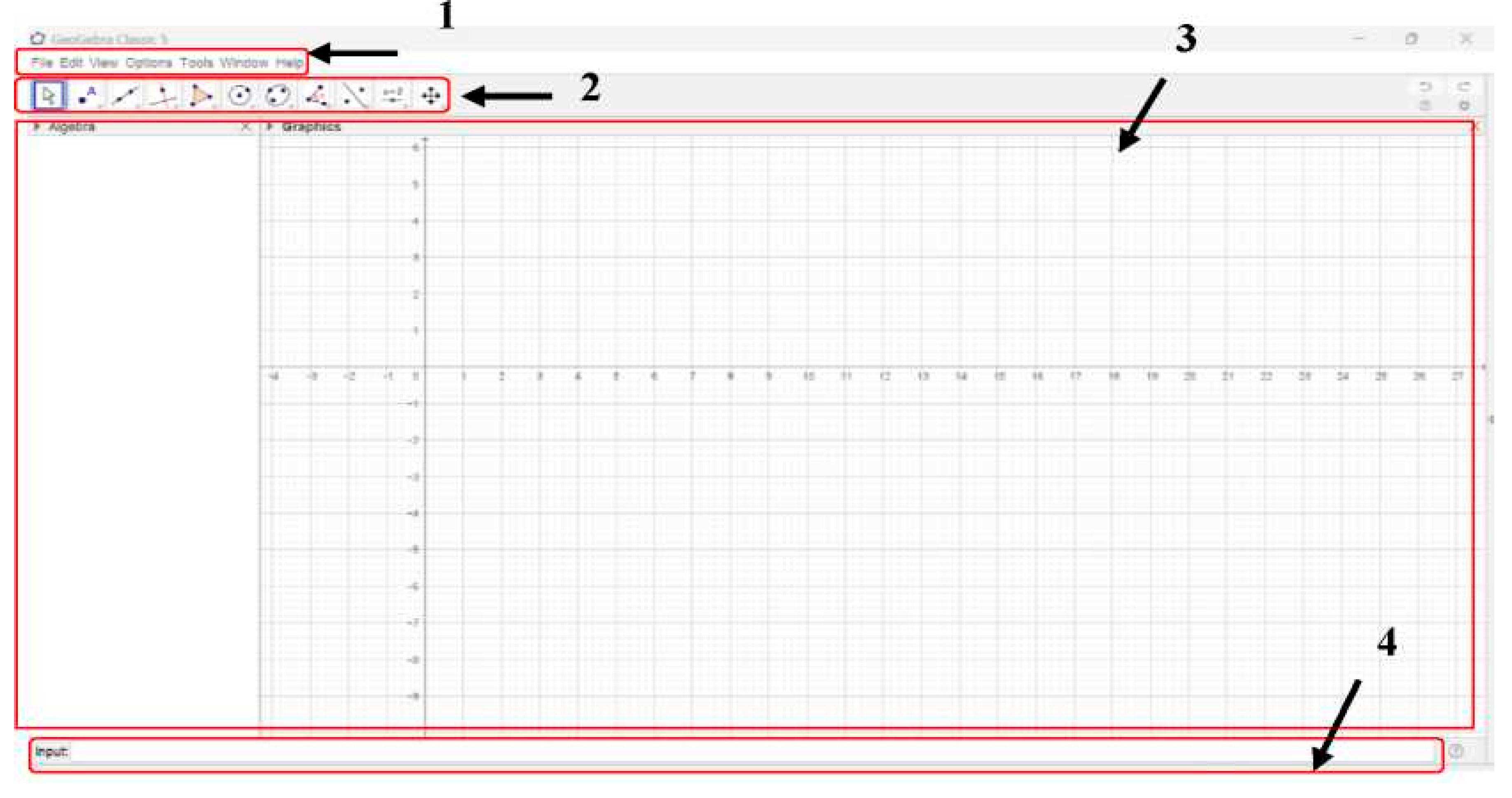
GeoGebra’s interface comprises several key components that facilitate interactive mathematical exploration. First, the Menu Bar contains standard Windows-style menus—File, Edit, Options, Tools, Window, and Help—providing access to file management, customization, and software settings. Second, the Toolbar offers a comprehensive set of digital instruments for constructing mathematical objects, inserting text, translating or rotating elements, and performing dynamic manipulations [73,74,75]. Third, the Workspace (Style Bar View) serves as the primary environment for mathematical activity. GeoGebra supports multiple synchronized views, including Graphics View, Geometry View, Algebra View, Spreadsheet View, CAS (Computer Algebra System) View, and Probability View, each tailored to specific mathematical representations and reasoning modes. Fourth, the Input Bar enables users to enter mathematical expressions, equations, or commands directly, allowing for immediate visualization and computational feedback [43].
GeoGebra’s interface is thoughtfully designed to support dynamic interaction, conceptual visualization, and mathematical reasoning through an intuitive and flexible structure. The platform integrates multiple interconnected components that collectively enable users to construct, manipulate, and analyze mathematical ideas seamlessly. At the forefront of this design is the Menu Bar, which contains familiar Windows-style menus such as File, Edit, Options, Tools, Window, and Help. These menus provide users with essential functions for managing files, customizing preferences, accessing advanced tools, and navigating software settings. Through these options, users can tailor the interface to suit their specific instructional or research needs, thereby enhancing usability and pedagogical flexibility. The Menu Bar thus serves as the foundation for configuring GeoGebra’s operational environment, supporting both novice users and experienced educators in optimizing their workflow. [70]
Complementing the Menu Bar is the Toolbar, which offers an extensive collection of digital instruments for creating and modifying mathematical objects. This feature allows users to construct points, lines, polygons, vectors, functions, and curves, as well as to insert annotations, measure angles, and execute geometric transformations such as translation, reflection, or rotation. Each tool is represented by an icon, enabling quick and intuitive selection. The Toolbar not only supports procedural efficiency but also promotes exploratory learning, as users can instantly observe the effects of their actions within the workspace. By allowing learners to directly engage with mathematical entities through manipulation and experimentation, GeoGebra transforms abstract symbolic content into interactive visual experiences that strengthen cognitive understanding and foster creativity in mathematical modeling. [71]
The Workspace, sometimes referred to as the Style Bar View, functions as the central arena for mathematical activity. This is where users perform constructions, visualize graphs, and test hypotheses through dynamic interactions. GeoGebra’s Workspace is highly versatile, supporting multiple synchronized views that reflect different modes of mathematical reasoning. These include the Graphics View and Geometry View for spatial visualization, the Algebra View for symbolic representation, the Spreadsheet View for tabular data analysis, the CAS (Computer Algebra System) View for symbolic computation, and the Probability View for statistical modeling. The ability to connect these views dynamically ensures that changes in one representation are automatically reflected in others, reinforcing students’ understanding of the interrelationships among mathematical concepts. This multimodal integration exemplifies GeoGebra’s constructivist foundation, where learners actively build meaning through coordinated visual and algebraic reasoning. [72]
Another critical feature of the interface is the Input Bar, which serves as a direct communication channel between the user and the software’s computational engine [73]. Through this feature, users can enter algebraic expressions, define functions, or execute specific commands to generate immediate visual or numerical output. The Input Bar bridges procedural computation and conceptual visualization, enabling users to verify results, test conjectures, and dynamically explore mathematical relationships. For instance, typing an equation such as y = sin(x) instantly produces its corresponding graph, allowing learners to manipulate parameters and observe changes in real time. This direct feedback loop enhances engagement and supports the development of mathematical intuition. The Input Bar thus plays a crucial role in reinforcing active exploration and facilitating the transition between symbolic and graphical representations. [74]
GeoGebra’s interface exemplifies the principles of user-centered design and interactive pedagogy. Each component—from the Menu Bar and Toolbar to the Workspace and Input Bar—works synergistically to create a rich, exploratory environment for mathematical learning and teaching. The software’s seamless integration of multiple representations enables learners to engage with mathematics in a holistic and interconnected manner, bridging conceptual understanding and procedural fluency. By empowering users to visualize, manipulate, and reason dynamically, GeoGebra transforms traditional mathematical instruction into an interactive, inquiry-driven experience aligned with the demands of contemporary education. [75]
The advantages of using GeoGebra in mathematics instruction are well documented. [65] highlight that (1) it produces precise and rapid geometric constructions compared to manual drawing, which is time-consuming and prone to error; (2) its dynamic features—such as animation and real-time dragging—allow students to visualize geometric relationships concretely, thereby deepening conceptual understanding; (3) it serves as a verification tool to confirm the correctness of constructed figures; and (4) it empowers both teachers and students to investigate and demonstrate geometric properties interactively. In sum, GeoGebra is a versatile, accessible digital learning environment that supports accurate, efficient, and engaging mathematical representation. It is freely available across devices—via web browser at https://www.geogebra.org or as a downloadable application for smartphones and computers—making it highly suitable for diverse educational contexts. [70,71,72,73,74]
2.1.3. Discovery Learning (DL) Model
2.1.3.1. Conceptual Definition
Discovery Learning (DL) is a constructivist instructional model that integrates principles of active inquiry with learning design grounded in constructivist theory [61,62,63,64,65]. According to [66,67,68,69], DL is defined as an approach wherein students actively discover and investigate concepts independently, leading to durable and meaningful knowledge retention. This perspective is echoed by [70,71,72,73,74,75], who assert that self-directed exploration in DL enhances long-term memory and conceptual clarity, as learners construct understanding through firsthand experience rather than passive reception.
Discovery Learning (DL) represents a constructivist pedagogical framework that emphasizes the centrality of active inquiry, exploration, and student autonomy in the learning process. Rooted in the constructivist paradigm, DL posits that learners acquire knowledge most effectively when they engage directly with problems, manipulate variables, and draw conclusions based on evidence and reasoning rather than through rote instruction [1,2,3,4,5]. This model redefines the teacher’s role from a transmitter of information to a facilitator who designs learning environments conducive to exploration and reflection. Within DL settings, students are encouraged to hypothesize, experiment, and analyze outcomes—processes that nurture deeper cognitive engagement and promote the internalization of complex concepts. By integrating inquiry-based strategies with reflective thinking, DL aligns closely with contemporary educational goals that prioritize critical thinking, creativity, and lifelong learning skills. [6,7,8,9,10]
[11,12,13,14,15], articulates Discovery Learning as a process in which students actively uncover and construct knowledge through independent investigation and problem-solving. This active participation fosters ownership of learning, as students become not merely recipients of information but producers of understanding. The discovery process encourages learners to identify patterns, make inferences, and derive principles through guided exploration, thereby strengthening their analytical and reasoning capabilities. Such engagement cultivates a more profound connection between new knowledge and existing cognitive structures, ensuring that learning is both meaningful and enduring. In this way, DL operationalizes the constructivist view that knowledge is constructed through interaction with one’s environment and not passively absorbed. [16,17,18,19,20]
[21] further emphasize that Discovery Learning enhances long-term retention and conceptual understanding by allowing students to experience the process of discovery firsthand. When learners engage directly with materials, phenomena, or abstract representations, they construct mental models that are personally meaningful and contextually relevant. This experiential dimension promotes cognitive flexibility, as students must continuously adapt their understanding in response to new evidence or feedback. The iterative nature of discovery—posing questions, testing hypotheses, and revising conclusions—mirrors authentic scientific and mathematical reasoning, thereby equipping students with transferable problem-solving skills. Moreover, because learners construct knowledge through their own inquiry, the resulting understanding tends to be more coherent, durable, and applicable in novel situations. [22,23,24,25,26]
From a psychological standpoint, Discovery Learning also strengthens intrinsic motivation and curiosity, as students perceive themselves as active agents in the learning process. The sense of accomplishment that arises from successfully uncovering a concept or solving a problem enhances self-efficacy and fosters a growth mindset. Rather than viewing challenges as obstacles, students learn to regard them as opportunities for intellectual exploration. This shift in mindset encourages persistence, metacognitive awareness, and self-regulation—all of which are crucial attributes for academic and professional success. Additionally, DL environments often incorporate collaboration and discussion, enabling students to articulate their reasoning, negotiate meaning, and refine their understanding through peer interaction. [27,28,29,30]
Discovery Learning represents a pedagogically rich approach that harmonizes cognitive, affective, and social dimensions of learning. By positioning students as discoverers rather than passive recipients, DL cultivates autonomy, curiosity, and reflective thinking. The model’s emphasis on inquiry-driven exploration not only deepens conceptual comprehension but also equips learners with adaptive strategies for lifelong learning. Consequently, DL remains a powerful and versatile framework for fostering meaningful engagement, higher-order reasoning, and durable knowledge construction in contemporary education. [31,32,33,34,35]
2.1.3.2. Instructional Phases
The DL model typically follows a structured sequence of cognitive and pedagogical stages. [36] outline six core phases: (1) Stimulation—presenting a stimulus to spark curiosity; (2) Problem Statement—identifying a central inquiry or problem; (3) Data Collection—gathering relevant information; (4) Data Processing—analyzing and interpreting collected data; (5) Verification—testing hypotheses or conclusions; and (6) Generalization—formulating broader principles or rules. [37] alternatively describe DL within an action research framework comprising planning, action, observation, and reflection. Hidayatullah et al. (2020) further elaborate a more comprehensive implementation process, including: (1) defining learning objectives; (2) analyzing student characteristics; (3) selecting appropriate content; (4) identifying topics for inductive exploration; (5) developing illustrative materials or tasks; (6) sequencing topics from simple to complex; and (7) assessing both learning outcomes and processes. [38]
The Discovery Learning (DL) model is characterized by a systematic and iterative sequence of cognitive and pedagogical stages designed to guide learners from initial curiosity to conceptual mastery. As outlined by [39], this model unfolds through six interrelated phases: stimulation, problem statement, data collection, data processing, verification, and generalization. The stimulation phase initiates the learning process by presenting students with a thought-provoking problem, phenomenon, or question that activates curiosity and cognitive engagement. In the problem statement phase, learners articulate the central inquiry or hypothesis to be explored, thereby setting a clear focus for investigation. The subsequent data collection stage involves gathering relevant information or evidence through observation, experimentation, or research, while data processing requires students to organize, analyze, and interpret the collected data systematically. During verification, learners test the validity of their emerging conclusions through critical reasoning or empirical evaluation, ensuring that their interpretations are grounded in logic and evidence. Finally, the generalization phase enables students to synthesize findings and derive broader conceptual or theoretical insights that can be transferred to new contexts. [40]
This sequence reflects a logical and constructivist progression from concrete experience to abstract understanding. Each stage is designed to cultivate specific cognitive skills—ranging from observation and classification to hypothesis testing and synthesis—that collectively foster deep learning. The cyclical nature of these phases allows learners to revisit earlier stages as they refine their understanding, reinforcing metacognitive awareness and adaptive reasoning. In this sense, DL not only promotes the acquisition of knowledge but also nurtures the habits of mind essential for scientific inquiry and critical thinking. The structure of the model thus embodies a balance between guided instruction and learner autonomy, offering both scaffolding and flexibility for diverse learning contexts. [41]
[42] interpret Discovery Learning through an action research framework, framing it within four recursive components: planning, action, observation, and reflection. This perspective underscores DL’s dynamic and reflective character, where each instructional cycle informs subsequent refinement. In the planning phase, educators design discovery-oriented tasks and prepare the necessary resources, ensuring alignment with learning objectives. The action phase encompasses the implementation of discovery activities, during which students engage actively in inquiry and experimentation. Observation involves both teacher and students monitoring progress, identifying learning patterns, and documenting cognitive or behavioral responses. The final reflection phase promotes critical evaluation of outcomes, encouraging both instructors and learners to assess the effectiveness of strategies, conceptual understanding, and engagement. This cyclical model integrates seamlessly with classroom-based research and professional development, making DL adaptable to evidence-based instructional improvement. [43]
Further expanding on these frameworks, [44,45,46,47,48,49] propose a more comprehensive implementation process that integrates both instructional design and learner analysis. Their model begins with defining clear learning objectives that establish the intended competencies and cognitive outcomes. Next, analyzing student characteristics ensures that instructional design is responsive to learners’ prior knowledge, readiness levels, and learning preferences. The selection of content and identification of topics for inductive exploration follow, emphasizing the importance of choosing materials that lend themselves to discovery and conceptual reasoning. Subsequently, educators develop illustrative materials or discovery tasks that stimulate inquiry, before sequencing topics in a progression from simple to complex to promote cognitive scaffolding. The final stage involves assessing learning outcomes and processes, ensuring that both the results of discovery and the quality of the inquiry process are evaluated holistically. [50]
Collectively, these frameworks illustrate that Discovery Learning is not an unstructured process of trial and error but rather a carefully designed pedagogical sequence that integrates inquiry, reflection, and systematic analysis. The various models—whether emphasizing cognitive phases, action research cycles, or instructional design steps—converge on the principle that knowledge construction occurs most effectively when learners are actively engaged in discovering relationships, testing ideas, and articulating understanding. Through structured yet flexible implementation, DL encourages curiosity, autonomy, and critical reasoning, positioning learners as active participants in their intellectual development. This multidimensional structure underscores the robustness of the Discovery Learning model as a foundation for inquiry-driven education across disciplines. [51]
2.1.3.3. Strengths of the DL Model
DL offers multiple pedagogical benefits. [52] note that it enhances cognitive processing skills, strengthens conceptual understanding and memory retention, fosters intrinsic motivation through the satisfaction of discovery, and accommodates individual learning paces. [53] adds that DL promotes active student engagement, deep comprehension through personal inquiry, emotional satisfaction from autonomous problem-solving, and improved transfer of knowledge to new contexts. [54] further emphasizes that DL cultivates active participation, stimulates curiosity, supports lifelong learning skills, and personalizes the learning experience.
Discovery Learning (DL) offers a wide array of pedagogical benefits that align with contemporary educational paradigms emphasizing autonomy, engagement, and deep understanding. As [55] highlight, DL enhances students’ cognitive processing by engaging them in higher-order thinking tasks such as analysis, synthesis, and evaluation. Rather than memorizing information, learners actively manipulate concepts, formulate hypotheses, and derive conclusions, which strengthens both conceptual understanding and long-term memory retention. This process-oriented engagement enables students to internalize abstract ideas more meaningfully, as they construct knowledge through exploration rather than passive absorption. Furthermore, the intrinsic satisfaction derived from personal discovery fosters sustained motivation, encouraging learners to persist in problem-solving activities. DL’s flexible structure also accommodates individual learning paces, allowing students to advance according to their readiness and depth of understanding—an essential feature in promoting inclusive and differentiated instruction. [56]
In addition to cognitive development, DL contributes significantly to the affective and motivational dimensions of learning. [57] observes that the model promotes active student participation by positioning learners as central agents in the construction of knowledge. Through self-directed inquiry, students experience a sense of ownership over their learning journey, which enhances engagement and responsibility. The personal nature of discovery fosters emotional satisfaction, as learners take pride in uncovering concepts through their own effort. This emotional reinforcement deepens comprehension and nurtures intrinsic interest in the subject matter. Moreover, by requiring students to apply learned concepts in new and varied contexts, DL strengthens the transferability of knowledge, ensuring that understanding extends beyond classroom boundaries. The combination of intellectual challenge and emotional reward within DL creates a powerful synergy that sustains both motivation and comprehension over time. [58]
[59] further underscores DL’s role in cultivating curiosity, self-regulation, and lifelong learning skills—attributes essential in preparing learners for continuous intellectual growth. The exploratory nature of DL stimulates curiosity by encouraging students to pose questions, seek explanations, and pursue deeper insights into phenomena. This inquiry orientation develops metacognitive awareness, as learners reflect on their strategies, monitor their progress, and adjust their approaches to achieve more effective outcomes. In doing so, DL equips students with adaptive skills that transcend disciplinary boundaries, fostering an enduring capacity for independent learning. Additionally, the model’s emphasis on personalization allows each learner to construct understanding in ways that align with their cognitive styles, interests, and prior knowledge. This individualized approach not only enhances engagement but also supports diverse learners in reaching their full potential. [60,61]
From a pedagogical standpoint, the integration of DL into instructional practice also strengthens teacher–student interactions and classroom dynamics. Teachers act as facilitators who provide guidance, scaffolding, and feedback as students navigate the discovery process. This shift from directive to facilitative teaching creates a more dialogic and collaborative learning environment, where questioning, experimentation, and reflection are encouraged. The resulting classroom culture promotes mutual respect, intellectual risk-taking, and shared responsibility for learning outcomes. Furthermore, because DL encourages the use of real-world problems and authentic tasks, it bridges the gap between theoretical knowledge and practical application, enabling students to see the relevance of their learning in everyday contexts. [62,63]
Discovery Learning represents a comprehensive pedagogical approach that integrates cognitive, affective, and social dimensions of learning into a coherent and student-centered framework. By fostering curiosity, intrinsic motivation, conceptual mastery, and self-directed inquiry, DL empowers learners to become active participants in their educational experiences. The model’s flexibility and emphasis on personal engagement make it particularly effective in developing both academic competence and lifelong learning dispositions. In essence, DL transforms the classroom into a dynamic arena of exploration and intellectual growth, where discovery serves as both the means and the end of meaningful education. [64,65]
2.1.3.4. Limitations of the DL Model
Despite its merits, DL presents notable challenges. [66] caution that lower-achieving students may struggle with independent reasoning, potentially leading to frustration. The model is also time-intensive, making it inefficient for large classes, and its success may be undermined by entrenched habits of teacher-centered instruction. [67] observes that DL assumes prior student readiness, requires extended time for concept development, and may limit authentic discovery if problems are overly structured by the teacher. Similarly, [68] warns that without clear scaffolding, students may become disoriented; the approach is inherently time-consuming; and poor implementation can result in learner frustration rather than empowerment.
Despite its numerous pedagogical strengths, the Discovery Learning (DL) model also entails several inherent limitations that can hinder its effectiveness if not carefully managed. As [69] highlight, one of the primary challenges lies in its suitability for learners with varying levels of cognitive readiness. Students with lower academic achievement or underdeveloped reasoning skills may find the open-ended nature of DL overwhelming, leading to confusion, frustration, or disengagement. The demand for independent inquiry and self-directed exploration presupposes a certain degree of prior knowledge and metacognitive ability that not all learners possess. Without adequate guidance, such students may struggle to generate hypotheses, analyze data, or draw meaningful conclusions, ultimately compromising learning outcomes. This limitation underscores the need for differentiated scaffolding and teacher intervention to ensure that all students can participate productively in the discovery process. [70]
Another significant constraint of the DL model is its time-intensive nature, which poses logistical challenges for educators operating within rigid curricular frameworks or large class settings. The inquiry-driven process of exploration, verification, and generalization requires considerably more instructional time compared to conventional direct instruction. Teachers must allocate sufficient time for students to explore problems, conduct investigations, and discuss findings—activities that may be impractical in time-limited academic schedules. As [71] note, these time demands can hinder the coverage of mandated content or reduce opportunities for practice and reinforcement. Additionally, the model’s implementation is often constrained by institutional traditions that favor teacher-centered approaches, where efficiency and control are prioritized over inquiry and exploration. In such contexts, shifting to a student-centered paradigm like DL requires substantial pedagogical adaptation and institutional support. [72]
[73] further emphasizes that Discovery Learning implicitly assumes a level of student readiness that may not always be present. Effective engagement in DL requires learners to possess foundational knowledge, curiosity, and the ability to manage ambiguity—qualities that vary widely among individuals. When students lack sufficient background understanding, they may struggle to recognize the significance of the problems presented or to connect their findings with conceptual frameworks. Moreover, the extended time required for concept formation through discovery can delay mastery of essential content, particularly in sequential disciplines like mathematics and science. Luciana also cautions that excessive teacher structuring of discovery tasks—intended to guide learning—may paradoxically reduce opportunities for genuine exploration. Overly prescribed activities risk turning discovery into mere procedural compliance, thereby undermining the model’s constructivist intent. [74]
[75] adds that the absence of explicit scaffolding within the DL framework can lead to disorientation and cognitive overload, particularly for novice learners. Without clear guidance or formative feedback, students may pursue unproductive paths of inquiry, wasting time and losing motivation. This lack of direction can transform the discovery process into a source of frustration rather than empowerment, contradicting the model’s core objective of fostering autonomy and curiosity. Furthermore, DL’s inherent demand for teacher facilitation skills—such as posing effective questions, monitoring progress, and managing discussions—poses a professional challenge. Inadequate teacher preparation or limited experience with inquiry-based instruction can result in poorly managed classroom dynamics and uneven learning outcomes. Thus, effective implementation requires not only learner readiness but also substantial teacher competence in designing, guiding, and assessing discovery-oriented activities. [73,74,75]
While Discovery Learning offers profound cognitive and motivational benefits, its success depends on contextual and pedagogical conditions that are not always easily met. Time constraints, learner variability, and insufficient scaffolding represent persistent barriers to optimal implementation. To mitigate these issues, educators should adopt a balanced approach, integrating structured guidance with opportunities for independent inquiry. Providing preparatory instruction, using guided discovery techniques, and scaffolding problem complexity can help ensure that students remain cognitively supported while still engaging in meaningful exploration. When effectively mediated, these strategies allow the DL model to realize its transformative potential while minimizing the risks of disorientation and inefficiency that can otherwise impede learning. [70]
2.1.4. Mathematical Communication Ability
2.1.4.1. Definition
Mathematical communication is a foundational competency in mathematics education. [1,2,3,4,5,6] describe it as a critical vehicle through which students exchange ideas, seek information, articulate reasoning, and validate mathematical arguments with peers. The National Council of Teachers of Mathematics [16,17,18,19,20] identifies it as an essential skill whose absence impedes mathematical development. [21] further define it as the capacity to share and clarify mathematical understanding through symbols, notations, graphs, and language—enabling students to express ideas precisely and coherently.
Mathematical communication constitutes a central pillar of effective mathematics learning and instruction. It extends beyond the mere transmission of answers to encompass the expression, justification, and negotiation of mathematical meaning within individual and collaborative contexts. [22] conceptualize mathematical communication as a critical conduit for intellectual exchange, allowing students to articulate reasoning, question assumptions, and validate arguments through interaction with peers. This process transforms mathematics from a solitary cognitive activity into a social practice of sense-making, wherein ideas are developed, challenged, and refined through dialogue. [23]
The National Council of Teachers of Mathematics [21] reinforces this view by asserting that mathematical communication is not an ancillary skill but a core component of mathematical proficiency. According to NCTM, the ability to communicate mathematically enables learners to construct and internalize knowledge through discussion, representation, and reflection. Without such communicative competence, mathematical understanding remains fragmented and procedural rather than conceptual. Thus, fostering students’ capacity to express and interpret mathematical ideas is indispensable for developing deeper comprehension and higher-order reasoning. [25]
Expanding on this perspective, [26] define mathematical communication as the ability to convey and clarify mathematical understanding using diverse representational systems—including symbols, equations, diagrams, graphs, and natural language. This multifaceted skill allows students to translate abstract concepts into various modes of expression, thereby enhancing precision, coherence, and meaning-making. Through mathematical communication, learners develop fluency in connecting symbolic representations with verbal explanations and contextual interpretations. [27]
In essence, mathematical communication serves as both a tool and outcome of mathematical thinking. It empowers students to articulate logical reasoning, justify problem-solving strategies, and engage in critical dialogue—processes essential for cultivating mathematical literacy and competence. Developing this ability, therefore, should be a deliberate pedagogical goal, integrated into all aspects of mathematics instruction to nurture reflective, articulate, and conceptually grounded learners. [28]
2.1.4.2. Indicators
Operational indicators of mathematical communication ability have been established by several scholars. [29] proposes five key indicators: (a) formulating conjectures, arguments, definitions, and generalizations; (b) explaining ideas, situations, and relationships orally or in writing; (c) translating real-world events into mathematical models; (d) representing real objects, diagrams, or situations using mathematical language, symbols, or models; and (e) reading and interpreting mathematical representations with comprehension. [30] expand this to include five dimensions: representation, listening, reading, discussion, and writing—each contributing to the construction and articulation of mathematical knowledge. [31] synthesize these into seven observable behaviors, encompassing translation of realia into mathematical forms, multimodal expression (oral, written, graphical, algebraic), use of mathematical language for everyday contexts, dialogic engagement (listening, discussing, questioning), reading comprehension of mathematical texts, and conjecture-building with logical justification. [32]
Operational indicators of mathematical communication ability have been comprehensively delineated by several mathematics education scholars, reflecting its multifaceted nature as both a cognitive and linguistic process. [33,34,35] identifies five foundational indicators: (a) formulating conjectures, arguments, definitions, and generalizations; (b) explaining mathematical ideas, situations, and relationships verbally or in written form; (c) translating real-world contexts into mathematical models; (d) representing concrete objects, diagrams, or situations using mathematical symbols and formal language; and (e) reading and interpreting mathematical representations meaningfully. These indicators collectively emphasize the dynamic interplay between reasoning, representation, and articulation in developing mathematical understanding. [36]
Building upon this framework, [37] conceptualize mathematical communication through five interrelated dimensions—representation, listening, reading, discussion, and writing—each serving as a distinct yet complementary pathway for constructing and expressing mathematical thought. Representation enables students to externalize abstract ideas through symbols and visuals; listening and discussion foster dialogic comprehension and negotiation of meaning; reading supports interpretation of mathematical texts; and writing consolidates conceptual understanding through structured expression. [38]
Further synthesis by [39] refines these perspectives into seven observable behaviors that capture the operational essence of mathematical communication: (1) translating real-life phenomena into mathematical expressions; (2) expressing ideas through multiple modalities—oral, written, graphical, and algebraic; (3) employing mathematical language to describe everyday contexts; (4) engaging in dialogic processes such as listening, questioning, and discussing; (5) interpreting mathematical symbols, texts, and visualizations with comprehension; (6) constructing conjectures supported by logical reasoning; and (7) articulating conclusions coherently and justifiably. [40]
Together, these indicators highlight that mathematical communication extends beyond linguistic fluency to encompass analytical reasoning, representational versatility, and dialogic interaction. Cultivating these dimensions equips students not only to convey mathematical ideas effectively but also to engage in reflective discourse that deepens conceptual understanding and promotes higher-order thinking. [41]
For the purpose of this study, mathematical communication ability is defined as the capacity to express mathematical ideas using appropriate mathematical language—both orally and in writing—and is measured through the following five indicators: (1) constructing conjectures, arguments, definitions, and generalizations; (2) explaining ideas, situations, and relationships verbally or in writing; (3) modeling real-life situations mathematically; (4) translating real objects, images, or diagrams into mathematical symbols, language, or models; and (5) comprehending written mathematical representations. [42]
2.2. Relevant Prior Studies
Several empirical studies inform the present research. [43] investigated the effectiveness of GeoGebra-assisted PBL on linear programming in senior high school, reporting superior mathematical communication outcomes in the experimental group—aligning with this study’s design but differing in educational level and topic. [44] employed GeoGebra within a scientific approach to enhance conceptual understanding (not communication), using a similar two-group comparison. [45] found significantly higher learning outcomes in GeoGebra-integrated classes versus conventional instruction. [47] similarly demonstrated GeoGebra’s positive impact on mathematics achievement in an SMA setting, though with a different research design. [46] examined GeoGebra’s effectiveness in teaching quadratic function graphs at the junior secondary level—matching the current study’s school level but differing in content and methodology. [47,48] utilized GeoGebra Classroom for three-dimensional geometry in SMA, while [49] explored student interest in systems of linear equations with two variables using GeoGebra in SMA. Finally, [50] analyzed interest in quadrilateral topics among Grade VII students in Jakarta using GeoGebra, though their study employed a single-class design. Collectively, these studies affirm GeoGebra’s pedagogical value and the efficacy of student-centered models like PBL and DL, yet none have directly compared PBL–GeoGebra against DL in the context of mathematical communication at the junior secondary level—highlighting the novelty and relevance of the present investigation. [51]
Several empirical studies provide a substantive foundation for the present investigation, collectively underscoring the pedagogical potential of GeoGebra-assisted instructional models while revealing a clear research gap in their comparative impact on mathematical communication at the junior secondary level. [52] examined the effectiveness of a GeoGebra-assisted Problem-Based Learning (PBL) model in teaching linear programming at the senior high school level. Their findings indicated that students in the experimental group exhibited superior mathematical communication skills compared to those in conventional classrooms. Although their study parallels the present research in methodological structure—employing a control and experimental group—it differs in both educational level and mathematical topic, thus providing complementary rather than overlapping evidence. [53]
Similarly, [54] integrated GeoGebra within a scientific learning approach aimed at enhancing conceptual understanding rather than communication ability. Their results confirmed that GeoGebra facilitated clearer conceptual visualization and deeper engagement with abstract mathematical relationships. This distinction in the targeted learning outcome broadens the understanding of GeoGebra’s versatility but highlights the lack of focus on communicative competencies. [55] and [56] also documented significant gains in mathematics achievement within GeoGebra-enriched environments compared to traditional teaching, reinforcing the tool’s effectiveness across diverse mathematical domains and instructional contexts.
At the junior secondary level, [57,58] explored GeoGebra’s use in teaching quadratic function graphs, a study aligned with the present research in grade level but differing in content and methodological framework. Their results demonstrated measurable improvements in student engagement and comprehension, suggesting GeoGebra’s scalability across various mathematical topics. [59,60] extended this work by employing GeoGebra Classroom to teach three-dimensional geometry at the senior high school level, emphasizing interactive visualization as a driver of student motivation and spatial reasoning. Meanwhile, [61,62] investigated students’ interest in systems of linear equations with two variables (SPLDV) and [63,64] examined similar effects on interest within quadrilateral topics among Grade VII students in Jakarta, though both studies adopted a single-group design, limiting generalizability. [65,66]
Taken together, these empirical efforts affirm the pedagogical value of GeoGebra and its ability to enhance engagement, conceptual understanding, and learning outcomes when embedded in student-centered models such as PBL and Discovery Learning (DL). However, a critical synthesis reveals that no prior research has explicitly compared the relative effectiveness of GeoGebra-assisted PBL and DL models in developing students’ mathematical communication skills at the junior secondary level. This gap establishes both the novelty and relevance of the present study, which seeks to extend existing evidence by integrating comparative pedagogical analysis with a focus on communicative dimensions of mathematical learning. [67]
3. Research Methodology
3.1. Operational Definitions
In this study, instructional effectiveness is operationally defined as the extent to which a teaching intervention successfully facilitates students’ achievement of predetermined learning objectives. Specifically, it is measured by (1) a statistically significant improvement in mathematical communication ability among students exposed to GeoGebra-integrated Problem-Based Learning (PBL) compared to those taught via Discovery Learning (DL), and (2) the proportion of students in the experimental group attaining or exceeding the school’s Minimum Completeness Criterion (KKM) in posttest assessments. The PBL instructional model refers to a student-centered approach grounded in contextualized, real-world mathematical problems, designed to foster active knowledge construction, collaborative inquiry, and conceptual understanding through a structured five-phase process. Mathematical communication ability is defined as the capacity to express mathematical ideas, reasoning, and solutions accurately and coherently using appropriate mathematical language—either orally or in writing—including symbols, diagrams, graphs, and formal notation. [68]
3.2. Research Design
3.2.1. Research Type
This study employs a quantitative research design, characterized by systematic procedures, numerical data collection, and statistical analysis to examine causal relationships between variables [69]. Specifically, a quasi-experimental design was implemented due to the non-random assignment of intact classes to treatment conditions, reflecting authentic classroom constraints while maintaining methodological rigor.
3.2.2. Research Variables
The independent variables consist of two instructional approaches: (X₁) PBL integrated with GeoGebra software and (X₂) Discovery Learning (DL). The dependent variable (Y) is students’ mathematical communication ability, assessed through validated pretest and posttest instruments aligned with established indicators of mathematical expression and representation. [70]
3.2.3. Experimental Design
The study adopts a pretest–posttest control group design, adapted from [71], illustrated as follows:
Experimental Group: O → X₁ → O
Control Group: O → X₂ → O
where O denotes the administration of identical pretest and posttest measures of mathematical communication ability, X₁ represents instruction using the GeoGebra-assisted PBL model, X₂ denotes instruction using the DL model, and the absence of random assignment signifies the quasi-experimental nature of the design. [72]
3.3. Research Setting and Timeline
The study was conducted at SMP Negeri 1 Padangsidimpuan, located at Jl. Mesjid Raya Baru No. 3, WEK IV, North Padangsidimpuan Subdistrict, Padangsidimpuan City, North Sumatra, Indonesia. Data collection took place between July and October 2025 during the first semester of the 2025/2026 academic year, involving two intact eighth-grade classes: Class VIII-F (experimental group) and Class VIII-G (control group).
Table 2.
Research Implementation Schedule (July–October 2025).
| MEETING No. | DATE (DAY/DATE) – EXPERIMENTAL GROUP (PBL + GEOGEBRA) | DATE (DAY/DATE) – CONTROL GROUP ( DL WITHOUT GEOGEBRA ) | ACTIVITY |
| 1 | Friday, 18 July 2025 | Friday, 18 July 2025 | Pretest |
| 2 | Tuesday, 22 July 2025 | Thursday, 24 July 2025 | Treatment Session 1 |
| 3 | Tuesday, 29 July 2025 | Thursday, 31 July 2025 | Treatment Session 2 |
| 4 | Friday, 1 August 2025 | Friday, 1 August 2025 | Treatment Session 3 |
| 5 | Tuesday, 5 August 2025 | Thursday, 7 August 2025 | Posttest |
Note. PBL = Problem-Based Learning; DL = Discovery Learning. The staggered schedule reflects the school’s weekly timetable while ensuring consistent instructional duration and alignment with the broader research period (July–October 2025). All dates fall within the first semester of the 2025/2026 academic year at SMP Negeri 1 Padangsidimpuan.
3.4. Population and Sample
The population of this study comprised all eighth-grade students at SMP Negeri 1 Padangsidimpuan, North Sumatra, Indonesia, during the first semester of the 2025/2026 academic year. At the time of the study, there were seven intact eighth-grade classes (VIII-A through VIII-G). Two of these classes were selected as the research sample using purposive sampling. Specifically, Class VIII-F was assigned as the experimental group (receiving Problem-Based Learning integrated with GeoGebra), and Class VIII-G served as the control group (taught via Discovery Learning without GeoGebra). The selection criterion was based on prior consultation with the school’s mathematics teachers, confirming that all students in both classes possessed personal smartphones capable of running the GeoGebra application—ensuring equitable access to the digital intervention.
3.5. Research Instruments
The study employed both test and non-test instruments. The test instrument consisted of a mathematical communication ability assessment, administered as a pretest and posttest. It comprised five open-ended problems, each aligned with established indicators of mathematical communication: (1) formulating conjectures and arguments, (2) explaining ideas and relationships orally or in writing, (3) modeling real-life situations mathematically, (4) translating diagrams or real objects into mathematical symbols or models, and (5) interpreting mathematical representations with comprehension.
The non-test instrument was a student response questionnaire containing 10 Likert-scale statements designed to gauge learners’ perceptions of using GeoGebra during instruction. Both instruments underwent rigorous validation. Face validity was established through expert review by a mathematics education lecturer and a senior mathematics teacher at SMP Negeri 1 Padangsidimpuan, ensuring clarity, appropriate language, and absence of ambiguous phrasing. Content validity was confirmed by aligning each test item with the targeted learning indicators and the “Straight-Line Equations” curriculum content [71,72,73,74,75].
A pilot test was conducted with 30 ninth-grade students (Class IX-B) at SMP Negeri 1 Padangsidimpuan to assess item difficulty and discriminatory power. The questionnaire was also validated by the school’s mathematics teacher prior to implementation.
3.6. Instrument Analysis
3.6.1. Validity
An instrument is considered valid if it accurately measures the intended construct. In this study, item validity for the test was analyzed using the Pearson product-moment correlation coefficient, computed via Microsoft Excel. The formula applied was:
where:
- rxy= correlation coefficient between item score and total score,
- X= score on a specific test item,
- Y= total test score,
- n= number of pilot respondents.
The resulting was then transformed into a t-value using:
The obtained value was compared with the critical t-value () at a significance level of and degrees of freedom . An item was considered valid if (Sundayana, 2020). Only items meeting this validity criterion were retained for inclusion in the final version of the research instrument used in the main study.
Table 3.
Summary of Item Validity Analysis for the Mathematical Communication Test.
| Item No. | Pearson Correlation (r) | t<sub>calculated</sub> | t<sub>critical</sub>" (α = 0.05, df = 28)" | Decision | |
| 1 | 0.528 | 3.043 | 2.064 | Valid | |
| 2 | 0.6 | 3.677 | 2.064 | Valid | |
| 3 | 0.823 | 7.086 | 2.064 | Valid | |
| 4 | 0.859 | 8.128 | 2.064 | Valid | |
| 5 | 0.744 | 5.46 | 2.064 | Valid |
Note. All five test items were retained for the final instrument as they demonstrated statistically significant validity (t<sub>calculated</sub> > t<sub>critical</sub>).
3.6.2. Instrument Reliability
Reliability refers to the consistency of an instrument in producing stable and reproducible results across varying conditions, unaffected by situational or external factors [1,2,3,4,5,6,7]. In this study, the reliability of the mathematical communication test—comprising open-ended (essay-type) items—was computed using Cronbach’s alpha coefficient, applied exclusively to the five validated items. The calculation was performed using Microsoft Excel with the following formula:
where:
- α = Cronbach’s alpha reliability coefficient,
- = number of valid test items,
- ∑σ i2 = sum of variances of individual items,
- σ T2 = variance of the total test scores.
The reliability of the instrument was assessed using Cronbach’s Alpha (α), as shown in the formula above. Here, represents the total number of items, denotes the variance of each item, and is the total variance of the test. A higher value of indicates greater internal consistency among the items. According to conventional benchmarks, the instrument is considered reliable if . [34,35]
The resulting reliability coefficient was interpreted using the following classification criteria (adapted from standard psychometric guidelines):
α≥0.80 : Excellent reliability
0.70≤α<0.80 : Good reliability
0.60≤α<0.70 : Acceptable reliability
α<0.60 : Poor reliability (instrument may require revision)
This approach ensures that the measurement tool demonstrates sufficient internal consistency for use in quantitative educational research.
Table 4.
Reliability Classification Criteria.
| Reliability Coefficient (r) | Category |
| 0.00 < r < 0.20 | Very Low |
| 0.20 < r < 0.40 | Low |
| 0.40 < r < 0.60 | Moderate |
| 0.60 < r < 0.80 | High |
| 0.80 < r < 1.00 | Very High |
Based on the reliability analysis conducted using Microsoft Excel, the instrument yielded a Cronbach’s alpha coefficient of 0.708, which falls within the high reliability category, indicating strong internal consistency.
3.6.3. Item Discrimination Index
The discrimination index (DI) measures an item’s ability to differentiate between high-achieving and low-achieving students. Following [20,24], the DI was computed using Microsoft Excel with the formula:
DP = SA-SB/ IA
where:
SA = total score of the upper group (top 27%),
SB = total score of the lower group (bottom 27%),
IA = ideal maximum score for the upper group.
The classification criteria for the discrimination index are as follows:
DP<0.00 : Very poor
0.00≤DP<0.20 : Poor
0.20≤DP<0.40 : Fair
0.40≤DP<0.80 : Good
0.80≤DP<1.00 : Very good
Table 5.
Item Discrimination Index Summary.
| Item No. | SA | SB | DP | Interpretation |
| 1 | 21 | 9 | 0.23 | Fair |
| 2 | 23 | 17 | 0.12 | Poor |
| 3 | 46 | 13 | 0.63 | Good |
| 4 | 26 | 13 | 0.25 | Fair |
| 5 | 22 | 9 | 0.25 | Fair |
3.6.4. Item Difficulty Indeks
The difficulty index (TK) reflects the proportion of students who answered an item correctly relative to the ideal maximum score. For essay-type items, the difficulty index was calculated using the formula (Sundayana, 2020):
where:
SA,SB = actual scores of upper and lower groups,
IA,IB = ideal maximum scores for the upper and lower groups, respectively.
The classification criteria are:
TK≤0.30 : Difficult
0.30<TK<0.70 : Moderate
0.70≤TK<1.00 : Easy
TK=1.00 : Too easy
Table 4.
Item Difficulty Index Summary.
| Item No. | SA | SB | TK | Interpretation |
| 1 | 21 | 9 | 0.29 | Difficult |
| 2 | 23 | 17 | 0.38 | Moderate |
| 3 | 46 | 13 | 0.57 | Moderate |
| 4 | 26 | 13 | 0.38 | Moderate |
| 5 | 22 | 9 | 0.3 | Difficult |
All analyses were performed using Microsoft Excel to ensure precision and reproducibility. Items with poor discrimination (e.g., Item 2) were retained due to their alignment with core mathematical communication indicators and content validity, consistent with recommendations for formative and diagnostic assessments in educational research.
3.7. Data Collection Procedures
Data were collected using two primary instruments: a written test and a student questionnaire. The written test consisted of five open-ended items, each explicitly aligned with the established indicators of mathematical communication ability (e.g., formulating arguments, translating real-world situations into mathematical models, interpreting representations). This test was administered as a pretest prior to the intervention and as a posttest upon its completion to measure changes in students’ mathematical communication skills. The primary objective was to evaluate the effectiveness of integrating GeoGebra within a Problem-Based Learning (PBL) framework compared to Discovery Learning (DL) without digital support.
The questionnaire comprised 10 Likert-scale statements designed to capture students’ perceptions of the GeoGebra application, structured around three dimensions of user response: (1) acceptance/receptiveness, (2) understanding/comprehension, and (3) evaluation/judgment adapted from [22,23,24,25,26,27]. The instrument was distributed via Google Forms and completed by students in the experimental group immediately after the posttest to ensure timely and authentic feedback. [74]
3.8. Data Analysis Techniques
Data analysis was conducted to test the research hypotheses regarding the comparative effectiveness of the two instructional approaches. First, normalized gain scores [70,71] were computed for each student to quantify individual improvement in mathematical communication ability:
Prior to hypothesis testing, assumption testing was performed. Given the sample size (n < 50 per group), the Shapiro-Wilk test [72,73,74] was used to assess the normality of the gain score distributions, implemented via IBM SPSS Statistics Version 25. The data were deemed normally distributed if the significance value (p) exceeded α = 0.05.
Since the gain scores in at least one group violated the normality assumption, a non-parametric inferential test was employed. Specifically, the Mann-Whitney U test was used to compare the central tendencies of normalized gain scores between the experimental (PBL + GeoGebra) and control (DL) groups. The hypotheses were formulated as follows: [73,74,75]
- H₀: μ₁ = μ₂ (There is no difference in the median normalized gain in mathematical communication ability between the two groups.)
- H₁: μ₁ > μ₂ (The median normalized gain is significantly higher in the PBL + GeoGebra group than in the DL group.)
The decision rule was based on a 5% significance level:
- If p > 0.05, H₀ is retained.
- If p < 0.05, H₁ is accepted, indicating a statistically significant advantage for the experimental condition.
3.9. Research Procedure
3.9.1. Preparation Phase
The preparatory stage included: (1) identification of the research problem; (2) formulation of the research title; (3) development and defense of the research proposal; (4) design of the PBL-based teaching module integrating GeoGebra; (5) preparation of instructional materials on “Straight-Line Equations”; (6) construction and validation of research instruments (test and questionnaire); (7) submission and approval of ethical and administrative research permissions from SMP Negeri 1 Padangsidimpuan; and (8) pilot testing of instruments with a non-participant Grade IX cohort to assess validity, reliability, difficulty, and discrimination indices.
3.9.2. Implementation Phase
The intervention was carried out over five scheduled meetings between July and August 2025. It began with the pretest administered to both the experimental (Class VIII-F) and control (Class VIII-G) groups. Subsequently, the experimental group received instruction using GeoGebra-integrated PBL, while the control group was taught the same content via Discovery Learning without GeoGebra. The phase concluded with the posttest administered to both groups under identical conditions. [72,73,74,75]
3.9.3. Completion Phase
This final stage involved: (1) compilation of all quantitative and qualitative data; (2) data processing and statistical analysis using SPSS and Microsoft Excel; and (3) synthesis of findings into a comprehensive research report, including implications for pedagogy, curriculum design, and future research on digital mathematics education.
4. Results and Discussion
4.1. Research Findings
4.1.1. Students’ Mathematical Communication Ability Improved More Significantly in the GeoGebra-Integrated PBL Group Than in the DL Group
4.1.1.1. Descriptive Analysis
4.1.1.1.1. Pretest Data on Students’ Mathematical Communication Ability
The pretest data represent students’ initial mathematical communication ability on the topic of Straight-Line Equations. The descriptive statistics for Grade VIII students at SMP Negeri 1 Padangsidimpuan are presented in Table 5.
As shown in Table 4.1, the experimental group exhibited a higher pretest mean than the control group. Additionally, the experimental group displayed a larger standard deviation (0.605 vs. 0.452), indicating greater variability in baseline ability—i.e., a more heterogeneous distribution of mathematical communication skills compared to the control group.
4.1.1.1.2. Posttest Data on Students’ Mathematical Communication Ability
Following the intervention—GeoGebra-integrated Problem-Based Learning (PBL) for the experimental group and Discovery Learning (DL) without GeoGebra for the control group—both groups completed a posttest. The results are summarized in Table 6.
The experimental group achieved a higher posttest mean (6.25) than the control group (4.00). However, the control group showed a larger standard deviation (3.037 vs. 2.653), suggesting greater dispersion in post-intervention performance and higher heterogeneity in learning outcomes.
4.1.1.1.3. Gain in Mathematical Communication Ability
Normalized gain scores were computed to measure improvement. The results are presented in Table 7.
The experimental group demonstrated a higher average gain (0.30) compared to the control group (0.19). The control group’s larger standard deviation (0.150 vs. 0.126) indicates more variable improvement, suggesting that DL produced less consistent learning gains than PBL with GeoGebra.
4.1.1.2. Inferential Analysis
4.1.1.2.1. Normality Test
The Shapiro-Wilk test (α = 0.05) was conducted using SPSS v.25 to assess the normality of gain score distributions.
Table 8.
Normality Test Results for Gain Scores.
| CLASS | SIGNIFICANCE | INTERPRETATION |
| Experimental | 0.534 | Normal |
| Control | 0.001 | Not Normal |
The experimental group’s gain scores were normally distributed (p = 0.534 > 0.05), whereas the control group’s were not (p = 0.001 < 0.05). Consequently, a non-parametric test was selected for hypothesis testing.
4.1.1.2.2. Mann-Whitney U Test
Given the violation of normality in one group, the Mann-Whitney U test was employed to compare the central tendencies of gain scores between groups. The hypotheses were:
- H₀: μ₁ = μ₂ — No difference in median gain between PBL + GeoGebra and DL groups.
- H₁: μ₁ > μ₂ — The PBL + GeoGebra group shows significantly greater improvement.
Decision rule (α = 0.05):
- If p > 0.05 → Accept H₀
- If p < 0.05 → Accept H₁
Table 9.
Mann-Whitney U Test Results.
| MANN-WHITNEY U | Z | SIG. (2 – TAILED) |
| 90.000 | –2.833 | 0.005 |
The significance value (0.005) is less than 0.05; thus, H₁ is accepted. This confirms that the improvement in mathematical communication ability was significantly greater in the PBL + GeoGebra group than in the DL group.
4.1.2. Percentage of Students Meeting the Minimum Completeness Criterion (KKM)
Descriptive analysis revealed that no student in either group achieved the KKM in the posttest.
Table 10.
Posttest Achievement Relative to KKM.
| CRITERION | EXPERIMENTAL GROUP | CONTROL GROUP |
| Pretest (%) | Posttest (%) | |
| KKM | 0 | 0 |
| Below KKM | 100 | 100 |
Thus, 0% of students in the experimental group met the KKM, indicating that while the intervention improved relative performance, absolute mastery (as defined by the school’s threshold) was not attained.
4.1.3. Student Responses to the GeoGebra Usage Questionnaire
The questionnaire (10 items, Likert scale) was administered via Google Forms to the 20 students in the experimental group after the posttest. Data were analyzed using Microsoft Excel. The overall mean response fell into the “high” category, indicating positive perceptions of GeoGebra. Individual item results are interpreted below with reference to corresponding figures.
1. “I feel confident solving math problems using GeoGebra.”
Figure 1.
Shows most students agreed..
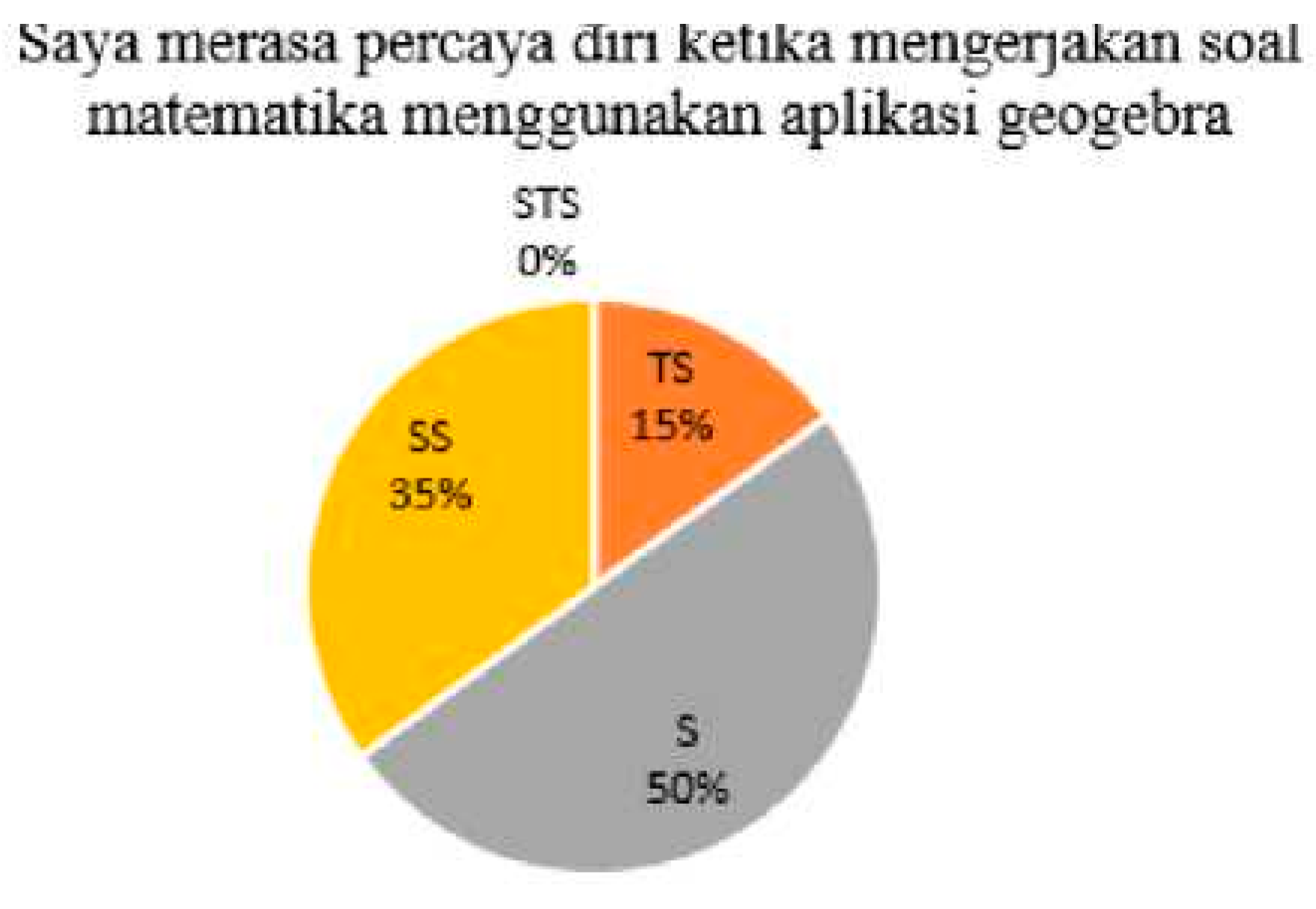
→Conclusion: GeoGebra enhanced student confidence in solving linear equation problems.
2. “GeoGebra’s interface is attractive and interactive, so I enjoy using it.”
Figure 2.
Indicates strong agreement.
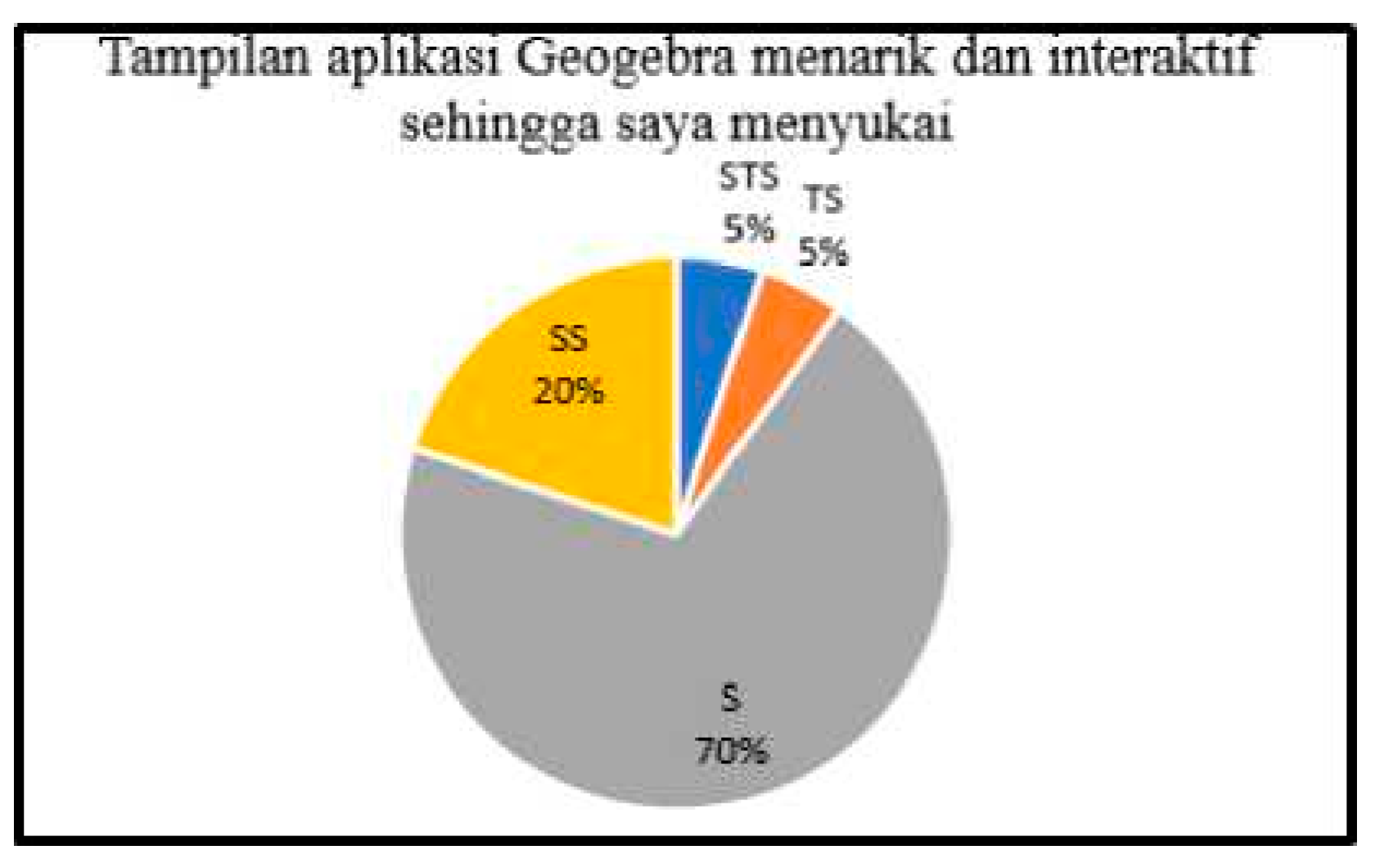
→Conclusion: Students appreciate GeoGebra’s engaging and interactive design.
3. “I find it difficult to use GeoGebra for solving linear equation problems.”
Figure 3.
shows most students disagreed.
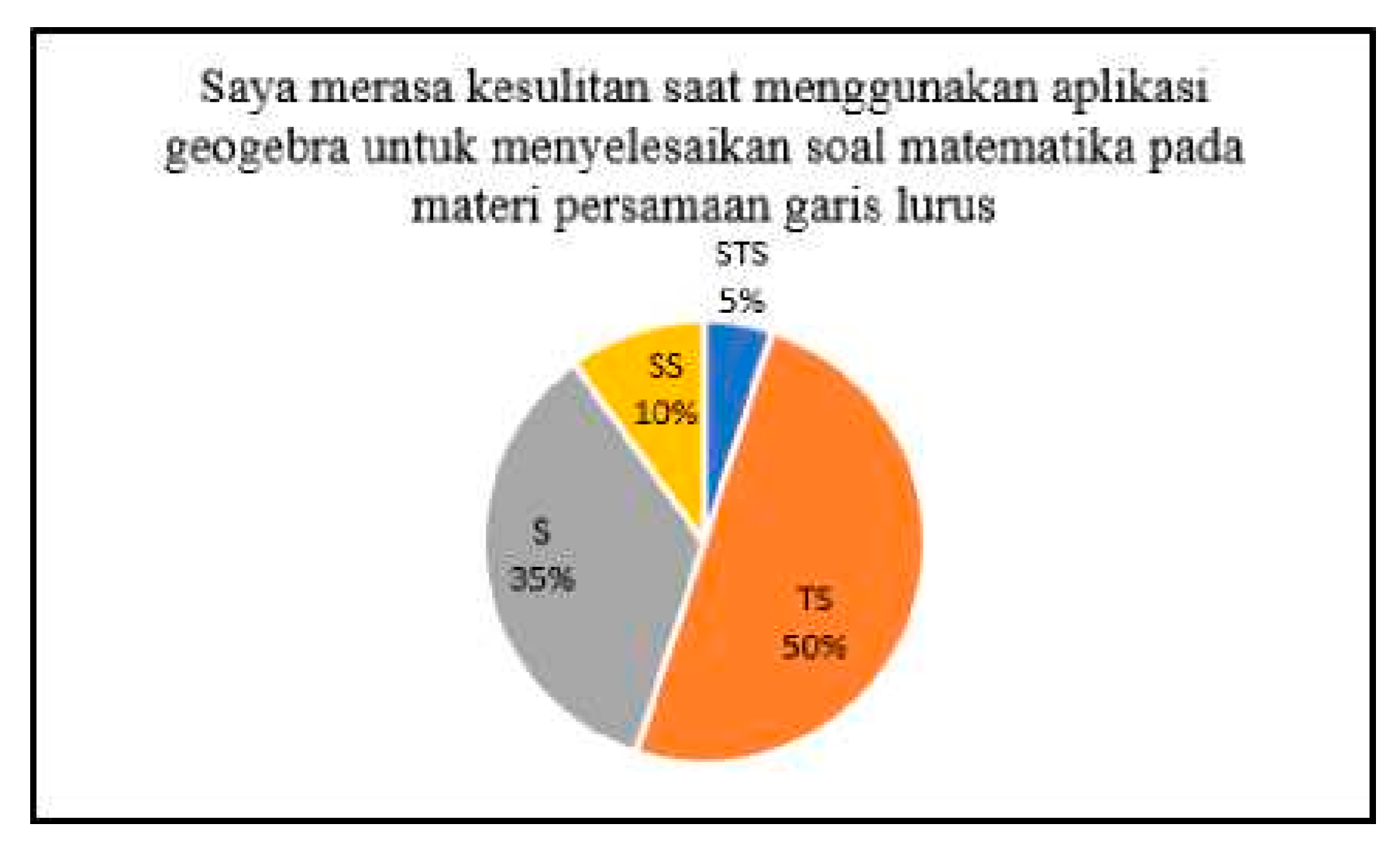
→Conclusion: Students did not experience significant difficulty using GeoGebra..
4. “Using GeoGebra increases my interest in solving linear equation problems.”
Figure 4.
Reflects high agreement.
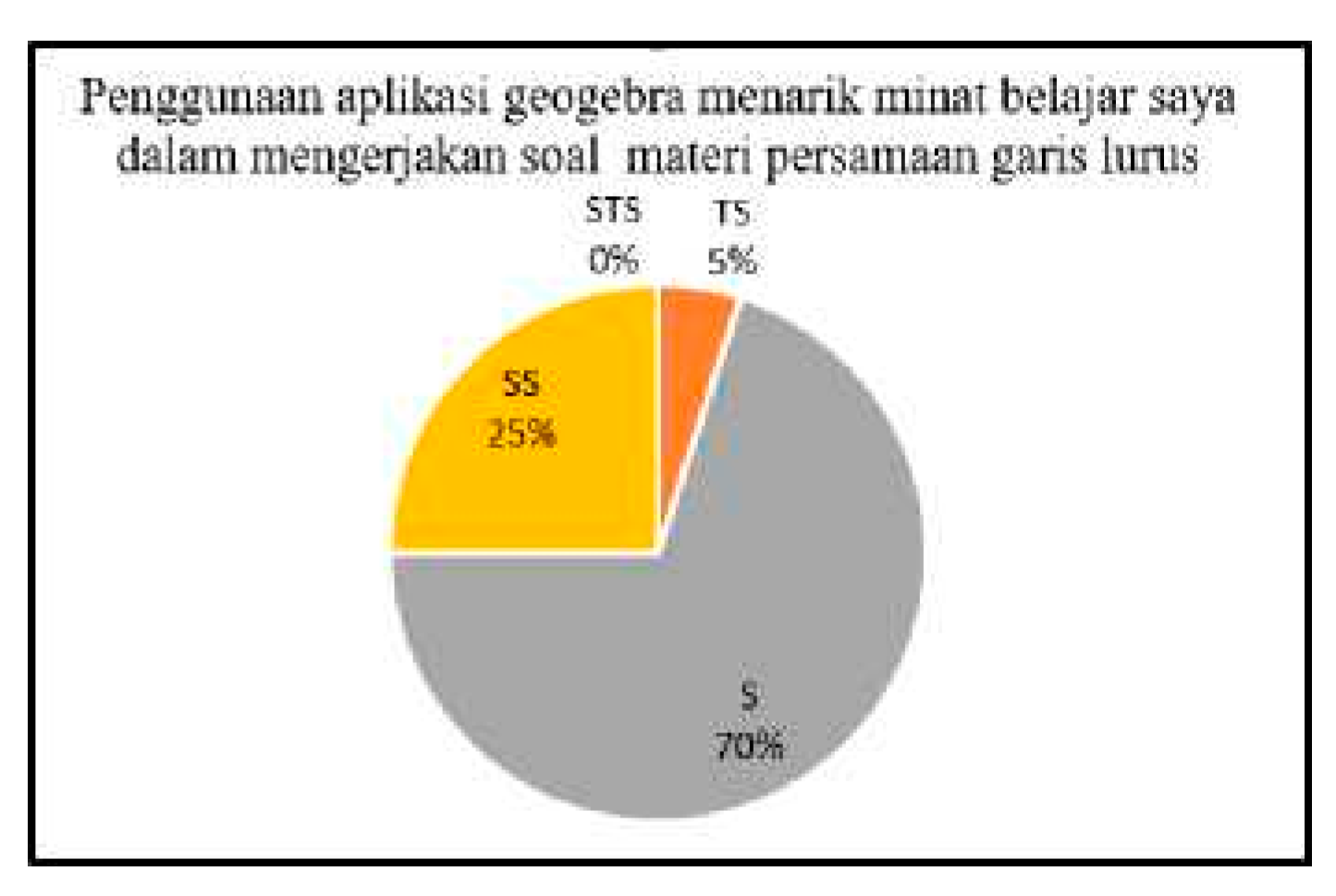
→Conclusion: GeoGebra positively influenced students’ learning motivation.
5. “I like using GeoGebra to solve math problems on linear equations.”
Figure 5.
Shows strong preference.
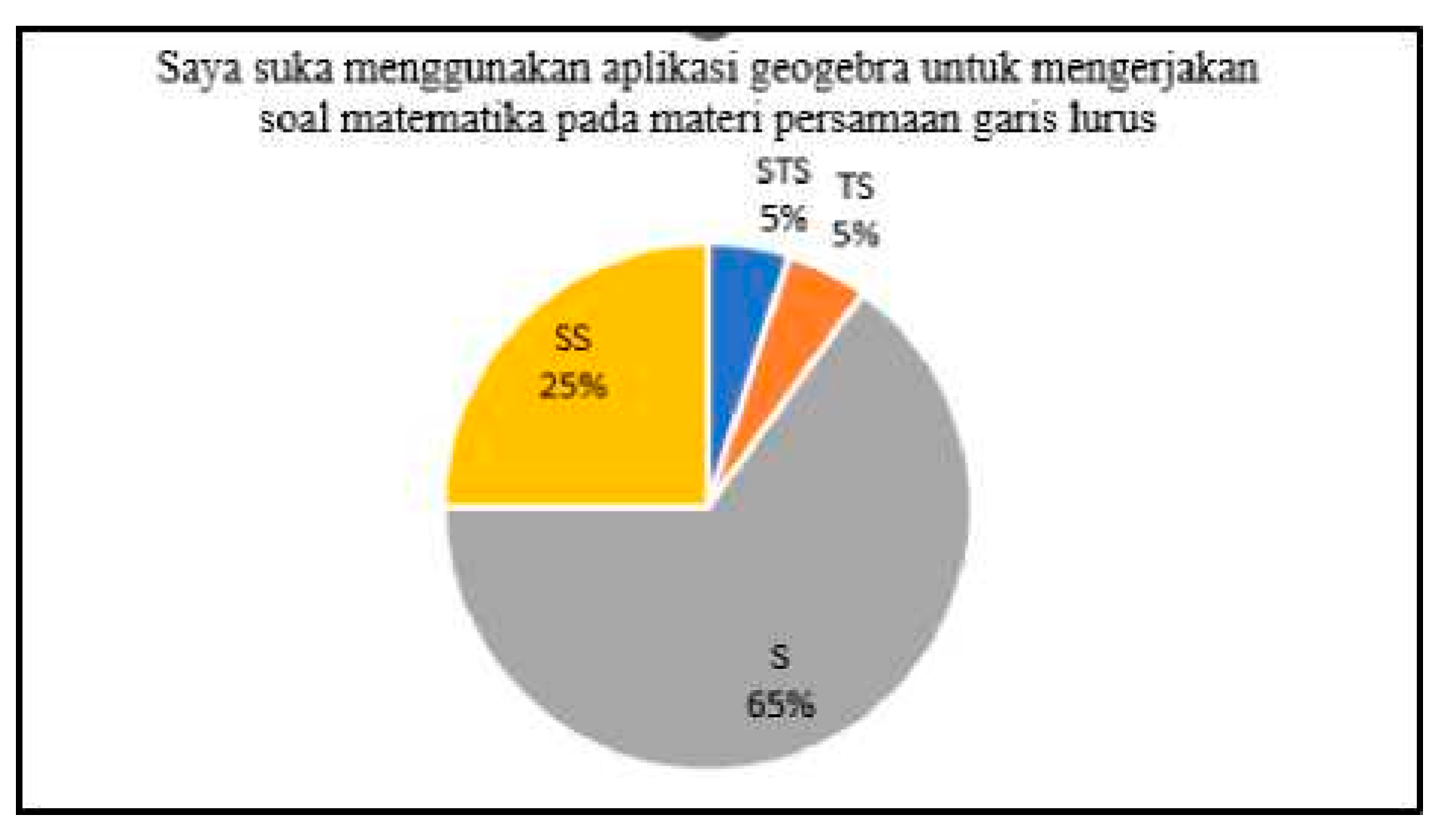
→Conclusion: Students enjoy using GeoGebra for this topic.
6. “GeoGebra as a learning medium is very confusing.”
Figure 6.
Reveals most students disagreed.
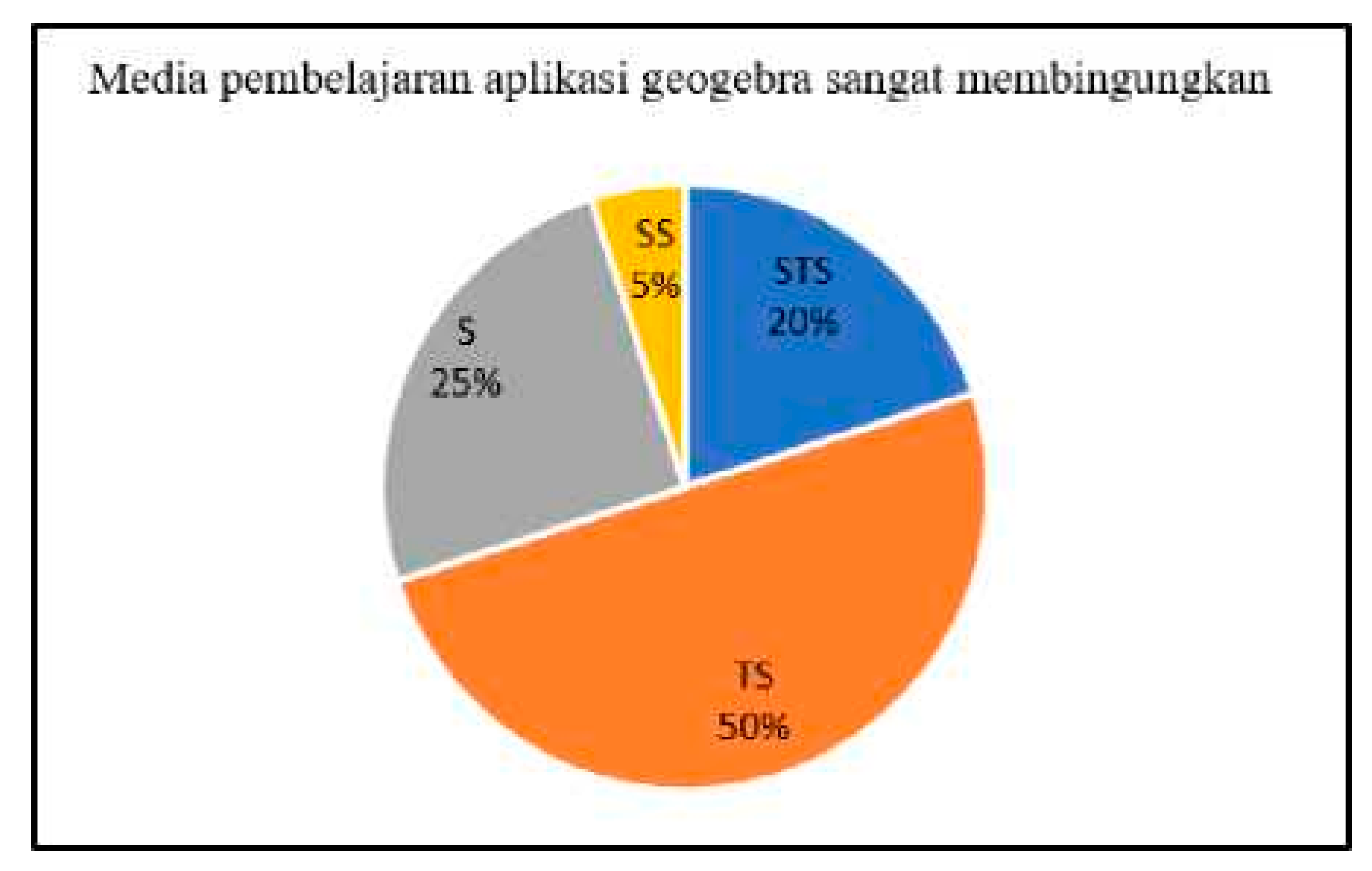
→Conclusion: Reveals most students disagreed.
7. “I prefer learning math using GeoGebra.”
Figure 7.
Shows high agreement.
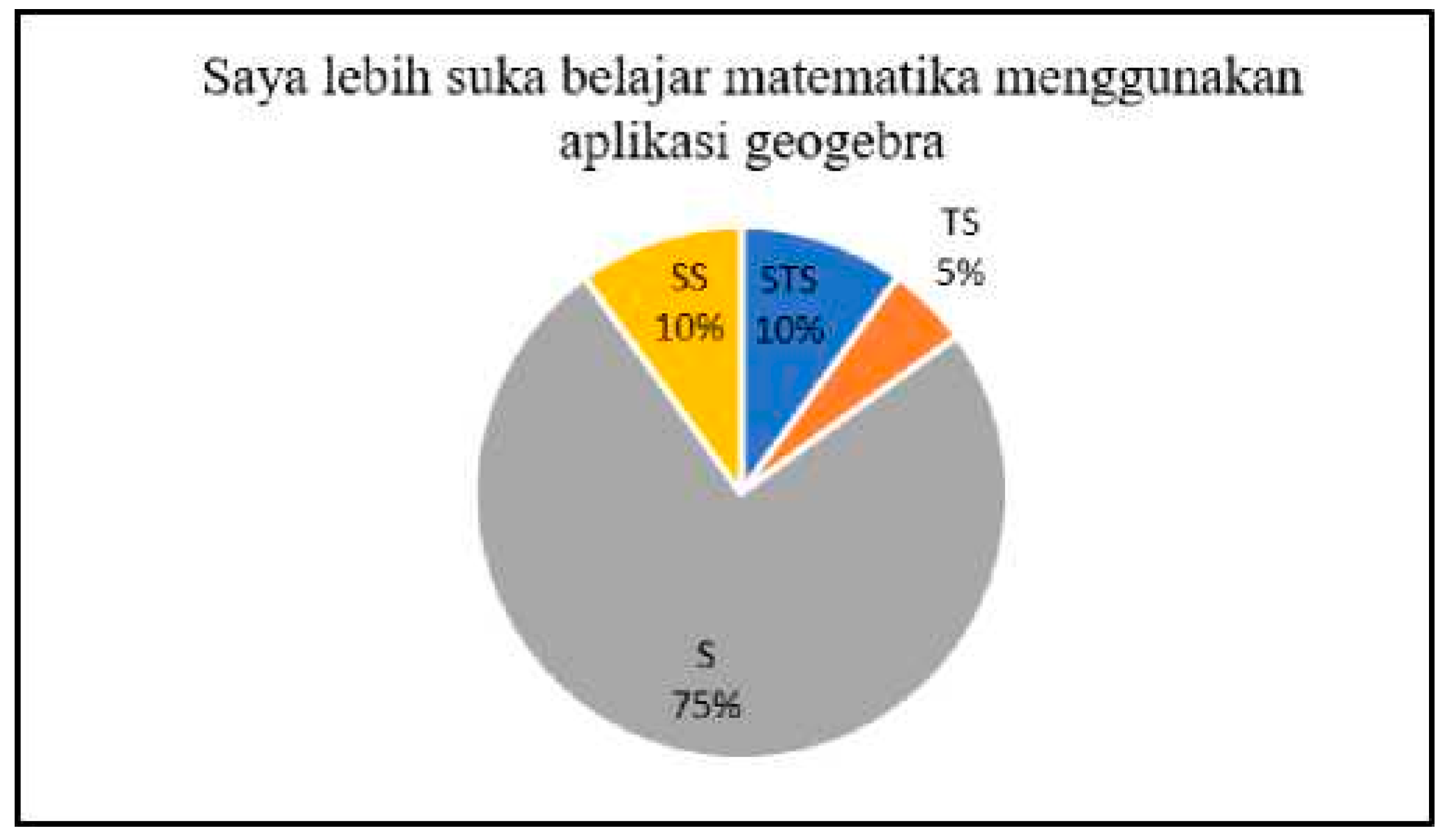
→Conclusion: Students favor GeoGebra-enhanced math instruction.
8. “I am happy when teachers use GeoGebra as a teaching medium.”
Figure 8.
Indicates strong approval.
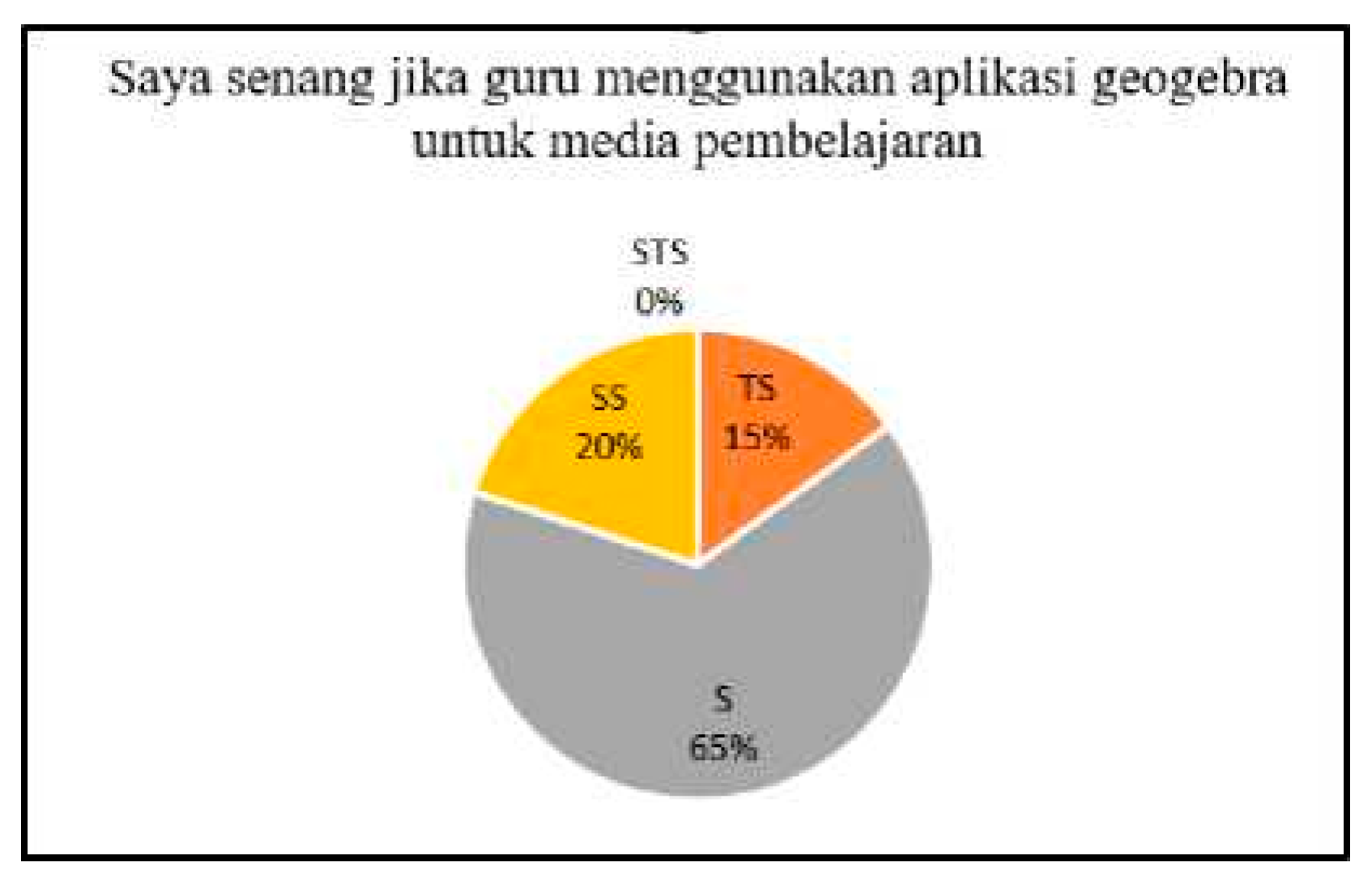
→Conclusion: Students welcome teacher use of GeoGebra in class.
9. “Using GeoGebra is not beneficial for math learning.”
Figure 9.
Shows most students disagreed.
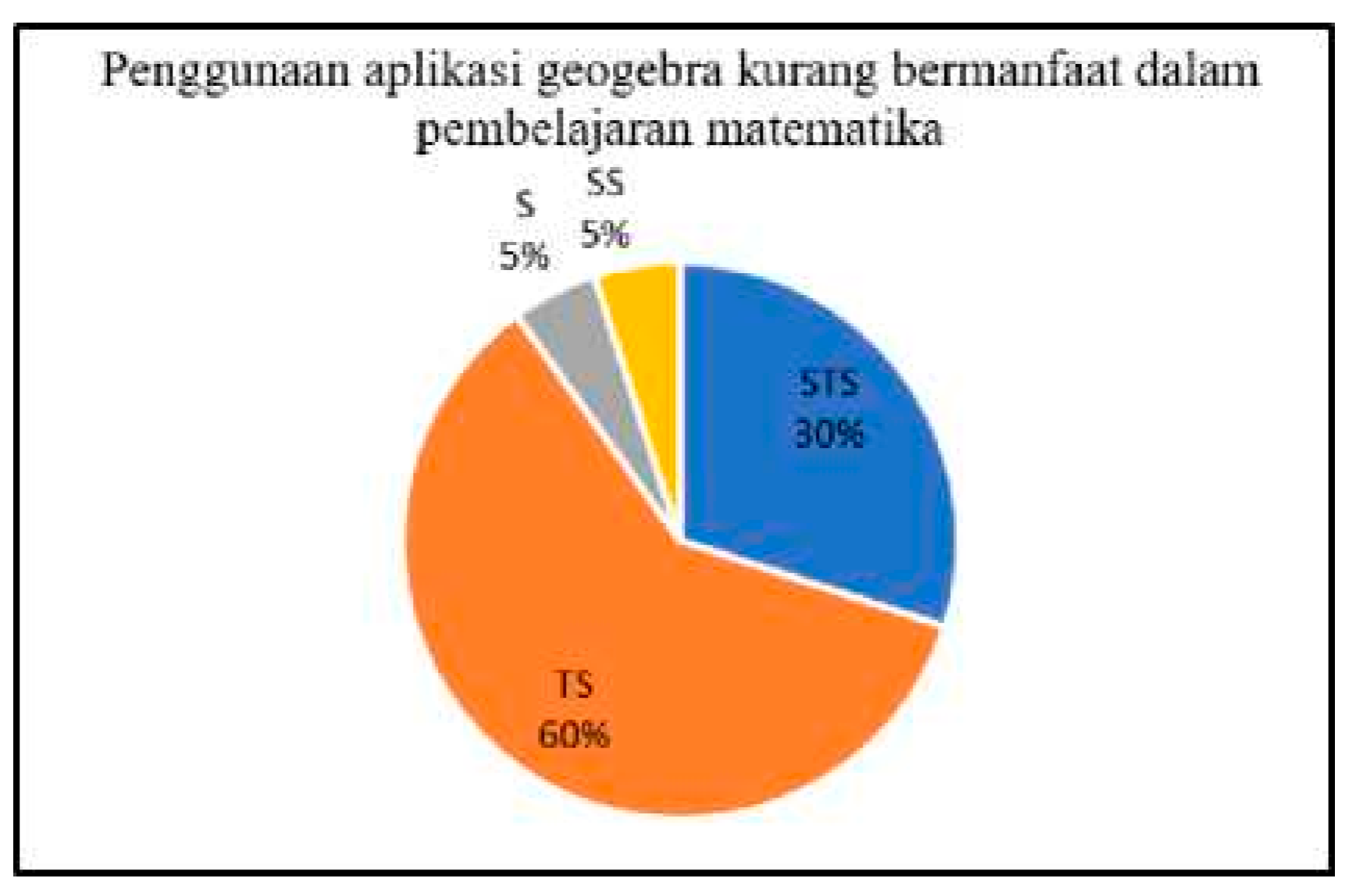
→Conclusion: Students perceive GeoGebra as beneficial.
10. “Learning math with GeoGebra makes the material easier to understand.”
Figure 10.
Reflects high agreement.
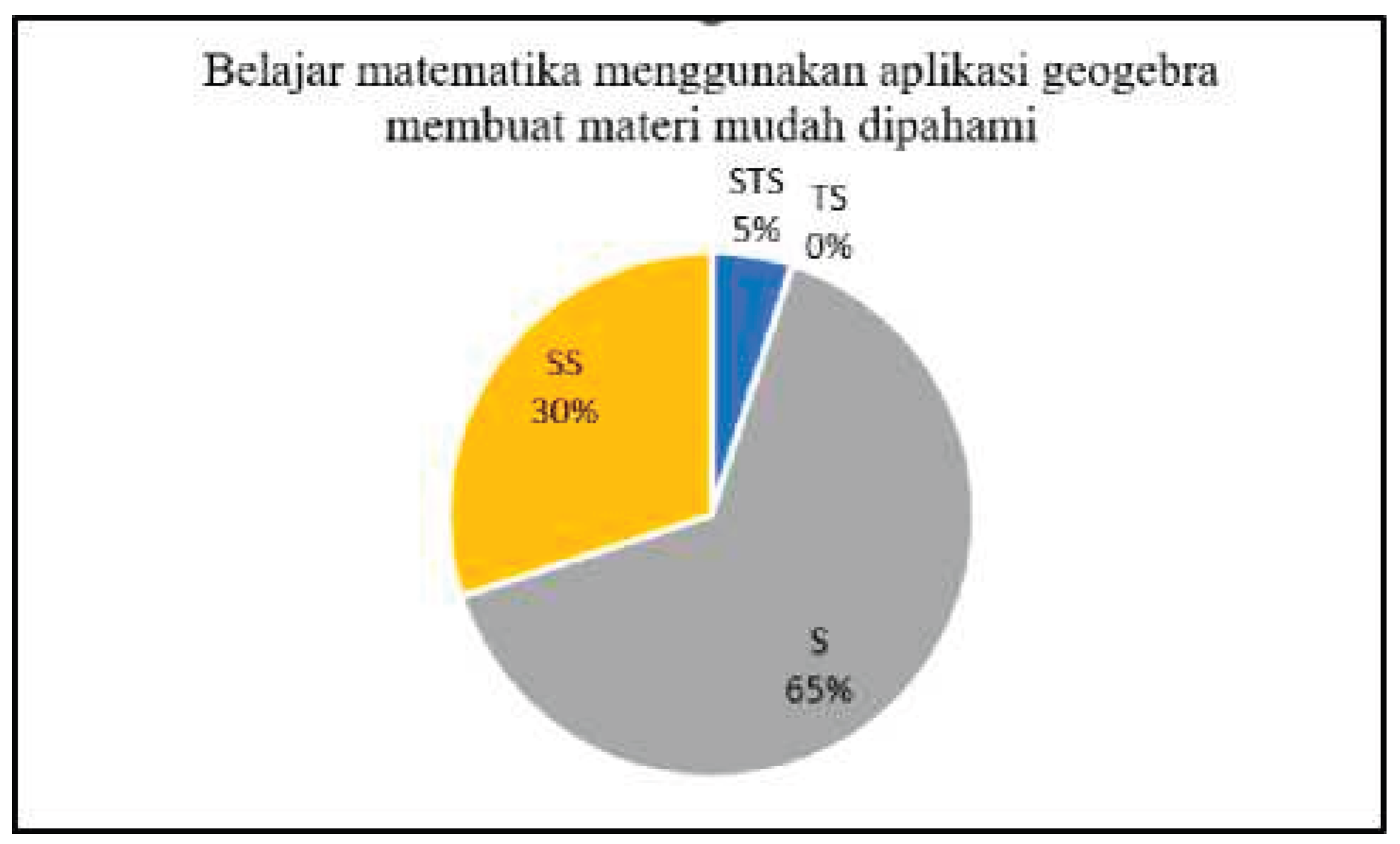
→Conclusion: GeoGebra aids conceptual understanding of linear equations.
Collectively, these responses confirm that students hold highly positive attitudes toward GeoGebra, viewing it as user-friendly, engaging, confidence-building, and pedagogically effective.
4.1.4. Achievement of Mathematical Communication Indicators
To assess indicator-level progress, pretest and posttest scores were analyzed per communication indicator.
Table 11.
Achievement of Mathematical Communication Indicators – Experimental Group.
| INDICATOR | PRETEST (%) | POSTTEST (%) |
| Formulating conjectures, arguments, definitions, and generalizations | 10.00 | 91.25 |
| Explaining ideas, situations, and relationships orally/writing | 0.00 | 13.75 |
| Translating real-life events into mathematical models | 0.00 | 46.25 |
| Representing real objects/diagrams into mathematical language/symbols | 0.00 | 5.00 |
| Reading and interpreting mathematical representations with comprehension | 1.25 | 8.75 |
| Average | 2.25 | 33.00 |
Table 12.
Achievement of Mathematical Communication Indicators – Control Group.
| INDICATOR | PRETEST (%) | POSTTEST (%) |
| Formulating conjectures, arguments, definitions, and generalizations | 6.58 | 47.37 |
| Explaining ideas, situations, and relationships orally/writing | 0.00 | 22.37 |
| Translating real-life events into mathematical models | 0.00 | 17.11 |
| Representing real objects/diagrams into mathematical language/symbols | 0.00 | 6.58 |
| Reading and interpreting mathematical representations with comprehension | 0.00 | 6.58 |
| Average | 1.32 | 20.00 |
Both groups showed improvement across all indicators, but the experimental group consistently outperformed the control group in posttest achievement (33.00% vs. 20.00% average). The highest gain in both groups occurred in formulating conjectures and arguments, likely because PBL emphasized structured problem analysis, written justification, and collaborative reasoning—further supported by GeoGebra’s visual scaffolding. Conversely, the lowest achievement was in representing real-world objects/diagrams into mathematical models, suggesting this remains a challenging skill requiring targeted instructional support.
Notably, the experimental group’s superior performance in argumentation and generalization is attributed to the PBL design, which consistently required students to:
- Identify knowns and unknowns in problems,
- Organize information in tables, and
- Use GeoGebra to visualize and validate mathematical relationships.
4.2. Discussion of Research Findings
The findings of this study indicate that students taught using Problem-Based Learning (PBL) integrated with GeoGebra demonstrated significantly greater improvement in mathematical communication ability compared to those taught via Discovery Learning (DL) without digital support. This conclusion is statistically supported by the Mann-Whitney U test (Table 4.5), which yielded a significance value of p = 0.005 (< 0.05), leading to the rejection of the null hypothesis. The normalized gain (N-gain) for the experimental group (mean = 0.30) was classified as moderate, whereas the control group’s gain (mean = 0.19) fell into the low category. This disparity underscores the pedagogical advantage of combining PBL’s inquiry-driven structure with GeoGebra’s dynamic visualization capabilities, which scaffold conceptual understanding and mathematical expression. [70,71,72,73,74]
These results align with prior empirical work. [70] similarly found that PBL supported by GeoGebra significantly enhanced mathematical communication compared to conventional instruction. Kamilah et al. (2019) reported higher N-gain scores in GeoGebra-assisted PBL classrooms, attributing this to increased student engagement and deeper cognitive processing. [71] observed greater student activity and participation in GeoGebra-integrated lessons, while [72,73] consistently documented superior learning outcomes in experimental groups using GeoGebra across various mathematical topics.
However, no student in either group achieved the school’s Minimum Completeness Criterion (KKM), falling short of the predefined effectiveness threshold of ≥75% mastery. This contrasts with [74,75], who reported an 82.35% mastery rate with GeoGebra in quadratic function instruction. In the present study, several contextual factors likely contributed to this outcome: (1) time constraints during testing due to student tardiness after recess, reducing the available time for completing the communication assessment; and (2) limited group representation during PBL presentations, where only a few groups presented publicly, potentially limiting peer learning and reflective discourse. These challenges echo findings by [72,73,74,75], who noted that insufficient test time and uncalibrated instruments (yielding overly difficult items) hindered KKM attainment despite positive GeoGebra integration.
Notably, while absolute mastery was not achieved, student perceptions of GeoGebra were overwhelmingly positive, with questionnaire responses falling into the “high” category. This aligns with [75] and [74], who emphasized GeoGebra’s capacity to enhance motivation and foster positive affective responses. The detailed item-level analysis further substantiates this:
- Confidence in problem-solving: Most students agreed that GeoGebra boosted their confidence—a finding corroborated by [75], who linked GeoGebra use to increased willingness to present solutions publicly.
- Attractive and interactive interface: Students strongly affirmed GeoGebra’s engaging design, consistent with [74], who identified enjoyment as a key affective outcome of GeoGebra use.
- Perceived ease of use: The majority disagreed that GeoGebra was difficult to operate, aligning with [73], who reported only 5% of students experiencing usability challenges.
- Enhanced learning interest: Students affirmed that GeoGebra increased their interest in solving linear equation problems, supporting [72], who found GeoGebra effective in stimulating learning motivation.
- Preference for GeoGebra: Most students expressed a liking for using GeoGebra in mathematics tasks, echoing [71], who noted strong student interest in GeoGebra as a problem-solving aid.
- Low cognitive load: Students rejected the notion that GeoGebra was confusing. This is attributed to the inclusion of step-by-step instructions in the PBL worksheets (LKPD) and GeoGebra’s offline accessibility—factors also highlighted by [70], who found minimal confusion among users.
- Preference for GeoGebra-enhanced instruction: Students indicated a clear preference for learning mathematics with GeoGebra, consistent with [69].
- Positive attitude toward teacher use of GeoGebra: Students expressed happiness when teachers employed GeoGebra, a sentiment mirrored in [68], who reported highly positive student reactions to teacher-led GeoGebra integration.
- Perceived usefulness: Students strongly disagreed that GeoGebra was unbeneficial, affirming its value across mathematical domains—an observation supported by [67], who documented GeoGebra’s utility in algebra, geometry, calculus, statistics, and trigonometry.
Collectively, these findings affirm that while GeoGebra-integrated PBL significantly enhances relative learning gains and student engagement, absolute mastery (KKM) may require additional instructional time, refined assessment instruments, and more inclusive presentation protocols. Nevertheless, the strong positive affective response suggests that GeoGebra serves as a powerful catalyst for transforming mathematics into an interactive, accessible, and enjoyable discipline—fully aligned with GeoGebra’s mission to “empower students to unleash their greatest potential” through innovative, connected, and student-centered learning experiences (GeoGebra, n.d.). [70,71,72,73,74,75]
5.1. Conclusions
Based on the findings and discussion, it can be concluded that the integration of GeoGebra within a Problem-Based Learning (PBL) framework was not fully effective in achieving the predefined criterion for instructional effectiveness—namely, that at least 75% of students attain the Minimum Completeness Criterion (KKM) in mathematical communication ability. Although students in the PBL + GeoGebra group demonstrated significantly greater improvement in mathematical communication compared to those in the Discovery Learning (DL) group (as confirmed by the Mann-Whitney U test, p = 0.005), none of the students in either group reached the KKM threshold in the posttest. [20,21,22,23,24,25]
Nevertheless, students’ perceptions of GeoGebra were overwhelmingly positive, with questionnaire responses falling into the “high” category across all affective dimensions—confidence, engagement, ease of use, perceived usefulness, and preference for GeoGebra-enhanced instruction. This indicates that while absolute mastery was not achieved, the intervention had a meaningful positive impact on students’ attitudes and learning experiences. [72]
5.2. Implications
The findings suggest that GeoGebra has strong potential to enhance students’ mathematical communication skills, particularly when embedded within student-centered pedagogies like PBL. Although learning outcomes did not meet the school’s mastery benchmark, the significant relative gain and high student satisfaction underscore GeoGebra’s value as a motivational and cognitive scaffold in mathematics education. This implies that digital tools like GeoGebra should not be evaluated solely on summative achievement metrics but also on their capacity to foster engagement, confidence, and conceptual exploration—key precursors to long-term mathematical proficiency. [73]
5.3. Recommendations
For future research, it is recommended to implement GeoGebra-integrated PBL with extended instructional time, refined assessment instruments, and more inclusive collaborative protocols (e.g., ensuring all groups present their work) to better support students in reaching mastery levels.
Further studies should investigate the broader affective impacts of GeoGebra, particularly its influence on students’ learning interest, intrinsic motivation, and self-efficacy in mathematics. Such research would provide a more holistic understanding of how dynamic digital tools contribute to both cognitive and non-cognitive learning outcomes.
This formulation maintains academic rigor while accurately reflecting your mixed-methods findings: statistically significant improvement without criterion-based effectiveness, yet strong affective endorsement—a nuanced but important contribution to the field of technology-enhanced mathematics education.
Funding
This research received no specific grant from any funding agency in the public, commercial, or not-for-profit sectors.
Acknowledgements
The authors would like to express their sincere gratitude to the principal and mathematics teachers of SMP Negeri 1 Padangsidimpuan for their support and collaboration during the implementation of this study. Special thanks are extended to the participating students for their active involvement and honest responses. The authors also acknowledge the valuable feedback provided by the peer reviewers, which significantly improved the quality of this manuscript.
Conflicts of Interest
The authors declare no actual or potential conflict of interest with respect to the research, authorship, and/or publication of this article.
Abbreviations
| ABBREVIATION | DEFINITION |
| PBL | Problem-Based Learning |
| DL | Discovery Learning |
| KKM | Kriteria Ketuntasan Minimal(Minimum Completeness Criterion) |
| LKPD | Lembar Kerja Peserta Didik(Student Worksheet) |
| N-gain | Normalized Gain |
| CAS | Computer Algebra System |
| SPSS | Statistical Package for the Social Sciences |
References
- Ahfahmi, A. H. Aplikasi Geogebra Classic terhadap pemahaman konsep matematika siswa pada materi transformasi geometri. Plusminus: Jurnal Pendidikan Matematika 2022, 2, 449–460. [Google Scholar]
- Amaliyakh Sholikhakh, R. , Pujiarto, H. Keefektifan model pembelajaran Problem Based Learning terhadap minat dan prestasi belajar matematika. Journal of Medives: Journal of Mathematics Education IKIP Veteran Semarang 2019, 3, 33–39. [Google Scholar] [CrossRef]
- Ameliana, Y. , Rosyana, T., & Purwasih, R. Analisis minat belajar siswa kelas VIII pada sub materi kubus dengan menggunakan pendekatan saintifik berbantuan software GeoGebra. PRISMA 2022, 11, 230–239. [Google Scholar] [CrossRef]
- Arina, J. , & Nuraeni, R. Kemampuan komunikasi matematis siswa kelas X SMK di Ponpes Nurul Huda. Plusminus: Jurnal Pendidikan Matematika 2022, 2, 315–324. [Google Scholar]
- Ayus, A. D. , Gusniwati, G., & Buhaerah, B. Efektivitas pembelajaran matematika berbasis daring (e-learning) terhadap prestasi belajar siswa. Pi: Mathematics Education Journal 2021, 4, 31–36. [Google Scholar] [CrossRef]
- Bella, Y. , Suhendri, H., & Ningsih, R. Peranan metode pembelajaran The Power Of Two terhadap kemampuan pemecahan masalah matematika. Jurnal Mercumatika: Jurnal Penelitian Matematika dan Pendidikan Matematika 2019, 3, 129–135. [Google Scholar] [CrossRef]
- Chronika, A. , Manalu, S., Jumiati, Y., Setiawan, W., Sudirman, J., Tengah, C., Cimahi, K., & Barat, J. Analisis minat belajar matematika siswa SMP kelas VIII pada materi persamaan garis lurus berbantu aplikasi Geogebra. Journal on Education 2019, 2, 63–69. [Google Scholar] [CrossRef]
- Danial, D. , Nur Azmy, Jamaluddin, Syarifuddin, & Fitriani. Efektivitas penerapan media alat peraga papan statistika terhadap pembelajaran matematika. Prosiding Seminar Nasional Fakultas Tarbiyah dan Ilmu Keguruan IAIM Sinjai 2022, 1, 15–19. [Google Scholar]
- Dewi, D. K. , Khodijah, S. S., Setiawan, W., Cintakarya, D., Bingkai, S., Cililin, C., & Siliwangi, I. Analisis motivasi belajar matematika siswa SMA Bingkai Cendekia Cililin berbantuan aplikasi Geogebra pada materi transformasi geometri. JPMI (Jurnal Pembelajaran Matematika Inovatif) 2020, 3, 49–58. [Google Scholar]
- Dwi, H. , Cahyani, Herlina, A., Hadiyanti, D., & Saptoro, A. Peningkatan sikap kedisiplinan dan kemampuan berpikir kritis siswa dengan penerapan model pembelajaran Problem Based Learning. Edukatif: Jurnal Ilmu Pendidikan 2021, 3, 919–927. [Google Scholar] [CrossRef]
- Edi, S. , & Rosnawati, R. Kemampuan berpikir kritis siswa dalam pembelajaran matematika model Discovery Learning. JNPM (Jurnal Nasional Pendidikan Matematika) 2021, 5, 234–246. [Google Scholar] [CrossRef]
- Fahmi, A. N. , Sutiarso, S., & Coesamin, M. Pengaruh model pembelajaran Discovery terhadap peningkatan kemampuan komunikasi matematis siswa. Jurnal Pendidikan Matematika 2019, 7, 705–716. [Google Scholar]
- Fahruunnisa, T. , Dewi, R., & Irwan. Penggunaan software Geogebra untuk memahami materi integral terhadap peserta didik kelas XII di SMA Swasta Harapan Paya Bakung. Serunai Matematika 2024, 16, 70. [Google Scholar]
- Fauziyah, F. D. , & Sujarwo, I. Kemampuan penalaran matematis dalam menyelesaikan soal geometri ditinjau dari persepsi siswa. Galois: Jurnal Penelitian Pendidikan Matematika 2022, 1, 10–22. [Google Scholar] [CrossRef]
- Febrita, Y. , & Ulfah, M. Peranan media pembelajaran untuk meningkatkan motivasi belajar siswa. Diskusi Panel Nasional Pendidikan Matematika https://proceeding.unindra.ac.id/index.php/DPNPMunindra/article/view/571. 2019, 5. [Google Scholar]
- Fitri, M. , Yuanita, P., & Maimunah, M. Pengembangan perangkat pembelajaran matematika terintegrasi keterampilan abad 21 melalui penerapan model Problem Based Learning (PBL). Jurnal Gantang 2020, 5, 77–85. [Google Scholar] [CrossRef]
- Giovanti, L. L. , Buchori, A., & Rahmawati, N. D. Efektivitas Problem Based Learning berbantu software Geogebra pada materi program linear terhadap kemampuan komunikasi matematis siswa SMA. Jurnal Lebesgue: Jurnal Ilmiah Pendidikan Matematika, Matematika dan Statistika 2023, 4, 1765–1776. [Google Scholar] [CrossRef]
- Gunanjar, D. , & Ansari, B. I. Penerapan model Discovery Learning berbantuan software Geogebra terhadap kemampuan pemahaman matematis siswa pada materi hubungan garis lurus dan sudut di kelas X MAN 1 Banda Aceh. Jurnal Sociohumaniora Kodepena (JSK) 2023, 4, 231–238. [Google Scholar] [CrossRef]
- Gusti, I. , Ngurah, A., Jayantika, T., Parmithi, N., Nyoman, D., & Purwaningsih, D. Pengaruh model pembelajaran Problem Based Learning terhadap kecemasan dan hasil belajar matematika. Emasains: Jurnal Edukasi Matematika dan Sains 2020, 9, 276–287. [Google Scholar] [CrossRef]
- Hakiki, S. M. , & Yahfizham, Y. Systematic Literature Review (SLR): Pemanfaatan aplikasi Geogebra dalam pembelajaran matematika. Konstanta: Jurnal Matematika dan Ilmu Pengetahuan Alam 2024, 2, 57–64. [Google Scholar] [CrossRef]
- Hakim, F. , Fitriani, N., & Nurfauziah, P. Peningkatan kemampuan komunikasi matematis siswa kelas VIII di MTSN 04 KBB menggunakan model pembelajaran Discovery Learning pada materi lingkaran. Jurnal Pembelajaran Matematika Inovatif 2024, 7, 435–444. [Google Scholar]
- Hamidah, N., F. , Naraeni, N., Sulhah, & Hidayati, P. Pengenalan pemanfaatan aplikasi Geogebra materi kesebangunan pada siswa SMPIT Widya Cendekia Kota Serang. Jubaedah: Jurnal Pengabdian dan Edukasi Sekolah 2024, 4, 95–109. [Google Scholar]
- Hanipah, H. , & Sumartini, T. S. Perbandingan kemampuan komunikasi matematis siswa antara Problem Based Learning dan Direct Instruction. Plusminus: Jurnal Pendidikan Matematika 2021, 1, 83–96. [Google Scholar]
- Hidayatullah, A. M. , Satiti, W. S., & Chotimah, C. Peningkatan hasil belajar siswa dengan model Discovery Learning pada materi transformasi geometri kelas XI MA/SMA. JoEMS (Journal of Education and Management Studies) 2020, 3, 21–24. [Google Scholar]
- Hikmah, R. Pengaruh aplikasi GeoGebra dalam meningkatkan kemampuan berpikir kritis siswa di SMPN Cibinong. SAP (Susunan Artikel Pendidikan) 2020, 5, 152–161. [Google Scholar] [CrossRef]
- Indriani, A. Analisis kecenderungan metode penelitian skripsi mahasiswa program studi pendidikan matematika di IKIP PGRI Bojonegoro. AKSIOMA: Jurnal Matematika dan Pendidikan Matematika 2019, 10, 130–134. [Google Scholar] [CrossRef]
- Indriani, W. D. , & Pasaribu, L. H. Peningkatan kemampuan komunikasi matematis siswa menggunakan model pembelajaran Hybrid Learning. Jurnal Cendekia: Jurnal Pendidikan Matematika 2022, 6, 291–299. [Google Scholar] [CrossRef]
- Islami, A. N. , & Setiawan, W. Efek Geogebra pada minat belajar siswa SMP. Wahana Matematika dan Sains: Jurnal Matematika, Sains, dan Pembelajarannya 2020, 14, 78–87. [Google Scholar]
- Ismayanti, S. , & Sofyan, D. Kemampuan komunikasi matematis siswa SMP kelas VIII di Kampung Cigulawing. Plusminus: Jurnal Pendidikan Matematika 2021, 1, 183–196. [Google Scholar]
- Jabnabillah, F. , & Reza Fahlevi, M. Efektivitas penggunaan aplikasi Geogebra pada pembelajaran matematika. Jurnal Pembelajaran Matematika Inovatif 2023, 6, 983–990. [Google Scholar]
- Jusniani, N. , & Nurmasidah, L. Penerapan model pembelajaran generatif untuk meningkatkan kemampuan komunikasi matematis siswa. Jurnal Ilmiah Matematika Realistik 2021, 2, 12–19. [Google Scholar]
- Kamilah, S. R. , Budilestari, P., & Gunawan, I. Penerapan model pembelajaran Problem Based Learning (PBL) dengan berbantuan GeoGebra untuk meningkatkan kemampuan representasi matematis siswa SMK. Intermathzo: Jurnal Pendidikan dan Pembelajaran Matematika 2019, 4, 70–77. [Google Scholar]
- Kanah, I. , & Mardiani, D. Kemampuan komunikasi dan kemandirian belajar siswa melalui Problem Based Learning dan Discovery Learning. Plusminus: Jurnal Pendidikan Matematika 2022, 2, 255–264. [Google Scholar] [CrossRef]
- Khasanah, U. , & Nugraheni, E. A. Analisis minat belajar matematika siswa kelas VII pada materi segiempat berbantuan aplikasi Geogebra di SMP Negeri 239 Jakarta. Jurnal Cendekia: Jurnal Pendidikan Matematika 2020, 6, 181–190. [Google Scholar] [CrossRef]
- Khasinah, S. Discovery Learning: Definisi, sintaksis, keunggulan dan kelemahan. Jurnal Mudarrisuna: Media Kajian Pendidikan Agama Islam 2021, 11, 402–413. [Google Scholar] [CrossRef]
- Lubis, R. A. , Fitriani, N., & Sariningsih, R. Penerapan model Discovery Learning berbantuan E-LKPD untuk meningkatkan kemampuan komunikasi matematis siswa kelas X MA pada materi SPLTV. Jurnal Pembelajaran Matematika Inovatif 2023, 6, 1473–1483. [Google Scholar]
- Luciana, N. Penerapan model Discovery Learning dalam meningkatkan kualitas pembelajaran dan hasil belajar matematika peminatan mengenai rumus jumlah dan selisih sinus dan kosinus dua sudut pada siswa kelas XI IPA 1 SMA Negeri 1 Cisaat. CENDEKIA: Jurnal Ilmu Pengetahuan 2021, 1, 106–111. [Google Scholar] [CrossRef]
- Lutfiyah, L. , & Sulisawati, D. N. Efektivitas pembelajaran matematika menggunakan media berbasis e-learning. Jurnal Pendidikan Matematika (JUDIKA EDUCATION) 2019, 2, 58–65. [Google Scholar] [CrossRef]
- Maf, S. , Wulandari, S., Jauhariyah, L., & Arif, N. Pembelajaran matematika dengan media software GeoGebra materi dimensi tiga. Mosharafa: Jurnal Pendidikan Matematika 2021, 10, 449–460. [Google Scholar]
- Millati, D. Y. I. , & Prihaswati, M. Analisis minat belajar siswa pada materi SPTLDV berbantu aplikasi Geogebra. EDUSAINTEK https://prosiding.unimus.ac.id/index.php/edusaintek/article/view/537. 2020, 4. [Google Scholar]
- Muhammad, I. , & Juandi, D. Model Discovery Learning pada pembelajaran matematika sekolah menengah pertama: A bibliometric review. Euler: Jurnal Ilmiah Matematika, Sains dan Teknologi 2023, 11, 74–88. [Google Scholar] [CrossRef]
- Nasution, N. A. , & Lubis, M. R. Efektivitas pengembangan perangkat pembelajaran berdasarkan pembelajaran inkuiri berbasis budaya berbantuan Geogebra. AXIOM: Jurnal Pendidikan dan Matematika 2021, 10, 133–142. [Google Scholar] [CrossRef]
- Novita, L. , Windiyani, T., & Sakinah, A. R. Pengaruh penerapan model Discovery Learning terhadap hasil belajar matematika siswa. Widyagogik: Jurnal Pendidikan dan Pembelajaran Sekolah Dasar 2020, 7, 148–163. [Google Scholar] [CrossRef]
- Nurhayati, L. , & Setiawan, W. Analisis minat belajar matematika siswa SMA pada materi program linier berbantuan aplikasi Geogebra. Journal on Education 2019, 2, 1–8. [Google Scholar] [CrossRef]
- Patmawati, P. , Ahmad, H., & Febryanti, F. Penerapan model pembelajaran Diskursus Multy Refrecentacy dengan aplikasi GeoGebra terhadap peningkatan kemampuan komunikasi matematis. Journal Peqguruang: Conference Series 2022, 4, 302–309. [Google Scholar] [CrossRef]
- Pertiwi, F. A. , Luayyin, R. H., & Arifin, M. Problem Based Learning untuk meningkatkan keterampilan berpikir kritis: Meta analisis. JSE: Jurnal Sharia Economica 2023, 2, 42–49. [Google Scholar] [CrossRef]
- Purnomo, J. Kebermanfaatan penggunaan Geogebra dalam pembelajaran matematika. Idealmathedu: Indonesian Digital Journal of Mathematics and Education 2021, 8, 9–22. [Google Scholar] [CrossRef]
- Puspitasari, W. D. , & Febrinita, F. Pengujian validasi penelitian. Journal Focus Action of Research Mathematic (Factor M) 2021, 4, 77–90. [Google Scholar]
- Putri, N. D. , & Tasman, F. Menggunakan Geogebra Classroom pada materi dimensi. Jurnal Edukasi dan Penelitian Matematika 2021, 10, 80–85. [Google Scholar]
- Rahayu, S. T. , Saputra, D. S., & Susilo, S. V. Pentingnya model Problem Based Learning dalam pembelajaran matematika siswa sekolah dasar. V. Pentingnya model Problem Based Learning dalam pembelajaran matematika siswa sekolah dasar. Prosiding Seminar Nasional Pendidikan 2019, 448–454. [Google Scholar]
- Rahmawati, N. S. , Kurnia Bungsu, T., Daulatina Islamiah, I., & Setiawan, W. Analisis minat belajar siswa MA Al-Mubarok melalui pendekatan saintifik berbantuan aplikasi Geogebra pada materi statistika dasar. Journal on Education 2019, 1, 386–395. [Google Scholar]
- Risanjani, A. , Kurniawati, R. P., & Mursidik, E. M. Efektivitas model PBL terhadap hasil belajar matematika siswa kelas IV pada materi keliling dan luas bangun datar. Seminar Nasional Sosial Sains, Pendidikan, Humaniora (SENASSDRA) 2023, 2, 678–684. [Google Scholar]
- Riyadi, M. , Pujiastuti, H., Sultan, U., & Tirtayasa, A. Analisis kemampuan komunikasi matematis siswa ditinjau dari gaya belajar. Indiktika: Jurnal Inovasi Pendidikan Matematika 2020, 3, 71–80. [Google Scholar] [CrossRef]
- Rizal Usman, M. , Satriani, S., & Ibrahim, M. Efektivitas penggunaan media GeoGebra pada pembelajaran matematika materi grafik fungsi kuadrat. JURNAL MathEdu (Mathematic Education Journal) 2023, 6, 27–33. [Google Scholar]
- Robiana, A. , Handoko, D. H. Pengaruh penerapan media UnoMath untuk meningkatkan kemampuan komunikasi matematis dan kemandirian belajar siswa. Mosharafa: Jurnal Pendidikan Matematika 2020, 9, 521–532. [Google Scholar] [CrossRef]
- Romlah, S. , Sylviana Zhanty, L., & Setiawan, W. Analisis kemampuan komunikasi matematis siswa SMP di Kota Cimahi pada materi statistika. Jurnal Cendekia: Jurnal Pendidikan Matematika 2019, 3, 266–277. [Google Scholar] [CrossRef]
- Sapilin, Adisantoso, P. , & Taufik, M. Peningkatan pemahaman konsep peserta didik dengan model Discovery Learning pada materi fungsi invers. Mosharafa: Jurnal Pendidikan Matematika 2019, 8, 285–296. [Google Scholar] [CrossRef]
- Sari, S. M. Pengembangan perangkat pembelajaran Problem Based Learning (PBL) dalam pembelajaran matematika di SMA. Jurnal Serambi Ilmu 2020, 21, 211–228. [Google Scholar] [CrossRef]
- Suci Rahmawati, N. , Bernard, M., & Akbar, P. Analisis kemampuan komunikasi matematis siswa SMK pada materi sistem linear dua variabel (SPLDV). Journal on Education 2019, 1, 344–352. [Google Scholar]
- Suhaifi, A. , Rufi’i, R., & Karyono, H. Pengaruh penggunaan aplikasi Geogebra terhadap hasil belajar matematika. Jurnal Inovasi Teknologi Pendidikan 2022, 8, 220–230. [Google Scholar]
- Sundayana, R. Statistika penelitian pendidikan (2nd ed.). ALFABETA.
- Susilawati. (2021). Peningkatan kinerja guru dalam menetapkan kriteria ketuntasan minimal melalui workshop di SDN Pondok Betung 03. Jurnal Sosial Teknologi 2020, 1, 319–334. [Google Scholar] [CrossRef]
- Syah, J. M. , & Sofyan, D. Kemampuan komunikasi matematis siswa SMP di Kampung Paledang Suci Kaler pada materi segiempat dan segitiga. Plusminus: Jurnal Pendidikan Matematika 2021, 1, 373–384. [Google Scholar]
- Syamsuddin, S. , & Utami, M. A. P. Efektivitas pembelajaran matematika melalui pendekatan Contextual Teaching and Learning. Jurnal Riset dan Inovasi Pembelajaran 2021, 1, 32–40. [Google Scholar] [CrossRef]
- Wahyuni, T. S. , Amelia, R., & Maya, R. Analisis kemampuan komunikasi matematis siswa SMP pada materi segiempat dan segitiga. Jurnal Kajian Pembelajaran Matematika 2019, 3, 18–23. [Google Scholar]
- Wahyuningsih, E. Pembelajaran matematika dengan pendekatan Problem Based Learning dalam implementasi Kurikulum 2013. Jurnal Pengembangan Pembelajaran Matematika 2019, 1, 69–87. [Google Scholar] [CrossRef]
- Wulandari, S. , & Rahma, I. Efektivitas media video KineMaster terhadap hasil belajar matematika siswa secara daring. Jurnal Analisa 2021, 7, 33–45. [Google Scholar]
- Y Pauweni, K. A. , Ismail Uwange, D., Ismail, S., & Ekawaty Kobandaha, P. Peningkatan hasil belajar siswa pada materi teorema Pythagoras menggunakan aplikasi Geogebra di kelas VIII SMP Negeri 15 Gorontalo. Jurnal Cendekia: Jurnal Pendidikan Matematika 2022, 6, 2660–2672. [Google Scholar] [CrossRef]
- Yanti, R. , Laswadi, L., Ningsih, F., Putra, A., & Ulandari, N. Penerapan pendekatan saintifik berbantuan Geogebra dalam upaya meningkatkan pemahaman konsep matematis siswa. AKSIOMA: Jurnal Matematika dan Pendidikan Matematika 2019, 10, 180–194. [Google Scholar] [CrossRef]
- Siregar, T. Stages of Research and Development Model Research and Development (R&D). DIROSAT: Journal of Education, Social Sciences & Humanities 2023, 1, 4. [Google Scholar] [CrossRef]
- Siregar, T. (2025). The Effectiveness of the Discovery Learning Model in Enhancing Students’ Mathematical Problem-Solving Skills. Preprints 2025. [Google Scholar] [CrossRef]
- Siregar, T. (2025). Effectiveness of the Problem-Based Learning Model in Improving Students’ Mathematical Communication Skills and Learning Motivation. Preprints 2025. [Google Scholar] [CrossRef]
- Siregar, T. (2025). Literature Review: The Use of GeoGebra Software on Mathematical Comprehension Ability. Preprint 2025. [Google Scholar] [CrossRef]
- Siregar, T. (2025). Integrating GeoGebra in Mathematics Education: Enhancing Pedagogical Practices among Teachers and Lecturers. Preprint 2025. [Google Scholar] [CrossRef]
- Siregar, T. 92025). Application of Geogebra for Teaching Mathematics. Preprint 2025. [Google Scholar] [CrossRef]
Table 5.
Descriptive Statistics of Pretest Scores on Mathematical Communication Ability.
| CLASS | NUMBER OF STUDENTS | MEAN | STANDAR DEVIATION | MINIMUM | MAXIMUM |
| Experimental | 20 | 0.450 | 0.605 | 0 | 2 |
| Control | 19 | 0.263 | 0.452 | 0 | 1 |
Table 6.
Descriptive Statistics of Posttest Scores on Mathematical Communication Ability.
| CLASS | NUMBER OF STUDENTS | MEAN | STANDAR DEVIATION | MINIMUM | MAXIMUM |
| Experimental | 20 | 6.25 | 2.653 | 1 | 10 |
| Control | 19 | 4.00 | 3.037 | 0 | 13 |
Table 7.
Gain in Mathematical Communication Ability.
| CLASS | MEAN GAIN | SATNDAR DEVIATION |
| Experimental | 0.30 | 0.126 |
| Control | 0.19 | 0.150 |
Disclaimer/Publisher’s Note: The statements, opinions and data contained in all publications are solely those of the individual author(s) and contributor(s) and not of MDPI and/or the editor(s). MDPI and/or the editor(s) disclaim responsibility for any injury to people or property resulting from any ideas, methods, instructions or products referred to in the content. |
© 2025 by the authors. Licensee MDPI, Basel, Switzerland. This article is an open access article distributed under the terms and conditions of the Creative Commons Attribution (CC BY) license (http://creativecommons.org/licenses/by/4.0/).
Copyright: This open access article is published under a Creative Commons CC BY 4.0 license, which permit the free download, distribution, and reuse, provided that the author and preprint are cited in any reuse.