

Submitted:
30 October 2025
Posted:
30 October 2025
You are already at the latest version
Abstract
New artichoke flours with high nutraceutical value have been developed. Blanching is a critical pre-treatment in the production of flour from artichokes, as it helps preserve bioac-tive and nutritional compounds before cutting, drying and milling. However, studies on the blanching of artichoke by-products for flour production are scarce, in contrast to those studies on edible artichoke parts. In this article, the effect of different blanching treatments (steam or immersion; 3-15 min) on the bioactive compounds (total phenolic content, TPC; total antioxidant capacity, TAC; and inulin) and color quality of flours (obtained after cut-ting, drying and milling) of artichoke by-products (stems and bracts) was studied. Blanching treatments induced increases in TPC, TAC and inulin, although those incre-ments varied greatly depending on the treatment type and artichoke part. In particular, the steaming (15 min) induced the highest TPC increment in hearts and stems (94 and 46%, respectively), TAC increment in hearts, stems and bracts (987, 1107 and 1660%, respec-tively) and inulin increment in hearts and stems (106 and 14%, respectively). Steaming (3 min) induced the highest inulin increment in bracts (40%). Immersion (15 min) induced the highest TPC increment in bracts (632%). In addition, the short blanching treatment (3 min) was not enough to inactivate browning enzymes with browning index values of 75, 52 and 67, which were similar, or even higher, to control samples (unblanched). In con-clusion, steam blanching for 15 and 3 min induced the highest bioactive contents in stems and hearts, and in bracts for inulin and TAC contents.
Keywords:
Cynara cardunculus
; inulin
; polyphenols
; flour
; industrial processing
1. Introduction
The artichoke plant (Cynara cardunculus var. Scolymus) is a plant belonging to the Asteraceae family, native to the Mediterranean region and commonly consumed in this area since at least the fourth century BC (Christaki et al., 2012). The commercially valuable part corresponds to the immature plant inflorescence, known as the ‘head’. Depending on the variety, the artichoke head can reach from 150 to 600 g. The head should be harvested unripe; otherwise, it loses its culinary value. However, the conventionally edible part corresponds to the inner part of the head, known as ‘heart’, and the inner bracts. The heart represents 10-18 % of the total head weight, while the heart+innermost bracts sum represents around 40 % of the head weight. It implies that 60-82 % of the total head weight is biomass, which is discarded as waste. Hence, artichoke stems, leaves and outer bracts are also commonly discarded [1]. However, all these by-products are highly rich in nutrients and bioactive compounds with health-promoting properties, such as vitamins, minerals, polyphenols and inulin, among others [2]. Nowadays, there is an important trend in the search for numerous ways to valorize by-products from the food industry, as they pose an important environmental issue [3,4,5]. The problem with artichoke is that its by-products are usually very fibrous and inedible. Many options have been proposed to valorize them, though they tend to rely on difficult, hardly scalable techniques [6,7]. Nevertheless, they could be easily and efficiently valorized through a drying process that would allow their incorporation as flour in many different forms [8]. However, the artichoke is also rich in endogenous enzymes (mainly peroxidase and polyphenol oxidase). Therefore, when peeling and cutting the artichoke, they can cause off-flavour and off-color once they come in contact with polyphenols [9]. Hence, to inactivate the endogenous enzymes, mild thermal treatments (commonly known as blanching) are conducted before artichoke processing as previously studied in literature [10,11,12]. Similarly, it is highly important to blanch artichoke by-products to ultimately obtain a flour (after milling and drying) of high quality. The different tissue structure and composition of artichoke by-products (stems and outer bracts) compared to the edible part (heart and inner bracts) lead to different thermal properties (i.e. different thermal treatment efficiency) due to: (i) less water content, which has higher conductivity than the fibrous structures (mainly composed of lignin and cellulose); (ii) harder and more compact fibers behave as thermal insulators. Therefore, it is very important to study the effects of blanching to optimize blanching+drying process to obtain a high-quality artichoke by-product flour.
Regarding blanching of artichoke by-products, Ruiz-Cano et al. [13] studied the effect of blanching (5-30 min, 96 ºC) on artichoke by-products, mainly stems and bracts. Regarding the edible artichoke edible part, Guida et al. [14] studied the effect of immersion+ohmic blanching (0-5 min at 80 ºC). Şahin et al. [15] also studied the blanching effect (steaming for 1 min at 98 ºC and immersion for 1 min at 98 ºC) on the artichoke hearts, followed by drying (vacuum drying (10-25 kPa vacuum pressure) at 70 ºC for 240-375 min). Muştu & Eren, [16] also considered other alternative drying techniques such as microwave drying (450-800 W, for 1-25 min) on artichoke heart discs (10 cm diameter; 1 cm thickness) but did not undergo prior blanching. Other studies have investigated the effect of drying on the nutritional and bioactive contents of artichoke by-products (bracts and stems) (Borsini et al. [17]), but without studying the effect of previous blanching. Finally, regarding blanching+drying of artichoke by-products, only Icier [18] studied the effect of different blanching treatments (5-9.5 min immersion at 85-100 ºC; 3.25 min ohmic at 85 ºC) and subsequent fluidized bed drying (60-80 ºC for 30-70 min) of artichoke bracts and stems. As observed, literature regarding the study of the effects of blanching and subsequent drying of artichoke by-products is very scarce. Therefore, research on the effect of different blanching methods (e.g. immersion, steam) on the subsequent dried artichoke by-products is needed.
The objective of this study was to investigate the effect of blanching (immersion or steam; 3-15 min) on the nutritional/bioactive contents of dried (hot air drying at 60 ºC) artichoke by-products (bracts and stems), as well as in the edible parts (hearts).
2. Materials and Methods
2.1. Plant Material
Artichokes (Cynara cardunculus var. scolymus cv ‘Blanca de Tudela’) were purchased from a local supermarket (Murcia, Spain) in March 2024 and processed the same day. Artichokes were produced in open parcels in the Fuente-Álamo area (Murcia, Spain). Intact artichoke heads (i.e., including inedible part (by-products: stem and outer bracts) as well as the edible part (heart and inner bracts)) were washed with cold tap water before blanching and drying treatments.
2.2. Blanching Treatments
Immersion (hot water) and steam blanching treatments were studied. Immersion blanching was carried out in a stainless-steel domestic pot (10 L capacity) with water at 99 ºC (heated at maximum power in an electric hot plate (Severin Elektrogeräte; Sundern, Germany)) for 3 or 15 min. The artichoke heads were kept completely submerged during the immersion blanching treatments at an artichoke:blanching-water ratio of 150:1 (weight (g):volume (L)). For steam blanching, the same pot was used but partially filled with tap water at the pot bottom, and a perforated stainless-steel grid was placed on the water to avoid product contact with water. Steam blanching was conducted at atmospheric pressure, leaving the pot lid semi-opened. After blanching treatments, the blanched product was drained with a domestic vegetable drainer and left to cool down at room temperature (approximately 5 min). Finally, the artichoke heads were vacuum-packed (Vacuum sealer SFS 110 B2, Silvercrest; Hamburg, Germany) in polypropylene embossed bags (15×30 cm) using vacuum packaging equipment and stored at -20 ºC until drying treatments were conducted (<2 weeks).
2.3. Drying Treatments
The frozen blanched samples were thawed at 4 ºC for 24 h in the dark and then manually cut (using a ceramic knife) into the edible part (heart+inner bracts) and their by-products (stems and outer bracts) before drying treatments. In the case of stems and hearts, they were cut into 0.5-cm slices. The weights of the different artichoke parts were: head, 224.2±74.3 g; hearts, 31.47±16.6 g; outer bract (1 unit), 1.65±0.67 g; stems, 16.46±8.48 g (4.4±0.2 cm length).
Drying was conducted using a prototype of a forced-air convection drying tunnel with an integrated precision balance (±0.01 g, model AH-300, Gram Precisión S.L.; Barcelona, Spain) to allow continuous product weight monitoring (Figure 1). As the heat source, the prototype included an electric air heater (Electric fan heater 2000W, King d'home; Rosny-sous-Bois, France) at 90 % of its total power (2000 W), which maintained a temperature of 60±2 ºC inside the drying tunnel (measured with a thermohygrometer; PCE-555, PCE Ibérica S.L.; Albacete, Spain). The relative humidity inside the drying tunnel was 5.5±0.5 % (measured with the thermohygrometer) and the air velocity was 1.0±0.1 m s-1 (measured with an anemometer; PCE-AM 81, PCE Ibérica S.L.; Albacete, Spain). These drying conditions were adjusted to those commonly used in the food industry for vegetable and artichoke drying [10]. Samples were arranged (in a 1-2 cm thick layer) on a perforated stainless-steel grid placed over the precision balance of the drying tunnel. Samples were dried until product weight variations were below 0.5 %. Briefly, the approximate drying times were 135, 210-270 and 300-360 min for bracts, stems and hearts, respectively. Drying trials were performed in triplicate for each of the factors (blanching treatment and artichoke part). Finally, dried samples were ground (Bosch TSM6A013B, Bosch; Stuttgart, Germany), vacuum-packed in bags (as described above) and stored at room temperature in the dark until further analyses.
2.4. Phenolic Compounds and Antioxidant Capacity Analyses
Extracts for the analysis of phenolic compounds and total antioxidant capacity were obtained using ISO 14502-1 methodology, with slight modifications (International Standard Organization [ISO], [19]). For it, 1 g of dried sample was added to 55 mL of hot water at 52 ºC and allowed to extract at room temperature for 30 min. Subsequently, 10 mL of MeOH was added and, finally, it was made up to 100 mL with distilled water. It was then centrifuged at 2,030×g for 10 min at 22 ºC (Mixtasel p 540, JP Selecta K; Barcelona, Spain). The obtained supernatant was used as the phenolic/total antioxidant extract.
Analyses of the total phenolic content (TPC) of the above extracts were made by the Folin-Ciocalteu method, with slight modifications [20]. Briefly, 1 mL of the extract (or blanching water) was mixed with 5 mL of Folin-Ciocalteu's reagent (0.2 N) and allowed to react for 8 min, after which 4 mL of a 0.7 M sodium carbonate solution was added. Then, the mixture was incubated for 1 h at room temperature in the dark, and finally, the absorbance was measured at 765 nm in a spectrophotometer (Nicolet Evolution 300, Thermo; Waltham MA, USA). The results were expressed as gallic acid equivalents (GAE) per dry weight (mg g-1).
Analysis of the total antioxidant capacity (TAC) of the above extracts was performed according to the DPPH (2,2-diphenyl-1-picrylhydrazyl) method [21]. Briefly, 1.2 mL of adjusted DPPH solution (adjusted to 1.10±0.02 absorbance at 517 nm) was added to 0.4 mL of the extract and incubated in the dark at room temperature for 10 min. Finally, the absorbance at 517 nm was measured in the spectrophotometer. The results were expressed as ascorbic acid equivalents (AAE) per dry weight (mg g-1).
2.5. Inulin Analysis
The determination of inulin content was performed following the method of El Sayed et al. [22], with slight modifications. Briefly, 1 g of dried sample was extracted with 90 mL of hot (85 ºC) ultrapure water in a water bath with stirring at 85 ºC for 25 min and allowed to cool to room temperature. Then, it was filled up to 100 mL with ultrapure water, centrifuged (10,000×g, 20 min) and finally the supernatant was filtered through a 0.2-µm PTFE syringe filter. This extract was used as the inulin extract.
Inulin analysis of the previous extract was conducted using an HPLC-RID device (DGU-20 A degasser, LC-170 30AD quaternary pump, SIL-30AC autosampler, CTO-10AS column heater, refractive index detector (RID); Shimadzu, Kyoto, Japan). A Luna NH2 column (150×4.6 mm, 5µm, Phenomenex, Macclesfield; UK) was used for chromatographic separation using 40:60 (v:v) water:acetonitrile mixture in isocratic mode for 50 min. Chromatographic conditions consisted of a column temperature of 40 ºC, flow rate of 0.6 mL min-1 and injection volume of 20 µL. The refractive index was recorded, and inulin content was quantified with commercial HPLC-grade standard (Sigma-Aldrich; Berlin, Germany) prepared at 5, 2.5, 1, 0.5 and 0.25 mM. The results were expressed in mg g-1 DW.
2.6. Color
Color was measured using a colorimeter (TCD-100, Beijing TIME High Technology; Beijing, China), based on the CIELAB color space. This system is based on three coordinates, where L*, represents the lightness of the color component (from 0 to 100, with zero being black and 100 being white). The coordinates a* and b* represent the green-red and blue-yellow axes, respectively (from -60 to +60, in both cases). Additionally, the color indices total color difference (TCD), hue angle (hº) and browning index (BI) were calculated, as shown in equations 1-3. For color determination, 3 measurements of the artichoke powder (placed on a surface forming a 0.5 cm thick layer) were taken and automatically averaged by the colorimeter.
where L0*, a0* and b0* are the values of the control artichoke (i.e. not blanched), while L*, a* and b* refer to the blanched samples.
2.7. Statistical Analysis
The effect of the different blanching and drying treatments on TPC, TAC and inulin was tested by performing one-way ANOVA. Fisher’s least significant difference (LSD) test was performed to find statistically significant differences P<0.05. All determinations were made in triplicate, and data were expressed as mean ± SD. The tests were performed using STATGRAPHICS Centurion v15.2 software (2025 Statgraphics Technologies. Inc.; The Plains VA, USA).
3. Results and Discussion
3.1. Drying Kinetics
The drying kinetics of artichoke samples can be observed in Figure 2. In general, the drying kinetics of all samples were similar, reaching final moisture values of 20-25 %. In other fruits and vegetables, it is possible to reach lower moisture values of approximately 5-10 % in industrial conditions [23]. However, the structure of artichoke tissue, rich in fiber, makes the moisture loss process during drying very difficult, while samples are very hygroscopic after drying [24]. Carbohydrate polymers are known to form complex structures with water, involving chemical linking. Particularly, it is known that the hydroxyl groups from lignin are enough to act as a reaction site for hydrogen bond formation with water molecules, bounding it. Therefore, water diffusion is strongly affected by these carbohydrate-water complexes present in plant tissue [25]. Thus, Lutz et al. [26] observed moisture levels of 20 % in artichoke (cv. Green Globe) hearts blanched (pressure cooker for 10 min) and dried (forced air at 50 ºC for 5 days).
The drying kinetics were different depending on the artichoke part and the blanching treatment used. First, the drying time was considerably shorter in the case of the bracts, ranging from 135 to 150 min in all cases. This is probably due to the tissue structure of the bracts, since, being a wide and thin sheet, the surface volume ratio is much higher, making the effective area of heat transmission greater. Therefore, moisture diffusion increased in the bracts, facilitating drying [17]. In contrast, hearts and stems required longer drying times of 195-285 min and 240-390 min, respectively. Moreover, differences were observed depending on the treatment, while in the case of bracts, all treatments required a similar time.
Another important trend observed was that, in all cases, the drying rate of control samples was lower than that of the blanched samples, except for the case of the 15 min steam-treated bracts. This indicates the importance of blanching for more efficient subsequent drying of the samples. The fact that steam treatment is more efficient for the case of stems and hearts may be because, after blanching treatment, plant tissues become more permeable to moisture and, therefore, increase water absorption [13]. Furthermore, these same authors observed how the moisture content after an immersion blanching process (95 ºC, 5 min) was significantly higher the more internal the bracts studied were. This could be especially relevant in the case of artichoke hearts, since their structure is composed of numerous sheets that are very tightly packed together, which would highly retain moisture. Thus, steam blanching leads to less water absorption than blanching by immersion in water and, therefore, subsequent drying would be facilitated. The fact that the most effective drying in the hearts was obtained with the 3 min-steam treatment seems to support it. In contrast, the outer bracts of artichoke are mature structures very rich in cellulose, lignin and other heteropolysaccharides [27]. It is then possible that a more intense blanching treatment, such as immersion, is necessary to induce structural changes in bract tissues that would favor the observed better moisture diffusion during drying [17]. In summary, the best treatment for each artichoke part, defined as the fastest drying treatment until final weight, were 15-min immersion for bracts (79.65 % weight reduction in 135 min), 15-min steaming for stems (78.48 % weight reduction in 195 min) and 3-min steaming for hearts (80.38 % weight reduction in 240 min).
3.2. Total Phenolic Content
The TPC results of the samples after treatments are shown in Figure 3. The TPC of the different artichoke parts of unblanched samples (control) were 23.5, 23.0 and 2.22 mg GAE g-1 DW for stems, hearts and bracts, respectively. The literature shows that the polyphenol content in the edible parts of artichokes is extremely variable depending on the variety and part of the artichoke [2]. Thus, the artichoke heart has generally higher polyphenol content than the stem, but different results have been observed in other artichoke varieties [28,29,30,31,32]. However, there is a consensus regarding the lower content of the outer bracts of artichokes compared to the rest of the parts, which agrees with our data [33,34]
The TPC was 20.0-43.6, 24.1-33.7 and 5.7-16.1 mg GAE g-1 DW for stems, hearts and bracts, respectively. Hence, a TPC increase was observed in all the blanched samples compared to the unblanched control samples. Nevertheless, no differences (p>0.05) were observed for the 3 min-steamed hearts and the 3 min-immersion stems. This phenomenon could be explained because intense thermal treatments would cause a rupture or softening of cellular tissues, releasing antioxidant compounds into the medium and thus increasing their bioavailability. In addition, such thermal treatment could break down other more complex compounds, releasing individual phenolic compounds capable of reacting with the Folin-Ciocalteu reagent [26]. This effect is particularly prominent in the case of bracts, where an increase in the extractability of these phenolic compounds of up to 632 % is observed for 15 min-immersion blanching [26]. According to Domínguez-Fernández et al. [35], this may be due since the intense heat treatment could induce the release of a certain amount of bound phenolic compounds, thus increasing their extractability and bioavailability. These bound phenolic compounds are generally not identified with traditional phenolic compound assays, such as the Folin-Ciocalteu, which is employed in most studies. Most of the phenolic compounds present in the tissues may be in the bound form, probably due to the very fibrous nature of the bracts, and are released after plant tissue disruption due to the thermal treatment. It may explain the TPC increase in bracts after thermal treatment, especially since immersion blanching is a more intensive treatment than steam blanching.
Although no studies on blanching and subsequent drying on the phenolic content of artichoke by-products have been found, there is existing literature on other types of heat treatments. Thus, Kayahan & Saloglu [32] found increased TPC in edible artichoke parts (hearts) of the varieties “Bayrampasa” (from 212 to 2447 mg GAE 100 g-1 fresh weight (FW)) and “Sakiz” (from 844 to 1836 mg GAE 100 g-1 FW) after a different cooking treatment (boiling in hot water at 95 ºC for 18 min). Similarly, Lutz et al. [26] observed a 50 % increment of TPC of artichoke edible parts (hearts) (cv. ‘Green Globe’) after blanching with a pressure cooker (10 min), followed by drying (50 ºC for 5 days in an oven). Rinaldi et al. [36] also observed increments of 800 % and 1140 % in the TPC of artichoke edible parts (hearts) (cv. ‘Violetto’) after blanching by immersion and steaming blanching (conditions not described), respectively. However, Guida et al. [14] reported a 27 % reduction of the TPC of artichoke edible parts (hearts) after blanching (immersion for 8 min in water at 100 ºC). Guida et al. [14] explained these contradictory data since the used artichoke variety had lower bound phenolic compounds than the rest of the studies that showed the opposite trend (increments), as similarly reported by Domínguez-Fernández et al. [35].
The 15-minute blanching treatments (steam or immersion) showed a greater increase in the bioavailability of phenolic compounds, compared to their 3-minute counterparts. It may be explained since the 3-min blanching was not enough for artichokes, either for the release of all the bound phenolic compounds described above, or for a complete inactivation of polyphenol oxidase. The inactivation of oxidative enzymes is one of the fundamental reasons for applying blanching treatments [37]. For example, Abdulaziz et al. [38] observed traces of peroxidase and catalase activity in artichoke hearts blanched by immersion for 10 min. Guida et al. [14] described that blanching by immersion for 8 min was enough to completely inactivate peroxidase in artichoke hearts, but 3 min of blanching still led to peroxidase activity of approximately 45 %. It has been suggested that optimal blanching should reach between 3-10 % residual peroxidase activity [37]. However, we observed that even a blanching pretreatment of only 3 min has a positive effect on the bioavailability of phenolic compounds, except in the case of stems treated by immersion for 3 min. In addition, we observed that the blanching effectiveness varies depending on the artichoke part. For example, in the case of bracts, the 15-minute immersion induced the highest bioavailability increment of the TPC (632 %) (Figure 3).
In contrast, for hearts and stems, blanching by steaming was more effective than immersion. In both cases, steaming for 15 min obtained the highest TPC increments (94 % for stems and 46 % for hearts) when compared to the control. It has been suggested on many occasions that immersion blanching causes greater leaching of bioactive compounds into the environment (blanching wastewater) than steaming [37]. This phenomenon has been observed in other vegetables such as spinach, carrots, mushrooms or peas [39]. Specifically, Rinaldi et al. [36] observed by optical microscopy a higher plant cell disruption in artichoke hearts after immersion compared to steaming (conditions not described). After subjecting several artichoke hearts to an immersion and steam blanching treatment, they observed a higher TPC in those steam-cooked hearts (6.5 vs 4.5 mg GAE g-1 DW). Though the increments reported are much higher (1140 and 800 % respectively, compared to the control), the final TPC is much lower than the TPC obtained in our study (Figure 3). Similarly, Ferracane et al. [40] observed a TPC increase (68 %) in artichoke hearts after steam-blanching (22 min) compared to immersion (98 ºC, 15 min) (44 %). However, in our study, no significant differences (p>0.05) were observed between blanching by steaming and immersion, both at 15 min (Figure 3).
After the immersion treatment, TPC values 12.9 and 18.9 mg GAE L-1 were observed in the immersion water after 3 min and 15 min, respectively. To our knowledge, no previous studies have analyzed the TPC of artichoke blanching water. Considering that the cooking volume corresponding to one artichoke head was 1.5 L, this is equivalent to a total of 19.35 and 28.35 mg GAE released into the blanching water, respectively. The average weight of the artichoke heads used was 224.2±74.3 g. Hence, this would be equivalent to 0.08 and 0.12 mg GAE released into the environment per gram of FW. Therefore, in the case of artichoke hearts (and also artichoke stems) it is preferable the utilization of steam blanching versus immersion ones to avoid the excessive wastewater effluents.
3.3. Total Antioxidant Capacity
The TAC results both for the fresh control and the samples after blanching and drying treatments are shown in Figure 4. The TAC values of the control artichoke were similar (p>0.05) in both stems and hearts (22.95 and 23.99 mg AAE g-1 DW, respectively), and considerably lower in the case of bracts (13.76 mg AAE g-1 DW) (Figure 4). Therefore, the same trend was observed as for the TPC. An increase in TAC was observed in all cases compared to the control, after the application of all treatments.
Furthermore, it is noteworthy that the increase in TAC recorded is considerably large. This increase ranged from 942 % (250.2 mg AAE g-1 DW) in 3 min-steamed hearts to 1660 % (243.4 mg AAE g-1 DW) in 15 min-steamed bracts. These results agree with those obtained by Ferracane et al. [40], who observed high TAC increases (1018-1423 %) in artichokes after steam and immersion blanching treatments (without subsequent drying, unlike our study). Lutz et al. [26] described a TAC increase (up to 1200%) of artichoke hearts (cv ‘Green Globe’) after immersion blanching (10 min, 98 ºC) followed by drying (50 ºC in an oven, 5 days). In contrast, Borsini et al. [17] observed TAC decreases in stems and bracts (81-85 % reduction, respectively) after drying (60 ºC, 400-600 min), but without previous blanching. Jiménez-Monreal et al. [41] also observed that TAC of artichoke hearts increased after different cooking treatments (boiling, microwaving, pressure-cooking, griddling, frying, and baking), while such TAC (determined by lipoperoxyl and hydroxyl radical scavenging, not DPPH) enhancement was not observed by those authors in other twenty studied vegetables (asparagus, broccoli, eggplant, maize, onion and spinach, among others).
Comparing the different blanching treatments for stems, hearts, and bracts, we observed that the highest TAC increase was observed after the 15-min steam blanching for stems, hearts and bracts (1107, 987, and 1660 %, respectively). This treatment also obtained the best results for TPC for stems and hearts. However, for bracts, the best treatment for TPC was the 15-min immersion. Contrary to TPC, no TAC differences (p>0.05) were observed between the four different blanching treatments for bracts and hearts. In the case of stems, the 15-min steam blanching induced a TAC increment. On the other side, the 3-min immersion treatment for stems induced the lowest TAC of the four blanching treatments. Coincidentally, this treatment also showed the lowest TPC in stems, as previously observed.
The TAC correlation with TPC was very low for hearts, stems and bracts with R2 values of 0.53, 0.32 and 0.33, respectively (Table 2). Therefore, it has been proposed that it could be due to the hydrolysis and transesterification phenomena that caffeoylquinic acids, the main phenolic compounds in artichoke, undergo when subjected to high temperatures, while other antioxidant compounds may be more resistant to thermal degradation. These well-known phenomena lead to significant redistributions of the phenolic profile [26]. The spatial distribution of functional groups in phenolic compounds has been observed to have significant effects on TAC [40]. A study on the TAC of individual caffeoylquinic acids in bamboo found that isomeric compounds exhibited significant TAC differences when tested in comparison with the overall DPPH method [42]. Caffeoylquinic acids constitute by far the largest proportion of phenolic compounds found in artichoke. In fact, caffeoylquinic acid content can represent up to 8 % on a dry matter basis in artichoke young tissues [43]. Therefore, blanching-induced isomerization of antioxidant compounds may lead to enhanced TAC.
3.4. Inulin
The inulin contents both for the fresh control and the samples after blanching and drying treatments are shown in Figure 5. The inulin contents of control samples were 170.9, 73.7 and 81.4 mg g-1 DW for stems, bracts, and hearts, respectively. Lattanzio et al. [43] found higher inulin contents in fresh artichoke hearts of nine different varieties ranged from 189 to 362 mg g-1 DW. This may be explained by the fact that the variety used in our study may contain less inulin than those studied by that author, apart from other factors like production zone, cultural practices, etc. In addition, Lattanzio et al. [43] clarified that large inulin variations may be due to different physiological states of samples, since it is impossible to accurately determine the age of a series of artichoke heads.
Attending to the different blanching treatments, in the stems, inulin contents ranged from 111 (3 min-immersion) to 195.5 mg g-1 DW (15-min steam). Except for the 15-min steam, the other three blanching treatments recorded similar losses of around 33 %. The 15-min steam remained like the control (p>0.05). For the bracts, the range was between 69.3 (3 min-immersion) and 103.8 mg g-1 DW (3 min-steam). In this case, all four treatments also remained (p>0.05) like the control. In the hearts, values between 95.3 (15 min-immersion) and 168.1 mg g-1 DW (3 min-steam) were recorded. The 15-min steam treatment showed an increase compared to the control (106%) and the other three treatments remained similar. Overall, the highest contents were observed in the steam treatments compared to the immersion treatments. Specifically, the most effective treatments were 15 min-steam (14 % increment), 3 min-steam (40 % increment), and 15 min-steam (106 % increment) for stems, bracts, and hearts, respectively. The previous results may be explained since inulin is a highly water-soluble compound [44,45]. Immersion blanching treatments may cause greater inulin loss through leaching. Furthermore, the observed highest inulin increase in the heart could be explained since it is the innermost fraction. Hence, this would make it difficult for inulin to leach into the blanching medium. This could also explain why it is the only fraction in which all treatments, to a greater or lesser extent, show an increase compared to the control. In turn, this increase compared to the control observed in almost all treatments could be due to changes in the tissues and in the inulin chains that favor greater extractability, despite possible losses due to leaching, although no previous literature has addressed it.
In general, the inulin content of artichokes has not been widely studied beyond the edible fraction. El Sayed et al. [22] reported inulin contents of 41.47 mg g-1 DW in a mixture of artichoke leaves, bracts, stems, and hearts (cv ‘Balady’). This mixture was dried and ground using forced air, although the working conditions are not described, and they were not subjected to prior blanching. These results are considerably lower than the lowest value obtained in this study in pure bract samples, which are the fraction with the lowest inulin content. Likewise, Francavilla et al. [46] analyzed the inulin content of a series of artichoke hearts and stems of the ‘Madrigal’ variety. Again, the samples were dried (no pre-blanching was performed) at 60 ºC (no convective forced-air drying oven) and extracted following a procedure like that used in this work, except for the use of microwaves (microwave-assisted extraction with water at 80 ºC; 1/10 product weight/water volume (w/v); 5 min). The same authors (Francavilla et al. [46]) observed an inulin content of hearts of 93 mg g-1 DW. These values are very similar to our data for the 3 min-immersion (99 mg g-1 DW) and 15 min-immersion (95 mg g-1 DW) treatments. However, Francavilla et al. [46] also report an inulin content in stems of 29 mg g-1 DW, which is well below the lowest values obtained in this work (111 mg g-1 DW for the 3 min-immersion treatment) (Figure 5). Meanwhile, Ruiz-Cano et al. [13] also analyzed the inulin content in artichoke bracts (variety ‘Blanca de Tudela’) from industrial waste that had been subjected to a blanching process (5-min immersion, 96 ºC) or blanching+cooking (30-min immersion, 96 ºC), and finally oven-dried (70 ºC for 24 h; non-convective forced air-drying). Surprisingly, they observed that the inulin content of the cooked bracts was higher than the blanched bracts, the same trend observed in our study for the 3 min-immersion and 15 min-immersion treatments (Figure 5). The inulin values observed by those authors for the control bract samples (fresh, unblanched) are similar to our study (100 vs 73 mg g-1 DW, respectively). Finally, Noriega-Rodríguez et al. [47] analyzed the inulin content of a mixture of industrial waste composed mainly of bracts (variety and pretreatment unknown). The plant material samples were freeze-dried, ground, and subjected to a hydroalcoholic extraction process (40 ºC, ethanol:water 75:25 (v:v), solid/solvent ratio 1:20 (w:v)). The results obtained were 70 mg g-1 DW, very similar to those obtained in our work for the 3-min immersion treatment (69 mg g-1 DW), and somewhat lower than those obtained for the other treatments (between 80 and 103 mg g-1 DW).
3.5. Color
The color data of artichoke flours is shown in Table 1. Longer blanching treatments, regardless of immersion or steaming, induced lower BI changes than shorter ones, when compared to control samples. However, the 3-min treatments (both immersion and steaming) showed similar or even slightly higher BI than those. It may be explained by a higher thermal inactivation of polyphenol oxidase, leading to lower enzymatic browning [10]. This is consistent with TPC data, since longer blanching treatments led to higher TPC. It can be due to increased thermal-induced extractability of polyphenols and enzymatic inactivation, which led to lower biosynthesis of quinones and other related polyphenol oxidation enzymatic products, responsible for the artichoke browning.
The correlation of the different color indexes is shown in Table 2 to elucidate the most representative color index during blanching + drying for the different artichoke parts. Overall, TCD showed the highest correlations (R2=0.93-0.94) with TPC for all three studied artichoke parts. BI was inversely correlated with TPC due to the enzymatic oxidation of polyphenols into colored quinones and related oxidation products, as previously commented. Interestingly, BI of steams and bracts showed lower correlations with TPC. This may be explained by the lower BI of steams and bracts, which may be due to a higher efficiency of the thermal enzymatic inactivation in these thinner plant parts compared to the artichoke hearts. The correlation of hº with TPC and TAC (data not shown) was very low for bracts and stems (R2<0.01). However, hº showed a correlation with hearts TAC (R2>0.6) and a strong correlation with hearts TPC (R2>0.9).
There is no previous literature studying the effects of different blanching treatments followed by drying on the color of different artichoke parts to obtain artichoke flour. Nevertheless, focusing on available literature on drying treatments on artichokes (without prior blanching), Canale et al. [48] studied the effect of drying treatments (oven drying at 40±5 ºC for 24 h or 48 h) to obtain flour from heart + stem of artichoke (cv ‘Violetto di Ramacca’). The BI data reported by those authors (Canale et al. [48,49]) were very similar to the long blanching treatments of our study. Interestingly, the much longer thermal treatment times (24-48 h) from those authors, compared to our study, led to lower BI, probably due to a higher enzymatic inactivation as previously discussed. Mustu & Eren [16] also studied the effects of microwave drying on the color of artichoke hearts (without prior blanching), observing a hº reduction (increased redness compared to yellowness increment, indicating greater browning)
Regarding literature related to the effects of blanching treatments of different artichoke parts (without subsequent drying), Ferracane et al. [40] reported L* and b* decreases in stems after steam (15 min) and immersion (22 min) blanching treatments, while those color parameters increased after those treatments for bracts. They also reported an a* increase of bracts after immersion blanching, which agrees with our study. Ihl et al. [50] also observed the same behavior, explaining that it could be due to a lower chlorophyll degradation or a different chlorophyll conversion pattern. Likewise, the rapid expulsion of intercellular air, and its replacement by water (and other cellular fluids), during immersion blanching treatments could affect other optical properties such as surface reflectance or the ability of light to penetrate the tissue. Guida et al. [14] reported that L* of artichoke hearts decreased after a combined blanching treatment (immersion+ohmic), which is in agreement with our data.
4. Conclusions
This investigation studied different blanching treatments of the artichoke edible part, as well as their artichoke by-products (stems and bracts), prior to drying to obtain artichoke flours. Hence, this process method to obtain flour from artichoke by-products with high nutritional/bioactive quality can be easily scaled at an industrial level, aiming for a circular economy. Steam blanching enhanced total antioxidant capacity, phenolic and inulin contents, especially for the 15 min steam blanching, as observed in the total antioxidant capacity of hearts, stems and bracts. In addition, the 15-min steam blanching also induced high phenolic and inulin enhancements in stems and hearts. On the other side, dried samples without prior blanching showed a lower nutritional/bioactive quality. In particular among blanching methods, steaming was more effective than immersion to induce the subsequent fastest drying in stems and hearts (15-min and 3-min, respectively), while 15-min immersion was more effective in bracts. Nevertheless, steam blanching treatments performed worse in terms of color compared to immersion treatments. Overall, steam blanching allows, in general terms, the best nutritional and bioactive properties, even though the different parts studied behave differently. Color is a fundamental property in food. However, most artichokes blanched in the industry are used for canning. They could also be used to obtain flour that would be formulated into other products, as has been proposed in many studies. In this way, color might not be such an important factor. Furthermore, working with steam blanching, unlike the immersion blanching currently used in the artichoke industry, would significantly reduce wastewater effluents and the environmental impact of the process.
Author Contributions
“Conceptualization, L.T-D., GB. M-H and F. M-I.; methodology, L.T-D., GB. M-H.; validation, GB. M-H.; investigation, L.T-D., FJ, L-A., J. S-M, M. J-M.; resources, GB. M-H., F. M-I.; writing—original draft preparation, L.T-D.; writing—review and editing, L.T-D., F. M-I., GB. MH.; visualization, L.T-D.; supervision, F. M-I., GB.M-H.; project administration, F. M-I.; funding acquisition, F. M-I. All authors have read and agreed to the published version of the manuscript.”
Funding
This work was supported by the grant CPP2022-009740 funded by MCIN/AEI/ 10.13039/501100011033/ and by the “European Union NextGenerationEU/PRTR”.
Data Availability Statement
Data sets generated during the current study are avail-
able from the corresponding author on reasonable request.
Conflicts of Interest
The authors have no competing interests to declare that are relevant to the content of this article
Abbreviations
The following abbreviations are used in this manuscript:
| TPC | Total Phenolic Content |
| TAC | Total Antioxidant Capacity |
| DPPH | 2,2-diphenyl-1-picrylhydrazyl |
| BI | Browning Index |
| TCD | Total Color Difference |
| DW | Dry Weight |
| FW | Fresh Weight |
| GAE | Galic Acid Equivalents |
| AAE | Ascorbic Acid Equivalents |
References
- Pandino, G.; Lombardo, S.; Mauromicale, G.; Williamson, G. Profile of polyphenols and phenolic acids in bracts and receptacles of globe artichoke (Cynara cardunculus var. scolymus) germplasm. J. Food Compos. Anal. 2011, 24(2), 148–153. [CrossRef]
- Tortosa-Díaz, L.; Saura-Martínez, J.; Taboada-Rodríguez, A.; Martínez-Hernández, G. B.; López-Gómez, A.; Marín-Iniesta, F. Influence of industrial processing of artichoke and by-products on the bioactive and nutritional compounds. Food Eng. Rev. 2025. [CrossRef]
- Sedlar, T.; Čakarević, J.; Tomić, J.; Popović, L. Vegetable by-products as new sources of functional proteins. Plant Foods Hum Nutr. 2021, 76(1), 31–36. [CrossRef]
- Szabo, K.; Cătoi, A. F.; Vodnar, D. C. Bioactive compounds extracted from tomato processing by-products as a source of valuable nutrients. Plant Foods Hum Nutr. 2018, 73(4), 268–277. [CrossRef]
- Kumar, M.; Barbhai, M. D.; Hasan, M.; Dhumal, S.; Singh, S.; Pandiselvam, R.; Rais, N.; Natta, S.; Senapathy, M.; Sinha, N.; Amarowicz, R. Onion (Allium cepa L.) peel: A review on the extraction of bioactive compounds, its antioxidant potential, and its application as a functional food ingredient. J. Food. Sci. 2022, 87(10), 4289–4311. [CrossRef]
- Quispe, M. A.; Valenzuela, J. A. P.; de la Cruz, A. R. H.; Silva, C. R. E.; Quiñonez, G. H.; Cervantes, G. M. M. Optimization of Ultrasound-Assisted Extraction of Polyphenols From Globe Artichoke (Cynara Scolymus L.) Bracts Residues Using Response Surface Methodology. Acta Sci. Pol. Technol. Aliment. 2021, 20(3), 277–290. [CrossRef]
- Benkhoud, H.; Baâti, T.; Njim, L.; Selmi, S.; & Hosni, K. Antioxidant, antidiabetic, and antihyperlipidemic activities of wheat flour-based chips incorporated with omega-3-rich fish oil and artichoke powder. J. Food Biochem. 2021, 45(3), 1–12. [CrossRef]
- Santos, D.; Lopes da Silva, J. A.; Pintado, M. Fruit and vegetable by-products’ flours as ingredients: A review on production process, health benefits and technological functionalities. Lwt. 2022, 154 (June 2021). [CrossRef]
- Sergio, L.; Gatto, M. A.; Spremulli, L.; Pieralice, M.; Linsalata, V.; Di Venere, D. Packaging and storage conditions to extend the shelf life of semi-dried artichoke hearts. Lwt. 2016, 72, 277–284. [CrossRef]
- Oliveira, S. M.; Brandão, T. R. S.; Silva, C. L. M. Influence of drying processes and pretreatments on nutritional and bioactive characteristics of dried vegetables: A review. Food Eng. Rev, 2016. 8(2), 134–163. [CrossRef]
- El-Sohaimy, S. A. The effect of cooking on the chemical composition of artichoke (Cynara scolymus L.). Afr. J. Food Sci. 2013, 4(8). [CrossRef]
- Guillén-Ríos, P.; Burló, F.; Martínez-Sánchez, F.; Carbonell-Barrachina, Á. A. Effects of processing on the quality of preserved quartered artichokes hearts. J. Food Sci. 2006, 71(2), 176–180. [CrossRef]
- Ruiz-Cano, D.; Pérez-Llamas, F.; Frutos, M. J.; Arnao, M. B.; Espinosa, C.; López-Jiménez, J. Á.; Castillo, J.; Zamora, S. Chemical and functional properties of the different by-products of artichoke (Cynara scolymus L.) from industrial canning processing. Food Chem. 2014, 160, 134–140. [CrossRef]
- Guida, V.; Ferrari, G.; Pataro, G.; Chambery, A.; Di Maro, A.; Parente, A. The effects of ohmic and conventional blanching on the nutritional, bioactive compounds and quality parameters of artichoke heads. Lwt. 2013, 53(2), 569–579. [CrossRef]
- Şahin K.; Özcan Sinir G.; Durmus F.; Çopur Ö. The effect of pretreatments and vacuum drying on drying characteristics, total phenolic content and antioxidant capacity of artichoke (Cynara cardunculus Var. scolymus L.) slices. Gıda. 2020,2020, :699–709. [CrossRef]
- Muştu, C.; Eren, I. Drying kinetics, heating uniformity and quality changes during the microwave vacuum drying of artichokes (Cynara scolymus L.). Ital. J. Food Sci. 2019, 31(3), 681–702. [CrossRef]
- Borsini, A. A.; Llavata, B.; Umaña, M.; Cárcel, J. A. Artichoke by products as a source of antioxidant and fiber: How it can be affected by drying temperature. Foods. 2021, 10(2), 1–13. [CrossRef]
- Icier F. Ohmic blanching effects on drying of vegetable byproduct. J Food Process Eng. 2010, 33(4):661–683. [CrossRef]
- International Standard Organization. Determination of substances characteristics of green and black tea. Part 1: Content of total polyphenols in tea-colorimetric method using Folin-Ciocalteu reagent. 2005, (ISO Reference number 14502-1:2005).
- Singleton, V. L.; Rossi, J. A. Colorimetry of total phenolics with phosphomolybdic-phosphotungstic acid reagents. Am. J. Enol. Viticult. 1965, 16, 144–158. [CrossRef]
- Brand-Williams, W.; Cuvelier, M. E.; Berset, C. Use of a free radical method to evaluate antioxidant activity. LWT. 1995, 28(1), 25–30. [CrossRef]
- El Sayed, A. M.; Hussein, R.; Motaal, A. A.; Fouad, M. A.; Aziz, M. A.; El-Sayed, A. Artichoke edible parts are hepatoprotective as commercial leaf preparation. Rev. Bras. Farmacogn. 2018, 28(2), 165–178. [CrossRef]
- Afolabi, I. S. Moisture migration and bulk nutrients interaction in a drying food systems: A Review. Food Nutr Sci. 2014, 05(08), 692–714. [CrossRef]
- Femenia, A.; Robertson, J. A.; Waldron, K. W.; Selvendran, R. R. Cauliflower (Brassica oleracea L), globe artichoke (Cynara scolymus) and chicory witloof (Cichorium intybus) processing by-products as sources of dietary fibre. J. Sci. Food Agric. 1998, 77(4), 511–518. [CrossRef]
- Hatakeyama, H., Hatakeyama, T. Lignin Structure, Properties, and Applications. In: Abe, A., Dusek, K., Kobayashi, S. (eds) Biopolymers. Advances in Polymer Science. 2009, vol 232. Springer, Berlin, Heidelberg. [CrossRef]
- Lutz, M.; Henríquez, C.; Escobar, M. Chemical composition and antioxidant properties of mature and baby artichokes (Cynara scolymus L.), raw and cooked. J. Food Compos. Anal. 2011, 24(1), 49–54. [CrossRef]
- Domingo, C. S.; Soria, M.; Rojas, A. M.; Fissore, E. N.; Gerschenson, L. N. Protease and hemicellulase assisted extraction of dietary fiber from wastes of Cynara cardunculus. Int. J. Mol. Sci. 2015, 16(3), 6057–6075. [CrossRef]
- Lombardo, S.; Pandino, G.; Mauromicale, G. Total polyphenol content and antioxidant activity among clones of two sicilian globe artichoke landraces. Acta Hortic. 2013, 983, 95–102. [CrossRef]
- Pandino, G., Lombardo, S., & Mauromicale, G.. Globe artichoke leaves and floral stems as a source of bioactive compounds. Ind Crops Prod. 2013, 44, 44–49. [CrossRef]
- Lombardo, S.; Pandino, G.; Mauro, R.; Mauromicale, G. Variation of phenolic content in globe artichoke in relation to biological, technical and environmental factors. Ital. J. Agron. 2009, 4(4), 181–189. [CrossRef]
- Dosi, R.; Daniele, A.; Guida, V.; Ferrara, L.; Severino, V.; Di Maro, A. Nutritional and metabolic profiling of the globe artichoke (cynara scolymus L. cv. capuanella heads) in province of Caserta, Italy. Aust. J. Crop Sci. 2013, 7(12), 1927–1934.
- Kayahan, S.; Saloglu, D. Comparison of phenolic compounds and antioxidant activities of raw and cooked turkish artichoke cultivars. Front. sustain. food syst. 2021, 5, 1–8. [CrossRef]
- Fratianni, F.; Tucci, M.; Palma, M.; De, Pepe, R.; Nazzaro, F. Polyphenolic composition in different parts of some cultivars of globe artichoke (Cynara cardunculus L. var. scolymus (L.) Fiori). Food Chem. 2007, 104(3), 1282–1286. [CrossRef]
- Galieni A.; Stagnari F.; Pisante M.; Platani C.; Ficcadenti N. Biochemical characterization of artichoke (Cynara cardunculus var scolymus L.) spring genotypes from marche and abruzzo regions (central Italy). Adv Hort Sci. 2019, 33(1):23–31. [CrossRef]
- Domínguez-Fernández, M.; Irigoyen, Á.; Vargas-Alvarez, M. de los A.; Ludwig, I. A.; De Peña, M. P.; Cid, C.. Influence of culinary process on free and bound (poly)phenolic compounds and antioxidant capacity of artichokes. Int. J. Gastron. Food Sci. 2021, 25, 100389. [CrossRef]
- Rinaldi, M.; Littardi, P.; Cavazza, A.; Santi, S.; Grimaldi, M.; Rodolfi, M.; Ganino, T.; Chiavaro, E. Effect of different atmospheric and subatmospheric cooking techniques on qualitative properties and microstructure of artichoke heads. Food Res. Int. 2020, 137(September), 109679. [CrossRef]
- Xiao, H. W.; Pan, Z.; Deng, L. Z.; El-Mashad, H. M.; Yang, X. H.; Mujumdar, A. S.; Gao, Z. J.; Zhang, Q. Recent developments and trends in thermal blanching – A comprehensive review. Inf. Process. Agric. 2017, 4(2), 101–127. [CrossRef]
- Abdulaziz, L.; Yaziji, S.; Azizieh, A. Effect of preliminarily treatments on quality parameters of artichoke with different preservation methods. Int. J. Chemtech Res. 2015, 7(6), 2565–2572.
- Bureau, S.; Mouhoubi, S.; Touloumet, L.; Garcia, C.; Moreau, F.; Bédouet, V.; Renard, C. M. G. C. Are folates, carotenoids and vitamin C affected by cooking? Four domestic procedures are compared on a large diversity of frozen vegetables. Lwt. 2015, 64(2), 735–741. [CrossRef]
- Ferracane, R.; Pellegrini, N.; Visconti, A.; Graziani, G.; Chiavaro, E.; Miglio, C.; Fogliano, V. Effects of different cooking methods on antioxidant profile, antioxidant capacity, and physical characteristics of artichoke. J. Agric. Food Chem. 2008, 56(18), 8601–8608. [CrossRef]
- Jiménez-Monreal, A. M.; García-Diz, L.; Martínez-Tomé, M.; Mariscal, M.; Murcia, M. A. Influence of cooking methods on antioxidant activity of vegetables. J. Food Sci. 2009, 74(3), 97–103. [CrossRef]
- Kweon, M. H.; Hwang, H. J.; Sung, H. C. Identification and antioxidant activity of novel chlorogenic acid derivatives from bamboo (Phyllostachys edulis). J. Agric. Food Chem. 2001, 49(10), 4646–4655. [CrossRef]
- Lattanzio, V.; Kroon, P. A.; Linsalata, V.; Cardinali, A. Globe artichoke: A functional food and source of nutraceutical ingredients. J. Funct. Foods. 2009, 1(2), 131–144. [CrossRef]
- Schütz, K.; Kammerer, D.; Carle, R.; Schieber, A. Identification and quantification of caffeoylquinic acids and flavonoids from artichoke (Cynara scolymus L.) heads, juice, and pomace by HPLC-DAD-ESI/MSn. J. Agric. Food Chem. 2004, 52(13), 4090–4096. [CrossRef]
- Christaki, E.; Bonos, E.; Florou-Paneri, P. Nutritional and functional properties of cynara crops (globe artichoke and cardoon) and their potential applications: A review. Int. J. Appl. Sci. 2012, 2(2), 64–70. http://www.ttjbiotech.com/pdf/2012nutritional.pdf. Accesed 15 january 2025.
- Francavilla, M.; Marone, M.; Marasco, P.; Contillo, F.; Monteleone, M. Artichoke biorefinery: From food to advanced technological applications. Foods. 2021, 10(1). [CrossRef]
- Noriega-Rodríguez, D.; Soto-Maldonado, C.; Torres-Alarcón, C.; Pastrana-Castro, L.; Weinstein-Oppenheimer, C.; Zúñiga-Hansen, M. E. Valorization of globe artichoke (Cynara Scolymus) agro-industrial discards, obtaining an extract with a selective eect on viability of cancer cell lines. Processes. 2020, 8(6). [CrossRef]
- Canale, M.; Sanfilippo, R.; Strano, M. C.; Amenta, M.; Allegra, M.; Proetto, I.; Papa, M.; Palmeri, R.; Todaro, A.; Spina, A. Artichoke industrial waste in durum wheat bread: Effects of two different preparation and drying methods of flours and evaluation of quality parameters during short storage. Foods. 2023, 12(18), 3419. [CrossRef]
- Canale, M.; Spina, A.; Summo, C.; Strano, M. C.; Bizzini, M.; Allegra, M.; Sanfilippo, R.; Amenta, M.; Pasqualone, A. Waste from artichoke processing industry: reuse in bread-making and evaluation of the physico-chemical characteristics of the final product. Plants. 2022, 11(24). [CrossRef]
- Ihl, M.; Monsalves, M.; Bifani, V. Chlorophyllase inactivation as a measure of blanching efficacy and colour retention of artichokes (Cynara scolymus L.). Lwt. 1998, 31(1), 50–56. [CrossRef]
Figure 1.
Diagram of the forced air convection drying tunnel prototype.
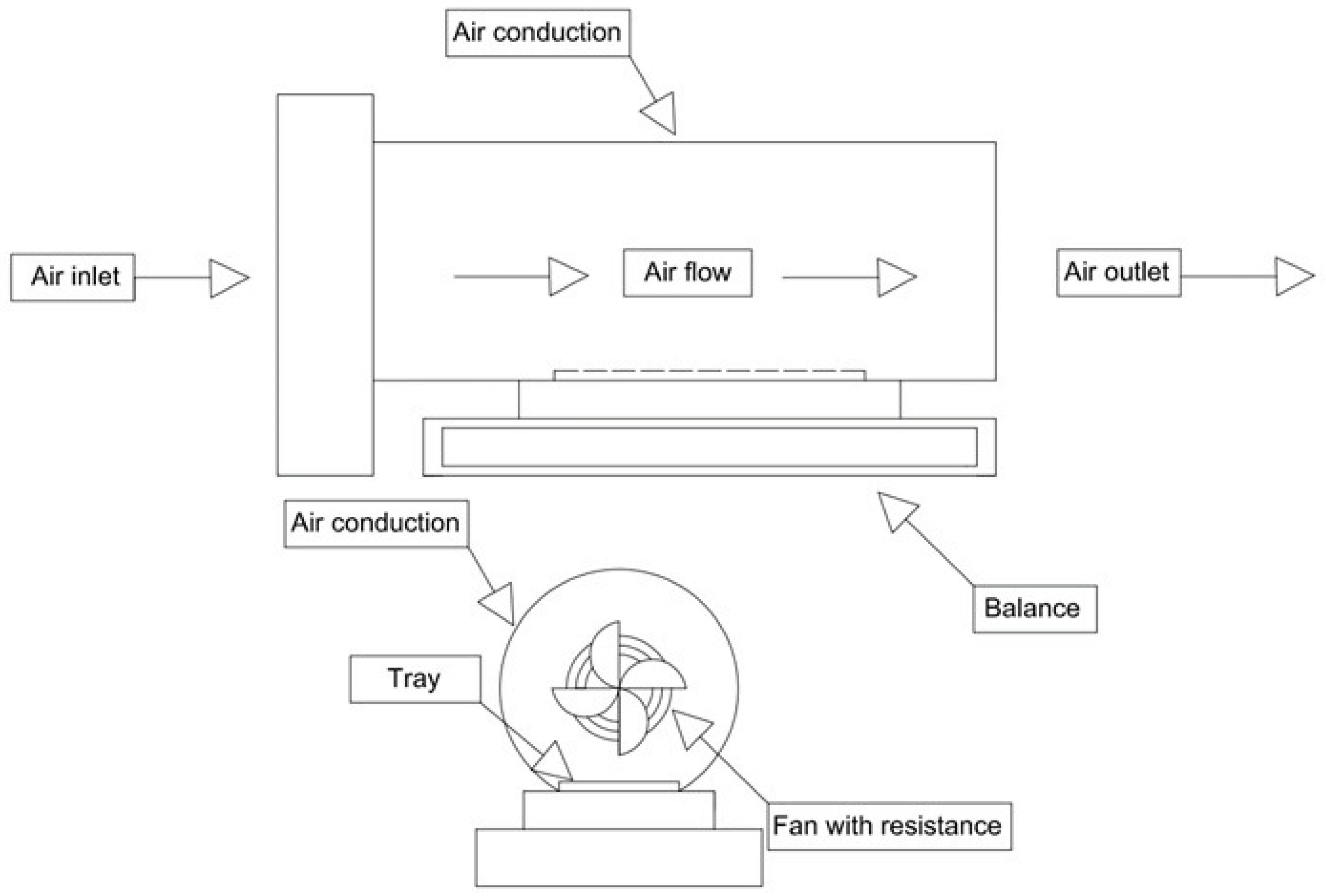
Figure 2.
Effect of drying process on the weight loss of bracts (A), stems (B) and hearts (C) of artichoke heads previously blanched by immersion (3 and 15 min) and steam (3 and 15 min), or unblanched (control) (mean(n=3)).
Figure 2.
Effect of drying process on the weight loss of bracts (A), stems (B) and hearts (C) of artichoke heads previously blanched by immersion (3 and 15 min) and steam (3 and 15 min), or unblanched (control) (mean(n=3)).
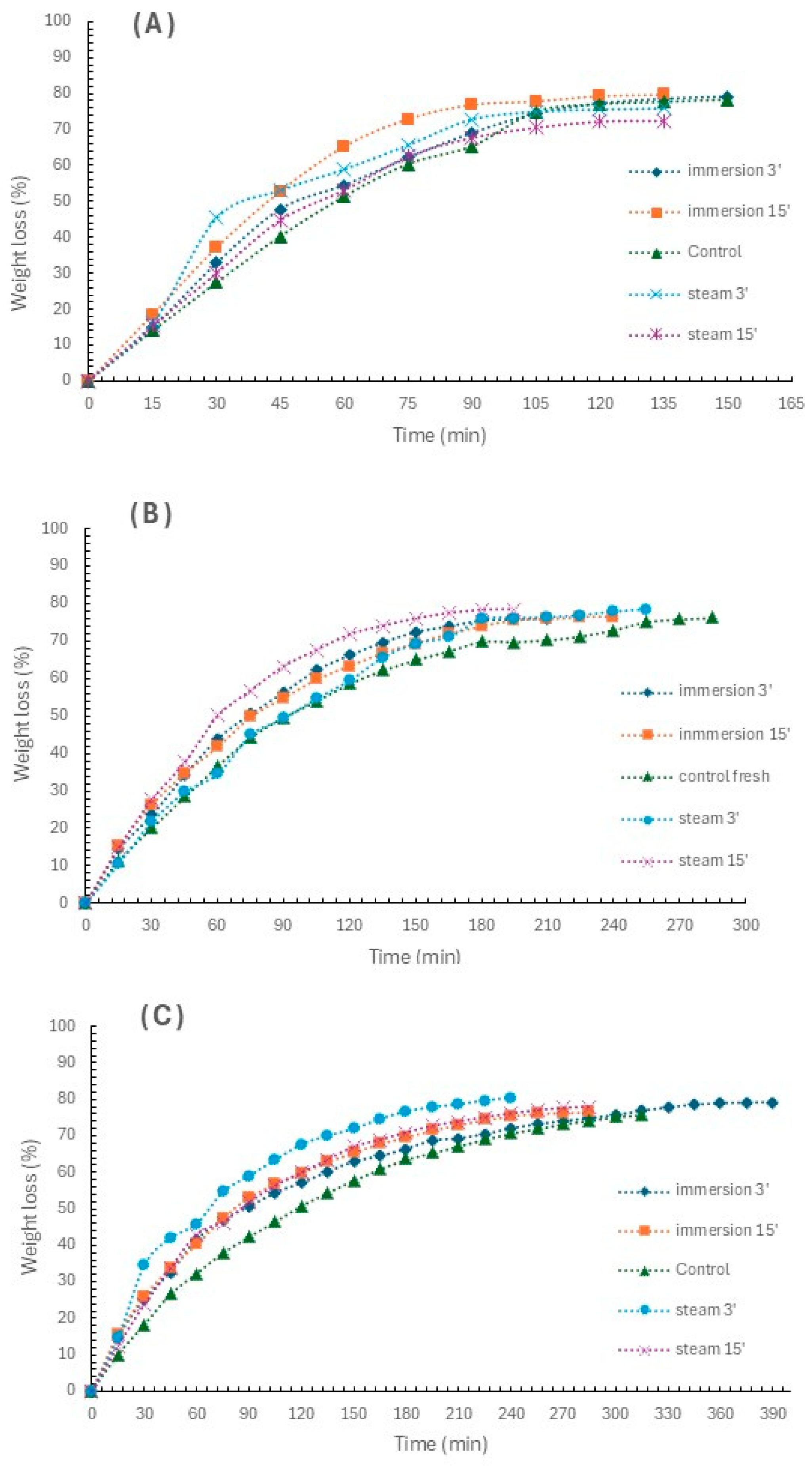
Figure 3.
Total phenolic content of different artichoke parts after different blanching treatments by immersion (3 and 15 min) and steam (3 and 15 min), or unblanched (control), and subsequent drying to obtain flours (mean(n=3) ±SD). Different letters indicate significant differences (p<0.05) for each fraction.
Figure 3.
Total phenolic content of different artichoke parts after different blanching treatments by immersion (3 and 15 min) and steam (3 and 15 min), or unblanched (control), and subsequent drying to obtain flours (mean(n=3) ±SD). Different letters indicate significant differences (p<0.05) for each fraction.
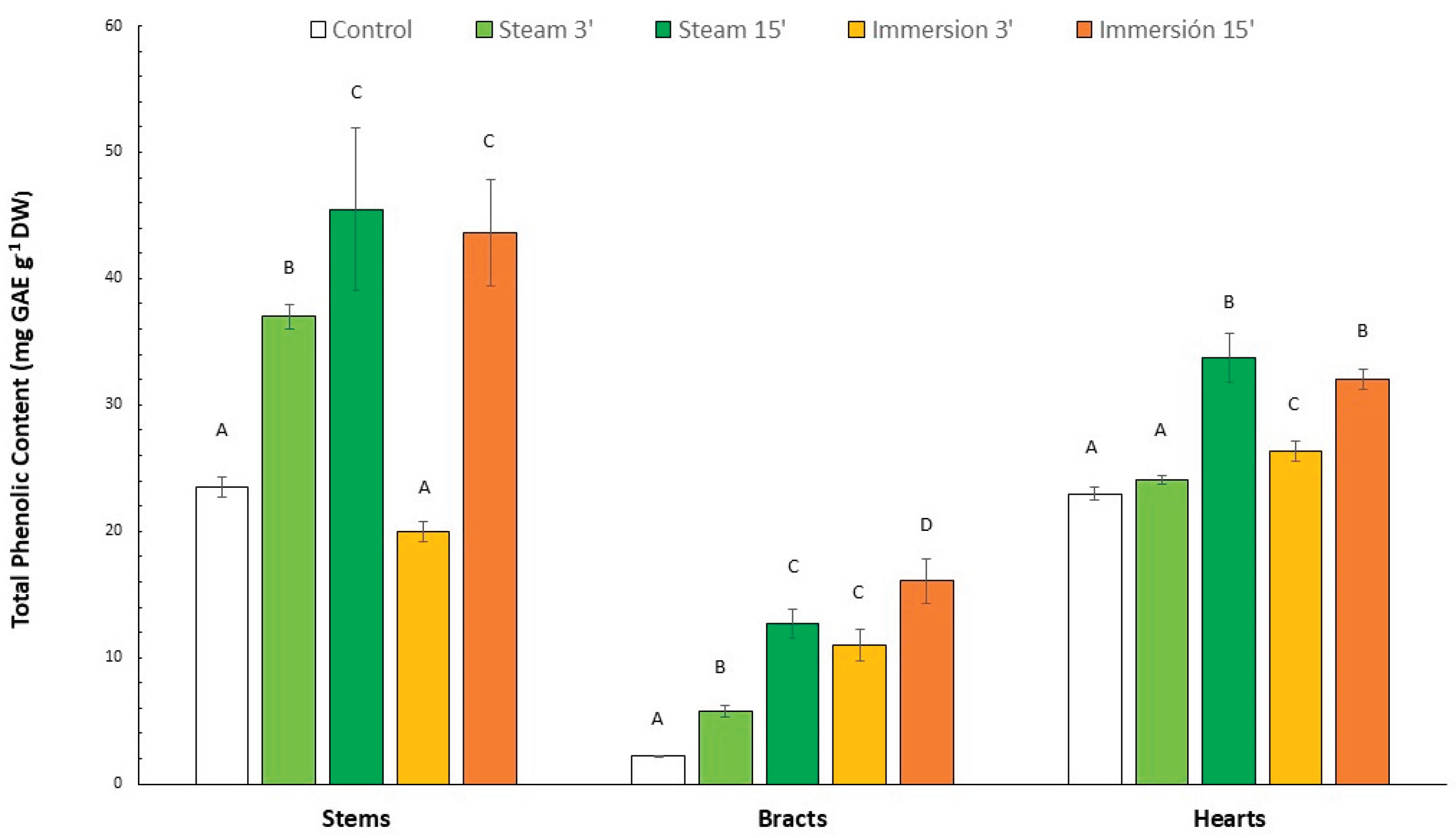
Figure 4.
Total antioxidant capacity of different artichoke parts after different blanching treatments by immersion (3 and 15 min) and steam (3 and 15 min), or unblanched (control), and subsequent drying to obtain flours (mean(n=3) ±SD). Different letters indicate significant differences (p<0.05) for each fraction.
Figure 4.
Total antioxidant capacity of different artichoke parts after different blanching treatments by immersion (3 and 15 min) and steam (3 and 15 min), or unblanched (control), and subsequent drying to obtain flours (mean(n=3) ±SD). Different letters indicate significant differences (p<0.05) for each fraction.
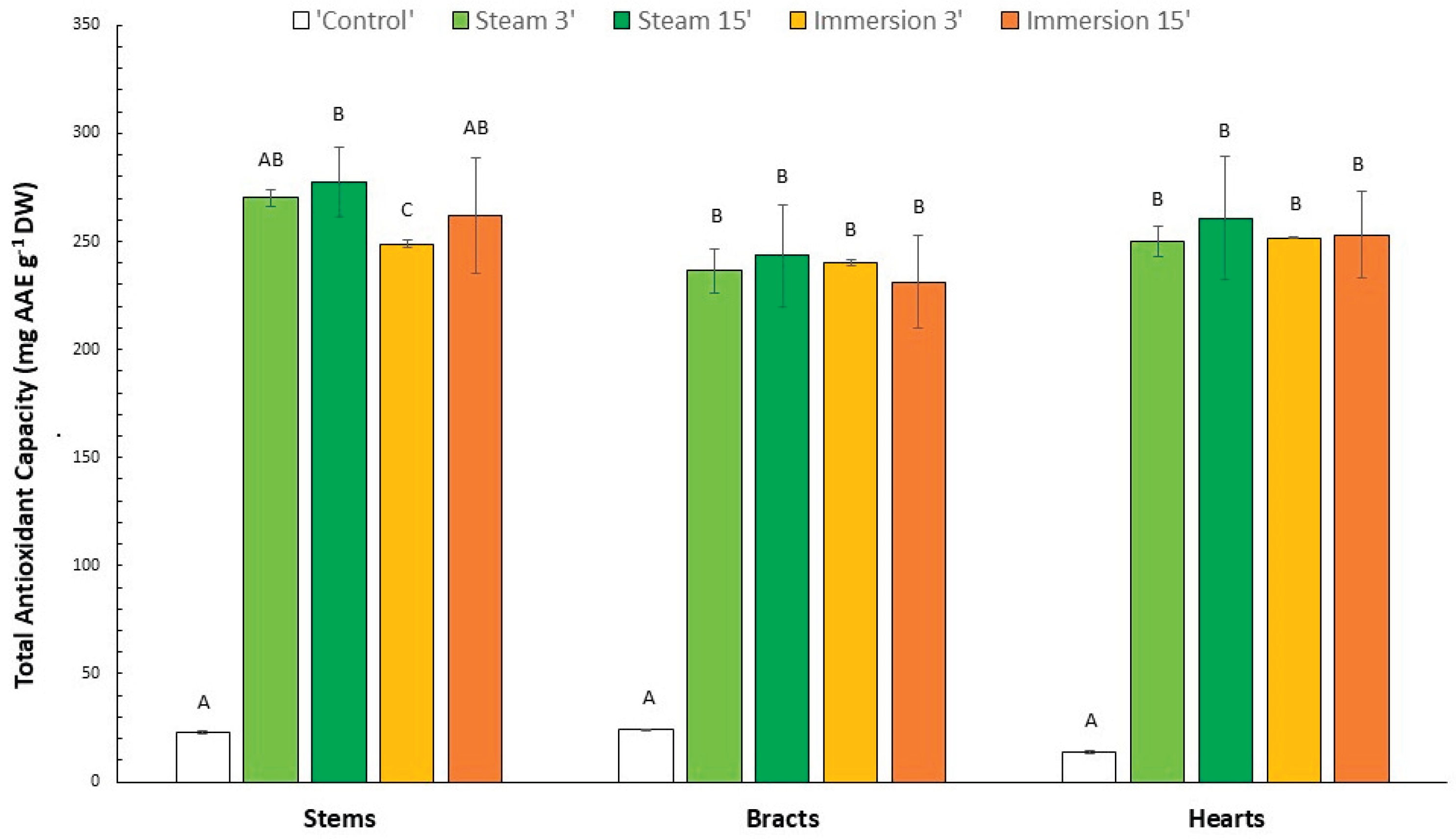
Figure 5.
Inulin content of different artichoke parts after different blanching treatments by immersion (3 and 15 min) and steam (3 and 15 min), or unblanched (control), and subsequent drying to obtain flours (mean (n=3) ±SD). Different letters indicate significant differences (p<0.05) for each fraction.
Figure 5.
Inulin content of different artichoke parts after different blanching treatments by immersion (3 and 15 min) and steam (3 and 15 min), or unblanched (control), and subsequent drying to obtain flours (mean (n=3) ±SD). Different letters indicate significant differences (p<0.05) for each fraction.
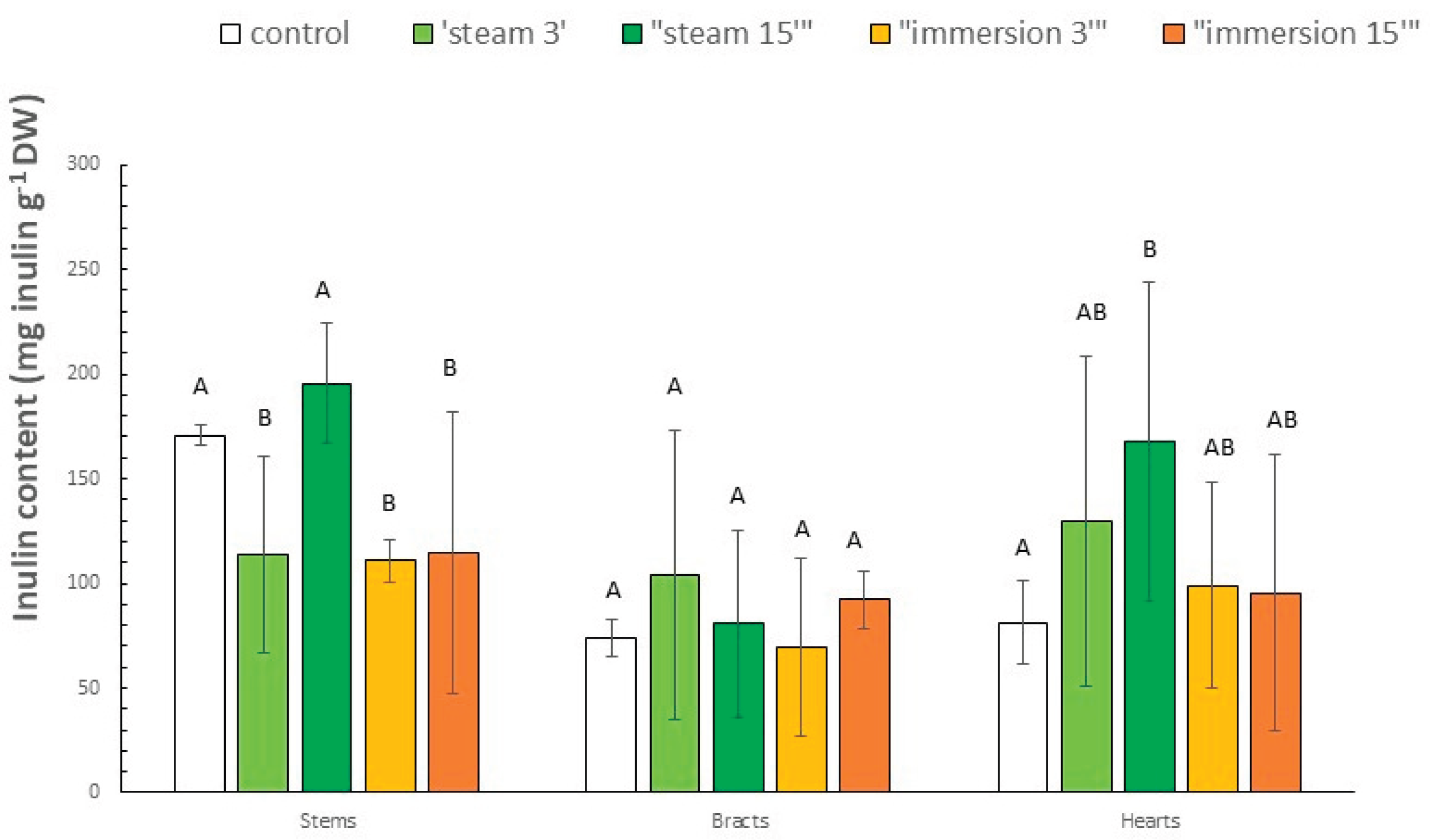

Table 1.
Color of different artichoke parts after different blanching treatments by immersion (3 and 15 min) and steam (3 and 15 min), or unblanched (control), and subsequent drying to obtain flours (mean (n=3) ±SD). Different letters indicate significant differences (p<0.05) for each fraction.
Table 1.
Color of different artichoke parts after different blanching treatments by immersion (3 and 15 min) and steam (3 and 15 min), or unblanched (control), and subsequent drying to obtain flours (mean (n=3) ±SD). Different letters indicate significant differences (p<0.05) for each fraction.
| Control |
Steam (3 min) |
Steam (15 min) |
Immersion (3 min) |
Immersion (15 min) |
|
| Bracts | |||||
| L* | 50.6 ± 0.1 c | 43.2 ± 0.68 d | 52.9 ± 0.36 b | 52.4 ± 0.47 b | 54.1 ± 0.1 a |
| a* | 0.5 ± 0.25 c | 7 ± 0.11 a | 2.4 ± 0.11 b | -2.5 ± 1.3 d | 1.1 ± 0.17 b |
| b* | 22.0 ± 0.17 b | 18.6 ± 0.75 c | 18.6 ± 0.05 c | 26.2 ± 1.2 a | 21.2 ± 0.41 b |
| BI† | 55.8 ± 0.25 c | 67.0 ± 1.4 a | 45.7 ± 0.22 e | 62.3 ± 1.4 b | 49.7 ± 0.95 d |
| TCD‡ | - | 47.5 ± 0.89 a | 56.1 ± 0.34 bc | 58.7 ± 0.95 b | 58.1 ± 0.14 c |
| hº | 1.54 ± 0.01a | 1.21 ± 0.01 c | 1.44 ± 0.1 b | -1.47 ± 0.04 d | 1.51 ± 0.1 a |
| Stems | |||||
| L* | 34.6 ± 0.11 d | 58.2 ± 0.75 b | 61.1 ± 1.5 a | 43.3 ± 1.3 c | 59.6 ± 0.47 ab |
| a* | 3.5 ± 0.51 a | 1.3 ± 0.15 b | 1.5 ± 0.68 b | 3.0 ± 0.1 a | -0.2 ± 0.2 c |
| b* | 14.3 ± 0.34 d | 23.5 ± 0.05 a | 21.0 ± 3.8 ab | 16.7 ± 0.41 cd | 19.0 ± 0.65 bc |
| BI | 59.5 ± 0.21 a | 52.0 ± 0.75 b | 42.9 ± 8.2 c | 52.6 ± 2.4 ab | 37.3 ±1.7 c |
| TCD | 45.5 ± 0.63 a | 46.9 ± 2.8 a | 29.4 ± 1.1 b | 44.6± 0.18 a | |
| hº | 1.33 ± 0.04 c | 1.51 ± 0.1 a | 1.49 ± 0.04 a | 1.39 ± 0.1 b | -1.55 ± 0.01 d |
| Hearts | |||||
| L* | 51.9 ± 0.1 a | 37.0 ± 2.3 d | 46.8 ± 0.05 b | 42.7 ± 0.58 c | 52.9 ± 1.7 a |
| a* | 5.1 ± 0.41 a | 6.4 ± 1.0 a | 2.5 ± 0.47 b | 6.0 ± 1.3 a | 3.2 ± 0.23 b |
| b* | 17.0 ± 0.15 b | 17.5 ± 1.3 b | 16.5 ± 0.63 b | 18.0 ± 1.3 ab | 19.4 ± 1.0 a |
| BI | 46.3 ± 0.34 c | 75.0 ± 2.5 a | 46.5 ± 1.1 c | 63.9 ± 5.6 b | 49.1 ± 3.8 c |
| TCD | 41.5 ± 2.7 a | 49.7 ± 0.23 c | 46.7 ± 1.14 b | 58.7 ± 0.95 c | |
| hº | 1.28 ± 0.02 b | 1.22 ± 0.04 b | 1.42 ± 0.03 a | 1.25 ± 0.05 b | 1.40 ± 0.01 a |
Table 2.
Correlations (R2) of color indexes (TCD, Total Color Difference; BI, Browning Index) with Total Phenolic Content (TPC) and Total Antioxidant Capacity (TAC) of different artichoke parts after different blanching treatments by immersion (3 and 15 min) and steam (3 and 15 min), or unblanched (control), and subsequent drying.
Table 2.
Correlations (R2) of color indexes (TCD, Total Color Difference; BI, Browning Index) with Total Phenolic Content (TPC) and Total Antioxidant Capacity (TAC) of different artichoke parts after different blanching treatments by immersion (3 and 15 min) and steam (3 and 15 min), or unblanched (control), and subsequent drying.
| Bracts | ||||
| TCD† | BI | TPC | TAC | |
| TCD | x | 0,6772 | 0,9274 | 0,0001 |
| BI | 0,6772 | x | 0,6811 | 0,0090 |
| TPC | 0,9274 | 0,6811 | x | 0,5323 |
| TAC | 0,0001 | 0,0090 | 0,5323 | x |
| Stems | ||||
| TCD | BI | TPC | TAC | |
| TCD | x | 0,3508 | 0,9396 | 0,8036 |
| BI | 0,3508 | x | 0,5745 | 0,1068 |
| TPC | 0,9396 | 0,5745 | x | 0,3252 |
| TAC | 0,8036 | 0,1068 | 0,3252 | x |
| Hearts | ||||
| TCD | BI | TPC | TAC | |
| TCD | x | 0,9144 | 0,9274 | 0,3260 |
| BI | 0,9144 | x | 0,9662 | 0,6132 |
| TPC | 0,9274 | 0,9662 | x | 0,3335 |
| TAC | 0,3260 | 0,6132 | 0,3335 | x |
Disclaimer/Publisher’s Note: The statements, opinions and data contained in all publications are solely those of the individual author(s) and contributor(s) and not of MDPI and/or the editor(s). MDPI and/or the editor(s) disclaim responsibility for any injury to people or property resulting from any ideas, methods, instructions or products referred to in the content. |
© 2025 by the authors. Licensee MDPI, Basel, Switzerland. This article is an open access article distributed under the terms and conditions of the Creative Commons Attribution (CC BY) license (http://creativecommons.org/licenses/by/4.0/).
Copyright: This open access article is published under a Creative Commons CC BY 4.0 license, which permit the free download, distribution, and reuse, provided that the author and preprint are cited in any reuse.


