
Submitted:
30 October 2025
Posted:
31 October 2025
You are already at the latest version
Abstract
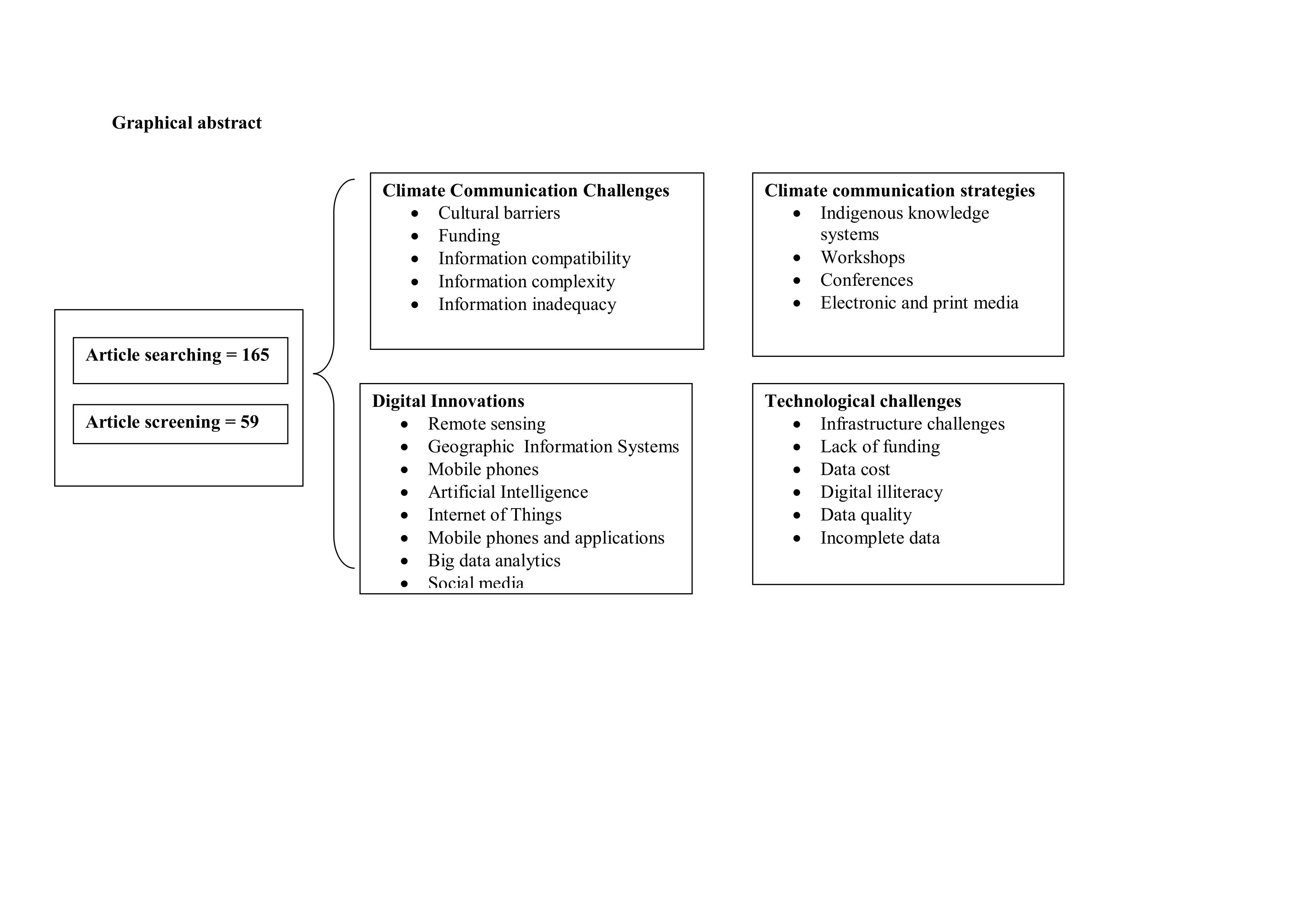
The effect of climate change has negatively impacted agricultural production and food security in the Sub-Saharan Africa region, particularly among smallholder farmers in Southern Africa. These challenges have been exacerbated the limitations in traditional agricultural communication systems and extension services. However, global innovations in digital technologies for communication provide opportunities for improving climate change information. This paper explores communication climate communication challenges among selected countries in the Southern African region and suggests how emerging digital technologies may be harnessed for climate communication among smallholder farmers. The review shows that while nations had embraced traditional digital technologies for communicating climate information, few innovations supported by emerging technologies have been developed to support climate communication among farmers. The review showed that farmers have continued to face several challenges in accessing and disseminating climate information. The review also shows that the few innovations that have been developed have remained at incubation level and a few of this innovation have been commercialized to support climate communication among smallholder farmers. The study therefore recommended further research on the integration of emerging technologies such as artificial intelligence, block chain technology and data analytics in climate change communication. The study further recommends policy interventions on improving accessibility of these emerging technologies among smallholder farmers.
Keywords:
climate communication
; Sub-Saharan Africa
; digital technologies
; climate resilience
; climate mitigation
1. Background
For some time international, regional and national organisations have grappled with the challenges of climate change. Climate change is among the most pressing global challenges, characterized by increasing variability in rainfall, temperature shifts, and more frequent extreme weather events such as floods and droughts (Khatibu and Ngowi, 2025). These challenges have been dominant in the developing world whose economies often rely on agriculture while the health sector has also been equally affected. In Sub-Saharan Africa, the effect has been severely reduced agricultural productivity while new diseases have emerged (Khatibu and Ngowi, 2025). Some key climate risks affecting households include drought, floods, storms, persistent droughts, crop and animal disease such as anthrax and foot and mouth dieses in livestock. The notable examples in Southern Africa has been recurrent cyclones such as the Cyclone El Nino, Cyclone Japhet and the most devastating among them, Cyclone Idai which resulted the loss of several thousands of lives, destruction infrastructure and the displacement of large populations in Mozambique, Madagascar and Zimbabwe. According to Onoja et al., (2022), so far, the responses to these threats have largely been confined to boosting economic growths and diverting economies from over reliance on agricultural resources that are vulnerable, developing new resilient technologies capable of adapting to the varying ecological conditions and climate change. In addition, to address these challenges of climate change, Climate Information Services (CIS) have emerged as a crucial tool to support proactive decision-making in agriculture (Khatibu and Ngowi, 2025). Climate information services developed and integrated into the traditional climate information communication services is nowadays driven by the digital technological development. These developments have witnessed the emergence of various technologies such as artificial intelligence, data analytics, cloud computing, block chain and the internet of things (IoT) now playing a vital role in the sharing of climate resilience information, to enable people to respond to and to recover from climate-related disasters. This study seeks identify how emerging digital technologies have been used for climate communication among countries in southern Africa.
2. Objectives
The main objectives of the study are:
- (i)
- Identify challenges in climate communication in Southern Africa
- (ii)
- Assess the strategies of climate communication in southern Africa
- (iii)
- Examine digital innovations in climate change communication in Southern Africa
3. Methodology
The study is s systematic literature review guided by the PRISMMA methodology. The review derives its findings from peer reviewed journal articles downloaded from Google Scholar, JSTOR, PLOS, DOAJ, Emerald Insight and Semantic Scholar. A total of 165 articles were downloaded from these databases and 59 articles were selected for the final review. The key search terms used for the retrieval of documents from the databases were” “Climate communication” OR “Digital technology” AND “Sub-Saharan Africa”, “Climate communication” AND “Sub-Saharan Africa”, and “Climate communication” OR “ICTs” AND “Sub-Saharan Africa”. The articles were selected based on abstract, title and keywords. This process resulted in the selection of 100 articles while 65 were discarded. The author then selected articles that were published between 2015 and 2025 and this process retuned 59 articles. The study therefore analysed 59 articles drawn from peer-reviewed journal articles, thesis, conference proceedings and book chapters. The process is represented on the PRISMA flow diagram in Figure 1 below.
3.1. Literature Sources
Table 1 below show that the major articles that were analysed in this study.
From Table 1 above, research on climate communication using digital technologies was dominated by research in Sub-Sahara Africa and this was followed by research on South Africa, Africa, Kenya, Ghana and Zimbabwe. Figure 2 above shows that there are few country studies carried out on digital climate communication among smallholder farmers in Sub-Saharan Africa.
3.2. Co-Citation and Occurrence of Keywords
Using Vosviewer, a total of 19 keywords with a minimum occurrence of 5 times formed a network shown in Figure 3 below.
From Figure 1 above, climate change was central to all the articles analysed and dominated occurrences in all articles where it co-occurred with such digital technologies as artificial intelligence, machine learning, Internet of Things and Blockchain. Climate change was also closely related to adaptation, climate adaptation, climate change adaptation, communication strategies and sustainable development. The results also showed that AI was closely linked to climate resilience, sustainable development and climate change and that the dominant literature focused on Africa. The analysis also showed the co-occurrence of Africa with climate information services, agriculture, climate change, climate change adaptation, communication strategies and block chain.
4. Findings and Discussions
4.1. Challenges in Climate Communication
The review sought to identify challenges that confronted SSA communities in sharing climate information. Table 2 above shows the sources and their contexts. From the results of various sectors impacted by climate change, among them agriculture, Chavula et al., (2024) reported that in Ethiopia, despite significant efforts by national agricultural research systems and other partners that boost agricultural production, much help is still needed, especially amidst the emerging challenges like climate change. While several innovations called Climate Information Services (CIS) have been developed, to enable communication Chavula and Kayusi (2025) says that many communities in Africa, efforts to utilise CIS in Africa face significant challenges, such as limited access to data, inadequate infrastructure, and language and cultural barriers. For those communities that have relied on indigenous local knowledge (ILK), Filho et al., (2024) say that there are several obstacles to effectively leveraging ILK towards climate change adaptation in Africa. For instance, the erosion of indigenous cultures and languages, often due to globalisation, urbanisation, and the influence of Western education, often threatens the transmission of indigenous knowledge from one generation to the next. Ngulube (2024) says that farmers also face climate communication challenges numerous challenges including budgetary limitations. In Zimbabwe, Makuvaro et al., (2023) reported that climate information was sometimes not readily available or was received late and sometimes recipients could not interpret information from the Meteorological Services Department. For Odoom et al., (2023) communicating climate information faced challenges such superficial public understanding, poor transition from public awareness to public action, and inadequate measures to deal with the pervasive sense of hopelessness in climate change adaptation.
To address these challenges, Tung et al., (2024) highlights the need to personalize messages, use trustworthy messengers, and apply participatory techniques to improve communication effectiveness next. Messages must be tailored to the specific needs of rural areas to successfully convey information about climate change adaptation. This requires engaging the community in the communication process and mobilizing trusted individuals or groups to convey information. By using these tactics, communication campaigns can close the information gap and encourage rural people to take action to adapt, thereby increasing their resilience to climate change. The need to understand the audience and conveying climate information through credible messengers, and the importance of engaging people emotionally or ensuring appropriate framing of the message have also been observed and (Odoom et al., (2023) saw no direct correlation between communication and behaviour change.
4.2. Strategies of Climate Communication in Southern Africa
From the review of literature, several strategies have been used to communicate climate information in SSA. These have ranged from traditional local knowledge systems to more advanced digital technologies. In a study by Matandirotya et al., (2024) on the communication of climate information and climate change adaptation in the Limpopo and Zambezi River Basins among the baVhenda population, local knowledge remains invaluable for indigenous communities particularly in areas such as weather prediction, drought early warning, managing seasonal food scarcity, and determining the start and end of rainy seasons. However where decisions on media choice for climate information communication are made, the selection of media may vary from one context to the other and sometimes media choices are determined by how the information must be packaged for the intended recipients (Sarku et al., 2025). For example, in several SSA countries among them namely Nigeria, Uganda, and South Sudan Sansa-Otim, et al., (2022) reported that radios and the television were preferred communication media for weather information. Zougmoré and Partey (2022) also reported that in West Africa, the TV, radio and mobile phones were the most frequently used ICT platforms for receiving agricultural and climate information. Other findings by Yohannis et al.,(2019) in rural Kenya disclosed that the radios, television, computers combined with the mobile phone were commonly available, accessible and cost-effective ICT tools that played a role in improving rural women’s access to real-time, relevant climate and agro-advisory information reducing information asymmetry in rural settings. However in South Africa and Namibia, Shimhanda and Vivian (2022) said that newspapers played a significant role in climate communication although the several of these newspapers were alarmist. In Zambia, according to Muteba (2020), presently, the media used for climate communication included newspapers, magazines, radios, television channels and internet-based forms such as social media, websites and weather apps. In a study by Sarku et al., (2025) on new ICT strategies for communicating climate information in Ghana, findings show that farmers predominantly rely on local or indigenous knowledge and traditional ICTs like radio and television for CIS, new ICTs including: Website on weather information, Bulletin on social media: Facebook, WhatsApp weather forecast presented as a flyer, YouTube video on weather information, Short message service (SMS), Audio WhatsApp weather forecast and Weather apps were identified, providing daily, weekly and seasonal forecasts outlooks.
On the other hand, non-media communication channels are communication channels not done through media, such as, conferences, round-table discussions, peer-to-peer chats, formal and informal education, as well as workshops. McGahey, and Lumosi et al.,(2018) however, argued that most climate communication strategies were top-down and not participatory. According to the reviews by McGahey, and Lumosi et al., (2018) approaches that involve face-to-face communication are often more persuasive and effective at influencing personal behaviour than mass-media communication. However, while these dialogic forms of communication counter the shortcomings of a prior tendency for top-down, one-way technocratic information dissemination approaches, there may be an apparent trade-off to be made between the urgency and scale of the response required, and the need for more effective, interactive approaches that facilitate social learning. Appiah et al., (2025) also examined the potential of social network in facilitating climate information access among smallholder farmers in the Sub-Saharan region. The face-to-face communication of climate information in the local language of the farmer, through farmers’ social networks, was reported to be a more efficient way to access information than through the conventional media like radio, television, mobile phones and print media. The flow of climate information through farmers’ social networks was found to break the language barrier and ensured timely access and timely decision-making. As such, in many African communities, Chari (2016) argues that the communication of climate change science in Africa could be better served by integrating digital technologies of communication and indigenous communication systems that embrace existing local knowledge in order to create more awareness and knowledge about climate change issues in Africa.
This need to integrate several strategies has then seen nations adopting multiple approaches to climate communication and sometimes customising this application to specific communities. For example in SSA, Khatibu and Ngowi (2025) say that effective methods can be customized for example, mobile apps with visual was reported to significantly increase uptake together with the use of the radio for weather forecasts in Kenya. The use of radio, the television and even newspapers for climate communication according to Onyancha and Onyango (2020) was the dominant because they provided information in simple formats easily understood. Besides mobile app, SMS was also popular among communities in Burkina Faso but these tools were popular among females while males favoured extension agents, print media, and television, while women prefer radios and social groups. In Zimbabwe, Mayoyo et al., (2023) reported that among technologies used for climate communication were mobile devices and social media, remote sensing technologies (GIS, GPS and satellite imagery). The technologies were then blended into precision agriculture which also relied on big data, cloud, analytics and cyber security, agricultural data analysis, advisory services, artificial intelligence, and blockchain technologies to enable the traceability of information.
According to Mirjana Stankovic et al., (2021) several ICT tools have been used in SSA for monitoring and analysis of climate-related hazards and vulnerabilities are becoming common tools for climate change adaptation. These technology tools include remote sensing, numerical modelling, GISs, broadband, satellite-based vegetation indices, satellite rainfall estimates, gridded rainfall time series to provide historical context, and flood monitoring. These types of systems allow timely communication with individuals and communities about potential changes in the climate system, such as drought, flood etc. These systems can then feed information into specific models such as those for famine monitoring, flood mapping or operational crop yield forecasting, to ascertain climate change vulnerability. Another researcher who cited similar technologies for climate communication is Amarnath (2020) who said that in the Gash River Basin of Sudan, in order to benefit from spate irrigation, the general information needed by farmers in this region that included timely forecasts detailing when and where floods may occur and spatial monitoring of actual crop growth and moisture conditions, remote sensing (RS) from satellite data presented a range of opportunities for providing such information. The efficacy of these technologies was proven in Zambia, by Chimanga and Kanja (2020) who attributed this to the wide availability of hand-held devices such as mobile phones and PDAs which facilitated internet access which enable users to access information for climate awareness capacity building and sustainability helping these farmers to adapt to its effects. The Sub-Saharan Region has seen a number of projects for climate communication. Carr et al., (2020) also investigated climate information services in Sub-Saharan Africa and identified several projects that had been developed for the purpose. From the technological developments that have occurred in the digital environments, other strategies have also emerged, blending traditional models of communication, digital-mediated innovations and newer emerging technologies.
4.3. Digital Innovations in Climate Change Communication
To effectively address climate resilience in rural Southern Africa, there is a need to integrate digital technologies into conventional decision making processes. This enables rural-based sectors to assess their sensitivity to climate change, anticipate the future impacts, and plan to improve resilience (Chapungu et al., 2024). According to Muchunku and Ageyo (2022) in East Africa, emerging communication trends suggest that audiences are increasingly more interested in hyper-local content although climate change by its very nature, is a global phenomenon, even if its impacts are experienced at a local level. Digital platforms have made it easier for communities to connect their realities with global trends and benchmark with the best practices around the world in crafting local solutions. Chapungu et al., (2024) list several innovations for digital climate communication in SSA and some of them are:
- (a)
- Remote sensing technologies, for example, drones, satellites, satellite- receiving stations in Zimbabwe, South Africa, Namibia, Botswana, and Mozambique where they have been used for Examining environmental variables for climate resilience strategies Climate vulnerability assessments Climate impact assessment Veld fire monitoring
- (b)
- Mobile phones in Malawi, Zimbabwe, South Africa, Namibia, Botswana, Mozambique, Angola, Lesotho, and Eswatini where they have been used for Climate and weather information dissemination Early warning Agricultural information dissemination
- (c)
- Machine learning in Malawi, Zimbabwe, South Africa, Namibia, Botswana, Mozambique, Angola, Lesotho, and Eswatini where they have been used for Climate projections Analyzing satellite imagery to detect changes in land use and vegetation
- (d)
- Deep learning in Malawi, Zimbabwe, South Africa, Namibia, Botswana, Angola, Mozambique, Lesotho and, Eswatini where they have been used for Monitoring deforestation, guiding land-use planning.
- (e)
- The Internet of Things in Malawi, Zimbabwe, South Africa, Namibia, Botswana, Mozambique, Angola, Lesotho, and Eswatini where they have been used for Data collection, communication, processing, and actionable intelligence by farmers, agricultural extension officers, climate disaster experts, and other stakeholders.
These examples have shown that ICT tools can boost agricultural output and promote resource sustainability and efficiency. This is because they provide data and information on early warning systems, new varieties, production optimisation, and managing diseases and pests which are effective for on-farm decision-making. This is enabled by technological capabilities for efficient capturing, storing, retrieving, and disseminating of market information, market intelligence, and agricultural extension rely on ICTs (Ngulube, 20024). With the scourge of climate change affecting most developing countries, research on digital technologies for climate communication has increased, resulting in the emergence of several innovations. Among these innovations is Artificial intelligence (AI). According to Chavula and Kayusi (2025) AI technologies, such as machine learning, natural language processing (NLP), and big data analytics, offer promising solutions to these challenges by improving data collection, processing, and communication. The major benefits of using AI are derived from Machine learning algorithms because in climate communication and climate data processing, they enhance the accuracy of climate forecasts and provide tailored advisory services for agriculture and disaster risk reduction. AI’s technical capabilities such as predictive modelling, optimization algorithms and pattern recognition also directly contribute to resilience in different ways across sectors. For instance, in agriculture, AI-based predictive models can enable farmers to anticipate droughts or pest outbreaks, thus safeguarding crop yields. Additionally, NLP can bridge the communication gap by translating complex climate data into local languages, making it accessible to rural communities where communication os often a challenge.
Big data analytics enables the integration of diverse datasets to generate comprehensive climate models and risk assessments. Filho and Gbaguidi (2024) also said that in Africa,the integration of big data and AI technologies can significantly assist farmers in making data-driven decisions that optimise crop yields and resource use. Through the integration of AI-powered drones and satellite imagery, farmers can monitor crop health, soil conditions, and weather patterns in real-time. According to Mbuvha, et al., (2024), and Rolnick et al., (2022), the integration of big data and AI is rapidly gaining traction as an essential tool for adaptation and mitigation to climate change because the technologies supported climate modelling and forecasting, sustainable energy, transportation, and infrastructure development. These applications clearly demonstrate AI’s ability to enhance climate resilience by improving predictive capabilities and enabling adaptive responses to climate change. Ayodele et al., (2025) also examined the role of AI in enhancing climate adaptation and mitigation efforts in Africa with particular emphasis on the use of machine learning and remote sensing technologies to support real-time data analysis, land-use classification, water resource management, and early warning systems. The study demonstrated how the fusion of satellite and ground-based data can significantly improve climate services in sectors such as agriculture. Moreover, AI’s ability to adapt and localize forecasts for specific regional climates is a critical asset in Africa, where climate systems are governed by highly variable and complex drivers. Another researcher who further explored the usage of AI in disseminating early warning on climate risks using AI is Reichstein et al., (2024). However, they highlighted the FATES (Fairness, Accountability, Transparency, Ethics, and Sustainability) principles as essential for equitable and trustworthy AI-based Early Warning Systems for all. Cowls et al., (2023) also examined the possibility of leveraging artificial intelligence to combat climate change and argued that leveraging the opportunities offered by AI for global climate change whilst limiting its risks is a gambit which requires responsive, evidence-based, and effective governance to become a winning strategy. According to Cowls et al., (2023) however, the ability of AI to process enormous amounts of non-structured, multi-dimensional data using sophisticated optimisation techniques is already facilitating the understanding of high-dimensional climate datasets and forecasting of future trends (Huntingford et al. 2019) such as global temperature changes (Ise and Oba 2019; Cifuentes et al. 2020), to predict climactic and oceanic phenomena such as El Niño (Ham et al., 2019), cloud systems (Rasp et al. 2018), and tropical instability waves (Zheng et al., 2020), and to better understand aspects of the weather system generally (Sønderby et al., 2020; Larraondo et al. 2020). AI tools can also help anticipate the extreme weather events that are more common as a result of global climate change, for example heavy rain damage (Choi et al., 2018) and wildfires (Jaafari et al., 2019). In many cases, AI techniques can help to improve existing forecasting and prediction systems, for example by automatically labelling climate modelling data (Chattopadhyay et al. 2020), improving approximations for simulating the atmosphere (Gagne et al., 2020), and separating signals from noise in climate observations (Barnes et al., 2019). Chavula and Kayusi (2025) also cite several studies that examine the usage of AI in climate information communication through AI-assisted Modeling (Si et al. 2018; Kassam et al. 2019; Mukarumbwa and Taruvinga, 2023), climate model evaluation (Eyring et al., 2019), climate model selection (Salman et al. 2018), multi-risk assessment (Terzi et al., 2019) and ecological modelling (Yates et al., 2018) among others. However, Ayadi et al., (2025) reported that the usage of AI for climate communication in Africa is still under-represented.
The internet of things (IoT) has also been gaining traction in climate communication. The IoT connects various devices and sensors to collect and analyse data, and in climate communication, improving the efficiency in assisting small-scale farmers with their climate change management and monitoring (Chizema et al., 2024). The study by Adebayo et al., (2024) in Nigeria demonstrated the potential of IoT technology as a pivotal tool in developing innovative responses to climate change challenges. It demonstrated how IoT could bolster Nigeria’s climate resilience through enhanced agricultural methods and better management of water resources. Nigussie et al., (2020) also proposed an IoT architecture for rural societal services including climate communication and resilience in Sub Saharan Africa. According to Nigussie et al., (2020) the use of IoT in the agricultural sector has been proposed for several purposes, such as in irrigation management, precision farming, predicting droughts, and microclimate monitoring. Related to the IoT is remote sensing and Convolutional Neural Networks (CNN), both identified as a highly effective for flood predictive modelling. The study by Nigussie et al., (2020) acknowledged the vital role of fully connected CNNs because of their capability to outperform machine learning methods like Random Forest and Support Vector Machines, thus improving the predictive accuracy across different data granularities (Sibandze et al., 2025; Panahi et al. 2021; Khosravi et al. 2020). The use of IoT for climate communication can be further enhanced if blockchain is integrated in the information value chain. According to Bikoro (2021), the use of blockchain in climate communication enhances transparency and security of information. These benefits are enhanced when these technologies are integrated with IoT.
Social media has also been used for climate communication. Mawila (2024) in investigating the communication of climate information in South Africa says that social media tools had gained wide popularity among the youths was Tiktok. Tella (2024) also cites some literature that ranks social media popularity on the basis of usage levels to disseminate environmental information in Kenya and these include: YouTube, Facebook, Instagram, WhatsApp, Twitter and LinkedIn among others. The same is true of South Africa where social media continues to permeate climate change communication strategies (Tella, 2024). Kachali (2020) also investigated the usage of social media by the youths in accessing and disseminating climate information in Malawi and reported that the use of social media was common among the youths with sites like YouTube, Facebook, Twitter, Instagram , Web 2.0, Whatsapp, Telegram, LinkedIn, Instagram and Snapchat providing almost everything to satisfy youngsters’ curiosity to explore, ranging from chatting to blogging, uploading and exchange of videos and wall posts, online games and to sharing pictures.
4.4. Technological Challenges in Climate Communication
Although there have been attempts to integrate modern digital technologies, countries in the SSA region have faced many challenges. Nkambule and Agholor (2021) in their investigation of the usage of ICTs for agricultural and climate communication in South Africa reported several challenges and these challenges were grouped into three main categories, namely, access challenges, quality challenges, and cost challenges. Other challenges were related to lack of infrastructure such as water and electricity, telecommunications, and transport (Phiri et al. 2019; Lokeswari, 2016). Phiri et al. (2019) also reported that low levels of literacy also affected the development of rural people and their efforts to adopt digital technologies for climate communication. In the Zambezi basin, Mayoyo et al., (2023) reported that the main challenges faced b rural communities in using digital tools for climate information communication the following: limited awareness, lack of digital skills, and the poor digital infrastructure for connectivity. Other challenges were specific to some applications. For example, the usage of social media was hindered by limited access to smart phones, unavailability of the internet, language barriers, complexity of some mobile applications, high data costs, high cost of acquiring new technologies such as GPS, lack of electricity, poor programing for radio and television when programmes are broadcast when most potential viewers will be outdoors and unavailability of local content. Another challenge faced by these communities was deductions as a result of SMS subscriptions for climate and weather information from mobile services companies. Filho and Gbaguidi (2024) while acknowledging the potential benefits of using AI in climate communication also cite several issues that may hinder the usage of these technologies in climate communication. This is because AI systems rely on large volumes of data and AI models may produce unreliable results if the data is inaccurate, incomplete, or outdated. For many agrarian communities in Africa lack comprehensive and up-to date agricultural and environmental data limits the effectiveness of AI solutions. Filho and Gbaguidi (2024) further acknowledges the inherent challenges of using AI systems among them biases in the training data, leading to unfair outcomes. These challenges coupled with the unavailability of technological infrastructure, limited internet connectivity, lack of reliable power supply, and inadequate technological infrastructure all hinder efforts to integrate AI in climate communication for supporting rural farmers in SSA. . In implementing AI in climate communication, Chavula, Kayusi and Juma (2024) reported that the major challenges may be categorised as Infrastructure and Connectivity Challenges and Data Availability and Quality challenges. Sub-Saharan Africa faces significant infrastructure development challenges. Its infrastructure is seriously underdeveloped, so that, for example, the phone system in the region is worse than that in many other regions (Chavula, Kayusi, and Juma, 2024). In addition to these constraints, the price of such services, where they exist, is high. Users normally face long delays and high costs in obtaining basic telecommunications services. Chavula and Kayusi (2025) also identified several challenges in efforts to use AI in climate communication and some of these challenges are lack of data, data inaccuracy, lack of infrastructure and language and cultural barriers. This challenge becomes more alarming when considering the human and social dimensions of climate vulnerability, where current AI-driven approaches often fail to engage with the lived realities, traditional knowledge systems, and unique challenges of rural populations (Olatade and Mogaji, 2025). According to Naidoo (2024) it is important to note that not all farmers readily adopt AI due to the various challenges they face in embracing this innovation. According to According to Naidoo (2024) the digital divide is a significant issue in modern society, highlighting the challenges individuals face in fully utilizing the benefits of Information and Communication Technology (ICT). Cowls et al., (2023) also investigated the challenges of integrating AI in climate communication. They argued that the introduction of AI into the climate domain risks amplifying several social and ethical challenges already associated with AI more generally, such as unfair bias, discrimination, or opacity in decision-making. However, they also say that ethical challenges caused by AI may take on novel forms in this context, and, therefore, require careful responses. These challenges also hindered the usage of IoT (Ngulube, 20024; Soeker et al., 2021). Ngulube (2024) also reported that smallholder farmers, particularly those in developing nations like Tanzania, face challenges with the accessibility and viability of digital services. In implementing blockchain for climate communication, Brummer (2024) acknowledges the challenges associated with blockchain adoption, including issues related to data governance, interoperability, regulatory frameworks, implementation costs, and the need for stakeholder education. The research underscores the importance of sector-wide consensus and standardisation efforts to overcome these challenges and facilitate the transition from blockchain pilots to enduring implementations.
5. Conclusions
The review shows the existence of interest among researchers on the usage of traditional media such as the radio, the television and newspapers for climate communication. Other non-media approaches that have dominated climate communication include workshops, conferences, and village gatherings. However, these have not adequately address the climate information needs of smallholder farmers in the Sub-Saharan region. To address these limitations therefore, new digital media such as the internet, social media, the Internet of things and artificial intelligence have also been used to communicate information. The introduction of digital technologies in climate communication has faced several challenges such as infrastructural challenges, cost, availability, accessibility, and data quality and data security in the usage of digital technologies by smallholder farmers. These challenges have also been exacerbated by digital and data illiteracy among smallholder farmers in the Sub-Saharan Africa.
Recommendations
Emerging technologies such as AI have been acknowledged to provide personalised and customised information. However these innovations have been minimal in the Sub-Saharan Africa. This review therefore recommends the development of AI-focused communication strategies. This can be enhanced by incentivising the development of AI-driven communication strategies and climate response technologies. Other challenges that confront AI adoption are ethical dilemmas such as data privacy, data security, incomplete data, data inaccuracy and algorithms bias. The review therefore recommends auditing AI systems for adherence to ethical principles in the adoption and usage of AI. It is also recommended that plural knowledge systems are adopted and integrated into digital communication of climate information. In many Sub-Saharan communities, smallholder farmers have relied on IKS but these approaches have lost appeal among the modern farmers. The study further recommends that investments be made in climate information production and communication. However, this should be in collaboration with colleges, universities, humanitarian agencies and the government.
References
- Adebayo, A., Victor, P. O., Oyedeji, O. C., Adebayo, A. V. and Mubarak, A. M. (2024). Climate change effect in nigeria mitigation, adaptation, strategies and way forward in the world of Internet of Things. International Journal of Innovative Science and Research Technology. 9(4). [CrossRef]
- Ayadi, R.; Forouheshfar, Y.; Moghadas, O. Enhancing system resilience to climate change through artificial intelligence: a systematic literature review. Front. Clim. 2025, 7, 1585331. [Google Scholar] [CrossRef]
- Ayodele, O. J.; Izuchukwu, A.; Abiola, D. S. Leveraging Artificial Intelligence for Climate Change Mitigation in Africa: A Sustainable Approach. World Journal of Innovation and Modern Technology ISSN 2682-5910.. 2025, 9(6). [Google Scholar]
- Brummer, U. (2024). Blockchain technology for agriculture traceability systems in South Africa. Master of management thesis. Graduate School of Business, University of Cape Town.
- Carr, E. R.; Goble, R.; Rosko, H. M.; Vaughan, C.; Hansen, J. Identifying climate information services users and their needs in Sub-Saharan Africa: a review and learning agenda. Climate and Development 2020, 12(1), 23–41. [Google Scholar] [CrossRef]
- Chapungu, L., Togo, M., and Raimundo, I. (2024). Prospects and Challenges for Adopting Artificial Intelligence and Digital Tools in Climate Resilience in Rural Southern Africa: A Systematic Review. In Editors Climate Change Resilience in Rural Southern Africa: Dynamics, Prospects and Challenges. Springer.
- Chari, T. Rethinking climate change communication strategies in Africa: The case for indigenous media. Indilinga-African Journal of Indigenous Knowledge Systems 2016, 15(2). [Google Scholar]
- Chattopadhyay, A.; Hassanzadeh, P.; Pasha, S. Predicting clustered weather patterns: a test case for applications of convolutional neural networks to spatio-temporal climate data. Sci Rep 2020, 10(1), 1317. [Google Scholar] [CrossRef]
- Chavula, P.; Kayusi, F. Role of Artificial Intelligence in Disseminating Climate Information Services in Africa. LatIA 2025, 3, 76. [Google Scholar] [CrossRef]
- Chavula, P.; Kayusi, F.; Juma, L. Leveraging Artificial Intelligence for Enhancing Wheat Yield Resilience Amidst Climate Change in Sub-Saharan Africa. LatIA 2024, 2024; 2, 88. [Google Scholar] [CrossRef]
- Chimanga, K.; Kanja, K. The Role of ICTs in Climate Change Adaptation: A Case of Small Scale Farmers in Chinsali District. Mathematics and Computer Science 2020, 5(6), 103–109. http://www.sciencepublishinggroup.com/j/mcs. [CrossRef]
- Chizema, T. R., Dlamini, P., Van Greunen, D., and Msomi, S. (2024). The Perceived Influence of Internet of Things on Precision Agriculture for Small-Scale Farming. IST-Africa 2024 Conference Proceedings Miriam Cunningham and Paul Cunningham (Eds)IST-Africa Institute and IIMC, 2024, ISBN: 978-1-905824-72-4.
- Choi, C.; Kim, J.; Kim, J.; Kim, D.; Bae, Y.; Kim, H. S. Development of heavy rain damage prediction model using machine learning based on big data. In Research article. Advances in meteorology; Hindawi, 2018. [Google Scholar] [CrossRef]
- Cifuentes, J.; Marulanda, G.; Bello, A.; Reneses, J. Air temperature forecasting using machine learning techniques: a review. Energies 2020, 13(16), 4215. [Google Scholar] [CrossRef]
- Cowls, J.; Tsamados, A.; ·Taddeo, M.; Floridi, L. The AI gambit: leveraging artificial intelligence to combat climate change—opportunities, challenges, and recommendations. AI & SOCIETY 2023, 38, 283–307. [Google Scholar] [CrossRef]
- Eyring, V.; Cox, P. M.; Flato, G. M.; Gleckler, P. J.; Abramowitz, G.; Caldwell, P. Taking climate model evaluation to the next level. Nat Clim Chang. 2019, 9(2), 102–10. [Google Scholar] [CrossRef]
- Filho, W. L; Lütz, J. M.; Totin, E.; Ayal, D.; Mendy, E. Obstacles to implementing indigenous knowledge in climate change adaptation in Africa. Journal of Environmental Management 2024. [Google Scholar] [CrossRef] [PubMed]
- Filho, W. L.; Gbaguidi, G. J. Using artificial intelligence in support of climate change adaptation Africa: potentials and risks. In Humanities and Social Sciences Communications; 2024. [Google Scholar] [CrossRef]
- Gagne, D. J.; Christensen, H.M.; Subramanian, A.C.; Monahan, A.H. Machine learning for stochastic parameterization: generative adversarial networks in the Lorenz ’96 model. J Adv Model Earth Syst 2020. [Google Scholar] [CrossRef]
- Ham, Y.G.; Kim, J.H.; Luo, J.J. Deep learning for multi-year ENSO forecasts. Nature 2019, 573(7775), 568–572. [Google Scholar] [CrossRef]
- Huntingford, C.; Jeffers, E.S.; Bonsall, M. B.; Christensen, H.M.; Lees, T.; Yang, H. Machine learning and artificial intelligence to aid climate change research and preparedness. Environ Res Lett 2019, 14(12), 124007. [Google Scholar] [CrossRef]
- Ise, T. and Oba, Y. (2019). Forecasting climatic trends using neural networks: an experimental study using global historical data. Front Robot AI. [CrossRef]
- Jaafari, A., Zenner, E.K., Panahi, M., and Shahabi, H. (2019). Hybrid artificial intelligence models based on a neuro-fuzzy system and metaheuristic optimization algorithms for spatial prediction of wildfire probability. Agric for Meteorol 266–267(March):198–207. [CrossRef]
- Kachali, R. (2020). Climate Change, Social Media And The African Youth: A Malawian Case Study. Master’s Thesis, Strategic Communication. School of Humanities, Education & Social Sciences Dissertation. UREBRO UNIVERSITET.
- Kassam, A.; Friedrich, T; Derpsch, R. Global spread of conservation agriculture. Int J Environ Stud. 2019, 76(1), 29–51. [Google Scholar] [CrossRef]
- Khatibu, S.; Ngowi, E. Effectiveness of climate information services in Sub-Saharan Africa’s agricultural sector: a systematic review of what works, what doesn’t work, and why. Front. Clim. 2025, 7, 1616691. [Google Scholar] [CrossRef]
- Khosravi, K.; Panahi, M.; Golkarian, A.; Keesstra, S.D.; Saco, P.M.; Bui, D.T; Lee, S. Convolutional neural network approach for spatial prediction of flood hazard at national scale of Iran. J. Hydrol. 2020, 591 (August), 125552. [Google Scholar] [CrossRef]
- Larraondo, P. R.; Renzullo, L. J.; Van Dijk, A. I. J. M.; Inza, I.; Lozano, J. A. Optimization of deep learning precipitation models using categorical binary metrics. J Adv Model Earth Syst 2020. [Google Scholar] [CrossRef]
- Lokeswari, K. A study of the use of ICT among rural farmers. International Journal of Communication Research 2016, 6(3). [Google Scholar]
- Makuvaro, V.; Chitata, T.; Tanyanyiwa, E.; Zirebwe, S. Challenges and Opportunities in Communicating Weather and Climate Information to Rural Farming Communities in Central Zimbabwe. Weather, Climate and Society 2023, 15(1), 109–119. [Google Scholar] [CrossRef]
- Matandirotya, N. R.; Filho, W. L.; Mahed, G.; Dinis, M. A. P.; Mathe, P. Local knowledge of climate change adaptation strategies from the vhaVenda and baTonga communities living in the Limpopo and Zambezi River Basins, Southern Afric. Inland Waters 2024, 14(3), 268–280. [Google Scholar] [CrossRef]
- Mawila, C. (2024). Framing of climate change in South Africa: An analysis of content in News24 and TikTok. master’s degree in journalism and media studies thesis. University of the Witwatersrand, Johannesburg, Republic of South Africa.
- Mayoyo, A,, Chapoto, A., Matchaya, G., Aheeyar, M., Chiwunze, G., Ebrahim, G., Ajayi, O.C., Afun-Ogidan, O., Fakudze, B. and Kasoma-Pele, W. (2023). Digital Climate Adaptation in Agriculture Profile for Zimbabwe. Internatinal Water Management Institute, Global Centre on Adaptation, and the African Development Bank. Colombo, Rotterdam and Abidjan.
- Mbuvha, R., Yaakoubi, Y., Bagiliko, J., Potes, S. H., Nammouchi, A. and Amrouche, S. (2024). Leveraging AI for Climate Resilience in Africa: Challenges, Opportunities, and the Need for Collaboration. (pp. 1-5). SSRN. [CrossRef]
- McGahey, D. J.; Lumosi, C. K. Climate Change Communication For Adaptation: Mapping Communication Pathways In Semi-Arid Regions To Identify Research Priorities. Journal of Sustainable Development in Africa 20(1) 2018. [Google Scholar]
- Muchunku, I. G.; Ageyo, J. New Media and Climate Change Communication: An Assessment of Utilization of New Media Platforms in Publication of Glocalized Climate Change Information by East Africa’s Science Journalists. International Journal of Academic Research in Environment & Geography 2022, 9(1), 36–48. [Google Scholar]
- Mukarumbwa, P.; Taruvinga, A. Landrace and GM maize cultivars’ selection choices among rural farming households in the Eastern Cape Province, South Africa. GM Crops Food 2023, 14(1), 1–15. [Google Scholar] [CrossRef] [PubMed]
- Muteba, T. (2020). Climate Communication for Adaptation Planning In the Tourism Sector In Livingstone, Zambia. Masters of Science in Environmental and Natural Resource Management Dissertation. The University of Zambia. Zambia.
- Naidoo, G. M. The Potential of Artificial Intelligence in South African Rural Development. In Special Edition of the Faculty of Humanities and Social Sciences; University Zululand, South Africa, 2024. [Google Scholar]
- Ngulube, P. Leveraging information and communication technologies for sustainable agriculture and environmental protection among smallholder farmers in tropical Africa. In Discover Environment; 2024. [Google Scholar]
- Nigussie, E., Olwal, T. O., Lemma, A., Mekuria, F. and Peterson, B. (2020). IoT Architecture for Enhancing Rural Societal Services in Sub-Saharan Africa. The 11th International Conference on Emerging Ubiquitous Systems and Pervasive Networks (EUSPN 2020) November 2-5, 2020, Madeira, Portugal. Procedia Computer Science 177 (2020): 338–344.
- Nkambule, T. B; Agholor, A. I. Information Communication Technology as a Tool for Agricultural Transformation and Development in South Africa. A review. Turkish Online Journal of Qualitative Inquiry (TOJQI) 2021, 12(7), 8658–8677. [Google Scholar]
- Odoom, D. and Fosu, M. (2023). Towards Promoting Climate Change Communication for Improved Adaptation in Africa: A Ghanaian Perspective. Journal of Policy and Development Studies (JPDS).14(1), ISSN(p) 0189-5958 ISSN (e) 2814-1091.
- Olatade, D, P. and Mogaji, R,I. (2025). Towards Inclusive Climate Solutions: Merging Indigenous African Knowledge and Artificial Intelligence in Rural Communities. JEPSD 1(1), 59–70. [CrossRef]
- Onoja, A.O., Emodi, A.I., Chagwiza, C. and Tagwi, A. (2022). Utilizing ICTs in Climate Change Resilience Building Along Agricultural Value Chains in Sub-Sahara Africa. Nigerian Agricultural Policy Research Journal (NAPReJ). 10, Special Issue.
- Onyancha, O. B; Onyango, E. A. Information And Communication Technologies For Agriculture (ICT4ag) In Sub-Saharan Africa: A Bibliometrics Perspective Based On Web Of Science Data, 1991–2018. Afr. J. Food Agric. Nutr. Dev 2020, 20(5), 16343–16370. [Google Scholar] [CrossRef]
- Panahi, M.; Jaafari, A.; Shirzadi, A.; Shahabi, H.; Rahmati, O.; Omidvar, E.; Lee, S.; Bui, D.T. Deep learning neural networks for spatially explicit prediction of flash flood probability. Geosci. Front. 2021, 12(3), 101076. [Google Scholar] [CrossRef]
- Phiri, A.; Chipeta, G. T.; Chawinga, W. D. Information needs and barriers of rural smallholder farmers in developing countries: A case study of rural smallholder farmers in Malawi. Information Development 2019, 35(3), 421–434. [Google Scholar] [CrossRef]
- Policy Makers. Sustainability 14(3870). [CrossRef]
- Rasp, S.; Pritchard, M.S.; Gentine, P. Deep learning to represent subgrid processes in climate models. Proc Natl Acad Sci. 2018, 115(39), 9684–9689. [Google Scholar] [CrossRef]
- Reichstein, M.; Benson, V.; Blunk, J.; Camps-Valls, G.; Creutzig, F.; Fearnley, C. J.; Han, B.; Kornhuber, K.; Rahaman, N.; Schölkopf, B.; Tárraga, J. M.; Vinuesa, R.; Dall, K.; Denzler, J.; Frank, D.; Martini, G.; Nganga, N.; Maddix, D. C.; Weldemariam, K. Early warning of complex climate risk with integrated artificial intelligence. Nature Communications 2024. [Google Scholar] [CrossRef] [PubMed]
- Rolnick, D.; Donti, P. L.; Kaack, L. H.; Kochanski, K.; Lacoste, A.; Sankaran, K.; Ross, A. S.; Milojevic-Dupont, N.; Jaques, N.; Waldman-Brown, A. Tackling climate change with machine learning. ACM Computing Surveys (CSUR) 2022, 55(2), 1–96. [Google Scholar] [CrossRef]
- Sansa-Otim, J.; Nsabagwa, M.; Mwesigwa, A.; Faith, B.; Owoseni, M.; Osuolale, O.; Mboma, D.; Khemis, B.; Albino, P.; Ansah, S. O. An Assessment of the Effectiveness of Weather Information Dissemination among Farmers and Policy Makers. Sustainability 2022, 14(3870). [Google Scholar] [CrossRef]
- Sarku, R.; Addi, F.; Attoh, E. M. N. A.N. New Information and Communication Technologies for climate services: Evidence from farmers in Ada East District, Ghana. Climate Services 2025, 37, 100535. [Google Scholar] [CrossRef]
- Shimhanda, M. N; Vivian, B. Media coverage of climate change in Namibia and South Africa: A comparative study of newspaper reports from October 2018 to April 2019. Namibian Journal of Environment 2022, 6 A, 57–66. [Google Scholar] [CrossRef]
- Si, P.; Liu, E.; He, W.; Sun, Z.; Dong, W.; Yan, C. Effect of no-tillage with straw mulch and conventional tillage on soil organic carbon pools in Northern China. Arch Agron Soil Sci. 2018, 64(3), 398–408. [Google Scholar] [CrossRef]
- Sibandze, P.; Kalumba, A. M.; Afuye, G. A.; Kganyago, M. Integrating remote sensing data and fully connected CNN for flood probability and risk assessment in the Port St Johns coastal town, South Africa. Remote Sensing Applications: Society and Environment 2025, 39, 101630. [Google Scholar] [CrossRef]
- Soeker, I., Lusinga, S., and Chigona, W. (2021). Readiness of the South African Agricultural Sector to Implement IOT. Proceedings of the 1st Virtual Conference on Implications of Information and Digital Technologies for Development, 2021.
- Sønderby, C. K., Espeholt, L., Heek, J., Dehghani, M., Oliver, A., Salimans, T., Agrawal, S., Hickey, J. and Kalchbrenner, N. (2020). MetNet: a neural weather model for precipitation forecasting. http:// arxiv. org/abs/2003.12140.
- Stankovic, M.; Neftenov, N.; Gupta, R. Use of Digital Tools in Fighting Climate Change: A Review of Best Practices. In ResearchGate; 2021. [Google Scholar]
- Tella, D. The Use of Social Media in Communicating Environmental Governance: A Review Of Two Social Media Platforms In South Africa And Kenya. Journal of Environment and Politics in Africa 2024, 6(1). [Google Scholar] [CrossRef]
- Terzi, S.; Torresan, S.; Schneiderbauer, S.; Critto, A.; Zebisch, M.; Marcomini, A. Multi-risk assessment in mountain regions: A review of modelling approaches for climate change adaptation. J Environ Manage 2019, 232, 759–71. [Google Scholar] [CrossRef] [PubMed]
- Tung, T. M.; Lan, D. H.; Tan, T. L. Bridging The Gap: Effective Communication Strategies for Climate Change Adaptation in Rural Communities. Pakistan Journal of Life and Social Sciences 2024, 22(2), 1039–1060. [Google Scholar] [CrossRef]
- Yates, K. L., Bouchet, P, J., Caley, M. J., Mengersen, K., Randin, C. F. and , Parnell, S. (2018). Outstanding challenges in the transferability of ecological models. Trends Ecol 33(10), 790–802. [CrossRef]
- Yohannis, M., Wausi, A. Waema, T and Hutchinson, M. (2019). The Role of ICT Tools in the Access of Climate Information by Rural Communities. Journal of Sustainability, Environment and Peace 1(2), 32–38.
- Zheng, G.; Li, X.; Zhang, R. H.; Liu, B. Purely satellite data-driven deep learning forecast of complicated tropical instability waves. Sci Adv 2020, 6(29), 1482. [Google Scholar] [CrossRef] [PubMed]
- Zougmoré, R. B.; Partey, S. T. Gender Perspectives of ICT Utilization in Agriculture and Climate Response in West Africa: A Review. Sustainability 2022, 14(12240). [Google Scholar] [CrossRef]
Figure 1.
The PRISMA Flow Diagram.
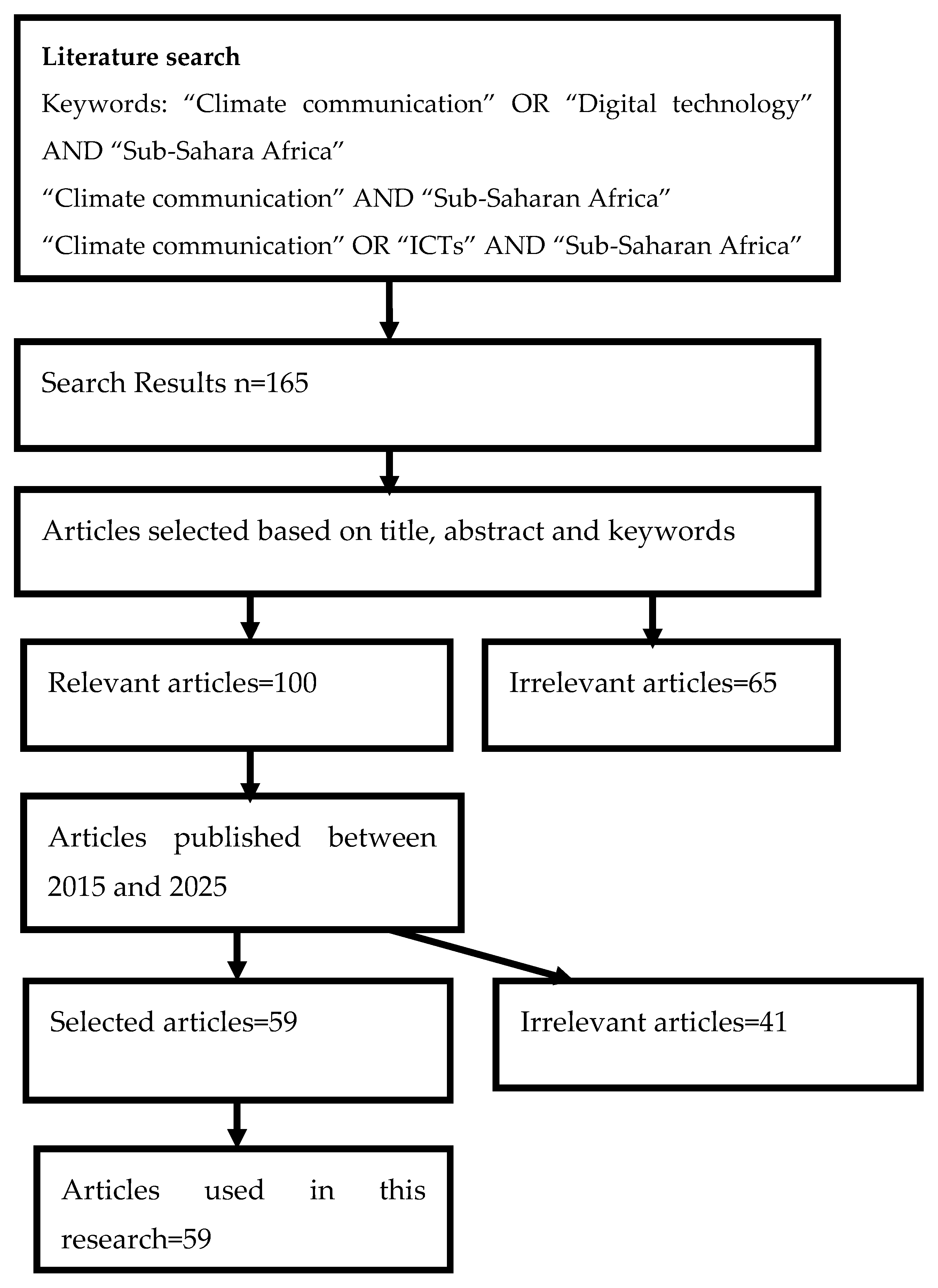
Figure 2.
Keyword analysis.
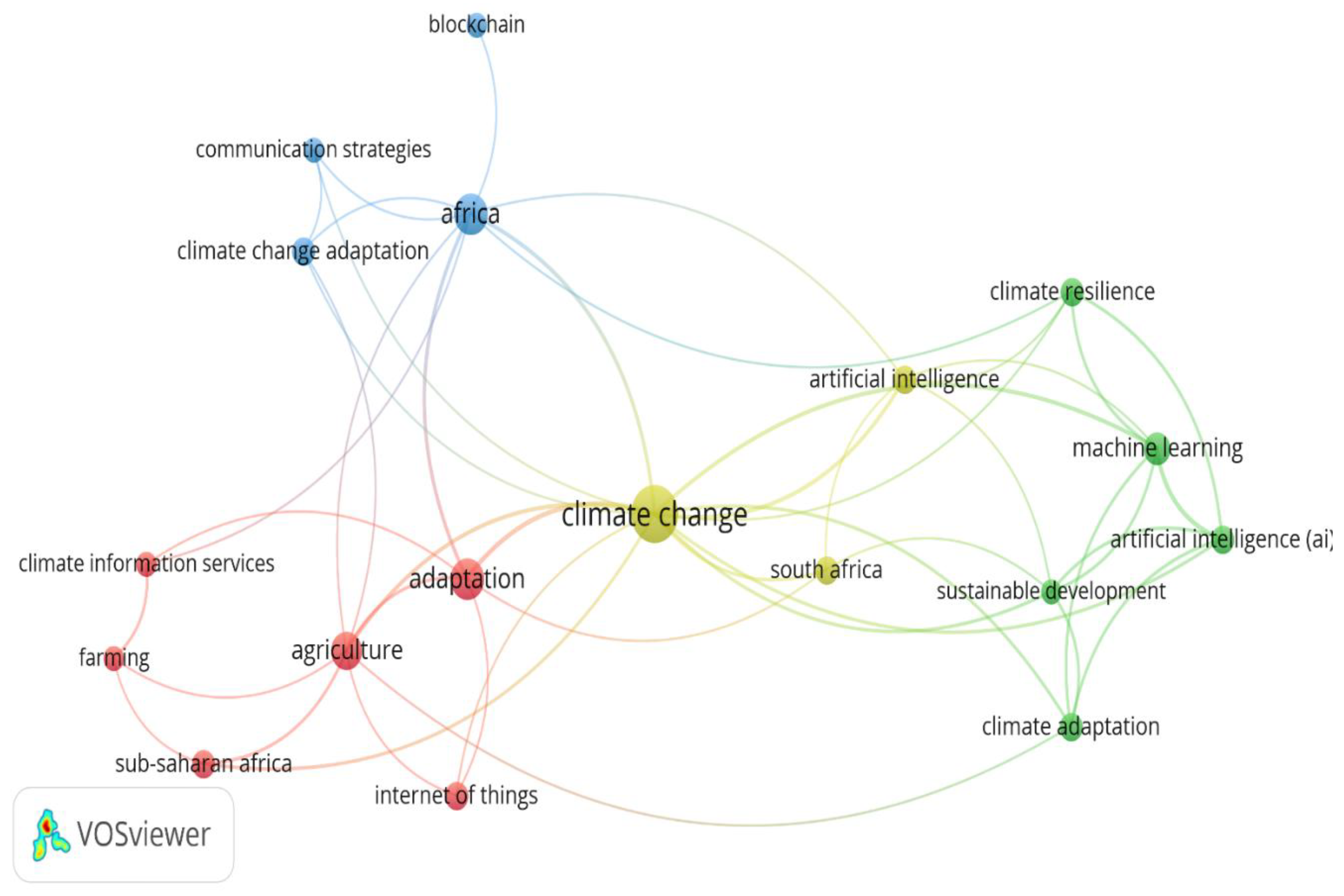

Table 1.
Sources of literature.
| Author | Theme | Location |
|---|---|---|
| Nigussie et al. (2020) | Irrigation management. | SSA |
| Nigussie et al. (2020) | IoT architecture. | SSA |
| Sibandze et al. (2025) | Remote sensing for flood probability. | South Africa |
| Appiah et al. (2025) | Social media for climate communication. | SSA |
| Sarku et al. (2025) | ICT services for climate communication. | Ghana |
| Bahta (2021) | Social networks. | South Africa |
| Mayoyo et al. (2023) | Digital climate adaptation. | Zimbabwe |
| Olatade and Mogaji (2025) | IK and AI for climate change. | Africa |
| Chapungu et al. (2021) | AI and ICTs for climate resilience | SSA |
| Filho et al. (2024) | Implementing IK in climate adaptation. | Africa |
| Soeker et al. (2021) | Readiness to implement IoT. | South Africa |
| Masinde et al. (2012) | ICT for weather forecasting. | SSA |
| Bakare (2020) | ICT and climate smart agriculture. | South Africa |
| Odoom et al. (2023) | Climate change communication. | Ghana |
| Ojonimi et al. (2022) | ICT for climate resilience | SSA |
| Tella., (2024) | Social media. | Kenya |
| Kiambi (2025) | ICT and agriculture | Kenya |
| Bosch (2012) | Blogging and Tweeting in climate change. | South Africa |
| McGahey and Lumosi (2018) | Climate change communication. | Kenya |
| Agbehadji et al. (2024) | Climate risk resilience and early warning systems. | Southern Africa |
| Chavula and Kayusi (2025) | AI in climate communication | Africa |
| Duruigbo (2013) | ICT strategies for climate change | SSA |
| Hansen et al. (2019) | Climate change services for farmers | Africa |
| Mofolo and Kagarura (2012) | IoT in sustainable rural development | South Africa |
| Carr et al. (2020) | Climate information services in SSA | SSA |
| Adebayo et al. (2024) | Climate change effectiveness in Nigeria (IoT) | Nigeria |
| Nkambule and Agholar (2025) | ICT for agricultural transformation in South Africa | South Africa |
| Chizema et al. (2024) | IoT for precision agriculture | Africa |
| Chavula et al. (2024) | AI and wheat yield resilience in Sub-Saharan Africa. | SSA |
| Matandirotya et al. (2024) | Local knowledge for climate adaptation | South Africa |
| Mwalukasa (2012) | Agricultural information services for climate change. | Tanzania |
| Muchunku and Ageyo (2022) | New media and climate change. | East Africa |
| Muteba (2020) | Climate communication in Zimbabwe | Zimbabwe |
| Leal Filho et al. (2024) | AI for climate change adaptation in Africa. | Africa |
| Ngulube (2024) | ICTs for sustainable agriculture in Africa. | Africa |
| Nwankwo et al. (2019) | IoT in climate messaging. | Nigeria |
| Chimaya and Kanja (2020) | ICT for climate change adaptation. | Zambia |
| Yohannis et al. (2019) | ICT tools for climate change information access. | Kenya |
| Brummer (2024) | Block chain for agriculture traceability in South Africa. | South Africa |
| Mukavaro et al. (2023) | Climate communication in rural Zimbabwe. | Zimbabwe |
| Chapungu, Nhamo, and Matsa (2024) | Climate related challenges in agriculture | Southern Africa |
| Naidoo (2024) | Challenges in accessing climate information. | South Africa |
| Sansa-Otim et al. (2022) | Weather information dissemination. | Uganda |
| Khatibu and Ngowi (2025) | Climate information services | SSA |
| Carr, et al. (2020) | Climate information services | SSA |
| Shimhanda and Vivian (2022) | Media coverage of climate change | Namibia and South Africa. |
| Onyancha and Onyango (2020) | ICTs for Agriculture (ict4ag) | SSA |
| Amarnath (2020) | Smart ICT for climate communication | Sudan |
| Chavula, Kayusi, and Juma (2024) | AI challenges in climate communication. | SSA |
Disclaimer/Publisher’s Note: The statements, opinions and data contained in all publications are solely those of the individual author(s) and contributor(s) and not of MDPI and/or the editor(s). MDPI and/or the editor(s) disclaim responsibility for any injury to people or property resulting from any ideas, methods, instructions or products referred to in the content. |
© 2025 by the authors. Licensee MDPI, Basel, Switzerland. This article is an open access article distributed under the terms and conditions of the Creative Commons Attribution (CC BY) license (http://creativecommons.org/licenses/by/4.0/).
Copyright: This open access article is published under a Creative Commons CC BY 4.0 license, which permit the free download, distribution, and reuse, provided that the author and preprint are cited in any reuse.


