

Submitted:
23 April 2023
Posted:
24 April 2023
You are already at the latest version
Abstract
Agriculture is the primary source of economic growth in many countries in West Africa. It provides food and livelihoods for the population. The purpose of this study is to review the digital agriculture status in five countries, namely Benin, Burkina Faso, Coˆte d’Ivoire, Ghana, and Nigeria. The study consisted of a bibliometric analysis using a database exported from the web of science through a well-defined search string. Additionally, the cases of digital technology deployment in the countries were assessed through a systematic review approach comparing the technologies used in the target countries. Representative articles from the bibliometric review published in the last five years were selected for the comparative analysis. The bibliometric analysis based on 3,249 publications revealed that the research interests have significantly increased since 2014. The top two countries in terms of authors’ nationality were Nigeria and Ghana, respectively. Climate change, Machine Learning (ML) and adoption were the hot topics of discussion. The digital agriculture survey showed that publications in Nigeria were focused on Internet of Things (IoT), Wireless Sensors Networks, blockchain, and Artificial Intelligence (IA) technologies. Ghana also has a strong interest in blockchain, AI, and big data, while Burkina Faso focused on IoT and AI. Cote d’Ivoire and Benin focused only on AI.
Keywords:
Digital agriculture
; Innovations
; Artificial Intelligence
; Internet of Things
; Machine Learning
; West Africa.
1. Introduction
Digital agriculture is a kind of agriculture which exploit modern technologies to gain sustainable development in agriculture fields like crop production, soil monitoring, livestock production and management, and fisheries. The agriculture sector is a development sector contributing to a large part of developing countries' Gross Domestic Product (GDP). Following the statistical predictions highlighted in [1], the worldwide population will reach 8 billion by 2023 and nearly 10 billion by 2050. The digital transformation of agriculture is therefore unavoidable to meet food security requirements faced by worldwide countries in general and emerging countries in particular.
Many technologies are used in numeric agriculture. one can quote the Internet of Things (IoT), Geographical Information Systems (GIS), Big data, Artificial Intelligence, Wireless Sensors Networks, and Blockchain. All of these technologies have a specific and useful application in digital agriculture. Furthermore, they are sometimes jointly used to solve many problems analogue agriculture induces. Much research has previously been performed on these technologies. While some researches discuss real application cases of some technologies, others present a bibliometric analysis of one or two technologies in Africa. To the best of our knowledge, there is a gap in the scientific literature about a review of technologies used in digital agriculture in West African countries.
This paper presents a bibliometric study of digital technologies in agriculture and a literature review on these technologies to help researchers, government members and farmers in the growing sector. To achieve this work, related works are first presented on bibliometric study and technology inventory. The methodology adopted to perform this work is followed. The bibliometric study presentation and the technologies review succeed it. Afterwards, the main contribution of this work is presented, and the discussions and conclusions finalize the paper.
2. Approaches and Methods
During the last five years, several works were investigated in digital agriculture. In this section, related works about the bibliometric and technologies survey.
2.1. Bibliometric survey on digital agriculture
In the literature, many research papers have addressed bibliometric studies focusing on digital innovations and technologies in agriculture [2]. In [3] the authors developed a literature review on the relationship between the Internet of Things and agriculture from 2012 to 2019. Through this study, they have shown the growing interest in the Internet of Things for agriculture-related applications. A literature review is also carried out to show the contribution of the Internet of Things to food production [4]. In [5] a literature review was conducted on artificial intelligence and agriculture. To explore research on technology adoption in agriculture and understand the determinants of technology adoption using models such as the technology acceptance model, a bibliometric analysis was conducted [6]. Annas et al. [7] conducted a literature review on digital innovation, data analysis and resilience chain. Alireza Abdollahi et al. in [8] did a literature review on sensor networks in agriculture from 2020 to 2021. In [9] through a systematic review, research contributions on digitalization and big data in agriculture were explored, and in [10], research on Unmanned Aerial Vehicles and precision agriculture was assessed. However, today, digital technologies such as blockchain have demonstrated their ability to create visibility and transparency across the supply chain through the digitally distributed ledger, smart contracts, and multi-layered protection against financial threats [11], [12]. While Big data analytics is found to be useful in enhancing data processing capacity and thereby responding to disruptive events [13], [14]. While literature reviews have shown the contribution of IoT, it is difficult to say concretely, when talking about digital agriculture, which technologies are most used and how and where they are most used. Amongst the important research, it is noted that very little literature has done a systematic comparative review of the contribution of different digital technologies in the field. In addition, very little work focuses on contributions from West African countries and assesses the contribution of these countries to digital agricultural research. To fill this gap, this paper explores innovation and technology contributions in the specific case of West Africa. Particular emphasis will be placed on some target countries.
2.2. Survey on technologies used in digital agriculture
In 2019, the application of precision agriculture has been investigated [15]. Precision Agriculture defines a management strategy that gathers, processes and analyzes temporal, spatial and individual data and associates it with other data to support management decisions according to estimated variability for improved resource use efficiency, productivity, quality, profitability and sustainability of agricultural production. It exploits sensors and software to ensure that the crops receive ex actly what they need to optimize productivity and sustainability. In this work, IoT and WSN applications were highlighted. The focus is made on Wireless communication technologies, sensors, and wireless nodes used to assess the environmental behavior, the platforms used to obtain spectral images of crops, the common vegetation indices used to analyze spectral images and applications of Wireless Sensors Networks in agriculture were highlighted. The main farming parameters used in precision agriculture development are crops, i.e., soil nutrients, the soil’s water level, wind speed, the intensity of sunlight, temperature, humidity, and chlorophyll content. As PA aims to generate excess yield by enhancing the resources such as fertilizers, water and pesticides..., it allows farmers to have an exact measure of resources for healthy crops. The main lesson learned from this study is that IoT sensors and WSN technologies are mainly used for PA. Generating the prescription map requires not only the vegetation indices but also the soil properties and meteorological comportment.
During the same year (2019), IoT-based systems in agriculture and farming are reviewed by presenting IoT software and hardware used in digital agriculture applications such as farming system monitoring, greenhouse and precision agriculture [16]. The authors of this paper describe the technical information existing in an IoT system. The main function of Wireless Sensor Nodes are Sensing capability, data processing capability, data storage capacity, Unlicensed radio-frequency band communication capability, Low power consumption, small size and Low cost. The hardware part mainly contains sensors, Data Acquisition Units (DAQ units), Data Processing Units (DPU), Communication Uni and Power supply unit. The software part mainly includes the Operating system, Drivers for sensors and actuators and Data networking stack.
Furthermore, discussions have been done on communication technologies like ZigBee, Bluetooth and wifi by presenting their advantages and limitations. Finally, the main challenges faced by developing nations were discussed. We can quote the non-spreading of internet access available throughout the country, the non-literacy of farmers in these countries, and the threat of theft, damage and vandalization of IoT devices... All of these challenges have slowed the digital agriculture progress in these countries.
In 2020, a literature review was performed on machine learning techniques applied during data processing in wireless sensors network-based PA [17]. In particular, ML model features have been investigated in many papers for yield prediction, decision support for irrigation, and crop quality.
Indeed, Farms, including IoT, Unmanned Aerial vehicles (UAV), and other technologies, induce millions of data pro- duction on the ground daily. These data should be analyzed by farmers with the help of Artificial Intelligence for making better decisions on forecasting and ensuring reliable management of sensors. In this work, the various ML algorithms were presented in two categories such as supervised learning and unsupervised learning. The focus was made on supervised learning as an unsupervised learning algorithm is used on exploratory applications where there is no specific set goal or the information the data consists of is not clear whereas supervised learning exploits a known set of labelled data to train a model to forecast the target variable for out of sample data. Regression algorithms such as decision trees, ensemble learning, Bayesian models and Artificial neural networks (ANN) are the most developed algorithms. These algorithms are mainly used to predict temperature and humidity in a greenhouse environment, to predict the type of crop to be grown using sensor data from soil pH, temperature and humidity, and to anticipate crop dysfunction proactively; the farmer is then notified with a possible remedy through smartphone, to analyze the sensor data for forecasting suitable temperature, humidity, and soil moisture of crops in the future, to forecast and detect pest/disease precisely using historical and real-time sensor data.
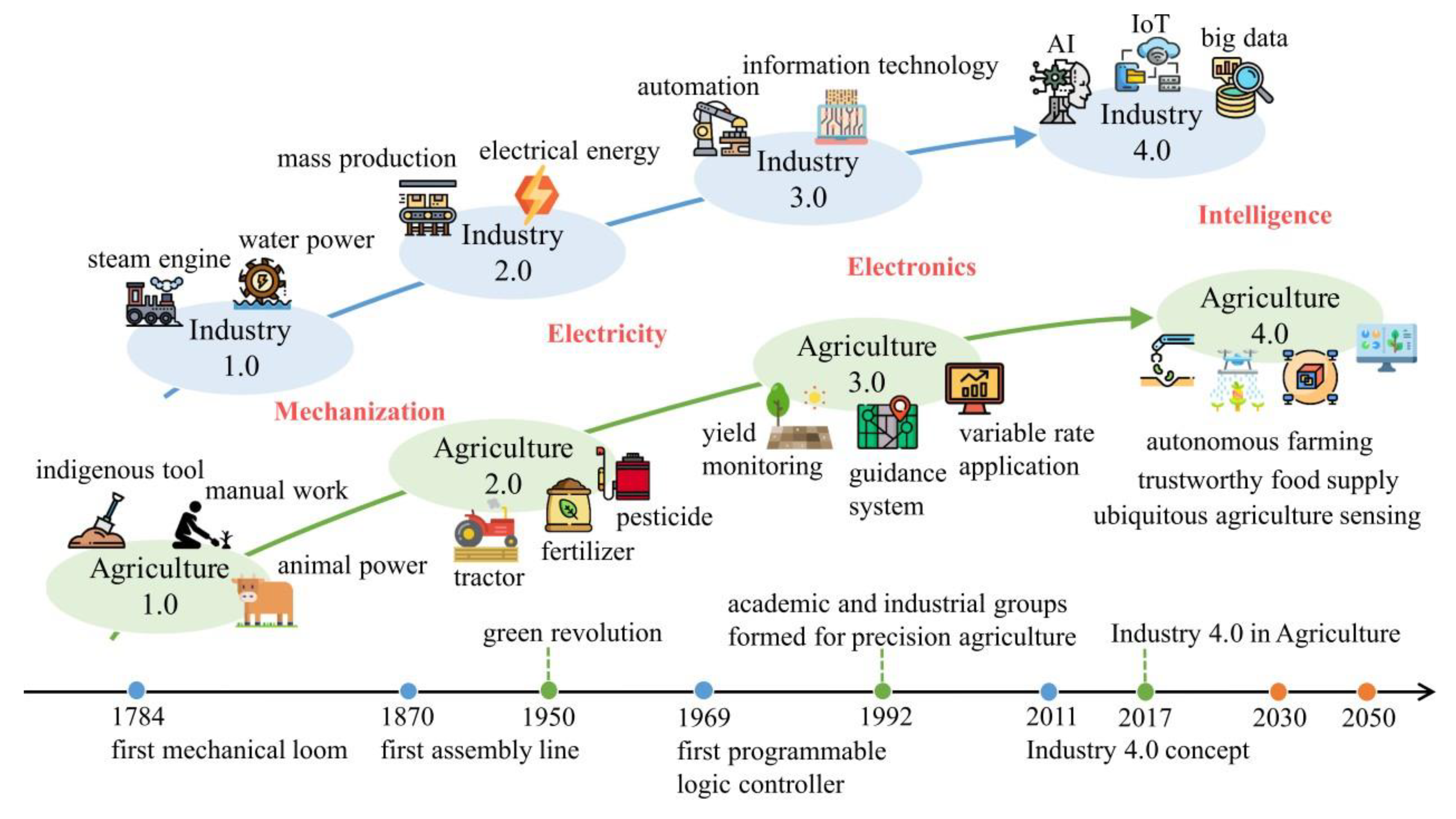
In 2021, The industrial revolution was compared to the agriculture revolution from traditional industry to modern industry and traditional agriculture to modern agriculture [18]. The roadmap relative to this comparison is presented in Figure.1, which indicates that industry and agriculture progress from mechanization to intelligence. Furthermore, agricultural progress is induced by industry progress. A literature review is performed on the key enabling technologies such as IoT, Robotics, Big data, IA and blockchain which revolutionized digital agriculture. The focus was made on smart farming applications and the research challenges relatives to them. As many of them are used with the agricultural production chain, these authors discussed the relationship between the technologies’ application to digital agriculture development.
As previously discussed, IoT collects and relays data to data analytics and deep learning for in-depth processing and analysis. These authors investigated the literature review on digital agriculture. They mainly focused their research on IoT, big data and deep learning techniques [20]. Application fields of each tech are studies. The data collected by IoT systems help farmers to handle precision crop varieties, phenotypes, selection, crop performance, soil quality, pH level, irrigation, and fertilizer application quantity. Furthermore, the advantages of exploitation of deep learning algorithms are highlighted where deep learning is defined as an important branch of machine learning which is trained on data sets and can detect patterns and anomalies in data generated by smart sensors. Also, Bigdata technology cannot be solely used in digital agriculture. Its exploitation requires important data collection and assists farmers in being informed and making correct decisions about farming practices and management. Challenges affection the adoption of these technologies are also studied, such as Concerns about privacy and trust, profitability issues, lack of skills, cost challenges, lack of broadband infrastructure, and Technical challenges. In 2022, an investigation on digital technologies and services used to increase agriculture productivity and sustainability in Tanzania [21]. The digital technology varies from simple mobile and web-based applications, mostly for smallholders to complex autonomous, information and cyber-physical systems used by large scale farmers. The main results from the literature review showed that sustainable development requires digital precision technologies. Adopting and managing technologies by small-scale farmers differs from those of large-scale farmers. Also, the authors identified the digital solutions proposed in Tanzania for digital agriculture and the problems farmers face with different services that slow down the development of digital agriculture in this country.
In the same year, a systematic review was conducted on IoT and WSN for sustainable smallholder agriculture [22]. Indeed, smallholder farms can be defined as family-run, small farms that are often fragmented into disjoint plots, are nature-dependent and have limited operational budget, limited information access and technology support, and often display low production levels. The main gaps in the utilization of these technologies, in this case, have been highlighted such as the problem of the literacy rate of farmers, the non-accessibility to information systems and the requirement of human presence to perform all activities. Most smallholder farms usually practice farming based on natural biophysical conditions for crop growth, such as rain, and apply a mix of crop growing and livestock breeding. Nowadays, IoT and WSN technologies are used to increase productivity by assuming the efficient use of natural resources like water and sun... and monitoring real-time crops and breeding health. Four areas constitute the application field of IoT and WSN in smallholder agriculture: precision agriculture (PA), weather monitoring (WM), pest and animal infestation monitoring (PAIM) and livestock management (LM). This work investigated the rate application of these technologies in each field. It has been demonstrated that PA is the field which records 60% of publications, PAIM 16%, WM 1% and LM 10%.
Furthermore, the different sensors type exploited in the works is studied and shown that the four main environment properties are the most checked. There are soil moisture, humidity, air and soil temperature. The additional parameters such as light, motion, soil acidity, air pressure, wind speed and direction, CO2 and solar radiation are also exploited. The data collected by sensors are processed and analyzed using simple computation, statistics and machine learning.
In this section, related work about a bibliometric study on digital agriculture and a survey on digital technologies are highlighted. While some papers present two technologies, others present three technologies. Also, we have not identified papers that present a survey of many technologies in conjunction with and related to many west African countries. The following section shows the methodology used in this paper.
2.3. Methodology
To contribute to digital inclusion in agriculture in west Africa, particularly in Benin, Burkina Faso, Cote d’Ivoire, Ghana and Nigeria, we assessed the current state of Innovation in each of these countries. We chose this country because they are involved in the AGRIDI project (Project for Accelerat ing inclusive green growth through Agri based innovation in Western Africa), an important project for growing innovation of digital agriculture in west Africa. For this, we adopted a mixed methodological approach. Firstly, we review the related work on review studies on digital agriculture. Secondly, through a quantitative approach based on bibliometric data analysis, we identified key research, authors and their relationship, covering all publications related to a given topic or field. All scientific contributions to digital agriculture in West Africa were reviewed using this search string. The bibliometric search was performed on the Web of science, and the bibliometric database was exported on 28 September 2022. The search string is: (Agriculture OR Agricultural OR ”Food production“ OR ”Farming system” OR Farming) AND (Innovation OR Numeric OR Digital OR Smart OR Automatic OR ”Artificial intelligence” OR ”Internet of things” OR ”Machine learning” OR ”Automated learning” OR Blockchain OR ”Big data” OR ”Data science” OR ”Wireless technologies” OR ”Mobile network” OR ”Sensor network”) AND (Benin OR Nigeria OR ”Ivory Coast” OR ”Cote d’Ivoire” OR Ghana OR ”Burkina Faso“ OR “Westˆ Africa”). Using this search string presented above, 3,249 publications were retrieved from the Web of Science, including articles, reviews, chapters and proceedings. The records were exported in BibTeX and txt files, including authors, publication year, title, abstract, subject categories, source journal and references. The data were analyzed using biblio-shiny, Bibliometric and VOSviewer software. Thirdly, we assessed the use cases and deployment of digital technologies in the countries through a systematic review approach based on a comparative analysis of technologies used in the target countries, papers have been selected based on the previous bibliometric study. Published papers during the last five years were selected from the bibliometric study to perform a comparative analysis of technologies used in the target countries. In total, 468 scientific documents were retrieved. First, filtering was performed to exclude articles based on title, the origin of the study, and whether the innovation/technology is used in agriculture. A second filtering was made by reading the abstracts, keywords, and conclusions. Based on this literature review, the primary lines of innovations and technologies were presented, as well as the context and level of advancement of west African countries.
3. Results
3.1. Bibliometric Study
Bibliometric analysis is a computer-assisted scientific review methodology that allows the identification of key re- search or authors and their relationship, covering all publications related to a given topic or field. In this section, we reported the results of the bibliometric study of the research on digital agriculture. We assessed the contributions of researchers, institutions, and target west Africa countries.
- Annual Scientific Production
Figure. 2 shows the number of publications on digital farming since 1975. It is easy to see that research interest in digital agriculture is not new. Since 1975, research work has focused on innovation in agriculture. However, since 2014, the research interest has increased considerably with publications. In 2021, more than 550 publications were indexed in the Web of science.
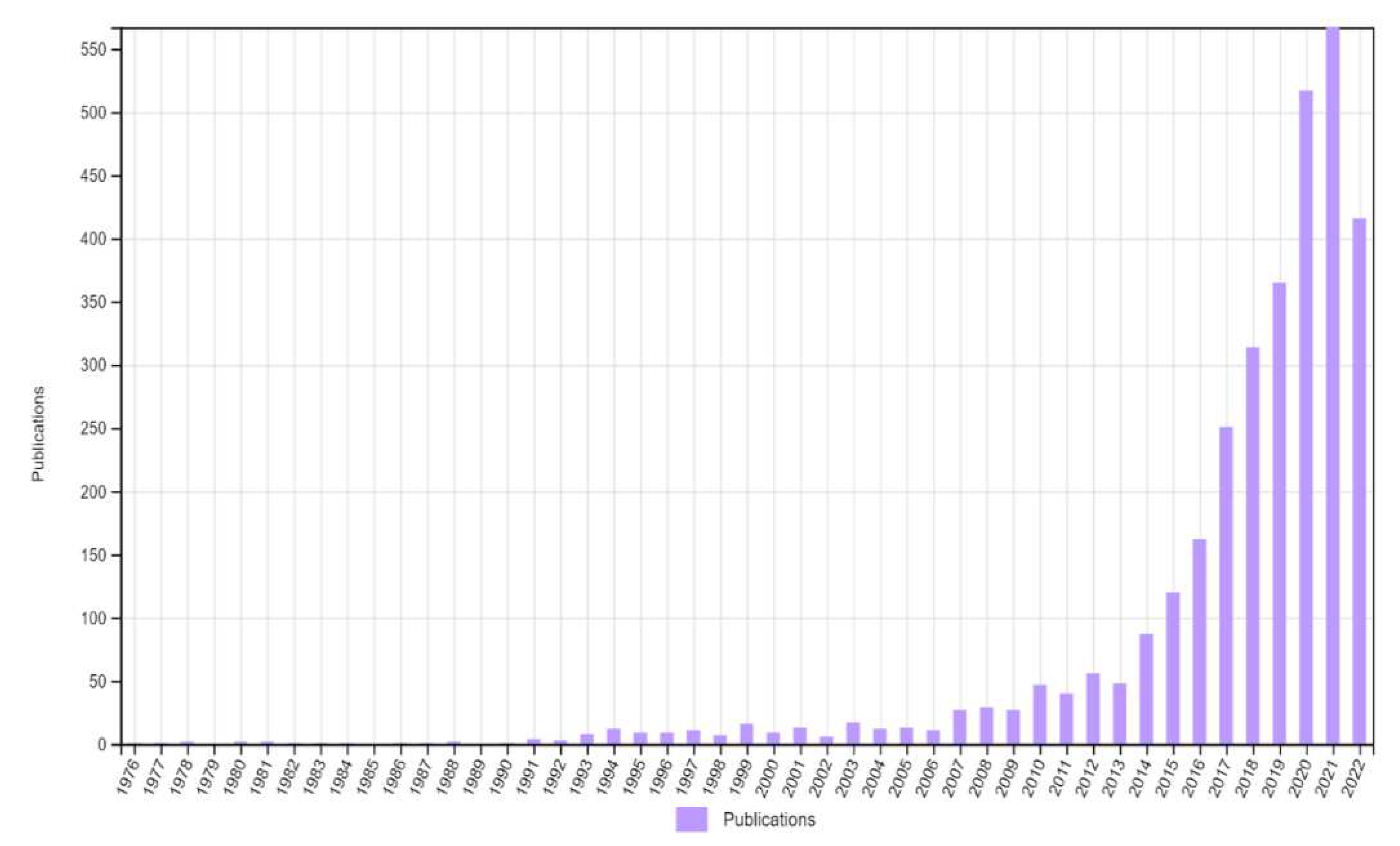
Figure 2.
Histogram of publications per year.
- Relevant Source
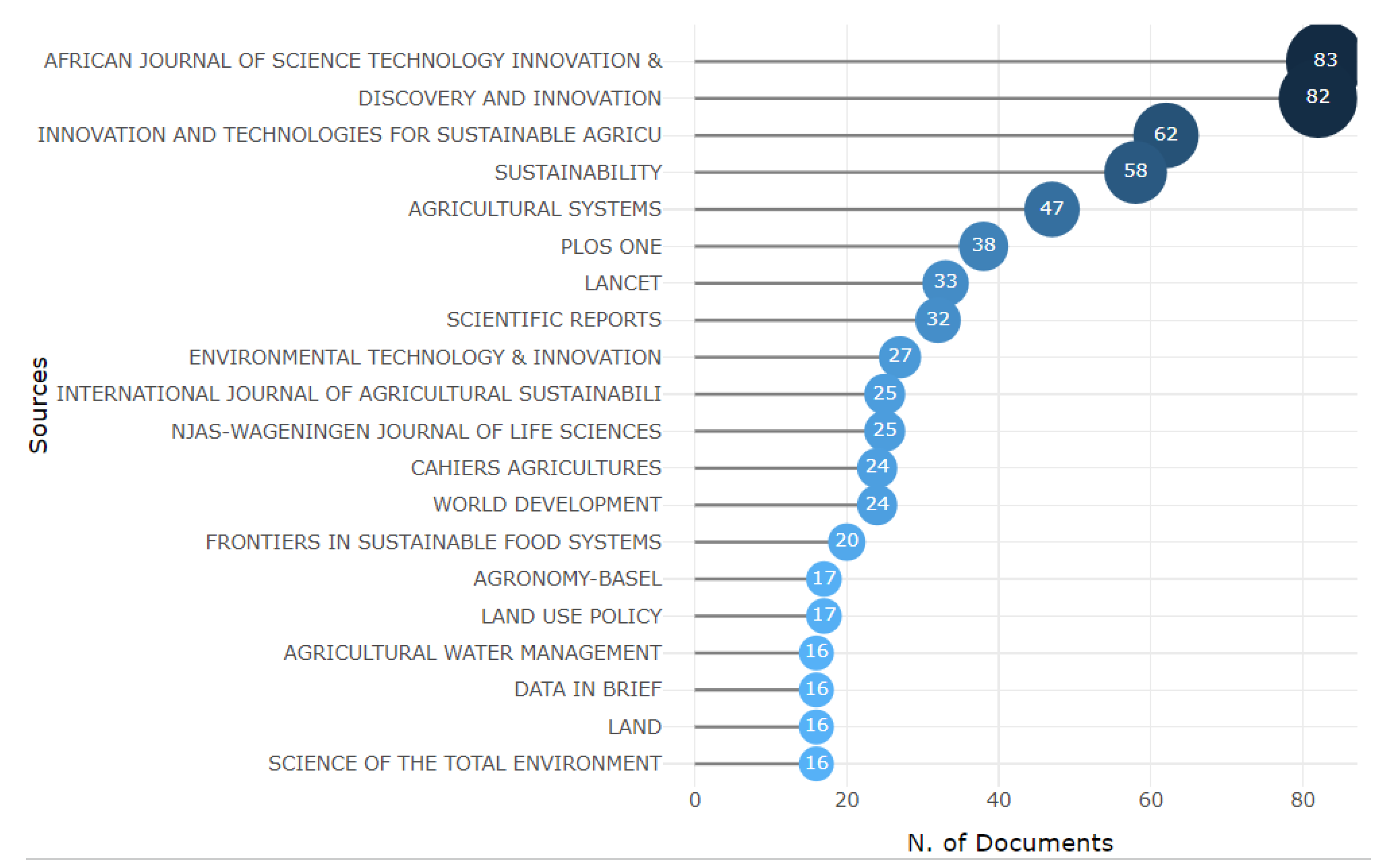
Figure 3.
Top 20 most relevant Source.
- Author Countries
Figure. 4 presents the scientific contributions to Innovation in digital agriculture according to the authors’ countries of origin. In the five countries, the bulk of the publications in digital agriculture come from Nigeria, followed by Ghana. On the other hand, the English-speaking countries (Ghana and Nigeria) showed more contributions to advancing knowledge in digital agriculture compared to the francophone countries in the following order: Benin, Burkina and Coˆte d’Ivoire.
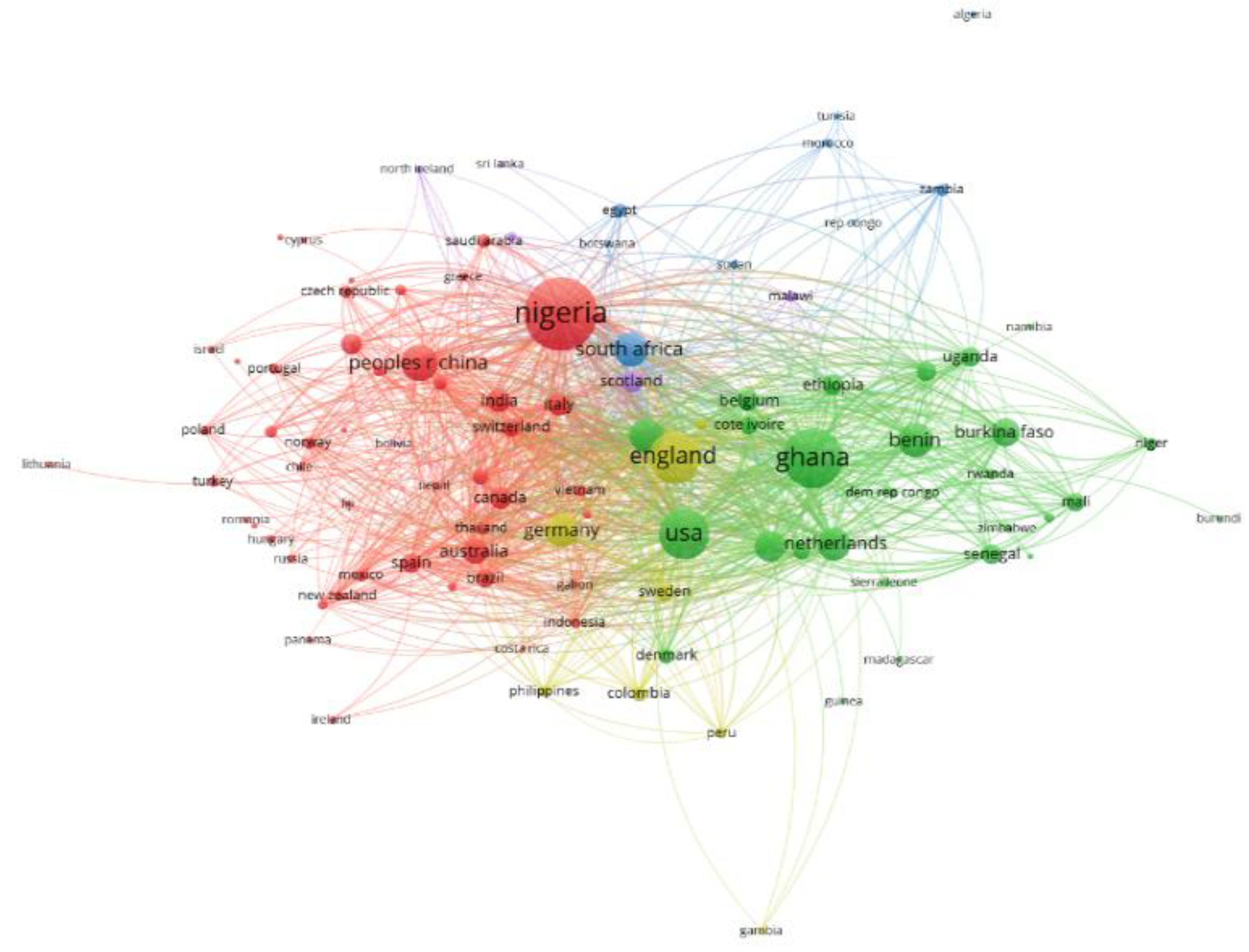
Figure 4.
Map of author Countries.
- Author Organizations
Most of the publication sources come from academia. The University of Ghana recorded the highest number of publications, followed by Nigerian universities (University of Nigeria, Opkara Agro University, University of Ibadan) and the University of Abomey-Calavi. Other sources include research institutions and international organizations.
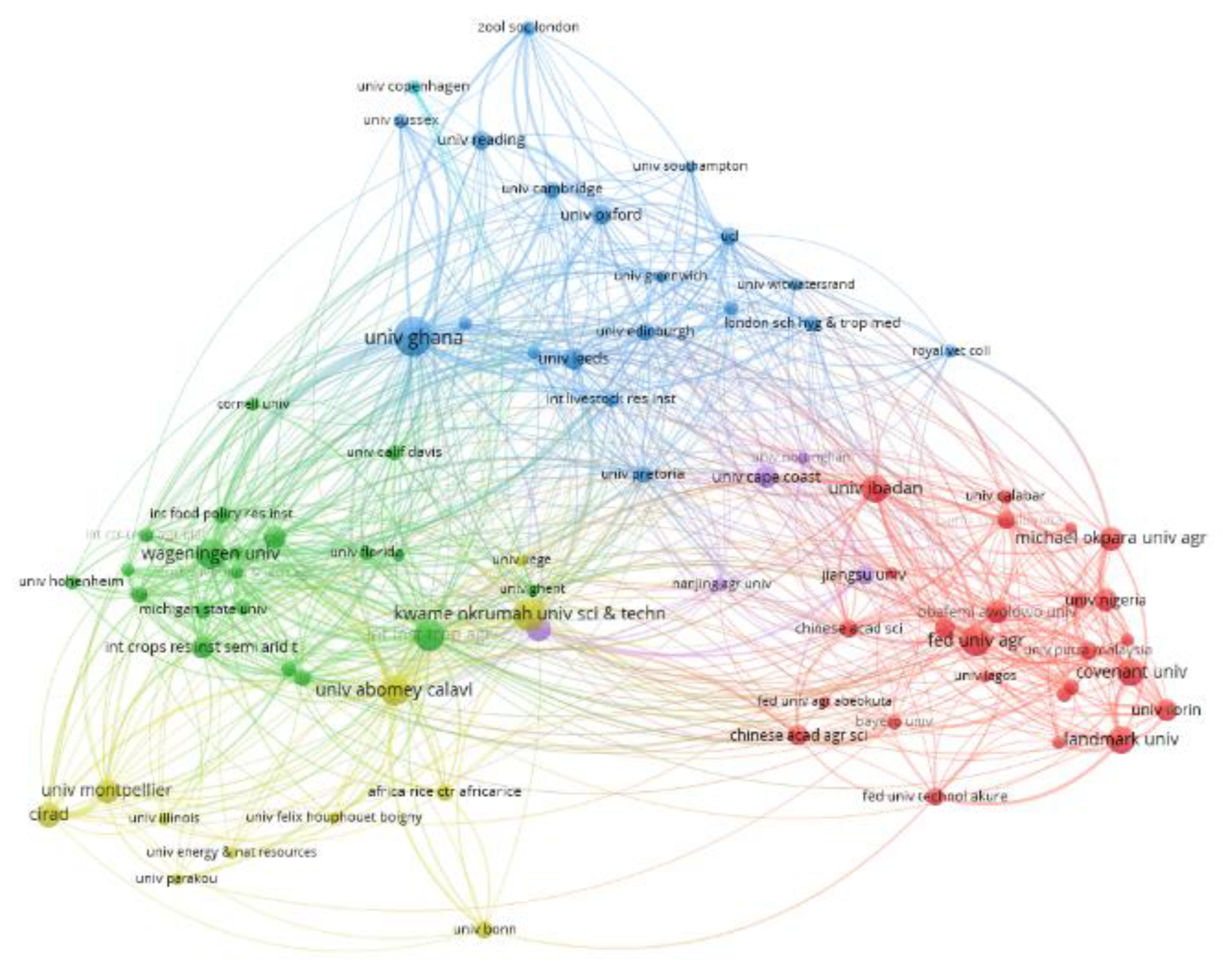
Figure 5.
Map of author Organizations.
- Co-occurrence Network
Figure. 6. shows a graph of keywords used in the publications. Each node is associated with a keyword, and its size is proportional to the number of documents where it appears. Since the study focuses specifically on 5 countries, keywords such as ‘’Ghana”, ‘’Nigeria,” and ‘’Africa” were most recurrent. Climate change and machine learning adoption are the technical words with the highest weight. Machine learning, sensor networks and artificial intelligence were the most explored digital agriculture technologies, and adoption was the much-discussed topic in the literature.
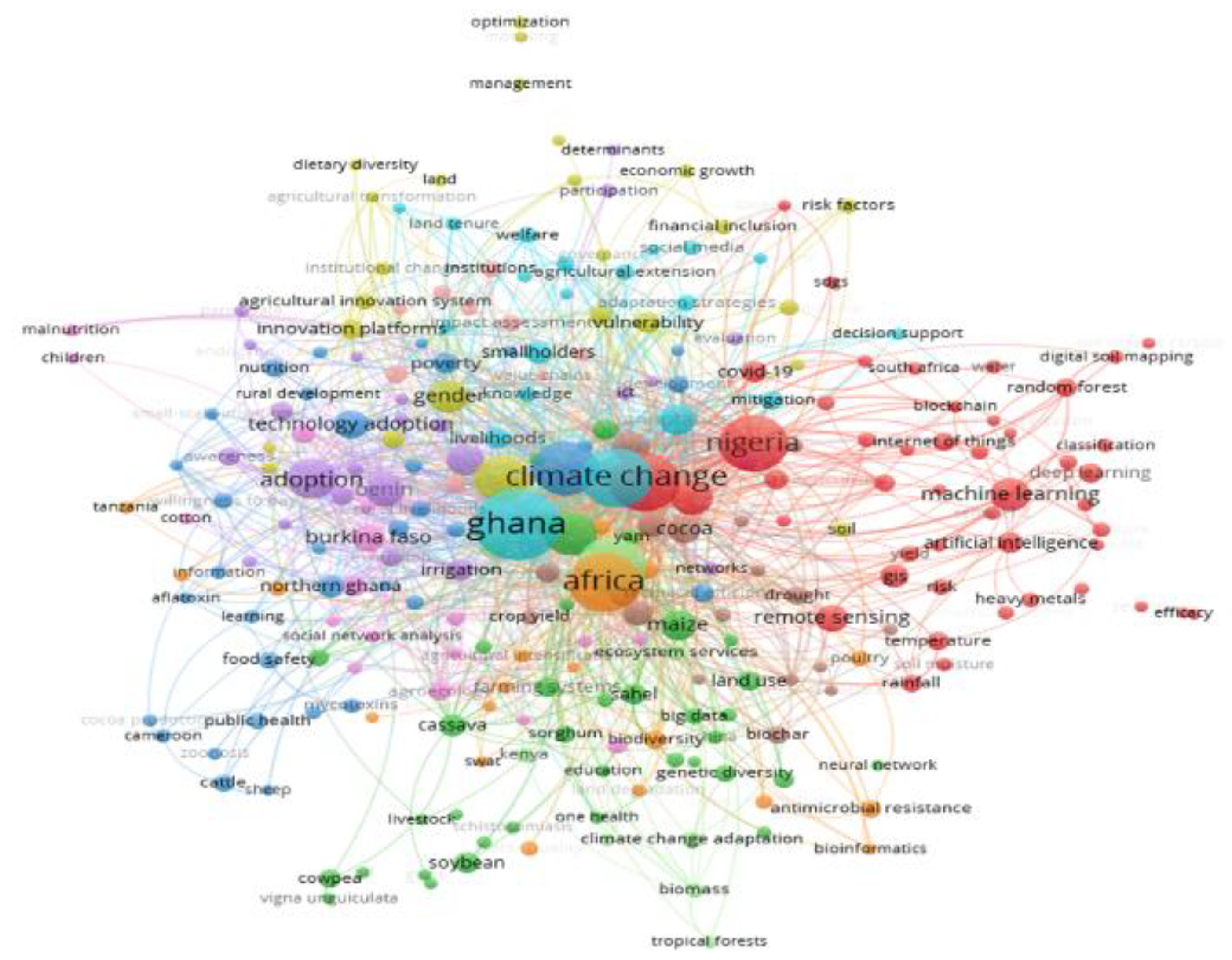
Figure 6.
Co-occurrence Network.
- Word Cloud
Figure. 7 presents the most used words and topics in the publications. Agriculture, impact, system and adoption are the words with the highest occurrences. Overall, the ‘’impact of systems”, ‘’agriculture,” and ‘’adoption” are topics of great interest in digital agriculture in West Africa.
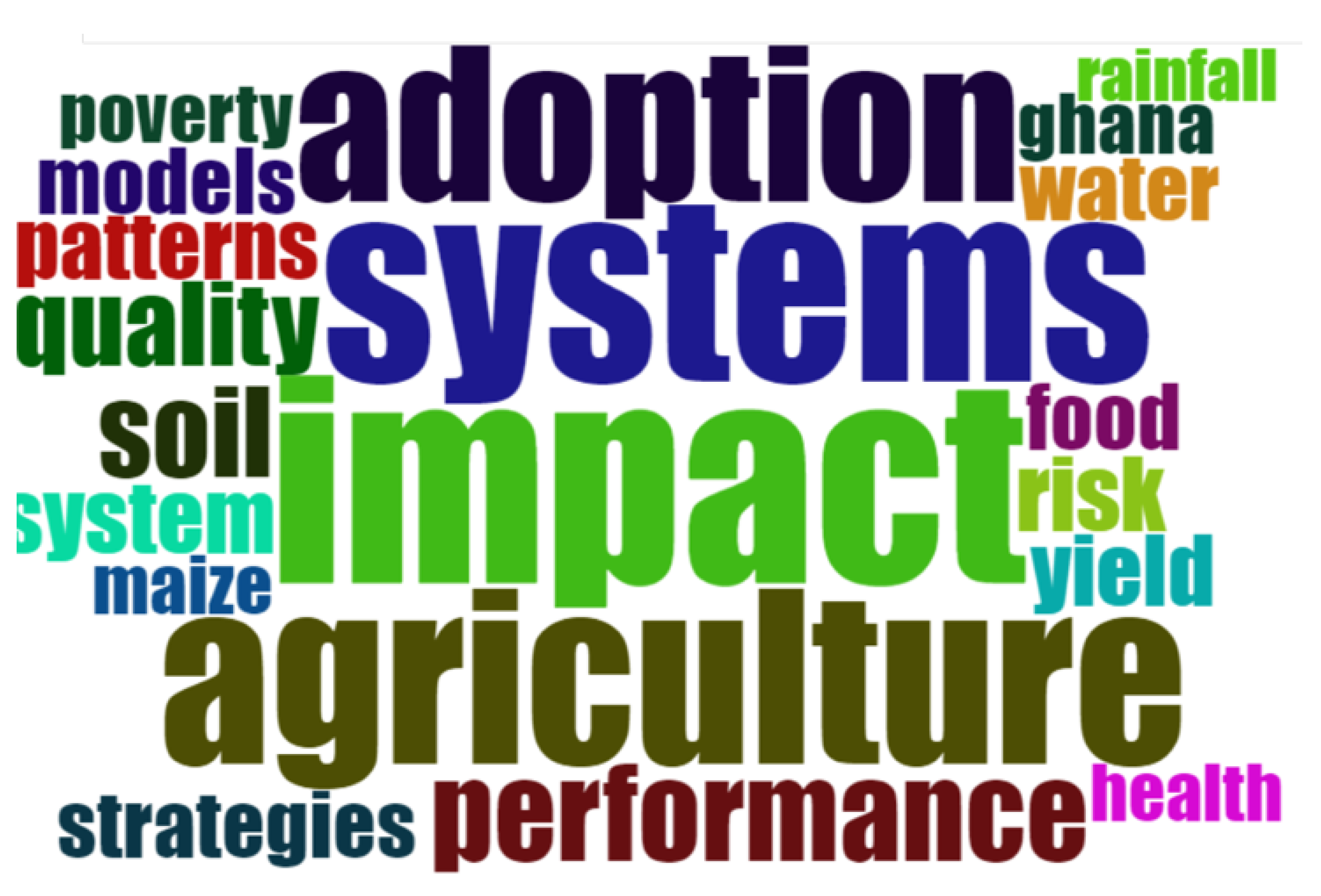
Figure 7.
Word cloud.
3.2. Digital Technologies Survey in the Five West Africa Countries
In this section, technologies applied in digital agriculture are reviewed for the target countries. For this purpose, papers have been selected based on the previous bibliometric study. This selection is made by reading the title and their abstracts and using papers recently published during the last five years. It has shown that Nigeria has registered many publications on this topic (mainly in IoT and Wireless Sensors Networks, blockchain and AI). It is followed by Ghana, which has also been published. Only related to AI. Benin presents only one scientific applied publication associated with AI.
In Benin, AI is used for crop production to predict soil properties. AI produces bananas, dry beans, cassava, rice, maize, and seed cotton production in Burkina. It is used to predict weather data and Chemical data. Also, IoT sensors are used for Fish species production, bananas and papayas production. They are used for meteorological parameters sensing, water pH, dissolved oxygen, temperature, and soil moisture sensing.
In Cote d’Ivoire, AI monitors riverine water and increases sugarcane production. In addition, this technology is used to manage and analyze weather data, chemical data, the blockchain, AI and big data. On the other hand, when Burkina Faso and Cote d’Ivoire published respectively on IoT and AI, Cote d’Ivoire publications were rainfall data, temperature data and sugarcane yields.
In Ghana, AI manages soil water storage in landscapes and crop yield prediction. Big data is mainly used to collect data quality ownership and accessibility. Blockchain handles coca food and drug supply chains for transparency, traceability, enhancement, and mitigation of unethical activities.
In Nigeria, AI is used for livestock and crop management, water and soil management and breeding. Block chain is used to create digital trust between agriculture stakeholders. IoT sensor networks are used for livestock monitoring, remote control sensing, precision irrigation and triggering of automated irrigation systems. The smart village uses Lora for farm crops and water quality monitoring.
Table 1 presents a summary about review performed on these technologies
4. Discussions
4.1. Lesson learned
The analysis of the status of digital agriculture across the five countries provides insights into each country’s efforts in digital agriculture. There are many ongoing initiatives in these countries to develop the sector. These have involved both private and public interventions for the deployment of digital technologies in agriculture. In the target countries, the knowledge production was mainly about machine learning, with a higher interest in the adoption of innovations generated through this technology to support digital agriculture;
Compared to the rest of the world, Africa is still lagging behind in terms of digital innovations in agriculture. However, technologies such as the Internet of Things (IoT), Wireless Sensors Networks, Artificial Intelligence, Blockchain, Unmanned Aerial Vehicle (UAV), Big data, and Geographic Information Systems (GIS) were explored; The studies showed that it is possible to use IoT-based solutions in agricultural production to solve many problems specific to the realities of West Africa such as livestock theft, water pollution.
IoT, sensor networks, and artificial intelligence can be leveraged to develop intelligent systems for crop and livestock farm monitoring and to improve animal and plant health care. The explosion of data science and big data offers impressive tools and models for predictive analysis. The wealth of data from agriculture and its analysis can be harnessed to improve farming practices to increase crop yields and reduce input costs.
Machine Learning implements very high-accuracy models to make predictions on se-veral aspects and prevent environmental hazards and promote precision agriculture.
The application of blockchain technology makes the food supply chain more efficient by tracking all transactions. These innovations have been proven and demonstrated by practical cases specific to the realities of West Africa in the literature. However, it must be noted that in west African countries, despite the potential of technologies and their ability to boost the field of agriculture, even though in real situations, the technologies have had to prove themselves, agriculture remains more traditional than digital. Practical agricultural solutions are not popularized and deployed in large-scale situations.
4.2. Recommendations
To enhance e-agriculture development in the five countries, many strategies should be undertaken. This subsection presents some recommendations.
Creating the enabling environment for digital agriculture: Most countries have developed a national strategic plan for e-agriculture. Hence, there is a need to execute the plan and monitor the indicators of success while maintaining a window for constant improvement of the enabling political and regulatory environment. Other countries like Burkina-Faso should develop a national strategic plan which should set the pillars and directives for developing key enabling factors for digital agriculture.
Developing the enabling infrastructures: The impact of digital innovations in agriculture on the livelihoods of rural people largely depends on access to electricity and the Internet. Therefore, these countries should promote interventions and investments for increasing electric power supply and network connectivity, especially in rural areas where most agricultural labor forces are located.
Accelerating Research and Innovations for e-agriculture: This will be achieved through strategic investments in Academia. Higher Education and Technical and Vocational Education and Training institutions are known to impact development. Therefore, strengthening the capacity of these institutions in state-of-art equipment and infrastructures will help to train more digital agriculture innovators. It may require curricula revisions connecting theoretical learning with hands-on experience from the industry. For this purpose, the strengthening of the public- private-partnership can guarantee that the trainees are well equipped in skills and understand the market needs. This may also increase the contributions of these in- institutions in advancing knowledge in digital agriculture and the global share of knowledge.
5. Conclusion
This study was conducted to assess the level of adoption of digital technologies in five West African countries, namely Benin, Ghana, Burkina-Faso, Nigeria, and Coˆte d’Ivoire, within the framework of the AGRIDI project. It consisted of a bibliometric analysis and a systematic review of digital technologies in these countries. Then a description of the technologies adopted in these countries was presented. The study revealed that digital technologies used in agriculture include blockchain, the Internet of Things, Big Data, machine learning/deep learning methods, etc. Nigeria is the most advanced of the five countries in adopting digital agriculture technologies. Ghana and Cote d’Ivoire followed it. Benin and Burkina Faso are ranked as countries with minor use of digital technologies. This study highlights not only the level of progress in digital agriculture in five countries, the key organizations working in the field and the terms frequently used. This work constitutes a reference for researchers interested in working in the sector and a tool to help seek to improve digital agriculture. Further work should be done in west African countries on the digitalization of agriculture. In the perspective of this work, we will extend the study to other African countries and study in these countries not only the technology but also the strategies and policies that are developed to promote the development of agriculture in Africa.
Author Contributions
Conceptualisation, methodology, resources, software, validation, and writing of initial draft preparation by J. D., I.S.T., A-C.H., S.C.A.H, F.A.K.S., H.G.G.A., S.P.G.T., A.E.S. ; funding acquisition, J.D. and A.E.A. All authors have read and agreed to the published version of the manuscript.
Funding
This research has funding by Accelerating Inclusive Green Growth through Agri-based Digital Innovation in West Africa (AGriDI); EuropeAid ID: KE-2009-GBC-3107646852, Contract No.: FOOD/2018/402-634; for the project entitled: Integrated pest management strategy to counter the threat of invasive fall armyworm to food security in Eastern Africa, (FAW-IPM) / Legal entity file number 6000268278.
Institutional Review Board Statement
Not applicable.
Informed Consent Statement
Not applicable.
Data Availability Statement
No new data were created in this data, and references were given in the text wherener data were obtained from other sources.
Acknowledgments
Funding for this study was provided by Accelerating Inclusive Green Growth through Agri-based Digital Innovation in West Africa (AGriDI).
Conflicts of Interest
The authors declare no conflict of interest.
References
- Abu, N.S.; Bukhari, W.M.; Ong, C.H.; Kassim, A.M.; Izzuddin, T.A.; Sukhaimie, M.N.; Norasikin, M.A.; Rasid, A.F.A. Internet of Things Applications in Precision Agriculture: A Review. J. Robot. Control. (JRC) 2022, 3, 338–347. [Google Scholar] [CrossRef]
- Sott M., K. A Bibliometric Network Analysis of Recent Publications on Evolution Structure. A Bibliometric Network Analysis of Recent Publications on Evolution Structure. 2021.
- Singh, S.; Haneef, F.; Kumar, S.; Ongsakul V. Internet of things and agriculture relationship: a bibliometric analysis. Journal for Global Business Advancement,2020, 13. [CrossRef]
- Bouzembrak, Y. ; Klu¨che, M. ; Gavai, A. ; Marvin, H. J. P. Internet of Things in food safety: Literature review and a bibliometric analysis. Trends in Food Science & Technology, 2019, 94. [CrossRef]
- Sa nchez, J. M. ; Rodríguez, J. P. ; Espitia H. E. Bibliometric analysis of publications discussing the use of the artificial intelligence technique agent based models in sustainable agriculture. Heliyon,2022, 8. [CrossRef]
- Piot-lepetit, I. ; Florez, M.; Gauche K. Understanding the determinants of IT adoption in agriculture using an integrated TAM-TOE model: A bibliometric analysis. 170. EAAE Seminar: Governance of food chains and consumption dynamics: what are the impacts on food security and sustainability?, 2019.
- Iftikhar, A.; Ali, I.; Arslan, A.; Tarba, S. Digital Innovation, Data Analytics, and Supply Chain Resiliency: A Bibliometric-based Systematic Literature Review. Ann. Oper. Res. 2022, 1–24. [Google Scholar] [CrossRef]
- Abdollahi, A.; Rejeb, K.; Rejeb, A.; Mostafa, M.M.; Zailani, S. Wireless Sensor Networks in Agriculture: Insights from Bibliometric Analysis. Sustainability 2021, 13, 12011. [Google Scholar] [CrossRef]
- Iaksch, J. ; Fernandes, E. ; Borsato, M. ; Tecnolo´gica, U. Digitalization and Big Data in Smart Farming – Bibliometric and Systemic Analysis,2020.
- Singh, A.P.; Yerudkar, A.; Mariani, V.; Iannelli, L.; Glielmo, L. A Bibliometric Review of the Use of Unmanned Aerial Vehicles in Precision Agriculture and Precision Viticulture for Sensing Applications. Remote. Sens. 2022, 14, 1604. [Google Scholar] [CrossRef]
- Lohmer, J. ; Bugert; Lasch. Analysis of resilience strategies and ripple effect in blockchain coordinated supply chains: An agent- based simulation study. International journal of production economics, 2020. [Google Scholar]
- Cui, P.; Dixon, J.; Guin, U.; Dimase, D. A Blockchain-Based Framework for Supply Chain Provenance. IEEE Access 2019, 7, 157113–157125. [Google Scholar] [CrossRef]
- Akter, S.; Motamarri, S.; Hani, U.; Shams, R.; Fernando, M.; Babu, M.M.; Shen, K.N. Building dynamic service analytics capabilities for the digital marketplace. J. Bus. Res. 2020, 118, 177–188. [Google Scholar] [CrossRef]
- Dubey, R. ; Childe, G. A., S. J. ; Wamba, F.; Roubaud, S. ; Foropon, C. Empirical investigation of data analytics capability and organizational flexibility as complements to supply chain resilience. Int. J. Prod. Res., 2019. [CrossRef]
- Shafi, U.; Mumtaz, R.; García-Nieto, J.; Hassan, S.A.; Zaidi, S.A.R.; Iqbal, N. Precision Agriculture Techniques and Practices: From Considerations to Applications. Sensors 2019, 19, 3796. [Google Scholar] [CrossRef] [PubMed]
- Jaiswal, S. P. ; Bhadoria, V. S. ; Agrawal, A. ; Ahuja H. Internet Of Things (Iot) For Smart Agriculture And Farming In Developing Nations. International Journal of Scientific & Technology Research, 2019, 8.
- Mekonnen, Y.; Namuduri, S.; Burton, L.; Sarwat, A.; Bhansali, S. Review—Machine Learning Techniques in Wireless Sensor Network Based Precision Agriculture. J. Electrochem. Soc. 2019, 167, 037522. [Google Scholar] [CrossRef]
- Liu, Y. ; Ma, X. ; Shu , L. ; Hancke, G. P. ; Abu-Mahfouz, A. M. From Industry 4.0 to Agriculture 4.0: Current Status, Enabling Technologies, and Research Challenges, IEEE Transactions On Industrial Informatics, 2021, 17. [CrossRef]
- Aceto, G.; Persico, V.; Pescape´, A.; A survey on information and communication technologies for industry 4.0: State-of-the-art, tax- onomies, perspectives, and challenges, IEEE Commun. Surv. Tut., 2019, 21. [CrossRef]
- Micheni, E. ; Machii J. ; Murumba, J. Internet of Things, Big Data Analytics, and Deep Learning for Sustainable Precision Agricul- ture. ST-Africa 2022 Conference Proceedings Miriam Cunningham and Paul Cunningham (Eds) IST-Africa Institute and IIMC, 2022.
- Mushi, G.E.; Serugendo, G.D.M.; Burgi, P.-Y. Digital Technology and Services for Sustainable Agriculture in Tanzania: A Literature Review. Sustainability 2022, 14, 2415. [Google Scholar] [CrossRef]
- Bayih, A.Z.; Morales, J.; Assabie, Y.; de By, R.A. Utilization of Internet of Things and Wireless Sensor Networks for Sustainable Smallholder Agriculture. Sensors 2022, 22, 3273. [Google Scholar] [CrossRef]
- Aoga, J. ; Bae, J. ; Veljanoska, S. ; Nijssen S. ; Schaus P. Impact of weather factors on migration intention using machine learning algo- rithms. arXiv preprint, 2020.
- Gouly, Y.E.; Gusov, A. Digital technologies as the factor of development of agro-industrial clusters in the countries of africa. Proceedings of the International Scientific and Practical Conference “Digital agriculture - development strategy” (ISPC 2019). LOCATION OF CONFERENCE, RussiaDATE OF CONFERENCE. [CrossRef]
- Piegnède E. ; Roudier, P. ; Diedhiou, A. ; Hermann V.; N’Guessan, B.; Kobea, A. T. ; Konate´, D.; Bi Pe´ne´, C. Sugarcane yield forecast in Ivory Coast (West Africa) based on weather and vegetation index data Atmosphere. MDPI, 2021, 12. [CrossRef]
- Okafor, G.C.; Annor, T.; Odai, S.N.; Larbi, I. Land Use Landcover Change Monitoring and Projection in the Dano Catchment, Southwest Burkina Faso. Int. J. Adv. Remote. Sens. GIS 2019, 9, 3185–3204. [Google Scholar] [CrossRef]
- Forkuor, G.; Hounkpatin, O.K.L.; Welp, G.; Thiel, M. High Resolution Mapping of Soil Properties Using Remote Sensing Variables in South-Western Burkina Faso: A Comparison of Machine Learning and Multiple Linear Regression Models. PLOS ONE 2017, 12, e0170478. [Google Scholar] [CrossRef]
- Zougmore, T.-W.; Malo, S.; Kagembega, F.; Togueyini, A. Low cost IoT solutions for agricultures fish farmers in Afirca:a case study from Burkina Faso. 2018 1st International Conference on Smart Cities and Communities (SCCIC). LOCATION OF CONFERENCE, Burkina FasoDATE OF CONFERENCE; pp. 1–7.
- Soro, M-P. ; Marcellin Yao, K. ; Kouassi, G. L. B. ; Ouattara A. A. ; Diaco, T. Modeling the Spatio-Temporal Evolution of Chlorophyll-a in Three Tropical Rivers Comoe´, Bandama, and Bia Rivers (Coˆte d’Ivoire) by Artificial Neural Network. Applied wetland science, 2020.
- Musah, S.; Medeni, T.D.; Soylu, D. Assessment of Role of Innovative Technology through Blockchain Technology in Ghana’s Cocoa Beans Food Supply Chains. 2019 3rd International Symposium on Multidisciplinary Studies and Innovative Technologies (ISMSIT). LOCATION OF CONFERENCE, TurkeyDATE OF CONFERENCE; pp. 1–12.
- Vyas, S.; Shabaz, M.; Pandit, P.; Parvathy, L.R.; Ofori, I. Integration of Artificial Intelligence and Blockchain Technology in Healthcare and Agriculture. J. Food Qual. 2022, 2022, 1–11. [Google Scholar] [CrossRef]
- Wally, D. Exploring the Application of ICTs and Big Data Analytics on Climate Data in Climate-Smart Agriculture to Increase Productivity for Small-Scale Farmers: The Case of Ghana. PhD diss Aalborg University, 2021.
- Appiah-Badu, N.K.A.; Missah, Y.M.; Amekudzi, L.K.; Ussiph, N.; Frimpong, T.; Ahene, E. Rainfall Prediction Using Machine Learning Algorithms for the Various Ecological Zones of Ghana. IEEE Access 2021, 10, 5069–5082. [Google Scholar] [CrossRef]
- Nketia, K.; Asabere, S.; Ramcharan, A.; Herbold, S.; Erasmi, S.; Sauer, D. Spatio-temporal mapping of soil water storage in a semi-arid landscape of northern Ghana – A multi-tasked ensemble machine-learning approach. Geoderma 2022, 410, 115691. [Google Scholar] [CrossRef]
- Cedric, L.S.; Adoni, W.Y.H.; Aworka, R.; Zoueu, J.T.; Mutombo, F.K.; Krichen, M.; Kimpolo, C.L.M. Crops yield prediction based on machine learning models: Case of West African countries. Smart Agric. Technol. 2022, 2. [Google Scholar] [CrossRef]
- Nyamekye, C.; Kwofie, S.; Ghansah, B.; Agyapong, E.; Boamah, L.A. Assessing urban growth in Ghana using machine learning and intensity analysis: A case study of the New Juaben Municipality. Land Use Policy 2020, 99, 105057. [Google Scholar] [CrossRef]
- Abdullahi, U. S. ; Nyabam, M.; Orisekeh, K. ; Umar, S. ; Sani, B.; David, E.; Umoru, A. A. Exploiting IoT and LoRaWAN technologies for effective livestock monitoring in Nigeria. Arid Zone Journal of Engineering, Technology and Environment, 2019.
- Njoku, U. C. ; Agubor, C. K.; Ezema L. S. Development of a Long- Range WAN Weather and Soil Monitoring System for Rural Farmers. Eximia,2022 4.
- Ajao, L. A.; Agajo, J.; Muazu, M. B. ; Schuell, J. K. A scheduling- based algorithm for low energy consumption in smart agriculture precision monitoring system. Agricultural Engineering International, CIGR Journal, 2020,22.
- Borgwardt, H. Conception of smart farming solutions in the context of Botswana’s digital development: Identifying and evaluating potential innovations that enable smallholder farmers in Botswana to access data, connecting them to new resources, knowledge, and markets, based on a federated digital framework to advance Africa’s transition to a digital economy. Doctoral dissertation, 2022.
- Elijah, O. ; Orikumhi, I. ; Rahman, T. A. ; Babale, S. A.; Orakwue, S. I. Enabling smart agriculture in Nigeria: Application of IoT and data analytics. IEEE 3rd International Conference on Electro-Technology for National Development (NIGERCON), 2017.
- Manoharan, A.M.; Rathinasabapathy, V. Smart Water Quality Monitoring and Metering Using Lora for Smart Villages. 2018 2nd International Conference on Smart Grid and Smart Cities (ICSGSC). LOCATION OF CONFERENCE, MalaysiaDATE OF CONFERENCE; pp. 57–61.
- Bore, N. , Kinai, A.; Waweru, P., Wambugu, I., Mutahi, J., Kemunto, E., Eds.; Weldemariam, K. AGWS: Blockchain-enabled Small-scale Farm Digitization. IEEE International Conference on Blockchain and Cryptocurrency (ICBC), 2020. [Google Scholar]
- Omo-Ojugo, E. Relevance of Big Data Analytics in Agriculture: Focus on Nigeria Agricultural Sector. International Journal of Science and Research (IJSR), 2018.
- Umar, M.A.; Sani, B.M.; Suleiman, U. An Overview of Machine and Deep Learning Technologies Application in Agriculture: Opportunities and Challenges in Nigeria. SLU J. Sci. Technol. 2022, 4, 84–96. [Google Scholar] [CrossRef]
- Bello, R.W.; Ikeremo, E.S.; Olubummo, D.A. Application of Machine Learning Identification and Classification of Muturu and Keteku Cattle Species for a Smart Agricultural Practice in Developing Countries such as Nigeria. J. Appl. Sci. Environ. Manag. 2022, 26, 1259–1262. [Google Scholar] [CrossRef]
- Nwabueze, C. A. ; Akaneme, S. A. ; Nwabueze, and R. I. Enhancing agricultural production using wireless sensor network. Iconic Research and Engineering Journals,2019, 2.
- Oyedeji, A. A Review of Wireless Sensor Network Potential in Nigeria as a Tool for Sustainable Development. J. Eng. Sci. 2021, 28. [Google Scholar] [CrossRef]
- Asogwa, T. C. ; Obiokafor, I. N. Wireless Sensor Network(WSN): Applications in Oil and Gas and Agriculture Industries in Nigeria. 2018.
- Bhaga, T.D.; Dube, T.; Shekede, M.D.; Shoko, C. Impacts of Climate Variability and Drought on Surface Water Resources in Sub-Saharan Africa Using Remote Sensing: A Review. Remote. Sens. 2020, 12, 4184. [Google Scholar] [CrossRef]

Table 1.
Technologies Survey in Digital Agriculture.
| Papers | DigitalTechnology | Details | Applications |
|---|---|---|---|
| Benin | |||
| J. Aoga et al [23] | AI-Machine learning | random forest (RF), and extreme Gradient Boosting (XGB) | Crops, production (forecasting of soil properties) |
| Burkina Faso | |||
| Y. E. Gouly and A. Gusov [24] | digital platforms, artificial intelligence and robotics | Agro-industrial plateforme | Crops yield production (cereal and rice production), livestock and fisheries production |
| E. Pignede et al [25] | AI, Machinelearning, automatic learning | rainfall data, temperature data and sugarcane yields analysis | Sugarcane Yield Forecasting using random forest method |
| Gloria C. Okafor et al [26] | Satellite images | Rain fed agriculture prediction | cassava, yam, groundnut, maize and sorghum crops production |
| G. Forkuor et al [27] | IoT, WSN and IA | Satellite spectral data, Terrain and climatic variables analyzed based on Multiple linear regression (MLR), Random forest regression (RFR), Support vector machines for regression (SVM) and Stochastic gradient boosting (SGB) | prediction of soil properties |
| T. W. Zoug- more et al [28] | IoT | sensors measure parameters such ph, dissolved oxygen, water temperature, soil moisture and meteorological parameters (wind speed, air humidity, rainfall, sunshine | soil moisture properties for papaya and banana crop production |
| Cote d’Ivoire | |||
| M-P. Soro et al [29] | AI-Machine learning | Artificial Neural Network (ANN) | Riverine water monitoring |
| E. Pignede et al [30] | AI, Machine learning, automatique learning | rainfall data, temperature data and sugarcane yields analysis | Sugarcane YieldForecasting using random forest method |
| Ghana | |||
| S. Musah et al [31] | Blockchain | Transparency and traceability enhancement, unethical activities mitigation | Cocoa bean food supply chains |
| S. Vyas et al [32] | AI and Blockchain | food supply chains and drug supply chains management, quality maintenance and intelligent prediction. | Drug supply chain |
| D. Wally et al [33] | Big data and ICT | Satellites and remote sensors, Mobile phone and remote sensors, accounting software and GPS | farmers income increasing, data quality, ownership and accessibility |
| N. K. A. Appiah- Badu et al [34] | AI-machine learning | random forest and extreme gradient boosting method for rainfall prediction, temperature (minimum and maximum), relative humidity, Sunshine hours and wind speed data prediction | ecological zone |
| K. A. Nketia [35] | AI-Machine learning | Random Forest, extreme gradient boosting algorithms | soil water storage in landscape |
| L. S. Cedric et al [36] | AI and big data | crops yield prediction weather data and chemical data | predict bananas,dry beans, cassava, rice, maize, and seed cotton |
| C. Nyamekye et al [37] | AI-machine learning | evaluation of the transitions among the major land use/land cover categories in Machine Learning algorithms (random forest) and intensity analysis | environment |
| Nigeria | |||
| U. S. Abdul- lahi et al [38] | IoT-LoRaWAN | Precision agriculture that uses analytic measurements to optimize farming decisions | Livestock farming- IoT helps farmers to make lists, prepare reports, sort cows by category, and track each animal’s overall lifetime |
| U. C. Njoku et al [39] | Wireless Sensors Network (WSN)- LoRaWAN | Remote monitoring system of the environmental weather and soil conditions of the farmland in order to trigger irrigation automatically | field monitoring for rural farmers and automatic irrigation system |
| L. A. Ajao et al [40] | IoT: WSN-WIFI | Agro-climatic field parameters sensing using soil pH meter, soil moisture, and environmental temperature and humidity sensors. Energy consumption system managing using Algorithmic State Machine technique | Regular farm crops monitoring using low energy consumption system |
| H. Borg- wardt [41] | Digital platforms, GPS tracking solution with LORAWAN | Survey on smart farming and adoption | digital applications for market access and crowd farming, digital applications adoption |
| O. Elijah et al [42] | IoT and Data Analysis | The application of IoT technologies and Data analysis in agriculture: sensing monitoring, use of RFID.... | Plants Farms, AnimalFarms, Automated Machinery, Aquaponics |
| A. M. Manoha- ran, and V. Rathinasabapthy [43] | IoT-LoRaWAN | The LoRa mote along with sensors are placed in water tanks at villages and within corporation limits | smart village: water quality monitoring and distribution, Chemical leakage detection in rivers |
| N. Bore et al. [44] | blockchain | Agribusiness Digital Wallet (ADW) system development which leverages blockchain to formalize the interactions and enable seamless data flow in small-scale farming ecosystem | Small-scale farming formalization digital trust establishment among the agriculture stakeholders |
| E. Omo Ojugo [45] | Big Data | Big data analytic adoption for farming practices enhancement | Yield improvement |
| M. A. Umar et al. [46] | AI- Machine Learning and Deep Learning | Models such as ANN, SVM, EL/ RF, ANN-XY, CNN, MLR, hybrid ANN, LSTM, LR/Bagging tree, FFNN, DT, BP, GWR and XGBoost are used | Crop Management, Livestock Management, water, and Soil Management |
| R. W. Bello et al. [47] | AI- Machine Learning and Deep Learning | Enhanced mask region-based convolutional neural networks (mask RCNN) | breeding improvement |
Disclaimer/Publisher’s Note: The statements, opinions and data contained in all publications are solely those of the individual author(s) and contributor(s) and not of MDPI and/or the editor(s). MDPI and/or the editor(s) disclaim responsibility for any injury to people or property resulting from any ideas, methods, instructions or products referred to in the content |
© 2023 by the authors. Licensee MDPI, Basel, Switzerland. This article is an open access article distributed under the terms and conditions of the Creative Commons Attribution (CC BY) license (http://creativecommons.org/licenses/by/4.0/).
Copyright: This open access article is published under a Creative Commons CC BY 4.0 license, which permit the free download, distribution, and reuse, provided that the author and preprint are cited in any reuse.


