
Submitted:
14 October 2025
Posted:
31 October 2025
You are already at the latest version
Abstract
Jasmonic acid (JA), a lipid-derived phytohormone, functions as a central coordinator of plant growth, development, and adaptive stress responses. This concise review outlines its historical discovery, biosynthetic pathway, and versatile signaling network that integrates morphological and physiological regulation. Acting as a primary messenger during both biotic and abiotic stresses, JA along with its key derivative, methyl jasmonate (MeJA) has gained increasing relevance in sustainable crop management. Recent advances highlight its incorporation into biostimulant formulations aimed at improving nutrient efficiency and plant resilience. Moreover, the capacity of JA to alleviate ammonium toxicity and reinforce systemic defense responses positions it as a promising component of climate-smart agriculture. Collectively, current evidence portrays JA as a sentinel molecule bridging stress biology with emerging eco-agricultural practices, offering new perspectives for environmentally resilient crop production. This short communication summarizes recent advances on the role of jasmonic acid in plant stress adaptation and sustainable agriculture.
Keywords:
jasmonic acid
; methyl jasmonate
; plant stress physiology
; biostimulants
; sustainable agriculture
; climate-smart crops
Jasmonates comprise a group of lipid-derived cyclopentanones that belong to the oxylipin family and occur ubiquitously throughout the plant kingdom. They play pivotal roles in coordinating developmental and environmental responses (Kaushik et al., 2022; Sharma and Laxmi, 2016; Wasternack and Hause, 2013). Functionally, they are considered major hormonal mediators of plant immunity, synthesized from membrane-bound fatty acids and perceived by protein receptors that trigger intricate signal-transduction cascades (Wasternack, 2015; Wasternack and Hause, 2013).
The history of jasmonate research dates back to 1899, when Hesse and Müller isolated an unidentified ketone, later named jasmone from the essential oil of Jasminum grandiflorum (Hesse and Müller, 1899). Subsequent analyses revealed that purified jasmone alone lacked the typical floral scent of jasmine, suggesting that additional volatile compounds were missing (Omelianski, 1923; Power, 1921). In 1962, Demole et al. identified methyl jasmonate (MeJA), the methyl ester of jasmonic acid (JA), as a fragrant constituent of jasmine oil. A few years later, Aldridge et al. (1971) isolated free JA from culture filtrates of the fungus Lasiodiplodia theobromae, confirming its natural occurrence beyond floral tissues.
In higher plants, jasmonic acid (JA) and its metabolites are actively distributed across a wide range of tissues, with reproductive organs exhibiting the highest concentrations. Leaf tissues generally contain greater amounts than roots, primarily because JA biosynthesis occurs in chloroplasts (Bell et al., 1995). The endogenous concentration of JA in higher plants is typically below 10 µM (0.01-3 ng g⁻¹ fresh weight) and is transported throughout the plant in both liquid and vapour phases to coordinate growth, development, and responses to external stimuli (Sembdner and Parthier, 1993; Mason et al., 1992; Farmer and Ryan, 1990; Vick and Zimmerman, 1987).
Since its identification, JA has been extensively examined for its wide-ranging physiological functions. It participates in vegetative growth (Sirhindi et al., 2020), trichome initiation (Yoshida et al., 2009), senescence (He et al., 2002), reproductive development (Schubert et al., 2019), sex determination (Wasternack, 2020), root elongation (Xu et al., 2020), and fruit ripening (Kondo et al., 2000). In addition, its role in oxidative defense under diverse stress conditions has been well established (Sirhindi et al., 2016).Recent studies on JA and its derivatives, including methyl jasmonate (MeJA), jasmonoyl-isoleucine (JA-Ile), and cis-jasmone (CJ) have deepened our understanding of the complex JA-mediated signaling networks that modulate gene expression and ensure plant survival under stress (Kaushik et al., 2024; Sood, 2023; Vincent et al., 2022).
Beyond their established role as key phytohormones, jasmonates have also attracted interest for their potential pharmacological effects in humans. Several studies report that jasmonic acid and its derivatives exhibit selective inhibition of tumour-cell proliferation while sparing normal cells (Cohen and Flescher, 2009; Wasternack, 2015). Among the natural jasmonates, methyl jasmonate (MeJA) has emerged as the most potent anti-cancer compound, capable of disrupting cancer-cell migration and inducing apoptosis (Raviv et al., 2013). Furthermore, investigations by Gunjegaonkar et al. (2018) demonstrated the therapeutic potential of MeJA in controlling cancerous cell growth. However, these findings are currently limited to in-vitro experiments, and clinical applications in oncology have yet to be realized.
Over the past four decades, jasmonic acid and its diverse derivatives have continued to fascinate plant physiologists, inspiring research on their potential use in sustainable crop production (Sahil et al., 2021; Moreira et al., 2019; Paprocka et al., 2018; Wasternack and Song, 2017). Increasing evidence now supports the integration of jasmonates into horticultural and agricultural practices for managing various biotic stresses, a strategy that complements the core principles of sustainable agriculture (Moreira et al., 2019; Sobhy et al., 2017; Gewehr, 2014).
The agricultural applications of jasmonates have expanded considerably in recent years. Salts of jasmonic acid, particularly its potassium and sodium derivatives are now utilized in bio-pesticide formulations designed to protect plants from fungal pathogens and enhance resistance to a range of biotic stressors (Gewehr, 2014). In addition, methyl jasmonate (MeJA) has been reported to improve the pharmacological efficacy of conventional pesticides (Ghasemi Pirbalouti et al., 2014). Several bio-pesticides, including chitosan, maleic hydrazide, and spermine, incorporate jasmonates as synergistic or complementary components to strengthen plant immunity and promote stress tolerance (Gewehr, 2014). It is well recognized that excessive application of chemical fertilizers such as urea or other ammonia-based compounds can limit crop productivity by inducing ammonium toxicity. In contrast, the recent incorporation of jasmonic acid and its derivatives into biofertilizer formulations has demonstrated significant potential to mitigate ammonium stress. This effect is achieved through the activation of induced systemic resistance (ISR), leading to enhanced ethylene synthesis and elevated intracellular calcium fluxes that help neutralize ammonia accumulation (Sidhu et al., 2022; Marks, 2012).
Although the development of jasmonate-enriched agricultural products is still in its early stages, ongoing research focusing on the perception and transduction mechanisms of both biotic and abiotic stress responses under JA treatment, both individually and as combined stressors is paving the way toward environmentally responsible and sustainable agricultural practices.
Conclusion
Jasmonic acid has evolved from a simple plant metabolite into a vital regulator of resilience and sustainability. Its expanding use in bio-pesticides and bio-fertilizers reflects its promising role as a natural tool for climate-smart agriculture. Further, continued exploration of JA-mediated signaling offers hope for crops that can endure stress while sustaining productivity, an encouraging step toward a greener, self-reliant future.
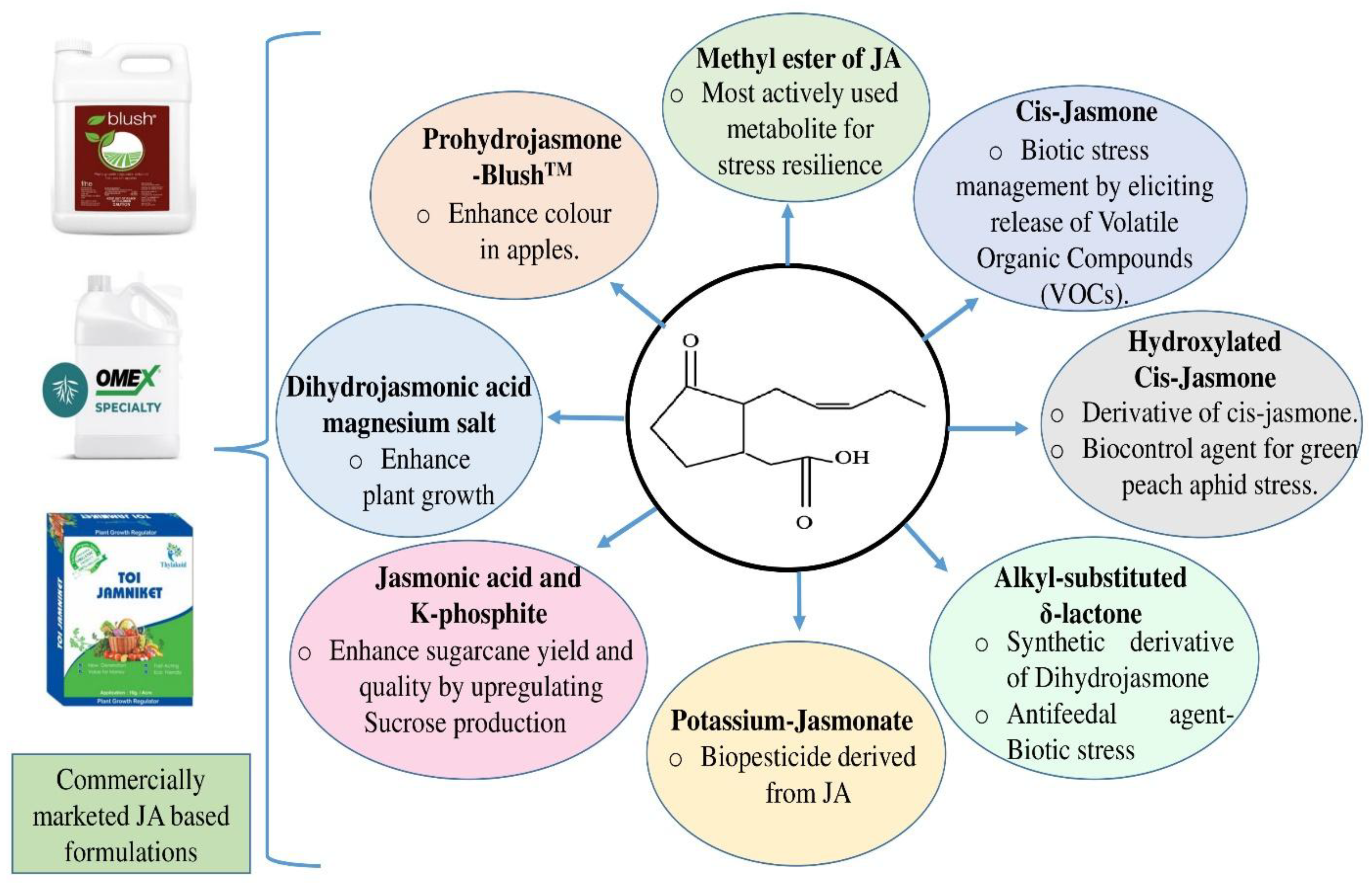
Figure 1.
Agrochemicals and Biostimulants derived from Jasmonic acid. (Sidhu et al., 2022; Moreira et al., 2019; Paprocka et al., 2018; Sobhy et al., 2017; Gewehr, 2014).
Figure 1.
Agrochemicals and Biostimulants derived from Jasmonic acid. (Sidhu et al., 2022; Moreira et al., 2019; Paprocka et al., 2018; Sobhy et al., 2017; Gewehr, 2014).
References
- Aldridge, D.C., Galt, S., Giles, D., Turner, W.B., 1971. Metabolites of Lasiodiplodia theobromae. Journal of the chemical society, C: Organic. 1623-1627.
- Bell, E., Creelman, R.A., Mullet, J.E., 1995. A chloroplast lipoxygenase is required for wound-induced jasmonic acid accumulation in Arabidopsis. Proc. Natl. Acad. Sci. USA. 92, 8675-8679.
- Cohen, S., and Flescher, E., (2009). Methyl jasmonate: a plant stress hormone as an anti-cancer drug. Phytochemistry. 70: 1600-1609.
- David Marks, 2012. Agricultural composition. Patent no. US8137429B2.
- Demole, E., Lederer, E., Mercier, D., 1962. lsolement et determination de Ia structure du jasmonate methyl, constituent odorant characteristique de I’essence de jasmin. Helv. Chim. Acta. 45, 675-685.
- Farmer, E.E., Ryan, C.A., 1990. Interplant communication: airborne methyl jasmonate induces synthesis of proteinase inhibitors in plant leaves. Proceedings of the National Academy of Sciences. 87(19), 7713-7716.
- Gewehr, M., 2014. Pesticidal Mixtures comprising Jasmonic Acid or a derivative thereof. Patent no. PCT/EP2013/070149.
- Ghasemi Pirbalouti, A., Sajjadi, S.E. and Parang, K., 2014. A review (research and patents) on jasmonic acid and its derivatives. Archiv der Pharmazie, 347(4), pp.229-239.
- Gunjegaonkar, S.M., Shanmugarajan, T.S., and Wankhede S.B. (2018). Plant Stress Hormone Methyl Jasmonate: Potential Candidate for Human Therapeutic Applications. International Journal of Pharmacognosy and Chinese Medicine. 2576-4772.
- He, Y., Fukushige, H., Hildebrand, D.F. and Gan, S., 2002. Evidence supporting a role of jasmonic acid in Arabidopsis leaf senescence. Plant physiology, 128(3), pp.876-884.
- Hesse, A. and Müller, F., 1899. Ueber ätherisches Jasminblüthenöl. I. Berichte der deutschen chemischen Gesellschaft, 32(1), pp.565-574.
- Kaushik, S., Ranjan, A., Sidhu, A., Singh, A.K. and Sirhindi, G., 2024. Cadmium toxicity: its’ uptake and retaliation by plant defence system and ja signaling. BioMetals, 37(4), pp.755-772.
- Kaushik, S., Sidhu, A., Singh, A.K. and Sirhindi, G., 2022. Bioscience of Jasmonates in Harmonizing Plant Stress Conditions. In Jasmonates and Brassinosteroids in Plants (pp. 99-118). CRC Press.
- Kondo, S., Tomiyama, A. and Seto, H., 2000. Changes of endogenous jasmonic acid and methyl jasmonate in apples and sweet cherries during fruit development. Journal of the American Society for Horticultural Science, 125(3), pp.282-287.
- Mason, H.S., DeWald, D.B., Creelman, R.A., Mullet, J.E., 1992. Coregulation of Soybean Vegetative Storage Protein Gene Expression by Methyl Jasmonate and Soluble Sugars. Plant Physiol. 98, 859-867.
- Moreira, B.D.A., Viana, R.D.S., Lisboa, L.A.M., Lopes, P.R.M., Figueiredo, P.A.M., Ramos, S.B., Bonini, C.S.B., Trindade, V.D.R., ANDRADE, M.D.O. and May, A., 2019. Jasmonic acid and K-phosphite enhance productivity and technological quality of sugarcane crop.
- Omelianski, V.L., 1923. Aroma-producing microörganisms. Journal of bacteriology, 8(4), pp.393-419.
- Paprocka, M., Gliszczyńska, A., Dancewicz, K. and Gabryś, B., 2018. Novel hydroxy-and epoxy-cis-jasmone and dihydrojasmone derivatives affect the foraging activity of the peach potato aphid Myzus persicae (Sulzer)(Homoptera: Aphididae). Molecules, 23(9), p.2362.
- Power, F.B., 1921. The detection of methyl anthranilate in fruit juices. Journal of the American Chemical Society, 43(2), pp.377-381.
- Raviv, Z., Cohen, S., and Reischer-Pelech, D. (2013). The anti-cancer activities of jasmonates. Cancer Chemother Pharmacol. 71:275-285.
- Sahil, Das, A., Mehta, S., Abdelmotelb, K.F., Lavale, S.A., Aggarwal, S.K., Jat, B.S., Tripathi, A. and Garg, S., 2021. Jasmonic acid for sustainable plant growth and production under adverse environmental conditions. Plant Performance Under Environmental Stress: Hormones, Biostimulants and Sustainable Plant Growth Management, pp.71-98.
- Schubert, R., Dobritzsch, S., Gruber, C., Hause, G., Athmer, B., Schreiber, T., Marillonnet, S., Okabe, Y., Ezura, H., Acosta, I.F. and Tarkowska, D., 2019. Tomato MYB21 acts in ovules to mediate jasmonate-regulated fertility. The Plant Cell, 31(5), pp.1043-1062.
- Sembdner, G., Parthier, B., 1993. The biochemistry and the physiological and molecular actions of jasmonates. Annu. Rev. Plant Physiol. Plant MOI. Biol. 44, 569-589.
- Sidhu, A., Kaushik, S., Singh, A.K. and Sirhindi, G., 2022. Application of Jasmonates in the Sustainable Development of Agriculture and Horticulture Crops. In Jasmonates and Brassinosteroids in Plants (pp. 187-198). CRC Press.
- Sirhindi, G., Kaushik, S., Mushtaq, R., Sharma, P. and Dogra, N., 2020. Jasmonates induce growth and modulation in pigments and vitamins of Brassica oleracea var. capitata, italica and botrytis edible heads (foliage/inflorescence). Brazilian Journal of Botany, 43, pp.705-719.
- Sirhindi, G., Mir, M.A., Abd-Allah, E.F., Ahmad, P. and Gucel, S., 2016. Jasmonic acid modulates the physio-biochemical attributes, antioxidant enzyme activity, and gene expression in Glycine max under nickel toxicity. Frontiers in plant science, 7, p.591.
- Sobhy, I.S., Woodcock, C.M., Powers, S.J., Caulfield, J.C., Pickett, J.A. and Birkett, M.A., 2017. cis-Jasmone elicits aphid-induced stress signalling in potatoes. Journal of Chemical Ecology, 43, pp.39-52.
- Sood, M., 2023. Jasmonates: “The master switch” for regulation of developmental and stress responses in plants. Journal of Plant Growth Regulation, 42(8), pp.5247-5265.
- Vick, B.A., Zimmerman, D.C., 1987. “Oxidative systems for modification of fatty acids: the lipoxygenase pathway.” Lipids: structure and function. Academic Press. Pp. 53-90.
- Vincent, S.A., Kim, J.M., Pérez-Salamó, I., To, T.K., Torii, C., Ishida, J., Tanaka, M., Endo, T.A., Bhat, P., Devlin, P.F. and Seki, M., 2022. Jasmonates and Histone deacetylase 6 activate Arabidopsis genome-wide histone acetylation and methylation during the early acute stress response. BMC biology, 20(1), p.83.
- Wasternack, C. and Hause, B., 2013. Jasmonates: biosynthesis, perception, signal transduction and action in plant stress response, growth and development. An update to the 2007 review in Annals of Botany. Annals of botany, 111(6), pp.1021-1058.
- Wasternack, C. and Song, S., 2017. Jasmonates: biosynthesis, metabolism, and signaling by proteins activating and repressing transcription. Journal of Experimental Botany, 68(6), pp.1303-1321.
- Wasternack, C., 2015. How jasmonates earned their laurels: past and present. Journal of plant growth regulation, 34, pp.761-794.
- Wasternack, C., 2020. Determination of sex by jasmonate. Journal of Integrative Plant Biology, 62(2), pp.162-164.
- Xu, P., Zhao, P.X., Cai, X.T., Mao, J.L., Miao, Z.Q. and Xiang, C.B., 2020. Integration of jasmonic acid and ethylene into auxin signaling in root development. Frontiers in Plant Science, 11, p.271.
- Yoshida, Y., Sano, R., Wada, T., Takabayashi, J. and Okada, K., 2009. Jasmonic acid control of GLABRA3 links inducible defense and trichome patterning in Arabidopsis.
Disclaimer/Publisher’s Note: The statements, opinions and data contained in all publications are solely those of the individual author(s) and contributor(s) and not of MDPI and/or the editor(s). MDPI and/or the editor(s) disclaim responsibility for any injury to people or property resulting from any ideas, methods, instructions or products referred to in the content. |
© 2025 by the authors. Licensee MDPI, Basel, Switzerland. This article is an open access article distributed under the terms and conditions of the Creative Commons Attribution (CC BY) license (http://creativecommons.org/licenses/by/4.0/).
Copyright: This open access article is published under a Creative Commons CC BY 4.0 license, which permit the free download, distribution, and reuse, provided that the author and preprint are cited in any reuse.


