

Submitted:
31 October 2025
Posted:
04 November 2025
Read the latest preprint version here
Abstract
The extraction of rotational energy from a Kerr black hole admits several celebrated descriptions, including the Penrose process, wave superradiance, and the Blandford-Znajek mechanism. Traditionally treated as distinct, these processes are shown here to be unified through a single criterion: the existence of negative Killing energy flux across the horizon, locally manifested as negative phase velocity (NPV) in the ergosphere. I demonstrate that (i) the Penrose process corresponds to particle trajectories with Eχ < 0, (ii) superradiance corresponds to wave modes with ω < mΩH, and (iii) the Blandford–Znajek mechanism corresponds to electromagnetic field lines with ΩF < ΩH. In all cases, the horizon absorbs negative energy while positive energy escapes to infinity. By expressing these mechanisms through the NPV condition S · k < 0, I present a unified theoretical framework for black hole energy extraction.
Keywords:
negative phase velocity (NPV)
; penrose process
; Blandford–Znajek mechanism
; superradiance
; Kerr black hole/ergosphere
; negative killing energy
; energy extraction from black holes
; Poynting flux/electromagnetic jets
; frame-dragging/horizon physics
; GRMHD diagnostics/numerical simulations
; wave amplification/mode scattering
1. Introduction
Rotating black holes provide one of the most remarkable natural laboratories for relativistic energy transfer. The ergosphere—the spacetime region outside the horizon where the timelike Killing vector becomes spacelike—permits negative-energy states relative to infinity. This peculiar feature allows rotational energy to be tapped, an idea pioneered by Penrose (1969).
Over the decades, three paradigms have emerged:
- Penrose process: a test particle entering the ergosphere can split into fragments, one of which falls into the black hole with negative Killing energy, allowing the other to escape with enhanced energy.
- Superradiance: classical or quantum fields scattered by a rotating black hole can emerge amplified if their frequency satisfies .
- Blandford–Znajek mechanism: magnetic field lines threading the horizon, coupled to a force-free magnetosphere, can extract rotational energy and drive astrophysical jets.
Although derived in different contexts—particles, waves, and electromagnetic fields—these processes share the same root: the absorption of negative energy by the horizon. This work demonstrates that a local diagnostic, negative phase velocity (NPV), provides a unifying description. In all channels, energy extraction occurs precisely when the phase velocity points opposite to the energy flux, i.e., .

Table 1.
Connection between Penrose process, superradiance, and Blandford–Znajek (BZ) mechanism, and their relation to negative phase velocity (NPV).
Table 1.
Connection between Penrose process, superradiance, and Blandford–Znajek (BZ) mechanism, and their relation to negative phase velocity (NPV).
| Phenomenon | Description | Relation to NPV |
|---|---|---|
| Penrose process | Particle in the ergosphere splits; one fragment with negative energy falls into the hole, the other escapes with greater-than-incoming energy. | Negative-energy state corresponds to energy flow opposing momentum (phase direction) — a mechanical analog of NPV. |
| Superradiance | Incident waves scattering off a rotating black hole are amplified when the superradiant condition holds. | Amplification arises because, within the ergosphere, local phase and energy flow oppose each other, creating an NPV region that extracts rotational energy. |
| Blandford–Znajek (BZ) | Magnetic field lines threading the rotating hole drive currents; energy is extracted as outward Poynting flux. | Magnetosphere behaves as a macroscopic NPV-like system: outward Poynting flux with co-rotating field structure; horizon acts like a rotating conductor with effectively negative impedance. |
2. Theoretical Framework
2.1. Geometry and Conserved Currents
Consider a Kerr black hole with mass M and angular momentum . The horizon generator is
with the horizon radius.
For a stress-energy tensor , the conserved flux of energy across the horizon is
while the angular momentum flux is
Horizon regularity imposes the relation
Thus, if , the horizon absorbs negative energy: rotational energy is extracted.
2.2. Negative Phase Velocity Condition
In a locally non-rotating (ZAMO) frame, the Poynting vector gives the direction of energy flow, while the wavevector sets the direction of phase propagation. The NPV condition is
which coincides with the condition that the horizon absorbs negative Killing energy.
In ordinary media, the phase velocity (direction of wavefront propagation) and the energy flow (given by the Poynting vector) point in the same direction. In negative-phase-velocity (NPV) or left-handed media, the phase velocity points opposite to the energy flow. Such media exhibit negative refraction, reverse Doppler, and reverse Cherenkov effects. This can also arise not just in meta-materials, but in curved spacetime near rotating black holes, where the spacetime metric itself acts as an effective medium with exotic constitutive parameters.
In Kerr geometry (i.e. rotating black holes), the frame-dragging of spacetime inside the ergosphere produces regions where the effective electromagnetic constitutive tensor allows NPV propagation. This means that Waves can have phase velocity directed inward while energy flow (Poynting vector) points outward, and the local observer sees “backward” wave propagation relative to the global energy flux. This is the electromagnetic analog of negative energy orbits in the Penrose process.
3. Results: Three Channels of Energy Extraction
3.1. Penrose Process (Particle Channel)
A particle with 4-momentum has Killing energy
In the ergosphere, can become negative. If a particle splits such that one fragment has , the escaping fragment must carry away energy in excess of the original. This is the particle realization of the NPV condition: momentum direction anti-aligned with energy flux.
3.2. Superradiance (Wave Channel)
For a scalar field mode
the horizon flux evaluates to
Amplification occurs when
so that . Locally, this corresponds to NPV: the phase velocity associated with is opposite to the outward energy flux .
3.3. Blandford–Znajek Mechanism (Electromagnetic Channel)
In a magnetosphere, magnetic field lines rotate with angular velocity . Each azimuthal Fourier mode behaves as if . The horizon energy flux is then
When , the flux is negative and outward Poynting power is produced. The classic BZ power law is
with the magnetic flux and a dimensionless constant.
Table 2.
Unified physical picture across particle, wave, and field/plasma regimes, highlighting how NPV manifests in each.
Table 2.
Unified physical picture across particle, wave, and field/plasma regimes, highlighting how NPV manifests in each.
| Process | Mechanism | NPV manifestation |
|---|---|---|
| Penrose (particle) | Negative-energy orbits in the ergosphere enable net energy extraction. | Momentum/phase direction vs. energy flow are misaligned (mechanical analog of NPV). |
| Superradiance (wave) | Wave amplification by a rotating horizon under the superradiant condition. | Phase velocity opposes energy (Poynting) flow within the ergosphere (wave-level NPV). |
| Blandford–Znajek (field/plasma) | Magnetically driven jet (outward Poynting flux) powered by black-hole spin. | Effective negative electromagnetic impedance; macroscopic NPV-like energy extraction. |
| NPV (EM/geometric)) | Phase–energy opposition enabled by frame-dragging and constitutive effects. | Underlies all of the above energy-extraction phenomena. |
4. Discussion
The above results demonstrate that all known energy extraction processes from a Kerr black hole are governed by a single criterion: the absorption of negative Killing energy, equivalently expressed as negative phase velocity propagation in the ergosphere.
- Penrose process: NPV arises in the momentum-energy misalignment of particles.
- Superradiance: NPV is realized when the reflected wave has group velocity outward but phase velocity inward.
- BZ mechanism: NPV manifests as field lines with pattern speed below the horizon angular velocity, leading to reversed energy flux across the horizon.
This unification has several consequences:
- It clarifies that BZ is not fundamentally different from superradiance but its steady, force-free, large-scale limit.
- It provides a diagnostic for simulations: identifying regions with can signal ongoing energy extraction in numerical GRMHD models.
- It suggests that analogous processes may occur in other rotating systems with ergoregions, such as analogue gravity experiments or rotating compact stars.
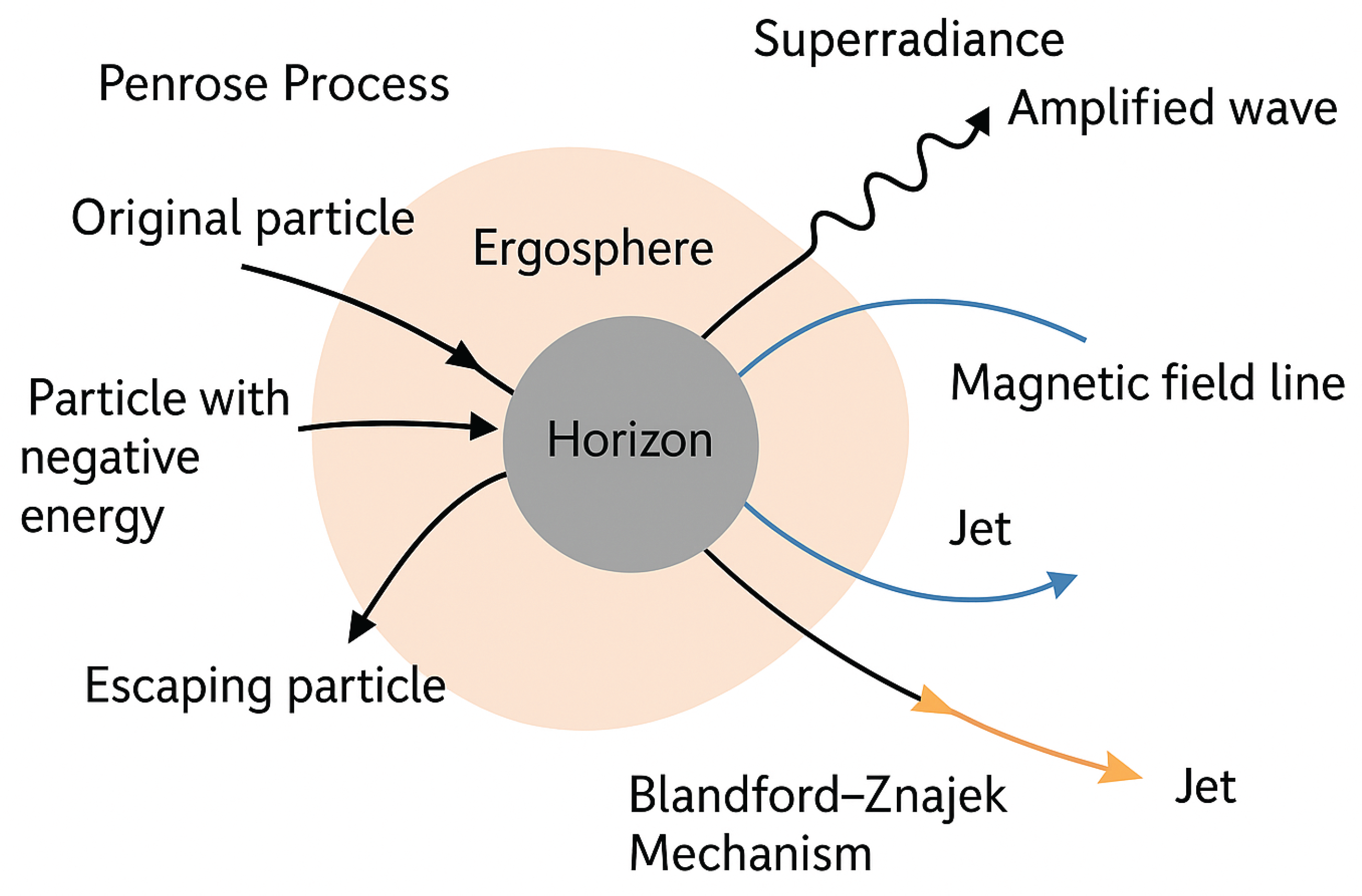
Figure 1.
Penrose Process vs. Blandford-Znajek Mechanism.
5. Conclusion
We have demonstrated that the Penrose process, superradiant scattering, and the Blandford–Znajek mechanism are three manifestations of a unified energy-extraction phenomenon from rotating black holes. The ergosphere permits negative Killing energy states, whose local signature is negative phase velocity.
- In the particle channel, this condition allows the Penrose process.
- In the wave channel, it yields superradiant amplification.
- In the electromagnetic channel, it drives the Blandford–Znajek jet.
This unified perspective highlights the ergosphere as the essential stage and NPV as the diagnostic connecting microscopic, mesoscopic, and macroscopic energy extraction processes.
Data Availability Statement
No data were generated or analyzed in support of this research.
References
- Blandford, R. D. , & Znajek, R. L., 1977, MNRAS 179, 433.
- Misner, C. W. , 1972, Phys. Rev. Lett. 28, 994.
- Penrose, R. , 1969, Rivista del Nuo. Cim. 1, 252.
- Setiawan, S. , Mackay, T. G., Lakhtakia, A, 2005, Phys.Lett. A341 15-21; Erratum-ibid. 2007, A361, 529-533.
- Teukolsky, S. A. , & Press, W. H., 1974, ApJ 193, 443.
- Thorne, K. S. , Price, R. H., & Macdonald, D. A., 1986, Black Holes: The Membrane Paradigm, Yale University Press.
- Zel’dovich, Y. B. , 1971, JETP Lett. 14, 1.
Disclaimer/Publisher’s Note: The statements, opinions and data contained in all publications are solely those of the individual author(s) and contributor(s) and not of MDPI and/or the editor(s). MDPI and/or the editor(s) disclaim responsibility for any injury to people or property resulting from any ideas, methods, instructions or products referred to in the content. |
© 2025 by the authors. Licensee MDPI, Basel, Switzerland. This article is an open access article distributed under the terms and conditions of the Creative Commons Attribution (CC BY) license (http://creativecommons.org/licenses/by/4.0/).
Copyright: This open access article is published under a Creative Commons CC BY 4.0 license, which permit the free download, distribution, and reuse, provided that the author and preprint are cited in any reuse.