

Submitted:
29 October 2025
Posted:
30 October 2025
You are already at the latest version
Abstract
In this work, we calculate the branching ratio (BR) of the decay process ρ0→π0π0γ within the theoretical framework of chiral perturbation theory with resonances, employing the odd intrinsic parity lagrangian. Our analysis shows that the BR depends solely on the LECs c57≡c5+c7, and d4. Since the experimentally measured BR does not provide sufficient constraints, the number of free parameters is reduced by applying on-shell and off-shell conditions at the interaction vertices. Our result shows that using full on-shell conditions is not consistent with the experimental BR. Therefore, we present an allowed region (contour plot) for (c57,d4) that is compatible with the experimental BR. We emphasize that once the differential BR becomes accessible, a fitting procedure can be carried out to delineate the parameter space.
Keywords:
QCD
; chiral perturbation theory (ChPT)
; effective field theories of QCD
; resonance chiral theory (RχT)
1. Introduction
The Standard Model of Particle Physics (SM) [1,2] is one of the most successful theories, it predicts almost all phenomena in particle physics between matter and its interactions: electromagnetic, weak, and strong. However, it is incomplete because it does not incorporate dark matter, gravity, neutrino masses and it does not explain the asymmetry matter -antimatter in the universe. Nowadays SM is considered an effective field theory with 19 free parameters that cannot be derived from the theory itself. Instead, these parameters must be determined phenomenologically, which is accomplished through the advancement of particle colliders experiments. The current status of these parameters can be found in Ref. [3].
At low energies, below 1 GeV, the particle spectrum consists predominantly of hadrons, which are composed of quarks embedded in a gluon sea. Gluons are the massless gauge bosons of spin 1 that mediate the strong interactions between quarks. In this regime, the strong coupling constant becomes sufficiently large to prevent the use of perturbative methods. Consequently the dynamics of hadronic structure cannot be described within the framework of SM at such energy scales.
As an alternative approach to the study of strong interactions, effective field theories (EFT) provide an ideal framework. They are constructed from the underlying fundamental theory in accordance with the Weinberg’s theorem [4], which states that the effective Lagrangian must respect the symmetries relevant to the energy range of interest. However, the predictive power of an EFT relies on the knowledge of its low energy coupling constants (LECs), which cannot be determined by symmetry requirements and must therefore be obtained either from the underlying theory or through phenomenological methods.
Chiral perturbation theory (ChPT) is an EFT of quantum chromodynamics (QCD) in the chiral limit1, formulated as a perturbative expansion in powers of momenta. The relevant degrees of freedom correspond to the Goldstone bosons arising from the spontaneous breaking of chiral symmetry, which can be identified with the lightest pseudoscalar mesons [5]. At leading order, corresponding to , the effective Lagrangian depends on two LECs, whose values are determined phenomenologically and are well established[5,6]. However, at higher orders, such as , the number of LECs increases significantly, making their determination a challenge.
As the energy increases up to 1 GeV, the role of resonance particles becomes significant, and they must be included as additional degrees of freedom. This leads to the framework of Resonance Chiral Theory () [6,7], which introduces new LECs. In the even parity sector [7], two LECs arise, and their corresponding values are well known. On the other hand, the odd intrinsic parity sector, formulated in Ref. [8], includes interactions among two light resonances (vectors) and one light pseudoscalar field, namely the VVP operators. Moreover, the interaction involving a vector, a pseudoscalar, and an external source (VJP) allows one to describe electromagnetic and weak interactions. This formulation incorporates eleven LECS, which are a priori unknown. Fortunately, by constructing the VVP and VJP Green’s three -point functions at leading order in , some combinations of these LECS can be predicted by requiring that the short-distance (high-energy) behavior of these Green’s functions matches the corresponding Operator Product Expansion (OPE)[8]. Nonetheless, some couplings remain unknown, in particular and , thus requiring a phenomenological analysis to set reasonable bounds on LECs.
In computing the isospin symmetry-breaking (IB) effects in the process , an upper bound of is assumed in Ref. [9]. This IB corrections are important in the tau-based determination of the hadronic vacuum polarization contribution to the anomalous magnetic moment of the muon [10]. Following the same line, Ref. [11] found that the decay can provide information on , assuming the on-shell condition for the vertex, which eliminates the dependence. This coupling is an input in their analysis of the triple-product asymmetries in the decay and in the radiative two-pion decay, namely . They report two possible values, and and choose2 the positive one in their analysis to maintain consistency with the result in [9].
With this proviso, it is clear that a more general analysis of this pair of couplings can be performed. The aim of this work is to determine the values of these couplings through the analysis of the branching ratio , described at tree level within the framework of the odd intrinsic parity Lagrangian, considering both vertices to be off-shell.
This paper is organized as follows. In Section 2, we review the foundations of Chiral Perturbation Theory (ChPT) and the inclusion of light resonances that give rise to , covering both the even- and odd-intrinsic-parity sectors, as described in Ref. [8]. In Section 3, we compute the invariant amplitude of the process , showing that only depends on and . In addition, the on-shell and off-shell vertices are defined, and their impact on the determination of the BR is discussed. In Section 4, we present our results and conclusions and in the last section, Appendix A, the full analytical expressions are reported.
2. Chiral Perturbation Theory with Resonances
ChPT is an EFT of QCD that incorporates all the essential features of QCD at low energies, well below 1 GeV . It is formulated as an expansion in powers of momentum, where the relevant degree of freedom are the eight Goldstone bosons corresponding to the lightest states in the hadronic spectrum. According to the power-counting scheme, the ChPT Lagrangian at lowest order is given by 3
where
is the parameterization of the Goldstone fields , which transform under the group4G as
The field is expressed as follows
where denote the Gell-Mann matrices and the covariant derivative
is defined to transform as
The symmetry breaking is introduced by the last two terms in Equation (1) with
where s and p are the scalar and pseudoscalar external fields, respectively.
The constants F and are LECs that can be determined phenomenologically [5,8]. For instance is associated with the pion decay constant, which can be extracted from the decay . On the other hand, is related to the scalar quark condensate and plays a central role in the spontaneous breaking of chiral symmetry.
Interactions with external fields are incorporated through the fields and . In the case of the electromagnetic interaction, these fields are given by
where is the electromagnetic field and
is the quark charge matrix.
As the energy approaches 1 GeV, incorporates the light resonances as explicit degrees of freedom. In Ref. [12], it is show that the vector and the antisymmetric tensor representation are equivalent. In this work, we adopt the antisymmetric tensor formalism as given in Ref. [7]. The Lagrangian of in the even intrinsic parity sector reads
To facilitate the construction of invariant terms involving resonances, the following parameterization is used
which transforms under the chiral group G as follows
with . In terms of this parameterization, the lowest-order chiral Lagrangian in Equation (1) becomes
where
The interaction of the vector resonances with the light mesons and external fields is described by
where
and
Finally, the kinetic part for the vector resonances is introduced as
where is the mass of the vector octet and
is the covariant derivative, defined to ensure invariance under the transformation of the vector field,
The natural connection in the coset space [6] is given by
The representation of the octets of Goldstone bosons and vector resonances are written as follows
In Ref. [8], the Lagrangian of the odd intrinsic parity sector is introduced, namely
where the operators are given by
These operators describe the interaction between two vector resonances and one pseudoscalar . On the other hand, the operators given by
describe the interaction between a vector resonance, an external vector source and a pseudoscalar (VJP). Some of the couplings , can be constrained by using the large- limit and by requiring compatibility with the short-distance behavior of QCD [8] and the result reads,
It is worth mentioning that in [13], an updated set of high-energy constraints on the LECs is provided,
3. Study of the Decay into Within
The decay process has been extensively studied. The first measurement of was obtained from the radiative process below 1 GeV [19]. This process is described within the vector meson dominance framework, including kaon loops and an intermediate scalar state, the meson[20,21,22,23,24]. However, a discrepancy with experimental data persist. Further efforts have been made [25] by incorporating additional intermediate states, such as the (now referred to as ), but the disagreement remains unsolved.
To further investigate possible contributions that could account for this discrepancy, we analyze the decay process within the framework of Resonance Chiral Theory (), focusing on the role of the unknown coupling constants.
3.1. Interaction Vertex Among the , , and Particles
The interaction vertices in terms of the fields are obtained from the VVP operators in Equation (26), considering only the relevant degrees of freedom (, ) and neglecting higher-order terms. Given this convention, the required expressions are written as,
where denotes a diagonal matrix, for instance
From now on, the subscripts on will be used exclusively as identifying labels and shall not be interpreted as tensor indices. The convention for momenta is shown in Figure 1. Consequently, the Feynman rule for the vertex is given by
where
3.1.1. On-Shell Vertex
The decay can be described within the framework, but its evaluation is hindered by its dependence on a set of LECs that remain unknown. Nonetheless, the number of independent couplings can be significantly reduced by employing on-shell vertices [11]. An on-shell vertex scenario corresponds to applying the Feynman rule for a vertex under the assumption that all external particles are on-shell, even when, in the Feynman amplitude, one of the legs corresponds to a virtual (off-shell) particle.
To define the on-shell vertex, we consider the process , where all the particles are on-shell and their corresponding momentum satisfy
3.2. Interaction Vertex Among the , , and Particles
In this section, we closely follow the treatment presented in Section 3.1. The interaction vertex involving the particles is derived from the Lagrangian given in Equation (26), taking into account only the relevant degrees of freedom and neglecting higher-order terms. The expressions thus derived are
The Lorentz indices and l are assigned according to Figure 2.
3.2.1. On-Shell Vertex
Considering the process, the Feynman amplitude, provided in Ref. [8], is given by
where can be reduced, after using Equations (38)–(40), as follows,
Therefore, the on-shell vertex is given by
which corresponds to the expression reported in [11].
3.3. Decay into
In this section, we analyze the process using the interaction Lagrangian given in Equation (47). At lowest order, the Feynman amplitude requires a and a vertex, with the treated as a virtual particle, as shown in Figure 3. It is found that the depends on the specific combination of LECs and . In order to reduce the number of unknown couplings, one can use the on-shell vertex, the on-shell vertex or considering both vertices on shell.
Scenario 1: The Decay via Purely on-Shell Vertices
First we calculate the branching ratio using both vertices on-shell, which are given in Equations (69) and (94). The corresponding Feynman amplitude is given by
where
and
The scalar products, expressed in terms of the Mandelstam variables defined as , , and , are written as follows
The kinematics of a three-body decay can be described by only two independent variables. In this work, we chose and ; therefore, the branching ratio is calculated as
where
and denotes the total decay width. The minimum and maximum values of and define the boundaries of the region known as the Dalitz plot (Figure 4), which are determined by the following relations
The values of the meson masses and decay widths, according to the Particle Data Group [3], are , , , and , where the numbers in parentheses indicate the uncertainties. Additionally, we take from Ref. [8] the values , , and .
The prediction with both vertices on-shell, using the relations (41)–(43), gives the value
while using Equations (44)–(46) yields
The propagated error reported in Equations (111) and (110) has been estimated as follows. The inputs parameters reported by the PDG have an uncertainty ; thus the evaluation is performed using the central value of all inputs, as well as the central value plus and minus . Finally, the uncertainty is collected as the sum of the deviations from the central value.
Comparing our prediction with the experimental value clearly shows that taking both vertices on-shell is not consistent.
Scenario 2: The decay via the on-shell vertex
In this section we treat the vertex (85)–(91) as off-shell, whereas the vertex remains on-shell (69). The corresponding Feynman amplitude for the decay is then given by
where the functions , and are given in Appendix A. For simplicity, we defined the following notation
When the relations (38)–(40) are applied, the Equation (112) depend exclusively on . Assuming that the theoretical prediction matches the experimental branching ratio, one obtains a quadratic expression in . Using the constraints (43), we find the roots . Similarly, applying the constraints (46) yields the solutions .
Scenario 3: The Decay via the on-Shell vertex
Here we take the vertex (94) to be on-shell, whereas the vertex (61)–(64) is kept off-shell. Consequently, the Feynman amplitude simplifies to
where, for simplicity it was defined the relation
and the functions , and are defined in the Appendix A.
When the relations (41)–(42) or, alternatively, (44)–(45) are applied, Equation (117) simplifies and the BR becomes a quadratic function of . Analogous to the analysis performed in the previous scenario, the solutions are using the constraints (41)–(43) and using the constraints (44)–(46). A similar analysis was carried out in Ref. [11] for the decay , and our central values are in reasonable agreement with their results, .
Scenario 4: The Decay with Off-Shell Vertices
Finally, we consider the scenario in which both vertices are off-shell. In this case, the corresponding Feynman amplitude is given by
By applying the large- constraints discussed in Section 2, Equation (119) is found to depend only on and . The dependence on is contained within the functions , and , which are defined in the Appendix A.
Prior to deriving the solution for and in this scenario, we analyze the impact of using the value of obtained in scenarios 2 together with the value of from scenario 3. The results of this combination are presented in Table 1.
The results presented in Table 1 indicate that the combination of on-shell and off-shell vertices provides a more accurate estimation of the branching ratio compared to the scenario that employs solely on-shell vertices. For instance, the parameter pair yields a , representing a notable improvement with respect to the result obtained in scenario 1. However, this value remains below the experimental measurement, , corresponding to a relative deviation of approximately with respect to the central value. However, the procedure used to construct the data in Table 1 is not fully consistent. Consequently, the most effective approach appears to be the use of purely off-shell vertices. Within this framework, a numerical contour solution in the parameter space can be derived, as shown in Figure 5, which identifies the region consistent with the experimental branching ratio.
Selected values from this solution are listed in Table 2.
It is worth noting that the pairs in Figure 5 exhibit three predominant features in the differential branching ratio , as illustrated in Figure 6. The blue curve appears to qualitatively agree with the results reported in Ref. [20], where the interaction is mediated by pion loops within a framework that combines the Vector Meson Dominance model and the linear sigma model.
4. Conclusions
In this work, we have studied the decay process within the framework of Chiral Perturbation Theory with resonances. Our analysis shows that the branching ratio (BR) depends exclusively on the low-energy couplings and . To address this, we analyzed all possible scenarios arising from different combinations of on-shell and off-shell interaction vertices. Our results indicate that the purely on-shell scenario yields a value significantly below the experimental branching ratio, suggesting that this scenario does not provide a reliable description of the process. On the other hand, scenarios in which one of the vertices is taken on-shell reduce the number of unknown coupling, thereby enabling the determination of the remaining coupling from the roots of a quadratic equation. It is worth noting that this approach does not allow us to discriminate between the two roots. Pursuing this line of reasoning, we use both couplings simultaneously and find that, even in the best scenario, the theoretical prediction differs by 19 % from the experimental value of (Table 1). This discrepancy suggests that the vertices must be off-shell. Our results are presented as a region of possible values for and , consistent with the experimental BR, as shown in Figure 5. Considering the result reported in Ref. [11], obtained through the decay , we get the values for and for . However, these values do not fall within the estimate of Ref. [9]. It must be emphasized that the value of obtained in Ref. [11] assumes the vertex to be on-shell, whereas the estimate for in Ref. [9] is based on an informed estimate inferred from the behaviour of the remaining couplings. Consequently, these estimates must therefore be interpreted with caution. In addition, we provide the differential branching ratio (dBR), which depends on the precise values of the LECs. In particular, Figure 6 shows the dBR for three representative sets of , where the shape of the distribution can be clearly observed. This information can be used to further constrain the parameter space (work in progress) by fitting to the experimental dBR data.
Supplementary Materials
The following supporting information can be downloaded at the website of this paper posted on Preprints.org.
Author Contributions
Conceptualization, methodology, algebraic computations, writing, review, and editing have been contributed to equally by all authors. All authors have read and approved the final published version of the manuscript.
Funding
This work was fully supported by the Consejo Nacional de Humanidades, Ciencias y Tecnologías (Conahcyt), under the Secretaría de Ciencia, Humanidades, Tecnología e Innovación (Secihti; CVU 859853).
Institutional Review Board Statement
Not applicable.
Informed Consent Statement
Not applicable.
Data Availability Statement
The original contributions presented in this study are included in the article and its Supplementary Material. For additional questions, please contact the corresponding authors.
Acknowledgments
The authors acknowledge the Universidad Autónoma de Nuevo León for providing facilities and resources during this research.
Conflicts of Interest
The authors declare no conflict of interest.
Abbreviations
The following abbreviations are used in this manuscript:
| BR | Branching Ratio. |
| dBR | Differential Branching Ratio. |
| LEC | Low-energy Coupling Constant. |
| SM | Standard Model. |
| EFT | Effective Field Theory. |
| ChPT | Chiral Perturbation Theory. |
| QCD | Quantum Chromodynamics. |
| Resonance Chiral Theory. | |
| VVP | Two vector sources and a pseudoscalar source. |
| VJP | A vector source, an external source and pseudoscalar source. |
Appendix A. Detailed and Supplementary Expressions
This appendix contains the lengthy analytical expression obtained from computing the Feynman amplitudes for the different scenarios involving on-shell and off-shell vertices.
The explicit expressions for the functions and are:
Similarly, the explicit expressions for the functions , , and are:
Finally, the explicit expressions for the functions , , , and are:
References
- Schwartz, M.D. Quantum Field Theory and the Standard Model; Cambridge University Press, 2014.
- Grossman, Y.; Nir, Y. The Standard Model: From Fundamental Symmetries to Experimental Tests; Princeton University Press, 2023.
- Navas, S.; et al. Review of particle physics. Phys. Rev. D 2024, 110, 030001. [Google Scholar] [CrossRef]
- Weinberg, S. Phenomenological Lagrangians. Physica A: Statistical Mechanics and its Applications 1979, 96, 327–340. [Google Scholar] [CrossRef]
- Scherer, S.; Schindler, M. A Primer for Chiral Perturbation Theory; Lecture Notes in Physics, Springer Berlin Heidelberg, 2011. [CrossRef]
- Pich, A. Chiral perturbation theory. Reports on Progress in Physics 1995, 58, 563. [Google Scholar] [CrossRef]
- Ecker, G.; Gasser, J.; Pich, A.; De Rafael, E. The role of resonances in chiral perturbation theory. Nuclear Physics B 1989, 321, 311–342. [Google Scholar] [CrossRef]
- Ruiz-Femenía, P.D.; Pich, A.; Portolés, J. Odd-intrinsic-parity processes within the resonance effective theory of QCD. Journal of High Energy Physics, 2003; 003. [Google Scholar] [CrossRef]
- Miranda, J.A.; Roig, P. New τ-based evaluation of the hadronic contribution to the vacuum polarization piece of the muon anomalous magnetic moment. Phys. Rev. D 2020, 102, 114017. [Google Scholar] [CrossRef]
- Aliberti, R.; et al. The anomalous magnetic moment of the muon in the Standard Model: an update. Phys. Rept. 2025, 1143, 1–158. [Google Scholar] [CrossRef]
- Chen, C.; Duan, C.G.; Guo, Z.H. Triple-product asymmetry in the radiative two-pion tau decay. JHEP 2022, 08, 144. [Google Scholar] [CrossRef]
- Ecker, G.; Gasser, J.; Leutwyler, H.; Pich, A.; De Rafael, E. Chiral Lagrangians for massive spin-1 fields. Physics Letters B 1989, 223, 425–432. [Google Scholar] [CrossRef]
- Roig, P.; Cillero, J.J.S. Consistent high-energy constraints in the anomalous QCD sector. Physics Letters B 2014, 733, 158–163. [Google Scholar] [CrossRef]
- Kampf, K.; Novotný, J. Resonance saturation in the odd-intrinsic parity sector of low-energy QCD. Phys. Rev. D 2011, 84, 014036. [Google Scholar] [CrossRef]
- Cirigliano, V.; Ecker, G.; Eidemüller, M.; Kaiser, R.; Pich, A.; Portolés, J. Towards a consistent estimate of the chiral low-energy constants. Nuclear Physics B 2006, 753, 139–177. [Google Scholar] [CrossRef]
- Gómez Dumm, D.; Roig, P. Resonance Chiral Lagrangian analysis of τ-→η(′)π-π0ντ. Phys. Rev. D 2012, 86, 076009. [Google Scholar] [CrossRef]
- Gómez Dumm, D.; Pich, A.; Portolés, J. τ→πππντ decays in the resonance effective theory. Phys. Rev. D 2004, 69, 073002. [Google Scholar] [CrossRef]
- Cirigliano, V.; Ecker, G.; Eidemüller, M.; Pich, A.; Portolés, J. 〈VAP〉Green function in the resonance region. Physics Letters B 2004, 596, 96–106. [Google Scholar] [CrossRef]
- Achasov, M.; et al. The e+e-→π0π0γ process below 1.0 GeV. Journal of Experimental and Theoretical Physics Letters 2000, 71, 355–358. [Google Scholar] [CrossRef]
- Bramon, A.; Escribano, R.; Napsuciale, M.; et al. Scalar σ meson effects in ρ and ω decays into π0π0γ. Physics Letters B 2001, 517, 345–354. [Google Scholar] [CrossRef]
- Achasov, M.; et al. Experimental study of ρ→π0π0γ and ω→π0π0γ decays. Physics Letters B 2002, 537, 201–210. [Google Scholar] [CrossRef]
- Gokalp, A.; Yilmaz, O. The decay ρ0→π0π0γ and the role of σ-meson. Physics Letters B 2001, 508, 25–30. [Google Scholar] [CrossRef]
- Marco, E.; Hirenzaki, S.; Oset, E.; Toki, H. Radiative decay of ρ0 and φ mesons in a chiral unitary approach. Physics Letters B 1999, 470, 20–26. [Google Scholar] [CrossRef]
- Gokalp, A.; Solmaz, S.; Yilmaz, O. Scalar σ meson effects in radiative ρ0-meson decays. Phys. Rev. D 2003, 67, 073007. [Google Scholar] [CrossRef]
- Akhmetshin, R.; et al. Study of the process e+e-→π0π0γ in c.m. energy range 600–970 MeV at CMD-2. Physics Letters B 2004, 580, 119–128. [Google Scholar] [CrossRef]
- Shtabovenko, V.; Mertig, R.; Orellana, F. FeynCalc 10: Do multiloop integrals dream of computer codes? Computer Physics Communications 2025, 306, 109357. [Google Scholar] [CrossRef]
- Mertig, R.; Böhm, M.; Denner, A. FeynCalc - Computer-algebraic calculation of Feynman amplitudes. Computer Physics Communications 1991, 64, 345–359. [Google Scholar] [CrossRef]
| 1 | The chiral limit denotes the theoretical scenario in which the light quarks u, d, and s are massless. |
| 2 | see discussion in appendix B of Ref. [11]) |
| 3 | Tr denotes the trace. |
| 4 | The symmetry group is referred to as the Chiral Symmetry |
Figure 1.
Convention of momentum and Lorentz index in the vertex where arrows indicate the direction of annihilation.
Figure 1.
Convention of momentum and Lorentz index in the vertex where arrows indicate the direction of annihilation.
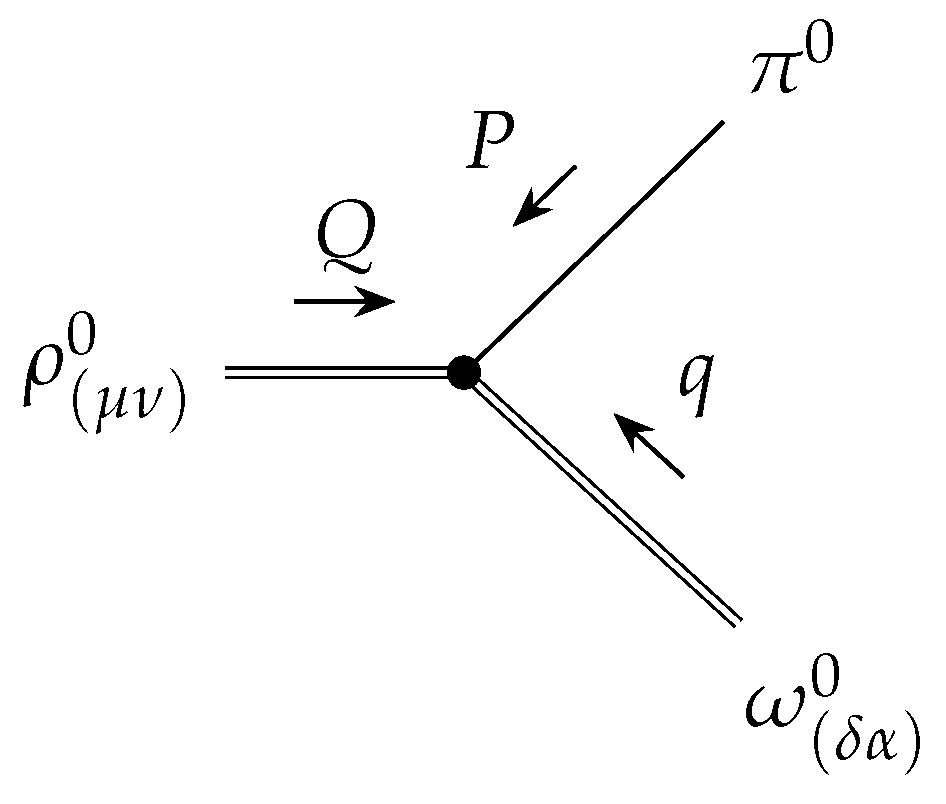
Figure 2.
Convention of momentum and Lorentz index for the , and vertex, where arrows indicate the direction of annihilation.
Figure 2.
Convention of momentum and Lorentz index for the , and vertex, where arrows indicate the direction of annihilation.
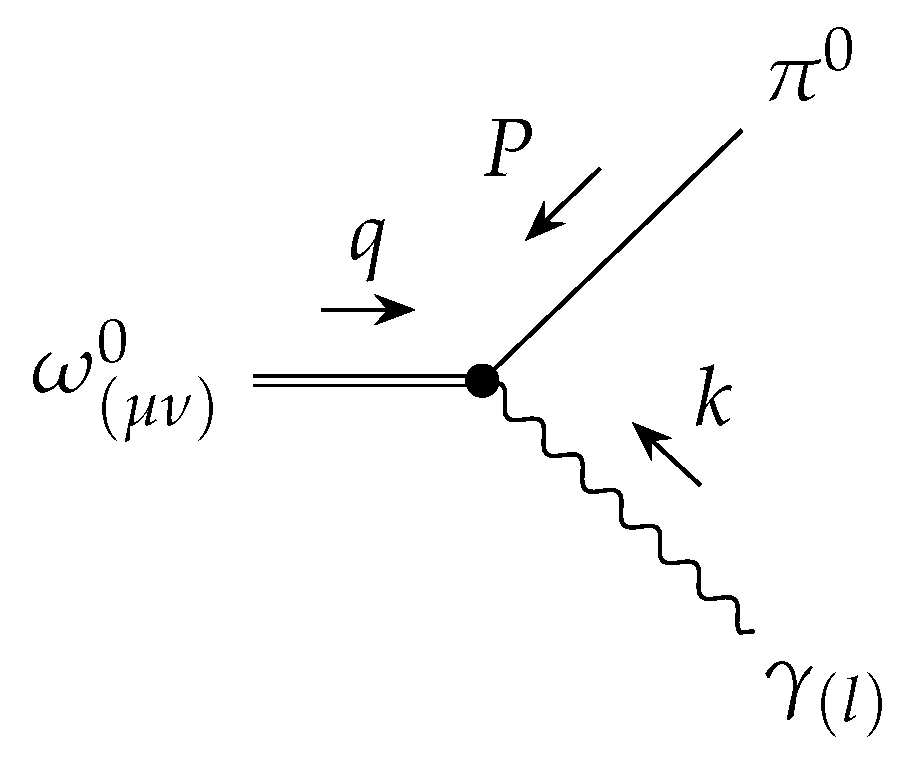
Figure 3.
Lowest-order Feynman diagram for the process , proceeding through a virtual resonance.
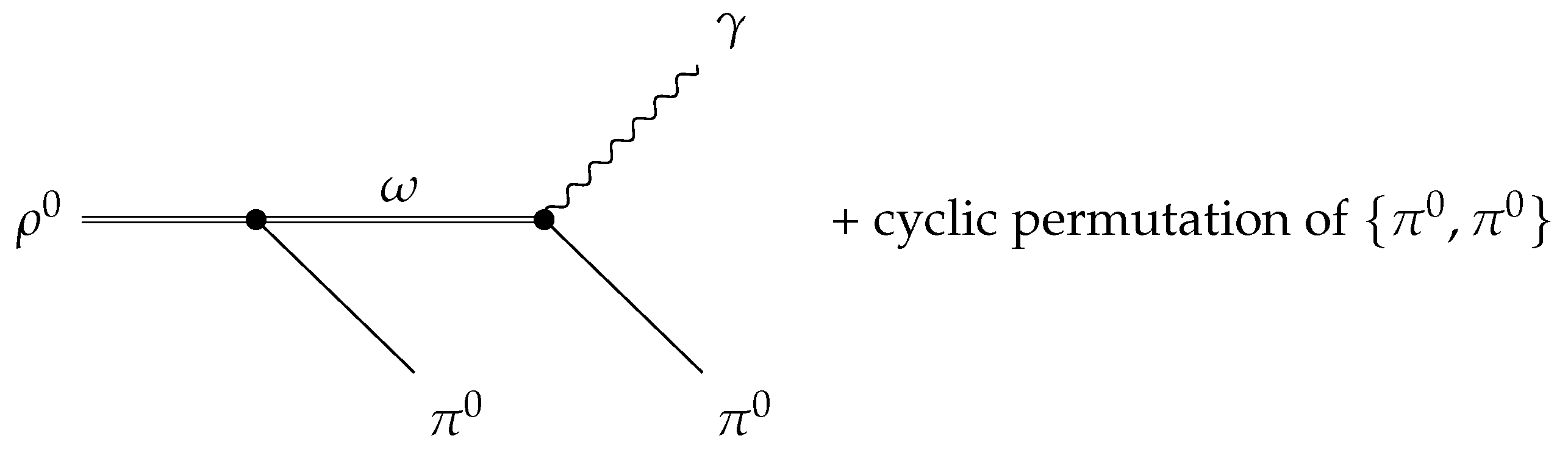
Figure 4.
Dalitz plot for the decay process .
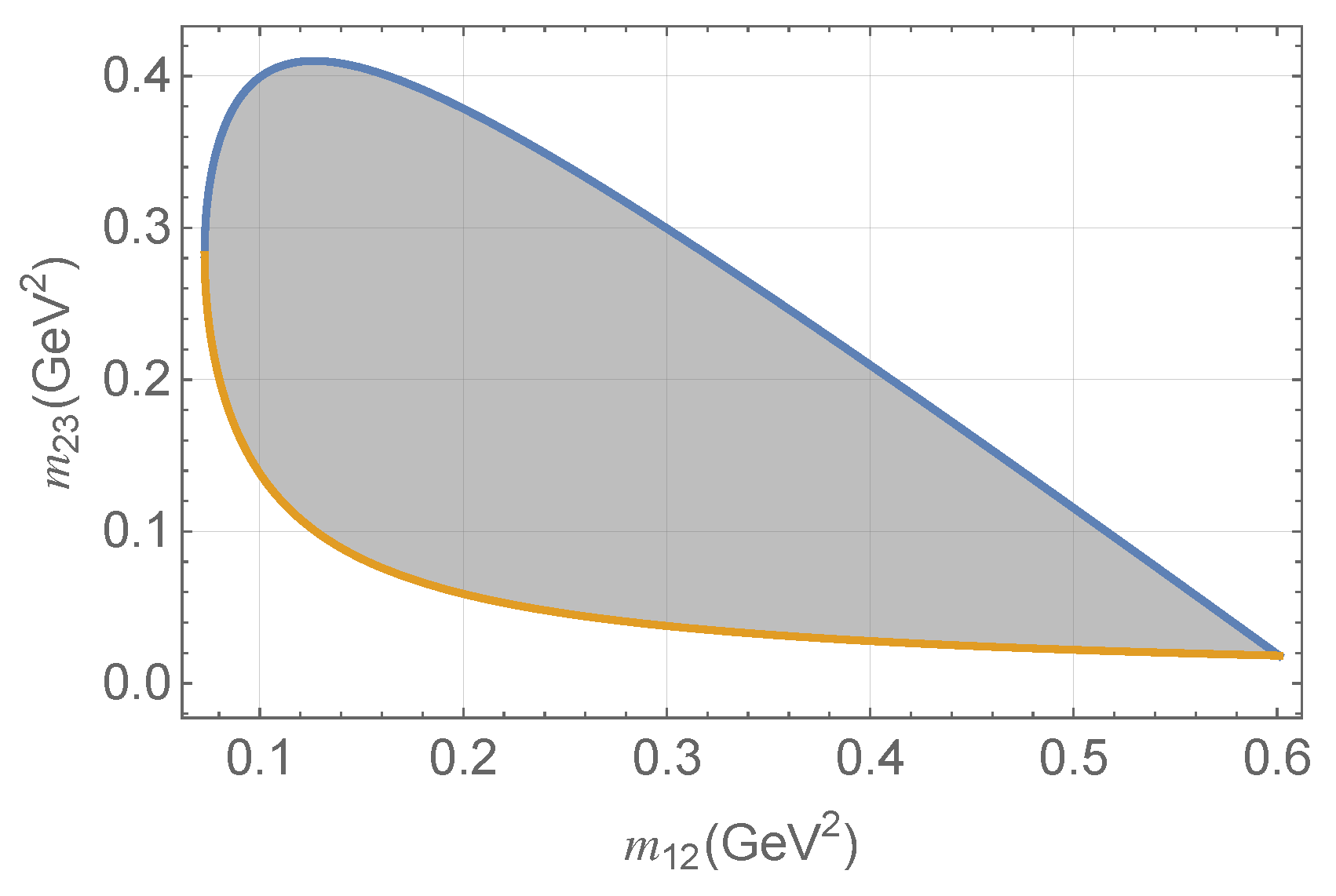
Figure 5.
Geometric locus in the () parameter space that matches the experimental , under the constraints (38)–(43).
Figure 5.
Geometric locus in the () parameter space that matches the experimental , under the constraints (38)–(43).

Figure 6.
In this plot we show the using three specific pairs from Figure 5.
Figure 6.
In this plot we show the using three specific pairs from Figure 5.
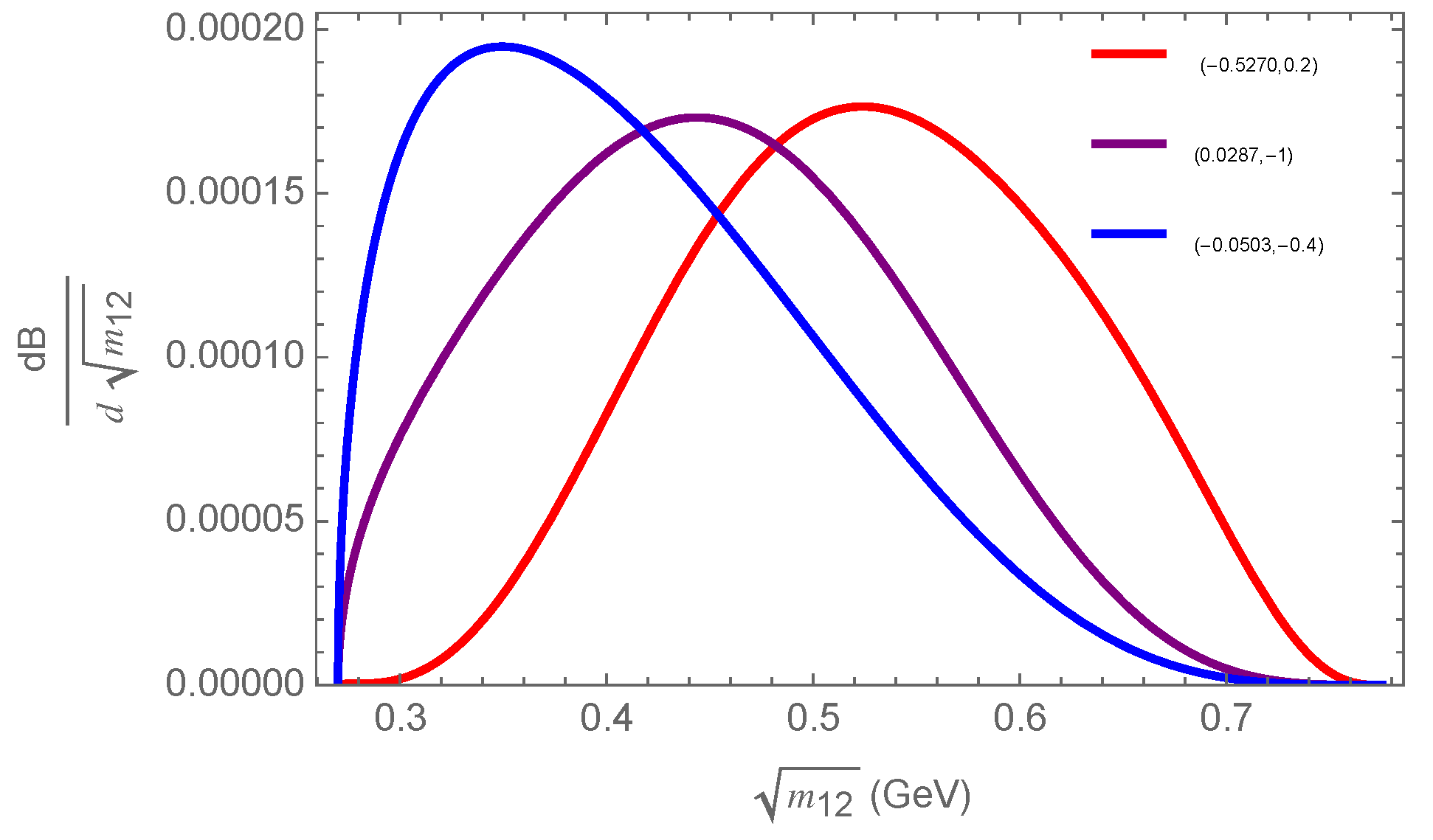

Table 1.
The prediction for computed using a combination of the values of and from scenarios 2 and 3.
Table 1.
The prediction for computed using a combination of the values of and from scenarios 2 and 3.
| Constraints (38)–(43) | Constraints (44)–(46) | ||||
|---|---|---|---|---|---|
| 0.032(3) | 0.901(54) | 0.030(3) | 1.059(65) | ||
| -0.025(3) | 0.901(54) | -0.025(3) | 1.059(65) | ||
| 0.032(3) | -0.221(54) | 0.030(3) | -0.327(65) | ||
| -0.025(3) | -0.221(54) | -0.025(3) | -0.327(65) | ||
Table 2.
In the first column, the value of is selected, while the two solutions shown in the second and third columns are obtained by applying the constraints (38)–(43), assuming that the theoretical prediction matches the experimental BR.
Table 2.
In the first column, the value of is selected, while the two solutions shown in the second and third columns are obtained by applying the constraints (38)–(43), assuming that the theoretical prediction matches the experimental BR.
| -0.98 | 0.03 | -0.03 |
| 0.90 | 0.03 | -0.03 |
| -0.80 | 0.03 | -0.03 |
| -0.70 | 0.04 | -0.03 |
| -0.60 | 0.04 | -0.04 |
| -0.50 | 0.05 | -0.04 |
| -0.40 | 0.06 | -0.05 |
| -0.30 | 0.07 | -0.06 |
| -0.20 | 0.09 | -0.08 |
| -0.10 | 0.12 | -0.10 |
| 0.02 | 0.20 | -0.18 |
| 0.10 | 0.33 | -0.31 |
| 0.20 | 0.44 | -0.53 |
| 0.30 | 0.21 | -0.25 |
| 0.40 | 0.12 | -0.15 |
| 0.50 | 0.09 | -0.10 |
| 0.60 | 0.07 | -0.08 |
| 0.70 | 0.05 | -0.07 |
| 0.80 | 0.05 | -0.05 |
| 0.90 | 0.04 | -0.05 |
| 0.98 | 0.04 | -0.04 |
Disclaimer/Publisher’s Note: The statements, opinions and data contained in all publications are solely those of the individual author(s) and contributor(s) and not of MDPI and/or the editor(s). MDPI and/or the editor(s) disclaim responsibility for any injury to people or property resulting from any ideas, methods, instructions or products referred to in the content. |
© 2025 by the authors. Licensee MDPI, Basel, Switzerland. This article is an open access article distributed under the terms and conditions of the Creative Commons Attribution (CC BY) license (http://creativecommons.org/licenses/by/4.0/).
Copyright: This open access article is published under a Creative Commons CC BY 4.0 license, which permit the free download, distribution, and reuse, provided that the author and preprint are cited in any reuse.


