Preprint
Review

This version is not peer-reviewed.

Industrial Applications of Red Macroalgae Phycocolloids

Submitted:

27 October 2025

Posted:

28 October 2025

You are already at the latest version

Abstract

Phycocolloids derived from red algae, including agar, carrageenan, and related sulfated polysaccharides, have attracted growing interest due to their multifunctional properties and wide-ranging industrial applications. These marine biopolymers exhibit unique structural characteristics and bioactivities that support their use in food, pharmaceutical, cosmetic, and biomedical sectors. This review provides a comprehensive synthesis of current knowledge on red algae phycocolloids, beginning with their biological origin, biosynthetic pathways, and ecological roles. It highlights recent advances in extraction and purification technologies, with a focus on improving yield, safety, and environmental sustainability. The review also explores emerging applications in drug delivery, tissue engineering, and green technologies, underscoring their potential in sustainable innovation. Key challenges—including regulatory constraints, scalability, and the need for interdisciplinary collaboration—are discussed, along with future directions for research and industrial development. This work aims to support the strategic integration of red algae phycocolloids into next-generation biotechnological solutions.
Keywords: 
;  ;  ;  ;  ;  ;  

1. Introduction

Beneath the sea’s surface, seaweed flourishes, playing a crucial role in production of oxygen and creating habitats rich in life. These photoautotrophic multicellular organisms, primarily marine with some freshwater species, belong to the domain Eukarya and are categorized into the kingdoms Plantae (green and red algae) and Chromista (brown algae) [1]. Macroalgae are classified into three phyla based on their pigment composition and chemical makeup: green (Chlorophyta), brown (Heterokontophyta, Phaeophyceae), and red (Rhodophyta) (Figure 1). They are widely distributed from tropical to polar regions, occupying ecoregions that range from intertidal to submerged zones still exposed to sunlight [2,3].
The diversity of seaweed chemical content is a result of their widespread distribution, leading to a variety of environments. To cope with harsh environmental conditions, seaweed produces unique polysaccharides — long-chain polymers composed of simple sugars linked by glycosidic bonds. These polysaccharides serve multiple functions, including protection against waves and desiccation, maintenance of ionic equilibrium, structural support for cell walls, and food storage [4].
The polysaccharide content and quality in seaweed exhibit significant seasonal variation and are influenced by numerous biotic and abiotic factors. The existing body of knowledge on these influencing factors varies depending on the type of polysaccharide; however, even for well-studied polysaccharides, findings are often inconsistent across different studies and species. Reviews on the responses of carrageenan and agar exist, but the considerable variation in recent study results underscores the need for a new review on the responses of these polysaccharides in seaweed [1,5].
Khalil et al. (2018) [6] highlighted that one of the main challenges in current phycocolloid production (derived from red seaweed) is the difficulty in controlling and optimizing the yield of agar and carrageenan. Furthermore, large-scale production is more viable with standardized products, as suggested for high-value bioactive products derived from seaweed [7]. Cultivation methods can potentially be adjusted to improve polysaccharide content [7], with environmental factors easily controlled in onshore aquaculture [8]. Offshore and nearshore cultivation can be optimized by selecting locations with suitable environmental conditions [7] and appropriate cultivation techniques [9]. Additionally, understanding the seasonality of polysaccharides can inform the optimal harvest time. Beyond practical applications, knowledge of the various factors influencing polysaccharides in seaweed can enhance our scientific understanding of how seaweed responds to global warming [10]. Overall, further research is needed on the impact of nutrients, carbon metabolism [11], and other influential factors [12,13].
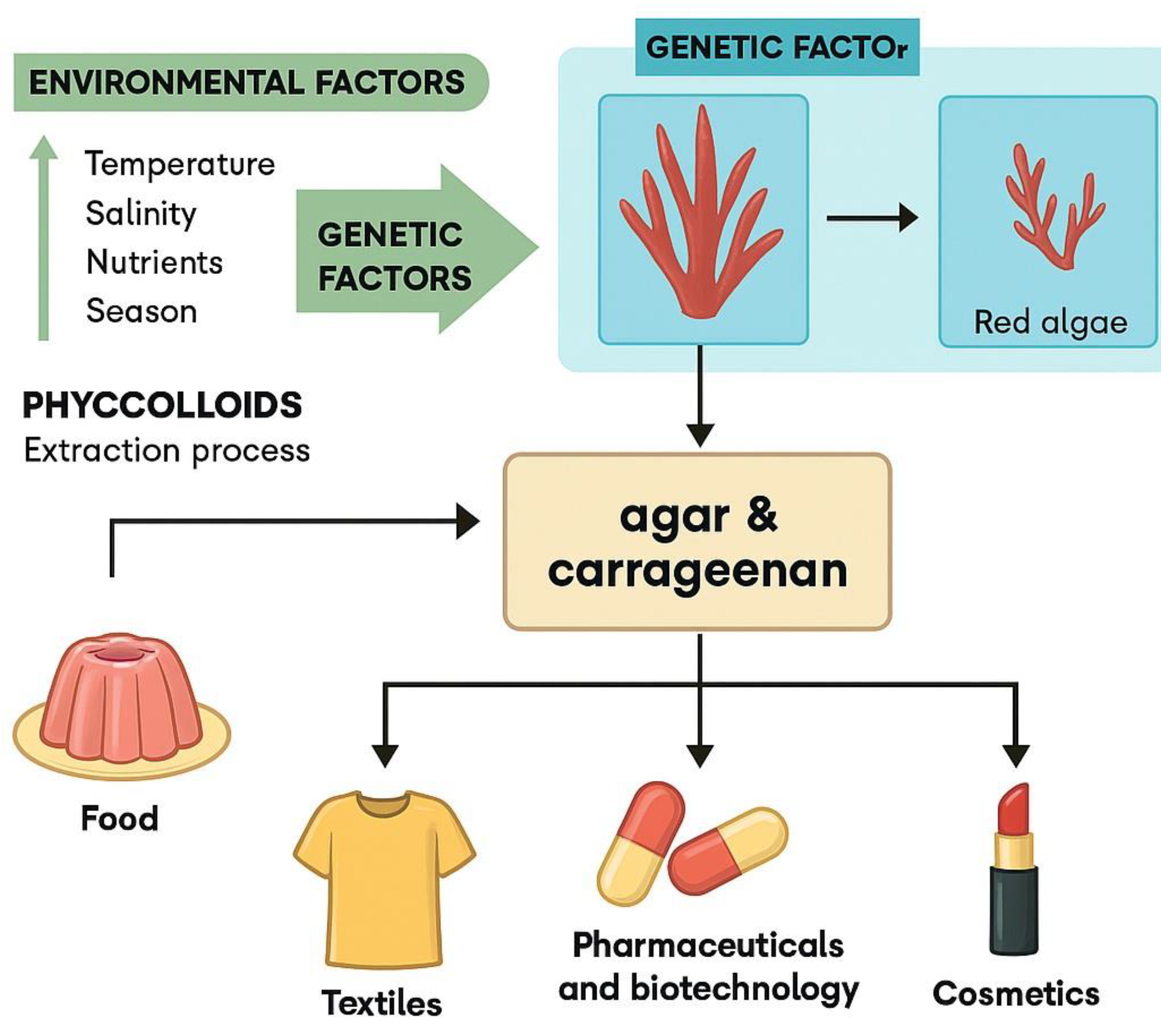
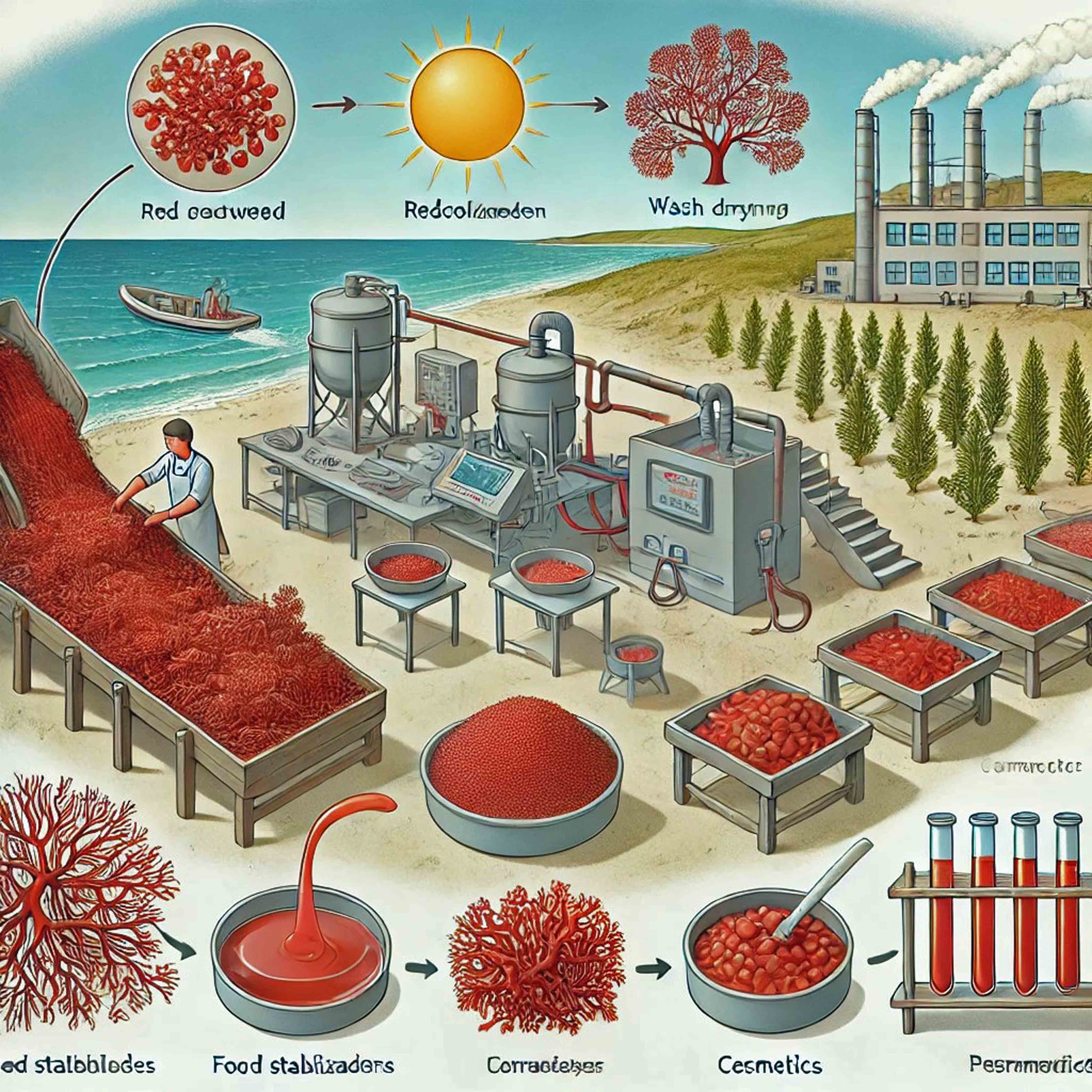
Phycocolloids, such as agar and carrageenan, are extracted from red seaweed and play a crucial role in various industrial applications. The production process of these polysaccharides involves several stages, each influenced by environmental conditions and genetic factors. Understanding these influences is key to optimizing yield and quality (Figure 2) [14].
The composition and quality of phycocolloids can vary significantly due to seasonal changes. For example, agar content is often higher during summer when light and temperature conditions are optimal. This variability requires careful monitoring and adjustment of cultivation practices to ensure consistent production. Environmental factors such as light intensity, temperature, and nutrient availability directly impact the synthesis of polysaccharides, making it essential to select cultivation sites with favorable conditions [15].
In onshore aquaculture, environmental conditions can be more easily controlled, allowing for the optimization of factors that affect phycocolloid production (García-Poza et al. 2020). Offshore and nearshore cultivation, on the other hand, can benefit from selecting locations that naturally provide suitable conditions for seaweed growth. The integration of advanced cultivation techniques can further enhance the efficiency and sustainability of phycocolloid production [16].
Understanding the seasonality of polysaccharides is also critical for determining the best harvest times. Seaweed often produces higher quantities of polysaccharides during certain seasons, and aligning harvesting schedules with these periods can maximize yield. Additionally, knowledge of the biotic and abiotic factors influencing polysaccharide production can provide insights into how seaweed may respond to environmental changes, such as global warming [17].
Further research is needed to explore the impact of nutrients and carbon metabolism on phycocolloid production. Studies on the responses of agar and carrageenan to different environmental conditions have shown considerable variation, highlighting the need for ongoing investigation. By expanding our understanding of these factors, we can develop more effective strategies for cultivating seaweed and producing high-quality phycocolloids [18].
The potential for optimizing cultivation methods to improve polysaccharide content is significant. By adjusting environmental conditions and employing innovative techniques, the industry can enhance the production of standardized, high-value bioactive products. This approach not only supports large-scale production but also contributes to the sustainable use of marine resources [19].

2. Drivers of Polysaccharide Production

Macroalgae polysaccharides have been recognized as a promising sustainable resource for the future, leading to a rising demand for their utilization and production. The global need for substantial quantities of seaweed is expected to grow in the coming years. However, optimizing cultivation systems remains essential to meet this expanding demand and ensure sustainable seaweed production and processing [20]. To address the increased demand for seaweed and seaweed-based products, it is crucial to enhance both the growth and collection of seaweed. The scarcity of farmed seaweed poses a significant threat to wild seaweed populations due to commercial overexploitation, raising serious marine environmental concerns [21]. Therefore, for the seaweed polysaccharide industry, it is imperative to maintain high quality while achieving higher yields of polysaccharides. This necessity studies seaweed metabolism and responses to abiotic and biotic factors, aiming to increase polysaccharide yield without compromising quality or incurring prohibitive economic costs [1].
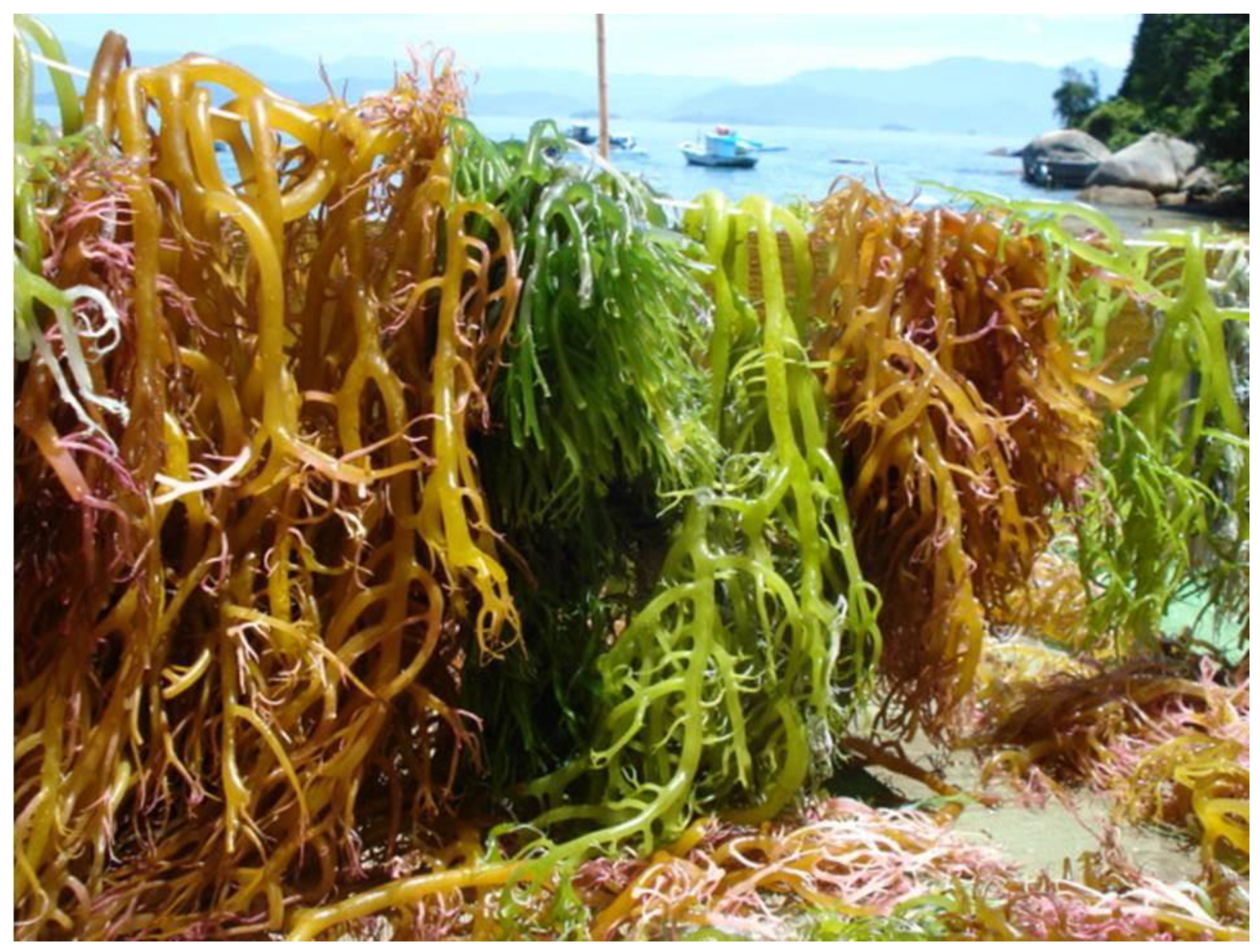
To further ensure the sustainability and efficiency of seaweed production, it is imperative to invest in advanced research and development initiatives. These should focus on innovative farming techniques, such as integrated multi-trophic aquaculture (IMTA) and offshore cultivation, which can help alleviate pressure on wild seaweed populations (Figure 3) [22].
Additionally, the development of biotechnological methods to enhance the growth rates and polysaccharide content of farmed seaweed is essential (Lomartire & Gonçalves 2024a). Collaboration between researchers, industry stakeholders, and policymakers is crucial to create supportive frameworks and incentives for sustainable practices. By adopting a holistic approach that includes environmental, economic, and social dimensions, the seaweed industry can achieve higher yields, maintain quality, and contribute to the global demand for sustainable resources while minimizing its ecological footprint [23].

2.1. Abiotic Factors

Light plays a critical role in photosynthesis, which involves carbon sequestration for energetic compounds and influences seaweed growth and metabolism. The intensity and quality of light can affect the formation of polysaccharides such as agar, carrageenan, and alginate [1]. Seaweed grows at different depths that receive varying levels of light, which in turn influences the quantity and type of polysaccharide produced [24]. Red seaweed flourishes in lower light conditions compared to green and brown seaweed. Temperature also impacts seaweed’s metabolic rate and polysaccharide production. While the optimal temperature varies by species, higher temperatures typically enhance growth rates until stress reduces polysaccharide output. Seasonal temperature variations can lead to fluctuations in polysaccharide content, with certain species producing more during cooler seasons [25].
Nutrients are essential for seaweed development, with nutrient-rich waters often promoting faster growth rates and altering polysaccharide compositions. However, excess nutrients can cause changes in the polysaccharide structure [26]. Elements like iron, magnesium, and potassium are necessary for the enzymatic activities involved in polysaccharide production [27]. Variations in salinity can induce osmotic stress in seaweed, affecting metabolism and polysaccharide formation. High salt levels often enhance the production of certain polysaccharides, such as alginate, as a defensive measure. The type and quantity of polysaccharides produced by different seaweed species depends on their salinity tolerance [1].
The mechanical motion of water, or water flow, influences nutrient availability and gas exchange, both of which are vital for seaweed growth and polysaccharide production. Moderate water flow is generally beneficial, but extreme conditions can result in physical damage and reduced polysaccharide output. High turbidity can decrease light penetration, thereby affecting photosynthesis and polysaccharide formation [28].
Moreover, the interaction between light and other environmental factors further complicates seaweed metabolism and polysaccharide production. For instance, while optimal light conditions can boost growth and polysaccharide synthesis, the combination with nutrient-rich waters can further enhance these effects [29]. Conversely, suboptimal light conditions, combined with nutrient deficiencies, can result in stunted growth and lower polysaccharide yields. Therefore, managing light exposure along with other environmental variables is crucial for maximizing seaweed productivity [30].
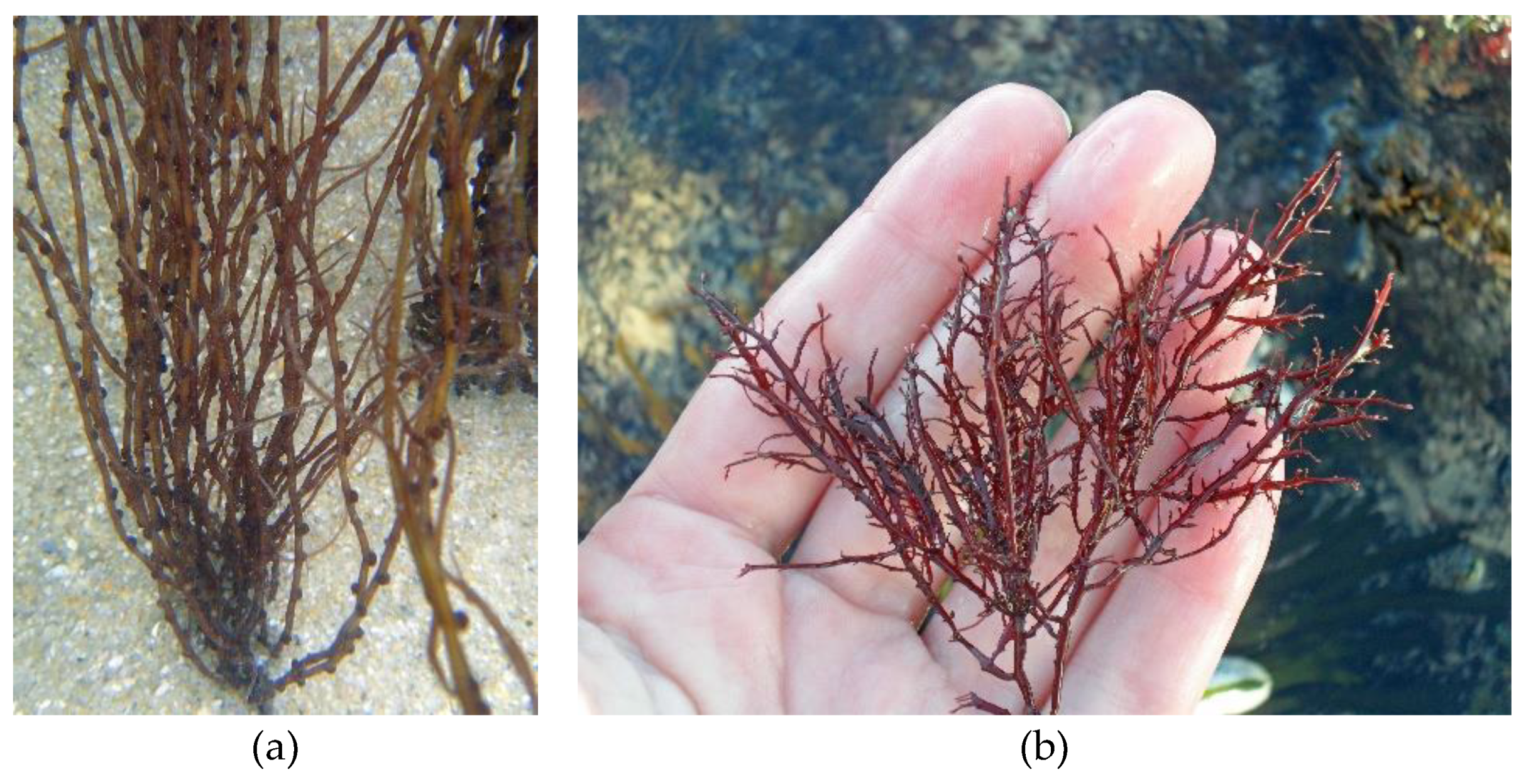
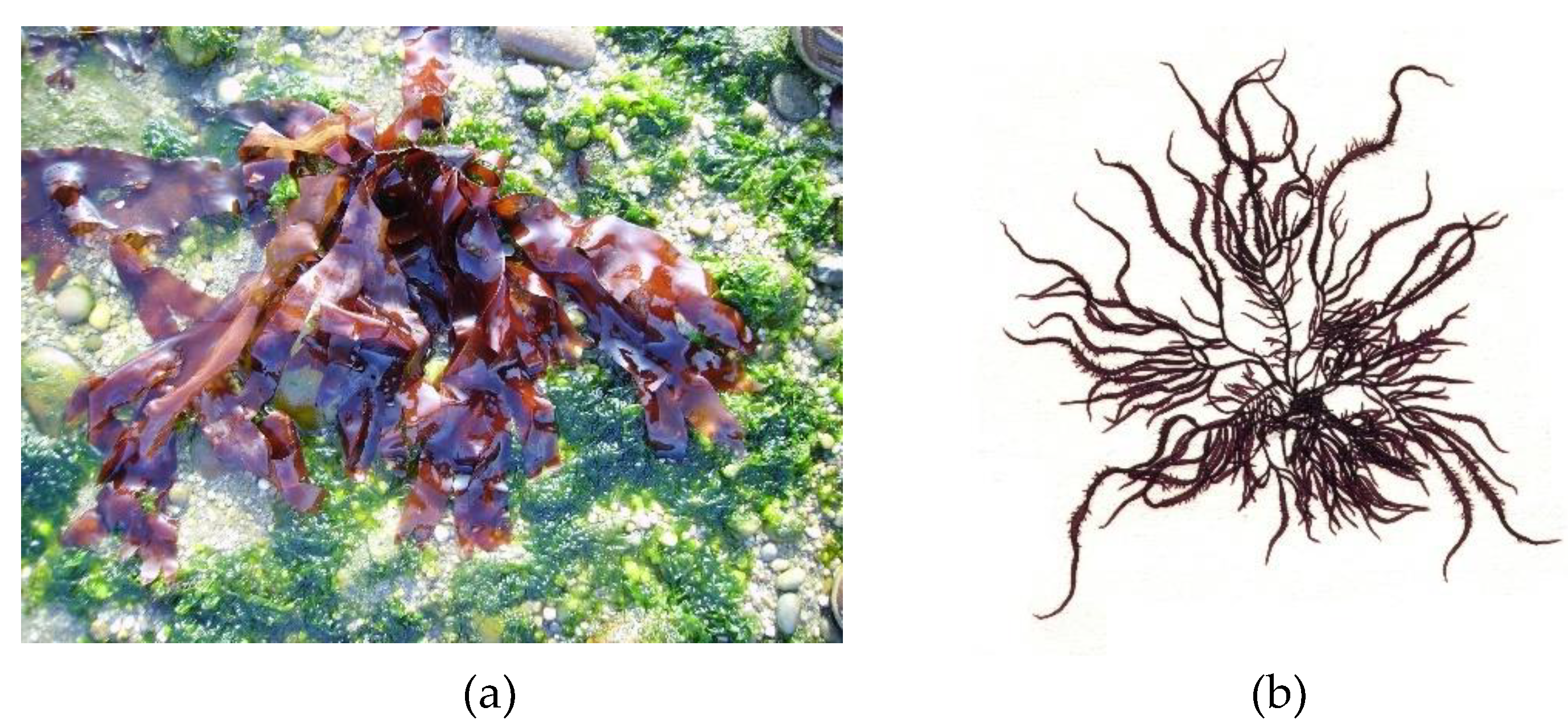
Macroalgae cultivation techniques must also account for the specific needs of different species. For example, red seaweed like Gracilaria gracilis (Figure 4a) and Gelidium corneum (Figure 4b) (Rhodophyta) require careful management of light and nutrient levels to optimize agar production, while brown seaweed like Laminaria and Macrocystis (Phaeophyceae) have different requirements for maximizing alginate yields. This necessitates a tailored approach to seaweed farming, where environmental conditions are closely monitored and adjusted to meet the specific needs of each seaweed species [31,32].
Research into the genetic factors influencing seaweed growth and polysaccharide production is also advancing. Genetic modifications and selective breeding programs hold potential for developing seaweed strains with enhanced polysaccharide content and resilience to environmental stress. Such advancements could significantly boost seaweed yields and ensure a more stable supply of high-quality polysaccharides for industrial applications [1,33].
Furthermore, the development of sustainable harvesting and post-harvest processing techniques is essential for maintaining the quality of seaweed polysaccharides. Traditional methods of harvesting and drying can sometimes result in degradation of polysaccharide quality. Innovations in these areas, such as the use of solar drying and controlled storage environments, can help preserve the integrity and functionality of seaweed polysaccharides, ensuring they meet the high standards required by various industries [34,35].
Understanding and optimizing the environmental and genetic factors that influence seaweed growth and polysaccharide production is crucial for meeting the rising demand for these valuable compounds [36]. Through integrated cultivation strategies, advanced genetic research, and innovative processing techniques, the seaweed industry can sustainably expand its production while maintaining the high quality of its polysaccharides. This holistic approach not only supports the industry’s growth but also contributes to environmental sustainability by reducing the pressure on wild seaweed populations and promoting the use of red macroalgae as a renewable resource [16,37].

2.2. Biotic Factors

Different seaweed species, and even distinct strains of the same species, possess unique genetic compositions that affect the type and quantity of polysaccharides produced. Consequently, identical abiotic factors can result in varying inputs for the same seaweed in different locations. The stage of the seaweed’s life cycle, whether juvenile or mature, also influences polysaccharide content, with certain stages yielding higher amounts. Polysaccharide production relies on specialized enzymes, whose activities are modulated by both genetic and environmental factors, thereby affecting the quantity and structure of the polysaccharides produced [1,26].
Herbivory and pathogen attacks can trigger polysaccharide synthesis as a defensive mechanism, with variations in polysaccharide content enhancing their protective properties [38]. Additionally, microbial populations on the seaweed’s surface can impact polysaccharide synthesis, further influencing their composition and function [39].
Understanding the interplay between genetic and environmental factors is crucial for optimizing seaweed cultivation and polysaccharide production. Advances in genetic research have the potential to identify specific genes responsible for polysaccharide synthesis, enabling selective breeding and genetic modification to enhance desired traits. By leveraging these genetic insights, it is possible to develop seaweed strains that are more resilient to environmental stressors and have higher polysaccharide yields [33,40].
Furthermore, the cultivation environment plays a pivotal role in determining the quality and quantity of polysaccharides. Controlled aquaculture systems, such as onshore and offshore farms, allow for precise manipulation of environmental parameters, including light, temperature, nutrients, and salinity. These systems can be tailored to meet the specific needs of different seaweed species, ensuring optimal growth conditions and maximizing polysaccharide production [41,42].
Another important aspect to consider is the impact of herbivory and pathogen pressure on seaweed health and polysaccharide synthesis. Macroalgae has evolved various defense mechanisms, including the production of bioactive compounds that deter herbivores and inhibit pathogen growth. Understanding these interactions can inform the development of integrated pest management strategies that minimize damage to seaweed crops while maintaining high polysaccharide yields [43,44].
The role of microbial communities in seaweed cultivation is also gaining attention. Microbiomes associated with seaweed surfaces can influence nutrient uptake, growth rates, and polysaccharide synthesis. By studying these microbial interactions, researchers can develop probiotics or other microbial treatments that enhance seaweed health and productivity. This holistic approach to seaweed cultivation, considering both macro and microbiological factors, can lead to more sustainable and efficient production systems [45,46].
In addition, post-harvest processing techniques are critical for maintaining the quality of extracted polysaccharides. Innovative methods, such as cold extraction and enzymatic treatments, can improve the purity and functionality of polysaccharides, making them more suitable for various industrial applications. The development of eco-friendly extraction processes also aligns with the growing demand for sustainable and green technologies in the seaweed industry [19,34].
Overall, the future of seaweed polysaccharide production lies in the integration of advanced genetic, environmental, and processing techniques. By adopting a multidisciplinary approach, the industry can achieve higher yields, better quality, and greater sustainability, contributing to the global demand for natural and renewable resources. This not only supports the economic growth of the seaweed sector but also promotes environmental conservation and the responsible use of marine ecosystems [23,30].

3. Red Macroalgae Polysaccharide Studies in Polysaccharide Production

Red seaweeds are renowned for their ability to produce a variety of valuable polysaccharides, notably agar and carrageenan. These polysaccharides have garnered significant attention due to their versatile applications in food, pharmaceutical, cosmetic, and biotechnology industries. The unique chemical properties of agar and carrageenan make them indispensable in various formulations, offering gelling, thickening, and stabilizing functionalities [1,47].
The production of polysaccharides in red seaweed is influenced by a complex interplay of genetic, environmental, and physiological factors. Understanding these factors is crucial for optimizing both the yield and quality of polysaccharides [48]. Research into the genetic makeup of red seaweed has revealed that different species, and even different strains within the same species, possess distinct genetic profiles that affect polysaccharide synthesis [49]. Environmental factors such as light, temperature, nutrient availability, and salinity play pivotal roles in modulating the metabolic pathways involved in polysaccharide production [50].
Additionally, the stage of the seaweed’s life cycle can significantly impact polysaccharide content, with certain developmental stages producing higher quantities of these compounds [51]. The enzymatic processes underlying polysaccharide synthesis are also subject to regulation by both internal and external cues, further adding to the complexity of production [52].
Recent studies have highlighted the importance of abiotic factors, such as light intensity and quality, in driving the photosynthetic activities that underpin carbon sequestration and energy production in seaweed. Temperature fluctuations, seasonal variations, and nutrient dynamics are also critical in shaping the polysaccharide profiles of red seaweed. Moreover, biotic interactions, including herbivory and microbial associations, can influence polysaccharide composition and abundance [53].
In this revision, we will delve into the various studies that have explored the production of polysaccharides in red seaweed [54]. We will examine the key factors that influence polysaccharide yield and quality and discuss the latest advancements in cultivation techniques aimed at enhancing polysaccharide production. By providing a comprehensive overview of the current state of research, this chapter aims to offer valuable insights for scientists, industry stakeholders, and policymakers interested in harnessing the potential of red seaweed polysaccharides for sustainable and innovative applications [55].

3.1. Agar

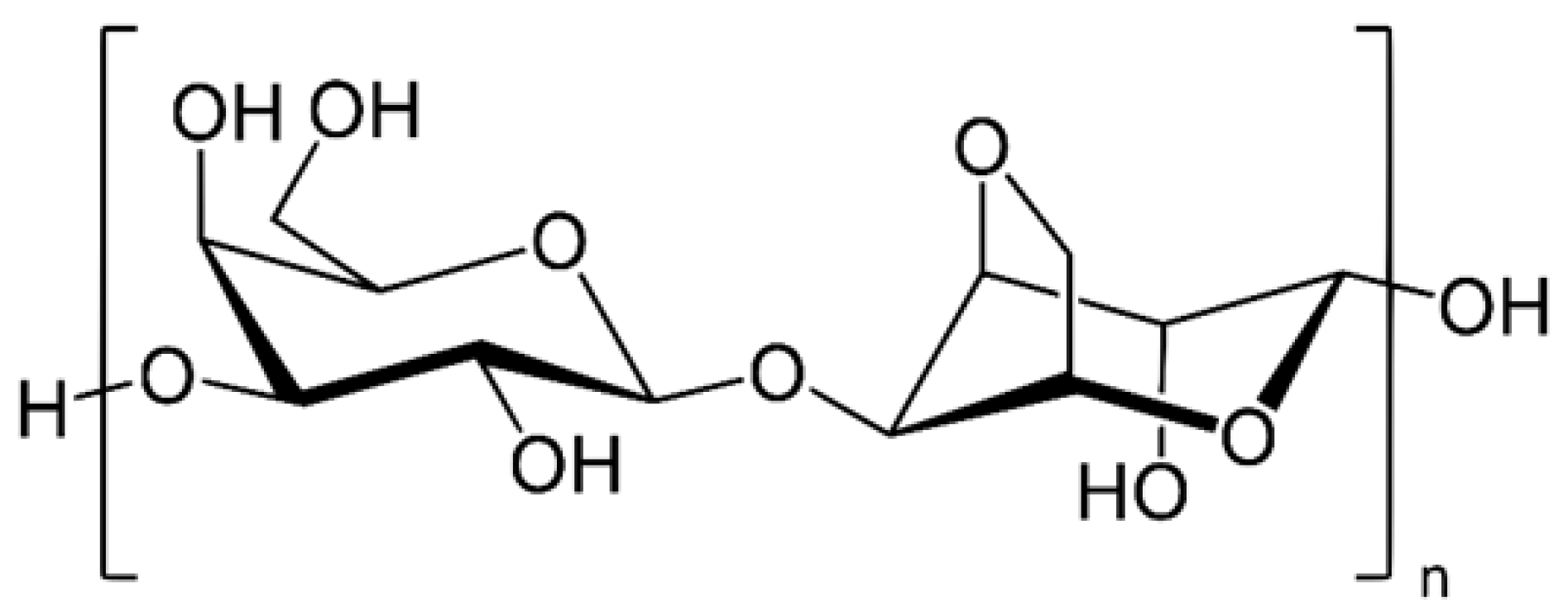
Agar (Figure 5), a crucial sulphated galactan, is predominantly found in the cell walls of various red algae, such as Gracilaria and Gelidium species. Its significance lies in its ability to protect these organisms from desiccation, extreme temperatures, high salinity, pH variations, and pathogens, while also maintaining ionic equilibrium [56]. Due to its unique gelling properties, agar has found extensive applications in food, pharmaceutical, and biotechnology industries [57].
Agar consists of a mixture of two polysaccharides: agarose (Figure 5) and agaropectin, with agarose making up about 70% of the mixture, while agaropectin makes about 30% of it. Thos galactan is commonly found in the cell walls of various red algae, is believed to protect these organisms from desiccation, extreme temperatures, high salinity, pH variations, and pathogens, while also maintaining ionic equilibrium [58]. Much of the research on agar in seaweed has focused on optimizing extraction methods, as reviewed by [59]. Environmental influences on agar content have also been extensively studied. Trends show that agar content is generally higher in summer, under conditions of both hypo- and hyper-salinity, and light deprivation, while it decreases with nitrogen enrichment and the presence of epiphytes. An earlier review by Lee et al. (2017) [60] discussed the factors affecting agar yield and quality. However, several new studies have emerged since then, which will be examined here alongside the key points from Lee et al.’s review [60].
Numerous studies have examined the environmental factors that influence agar content in red algae. Seasonal variations play a significant role, with research indicating that agar content is generally higher during the summer months. This increase is attributed to optimal light conditions and warmer temperatures, which enhance photosynthetic activity and polysaccharide synthesis. Light intensity and quality are crucial factors that affect agar production [61]. Red algae, which thrive in lower light conditions compared to green and brown algae, show variations in agar content based on the light environment. Hypo- and hyper-salinity conditions have also been found to influence agar production, with these stress conditions potentially triggering mechanisms that increase agar synthesis as a protective response. Conversely, factors such as nitrogen enrichment and the presence of epiphytes have been associated with a decrease in agar content. Nitrogen enrichment can alter the metabolic pathways, redirecting resources away from polysaccharide synthesis. The growth of epiphytes on the surface of red algae can impede light absorption and nutrient uptake, further affecting agar production [60].
The extraction of agar from red algae has been the focus of extensive research, aiming to optimize yield and quality. Traditional extraction methods involve hot water extraction, where the algae are boiled to release agar into the solution. This is followed by filtration and purification processes to obtain pure agar [62]. Recent advancements in extraction techniques have sought to improve efficiency and reduce environmental impact. Enzyme-assisted extraction methods, for example, use specific enzymes to break down cell walls, enhancing agar release while minimizing the use of harsh chemicals [63].
Microwave-assisted extraction is another innovative technique that uses microwave energy to rapidly heat the algae, resulting in faster extraction and higher yields. These modern methods not only improve the efficiency of agar extraction but also help in obtaining agar with better gelling properties, making it more suitable for various industrial applications. The ongoing research and development in this area are crucial for meeting the rising demand for high-quality agar while ensuring sustainable production practices [64].
Looking ahead, exploring the potential of integrating seaweed farming with other aquaculture practices, such as fish or shellfish farming, could provide synergistic benefits and promote more sustainable use of marine resources. By adopting a holistic approach that considers environmental, economic, and social factors, the seaweed industry can continue to thrive and contribute to the global demand for renewable and sustainable resources [65].
Agar remains a vital polysaccharide with extensive applications across various industries. Continued research into optimizing its production and extraction will ensure that the benefits of this remarkable compound can be fully realized, supporting both economic growth and environmental sustainability. Understanding and optimizing the environmental and genetic factors that influence seaweed growth and polysaccharide production is crucial for meeting the rising demand for these valuable compounds. Through integrated cultivation strategies, advanced genetic research, and innovative processing techniques, the seaweed industry can sustainably expand its production while maintaining the high quality of its polysaccharides [22,30].

3.2. Carrageenan

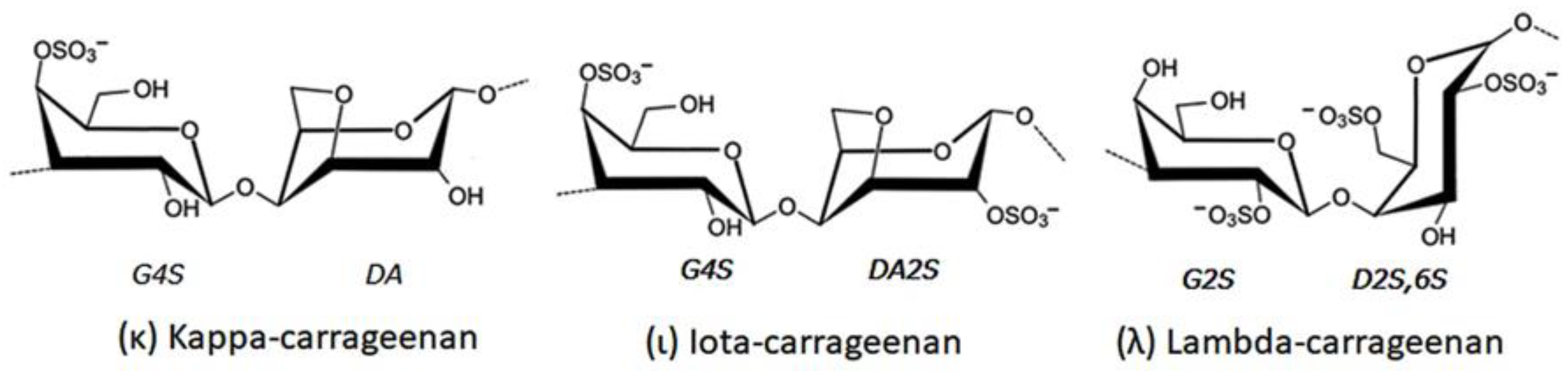
Carrageenan (Figure 6) powder is typically a yellowish to colorless, coarse to fine powder that is practically odorless [66]. For a substance to be classified as carrageenan by food agencies worldwide, it must contain galactose, anhydro-galactose, and sulphates (Figure 6). If any of these molecules are absent from the sample, it is not considered carrageenan. Carrageenan is only soluble in hot water and is not soluble in alcohol solutions above 1.5% [67].
The food purity rate of carrageenan is determined by several critical factors: viscosity level (5 mPa·s [1.5% solution at 75 °C]), sulfation content (between 15% and 40% carrageenan dry weight), ash yield (between 15% and 40% carrageenan dry weight), low molecular-weight carrageenan content (molecular weight fraction below 50 kDa, where over 5% is considered a poligeenan, a non-approved polymer for food industry), and the detection of starch, lipid, and protein levels below 5% (collectively). High water absorption capacity is also an important criterion. These standards ensure that the carrageenan meets the biochemical and physical-chemical characterization methods similar to other polymers [68].
Research and development units and the industry are keen on innovating and exploiting new red seaweed polysaccharide extraction processes with more eco-friendly methods and purification techniques. Continuous research must demonstrate that these polymers maintain high purity according to the Chemical Abstracts Service (CAS) and international conventions. This certification is essential to ensure the quality of the compound for further industrial exploitation [69].
Developing eco-friendly processes and purification techniques for extracting red seaweed polysaccharides like carrageenan is critical for several reasons. Traditional extraction methods often involve the use of hot water and chemical solvents, which can be energy-intensive and environmentally damaging. By adopting greener methods, such as enzyme-assisted extraction and microwave-assisted extraction, the industry can reduce its environmental footprint while maintaining or even improving the yield and quality of carrageenan [70].
Enzyme-assisted extraction uses specific enzymes to break down cell walls, releasing carrageenan more efficiently and minimizing the need for harsh chemicals. This method not only enhances the purity of the final product but also reduces the environmental impact of the extraction process [71]. Similarly, microwave-assisted extraction uses microwave energy to rapidly heat the algae, resulting in faster and more efficient extraction. This technique has been shown to increase carrageenan yield and quality while conserving energy and reducing waste [72].
To ensure that the extracted carrageenan meets the required standards for food and other industrial applications, rigorous testing and quality control measures are essential. This includes assessing the viscosity, sulfation content, ash yield, and molecular weight distribution, as well as detecting any impurities such as starch, lipid, and protein [73]. High water absorption capacity is also a key quality attribute, as it influences the functional properties of carrageenan in various applications [69,73].
The pursuit of high-purity carrageenan is not only driven by regulatory requirements but also by the demand for high-quality products in food, pharmaceutical, and cosmetic industries [22]. Carrageenan is widely used as a gelling, thickening, and stabilizing agent, and its performance is closely linked to its purity and molecular characteristics [74]. By refining extraction and purification techniques, manufacturers can produce carrageenan that meets the stringent standards set by global regulatory agencies, ensuring its suitability for a wide range of applications [16].
Optimizing the extraction and purification of carrageenan from red seaweed is crucial for meeting the growing demand for this versatile polysaccharide. By adopting eco-friendly methods and maintaining high standards of purity, the industry can support sustainable production practices and deliver high-quality carrageenan for use in various sectors. Continued research and innovation in this field will be essential to achieving these goals and ensuring the long-term viability of the seaweed polysaccharide industry [75]. The food purity rate of carrageenan is determined by several critical factors: viscosity level (5 mPa·s [1.5% solution at 75 °C]), sulfation content (between 15% and 40% carrageenan dry weight), ash yield (between 15% and 40% carrageenan dry weight), low molecular-weight carrageenan content (molecular weight fraction below 50 kDa, where over 5% is considered a poligeenan, a non-approved polymer for food industry), and the detection of starch, lipid, and protein levels below 5% (collectively). High water absorption capacity is also an important criterion. These standards ensure that the carrageenan meets the biochemical and physical-chemical characterization methods similar to other polymers [68].
Research and development units and the industry are keen on innovating and exploiting new red seaweed polysaccharide extraction processes with more eco-friendly methods and purification techniques. Continuous research must demonstrate that these polymers maintain high purity according to the Chemical Abstracts Service (CAS) and international conventions. This certification is essential to ensure the quality of the compound for further industrial exploitation [69].
Developing eco-friendly processes and purification techniques for extracting red seaweed polysaccharides like carrageenan is critical for several reasons. Traditional extraction methods often involve the use of hot water and chemical solvents, which can be energy-intensive and environmentally damaging. By adopting greener methods, such as enzyme-assisted extraction and microwave-assisted extraction, the industry can reduce its environmental footprint while maintaining or even improving the yield and quality of carrageenan [70].
Enzyme-assisted extraction uses specific enzymes to break down cell walls, releasing carrageenan more efficiently and minimizing the need for harsh chemicals. This method not only enhances the purity of the final product but also reduces the environmental impact of the extraction process [71]. Similarly, microwave-assisted extraction uses microwave energy to rapidly heat the algae, resulting in faster and more efficient extraction. This technique has been shown to increase carrageenan yield and quality while conserving energy and reducing waste [72].
To ensure that the extracted carrageenan meets the required standards for food and other industrial applications, rigorous testing and quality control measures are essential. This includes assessing the viscosity, sulfation content, ash yield, and molecular weight distribution, as well as detecting any impurities such as starch, lipid, and protein [73]. High water absorption capacity is also a key quality attribute, as it influences the functional properties of carrageenan in various applications [69,73].
The pursuit of high-purity carrageenan is not only driven by regulatory requirements but also by the demand for high-quality products in food, pharmaceutical, and cosmetic industries [16]. Carrageenan is widely used as a gelling, thickening, and stabilizing agent, and its performance is closely linked to its purity and molecular characteristics [74]. By refining extraction and purification techniques, manufacturers can produce carrageenan that meets the stringent standards set by global regulatory agencies, ensuring its suitability for a wide range of applications [16].
Optimizing the extraction and purification of carrageenan from red seaweed is crucial for meeting the growing demand for this versatile polysaccharide. By adopting eco-friendly methods and maintaining high standards of purity, the industry can support sustainable production practices and deliver high-quality carrageenan for use in various sectors. Continued research and innovation in this field will be essential to achieving these goals and ensuring the long-term viability of the seaweed polysaccharide industry [75].

4. Extraction Technologies and Safety Measures for Phycocolloid Production

Phycocolloids, such as agar, carrageenan, and alginate, are extracted from seaweed using various methods. Ensuring safety during the extraction process is crucial to protect both workers and the environment while producing high-quality and safe products. By employing these extraction techniques in conjunction with proper safety measures, phycocolloid extraction can be conducted efficiently and safely. This approach ensures that the final products are of high quality and that both the workforce and the environment are safeguarded [76].

4.1. Industrial Extraction Methods

The industry’s traditional method of phycocolloid production involves a multi-stage processing procedure that includes key phases such as cleaning/washing, pre-treatment, solid/liquid separation (extraction), precipitation, filtration, drying, and milling [6,77]. These existing methods require high levels of chemical, water, and energy consumption, as well as meticulous control of waste generated throughout the process, making them less environmentally friendly and cost ineffective [6]. Considering these challenges, green extraction methods such as ultrasound-assisted extraction (UAE), microwave-assisted extraction (MAE), enzyme-assisted extraction (EAE), supercritical fluid extraction (SFE), pressurized solvent extraction (PSE), reactive extrusion, and photo-bleaching are being explored to reduce chemical usage and improve the extraction yield and quality of seaweed-derived polymers [78].

4.1.1. Agar

The industrial process of agar extraction involves high solvent consumption and generates a significant amount of waste, making it a time-consuming process that relies on conventional heating with hot water over several hours. Acid pre-hydrolysis is commonly used for the chemical liquefaction of agarose [79]. One major disadvantage of alkali treatment is the generation of effluents that can have an environmental impact if not properly treated. An eco-friendly alternative to enhance the gel strength of agar could be enzymatic treatment, though its cost may not make it commercially competitive compared to alkaline treatment [80]. Combining heat and ultrasound treatments can reduce the time and energy required for the process. Microwave-assisted extraction (MAE) significantly shortens the time needed for agar extraction compared to conventional methods, consuming less energy and solvent volume, and reducing waste disposal requirements [81].

4.1.2. Carrageenan

The traditional method of producing commercial carrageenans involves washing to remove impurities such as sand, epiphytes, and salt, followed by extracting the carrageenan in a hot aqueous solution, either neutral or alkaline. The process continues with filtration, recovery of the carrageenan from the solution through alcohol precipitation, drying, and milling. Depending on the extraction method, carrageenan can be classified into two distinct grades: semi-refined carrageenan (SRC) and refined carrageenan (RC) [82]. In the original method used in the late 1970s and early 1980s, carrageenan was extracted from seaweed into an aqueous solution. At this stage, when carrageenan is extracted by alkali treatment, it is referred to as SRC. Additional treatments, such as filtering and purifying, are required to eliminate residual components like cellulosic materials, resulting in RC [83].
To reduce time, energy demand, and consumption of water, chemicals, and solvents, novel extraction techniques have been developed. These include pressurized solvent extraction and microwave-, ultrasonic-, and enzyme-assisted extractions. Microwave-assisted extraction (MAE) offers a reduction in time and energy consumption, thus enhancing process efficiency. Similarly, ultrasound-assisted processes, both alkaline and aqueous, shorten extraction times compared to conventional methods, preventing the degradation of labile compounds and resulting in a slight variation in sulphate content and viscosity. These innovative techniques improve the extraction efficiency and sustainability of carrageenan production [81].

4.2. Industrial Safety Measures

Since polysaccharides exhibit diverse compositions due to the extraction process or various abiotic and biotic factors, it is essential to employ chemical and biochemical methods to ensure their quality. Chromatography is a physical separation method where the components of a mixture are distributed between two phases. One phase, which may take the form of a porous bed, bulk liquid, layer, or film, is typically stationary (stationary phase), while the other is a fluid (mobile phase) that moves through or over the stationary phase. Chromatography encompasses various techniques that can be sequentially applied to achieve high-efficiency isolation and characterization of seaweed quality, though these methods can be costly. High-performance anion exchange chromatography (HPAEC) is a cost-effective alternative that quantifies and characterizes seaweed polysaccharide fractions, despite the challenging viscosity of liquid extracts. HPAEC employs a strong anion exchange to separate fractions based on pH and the acidic nature of seaweed polysaccharides [84].
Spectroscopy techniques, such as Fourier transform infrared spectroscopy (FTIR), utilize infrared light frequencies to analyze light absorbance by samples and chemical bond vibrations. FTIR offers a low-cost option compared to other techniques like NMR, X-ray, and chromatography for analyzing chemical bonds in dried samples, without requiring liquid extract solutions [85]. FTIR can identify polysaccharide, pigment, phenolic fractions, compound oxidation, and microplastics in seaweed before commercialization. Although it is cheaper and easier to operate than chromatography, FTIR’s biochemical quantification and quality analysis are less robust. However, combined techniques can enhance seaweed quality [86]. Pereira and his team employed FTIR-ATR (Fourier Transform Infrared - Attenuated Total Reflectance) spectroscopy to determine the composition of different phycocolloids by analyzing dried ground seaweed, eliminating the need for KBr tablets [14]. FTIR-ATR is applied in the seaweed polysaccharide extraction industry to differentiate agar and carrageenan quality, and it is the most efficient and ecologically benign technology for biomass analysis. Its primary uses include identification, quality control, and structural elucidation. Industrial sectors utilize FTIR for rapid detection of significant properties to approve chemicals like phycocolloids and active ingredients for pharmaceuticals. In this context, FTIR spectra differentiates between agar- and carrageenan-producing seaweed [85,87].
All chemical analysis methods have their advantages and disadvantages in certifying seaweed quality. Current techniques are not always the most appropriate, with some methods borrowed from plant analysis and overlooking mandatory heavy metal checks. Developing and improving these techniques is crucial, given the complexity of seaweed composition, while keeping costs manageable for seaweed companies. Legislative efforts are needed to establish comprehensive seaweed food quality control checks due to the chemical variability and compound complexity in seaweed [88,89,90].

4.3. Technical Characteristics of Agar and Carrageenan

Agar and carrageenans are widely used in food, medicine, and biotechnology due to their unique gelling, thickening, and stabilizing properties. To ensure safe and secure industrial application, their technical characteristics must be analyzed and approved as polysaccharides by CAS and other national and international agencies.

4.3.1. Agar

Agar powder is either doorless or has a faint odor. Unground agar is typically found in packages of thin, membranous, agglutinated strands, as well as sliced, flaked, or granular forms. It can range in color from light yellowish orange to yellowish-grey, pale yellow, or it can be colorless. When wet, it becomes tougher and forms a jelly-like substance; when dry, agar is very fragile. Agar powder itself is white, yellowish-white, or light golden in color. Under a microscope in water, agar powder appears more transparent. In a chloral hydrate solution, it is even more transparent than in water, showing a more granular, striated, and angular structure, occasionally containing diatom frustules [1,91].
Agar is insoluble in cold water but soluble in hot water. Its purity level is determined by ash content (food-grade ash below 6.5%), insoluble matter, and the detection of starch, lipids, and proteins. Other factors include water absorption capacity and viscosity. Therefore, several techniques like those used for other polymers’ biochemical and physicochemical characterization and certification methods, such as glucans and xanthan gums, are applied [1].

4.3.2. Carrageenan

Carrageenan powder is typically yellowish to colorless, coarse to fine powder that is practically odorless. To be recognized as carrageenan by food agencies worldwide, it must contain galactose, anhydro-galactose, and sulphates. If any of these molecules are not present in the sample, it is not considered carrageenan. Carrageenan is only soluble in hot water and not in alcohol solutions above 1.5% [59].
For food purity, the most important factors are the viscosity level (5 mPa·s at a 1.5% solution at 75 °C), sulfation content (between 15% and 40% carrageenan dry weight), ash yield (between 15% and 40% carrageenan dry weight), low molecular-weight carrageenan content (molecular weight fraction below 50 kDa, with over 5% considered as poligeenan, a non-approved polymer for the food industry), detection of starch, lipid, and protein levels (below 5% combined), and high water absorption capacity. Several methods, similar to those used for other polymers’ biochemical and physicochemical characterization, are applied [92].
Research and development units and industry seek to innovate and exploit new red seaweed polysaccharide extractions using more eco-friendly processes and purification techniques. Continuous research must demonstrate that polymers have high purity according to CAS and international conventions, which is essential to certify the quality of the compound for further exploitation [16].

4.4. RD of Polysaccharide Extraction Methods

Although the phycocolloid extraction industry has implemented certified methods, these methods are labor-intensive, have medium to low extraction rates, use substantial amounts of chemicals, water, and energy, and generate waste during the process, making them less environmentally and economically efficient. Considering this, numerous green extraction techniques are emerging to decrease chemical use while enhancing the extraction yield and quality of seaweed-derived polymers. However, these new techniques need to pass tests and meet requirements for industrial polysaccharide commercial samples before they can be applied in the industry. Furthermore, most studies are not designed for industrial scale, making the economic feasibility of the extraction process another important factor to consider [1,16,93].
These new techniques include microwave-assisted extraction (MAE), ultrasound-assisted extraction (UAE), enzymatic-assisted extraction (EAE), and green solvent extraction methods. These methods encompass subcritical water extraction (SWE), ionic liquid extraction, supercritical fluid extraction (SFE), and other methods like reactive extrusion and photo-bleaching. There is less accessible information due to the variety of distinct methods currently in use. However, MAE and UAE procedures are low-cost and have been effectively utilized in large-scale commercial chemical extractions [94,95].
Polysaccharides have a variable composition that can be influenced by the extraction process as well as abiotic and biotic factors. Therefore, many procedures must be used to describe them and ensure their quality. It is critical to find new, effective, and environmentally acceptable extraction technologies for commercial scale. Hydrocolloids, like carrageenan and agar, are often processed inefficiently using significant amounts of chemicals; nevertheless, there are innovative and equally acceptable alternatives to meet industrial productivity demands [96].
As a result, while researching novel species and cultivation and extraction procedures for obtaining carrageenan and agar for industry approval, it is crucial to investigate the identification and purity of the material to ensure its safety and compliance with regulatory requirements. Mendes et al. (2023) [97] demonstrated that different species strains (Kappaphycus alvarezii) (see Figure 3) can influence the appropriate method to extract carrageenan, which can be approved for food applications. Thus, the effect of different extraction procedures on the type of extracted carrageenan was very clear [1].

5. Seaweed Polysaccharides’ Current Industrial Applications

The phycocolloid industry is growing faster than the world GDP, at a rate of 6% per year. Historically, phycocolloids have been used as food additives in the food and beverage sector, which accounts for over 70% of their global market value. However, their use in personal care, cosmetics, and the medical and pharmaceutical industries is expected to grow the fastest [98].
With advancing knowledge and technological progress, the applications of algal polysaccharides are expanding beyond these traditional uses. Here, we explore applications still under study or new to the industries. Firstly, the antiviral activity of several seaweed polysaccharides has sparked interest in their potential to combat the global COVID-19 pandemic. Algal polysaccharides are believed to help prevent the attachment, adsorption, and replication of the virus. Furthermore, their safety, biodegradability, and biocompatibility, along with low production costs, may offer advantages over plant-based compounds [99,100]. Another advantage of red seaweed polysaccharides is their inherent bioactivity potential. Certain polysaccharides, such as agar and carrageenan, exhibit various biological activities, which differ based on their molecular weight, sulphation level, and the number of sulfate ester groups present in the polymer [101].
Additionally, different seaweed species produce chemically diverse polysaccharides, potentially influenced by the extraction process used. Carrageenophytes often have a higher concentration of sulfate groups than agarophytes. Nonetheless, carrageenan molecular structure is quite diverse, with the most economically important types being iota, lambda, and kappa carrageenan. What distinguishes these forms of carrageenan is primarily their sulfate ester concentration and their location in the molecule [102].

5.1. Food Industry

Agar was the first hydrocolloid to receive the European registration number E406 and was approved as GRAS (Generally Recognized as Safe) by the Food and Drug Administration (FDA) for use as an additive in the food industry [103]. Approximately 80% of the agar produced globally is used for food applications [104]. In Asian countries, agar is a popular ingredient in jellies, where macroalgae are boiled, flavored, and cooled to form jellies. Agar applications are largely based on their functional qualities, such as gel strength. Low-quality agar is primarily used in food products, while some may extend to industrial applications, such as paper sizing, coating, adhesives, textile printing/dyeing, casting, and impressions [6]. Despite being listed as a permitted food additive, agar (E406) is only used in a limited number of food items. It is estimated that around 90% of marketed agar is intended for the food sector [105].
Carrageenan is widely used in dairy products and the baking industry due to its excellent functional properties. It binds milk molecules and retains water, which helps stabilize processed meat products [81]. Additionally, carrageenan is commonly used as a gelling agent. However, its gel-forming abilities depend on the type of carrageenan used, with iota and kappa carrageenan forming a gel in the presence of potassium or calcium [106].
Carrageenans are employed in various food and beverage recipes to provide thickness, stability, and gelling. These phycocolloids are also used for immobilizing biocatalysts, as stabilizers in toothpaste, in air freshener gels, pet food, and meat products. New applications of carrageenan in the food industry include its use as a protective coating on fresh-cut packaged food. Here, carrageenan acts as a gas barrier, altering the cut surfaces of the fruit, reducing respiration, and consequently slowing down discoloration while maintaining texture throughout the shelf life [68].

5.2. Pharmaceutical and Medical Industry

Beyond their use in the food industry, algal polysaccharides are extensively employed in the pharmaceutical and medical sectors. Their jellifying, stabilizing, and thickening properties, as well as their bioactivities, make them valuable in these fields. Phycocolloids can be used as ’functional foods’ that offer health benefits and help prevent chronic diseases. The bio-nanostructures of algal polysaccharides have become an important addition to the food industry, primarily focusing on health applications, including supplements and prebiotics [76].
Algal polysaccharides possess antibacterial, antimicrobial, and antiviral properties. Their medical applications are diverse, ranging from cancer and tumor prevention to anti-inflammatory and antioxidant effects. They are commonly used in drug delivery and disinfection, while less commonly, they are used as dissolving bandages and in tissue engineering. Additionally, various polysaccharides have specific uses, further highlighting their versatility and importance in different industries [107].
Agar is known to decrease blood glucose levels, which is important for people with hyperglycemia, and prevents the aggregation of red blood cells. It also has the ability to absorb ultraviolet radiation [108]. Additionally, agar is used to produce pharmaceutical-grade growth media for laboratory purposes. It is commonly used in culture mediums because it is not easily metabolized, is non-digestible, and has good gel firmness, elasticity, clarity, and stability [6].
Medium-quality agar can be used to obtain monoclonal antibodies, interferons, steroids, and alkaloids, and act as a bulking agent, laxative, suppository, capsule, tablet, and anticoagulant in medicinal and pharmaceutical fields. On the other hand, the most highly purified agar, obtained from a fraction of agar called agarose, is used for separation in molecular biology processes such as electrophoresis, immune diffusion, and gel chromatography [6,109].
Carrageenan possesses several pharmaceutical properties, such as anticoagulant, antithrombotic, antiviral, antitumor, and cholesterol-lowering effects, as well as immunomodulatory and antioxidant activities. These pharmaceutical aspects form the basis for carrageenan’s application in the pharmaceutical field [6,109].
Carrageenan is used in the production of tetracyclines, a significant group of antibiotics [68]. Due to its ability to form a gel, it is employed as an immobilizer of Streptomyces aureofaciens, the bacteria used to produce these antibiotics. Additionally, carrageenan can be utilized in the production of D-aspartic acid for semi-synthetic antibiotics. Moreover, carrageenan has been proven to inhibit the attachment of viruses such as the human papillomavirus, dengue virus, influenza A, and herpes virus [6,109,110].

5.3. Cosmetic Industry

Consumers are increasingly opting for seaweed-based cosmetics over synthetic equivalents. These products often contain pure components or extract of various substances derived from seaweed. The chemicals found in seaweed possess essential properties for cosmetic use, such as minimal cytotoxicity and low allergen concentration. However, the biochemical profiles of seaweed can vary, and the extraction processes might lead to the loss of certain biomolecules [111].
Macroalgal hydrocolloids, also known as phycocolloids, are the most important polysaccharides for industrial commercialization. Phycocolloids are structural polysaccharides found in seaweed that often produce colloidal solutions, which are transitional phases between solutions and suspensions. As a result, polysaccharides can be employed in various sectors, including cosmetics, where they serve as thickening, gelling, and stabilizing agents for suspensions and emulsions [24].
Pharmacy and cosmetics consume 20% of the total carrageenan output. Carrageenan is found in the formulations of many everyday cosmetic goods, including toothpastes, hair wash products, lotions, medications, sunblock’s, shaving creams, deodorant sticks, sprays, and foams. Its ability to form hydrogels allows it to be employed in various applications, including antiviral, antibacterial, and pathophysiological processes such as hyperlipidemia management [112].
Agar can be used as an emulsifier and stabilizer in creams and to manage the moisture content in cosmetic products such as hand lotions, liquid soap, deodorants, foundation, exfoliants, cleansers, shaving cream, face moisturizer/lotion, and acne and anti-aging treatments. Agar can endure high temperatures (up to 250 °C) and preserve its properties even near boiling point temperatures, making it ideal for use in jellied confections where the components may be treated at high temperatures and subsequently cooled down [64,112,113].

5.4. Agriculture and Industry

Seaweed polysaccharides are used in traditional fertilizers to help retain water and nutrients in soil, primarily serving as soil conditioners. These natural materials can absorb massive volumes of water, acting as super-absorbents that can hold up to hundreds of times their own weight. In agriculture, these polysaccharides are often referred to as moisture-holding hydrogels, which enhance soil water retention, a critical characteristic of healthy soil [30].
Agricultural researchers have developed super-absorbents to improve the soil’s abiotic characteristics, promoting water retention, water use efficiency, soil permeability, infiltration rates, plant performance, and soil aeration. Additionally, they can reduce irrigation frequency, limit compaction shift, prevent erosion and water drainage, and decrease fertilizer solubility rates [114].
Carrageenans and their oligomers, derived from various red seaweed, are a rich source of bioactive compounds that activate plant defense systems and provide resistance to abiotic and biotic stressors. This is achieved by regulating a variety of physiological and biochemical processes. Carrageenans also regulate several plant metabolic processes, including cell division, purine and pyrimidine synthesis, nitrogen and sulfur absorption, and photosynthesis. On the other hand, while numerous studies have been conducted on the bioactivities of agarophytes, there has been little research on the bioactivities of agar, particularly its influence on plants [115].
Red seaweed polysaccharides have a wide range of industrial applications today (Table 1). Before introducing these polysaccharides to new industries and uses, it is essential to produce more seaweed with a high polysaccharide yield while ensuring quality. Understanding the drivers for seaweed polysaccharide production is crucial. New uses are being developed and applied in various fields, such as paper sizing, coating, adhesives, textile printing/dyeing, casting, and impressions [116].
Polysaccharide production, particularly from red seaweed, is influenced by various factors, including economic, environmental, technical, and consumer demands. The increasing consumer preference for natural and clean-label products is boosting the demand for seaweed-derived polysaccharides such as agar and carrageenan. These polysaccharides are valuable for controlled drug delivery systems, wound dressings, and tissue engineering due to their biocompatibility, non-toxicity, and gel-forming properties [4].
The designation of polysaccharides as GRAS (Generally Recognized as Safe) by food and drug regulatory agencies such as the FDA expands their usage in various sectors, promoting more manufacturing. Countries with extensive seaweed resources are ramping up polysaccharide production to meet global demand, particularly in regions with high consumption of natural and health-promoting components. Seaweed farming is considered more sustainable than land-based agriculture since it uses fewer resources. This sustainability factor is driving increased investment in seaweed polysaccharide synthesis [66,118].

5.5. Livestock Industry

Macroalgae consumption extends beyond humankind, benefiting various animal species as well. European use of seaweed in animal husbandry dates back to the Roman era [119]. Countries like Iceland, France, and Norway commonly incorporate seaweed into domestic animal nutrition [120]. Notably, the first seaweed meal for animal feed was produced in Norway, using brown seaweed that were collected, dried, and milled [121].
In addition to being used directly as feed, macroalgae are also introduced into other types of feed as a nutritional additive and nutraceutical compound. Currently, algae supplementation is used to address mineral deficiencies in animal pastures in countries such as the USA, Australia, and New Zealand. Seaweed meals, primarily used as a vitamin and mineral supplement, are produced mainly from kelps like Palmaria palmata (Figure 8a), Grateloupia filicina (Figure 8b), Neopyropia tenera, and Chondrus crispus [27,122].
Moreover, extracts like macroalgae-derived sulfated polysaccharides are added to animal feed. These meals have been proven to enhance animal intestinal integrity and improve immune response efficiency [123].
The livestock industry and red seaweed (Rhodophyta) phycocolloids may seem like distinct domains at first glance, but they intersect in intriguing and beneficial ways. Red seaweed, known for its high phycocolloid content, such as agar and carrageenan, has significant potential applications within the livestock industry. The integration of red seaweed into livestock farming presents opportunities to address some of the industry’s pressing challenges, such as environmental sustainability, animal health, and economic efficiency [24].
One of the most promising applications of red seaweed in the livestock industry is its potential to reduce methane emissions from ruminant animals. Methane, a potent greenhouse gas, is a major contributor to climate change, and ruminant livestock such as cows, sheep, and goats are significant methane emitters due to their digestive processes. Studies have shown that incorporating certain species of red seaweed, particularly Asparagopsis, into the diet of ruminants can significantly reduce methane production. This not only helps mitigate the environmental impact of livestock farming but also enhances the overall sustainability of the industry [122].
Additionally, red seaweed phycocolloids can improve animal health and nutrition. Carrageenan, for example, has been found to possess antiviral and immunomodulatory properties, which can support the health and resilience of livestock. These properties can help reduce the reliance on antibiotics, addressing concerns about antibiotic resistance and improving the overall health management of livestock populations [16]. Moreover, red seaweed is a rich source of essential nutrients, including vitamins, minerals, and antioxidants, which can enhance the nutritional profile of animal feed and contribute to better growth and productivity [124].
Economically, the integration of red seaweed into the livestock industry can create new value chains and opportunities for coastal communities involved in seaweed farming. By promoting the cultivation and utilization of red seaweed, the livestock industry can support sustainable aquaculture practices and contribute to the economic development of regions where seaweed is an abundant and renewable resource [125].
The intersection of the livestock industry and red seaweed phycocolloids offers a promising pathway towards greater sustainability, improved animal health, and economic benefits. By leveraging the unique properties of red seaweed, the livestock industry can address some of its most pressing challenges and contribute to a more sustainable and resilient food system [126].
The livestock industry and red seaweed (Rhodophyta) phycocolloids may seem like distinct domains at first glance, but they intersect in intriguing and beneficial ways. Red seaweed, known for its high phycocolloid content, such as agar and carrageenan, has significant potential applications within the livestock industry. The integration of red seaweed into livestock farming presents opportunities to address some of the industry’s pressing challenges, such as environmental sustainability, animal health, and economic efficiency [1,24].
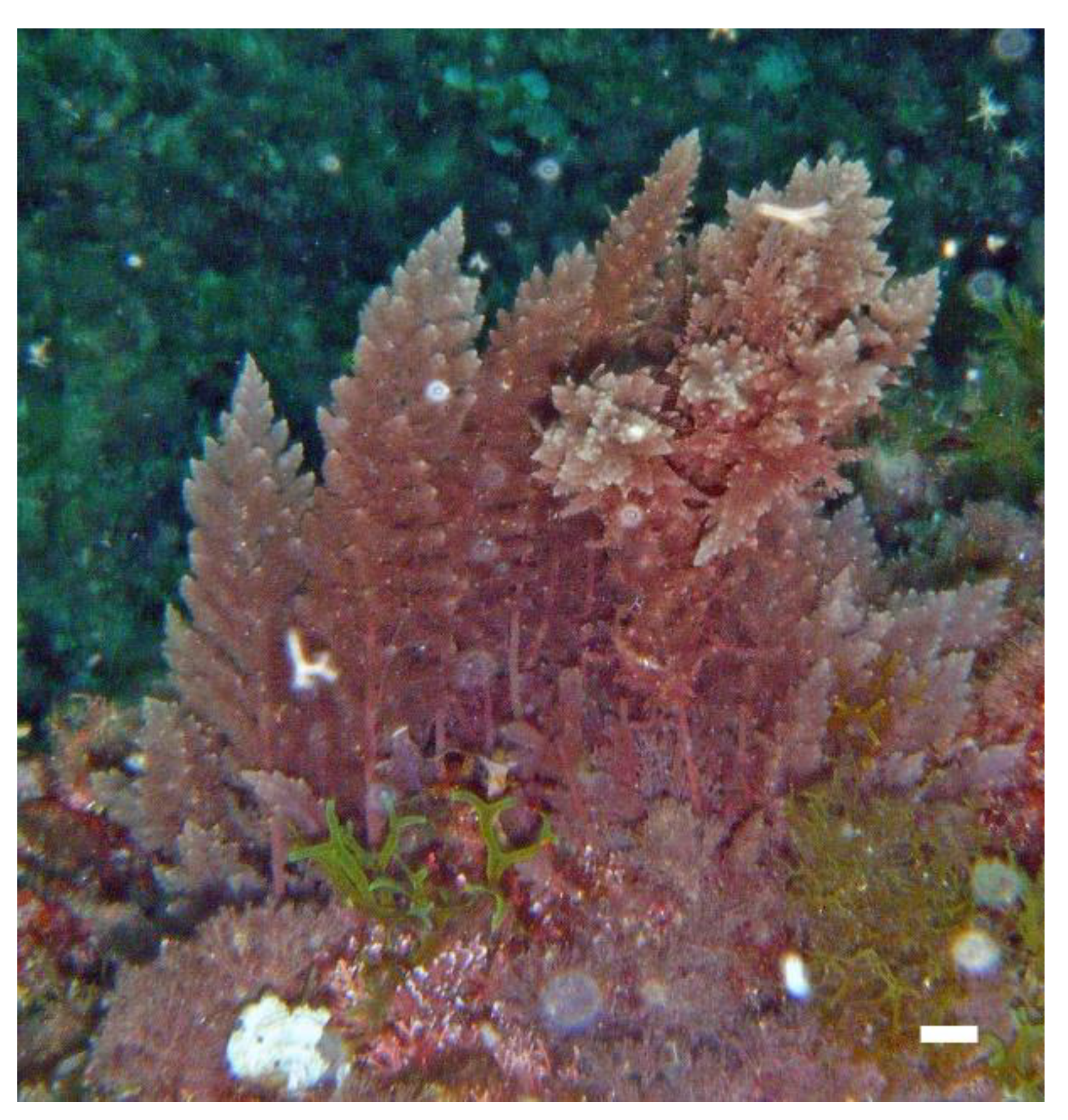
One of the most promising applications of red seaweed in the livestock industry is its potential to reduce methane emissions from ruminant animals. Methane, a potent greenhouse gas, is a major contributor to climate change, and ruminant livestock such as cows, sheep, and goats are significant methane emitters due to their digestive processes. Studies have shown that incorporating certain species of red seaweed, particularly Asparagopsis taxiformis (Figure 9), into the diet of ruminants can significantly reduce methane production. This not only helps mitigate the environmental impact of livestock farming but also enhances the overall sustainability of the industry [122,127].
Additionally, red seaweed phycocolloids can improve animal health and nutrition. Carrageenan, for example, has been found to possess antiviral and immunomodulatory properties, which can support the health and resilience of livestock. These properties can help reduce the reliance on antibiotics, addressing concerns about antibiotic resistance and improving the overall health management of livestock populations. Moreover, red seaweed is a rich source of essential nutrients, including vitamins, minerals, and antioxidants, which can enhance the nutritional profile of animal feed and contribute to better growth and productivity [128].
Among the red seaweed species, K. alvarezii is another important example, as it serves as a primary source of carrageenan. Besides its gelling, thickening, and stabilizing properties, carrageenan extracted from K. alvarezii has been studied for its antiviral and immunomodulatory effects on animals. Incorporating this alga into animal feed can help boost animal health, increase disease resistance, and reduce the need for antibiotics, thereby combating antibiotic resistance — a growing concern in modern livestock farming. Additionally, K. alvarezii enhances the nutritional quality of the diet, promoting healthier and more productive animal growth [75,82].
Economically, the integration of red seaweed into the livestock industry can create new value chains and opportunities for coastal communities involved in seaweed farming. By promoting the cultivation and utilization of red seaweed, the livestock industry can support sustainable aquaculture practices and contribute to the economic development of regions where seaweed is an abundant and renewable resource [129]. The intersection of the livestock industry and red seaweed phycocolloids offers a promising pathway towards greater sustainability, improved animal health, and economic benefits. By leveraging the unique properties of red seaweed, the livestock industry can address some of its most pressing challenges and contribute to a more sustainable and resilient food system [16].

6. Industrial Innovation: Emerging Applications of Seaweed Polysaccharides

The phycocolloid industry is now growing at a faster rate than the global GDP, with an annual growth of 6%. Historically, phycocolloids have been primarily used as food additives in the food and beverage sector, accounting for more than 70% of their global market value 1. However, their application in personal care, cosmetics, and the medical and pharmaceutical industries is expected to expand the quickest [98].
With advancing knowledge and technological progress, the applications of algal polysaccharides are beginning to extend beyond their traditional uses. This includes exploring new and emerging uses that are still under study. For instance, the antiviral properties of several seaweed polysaccharides have inspired research into their potential to combat the global COVID-19 pandemic [100]. Algal polysaccharides are believed to help prevent the attachment, adsorption, and replication of the virus. Additionally, their safety, biodegradability, and biocompatibility, along with their low production costs, potentially offer advantages over plant-based compounds [130].
Moreover, red seaweed polysaccharides have inherent bioactivity potential that sets them apart from plant-based compounds. Certain polysaccharides, such as agar and carrageenan, exhibit various biological activities that differ based on their molecular weight, sulphation level, and the number of sulphate ester groups present. Furthermore, different seaweed species produce chemically diverse polysaccharides, which may be influenced by the extraction process used [131]. Carrageenophytes generally possess a higher concentration of sulphate groups compared to agarophytes. Nevertheless, the molecular structure of carrageenan is quite diverse, with the most economically important types being iota, lambda, and kappa carrageenan. These forms are primarily distinguished by their sulphate ester concentration and their specific location within the molecule [132].

6.1. Pharmaceutical Applications

The phycocolloid industry is now growing at a faster rate than the global GDP, with an annual growth of 6%. Historically, phycocolloids have been primarily used as food additives in the food and beverage sector, accounting for more than 70% of their global market value. However, their application in personal care, cosmetics, and the medical and pharmaceutical industries is expected to expand the quickest [133].
With advancing knowledge and technological progress, the applications of algal polysaccharides are beginning to extend beyond their traditional uses. This includes exploring new and emerging uses that are still under study. For instance, the antiviral properties of several seaweed polysaccharides have inspired research into their potential to combat the global COVID-19 pandemic [100,107]. Algal polysaccharides are believed to help prevent the attachment, adsorption, and replication of the virus. Additionally, their safety, biodegradability, and biocompatibility, along with their low production costs, potentially offer advantages over plant-based compounds [134].
Moreover, the nanoparticles of seaweed polysaccharides have garnered attention for several other therapeutic applications. Drug delivery, insulin delivery, and bioactivities against fungal infections, tuberculosis, and cancer are some of the applications being explored [135]. Carrageenan, in particular, has sparked widespread interest and its use in pharmaceutical formulations is on the rise. It has been included in respected pharmacopoeias such as the United States Pharmacopeia 35-National Formulary 30 S1 (USP35-NF30 S1), the British Pharmacopoeia 2012 (BP2012), and the European Pharmacopoeia 7.0 (EP7.0), suggesting its potential as a pharmaceutical excipient and a bright future [1].
Carrageenan has been shown to have antiviral and antibacterial characteristics, as well as anticoagulant, anti-diabetic, and antioxidant properties [136]. There is a growing interest in combining carrageenan with natural polymers such as chitosan, starch, cellulose, chitin, and alginate to develop biodegradable materials with desirable properties for use in biomedical applications. These combinations have demonstrated tremendous potential in a variety of biological applications, including drug delivery and tissue engineering [137]. Carrageenan’s outstanding bio-functionality and rheological properties, including cost-effectiveness, biological compatibility, biodegradability, and flexibility, make it an ideal functional compound for a wide range of biomedical applications, from developing nanostructure-based intelligent drug delivery systems to 3D bioprinting in tissue engineering and wound healing [138].
Agar, another significant phycocolloid, is increasingly preferred over synthetic polymers and is being investigated as an alternative raw material for therapeutic purposes. It is highly desirable in the pharmaceutical industry due to its remarkable intrinsic properties, notably the strong gel it produces [76]. Agar has been exploited in the creation of injectable and phase-changeable composite hydrogels for cancer treatment using chemotherapy and photothermal therapy. These composite hydrogels can efficiently load and release chemotherapeutics and antibiotics [139]. Additionally, an agar-based nanocomposite film has been shown to effectively suppress the development of Listeria monocytogenes (Bacteria) [140]. The use of agar and polysaccharide mixes is also becoming common. In pharmaceuticals, agar is used primarily to gel, stabilize, and thicken. Furthermore, it is often used for purgation and as a surgical assistant. Researchers have worked diligently to develop agar-based products such as composite hydrogels, nanocomposite films, and other materials with specialized applications in pharmacology [141].

6.2. Food Packaging

Additionally, food packaging is important for the preservation, protection, and convenience of food products but is often not sustainably [142]. However, polysaccharide membranes can work as a barrier against oxygen and carbon dioxide, making them a promising candidate for food packaging [143]. Moreover, they are edible and biodegradable, so the environment is not impacted whether people eat the packaging or not. However, they do not work as a barrier for water or water vapor due to their hydrophilic properties, which can become a problem for durability and change the organoleptic characteristics of the product [144]. A method to mitigate the risks of spoiled food is intelligent food packaging. This concept focuses on the observance and control of changes in the food or in the food packaging. It is done using biosensors made from polysaccharide hydrogels to measure those parameters [145].
For example, it has been demonstrated that the spoilage of fish could be slowed by using a partly agarose-based hydrogel [146]. Another utility of polysaccharides is making biostimulants for plant growth. In a study where polysaccharide extract was given to growing plants, all the evaluated parameters (total plant size, leaf growth, and weight) showed further development in plants with the treatment [147]. Seaweed polysaccharides’ adaptability allows for a wide range of unique uses across many sectors. As research and development continue, the usage of these sustainable and bioactive molecules is anticipated to grow, resulting in novel solutions in healthcare, environmental sustainability, and beyond. However, these novel applications are still in their early stages, with R&D in its initial steps and with significant restrictions and challenges to overcome in the immediate future. Furthermore, a cost-effective analysis of scaling-up still needs to be applied to determine if it is possible to be applied at an industrial scale [1].
Nanotechnology in drug delivery has revolutionized the way treatments are administered, enabling the development of nanoparticles that can target specific cells or tissues. These nanoparticles can encapsulate drugs, enhance their stability and allow for controlled release, which improves the efficacy and safety of treatments. Examples include liposomes, dendrimers, and polymeric nanoparticles, all of which are used in targeted cancer therapy, gene delivery, and the treatment of various infectious diseases. This precise targeting reduces side effects and increases the therapeutic impact of drugs [148,149].
Pharmacogenomics, the study of how genes affect an individual’s response to drugs, aims to tailor drug treatments based on genetic profiles. This personalized medicine approach optimizes drug efficacy and minimizes adverse effects by understanding genetic variations that influence drug metabolism and response. By developing treatments specifically suited to an individual’s genetic makeup, pharmacogenomics offers more effective solutions for conditions such as cardiovascular diseases, cancer, and psychiatric disorders, leading to improved patient outcomes [150].
Biopharmaceuticals, also known as biologics, are drugs derived from biological sources, including proteins, nucleic acids, and cells. These drugs offer targeted and highly specific treatments for various diseases. Examples of biopharmaceuticals include monoclonal antibodies, therapeutic proteins, and vaccines, which have shown great promise in treating autoimmune diseases, cancers, and infectious diseases. The precision and specificity of biopharmaceuticals contribute to advances in precision medicine, providing patients with tailored and effective treatments [151].
Regenerative medicine focuses on repairing or replacing damaged tissues and organs using techniques such as stem cell therapy, tissue engineering, and gene therapy. Stem cells have the potential to differentiate into various cell types, allowing for the regeneration of damaged tissues. For example, Gelidium amansii extract, a red alga, has been studied for its potential to promote wound healing due to its bioactive compounds. Tissue engineering involves creating bioengineered scaffolds that support cell growth and tissue formation. These approaches offer innovative solutions for conditions like spinal cord injuries, heart disease, and neurodegenerative disorders, paving the way for breakthroughs in medical treatment and patient care [152].
Antibody-drug conjugates (ADCs) are targeted cancer therapies that combine monoclonal antibodies with cytotoxic drugs. The antibodies specifically target cancer cells, delivering the cytotoxic agents directly to the tumor while minimizing damage to healthy tissues. This targeted approach enhances the efficacy of chemotherapy and reduces side effects, providing a more effective and safer treatment option for cancer patients. ADCs have shown promising results in treating various types of cancer, including breast cancer, lymphoma, and leukemia [153].
RNA-based therapeutics, including messenger RNA (mRNA) and small interfering RNA (siRNA), have gained attention for their ability to regulate gene expression and treat genetic disorders. mRNA vaccines, such as those developed for COVID-19, have demonstrated rapid development and high efficacy [154]. Carrageenan derived from Kappaphycus alvarezii has been explored for its potential to inhibit viral replication, offering a natural approach to combating viral infections. siRNA can silence specific genes, offering potential treatments for diseases like Huntington’s disease and amyloidosis. These RNA-based therapies represent a new frontier in medical treatment, providing innovative approaches to combat genetic diseases [82].
Drug repurposing involves identifying new therapeutic uses for existing drugs. This approach can expedite the development of treatments by leveraging the known safety and efficacy profiles of existing drugs. Drug repurpose has been explored for various diseases, including COVID-19, cancer, and neurodegenerative disorders. It offers a cost-effective and efficient strategy for expanding treatment options, providing patients with access to new therapies more quickly [155].
These themes represent some of the cutting-edge advancements and innovative approaches within the field of pharmaceutical applications. Each area has the potential to significantly impact healthcare, improve patient outcomes, and address unmet medical needs, pushing the boundaries of modern medicine and offering hope for a healthier future [156].

7. Future Road for Red Seaweed Polysaccharide Exploitation

Given the current blue and circular economic paradigm, the agar and carrageenan extraction industries have a new goal: scaling up and developing green extraction and recovery techniques. This circular economy concept, as discussed in [1], emphasizes the biorefinery approach, which integrates biomass into the production of various value-added products and compounds based on biomass quality, thereby reducing industrial waste [157,158]. The biorefinery conceptualization relies on a multi-solution strategy, producing both low-volume, high-value-added products and vice versa, completing the cycle. The cascade valorization strategy, which includes selective, sequential extraction of value-added chemicals, along with the generation of biofuels or soil amendments, is also part of the biorefinery concept [159].
Red seaweed contains valuable compounds that can be utilized before polysaccharide extraction. Once safety requirements are met, several high-value pigments and bioactive compounds can be used in the biomedical and food industries [159]. Although commercial extraction methods for some pigments, such as fucoxanthin and phycoerythrin, have been developed, industrial extraction methods are still in progress [27]. By implementing biorefinery from the beginning, seaweed biomass can be utilized more effectively, reducing the need for pre-treatments (currently used to clean polysaccharides at the industrial level) and lowering manufacturing costs [158]. The final waste from the biorefinery process primarily consists of ashes and minerals, which can be used to enrich agricultural soil [159], contributing to a near zero-waste industry. Although this approach is still in its early stages, promising results have already been demonstrated on a small scale [158].
Despite the current limited knowledge about the biochemical diversity of polysaccharides produced by cultivated seaweeds, it is essential to exploit seaweeds to achieve high yields and quality. The mechanisms of action for certain functions can vary by location. Existing research does not adequately address the relationship between seaweed polysaccharides and specific abiotic and biotic factors, nor the yield, structure, and molecular length of agar and carrageenan monomers. Given industry’s needs, the quality of polysaccharides is crucial [160].
The implementation of green extraction and recovery techniques not only benefits the environment but also can increase the efficiency and sustainability of the agar and carrageenan industries. Adopting biorefinery methods allows for the full utilization of red seaweed biomass, transforming waste into valuable products and minimizing waste. This circular economy model is essential for addressing current environmental challenges and promoting a more responsible and innovative industry [161].
Furthermore, the exploitation of red seaweed can be expanded to include the production of bioactive products with antioxidant, anti-inflammatory, and antimicrobial properties. These compounds have significant potential for applications in the pharmaceutical and cosmetic industries, offering new market opportunities and contributing to the diversification of seaweed-derived products [38].
Continuous research on the biochemical diversity of cultivated seaweeds is essential to optimize extraction processes and ensure the quality of polysaccharides. Studies focusing on the relationship between seaweed polysaccharides and specific abiotic and biotic components can reveal new strategies to improve the yield and molecular structure of final products. Collaboration between scientists, engineers, and industry is crucial to advance this field and develop innovative solutions that meet market needs [162].

7.1. Seaweed-Based Biodegradable Packaging Materials

Seaweed-based biodegradable packaging materials have emerged as a promising and environmentally friendly alternative to conventional plastics. The use of seaweed as a raw material for packaging offers several advantages [163]. One of the primary advantages of seaweed is its status as a renewable resource that can be cultivated sustainably. Unlike traditional packaging materials derived from fossil fuels, seaweed grows rapidly and abundantly without competing for valuable land or freshwater resources. This makes it a more sustainable choice for packaging, addressing concerns related to resource depletion and land-use conflicts. Additionally, seaweed-based packaging materials are biodegradable, meaning they can naturally break down through biological processes into non-toxic components. This is in stark contrast to conventional plastics, which can persist in the environment for hundreds of years, causing significant pollution and harm to ecosystems. By utilizing seaweed-based materials, the accumulation of plastic waste can be mitigated, reducing the strain on landfills, oceans, and natural environments [164]. Seaweed also possesses inherent barrier properties that make it suitable for packaging applications. Its natural compounds, such as polysaccharides and proteins, provide excellent moisture resistance, oxygen barrier, and protection against UV light. These properties are particularly beneficial for food packaging, as they help maintain product freshness, extend shelf life, and prevent spoilage. Seaweed-based materials can also be engineered to possess the desired mechanical strength and flexibility, making them adaptable for various packaging needs [165].
Another advantage of seaweed-based packaging is its compatibility with existing manufacturing processes. The transition from conventional packaging materials to seaweed-based alternatives can be achieved without major disruptions or investments in new equipment. This ease of integration allows industries to adopt seaweed-based materials more readily, promoting their widespread use and positively impacting the reduction of plastic waste [166]. In addition to environmental benefits, seaweed cultivation for packaging materials can contribute to carbon sequestration. Seaweed absorbs CO2 during its growth, helping to mitigate climate change by capturing and storing carbon from the atmosphere. This carbon capture aspect further enhances the sustainability profile of seaweed-based packaging [167]. While the development and adoption of seaweed-based packaging materials are ongoing, research and innovation continue to optimize their performance, cost-effectiveness, and scalability. Standardization of processing methods and regulations regarding their use and disposal are also being addressed to ensure proper management and integration into existing waste management systems [168]. Seaweed-based biodegradable packaging materials offer a sustainable solution to the plastic waste problem. They harness the renewable and abundant properties of seaweed, providing biodegradability, barrier protection, and compatibility with existing manufacturing processes. Choosing seaweed-based packaging reduces reliance on fossil fuel-derived plastics, minimizes environmental pollution, and contributes to a more sustainable future [16].

7.2. Seaweed Holds Significant Potential as a Sustainable Energy Source for Drug Manufacturing Processes

Seaweed holds promise as a sustainable energy source for drug manufacturing processes due to its various applications. Harnessing the energy potential of seaweed reduces reliance on fossil fuels and contributes to a more environmentally friendly approach to pharmaceutical production [169].
Seaweed can be transformed into biofuels such as bioethanol and biodiesel through processes like fermentation or thermochemical conversion. These biofuels can serve as renewable alternatives to traditional fossil fuels, powering the machinery and equipment involved in drug manufacturing. The conversion of seaweed into biofuels presents an opportunity to reduce greenhouse gas emissions and mitigate climate change. Additionally, these compounds can be applied in drug manufacturing processes, directly replacing synthetic ingredients, such as using seaweed-based polylactide (PLA) to substitute polyhydroxyalkanoates (PHA) [170] (Figure 10).
Through a process called anaerobic digestion, seaweed can be used to produce biogas, a renewable energy source primarily consisting of methane and CO2. Biogas can be utilized for heat and electricity generation, providing a sustainable power supply for pharmaceutical manufacturing facilities. Utilizing biogas reduces reliance on non-renewable energy sources and decreases carbon emissions [172]. Seaweed biomass, which contains significant amounts of polysaccharides, can be harvested and processed for energy production. Methods such as combustion or gasification can be employed to convert this biomass into energy. The energy generated can be used to meet the energy demands of drug manufacturing processes, contributing to a more sustainable and self-sufficient manufacturing ecosystem [170].
Seaweed can also be directly burned as a fuel source to generate heat or steam. This thermal energy can be utilized in various pharmaceutical manufacturing processes that require heat or steam. Utilizing seaweed directly avoids the need for fossil fuel-based energy sources, thereby reducing environmental impact and fostering sustainability [173]. Macroalgae biomass can be processed to produce bioethanol, a renewable fuel that can power drug manufacturing processes. This conversion reduces reliance on fossil fuels and lowers greenhouse gas emissions. Seaweed-based bioethanol production involves several steps, including harvesting, washing, drying, hydrolysis, and fermentation. The carbohydrates in seaweed are converted into sugars, which are then fermented to produce bioethanol (Figure 11). This bioethanol can be used as a sustainable energy source for various pharmaceutical manufacturing applications, contributing to a more eco-friendly and efficient production process [174].
It is important to emphasize that while seaweed holds promise as a sustainable energy source, further research and development are needed to optimize the efficiency of seaweed-based energy production. Additionally, careful attention must be given to sustainable seaweed cultivation practices and minimizing potential impacts on marine ecosystems. Integrating seaweed-based energy into a broader renewable energy portfolio, in conjunction with sources like solar, wind, and geothermal power, can help achieve a comprehensive and resilient energy supply for drug manufacturing processes [175].
Finally, integrating biorefinery practices from the beginning of seaweed cultivation can significantly reduce production costs and increase the economic viability of industrial operations. The cascade valorization strategy, which includes sequential and selective extraction of high-value chemicals along with the generation of biofuels or soil amendments, represents a holistic approach to utilizing seaweed biomass. This strategy not only maximizes the value of natural resources but also contributes to the environmental and economic sustainability of the red seaweed industry [176].

8. Conclusions

This work provides a comprehensive overview of red algae-derived phycocolloids, emphasizing their structural diversity, ecological relevance, and industrial potential. The synthesis of key findings across chapters highlights the multifaceted nature of these biopolymers and their growing importance in sustainable development.
Red algae phycocolloids exhibit significant variability in composition and functionality, influenced by genetic, environmental, and technological factors. Advances in extraction technologies have improved the efficiency and safety of production, supporting broader industrial adoption.
Current applications span food, pharmaceutical, and cosmetic sectors, with emerging innovations in bioplastics and nanotechnology suggesting new frontiers. However, challenges persist, including sustainability concerns, economic barriers, and regulatory constraints. Addressing these issues requires coordinated efforts across research, industry, and policy.
Future exploitation of red algae phycocolloids will benefit from interdisciplinary research, supportive regulatory frameworks, and ethical harvesting practices. These strategies are essential to unlocking the full potential of phycocolloids in contributing to global sustainability goals.
In conclusion, red algae phycocolloids represent a promising class of marine biopolymers with transformative potential. Continued investment in research and innovation is crucial to overcoming current limitations and realizing their role in sustainable industrial development.

Institutional Review Board Statement

Not applicable.

Informed Consent Statement

Not applicable.

Data Availability Statement

No new data were created or analyzed in this study. Data sharing is not applicable to this article.

Acknowledgments

Leonel Pereira thanks the FCT—Foundation for Science and Technology, I.P., in the structure of Project UIDB/04004/2025—Centre for Functional Ecology—Science for the People & the Planet.

Conflicts of Interest

The author declares no conflicts of interest.

Abbreviations

The following abbreviations are used in this manuscript:
CO2 - Carbon Dioxide
Covid -19 - Corona Virus Disease – 2019
EAE - Enzyme-Assisted Extraction
FDA - Food and Drug Administration
GDP - Gross Domestic Product
GRAS - Generally Recognized as Safe
HPAEC - High-Performance Anion Exchange Chromatography
IMATA - Integrated Multi-Trophic Aquaculture
MAE - Microwave-Assisted Extraction
mRNA - messenger RNA
PHA - Polyhydroxyalkanoates
PLA - Polylactide
siRNA - small interfering RNA
SRC - Semi-Refined Carrageenan
UAE - Ultrasound-Assisted Extraction

References

  1. Mendes, M.; Cotas, J.; Pacheco, D.; Ihle, K.; Hillinger, A.; Cascais, M.; Marques, J. C.; Pereira, L.; Gonçalves, A. M. M. , Red Seaweed (Rhodophyta) Phycocolloids: A Road from the Species to the Industry Application. Mar. Drugs 2024, 22, 432. [Google Scholar] [CrossRef]
  2. Pereira, L. , Macroalgae. Encyclopedia 2021, 1, 177–188. [Google Scholar] [CrossRef]
  3. Freitas, M. V.; Pacheco, D.; Cotas, J.; Mouga, T.; Afonso, C.; Pereira, L. , Red Seaweed Pigments from a Biotechnological Perspective. Phycology 2022, 2, 1–29. [Google Scholar] [CrossRef]
  4. Otero, P.; Carpena, M.; Garcia-Oliveira, P.; Echave, J.; Soria-Lopez, A.; Garcia-Perez, P.; Fraga-Corral, M.; Cao, H.; Nie, S.; Xiao, J.; Simal-Gandara, J.; Prieto, M. A. , Seaweed polysaccharides: Emerging extraction technologies, chemical modifications and bioactive properties. Crit. Rev. Food. Sci Nutr. 2023, 63, 1901–1929. [Google Scholar] [CrossRef] [PubMed]
  5. Kravchenko, A. O.; Byankina Barabanova, A. O.; Glazunov, V. P.; Yakovleva, I. M.; Yermak, I. M. , Seasonal variations in a polysaccharide composition of Far Eastern red seaweed Ahnfeltiopsis flabelliformis (Phyllophoraceae). J. Appl. Phycol. 2018, 30, 535–545. [Google Scholar] [CrossRef]
  6. Khalil, H. P. S. A.; Lai, T. K.; Tye, Y. Y.; Rizal, S.; Chong, E. W. N.; Yap, S. W.; Hamzah, A. A.; Fazita, M. R. N.; Paridah, M. T. A review of extractions of seaweed hydrocolloids: Properties and applications. EXPRESS Polym. Lett. 2018, 12, 296–317. [Google Scholar] [CrossRef]
  7. Hafting, J. T.; Craigie, J. S.; Stengel, D. B.; Loureiro, R. R.; Buschmann, A. H.; Yarish, C.; Edwards, M. D.; Critchley, A. T. , Prospects and challenges for industrial production of seaweed bioactives. J. Phycol. 2015, 51, 821–837. [Google Scholar] [CrossRef]
  8. García-Poza, S.; Leandro, A.; Cotas, C.; Cotas, J.; Marques, J. C.; Pereira, L.; Gonçalves, A. M. M. , The Evolution Road of Seaweed Aquaculture: Cultivation Technologies and the Industry 4.0. Int. J. Environ. Res. Public Health 2020, 17, 6528. [Google Scholar] [CrossRef]
  9. Friedlander, M. Advances in cultivation of Gelidiales. In Nineteenth International Seaweed Symposium: Proceedings of the 19th International Seaweed Symposium, held in Kobe, Japan, 26-31 March, 2007.; Borowitzka, M. A.; Critchley, A. T.; Kraan, S.; Peters, A.; Sjøtun, K.; Notoya, M., Eds. Springer Netherlands: Dordrecht, 2009; pp. 1–6. [Google Scholar] [CrossRef]
  10. Kumar, A.; Buia, M. C.; Palumbo, A.; Mohany, M.; Wadaan, M. A. M.; Hozzein, W. N.; Beemster, G. T. S.; AbdElgawad, H. , Ocean acidification affects biological activities of seaweeds: A case study of Sargassum vulgare from Ischia volcanic CO2 vents. Environ. Pollut. 2020, 259, 113765. [Google Scholar] [CrossRef]
  11. Roleda, M. Y.; Hurd, C. L. Seaweed nutrient physiology: application of concepts to aquaculture and bioremediation. Phycologia 2019, 58, 552–562. [Google Scholar] [CrossRef]
  12. Lee, W.-K.; Lim, Y.-Y.; Leow, A. T.-C.; Namasivayam, P.; Ong Abdullah, J.; Ho, C.-L. , Biosynthesis of agar in red seaweeds: A review. Carbohydr. Polym. 2017, 164, 23–30. [Google Scholar] [CrossRef]
  13. Véliz, K. , Chandía, N., Rivadeneira, M. et al. Seasonal variation of carrageenans from Chondracanthus chamissoi with a review of variation in the carrageenan contents produced by Gigartinales. J. Appl. Phycol. 2017, 29, 3139–3150. [Google Scholar] [CrossRef]
  14. Pereira, L.; Amado, A. M.; Critchley, A. T.; van de Velde, F.; Ribeiro-Claro, P. J. A. , Identification of selected seaweed polysaccharides (phycocolloids) by vibrational spectroscopy (FTIR-ATR and FT-Raman). Food Hydrocoll. 2009, 23, 1903–1909. [Google Scholar] [CrossRef]
  15. Afonso, C.; Correia, A.P.; Freitas, M.V.; Baptista, T.; Neves, M.; Mouga, T. Seasonal Changes in the Nutritional Composition of Agarophyton vermiculophyllum (Rhodophyta, Gracilariales) from the Center of Portugal. Foods 2021, 10, 1145. [Google Scholar] [CrossRef]
  16. Pereira, L.; Cotas, J. , Seaweed: a sustainable solution for greening drug manufacturing in the pursuit of sustainable healthcare. Explor. Drug Sci. 2024, 2, 50–84. [Google Scholar] [CrossRef]
  17. Ptak, S. H.; Hjuler, A. L.; Ditlevsen, S. I.; Fretté, X.; Errico, M.; Christensen, K. V. , The effect of seasonality and geographic location on sulphated polysaccharides from brown algae. Aquac. Res. 2021, 52, 6235–6243. [Google Scholar] [CrossRef]
  18. Theobald, E. J.; Irving, A. D.; Capper, A.; Costa, J. F.; Diaz-Pulido, G.; Andrews, E. L.; Kelly, J.; Jackson, E. L. , Selection of marine macroalgae for nutrient biofilter and bioproduct trials in the coastal waters of Queensland, Australia. Aquac. Int. 2024, 32, 9631–9669. [Google Scholar] [CrossRef]
  19. Otero, P.; Carpena, M.; Garcia-Oliveira, P.; Echave, J.; Soria-Lopez, A.; Garcia-Perez, P.; Fraga-Corral, M.; Cao, H.; Nie, S.; Xiao, J.; Simal-Gandara, J.; Prieto, M. A. , Seaweed polysaccharides: Emerging extraction technologies, chemical modifications and bioactive properties. Critical Reviews in Food Science and Nutrition 2023, 63, 1901–1929. [Google Scholar] [CrossRef]
  20. Zhang, L.; Liao, W.; Huang, Y.; Wen, Y.; Chu, Y.; Zhao, C. , Global seaweed farming and processing in the past 20 years. Food Production, Food Prod. Process. Nutr. 2022, 4, 23. [Google Scholar] [CrossRef]
  21. García-Poza, S.; Leandro, A.; Cotas, C.; Cotas, J.; Marques, J. C.; Pereira, L.; Gonçalves, A. M. M. , The Evolution Road of Seaweed Aquaculture: Cultivation Technologies and the Industry 4.0. Int. J. Environ. Res. Public. Health 2020, 17, 6528. [Google Scholar] [CrossRef]
  22. Ali, M. Q.; Azhar, M. A.; Munaim, M. S. A.; Ruslan, N. F.; Alsubhi, L. M.; Ahmad, N.; Noman, A. E. , Seaweed organic compounds source of hydrocolloids and sustainable food packaging: properties, application, and future direction. Discov. Food 2024, 4, 101. [Google Scholar] [CrossRef]
  23. Samoraj, M.; Çalış, D.; Trzaska, K.; Mironiuk, M.; Chojnacka, K. , Advancements in algal biorefineries for sustainable agriculture: Biofuels, high-value products, and environmental solutions. Biocatal. Agric. Biotechnol. 2024, 58, 103224. [Google Scholar] [CrossRef]
  24. Pereira, L. , Atlantic algae as food and their extracts. Explor. Foods Foodomics 2023, 1, 15–31. [Google Scholar] [CrossRef]
  25. Bastos, G. A. P. Cultivation of the wild seaweed Gracilaria gracilis under laboratory scale: The Effect of Light Intensity and Nutrients on Growth, Pigment and Total Soluble Protein Content, 2019. Master’s degree Thesis, Escola Superior de Turismo e Tecnologia do Mar, Instituto Politécnico de Leiria, Portugal, 129 pp.
  26. Pereira, L. , Non-indigenous seaweeds in the Iberian Peninsula, Macaronesia Islands (Madeira, Azores, Canary Islands) and Balearic Islands: Biodiversity, ecological impact, invasion dynamics, and potential industrial applications. Algal Res. 2024, 78, 103407. [Google Scholar] [CrossRef]
  27. Leandro, A.; Pacheco, D.; Cotas, J.; Marques, J.C.; Pereira, L.; Gonçalves, A.M.M. Seaweed’s Bioactive Candidate Compounds to Food Industry and Global Food Security. Life 2020, 10, 140. [Google Scholar] [CrossRef]
  28. Hurd, C. , Shaken and stirred: the fundamental role of water motion in resource acquisition and seaweed productivity. PiP 2017, 4. [Google Scholar] [CrossRef]
  29. Singh, S. P.; Singh, P. , Effect of temperature and light on the growth of algae species: A review. Renew. Sustain. Energy Rev. 2015, 50, 431–444. [Google Scholar] [CrossRef]
  30. Mamede, M.; Cotas, J.; Bahcevandziev, K.; Pereira, L. Seaweed Polysaccharides in Agriculture: A Next Step towards Sustainability. Appl. Sci. 2023, 13, 6594. [Google Scholar] [CrossRef]
  31. Farghali, M.; Mohamed, I. M. A.; Osman, A. I.; Rooney, D. W. , Seaweed for climate mitigation, wastewater treatment, bioenergy, bioplastic, biochar, food, pharmaceuticals, and cosmetics: a review. Environ. Chem. Lett. 2023, 21, 97–152. [Google Scholar] [CrossRef]
  32. Khan, N.; Sudhakar, K.; Mamat, R. , Macroalgae farming for sustainable future: Navigating opportunities and driving innovation. Heliyon 2024, 10, e28208. [Google Scholar] [CrossRef]
  33. Charrier, B.; Rolland, E.; Gupta, V.; Reddy, C. R. K. , Production of genetically and developmentally modified seaweeds: exploiting the potential of artificial selection techniques. Front. Plant Sci. 2015, 6. [Google Scholar] [CrossRef]
  34. Zhu, X.; Healy, L.; Zhang, Z.; Maguire, J.; Sun, D.-W.; Tiwari, B. K. , Novel postharvest processing strategies for value-added applications of marine algae. J. Sci. Food Agric. 2021, 101, 4444–4455. [Google Scholar] [CrossRef]
  35. Lafeuille, B.; Tamigneaux, É.; Berger, K.; Provencher, V.; Beaulieu, L. Impact of Harvest Month and Drying Process on the Nutritional and Bioactive Properties of Wild Palmaria palmata from Atlantic Canada. Mar. Drugs 2023, 21, 392. [Google Scholar] [CrossRef]
  36. Akter, A.; Sobuj, M. K. A.; Islam, M. S.; Chakroborty, K.; Tasnim, N.; Ayon, M. H.; Hossain, M. F.; Rafiquzzaman, S. M. , Seaweed polysaccharides: Sources, structure and biomedical applications with special emphasis on antiviral potentials. Fut. Foods 2024, 10, 100440. [Google Scholar] [CrossRef]
  37. Pereira, L.; Cotas, J.; Gonçalves, A. M. , Seaweed Proteins: A Step towards Sustainability? Nutrients 2024, 16, 1123. [Google Scholar] [CrossRef]
  38. El-Beltagi, H.S.; Mohamed, A.A.; Mohamed, H.I.; Ramadan, K.M.A.; Barqawi, A.A.; Mansour, A.T. Phytochemical and Potential Properties of Seaweeds and Their Recent Applications: A Review. Mar. Drugs 2022, 20, 342. [Google Scholar] [CrossRef] [PubMed]
  39. Akbar, W. A.; Rahim, H. U.; Rutigliano, F. A. , Microbial- and seaweed-based biopolymers: Sources, extractions and implications for soil quality improvement and environmental sustainability - A review. J. Environ. Manage. 2024, 359, 120964. [Google Scholar] [CrossRef]
  40. Nagahawatta, D. P.; Liyanage, N. M.; Jayawardena, T. U.; Yang, F.; Jayawardena, H. H. A. C. K.; Kurera, M. J. M. S.; Wang, F.; Fu, X.; Jeon, Y.-J. , Functions and values of sulfated polysaccharides from seaweed. Algae 2023, 38, 217–240. [Google Scholar] [CrossRef]
  41. Cabral, P.; Levrel, H.; Viard, F.; Frangoudes, K.; Girard, S.; Scemama, P. , Ecosystem services assessment and compensation costs for installing seaweed farms. Marine Policy 2016, 71, 157–165. [Google Scholar] [CrossRef]
  42. Manolache, A.I.; Andrei, G. A Comprehensive Review of Multi-Use Platforms for Renewable Energy and Aquaculture Integration. Energies 2024, 17, 4816. [Google Scholar] [CrossRef]
  43. Giancarlo, L. C.; Mark, E. H. , Activated chemical defenses in tropical versus temperate seaweeds. Mar. Ecol. Prog. Ser. 2000, 207, 243–253. [Google Scholar] [CrossRef]
  44. Lomartire, S. , Gonçalves. A.M.M. An Overview of Potential Seaweed-Derived Bioactive Compounds for Pharmaceutical Applications. Mar. Drugs 2022, 20, 141. [Google Scholar] [CrossRef] [PubMed]
  45. Singh, R. P.; Reddy, C. R. K. , Seaweed–microbial interactions: key functions of seaweed-associated bacteria. FEMS Microbiol. Ecol. 2014, 88, 213–230. [Google Scholar] [CrossRef] [PubMed]
  46. Macrae, O. C.; Vickers, C. J. , The significance of microbiota in New Zealand seaweed aquaculture N. Z. J. Mar. Freshw. Res. 2024, 59, 1–28. [Google Scholar] [CrossRef]
  47. Alba, K.; Kontogiorgos, V., Seaweed Polysaccharides (Agar, Alginate Carrageenan). In Encyclopedia of Food Chemistry, Melton, L.; Shahidi, F.; Varelis, P., Eds. Academic Press: Oxford, 2019; pp 240-250. [CrossRef]
  48. Sudha, P. N.; Aisverya, S.; Nithya, R.; Vijayalakshmi, K. , Chapter Eight - Industrial Applications of Marine Carbohydrates. In Advances in food and nutrition research, Kim, S.-K., Ed. Academic Press 2014, 73, pp–145. [Google Scholar] [CrossRef]
  49. Xie, C.; Lee, Z. J.; Ye, S.; Barrow, C. J.; Dunshea, F. R.; Suleria, H. A. R. , A Review on Seaweeds and Seaweed-Derived Polysaccharides: Nutrition, Chemistry, Bioactivities, and Applications. Food Rev. Int. 2024, 40, 1312–1347. [Google Scholar] [CrossRef]
  50. Lopes, C.; Obando, J.M.C.; Santos, T.C.d.; Cavalcanti, D.N.; Teixeira, V.L. Abiotic Factors Modulating Metabolite Composition in Brown Algae (Phaeophyceae): Ecological Impacts and Opportunities for Bioprospecting of Bioactive Compounds. Mar. Drugs 2024, 22, 544. [Google Scholar] [CrossRef]
  51. Pacheco, D.; Cotas, J.; Rocha, C. P.; Araújo, G. S.; Figueirinha, A.; Gonçalves, A. M. M.; Bahcevandziev, K.; Pereira, L. , Seaweeds’ carbohydrate polymers as plant growth promoters. Carbohydr. Polym. Technol. Appl. 2021, 2, 100097. [Google Scholar] [CrossRef]
  52. Gomes-Dias, J. S.; Romaní, A.; Teixeira, J. A.; Rocha, C. M. R. , Valorization of Seaweed Carbohydrates: Autohydrolysis as a Selective and Sustainable Pretreatment. ACS Sustain. Chem. Eng. 2020, 8, 17143–17153. [Google Scholar] [CrossRef]
  53. Lalegerie, F.; Gager, L.; Stiger-Pouvreau, V.; Connan, S., Chapter Eight - The stressful life of red and brown seaweeds on the temperate intertidal zone: effect of abiotic and biotic parameters on the physiology of macroalgae and content variability of particular metabolites. In Advances in Botanical Research, Bourgougnon, N., Ed. Academic Press: 2020; Vol. 95, pp 247-287. [CrossRef]
  54. Qiu, S.-M.; Aweya, J. J.; Liu, X.; Liu, Y.; Tang, S.; Zhang, W.; Cheong, K.-L. , Bioactive polysaccharides from red seaweed as potent food supplements: a systematic review of their extraction, purification, and biological activities. Carbohydr. Polym. 2022, 275, 118696. [Google Scholar] [CrossRef]
  55. Guo, H.; Liu, H.-Y.; Li, H.; Wu, D.-T.; Zhong, L. L. D.; Gan, R.-Y.; Gao, H. , Recent advances in the influences of drying technologies on physicochemical properties and biological activities of plant polysaccharides. Crit. Rev. Food Sci. Nutr. 2024, 64, 13024–13044. [Google Scholar] [CrossRef]
  56. Lee, W.-K.; Lim, Y.-Y.; Leow, A. T.-C.; Namasivayam, P.; Abdullah, J. O.; Ho, C.-L. , Factors affecting yield and gelling properties of agar. J. Appl. Phycol. 2017, 29, 1527–1540. [Google Scholar] [CrossRef]
  57. Rhein-Knudsen, N.; Ale, M. T.; Ajalloueian, F.; Yu, L.; Meyer, A. S. , Rheological properties of agar and carrageenan from Ghanaian red seaweeds. Food Hydrocoll. 2017, 63, 50–58. [Google Scholar] [CrossRef]
  58. Pomin, V. H. , Structural and functional insights into sulfated galactans: a systematic review. Glycoconj. J. 2010, 27, 1–12. [Google Scholar] [CrossRef] [PubMed]
  59. Matos, G.S.; Pereira, S.G.; Genisheva, Z.A.; Gomes, A.M.; Teixeira, J.A.; Rocha, C.M.R. Advances in Extraction Methods to Recover Added-Value Compounds from Seaweeds: Sustainability and Functionality. Foods 2021, 10, 516. [Google Scholar] [CrossRef] [PubMed]
  60. Lee, W.-K.; Lim, Y.-Y.; Leow, A. T.-C.; Namasivayam, P.; Ong Abdullah, J.; Ho, C.-L. , Biosynthesis of agar in red seaweeds: A review. Carbohydr. Polym. 2017, 164, 23–30. [Google Scholar] [CrossRef]
  61. Sánchez-Astráin, B.; Sainz-Villegas, S.; Guinda, X.; Fernández de la Hoz, C.; Juanes, J. A. , Assessment of the growth capacity of newly sprouted shoots of Gelidium corneum (Florideophyceae, Rhodophyta) through field-based experiments. Mar. Environ. Res. 2024, 202, 106781. [Google Scholar] [CrossRef]
  62. Castejón, N.; Parailloux, M.; Izdebska, A.; Lobinski, R.; Fernandes, S.C.M. Valorization of the Red Algae Gelidium sesquipedale by Extracting a Broad Spectrum of Minor Compounds Using Green Approaches. Mar. Drugs 2021, 19, 574. [Google Scholar] [CrossRef]
  63. Xiao, Q.; Wang, X.; Zhang, J.; Zhang, Y.; Chen, J.; Chen, F.; Xiao, A. Pretreatment Techniques and Green Extraction Technologies for Agar from Gracilaria lemaneiformis. Mar. Drugs 2021, 19, 617. [Google Scholar] [CrossRef]
  64. Morais, S. , 18 - Ultrasonic- and microwave-assisted extraction and modification of algal components. In Functional Ingredients from Algae for Foods and Nutraceuticals, Domínguez, H., Ed. Woodhead Publishing: 2013; pp 585-605. [CrossRef]
  65. Soto, D. (Ed.). Integrated mariculture: a global review, 2009. FAO Fish. Tech. Pap. No. 529. Rome, FAO. 2009. 183 p. ISBN 978-92-5-106387-3.
  66. Matos, C.; Moreira, M.M.; Loureiro, H.; Gomes, L.R. Demystifying E407 and E407a Additives (Carrageenans) Through Their Gastronomic Alchemy: A Contribution to Increase Consumer Sovereignty. Gastronomy 2024, 2, 191–214. [Google Scholar] [CrossRef]
  67. Younes, M.; Aggett, P.; Aguilar, F.; Crebelli, R.; Filipič, M.; Frutos, M. J.; et al. , Re-evaluation of carrageenan (E 407) and processed Eucheuma seaweed (E 407a) as food additives. EFSA Journal 2018, 16, e05238. [Google Scholar] [CrossRef] [PubMed]
  68. Necas, J.; Bartosikova, L. Carrageenan: a review. Vet. Med-Czech. 2013, 58, 187–205. [Google Scholar] [CrossRef]
  69. Mendes, M.; Cotas, J.; Gutiérrez, I.B.; Gonçalves, A.M.M.; Critchley, A.T.; Hinaloc, L.A.R.; Roleda, M.Y.; Pereira, L. Advanced Extraction Techniques and Physicochemical Properties of Carrageenan from a Novel Kappaphycus alvarezii Cultivar. Mar. Drugs 2024, 22, 491. [Google Scholar] [CrossRef]
  70. Lomartire, S.; Gonçalves, A.M.M. Novel Technologies for Seaweed Polysaccharides Extraction and Their Use in Food with Therapeutically Applications — A Review. Foods 2022, 11, 2654. [Google Scholar] [CrossRef]
  71. Tarman, K.; Sadi, U.; Santoso, J.; Hardjito, L. , Carrageenan and its Enzymatic Extraction. In Encyclopedia of Marine Biotechnology, 2020; pp 147-159. 147-159. [CrossRef]
  72. Álvarez-Viñas, M.; Rivas, S.; Torres, M.D.; Domínguez, H. Microwave-Assisted Extraction of Carrageenan from Sarcopeltis skottsbergii. Mar. Drugs 2023, 21, 83. [Google Scholar] [CrossRef]
  73. Heriyanto, H.; Kustiningsih, I.; Sari, D. , The effect of temperature and time of extraction on the quality of Semi Refined Carrageenan (SRC). MATEC Web of Conferences 2018, 154, 01034. [Google Scholar] [CrossRef]
  74. Hale, J.; Gerhäuser, J.; Gaukel, V.; Wefers, D. , Commercially available carrageenans show broad variation in their structure, composition, and functionality. Eur. Food Res. Technol. 2024, 250, 2989–3003. [Google Scholar] [CrossRef]
  75. Shafie, M. H.; Kamal, M. L.; Zulkiflee, F. F.; Hasan, S.; Uyup, N. H.; Abdullah, S.; Mohamed Hussin, N. A.; Tan, Y. C.; Zafarina, Z. , Application of Carrageenan extract from red seaweed (Rhodophyta) in cosmetic products: A review. J. Indian Chem. Soc. 2022, 99, 100613. [Google Scholar] [CrossRef]
  76. Lomartire, S.; Gonçalves, A.M.M. Algal Phycocolloids: Bioactivities and Pharmaceutical Applications. Mar. Drugs 2023, 21, 384. [Google Scholar] [CrossRef] [PubMed]
  77. Arvizu-Higuera, D.L.; Rodríguez-Montesinos, Y.E.; Murillo-Álvarez, J.I.; Muñoz-Ochoa, M.; Hernández-Carmona, G. Effect of alkali treatment time and extraction time on agar from Gracilaria vermiculophylla. J. Appl. Phycol. 2008, 20, 515–519. [Google Scholar] [CrossRef]
  78. Gomez, L.; Tiwari, B.; Garcia-Vaquero, M. , Chapter 9 - Emerging extraction techniques: Microwave-assisted extraction. In Sustainable Seaweed Technologies, Torres, M. D.; Kraan, S.; Dominguez, H., Eds. Elsevier: 2020; pp 207-224. [CrossRef]
  79. Villanueva, R. D.; Sousa, A. M. M.; Gonçalves, M. P.; Nilsson, M.; Hilliou, L. , Production and properties of agar from the invasive marine alga, Gracilaria vermiculophylla (Gracilariales, Rhodophyta). J. Appl. Psychol. 2010, 22, 211–220. [Google Scholar] [CrossRef]
  80. Cardozo, K. H. M.; Guaratini, T.; Barros, M. P.; Falcão, V. R.; Tonon, A. P.; Lopes, N. P.; Campos, S.; Torres, M. A.; Souza, A. O.; Colepicolo, P.; Pinto, E. , Metabolites from algae with economical impact. Comp. Biochem. Physiol. C Toxicol. Pharmacol. 2007, 146, 60–78. [Google Scholar] [CrossRef]
  81. Hernández-Carmona, G.; Freile-Pelegrín, Y.; Hernández-Garibay, E. Conventional and alternative technologies for the extraction of algal polysaccharides. In Functional Ingredients from Algae for Foods and Nutraceuticals; Dominguez, H., Ed.; Woodhead Publishing: Sawston, UK, 2013; pp. 475–516. ISBN 9780857095121. [Google Scholar]
  82. Rupert, R.; Rodrigues, K. F.; Thien, V. Y.; Yong, W. T. L. , Carrageenan from Kappaphycus alvarezii (Rhodophyta, Solieriaceae): Metabolism, Structure, Production, and Application. Front. Plant Sci. 2022, 13. [Google Scholar] [CrossRef]
  83. Moses, J.; Anandhakumar, R.; Shanmugam, M. (2015). Effect of alkaline treatment on the sulfate content and quality of semi-refined carrageenan prepared from seaweed Kappaphycus alvarezii Doty (Doty) farmed in Indian waters. Afr. J. Biotechnol. 2015, 14, 1584–1589. [Google Scholar] [CrossRef]
  84. Shi, L. , Bioactivities, isolation and purification methods of polysaccharides from natural products: A review. Int. J. Biol. Macromol. 2016, 92, 37–48. [Google Scholar] [CrossRef]
  85. Mohamed, M. A.; Jaafar, J.; Ismail, A. F.; Othman, M. H. D.; Rahman, M. A. , Chapter 1 - Fourier Transform Infrared (FTIR) Spectroscopy. In Membrane Characterization, Hilal, N.; Ismail, A. F.; Matsuura, T.; Oatley-Radcliffe, D., Eds. Elsevier: 2017; pp 3-29. 3-29. [CrossRef]
  86. Monteiro, P.; Cotas, J.; Pacheco, D.; Figueirinha, A.; da Silva, G. J.; Pereira, L.; Gonçalves, A. M. M., Seaweed as Food: How to Guarantee Their Quality? In Sustainable Global Resources of Seaweeds Volume 2: Food, Pharmaceutical and Health Applications, Ranga Rao, A.; Ravishankar, G. A., Eds. Springer International Publishing: Cham, 2022; pp 309-321. [CrossRef]
  87. Cherniienko, A.; Lesyk, R.; Zaprutko, L.; Pawełczyk, A. , IR-EcoSpectra: Exploring sustainable ex situ and in situ FTIR applications for green chemical and pharmaceutical analysis. J. Pharm. Anal. 2024, 14, 100951. [Google Scholar] [CrossRef]
  88. Gómez-Ordóñez, E.; Rupérez, P. FTIR-ATR spectroscopy as a tool for polysaccharide identification in edible brown and red seaweeds. Food Hydrocoll. 2011, 25, 1514–1520. [Google Scholar] [CrossRef]
  89. Hong, T.; Yin, J.-Y.; Nie, S.-P.; Xie, M.-Y. Applications of infrared spectroscopy in polysaccharide structural analysis: Progress, challenge and perspective. Food Chem.: X 2021, 12, 100168. [Google Scholar] [CrossRef] [PubMed]
  90. Vandanjon, L.; Burlot, A.-S.; Zamanileha, E.F.; Douzenel, P.; Ravelonandro, P.H.; Bourgougnon, N.; Bedoux, G. The Use of FTIR Spectroscopy as a Tool for the Seasonal Variation Analysis and for the Quality Control of Polysaccharides from Seaweeds. Mar. Drugs 2023, 21, 482. [Google Scholar] [CrossRef] [PubMed]
  91. Matos, C.; Moreira, M.M.; Loureiro, H.; Gomes, L.R. Demystifying E407 and E407a Additives (Carrageenans) Through Their Gastronomic Alchemy: A Contribution to Increase Consumer Sovereignty. Gastronomy 2024, 2, 191–214. [Google Scholar] [CrossRef]
  92. Rashedy, S.H.; Abd El Hafez, M.S.M.; Dar, M.A.; Cotas, J.; Pereira, L. Evaluation and Characterization of Alginate Extracted from Brown Seaweed Collected in the Red Sea. Appl. Sci. 2021, 11, 6290. [Google Scholar] [CrossRef]
  93. Cotas, J.; Tavares, J.O.; Silva, R.; Pereira, L. Seaweed as a Safe Nutraceutical Food: How to Increase Human Welfare? Nutraceuticals 2024, 4, 323–362. [Google Scholar] [CrossRef]
  94. Usman, M.; Nakagawa, M.; Cheng, S. Emerging Trends in Green Extraction Techniques for Bioactive Natural Products. Processes 2023, 11, 3444. [Google Scholar] [CrossRef]
  95. Khalid, S.; Chaudhary, K.; Amin, S.; Raana, S.; Zahid, M.; Naeem, M.; Mousavi Khaneghah, A.; Aadil, R. M. , Recent advances in the implementation of ultrasound technology for the extraction of essential oils from terrestrial plant materials: A comprehensive review. Ultrason. Sonochem. 2024, 107, 106914. [Google Scholar] [CrossRef]
  96. Noelia, F.; Maria Jesus, G.-M.; Daniela, R.; Eduarda, F.; Herminia, D.; Marisa, F. , Algae Polysaccharides’ Chemical Characterization and their Role in the Inflammatory Process. Curr. Med. Chem. 2017, 24, 149–175. [Google Scholar] [CrossRef]
  97. Mendes, M. Novel Extraction Methods, Yield, Structural and Rheological Properties of Carrageenan from Novel Kappaphycus alvarezii Strains from the Philippines. Master Dissertation, Universidade de Coimbra, Coimbra, Portugal, 2023, 142 p. (Available online at: https://estudogeral.uc.pt/retrieve/265167/Disserta%C3%A7%C3%A3o%20Corrigida%20-%20Madalena%20Miguel%20Memdes%20Afonso.pdf (Accessed on October 22, 2025).
  98. Pangestuti, R.; Kim, S.-K. , An Overview of Phycocolloids: The Principal Commercial Seaweed Extracts. In Marine Algae Extracts, S.-K. Kim and K. Chojnacka eds. 2015; pp. 319-330. [CrossRef]
  99. Holdt, S. L.; Kraan, S. , Bioactive compounds in seaweed: functional food applications and legislation. J. Appl. Phycol. 2011, 23, 543–597. [Google Scholar] [CrossRef]
  100. Pereira, L.; Critchley, A. T. , The COVID 19 novel coronavirus pandemic 2020: seaweeds to the rescue? Why does substantial, supporting research about the antiviral properties of seaweed polysaccharides seem to go unrecognized by the pharmaceutical community in these desperate times? J. Appl. Phycol. 2020, 32, 1875–1877. [Google Scholar] [CrossRef] [PubMed]
  101. Carina, D.; Sharma, S.; Jaiswal, A. K.; Jaiswal, S. , Seaweeds polysaccharides in active food packaging: A review of recent progress. TIFS 2021, 110, 559–572. [Google Scholar] [CrossRef]
  102. Zhong, H.; Gao, X.; Cheng, C.; Liu, C.; Wang, Q.; Han, X. The Structural Characteristics of Seaweed Polysaccharides and Their Application in Gel Drug Delivery Systems. Mar. Drugs 2020, 18, 658. [Google Scholar] [CrossRef]
  103. Babich, O.; Sukhikh, S.; Larina, V.; Kalashnikova, O.; Kashirskikh, E.; Prosekov, A.; Noskova, S.; Ivanova, S.; Fendri, I.; Smaoui, S.; et al. Algae: Study of Edible and Biologically Active Fractions, Their Properties and Applications. Plants 2022, 11, 780. [Google Scholar] [CrossRef]
  104. Pereira, L. (Ed.) Therapeutic and Nutritional Uses of Algae; CRC Press: Boca Raton, FL, USA, 2018; ISBN 9781315152844. [Google Scholar]
  105. McHugh, D.J. A Guide to the Seaweed Industry; FAO: Rome, Italy, 2003; ISBN 9251049580. [Google Scholar]
  106. Udo, T.; Mummaleti, G.; Mohan, A.; Singh, R. K.; Kong, F. , Current and emerging applications of carrageenan in the food industry. Food Res. Int. 2023, 173, 113369. [Google Scholar] [CrossRef]
  107. Nigam, S.; Singh, R.; Bhardwaj, S. K.; Sami, R.; Nikolova, M. P.; Chavali, M.; Sinha, S. Perspective on the therapeutic applications of algal polysaccharides. J. Polym. Environ. 2022, 30, 785–809. [Google Scholar] [CrossRef]
  108. Tanna, B.; Mishra, A. Nutraceutical Potential of Seaweed Polysaccharides: Structure, Bioactivity, Safety, and Toxicity. Compr. Rev. Food Sci. Food Saf. 2019, 18, 817–831. [Google Scholar] [CrossRef] [PubMed]
  109. Pereira, L. A review of the nutrient composition of selected edible seaweeds. In Seaweed: Ecology, Nutrient Composition and Medicinal Uses; Pomin, V.H., Ed.; Nova Science Publishers, Inc: New York, NY, USA, 2011; ISBN 978-1-61470-878-0. [Google Scholar]
  110. Liu, J.; Zhan, X.; Wan, J.; Wang, Y.; Wang, C. Review for carrageenan-based pharmaceutical biomaterials: Favourable physical features versus adverse biological effects. Carbohydr. Polym. 2015, 121, 27–36. [Google Scholar] [CrossRef] [PubMed]
  111. López-Hortas, L.; Flórez-Fernández, N.; Torres, M.D.; Ferreira-Anta, T.; Casas, M.P.; Balboa, E.M.; Falqué, E.; Domínguez, H. Applying Seaweed Compounds in Cosmetics, Cosmeceuticals and Nutricosmetics. Mar. Drugs 2021, 19, 552. [Google Scholar] [CrossRef] [PubMed]
  112. Pereira, L. Seaweeds as source of bioactive substances and skin care therapy-cosmeceuticals, algotheraphy, and thalassotherapy. Cosmetics 2018, 5, 68. [Google Scholar] [CrossRef]
  113. Balboa, E.M.; Conde, E.; Soto, M.L.; Pérez-Armada, L.; Domínguez, H. Cosmetics from Marine Sources BT. In Springer Handbook of Marine Biotechnology; Kim, S.-K., Ed.; Springer: Berlin/Heidelberg, Germany, 2015; pp. 1015–1042. ISBN 978-3-642-53971-8. [Google Scholar]
  114. Malik, S.; Chaudhary, K.; Malik, A.; Punia, H.; Sewhag, M.; Berkesia, N.; Nagora, M.; Kalia, S.; Malik, K.; Kumar, D.; et al. Superabsorbent Polymers as a Soil Amendment for Increasing Agriculture Production with Reducing Water Losses under Water Stress Condition. Polymers 2023, 15, 161. [Google Scholar] [CrossRef]
  115. Shukla, P. S.; Borza, T.; Critchley, A. T.; Prithiviraj, B. , Carrageenans from Red Seaweeds as Promoters of Growth and Elicitors of Defense Response in Plants. Front. Mar. Sci. 2016, 3. [Google Scholar] [CrossRef]
  116. Jönsson, M.; Allahgholi, L.; Sardari, R.R.R.; Hreggviðsson, G.O.; Nordberg Karlsson, E. Extraction and Modification of Macroalgal Polysaccharides for Current and Next-Generation Applications. Molecules 2020, 25, 930. [Google Scholar] [CrossRef]
  117. Cotas, J.; Lourenço, M.; Figueirinha, A.; Valado, A.; Pereira, L. Seaweed Polysaccharides: A Rational Approach for Food Safety Studies. Mar. Drugs 2025, 23, 412. [Google Scholar] [CrossRef]
  118. Ahmed, N.; Sheikh, M. A.; Ubaid, M.; Chauhan, P.; Kumar, K.; Choudhary, S. , Comprehensive exploration of marine algae diversity, bioactive compounds, health benefits, regulatory issues, and food and drug applications. Measurement: Food 2024, 14, 100163. [Google Scholar] [CrossRef]
  119. Sultana, F.; Wahab, M. A.; Nahiduzzaman, M.; Mohiuddin, M.; Iqbal, M. Z.; Shakil, A.; Mamun, A.-A.; Khan, M. S. R.; Wong, L.; Asaduzzaman, M. , Seaweed farming for food and nutritional security, climate change mitigation and adaptation, and women empowerment: A review. Aquac. Fish. 2023, 8, 463–480. [Google Scholar] [CrossRef]
  120. Dhakal, S.; Jüterbock, A. O.; Lei, X.; Khanal, P. , Application of the brown macroalga Saccharina latissima (Laminariales, Phaeophyceae) as a feed ingredient for livestock: A review. Anim. Nutr. 2024, 19, 153–165. [Google Scholar] [CrossRef] [PubMed]
  121. Makkar, H. P. S.; Tran, G.; Heuzé, V.; Giger-Reverdin, S.; Lessire, M.; Lebas, F.; Ankers, P. , Seaweeds for livestock diets: A review. AFST 2016, 212, 1–17. [Google Scholar] [CrossRef]
  122. Min, B. R.; Parker, D.; Brauer, D.; Waldrip, H.; Lockard, C.; Hales, K.; Akbay, A.; Augyte, S. , The role of seaweed as a potential dietary supplementation for enteric methane mitigation in ruminants: Challenges and opportunities. Anim. Nutr. 2021, 7, 1371–1387. [Google Scholar] [CrossRef]
  123. González-Meza, G.M.; Elizondo-Luevano, J.H.; Cuellar-Bermudez, S.P.; Sosa-Hernández, J.E.; Iqbal, H.M.N.; Melchor-Martínez, E.M.; Parra-Saldívar, R. New Perspective for Macroalgae-Based Animal Feeding in the Context of Challenging Sustainable Food Production. Plants 2023, 12, 3609. [Google Scholar] [CrossRef]
  124. Morais, T.; Inácio, A.; Coutinho, T.; Ministro, M.; Cotas, J.; Pereira, L.; Bahcevandziev, K. Seaweed Potential in the Animal Feed: A Review. J. Mar. Sci. Eng. 2020, 8, 559. [Google Scholar] [CrossRef]
  125. Rebours, C.; Marinho-Soriano, E.; Zertuche-González, J. A.; Hayashi, L.; Vásquez, J. A.; Kradolfer, P.; Soriano, G.; Ugarte, R.; Abreu, M. H.; Bay-Larsen, I.; Hovelsrud, G.; Rødven, R.; Robledo, D. , Seaweeds: an opportunity for wealth and sustainable livelihood for coastal communities. J. Appl. Phycol. 2014, 26, 1939–1951. [Google Scholar] [CrossRef] [PubMed]
  126. Gadzama, I. , Red Seaweed: A Promising Solution for Sustainable Ruminant Production. MCAES 2024, 7, 6–2024. [Google Scholar] [CrossRef]
  127. Wanapat, M.; Prachumchai, R.; Dagaew, G.; Matra, M.; Phupaboon, S.; Sommai, S.; Suriyapha, C. , Potential use of seaweed as a dietary supplement to mitigate enteric methane emission in ruminants. STOTEN 2024, 931, 173015. [Google Scholar] [CrossRef]
  128. Álvarez-Viñas, M.; Souto, S.; Flórez-Fernández, N.; Torres, M.D.; Bandín, I.; Domínguez, H. Antiviral Activity of Carrageenans and Processing Implications. Mar. Drugs 2021, 19, 437. [Google Scholar] [CrossRef]
  129. Ahmed, Z. U.; Hasan, O.; Rahman, M. M.; Akter, M.; Rahman, M. S.; Sarker, S. , Seaweeds for the sustainable blue economy development: A study from the south east coast of Bangladesh. Heliyon 2022, 8. [Google Scholar] [CrossRef] [PubMed]
  130. Venkatesan, J.; Lowe, B.; Anil, S.; Manivasagan, P.; Kheraif, A. A. A.; Kang, K.-H.; Kim, S.-K., Seaweed polysaccharides and their potential biomedical applications. Starch - Stärke 2015, 67 (5-6), 381-390. [CrossRef]
  131. Lomartire, S. , Gonçalves. A.M.M. An Overview of Potential Seaweed-Derived Bioactive Compounds for Pharmaceutical Applications. Mar. Drugs 2022, 20, 141. [Google Scholar] [CrossRef] [PubMed]
  132. Falshaw, R.; Bixler, H. J.; Johndro, K. , Structure and performance of commercial κ-2 carrageenan extracts. Part III. Structure analysis and performance in two dairy applications of extracts from the New Zealand red seaweed, Gigartina atropurpurea. Food Hydrocoll. 2003, 17, 129–139. [Google Scholar] [CrossRef]
  133. Liu, F.; Duan, G.; Yang, H. , Recent advances in exploiting carrageenans as a versatile functional material for promising biomedical applications. Int. J. Biol. Macromol. 2023, 235, 123787. [Google Scholar] [CrossRef]
  134. Alfinaikh, R. S.; Alamry, K. A.; Hussein, M. A. , Sustainable and biocompatible hybrid materials-based sulfated polysaccharides for biomedical applications: a review. RSC Adv. 2025, 15, 4708–4767. [Google Scholar] [CrossRef]
  135. Ahmad, A.; Gulraiz, Y.; Ilyas, S.; Bashir, S. , Polysaccharide based nano materials: Health implications. Food Hydrocoll. Health 2022, 2, 100075. [Google Scholar] [CrossRef]
  136. Pacheco-Quito, E.-M.; Ruiz-Caro, R.; Veiga, M.-D. Carrageenan: Drug Delivery Systems and Other Biomedical Applications. Mar. Drugs 2020, 18, 583. [Google Scholar] [CrossRef] [PubMed]
  137. Aga, M. B.; Dar, A. H.; Nayik, G. A.; Panesar, P. S.; Allai, F.; Khan, S. A.; Shams, R.; Kennedy, J. F.; Altaf, A. , Recent insights into carrageenan-based bio-nanocomposite polymers in food applications: A review. Int. J. Biol. Macromol. 2021, 192, 197–209. [Google Scholar] [CrossRef]
  138. Aga, M. B.; Dar, A. H.; Nayik, G. A.; Panesar, P. S.; Allai, F.; Khan, S. A.; Shams, R.; Kennedy, J. F.; Altaf, A. , Recent insights into carrageenan-based bio-nanocomposite polymers in food applications: A review. Int. J. Biol. Macromol. 2021, 192, 197–209. [Google Scholar] [CrossRef]
  139. Wu, C.; Zhao, J.; Hu, F.; Zheng, Y.; Yang, H.; Pan, S.; Shi, S.; Chen, X.; Wang, S. , Design of injectable agar-based composite hydrogel for multi-mode tumor therapy. Carbohydr. Polym. 2018, 180, 112–121. [Google Scholar] [CrossRef] [PubMed]
  140. Alboofetileh, M.; Rezaei, M.; Hosseini, H.; Abdollahi, M. , Efficacy of activated alginate-based nanocomposite films to control Listeria monocytogenes and spoilage flora in rainbow trout slice. J. Food Sci. Technol. 2016, 53, 521–530. [Google Scholar] [CrossRef]
  141. Pandya, Y.; Bakshi, M.; Sharma, A., Agar-agar extraction, structural properties and applications: A review. The Pharma Journal 2022, 11, 1151-1157. Available online at: https://www.thepharmajournal.com/archives/2022/vol11issue6S/PartO/S-11-6-106-220.pdf) (Accessed on 23 March 2025).
  142. Onyeaka, H. N.; Nwabor, O. F. , Chapter 9 - Natural active components in smart food packaging system. In Food Preservation and Safety of Natural Products, Onyeaka, H. N.; Nwabor, O. F., Eds. Academic Press: 2022; pp 119-131. [CrossRef]
  143. Ferreira, A.R.V.; Alves, V.D.; Coelhoso, I.M. Polysaccharide-Based Membranes in Food Packaging Applications. Membranes 2016, 6, 22. [Google Scholar] [CrossRef] [PubMed]
  144. Gupta, D.; Lall, A.; Kumar, S.; Patil, T. D.; Gaikwad, K. K. , Plant-based edible films and coatings for food-packaging applications: recent advances, applications, and trends. Sustain. Food Technol. 2024, 2, 1428–1455. [Google Scholar] [CrossRef]
  145. Chiu, I.; Ye, H.; Aayush, K.; Yang, T., Chapter Seven - Intelligent food packaging for smart sensing of food safety. In Advances in Food and Nutrition Research, Lu, X., Ed. Academic Press: 2024; Vol. 111, pp. 215-259. [CrossRef]
  146. Zhuang, S.; Hong, H.; Zhang, L.; Luo, Y. , Spoilage-related microbiota in fish and crustaceans during storage: Research progress and future trends. CRFSFS 2021, 20, 252–288. [Google Scholar] [CrossRef]
  147. Mzibra, A.; Aasfar, A.; El Arroussi, H.; Khouloud, M.; Dhiba, D.; Kadmiri, I. M.; Bamouh, A. , Polysaccharides extracted from Moroccan seaweed: a promising source of tomato plant growth promoters. J. Appl. Phycol. 2018, 30, 2953–2962. [Google Scholar] [CrossRef]
  148. Abotaleb, S.I.; Gheda, S.F.; Allam, N.G.; El-Shatoury, E.H.; Cotas, J.; Pereira, L.; Saeed, A.M. Biosynthesis of Zinc Oxide Nanoparticles Using Seaweed: Exploring Their Therapeutic Potentials. Appl. Sci. 2024, 14, 7069. [Google Scholar] [CrossRef]
  149. Patra, J. K.; Das, G.; Fraceto, L. F.; Campos, E. V. R.; Rodriguez-Torres, M. d. P.; Acosta-Torres, L. S.; Diaz-Torres, L. A.; Grillo, R.; Swamy, M. K.; Sharma, S.; Habtemariam, S.; Shin, H.-S. , Nano based drug delivery systems: recent developments and future prospects. J. Nanobiotechnology 2018, 16, 71. [Google Scholar] [CrossRef]
  150. Oates, J.T.; Lopez, D. , Pharmacogenetics: An Important Part of Drug Development with A Focus on Its Application. Int. J. Biomed. Investig. 2018, 1, 111. [Google Scholar] [CrossRef]
  151. Rang, H. P.; LeVine, H.; Hill, R. , Chapter 3 - Therapeutic modalities. In Drug Discovery and Development (Second Edition), Hill, R. G.; Rang, H. P., Eds. Churchill Livingstone: 2013; pp. 33-40. [CrossRef]
  152. Rajabzadeh, N.; Fathi, E.; Farahzadi, R. , Stem cell-based regenerative medicine. Stem Cell Investig. 2019, 6. [Google Scholar] [CrossRef]
  153. Fu, Z.; Li, S.; Han, S.; Shi, C.; Zhang, Y. , Antibody drug conjugate: the “biological missile” for targeted cancer therapy. Signal Transduct. Target. Ther. 2022, 7, 93. [Google Scholar] [CrossRef] [PubMed]
  154. Li, D.; Liu, C.; Li, Y.; Tenchov, R.; Sasso, J. M.; Zhang, D.; Li, D.; Zou, L.; Wang, X.; Zhou, Q. , Messenger RNA-Based Therapeutics and Vaccines: What’s beyond COVID-19? ACS Pharmacol. Transl. Sci. 2023, 6, 943–969. [Google Scholar] [CrossRef] [PubMed]
  155. Rauf, A.; Ahmad, Z.; Naz, S.; Hemeg, H. A. , Introduction to Drug Repurposing: Exploring New Applications for Existing Drugs. In Drug Development and Safety, Rauf, A., Ed. IntechOpen: Rijeka, 2024. [CrossRef]
  156. Tani, H. Recent Advances and Prospects in RNA Drug Development. Int. J. Mol. Sci. 2024, 25, 12284. [Google Scholar] [CrossRef]
  157. Balina, K.; Romagnoli, F.; Blumberga, D. Seaweed biorefinery concept for sustainable use of marine resources. Energy Procedia 2017, 128, 504–511. [Google Scholar] [CrossRef]
  158. Pardilhó, S.; Cotas, J.; Pacheco, D.; Gonçalves, A.M.M.; Bahcevandziev, K.; Pereira, L.; Figueirinha, A.; Dias, J.M. Valorisation of marine macroalgae waste using a cascade biorefinery approach: Exploratory study. J. Clean. Prod. 2023, 385, 135672. [Google Scholar] [CrossRef]
  159. Pardilhó, S.; Cotas, J.; Pereira, L.; Oliveira, M.B.; Dias, J.M. Marine macroalgae in a circular economy context: A comprehensive analysis focused on residual biomass. Biotechnol. Adv. 2022, 60, 107987. [Google Scholar] [CrossRef]
  160. Buschmann, A. H.; Camus, C.; Infante, J.; Neori, A.; Israel, Á.; Hernández-González, M. C.; Pereda, S. V.; Gomez-Pinchetti, J. L.; Golberg, A.; Tadmor-Shalev, N.; Critchley, A. T. , Seaweed production: overview of the global state of exploitation, farming and emerging research activity. Eur. J. Phycol. 2017, 52, 391–406. [Google Scholar] [CrossRef]
  161. Arias, A.; Feijoo, G.; Moreira, M. T. , Macroalgae biorefineries as a sustainable resource in the extraction of value-added compounds. Algal Res. 2023, 69, 102954. [Google Scholar] [CrossRef]
  162. Wijesinghe, W. A. J. P.; Jeon, Y.-J. , Enzyme-assistant extraction (EAE) of bioactive components: A useful approach for recovery of industrially important metabolites from seaweeds: A review. Fitoterapia 2012, 83, 6–12. [Google Scholar] [CrossRef]
  163. Waseem, M.; Khan, M. U.; Majeed, Y.; Ntsefong, G. N.; Kirichenko, I.; Klopova, A.; Trushov, P.; Lodygin, A. , Seaweed-based films for sustainable food packaging: properties, incorporation of essential oils, applications, and future directions. Potr. S. J. F. Sci. 2023, 17, 899–917. [Google Scholar] [CrossRef]
  164. Nesic, A.; Meseldzija, S.; Benavides, S.; Figueroa, F.A.; Cabrera-Barjas, G. Seaweed as a Valuable and Sustainable Resource for Food Packaging Materials. Foods 2024, 13, 3212. [Google Scholar] [CrossRef] [PubMed]
  165. Carina, D.; Sharma, S.; Jaiswal, A. K.; Jaiswal, S. , Seaweeds polysaccharides in active food packaging: A review of recent progress. TIFS 2021, 110, 559–572. [Google Scholar] [CrossRef]
  166. Pereira, L.; Valado, A. Harnessing the power of seaweed: unveiling the potential of marine algae in drug discovery. Explor. Drug Sci. 2023, 1, 475–96. [Google Scholar] [CrossRef]
  167. Eswar, I.; Majumder, A.; Raja mohamed, S. H.; Logesh, K.; Shek alavudeen, S. M. I.; Hariprakash, M.; Sundarraj, D. K. , Seaweed responses to ocean acidification: global impacts on growth, biochemical composition, and CO2 mitigation potential. Discov. Ocean. 2025, 2, 19. [Google Scholar] [CrossRef]
  168. Sathiamurthy, J.; V. , G. R.; Gopal, R. K., Production and Evaluation of a Seaweed-Based Bioplastic Sheet for Food Packaging. UPJOZ 2024, 45, 108–115. [Google Scholar] [CrossRef]
  169. Sharma, A.; Dubey, S.; Singh, K.; Mittal, R.; Quille, P.; Rajauria, G. Innovative Processing and Industrial Applications of Seaweed. Phycology 2025, 5, 10. [Google Scholar] [CrossRef]
  170. Zhao, Y.; Bourgougnon, N.; Lanoisellé, J.-L.; Lendormi, T. Biofuel Production from Seaweeds: A Comprehensive Review. Energies 2022, 15, 9395. [Google Scholar] [CrossRef]
  171. Lee, S.-Y.; Ahn, J. W.; Hwang, H.; Lee, S.-B. , Seaweed Biomass Resources in Korea. KSBB Journal 2011, 26, 267–276. [Google Scholar] [CrossRef]
  172. Faisal, S.; Zaky, A.; Wang, Q.; Huang, J.; Abomohra, A. Integrated Marine Biogas: A Promising Approach towards Sustainability. Fermentation 2022, 8, 520. [Google Scholar] [CrossRef]
  173. Wyper, O. M.; Zendehboudi, S.; Kerton, F. M. , The Sea’s best kept secret: the use of seaweed as a source of biohydrogen for clean and renewable energy. RSC Sustain. 2024, 2, 1289–1299. [Google Scholar] [CrossRef]
  174. Ramachandra, T. V.; Hebbale, D. , Bioethanol from macroalgae: Prospects and challenges. Renew. Sustain. Energy Rev. 2020, 117, 109479. [Google Scholar] [CrossRef]
  175. Harichandan, S. , Harnessing seaweed for biohydrogen production: An integrated ecological and energy framework. Int. J. Hydrogen Energy 2025, 136, 1–10. [Google Scholar] [CrossRef]
  176. Trif, M.; Rusu, A. V.; Bellahcen, T. O.; Cherifi, O.; El Bakali, M., Sustainable and Cost-Effective Management of Residual Aquatic Seaweed Biomass. Business Opportunity for Seaweeds Biorifineries. In Seaweeds and Seaweed-Derived Compounds: Meeting the Growing Need for Healthy Biologically Active Compounds, Ozogul, F.; Trif, M.; Rusu, A., Eds. Springer International Publishing: Cham, 2024; pp 367-396. [CrossRef]
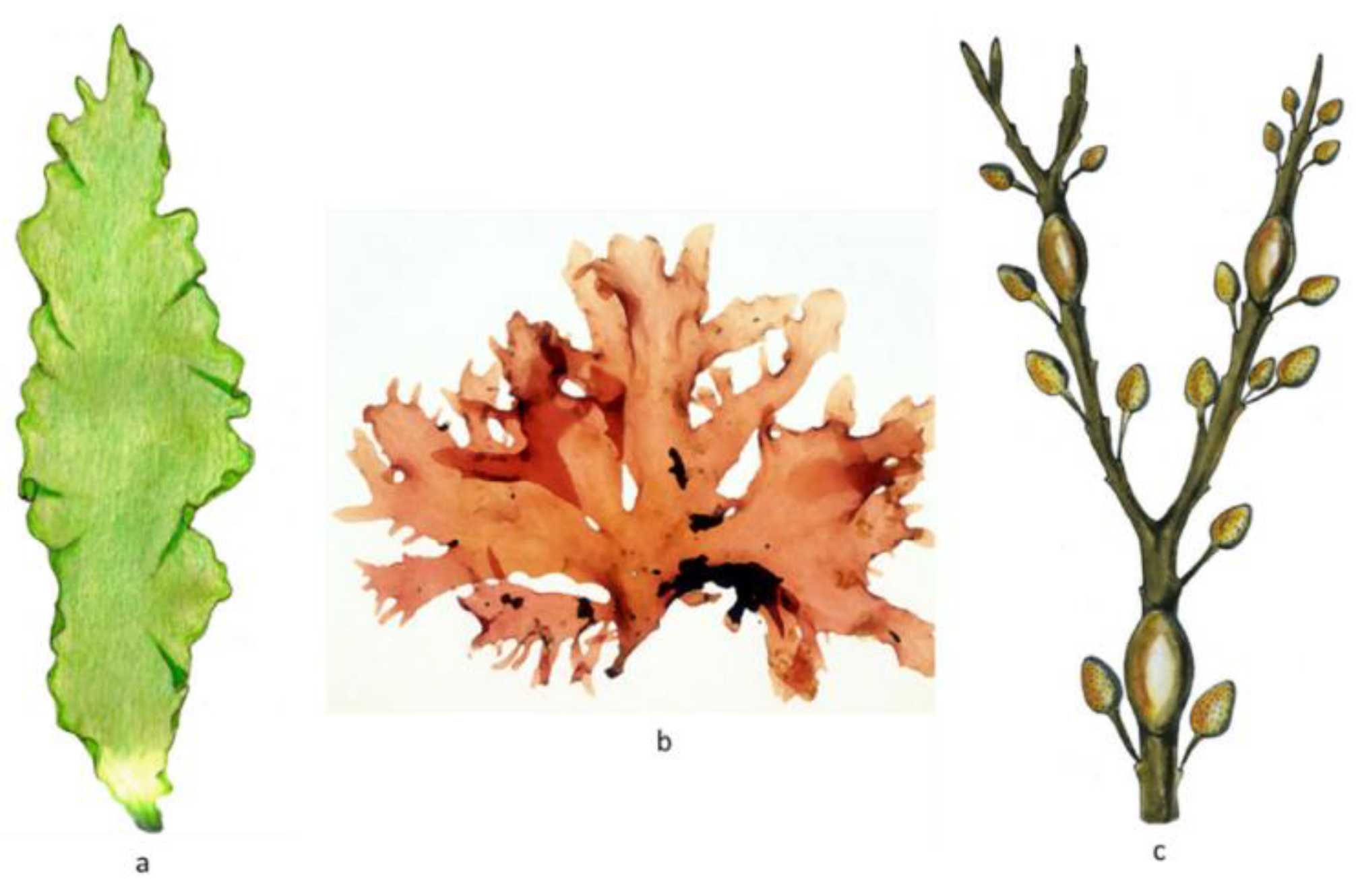
Figure 1. The three main taxonomic groups of macroalgae: (a) phylum Chlorophyta — green algae; (b) phylum Rhodophyta — red algae; (c) phylum Heterokontophyta, class Phaeophyceae — brown algae [2].
Preprints 182519 g001
Figure 2. Extraction process of phycocolloids such as agar and carrageenan from red algae, including some of their industrial applications and some of the influences of environmental and genetic factors.
Preprints 182519 g002
Figure 3. Innovative farming techniques, such as integrated multi-trophic aquaculture (IMTA) and nearshore cultivation of Kappaphycus alvarezii.
Preprints 182519 g003
Figure 4. Gracilaria gracilis (a) and Gelidium corneum (b) (Rhodophyta).
Preprints 182519 g004
Figure 5. Chemical structure of the agarose polymer.
Preprints 182519 g005
Figure 6. Idealized structure of the chemical units of the different types of carrageenan.
Preprints 182519 g006
Figure 8. Palmaria palmata (a) and Grateloupia filicina (b).
Preprints 182519 g007
Figure 9. Asparagopsis taxiformis (Scale = 1 cm).
Preprints 182519 g008
Figure 10. Production process of seaweed-based PLA (adapted from [171]).
Preprints 182519 g009
Figure 11. Production process of seaweed bioethanol (adapted from [171]).
Preprints 182519 g010
Table 1. Summary of industrial applications of red seed polysaccharides (Based on [1,30,117]).
Industry Polysaccharide Main Applications Specific Uses
Food Industry Agar
Carrageenan
- Food additive (E406, GRAS
approved)
- Popular in jellies
- Food additive (E407, GRAS
approved)
- Processed meat products
Stabilization
- Protective coating on fresh-cut
packaged food
- Low-quality agar in food products
- High-quality agar in limited food items
- Common use as a jellifying agent
- Binds milk molecules, retains water
- Gas barrier, reduces respiration, slows discoloration, and maintains texture in packaged foods
Pharmaceutical Agar
Carrageenan
- Pharmaceutical grade growth media
- Drug delivery systems
- Functional foods with health
Benefits
- Medical analysis
- Pharmaceutical drugs and agents
- Functional foods with health
benefits
- Decreases blood glucose, prevents red blood cell Aggregation
- Acts as bulking agents in laxatives, suppositories, capsules, tablets, and anticoagulants
- Production and encapsulation of monoclonal antibodies, interferons, steroids, and alkaloids
- Decreases blood glucose, prevents red blood cell Aggregation
- Highly purified agar (agarose) used in molecular biology (electrophoresis, immune diffusion, gel chromatography)
Cosmetic Agar
Carrageenan
Structural ingredients
Structural ingredient
- Used in creams, hand lotions, liquid soap, deodorants, foundation, exfoliant, cleanser, shaving cream, face moisturizer/lotion, acne and
anti-aging treatments
- Applications include toothpaste, hair wash products, lotions, medications, sun blocks, shaving
creams, deodorant sticks, sprays, and foams
Agriculture Agar
Carrageenan
Structural ingredients
Functional ingredients
Regulates physiological and
biochemical processes in plants
(e.g., cell division, photosynthesis)
- Acts as moisture-holding hydrogel, reducing
irrigation frequency, improving soil aeration, and
limiting erosion
- Soil conditioner, improves water
retention, soil permeability, and plant performance
- Regulates plant metabolic processes, including
purine and pyrimidine synthesis, nitrogen and sulfur absorption
- Activates plant defense systems,
provides resistance to abiotic and biotic stressors
Disclaimer/Publisher’s Note: The statements, opinions and data contained in all publications are solely those of the individual author(s) and contributor(s) and not of MDPI and/or the editor(s). MDPI and/or the editor(s) disclaim responsibility for any injury to people or property resulting from any ideas, methods, instructions or products referred to in the content.
Copyright: This open access article is published under a Creative Commons CC BY 4.0 license, which permit the free download, distribution, and reuse, provided that the author and preprint are cited in any reuse.
Prerpints.org logo

Preprints.org is a free preprint server supported by MDPI in Basel, Switzerland.

Subscribe

Disclaimer

Terms of Use

Privacy Policy

Privacy Settings

© 2025 MDPI (Basel, Switzerland) unless otherwise stated