

Submitted:
25 October 2025
Posted:
28 October 2025
You are already at the latest version
Abstract
European policy promotes a "triple transition”, integrating digital innovation, ecological sustainability (green policy goals), and social inclusion in development initiatives. Cultural and creative industries (‘CCIs’) can be pivotal in this process, given their societal role beyond the production of products and services and their ability to shape responses to ubiquitous challenges. The objective of this study is examining how institutional mandates interact with organic innovation dynamics in the CCIs regarding the simultaneous integration of all three policy pillars in creative projects. We use data on 5,601 initiatives from the EU's Creative Europe program (2013-2024) as a natural experiment. As of 2021, Creative Europe’s calls for proposals have begun suggesting the inclusion of all three pillars of the triple transition in funded creative projects. This policy shift enables the comparison of pre- and post-mandate trends. Results reveal an intrinsic upward trajectory in projects with simultaneous digital, green and social goals (i.e. ‘triple-pillar’ projects), even before the shift. This pattern persisted after 2021 as well. However, the mandate substituted for other catalysts like international collaboration. Pre-2021, multi-country partnerships significantly predicted triple-focus within projects. Post-2021 however, this link vanished as even local projects complied with Creative Europe’s suggestions. Instead, larger project budgets and grants emerged as key enablers, indicating a trade-off in cost efficiency. Mandated comprehensiveness required greater resources for implementation. Our findings therefore underscore that policy can reinforce bottom-up creativity. However, it reshapes processes, potentially burdening smaller actors. To maximise policy impact, mandates should pair with funding support and flexibility.
Keywords:
creative Europe
; cultural and creative industries
; triple transition
; digital transformation
; environmental sustainability
; social inclusion
; international collaboration
; project funding
1. Introduction
The idea of a “triple transition,” calls for simultaneous progress on digital innovation, ecological sustainability, and social inclusion as the foundation of Europe’s future development (Muench et al., 2022; Matti et al., 2023). This concept builds on the earlier notion of a twin transition (combining digitalization and decarbonization) by adding a justice dimension, on the premise that technological and green advances must go hand-in-hand with inclusivity to be truly sustainable (Council of the EU, 2023). In this context, the cultural and creative industries (‘CCIs’) have been identified as pivotal players. Scholars and policymakers argue that CCIs can act as catalysts for systemic change across all three transition pillars (De Smedt and De Voldere, 2025; Gustafsson and Lazzaro, 2021). The CCIs do more than produce cultural content. They shape values, public awareness, and behaviours, thereby influencing how society responds to environmental challenges, digital transformation, and social issues (European Commission, 2023; Ranczakowska et al., 2024). As a result, there is growing optimism that creative projects can integrate technological, green, and social goals in innovative ways. At the same time, critical questions remain unanswered. Do grassroots creative initiatives naturally converge on addressing all three priorities together, or does this only happen when institutions explicitly require it? How does top-down policy intervention interact with the organic creative process? What trade-offs arise when projects are expected to embrace multiple policy objectives? Could such a broader scope demand greater resources or new ways of working? These questions are at the heart of our study.
The present paper investigates how CCIs respond to the triple-transition agenda by analysing thousands of creative innovation projects supported under the European Union’s Creative Europe funding programme. We use Creative Europe’s project portfolio as a laboratory to test whether and how cultural projects incorporate all three policy objectives over time. Such projects are referred to as ‘triple-pillar’, ‘triple-objective’, ‘triple scope’, ‘triple objective’ or ‘tri pillar’ ones throughout the paper. Crucially, we leverage a policy shift in 2021 as a natural experiment. During the program’s initial period (2013–2020), Creative Europe emphasized cross-border collaboration and digital modernization, with social inclusion gradually gaining importance, but it had no formal requirement for environmental sustainability in projects. From 2021 onward, however, the EU suggested that funded projects address all three dimensions, i.e. digital, green, and social, in addition to its cultural goals. This institutional shift in incentives provides a unique opportunity to observe creative projects before and after a broad sustainability mandate was imposed. In this context, the word ‘mandate’ should not be understood as an obligatory, strict request, rather as a set of explicitly expressed incentives and suggestions. Detailed timelines on the genesis of this mandate are provided in Section 2.2.1. It is important to note that this paper is not an evaluation of Creative Europe’s policy or its outcome. It was not funded, commissioned, or endorsed by the European Commission. Instead, it is a study, which exploits Creative Europe as a contextual backdrop to probe a more general phenomenon. This is the question of how institutional requirements might accelerate, reshape, or burden the integration of multiple innovation goals. In other words, we ask whether cultural projects were already moving towards triple-focus objectives on their own and how their trajectory was altered once a triple-transition suggestion became explicit.
This research contributes to several strands of literature. First, it adds empirical evidence to the rich theoretical discussion on innovation in creative sectors and sustainability transitions. Previous work has highlighted that CCIs can drive social innovation and community well-being (Sica et al., 2025) and can play a role in promoting sustainability (Panneels, 2023) and digital adoption (Komorowski and Picone, 2020). However, these dimensions have often been studied in isolation. Little is known about the extent to which single projects can successfully combine all three objectives and what factors enable or hinder such breadth. Our study is, to our knowledge, the first large-scale analysis of integrated triple-transition goals at the project level in the cultural sector. We also bring new insight to the debate in innovation studies about diffusion vs. design in driving change. Classic diffusion theory suggests that new practices and norms (such as eco-friendly, inclusive digital innovation) can spread organically through creative communities over time (Rogers, 2003). Institutional theory, meanwhile, emphasizes that organizations respond to formal pressures and will conform to mandates to maintain legitimacy (DiMaggio and Powell, 1983). By observing CCI projects with and without explicit policy mandates, we bridge these perspectives. We examine whether organic trends or mimetic behaviours in the creative field were already leading to multi-objective projects, and how a top-down rule interacted with those trends. This empirical test of theorized mechanisms, including peer imitation, normative alignment, and coercive compliance, extends the literature on cultural innovation under multiple institutional logics.
Methodologically, our analysis exploits a comprehensive dataset of 5,601 Creative Europe projects spanning 2013-2024, each documented with its objectives, partnership composition, and budget. We classify the projects based on whether they pursued digital, green, and social aims, either singly or in combination. A detailed overview of the methodology employed in doing so is provided in Section 2.2.2. Using econometric models, we then identify the drivers of triple-objective projects and compare these drivers before and after 2021. This approach allows us to isolate how the likelihood of a project integrating all three goals evolved over time and in response to the policy change. The results provide a compelling narrative about the interplay between voluntary innovation and policy-driven change. We find that even before any requirement was in place, creative projects were increasingly broadening their scope. From 2013 to 2020 there was a clear upward drift in the probability that a given project would combine digital, social, and environmental ambitions. This intrinsic trend suggests that the creative sector was already embracing more holistic visions of innovation, likely spurred by the diffusion of new ideas, peer learning, and shifting societal norms. In 2021, the introduction of the triple-transition mandate dramatically accelerated this trajectory. The share of projects tackling all three priorities surged. By 2025, a large proportion of projects addressed the triple transition, reflecting the power of institutional mandates to rapidly standardize practices. Yet our findings also reveal that the mandate fundamentally reconfigured the landscape of project design. Before 2021, projects that voluntarily achieved a triple focus tended to have certain distinguishing features. Notably, they often involved multiple countries in their consortium, hinting that diverse international collaboration was a key facilitator for integrating various goals. After 2021, this correlation vanished. With the policy, even small, locally based projects were incentivised to cover all fronts. What emerged was a new distinguishing factor, namely project resources. In the post-mandate era, the size of individual grants (adjusted for constant purchasing power) became virtually the same time series as the proportion of triple-pillar projects within all initiatives. This is shown visually in Section 2.2.3. No such relationship existed prior to 2021. In short, the explicit suggestion of multi-dimensional innovation ensured widespread compliance but introduced a new dependency on scale and capacity.
These findings carry important implications. Substantively, they suggest that the cultural sector’s move toward combining digital transformation, green goals and inclusion has been driven by both bottom-up creativity and top-down policy signals. Policy can reinforce and speed up organic innovation trends, but it also changes the innovation process. Our study suggests that ambitious cross-cutting agendas like the triple transition can indeed be embraced by creative actors, but they must be paired with adequate funding, knowledge sharing, and flexibility. With this message, we aim to spark a richer dialogue between cultural policy, innovation studies, and sustainability research. Our results showcase the creative industries as a microcosm of transition dynamics, revealing both the opportunities and the constraints of coupling creativity with digital, green, and social objectives. This insight is vital as governments increasingly look to the creative economy not only for economic growth, but also as a source of solutions for climate action and social cohesion. The remainder of the paper is organized as follows: first, we develop our hypotheses and theoretical expectations regarding organic project evolution and the effects of mandates (see Section 2.1). We then describe the data (Section 2.2) and empirical methodology (Section 2.3), including our classification of project objectives (Section 2.2.2). Next, we present the results of our analysis and discuss how they support the hypotheses (Section 3). Finally, we conclude with reflections on policy implications and avenues for future research on creative industries in sustainable transitions (Section 4).
2. Materials and Methods
2.1. Theoretical Framework
CCIs span arts, heritage, design, media, and gaming, all moving through digital change and increasingly expected to support sustainability and cohesion (European Commission, 2023; Ranczakowska et al., 2024). We ask how organic creative dynamics interact with institutional rules in pushing projects to address all three aims at once, and we derive three testable hypotheses below from prior theory and evidence.
2.1.1. Natural Convergence Towards the Integration of Digital, Green and Social Goals Over Time
Innovation in the CCIs is exploratory, which eases the integration of multiple societal aims. These sectors can act as transition brokers that diffuse ideas and values into practice (Gerlitz and Prause, 2021). Cultural production links to social innovation and community wellbeing, and creative entrepreneurs increasingly build sustainability and inclusion into their value propositions (Sica et al., 2025; Kalfas et al., 2024; Panneels, 2023). Several mechanisms push projects toward triple aims. Diffusion theory predicts gradual spread of combined practices through networks as early projects demonstrate viability and advantages (Rogers, 2003). Increasing returns reinforce adoption, since each successful fusion sets benchmarks, builds expectations, and enlarges the knowledge base for the next project (Arthur, 1989). Under uncertainty, organizations imitate models that are successful or legitimate, including those favoured by funders or awards, which produces isomorphism around triple aims (DiMaggio and Powell, 1983; Haunschild and Miner, 1997; Bikhchandani et al., 1992; Gustafsson and Lazzaro, 2021). Normative pressures matter as well. With rising public concern for sustainability, justice, and digital transformation, many cultural producers align intrinsically with these goals and embed eco practices, digital tools, and social engagement in their work (Komorowski and Picone, 2020; Gustafsson and Lazzaro, 2021; Sica et al., 2025; Lupu et al., 2023). These forces predate mandates. The share of projects addressing sustainability and inclusion rose through the 2010s under bottom-up dynamics and creative clusters that combined new digital production with diverse content and green initiatives through local spillovers (Fleischmann et al., 2017; Cooke and De Propris, 2011; Komorowski et al., 2025).
Hypothesis 1 therefore, in line with the above, states that projects naturally tend to integrate digital, green, and social aims over time even without mandates, and that later mandates complement rather than replace this trajectory by amplifying an existing evolution (Muench et al., 2022). This hypothesis is confirmed by the data described in Section 2.2, with empirical results shown in Section 3.1.
2.1.2. Formal Requirements, Mandates Substitute for Other Policy Catalysts
Before explicit triple themed rules, projects often use specific strategies to broaden scope. International collaboration is the salient example. Cross border and cross sector teams bring diverse priorities and skills, which supports broader objectives and richer outputs that address multiple societal challenges compared to homogeneous teams (Hong and Page, 2004; Gustafsson and Lazzaro, 2021; Ranczakowska et al., 2024). Creative Europe and predecessors encouraged transnational cooperation to spur exchange and to integrate intercultural dialogue, inclusion, and environmental awareness within artistic work (European Commission, 2021; Gerlitz and Prause, 2021). During 2013 to 2020, projects with more international partners were more likely to report multiple aims, leveraging diversity for scope (Fleischmann et al., 2017). Once a broad mandate arrives, the optional catalysts become less pivotal. If many funded project must cover digital, green, and social aims, even small local teams are compelled to address the full set. Extrinsic regulation substitutes for intrinsic or voluntary strategies and reduces variance formerly explained by internal choices, which mirrors motivation crowding and institutionalization that levels differentiators once practices are codified (Frey and Jegen, 2001; Tolbert and Zucker, 1983). We therefore expect that international breadth no longer predicts triple scope after the mandate. Teams may also redirect behaviour by addressing new aims in house rather than seeking extra partners, which can satisfy formal criteria yet risk perfunctory coverage. Collaboration can still improve depth and quality, but our focus here is incidence.
Consequently, Hypothesis 2 states that introducing a requirement for triple aims substitutes for prior mechanisms, such as international collaboration, which previously helped produce multi objective projects. Hypothesis 2 will find support if international breadth strongly predicts triple scope before the policy change and not after. This hypothesis is indeed confirmed by the data described in Section 2.2, with empirical results shown in Section 3.1.
2.1.3. Formal Requirements Imply Increased Resource Utilization
Adding environmental, social, and digital aims increases effort, skills, and financing needs. A film may require eco consultants or inclusion officers, a heritage project may need new software and training for environmental and accessibility standards. Such additions raise complexity and cost, which is consistent with evidence on slack, search, and the resource intensity of multi-dimensional innovation (Nohria and Gulati, 1996; Martinsuo and Killen, 2014; Gustafsson and Lazzaro, 2021; Komorowski and Fodor, 2025). Pre mandate, many projects with limited budgets prioritized a main objective. When policy suggests that projects cover multiple aims, resources become pivotal. In competitive funding, projects that widen scope typically request and receive larger grants, which acts as a premium for complexity (Lupu et al., 2023). We therefore expect grant size to become a critical predictor of triple scope after the mandate, with average costs rising as coordination and expertise needs grow, and with small actors facing constraints unless supported (Panneels, 2023; De Smedt and De Voldere, 2025). Without added resources, superficial compliance or exit could follow. The net prediction is a positive correlation between grant size and triple scope only after the policy change, whereas before, low budget projects could remain single or double focused without penalty. Policymakers face a trade-off between comprehensiveness and cost efficiency and should plan for a premium in funding and capabilities to avoid overburdening teams and diluting innovation when funds are thin (Komorowski and Lewis, 2023; Lupu et al., 2023).
Hypothesis 3 therefore states that mandating triple aims makes budget size a key predictor of triple scope in the post mandate period. This Hypothesis is confirmed by the data described in Section 2.2, with empirical results shown in Section 3.1.
Taken together, Hypotheses 1 and 2 concern complementarity and substitution between mandates and existing catalysts, while Hypothesis 3 concerns the efficiency costs of mandated breadth. Section 3 tests these claims. The evidence shows how far projects were already moving toward integration, and how the mandate changed composition and resource allocation. We then revisit the expectations in light of the regression results and consider whether policy can reinforce creative dynamics without unintended consequences, or whether adjustments are needed to balance ambition with feasible execution (see Section 4).
2.2. Data
2.2.1. General Introduction to the Data
Creative Europe is the European Union’s flagship funding programme for the cultural, creative, and audiovisual sectors (European Commission, 2023). It supports performing arts, heritage, film industry and media collaborations to strengthen cultural diversity and competitiveness across Europe. The programme ran in 2014 to 2020 with a budget of €1.47 billion and was renewed for 2021 to 2027 with €2.44 billion (European Commission, 2023). One funded project is a distinct initiative receiving a Creative Europe grant. Each project is an umbrella for activities such as productions, events, training, translations, and network building, led by one organization with partners, often across several countries. Our dataset covers 5,601 funded projects, one observation per project. For each we observe the inflation adjusted grant amount in euro, the number of participating countries, the lead coordinator’s country, and the coordinator’s organizational type. Coordinators range widely. In the Culture subprogram, many are nonprofit associations or public cultural institutions. In the Media subprogram, they include private production companies, distributors, festivals, and training institutes. We also record call identifiers for each project. These allow fixed effects for differences across schemes, either call year or specific action (examples for what an action is include . All project data come from the Commission’s public Creative Europe database, (European Commission, 2025), licensed under Creative Commons Attribution 4.0 International (CC BY 4.0).1 We modified the original data by adding classifications of project objectives and ancillary data, such as the Euro Area’s monthly harmonized index of consumer prices (‘HICP’, Eurostat, n.d.), which are deposited in the journal's repository under the same license. The original data source is a live dataset. Consequently, the version placed in the journal’s repository contains original information (plus our additions) is accurate as of 20 October 2025. Users may reuse the original, live dataset at any point in time (point at which it may have changed compared to the version in the repository) with credit and disclosure of changes (European Commission, 2011).
Before describing our classification of project objectives (Section 2.2.2), it is important to clarify the policy context and how it shifted over time, particularly its major change in 2021. During the 2013-2020 programme period, Creative Europe calls strongly emphasized transnational collaboration and digital innovation, alongside improving cultural access as a social goal. From the very first calls, one of the core priorities was adapting the cultural and creative sectors to the “digital shift,” encouraging new digital distribution models and use of new technologies in culture (Assembly of European Regions, 2018). Another recurring priority was audience development, which implicitly carried an inclusion aspect (e.g. reaching youth, minorities, or people with disabilities as new audiences for culture). Cross-border cooperation was a mandatory feature of nearly all projects. For instance, a typical Culture subprogram strand cooperation project had to involve partners from at least three different countries, and a Media subprogram film co-production often required broadcasters or producers from multiple EU states. However, environmental sustainability was notably absent from the formal criteria in this period. The calls issued between 2013 and 2019 did not require or explicitly mention “green” measures or climate-related objectives. For example, the 2015 call for European Cooperation Projects focused on the mobility of artists, audience engagement, and digital capacity, but contained no reference to environmental practices. Even as late as 2018, the priorities for the 2019 Cooperation Projects included international mobility, social integration of refugees, and promoting cultural heritage, yet no sustainability or climate action was asked of applicants (Assembly of European Regions, 2018). Similarly, in the Media subprogram, calls up to 2020 were centred around boosting cross-border circulation of films, embracing digital distribution (online platforms, video-on-demand), and expanding audiences, without imposing environmental criteria. The only hints of eco-consciousness emerged informally – by 2020, the film industry was starting to discuss “green shooting” and some Media guidelines encouraged sustainable approaches. However, these were not binding or evaluated in the grant decisions. In sum, under the 2013–2020 framework, “Digital” was a core explicit priority and “Social” (inclusion and access) became increasingly explicit, whereas “Green” was entirely absent as an objective (see our synthesis in Table 1 below). International cooperation was a given throughout, as a structural requirement of the funding schemes.
In 2021, with the launch of the new Creative Europe programme (2021–2027), a significant policy shift occurred. Environmental sustainability was elevated to a central objective alongside digital transition and social inclusion. The European Commission explicitly aligned Creative Europe with its broader priorities of the European Green Deal, social inclusion, and digital transformation (European Commission, 2023). All calls in the new program incorporate these three horizontal priorities, digital innovation, social inclusion and diversity, and green sustainability, in addition to fulfilling the core cultural/audiovisual goals of the call. For example, the 2021 call for European Cooperation Projects asked applicants to explain how their project would contribute to environmental sustainability (such as reducing carbon footprint or promoting climate awareness), how it would ensure inclusion and reach diverse audiences, and how it would embrace the digital mode of creation or dissemination, on top of the artistic collaboration proposal. Similar requirements were integrated across the board. New funding actions like the Cross-sectoral Creative Innovation Lab explicitly included a “greening” theme (projects under this scheme were encouraged to develop innovative solutions for greener practices in culture). Even traditional schemes were adapted. Literary translation projects had to consider eco-friendly production and broad accessibility, European platform and network projects were encouraged to adopt sustainable event practices and diversity strategies, and film/TV funding under the Media subprogram added criteria for green production plans and gender-balanced or inclusive project teams. In short, after 2021 the Creative Europe programme made the Digital–Social–Green triad a cross-cutting obligation for all projects. This policy mandate is clearly reflected in the data. As we show in Figure 1, from 2021 onward many more funded project set out objectives in all three dimensions than in the period preceding this year.
2.2.2. Project Classification Methodology
Our analysis requires identifying each project’s orientation with respect to the three policy objectives (digital, social, green). To this end, we performed a systematic classification of all projects in the dataset, assigning each project to one of seven categories: D+S+G (project addresses all three pillars: Digital, Social, and Green simultaneously), D+S (addresses both Digital and Social, but not Green), D+G (Digital and Green only), S+G (Social and Green only), D-only, S-only, or G-only. A very small number of projects did not clearly pursue any of the three objectives – these were tagged as “None,” effectively an eighth category, though such cases were rare by design of the programme. All these classifications are clearly visible, with narrative and keyword-based justifications included, in the data provided to the journal’s repository. This classification was carried out using a combination of automated text analysis and manual review. We leveraged the official project summaries and descriptions provided in the Creative Europe database for each project. First, a keyword-based scan was applied: for instance, the presence of terms like “digital platform”, “VR”, “online tool”, or “new technology” would indicate a Digital dimension; mentions of “audience development”, “social inclusion”, “diversity”, “disability”, “youth engagement”, or references to specific community groups signalled a Social aim; and words such as “climate”, “environmental impact”, “green”, or “carbon footprint” pointed to a Green objective. This precursory automated flagging was then followed by close reading of each project’s aims by the research team. We examined whether the context truly supported the inclusion of a given pillar. For example, a project might mention the word “digital” simply to note they have a website, which does not amount to an innovative digital objective – such a project would not be classified as Digital-focused based on that alone. Conversely, some projects had implicit sustainability goals (e.g. heritage restoration can have an environmental angle in terms of materials used) that required careful interpretation and classification, even in the absence of readily-identifiable keywords. To ensure consistency, multiple team members cross-validated a subset of the classifications, and any ambiguous cases were discussed collectively. Through this rigorous process, we endeavoured to maximize accuracy and objectivity in tagging projects by their policy objectives.
We acknowledge that a few project classifications were subject to debate. The boundaries between, say, a purely cultural/social project and one that slightly touches digital tools can be fuzzy. We confronted these edge cases during the manual validation process. Importantly, any reasonable misclassifications are highly unlikely to affect our conclusions. In fact, we conducted a very stringent robustness check (discussed in Section 3.2) in which we randomly re-assigned 10% of the projects to different categories to mimic a worst-case classification error rate. The results of our statistical analysis remained essentially unchanged. Ten percent of our sample is 560 projects – far more than the number of dubious classifications one could plausibly conceive of. We are therefore confident that even if a handful of projects were inadvertently miscoded or interpreted differently by the authors of this paper and their peers, it does not compromise the patterns and effects we report. All data have been made available.
While we categorized projects into the full seven (plus one “none”) buckets, our empirical analysis focuses primarily on the distinction between “triple-pillar” projects (D+S+G) and all others. In other words, we collapse the classification into a binary outcome for most regressions: does a project simultaneously integrate digital innovation, social-inclusive goals, and environmental sustainability or not? This approach is aligned with our research questions about the drivers and effects of all-encompassing projects. The binary indicator of a tri-pillared project is the dependent variable in our models (see Section 2.3), and we examine how its incidence correlates with various factors before and after the policy shift. It is worth noting that reducing the rich classification to a binary is a conservative choice made for analytical clarity.
2.2.3. Data Diagnostics
We inspect aggregate trends before formal modelling. Figure 1 plots monthly indicators from March 2013 to September 2025. The first is the share of newly starting projects classified as triple-pillar. The second is the average number of partner countries per project, a proxy for international collaboration intensity. The third is the average inflation adjusted grant amount per project. The latter two are normalized to a zero to one scale with one equal to the sample maximum so all series can be plotted together.
The 2021 policy shift is visible. However, it is important to note for the visual reading of Figure 1, as mentioned in the Note underneath it, that the series in it are 8-month moving averages. During individual months, the numbers in the figure can jump to anomalous heights only to be reduced to zero in the next one. This does not reflect a statistical artefact that would bias the results. Instead, it is the result of certain months featuring very few or no newly started projects. Even with this feature in mind, it appears clear that the triple-pillar project share was on a gradual upward path in the late 2010s. The new requirements in 2021 led to an immediate surge, delayed only slightly by the transmission from grant call wording to project start times. The series did not jump to its local maximum in January 2021 but rose through 2021 to 2022 before saturating temporarily, only to markedly rise again as of 2024. The other two series change their relation to triple prevalence. There was some pre 2021 correlation between grant amount and triple-pillar status. However, after 2021, the pattern changed. Grant sizes and the incidence of triple-pillar projects started moving in near lockstep. This aligns with Hypothesis 3. Making triple scope the norm carries a higher price tag, so average grants rose. We later show that grant size predicts triple-pillar status only after 2021.
Consortium breadth shows the opposite shift. In the years before 2021 there was a mild positive association between partner countries and triple prevalence. This is consistent with international collaboration as a pathway to broader scope. Our regressions confirm that an additional country significantly increased the odds of triple status before 2021, all other things being equal. After 2021 however, the relation inverts. Average countries per project jumped around 2022. Subsequently, however, with triple-pillar project shares rising markedly, average consortium size declined. Under the program’s mandate, with our without extensive international breadth, projects had to strive to include digital, social, and green aims. This explains the decoupling between the two series, supporting Hypothesis 2. The mandate substituted for the catalytic role of international collaboration.
The data show a natural move toward multiple objectives and an acceleration and reshaping after the 2021 intervention. Projects became larger in budget on average but not necessarily broader in international scope. Figure 1 foreshadows the regression findings on time, the mandate, and interactions with grant size and collaboration.
2.3. Empirical Methodology
Our empirical models predict the probability that any given funded project is triple-pillar. The dependent variable equals one when a project simultaneously pursues digital, social, and green objectives (i.e., is triple-pillar), and zero otherwise. Variable definitions follow Section 2.2. We estimate a binary choice model with a logistic link and maximum likelihood with robust standard errors. The observational unit is a project. Each observation carries the project start month, the number of participating countries, the inflation-adjusted grant amount in thousands of euros, the lead coordinator country, and the call or action identifier.
We split the sample in January 2021. The pre 2021 sample includes start dates strictly before January 2021. The post 2021 sample includes start dates on or after January 2021 through the end of the window. This split isolates pre-existing time trends and post mandate patterns without imposing a pooled jump. We include a linear month index, one unit per calendar month, to capture slow moving learning and diffusion in the sector. The coefficient measures the change in log odds for a one month increase, conditional on other variables. We include the number of participating countries as a direct measure of international collaboration that can broaden scope. We include the real grant amount to measure how triple probability varies with resources. Deflation uses Euro Area HICP so that one euro has constant purchasing power (Eurostat, n.d.).
We use fixed effects to purge composition effects. Calls differ in structure, evaluation grids, and delivery requirements. Lead countries differ in institutions, networks, and sectoral structures. Without controls, shifts in the mix of calls or leads would bias time and other covariates. Fixed effects remove level differences that are constant within a call or lead country. Identification comes from within call and within lead country contrasts across projects that start in different months, have different budgets, or bring different numbers of partner countries.
We estimate three nested specifications. Specification one includes month, countries, and grant. Specification two adds a full set of lead country dummies with one omitted category. Specification three adds call related dummies. For pre 2021 we use action identifiers whenever there is within action variation. For post 2021 we replace action dummies with year of call because the shorter period rarely has within action variation. In all specifications any fixed effect group with no outcome variation is dropped. This is a mechanical property of nonlinear models with group dummies when the outcome is constant inside a group. Such observations do not inform slope parameters because they imply perfect prediction. Dropping them avoids singularity and leaves comparisons well defined. We fit the data described in Section 2.2 to Equation 1 below.
Equation 1. Logit Binary Choice Model Estimating the Probability that any Given Project is a Triple Pillar One
with . is the indicator for a triple pillar project. is the linear month index. is the number of participating countries. is the inflation adjusted grant amount in thousand euro. is the lead country fixed effect. is the call related fixed effect. In the pre 2021 sample denotes action identifiers when they carry variation. In the post 2021 sample denotes year of call. The constant collects the baseline log odds once the fixed effects are zeroed out by the coding. The parameters , , and are the objects of interest.
We report coefficients and robust standard errors. Reading the coefficients is standard for a logit. A one unit change in a regressor changes the log odds by the coefficient. The corresponding odds ratio equals the exponential of the coefficient. For the month index this means that moving forward by one calendar month multiplies the odds of a project being triple pillar by . For the number of countries it means that adding one more partner country multiplies the odds by . For grant size it means that adding one thousand real euro multiplies the odds by . We do not transform the dependent variable or the covariates, so these interpretations hold in natural units.
3. Results
3.1. Supporting the Testable Hypotheses
The results of fitting Equation 1 with the input from the dataset as described in Section 3.2 are given in Table 1 below for all funded projects that started prior to January 2021. In Table 2, the results are presented from repeating the same process on projects that started on or after January 2021 (until October 2025).
There are both similarities and differences across Table 2 and Table 3, but they all align with the testable hypotheses set out in the theoretical framework section. First, month fixed effects have a positive and generally statistically significant effect on the probability of any given project being triple-objective (instead of focusing on only one or two of the three pillars). This holds for all projects, independently of when they started. The coefficients range between 0.01 and 0.02. The odds ratios that they produce therefore range between e0.01 and e0.02, i.e. between 1.01 and 1.02. This entails that moving from one month to the next, the probability that any given project with otherwise the same attributes moves from a single- or double-pillar one and becomes triple-pillar increases by 1 to 2% on average. This is a ceteris paribus increase, meaning that it happens irrespectively of the values of all the other explanatory variables included in the regressions shown in Table 2 and Table 3. This increase is in relative terms and not in percentage points. For instance, if in a given month, the unconditional probability for a given project to be a triple-pillar one was 10%, the next month, this same probability for otherwise the exact same project would increase to 10.1%-10.2%. This effect may seem weak from one period to another, however it is important to note that it compounds over time. After just 5 years, these coefficients would predict a rise in probabilities from this initial 10% to 18.17%-32.81%. Again, it is important to keep in mind that this probability increase refers to otherwise the exact same project – stemming from the same call, organized by an institution from the same country, having the same budget and the same number of different collaborator states.
Most importantly, this time effect is independent of the institutional embedding of policy goals within grants and calls for action. The explicit mandate for projects to shift to triple-objective ones produces an immediate and large increase in the prevalence of such projects, as shown in Figure 1. However, this measure merely reinforces a pre-existing, self-propelled and autonomous effect of projects naturally incorporating all three pillars simultaneously. This is visible in Table 2, showing that this effect existed, and was both statistically and economically significant, even prior to the policy shift that occurred in 2021. Moreover, it persisted afterwards as well, as shown in Table 3. If the policy mandate was a substitute to self-reinforcement, this persistence would not be observable. The proportion of triple-pillar projects would shift to their theoretical maximum (or to some stable, equilibrium level) and would remain there across time. This means that the month fixed effect would cease to be a determinant driving the incidence of such projects. In conclusion therefore, policy mandates are complements to development projects diversifying their aims over time, either naturally, or through imitation.
This is precisely the premise of our testable Hypothesis 1, as outlined in Section 2.1. Note that our theoretical framework outlines numerous mechanisms that would predict such observations. These include, as detailed in Section 2.1, the predictions from innovation diffusion theory, the integration of positive feedback loops, mimicking successful or funded projects, or simply keeping up with the zeitgeist and social policy priorities. This exploratory econometric study is not designed to designate any of these mechanisms as more plausible than the other. Instead, it provides evidence that jointly or separately, these mechanisms mutate projects in a way that over time and incrementally, they aggregate the three policy pillars, instead of just focusing on one or two of them.
The number of participating countries per project (a robust proxy for international collaboration) is a very strong predictor for the prevalence of projects that incorporate all three pillars as objectives, but only in the period prior to January 2021. For all projects that started after this time, this same explanatory variable has no effect on the same incidence. This finding is in line with our testable Hypothesis 2. Independently of the intensity of international collaboration, a mandate results in a mechanical increase of triple-pillar projects. Prior to the mandate, as outlined in Section 2.1, international collaboration was a crucial tool in setting innovation priorities related to multiple pillars simultaneously. This feature of international cooperation most probably persists in the period following January 2021 as well. It could conceivably manifest itself in increasing the probability of tri-pillar projects’ successful outcomes. Nevertheless, as signalled in Section 4, the study and evaluation of project quality, per se, is beyond the scope of this paper. What seems certain, however, is that institutionalization works across all types of projects, re-defining their focus. This effect is independent of whether they were planned to be international ones or not. Overall therefore, mandating acts as a substitute for other catalysts of diversified project focus. In this case - with the specific attribute being available for testing - a substitute to international collaboration. This effect is large from an economic perspective. Before January 2021, adding one more collaborating country to a project increased the baseline probability of a project being triple-pillar by e0.17 approximately (see for instance the estimated coefficient in Table 1 Specification 2), i.e. by 18.5%. Again, this is not an increment in percentage points, but rather a proportional increase compared to baseline odds. However, this effect disappeared completely after the blanket mandates regarding the tri-pillar focus. In other words, after January 2021, additional international cooperation has no effect on project focus, because the mandate captured, and substituted for, its beneficial effects.
A similar reversal of covariation is observable when it comes to grant sizes. However, the starting point is the opposite of the above. For projects that started prior to January 2021, grant sizes are not significant predictors of a project being triple-pillar or not. It is important to note that, as mentioned in Section 2.2, the grant sizes are normalized with Euro Area inflation. This means that they are comparable throughout the entire period of observation (from 2013 and 2025). One given real euro of grant always confers the same purchasing power. Consequently, the fact that grant size becomes the most important predictor of projects being triple-objective ones is not a mere artefact of inflation correlated with time. As shown in Table 3, each additional real grant amount of 1000 EUR makes it 0.04% more likely that any given project is a triple-pillar one. Again, this effect may appear small, but the average real grant amount (adjusted for inflation) is EUR 223,000 and can reach up to EUR 1.5 million. A project that was awarded a grant of EUR 200,000 (still below the average), as opposed to an EUR 100,000 project will be, all other things equal, 4% more likely to be a triple-pillar project. This is a considerable increase that only applies for projects that started after the institutional mandate of shifting towards triple-pillar projects in 2021. This supports testable Hypothesis 3, namely that mandating is effective, but comes at the cost of higher resource use. If initially, projects do not incorporate all three pillars, but widen their scope artificially due to an explicit mandate, that demands a premium in grant allocation.
All findings in this section are robust to potential misclassifications of projects. This is the focus of the next subsection.
3.2. Robustness
The main results rest on a hand classification of every project summary into single pillar, double pillar, or triple pillar types. Certain individual cases could be open to discussion. That is normal in this kind of work. Our aim is not to defend every single label. Our aim is to show that the central findings do not depend on any one of them.
We use a stress test that follows the logic of outcome misclassification in discrete response models. Random misclassification attenuates coefficients toward zero and rarely flips signs unless effects are weak. This is well known in the literature on binary choice with mismeasured outcomes as shown by Hausman, Abrevaya and Scott Morton (1998) and by Magder and Hughes (1997). It is also consistent with the general insight from the measurement error literature that symmetric noise dilutes signal rather than fabricates it as explained by Carroll, Ruppert, Stefanski and Crainiceanu (2006). Our test is therefore deliberately conservative.
We draw a simple random sample of projects equal to ten percent of the full dataset. This is 560 projects out of 5600. We do this by randomly drawing a number for each project (either 0 or 1) from a uniform distribution. We then take a completely random draw of 560 projects and we re-classify them. For each selected project we flip the dependent variable. If it was coded as triple pillar it becomes non triple pillar. If it was coded as non triple pillar it becomes triple pillar. We do not change any covariates. We then re estimate Equation 1 exactly as before. We run the same three specifications as in Table 2 and Table 3. We keep the same fixed effects where they are defined. We report the results in Table 4 and Table 5. Note that we did not cherry-pick results from a number of simulations, with the aim of fitting any pre-determined agenda. The data analysed here (as also deposited into the data repository) incorporates the outcomes of the first random draw that we carried out.
The first panel concerns projects that started before January 2021. Table 4 shows that the month effect remains positive and statistically different from zero in every specification, even after projects’ random reclassifications. This reproduces the qualitative message of Table 2. Projects became more likely to be triple pillar over calendar time even before the mandate. The coefficient on the number of participating countries remains large and precise. It is about 0.10 to 0.11 and is significant at conventional levels. The amount of the grant remains economically small and not reliably different from zero. Lead country fixed effects and call related fixed effects are included where shown. The constants and the pseudo-R squared values shift because we deliberately injected noise into the dependent variable. That shift is expected under random misclassification and does not contradict the stability of the signs and the significance of the core parameters documented above. In short, the pre mandate pattern survives an extreme relabelling of five hundred and sixty projects.
The second panel concerns projects that started on or after January 2021. Table 5 mirrors the message of Table 3. The month effect remains positive and usually significant. The coefficient on the number of participating countries is small and not reliably different from zero across specifications. The amount of the grant remains positive and significant and thus continues to be the main predictor of triple pillar status after the mandate. This is exactly the qualitative picture in Table 2. Again, the constants and the pseudo-R squared values move. This is mechanical. The random flip breaks some of the within category variation that underpins the fixed effects. Some observations drop when there is no remaining variation inside a fixed category. This behaviour is already described in the notes to Table 2 and it is amplified by the stress test. None of these mechanical shifts alters the signs or the economic interpretation of the structural coefficients.
The design of this robustness check answers the main objection to any hand-classification. One could debate a list of individual projects. We therefore move the debate to an extreme case. We assume that as many as five hundred and sixty labels are wrong and wrong in the worst possible way for our conclusions since we flip the outcome rather than introducing inconsequential noise. The results are practically unchanged. Before January 2021 the likelihood of a triple pillar project increases with calendar time and with international breadth. After January 2021 the likelihood of a triple pillar project increases with money and not with international breadth. The month effect persists across the institutional break. This is the same story as in Table 1 and Table 2. It is the same story after we deliberately contaminate the dependent variable on a scale that far exceeds any reasonable rate of human error. The inference is therefore not an artefact of judgment calls in coding. It follows from patterns that are strong enough to withstand heavy misclassification. This approach is similar in spirit to permutation and sensitivity checks that inject noise in outcomes to test stability as discussed by Efron and Tibshirani (1993) and is closely related to the misclassification stress tests proposed in the discrete response literature noted above.
4. Discussion
Our results carry important lessons for cultural policy, highlighting both the impressive efficacy and the caveats of mandates. The dramatic surge in triple-pillar projects after 2021 underscores that clear requirements can swiftly embed broad objectives across an entire funding portfolio. This rapid mainstreaming of Europe’s digital, green, and just transition priorities demonstrates how aligning funding criteria with high-level policy goals can catalyse wide adoption. Crucially, however, the mandate did not impose an unnatural direction on the sector so much as accelerate a shift that was already underway. The mandate amplified rather than initiated (Muench et al., 2022). In fact, our analysis suggests that even in the absence of a mandate, the incidence of triple-pillar projects would have continued rising, propelled by voluntary cross-border collaborations and intrinsic commitment to these values. The mandate’s value was in dramatically speeding up this process, which is a potent tool in times of urgency when policymakers seek immediate change. This swift alignment between EU priorities and on-the-ground practice speaks to a strong convergence between policy goals and practitioners’ own evolving values. Yet it also sets the stage for questioning when such a blunt instrument is truly necessary, given that the sector was already moving in this direction on its own.
Mandating objectives for all projects also reshaped project design. Before 2021, projects that voluntarily spanned the digital, green, and social pillars were typically larger in scale and often assembled international consortia. Diverse, cross-border teams brought together the breadth of expertise and perspectives needed to tackle multiple goals, which made such ambitious scope feasible in a subset of projects (Hong and Page, 2004; Gustafsson and Lazzaro, 2021). These partnerships were an organic catalyst for breadth. After the mandate, however, even small local initiatives had no choice but to address all three priorities, and indeed the degree of international collaboration stopped being a differentiating factor for triple-focus status. The policy effectively substituted for the role that large partnerships used to play. The rule “flattened” the field: a tiny community theater project must tick the same three boxes as a multi-country creative network. One risk is that without the engines that previously drove integrative projects (like diverse teams pooling resources and knowledge), some projects may fulfil the added objectives only superficially. In other words, thematic completeness could turn into a perfunctory check-the-box exercise rather than a substantive commitment (Frey and Jegen, 2001; Gustafsson and Lazzaro, 2021; Fodor et al., 2023). Our findings hint at this tension. Post-2021, projects achieved triple-pillar compliance regardless of collaboration depth, suggesting a possible element of formulaic compliance. Policymakers should respond by encouraging and rewarding genuine depth of engagement with each pillar now that breadth is mandated. Continued incentives for meaningful international partnership, knowledge-sharing platforms, and guidance on best practices are needed to ensure that integration runs deeper than a token gesture.
Broadening project scope through mandates has significant resource implications. After 2021, projects that covered all three priority areas tended to have substantially larger budgets, whereas prior to the mandate there was no such correlation between breadth of focus and budget size. Meeting multiple objectives simultaneously is inherently more complex and demanding, so it makes sense that only well-resourced projects could do it voluntarily in the past. Budget per project rose in tandem with required scope, effectively subsidizing the new complexity. This pattern is consistent with the idea that adding objectives increases project resource needs and managerial complexity (Nohria and Gulati, 1996; Yan and Liu, 2023). Creative Europe adjusted its grant making to account for this. Larger awards and the allowance for bigger consortia enabled project teams to bring in, for example, eco-consultants, accessibility experts, or advanced digital technologists to meet the expanded requirements. In doing so, the program acknowledged that pursuing sustainability and inclusion goals in addition to core cultural work demands real resources (Lupu et al., 2023). While this approach of coupling mandates with higher funding can be necessary to maintain project scope, it carries trade-offs. Higher per-project funding means fewer projects can be supported for a given total budget, concentrating resources into bigger, more complex initiatives. Smaller or less-experienced organizations might struggle to absorb these larger grants or to compete in calls where the bar for complexity is so high. There is a concern that, without additional support, some grassroots actors could effectively be crowded out, not by an official rule against them, but by the sheer scale and sophistication now expected. Targeted capacity-building measures (training, mentoring, help with forming partnerships) can mitigate this risk and ensure that newcomers and small players are not left behind in the push for breadth. This trade-off appears to have been deemed worthwhile to promote holistic innovation, but it warrants continual monitoring. If in the future budgets do not keep pace with the mandated ambitions, projects may be forced to stretch thin resources across too many goals, undermining their effectiveness (Komorowski and Lewis, 2023). Policymakers must therefore regularly re-evaluate the scale of funding and administrative support required to genuinely fulfil all three objectives in each project, adjusting the policy or funding levels as needed so that quality is not sacrificed for quantity of themes.
A critical unknown in our study is the depth of implementation behind these triple-purpose projects. We measured proposals and designs, not actual outcomes. The mandate has clearly succeeded in getting projects to say they will address digital, green, and social aims; what remains unclear is how well these intentions are being carried out in practice. It is possible that some of the post-2021 surge in triple-focused projects involves symbolic compliance or “box-ticking” rather than substantive action. We cannot observe within our data whether, for example, a project’s environmental component was a token add-on purely to satisfy the requirement, or a meaningful strand of activity with real impact. If the mandate induced any degree of superficial compliance, i.e., projects nominally addressing a pillar but devoting minimal effort to it, then the policy’s effectiveness is more limited than the application data suggest. This is a classic concern when external rules attempt to shape intrinsic practices: people may meet the letter of the law without embracing its spirit (Frey and Jegen, 2001). Going forward, evaluation needs to pivot from checking for the presence of triple objectives (which is now given) to assessing the performance on those objectives. In practical terms, that means introducing outcome indicators and qualitative evaluations that can distinguish genuine multi-dimensional innovation from mere signalling. For example, did these projects actually reduce their carbon footprint or reach new diverse audiences or create useful digital tools? Metrics such as measured carbon reductions, concrete improvements in inclusion (e.g. audience or staff diversity), and digital engagement statistics, coupled with narrative reports, would help verify that triple-pillar projects are delivering real value. Overall, the true effectiveness of these efforts remains a “black box” beyond our current analysis. From a policy perspective, it will be crucial to identify whether the mandate is translating into shallow compliance or deep change. If adding mandatory objectives not only raises resource needs but also, in some cases, dilutes the quality or focus of projects, then the approach may need refinement. In the worst case, a mandate that produces many nominally compliant projects with little impact would mean rethinking the one-size-fits-all requirement. More likely, it calls for better implementation support. Funders can strengthen guidance with clear standards of what meaningful engagement in each pillar looks like, showcase best-practice examples of integrated projects, and offer dedicated advisory services to help projects turn lofty goals into concrete outcomes. In short, simply requiring triple alignment was phase one; ensuring real performance on those dimensions is the critical next phase.
Author Contributions
Aliya Turegeldinova and Bakytzhan Amralinova contributed to the conceptual framing and literature review, secured funding, managed resources and contributed to manuscript drafting and revisions. Máté Miklós Fodor developed the empirical model, conducted the analysis, and led manuscript drafting and revisions. Akerkin Eraliyeva, Chen Dayou, and Aidos Joldassov assisted with model validation, robustness extensions, data collection and cleaning and policy interpretation. All authors discussed results, contributed to the final version, and approved the submitted manuscript.
Funding
This research was funded by the Committee of Science of the Ministry of Science and Higher Education of the Republic of Kazakhstan under Grant No. BR27198643 – “Development of digital competences of human capital in industry and logistics through cluster collaboration of science, education and industry.” This research also received funding from UK Research & Innovation's Strength in Places Fund project “Media Cymru” (2021-2026) (grant number 99911) and the Arts & Humanities Research Council (UK) project “Clwstwr” (2018-2023) (grant number AH/S002790).
Data Availability Statement
The dataset that has been modified has been uploaded with this preprint.
Acknowledgments
The authors thank the Committee of Science of the Ministry of Science and Higher Education of the Republic of Kazakhstan for financial support, as well as the UKRI and the AHRC. Colleagues at Satbayev University and other collaborating institutions merit special thanks for their valuable feedback and discussions that improved the paper, including their interventions during workshops and research seminars.
Conflict of Interest
The authors declare that the research was conducted in the absence of any commercial or financial relationships that could be construed as a potential conflict of interest.
References
- Assembly of European Regions. (2018). Fund your project on cultural cooperation with Creative Europe. Available at: https://aer.eu/fund-your-project-on-cultural-cooperation-with-creative-europe/ (Accessed October 22, 2025).
- Carroll, R. J., Ruppert, D., Stefanski, L. A., and Crainiceanu, C. (2006). Measurement Error in Nonlinear Models. Boca Raton, FL: Chapman and Hall and CRC Press.
- Cooke, P., & De Propris, L. (2011). A policy agenda for EU smart growth: The role of creative and cultural industries. Policy Studies, 32(4), 365–375.
- Council of the European Union. (2023). Council conclusions on the triple transition (21 November 2023, 2023/2051(INL)). Brussels: Council of the EU.
- De Smedt, E., and De Voldere, I. (2025). Shaping tomorrows: the CCS as agents of change in Europe’s transition. Front. Commun. 10:1657019. [CrossRef]
- De Smedt, P., & De Voldere, I. (2025). Cultural and Creative Ecosystems and the Green Deal. Joint Research Centre.
- DiMaggio, P. J., & Powell, W. W. (1983). The iron cage revisited: Institutional isomorphism and collective rationality in organizational fields. American Sociological Review, 48(2), 147–160.
- Efron, B., and Tibshirani, R. J. (1993). An Introduction to the Bootstrap. New York: Chapman and Hall.
- European Commission. (2011). Commission Decision of 12 December 2011 on the reuse of Commission documents (2011/833/EU). Official Journal of the European Union, L330, 39–42.
- European Commission. (2021). Regulation (EU) 2021/818 establishing the Creative Europe Programme 2021–2027.
- European Commission. (2023). About the Creative Europe programme 2021–2027. Available at: https://culture.ec.europa.eu/creative-europe/about-the-creative-europe-programme (Accessed October 22, 2025).
- European Commission. (2025). "Creative Europe Projects Lists," data set, https://culture.ec.europa.eu/creative-europe/projects/projects-lists (licensed under CC BY 4.0).
- European Commission. (2025). Legal notice: Reuse of Commission information (CC BY 4.0). Available at: https://commission.europa.eu/legal-notice_en (Accessed October 22, 2025).
- Eurostat. n.d. "HICP - Monthly Data (Index)." Data set, datacode prc_hicp_midx. European Commission. https://ec.europa.eu/eurostat/databrowser/view/prc_hicp_midx/default/table?lang=en. Accessed October 22, 2025.
- Fleischmann, K., Daniel, R., & Welters, R. (2017). Developing a regional economy through creative industries. Creative Industries Journal, 10(2), 119–138.
- Fodor, M.M., Komorowski, M. and Turegeldinova, A., 2023. The relationship between firm attributes and attitudes towards diversity. Sustainability, 15(9), p.7481.
- Frey, B. S., & Jegen, R. (2001). Motivation crowding theory. Journal of Economic Surveys, 15(5), 589–611.
- Gerlitz, L., & Prause, G. (2021). Cultural and creative industries as innovation and sustainable transition brokers in the Baltic Sea Region. Entrepreneurial Business and Economics Review, 9(1), 61–80.
- Gustafsson, C., & Lazzaro, E. (2021). The innovative response of cultural and creative industries to major European societal challenges: Toward a knowledge and competence base. Sustainability, 13(23), 13267.
- Gustafsson, C., and Lazzaro, E. (2021). The innovative response of cultural and creative industries to major European societal challenges: toward a knowledge and competence base. Sustainability 13:13267. [CrossRef]
- Hausman, J. A., Abrevaya, J., and Scott-Morton, F. M. (1998). Misclassification of the dependent variable in a discrete-response setting. Journal of Econometrics. 87, 239–269.
- Hong, L., & Page, S. (2004). Groups of diverse problem solvers can outperform groups of high-ability problem solvers. Proceedings of the National Academy of Sciences, 101(46), 16385–16389.
- Hong, L., & Page, S. (2004). Groups of diverse problem solvers can outperform groups of high-ability problem solvers. PNAS, 101(46), 16385–16389.
- Komorowski, M. and Lewis, J., 2023. The creative and cultural industries towards sustainability and recovery (Vol. 1). MDPI.
- Komorowski, M., & Picone, P. M. (Eds.). (2020). Creative Cluster Development: Governance, Institutions and Proximity. Routledge.
- Komorowski, M., Lupu, R., Lewis, J. and Fodor, M.M., 2025. Conclusion: A roadmap for successful creative industries' R, D&I. In Research, Development and Innovation in the Creative Industries (pp. 79-82). Routledge.
- Komorowski. M. and Fodor, M.M., 2025. Universities as innovation agents for the creative industries–An exploratory quantitative study from Wales. City, Culture and Society, 43, p.100670.
- Lupu, R., Komorowski, M. and Pepper, S., 2023. Understanding the Role of Creative. Global Creative Ecosystems: A Critical Understanding of Sustainable Creative and Cultural Production, p.77.
- Magder, L. S., and Hughes, J. P. (1997). Logistic regression when the outcome is measured with uncertainty. American Journal of Epidemiology. 146, 195–203.
- Matti, S., Jensen, K., Bontoux, L., Goran, P., Pistocchi, A., & Salvi, M. (2023). Towards a Fair and Sustainable Europe 2050. Joint Research Centre.
- Muench, S., Thöne, M., & Blondeel, M. (2022). Towards a Green and Digital Future: Key Requirements for Successful Twin Transitions. Joint Research Centre.
- Nohria, N., & Gulati, R. (1996). Is slack good or bad for innovation? Academy of Management Journal, 39(5), 1245–1264.
- Panneels, I. (2023). The quintuple bottom line. Sustainability, 15(13), 10398.
- Ranczakowska, A., Fraioli, E., & Garma, E. (2024). Just Sustainability from the Heart of Communities. ENCC report.
- Rogers, E. M. (2003). Diffusion of Innovations (5th ed.). Free Press.
- Sica, G., Palazzo, M., Micozzi, A., & Ferri, M. A. (2025). Leveraging CCIs to foster social innovation. Journal of Innovation & Knowledge, 10(1), 100649.
- Tolbert, P. S., & Zucker, L. G. (1983). Institutional sources of change in the formal structure of organizations. Administrative Science Quarterly, 28(1), 22–39.
- Yan, W.-J., & Liu, S.-T. (2023). Creative economy and sustainable development. Sustainability, 15(5), 4353.
| 1 | |
| 2 | See, for instance, https://culture.ec.europa.eu/calls/creative-europe-new-call-for-proposals-for-european-cooperation-projects-2019#:~:text=This%20action%20focuses%20on%20the,following%20priorities, last accessed on 22 October 2025, https://creativesunite.eu/article/creative-europe-open-call-for-european-cooperation-projects#:~:text=The%20action%20is%20anchored%20in,as%20the%20New%20European%20Bauhaus, last accessed on 22 October 2025, or https://europlan.pixel-online.org/news.php?id=248#:~:text=,ensuring%20the%20widest%20possible%20accessibility, also last accessed on 22 October 2025. |
| 3 | See, for instance, https://www.eacea.ec.europa.eu/grants/2014-2020/creative-europe_en#:~:text=,international%20opportunities%2C%20markets%2C%20and%20audiences, last accessed on 22 October 2025. |
| 4 |
Figure 1.
The Evolution of Key Measurable Variables Over Time. Source: European Commission, 2025), licensed under Creative Commons Attribution 4.0 International (CC BY 4.0).4 Note: for ease of readability, we present the 8-month moving average (‘MA’) of each variable on the chart above.
Figure 1.
The Evolution of Key Measurable Variables Over Time. Source: European Commission, 2025), licensed under Creative Commons Attribution 4.0 International (CC BY 4.0).4 Note: for ease of readability, we present the 8-month moving average (‘MA’) of each variable on the chart above.
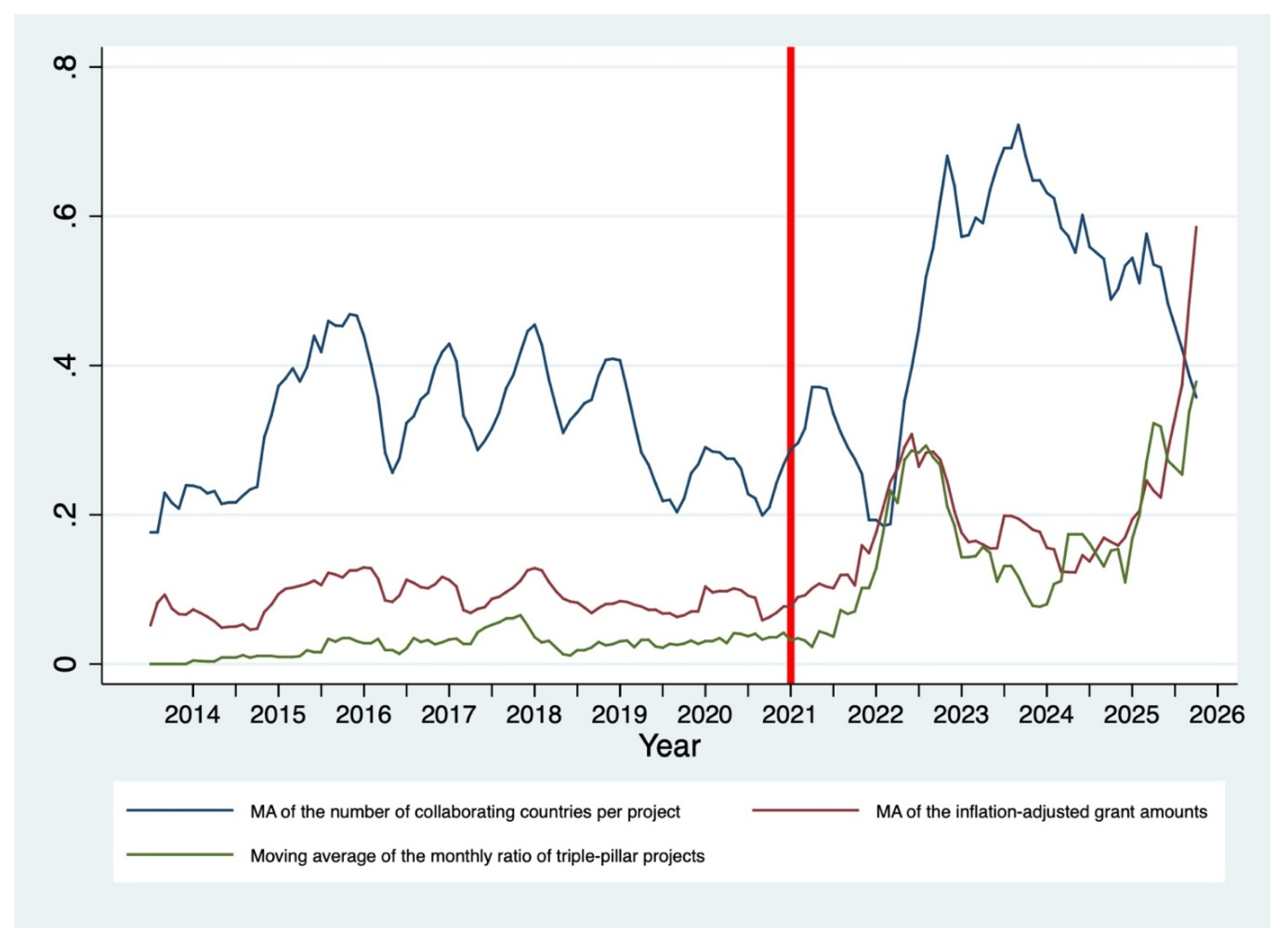

Table 1.
Overview of Creative Europe’s Policy Objective Changes Over Time.
| Period | Digital | Social / Inclusion | Green / Sustainability | International Cooperation |
| 2014–2016 | Explicit core priority (“digital shift”) | Implicit via audience reach | Absent | Mandatory |
| 2017–2019 | Explicit | Explicit for refugees/integration | Absent | Mandatory |
| 2020 | Explicit | Explicit | Emergent in MEDIA guidance only | Mandatory |
| 2021–2024 | Explicit and quantified | Explicit and cross-cutting | Explicit and cross-cutting | Mandatory |
Source: synthesis by the authors based on Official EU call texts and summaries from the Creative Europe programme (2014–2020 and 2021–2027),2 as well as from European Commission guidance and press releases on Creative Europe priorities.3 Note that throughout the paper, we identify the start of Creative Europe as 2013, as multiple projects already begun at that point, all included in the data analysed for this paper. In official EU communication, however, the program is generally mentioned to have started in 2014 only.
Table 2.
Estimated coefficients from logistic regressions with the probability of a given project starting prior to January 2021 encompassing all three pillars as its objectives, simultaneously.
Table 2.
Estimated coefficients from logistic regressions with the probability of a given project starting prior to January 2021 encompassing all three pillars as its objectives, simultaneously.
| Specification 1 | Specification 2 | Specification 3 | |
|---|---|---|---|
| Month fixed effect | 0.01** (0.004) | 0.01** (0.004) | 0.01*** (0.004) |
| # of participating countries | 0.19*** (0.04) | 0.17*** (0.04) | 0.07 (0.08) |
| The amount of the grant (in inflation-adjusted EUR ‘000) | 0.0002 (0.0002) | 0.0002 (0.0002) | 0.0004 (0.0003) |
| Lead-country fixed effects | Included | ||
| Call-related fixed effects | Included | ||
| Constant | -11.1*** (2.9) | -39 (1168) | -25.8 (539) |
| Pseudo-R2 | 0.04 | 0.11 | 0.08 |
| # of observations | 4,520 | 3,708 | 4,170 |
Note: Estimated standard errors are in brackets, the non-bracketed figures are regression coefficients. *** denotes statistical significance at the 1%-, ** at the 5%- and * at the 10% level. These figures mean that the probability of a random sample of projects producing the results above assuming that the regressors are, in reality, irrelevant for the dependent variable, is merely 1%, 5%, or 10% respectively. Note that a model, identical to specification 3 was run, with coordinator-type fixed effects instead of call-related fixed effects included (i.e., with the identification of whether the project coordinator was a film distributor, training institute, cultural operator, etc). It produced identical results to those shown in Specification 3. However, this regression output is not shown, because it cannot be replicated for the projects that begun in or after January 2021. This is because the coordinator’s organization type was not systematically collected for the majority of this time period. Furthermore, note that the number of observations change across specifications. This is natural and not a statistical artefact or a source of potential bias. When including fixed effects (such as call-specific fixed effects), it occasionally occurs that there is no variation in the objectives of projects within a given fixed category. These observations are then dropped as they do not provide for meaningful comparators. In other words, if a given call only ever produced projects with a single- or double- (instead of a triple-objective), the observations from that call must be dropped. This is because, due to a lack of variation, they cannot produce a meaningful coefficient on how much more or less likely that particular call makes the genesis of a triple-objective project.
Table 3.
Estimated coefficients from logistic regressions with the probability of a given project starting on or after January 2021 encompassing all three pillars as its objectives, simultaneously.
Table 3.
Estimated coefficients from logistic regressions with the probability of a given project starting on or after January 2021 encompassing all three pillars as its objectives, simultaneously.
| Specification 1 | Specification 2 | Specification 3 | |
|---|---|---|---|
| Month fixed effect | 0.02*** (0.005) | 0.02*** (0.005) | 0.01 (0.03) |
| # of participating countries | 0.03 (0.03) | 0.02 (0.03) | 0.03 (0.03) |
| The amount of the grant (in inflation-adjusted EUR ‘000) | 0.0004*** (0.0001) | 0.0003** (0.0001) | 0.0004*** (0.0001) |
| Lead-country fixed effects | Included | ||
| Call-related fixed effects | Included | ||
| Constant | -11.1*** (2.9) | -26 (632) | -155 (503) |
| Pseudo-R2 | 0.03 | 0.06 | 0.03 |
| # of observations | 1,079 | 991 | 1,079 |
Note: Kindly observe the same methodological notes as under Table 2 that also apply here.
Table 4.
Estimated coefficients from logistic regressions with the probability of a given project starting prior to January 2021 encompassing all three pillars as its objectives, simultaneously with a random 10% of all projects re-classified.
Table 4.
Estimated coefficients from logistic regressions with the probability of a given project starting prior to January 2021 encompassing all three pillars as its objectives, simultaneously with a random 10% of all projects re-classified.
| Specification 1 | Specification 2 | Specification 3 | |
|---|---|---|---|
| Month fixed effect | 0.003* (0.0018) | 0.003* (0.0018) | 0.0034* (0.0021) |
| # of participating countries | 0.11*** (0.02) | 0.10*** (0.03) | 0.11*** (0.04) |
| The amount of the grant (in inflation-adjusted EUR ‘000) | 0.00002 (0.0001) | 0.00001 (0.001) | -0.000003 (0.0001) |
| Lead-country fixed effects | Included | ||
| Call-related fixed effects | Included | ||
| Constant | -11.1*** (2.9) | -5.36*** (1.66) | -4.58*** (1.50) |
| Pseudo-R2 | 0.008 | 0.02 | 0.02 |
| # of observations | 4,520 | 4,513 | 4,512 |
Note: The number of observations in each specification has changed considerably compared to Table 2. This is because the random reallocation of project types has created variation within lead-country and call-related fixed effects that did not exist before. The goodness of fit of the models (the Pseudo-R squared) has decrease significantly, because the values of the explanatory variables did not change and those would be predicting the correct and unchanged project types. Overall, this means that less of the variation is explained, because noise was artificially injected into the data.
Table 5.
Estimated coefficients from logistic regressions with the probability of a given project starting in or after January 2021 encompassing all three pillars as its objectives, simultaneously with a random 10% of all projects re-classified.
Table 5.
Estimated coefficients from logistic regressions with the probability of a given project starting in or after January 2021 encompassing all three pillars as its objectives, simultaneously with a random 10% of all projects re-classified.
| Specification 1 | Specification 2 | Specification 3 | |
|---|---|---|---|
| Month fixed effect | 0.007* (0.004) | 0.007* (0.004) | 0.02 (0.03) |
| # of participating countries | 0.07 (0.03) | -0.005 (0.03) | 0.007 (0.03) |
| The amount of the grant (in inflation-adjusted EUR ‘000) | 0.0003** (0.0001) | 0.0002* (0.0001) | 0.0003** (0.0001) |
| Lead-country fixed effects | Included | ||
| Call-related fixed effects | Included | ||
| Constant | -6.98* (3.62) | -20.5 (839) | 211 (524) |
| Pseudo-R2 | 0.01 | 0.04 | 0.01 |
| # of observations | 1,079 | 1,037 | 1,079 |
Note: Kindly observe the methodological notes under Table 4.
Disclaimer/Publisher’s Note: The statements, opinions and data contained in all publications are solely those of the individual author(s) and contributor(s) and not of MDPI and/or the editor(s). MDPI and/or the editor(s) disclaim responsibility for any injury to people or property resulting from any ideas, methods, instructions or products referred to in the content. |
© 2025 by the authors. Licensee MDPI, Basel, Switzerland. This article is an open access article distributed under the terms and conditions of the Creative Commons Attribution (CC BY) license (http://creativecommons.org/licenses/by/4.0/).
Copyright: This open access article is published under a Creative Commons CC BY 4.0 license, which permit the free download, distribution, and reuse, provided that the author and preprint are cited in any reuse.


