

Submitted:
24 October 2025
Posted:
27 October 2025
You are already at the latest version
Abstract
Young and older participants were asked to choose between two strategies (Experiment 1) and to execute instructed strategies (Experiment 2) to estimate the products of two-digit multiplication problems. Interestingly, how fear, disgust, and sadness influence strategy selection and strategy execution differed in young and older adults. Disgust led young adults to select the better strategy less often and to slow down while executing the instructed strategies. Fear had no effect on younger adults’ strategy selection but slowed the execution of strategies to a greater extent than disgust. Older adults’ strategy selection and execution were unaffected by any negative emotions. These findings showed that fear, disgust, and sadness do not influence strategic aspects of arithmetic the same way in young adults, while having no effects in older adults. They have important implications for further our understanding of emotion–cognition interactions as well as age-related changes in these interactions.
Keywords:
emotion and cognition
; arithmetic
; problem-solving
; strategies
; aging
1. Introduction
How do specific negative emotions influence cognition in general and arithmetic in particular, and do these effects change with aging? Negative emotions sometimes enhance and sometimes impair attention, memory, reasoning, and decision making. Moreover, older adults often show reduced influence of negative stimuli, a well-documented positivity effect. However, very few studies have examined the evolution of emotion-cognition links during aging in the specific domain of arithmetic and most of them have treated emotion dimensionally, contrasting negative, positive, and neutral emotions. As a consequence, we ignore whether and how different emotions such as fear, sadness, or disgust have different effects on arithmetic performance, and how young and older adults may differ in these effects. The present work addressed these issues by combining a strategy perspective with a typological approach of emotions. Before outlining the logic of the present study, we first briefly review previous findings on emotion-cognition-aging relations. Then, we review previous findings on age-related differences in effects of emotions on arithmetic performance, and on proposed mechanisms responsible for these effects.
1.1. Age-Related Differences in Effects of Negative Emotions on Cognition
Research has shown that negative emotions influence performance in a wide variety of cognitive domains such as attention, memory, reasoning, or decision-making (see De Houwer & Hermans, 2010; Lemaire, 2022; Robinson et al., 2013, for reviews). In all these domains, negative emotions sometimes enhance and sometimes impair performance. For example, in memory, participants are better at recalling emotional stimuli as words, sentences or pictures, compared to neutral stimuli (e.g. Chapman et al., 2013; Davidson et al., 2006; Davis et al., 2019; Kensinger & Corkin, 2004; Le Bigot et al., 2018; Talamini et al., 2021; Yeung & Fernandez, 2021). Conversely, studies showed that negative emotions such as stress have detrimental effects on memory performance (e.g., Kuhlmann et al., 2005; Payne et al., 2006). As another example, negative emotions enhance logical reasoning when they are task-relevant (see Blanchette & Caparos, 2018, for a review). For instance, Vietnam war veterans reasoned more accurately about war-related problems than about unrelated emotional or neutral ones (Blanchette & Campbell, 2012; see also Caparos & Blanchette, 2017). But when emotional content is not congruent with individuals past emotional experience, emotions lead to poorer reasoning performance (e.g., Blanchette & Richards, 2004; Eliades et al., 2013). Beneficial and deleterious effects of negative emotions on cognition are often explained through general processing mechanisms, like attentional capture (Okon-Singer et al., 2015; Pessoa, 2009; Verbruggen & De Houwer, 2007). Negative emotions automatically grab attention, thereby enhancing performance when emotions align with task goals or individuals past experience but impairing it when they are irrelevant. Such attentional capture may disrupt cognitive control, bias processing priorities, and consume attentional and working-memory resources.
Effects of emotions have been shown to evolve with aging. Research highlighted age-related shifts in motivational goals, socio-affective priorities, and emotional processing. Indeed, older adults generally report greater happiness and life satisfaction than young adults (e.g., Carstensen, 2000; Charles, 2010). Moreover, older adults showed improved inhibition of irrelevant emotional information (e.g., Almdahl et al., 2021; Ashley & Swick, 2009; Berger et al., 2019; LaMonica et al., 2010; Monti et al., 2010; Samanez-Larkin et al., 2009; Waring et al., 2019) and emotion-regulation abilities (see Allen & Windsor, 2019; Brady et al., 2018; Doerwald et al., 2016; Riediger & Bellingtier, 2022, for reviews). Finally, so-called age-related positivity effects have been robustly highlighted, reflecting shifts in attention toward positive and away from negative stimuli. Unlike young adults, whose attention is typically drawn to negative stimuli, older adults preferentially process emotionally positive information and down-regulate negative emotions. These effects have been observed across attention, memory, reasoning, and decision making (see Barber & Kim, 2021; Carstensen & DeLiema, 2018; Mather & Carstensen, 2005; Reed & Carstensen, 2012; Scheibe & Carstensen, 2010, for reviews). In attention specifically, older adults direct their gaze more often toward positive faces, pictures, or film clips and avoid negative stimuli, whereas young adults display the opposite bias (e.g., Allard & Isaacowitz, 2008; Chukwuorji & Allard, 2022; DiGirolamo et al., 2023; Fung et al., 2019; Isaacowitz et al., 2006a, 2006b, 2008; Isaacowitz & Choi, 2011; Knight et al., 2007; Livingstone & Isaacowitz, 2015; Nikitin & Freund, 2011; Sands & Isaacowitz, 2017; Sasse et al., 2014; see Isaacowitz, 2012; Sands et al., 2018, for reviews).
Although age-related differences in effects of emotions on cognitive performance have been well documented in general cognitive domains such as attention and memory, some gaps remain. Particularly, the influence of emotions on young and older adults’ performance has been far less examined in more specific domains such as numerical cognition. Furthermore, while attention and memory are known to show significant age-related cognitive decline, arithmetic appears to be relatively unaffected (see Duverne & Lemaire, 2005; Uittenhove & Lemaire, 2015, 2018, for reviews). Observing age-related differences in effects of emotions in a domain that is relatively age-invariant would suggest that these differences are indeed due to changes in attentional biases toward (or away from) emotions or in emotional regulation capacities, rather than to cognitive decline.
1.2. Age-Related Differences in Effects of Emotions on Arithmetic Performance
A few studies have shown that emotions also influence performance in arithmetic (Fabre & Lemaire, 2019; Framorando & Gendolla, 2018, 2019; Geurten & Lemaire, 2022, 2023; Kleinsorge, 2007, 2009; Lallement & Lemaire, 2021, 2023, 2025; Lemaire, 2024; Liu et al., 2021; Melani et al., 2024, 2025; Schimmack & Derryberry, 2005; Zhu et al., 2021, 2022, 2024). Most of these studies have highlighted deleterious effects of irrelevant negative emotions on arithmetic performance. For example, Kleinsorge (2007) investigated whether emotions influence simple arithmetic problem verification. Participants were asked to verify single-digit addition or multiplication problems (e.g., 7 × 5 = 35, true or false?) superimposed on emotionally positive, negative, or neutral pictures. Participants were significantly slower when problems appeared on negative pictures compared to neutral ones. Notably, the authors attributed the deleterious effects of negative emotions on arithmetic performance to the same attentional mechanisms commonly invoked to explain effects of emotions in general cognitive domains. Irrelevant negative emotions would capture participants’ attentional resources, thereby impairing their performance on the target arithmetic task.
Very few studies have looked at how the effects of emotions in arithmetic change with aging (Lallement & Lemaire, 2021, 2023; Lemaire, 2024; Melani et al., 2024, 2025). For instance, Lallement and Lemaire (2021) asked young and older participants to verify simple one-digit addition problems (e.g., 8 + 4 = 13, true or false?) or to estimate the product of complex two-digit multiplication problems (e.g., which is nearer to 42 × 84; 3,200 or 4,500?). Each problem appeared superimposed on emotionally neutral or negative pictures. Across tasks, participants were slower in the negative condition than in the neutral condition, especially on the more difficult problems. Crucially, these deleterious effects of emotions were smaller in older adults than in young adults, suggesting reduced attentional capture by negative pictures and/or more effective emotion regulation with aging.
Explanations based solely on attentional capture seemed insufficient to account for effects of negative emotions on arithmetic performance, and age-related differences in these effects. Indeed, we hypothesized that emotions, by diverting attention, would disrupt how participants perform arithmetic tasks. For example, emotions could lead participants to use fewer effective strategies, or to execute these strategies less efficiently. Similarly, age-related differences in effects of emotions on arithmetic performance could stem from the fact that emotions would have different effects on the strategies used by young adults and those used by older adults to perform arithmetic tasks. To address these questions, recent studies have adopted a strategy approach to examine the mechanisms by which emotions influence arithmetic performance in young and older adults.
1.3. Emotions and Arithmetic: A Strategy Perspective
The conceptual framework developed by Lemaire and Siegler (1995) offers a valuable approach for investigating mechanisms by which emotions differently influence young and older adults’ arithmetic (and more generally cognitive) performance. This strategy perspective is based on previous findings that people use several strategies to solve a given cognitive task (Siegler, 2007). A strategy can be defined as “a procedure or set of procedures for achieving a higher-level goal or task” (Lemaire & Reder, 1999, p. 365). Lemaire and Siegler’s framework focuses on four key dimensions of strategic behavior, repertoire (i.e., the number and types of strategies available to individuals), selection (i.e., the strategies selected for a given problem), distribution (i.e., the relative frequency with which different strategies are used), and execution (i.e., the speed and/or accuracy with which strategies are executed).
A growing number of studies have adopted a strategy perspective to better understand the mechanisms by which emotions influence arithmetic performance (e.g., Geurten & Lemaire, 2022; Lallement et al., 2025; Lemaire, 2024). For instance, Geurten and Lemaire (2022) asked participants to estimate the products of complex two-digit multiplication problems. Participants selected either a rounding-down strategy (i.e., RD, rounding both operands down to the nearest decades, e.g., choosing 80 x 20 to estimate 86 x 21) or a rounding-up strategy (i.e., RU, rounding both operands up to the nearest decades, e.g., choosing 90 x 50 to estimate 84 x 47). The multiplication problems appeared superimposed on emotionally negative or neutral pictures. Results showed that negative emotions had deleterious effects on participants’ ability to select the better strategy for estimating the products of multiplication problems (i.e., strategy selection), but also on their ability to judge whether they had chosen the better strategy on each trial. Lallement and Lemaire (2025) conducted a similar experiment in which rounding strategies were instructed to participants on each trial. Results showed that negative emotions slowed the execution of both rounding-down and rounding-up strategies, with an even greater slowing when participants were required to execute the more cognitively demanding rounding-up strategy.
Recently, Lemaire (2024) investigated age-related differences in effects of emotions on the strategy use in arithmetic problem-solving tasks. Across three experiments, young and older adults were asked to (a) solve two-digit addition problems (e.g., 32 + 56) while reporting the strategies they used on each problem (i.e., assessing strategy repertoire and distribution), (b) estimate the products of two-digit multiplication problems (e.g., 38 × 64) by choosing between rounding-down and rounding-up strategies (i.e., assessing strategy selection), and (c) execute instructed rounding-down or rounding-up strategies to estimate the products of two-digit multiplication problems (e.g., 38 x 64; assessing strategy execution). In all experiments, problems were presented superimposed on emotionally negative or neutral pictures. Negative emotions led (a) young adults, but not older adults, to use fewer strategies and to change how often they used available strategies, (b) both age groups to select the better strategy less often, and (c) both age groups to execute strategies more poorly, though to a lesser extent in older adults. These findings highlighted that negative emotions influenced young and older adults’ strategy selection to the same extent, and that young adults’ strategy repertoire, distribution, and execution were more influenced by emotions than older adults. They follow general patterns of previous findings regarding age-related changes in effects of emotions on cognition, particularly smaller deleterious effects of negative emotions.
One of the limitations of previous studies on emotions and arithmetic is that the major issues regarding effects of emotions in arithmetic and their age-related changes during adulthood were addressed using a dimensional approach of emotions (see Liu et al., 2021; Zhu et al., 2021, 2022, for exceptions). A dimensional approach of emotions consists in describing emotions along continuous dimensions such as valence (the positive or negative nature of emotions) and arousal (the intensity of emotions) and proves effective in answering general questions such as: “Do emotions influence arithmetic performance and does this influence change with aging?” Nevertheless, of additional interest is whether different emotions have different effects. To address this issue, a typological approach of emotions is necessary in order to better understand their specific effects on cognitive performance. The typological approach consists in describing emotions as distinct and discrete categories. It allows us to answer more specific questions such as “Do different negative emotions, such as fear, sadness, or disgust, differentially influence arithmetic performance?” Findings from recent studies suggest that it may be the case. For example, Liu and colleagues (2021) asked participants to estimate the products of complex two-digit multiplication problems (e.g., doing 20 x 80 to estimate the product of 24 x 79). The display of multiplication problems was preceded by the display of faces that could express happiness, fear, anger, or neutral emotions. They found no differences between anger and neutral conditions or between happiness and neutral conditions, and slower responses in the fear condition than in the neutral condition. Regarding negative emotions, it is difficult to understand why fear decreased performance whereas anger had no effect, and to know whether facial expressions effectively induced emotional experiences. The emotional induction power of faces might have been too weak, especially for anger. This led us to test different emotions using alternative emotional induction stimuli (pictures of emotional scenes from the IAPS), to focus on negative emotions, so as to replicate Liu et al.’s findings for fear and extend the investigation to other negative emotions such as disgust and sadness.
Recently, Viesel-Nordmeyer and Lemaire (in press) asked young and older adults to verify addition and multiplication problems that were presented superimposed on emotionally neutral or negative pictures eliciting anger, disgust, or sadness. They found that young adults were more impaired by sadness than older adults while solving addition problems. Also, older adults, but not young adults, solved multiplication problems more slowly following disgust and sad pictures than following neutral pictures. Finally, anger did not affect either group’s performance. This study provides evidence that different negative emotions can have different effects on arithmetic performance, and that these effects can be modulated by age. However, none of these previous studies that suggest that different negative emotions do not have the same effects on arithmetic performance adopted a strategy perspective, which is adopted here. Adopting a strategy perspective entail examining how often individuals use available strategies and how they execute strategies on each problem to determine whether strategy selection and strategy variations are similar or different in each emotional condition. This strategy perspective was adopted here as it yields the type of data we need to provide mechanistic explanations of effects of emotions on performance and of age-related differences therein.
1.4. Overview of the Present Study
The main goals of the present study were to determine (a) how arithmetic performance is influenced by different negative emotions and (b) whether this influence varies with aging. To address these issues, we conducted two experiments combining a strategy perspective with a typological approach of emotions. Also, following previous works on emotion and arithmetic, we used a within-trial emotion induction procedure while participants solved arithmetic problems. Young and older adults were asked to choose between rounding-down and rounding-up strategies (Experiment 1, assessing strategy selection) or execute the instructed rounding strategies (Experiment 2, assessing strategy execution) to estimate the products of complex two-digit multiplication problems (e.g., 34 x 67). Thus, Experiment 1 examined how different negative emotions (i.e., fear, disgust, and sadness) influence the ability to select the better strategy for solving arithmetic problems. Experiment 2 investigated how, when strategy repertoire, distribution and selection are controlled, these negative emotions influence the speed of strategy execution. In both experiments, problems were displayed superimposed on emotionally neutral or negative pictures that induced disgust, fear, or sadness.
Above and beyond replicating existing findings of impaired arithmetic performance under negative emotions and age-related differences therein (Fabre & Lemaire, 2019; Framorando & Gendolla, 2018, 2019; Geurten & Lemaire, 2022, 2023; Kleinsorge, 2007, 2009; Lallement & Lemaire, 2021, 2023; Lallement et al., 2025; Lemaire, 2024; Liu et al., 2021; Melani et al., 2024, 2025; Schimmack & Derryberry, 2005; Zhu et al., 2021, 2022, 2024), this study tested two sets of original hypotheses. First, given that Viesel-Nordmeyer and Lemaire (in press) found that different negative emotions have different effects on arithmetic performance, we hypothesized that fear, sadness, and disgust would exert different effects on strategic aspects of arithmetic performance. Moreover, as postulated by Pekrun’s Cognitive Value Theory (CVT; Pekrun, 2006; 2019; Pekrun & Linnenbrink-Garcia, 2012) the influence of negative emotions on performance may differ between so-called deactivating and activating negative emotions. According to Pekrun, deactivating emotions such as sadness or anxiety tend to decrease individuals’ motivation to engage in cognitive tasks, whereas activating emotions such as anger or fear increase vigilance and may motivate individuals to disengage from negative emotions to engage in cognitive tasks. In line with the CVT, we predicted that sadness would have stronger deleterious effects on performance than disgust or fear. Indeed, sadness being a deactivating emotion might lead participants to engage less in arithmetic problem solving task which would lead them to slow down and/or err more. In contrast, fear and disgust being activating emotions may motivate participants to disengage from the negative emotions and re-engage in the target arithmetic task leading them to solve arithmetic problems more quickly and/or more accurately.
Our second hypothesis concerned age-related differences in effects of negative emotions on strategic aspects of arithmetic performance. Previous studies highlighted age-related positivity effects with older adults’ performance being less influenced by negative emotions and more by positive emotions in general cognitive domains (see Barber & Kim, 2021; Carstensen & DeLiema, 2018; Mather & Carstensen, 2005; Reed & Carstensen, 2012; Scheibe & Carstensen, 2010, for reviews) and, more recently, in arithmetic (Lallement & Lemaire, 2021; Lemaire, 2024). Given that age-related positivity effects have been robustly observed in numerous studies using various emotional stimuli, such as negative pictures (e.g., Allard & isaacowitz, 2008; Lallement & Lemaire, 2021; Sasse et al., 2014), words (e.g., Leigland et al., 2004; Thomas & Hasher, 2006), video clips (e.g., Chukwuorji & Allard, 2022; DiGirolamo et al., 2023; Sands & Isaacowitz, 2017), or angry and sad faces (e.g., Ebner & Johnson, 2010; Fung et al., 2019; Mather & Carstensen, 2003), we predicted that the effects of negative emotions on strategic aspects of arithmetic performance will be smaller in older adults than in young adults, although age differences may be modulated by the type of negative emotions.
2. Experiment 1. Age-Related Differences in Effects of Emotions on Strategy Selection
2.1. Method
2.1.1. Participants
We tested 66 participants (39 young adults; 27 older adults) and 93 participants (47 young adults; 46 older adults) in Experiment 2. In both Experiments 1 and 2, young adults were undergraduate students at Aix-Marseille University, and older adults were volunteers from distinct French metropolitan areas (see Table 1, for participants’ characteristics). The target sample size was determined using an a-priori power analysis (G*Power; Faul et al., 2007). A recent study on effects of negative emotions on strategy selection and execution in computational estimation tasks in young and older adults found that η²p ranged from .550 to .690 (Lemaire, 2024). Using a η²p = .550, our study design of one between-participant factor (age) and two within-participant factors (emotion and strategy) could achieve 96% power with 20 participants (10 per group). In order to exceed this criterion and achieve more than 96% power, we recruited 66 participants in Experiment 1, and 93 participants in Experiment 2. In both experiments, participants gave their informed written consent. These experiments received approval from the National Ethics Committee in France (Ref.: SI CNRIPH 20.04.02.47414).
2.1.2. Stimuli
Arithmetic problems. The stimuli were 48 multiplication problems presented in a standard form (i.e., a x b) with the operands a and b being two-digit numbers (e.g., 24 x 68, see Table 2 for the list of multiplication problems). Given previous findings in arithmetic (see Kadosh & Dowker, 2015; Gilmore et al., 2018; Knops, 2019, for overviews), we controlled the following factors: (a) no operands had 0 or 5 as unit digits; (b) digits were not repeated in the same decade or unit positions across operands (e.g., 43 x 49); (c) no digits were repeated within operands (e.g., 44 x 58); (d) no tie problems (e.g., 32 x 32) were used; and (e) operands were between 21 and 89.
Using the rounding-down strategy (i.e., RD; rounding both operands down to their nearest decades) yielded the better (i.e., closest to exact products) estimate on half the problems (e.g., doing 60 x 70 to estimate 61 x 76) while using the rounding-up strategy (i.e., RU; rounding both operands up to their nearest decades) was the better strategy (e.g., doing 40 x 60 to estimate 34 x 59) on the other problems. The unit digit was smaller than 5 in the first operand and larger than 5 in the second operand (e.g., 43 x 79) for half the problems, and the reverse for the other half (e.g., 46 x 83). Moreover, each problem was presented twice, once with an emotionally neutral picture and once with an emotionally negative picture. The problems were presented in two blocks of 48 balanced trials. Problems displayed with a neutral picture in the first block were displayed with a negative picture in the second block, while problems initially paired with a negative picture were subsequently presented with a neutral picture. Thus, within each block, half of the problems were presented with a neutral image (e.g., nature scene) and the other half with a negative image, which could induce fear (e.g., assault scene), disgust (e.g., clogged toilet), or sadness (e.g., abandoned animal). Finally, the problems of different categories (i.e., RD / RU problems x Neutral / Negative conditions) were matched on (a) the side of the larger operand (i.e., half the problems in each category had their largest operand on the left position and half on the right position), (b) the size of the correct products, and (c) the mean percentage deviations between correct products and estimates (calculated with the following formula: ([(estimate – correct product)/correct product] x 100).
Pictures. Ninety-six pictures were selected from International Affective Pictures System (IAPS; Lang, Bradley, & Cuthbert, 2008; see Table 3 for the list of pictures). Half the pictures were emotionally neutral (mean valence = 4.96; SD = 0.21, mean arousal = 2.62; SD = 0.32), and half were emotionally negative (mean valence = 2.64; SD = 0.50, mean arousal = 5.94; SD = 0.56). Among the 48 emotionally negative pictures, 16 pictures induced disgust (mean valence = 2.58; SD = 0.54, mean arousal = 6.03; SD = 0.39), 16 induced fear (mean valence = 2.81; SD = 0.61,mean arousal = 6.07; SD = 0.59), and 16 induced sadness (mean valence = 2.54; SD = 0.29, mean arousal = 5.72; SD = 0.63) The emotional categories of the negative pictures (disgust, fear, sadness) were determined in a pilot study with 80 adults (18–60 years). Participants viewed a set of pictures and classified each of them as neutral, fear, disgust, sadness, or other. For the present experiments, we selected the pictures that achieved the highest categorical agreement across participants. Among the selected pictures, those inducing fear, disgust, and sadness did not differ significantly in mean valence, F (1.829, 27.442) = 1.488, MSe = .243, p = .243, η²p = .090, and mean arousal, F (2.000, 30.000) = 1.749, MSe = .336, p = .191, η²p = .104. Therefore, arousal and valence of neutral and negative pictures were matched across the RD and the RU problems.
2.1.3. Procedure
Both Experiments 1 and 2 were programmed on E-Prime 3.0 (Psychology Software Tools. E-Prime®. 2018). The procedure is illustrated in Figure 1. Participants were told that they will see emotionally neutral or negative pictures and will complete a computational estimation task. Participants were informed that for each problem, the better strategy was either the rounding-down or rounding-up strategy. They were asked to try to select the better strategy among these two in order to find the best estimate (or closest from correct product) for each problem. Participants were explicitly told that the better strategy was to round one operand down and the other up to their nearest decades (e.g., doing 20 x 70 to estimate 24 x 68) for all problems, but that this mixed-rounding strategy was not allowed. This mixed-rounding strategy was not allowed to make the strategy choice process harder, given that previous studies showed that when participants can use mixed-rounding, strategy selection is so easy that everybody selects the better strategy on more than 95% of problems (e.g., Lemaire et al., 2004).
Each trial started with a 1000-ms white screen followed by a 500-ms fixation cross. Then, an emotionally neutral or negative (i.e., disgusting, fearful or sad) picture was displayed on the screen for 1500 ms. Following this delay, the multiplication problem appeared superimposed on the picture until participant’s response. To find out the strategy chosen by the participants, they were asked to calculate and provide their answers out loud. The participant’s response was followed by a mouse click, which served to record the response time and to trigger the display of a white screen, during which the experimenter recorded the strategy and final response. After a training session of 12 trials, all participants completed 96 trials divided into two blocks of 48 trials.
2.2. Results
Results are reported in two main parts. The first part examines age-related differences in how emotions influence participants’ better strategy selection and the second examines age-related differences in effects of emotions on participants’ performance (i.e., solution times and percent deviations; see Table 4). Percent deviations (between exact products and participants’ product estimates) were calculated as follows: [(exact product − estimate) / exact product) × 100]. For example, a participant providing 6,400 as an estimate for 74 x 89 would be [(6,586–6,400)/6,586] × 100 = 2.8% away from the exact product. Mean percentages of better strategy selection, estimation latencies, and percent deviations were analyzed with mixed-design ANOVAs, 2 (age: young adults, older adults) x 2 (strategy: rounding-down, rounding-up) x 4 (emotion: neutral, disgust, fear, sadness), with repeated measures on the last two factors (see Table 5 for summary of statistical results).
2.2.1. Effects of Emotions on Better Strategy Selection
The main effect of emotions on percentages of better strategy selection was significant. Participants selected the better strategy less often in the disgust condition (56.3%) compared to the neutral condition (64.7%), p < .001. In contrast, percentages of better strategy selection in the fear (64.7%) and sadness (66.3%) conditions did not significantly differ from those in the neutral condition, ps = .915 and .465, respectively.
Moreover, the Strategy x Emotion interaction was significant. Participants selected the better strategy less often in the disgust condition than in the neutral condition when the better strategy was the rounding-down strategy (-15.5%), p < .001, whereas no differences emerged between disgust and neutral conditions when the better strategy was the rounding-up strategy, p = .647. Participants selected the better strategy more often in the sadness condition than in the neutral condition when the better strategy was the rounding-down strategy (i.e., +5.7%), p = .027, but equally often in sadness and neutral conditions when the better strategy was the rounding-up strategy, p = .108. The effects of fear were non-significant in either strategy conditions.
In addition, the Age x Emotion interaction was significant. Specifically, young adults selected the better strategy less often in the disgust condition (-11,4%, p < .001), and more often in the sadness condition (+3.8%, p = .047), compared to the neutral condition. In contrast, older adults showed no significant effects of disgust, p = .051, or sadness, p = .470. For both age groups, fear had no effects, ps = .551 and .259, respectively. No other main or interaction effects came out significant on mean percent selection of the better strategy.
2.2.2. Effects of Emotions on Performance
Young adults were slower than older adults (6999 ms vs. 5432 ms). Participants were slower with the rounding-up strategy compared to the rounding-down strategy (i.e., 6763 ms vs. 5962 ms) and provided poorer estimates with the rounding-up strategy than with the rounding-down strategy (i.e., +1.1% deviation). Moreover, participants were slower in the fear condition than in the neutral condition (+397 ms), p = .032, but they were as fast in the disgust and sadness conditions as in the neutral condition, ps = .396 and .329, respectively.
The Age x Strategy interaction revealed that the effect of strategy was significant in young adults (+1143 ms), p < .001, but not significant in older adults, p = .198. Moreover, the Age x Emotion interaction showed that young adults were slower under the fear than in the neutral condition (+760 ms), p < .001, but were as fast in the disgust and sadness conditions as in the neutral condition, ps = .466 and .994, respectively. In contrast, older adults showed no significant effects of fear, p = .568, disgust, p = .617, or sadness, p = .204. No other interactions effects came out significant on estimation latencies and percentages of deviations.
2.3. Summary of Findings
Experiment 1 aimed to determine (a) whether different types of negative emotions differentially influence the ability to select the better strategy for solving arithmetic problems and (b) whether age-related differences in effects of emotions on strategy selection depend on the type of negative emotions. Young and older adults were asked to choose between the rounding-down and the rounding-up strategies to estimate the products of complex two-digit multiplication problems that were displayed superimposed on emotionally neutral or negative (disgust, fear, or sad) pictures.
The findings showed that not all negative emotions led participants to select the better strategy on each problem less often. Actually, participants selected the better strategy less often only under disgust, and this happened especially when problems were best estimated with the rounding-down strategy. Moreover, surprisingly, under sadness, participants selected the rounding-down strategy more often when it was the better strategy. Sadness did not change the use of rounding-up strategy on problems where it was the better strategy.
Concerning performance, fear was the only negative emotion that slowed participants, particularly when the chosen strategy was the rounding-up strategy. This effect of fear on performance was not accompanied with corresponding effects of fear on better strategy selection. Similarly, significant effects of disgust on strategy selection did not lead participants to be slower in providing their estimates under disgust. Of course, findings from latencies should be interpreted with caution because they may be the result of different sources, including strategy selection and/or strategy execution. By controlling strategy selection, Experiment 2 aimed at testing effects of different negative emotions on estimation performance all else being equal.
The present pattern of decreased strategy selection under disgust, increased strategy selection under sadness, and slowed estimation under fear was found primarily in young adults. Older adults’ strategy selection and estimation latencies were not influenced by any negative emotions. These results confirm our hypothesis and replicate previous findings that older adults are less influenced by negative emotions than young adults, regardless of the type of negative emotions. Such findings are easily accounted for by the often-found age-related positivity biases showing that older adults are less influenced by negative emotions than young adults. Even if our results are clear regarding no effects of emotions on strategy selection, it is hard to conclude that they did not affect performance because age-related differences in strategy performance under different negative emotions may be confounded by age-related differences in strategy selection. In Experiment 2, because all young and older adults executed available strategies on all problems, we could determine whether different emotions influence young and older adults’ performance similarly or differently.
3. Experiment 2: Age-Related Differences in Effects of Emotions on Strategy Execution
3.1. Method
The same problems (see Table 2) and pictures (see Table 3), as well as the same sequence of events (see Figure 1) within a given trial as in Experiment 1 were used. The only difference was that participants did not have to select strategies on each problem but were told which strategy to execute. The 48 problems were presented twice, distributed across two matched subsets, subset A and subset B. In each subset, half the problems were best estimated with the rounding-down strategy and the other problems with the rounding-up strategy. Half the participants were asked to execute the rounding-down strategy to find estimates of all problems in subset A (once under neutral and once under negative emotion conditions, randomly presented) and to execute the rounding-up strategy on all problems in subset B (also once under neutral and once under negative emotion conditions, randomly presented). The other participants did the reverse. Half the participants executed the rounding-down strategy first and the rounding-up strategy second; the other participants did the reverse. Participants first practiced each strategy on 12 problems.
3.2. Results
Mean estimation times, percentages of correct estimations given the instructed strategy (i.e., if a participant had to execute the rounding-down strategy on 52 x 79 and provided 3500 as an estimate, this participant’s answer was considered correct and coded 1; otherwise, it was coded 0), and mean percent deviations were analyzed with mixed-design ANOVAs, 2 (age: young, older adults) x 2 (strategy: rounding-down, rounding-up) x 4 (emotion: neutral, disgust, fear, sadness), with repeated measures on the last two factors (see Table 6 for means, and Table 7 for summary of statistical results).
3.2.1. Age-Related Differences in Effects of Emotions on Mean Estimation Times
Young adults were slower than older adults (5132 ms vs. 4065 ms). Moreover, participants were slower with the rounding-up strategy than with the rounding-down strategy (5241 ms vs. 3967 ms). Interestingly, the main effect of emotion showed that, relative to the neutral condition, participants were slower in the disgust (+144 ms), p = .049, and in the fear (+ 490 ms), p < .001, conditions. Moreover, the effect of fear was larger than the effect of disgust, t(92) = 3.257, p = .002. No differences emerged between the neutral and the sadness conditions, p = .354.
The Strategy x Emotion interaction showed that the effect of disgust was significant when participants executed the rounding-down strategy (+287 ms), p < .001, but non-significant when they executed the rounding-up strategy, p = .996. In contrast, although effects of fear (i.e., fear – neutral) were significant with the rounding-up strategy (+670 ms, p < .001) or with the rounding-down strategy (+309 ms, p < .001), these effects were larger for the former than the later, t(92) = 1.998, p = .049. The effect of sadness was not significant for either the rounding-down strategy, p = .580, or the rounding-up strategy, p = .152. Moreover, the Age x Emotion interaction was significant. Young adults showed slowed down under disgust (+286 ms, p = .005) and fear (+761 ms, p < .001), but not under sadness, p = .548. Older adults showed no significant effects of fear, p = .168, disgust, p = .993, or sadness, p = .548.
Finally, the Age x Strategy x Emotion interaction was significant. Post-hoc comparisons revealed that effects of emotions differed with each strategy in young adults. Young adults showed larger effects of disgust while executing the rounding-down strategy (+499 ms, p <.001) than while executing the rounding-up strategy (+74 ms, p = .607). In contrast, the effects of fear and sadness were larger with the rounding-up strategy (+1107 ms, p < .001 and +377 ms, p = .025, respectively) than with the rounding-down strategy and (+416 ms, p < .001 and +8 ms, p = .931, respectively). Older adults were not slowed down under any emotions and whichever strategy they executed.
3.2.2. Age-Related Differences in Effects of Emotions on Percentages of Correct Responses and Percentages of Deviations
Analyses of percent correct responses showed that older adults were more accurate than young adults (92.3% vs. 88.5%). Participants were more accurate with the rounding-down strategy than with the rounding-up strategy (92.2% vs. 87.9%). Moreover, the main effects of emotions showed that participants were less accurate in the fear condition than in the neutral condition (-2.7%), p = .009, but were as accurate in the disgust and sadness conditions as in the neutral condition, ps = .210 and .578, respectively. Finally, the Strategy x Emotion revealed that participants were less accurate under fear only while executing the rounding-up strategy (-3.8%), p = .011. Furthermore, participants were more accurate under disgust while executing the rounding-up strategy (+3.1%), p = .010, but not while executing the rounding-down strategy (-0.6%), p = .689. Finally, regardless of the strategy, sadness did not affect accuracy.
Interestingly, the main effect of emotions also came out significant on percent deviations. Participants provided poorer estimates in the disgust than in the neutral condition (+ 0.9% deviation, p = .002). On the contrary, participants provided better estimates in the fear condition than in the neutral condition (-0.9% deviation, p < .001). This indicates that although participants committed estimation errors more frequently under fear, the magnitude of these errors was smaller than in the neutral condition. Conversely, while the frequency of errors under disgust did not differ from that observed in the neutral condition, the magnitude of these errors was greater in the disgust condition. As for the percentages of correct responses, sadness had no effect on percent deviations. No other interaction effects came out significant on percentages of correct responses and on percent deviations.
3.3. Summary of Findings
Experiment 2 aimed at determining (a) whether different types of negative emotions had the same influence on the execution of strategies while solving arithmetic problems and (b) whether age-related differences in effects of negative emotions on strategy execution depend on the type of negative emotions. Unique to Experiment 2 was that we controlled all other strategy dimensions (i.e., strategy repertoire, distribution, and selection).
The results support our first hypothesis that different types of negative emotion differentially influence the speed of strategy execution in arithmetic. Disgust and fear led participants to be slower to execute instructed strategies, with a greater slowdown under fear, whereas sadness had no effect on latencies. Fear also led to decreased accuracy. Most interesting, the deleterious effects of disgust and fear were modulated by the instructed strategies. Thus, effects of disgust were larger while participants executed the rounding-down strategy. This was unexpected because the rounding-up strategy is typically more difficult and more resources-demanding than the rounding-down strategy. If negative emotions disrupt performance by capturing attentional resources, their effects should be stronger for the more demanding rounding-up strategy. In this study, this pattern emerged only for fear, whose deleterious effect on strategy execution latencies and accuracy was indeed greater for the rounding-up strategy.
When comparing the two age groups separately, this pattern of slower strategy execution under disgust (particularly for the rounding-down strategy) and fear (particularly for the rounding-up strategy) appeared only in young adults. Older adults’ strategy execution was not influenced by any negative emotions and whichever strategy they were asked to implement. These results on strategy execution replicate those on strategy selection in Experiment 2 and show that the target negative emotions (fear, disgust, sadness) did not change how efficient older adults are while executing strategies.
4. General Discussion
The present study aimed to determine (a) whether different types of negative emotion differentially influence strategy selection and strategy execution while solving arithmetic problems, and (b) whether age-related differences in the effects of negative emotions depend on the type of emotion. Young and older adults were asked to estimate the products of two-digit complex multiplication problems displayed on emotionally neutral or negative (disgust, fear, sad) pictures by choosing between the rounding-down and the rounding-up strategies (Experiment 1, assessing strategy selection), or by executing instructed strategies (Experiment 2, assessing strategy execution). We found that not all negative emotions influence arithmetic performance and that young and older adults were not influenced the same way by negative emotions.
4.1. How Several Types of Negative Emotions Influence Strategic Aspects of Arithmetic Performance
The present results of deleterious effects of negative emotions in arithmetic replicate previous findings (e.g., Fabre & Lemaire, 2019; Framorando & Gendolla, 2018, 2019; Geurten & Lemaire, 2022, 2023; Kleinsorge, 2007, 2009; Lallement & Lemaire, 2021, 2023; Lallement et al., 2025; Lemaire, 2024; Liu et al., 2021; Melani et al., 2024, 2025; Schimmack & Derryberry, 2005; Zhu et al., 2021, 2022, 2024) and confirmed that these deleterious effects are mediated by disruptions of strategic aspects of arithmetic performance (e.g., Geurten & Lemaire, 2022; Lallement et al., 2025; Lemaire, 2024). The first key original finding of this study is that different types of negative emotions do not have the same influence on arithmetic performance. Specifically, here, we found that disgust led participants to select the better strategy on each problem less often and to execute the instructed strategies more poorly. Fear had no effects on strategy selection but slowed the execution of strategies to a greater extent than disgust. Our findings also showed that sadness has no influence on either strategy selection or execution. These results are inconsistent with the CVT (Pekrun, 2006; 2019; Pekrun & Linnenbrink-Garcia, 2012), which predicted, on the contrary, decreased performance under deactivating negative emotions (sadness) and greater engagement in the task and/or disengagement from activating negative emotions (disgust, fear).
How do different negative emotions exert their effects on arithmetic performance? Differences in valence and intensity across these emotions can be ruled out, as valence and arousal did not differ across disgust, fear, and sadness.
Functional significance of emotions may explain how they differ in their effects on arithmetic performance. Indeed, participants’ attitudes toward emotions may vary with the type of emotions (Harmon-Jones et al., 2011). Disgust and fear are highly salient emotions, as they enable individuals to avoid potential contamination or aversive situations, and to quickly respond to potential threats. As a consequence, they may exert strong attentional capture, which could lead to their disruptive influence here. The greater effect of fear compared with disgust on strategic aspects of performance may stem from the fact that detecting potential danger is even more critical for survival than identifying an aversive but non-threatening situation. In contrast, sadness appears to be a less salient emotion, whose detection is less directly tied to survival. Sadness typically arises in response to negative events such as loss and is often accompanied by a motivation to change the situation. It is therefore plausible that the sad pictures captured participants’ attention to a lesser extent, or that participants focused more on the arithmetic task to regulate the sadness elicited by pictures, leading to unaffected strategy selection and execution.
Alternatively, different types of negative emotions may exert their effects on different mechanisms involved in estimating multiplication problems. For example, using magnetoencephalography and a dimensional approach of emotions, Lallement and colleagues (2025) found that negative emotions exerted their deleterious effects on execution strategy by specifically disrupting the encoding of arithmetic problems. Future studies could aim to determine which mechanisms are specifically disrupted by disgust, fear, and sadness.
4.2. Age-Related Changes in Effects of Negative Emotions on Strategy Aspects of Arithmetic Performance
The second key findings of the present study is that age-related differences in the effects of negative emotions on strategic aspects of arithmetic performance do not depend on the type of negative emotions. Older adults were less influenced than young adults by negative emotions both when choosing between the rounding-down and the rounding-up strategies and when executing the instructed rounding strategies to estimate the products of multiplication problems. This finding is consistent with previous research documenting robust age-related positivity effects across a variety of cognitive domains (see Barber & Kim, 2021; Carstensen & DeLiema, 2018; Mather & Carstensen, 2005; Reed & Carstensen, 2012; Scheibe & Carstensen, 2010, for reviews) and extends more recent evidence of such age-related positivity effects in arithmetic (e.g., Lallement & Lemaire, 2021; Lemaire, 2024).
More specifically, our data replicates Lemaire’s (2024) finding that negative emotions have a smaller influence on strategy execution in older adults than in young adults. We also found reduced effects of emotions on older adults’ strategy selection relative to young adults, an outcome that contrasts with Lemaire’s finding of no age differences in effects of emotions on strategy selection. Several methodological factors may account for the divergence. For example, the pictures used in the two studies were not strictly identical. In addition, while Lemaire adopted a dimensional approach of emotions, contrasting a neutral condition with a single and general negative condition, the present study adopted a typological approach of emotions in which one-third of the pictures each induced fear, disgust, and sadness. A plausible explanation for the discrepancy is that a dimensional analysis of negative emotions may mask age-related subtleties. When negative emotions are collapsed into a single negative valence measure, overall effects may appear comparable among young and older adults. In contrast, a more fine-grained typological approach of emotions can reveal that different negative emotions, such as disgust, fear, and sadness, exert weaker influence on strategy selection in older adults. Future research would therefore benefit from directly comparing dimensional and typological frameworks within the same experimental protocol, allowing researchers to disentangle global valence effects from emotion-specific patterns and to clarify how aging moderates effects of emotion in arithmetic.
Smaller effects of negative emotions on arithmetic performance may arise from older adults’ attention being less captured by negative stimuli than that of young adults, as found in prior studies on attention (e.g., Allard & Isaacowitz, 2008; Chukwuorji & Allard, 2022; DiGirolamo et al., 2023; Fung et al., 2019; Isaacowitz et al., 2006a, 2006b, 2008; Isaacowitz & Choi, 2011; Knight et al., 2007; Livingstone & Isaacowitz, 2015; Nikitin & Freund, 2011; Sands & Isaacowitz, 2017; Sasse et al., 2014; see Isaacowitz, 2012; Sands et al., 2018, for reviews). The present findings highlight that this reduced attentional capture by negative emotions extends across different types of negative emotions. Older adults’ attention may have been less captured by fear, disgust, or sadness, leaving their attentional and cognitive resources available to select the more efficient strategy or to execute the instructed strategies more efficiently to solve arithmetic problems. An alternative explanation is that both young and older adults experienced similar attentional capture by negative pictures, but older adults regulated these emotional responses more effectively, consistent with evidence that older adults are sometimes better than young adults at regulating irrelevant negative emotions (see Allen & Windsor, 2019; Brady et al., 2018; Doerwald et al., 2016; Riediger & Bellingtier, 2022, for reviews). From this perspective, older adults would be better able to downregulate irrelevant negative emotions induced by pictures, regardless of specific emotional category. Future research could help disentangle these possibilities by directly assessing attentional capture and emotion-regulation processes in the same paradigm. Finally, a further explanation that cannot totally be ruled out, and represents a potential limitation of the present study, is that older adults were generally more skilled at arithmetic than young adults, as indicated by their higher scores on the French-Kit and their superior task performance. Across emotional conditions, older adults were faster and more accurate than young adults when executing the required strategies. Such greater baseline expertise may have acted as a protective factor against the detrimental effects of negative emotions. However, this baseline difference between young and older adults was observed only in the second experiment. In the first experiment, where young and older adults had similar baseline performance, positivity biases were still observed.
5. Conclusions
Effects of emotions on cognition, and age-related differences in these effects, have been documented in a wide range of general cognitive domains. More recently, such effects have been extended to arithmetic and were found to be mediated by changes in strategic aspects. Negative emotions lead participants to use fewer strategies, to select the most appropriate strategies less often, and execute these strategies less efficiently when solving arithmetic problems. The present study adopted a typological approach of emotions to determine whether specific discrete emotions differentially influence strategic aspects of arithmetic performance. We found that fear and disgust, but not sadness, impaired both strategy selection and execution and that these effects varied across strategies. Moreover, consistent with prior findings of age-related positivity effects, we observed that older adults were less influenced by negative emotions. Our findings extend this smaller influence on different emotions, indicating that older adults are particularly effective at regulating irrelevant negative emotions and maintaining focus on arithmetic tasks. Note that our data did not enable us to determine the loci of effects of each emotion, as different emotions may influence different processes in target cognitive tasks in general and arithmetic (e.g., encoding problems, calculating correct answers, responding) in particular. Future studies may further our understanding of how emotions influence arithmetic performance by examining which processes of the target tasks emotions influence.
Author Contributions
C.L. and P.L. designed the experiment. C.L. performed the data analyses, and together with PL wrote several drafts of the manuscript.
Funding
This research was supported by a grant awarded to Patrick Lemaire by the Agence Nationale de la Recherche (ANR 22-CE28-0016).
Data Availability
data can be found on the following link: https://osf.io/zcpx8/overview?view_only=324bf69ba0f64760a2b5f30984b060b2.
Acknowledgments
The authors thank El Walid Chihoub for his help in programming the experiments, as well as data collection and analyses.
Conflicts of Interest
The authors declare no conflicts of interest.
References
- Allard, E. S., & Isaacowitz, D. M. (2008). Are Preferences in Emotional Processing Affected by Distraction? Examining the Age-Related Positivity Effect in Visual Fixation within a Dual-Task Paradigm. Aging, Neuropsychology, and Cognition, 15(6), 725–743. [CrossRef]
- Allen, V. C., & Windsor, T. D. (2019). Age differences in the use of emotion regulation strategies derived from the process model of emotion regulation: A systematic review. Aging & mental health, 23(1), 1-14. [CrossRef]
- Almdahl, I. S., Martinussen, L. J., Agartz, I., Hugdahl, K., & Korsnes, M. S. (2021). Inhibition of emotions in healthy aging: age-related differences in brain network connectivity. Brain and Behavior, 11(5), e02052. [CrossRef]
- Ashley, V., & Swick, D. (2009). Consequences of emotional stimuli: Age differences on pure and mixed blocks of the emotional Stroop. Behavioral and Brain Functions, 5, Article 14. [CrossRef]
- Barber, S. J., & Kim, H. (2022). The positivity effect: A review of theories and recent findings. In G. Sedek, T. M. Hess, & D. R. Touron (Eds.), Multiple pathways of cognitive aging: Motivational and contextual influences (pp. 84–104). Oxford University Press. [CrossRef]
- Berger, N., Richards, A., & Davelaar, E. J. (2019). Preserved proactive control in ageing: A stroop study with emotional faces vs. words. Frontiers in Psychology, 10, 1906. [CrossRef]
- Blanchette, I., & Campbell, M. (2012). Reasoning about highly emotional topics: Syllogistic reasoning in a group of war veterans. Journal of Cognitive Psychology, 24(2), 157–164. [CrossRef]
- Blanchette, I., & Caparos, S. (2018). When emotions improve reasoning: The possible roles of relevance and utility. New Paradigm Psychology of Reasoning, 163-177.
- Blanchette, I.,&Richards, A. (2004). Reasoning about emotional and neutral materials: Is logic affected by emotion? Psychological Science, 15(11), 745–752. [CrossRef]
- Brady, B., Kneebone, I. I., Denson, N., & Bailey, P. E. (2018). Systematic review and meta-analysis of age-related differences in instructed emotion regulation success. PeerJ, 6, e6051. [CrossRef]
- Caparos, S., & Blanchette, I. (2017). Independent effects of relevance and arousal on deductive reasoning. Cognition and emotion, 31(5), 1012-1022. [CrossRef]
- Carstensen, L. L., & DeLiema, M. (2018). The positivity effect: A negativity bias in youth fades with age. Current opinion in behavioral sciences, 19, 7-12. [CrossRef]
- Carstensen, L. L., Pasupathi, M., Mayr, U., & Nesselroade, J. R. (2000). Emotional experience in everyday life across the adult life span. Journal of Personality and Social Psychology, 79(4), 644–655. [CrossRef]
- Chapman, H. A., Johannes, K., Poppenk, J. L., Moscovitch, M., & Anderson, A. K. (2013). Evidence for the differential salience of disgust and fear in episodic memory. Journal of Experimental Psychology: General, 142(4), 1100–1112. [CrossRef]
- Charles, S. T. (2010). Strength and vulnerability integration: A model of emotional well-being across adulthood. Psychological Bulletin, 136(6), 1068–1091. [CrossRef]
- Chukwuorji, J. C., & Allard, E. S. (2022). The age-related positivity effect and emotion regulation: Assessing downstream affective outcomes. The International Journal of Aging and Human Development, 95(4), 455-469. [CrossRef]
- Cisler, J. M., Olatunji, B. O., & Lohr, J. M. (2009). Disgust, fear, and the anxiety disorders: A critical review. Clinical psychology review, 29(1), 34-46. [CrossRef]
- Davidson, P. S., McFarland, C. P., & Glisky, E. L. (2006). Effects of emotion on item and source memory in young and older adults. Cognitive, Affective, & Behavioral Neuroscience, 6(4), 306-322. [CrossRef]
- Davis, S. D., Peterson, D. J., Wissman, K. T., & Slater, W. A. (2019). Physiological Stress and Face Recognition : Differential Effects of Stress on Accuracy and the Confidence–Accuracy Relationship. Journal of Applied Research in Memory and Cognition, 8(3), 367 375. [CrossRef]
- De Houwer, J., & Hermans, D. (Eds.). (2010). Cognition and emotion: Reviews of current research and theories. Psychology Press. [CrossRef]
- Deltour, J. J. (1993). Echelle de vocabulaire de Mill Hill de J. C. Raven [Raven’s Mill–Hill Vocabulary Scale]. Adaptation française et normes européennes du Mill Hill et du Standard Progressive Matrices de Raven (PM38). Braine-le-Château, France: Editions l’Application des Techniques Modernes.
- DiGirolamo, M. A., McCall, E. C., Kibrislioglu Uysal, N., Ho, Y. W., Lind, M., & Isaacowitz, D. M. (2023). Attention to emotional stimuli across adulthood and older age: A novel application of eye-tracking within the home. Journal of Experimental Psychology: General, 152(5), 1439–1453. [CrossRef]
- Doerwald, F., Scheibe, S., Zacher, H., & Van Yperen, N. W. (2016). Emotional competencies across adulthood: State of knowledge and implications for the work context. Work, Aging and Retirement, 2(2), 159-216. [CrossRef]
- Duverne, S., & Lemaire, P. (2005). Aging and mental arithmetic. In J. I. D. Campbell (Ed.), Handbook of mathematical cognition (pp. 397–411). Psychology Press.
- Ebner, N. C., & Johnson, M. K. (2010). Age-group differences in interference from young and older emotional faces. Cognition and Emotion, 24(7), 1095-1116. [CrossRef]
- Ekman, P. (1992). Are there basic emotions? Psychological Review, 99(3), 550–553. [CrossRef]
- Ekman, P., Dalgleish, T., & Power, M. (1999). Basic emotions. San Francisco, USA.
- Eliades, M., Mansell, W., & Blanchette, I. (2013). The effect of emotion on statistical reasoning: Findings from a base rates task. Journal of Cognitive Psychology, 25(3), 277–282. [CrossRef]
- Fabre, L., & Lemaire, P. (2019). How emotions modulate arithmetic performance: A study in arithmetic problem verification tasks. Experimental Psychology, 66(5), 368–376. [CrossRef]
- Faul, F., Erdfelder, E., Lang, A. G., & Buchner, A. (2007). G* Power 3: A flexible statistical power analysis program for the social, behavioral, and biomedical sciences. Behavior research methods, 39(2), 175-191. [CrossRef]
- Folstein, M. F., Folstein, S. E., & McHugh, P. R. (1975). “Mini-mental state”: a practical method for grading the cognitive state of patients for the clinician. Journal of psychiatric research, 12(3), 189-198. [CrossRef]
- Framorando, D., & Gendolla, G. H. (2018). The effect of negative implicit affect, prime visibility, and gender on effort-related cardiac response. Adaptive Human Behavior and Physiology, 4, 354-363. [CrossRef]
- Framorando, D., & Gendolla, G. H. (2019). Prime warning moderates implicit affect primes’ effect on effort-related cardiac response in men. Biological Psychology, 142, 62-69. [CrossRef]
- French, J. W., Ekstrom, R. B., & Price, I. A. (1963). Kit of reference tests for cognitive factors. Princeton, NJ: Educational Testing Service.
- Fung, H. H., Gong, X., Ngo, N., & Isaacowitz, D. M. (2019). Cultural differences in the age-related positivity effect: Distinguishing between preference and effectiveness. Emotion (Washington, D.C.), 19(8), 1414–1424. [CrossRef]
- Geurten, M., & Lemaire, P. (2022). Influence of emotional stimuli on metacognition: A study in arithmetic. Consciousness and Cognition, 106, 103430. [CrossRef]
- Geurten, M., & Lemaire, P. (2023). Domain-specific and domain-general metacognition for strategy selection in children with learning disabilities. Current Psychology, 42(17), 14297-14305. [CrossRef]
- Gilmore, C., Göbel, S. M., & Inglis, M. (2018). An introduction to mathematical cognition. Routledge. [CrossRef]
- Harmon-Jones, E., Harmon-Jones, C., Amodio, D. M., & Gable, P. A. (2011). Attitudes toward emotions. Journal of personality and social psychology, 101(6), 1332. [CrossRef]
- Isaacowitz, D. M. (2012). Mood regulation in real time: Age differences in the role of looking. Current directions in psychological science, 21(4), 237-242. [CrossRef]
- Isaacowitz, D. M., & Choi, Y. (2011). The malleability of age-related positive gaze preferences: Training to change gaze and mood. Emotion, 11(1), 90–100. [CrossRef]
- Isaacowitz, D. M., Wadlinger, H. A., Goren, D., & Wilson, H. R. (2006). Is there an age-related positivity effect in visual attention? A comparison of two methodologies. Emotion, 6(3), 511–516. [CrossRef]
- Isaacowitz, D. M., Wadlinger, H. A., Goren, D., & Wilson, H. R. (2006). Selective preference in visual fixation away from negative images in old age? An eye-tracking study. Psychology and Aging, 21(1), 40–48. [CrossRef]
- Kadosh, R. C., & Dowker, A. (Eds.). (2015). The Oxford handbook of numerical cognition. Oxford Library of Psychology.
- Kensinger, E. A., & Corkin, S. (2004). Two routes to emotional memory: Distinct neural processes for valence and arousal. Proceedings of the National Academy of Sciences, 101(9), 3310-3315. [CrossRef]
- Kleinsorge, T. (2007). Anticipatory modulation of interference induced by unpleasant pictures. Cognition & Emotion, 21(2), 404–421. [CrossRef]
- Kleinsorge, T. (2009). Anticipation selectively enhances interference exerted by pictures of negative valence. Experimental Psychology, 56(4), 228–235. [CrossRef]
- Knight, M., Seymour, T. L., Gaunt, J. T., Baker, C., Nesmith, K., & Mather, M. (2007). Aging and goal-directed emotional attention: Distraction reverses emotional biases. Emotion, 7(4), 705–714. [CrossRef]
- Knops, A. (2019). Numerical cognition. Routledge. [CrossRef]
- Kuhlmann, S., Piel, M., & Wolf, O. T. (2005). Impaired Memory Retrieval after Psychosocial Stress in Healthy Young Men. Journal of Neuroscience, 25(11), 2977 2982. [CrossRef]
- LaMonica, H. M., Keefe, R. S., Harvey, P. D., Gold, J. M., & Goldberg, T. E. (2010). Differential effects of emotional information on interference task performance across the life span. Frontiers in aging neuroscience, 2, 141. [CrossRef]
- Lallement, C., & Lemaire, P. (2021). Age-related differences in how negative emotions influence arithmetic performance. Cognition and Emotion, 35(7), 1382–1399. [CrossRef]
- Lallement, C., & Lemaire, P. (2023). Are there age-related differences in effects of positive and negative emotions in arithmetic?. Experimental Psychology, 70(5), 307. [CrossRef]
- Lallement, C., Hinault, T., Kanzari, K., & Lemaire, P. (2025). How Negative Emotions Influence Arithmetic Performance: A Magnetoencephalography Study. Journal of Cognitive Neuroscience, 1-21. [CrossRef]
- Lang, P. J., Bradley, M. M., & Cuthbert, B. N. (2008). International Affective Picture System (IAPS): Affective ratings of pictures and instruction manual (Tech. Rep. A-8). Gainesville: University of Florida.
- Le Bigot, L., Knutsen, D., & Gil, S. (2018). I remember emotional content better, but I’m struggling to remember who said it!. Cognition, 180, 52-58. [CrossRef]
- Leigland, L. A., Schulz, L. E., & Janowsky, J. S. (2004). Age related changes in emotional memory. Neurobiology of aging, 25(8), 1117-1124. [CrossRef]
- Lemaire, P. (2022). Emotion and cognition: An introduction (1st ed.). Routledge. [CrossRef]
- Lemaire, P. (2024). Aging, emotion, and cognition: The role of strategies. Journal of Experimental Psychology: General, 153(2), 435. [CrossRef]
- Lemaire, P., Arnaud, L., & Lecacheur, M. (2004). Adults’ age-related differences in adaptivity of strategy choices: evidence from computational estimation. Psychology and aging, 19(3), 467. [CrossRef]
- Lemaire, P., & Reder, L. (1999). What affects strategy selection in arithmetic? The example of parity and five effects on product verification. Memory & Cognition, 27(2), 364-382. [CrossRef]
- Lemaire, P., & Siegler, R. S. (1995). Four aspects of strategic change: Contributions to children’s learning of multiplication. Journal of Experimental Psychology: General, 124(1), 83–97. [CrossRef]
- Liu, D., Wang, Y., Lu, F., Shu, D., Zhang, J., Zhu, C., & Luo, W. (2021). Emotional valence modulates arithmetic strategy execution in priming paradigm: an event-related potential study. Experimental Brain Research, 239(4), 1151-1163. [CrossRef]
- Livingstone, K. M., & Isaacowitz, D. M. (2015). Situation selection and modification for emotion regulation in younger and older adults. Social psychological and personality science, 6(8), 904-910. [CrossRef]
- Mather, M., & Carstensen, L. L. (2003). Aging and attentional biases for emotional faces. Psychological science, 14(5), 409-415. [CrossRef]
- Mather, M., & Carstensen, L. L. (2005). Aging and motivated cognition: The positivity effect in attention and memory. Trends in cognitive sciences, 9(10), 496-502. [CrossRef]
- Melani, P., Fabre, L., & Lemaire, P. (2024). How negative emotions influence arithmetic performance: a comparison of young and older adults. Current Psychology, 43(2), 931-941. [CrossRef]
- Melani, P., Fabre, L., & Lemaire, P. (2025). How negative emotions influence arithmetic problem-solving processes: An ERP study. Neuropsychologia, 211, 109132. [CrossRef]
- Monti, J. M., Weintraub, S., & Egner, T. (2010). Differential age-related decline in conflict-driven task-set shielding from emotional versus non-emotional distracters. Neuropsychologia, 48(6), 1697-1706. [CrossRef]
- Nikitin, J., & Freund, A. M. (2011). Age and motivation predict gaze behavior for facial expressions. Psychology and Aging, 26(3), 695–700. [CrossRef]
- Okon-Singer, H., Hendler, T., Pessoa, L., & Shackman, A. J. (2015). The neurobiology of emotion–cognition interactions: Fundamental questions and strategies for future research. Frontiers in Human Neuroscience, 9, Article 58. [CrossRef]
- Payne, J., Jackson, E., Ryan, L., Hoscheidt, S., Jacobs, J., & Nadel, L. (2006). The impact of stress on neutral and emotional aspects of episodic memory. Memory, 14(1), 1-16. [CrossRef]
- Pekrun, R. (2006). The control-value theory of achievement emotions: Assumptions, corollaries, and implications for educational research and practice. Educational Psychology Review, 18(4), 315–341. [CrossRef]
- Pekrun, R. (2019). Achievement emotions: A control-value theory perspective. In R. Patulny, A. et al.(Eds.), Emotions in late modernity (pp. 142–157). Routledge/Taylor & Francis Group. [CrossRef]
- Pekrun, R., & Linnenbrink-Garcia, L. (2012). Academic emotions and student engagement. In S. L. Christenson, A. L. Reschly, & C. Wylie (Eds.), Handbook of research on student engagement (pp. 259–282). Springer Science + Business Media.
- Pessoa, L. (2009). How do emotion and motivation direct executive control?. Trends in cognitive sciences, 13(4), 160-166. [CrossRef]
- Raven, J. C. (1958). Guide to using the Mill Hill Vocabulary Scale with the Progressive Matrices Scales.
- Riediger, M., & Bellingtier, J. A. (2022). Emotion regulation across the lifespan. The Oxford handbook of emotional development, 92-109.
- Reed, A. E., & Carstensen, L. L. (2012). The theory behind the age-related positivity effect. Frontiers in psychology, 3, 339. [CrossRef]
- Robinson, M. D., Watkins, E. R., & Harmon-Jones, E. (2013). Handbook of cognition and emotion. Guilford Press.
- Samanez-Larkin, G. R., Robertson, E. R., Mikels, J. A., Carstensen, L. L., & Gotlib, I. H. (2009). Selective attention to emotion in the aging brain. Psychology and Aging, 24(3), 519–529. [CrossRef]
- Sands, M., & Isaacowitz, D. M. (2017). Situation selection across adulthood: The role of arousal. Cognition and Emotion, 31(4), 791-798. [CrossRef]
- Sands, M., Livingstone, K. M., & Isaacowitz, D. M. (2018). Characterizing age-related positivity effects in situation selection. International journal of behavioral development, 42(4), 396-404. [CrossRef]
- Sasse, L. K., Gamer, M., Büchel, C., & Brassen, S. (2014). Selective control of attention supports the positivity effect in aging. PloS one, 9(8), e104180. [CrossRef]
- Scheibe, S., & Carstensen, L. L. (2010). Emotional aging: Recent findings and future trends. Journals of Gerontology Series B: Psychological Sciences and Social Sciences, 65(2), 135-144. [CrossRef]
- Schimmack, U., & Derryberry, D. (Ed.). (2005). Attentional Interference Effects of Emotional Pictures: Threat, Negativity, or Arousal? Emotion, 5(1), 55–66. [CrossRef]
- Talamini, F., Eller, G., Vigl, J., & Zentner, M. (2022). Musical emotions affect memory for emotional pictures. Scientific reports, 12(1), 10636. [CrossRef]
- Thomas, R. C., & Hasher, L. (2006). The influence of emotional valence on age differences in early processing and memory. Psychology and Aging, 21(4), 821–825. [CrossRef]
- Uittenhove, K., & Lemaire, P. (2015). The effects of aging on numerical cognition. The Oxford handbook of numerical cognition, 345-366. [CrossRef]
- Uittenhove, K., & Lemaire, P. (2018). Performance control in numerical cognition: Insights from strategic variations in arithmetic during the life span. In Heterogeneity of function in numerical cognition (pp. 127-145). Academic Press. [CrossRef]
- Verbruggen, F., & De Houwer, J. (2007). Do emotional stimuli interfere with response inhibition? Evidence from the stop signal paradigm. Cognition and Emotion, 21(2), 391–403. [CrossRef]
- Viesel-Nordmeyer, N., & Lemaire, P. How different negative emotions affect young and older adults’ arithmetic performance in addition and multiplication problems? Journal of Cognitive Neuroscience, in press.
- Wager, T. D., Kang, J., Johnson, T. D., Nichols, T. E., Satpute, A. B., and Barrett, L. F. (2015). A Bayesian model of category-specific emotional brain responses. PLoS Comput. Biol. 11:e1004066. [CrossRef]
- Waring, J. D., Greif, T. R., & Lenze, E. J. (2019). Emotional response inhibition is greater in older than younger adults. Frontiers in psychology, 10, 961. [CrossRef]
- Yeung, R. C., & Fernandes, M. A. (2021). Divided attention at encoding or retrieval interferes with emotionally enhanced memory for words. Memory, 29(3), 284-297. [CrossRef]
- Zhu, C., Jiang, Y., Wang, Y., Liu, D., & Luo, W. (2021). Arithmetic performance is modulated by cognitive reappraisal and expression suppression: Evidence from behavioral and ERP findings. Neuropsychologia, 162, 108060. [CrossRef]
- Zhu, C., Li, P., Li, Y., Jiang, Y., Liu, D., & Luo, W. (2022). Implicit emotion regulation improves arithmetic performance: An ERP study. Cognitive, Affective, & Behavioral Neuroscience, 22(3), 574-585. [CrossRef]
- Zhu, C., Zhang, Z., Lyu, X., Wang, Y., Liu, D., & Luo, W. (2024). Mathematical problem solving is modulated by word priming. PsyCh journal, 13(3), 465–476. [CrossRef]
Figure 1.
Sequence of events within an example of emotionally neutral trial.
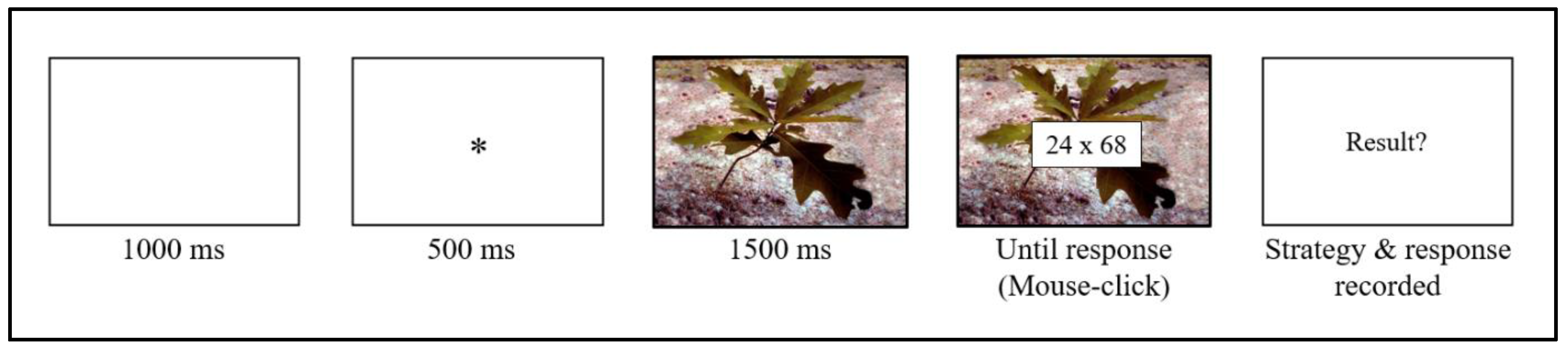

Table 1.
Participants’ characteristics in Experiments 1 and 2.
| Characteristics | Young adults | Older adults | Fs |
| Experiment 1. Strategy selection | |||
| N (females/males) | 39 (29/10) | 27 (20/7) | - |
| Mean age in y.m. (SD) | 21.1 (3.2) | 70.3 (5.5) | - |
| Range | 18—32 | 65—89 | - |
| Mean number of years of formal education (SD) | 14.3 (0.8) | 14.0 (2.0) | .51 |
| Arithmetic fluency (SD) | 39.0 (12.1) | 57.6 (14.9) | 31.11*** |
| Vocabulary (SD) | 20.7 (3.9) | 26.3 (3.7) | 33.32*** |
| MMSE (SD) | - | 28.7 (1.0) | - |
| Experiment 2. Strategy execution | |||
| N (females/males) | 47 (29/18) | 46 (26/20) | - |
| Mean age in y.m. (SD) | 21.3 (3.0) | 71.3 (5.0) | - |
| Range | 18—31 | 65—86 | - |
| Mean number of years of formal education (SD) | 13.7 (1.3) | 14.4 (3.3) | 1.44 |
| Arithmetic fluency (SD) | 40.3 (16.2) | 59.2 (18.7) | 27.15*** |
| Vocabulary (SD) | 20.1 (4.6) | 26.0 (3.6) | 46.64*** |
| MMSE (SD) | - | 28.9 (1.0) | - |
Note. ***p < .001. Arithmetic fluency was assessed using a paper-and-pencil arithmetic test (French et al., 1963) in which participants had to solve as many addition, subtraction, and multiplication problems as possible in six minutes. Vocabulary was assessed using a French version of the Mill-Hill Vocabulary Scale (MHVS; Deltour, 1993; Raven, 1958). MHVS consists of 34 items distributed across three pages. Each item included a target word followed by six proposed words, and the task consisted in identifying which word is the closest to the target. The French version of the Mini Mental-State Examination (MMSE; Folstein et al., 1975) assessed general cognitive abilities. None of the participants had a score below 27.
Table 2.
List of multiplication problems used in both Experiments 1 and 2.
| RD Problems | RU Problems | |||
| 43 x 79 | 71 x 57 | 34 x 49 | 68 x 73 | |
| 43 x 86 | 71 x 58 | 34 x 59 | 69 x 54 | |
| 46 x 83 | 72 x 46 | 48 x 71 | 72 x 49 | |
| 47 x 51 | 72 x 47 | 49 x 82 | 73 x 58 | |
| 51 x 87 | 76 x 51 | 53 x 79 | 74 x 89 | |
| 52 x 79 | 76 x 81 | 54 x 68 | 79 x 54 | |
| 57 x 61 | 79 x 42 | 58 x 63 | 79 x 63 | |
| 57 x 72 | 79 x 62 | 59 x 63 | 79 x 64 | |
| 61 x 76 | 81 x 46 | 59 x 74 | 83 x 59 | |
| 63 x 86 | 82 x 57 | 62 x 59 | 84 x 47 | |
| 68 x 71 | 86 x 53 | 64 x 87 | 84 x 48 | |
| 69 x 52 | 87 x 52 | 68 x 53 | 87 x 74 | |
Table 3.
IAPS references of pictures used in the present study (Lang et al., 2008).
| Neutral Pictures | Negative Pictures | ||
|
2038, 2190, 2393, 2397, 2397, 2411, 2440, 2480, 2570, 2840, 2850, 2880, 2890, 5510, 5520, 5530, 5740, 7000, 7004, 7006, 7010, 7012, 7020, 7025, 7026, 7030, 7031, 7035, 7040, 7041, 7050, 7053, 7059, 7080, 7090, 7100, 7110, 7150, 7161, 7175, 7179, 7185, 7187, 7217, 7235, 7491, 7705, 7950 |
Disgust | Fear | Sadness |
|
2730, 2981, 3019, 3103, 3140, 3250, 3550, 6415, 9042, 9300, 9302, 9321, 9373, 9400, 9405, 9500 |
1090, 1111, 1201, 1202, 1205, 1220, 3500, 3530, 6242, 6300, 6510, 6520, 6821, 6825, 6831, 6838 |
2301, 2688, 3300, 6570.1, 9002, 9050, 9184, 9250, 9900, 9902, 9903, 9904, 9905, 9910, 9911, 9920 |
|
Table 4.
Better strategy selection (%), estimation latencies (ms), and percentages of deviations as a function of age (young, older adults), strategy (rounding-down, rounding-up), and emotion (neutral, disgust, fear, sadness) in Experiment 1. .
Table 4.
Better strategy selection (%), estimation latencies (ms), and percentages of deviations as a function of age (young, older adults), strategy (rounding-down, rounding-up), and emotion (neutral, disgust, fear, sadness) in Experiment 1. .
| Young Adults (N=39) | Older Adults (N=27) | ||||||||||||||
| Neutral | Disgust | Fear | Sadness | Disgust – Neutral | Fear – Neutral | Sadness – Neutral | Neutral | Disgust | Fear | Sadness | Disgust – Neutral | Fear – Neutral | Sadness – Neutral | ||
| Better strategy selection (%) | |||||||||||||||
| Rounding - Down | 66.1 | 46.4 | 63.9 | 74.1 | -19.8*** | -2.2 | 8.0** | 59.7 | 50.2 | 56.0 | 62.1 | -9.4** | -3.7 | 2.4 | |
| Rounding - Up | 65.9 | 62.7 | 66.0 | 65.5 | -3.1 | 0.1 | -0.4 | 66.1 | 67.2 | 72.5 | 60.3 | 1.1 | 6.4* | -5.7* | |
| Means | 66.0 | 54.5 | 64.9 | 69.8 | -11.4*** | -1.0 | 3.8* | 62.9 | 58.7 | 64.2 | 61.2 | -4.2 | 1.3 | -1.6 | |
| Estimation latencies (ms) | |||||||||||||||
| Rounding - Down | 6,267 | 6,307 | 6,902 | 6,233 | 40 | 636* | -34 | 5,435 | 5,331 | 5,041 | 5,351 | -104 | -394 | -84 | |
| Rounding - Up | 7,423 | 7,091 | 8,307 | 7,459 | -332 | 884*** | 36 | 5,681 | 5,545 | 5,820 | 5,339 | -136 | 139 | -342 | |
| Means | 6,845 | 6,699 | 7,605 | 6,846 | -146 | 760*** | 1 | 5,558 | 5,438 | 5,430 | 5,345 | -120 | -128 | -213 | |
| Percentages of deviations | |||||||||||||||
| Rounding - Down | 4.5 | 4.5 | 4.8 | 6.7 | -0.1 | 0.2 | 2.2** | 5.1 | 5.6 | 5.2 | 6.9 | 0.5 | 0.1 | 1.8 | |
| Rounding - Up | 6.7 | 6.7 | 8.7 | 6.1 | -0.1 | 2.0* | -0.7 | 4.7 | 7.2 | 6.0 | 5.7 | 2.5* | 1.4 | 1.1 | |
| Means | 5.6 | 5.6 | 6.8 | 6.4 | -0.1 | 1.1 | 0.8 | 4.9 | 6.4 | 5.6 | 6.3 | 1.5 | 0.7 | 1.4* | |
Note. *p < .05; **p < .01; ***p < .001.
Table 5.
Statistics of effects on percentages of better strategy selection, estimation latencies, and percentages of deviations.
Table 5.
Statistics of effects on percentages of better strategy selection, estimation latencies, and percentages of deviations.
| Effects | MSe | Fs | p | η²p |
| Better strategy selection (%) | ||||
| Age | 1,103.403 | 0.492 | .485 | .008 |
| Strategy | 1,115.703 | 3.936 | .052 | .058 |
| Emotion | 189.137 | 12.808 | < .001 | .167 |
| Age x Strategy | 1,115.703 | 1.393 | .242 | .021 |
| Age x Emotion | 189.137 | 5.253 | .002 | .076 |
| Strategy x Emotion | 156.848 | 17.502 | < .001 | .215 |
| Age x Strategy x Emotion | 156.848 | 1.630 | .184 | .025 |
| Estimation latencies | ||||
| Age | 35,002,964.210 | 8.826 | .004 | .121 |
| Strategy | 2,998,814.940 | 22.365 | < .001 | .259 |
| Emotion | 2,507,559.331 | 2.979 | .050 | .044 |
| Age x Strategy | 2,998,814.940 | 7.440 | .008 | .104 |
| Age x Emotion | 2,507,559.331 | 3.185 | .040 | .047 |
| Strategy x Emotion | 1,943,481.481 | 1.248 | .294 | .019 |
| Age x Strategy x Emotion | 1,943,481.481 | 0.440 | .700 | .007 |
| Percentages of deviations | ||||
| Age | 26.431 | 0.428 | .515 | .007 |
| Strategy | 27.744 | 5.214 | .026 | .075 |
| Emotion | 18.851 | 1.705 | .172 | .026 |
| Age x Strategy | 27.744 | 3.494 | .066 | .052 |
| Age x Emotion | 18.851 | 1.358 | .259 | .021 |
| Strategy x Emotion | 12.116 | 5.954 | .001 | .085 |
| Age x Strategy x Emotion | 11.618 | 1.267 | .287 | .019 |
Table 6.
Estimation latencies (ms), percentages of correct estimations, and percentages of deviations as a function of age (young, older adults), strategy (rounding-down, rounding-up), and emotion (neutral, disgust, fear, sadness), in Experiment 2.
Table 6.
Estimation latencies (ms), percentages of correct estimations, and percentages of deviations as a function of age (young, older adults), strategy (rounding-down, rounding-up), and emotion (neutral, disgust, fear, sadness), in Experiment 2.
| Young Adults (N=47) | Older Adults (N=46) | |||||||||||||
| Neutral | Disgust | Fear | Sadness | Disgust– Neutral | Fear – Neutral | Sadness – Neutral | Neutral | Disgust | Fear | Sadness | Disgust – Neutral | Fear – Neutral | Sadness – Neutral | |
| Estimation latencies (ms) | ||||||||||||||
| Rounding - Down | 4,197 | 4,696 | 4,613 | 4,205 | 499*** | 416*** | 8 | 3,450 | 3,520 | 3,650 | 3,365 | 71 | 201 | -85 |
| Rounding - Up | 5,447 | 5,520 | 6,554 | 5,824 | 74 | 1107*** | 377* | 4,605 | 4,532 | 4,829 | 4,568 | -73 | 224 | -37 |
| Means | 4,822 | 5,108 | 5,583 | 5,014 | 286** | 761*** | 193 | 4,027 | 4,026 | 4,239 | 3,967 | -1 | 212 | -61 |
| Percentages of correct estimations | ||||||||||||||
| Rounding - Down | 91.3 | 90.4 | 88.7 | 92.3 | -0.9 | -2.6 | 1.0 | 96.0 | 95.7 | 95.2 | 93.9 | -0.3 | -0.8 | -2.1 |
| Rounding - Up | 86.4 | 90.0 | 81.4 | 87.5 | 3.6* | -5.0* | 1.1 | 89.0 | 91.6 | 86.4 | 90.8 | 2.6 | -2.6 | 1.8 |
| Means | 88.9 | 90.2 | 85.1 | 89.9 | 1.3 | -3.8** | 1.1 | 92.5 | 93.6 | 90.8 | 92.4 | 1.2 | -1.7 | -0.1 |
| Percentages of deviations | ||||||||||||||
| Rounding - Down | 15.7 | 16.7 | 15.5 | 15.5 | 1.0* | -0.2 | -0.2 | 15.9 | 16.3 | 14.6 | 15.6 | 0.4 | -1.3*** | -0.3 |
| Rounding - Up | 16.3 | 17.9 | 15.2 | 15.8 | 1.6** | -1.1* | -0.5 | 15.9 | 16.8 | 15.0 | 16.3 | 0.9 | -0.9 | 0.4 |
| Means | 16.0 | 17.3 | 15.3 | 15.7 | 1.3** | -0.7* | -0.3 | 15.9 | 16.6 | 14.8 | 16.0 | 0.7 | -1.1*** | 0.1 |
Note. *p < .05; **p < .01; ***p < .001.
Table 7.
Statistics of effects on estimation latencies, percentages of correct responses, and percentages of deviations.
Table 7.
Statistics of effects on estimation latencies, percentages of correct responses, and percentages of deviations.
| Effects | MSe | Fs | p | η²p |
| Estimation latencies | ||||
| Age | 19,868,106.74 | 10.657 | .002 | .105 |
| Strategy | 2,689,218.149 | 112.065 | < .001 | .552 |
| Emotion | 2,406,205.535 | 10.877 | < .001 | .107 |
| Age x Strategy | 2,689,218.149 | 1.271 | .263 | .014 |
| Age x Emotion | 2,406,205.535 | 2.928 | .043 | .031 |
| Strategy x Emotion | 847,725.522 | 5.400 | .003 | .056 |
| Age x Strategy x Emotion | 847,725.522 | 2.931 | .047 | .031 |
| Percentages of correct responses | ||||
| Age | 557.271 | 4.863 | .030 | .051 |
| Strategy | 229.846 | 20.428 | < .001 | .183 |
| Emotion | 107.263 | 5.653 | < .001 | .058 |
| Age x Strategy | 229.846 | 0.379 | .540 | .004 |
| Age x Emotion | 107.263 | 0.905 | .432 | .010 |
| Strategy x Emotion | 95.989 | 3.567 | .020 | .038 |
| Age x Strategy x Emotion | 95.989 | 0.683 | .542 | .007 |
| Percentages of deviations | ||||
| Age | 9.780 | 1.255 | .265 | .014 |
| Strategy | 9.372 | 3.447 | .067 | .036 |
| Emotion | 7.610 | 17.112 | <.001 | .158 |
| Age x Strategy | 9.372 | 0.024 | .878 | .000 |
| Age x Emotion | 7.610 | 1.667 | .183 | .018 |
| Strategy x Emotion | 6.674 | 0.784 | .481 | .009 |
| Age x Strategy x Emotion | 6.674 | 0.888 | .431 | .010 |
Disclaimer/Publisher’s Note: The statements, opinions and data contained in all publications are solely those of the individual author(s) and contributor(s) and not of MDPI and/or the editor(s). MDPI and/or the editor(s) disclaim responsibility for any injury to people or property resulting from any ideas, methods, instructions or products referred to in the content. |
© 2025 by the authors. Licensee MDPI, Basel, Switzerland. This article is an open access article distributed under the terms and conditions of the Creative Commons Attribution (CC BY) license (http://creativecommons.org/licenses/by/4.0/).
Copyright: This open access article is published under a Creative Commons CC BY 4.0 license, which permit the free download, distribution, and reuse, provided that the author and preprint are cited in any reuse.


