
Submitted:
22 October 2025
Posted:
27 October 2025
You are already at the latest version
Abstract
Development of sustainable, biodegradable alternatives has become more urgent worldwide due to the escalating environmental issue linked to petroleum-based plastics. Chitosan and Poly(butylene succinate) (PBS) are two emerging candidates that have drawn a lot of attention because of their complementary qualities. PBS has good mechanical strength, biodegradability, and processability, while chitosan has antimicrobial activity, biocompatibility, and the capacity to form films. The inherent drawbacks of each substance, such as the brittleness of PBS and the limited solubility of chitosan, limit their potential uses on their own. Recently, bio-based nanoparticles including cellulose, lignin, and starch nanocrystals have been incorporated into these biopolymers to improve them thanks to developments in nanotechnology. These nanoparticles enhance PBS/chitosan composites' tensile strength, thermal stability, and barrier qualities while also enabling adjustable biodegradation behavior appropriate for a range of uses. This paper furnishes a thorough analysis of PBS/chitosan nanocomposites boosted with bio-based nanoparticles, going into their structure–property connections, processing methods, and several multipurpose uses in smart materials, biomedical scaffolds, food packaging, and agriculture. The current situation in India, where regulations centered on sustainability are driving the development and commercialization of biodegradable polymers, is highlighted in particular. Economic and environmental evaluations are also provided, emphasizing difficulties with standardization, recycling, and large-scale adoption. The paper ends with recommendations for future research that center on integrating the circular economy, scalable green processing, hybrid nanoparticle systems, and compatibilization at the molecular level. PBS/chitosan nanocomposites, taken together, offer a promising class of environmentally friendly materials that combine sustainability and performance, providing potential routes to the next generation of biodegradable plastic alternatives.
Keywords:
poly(butylene succinate)
; chitosan
; bio-based nanoparticles
; nanocomposites
; biodegradable plastics
; green materials
Introduction
Environmental challenges have been brought on by the world's reliance on traditional plastics made from non-renewable petroleum resources [1]. Less than 10% of the 400 million tonnes of plastic garbage produced each worldwide is successfully recycled; the remainder ends up in landfills and the ocean, where it remains for centuries. As these plastics break down, harmful substances and microplastics are released, upsetting ecosystems and getting into the food chain [2]. Due to insufficient waste management infrastructure, India, one of Asia's biggest users of plastic, produces over 3.4 million tons of plastic garbage yearly, of which very little is recycled [3]. Most single-use plastics are a major source of pollution in land and water, especially packing films and carry bags. Both policy interventions, such as India's Plastic Waste Management (PWM) Rules and bans on disposable plastics, as well as research initiatives to find renewable alternatives that can function as well as synthetic plastics while providing complete biodegradability, have been spurred by the negative effects on the environment and human health (Figure 1) [4].
Researchers and companies are investigating biodegradable polymers made from renewable feedstocks such starch, cellulose, chitosan, and polyesters like poly(butylene succinate) (PBS) and polylactic acid (PLA) in an effort to reduce the pollution caused by plastics [5]. Among them, PBS is a particularly promising aliphatic polyester made from 1,4-butanediol and succinic acid, both of which may be made using bio-based methods. PBS is appropriate for a range of commercial applications, such as films, molded goods, and packaging materials, due to its exceptional processability, thermal stability, and biological breakdown [6]. However, because of its inherent antibacterial activity, biocompatibility, and film-forming capacity, chitosan, which is produced by deacetylating chitin, which is plentiful in crustacean shells is very appealing for use in biomedical and ecological contexts. likewise, using PBS or chitosan alone frequently leads to performance issues such brittleness, inadequate mechanical strength, or poor interfacial adhesion [7]. As a result, their integration in a composite structure provides a special synergy between biodegradability and mechanical resilience. Despite the intrinsic biodegradability of PBS and chitosan, their commercial scalability is limited by their independent physicochemical characteristics. PBS has weak gas barrier qualities and low melt strength, but chitosan is very hydrophilic and performs poorly mechanically in humid environments [8]. Nanocomposite technology has become a game-changing solution to these constraints. By encouraging robust interfacial interactions and enhanced crystallinity, the addition of bio-based nanoparticles, such as cellulose nanocrystals (CNCs), lignin nanoparticles (LNPs), and starch nanocrystals (SNCs), to PBS/chitosan matrices improves mechanical durability, heat resistance, and barrier performance [9]. Additionally, the sustainable development of the composites is unaffected by such nanoparticles because they are biodegradable and regenerative. Strong interfacial adhesion, uniform nanoparticle dispersion, and compatibilization process optimization for scalable manufacturing are still difficult tasks, nevertheless [10].
In order to meet the need for green plastic alternatives in India and throughout the world, this study aims to give a thorough overview of current developments in poly (butylene succinate) and chitosan nanocomposites reinforced with bio-based nanoparticles. The review methodically investigates the production pathways, material compatibilization techniques, structure–property connections, and functional improvements made possible by the inclusion of nanoparticles. It also critically examines mechanical, processing, and environmental viewpoints in order to pinpoint research gaps and potential avenues for industrial translation in the future. This review aims to aid in the creation of next-generation biodegradable materials that can successfully replace petroleum-based plastics in packaging, biomedical, and agricultural applications by combining knowledge from polymer chemistry, nanotechnology, and ecological sustainability.
Properties and Limitations of PBS and Chitosan
- Poly(butylene succinate) (PBS)
Succinic acid (or its dimethyl ester) is polycondensed with 1,4-butanediol to create poly(butylene succinate) (PBS), a semi-crystalline aliphatic thermoplastic polyester. PBS has repeated ester connections in its chemical structure, which aid in its biodegradability by enzymatic and hydrolytic cleavage in composting environments [11]. With a glass transition temperature (Tg) of around -32 °C and a moderate melting temperature (Tm) of 114–120 °C, PBS may be handled using standard plastic processing techniques including extrusion, injection molding, and blow molding. PBS, which is similar to low-density polyethylene (LDPE) in terms of look and tactile quality, is one of the most economically feasible biodegradable polyesters due to its exceptional processability, mechanical strength, and thermal stability [12].
PBS has good mechanical performance, with tensile strength of 30 to 40 MPa and elongation at break of up to 400%, contingent on crystallinity and processing circumstances [13]. PBS is also highly biodegradable, allowing it to be broken down by microorganisms in soil and water, producing carbon dioxide, water, and biomass without leaving any harmful residues behind. PBS's intrinsic brittleness and low melt strength, however, restrict its employment in flexible packaging and film applications in spite of these benefits. Additionally, the low melt viscosity makes it difficult to create blown or foamed films with reliable mechanical characteristics. Meanwhile, PBS's use in high-barrier packaging is limited by its modest oxygen and water vapor barrier qualities. In order to increase PBS's ductility, toughness, and general functional performance, attempts to alter or combine it with other polymers or nanofillers have accelerated [14].
- Chitosan (CS)
The partially deacetylated form of chitin, the second most prevalent biopolymer on Earth after cellulose, yields chitosan (CS), a naturally occurring, renewable polymer. Chitosan is structurally made up of β-(1→4)-linked D-glucosamine and N-acetyl-D-glucosamine units, and its molecular weight and degree of deacetylation (DD) greatly influence its characteristics [15]. It is very adaptable for use in biomedical, pharmaceutical, food, and environmental applications due to the outstanding film-forming ability, biological compatibility, and chemical reactivity that are provided by the amino and hydroxyl groups along its backbone [16]. Crucially, chitosan contains inherent antibacterial and antifungal properties due to its cationic nature in acidic conditions, which enables it to interact electrostatically with negatively charged molecules, surfaces, and microbial cell walls. Because of this characteristic, it is very useful in applications requiring sanitary or bioactive surfaces, such water purification membranes, food packaging, and wound dressings [17].
Chitosan films are non-toxic, biodegradable, and have strong oxygen barrier qualities. They may also be readily crosslinked or combined with other polymers to customize their mechanical and functional properties [18]. However, a number of obstacles prevent its wider industrial application. Because of its crystalline form and significant hydrogen bonding, chitosan is poorly soluble in neutral and basic aqueous solutions, which restricts its processability and compatibility with hydrophobic polymers like PBS. Its brittleness, moisture sensitivity, and mechanical weakness are other significant disadvantages that lessen its structural stability in humid environments [18]. To overcome these limitations, researchers have developed chemical modifications (e.g., quaternization, acylation) and nanocomposite strategies incorporating nanoparticles or plasticizers to enhance flexibility, mechanical strength, and water resistance. The integration of chitosan with PBS thus provides an opportunity to merge the structural robustness and processability of PBS with the biofunctionality and antimicrobial characteristics of chitosan, yielding multifunctional biodegradable materials suitable for sustainable plastic replacement [19].
- Structure–Property Relationships
When bio-based nanoparticles are added to chitosan (CS) and poly(butylene succinate) (PBS) matrices, the resultant nanocomposites' structural, mechanical, thermal, and functional characteristics are significantly altered [20]. The main cause of these improvements is the development of robust interfacial contacts between the nanoparticles and polymer chains, which affect phase shape, molecular mobility, and crystallization behavior. Since the degree of compatibility and reinforcement inside the polymer matrix is determined by the nanoparticle type, concentration, dispersion state, and surface chemistry, the magnitude of these benefits is contingent upon these factors [21].
- Mechanical Properties
The tensile modulus, yield strength, and general stiffness of PBS/chitosan nanocomposites are significantly increased by the addition of evenly distributed bio-based nanoparticles, such as cellulose nanocrystals (CNCs), lignin nanoparticles (LNPs), or starch nanocrystals (SNCs) [22]. This improvement results from effective stress transmission at the interface between the nanoparticle and the polymer, where the polymer chains are anchored onto the surfaces of the nanoparticles by strong hydrogen bonds and electrostatic interactions [23]. In particular, CNCs' stiff crystalline structure serves as a scaffold for reinforcement, preventing polymer chain slippage under stress and increasing stiffness. Without sacrificing ductility, mechanical performance is greatly enhanced at optimal nanoparticle loadings, which are usually 1–5%. Nevertheless, agglomeration and interfacial flaws brought on by high nanoparticle concentrations may lessen toughness and elongation at break. Therefore, optimizing the mechanical advantages of the nanocomposite requires high interfacial adhesion and uniform nanoparticle dispersion [24].
- Thermal Behavior
The thermal stability and crystallographic properties of PBS/chitosan nanocomposites are also altered by the inclusion of bio-based nanoparticles. As efficient nucleating agents, nanoparticles accelerate PBS's crystallization rate and encourage heterogeneous crystallization [25]. This leads to increased degree of crystallinity and melting enthalpy, which improve heat resistance and dimensional stability. Moreover, thermal degradation is delayed and the beginning decomposition temperature is raised when polymer chain mobility is restricted close to the nanoparticle interface [26]. According to studies, PBS/CNC and PBS/LNP composites can demonstrate a 10–20 °C increase in the commencement of thermal deterioration when compared to clean PBS. The barrier function of nanoparticles, which prevents heat transmission and the dispersion of volatile degradation products during thermal breakdown, is responsible for these benefits [27].
- Barrier and Surface Properties
The addition of nanoparticles greatly improves the PBS/chitosan nanocomposites' ability to withstand moisture and gasses. Diffusion channels become more tortuose when nanoscale fillers are present, requiring oxygen and water vapor molecules to travel through the polymer matrix over longer, more intricate paths. This "tortuous path effect" successfully lowers permeability, which makes the material ideal for biomedical barrier applications and food packaging [28]. Furthermore, the hydrophilic properties of chitosan and the polar surfaces of nanoparticles enhance adherence to hydrophilic substrates and promote homogeneous film development. LNPs' aromatic phenolic structures provide them UV-blocking and antioxidant properties in some situations, which increases the composites' potential for effective packaging [29].
- Biodegradation Behavior
Variations in the type, concentration, and dispersion of bio-based nanoparticles can be used to adjust the biodegradation rate of PBS/chitosan nanocomposites. By facilitating enzymatic or microbial assault and improving water absorption, hydrophilic nanoparticles like CNCs and SNCs speed up decomposition [30]. The longevity of the material can be better controlled by lignin nanoparticles, which are more hydrophobic and aromatic, delaying hydrolytic decomposition. Additionally, the nanoparticles' enhanced surface area and interfacial areas make it easier for microorganisms to colonize, resulting in a regulated and environment-responsive breakdown profile. This adaptability makes it possible to create materials with degradation rates that are suited for a variety of end uses, from long-term biomedical implants to short-term packaging [31].
- Applications
Because of the polymers mechanical integrity, barrier effectiveness, biodegradability, and functional diversity, the combination of poly(butylene succinate) (PBS) and chitosan (CS), further strengthened by bio-based nanoparticles, has opened up a wide range of sustainable applications [32]. The production of biodegradable composites that may take the place of petroleum-based plastics in a variety of industrial sectors is made possible by the synergistic combination of chitosan's antibacterial activity and PBS's thermoplastic strength. The most notable uses are found in packaging, biomedical engineering, and agriculture, where material performance and environmental sustainability are equally important [33].
- Packaging Applications
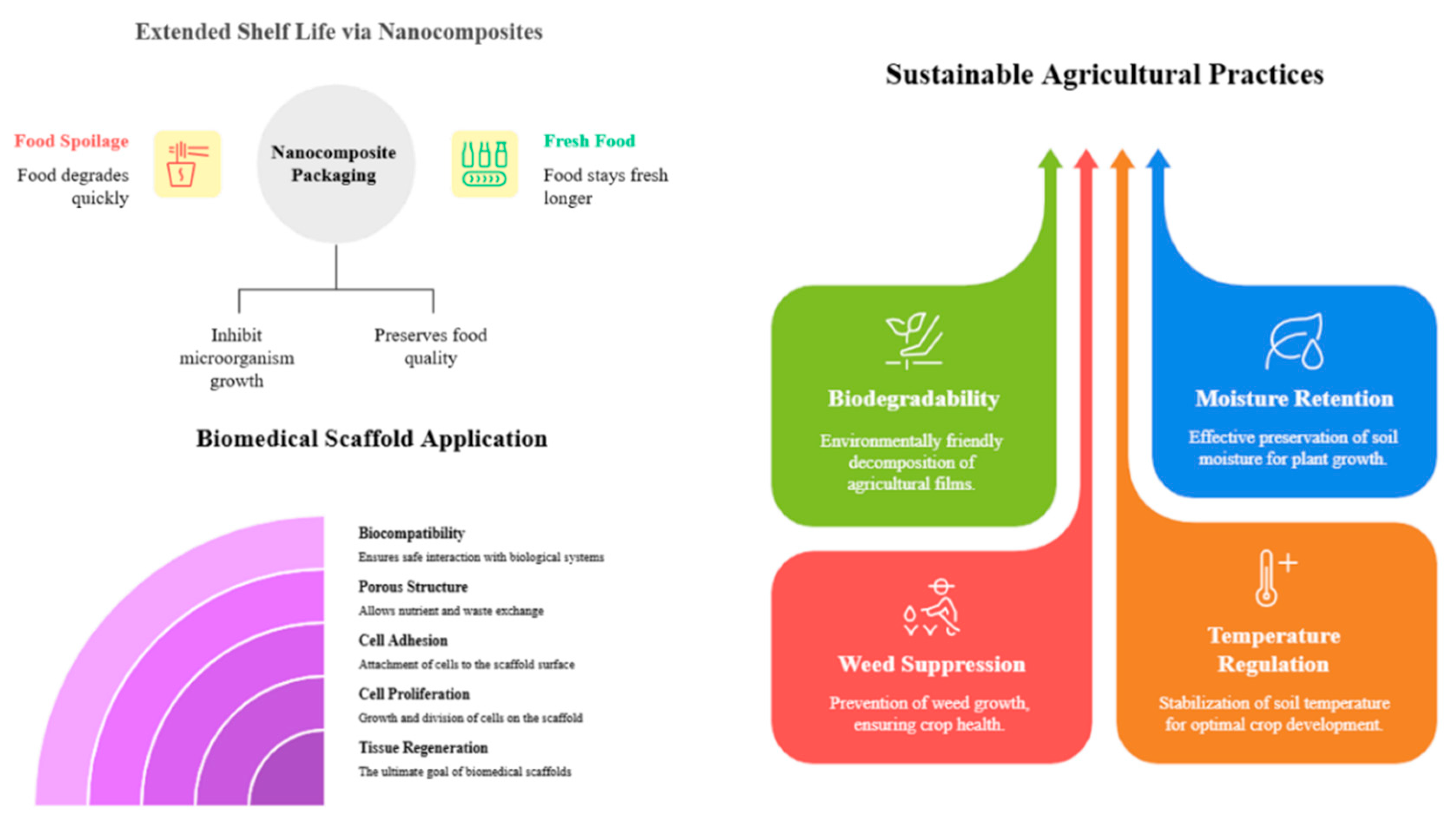
One of the biggest markets for traditional plastics is the packaging sector, especially for single-use coatings, trays, and films. PBS/chitosan nanocomposites are perfect for environmentally friendly packaging materials because they have improved mechanical strength, gas barrier performance, and antimicrobial qualities when reinforced with bio-based nanoparticles like cellulose nanocrystals (CNCs), lignin nanoparticles (LNPs), and starch nanocrystals (SNCs). The enhanced oxygen and moisture barrier qualities that result from the nanoparticles' convoluted diffusion path greatly extend the shelf life of perishable products like food and medications [34].
Furthermore, the natural antimicrobial and antifungal abilities of chitosan prevent the development of spoilage microorganisms on the packing surface, lowering the risk of contamination and food loss (Figure 2). Additionally, lignin nanoparticles have antioxidant and UV-shielding properties that stop photo-oxidative deterioration of delicate goods. These multipurpose qualities make it possible to create smart and effective packaging solutions that can prolong product freshness while preserving complete biodegradability [34]. Additionally, PBS-based nanocomposite films may be manufactured with standard industrial tools (such as thermoforming and extrusion), guaranteeing compatibility with current packaging infrastructure and promoting industrial scalability [35].
- Biomedical Applications
PBS/chitosan nanocomposites are ideal for pharmaceutical and biomedical applications because to their regulated biodegradability, non-toxicity, and biocompatibility (Figure 2). The use of nanoparticles enhances the films' or scaffolds' mechanical stability and toughness, which is essential for preserving structural integrity in biomedical settings. Antibacterial coatings, drug delivery systems, tissue engineering scaffolds, and wound dressings are a few examples of applications [36].
By promoting haemostatic and antibacterial activities, chitosan speeds up wound healing and guards against infections. Bio-based nanoparticles, on the other hand, improve cell adhesion, proliferation, and differentiation because of their nanoscale roughness and bioactivity, whilst PBS offers elasticity and structural support [37]. CNC-reinforced PBS/chitosan scaffolds, for instance, have shown enhanced hydrophilicity and osteoconductivity, which qualifies them for bone tissue regeneration [38]. Additionally, the composite's adjustable rate of disintegration enables controlled medication release, in which encapsulated therapeutic chemicals are released gradually as the polymer matrix breaks down. By removing the need for additional surgical removal, these biodegradable devices lessen patient stress and medical expenses [39].
- Agricultural Applications
The need for organic substitutes in agriculture has increased due to rising concerns about the durability of plastic mulch films and plant protection products [40]. Bio-based nanoparticle-reinforced PBS/chitosan nanocomposites offer a sustainable alternative for seed coatings, mulch films, and controlled-release insecticides or fertilizers [41]. These composites ensure crop protection and better soil health during the growing season by offering sufficient mechanical durability, moisture retention, and UV resistance [42].
The films may naturally break down after harvest thanks to the composites' biodegradability, which lessens the environmental impact of traditional agricultural plastics made of polyethylene [43]. The antibacterial and antifungal qualities of chitosan also help to reduce soil-borne plant illnesses, while the use of nanoparticles improves the regulation of water vapor permeability, preserving ideal soil moisture levels. By serving as reservoirs for nutrients or agrochemicals, nanoparticles in controlled-release systems minimize chemical leaching and nutrient loss by enabling their slow diffusion into the soil (Figure 2). Therefore, PBS/chitosan nanocomposites are an important step in the development of circular and green agriculture technology [44].
Figure 2.
Functional Applications of PBS/Chitosan Nanocomposites in Food Packaging and Agriculture.
- Other Emerging Applications
PBS/chitosan-based nanocomposites are being investigated for usage in wastewater treatment membranes, coatings, and 3D printing filaments in addition to packaging, biomedical, and agricultural applications. Because of their mechanical toughness and thermal processability, they may be used in additive manufacturing to create personalized biodegradable goods [45]. The cationic properties of chitosan and the increased surface area of the nanoparticles in environmental engineering make these composites efficient adsorbents for organic pollutants, dyes, and heavy metals in water treatment applications [46]. Furthermore, lignin nanoparticle-containing PBS/chitosan films demonstrate antioxidant activity and electrostatic charge dissipation, expanding its potential for use in electronic packaging and anti-static coatings. These new developments highlight the adaptability of PBS/chitosan nanocomposites as multipurpose green materials that may satisfy performance requirements and advance international sustainability objectives [47].
- Environmental and Economic Considerations
One important step in the creation of sustainable materials is the switch from traditional petroleum-based plastics to biodegradable polymer nanocomposites like poly(butylene succinate) (PBS)/chitosan systems [48]. However, life-cycle analysis (LCA) must be used to evaluate these materials' environmental advantages holistically, and their economic feasibility must be investigated in light of manufacturing prices, raw material availability, and processing technology scalability. With an emphasis on their applicability to both Indian and international industrial contexts, this section assesses the environmental impact, biodegradability, and economic ramifications of PBS/chitosan nanocomposites boosted with bio-based nanoparticles [49].
- Environmental Sustainability and Life-Cycle Assessment
PBS/chitosan nanocomposites' biodegradability and renewability are two of its main environmental advantages. 1,4-butanediol and bio-based succinic acid, which may be obtained from renewable resources including corn, sugarcane, and biomass hydrolysates, can be used to create PBS [50]. Chitosan, which is produced by deacetylating the leftover chitin from crustacean shells, gives the composite system a significant waste valorization component. While improving material performance, the use of bio-based nanoparticles such as cellulose, lignin, and starch further lessens reliance on petroleum-based additives [51].
According to life-cycle assessment (LCA) studies, PBS and PBS-based composites significantly lower non-renewable energy consumption and carbon footprints when compared to traditional plastics like polyethylene, polypropylene, and PET. For instance, compared to its petroleum-derived competitors, bio-based PBS can reduce greenhouse gas (GHG) emissions by as much as 50–60%, according to cradle-to-grave assessments [52]. Furthermore, unlike burnt synthetic plastics that release hazardous dioxins and volatile organic compounds (VOCs), PBS/chitosan composites biodegrade at the end of their useful lives, producing CO₂, water, and biomass without releasing toxic residues. Biodegradable materials may drastically lower landfill buildup and marine pollution, which is especially important for India, where improper handling of plastic waste is still a major problem [53].
- Biodegradation Pathways and Environmental Compatibility
In soil, compost, and aquatic settings, PBS and chitosan are biodegraded by microbial, enzymatic, and hydrolytic processes. Hydrophilic bio-based nanoparticles speed up degradation by improving microbial colonization and water absorption [54]. Depending on the kind and quantity of nanoparticles, PBS/chitosan nanocomposites can break down in 60–120 days under composting conditions. International biodegradability standards like ASTM D6400 and ISO 14855 are in line with this. Crucially, the breakdown products primarily oligosaccharides and organic acids are safe for the environment and may even increase soil microbial activity. When assessing the ecotoxicity of nanoparticles and their long-term effects on soil, caution must be exercised [55]. Although bio-based nanoparticles like CNCs and LNPs are widely acknowledged to be harmless and biodegradable, excessive buildup or inadequate dispersion may have an impact on soil microbiota or change the carbon–nitrogen balance. Therefore, before these nanocomposites are widely used in the field, comprehensive ecotoxicological evaluations and standardized biodegradation procedures are needed to confirm their environmental suitability [56].
- Economic Feasibility and Industrial Challenges
PBS/chitosan nanocomposites' economic viability is still a key factor in their commercialization, even with their environmental benefits. Because bio-based monomers are scarce and polymerization is more expensive, the cost of bio-based PBS is now much greater than that of conventional plastics [57]. Similarly, the manufacture of chitosan requires many processes, including deproteinization, demineralization, and deacetylation, which raises processing costs. Additionally, surface modification and nanoparticle manufacturing add to the cost, especially when uniform morphology and high purity are needed [58].
However, cost reductions are being driven by current technical breakthroughs. Economic competitiveness is progressively being improved by the growing use of agricultural and seafood waste streams for the extraction of chitosan, biotechnological fermentation for the production of succinic acid, and scalable nanoparticle synthesis techniques (such as acid hydrolysis for CNCs and green precipitation for LNPs). Through circular economy models that co-produce biofuels, biochemicals, and biopolymers, the growth of integrated biorefineries in India and beyond presents more opportunities to reduce material costs. Furthermore, encouraging government initiatives like India's National Policy on Resource Efficiency (NPRE) and financial aid for bioplastic production facilities are anticipated to hasten market uptake.
- Sustainability Trade-Offs and Future Prospects
Despite being better for the environment than synthetic plastics, PBS/chitosan nanocomposites come with a number of trade-offs that need to be considered. Using non-renewable energy sources during the manufacture of nanoparticles or the mixing of polymers may result in increased energy input that partially offsets the total carbon benefit [59]. A similar difficulty is getting nanoparticles to disperse and become homogeneous on an industrial scale without sacrificing their biodegradability. Reactive extrusion methods and bio-based coupling agents are two examples of cost-effective compatibilization solutions being researched to improve processability while preserving environmental sustainability [60].
In order to achieve real sustainability in the future, the confluence of waste valorization, green chemistry, and circular bioeconomy concepts will be essential. PBS/chitosan nanocomposites can become economically and environmentally feasible through the development of industrial symbiosis networks, in which waste from one industry (such as seafood or agricultural) is used as feedstock for the manufacturing of biopolymers [61]. These materials have the potential to serve as the foundation for next-generation biodegradable plastic alternatives with further research and supportive policy frameworks, especially in developing nations like India that are attempting to balance environmental preservation with industrial growth.
- Current Status in India
India has worked extensively to promote biodegradable, compostable, or bio-based alternatives to traditional plastics generated from fossil fuels. A significant gap in the domestic manufacturing of resin and monomers still exists since, according to a research by NITI Aayog on alternatives to plastics, "at this time, there is no manufacturer of essential synthetic biodegradable plastics (PBAT, PBS, PLA & PHA) in India [62]." Simultaneously, as rules pertaining to single-use plastics (SUPs) become more stringent, the biodegradable plastic materials market in India is expected to rise from its 2022 valuation of around US$85 million to US$223 million by 2030 [63].
Compostable and bio-based plastic substitutes are now available from a number of startups and businesses (Table 1). Water-soluble and biodegradable films and bags are produced by GreenPlast (by Green Tech Bio Products, Coimbatore) using industrial starch, PVOH, and vegetable oil derivatives. Made from sustainable plant-based materials, Naturoplast provides "100% compostable & biodegradable" bags, pouches, and flatware. Ecolastic produces "100% compostable bioplastics" from maize and vegetable starches, including trash bags, carry bags, and pouches. However, standards and regulatory clarity continue to be problematic. The Bureau of Indian Standards (BIS), for example, has declared that "there is no 100% biodegradable plastic in India" at this time, and such assertions may be deceptive.
In light of this, India's use of biodegradable plastic alternatives is expanding, although it is still in its infancy. Standards and claims need to be monitored, industrial scaleup is still a challenge, and manufacturing capacity for biopolymeric resins are constrained [70]. Key alternatives, their material bases, common uses, and the main obstacles in the Indian setting are compiled in the table below.
- Sustainable / Biodegradable Plastic Recycling and Alternative Applications in India
Reusing and recycling current plastic trash is still crucial for attaining sustainability in India's material economy, even though creating new biodegradable materials like PBS/chitosan nanocomposites is a forward-looking approach [71]. A parallel strategy of upcycling, recycling, and reusing existing polymers into long-lasting, value-added goods has gained traction because totally biodegradable plastics are still in their infancy. These circular economy paths minimize waste accumulation, decrease reliance on the manufacturing of virgin plastic, and increase the service life of products (Table 2).
Post-consumer or industrial plastic waste, such as polyethylene, polypropylene, PET, and biodegradable blends, is being converted into sustainable uses in India by a number of creative projects and industries. These include textiles, furniture, construction composites, mosquito nets, and road materials. In addition to conserving resources, these solutions support better waste management systems and provide jobs in rural areas [72]. Additionally, incorporating natural fibers or biodegradable polymers partially into recycled plastic matrices enhances environmental friendliness without sacrificing mechanical performance.
- Textile and Fabric Applications
The recycling of PET bottles into polyester fibers for use in household textiles, sportswear, and mosquito nets is one of India's most effective plastic recycling initiatives. Every year, businesses like Garware Technical Fibres, Indorama Ventures, and Reliance Industries (R|Elan Fabric 2.0) recycle millions of plastic bottles to create yarns and fibers that are spun into geotextiles, ropes, and mosquito nets. In areas where malaria is common, polyethylene terephthalate mosquito nets that have been authorized by the World Health Organization (WHO) are frequently used, successfully combining the benefits of plastic recycling and public health. To improve end-of-life degradability, some inventors are also experimenting with biopolymer–polyester blends, which include adding a percentage of biodegradable polymers (such PLA and PBS) to recovered PET fibers. These hybrid materials show how recyclable and biodegradable technologies may coexist in a framework for sustainable materials [73].
- Road and Construction Applications
The use of discarded plastic in road building, where bitumen is combined with shredded polyethylene, polypropylene, and polystyrene to create plastic-modified asphalt, has been approved by India's Ministry of Road Transport and Highways [74]. Over 120,000 km of plastic roads have been developed throughout Indian states, enhancing road longevity and cutting maintenance costs. Biodegradable polymer additions, including starch or PBS-modified bitumen blends, are being investigated in recent pilot studies. These additives may result in environmentally friendly paving materials that retain their strength and flexibility over time while partially degrading.
Paving blocks, panels, insulating boards, and roofing sheets are all made from recycled and biodegradable plastic composites. Some producers make bio-composite boards, which give structural strength and partial biodegradability, by combining recycled LDPE or PLA with agro-waste fibers (rice husk, coir, and jute) [75].
- Agricultural and Household Alternatives
In agriculture, recycled and biodegradable plastic composites are being used more and more in products like greenhouse films, biodegradable mulch films, drip irrigation tubes, and reusable nursery pots [75]. Several non-governmental organizations and small businesses in rural regions recycle multilayer plastic trash into low-cost livelihood items such floor mats, tarpaulins, mosquito nets, and fence materials. Similarly, agricultural films and seedling trays that degrade after one or two crop cycles and minimize soil contamination are being investigated using biodegradable starch and PBS mixes. Recycled PET and HDPE are being used in the home sector to make eco-furniture, planters, school seats, and storage containers for the home, which helps keep tons of plastic out of landfills and meets the requirements of the neighbourhood [76].
- Summary of Reported Works on PBS/Chitosan Bio-Nanocomposites
The development of poly (butylene succinate) and chitosan-based nanocomposites reinforced with bio-derived nanoparticles to improve their mechanical, thermal, and barrier characteristics has received a lot of scientific interest lately. These hybrid systems, which are further reinforced by nanofillers such cellulose nanocrystals, chitin nanohiskers, lignin nanoparticles, and starch nanocrystals, combine the biodegradability and flexibility of PBS with the biocompatibility and antibacterial properties of chitosan. The combination offers a flexible framework for biomedical, agri-films, and sustainable packaging (Table 3).
Future Directions
As an alternative to traditional plastics made from petroleum, the creation of poly(butylene succinate) (PBS) and chitosan-based nanocomposites augmented with bio-based nanoparticles has shown encouraging promise. However, a number of scientific, technological, and socioeconomic issues need to be resolved in order to fully understand their industrial and environmental effect. The main avenues for furthering this field are outlined in the following future directions:
- Molecular Design and Tailored Functionalization
Future studies should focus on designing PBS/chitosan interactions at the molecular level using compatibilization techniques and surface modification. Interfacial incompatibility frequently results from the hydrophilic nature of chitosan and the hydrophobic polyester backbone of PBS. The dispersion of nanoparticles (such as cellulose, lignin, or starch nanocrystals) and their mechanical integrity can be greatly improved by functionalization employing biodegradable coupling agents, graft copolymerization, or reactive blending. To improve performance, chain–nanoparticle interactions may also be predicted with the use of computational modeling and molecular dynamics simulations.
- Integration of Multi-Scale Bio-Based Nanoparticles
Single nanoparticle systems have been used in the majority of previous investigations. Systems that combine cellulose, chitin, lignin, or starch nanoparticles in a synergistic manner are the way of the future for hybrid nano-fillers. While maintaining biodegradability, such multi-scale reinforcement can provide balanced mechanical, thermal, and barrier qualities (Figure 3). Additionally, PBS/chitosan composites may be used in biomedical and smart packaging fields by including functional nanoparticles such nanoclay, halloysite, or bio-hydroxyapatite, which can impart antibacterial, UV-protective, or bioactive properties.
- Green and Scalable Processing Technologies
Using scalable and environmentally friendly processing techniques is a crucial first step toward industrial adoption. Reactive extrusion, solvent-free melt mixing, and in-situ polymerization with non-toxic catalysts or enzymes seem to be the main areas of future study. Structure-property connections might be precisely controlled while reducing environmental impact through the use of 3D printing (additive manufacturing), ultrasonic dispersion, or supercritical CO₂-assisted processing. For sustainable scale-up, low-cost, water-based manufacturing methods that work with PBS and chitosan must be developed.
- Life-Cycle Assessment and End-of-Life Strategies
The kinetics of biodegradation under actual environmental circumstances are still not well understood, despite the term "biodegradable." Future research on composting, marine degradation, and soil absorption should incorporate life-cycle assessment (LCA) and end-of-life scenario modeling. To verify environmental claims and comply with international sustainability standards like ISO 17088 (biodegradable plastics) and EN 13432 (compostability), it is imperative to establish standardized degrading processes for PBS/chitosan nanocomposites.
- Functional Applications and Smart Composites
PBS/chitosan nanocomposites are great candidates for the creation of intelligent and multipurpose materials because of their intrinsic biodegradability, biocompatibility, and antibacterial activity. One of the most interesting applications is in active food packaging, where these composites may be designed to release natural antioxidants or antimicrobials in a regulated manner, increasing the shelf life of perishable goods while reducing the need for chemical additives. PBS/chitosan-based scaffolds for tissue engineering are becoming more and more popular in the biomedical sector because of the way that the bioactivity of chitosan and the mechanical strength of PBS work together to promote cell adhesion, proliferation, and slow degradation that is consistent with tissue regeneration.
These nanocomposites may be used in agriculture to create biodegradable mulch films and controlled-release fertilizers, where the concentration and composition of nanoparticles can be changed to regulate the pace of decomposition and nutrient release. This provides a sustainable substitute for traditional plastic films that pollute soil. Additionally, the addition of bio-conductive nanoparticles to the PBS/chitosan matrix, such as cellulose-based conductive fillers or carbon dots derived from lignin, creates opportunities for wearable sensors, flexible electronics, and smart packaging systems that can monitor the environment or human health. When taken as a whole, these diverse uses demonstrate the adaptability of PBS/chitosan nanocomposites as sustainable materials ready to close the performance-environment gap in upcoming smart material technologies.
- Circular Economy and Industrial Implementation
In order to ensure sustainable manufacture, usage, and end-of-life management, PBS/chitosan nanocomposites must be developed in accordance with the tenets of a circular materials economy. The development of closed-loop recycling and bio-upcycling routes that enable the effective recovery and reprocessing of PBS/chitosan blends without sacrificing their structural or functional integrity is a top objective. Improving local manufacturing capabilities for chitosan and PBS resins, especially by valuing marine waste like shrimp and crab shells, may greatly lessen reliance on imports and encourage the development of a self-sufficient biopolymer sector.
Promoting cooperation between government, business, and academia to connect research advancements with commercial manufacturing is equally crucial. These collaborations help hasten the adoption of bio-based plastic technologies, especially in developing nations like India where there is a rising need for biodegradable materials. Biodegradable standards, certification processes, and regulatory incentives must be strictly enforced to guarantee market viability and customer trust. In addition to promoting industry involvement, these steps will provide a regulatory framework that verifies biodegradability claims, guaranteeing that PBS/chitosan nanocomposites make a significant contribution to a circular and sustainable plastic economy.
Conclusions
The development of next-generation biodegradable plastics has advanced significantly with the combination of Poly(butylene succinate) (PBS) and chitosan reinforced with bio-based nanoparticles. These nanocomposites successfully blend the biocompatibility, antibacterial qualities, and renewable source of chitosan with the mechanical strength and processability of PBS to create multipurpose materials that can satisfy environmental and performance requirements. Bio-derived nanofillers, like cellulose, lignin, and starch nanoparticles, have been shown to improve barrier performance, tensile modulus, and thermal stability while allowing for tunable biodegradation, which is crucial for a variety of applications in fields like packaging, biomedical engineering, and agriculture.
Even with significant advancements, a number of obstacles must be overcome before widespread commercialization is possible. Limited interfacial compatibility, high manufacturing costs, and inadequate infrastructure for recycling and composting are major obstacles. A comprehensive strategy that incorporates legislative interventions, industry-academia partnerships, life-cycle assessment, green synthesis, and molecular-level design will be needed to address these problems. To guarantee product dependability and public acceptability, it would be essential to establish domestic manufacturing capabilities for PBS and chitosan in nations like India and to create precise biodegradability certification requirements. In the future, a revolutionary potential will arise from the intersection of biopolymer chemistry, nanotechnology, and the concepts of the circular economy. PBS/chitosan nanocomposites can develop into intelligent, sustainable, and high-performing materials by enhancing nanoparticle functionalization, increasing processing effectiveness, and incorporating waste valorization techniques. These developments will not only lessen the global plastic catastrophe but also reshape the design of environmentally friendly materials in the future, shifting away from throwaway consumption and toward regenerative, biologically inspired production methods.
Author Contributions
Supervision, M.I, S.V, S.V, B.R.; project administration, M.I.; writing—review and editing, S.V, S.V and B.R.; data curation, S.V, B.R. and M.I.; writing—original draft, M.I.; formal analysis, All authors have read and agreed to the published version of the manuscript.
Funding
This research received no external funding.
Data Availability Statement
The original contributions presented in the study are included in the article, further inquiries can be directed to the corresponding author.
Acknowledgments
The authors acknowledge JKKMMRF’S Annai JKK Sampoorani Ammal College of Pharmacy for their support.
Conflicts of Interest
The authors declare no conflicts of interest.
References
- M. A. Fayshal, “Current practices of plastic waste management, environmental impacts, and potential alternatives for reducing pollution and improving management,” Heliyon, vol. 10, no. 23, p. e40838, Dec. 2024. [CrossRef]
- N. Singh and T. R. Walker, “Plastic recycling: A panacea or environmental pollution problem,” npj Mater. Sustain., vol. 2, no. 1, p. 17, Aug. 2024. [CrossRef]
- K. Kalauni, A. Vedrtnam, S. P. Sharma, A. Sharma, and S. Chaturvedi, “A comprehensive review of recycling and reusing methods for plastic waste focusing Indian scenario,” Waste Manag Res, vol. 43, no. 9, pp. 1378–1399, Sep. 2025. [CrossRef]
- Y. Chen, A. K. Awasthi, F. Wei, Q. Tan, and J. Li, “Single-use plastics: Production, usage, disposal, and adverse impacts,” Science of The Total Environment, vol. 752, p. 141772, Jan. 2021. [CrossRef]
- Y. Xie, S. Gao, D. Zhang, C. Wang, and F. Chu, “Bio-based polymeric materials synthesized from renewable resources: A mini-review,” Resources Chemicals and Materials, vol. 2, no. 3, pp. 223–230, Sep. 2023. [CrossRef]
- M. Barletta et al., “Poly(butylene succinate) (PBS): Materials, processing, and industrial applications,” Progress in Polymer Science, vol. 132, p. 101579, Sep. 2022. [CrossRef]
- A. Harugade, A. P. Sherje, and A. Pethe, “Chitosan: A review on properties, biological activities and recent progress in biomedical applications,” Reactive and Functional Polymers, vol. 191, p. 105634, Oct. 2023. [CrossRef]
- M. Ramesh, M. Tamil Selvan, and A. Saravanakumar, “Evolution and recent advancements of composite materials in structural applications,” in Applications of Composite Materials in Engineering, Elsevier, 2025, pp. 97–117. [CrossRef]
- S. Sharma et al., “Polymeric nanocomposites: Recent advances, challenges, techniques, and biomedical applications,” Annales Pharmaceutiques Françaises, vol. 83, no. 6, pp. 1019–1039, Nov. 2025. [CrossRef]
- V. Lunetto, M. Galati, L. Settineri, and L. Iuliano, “Sustainability in the manufacturing of composite materials: A literature review and directions for future research,” Journal of Manufacturing Processes, vol. 85, pp. 858–874, Jan. 2023. [CrossRef]
- M. Barletta et al., “Poly(butylene succinate) (PBS): Materials, processing, and industrial applications,” Progress in Polymer Science, vol. 132, p. 101579, Sep. 2022. [CrossRef]
- L. Aliotta, M. Seggiani, A. Lazzeri, V. Gigante, and P. Cinelli, “A Brief Review of Poly (Butylene Succinate) (PBS) and Its Main Copolymers: Synthesis, Blends, Composites, Biodegradability, and Applications,” Polymers (Basel), vol. 14, no. 4, p. 844, Feb. 2022. [CrossRef]
- A. Dmitruk, J. Ludwiczak, M. Skwarski, P. Makuła, and P. Kaczyński, “Influence of PBS, PBAT and TPS content on tensile and processing properties of PLA-based polymeric blends at different temperatures,” J Mater Sci, vol. 58, no. 4, pp. 1991–2004, Jan. 2023. [CrossRef]
- S. Su, R. Kopitzky, S. Tolga, and S. Kabasci, “Polylactide (PLA) and Its Blends with Poly(butylene succinate) (PBS): A Brief Review,” Polymers (Basel), vol. 11, no. 7, p. 1193, Jul. 2019. [CrossRef]
- F. Hisham, M. H. Maziati Akmal, F. Ahmad, K. Ahmad, and N. Samat, “Biopolymer chitosan: Potential sources, extraction methods, and emerging applications,” Ain Shams Engineering Journal, vol. 15, no. 2, p. 102424, Feb. 2024. [CrossRef]
- H. El Knidri, R. Belaabed, A. Addaou, A. Laajeb, and A. Lahsini, “Extraction, chemical modification and characterization of chitin and chitosan,” International Journal of Biological Macromolecules, vol. 120, pp. 1181–1189, Dec. 2018. [CrossRef]
- A. Biswal and S. K. Swain, “Chitosan: A Smart Biomaterial,” in Chitosan Nanocomposites, S. K. Swain and A. Biswal, Eds., in Biological and Medical Physics, Biomedical Engineering., Singapore: Springer Nature Singapore, 2023, pp. 1–25. [CrossRef]
- R. Priyadarshi and J.-W. Rhim, “Chitosan-based biodegradable functional films for food packaging applications,” Innovative Food Science & Emerging Technologies, vol. 62, p. 102346, Jun. 2020. [CrossRef]
- J. Fiallos-Núñez et al., “Eco-Friendly Design of Chitosan-Based Films with Biodegradable Properties as an Alternative to Low-Density Polyethylene Packaging,” Polymers (Basel), vol. 16, no. 17, p. 2471, Aug. 2024. [CrossRef]
- R. Merijs-Meri et al., “Melt-Processed Polybutylene-Succinate Biocomposites with Chitosan: Development and Characterization of Rheological, Thermal, Mechanical and Antimicrobial Properties,” Polymers, vol. 16, no. 19, p. 2808, Oct. 2024. [CrossRef]
- E. J. Bailey and K. I. Winey, “Dynamics of polymer segments, polymer chains, and nanoparticles in polymer nanocomposite melts: A review,” Progress in Polymer Science, vol. 105, p. 101242, Jun. 2020. [CrossRef]
- H. Kim et al., “Highly reinforced poly(butylene succinate) nanocomposites prepared from chitosan nanowhiskers by in-situ polymerization,” International Journal of Biological Macromolecules, vol. 173, pp. 128–135, Mar. 2021. [CrossRef]
- Monika, A. K. Pal, S. M. Bhasney, P. Bhagabati, and V. Katiyar, “Effect of Dicumyl Peroxide on a Poly(lactic acid) (PLA)/Poly(butylene succinate) (PBS)/Functionalized Chitosan-Based Nanobiocomposite for Packaging: A Reactive Extrusion Study,” ACS Omega, vol. 3, no. 10, pp. 13298–13312, Oct. 2018. [CrossRef]
- B.-M. Tofanica, A. Mikhailidi, M. E. Fortună, R. Rotaru, O. C. Ungureanu, and E. Ungureanu, “Cellulose Nanomaterials: Characterization Methods, Isolation Techniques, and Strategies,” Crystals, vol. 15, no. 4, p. 352, Apr. 2025. [CrossRef]
- T. Zhao et al., “Thermal, crystallization, and mechanical properties of polylactic acid (PLA)/poly(butylene succinate) (PBS) blends,” Polym. Bull., vol. 81, no. 3, pp. 2481–2504, Feb. 2024. [CrossRef]
- T. Zhao et al., “Thermal, crystallization, and mechanical properties of polylactic acid (PLA)/poly(butylene succinate) (PBS) blends,” Polym. Bull., vol. 81, no. 3, pp. 2481–2504, Feb. 2024. [CrossRef]
- J. Qi, J. Wu, J. Chen, and H. Wang, “An investigation of the thermal and (bio)degradability of PBS copolyesters based on isosorbide,” Polymer Degradation and Stability, vol. 160, pp. 229–241, Feb. 2019. [CrossRef]
- C. Chandarana, S. Bonde, S. Sonwane, and B. Prajapati, “Chitosan-based packaging: leading sustainable advancements in the food industry,” Polym. Bull., vol. 82, no. 11, pp. 5431–5462, Jul. 2025. [CrossRef]
- W. Cui and L. Xiang, Natural Polymers for Biomedical Applications, 1st ed. Wiley, 2024. [CrossRef]
- M. Yanat and K. Schroën, “Preparation methods and applications of chitosan nanoparticles; with an outlook toward reinforcement of biodegradable packaging,” Reactive and Functional Polymers, vol. 161, p. 104849, Apr. 2021. [CrossRef]
- J. Yu, D. Wang, N. Geetha, K. M. Khawar, S. Jogaiah, and M. Mujtaba, “Current trends and challenges in the synthesis and applications of chitosan-based nanocomposites for plants: A review,” Carbohydrate Polymers, vol. 261, p. 117904, Jun. 2021. [CrossRef]
- Z. U. Arif, M. Y. Khalid, M. F. Sheikh, A. Zolfagharian, and M. Bodaghi, “Biopolymeric sustainable materials and their emerging applications,” Journal of Environmental Chemical Engineering, vol. 10, no. 4, p. 108159, Aug. 2022. [CrossRef]
- J. J. Andrew and H. N. Dhakal, “Sustainable biobased composites for advanced applications: recent trends and future opportunities – A critical review,” Composites Part C: Open Access, vol. 7, p. 100220, Mar. 2022. [CrossRef]
- A. S. Khandeparkar, R. Paul, A. Sridhar, V. V. Lakshmaiah, and P. Nagella, “Eco-friendly innovations in food packaging: A sustainable revolution,” Sustainable Chemistry and Pharmacy, vol. 39, p. 101579, Jun. 2024. [CrossRef]
- F. Palmieri, J. N. A. Tagoe, and L. Di Maio, “Development of PBS/Nano Composite PHB-Based Multilayer Blown Films with Enhanced Properties for Food Packaging Applications,” Materials (Basel), vol. 17, no. 12, p. 2894, Jun. 2024. [CrossRef]
- L. Sun, K. Zhang, and J. Wang, “Development of PEG-coated MgO NPs/chitosan hybrid nanocomposite loaded with ciprofloxacin drug for synergistic bacterial sepsis treatment: In vitro antibacterial and biocompatibility studies,” Journal of Drug Delivery Science and Technology, vol. 114, p. 107461, Dec. 2025. [CrossRef]
- J. Su et al., “Hemostatic and antimicrobial properties of chitosan-based wound healing dressings: A review,” International Journal of Biological Macromolecules, vol. 306, p. 141570, May 2025. [CrossRef]
- M. Mohammadalipour, F. Alihosseini, E. B. Toloue, S. Karbasi, and Z. Mohammadalipour, “Evaluation of PHB-chitosan/CNC scaffolds’ applicability for bone tissue engineering via MG-63 osteoblastic cell cultivation and osteogenic markers gene expression,” International Journal of Biological Macromolecules, vol. 320, p. 146041, Aug. 2025. [CrossRef]
- R. Jiffrin et al., “Electrospun Nanofiber Composites for Drug Delivery: A Review on Current Progresses,” Polymers (Basel), vol. 14, no. 18, p. 3725, Sep. 2022. [CrossRef]
- T. Hofmann et al., “Plastics can be used more sustainably in agriculture,” Commun Earth Environ, vol. 4, no. 1, p. 332, Sep. 2023. [CrossRef]
- D. G. Hayes et al., “Biodegradable Plastic Mulch Films for Sustainable Specialty Crop Production,” in Polymers for Agri-Food Applications, T. J. Gutiérrez, Ed., Cham: Springer International Publishing, 2019, pp. 183–213. [CrossRef]
- “Use of plastic mulch in agriculture and strategies to mitigate the associated environmental concerns,” in Advances in Agronomy, vol. 164, Elsevier, 2020, pp. 231–287. [CrossRef]
- G. Chen et al., “Replacing Traditional Plastics with Biodegradable Plastics: Impact on Carbon Emissions,” Engineering, vol. 32, pp. 152–162, Jan. 2024. [CrossRef]
- R. S. Riseh, M. Hassanisaadi, M. Vatankhah, S. A. Babaki, and E. A. Barka, “Chitosan as a potential natural compound to manage plant diseases,” International Journal of Biological Macromolecules, vol. 220, pp. 998–1009, Nov. 2022. [CrossRef]
- Y. Zhou et al., “Recent advances and perspectives in functional chitosan-based composites for environmental remediation, energy, and biomedical applications,” Progress in Materials Science, vol. 152, p. 101460, Jun. 2025. [CrossRef]
- S. D. Souza et al., “Impact of Cationic and Neutral Clay Minerals’ Incorporation in Chitosan and Chitosan/PVA Microsphere Properties,” ACS Appl. Mater. Interfaces, vol. 17, no. 14, pp. 21189–21205, Apr. 2025. [CrossRef]
- E. Rosova et al., “Biocomposite Materials Based on Chitosan and Lignin: Preparation and Characterization,” Cosmetics, vol. 8, no. 1, p. 24, Mar. 2021. [CrossRef]
- S. Rajendran et al., “Replacement of Petroleum Based Products With Plant-Based Materials, Green and Sustainable Energy—A Review,” Engineering Reports, vol. 7, no. 4, p. e70108, Apr. 2025. [CrossRef]
- E. Kaynak, I. S. Piri, and O. Das, “Revisiting the Basics of Life Cycle Assessment and Lifecycle Thinking,” Sustainability, vol. 17, no. 16, p. 7444, Aug. 2025. [CrossRef]
- F. Patwary, N. Matsko, and V. Mittal, “Biodegradation properties of melt processed PBS /chitosan bio-nanocomposites with silica, silicate, and thermally reduced graphene,” Polymer Composites, vol. 39, no. 2, pp. 386–397, Feb. 2018. [CrossRef]
- S. Wang, H. Yi, and M. Zheng, “The green synthetic approach to prepare PbS/chitosan nanocomposites and its new optical sensing active properties for 2-isonaphthol,” Polym. Sci. Ser. B, vol. 58, no. 4, pp. 474–478, Jul. 2016. [CrossRef]
- D. Nath, M. Misra, F. Al-Daoud, and A. K. Mohanty, “Studies on poly(butylene succinate) and poly(butylene succinate- co -adipate)-based biodegradable plastics for sustainable flexible packaging and agricultural applications: a comprehensive review,” RSC Sustainability, vol. 3, no. 3, pp. 1267–1302, 2025. [CrossRef]
- D. Baca, R. Monroy, M. Castillo, A. Elkhazraji, A. Farooq, and R. Ahmad, “Dioxins and plastic waste: A scientometric analysis and systematic literature review of the detection methods,” Environmental Advances, vol. 13, p. 100439, Oct. 2023. [CrossRef]
- J. Kim et al., “Comparative degradation behavior of polybutylene succinate (PBS), used PBS, and PBS/Polyhydroxyalkanoates (PHA) blend fibers in compost and marine–sediment interfaces,” Sustainable Materials and Technologies, vol. 41, p. e01065, Sep. 2024. [CrossRef]
- N. F. Alias and K. I. K. Marsilla, “Processes and characterization for biobased polymers from polybutylene succinate,” in Processing and Development of Polysaccharide-Based Biopolymers for Packaging Applications, Elsevier, 2020, pp. 151–170. [CrossRef]
- A. P. Khedulkar et al., “Bio-based nanomaterials as effective, friendly solutions and their applications for protecting water, soil, and air,” Materials Today Chemistry, vol. 46, p. 102688, Jun. 2025. [CrossRef]
- A. Riofrio, T. Alcivar, and H. Baykara, “Environmental and Economic Viability of Chitosan Production in Guayas-Ecuador: A Robust Investment and Life Cycle Analysis,” ACS Omega, vol. 6, no. 36, pp. 23038–23051, Sep. 2021. [CrossRef]
- I. Issahaku, I. K. Tetteh, and A. Y. Tetteh, “Chitosan and chitosan derivatives: Recent advancements in production and applications in environmental remediation,” Environmental Advances, vol. 11, p. 100351, Apr. 2023. [CrossRef]
- S. Huang, Q. Dong, S. Che, R. Li, and K. H. D. Tang, “Bioplastics and biodegradable plastics: A review of recent advances, feasibility and cleaner production,” Science of The Total Environment, vol. 969, p. 178911, Mar. 2025. [CrossRef]
- Y. Liu et al., “Breaking the nanoparticle’s dispersible limit via rotatable surface ligands,” Nat Commun, vol. 13, no. 1, p. 3581, Jun. 2022. [CrossRef]
- M. Tanveer, S. A. R. Khan, M. Umar, Z. Yu, M. J. Sajid, and I. U. Haq, “Waste management and green technology: future trends in circular economy leading towards environmental sustainability,” Environ Sci Pollut Res Int, vol. 29, no. 53, pp. 80161–80178, Nov. 2022. [CrossRef]
- E. Nøklebye, H. N. Adam, A. Roy-Basu, G. K. Bharat, and E. H. Steindal, “Plastic bans in India – Addressing the socio-economic and environmental complexities,” Environmental Science & Policy, vol. 139, pp. 219–227, Jan. 2023. [CrossRef]
- A. S. Barone et al., “Rethinking single-use plastics: Innovations, polices, consumer awareness and market shaping biodegradable solutions in the packaging industry,” Trends in Food Science & Technology, vol. 158, p. 104906, Apr. 2025. [CrossRef]
- P. Singh, V. K. Pandey, R. Singh, K. Singh, K. K. Dash, and S. Malik, “Unveiling the potential of starch-blended biodegradable polymers for substantializing the eco-friendly innovations,” Journal of Agriculture and Food Research, vol. 15, p. 101065, Mar. 2024. [CrossRef]
- M. Stroescu, A. R. Marc, and C. C. Mureșan, “A Comprehensive Review on Sugarcane Bagasse in Food Packaging: Properties, Applications, and Future Prospects,” HPM, vol. 32, no. 1–2, pp. 169–184, Dec. 2024. [CrossRef]
- J. Kovacs and M. Garai-Fodor, “Compostable Bag Project- Possible Marketing Strategies for Applying Microplastic-Free Packaging in Practice,” in Proceedings of the 10th International Conference on Lifelong Education and Leadership for ALL (ICLEL 2024), vol. 34, C. F. De Sousa Reis, M. Fodor-Garai, and O. Titrek, Eds., in Atlantis Highlights in Social Sciences, Education and Humanities, vol. 34. , Dordrecht: Atlantis Press International BV, 2025, pp. 742–761. [CrossRef]
- K. Samneingjam, J. Mahajaroensiri, M. Kanathananun, C. V. Aranda, M. Muñoz, and S. Limwongsaree, “Enhancing Polypropylene Biodegradability Through Additive Integration for Sustainable and Reusable Laboratory Applications,” Polymers, vol. 17, no. 5, p. 639, Feb. 2025. [CrossRef]
- N. Khan, K. Sudhakar, and R. Mamat, “Bio-based papers from seaweed and coconut fiber: sustainable materials for a greener future,” Carbon Resources Conversion, vol. 8, no. 4, p. 100329, Dec. 2025. [CrossRef]
- B. Rajbongshi, A. Saikumar, and L. S. Badwaik, “Valorization of areca nut husk and water hyacinth fibers into biodegradable plates for sustainable packaging,” Sustainable Food Technol., p. 10.1039.D5FB00319A, 2025. [CrossRef]
- S. Huang, Q. Dong, S. Che, R. Li, and K. H. D. Tang, “Bioplastics and biodegradable plastics: A review of recent advances, feasibility and cleaner production,” Science of The Total Environment, vol. 969, p. 178911, Mar. 2025. [CrossRef]
- J. E. Lee, D. Lee, J. Lee, and Y.-K. Park, “Current methods for plastic waste recycling: Challenges and opportunities,” Chemosphere, vol. 370, p. 143978, Feb. 2025. [CrossRef]
- R. Shanker et al., “Plastic waste recycling: existing Indian scenario and future opportunities,” Int J Environ Sci Technol (Tehran), vol. 20, no. 5, pp. 5895–5912, 2023. [CrossRef]
- J. Enking et al., “Recycling processes of polyester-containing textile waste–A review,” Resources, Conservation and Recycling, vol. 219, p. 108256, Jun. 2025. [CrossRef]
- Y. Ma et al., “The utilization of waste plastics in asphalt pavements: A review,” Cleaner Materials, vol. 2, p. 100031, Dec. 2021. [CrossRef]
- S. Agyeman, N. K. Obeng-Ahenkora, S. Assiamah, and G. Twumasi, “Exploiting recycled plastic waste as an alternative binder for paving blocks production,” Case Studies in Construction Materials, vol. 11, p. e00246, Dec. 2019. [CrossRef]
- T. Hofmann et al., “Plastics can be used more sustainably in agriculture,” Commun Earth Environ, vol. 4, no. 1, p. 332, Sep. 2023. [CrossRef]
- H. Kim et al., “Highly reinforced poly(butylene succinate) nanocomposites prepared from chitosan nanowhiskers by in-situ polymerization,” International Journal of Biological Macromolecules, vol. 173, pp. 128–135, Mar. 2021. [CrossRef]
- T. Kim et al., “Trans crystallization behavior and strong reinforcement effect of cellulose nanocrystals on reinforced poly(butylene succinate) nanocomposites,” RSC Adv., vol. 8, no. 28, pp. 15389–15398, 2018. [CrossRef]
- S. C. M. Fernandes et al., “Novel transparent nanocomposite films based on chitosan and bacterial cellulose,” Green Chem., vol. 11, no. 12, p. 2023, 2009. [CrossRef]
- Y.-P. Zhang et al., “Preparation and Characterization of Bio-Nanocomposites Film of Chitosan and Montmorillonite Incorporated with Ginger Essential Oil and Its Application in Chilled Beef Preservation,” Antibiotics, vol. 10, no. 7, p. 796, Jun. 2021. [CrossRef]
Figure 1.
Global and Indian Plastic Production and Waste Management Trends (2010–2025).
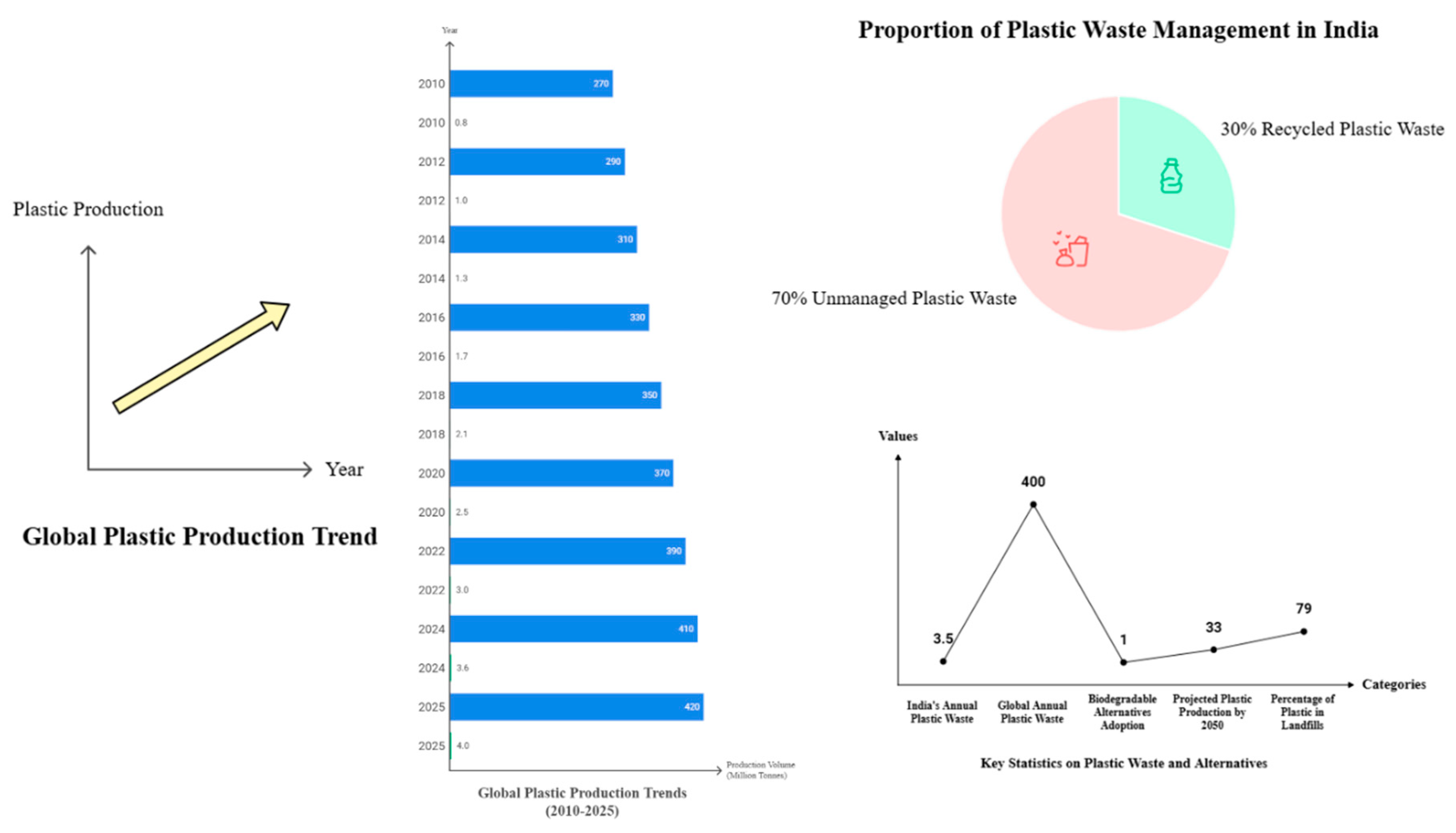
Figure 3.
Mechanism of Nanoparticle Reinforcement in PBS/Chitosan Nanocomposites.
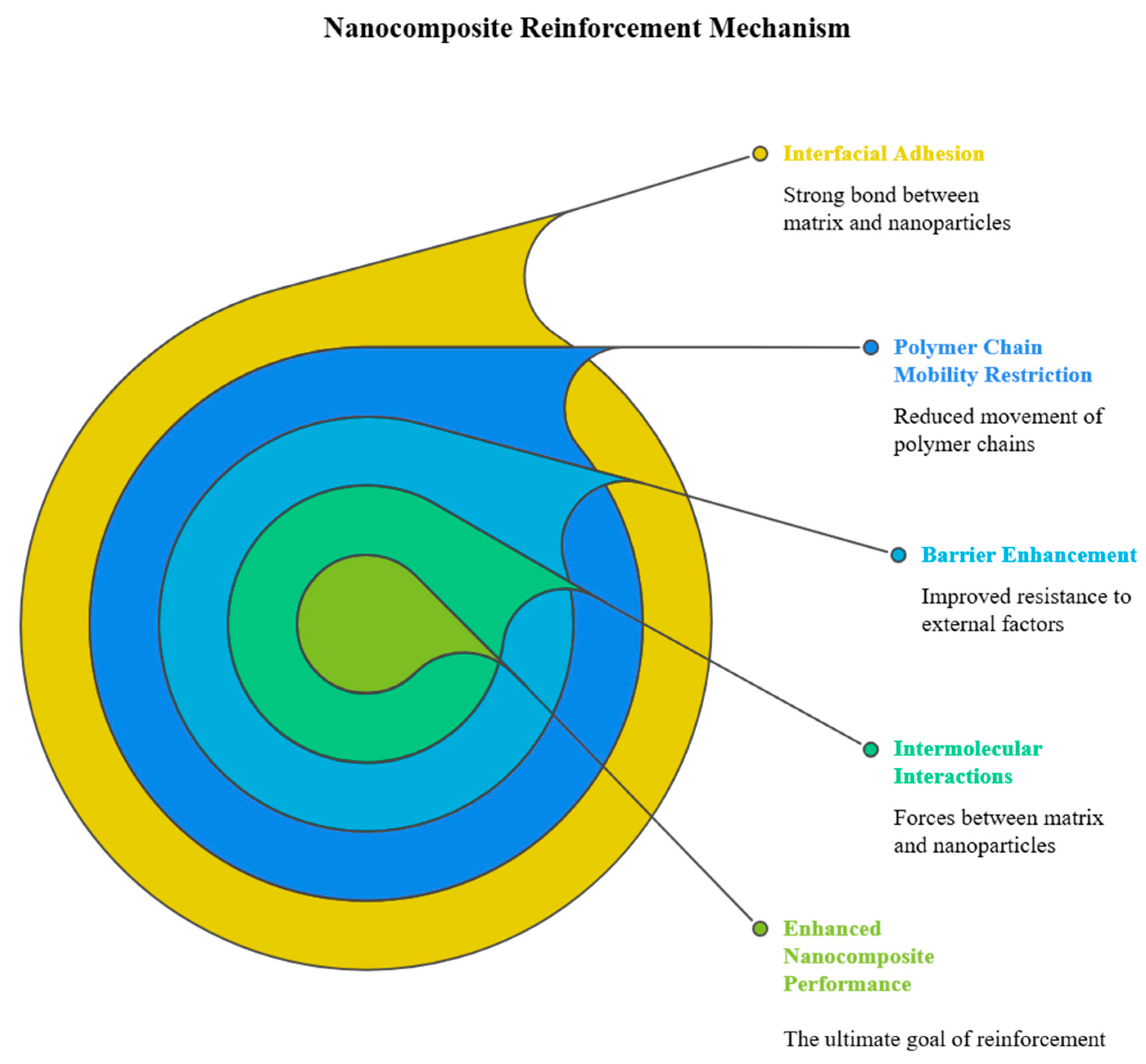

Table 1.
Sustainable / Biodegradable Plastic Substitutes in India.
| Material / Product Type | Material Basis | Typical Applications | Key Challenges / Notes | References |
|---|---|---|---|---|
| Starch-/vegetable-oil-derived compostable films & bags | Corn starch, tapioca starch, PVOH blends (e.g., GreenPlast) | Carry-bags, grocery/vegetable bags, waste bags | Production cost still higher than PE/PP; claims of biodegradability need verification; scale and supply of feedstock. | [64] |
| Compostable bioplastic-based packaging & cutlery | Plant based (sugarcane bagasse, etc) (e.g., Naturoplast) | Disposable plates, cutlery, hot-food pouches | Heat-resistance, barrier properties may lag; cost premium; certification standards. | [65] |
| Bio-bags / compostable garbage bags | Corn/vegetable starch blends (e.g., Ecolastic) | Municipal waste bags, courier bags, plant-grow bags | Composting infrastructure in India still limited; real end-of-life conditions vary. | [66] |
| Additive-modified conventional plastics (oxo-/oxo-bio) | d2w additive technology used with PE/PP (e.g., by Symphony Environmental Technologies in India) | Flexible films, carrier bags, woven sacks, thin-walled containers | Despite claims, regulatory & certification issues; biodegradability in natural environment uncertain; ‘oxo’ plastics may fragment into microplastics. | [67] |
| Novel bio-films/seaweed-based materials | Seaweed-derived films (Indian startup) | Transparent films for packaging | Early stage; scalability, cost, durability under Indian conditions need work. | [68] |
| Areca palm-leaf, bagasse, plate/utensils alternatives (not strictly plastics) | Natural fibre plates, bowls | Disposable tableware replacing plastic plates | May not match all functional needs (strength, moisture resistance); supply chain & cost factors. | [69] |
Table 2.
Sustainable / Biodegradable Plastic Recycling Alternatives in India.
| Recycled / Sustainable Product | Material Source / Feedstock | End-use Application | Sustainability Benefits |
|---|---|---|---|
| Mosquito nets & textiles | Recycled PET bottles (polyester fibers) | Health-sector mosquito nets, clothing, ropes | Diverts plastic waste; durable; supports WHO vector control programs |
| Plastic-modified bitumen | Waste PE, PP, PS blended with bitumen | Road construction | Improves pavement life; reduces plastic waste disposal |
| Bio-composite boards | Recycled plastics + agro-fibers (coir, husk) + PLA/PBS blends | Furniture, panels, construction boards | Partial biodegradability; value addition to agro-waste |
| Agricultural films & pots | Biodegradable PBS/starch blends or recycled PE/PLA | Mulch films, nursery pots, irrigation components | Reduces plastic pollution in soil; compostable after use |
| Recycled household products | Post-consumer HDPE, PET | Containers, planters, benches, chairs | Reduces landfill load; promotes reuse economy |
| Nonwoven geotextiles | Recycled polypropylene fibers | Road underlay, erosion control | Long life; replaces virgin polymer textiles |
| Seaweed- or algae-based films | Marine biomass | Edible packaging, compostable wraps | Fully biodegradable; marine-safe innovation |
Table 3.
Summarizes key published works highlighting the compositions, processing techniques, and major performance outcomes of PBS/chitosan bio-nanocomposites reported in recent literature.
Table 3.
Summarizes key published works highlighting the compositions, processing techniques, and major performance outcomes of PBS/chitosan bio-nanocomposites reported in recent literature.
| Authors & Year | Title of Work | Nanoparticle / Bio-Filler | Matrix & Application | References |
|---|---|---|---|---|
| Kim et al. | Highly reinforced poly(butylene succinate) nanocomposites prepared from chitosan nanowhiskers by in-situ polymerization | Chitosan nanowhiskers (CsWs) | PBS matrix; improved mechanical strength/toughness; biodegradable plastic substitute | [77] |
| Kim T et al. | Trans crystallization behavior and strong reinforcement effect of cellulose nanocrystals on reinforced poly(butylene succinate) nanocomposites | Cellulose nanocrystals (CNCs) | PBS matrix; enhanced crystallisation and mechanical performance | [78] |
| Kusmono et al. | Fabrication and Characterization of Chitosan/Cellulose Nanocrystal/Glycerol Bio-Composite Films | Cellulose nanocrystals (CNCs) + glycerol | Chitosan matrix; bio-composite film (food packaging context) | [78] |
| Fernandes et al. | Novel transparent nanocomposite films based on chitosan and bacterial cellulose | Bacterial cellulose nanofibrils | Chitosan matrix; transparent film with improved mechanical & barrier properties | [79] |
| Zhang et al | Preparation and Characterization of Bio-Nanocomposite Film of Chitosan and Montmorillonite Incorporated with Ginger Essential Oil and Its Application in Chilled Beef Preservation | Montmorillonite (as nanoplatelet) + ginger essential oil | Chitosan matrix; food packaging application (chilled beef preservation) | [80] |
Disclaimer/Publisher’s Note: The statements, opinions and data contained in all publications are solely those of the individual author(s) and contributor(s) and not of MDPI and/or the editor(s). MDPI and/or the editor(s) disclaim responsibility for any injury to people or property resulting from any ideas, methods, instructions or products referred to in the content. |
© 2025 by the authors. Licensee MDPI, Basel, Switzerland. This article is an open access article distributed under the terms and conditions of the Creative Commons Attribution (CC BY) license (http://creativecommons.org/licenses/by/4.0/).
Copyright: This open access article is published under a Creative Commons CC BY 4.0 license, which permit the free download, distribution, and reuse, provided that the author and preprint are cited in any reuse.