

Submitted:
23 October 2025
Posted:
24 October 2025
You are already at the latest version
Abstract
(1) Background: Compost plays a crucial role in promoting sustainable agriculture. With waste management becoming a significant concern for authorities, transforming waste into compost provides an effective and environmentally friendly solution. Microorganisms, especially bacteria, are central to decomposing waste and converting it into valuable organic nutrients, thereby supporting the sustainable development of agricultural systems (2) Methods: This article synthesizes key insights from research published in high-ranking, reputable scientific journals worldwide on bacteria and compost, complemented by the author’s practical experience at Kume Sangyou Compost Company in Hiroshima Prefecture, Japan (3) Results: pH, aeration, temperature, moisture, nutrient content, electrical conductivity (EC), particle size, toxic chemicals, and radiation have been recognized as key factors that warrant careful consideration during the composting process (4) Conclusions: This article provides a valuable resource on composting and constitutes a strategic contribution to the advancement of sustainable agricultural development.
Keywords:
compost
; bacteria
; pH
; air
; temperature
; moisture
; nutrients
; electrical conductivity (EC)
; material size
; toxic chemical
; radiation
1. Introduction
Sustainable agriculture has become a critical focus in the face of global environmental challenges, food security concerns, and socio-economic development [1]. It ensures long-term food security [2] by maintaining stable and efficient production while conserving natural resources, thereby safeguarding supplies for current and future generations [3]. By minimizing reliance on toxic chemicals and employing natural methods, sustainable agriculture protects safe and healthy food sources [4]. It significantly contributes to environmental preservation and ecosystem protection by limiting pesticide and chemical fertilizer use and preventing land over-exploitation [5]. Maintaining soil fertility, water quality, and biodiversity is essential for the long-term sustainability of agricultural production [6]. Furthermore, sustainable agriculture enhances resource efficiency through optimized use of land, water, and energy, while advanced farming technologies help preserve these resources and reduce environmental impacts [7]. It also plays a role in climate change adaptation and mitigation by lowering greenhouse gas emissions through low-carbon practices and increasing the resilience of crops and livestock to extreme weather events such as droughts, floods, and storms [8]. Economically, sustainable agriculture supports growth by improving farmers’ livelihoods, generating stable incomes, and fostering green entrepreneurship [9]. Moreover, it is vital for rural and social development, promoting inclusive growth, strengthening local communities, and enhancing quality of life in agricultural areas [10]. By encouraging cooperative formation, facilitating knowledge exchange, and advancing sustainable community development models, sustainable agriculture also fosters local community development in harmony with nature [11].
Compost is a mixture of organic materials, primarily plant-based, that serves as a fertilizer to improve the physical, chemical, and biological properties of soil [12]. It is typically produced through the decomposition of organic matter, including manure, food waste, and plant residues, yielding nutrient-rich substances that enhance soil fertility and promote the proliferation of beneficial microorganisms. Bacteria are considered the primary drivers of the composting process, working alongside fungi, nematodes, and protozoa to facilitate organic matter degradation [13]. Compost is widely applied to improve soil quality, deter pests, reduce dependence on chemical fertilizers, lower production costs, and enhance crop yield efficiency [14]. Its benefits include supplying essential nutrients, improving soil structure, increasing humus content, suppressing soil-borne pathogens, and reducing the incidence of agricultural diseases [15]. Composting is also recognized as an effective strategy for managing organic waste, such as food scraps and plant residues, while substantially reducing environmental pollution [16]. As an environmentally preferable alternative to landfill disposal, composting mitigates methane emissions generated under anaerobic conditions and contributes to environmental and economic sustainability [17]. Compost is utilized in diverse applications, including stream reclamation, land restoration, landfill cover, and wetland construction, and is produced via an aerobic process that recycles organic waste into nutrient-rich soil amendments [18]. During composting, temperatures can exceed 55 °C, sufficient to inactivate numerous pathogens and weed seeds, thereby producing a safer and more effective product for agricultural use [19]. Handling composted material at 50–70 °C (122–158 °F), where microorganisms have fully digested the organic matter, is considered safe, as these temperatures inactivate most pathogens and render oocysts non-viable [20]. Compost products have been shown to suppress plant pathogens and crop diseases, including Fusarium oxysporum, Rhizoctonia spp, and Pythium debaryanum [21]. Compost extracts contain diverse microbiota and enzymes capable of inhibiting fungal plant pathogens [22]. Additionally, compost serves as a reservoir of biocontrol microorganisms, such as Bacillus subtilis, Bacillus licheniformis, and Penicillium chrysogenum, which play important roles in suppressing plant diseases in agriculture [23]. Therefore, a comprehensive understanding and further advancement of the composting process are essential for enhancing sustainability in agricultural practices.
The annual production of vast amounts of waste poses unprecedented challenges to the global environment. From expansive urban landfills to floating marine garbage patches, the worldwide accumulation of waste highlights significant concerns regarding environmental sustainability [24]. A recent United Nations Environment Program (UNEP) report indicates a rising trend in global pollution, particularly in regions relying on open dumping and incineration as primary waste disposal methods [25]. These practices not only contribute to greenhouse gas emissions but are also major sources of toxic pollutants, adversely affecting soil, water, and air quality [26]. In 2017, total global waste generation was approximately 20 billion tons, equivalent to 2.63 tons per capita per year. Under a business-as-usual scenario, global waste production is projected to reach 46 billion tons by 2050 [27]. Municipal solid waste (MSW) generation is expected to increase from 2.1 billion tons in 2023 to 3.8 billion tons by 2050. In 2020, the direct global cost of waste management was estimated at approximately USD 252 billion, rising to USD 361 billion when hidden costs associated with pollution, health impacts, and climate change are included. Without significant improvements in waste management, this figure could nearly double by 2050, reaching an estimated USD 640.3 billion annually [28]. The implementation of zero-waste strategies and the enhancement of global waste management systems are essential to mitigate environmental pollution, reduce greenhouse gas emissions, and protect public health [29]. Anaerobic decomposition of organic waste in landfills generates substantial methane [30], and illegal waste disposal can lead to leaching of toxic chemicals into soil, water, and air, causing long-term ecological damage, biodiversity disruption, and adverse effects on the human food chain [31]. Consequently, converting waste into compost represents a highly advantageous strategy, as it addresses environmental challenges while simultaneously promoting sustainable agricultural development
Bacteria are ubiquitous, predominantly free-living, single-celled organisms that belong to the extensive domain of prokaryotic microorganisms [32]. As one of the earliest life forms on Earth, they typically measure only a few micrometers in length [33]. Bacteria inhabit diverse environments, including soil, freshwater and marine systems, acidic hot springs, radioactive waste sites, and even the deep biosphere within Earth’s crust [34]. They play crucial roles in multiple stages of nutrient cycling, including the decomposition of organic matter and the fixation of atmospheric nitrogen into bioavailable forms for plants, thereby supporting overall ecosystem productivity [35]. In extreme environments such as hydrothermal vents and cold seeps, extremophilic bacteria sustain life by converting dissolved compounds, including hydrogen sulfide and methane, into usable energy [36]. Soil represents a major bacterial reservoir, with a few grams harboring approximately one billion bacterial cells. These microorganisms are essential for soil ecology due to their capacity to decompose toxic compounds and recycle vital nutrients [37]. In compost, bacteria are the most abundant and functionally significant microorganisms, playing a central role in organic matter decomposition and soil enrichment through nutrient recycling [38]. They process carbon and nitrogen and release nutrients available to plants, including nitrogen, phosphorus, and magnesium [39]. Bacteria colonize both the surfaces and internal tissues of plants and animals; although a small fraction is pathogenic, the majority are beneficial, performing essential functions in maintaining environmental balance [40]. Remarkably, bacteria are also present in the atmosphere, with a single cubic meter of air potentially containing up to one hundred million bacterial cells [41]. Bacteria are central to the composting process; without their activity, organic waste cannot be converted into humus, a nutrient-rich material that nourishes plants and improves soil structure and fertility [42]. In composting, bacteria are generally classified as aerobic or anaerobic, with their predominance determined by the specific composting conditions [43]. This study focuses on aerobic composting, which occurs in the presence of ample oxygen [44]. During aerobic composting, bacteria decompose organic materials into carbon dioxide (CO₂), water, heat, and humus [45]. The resulting compost is a stable organic material with minimal phytotoxic effects on plants [46]. Heat generated during this process accelerates the decomposition of proteins, lipids, and complex carbohydrates, including cellulose and hemicellulose [47], while also reducing composting duration and effectively eliminating numerous pathogens and weed seeds [48]. Although some nutrients may be lost during aerobic composting, this method is generally more efficient and advantageous than anaerobic composting [49]. A major benefit of aerobic composting is its ability to fully decompose organic matter into CO₂ and water, producing stable humus [50], while high temperatures help eliminate harmful pathogens and weed seeds [51,52]. However, the process requires careful regulation of environmental factors, as these directly influence composting efficiency and outcomes [53]. Therefore, this study emphasizes the key factors and essential knowledge necessary to establish optimal conditions for aerobic bacterial growth, highlighting critical aspects of composting that contribute to environmental protection, high-quality compost production, and sustainable agricultural development
2. Materials and Methods
This article presents a comprehensive synthesis of knowledge derived from leading and reputable global sources. Data and information were obtained from high-quality scientific databases, including the Science Citation Index (SCI), Science Citation Index Expanded (SCIE), and the Institute for Scientific Information (ISI), which curate peer-reviewed research from a wide range of journals worldwide. The study draws on a curated collection of 218 scientific articles published between 2000 and 2025. Sources were selected from internationally recognized publishers to ensure academic rigor and reliability, including Springer, Elsevier, Wiley-Blackwell, Taylor & Francis, Oxford University Press, Cambridge University Press, University of Chicago Press, Inder Science Publishers, and Edward Elgar Publishing.
3. Results
3.1. pH and Bacteria in Composting
The growth of each bacterial group depends on a specific pH range, as pH directly influences membrane permeability, metabolic activity, and enzyme function [54]. Based on their pH preferences, bacteria are generally classified into three main groups. Acidophilic bacteria grow optimally in acidic environments, typically at a pH of 4–6 [55]. Neutrophilic bacteria, which include most bacteria and protozoa, thrive in near-neutral conditions (pH 6–8), but their growth is strongly inhibited below pH 4 or above pH 9 [56]. Alkaliphilic bacteria prefer alkaline environments with pH values between 9 and 11 and are commonly found in coastal and saline habitats [57].
The pH of the medium affects bacterial activity by altering the metabolic balance between the cell and its environment, which can ultimately lead to cell death. Each bacterial species has an optimal pH range, generally between 5.5 and 8.5, with most growing best around neutral pH (approximately 7), since the intracellular pH of living cells is usually neutral [58]. pH influences membrane permeability, metabolism, enzyme activity, and ATP synthesis; thus, maintaining an optimal pH environment is essential for microbial growth and development [59].
Most bacteria and protozoa are neutrophilic, growing best at pH 6–8, and generally cannot grow below pH 4 or above pH 9 due to inhibition of enzyme activity by excess H⁺ or OH⁻ ions [60]. Few bacteria but most fungi are acidophilic, thriving at pH 4–6, where H⁺ ions stabilize the plasma membrane without accumulating intracellularly, allowing the cytoplasm to remain near neutral [61]. In contrast, many bacteria tolerate alkaline pH (9–11). These alkaliphilic species are often found in lakes and alkaline soils and maintain a neutral cytoplasm by actively accumulating H⁺ ions from the environment [62].
During composting, pH management is critical for enhancing microbial activity and degradation rates. Composting organic household waste at 60 °C showed improved degradation when lime was added to maintain pH above 7, preventing acidification [63]. Recent studies demonstrated that keeping the process temperature below 40 °C until the pH of condensate exceeded 5 shortened the duration of the initial acidic phase [64]. Low pH has been repeatedly linked to stagnation in microbial activity during composting [65]. A typical transition from mesophilic to thermophilic conditions coincides with a shift from acidic (pH 4.5–5.5) to alkaline (pH 8–9) [66]. Centrally collected household waste often exhibits an initial acidity of pH 4.5–6 due to short-chain organic acids, mainly lactic and acetic acid [67], whose concentrations increase during the early composting phase [68]. Studies consistently report that reduced microbial activity in the initial mesophilic stage is associated with this low pH environment [69].
Table 1 identified the bacterial types present in the compost pile and guided pH adjustment to create optimal conditions for microbial activity, thereby improving production efficiency. Studies have shown that liming compost to prevent the pH from dropping below 7, particularly during the early stage in laboratory-scale reactors, accelerates the degradation of organic matter compared with systems without pH control [70]. Microorganisms involved in composting, when cultured in a liquid medium of proteins and glucose, exhibited pH dependence with an optimum range of 7–8, while glucose decomposition proceeded rapidly across a broader range of pH 6–9 [71]. In another study, inoculation with Bacillus licheniformis significantly enhanced carbon turnover by shortening the low-pH phase during composting at 60 °C in a laboratory-scale reactor [72].
Anaerobic conditions were found to increase the net production of short-chain fatty acids and decrease pH, with a marked shift toward higher acetic acid content and reduced levels of other fatty acids when aeration was stopped in the later stages [73]. Furthermore, rapidly increasing the temperature to 55 °C while maintaining a low pH (5.1–5.5) resulted in markedly reduced respiration activity compared with naturally self-heated material. Experiments also indicated that the low-pH phase persisted longer under oxygen-limited conditions, with O₂ concentrations of about 1–2.5% in the compost gas [74].
3.2. Air and Bacteria in Composting
The mechanism of organic composting is a natural biological purification process driven by aerobic microorganisms [75]. Aerobic bacteria thrive in oxygen-rich environments, where they decompose organic matter into carbon dioxide (CO₂), water, nitrate, sulfate, and biomass [76,77]. Supplying sufficient oxygen accelerates this process, making aerobic composting the most widely adopted method globally [78]. During the early stages, large amounts of oxygen are required; if oxygen is insufficient, microbial activity and decomposition slow down [79,80]. Stirring while composting further aids by dissipating excess heat, water vapor, and toxic gases [81].
Free air space (FAS) is a critical factor in composting and must be properly managed [82]. Oxygen availability determines microbial activity and strongly influences fermentation and decomposition efficiency [83]. Adequate air content and movement within the compost ensure sufficient oxygen supply, remove carbon dioxide and excess moisture, and prevent heat buildup [84]. Maintaining appropriate air-filled porosity (AFP) is essential for pore connectivity and gas exchange [85]. Air circulation also regulates compost pile temperature and supports aerobic microbial growth [86]. Oxygen levels decline rapidly during composting as bacteria consume it, with oxygen consumption nearly equivalent to carbon dioxide production [87]. As oxygen decreases, aerobic activity diminishes and anaerobic decomposition increases, often producing strong odors, particularly in nutrient-rich materials such as livestock manure or meat and fish residues [88].
Regular aeration, especially by turning the compost pile, replenishes oxygen and accelerates decomposition [89]. Aerated static pile (ASP) technology is a widely applied method at multiple scales [90]. ASP systems supply oxygen directly to the compost mass, enabling beneficial microbes to function effectively without mechanical stirring [91]. The air supply also regulates temperature, preventing overheating that can kill microbes [92]. Compared with anaerobic or traditional aerobic composting, ASP shortens incubation time [93] and produces compost with higher nutritional value through better mixing and temperature control [94].
If aeration is inadequate, anaerobic zones form, causing odor problems [95]. Conversely, excessive aeration increases operational costs, removes heat, and may yield substandard compost containing pathogens [96]. Among aeration methods stirring, inserting pipes, or air blowing the latter is most effective, provided airflow is carefully controlled [97]. A reasonable airflow rate is typically 5–10 m³ per ton of material per hour [98].
3.3. Temperature and Bacteria in Composting
Bacteria are single-celled microorganisms whose growth and activity are strongly influenced by temperature, making it a critical factor in the composting process [99]. Temperature directly affects bacterial enzyme systems that drive the decomposition of organic matter. Under favorable conditions, enzymes function efficiently; when temperatures are unfavorable, enzymatic activity is disrupted, causing bacterial inactivation or death [100]. Each group of microorganisms thrives within a specific temperature range, and based on this preference, bacteria are classified into three main groups.
In the initial stage of composting (0–40 °C), mesophilic bacteria dominate. Commonly found in topsoil, they are responsible for the early breakdown of organic matter [101]. As the temperature rises above 40 °C, thermophilic bacteria become predominant, with species of the genus Bacillus being especially abundant [102]. The diversity of Bacillus species peaks between 50–55 °C but declines sharply at 60 °C or higher. When conditions become unfavorable, these bacteria form endospores—thick-walled, highly resistant structures that allow survival under heat, cold, desiccation, or nutrient limitation. Endospores germinate when conditions improve, allowing the bacteria to become metabolically active again [103]. At the highest composting temperatures, species belonging to the genus Thermus have also been detected [104].
As the compost cools, mesophilic bacteria recolonize during the maturation phase. The diversity and abundance of these microbial communities depend on spores and surviving populations both within the compost and from the surrounding environment. Generally, a longer curing or maturation phase supports greater microbial diversity [105].
Table 2 illustrates the types of bacteria active across different temperature ranges, highlighting the critical role of temperature regulation in composting efficiency. The data show that 40–55 °C provides optimal conditions for the growth of mesophilic and thermophilic bacteria, particularly Bacillus species. At higher temperatures (above 55 °C up to 121 °C), only Thermus species can survive. These elevated temperatures are effective for eliminating pathogens, pests, and weed seeds, emphasizing the importance of tailoring temperature control to composting objectives [106].
At low temperatures, bacterial metabolism slows or ceases, which may cause cell death, although many bacteria can persist in a dormant state for extended periods [107]. Conversely, high temperatures inactivate bacteria, with resistance varying by species and whether cells exist in vegetative or spore form [108]. Vegetative bacteria are typically inactivated at 56–60 °C within 30 minutes and die almost instantly at 100 °C, whereas spores tolerate harsher conditions, surviving at 121 °C for 15–30 minutes in an autoclave and requiring 170 °C for 30–60 minutes to be destroyed [109].
The mechanisms of high-temperature inactivation include protein coagulation [110], enzyme denaturation [111], alterations in plasma membrane permeability [112], disruption of physicochemical balance due to accelerated biochemical reactions, and nucleic acid release [113]. In composting, the mesophilic phase occurs optimally at 20–45 °C, followed by a thermophilic phase at 50–70 °C [114]. Sustained high temperatures during aerobic incubation are indicative of vigorous microbial activity. Most pathogens are inactivated at ≥55 °C, while weed seeds are destroyed at approximately 62 °C. Controlled mixing can therefore be used to regulate pile temperature and ensure both effective decomposition and sanitation [115].
3.4. Moisture and Bacteria in Composting
All microorganisms require water to survive, as it dissolves nutrients and enables their transport into cells. In composting, bacteria play a vital role in decomposing organic matter, often forming a thin water film on material surfaces to facilitate this process [116]. Generally, higher moisture content supports greater microbial activity, with optimal growth observed at around 80% relative air humidity and above 20% environmental humidity [117]. Moisture is essential for sustaining microbial metabolism and all life processes; therefore, composting materials should be maintained at appropriate moisture levels to optimize microbial growth and activity [118].
Table 3 shows that the optimal moisture content for bacterial growth during composting is 50–60%. Maintaining this range is essential for efficient decomposition, while a final moisture content of at least 30% is recommended as the minimum threshold [119]. Moisture levels above 65% are unfavorable, as excess water reduces aeration, creates anaerobic conditions, and leads to odor, nutrient loss, and the proliferation of harmful microorganisms. Conversely, if moisture falls below 30%, microbial activity is greatly restricted, slowing down the process. A practical way to assess proper moisture is by holding the compost in the palm: it should feel moist but not release water droplets. For best results, composting should begin at 50–60% moisture and gradually decrease to about 30% by the end of the process [120].
3.5. Nutrients and Bacteria in Composting
Bacteria require four main elements for effective composting: carbon, nitrogen, phosphorus, and potassium, with carbon and nitrogen being the most critical [121]. The carbon-to-nitrogen (C/N) ratio plays a central role in regulating microbial activity and ensuring nutrient availability for plants [122]. Bacterial cells have a C/N ratio of approximately 8:1; carbon serves as both an energy source and structural component, while nitrogen is essential for protein synthesis [123]. Maintaining a proper C/N ratio not only enhances composting efficiency but also reduces nutrient losses and supports environmental sustainability [124].
An excess of carbon slows decomposition because microbes lack sufficient nitrogen for protein production, while an excess of nitrogen leads to ammonia emissions, unpleasant odors, and nutrient loss [125]. Nitrogen-rich “greens” include materials such as grass, food scraps, and fresh leaves, while carbon-rich “browns” include woody residues, paper, stalks, and dry leaves [126]. Browns primarily supply energy through oxidation, which generates heat [127], while greens provide nitrogen to support microbial growth and metabolic activity [128]. Woody materials, which are rich in lignin, decompose more slowly but improve compost structure and aeration, while fruit and vegetable residues, rich in cellulose, break down more quickly [129]. Mixtures that include woody components are particularly effective because they provide both structural support and oxygen diffusion [130]. Rapid decomposition of nitrogen-rich materials can sometimes cause odors; however, this can be mitigated by balancing with additional carbon-rich inputs [131].
Table 4 shows that the most suitable C/N ratio for composting is between 25:1 and 30:1, which serves as an important guideline for adjusting input materials to optimize the process. When the ratio falls below 20:1, excess nitrogen is lost as ammonia or nitrous oxide, causing odor problems. Conversely, ratios above 40:1 restrict microbial growth and slow fermentation [132]. Several studies have reported the optimal C/N ratio for decomposition to be in the range of 30:1–35:1. Ratios below this threshold result in nitrogen losses, while higher ratios extend the composting time [133].
Nonetheless, satisfactory composting can still occur within a broader range of 20:1–40:1, and in some cases up to 50:1, provided that other conditions are well managed. Maintaining a C/N ratio above 15:1 helps minimize nitrogen losses and ammonia emissions [134]. Overall, the most effective ratio for efficient composting lies between 25:1 and 35:1, although successful composting is still possible across a wider spectrum when carbon-rich and nitrogen-rich inputs are properly balanced [135]
3.6. Electrical Conductivity (EC) and Bacteria in Composting
Electrical conductivity (EC) is an important index influencing bacterial growth because it reflects the concentration of mineral salts, nutrients, and the osmotic environment in which bacteria operate [136]. EC measures the ability of a solution to conduct electricity and is directly related to its dissolved salt content, also referred to as salinity or ion concentration. It serves as an indicator of soluble salt concentration in soil or water, which in turn affects plant nutrient availability, microbial activity, crop yield, and quality [137,138].
Within a certain range, conductivity increases with ion concentration and decreases when ions are depleted, typically expressed in units of mS/cm or dS/m [139]. EC is affected by multiple factors, including ionic concentration, soil type, clay content, moisture, porosity, salinity, and temperature [140]. It reflects the number of ions surrounding the diffusion layer of soil colloids and thus provides a direct measure of the energy available for plant growth [141].
Both excessively high and low EC values can negatively affect crops and microbial activity. Low EC suggests insufficient nutrient availability, while high EC can create osmotic stress that limits water and nutrient uptake [142,143]. Optimal EC thresholds vary depending on crop type, compost composition, and growth stage [144].
Table 5 shows that EC values of 0.2–2.2 mS/cm are generally suitable for crop growth, though optimal ranges vary by crop type. For most plants, EC values between 0.8–1.8 mS/cm are ideal and should not exceed 2.5 mS/cm [145]. Leafy vegetables typically prefer EC of 1.6–1.8 mS/cm, while fruit trees thrive at 2–2.2 mS/cm [146]. EC serves as a key indicator during composting and fermentation, as bacterial activity both influences and is influenced by EC, affecting the decomposition of organic matter [147].
During the plant life cycle, energy requirements differ between the growth and decomposition phases [148]. Prolonged deviations of soil EC from the optimal range can limit plant growth, trigger tissue decomposition, and increase susceptibility to disease and rot [149,150]. Healthy plant development depends on adequate nutrient availability, which is closely linked to appropriate soil EC and ion concentrations [151,152]. Low or suboptimal EC can reduce nutrient availability, leading to poor plant biomass and accelerated decomposition [153].
Soil EC is influenced by cultivation practices, irrigation, land use, fertilizers, compost, and soil amendments, while intrinsic factors such as soil minerals, climate, and texture are less modifiable [154,155]. Measuring EC provides a reliable estimate of nutrient availability and ion concentration in the soil solution, helping guide management practices to maintain optimal conditions for plant growth [156,157,158]. In general, higher salinity increases EC, indicating greater concentrations. Soil EC typically ranges from 0.2 to 1.2 mS/cm, corresponding to nutrient levels suitable for plant uptake, while values below 0.2 indicate deficiencies and above 1.2 suggest excessive nutrient concentrations [159,160].
3.7. Material Size and Bacteria in Composting
Table 6 shows that smaller material size, better heat and moisture retention, and a larger C/N ratio positively affect the composting process [161]. Particle sizes below 15 mm reduce aeration and oxygen diffusion, limiting microbial efficiency in degrading lignocellulose, while sizes above 30 mm slow the overall composting rate [162]. Aerobic decomposition occurs primarily on material surfaces, so increasing surface area accelerates microbial activity and decomposition [163,164]. The optimal particle size for composting is generally 15–30 mm in diameter, with methods such as chopping, grinding, or sieving used to achieve this range [165]. Appropriate material size improves air, moisture, and temperature conditions for microbial growth, making it a decisive factor in the rate and efficiency of bacterial decomposition.
3.8. Toxic Chemical and Bacteria in Composting
Toxic substances are a critical factor affecting the growth and activity of aerobic microorganisms during composting, influencing both the effectiveness and safety of the final product [166]. Heavy metals and certain organic compounds can inhibit microbial growth through adsorption onto organic matter, flocculation, precipitation, and complexation with impurities [167]. Mercury and copper are particularly toxic because they form complexes with enzymes and metabolic compounds [168]. Organic complexes containing sulfur and nitrogen may compete with trace elements required as enzymatic cofactors [169]. Additionally, phenols, plastics, and surfactants can damage microbial cells or cause genetic alterations. Therefore, composting practices should minimize the inclusion of plastics, nylon, and other non-biodegradable wastes to protect microbial activity and ensure product quality [170].
3.9. Radiation and Bacteria in Composting
Sunlight affects bacterial growth due to its ultraviolet (UV) component, particularly wavelengths between 200–300 nm, with 253.7 nm exhibiting strong antiseptic effects [171]. X-rays and radioactive elements can also inhibit microbial growth, with α and β radiation being bactericidal, while γ radiation has minimal effect [172,173]. The mechanism involves absorption of radiation by bacterial protoplasm and nucleic acids, leading to inhibition of DNA replication or irreversible DNA damage, ultimately causing cell death [174,175].
Studies show that avoiding UV-A exposure during composting promotes higher-quality compost, with a longer thermophilic period, optimal particle-size distribution, adequate moisture and aeration, favorable pH, strong enzyme activity, and rapid humification [176]. During the mesophilic and cooling phases, bacterial diversity and abundance (measured by ACE and Shannon indices) were highest under no blue light, while lignin-degrading microorganisms such as Flavobacterium, Acaulium, and Acremonium increased, indicating improved microbial community structure [177]. Therefore, composting should be carried out in shaded or cool environments to minimize exposure to direct sunlight and harmful UV radiation, ensuring optimal microbial activity and compost quality.
4. Discussion
Recently, composting has been recognized as a sustainable strategy for maintaining agricultural ecosystems in an environmentally safe manner. This method reduces carbon emissions, improves land use, and converts various organic solid wastes into stable, nutrient-rich products suitable for agricultural application under controlled conditions [178]. Composting is defined as the biological decomposition of organic matter under aerobic conditions, resulting in a stable, humus-like product facilitated by diverse microbial communities whose dynamics vary temporally and spatially [179].
The final compost should be free of pathogens and viable seeds, stable, and suitable for use as a soil amendment [180]. Decomposition occurs through the successive activities of different bacterial groups, generating microbial biomass, heat, and a stabilized substrate with reduced carbon and nitrogen content [181,182]. Soil amendment with composted organic material is a long-established practice worldwide, with well-documented long-term benefits for soil fertility [183].
Composting not only diverts organic waste from disposal facilities but also transforms it into a valuable nutrient-rich amendment for agricultural, horticultural, and landscaping applications [184]. This controlled aerobic process relies on resident microbial communities to mediate biodegradation, converting organic inputs into a homogeneous, plant-available material under optimal moisture and temperature conditions [185,186]. Overall, composting represents an effective and highly sustainable solution for organic waste management and agricultural development.
Figure 1 shows the combined results. Optimal conditions and environmental factors are essential for bacterial growth, leading to the best composting outcomes. There are many factors that affect the growth and development of bacteria during composting. These elements are interconnected and linked together to help bacteria decompose input materials [187]. Bacteria have shown that they play an important role in composting [188]. So, the studies of bacteria in composting are very important. Composting is microbial decomposition of biodegradable materials, and it is governed by physicochemical, physiological, and microbiological factors. The importance of microbial communities during composting has been demonstrated by many studies [189].
Among the factors highlighted in the research results, pH plays a crucial role in maintaining the stability of the decomposition process and supporting bacterial fermentation [190]. Most bacteria thrive in neutral pH conditions, and extreme pH levels can inhibit their growth [191]. Therefore, monitoring and adjusting pH is essential. Various methods, such as mixing ingredients, adding lime powder, or using other by-products for neutralization, can be applied [192]. pH is checked daily for all input and output materials. Moreover, compost pits are regularly monitored and adjusted throughout the composting process to maintain optimal conditions.
Air is another critical factor. All living organisms, including bacteria, require oxygen to survive and function effectively [193]. In compost production, the presence of aerobic bacteria and sufficient oxygen is a prerequisite for successful fermentation [194]. Air supply is managed through mixing techniques, aeration systems, and proper ingredient blending, all of which influence the efficiency of composting [195]. Staff carefully monitor oxygen levels in compost pile. 24 hours air-blowing system ensures continuous oxygen supply, while regular mixing improves ventilation and oxygen distribution. Insufficient oxygen or poor mixing can favor the growth of anaerobic bacteria, compromising the quality of compost produced via aerobic methods. Consequently, air management is given high priority to ensure an effective and reliable composting process.
Temperature is a critical factor in composting, as each type of bacterium operates optimally within a specific range [196]. Excessively high temperatures can kill bacteria, while low temperatures may trigger spore formation or dormancy [197], significantly affecting the fermentation process. Temperature adjustments can be made according to the fermentation stage or environmental conditions [198].
At the factory, temperature is continuously monitored 24/7 to assess fermentation activity. High temperatures indicate vigorous decomposition, whereas low temperatures suggest slowing microbial activity. Bacterial activity is usually highest in the early stages, generating substantial heat, which gradually decreases toward the end of composting. Temperature is often used to determine the duration and transition points of each composting stage.
Ambient environmental temperature also influences the process. Seasonal variations, such as summer and winter, affect composting speed and the timing of raw material handling for organic fertilizer production. Higher temperatures in summer accelerate decomposition, while lower winter temperatures slow the process. Therefore, interventions to control compost pit temperature are essential to maintain optimal fermentation conditions.
Moisture is an essential factor in composting, as it directly affects bacterial growth and the efficiency of the decomposition process [199]. Bacteria are single-celled organisms whose cytoplasmic systems rely heavily on adequate humidity [200]. Low moisture can cause cytoplasmic dehydration, leading to bacterial death [201]. Conversely, excessive moisture promotes the development of unpleasant odors and the growth of harmful bacteria, which can interfere with fermentation [202].
During composting, moisture levels are monitored daily in the compost pits. This factor is closely linked to the biochemical integrity of bacterial cells. Insufficient moisture can easily kill bacteria due to the sensitivity of their cell structures to osmotic and dialysis effects. Excessive moisture, on the other hand, can result in odor problems and the proliferation of pathogenic bacteria, reducing the quality of the compost. Therefore, careful management of water content is critical: water is added when humidity is too low, and dry materials are incorporated when moisture is excessive to maintain an optimal balance.
In composting, nutritional factors serve as the source of raw materials for the fermentation process [203]. These materials provide carbon and nitrogen essential for bacterial growth and development [204]. Careful management of the carbon-to-nitrogen balance is necessary to ensure the quality of the final product [205]. If there is an excess of nitro element, compost leads to strong acidity in compost, but if there is an excess of carbon, it leads to high basicity and bacteria cannot synthesize nutrients [206]. The source of raw materials or nutrients to nourish bacteria is a decisive factor for the quality of compost. We always carefully select and calculate to ensure the balance of nitrogen and carbon ratios. Carbon sources such as wood, hay, and rice husks are the main materials. Meanwhile, the main nitrogen-rich raw materials are meat and leftover food. All of them are selected and mixed in a suitable ratio to create the most favorable conditions for bacteria to grow. Industrial sludge or confectionery, leftover fruits often contain many compounds and nutrients, which are also considered and selected by us to mix during the production process.
Electrical conductivity is a factor of trace elements present in composting [207]. EC in an environment that is too high or too low will lead to osmotic pressure or dialysis with the cytoplasm [208]. The result is harmful effects on bacteria. Besides, the EC value will affect the quality of compost and the nutrient synthesis mechanism of plants [209]. Conductivity is a factor that we must check every day in the production process. This is a factor directly related to the quality of fertilizer and the growth mechanism of bacteria. If the conductivity is high, this shows that the product has a high amount of salt and many heavy metal elements, which will make it difficult for bacteria to grow and easily die, leading to the fertilizer being produced being harmful to the soil and plants. Conductivity is always a factor that we check along with temperature, humidity and pH. We closely monitor all these factors so that we can adjust them appropriately by mixing methods and adding ingredients for balance.
The next factor that needs to be considered in composting is the size of the material [210]. Basically, the material needs to be reduced so it is easier for the decomposition process as well as the decomposition activities of bacteria can become easier [211]. Large materials lead to slow decomposition and difficult oxidation, directly affecting compost quality [212]. The size of the raw material will directly affect the decomposition rate, so before composting, we always process the raw material to the appropriate size. With easily decomposable and small-sized raw materials, we do not need to cut them. Wood bark is a carbon factor that we use small crushers with suitable sizes. This will help the fermentation process faster. Bacteria decompose more easily, and the quality of compost will be better.
Another factor is always considered toxic substances in the production process because most bacteria are strongly influenced by toxins, which will poison the cytoplasmic system, affecting the body's health, cell multiplication and bacterial culture [213]. Even if bacteria can absorb or decompose toxic substances, the quality of compost is able to seriously affect. Because of the residual toxic content in compost, agricultural products are poisoned [214]. One of the most important factors is that we will pay close attention not to put toxic substances into composting materials. Because toxic substances will make bacteria die quickly and toxic residues will make the quality of compost very poor. Plastic, toxic chemicals, materials containing toxic metals, plastics, are all carefully screened by us before putting into composting.
Radiation, particularly ultraviolet (UV) light, can inhibit bacterial growth by damaging or mutating cells [215,216]. Therefore, in composting, it is crucial to control environmental conditions and prevent direct sunlight exposure [217]. To address this, compost fermentation areas are equipped with roofs or covers, especially during the early stages when decomposition is most active, ensuring that UV rays do not impair bacterial activity [218].
The effective management of all factors pH, oxygen, temperature, moisture, nutrients, electrical conductivity, material size, toxins, and radiation (Table 7) creates optimal conditions for bacterial growth, maximizing the efficiency of aerobic fermentation and producing high-quality compost. Achieving the best combination of these elements is essential for a successful composting process.
All factors are carefully studied based on scientific research and our long-standing production experience, resulting in a process where scientific knowledge and practical expertise are fully integrated to ensure consistent, efficient compost production.
5. Conclusions
Research on bacteria has significantly contributed to various fields, including composting. Creating and maintaining optimal conditions is essential for bacterial growth and effective composting. Neutral pH around 7 provides a favorable environment, while well-ventilated air ensures adequate oxygen supply (5–10 m³/ton of material per hour). Optimal moisture ranges from 50–60%, and a carbon-to-nitrogen (C/N) ratio of 25:1–35:1 is most effective for decomposition. Electrical conductivity (EC) between 0.2–2.2 mS/cm, appropriately sized raw materials (15–30 mm), and the absence of toxic chemicals, blue light, and UV-A radiation further support bacterial activity. Optimizing these factors promotes bacterial growth and development, which is key to producing high-quality compost and improving productivity. This study highlights the critical parameters that must be carefully managed to maximize efficiency in the composting process. These guidelines can positively contribute to advancing composting practices, protecting the environment, and producing high-quality agricultural products.
Author Contributions
Tran Duc Viet wrote the manuscript Tran Dang Xuan, Shimatani Keiji supervised and corrected the revised version.
Funding
No funding
Acknowledgments
I would like to sincerely thank Owarai company, Hiroshima province, Japan for providing me with the opportunity to do this research.
Conflicts of Interest
The authors declare no conflict of interest.
References
- Pawlak, K.; Kołodziejczak, M. The Role of Agriculture in Ensuring Food Security in Developing Countries: Considerations in the Context of the Problem of Sustainable Food Production. Sustainability. 2020, 12, 5488. [Google Scholar] [CrossRef]
- Umesha, S.; Manukumar, H.M.; Chandrasekhar, B. Sustainable Agriculture and Food Security. J. Agric. Biotech. Sustain. Dev. 2018, 67–92. [Google Scholar]
- Pinstrup-Andersen, P.; Pandya-Lorch, R. Food Security and Sustainable Use of Natural Resources: A 2020 Vision. Ecol. Econ. 1998, 26, 1–10. [Google Scholar] [CrossRef]
- Anani, O.A.; Adetunji, C.O. Role of Pesticide Applications in Sustainable Agriculture. In Appl. Soil Chem. 2021, 235–256. [Google Scholar]
- Usman, M.; Ibrahim, F.; Oyetola, S.O. Sustainable Agriculture in Relation to Problems of Soil Degradation and How to Amend Such Soils for Optimum Crop Production in Nigeria. Int. J. Res. Agric. Food Sci. 2018, 4, 1–17. [Google Scholar]
- Bardos, R.P.; Thomas, H.F.; Smith, J.W.; Harries, N.D.; Evans, F.; Boyle, R.; Howard, T.; Haslam, A. The development and use of sustainability criteria in SuRF-UK’s sustainable remediation framework. Sustainability. 2018, 10, 1781. [Google Scholar] [CrossRef]
- Bhardwaj, A.; Gupta, S.P. Empowering Sustainable Agriculture: Harnessing AI for Enhanced Yields, Resource Efficiency, and Eco-Friendly Farming Practices. In AI and Ecological Change for Sustainable Development. Springer. 2025, 183–216. [Google Scholar]
- Das, U.; Ansari, M.A. The Nexus of Climate Change, Sustainable Agriculture and Farm Livelihood: Contextualizing Climate Smart Agriculture. Clim. Res. 2021, 84, 23–40. [Google Scholar] [CrossRef]
- Olabinjo, O.; Opatola, S. Agriculture: A Pathway to Create a Sustainable Economy. Turk. J. Agric. Eng. Res. 2023, 4, 317–326. [Google Scholar] [CrossRef]
- Kamakaula, Y. Sustainable Agriculture Practices: Economic, Ecological, and Social Approaches to Enhance Farmer Welfare and Environmental Sustainability. West Sci. Nat. Technol. 2024, 2, 47–54. [Google Scholar] [CrossRef]
- Cervantes, J.Z.; Dakina, I.; Modasir, H.L.; Monteza, M.G.; Ocor, J.D.; Orillo, E.P.E.; Fuentes, J. Sustainability of Agricultural Cooperatives: A Comprehensive Analysis. Preprint. 2023.
- Cozzolino, E.; Salluzzo, A.; Piano, L.D.; Tallarita, A.V.; Cenvinzo, V.; Cuciniello, A.; Caruso, G. Effects of the Application of a Plant-Based Compost on Yield and Quality of Industrial Tomato (Solanum lycopersicum L.) Grown in Different Soils. Appl. Sci. 2023, 13, 8401. [Google Scholar] [CrossRef]
- Sayara, T.; Basheer-Salimia, R.; Hawamde, F.; Sánchez, A. Recycling of Organic Wastes through Composting: Process Performance and Compost Application in Agriculture. Agronomy 2020, 10(11), 1838. [Google Scholar] [CrossRef]
- Kelbesa, W.A. Effect of Compost in Improving Soil Properties and Its Consequent Effect on Crop Production A Review. J. Nat. Sci. Res. 2021, 12(10), 15–25. [Google Scholar]
- Erhart, E.; Hartl, W. Compost Use in Organic Farming. In Genetic Engineering, Biofertilisation, Soil Quality and Organic Farming; Springer: Dordrecht, The Netherlands, 2010; pp. 311–345. [Google Scholar]
- Manea, E.E.; Bumbac, C. Sludge Composting Is This a Viable Solution for Wastewater Sludge Management? Water. 2024, 16(16), 20734441. [Google Scholar] [CrossRef]
- Cao, Y.; Wang, X.; Bai, Z.; Chadwick, D.; Misselbrook, T.; Sommer, S.G.; Ma, L. Mitigation of Ammonia, Nitrous Oxide and Methane Emissions during Solid Waste Composting with Different Additives: A Meta-Analysis. J. Clean. Prod. 2019, 235, 626–635. [Google Scholar] [CrossRef]
- Bremaghani, A. Utilization of Organic Waste in Compost Fertilizer Production: Implications for Sustainable Agriculture and Nutrient Management. Law Econ. 2024, 18(2), 86–98. [Google Scholar]
- Shi, W.; Dong, Q.; Saleem, M.; Wu, X.; Wang, N.; Ding, S.; Gao, Z. Microbial-Based Detonation and Processing of Vegetable Waste for High Quality Compost Production at Low Temperatures. J. Clean. Prod. 2022, 369, 133276. [Google Scholar] [CrossRef]
- De Guardia, A.; Mallard, P.; Teglia, C.; Marin, A.; Le Pape, C.; Launay, M.; Petiot, C. Comparison of Five Organic Wastes Regarding Their Behaviour during Composting: Part 1, Biodegradability, Stabilization Kinetics and Temperature Rise. Waste Manag. 2010, 30(3), 402–414. [Google Scholar] [CrossRef]
- Milinković, M.; Lalević, B.; Jovičić-Petrović, J.; Golubović-Ćurguz, V.; Kljujev, I.; Raičević, V. Biopotential of Compost and Compost Products Derived from Horticultural Waste—Effect on Plant Growth and Plant Pathogens’ Suppression. Process Saf. Environ. Prot. 2019, 121, 299–306. [Google Scholar] [CrossRef]
- Jiménez, R.; Suárez-Estrella, F.; Jurado, M.M.; López-González, J.A.; Estrella-González, M.J.; Toribio, A.J.; López, M.J. Sustainable Approach to the Control of Airborne Phytopathogenic Fungi by Application of Compost Extracts. Waste Manag. 2023, 171, 143–154. [Google Scholar] [CrossRef]
- Mironov, V.; Shchelushkina, A.; Selitskaya, O.; Nikolaev, Y.; Merkel, A.; Zhang, S. Introducing Autochthonous Bacterium and Fungus Composition to Enhance the Phytopathogen-Suppressive Capacity of Composts against Clonostachys rosea, Penicillium solitum and Alternaria alternata In Vitro. Agronomy. 2023, 13(11), 2841. [Google Scholar] [CrossRef]
- Roy, H.; Islam, M. R.; Tasnim, N.; Roy, B. N.; Islam, M. S. Opportunities and challenges for establishing sustainable waste management. Trash or Treasure: Entrepreneurial Opportunities in Waste Management 2024, 79–123. [Google Scholar]
- Almansour, M.; Akrami, M. Towards Zero Waste: An In-Depth Analysis of National Policies, Strategies, and Case Studies in Waste Minimisation. Sustainability. 2024, 16(22), 10105. [Google Scholar] [CrossRef]
- Abubakar, I.R.; Maniruzzaman, K.M.; Dano, U.L.; AlShihri, F.S.; AlShammari, M.S.; Ahmed, S.M.S.; Alrawaf, T.I. Environmental sustainability impacts of solid waste management practices in the global South. IJERPH. 2022, 19, 12717. [Google Scholar] [CrossRef] [PubMed]
- Maalouf, A.; Mavropoulos, A. Reassessing Global Municipal Solid Waste Generation. Waste Manag. Res. 2023, 41(4), 936–947. [Google Scholar] [CrossRef] [PubMed]
- Priya, A.K.; Alghamdi, H.M.; Kavinkumar, V.; Elwakeel, K.Z.; Elgarahy, A.M. Bioaerogels from Biomass Waste: An Alternative Sustainable Approach for Wastewater Treatment. Int. J. Biol. Macromol. 2024, 282, 136994. [Google Scholar] [CrossRef] [PubMed]
- Yazdani, S.; Lakzian, E. Conservation; Waste Reduction/Zero Waste. In Pragmatic Engineering and Lifestyle; Emerald Publishing Limited: Bingley, UK, 2023; pp. 131–152. [Google Scholar]
- Hassan-Ajao, O.Q.; Ajayi, O.G.; Omoniyi, T.E. Assessing the Potential of Anaerobic Digestion as a Sustainable Solution for Organic Waste Management and Renewable Energy Generation. Adeleke Univ. J. Eng. Technol. 2025, 8(1), 276–285. [Google Scholar]
- Taddese, S. Municipal Waste Disposal on Soil Quality. A Review. A Review. Acta Sci. Agric. 2019, 3(12), 09–15. [Google Scholar] [CrossRef]
- Stewart, E.J. Growing Unculturable Bacteria. J. Bacteriol. 2012, 194(16), 4151–4160. [Google Scholar] [CrossRef]
- Levin, P.A.; Angert, E.R. Small but Mighty: Cell Size and Bacteria. Cold Spring Harb. Perspect. Biol. 2015, 7(7), a019216. [Google Scholar] [CrossRef]
- Mehta, D.; Satyanarayana, T. Diversity of hot environments and thermophilic microbes. In Thermophilic Microbes in Environmental and Industrial Biotechnology: Biotechnology of Thermophiles; Springer: Dordrecht, The Netherlands, 2013; pp. 3–60. [Google Scholar]
- Fenchel, T.; King, G.M.; Blackburn, T.H. Bacterial Biogeochemistry: The Ecophysiology of Mineral Cycling; Academic Press: London, UK, 2012. [Google Scholar]
- Saralov, A.I. Adaptivity of Archaeal and Bacterial Extremophiles. Microbiology. 2019, 88(4), 379–401. [Google Scholar] [CrossRef]
- Wang, Y.; Gong, J.; Li, J.; Xin, Y.; Hao, Z.; Chen, C.; Li, J. Insights into Bacterial Diversity in Compost: Core Microbiome and Prevalence of Potential Pathogenic Bacteria. Sci. Total Environ. 2020, 718, 137304. [Google Scholar] [CrossRef]
- Yetgin, A.; Tümük, D.; Odek, M.; Bay, D.; Avşar, C.; Atun, M.; Gezerman, A.O. Exploring the Role of Bacterial Communities in the Composting Process. Med. Med. Chem. 2025, 2(1), 25–36. [Google Scholar]
- Satyaprakash, M.; Nikitha, T.; Reddi, E.U.B.; Sadhana, B.; Vani, S.S. Phosphorous and Phosphate Solubilising Bacteria and Their Role in Plant Nutrition. Int. J. Curr. Microbiol. Appl. Sci. 2017, 6(4), 2133–2144. [Google Scholar] [CrossRef]
- Tuson, H.H.; Weibel, D.B. Bacteria–Surface Interactions. Soft Matter 2013, 9(17), 4368–4380. [Google Scholar] [CrossRef]
- Flemming, H.C.; Wuertz, S. Bacteria and Archaea on Earth and Their Abundance in Biofilms. Nat. Rev. Microbiol. 2019, 17(4), 247–260. [Google Scholar] [CrossRef]
- Ayilara, M.S.; Olanrewaju, O.S.; Babalola, O.O.; Odeyemi, O. Waste Management through Composting: Challenges and Potentials. Sustainability. 2020, 12(11), 4456. [Google Scholar] [CrossRef]
- Partanen, P.; Hultman, J.; Paulin, L.; Auvinen, P.; Romantschuk, M. Bacterial Diversity at Different Stages of the Composting Process. BMC Microbiol. 2010, 10, 94. [Google Scholar] [CrossRef]
- Lin, Y.P.; Huang, G.H.; Lu, H.W.; He, L. Modeling of Substrate Degradation and Oxygen Consumption in Waste Composting Processes. Waste Manag. 2008, 28(8), 1375–1385. [Google Scholar] [CrossRef]
- Yu, H.; Xie, B.; Khan, R.; Shen, G. The Changes in Carbon, Nitrogen Components and Humic Substances during Organic-Inorganic Aerobic Co-Composting. Bioresour. Technol. 2019, 271, 228–235. [Google Scholar] [CrossRef]
- Siles-Castellano, A.B.; López, M.J.; López-González, J.A.; Suárez-Estrella, F.; Jurado, M.M.; Estrella-González, M.J.; Moreno, J. Comparative Analysis of Phytotoxicity and Compost Quality in Industrial Composting Facilities Processing Different Organic Wastes. J. Clean. Prod. 2020, 252, 119820. [Google Scholar] [CrossRef]
- Qiao, Y.; Wang, B.; Ji, Y.; Xu, F.; Zong, P.; Zhang, J.; Tian, Y. Thermal Decomposition of Castor Oil, Corn Starch, Soy Protein, Lignin, Xylan, and Cellulose during Fast Pyrolysis. Bioresour. Technol. 2019, 278, 287–295. [Google Scholar] [CrossRef]
- Meena, A.L.; Karwal, M.; Kj, R.; Narwal, E. Aerobic composting versus anaerobic composting: Comparison and differences. Food Sci. Rep. 2021, 2, 23–26. [Google Scholar]
- Ayilara, M.S.; Olanrewaju, O.S.; Babalola, O.O.; Odeyemi, O. Waste Management through Composting: Challenges and Potentials. Sustainability 2020, 12(11), 4456. [Google Scholar] [CrossRef]
- B Anielak, A. M.; Świderska-Dąbrowska, R.; Łomińska-Płatek, D.; Dąbrowski, T.; Piaskowski, K. Methods for Obtaining Humus Substances: Advantages and Disadvantages. Applied Sciences. 2025, 15. [Google Scholar] [CrossRef]
- Neher, D.A.; Weicht, T.R.; Dunseith, P. Compost for Management of Weed Seeds, Pathogen, and Early Blight on Brassicas in Organic Farmer Fields. Agroecol. Sustain. Food Syst. 2015, 39(1), 3–18. [Google Scholar] [CrossRef]
- Liu, T.; Wang, M.; Awasthi, M.K.; Chen, H.; Awasthi, S.K.; Duan, Y.; Zhang, Z. Measurement of Cow Manure Compost Toxicity and Maturity Based on Weed Seed Germination. J. Clean. Prod. 2020, 245, 118894. [Google Scholar] [CrossRef]
- Amuah, E.E.Y.; Fei-Baffoe, B.; Sackey, L.N.A.; Douti, N.B.; Kazapoe, R.W. A Review of the Principles of Composting: Understanding the Processes, Methods, Merits, and Demerits. Org. Agric. 2022, 12(4), 547–562. [Google Scholar] [CrossRef]
- Padan, E.; Bibi, E.; Ito, M.; Krulwich, T.A. Alkaline pH Homeostasis in Bacteria: New Insights. Biochim. Biophys. Acta-Biomembr. 2005, 1717, 67–88. [Google Scholar] [CrossRef]
- Lorenzo, J.M.; Munekata, P.E.; Dominguez, R.; Pateiro, M.; Saraiva, J.A.; Franco, D. Main Groups of Microorganisms of Relevance for Food Safety and Stability: General Aspects and Overall Description. In Innovative Technologies for Food Preservation. 2018, 53–107. [Google Scholar]
- Pinel, I.S.M.; Hankinson, P.M.; Moed, D.H.; Wyseure, L.J.; Vrouwenvelder, J.S.; van Loosdrecht, M.C. Efficient Cooling Tower Operation at Alkaline pH for the Control of Legionella pneumophila and Other Pathogenic Genera. Water Res. 2021, 197, 117047. [Google Scholar] [CrossRef]
- Kanekar, P.P.; Kanekar, S.P. Alkaliphilic, Alkalitolerant Microorganisms. In Diversity and Biotechnology of Extremophilic Microorganisms from India; 2022; pp. 71–116. [Google Scholar]
- Xing, Z.; Guo, J.; Wu, Z.; He, C.; Wang, L.; Bai, M.; Cheng, C. Nanomaterials Enabled Physicochemical Antibacterial Therapeutics: Toward the Antibiotic Free Disinfections. Small 2023, 19(50), 2303594. [Google Scholar] [CrossRef]
- Guan, N.; Liu, L. Microbial Response to Acid Stress: Mechanisms and Applications. Appl. Microbiol. Biotechnol. 2020, 104(1), 51–65. [Google Scholar] [CrossRef]
- Bååth, E.; Anderson, T.H. Comparison of Soil Fungal/Bacterial Ratios in a pH Gradient Using Physiological and PLFA-Based Techniques. Soil Biol. Biochem. 2003, 35(7), 955–963. [Google Scholar] [CrossRef]
- Rawat, A.; Vaidya, B.; Khatri, K.; Goyal, A.K.; Gupta, P.N.; Mahor, S.; Vyas, S.P. Targeted intracellular delivery of therapeutics: An overview. Pharmazie 2007, 62, 643–658. [Google Scholar]
- Slonczewski, J.L.; Fujisawa, M.; Dopson, M.; Krulwich, T.A. Cytoplasmic pH measurement and homeostasis in bacteria and archaea. Adv. Microb. Physiol. 2009, 55, 1–317. [Google Scholar]
- Qi, C.; Yin, R.; Cheng, J.; Xu, Z.; Chen, J.; Gao, X.; Luo, W. Bacterial dynamics for gaseous emission and humification during bio-augmented composting of kitchen waste with lime addition for acidity regulation. Science of the Total Environment. 2022, 848, 157653. [Google Scholar] [CrossRef] [PubMed]
- Smårs, S.; Gustafsson, L.; Beck-Friis, B.; Jönsson, H. Improvement of the composting time for household waste during an initial low pH phase by mesophilic temperature control. Bioresour. Technol. 2002, 84, 237–241. [Google Scholar] [CrossRef] [PubMed]
- Wendt-Potthoff, K.; Koschorreck, M.; Ercilla, M.D.; España, J.S. Microbial activity and biogeochemical cycling in a nutrient-rich meromictic acid pit lake. Limnologica 2012, 42, 175–185. [Google Scholar] [CrossRef]
- Sundberg, C.; Smårs, S.; Jönsson, H. Low pH as an inhibiting factor in the transition from mesophilic to thermophilic phase in composting. Bioresour. Technol. 2004, 95, 145–150. [Google Scholar] [CrossRef]
- Sánchez-Bascón, M.; Díez-Gutiérrez, M.A.; Hernández-Navarro, S.; Corrêa-Guimarães, A.; Navas-Gracia, L.M.; Martín-Gil, J. Use of potato peelings in composting techniques: A high-priority and low-cost alternative for environmental remediation. Soil Dyn. Plant 2008, 72–89. [Google Scholar]
- Muscolo, A.; Papalia, T.; Settineri, G.; Mallamaci, C.; Jeske-Kaczanowska, A. Are raw materials or composting conditions and time that most influence the maturity and/or quality of composts? Comparison of obtained composts on soil properties. J. Clean. Prod. 2018, 195, 93–101. [Google Scholar] [CrossRef]
- Azim, K.; Soudi, B.; Boukhari, S.; Perissol, C.; Roussos, S.; Thami Alami, I. Composting parameters and compost quality: A literature review. Org. Agric. 2018, 8, 141–158. [Google Scholar] [CrossRef]
- Wang, X.; Selvam, A.; Wong, J.W.C. Influence of lime on struvite formation and nitrogen conservation during food waste composting. Bioresour. Technol. 2016, 217, 227–232. [Google Scholar] [CrossRef]
- Insam, H.; De Bertoldi, M. Microbiology of the Composting Process. In Waste Management Series. 2007, 8, 25–48. [Google Scholar]
- Njokweni, S.G.; Steyn, A.; Botes, M.; Viljoen-Bloom, M.; van Zyl, W.H. Potential Valorization of Organic Waste Streams to Valuable Organic Acids through Microbial Conversion: A South African Case Study. Catalysts 2021, 11, 964. [Google Scholar] [CrossRef]
- Wang, X.; Li, Y.; Zhang, Y.; Pan, Y.R.; Li, L.; Liu, J.; Butler, D. Stepwise pH Control to Promote Synergy of Chemical and Biological Processes for Augmenting Short-Chain Fatty Acid Production from Anaerobic Sludge Fermentation. Water Research. 2019, 155, 193–203. [Google Scholar] [CrossRef] [PubMed]
- Haddadin, M.S.; Haddadin, J.; Arabiyat, O.I.; Hattar, B. Biological Conversion of Olive Pomace into Compost by Using Trichoderma harzianum and Phanerochaete chrysosporium. Bioresource Technology 2009, 100, 4773–4782. [Google Scholar] [CrossRef] [PubMed]
- Nozhevnikova, A.N.; Mironov, V.V.; Botchkova, E.A.; Litti, Y.V.; Russkova, Y.I. Composition of a Microbial Community at Different Stages of Composting and the Prospects for Compost Production from Municipal Organic Waste. Applied Biochemistry and Microbiology 2019, 55, 199–208. [Google Scholar] [CrossRef]
- Ma, R.; Liu, Y.; Wang, J.; Li, D.; Qi, C.; Li, G.; Yuan, J. Effects of Oxygen Levels on Maturity, Humification, and Odor Emissions during Chicken Manure Composting. Journal of Cleaner Production 2022, 369, 133326. [Google Scholar] [CrossRef]
- Hubbe, M.A.; Nazhad, M.; Sánchez, C. Composting as a Way to Convert Cellulosic Biomass and Organic Waste into High-Value Soil Amendments: A Review. BioResources 2010, 5, 2808–2854. [Google Scholar] [CrossRef]
- Ayilara, M.S.; Olanrewaju, O.S.; Babalola, O.O.; Odeyemi, O. Waste Management through Composting: Challenges and Potentials. Sustainability 2020, 12, 4456. [Google Scholar] [CrossRef]
- Puyuelo, B.; Gea, T.; Sánchez, A. A New Control Strategy for the Composting Process Based on the Oxygen Uptake Rate. Chemical Engineering Journal 2010, 165, 161–169. [Google Scholar] [CrossRef]
- Nguyen, T.P.; Koyama, M.; Nakasaki, K. Effects of Oxygen Supply Rate on Organic Matter Decomposition and Microbial Communities during Composting in a Controlled Lab-Scale Composting System. Waste Management 2022, 153, 275–282. [Google Scholar] [CrossRef]
- Argun, Y.A.; Karacali, A.; Calisir, U.; Kilinc, N. Composting as a Waste Management Method. Journal of International Environmental Application and Science 2017, 12, 244–255. [Google Scholar]
- Yu, S.; Clark, O.G.; Leonard, J.J. Influence of Free Air Space on Microbial Kinetics in Passively Aerated Compost. Bioresource Technology 2009, 100, 782–790. [Google Scholar] [CrossRef]
- Sun, C.; Wei, Y.; Kou, J.; Han, Z.; Shi, Q.; Liu, L.; Sun, Z. Improve Spent Mushroom Substrate Decomposition, Bacterial Community and Mature Compost Quality by Adding Cellulase during Composting. Journal of Cleaner Production 2021, 299, 126928. [Google Scholar] [CrossRef]
- Meena, A. L.; Karwal, M.; Dutta, D.; Mishra, R. P. Composting: phases and factors responsible for efficient and improved composting. Agriculture and Food: e-Newsletter. 2021, 1, 85–90. [Google Scholar]
- Ruggieri, L.; Gea, T.; Artola, A.; Sánchez, A. Air Filled Porosity Measurements by Air Pycnometry in the Composting Process: A Review and a Correlation Analysis. Bioresource Technology 2009, 100, 2655–2666. [Google Scholar] [CrossRef]
- Meena, A.L.; Karwal, M.; Dutta, D.; Mishra, R.P. Composting: Phases and Factors Responsible for Efficient and Improved Composting. Agriculture and Food: e-Newsletter 2021, 1, 85–90. [Google Scholar]
- Azim, K.; Soudi, B.; Boukhari, S.; Perissol, C.; Roussos, S.; Thami Alami, I. Composting Parameters and Compost Quality: A Literature Review. Organic Agriculture 2018, 8, 141–158. [Google Scholar] [CrossRef]
- Ma, R.; Liu, Y.; Wang, J.; Li, D.; Qi, C.; Li, G.; Yuan, J. Effects of oxygen levels on maturity, humification, and odor emissions during chicken manure composting. Journal of Cleaner Production. 2022, 369, 133326. [Google Scholar] [CrossRef]
- Wang, L. K.; Wang, M. H. S.; Cardenas Jr, R. R.; Sabiani, N. H. M.; Yusoff, M. S.; Hassan, S. H.; Hung, Y. T. Composting processes for disposal of municipal and agricultural solid wastes. Solid Waste Engineering and Management 2022, 1, 399–523. [Google Scholar]
- Michel, F.; O’Neill, T.; Rynk, R.; Gilbert, J.; Wisbaum, S.; Halbach, T. Passively Aerated Composting Methods, Including Turned Windrows. In The Composting Handbook. 2022, 159–196. [Google Scholar]
- Nikaeen, M.; Nafez, A.H.; Bina, B.; Nabavi, B.F.; Hassanzadeh, A. Respiration and Enzymatic Activities as Indicators of Stabilization of Sewage Sludge Composting. Waste Management. 2015, 39, 104–110. [Google Scholar] [CrossRef] [PubMed]
- Harindintwali, J.D.; Zhou, J.; Yu, X. Lignocellulosic Crop Residue Composting by Cellulolytic Nitrogen-Fixing Bacteria: A Novel Tool for Environmental Sustainability. Science of the Total Environment. 2020, 715, 136912. [Google Scholar] [CrossRef]
- Suhartini, S.; Hidayat, N.; Rohma, N.A.; Paul, R.; Pangestuti, M.B.; Utami, R.N.; Melville, L. Sustainable Strategies for Anaerobic Digestion of Oil Palm Empty Fruit Bunches in Indonesia: A Review. International Journal of Sustainable Energy. 2022, 41, 2044–2096. [Google Scholar] [CrossRef]
- Stentiford, E. Composting and Compost. Environmental Science and Technology. 2013, 37, 187–204. [Google Scholar]
- Awasthi, M.K.; Mahar, A.; Ali, A.; Wang, Q.; Zhang, Z. Component Technologies for Municipal Solid Waste Management. In Municipal Solid Waste Management in Developing Countrie. 2016, 75–110. [Google Scholar]
- Yasmin, N.; Jamuda, M.; Panda, A.K.; Samal, K.; Nayak, J.K. Emission of Greenhouse Gases (GHGs) during Composting and Vermicomposting: Measurement, Mitigation, and Perspectives. Energy Nexus. 2022, 7, 100092. [Google Scholar] [CrossRef]
- Noor, R. S.; Shah, A. N.; Tahir, M. B.; Umair, M.; Nawaz, M.; Ali, A.; Assiri, M. A. Recent trends and advances in additive-mediated composting technology for agricultural waste resources: A comprehensive review. ACS omega 2024, 9, 8632–8653. [Google Scholar] [CrossRef] [PubMed]
- Yaras, A.; Arslanoglu, H. Preparation and Characterization of Novel Iron (III) Hydroxide Paper Mill Sludge Composite Adsorbent for Chromium Removal. Sakarya University Journal of Science. 2019, 23, 1019–1026. [Google Scholar] [CrossRef]
- Kang, W.; Kim, I.H.; Lee, T.J.; Kim, K.Y.; Kim, D. Effect of Temperature on Bacterial Emissions in Composting of Swine Manure. Waste Management. 2014, 34, 1006–1011. [Google Scholar] [CrossRef]
- Miyatake, F.; Iwabuchi, K. Effect of High Compost Temperature on Enzymatic Activity and Species Diversity of Culturable Bacteria in Cattle Manure Compost. Bioresource Technology. 2005, 96, 1821–1825. [Google Scholar] [CrossRef]
- Adekunle, I.M.; Adekunle, A.A.; Akintokun, A.K.; Akintokun, P.O.; Arowolo, T.A. Recycling of organic wastes through composting for land applications: A Nigerian experience. Waste Manag. Res. 2011, 29, 582–593. [Google Scholar] [CrossRef]
- Hassen, A.; Belguith, K.; Jedidi, N.; Cherif, A.; Cherif, M.; Boudabous, A. Microbial characterization during composting of municipal solid waste. Bioresour. Technol. 2001, 80, 217–225. [Google Scholar] [CrossRef]
- Ringel-Scaia, V.M.; Qin, Y.; Thomas, C.A.; Huie, K.E.; McDaniel, D.K.; Eden, K.; Allen, I.C. Maternal influence and murine housing confound impact of NLRP1 inflammasome on microbiome composition. J. Innate Immun. 2019, 11, 416–431. [Google Scholar] [CrossRef] [PubMed]
- Finore, I.; Feola, A.; Russo, L.; Cattaneo, A.; Di Donato, P.; Nicolaus, B.; Romano, I. Thermophilic bacteria and their thermozymes in composting processes: A review. Chem. Biol. Technol. Agric. 2023, 10, 7. [Google Scholar] [CrossRef]
- Fourti, O.; Jedidi, N.; Hassen, A. Behaviour of main microbiological parameters and of enteric microorganisms during the composting of municipal solid wastes and sewage sludge in a semi-industrial composting plant. Am. J. Environ. Sci. 2008, 4, 103–110. [Google Scholar] [CrossRef]
- Eamens, G.J.; Dorahy, C.J.; Muirhead, L.; Enman, B.; Pengelly, P.; Barchia, I.M.; Cooper, K. Bacterial survival studies to assess the efficacy of static pile composting and above ground burial for disposal of bovine carcases. J. Appl. Microbiol. 2011, 110, 1402–1413. [Google Scholar] [CrossRef] [PubMed]
- Russell, N.J. Bacterial membranes: The effects of chill storage and food processing. An overview. Int. J. Food Microbiol. 2002, 79, 27–34. [Google Scholar] [CrossRef]
- Lepesteur, M. Human and livestock pathogens and their control during composting. Critical reviews in environmental science and technology. 2022, 52, 1639–1683. [Google Scholar] [CrossRef]
- Ashenafi, M. Thermal effects in food microbiology. In Thermal Food Processing: New Technologies and Quality; 2012; pp. 65–80. [Google Scholar]
- Heinlin, J.; Morfill, G.; Landthaler, M.; Stolz, W.; Isbary, G.; Zimmermann, J.L.; Karrer, S. Plasma medicine: Possible applications in dermatology. JDDG J. Dtsch. Dermatol. Ges. 2010, 8, 968–976. [Google Scholar] [CrossRef]
- Vieille, C.; Zeikus, G.J. Hyperthermophilic enzymes: Sources, uses, and molecular mechanisms for thermostability. Microbiol. Mol. Biol. Rev. 2001, 65, 1–43. [Google Scholar] [CrossRef]
- Xiang, Q.; Kang, C.; Niu, L.; Zhao, D.; Li, K.; Bai, Y. Antibacterial activity and a membrane damage mechanism of plasma-activated water against Pseudomonas deceptionensis CM2. LWT. 2018, 96, 395–401. [Google Scholar] [CrossRef]
- Wang, P.; Han, S.; Lin, Y. Role of microbes and microbial dynamics during composting. In Current Developments in Biotechnology and Bioengineering. 2023, 169–220. [Google Scholar]
- Roberts, P.; Edwards-Jones, G.; Jones, D.L. In-vessel cocomposting of green waste with biosolids and paper waste. Compost Sci. Util. 2007, 15, 272–282. [Google Scholar] [CrossRef]
- Miller, F.C. Composting of municipal solid waste and its components. In Microbiology of Solid Waste. 2020, 115–154. [Google Scholar]
- Hubbe, M.A.; Nazhad, M.; Sánchez, C. Composting as a way to convert cellulosic biomass and organic waste into high-value soil amendments: A review. BioResources 2010, 5, 2808–2854. [Google Scholar] [CrossRef]
- Horve, P.F.; Lloyd, S.; Mhuireach, G.A.; Dietz, L.; Fretz, M.; MacCrone, G.; Ishaq, S.L. Building upon current knowledge and techniques of indoor microbiology to construct the next era of theory into microorganisms, health, and the built environment. J. Expo. Sci. Environ. Epidemiol. 2020, 30, 219–235. [Google Scholar] [CrossRef] [PubMed]
- Liu, X.; Koestler, R.J.; Warscheid, T.; Katayama, Y.; Gu, J.D. Microbial deterioration and sustainable conservation of stone monuments and buildings. Nat. Sustain. 2020, 3, 991–1004. [Google Scholar] [CrossRef]
- Tiquia, S.M.; Tam, N.F.Y.; Hodgkiss, I.J. Microbial activities during composting of spent pig-manure sawdust litter at different moisture contents. Bioresour. Technol. 1996, 55, 201–206. [Google Scholar] [CrossRef]
- Stone, W.; Kroukamp, O.; McKelvie, J.; Korber, D.R.; Wolfaardt, G.M. Microbial metabolism in bentonite clay: Saturation, desiccation and relative humidity. Appl. Clay Sci. 2016, 129, 54–64. [Google Scholar] [CrossRef]
- Artola, A.; Barrena, R.; Font, X.; Gabriel, D.; Gea, T.; Mudhoo, A.; Sánchez, A. Composting from a sustainable point of view: Respirometric indices as a key parameter. Dyn. Soil Dyn. Plant 2009, 3, 1–16. [Google Scholar]
- Li, F.; Chen, J.; Wang, L.; Hu, J.; Shan, Y.; Yin, Q.; Le, Y. Effects of turning frequency on the reduction, humification and stabilization of organic matter during composting: Laboratory-scale research. Fresenius Environ. Bull. 2014, 23, 2381–2387. [Google Scholar]
- Rashid, N.; Onwusogh, U.; Mackey, H. R. Exploring the metabolic features of purple non-sulfur bacteria for waste carbon utilization and single-cell protein synthesis. Biomass conversion and biorefinery. 2024, 14, 12653–12672. [Google Scholar] [CrossRef]
- Guo, R.; Li, G.; Jiang, T.; Schuchardt, F.; Chen, T.; Zhao, Y.; Shen, Y. Effect of aeration rate, C/N ratio and moisture content on the stability and maturity of compost. Bioresource technology. 2012, 112, 171–178. [Google Scholar] [CrossRef]
- Meena, A.L.; Karwal, M.; Dutta, D.; Mishra, R.P. Composting: Phases and factors responsible for efficient and improved composting. Agric. Food e-Newsletter. 2021, 1, 85–90. [Google Scholar]
- Cooperband, L.R. Composting: Art and science of organic waste conversion to a valuable soil resource. Lab. Med. 2000, 31, 283–290. [Google Scholar] [CrossRef]
- Colmenares, J.C.; Varma, R.S.; Lisowski, P. Sustainable hybrid photocatalysts: Titania immobilized on carbon materials derived from renewable and biodegradable resources. Green Chem. 2016, 18, 5736–5750. [Google Scholar] [CrossRef] [PubMed]
- Kasirajan, S.; Ngouajio, M. Polyethylene and biodegradable mulches for agricultural applications: A review. Agron. Sustain. Dev. 2012, 32, 501–529. [Google Scholar] [CrossRef]
- Volpe, R.; Zabaniotou, A.A.; Skoulou, V. Synergistic effects between lignin and cellulose during pyrolysis of agricultural waste. Energy Fuels. 2018, 32, 8420–8430. [Google Scholar] [CrossRef]
- Hubbe, M.A.; Nazhad, M.; Sánchez, C. Composting to convert cellulosic biomass and organic waste into high-value soil amendments: A review. BioResources. 2010, 5, 2808–2854. [Google Scholar] [CrossRef]
- Modderman, C. Composting with or without Additives. In Animal Manure: Production, Characteristics, Environmental Concerns, and Management; CRC Press: Boca Raton, FL, USA, 2020; Volume 67. [Google Scholar]
- Azim, K.; Soudi, B.; Boukhari, S.; Perissol, C.; Roussos, S.; Thami Alami, I. Composting Parameters and Compost Quality: A Literature Review. Org. Agric. 2018, 8, 141–158. [Google Scholar] [CrossRef]
- Cui, Y.; Gao, H.; Li, J.; Pang, F.; Zhao, S.; Zhao, Y.; He, Z. Losses and transformations of nitrogen at low value of C/N ratio compost. Russian Agricultural Sciences. 2019, 45, 543–549. [Google Scholar]
- Stark, C.H.; Richards, K.G. The Continuing Challenge of Nitrogen Loss to the Environment: Environmental Consequences and Mitigation Strategies. Dyn. Soil Dyn. Plant. 2008, 2, 41–55. [Google Scholar]
- Azis, F.A.; Choo, M.; Suhaimi, H.; Abas, P.E. The Effect of Initial Carbon to Nitrogen Ratio on Kitchen Waste Composting Maturity. Sustainability. 2023, 15, 6191. [Google Scholar] [CrossRef]
- Rietz, D.N.; Haynes, R.J. Effects of Irrigation-Induced Salinity and Sodicity on Soil Microbial Activity. Soil Biol. Biochem. 2003, 35, 845–854. [Google Scholar] [CrossRef]
- Ding, X.; Jiang, Y.; Zhao, H.; Guo, D.; He, L.; Liu, F.; Yu, J. Electrical Conductivity of Nutrient Solution Influenced Photosynthesis, Quality, and Antioxidant Enzyme Activity of Pakchoi (Brassica campestris L. ssp. chinensis) in a Hydroponic System. PLoS ONE. 2018, 13, e0202090. [Google Scholar] [CrossRef]
- Corwin, D. L.; Yemoto, K. Salinity: Electrical conductivity and total dissolved solids. J. Soil Sci. Soc. Am. 2020, 84, 1442–1461. [Google Scholar] [CrossRef]
- Ahmad, M. N.; Anuar, M. I.; Abd Aziz, N.; Murdi, A. A. Function and application of Soil Electrical Conductivity (EC) sensor in agriculture: A Review. Agric. Food Res. 2025, 6. [Google Scholar]
- Friedman, S.P. Soil Properties Influencing Apparent Electrical Conductivity: A Review. Comput. Electron. Agric. 2005, 46, 45–70. [Google Scholar] [CrossRef]
- Robinson, D.A.; Jones, S.B.; Wraith, J.M.; Or, D.; Friedman, S.P. A Review of Advances in Dielectric and Electrical Conductivity Measurement in Soils Using Time Domain Reflectometry. Vadose Zone J. 2003, 2, 444–475. [Google Scholar] [CrossRef]
- Rengasamy, P. Soil Processes Affecting Crop Production in Salt-Affected Soils. Funct. Plant Biol. 2010, 37, 613–620. [Google Scholar] [CrossRef]
- Rietz, D.N.; Haynes, R.J. Effects of Irrigation-Induced Salinity and Sodicity on Soil Microbial Activity. Soil Biol. Biochem. 2003, 35, 845–854. [Google Scholar] [CrossRef]
- Jacobs, D.F.; Timmer, V.R. Fertilizer-Induced Changes in Rhizosphere Electrical Conductivity: Relation to Forest Tree Seedling Root System Growth and Function. New For. 2005, 30, 147–166. [Google Scholar] [CrossRef]
- Amalfitano, C.A.; Del Vacchio, L.D.V.; Somma, S.; Cuciniello, A.C.; Caruso, G. Effects of Cultural Cycle and Nutrient Solution Electrical Conductivity on Plant Growth, Yield and Fruit Quality of ‘Friariello’ Pepper Grown in Hydroponics. Hortic. Sci. 2017, 44, 91–98. [Google Scholar] [CrossRef]
- Karam, N.S.; Al-Daood, B.H. Response of Asiatic Lily to Nutrient Solution Recycling in a Closed Soilless Culture. Acta Hortic. 2005, 697, 199–204. [Google Scholar] [CrossRef]
- Qiu, Y. L.; Taylor, A. B.; McMANUS, H. A. Evolution of the life cycle in land plants. Syst. Evolution. 2012, 50, 171–194. [Google Scholar] [CrossRef]
- Cherubini, F.; Bargigli, S.; Ulgiati, S. Life Cycle Assessment (LCA) of Waste Management Strategies: Landfilling, Sorting Plant and Incineration. Energy. 2009, 34, 2116–2123. [Google Scholar] [CrossRef]
- Bhandari, A. L.; Ladha, J. K.; Pathak, H.; Padre, A. T.; Dawe, D.; Gupta, R. K. Yield and soil nutrient changes in a long-term rice-wheat rotation in India. SSSAJ. 2002, 66, 162–170. [Google Scholar]
- Pettit, R.E. Organic Matter, Humus, Humate, Humic Acid, Fulvic Acid and Humin: Their Importance in Soil Fertility and Plant Health. CTI Res. 2004, 10, 1–7. [Google Scholar]
- Sultanbawa, F.; Sultanbawa, Y. Mineral nutrient-rich plants–Do they occur? Appl. Food Res. 2023, 3. [Google Scholar] [CrossRef]
- Gumus, İ.; Şeker, C. Influence of Humic Acid Applications on Modulus of Rupture, Aggregate Stability, Electrical Conductivity, Carbon and Nitrogen Content of a Crusting Problem Soil. Solid Earth. 2015, 6, 1231–1236. [Google Scholar] [CrossRef]
- Naorem, A.; Jayaraman, S.; Dang, Y. P.; Dalal, R. C.; Sinha, N. K.; Rao, C. S.; Patra, A. K. Soil constraints in an arid environment—challenges, prospects, and implications. Agronomy. 2023, 13, 220. [Google Scholar] [CrossRef]
- Bhardwaj, S.; Badiyal, A.; Dhiman, S.; Bala, J.; Walia, A. Exploring Halophiles for Reclamation of Saline Soils: Biotechnological Interventions for Sustainable Agriculture. J. Basic Microbiol. 2025, e70048. [Google Scholar] [CrossRef] [PubMed]
- Hansen, S.; Abrahamsen, P.; Petersen, C.T.; Styczen, M. Daisy: Model Use, Calibration, and Validation. Trans. ASABE. 2012, 55, 1317–1333. [Google Scholar] [CrossRef]
- Corwin, D.L.; Lesch, S.M. Apparent Soil Electrical Conductivity Measurements in Agriculture. Comput. Electron. Agric. 2005, 46, 11–43. [Google Scholar] [CrossRef]
- Peralta, N. R.; Costa, J. L. Delineation of management zones with soil apparent electrical conductivity to improve nutrient management. Comput. Electron. Agric. 2013, 99, 218–226. [Google Scholar] [CrossRef]
- Machado, R.M.A.; Serralheiro, R.P. Soil Salinity: Effect on Vegetable Crop Growth. Horticulturae. 2017, 3, 30. [Google Scholar] [CrossRef]
- Ismayilov, A. I.; Mamedov, A. I.; Fujimaki, H.; Tsunekawa, A.; Levy, G. J. Soil salinity type effects on the relationship between the electrical conductivity and salt content for 1: 5 soil-to-water extract. Sustainability. 2021, 13, 3395. [Google Scholar] [CrossRef]
- Maestre-Valero, J.F.; Gonzalez-Ortega, M.J.; Martinez-Alvarez, V.; Gallego-Elvira, B.; Conesa-Jodar, F.J.; Martin-Gorriz, B. Revaluing the Nutrition Potential of Reclaimed Water for Irrigation in Southeastern Spain. Agric. Water Manag. 2019, 218, 174–181. [Google Scholar] [CrossRef]
- Mishra, S.K.; Yadav, K.D. Assessment of the Effect of Particle Size and Selected Physico-Chemical and Biological Parameters on the Efficiency and Quality of Composting of Garden Waste. J. Environ. Chem. Eng. 2022, 10, 107925–5. [Google Scholar] [CrossRef]
- Fan, H.; Liao, J.; Abass, O.K.; Liu, L.; Huang, X.; Wei, L.; Liu, C. Effects of Compost Characteristics on Nutrient Retention and Simultaneous Pollutant Immobilization and Degradation during Co-Composting Process. Bioresour. Technol. 2019, 275, 61–69. [Google Scholar] [CrossRef]
- Tognetti, C.; Mazzarino, M.J.; Laos, F. Improving the Quality of Municipal Organic Waste Compost. Bioresour. Technol. 2007, 98, 1067–1076. [Google Scholar] [CrossRef]
- Haynes, R.J.; Belyaeva, O.N.; Zhou, Y.F. Particle Size Fractionation as a Method for Characterizing the Nutrient Content of Municipal Green Waste Used for Composting. Waste Manag. 2015, 35, 48–54. [Google Scholar] [CrossRef] [PubMed]
- Voberkova, S.; Maxianová, A.; Schlosserová, N.; Adamcová, D.; Vršanská, M.; Richtera, L.; … Vaverková, M.D. Food Waste Composting Is It Really So Simple as Stated in Scientific Literature? A Case Study. Sci. Total Environ. 2020, 723, 138202. [Google Scholar] [CrossRef] [PubMed]
- Priya, A.K.; Gnanasekaran, L.; Dutta, K.; Rajendran, S.; Balakrishnan, D.; Soto-Moscoso, M. Biosorption of Heavy Metals by Microorganisms: Evaluation of Different Underlying Mechanisms. Chemosphere. 2022, 307, 135957. [Google Scholar] [CrossRef] [PubMed]
- Ayilara, M.S.; Olanrewaju, O.S.; Babalola, O.O.; Odeyemi, O. Waste Management through Composting: Challenges and Potentials. Sustainability. 2020, 12, 4456. [Google Scholar] [CrossRef]
- Hoang, H.G.; Thuy, B.T.P.; Lin, C.; Vo, D.V.N.; Tran, H.T.; Bahari, M.B.; Vu, C.T. The Nitrogen Cycle and Mitigation Strategies for Nitrogen Loss during Organic Waste Composting: A Review. Chemosphere. 2022, 300, 134514. [Google Scholar] [CrossRef]
- Wu, D.; Wei, Z.; Mohamed, T.A.; Zheng, G.; Qu, F.; Wang, F.; Song, C. Lignocellulose Biomass Bioconversion during Composting: Mechanism of Action of Lignocellulase, Pretreatment Methods and Future Perspectives. Chemosphere, 2022, 286, 131635. [Google Scholar] [CrossRef]
- Alshabib, M.; Onaizi, S. A. Effects of surface active additives on the enzymatic treatment of phenol and its derivatives: a mini review. Curr. Pollut. Rep. 2019, 5, 52–65. [Google Scholar] [CrossRef]
- Bono, N.; Ponti, F.; Punta, C.; Candiani, G. Effect of UV Irradiation and TiO2-Photocatalysis on Airborne Bacteria and Viruses: An Overview. Materials. 2021, 14, 1075. [Google Scholar] [CrossRef]
- Tripathy, D.; Upadhyay, R.; Singh, C. S.; Boruah, N.; Mandal, N.; Chatterjee, A. Mitigation of X-ray induced DNA dadamagend expression of DNA-repair genes by antioxidative Potentilla fulgens root extract and its ethyl-acetate fraction in mammalian cells. Mutagenesis. 2021, 36, 165–175. [Google Scholar] [CrossRef]
- Yasar, A.; Tabinda, A.B. Anaerobic Treatment of Industrial Wastewater by UASB Reactor Integrated with Chemical Oxidation Processes: An Overview. Pol. J. Environ. Stud. 2010, 19, 1051–1061. [Google Scholar]
- Li, R.; Zhang, L. Effects of Radiation with Diverse Spectral Wavelengths on Photodegradation during Green Waste Composting. Sci. Total Environ. 2022, 826, 154166. [Google Scholar] [CrossRef]
- Su, Y.; Zhang, L. Responses of Microorganisms to Different Wavelengths of Light Radiation during Green Waste Composting. Sci. Total Environ. 2024, 171021. [Google Scholar] [CrossRef] [PubMed]
- Yang, C.; Sun, W.; Ao, X. Bacterial Inactivation, DNA Damage, and Faster ATP Degradation Induced by Ultraviolet Disinfection. Front. Environ. Sci. Eng. 2020, 14, 1–10. [Google Scholar] [CrossRef]
- Wang, X.; Cui, H.; Shi, J.; Zhao, X.; Zhao, Y.; Wei, Z. Relationship between Bacterial Diversity and Environmental Parameters during Composting of Different Raw Materials. Bioresour. Technol. 2015, 198, 395–402. [Google Scholar] [CrossRef]
- Farrell, M.; Jones, D.L. Critical Evaluation of Municipal Solid Waste Composting and Potential Compost Markets. Bioresour. Technol. 2009, 100, 4301–4310. [Google Scholar] [CrossRef]
- Partanen, P.; Hultman, J.; Paulin, L.; Auvinen, P.; Romantschuk, M. Bacterial Diversity at Different Stages of the Composting Process. BMC Microbiol. 2010, 10, 94. [Google Scholar] [CrossRef]
- Danon, M.; Franke-Whittle, I.H.; Insam, H.; Chen, Y.; Hadar, Y. Molecular Analysis of Bacterial Community Succession during Prolonged Compost Curing. FEMS Microbiol. Ecol. 2008, 65, 133–144. [Google Scholar] [CrossRef]
- Neher, D.A.; Weicht, T.R.; Bates, S.T.; Leff, J.W.; Fierer, N. Changes in Bacterial and Fungal Communities across Compost Recipes, Preparation Methods, and Composting Times. PLoS ONE. 2013, 8, e79512. [Google Scholar] [CrossRef] [PubMed]
- Ishan, I.; Kanekar, H.; Kalamdhad, A.S. Microbial Population, Stability and Maturity Analysis of Rotary Drum Composting of Water Hyacinth. Biologia. 2014, 69, 1303–1313. [Google Scholar] [CrossRef]
- Siles-Castellano, A.B.; López-González, J.A.; Jurado, M.M.; Estrella-González, M.J.; Suárez-Estrella, F.; López, M.J. Compost Quality and Sanitation on Industrial Scale Composting of Municipal Solid Waste and Sewage Sludge. Appl. Sci. 2021, 11, 7525. [Google Scholar] [CrossRef]
- Amuah, E.E.Y.; Fei-Baffoe, B.; Sackey, L.N.A.; Douti, N.B.; Kazapoe, R.W. A Review of the Principles of Composting: Understanding the Processes, Methods, Merits, and Demerits. Org. Agric. 2022, 12, 547–562. [Google Scholar] [CrossRef]
- Pergola, M.; Persiani, A.; Palese, A.M.; Di Meo, V.; Pastore, V.; D’Adamo, C.; Celano, G. Composting: The Way for Sustainable Agriculture. Appl. Soil Ecol. 2018, 123, 744–750. [Google Scholar] [CrossRef]
- Azim, K.; Soudi, B.; Boukhari, S.; Perissol, C.; Roussos, S.; Thami Alami, I. Composting Parameters and Compost Quality: A Literature Review. Org. Agric. 2018, 8, 141–158. [Google Scholar] [CrossRef]
- Khalil, A.I.; Beheary, M.S.; Salem, E.M. Monitoring of Microbial Populations and Their Cellulolytic Activities during the Composting of Municipal Solid Wastes. World J. Microbiol. Biotechnol. 2001, 17, 155–161. [Google Scholar] [CrossRef]
- Chandna, P.; Nain, L.; Singh, S.; Kuhad, R.C. Assessment of Bacterial Diversity during Composting of Agricultural Byproducts. BMC Microbiol. 2013, 13, 99. [Google Scholar] [CrossRef]
- Zhang, L.; Chung, J.; Jiang, Q.; Sun, R.; Zhang, J.; Zhong, Y.; Ren, N. Characteristics of Rumen Microorganisms Involved in Anaerobic Degradation of Cellulose at Various pH Values. RSC Adv. 2017, 7, 40303–40310. [Google Scholar] [CrossRef]
- Lund, P.; Tramonti, A.; De Biase, D. Coping with Low pH: Molecular Strategies in Neutralophilic Bacteria. FEMS Microbiol. Rev. 2014, 38, 1091–1125. [Google Scholar] [CrossRef] [PubMed]
- Galetakis, M.; Alevizos, G.; Leventakis, K. Evaluation of Fine Limestone Quarry By-Products for the Production of Building Elements—An Experimental Approach. Constr. Build. Mater. 2012, 26, 122–130. [Google Scholar] [CrossRef]
- Schulz, H.N.; Jørgensen, B.B. Big Bacteria. Annu. Rev. Microbiol. 2001, 55, 105–137. [Google Scholar] [CrossRef]
- Ayilara, M.S.; Olanrewaju, O.S.; Babalola, O.O.; Odeyemi, O. Waste Management through Composting: Challenges and Potentials. Sustainability. 2020, 12, 4456. [Google Scholar] [CrossRef]
- Makan, A.; Assobhei, O.; Mountadar, M. Effect of Initial Moisture Content on the In-Vessel Composting under Air Pressure of Organic Fraction of Municipal Solid Waste in Morocco. Iran. J. Environ. Health Sci. Eng. 2013, 10, 1–9. [Google Scholar] [CrossRef]
- Dhamodharan, K.; Varma, V. S.; Veluchamy, C.; Pugazhendhi, A.; Rajendran, K. Emission of volatile organic compounds from composting: A review on assessment, treatment and perspectives. Sci. Total Environ. 2019, 695, 133725. [Google Scholar] [CrossRef] [PubMed]
- Moon, S.; Ham, S.; Jeong, J.; Ku, H.; Kim, H.; Lee, C. Temperature matters: bacterial response to temperature change. J. Microbiol. 2023, 61, 343–357. [Google Scholar] [CrossRef]
- Setlow, P.; Christie, G. New thoughts on an old topic: secrets of bacterial spore resistance slowly being revealed. Microbiol. Mol. Biol. Rev. 2023, 87(2), e00080–22. [Google Scholar] [CrossRef]
- Nemet, F.; Perić, K.; Lončarić, Z. Microbiological Activities in the Composting Process—A Review. Columella J. Agric. Environ. Sci. 2021, 8, 41–53. [Google Scholar] [CrossRef]
- Misra, N.N.; Yadav, B.; Roopesh, M.S.; Jo, C. Cold Plasma for Effective Fungal and Mycotoxin Control in Foods: Mechanisms, Inactivation Effects, and Applications. Compr. Rev. Food Sci. Food Saf. 2019, 18, 106–120. [Google Scholar] [CrossRef]
- Wright, C.J.; Shah, M.K.; Powell, L.C.; Armstrong, I. Application of AFM from Microbial Cell to Biofilm. Scanning. 2010, 32, 134–149. [Google Scholar] [CrossRef] [PubMed]
- Wikurendra, E.A.; Nurika, G.; Herdiani, N.; Lukiyono, Y.T. Evaluation of the Commercial Bio-Activator and a Traditional Bio-Activator on Compost Using Takakura Method. J. Ecol. Eng. 2022, 23, 6. [Google Scholar] [CrossRef]
- Sanchez, Ó.J.; Ospina, D.A.; Montoya, S. Compost Supplementation with Nutrients and Microorganisms in Composting Process. Waste Manag. 2017, 69, 136–153. [Google Scholar] [CrossRef]
- Harindintwali, J.D.; Zhou, J.; Muhoza, B.; Wang, F.; Herzberger, A.; Yu, X. Integrated Eco-Strategies towards Sustainable Carbon and Nitrogen Cycling in Agriculture. J. Environ. Manag. 2021, 293, 112856. [Google Scholar] [CrossRef] [PubMed]
- Cutter, C. N. Microbial control by packaging: a review. Crit. Rev. Food Sci. Nutr. 2002, 42, 151–161. [Google Scholar] [CrossRef] [PubMed]
- Caceres, R.; Malińska, K.; Marfà, O. Nitrification within Composting: A Review. Waste Manag. 2018, 72, 119–137. [Google Scholar] [CrossRef] [PubMed]
- Beesley, L.; Dickinson, N. Carbon and Trace Element Fluxes in the Pore Water of an Urban Soil following Greenwaste Compost, Woody and Biochar Amendments, Inoculated with the Earthworm Lumbricus terrestris. Soil Biol. Biochem. 2011, 43, 188–196. [Google Scholar] [CrossRef]
- Herman, K.C.; Bleichrodt, R. Go with the Flow: Mechanisms Driving Water Transport during Vegetative Growth and Fruiting. Fungal Biol. Rev. 2022, 41, 10–23. [Google Scholar] [CrossRef]
- Samri, S.E.D.; Aberkani, K.; Said, M.; Haboubi, K.; Ghazal, H. Effects of Inoculation with Mycorrhizae and the Benefits of Bacteria on Physicochemical and Microbiological Properties of Soil, Growth, Productivity and Quality of Table Grapes Grown under Mediterranean Climate Conditions. J. Plant Prot. Res. 2021, 61, 4. [Google Scholar] [CrossRef]
- Ayilara, M.S.; Olanrewaju, O.S.; Babalola, O.O.; Odeyemi, O. Waste Management through Composting: Challenges and Potentials. Sustainability. 2020, 12, 4456. [Google Scholar] [CrossRef]
- Rastogi, M.; Nandal, M.; Khosla, B. Microbes as Vital Additives for Solid Waste Composting. Heliyon. 2020, 6, e03342. [Google Scholar] [CrossRef]
- Ahmad, A.; Aslam, Z.; Bellitürk, K.; Iqbal, N.; Naeem, S.; Idrees, M.; Kamal, A. Vermicomposting Methods from Different Wastes: An Environment Friendly, Economically Viable and Socially Acceptable Approach for Crop Nutrition: A Review. Int. J. Food Sci. Agric. 2021, 5, 58–68. [Google Scholar] [CrossRef]
- Sharma, P.; Parakh, S.K.; Singh, S.P.; Parra-Saldívar, R.; Kim, S.H.; Varjani, S.; Tong, Y.W. A Critical Review on Microbes-Based Treatment Strategies for Mitigation of Toxic Pollutants. Sci. Total Environ. 2022, 834, 155444. [Google Scholar] [CrossRef]
- Luo, Y.; Liang, J.; Zeng, G.; Chen, M.; Mo, D.; Li, G.; Zhang, D. Seed Germination Test for Toxicity Evaluation of Compost: Its Roles, Problems and Prospects. Waste Manag. 2018, 71, 109–114. [Google Scholar] [CrossRef]
- Caldwell, M.M.; Bornman, J.F.; Ballaré, C.L.; Flint, S.D.; Kulandaivelu, G. Terrestrial Ecosystems, Increased Solar Ultraviolet Radiation, and Interactions with Other Climate Change Factors. Photochem. Photobiol. Sci. 2007, 6, 252–266. [Google Scholar] [CrossRef] [PubMed]
- Pfeifer, G.P.; You, Y.H.; Besaratinia, A. Mutations Induced by Ultraviolet Light. Mutat. Res. Fundam. Mol. Mech. Mutagen. 2005, 571, 19–31. [Google Scholar] [CrossRef] [PubMed]
- Liu, B.; Yu, K.; Ahmed, I.; Gin, K.; Xi, B.; Wei, Z.; Zhang, B. Key Factors Driving the Fate of Antibiotic Resistance Genes and Controlling Strategies during Aerobic Composting of Animal Manure: A Review. Sci. Total Environ. 2021, 791, 148372. [Google Scholar] [CrossRef]
- Zenikov, V.I. Technology of Livestock and Poultry Waste Aerobic Fermentation. Russ. Agric. Sci. 2016, 42, 109–112. [Google Scholar] [CrossRef]
- Gajalakshmi, S.; Abbasi, S.A. Solid Waste Management by Composting: State of the Art. Crit. Rev. Environ. Sci. Technol. 2008, 38, 311–400. [Google Scholar] [CrossRef]
Figure 1.
Overview diagram of factors affecting microbial growth during organic waste composting.
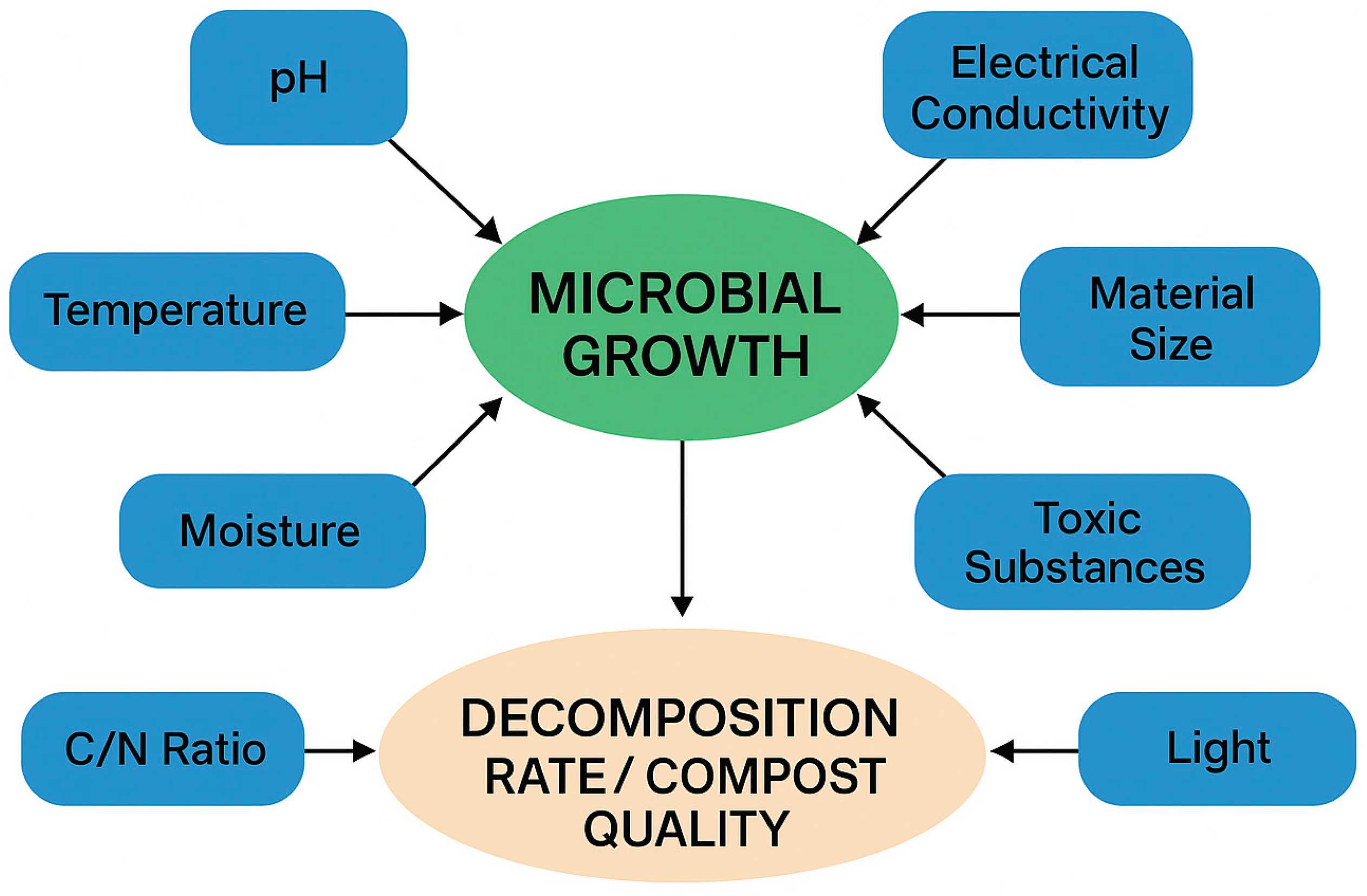

Table 1.
Classify bacteria according to pH of composting environment.
| pH | Bacteria | References |
|---|---|---|
| pH = 4-6 | Acidophilic bacterial | Lorenzo et al., 2018 |
| pH = 6-8 | Neutrophil bacterial | Pinel et al., 2021 |
| pH = 9-11 | Alkaliphilic bacterial | Kanekar et al., 2022 |
Table 2.
Classify bacteria according to temperature of composting environment.
| Temperature | Bacteria | References |
|---|---|---|
| 0-40°C | Mesophilic bacteria | Adekunle et al., 2011 |
| 40-50°C | Thermophilic bacteria | Hassen et al., 2001 |
| 50-55°C | Bacilli species | Ringel-Scaia et al., 2019 |
| 55-121°C | Thermus | Finore et al., 2023 |
Table 3.
Bacterial response according to environmental moisture.
| Moisture | Bacterial response | References |
|---|---|---|
| Lower than 30% | Limit bacteria activity | Liu et al., 2020 |
| 50-60% | Advantages of bacteria activity | Tiquia et al., 1996 |
| More than 65% | Bacilli species | Stone et al., 2016 |
Table 4.
Bacterial response according to environmental C: N Ratio.
| C: N Ratio | Bacterial response | References |
|---|---|---|
| 25:1 to 30:1 | Optimal | Azim et al., 2018 |
| Higher than 40:1 | Restricted | Brinton et al., 2000 |
| Less than 20:1 | Odor problems | Stark et al., 2008 |
Table 5.
Bacterial response according to environmental electrical conductivity.
| Electrical Conductivity | Plant type | References |
|---|---|---|
| 0.8 - 1.8 mS/cm | General Plants | Jacobs et al., 2005 |
| 1.6 - 1.8 mS/cm | Vegetables | Amalfitano et al., 2017 |
| 2 - 2.2 mS/cm | Fruit trees | Karam et al., 2005 |
| Below 0.2 mS/cm | Deficient | Maestre et al., 2019 |
Table 6.
Material size and fermentation efficiency after 48 day (Mishra et al., 2022).
| Material size | Heat retention | Moisture | C/N ratio |
|---|---|---|---|
| 5–15 mm | 7 days | 23.37% | 16.91 |
| 15–30 mm | 8 days | 22.86% | 15.05 |
| 30–45 mm | 4 days | 21.84% | 18.13 |
| 45–75 mm | 3 days | 20.80% | 20.99 |
Table 7.
Summary of factors affecting bacterial growth in compost production.
| Factors | Optimal Range | Impact on bacterial | Notes |
|---|---|---|---|
| pH | 6–8 (neutrophilic bacteria); acidophilic 4–6; alkaliphilic 9–11 | Effects on membrane permeability, metabolism, enzyme activity | Adjust with lime or alkaline/acidic agents as needed. |
| Temperature | Mesophilic: 20–45 °C; Thermophilic: 50–70 °C; Thermus: >55 °C | Affects metabolic rate, enzymes, microbial growth | Temperature management to optimize decomposition and kill pathogens |
| Humidity | 50–60% initially, down to ~30% final i | Maintain metabolic activity, decomposition rate | Manual test: material is moist but not leaking |
| C/N ratio | 25:1–35:1 optimal; 20:1–40:1 acceptable | Balance energy and protein, prevent odor, limit nitrogen loss | Use N-rich “greens” and C-rich “browns” |
| Electrical Conductivity (EC) | 0.8–1.8 mS/cm for plants; do not exceed 2.5 mS/cm | Too high/low EC affects microbial metabolism and plant growth. | Monitor EC during incubation; adjust with organic material |
| Material size | 15–30 mm optimal; 3–50 mm acceptable | Influence of surface area, aeration, decomposition rate | Cut, crush, screen to achieve optimal size |
| Poison | Limit heavy metals, phenols, plastics, surfactants | Enzyme inhibition, gene mutation, microbial death | Eliminate non-biodegradable waste, plastic |
| Light/UV | Avoid direct exposure to sunlight and UV rays | UV 253.7 nm, X-ray, α, β kill microorganisms | Store in shade or cool place; avoid UV-A and blue light |
| Oxy (aeration) |
AFP and FAS adequate; maintain 5–10 m³/h/ton if using air blowing | Provide O₂ for aerobic microorganisms, reduce odor | Rotate, turn or use ASP to adjust air |
Disclaimer/Publisher’s Note: The statements, opinions and data contained in all publications are solely those of the individual author(s) and contributor(s) and not of MDPI and/or the editor(s). MDPI and/or the editor(s) disclaim responsibility for any injury to people or property resulting from any ideas, methods, instructions or products referred to in the content. |
© 2025 by the authors. Licensee MDPI, Basel, Switzerland. This article is an open access article distributed under the terms and conditions of the Creative Commons Attribution (CC BY) license (http://creativecommons.org/licenses/by/4.0/).
Copyright: This open access article is published under a Creative Commons CC BY 4.0 license, which permit the free download, distribution, and reuse, provided that the author and preprint are cited in any reuse.


