

Submitted:
20 October 2025
Posted:
22 October 2025
You are already at the latest version
Abstract
Lignocellulose may be a renewable carbon substitute for petroleum; however, lignocellulosic biorefinery requires thorough physical and chemical characterization to design the most economical method for its exploitation. We therefore performed a range of extractions, degradations, and analyses to characterize a commercial willow biomass resource that has not yet been defined and may be a promising woody resource for the Midwestern USA, especially Michigan. These characterization procedures are believed to be generalizable to examine other lignocellulosic resources, which inspired us to compose a course outline that may convey bioeconomy concepts. Our data complements existing characterizations of willow biomass and identifies which of our assortment of willow varieties are particularly suited for different products of the emerging bioeconomy, which is the raw data that is essential to inform the selection and processing mechanisms of biomass resources.
Keywords:
willow
; biomass
; resources
; biorefinery
; characterization
; Midwest
; lignocellulose
Introduction
Petroleum is unsustainably both a finite resource[1,2] and a substantial contributor to anthropogenic wastes: e.g. non-degradable plastics[3,4,5,6] and carbon-positive fuel emissions[7], which exacerbate climate change[8,9] and species extinction[10,11]. A Green Chemistry Principle[12] and a few Sustainable Development Goals[13] acknowledge these shortcomings of a petroleum-based chemical industry, and accordingly advocates for the use of renewable resources like plant biological material (biomass) in lieu of petroleum products towards the goal of achieving industrial and social sustainability.
Lignocellulosic biomass is Earth’s most abundant and renewable carbon resource, e.g. tera-tons are produced annually[14] via photosynthesis, and thus this is the most logical renewable replacement for petroleum. The isolated carbohydrate and aromatic monomers of lignocellulose can be readily processed into high-value platform chemicals[15,16,17], fuels[18,19], and materials[20,21]; however, the process of isolating these monomers is formidable for biorefinery [15,16,22]. Industry consequently favors food biomass like corn and sugarcane that can more easily be refined into isolated carbohydrate monomers while also minimizing problems of corrosive minerals[23]. Food biomass, despite being more sustainable than petroleum[24], is disadvantageous to woody lignocellulosic for contributing to food insecurities[25], yielding only carbohydrate-derived products through biorefinery, and requiring more fertilizer[26] with often less yields[27] than lignocellulosic biomass[29], which is depicted in Table 1. Research into characterizing lignocellulosic biomass and the isolation of monomers therefrom is thus essential to efficiently exploit Earth’s most abundant and renewable carbon source for a sustainable chemical industry.
The clarion call for lignocellulosic biorefinery research motivated our broad characterization of commercial willow biomass, similar to other studies of wood-derived biomass[30]. Willow was selected as an archetypical lignocellulosic resource for offering 1) rapid growth and asexual reproduction that are amenable to short rotation crop strategies[31], 2) remediation of wastestreams[32] and contaminated soils[33], and 3) desirable adaptations to the seasonal fluctuations[34,35,36] of climates like Michigan. Our willow varieties – Fabius (Salix viminalis x Salix miyabeana), Fishcreek (Salix purpurea), Millbrook (Salix purpurea x Salix miyabeana), and SX64 (Salix miyabeana) – were sourced from DoubleAWillow[37]. Short rotation woody crops such as willow, poplar, and aspen have been explored in Michigan previously[38,39], however, these studies exclusively evaluated biological growth metrics and did not evaluate wood characteristics. We therefore conducted an array of analytical experiments, in partnership with biological collaborators[40], that advance the literature of willow biomass[41,42,43] and especially within the Midwestern USA. We postulate that our chemical characterizations will inform the selection of willow biomass in future, large-scale, biomass projects and perhaps guide biorefinery techniques to specifically process willow biomass. We furthermore devised an upper-level biorefinery laboratory course around these experiments – which is expressed in the Supporting Information – as a means of conveying bioeconomy concepts whilst characterizing lignocellulosic resources. The unreported data of commercial willow biomass herein supports the bioeconomy in the Midwestern USA and may further elucidate biomass options for large-scale biorefinery to meet the goal of a sustainable bioeconomy.
Materials and Methods
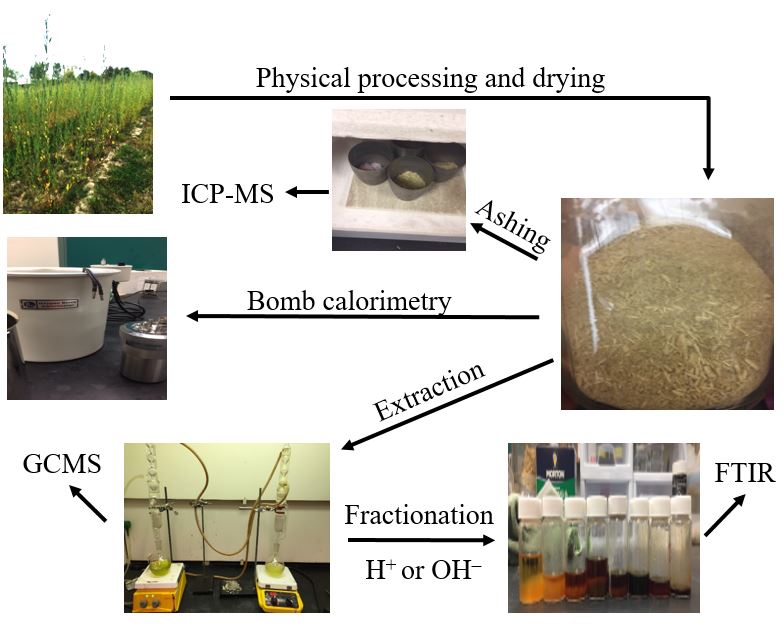
Our experimental sequence is depicted in Figure 1. Steps 1-4, preceding the “ground, dried” sample, simply maximize sample surface area and dryness to improve the efficacy of subsequent experimentation. Each branch of arrows emanating from the “ground, dried” is an independent experiment that is individually discussed.
Harvesting and Drying
We harvested ~200g of stems from each willow variety year after the establishment year. The varieties were examined both individually and as a mixed group (“M”) that was aged outside between January – May. The seasonal exposure of the M samples controlled against weathering and sample age. A wild 5-year-old willow was harvested near the farm plot (“W”) which controlled for farming practices and domestication. All samples were processed into “ground, dried” samples by first chipping via an electric chipper and then cutting the samples into small wood chips. The homogeneous chips were then dried either in a convection oven at 80°C for ~3 days, or in a lyophilizer at ~0.031 mBar and -52 ºC for 1 day. The % moisture was calculated
and was contrasted between both drying methods. The dried chips were then ground in a KitchenAid coffee-mate coffee grinder until small pellets and fine dust remained, which we called the “ground, dried” (GD) sample. This sample was used in all of the subsequent experiments.
Ash Determination
Clean platinum crucibles were loaded with 5g of GD sample and were burned at 575°C for ~2 ¾ hours. The % ash of the charred sample was determined via Equation 1. A 90 mg portion of this ash was dissolved, at ~90°C over 20 minutes, in a solution of 24 mL of DI water and 1 mL of 6 M HNO3 (other acids can be used[44]). The dissolved ash solution was filtered via a Hirsch funnel, reconstituted to 25.00 mL, and then diluted 1.00:100.00. The elements copper, zinc, cadmium, and lead were analyzed via AAS and ICP-MS (Tables S2-S6).
Organic Extractions
Steam distillation and Soxhlet extraction were both conducted. Steam distillation of 20g of GD sample produced 200mL of distillate after ~1.5 hours. This distillate was subsequently extracted in a separatory funnel with ~15g of NaCl and two 10mL aliquots of either ethyl acetate or hexanes solvent, where ethyl acetate was more efficacious and also greener[51]. The resultant organic layers were combined and condensed to 1mL via N2 gas evaporation. Soxhlet extraction of of GD sample, with ~275mL of solvent, was conducted for ~50 reflux cycles at . The extract was condensed to ~10mL via a rotary evaporator and was cooled to room temperature. Any precipitate was vacuum filtered via a Buchner funnel. This precipitate from ethanol solvent was identified as Braun’s lignin[45], which derived through solvolysis of the native lignin[46]. The post-Soxhlet extraction residual solids were air-dried and the % extract was quantified using Equation 1.
The residual solids after Soxhlet extraction with ethanol solvent were predicted to be purely lignocellulose, which assumes that organic metabolites were completely removed during extraction and thus the remaining constituent of the sample is lignocellulose. These residual solids were accordingly used representatively as lignocellulose in subsequent bomb calorimetry and delignification experiments.
The distillates and extracts were analyzed via spectroscopy and chromatography with consistent integration parameters (Tables S7-S8) and with the NIST mass spectral chemical library. A dual-beam UV-Vis spectrophotometer and matching quartz cuvettes assessed Soxhlet extracts after serial dilutions of approximately 3:1, 1:9, 1:99, and 1:699 sample to solvent ratios.
Bomb Calorimetry
A calibrated bomb calorimeter was loaded with 0.45g of lignocellulosic residue and a superficial layer of ~0.55g of vegetable oil that served to homogenize combustion and mitigate sample dispersal. A deliberately slow and steady pressurizing and depressurizing rate was used to additionally mitigate sample dispersal. The enthalpy calculations are expressed in the Supporting Information, where the correction factor for altered pressure during combustion was ~6 orders-of-magnitude less than the standard deviation of our measurements; hence, we conclude that the correctional factor is negligible for lignocellulosic biomass.
Delignification
Alkaline and acidic delignification were both explored as means of isolating the carbohydrate and aromatic monomers of willow lignocellulose. The alkaline procedure dissolved 1g of lignocellulosic residue in 0%, 5%, 10%, or 15% NaOH solutions, with 2 vials for each alkalinity. One of the vials was stirred at ~70 °C for an hour and was then stirred at room temperature for a few days, while the other vial was only stirred at room temperature for a few days. The resultant amber- to black-colored solutions were vacuum filtered, washed with alcohol or water, and then the filtered isolates were air-dried to yield crude lignin.
The alternative acid delignification procedure dissolved ~8 g of lignocellulosic residue in ~60 mL of a 9:1 mixture of 1,4-dioxane and 2M HCl, under heat, which generated a maroon-colored solution. This solution was cooled to room temperature, where precipitate was collected via vacuum filtration and was air-dried. The air-dried precipitate was then dissolved in 10 mL of a 9:1 mixture of acetone and water to produce a purple solution that was diluted 1/10 with DI water, vacuum filtered, and then the filtered isolate was air-dried to yield crude lignin. The second purification dissolved the crude lignin isolate in 10 mL of a 9:1 mixture of acetone and methanol that was subsequently diluted 1/10 with diethyl ether, vacuum filtered, and then the filtered isolate was air-dried to yield purified lignin. The mass balance of each acidic purification is articulated in the Supporting Information. The fractions after both alkaline and acidic delignification were analyzed via IR spectroscopy.
Results
Moisture Determination
The moisture data in Table 2 reveal that oven-drying and lyophilization are statistically equivalent. This suggests that either willow biomass is devoid of volatile organic compounds (VOCs), since mass from VOCs would be lost during the oven-drying yet not during lyophilization, or that VOCs are unable to volatilize from lignocellulosic integument. The former corroborates with steam distillate data where minimal organic material was spectroscopically detected in its essential oil. The data also reveal significant differences between the willow varieties; first, the Fishcreek variety possesses the lowest moisture content; and, second, the weathered M samples possess less moisture yet contain an equivalent Soxhlet extractable content, which suggests that aging samples outside may be an effective method of dehydrating lignocellulosic biomass without sacrificing extractable content.
Ash Determination
The ash data in Table 2 reveal a few significant differences between the willow varieties. The Fiskcreek variety notably possesses the lowest ash content while the wild W samples possesses the greatest ash content. Our willow varieties further contain an order of magnitude more copper than a similar measurement in literature (Table 3), which may be indicative of bioremediation, similar to other elements[47,48].
Extraction
The essential oil via steam distillation was essentially devoid of organic content. Both organic fractions of the W samples and the hexanes fraction of the M samples possessed only solvent peaks in their GC chromatograms, and the respective aqueous mother liquid only possessed the 1635 cm-1 IR peak of water (Figure S6)[49]. The ethyl acetate fraction from the M samples revealed three subtle but identifiable organic peaks (Table S9) that are similar to reported extract from other willow varieties[50]; nevertheless, the miniscule organic content in the essential oil corroborates with the oven-drying and lyophilization equivalence to suggest that willow biomass is a poor source of VOCs.
The Soxhlet extracts, by contrast, were a chemical cornucopia. The use of organic, liquid-phase, extraction dissolves non-volatile compounds like chlorophyll[52], in the UV-Vis spectra (Figure S13), and the identification (Table S11) and quantification (Table S12) of these larger metabolites. Ethanol solvent 1) extracted more mass than acetone, DCM, or hexanes (Table S10), which was between in Table 4; 2) displayed the most diverse extractable profile (Figure S14); and 3) is the greenest solvent[51]; hence, ethanol was used exclusively for all comparisons between the willow varieties (Figures S14). The integrated GCMS chromatograms revealed that the Fishcreek variety possesses the greatest concentration of aspirin precursors, salicin and salicylic acid in Figure 2, and moreover revealed hereditable patterns in metabolic production, which is elaborated in the Supporting Information.
Enthalpy of Combustion
The enthalpy-of-combustion measurements in Table 5 revealed that the Millbrook variety significantly possesses the greatest enthalpic density, relative to the other examined varieties. The results align with literature after considering that the literature assesses the entire biomass (lignocellulose + extractable) while our experiments only assessed lignocellulose, which skews our results lower since lignocellulose is quite oxidized.
Delignification
IR spectroscopy confirmed the presence of depolymerized lignin in our alkaline isolates. The carbonyl[53] peak at 1706 cm-1 in Figure 3 is evident in Kraft lignin from literature[54] from literature and in our Braun's lignin[45] (Figure S16 and Table S14), which supports that this peak is representative of depolymerized lignin. This peak was furthermore observed exclusively with conditions of ≥ 70°C heat and ≥ 10% alkaline in Figure 3, which suggests that minimum conditions for alkaline delignification of willow lignocellulose exist between and alkaline. This peak was inversely proportional, from full width at half maximum calculations (Table S15-S16), with the hydroxyl and C=C peaks of native lignocellulose in Figures 3 at 3345 cm-1 and 1647 cm-1, respectively, which suggests that the carbonyl peak may be mechanistically formed from phenolic oxidation of native lignin[55]. Delignification in alkaline conditions is finally supported by a pronounced C-H out of plane bend[53] peak at 879 cm-1 in the lignin spectra of Figure 3, where depolymerized lignin possessing more sp3 bonds, and thus more out-of-plane bends, than native polymerized lignin. This out-of-place bend is likewise proportional with temperature and alkalinity, which further solidifies the hypothesized minimal conditions for delignification in alkaline conditions.
The lignin isolates from acidic conditions were subtly distinct from those in alkaline conditions. A carbonyl peak at 1717.45 ± 0.07 cm-1 was observed in all acidic delignification trials (Tables S17-S18), which may represent a blue-shifted form of the 1706 cm-1 carbonyl from alkaline conditions and Braun’s lignin that represents a slightly different atomic environment. This highlights the dependency of lignin characteristics upon the delignification method[45], and thus these experiments may uniquely inform the expected qualities of the derived lignin monomers. The spectra for crude and purified lignin isolates were nearly identical (Table S18), which suggests that the secondary purification in acidic conditions is unnecessary. The purification yields, following mass balance, were determined to be 5-17% (Table S19-S20).
Discussion
Our analyses of DoubleAWillow varieties reveal significant differences and amenable properties for woody biorefinery. The Fishcreek variety (Salix purpurea), for example, exhibits the lowest moisture and ash contents, and the greatest concentration of pharmaceutical precursors, which suggest that this variety is the best overall biomass resource, particularly for the pharmaceutical industry that may use biomass crops to source steroidal compounds that are expensive and inefficient to synthesize. The Millbrook variety (Salix purpurea x Salix miyabeana), by contrast, possesses the greatest enthalpy density, which suggests that this variety may be the best biofuel resource. The data additionally reveal spectral qualities of willow lignin monomers in both alkaline and acidic conditions, and moreover identify minimum conditions for alkaline delignification to occur. The ash measurements finally suggest copper accumulation, which, since the soil is not contaminated with copper, suggests unreported bioremediation behavior of copper similar to that of other minerals.
The aforementioned results, as a complement to the biological observations of impressive growth by our biological collaborators, elucidates chemical characteristics of willow biomass that we believe support its use as a biomass resource in the American Midwest. Identifying and characterizing candidate biomass resources is an important initial step, and perhaps may inspire the exploration of other woody lignocellulosic resources, towards a sustainable local bioeconomy.
Supplementary Materials
The following supporting information can be downloaded at the website of this paper posted on Preprints.org.
Author Contributions
Andrew Philip Freiburger: Principal author and researcher. Dalila Kovacs: Research mentor and author. James J. Kirkke: Research mentor and author. Lucian Lucia: Author. Nathanial Dietlin: Researcher.
Associated Content
An appendix is included for extra results and characterization data and supportive figures.
Acknowledgements
The authors thank the GVSU chemistry department for providing the necessary supplies; nathaniel dietlin for his development and experimentation of acidic delignification and ash quantification; and the GVSU biology department and erik nordman for cultivating the willows on our behalf. The authors finally thank kristen freiburger for her critical suggestions and selfless support in the composition of this article.
Conflicts of Interest
The authors declare no competing financial interest with the provided work.
References
- BP Statistical Review of World Energy: 67th Edition; 2018.
- BP Statistical Review of World Energy: 68th Edition; 2019. [CrossRef]
- Eriksen, M.; Lebreton, L.C.M.; Carson, H.S.; Thiel, M.; Moore, C.J.; Borerro, J.C.; Galgani, F.; Ryan, P.G.; Reisser, J. Plastic Pollution in the World’s Oceans: More than 5 Trillion Plastic Pieces Weighing over 250,000 Tons Afloat at Sea. PLoS One 2014, 9, 1–15. [Google Scholar] [CrossRef]
- Restrepo-Flórez, J.M.; Bassi, A.; Thompson, M.R. Microbial Degradation and Deterioration of Polyethylene - A Review. Int. Biodeterior. Biodegrad. 2014, 88, 83–90. [Google Scholar] [CrossRef]
- Bouwmeester, H.; Hollman, P.C.H.; Peters, R.J.B. Potential Health Impact of Environmentally Released Micro- and Nanoplastics in the Human Food Production Chain: Experiences from Nanotoxicology. Environ. Sci. Technol. 2015, 49, 8932–8947. [Google Scholar] [CrossRef]
- Jambeck, J.R.; Geyer, R.; Wilcox, C.; Siegler, T.R.; Perryman, M.; Andrady, A.; Narayan, R.; Law, K.L. Plastic Waste Inputs from Land into the Ocean. Science 2015, 347, 768–771. [Google Scholar] [CrossRef]
- Pearson, P.N.; Palmer, M.R. Atmospheric Carbon Dioxide Concentrations over the Past 60 Million Years. Nature 2000, 406, 695–699. [Google Scholar] [CrossRef]
- Crafts-Brandner, S.J.; Salvucci, M.E. Rubisco Activase Constrains the Photosynthetic Potential of Leaves at High Temperature and CO2. Proc. Natl. Acad. Sci. U. S. A. 2000, 97, 13430–13435. [Google Scholar] [CrossRef] [PubMed]
- Hansen, J.; Sato, M.; Ruedy, R.; Lo, K.; Lea, D.W.; Medina-Elizade, M. Global Temperature Change. Proc. Natl. Acad. Sci. U. S. A. 2006, 103, 14288–14293. [Google Scholar] [CrossRef] [PubMed]
- De Vos, J.M.; Joppa, L.N.; Gittleman, J.L.; Stephens, P.R.; Pimm, S.L. Estimating the Normal Background Rate of Species Extinction. Conserv. Biol. 2014, 29, 452–462. [Google Scholar] [CrossRef] [PubMed]
- Thomas, C.D.; Cameron, A.; Green, R.E.; Bakkenes, M.; Beaumont, L.J.; Collingham, Y.C.; Erasmus, B.F.N.; Ferreira De Siqueira, M.; Grainger, A.; Hannah, L.; Hughes, L.; Huntley, B.; Van Jaarsveld, A.S.; Midgley, G.F.; Miles, L.; Ortega-Huerta, M.A.; Peterson, A.T.; Phillips, O.L.; Williams, S.E. Extinction Risk from Climate Change. Nature 2004, 427, 145–148. [Google Scholar] [CrossRef]
- Anastas, P.T.; Warner, J.C. Green Chemistry: Theory and Practice; Oxford University Press, 1998.
- Fahriye Enda, T.; Karaosmanoglu, F. Supply Chain Network Carbon Footprint of Forest Biomass to Biorefinery. J. Sustain. For. 2021, 40, 124–141. [Google Scholar] [CrossRef]
- CELLULOSE – FUNDAMENTAL ASPECTS.; Godbout, L., Ven, T. van de, Eds.; InTech, 2013.
- Zakzeski, J.; Bruijnincx, P. C. A.; Jongerius, A. L.; Weckhuysen, B. M. The Catalytic Valorization of Lignin for the Production of Renewable Chemicals. Chemical Reviews. 2010, pp 3552–3599. [CrossRef]
- Werpy, T.; Petersen, G. Top Value Added Chemicals from Biomass Volume I – Results of Screening for Potential Candidates from Sugars and Synthesis Gas; 2004. [CrossRef]
- Bechthold, I.; Bretz, K.; Kabasci, S.; Kopitzky, R.; Springer, A. Succinic Acid: A New Platform Chemical for Biobased Polymers from Renewable Resources. Chem. Eng. Technol. 2008, 31, 647–654. [Google Scholar] [CrossRef]
- Mascal, M.; Nikitin, E.B. Direct, High-Yield Conversion of Cellulose into Biofuel. Angew. Chemie - Int. Ed. 2008, 47, 7924–7926. [Google Scholar] [CrossRef] [PubMed]
- Ragauskas, A.J.; Nagy, M.; Kim, D.H.; Eckert, C.A.; Hallett, J.P.; Liotta, C.L. From Wood to Fuels. Ind. Biotechnol. 2006, 2, 55–65. [Google Scholar] [CrossRef]
- Liu, B.; Huang, Y.; Cao, H.; Song, A.; Lin, Y.; Wang, M.; Li, X. A High-Performance and Environment-Friendly Gel Polymer Electrolyte for Lithium Ion Battery Based on Composited Lignin Membrane. J. Solid State Electrochem. 2018, 22, 807–816. [Google Scholar] [CrossRef]
- Lavoine, N.; Desloges, I.; Dufresne, A.; Bras, J. Microfibrillated Cellulose - Its Barrier Properties and Applications in Cellulosic Materials: A Review. Carbohydr. Polym. 2012, 90, 735–764. [Google Scholar] [CrossRef]
- Vincent, S.; Prado, R.; Kuzmina, O.; Potter, K.; Bhardwaj, J.; Wanasekara, N.D.; Harniman, R.L.; Koutsomitopoulou, A.; Eichhorn, S.J.; Welton, T.; Rahatekar, S.S. Regenerated Cellulose and Willow Lignin Blends as Potential Renewable Precursors for Carbon Fibers. ACS Sustain. Chem. Eng. 2018, 6, 5903–5910. [Google Scholar] [CrossRef]
- Livingston, B.; Babcock, M. Ash Related Issues in Biomass Combustion. In ThermalNet workshop; 2006; p 169.
- Liska, A.J.; Yang, H.S.; Bremer, V.R.; Klopfenstein, T.J.; Walters, D.T.; Erickson, G.E.; Cassman, K.G. Improvements in Life Cycle Energy Efficiency and Greenhouse Gas Emissions of Corn-Ethanol. J. Ind. Ecol. 2009, 13, 58–74. [Google Scholar] [CrossRef]
- Hunger Notes. 2018 world hunger and poverty facts and statistics https://www.worldhunger.org/world-hunger-and-poverty-facts-and-statistics/ (accessed Sep 7, 2020).
- Hytönen, J. Effect of Fertilizer Treatment on the Biomass Production and Nutrient Uptake of Short-Rotation Willow on Cut-Away Peatlands. Silva Fennica. 1995, pp 21–40. [CrossRef]
- 2016 Agricultural Chemical Use Survey: Corn; 2017.
- Yang, H.; Zhou, Y.; Liu, J. Land and Water Requirements of Biofuel and Implications for Food Supply and the Environment in China. Energy Policy 2009, 37, 1876–1885. [Google Scholar] [CrossRef]
- Heller, M.C.; Keoleian, G.A.; Volk, T.A. Life Cycle Assessment of a Willow Bioenergy Cropping System. Biomass and Bioenergy 2003, 25, 147–165. [Google Scholar] [CrossRef]
- Balaguer-Benlliure, V.; Moya, R.; Gaitán-Alvarez, J. Physical and Energy Characteristics, Compression Strength, and Chemical Modification of Charcoal Produced from Sixteen Tropical Woods in Costa Rica. J. Sustain. For. 2021, 00, 1–19. [Google Scholar] [CrossRef]
- Ford-Robertson, J.B.; Mitchell, C.P.; Watters, M.P. Short Rotation Coppice Energy Plantations: Technology and Economics. J. Sustain. For. 1994, 1, 23–40. [Google Scholar] [CrossRef]
- Perttu, K.L. Biomass Production and Nutrient Removal from Municipal Wastes Using Willow Vegetation Filters. J. Sustain. For. 1994, 1, 57–70. [Google Scholar] [CrossRef]
- Sennerby-Forsse, L.; Melin, J.; Rosen, K.; Siren, G. Uptake and Distribution of Radiocesium in Fast-Growing Salix Viminalis L. J. Sustain. For. 1994, 1, 93–103. [Google Scholar] [CrossRef]
- Mirck, J.; Isebrands, J.G.; Verwijst, T.; Ledin, S. Development of Short-Rotation Willow Coppice Systems for Environmental Purposes in Sweden. Biomass and Bioenergy 2005, 28, 219–228. [Google Scholar] [CrossRef]
- Mola-Yudego, B.; Aronsson, P. Yield Models for Commercial Willow Biomass Plantations in Sweden. Biomass and Bioenergy 2008, 32, 829–837. [Google Scholar] [CrossRef]
- Volk, T.A.; Abrahamson, L.P.; Nowak, C.A.; Smart, L.B.; Tharakan, P.J.; White, E.H. The Development of Short-Rotation Willow in the Northeastern United States for Bioenergy and Bioproducts, Agroforestry and Phytoremediation. Biomass and Bioenergy 2006, 30, 715–727. [Google Scholar] [CrossRef]
- Willow plant cuttings for sale https://doubleavineyards.com/willow-cuttings-for-sale.
- Wang, Z.; MacFarlane, D.W. Evaluating the Biomass Production of Coppiced Willow and Poplar Clones in Michigan, USA, over Multiple Rotations and Different Growing Conditions. Biomass and Bioenergy 2012, 46, 380–388. [Google Scholar] [CrossRef]
- Koerper, G.J.; Richardson, C.J. Biomass and Net Annual Primary Production Regressions for Populus Grandidentata on Three Sites in Northern Lower Michigan. Can J. FOR. RES. 1980, 10. [Google Scholar] [CrossRef]
- Crawford, J.A.; Nordman, E. Analyzing Survival, Growth, and Environmental Effects of Willow Biomass Energy Crops at GVSU. ScholarWorks@GVSU.
- Dou, J.; Xu, W.; Koivisto, J.J.; Mobley, J.K.; Padmakshan, D.; Kögler, M.; Xu, C.; Willför, S.; Ralph, J.; Vuorinen, T. Characteristics of Hot Water Extracts from the Bark of Cultivated Willow (Salix Sp.). ACS Sustain. Chem. Eng. 2018, 6, 5566–5573. [Google Scholar] [CrossRef]
- Dou, J.; Galvis, L.; Holopainen-Mantila, U.; Reza, M.; Tamminen, T.; Vuorinen, T. Morphology and Overall Chemical Characterization of Willow (Salix Sp.) Inner Bark and Wood: Toward Controlled Deconstruction of Willow Biomass. ACS Sustainable Chemistry and Engineering. 2016, pp 3871–3876. [CrossRef]
- Dou, J.; Kim, H.; Li, Y.; Padmakshan, D.; Yue, F.; Ralph, J.; Vuorinen, T. Structural Characterization of Lignins from Willow Bark and Wood. J. Agric. Food Chem. 2018, 66, 7294–7300. [Google Scholar] [CrossRef]
- Chandrasekaran, S.R.; Hopke, P.K.; Rector, L.; Allen, G.; Lin, L. Chemical Composition of Wood Chips and Wood Pellets. Energy and Fuels. 2012, pp 4932–4937. [CrossRef]
- Brauns, F.E. The Isolation and Methylation of Native Lignin. J. Am. Chem. Soc. 1939, 61, 2120–2127. [Google Scholar] [CrossRef]
- Nielsen, J.B.; Jensen, A.; Schandel, C.B.; Felby, C.; Jensen, A.D. Solvent Consumption in Non-Catalytic Alcohol Solvolysis of Biorefinery Lignin. Sustain. Energy Fuels 2017, 1, 2006–2015. [Google Scholar] [CrossRef]
- Maxted, A.P.; Black, C.R.; West, H.M.; Crout, N.M.J.; Mcgrath, S.P.; Young, S.D. Phytoextraction of Cadmium and Zinc by Salix from Soil Historically Amended with Sewage Sludge. Plant Soil 2007, 290, 157–172. [Google Scholar] [CrossRef]
- Mertens, J.; Vervaeke, P.; Meers, E.; Tack, F.M.G. Seasonal Changes of Metals in Willow (Salix Sp.) Stands for Phytoremediation on Dredged Sediment. Environ. Sci. Technol. 2006, 40, 1962–1968. [Google Scholar] [CrossRef]
- NIST Chemistry WebBook, SRD 69: Water https://webbook.nist.gov/cgi/cbook.cgi?ID=C7732185&Type=IR-SPEC&Index=1 (accessed Jun 2, 2020).
- Jerković, I.; Marijanović, Z.; Tuberoso, C.I.G.; Bubalo, D.; Kezić, N. Molecular Diversity of Volatile Compounds in Rare Willow (Salix Spp.) Honeydew Honey: Identification of Chemical Biomarkers. Mol. Divers. 2010, 14, 237–248. [Google Scholar] [CrossRef] [PubMed]
- Capello, C.; Fischer, U.; Hungerbühler, K. What Is a Green Solvent? A Comprehensive Framework for the Environmental Assessment of Solvents. Green Chem. 2007, 9, 927–993. [Google Scholar] [CrossRef]
- Makarska-Bialokoz, M.; Kaczor, A.A. Computational Analysis of Chlorophyll Structure and UV-Vis Spectra: A Student Research Project on the Spectroscopy of Natural Complexes. Spectrosc. Lett. 2014, 47, 147–152. [Google Scholar] [CrossRef]
- Jr., M.J.; Fleming, S.A. Organic Chemistry; Fifth, Ed.; W. W. Norton & Company: New York, New York, 2014.
- Boeriu, C.G.; Bravo, D.; Gosselink, R.J.A.; Van Dam, J.E.G. Characterisation of Structure-Dependent Functional Properties of Lignin with Infrared Spectroscopy. Ind. Crops Prod. 2004, 20, 205–218. [Google Scholar] [CrossRef]
- Thomson, R.H. Phenol Tautomerism. Q. Rev. Chem. Soc. 1956, 10, 27–43. [Google Scholar] [CrossRef]
- 2016 Agricultural Chemical Use Survey - Corn; 2017.
- USDA. Feedgrains sector at a glance https://www.ers.usda.gov/topics/crops/corn-and-other-feedgrains/feedgrains-sector-at-a-glance/ (accessed May 31, 2020).
- Musick, J.T.; Dusek, D.A. Irrigated Corn Yield Response To Water. Am. Soc. Agric. Eng. 1980, 92–103. [Google Scholar] [CrossRef]
- Howell, T.A.; Yazar, A.; Schneider, A.D.; Dusek, D.A.; Copeland, K.S. Yield and Water Use Efficiency of Corn in Response to LEPA Irrigation. Am. Soc. Agric. Eng. 1995, 38, 1737–1747. [Google Scholar] [CrossRef]
- Mubako, S.; Lant, C. Water Resource Requirements of Corn-Based Ethanol. Water Resour. Res. 2008, 44, 1–5. [Google Scholar] [CrossRef]
- Ham, G.E.; Liener, I.E.; Evans, S.D.; Frazier, R.D.; Nelson, W.W. Yield and Composition of Soybean Seed as Affected by N and S Fertilization. Agron. J. 1975, 67, 293–297. [Google Scholar] [CrossRef]
- Frédette, C.; Grebenshchykova, Z.; Comeau, Y.; Brisson, J. Evapotranspiration of a Willow Cultivar (Salix Miyabeana SX67) Grown in a Full-Scale Treatment Wetland. Ecol. Eng. 2019, 127, 254–262. [Google Scholar] [CrossRef]
- Mirck, J.; Volk, T.A. Seasonal Sap Flow of Four Salix Varieties Growing on the Solvay Wastebeds in Syracuse, NY, USA. Int. J. Phytoremediation 2009, 12, 1–23. [Google Scholar] [CrossRef]
- Keller, C.; Ludwig, C.; Davoli, F.; Wochele, J. Thermal Treatment of Metal-Enriched Biomass Produced from Heavy Metal Phytoextraction. Environ. Sci. Technol. 2005, 39, 3359–3367. [Google Scholar] [CrossRef]
- Telmo, C.; Lousada, J. Heating Values of Wood Pellets from Different Species. Biomass and Bioenergy 2011, 35, 2634–2639. [Google Scholar] [CrossRef]
Figure 1.
An sequence of experiments in the biorefinery course. Steps 1-4 achieve a “ground, dried” sample through processes that are specific to the biomass. Steps 5 & 6 are dependent only upon steps 1-4; Steps 8 & 9 are dependent upon steps 1-4 and step 7. The text above each arrow describes the technique or method that is used experiment, while the bolded text below each arrow describes the quantitative data that is acquired from the process.
Figure 1.
An sequence of experiments in the biorefinery course. Steps 1-4 achieve a “ground, dried” sample through processes that are specific to the biomass. Steps 5 & 6 are dependent only upon steps 1-4; Steps 8 & 9 are dependent upon steps 1-4 and step 7. The text above each arrow describes the technique or method that is used experiment, while the bolded text below each arrow describes the quantitative data that is acquired from the process.
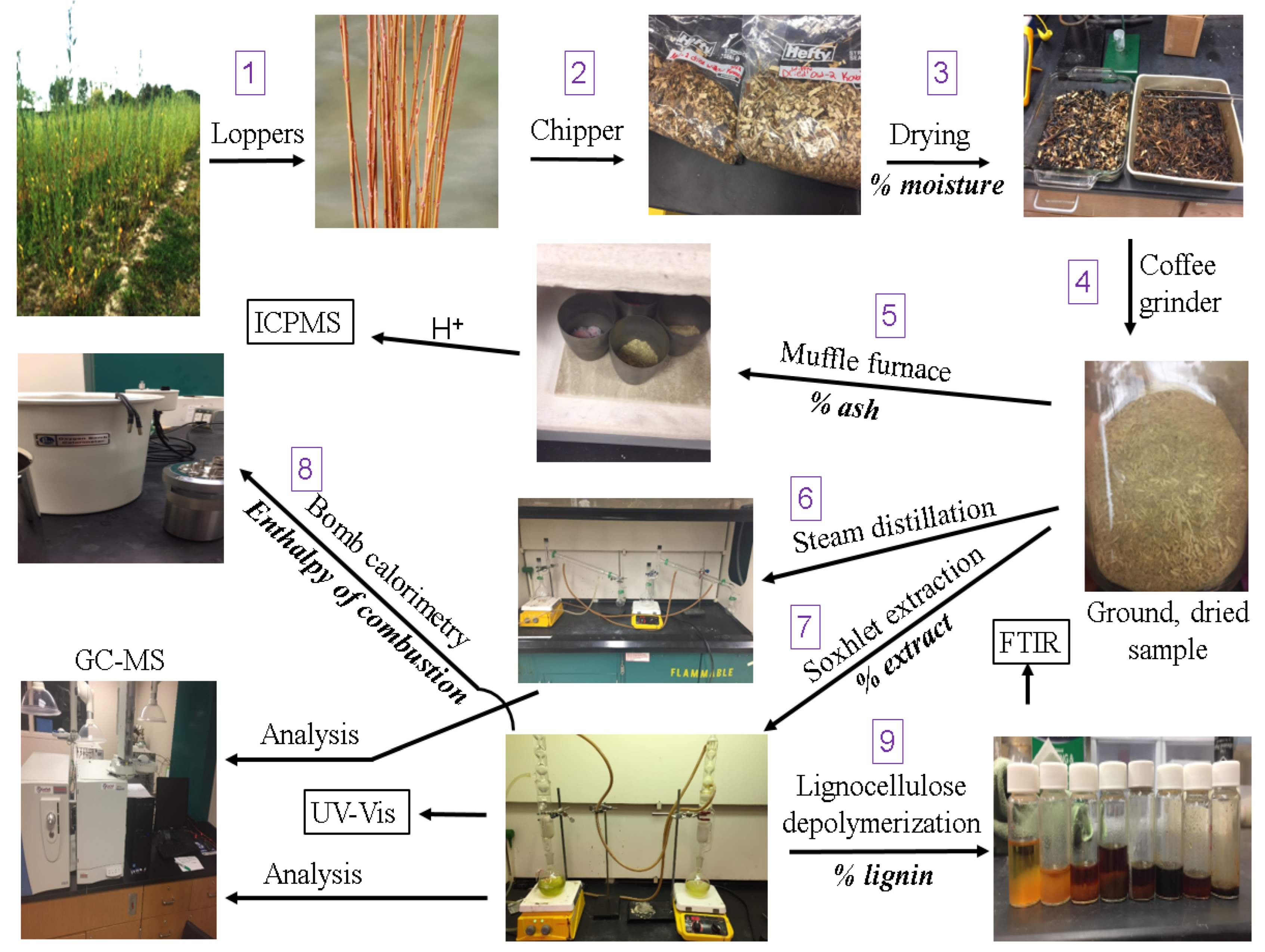
Figure 2.
Gas chromatogram of the ethanol Soxhlet extract from the Fishcreek willow variety.
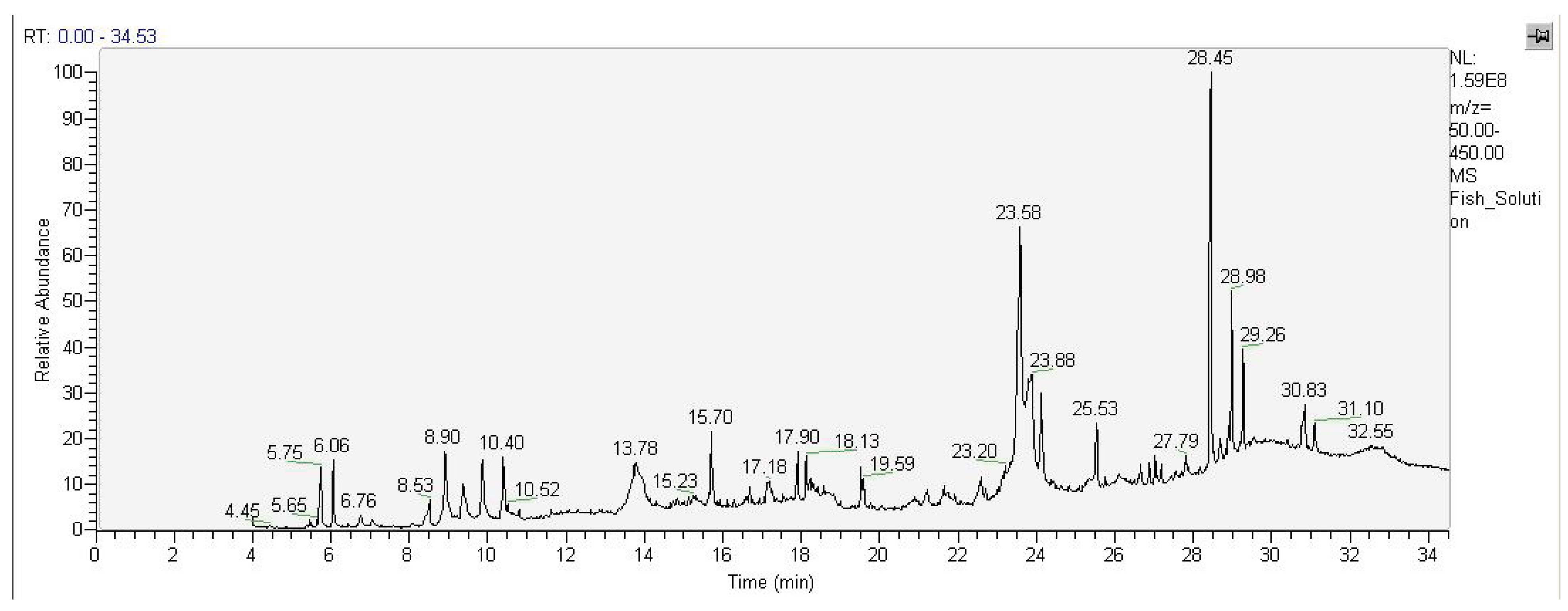
Figure 3.
FTIR spectra of trials with 10% and 15% alkaline. The background figure depicts the 10% trial, with heated filtrate on top and room temperature filtrate on bottom. The foreground figure depicts the 15% trial, with heated filtrate as the black (top line), room temperature filtrate (red), heated solid residue (blue), and room temperature solid residue (green).
Figure 3.
FTIR spectra of trials with 10% and 15% alkaline. The background figure depicts the 10% trial, with heated filtrate on top and room temperature filtrate on bottom. The foreground figure depicts the 15% trial, with heated filtrate as the black (top line), room temperature filtrate (red), heated solid residue (blue), and room temperature solid residue (green).
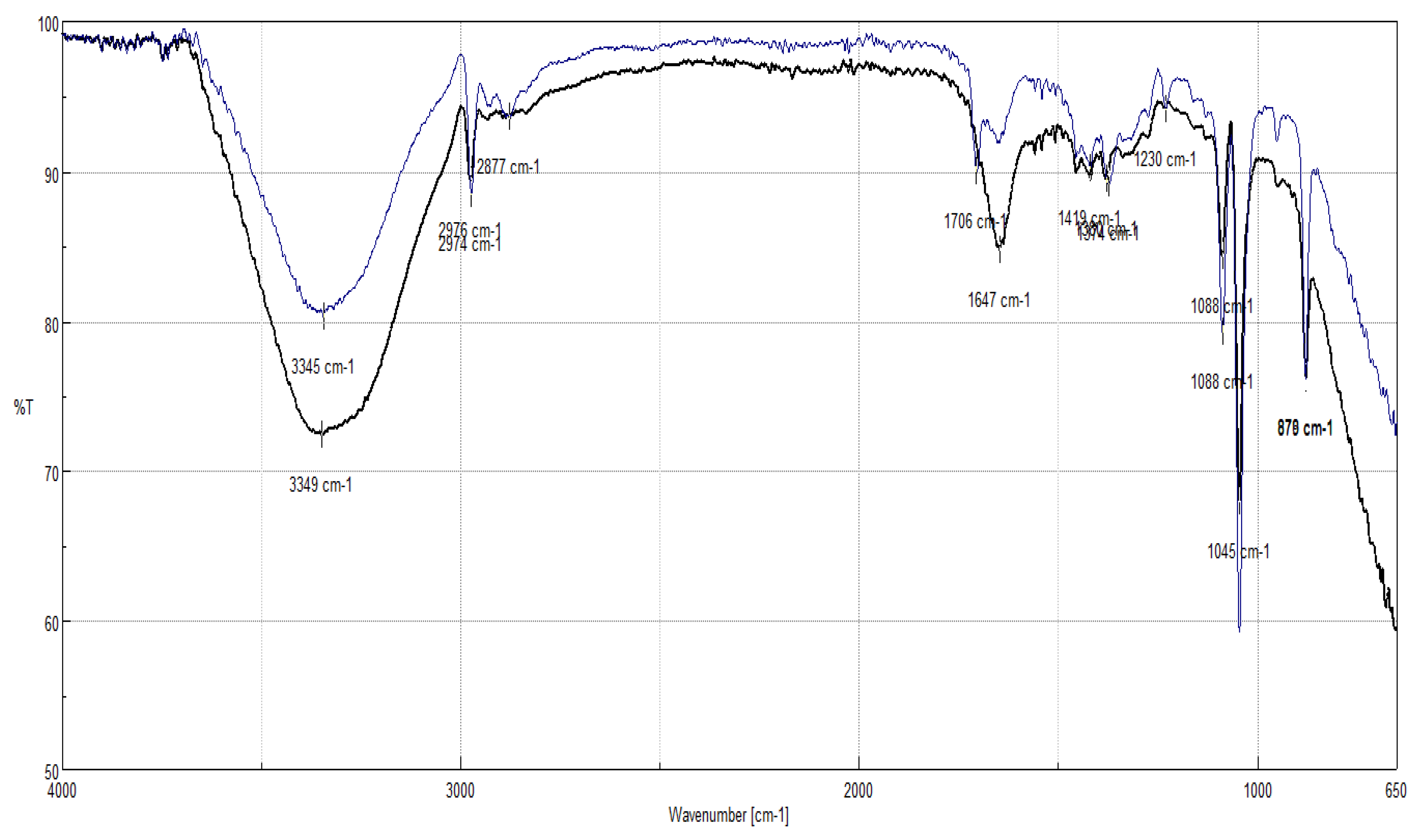

Table 1.
Annual requirements for 1st generation biomass food crops (corn and soybeans), a fiber crop (hemp), and a woody crop (willow).
Table 1.
Annual requirements for 1st generation biomass food crops (corn and soybeans), a fiber crop (hemp), and a woody crop (willow).
| Plant feedstock | Water requirements () | Fertilizer requirements( | Dry crop yield ( |
| Corn | 3433,5-8804 | 3381 | ~29003,2 – 11,8004 |
| Soybeans | 7335 | 59-3217 | 17201-85006 |
| Willow (lignocellulosic) | 4949–39548 | 1007 | 77007 |
1 The total mass is constituted by nitrogen (162kg), phosphate (68kg), Potash (90kg), and Sulfer (18kg) [56]. 2 The ‘56 lb per bushel’ definition is assumed [57]; 3 [58]; 4 440 for irrigated water requirements [59]; 5 A weighted average of the irrigated and non-irrigated fields [60]; 6 Nitrogen exclusively for non-nodulating isolines [61]; 7 Exclusively nitrogen fertilization, where the addition of potassium and phosphorous fertilizers were not associated with increased growth rates [26]; 8 The seasonal EF in wetlands [62]; 9 Sapflow was considered a proxy for transpiration [63].
Table 2.
Moisture and ash data for each willow variety. The error derives from 2-4 trials. The 1 superscript denotes a lyophilized trial.
Table 2.
Moisture and ash data for each willow variety. The error derives from 2-4 trials. The 1 superscript denotes a lyophilized trial.
| Wood sample | % moisture (from total biomass) | % Ash (from dehydrated samples) |
|---|---|---|
| W |
50.06 ± 0.71 |
2.862 ± 0.037 |
| M | 19.76 ± 0.26 | 2.44 ± 0.27 |
| Fishcreek | 43.6 ± 1.6 42.31 | 1.51 ± 0.24 |
| Fabius | 52.2 ± 2.0 53.61 | 2.39 ± 0.37 |
| SX-64 | 50. ± 2.2 50.41 | 2.53 ± 0.67 |
| Millbrook | 51.6 ± 1.2 51.11 | 2.72 ± 0.53 |
Table 3.
Elemental concentrations in ash from the Fishcreek variety. The quantities are compared with a literature reference.
Table 3.
Elemental concentrations in ash from the Fishcreek variety. The quantities are compared with a literature reference.
| Data source | Copper (ppm) | Lead (ppm) | Cadmium (ppm) | Zinc (ppm) |
| Keller et al.[64] (ox. conditions) | 171 | - | 2 | 7293 |
| Fiskcreek | 2300 | 18 | 2.3 | 7500 |
Table 4.
Extractable content via ethanol Soxhlet extraction for the four cultivated willow varieties.
Table 4.
Extractable content via ethanol Soxhlet extraction for the four cultivated willow varieties.
| Willow variety | Proportion of extractable mass (%) |
|---|---|
| Fishcreek (Salix purpurea) | 9.8 ± 1.1 |
| Fabius (Salix viminalis x Salix miyabeana) | 11.22 ± 0.90 |
| SX-64 (Salix miyabeana) | 12.42 ± 0.40 |
| Millbrook (Salix purpurea x Salix miyabeana) | 10.72 ± 0.70 |
Table 5.
Enthalpy of combustion data from the bomb calorimetry experiments. The pre-extracted four willow varieties are contrasted with an un-extracted willow species from literature.
Table 5.
Enthalpy of combustion data from the bomb calorimetry experiments. The pre-extracted four willow varieties are contrasted with an un-extracted willow species from literature.
| Sample | Enthalpy of combustion (kilojoules/gram) | Standard deviation (kilojoules/gram) |
|---|---|---|
| Vegetable oil | 43.4 | 0.3 |
| Fabius (Salix viminalis x Salix miyabeana) | 13.0 | 0.5 |
| SX64 (Salix miyabeana) | 15.3 | 0.5 |
| Millbrook (Salix purpurea x Salix miyabeana) | 17.6 | 0.3 |
| Fishcreek (Salix purpurea) | 15.5 | 0.2 |
| Salix babilonica[65] | 18.279 | 0.348 |
Disclaimer/Publisher’s Note: The statements, opinions and data contained in all publications are solely those of the individual author(s) and contributor(s) and not of MDPI and/or the editor(s). MDPI and/or the editor(s) disclaim responsibility for any injury to people or property resulting from any ideas, methods, instructions or products referred to in the content. |
© 2025 by the authors. Licensee MDPI, Basel, Switzerland. This article is an open access article distributed under the terms and conditions of the Creative Commons Attribution (CC BY) license (http://creativecommons.org/licenses/by/4.0/).
Copyright: This open access article is published under a Creative Commons CC BY 4.0 license, which permit the free download, distribution, and reuse, provided that the author and preprint are cited in any reuse.


