

Submitted:
19 October 2025
Posted:
20 October 2025
Read the latest preprint version here
Abstract
Alena Tensor is a recently discovered class of energy-momentum tensors that proposes a general equivalence of the curved path and geodesic for analyzed spacetimes which allows the analysis of physical systems in curvilinear (GR), classical and quantum descriptions. This paper demonstrates that extending the existing dust description to a form that provides a full matter energy-momentum tensor in GR naturally leads to the development of a halo effect for continuum media. This result provides a good approximation of the galaxy rotation curve for approximately 100 analyzed objects from the SPARC database and allows for further adjustments dependent on anisotropy and energy flux. In the resulting picture, matter density is responsible for the increase in rotation velocity, and the resulting rotational energy is responsible for maintaining it. The cumulative effect keeps matter outside the standard geodesic, and the trajectory of motion and lensing effects depend on both the rest masses and the obtained rotational energy. The model also provides the possibility of a classical description based on standard vacuum equations.
Keywords:
unification
; Alena Tensor
; dark energy
; dark matter
1. Introduction
Research on the dark sector has been ongoing for many years [1] and there is still no theoretical consensus [2] or convincing experimental evidence regarding its nature [3]. We have not found dark matter signals for the WIMP models [4], axions/ALPs [5], SIDM [6], despite new experimental approaches [7], experiments in underground detectors [3], LZ experiments [4], XENON-nT [8] or SuperCDMS [9], and the latest observational data (e.g., "Hubble tension", ”Sigma-8 tension”) make the issue of the dark sector even more puzzling [10]. The dominant theoretical model is still with dark matter haloes [11], although alternative theories such as MOND/relativistic generalizations [12], dark photons [13], TeVeS/related constructions [12], f(R) [14], black holes [15], or the recently popular ”emergent/entropic gravity” [16] have achieved some success at selected scales. However, all these approaches experience ups and downs depending on the subsequent observational data [4,8,10,17].
There is also considered the possibility of hybrid models (e.g. a superfluid DM combining features of MOND and DM) [18], or even incorrect/weakened estimates of baryon masses and systematic errors in the M/L estimate [19], and the interaction of dark matter and energy [20] but so far this entire massive effort by the scientific community has not yielded a definitive conclusion. We have more certainty about dark energy because the universe is definitely expanding, and there are ample, multiple, independent confirmations, eg. from SN Ia, BAO, and CMB [11,21]. It is still uncertain whether the cosmological constant is indeed constant, although recent DESI (BAO) analyses indicate the possibility of w(z) dynamics [22], and the Euclid mission is rapidly delivering high-quality weak lensing maps and surveys that will be crucial for measuring the dark energy equation of state [23].
The Alena Tensor is a relatively young field of research and has not had much relevance to the dark sector until now. Previous work has focused on developing a dual description for physical systems with matter and fields in which the metric tensor is not a feature of spacetime but only a method of describing it. Its aim is to provide a smooth transition between curvilinear description consistent with GR [24] and a flat (classical and quantum [25]) description for simple cases with dust [26], which was analyzed mainly for physical systems with electromagnetic fields [27]. This paper will demonstrate that extending the Alena Tensor to the general case yields results, that provide a representation of the spherical dark matter halo and, naturally, provide an explanation for the cosmological constant. The obtained picture of GR equations leads to a potential explanation of the dark matter phenomenon based on the energy associated with the rotation itself and for about 100 diverse galaxies from the SPARC database [28] gives a fairly good approximation of the observed rotation curves.
In the first part of the paper, an introduction to the Alena Tensor model for dust will be presented, then this approach will be extended to the general form of the matter energy-momentum tensor, leading to the "dark matter halo effect". The results will be analyzed and discussed and shown to lead to the conclusions described in the abstract.
2. Results
In this chapter, the conclusions reached so far regarding the Alena Tensor will be recalled, the notation will be introduced, and the reasoning from the previous articles will be generalized to all gauge fields and all forces acting in the physical system. The obtained results will be then used to formulate conclusions regarding the dark matter and compared with observational data.
2.1. Transforming Curved Path into Geodesic for Dust
As a first step, one may generalize the solution proposed in [26] in such a way that the forces resulting from all gauge fields are related to the metric tensor of curved spacetime.
One may begin the reasoning by introducing tensor defined in terms of the gauge field tensors for each gauge group A, and the stress-energy tensor for such generalized field
and denote the invariant of this field as . Following reasoning from [26] let this field invariant be defined dually as follows
where is certain constant (or simply invariant, independent of the metric) and where , as raised in [25], in this approach is a metric tensor describing a curved spacetime in which all motion occurs along geodesics. By making variation on with respect to metric (Hilbert’s method) one obtains the energy-momentum tensor of the field from (1) expressed dually as
Such approach, exactly as shown in [26], establishes a relationship between the field and the metric tensor and in the spacetime considered as described by the metric tensor , one obtains what yields that in curvilinear description of the system, energy-momentum tensor of the field vanishes, maintaining continuity of function. As shown in previous articles, this causes the presence of a field in curved spacetime to manifest itself solely through curvature, which replaces the four-force densities in flat spacetime.
In flat spacetime, one may assume that the equations of motion for the gauge fields A are satisfied, thus one obtains gauge four-currents . Therefore, the total density of the Yang-Mills four-forces [29,30] is
where the self-interactions of gauge fields in a non-Abelian theory are reducing. Then, following the reasoning presented in [26] one may define coefficient where represents matter density and is associated with the translational current . In the Alena Tensor approach, the existence of matter is thus a manifestation of the existence of fields what ensures, that without fields matter does not exist.
This allows to define the Lagrangian and obtain from it the strest-energy tensor (Alena Tensor) for the system with dust by variation on the metric
In accordance with [27], assuming as rest mass density, four-momentum density is defined as what takes into account motion and Lorentz contraction of the volume. Total translational four-force density acting on matter is therefore defined as
As shown in [25], the above amendment introduces a natural property concerning curved spacetime, assuming that for dust, geodetic motion is expected
Now it can be noticed, that in flat spacetime the four-divergence of the above tensor can be interpreted as the density of the four-forces acting on matter reduced by the density of the field-related four-forces
As shown in [25], can be associated with the existence of gravity in the system, while behaves as a radiation-reaction force, reducing the value of forces due to the field and upholding the conservation of energy, ensuring that the increasing energy density associated with matter does not exceed the total energy density available in the system
where . Presented approach also indicates the anstaz for the Kerr-Schild type metrics for curved spacetime
where are null vectors and are related coefficients.
In the next section, the above model will be expanded to include rotation-related components, which will prove crucial for describing dark sector phenomena and allow to obtain a description that agrees with the observational results.
2.2. Rotational Energy
It can be noticed that the radiation reaction force should take into account the total energy associated with the body, so in addition to the energy associated with the translational motion, it seems necessary to take into account the rotational energy.
One may thus introduce a projector , flow vorticity tensor , positive coefficient equal to the rotational energy up to and some metric independent auxiliary with the dimension of the square of time
Defining Lagrangian density for the whole system and tensor to describe emerging boundary terms
and introducing tensor related to rotational properties of the system
one obtains Alena Tensor for the system derived with help of variational method on in the form
Considering description in curved spacetime, described by the metric tensor , the field tensor vanishes, the system tensor reduces to the form and its vanishing four-divergence means that any deviations from the geodesic motion with are compensated by rotation related forces. Using the standard kinematic decomposition one may calculate
where the element in brackets in last equation represents in fact the purely spatial vorticity divergence. Assuming the classical definition of the energy flux one also gets
Introducing classical shear tensor and effective vortex stress tensor as
one may thus rewrite in curved spacetime as
One may notice, that the system has a built-in anisotropic stress described by , but its source is not viscosity, but the coupling between shear and vorticity (between flow deformation and local spin angular momentum).
Considered in flat spacetime such approach introduces additional four-force density acting on matter and also changes and the radiation reaction to the form
One may now repeat the reasoning from [26] and define the generalized Ricci and Einstein tensors, where the sign indicates normalization with the constant , and additional tensor as
where the last equality holds in any considered spacetime and for , becomes the classical GR equation in curved spacetime (in curved spacetime and vanish).
The Lagrangian for may be obtained the same way as in [26] with the use of the interpolating path method . Using this method one obtains
Since the variation of the functional is located on the boundary , thus .
In the last equation of () considered in curved spacetime field invariant acts as double the vacuum energy density (vacum pressure). This equation may be derived from the Lagrangian density in the form
where the variation by Hilbert’s method on gives .
The equation () considered in curved spacetime simplifies to where and thus also vanishes. It is also worth noting that in flat spacetime the generalized Einstein tensor is associated with the four-divergence of
so the curvature it describes in curved spacetime replaces this four-force density, where is related to gravity and is the density of radiation-reaction four-force. The presence of the radiation-reaction force has already been discussed in previous works [24], and it now prevents the matter energy and rotational energy from increasing beyond the maximum energy density available in the system.
It is worth noting that internal energy density and rotational energy, essentially exhaust the possible forms of energy that can be attributed to material bodies (other forms of energy, e.g., chemical energy, can be treated as their components) which could be present in the radiation reaction force. This means that the model proposed here seems complete (with the possible extension of to a tensor form for more complex systems) and should allow for reproducing the results obtained from GR, as well as reproducing observational results that are inconsistent (such as the dark sector) with currently used interpretation of GR.
Alena Tensor approach therefore allows to look at Einstein’s equations in a new light and analyze the possibilities of explaining the dark sector in a consistent mathematical framework that allows analysis in both flat and curved spacetime. Importantly, it is also possible to analyze the system using a quantum approach (in the description for flat spacetime) and to use standard tools of continuum mechanics for continuous media in flat and curved spacetime, where the description of the behavior of matter has been separated into effects related to fundamental interactions , gravity and radiation reaction , and forces related to the distribution of matter .
2.3. The Halo Effect
The obtained result de facto means that Alena Tensor ensures correct operation of the standard continuum mechanics equations and GR equations (Euler equations, EOS, TOV, first integrals for rotating stars, etc.), with assumption that the energy density used in them is and pressure is equal to . In the next steps, this approach will be analyzed to show that it leads to consistency with the observational data.
It’s worth starting with a simple approximation. Denoting as rotational velocity and assuming
one may notice, that in (14) plays the role of the density of the moment of inertia, while increases the body’s effective mass within its own frame. This would allow to consider galaxies as continuous media, where the effective mass and its density responsible for gravity from (16) increases with the galactic disk size and angular velocity, causing the halo effect.
For far regions, denoting as baryonic mass, for spherical symmetry one obtains from Poisson’s equation simple linear ODE in the Newtonian limit. In the far regions it could determine a constant rotation speed and might be used to measure of deviation from the vacuum solution.
This means that Kepplerian profiles are still possible for systems that can be approximated by a vacuum solution or does not rotate .
Going into a more detailed analysis, one may consider a simple ideal fluid system with pressure according to (16) and (19). In the GR equations one may consider above with an axisymmetric, spherical metric
Analyzing Euler’s energy and momentum equations in one may notice, that is not a geodetic movement, and on the equator it takes the value
where coefficient determines the deviation from the geodetic. One may therefore define pressure according to conclusions from previous section as follows, what yields
In obtained picture the velocity increase depends solely on the baryon mass distribution, while the flattening of the tail is maintained by the rotational energy. This precisely corresponds to the expected behavior of a dark matter "halo."
The introduction of and into a system can be approximated by defining parameter changing oryginal p used for isotropic model
In practice, even a constant should be sufficient for analyzing the fit of galaxy rotation curves. Using a constant also provides a simpler ODE and the ability to quickly perform preliminary fits of to observational data for large amounts of data.
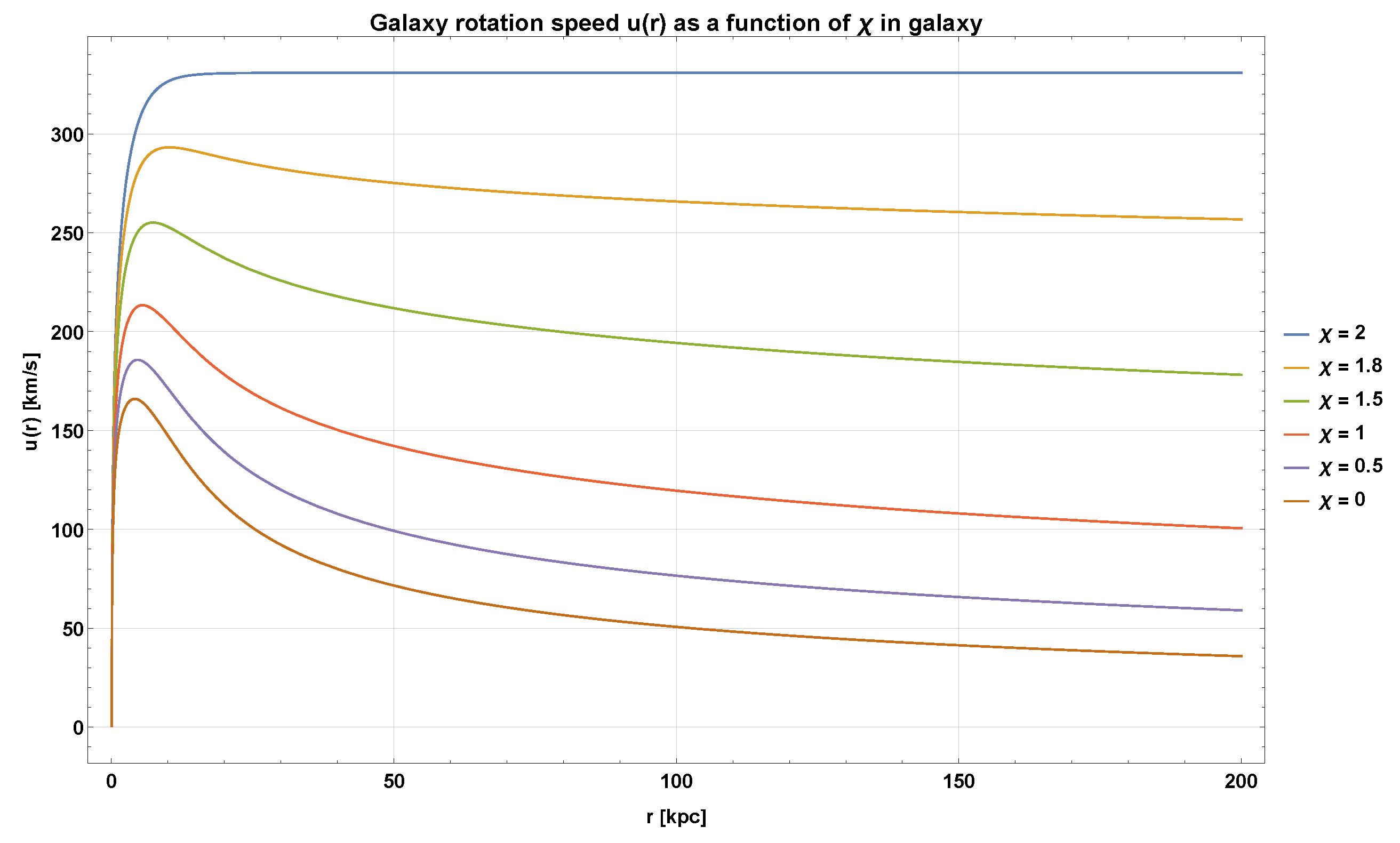
Below one may find the expected course of the rotation curves depending on the assumed constant . The calculations used an averaged Hernquist bulge baryon model and a ”spherical proxy” of the exponential disk
with total baryon density , standard G value, anisotropy and energy stream simulated by constant . As can be seen from the graph, the increasing anisotropy towards the outskirts of the galaxy would allow the graph to align with the expected curve shapes for spiral galaxies.
Figure 1.
Approx. rotation curves in Alena Tensor model.
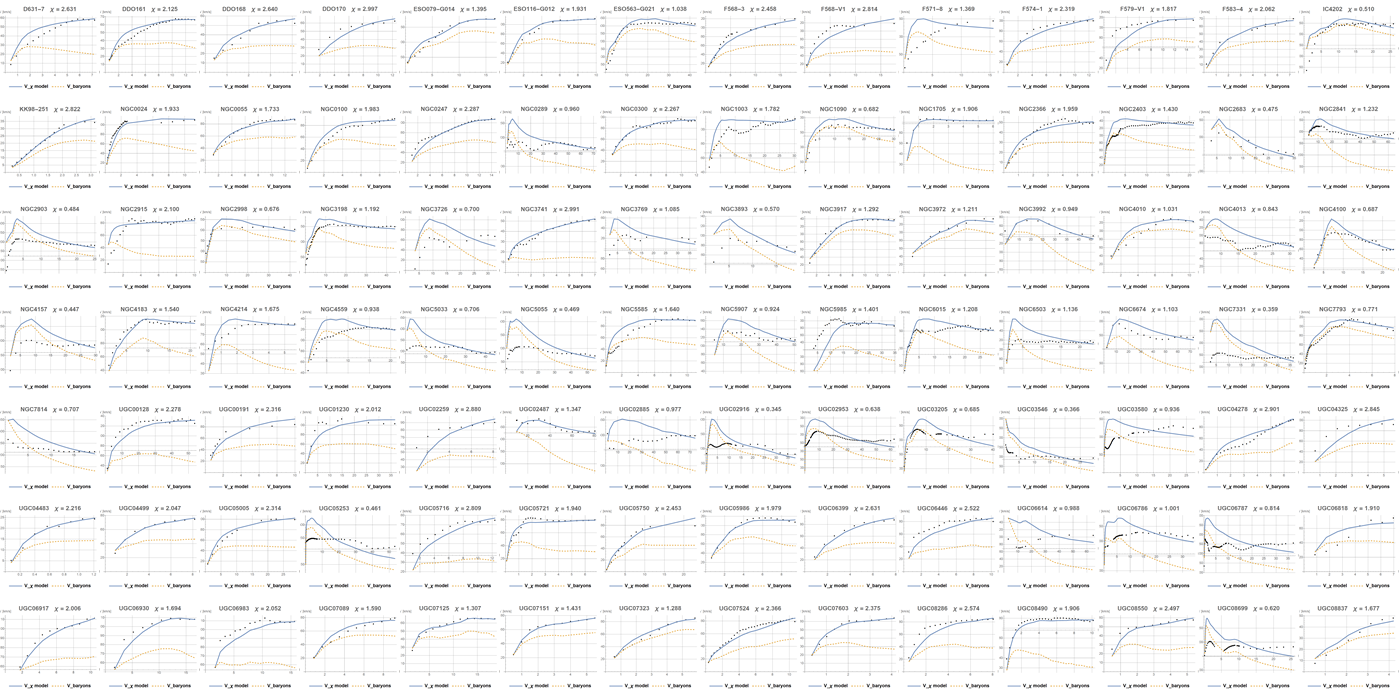
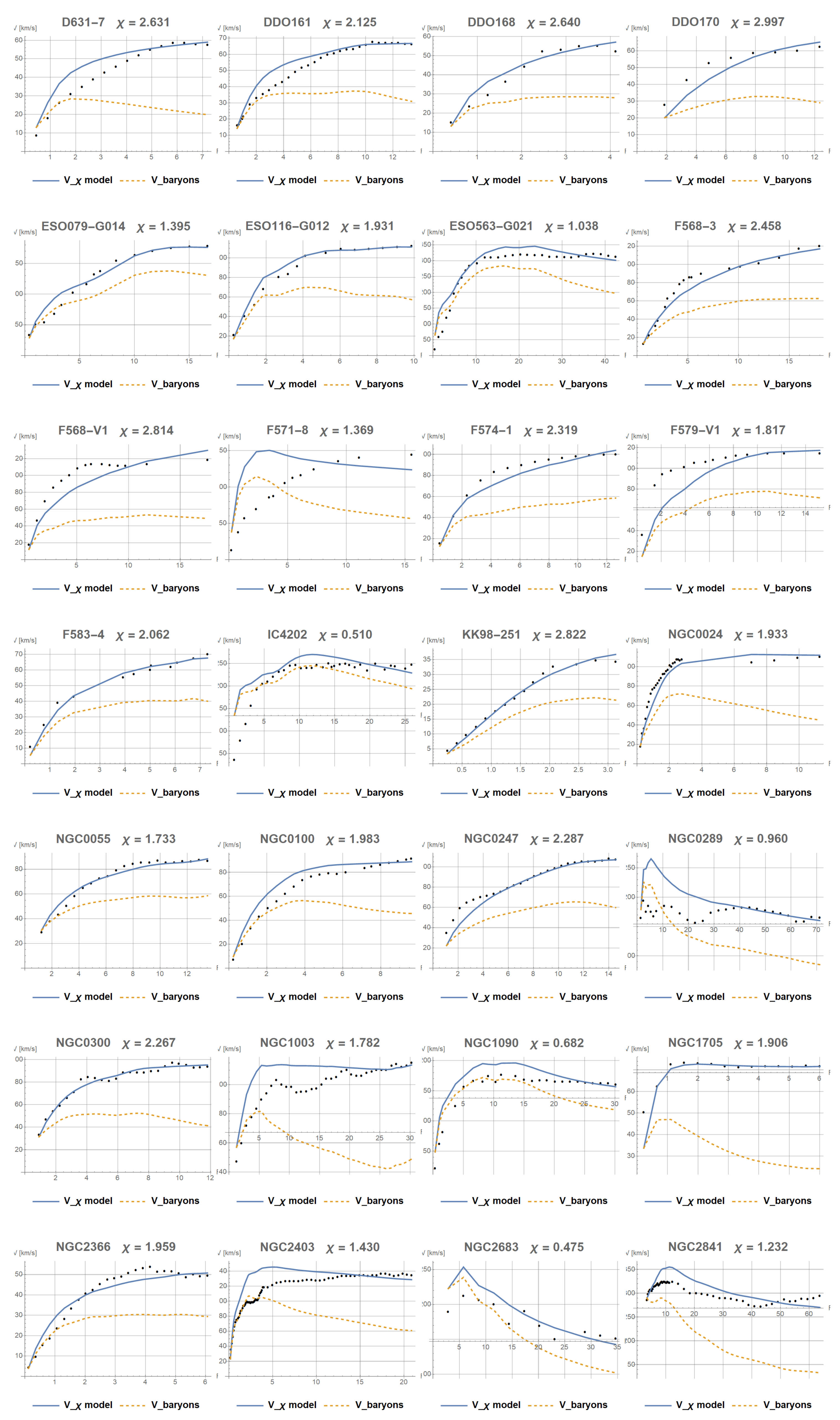
As it appears, constant actually allows to tune the rotation velocity distribution for some part of galaxies what gives an overview of the method and may help in further analysis and tuning of function to achieve full agreement with observations. The Appendix A presents the results of tuning the constant for about 100 galaxies from the SPARC catalog. The results seem encouraging, and worth further analysis with the function or with the full tensor representation. For most galaxies the fit is very good, and for the rest it is obtainable by introducing a simple function which provides for small r (chaotic motions in the center, no ordered rotation) to a stabilized rotation in the outskirts with a fixed .
The parameter was adjusted for each galaxy by iteratively solving the radial motion differential equation resulting from (34), with the condition of normalizing the rotation rate in the outer disk . The entire procedure, including reading the rotation data from the SPARC catalog, interpolating the baryonic component , numerically solving the equation for and saving the resulting plots in PDF format, was fully automated in the Mathematica script, and run in an environment with the SPARC source data. The script is included in the supplementary files.
3. Discussion and Conclusions
As seen in the above article, supplementing the Alena Tensor with the energy associated with the rotation of bodies naturally leads to the creation of halo effects, known from dark matter studies. Preliminary analysis allows for a fairly good match of this effect to observational results, although this obviously requires further development and verification for a larger number of cosmological objects.
Importantly, the proposed approach does not require modification of the GR equations, but rather fits naturally into the applied GR equations and continuum mechanics. Since the source is described in this approach by , this means that the observed increase in effective mass also affects gravitational lensing to an extent precisely corresponding to the increase in effective mass by the energy associated with (in this case - rotational) ”dark matter”. This is precisely what is obtained in observations [31,32].
The proposed solution fits quite well with the research direction represented by [33,34,35] and also [36] (including baryotropy), who investigated anisotropic fluid in cosmology and its potential connections with the dark sector. However, it complements these studies with the natural halo effect resulting directly from the GR equations for the Alena Tensor. The proposed model also expands and, in a sense, substantiates the hypothesis posed by C. Rourke [37], complementing the research [38,39,40,41] with a justification for linking rotation with the halo effect. The idea that rotation-related effects can mimic dark matter is not new, but Alena Tensor gives it some additional structure, making it a direct consequence of a coherent mathematical model.
Importantly, the Alena Tensor also provides a natural interpretation of dark energy. The value of is an invariant of the field tensor and becomes constant (or, at least, metric-independent invariant) in curvilinear description. In a sense, a nonzero value of can therefore be interpreted as a scale of deviation from pure wave solutions, without matter (for example, for the electromagnetic field, would mean that the electric and magnetic fields are equal, so the solutions must be pure electromagnetic waves). Since the value of measured in flat spacetime is , it is a measure of the "flatness" of spacetime, or more precisely, a measure of how much the metric tensor for the curvilinear description deviates from the Minkowski tensor. This interpretation seems particularly interesting in the context of the works [42,43], because it strengthens and details the conclusions described therein, providing a geometric, anisotropic source that can be interpreted as a specific backreaction mechanism leading to acceleration.
This approach could be applied to many other continuous systems (e.g., stars or black holes) and seems worth to describe the extreme in which and all the energy in the system is rotational energy. Although at first glance it seems absurd, one may notice, that the source in vacuum solution (29) is indeed solely rotational energy. Replacing rotation with vorticity and treating it as a consequence of the circulating field could potentially help model, for example, elementary particles as quasi-stable systems of three-dimensional vortices, driven by their own rotational energy. It also seems that describing matter (e.g. a neutron star, as in [44,45]) using the mechanism proposed here would be the simplest way to confirm or falsify the Alena Tensor, due to the high symmetry of such a solution. Equally interesting direction of further analysis could be e.g. the use of the possibilities of quantum description of the dark sector in the Alena Tensor model, for further development of works such as [46]. However, these analyses deserve separate articles.
In conclusion, it remains an open question whether the Alena Tensor is a correct way to describe physical systems, but this paper shows that, beyond the compliances with available knowledge achieved so far, it naturally leads to the existence of halo effects and also proposes an interpretation of dark energy. The author hopes that the results obtained in this article will facilitate further use of discussed approach as a tool that can help develop this approach and, potentially, many similar concepts. It also seems that further analysis of Alena Tensor may provide useful descriptions of the transformation between curved and flat spacetime and bring new insights that will contribute to a better understanding of issues related to the broadly understood unification of physical theories.
Funding
Author did not receive support from any organization for the submitted work.
Data Availability Statement
All data that support the findings of this study are included within the article (and any supplementary files).
Acknowledgments
During the preparation of this work the author did not use generative AI or AI-assisted technologies, except for continuous learning.
Conflicts of Interest
Author have no relevant financial or non-financial interests to disclose.
Appendix A. Results of Fitting the Constant χ
The charts are placed on the last pages of the document.
Figure A1.
Rotation curves at constant for galaxies 1/4.
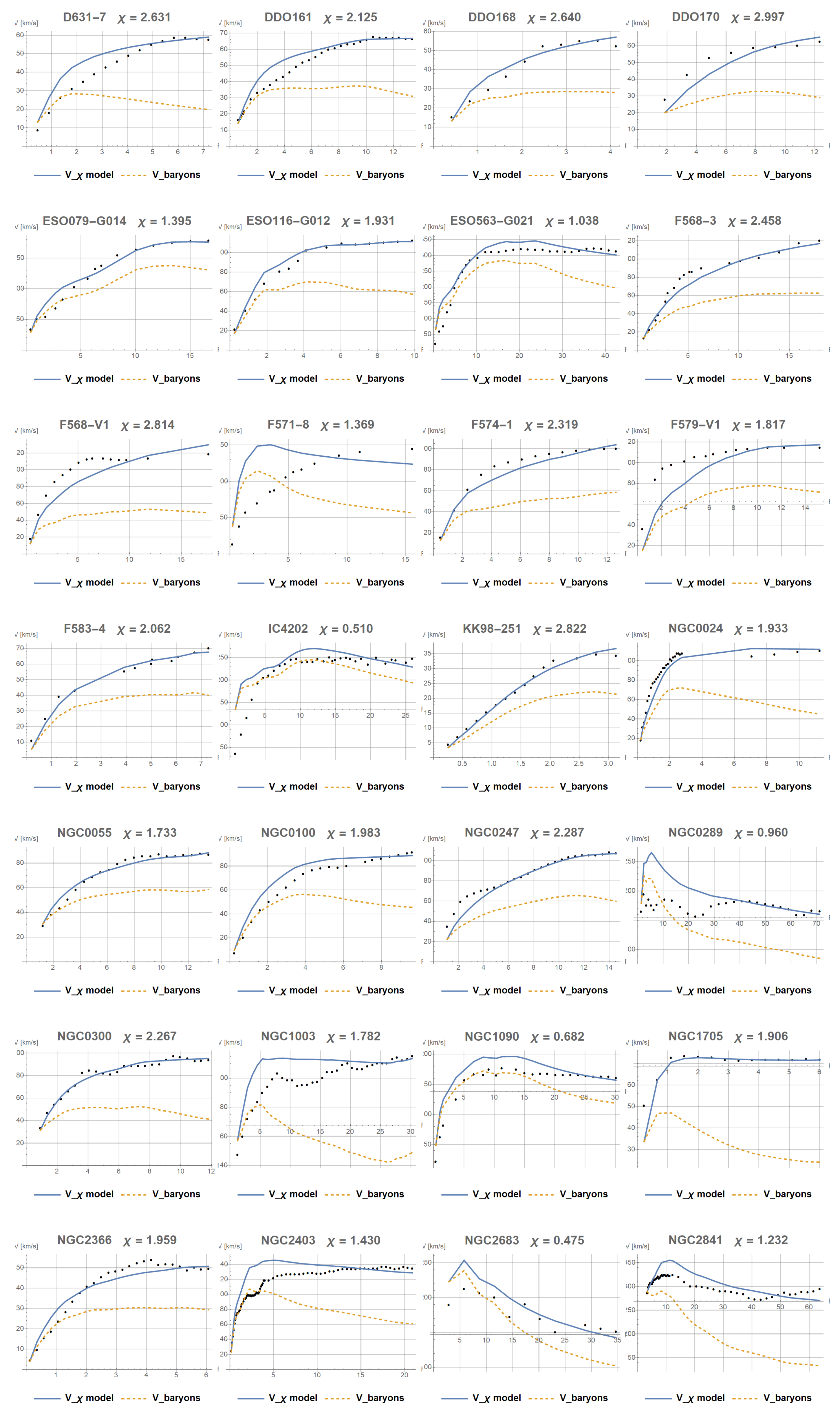
Figure A2.
Rotation curves at constant for galaxies 2/4.
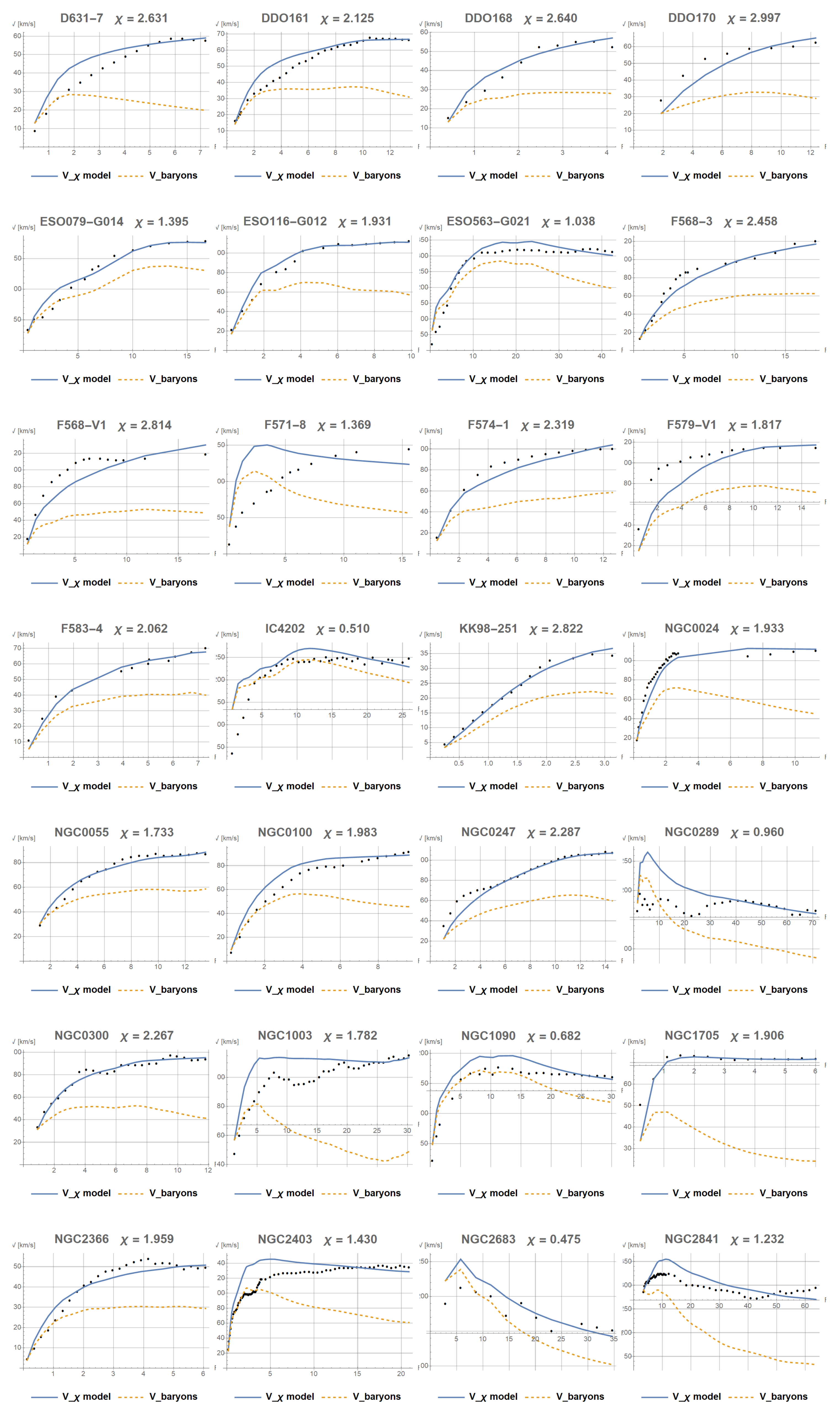
Figure A3.
Rotation curves at constant for galaxies 3/4.
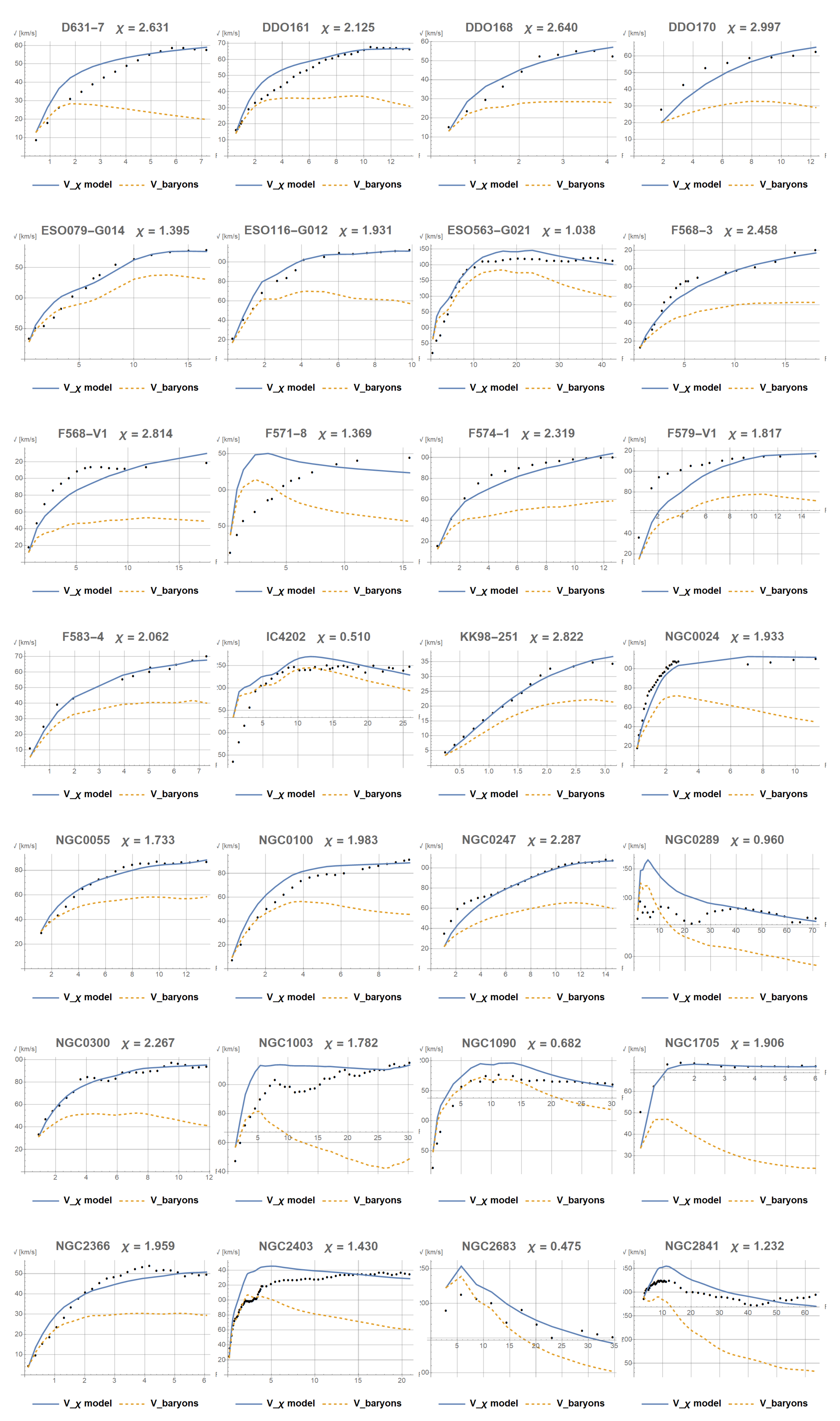
Figure A4.
Rotation curves at constant for galaxies 4/4.
References
- Abdalla, E.; Marins, A. The dark sector cosmology. International Journal of Modern Physics D 2020, 29, 2030014. [Google Scholar] [CrossRef]
- Marra, V.; Rosenfeld, R.; Sturani, R. Observing the dark sector. Universe 2019, 5, 137. [Google Scholar] [CrossRef]
- Billard, J.; et al. Direct detection of dark matter - APPEC committee report. Reports on Progress in Physics 2022, 85, 056201. [Google Scholar] [CrossRef] [PubMed]
- Akerib, D.S.; et al. Projected WIMP sensitivity of the LUX-ZEPLIN dark matter experiment. Phys. Rev. D 2020, 101, 052002. [Google Scholar] [CrossRef]
- Nitta, T.; et al. Search for a Dark-Matter-Induced Cosmic Axion Background with ADMX. Phys. Rev. Lett. 2023, 131, 101002. [Google Scholar] [CrossRef] [PubMed]
- Eckert, D.; et al. Constraints on dark matter self-interaction from the internal density profiles of X-COP galaxy clusters. Astronomy & Astrophysics 2022, 666, A41. [Google Scholar] [CrossRef]
- Capolupo, A.; Pisacane, G.; Quaranta, A.; Romeo, F. Probing mirror neutrons and dark matter through cold neutron interferometry. Physics of the Dark Universe 2024, 46, 101688. [Google Scholar] [CrossRef]
- Aprile, E.; et al. First Search for Light Dark Matter in the Neutrino Fog with XENONnT. Phys. Rev. Lett. 2025, 134, 111802. [Google Scholar] [CrossRef]
- Agnese, R.; et al. First Dark Matter Constraints from a SuperCDMS Single-Charge Sensitive Detector. Phys. Rev. Lett. 2018, 121, 051301. [Google Scholar] [CrossRef]
- Kamionkowski, M.; Riess, A.G. The Hubble Tension and Early Dark Energy. Annual Review of Nuclear and Particle Science 2023, 73, 153–180. [Google Scholar] [CrossRef]
- Collaboration, P. Planck 2018 results. VI. Cosmological parameters. Astronomy & Astrophysics 2020, 641, A6. [Google Scholar] [CrossRef]
- Skordis, C.; Złośnik, T. New Relativistic Theory for Modified Newtonian Dynamics. Physical Review Letters 2021, 127, 161302. [Google Scholar] [CrossRef]
- Andreev, Y.; Collaboration), O.N. Search for Light Dark Matter with NA64 at CERN. Physical Review Letters 2023, 131, 161801. [Google Scholar] [CrossRef]
- Ishak, M. Testing general relativity in cosmology. Living Reviews in Relativity 2019, 22, 1. [Google Scholar] [CrossRef]
- Anchordoqui, L.A.; Antoniadis, I.; Lüst, D.; Castillo, K.P. Through the looking glass into the dark dimension: Searching for bulk black hole dark matter with microlensing of X-ray pulsars. Physics of the Dark Universe 2024, 46, 101681. [Google Scholar] [CrossRef]
- Brouwer, M.; et al. First test of Verlinde’s theory of emergent gravity using weak gravitational lensing measurements. Monthly Notices of the Royal Astronomical Society 2017, 466, 2547–2559. [Google Scholar] [CrossRef]
- Aprile, E.; et al. First Dark Matter Search Results from the XENON1T Experiment. Phys. Rev. Lett. 2017, 119, 181301. [Google Scholar] [CrossRef]
- Khoury, J. Dark Matter Superfluidity. SciPost Physics Lecture Notes 2022, 42. [Google Scholar] [CrossRef]
- Goddy, J.; et al. A comparison of the baryonic Tully-Fisher relation in MaNGA and SPARC. Monthly Notices of the Royal Astronomical Society 2023, 520, 3895–3912. [Google Scholar] [CrossRef]
- Lucca, M. Dark energy-dark matter interactions as a solution to the S8 tension. Physics of the Dark Universe 2021, 34, 100899. [Google Scholar] [CrossRef]
- Brout, D.; Collaboration), O.P. The Pantheon+ Analysis: Cosmological Constraints. The Astrophysical Journal 2022, 938, 110. [Google Scholar] [CrossRef]
- Lodha, K.; et al. DESI 2024: Constraints on physics-focused aspects of dark energy using DESI DR1 BAO data. Phys. Rev. D 2025, 111, 023532. [Google Scholar] [CrossRef]
- Cuillandre, J.C.; Collaboration), O.E. Euclid: Early Release Observations - Programme overview and data products. Astronomy & Astrophysics 2025, 686, A1. [Google Scholar] [CrossRef]
- Ogonowski, P. Proposed method of combining continuum mechanics with Einstein Field Equations. International Journal of Modern Physics D 2023, 2350010, 15. [Google Scholar] [CrossRef]
- Ogonowski, P. Developed method: interactions and their quantum picture. Frontiers in Physics 2023, 11, 1264925. [Google Scholar] [CrossRef]
- Ogonowski, P. Gravitational waves and Higgs-like potential from Alena Tensor. Physica Scripta 2025, 100. [Google Scholar] [CrossRef]
- Ogonowski, P.; Skindzier, P. Alena Tensor in unification applications. Physica Scripta 2024, 100, 015018. [Google Scholar] [CrossRef]
- Lelli, F.; McGaugh, S.S.; Schombert, J.M. SPARC: Mass Models for 175 Disk Galaxies with Spitzer Photometry and Accurate Rotation Curves. The Astronomical Journal 2016, 152, 157. [Google Scholar] [CrossRef]
- Forger, M.; Römer, H. Currents and the energy-momentum tensor in classical field theory: a fresh look at an old problem. Annals of Physics 2004, 309, 306–389. [Google Scholar] [CrossRef]
- Blaschke, D.N.; Gieres, F.; Reboud, M.; Schweda, M. The energy-momentum tensor(s) in classical gauge theories. Nuclear Physics B 2016, 912, 192–223. [Google Scholar] [CrossRef]
- Bartelmann, M.; Schneider, P. Weak gravitational lensing. Reports on Progress in Physics 2001, 64, 691–757. [Google Scholar] [CrossRef]
- et al., T.E.C. Strong Gravitational Lensing as a Probe of Dark Matter. Space Science Reviews 2024, 220, 87. [Google Scholar] [CrossRef]
- Cadoni, M.; Sanna, A.P.; Tuveri, M. Anisotropic fluid cosmology: an alternative to dark matter? Physical Review D 2020, 102, 023514. [Google Scholar] [CrossRef]
- Cadoni, M.; Casadio, R. Effective fluid description of the dark universe. Physics Letters B 2018, 776, 242–248. [Google Scholar] [CrossRef]
- et al., B.D. Anisotropic strong lensing as a probe of dark matter self-interaction. Monthly Notices of the Royal Astronomical Society 2023, 526, 5455–5473. [Google Scholar] [CrossRef]
- et al., D.P. Dark matter fluid constraints from galaxy rotation curves. European Physical Journal C 2023, 83, 11457. [Google Scholar] [CrossRef]
- Rourke, C. A geometric alternative to dark matter. arXiv 2020, arXiv:1911.08920. [Google Scholar] [CrossRef]
- Konno, K.; Matsuyama, T.; Asano, Y.; Tanda, S. Flat rotation curves in Chern-Simons modified gravity. Physical Review D 2008, 78, 024037. [Google Scholar] [CrossRef]
- Balasin, H.; Grumiller, D. Non-Newtonian behavior in weak field general relativity for extended rotating sources. International Journal of Modern Physics D 2008, 17, 475–488. [Google Scholar] [CrossRef]
- Hanafy, W.E.; Hashim, M.; Nashed, G.G.L. Revisiting flat rotation curves in Chern-Simons modified gravity. Physics Letters B 2024, 856, 138882. [Google Scholar] [CrossRef]
- Walrand, S. A machian model as potential alternative to dark matter halo thesis in galactic rotational velocity prediction. Frontiers in Astronomy and Space Sciences 2024, 11, 1429235. [Google Scholar] [CrossRef]
- Acquaviva, G.; et al. Simple-graduated dark energy and spatial curvature. Physical Review D 2021, 104, 023505. [Google Scholar] [CrossRef]
- Buchert, T.; Räsänen, S. Backreaction in Late-Time Cosmology. Annual Review of Nuclear and Particle Science 2012, 62, 57–79. [Google Scholar] [CrossRef]
- Malaver, M.; Assunção, A.K.T.; Moraes, P.H.R.S. Realistic anisotropic neutron stars: Pressure effects. Physical Review D 2024, 109, 043025. [Google Scholar] [CrossRef]
- Lopes, L.L.; Das, H. Spherically symmetric anisotropic strange stars. The European Physical Journal C 2024, 84, 166. [Google Scholar] [CrossRef]
- Brax, P.; Fichet, S. Scalar-mediated quantum forces between macroscopic bodies and interferometry. Physics of the Dark Universe 2023, 42, 101294. [Google Scholar] [CrossRef]
Disclaimer/Publisher’s Note: The statements, opinions and data contained in all publications are solely those of the individual author(s) and contributor(s) and not of MDPI and/or the editor(s). MDPI and/or the editor(s) disclaim responsibility for any injury to people or property resulting from any ideas, methods, instructions or products referred to in the content. |
© 2025 by the author. Licensee MDPI, Basel, Switzerland. This article is an open access article distributed under the terms and conditions of the Creative Commons Attribution (CC BY) license (http://creativecommons.org/licenses/by/4.0/).
Copyright: This open access article is published under a Creative Commons CC BY 4.0 license, which permit the free download, distribution, and reuse, provided that the author and preprint are cited in any reuse.