1. Introduction
A central, unresolved question in physiology is how the human body achieves rapid, coherent integration across its trillions of cells. The established neural and endocrine systems provide targeted, high-fidelity communication, yet their function is embedded within and dependent on a continuous, physically interconnected milieu. Traditionally, the interstitium—the space between cells and tissues—has been cataloged in anatomy texts as a passive, structural filler or a mere conduit for fluid and solute passage.
This view is untenable in light of a convergence of global scientific evidence. Research spanning disparate fields—from detailed anatomical studies of the fascial system [
1,
2], to physiological investigations of interstitial fluid and lymph formation [
3], to biophysical analyses of mechanotransduction in the extracellular matrix [
4]—has collectively painted a picture of a dynamic and responsive interstitial space. Landmark imaging studies have further visualized the macroscopic continuity and potential fluid-conducting capacity of these spaces in specific organs [
5,
6]. Despite this wealth of data, a unifying theoretical framework that interprets these interconnected spaces as a
coherent, system-wide functional entity has been conspicuously absent.
Here, we integrate these long-established yet fragmented observations to propose the formal recognition of the
Human Interstitial System (HIS). This is not the proposal of a newly discovered organ, but the conceptualization of a fundamental physiological system whose integrative function emerges from the dynamic interactions within this continuous, body-wide network. This framework, originating from the Interstitial Integration Hypothesis [
7], aims to complete our physiological model by elucidating the physical substrate upon which system-level coordination is built.
2. Defining the Human Interstitial System
We define the Human Interstitial System as: the continuous, dynamic, and structured space existing between all of the body's cells and functional units, comprising the interstitial fluid, the connective tissue matrix (including collagen, elastin, and glycosaminoglycans like hyaluronan), and the resident cells, which collectively form a system-wide integrative medium enabling physical connection, information transmission, and coordination.
Its status as a bona fide physiological system is justified by established physiological criteria:
1.
System-Wide Distribution: It is ubiquitously present in all tissues and organs, forming a continuous network from the pericellular space to the macroscopic fascial planes [
1,
2,
5].
2. Identifiable Structure: It possesses a definite, hierarchically organized architecture, with properties (porosity, stiffness, composition) that are specific to location and dynamically regulated.
3. Specific, Essential Function: Its components work synergistically to achieve system-level functions—specifically, whole-body integration—that cannot be fully attributed to the sum of individual organs.
4. Homeostatic Importance: Functional impairment of the HIS, as seen in fibrosis, edema, or connective tissue disorders, leads to characteristic and systemic pathophysiology.
Unlike traditional, parenchyma-based organs, the essential characteristic of the HIS lies in the functionalization of relational space itself and the dynamic processes that occur within it.
3. Core System Functions
The HIS manages interactions between all body components through four core, interdependent functions:
1. Mediation: It physically defines the pathways for substance transport, determining which cells interact, under what conditions, and at what rates. It is the necessary medium for virtually all intercellular communication.
2.
Filtration and Regulation: Acting as a molecular sieve, the glycosaminoglycan gel (notably hyaluronan [
8]) enables selective filtration of solutes and fine-tuning of the local microenvironment, creating distinct biochemical niches.
3.
Integration: The HIS continuously integrates distributed physiological signals. Mechanical pressures, chemical gradients, and bioelectric potentials propagate as confined waves through this viscoelastic medium. The resulting interference patterns are hypothesized to perform a form of real-time, analog computation of the body's global state [
9].
4. Emergence: This integrated wave dynamics gives rise to a global, spatiotemporal pattern—conceptualized as a Metabolic Information Field. This field provides a contextual background for the entire system, guiding pre-conscious, predictive physiological adjustments and serving as a substrate for physiological phase transitions.
4. A Testable Mechanistic Model
We propose the HIS operates through a process of Confined Hydro-Electro-Chemical Dynamics:
1. Perturbation: Local cellular activities (contraction, secretion, metabolism) generate mechanical and chemical perturbations.
2. Propagation: These perturbations propagate as confined (non-linear) pressure, concentration, and electromagnetic waves through the interstitial fluid and deformable matrix.
3. Filtering and Shaping: The specific material properties (stiffness, porosity, charge) of the local interstitial environment filter and shape these waves, determining their speed, attenuation, and direction.
4. Integration and Emergence: The superimposition and interference of these myriad waves form a complex, dynamic standing wave pattern across the body. This pattern is the physical instantiation of the proposed Metabolic Information Field.
5. Feedback: This global field influences local cellular behavior (e.g., via mechanosensitive ion channels), completing a feedback loop that operates without central control.
This process can be summarized as: Interstitial Structure → Confined Dynamics → Wave Integration → System Function.
5. Decisive Tests: Falsifiable Predictions of the HIS Theory
The strength of this framework lies in its vulnerability to empirical refutation. We propose three critical experiments designed to test its core principles. The failure of any of these predictions would necessitate a fundamental revision of the theory.
Prediction 1: The HIS is a Causal Agent in Systemic Autonomic Synchronization
Core Hypothesis: If the HIS is a genuine systemic integrator, then a localized, rapid, and non-inflammatory disruption of its key structural component will cause immediate, measurable desynchronization in remote autonomic functions, prior to neural or humoral feedback.
Experimental Design: Using a rodent model, apply a photoactivatable hyaluronidase to selectively degrade hyaluronan in one hindlimb. Employ high-temporal-resolution electrophysiology (e.g., ECG, laser Doppler flowmetry) to monitor heart rate variability and vascular tone in real-time.
Falsification Condition: The intervention produces no change in systemic autonomic synchronization, or changes only occur subsequent to the establishment of significant local inflammation or measurable neural signaling.
Prediction 2: The HIS Mediates Rapid, Non-Neural Interoceptive Communication
Core Hypothesis: The HIS provides a pathway for rapid signal transmission independent of the nervous system.
Experimental Design: In human volunteers, apply a standardized mechanical stimulation (e.g., a precise pressure pulse) to the forearm. Simultaneously, use high-frequency ultrasound elastography or bioimpedance to measure tissue compliance changes in the contralateral lower limb, before and after a regional nerve blockade.
Falsification Condition: The rapid, stimulus-locked change in remote tissue compliance is completely abolished following effective nerve blockade, demonstrating exclusive neural mediation.
Prediction 3: HIS-Targeted Therapy Reverses Systemic Functional Decline
Core Hypothesis: If interstitial dysfunction is a root cause of age-related systemic disintegration, then therapies specifically designed to restore healthy interstitial structure (e.g., via enzymatic remodeling of cross-links or HA supplementation) will outperform conventional, organ-centric treatments.
Experimental Design: In aged animal models exhibiting multi-organ functional decline, compare a HIS-targeted therapeutic strategy (e.g., a senolytic cocktail that clears matrix-degrading senescent cells) against a standard-of-care treatment for a specific age-related condition (e.g., an antihypertensive). Primary outcomes would be integrative, whole-body metrics like physical performance battery scores and metabolic coordination.
Falsification Condition: The HIS-targeted therapy shows no statistically significant superiority over the organ-specific treatment in reversing the systemic functional impairment.
6. Discussion and Implications
The Human Interstitial System framework offers a powerful, novel lens through which to reinterpret a wide range of physiological and clinical phenomena. It provides a biophysical basis for the systemic effects of physical therapies like acupuncture and massage [
2,
6], explains organ-specific patterns of metastasis, and re-contextualizes fibrosis not as a localized scar but as a "systemic integrative disease." This theory does not seek to replace the neuro-endocrine-immune systems but to complement them by defining the physical matrix upon which they operate and from which higher-order integration emerges.
The primary challenge ahead is technological: the direct, real-time measurement of the proposed Metabolic Information Field will require advances in imaging and sensor technologies. However, the decisive tests proposed herein are feasible with current methodologies and are designed to cleanly isolate the HIS's putative role.
Validation of this framework would establish "Human Interstitial System Science" as a new sub-discipline within physiology. It would catalyze a paradigm shift in how we understand health, viewing it as a state of optimal interstitial coherence, and disease as a disintegration of this relational matrix. This would not only legitimize a class of physical medicines but also guide the next generation of biomaterials, tissue engineering, and strategies for promoting healthy aging.
7. Conclusion
We have synthesized a century of dispersed scientific observation to define the Human Interstitial System—a fundamental, body-wide platform for physiological integration. By shifting the focus from the actors (cells and organs) to the stage and its dynamics (the interstitial space), this framework provides a more complete understanding of human physiology. As a testable, falsifiable theory grounded in biophysical principles, the HIS hypothesis represents a critical step toward a truly holistic and predictive science of the human body.
Figure 1.
The Integrative Mechanism of the Human Interstitial System and the Emergence of the Metabolic Information Field.
Figure 1.
The Integrative Mechanism of the Human Interstitial System and the Emergence of the Metabolic Information Field.
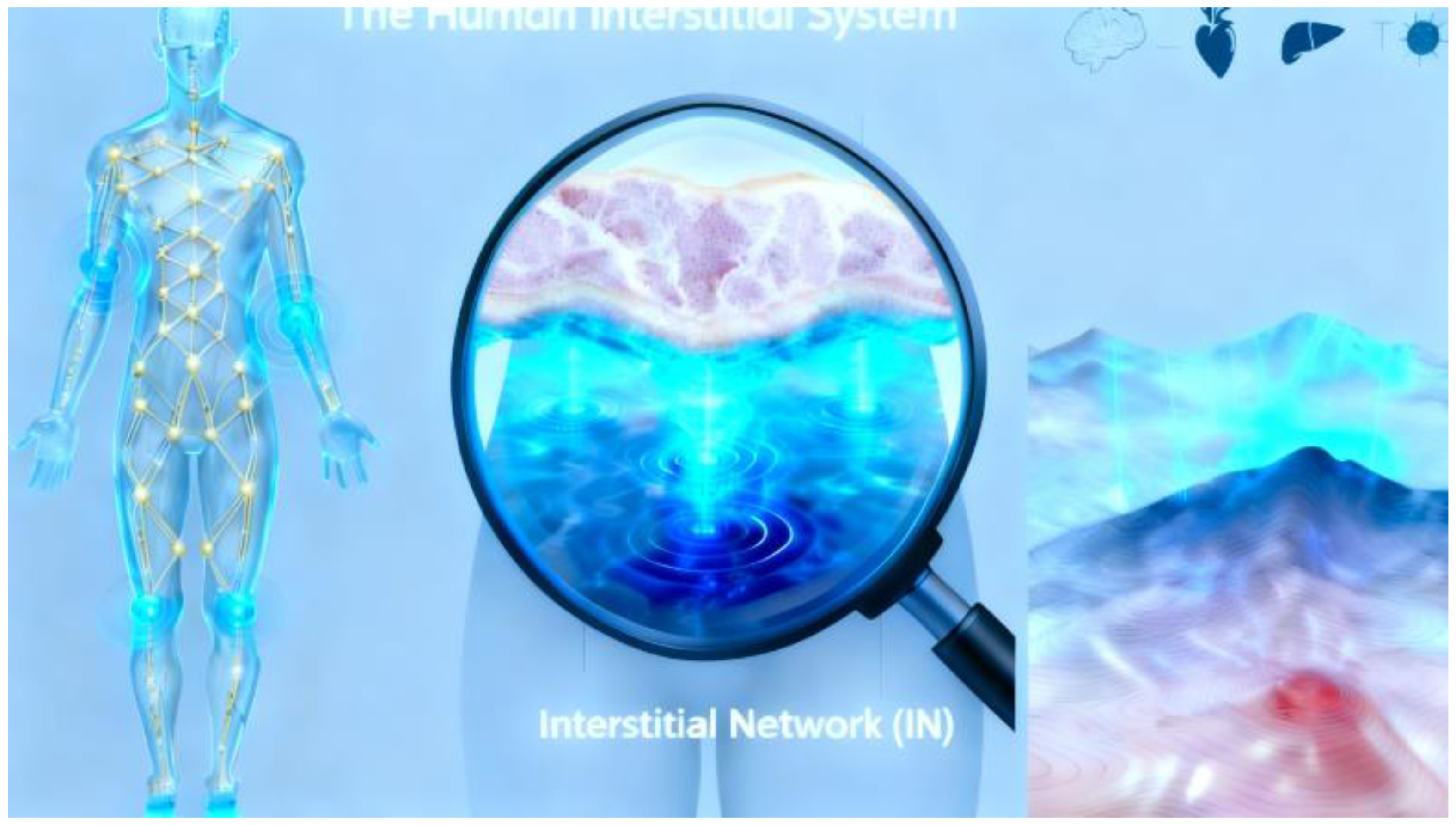
Schematic illustrating the core principle of whole-body integration via the Human Interstitial System. The
Interstitial Network (IN), a continuous, fluid-filled matrix spanning microscopic to macroscopic scales, serves as the architectural basis. Local physiological activities generate physicochemical waves that propagate through the IN. These waves undergo
constructive and destructive interference, integrating localized signals in real time across the body. This dynamic interference pattern gives rise to a global
Metabolic Information Field (MIF), which encodes the organism's integrated physiological status and guides predictive homeostasis.
Figure 2.
Pathological Re-conceptualization: Systemic Diseases as Dysfunctions of Interstitial Informatic Flow.
Figure 2.
Pathological Re-conceptualization: Systemic Diseases as Dysfunctions of Interstitial Informatic Flow.
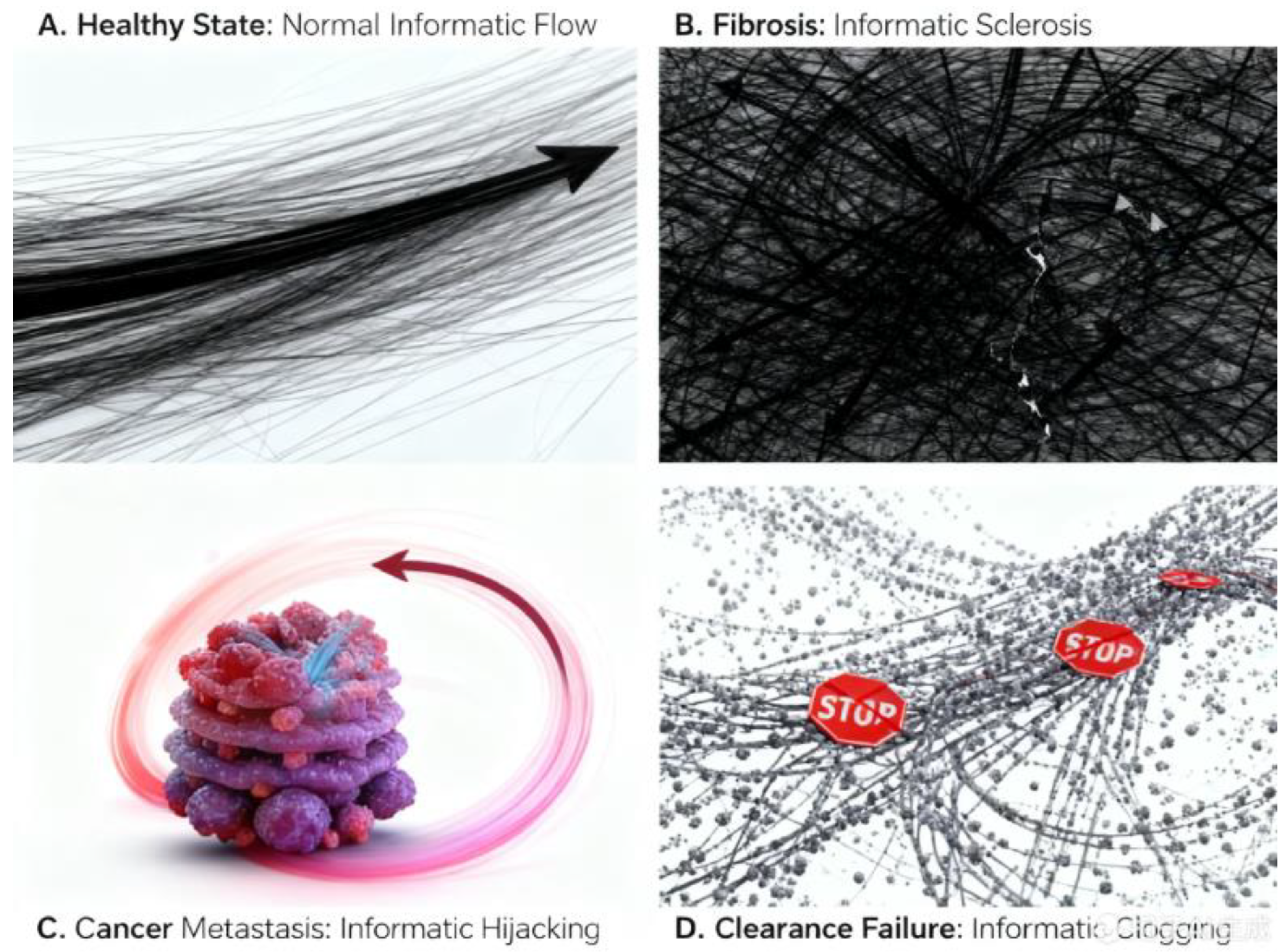
Comparative models of physiological states through the lens of the interstitial paradigm.
A. Healthy State: Normal Informatic Flow: The patent and well-structured Interstitial Network facilitates unimpeded wave propagation and efficient clearance, underpinning systemic integration.
B. Fibrosis: Informatic Sclerosis: Pathological matrix deposition disrupts the IN architecture, dampening wave propagation and creating informational "dead zones" that lead to tissue isolation.
C. Cancer Metastasis: Informatic Hijacking: Tumor cells remodel the local interstitium, establishing selfish chemical gradients and co-opting interstitial pathways to promote dissemination.
D. Clearance Failure: Informatic Clogging: Dysfunction of specialized clearance pathways results in waste accumulation within the IN, impairing information fidelity and contributing to neurodegeneration.
Author Contributions
Q.W.: Conceptualization, Methodology, Writing – Original Draft, Supervision, Funding Acquisition. Y.W.: Validation, Formal Analysis, Investigation, Data Curation, Writing – Review & Editing.
Acknowledgments
We thank colleagues at Shandong First Medical University for constructive discussions.
Declaration of Interests
The authors declare no competing interests.
Lead Contact
Further information and requests for resources should be directed to and will be fulfilled by the Lead Contact, Qingbao Wang ( qbwang@sdfmu.edu.cn).
References
- Langevin, H.M.; Yandow, J.A. Relationship of acupuncture points and meridians to connective tissue planes. Anat. Rec. 2002, 269, 257–265. [Google Scholar] [CrossRef] [PubMed]
- Schleip, R. et al. Fascia: The tensional network of the human body. Elsevier (2012).
- Wiig, H.; Swartz, M.A. Interstitial fluid and lymph formation and transport: Physiological regulation and roles in inflammation and cancer. Physiol. Rev. 2012, 92, 1005–1060. [Google Scholar] [CrossRef] [PubMed]
- Ingber, D.E. Mechanobiology and diseases of mechanotransduction. Ann. Med. 2003, 35, 564–577. [Google Scholar] [CrossRef] [PubMed]
- Benias, P.C.; et al. Structure and Distribution of an Unrecognized Interstitium in Human Tissues. Sci. Rep. 2018, 8, 4947. [Google Scholar] [CrossRef] [PubMed]
- Langevin, H.M.; et al. Mechanical signaling through connective tissue: A mechanism for the therapeutic effect of acupuncture. FASEB J. 2001, 15, 2275–2282. [Google Scholar] [CrossRef] [PubMed]
- Wang, Q.; Wang, Y. The Interstitial Integration Hypothesis: A Unified Physical Framework for Emergence and Self-Organization. Preprint at [relevant repository] (2024).
- Fraser, J.R.; Laurent, T.C.; Laurent, U.B. Hyaluronan: Its nature, distribution, functions and turnover. J. Intern. Med. 1997, 242, 27–33. [Google Scholar] [CrossRef] [PubMed]
- Fels, D. Physical principles in the emergence of multicellular organization. BioEssays 2019, 41, 1900007. [Google Scholar]
|
Disclaimer/Publisher’s Note: The statements, opinions and data contained in all publications are solely those of the individual author(s) and contributor(s) and not of MDPI and/or the editor(s). MDPI and/or the editor(s) disclaim responsibility for any injury to people or property resulting from any ideas, methods, instructions or products referred to in the content. |
© 2025 by the authors. Licensee MDPI, Basel, Switzerland. This article is an open access article distributed under the terms and conditions of the Creative Commons Attribution (CC BY) license (http://creativecommons.org/licenses/by/4.0/).