

Submitted:
18 October 2025
Posted:
20 October 2025
You are already at the latest version
Abstract
The World Health Organization (WHO) is an authoritative global body that focuses on health-related issues globally. Given its prominence, and as a gesture of respect, it is important to accurately represent the organization’s name. Using the Problematic Paper Screener, an AI-driven software that identifies linguistic distortions, or ‘tortured phrases’, “World Wellbeing Association” was searched on 30 November 2024, identifying 59 documents. After exclusions, 19 documents were examined, almost all of which were open access, most mentioning this ‘tortured phrase’ once, to define WHO. One of those documents has been retracted. WHO is advised to reach out to the authors and journals to request a correction of their misrepresented organization in the scientific literature.
Keywords:
errors
; established jargon
; ethics
; misconduct
; scientific communication and error
Acronyms, or abbreviated forms of a string of words, are a frequent feature in the scientific literature, including to represent organizations such as the World Health Organization, whose acronym is WHO. One would think that such a basic representation of a renowned organization would be accurately represented in the academic literature, even more so in literature related to medical science. Despite this, there are studies that have incorrectly referred to the WHO as the “World Wellbeing Association”, while employing the WHO acronym to represent this distorted organizational name. This linguistic distortion, a ‘tortured phrase’, may have arisen as a result of reverse translation or an attempt to escape plagiarism detection by synonymizing text (Cabanac et al., 2021). In this case, health was synonymized by wellbeing, while organization was synonymized by association.
When scientists write papers, they are tasked with referencing information as accurately as possible, to truthfully represent the facts (Kueffer & Larson, 2014), so the existence of ‘tortured phrases’ in the scientific literature dilutes the specificity of terms while, especially in the natural sciences and biomedical literature, adding a layer of confusion and reducing comprehension (Teixeira da Silva, 2022). This phenomenon is not only restricted to peer-reviewed literature, such as literature pertaining to COVID-19 (Teixeira da Silva, 2023a), where one would least expect it to occur, but can also be found in preprints, or non-peer-reviewed texts or grey literature (Teixeira da Silva, 2023b).
To better appreciate cases of the scientific literature indexed with a digital object identifier (DOI) that employed WWA instead of WHO, a search was undertaken on the Problematic Paper Screener for “World Wellbeing Association” on 28–30 November 2024, where 59 documents were initially discovered. Only peer-reviewed journal papers (n = 17) and preprints (n = 2) with a DOI were considered (Table 1), while book chapters, conference proceedings, theses, other documents, as well as one false positive, one inaccessible document, and one duplicate and “silently retracted” publication, were excluded (n = 40). Of the 19 remaining papers/preprints that were examined, two were not open access, while in the majority of cases (n = 14), “World Wellbeing Association” appeared only once, usually to define WHO (examples in Figure 1A–C). Two other ‘tortured phrases’ for, and misrepresentations of, WHO were discovered: “World Health Association” (DOI: 10.1186/s40537-019-0175-6) and “World Healthcare Organization” (DOI: 10.21931/rb/2022.07.02.13). One paper (DOI: 10.1007/s11356-021-13851-4) was retracted, with one of the reasons alluding to ‘tortured phrases’ (from the retraction notice: “containing nonstandard phrases”). In one particularly egregious case (DOI: 10.9734/jpri/2022/v34i8A35475), the original title of a paper (Eurosurveillance editorial team, 2020) was manipulated in the reference list, with several words, including the definition of WHO, having been synonymized (Figure 1D).
In the world of scientific publishing’s faux pas, ‘tortured phrases’ rank low compared to more serious ethical infractions like data fabrication or hard-core fraud like on-demand purchases of data, papers, or authorship from a paper mill, whose products are inevitably retracted (Candal-Pedreira et al., 2022). Even so, if one considers that some ‘tortured phrases’ enter the scientific literature as a result of deceptive practices by authors, i.e., a purposeful distortion of scientific terms to mimic real terms or actual jargon, employing artificial intelligence (AI) to achieve that feat, then this action alone has a double layer of dishonesty and deception, in violation of most journals’ ethics policies. Since author motives are difficult to prove, absent a confession, the presence of ‘tortured phrases’ can be corrected simply via an erratum, or, in more serious cases, where their existence is coupled with other malfeasance, fraud or deception, by a retraction. Generative AI, like ChatGPT, has the ability to correct erroneous terms, and reverse ‘tortured phrases’ (Teixeira da Silva & Tsigaris, 2024), and could be one way for journal copy editors to screen and clean scientific literature before it is published (Teixeira da Silva, 2024), although if editing companies or publishers use such AI, then its use needs to be transparently declared by authors, who are clients of both editing companies and publishers (Teixeira da Silva, 2025).
These findings were submitted in early December 2024 to one of the WHO journals, Bulletin of the World Health Organization, to formally notify WHO of these cases, but the article was rejected for unspecific reasons. WHO, despite having knowledge of these cases, had an excellent opportunity to reach out to both the authors and the journals in question (Table 1), to request these parties to correct this ‘tortured phrase’, either as corrigenda or as retractions – depending on the level of error and volume of ‘tortured phrases’ – and the misrepresentation of its organization, but it elected to not do so.
Author Contributions
Conceptualization, investigation, verification, writing, editing.
Availability of Data and Material
All data used can be found in Table 1, accessed via papers’ DOIs.
References
- Cabanac, G.; Labbé, C.; Magazinov, A. Tortured phrases: A dubious writing style emerging in science. Evidence of critical issues affecting established journals. arXiv 2021. preprint, not peer reviewed) 27 pages. [Google Scholar] [CrossRef]
- Candal-Pedreira, C.; Ross, J. S.; Ruano-Ravina, A.; Egilman, D. S.; Fernández, E.; Pérez-Ríos, M. Retracted papers originating from paper mills: cross sectional study. BMJ (Clinical Research Ed.) 2022, 379, e071517. [Google Scholar] [CrossRef] [PubMed]
- Eurosurveillance editorial team. Note from the editors: World Health Organization declares novel coronavirus (2019-nCoV) sixth public health emergency of international concern. Euro Surveillance 2020, 25(5), 200131e. [Google Scholar] [CrossRef]
- Kueffer, C.; Larson, B. M. H. Responsible use of language in scientific writing and science communication. BioScience 2014, 64(8), 719–724. [Google Scholar] [CrossRef]
- Teixeira da Silva, J. A. Tortured phrases dilute the specificity of medical jargon. Journal of Health and Social Sciences 2022, 7(2), 137–140. [Google Scholar] [CrossRef]
- Teixeira da Silva, J. A. “Tortured phrases” in COVID-19 literature: Can they serve as epistemic markers to assess the integrity of medical information? Philosophy of Medicine 2023a, 4(1), 1–12. [Google Scholar] [CrossRef]
- Teixeira da Silva, J. A. ‘Tortured phrases’ in preprints. Current Medical Research & Opinion 2023b, 39(5), 785–787. [Google Scholar] [CrossRef]
- Teixeira da Silva, J. A. Copy editors can play a role in the detection and elimination of “tortured phrases”. Science Editor 2024, 47(3), 83–85. [Google Scholar] [CrossRef]
- Teixeira da Silva, J. A. Editing companies have the responsibility of ensuring their declared use of generative artificial intelligence. Journal of Clinical Epidemiology 2025, 177, 111607. [Google Scholar] [CrossRef] [PubMed]
- Teixeira da Silva, J. A.; Tsigaris, P. ChatGPT’s ability to reverse ‘tortured phrases’ into standardized English and scientific jargon: Relevance to nurse educators and researchers. Nurse Educator 2024, 49(3), E161. [Google Scholar] [CrossRef] [PubMed]
Figure 1.
Several cases of the presence of the ‘tortured phrase’ “World Wellbeing Association” (indicated by red arrows), a ‘tortured phrase’ is meant to represent the authentic World Health Organization (WHO). Sources of snippet screenshots: (A) DOI: 10.17762/pae.v58i2.1894 (p. 637); (B) DOI: 10.30574/gscbps.2022.19.1.0095 (p. 306); (C) DOI: 10.53555/67g9gx22 (p. 633); (D) DOI: 10.9734/jpri/2022/v34i8A35475 (p. 38). All cases: CC BY license.
Figure 1.
Several cases of the presence of the ‘tortured phrase’ “World Wellbeing Association” (indicated by red arrows), a ‘tortured phrase’ is meant to represent the authentic World Health Organization (WHO). Sources of snippet screenshots: (A) DOI: 10.17762/pae.v58i2.1894 (p. 637); (B) DOI: 10.30574/gscbps.2022.19.1.0095 (p. 306); (C) DOI: 10.53555/67g9gx22 (p. 633); (D) DOI: 10.9734/jpri/2022/v34i8A35475 (p. 38). All cases: CC BY license.
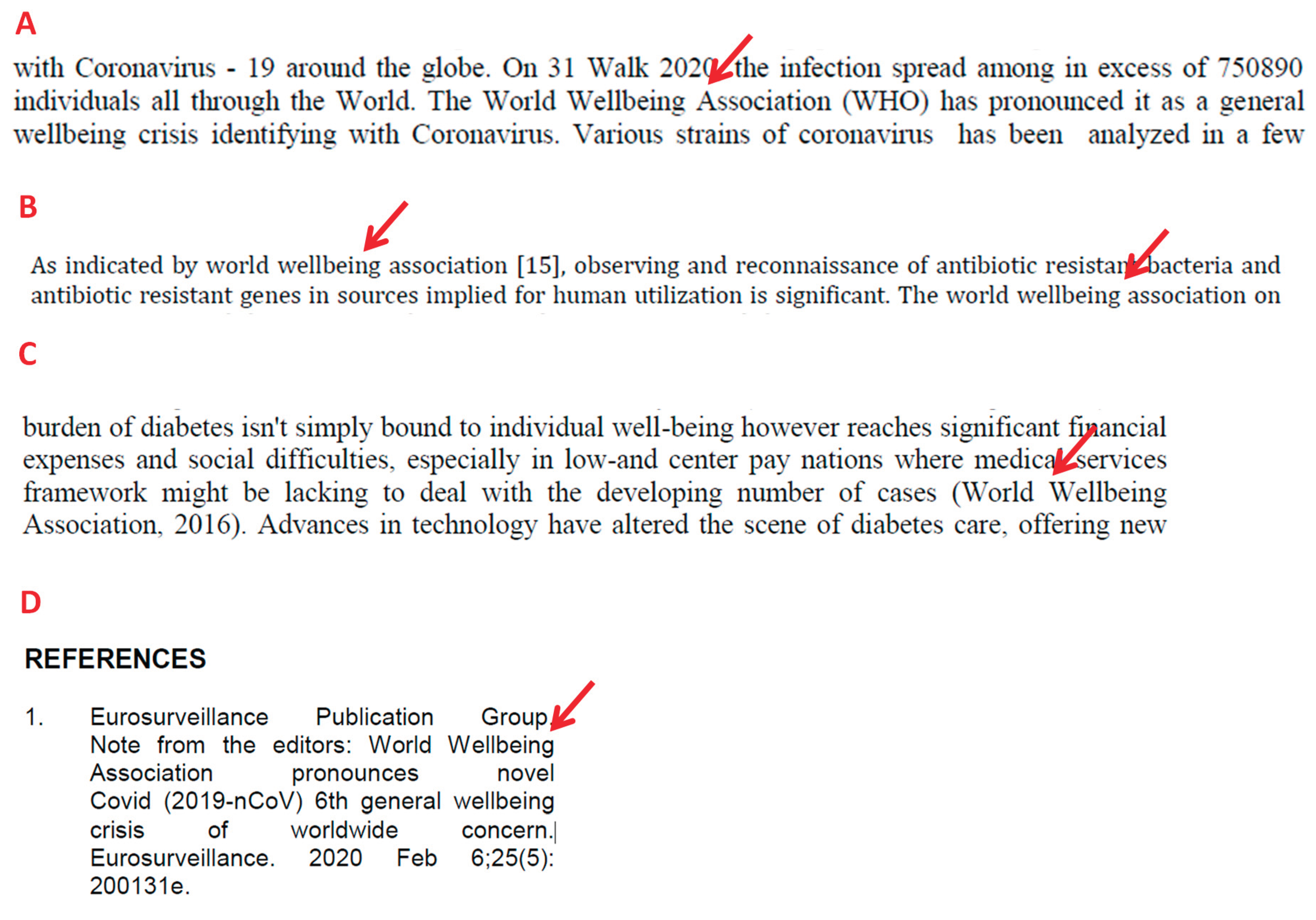

Table 1.
Cases (n = 19) of “World Wellbeing Association”1, a tortured phrase that is supposed to represent the World Health Organization.
Table 1.
Cases (n = 19) of “World Wellbeing Association”1, a tortured phrase that is supposed to represent the World Health Organization.
| Year | DOI | Journal | Publisher |
|---|---|---|---|
| 2019 | 10.1186/s40537-019-0175-6 | Journal of Big Data | Springer Nature |
| 2020 | 10.21608/bjas.2020.185617 2 | Benha Journal of Applied Sciences | Egyptian Knowledge Bank |
| 2021 | 10.9734/jpri/2021/v33i35B31905 | Journal of Pharmaceutical Research International | Sciencedomain International |
| 2021 * | 10.1007/s11356-021-13851-4 | Environmental Science and Pollution Research | Springer Nature |
| 2021 ** | 10.21203/rs.3.rs-765835/v1 | Research Square | Springer Nature (Research Square Platform LLC) |
| 2021 | 10.17762/pae.v58i2.1894 | Psychology and Education Journal | Auricle Technologies |
| 2022 | 10.21931/rb/2022.07.02.13 | Bionatura | Clinical Biotec |
| 2022 | 10.1149/10701.17699ecst | ECS Transactions | The Electrochemical Society |
| 2022 | 10.9734/jpri/2022/v34i8A35475 | Journal of Pharmaceutical Research International | Sciencedomain International |
| 2022 | 10.30574/gscbps.2022.19.1.0095 | GSC Biological and Pharmaceutical Sciences | GSC Online Press |
| 2022 | 10.26858/pbar.v4i1.33004 | Pinisi Business Administration Review | Universitas Negeri Makassar |
| 2023 | 10.21608/smj.2023.192450.1369 | Sohag Medical Journal | Egyptian Knowledge Bank |
| 2023 | 10.53555/sfs.v10i2S.316 | Journal of Survey in Fisheries Sciences | Green Publication |
| 2023 | 10.11591/ijece.v13i5.pp5681-5695 | International Journal of Electrical and Computer Engineering | Institute of Advanced Engineering and Science |
| 2023 ** | 10.20944/preprints202306.1788.v1 | Preprints.org | MDPI |
| 2023 | 10.11591/eei.v12i3.4579 | Bulletin of Electrical Engineering and Informatics | Institute of Advanced Engineering and Science |
| 2023 | 10.17762/ijritcc.v11i10.8469 | International Journal on Recent and Innovation Trends in Computing and Communication | Auricle Technologies |
| 2024 | 10.53555/67g9gx22 | Journal of Population Therapeutics and Clinical Pharmacology | Green Publication |
| 2024 | 10.1007/s00521-024-09425-3 | Neural Computing and Applications | Springer Nature |
1 Discovered using the Problematic Paper Screener (https://dbrech.irit.fr/pls/apex/f?p=9999:24:::NO:::) (last accessed: 30 November 2024). In several of these cases, there are multiple ‘tortured phrases’, although only one has been focused on in this paper. 2 A silently retracted duplicate of this paper was discovered in the same journal: DOI = 10.21608/bjas.2020.135975 * Retracted ** Preprints.
Disclaimer/Publisher’s Note: The statements, opinions and data contained in all publications are solely those of the individual author(s) and contributor(s) and not of MDPI and/or the editor(s). MDPI and/or the editor(s) disclaim responsibility for any injury to people or property resulting from any ideas, methods, instructions or products referred to in the content. |
© 2025 by the authors. Licensee MDPI, Basel, Switzerland. This article is an open access article distributed under the terms and conditions of the Creative Commons Attribution (CC BY) license (http://creativecommons.org/licenses/by/4.0/).
Copyright: This open access article is published under a Creative Commons CC BY 4.0 license, which permit the free download, distribution, and reuse, provided that the author and preprint are cited in any reuse.


