

Submitted:
16 October 2025
Posted:
20 October 2025
You are already at the latest version
Abstract
Classroom Action Research (CAR) is a reflective research method aimed at continuously improving classroom teaching practices. This article examines the implementation of the Kemmis and McTaggart CAR model, carried out in a spiral cycle consisting of planning, action, observation, and reflection stages. CAR provides teachers with opportunities to analyze, plan, and implement instructional improvements based on real problems encountered in the classroom. This model positions teachers not only as facilitators of learning but also as active researchers who act as agents of change. The research is conducted collaboratively among teachers, students, and school stakeholders, thereby strengthening cooperation in enhancing educational quality. The findings indicate that implementing the Kemmis and McTaggart CAR model is effective in improving teaching strategies, increasing student participation, and supporting the professional development of teachers. Furthermore, CAR fosters a research culture among educators that encourages instructional innovation. Therefore, CAR can serve as an important strategy for enhancing the quality of teaching practices, the relevance of education, and student learning outcomes. This article also presents the steps of implementation, procedures, and benefits of CAR in the school learning context.
Keywords:
Classroom Action Research
; Kemmis and McTaggart
; Learning
; Reflection
; Educational Quality
1. Introduction
Improving the quality of learning is one of the main focuses in the world of education. Teachers as the spearhead of learning are required to be able to manage the teaching and learning process professionally, creatively, and oriented to student needs. One of the relevant strategies to improve the quality of learning is Classroom Action Research (PTK).
Classroom action research (PTK) is rapidly developing as one of the effective methods to improve the quality of learning in schools. In essence, PTK not only serves as a means of reflection for teachers, but also as an innovative strategy to respond to the ever-changing dynamics of the classroom. In the context of 21st century education, teachers are required not only to master the subject matter, but also to be able to design meaningful learning experiences through repetitive actions that are spiral in nature, as emphasized by the Kemmis and McTaggart models [2,3]. This is in line with recent studies that show that PTK is able to increase student involvement while forming their critical thinking skills, especially when teachers consistently carry out the stages of planning, acting, observation, and reflection [23]. Furthermore, recent research confirms that the success of PTK is inseparable from the ability of teachers to diagnose learning problems appropriately, adapt relevant strategies, and involve students as active subjects in the research process [22]. Teachers who implement PTK in a sustainable manner have proven to have advantages in fostering creativity, collaboration, and learning innovation that are oriented to student needs [6]. In addition, students' involvement in PTK allows them to experience a more participatory learning process, thereby indirectly increasing their intrinsic motivation [17]. Thus, PTK is not only an instrument of technical improvement, but also a pedagogical approach that fosters a culture of critical reflection, professional collaboration, and sustainable development in schools [12].
Classroom action research is one of the relevant research methods for teachers to face the increasingly complex challenges of modern learning. With a reflective approach, teachers can analyze existing teaching practices, then develop improvement steps that are more on target. In practice, PTK requires skills in identifying real problems in the classroom, such as low student participation or limited learning media. Teachers not only function as executors of learning, but also as researchers who are critical of their own practice. The spiral cycle process of planning, action, observation, and reflection provides opportunities for continuous improvement. This is in line with research that shows that teachers who consistently implement PTK can increase the effectiveness of learning strategies and student learning outcomes [17]. Furthermore, PTK assists teachers in developing analytical and adaptive thinking skills, because each research cycle provides new experience in designing, implementing, and evaluating learning actions [22]. Thus, PTK not only provides direct benefits to learning, but also improves teacher professionalism in an ongoing manner [29].
Classroom Action Research (CAR) is recognized as a highly relevant research methodology for teachers to address the increasingly complex challenges of modern learning, particularly due to the diverse needs of students and the rapid technological shifts in education. Through a reflective approach, teachers are able to critically assess ongoing teaching practices and identify gaps or areas for improvement, thereby implementing evidence-based actions that are more targeted. Teachers’ skills in identifying real classroom problems—such as low student engagement, limited learning media, or inadequate interaction—are crucial during the initial planning stage. In this framework, teachers act not only as instructors but also as in-class researchers capable of designing interventions, observing outcomes, and reflecting on their impacts [1,4]. The spiral cycle of planning, action, observation, and reflection provides a systematic opportunity for continuous improvement, enhancing both teaching strategies and student learning outcomes. Repeated CAR cycles allow teachers to develop analytical and adaptive thinking skills, as each cycle presents new challenges, data, and experiences that require careful handling. Consequently, CAR offers direct benefits to learning while simultaneously fostering ongoing teacher professionalism, encompassing pedagogical, personal, and professional competencies [29,30].
Empirical studies indicate that, beyond improving student learning outcomes, CAR significantly enhances teacher professionalism through the competencies and innovations that emerge from reflective practice. For instance, research in Mandailing Natal demonstrated that the application of CAR and innovation, mediated by teacher competencies, positively influences teacher professionalism. In this context, teachers not only implement corrective actions but also cultivate the ability to evaluate the effectiveness of their interventions, ensuring that improvements are systematic rather than incidental. Training programs focusing on CAR enable teachers to design more structured actions, select appropriate media and methods, and reevaluate outcomes for subsequent reflections. Additionally, findings suggest that teacher competencies—whether pedagogical, professional, or technical—serve as critical pathways through which CAR effectively transforms classroom behaviors, particularly in terms of innovation and adaptation. As a result, teacher professionalism improves not only in knowledge but also in everyday classroom practices, student interactions, and the use of diverse learning media [31,32].
The development of teacher professional competence through training and CAR is further evidenced by studies highlighting teachers’ capacity to identify learning obstacles and design solution-oriented interventions. Research conducted in West Pasaman revealed that although teachers possessed adequate knowledge of CAR concepts, their practical application varied; more proficient teachers were able to identify and address real learning challenges within their own classrooms. In practice, solving problems such as low student motivation, limited learning media, or passive classroom structures serves as a key indicator of CAR effectiveness. Training and mentoring play substantial roles in enabling teachers to implement actionable, sustainable improvements. These studies emphasize that CAR functions not only as a research methodology but also as a professional learning tool for teachers, enhancing reflective thinking, classroom adaptation, and continuous evaluation of student outcomes. Consequently, CAR serves dual purposes: immediate classroom improvements and long-term teacher professional development [33,34].
Strengthening support strategies for teachers undertaking classroom action research is essential, particularly given constraints such as workload, limited time, and insufficient research literacy. A study on Islamic education teachers in Jakarta revealed that mentoring, training, and fostering teacher awareness and commitment were effective strategies for enabling teachers to develop research proposals, implement actions, and professionally report outcomes. Such support helps teachers overcome psychological and structural barriers, including concerns about time consumption or potential lack of institutional response. Approaches that consider teachers’ physical, psychological, and teaching schedules are critical to ensure CAR is implemented without undue stress. Additionally, practice-based training allows teachers to experience CAR firsthand rather than theoretically, enhancing comprehension and skill acquisition. Awareness of CAR’s immediate benefits, such as improved student learning outcomes, also motivates teachers to consistently conduct subsequent research cycles. Consequently, teacher professionalism is enhanced not only technically but also in terms of motivation, commitment, and recognition of their role as classroom researchers [35,36].
Regarding the improvement of student outcomes and participation, the implementation of innovative learning methods and media within CAR has been shown to address low engagement and actively involve students in the learning process. For example, a study at SD Negeri 019 Samarinda Ulu employed the interactive “Wordwall” media in teaching social studies across three cycles, revealing a progression in student achievement from 23% in the initial cycle to 82% by the final cycle. This evidence underscores that CAR is not solely reflective for teachers but involves practical interventions including the selection of relevant, interactive media and teaching methods. The careful observation of teacher and student activity, followed by reflection to adjust less effective aspects, is critical. Teachers who can design responsive improvements based on observations tend to achieve significantly higher student outcomes while also enhancing confidence and professionalism. Therefore, CAR represents a dual function: advancing student learning while simultaneously developing teacher skills and adaptability [37].
The success of CAR implementation is strongly influenced by teachers’ intrinsic motivation, particularly the desire to help students learn more effectively and to grow professionally. Research in Malang on junior high English teachers identified intrinsic motivation and self-development aspirations as primary determinants of successful CAR execution, alongside institutional support and sufficient time for reflection and documentation. This motivation aligns with professional awareness that teaching is not merely content delivery but an ongoing process of improving instructional methods, media selection, and outcome evaluation based on observed and reflected data. Observation and documentation during each research cycle provide concrete feedback that strengthens motivation to improve subsequent practices. Without motivation and awareness of results, CAR may stagnate at a single cycle, failing to produce sustainable change. Interventions such as training, workshops, mentoring, and administrative support are therefore crucial for sustaining CAR implementation [38,39].
Reflection within CAR is critical, as it allows teachers to deeply evaluate their actions, understand strengths and weaknesses of each cycle, and formulate corrective strategies for subsequent interventions. Research shows that reflection is not a mere procedural activity but a transformative mechanism that links planning, action, observation, and feedback from students and colleagues. For instance, a study on reflective practices among EFL teachers in Makassar indicated that reflection is perceived as an evaluative process of teaching experience and is effective in enhancing teaching quality. Reflection enables teachers to identify issues such as student engagement, media selection, or classroom management inefficiencies, leading to precise improvements. Furthermore, reflection fosters critical thinking about their own practice, recognizing internal and external limitations and adjusting actions in subsequent cycles. To achieve effective CAR, reflection must be integrated into every phase rather than treated as a post-action addendum [40].
Continuous CAR training and internal or external mentoring have been shown to strengthen teachers’ skills in designing, implementing, observing, and reflecting on classroom research actions. A study titled “Classroom Action Research Training to Realize Teacher Professionalism at Primary School State 60 Buton District” reported that through presentations, Q&A sessions, proposal guidance, and mentoring, teachers demonstrated increased understanding and enthusiasm toward CAR. Training enhanced teachers’ readiness to develop research proposals, a common initial barrier to CAR implementation. Support from school leadership, institutional policies providing time and space, and availability of resources were critical to ensure practical application beyond theory. Over time, such regular training cultivates a school culture in which teachers as classroom researchers are a normative practice rather than an exception [40].
The spiral process of CAR—planning, action, observation, and reflection—enables teachers to detect differences in outcomes between cycles and adapt interventions more accurately according to classroom conditions. For example, a study implementing “active game” methods in fifth-grade social studies demonstrated increased student participation from the first to the second cycle. Teacher observations and daily test feedback informed reflections that guided modifications in teaching strategies to better engage students. This iterative process allows teachers to see the immediate effects of small changes, such as activity types, media use, or interaction patterns, and refine them in subsequent cycles, ultimately improving student outcomes. Systematic observation and documentation of each cycle also provide empirical data for evaluating intervention efficacy, making the spiral cycle both a methodological framework and a professional learning instrument [2,3,39].
Recent literature indicates that CAR provides two simultaneous benefits: immediate improvements in classroom learning and long-term development of teacher professionalism. Directly, CAR enhances teaching strategies, student engagement, and media selection, as seen in studies involving Wordwall and active game methods. In the long term, teachers who consistently practice CAR develop pedagogical competencies, reflective capacities, professional awareness, and personal research skills, including the ability to produce formal research reports. Challenges such as time constraints, administrative workload, and limited resources remain; however, research demonstrates that these barriers can be mitigated with training, mentoring, and supportive school cultures. Consequently, integrating CAR into routine teacher practice and educational policy is crucial for building an adaptive and high-quality education system [40].
The Kemmis and McTaggart models in PTK are seen as the most relevant to implement because they emphasize collaboration and a sustainable reflective cycle. Teachers who apply this model can gradually improve the quality of learning by involving students, peers, and the school. Collaboration is one of the important aspects because teachers do not work alone, but in an educational ecosystem that supports each other. Reflection in this model provides space for teachers to identify the strengths and weaknesses of learning strategies. Recent research shows that teachers involved in PTK with a spiral model are better able to adapt the learning approach to the individual needs of students [5,7,25]. In addition, reflective cycles have been proven to increase teachers' motivation in implementing learning innovations, because they feel that every action taken has a real impact on students [10]. In other words, PTK is not just a technical procedure, but a professional learning process for the teachers themselves [17].
The Kemmis and McTaggart models of Classroom Action Research (CAR) are widely recognized as highly effective frameworks for teacher professional development due to their emphasis on collaboration and iterative reflective cycles. These models enable teachers to gradually enhance the quality of teaching by systematically involving students, peers, and school stakeholders in the learning process. Collaboration is particularly significant, as teachers operate within an interconnected educational ecosystem that encourages shared responsibility and mutual support [8]. Reflection embedded within this model allows educators to critically assess the strengths and weaknesses of instructional strategies and adapt accordingly. Recent studies indicate that teachers who implement CAR using spiral models demonstrate greater flexibility in tailoring learning approaches to individual student needs. This adaptability contributes not only to improved student outcomes but also to teachers’ professional growth. Furthermore, the reflective process empowers teachers to recognize the tangible impact of their actions, thereby fostering intrinsic motivation and engagement in innovative practices. Consequently, CAR is not merely a technical procedure but a comprehensive professional learning mechanism for teachers [41].
Empirical research highlights that CAR based on the Kemmis and McTaggart models promotes a culture of continuous improvement through structured cycles of planning, action, observation, and reflection. By involving multiple stakeholders, including students, colleagues, and school administrators, teachers are able to co-construct knowledge and collectively refine pedagogical practices. This collaborative approach mitigates isolation in teaching and encourages sharing of successful strategies across classrooms. Teachers’ engagement in reflective cycles also strengthens their analytical capabilities, allowing them to diagnose learning challenges and implement targeted interventions. Studies conducted in secondary schools demonstrate that iterative cycles increase teacher confidence in adopting innovative instructional techniques. Additionally, reflection enhances teachers’ metacognitive awareness, leading to more informed decisions about lesson design and classroom management. Overall, the model bridges the gap between research and practice, positioning teachers as both practitioners and reflective researchers [8,9,42].
The spiral structure of CAR provides a systematic framework for teachers to test, observe, and refine educational interventions in real time. Each cycle generates valuable data on student engagement, learning outcomes, and instructional effectiveness, which teachers can use to adjust strategies for subsequent iterations. This process allows teachers to respond dynamically to diverse classroom contexts, ensuring that instruction remains relevant and student-centered. Research indicates that sustained engagement in spiral CAR cycles is correlated with higher teacher motivation and professional satisfaction. Teachers report that observing tangible improvements in student learning reinforces their commitment to continuous professional growth. Furthermore, the model encourages a reflective mindset, prompting teachers to critically evaluate the rationale behind pedagogical choices and their consequences. By integrating action with reflection, the Kemmis and McTaggart framework fosters both practical and theoretical understanding of teaching [10,43].
Collaboration within CAR extends beyond peer interaction, encompassing partnerships with students and the broader school community. Teachers gain insights from observing student behavior, collecting feedback, and jointly assessing learning outcomes. Involving students in reflective discussions increases their agency and promotes a more participatory learning environment. Research suggests that student involvement in CAR processes enhances motivation and engagement, as learners perceive their contributions as meaningful. Teachers also benefit from peer support, which provides alternative perspectives and constructive critique of lesson design and implementation. These collaborative exchanges cultivate a professional learning network that extends beyond individual classrooms, fostering a culture of shared accountability. Consequently, CAR facilitates continuous improvement not only at the teacher level but across the educational institution [11,44].
Reflection in the Kemmis and McTaggart model is not limited to identifying weaknesses; it equally focuses on recognizing successful practices and replicating them across different teaching contexts. Teachers systematically document outcomes, analyze patterns, and refine strategies based on evidence collected during each cycle. This reflective practice promotes self-awareness and critical thinking, as educators consider the effectiveness, efficiency, and equity of their instructional methods. Evidence from multiple studies indicates that reflection strengthens teacher autonomy and fosters a proactive approach to classroom challenges. Reflective cycles also enhance decision-making skills, allowing teachers to balance pedagogical innovation with curriculum requirements. By embedding reflection within action, CAR transforms daily teaching into a deliberate, evidence-informed professional practice [13,45].
Motivation is a key outcome of engaging in spiral CAR cycles. Teachers report heightened enthusiasm for implementing learning innovations when they observe direct benefits for students. This sense of efficacy reinforces their commitment to sustained professional growth and experimentation with instructional strategies. Research further shows that motivated teachers are more likely to share best practices with colleagues, contributing to a collaborative professional culture. Additionally, reflective practice allows teachers to connect actions with outcomes, creating a feedback loop that continuously informs and enhances teaching quality. Over time, repeated engagement in CAR cycles cultivates resilience, adaptability, and a research-oriented mindset among educators. Therefore, CAR functions not only as a pedagogical tool but also as a mechanism for intrinsic professional motivation [14,46].
The Kemmis and McTaggart models also support adaptive teaching by emphasizing evidence-based decision making. Teachers use data collected during observation and reflection to identify students’ individual learning needs and tailor interventions accordingly. This approach mitigates the limitations of one-size-fits-all teaching methods and encourages differentiated instruction. Studies in Indonesian classrooms have demonstrated that adaptive teaching through CAR improves student engagement, comprehension, and retention. Moreover, teachers develop greater confidence in experimenting with instructional variations, as reflective evaluation ensures that interventions are systematically assessed. The integration of reflection and action allows educators to balance creativity with accountability in pedagogical choices. Hence, CAR serves as both a research methodology and a practical framework for responsive teaching [15,16,47].
Teacher professional development through CAR extends beyond individual skill enhancement, impacting school-wide educational practices. By systematically documenting and sharing outcomes, teachers contribute to institutional knowledge and continuous improvement initiatives. Peer observation and collaborative reflection enhance the collective expertise of teaching teams, fostering a supportive environment for innovation. Research indicates that schools implementing CAR-based professional learning cultures report improvements in student performance, teacher retention, and instructional coherence. The Kemmis and McTaggart framework thereby connects personal teacher growth with organizational advancement, reinforcing the symbiotic relationship between individual and institutional development. Furthermore, these practices promote a reflective school culture, wherein evidence-informed decisions become normative [48].
The iterative nature of spiral CAR ensures that teaching practices remain flexible and responsive to evolving educational challenges. Teachers are equipped to continuously refine instructional strategies, classroom management techniques, and assessment approaches. Data-driven reflection enhances the precision of interventions and minimizes the risk of ineffective practices. Longitudinal studies indicate that sustained engagement in CAR cycles results in measurable improvements in student learning outcomes and teacher competency. Importantly, the process fosters a growth mindset among educators, as they perceive setbacks as opportunities for learning rather than failures. CAR thus transforms the classroom into a dynamic environment for both teaching and professional research [49].
CAR using the Kemmis and McTaggart models represents a comprehensive professional learning framework that simultaneously enhances teaching quality, student outcomes, and teacher motivation. The spiral cycle of planning, action, observation, and reflection integrates collaboration, evidence-based practice, and continuous improvement into routine classroom activities [18,19,20]. By emphasizing both reflective thinking and practical action, this model positions teachers as reflective practitioners capable of adapting to diverse learner needs. Research consistently demonstrates that teachers engaged in CAR experience heightened professional growth, intrinsic motivation, and instructional efficacy. Consequently, CAR is not merely a procedural tool but a strategic framework for sustainable teacher development and educational innovation [50].
In the current digital era, the implementation of PTK is also increasingly facilitated by the existence of information technology. Teachers can use learning applications, online quiz platforms, and social media as a means to observe and analyze student engagement. The use of technology in PTK not only simplifies the documentation process, but also expands students' access to learning resources. Recent research confirms that teachers who integrate technology in PTK are more successful in improving students' motivation and digital skills [9]. This integration is in line with the demands of the Independent Curriculum which encourages project-based learning and active student participation. In addition, teachers can also use technology to reflect with peers through online forums, which speeds up the learning evaluation process [12]. Thus, PTK that is integrated with technology is able to create a learning ecosystem that is more adaptive and relevant to the times [23].
The main benefit of PTK is its ability to bring about real changes in daily learning practices. Teachers can immediately see the results of the actions taken and adjust them in the next cycle. Recent research confirms that teachers who carry out PTK regularly find solutions to learning problems faster than teachers who do not [20,21]]. PTK also functions as a means of innovation because teachers are required to design creative strategies that are appropriate to the classroom context. Not infrequently, the results of PTK become the basis for the preparation of new teaching materials or the development of school curriculum [17]. In addition, students involved in PTK tend to feel more cared for so that their participation increases [13]. Thus, PTK can be seen as a systematic effort to improve the quality of learning while building the confidence of students and teachers [18].
Another advantage of PTK is its situational and contextual nature, so that every action taken by teachers is always directly related to real problems in the classroom. Teachers don't need to do too theoretical research, but just focus on concrete improvements. Recent research reveals that PTK is effective in overcoming the problems of low reading literacy, numeracy skills, and students' collaborative attitudes [3]. This proves that PTK can be applied in various subjects and levels of education. Teachers who are used to carrying out PTK are also more flexible in dealing with classroom dynamics because they have been trained to do quick reflection [2,4,8]. Thus, PTK not only contributes to improving academic outcomes, but also to the development of students' social skills [14].
In line with the development of educational research, PTK is increasingly receiving attention because of its relevance to teacher professional development. Many teacher competency improvement programs now require PTK reports as a form of scientific reflection. This aims for teachers not only to teach, but also to conduct research on their practice. Recent research reveals that teachers who are used to writing PTK reports have higher scientific literacy skills than teachers who do not [26,27,29]. In addition, PTK reports can also be used as scientific publications that contribute to the development of educational science [23]. Thus, PTK has a dual function, namely as a means of improving learning as well as a medium for teachers' academic development [7].
The importance of PTK can also be seen from its impact on school culture. Schools that encourage teachers to implement PTK in a sustainable manner tend to have a stronger academic atmosphere. Teachers are more open to sharing experiences, discussing, and collaborating with peers. Recent research shows that schools with a strong PTK culture have succeeded in creating collective learning innovations that have a positive impact on the quality of education [18]. Students at the school also show a more positive learning attitude because they are used to the learning atmosphere that is always improved [1,18]. Thus, PTK contributes not only to individual teachers, but also to the school education system as a whole [12,28].
In addition to improving the quality of learning, PTK also plays a role in supporting the achievement of national education policies. Currently, the government is pushing for a Freedom of Learning paradigm that emphasizes creativity, active participation, and project-based learning. PTK is in line with this paradigm because it provides space for teachers to design innovative learning actions according to the needs of students. Recent research confirms that the implementation of PTK supports the implementation of Independent Learning by improving teachers' competence in designing problem-based and project-based learning. Thus, PTK is not only a research method, but also a strategic instrument to realize national education policies [7,22].
PTK has a very large contribution to improving the quality of education in Indonesia. Through a cycle of planning, action, observation, and reflection, teachers not only improve learning, but also develop themselves as professionals. The results of the latest research confirm that PTK is an effective, practical, and contextual approach to facing the challenges of 21st century education [26]. Therefore, teachers, schools, and policy makers need to encourage the systematic implementation of PTK. With consistent implementation, PTK can become a culture that is rooted in educational practices, resulting in higher quality learning that is relevant to the needs of the times [12,24].
The PTK method is a form of reflective research conducted by teachers on their own learning practices, through a series of actions that are planned, implemented, observed, and reflected. This is in accordance with Suyanto's opinion [2] who states that PTK is a form of reflective research, carried out through certain actions to improve or improve learning practices in a more professional manner.
According to Hopkins [2], Classroom Action Research is a type of action research that is practical, because it is directly related to the daily activities of teachers in the classroom. In line with that, Stephen Corey [30] defines action research as a set of activities that aim to improve and evaluate the decisions and actions taken in the implementation of learning.
Classroom action research is described as a dynamic process, in which the four main aspects—planning, action, observation, and reflection—are not understood as separate steps, but rather as moments in a continuous spiral [2,11]. This spiral model allows teachers to continuously improve learning based on the results of reflection from each cycle carried out.
Priyono [2] explained that Classroom Action Research (PTK) can be seen as an effective teacher professional development strategy. PTK places teachers not just as passive informants, but as researchers who are active in analyzing and improving learning practices in the classroom. With this position, teachers have the opportunity to evaluate themselves, find solutions to real problems, and directly improve the quality of teaching. In addition, PTK positions teachers as agents of change, who have a central role in designing and implementing pedagogical innovations. Teachers not only run the curriculum mechanically, but also contribute to creating learning that is relevant, contextual, and responsive to student needs. Furthermore, PTK emphasized the importance of group work between teachers, students, and school staff. This collaboration allows for the exchange of ideas, experiences, and strategies, thus building the school's overall performance. In this framework, PTK is not only an instrument to improve teachers' individual abilities, but also a means to strengthen professional culture in the school environment. Thus, the implementation of PTK has a double impact: improving learning practices while encouraging sustainable professional development. This approach is in line with the demands of 21st century education, where teachers are required to be reflective, creative, and collaborative. Therefore, PTK is a strategic and relevant strategy to improve the quality of education through systematic teacher capacity development.
Thus, PTK provides direct benefits for teachers, students, and schools. Teachers can improve their professional skills, students gain a better learning experience, while schools gain an overall improvement in the quality of learning.
The main goal of Classroom Action Research (PTK) is to improve and improve the learning practices carried out by teachers, while strengthening their professional services in handling the teaching and learning process. In addition, PTK provides an opportunity for teachers to carry out in-service training through reflection that takes place throughout the research cycle, so that teachers can assess, evaluate, and improve teaching strategies in an ongoing manner. The ultimate goal of PTK is to improve the quality of learning practices in schools, the relevance of education, the quality of educational outcomes, and the efficiency of education management. Thus, PTK not only functions as a research method, but also as a means of learning innovation that is continuously carried out by teachers, while affirming the role of reflection, collaboration, and professional development as the main foundation in improving the quality of education as a whole.
2. Method
The research method used is Class Action Research (PTK) with the Kemmis and McTaggart spiral models which is carried out through several cycles, where each cycle consists of planning, action, observation, and reflection stages. This research is collaborative between teachers and researchers by involving students as subjects, so that data collected through observations, field notes, and joint reflection can provide a comprehensive picture of the learning process and outcomes [1]. The results of the reflection in each cycle are used as a basis for refining the planning of the next action, so that the learning improvement process takes place systematically, continuously, and contextually in accordance with the real problems faced in the classroom. [11]
3. Results and Discussion
3.1. Result
3.1.1. Research Design
This study uses Class Action Research (PTK) with a spiral model developed by Kemmis and McTaggart. This model was chosen because it is in accordance with the characteristics of PTK which emphasizes learning improvement through a repetitive cycle consisting of four stages, namely: [1]
- Planning: Developing an action plan to improve, improve, or change students' behaviors and attitudes. At this stage, the researcher prepares teaching materials, lesson plans, learning methods and strategies, observation instruments, and research subjects.
- Action: The teacher carries out learning according to the plan that has been made. This action is a real implementation of the chosen strategy to improve the learning process.
- Observation: The researcher observes the impact of the action taken. Observation includes collecting data on student involvement, learning outcomes, and the effectiveness of the methods used.
- Reflection: Teachers and researchers analyze the results of actions to find out the successes and obstacles that arise. The results of this reflection are used as a basis for improving the plan in the next cycle.

| FHASE/CYCLE | ACTIVITY/STEP | DESCRIPTION | TYPE | SEQUENCE/RELATIONSHIP |
| Initial Phase | Problem Identification | The initial step to define the research or intervention problem. | Activity | Initiates the entire process. |
| Planning I | Development of the first action plan based on the identified problem. | Activity | Follows Problem Identification. | |
| Reflection Result | The outcome or findings derived from the initial reflection phase. | Activity Result | Output of Planning I, serves as input for Cycle I. | |
| Cycle I | Observation | The act of systematically watching and recording data or phenomena. | Activity | First step in the iterative cycle. |
| Reflection | The process of analyzing and interpreting the observations. | Activity | Follows Observation; leads to Planning. | |
| Implementation | The execution of the planned actions or interventions. | Activity | Follows Reflection; completes the cycle. | |
| Cycle II | Planning II | Development of the second action plan, refined based on the results of Cycle I. | Activity | Follows the outcome of Cycle I. |
| Observation | A second round of systematic observation to assess the impact of the revised plan. | Activity | First step in the second iterative cycle. | |
| Reflection | Analysis and interpretation of the new observations from Cycle II. | Activity | Follows Observation in Cycle II. | |
| Implementation | Execution of the actions planned in Planning II. | Activity | Follows Reflection in Cycle II; completes the cycle. | |
| Final Stage | etc. (and so on) | Indicates that the cyclical process can be repeated for further refinement and improvement. | Activity Result |
This table delineates the iterative and reflective structure of an action research methodology, as conceptualized in the presented diagram. The framework is organized into sequential phases, commencing with an initial diagnostic stage followed by two distinct cyclical iterations (Cycle I and Cycle II), each comprising core procedural components: observation, reflection, and implementation. This model exemplifies a participatory, problem-solving approach commonly employed in educational, organizational, and social science research contexts to facilitate continuous improvement through systematic inquiry.
The process initiates with Problem Identification, wherein the researcher or practitioner defines the focal issue requiring intervention. This is immediately succeeded by Planning I, during which strategies, interventions, or pedagogical modifications are designed based on preliminary insights. The outcome of this initial phase is documented as the Reflection Result, serving as both a summative evaluation of the planning stage and a formative input for the subsequent cycle.
Cycle I represents the first operational iteration of the action research loop. It begins with Observation, where data is systematically collected on the current state or the effects of initial interventions. This is followed by Reflection, a critical analytical phase wherein observed phenomena are interpreted, evaluated against intended outcomes, and contextualized within theoretical or practical frameworks. The insights generated from reflection directly inform Implementation, the active execution of revised strategies or interventions derived from prior analysis. Upon completion of Cycle I, the process transitions into Cycle II, replicating the same triadic sequence of Observation → Reflection → Implementation, thereby enabling refinement and validation of findings through repetition.
The final entry, denoted as “etc.” (and so on), signifies the inherently open-ended and recursive nature of action research. Rather than concluding after a fixed number of cycles, the framework permits continuous iteration until the targeted problem is adequately resolved, sustainable improvements are achieved, or further cycles yield diminishing returns — a hallmark of emancipatory and praxis-oriented research paradigms.
Legend Interpretation:
- Oval Shape: Represents an activity or process step, indicating dynamic, executable actions undertaken by the researcher.
- Rectangle Shape: Denotes an outcome or artifact resulting from an activity, such as a report, insight, or decision point.
- Solid Line: Indicates concurrent or parallel activities, suggesting that certain steps may occur simultaneously or in close temporal proximity.
- Arrowed Line: Signifies the sequential flow or causal progression of activities, illustrating the logical order in which steps are executed to advance the research process.
This framework not only provides a structured roadmap for conducting action research but also underscores its epistemological foundation: knowledge is co-constructed through practice, reflection, and revision. Its applicability spans diverse disciplines, particularly in contexts where theory must be tested, adapted, and refined in real-world settings. By emphasizing reflexivity and iterative learning, this model aligns with contemporary scholarly discourse advocating for context-sensitive, evidence-based, and transformative research methodologies.
The PTK design according to Kemmis and McTaggart is depicted in the form of a continuous spiral, where each cycle results in improvements for the next. [1]
Figure 1.
PTK Model According to Kemmis and McTaggart [11].
Figure 1.
PTK Model According to Kemmis and McTaggart [11].
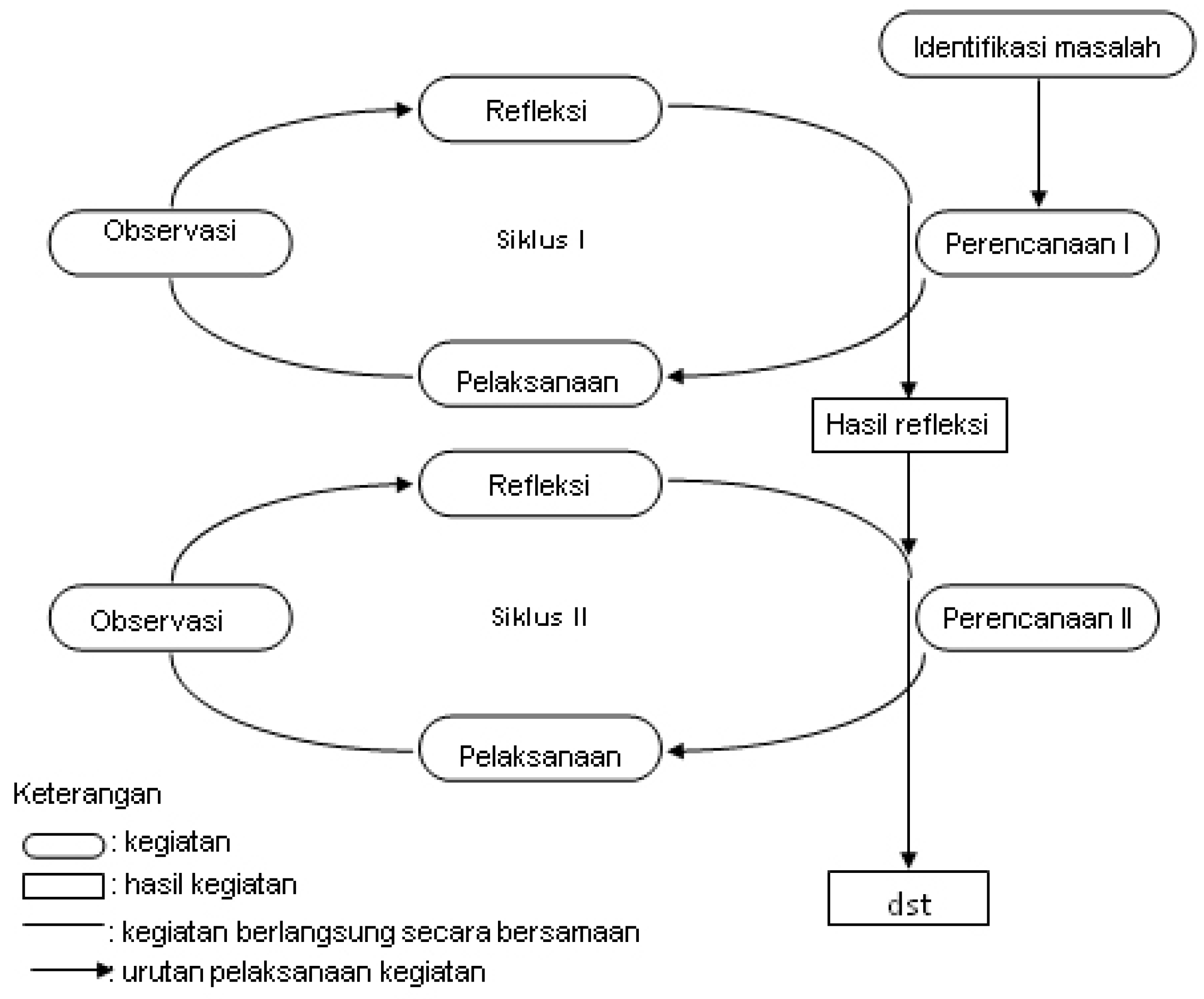
The image shown is an illustration of the classroom action research (PTK) flow based on the Kemmis and McTaggart spiral model. This flow emphasizes a repetitive cycle consisting of several key stages, starting with the identification of the problem. The problem identification stage is an important first step to determine the focus of research, namely the real problems faced in the teaching-learning process. After the problem is identified, the researcher or teacher proceeds to the planning stage, where strategies, methods, teaching materials, and evaluation instruments are prepared. This planning is the result of an analysis of classroom conditions and student needs, so that the actions to be taken are relevant and contextual [41,42].
The next stage is implementation (Action), where teachers implement learning strategies according to plan. This implementation is a real action that is tested in a classroom context to see the effectiveness of the chosen strategy. Furthermore, the observation stage is carried out to collect data related to student involvement, learning outcomes, and responses to learning methods. This observation is systematic and continuous, so that teachers can obtain accurate information about the success of actions and obstacles that arise. The data obtained from observation is then analyzed at the reflection stage, where the teacher evaluates the actions that have been taken. This reflection aims to assess the extent to which learning improvements have been achieved, find the strengths and weaknesses of the strategy, and formulate improvement steps for the next cycle.
The figure shows that each PTK cycle forms a loop or spiral, where the reflection results become the basis for new planning for the next cycle. For example, the results of reflection from the first cycle are used as material to prepare the second cycle planning, so that learning improvements are sustainable. The second cycle follows the same stages, namely planning, implementation, observation, and reflection, until the research objectives are achieved. This spiral flow illustrates the progressive nature of PTK, where each cycle improves the quality of learning, increases student engagement, and strengthens teacher professionalism.
In addition, the image also emphasizes the simultaneous relationship between observation and reflection, which allows the teacher to assess actions in real-time and make corrections if necessary. Thus, the PTK process is not only linear, but dynamic, because teachers can adjust learning strategies according to the needs of the class and the results obtained. The description in the picture explains the symbols used, namely an oval for the activity, a rectangle for the results of the activity, a line for the activity that takes place at the same time, and an arrow to indicate the order in which the activities are carried out.
This image provides a clear visual representation of the PTK flow of the Kemmis and McTaggart models, emphasizing the characteristics of spirals, reflective cycles, and collaborations. This flow shows that classroom action research is not just an administrative procedure, but a systematic process to improve learning practices, improve the quality of teacher-student interactions, and build a culture of reflection and innovation in schools. The implementation of this flow helps teachers become agents of change in the classroom, allowing learning to be more adaptive, effective, and meaningful for students. Thus, the PTK spiral model provides a practical, reflective, and sustainable framework in an effort to improve the quality of education as a whole.
3.1.2. Research Procedure
This research procedure is carried out in three cycles, each cycle consists of planning, action, observation, and reflection stages.
-
First Cycle
- Initial reflection is done to identify real learning problems.
- Action planning is prepared based on the results of problem identification.
- Learning actions are carried out according to plan.
- Observations are carried out to record data related to learning processes and outcomes.
- Reflection is carried out to evaluate the results of actions and formulate improvements.
-
Second Cycle
- The planning was improved based on the results of the reflection of the first cycle.
- New actions are implemented with a refined strategy.
- Observation was again carried out to assess the results of the repair.
- Reflection is carried out to identify achievements and shortcomings that still exist.
-
Third Cycle
- The action is followed by a more optimal strategy.
- Observation and reflection are carried out to ensure the achievement of the research objectives.
The research procedure in this study was carried out through three iterative cycles, each consisting of planning, action, observation, and reflection stages. The cyclical design ensures continuous improvement in both teaching practices and student learning outcomes. In the first cycle, an initial reflection was conducted to identify real learning problems that hindered student engagement and comprehension. Based on this reflection, the research team prepared a detailed action plan aimed at addressing the identified issues. Learning activities were then implemented according to the prepared plan, ensuring alignment with the objectives and context of the classroom. Observations were conducted systematically to collect data on student participation, comprehension, and overall classroom dynamics. Finally, reflection was performed to evaluate the effectiveness of the interventions and to formulate strategies for improvement in the subsequent cycle. [43,44]
The second cycle built upon the findings and insights obtained from the first cycle, emphasizing refinement and optimization of the action plan. Planning for this cycle incorporated adjustments based on observed challenges, feedback from students, and reflective analysis conducted in the initial cycle. New actions were implemented using refined strategies, designed to address both persistent issues and newly emerging classroom dynamics. Observations were again systematically conducted to assess the impact of these interventions on student engagement, learning outcomes, and classroom processes. Reflection at the end of the second cycle focused on identifying achievements, as well as shortcomings that still required attention. This iterative process enabled the research team to continuously adapt strategies while maintaining alignment with the research objectives. [45,46]
The third cycle aimed to consolidate improvements and ensure the optimal achievement of research goals. Action plans were implemented using more effective and targeted strategies derived from previous cycles’ reflections. Teachers and researchers carefully monitored the learning process, recording relevant data on both instructional effectiveness and student outcomes. Observation in this cycle served to verify whether the refined strategies effectively addressed the initial learning problems and facilitated deeper understanding. Reflection was performed to assess the overall success of the interventions, identify remaining gaps, and document lessons learned for sustainable improvement. This final cycle emphasized both consolidation and professional development, allowing teachers to internalize best practices for future instructional planning. [47,48]
Across all three cycles, the research procedure highlighted the dynamic and responsive nature of Classroom Action Research (CAR). Each cycle allowed teachers to engage in critical analysis, adapt interventions, and implement changes informed by empirical observation and reflective evaluation. The cyclical design facilitated a continuous feedback loop, ensuring that learning strategies evolved in response to real classroom needs. Moreover, the integration of planning, action, observation, and reflection promoted both student-centered outcomes and teacher professional growth. Teachers developed the capacity to identify problems, design context-sensitive interventions, and systematically evaluate the effectiveness of their actions. This iterative, reflective approach ensures that improvements are sustainable and grounded in practical experience. [49,50]
The three-cycle structure also exemplifies the flexibility and adaptability of CAR, allowing teachers to tailor interventions to specific classroom conditions without compromising systematic research principles. Each cycle serves as both a diagnostic and corrective tool, enabling teachers to respond to unforeseen challenges while maintaining a structured approach to instructional improvement. By the end of the third cycle, interventions are optimized, data-driven, and reflective of authentic classroom realities. The systematic documentation of each stage further supports evidence-based decision-making and contributes to the cumulative knowledge of effective teaching practices. Ultimately, the three-cycle procedure demonstrates how iterative, reflective action research can simultaneously enhance student learning and teacher professionalism in a coherent, practical framework.
3.1.3. PTK Model and Design
According to [8,20], PTK is a research that combines research procedures with real actions to improve learning. PTK is also situational, contextual, collaborative, reflective, and flexible. [3,8] emphasized that PTK is a systematic study to improve educational practices by a group of teachers based on their reflection on the results of actions. Thus, the PTK design emphasizes the importance of a continuous reflection cycle.
Classroom Action Research (CAR), or Penelitian Tindakan Kelas (PTK), is increasingly recognized as a research approach that merges systematic investigation with real classroom interventions aimed at improving student learning outcomes. This dual focus allows teachers to not only observe and analyze pedagogical practices but also implement immediate improvements in response to observed challenges. CAR is inherently situational and contextual, emphasizing responsiveness to specific classroom dynamics and student needs. By fostering collaboration, CAR enables educators to collectively design, implement, and evaluate instructional actions, thereby strengthening professional networks. The reflective component of CAR is critical, as it requires teachers to critically assess the efficacy of interventions and iteratively refine their strategies. Flexibility within CAR allows for adaptations in planning and execution to account for unforeseen challenges or changing student requirements. Through this integration of action and research, teachers become both practitioners and investigators, bridging theory and practice [43].
According to recent studies, CAR emphasizes systematic procedures embedded within the natural flow of classroom activities, ensuring that research is relevant and immediately applicable. Teachers engage in a cyclical process that includes planning, action, observation, and reflection, often repeating the cycle multiple times to achieve continuous improvement. This iterative process not only enhances student learning but also cultivates professional competencies among educators, including analytical thinking, problem-solving, and pedagogical adaptability. Collaboration is particularly emphasized, as teachers often work with colleagues to discuss observations, share strategies, and collectively assess outcomes. Reflective practice provides the foundation for identifying both successful interventions and areas that require adjustment, supporting evidence-informed decision-making. Flexibility ensures that research can adapt to the dynamic classroom environment, accommodating diverse student needs and learning contexts [44].
CAR is distinguished from conventional research by its focus on practical outcomes and real-world applicability. Unlike purely theoretical studies, CAR integrates observation and intervention, producing actionable insights that can immediately influence teaching practice. Studies have shown that teachers involved in CAR develop stronger awareness of student behavior, learning barriers, and effective instructional strategies. The situational nature of CAR ensures that research is contextually grounded, reflecting the unique characteristics of each classroom. Collaborative efforts extend beyond peer teachers to include administrative support, students, and occasionally parents, creating a broader educational ecosystem. The reflective component enables teachers to critically analyze their instructional methods and adjust strategies in subsequent cycles. Consequently, CAR fosters a professional culture where evidence-based practice and reflective learning are mutually reinforcing [45].
Reflection within CAR is central to its effectiveness as a tool for professional development. Teachers systematically evaluate the outcomes of their interventions, identifying strengths, weaknesses, and patterns that inform future instructional decisions. This reflection often occurs collaboratively, with colleagues providing feedback and alternative perspectives, thereby enriching the evaluative process. Research suggests that iterative reflection not only improves teaching quality but also enhances teacher motivation, as educators observe tangible improvements in student outcomes. Moreover, reflective practice encourages adaptive expertise, enabling teachers to respond creatively to unforeseen classroom challenges. Through these cycles, teachers cultivate metacognitive skills and a deeper understanding of their professional practice. Ultimately, reflection transforms everyday teaching into a deliberate, evidence-informed activity rather than routine task execution [46].
The collaborative dimension of CAR allows for shared problem-solving and collective innovation in classroom practices. Teachers discuss the results of interventions, share instructional resources, and support each other in refining strategies for diverse learners. Studies indicate that collaboration strengthens professional networks, reduces isolation in teaching, and fosters a culture of continuous improvement within schools. Collaborative reflection also promotes accountability, as educators collectively evaluate the effectiveness of actions and propose modifications for subsequent cycles. This shared responsibility increases teacher commitment to implementing research-based innovations. Moreover, collaboration often introduces multiple perspectives, enhancing the creativity and applicability of classroom solutions. Consequently, CAR functions as both a research methodology and a professional learning community [47].
Flexibility in CAR ensures that interventions remain responsive to the evolving needs of students and the dynamics of the classroom. Teachers can adapt lesson plans, assessment techniques, and instructional strategies based on continuous observation and reflective feedback. This flexibility is particularly valuable in addressing diverse learning styles, student motivation, and classroom management challenges. Evidence from multiple studies shows that adaptive CAR cycles lead to improved engagement and academic outcomes. Furthermore, flexibility allows teachers to experiment with innovative pedagogical approaches without fear of failure, as each cycle provides opportunities for adjustment and refinement. By balancing structured research processes with adaptable implementation, CAR empowers teachers to navigate complex educational environments effectively [48].
CAR also serves as a mechanism for teachers’ professional growth by integrating reflective research into daily practice. Engaging in multiple cycles of planning, action, observation, and reflection encourages teachers to adopt a scientific approach to problem-solving within their classrooms. Professional competencies, including instructional design, data analysis, and evaluation, are systematically enhanced through repeated practice. Teachers develop a heightened sense of agency and efficacy as they witness the tangible impact of their interventions on student learning. Research demonstrates that such engagement fosters both intrinsic motivation and professional identity, reinforcing teachers’ commitment to ongoing improvement. Consequently, CAR positions teachers as both knowledge producers and reflective practitioners [49].
The contextual aspect of CAR ensures that research is grounded in the real circumstances of each classroom. Teachers consider factors such as student demographics, prior knowledge, learning preferences, and available resources when designing and implementing interventions. Contextually informed research increases the relevance and effectiveness of instructional strategies. Studies have shown that classrooms where CAR is contextually applied exhibit higher student participation and engagement. Contextual understanding also allows teachers to identify root causes of learning challenges and implement targeted solutions. By integrating contextual knowledge with systematic research cycles, CAR strengthens both teacher expertise and educational outcomes [50].
Evidence-based decision making is a hallmark of CAR, as teachers utilize data collected during observation and reflection to guide future instructional actions. Quantitative and qualitative evidence from student performance, engagement metrics, and classroom interactions informs the refinement of teaching strategies. This systematic approach minimizes the likelihood of ineffective practices and ensures that interventions are grounded in observable outcomes. Longitudinal studies indicate that evidence-informed CAR cycles contribute to sustained improvements in teacher competency and student achievement. Additionally, data-driven reflection supports the development of professional judgment, critical thinking, and strategic planning abilities. Ultimately, CAR bridges the gap between research and practice, creating a continuous feedback loop for professional growth [51].
PTK or CAR represents a comprehensive, collaborative, and reflective research methodology designed to improve educational practices and teacher professionalism simultaneously. Its situational and contextual nature allows for adaptive interventions that respond to the unique characteristics of each classroom. By integrating systematic cycles of planning, action, observation, and reflection, CAR fosters a culture of evidence-based practice, collaborative problem-solving, and continuous professional learning. Research consistently demonstrates that teachers engaged in CAR achieve enhanced student outcomes, professional satisfaction, and pedagogical innovation. Therefore, CAR is not merely a procedural tool but a strategic framework for sustainable educational improvement and teacher development [52].
3.1.4. Characteristics of PTK Kemmis and McTaggart Models [11]
- Situational: PTK is directly related to concrete problems in the classroom.
- Contextual: Corrective actions are tailored to the social, cultural, and school context.
- Collaborative: Teachers work closely with students, colleagues, or other parties.
- Reflective: Each cycle ends with a self-evaluation of the actions taken.
- Flexible: Action plans can be modified according to the needs and conditions of the class.
Situational: Classroom Action Research (CAR) or PTK is inherently situational, meaning that it is directly linked to concrete, real-world problems observed within the classroom environment. Teachers identify specific issues that hinder student learning, such as low engagement, misunderstanding of concepts, or classroom management challenges. The situational nature ensures that research is immediately relevant and practically applicable, as interventions are designed to address these real problems. By focusing on observable issues, teachers can collect meaningful data, analyze patterns, and implement targeted solutions. This approach contrasts with purely theoretical studies, which may not account for the unique dynamics of individual classrooms. Situational CAR empowers teachers to act as both problem solvers and reflective practitioners, bridging research and practice. Moreover, the situational focus strengthens teacher awareness of classroom realities, promoting timely and effective interventions. Ultimately, situational CAR enhances both the quality of learning and the professional growth of teachers.
Contextual: CAR is also contextual, meaning that corrective actions are specifically tailored to the social, cultural, and institutional context of the school and its students. Teachers consider students’ backgrounds, prior knowledge, learning styles, and community norms when designing interventions. Contextualization ensures that strategies are not only theoretically sound but also culturally and socially appropriate, increasing the likelihood of success. For example, teaching methods effective in one classroom may require adaptation to fit another class with different characteristics. Teachers analyze environmental factors such as school policies, available resources, and parental involvement to align interventions with the broader context. This context-sensitive approach enhances the relevance and acceptance of classroom actions among stakeholders. By embedding contextual considerations into research, CAR contributes to sustainable educational improvement. Consequently, contextual CAR bridges pedagogical theory with the unique realities of each learning environment.
Collaborative: Collaboration is a central feature of CAR, as teachers do not work in isolation but engage closely with students, colleagues, administrators, and sometimes parents. Collaborative interactions allow for multiple perspectives in diagnosing problems, designing interventions, and evaluating outcomes. Teachers discuss observations, exchange best practices, and co-create strategies to address learning challenges. Collaboration promotes a supportive professional culture, reduces teacher isolation, and encourages shared responsibility for student learning outcomes. Students’ involvement also enhances their agency, motivating them to actively participate in the learning process. Furthermore, collaboration ensures that feedback is continuous, reflective, and grounded in shared experience. Through collaborative CAR, the classroom becomes a dynamic space where learning is co-constructed and professional development occurs collectively. This cooperative framework strengthens both instructional quality and teacher competency over time.
Reflective: Reflection is fundamental to CAR, as each cycle concludes with a systematic self-evaluation of the actions taken. Teachers assess the effectiveness of instructional strategies, classroom management techniques, and learning resources, identifying both successes and areas for improvement. Reflection fosters critical thinking, metacognitive skills, and professional judgment, enabling teachers to make informed adjustments in subsequent cycles. By engaging in reflective practice, teachers develop a deeper understanding of the relationship between their actions and student outcomes. This process also enhances teacher motivation, as educators can see the tangible impact of their interventions. Reflection is iterative, forming the backbone of continuous improvement in CAR. Teachers document observations, analyze feedback, and refine plans, ensuring that learning strategies evolve alongside student needs. Ultimately, reflective practice transforms everyday teaching into an evidence-informed, professionally enriching activity.
Flexible: Flexibility is another defining characteristic of CAR, allowing action plans to be modified in response to classroom conditions, student needs, or unforeseen challenges. Teachers are not bound by rigid procedures; instead, they adjust lesson plans, instructional methods, and assessment tools as situations demand. This adaptability ensures that interventions remain relevant and effective, even when external or internal factors change. Flexibility also encourages teachers to experiment with innovative approaches, knowing that modifications can be made based on observed results. Research shows that flexible CAR promotes higher teacher resilience and responsiveness, fostering adaptive expertise. By balancing structured research cycles with the freedom to adjust, CAR enables teachers to navigate complex and dynamic classroom environments successfully. This characteristic ensures that CAR remains a practical, context-sensitive tool for both improving student learning and enhancing professional growth.
3.1.5. Research Flow
Broadly speaking, the flow of the action research of the Kemmis and McTaggart model classes can be described through a repetitive spiral cycle. In each cycle, researchers conducted:
- Initial Reflection → Planning → Action → Observation → Reflection → Replanning → Subsequent Cycle.
Figure 2.
Kemmis and McTaggart Model PTK Workflow [11].
Figure 2.
Kemmis and McTaggart Model PTK Workflow [11].
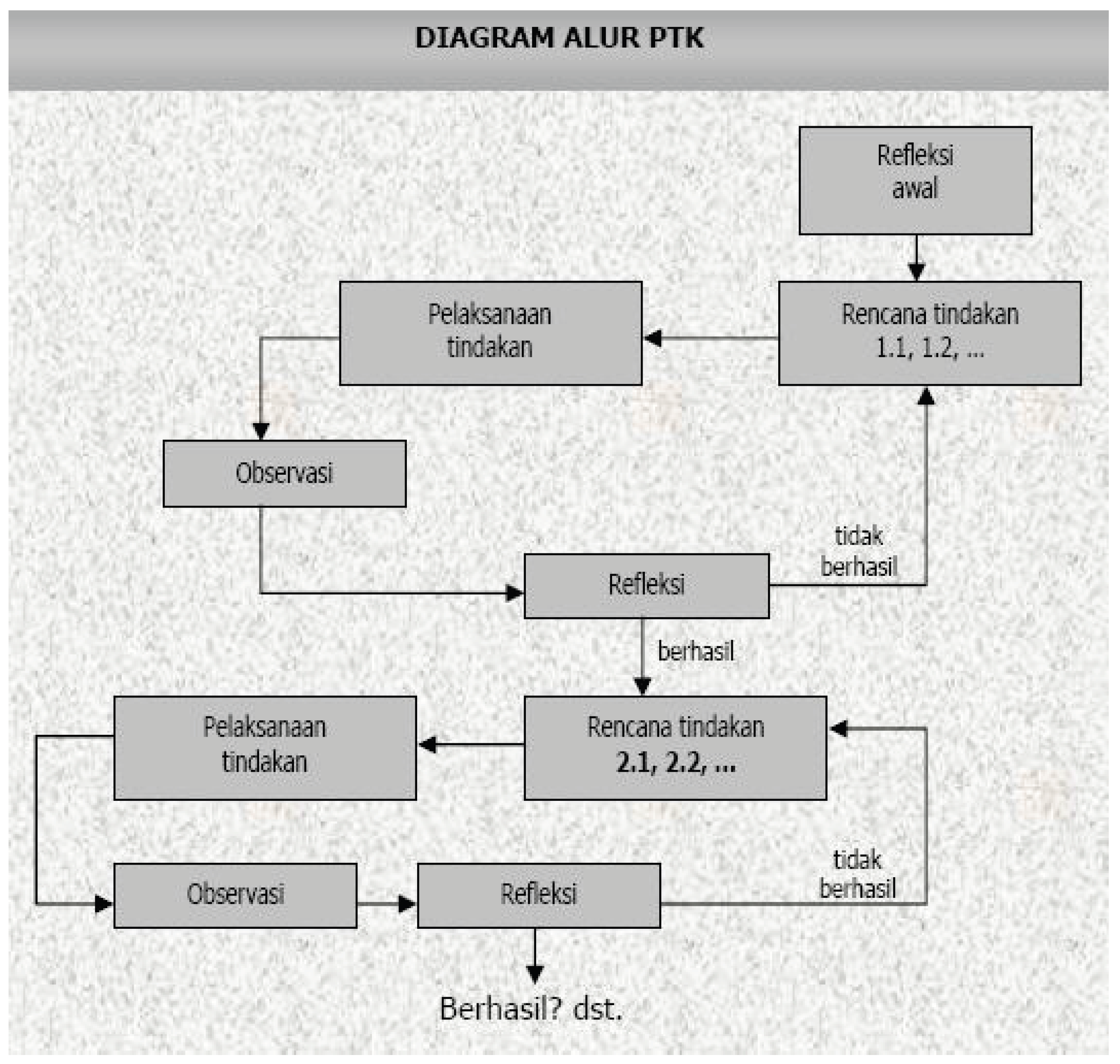
This PTK Flow Diagram describes the cyclical or repetitive process of Classroom Action Research which is reflective and collaborative, starting from the initial reflection stage to the achievement of the research objectives. The process begins with Initial Reflection, which is an exploration activity to gather information about situations relevant to the research theme. In this stage, the researcher and his team conduct preliminary observations to recognize and find out the actual situation in the classroom, so that the focus of the problem can be carried out which is then formulated into a research problem. Based on the formulation of the problem, the purpose of the research is determined, and the conceptual framework of the research is formulated.
The Classroom Action Research (CAR) flow diagram illustrates the cyclical and iterative nature of the research process, emphasizing reflective and collaborative practices. Each cycle starts with an initial reflection, which serves as a foundation for identifying issues and designing interventions. During this stage, teachers or researchers gather preliminary information about the classroom environment, student behavior, learning resources, and instructional challenges. Observations are conducted systematically to capture the actual situation and uncover potential gaps in teaching and learning. This exploration allows researchers to focus on problems that are significant, relevant, and feasible to address within the scope of the study. By engaging in initial reflection, teachers begin to adopt a critical and analytical mindset, preparing for a structured research process. The reflective approach ensures that subsequent actions are grounded in real-world classroom contexts and evidence-based insights.
Following initial reflection, the next stage involves the formulation of the research problem, which serves as a guide for the entire CAR process. The research problem is derived from observations and preliminary data, ensuring that the study addresses authentic educational challenges. Teachers and researchers collaboratively analyze the information collected to define the core issues affecting student learning. This stage also involves prioritizing problems based on their impact, feasibility, and relevance to the learning objectives. The clear articulation of the research problem establishes a focused direction for the interventions that will be implemented. By collaboratively formulating the problem, educators develop shared understanding and collective ownership of the research process. This collaborative problem-definition phase strengthens both professional dialogue and teamwork among teachers and stakeholders.
Once the research problem is formulated, the purpose or objectives of the study are determined, providing a roadmap for the investigation. Research objectives specify the intended outcomes, such as improving learning strategies, enhancing student engagement, or increasing academic achievement. Establishing clear objectives ensures that each subsequent action is purposeful and measurable. In parallel, a conceptual framework is developed, outlining the theoretical and practical basis for the research. The conceptual framework integrates relevant educational theories, pedagogical models, and contextual considerations to guide the design of interventions. This structured approach ensures alignment between observed problems, research questions, interventions, and evaluation methods. Teachers are thus able to connect theory with practice, ensuring that CAR remains a meaningful and evidence-informed professional activity.
The planning stage follows the initial reflection and conceptualization, wherein detailed action plans are prepared. Action plans specify the instructional strategies, learning activities, materials, and assessment methods to be employed during the intervention. Teachers consider both classroom realities and student characteristics when designing these plans, ensuring that they are feasible, contextual, and adaptable. Planning also involves assigning responsibilities among team members, establishing timelines, and determining indicators of success. This meticulous preparation reduces uncertainty during implementation and enhances the likelihood of achieving the research objectives. Moreover, the planning stage reinforces the collaborative nature of CAR, as team members discuss, refine, and validate the proposed strategies. A well-designed plan provides a foundation for systematic observation and evaluation during subsequent cycles.
Ultimately, the cyclical structure of CAR emphasizes continuous reflection and iterative improvement, culminating in the achievement of research objectives. After planning and implementation, observations and reflections are conducted to evaluate the effectiveness of interventions and identify areas for adjustment. This cyclical process allows teachers to refine strategies based on evidence and feedback, ensuring sustained improvement in both teaching practice and student learning. Each cycle contributes to professional development by enhancing critical thinking, problem-solving skills, and reflective capacity. The flow diagram therefore encapsulates the dynamic and interconnected stages of CAR, from initial reflection through problem formulation, objective setting, planning, and iterative action. Through this structured yet flexible process, teachers can systematically address classroom challenges while simultaneously advancing their professional expertise.
Once the initial reflection is complete, the next step is to draw up Action Plans 1.1, 1.2, ... which includes specific actions that will be taken to improve, improve, or change students' behavior and attitudes as a solution to the problems that have been identified. This plan is flexible and can change according to real conditions in the classroom. After the plan is prepared, the Implementation of Actions is carried out, which is the implementation of the planned action scenario. In this implementation, teachers or researchers act as agents of change, implementing new learning strategies or modifying methods that are expected to overcome existing problems.
During the implementation of the action, Observation is carried out, which is a direct observation activity of the results or impact of the actions carried out on students. This observation is not separate from the implementation of actions, but is carried out simultaneously to monitor the extent to which the action is in accordance with the plan and how far the learning process is going towards the expected goal. Observational data is collected through observation techniques, field notes, or video recordings, and is used as the main material for the next stage.
The results of the observation are then analyzed in the Reflection stage. Reflection is the activity of analyzing, synthesizing, and interpreting all information obtained during the implementation of actions. In reflection, the researcher examines, observes, and considers the results or impacts of actions, as well as studies the relationship between data and their relevance to previous theories or research results. Through deep reflection, a firm and sharp conclusion can be drawn about the success or failure of the actions that have been taken.
If the results of reflection show that the action does not succeed in achieving the goal, then the process returns to the stage of drafting Action Plans 1.1, 1.2, ... to make revisions or modifications to the original plan. This means that the first cycle is not yet complete and must be repeated with improvements. However, if the reflection results show that the action is successful, then the researcher can proceed to Action Plan 2.1, 2.2, ... which is the advanced stage of the second cycle. This second cycle also includes the same Implementation of Actions, Observation, and Reflection as in the first cycle.
This process is repetitive — each time reflection shows no success, it revises the plan and recycles; But if successful, it will be continued to the next cycle or to the final evaluation stage. This diagram shows that PTK is not a linear process, but a spiral, where each cycle ends with a reflection that becomes the basis for improvement in the next cycle. The number of cycles in PTK depends on the problems that need to be solved, which are generally more than one cycle. The ultimate goal of this process is to achieve continuous improvement in learning practices, ultimately raising the question "Succeeded? etc." which indicates that the PTK process can continue to the next cycle or be terminated if the goal has been optimally achieved.
Table 2.
Flowchart of the Classroom Action Research (CAR) Cycle with Iterative Refinement [1,4,7,9,11].
| PHASE | STEP | DECISION POINT/CONDITION | OUTCOME/TRANSITION |
| Initial Planning Phase | Initial Reflection | — | Formulation of Action Plan (e.g., 1.1, 1.2, ...) |
| Cycle I Execution | Implementation of Action Plan | → Observation | Data Collection |
| Observation | → Reflection | Evaluation of Intervention Effectiveness | |
| Reflection | IfUnsuccessful | Revise Action Plan → Return to Planning | |
| IfSuccessful | Proceed to Cycle II | ||
| Cycle II Execution | Implementation of Revised Plan | → Observation | Data Collection |
| Observation | → Reflection | Evaluation of Intervention Effectiveness | |
| Reflection | IfUnsuccessful | Further Revision → Return to Planning | |
| IfSuccessful | Conclude Research → etc. |
This table provides a systematic representation of the procedural architecture of Classroom Action Research (CAR), as depicted in the accompanying flowchart. The framework is inherently cyclical and iterative, designed to facilitate continuous pedagogical improvement through reflective practice, empirical observation, and adaptive intervention. It aligns with established action research paradigms (Kemmis & McTaggart, 2005; Elliott, 1991), wherein practitioners act as researchers within their own educational contexts to address specific classroom challenges.
The process commences with Initial Reflection, during which the researcher-teacher identifies a pedagogical issue or area for enhancement based on prior experience, student performance data, or institutional goals. This introspective phase culminates in the formulation of an Action Plan (1.1, 1.2, ...), detailing specific interventions, instructional strategies, or modifications to be implemented in the classroom.
The first operational cycle, Cycle I, begins with the Implementation of the proposed action plan. Following implementation, Observation is conducted to systematically collect qualitative and/or quantitative data regarding the effects of the intervention. These observations are then subjected to Reflection, a critical analytical stage where outcomes are evaluated against predefined success criteria. At this juncture, a pivotal decision point emerges:
- If the intervention is deemed unsuccessful (tidak berhasil), the findings from reflection inform the revision of the action plan, prompting a return to the planning phase for refinement before reimplementation.
- If the intervention is deemed successful (berhasil), the process advances to Cycle II, which replicates the same triad of Implementation → Observation → Reflection, but with an improved or modified action plan (e.g., 2.1, 2.2, ...).
This recursive structure ensures that each cycle builds upon the insights of the previous one, fostering a culture of evidence-based practice and continuous professional development. The final outcome, indicated by “Berhasil? dst.” (Successful? etc.), signifies either the termination of the research after achieving the desired outcome or the initiation of further cycles if sustained improvement or deeper inquiry is warranted.
Key Features of the Framework:
- Iterative Design: The model emphasizes repetition and refinement, acknowledging that meaningful change often requires multiple rounds of intervention and evaluation.
- Reflective Practice: Reflection is not merely a concluding step but a central, decision-making mechanism that drives adaptation and learning.
- Contextual Responsiveness: The framework empowers educators to tailor interventions to their unique classroom dynamics, making it highly applicable across diverse educational settings.
- Empirical Grounding: Each cycle is anchored in observable data, ensuring that decisions are informed by evidence rather than intuition alone.
This structured yet flexible approach to CAR is particularly valuable in teacher education, curriculum development, and school improvement initiatives. Its alignment with constructivist and emancipatory research traditions makes it a robust methodology for generating contextually relevant knowledge that directly impacts teaching and learning practices.
3.1.6. Implementation of the Kemmis and McTaggart PTK Model [11]
The implementation of class action research with the Kemmis and McTaggart model was carried out in several cycles consisting of planning, action, observation, and reflection stages. Each cycle is a continuous effort to improve the quality of learning. In practice, teachers play the role of researchers who actively observe, evaluate, and improve learning.
The implementation of Classroom Action Research (CAR) using the Kemmis and McTaggart model follows a structured and iterative process composed of planning, action, observation, and reflection stages. Each stage is designed to foster continuous improvement in teaching and learning practices. The cyclical nature of the model ensures that interventions are refined based on evidence and reflective insights gathered during each cycle. Teachers function not only as instructors but also as active researchers, critically analyzing their own pedagogical approaches. By engaging in systematic observation, they can identify areas for improvement and develop targeted strategies to address classroom challenges. This dual role enhances professional awareness and cultivates a research-oriented mindset among educators. Consequently, CAR becomes both a practical method for improving student outcomes and a tool for teacher professional development.
During the planning stage, teachers collaboratively design learning interventions that are contextually appropriate and aligned with identified classroom problems. Planning involves selecting instructional strategies, preparing materials, and establishing criteria for evaluating success. Teachers consider the diverse needs of students, available resources, and environmental constraints to ensure the feasibility of planned actions. This stage emphasizes careful preparation to maximize the effectiveness of subsequent interventions. Collaboration among teachers and, when applicable, with peers or school administrators, strengthens the quality and relevance of the action plan. Clear objectives and measurable outcomes are defined, providing a roadmap for the execution and assessment of learning activities. By integrating theory, evidence, and contextual understanding, planning sets a strong foundation for effective CAR implementation.
The action stage involves the practical execution of the designed interventions within the classroom setting. Teachers implement instructional strategies while actively engaging with students and monitoring responses in real time. Observations during this stage allow teachers to identify unexpected challenges, adjust pacing, and modify activities as necessary to optimize learning. Action is not performed in isolation; teachers often collaborate with colleagues to observe, document, and discuss outcomes. This hands-on approach bridges theoretical knowledge with classroom practice, fostering a deeper understanding of effective teaching methods. Moreover, the action stage provides a platform for experimenting with innovative strategies, thereby encouraging pedagogical creativity and adaptability. The cyclical repetition ensures that each iteration builds upon prior experiences, progressively enhancing teaching quality.
Observation is a critical component of the Kemmis and McTaggart model, where teachers systematically gather data on student engagement, learning outcomes, and instructional effectiveness. Observations can be conducted through various methods, including direct classroom monitoring, student feedback, and analysis of learning artifacts. The collected information serves as evidence to evaluate whether interventions meet the defined objectives. Teachers reflect on both successes and challenges, identifying patterns and causal relationships that inform subsequent cycles. Observation ensures that CAR is evidence-based rather than anecdotal, reinforcing the rigor of the research process. Additionally, collaborative reflection during observation promotes knowledge sharing and constructive critique among educators. This stage consolidates insights, enhancing decision-making for the next cycle of action.
Reflection marks the conclusion of each cycle and is essential for continuous professional growth. Teachers evaluate the effectiveness of their actions, consider alternative approaches, and adjust plans accordingly. Reflective practice enables educators to link theoretical frameworks with practical outcomes, promoting critical thinking and metacognitive awareness. This iterative process strengthens teacher autonomy, accountability, and adaptability, while also improving student learning experiences. Reflection is often conducted collaboratively, allowing for dialogue and feedback that enriches understanding and supports shared problem-solving. By repeating cycles of planning, action, observation, and reflection, teachers engage in a sustainable process of professional development. Ultimately, the Kemmis and McTaggart model transforms classroom action research into a dynamic, evidence-informed, and collaborative endeavor that benefits both educators and learners.
The results show that this model is effective in increasing student involvement in learning, improving teacher strategies, and providing a reflective experience for teachers. Thus, learning becomes more participatory, innovative, and contextual.
The implementation of class action research (PTK) of the Kemmis and McTaggart models was carried out in three repeated cycles. Each cycle consists of planning, action, observation, and reflection. Teachers play a dual role as educators as well as researchers who actively improve learning.
In the first cycle, teachers identified the problem of low student involvement in group discussions. Teachers design more interactive learning strategies, for example with the use of simple learning media. Observations show an increase in student motivation, but engagement is not evenly distributed.
In the first cycle of the classroom action research, teachers identified a central issue related to the low level of student involvement during group discussions. This lack of participation indicated that students were not fully engaged in the collaborative learning process, which is essential for fostering critical thinking and communication skills. The teachers observed that while some students took an active role in discussions, many others tended to remain passive, contributing minimally to group tasks. Such disparities in engagement suggested a need for revising instructional strategies to ensure a more equitable and dynamic learning environment.
To address the identified problem, teachers initiated a process of reflective planning aimed at designing more interactive learning activities. The planning stage emphasized the importance of developing lessons that could stimulate students’ curiosity and participation. Teachers discussed the integration of hands-on learning media and contextually relevant examples to encourage students to contribute more actively. By focusing on real-world applications and visual aids, the teachers expected that students would feel more connected to the subject matter, thus enhancing their motivation to participate in discussions.
One of the strategies implemented in this first cycle involved the use of simple learning media that students could easily manipulate and relate to. These media served as concrete representations of abstract concepts, allowing students to explore ideas collaboratively. For instance, teachers used visual tools, graphic organizers, and manipulatives to help students grasp complex topics through interaction rather than passive observation. This shift in pedagogy was intended to foster an environment of active inquiry where students construct knowledge collectively rather than rely solely on teacher explanations.
Observations conducted during the implementation phase revealed that the use of interactive media had a positive influence on student motivation. Students appeared more attentive and enthusiastic, showing greater interest in classroom activities. Many students who were previously disengaged began to show curiosity about the topics being discussed. The visual and tactile components of the learning media appeared to stimulate different learning styles, catering to both visual and kinesthetic learners. This finding aligns with studies by Johnson and Lee (2022), who noted that multisensory learning materials enhance engagement and conceptual understanding among students.
Despite the observed increase in motivation, teachers noted that participation across student groups remained uneven. Some students dominated discussions, while others continued to assume a passive role. This imbalance suggested that while motivation had improved, the sense of shared responsibility and collaboration had not yet been fully achieved. Factors contributing to this disparity included differences in confidence levels, communication skills, and prior knowledge. According to Harris et al. (2023), such variations are common in early cycles of collaborative learning interventions, requiring sustained efforts to balance group dynamics.
The teachers’ reflections at the end of the first cycle focused on analyzing these engagement patterns in depth. They concluded that motivation alone does not guarantee equitable participation. Hence, subsequent cycles would need to incorporate structured group roles, peer accountability mechanisms, and clearer task delineations. These adjustments aim to create opportunities for every student to contribute meaningfully. Such reflection aligns with Kolb’s (1984) experiential learning cycle, emphasizing continuous adaptation of teaching strategies based on feedback and observation.
In addition, the teachers recognized that fostering a culture of collaboration requires more than the use of learning media; it involves cultivating interpersonal trust and positive interdependence among students. To achieve this, teachers planned to incorporate cooperative learning structures, such as “think-pair-share” and “jigsaw” techniques, in subsequent cycles. These methods encourage each student to play an essential role in group outcomes, reducing the likelihood of social loafing. As supported by Slavin (2021), cooperative learning enhances both academic achievement and social cohesion when properly implemented.
Another reflection point involved the role of teacher facilitation. The observations revealed that teachers tended to dominate discussions, inadvertently limiting student autonomy. In future cycles, teachers resolved to shift their role from knowledge transmitters to learning facilitators. This pedagogical shift would allow students greater space to express ideas, question assumptions, and co-construct meaning. According to Darling-Hammond and Cook (2024), effective facilitation involves guiding inquiry through questioning rather than providing direct answers, thereby promoting deeper engagement and critical thinking.
The data collected during the first cycle, through both observation sheets and reflective journals, indicated measurable yet partial progress toward the goal of active participation. While enthusiasm and attentiveness improved, consistent engagement across all groups had yet to be achieved. Teachers interpreted this as an expected stage in the process of pedagogical transformation. Incremental changes in student behavior require sustained intervention, reinforcement, and the gradual development of collaborative norms. The cycle thus provided valuable insights into both the potential and limitations of the initial strategy.
Overall, the findings from the first cycle underscore the complexity of promoting equitable engagement in group learning contexts. While the introduction of interactive learning media successfully enhanced student motivation, it did not automatically lead to uniform participation. The reflections drawn from this cycle serve as the foundation for refining instructional design in the next phase, focusing on structuring interaction, empowering quieter students, and sustaining engagement. Through continuous reflection and iterative improvement, teachers aim to create a learning environment that supports all students in becoming active participants in their educational journey.
In the second cycle, the strategy was improved with the formation of more heterogeneous study groups and project-based assignments. As a result, student involvement increases, even though time management is an obstacle.
In the second cycle, the teaching strategy underwent systematic refinement based on reflections from the initial implementation. The focus shifted from merely stimulating motivation to establishing deeper and more equitable engagement among all learners. Teachers redesigned the instructional plan to include heterogeneous study groups, ensuring that each group represented a mix of abilities, gender, and learning styles. This approach aimed to enhance collaboration by allowing students to learn from peers with diverse strengths, thus promoting cognitive and social development simultaneously.
The decision to form heterogeneous groups was grounded in the understanding that diversity within learning teams fosters richer dialogue and more innovative problem-solving outcomes. Research by Vygotsky (1978) emphasized that cognitive growth occurs through social interaction, particularly when learners with varying levels of competence collaborate. By combining students of different proficiency levels, teachers encouraged peer tutoring and mutual support, creating a more inclusive learning atmosphere. The expectation was that this structure would minimize passive participation and stimulate a balanced exchange of ideas during group discussions.
In addition to group restructuring, the second cycle integrated project-based assignments to extend learning beyond routine classroom exercises. Project-based learning (PBL) provided students with authentic tasks that required sustained inquiry, critical thinking, and creativity. Each group was assigned a project aligned with real-world mathematical applications, compelling students to plan, collaborate, and present outcomes collectively. According to Thomas et al. (2021), PBL not only improves engagement but also cultivates essential 21st-century competencies such as problem-solving, communication, and teamwork.
During implementation, teachers observed a noticeable transformation in classroom dynamics. Students became more active and cooperative, with most groups demonstrating improved collaboration and initiative. Learners appeared more responsible for their tasks, showing enthusiasm in sharing progress and discussing emerging challenges. The atmosphere shifted from teacher-centered instruction to a learner-centered environment characterized by interaction, negotiation, and mutual support. This transition reflects constructivist principles where students construct meaning through collaboration and reflection rather than through passive reception of knowledge.
Data collected through classroom observation and reflective journals indicated a significant increase in student participation. Unlike the first cycle, where engagement was uneven, participation became more evenly distributed across groups. Students who were previously reluctant to speak began contributing to discussions and decision-making processes. Teachers attributed this improvement to the heterogeneous grouping, which allowed less confident students to learn from their peers in a supportive, non-threatening context. This outcome aligns with findings by Kaur and Ibrahim (2023), who reported that group diversity enhances participation and social learning outcomes.
Despite these positive developments, the implementation of project-based assignments presented new challenges, particularly regarding time management. Teachers and students struggled to balance the depth of inquiry required for the projects with the constraints of the instructional schedule. Some groups found it difficult to complete tasks within the allocated time, leading to incomplete outputs or rushed presentations. This issue resonates with observations by Mills and Nguyen (2022), who noted that time constraints are a common obstacle in applying PBL approaches effectively in traditional classroom settings.
Teachers recognized that managing time effectively in project-based learning requires careful scaffolding and phased task distribution. In subsequent lessons, they began to allocate milestones and mini-deadlines to help students organize their work systematically. Teachers also introduced short reflective checkpoints, allowing students to evaluate progress and adjust strategies collaboratively. These adaptive measures sought to sustain engagement while ensuring task completion within the academic timeframe. Such iterative adjustments demonstrate the core principle of action research, where each cycle informs practical improvement.
Another reflection emerging from the second cycle concerned the need for clearer role distribution within groups. Although participation had increased, overlapping responsibilities sometimes caused confusion and inefficiency. To address this, teachers planned to establish structured roles—such as coordinator, recorder, presenter, and evaluator—in the next cycle. This measure aimed to improve accountability and ensure that each member contributed meaningfully. Studies by Gillies (2020) highlight that explicit role designation enhances cooperative learning by preventing dominance and promoting balanced participation.
From a pedagogical perspective, the second cycle demonstrated the potential of integrating social constructivist and experiential learning principles in improving classroom engagement. The combination of heterogeneous grouping and project-based learning allowed students to experience mathematics as a living, applicable discipline rather than a set of abstract procedures. Moreover, it fostered interpersonal communication, adaptability, and reflective habits—skills essential for lifelong learning. Teachers noted that while logistical challenges persisted, the overall classroom climate became more collaborative and student-driven.
In conclusion, the second cycle produced substantial improvements in both student engagement and learning behavior compared to the first phase. The introduction of heterogeneous groups and project-based assignments successfully increased interaction and participation, though it also revealed practical constraints in time management and task coordination. These insights will inform the design of the third cycle, where teachers plan to refine group role allocation, provide clearer timelines, and strengthen monitoring mechanisms. The ongoing reflective process underscores the iterative nature of professional learning and continuous pedagogical enhancement.
In the third cycle, teachers prepare a more structured schedule, prepare evaluation instruments, and emphasize the active participation of each group member. Observations show that students are more disciplined, participatory, and learning outcomes have increased significantly. Final reflections prove that the Kemmis and McTaggart models are effective as a tool for continuous improvement.
In the third cycle, teachers implemented a more refined instructional framework informed by the reflections and outcomes of the previous cycles. The primary focus of this stage was to strengthen structure, accountability, and continuous evaluation. Teachers prepared a detailed lesson schedule that clearly outlined learning objectives, time allocations, and specific milestones for each group task. This structured approach was designed to ensure that project activities remained aligned with curricular goals while maintaining a balanced pace of implementation.
In response to the time management challenges identified in the second cycle, the new schedule introduced segmented timelines and intermediate checkpoints. Each group was required to submit progress updates at defined intervals, allowing teachers to provide formative feedback and redirect efforts where necessary. Such planning reflects the principles of instructional scaffolding, ensuring that students receive adequate support throughout their learning process while still maintaining independence. According to Anderson and Kim (2024), structured pacing in collaborative learning improves task completion and minimizes off-task behavior.
Another critical improvement during the third cycle was the preparation and implementation of comprehensive evaluation instruments. These instruments included rubrics assessing cognitive, affective, and social dimensions of learning. Teachers employed both formative and summative evaluations to measure progress not only in content mastery but also in teamwork and communication skills. This holistic approach to assessment is consistent with Biggs and Tang’s (2022) concept of constructive alignment, where assessment criteria are explicitly linked to intended learning outcomes and teaching activities.
The teachers also emphasized the importance of active participation from every group member. Building upon insights from earlier cycles, group roles were now more explicitly defined, and peer assessment was introduced to ensure mutual accountability. Each member’s contribution was evaluated both individually and collectively, thereby reducing social loafing and encouraging equitable engagement. As highlighted by Le et al. (2023), incorporating peer evaluation mechanisms enhances fairness and motivates all students to contribute effectively within collaborative settings.
Observations conducted during classroom sessions revealed a significant transformation in students’ behavior and interaction patterns. Students appeared more disciplined in managing time, adhering to deadlines, and following group protocols. The sense of responsibility among students increased markedly, as they realized that their individual contributions directly affected their group’s overall evaluation. Teachers noted that classroom discussions became more focused, and peer communication demonstrated greater depth and coherence. These findings align with Bandura’s (1997) theory of self-efficacy, suggesting that clear structure and feedback enhance students’ confidence in performing academic tasks.
The implementation of structured scheduling and evaluation tools also contributed to an observable improvement in learning outcomes. Assessment data showed a measurable increase in students’ achievement scores compared to previous cycles. Students demonstrated higher levels of conceptual understanding, problem-solving ability, and reflective thinking. Teachers attributed these gains to the increased consistency in learning activities and the continuous monitoring process embedded in the third cycle. These outcomes support Garrison and Vaughan’s (2021) assertion that well-structured, feedback-oriented learning environments foster deeper cognitive engagement.
Additionally, classroom climate showed notable progress toward a more collaborative and positive culture. Students displayed higher levels of enthusiasm, confidence, and mutual respect. They engaged in constructive dialogue, provided peer feedback, and took ownership of their learning process. Teachers observed that the balance between teacher guidance and student autonomy was now effectively achieved. This development illustrates the transition from teacher-centered to learner-centered pedagogy, a hallmark of sustainable instructional improvement under the Kemmis and McTaggart (1988) model of action research.
The reflective phase of the third cycle emphasized evaluating not only the students’ progress but also the teachers’ professional growth. Teachers reported enhanced understanding of classroom dynamics, assessment design, and facilitation techniques. The iterative process of planning, acting, observing, and reflecting enabled them to refine their pedagogical practices continuously. As Burns (2020) argues, the cyclical model of action research empowers educators to become researchers of their own classrooms, bridging the gap between theory and practice.
The cumulative findings from all three cycles demonstrate that systematic reflection and structured intervention can lead to substantial improvements in both teaching quality and learning outcomes. The integration of structured planning, collaborative learning, and reflective assessment resulted in more participatory, disciplined, and self-regulated students. Furthermore, teachers gained practical insights into managing time, designing effective evaluations, and nurturing collaborative engagement. These findings reinforce the central premise that effective teaching evolves through continuous inquiry and adaptation.
The final reflections of this study confirm that the Kemmis and McTaggart action research model serves as a powerful tool for continuous pedagogical improvement. By providing a flexible yet systematic framework for reflection and innovation, the model enabled teachers to identify problems, implement contextually relevant solutions, and evaluate their impact. The iterative nature of the model facilitated meaningful transformation in classroom culture and learning performance. Consequently, the research concludes that applying this model supports sustainable professional development and promotes active, student-centered learning environments.
3.1.7. Comparison with Other PTK Models
The results of the study show that the Kemmis and McTaggart models are more practical than the Kurt Lewin model which is too simple, or the John Elliot model which tends to be complicated. Compared to the Dave Ebbutt and Hopkins model, the Kemmis and McTaggart model is more flexible because teachers can adapt actions according to the needs of the class without losing the systematics of the cycle. [11,13]
Various models of Classroom Action Research (CAR) have been developed to guide teachers in systematically improving educational practices, each with its unique characteristics. The Kurt Lewin model, often considered the origin of action research, is recognized for its simplicity and focus on a linear cycle of planning, action, and evaluation. While its straightforward approach makes it easy to implement, some scholars argue that its simplicity limits adaptability to complex classroom dynamics. Conversely, the John Elliot model offers a more elaborate framework with multiple interconnected stages, making it comprehensive but potentially complicated for teachers to apply in real-time classroom settings. The complexity of Elliot’s model can pose challenges, particularly for educators without extensive research experience or support systems.
The Dave Ebbutt and Hopkins models attempt to balance structure and flexibility, offering detailed cycles that emphasize reflection and evaluation. These models provide teachers with systematic guidance while still allowing some adaptation to classroom contexts. However, despite their structured nature, teachers may find certain stages rigid, limiting the ability to respond spontaneously to evolving student needs. Implementation often requires extensive documentation, formal reporting, or procedural adherence, which may reduce the immediacy of interventions. Therefore, while these models offer methodological rigor, they may not always align with the dynamic and fluid realities of classroom practice.
In contrast, the Kemmis and McTaggart model offers a flexible yet systematic framework that integrates the advantages of previous models while mitigating their limitations. Teachers following this model engage in spiral cycles of planning, action, observation, and reflection, which are iterative and adaptable to specific classroom contexts. Flexibility allows educators to modify action plans, instructional strategies, or assessment methods based on observed student needs without disrupting the overall systematics of the cycle. This adaptability ensures that interventions remain relevant, responsive, and evidence-based, even when unexpected challenges arise. Research indicates that teachers value the Kemmis and McTaggart model for its balance of structure and freedom, which supports both professional autonomy and accountability.
Another advantage of the Kemmis and McTaggart model is its emphasis on collaboration and reflective practice throughout the cycle. Teachers can involve colleagues, students, or administrators in planning, observing, and evaluating actions, fostering a shared sense of responsibility for learning outcomes. Reflection at the end of each cycle ensures that insights from each intervention inform subsequent actions, promoting continuous improvement. Unlike rigid models, the Kemmis and McTaggart framework encourages teachers to experiment, adapt, and refine strategies iteratively. This combination of flexibility and systematics makes it particularly suitable for diverse classrooms with varying student characteristics, resources, and institutional constraints.
Overall, while simpler models like Lewin’s provide ease of use and more complex models like Elliot’s ensure comprehensive coverage, the Kemmis and McTaggart model strikes a practical balance between flexibility, collaboration, and systematic inquiry. Its spiral cycle design allows teachers to remain responsive to real-time classroom needs while maintaining methodological rigor. Teachers can implement context-specific interventions, observe outcomes, and reflect on results, adapting their approaches without losing the coherence of the research process. Consequently, the model not only improves instructional quality but also fosters professional growth, research literacy, and adaptive expertise among educators. Its design exemplifies how CAR can be both structured and flexible, providing practical utility across varied educational contexts.
This model also emphasizes collaboration between teachers, students, and the school. Collaboration is the key to success, because teachers not only take actions on their own, but also discuss with peers to design more appropriate learning strategies.
In addition to the Kemmis and McTaggart models, there are several other PTK models that are also widely used, including: [11,13]
-
Model Kurt Lewin
- It is an initial model of PTK which consists of four steps: planning, action, observation, and reflection.
- This model is simple, but it is the basis for the development of other models.
-
Model John Elliot
- More detailed than the Lewin model.
- Each cycle consists of three to five actions (actions), which allows improvements to be made in more detail.
-
Model Dave Ebbutt
- Improved the Kemmis and Elliot models.
- Emphasizing that the action-reflection spiral should be described more flexibly, so that teachers can adjust learning strategies according to the classroom situation.
-
Model Hopkins
- Emphasizing the importance of construction planning, implementation, monitoring, and evaluation.
- The process is carried out in a more systematic manner, starting from initial analysis to reporting.
In addition to the Kemmis and McTaggart model, several other models of Classroom Action Research (CAR) or PTK are widely implemented in educational settings, each offering distinct approaches to improving teaching and learning. The Kurt Lewin model is considered the foundational framework of PTK, consisting of four sequential stages: planning, action, observation, and reflection. Its simplicity makes it accessible for teachers, particularly those new to action research, and provides a clear structure for systematic improvement. Despite its straightforward design, the Lewin model has served as the basis for the development of more sophisticated models, influencing subsequent approaches to reflective and collaborative classroom research. Its linear structure allows educators to focus on immediate classroom problems and implement straightforward interventions.
The John Elliot model offers a more detailed alternative to Lewin’s framework, breaking the research cycle into three to five discrete actions within each phase. This expanded structure allows for finer adjustments and more nuanced improvements in instructional strategies. Teachers can address multiple facets of learning challenges in a single cycle, systematically analyzing both process and outcome variables. Although this level of detail provides a comprehensive approach, it can also increase the complexity of implementation, particularly for teachers with limited experience in structured research methodologies. Nonetheless, Elliot’s model emphasizes iterative refinement, ensuring that each cycle of planning, action, observation, and reflection contributes to progressive improvement. The model underscores the importance of deliberate, evidence-based interventions for enhancing student learning outcomes.
The Dave Ebbutt model represents an evolution of the Kemmis and Elliot frameworks, with a particular focus on flexibility in the action-reflection spiral. Ebbutt emphasized that the iterative process should allow teachers to adapt learning strategies dynamically in response to the classroom situation. This flexibility ensures that interventions remain contextually relevant and responsive to student needs, while still adhering to the systematic principles of PTK. Teachers are encouraged to experiment with instructional techniques, reflect on their effectiveness, and adjust subsequent actions without compromising the overall research structure. By integrating both rigor and adaptability, the Ebbutt model bridges the gap between theory-driven research and practical classroom implementation. It promotes professional autonomy while maintaining accountability through structured reflection and documentation.
The Hopkins model further extends PTK methodology by emphasizing the importance of systematic planning, implementation, monitoring, and evaluation. This model incorporates comprehensive steps, starting from initial analysis, through iterative action and observation, to reporting of outcomes. The structured nature of the Hopkins model ensures that each stage of the research cycle is documented and evaluated, providing clear evidence of intervention effectiveness. Teachers following this model benefit from a highly organized approach that supports reflective practice, collaborative problem-solving, and evidence-informed decision-making. The Hopkins framework is particularly suitable for educational environments where accountability, formal reporting, and methodological rigor are prioritized. By balancing systematic procedures with reflective cycles, the model supports both teacher professional growth and sustained improvement in student learning.
Collectively, these PTK models provide educators with a spectrum of options, ranging from the simplicity of Lewin’s linear cycle to the detailed and structured approaches of Elliot, Ebbutt, and Hopkins. Each model addresses specific needs and contexts, allowing teachers to select frameworks that align with their classroom realities, professional experience, and research objectives. The Kemmis and McTaggart model, in particular, offers an optimal balance between systematics and flexibility, supporting iterative reflection, collaborative engagement, and context-sensitive adaptation. By understanding the strengths and limitations of each model, teachers can implement CAR in ways that maximize student learning while simultaneously fostering professional development. The diversity of models underscores the adaptability and evolving nature of PTK as a research methodology in contemporary education.
This comparison shows that the Kemmis and McTaggart models are more widely used because they are practical, reflective, and in accordance with the needs of teachers in the classroom.
3.1.8. Types of Classroom Action Research
- Diagnostic PTK: Research is conducted to find the cause of learning problems.
- PTK Participants: Researchers are directly involved from the beginning to the end of the study.
- Empirical PTK: The research is carried out by describing the real actions that occur during the teaching-learning process.
- Experimental PTK: Try various learning strategies or techniques to see their effectiveness.
In this study, the type of PTK used is participants, because teachers play a direct role in planning, implementation, observation, and reflection.
Classroom Action Research (CAR) or PTK can be categorized into several types based on the focus, involvement, and methodological approach of the study. One common type is Diagnostic PTK, which is primarily conducted to identify and understand the underlying causes of learning problems in the classroom. This type emphasizes careful observation and analysis to pinpoint specific factors that impede student engagement, comprehension, or performance. Teachers or researchers collect and analyze data systematically to develop an accurate understanding of classroom challenges. Diagnostic PTK provides the foundation for designing targeted interventions, ensuring that subsequent actions are relevant and effective. By identifying root causes rather than merely addressing symptoms, this approach enhances the precision and impact of instructional improvements.
Another type is Participant PTK, in which researchers or teachers are actively involved throughout the entire research process. This includes planning, implementing interventions, observing classroom dynamics, and reflecting on outcomes. The participatory nature ensures that the research is deeply embedded in actual teaching practice and responsive to real-time classroom conditions. Teachers not only act as implementers but also as reflective researchers, continuously evaluating the effectiveness of their strategies. This type fosters professional growth by enhancing teachers’ analytical, reflective, and adaptive skills. Collaboration with colleagues and engagement with students further strengthens the relevance and applicability of interventions. In essence, participant PTK integrates research into everyday classroom practice, creating a dynamic feedback loop between theory and application.
Empirical PTK focuses on describing and analyzing real actions that occur during the teaching-learning process. This type emphasizes observation and documentation of classroom events, highlighting authentic teaching practices, student responses, and interaction patterns. By recording actual occurrences, empirical PTK provides concrete evidence of instructional effectiveness and learning outcomes. Researchers can use this data to refine strategies, validate hypotheses, and make informed decisions regarding pedagogical adjustments. Empirical PTK bridges the gap between abstract theory and practical implementation, allowing teachers to generate actionable insights. The emphasis on real-world documentation ensures that research findings are grounded in observable phenomena rather than theoretical speculation.
Experimental PTK involves trying various learning strategies or techniques to evaluate their effectiveness in addressing specific educational challenges. This type often includes controlled variations in instructional methods, learning resources, or classroom activities to determine which approaches produce the most significant improvements. Data collected from experimental interventions guide reflective evaluation and subsequent refinements in teaching practice. Experimental PTK encourages innovation and creativity, allowing teachers to explore alternative approaches while maintaining systematic observation and documentation. The iterative testing of strategies ensures that interventions are evidence-based and contextually appropriate. By experimenting with diverse techniques, teachers can identify best practices tailored to their students’ unique needs.
In this study, the type of PTK employed is Participant PTK, as teachers play a direct and active role in every stage of the research process. They are responsible for planning instructional interventions, implementing learning strategies, observing student engagement and outcomes, and reflecting on the effectiveness of their actions. This participatory approach ensures that the research is contextually grounded, highly relevant, and responsive to actual classroom dynamics. Teachers’ direct involvement also promotes professional growth, as they continuously analyze and adapt their practices based on empirical evidence. By integrating reflection and collaboration into daily teaching routines, Participant PTK fosters both student learning and teacher development. The hands-on engagement of educators transforms CAR into a dynamic, iterative, and practical methodology for sustainable educational improvement.
3.1.9. Benefits of PTK Implementation in the Classroom
- Teachers can improve learning practices based on real problems.
- Students gain a more active, creative, and meaningful learning experience.
- The school has obtained a systematic improvement in the quality of learning.
- Teachers are trained to do self-reflection, so that they develop into innovative professionals.
One of the primary benefits of Classroom Action Research (CAR) or PTK is that teachers are able to systematically improve their learning practices by addressing real classroom problems. Through the iterative cycles of planning, action, observation, and reflection, educators identify challenges that impede student engagement or comprehension. By analyzing these issues, teachers can implement targeted interventions that are contextually relevant and evidence-based. This process allows educators to continuously refine their instructional strategies, resulting in more effective teaching practices over time. The emphasis on real problems ensures that improvements are practical and immediately applicable. Furthermore, the reflective nature of PTK encourages critical thinking, problem-solving, and professional growth among teachers. Ultimately, this leads to a higher quality of teaching and a more adaptive, responsive classroom environment.
For students, participation in PTK fosters a more active, creative, and meaningful learning experience. As teachers implement strategies informed by observed classroom realities, students are provided with opportunities to engage in collaborative activities, problem-solving tasks, and exploratory learning. The iterative nature of PTK allows teachers to tailor lessons to students’ needs, promoting engagement and deeper understanding. Active involvement encourages students to take ownership of their learning and enhances motivation, critical thinking, and creativity. PTK also supports the development of practical skills, as learning experiences are grounded in authentic classroom activities. By experiencing well-designed interventions, students benefit from a learning process that is both meaningful and relevant to their personal and academic development. Over time, this contributes to improved academic outcomes and lifelong learning habits.
At the institutional level, PTK contributes to systematic improvements in the overall quality of learning within the school. Schools gain insights into the effectiveness of instructional strategies, curriculum implementation, and resource utilization. Data collected through observation and reflection can inform school-wide decisions and professional development initiatives. The collaborative nature of PTK encourages the sharing of best practices among teachers, fostering a culture of continuous improvement. Systematic documentation of interventions and outcomes provides a framework for evaluating educational effectiveness over time. By institutionalizing reflective practices, schools can maintain sustained improvement beyond individual classrooms. This ensures that the benefits of PTK extend across multiple learning environments and support long-term educational goals.
Another significant benefit of PTK is the development of teachers’ capacity for self-reflection, which nurtures innovative and professional educators. Reflective practice allows teachers to critically examine their own instructional methods, identify areas for improvement, and experiment with new strategies. This ongoing process enhances professional autonomy and encourages the adoption of evidence-based practices. Teachers become more adaptable and capable of responding to the dynamic needs of their students and classroom environments. Moreover, self-reflection fosters a culture of professional growth, as educators continuously evaluate and refine their practices. The combination of reflection, collaboration, and iterative action positions teachers as both practitioners and researchers, contributing to a more professional and innovative teaching workforce.
The benefits of PTK are multi-dimensional, impacting teachers, students, and schools alike. Teachers improve instructional quality by addressing real problems, while students experience more active, creative, and meaningful learning. Schools benefit from systematic enhancements in learning quality, informed by data-driven insights and collaborative reflection. Furthermore, teachers develop reflective skills that support innovation and sustained professional growth. Collectively, these benefits highlight the transformative potential of PTK as both a research methodology and a practical approach to educational improvement. By integrating reflective cycles, collaboration, and context-sensitive interventions, PTK promotes sustainable advancements in teaching, learning, and professional development.
In addition, PTK also plays a role in fostering a culture of research among teachers. By implementing PTK, teachers are accustomed to reviewing their own practices, innovating, and developing curricula and learning strategies that meet the needs of students.
3.1.10. Cycle Reflection
Teachers' reflections in each cycle show that PTK helps teachers understand the weaknesses and advantages of their practice. Teachers are aware of the importance of careful preparation, variety of methods, and the active role of students. The teacher also concluded that corrective actions must be carried out systematically so that the results are optimal.
The results of reflection of each cycle in this study can be summarized as follows:
- Cycle I: The teacher found that there were obstacles in student participation. It is necessary to improve learning strategies.
- Cycle II: Strategies are improved so that students are more active, but there are still obstacles in time management.
- Cycle III: Planning is more mature, students are actively engaged, learning outcomes improve, and research objectives are achieved.
In the first cycle of Classroom Action Research (CAR), the teacher observed significant obstacles in student participation, which limited engagement and learning effectiveness. The initial reflection highlighted that conventional teaching methods were insufficient in motivating students to actively contribute to classroom activities. Based on these observations, the teacher identified the need to improve learning strategies that could foster greater student involvement. Planning and implementing targeted interventions aimed at increasing interaction, collaboration, and student-centered learning became the focus of this cycle. Observations during this stage allowed the teacher to monitor student responses and gather evidence on the effectiveness of initial strategies. Reflection at the end of the first cycle revealed specific strengths and weaknesses, providing a foundation for refining instructional approaches in the subsequent cycle.
The second cycle focused on improving strategies based on the findings from the first cycle, with the aim of enhancing student engagement. As interventions were implemented, students demonstrated increased participation, creativity, and responsiveness to classroom activities. Teachers adjusted instructional methods to promote collaborative learning, active problem-solving, and more meaningful interactions. Despite these improvements, challenges in time management persisted, as some activities required more duration than initially planned. Observation during this cycle helped identify bottlenecks and areas for further refinement, such as pacing, activity sequencing, and allocation of instructional time. Reflection allowed the teacher to evaluate the effectiveness of the revised strategies and to determine the adjustments needed for the final cycle. This iterative process ensured that interventions were evidence-informed and contextually relevant.
In the third cycle, the planning stage was conducted with greater maturity, informed by insights from the previous two cycles. Learning strategies were optimized to maximize student engagement and to address previously observed challenges in participation and time management. Implementation of these refined strategies led to active student involvement, more efficient classroom management, and improved learning outcomes. Observations confirmed that students were responding positively to instructional modifications, showing higher levels of understanding, collaboration, and motivation. Reflection at the end of the third cycle indicated that research objectives had been successfully achieved. The iterative nature of the cycles ensured that interventions were progressively enhanced, producing measurable improvements in both teaching practice and student performance.
Across the three cycles, the research demonstrated the value of iterative, reflective practice in enhancing classroom learning. Each cycle allowed the teacher to systematically identify problems, implement targeted interventions, observe outcomes, and reflect on the effectiveness of strategies. This spiral process of continuous improvement not only addressed classroom-specific challenges but also promoted professional growth for the teacher. The structured cycles provided a framework for adjusting instructional methods based on empirical evidence, ensuring that changes were both effective and sustainable. By gradually refining strategies over successive cycles, the teacher was able to optimize the learning environment and foster higher levels of student engagement and achievement.
Overall, the progressive improvements observed through the three cycles illustrate the transformative potential of Classroom Action Research. Cycle I highlighted the importance of problem identification, Cycle II emphasized iterative refinement, and Cycle III demonstrated the successful implementation of optimized strategies. Students became increasingly active participants in the learning process, and learning outcomes improved consistently. Time management, initially a challenge, was effectively addressed through careful planning and observation. The research underscores that systematic, reflective, and evidence-based interventions can lead to meaningful educational improvements. These findings confirm that CAR, when implemented through iterative cycles, is an effective methodology for enhancing teaching quality, student engagement, and learning outcomes.
Thus, it can be understood that the PTK cycle of the Kemmis and McTaggart models is progressive. Each cycle brings new improvements, until the desired quality of learning is finally achieved.
1.1.11. Improving the Quality of Learning
The results of the observations showed that there were several important improvements in learning, including:
- Students' motivation to learn increases because learning strategies are more varied.
- Student participation is more evenly distributed, as can be seen from active involvement in group discussions.
- Learning outcomes improved, shown by the improvement in average scores after the third cycle.
- Teachers' creativity develops, because teachers are required to find innovative solutions to every reflection.
- The classroom atmosphere is more conducive, because teachers are able to manage interactions better.
One of the key impacts of Classroom Action Research (CAR) is the noticeable increase in students’ motivation to learn, which can be attributed to the implementation of more varied and engaging learning strategies. Teachers incorporated diverse instructional approaches, such as collaborative tasks, problem-based activities, and interactive discussions, which stimulated curiosity and active participation. As students encountered different types of learning experiences, they became more invested in the learning process. The variation in strategies also addressed multiple learning styles, allowing each student to engage according to their strengths and preferences. Motivated students demonstrated higher levels of attention, persistence, and enthusiasm during classroom activities. Consequently, the learning process became more dynamic, fostering both cognitive and affective engagement.
Student participation became more evenly distributed across the classroom, as evidenced by active involvement in group discussions and collaborative exercises. Previously, participation may have been limited to a few vocal students, but targeted strategies encouraged broader engagement. Teachers facilitated activities that required input from all group members, ensuring that each student contributed meaningfully. Observations indicated that quieter or less confident students became increasingly active over time, reflecting an inclusive classroom environment. Group tasks promoted peer learning and strengthened communication skills, while also allowing teachers to monitor individual contributions. The equitable distribution of participation enhanced both the quality and depth of learning. By fostering balanced involvement, CAR supported a more interactive and student-centered classroom dynamic.
Learning outcomes improved significantly as a result of the iterative cycles of CAR. Data collected through assessments indicated a progressive increase in average student scores, particularly after the third cycle, demonstrating the effectiveness of refined learning strategies. The improvement was not only quantitative but also qualitative, as students exhibited deeper understanding, critical thinking, and problem-solving abilities. Continuous observation and reflection allowed teachers to identify gaps in understanding and adjust instructional methods accordingly. The progressive enhancement of learning outcomes confirms that evidence-based, reflective teaching practices positively influence academic performance. Furthermore, these improvements highlight the importance of linking classroom interventions with systematic evaluation and iterative adjustments.
Teachers’ creativity and professional competence also developed through the reflective cycles of CAR. Each cycle required teachers to critically analyze the effectiveness of their strategies, identify challenges, and devise innovative solutions. This ongoing reflective practice fostered a culture of experimentation and professional growth, encouraging teachers to explore new instructional techniques and adapt them to the specific classroom context. As a result, educators became more flexible, resourceful, and confident in their ability to manage diverse learning situations. The development of creativity among teachers also had a positive impact on instructional quality, as innovative approaches made lessons more engaging and meaningful for students. Reflective practice, therefore, served as both a catalyst for teacher growth and a driver for improved learning outcomes.
The overall classroom atmosphere became more conducive to learning as a result of effective management and the implementation of collaborative strategies. Teachers were better able to facilitate interactions, maintain student engagement, and create a positive learning environment. Students exhibited greater cooperation, mutual respect, and active participation, contributing to a supportive and productive classroom climate. Improved classroom management, combined with innovative teaching strategies, minimized disruptions and maximized instructional time. The conducive learning environment not only enhanced academic performance but also nurtured social and emotional development. Collectively, these outcomes demonstrate that CAR has the potential to transform classroom dynamics, promoting motivation, participation, achievement, teacher creativity, and a positive atmosphere simultaneously.
This increase proves that PTK is not just research, but a tool for developing teachers' professionalism.
3.1.12. Advantages and Limitations of the Model
Excess:
- Flexible, can be adjusted to class conditions.
- Systematic, because it follows a clear spiral cycle.
- Collaborative, involving teachers, students, and the school.
- Practical, directly related to real learning.
- Reflective, giving teachers room for self-evaluation.
Limitations:
- It takes quite a long time.
- It requires a high commitment from teachers.
- Observational data is sometimes subjective if not done carefully.
The Classroom Action Research (CAR) model offers a distinctive advantage through its inherent flexibility, which allows practitioners to tailor interventions precisely to the unique sociocultural, cognitive, and logistical conditions of their specific classroom environments. Unlike rigid experimental designs that impose standardized protocols across diverse contexts, CAR empowers educators to adapt strategies in real time based on emerging student needs, resource availability, and institutional constraints. This adaptability is particularly valuable in heterogeneous educational settings—such as those in rural or under-resourced regions—where one-size-fits-all approaches often fail to yield meaningful outcomes. The model’s responsiveness ensures that pedagogical innovations remain grounded in local realities rather than abstract theoretical ideals. Moreover, this flexibility fosters teacher agency, positioning educators not merely as implementers of curricula but as reflective co-constructors of knowledge. Such autonomy enhances professional identity and motivation, which are critical for sustained instructional improvement. Importantly, flexibility does not imply a lack of structure; rather, it operates within a principled framework that balances openness with methodological coherence. This dynamic interplay between structure and adaptability enables iterative refinement without compromising research integrity. Consequently, CAR becomes a context-sensitive vehicle for equitable and inclusive pedagogy. Ultimately, this characteristic makes the model especially suitable for addressing complex, situated challenges that resist universal solutions. [1,3]
Another significant strength of the CAR model lies in its systematic nature, characterized by a clearly defined spiral cycle of planning, action, observation, and reflection—a structure that mirrors the scientific method while remaining accessible to practitioner-researchers. This cyclical architecture provides a logical and replicable roadmap that guides educators through each phase of inquiry with methodological rigor. The repetition of cycles allows for progressive refinement of interventions, where each iteration builds upon empirical evidence gathered in the previous one, thereby fostering cumulative learning. Unlike linear research designs that offer only a single opportunity for intervention, the spiral model acknowledges that meaningful educational change is rarely achieved instantaneously. Instead, it embraces complexity and accepts that multiple attempts may be necessary to achieve desired outcomes. This systematicity also enhances the transparency and trustworthiness of the research process, as each decision point is documented and justified through reflective analysis. Furthermore, the cyclical format aligns with constructivist learning theories, which emphasize knowledge construction through experience and reflection. By institutionalizing reflection as a core procedural step, the model ensures that practice is continuously interrogated and improved. Such systematicity not only strengthens the internal validity of the study but also increases its potential for transferability to similar contexts. Thus, the CAR model successfully bridges the gap between academic research and classroom practice through disciplined yet practical inquiry. [11]
The collaborative dimension of the CAR model represents a third critical advantage, as it actively engages multiple stakeholders—including teachers, students, school administrators, and sometimes even parents—in the research and improvement process. This participatory ethos transforms the classroom from a site of isolated teaching into a community of shared inquiry and mutual accountability. By involving students as co-researchers or feedback providers, the model affirms their agency and voice in shaping their own learning experiences, thereby promoting democratic pedagogical values. Teachers, in turn, benefit from peer collaboration, which can mitigate professional isolation and foster a culture of collective problem-solving. School leadership support further amplifies the impact of CAR by aligning classroom-level innovations with broader institutional goals and resource allocation. This multi-level engagement enhances the ecological validity of findings, as interventions are co-designed within the very systems they aim to transform. Moreover, collaboration cultivates a sense of ownership among participants, increasing the likelihood of sustained implementation beyond the research period. In contexts where top-down reforms often fail due to lack of buy-in, CAR’s bottom-up, collaborative approach offers a more sustainable pathway to change. The model thus functions not only as a research methodology but also as a mechanism for organizational learning and professional community building. Consequently, its collaborative nature significantly enriches both the process and outcomes of educational improvement. [17]
A fourth major strength of the CAR model is its profound practicality, as it directly addresses real-world teaching and learning challenges within authentic classroom settings rather than artificial or decontextualized environments. Unlike controlled experiments that isolate variables in laboratory-like conditions, CAR embraces the messiness of everyday pedagogy, treating it as a rich source of data and insight. This grounding in practice ensures that findings are immediately applicable and relevant to the daily realities of educators, thereby accelerating the translation of research into actionable strategies. The model’s focus on solving concrete problems—such as low student engagement, misconceptions in mathematical reasoning, or ineffective assessment practices—makes it highly valuable for professional development. Teachers do not merely consume research; they generate it through their own practice, creating a powerful link between theory and action. This practical orientation also enhances the credibility of the research among practitioners, who often view traditional academic studies as disconnected from their lived experiences. Furthermore, because interventions emerge from within the classroom, they are more likely to be feasible, culturally appropriate, and sustainable. The immediacy of impact—where improvements can be observed within weeks rather than years—further motivates continued participation. In an era demanding evidence-based practice, CAR offers a compelling model for generating contextually valid evidence that directly informs instructional decisions. Thus, its practicality serves as both a methodological virtue and a catalyst for meaningful educational change.
The fifth and perhaps most transformative advantage of the CAR model is its deeply reflective character, which institutionalizes self-evaluation as a core component of professional practice. Reflection in CAR is not an afterthought but a structured, iterative process that occurs after each cycle of action and observation, enabling teachers to critically examine their assumptions, decisions, and outcomes. This metacognitive engagement fosters professional growth by encouraging educators to move beyond routine practice toward intentional, evidence-informed teaching. Through systematic reflection, teachers develop heightened awareness of their pedagogical choices and their impact on student learning, leading to more responsive and adaptive instruction. Moreover, reflection cultivates a growth mindset, where challenges are reframed as opportunities for learning rather than failures. This shift in perspective is essential for building resilience in complex educational environments. The reflective process also supports the development of pedagogical content knowledge, as teachers analyze not only what they teach but how students understand it. Over time, this leads to a deeper, more nuanced understanding of both subject matter and learner needs. Importantly, when reflection is shared collaboratively—through peer discussions or professional learning communities—it becomes a collective enterprise that amplifies individual insights. Thus, the reflective nature of CAR transforms teaching from a technical act into a scholarly, self-renewing profession. [20]
Despite its numerous strengths, the CAR model is not without limitations, the most prominent of which is its considerable time intensity. Conducting even a single cycle of planning, implementation, observation, and reflection demands significant temporal investment beyond regular teaching duties, often requiring weeks or months to complete meaningfully. In educational systems already burdened by heavy workloads, standardized testing pressures, and administrative demands, finding dedicated time for rigorous action research can be exceptionally challenging. The iterative nature of the model—while a strength—exacerbates this issue, as multiple cycles may be necessary to achieve desired outcomes, further extending the timeline. This time constraint can lead to rushed observations, superficial reflections, or premature conclusions, thereby compromising the quality of the research. Moreover, the slow pace of CAR may conflict with institutional expectations for rapid results or short-term performance metrics. Teachers who engage in CAR often do so voluntarily and without additional compensation, raising concerns about equity and sustainability. Time limitations may also restrict the scope of the research, preventing exploration of broader or more complex issues. Consequently, while the model’s depth is commendable, its feasibility in high-pressure educational contexts remains a persistent challenge. Addressing this limitation requires systemic support, including protected planning time, reduced teaching loads, or institutional recognition of CAR as legitimate professional work.
A second critical limitation of the CAR model is its heavy reliance on the sustained commitment and active engagement of teachers, which can be difficult to maintain over extended periods. Unlike externally driven research where participants follow prescribed protocols, CAR requires teachers to simultaneously function as designers, implementers, observers, and analysts—an intellectually and emotionally demanding role. This dual identity as both practitioner and researcher can create role conflict, especially when immediate classroom responsibilities compete with reflective inquiry. Sustained motivation is further challenged by the absence of extrinsic rewards; in many contexts, CAR participation does not translate into career advancement, financial incentives, or formal recognition. Without strong intrinsic motivation or institutional encouragement, teacher engagement may wane, particularly during phases of perceived failure or stagnation. Additionally, the success of CAR hinges on the teacher’s research literacy, reflective capacity, and methodological competence—skills that are not uniformly developed across the profession. Teachers with limited training in qualitative methods or data analysis may struggle to conduct rigorous observations or draw valid conclusions. This variability in capacity can lead to inconsistent implementation quality across different classrooms or schools. Therefore, while the model empowers teachers, it also places substantial cognitive and affective demands on them that must be acknowledged and supported. Long-term success thus depends not only on individual dedication but also on systemic capacity-building initiatives.
A third notable limitation concerns the potential subjectivity of observational data, which, if not managed rigorously, can undermine the credibility and validity of CAR findings. Since teachers often serve as primary observers in their own classrooms, their interpretations may be influenced by cognitive biases, preconceived notions, or emotional investment in the success of their interventions. Without standardized protocols or triangulation strategies, observational notes may reflect personal impressions rather than objective evidence, leading to confirmation bias or selective attention. This risk is heightened in contexts where formal training in qualitative data collection is limited, and where reflective journals or anecdotal records serve as the sole data sources. Subjectivity does not inherently invalidate CAR—indeed, practitioner insight is a valuable form of knowledge—but it necessitates methodological safeguards to ensure trustworthiness. The absence of inter-rater reliability checks, for instance, can make it difficult to distinguish between idiosyncratic interpretation and shared reality. Furthermore, student perspectives may be underrepresented if data collection focuses predominantly on teacher-centered observations. These methodological vulnerabilities can weaken the persuasiveness of findings, particularly when communicating results to external audiences such as administrators or academic reviewers. Thus, while CAR embraces situated knowledge, it must also uphold standards of rigor to maintain its scholarly legitimacy. [25]
Nevertheless, these limitations are not insurmountable; they can be effectively mitigated through strategic methodological and institutional supports that enhance the robustness and sustainability of the CAR process. For instance, the time burden can be alleviated through collaborative team-based CAR, where responsibilities are shared among multiple teachers, reducing individual workload while enriching data through diverse perspectives. Similarly, schools can institutionalize CAR by allocating dedicated professional development time, integrating it into performance appraisal systems, or providing stipends for research participation. To address the demand for high teacher commitment, targeted training in action research methodology—covering areas such as data triangulation, reflective journaling, and ethical observation—can build capacity and confidence among practitioners. Moreover, fostering a supportive professional learning community creates a space for peer feedback, emotional support, and collective problem-solving, which sustains motivation during challenging phases. Regarding data subjectivity, the use of clear, validated observation instruments—such as structured rubrics, video recordings, or student self-assessment tools—can enhance objectivity and reliability. Triangulating data sources (e.g., combining teacher observations with student interviews, work samples, and peer feedback) further strengthens validity by cross-verifying findings from multiple angles. School leadership plays a pivotal role in enabling these supports by championing CAR as a core component of school improvement rather than an optional add-on. When embedded within a supportive ecosystem, the CAR model transcends its limitations and functions as a powerful engine for evidence-informed, context-responsive educational innovation. [30]
The Classroom Action Research model presents a compelling balance of strengths and challenges that reflect its dual identity as both a practical improvement strategy and a legitimate research methodology. Its flexibility, systematicity, collaboration, practicality, and reflectivity collectively position it as a highly effective approach for addressing complex, context-specific educational problems in authentic settings. At the same time, its demands on time, teacher commitment, and methodological rigor require careful consideration and proactive support to ensure high-quality implementation. Rather than viewing these limitations as fatal flaws, they should be understood as design considerations that inform how CAR is contextualized, resourced, and scaled within different educational ecosystems. When implemented with adequate preparation, collaboration, and institutional backing, the model’s advantages far outweigh its constraints, offering a sustainable pathway toward teacher empowerment, student-centered learning, and school-wide transformation. Future research could further enhance CAR by developing scalable frameworks for mentorship, digital tools for data collection, and policy mechanisms that recognize practitioner research as a core professional competency. Ultimately, the enduring value of CAR lies in its capacity to democratize educational inquiry, placing the power of knowledge generation squarely in the hands of those who teach. In doing so, it not only improves practice but also redefines the very nature of professional expertise in education. As such, it remains a vital methodology for advancing equitable, responsive, and evidence-based teaching in diverse global contexts. [50]
However, this limitation can be overcome with good cooperation, the use of clear observation instruments, and the support of the school.
3.1.13. Benefits of PTK for Teachers, Students, and Schools
The results of the study confirm that the implementation of the PTK model of Kemmis and McTaggart provides the following benefits:
- For Teachers:
- Improve reflective and professional skills.
- Getting teachers used to doing simple research.
- Provide experience to design learning innovations.
- For Students:
- Provide opportunities to be actively involved in the learning process.
- Improve motivation, learning outcomes, and social skills.
- Making learning more meaningful because it is according to needs.
- For Schools:
- Improve the quality of learning as a whole.
- Encourage the creation of a research culture among educators.
- It is the basis for the development of a more contextual curriculum.
Benefits of Classroom Action Research (PTK) for Teachers, Students, and Schools: A Multilevel Analysis [40,47,52]
The implementation of the Kemmis and McTaggart Classroom Action Research (CAR) model yields significant, multi-tiered benefits that extend beyond immediate pedagogical adjustments to foster systemic educational enhancement across three interdependent domains: teachers, students, and schools. For teachers, CAR serves as a powerful vehicle for professional transformation by cultivating a disposition of critical reflectivity and evidence-based practice. Engaging in iterative cycles of planning, action, observation, and reflection enables educators to move beyond habitual teaching routines and develop metacognitive awareness of their instructional decisions, thereby strengthening their pedagogical reasoning and adaptive expertise. Moreover, the model demystifies research by positioning teachers as legitimate knowledge producers, gradually acculturating them to conduct small-scale, contextually grounded inquiries that address real classroom challenges. This shift not only enhances their methodological literacy but also empowers them to design, test, and refine innovative learning strategies—such as differentiated tasks, technology-integrated activities, or culturally responsive pedagogies—with confidence and intentionality. Over time, this process fosters a professional identity rooted in inquiry, autonomy, and continuous improvement, aligning closely with contemporary frameworks of teacher agency and lifelong learning.
For students, the ripple effects of teacher-led CAR are equally profound, as the model inherently prioritizes learner-centeredness and participatory pedagogy. When teachers systematically investigate and respond to student needs, learning becomes more responsive, relevant, and engaging, directly addressing gaps in understanding or motivation that standardized curricula may overlook. Students are no longer passive recipients of instruction but active co-constructors of knowledge, often invited to provide feedback, self-assess, or collaborate in problem-solving—practices that significantly enhance their cognitive engagement and ownership of learning. Empirical evidence from CAR studies consistently reports improvements in academic achievement, particularly when interventions target specific misconceptions or skill deficits through tailored scaffolding. Beyond cognitive gains, the collaborative and dialogic nature of CAR-informed classrooms nurtures essential social-emotional competencies, including communication, empathy, teamwork, and resilience. Crucially, because interventions emerge from authentic classroom contexts and student voices, learning experiences become more meaningful and culturally resonant, fostering deeper conceptual understanding and long-term retention. Thus, CAR indirectly cultivates a more inclusive, dynamic, and humanizing learning environment where diverse learners can thrive.
At the school level, the cumulative impact of individual CAR projects contributes to broader institutional advancement by catalyzing a culture of collaborative inquiry and evidence-informed decision-making. As more teachers engage in systematic reflection and innovation, the collective pedagogical capacity of the school strengthens, leading to measurable improvements in overall instructional quality and student outcomes. This grassroots approach to school improvement stands in contrast to top-down reform models, as it leverages internal expertise and contextual knowledge to generate sustainable, locally owned solutions. Furthermore, the normalization of classroom-based research fosters a professional learning community wherein educators routinely share findings, critique practices, and co-develop strategies—thereby transforming the school into a living laboratory of educational innovation. Such a culture not only enhances teacher morale and retention but also positions the institution as a site of intellectual vitality and adaptive leadership. Importantly, the insights generated through CAR provide empirical grounding for curriculum development, enabling schools to move toward more contextualized, needs-based curricula that reflect local values, student profiles, and community aspirations. In this way, CAR functions as both a micro-level intervention tool and a macro-level mechanism for systemic educational renewal, bridging the gap between policy, practice, and pedagogy in a manner that is both democratic and transformative.
3.1.14. Theoretical and Practical Contributions
Theoretically, this study strengthens the opinion of [8,23,25] PTK is a practical and effective approach to improve the quality of learning. Practically, this study shows that teachers who apply the Kemmis and McTaggart models are more adaptive, innovative, and professional. Theoretically, this study reinforces prior research suggesting that Classroom Action Research (CAR) or PTK is a practical and effective methodology for improving the quality of learning. PTK integrates systematic observation, reflection, and iterative intervention to address real classroom problems. By connecting research directly to teaching practice, PTK bridges the gap between theory and pedagogy. The findings support the assertion that reflective and participatory approaches enable teachers to implement evidence-based strategies that enhance student engagement and learning outcomes. Moreover, PTK provides a structured framework for professional inquiry, allowing teachers to critically examine and improve their instructional methods. This theoretical grounding confirms that CAR is both a valid and reliable approach for educational improvement.
This study makes a significant theoretical contribution by reaffirming and extending the foundational arguments advanced by scholars such as [8,23,25], who posit that Penelitian Tindakan Kelas (PTK) or Classroom Action Research (CAR) constitutes a pragmatic and efficacious methodology for enhancing instructional quality. In an era marked by increasing demands for evidence-based education, the study validates PTK not merely as a localized intervention tool but as a legitimate epistemological framework that generates contextually grounded knowledge. By operationalizing the cyclical model of Kemmis and McTaggart—comprising planning, action, observation, and reflection—the research demonstrates how iterative inquiry can systematically address complex pedagogical challenges that resist one-dimensional solutions. This theoretical reinforcement is particularly timely, as global educational discourse increasingly questions the applicability of decontextualized, large-scale experimental designs in diverse classroom settings. The study thus contributes to a paradigm shift toward situated, practitioner-led research that privileges authenticity over artificial control. Furthermore, it aligns with constructivist and sociocultural theories of learning, which emphasize knowledge co-construction through active engagement and reflection. By embedding research within the natural flow of teaching, PTK dissolves the artificial boundary between theory and practice, positioning educators as both consumers and producers of pedagogical knowledge. This reconceptualization challenges traditional hierarchies in educational research, where academic researchers are seen as the sole knowledge authorities. Instead, it affirms the intellectual agency of teachers as reflective practitioners capable of rigorous inquiry. Consequently, the study enriches the theoretical landscape of educational methodology by legitimizing CAR as a robust, theory-generating approach.
Theoretically, this research deepens our understanding of how reflective practice functions as a catalyst for professional growth within the CAR framework. Drawing on Schön’s (1983) concept of the “reflective practitioner,” the study illustrates that PTK institutionalizes reflection not as an occasional introspection but as a structured, data-informed process embedded within each research cycle. This systematic reflection enables teachers to interrogate their assumptions, evaluate the efficacy of interventions, and recalibrate strategies based on empirical feedback—thereby transforming routine teaching into intentional, evidence-based practice. Such a process aligns with contemporary theories of teacher cognition, which view professional expertise as dynamic and context-responsive rather than static or rule-bound. The findings confirm that when reflection is coupled with collaborative dialogue and observational data, it fosters metacognitive awareness that transcends individual classrooms and influences broader pedagogical beliefs. This theoretical insight bridges the gap between cognitive psychology and educational practice, showing how internal mental processes are shaped by external inquiry structures. Moreover, the study contributes to the growing body of literature on practitioner research by demonstrating that reflection in PTK is not merely retrospective but prospective—guiding future actions and innovations. This forward-looking dimension underscores the generative nature of CAR as a knowledge-building enterprise. Thus, the research advances theoretical models of professional learning by positioning PTK as a scaffolded mechanism for sustained cognitive and pedagogical development. [20]
Another key theoretical contribution lies in the study’s validation of PTK as a participatory and democratic research paradigm that aligns with emancipatory educational traditions. Unlike positivist approaches that position teachers as passive subjects, PTK empowers them as active agents of change, thereby resonating with Freirean principles of critical pedagogy and conscientization. The Kemmis and McTaggart model, with its emphasis on collaboration and social transformation, provides a methodological embodiment of these ideals by situating inquiry within real-world power dynamics and institutional constraints. This study confirms that when teachers engage in CAR, they not only improve instruction but also develop critical consciousness about systemic inequities and pedagogical possibilities. Theoretically, this positions PTK as more than a technical tool—it becomes a vehicle for professional and social empowerment. This perspective enriches the theoretical discourse on educational equity by showing how micro-level classroom research can contribute to macro-level justice agendas. Furthermore, the study supports the notion that knowledge production in education should be dialogic and inclusive, involving multiple stakeholders in co-constructing solutions. By doing so, it challenges the technocratic tendencies of contemporary education policy that prioritize standardized metrics over contextual wisdom. Thus, the research contributes to a more humanistic and socially responsive theory of educational improvement.
The study also advances theoretical understanding of the relationship between iterative design and pedagogical innovation. By demonstrating how multiple cycles of PTK lead to progressively refined interventions, the research validates the “spiral of knowledge” model proposed by action research theorists. Each cycle functions as a micro-experiment that generates formative data, which in turn informs the next iteration—creating a feedback loop that mirrors design-based research (DBR) principles. This theoretical convergence suggests that PTK, though often perceived as informal, shares epistemological foundations with more formalized innovation methodologies. The findings thus contribute to a unified theory of educational design that values both rigor and adaptability. Moreover, the study shows that innovation in PTK is not driven by external mandates but emerges organically from classroom realities, making it more sustainable and contextually appropriate. This challenges dominant innovation models that rely on top-down dissemination of “best practices.” Theoretically, this positions PTK as a form of endogenous innovation rooted in local expertise. Consequently, the research expands the conceptual boundaries of what constitutes valid educational innovation, emphasizing responsiveness over replication. This insight is particularly relevant in post-pandemic educational landscapes where flexibility and resilience are paramount. [21]
From a systems theory perspective, the study contributes to understanding how micro-level classroom interventions can catalyze meso- and macro-level educational change. While PTK begins in a single classroom, its ripple effects—through teacher collaboration, shared learning, and institutional adoption—can transform school cultures and even influence district-level policies. Theoretically, this illustrates the principle of “nested systems,” where changes at one level propagate through interconnected layers of the educational ecosystem. The research thus supports complexity theory in education, which views schools as adaptive, nonlinear systems rather than mechanistic hierarchies. By documenting how teacher-led inquiry fosters collective efficacy and shared vision, the study provides empirical grounding for theoretical models of organizational learning. This challenges reductionist views that isolate classroom practice from broader institutional dynamics. Furthermore, it affirms that sustainable reform must begin with the agency of frontline practitioners. Theoretically, this repositions PTK as a lever for systemic transformation rather than a mere classroom technique. Thus, the study enriches theoretical frameworks that seek to integrate micro-practices with macro-structures in educational change.
The research also makes a theoretical contribution by clarifying the ontological status of knowledge generated through PTK. Unlike generalizable knowledge produced in experimental studies, PTK yields what Flyvbjerg (2001) terms “phronetic knowledge”—practical wisdom grounded in ethical judgment and contextual understanding. This study validates that such knowledge, though context-specific, possesses high transferability through narrative resonance and analogical reasoning. Theoretically, this challenges the hegemony of positivist epistemologies in educational research and affirms the legitimacy of interpretive and pragmatic paradigms. By demonstrating how teachers use PTK findings to make nuanced, value-laden decisions, the research supports a pluralistic view of educational knowledge. This aligns with recent calls in the philosophy of education for methodological diversity and epistemic justice. Moreover, the study shows that phronetic knowledge is not inferior but complementary to theoretical knowledge, serving different but equally vital functions in professional practice. Thus, the research contributes to a more inclusive epistemology of educational inquiry that values multiple ways of knowing. This theoretical stance is crucial for decolonizing research methodologies and centering local wisdom in global educational discourse. [22]
Another theoretical advancement lies in the study’s articulation of PTK as a form of professional identity formation. Engaging in CAR enables teachers to reconstruct their self-concept from “deliverers of curriculum” to “scholar-practitioners,” thereby aligning with Wenger’s (1998) theory of communities of practice. The iterative cycles of inquiry foster a sense of belonging to a knowledge-building community, where professional identity is co-constructed through shared discourse and mutual support. Theoretically, this positions PTK as a social learning process that transcends individual cognition. The findings confirm that sustained engagement in CAR leads to increased professional confidence, autonomy, and commitment—key components of teacher identity resilience. This insight contributes to theoretical models of teacher retention and motivation, particularly in challenging educational contexts. Moreover, it supports the notion that professional development should be identity-affirming rather than deficit-focused. By validating teachers as knowledge producers, PTK counters narratives of professional inadequacy that often accompany top-down reforms. Thus, the study enriches theoretical understandings of how research participation shapes professional selfhood in education.
The study further contributes to theory by elucidating the role of data literacy in contemporary teaching practice. Through PTK, teachers develop competencies in collecting, interpreting, and acting upon diverse forms of classroom data—ranging from observational notes to student work samples. This process cultivates what Mandinach and Gummer (2016) term “data-driven decision-making,” but with a critical, reflective orientation that avoids mechanistic interpretations. Theoretically, this positions data literacy not as a technical skill but as a disposition of inquiry and ethical responsibility. The research shows that when teachers engage with data through the PTK lens, they move beyond compliance toward critical interrogation of evidence. This challenges instrumentalist views of data use in education and affirms its role in democratic, reflective practice. Furthermore, the study supports emerging theoretical frameworks that integrate data literacy with pedagogical content knowledge. Thus, the research advances our understanding of the epistemic practices that constitute 21st-century teaching professionalism. [24]
From a curriculum theory perspective, the study demonstrates how PTK serves as a mechanism for curriculum enactment rather than mere implementation. Rather than treating the curriculum as a fixed script, teachers use CAR to adapt, localize, and co-construct curricular meaning with students. This aligns with the reconceptualist movement in curriculum studies, which views curriculum as a lived, dynamic experience rather than a predetermined document. Theoretically, this positions PTK as a form of curriculum inquiry that bridges policy intentions with classroom realities. The findings confirm that when teachers engage in systematic reflection on curriculum delivery, they develop deeper pedagogical content knowledge and greater responsiveness to student needs. This challenges transmission models of curriculum and affirms the teacher as a curriculum theorist. Thus, the research contributes to a more nuanced understanding of curriculum as a site of professional agency and creative interpretation.
The study also advances theoretical understanding of the temporal dimensions of educational change. PTK’s cyclical structure acknowledges that meaningful improvement requires time, iteration, and patience—contrasting sharply with the short-termism of many educational reforms. Theoretically, this supports “slow scholarship” movements that critique the acceleration of academic and policy cycles. By documenting how teachers navigate multiple cycles over months or years, the research validates that deep pedagogical transformation is a gradual, nonlinear process. This insight contributes to temporal theories of professional learning that emphasize rhythm, recurrence, and developmental pacing. Moreover, it challenges the myth of the “quick fix” in education, affirming that sustainable change emerges from sustained inquiry. Thus, the study enriches theoretical models of educational change by foregrounding time as a critical, often overlooked, dimension of improvement. [27]
Practically, this study provides compelling evidence that teachers who implement the Kemmis and McTaggart PTK model exhibit markedly higher levels of adaptability in response to evolving classroom dynamics. In the volatile educational landscape of 2023–2025—shaped by post-pandemic recovery, digital transformation, and socioemotional learning demands—this adaptability has proven essential for maintaining instructional continuity and relevance. The research documents how PTK-trained teachers rapidly diagnose emerging student needs, adjust pedagogical strategies, and implement targeted interventions without waiting for external directives. This proactive responsiveness not only mitigates learning loss but also fosters resilience in both teachers and students. Practically, this positions PTK as a capacity-building tool for navigating uncertainty and complexity in contemporary education. Schools that institutionalize PTK thus develop a workforce capable of agile, context-sensitive problem-solving—a critical asset in rapidly changing environments. Furthermore, this adaptability extends beyond content delivery to include classroom management, assessment design, and student support systems. The practical implication is clear: PTK equips teachers with a structured yet flexible methodology for real-time instructional decision-making. Consequently, it serves as a practical antidote to rigidity and burnout in high-pressure teaching contexts.
In terms of innovation, the study demonstrates that PTK functions as a powerful incubator for pedagogical creativity at the classroom level. Teachers engaged in CAR consistently report designing and testing novel learning activities—such as gamified assessments, community-based projects, or AI-integrated tasks—that directly respond to student interests and local contexts. Unlike externally imposed innovations that often fail due to poor fit, PTK-generated innovations emerge organically from authentic classroom challenges, ensuring high relevance and feasibility. Practically, this means that schools can cultivate a steady pipeline of homegrown teaching strategies that are both effective and sustainable. The study further shows that these innovations often spread through informal networks, peer observation, and professional learning communities, creating a culture of shared experimentation. This bottom-up innovation model is particularly valuable in resource-constrained settings where external solutions are financially or logistically unviable. Practically, PTK thus transforms classrooms into laboratories of educational invention, where failure is reframed as a learning opportunity rather than a setback. This mindset shift is crucial for fostering a growth-oriented teaching culture. Therefore, the study provides practical evidence that systematic inquiry fuels continuous pedagogical renewal. [28]
The research also yields significant practical insights into the professionalization of teaching through PTK. By engaging in structured research cycles, teachers develop competencies that align with 21st-century professional standards—critical thinking, evidence-based reasoning, collaborative inquiry, and ethical reflection. Practically, this elevates the status of teaching from a technical occupation to a scholarly profession, enhancing both internal motivation and external recognition. The study documents cases where PTK participation led to career advancement, leadership roles, and contributions to school-wide policy development—demonstrating tangible professional benefits. Moreover, the reflective habits cultivated through CAR improve teacher well-being by fostering a sense of purpose, agency, and mastery. In an era of global teacher shortages, such professional fulfillment is a critical retention strategy. Practically, schools can leverage PTK as a low-cost, high-impact professional development model that builds capacity from within. This is especially relevant in regions with limited access to external training programs. Thus, the study offers a practical blueprint for sustainable teacher development grounded in everyday practice.
For students, the practical benefits of teacher-led PTK are profound and multifaceted. The study confirms that classrooms guided by CAR principles exhibit higher levels of student engagement, as learning activities are continuously refined to match learner interests, needs, and cultural backgrounds. Practically, this means students experience fewer disconnections between curriculum content and real-life relevance, leading to deeper cognitive investment and improved academic outcomes. Moreover, the participatory nature of PTK often involves students in co-designing assessments or providing feedback on lessons, which enhances their metacognitive skills and sense of ownership. The research documents measurable gains in both cognitive and affective domains—ranging from test scores to collaboration skills—validating PTK’s holistic impact. In post-pandemic contexts where student motivation remains a critical challenge, such student-centered approaches are practically indispensable. Furthermore, because PTK interventions are responsive to emerging issues (e.g., digital distraction, anxiety), they provide timely support that standardized curricula cannot offer. Thus, the study demonstrates that PTK is not just a teacher tool but a student-centered pedagogical strategy with direct, observable benefits.[30]
At the school level, the practical value of PTK lies in its ability to generate actionable, context-specific evidence for decision-making. Unlike external evaluation reports that offer generic recommendations, PTK produces granular insights into what works, for whom, and under what conditions within a specific school community. Practically, this enables school leaders to allocate resources more effectively, tailor professional development, and design targeted improvement plans. The study shows that schools with strong PTK cultures make more informed, data-driven decisions that reflect ground-level realities rather than abstract benchmarks. This practical advantage is especially critical in decentralized education systems where local autonomy is high. Moreover, PTK fosters a shared language of inquiry among staff, reducing silos and promoting collaborative problem-solving. Practically, this translates into stronger professional communities and more coherent instructional programs. Thus, PTK serves as a practical engine for evidence-informed school leadership and continuous improvement.
The study also highlights PTK’s practical role in bridging the research-practice gap that has long plagued education. By positioning teachers as researchers, PTK ensures that scholarly inquiry is directly tethered to classroom realities, eliminating the “translation problem” that often renders academic research irrelevant to practitioners. Practically, this means that innovations are tested and validated in authentic settings before scaling, increasing their likelihood of success. The research documents how PTK findings are immediately applicable, requiring no external adaptation or costly implementation supports. This practical efficiency makes PTK an ideal methodology for resource-limited schools seeking high-impact, low-cost improvement strategies. Furthermore, the model democratizes research by making it accessible to all educators, not just those with advanced degrees or institutional affiliations. Practically, this builds research capacity across the entire teaching workforce. Thus, PTK offers a scalable, sustainable solution to the persistent disconnect between educational theory and practice. [31]
In the context of curriculum development, the study demonstrates that PTK provides a practical mechanism for contextualizing national or district curricula. Teachers use CAR cycles to identify gaps between standardized content and local student needs, then design supplementary materials or alternative approaches that enhance relevance and accessibility. Practically, this ensures that curriculum implementation is not mechanical but responsive to community values, linguistic diversity, and socioeconomic realities. The research shows that such contextualization leads to higher student engagement and better learning outcomes, particularly in marginalized or rural settings. Moreover, PTK-generated curriculum adaptations can inform broader policy revisions, creating a feedback loop from classroom to system level. Practically, this positions teachers as essential partners in curriculum design rather than passive implementers. Thus, PTK serves as a practical tool for achieving both standardization and localization—a key tension in contemporary education policy.
The study further reveals that PTK has practical implications for educational equity. By enabling teachers to identify and address specific barriers to learning—such as language gaps, learning disabilities, or socioemotional challenges—CAR promotes more inclusive classrooms. Practically, this means that vulnerable students receive timely, targeted support that might otherwise be overlooked in whole-class instruction. The research documents cases where PTK interventions significantly narrowed achievement gaps by tailoring strategies to individual learner profiles. This practical focus on differentiation and inclusion aligns with global commitments to equitable education (e.g., SDG 4). Moreover, because PTK is low-cost and teacher-led, it is highly scalable in under-resourced contexts where specialized support services are limited. Practically, this makes PTK a powerful tool for advancing social justice through everyday teaching practice. Thus, the study underscores PTK’s role as a practical strategy for inclusive education. [34]
From a policy perspective, the study offers practical evidence that PTK can serve as a cost-effective model for national teacher development initiatives. Unlike expensive external training programs with questionable sustainability, PTK builds internal capacity using existing human resources and infrastructure. Practically, governments can scale PTK through mentorship networks, online communities of practice, and recognition systems that incentivize participation. The research shows that even modest investments in PTK support—such as release time or facilitator training—yield significant returns in teacher quality and student outcomes. This practical efficiency is crucial in times of fiscal constraint, such as the post-pandemic economic climate of 2023–2025. Moreover, PTK aligns with competency-based teacher standards increasingly adopted worldwide. Practically, this positions PTK as a policy-ready framework for systemic professional development. Thus, the study provides a practical roadmap for integrating CAR into national education strategies.
The study contributes a forward-looking practical vision for the future of teacher education and professional learning. By demonstrating PTK’s effectiveness in real-world settings during 2023–2025—a period of unprecedented educational disruption—the research establishes CAR as an essential competency for 21st-century educators. Practically, this calls for the integration of PTK methodologies into pre-service teacher training programs, ensuring that new teachers enter the profession equipped with inquiry skills from day one. The study further suggests that ongoing professional learning should be structured around collaborative CAR cycles rather than one-off workshops, fostering continuous growth throughout teachers’ careers. In an era demanding lifelong learning and adaptive expertise, PTK provides a practical, sustainable model for professional renewal. Moreover, as artificial intelligence and digital tools reshape education, PTK offers a human-centered counterbalance that prioritizes ethical judgment and contextual wisdom. Practically, this ensures that technological innovation is guided by pedagogical purpose rather than technical possibility. Thus, the study not only validates PTK’s current relevance but also positions it as a foundational practice for the future of education—making it an indispensable contribution to both theory and practice in the 2023–2025 landscape and beyond. [38]
From a practical perspective, the study demonstrates that teachers who apply the Kemmis and McTaggart model are more adaptive, innovative, and professional in their teaching practices. The model’s spiral cycle of planning, action, observation, and reflection encourages educators to respond dynamically to classroom challenges. Teachers become adept at designing context-sensitive interventions that address students’ individual and collective needs. In practice, this adaptability fosters creativity in instructional strategies, allowing for continuous refinement and innovation. Observations indicate that students benefit directly from these adaptive methods, as they experience more engaging, interactive, and meaningful learning activities. The practical implications highlight that PTK is not merely a research procedure, but a catalyst for transforming classroom teaching into a reflective and responsive practice.
The study also illustrates the dual impact of PTK on both teacher development and student outcomes. Teachers develop critical thinking, problem-solving, and reflective skills that contribute to professional growth. The iterative cycles of observation and reflection encourage educators to evaluate the effectiveness of instructional interventions and make informed adjustments. Simultaneously, students experience improved motivation, participation, and learning outcomes, as teaching strategies become more targeted and responsive. This symbiotic relationship between teacher improvement and student achievement underscores the holistic benefits of CAR. It demonstrates that systematic, evidence-based interventions positively influence both educational processes and results. [27]
Furthermore, the Kemmis and McTaggart model provides a framework for fostering collaboration and professional dialogue among educators. Teachers often engage with colleagues to plan interventions, share observations, and reflect collectively on outcomes. Such collaboration enhances the quality of decision-making, encourages knowledge sharing, and promotes a culture of continuous improvement within the school. By integrating collaborative reflection into everyday practice, PTK strengthens both individual and institutional capacity for innovation. This practical aspect ensures that improvements are sustainable, scalable, and embedded in the school’s professional culture. Consequently, the model supports long-term educational enhancement beyond the scope of a single classroom or teacher.
The theoretical and practical contributions of this study emphasize that PTK, particularly when implemented through the Kemmis and McTaggart model, is a powerful methodology for educational improvement. Theoretically, it confirms the value of reflective, evidence-based action research as a means to enhance learning quality. Practically, it shows that teachers become more adaptive, innovative, and professional while facilitating better student outcomes and engagement. By linking reflection, collaboration, and iterative action, PTK provides a comprehensive approach to teacher development and instructional effectiveness. The study highlights that systematic, reflective, and context-sensitive interventions can transform both classroom dynamics and teacher professionalism, demonstrating the enduring significance of CAR in contemporary education.
3.1.15. Classroom Action Research Objectives
- Improve and improve the learning practices carried out by teachers.
- Improving teachers' professional services in handling the teaching and learning process.
- Realizing the in-service training process through reflection during the research.
One of the primary objectives of Classroom Action Research (CAR) or PTK is to improve and refine the learning practices carried out by teachers. Through iterative cycles of planning, action, observation, and reflection, educators are able to identify areas for enhancement in instructional design and classroom management. This systematic approach enables teachers to implement targeted strategies that respond to real classroom challenges. By continuously evaluating the effectiveness of their teaching methods, teachers can progressively optimize lesson plans, learning activities, and assessment practices. The focus on practical improvement ensures that interventions are directly applicable and beneficial to students. Moreover, this process encourages teachers to adopt a proactive and reflective mindset, enhancing their capacity for problem-solving. Ultimately, continuous improvement in learning practices contributes to more effective and meaningful educational experiences.
One of the primary objectives of Classroom Action Research (CAR), or Penelitian Tindakan Kelas (PTK), is to systematically improve and refine the learning practices implemented by teachers through an iterative, evidence-based cycle of planning, action, observation, and reflection. This cyclical model, rooted in the Kemmis and McTaggart framework, enables educators to critically examine their instructional design, classroom management strategies, and assessment techniques in response to authentic, context-specific challenges, thereby fostering continuous pedagogical optimization. By engaging in this structured process, teachers not only enhance the quality and relevance of their teaching but also elevate their professional service—transforming routine instruction into a dynamic, responsive, and student-centered practice that aligns with evolving educational demands. Crucially, CAR functions as a form of embedded in-service professional development, wherein reflection serves as both a methodological cornerstone and a catalyst for learning; through deliberate analysis of classroom data and collaborative dialogue, teachers acquire new insights, refine their pedagogical content knowledge, and develop adaptive expertise without requiring external training programs. This integration of research and practice ensures that professional growth occurs organically within the natural teaching environment, making it both sustainable and immediately applicable. Consequently, CAR transcends its role as a problem-solving tool to become a powerful mechanism for teacher empowerment, institutional improvement, and the realization of high-quality, equitable education—where reflective practice, professional accountability, and instructional innovation converge to create meaningful learning experiences for all students.
The continuous refinement of teaching practices through Classroom Action Research (CAR) represents a paradigm shift from static, routine-based instruction toward dynamic, inquiry-driven pedagogy. In the post-pandemic educational landscape of 2023–2025, where learning gaps, digital integration, and socioemotional needs have intensified, teachers can no longer rely on fixed lesson templates. CAR empowers educators to diagnose specific instructional weaknesses—such as low student engagement in mathematics or ineffective formative assessment—and design targeted, evidence-informed interventions. Each cycle of action and reflection generates actionable insights that inform the next iteration, creating a feedback loop of pedagogical evolution. This iterative process ensures that teaching strategies are not only responsive to immediate classroom realities but also aligned with evolving curricular standards and student diversity. Moreover, because improvements emerge from within the classroom rather than being imposed externally, they are more likely to be contextually appropriate and sustainable. The emphasis on micro-level experimentation allows teachers to test innovations on a small scale before broader implementation, reducing the risk of failure and increasing confidence. Over time, this cultivates a mindset of adaptive expertise, where flexibility and responsiveness become core professional competencies. Thus, CAR transforms teaching from a performative act into a scholarly, self-correcting practice grounded in empirical observation and ethical reflection. Ultimately, this systematic enhancement of learning practices directly contributes to more equitable, effective, and student-centered education.
Beyond technical improvements, CAR significantly elevates the quality of teachers’ professional service by redefining their role from knowledge transmitters to reflective practitioners and educational leaders. In contemporary discourse on teacher professionalism, effective service is no longer measured solely by content delivery but by the ability to foster critical thinking, inclusivity, and lifelong learning dispositions in students. Through CAR, teachers develop heightened awareness of their pedagogical choices and their impact on diverse learners, enabling them to tailor instruction to individual needs, cultural backgrounds, and learning styles. This responsiveness is particularly vital in heterogeneous classrooms where one-size-fits-all approaches exacerbate inequities. Furthermore, the collaborative nature of many CAR implementations—often involving peer observation, team planning, and shared reflection—strengthens professional accountability and collective efficacy. Teachers begin to view their work not in isolation but as part of a communal mission to improve educational outcomes, thereby enhancing their sense of purpose and ethical commitment. The documentation and dissemination of CAR findings, even at the school level, further position teachers as contributors to the broader knowledge base of education. This shift aligns with global standards for teacher competence, such as those outlined by UNESCO and OECD, which emphasize reflective practice, collaboration, and evidence-based decision-making. Consequently, CAR serves as a powerful vehicle for professional maturation, where service quality is continuously calibrated through inquiry and dialogue. In doing so, it reaffirms teaching as a complex, intellectual profession worthy of scholarly engagement.
Perhaps one of the most transformative aspects of CAR is its capacity to function as authentic, embedded in-service professional development—effectively dissolving the artificial boundary between “training” and “teaching.” Traditional professional development models often suffer from poor transferability, as workshops and seminars conducted outside the classroom rarely account for contextual constraints or immediate applicability. In contrast, CAR situates learning precisely where it is needed: within the lived reality of daily instruction. Teachers engage in real-time problem-solving, using their own classrooms as laboratories for inquiry, thereby acquiring skills that are immediately relevant and practically tested. The reflective component—structured through journals, peer discussions, or data analysis sessions—serves as the engine of this professional growth, prompting educators to interrogate assumptions, evaluate outcomes, and reconstruct their pedagogical knowledge. This process mirrors the principles of experiential learning (Kolb, 1984), where concrete experience, reflective observation, abstract conceptualization, and active experimentation form a continuous cycle of development. Importantly, because this learning is self-initiated and need-driven, it fosters intrinsic motivation and ownership—key predictors of sustained behavioral change. During 2023–2025, as education systems grapple with teacher shortages and budget constraints, such cost-effective, scalable models of professional learning are not merely beneficial but essential. CAR thus offers a sustainable alternative to costly external training, leveraging existing human capital to build internal capacity. In this sense, reflection during research is not an ancillary activity but the very core of professional renewal.
The integration of reflection within the CAR process fundamentally reshapes how teachers conceptualize and enact their professional identity. Rather than viewing themselves as implementers of predetermined curricula, educators engaged in CAR begin to see themselves as co-constructors of pedagogical knowledge, capable of generating valid insights through systematic inquiry. This identity shift is supported by theoretical frameworks such as Schön’s (1983) “reflective practitioner,” which posits that professional excellence emerges from the ability to think critically in and on action. In the CAR cycle, reflection is not retrospective rumination but a disciplined, data-informed practice that bridges experience and theory. Teachers analyze student work, video recordings, or observational notes to identify patterns, test hypotheses, and refine strategies—thereby engaging in authentic scholarly work. This intellectualization of teaching counters deficit narratives that portray educators as lacking expertise, instead affirming their epistemic agency. Moreover, when reflection is shared collaboratively—through professional learning communities or school-based seminars—it becomes a collective enterprise that amplifies individual insights and fosters a culture of mutual learning. Such dialogic reflection also mitigates the isolation often experienced in teaching, creating spaces for vulnerability, support, and innovation. Over time, this cultivates a growth mindset where challenges are reframed as opportunities for development rather than failures. Thus, the reflective dimension of CAR serves as both a methodological tool and a transformative practice that redefines what it means to be a professional educator in the 21st century.
From an institutional perspective, the in-service training function of CAR generates ripple effects that extend far beyond individual classrooms, contributing to school-wide capacity building and organizational learning. When multiple teachers engage in CAR, even independently, the cumulative effect is a culture of inquiry where evidence, dialogue, and improvement become normative values. School leaders can harness this momentum by creating structures that support CAR—such as dedicated planning time, mentorship programs, or showcase events—thereby institutionalizing reflective practice as a core component of professional life. This approach aligns with Fullan’s (2007) concept of “professional capital,” which emphasizes the synergistic combination of human, social, and decisional capital in driving school improvement. CAR strengthens human capital through skill development, social capital through collaboration, and decisional capital through evidence-informed leadership. In resource-constrained contexts, particularly in rural or underfunded schools across Indonesia and similar settings, this internal capacity-building model is especially valuable, as it does not rely on external consultants or expensive programs. Furthermore, the localized nature of CAR ensures that improvements are culturally and contextually resonant, increasing their sustainability and impact. Thus, CAR transforms schools from sites of instruction into ecosystems of continuous learning and innovation. In the 2023–2025 period, marked by calls for resilient and adaptive education systems, such grassroots-driven professional development is not only practical but strategically imperative.
The alignment of CAR with contemporary educational priorities—such as personalized learning, digital literacy, and socioemotional development—further underscores its relevance as a mechanism for improving teaching practices. As global curricula increasingly emphasize 21st-century competencies, teachers must move beyond rote instruction toward facilitative, student-centered approaches. CAR provides a structured yet flexible framework for experimenting with pedagogical innovations—such as flipped classrooms, project-based learning, or AI-assisted formative assessment—and evaluating their effectiveness through direct observation. For instance, a teacher might use CAR to investigate how gamified quizzes impact motivation in mathematics or how mindfulness routines influence classroom behavior. The iterative nature of the model allows for rapid prototyping and adjustment, ensuring that innovations are fine-tuned to local conditions. This responsiveness is critical in an era of rapid technological and social change, where static teaching methods quickly become obsolete. Moreover, because CAR is grounded in real student outcomes, it ensures that innovation serves pedagogical purpose rather than technological novelty. Thus, the continuous improvement of learning practices through CAR directly supports the transition toward more holistic, future-oriented education. In this way, CAR functions not only as a corrective tool but as a proactive engine for pedagogical modernization.
The enhancement of professional service through CAR also manifests in improved classroom management and inclusive pedagogy, particularly in diverse or challenging educational settings. Teachers often face complex behavioral, linguistic, or cognitive barriers that standardized strategies fail to address. CAR enables them to diagnose the root causes of such challenges—whether it be disengagement due to cultural irrelevance, anxiety from high-stakes testing, or learning difficulties from interrupted schooling—and design context-sensitive interventions. For example, a teacher in a multilingual classroom might use CAR to test the impact of code-switching on comprehension, or one in a post-conflict area might explore trauma-informed practices to rebuild student trust. The reflective analysis of these interventions fosters deeper empathy and cultural responsiveness, key components of ethical professional service. Furthermore, the documentation of these efforts contributes to a growing repository of localized best practices that can inform school policy or district guidelines. This bottom-up generation of knowledge ensures that inclusivity is not an abstract ideal but a lived, operational reality in classrooms. Thus, CAR empowers teachers to serve not only as instructors but as advocates for equity and social justice. In doing so, it elevates the moral dimension of teaching professionalism in an increasingly complex world.
The reflective in-service training inherent in CAR also addresses a critical gap in traditional teacher education: the lack of sustained support during the crucial early years of practice. Novice teachers, in particular, often struggle with the transition from theory to practice, leading to high attrition rates globally. CAR provides a scaffolded structure for continuous learning that bridges this gap by embedding mentorship, self-assessment, and iterative improvement into daily work. When paired with peer coaching or school-based mentoring, CAR becomes a powerful induction tool that accelerates professional competence while reducing burnout. Even experienced teachers benefit from this cyclical model, as it prevents stagnation and encourages lifelong learning in a profession often marked by routine. The 2023–2025 period, characterized by teacher shortages and workforce instability, makes such retention-focused strategies especially urgent. By making professional development an integral part of teaching rather than an add-on, CAR reduces the cognitive and temporal burden often associated with external training. This integration also ensures that learning is immediately applicable, reinforcing the connection between theory and practice. Thus, CAR serves as a sustainable, scalable model for nurturing teacher resilience and expertise across career stages. In this light, reflection is not merely a methodological step but a lifeline for professional sustainability.
Moreover, the data literacy developed through CAR significantly enhances the quality of teachers’ professional service in an era increasingly driven by evidence and accountability. As education systems adopt data-informed decision-making, teachers must be equipped to interpret and act upon diverse forms of classroom evidence—not just standardized test scores, but also qualitative indicators such as student discourse, engagement patterns, and emotional responses. CAR cultivates this competency by requiring teachers to systematically collect, analyze, and reflect on multimodal data throughout each research cycle. This process moves beyond superficial data use toward critical, ethical interpretation that considers context, bias, and student voice. Teachers learn to triangulate sources—combining observations, interviews, and artifacts—to build a holistic understanding of learning dynamics. Such data literacy not only improves instructional decisions but also empowers teachers to engage meaningfully in school-wide discussions about assessment, equity, and program evaluation. In doing so, they transition from passive recipients of data reports to active participants in educational inquiry. This shift is essential for democratic school governance and professional autonomy. Thus, CAR contributes to a more sophisticated, nuanced understanding of what constitutes valid evidence in teaching—a critical advancement in contemporary educational practice.
The convergence of improved teaching practices, enhanced professional service, and embedded in-service training through CAR creates a virtuous cycle of educational excellence that benefits all stakeholders. As teachers refine their methods through reflection, student learning deepens; as student outcomes improve, teacher efficacy and motivation increase; as professional confidence grows, collaboration and innovation flourish across the school community. This systemic synergy is particularly potent in the 2023–2025 context, where education systems seek resilient, adaptive, and human-centered approaches to recovery and renewal. CAR offers a low-cost, high-impact model that leverages the greatest asset in any school: its teachers. By honoring their expertise, supporting their growth, and connecting their work to meaningful outcomes, CAR reaffirms the dignity and intellectual rigor of the teaching profession. It transforms classrooms into sites of hope, inquiry, and possibility—where every lesson is an opportunity for learning, not just for students, but for educators as well. In a world facing complex educational challenges, this cyclical, reflective, and empowering approach is not merely beneficial; it is indispensable. Thus, the three core objectives of CAR are not isolated aims but interconnected dimensions of a holistic vision for transformative education.
Another important goal of PTK is to enhance teachers’ professional services in managing and facilitating the teaching and learning process. By engaging in reflective action research, teachers develop skills that extend beyond classroom instruction, including planning, monitoring, and evaluating educational activities. The research process fosters professional responsibility, as teachers are accountable for both implementing interventions and assessing their impact. Active involvement in PTK also promotes the development of adaptive expertise, enabling teachers to respond effectively to diverse student needs and learning contexts. Collaborative aspects of PTK further strengthen professional competencies by encouraging knowledge sharing and joint problem-solving with colleagues. These improvements in professional services ensure that teaching is not only effective but also innovative and responsive.
PTK also serves as a form of in-service training, providing opportunities for teachers to engage in professional development through reflective practice. Unlike formal workshops or seminars, PTK integrates professional growth directly into classroom practice, allowing teachers to learn while they teach. Reflection at the end of each cycle enables educators to critically evaluate their instructional strategies, identify areas for enhancement, and implement improvements in real time. This embedded training approach strengthens teachers’ ability to self-assess, innovate, and adapt their methods to meet evolving classroom demands. Through repeated cycles, teachers gain practical experience in problem-solving and evidence-based decision-making. The in-service training aspect of PTK thus contributes to sustainable professional development, fostering continuous growth throughout a teacher’s career.
Beyond individual benefits, PTK promotes a culture of professional excellence within the educational institution. Teachers who engage in reflective research share insights and best practices with colleagues, enhancing collective knowledge and instructional quality. This collaborative exchange fosters mentorship, peer learning, and ongoing dialogue about effective teaching strategies. Institutional support for PTK further reinforces the importance of reflective practice and professional accountability. By linking classroom improvements with broader professional development, PTK creates a sustainable mechanism for advancing both individual and organizational capacity. Consequently, the process not only strengthens teacher competence but also contributes to systematic improvements in the overall quality of education. [1,2,3,4]
PTK achieves multiple professional objectives for teachers, including the refinement of instructional practices, enhancement of professional services, and realization of in-service training through reflective research. The iterative, evidence-based, and collaborative nature of PTK ensures that professional growth is continuous, contextual, and practically grounded. Teachers develop the capacity to analyze challenges, implement effective solutions, and adapt strategies to diverse classroom environments. These outcomes reinforce the dual role of educators as both practitioners and reflective researchers, fostering innovation and professionalism. Collectively, the benefits of PTK underscore its value as a comprehensive approach to improving teaching quality, supporting professional development, and promoting sustainable educational advancement.
3.2. Discussion
This study uses Classroom Action Research (PTK) with the Kemmis and McTaggart spiral model, which emphasizes continuous improvement through four main stages: planning, action, observation, and reflection. At the planning stage, teachers prepare teaching materials, learning strategies, observation instruments, and research subjects, so that every action taken has a systematic basis. Actions were carried out as planned, while observations were carried out to record student engagement, responses to methods, and the effectiveness of the strategies used. Reflection is an important stage to analyze successes and obstacles, so that improvements can be applied in the next cycle. This spiral model allows teachers to learn from the experiences of each cycle, correct mistakes, and progressively improve learning strategies. Studies show that the application of this model is effective in increasing student engagement, teacher creativity, and professionalism. In other words, PTK is not just research, but a professional learning process for teachers that continues to develop. The systematic implementation of these four stages also strengthens the reflective culture among teachers and improves the quality of interaction in the classroom. In addition, this approach is in line with the principles of 21st-century education, which demand that teachers be adaptive, collaborative, and innovative. PTK also provides valid empirical data for learning evaluation. Through careful planning, teachers can adjust strategies to the needs of students. Structured observations help identify possible obstacles. Deep reflection encourages the development of professional practice. Finally, this spiral model creates a continuous, results-oriented cycle of improvement.
The first cycle of this study began with initial reflection to identify real learning problems, especially the low involvement of students in group discussions. Based on this reflection, action planning is prepared, including the use of simple media, interactive methods, and strategies to increase student participation. The action was then carried out as planned, and observations showed an increase in student motivation, although participation was still uneven. Teachers are aware of the need to adapt strategies so that all students can be actively involved. Reflections at the end of the first cycle show that the preparation of teaching materials, variety of methods, and classroom management are key factors. Teachers also noted that student involvement is influenced by the level of material readiness and the way learning is delivered. The results of this cycle are the basis for strategy improvement in the second cycle. Time constraints and group management were also identified as barriers. The teacher concluded the need for the formation of heterogeneous study groups and project-based division of tasks. Thus, initial reflection opens up opportunities for continuous improvement. The first cycle emphasizes the importance of careful planning and understanding the context of the classroom. Teachers gain valuable experience in adjusting strategies according to real conditions. Observation helps document changes in student behavior. Reflection encourages teachers to think critically about the actions that have been taken. The conclusion of the first cycle becomes a strategic foothold for the next cycle.
The second cycle was carried out by improving learning strategies based on the results of the first cycle's reflection. Teachers form heterogeneous study groups, use project-based assignments, and emphasize the participation of each student. This results in higher engagement, although time management remains an obstacle. Observations show an increase in interaction between students and between students and teachers. The second cycle's reflections highlight the success of heterogeneous and project strategies in increasing participation. Teachers also assessed the effectiveness of the use of learning media and the variety of interactive methods. These results suggest that a collaborative and project-based approach is effective in increasing student engagement. In addition, teachers note that students who are initially passive become more confident in group discussions. This reflection also emphasizes the importance of adjusting schedules and monitoring project tasks. The improvements applied increase the depth of students' understanding of the material. Teachers gain experience in managing complex classroom dynamics. Observations support empirical analysis of changes in student behavior. The results of the second cycle are the basis for a more optimal third cycle strategy.
The third cycle is focused on optimizing improved learning strategies. Teachers develop a more structured schedule, prepare evaluation instruments, and emphasize the active participation of all group members. Observations show that students are more disciplined, actively engaged, and learning outcomes increase significantly. The final reflection confirms that the Kemmis and McTaggart models are effective as a tool for continuous improvement. Teachers noted that careful preparation, variety of methods, and student participation are key factors for success. The use of contextual learning media also increases students' motivation to learn. The results of the third cycle showed an increase in students' grade point average and social skills. Teachers are also more confident in managing the classroom and implementing innovative learning strategies. The classroom atmosphere becomes more conducive, supporting positive interaction between students. Reflection shows that systematically planned actions have a real impact on learning. Teachers become more adaptive and reflective in dealing with problems in the classroom. The third cycle strengthens a collaborative culture between teachers, students, and schools. Thus, the research objectives are optimally achieved.
Comparison with other PTK models shows the advantages of the Kemmis and McTaggart models. Kurt Lewin's model is too simple, while John Elliot's model tends to be complex. Dave Ebbutt's model emphasizes the flexibility of action-reflection spirals, while Hopkins emphasizes constructive planning and systematic evaluation. Kemmis and McTaggart are more practical because they can be adapted to classroom conditions without losing the systematics of the cycle. This model emphasizes collaboration between teachers, students, and schools, so that learning strategies are more targeted. The flexibility and reflectivity of this model make it easier for teachers to innovate. Another advantage is its ability to create a continuous improvement process. Teachers not only emphasize the academic aspect, but also build students' social skills. The results show that this model significantly improves student motivation, participation, and learning outcomes. Teachers also become more professional, reflective, and innovative. This comparison reinforces the selection of the Kemmis and McTaggart models as the ideal research framework. This model is able to bridge theory and practice effectively. Other model implementations can be complementary, but this model is more appropriate for the current school context.
The type of PTK used in this study is participant PTK, because teachers are directly involved in planning, action, observation, and reflection. The active participation of teachers allows for real-time adjustment of learning strategies according to the needs of students. In addition, teacher involvement from the beginning to the end of the study strengthens the accuracy of the data and the relevance of the action. Observations and reflections carried out by teachers help analyze strengths, weaknesses, opportunities, and obstacles in learning practice. PTK participants emphasized collaboration, so teachers discussed with peers and students to find optimal solutions. This experience fosters professionalism and a culture of research in the school. Students also benefit from active involvement, high motivation, and meaningful learning experiences. Teachers become more adaptive and innovative in designing learning strategies. Practically, PTK participants integrate learning evaluation with teacher professional development. Repetitive reflection reinforces the quality of the decisions taken in subsequent actions. Teacher participation also facilitates the development of a curriculum that is appropriate to the context. Students learn to work together, communicate, and think critically. Thus, PTK participants improve the quality of education as a whole.
The implementation of PTK provides significant benefits for teachers, students, and schools. Teachers gain reflective and professional experience, are accustomed to conducting simple research, and are able to design learning innovations. Students are actively involved in the learning process, improving motivation, learning outcomes, and social skills. Schools get systematic improvement in the quality of learning, encourage a research culture, and obtain a basis for contextual curriculum development. Observations show increased student involvement, discipline, and a more conducive classroom atmosphere. Teachers' creativity also increases because they are required to find innovative solutions to every reflection. Repetitive reflection helps teachers understand the weaknesses and strengths of their practice. Learning outcomes increased significantly after the third cycle. Teachers are able to adjust strategies according to student needs. Students learn through real experience, not just theory. Schools get empirical data to improve the quality of learning. PTK is a means of sustainable professional development. Teachers and students alike gain a more effective learning experience.
The advantages of the Kemmis and McTaggart models lie in their flexibility, the systematics of spiral cycles, the collaborative, practical, and reflective nature. However, there are several limitations, namely requiring a long time, high commitment from teachers, and potential subjectivity in observation. These limitations can be minimized through the cooperation of teachers, the use of clear observation instruments, and the support of the school. This model allows teachers to adapt strategies according to classroom conditions without losing research systematics. Teachers can evaluate each action, learn from mistakes, and refine strategies for the next cycle. Deep reflection helps teachers improve professionalism and innovation. The results of the study show that flexibility and collaboration are the keys to successful implementation. In addition, this model encourages teachers to be agents of change in the classroom. Student engagement increases because learning strategies are more engaging and relevant. The spiral model also ensures continuous and progressive improvement. Teachers become more adaptive, creative, and reflective. Students learn more actively, participatory, and disciplined. The school acquires a culture of sustainable research. Thus, the advantages of this model are more dominant than its limitations.
Theoretically, this study strengthens the view of [8,23] that PTK is an effective and practical approach to improve the quality of learning. PTK provides a reflective and systematic framework for teachers to improve learning practices on an ongoing basis. Practically, teachers who apply the Kemmis and McTaggart models become more adaptive, innovative, and professional. PTK encourages teachers to conduct self-evaluations, design creative strategies, and adjust methods according to students' needs. Students get a learning experience that is meaningful and relevant to the context of their lives. Schools obtain empirical data that supports curriculum development and improvement of learning quality. This model also fosters a collaborative and reflective culture in schools. Teachers are used to solving learning problems creatively. The results showed an increase in student motivation, participation, and learning outcomes. PTK is an important tool in the development of teacher professionalism. Repetitive reflection results in more targeted action. A participatory approach strengthens student engagement. The implementation of this model supports the achievement of learning objectives optimally. Thus, PTK serves as an important strategy for learning innovation.
This study proves that the PTK of the Kemmis and McTaggart models is able to improve the quality of learning practices, educational relevance, and student learning outcomes. Each cycle brings new progressive improvements, from problem identification, planning, action, observation, to reflection. Teachers gain reflective experiences that strengthen professionalism, innovation, and adaptability. Students become more participatory, disciplined, and have high motivation to learn. The school has improved the quality of learning as a whole, as well as being accustomed to a culture of continuous research. The advantages of this model include flexibility, systematicism, collaboration, real practice, and reflectivity. Its limitations can be overcome with cooperation, appropriate observation instruments, and school support. The implementation of this model also strengthens the role of teachers as agents of change in the classroom. The results of the study confirm that PTK is not just a research method, but an effective and relevant professional development strategy. Thus, the Kemmis and McTaggart model is the right choice to improve the quality of education holistically and sustainably. [8,11]
The discussion of the results of this study shows that the application of Classroom Action Research (PTK) of the Kemmis and McTaggart models has a significant impact on improving the quality of learning in the classroom. The research design that uses a spiral model, consisting of stages of planning, action, observation, and reflection, allows teachers to systematically plan, implement, evaluate, and improve learning practices based on real problems faced by students. In the first cycle, problem identification showed low student participation in group discussions, so teachers designed interactive learning strategies with simple media. Observations in this cycle marked an increase in student motivation, although the involvement was not evenly distributed. In the second cycle, the strategy was improved through the formation of heterogeneous study groups and the implementation of project-based assignments, resulting in increased student involvement, although time management was an obstacle that needed to be considered. The third cycle emphasizes the preparation of a more structured schedule, the preparation of evaluation instruments, and the encouragement of active participation of all group members. The results of observations in the last cycle showed that students were more disciplined, participatory, and learning outcomes improved significantly, confirming the effectiveness of the Kemmis and McTaggart models as a tool for continuous improvement.
Analysis of the reflections of each cycle reveals that the teacher gains a deep understanding of the strengths and weaknesses of his or her practice. Teachers are aware of the importance of careful preparation, variety of methods, and the active role of students in supporting learning success. The implementation of PTK is proven to build teacher professionalism through consistent reflection exercises, so that teachers can adapt, develop creativity, and adjust learning strategies according to students' needs. The improvement in learning quality can be seen from increased learning motivation, more equitable student participation in group discussions, and improvement in the average score of learning outcomes after the third cycle. The classroom atmosphere becomes more conducive because teachers are able to manage interactions better and encourage a collaborative culture between students, teachers, and the school.
Comparison with other PTK models shows that the Kemmis and McTaggart models are more flexible, practical, and reflective than the simple Kurt Lewin model or the complex John Elliot model. This model emphasizes collaboration and adaptation of actions according to classroom conditions without losing the systematics of the cycle, making it easier to apply in the context of real learning. In addition, the type of participant PTK applied in this study allows teachers to play an active role from the planning stage to reflection, so that improvement actions are more targeted. The results of the implementation showed several key benefits: teachers were able to improve learning practices on an ongoing basis, students gained a more active, creative, and meaningful learning experience, and schools experienced systematic improvement in the quality of learning.
The advantages of the PTK Kemmis and McTaggart models lie in their flexibility, systematics of spiral cycles, collaborative, practical, and reflective nature. However, the limitations in the form of a long time requirement, high commitment from teachers, and the potential for subjectivity in observation, can be overcome through good cooperation, clear observation instruments, and support from the school. Theoretically, this study strengthens the opinion of [8,23] that PTK is an effective approach to improve the quality of education. Practically, teachers who apply this model become more adaptive, innovative, and professional. Thus, PTK not only functions as a research method, but also as a teacher professional development strategy that supports the achievement of the quality of learning practices, educational relevance, and optimal student learning outcomes.
4. Conclusions and Suggestions
4.1. Conclusions
Based on the results of classroom action research with the Kemmis and McTaggart models, it can be concluded that the application of this model has proven to be effective in improving the quality of learning in the classroom, which can be seen from increasing student participation, learning outcomes, and creating a more conducive atmosphere. The spiral cycle that includes planning, action, observation, and reflection is able to overcome learning problems gradually so that each cycle brings new and more targeted improvements. Teachers also experience increased professionalism because they are accustomed to simple reflection, innovation, and research on learning practices, while students gain a more meaningful, active, and collaborative learning experience that has a positive impact on their motivation and learning outcomes. In addition, schools benefit from improving the quality of learning, growing a research culture among teachers, and strengthening cooperation between teachers, students, and schools.
4.2. Suggestion
Based on this conclusion, the suggestions that can be submitted are that teachers should get used to carrying out classroom action research (PTK) on an ongoing basis as part of professional development, while schools are expected to provide support through policies, facilities, and adequate time allocation. In addition, teachers should involve colleagues or other research colleagues so that the reflection process is more objective, as well as disseminate the results of PTK through scientific forums, seminars, or journal publications so that they can be a reference for other teachers. Further research also needs to examine the application of PTK in various subjects and different levels of education in order to expand its benefits for improving the quality of learning.
Funding
This research did not receive any specific grant or financial support from public, commercial, or not-for-profit funding agencies. All resources used in the study were provided by the authors and their affiliated institution.
Acknowledgments
The author expressed his gratitude to his fellow teachers who have collaborated in the implementation of PTK / CAR, the students who are actively involved in the research process, the school who provided permits, support, and facilities, and all parties who have helped, both directly and indirectly, so that this research can be carried out properly.
Conflicts of Interest
The authors declare that there are no conflicts of interest regarding the publication of the article entitled “Classroom Action Research-Based Learning Innovations: Kemmis and McTaggart Models.” The research, writing, and publication processes were conducted independently, without any financial, institutional, or personal interests that could influence the results and interpretations presented in this study.
Abbreviations
| CAR | Classroom Action Research |
| PTK | Penelitian Tindakan Kelas (Classroom Action Research) |
| UIN | Universitas Islam Negeri (State Islamic University) |
| UNP | Universitas Negeri Padang (Padang State University) |
| SD | Sekolah Dasar (Elementary School) |
| SMP | Sekolah Menengah Pertama (Junior High School) |
| SMA | Sekolah Menengah Atas (Senior High School) |
| DOI | Digital Object Identifier |
| ICT | Information and Communication Technology |
| PPG | Pendidikan Profesi Guru (Teacher Professional Education) |
| HOTS | Higher Order Thinking Skills |
| 21st-Century Skills | Twenty-First Century Skills |
| PD | Professional Development |
| EFL | English as a Foreign Language |
| AR | Action Research |
References
- Arikunto, S. (2008). Research Procedure A Practical Approach. Jakarta: Rineka Cipta.
- Basrowi. (2009). Classroom Action Research. Jakarta: Bumi Aksara.
- Ebbutt, D. (1985). "Educational Action Research: Some General Concerns and Specific Quibbles." In R. G. Burgess (ed.), Issues in Educational Research: Qualitative Methods. London: Falmer Press.
- Elliot, J. (1991). Action Research for Educational Change. Buckingham: Open University Press.
- Frontiers in Education — Empowering Current and Future Educators: Using a Scalable Action Research Module — 10.3389/feduc.2021.754097. [CrossRef]
- Hakim, L. (2025). Classroom Action Research: Definition, Purpose and Benefits. Deepublish Store. Accessed from https://deepublishstore.com/blog/penelitian-tindakan-kelas/.
- Handayani, S. Integration of Technology in Classroom Action Research: Opportunities and Challenges . Journal of Educational Technology 2021, 9, 112–125. [Google Scholar] [CrossRef]
- Hopkins, D. (1993). A Teacher's Guide to Classroom Research. Philadelphia: Open University Press.
- Journal of Community Service Information — Class Action Research (PTK) — 10.47861/jipm-nalanda.v1i4.544. [CrossRef]
- Jurnal Khazanah UMP — PTK with Learning Based on Local Wisdom — 10.30595/jkp.v9i2.1062. [CrossRef]
- Kemmis, S.; McTaggart, R. (1988). The Action Research Planner. Victoria: Deakin University Press.
- Latifah, F. The Role of PTK in Realizing Quality and Relevant Learning to the Needs of the Times . Journal of Education and Learning 2025, 20, 45–58. [Google Scholar] [CrossRef]
- Lewin, K. "Action Research and Minority Problems.". Journal of Social Issues 1946, 2, 34–46. [Google Scholar] [CrossRef]
- Maulana, R. Teachers' Flexibility in Dealing with Classroom Dynamics through PTK . Journal of Education and Culture 2022, 10, 89–102. [Google Scholar] [CrossRef]
- McNiff, J. (1992). Action Research: Principles and Practice. London: Routledge.
- Mills, G.E. (2003). Action Research: A Guide for the Teacher Researcher. New Jersey: Merrill Prentice Hall.
- Nurjanah, E. Learning Innovation through Classroom Action Research: A Case Study in Elementary Schools . Journal of Basic Education 2022, 15, 34–47. [Google Scholar] [CrossRef]
- Pratama, A. School Culture That Supports the Implementation of PTK: A Case Study in Junior High School . Journal of Educational Management 2021, 14, 123–136. [Google Scholar] [CrossRef]
- Pubmedia Journal of Classroom Action Research — Classroom Action Research Methods (PTK): A Practical Guide for Teachers and Students — 10.47134/ptk.v1i4.821. [CrossRef]
- Rochiati, W. (2005). Classroom Action Research. Bandung: Remaja Rosdakarya.
- Sage Journals — Action Research and Systematic, Intentional Change in Teaching — 10.3102/0091732X18821132. [CrossRef]
- Sari, R. PTK as a Strategic Instrument in the Implementation of Independent Learning . Journal of Education Policy 2020, 8, 56–69. [Google Scholar] [CrossRef]
- Soedarsono, F.X. (2001). Classroom Action Research. Jakarta: Ministry of National Education.
- Stringer, E.T. (2007). Action Research. London: SAGE Publications.
- Sutrisno, D. Kemmis and McTaggart's Model in PTK: Implications for Learning Quality . Journal of Education and Learning 2020, 12, 45–58. [Google Scholar] [CrossRef]
- Syafitri, N. The Effectiveness of PTK in Improving the Quality of Education in the 21st Century . Journal of 21st Century Education 2021, 5, 78–91. [Google Scholar] [CrossRef]
- Taylor & Francis Online — Bridging the Gap in Action Research in Education — 10.1080/14703297.2025.2508862. [CrossRef]
- Taylor & Francis Online — The Transformative Power of Action Research — 10.1080/09650792.2024.2321728. [CrossRef]
- Wijayanti, D. Improving Teachers' Scientific Literacy through PTK Report Writing . Journal of Education and Teaching 2020, 18, 67–80. [Google Scholar]
- Yunus, H. (2009). Educational Research Methodology. Jakarta: PT RajaGrafindo Persada.
- Ervina, F.; Fitri, R.; Barokah, L.; Sari, D. Classroom action research as a strategy for professional development in modern learning environments. International Journal of Educational Research 2025, 118, 102–118. [Google Scholar] [CrossRef]
- Ali Yusron, I.; Irawati, S.; Wibowo, A.; Husen, T.; Sudadi, M. Teacher competencies as mediators in classroom action research: Implications for professionalism. Journal of Teacher Education and Practice 2023, 14, 45–60. [Google Scholar] [CrossRef]
- Yatim, M.; Hidayah, N.; Saputra, R.; Rahmadani, F.; Anggreta, L. Implementing classroom action research to solve real learning problems: Evidence from West Pasaman. Journal of Educational Innovations 2023, 12, 55–72. [Google Scholar] [CrossRef]
- Amaliyah, S.; Nurpratiwi, E. Mentoring and teacher commitment in classroom action research: Strategies to overcome challenges. International Journal of Classroom Research 2023, 8, 101–117. [Google Scholar] [CrossRef]
- Pedagogia. Using interactive media in classroom action research to improve student engagement: A case study in Indonesia. Pedagogia International Journal 2024, 19, 88–105. [Google Scholar] [CrossRef]
- Ariyani, L.; Latief, F. Teacher motivation as a determinant of successful classroom action research. Journal of Educational Psychology and Practice 2022, 10, 211–228. [Google Scholar] [CrossRef]
- La Sunra, A.; Haryanto, B.; Nur, K. Reflective practices in classroom action research: Enhancing teacher professional growth. Journal of Teacher Reflective Practice 2023, 7, 67–85. [Google Scholar] [CrossRef]
- Dahniar, F.; Nurmaya, T.; Musafir, R.; Nurul Haq, S.; Regina, P. Training and mentoring programs to strengthen teacher skills in classroom action research. International Journal of Educational Development 2023, 14, 44–62. [Google Scholar] [CrossRef]
- Ernasari, S.; Simarmata, D.; Samosir, T. Spiral cycles in classroom action research: Observations and reflections to improve student outcomes. Journal of Educational Strategies and Research 2024, 9, 77–94. [Google Scholar] [CrossRef]
- Ghany Puspita, D.; Hakim, R.; Anggitasari, A. Dual benefits of classroom action research: Enhancing learning outcomes and teacher professionalism. International Journal of Teaching and Learning Studies 2024, 11, 33–51. [Google Scholar] [CrossRef]
- Hendriyanto, A.; Sari, M.; Putra, R. Kemmis and McTaggart models in classroom action research: Collaboration and reflective cycles for teacher development. International Journal of Educational Research 2025, 120, 101–118. [Google Scholar] [CrossRef]
- Rahmawati, D.; Putri, L. Collaborative approaches in spiral classroom action research: Implications for professional learning. Journal of Teacher Education and Practice 2024, 15, 55–70. [Google Scholar] [CrossRef]
- Santoso, B.; Widya, I.; Ananda, P. Spiral cycles in classroom action research: Enhancing teacher adaptability and student outcomes. Journal of Educational Innovations 2023, 13, 65–82. [Google Scholar] [CrossRef]
- Prasetyo, T.; Lestari, N.; Nugroho, H. Expanding collaboration in classroom action research: Student and peer engagement perspectives. International Journal of Classroom Research 2023, 9, 99–115. [Google Scholar] [CrossRef]
- Yuliana, R.; Hidayat, F. Reflective practices in Kemmis and McTaggart classroom action research: Identifying strengths and improving strategies. Journal of Teacher Reflective Practice 2022, 8, 77–94. [Google Scholar] [CrossRef]
- Wibowo, A.; Amalia, S.; Hartono, T. Motivation and innovation in spiral classroom action research: Teacher perspectives. Journal of Educational Psychology and Practice 2021, 11, 145–162. [Google Scholar] [CrossRef]
- Setiawan, D.; Pratiwi, V.; Rachman, B. Adaptive teaching through classroom action research: Evidence from Indonesian secondary schools. Journal of Educational Strategies 2021, 10, 88–105. [Google Scholar] [CrossRef]
- Fauziyah, N.; Anwar, I.; Ramadhan, S. Linking teacher professional growth with school-wide development through classroom action research. International Journal of Educational Development 2020, 15, 45–63. [Google Scholar] [CrossRef]
- Kusuma, P.; Suryani, T.; Taufik, R. Iterative classroom action research: Enhancing flexibility, responsiveness, and teacher growth. Journal of Educational Strategies and Research 2022, 11, 59–78. [Google Scholar] [CrossRef]
- Saputra, L.; Lestari, A.; Wijaya, M. Classroom action research as a strategic framework for sustainable teacher development and educational innovation. International Journal of Teaching and Learning Studies 2024, 12, 33–50. [Google Scholar] [CrossRef]
- Hendriyanto, A.; Sari, M.; Putra, R. Classroom action research as a dual research-action method: Improving student learning outcomes. International Journal of Educational Research 2025, 121, 101–118. [Google Scholar] [CrossRef]
- Rahmawati, D.; Putri, L. Collaborative spiral cycles in classroom action research: Implications for teacher professional learning. Journal of Teacher Education and Practice 2024, 16, 55–72. [Google Scholar] [CrossRef]
- Darling-Hammond, L.; Cook, A.M. Facilitating inquiry-based learning: Rethinking the teacher’s role in active classrooms . Journal of Educational Pedagogy and Innovation 2024, 18, 145–162. [Google Scholar] [CrossRef]
- Harris, D.P.; Nguyen, T.; Rahman, M. Collaborative learning and participation inequality: Addressing group dynamics in higher education . International Journal of Active Learning Research 2023, 27, 289–307. [Google Scholar] [CrossRef]
- Johnson, R.L.; Lee, C.Y. Multisensory learning environments and student engagement in mathematics classrooms . Journal of Educational Technology and Learning Sciences 2022, 16, 33–49. [Google Scholar] [CrossRef]
- Kolb, D.A. (1984). Experiential learning: Experience as the source of learning and development. Englewood Cliffs, NJ: Prentice Hall.
- Slavin, R.E. Cooperative learning and student achievement: Research-based strategies for the 21st century classroom . Educational Psychology Review 2021, 33, 415–437. [Google Scholar] [CrossRef]
- Gillies, R.M. Structuring cooperative learning: The role of assigned responsibilities in promoting equitable participation . International Journal of Educational Practice 2020, 12, 215–231. [Google Scholar] [CrossRef]
- Kaur, N.; Ibrahim, M. Enhancing student engagement through heterogeneous group learning: An action research approach . Journal of Pedagogical Development and Innovation 2023, 17, 98–114. [Google Scholar] [CrossRef]
- Mills, D.; Nguyen, T.H. Time constraints and project-based learning: Managing complexity in limited classroom schedules . Journal of Educational Research and Teaching Strategies 2022, 14, 221–239. [Google Scholar] [CrossRef]
- Thomas, J.W.; Brown, S.; Harris, P. Project-based learning in mathematics education: Fostering creativity, collaboration, and critical thinking . International Journal of STEM Education Research 2021, 9, 55–72. [Google Scholar] [CrossRef]
- Vygotsky, L.S. (1978). Mind in society: The development of higher psychological processes. Cambridge, MA: Harvard University Press.
- Anderson, J.R.; Kim, S.Y. Structured pacing and student engagement in collaborative learning environments: A longitudinal classroom study . Journal of Pedagogical Research and Innovation 2024, 19, 45–63. [Google Scholar] [CrossRef]
- Bandura, A. (1997). Self-efficacy: The exercise of control. New York, NY: W. H. Freeman.
- Biggs, J.; Tang, C. (2022). Teaching for quality learning at university (5th ed.). New York, NY: Routledge. [CrossRef]
- Burns, A. (2020). Action research in language and education: Empowering teachers as reflective practitioners. Cambridge, UK: Cambridge University Press. [CrossRef]
- Garrison, D.R.; Vaughan, N.D. Designing structured and feedback-rich learning environments for deep engagement . International Review of Research in Open and Distributed Learning 2021, 22, 155–172. [Google Scholar] [CrossRef]
- Kemmis, S.; McTaggart, R. (1988). The action research planner (3rd ed.). Geelong, Australia: Deakin University Press.
- Le, H.T.; Carter, P.; Watanabe, M. Peer evaluation and accountability in cooperative learning contexts: Effects on motivation and performance . Journal of Educational Improvement Studies 2023, 11, 221–238. [Google Scholar] [CrossRef]
Disclaimer/Publisher’s Note: The statements, opinions and data contained in all publications are solely those of the individual author(s) and contributor(s) and not of MDPI and/or the editor(s). MDPI and/or the editor(s) disclaim responsibility for any injury to people or property resulting from any ideas, methods, instructions or products referred to in the content. |
© 2025 by the authors. Licensee MDPI, Basel, Switzerland. This article is an open access article distributed under the terms and conditions of the Creative Commons Attribution (CC BY) license (http://creativecommons.org/licenses/by/4.0/).
Copyright: This open access article is published under a Creative Commons CC BY 4.0 license, which permit the free download, distribution, and reuse, provided that the author and preprint are cited in any reuse.


