

Submitted:
17 October 2025
Posted:
17 October 2025
You are already at the latest version
Abstract
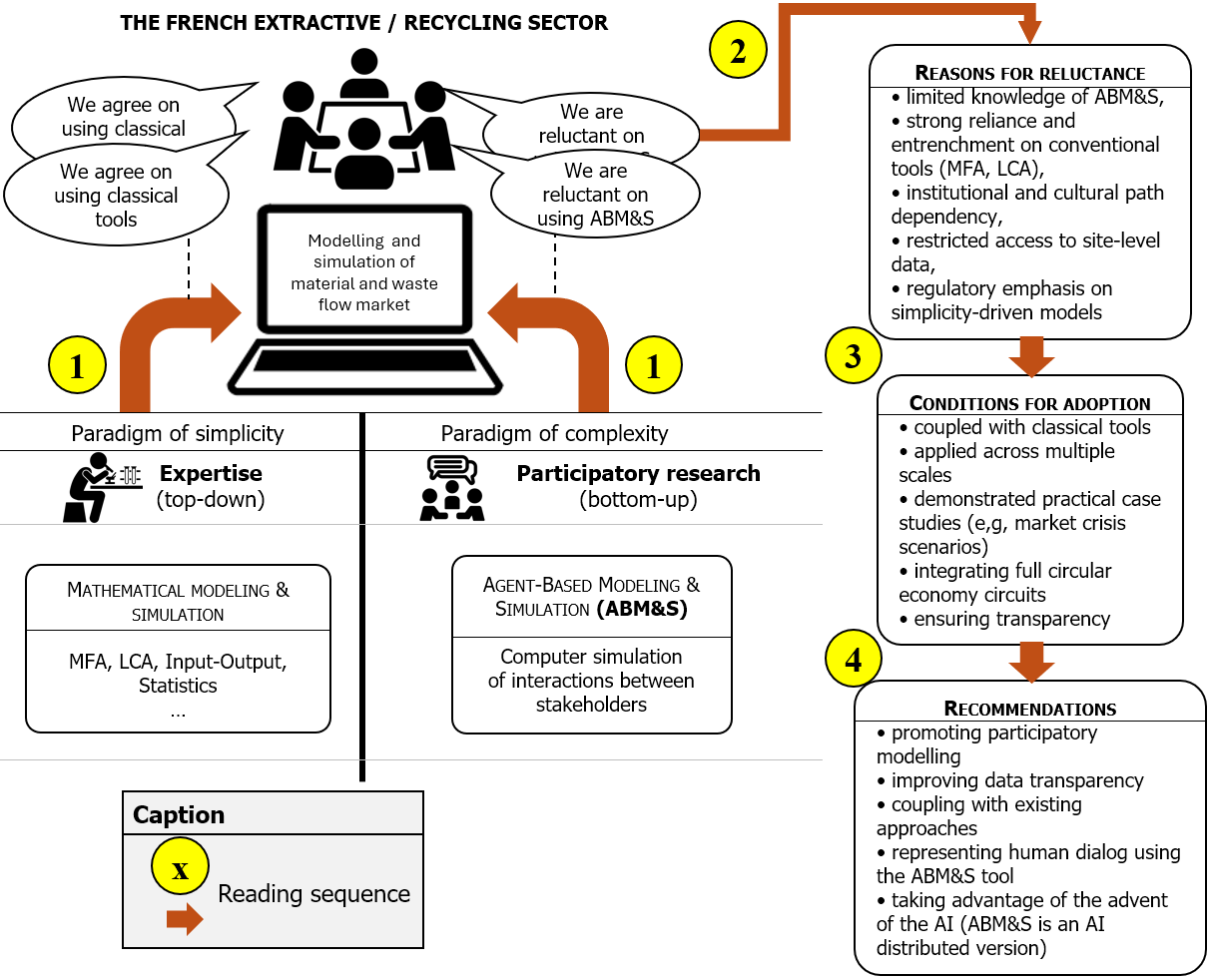
In France, the extractive and recycling (ExtRec) sector plays a critical role in resource recovery and circular economy transitions; and representing complexity in the modelling and simulation of material and waste flows would allow the sector to better capture the effects of various stakeholders’ decisions on waste management. However, the sector remains reluctant to adopt complexity, particularly agent-based modelling and simulation (ABM&S) whereas the approach is now developing elsewhere (in other sectors, other countries). Our sociological question is then: how such a reluctance could exist in this sector? Using a qualitative method, this study identified 5 reasons for this reluctance including limited knowledge of ABM&S, entrenched reliance on classical practices (MFA, LCA …), and workplace and institutional influences. This research then shows that reluctance toward ABM&S in the French ExtRec sector is not simply a technical gap but a socially and institutionally embedded phenomenon. Addressing this reluctance requires both technical innovations (coupling, data frameworks) and sociological strategies (participatory approaches, institutional practice reform). Nevertheless, the sector expressed conditions under which ABM&S could gain acceptance; furthermore, we provide recommendations that would remove adoption barriers. More globally, this paper contributes to debates on modelling approaches for waste policy and circular economy strategies.
Keywords:
circular economy
; waste management
; extractive industries
; agent-based modelling
; market simulation
; complexity theory
; sociological analysis
1. Introduction
Waste is generated at different stages of a product's life cycle (SOeS, 2022) and its generation is decided by all the economic actors concerned (ibid; (Ding et al., 2021)). This situation is also true for the extractive or recycling (hereafter ExtRec) sector, in particular for two categories of market of this sector. The first category is mining market, often analyzed at inter-country levels, and which starts from metal (e.g. lithium) resources extraction (let m-circuit-1) till the end product (e.g. battery) recycling (let m-circuit-2). The second category is the quarrying market, often analyzed at a territorial level, which starts from aggregates resources extraction (let q-circuit-1) till the construction & demolition (C&D) waste recycling (let q-circuit-2). To follow the current and future evolution of the flows in the 2 circuits of these respective markets, two tools are often used: MFA or Material Flow Analysis (Moriguchi & Hashimoto, 2016; Tazi et al., 2020; Ryter et al., 2024) and LCA or Life-Cycle Analysis (Butera et al., 2015; Soto-Vázquez, 2025). However, such tools tend to overlook interaction among key stakeholders and the subtle decision-making process (Tian et al., 2025). To short, they ignore the representation of complexity i.e. multi-actor and multi-scale decisions and their interactions (Fromm, 2004; Ding et al., 2021). However, not considering complexity makes it difficult for the heterogeneous actors to envisage how their individual decisions may affect the performance of the whole value chain (Utomo et al., 2018). To deal with this limitation, one approach that is historically recognized to excel at representing and simulating the complexity of systems is agent -based modelling – or ABM -and simulation or ABM&S (Halpin, 1999; Fromm, 2004; Farmer & Foley, 2009; Sherwood et al., 2017). This is also true in the waste management research (Peng et al., 2022; Ding et al., 2021; Tian et al., 2025). For example, the team of Ding considers that the ABM&S method is appropriate to manage demolition waste management because demolition industry is featured as a dynamic, interactive, and complex adaptive system (Ding et al., 2021); indeed, it involves various stakeholders, including the government, demolition contractors, and recycling companies, etc. the decisions of which affect waste generation, recycling, and reuse (ibid).
France is also concerned by waste issues. In 2018, it produced 343.3 Mt of waste, which represents 5.1 tons of waste per capita, making it the second waste producer in Europe in 2018 (SOeS, 2022). The ABM&S approach could then be an interesting approach to adopt by the French extractive and/or recycling (ExtRec) sector. However, in France, the literature notes at least two limitations regarding the approach. First, Fermet-Quinet noted that if efforts are now carried out so the approach is more recognized in France, the resulting works mostly concern renewable resources sectors like forest, agriculture, livestock, water resources (Etienne et al., 2011; Perrotton et al., 2017; Daré et al., 2018; Utomo et al., 2018; Barreteau et al., 2021) and the wastes (such as organic wastes) the related exploitations generate (Courdier et al., 2002; Soulié & Wassenaar, 2017; Hatik et al., 2020); very little efforts have been caried out regarding not non-renewable resources sector like the French ExtRec sector (Fermet-Quinet, 2024). Second, if efforts exist to use the approach for circuit 1 or circuit 2 of the worldwide ExtRec sector, the corresponding works are geographically situated in United States (Riddle et al., 2021) or in China (Ding et al., 2021) or in Australia (Yuan et al., 2019); not in France. Yet, in France, the ExtRec sector rather keep practicing only tools like LCA (Beylot et al., 2018), MFA (Tazi et al., 2020) or statistics (SOeS, 2022). In fact, from a sociological point of view, the French ExtRec sector is moving against what the sociologist Edgar Morin calls the culture of complexity (Morin, 2008). The level of this culture corresponds, for an actor, to the level of his (mental) deconstruction of the paradigm of simplicity (Feldman, 2016), which Morin suggests deconstructing because, according to him, the simplifying modes of representing knowledge in this paradigm mutilate more than they express the realities or phenomena they account for (Morin, 2008). Thus, given the importance we think moving forward complexity is, we decide, during the last decade, to sociologically understand the reluctance of the French ExtRec sector to practice modelling and simulations of the abovementioned circuits at a complex level, in particular via the ABM&S approach.
Carried out by ABM&S researchers, this work then aims to answer the main following research question:
While tackling the complexity via the ABM&S approach seems promising and is developing elsewhere (in other sectors, other countries, etc.), how such a reluctance could exist in the French ExtRec sector?
Specifically, the paper explores the following (sub-)questions:
- q1.
- what are the possible reasons for this reluctance?
- q2.
- under which minimum conditions the ABM&S could be accepted by the sector?
- q3.
- how could the above findings be interpreted from a sociological perspective?
- q4.
- what recommendations could be provided for supporting a potential paradigm shift towards complexity each time it proves necessary?
2. Materials and Methods
2.1. Theoretical Fields
Our research stance is positioned within comprehensive epistemology. Unlike explanatory epistemology, which seeks to explain human reality through causal relationships (as in the natural sciences), comprehensive epistemology focuses on understanding stakeholders’ experiences and meanings within social and historical contexts (Marvasti, 2004; Charmillot, 2021). Our research draws on five theoretical fields: (1) sociologization and historization of models, (2) sociology of science and technology, (3) pragmatic sociology, (4) the culture of complexity, and (5) modelling practices of raw materials and waste markets.
The first field is the sociologization and historicization of models (Armatte & Dahan, 2004; Dahan, 2009). Sociologizing the notion of model means • restoring it as a modelling activity in an institutional, technical and political environment, • reclassifying it in a social universe of judgments, expertise, decisions and uses and • giving back a predominant place to action and social actors (ibid). By 'social actors', we mean • those who build the model at different scales (researcher, engineer, research institutions, etc.) with often different modelling practices (statistics, mathematics, ABM&S, etc.), • those who use them at different scales (experts, industrialists, communities, ministry, public-private partnership structure, etc.), • those who do both at the same time, and • those who promote the modelling activity (funders, etc.).
The second field concerns the sociology of science and technology (Latour, 2000; Bonneuil & Joly, 2013) focusing here on the relationship of society to technoscience and technological progress (e.g. reluctance because of the risks induced on transformations or on social practices); combined with the place occupied by the adoption / future of ABM&S in this relationship (Squazzoni, 2010; Hamill, 2010; Collins et al., 2024). In terms of the mode of production of knowledge, we consider the sociologization of models as the 'modelling' focus of the sociology of science.
The third field is that of pragmatic sociology or the sociology of trials (Barthe et al., 2013). This field considers taking seriously the justifications and criticisms made by social actors based on what they have experienced, in this case here with regard to ABM&S practices. compared to the classical modelling practices that they are used to creating / using. In fact, the success of classical modelling practices is that they have had the capacity to allow these social groups to identify and recognize themselves (Barthe et al., 2013)
The fourth field concerns the culture of complexity (Morin, 2008; Li Vigni, 2022) applied to modelling (Rossignol, 2018) including waste management (Courdier et al., 2002; Andriamasinoro & Monfort-Climent, 2021). It is a paradigm debate between the actors, and which consists of knowing to what level of detail they must construct / analyze their market, between the paradigm of simplicity (Feldman, 2016), the paradigm of complexity and all the nuances that there are between the two. It is also a question of seeing how, if it is possible for them, to articulate and perpetuate the whole.
Finally, the fifth field concerns the work of developing models (static or dynamic) of the raw materials/waste market in the French ExtRec sector, along the circular economy. This concerns both construction materials and metals. We are particularly interested in models that aim to analyze flows and/or to make forecasts (Andriamasinoro & Ahne, 2013; Augiseau & Barles, 2017; Schleifer et al., 2019; Rodriguez-Chavez, 2010) to help in the co-construction of future scenarios for a given territory.
2.2. Clarification of Some Theoretical Concepts
The above theoretical fields mobilize several concepts some of which deserve to be clarified (other unexplained concepts are considered self-explanatory); the aim of clarification is to avoid the semantic ambiguities carried by the so-called spontaneous sociology (Burawoy, 2017), based on prenotions or a priori evidence, which have nothing scientific about them, and which we must therefore attempt to deconstruct (ibid) via this Subsection.
In particular, we will focus on the following concepts: • circular economy and its value chain; • market, • the trio ‘agent, agent-based, and emergence’; • complexity representation paradigms; and • habitus.
2.2.1. Circular Economy and Its Value Chain
Based on the definition in (Dermine-Brullot & Torre, 2020), the circular economy is a concept aimed at reconciling economic growth, social equity and the preservation of the planet. It is like sustainable development but with a stronger local anchoring in terms of stated objectives and actions. The circular economy gives a special place to Industrial and Territorial Ecology (ITE), which shows a growing interest in the spatial dimensions of circular processes. Furthermore, it understands nature and natural ecosystems as objects likely to be manipulated by technological innovations. In France, the political sphere concretizes the local anchoring of the circular economy based on an operational definition of circularity which is based on a breakdown into territorial and spatial strategies via numerous ongoing calls for projects; the aim of these calls is to encourage the local deployment of these strategies among communities, businesses and citizens.
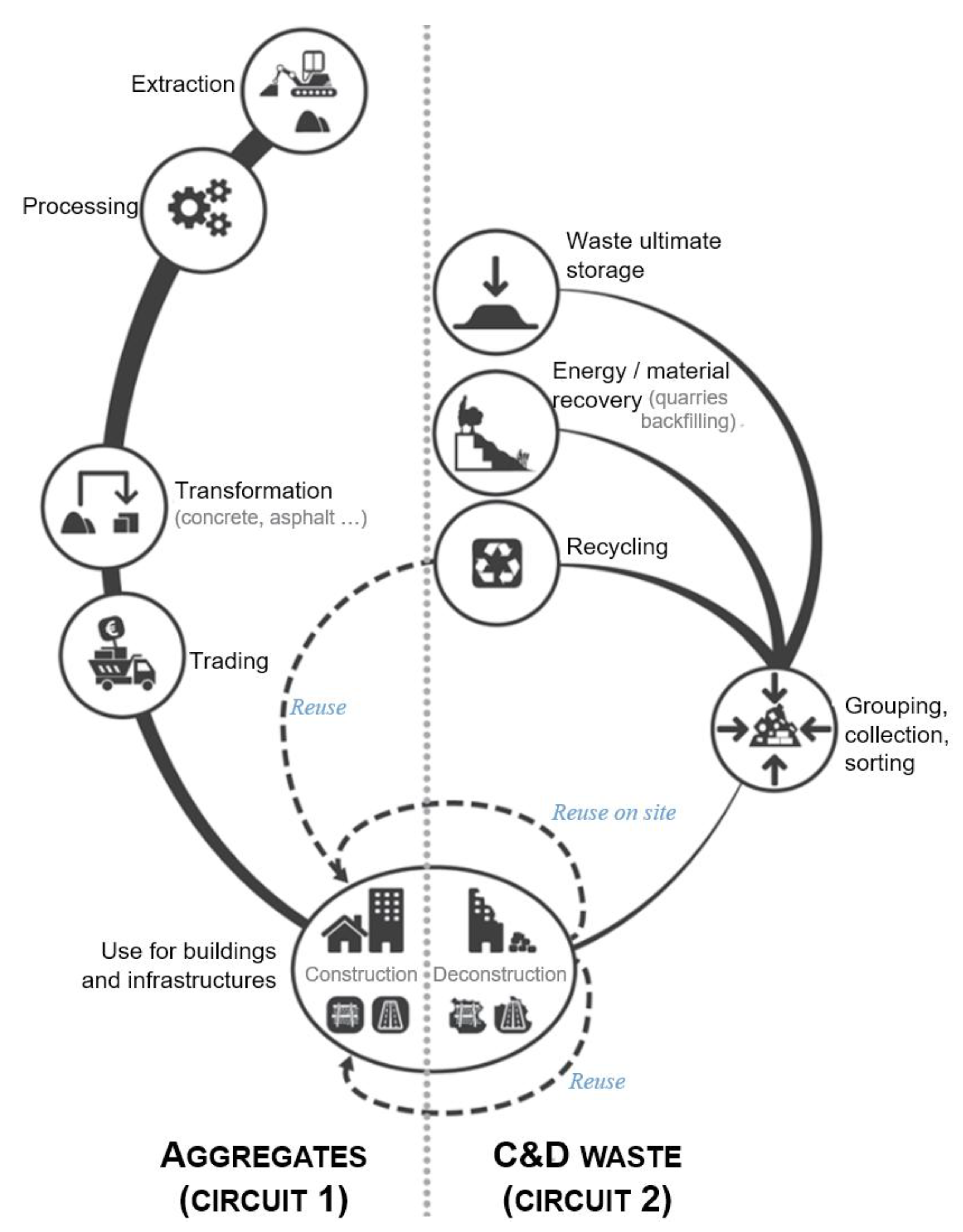
If we take the example of the aggregates sector in France, the circular economy is characterized by the 4Rs principle – reduce, reemploy, reuse, recycle – as follows (PanoramaIdF, 2017):
- reduce the exploitation of alluvial deposits (to preserve the environment) in favor of massive rocks (having lower environmental stakes); also reduce waste disposal in landfills, in favor of recycling or recovery;
- reuse the excavated earth debris from deconstruction, for backfilling on the same site, or elsewhere;
- reuse inert concrete and asphalt waste from deconstruction, for road construction and/or for backfilling quarries at the end of their life;
- recycle waste to be incorporated into road construction.
It should be noted that a French context adopts the 4Rs principle whereas in an English context, there is no distinction between reemploy and reuse. In the French context, ‘reemploy’ means there is no change in the use (e.g. giving an old shirt to the Red Cross for others to wear, so no change in use) while ‘reuse’ means there is a change in use (e.g. a glass previously used to drink water, now being used as a flowerpot, so a different use for the same object).
Figure offers an expression of the forms of circularity of materials in the aggregates sector in Île-de-France (ibid).
Figure 1.
escription of the circular economy of aggregates in the French Île-de-France region (PanoramaIdF, 2017).
Figure 1.
escription of the circular economy of aggregates in the French Île-de-France region (PanoramaIdF, 2017).
2.2.2. Market
Here, we understand the market as a social institution (NCERT, 2007) in which the dynamics of exchanges along the value chain of the circular economy are located. The modelling of this market does not only concern the interactions (= the flows of substances exchanged, waste generated, etc.) on each link in the chain, but also the decisions at the origin of these interactions (Ponte & Sturgeon, 2014); indeed, the decisions influence, for example, the quantity of generated demolition waste (Ding et al., 2021). These decisions are multi-scale and multi-actor, thus meeting the definition of the complex (Fromm, 2004). For example, in relation to the opening of quarries or recycling centers in France, whereas the decision is multi-scale because even if the opening is done at a regional level, the reality is that certain mobilizations of materials are made following decisions taken at lower scales (Augiseau & Barles, 2017) i.e. at that of sites (finer level), municipalities or agglomerations (micro) and departments (meso). These decisions are also multi-actor because, for a given scale, the actors are in reality in a social transaction i.e. a transaction which gives priority to actions which involve different modes of interaction between two or more agents (Rémy, 2020): in competition, in negotiation, etc. or linked via a multi-year loyalty contract to cope with price fluctuations. From the outset, we are confronted here with the social in its complexity (ibid). This is, for example, the decision on the price of certain materials which depends more on the local context such as the accessibility of sectors, competition, etc. (ADEME, 2012) rather than on a price imposed at the regional level.
It should be noted that in terms of modelling, not all links in the chain are necessarily studied by models; some models only analyze the first two links, from extraction to the first transformation link (Rodriguez-Chavez, 2010; Schleifer et al., 2019), others go as far as the link of final use by the general public (Riddle et al., 2021), etc.
2.2.3. Agent, Agent-Based, and Emergence
To explain the agent-based approach and its usefulness as simply as possible, let us take the example of collective intelligence in ants (Bonabeau et al., 1999; Drogoul & Ferber, 1994). To build their nest, ants do not have an expert architect acting in a centralized mode, who decides on the architecture of the nest (the solution) to be built or who distributes the construction tasks. On the contrary, the final nest solution will emerge, endogenously, from the interaction of the ants among themselves and/or with their environment, each ant having only a partial and local perception of this environment. This final solution, an ant, alone, by its own perception, could not have found it.
Explaining the concept behind the example above, and drawing inspiration from the definition in (Ferber, 1999), we call 'agent' a physical or virtual entity (the ant for the example above) which is capable of deciding and acting in an environment, which has only a partial representation of it (possibly none), which can communicate directly or indirectly – that is to say via the environment – with other agents, which is driven by objectives or signals encouraging it to follow its congeners and whose behavior tends to satisfy these objectives. The concept of intelligence is completely revised: we move here from the intelligence of an individual to collective intelligence (Bonabeau et al., 1999).
2.2.4. Complexity Representation Paradigms
The complexity paradigm of each person (physical or moral) involved in the problem of modelling is translated here by the way of thinking of this person on the level of complexity up to which the market should be represented, and then the associated model should be created, as questioned by many works (Dionnet et al., 2017; Taillandier et al., 2019): behind closed doors between only politicians / experts / researchers? or by involving stakeholders?
In the literature, Jean-Yves Rossignol defines three levels of complexity (Rossignol, 2018): ➊ the simple (analytic) paradigm, ➋ the restricted complexity paradigm, and ➌ the generalized complexity (deliberative) paradigm. Figure illustrates these points.
Figure 2.
The 3 paradigms of complexity, divided between expertise (by researchers/experts only) and participatory research (with stakeholders).
Figure 2.
The 3 paradigms of complexity, divided between expertise (by researchers/experts only) and participatory research (with stakeholders).
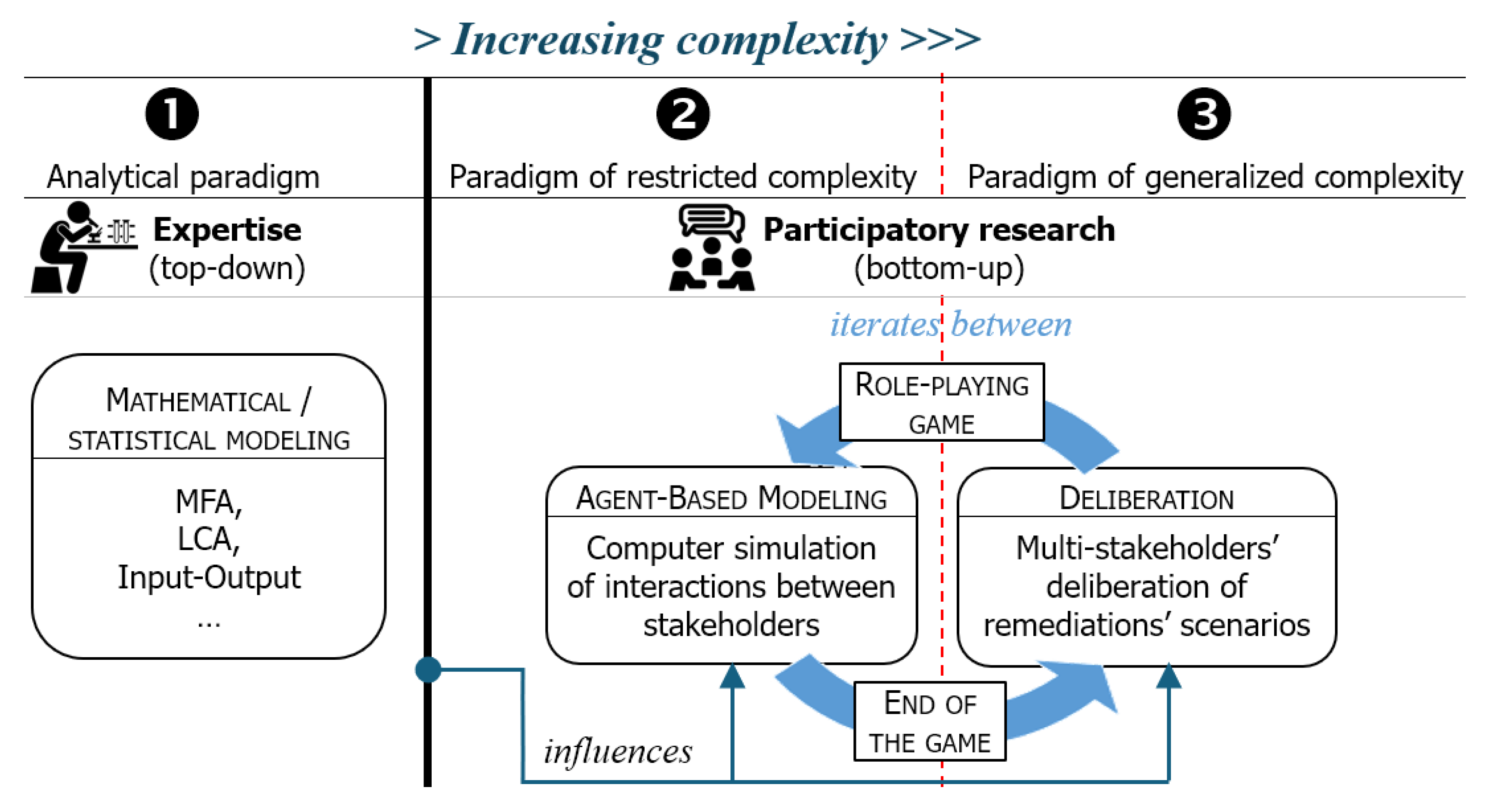
The simple (analytical) paradigm ➊) is the classical 'top-down' modelling paradigm. It is adopted by default, in this case by experts or researchers, to model a problem by positing that the mind first draws interpretations of the world that are as simple as possible, or, at least, that are biased toward simplicity (Feldman, 2016). The drawback of this paradigm is that it considers very weakly the heterogeneity of the real situation studied wherever it is necessary, in particular the multiple feelings, history and opinions (often divergent) of each actor involved in the problem. Mathematical-based tools like MFA, LCA or statistics fall in this category.
The restricted complexity paradigm (paradigm ➋) is the ' bottom -up' modelling paradigm that considers the above heterogeneity. Unlike the analytical paradigm, the desired solution would emerge from multiple social transactions. ABM&S fall into this category; here, the modeler is confronted with the social in its complexity, addressing the various stages and multiple encounters that the transaction involves (Rémy, 2020). As an example in the waste management domains in France, let us cite ABM&S works which that explicitly represented the different stages of negotiations during collective management of organic wastes (Courdier et al., 2002; Soulié & Wassenaar, 2017; Hatik et al., 2020). Another tool that falls in this category is role-playing game (players’ interaction around a board), but its reluctance study is out of this paper.
The generalized complexity paradigm (paradigm ➌), also called the deliberative paradigm, assume that, however, at a given moment, a model alone is not enough: the objective evaluation (estimation of remediation scenarios through simulation models) should then be followed by a subjective evaluation (giving them a societal meaning). In this second evaluation, different actors 'deliberate' (Frame & O’Connor, 2011; O’Connor & Douguet, 2024), that is, exchange points of view via a dialogue built on the capacity of each scenario (in this case, site remediation) to satisfy each of the issues (e.g. technical-economic feasibility, drastic reduction of pollution, compliance with legal barriers, etc.); this dialogue could rely on the modeling tools from paradigms 1 (MFA, LCA …) and 2 (ABM&S …) to give a vision in terms of links between the different elements constituting this studied territory.
2.2.5. Habitus
Habitus is a concept from the French sociologist Pierre Bourdieu (Bourdieu, 1977). It corresponds to a set of internalized schemes a social actor progressively forges during its primary (e.g. education, family heritage) and secondary (e.g. professional) socialization. These schemes are capable of arousing, guiding and directing all of the actor practices without him/her being aware of it (Champagne & Christin, 2012; Asimaki & Koustourakis, 2014).
2.3. Methodology
In this study, we met with stakeholders in the ExtRec sector we believe would be interested in discussing the ABM&S approach (experts, modelers, authorities).
They mostly come from BRGM (the French Geological Survey) or from its partners (institutions, research center …) in which the BRGM is in collaboration in the context of research or public-policy support. The stakeholders from BRGM are colleagues that are experts/scientists in circuit 1 and/or circuit 2 market analysis. BRGM partners may be in France (regional authorities, unions, etc.), or internationally. International stakeholders are researchers / experts the BRGM or one of its partners has invited. The primary objective of the visit is not generally ABM&S. Nevertheless, when we think some of them may have an opinion on the ABM&S subject, we take advantage of this visit to meet them.
2.3.1. Preamble: Principle of Anonymization
In order to respect the anonymity of the stakeholders we met during this work, the following principles will be adopted for the remainder of this article:
- an alias will be assigned to each person;
- the terms ' he ', ' his ' and ' him ' shall be used to refer to a person or his/her actions, regardless of his/her actual gender;
- the names of the countries or regions of study will be anonymized, except for ‘France’ and the ‘BRGM’ where the main author of this article works;
- the reference of the models used to discuss with these stakeholders were withheld because we think this may open up possibilities of identifying some of them.
2.3.2. Data Collection and Analysis Methods
Our approach is qualitative (Marvasti, 2004).
Regarding the data collection, we use • ethnographic observation of modelling practices, • literature review of modelling practices in France and abroad, and • informal conversations (Swain & King, 2022). Regarding the data analysis, we use thematic analysis method (Braun & Clarke, 2006; Ahmed et al., 2025). This allows us to group together into main themes what was expressed by the stakeholders we met (see Table 1), and to interpret them sociologically while situating them in the context of literature.
In relation to data collection, ethnographic observation focuses on the modelling practices (in the sense of production and/or use) adopted by BRGM partners: the aim is to monitor whether these practices evolve over time or not.
As for the informal conversation in particular, it takes one of the following forms:
- questions/answers during project presentation meetings involving (at least) ABM&S;
- (what we call) discussions “in the corridor”, over coffee, with the stakeholders.
Let us recall that in informal conversations, we, the researchers, are here not interested in tonal nuances or emphases, or the pauses; we are concerned with the way stories are told and how meanings are made, and our main intention is to report the words used as reliably as possible (Swain & King, 2022).
Two reasons (at least) justify our choice of this approach: the interest and availability of the stakeholders we planned to meet. First, when a person seems relevant to us to meet (colleagues or project partners or guests), we cannot know at the outset their level of interest (and therefore enthusiasm) to talk about this subject; however, this parameter is important to engage interactions (Marvasti, 2004). Also, as the time of this research is a long time, we opted not to "rush" stakeholders and to adopt a progressive discussion on the subject according to the availability of the person over time. Project meetings that include ABM&S (and other subjects too) are an opportunity to make further progress because the presence of the person indicates that they have made themselves available in the precise slot of the meeting (even if the primary reason for their presence may sometimes be other projects). In fact, the overall idea is to gradually arouse the person's interest (if it is not already the case) in order to, at the appropriate time, request a formal interview if necessary.
Ultimately, the stakeholders we met to the time of writing this article emerged from these different collection methods. Table 1 lists these stakeholders and their mode of intervention in relation to a market simulation model (producers or users or both) whether this model (in the form of m-circuit and/or q-circuit) uses an ABM&S or more classical modelling approaches (mathematics, statistics, MFA, etc.).
2.3.3. Summary on the Stakeholders We Met and the Study Areas
In terms of study territories, the aggregates market (q-circuit-1 and q-circuit-2) covers two administrative regions in France, which we will denote respectively as Reg1 and Reg2; remember that the metals market (m-circuit-1 and m-circuit-2) is always studied on an inter-country scale (see §introduction). It should also be noted that among the stakeholders we met, there was a guest from a geological service of a country outside France (BRGM being the French geological service). In this article, the foreign country in question will be denoted C1.
3. Results
In this results section, we present the answers to sub-questions q1 (reasons) and Error! Reference source not found. (conditions). The answers to sub-questions Error! Reference source not found. (sociological interpretations) and q4 (recommendations) fall under the 'Discussion' section.
3.1. The Expressed Reasons for Reluctance
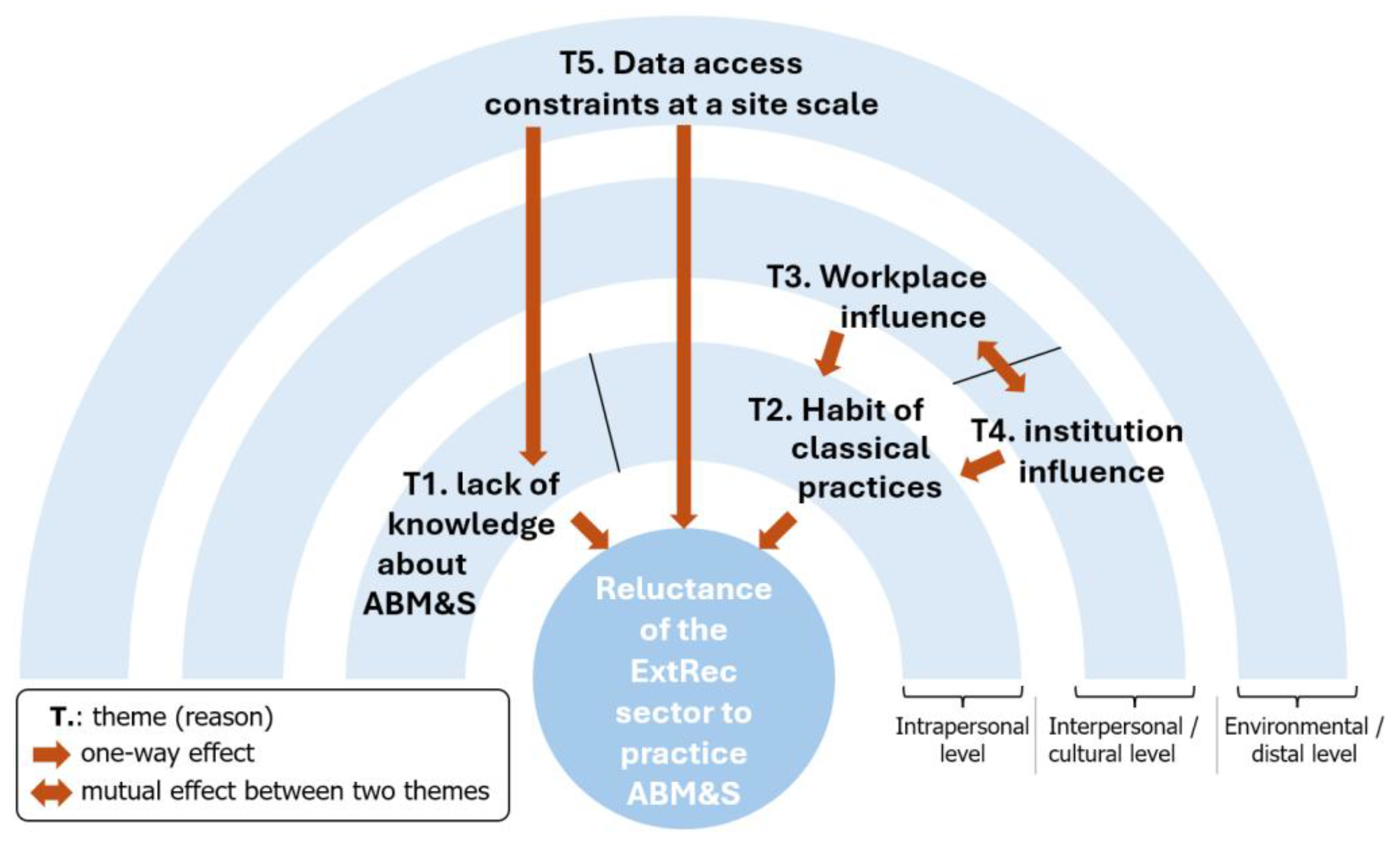
Based on the data we collected and analyzed, 5 interconnected themes (
) explain the reluctance of the ExtRec sector to adopt ABM&S: (1) lack of knowledge on ABM&S construction, operation, and interpretation, (2) entrenched habits of classical practices (MFA, LCA, mathematics …), (3) workplace influence, (4) institutional influence, and (5) data access constraints at a site scale.
These themes were categorized at 3 levels, identical to what was proposed in (Abdelghaffar et al., 2019):
- the intrapersonal level, in which there are two themes: lack of knowledge about ABM&S and familiarity with classical market modelling and simulation practices;
- the interpersonal or cultural level, in which there are two themes: the influence of the workplace and the influence of institutions;
- the environmental or distal level, in which there is 1 theme: access to the data, often detailed, necessary for this type of modelling.
Figure 3.
Thematic map showing 5 identified themes (reluctance reasons) and potential interactions between them.
Figure 3.
Thematic map showing 5 identified themes (reluctance reasons) and potential interactions between them.
The following paragraphs detail these themes (reasons).
3.1.1. Reason 1: Lack of knowledge about ABM&S
One of the reasons expressed by stakeholders we met is the lack of knowledge about this approach. C1Gs_Flw frankly admitted that although he is interested in the approach, his knowledge in ABM&S is very limited. Lack of knowledge also concerns how the model should be built, piloted (in terms of scenario simulation) and operated (in terms of results). Thus, when we presented to FrGS_Ec2 a model of the lithium market, using ABM&S, he argued • that the complexity induced by the construction of an application model in a system that can contain many heterogeneous agents is quite prohibitive, • that the time required before having the results of the simulation is not clear (can vary from one minute to one week) and • that the level of ease/difficulty in being able to follow the evolution of this entire detailed system during a simulation is also complicated. FrGS_Ec1, having become aware of this same market model, joins the remarks of FrGS_Ec2, with an additional fear: the aspects of ‘autonomy’ and ‘emergence’ left to ABM&S. Indeed, according to him, mining economists would like to ' keep control' of their analysis, i.e. not letting computers reason in lieu of them.
3.1.2. Reason 2: Habit of Classical Practices
For years, we have observed that Min_Mod, an aggregates market modeler, always adopts mathematical practices to develop his model. However, in one of the meetings where his national aggregates market model was presented to Fr_Synp, the latter pointed out that his model was too simple. Fr_Synp explained that he did not really see what he could do with this national model knowing that decisions to open quarries are made at the regional level. Complicating the model therefore became necessary for him to be able to better represent, at the regional level (Reg1, in this case), a market highlighting the heterogeneous decisions of the actors on the choice of their customer / supplier as well as the associated negotiations. However, despite the feedback expressed by Fr_Synp, Min_Mod decided, years later to develop the regional model still using a mathematical modelling practice based on the optimization of links (customers ↔ suppliers). The model therefore did not represent these decisions and negotiations in any way. However, another stakeholder, Reg1_Synm subsequently accepted to publicly communicate the existence of this regional model because it is a research result although not directly operational.
3.1.3. Reason 3: Influence of the Workplace
This theme (as well as the following one) concerns more the stakeholders we met at BRGM.
First of all, let us point out to the paper reader that the BRGM has the status of EPIC (industrial and commercial public body) and is under the supervision of French ministries (which vary according to State decisions). In this context, the financial allocation allocated by its supervisory ministries covers 50% of its operating and structural costs and is used in particular to carry out, on behalf of its ministries, expertise works; these works, developed according to a specific resolution paradigm will be carried out according to specific methods (based on Figure , we noted that they are methods from paradigm ➊). The other 50% of BRGM funding is reported in particular via collaborative research projects, whether at the French level (e.g. The French Research National Agency, The French Agency for Ecological Transition) or at the European level (e.g. The Horizon Europe program, etc.).
Faced with all this, we observed that BRGM then asks its employees • to prioritize requests from the ministry (and therefore the associated paradigm) and • to build research projects in which (classical) techniques that have already proven themselves take a predominant place (paradigm ➊). The criterion here is to increase the chances of obtaining funding.
3.1.4. Reason 4: Influence of Institutions
As previously stated, the BRGM is under the supervision of French ministries. In reality, these ministries sometimes address the BRGM as a 'work colleague' (see the previous theme) and sometimes as an institution. In the latter case, FrGS_Innov then specifies that the BRGM is first and foremost an establishment that operates with a prescription from the French State, which agrees with the BRGM on the path to follow and the BRGM generally follows the instructions. However, according to FrGS_Innov, the State is surrounded by experts; these experts are always keen to convince on their technical solution, they are therefore not used to first understanding the situations of the stakeholders and then going into the support process via potentially innovative tools such as ABM&S. In short, we observed that the ministries, by addressing the BRGM via this channel, remain at paradigm 1 and leave little opportunity for BRGM employees to glimpse paradigm 2.
3.1.5. Reason 5: Difficulty Accessing Data at the Micro Scale (Sites)
Another reason for reluctance to use ABM&S is the difficulty of accessing site-level data; this difficulty concerns both the metals market (m-circuit-1 and m-circuit-2) and the aggregates market (q-circuit-1 and q-circuit-2). In study region 1 (in France), where we wanted to develop an ABM&S of the aggregates market along the circular economy, we were refused. The data provider Reg1_Synm (data concerning q-circuit-1 of Reg1) clearly explained to us that the actual production data within the sites are confidential. The data provider Reg1_GOrd (data concerning q-circuit-2 of Reg1) agrees with the same idea for the demolition and recycling waste part.
In study region 2 (in France), the response from Reg2_Synm was the same for circuit 1; however, for circuit 2, the provider Reg2_Gord, a member of Reg2_Actr, granted us flexibility by agreeing to provide us with the data but specifying that these data should be used simply for calculations; they should under no circumstances be disclosed publicly. Despite this flexibility, we observed that the refusal to provide data at this scale remains the dominant response.
3.2. The Expressed Conditions for Appropriation
Stakeholders identified 5 conditions under which ABM&S could become acceptable: (1) Coupling with existing tools (MFA, LCA, statistics), (2) integrating complete circular economy circuits, including recycling, (3) representing multi-scale dynamics (from site to regional and national levels), (4) demonstrating practical value (through case studies like reproducing historical market behaviors), and (5) ensuring reliable data at a site level.
3.2.1. Condition 1: Coupling with Existing Approaches
Amongst stakeholders we met, some have been working for years on classical flow modelling practices (MFA, LCA, IO, statistics); nevertheless, they remain open to ABM&S if coupling points between approaches are possible. This is what C1GS_Flw highlights when he explains that in general, the work that his group does can fit into several different categories: standard Materials Flow Analysis, economic input-output modelling and a more holistic approach; and that ABM&S may fit in one or more of these categories. This condition is confirmed by FrGS_Ec1 which requires that one should consider integrating other flow modelling techniques like the MFA approach in metal market modelling. He argues that this technique is a proven method which analyses, for a given time/ metal, how the input (instock, importation, production, etc.) evolves to output (consumption, outstock, exportation, etc.) for each country where the studied metal passes. Furthermore, for FrGS_Ec1, also integrating the LCA would make it possible to consider environmental characteristics (and therefore waste), from mining to recycling.
3.2.2. Condition 2: Integrating Complete Circular Economy Circuits
The lithium market model presented to FrGS_Ec1 only covered the primary circuit. For him, this is a major shortcoming. He argued that the model should systematically contain the secondary circuit that would allow evaluation of the quantities of metals that can be obtained by recycling end-use products.
3.2.3. Condition 3: Representing Multi-Scale Dynamics
During our meeting with the stakeholders of region 2, Reg2_Actr, during the Q&A session, admitted the originality of this bottom -up approach, which is attractive in principle. Indeed, if production and their interactions with demands are done on the micro sites (calculation scale), it is then possible to restore the results at different scales, from micro to macro (municipal and/or departmental and/or regional). However, if this characteristic is necessary, it is not sufficient for Reg2_Actr to appropriate an ABM&S model. Indeed, for this stakeholder, the complex model seems to be still premature since it does not integrate the entire complexity of the supply chain. This last discours is similar then to that of FrGS_Ec1 (see previous condition), namely the systematic integration of the entire value chain of the circular economy in this type of model.
3.2.4. Condition 4: Demonstrating Practical Value Through Case Studies
For FrGS_Ec1, an effective way to convince of the interest of the approach is ‘showing by doing’ with the ability to demonstrate a very concrete result, in this case, reproducing some metal price behavior covering periods of the 2008 crisis. FrGS_Ec1 even suggested the very concrete scenario leading to this result: an increase in demand, speculation by the market (and therefore storage strategy by producers and financiers), a sudden decrease in demand.
3.2.5. Condition 5: Ensuring Reliable Data at a Site Level
We were able to observe the behavior of the data providers: in Region 1, providers Reg1_Synm (for aggregates) and Reg1_GOrd (for waste) did not want to provide site-level production data at all, unlike the data provider Reg2_Gord in Region 2.
4. Discussions
In this section, we present the answers to sub-questions • Error! Reference source not found. (sociological interpretations of the results), in Section 0, and • q4 (possible recommendations) in Section 0.
As we are in a comprehensive research approach, we try, in Section 4.1, to find meaning - i.e. to find interpretative proposals, or even interpretative risks -possible (Charmillot, 2021) to the reluctance of social actors in the ExtRec sector towards the complex modelling and simulation of their market via ABM&S.
Furthermore, the interactions between the themes, as we have shown in the thematic map (
), can provide valuable information to identify the recommendations that may help to decrease the reluctance of the ExtRec sector to practice complexity when it is deemed necessary.
In this section, we also summarize the contributions of this research (Section 0).
4.1. Sociological Interpretation of the Results
In the literature, one reason for the lack of knowledge about ABM&S in the ExtRec sector may be engineering-related. More specifically, even though efforts are currently being made to develop standard protocols for building and/or validating ABM&S (Rand & Rust, 2011; Müller et al., 2013; Collins et al., 2024; Tian et al., 2025; An et al., 2021), these efforts have not yet been sufficiently disseminated or applied (and therefore little known) in all sectors where ABM&S may be relevant, a fortiori, in the ExtRec sector; this situation was true 15 years ago (Squazzoni, 2010) and the present study shows that it remains true today, in this case in the ExtRec sector (Tian et al., 2025).
However, we think this lack of knowledge is not attributable solely to engineering; it may also be due to sociological and historical reasons, more precisely socio-historical reasons. Indeed, the historicization and sociologization of models between 1950 and 2000, carried out by the historian of mathematics Amy Dahan and her team (Armatte & Dahan, 2004; Dahan, 2009) have shown that the modelling practices adopted during these periods (practices which, themselves, draw on the inventions of the 1920s) are mainly based on mathematics, with different variations depending on the applications (for example, econometrics for economics). At no time were ABM&S mentioned in that work. In fact, the use of ABM&S to simulate social systems began in the early 1990s (Drogoul & Ferber, 1994; Halpin, 1999; Ferber, 1999) and its recognition for simulating an economic system only really began in the late 2000s (Farmer & Foley, 2009). Still following the course of history, the first ABM&S work on simulating the metals market (m-circuit), including the criticality of metals, only appeared around 2015, particularly in the United States (Riddle et al., 2015; Riddle et al., 2021) or Australia (Yuan et al., 2019); and ABM&S work on simulating the construction waste market (q-circuit) was only visible around 2020, particularly in China (Ding et al., 2021; Peng et al., 2022). We can therefore clearly see the low application of the method in the ExtRec sector in France, hence this lack of knowledge by the sector.
Beyond the lack of knowledge, the reluctance to ABM&S can also be explained by the ExtRec sector's ingrained habit of classical modelling practices (cf. Figure /paradigm ➊) such as MFA or LCA. This entrenchment means that for researchers in the ExtRec sector, continuing solely on these techniques may be sufficient to understand the market. However, these techniques only model the flows (of substances, waste) whereas the complex decisions of stakeholders (paradigm ➋), which generated these flows, should be also represented (Ponte & Sturgeon, 2014). Indeed, these stakeholders decisions are also an important factor that explains the quantity of waste generated (Ding et al., 2021). In France, there have still been models that have tried to represent and simulate decisions in the aggregates market (Rodriguez-Chavez, 2010; Schleifer et al., 2019). However, the choice in this model was to represent a decision at a very centralized level (one decision for all) whereas in reality, the decision on the price of certain materials depends more on local decisions according to the accessibility of sectors and competition. That work therefore remained in paradigm ➊. This situation of entrenching classical tools can be explained by different possible sociological reasons (which can be linked to each other). First of all, there are the socio-historical reasons already introduced previously (these techniques are based on mathematics). In particular, the historicity of conceptions and practices, combined with the extreme diversity of disciplinary fields and empirical domains (Armatte & Dahan, 2004) probably favor this situation. In addition, there are the 'epistemic cultures', put forward by the sociologist of science Karin Knorr-Cetina: these cultures correspond to a diversity of ways of doing science according to the disciplines, not only in methods and tools but also in reasoning (Knorr-Cetina, 1999). Finally, in a more general theory, social resistance to progress (here reluctance to move towards the techniques of paradigm ➋) can also be due to the risks generated by the transformations and the threats that these techniques represent for current social relations and practices (Wynne, 1992).
This individual entrenching a modelling practice of the MFA or LCA type or other (intrapersonal level) can also be due to the habitus (Bourdieu, 1977) of the researcher. The part of the habitus we are talking about here has been forged over time in and by his work environment (interpersonal / cultural level) during the process of his secondary socialization. This construction may have been done by colleagues or by the policy of the employment establishment, more widely. In fact, these MFA or LCA type techniques have concretely proven themselves both • on the scientific level, in view of the numerous publications published (e.g.: the various references in this article), and also • in terms of sustainability in terms of funding obtained continuously (in any case in the context of the BRGM). This funding aspect is true whether in the context of a collaborative research project, at different scales (France, Europe …), or in support of public policies (supervisory ministries). Concerning the latter, the specific expert works requested by the supervisory ministries all falls under paradigm ➊. And since this work is a priority (because coming from the ministries) and must be submitted within a limited timeframe, the time to reflect on the possible application of paradigm ➋ techniques for these works is almost non-existent. This situation is close to Weinberg's conclusion that scientific expertise sometimes transgresses or sets aside scientific methods (including new ones) and the limits of acquired knowledge in order to address the problems posed (Weinberg, 1987). In fact, from a pragmatic sociology perspective, the success of these classical modelling practices is also that they have had the ability to enable social groups to identify and recognize themselves (Barthe et al., 2013); social groups distributed amongst model builders and users. With all these positive funding results, the employing institution, in a pragmatic way, logically influences researchers using these techniques to continue in this direction.
Also influencing this reluctance are the BRGM's supervisory ministries, which act not as a 'work colleague' requesting expert work (already mentioned in the previous paragraph), but as an institution. In this case, we are referring to a ministry that guides the general policy of the BRGM establishment. Our interpretation here is based entirely on the work of sociologist Lucie Ottolini, who studied the level of adoption of policies of openness to civil society by a good number of expert institutes in France (Ottolini, 2020), including the BRGM. This openness request was made by the supervisory ministries of these different institutes, some of which belong to the industrial risks sector, others to the renewable resources sector; only the BRGM belongs to the ExtRec sector. This opening to society includes reforms of expertise (paradigm ➊), promoting changes in the practices of expertise in relation to its supervisory authorities (openness towards paradigm ➋). In terms of results, Lucie Ottolini concluded that even if the request from the ministries was made to all, the BRGM found itself in a different situation from all its counterparts: if the construction of change towards paradigm ➋ is today effective on the operational level, the transition is a little less clear on the cultural level. Indeed, some current operational senior managers involved in this opening began their careers at the BRGM while it was still in its historical field of activity of mineral prospecting (a past still vivid in memories); these managers are geological experts (paradigm ➊). Also, they left aside (or rather slowed down) the process of opening to society (paradigm ➋) and consequently the possibility of developing the associated participatory dialogue mechanisms (ABM&S with regard to modelling). Nevertheless, we believe that the current mining revival, desired by the French government, combined with the associated controversies (Merlin et al., 2018) could accelerate the implementation of these paradigm ➋ systems. Indeed, controversies generally require dialogue, and then the representation and analysis of interaction between stakeholders.
Finally, in addition to the lack of knowledge and the influence of the workplace or institutions, the reluctance may also be due to the lack of confidence by experts in the ExtRec sector in the reliability of the data used to develop the model. This data reliability is itself driven by the almost systematic refusal of data providers at the detailed level to open their data. To take the opposite example, taken from the metals market, the dominant models are those that only represent supply and demand at the global level; however, these models ignore the endogenous dynamics between the underlying countries which then fed this level (Martin et al., 2017). This dominance can be explained by the fact that since the data associated with these levels are not confidential, the data providers like Eurostat (https://ec.europa.eu/eurostat/en/) open them to the social actors concerned by modelling (experts, industrialists, government of the countries producing or consuming metals). As a result, these macro data are abundant and continuously verified. This leads to confidence among experts in the ExtRec sector in these data and in the models that use them even if they only look at the global level (paradigm ➊). Again, as with LCA and MFA techniques, these models and data, although falling under paradigm ➊, have had the capacity to allow social groups to identify and recognize themselves (Barthe et al., 2013). Conversely, since modelling of the industrial metals market at an inter-country scale (paradigm ➋) has hardly existed, many data providers have always deemed it inappropriate to build (and/or promote) an associated database. Moreover, our study on aggregates/waste from the construction industry in the two regions of France showed that the more complex the model becomes, the more confidential the data can be, increasing the reluctance of suppliers to share them. All this increases the reluctance to adopt ABM&S.
4.2. Recommendations
Our study showed that the stakeholders we met were not opposed to addressing complexity through ABM&S. They simply set conditions that we can summarize in 4 points (the order of mention is not important): • coupling with existing approaches, • transparency of the model, • a demonstration of its ability to meet the expectations of experts and • reliability of the data, which involves the opening of confidential data. To this, we add fifth and sixth points (which does not come from the stakeholders we met) respectively: • the advent of Artificial Intelligence and • the representation of the most complex paradigm: human deliberation (cf. the paradigm ➌ in Figure ).
The first recommendation (point 1) is the coupling of ABM&S with existing techniques. Armatte and Dahan argue in particular that recognizing the divergences between models (in this case constructed under the paradigms ➊ and ➋) is now part of the requirements of critical debate regarding sciences (including models) and their social uses, and that models constructed on composite systems are almost always the result of collective work by several groups with their own disciplinary logics (Armatte & Dahan, 2004). Consequently, these groups must coordinate locally (ibid). Drogoul and Ferber, ABM&S researchers, give an example on how ABM&S could be coupled with mathematics: “agent-based models are used at a local level as analog mappings of a real system; from this description, one can derive global parameters that can be incorporated into a mathematical model and studied; thus, mathematical models are used at the macro-level whereas agent-based simulation models are used to cross the micro-macro bridge by letting global configuration emerge from the local agent interactions” (Drogoul & Ferber, 1994). In terms of recommendation in relation to this point 1, we therefore propose that model builders (with their diverse approaches) and model users in the ExtRec sector come together in what digital sociologist Li Vigni calls a scientific platform (Li Vigni, 2022). This platform is defined as a meeting point of complexity and a common base that allows heterogeneous members of the ExtRec sector to pool their resources, increase their collective legitimacy and try to obtain local or international funding together. As a motivator, the Chinese ExtRec sector also suggests this trend. Indeed, the team of Tian suggests that to better utilize ABM&S for achieving environmental protection and sustainability development goals, prioritizing integration of multi-model coupling, interdisciplinary collaboration, visualization, and open-source code sharing as key strategies is essential (Tian et al., 2025).
The second recommendation (point 2) is model transparency. It is clear that if, a few decades ago, "black box" models were considered as a type of model in their own right (Armatte & Dahan, 2004), i.e. that stakeholders provide blind trust to the researchers or experts who created them, this study has shown that this is no longer the case today (cf. for example the speech of Fr_Synp). Also, to address this, we recommend that the French ExtRec sector adopt participatory modelling (Abrami et al., 2021). This is an approach where users of the future model are involved from the (co-)construction of the model, for example via the ARDI method (Etienne et al., 2011). Indeed, at this stage, the literature notes that only a handful of simulation models has really been used to assist in the decision-making process, and that the main reason for this situation comes from the lack of involvement of stakeholders in the upstream processes of design and exploration (simulation) of these models (Taillandier et al., 2019). In fact, most of the time, models are developed and explored only by researchers (ibid). This is, for example, the request expressed by Fr_Synp during our discussion with him.
The third recommendation (point 3) is the need to demonstrate the ability of ABM&S to meet the expectations of experts in the ExtRec sector. In fact, we believe that this is the crucial point to raise awareness in this sector to move from paradigm 1 to paradigm 2, well before acquiring knowledge on how to build / validate ABM&S. We call it pragmatism. This is a priority step where social actors (in this case, sector experts / practitioners …) first want to have concrete experiences (Barthe et al., 2013) of an ABM&S model bringing added value to their task, before these experts / practitioners decide to invest time in deepening the approach. This request for demonstration joins that of the sociologist Lynne Hamill which suggests that to promote the use of ABM, the ABM&S community needs demonstrate the value of modelling to other social scientists by showing -by-doing and offering training projects (Hamill, 2010).
Finally, on the opening of confidential data (point 4) at the site level (a determinant of the reliability of the data and therefore of the ABM&S models that use them), it will be necessary to strengthen the awareness-raising discourse towards data providers on the decorrelation that exists between 'calculation scale' (the complex -where the confidential data are) and 'presentation scale' (the simplest). This reinforcement is also requested, for example, by the sociologist Lynne Hamill (ibid). By analogy, a meal presented in a very simple way to the guests (presentation) may in reality have taken many hours of preparation in the kitchen (calculation), given the complexity of the recipe. This separation applies to both spatial and temporal scales. Thus, the complex and confidential data that this provider could open will only be used for background calculation and will only be visible to the user (except to the one who provided them) in an aggregated manner.
Beyond these points resulting from the analysis of the stakeholders’ discourse, we would like to add another recommendation (point 5). Today, society is facing the rapid arrival of a particular complex technology: Artificial Intelligence (Bradley, 2018). This technology has • positive impacts such as the ability to detect a disease very early, and • negative impacts such as the social instability of a person who has lost their job because of AI (Qian et al., 2024). In any case, AI leaves no one indifferent. Historically, the 'agent' paradigm has always positioned itself as one of the "distributed" branches of AI (Drogoul & Ferber, 1994; Ferber, 1999; Halpin, 1999) with the following articulation: the main subject of AI is to develop components of intelligence while the goal (among others) of ABM&S research is to integrate them into the agent's learning activity (Moyaux et al., 2006). If, through their various demonstrations (see point 3), ABM&S modelers manage to convince the ExtRec sector that their models are also part of AI (which it knows well) and also provide added value compared to traditional AI, we believe that the sector's reluctance towards ABM&S will be reduced. We therefore recommend that ABM&S modelers also evolve in this direction.
The final point (point 6) is the representation of the most complex paradigm: human deliberation. Let us remember that the real complexity of the socio-economic world is not the simulation models, but the human – and territorial – dialogue that lies behind them (van Asselt Marjolein et Rijkens-Klomp, 2002) and therefore the consideration of the deliberative paradigm (the paradigm 3 of Figure ). In the context of circular economy, this is what was done for example by the team of Douguet (Douguet et al., 2019) on the co-construction of prospective scenarios related to (natural and recycled) aggregates supply to face the Ile-de-France region (France) demands. For this kind of dialogue, it is necessary to provide a place where stakeholders can express their opinion on the different prospective scenarios studied, in order to give meaning to the territory studied. This dialogue could rely on the modeling tools from paradigms 1 (MFA, LCA …) and 2 (ABM&S …) to give a vision (a prospective purpose) in terms of links between the different elements constituting this territory.
4.3. Summary of Our Contributions
Our contributions are at both strategic and methodologic levels.
Strategic. By situating this research within the sociology of science and complexity theory, it contributes to understanding the interplay between technical modelling tools and institutional, cultural, and social dynamics in waste management in the French ExtRec sector (modelers, deciders, practitioners …). This research shows that reluctance toward ABM&S in this sector is not simply a technical gap but a socially and institutionally embedded phenomenon. We could then conclude that addressing this reluctance requires both technical innovations (coupling, data frameworks) and sociological strategies (participatory approaches, reform of institutional practices). It highlights the need for interdisciplinary collaboration and institutional openness to complexity in waste management modelling. While paradigm shifts toward complexity will not occur uniformly across all actors, strategic coupling of classical and complex models may serve as a bridge. By embracing participatory modelling and demonstrating concrete benefits, the French ExtRec sector could advance waste management practices in alignment with circular economy goals. One consequence is that beyond just following and analysing generated material and waste flows (can be done with tools such as MFA and LCA), ABM&S allows the sector to dynamically capture / assess its multi-actor and multi-scale decision-making complexity that shapes flow generation and recycling practices.
Methodologic. Fermet-Quinet (Fermet-Quinet, 2024) noted that in France, the paradigm of complex modelling and simulation of a material and wastes flows market via ABM&S -i.e. paradigm ➋, according to Figure - exists only in the renewable resources sector like forest, agriculture, livestock, water resources, etc. (Etienne et al., 2011; Perrotton et al., 2017; Daré et al., 2018; Utomo et al., 2018; Barreteau et al., 2021) and the wastes (such as organic wastes) the related exploitations generate (Courdier et al., 2002; Soulié & Wassenaar, 2017; Hatik et al., 2020). This work aims to progress towards the use of the approach to the non-renewable resources sector such as mineral resources, and by extension, the entire French ExtRec sector.
5. Concluding Remarks
5.1. Regarding Edgard Morin’s Culture of Complexity
This work also allowed us to better understand, through the case of the ExtRec sector, to what extent Édgar Morin's idea of deconstructing the simplicity paradigm (Morin, 2008), as outlined in the Introduciton, was applicable. To clarify our point, we first put in Table 2 the 4 ideal types of social reluctance of actors in relation to the practice of modelling and simulation at the complex level via ABM&S. These ideal types were largely inspired by those of Max Weber and recalled in (Zaleski, 2010).
In our opinion, based on Table 2, the possibility of evolving towards complexity, will not happen for every social actor (researcher, user, expert, etc.) in the ExtRec sector. Nevertheless, there is a common point between the actors in the 4 ideal types. This concerns their openness to the coupling of classical models / ABM, but not in the same way: either the actor participates himself in the implementation of paradigm ➋, or he remains in paradigm 1 and works with other researchers for paradigm ➋.
5.2. Limits and Research Paths
The study proposed here is only the beginning of a long process of exploring the possible reasons for the reluctance to use complex modelling and simulation practices by the French ExtRec sector. This means that our objective in this first step was not to immediately obtain a generalizable result.
For the rest, we plan two research paths evolutions: on the methodology and on the research scope.
Regarding the methodology (evolution 1), the work insofar was based on a purely qualitative approach. Future research should complement this qualitative analysis with quantitative surveys to assess the prevalence and weight of reluctance factors across a broader range of stakeholders. This action could be done via a questionnaire that will be constructed from the themes identified in this work and which will be intended for a greater number of more significant actors.
Regarding the project scope (evolution 2), expanding the scope to post-extractive waste management and coupling role-playing games (the another tool of paradigm ➋ in Figure ) with ABM&S could further enrich approaches to complexity in waste governance. In fact, insofar, we have limited this work to the extractive and recycling sector. However, in real life, at the end of an extractive activity (i.e. at the post-extractive period), there is next the management of waste left by the activity in these (degraded) territories. Regarding the waste management in this new context, the European Directive 2006/21/EC of 15 March 2006 on the management of waste from extractive industries actually encourages the recovery of extractive waste by means of recycling, reusing or reclaiming such waste. This is also true for France. More concretely, an inventory was finalized in France in 2012; as results, tailing sites were identified according to their potential impacts risks on soils and human health (Bellenfant et al., 2013). These sites will then be the subject of specific actions like environmental and sanitary studies or works of rehabilitation (ibid). The issue, as outlined by Lebot and Andriamasinoro, is that while public policies have traditionally relied on technocratic, top-down management of these risks (paradigm ➊), citizen mobilizations in these territories have emerged over the past fifteen years to demand a right to a more participatory approach (paradigm ➋) to defining risks in the territory and decisions on their management; this results to a conflict of legitimacy between citizen knowledges and institutionalized knowledges (Lebot & Andriamasinoro, 2025) and then a need for multi-stakeholders discussions. Regarding the tool to support the complexity of this type of discussion, literature leans rather towards the other tool of paradigm 2, namely role-playing games, such as QualiTed (Qualited, 2024). Therefore, we plan to also integrate this approach to deal with complexity. Role-playing and ABM&S are complementary tools (Le Page et al., 2014) particularly regarding the distribution of decisions between human (players) agents and virtual agents.
What would be interesting is that this coupling of the paradigm ➋ tools we plan would arouse questions such as: will the social actors of the ExtRec (and post-extractive) sector be more or less reluctant towards this another tool of paradigm 2 (role-playing games) as they are with ABM&S? Would a reluctance towards one then have an impact on the other, for this sector?
Author Contributions
Conceptualization, Fenintsoa Andriamasinoro and Jean-Marc Douguet; Methodology, Fenintsoa Andriamasinoro and Jean-Marc Douguet; Validation, Jean-Marc Douguet; Formal analysis, Fenintsoa Andriamasinoro;Investigation, Fenintsoa Andriamasinoro; Writing—original draft preparation, Fenintsoa Andriamasinoro; Writing—review and editing, Jean-Marc Douguet;Visualization, Fenintsoa Andriamasinoro and Jean-Marc Douguet.All authors have read and agreed to the published version of the manuscript.
Funding
This research received no external funding.
References
- Abdelghaffar, E. , Hicham, E.K., Siham, B., Samira, E.F. & Youness, E.A. Perspectives of adolescents, parents, and teachers on barriers and facilitators of physical activity among school-age adolescents: a qualitative analysis. Environmental Health and Preventive Medicine 2019, 24. [Google Scholar] [CrossRef]
- Abrami, G. , Daré, W., Ducrot, R., Salliou, N. & Bommel, P. (2021). Participatory modelling. In R. Biggs, A. de Vos, R. Preiser, H. Clements, K. Maciejewski, M. Schlüter (Eds.), The Routledge handbook of research methods for social-ecological systems. Abingdon: Routledge International Handbooks. ISBN 9781003021339. [CrossRef]
- ADEME (2012). Étude sur le prix d'élimination des déchets inertes du BTP. Etude. https://tinyurl.com/w-dech-adm.
- Ahmed, S.K. , Mohammed, R.A., Nashwan, A.J., Ibrahim, R.H., Abdalla, A.Q., M. Ameen, B.M. & Khdhir, R.M. (). Using thematic analysis in qualitative research. Journal of Medicine, Surgery, and Public Health 2025, 6, 100198. [Google Scholar] [CrossRef]
- Andriamasinoro, F. & Ahne, H. Prospective analysis of the world lithium market: contribution to the evaluation of supply shortage periods. International Business & Economics Research Journal 2013, 12, 359–372. [Google Scholar] [CrossRef]
- Andriamasinoro, F. & Monfort-Climent, D. Consideration of Complexity in the Management of Construction and Demolition Waste Flow in French Regions: An Agent-Based Computational Economics Approach. Modelling 2021, 2, 385–405. [Google Scholar] [CrossRef]
- An, L. , Grimm, V., Sullivan, A., Turner II , B.L., Malleson, N., Heppenstall, A., Vincenot, C., Robinson, D., Ye, X., Liu, J., Lindkvist, É. & Tang, W. Challenges, tasks, and opportunities in modeling agent-based complex systems. Ecological Modelling 2021, 457, 109685. [Google Scholar] [CrossRef]
- Armatte, M. & Dahan, A. Models and modeling, 1950-2000: New practices, new implications. Revue d'histoire des sciences 2004, 57, 243–303. [Google Scholar] [CrossRef]
- Asimaki, A. & Koustourakis, G. Habitus: An attempt at a thorough analysis of a controversial concept in Pierre Bourdieu’s theory of practice. Social Sciences 2014, 3, 121–131. [Google Scholar] [CrossRef]
- Augiseau, V. & Barles, S. (). Studying construction materials flows and stock: A review. Resources, Conservation and Recycling 2017, 123, 153–164. [Google Scholar] [CrossRef]
- Barreteau, O. , Abrami, G., Bonté, B., Bousquet, F. & Mathevet, R. (2021). Serious games. In R. Biggs, A. de Vos, R. Preiser, H. Clements, K. Maciejewski, M. Schlüter (Eds.), The Routledge handbook of research methods for social-ecological systems (Ch. 15, pp. 176-88). Abingdon: Routledge International Handbooks. ISBN 9781003021339. [CrossRef]
- Barthe, Y. , De Blic, D., Heurtin, J.-P., Lagneau, É., Lemieux, C., Linhardt, D., Moreau de Bellaing, C., Rémy, C. & Trom, D. Pragmatic Sociology: A User’s Guide. Politix 2013, 103, 175–204. [Google Scholar] [CrossRef]
- Bellenfant, G. , Guezennec, A.-G., Bodénan, F., d’Hugues, P. & Cassard, D. (2013, September 18-20). Re-processing of mining waste: Combining environmental management and metal recovery? [Conference session]. 8th International Seminar on Mine Closure, Cornwall, England, pp. 571-82. [CrossRef]
- Beylot, A. , Hochar, A., Michel, P., Descat, M., Ménard, Y. & Villeneuve, J. Municipal Solid Waste Incineration in France: An Overview of Air Pollution Control Techniques, Emissions, and Energy Efficiency. Journal of Industrial Ecology 2018, 22, 1016–1026. [Google Scholar] [CrossRef]
- Bonabeau, E. , Theraulaz, G. & Dorigo, M. (1999). Swarm Intelligence: From Natural to Artificial Systems. USA: OUP. 320 p. ISBN-13 : 978-0-19513-159-8.
- Bonneuil, C. & Joly, P.-B. (2013). Sciences, techniques et société. La Découverte. ISBN 9782707150974.
- Bourdieu, P. (1977). Outline of a Theory of Practice. 1st ed. Cambridge University Press. 255 p. ISBN-13: 978-0521291644.
- Bradley, R. (2018). 16 Examples of Artificial Intelligence (AI) in Your Everyday Life. https://tinyurl.com/w-16ex-AI.
- Braun, V. & Clarke, V. Using thematic analysis in psychology. Qualitative Research in Psychology 2006, 3, 77–101. [Google Scholar] [CrossRef]
- Burawoy, M. On Desmond: The Limits of Spontaneous Sociology. Theory and Society 2017, 46, 261–284. [Google Scholar] [CrossRef]
- Butera, S. , Christensen, T.H. & Astrup, T.F. Life cycle assessment of construction and demolition waste management. Waste Management 2015, 44, 196–205. [Google Scholar] [CrossRef]
- Champagne, P. & Christin, O. (2012). « Habitus ». Pierre Bourdieu. Presses universitaires de Lyon, 57-91. [CrossRef]
- Charmillot, M. (2021). Définir une posture de recherche, entre constructivisme et positivisme. In F. Piron & É. Arsenault (Eds.), Guide décolonisé et pluriversel de formation à la recherche en sciences sociales et humaines. Esbc. https://tinyurl.com/w-post-char.
- Collins, A.J. , Koehler, M. & Lynch, C.J. Methods That Support the Validation of Agent-Based Models: An Overview and Discussion. Journal of Artificial Societies and Social Simulation 2024, 27. [Google Scholar] [CrossRef]
- Courdier, R. , Guerrin, F., Andriamasinoro, F. & Paillat, J.-M. Agent-based simulation of complex systems: application to collective management of animal wastes. Journal of Artificial Societies and Social Simulation 2002, 5. [Google Scholar]
- Dahan, A. (2009). Épistémologie de la modélisation, le cas des modèles de climat. In D. Hervé & F. Laloë (Eds.), Modélisation de l'environnement : entre natures et sociétés (Ch. 10, pp. 193-208). Éditions Quæ. [CrossRef]
- Daré, W. , Venot, J., Le Page, C. & Aduna, A. Problemshed or Watershed? Participatory Modeling towards IWRM in North Ghana. Water 2018, 10, 721. [Google Scholar] [CrossRef]
- Dermine-Brullot, S. & Torre, A. (). Dossier « L’économie circulaire : modes de gouvernance et développement territorial ». Nature, Sciences et Société 2020, 28, 108–117. [Google Scholar] [CrossRef]
- Ding, Z. , Liu, R., Wang, Y., WY. Tam, V. & Ma, M. An agent-based model approach for urban demolition waste quantification and a management framework for stakeholders. Journal of Cleaner Production 2021, 285, 124897. [Google Scholar] [CrossRef]
- Dionnet, M. , Imache, A., Leteurtre, E., Rougier, J.-E. & Dolinska, A. (2017). Guide de concertation territoriale et de facilitation. Lisode. 64 p. [CrossRef]
- Douguet, J.M. , Morlat, C., Lanceleur, P. & Andriamasinoro, F. Subjective evaluation of aggregate supply scenarios in the Ile-de-France region with a view to a circular economy: the ANR AGREGA research project. International Journal of Sustainable Development 2019, 22, 123–157. [Google Scholar] [CrossRef]
- Drogoul, A. & Ferber, J. (1994). Multi-agent simulation as a tool for modeling societies: Application to social differentiation in ant colonies. In C. Castelfranchi & E. Werner (Eds.), Artificial Social Systems. Lecture Notes in Computer Science, vol 830. Springer, Berlin, Heidelberg. [CrossRef]
- Etienne, M. , Du Toit, D.R. & Pollard, S. ARDI: a Co-construction Method for Participatory Modeling in Natural Resources Management. Ecology and Society 2011, 16, 44. [Google Scholar]
- Farmer, J.D. & Foley, D. The economy needs agent-based modelling. Nature 2009, 460, 685–686. [Google Scholar] [CrossRef] [PubMed]
- Feldman, J. The simplicity principle in perception and cognition. Cognitive Science 2016, 7, 330–340. [Google Scholar] [CrossRef]
- Ferber, J. (1999). Multi-Agent Systems: An Introduction to Distributed Artificial Intelligence. Addison Wesley. 528 p. ISBN-10 0201360489.
- Fermet-Quinet, N. (2024). Intégrer les activités minières et leurs impacts dans un outil d’aide à la discussion pour la planification territoriale – cas de l’or en Guyane. PhD Thesis in Geosciences. University of Lorraine (France) - GeoResources Laboratory. https://theses.fr/s365356.
- Frame, B. & O’Connor, M. Integrating valuation and deliberation: the purposes of sustainability assessment. Environmental Science & Policy 2011, 14, 1–10. [Google Scholar] [CrossRef]
- Fromm, J. (2004). The Emergence of Complexity. Kassel: Kassel university press. 200 p. ISBN 978-3-89958-069-3.
- Halpin, B. Simulation in Sociology. American Behavioral Scientist 1999, 42, 1488–1508. [Google Scholar] [CrossRef]
- Hamill, L. Agent-based modelling: the next 15 years. Journal of Artificial Societies and Social Simulation 2010, 13. [Google Scholar] [CrossRef]
- Hatik, C. , Medmoun, M., Courdier, R. & Soulié, J.-C. (2020, October 7-9). PoVaBiA: A multi-agent decision-making support tool for organic waste management [Conference session]. 18th International Conference on Practical Applications of Agents and Multi-Agent Systems (PAAMS), L'Aquila, Italie, pp. 421-25. ISBN 978-3-030-49777-4. [CrossRef]
- Knorr-Cetina, K. (1999). Epistemic Cultures: How the Sciences Make Knowledge. Harvard University Press. 352 p. ISBN-13: 978-0674258945.
- Latour, B. When things strike back: a possible contribution of ‘science studies’ to the social sciences. The British Journal of Sociology 2000, 51, 107–123. [Google Scholar] [CrossRef]
- Le Page, C. , Abrami, G., Barreteau, O., Bécu, N., Bommel, P., Botta, A., Dray, A., Monteil, C. & Souchère, V. (2014). Models for sharing representations. In M. Etienne, (Ed.) Companion Modelling: A Participatory Approach Supporting Sustainable (Ch. 3, pp. 69-101). Springer, Dordrecht. Online ISBN 978-94-017-8557-0. [CrossRef]
- Lebot, B. & Andriamasinoro, F. (2025). Evaluating the Role of Knowledge Co-Production in Addressing Post-Mining Risks. In D. Maddaloni & O. Gkounta (Eds.), Abstract Book - 19th Annual International Conference on Sociology (Ch. 25, pp. 52-53). Athens Greece. ISBN 978-960-598-673-5. https://www.atiner.gr/abstracts/2025ABST-SOC.pdf.
- Li Vigni, F. (2022). Histoire et sociologie des sciences de la complexité. Éditions Matériologiques ed. 194 p. https://tinyurl.com/w-vign-pf.
- Martin, G. , Rentsch, L., Höck, M. & Bertau, M. Lithium market research – global supply, future demand and price development. Energy Storage Materials 2017, 6, 171–179. [Google Scholar] [CrossRef]
- Marvasti, A.B. (2004). Qualitative Research in Sociology. SAGE Publications. 160 p. ISBN 0 7619 4860 0.
- Merlin, J. , Gunzburger, Y. & Laurent, B. (2018, August 18). "Mining renewal" in metropolitan France? The controversial definition of a "responsible mine" model [Conference session]. 4S Conference, Sydney.
- Moriguchi, Y. & Hashimoto, S. (2016). Material Flow Analysis and Waste Management. In R. Clift & A. Druckman (Eds.), Taking Stock of Industrial Ecology. Springer International Publishing, Cham. ISBN 978-3-319-20571-7. [CrossRef]
- Morin, É. (2008). On Complexity. Hampton Press. 127 p. ISBN-13: 978-1572738010.
- Moyaux, T. , Chaib-Draa, B. & D’Amours, S. (2006). Supply Chain Management and Multiagent Systems: An Overview. In B. Chaib-draa & J.P. Müller (Eds.), Supply Chain Management and Multiagent Systems. Springer-Verlag. ISBN-10: 3-540-33875-6. [CrossRef]
- Müller, B. , Bohn, F., Dreßler, G., Groeneveld, J., Klassert, C., Martin, R., Schlüter, M., Schulze, J., Weise, H. & Schwarz, N. Describing human decisions in agent-based models – ODD + D, an extension of the ODD protocol. Environmental Modelling & Software 2013, 48, 37–48. [Google Scholar] [CrossRef]
- NCERT (2007). The market as a social institution. In Indian Society: Textbook in Sociology for Class XII. ISBN 81-7450-652-7. https://tinyurl.com/w-indi-mark.
- O’Connor, M.P. & Douguet, J.-M. Working deliberat(iv)ely with(in) wicked problems: The existential, epistemological and ethical nexus of imperfect knowledge. Futures 2024, 163, 103436. [Google Scholar] [CrossRef]
- Ottolini, L. (2020). Travailler avec le tiers secteur : études de cas des politiques d’ouverture à la société dans les instituts d’expertise et de leurs effets en France de 1990 à 2020. Thèse de Doctorat en Sociologie. Université Gustave Eiffel - Laboratoire Interdisciplinaire Sciences Innovations Sociétés. https://theses.fr/2020PESC2020.
- PanoramaIdF (2017). Granulats en Île-de-France : Panorama régional. Collectif DRIEE - IAU - UNICEM., ISBN 978 27371 2018 3 https://tinyurl.com/w-idf-pano.
- Peng, Z. , Lu, W. & Webster, C. Understanding the effects of a construction waste cap-and-trade scheme: An agent-based modeling study in Hong Kong. Journal of Cleaner Production 2022, 375, 134135. [Google Scholar] [CrossRef]
- Perrotton, A. , de Garine-Wichatitsky, M., Valls-Fox, H. & Le Page, C. My cattle and your park: Codesigning a role-playing game with rural communities to promote multistakeholder dialogue at the edge of protected areas. Ecology and Society 2017, 22, art35. [Google Scholar] [CrossRef]
- Ponte, S. & Sturgeon, T. Explaining governance in global value chains: A modular theory-building effort. Review of International Political Economy 2014, 21, 195–223. [Google Scholar] [CrossRef]
- Qian, Y. , Siau, K.L. & Nah, F.F. Societal impacts of artificial intelligence: Ethical, legal, and governance issues. Societal Impacts 2024, 3, 100040. [Google Scholar] [CrossRef]
- Qualited(2024). Modèle FR : 20243036-001 - Planche de jeu. inpi. https://tinyurl.com/w-qtd-24.
- Rand, W. & Rust, R.T. Agent-Based Modeling in Marketing: Guidelines for Rigor. International Journal of Research in Marketing 2011, 28, 181–193. [Google Scholar] [CrossRef]
- Rémy, J. (2020). Introduction. Transactions sociales et complexité. In J. Rémy, (Ed.) La transaction sociale : Un outil pour dénouer la complexité de la vie en société. [CrossRef]
- Riddle, M. , Macal, C.M., Conzelmann, G., Combs, T.E., Bauer, D. & Fields, F. Global critical materials markets: An agent-based modeling approach. Resources Policy 2015, 45, 307–321. [Google Scholar] [CrossRef]
- Riddle, M.E. , Tatara, E., Olson, C., Smith, B.J., Irion, A.B., Harker, B., Pineault, D., Alonso, E. & Graziano, D.J. (). Agent-based modeling of supply disruptions in the global rare earths market. Resources, Conservation & Recycling 2021, 164, 105193. [Google Scholar] [CrossRef]
- Rodriguez-Chavez, M.-L. (2010). Anticipation of the access to the aggregate resource by breaking present schemes in the long term. Thesis (PhD). Paris: MINES ParisTech, HAL Id: pastel-00563707 https://pastel.archives-ouvertes.fr/pastel-00563707.
- Rossignol, J.-Y. (2018). Complexité : Fondamentaux à l'usage des étudiants et des professionnels. 1st ed. EDP Sciences - Collection : PROfil. 262 p. EAN13: 9782759821945.
- Ryter, J. , Bhuwalka, K., O'Rourke, M., Montanelli, L., Cohen-Tanugi, D., Roth, R. & Olivetti, E. Understanding key mineral supply chain dynamics using economics-informed material flow analysis and Bayesian optimization. Journal of Industrial Ecology 2024, 28, 709–726. [Google Scholar] [CrossRef]
- Schleifer, J. , Tessier, B., Thenevin, I., Deneuve, C., Mallens, C. & Goethals, L. (). Le projet AGREGA : vers un outil pédagogique et ludique pour simuler le marché des granulats en région Île-de-France. Annales des Mines - Responsabilité et environnement, Eska 2019, 96, 107–119. [Google Scholar] [CrossRef]
- Sherwood, J. , Ditta, A., Haney, B., Haarsma, L. & Carbajales-Dale, M. Resource Criticality in Modern Economies: Agent-Based Model Demonstrates Vulnerabilities from Technological Interdependence. Biophysical economics and resource quality 2017, 2, 1–22. [Google Scholar] [CrossRef]
- SOeS (2022). Waste Generation and Recycling: Extract from France's 2021 Environmental Performance Review. Fact sheet. French Environment Ministerial Statistical Department, French service of observation and statistics. https://tinyurl.com/w-cgdd-waste.
- Soto-Vázquez, R. Life-cycle assessment in mining and mineral processing: A bibliometric overview. Green and Smart Mining Engineering 2025, 2, 73–83. [Google Scholar] [CrossRef]
- Soulié, J.-C. & Wassenaar, T. (2017, December 3-8). Modelling the integrated management of organic waste at a territory scale [Conference session]. 22nd International Congress on Modelling and Simulation (MODSIM), Tasmania, Australia, p. 75. ISBN 978-0-9872143-6-2. https://agritrop.cirad.fr/588064/.
- Squazzoni, F. The impact of agent-based models in the social sciences after 15 years of incursions. History of Economic Ideas 2010, 18, 197–233. [Google Scholar]
- Swain, J. & King, B. Using Informal Conversations in Qualitative Research. International Journal of Qualitative Methods 2022, 21, 1–10. [Google Scholar] [CrossRef]
- Taillandier, P. , Grignard, A., Marilleau, N., Philippon, D., Huynh, Q.-N., Gaudou, B. & Drogoul, A. Participatory Modeling and Simulation with the GAMA Platform. Journal of Artificial Societies and Social Simulation 2019, 22. [Google Scholar] [CrossRef]
- Tazi, N. , Idir, R. & Ben Fraj, A. Sustainable reverse logistic of construction and demolition wastes in French regions: Towards sustainable practices. Procedia CIRP 2020, 90, 712–717. [Google Scholar] [CrossRef]
- Tian, X. , Peng, F., Wei, G., Xiao, C., Ma, Q., Hu, Z. & Yaobin, L. Agent-based modeling in solid waste management: Advantages, progress, challenges and prospects. Environmental Impact Assessment Review 2025, 110, 107723. [Google Scholar] [CrossRef]
- Utomo, D.S. , Onggo, B.S. & Eldridge, S. Applications of agent-based modelling and simulation in the agri-food supply chains. European Journal of Operational Research 2018, 269, 794–805. [Google Scholar] [CrossRef]
- van Asselt Marjolein, B.A. & Rijkens-Klomp, N. A look in the mirror: reflection on participation in Integrated Assessment from a methodological perspective. Global Environmental Change 2002, 12, 167–184. [Google Scholar] [CrossRef]
- Weinberg, A.M. (1987). Science and Its Limits. In C. Whipple, (Ed.) De Minimis Risk. Springer, Boston. ISBN 978-1-4684-5295-2. [CrossRef]
- Wynne, B. Misunderstood misunderstanding: social identities and public uptake of science. Public Understanding of Science 1992, 1, 281–304. [Google Scholar] [CrossRef]
- Yuan, Y. , Yellishetty, M., Muñoz, M.A. & Northey, S.A. Toward a dynamic evaluation of mineral criticality: Introducing the framework of criticality systems. Industrial Ecology. [CrossRef]
- Zaleski, P. Ideal Types in Max Weber's Sociology of Religion: Some Theoretical Inspirations for a Study of the Religious Field. Polish Sociological Review 2010, 171, 319–325. [Google Scholar]

Table 1.
List of stakeholders we met (under an anonymous name).
| Alias | Description | Intervention in market simulation models | Method of data collection by the researchers | Model scale |
|---|---|---|---|---|
| FrGS_Ec1 | Metals Market Economist | Users | Meeting to present an ABM&S model for simulating the lithium market | International |
| FrGS_Ec2 | Researcher and modeler of the metals market using econometric practices | Producers/Users | Meeting to present an ABM&S model for simulating the lithium market | International |
| FrGS_Innov | Member of the BRGM Innovation Team | n / a | Corridor discussion on the introduction of new participatory approach tools at the French National Geological Survey (BRGM) | n/a |
| Min_Mod | Aggregates market modeler using mathematical practices | Producers / users | Observation over time (over different projects) of modelling and simulation practices in the aggregates market in France | National (France) |
| C1GS_Flw | Member of the team of flow analysts (MFA approach, etc.) of mineral resources of the geological service of the foreign country C1 | Users | Corridor discussion on the idea of applying ABM&S to the geological survey of country C1 (non-France) | National (country C1) |
| Fr_Synp | Union representing material producers (France) | Users | Meeting to present an aggregates market model based on mathematical practices (dynamic system) | National (France) |
| Reg1_Synm | Union representing construction in region 1 (France) | Users, data providers | Meeting to present an aggregates market model based on mathematical practices (optimization) | Region 1 (France) |
| Reg1_GOrd | Data manager of the regional waste observatory in region 1 (France) | Data provider | Corridor discussion on providing data to develop an ABM&S of demolition waste streams on the secondary aggregate circuit in Region 1 | Region 1 (France) |
| Reg2_Synm | Union representing construction in region 2 (France) | Users, data providers | Observation of use of aggregates market model based on mathematical practices (optimization) | Region 2 (France) |
| Reg2_GOrd | Data manager of the regional waste observatory in region 2 (France) | Data provider | Corridor discussion on providing data to develop an ABM&S of demolition waste streams on the secondary aggregate circuit in Region 2 | Region 2 (France) |
| Reg2_Actr | Stakeholders involved in the management of deconstruction waste in region 2: the Center for Urban Planning Studies, regional authorities, and the regional construction unit | Users | Meeting to present an ABM&S model of demolition waste flows on the secondary aggregate circuit in region 2 | Region 2 (France) |
Table 2.
Distribution of actors' reluctance in relation to our proposal for ABM&S and complexity, on Max Weber's 4 ideal types of social attitude.
Table 2.
Distribution of actors' reluctance in relation to our proposal for ABM&S and complexity, on Max Weber's 4 ideal types of social attitude.
| Ideal type of social reluctance towards ABM&S | Reasons for action | Example of actors adopting this attitude (see Table 1) |
|---|---|---|
| Reluctance to ABM&S by traditional action | Tradition, entrenching of classical modelling habits (MFA, LCA, etc.) | C1GS_Flw |
| Reluctance to ABM&S through affective or affective action | Influence (pressure?) from institutions or the workplace for the priority implementation of specific projects with specific methods and which do not leave time to think about / to test new modelling practices | FrGS_Ec1, C1GS_Flw |
| Reluctance to ABM&S through value rationality | The value of defending certain modelling practices at all costs throughout projects, leaving no room for new practices | FrGS_Ec2, Min_Mod |
| Reluctance to ABM&S by rationality in purpose | It is based on the classical paradigm (paradigm ➊) but does not exclude an opening to paradigm ➋ depending on the purpose it seeks to achieve. | Fr_Synp, Reg2_Actr |
Disclaimer/Publisher’s Note: The statements, opinions and data contained in all publications are solely those of the individual author(s) and contributor(s) and not of MDPI and/or the editor(s). MDPI and/or the editor(s) disclaim responsibility for any injury to people or property resulting from any ideas, methods, instructions or products referred to in the content. |
© 2025 by the authors. Licensee MDPI, Basel, Switzerland. This article is an open access article distributed under the terms and conditions of the Creative Commons Attribution (CC BY) license (http://creativecommons.org/licenses/by/4.0/).
Copyright: This open access article is published under a Creative Commons CC BY 4.0 license, which permit the free download, distribution, and reuse, provided that the author and preprint are cited in any reuse.


