

Submitted:
03 October 2025
Posted:
17 October 2025
You are already at the latest version
Abstract
The article is designed to attract the attention of those who deeply study the meanings of words that are effective in practice and do not mislead readers. The authors of this article call for refining the meaning of the word “logic” and clarifying its meaning to see the relationship of logic to innateness. The same article also describes the meaning of “logical method” as well as “ethics” as the natural opposite of logic. It will also be important in this article to explain that there are only two kinds of logic in nature: abstract logic and concrete logic. Therefore, this article will be useful for the development of science and a better explanation of the meaning of words and tools of thinking.
Keywords:
abstract logic
; concrete logic
; ethics
; innateness
; logic
; logical method
1. Introduction
Logical analysis (logical method) has been used in the study of this area. This article is made up of several blocks. The sequential blocks of this article are made so that many scholars can grasp the logical explanation of the importance of the true meaning of words and their meanings, regardless of the situation. Although, according to our observations, some scholars and readers, when reading logical articles, may perceive logical inferences as a hypothesis or as an opinion or, after all, an assumption. If the reader finds it difficult to analyse each logical example, it shows that he has no logic. Therefore, the purpose of this article is to convey the truth about the meaning of the word “logic” and the subsequent error recognition and correction that have been made through personal experience of scientists or any specialists who still cannot reach a consensus on the meaning of words and their functions. A long and abundant discussion about logic is already an existing problem for final understanding and universal acceptance. Therefore, it would be logical to ignore this problem and specialise this topic with something available in modern sciences. This paper does not deal with the debatable aspects of human reasoning that arise in psychology, because the latter is based on subjective experience and philosophical analysis and for this reason psychology treats logic as reasoning. For this reason, the authors of this article use this value in the first blocks to show where the error is. Recognition of these mistakes will entail creation of the following new sciences and their qualitative development, after creation of order in the meaning of the words discussed in this article.
1.1. An Existing Problem In The Meaning Of Words
The main problem that is the reason for writing this article is that many people, scientists and researchers have difficulty understanding the meaning and significance of the word “logic” and how it works, as well as how the “logical method” works. There are some people who perceive this article as a very primitive, meaningless endeavor and that supposedly there is no new cognitive information in it. It is also incompetence that readers take some scientific or ground-breaking articles to heart. And this should not be the case, because scientific or future scientific information should not touch their feelings and their natural “vulnerability” or “pride”. For example, innate personal traits or qualities such as aristocratism is present in some people (Olha Kovalchuk, Viktor Dudkevych, Compact socionics, Dictionary, p. 175). That is why this quality is inherent in some scientists who demand that an article should include as many authoritative sources as possible. They care more about that than following logical conclusions. It is actually enough to take note of an article based on logical inferences with a minimum of sources. Because such inferences are undeniable, infallible and there are no other correct or more correct variations in them. But we have the fact that logic is hardly described in various dictionaries. For example:
logic
a particular way of thinking, especially one that is reasonable and based on good judgment:
I fail to see the logic behind his argument.
If prices go up, wages will go up too - that's just logic.
There's no logic in the decision to reduce staff when orders are the highest they have been for years.
The internal logic of her argument is undeniable.
and
sensible methods of thinking and making good decisions:
business/economic/commercial logic
the logic of sth Customers support what we're doing, because they see the logic of using renewable resources.
there is logic in/to sth There is clear logic in putting the two businesses together.
If there's any logic to privatization, it's that competition creates more efficiency. (Cambridge dictionary)
The reader will then have many questions: “who has reasonable thinking and good judgment?“, “what are ’sensible” and “good decisions” from the point of view of nature and the Universe?”, “what is the connection between logic and thinking?”, “which of us is incapable of judgment?”, etc. And the discussion does not end there. Consequently, there is also confusion in the meaning of the phrase “logical method” or it has no correct explanation. And this is extremely important to understand, if we are talking about any science, which was supposedly built thanks to the logical method for the most part. And what is the logical method? The very fact that different authors and scientists describe the meaning in different ways and can not come to a consensus and this is justified by the fact that logic has come to be regarded as a science. Consequently, this fact raises a very important and controversial question of whether logic is a discipline and a science, if different people and parties could not agree on the meaning of this word and did not learn to think equally logically in the process of learning this science. According to the empirical observations of the authors of this article, people will not learn to think in the same logical way. After all, such people have their own subjective reasoning language which is very different from the reasoning language of those who have logical reasoning. If you think back to your school years, you will notice among students where some excelled in maths, sometimes skipping the subject, others studied hard and the subject was given to them with difficulty in the end. Some, on leaving school, are keen to take more complex tasks, i.e., logical works such as engineering, economics, technology, while others, despite having enough opportunities and facilities, still preferred to take simplified and less demanding jobs. Such a simple observation in life has made it clear that all people are thought different.
1.2. Three Laws of Logic
In the science of logic there are 3 laws (Peregrin J., Svoboda V., Laws of Logic – Where Do They All Come From?), but there are a number of errors in explanations: incorrectly, it is called “the law of contradiction”. Such a law exists mainly only in nature, since in nature the authors of this article have noticed the existence of patterns such as paired opposites: left-right, beginning-end, animate-inanimate, presence-absence and true-false. And when it comes to logic and its purpose, it is more correct to formulate this name precisely as “the law of non-contradiction”. But this is the “law of identity”. This is the very “regularity” that logic possesses. And this is due to the fact that logic itself in ordinary life most of the time pays more attention to the construction or finding of consistency. The construction or finding the consistency is a sign (form) of strict consistency. Although others believe that logic always acts as a detective with an explicit “inductive logic” (J. Hawthorne, The Stanford Encyclopedia of Philosophy). But the point is that it is not only the person who carries logic itself that can find a contradiction, but any person who has a good memory, sensory abilities, and the purpose of looking for a criminal or looking for a contradiction in other people's words and actions. After all, there are different functions in human thinking (Thinking, Inclusive Design Toolkit, University of Cambridge). Therefore, logic is not equal to the talent or strong abilities of a detective.
The law of the excluded middle does not apply to logic, but to facts in nature. This is explained by the fact that facts, as a kind of truth, are found in nature (environment) and are perceived and discovered primarily through sensory (visual, empirical), auditory or other functions and subsequent human memory. For example, we can imagine that every 5-year-old child already knows his name, because previously his mother, father and his close surroundings always called him so. It will be true for him and those who support his name. And it will not be true for other people who, for example, think that this name is not very suitable for this child. Instead, such people might make up a nickname for him. Here the third law no longer works, because anyone's reasoning comes from their personal subjective view. And if he hears a different name from a passerby or his father, he will be surprised or ignore such an address. In this case, no logic is needed to understand whether the reasoning/address is true or false. The determination of whether a reasoning is “false” or “true” is a matter of human analysis (personal subjective view), thinking and memory. Thus, there are no laws in logic; instead, the precise meaning of logic must be properly stated.
1.3. The Problem of Templates in the Sciences
Many researchers and scientists today tend to confuse the logical method with a logical template already previously prepared by someone for them to determine something. A logical pattern is a finished product of logic, like mathematical formulas, models, principles and laws once made by people with logical reasoning. Other people's schemes and other people's methods are ready-made templates. And while some scientists have only used a logical template (created in a strict sequence) or just a template (created without validity) in certain sciences, many of the phenomena they have encountered surely need a more in-depth detailed follow-up logical study. In fact, it is worthwhile not only to just blindly obey the pre-prepared template, but it is also important to identify new patterns and phenomena, which, it would seem, at first glance do not find points of contact with the already established strict rules and templates of existing scientific disciplines. This is why logical analysis (method) with strict sequence gives development, leads to new discoveries and creates or opens up new sciences for society, such as socionics and major interdisciplinary typology. After all, there is still much unexplored in nature, which surely does not fit into one or another previously prepared framework of previous discoveries and unfounded conclusions. An example of the use of the logical method and at the same time a prepared scientific template can be called the work of Carl Jung's “Psychological Types”. Jung initially used logic in his writings, and then decided to move away from his own discovery and classification because it did not fit into the template of the science of psychology. His entourage apparently also strictly followed the psychological science template and dogma. But nevertheless, he passed on his observations, described phenomena and conclusions in written form to the next generation so that new researchers could study and continue the lost connection in the phenomena discovered at that time.
1.4. An Example of Two Situations About Logic and Template
If we briefly go into primitive examples of the difference between a logical method and a pre-prepared logical template, we can see the difference between two situations, where at the end the correct result (the product of logic) is given, thanks to the process of logical analysis (the work of logic), starting from scratch, or the wrong result in the same situation (which is the absence of the product of logic), and the situation where at the end any result is given, thanks to a pre-prepared template (the product of logic) and logical hints (the product of logic). In the first situation, a person independently guesses and analyses how to correctly assemble, for example, a nightstand without mistakes, without help and without instructions. The first situation (analysing from scratch) will also be an example with apples, where the same person was offered to take as many apples as he wants. But, for example, he doesn't have a basket with him. Usually people, without any prompting from outside, take different numbers of apples, depending on their desire or instinct or both together, as happens in ordinary life. But the situation creates a question for the person: “how many apples should I take so that I can carry them in my arms?”. The logical analysis will form the target out of the previous question and “makes” a conclusion: “there are 5 people in my family, including me, so I will take 5 apples”. It is possible to assume that it was just his idea, as the man could just happen to remember his family at that moment.
But since man has no basket with him, the inner desire or instinct that is in every man has more weight and validity than the idea. Since, an idea is unreasonable and only a fleeting breakthrough thought (Compact socionics, Idea and logic, p. 30-31). The goal that logic sets for itself also has more weight and validity than an idea. Therefore, it is logical that instinct or purpose or inner desire will lead the idea astray (because not having a basket puts a person at a disadvantage). So, in such a situation, as stated above, there are 2 ways: logical analysis with the right result or no logical analysis with the wrong result. Here we are dealing with the fact that man has set himself a certain goal from scratch and as a result has achieved it, in harmony with his desire and instinct. This is the logical method of building a nightstand or building a certain goal. Then the nightstand or the goal obtained is a product of logic. In the second situation, where any result is given at the end, due to the logical pattern (formulas, instructions, theoretical tasks and choice models) and logical clues (unrelated to reality tasks), it comes out differently. The second situation is not real (not natural), where a person is not solving problems from scratch. It will be in some science or in an event, like a contest or a lesson, where the tasks with hints will be given out. After all, such sciences, subjects and various contests were created by man, and there are always hints and templates. And if you create an experiment, that may be the hint. For example, in school, a student was given logical ready-made clues like “2+2= ” and so on. In this situation we see only non-autonomous (not independent) logic (since it is left to count it on fingers), because the student was given primitive and unrelated to reality tasks, because they made up two digits “2”. And if you recall the sum by memorizing ready-made counting patterns in advance, it's just essentially following the patterns of others. After all, maths is not reality or nature, but a man-made science and a subject with clues.
1.5. Tables
Any forms of tables with semantic content do not exist in nature, so the table forms themselves are partly the author's invention. In tables, authors may attribute inherently optional elements. For example, in many-valued logic (Fletcher, T. J., Models of Many-Valued Logics, The American Mathematical Monthly). And all this arose because it was not based on the existing, on what is in the present nature, or on the logically justified earlier, if it was created by man. And it was necessary to rely on the above-mentioned and to bring together what was justified earlier, initially relying on the area in which these phenomena resided, and not to go beyond this area until all the phenomena and regularities in this area are studied in detail. Then, after that, one should take into account all obvious and possible other connections, influences and consequences that may arise in the process.
1.6. Truth and Logic
But if we go back to the word “logic”, why is logic the truth? This is due to the fact that this is what Frege decided for some reason. He stated that the word “true” characterizes logic (G. Frege, Posthumous Writings, p. 126). But to be more precise, the result and product of logic is truth. It is because if a person without mistakes, without outside help and without any pre-prepared instruction, for example, made a table or a nightstand by himself as a new invention, it means that his thinking brought about the correct and expected result for him or for others. This is all because his thinking builds a sequence based, on the one hand, on a foundation from reality and, on the other hand, on purpose. And it means that his result was true in the outcome. «Truth or verity is the property of being in accord with fact or reality” (Merriam-Webster's Online Dictionary, truth, archived at the Wayback Machine). The truth is that the goal (or dream or plan) for all involved has actually been achieved in reality. Therefore, the result (product of logic) is, in its essence, a truth that no one can challenge. It is also stated that a logical system must be true (Jaakko J. Hintikka, Logical systems, Britannica). Therefore, any logical system is also a product of the work of logic.
1.7. Settings (Installations)
If we consider the work of Jaakko J. Hintikka, in his understanding, logic is in the space of information, for it is logical that he judged by himself and his thinking when he drew the conclusion:
In a broad sense of both “logic” and “inference,” any rule-governed move from a number of propositions to a new one in reasoning can be considered a logical inference, if it is calculated to further one’s knowledge of a given topic. The rules that license such inferences need not be truth-preserving, but many will be ampliative, in the sense that they lead (or are likely to lead) eventually to new or useful information. (Jaakko J. Hintikka, Rules of ampliative reasoning, Logical systems, Britannica).
It shows that he had a poor understanding of logic, per se, since he claimed in the quote: “the rules that license such inferences need not be truth-preserving…”. Finding logic in the information environment is the fourth setting (installation) in thinking (here referred to the personality of Jaakko J. Hintikka), where his logical setting will work in a new, unfamiliar to him environment and accepts everything new that the environment and society gives to the setting. The workings of thinking settings are described in “Compact socionics”. (Olha Kovalchuk, Viktor Dudkevych, Compact socionics. A guide to overcoming the socionic impasse, 2013-2024, p. 42; p. 137-140). And the information that sounds from the mouth of any person, including a close person, will always be new for any person, because he/she cannot guess what information the interlocutor is going to convey to him/her. Going deeper into the topic of attitudes (settings), the fourth setting does not memorise the products of logic and does not use them in the future (Olha Kovalchuk, Viktor Dudkevych, Compact socionics. ‘Introduction to ‘Compact socionics’’, p. 18). As a consequence, such people are often incompetent in a case that requires logical analysis and positive results. Unlike Hintikka, Aristotle saw connections in the surrounding world, throughout his life confidently and steadily expressed his logical point of view (characteristic for the bearer of logic, that is, the owner of the logical first setting). The human logical reasoning discussed above depends on the stable position of the setting where his logic lies. And so each author will be judged by himself, having logic in a certain setting of his thinking, where this setting fulfills its role in the environment in which the author resides.
1.8. Meaning of “Logic Is A Tool”
Since the topic about the existence of settings in thinking has been touched upon, it follows that logic is a tool in thinking. The term “logic” was apparently named just by the man who is the bearer of that logic, which is as a tool in his conscious thinking. In the time of Aristotle the word “tool” sounded in the discussion about logic:
Aristotle’s logical works were compiled into what is known as the Organon, or ‘Instrument.’ This is an artificial classification, which reflects a controversy in ancient philosophy over whether logic should be conceived of as a tool to be applied to existent theories or whether it should be seen as a discipline that produces its own theories. (Luke Dunne, Aristotle on Logic: Deduction, Syllogisms, and Truth, 2023)
A single logic does not exist in the same way for many or all people. However, some people have the same working logic in all situations, except for unfamiliar situations, events and in the circle of unfamiliar people. Some other people have the same, but already narrowly directed logic (in certain spheres of life and moments). There are two more working installations (settings) of the same kind of logic, but they work with much less frequency than the above mentioned ones. If we speak about logic in the second setting and logic in the third setting, one logic is always only of two kinds of logic (we speak here about concrete or abstract logic, but we will take only concrete logic on our example), in one and another setting it works in different conditions and tempos, but both settings also produce a finished product, because logic is present there in working settings.
1.9. The Difference Between Logic and Logical Method
From this article earlier, the examples of logic have been described thanks to logical analysis. And it was also explained what the logical method is with an example. What is the difference between the two? Logic is a tool in thinking. Its purpose is to fulfill the truth. Since logic is a tool, like every tool it has the property of working. Logic works by relying on something existing (its foundation) or justified before it can begin to work with the existing or justified. Otherwise, there is no way to begin work without having anything of the object world around it. Thus, relying on something substantive will be followed by a task whose aim is to create the truth. Therefore, in this picture we see a strict sequence (work of logic) and it is nothing but a logical method.
1.10. Example of a Logical Sequence
Let's take a situation where there is an error in the assessment of a patient's work capacity. “Physicians in the study of intervertebral herniation determine the stages of the hernia by its size and degree of change using MRI. These stages are commonly associated with a person's work capacity criterion.” Here we include a logical sequence, since we talked about the ability to work and began to measure the size of the hernia with a ruler. Given that the hernia is in the human body, it would be correct to measure the size of the patient's bones and body to make a proportion between the bones, the body and the hernia itself and then evaluate the pain criteria. That is, it is worth starting the topic about the patient who has a herniated disc in the spine in the first place. Accordingly, the sequence of logical analysis starts from this moment, and not from the hernia that everyone talks about. After all, logic, from the beginning, always relies on foundation and the structure of this foundation or relies on the main object, where the problem lies or hiding, before starting working through the problems and getting to the goal. Thus, after comparing all these actual components, the conclusion that comes out is that people with thin and tall physiques can feel pain even if the hernia size is small. Whereas people with dense and strong build, with low stature, may feel no pain or less pain for the same size of hernia. This consistency will help to achieve justice and truth - to understand the true individual degree of work capacity of each patient with this diagnosis. This is what the workings of logic look like. But the fact is that at the moment not all people and doctors are able to analyze the similar situations that require justice and truth, and cannot apply strict sequence at work, since they make an error in assessing the patient's condition or make a wrong diagnosis. Strict consistency (sequence) is logical consistency. For example, let us take a ready product of logic - the Constitution, UN Convention on Human Rights and Persons with Disabilities, where logical inferences are clearly visible in each article and there is a logical sequence of articles. The logical sequence of articles consists of a smooth transition from objective things, situations and circumstances to specific diverse situations, starting with events characterised by abundant frequency in the masses of people. However, as some have already discovered, there are some people who do not see such things or do not attach special importance to such things (Araújo A., Matias G., A Constituição Portuguesa: uma questão de simplificação?, 2015). Therefore, it is logical that only a few people can see and consider the strict sequence. This is because all people have different settings in their thinking (Olha Kovalchuk, Viktor Dudkevych, Compact socionics. A guide to overcoming the socionic impasse, 2013-2024, p. 164-165). If we count approximately, only about 20-25% of people can see and apply such a sequence as in this example. We are talking about those people who have a stable working concrete logic. That is, it is about all rational concrete logicians (type LSI and type LSE) and some irrational concrete logicians (type SLI and type SLE). In nature there should be all 16 types of people, so the theoretical system hints, of them there are these 4 types (Olha Kovalchuk, Viktor Dudkevych, Compact socionics. Table No. 10 - Quadras, p. 45). Purely hypothetically we can calculate, if we divide the whole population on the Earth into 4 parts, it comes out to 25%.
But why “20-25%” and not strictly 25%? This is explained by the fact that concrete logical types of SLI and SLE are irrationals, i.e. they often do not take into account nuances unlike rationals (Olha Kovalchuk, Viktor Dudkevych, Compact socionics. Lecture #31 - Emotions in head (rational / irrational) p. 98; Lecture #1. Sixteen types and emotions in the head, p. 114-115). Therefore, the figure of “20-25%” of people with logic on planet Earth is approximate. There is a second calculation, which yielded an identical result. There are 8 attitudes (settings) in human thinking. About the presence of 8 attitudes in the psyche of a person “spoke” the psychiatrist Jung himself (Jung, C. G., Psychological Types). However, it was clarified by him that 4 attitudes are conscious and 4 are unconscious. Logically, conscious attitudes are working attitudes and unconscious attitudes are non-working attitudes when it comes to the workings of the mind in everyday life. Naturally, there are also 8 tools that lie in the attitudes and they differ from each other in their properties (Olha Kovalchuk, Viktor Dudkevych, Compact socionics. p. 164-165). Consequently, in the course of work on “Compact socionics” it became clear that one kind of logic lies permanently in one conscious attitude, and another kind of logic lies permanently in the unconscious one. It also emerged that the first two conscious attitudes are an important component in the role of a stable personality in ordinary daily life and are superior in frequency and quality to the other two conscious attitudes. Thus, it turned out that out of 8 attitudes only 2 attitudes play a significant role in the life of an individual. These two attitudes out of 8 attitudes are the 25%. However, again, the second attitude in frequency will be inferior to the first attitude in the application of the tool in life (Olha Kovalchuk, Viktor Dudkevych, Compact socionics, p. 160-161). Therefore, such a theoretical pattern can be taken into account when starting to work with statistics.
1.11. Misconceptions About Logic. Abstract and Concrete Logic
As an example, one can hear from the mouths of some people familiar phrases: “I saw the same phenomenon in another field. So there is logic there!”. This is a wrong judgment, because on the one hand, we all agree that in nature everything is logical. Everyone can empirically discover a pattern in nature. That's if a person wants to discover it. Usually any pattern has in itself the repetition of signs or numbers. In such a case, in order not to confuse the reader, it would be more correct to use the word “interconnection” or “pattern” (or “regularity”) instead of “logic”. In this case, we are talking about the interconnection of the two areas in which the subject resides. We already know about John Stuart Mill's five logical methods for investigating causal relations (Churchill, R., P., Logic: An Introduction) - here we are talking about investigating causal relations. But when there are causal relationships in nature that compel investigation, then human thinking or thought analysis will work, and not necessarily logic as a tool in human thinking. This is because everything around that compels investigation and analysis is obvious to everyone, whether one has logic or not. Similarly, if you take the meaning of “consequence”, it is “consequence” and not “logic”, despite the actions being the same in essence. And you may also hear something like this, “saw the same phenomenon in another area. So I am a logician!”. However, the wording itself is insufficient to claim to be looking for connections (this is a form of logical consistency). It could be a pattern search for coincidences, justifications, or analogies according to pattern (template). Any laws, rules, notions, concepts, criticisms, reasoning, correct positions, statements, conclusions, opinions and inferences, cognitions, experiences, aspects, systems, representations, ideas, concepts, philosophy, feelings, intuition, instinct, desires, ethics, paradoxes, quality, meaning, meanings, roles, assertions, justifications, arguments, theses, and conversation about the fact itself are not in themselves a product of logic unless they are all constructed in a coherent way and logically sound.
Another interesting point is that some of the scientists discovered the laws of dialectics (Engels, F., Dialectics of nature):
1. the law of unity and struggle of opposites, 2. the law of transition of quantitative changes into qualitative ones, 3. the law of the negation of the negation. However, in the first point, if there is a struggle of opposites in conclusion, then this suggests that there is not and will not be a logical product, because in the logical product instead of struggle lies truth. In the second point, quality is not a finished product of logic, since quality is merely a correction of an already existing product. But already the third point is directly related to logic, since its consistency has always rested on obvious facts or regularities and their nuances and then creates a truth that no one can negate or deny.
Therefore, it is obvious that those who do not understand very well the meaning of terms and sciences that require concrete logic, need the help of a person who has concrete logic to continue the concrete activities. But since such human logicians (those who have an innate tool of concrete logic in their first or second thinking setting) are more likely to climb into engineering professions and other sciences that allow thinking in the direction of development. This conclusion is justified by the fact that in the description of the mission of the tool “logic”, or more precisely, of a concrete logic says about development (Olha Kovalchuk, Viktor Dudkevych, Compact socionics, Lecture #2. Description of functions (signs), p.115-118) - it is about any action that brings an obvious result. And this result must surpass other results of the past and present. What is not new or obvious in the world is not a superior result or development for a particular logic. Therefore we can expect some stagnation and collision with errors in such sciences as philosophy and psychology, where non-logical people usually like to stay. After all, that is where complex logical tasks are not required. Illogical people can also be in mathematics, because all they have to do is to reproduce ready-made patterns of calculus, having learned everything by heart, everything ready-made, built and left ever by logical people or by means of logical method of research. You will ask, and where were such people-logicians then, when Aristotle still lived (and today), who took and wrote articles about logic. There is an answer to this and a good reason for it. After all, the presence of some confusion and inability to understand the meanings deeper, indicates that in Aristotle’s logical statements there is abstractness (Reid, T., Analysis of Aristotle’s Logic, with Remarks), in other words - non-obviousness of connections. That is, there was an abstract logic in Aristotle's mind that naturally did not allow him to work with concrete phenomena. Some people who study logic in current times hint at the existence of abstract logic too. (James W. Garson, Intro Mind Notes, Week 10: Logic, Reasoning and Creativity, HMW, Ch. 5, pp. 333-362)
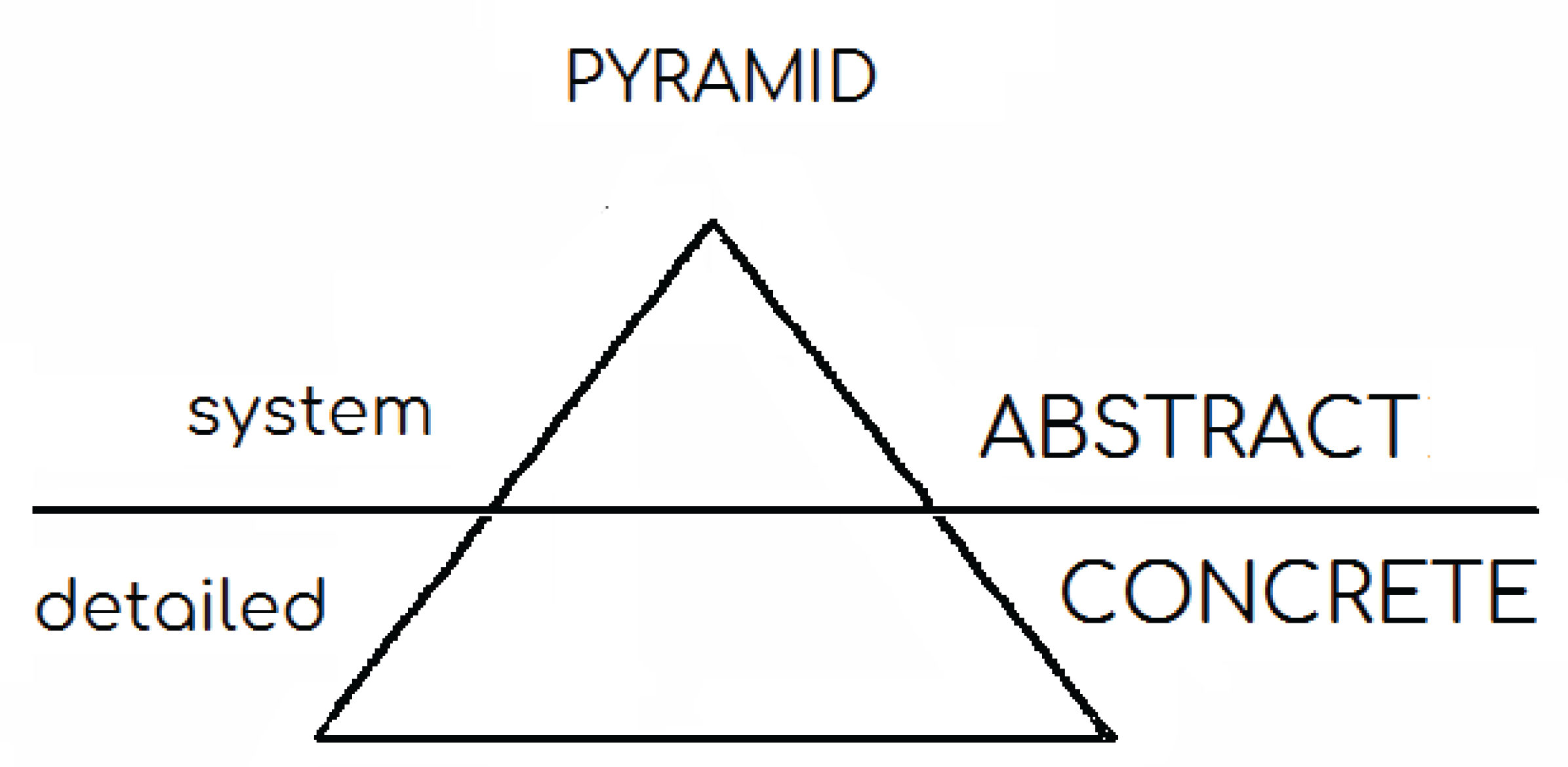
To illustrate, let's look at the Figure 1 (Olha Kovalchuk, Viktor Dudkevych, Lecture № 11 «Installations (settings)», Compact socionics. A guide to overcoming the socionic impasse, p. 160-161):
Abstract (systemic) logic sees less visible and invisible to the eye direct and indirect connections, and its job is to create rules that prevent chaos in reality (for example, at the international or political level). The products of concrete (detailed) logic are an example of original maths, drawing diagrams and schemes (theoretical systems) with meaning, where the connections (truth) between objects and details are obvious and unmistakable. Concrete logic - master in a specific activity that requires deep logical analysis. It is easier for abstract people to look at the world from above and think abstractly by virtue of objective surface vision, so as a rule they break through to the top in any activity. Concrete people stay at the bottom, doing other things, so their interests differ from those of abstract people and they have few common topics in conversation. Moreover, abstract people, due to their inability to analyze deeper for a long time, often do not listen to concrete people. Therefore, in the end, what we have is what we have, both in scientific terminology and in filling this terminology with meaning. Therefore, the concept of logic as a human tool in thinking is used in this paper. However, there is a classical medieval distinction between “logica docens” and “logica utens”, similar in meaning to the two terms above. But for example here: “The logica docens is nothing but the perfection of the logica utens.” (Peirce, Charles S., Definitions for Baldwin's Dictionary [R]. MS [R] 1147), then concrete and abstract logic have a different outcome, as they are two different tools in human thinking. As it was written above, one tool works in consciousness, while the other tool is in subconsciousness in idle state in normal time. This is also explained in the figure, where there is a line between system (abstract) logic and concrete logic, where there is no transition or co-dependence between system logic and concrete logic. And the reason is simple - the first logic is held by one person, the second logic is held by a completely different person. And it cannot be that both types of logic are working in the same person throughout his life (this was written about earlier in this article).
1.12. The Opposite of Logic Is Ethics
Nature hints at the existence of the law of opposites in nature. The opposite of “logic” is “ethics” (Aušra Augustinavičiūtė, Personal Qualities That Should be Considered in Selection of a Partner, The Dual Nature of Man). In human relations, as in any business, there is a place for logic, and there is also a place for ethics. They are in meaning and in essence not only opposites, but also a mechanism in the struggle against each other. Thus, ethics is also an instrument (tool) of thinking, which is present in people with stably non-working logic. But there is a long tradition that claims that ethics is intrinsic to logic (Catt, I. E. (2018). Charles Sanders Peirce: Logic and Ethics. An Encyclopedia of Communication Ethics: Goods in Contention). Again, Peirce was judging by himself, since in some people like him, both logic and ethics work, but already in different situations, at different times and in different frequencies. Such people are called “rationals” (Olha Kovalchuk, Viktor Dudkevych, Compact socionics, Schematic of “Compact socionics”). It will be important to recall here that strict consistency is inseparable from the work of logic (logical method), at which time it will be correct to consider that the work of ethics is “positive politeness” (one of the most correct and possible options, close in meaning and image, but opposite to the image of logic). Politeness in the understanding of the authors of this article, is a falsity, because its purpose is to preserve peace of mind in the interlocutor. This applies more to concrete ethics. On the contrary, abstract ethics - its mission is to create information exchange, to keep people connected. It is expressed in caring for people, such as trying to give way to someone, quietly closing the door to avoid noise, etc.
1.13. The Relationship of Innateness to Logic and Its Examples
What is the relationship between logical results (product of logic) and innateness? Logically it can be explained by a simple example from math, where the digit “8” (eight), results from adding the two digits “4”. This digit “8” regardless of time always remains “8”. So, since it is unchanging and undeniable (truth), therefore it is innate? Exactly so. And also the fact that nature itself is logical (repetitive) by virtue of the existence in nature of paired opposites (left-right, beginning-end, animate-inanimate, presence-absence and true-false, which was previously mentioned). In addition to paired opposites, more obvious can be considered in the account of paired regularities: living beings have two eyes, two eyebrows, two ears, two legs of the same length, etc. All these facts are also innate. Such an observation has led to this conclusion and does not belong to a hypothesis. The same analogy can and even should be applied to other activities constructed by logic. For example, if a theoretical system was constructed by a logical method, then such a system is innate, because it is a finished product of logic. In such a case, the tools of human thinking referred to in the innate theoretical system are also trivially and automatically considered innate. Therefore, this explanation can be taken into account in the following works and conclusions, when the use of logic as a tool is a necessity and the only way to continue the activity. And these works provide clarity in the meaning of other terms and theoretical systems, as well as to separate non-innate phenomena from innate phenomena.
1.14. About New Logical Systems and Theoretical Phenomena
One of the authors of the theoretical system, having engineering education, has always applied logic in his work, he calls it "logical approach or method". This work is unencumbered by patterns from other existing sciences of human thinking, since the theoretical logical system is not and cannot be part of them, since it operates with true repeatable, unchanging things. It is through work with logic that a new systematic patterned field called “Compact socionics” has recently emerged. This is an area in which there are new phenomena and their implications. This field and work arose in part as a consequence and logical extension of Jung's work. It deals with human qualities, stable characters and values that form interpersonal, equally stable relationships. Such qualities, characters and relationships would be considered a priori innate, since such theoretical phenomena were constructed by logical method rather than by experience or subjective vision. After all, let us recall that logical conclusions made by logical method are equal in essence to the same mathematical conclusion about the number "8", as mentioned above. Which means they are true because they are unchanging, which means they are innate. Therefore, to understand the importance of this topic, it is necessary to realize now that the use of logic as a tool, and not the use of a template, is the right path of development in many sciences.
2. Conclusions
With knowledge of the structure of logic, its function and importance, we simplify our work in the sciences. Consequently, it is about the ordering of terms in the sciences, as well as in the subsequent vision of inter-scientific connections that generate new phenomena invisible to human eyes. From this article, we can conclude that logic is an innate tool in thinking that builds strict sequence. This meaning is correct. The work of logic, that is, logical analysis, is the logical method. And a logical method is a strict sequence. The antonym of logic in meaning and sense is ethics. The purpose of eliminating the error is to remove the science called "logic" and the corresponding profession called "logician". This is due to the fact that logic cannot be taught, since it is an innate talent of only some people, since logic is stably present in their thinking only due to the presence of the innate tool called "logic" in their thinking. Therefore, only such people can be called "logicians", which was clarified in "Compact socionics".
References
- Kovalchuk, O., Dudkevych, V. (2013-2024). (1 Ed.). Compact socionics. A guide to overcoming the socionic impasse. ISBN 978-82-693623-0-5.
- Cambridge dictionary. Logic. https://dictionary.cambridge.org/dictionary/english/logic.
- Peregrin, J., Svoboda, V., Laws of Logic – Where Do They All Come From?. Czech Academy of Sciences, Institute of Philosophy. https://logika.flu.cas.cz/images/lide/svoboda/Laws.pdf.
- Hawthorne, J. (Summer 2024). Inductive Logic.
- The Stanford Encyclopedia of Philosophy. Edward N. Zalta & Uri Nodelman (eds.), https://plato.stanford.edu/archives/sum2024/entries/logic-inductive.
- Inclusive Design Toolkit. Thinking. University of Cambridge. https://www.inclusivedesigntoolkit.com/UCthinking/thinking.html.
- Jung, C. G. (2017). Psychological Types. Routledge classics by Routledge, 1 ed. ISBN 978-1-315-51233-4.
- Fletcher, T. J. (1963). Models of Many-Valued Logics. The American Mathematical Monthly, 70(4), 381–391. https://doi.org/10.1080/00029890.1963.11987597.
- Frege, G. (1970), Posthumous Writings. Chicago: University of Chicago Press.
- Merriam-Webster's Online Dictionary. (2005), truth, Archived 2009-12-29 at the Wayback Machine.
- Jaakko J. Hintikka. Logical systems. Britannica.
- https://www.britannica.com/topic/logic/Logical-systems.
- Dunne, L. (2023). Aristotle on Logic: Deduction, Syllogisms, and Truth. TheCollector.
- https://www.thecollector.com/aristotle-logic-deduction-truth-syllogisms/.
- Araújo A., Matias G. (2015). A Constituição Portuguesa: uma questão de simplificação?, https://observador.pt/2015/04/22/a-constituicao-portuguesa-uma-questao-de-simplificacao/ .
- Churchill, Robert Paul (1990). Logic: An Introduction (2nd ed.). New York: St. Martin's Press. p. 418. ISBN 978-0-312-02353-9. OCLC 21216829.
- Engels, F. (7th ed., 1973). Dialectics of nature (Translator, Clements Dutt). New York: International Publishers. (Original work published 1940).
- Reid, T. (1806), Analysis of Aristotle’s Logic, with Remarks. Publisher: William Creech; and sold, Oxford University, https://play.google.com/books/Analysis of Aristotle’s Logic, with Remarks.
- James W. Garson. Intro Mind Notes, Week 10: Logic, Reasoning and Creativity, HMW. Ch. 5, p. 333-362. https://uh.edu/~garson/IMNotes10.htm.
- Peirce, Charles S. (1901-1902 [c.]). Definitions for Baldwin's Dictionary [R]. MS [R] 1147. ‘Logica Docens’ (pub. 10.08.17-14:13). Quote in M. Bergman & S. Paavola (Eds.), The Commens Dictionary: Peirce's Terms in His Own Words. New Edition. Retrieved from http://www.commens.org/dictionary/entry/quote-definitions-baldwins-dictionary-r-3.
- Aušra Augustinavičiūtė. (2021). Personal Qualities That Should be Considered in Selection of a Partner. The Dual Nature of Man. Wikisocion Authors. https://wikisocion.github.io/content/dual_nature.html#personal-qualities-that-should-be-considered-in-selection-of-a-partner/. Automated translation. Аугустинавичюте А. Сoциoника: Введение. – СПб., Terra Fantastica, 1998, с. 103 – 193.
- Catt, I. E. (2018). Charles Sanders Peirce: Logic and Ethics. An Encyclopedia of Communication Ethics: Goods in Contention. https://doi.org/10.3726/b13449, https://www.academia.edu/38907301/Charles_Sanders_Peirce_Logic_and_Ethics.
Figure 1.
Abstract and concrete.
Disclaimer/Publisher’s Note: The statements, opinions and data contained in all publications are solely those of the individual author(s) and contributor(s) and not of MDPI and/or the editor(s). MDPI and/or the editor(s) disclaim responsibility for any injury to people or property resulting from any ideas, methods, instructions or products referred to in the content. |
© 2025 by the authors. Licensee MDPI, Basel, Switzerland. This article is an open access article distributed under the terms and conditions of the Creative Commons Attribution (CC BY) license (http://creativecommons.org/licenses/by/4.0/).
Copyright: This open access article is published under a Creative Commons CC BY 4.0 license, which permit the free download, distribution, and reuse, provided that the author and preprint are cited in any reuse.


