

Submitted:
14 October 2025
Posted:
15 October 2025
You are already at the latest version
Abstract
This article presents the scientific validation of a Management Model for International Cooperation aimed at the development of renewable energy sources in the Cuban electricity sector. The objective of this research is to validate the content of the developed questionnaire, thus obtaining an instrument with 22 activities and five subprocesses for application in the management of international collaboration projects. The methodology used was quantitative, descriptive, and psychometric, with content validity based on expert judgment, employing statistical treatment using the Statistical Software for the Social Sciences (SSPS V.20). It is concluded that the results show high internal consistency of the construct, where Cronbach's alpha values greater than 0.90 are considered optimal in all subprocesses of the model, confirming its relevance and reliability for the strategic management of international renewable energy projects.
Keywords:
Cronbach's alpha
; management model
; expert method
; international cooperation
; renewable energy
1. Introduction
A review of the concepts about cooperation presented by various scholars reveals different definitions of the topic. The current concept of international cooperation in the latest UNIDO Annual Report 2024 focuses on strengthened technical cooperation and multisectoral collaboration to promote sustainable industrial development and global economic recovery. UNIDO highlights the record mobilization of funds for technical cooperation, reaching $663.6 million in 2024, as well as a 29% increase in the implementation of technical cooperation activities compared to the previous year, exceeding established targets.
International cooperation is understood as a strategic alliance between member states, the private sector, and development partners, operating within international frameworks such as funds for the environment, climate change, and adaptation. Cooperation is oriented toward the transfer of low-carbon technology, boosting trade competitiveness and market access in regions such as Africa, and collaborating on initiatives that promote gender equality and women’s empowerment.
In short, UNIDO defines international cooperation comprehensively as a mechanism that: a) mobilizes extensive voluntary financial resources; b) increases technical cooperation that supports sustainable productive transformation; c) establishes partnerships with multiple actors, including the private sector and international organizations; d) prioritizes industrial innovation, adaptation to climate change, social inclusion and sustainable development in line with the 2030 Agenda. This approach is documented in the UNIDO Annual Report 2024, which highlights new technical cooperation programs, flagship projects and the formation of new alliances to strengthen sustainable industrialization in developing countries [1].
The UNDP understands development cooperation as a strategic and multidimensional partnership that provides countries with access to knowledge, resources, and expertise to promote the well-being of their people, boost resilience, eradicate poverty, and reduce inequalities through integrated and innovative approaches. Furthermore, cooperation is based on inclusive partnerships and multi-stakeholder coordination to achieve sustainable results and strengthen national capacities, fostering sustainable and resilient development that responds to national and global priorities [2].
Furthermore, the UNDP Strategic Plan 2022-2025 emphasizes collaboration with partners within and outside the United Nations system, supporting governments and communities in economic, social, and environmental recovery and transformation, especially in the wake of the COVID-19 pandemic. It also highlights that cooperation must be based on a systemic approach that leverages UNDP’s innovation, creativity, and local and global expertise [3].
In addition, the European Parliament reaffirms the EU’s commitment to peaceful diplomatic cooperation, the resolution of disputes through dialogue in compliance with international law, and international collaboration on key issues such as climate change, human rights and sustainable economic development [4].
For its part, the concept of international collaboration in the “Report of the 15th IRENA Assembly: Accelerating the Transition to Renewable Energy” is based on global cooperation to facilitate and accelerate the energy transition to renewable sources with an inclusive and supportive approach that transcends borders. This cooperation entails: 1. facilitating the financing and mobilization of investments for renewable energy; 2. creating strategic alliances and global platforms; 3. promoting a just and equitable transition; and 5. strengthening collective action [5].
Collaboration in the BRICS context involves civil society as a key and dynamic partner that facilitates the articulation of diverse citizen voices to influence global policies and practices [6].
Technical cooperation, as conceptualized by the OECD, is defined as “a modality intended to strengthen individual and organizational capacities through the offer of specialist services, training and related learning possibilities” [7], thereby contributing to the achievement of international priorities, such as the Sustainable Development Goals.
Decree Law 16 of 2020 on Cuban International Cooperation defines this concept as: “the set of relations and coordinated actions between Cuba and other States, international organizations, non-governmental organizations and other actors, based on solidarity, mutual benefit and respect for national sovereignty, to contribute to the economic, social and scientific-technical development of the country” [8].
On the other hand, Romero (2017) [9] considers that:
“Cuba currently has the possibility of accessing external sources of financing, but this implies that it complies with its payments to creditors. Achieving timely compliance with the increasing payments for debt service requires a productive response that must incorporate greater advances in terms of changes in the policy and management mechanisms of the national economy, in such a way as to promote a higher level of decentralization and business autonomy, together with a broader diversification of the ownership structure”.
Vivian Cabrera (2014) [10], for her part, consider that states for local development in Cuba, unlike the Latin American experience, has been supported by a different development model, in which the determination of local priorities, the allocation of resources and mechanisms regulations are in correspondence with the country’s strategic lines of development. In this global logic, the specific situations of the local context, in terms of problem solving and resource allocation, are not necessarily coincident. Although in 2004 a governing document for the implementation of Municipal Initiatives for Local Development was approved by the Ministry of Economy and Planning, limitations persist, such as the verticalization of the country’s productive structures, high centralization in decision making, little culture in the area of local development and the nonexistence of a national innovation system based on territorial needs.
Korkeakoski and Filgueiras (2022) [11] recognize that the Cuban government estimates that between 3500 and 4000 million dollars in investments are needed to achieve its objectives for renewable energies, to reach 24% by 2030, reduce the cost of electric energy up to 0.17 USD and mitigate the environmental impact with a reduction of CO2 emissions up to 1015 tons/year, with an essential part of direct foreign investments; where most of the investments are planned in the development of energy: wind and solar photovoltaic. However, the Cuban Government promotes investments in other renewable energies, for example, in biogas, forest biomass, agro-industrial waste and urban solid waste.
The energy sector has been developing international cooperation for more than 15 years; however, its implementation has been focused more on complying with government directives or through specific actions than on the institution’s management approach for the development of intentional and systemic international cooperation. However, in the international environment, where technologies for generating electricity based on renewable energy sources are being promoted, there is a potential for non-reimbursable funds or funds with favorable financial terms from international cooperation, which are underexploited by all areas of the energy sector.
Based on the analysis of the above concepts, the author considers that a management model for international cooperation is a framework for the direction and management of an entity or government. Management models can be applied to both private companies and public administration institutions. This means that governments have a management model on which they base their policies and actions, and with which they aim to achieve their objectives.
Although the management model used by public organizations differs from that of the private sector, the latter is based on obtaining economic profit. In contrast, the former considers other issues, such as the social well-being of the population. However, there are commonalities when projects involve both government and private companies; managing international cooperation can benefit both in this case. Therefore, implementing an international cooperation management model that enables the development of renewable sources requires specific efforts and a tailored design.
On the other hand, in recent years, many countries have been promoting initiatives to transition their energy generation mix to renewable sources, replacing conventional thermal generation. This shift aims to reduce the adverse effects of climate change and achieve sustainable development, thanks to the benefits it offers. However, it is necessary to consider that when the policies and institutions of the electricity sector of the countries are not solid, these types of technologies present barriers or limitations to their development, so it is essential to establish stable policies, legal instruments, strategies, actions and regulatory schemes that favor the incorporation of these technologies, contextualizing each action for each national energy market [12].
According to Romero (2017) [9], Cuba currently has the possibility of accessing external sources of financing, but this implies that it must comply with its payments to its creditors. Achieving timely compliance with growing debt service payments requires a productive response that incorporates significant policy and management changes in the national economy. This should foster greater decentralization and business autonomy, along with a broader diversification of the ownership structure.
The management model for international cooperation in developing renewable energy sources, grounded in science, technology, and innovation, addresses the shortcomings in the management system’s approach. Its design helps identify integration gaps in corporate systems and strengthen technology and innovation management capabilities at the strategic, tactical, and operational levels, based on continuous improvement.
The concept of a management model is understood as a simplified description of a system that provides an essential structure for addressing organizational change practically and effectively. In this context, a model is a conceptual tool that helps understand and guide how change occurs, considering the interactions between people, processes, and culture within the organization. [13]. These models integrate elements such as planning, organization, direction, and control, adapting to the specific needs of each entity [14].
In the field of quality management, different institutions and experts have developed several models to provide a structured and systematic framework for evaluating and improving an organization’s quality performance. These models offer a set of principles, criteria, and practices that help organizations establish efficient processes, improve customer satisfaction, and achieve consistent results [15]. To compete with other major players in the global market, Ecuadorian companies, for example, have found it necessary to implement procedures that improve their strategies, production processes, and innovation. This focus on quality and efficiency is essential to boost the country’s economic development and competitiveness on the international stage [16]. The model proposed in this study takes into account the concepts of total quality. To implement an international cooperation management model that allows for the accelerated introduction of technologies based on renewable energy sources, it is first necessary to understand the current external context and the evolution of these technologies in different countries based on the challenges they have experienced.
Renewable energy sources face various technical, economic, regulatory, and social challenges at both the global and regional levels:
- -
- Technical and integration challenges: Intermittent solar and wind power generation make it difficult to balance supply and demand. Furthermore, the electricity infrastructure, designed for fossil-fuel-powered generation plants, requires modernization to integrate renewable energy and storage [17,18]. There are also limitations in the capacity and availability of current storage technologies [19].
- -
- -
- Regulatory and political challenges: Regulatory fragmentation and complex permitting processes slow project implementation [22,23]. The lack of continuity and stability in political incentives reduces investor confidence [24]. There are also legal loopholes that limit the development of energy communities and local participation [25].
- -
There are various examples of international cooperation implementation, such as that promoted by the European Union, which optimizes costs and benefits and improves the deployment of renewable energy [17,18]. Stability in regulatory frameworks and incentives is essential for investor confidence and project success [22]. Furthermore, inclusive and transparent community participation facilitates social acceptance and reduces local conflicts [24,25]. Finally, adapting solutions to the regional context is essential due to sociopolitical and economic differences [19,20]. In emerging economies in developing countries, there is a lack of adequate infrastructure, legal certainty, and technical capacity [20,26]. Deep political and structural reforms are essential to advance the energy transition from fossil fuels to renewable energy sources [24,27].
Based on a bibliographic review of the literature related to the research topic and the criteria of different authors, a questionnaire was developed to validate the International Cooperation Management Model (ICMM).
Selecting the appropriate experts to validate the ICMM involves considering their expertise in methodology, instrument design, and data analysis related to the thematic content. Therefore, expert validity is a complex and multifaceted issue. Although experts may have limitations in their assessments, their contribution is still valuable and can significantly improve the decision-making process. Furthermore, their judgments may vary, influenced by the context in which they operate.
Content validity through expert judgment is fundamental in the construction of measurement instruments. At this stage, a group of specialists assess each of the instrument’s items to evaluate whether they adequately reflect all the dimensions of the variable or construct to be measured. [28,29,30].
Specifically, the objective of this work is to validate a questionnaire with the activities of the management of international cooperation for the development of renewable energies in Cuba through the expert method and applying the reliability coefficient: Cronbach’s Alpha.
2. Materials and Methods
Expert Method
Rigorous expert selection is a fundamental pillar for ensuring validity and reliability in instrument validation processes and studies based on expert judgment. According to Guerrero et al. (2025) [28], the group of experts must be heterogeneous, with extensive and recognized experience in the subject area, as well as a willingness to actively participate. The ideal number of experts varies depending on the study, although it usually ranges between 7 and 15 [29,31], which favors diversity of perspectives and consistency in evaluations.
For expert selection, it is recommended to apply multi-criteria techniques that consider criteria such as professional experience, academic output, specific training, and recognition in the field, as proposed by Sigüenza et al. (2024) and Maldonado et al. (2024) [32,33]. Furthermore, the use of self-assessments and systematization of criteria helps standardize the selection process and increase confidence in the evaluators’ competence [28,34].
Some sources indicate that the optimal number of experts generally ranges between 15 and 30 participants. However, ranges of 2 to 20 experts are also accepted, and it is even considered that 10 experts are sufficient to obtain a reliable estimate of content validity. This wide range responds to the need to balance representativeness and competence with operational feasibility, since a tiny group can overestimate the influence of each expert. At the same time, a group that is too large makes it difficult to reach a consensus. In practical terms, it is recommended that the number of experts does not exceed 30, since from this number onwards, the average error in the responses remains at low levels and less than 1, which is optimal for group reliability [35].
Questionnaire Development
To develop the questionnaire, a bibliographic review was conducted, analyzing the instruments used in studies with objectives similar to those of this research. A bibliographic mapping of the literature was conducted in five key international databases (Redalyc.org, Dialnet.net, Academia.edu, SciELO.org, and Google Scholar) to analyze the main methodological trends related to this field of research due to their quality criteria or international focus. An analysis of the instruments identified in the searches was then conducted.
Application Procedure
The research technique employed was a survey, and the instrument used was an initial questionnaire comprising 22 activities, categorized into seven dimensions: 1-Strategic planning, 2-Stakeholder coordination, 3-Innovation and technology transfer, 4-Training and capacity building, 5-Financing and economic sustainability, 6-Institutional strengthening, and 7-Monitoring and evaluation.
The 22 questions were validated as applicable to 5 subprocesses that comprise the International Cooperation Management process. This is an exploratory and descriptive, cross-sectional, instrument validation study, framed within a quantitative approach. As a complement to this information, Appendix A presents the activities (items) included in the questionnaire that intervene in the intentional and systemic process of international collaboration.
Following the Delphi methodology, the questionnaire was sent to the panel of experts for them to respond, indicating their level of agreement with the statements. In the first round (May–June 2025), the panelists completed the questionnaire online and were offered the opportunity to add their opinions in open text. The technical team evaluated and presented the results of the first round using bar graphs to facilitate comments and clarifications from each participant. Statements not reached by consensus were sent back to the panelists for evaluation in a second round (June–July 2025). The results of this second round were tabulated and presented descriptively. All 12 selected experts completed the first and second rounds of consensus. The expert knowledge coefficient values used in the literature reviewed to determine the expert’s position were [35]:
- 0.8 <= K <= 1.0, high expert competence coefficient
- 0.5 <= K < 0.8, medium expert competence coefficient
- K < 0.5, low expert competence coefficient
Calculation of the Argumentation Quotient (Ka)
The Argumentation Quotient (Ka) is obtained by adding the scores assigned by the expert to various sources of argumentation within their knowledge. The expert was presented with different sources of argumentation and asked to indicate the level of influence on their knowledge in the area, which could be High, Medium, or Low. It is calculated by averaging two components: the expert’s declared knowledge on the subject (self-evaluation) and the scientific basis or experience that supports said knowledge [29,31]. A value of ka≥0.8 suggests high competence.
Calculation of the Knowledge Quotient (Kc)
The Knowledge Quotient (Kc) is obtained from the expert’s self-assessment of their knowledge on topics relevant to the study. The expert rated their knowledge on a scale of 0 to 10, where 0 represents complete ignorance and 10 represents complete knowledge. It measures the homogeneity or agreement between the experts’ assessments [28,33]. This score is multiplied by 0.1 to obtain the Kc.
In the context of research that requires critical and substantiated evaluations, having qualified experts ensures that decisions are informed and based on in-depth knowledge of the subject. In this study, experts were selected using the competency indicator, a method recognised for its effectiveness in determining the suitability of participants in research processes.
✓ Kc is the expert’s theoretical knowledge, evaluated on a scale of 1 to 10.
✓ Ka is the expert’s practical argumentation capacity, determined through exercises or applied cases relevant to the topic of study.
This index validates that the selected group can make valid judgments for the research or validation in question [30,37].
The interpretation of these coefficients is crucial: a K close to 1 indicates a highly qualified expert, while low values may indicate a lack of suitability for participation in the study. This criterion allows evaluations to be supported by experts with adequate knowledge and arguments based on relevant sources. Expert opinions are of significant value because they consist of conclusions or inferences reached by the expert based on their theoretical knowledge and practical experience in their field of expertise, and therefore constitute a qualified opinion. [29,31].
Furthermore, for the specific selection criteria, it is recommended to consider: a) verifiable experience in the subject area (publications, years of practice, positions) [32]; academic level and relevant complementary training [33]; recognition by peers or by the academic/professional community [31]; willingness and commitment to participate in validation [28]; heterogeneity in perspective to achieve methodological balance and avoid bias [29]. Finally, the need to establish a threshold in the coefficients to validate the inclusion or exclusion of experts from the final group is highlighted, thus guaranteeing quality and robustness in the process of evaluation and validation of instruments or consensus of opinions [28,37,38]. The average value determines the expert’s suitability to participate in specialized research, with a K value ≥ 0.8 being the minimum criterion for being considered suitable for this study.
Where corresponds to the expert’s theoretical knowledge, evaluated through a self-assessment using a scale of 1 to 10, while reflects practical argumentation, determined by the expert’s ability to solve applied cases related to the ICMM. Only experts with a value equal to or greater than 0.8 were selected, ensuring that participants possess an adequate level of theoretical and practical competence.

Table 1.
Selection of experts 1.
| Expert | Organization | Kc | Ka | K | Level of competence |
|---|---|---|---|---|---|
| 1 | UNDP | 1.0 | 0.9 | 0.95 | Alto |
| 2 | MINEM | 1.0 | 0.9 | 0.95 | Alto |
| 3 | UNE | 0.9 | 1.0 | 0.95 | Alto |
| 4 | IHES | 0.9 | 1.0 | 0.95 | Alto |
| 5 | MINCEX | 0.9 | 1.0 | 0.95 | Alto |
| 6 | FFRC | 0.9 | 0.9 | 0.90 | Alto |
| 7 | UNE | 0.9 | 0.9 | 0.90 | Alto |
| 8 | UNIDO | 0.9 | 0.9 | 0.90 | Alto |
| 9 | CEDEL | 0.9 | 0.8 | 0.85 | Alto |
| 10 | UNE | 0.8 | 0.9 | 0.85 | Alto |
| 11 | INRH | 0.7 | 0.9 | 0.80 | Alto |
| 12 | UNISS | 0.9 | 0.9 | 0.90 | Alto |
1 Source: own elaboration.
All experts presented a high level of competence, which supports the validity of their judgments.
The experts evaluated whether each item was necessary but not sufficient, proper but redundant, or unnecessary for what the item was supposed to represent. Regarding reliability, SPSS V.20 was used to determine reliability using Cronbach’s alpha coefficient as a basic ratio to assess the tool’s internal consistency. It is important to mention that other methods exist, such as reliability calculated through structural equation modelling and split-half modelling, which are very useful for working with both types of variables: latent and observable. However, despite a general assessment of item correlation, Cronbach’s alpha remains the most appropriate statistic for cross-sectional self-administered tests, such as the one used in this study.
3. Results
3.1. Brief Explanation of the Model
The management model for international cooperation in developing renewable energy sources, based on Science, Technology, and Innovation (STI), emerges as a response to management deficiencies within the management system. Its design allows for the identification of integration gaps in corporate systems and the strengthening of technological and innovative management capabilities at the strategic, tactical, and operational levels through a process of continuous improvement.
A management model is a structured framework that defines processes, strategies, and practices to direct and optimize organizational resources, to achieve goals efficiently and sustainably [13]. These models integrate functions such as planning, organization, direction, and control, adapting to the specific characteristics of each entity [14]. Among the most common approaches are total quality management, competency-based management, and organizational agility, each with specific methodologies and tools [15]. The selection of the appropriate model depends on the organizational context, strategic objectives, and environmental demands [16] (Figure 1).
The management of technological resources constitutes the fundamental foundation of all these approaches, which is why this paper adopts a strategic technological resource management approach. This approach recognizes that technology and innovation are key assets that must be comprehensively managed to effectively respond to economic, environmental, and social demands, as well as to the institutional and governmental needs that manifest themselves in the specific problems to be solved.
According to the above ideas, the following diagram establishes a management model for international cooperation based on process management that includes 5 key sub processes: inputs and outputs, strategic processes, and support processes.
3.2. Scope of the Model
For this research, the ICMM encompasses the international collaboration received by the Electricity Union for the development of renewable energy sources.
Provider: Defined as any foreign State, organization, or institution that provides international cooperation to the country, whether in financial, material, technological, or training resources [8].
Recipient: The Cuban party, represented by the State, its institutions, organizations, or authorized entities, that receives and manages international cooperation for the country’s economic and social development [8].
Five subprocesses have been identified with a logical sequence of activities that complement the international cooperation management process:
3.2.1. Subprocess 1: Identification of Cooperation Needs and Opportunities
- To conduct technological and financial gap analyses in the energy matrix.
- To identify relevant international cooperation programs and agencies.
- To analyse the geopolitical context to assess risks and opportunities.
- To develop a priority plan aligned with the identified needs and opportunities.
- To align cooperation opportunities with the priority plan.
3.2.2. Subprocess 2: Formulation of the Cooperation Project Portfolio
- To design a portfolio of projects that respond to the identified needs and are aligned with the Sustainable Development Goals (SDGs).
- To negotiate with international partners and stakeholders to define roles and commitments.
- To design financing schemes that minimize geopolitical risks.
- To prepare the technical and administrative documents required for approval.
- Submit projects for approval at the appropriate levels.
3.2.3. Subprocess 3: Project Management and Execution
- To implement planned activities in coordination with international partners.
- To conduct technical and financial monitoring for risk management.
- To train local personnel to ensure knowledge transfer.
- To influence energy policies at the local, sectorial, provincial, and national levels to promote the adoption of renewable technologies.
3.2.4. Subprocess 4: Monitoring and Evaluation
- To design and implement a continuous monitoring system.
- To prepare periodic reports on technical, financial, and impact progress.
- To evaluate technical and social environmental impacts, as well as medium- and long-term indicators.
- To identify and document lessons learned to improve future projects.
3.2.5. Subprocess 5: Sustainability and Replicability
- To manage the technology and knowledge generated to ensure its continuity.
- To design or integrate sustainable financing mechanisms and incentives.
- To document good practices and successful experiences.
- To develop an exit strategy that allows for replication and improvement of the project in other areas.
- To record all relevant information in the organization’s digital and technological database.
When the cycle of the five subprocesses is completed, it contributes to the fulfillment of the SDGs, mainly those related to Affordable and Clean Energy (7) and the Climate Action (13). In addition, the solution to the set of identified problems is achieved and, as a result, impacts are obtained in innovation (organizational or technological) or in the technology transfer.
Strategic processes must be aligned with international cooperation providers and include:
- Geographic diversification of interventions (expanding and balancing alliances, projects, or exchanges between geographic regions and countries).
- Financing mechanisms or technical assistance capabilities.
- Specialization and transfer of good practices.
- Monitoring and evaluation.
Support processes enable successful project development and include:
- Integration and connectivity with national and regional development plans.
- Strategic alliances with institutions or universities.
- Management of risks associated with projects.
- Knowledge management based on lessons learned and products generated by projects.
- Communication and awareness-raising with key stakeholders.
- Appropriation of technology and knowledge that enable institutional strengthening.
- Sustainability, through institutional financial and supporting mechanisms from the energy sector.
This contributes to the replication of large-scale pilot projects and the implementation of new projects.
3.3. Results: Reliability Analysis (SPSS V.20)
Several reliability analysis models are available in the SPSS V.20 and other similar statistical programs. To measure the internal consistency of the activities that constitute the ICMM components, Cronbach’s alpha was selected. This coefficient allows us to determine the extent to which the items used in an instrument are correlated. This coefficient is very useful as it summarizes the average correlations between the items that comprise an instrument and indicates the extent to which a construct, concept, or factor measured is present in each item. For its application, the data can be dichotomous, ordinal, or interval, but must be numerically coded [36].
The validation of a questionnaire includes evaluating the reliability of its components, with Cronbach’s alpha coefficient being one of the most widely used indicators for measuring the internal consistency of the items that make up a construct or dimension. This coefficient quantifies the evaluation between the items in the instrument, indicating how homogeneous the set is and, therefore, the reliability of the construct to be measured [32].
According to Sigüenza et al. (2024) [32], Cronbach’s Alpha values above 0.7 are considered adequate for educational research, with this being the minimum acceptable to guarantee the internal consistency of the questionnaire. Values between 0.8 and 0.9 reflect well to excellent reliability, while values above 0.9 could indicate redundancy between items. Some authors, such as Martínez et al. (2025) [39], point out that for the validation of questionnaires in health sciences and education, a Cronbach’s Alpha equal to or greater than 0.7 is sufficient. However, they suggest that the interpretation should be contextualised in the number of items and the nature of the construct. For questionnaires with few items, a value close to 0.6 could be temporarily accepted if complemented with other validity indicators. Others such as Silva and Rioseco (2025) [29] mention that an Alpha coefficient between 0.7 and 0.95 is desirable in the educational field and warn that values that are too high (greater than 0.95) can be counterproductive, as they could imply that the items are excessively similar or redundant, which limits the instrument’s capacity to capture different facets of the construct [36].
In social and educational research contexts, researchers also agree that Cronbach’s Alpha should ideally be above 0.7, highlighting that values lower than this suggest the need to review items to improve the homogeneity of the instrument [40]. Cronbach’s alpha requires only a single test administration and is used to determine internal consistency in unidimensional scales. Reliability is defined as the degree to which a multi-item instrument consistently measures a sample of the population. Consistent measurement refers to the degree to which a measure is error-free. The reliability coefficient indicates the strength of the association. The value ranges from -1 to +1; a value of 0 means no relationship between the two scores, while a value close to -1 or +1 indicates a very close, negative, or positive relationship [35].
A positive value indicates that individuals with high scores on the first administration of the scale will also score high on the second administration. Negative reliability indicates a calculation error or a significant inconsistency in the scale.
Internal consistency is achieved when instruments that seek to measure a construct can be indirectly validated based on the relationship shown by the items that comprise the scale; That is, if there is a high internal consistency or interrelation between the questions or sections that are part of the scale.
Cronbach’s alpha coefficient is calculated using the following equation [35]:
α = (k/k − 1) (1 − Si2 / S sum2)
k = Number of test items
Si2 = Item variance (from 1……i)
S sum2 = Total test variance
The reliability of the proposed questionnaires, as proposed, was determined by calculating the general Cronbach’s Alpha coefficient and the alpha obtained by eliminating each of the items concerning their internal consistency, to estimate the existing correlation between them and identify items that are inconsistent or that are far from the aspects that influence the process of applying statistical techniques in many areas. According to Cornetero and López (2025) and Pedroso et al. (2022) [40,41], this coefficient takes values between 0 and 1. 0 represents zero reliability, and 1 represents total reliability. The author herself insists that there is no rule indicating from which specific value the instrument loses reliability. For this research, Castañeda et al. (2024) [36] classifies Cronbach’s Alpha coefficient according to the following limits:
- Very low reliability: α ≤ 0.30
- Low reliability: 0.30 < α ≤ 0.60
- Moderate reliability: 0.60 < α ≤ 0.75
- High reliability: 0.75 < α ≤ 0.90
- Very high reliability: α > 0.90.
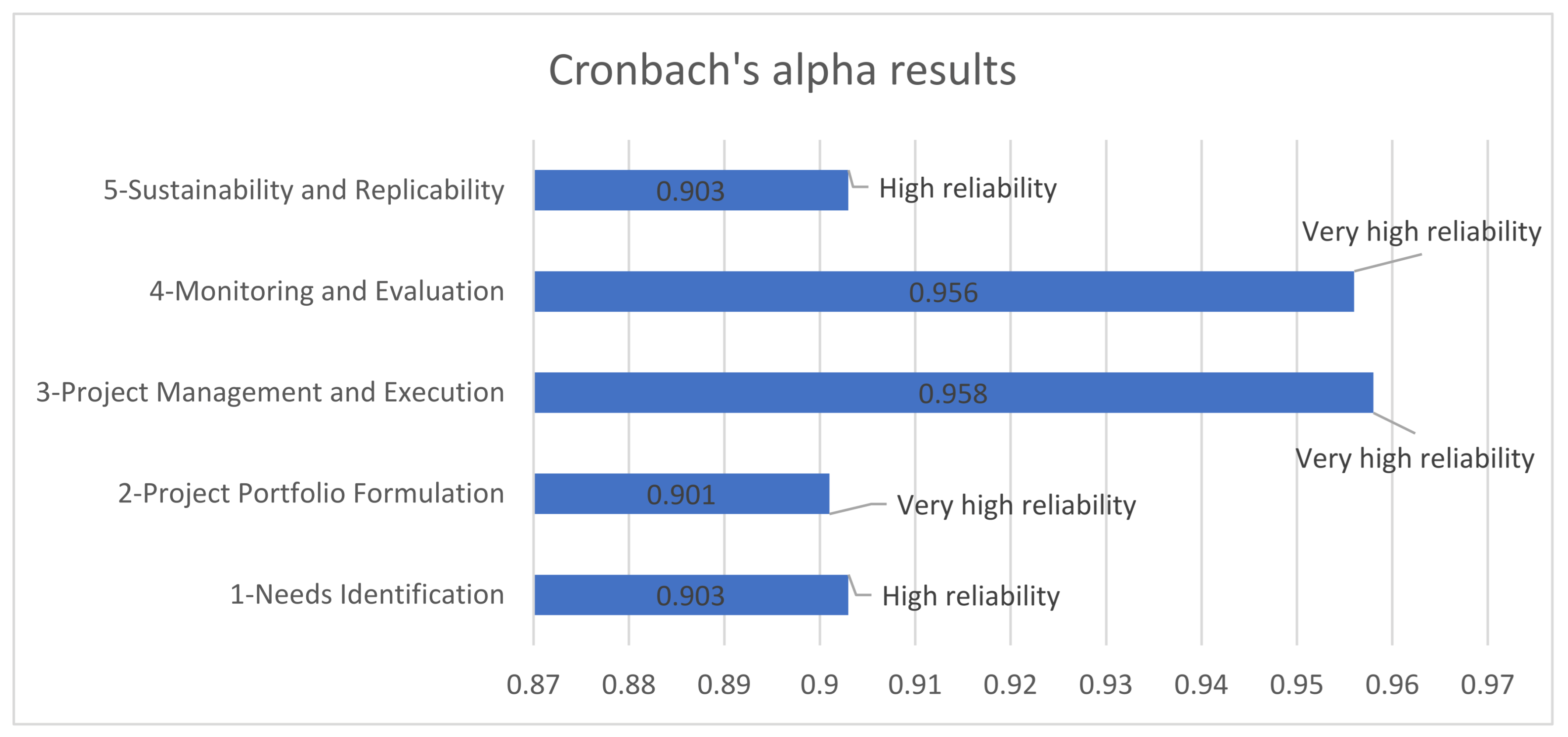
The results of this study reflect the experts’ perceptions of international cooperation management models for the development of renewable energy sources. Based on the responses to the questionnaire, key aspects such as the adequacy of the evaluated activities were analyzed. Figure 2 shows the results of Cronbach’s alpha for each subprocess.
These results are comparable with recent studies on the validation of international management and cooperation instruments, where Cronbach’s alpha values greater than 0.90 are considered optimal for complex and multidimensional instruments.
3.3.1. Subprocess 1
- Internal consistency: The Cronbach’s alpha coefficient obtained was 0.903, and the alpha based on typed items was 0.913; both values indicate high and adequate reliability for the scale. These results suggest that the items present adequate homogeneity and consistently measure the underlying construct of Subprocess 1.
- Item descriptive statistics: Item means range from 2.75 to 3.92, with an overall mean of 3.42, indicating a medium-high level of response. Standard deviations range from 0.29 to 1.42, showing moderate response variability.
- Inter-item correlations: Most inter-item correlations are positive and moderate to high, with some items showing low or negative correlations with others, which may indicate items with less contribution to internal consistency. Items such as ACT_1.2 and ACT_3.3 show low or negative correlations with certain items, suggesting the need for revision. The corrected item-total correlation ranges from -0.023 (ACT_3.3) to 0.775 (ACT_2.2).
- Cronbach’s alpha if the item is deleted: The elimination of items with low correlation, such as ACT_3.3, does not substantially improve the overall Cronbach’s alpha, which remains above 0.90. This indicates that, overall, the items contribute positively to the instrument’s internal reliability as shown in Table 1.
Table 1.
Total-item statistics of Subprocess 1.
| Items | Scale mean if item is deleted | Scale variance if item isdeleted | Corrected item-total correlation | Cronbach’s alpha if the item is deleted |
|---|---|---|---|---|
| ACT_1.1 | 72.2500 | 93.295 | .602 | .897 |
| ACT_1.2 | 72.1667 | 99.424 | .050 | .913 |
| ACT_1.3 | 72.3333 | 88.061 | .492 | .902 |
| ACT_1.4 | 71.8333 | 93.788 | .557 | .898 |
| ACT_2.1 | 72.0833 | 91.720 | .545 | .898 |
| ACT_2.2 | 72.0000 | 86.364 | .775 | .891 |
| ACT_2.3 | 71.6667 | 90.242 | .721 | .893 |
| ACT_3.1 | 72.5833 | 86.447 | .493 | .904 |
| ACT_3.2 | 71.5000 | 97.000 | .569 | .899 |
| ACT_3.3 | 71.5000 | 101.545 | -.023 | .906 |
| ACT_4.1 | 71.5833 | 95.356 | .674 | .897 |
| ACT_4.2 | 72.0000 | 90.545 | .851 | .892 |
| ACT_4.3 | 71.5833 | 92.265 | .742 | .894 |
| ACT_5.1 | 72.1667 | 90.879 | .624 | .896 |
| ACT_5.2 | 71.7500 | 88.023 | .751 | .892 |
| ACT_5.3 | 71.4167 | 100.629 | .139 | .904 |
| ACT_5.4 | 72.0000 | 93.091 | .520 | .898 |
| ACT_6.1 | 71.7500 | 92.750 | .646 | .896 |
| ACT_6.2 | 71.9167 | 94.447 | .510 | .899 |
| ACT_7.1 | 71.7500 | 95.477 | .428 | .900 |
| ACT_7.2 | 71.9167 | 91.174 | .775 | .893 |
| ACT_7.3 | 72.2500 | 91.841 | .514 | .899 |
Source: SPSS V.20.
3.3.2. Subprocess 2
- Internal consistency: The overall Cronbach’s alpha was 0.901, indicating a high level of reliability and internal consistency for the scale, suggesting that the items consistently measure the proposed construct. Upon standardization, the alpha increased slightly to 0.916.
- Item descriptive statistics: Item means ranged from 2.6667 to 3.6667, with generally moderate standard deviations, reflecting some variability in responses. Most items showed moderate to high, positive corrected item-total correlations (with values between 0.258 and 0.864), indicating that each item contributes adequately to the scale.
- Inter-item correlations: However, some items, such as ACT_3.3 (-0.026) and ACT_7.1 (-0.072), exhibited negative correlations with the total scale, suggesting that they may be measuring different constructs or require revision or elimination to improve reliability.
- Cronbach’s alpha if the item is deleted: The elimination of ACT_1.2 was necessary due to its zero variance, an indicator of lack of response variability that could affect reliability. Furthermore, the uniqueness of the covariance matrix may result from strong linear relationships between items.
Table 2.
Total—item statistics of Subprocess 2.
| Items | Scale mean if item is deleted |
Scale variance if item is deleted | Corrected item-total correlation | Cronbach’s alpha if item is deleted |
|---|---|---|---|---|
| ACT_1.1 | 64.2500 | 100.568 | .495 | .898 |
| ACT_1.3 | 64.0833 | 95.538 | .790 | .891 |
| ACT_1.4 | 64.5833 | 98.992 | .583 | .896 |
| ACT_2.1 | 64.5000 | 96.455 | .608 | .895 |
| ACT_2.2 | 65.0833 | 94.083 | .405 | .903 |
| ACT_2.3 | 64.5833 | 91.720 | .851 | .888 |
| ACT_3.1 | 64.4167 | 93.720 | .776 | .890 |
| ACT_3.2 | 64.4167 | 98.083 | .583 | .896 |
| ACT_3.3 | 65.0833 | 105.174 | -.026 | .917 |
| ACT_4.1 | 64.4167 | 90.629 | .864 | .887 |
| ACT_4.2 | 64.8333 | 91.242 | .812 | .888 |
| ACT_4.3 | 64.8333 | 91.606 | .638 | .893 |
| ACT_5.1 | 64.1667 | 97.424 | .618 | .895 |
| ACT_5.2 | 64.3333 | 92.242 | .750 | .890 |
| ACT_5.3 | 64.1667 | 94.879 | .821 | .891 |
| ACT_5.4 | 64.1667 | 98.152 | .560 | .896 |
| ACT_6.1 | 64.5000 | 97.364 | .463 | .898 |
| ACT_6.2 | 64.5833 | 100.992 | .258 | .903 |
| ACT_7.1 | 64.2500 | 106.568 | -.072 | .910 |
| ACT_7.2 | 64.8333 | 99.970 | .342 | .901 |
| ACT_7.3 | 64.9167 | 94.083 | .608 | .894 |
Source: SPSS V.20.
3.3.3. Subprocess 3
- Internal consistency: The Cronbach’s alpha coefficient obtained was 0.958, indicating an excellent level of reliability according to conventional criteria (values greater than 0.90 are considered indicative of high internal consistency). This result suggests that the items are highly correlated with each other and consistently measure the underlying construct.
- Item descriptive statistics: Item means range from 2.58 to 3.58, with an overall mean of 3.18.
- Standard deviations range from 0.51 to 1.87, showing variability in responses. The average item variance is 1.036, indicates a moderate dispersion.
- Inter-item correlations: Most inter-item correlations are positive and moderate to high, with maximum values close to 0.95. Some low or negative correlations were identified (for example, ACT_2.3 presents a very low correlation with several items), which could indicate items that do not optimally contribute to the scale’s homogeneity.
- Cronbach’s alpha if the item is deleted: The elimination of no items significantly improves the overall Cronbach’s alpha, as values range between 0.953 and 0.961. This indicates that all items contribute positively to the instrument’s internal consistency.
Table 3.
Total—item statistics of Subprocess 3.
| Items | Scale mean if item is deleted |
Scale variance if item is deleted | Corrected item-total correlation | Cronbach’s alpha if item is deleted |
|---|---|---|---|---|
| ACT_1.1 | 67.4167 | 250.447 | .467 | .959 |
| ACT_1.2 | 67.2500 | 249.114 | .577 | .958 |
| ACT_1.3 | 67.2500 | 242.568 | .803 | .955 |
| ACT_1.4 | 66.6667 | 242.242 | .797 | .955 |
| ACT_2.1 | 66.5833 | 239.902 | .867 | .955 |
| ACT_2.2 | 66.7500 | 234.750 | .906 | .954 |
| ACT_2.3 | 66.5833 | 262.265 | .185 | .961 |
| ACT_3.1 | 67.0000 | 236.000 | .720 | .957 |
| ACT_3.2 | 66.5833 | 242.083 | .883 | .955 |
| ACT_3.3 | 66.6667 | 247.697 | .419 | .961 |
| ACT_4.1 | 66.5000 | 238.818 | .900 | .954 |
| ACT_4.2 | 67.0000 | 228.909 | .958 | .953 |
| ACT_4.3 | 67.0833 | 231.356 | .921 | .954 |
| ACT_5.1 | 67.0000 | 251.273 | .578 | .958 |
| ACT_5.2 | 67.1667 | 233.424 | .899 | .954 |
| ACT_5.3 | 66.8333 | 244.333 | .765 | .956 |
| ACT_5.4 | 67.0833 | 239.720 | .737 | .956 |
| ACT_6.1 | 66.5833 | 238.083 | .929 | .954 |
| ACT_6.2 | 66.4167 | 245.174 | .768 | .956 |
| ACT_7.1 | 66.5000 | 260.091 | .326 | .960 |
| ACT_7.2 | 66.5833 | 258.447 | .539 | .958 |
| ACT_7.3 | 66.5000 | 258.818 | .509 | .959 |
Source: SPSS V.20.
3.3.4. Subprocess 4
- Internal Consistency: The overall Cronbach’s alpha coefficient is 0.956, indicating an excellent level of reliability. This value reflects that the items exhibit high internal correlation and consistently measure the underlying construct of Subprocess 4.
- Item Descriptive Statistics: Item means range from 2.17 (minimum) to 3.75 (maximum), with an overall mean of 2.77. The standard deviation ranges from 0.45 to 1.24, showing moderate variability in responses. The average item variance is 0.864, indicating moderate dispersion.
- Inter-Item Correlations: Most inter-item correlations are positive and moderate to high, with maximum values close to 0.93, supporting internal consistency. Some items show low or negative correlations with certain other items (e.g., ACT_2.3 with a very low correlation), which could indicate items that contribute less to the scale’s homogeneity. The corrected item-total correlation ranges from 0.215 (ACT_2.3) to 0.922 (ACT_5.2), demonstrating that most items contribute significantly to the scale.
- Cronbach’s alpha if the item is deleted: Cronbach’s alpha for item deletion ranges from 0.951 to 0.958, with no item deletion substantially improving overall reliability. This indicates that all items contribute positively to internal consistency. Item ACT_2.3 has the lowest correlation (0.215), suggesting it could be a candidate for revision or possible exclusion.
Table 4.
Total—item statistics of Subprocess 4.
| Items | Scale mean if item is deleted |
Scale variance if item is deleted | Corrected item total correlation | Cronbach’s alpha if item is deleted |
|---|---|---|---|---|
| ACT_1.1 | 58.4167 | 202.447 | .371 | .959 |
| ACT_1.2 | 58.0833 | 194.083 | .820 | .952 |
| ACT_1.3 | 58.4167 | 190.447 | .851 | .952 |
| ACT_1.4 | 58.0833 | 194.083 | .921 | .951 |
| ACT_2.1 | 58.2500 | 198.386 | .808 | .953 |
| ACT_2.2 | 58.6667 | 193.515 | .869 | .952 |
| ACT_2.3 | 57.6667 | 212.061 | .215 | .958 |
| ACT_3.1 | 58.5833 | 196.265 | .666 | .954 |
| ACT_3.2 | 58.0833 | 192.083 | .698 | .954 |
| ACT_3.3 | 58.1667 | 202.152 | .451 | .957 |
| ACT_4.1 | 57.9167 | 197.720 | .839 | .952 |
| ACT_4.2 | 58.3333 | 192.424 | .778 | .953 |
| ACT_4.3 | 58.5000 | 195.545 | .746 | .953 |
| ACT_5.1 | 58.5000 | 203.364 | .590 | .955 |
| ACT_5.2 | 58.5000 | 186.636 | .922 | .951 |
| ACT_5.3 | 58.0833 | 197.174 | .787 | .953 |
| ACT_5.4 | 58.5000 | 193.727 | .816 | .952 |
| ACT_6.1 | 57.8333 | 194.515 | .917 | .951 |
| ACT_6.2 | 57.4167 | 197.356 | .747 | .953 |
| ACT_7.1 | 57.0833 | 208.992 | .601 | .956 |
| ACT_7.2 | 57.0833 | 210.265 | .503 | .956 |
| ACT_7.3 | 57.3333 | 206.970 | .497 | .956 |
Source: SPSS V.20.
3.3.5. Subprocess 5
- Internal Consistency: The Cronbach’s alpha coefficient obtained was 0.903, while the alpha based on typed items was 0.913. These values indicate high internal reliability, suggesting that the items exhibit adequate homogeneity and consistently measure the construct underlying Subprocess 5.
- Item Descriptive Statistics: Item means ranged from 2.75 to 3.92, with an overall mean of 3.42, indicating a medium-high level of response. Standard deviations ranged from 0.29 to 1.42, showing moderate variability in participants’ responses.
- Interitem Correlations: Most correlations between items were positive to moderate, with some items exhibiting low or negative correlations with others, which could indicate items with a lower contribution to internal consistency. In particular, items such as ACT_1.2 and ACT_3.3 showed negative or very low correlations with certain items, suggesting the need for revision. The corrected item-total correlation ranged from -0.023 (ACT_3.3) to 0.775 (ACT_2.2).
- Cronbach’s alpha if the item is deleted: Deleting items with low correlation, such as ACT_3.3, does not substantially improve the overall Cronbach’s alpha, which remains above 0.90. This indicates that overall the items contribute positively to the instrument’s internal reliability.
Table 5.
Total-item statistics of Subprocess 5.
| Items | Scale mean if item is deleted |
Scale variance if item is deleted | Corrected item-total correlation | Cronbach’s alpha if item is deleted |
|---|---|---|---|---|
| ACT_1.1 | 72.2500 | 93.295 | .602 | .897 |
| ACT_1.2 | 72.1667 | 99.424 | .050 | .913 |
| ACT_1.3 | 72.3333 | 88.061 | .492 | .902 |
| ACT_1.4 | 71.8333 | 93.788 | .557 | .898 |
| ACT_2.1 | 72.0833 | 91.720 | .545 | .898 |
| ACT_2.2 | 72.0000 | 86.364 | .775 | .891 |
| ACT_2.3 | 71.6667 | 90.242 | .721 | .893 |
| ACT_3.1 | 72.5833 | 86.447 | .493 | .904 |
| ACT_3.2 | 71.5000 | 97.000 | .569 | .899 |
| ACT_3.3 | 71.5000 | 101.545 | -.023 | .906 |
| ACT_4.1 | 71.5833 | 95.356 | .674 | .897 |
| ACT_4.2 | 72.0000 | 90.545 | .851 | .892 |
| ACT_4.3 | 71.5833 | 92.265 | .742 | .894 |
| ACT_5.1 | 72.1667 | 90.879 | .624 | .896 |
| ACT_5.2 | 71.7500 | 88.023 | .751 | .892 |
| ACT_5.3 | 71.4167 | 100.629 | .139 | .904 |
| ACT_5.4 | 72.0000 | 93.091 | .520 | .898 |
| ACT_6.1 | 71.7500 | 92.750 | .646 | .896 |
| ACT_6.2 | 71.9167 | 94.447 | .510 | .899 |
| ACT_7.1 | 71.7500 | 95.477 | .428 | .900 |
| ACT_7.2 | 71.9167 | 91.174 | .775 | .893 |
| ACT_7.3 | 72.2500 | 91.841 | .514 | .899 |
Source: SPSS V.20.
4. Discussion
In the questionnaire used in this research, the values obtained by all items in the coefficient calculation, if eliminated, are above eight. The value resulting from their elimination shows no significant difference from the previously obtained results, which is why it was decided to retain all items. The values obtained from the experts’ assessment reflect high internal consistency, which translates into high reliability. [36].
Subprocess 1 shows high internal reliability, confirming the consistency of the scale in measuring the construct related to international cooperation management. The item with a low correlation (e.g., ACT_3.3) indicates that this activity is not as important in the first subprocess but is essential in subprocesses 3 and 4.
In subprocess 2, activities also contribute little to internal consistency, but they contribute more in other subprocesses. Most items have item-total correlations above 0.4, indicating a good contribution to the scale. Items ACT_3.3 and ACT_7.1.
Subprocess 3 shows excellent internal reliability with a Cronbach’s alpha of 0.958, indicating that the items comprise a consistent and homogeneous scale. Analyze items with low corrected correlations with the scale and consider their possible reformulation or exclusion (e.g., ACT_2.3).
Subprocess 4 shows excellent reliability with a Cronbach’s alpha of 0.956, indicating that the items consistently measure the construct. As in the previous subprocess, item ACT_2.3 shows a low item-total correlation (0.215).
Subprocess 5 shows high internal reliability, confirming the scale’s consistency in measuring the construct related to international cooperation management. In particular, items such as ACT_1.2 and ACT_3.3 showed negative or very low correlations with particular items.
The authors’ criterion is to maintain all activities because the questionnaire validation is for five subprocesses, and some items do not have the same impact on all of them. The design of the questionnaire, validated by experts and piloted, has led to the development of a research instrument on the management of international cooperation for the development of renewable energy sources.
5. Conclusions
The experts presented a high level of competence, which supports the validity of their judgments. Statistical validation confirms that the questionnaire meets rigorous standards: it exhibits very high internal consistency (subscales ≥ 0.90) and solid content reliability, endorsed by experts. This demonstrates that the items comprehensively cover the theoretical constructs of interest.
Scientific validation using the expert method and Cronbach’s alpha reliability analysis demonstrates that the Management Model for International Cooperation in the electricity sector is robust, reliable, and applicable to the management of renewable energy projects. The structured approach and high reliability coefficients suggest that the model can be replicated in other contexts facing similar challenges in the energy transition. The validated ICMM questionnaire will be implemented in the collaborative project “Energy Transition Program in the Special Municipality of Isla de la Juventud through Renewable Energy Sources and Energy Efficiency.”
Author Contributions
Conceptualization, A.M, S.A., F.M. and J.S.; methodology, A.M. and F.M.; software, A.M. and S.A.; validation, A.M. and S.A.; formal analysis, A.M, S.A., F.M. and J.S.; writing—original draft preparation, A.M. and F.M.; writing—review and editing, A.M., F.M., S.A. and S.J.
Funding
This research received no external funding.
Acknowledgments
The authors thanks the UNDP staff for their support in knowledge management for scientific research contributing to the transformation of Cuba’s energy matrix, and the scientific and technical staff who participated as experts in the validation of the questionnaire. Special recognition is due to the directors and technicians of the Cuban Electricity Union, who develop renewable energy projects in a challenging and complex environment with limited access to financing sources and technologies.
Conflicts of Interest
The authors declare no conflicts of interest. The funders had no role in the design of the study; in the collection, analyses, or interpretation of data; in the writing of the manuscript; or in the decision to publish the results.
Abbreviations
The following abbreviations are used in this manuscript:
| UNIDO | United Nations Industrial Development Organization |
| UNDP | United Nations Development Program |
| BRICS | Brazil, Russia, India, China, and South Africa |
| OECD | Organization for Economic Co-operation and Development |
| ICMM | International Cooperation Management Model |
| MINEM | Ministry of Energy and Mines |
| UNE | Electrical Union |
| IHES | Indio Hatuey Experimental Station (University of Matanzas) |
| FFRC | Finland Futures Research Centre. University of Turku |
| CEDEL | Centre for Local and Community Development |
| MINCEX | Ministry of Foreign Trade |
| FFRC | Finland Futures Research Centre. University of Turku |
| INRH | National Institute of Hydraulic Resources |
Appendix A
Table A1.
22 Activities for 7 Dimensions applicable in 5 Subprocesses.
| DIMENSIONS/ACTIVITIES: |
| 1. Strategic planning |
| 1.1 Identification of national priorities: Defining priority areas for the development of FRE and linking projects to national plans ensures coherence with local priorities and the Sustainable Development Goals (SDG). |
| 1.2 Formulation of viable projects: To design projects aligned with national needs and donor interests |
| 1.3 Analysis of technological and financial gaps: Identify specific needs in technology and financing. |
| 1.4 Political commitment: Political support at national and international levels is crucial to creating an enabling environment for practical cooperation. |
| 2. Articulation of actors |
| 2.1 Inter-institutional coordination: To establish coordination mechanisms between UNE, ministries and international organizations to avoid duplicating efforts and develop comprehensive strategies. |
| 2.2 Public-private partnerships: Promoting private sector participation in FRE projects is essential to mobilize resources and share experiences. |
| 2.3 Community participation: Involving local communities in project planning and implementation ensures that initiatives are relevant and sustainable. |
| 3. Innovation and Technology Transfer |
| 3.1 Acquisition of advanced technologies: Cooperation should include the use of new technologies to improve the effectiveness of projects and facilitate the exchange of information. |
| 3.2 Technological adaptation to the local context: To ensure that technologies are suitable for Cuban conditions, which guarantee sustainability |
| 3.3 Local capacity development: To train technicians and professionals in the use and maintenance of technologies. |
| 4. Training and capacity building |
| 4.1 Technical training programs: To implement courses and workshops for UNE staff and other key actors. |
| 4.2 International exchanges: To promote internships and technical visits to countries with experience in FRE. |
| 4.3 Citizen education and awareness: To develop awareness campaigns on the benefits of FRE. |
| 5. Financing and economic sustainability |
| 5.1 Mobilization of international resources: To create expertise to access international cooperation funds. |
| 5.2 Innovative financing mechanisms: to explore options such as green bonds, financial incentives and payment-by-results schemes. |
| 5.3 Financial sustainability of projects: To ensure that projects are economically viable in the long term, which guarantees their continuity. |
| 5.4 Diversity of cooperation modalities: Using approaches such as bilateral, multilateral, South-South and triangular cooperation allows combining resources and knowledge to maximize impact. |
| 6. Institutional strengthening |
| 6.1 Adaptation of the organizational structure: Strengthening includes training human resources, improving infrastructure, organizational structures and developing strong institutions. |
| 6.2 Effective governance: Promoting accountable and transparent governance helps build trust among local and international partners. |
| 7. Monitoring and evaluation |
| 7.1 Clear performance indicators: Establishing metrics to evaluate the progress of projects allows you to measure their real impact. |
| 7.2 Periodic reviews: To establish a monitoring system and conduct regular reviews to adjust strategies and correct deviations. |
| 7.3 Transparency and accountability: Ensuring that the organizations involved operate transparently is vital to maintaining trust and effectiveness in cooperation. Ensure that results are communicated in a clear and accessible manner. |
References
- United Nations. (2024). UNIDO Annual Report 2024, pages 6-10. https://www.unido.org/sites/default/files/unido-publications/2025-04/UNIDO-AR2024-Spanish-ebook.pdf.
- UNDP. (2023). Annual Report on Development Cooperation 2024. https://www.undp.org/sites/g/files/zskgke326/files/2024-03/informe_pnud_2023_regular_digital.pdf.
- UNDP. (2022). Strategic Plan 2022-2025. https://www.undp.org/sites/g/files/zskgke326/files/2021-10/UNDP-Strategic-Plan-2022-2025-SP.pdf.
- European Parliament. (2025). Resolution on the implementation of the Union’s common foreign and security policy. Retrieved from https://www.europarl.europa.eu/doceo/document/TA-10-2025-0057_ES.html.
- IRENA. (2025). Report of the 15th IRENA Assembly: Accelerating the transition to renewable energy. https://www.energiaestrategica.com/a-pesar-de-un-2024-record-irena-advierte-que-se-debe-triplicar-la-capacidad-de-renovables-en-el-mundo/.
- Petrone F. (2021). BRICS and Civil Society: Challenges and Future Perspectives in a Multipolar World. International Organisations Research Journal, vol. 16, no 4, pp. 171-195 (in English). [CrossRef]
- AECID. (2022). Intervention Formulation Document Model. Available at: https://repositorio.iica.int/bitstream/handle/11324/21564/5258-00.pdf?sequence=1&isAllowed=y.
- Republic of Cuba. (2020). *Decree-Law No. 16 of 2020: On International Cooperation*. Official Gazette of the Republic of Cuba, Regular Edition No. 63. http://www.gacetaoficial.gob.cu.
- Romero, A. (2017). Cuban foreign policy and the updating of the economic model in a changing environment. Own Thought 45, pp. 81-110. http://www.cries.org/wp-content/uploads/2017/09/007-romero.pdf.
- Cabrera, V. (2014). International Cooperation for Development in Cuba. A Case Study. University Institute of Development and Cooperation IUDC—UCM. Working document No. 29, pp. 1-50. Available at: https://www.ucm.es/data/cont/docs/599-2014-05-19-PLMP_Finalista_Viviana.pdf.
- Korkeakoski, M; Filgueiras Sainz de Rozas, M.L. (2022). A look at the transition of the Cuban energy matrix. Energy Engineering. 2022. 43(3), September/December. e1508. Magazine site: http://scielo.sld.cu/scielo.php?pid=S1815-59012022000300040&script=sci_arttext.
- Arias, D., Gavela, P., & Riofrio, J. (2022). State of the Art: Incentives and Strategies for Renewable Energy Penetration. Technical Journal “Energy”, 18(2 SE-ENERGY EFFICIENCY), pp. 91-103. [CrossRef]
- Cameron, E., & Green, M. (2009). Making sense of change management (2nd ed.). Kogan Page. http://www.uop.edu.pk/ocontents/Change%20Management%20Book.pdf.
- Daft, R. L. (2021). Organization theory and design (13th ed.). Cengage Learning. https://www.studocu.com/row/document/abdul-wali-khan-university-mardan/business-organization/e-book-organization-theory-design-13th-edition-by-richard-daft/119022415.
- Navarro Claro, G. T., & Bayona Soto, J. A. (2024). From the Total Quality Paradigm to Quality 5.0: A Literature Review for the Manufacturing Sector. Journal of Social Sciences, 30, 551-566. [CrossRef]
- Mendoza-Saltos, L. M., González-González, A., & Vivas-Vivas, F. E. (2025). Analysis of the Level of Service and Production Quality at Mendoza S.A. Company. Scientific Journal INGENIAR: Engineering, Technology and Research. ISSN: 2737-6249, 8(15), 205-224. Retrieved from https://journalingeniar.org/index.php/ingeniar/article/view/289.
- Caldés, N., Del Río, P., Lechón, Y., & Gerbeti, A. (2018). Renewable energy cooperation in Europe: What next? Drivers and barriers to the use of cooperation mechanisms. Energies, 12(1), 70. [CrossRef]
- Tedeschini, F. R., Tuerk, A., & Frieden, D. (2023). Renewable Cooperation Mechanisms in the EU: Lessons Learned and Future Perspectives. Energies, 16(21), 7410. [CrossRef]
- Di Foggia, G., Beccarello, M., & Jammeh, B. (2024). A Global Perspective on Renewable Energy Implementation: Commitment Requires Action. Energies, 17(20), 5058. [CrossRef]
- Yang, F., & Li, J. (2024). A Review of Renewable Energy Investment in Belt and Road Initiative Countries: A Bibliometric Analysis Perspective. Energies, 17(19), 4900. [CrossRef]
- Dębicka, A., Olejniczak, K., Radomski, B., Kurz, D., & Poddubiecki, D. (2024). Renewable Energy Investments in Poland: Goals, Socio-Economic Benefits, and Development Directions. Energies, 17(10), 2374. [CrossRef]
- Krug, M., Di Nucci, M. R., Schwarz, L., Alonso, I., Azevedo, I., Bastiani, M., Dyląg, A., Laes, E., Hinsch, A., Klāvs, G., Kudreņickis, I., Maleki, P., Massa, G., Meynaerts, E., Pappa, S., & Standal, K. (2023). Implementing European Union Provisions and Enabling Frameworks for Renewable Energy Communities in Nine Countries: Progress, Delays, and Gaps. Sustainability, 15(11), 8861. [CrossRef]
- Nergui, O., Park, S., & Cho, K.-w. (2024). Comparative Policy Analysis of Renewable Energy Expansion in Mongolia and Other Relevant Countries. Energies, 17(20), 5131. [CrossRef]
- Krug, M., Di Nucci, M. R., Caldera, M., & De Luca, E. (2022). Mainstreaming Community Energy: Is the Renewable Energy Directive a Driver for Renewable Energy Communities in Germany and Italy? Sustainability, 14(12), 7181. [CrossRef]
- Tatti, A., Ferroni, S., Ferrando, M., Motta, M., & Causone, F. (2023). The Emerging Trends of Renewable Energy Communities’ Development in Italy. Sustainability, 15(8), 6792. [CrossRef]
- Al-Sarihi, A., & Mansouri, N. (2022). Renewable Energy Development in the Gulf Cooperation Council Countries: Status, Barriers, and Policy Options. Energies, 15(5), 1923. [CrossRef]
- Adeshina, M. A., Ogunleye, A. M., Suleiman, H. O., Yakub, A. O., Same, N. N., Suleiman, Z. A., & Huh, J.-S. (2024). From Potential to Power: Advancing Nigeria’s Energy Sector through Renewable Integration and Policy Reform. Sustainability, 16(20), 8803. [CrossRef]
- Guerrero Chirinos, R. A., Delgado Fernández, J. R., Pacheco Molina, A., Vivanco Ureña, C. I., Reyes Carrión, J. P., & Vivanco Ureña, J. (2025). Validación de contenido por expertos: concordancia interjueces y modelo estandarizado para instrumentos de investigación. Revista Latinoamericana De Educación, 3(3), e423–e423. [CrossRef]
- Silva-Quiroz, J., & Rioseco-Pais, M. (2025). Competencias digitales clave para la formación académica en estudiantes universitarios según el modelo DigComp: un estudio basado en juicio de expertos. Edutec, Revista Electrónica De Tecnología Educativa, (91), 269-286. [CrossRef]
- Piguave Carrera, K. D., Zúñiga Junco, X. M., Monge García, M. G., & Verdezoto Vizcarra, F. I. (2025). Percepción de Expertos sobre la Calidad Del Servicio en el MSP del cantón Quevedo mediante SERVQUAL. Tesla Revista Científica, 5(2), e450. [CrossRef]
- BROZIA, Ana Inés; BARITÉ, Mario. La opinión Experta Como Garantía: Elementos para un Abordaje Teórico y Metodológico. ISKO Brasil, [S. l.], n. 8, 2025. https://isko.org.br/ojs/index.php/iskobrasil/article/view/9.
- Sigüenza Orellana, Juan, Andrade Cordero, Celio, & Chitacapa Espinoza, Johanna. (2024). Validación del cuestionario para docentes: Percepción sobre el uso de ChatGPT en la educación superior. Revista Andina de Educación, 8(1), 000816. [CrossRef]
- Maldonado-Suárez, N., & Santoyo-Telles, F. (2024). Validesa de contingut per judici d’experts: integració quantitativa i qualitativa en la construcció d’instruments de mesura. REIRE Revista d’Innovació I Recerca En Educació, 17(2), 1-19. [CrossRef]
- Pérez, O. D. R., García, T. R. G., & Suarez, J. A. T. (2024). Validación de contenido en cuestionarios de instrumentos utilizados en investigaciones de dirección en Educación Médica. Revista de Información científica para la Dirección en Salud. INFODIR. https://revinfodir.sld.cu/index.php/infodir/article/view/1611.
- Herrera Masó, Juan Rubén, Calero Ricardo, Jorge Luis, González Rangel, Miguel Ángel, Collazo Ramos, Milagros Isabel, & Travieso González, Yelamy. (2022). Method for expert consultation at three levels of validation. Revista Habanera de Ciencias Médicas, 21(1). Epub 10 de marzo de 2022. Recuperado en 24 de julio de 2025. http://scielo.sld.cu/scielo.php?script=sci_arttext&pid=S1729-519X2022000100014&lng=es&tlng=en.
- Castañeda Rodríguez, Taimi, López Domínguez, Abelardo, Collazo Frías, Victoria del Carmen, & Moirón Vallar, Olga Margarita. (2024). Instrumental reliability to measure the application of statistical techniques in physical culture: Cronbach’s Alp-ha. Transformación, 20(1), 128-144. Epub 01 de enero de 2024. Recuperado en 24 de julio de 2025. http://scielo.sld.cu/scielo.php?script=sci_arttext&pid=S2077-29552024000100128&lng=es&tlng=en.
- Carbonell-Abella, Cristina, Micó-Pérez, Rafael Manuel, Vargas-Negrín, Francisco, Bastida-Calvo, José Carlos, & Aguado-Acín, Pilar. (2025). Consenso Delphi sobre el manejo de pacientes con osteoporosis en atención primaria. Revista de Osteoporosis y Metabolismo Mineral, 17(1), 42-55. Epub 24 de abril de 2025. [CrossRef]
- Cabrera Ramos, J.F., Kaechele, M., López Padrón, A., y Álvarez, A. (2025). Diseño y validación del cuestionario de conocimiento y percepciones sobre Inteligencia Artificial Generativa para futuros docentes. EDUTEC. Revista Electrónica de Tecnología Educativa, (92), 216-233. [CrossRef]
- Martínez Lara, Verónica, Ramírez de León, José Alberto, Morales Ramírez, Dionicio, & González Pérez, Brian. (2025). Diseño y validación de un instrumento para medir los hábitos saludables y el estado emocional en adolescentes. Nutrición Hospitalaria, 42(2), 219-231. Epub 19 de mayo de 2025. [CrossRef] [PubMed]
- Cornetero, M. C. G., & López-Regalado, O. (2025). Validez y confiabilidad de instrumentos de investigación en el aprendizaje: una revisión sistemática. Revista Tribunal, 5(10), 653-675. [CrossRef]
- Pedroso, L. M., Diez, T. & López, A. (2022). Estructuración sistémica de los contenidos de la matemática en la ingeniería utilizando la habilidad usar asistentes matemáticos. Varona. Revista Científico Metodológica, (74), 64-74. Acceso: 10/05/2023. http://scielo.sld.cu/scielo.php?script=sci_arttext&pid=S1992-82382022000100064&Ing=es&tlng=es.
Figure 1.
Diagram of the International Cooperation Management Model for the development of renewable energy sources. Source: prepared by the authors.
Figure 1.
Diagram of the International Cooperation Management Model for the development of renewable energy sources. Source: prepared by the authors.
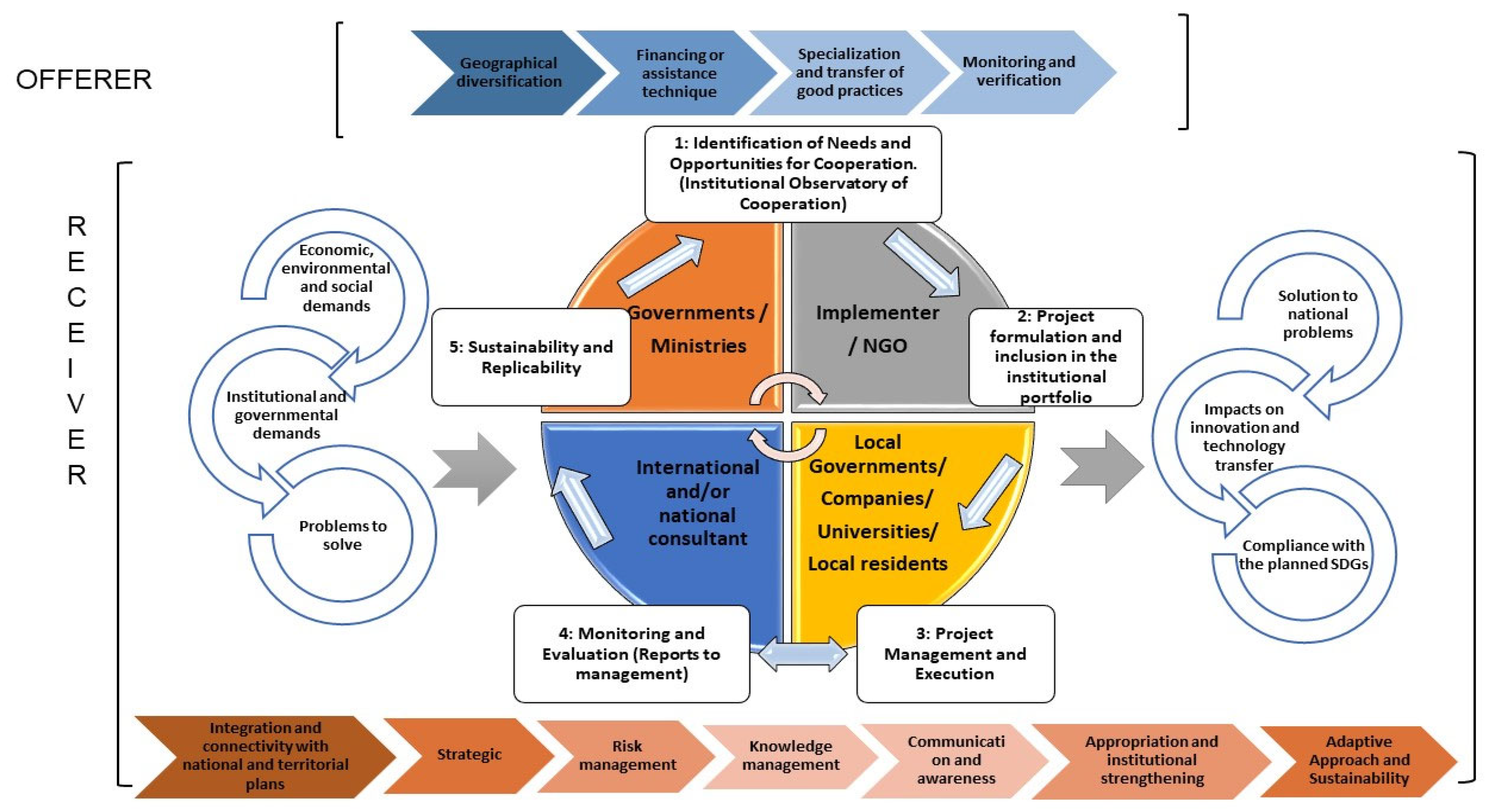
Figure 2.
Results of Cronbach’s alpha for each subprocess. Source: prepared by the authors.
Disclaimer/Publisher’s Note: The statements, opinions and data contained in all publications are solely those of the individual author(s) and contributor(s) and not of MDPI and/or the editor(s). MDPI and/or the editor(s) disclaim responsibility for any injury to people or property resulting from any ideas, methods, instructions or products referred to in the content. |
© 2025 by the authors. Licensee MDPI, Basel, Switzerland. This article is an open access article distributed under the terms and conditions of the Creative Commons Attribution (CC BY) license (http://creativecommons.org/licenses/by/4.0/).
Copyright: This open access article is published under a Creative Commons CC BY 4.0 license, which permit the free download, distribution, and reuse, provided that the author and preprint are cited in any reuse.


