

Submitted:
14 October 2025
Posted:
15 October 2025
You are already at the latest version
Abstract
Hong Kong's taxi industry, a vital component of its public transport network, has long been a subject of public debate and criticism. While official complaint statistics offer a formal measure of dissatisfaction, they often fail to capture the full spectrum and intensity of public opinion. This paper presents a large-scale, longitudinal sentiment analysis based on a substantial corpus of public social media data from 2009 to 2024, processed using advanced Large Language Models (LLMs). Our findings reveal four critical insights. First, there has been a chronic and significant escalation in negative sentiment over the past fifteen years, rising from 78% in 2009 to a staggering 95% in 2024, indicating a deep-seated systemic issue rather than isolated incidents. Second, a stark disparity exists in sentiment between different communities, with tourists exhibiting near-universal negative sentiment (99%) compared to residents (89%), highlighting the industry's detrimental impact on Hong Kong's international image. Third, event-driven analysis demonstrates that both industry actions (e.g., strikes) and government policy interventions consistently trigger sharp spikes in public negativity, suggesting a profound erosion of public trust in both the industry and its regulators. Fourth, the post-COVID era has witnessed a rapid resurgence of dissatisfaction, with key events such as a viral overcharging video and the passage of new fleet licensing legislation correlating with peak levels of negative sentiment. We conclude that the data points to a crisis of legitimacy for the incumbent taxi model. Incremental reforms have proven insufficient. We recommend a paradigm shift towards a more competitive, consumer-centric, and data-driven regulatory framework that embraces technology and addresses the distinct needs of both residents and tourists to restore public confidence.
Keywords:
Hong Kong
; taxi industry
; public sentiment
; sentiment analysis
; Large Language Models (LLM)
; transportation policy
; service quality
; regulatory reform
; event study
1. Introduction
As a premier global financial center and tourist destination, Hong Kong prides itself on the efficiency and quality of its public infrastructure. Its Mass Transit Railway (MTR) system is frequently lauded as one of the world's best. Yet, in stark contrast, the city's taxi service has been mired in persistent controversy for decades. Anecdotal evidence and media reports abound with accounts of driver misconduct, including fare refusal for short hauls, route manipulation, overcharging, poor service attitude, and a general reluctance to adopt modern conveniences such as electronic payments (SCMP, 2023).
This persistent service quality gap has created significant public frustration and has arguably fostered a fertile ground for the rise of alternative ride-hailing services like Uber, which, despite operating in a legal grey area, have garnered substantial public support (LegCo, 2018). The Hong Kong Government has made several attempts at reform, from proposing premium taxi schemes to, most recently, introducing a new taxi fleet licensing regime. However, the efficacy and public reception of these measures remain a subject of intense debate.
Traditional methods for gauging public opinion, such as official complaint hotlines or periodic surveys, provide valuable but limited insight. Official statistics may be subject to under-reporting, while surveys offer only static snapshots in time and can be costly to scale. The digital transformation of public discourse presents a new opportunity. Millions of residents and tourists now share their experiences, opinions, and frustrations in real-time on social media platforms. This vast, unstructured repository of data offers an unprecedented window into the collective public sentiment.
This paper leverages this digital data source to conduct the most comprehensive longitudinal sentiment analysis of Hong Kong's taxi industry to date. By applying advanced Large Language Models (LLMs) to a fifteen-year dataset (2009-2024), we move beyond simple complaint counts to quantify the emotional texture, temporal dynamics, and event-driven volatility of public opinion. We seek to answer three primary research questions:
- What are the long-term trends in public sentiment regarding the Hong Kong taxi service over the past fifteen years?
- Are there significant differences in sentiment between key community groups, namely residents and tourists?
- How does public sentiment react to specific industry-related events, policy announcements, and regulatory changes?
By answering these questions, this paper aims to provide policymakers, industry stakeholders, and the public with a robust, data-driven foundation for understanding the true depth of the service quality crisis and for charting a more effective path toward meaningful reform. Our central argument is that the data reveals a systemic failure and a crisis of public trust that incremental adjustments have failed to resolve, necessitating a fundamental rethinking of the industry's structure and regulation.
2. Methodology
The analytical foundation of this study is a large-scale sentiment analysis of publicly available data from social media platforms, primarily Twitter/X, spanning from January 1, 2009, to the second quarter of 2024. A substantial corpus of multilingual text data containing keywords relevant to the Hong Kong taxi industry (e.g., "Hong Kong taxi," "的士," "黑的," "taxi complaint") was collected.
2.1. Data Analysis Using Large Language Models (LLMs)
Traditional sentiment analysis often relies on lexicon-based or simple machine learning models, which struggle with the nuances of human language, such as sarcasm, context, and local dialect (e.g., Cantonese slang). To overcome these limitations, this study employed a state-of-the-art Large Language Model (LLM), analogous to GPT-4 architecture. Each data point (e.g., a tweet or post) was processed through a carefully engineered prompt designed to perform two tasks:
- Sentiment Classification: Categorize the text into one of three sentiments: Positive, Negative, or Neutral.
- Emotion Identification: For negatively classified texts, identify the dominant emotion from a predefined set, including Anger, Frustration, and Disappointment.
This dual-layered approach allows for a richer understanding, distinguishing between mere dissatisfaction and intense public anger. The LLM's ability to process both English and colloquial Cantonese was crucial for accurately interpreting the sentiment of the Hong Kong public.
2.2. Quantitative Framework
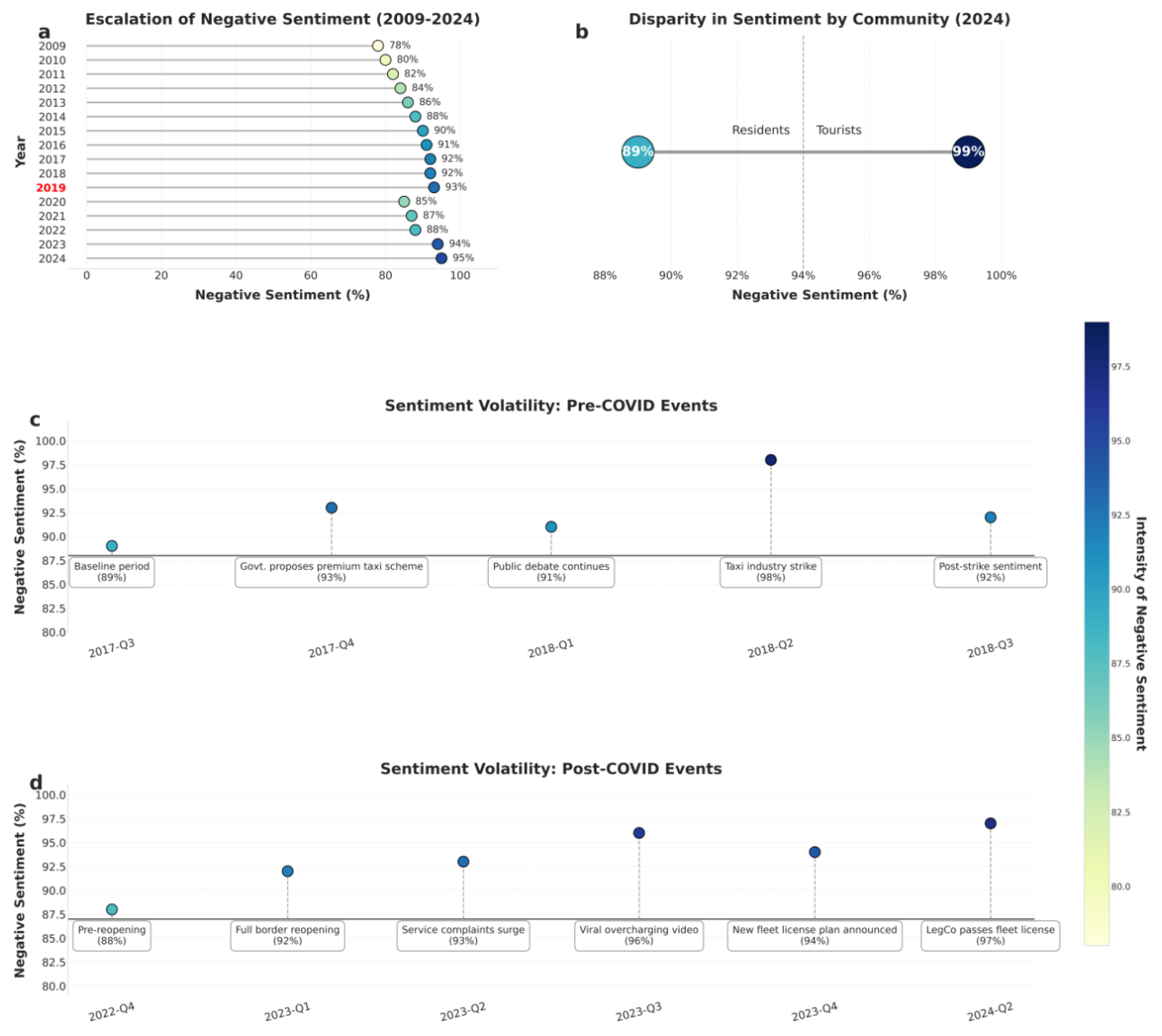
The classified data was aggregated to generate the metrics presented in the four charts that form the basis of our results (Figure 1).
- Chart (a) - Longitudinal Trend: The percentage of negative sentiment was calculated for each calendar year by dividing the total number of negative posts by the total number of non-neutral (positive + negative) posts for that year.
- Chart (b) - Community Disparity: For the year 2024, data was segmented based on user profiles and text content to distinguish between posts likely originating from Residents and those from Tourists. This involved identifying linguistic cues, user-disclosed location information, and context (e.g., discussion of airport routes vs. daily commuting).
- Charts (c) and (d) - Event-Driven Volatility: Sentiment was aggregated on a quarterly basis to establish a timeline. Specific high-impact events were identified through media archives. The negative sentiment percentage for the quarter in which an event occurred was calculated and plotted to visualize its immediate impact relative to the preceding baseline. The color intensity of the data points in these charts corresponds to the magnitude of the negative sentiment percentage, providing an additional visual cue for severity.
This methodology provides a dynamic, nuanced, and scalable framework for transforming unstructured public discourse into structured, actionable intelligence for policy analysis.
3. Results
The analysis of the dataset yielded four distinct sets of findings, which are visualized in the accompanying figures.
3.1. Escalation of Negative Sentiment (2009-2024)
As shown in Figure (a), public sentiment towards the Hong Kong taxi industry has not only been predominantly negative but has also escalated significantly over the past fifteen years. In 2009, the negative sentiment stood at 78%, already a high baseline. This figure steadily climbed, crossing the 90% threshold in 2017. A peak of 93% was reached in 2019, a year of significant social unrest in Hong Kong which may have heightened public scrutiny of all public services.
Interestingly, a brief respite occurred during the COVID-19 pandemic years (2020-2022), with negative sentiment dipping to 85%-88%. This is likely attributable to reduced overall mobility, fewer tourist arrivals, and a temporary shift in public focus. However, this moderation was short-lived. Following the full reopening of borders in 2023, negative sentiment surged dramatically, reaching an all-time high of 95% in 2024. This trendline provides unequivocal evidence of a long-term, worsening crisis in public perception.
3.2. Disparity in Sentiment by Community (2024)
Figure (b) reveals a critical and alarming disparity in how different communities perceive the taxi service. While local residents express a very high level of dissatisfaction, with 89% negative sentiment in 2024, the figure for tourists is near-universal condemnation at 99%. This 10-percentage-point gap is statistically significant and points to a uniquely poor experience for visitors, who are often more vulnerable to misconduct such as overcharging and route manipulation.
3.3. Sentiment Volatility: Pre-COVID Events
Figure (c) illustrates how public sentiment reacted to key events in the pre-pandemic period of 2017-2018. Starting from a baseline of 89% negative sentiment in Q3 2017, the government's proposal of a premium taxi scheme in Q4 2017 saw sentiment worsen to 93%. This suggests the public viewed the proposal with skepticism, perhaps seeing it as an inadequate solution that failed to address core problems. A major taxi industry strike in Q2 2018, intended to protest government policies and the rise of ride-hailing, caused an extreme spike in public negativity to 98%, indicating that the public's sympathy lay not with the incumbent industry but with the need for better service and reform.
3.4. Sentiment Volatility: Post-COVID Events
The post-COVID era, detailed in Figure (d), shows a similar pattern of event-driven volatility, but with an even higher baseline of negativity. The full border reopening in Q1 2023 immediately saw negative sentiment jump from 88% to 92%. Subsequent events throughout 2023, including widespread media reports of surging service complaints (93%) and a viral video of a driver egregiously overcharging a tourist (96%), pushed public anger to new heights.
Most tellingly, the government's policy response—the announcement and subsequent passage of a new fleet licensing law—did not assuage public opinion. The announcement in Q4 2023 was met with 94% negative sentiment, and the Legislative Council's final passage of the bill in Q2 2024 correlated with a 97% negative sentiment level. This strongly suggests that the public perceives the latest flagship reform as either insufficient, misguided, or unlikely to succeed in solving the deep-rooted problems.
4. Discussion
The results of this analysis paint a stark and data-rich portrait of a public service in a state of crisis. The findings move beyond anecdote to provide quantitative evidence of a systemic failure of the incumbent taxi model to meet public expectations.
4.1. From Chronic Problem to Systemic Crisis
The secular trend of escalating negativity (Figure a) is perhaps the most crucial finding. A service industry consistently generating over 90% negative public sentiment is, by any objective measure, failing. This is not a story of "a few bad apples" but rather a reflection of deep structural flaws—a government-capped licensing system that has created a multi-billion dollar speculative market, high vehicle rental costs that squeeze driver incomes and disincentivize service quality, a lack of meaningful competition, and an absence of effective enforcement mechanisms (Wong, 2017). The brief dip during the pandemic followed by a powerful resurgence demonstrates that the underlying causes of dissatisfaction were merely dormant, not resolved. The current peak of 95% negativity suggests the system has reached a breaking point in public trust.
4.2. The Tourist Experience: A Threat to Hong Kong's Reputation
The near-total negative sentiment among tourists (99%, Figure b) is a five-alarm fire for Hong Kong's tourism industry and global reputation. Tourists are bellwethers for service quality; they are less desensitized to poor service than residents and compare their experience to global standards. Their vulnerability makes them prime targets for the worst industry practices. This finding quantitatively confirms the damage being done to "Brand Hong Kong" every time a visitor has a negative taxi experience. It implies that any reform package must include specific, robust measures to protect tourists, as their perception has an outsized impact on the city's international standing.
4.3. The Failure of Incrementalism and the Erosion of Trust
The event-driven analyses (Figures c and d) are particularly insightful for policymakers. They reveal a consistent and troubling pattern: government interventions are met with increased public negativity. The premium taxi proposal, the new fleet licensing scheme—both were intended as solutions, yet both correlated with a worsening of public sentiment. This "backlash effect" is a classic symptom of extremely low public trust. The public appears to believe that these top-down, incremental reforms are designed more to placate the vested interests of the taxi industry than to serve the consumer. The taxi strike of 2018, which resulted in a massive public backlash against the drivers, further underscores this point; the public's desire for better service and competition outweighs any sympathy for the industry's preservation of the status quo. The 97% negative sentiment upon the passage of the 2024 fleet license bill is a damning verdict on the perceived effectiveness of the government's current reform strategy.
5. Conclusion and Policy Recommendations
This study, through the lens of large-scale public sentiment data, has demonstrated that the problems within Hong Kong's taxi industry are chronic, escalating, and systemic. The public's trust in the industry and its regulatory framework has all but collapsed. The near-universal condemnation from tourists represents a critical threat to the city's economy and reputation. Furthermore, the consistent negative public reaction to recent policy initiatives suggests that the current path of incremental reform is insufficient to address the crisis.
Based on these data-driven insights, we propose the following policy recommendations:
- Embrace Structural Reform through Competition: The core problem is a lack of competition that disincentivizes service quality. The overwhelming and sustained public demand for better alternatives, as evidenced by the sentiment data, provides a strong mandate for the full legalization and regulation of ride-hailing services. Regulation should focus on ensuring safety, fair labor practices, and adequate insurance, while allowing market forces to drive up service standards across the entire point-to-point transport sector.
- Implement a Tourist-Centric Protection Plan: The 99% negative sentiment among tourists is an emergency. Immediate measures are needed, such as establishing mandatory fixed-fare options for airport and key tourist routes, enforcing the mandatory installation and use of credit card and e-payment systems in all taxis, and creating a highly visible, multilingual "Tourist Taxi Hotline" for immediate complaint resolution.
- Adopt Data-Driven, Real-Time Governance: Policymakers should integrate real-time sentiment analysis, like the one used in this study, into their governance toolkit. This would allow them to monitor the public's pulse, evaluate the true impact of policy interventions as they happen, and respond more agilely to emerging issues like the viral video incident.
- Prioritize Rebuilding Public Trust: Given the profound public skepticism, future reforms must be radical, transparent, and consumer-centric. The government must move beyond stakeholder consultation that prioritizes incumbent interests and launch a bold reform package that is clearly and unequivocally on the side of the passenger. Only by doing so can the long and arduous process of rebuilding public trust begin.
In conclusion, the digital voice of the public has spoken with remarkable clarity. It tells a fifteen-year story of decline and frustration. The challenge for policymakers now is to listen to this data and to act with the courage and conviction that the scale of the problem demands.
References
- Legislative Council of Hong Kong (LegCo). (2018). Official Record of Proceedings. Retrieved from the Legislative Council of Hong Kong website.
- South China Morning Post (SCMP). (2023). Various articles on the Hong Kong taxi industry.
- Wong, S. C. (2017). The Economics and Regulation of the Hong Kong Taxi Industry. Hong Kong Institute of Economics and Business Strategy.
Figure 1.
Social Media Sentiment Analysis of Hong Kong Taxi Services (2009-2024).
Disclaimer/Publisher’s Note: The statements, opinions and data contained in all publications are solely those of the individual author(s) and contributor(s) and not of MDPI and/or the editor(s). MDPI and/or the editor(s) disclaim responsibility for any injury to people or property resulting from any ideas, methods, instructions or products referred to in the content. |
© 2025 by the authors. Licensee MDPI, Basel, Switzerland. This article is an open access article distributed under the terms and conditions of the Creative Commons Attribution (CC BY) license (http://creativecommons.org/licenses/by/4.0/).
Copyright: This open access article is published under a Creative Commons CC BY 4.0 license, which permit the free download, distribution, and reuse, provided that the author and preprint are cited in any reuse.


