

Submitted:
13 October 2025
Posted:
14 October 2025
You are already at the latest version
Abstract
In this paper we continue the study of the thermodynamics of fluid elements in isothermal turbulent self-gravitating systems, presented by molecular clouds. We build the model again based on the hypothesis that can, locally, substitute the turbulent kinetic energy per fluid element for the macrotemperature of a gas of fluid elements. Also, we presume that the cloud has a fractal nature. The virial theorem is applicable to our system, too (hence it is in a dynamical equilibrium). But in contrast to the previous work, where the turbulent kinetic energy clearly dominates over the gravity, in the present paper, we assume that the virial relation 2Ekin + Egrav = 0 holds, for the entire cloud. Hence the cloud is dense and strongly self-gravitating object. On that base we calculate the internal and the total energy per fluid element. Writing down the first principle we obtain the explicit form of the entropy increment. It demonstrates an untypical behaviour. In the range 0 ≤ β < 0.4, for the turbulent scaling exponent, the entropy increment is positive, but in the interval 0.4 < β ≤ 1 is negative, and for βcr = 0.4 is zero. The latter two regimes (negative and zero) can not be explained from the classical point of view. Although, we give some arguments for the reasons of these irregularities and the main is that our cloud is an open self-organizing system, driving by the gravity. Moreover, we study the system for critical points under the conditions of three thermodynamic ensembles: micro-canonical, canonical, and grand canonical. Only the canonical ensemble demonstrates a critical point, which is a maximum of the free energy and corresponds to an unstable equilibrium of the system. Analysis of the equilibrium potentials, also, shows that the system resides in unstable states under all the conditions. These results we explain arising the hypothesis that the virialized cloud is in the final unstable state before its contraction and subsequent fragmentation or collapse.
Keywords:
molecular clouds
; fluids
; turbulence
; self-gravity
; virialization
; thermodynamics
1. Introduction
This work continues our investigation of the hydrodynamic isothermal turbulent self-gravitating systems by using the powerful tools of thermodynamics. Again in the base of our study we put the idea that fully developed saturated isothermal turbulence can be regarded locally as an ideal gas of fluid elements, which do not have internal degrees of freedom (see e.g. similar ideas in [1,2,3,4,5,6,7,8,9,10,11,12]). Therefore we can substitute the turbulent kinetic energy per fluid element for the temperature of the chaotic motion of the fluid elements, the idea rose by Keto et al. [13]. As a plausible model for our purpose we use molecular clouds (MCs), which are known to be (supersonically) turbulent self-gravitating gas entities consisting mostly by molecular hydrogen (see e.g. [14,15,16]) at roughly constant Kelvin temperature [17]. Their turbulence is fully developed and saturated and demonstrates an inertial range of scales, which roughly spans , where turbulent kinetic energy transfers from the larger to the smaller scales, which is the so called "turbulent energy cascade". The latter phenomenon is well stated for subsonic ([18,19]) and for trans- and supersonic turbulence ([20,21,22,23,24]), as well. The saturated turbulence (together with the gravity) determines the fractal structure of MCs [14,15,16,21], which we take in account, as well. Also, the energy transfer from larger to smaller scales constrains us to work with quantities (energies) calculated per fluid element, and to assume only local (in a small volume regarding to the whole cloud) equilibrium. This means that we apply the tools of non-equilibrium thermodynamics.
Gravity (self-gravity and gravity of the surrounding medium) is the other main factor in this physical picture. It is an attracting force and tends to contract and eventually to collapse the MCs, while the turbulence tends to disperse the gas. So they operate opposite to each other. The balance between these two "forces" depends on the evolutionary stage of the cloud. Young clouds are diffuse and the turbulence dominates over gravity. The cloud’s entity is saved due to the confining pressure of the surrounding medium (see e.g. [14,15,16]). In contrast, at the later stages turbulence and gravity are in a rough balance, which can be presented approximately by the virial equation (see e.g. [15,16,25]). At these later stages the star-formation process in the MCs takes place. Accounting for this evolutionary picture, in our previous work [26] we attempted to model the former scenario (for the diffuse clouds) and obtained that under the boundary conditions of the grand canonical ensemble the Gibbs energy had a minimum, which corresponded to a stable dynamical equilibrium state of our system. This can be explained with the key role of the confining pressure at the early stages of cloud’s evolution. In the present work we model a virialized cloud, i.e. an object at the later stages of its evolution. We obtain that micro-canonical and grand canonical ensembles do not have critical points, while the canonical ensemble demonstrates a maximum of the free energy, which means that the system is in unstable equilibrium. Moreover the additional analysis of the equilibrium potential, relevant to corresponding ensembles, show that all the states of the system are unstable. To explain these results we assume that the virialized clouds are in the final unstable state of their evolution leading to subsequent contraction and eventual fragmentation or collapse.
Finally, we have to say, that magnetic fields and new-born stars also play a significant role in the MCs’ physics, but we neglect them in our considerations in order to simplify these first attempts. In the inertial range, which includes the scales from the giant clouds’ sizes (pc) down to the pre/proto-stellar cores’ sizes (pc), the dominant energies are the turbulent kinetic and the gravitational. The magnetic energy is subdominant, so it can be neglected in our analysis (see e.g. [15,25]).
The paper structure is as follows: in the next Section 2 we present the model and give the equations for the internal and the total energy, and also make the assumption for the mean field consideration; in Section 3 we write down the first principle for the model and obtain the explicit form of the entropy (Section 3.1), then we get the formulae for the free energy (Section 3.2) and the Gibbs potential (Section 3.3); after that, in Section 3.4, we consider the cloud stability under three sets of boundary conditions: micro-canonical ensemble (Section 3.4.1), canonical ensemble (Section 3.4.2), and grand canonical ensemble (Section 3.4.3); in Section 3.5 we study the origin of the entropy change; in Section 4 we comment on the basis of the model and the main results (Section 4.1) and on the possible caveats (Section 4.2); finally, in Section 5, we give our conclusions.
2. Set Up of the Model
In this Section we recall the model presented in [26]. We study a molecular gas cloud, which is isothermal with Kelvin temperature K (e.g. see [15,16,17]). The gas is turbulent. This turbulence is fully developed and saturated and the cloud scale l is in the inertial range: 1. and are the upper scale of the inertial range and the scale of dissipation, respectively. We assume that the inner part of the cloud with characteristic scale has very small mass and volume compared to the whole cloud, hence: . Also, we presume the cloud to be a homogeneous object with an averaged number density . This simplification is unavoidable, in order to consider the cloud as a simple thermodynamic system.
We suppose, as well, that in the inertial range, the following scaling law is valid:
where is the 3D turbulence velocity dispersion, is a normalizing coefficient and is the turbulent scaling exponent [21,23,24,27].
We presume that the cloud is immersed in a very large, but not infinite medium2. This environment is characterized by some averaged number density (of the fluid elements) , Kelvin temperature (of the molecule motion) , and 3D turbulence velocity dispersion . It has a role of reservoir of thermal and turbulent energy, and, as well, of matter, for the cloud. Its gravitational potential in the volume of our object is .
We consider the local macroscopic turbulent motion of the fluid elements (in the inertial range) as purely chaotic. Hence the turbulence is of Kolmogorov type. And therefore can be regarded as a motion in an ideal gas containing of fluid elements treated as particles without internal degrees of freedom. Consequently we can introduce the notion of macro-temperature (the temperature of the chaotic motion of fluid elements) which is related to the velocity dispersion through the following expression:
where m is the mass of the fluid elements, and is the Boltzmann constant. Equation (2) means that the turbulent kinetic energy, per fluid element, at scale l is equivalent to the kinetic energy of the chaotic motion of the gas of fluid elements, which we called "macro-gas". According to our presumption the motion of the fluid elements is only locally purely chaotic, hence this equation must be considered as an averaged relation (at regarded scale l).
Hence if we account for the turbulent kinetic energy and the gravitational energy, we can write down the following expressions for the internal and the total energy of the macro-gas, per fluid element, respectively:
and
where is the total gravitational potential in the cloud’s volume caused by both: the surrounding medium () and the self-gravity of the cloud ().
It is worth to note that in our model the interaction between the fluid elements is only due to gravitational attraction. This interaction, in a small volume, is negligible in comparison to their kinetic energy. But one can not neglect the gravitational energy of these elements caused by the self-gravity of the whole cloud. So we account for it including in equation (5) (for the total energy, per fluid element) the total potential . The latter means that we consider every fluid element as it is submerged in an averaged external gravitational field caused by the surrounding medium and the self-gravity of the cloud. At this point we introduce the assumption that the cloud is virialized. In other wards , if we consider the whole cloud. Hence for energy per fluid element this reads:
where the last equality means that the total energy is equal, in absolute value, to the turbulent kinetic energy, but its sign is negative.
Also we assume for our cloud that it demonstrates fractal structure in the inertial range of scales. This assumption is supported from many observations and simulations which are systematized in [14,15,16]. As a direct consequence of this we can consider fractal dimension of our cloud in the plausible range , which means that the mass at scale l can be presented as follows , where is the mass at the dissipation scale . Finally, combining the assumptions for virialization and fractal structure of the cloud, using the relationship , which assumes (from dimensional considerations) that, in the inertial range, it must hold and hence we get , or equivalent relation , between the turbulence scaling exponent and the fractal dimension .
3. Results
3.1. First Principle and Entropy of Macro-Gas
In the context of the previous Section the first principle of thermodynamics of the fluid elements, written per fluid element, reads:
where s is the entropy per fluid element, is the local pressure of macro-gas expressed through the equation of state, and n is the number density ( has a meaning of volume per fluid element, where V and N are the volume and the number of fluid elements at the considered scale l, accordingly).
Here we must note that obviously the expression for is a full differential (it is a function of one variable ) and hence the energy is a function of the state. The entropy also satisfies this condition, the second mixed derivatives of s (in regard to variables and n) are both equal to zero. The latter means the entropy is a function of the state (this state is determined by the variables and n). Then we integrate equation (8) from the scale of dissipation to the scale l and obtain:
We stress here that the entropy at the dissipation scale is allowed to be an undefined positive constant because of the results obtained in this work. Therefore we reject the assumption in the previous work [26], where at the dissipation scale (due to the vanishing of the turbulence), which does not change substantial any equation or result there. And so, we note that the sign of the difference at the considered scale l is not clear due to the different behaviour of the two addends. and the first term is negative, while and hence the second term is positive. Which of them dominates? To answer this question we need to perform the expression for the entropy in different form. Making use of the scaling relation for the macro-temperature (stemming from equation (3)) we have (where is the macro-temperature at the dissipation scale). Starting from definition for number density we obtain (where , and are the number density of fluid elements, the number of fluid elements at and the volume of the dissipation scale, accordingly). Then we account that the mass at scale l can be presented as , and also remember the assumption that the cloud is a fractal with fractal dimension , which means that . Therefore we get . Finally for the entropy increment we arrive at the following expression:
The obtained equation shows that for scales the sign of the entropy increment will be the same as the sign of the coefficient , which depends on two parameters: the turbulence scaling exponent and the fractal dimension . At this point we remember that it holds the relation . Therefore the considered coefficient gets . So the entropy increment will be positive for and negative for . At the critical value the entropy increment will be equal to zero for all the inertial range.
3.2. Free Energy
Free energy, per fluid element, can be defined through the following expression:
To obtain the explicit form of free energy we make use of equations (6) and (9). The formula for is as follows:
Using the scaling relations for macro-temperature and number density we can obtain the free energy as a function only of the scale l. This function reads:
3.3. Gibbs Potential
Gibbs potential, per fluid element, reads as follows:
To obtain the explicit form of Gibbs potential we make use of equations (6), (9), and the equation of state: . The formula for is as follows:
Using the scaling relations for macro-temperature and number density we can obtain the Gibbs energy as a function only of the scale l. This function reads:
3.4. Stability Analysis
In this Section we intend to explore the stability of the system (our cloud) making use of the model presented in Section 2 and the equations of thermodynamics of fluid elements obtained above in Section 3. We regard three cases. The first one is micro-canonical ensemble which implies the cloud is isolated and its energy, volume and number of fluid elements are fixed. The relevant potential here is the entropy. The second one is canonical ensemble where the cloud is submerged in a very large medium (reservoir) at fixed temperature , i.e. the system has fixed volume and number of fluid elements and is in thermal contact with a thermostat. The relevant potential is the free energy. And the third case is grand canonical ensemble: the cloud has a fixed number of fluid elements and is in thermal and mechanical contact with a huge reservoir with fixed temperature and pressure ; the relevant potential is the Gibbs potential, accordingly. The three ensembles have varying degree of correspondence to real objects. They simply are three different boundary problems for our system. According to many observations and numerical experiments more plausible look canonical and grand canonical ensembles (see i.g. the reviews [14,15,16]). But we wish first to perform our study and then to make conclusions about their applicability.
Also it is worth to note that in all the three ensembles the relevant equilibrium potential is a function of two variables (i.g. temperature and density n), so the potential is two dimensional surface in three dimensional space. However, in our model we consider scaling relations for these variables: and . Hence the two variables are not independent, rather the system resides on the one dimensional subspace of the regarded potential surface (this is a curve, which lies on the potential surface), determined by the following equivalent expressions:
This restriction probably will imposes an additional physical condition on system’s parameters.
About the following considerations we refer the reader to the books by Callen [28], Chapter 8 (concerning the stability of the ensembles according to their equilibrium potentials), and by Reif [29], Chapter 8 (concerning the critical points of the off-equilibrium potentials in Section 3.4.2 and Section 3.4.3).
3.4.1. Micro-Canonical Ensemble
In this case the cloud is regarded as an isolated self-gravitating macro-gas. The potential which determines stability of the system is entropy. The conditions for the ensemble are fixed energy and number density (volume per fluid element is ) of the system. The energy according to equation (6) is determined by the only one parameter - macro-temperature , which at its turn depends on the scale (see equation (3)), solely. The density also is determined by the scale. So, the state of the system, in micro-canonical ensemble, is defined if the scale l is fixed. In Section 3.1 we obtain for the entropy the following scaling law:
where for the entropy change is a positive increasing function of the scale l in all the inertial range. Contrary to this, if , then the entropy change is a negative decreasing function of the scale. At the critical value the entropy change is equal to zero for all the scales. In all of the three regimes (determined by ) the entropy is a monotonic function of the scale and does not have extrema.
If we perform the analysis using equation (9), where the entropy is a function of the two variables ( and n), the conclusions will not differ. It is easy to calculate the partial derivatives. They read:
and they both are negative, hence the entropy is a monotonically decreasing function of the temperature and the density n. Therefore do not have extrema. There are no any equilibrium states of the system in the case of micro-canonical ensemble.
Further on to apply the method described by Callen [28] we need second derivatives of s. They are as follows:
and
They both are positive and hence the shape of the surface is convex, therefore the states describing by entropy are unstable. 3
3.4.2. Canonical Ensemble
In the case of canonical ensemble the system is submerged in a huge reservoir at fixed macro-temperature . The free energy, written in the off-equilibrium form4 reads:
and it will be varied as a function of at fixed n (note, that fixed n is equivalent to a fixed v), which play a role of parameter determining the state of the system (our cloud). As a first step we take the first derivative of in regard to (see equations 7 and 8) and seeking for extrema. This is as follows:
therefore the free energy might have an extremum for macro-temperature . We need the second derivative of in regard to to say what kind of extremum this may be. It is easy to see that the second derivative at temperature is negative:
This corresponds to a maximum of the off-equilibrium free energy. Hence, at the system is in unstable equilibrium state under the conditions of canonical ensemble (i.e. the system is in contact with a very large thermal reservoir at fixed macro-temperature ) 5.
According to Callen [28] we must analyze the equilibrium form of the free energy (12). The second partial derivatives of f in canonical variables and v (see the footnote above, where the change of variables is set) read:
and
The second condition is satisfied, but the first is broken and hence the system described by f do not have stable states. Instability is due to the temperature .
3.4.3. Grand Canonical Ensemble
In the third case the cloud is studied as a macro-gas immersing in a large surrounding medium at fixed macro-temperature and fixed pressure . Here we start with analysis of the equilibrium Gibbs potential defined by equation (15). Making use of the relations and one easily obtains the Gibbs potential as a function of the canonical variables and P. The formula for reads:
Now we can calculate the second derivatives regarding to and P. They are as follows:
and
The second condition is satisfied, but the first is broken again and hence the system described by g do not have stable states.
Let us in turn to study the Gibbs potential, written in an off-equilibrium form6, which is as follows:
and it will be investigated as a function of and n, which are the variables determining the state of the cloud (we follow Reif [29], Chapter 8).
Starting we take the first derivative of in regard to (see equations 7 and 8) and seeking for extrema. This is as follows:
Therefore the Gibbs potential might have an extremum for macro-temperature . We need of the second derivative of in regard to to say what kind of extremum this is. We easy obtain that the second derivative at temperature is negative:
This indicates that if the cloud resides at macro-temperature , then it might be in a unstable dynamical equilibrium, because the Gibbs potential may have a maximum.
Let the macro-temperature of cloud is considered fixed at . Then the variation of Gibbs potential is only due to n. The first derivative in regard to n, respectively reads:
But the pressure of macro-gas in the cloud, at considered conditions, is . Therefore the condition for an extremum, in regard to variable n, is: . The second partial derivative of in regard to n, under the conditions: and , is as follows:
The mixed second derivatives of Gibbs potential are obviously zero and therefore the functional determinant built up from the second partial derivatives of , calculated at and , will be:
Hence, if the parameters of our system are set at: and , then it resides in a local unstable critical point, which is a saddle point. The latter may be an indication for phase transition.
To complete our study of the grand canonical ensemble we perform the analysis for critical points of the off-equilibrium Gibbs potential in canonical variables and P, and show that the above obtained result will be confirmed. First we need to write down the Gibbs potential in terms of and P, using the relations and , where is the pressure of the macro-gas at dissipation scale . The formula for reads:
The respective first derivatives of in regard to and P are as follows:
and
Equating them to zero one obtains a system of two equations for unknowns and P. Solving this system we get the roots: and . To finish this consideration we need of the second partial derivatives calculated at the obtained critical values and . After some algebra we arrive at:
and the second mixed derivatives
The calculations show that regarding to the off-equilibrium Gibbs potential has a maximum at , while regarding to P, has a minimum at . It is clear that the corresponding functional determinant is negative and therefore at the critical point and one has an unstable saddle point. The latter simply confirms the result obtained above using the variables and n.
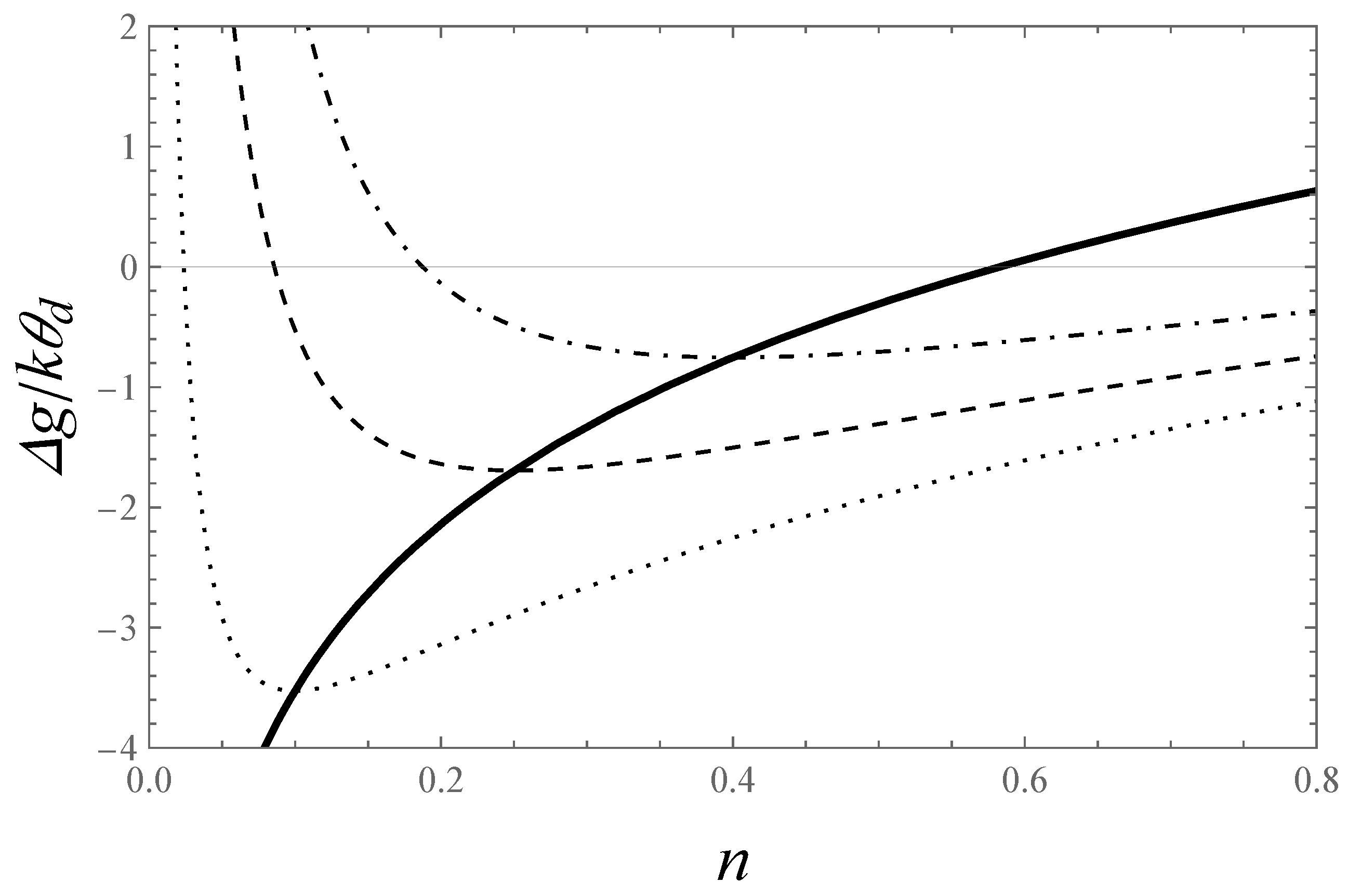
To illustrate our results for the grand canonical ensemble we present at Figure 1 and Figure 2 the extrema of the increment of off-equilibrium Gibbs potential for different boundary conditions and the increment of equilibrium Gibbs potential , which crosses through its maxima or minima, accordingly. Both increments are calculated in regard to the addends or , respectively, which can not be numerically assessed due to the value of and both relate to the dissipation scale. At Figure 1 the increment of Gibbs potential is plotted as a function of the macro-temperature . The increment of equilibrium Gibbs potential is represented by a thick line. The increment of off-equilibrium Gibbs potential is represented by dotted, dashed and dot-dashed lines for three different values of the ratio , accordingly, which correspond to scales . The density ratios are chosen to be (note that if the temperature is varied, then the density must be equal to its equilibrium value, chosen here arbitrary, but corresponding to a scale larger than dissipation one). The pressure of the thermal reservoir (the surrounding medium) is , respectively. At Figure 2, in turn, the increment of the Gibbs potential is plotted as a function of the density n. The increment of equilibrium Gibbs potential is represented again by a thick line. The increment of off-equilibrium Gibbs potential is represented by dotted, dashed and dot-dashed lines for three different values of the ratio , accordingly, which again correspond to scales . The macro-temperature ratios are chosen to be (the temperature is fixed at its arbitrary chosen equilibrium value). The pressure of the thermal reservoir (the surrounding medium) is , respectively. One can conclude that the behaviour of the Gibbs potential (both equilibrium and off-equilibrium) is expected for ideal gas.
Finally we must say that the condition for the pressure contradicts with the assumption for virialization of the cloud , because the latter presumes that the outer (confining) pressure at the clouds boundary is negligible compared with the turbulent pressure P. This issue will be commented in Section 4.1.
3.5. The Origin of the Entropy Change
Here we attempt to clarify, at least principle, the origin of the entropy change in time (during the cloud’s evolution), as a possible reason for negative entropy increment for . In non-equilibrium thermodynamics the rate of the entropy change per unit volume is given by the equation of the first principle divided by the infinitesimal time increment , which reads:
If the system does not change its volume, then only the first term on the right hand side matters, and it can be expressed by the energy flow through the scales of the cloud:
The absolute value of the energy flow is defined standard: , where is the energy that flows through an infinitesimal surface for the infinitesimal time . The energy can be presented by the energy per fluid element: , where is a physically small volume. Accounting that , we arrive at:
where is the mass density of the fluid elements, and the gravity term is accounted in respect to the previous work [26], where and also the term caused by the external matter is neglected, because it does not change in the cloud’s volume. The exponent can be expressed trough the turbulent scaling exponent.
To calculate we assume a spherical symmetry for the cloud. Then , because the energy flow is directed from larger to smaller scales, end hence . Making use of the scaling laws , (where is the turbulent velocity dispersion at the dissipation scale) and and after some calculations we obtain the following formula for the rate of change of the entropy per unit volume:
where is the energy per fluid element at the dissipation scale. It is not difficult to see that , where the dimensionless function is determined in the previous work [26] (see Section 4.1 there) and accounts for the validity that the entropy is a function of the state. If , then the entropy is a full differential (the kinetic energy dominates over the gravity), but if , the entropy can not be a function of the state due to the dominance of the gravity. The critical value for that we obtained is , but it depended on the values of , and that we adopted, and also on the assessment of the mass m of the fluid elements, which is a bit speculative. Nevertheless, the rough equality between obtained in this work theoretically, and the value obtained in [26], shows the link between the early stages of cloud evolution considered in [26] and the latest stages studied in this work. We can conclude that if the kinetic energy dominates at the early stages, then the rate of change of the entropy per unit volume will be positive and at the latest stages cloud will have positive entropy increment per fluid element. On the contrary, if at the early stages the gravity dominates the energy balance, then the rate of change of the entropy per unit volume will be negative and hence at the latest stages the entropy increment will be negative.
4. Discussion
4.1. Basic Assumptions and Main Results
In the present paper we set ourselves the aim to describe the hydrodynamics of one turbulent virialized self-gravitating system by using thermodynamic tools. The model of molecular cloud was built similarly to our previous work [26]. We substituted again the turbulent kinetic energy per fluid element by macro-temperature leading the idea of Keto et al. [13]. Then we explicitly wrote down the internal and total energy per fluid element at scale l. We accounted for the gravity (the self-gravity and the gravity caused by the external medium). Here there was a new point. We presumed that the cloud is virialised ([14,15,16,25]), hence the relation must be hold for the whole cloud at scale l. This in turn led to a negative total energy (for the whole cloud and per fluid element). Also, the thermodynamic approach we led must account, at least, for the turbulent kinetic energy flow from larger to smaller scales in the inertial range, which makes the system to be in a dynamical equilibrium. But the existence of the energy flow assumes that the tools of equilibrium thermodynamics (i.g. the thermodynamic potentials) can not be applied for the whole system, rather they are valid locally, for small volumes of the cloud, do not affected by the global flows, but which are still thermodynamic systems. The same approach we followed in the previous works ([26,30]), although we did not account for this issue (the turbulent energy flow), but rather we aimed to work with additive potentials describing one self-gravitating system.
After that we formulated the first principle for the system, using energies per fluid element, and then obtained the explicit expression for the entropy. It turned out that it depends on the logarithms of macro-temperature and number density and its increment could be positive or negative. The parameter which controls the sign of the entropy increment is the turbulent scaling exponent . If , then the entropy change is positive in the inertial range. On the contrary, if , then the entropy change is negative in the inertial range. For the entropy change is zero for all the scales l. The entropy increment we interpret standard, as a logarithm of the probability of the macro-state. According to equation (10) it is easy to see that , where is the phase-space volume per fluid element. How to interpret the negative and zero entropy change? It seems difficult and in a contradiction to the classical sense of this notion, because if the system grows in size (scale l) we expect that the entropy increases, hence its change is positive. At least we can make a simple observation. Let us look at the equation (9) for the entropy, which is obtained from the integration of the first principle. We can note that the first term is always negative for scales , due to the nature of the turbulence velocity scaling (), while the second term must be positive for scales , because the number density of the fluid elements (which is linearly proportional to the number density of the molecules) decreases with the scale (). So the sign of the entropy will be determined by the predominance of one of these terms. If the temperature (the turbulent velocity dispersion) dominates the phase space volume , then the entropy change will be negative. On the contrary, if the number density (the volume per fluid element) dominates the phase space volume, then the entropy change will be positive. And if the two contributions are equal to each other, then the entropy change will be zero. Due to the scaling relations for and , and also due to the assumptions for fractal nature of the system and its virialization, the above consideration is presented by the conditions on the turbulent scaling index . It is worth to note, also, that the first (negative) term in equation (9) comes from the total energy, which is negative due to the assumption for virialization, meaning that the cloud is a strongly self-gravitating object. The latter, may be, is in the root of the problem with negative entropy change, according to the review by Aschwanden et al. [31]. They considered several examples of self-organization in astrophysics. One of them is star-formation in MCs, and the driving mechanism of self-organization is gravity. All the self-organizing systems are open and dissipative, and they are characterized by a negative local entropy change in time. To study the latter in Section 3.5 we calculated the rate of change of the entropy per unit volume for our model, as the calculations are valid for both works: this paper and the previous one [26]. The result shows that the sign of depends on the sign of the expression , where is a dimensionless function introduced in [26] (see Section 4.1 there), which controls the validity that the entropy is a full differential (i.e. it is a function of the state). There existed a critical value for , which depended on the choice of parameters , and , and also on the value m of the fluid elements’ mass (the latter is calculated, but under several assumptions). The obtained critical value for (under a plausible choice of the parameters) is and it is roughly equal to , which we obtained theoretically in this work. In [26] we got that if , then the turbulent kinetic energy dominates over the gravity and the entropy is a function of the state. At these values of we have and the sign of will be positive. But if , then the gravity dominates the energy balance and the entropy is not a full differential, also and the sign of will be negative. This consideration shows the link between the early stages of cloud evolution studied in [26] and the latest stages investigated in this work. We can conclude that if the kinetic energy dominates at the early stages, then the rate of change of the entropy per unit volume will be positive and at the latest stages cloud will have positive entropy increment per fluid element. On the contrary, if at the early stages the gravity dominates the energy balance, then the rate of change of the entropy per unit volume will be negative and hence at the latest stages the entropy increment will be negative. This consideration might be related, also, to Shannon’s entropy (negentropy) in the information theory (see e.g. [32]). In this field the negative entropy change is explained as the system evolves from the state with maximal disorder characterized by the normal distribution to a state with higher self-organization, described by another distribution. In the terms of the probability density function of mass (or number) density of MCs, at early stages of their evolution, they are described by the so called log-normal distribution (Gaussian of log-density), while, at later stages of their life, they demonstrates density distributions substantially different from the Gaussian (at the high density end of the log-normal arise(s) the so called "power-law tail(s)"), and this process is driven by the gravity [14,15,16,21,23,33].
The gravity is, also, in the base of the fact that the thermal capacity per fluid element c, defined through the expression (where is the infinitesimal heat per fluid element, which the system exchanges with the surrounding medium), turns to be negative. This can be seen as follows. We have for an equilibrium process, hence . Then make use of equation (9), we arrive at:
The obtained negative thermal capacity is not surprising for strongly self-gravitating systems ([1,3,6,13,14].)
Going through the results of this paper we can say that the micro-canonical ensemble does not have equilibrium states (it does not have even critical points), while the canonical and grand canonical ensembles demonstrate critical points. For the canonical ensemble this point is maximum, if the macro-temperature is set to be equal to the temperature of the surrounding medium . This state is an unstable equilibrium and we consider it as realistic model, reflecting the conservation of the momentum of fluid elements through the cloud’s boundary ([14,15,16,33]). The grand canonical ensemble critical point is a saddle point of the Gibbs energy. The latter ensemble is, also, appropriate for describing molecular clouds, which are submerged in the surrounding diffuse gas at the conditions of equal gas pressure (for the molecular gas) at and the conserving of the momentum of fluid elements through their boundaries ([14,15,16,33]). So, it is not surprising that for this critical point we obtain the equality of both: the macro-temperatures and the pressures of macro-gas at the cloud’s boundary. Also, this critical point is unstable. Unfortunately, the condition for equality of the pressures at clouds boundary contradicts with the assumption for cloud’s virialization , as far as the latter equation presumes that the turbulent pressure in the cloud is much larger than the outer turbulent pressure . Therefore the grand canonical ensemble can not have critical points for our model. The study of the equilibrium potentials s, f and g, using the method presented by Callen [28] is in agreement with the method presented by Rief [29]. This analysis give us that the system is unstable under the conditions in all the three ensembles. This leads us to the hypothesis that the virialized clouds are unstable and can not be observed. Instead, Keto [25] established that clouds with virial parameter , which presumes a substantial role of the outer pressure in the energy balance, are in a stable equilibrium and can be widely observed. Probably, the evolution of the clouds from states characterized by a clear dominance of the turbulent kinetic energy over the gravity and a key role of the outer pressure to stabilize them (see our previous paper [26]) to states with a grater part of the gravity, in the virial energy balance, conducts them to virialization , which is unstable state and finishes with cloud’s contraction and subsequent fragmentation or collapse.
To shed more light on the key assumptions for virialization, in this work, and for energy equipartition, in our previous work [26], and to deepen the above comments, we will discuss in short the virial theorem written, for the whole cloud, in the following form:
where is the external pressure caused by the external turbulence, V is the cloud’s volume, is the gas kinetic energy, which we presume to be only due to turbulence, and is the gravitational energy of the cloud (the self-gravity plus the gravity caused by the external medium). The magnetic fields are neglected in the model by assumption, and the terms, due to the chaotic molecule motion, in the external pressure and in the kinetic energy are neglected, as well, which is justified at scales larger than the sizes of pre- or proto-stellar cores ([14,15,16]) 7. Then dividing the equation by we obtain the virial theorem in terms of pressures:
where is the external pressure directed inward ( is the mass density of the fluid elements outside the cloud), is the turbulent kinetic pressure in the cloud directed outward ( is the mass density of the fluid elements in the cloud), and is the gravitational pressure directed inward. It is clear that due to the momentum conservation through the cloud’s boundary ([14,15,16]). Then we can rewrite the above equation in the form:
The obtained equipartition we assume (for all the scales of the inertial range) in both: our previous paper [26] and this paper. But there is a difference. In the former case we presume that and hence the gravitational energy is negligible compared to the turbulent kinetic energy 8. This physically corresponds to the diffuse molecular clouds, where and therefore the external pressure is crucial for equilibrium. In the latter case (the present work) we use that and the cloud is a strongly self-gravitating (virialized) object. Physically this is the case of dense molecular clouds (, hence the external pressure is negligible). The two considered regimes are situated at the opposite ends of the set of the virialized molecular clouds (the MCs for which the virial theorem can be written) [15,25]. They can be regarded, also, in evolutionary sense: the young clouds are diffuse and do not contain high dense structures, while the mature clouds are dense and strongly self-gravitating.
4.2. Caveats
As any model of the real physical systems, the one presented in this work has its own shortcomings. In this Section we list and discuss three issues, which look relevant to our work.
The first one is the non-equilibrium nature of the turbulence regarding the existence of turbulent energy flow from larger to smaller scales in the inertial range. This phenomenon constrains us to use approach based on quantities (energies) calculated per fluid element, and hence to deal with notions as averaged gravitational field and local thermodynamic equilibrium. This is a classic in non-equilibrium thermodynamics but put in debate the relevance of our conclusions for the entire system. That is why we need to consider our medium at scale l as to be an averaged one in regard to density (homogeneous system), put in its own averaged gravitational and velocity field. This approach contradicts to the presence of shocks and intermittent nature of the turbulence (especially supersonic) and rises the second issue. Moreover, the virialized clouds are strongly self-gravitating objects and hence the gravity causes strong density contrasts, as well. But the assumption of homogeneity is a needed condition for one thermodynamic system to be simple. For that reason we adopt it as a rough, but unavoidable, at this first step, approximation. The third issue concerns the possibility, in our model, of negative entropy change for . The latter range for turbulent scaling exponent is possible and observable (see e.g. [14,15,16,21,23,24]), therefore we need to interpret the negative entropy change for these values of . The latter is a tough problem, leaping across the classical sense. The only what we can see, for now, is, that the problem arises from the negative total energy per fluid element (see equation (9)), which at turn stems from the virialization of the cloud. Also, the statistical point of view says, that the system has a negative entropy change if the turbulent velocity degrees of freedom dominate over the spacial degrees, in the phase space of the system (see equation (10)). One possible explanation is that gravity of the system drives it to be more and more self-organized, and hence leads to a negative entropy change during the cloud’s evolution.
Finally, we might conclude that the presented in this paper novel approach to study possible equilibrium states of hydrodynamical turbulent isothermal self-gravitating virialized systems has its reason, although there are valid concerns that one can raise.
5. Conclusions
In this paper we present our second work dedicated on the thermodynamics of fluid elements in turbulent isothermal self-gravitating molecular clouds. This way we assumed that the cloud is virialized, i.e. the energy relation , for the entire cloud, holds. About the other aspects the model of our system is the same like in [26]: we substituted the turbulent kinetic energy per fluid element for the macro-temperature (leading the idea by Keto et al. [13]) and considered the cloud to have a fractal nature. In general, we led the approach of the non-equilibrium thermodynamics to work with quantities calculated per fluid element. Then we explicitly obtained the internal and the total energy per fluid element and writing down the first principle we arrived at the expression for the entropy change per fluid element. The latter equation exhibited a complicated nature. It is positive in the range , negative in , and equal to zero for . The negative and zero entropy change were hard to be explained, although we presented some arguments for their origin (see, also, the considerations in Section 3.5). After that we considered our cloud under three different boundary conditions sets. They were micro-canonical, canonical and grand canonical ensembles, accordingly. The first system did not have critical points for the relevant potential (the entropy, respectively). The second system demonstrated a maximum of the free energy if the macro-temperature were set to be equal to the macro-temperature at the cloud’s boundary. At this condition the system resides in an unstable equilibrium state. The third system, in its turn, had a critical point if the macro-temperature and the pressure of the macro-gas, in the cloud, were equal to the relevant quantities of the surrounding medium. But due to the contradiction between the assumption for energy relation and the condition for pressures’ equality at the cloud’s boundary, the grand canonical ensemble can not have critical points. Analysis of the equilibrium potentials shows, also, that the system resides in unstable states under the conditions of all the three ensembles. To explain these result we arose a hypothesis that the clouds evolve from early stable stages, characterized by the turbulent dominance over the gravity, to final unstable virialized state, finishing eventually with contraction and subsequent fragmentation or collapse.
Finally, although there exist several valid caveats against the model, we may conclude that using our new approach succeed to model two classes of molecular clouds, residing in equilibrium described by the virial theorem. In the first paper [26] we built the model of the diffuse MCs, corresponding to the early state of the cloud’s evolution, demonstrating equipartition between gravitational and turbulent kinetic energy with clear dominance of the latter. And, in this paper, we built the model of the dense MCs, where virial balance between gravity and turbulence was presented. These clouds are at the latest stages of their evolution, when possible contraction may lead the clouds to fragment or collapse.
Author Contributions
Conceptualization, S.D.; methodology, S.D. and I.S.; validation, S.D., I.S. and V.K.; formal analysis, S.D.; investigation, I.S.; writing—original draft preparation, S.D.; writing—review and editing, I.S. and V.K. All authors have read and agreed to the published version of the manuscript.
Institutional Review Board Statement
Not applicable.
Informed Consent Statement
Not applicable.
Data Availability Statement
No new data were created or analyzed in this study. Data sharing is not applicable to this article.
Acknowledgments
S. D. thanks Rumyana Staneva for the encouragement to develop the ideas presented in this article.
Conflicts of Interest
The authors declare no conflicts of interest.
Abbreviations
The following abbreviations are used in this manuscript:
| MC(s) | Molecular Cloud(s) |
| 3D | three-dimensional space |
References
- Antonov, V. A. Most probable phase distribution in spherical star systems and conditions for its existence. Vest. Leningr. Gos. Univ. 1962, 7, p.135. [Google Scholar] [CrossRef]
- Katz, J. On the number of unstable modes of an equilibrium. Monthly Notices of the Royal Astronomical Society 1978, 183, 765–770. [Google Scholar] [CrossRef]
- Lynden-Bell, D. , Wood, R. The gravo-thermal catastrophe in isothermal spheres and the onset of red-giant structure for stellar systems. Monthly Notices of the Royal Astronomical Society 1968, 138, 495–525. [Google Scholar] [CrossRef]
- Padmanabhan, T. Antonov Instability and Gravothermal Catastrophe–Revisited. Astrophysical Journal Supplement, 1989, 71, p.651. [Google Scholar] [CrossRef]
- Padmanabhan, T. Statistical mechanics of gravitating systems. Physics Reports 1990, 188, 285–362. [Google Scholar] [CrossRef]
- Chavanis, P-H. Gravitational instability of finite isothermal spheres. Astronomy & Astrophysics 2002, 381, 340–356. [Google Scholar]
- Chavanis, P-H. Gravitational instability of isothermal and polytropic spheres. Astronomy & Astrophysics 2003, 401, 15–42. [Google Scholar] [CrossRef]
- Chavanis, P-H. Dynamical stability of collisionless stellar systems and barotropic stars: the nonlinear Antonov first law Astronomy & Astrophysics 2006, 451, 109–123.
- de Vega, H. J. , Sanchez, N., Combes, F. Self-gravity as an explanation of the fractal structure of the interstellar medium. Nature 1996, 383, 56–58. [Google Scholar] [CrossRef]
- de Vega, H. J. , Sanchez, N., Combes, F. Fractal dimensions and scaling laws in the interstellar medium: A new field theory approach. Physical Review D 1996, 54, 6008–6020. [Google Scholar] [CrossRef]
- de Vega, H. J. , Sanchez, N. The statistical mechanics of the self-gravitating gas: equation of state and fractal dimension. Physics Letters B 2000, 490, 180–186. [Google Scholar] [CrossRef]
- Sormani, M. C. , Bertin, G. Gravothermal catastrophe: The dynamical stability of a fluid model. Astronomy & Astrophysics 2013, 552, id–A37. [Google Scholar]
- Keto, E. , Field, G., B., Blackman, E., G. A turbulent-entropic instability and the fragmentation of star-forming clouds. Monthly Notices of the Royal Astronomical Society 2020, 492, 5870–5877. [Google Scholar] [CrossRef]
- Elmegreen, B. , Scalo, J. Interstellar Turbulence I: Observations and Processes. Annual Review of Astronomy & Astrophysics 2004, 42, 211–273. [Google Scholar]
- Hennebelle, P. & Falgarone, E. Turbulent molecular clouds. The Astronomy & Astrophysics Review 2012, 20, id–55. [Google Scholar]
- Klessen, R. S., & Glover, S. C. O. Physical Processes in the Interstellar Medium. Star Formation in Galaxy Evolution: Connecting Numerical Models to Reality, Saas-Fee Advanced Course; ISBN 978-3-662-47889-9; Springer-Verlag: Berlin Heidelberg, Germany, 2016, pp. 85-249.
- Ferriere, K. M. The interstellar environment of our galaxy. Reviews of Modern Physics 2001, 73, 1031–1066. [Google Scholar] [CrossRef]
- Frisch, U. , Donnelly, R.J. Turbulence: The Legacy of A. N. Kolmogorov. Physics Today 1995, 49, p.82. [Google Scholar] [CrossRef]
- Kolmogorov, A. The Local Structure of Turbulence in Incompressible Viscous Fluid for Very Large Reynolds’ Numbers. Dokl. Akad. Nauk SSSR 1941, 30, 301–305. [Google Scholar]
- Galtier, S. , Banerjee, S. Exact Relation for Correlation Functions in Compressible Isothermal Turbulence. Physical Review Letters 2011, 107, id–134501. [Google Scholar] [CrossRef]
- Kritsuk, A. , Norman, M., Padoan, P., & Wagner, R. The Statistics of Supersonic Isothermal Turbulence. The Astrophysical Journal 2007, 665, 416–431. [Google Scholar]
- Aluie, H. Compressible Turbulence: The Cascade and its Locality. Physical Review Letters 2011, 106, id–174502. [Google Scholar] [CrossRef] [PubMed]
- Federrath, C. , Roman-Duval, J., Klessen, R., Schmidt, W., Mac Low, M.-M. Comparing the statistics of interstellar turbulence in simulations and observations. Solenoidal versus compressive turbulence forcing. Astronomy & Astrophysics 2010, 512, id–81. [Google Scholar]
- Padoan, P. , Juvela, M., Kritsuk, A., Norman, M. The Power Spectrum of Supersonic Turbulence in Perseus. The Astrophysical Journal 2006, 653, L125–L128. [Google Scholar] [CrossRef]
- Keto, E. Scales of Stability and Turbulence in the Molecular ISM. Astronomische Nachrichten 2024, 345, id–e20240044. [Google Scholar] [CrossRef]
- Donkov, S. , Stefanov I.Zh., Kopchev V., Thermodynamics of Fluid Elements in the Context of Turbulent Isothermal Self-Gravitating Molecular Clouds. Universe 2025, 11(6), 184. [Google Scholar] [CrossRef]
- Larson, R. Turbulence and star formation in molecular clouds. Monthly Notices of the Royal Astronomical Society 1981, 194, 809–826. [Google Scholar] [CrossRef]
- Callen, H. B. Thermodynamics and an introduction to Thermostatistics ISBN 978-0471862567. Published by John Wiley & Sons, Inc., 2nd Edition, 1991, pp. 203-207.
- Reif, F. Fundamentals of Statistical and Thermal Physics ISBN 978-1-57766-612-7. Published by Waveland Press, Inc., Nong Grove, IL USA, 1965, pp. 288-319.
- Donkov, S. , Stefanov, I. Z., Veltchev, T. V. Thermodynamics of fluid elements in the context of saturated isothermal turbulence in molecular clouds. Bulgarian Astronomical Journal 2023, 38, 91–97. [Google Scholar]
- Aschwanden, M.J. , Scholkmann, F., Bethune, W., et al. Order out of Randomness: Self-Organization Processes in Astrophysics. Space Science Reviews 2018, 214, article. [Google Scholar] [CrossRef]
- Cover, T.M., Thomas, J.A. Elements of Information Theory, Second Edition, ISBN-13 978-0-471-24195-9. Published by A John Wiley & Sons, Inc., Hoboken, New Jersey, 2006, pp. 13-103.
- Vázquez-Semadeni, E. , Palau, A., Ballesteros-Paredes, J., Gómez, G., Zamora-Aviles, M. Global hierarchical collapse in molecular clouds. Towards a comprehensive scenario. Monthly Notices of the Royal Astronomical Society 2019, 490, 3061–3097. [Google Scholar] [CrossRef]
- Binney, J. , Tremaine, S. Galactic dynamics. Galactic Dynamics (Princeton Series in Astrophysics); Princeton, N.J.: Princeton University Press, USA, 1987; pp. 567–573. [Google Scholar]
| 1 | This range roughly spans between and
|
| 2 | To avoid the so called "Jeans swindle": the assumption for infinite homogeneous medium is actually not really consistent, because the Poisson equation cannot be solved unless the medium density is zero. |
| 3 |
We can easily obtain that in canonical variables and v the conclusion for the stability will be the same. If one accounts for the differential relations and , defining the change of variables in s, obtains:
The conditions for stability of the system according to Callen [28] are violated, due to the derivative regarding , the derivative in regard to v is right. Hence, the instability is caused by the energy (temperature).
|
| 4 | The detailed derivation of the off-equilibrium form for the Gibbs potential is performed in App.B of the previous paper [26]. The derivation for the free energy is not made, because the calculations in the case of canonical ensemble are (a subcase and) simpler than that for the grand canonical ensemble. |
| 5 | We must note here that similar consideration of the canonical ensemble, without varying density n, had to be done in Section 4.4.1 of our previous work [26], too. The right application of the method of off-equilibrium potentials, presented in Reif [29], implies that in the case of the canonical ensemble the off-equilibrium free energy must be varied only in regard to the temperature, although the equilibrium potential is a function of two variables. Therefore, by the consideration in Section 4.4.1 of [26] we must conclude that the system is in a stable equilibrium state at temperature , due to the minimum of the free energy. |
| 6 | See the App.B in [26]. |
| 7 | See, also, the assessment for the macro-temperature made in our previous paper [26], Section 4.4.2 there. |
| 8 | Here we must note that in [26], Section 4.1, there is a mistake. We consider virialization in the form , which means a strong self-gravitating cloud, like in the present work. The right hypothesis is an equipartition (at all the scales of the inertial range) with a strong domination of the turbulent kinetic energy (i.e. ). The considerations in Section 4.1, there, are in accordance with the latter presumption. |
Figure 1.
The increment of the normalized Gibbs potential as a function of the macro-temperature . The increment of equilibrium Gibbs potential is represented by a thick line. The increment of off-equilibrium Gibbs potential is represented by dotted, dashed and dot-dashed lines for three different values of the ratio , accordingly. The density ratios are chosen to be . The pressure of the thermal reservoir (the surrounding medium) is , respectively.
Figure 1.
The increment of the normalized Gibbs potential as a function of the macro-temperature . The increment of equilibrium Gibbs potential is represented by a thick line. The increment of off-equilibrium Gibbs potential is represented by dotted, dashed and dot-dashed lines for three different values of the ratio , accordingly. The density ratios are chosen to be . The pressure of the thermal reservoir (the surrounding medium) is , respectively.
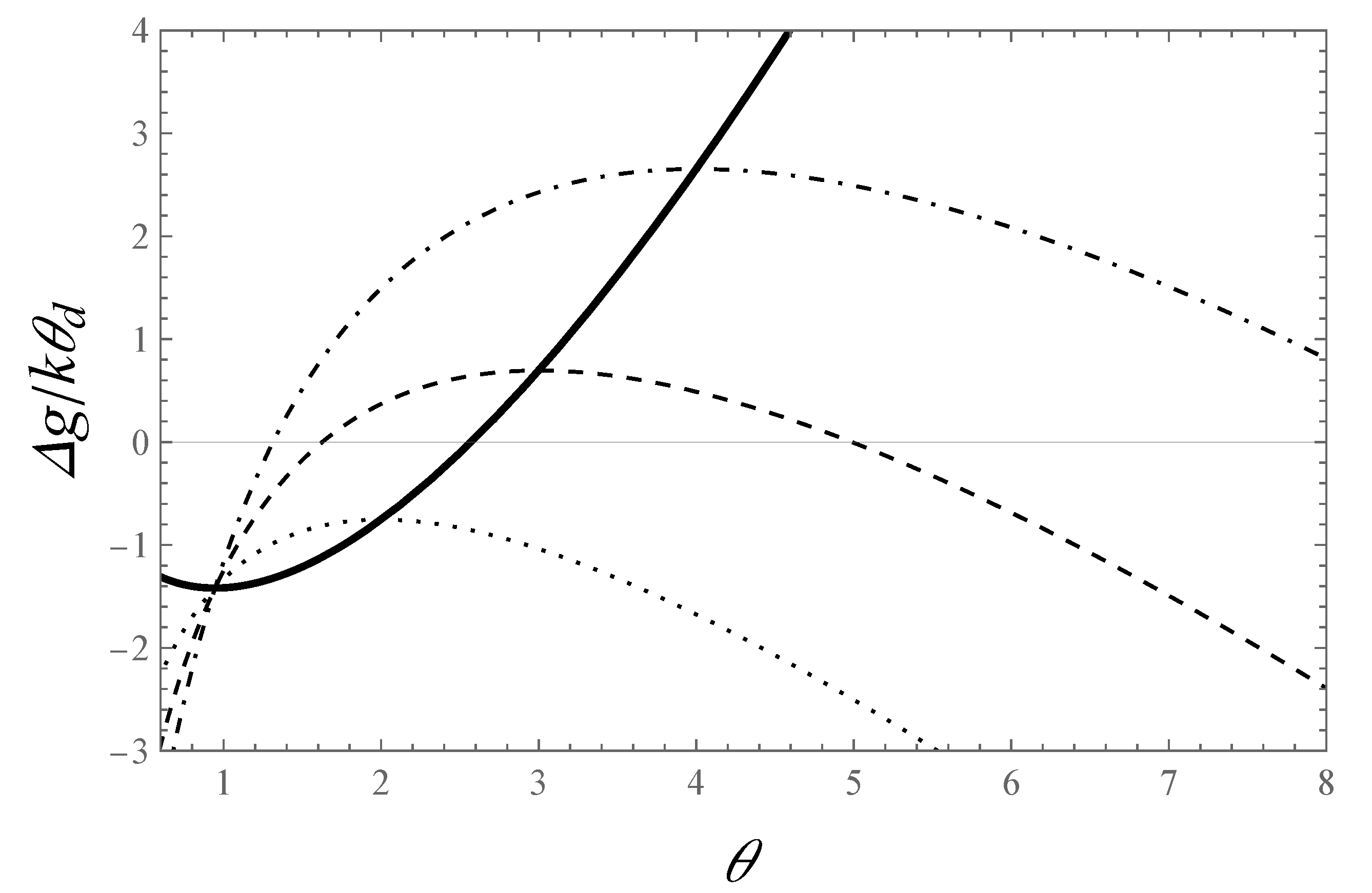
Figure 2.
The increment of the normalized Gibbs potential as a function of the density n. The increment of equilibrium Gibbs potential is represented by a thick line. The increment of off-equilibrium Gibbs potential is represented by dotted, dashed and dot-dashed lines for three different values of the ratio , accordingly. The macro-temperature ratios are chosen to be . The pressure of the thermal reservoir (the surrounding medium) is , respectively.
Figure 2.
The increment of the normalized Gibbs potential as a function of the density n. The increment of equilibrium Gibbs potential is represented by a thick line. The increment of off-equilibrium Gibbs potential is represented by dotted, dashed and dot-dashed lines for three different values of the ratio , accordingly. The macro-temperature ratios are chosen to be . The pressure of the thermal reservoir (the surrounding medium) is , respectively.
Disclaimer/Publisher’s Note: The statements, opinions and data contained in all publications are solely those of the individual author(s) and contributor(s) and not of MDPI and/or the editor(s). MDPI and/or the editor(s) disclaim responsibility for any injury to people or property resulting from any ideas, methods, instructions or products referred to in the content. |
© 2025 by the authors. Licensee MDPI, Basel, Switzerland. This article is an open access article distributed under the terms and conditions of the Creative Commons Attribution (CC BY) license (http://creativecommons.org/licenses/by/4.0/).
Copyright: This open access article is published under a Creative Commons CC BY 4.0 license, which permit the free download, distribution, and reuse, provided that the author and preprint are cited in any reuse.


