

Submitted:
12 October 2025
Posted:
13 October 2025
You are already at the latest version
Abstract
The persistent explanatory gap between local interactions and global emergence represents a fundamental challenge in complex systems science. While current frameworks successfully describe what components interact and their topological patterns, they lack a physical theory for how interactions are materially mediated and integrated—the crucial mechanism underlying self-organization. We propose the Interstitial Integration Hypothesis (IIH) as a comprehensive mechanistic framework. The IIH identifies the structure, dynamics, and material properties of interstitial spaces—the functional substrates between discrete components—as the physical determinant of system-level function and emergent behavior. Through convergent evidence from quantum physics to social science, we demonstrate that interstitial architecture governs how simple components give rise to complex phenomena through constrained flow and information processing. Crucially, we formulate specific, falsifiable predictions with detailed experimental protocols. This framework not only resolves longstanding puzzles of emergence but also reframes pathologies from fibrosis to social sclerosis as “intersticiopathies”—dysfunctions of interstitial flow—offering a transformative paradigm for engineering resilient systems across disciplines.
Keywords:
complex systems
; emergence
; self-organization
; physical substrate
; mechanobiology
; systems integration
1. Introduction: From Descriptive Mystery to Mechanistic Explanation
The central mystery of complexity science—how local interactions produce global coherence without central control—has persisted not because the phenomenon is inherently mysterious, but because prevailing paradigms have studied the wrong dimension of reality. Reductionism excels at decomposition, and network theory reveals topological patterns [1], but both share a fundamental limitation: they focus on entities and abstract connections while ignoring the physical medium through which interactions occur. The crucial channel of interaction has been treated as a weightless, spaceless abstraction, devoid of material properties and causal efficacy.
This critical oversight explains why emergence has remained in the realm of philosophical speculation rather than rigorous science. Current frameworks can describe what emerges but cannot explain how it emerges through physical processes. The phrase “more than the sum of parts” represents not an explanation but a confession of ignorance—a descriptive label for our lack of mechanistic understanding.
Here, we formalize the Interstitial Integration Hypothesis (IIH), which represents a fundamental paradigm shift from entity-oriented description to relation-oriented mechanism. We define an interstice as a structured, dynamic, functional space that physically mediates interactions between system components. The core tenet is that the material and dynamical properties of interstitial spaces (stiffness, porosity, conductivity, chemical composition) are not secondary features but causal factors in system-level behavior and the specific character of emergent phenomena.
This article establishes the conceptual foundations of the IIH, clearly distinguishing its mechanistic approach from descriptive frameworks. We then present convergent evidence across scales, demonstrating how interstitial architecture provides the physical basis for emergence. Most critically, we derive rigorously testable, falsifiable predictions to guide empirical validation, moving emergence from philosophical speculation to empirical science.
2. Conceptual Foundation: From Descriptive Abstraction to Physical Mechanism
The IIH fundamentally transcends existing frameworks by addressing their core limitation: the treatment of interaction as abstraction rather than physical process.
2.1. The Descriptive Limitation of Current Paradigms:
•Network Theory excels at mapping connectivity topology but cannot explain system behavior when the physical properties of connections determine functionality. It identifies hubs but cannot explain why a hub matters if its significance derives from the material properties of its connections—like mapping roads while ignoring whether they are dirt paths or superconducting channels.
•Systems Theory models abstract interactions but typically omits the physical structure of the interaction medium as a first-order parameter. It describes predator-prey dynamics while ignoring how foliage density physically modulates encounter rates—the very physical medium that determines interaction possibilities.
2.2. The IIH as Mechanistic Alternative
The IIH places the physical substrate of interaction at the forefront, asserting that the interstice is a functional compartment with three essential mechanistic attributes:
1. Constrained Connectivity: Physical geometry and topology define possible interaction pathways (e.g., pore networks determine molecular access in catalysts; neural pathways constrain information flow).
2. State-Dependent Permeability: Material properties dynamically modulate flow based on conditions (e.g., synaptic plasticity enables learning; vasodilation regulates blood flow).
3. Information Encoding: Physical state encodes information that directs component behavior (e.g., ECM stiffness patterns instruct cell fate decisions; social trust guides economic transactions).
If network theory provides the syntax of complexity and systems theory describes its logic, the IIH reveals its physics—the material basis that gives connections their specific efficacy and meaning. Collectively, these attributes substantiate a core principle revealed by the IIH: “Structure determines flow, and flow determines function.” The interstice is the critical domain where quantitative interactions undergo qualitative phase transitions, and where system-level properties truly emerge.
3. Convergent Evidence: The Physical Basis of Emergence Across Scales
3.1. Physical Sciences: From Quantum Vacuum to Cosmic Structure
•Quantum Field Theory: The Higgs field represents the ultimate interstice—not empty void but a pervasive energy field whose properties endow elementary particles with mass through continuous interaction [2]. This establishes that space itself actively determines fundamental material properties, providing a primordial example of interstitial causation.
•Condensed Matter Physics: The performance of porous materials is dictated by interstitial architecture—pore size, distribution, and connectivity govern molecular transport and reaction kinetics [3]. This demonstrates how interstitial design physically determines system function, not merely describes it.
•Cosmology: The cosmic web’s large-scale structure is sculpted not by visible matter but by dark matter’s gravitational potential [4]. This invisible interstitial matrix acts as cosmic scaffolding, physically directing the assembly of luminous matter through constrained gravitational pathways.
3.2. Biological Systems: The Master Integration NetworkBiology reveals sophisticated interstitial engineering across scales, providing compelling evidence against purely descriptive approaches:
•Developmental Biology: The critical role of interstices is fundamentally demonstrated in embryogenesis. The subgerminal space in the avian egg provides a quintessential example. This fluid-filled cavity is not a passive void but a morphogenetic arena that creates the essential topographical context for the extensive cell migrations during gastrulation. The physical constraints within this space guide the emergence of the body plan, illustrating how a defined interstice acts as the substrate for the transition from potentiality to actualized life [5].
•Macroscopic Interstitium: Benias et al. (2018) identified a fluid-filled, lattice-structured interstitium as a widespread anatomical compartment, potentially functioning as a shock-absorbing transport network [6]. This provides macroscopic validation of interstitial function beyond descriptive anatomy.
•ECM Mechanoregulation: The extracellular matrix serves as a canonical interstice whose mechanical stiffness directly regulates cell fate via mechanosensitive effectors like YAP/TAZ [7]. Fibrosis—interstitial hardening—demonstrates how interstitial pathology drives systemic failure, revealing the causal power of interstitial states.
•Glymphatic System: This brain-wide clearance system utilizes perivascular spaces as interstitial conduits for metabolic waste [8]. Its flow-dependent function, impaired in neurodegeneration, establishes a direct link between interstitial dynamics and system health—a relationship inaccessible to descriptive approaches.
•Cellular Communication: Gap junctions form regulated aqueous pores, while synaptic clefts are chemically complex interstices—both exemplify specialized interstitial structures for precise signaling that descriptive networks can identify but cannot physically explain [9].
3.3. Social and Information Systems
•Social Capital: Trust networks and shared norms constitute the social interstice. This concept finds its measurable correlate in the sociological construct of social capital [10], which robustly links the quality of this relational space to economic resilience and institutional efficacy. This demonstrates how interstitial quality physically determines collective function beyond individual attributes.
•Digital Infrastructure: Protocol stacks (e.g., TCP/IP) function as logical interstices, dictating data exchange rules and efficiency—the physical implementation that gives digital networks their specific emergent capabilities.
4. Resolving the Puzzles of Emergence: From Mystery to Mechanism
The IIH provides unified mechanistic explanations for complexity’s enduring mysteries, transforming them from philosophical puzzles into scientific questions:
•Why doesn’t the universe disintegrate into chaos? Order persists because interstitial architectures—from quantum fields to gravitational potentials—constrain possible states toward higher-order stability. The “more” in “more than the sum of parts” physically resides in these structuring spaces.
•How does consciousness emerge? Consciousness arises not mystically from neurons but mechanistically from the electrochemical dynamics of synaptic interstices—precisely regulated spaces where mind manifests from matter through patterned information flow. The physical architecture of these spaces determines the character of conscious experience.
•How do markets self-organize? Market complexity emerges not magically from individuals but predictably from social interstice quality—trust, norms, and communication channels that physically enable decentralized coordination.
In each case, the answer lies not in the components but in the structured spaces between them that govern interaction possibilities—the physical basis that descriptive approaches systematically overlook.
5. Testable Predictions and Falsification
Unlike descriptive theories that offer post-hoc explanations, the IIH generates specific, falsifiable predictions that can distinguish it from alternative frameworks:
•Prediction 1 (Biological Integration):
o Statement: Targeted enzymatic degradation of Hyaluronan in 3D liver organoid ECM will induce predictable transcriptomic and functional alterations in cells >500 μm from the degradation site.
o Protocol: Use light-activatable hyaluronidase in HA-rich organoids with spatial transcriptomics and functional assays.
o Falsification: Changes confined to <100 μm would refute interstitial mediation of long-range integration, supporting instead a component-centric view.
•Prediction 2 (Materials Science):
o Statement: Hierarchically porous MOFs will show ≥50% higher catalytic TOF for bulky substrates than stochastic porous counterparts with identical chemistry.
o Protocol: Synthesize and characterize MOFs via gas sorption and tomography; measure TOF in standardized reactions.
o Falsification: No TOF difference would demonstrate that interstitial transport isn’t performance-determining, supporting descriptive chemical explanations alone.
•Prediction 3 (Social Dynamics):
o Statement: A Digital Interstitial Index from mobile data will better predict post-disaster economic resilience than GDP or traditional economic indicators.
o Protocol: Analyze mobile and economic data from 50 cities using multivariate regression.
o Falsification: No predictive power (p>0.01) would invalidate information interstice importance, supporting instead component-based economic theories.
6. Implications and Research Program
The IIH transforms our approach to complexity from description to mechanism:
•Redefining Pathologies: “Intersticiopathies”—systemic dysfunctions from impaired interstitial flow—apply from fibrosis to social polarization, offering new diagnostic and therapeutic approaches.
•Guiding Design: Next-generation advances will come from deliberate interstitial engineering in tissues, materials, and cities—designing the spaces between components rather than just the components themselves.
•Unified Science: Provides common mechanistic framework across physical, biological, and social domains, moving beyond descriptive analogies to unified principles.
We propose an “Interstitome Project” to systematically map, model, and manipulate interstitial networks across scales, transforming our understanding of integration from observation to engineering.
7. Conclusion
The greatest discoveries often come from seeing what lies between things rather than the things themselves. The Interstitial Integration Hypothesis represents such a shift—from studying notes to understanding the staff they’re written on. By taking seriously the spaces between components as active, governing substrates, we move emergence from philosophical mystery to physical mechanism. This perspective crystallizes a fundamental law: structure determines flow, and flow determines function, with the interstice serving as the critical domain for phase transitions and the true emergence of system-level properties. Where descriptive approaches see “more than the sum of parts” as a final answer, the IIH sees it as a starting point for physical investigation. Through rigorous experimental testing of this hypothesis, we can determine if the key to emergence has indeed been residing in the gaps all along—the structured spaces that transform simple components into complex wholes.
Figure 1.
The Interstitial Integration Hypothesis - A Unified Framework Across Scales.
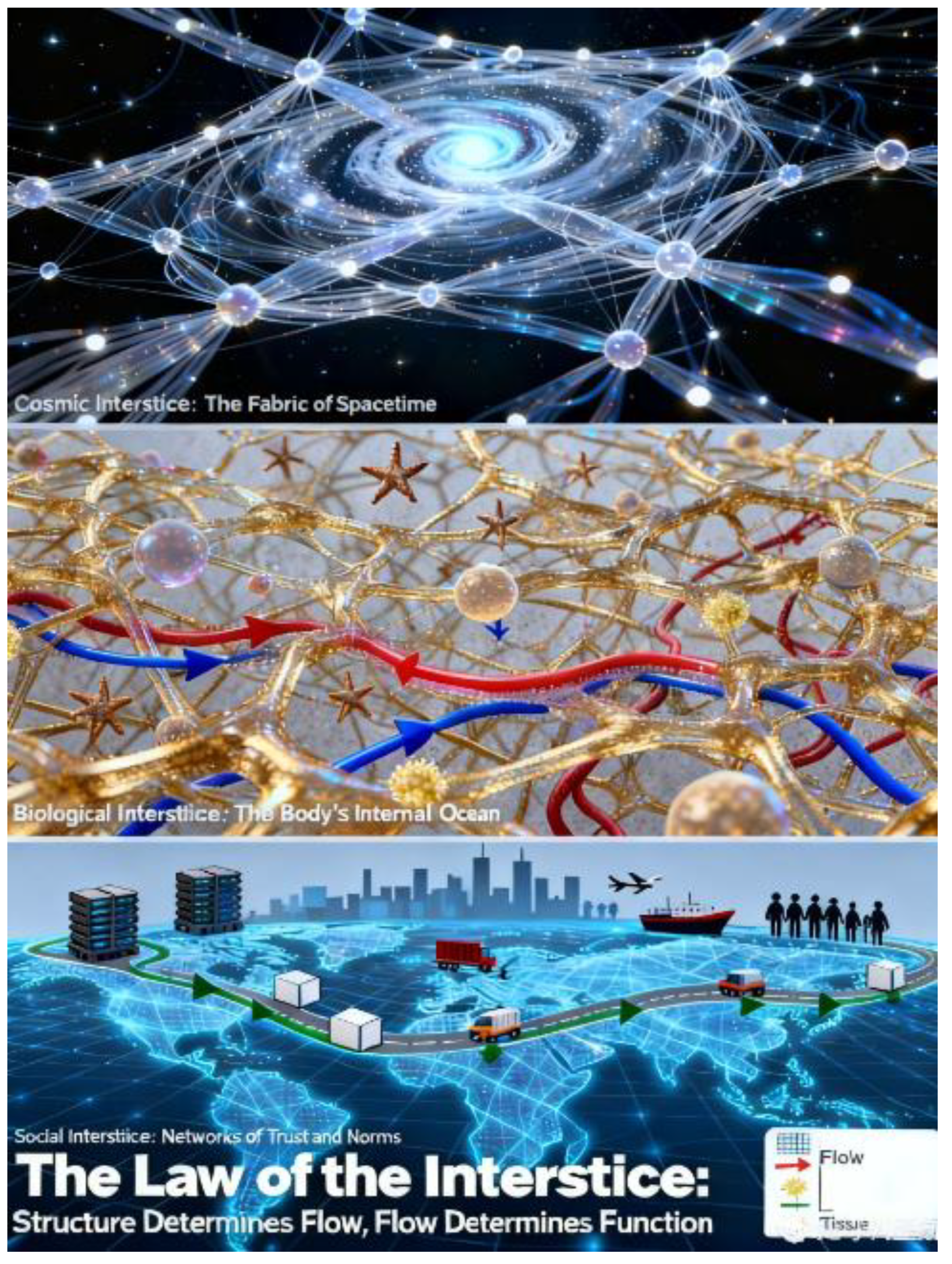
This conceptual illustration depicts the core principle of the Interstitial Integration Hypothesis (IIH), which posits that the structured spaces between components—the interstices—are the fundamental substrate for emergence and self-organization. The framework is demonstrated across three representative scales: the Cosmic Interstice (the fabric of spacetime governing physical laws), the Biological Interstice (the body’s fluid-filled “internal ocean” enabling cellular integration), and the Socio-Cognitive Interstice (networks of trust and norms facilitating collective action). The universal causal chain underpinning all systems is summarized by the foundational law: Structure Determines Flow, Flow Determines Function.
Author Contributions
Qingbao Wang: Conceptualization, Methodology, Writing – Original Draft, Supervision, Funding Acquisition. Yi Wang: Validation, Formal Analysis, Investigation, Data Curation, Writing – Review & Editing.
Acknowledgments
We thank colleagues at Shandong First Medical University for constructive discussions.
Declaration of Interests
The authors declare no competing interests.
Lead Contact
Further information and requests for resources should be directed to and will be fulfilled by the Lead Contact, Qingbao Wang ( qbwang@sdfmu.edu.cn).
References
- Barabási, A.-L. Network Science. (Cambridge University Press, 2016).
- Englert, F. & Brout, R. Broken Symmetry and the Mass of Gauge Vector Mesons. Phys. Rev. Lett. 13, 321–323 (1964). [CrossRef]
- Liu, J. et al. Bioinspired Murray materials for mass transfer and activity. Nat. Commun. 8, 14921 (2017).
- Planck Collaboration et al. Planck 2018 results. VI. Cosmological parameters. Astron. Astrophys. 641, A6 (2020). [CrossRef]
- Gilbert, S. F. Developmental Biology (12th Edition). Sinauer Associates (2020).
- Benias, P. C. et al. Structure and Distribution of an Unrecognized Interstitium in Human Tissues. Sci. Rep. 8, 4947 (2018). [CrossRef]
- Dupont, S. et al. Role of YAP/TAZ in mechanotransduction. Nature 474, 179–183 (2011).
- Iliff, J. J. et al. A paravascular pathway facilitates CSF flow through the brain parenchyma and the clearance of interstitial solutes, including amyloid β. Sci. Transl. Med. 4, 147ra111 (2012).
- Goodenough, D. A. & Paul, D. L. Gap Junctions. Cold Spring Harb. Perspect. Biol. 1, a002576 (2009).
- Putnam, R. D. Bowling Alone: The Collapse and Revival of American Community. (Simon & Schuster, 2000).
Disclaimer/Publisher’s Note: The statements, opinions and data contained in all publications are solely those of the individual author(s) and contributor(s) and not of MDPI and/or the editor(s). MDPI and/or the editor(s) disclaim responsibility for any injury to people or property resulting from any ideas, methods, instructions or products referred to in the content. |
© 2025 by the authors. Licensee MDPI, Basel, Switzerland. This article is an open access article distributed under the terms and conditions of the Creative Commons Attribution (CC BY) license (http://creativecommons.org/licenses/by/4.0/).
Copyright: This open access article is published under a Creative Commons CC BY 4.0 license, which permit the free download, distribution, and reuse, provided that the author and preprint are cited in any reuse.


