

Submitted:
09 October 2025
Posted:
10 October 2025
You are already at the latest version
Abstract
Chemistry education research, as a subfield of science education, explores teaching and learning through the lens of chemical sciences. This review provides a comprehensive overview of the key themes and developments in chemistry education research conducted at the Chemistry Teacher Education Unit of the University of Helsinki over the past two decades. Drawing on 103 peer-reviewed publications, the analysis identifies two major research emphases: sustainability and modern technology in chemistry education. Sustainability-focused studies highlight climate education, systems thinking, and teacher agency, while technology-oriented research investigates the integration of artificial intelligence, cheminformatics, and molecular modeling into teaching practices. The review also underscores the role of design-based research and the importance of collaboration within scientists, schools, industry, the national LUMA (STEM) Finland network and international partnerships. These efforts contribute significantly to the advancement of formal, non-formal, and informal science education, as well as to the development of research-based teacher education.
Keywords:
Chemistry education
; Chemistry Science
; education
; Teacher education
; Design-based research
; Sustainability
; Modern technology
1. Introduction
According to the international organization IUPAC, chemistry education is a subfield of chemical science (IUPAC, 2025). Research in this field examines key questions related to education, teaching, and learning from the perspective of chemistry across different educational levels (Taber, 2018). The field includes various focus areas, such as the nature of chemical science and conceptual understanding (e.g., Jong, 2000). Recently, international research has evolved toward broader goals, including scientific literacy, argumentation, and the integration of digital technologies (e.g., Erduran & Akış, 2023; Aksela, 2025; Sjöström, 2025). Sustainability and socio-scientific issues have become prominent research areas (e.g., Anastas & Zimmerman, 2018; Burmeister et al., 2012; Çalık & Wiyarsi, 2021).
In Finland, the development of chemistry education research gained momentum following the first European Conference on Research in Chemical Education (ECRICE) in 1992 (Aksela & Mäkelä, 1993). Since then, the Chemistry Teacher Education Unit at the University of Helsinki has played a central role in advancing the field. This review synthesizes the key themes and developments in chemistry education research conducted by this unit over the past 20 years, drawing on 103 peer-reviewed publications. It highlights the contributions of design-based research, the role of national and international collaboration—particularly through the LUMA Centre Finland network—and the impact of these efforts on formal, non-formal, and informal science education.
2. Background of Finnish Chemistry Education Research
In Finland, chemistry education research remains a relatively young discipline compared to its development in many other countries (e.g., Jong, 2000). To foster its growth, the Chemistry Teacher Education Unit was founded in 2001 within the Department of Chemistry at the University of Helsinki (Aksela, 2010). Since then, two research groups—SECO (Science and Chemistry Education Collaboration) and the multidisciplinary LUMA Science Helsinki—have worked in close partnership to advance the field. A central focus of their work is international research collaboration, which has significantly contributed to the development of evidence-based practices. To date, the SECO group has produced 16 doctoral dissertations, with several more currently in progress.
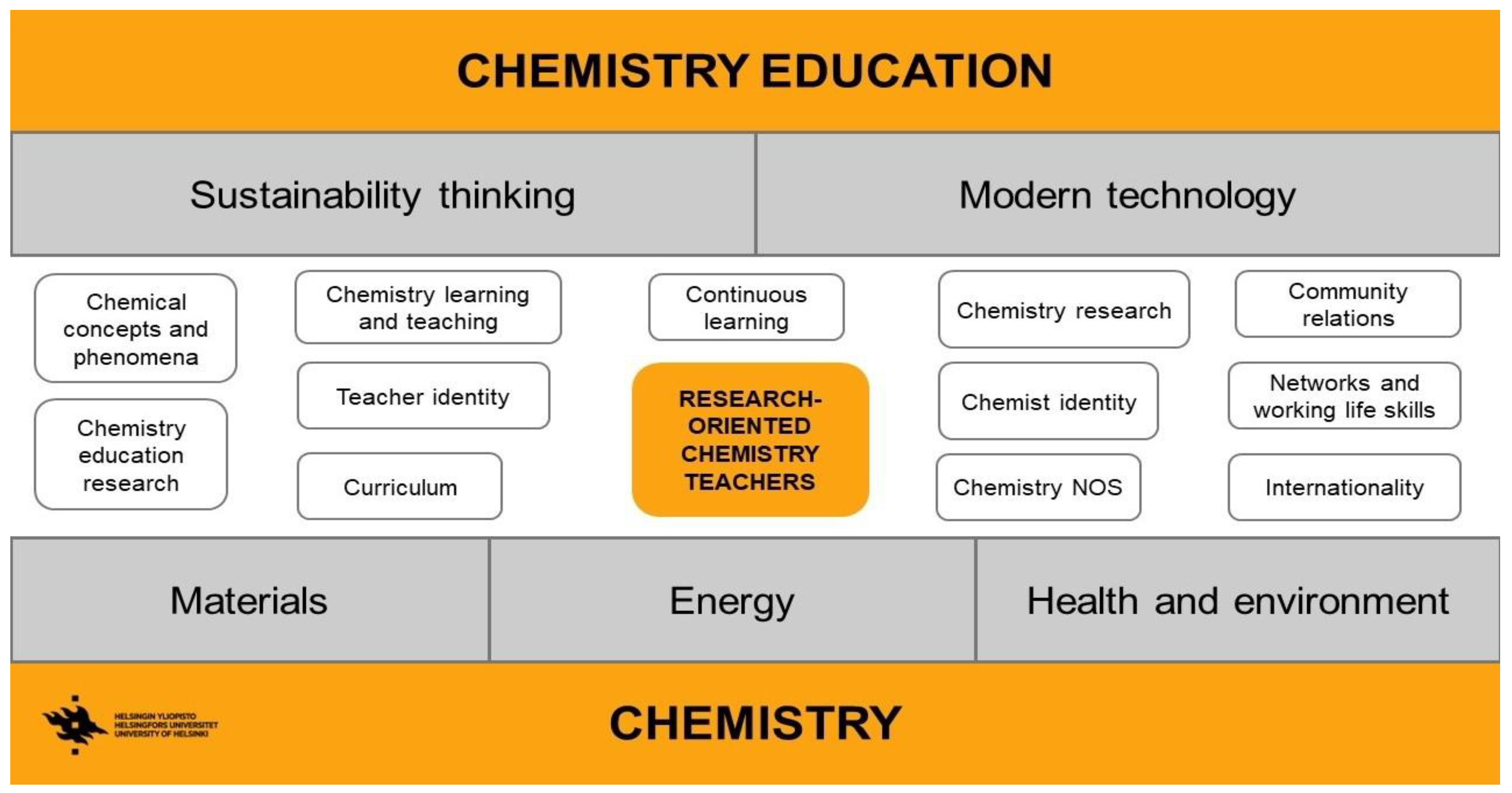
Figure 1.
The focus for activities and research at the LUMAlab Gadolin (part of LUMA Centre Finland, www.luma.fi). The themes—materials, energy, health, and environment—are the main focuses in modern research at the Department of Chemistry. .
Figure 1.
The focus for activities and research at the LUMAlab Gadolin (part of LUMA Centre Finland, www.luma.fi). The themes—materials, energy, health, and environment—are the main focuses in modern research at the Department of Chemistry. .
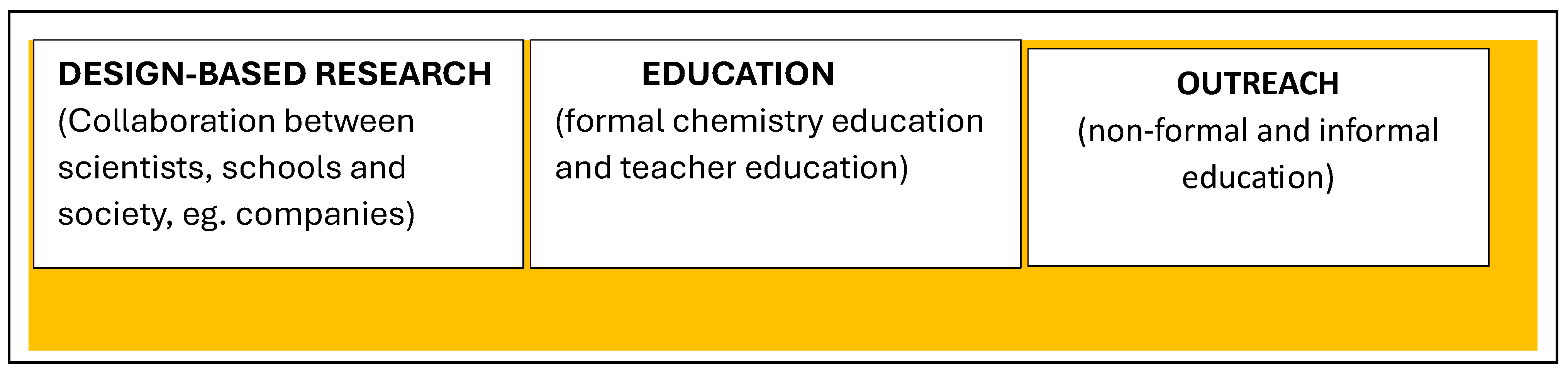
Collaborative efforts with schools, universities, and societal stakeholders are actively pursued through the LUMAlab Gadolin initiative (Aksela et al., 2025), a national hub for design-based research, science education, and outreach (see Figure 2). This initiative supports the dissemination of research through formal, non-formal, and informal education, and aligns with the goals of the Finnish LUMA (STEM) strategy. Long-standing cooperation exists with the national LUMAT Science Research Forum (part of the national LUMA Centre Finland network, www.luma.fi), including various projects (e.g., StarT LUMA), international symposia, research seminars, and the scientific journal LUMAT. In our research, theory and practice are often closely linked through design-based research (e.g., Aksela, 2019; Pernaa et al., 2022), which produces both theoretical insights and practical applications.
3. Publications and Analysis
Since 2003, the Chemistry Teacher Education Unit has published 111 research articles. A total of 103 peer-reviewed articles from 2006–2024 were retrieved from the University of Helsinki’s TUHAT research database and inductively categorized into themes. In total, 53 themes were identified, describing research topics, contexts, and key methodologies. International collaborations were also mapped.
4. Results
The thematic analysis of the 103 peer-reviewed articles revealed that sustainability (N=11) and modern technology (N=22) emerged as the most prominent research areas (see Chapters 4.1 and 4.2 for detailed discussion). A significant portion of the research was conducted within the frameworks of the nature of science (NOS) (N=12) and chemistry teacher education (N=18), reflecting the unit’s commitment to foundational and pedagogical dimensions of chemistry education.
Furthermore, the analysis highlights the active engagement in international collaboration, involving researchers from Australia, Norway, Germany, Chile, China, Slovenia, and the United States. These partnerships have primarily focused on advancing research in technology-enhanced learning and teacher education. Notably, collaborative efforts in climate change education have been undertaken with Australia and Taiwan, exemplified by the international project Enacting Climate Change Education (https://enactingclimatechangeeducation.deakin.edu.au).
4.1. Sustainability in Chemistry Education
Sustainability has become a central theme in chemistry education research, especially since the 2010s. This trend reflects broader societal changes, with sustainability issues increasingly becoming core areas of education and research. The reviewed articles show that sustainability has been approached in diverse ways across educational levels, pedagogical approaches, and research methods.
Common methodologies included design-based research, mixed methods, and qualitative approaches (e.g., grounded theory, discourse analysis). Key themes included climate education, systems thinking, teacher agency, learner-centered pedagogical solutions, and collaborative development among stakeholders.
In the 2010s, sustainability-focused research emphasized learner-centered pedagogy, life-cycle thinking, and societal agency. Herranen et al. (2018) examined university students’ perceptions of learner-centered and learner-driven sustainability education, highlighting the need to clarify concepts and move toward transformative, learner-driven pedagogy. Juntunen and Aksela (2013, 2014b) used life-cycle analysis to develop students’ argumentation skills and environmental awareness in chemistry education, emphasizing the need to strengthen teachers’ pedagogical competence in sustainability-related chemistry content and models (Juntunen & Aksela, 2014a).
Studies on youth perspectives on climate and sustainability emphasized a desire to act for a better world and interest in integrating ethical, societal, and scientific viewpoints (Tolppanen & Aksela, 2018; Vesterinen et al., 2016).
In the 2020s, research has shifted toward systems thinking, co-design in teaching, and the importance of teachers’ views and agency in implementing sustainability education. For example, Aksela and Tolppanen (2022) highlighted the potential of co-design to create learner-centered climate education solutions in science teacher education. Sihvonen et al. (2024) emphasized the importance of co-design in addressing complex topics like climate change. Herranen and Aksela (2024) showed how teachers’ self-efficacy in climate education affects their ability to support students in sustainable action. Vuorio et al. (2024) introduced systems thinking through authentic chemists’ narratives, framing sustainability as a multidimensional concept encompassing ecological, economic, and social domains. The international “Enacting Climate Change Education” project launched in 2024 has further strengthened climate education research.
4.2. Modern Technology
Technology-focused chemistry education research has been a key area for over 20 years. This research is typically conducted using design-based approaches, which are well-suited for developing practical solutions (e.g., online environments, software, and learning materials) that serve as research settings for case studies (Juuti & Lavonen, 2006; Pernaa, 2013).
Early research focused on measurement automation and online learning environments (Aksela, 2005; Aksela, 2011; Lavonen et al., 2003). Technologies were selected to reflect developments in contemporary chemical science. This was followed by a long period of molecular modeling, in collaboration with active chemistry researchers (Aksela & Lundell, 2008). Technology solutions have been developed for various needs, from chemistry teacher education (Pernaa & Aksela, 2009) to lifelong learning (Myllyviita & Aksela, 2009).
Contemporary chemistry research has shifted toward data-oriented cheminformatics (Pernaa, Takala et al., 2023), prompting the development of school-appropriate molecular modeling software (Pernaa, 2015) and cheminformatics-based learning materials (Pernaa, 2022). This direction is currently an active research area.
As technology continues to evolve, it remains a dynamic research theme. Chemistry education researchers monitor developments in both chemistry and education. At this intersection, artificial intelligence has emerged as a recent focus, particularly in addressing challenges in chemical informatics and learning (Pernaa, Haatainen et al., 2023).
It is important to note that existing technologies also evolve. For example, mobile technology has improved the usability of measurement automation devices, and molecular modeling is now integrated into textbooks via new web applications (Pernaa & Aksela, 2013). Thus, the process is cyclical and iterative, with older technologies revisited multiple times.
5. Summary
This review synthesizes two decades of chemistry education research in Finland, revealing a dynamic and internationally connected field that addresses pressing global challenges. The analysis identifies two central and innovative themes: sustainability and modern technology in teaching.
Research on sustainability emphasizes climate education, systems thinking, and teacher agency, reflecting a shift toward transformative, learner-centered pedagogies and collaborative design. Meanwhile, technology-focused studies explore the integration of artificial intelligence, molecular modeling, and cheminformatics into chemistry instruction, showcasing iterative development aligned with advances in chemical science and educational practice.
Both themes are underpinned by design-based research, which bridges theoretical frameworks with practical applications. The review also highlights the pivotal role of the LUMA Centre Finland network, which fosters collaboration across universities, schools, and societal stakeholders. Through national and international projects, symposia, and the scientific journal LUMAT, this network supports the development of research-based teacher education and innovative chemistry teaching.
Together, these efforts contribute to shaping chemistry education and its teacher education that is responsive to the demands of a sustainable and technologically advanced future.
Acknowledgments
We would like to express our sincere thanks to our long-term collaborators. In particular, we extend our gratitude to the Department of Chemistry and its leadership for supporting and valuing our work. .
References
- Aksela, M. Towards student-centred solutions and pedagogical innovations in science education through co-design approach within design-based research. LUMAT: International Journal on Math, Science and Technology Education 2019, 7(3), 113–139. [Google Scholar] [CrossRef]
- Aksela, M. Supporting meaningful chemistry learning and higher-order thinking through computer-assisted inquiry: A design research approach. PhD thesis, University of Helsinki, 2005. Available online: https://helda.helsinki.fi/handle/10138/21127.
- Aksela, M. Evidence-based teacher education: Becoming a lifelong research-oriented chemistry teacher? Chemistry Education Research and Practice 2010, 11(2), 84–91. [Google Scholar] [CrossRef]
- Aksela, M. K. Engaging students for meaningful chemistry learning through Microcomputer-based Laboratory (MBL) inquiry. Educació Química : EduQ 2011, 9, 30–37. [Google Scholar] [CrossRef]
- Aksela, M. Advancing Scientific Literacy in Climate Change Education through Collaborative: Evidence-Based Approaches. [RMd] RevistaMultidisciplinar 2025, 7(3), 9–17. [Google Scholar] [CrossRef]
- Aksela, M.; Lundell, J. Computer-based molecular modelling: Finnish school teachers’ experiences and views. Chemistry Education Research & Practice 2008, 9(4), 301–308. [Google Scholar] [CrossRef]
- Aksela, M.; Mäkelä, M.-L. Tarvitaanko kemian opetuksen tutkimusta maassamme? Kemia-Kemi 1993, 20(4), 315. [Google Scholar]
- Aksela, M.; Pernaa, J.; Haatainen, O.; Pesonen, R.; Vuorio, E. Inspiring the makers of the future in science through collaboration with scientists, science educators, schools and society within LUMAlab Gadolin. Kemiauutiset KemiNyheter ChemistryNews 2025, 17(1), 49–52. [Google Scholar]
- Aksela, M.; Tolppanen, S.; Hsu, Teoksessa Y.-S.; Tytler, R.; White, P. J. Towards Student-Centered Climate Change Education Through Co-design Approach in Science Teacher Education. Teoksessa Y.-S. Hsu, R. Tytler, & P. J. White (Toim.). In Innovative Approaches to Socioscientific Issues and Sustainability Education; (s. 85–99); Springer Nature: Singapore, 2022. [Google Scholar] [CrossRef]
- Anastas, P. T.; Zimmerman, J. B. The United Nations sustainability goals: How can sustainable chemistry contribute? Current Opinion in Green and Sustainable Chemistry 2018, 13, 150–153. [Google Scholar] [CrossRef]
- Burmeister, M.; Rauch, F.; Eilks, I. Education for Sustainable Development (ESD) and chemistry education. Chemistry Education Research and Practice 2012, 13(2), 59–68. [Google Scholar] [CrossRef]
- Çalık, M.; Wiyarsi, A. A Systematic Review Of The Research Papers On Chemistry-Focused Socio-Scientific Issues. Journal of Baltic Science Education 2021, 20(3), 360–372. [Google Scholar] [CrossRef]
- Erduran, S.; Akış, A. P. Chemistry Education Research: Recent Trends and the Onset of the Pandemic Era. In Handbook of Research on Science Education; Routledge, 2023; p. p. 35. [Google Scholar]
- Herranen, J.; Aksela, M. Fostering teachers as sustainability and climate change educators through understanding of teachers’ self-efficacy beliefs. LUMAT: International Journal on Math, Science and Technology Education 2024, 12(3), 30–52. [Google Scholar] [CrossRef]
- Herranen, J.; Vesterinen, V.-M.; Aksela, M. From Learner-Centered to Learner-Driven Sustainability Education. Sustainability 2018, 10(7), 2190. [Google Scholar] [CrossRef]
- IUPAC. Chemistry Education Archives. IUPAC International Union of Pure and Applied Chemistry. 2025. https://iupac.org/tag/chemistry-education/.
- Jong, O. Crossing the borders: Chemical education research and teaching practice. University Chemistry Education 2000, 4(1), 29–32. [Google Scholar]
- Juntunen, M.; Aksela, M. Life-Cycle Analysis and Inquiry-Based Learning in Chemistry Teaching. Science Education International 2013, 24(2), 150–167. [Google Scholar]
- Juntunen, M.; Aksela, M. Education for sustainable development in chemistry – challenges, possibilities and pedagogical models in Finland and elsewhere. Chemistry Education Research and Practice 2014a, 15(4), 488–500. [Google Scholar] [CrossRef]
- Juntunen, M.; Aksela, M. Improving students’ argumentation skills through a product life-cycle analysis project in chemistry education. Chemistry Education Research and Practice 2014b, 15(4), 639–649. [Google Scholar] [CrossRef]
- Juuti, K.; Lavonen, J. Design-Based Research in Science Education: One Step Towards Methodology. Nordic Studies in Science Education 2006, 2(2), 54–68. [Google Scholar] [CrossRef]
- Lavonen, J.; Juuti, K.; Meisalo, V. Designing a user-friendly microcomputer-based laboratory package through the factor analysis of teacher evaluations. International Journal of Science Education 2003, 25(12), 1471–1487. [Google Scholar] [CrossRef]
- Myllyviita, A.; Aksela, M. Virtual mentoring for novice teachers. Lifelong Learning in Europe 2009, 14(2), 106–110. [Google Scholar]
- Pernaa, J. Kehittämistutkimus tutkimusmenetelmänä. Teoksessa J. Pernaa (Toim.), Kehittämistutkimus opetusalalla (s. 9–26). PS-kustannus. 2013. [Google Scholar]
- Pernaa, J. Edumol: Avoin ja ilmainen molekyylimallinnussovellus kemian opetuksen tueksi. LUMAT: International Journal on Math, Science and Technology Education 2015, 3(7), Article 7. [Google Scholar] [CrossRef]
- Pernaa, J. Possibilities and Challenges of Using Educational Cheminformatics for STEM Education: A SWOT Analysis of a Molecular Visualization Engineering Project. Journal of Chemical Education 2022, 99(3), 1190–1200. [Google Scholar] [CrossRef]
- Pernaa, J.; Aksela, M. Chemistry teachers’ and students’ perceptions of practical work through different ICT learning environments. Problems of Education in the 21st Century 2009, 16, 80–88. [Google Scholar]
- Pernaa, J.; Aksela, M. The history, current state and future of electronic chemistry learning environments. LUMAT: International Journal on Math, Science and Technology Education 2013, 1(4), 435–456. [Google Scholar] [CrossRef]
- Pernaa, J.; Haatainen, O.; Aksela, M. Ensuring the Relevance of an Evidence-Based Chemistry Teacher Education Study Program: Narrative Insights from Continuous Research-Based Development Conducted in the University of Helsinki. Social Sciences 2025. [Google Scholar] [CrossRef]
- Pernaa, J.; Haatainen, O. M.; Aksela, M. The Possibilities and Challenges of Using AI Chatbots in Teacher Education: An Example of Project-Based STEM Learning. 21–22. 2023. [Google Scholar]
- Pernaa, J.; Kämppi, V.; Aksela, M. Supporting the Relevance of Chemistry Education through Sustainable Ionic Liquids Context: A Research-Based Design Approach. Sustainability 2022, 14(10), 6220. [Google Scholar] [CrossRef]
- Pernaa, J.; Takala, A.; Ciftci, V.; Hernández-Ramos, J.; Cáceres-Jensen, L.; Rodríguez-Becerra, J. Open-Source Software Development in Cheminformatics: A Qualitative Analysis of Rationales. Applied Sciences 2023, 13(17), 17. [Google Scholar] [CrossRef]
- Sihvonen, P.; Lappalainen, R.; Herranen, J.; Aksela, M. Promoting Sustainability Together with Parents in Early Childhood Education. Education Sciences 2024, 14(5), 541. [Google Scholar] [CrossRef]
- Sjöström, J. Vision III of scientific literacy and science education: An alternative vision for science education emphasising the ethico-socio-political and relational-existential. Studies in Science Education 2025, 61(2), 239–274. [Google Scholar] [CrossRef]
- Taber, K. S. Identifying research foci to progress chemistry education as a field. Educación Química 2018, 28, Article 2. [Google Scholar] [CrossRef]
- Tolppanen, S.; Aksela, M. Identifying and addressing students’ questions on climate change. The Journal of Environmental Education 2018, 49(5), 375–389. [Google Scholar] [CrossRef]
- Vesterinen, V.-M.; Tolppanen, S.; Aksela, M. Toward citizenship science education: What students do to make the world a better place? International Journal of Science Education 2016, 38(1), 30–50. [Google Scholar] [CrossRef]
- Vuorio, E.; Pernaa, J.; Aksela, M. Lessons for Sustainable Science Education: A Study on Chemists’ Use of Systems Thinking across Ecological, Economic, and Social Domains. Education Sciences 2024, 14(7), Article 7. [Google Scholar] [CrossRef]
Figure 2.
LUMAlab Gadolin is a collaborative hub for design-based research, education and outreach in science education. Close collaboration has done with scientists, industry and schools (see Aksela, 2019). It offers a platform for disseminating new research through formal, non-formal and informal education to everyone. LUMAlab Gadolin supports the aims of the Finnish national LUMA (STEM) strategy and its action plan by collaborating closely with the national LUMA Centre Finland network, which includes 11 universities and 13 centers, with the first established at the University of Helsinki in 2003. .
Figure 2.
LUMAlab Gadolin is a collaborative hub for design-based research, education and outreach in science education. Close collaboration has done with scientists, industry and schools (see Aksela, 2019). It offers a platform for disseminating new research through formal, non-formal and informal education to everyone. LUMAlab Gadolin supports the aims of the Finnish national LUMA (STEM) strategy and its action plan by collaborating closely with the national LUMA Centre Finland network, which includes 11 universities and 13 centers, with the first established at the University of Helsinki in 2003. .
Disclaimer/Publisher’s Note: The statements, opinions and data contained in all publications are solely those of the individual author(s) and contributor(s) and not of MDPI and/or the editor(s). MDPI and/or the editor(s) disclaim responsibility for any injury to people or property resulting from any ideas, methods, instructions or products referred to in the content. |
© 2025 by the authors. Licensee MDPI, Basel, Switzerland. This article is an open access article distributed under the terms and conditions of the Creative Commons Attribution (CC BY) license (http://creativecommons.org/licenses/by/4.0/).
Copyright: This open access article is published under a Creative Commons CC BY 4.0 license, which permit the free download, distribution, and reuse, provided that the author and preprint are cited in any reuse.


