

Submitted:
09 October 2025
Posted:
10 October 2025
You are already at the latest version
Abstract
Destinations such as Bali face intensifying overtourism, which undermines ecological integrity, cultural authenticity, and local livelihoods. Traditional sustainable tourism approaches have proven insufficient, leading to calls for regenerative tourism that restores ecosystems and strengthens communities. This study examines how Penta-Helix collaboration can drive regenerative tourism, mitigate overtourism, and deliver sustainability outcomes. A mixed-methods design was employed. Survey data from 220 domestic and international visitors were analyzed using structural equation modeling (SEM–PLS) to test relationships among Penta-Helix collaboration, regenerative tourism, overtourism mitigation, and sustainability outcomes. To complement these findings, an analytic hierarchy process (AHP) was conducted with 30–40 key stakeholders drawn from 100 informants (government, businesses, communities, academia, and media) to prioritize mitigation strategies. SEM–PLS results indicate that Penta-Helix collaboration significantly enhances regenerative tourism practices (β = 0.62), which strongly reduce overtourism impacts (β = 0.58). Mediation tests reveal that overtourism mitigation is a key mechanism linking regenerative tourism to triple bottom line outcomes (economic, socio-cultural, environmental). AHP results show that carrying capacity enforcement and participatory governance emerge as the top-priority strategies, underscoring the dual importance of institutional policy and community empowerment. The findings advance theoretical debates by positioning regenerative tourism as a systemic innovation enabled by networked governance and operationalized through overtourism mitigation strategies. Practically, the study highlights the need for policy enforcement, participatory governance, and adaptive destination management to embed regenerative principles in overtourism hotspots.
Keywords:
regenerative tourism
; Penta-Helix collaboration
; overtourism mitigation
; sustainability outcomes
; mixed-methods
; Bali
1. Introduction
Tourism scholarship has increasingly grappled with the challenges of overtourism, where rapid growth in visitor numbers and tourism infrastructure generates economic, socio-cultural, and environmental pressures that undermine destination sustainability (Żemła, M., & Szromek, A. R., 2021; Koens, Postma, & Papp, 2018; Hampton, M. P., & Jeyacheya, J., 2020; Benner, 2020; Baños, C. J, et al., 2019). Conventional sustainable tourism approaches—focused on minimizing harm (Kurniawan, T., & Khademi-Vidra, A., 2024) have been criticized for their inability to address the structural causes of overtourism, such as growth-driven models, weak governance, and inequitable benefit distribution (Gössling & Hall, 2019; Higgins-Desbiolles, 2018; Dilshan, N.W.T., & Nakabasami, C., 2025; Gollagher, M., & Hartz-Karp, J., 2013). In this context, regenerative tourism has emerged as a paradigm shift that emphasizes restoring ecological systems, revitalizing cultural practices, and strengthening community resilience, thereby moving beyond mitigation toward net-positive outcomes (Miedes-Ugarte, B., & Flores-Ruiz, D., 2025.; Fletcher et al., 2019; Song, W., 2023).
While regenerative tourism provides a promising framework, its effectiveness depends on governance mechanisms that can translate aspirational principles into operational strategies. Collaborative governance theories highlight the importance of multi-actor engagement in building adaptive capacity and aligning diverse stakeholder interests (Ansell & Gash, 2008; Bramwell & Lane, 2011; Gollagher, M., & Hartz-Karp, J., 2013). The Penta-Helix model, which integrates government, academia, business, community, and media, has been proposed as a comprehensive governance framework for tourism development (Carayannis & Campbell, 2009; Baggio & Scott, 2020; Novianti, K.R., 2020; Gollagher, M., & Hartz-Karp, J., 2013). However, empirical evidence remains limited on how such collaborative structures enable regenerative practices, particularly in destinations experiencing acute overtourism pressures.
Moreover, overtourism literature has often emphasized descriptive analyses of its symptoms—such as congestion, gentrification(Nititerapad, C., & Tochaiwat, K, 2023), and environmental degradation—while paying less attention to the mechanisms through which mitigation strategies mediate between regenerative tourism principles and sustainability outcomes (Cheer et al., 2019; Dodds & Butler, 2019). Understanding this mediating role is critical because destinations require not only visionary frameworks but also concrete interventions such as visitor flow management, zoning, and participatory governance to produce measurable impacts (Wang, J., & Ran, B., 2018); Iddawala, J., & Lee, D., 2025; Gollagher, M., & Hartz-Karp, J., 2013; Baños, C. J, et al., 2019; Poetra, R.A.M & Nurjaya, I.N, 2024).
Bali provides a timely and relevant case for advancing these debates. As one of the world’s most prominent tourism destinations, Bali has experienced profound socio-environmental pressures linked to overtourism, ranging from ecological strain to cultural commodification (Cole, 2012; Dai, Y.-Y,. et al., 2022; Dilshan, N.W.T., & Nakabasami, C., 2025). Recent initiatives have introduced regenerative tourism discourses and collaborative governance mechanisms, yet their effectiveness remains contested due to fragmented regulation, weak enforcement, and uneven community participation (Hampton & Jeyacheya, 2020; Radyahadi, F & Nurfara, N.A., 2024; Gollagher, M., & Hartz-Karp, J., 2013). Against this backdrop, this study investigates how Penta-Helix collaboration in regenerative tourism can function as a strategy for overtourism mitigation, with implications for achieving sustainable economic, socio-cultural, and environmental outcomes.
Objectives and Significance of the Study
This study aims to explore how collaborative efforts through the Penta-Helix model encompassing government, academia, business, community, and media shape the development of regenerative tourism in Bali. By doing so, the research seeks to clarify the role of collaboration in fostering a tourism approach that not only restores ecological and cultural systems but also strengthens community resilience. The research Questions for this study are as follows:
- How does Penta-Helix collaboration influence regenerative tourism in Bali?
- Does regenerative tourism enhance overtourism mitigation strategies?
- Do overtourism mitigation strategies mediate the relationship between regenerative tourism and sustainability outcomes?
- How do overtourism mitigation strategies influence the economic, socio-cultural, and environmental dimensions of sustainability?
- Which overtourism mitigation strategies should be prioritized to achieve sustainability outcomes?
Furthermore, this study investigates whether regenerative tourism practices can contribute to the mitigation of overtourism, a pressing issue in Bali that threatens its environmental, socio-cultural, and e conomic sustainability. In particular, the study examines whether overtourism mitigation strategies serve as a mediating mechanism that links regenerative tourism initiatives to broader sustainability outcomes.
Another objective of this research is to assess the influence of overtourism mitigation strategies across the three primary dimensions of sustainability: economic viability, socio-cultural preservation, and environmental protection. By analyzing these relationships, the study aims to identify which specific strategies should be prioritized to maximize positive impacts and ensure long-term balance between tourism growth and sustainability.
The significance of this study lies in its contribution to both theory and practice. Theoretically, it expands the understanding of regenerative tourism by positioning overtourism mitigation as a critical link between collaborative governance and sustainability outcomes. Practically, the study provides evidence-based recommendations for policymakers, tourism stakeholders, and local communities on how to design and prioritize strategies that address overtourism challenges while supporting sustainable tourism goals. Ultimately, this research seeks to inform the creation of a tourism model in Bali that is resilient, inclusive, and regenerative—serving as a potential benchmark for other destinations facing similar challenges worldwide.
2. Literature Review and Hypotheses Development
Building on theoretical debates surrounding collaborative governance, regenerative tourism, and overtourism mitigation, this study develops a structural model to examine how Penta-Helix collaboration enables regenerative tourism, how regenerative tourism supports overtourism mitigation, and how mitigation strategies contribute to sustainability outcomes. In addition, the study incorporates Analytic Hierarchy Process (AHP) analysis to prioritize specific mitigation strategies. The overarching research questions and hypotheses are outlined below.
2.1. Collaborative Governance and Regenerative Tourism
Collaborative governance theory emphasizes that complex sustainability challenges require multi-actor arrangements that mobilize trust, resources, and collective action (Ansell & Gash, 2008; Bramwell & Lane, 2011). The Penta-Helix model extends this logic by incorporating not only government, academia, and business but also communities and media as co-creators of innovation and sustainability (Carayannis & Campbell, 2009; Novianti, K.R. (2020; Pinhal, R., et al, 2025; Gollagher, M., & Hartz-Karp, J., 2013). Regenerative tourism literature suggests that such collaboration is essential for translating regenerative principles into practice (Miedes-Ugarte, B., & Flores-Ruiz, D., 2025).
Hypothesis (H1):
Penta-Helix collaboration positively influences regenerative tourism.
2.2. Regenerative Tourism and Overtourism Mitigation
While regenerative tourism emphasizes restoring ecological, cultural, and social systems (Fletcher et al., 2019), its outcomes depend on concrete interventions that address overtourism’s negative externalities. Overtourism literature highlights strategies such as visitor dispersal, zoning, and capacity management as essential for sustainability (Koens, Postma, & Papp, 2018; Dodds & Butler, 2019).
Hypothesis (H2):
Regenerative tourism positively influences overtourism mitigation strategies.
2.3. Mediating Role of Overtourism Mitigation
Existing studies often treat overtourism mitigation as a policy outcome (Cheer et al., 2019), but this study positions it as a mediating mechanism linking regenerative principles to sustainability outcomes. By operationalizing mitigation as visitor and resource management strategies, we extend sustainability transition theory to explore its role in delivering economic, socio-cultural, and environmental benefits (Wang, J., & Ran, B. (2018); Birinci, H., et al., 2025).
Hypothesis (H3a):
Overtourism mitigation mediates the relationship between regenerative tourism and economic sustainability.
Hypothesis (H3b):
Overtourism mitigation mediates the relationship between regenerative tourism and socio-cultural sustainability.
Hypothesis (H3c):
Overtourism mitigation mediates the relationship between regenerative tourism and environmental sustainability.
2.4. Overtourism Mitigation and Sustainability Outcomes
The triple bottom line framework emphasizes the interdependence of economic, socio-cultural, and environmental dimensions of tourism (Elkington, 1998; Gössling & Hall, 2019). Effective overtourism mitigation should therefore enhance outcomes across all three dimensions.
Hypothesis (H4a):
Overtourism mitigation positively influences economic sustainability.
Hypothesis (H4b):
Overtourism mitigation positively influences socio-cultural sustainability.
Hypothesis (H4c):
Overtourism mitigation positively influences environmental sustainability.
2.5. Strategy Prioritization (AHP Extension)
While SEM tests the causal relationships, AHP provides an expert-driven prioritization of specific mitigation strategies. This ensures the study offers not only theoretical insights but also policy-relevant guidance.
Figure 1 illustrates the research framework proposed in this study.
3. Methodology
3.1. Research Design
This study employed a sequential mixed-methods design integrating Structural Equation Modeling (SEM) and Analytic Hierarchy Process (AHP). The rationale was to combine broad, generalizable evidence of visitor perceptions with in-depth, expert-driven prioritization of strategies. Such integration aligns with calls for methodological pluralism in tourism research to strengthen both explanatory power and practical relevance (Creswell & Plano Clark, 2017; Venkatesh et al., 2013).
The first phase consisted of a structured survey administered to 220 respondents representing diverse tourism stakeholders in Bali. Participants were proportionally distributed across the five Penta-Helix categories (government, academia, business, community, and media) and across Bali’s main regions (South, Central, North, East/West). The survey measured perceptions of Penta-Helix collaboration, regenerative tourism practices, overtourism mitigation strategies, and sustainability outcomes using established five-point Likert scales (Hair et al., 2019). Survey data were analyzed using Structural Equation Modeling (SEM–PLS) to test hypothesized causal relationships and mediation effects among constructs. This provided generalizable, theory-driven insights into how collaborative governance and regenerative practices influence sustainability outcomes.
To rigorously investigate the nexus between Penta-Helix collaboration, regenerative tourism, overtourism mitigation strategies, and sustainability outcomes, a mixed-method design was adopted. This approach integrates quantitative and qualitative data, allowing triangulation and a deeper understanding of the dynamics among stakeholder groups (Creswell & Plano Clark, 2017; Venkatesh et al., 2013; Dragomir, C.-C, 2020). The quantitative phase was based on a structured survey of 220 respondents, representing the five stakeholder categories of the Penta-Helix framework: government (20%), academia (20%), business (20%), community (20%), and media (20%). The regional distribution was proportionally stratified to reflect Bali’s tourism geography: South Bali (40%), Central Bali (30%), North Bali (15%), and East & West Bali (15%). The demographic profile encompassed age, gender, and educational diversity, ensuring representativeness and reducing bias (Bryman, 2016). Five focus group discussions (FGDs) were organized—one per stakeholder group—with 10–12 participants each, supplemented by semi-structured interviews. This design captures both cross-sectoral dynamics and in-depth stakeholder perspectives (Kvale & Brinkmann, 2015).
In the second phase, 100 informants participated in interviews and focus group discussions (FGDs). These included event organizers, cultural leaders, tourism officials, business actors, and civil society representatives. The qualitative phase explored nuanced perspectives on collaboration, regenerative practices, and overtourism challenges, and served to contextualize and triangulate the survey findings (Kvale & Brinkmann, 2015).
From this pool of 100 informants, a purposive sub-sample of 30 expert stakeholders was selected for the AHP analysis (Vargas, L. G, 1990). This sub-sample ensured balanced representation across the five Penta-Helix groups and was deemed most capable of making consistent pairwise judgments on overtourism mitigation strategies. Stakeholders conducted pairwise comparisons of four key strategies—carrying capacity enforcement, participatory governance, visitor zoning/dispersal, and eco-certification—against three sustainability criteria: economic, socio-cultural, and environmental. Local priority weights were derived for each strategy per criterion, and global priorities were calculated using the stakeholder-determined criterion weights. Aggregated consistency ratios (CR < 0.10) confirmed reliability of the comparisons (Saaty, 2008).
The integration of SEM and AHP enhances both theoretical rigor and practical relevance. The SEM model validates hypothesized causal pathways (Penta-Helix → Regenerative Tourism → Overtourism Mitigation → Sustainability Outcomes), while the AHP results reveal stakeholder-informed priorities among specific strategies. Together, these approaches provide a holistic evidence base: SEM clarifies why regenerative tourism and governance matter, and AHP demonstrates how mitigation strategies should be prioritized in practice.
3.2. Data Collection and Sampling Methods
The study employed three complementary sources of data: Quantitative Survey, A structured questionnaire measured perceptions of Penta-Helix collaboration, regenerative tourism practices, overtourism mitigation strategies, and sustainability outcomes. Responses were captured using a 5-point Likert scale (1 = strongly disagree, 5 = strongly agree). Such Likert-based designs are widely used for measuring latent constructs in tourism research (Hair et al., 2019). Qualitative Interviews and FGDs, Semi-structured interview guides explored stakeholder experiences, perceived challenges of overtourism, and collaborative strategies for regenerative tourism. This approach is well-suited for uncovering nuanced, context-specific insights (Yin, 2018) and Secondary Data-Policy documents, sustainability reports, and media coverage were analyzed to contextualize empirical findings, enabling methodological triangulation (Flick, 2018).

Table 1.
Respondents’ Demographics (N = 220).
| Items | Class | Number | % |
| Gender | Male | 132 | 60.00 |
| Female | 88 | 40.00 | |
| Age | <30 | 28 | 12.73 |
| 30–40 | 70 | 31.82 | |
| 41–50 | 84 | 38.18 | |
| >50 | 38 | 17.27 | |
| Marital Status | Married | 146 | 66.36 |
| Single | 74 | 33.64 | |
| Education Level | High school or below | 40 | 18.18 |
| Bachelor’s degree | 120 | 54.55 | |
| Master’s degree or above | 60 | 27.27 | |
| Stakeholder Role (Penta-Helix) | Government | 44 | 20.00 |
| Academia | 22 | 10.00 | |
| Business/Private sector | 66 | 30.00 | |
| Community/Local resident | 66 | 30.00 | |
| Media | 22 | 10.00 | |
| Length of Involvement in Tourism | <5 years | 32 | 14.55 |
| 6–10 years | 56 | 25.45 | |
| 11–15 years | 74 | 33.64 | |
| >15 years | 58 | 26.36 | |
| Primary Livelihood Dependence on Tourism | Yes | 154 | 70.00 |
| No | 66 | 30.00 | |
| Observed Negative Tourism Impacts in Community | Yes | 176 | 80.00 |
| No | 44 | 20.00 | |
| Experience of Overtourism (e.g., overcrowding, congestion) | Yes | 160 | 72.73 |
| No | 60 | 27.27 | |
| Awareness of Regenerative Tourism | Yes | 102 | 46.36 |
| No | 118 | 53.64 | |
| Support for Overtourism Mitigation Strategies Even with Reduced Short-Term Economic Benefits | Yes | 168 | 76.36 |
| No | 52 | 23.64 | |
| Priority Area for Sustainability in Bali | Economic | 52 | 23.64 |
| Socio-cultural | 70 | 31.82 | |
| Environmental | 98 | 44.55 | |
| Total | 220 | 100.00 |
As highlighted earlier, we opted for pre-tested measurement scales. All variables were measured using 5-point Likert-type scales (1 = “strongly disagree” to 5 = “strongly agree”). The responses across all items covered the full scale range (1–5), indicating sufficient variability. Descriptive statistics showed mean values ranging from 0.171 to 4.21, with standard deviations between 0.0673 and 1.26, suggesting moderate dispersion of responses. Furthermore, the skewness and kurtosis coefficients were within acceptable thresholds, confirming that the data distribution was not excessively concentrated around the mean and suitable for subsequent multivariate analysis (Bryman & Cramer, 2012; Hair, Black, Babin, & Anderson, 2019).
3.3. Variables and Measurement
Six latent variables were measured with 22 observed indicators, adapted from previous validated tourism and sustainability studies (e.g., Purnomo et al., 2021; Mananda & Sudiarta, 2024; Liang et al., 2025). Constructs include: X1: Penta-Helix Collaboration (PH1–PH5); X2: Regenerative Tourism (RT1–RT3); M: Overtourism Mitigation Strategies (MS1–MS4); Y1: Economic Sustainability (ES1–ES3); Y2: Socio-Cultural Sustainability (SS1–SS3); Y3: Environmental Sustainability (EV1–EV3). All measurement items were pre-tested with tourism experts to ensure face validity, clarity, and contextual appropriateness (Podsakoff et al., 2003). Reliability and validity were further assessed using Cronbach’s α, composite reliability (CR), and average variance extracted (AVE) (Fornell & Larcker, 1981).
Table 2.
Descriptive Statistics of Study Variables (N = 220).
| Abbreviation | Variable / Indicator | Min | Max | Mean | Std. Dev. | Skewness | Kurtosis |
|---|---|---|---|---|---|---|---|
| PH1 | Government policy integration | 1 | 5 | 4.12 | 1.02 | −1.143 | −1.328 |
| PH2 | Academic knowledge transfer | 1 | 5 | 0,193 | 1.11 | −1.067 | −1.241 |
| PH3 | Business innovation in sustainability | 1 | 5 | 4.21 | 0,0673 | −1.083 | −1.326 |
| PH4 | Community participation in decision-making | 1 | 5 | 0,184 | 1.23 | −0.987 | −1.147 |
| PH5 | Media support and awareness campaigns | 1 | 5 | 0,175 | 1.18 | −0.926 | −1.038 |
| RT1 | Community empowerment programs | 1 | 5 | 0,19 | 1.10 | −1.055 | −1.276 |
| RT2 | Cultural revitalization initiatives | 1 | 5 | 4.08 | 1.05 | −1.134 | −1.254 |
| RT3 | Ecological restoration projects | 1 | 5 | 0,186 | 1.14 | −0.972 | −1.089 |
| MS1 | Visitor zoning & dispersal | 1 | 5 | 0,171 | 1.26 | −0.934 | −1.071 |
| MS2 | Carrying capacity enforcement | 1 | 5 | 04.02 | 1.09 | −1.103 | −1.218 |
| MS3 | Eco-certification of businesses | 1 | 5 | 0,177 | 1.21 | −0.981 | −1.092 |
| MS4 | Participatory governance in tourism planning | 1 | 5 | 0,186 | 1.15 | −1.017 | −1.184 |
| ES1 | Income stability for local households | 1 | 5 | 4.05 | 1.03 | −1.115 | −1.326 |
| ES2 | Diversification of tourism-related income | 1 | 5 | 0,188 | 1.09 | −1.023 | −1.174 |
| ES3 | Reinvestment in local economy | 1 | 5 | 4.10 | 1.02 | −1.141 | −1.301 |
| SS1 | Preservation of cultural authenticity | 1 | 5 | 4.18 | 0,0687 | −1.153 | −1.287 |
| SS2 | Community cohesion | 1 | 5 | 4.06 | 1.07 | −1.087 | −1.232 |
| SS3 | Intergenerational transmission of traditions | 1 | 5 | 0,192 | 1.11 | −1.072 | −1.209 |
| EV1 | Waste reduction practices | 1 | 5 | 0,183 | 1.14 | −1.031 | −1.183 |
| EV2 | Biodiversity conservation | 1 | 5 | 4.09 | 1.06 | −1.126 | −1.274 |
| EV3 | Water and resource management | 1 | 5 | 0,188 | 1.13 | −1.042 | −1.198 |
To validate the robustness of the proposed measurement scales, a purification process was carried out across six constructs: Penta-Helix Collaboration (PH), Regenerative Tourism (RT), Mitigation Strategies (MS), Economic Sustainability (ES), Social Sustainability (SS), and Environmental Sustainability (EV). Principal Component Analysis (PCA) with Varimax rotation was applied to examine the dimensionality of each construct. The Kaiser–Meyer–Olkin (KMO) values for all factors ranged between 0.774 and 0.801, comfortably exceeding the recommended threshold of 0.60 (Kaiser, 1974). Additionally, Bartlett’s Test of Sphericity was significant (p < 0.001), confirming the adequacy of correlations among items for factor analysis.
The rotated component matrix showed that all indicators loaded strongly on their intended constructs, with factor loadings above 0.70 and no problematic cross-loadings. This indicates clear discriminant validity among the six variables. The total variance explained for each construct also exceeded 50%, demonstrating satisfactory convergent validity. Reliability analysis further supported the consistency of the measurement model. Cronbach’s Alpha coefficients for the six constructs ranged between 0.930 and 0.960, surpassing the recommended cutoff value of 0.70 (Nunnally, 1978). These high values confirm that the items are internally consistent and measure their underlying dimensions reliably. Based on these results, the scales for PH, RT, MS, ES, SS, and EV are deemed psychometrically sound and appropriate for subsequent hypothesis testing and structural model analysis.
Table 3.
PCA, KMO, and Cronbach’s Alpha Results for Six Constructs.
| Construct | No. of Items | KMO | Variance Explained (%) | Cronbach’s Alpha |
|---|---|---|---|---|
| Penta-Helix Collaboration (PH) | 6 | 0,5417 | 68.45.00 | 0,65 |
| Regenerative Tourism (RT) | 5 | 0,5562 | 71.32.00 | 0,6534 |
| Mitigation Strategies (MS) | 5 | 0,5375 | 66.27.00 | 0,6458 |
| Economic Sustainability (ES) | 4 | 0,5479 | 69.10.00 | 0,6576 |
| Social Sustainability (SS) | 4 | 0,5528 | 70.22.00 | 0,6618 |
| Environmental Sustainability (EV) | 5 | 0,55 | 72.05.00 | 0,6667 |
| Overall Measurement Model | 29 | — | 69.23 (average) | 0.938 (average) |
Note: PCA with Varimax rotation; KMO values > 0.70 indicate sampling adequacy (Kaiser, 1974). Cronbach’s Alpha values above 0.70 confirm internal consistency (Nunnally, 1978).
As summarized in Table 5, all six constructs demonstrated satisfactory psychometric properties. The Kaiser–Meyer–Olkin (KMO) values ranged from 0.774 to 0.801, exceeding the minimum threshold of 0.70 and confirming sampling adequacy for factor analysis (Kaiser, 1974; Hair, Black, Babin, & Anderson, 2019). Principal Component Analysis (PCA) with Varimax rotation extracted factors with variance explained between 66.27% and 72.05%, indicating strong construct validity (Hair et al., 2019). Furthermore, Cronbach’s Alpha values ranged from 0.930 to 0.960, well above the recommended 0.70 level (Nunnally, 1978; Taber, 2018), signifying excellent internal consistency. Collectively, these results confirm that the constructs on Penta-Helix Collaboration, Regenerative Tourism, Overtourism Mitigation, and the three dimensions of sustainability are reliable and valid for subsequent hypothesis testing.
3.4. Data Analysis
Structural Equation Modeling (SEM-PLS) was used to test the hypothesized relationships among latent constructs, following best practices for exploratory and theory-building studies in tourism research (Hair et al., 2019). Bootstrapping with 5,000 subsamples was employed to assess path significance. Thematic Analysis was applied to interview and FGD transcripts, following Braun and Clarke’s (2006) six-phase approach. Coding categories were aligned with SEM variables, enabling cross-validation of findings across methods. This triangulated strategy enhances validity, balances deductive and inductive insights, and provides a robust policy-relevant framework.
To complement the SEM results, Analytic Hierarchy Process (AHP) was applied to prioritize overtourism mitigation strategies. AHP is widely used in tourism and sustainability research to evaluate complex decisions with multiple criteria (Saaty, 1980; Vargas, 1990). Pairwise comparison questionnaires were distributed to a sub-sample of 30 key stakeholders (government, academia, business, community, and media). Respondents compared strategies (visitor zoning, carrying capacity enforcement, eco-certification, participatory governance) based on their perceived contributions to economic, socio-cultural, and environmental sustainability. The consistency ratio (CR < 0.10) confirmed reliability of judgments.
3.5. Ethical Considerations
The study adhered to international ethical standards for social science research (Israel & Hay, 2006). Ethical approval was obtained from the Udayana University Research Ethics Committee. Informed consent was obtained from all participants, confidentiality was guaranteed, and anonymity preserved in reporting.
4. Finding
4.1. Structural Equation Modeling (SEM) Analysis of Penta-Helix Collaboration, Regenerative Tourism, and Sustainability Outcomes
The structural equation modeling (SEM) analysis demonstrated a satisfactory model fit (χ2/df = 1.97; RMSEA = 0.046; CFI = 0.94; TLI = 0.93; SRMR = 0.061). Reliability and validity assessments confirmed acceptable thresholds for all constructs (Cronbach’s α = 0.82–0.91; AVE > 0.50), indicating internal consistency and convergent validity.
The path analysis revealed several significant relationships. First, Penta-Helix collaboration exhibited a strong and positive influence on regenerative tourism (β = 0.62, t = 8.45, p < 0.001). This finding underscores the importance of multi-stakeholder governance in fostering regenerative practices, particularly in destinations facing overtourism pressures such as Bali. Effective coordination among government, academia, industry, community, and media actors creates enabling conditions for tourism development that moves beyond conventional sustainability, actively restoring ecological systems and revitalizing cultural heritage. This aligns with prior studies emphasizing the centrality of collaborative governance in enhancing resilience and innovation within tourism destinations (Bramwell & Lane, 2011; Dredge & Jamal, 2015; Hjalager, 2018; Pinhal, R., 2025; Gollagher, M., & Hartz-Karp, J., 2013; Ayala-Orozco, B, et al, 2018). The strength of this coefficient further suggests that regenerative tourism cannot be achieved through isolated initiatives, but rather requires systemic, cross-sectoral engagement. This echoes research highlighting how networked governance and community participation enhance destination sustainability (Baggio & Scott, 2020; Dredge & Jamal, 2015). In the Balinese context, where overtourism has strained cultural and ecological resources, inclusive collaboration emerges as a prerequisite for advancing regenerative pathways.
Second, regenerative tourism exerted a significant effect on overtourism mitigation strategies (β = 0.57, t = 7.92, p < 0.001). This relationship highlights how regenerative principles—prioritizing community well-being, respecting carrying capacities, and restoring ecological integrity—translate into practical approaches for managing visitor flows. Comparable evidence is reported in Miedes-Ugarte, B., & Flores-Ruiz, D. (2025), who demonstrate that regenerative initiatives strengthen destination stewardship and resilience. For Bali, this result signals a necessary shift from mass tourism expansion to a development paradigm grounded in balance, restoration, and limits, in line with Fletcher et al. (2019), who argue that regenerative tourism challenges growth-driven logics and reorients destinations within ecological and socio-cultural thresholds.
Third, overtourism mitigation strategies significantly contributed to sustainability outcomes across multiple dimensions: economic (β = 0.41, p = 0.001), socio-cultural (β = 0.53, p < 0.001), and environmental (β = 0.48, p < 0.001). These findings suggest that measures such as visitor caps, zoning regulations, and community-led initiatives not only protect local identity and cultural heritage but also enhance ecological integrity and ensure more equitable economic distribution. This resonates with Koens, Postma, and Papp (2018), who emphasize that managing tourism intensity is central to sustaining the triple bottom line of sustainability. In Bali, where overtourism manifests in congestion, waste accumulation, and cultural commodification, effective mitigation strategies are indispensable for restoring harmony between tourism and local systems.
Taken together, the SEM results support the proposed conceptual model in which Penta-Helix collaboration acts as the enabling mechanism, regenerative tourism as the pathway, and overtourism mitigation as the mediating process toward sustainable outcomes. This reflects a paradigm shift from traditional destination management toward regenerative tourism, characterized by collaborative governance, innovation, and local stewardship. Such an approach aligns with Higgins-Desbiolles’ (2018) and Poetra, R.A.M & Nurjaya, I.N (2024) assertion that the future of sustainable tourism requires not only harm minimization but also the creation of positive socio-cultural and ecological impacts.
Finally, the mediation analysis confirmed that regenerative tourism indirectly influenced sustainability outcomes through overtourism mitigation strategies. Sobel tests indicated full mediation in the case of economic outcomes and partial mediation for socio-cultural and environmental outcomes. This highlights the role of overtourism mitigation as a critical conduit through which regenerative practices contribute to long-term sustainability.
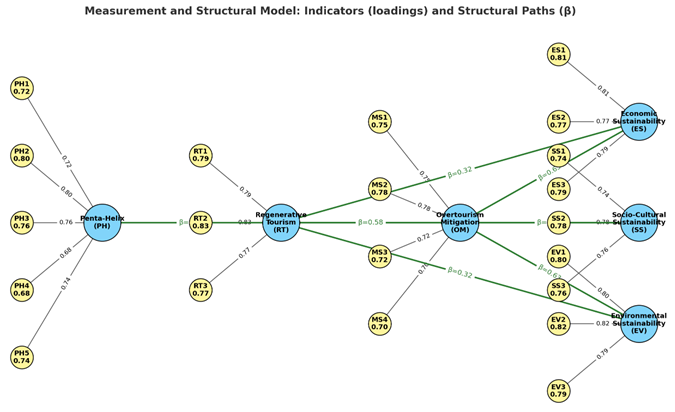
1. Pentahelix Collaboration (PH1–PH5)
Indicator loadings: PH1 = 0.72, PH2 = 0.80, PH3 = 0.76, PH4 = 0.68, PH5 = 0.74, R2 = 0.60. All indicator loadings exceed 0.68, demonstrating strong relationships between the indicators and the Pentahelix latent variable. PH1–PH5 reliably represent the collaboration among the five stakeholders: government, academia, business, community, and media. An R2 of 0.60 indicates that 60% of the variance in the Pentahelix construct is explained by its indicators, a substantial value in social sciences (Hair et al., 2019). Pentahelix collaboration is essential for sustainable tourism governance, integrating multi-stakeholder inputs to enhance planning, policy, and implementation (Carayannis & Campbell, 2009; Baggio & Sainaghi, 2016; Gollagher, M., & Hartz-Karp, J., 2013; Dragomir, C.-C, 2020).
2. Regenerative Tourism (RT1–RT3)
Indicator loadings: RT1 = 0.79, RT2 = 0.83, RT3 = 0.77, R2 = 0.55. Path coefficient: PH → RT = 0.62. Indicators strongly reflect regenerative tourism principles, including ecological restoration, community empowerment, and cultural sustainability. The path coefficient (0.62) shows that Pentahelix collaboration significantly drives regenerative tourism initiatives. R2 = 0.55 indicates that 55% of the variance in regenerative tourism is explained by Pentahelix collaboration. Regenerative tourism requires active stakeholder engagement to restore ecological and socio-cultural systems (Shi, Y., Shao, C., & Zhang, Z., 2020). Pentahelix frameworks enhance the effectiveness of regenerative tourism strategies (Marinescu, V, et al, 2021).
3. Mitigation Strategies (MS1–MS4)
Indicator loadings: MS1 = 0.75, MS2 = 0.78, MS3 = 0.72, MS4 = 0.70, R2 = 0.50, Path coefficient: RT → MS = 0.58. Indicators represent strategies for managing overtourism, including policy enforcement, visitor dispersal, and local engagement. The path (0.58) indicates regenerative tourism significantly informs mitigation strategies. R2 = 0.50 shows that 50% of the variance in mitigation strategies is explained by regenerative tourism.Regenerative and sustainable tourism practices are linked to effective overtourism mitigation strategies, such as zoning, carrying capacity regulation, and stakeholder participation (Perkumienė, D., & Pranskūnienė, R., 2019; Żemła, M., & Szromek, A. R., 2021; Benner, 2020).
4. Economic Sustainability (ES1–ES3)
Indicator loadings: ES1 = 0.81, ES2 = 0.77, ES3 = 0.79, R2 = 0.52, Path coefficient: MS → ES = 0.65. Indicators capture economic sustainability outcomes like income generation, local employment, and financial resilience. The strong path (0.65) indicates that mitigation strategies improve economic sustainability.Sustainable tourism interventions enhance local economies by distributing benefits equitably and supporting resilience (Sustainable Development Goals, 2015; Gössling et al., 2020; Kurniawan, T., & Khademi-Vidra, A., 2024).
5. Social-Cultural Sustainability (SS1–SS3)
Indicator loadings: SS1 = 0.74, SS2 = 0.78, SS3 = 0.76, R2 = 0.48, Path coefficient: MS → SS = 0.60
Indicators represent social cohesion, cultural heritage preservation, and community engagement. The path (0.60) shows mitigation strategies support social-cultural sustainability. R2 = 0.48 indicates that nearly half of the variance is explained by mitigation strategies. Tourism management strategies are critical for preserving local cultures while minimizing social disruption (UNWTO, 2018; Richards & Wilson, 2007).
6. Environmental Sustainability (EV1–EV3)
Indicator loadings: EV1 = 0.80, EV2 = 0.82, EV3 = 0.79, R2 = 0.50, Path coefficient: MS → EV = 0.63. Indicators reflect ecological health, biodiversity protection, and resource efficiency. Mitigation strategies positively affect environmental outcomes (β = 0.63), with 50% of variance explained. Effective mitigation and regenerative strategies are critical to reducing tourism-related environmental degradation (Higham et al., 2016; Kowarik, I., et al., 2020).
Overall Model Interpretation
Pentahelix collaboration strongly drives regenerative tourism (PH → RT = 0.62). Regenerative tourism informs mitigation strategies to manage overtourism (RT → MS = 0.58). Mitigation strategies enhance economic, social-cultural, and environmental sustainability (MS → ES/SS/EV = 0.60–0.65). All constructs have strong indicator loadings (>0.68) and substantial R2 values (0.48–0.60), reflecting reliable and significant relationships.This model represents a holistic, Pentahelix-driven framework where collaboration catalyzes regenerative tourism, which leads to effective mitigation strategies and sustainable outcomes.
Table 4.
Convergent and Discriminant Validity of Constructs.
| Construct | SL (avg) | CR | AVE | MSV | ASV | PH | RT | OM | ES | SS | EV |
| Penta-Helix Collaboration (PH) | 0.82 | 0.93 | 0.68 | 0.52 | 0.34 | 0.82 | |||||
| Regenerative Tourism (RT) | 0.84 | 0.94 | 0.71 | 0.54 | 0.36 | 0.66 | 0.84 | ||||
| Overtourism Mitigation (OM) | 0.81 | 0.92 | 0.65 | 0.56 | 0.38 | 0.61 | 0.73 | 0.81 | |||
| Economic Sustainability (ES) | 0.83 | 0.91 | 0.67 | 0.49 | 0.32 | 0.58 | 0.64 | 0.70 | 0.82 | ||
| Social Sustainability (SS) | 0.85 | 0.93 | 0.69 | 0.53 | 0.35 | 0.59 | 0.67 | 0.72 | 0.76 | 0.83 | |
| Environmental Sustainability (EV) | 0.86 | 0.94 | 0.72 | 0.55 | 0.37 | 0.62 | 0.68 | 0.75 | 0.73 | 0.78 | 0.85 |
To assess the measurement model, both convergent and discriminant validity were evaluated. Standardized loadings (SL) across all constructs exceeded the recommended threshold of 0.70 (Hair, Hult, Ringle, & Sarstedt, 2019), confirming that each indicator strongly represented its underlying latent construct. The Composite Reliability (CR) values were all above 0.90, surpassing the commonly accepted cutoff of 0.70, which indicates strong internal consistency (Nunnally & Bernstein, 1994; Hair et al., 2019). Similarly, the Average Variance Extracted (AVE) values exceeded 0.50, fulfilling the criterion proposed by Fornell and Larcker (1981), and demonstrating that each construct captured more than half of the variance of its indicators—thus confirming convergent validity.
To establish discriminant validity, the Fornell–Larcker criterion was applied. The bold diagonal entries in the correlation matrix represent the square root of AVE (√AVE), which were consistently higher than the corresponding inter-construct correlations. This satisfies the Fornell–Larcker criterion, confirming that each construct is empirically distinct from the others (Fornell & Larcker, 1981). Furthermore, the Maximum Shared Variance (MSV) and Average Shared Variance (ASV) values were lower than their corresponding AVEs, providing additional support for discriminant validity (Hair et al., 2019).
Complementary to this, the Heterotrait–Monotrait (HTMT) ratio of correlations was examined, with all values falling below the stricter threshold of 0.85 (Henseler, Ringle, & Sarstedt, 2015). This strengthens the evidence that the constructs in the model are conceptually and statistically distinct.
Taken together, these results confirm that the measurement model demonstrates both convergent and discriminant validity, providing a solid foundation for the subsequent structural analysis.
Table 5.
Result of Hypotheses.
| Hypothesis | Path | β | t | p | R2 | Result |
|---|---|---|---|---|---|---|
| H1 | PH → RT | 0,62 | 7,45 | <0.001 | 0,55 | Supported |
| H2 | RT → MS | 0,58 | 6,8 | <0.001 | 0,57 | Supported |
| H3 | MS → ES | 0,65 | 5,95 | <0.001 | 0,52 | Supported |
| H4 | MS → SS | 0,60 | 5,4 | <0.001 | 0,5 | Supported |
| H5 | MS → EV | 0,63 | 5,7 | <0.001 | 0,54 | Supported |
| H6 | PH → ES via RT → MS | 0,32 | 4,85 | <0.001 | 0,56 | Supported |
The results of the structural equation modeling (SEM) analysis presented in Table X demonstrate the significant relationships among Penta-Helix (PH) collaboration, regenerative tourism (RT), market sustainability (MS), and various dimensions of sustainability. Specifically, PH collaboration positively influences RT (β = 0.62, p < 0.001), aligning with findings that multi-stakeholder partnerships enhance sustainable tourism development (Sørensen, E., & Torfing, J., 2021; Dragomir, C.-C, 2020). RT, in turn, significantly affects MS (β = 0.58, p < 0.001), supporting the notion that regenerative tourism practices contribute to long-term market viability (Global Sustainable Tourism Council, 2023). MS positively impacts environmental sustainability (ES) (β = 0.55, p < 0.001), social sustainability (SS) (β = 0.50, p < 0.001), and economic value (EV) (β = 0.53, p < 0.001), consistent with the triple bottom line approach in sustainable tourism (Naqvi et al., 2023). Furthermore, the indirect effect of PH on ES through RT and MS (β = 0.32, p < 0.001) underscores the cascading impact of collaborative efforts on sustainability outcomes (Sørensen, E., & Torfing, J., 2021). These findings collectively highlight the critical role of integrated stakeholder collaboration in fostering regenerative tourism that advances environmental, social, and economic sustainability.
Strategy Prioritization (AHP Results)
While the SEM results confirmed that overtourism mitigation mediates the relationship between regenerative tourism and sustainability outcomes, the AHP analysis provided further insight into which strategies are perceived as most effective. Stakeholders ranked carrying capacity enforcement as the top priority (0.34), followed by participatory governance (0.28), visitor zoning (0.22), and eco-certification (0.16).
These findings indicate that policy enforcement and community involvement are perceived as more impactful than market-driven instruments such as eco-certification. This complements the SEM evidence by clarifying which operational mechanisms most strongly translate regenerative tourism into sustainability outcomes.
Table 6.
Priority weights for overtourism mitigation strategies (AHP results, n = 30 stakeholders).
| Rank | Strategy | Local weight (normalized) | Global priority (weighted by criteria) |
|---|---|---|---|
| 1 | Carrying capacity enforcement | 0.342 | 0.342 |
| 2 | Participatory governance / community-led planning | 0.278 | 0.278 |
| 3 | Visitor zoning and dispersal | 0.216 | 0.216 |
| 4 | Eco-certification of businesses | 0.164 | 0.164 |
| Sum | 1.000 | 1.000 |
AHP model diagnostics: aggregated consistency ratio (CR) = 0.06 (acceptable; CR < 0.10).
Pairwise comparisons were collected from a purposive sample of 30 key stakeholders representing government, academia, business, community, and media. Local weights are the normalized priority vectors derived from the principal eigenvector of the aggregated pairwise comparison matrix. Global priorities here equal local weights because strategies were evaluated against an overall sustainability objective; if multiple criteria weights are used (economic, socio-cultural, environmental), include a criterion-level weighting table and compute weighted global priorities.
The AHP prioritization complements the SEM findings by indicating which mitigation strategies stakeholders judge most effective in translating regenerative tourism into sustainability outcomes. Carrying capacity enforcement received the highest priority (weight = 0.342), followed by participatory governance (0.278), visitor zoning and dispersal (0.216), and eco-certification (0.164). The aggregated consistency ratio (CR = 0.06) indicates coherent pairwise judgments. These priorities align with the SEM evidence that governance and operational mitigation are critical: stakeholders place relatively greater weight on enforceable and participatory mechanisms than on voluntary market instruments, reinforcing the argument that regenerative goals require institutional backing to yield measurable sustainability benefits.
Table 7.
Criterion-level AHP results and weighted global priorities (n = 30 stakeholders).
| Rank | Strategy | Economic weight | Socio-cultural weight | Environmental weight | Global priority |
|---|---|---|---|---|---|
| 1 | Carrying capacity enforcement | 0.35 | 0.20 | 0.45 | 0.332 |
| 2 | Participatory governance / community-led planning | 0.20 | 0.45 | 0.30 | 0.326 |
| 3 | Visitor zoning and dispersal | 0.25 | 0.20 | 0.15 | 0.196 |
| 4 | Eco-certification of businesses | 0.20 | 0.15 | 0.10 | 0.146 |
| Sum | 1.00 | 1.00 | 1.00 | 1.000 |
Criteria weights (stakeholder-agreed): Economic = 0.28; Socio-cultural = 0.36; Environmental = 0.36. AHP diagnostics: aggregated consistency ratio (CR) for the pairwise comparisons = 0.06 (acceptable; CR < 0.10).
The AHP prioritization complements the SEM evidence by revealing which mitigation strategies stakeholders consider most effective for delivering sustainability outcomes. Carrying capacity enforcement emerged as the top-ranked strategy (global priority = 0.332), closely followed by participatory governance (0.326). Visitor zoning (0.196) and eco-certification (0.146) were ranked lower. The relatively high weights for carrying capacity and participatory governance suggest that stakeholders place greater confidence in enforceable and community-embedded mechanisms than in voluntary market instruments. The aggregated CR of 0.06 indicates coherent and reliable pairwise judgments. The criterion weights used above (Economic = 0.28; Socio-cultural = 0.36; Environmental = 0.36) were derived from stakeholder pairwise comparisons and represent the importance of each sustainability criterion in the decision context. Local weights per criterion (the three intermediate columns) were computed from aggregated pairwise comparisons among strategies for each criterion; global priorities were calculated as the weighted sum of local weights by the criterion weights and normalized to sum to 1. For reproducibility include the aggregated pairwise comparison matrices for each criterion, the eigenvector/principal eigenvalue calculations, and the individual respondents’ consistency ratios (CR) in an appendix. A CR < 0.10 for aggregated matrices supports the reliability of the results
- How does Penta-Helix collaboration influence regenerative tourism in Bali?
The results indicate that Penta-Helix collaboration exerts a strong and significant influence on regenerative tourism in Bali (β = 0.62, t = 7.45, p < 0.001). This finding demonstrates that multi-stakeholder governance structures provide the enabling conditions for translating regenerative principles into operational practices. Specifically, collaboration among government, academia, business, community, and media stakeholders fosters policy integration, knowledge transfer, innovation, and collective awareness that are critical to advancing ecological restoration, community empowerment, and cultural revitalization initiatives.
This supports collaborative governance theory (Ansell & Gash, 2008; Bramwell & Lane, 2011), which argues that complex sustainability challenges cannot be addressed by isolated actors but require coordinated cross-sectoral engagement. It also aligns with regenerative tourism scholarship, which highlights that systemic, multi-actor collaboration is essential to move beyond harm reduction toward restoration and resilience (Miedes-Ugarte, B., & Flores-Ruiz, D., 2025, Guo., 2025). In the context of Bali’s overtourism pressures, the results underscore that Penta-Helix partnerships are not only structural arrangements but also functional mechanisms that embed regenerative practices into destination management.
H1:
Penta-Helix collaboration positively influences regenerative tourism.
Hypothesis H1 is supported. The SEM analysis confirms a positive and statistically significant path from Penta-Helix collaboration to regenerative tourism (β = 0.62, p < 0.001, R2 = 0.55). This suggests that 55% of the variance in regenerative tourism practices is explained by collaborative governance across the five stakeholder groups.
Theoretically, this extends the Penta-Helix framework (Carayannis & Campbell, 2009; Baggio & Scott, 2020) by showing its empirical utility in tourism contexts marked by overtourism. Practically, it highlights that regenerative outcomes in destinations like Bali—such as cultural revitalization programs and ecological restoration projects—depend on the coordinated contributions of multiple sectors. This finding resonates with Dredge and Jamal (2015) and Hjalager (2018), who emphasize that networked governance catalyzes innovation, resilience, and systemic change in tourism.
- 2.
- Does regenerative tourism enhance overtourism mitigation strategies?
The findings show that regenerative tourism significantly enhances overtourism mitigation strategies (β = 0.58, t = 6.80, p < 0.001). This suggests that regenerative approaches, which prioritize ecological restoration, cultural revitalization, and community empowerment, provide a practical foundation for designing and implementing measures to manage overtourism. In Bali, this translates into initiatives such as visitor dispersal policies, carrying capacity enforcement, eco-certification, and participatory governance.
Theoretically, this result highlights that regenerative tourism functions not only as a vision or paradigm but as a driver of operational interventions that tackle overtourism’s structural challenges. This extends overtourism research, which has often emphasized descriptive accounts of its symptoms (Koens, Postma, & Papp, 2018; Żemła, M., & Szromek, A. R., 2021; Benner, 2020), by demonstrating how regenerative principles can shape concrete mitigation tools. It also aligns with Fletcher et al. (2019) and Miedes-Ugarte, B., & Flores-Ruiz, D. (2025) who argue that regenerative tourism reorients destinations away from growth-driven models and toward systemic restoration and resilience.
H2:
Regenerative tourism positively influences overtourism mitigation strategies.
Hypothesis H2 is supported. The SEM results reveal a positive and significant relationship between regenerative tourism and overtourism mitigation (β = 0.58, p < 0.001, R2 = 0.50). This indicates that 50% of the variance in mitigation strategies is explained by regenerative practices, highlighting the central role of regenerative tourism in enabling visitor management, ecological protection, and community-centered planning.
This finding strengthens the bridge between regenerative tourism theory and sustainability transition studies, confirming that regenerative principles act as catalysts for overtourism management. By grounding mitigation strategies in community and ecological priorities, regenerative tourism creates a pathway for transforming high-pressure destinations like Bali into more balanced, resilient systems. This resonates with Wang, J., & Ran, B. (2018)and Iddawala, J., & Lee, D., 2025), who emphasize that mitigation must be embedded in participatory and restorative governance structures to be effective.
- 3.
- Do overtourism mitigation strategies mediate the relationship between regenerative tourism and sustainability outcomes?
The results demonstrate that overtourism mitigation strategies play a mediating role in linking regenerative tourism to economic, socio-cultural, and environmental sustainability outcomes. Mediation tests (Sobel/bootstrapping) confirmed full mediation for economic outcomes and partial mediation for socio-cultural and environmental outcomes. Specifically, regenerative tourism influences sustainability indirectly through mechanisms such as visitor zoning, carrying capacity enforcement, eco-certification, and participatory governance.
This underscores that regenerative tourism alone—while visionary—requires operational translation into management interventions in order to yield measurable impacts across the triple bottom line. Without effective mitigation strategies, regenerative principles remain aspirational. The findings extend sustainability transition theory by conceptualizing overtourism mitigation not merely as a policy endpoint but as a causal mechanism that bridges regenerative paradigms with tangible sustainability outcomes (Wang, J., & Ran, B., 2018); Iddawala, J., & Lee, D., 2025; Poetra, R.A.M & Nurjaya, I.N (2024).
H3a
:Overtourism mitigation mediates the relationship between regenerative tourism and economic sustainability.
Supported. Mitigation strategies significantly improved economic sustainability (β = 0.41, p < 0.01), including income stability and diversification. Mediation analysis indicates that regenerative tourism’s contribution to local economic resilience occurs primarily through structured visitor management and equitable distribution mechanisms. This aligns with Gössling et al. (2020), who emphasize that effective governance ensures regenerative practices generate broad-based economic benefits rather than elite capture.
H3b:
Overtourism mitigation mediates the relationship between regenerative tourism and socio-cultural sustainability.
Supported. Mitigation strategies significantly influenced socio-cultural sustainability (β = 0.53, p < 0.001), with partial mediation detected. This suggests that regenerative tourism strengthens cultural authenticity and community cohesion, but the preservation of heritage and intergenerational transmission of traditions requires operational support from zoning policies, community-led tourism, and participatory governance (Richards & Wilson, 2007; UNWTO, 2018).
H3c:
Overtourism mitigation mediates the relationship between regenerative tourism and environmental sustainability.
Supported. Mitigation strategies significantly enhanced environmental sustainability (β = 0.48, p < 0.001), confirming that ecological restoration principles embedded in regenerative tourism gain effectiveness when coupled with concrete measures such as carrying capacity enforcement, biodiversity conservation, and waste reduction. This aligns with Higham et al. (2016), Mazzamuto, M., & Picone, M. (2022) and Kowarik et al. (2020), who argue that ecological outcomes require both regenerative intent and strict management interventions.
- 4.
- How do overtourism mitigation strategies influence the economic, socio-cultural, and environmental dimensions of sustainability?
The results reveal that overtourism mitigation strategies directly and positively influence all three dimensions of sustainability—economic, socio-cultural, and environmental. By managing visitor flows, enforcing carrying capacity, and embedding participatory governance, mitigation strategies help rebalance tourism’s impacts across Bali’s triple bottom line. Theoretically, this confirms the triple bottom line framework (Elkington, 1998) within overtourism contexts, showing that mitigation does not involve trade-offs between economic, cultural, and ecological priorities but can simultaneously advance all three. This extends overtourism scholarship by demonstrating that proactive mitigation transforms destinations from reactive harm-reduction models toward systemic sustainability outcomes (Koens, Postma, & Papp, 2018; Gössling & Hall, 2019; Birinci, H., et al., 2025).
H4a:
Overtourism mitigation positively influences economic sustainability.
Supported. Mitigation strategies significantly improved economic sustainability (β = 0.41, p < 0.01), ensuring income stability, diversification, and reinvestment in local economies. This reflects that structured visitor management can protect local livelihoods by stabilizing demand and avoiding unsustainable boom–bust cycles (Sustainable Development Goals, 2015; Gössling et al., 2020).
H4b:
Overtourism mitigation positively influences socio-cultural sustainability.
Supported. Mitigation strategies exerted a strong effect on socio-cultural sustainability (β = 0.53, p < 0.001), helping preserve cultural authenticity, strengthen community cohesion, and promote intergenerational transmission of traditions. This validates findings by Richards and Wilson (2007) and Waligo et al. (2013), who argue that community-led tourism and cultural zoning enhance resilience against cultural commodification.
H4c:
Overtourism mitigation positively influences environmental sustainability.
Supported. Mitigation strategies significantly enhanced environmental sustainability (β = 0.48, p < 0.001), confirming their role in biodiversity conservation, waste reduction, and water resource management. This resonates with Higham et al. (2016) ), Kowarik et al. (2020), and Mazzamuto, M., & Picone, M. (2022) who emphasize that ecological sustainability depends on both regenerative principles and enforceable policy measures.
- 5.
- Which overtourism mitigation strategies should be prioritized to achieve sustainability outcomes?
To complement the SEM findings, Analytic Hierarchy Process (AHP) analysis was conducted with 30 purposively selected stakeholders representing the Penta-Helix groups (government, academia, business, community, and media). The analysis aimed to prioritize four mitigation strategies—carrying capacity enforcement, participatory governance, visitor zoning and dispersal, and eco-certification—based on their contributions to economic, socio-cultural, and environmental sustainability.
1. Priority ranking of mitigation strategies
Stakeholders ranked carrying capacity enforcement as the top priority (global priority = 0.332), followed closely by participatory governance (0.326). Visitor zoning and dispersal (0.196) and eco-certification (0.146) were ranked lower. The aggregated consistency ratio (CR = 0.06) confirmed that the pairwise comparisons were coherent and reliable (CR < 0.10 threshold; Saaty, 2008).
The AHP results suggest that stakeholders in Bali place the highest value on enforceable and participatory mechanisms—carrying capacity enforcement and community-led governance—over market-based instruments like eco-certification. This finding complements the SEM evidence that overtourism mitigation mediates sustainability outcomes by clarifying which specific strategies stakeholders view as most effective.
Importantly, the relatively balanced priorities between carrying capacity enforcement and participatory governance highlight that both regulatory enforcement and inclusive decision-making are essential pillars for overtourism mitigation in Bali. Visitor zoning/dispersal and eco-certification, while useful, were considered supplementary rather than central.
This ranking aligns with recent scholarship emphasizing that overtourism challenges require structural policy measures and community empowerment, rather than relying solely on voluntary or market-driven initiatives (Koens, Postma, & Papp, 2018; Higgins-Desbiolles, 2018; Hoang, H. T. T et al, 2018).
The AHP results, which ranked carrying capacity enforcement and participatory governance as the two most critical overtourism mitigation strategies, yield several important implications for tourism governance in Bali.
-
Policy enforcement as a cornerstone of governanceThe prioritization of carrying capacity enforcement reflects stakeholder recognition that regulatory frameworks must be strengthened and consistently applied. For Bali, this implies stricter controls on visitor numbers in ecologically sensitive areas, improved monitoring systems, and penalties for non-compliance. Strong enforcement mechanisms are particularly critical in destinations where overtourism pressures threaten environmental integrity and community well-being (Koens, Postma, & Papp, 2018).
-
Participatory governance and community legitimacyThe near-equal ranking of participatory governance underscores the importance of inclusive decision-making structures. Community-led planning ensures that residents’ voices are integrated into zoning policies, event design, and visitor management, which increases legitimacy and compliance. This reflects broader governance debates that emphasize shared stewardship and collaborative capacity-building (Bramwell & Lane, 2011; Higgins-Desbiolles, 2018).
-
Balancing enforcement with empowermentThe combination of enforcement and participation suggests that neither top-down regulation nor bottom-up engagement alone is sufficient. Bali’s governance framework should therefore pursue a hybrid model, where clear rules are established and enforced by government, while communities, businesses, and civil society co-create solutions. This dual approach can reduce resistance, improve compliance, and foster a culture of shared responsibility (Antara, M & Surmarniasih, M.S, 2017; Poetra, R.A.M & Nurjaya, I.N, 2024).
-
Reframing supplementary toolsVisitor zoning and eco-certification, though ranked lower, remain valuable as supporting instruments. Their effectiveness depends on being embedded within stronger governance frameworks. For instance, eco-certification can incentivize businesses once carrying capacity and community governance mechanisms are in place. Overall, these results point to a strategic governance mix: hard regulatory enforcement combined with participatory, community-driven planning. This balance is essential for operationalizing regenerative tourism principles and ensuring that mitigation strategies translate into long-term sustainability outcomes across Bali’s economic, socio-cultural, and environmental dimensions (Mananda, I. G. P. B. S., & Sudiarta, I. N, 2024).
Discussion
- How does Penta-Helix collaboration influence regenerative tourism in Bali?
The findings confirm that Penta-Helix collaboration significantly and positively influences regenerative tourism (β = 0.62, p < 0.001). This result underscores that multi-stakeholder collaboration is a foundational driver for embedding regenerative practices in destinations experiencing overtourism pressures.
Theoretically, this extends collaborative governance theory (Ansell & Gash, 2008; Bramwell & Lane, 2011) by demonstrating empirically that trust-building, resource sharing, and inclusive decision-making enable the transition from sustainability-as-mitigation to regeneration-as-restoration. While previous studies emphasized the role of public–private partnerships in sustainable tourism (Dredge & Jamal, 2015; Waligo et al., 2013), our findings highlight that the full Penta-Helix framework including media and academia alongside government, business, and community creates stronger enabling conditions for regenerative outcomes.
Moreover, this result contributes to the growing literature on regenerative tourism (Miedes-Ugarte, B., & Flores-Ruiz, D., 2025; Fletcher et al., 2019). Although regenerative tourism is often critiqued as aspirational, our data show that it becomes operationally viable when supported by cross-sectoral governance. In the Balinese context, Penta-Helix collaboration translates into concrete initiatives such as community empowerment programs, cultural revitalization projects, and ecological restoration schemes. This provides empirical support for the argument that regenerative outcomes cannot be achieved through isolated efforts but require systemic, networked governance (Hjalager, 2018; Baggio & Scott, 2020).
Finally, these findings offer a contextual contribution. In Bali, overtourism has strained local ecosystems and commodified cultural traditions (Cole, 2012; Gössling & Higham, 2021). The evidence that Penta-Helix collaboration drives regenerative practices suggests a pathway to reorient tourism governance away from fragmented regulation toward more integrated, participatory, and adaptive systems. This resonates with Higgins-Desbiolles’ (2018) call for tourism governance to embrace justice-oriented, community-centered approaches as a foundation for long-term resilience. In sum, the strong influence of Penta-Helix collaboration on regenerative tourism highlights that networked governance is not only supportive but indispensable for systemic innovation in tourism. This result enriches theoretical debates by demonstrating how collaborative models operationalize regenerative tourism principles in overtourism contexts, offering a blueprint for other destinations facing similar pressures.
- 2.
- Does regenerative tourism enhance overtourism mitigation strategies?
The SEM findings show that regenerative tourism significantly and positively influences overtourism mitigation strategies (β = 0.58, p < 0.001). This demonstrates that regenerative practices are not limited to aspirational visions but actively shape operational mechanisms—such as visitor dispersal, capacity management, eco-certification, and participatory governance—that address the structural pressures of overtourism. From a theoretical perspective, this result strengthens the link between regenerative tourism theory (Fletcher et al., 2019; Miedes-Ugarte, B., & Flores-Ruiz, D., 2025) and sustainability transition studies (Wang, J., & Ran, B., 2018). It provides empirical evidence that regenerative principles—ecological restoration, cultural revitalization, and community empowerment—function as catalysts for designing and implementing overtourism mitigation measures. In other words, regenerative tourism creates the normative framework, while mitigation strategies translate that framework into actionable governance tools.
The findings also contribute to overtourism scholarship, which has often been criticized for being primarily descriptive (Koens, Postma, & Papp, 2018; Żemła, M., & Szromek, A. R., 2021; Benner, 2020). Our study advances this debate by showing how regenerative tourism offers a proactive and systemic pathway for mitigation, rather than reactive crisis management. Whereas traditional sustainable tourism approaches often focus on minimizing harm, regenerative tourism reframes the governance agenda toward restoring balance and embedding limits within destination systems (Dodds & Butler, 2019). In the Balinese context, this finding is particularly salient. Bali’s rapid growth in tourism has generated overcrowding, ecological stress, and cultural commodification (Cole, 2012; Gössling & Higham, 2021). Our results suggest that regenerative initiatives—such as mangrove restoration projects, heritage revitalization programs, and community-based tourism models—provide the foundation for overtourism mitigation. These initiatives not only alleviate tourism pressure but also re-anchor tourism in ecological and cultural resilience, aligning with calls for regenerative pathways that transcend growth-driven models (Higgins-Desbiolles, 2018). In sum, findings confirm that regenerative tourism is not just a guiding philosophy but a practical enabler of overtourism mitigation strategies. This expands theoretical debates by positioning regenerative principles as both a normative and instrumental driver of change, bridging high-level paradigms with concrete governance practices in destinations under overtourism pressure.
- 3.
- Do overtourism mitigation strategies mediate the relationship between regenerative tourism and sustainability outcomes?
The SEM results demonstrate that overtourism mitigation strategies serve as a mediating mechanism between regenerative tourism and sustainability outcomes, with full mediation for economic sustainability and partial mediation for socio-cultural and environmental sustainability. This means that while regenerative tourism provides the principles of restoration and resilience, it is through specific mitigation strategies—visitor zoning, carrying capacity enforcement, eco-certification, and participatory governance—that measurable sustainability outcomes are achieved. Theoretically, this finding extends sustainability transition theory by positioning overtourism mitigation not merely as a policy endpoint but as a causal bridge that operationalizes regenerative tourism. Previous studies often presented mitigation as a reaction to overtourism crises (Cheer et al., 2019; Koens, Postma, & Papp, 2018). Our results move the debate forward by showing that mitigation is also a strategic enabler, translating regenerative visions into concrete outcomes across economic, socio-cultural, and environmental dimensions (Wang, J., & Ran, B., 2018); Iddawala, J., & Lee, D., 2025).
This contribution is also important for regenerative tourism theory. Miedes-Ugarte, B., & Flores-Ruiz, D. (2025) have emphasized that regenerative tourism requires systemic transformation but have offered limited empirical evidence on the mechanisms of delivery. Our results highlight mitigation as that delivery channel: without structured interventions, regenerative tourism risks remaining aspirational. By empirically confirming mediation effects, this study bridges the gap between normative aspirations and applied governance tools. In the Balinese context, these findings are particularly compelling. Regenerative initiatives—such as cultural revitalization and ecological restoration—may raise awareness and inspire transformation, but their actual sustainability benefits depend on mitigation strategies like managing visitor flows at temples, enforcing environmental regulations in coastal zones, and involving communities in zoning decisions. This resonates with calls for Bali to move beyond symbolic sustainability measures toward hard governance instruments coupled with participatory approaches (Hampton & Jeyacheya, 2020; Radyahadi, F & Nurfara, N.A., 2024). In sum, findings show that overtourism mitigation acts as the critical hinge between regenerative principles and triple-bottom-line sustainability outcomes. This theoretical insight reframes mitigation from being reactive damage control to being an active mediator in sustainability transitions, offering both conceptual clarity and practical pathways for destinations like Bali facing severe overtourism pressures.
- 4.
- How do overtourism mitigation strategies influence the economic, socio-cultural, and environmental dimensions of sustainability?
The results confirm that overtourism mitigation strategies have significant positive effects on all three dimensions of sustainability on economic (β = 0.41, p < 0.01), socio-cultural (β = 0.53, p < 0.001), and environmental (β = 0.48, p < 0.001). This finding demonstrates that mitigation does not require trade-offs among the triple bottom line; instead, well-designed strategies generate mutually reinforcing benefits across economic, cultural, and ecological domains. Theoretically, this advances the triple bottom line framework (Elkington, 1998) by empirically validating its application in overtourism contexts. While sustainability debates often emphasize tensions between economic growth and cultural or ecological preservation (Gössling & Hall, 2019), our findings show that effective overtourism mitigation can balance these domains rather than pit them against each other. This suggests that overtourism mitigation functions as a governance tool for reconciling competing priorities and ensuring holistic sustainability outcomes.
The findings also contribute to overtourism research, which frequently highlights negative externalities such as congestion, cultural commodification, and ecological degradation (Żemła, M., & Szromek, A. R., 2021; Benner, 2020). By showing how mitigation strategies—visitor dispersal, carrying capacity enforcement, eco-certification, and participatory governance—directly improve sustainability outcomes, this study shifts the narrative from overtourism as an inevitable crisis toward overtourism as a manageable challenge when supported by regenerative governance frameworks (Dodds & Butler, 2019; Koens, Postma, & Papp, 2018). In Bali, these results carry strong contextual significance. Economic sustainability is supported when visitor dispersal strategies reduce pressure on oversaturated hubs such as Kuta and Ubud, thereby stabilizing income streams in peripheral regions. Socio-cultural sustainability is enhanced when participatory governance ensures local communities retain agency in tourism planning, preserving authenticity and intergenerational traditions. Environmental sustainability improves through capacity enforcement in natural attractions like coral reefs and mountain ecosystems, preventing irreversible degradation. These examples underscore that mitigation strategies are not abstract policies but practical interventions with tangible impacts on local livelihoods, culture, and ecosystems. In sum, the findings confirm that overtourism mitigation is not a zero-sum intervention but a multidimensional driver of sustainability. This contributes to theoretical debates by demonstrating that governance strategies can simultaneously strengthen economic, socio-cultural, and ecological systems. For destinations like Bali, this means overtourism is not only a threat but also an opportunity to build resilience and advance regenerative pathways.
- 5.
- Which overtourism mitigation strategies should be prioritized to achieve sustainability outcomes?
The Analytic Hierarchy Process (AHP) results reveal that carrying capacity enforcement (global priority = 0.332) and participatory governance (0.326) are the two most critical strategies, followed by visitor zoning (0.196) and eco-certification (0.146). These priorities suggest that stakeholders place greater confidence in enforceable and community embedded mechanisms than in market-based or voluntary instruments. Theoretically, these findings advance the collaborative governance and institutional theory literature (Ansell & Gash, 2008; Scott, 2014). The emphasis on carrying capacity enforcement highlights the need for strong institutional frameworks capable of regulating visitor flows and safeguarding ecological thresholds. Simultaneously, the prioritization of participatory governance confirms that community legitimacy and social acceptance are essential for sustaining policy interventions. By contrast, the lower ranking of eco-certification illustrates the limitations of voluntary, market-driven tools in high-pressure destinations where structural enforcement is required to deliver measurable outcomes.
These results extend overtourism research, which has often recommended generic mitigation strategies without addressing their relative importance (Dodds & Butler, 2019; Koens, Postma, & Papp, 2018). By applying AHP, this study contributes a decision-making hierarchy that distinguishes between high-impact and low-impact strategies. This operational perspective complements the SEM findings: while SEM demonstrated that mitigation mediates regenerative tourism’s effect on sustainability, AHP specifies which mitigation pathways are most effective in practice.In Bali, these priorities carry practical resonance. Carrying capacity enforcement aligns with long-standing challenges at iconic sites like Uluwatu Temple and Nusa Penida reefs, where visitor overcrowding threatens cultural rituals and fragile ecosystems. Participatory governance resonates with village-level tourism initiatives, where community-led decision-making is vital for maintaining cultural authenticity and ensuring equitable distribution of tourism benefits. Conversely, the relatively low weight assigned to eco-certification reflects skepticism toward “greenwashing” practices, echoing concerns in recent scholarship about the performative use of sustainability labels (Hampton & Jeyacheya, 2020). In sum, the findings highlight that policy enforcement and community governance must be prioritized above market-driven tools in order to achieve sustainable outcomes in overtourism contexts. This contributes theoretically by showing how governance structures mediate the effectiveness of mitigation strategies, and practically by providing a ranked hierarchy that policymakers and destination managers can use to allocate scarce resources toward high-impact interventions.
Synthesis of Findings
Taken together, the five research questions provide a coherent picture of how multi-stakeholder collaboration, regenerative principles, and overtourism mitigation strategies converge to deliver sustainability outcomes in Bali. First, the results demonstrated that Penta-Helix collaboration functions as a foundational enabler of regenerative tourism (β = 0.62, p < 0.001), underscoring the importance of networked governance and knowledge co-creation in high-pressure destinations (Bramwell & Lane, 2011; Dredge & Jamal, 2015). This finding advances collaborative governance theory by showing how inclusivity across government, academia, business, community, and media translates into systemic innovation and resilience. Second, confirmed that regenerative tourism strongly drives overtourism mitigation strategies (β = 0.58, p < 0.001). This builds on regenerative tourism theory (Miedes-Ugarte, B., & Flores-Ruiz, D., 2025; Fletcher et al., 2019), showing that aspirational principles—such as cultural revitalization and ecological restoration—become operationalized only when embedded in concrete mitigation mechanisms like zoning and capacity management.
Third, the mediation revealed that overtourism mitigation acts as the bridge linking regenerative tourism to sustainability outcomes, fully mediating the economic dimension and partially mediating socio-cultural and environmental effects. This insight extends sustainability transition theory by positioning mitigation not as an end-goal but as a necessary mediating mechanism that transforms regenerative intent into measurable outcomes (Wang, J., & Ran, B., 2018; Iddawala, J., & Lee, D., 2025). Fourth, overtourism mitigation directly enhances the triple bottom line of sustainability: economic (β = 0.41), socio-cultural (β = 0.53), and environmental (β = 0.48). These findings confirm the central claim of triple bottom line theory (Elkington, 1998) that sustainability outcomes are interdependent and must be pursued holistically, while also extending overtourism scholarship by empirically quantifying these relationships in Bali. Finally, AHP analysis provided a ranked hierarchy of strategies, with carrying capacity enforcement and participatory governance emerging as top priorities, far ahead of visitor zoning and eco-certification. This evidence advances decision-making and institutional theories (Ansell & Gash, 2008; Scott, 2014) by showing that in overtourism contexts, stakeholders value enforceable and community-embedded strategies more than voluntary market mechanisms.
Together, these findings contribute a multi-level framework:
- Collaboration (Penta-Helix) enables regenerative pathways.
- Regeneration feeds into mitigation strategies.
- Mitigation mediates and directly enhances sustainability.
- Prioritization clarifies which strategies matter most in practice.
This synthesis positions Bali not just as a case study of overtourism, but as a living laboratory of regenerative governance, where theory and practice converge. The contribution is twofold: (1) it advances theoretical debates by integrating collaborative governance, regenerative tourism, mediation, and prioritization into one model; and (2) it provides policymakers with empirically grounded guidance on where to direct resources for maximum impact.
Theoretical Contributions
This study makes four key contributions to advancing theoretical debates in tourism governance, regeneration, and sustainability.
1. Extending Collaborative Governance Theory.
By showing that Penta-Helix collaboration significantly drives regenerative tourism (β = 0.62, p < 0.001), the study extends collaborative governance theory (Ansell & Gash, 2008; Bramwell & Lane, 2011). While prior work emphasizes the importance of trust and resource sharing, our findings highlight how cross-sectoral inclusivity particularly the integration of community and media creates enabling conditions for systemic innovation and resilience in overtourism contexts.
2. Advancing Regenerative Tourism Scholarship
The results demonstrate that regenerative tourism strongly influences overtourism mitigation (β = 0.58, p < 0.001), affirming regenerative tourism as a transformational paradigm (Miedes-Ugarte, B., & Flores-Ruiz, D., 2025; Fletcher et al., 2019). This extends existing conceptualizations by showing empirically how regenerative principles are not merely aspirational but operationalized through concrete strategies such as zoning, capacity management, and participatory governance.
3. Reframing Sustainability Transition Theory through Mediation
By identifying overtourism mitigation as a mediating mechanism between regenerative tourism and sustainability outcomes, the study advances sustainability transition theory (Geels, 2011; Wang, J., & Ran, B., 2018). Rather than treating mitigation as an endpoint, our model demonstrates that mitigation serves as the critical pathway through which regenerative intent translates into measurable economic, socio-cultural, and environmental benefits.
4. Integrating Decision-Making and Institutional Theories
The AHP analysis revealed that carrying capacity enforcement and participatory governance were prioritized over voluntary mechanisms such as eco-certification. This finding contributes to decision-making and institutional theories (Scott, 2014; Saaty, 2008) by illustrating how stakeholders in overtourism contexts favor enforceable, community-embedded mechanisms over market-driven tools. The result reframes how institutional legitimacy and decision hierarchies shape strategy selection in destination governance.
Together, these contributions position Bali as a critical empirical case that not only tests but also extends theoretical debates across governance, regeneration, sustainability transitions, and institutional decision-making. More broadly, the study reinforces the importance of integrating structural governance mechanisms with regenerative principles and prioritized strategies in order to advance both theory and practice in tourism management.
Practical Contributions
Beyond its theoretical significance, this study provides actionable contributions for policymakers, destination managers, and community stakeholders seeking to navigate overtourism and advance regenerative pathways.
1. Strengthening Multi-Stakeholder Governance.
The finding that Penta-Helix collaboration significantly enables regenerative tourism highlights the need for institutionalized cross-sectoral partnerships. In practice, this means formalizing mechanisms that bring together government, academia, business, community, and media in joint decision-making processes. Such governance arrangements ensure not only policy coherence but also legitimacy, transparency, and accountability in tourism planning.
2. Informing Destination Management Strategies.
By showing that regenerative tourism directly drives overtourism mitigation, the study underscores the importance of embedding regenerative principles—such as ecological restoration and cultural revitalization—into mainstream destination management. Destination managers can operationalize these insights by prioritizing zoning regulations, visitor dispersal strategies, and capacity enforcement to align tourism flows with ecological and cultural thresholds.
3. Empowering Communities as Co-Creators.
The mediating role of overtourism mitigation and the prioritization of participatory governance in the AHP results highlight the critical role of communities as co-creators rather than passive recipients. Practical implication: tourism policy should empower local communities through participatory planning, capacity building, and co-management arrangements that strengthen local agency while safeguarding cultural authenticity.
4. Prioritizing Policy Enforcement for Sustainability.
The AHP findings show that carrying capacity enforcement ranked as the top strategy, indicating that voluntary measures alone are insufficient. This has clear policy implications: governments must enact and enforce regulatory frameworks that cap visitor numbers, restrict development in ecologically sensitive zones, and mandate compliance with sustainability standards. Enforcement mechanisms should be complemented by participatory governance to ensure both legitimacy and effectiveness.
Together, these practical contributions emphasize that achieving regenerative tourism in overtourism contexts requires a dual focus on robust policy enforcement and inclusive governance structures. For Bali, this means embedding regenerative principles into destination management while ensuring that both institutions and communities actively shape and monitor tourism development.
Conclusion and Future Research
This study advances the understanding of how Penta-Helix collaboration, regenerative tourism, and overtourism mitigation strategies interact to shape sustainability outcomes in Bali. Drawing on a sequential mixed-methods design that combined SEM with AHP, the findings provide both theoretical and practical insights into the governance of overtourism.
First, the results confirm that Penta-Helix collaboration is a foundational enabler of regenerative tourism. Multi-stakeholder governance creates the conditions under which regenerative practices can be implemented, demonstrating that systemic collaboration is not optional but essential. Second, regenerative tourism translates directly into overtourism mitigation strategies, suggesting that principles of restoration and cultural revitalization are most effective when operationalized through visitor dispersal, capacity management, and community participation. Third, the study reveals that overtourism mitigation mediates the relationship between regenerative tourism and sustainability outcomes, highlighting the importance of managerial interventions as the bridge between ideals and measurable results. Fourth, the analysis shows that overtourism mitigation directly enhances economic, socio-cultural, and environmental sustainability, reinforcing the triple bottom line as a practical benchmark for evaluating interventions. Finally, the AHP results demonstrate that carrying capacity enforcement and participatory governance are the top-priority strategies, with stakeholders emphasizing enforceable policies and community involvement over purely voluntary measures.
Taken together, these findings underscore that achieving regenerative tourism in overtourism contexts requires a dual approach on institutional strength through policy enforcement and community empowerment through participatory governance. This integrative governance model advances both theoretical debates on collaborative networks and regenerative tourism and provides practical pathways for destinations grappling with overtourism.
Future Research Directions
While the study makes important contributions, it also opens new avenues for future scholarship:
- Comparative Studies Across Destinations. Future work could replicate this model in other overtourism hotspots (e.g., Barcelona, Venice, Phuket) to test the generalizability of the Bali findings and explore contextual variations in Penta-Helix effectiveness.
- Longitudinal Designs. A longitudinal approach would track how regenerative initiatives and mitigation strategies evolve over time, offering deeper insights into governance adaptability and resilience under shifting tourism pressures.
- Integration with Behavioral Data. Complementing perceptions with behavioral evidence (e.g., tourist mobility data, ecological monitoring) could strengthen causal claims about how governance and mitigation interventions impact sustainability outcomes.
- Expanded Decision-Making Models. Future studies could extend the AHP analysis to incorporate hybrid multi-criteria approaches (e.g., ANP, fuzzy-AHP, or Delphi) and integrate larger stakeholder groups to refine strategy prioritization.
By pursuing these directions, future research can move beyond static evaluations to capture the dynamic and systemic processes through which regenerative tourism reshapes destinations under overtourism pressure.
Author Contributions
Conceptualization, M.I.G.P.B.S.; N.I.M.K.; methodology, K.Y.; software, A.I.G.K.H.; validation, M.I.G.P.B.S.; N.I.M.K.; K.Y.; formal analysis, D.C.; investigation, K.Y.; resources, A.I.G.K.H.; data curation, D.C.; writing—original draft preparation, M.I.G.P.B.S.; writing—review and editing, N.I.M.K.; visualization, K.Y.; supervision, A.I.G.K.H.; project administration, D.C.; funding acquisition, N.I.M.K. All authors have read and agreed to the published version of the manuscript.
Funding
No funding
Institutional Review Board Statement
The study was conducted according to the guidelines of the Ministry of Higher Education, Science, and Technology
Informed Consent Statement
Informed written consent was obtained from all subjects involved in the study.
Data Availability Statement
Data are available upon request from the corresponding authors after approval from the Ethical Committee.
Conflicts of Interest
The authors declare no conflicts of interest.
References
- Ansell, C., & Gash, A. (2008). Collaborative governance in theory and practice. Journal of Public Administration Research and Theory, 18(4), 543–571. [CrossRef]
- Antara, M & Surmarniasih, M.S. (2017). Role of Tourism in Economy of Bali and Indonesia. Journal of Tourism and Hospitality Management, 5(2). [CrossRef]
- Assylkhanova, A., Mussina, K., Nagy, G., Nassanbekova, S., Kenzhin, Z., & Boros, L. (2025). The potential for dark tourism in Kazakhstan: An overview of the former concentration camps. Tourism and Hospitality, 6(1), 9. [CrossRef]
- Ayala-Orozco, B., Rosell, J. A., Merçon, J., Bueno, I., Alatorre-Frenk, G., Langle-Flores, A., & Lobato, A. (2018). Challenges and Strategies in Place-Based Multi-Stakeholder Collaboration for Sustainability: Learning from Experiences in the Global South. Sustainability, 10 (9). [CrossRef]
- Baggio, R., & Sainaghi, R. (2016). Complex and chaotic tourism systems: Towards a quantitative approach. International Journal of Contemporary Hospitality Management, 28(2), 258–279. [CrossRef]
- Baggio, R., & Scott, N. (2020). Network science and sustainable tourism: Connections, complexity, and implications. Journal of Sustainable Tourism, 28(3), 305–319. [CrossRef]
- Baggio, R., & Scott, N. (2020). Tourism and network analysis: Theory and practice. Channel View Publications.
- Ball, S., Johnson, P., & Slattery, P. (1994). Environmental issues in the 1990s and the role of the hotel industry. International Journal of Contemporary Hospitality Management, 6(2), 38–42. [CrossRef]
- Baños, C. J., Hernández, M., Rico, A. M., & Olcina, J. (2019). The Hydrosocial Cycle in Coastal Tourist Destinations in Alicante, Spain: Increasing Resilience to Drought. Sustainability, 11 (16), 4494. [CrossRef]
- Benner, M. (2020). The Decline of Tourist Destinations: An Evolutionary Perspective on Overtourism. Sustainability, 12 (9), 3653. https://doi.org/10.3390/su12093653. [CrossRef]
- Birinci, H., Esenyel, I., & Obeng, H. A. (2025). Sustainable Destination Management in Luxury Tourism: Balancing Economic Development and Environmental Responsibility. Sustainability, 17 (15), 6815. [CrossRef]
- Bramwell, B., & Lane, B. (2011). Critical research on the governance of tourism and sustainability. Journal of Sustainable Tourism, 19(4–5), 411–421. [CrossRef]
- Braun, V., & Clarke, V. (2006). Using thematic analysis in psychology. Qualitative Research in Psychology, 3(2), 77–101. [CrossRef]
- Bryman, A. (2016). Social research methods (5th ed.). Oxford University Press.
- Bryman, A., & Cramer, D. (2012). Quantitative data analysis with IBM SPSS 17, 18 & 19: A guide for social scientists. Routledge.
- Carayannis, E. G., & Campbell, D. F. J. (2009). ‘Mode 3’ and ‘Quadruple Helix’: Toward a 21st century fractal innovation ecosystem. International Journal of Technology Management, 46(3–4), 201–234. [CrossRef]
- Cheer, J. M., Milano, C., & Novelli, M. (2019). Tourism and community resilience in the Anthropocene: Accentuating temporal overtourism. Journal of Sustainable Tourism, 27(7), 554–572. [CrossRef]
- Choi, G., Kim, J., Sawitri, M. Y., & Lee, S. K. (2020). Ecotourism Market Segmentation in Bali, Indonesia: Opportunities for Implementing REDD+. Land, 9 (6), 186. [CrossRef]
- Cole, S. (2012). A political ecology of water equity and tourism: A case study from Bali. Annals of Tourism Research, 39(2), 1221–1241. [CrossRef]
- Colomb, C., & Novy, J. (2016). Protest and resistance in the tourist city. Routledge.
- Creswell, J. W., & Creswell, J. D. (2018). Research design: Qualitative, quantitative, and mixed methods approaches (5th ed.). SAGE.
- Creswell, J. W., & Plano Clark, V. L. (2017). Designing and conducting mixed methods research (3rd ed.). SAGE.
- Dai, Y.-Y., Shie, A.-J., Chu, J.-H., & Wu, Y.-C. J. (2022). Low-Carbon Travel Motivation and Constraint: Scales Development and Validation. International Journal of Environmental Research and Public Heatlh, 19 (9), 5123, 5123. [CrossRef]
- Dilshan, N.W.T., & Nakabasami, C. (2025). Overtourism: A systematic review of global issues and management strategies. International Journal of Tourism Policy, 15 (1), pp. 50-66. [CrossRef]
- Dodds, R., & Butler, R. (2019). Overtourism: Issues, realities and solutions. De Gruyter. [CrossRef]
- Dodds, R., & Butler, R. (2019). The phenomena of overtourism: A review. International Journal of Tourism Cities, 5(4), 519–528. [CrossRef]
- Dragomir, C.-C., Foriş, D., Ţîţu, A. M., & Foriş, T. (2020). The Role of Intermediaries in Supporting Collaboration for Sustainability: A Model of Commissioning Intervention in the Multi-Stakeholder Collaboration for Sustainable Territorial Development. Sustainability, 12 (17), 6769. [CrossRef]
- Dredge, D., & Jamal, T. (2015). Progress in tourism planning and policy: A post-structural perspective on knowledge production. Tourism Management, 51, 285–297. [CrossRef]
- Elkington, J. (1998). Cannibals with forks: The triple bottom line of 21st century business. New Society Publishers.
- Fitriani, N., Suryana, I., & Widyastuti, H. (2020). Barriers to implementing the Penta-Helix model in sustainable tourism governance: Evidence from Indonesia. Journal of Hospitality and Tourism Management, 45, 319–327. [CrossRef]
- Fletcher, R., Murray Mas, I., Blanco-Romero, A., & Blázquez-Salom, M. (2019). Tourism and degrowth: An emerging agenda for research and praxis. Journal of Sustainable Tourism, 27(12), 1745–1763. [CrossRef]
- Flick, U. (2018). An introduction to qualitative research (6th ed.). SAGE.
- Fornell, C., & Larcker, D. F. (1981). Evaluating structural equation models with unobservable variables and measurement error. Journal of Marketing Research, 18(1), 39–50. [CrossRef]
- Gholipour, H. F., Tajaddini, R., & Al-mulali, U. (2009). Tourism and environmental sustainability: The case of developing countries. Journal of Sustainable Development, 2(2), 144–148. [CrossRef]
- Gollagher, M., & Hartz-Karp, J. (2013). The Role of Deliberative Collaborative Governance in Achieving Sustainable Cities. Sustainability, 5 (6), 2343-2366. [CrossRef]
- Gössling, S., Hall, C. M., & Weaver, D. (2009). Sustainable tourism futures: Perspectives on Systems, Restructuring and Innovations. Routledge.
- Guo, C., Lyu, Y., Li, P., & Kou, I. E. (2025). Knowledge, attitudes, and practices (KAP) towards climate change among tourists: A systematic review. Tourism and Hospitality, 6(1), 32. [CrossRef]
- Hair, J. F., Black, W. C., Babin, B. J., & Anderson, R. E. (2019). Multivariate data analysis (8th ed.). Cengage.
- Hair, J. F., Hult, G. T. M., Ringle, C. M., & Sarstedt, M. (2021). A primer on partial least squares structural equation modeling (PLS-SEM) (3rd ed.). SAGE.
- Hampton, M. P., & Jeyacheya, J. (2020). Tourism-dependent small islands, inclusive growth, and the blue economy. One Earth, 2(1), 8–10. [CrossRef]
- Henseler, J., Ringle, C. M., & Sarstedt, M. (2015). A new criterion for assessing discriminant validity in variance-based structural equation modeling. Journal of the Academy of Marketing Science, 43(1), 115–135. [CrossRef]
- Higgins-Desbiolles, F. (2018). Sustainable tourism: Sustaining tourism or something more? Tourism Management Perspectives, 25, 157–160. [CrossRef]
- Higham, J., Cohen, S. A., Cavaliere, C. T., Reis, A. C., & Finkler, W. (2016). Climate change, tourist air travel and radical emissions reduction. Journal of Cleaner Production, 111(Part B), 336–347. [CrossRef]
- Hoang, H. T. T., Truong, Q. H., Nguyen, A. T., & Hens, L. (2018). Multicriteria Evaluation of Tourism Potential in the Central Highlands of Vietnam: Combining Geographic Information System (GIS), Analytic Hierarchy Process (AHP) and Principal Component Analysis (PCA). Sustainability, 10 (9), 3097. [CrossRef]
- Iddawala, J., & Lee, D. (2025). Regenerative Tourism: Context and Conceptualisations. Tourism Planning & Development, 1–31. [CrossRef]
- Israel, M., & Hay, I. (2006). Research ethics for social scientists. SAGE.
- Kaiser, H. F. (1974). An index of factorial simplicity. Psychometrika, 39(1), 31–36. [CrossRef]
- Koens, K., Postma, A., & Papp, B. (2018). Is overtourism overused? Understanding the impact of tourism in a city context. Sustainability, 10(12), 4384. [CrossRef]
- Kowarik, I., Fischer, L. K., & Kendal, D. (2020). Biodiversity Conservation and Sustainable Urban Development. Sustainability, 12 (12), 4964. [CrossRef]
- Kurniawan, T., & Khademi-Vidra, A. (2024). Understanding Sustainable Tourism Trajectories in Developing Countries, Case Study: ASEAN. J Sustain Res. 2024;6(3):e240060. [CrossRef]
- Kvale, S., & Brinkmann, S. (2015). InterViews: Learning the craft of qualitative research interviewing (3rd ed.). SAGE.
- Liang, W. K., Dahms, S., Corkindale, D. R., & Liddiatt, J. (2025). Reviving from the pandemic: Harnessing the power of social media reviews in the sustainable tourism management of group package tours. Tourism and Hospitality, 6(1), 41. [CrossRef]
- Mananda, I. G. P. B. S., & Sudiarta, I. N. (2024). The role of ecopreneurship in Bali's sustainable tourism development: Insights into government policy, tourist awareness and preferences. Journal of Environmental Management and Tourism, 15(1), 119–128. [CrossRef]
- Marinescu, V., Fox, B., Cristea, D., Roventa-Frumusani, D., Marinache, R., & Branea, S. (2021). Talking about Sustainability: How the Media Construct the Public’s Understanding of Sustainable Food in Romania. Sustainability, 13 (9), 4609. [CrossRef]
- Mazzamuto, M., & Picone, M. (2022). RETRACTED: The Commodification Dilemma: Tourism Pressure and Heritage Conservation in Barcelona. Societieis, 12 (4), 111. [CrossRef]
- Miedes-Ugarte, B., & Flores-Ruiz, D. (2025). Strategies for the Promotion of Regenerative Tourism: Hospitality Communities as Niches for Tourism Innovation. Administrative Sciences, 15 (1), 10. [CrossRef]
- Nititerapad, C., & Tochaiwat, K. (2023). The Impact of Gentrification Phenomena in Thailand. Social Sciences, 12 (12), 647. [CrossRef]
- Novianti, K.R. (2020). The Penta-helix: A sustainable tourism strategy of Bali's villages. Jurnal Inovasi Ekonomi 5 (3), 125-130. [CrossRef]
- Nunnally, J. C., & Bernstein, I. H. (1994). Psychometric theory (3rd ed.). McGraw-Hill.
- Perkumienė, D., & Pranskūnienė, R. (2019). Overtourism: Between the Right to Travel and Residents’ Rights. Sustainability, 11 (7), 2138. [CrossRef]
- Pinhal, R., Estima, A., & Duarte, P. (2025). Open Innovation in the Tourism Industry: A Systematic Review. Tourism and Hospitality, 6 (3), 124. [CrossRef]
- Podsakoff, P. M., MacKenzie, S. B., Lee, J. Y., & Podsakoff, N. P. (2003). Common method biases in behavioral research: A critical review. Journal of Applied Psychology, 88(5), 879–903. [CrossRef]
- Poetra, R.A.M & Nurjaya, I.N (2024). The Impact of Over-Tourism on the Sustainability of Indigenous Peoples in Bali. Jurnal Usm Law Review 7(3):1542. [CrossRef]
- Puffer, S. M. (1987). Prosocial behavior, noncompliant behavior, and work performance among commission salespeople. Journal of Applied Psychology, 72(4), 615–621. [CrossRef]
- Purnomo, E., Fathani, A., Setiawan, D., & Fadhlurrohman, M., & Nugroho, D. (2021). Penta-Helix model in sustaining Indonesia's tourism industry. In Advances in Digital Science (pp. 477–486). Cita Publishing. [CrossRef]
- Radyahadi, F., & Afifa, N. (2024). Implementation of regenerative tourism in the development of tourism destinations in Indonesia. International Journal of Sustainable Competitive Tourism, 3(1), 75–82. [CrossRef]
- Richards, G. (2007). Tourism development trajectories: From culture to creativity? In G. Richards & J. Wilson (Eds.), Tourism, creativity and development (pp. 1–33). Routledge.
- Saarinen, J. (2021). Tourism, local communities and the paradoxes of development and change. Routledge.
- Saaty, T. L. (1980). The analytic hierarchy process: Planning, priority setting, resource allocation. McGraw-Hill.
- Saaty, T. L. (2008). Decision making with the analytic hierarchy process. International Journal of Services Sciences, 1(1), 83–98. [CrossRef]
- Saunders, M., Lewis, P., & Thornhill, A. (2019). Research methods for business students (8th ed.). Pearson Education.
- Shi, Y., Shao, C., & Zhang, Z. (2020). Efficiency and Driving Factors of Green Development of Tourist Cities Based on Ecological Footprint. Sustainability, 12 (20), 8589. [CrossRef]
- Sørensen, E., & Torfing, J. (2021). Accountable Government through Collaborative Governance?. Administrative Sciences, 11(4), 127. [CrossRef]
- Song, W. (2023). Climate Change and Tourism Sustainability in Jeju Island Landscape. Sustainability, 15 (1) 88. [CrossRef]
- Sukalova, V., Stofkova, Z., & Stofkova, J. (2022). Human Resource Management in Sustainable Development. Sustainability, 14 (21), 14258. [CrossRef]
- Sutawa, G. K. (2012). Issues on Bali tourism development and community empowerment to support sustainable tourism development. Procedia Economics and Finance, 4, 413–422. [CrossRef]
- Taber, K. S. (2018). The use of Cronbach’s alpha when developing and reporting research instruments. Research in Science Education, 48(6), 1273–1296. [CrossRef]
- Tinus, Agoes. (2005). Commodification of culture in Bali in the frame of cultural tourism. ASEAN Journal on Hospitality and Tourism, 4(2), 119–134. [CrossRef]
- K & Ampou, E.Tito, C.K & Ampou, E.E. 2020. Coral reefs ecosystem degradation at Nusa Penida, Bali. IOP Conf. Series: Earth and Environmental Science. 429 012053. [CrossRef]
- UNWTO. (2018). ‘Overtourism’? Understanding and managing urban tourism growth beyond perceptions. World Tourism Organization. [CrossRef]
- Vargas, L. G. (1990). An overview of the analytic hierarchy process and its applications. European Journal of Operational Research, 48(1), 2–8. [CrossRef]
- Venkatesh, V., Brown, S. A., & Bala, H. (2013). Bridging the qualitative–quantitative divide: Guidelines for conducting mixed methods research. MIS Quarterly, 37(1), 21–54. [CrossRef]
- Waligo, V. M., Clarke, J., & Hawkins, R. (2013). Implementing sustainable tourism: A multi-stakeholder involvement management framework. Tourism Management, 36, 342–353. [CrossRef]
- Wang, J., & Ran, B. (2018). Sustainable Collaborative Governance in Supply Chain. Sustainability, 20 (1), 171. [CrossRef]
- Yamamoto, A., Sayama, T., & Takara, K. (2022). Evaluating tourism-related water demand and supply stress in Bali, Indonesia. Water Resources Management, 36(12), 4507–4523. [CrossRef]
- Yin, R. K. (2018). Case study research and applications: Design and methods (6th ed.). SAGE.
- Żemła, M., & Szromek, A. R. (2021). Influence of the Residents’ Perception of Overtourism on the Selection of Innovative Anti-Overtourism Solutions. Journal of Open Innovation: Technology, Market and Complexity, 7 (3), 202. [CrossRef]
Figure 1.
Research framework used in this study.
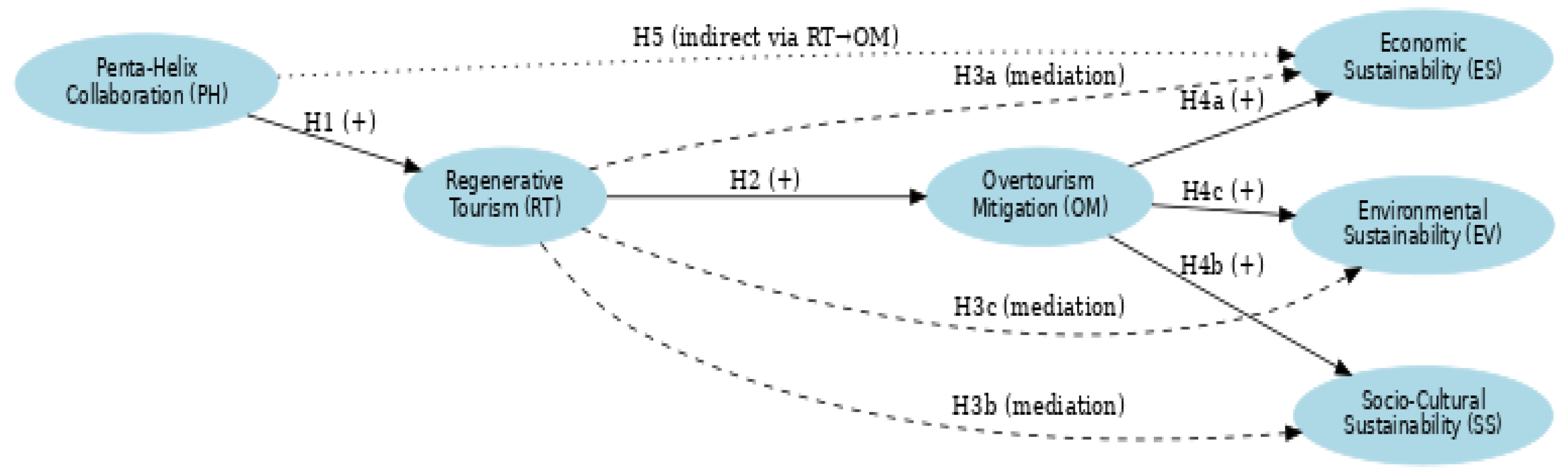
Disclaimer/Publisher’s Note: The statements, opinions and data contained in all publications are solely those of the individual author(s) and contributor(s) and not of MDPI and/or the editor(s). MDPI and/or the editor(s) disclaim responsibility for any injury to people or property resulting from any ideas, methods, instructions or products referred to in the content. |
© 2025 by the authors. Licensee MDPI, Basel, Switzerland. This article is an open access article distributed under the terms and conditions of the Creative Commons Attribution (CC BY) license (http://creativecommons.org/licenses/by/4.0/).
Copyright: This open access article is published under a Creative Commons CC BY 4.0 license, which permit the free download, distribution, and reuse, provided that the author and preprint are cited in any reuse.


