

Submitted:
28 February 2024
Posted:
14 March 2024
You are already at the latest version
Abstract
The wellness economy has developed rapidly recently, particularly in wellness tourism. Wellness tourism transforms sustainable strategy through the availability of extended multi-actor engagement in service innovation to further the tourism experience. Therefore, when operating a wellness tourism destination, it is necessary to encourage multi-actor engagement in service innovation to achieve sustainable development. This paper introduces a mixed research method with the SWOT-AHP-QSPM, as it qualitatively analyzes the advantages, disadvantages, opportunities, and threats, constructs an evaluation index system, conducts quantitative analysis using the analytic hierarchy process, determines the index weight and weighted score, and calculate the sustainable development strategy, which is appropriate for wellness development of Chongqing Tea Mountain and Bamboo Forest National Forest Park. Purposive field surveys and personal interviews were conducted in Chongqing forest tourism destinations, involving 356 effective respondents. The research reveals that multi-actor engagement significantly enhances sustainable development. These findings bridge service innovation knowledge gaps and provide valuable insights for forest tourism destination management and sustainable policy strategies to elevate multi-actor engagement in forest sites.
Keywords:
sustainable development
; wellness tourism
; SWOT-AHP-QSPM analysis
; service innovation
; multi-actor engagement
1. Introduction
Wellness tourism has developed rapidly in recent years, transforming consumer behavior through the availability of extended engaged services in further tourism behavior experience. Multi-actor engagement enables consumers to provide innovative services, save time, and experience economic benefits in forest wellness tourism destinations, such as the time banking value co-creation model [1]. By 2022, the market share of the global wellness economy reached 5.6 trillion dollars, nearly 14% higher than its size in 2019, and more than 218 countries, territories, and markets developed this kind of economy [2]. However, the development of the wellness economy varies significantly between countries and regions [3]. First, wellness tourism in North America has surpassed Asia-Pacific to become the largest regional wellness economy- according to statistics, by 2022, North America ($1.9 trillion), Asia-Pacific ($1.7 trillion), and Europe ($1.5 trillion) together account for 90% of the entire global wellness economy. Per capita spending on wellness is significantly higher in North America ($5,108), followed by Europe ($1,596) than in other regions of the world [2]. Second, the actual and forecast growth of the wellness economy of North America, Europe, and Middle East-North Africa have shown the most muscular resilience, recovery, and growth than other countries. Besides, the growth rate of wellness tourism reached 36.2%, higher than Spas (22.3%), Wellness Real Estate (20.5%), and Physical Activity (14.3%) [2]. However, wellness tourism, spas, and thermal/mineral springs are the wellness sectors most adversely affected by COVID-19 due to travel restrictions and business shutdowns, especially in China and Japan. The Ukraine war, energy prices, and staffing shortages have negatively impacted European springs, spas, and tourism businesses.
During the COVID-19 pandemic, concern has arisen that traditional sightseeing could be changed, and governments and international tourism organizations encourage Artificial Intelligence and Virtual Reality to enrich tourists` virtual experience [4]. It has pushed tourists to adopt digital technology alternatives, replacing on-site tourism. Influenced by this measure, during the pandemic, virtual tourism increased in the tourism industry [5]. However, tourists` perception of well-being during travel has been lost, such as physical exercise, emotional communication, emotional release, etc., which is promising to break through barriers and enable further recovery and promotion of wellness tourism. In the context of the forest wellness tourism destination, the need for a healthy travel life is promised to help the industry recover quickly and become a new standard family tourism method after the pandemic [6,7].
However, wellness tourists from Asia-Pacific countries, especially from China, still heavily rely on thermal/mineral Springs. What motivates them to switch from thermal water, mineral water, and seawater to wellness tourism is unclear. Furthermore, people changed their tourism awareness during the pandemic and prefer traveling alone to a family health travel lifestyle [7]. Although tourists use digital technology or VR to enrich tourism activities, whether these services will become the norm is unknown. In addition, scholars have widely applied value co-creation theory to evaluate the multi-actor engagement in the service innovation characteristics of products and services [8]. Recent studies in the tourism field have discussed kinds of multi-actor engagement affecting service innovation but rarely investigated the sustainable development strategy for wellness tourism service innovation [9]. As a part of multi-actor engagement behavior, the perceived value of service innovation is considered one of the most critical factors influencing tourist engagement behavior [10]. Tourism companies provide knowledge management platforms to facilitate tourists and employees to accumulate tourist needs during the communication process and further influence the service quality of tourism destinations and tourists` travel intentions [11]. In the hospitality industry context, restaurants, as communities where consumers gather intensively, are often strongly impacted by actors` engagement. Consumers` increasing concern about physical and mental health means efficient health and safety measures are needed to increase tourists` trust and willingness to revisit tourism destinations [12]. Although previous studies examined perceived service innovation value, including saving time, improving selectivity, and improving service efficiency and effectiveness, etc. on accepting engagement service innovation, few include a sustainable service quality construct to investigate whether and how actors perceive the service innovation value to the engagement behavior from the wellness tourism destination and whether this would further influence wellness tourism destination to switch to a sustainable development method [13]. Finally, service innovation could be regarded as a sustainable objective. On the one hand, the change time of service content is shortened (from service idea to service concept, from service concept to service content). On the other hand, emerging value co-creation accelerates the generation of service innovation content and forms (such as virtual communities, experiential communities, etc.), which can bring us to a completely innovative tourism service space and thus further influence the sustainable development of wellness tourism destinations.
Therefore, this study aims to investigate what factors drive multi-actor engagement in service innovation and examine if and how these factors influence the sustainable development of wellness tourism destinations. The present study proposes a SWOT-AHP-QSPM model based on the attribution framework to address these research gaps. Due to the limited number of studies successfully examining sustainable development strategies using mixed research methods, this is also one of the main objectives of this paper. To do so, we employ a qualitative method to analyze the characteristics of the case forest tourism destination, combined with a quantitative method of field surveys and related statistical data from the government to analyze the relationships between factors, then derive the optimal strategy for the case. This paper reviews relevant literature by introducing wellness tourism, service innovation, mixed research methods, and sustainable development. Then, the materials and methods are introduced in section three. Section four introduces this study's results and discusses the findings. Section five introduces the sustainable development strategies for wellness tourism in case destination and theoretical contributions and managerial implications for scholars and forest tourism destination managers in section six. Finally, this study points out the limitations and suggestions for future research.
2. Literature Review
2.1. Wellness Tourism
Wellness tourism is defined as travel associated with maintaining or enhancing one's well-being. It can be divided into primary wellness tourists (e.g., destination spas, hot springs resorts, health resorts, yoga retreats, etc.) and secondary wellness tourists (e.g., seeking out healthy foods, gyms/exercise options, etc., during a trip) [2]. As an emerging tourism industry, wellness tourism will become the central theme of future tourism development. The "National Health and Wellness Tourism Demonstration Base Standard" defines wellness tourism as enabling people to achieve natural and harmonious excellence in body, mind, and spirit through various means such as beauty and physical fitness, nutritious diet, spiritual cultivation, and caring for the environment-the sum of various tourism activities in the state. Some scholars pointed out that prior studies in wellness tourism mainly focus on the impact of tourism resources such as physical health, psychological health, and hot spring tourism on wellness tourism, to areas such as tourist satisfaction, destination management, and performance management in an international context. Tourist attitudes remain a hot research topic in international wellness tourism [14]. Existing studies have identified that multi-actor engagement in service innovation, digital technology, knowledge management, perceived value, policy support, etc., primarily influences the service innovation performance of wellness tourism destinations [1].
Furthermore, forest wellness is a significant branch of wellness tourism development. Value co-creation has become a new model of service innovation for current wellness tourism companies' development, such as time banking with the unified theory of acceptance and use of technology model (UTAUT) [15] and UTAUT2 [16,17]. However, few studies have compared multi-actor engagement with service innovation when examining whether multi-actor engagement positively impacts service innovation performance and how to develop a sustainable development strategy for different types of wellness tourism resources [1]. Therefore, this study uses forest tourism resources to explore the diversified development model of wellness tourism resources.
2.2. Service Innovation
Under the service-dominant logic, services are the basis of all economic exchanges, and products are the carriers for providing services [18,19,20]. Therefore, services should not be differentiated as a comparison of products, but services represent the exchange process's general situation and are an expanded exchange concept [19,21]. According to the characteristics of the wellness industry, service innovation in this study is defined as the process of improving or changing products, service processes, or service models by introducing new concepts or technologies to improve service quality and service efficiency and achieve value co-creation enhancement. Based on the value co-creation theory, many studies have examined multi-actor engagement in service innovation, such as customer engagement, employee participation, government engagement, tourism enterprise participation, community involvement, etc [1,22,23,24,25,26,27,28,29].
2.3. Mixed Research Method
Mixed research methods often combine qualitative and quantitative data in research. In this study's context, the qualitative analysis contains SWOT and AHP analysis, and the quantitative analysis is mainly the quantitative strategic planning matrix (QSPM) analysis. The SWOT-AHP model conducts quantitative analysis according to the logical sequence of decomposition, comparison, judgment, and synthesis to determine the weight of each indicator and simplify complex decision-making issues. It includes establishing a hierarchical structure model from top to bottom according to the target layer, criterion layer, and indicator layer of each factor according to different attributes, constructing a judgment matrix based on pairwise comparison of model indicators by relevant experts, and using the sum-product method or square root method based on the judgment matrix. Calculate using commonly used methods such as the method, use the characteristic root method to find the corresponding element weights, and then conduct a consistency test. Finally, perform a total hierarchical sorting to obtain the weight of each indicator relative to the overall goal [30,31]. Furthermore, QSPM uses quantitative assessment to evaluate the competitiveness and attractiveness of different strategies composed of strengths, weaknesses, opportunities, and threats to facilitate strategic decision-makers to make optimal strategic choices. QSPM is usually a supplementary method to the evaluation factors in the previous stage. It mainly scores each strategy based on the EFE matrix, IFE matrix, and SWOT matrix. The scoring results reveal the priority of various alternative strategies [32]. Therefore, the strategic choice for the sustainable development of wellness tourism in forest wellness tourism destinations is to combine SWOT-AHP analysis with QSPM to determine the optimal alternative for the development strategy obtained in the SWOT matrix.
2.4. Sustainable Development
According to the United Nations World Tourism Organization (UNWTO), "tourism comprises the activities of persons traveling to and staying in place outside their usual environment for not more than one consecutive year for leisure, business, and other purposes." In the case of world tourism, it is one of the key economic sectors with a direct contribution to the GDP and employs the local people. Moreover, tourism promotes and develops peace, prosperity, and national and international relationships with sustainable development goals [33]. Many researchers have worked in this field and contributed to environmental sustainability and nature-oriented tourism development [6,13,34]. Although ecotourism is a vast concept, sustainable wellness tourism is just a speculation of the summary in the name of tourism development and GDP generation. Sometimes, human interference has changed the dimension of ecotourism and hampered the environment so rigidly. Therefore, the wellness tourism destination should create a threat and destroy the system. Furthermore, the World Ecotourism Summit final report includes five distinct criteria: 'nature-based product,' 'minimal impact management,' 'environmental education,' 'contribution to conservation', and 'contribution to the community where the 'minimal impact management' has been replaced with ethics and sustainability.
Therefore, current research on forest wellness tourism development mainly focuses on resource evaluations, landscape planning research, tourism product quality, tourism service quality, tourism resource classification, park construction evaluation system, etc. [35]. Urban strategic planning, ecotourism, sports tourism, adventure tourism, cultural tourism, and other fields in tourism often employ the advantages, weaknesses, opportunities, and threats (SWOT) analysis method, and most of them are qualitative analysis, which is highly arbitrary and subjective. This study takes the national forest park as the case, constructs its SWOT-AHP-QSPM model for the sustainable development of wellness tourism, quantitatively analyzes the advantages, disadvantages, opportunities, and threats of the wellness tourism development, and finds the practical strategies and countermeasures for the sustainable development of case destination.
3. Materials and Methods
3.1. The Research Site
Chongqing City aims to build a national forest wellness resort (base) and proposes to strive to build 100 forest wellness bases by 2025, serving 50 million people annually [36]. Chongqing Tea Mountain and Bamboo Forest National Forest Park is in the Jishan Mountains in Yongchuan District, Chongqing City. Its geographical location is 106°2′02″~106°03′54″ east longitude, 29°22′26″~29°31′54″ north latitude, and 55 kilometers from Chongqing city, 50 kilometers from Dazu Rock Carvings in the west, 272 kilometers from Chengdu city, and 72 kilometers from Luzhou city in the south, with a total area of 9979 hectares. It has over 1,000 hectares of tea gardens in clusters and 3,333.33 hectares of bamboo. Because tea and bamboo grow symbiotically and are connected like an ocean, it is named "Tea Mountain and Bamboo Forest." It has 533.33 hectares of phoebe bamboo, 1533.33 hectares of timber, and 200 hectares of trail bamboo. The main rare species include Cyperus alba, Ginkgo biloba, Zhennan, yew, metasequoia, etc. This study employs this national forest park as a typical case analysis location for its unique geographical location, climate characteristics, and stable tourist source.
3.2. Data
The data for this study come from field surveys and related statistical data. From April to November 2023, the authors inspected tourist destinations such as Chongqing Tea Mountain and the Bamboo Forest National Forest Park scenic area. This study conducted questionnaires with park staff on the development status, potential, and prospects of local tourist attractions. The statistical data comes from the Chongqing Statistical Yearbook from 2010 to 2023 and the Chongqing National Economic and Social Development Statistical Bulletin from 2015 to 2020.
3.3. Methods
3.3.1. Construct a Judgment Matrix
A hierarchical structure model is constructed based on the SWOT analysis results to provide an indicator hierarchical framework for AHP analysis. On this basis, this study employs the expert consultation method to assign values to each criterion layer and the internal indicators of the criterion layer using the "pairwise comparison" method, evaluate the relative importance between indicators, and weigh the assignment of each indicator by all experts to obtain the average score. Firstly, set the index of the construction matrix to aij, and its value is obtained through the average ratio,
aij = ai/aj,
In the formula, ai is the average score of indicator i, and aj is the average score of indicator j. The comparison result is transformed into a pairwise comparison judgment matrix A.
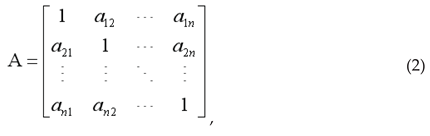
3.3.2. Solve the Judgment Matrix
This study uses the sum-product method to solve the judgment matrix. First, each column of the judgment matrix is normalized,

Secondly, add the column-normalized judgment matrices by rows,


Then, normalize the vector treatment.

Finally, calculate the maximum characteristic root λmax of the judgment matrix, that is

In the formula, (AW)i represents the i-th element of vector AW.
3.3.3. Consistency Test
Since calculation errors in the regularization process will subtly impact the consistency, we must test the consistency. To calculate the consistency index CI of the judgment matrix,
CI = (λmax-n)/(n-1),
In the formula, λmax is the most significant characteristic root, and n is the order of the judgment matrix. According to the assignment table of the consistency index RI of the judgment matrix, CR is calculated with the formula
CR = CI/RI,
CR is the random consistency ratio of the judgment matrix, CI is the consistency index of the judgment matrix, and RI is the average random consistency index of the judgment matrix. If CR <0.1, it means the consistency test is passed, and if CR>0.1, it means that the matrix needs further modification until satisfactory consistency is achieved.
3.3.4. Determine the Weight
Based on the judgment matrix that passed the consistency test, the importance of each layer's indicators relative to the previous layer's indicators is obtained. Then, the weight of each criterion layer is combined with the weight of the internal indicators of the criterion layer to obtain the priority scores of all indicators and the hierarchical Consistency check of the overall ranking.
3.3.5. Four-Quadrant Coordinate Method
The four-quadrant coordinate method determined the strategic goals for the sustainable development of Chongqing Tea Mountain and Bamboo Forest National Forest Park wellness tourism. The development strategy and intensity are determined mainly by calculating the center of gravity coordinates of the strategic map and the azimuth angle and intensity coefficient of the center of gravity point. Then, the sustainable development path of forest wellness is discussed. Analyze the weight results using the SWOT-AHP model to identify strengths, weaknesses, opportunities, and threats. The total strength of advantages is
S = ΣSi/ns,
Overall disadvantage is
W = ΣWi/nw,
The total opportunity advantage is
O = ΣOi/no,
The total threat is
T = ΣTi/nt,
In the formula, ns, nw, no, and nt represent the total number of advantages, disadvantages, opportunities, and threats. Si, Wi, Oi, and Ti represent each factor's i-th strengths, weaknesses, opportunities, and threats.
Secondly, the four variables of advantages, disadvantages, opportunities, and threats are used as semi-axes to establish a four-quadrant coordinate system. The total strength of advantages, the strength of total weaknesses, the strength of total opportunities, and the strength of total threats are positioned as point coordinates. The connecting lines form a strategic quadrilateral, and based on this, the strategic center of gravity coordinates of the strategic quadrilateral, the strategic azimuth angle, and the strategy's positive intensity, negative intensity, and intensity coefficient are calculated. Finally, the specific strategic plan and its intensity are determined. The strategic focus coordinates are
P(x,y) = (Σxi/4, Σyi/4),
The strategic azimuth is
θ= arctan(y/x)(0≤θ≤2π),
The strategic positive intensity is
U = S×O,
The strategic negative intensity is
V = W×T,
The strategic intensity coefficient is
ρ= U/(U+V),
3.3.6. QSPM Analysis Method
The establishment of QSPM for the sustainable development of wellness tourism in Chongqing City is divided into five steps. Step 1, based on the IFE matrix and EFE matrix information, analyzes the internal superior resources, critical external opportunities, and challenge factors and their weights for the sustainable development of wellness tourism in Chongqing City in the second left column of the QSPM. Step 2, based on the alternative strategies derived from the SWOT matrix of sustainable development of wellness tourism in Chongqing City, places these strategies in the top row of the QSPM model table. Step 3, the numerical value represents the attractiveness score of the strategy (attractiveness scores (AS)). Strategic attractiveness scores use expert scoring methods to express the relative attractiveness of each factor to each model. The rating range and standard of attractiveness are 1 to 4, respectively, representing the degree of attractiveness, specifically unattractive (1 point), particular attractiveness (2 points), reasonably attractive (3 points), and very attractive (4 points). Step 4, calculate the total attractiveness scores (TAS). The total attractiveness score TAS is equal to the weight of the internal advantageous resources and external development opportunities and challenges that influence the sustainable development of Chongqing's wellness tourism multiplied by the attractiveness score. The total attractiveness score represents the intensity of strategic attractiveness. Step 5, calculates the total attractiveness scores (STAS), indicating the results of strategic selection and the combined attractiveness calculation ranking.
3.4. Model Construction
Combined with field survey data concerning China's "National Wellness Tourism Demonstration Base Standards" (LB/T051-2016) and the experience of developing forest wellness tourism in other regions, following scientific, systematic, practical, and dynamic principles of sustainability, an index system of sustainable development factors of forest wellness tourism in Chongqing Tea Mountain and Bamboo Forest national forest park was constructed. A questionnaire using the index system in Table 1 as the content and a questionnaire survey were conducted among scenic area staff, tourists, and scholars to screen out the main strategic factors affecting the sustainable development of forest wellness tourism in Chongqing Tea Mountain and bamboo forest national forest park. The influence degree of each indicator in the questionnaire, such as the advantage factor, is assigned. The five levels are no advantage, slight advantage, average advantage, considerable advantage, and huge advantage.
The corresponding scores are 1, 2, 3, 4 and 5 points. A total of 400 questionnaires were distributed, and 356 were effectively collected. Finally, based on the questionnaire survey results, the average score of each indicator is calculated, and the leading indicators are determined according to the score.

Table 2.
T The index system of sustainable development factors.
| Indicator N. | Average Score | Main Indicator | Indicator N. | Average Score | Main Indicator |
|---|---|---|---|---|---|
| S1 S2 S3 S4 S5 S6 S7 S8 |
3.94 | Yes | W1 | 3.79 | Yes |
| 3.81 | Yes | W2 | 2.69 | No | |
| 3.68 4.0.4 2.04 2.93 2.15 2.86 |
Yes Yes No No No No |
W3 W4 W5 W6 W7 W8 |
3.59 3.87 3.49 2.47 2.80 2.32 |
Yes Yes Yes No No No |
|
| O1 O2 O3 O4 O5 |
3.81 | Yes | T1 | 4.20 | Yes |
| 3.68 3.55 2.58 3.94 |
Yes Yes No Yes |
T2 T3 T4 T5 |
2.49 4.03 3.87 2.64 |
No Yes Yes No |
4. Results
4.1. SWOT Factor Analysis
Based on the finalized leading indicators, a SWOT analysis model was constructed, as shown in Figure 1, and its indicators were qualitatively analyzed.
4.1.1. Strength
Rich biological resources. Chongqing Tea Mountain and Bamboo Forest national forest park is located at the Jishan Mountains' anticline. The mountain is narrow and long, shaped like a soaring dragon. The highest peak- Bodaoling, is 1,025 meters above sea level, and the lowest point- Luojiaheba, is 227 meters above sea level. The geological structure belongs to the Yongchuan broom-shaped fold bundle of the East Sichuan fold belt, the third subsidence zone of the Neocathaysian system. Cold sandy yellow soil is widely spread on the mountain, and the surface is primarily light gray or gray limestone. The top of the mountain is gentle, and the soil is deep, suitable for the growth of tea trees and bamboo. The vegetation type of Chongqing Tea Mountain and Bamboo Forest national forest park is subtropical evergreen broad-leaved forest. The forest coverage rate in the scenic area is 97%.
Bamboo and tea trees are mainly distributed. The top of the mountain is sparse shrubs and grass meadows. There are more than 30 species of tea trees in the scenic area, which are rich in famous teas such as "Yongchuan Xiuya," "Yudu Hao Tea," and "Yuzhou Maofeng." There are more than ten precious bamboo species, such as moso bamboo, Ci bamboo, bitter bamboo, and white oleander. Varieties include human-faced bamboo, animal bamboo, flowered bamboo, etc. Chongqing Tea Mountain and Bamboo Forest national forest park have many wildlife resources. There are 39 species of birds in 23 families, 16 species of mammals in 9 families, 258 species of insects, and more than 30 species of butterflies. The protected animals include macaques, black bears, yellow-throated martens, big civets, small civets, otters, golden cats, etc.
Excellent climate and environment. Chongqing Tea Mountain and Bamboo Forest national forest park is located in a humid subtropical climate zone with a mild climate, four distinct seasons, abundant rainfall throughout the year, a long frost-free period, little sunshine, and high humidity. The average annual temperature is 14 degrees Celsius, the average annual snow cover is one week, the average annual rainfall is 1042.2 mm, the average sunshine is 1298.5 hours, and the average annual frost-free period is 317 days. The atmospheric environment in the park reaches China's national standard, with an oxygen ion content of 30,000 to 50,000 per cubic centimeter. The average annual air quality rate reaches 97.6%, making it an ideal natural oxygen bar.
Diverse tourism resources. The natural landscape in the national forest park is superior and has the "natural oxygen bar" reputation. The National Forest Park has long focused on developing forest tourism, including Bodaoling, the highest peak in western Chongqing, historical monuments Zhu De Tea House and Tianzi Palace ruins, and the filming location for the House of Flying Daggers movie. There are six A-level scenic spots in Yongchuan District, including three A-level scenic spots and two A-level scenic spots, initially forming a regional cluster of high-quality A-level scenic spots.
Table 3.
The index system of sustainable development factors.
| Scenic Spot Name | Quality Level | Scenic Spot Type | Opening Time |
|---|---|---|---|
| Chongqing LocalJoy Resort Theme Park | AAAA | Animal/theme amusement park | Every day 9:00-17:30 |
| Chongqing Tea Mountain and Bamboo Forest | AAAA | Forest/Grassland | Every day 9:00-17:30 |
| Chongqing Stalagmite Mountain Scenic Area Chongqing Yongchuan Taohuayuan Tourist Resort Chongqing Yongchuan Songgai Ancient Town Chongqing Yongchuan Museum |
AAAA AAA AAA AAA |
Natural scenery Leisure vacation Characteristic neighborhood Cultural Museum |
Every day 9:00-17:30 Every day 9:00-17:30 Every day 9:00-17:30 9:00-17:30 (Closed every Monday) |
Unique traffic location. Chengdu and Chongqing are highly complementary economically. Chengdu City has apparent advantages in science and technology, finance, commerce, culture, and education, and it plays an essential role in radiating and driving the small and medium-sized cities in the Chengdu Plain area. Chongqing city has a strong manufacturing foundation and a high industrial level. It is also a transportation hub and trade port in the southwest. It can connect with the Wuhan urban agglomeration to the east, and going south through the southwest sea passage, it connected to the Nan Ning, Gui Yang, and Kun Ming economic zones. Therefore, Chongqing and Chengdu have become hubs connecting southwestern China to central and southern China. In terms of expressways, three expressways will be completed and opened to traffic in 2024. Construction of the Yongchuan-Zigong and Yongchuan-Dazu Expressways (Chongqing Section) has started. The Construction of the Chongqing Central City to Yongchuan Express Logistics Channel and the Yongchuan City to Gangqiao Express Logistics Channel has started.
Regarding railways, the Yongchuan section of the Chongqing-Kunming high-speed railway will open to traffic in 2025. The urban railway line from the central city to Yongchuan is being planned. Six projects, including the Chongqing-Zigong (Leshan) intercity railway, the Chongqing-Bijie intercity railway, the second railway ring line, the Chengdu-Chongqing railway capacity expansion Yongchuan section, the Chongqing-Yibin railway, and the Chongqing-Luyi intercity railway, have been included in the 2035 mid- to long-term plan. Regarding air and shipping channels, the second airport planned to be built in Chongqing is only more than 10 kilometers from the central city of Yongchuan. Port of Songgai in Yongchuan District is located on the northern bank of the Yangtze River at the southernmost tip of Yongchuan District and has now opened direct international shipping.
4.1.2. Weakness
Shortage of professional talents. Forest wellness is a diversified industry integrating rehabilitation, ecology, medicine, and healthcare. It requires comprehensive talents integrating management and technology, such as forest wellness practitioners, forest wellness technicians, and forest commentators. However, due to the limited economy in the tourism industry, it isn't easy to introduce talents from outside. At the same time, personnel in the region lack standard technical training, and there is a shortage of professional and technical personnel.
Infrastructure is backward. Compared with similar tourist attractions in other places, its infrastructure construction is still lagging, and it is challenging to meet the expanding market demand. It was mainly highlighted in wellness facilities, transportation infrastructure, and accommodation facilities. Currently, Yongchuan district can still provide conventional medical and wellness facilities, but there are problems such as limited quantity and insufficient technology. A three-dimensional transportation network with highways, railways, aviation, and water transportation as the core within the territory has initially taken shape. However, the density and mileage of highways make it challenging to meet the needs of tourists for "fast travel and slow travel." Accommodation facilities are limited and insufficient, making it hard to find accommodation during holidays.
The operating mechanism is backward. According to an analysis of relevant literature on the current development status of forest wellness tourism, although Yongchuan publicity has made use of technologies such as the internet and new media, the promotion form lacks multi-channel and multi-perspective publicity methods compared with Chengdu, Zhangjiajie, and other regions. Use internet technology to attract tourists, mainly from surrounding areas.
Insufficient publicity. Forest wellness tourism relies on forests to effectively integrate the tourism and healthcare industries. It is necessary to find their common points. Combined with the actual needs of tourists, create unique tourism health projects. However, judging from the current development status of the Yongchuan forest wellness tourism industry, the connection between the tourism industry and the wellness industry is not close enough. The two are relatively independent, have limited integration, and lack outstanding industrial characteristics.
4.1.3. Opportunity
Strong policy support. The State Forestry and Grassland Administration issued the "Opinions on Promoting the Development of the Forest Recreation Industry." The opinions pointed out that the development of the forest wellness industry must adhere to the five basic principles of ecological optimization, adapting measures to local conditions, scientific development, innovation leadership, and market leadership. They clarified the main tasks of vigorously developing the forest wellness industry. At the local level, the Yongchuan district government issued the Rural Tourism Development Plan (2020-2030), which focused on creating forest wellness tourism in Chongqing Tea Mountain and Bamboo Forest national forest park.
The market prospect is broad. The population's aging and severe environmental pollution problems have intensified people's medical and healthcare demands. People's health awareness continues to improve, and the wellness tourism industry is booming. As a tourist city in Chongqing, Yongchuan district's tourist arrivals and income have increased in the past ten years. According to the recent years "Yongchuan District Statistical Yearbook," tourist reception and income have steadily grown.
Tourism Industry transformation and upgrading. The traditional sightseeing model of simply enjoying the scenery cannot meet the needs of tourists at this stage. Tourists prefer experiential, leisure, and wellness tourism. Wellness tourism is quality tourism that integrates sports, leisure, healthcare, and elderly care. It is the key to the transformation and development of tourism under the new standard development. Yong Chuan district can use its environmental, selenium-rich environment, and traditional Chinese medicine advantages to create more distinctive wellness tourism products and promote the transformation and upgrading of the regional wellness tourism industry.
Changes in consumption concepts. Price is one of the factors consumers consider when choosing travel products. However, when tourists make travel consumption decisions, their inner preferences and needs are far more important than the impact of price.
4.1.4. Threaten
Peripheral competitive pressure. The unique geographical structure gives Chongqing rich forest wellness resources. There are 27 national forest parks in Chongqing, and they have enormous potential to develop the forest wellness industry. Secondly, Sichuan, Guizhou, Yunnan, and other places have significantly better human and natural resources than Chongqing. Guizhou has completed preparing the forest wellness plan and has established over 100 forest wellness bases. Many places already have specific forest brand effects. Sichuan Province promulgated the "Sichuan Forest Wellness and Nutrition Foundation" and "Land Construction Standards" and built the first forest wellness e-commerce platform. In addition, Chengdu City in Sichuan Province is a famous tourist city in China, and its infrastructure, talent training, and market demand far exceed that of Chongqing City.
Investment and financing difficulties. Disadvantages such as weak infrastructure, lack of professional talents, and backward publicity mechanisms have resulted in its low visibility, weak appeal, and limited customer base. At the same time, the development of forest wellness tourism projects is an industry with a long cycle, weak results, and slow returns. Coupled with numerous uncertain factors, investment and financing are more complex than in other regions with muscular economic strength.
Diverse tourism needs. The diverse demand for wellness tourism has brought market opportunities to the forest wellness tourism industry. However, as the demand for wellness is getting higher and higher, traditional and straightforward sightseeing-style tourism can no longer meet the needs of tourists. It has natural physiological and medical functions. Forest wellness tourism caters more to the needs of the public, allowing people to experience the joy of life and achieve the purpose of education and self-cultivation. It is necessary to segment the tourism market according to wellness needs, improve existing wellness tourism projects, and meet the needs of different consumer groups.
Based on the SWOT analysis of the sustainable development of forest wellness tourism in Chongqing Tea Mountain and Bamboo Forest, it is clear that the current stage of developing forest wellness tourism in Chongqing Tea Mountain and Bamboo Forest has its internal advantages and disadvantages, as well as opportunities and threats from the outside. It is a complex situation in which advantages and disadvantages coexist, and opportunities and threats coexist.
4.2. Hierarchical Model Analysis
4.2.1. Construction of Evaluation Index System
There is an evaluation system for sustainable development based on the internal and external factors influencing the sustainable development of Chongqing tea mountain and bamboo forest wellness tourism. It combines the SWOT analysis factors in pairs to determine the corresponding sustainable development strategy.
Construct a judgment matrix to determine system weights. According to Figure 2, the importance of the criterion layer and each indicator layer is judged respectively. Questionnaires were sent to experts and scholars in ecology, tourism, forestry, agriculture, and other related fields through email and on-site consultation.
Table 4.
Judgment matrix and consistency check at each project level
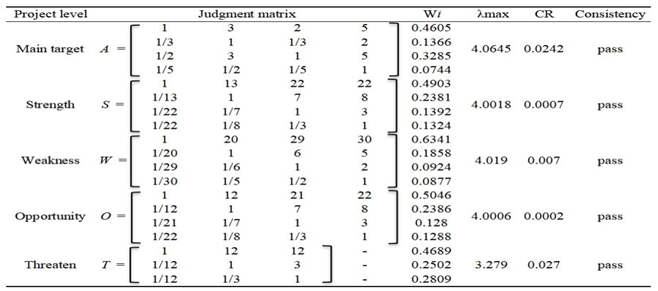
Twenty-eight questionnaires were distributed, and 23 were recovered, with an effective rate of 82%. The questionnaire adopts the "pairwise comparison" method, constructs a judgment matrix according to formula (2), and calculates the corresponding weight of each indicator. Refer to formulas (6) and (8) to calculate the maximum eigenvalue and consistency ratio and check whether the indicators at each level pass the consistency test based on whether the CR value is less than 0.1.
Determine portfolio weights and weighted scores. The weight within the group represents the importance of each indicator in the indicator layer to which it belongs, so it is of great significance to calculate the relative importance of each indicator to the overall goal. The adequate response degree of the forest wellness tourism in Chongqing Tea Mountain and Bamboo Forest national forest park to each indicator is scored, and the value is between ±5 and ±1. The sensitivity decreases with the score and is divided into extremely sensitive, relatively sensitive, sensitive, and mild. There are five levels of sensitivity and insensitivity, with positive values assigned to strengths and opportunities and negative values assigned to disadvantages and threats. Finally, the weighted score of each indicator is determined by multiplying the weight of each indicator combination and the corresponding score. The greater the absolute value, the greater the value. The greater the intensity, as shown in Table 5.
According to the analysis of the weight results of the SWOT-AHP model, it is concluded that the strength > Opportunity> weakness > threaten the sustainable development of wellness tourism in Chongqing Tea Mountain and Bamboo Forest National Forest Park. The internal strengths outweigh its weaknesses, especially the superior climate environment and rich biological resources within the territory, which provide innate conditions for the development of forest wellness tourism. The weakness is mainly reflected in the infrastructure and professional talents. The necessary supporting facilities such as medical care, leisure and entertainment, sports fitness, catering, and accommodation are incomplete, the loss of professional talents is profound, and the training intensity is insufficient. It is necessary to continuously strengthen the Construction of supporting facilities while focusing on talent training and building a professional team. From an external perspective, the expanding demand in the wellness market is a powerful driving force for the sustainable development of forest wellness tourism in Chongqing Tea Mountain and Bamboo Forest National Forest Park. Policies are its basic guarantee. Relevant policies should be further implemented and guided by preferential policies, top-level design combined with market expansion opportunities, reasonable planning, and implementation. Difficulties in investment and financing are the biggest threat to the development of forest wellness tourism in national forest parks. Policies should be relaxed, financing channels should be expanded, and characteristic industries should be built based on advantages to enhance competitiveness, cater to diverse needs, and achieve sustainable development.
4.2.2. Development Strategy Analysis by QSPM
Regarding strengths and weaknesses analyzed by SWOT, identified the internal factor estimate matrix (IFEM), and opportunities and threats analyzed by SWOT, identified the external factor estimate matrix (EFEM). Based on the weight results of the hierarchical model, the total strengths, weaknesses, opportunities, and threats are obtained as follows: total strength is S = 1.026425, total strength is W = -1.001425, total opportunity strength is O = 1.02765, total threat intensity is T=-0.81255. A four-quadrant coordinate system is constructed with strengths, weaknesses, opportunities, and threats as semi-axis variables. The total strength, weakness, Opportunity, and threat are positioned in the four-quadrant coordinate system and connected in sequence to form a strategic evaluation matrix, as shown in Figure 3. The center of gravity coordinates of the strategic evaluation matrix diagram P (x, y) = P (0.01, 0.0538) are obtained from formula (13). The strategic type azimuth angle θ= 15° is determined from the coordinates of point P.
Based on the evaluation above matrix of internal and external factors, this study constructed a qualitative analysis SWOT matrix of Chongqing Tea Mountain and Bamboo Forest National Forest Park wellness tourism competitiveness strategy. It formed four competitive strategies: SO, WO, ST, and WT. SO strategy is an aggressive combination of strengths (S) and opportunities (O), and WO strategy is a reversal combination of weaknesses (W) and opportunities (O). ST strategy is a combination of strengths (S) and threats (T) and resistance combination, and WT strategy is a defensive combination formed by disadvantages (W) and threats (T). The four competitive strategies construct four strategic plans, respectively.
Based on determining the position of the center of gravity coordinate P of the strategic matrix, analyzing the strategic intensity coefficient helps determine its development strategy. First of all, strategic intensity can be divided into positive and negative strategic intensity. The influencing factors of positive strategic intensity are internal strength and external Opportunity, while negative strategic intensity is affected by internal weakness and external threats. The following calculations were made based on the weighted scores of each factor for the sustainable development of forest wellness tourism in Chongqing Tea Mountain and Bamboo Forest National Forest Park. The positive strategic intensity U=1.0548, the negative strategic intensity V=0.8137, and finally, the strategic intensity coefficient ρ=0.5645 is obtained through formula (17). The value range of ρ is between 0 and 1. The larger the value of ρ, the greater the implementation intensity of the strategy type.
According to the coordinates of the center of gravity and the range of the azimuth angle of θ, it is determined that forest wellness tourism in Chongqing Tea Mountain and Bamboo Forest national forest park is a vital industry and should adopt a competitive, sustainable development strategy. Further, based on the strategic intensity coefficient ρ= 0.5645, it is concluded that the sustainable development of forest wellness tourism in Chongqing Tea Mountain and Bamboo Forest national forest park should actively adopt a competitive development strategy to enhance industrial advantages, achieve sustainable development of tourism, and drive regional connections industrial development.
As shown in Figure 3, the center of gravity of the SWOT strategic quadrilateral for the sustainable development of Chongqing wellness tourism falls in the first quadrant of the coordinate axis, that is, the area composed of advantages (S) and opportunities (O), which shows that the development of Chongqing forest wellness tourism has relatively great potential. With good internal and external advantages, the SO strategy, composed of advantages (S) and opportunities (O), is currently the best development strategy. The SO strategy aims to seize opportunities and leverage advantages and includes four alternative plans: ① Demand leadership to expand the market for new technologies and products. ② Policy first to ensure the unique design and accelerated implementation. ③ Join forces to deepen high-level industrial research cooperation. ④ Service escort, encourage, and standardize intermediary services. The priority of these four solutions needs to be determined using the QSPM matrix.
Using the four SO strategy alternatives as horizontal indicators and the four elements of the SWOT model as vertical indicators, this study constructed a QSPM matrix for the sustainable development competitive strategy of wellness tourism in Chongqing Tea Mountain and Bamboo Forest National Forest Park (as shown in Table 6). Among them, SO1-SO3 refers to the four alternatives of the SO strategy. S1-S4 corresponds to the four characteristic indicators of strengths (S), W1-W4 corresponds to the four characteristic indicators of disadvantages (W), O1-O4 corresponds to the four characteristic indicators of opportunities (O), and T1-T3 corresponds to 3 characteristic indicators of threat (T). ES represents the evaluation score of each characteristic indicator obtained through the expert consultation method, assuming that under the simulated implementation of the corresponding alternative (one of SO1 - SO3), the simulation implementation effect is estimated and evaluated according to the SWOT model. TES is the weighted score of each feature index score ES and its weight coefficient.
Table 6.
Swot matrix analysis
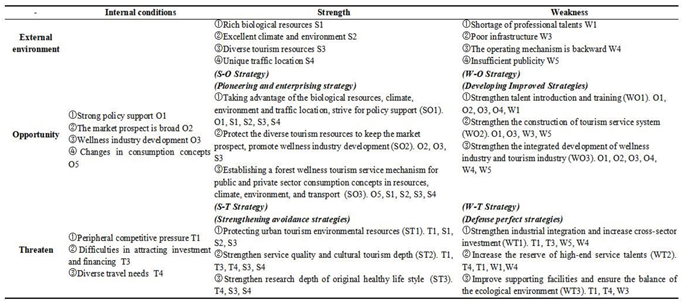
According to the analysis results in Table 7, the total scores of SO1, SO2, and SO3 alternatives are 2.80385, 2.86073, and 2.81294, respectively. Therefore, the priority order of the three alternative strategic plans is SO2 > SO1 > SO3, indicating that the implementation plan for the sustainable development competition strategy of Chongqing Tea Mountain and Bamboo Forest National Forest Park wellness tourism can prioritize demand leadership, policy driving, and service mechanism protection in order. In addition, the gap between demand-led (SO2) and policy guidance (SO1) is small, and both are given priority consideration based on priority.
5. Discussion
According to the SWOT-AHP-QSPM model analysis results, this study designed the following implementation countermeasures to promote better innovative development of service quality in Chongqing Tea Mountain and Bamboo Forest National Forest Park. The order of each countermeasure is the same as the alternatives' priority.
5.1. Sustainable Development Strategies
5.1.1. Stimulate Market Demand
In developing tourism resources, the scenic spot integrates biological resources, tourism resources, and national culture. It relies on the advantages of the climate and environment to combine forest wellness with existing tourist attractions and folk culture.
On the premise of adhering to the priority of ecological protection, it is building multiple global tourism areas such as ecological cultural tourism area, health culture experience area, selenium-rich health vacation tourism area, ecological leisure vacation tourism area, alpine forest experience tourism area, mountain outdoor sports adventure area, etc. to create forest wellness tourism town that meets the diversified wellness tourism needs of tourists.
5.1.2. Policy Guidance
The government improved the construction and incentive mechanism of the service management system. First, the government, schools, and enterprises should cooperate and seek common development paths. The government supports the development policy of forest wellness tourism, relaxes policies on investment and financing, and provides preferential conditions. It adheres to the principle of multi-actor engagement, such as government guidance, market players, social participation, co-construction, and sharing. It cooperates with enterprises to build a forest wellness tourism industry, introducing high-quality cross-industry partners for financing.
Second, cooperate with relevant enterprises to organize large-scale publicity activities, fully play the critical role of the internet, new media, and integrated media in marketing, popularize forest healthcare knowledge through multiple channels and levels, and promote Chongqing forest wellness tourism. Forest wellness is an emerging tourism industry that integrates many industries. At present, forest wellness tourism needs a large number of outstanding innovative talents to join. Chongqing has a university town and a western vocational education center with many universities. It should fully cooperate with universities and have targeted training of professionals related to healthcare services.
Third, regarding infrastructure construction, we should guide high-tech enterprises to develop autonomous driving technology further and promote the digital transformation of urban roads. At the same time, we should strengthen the cooperation between hospital rehabilitation facilities, doctors, and forest rehabilitation tourism enterprises and improve the forest wellness tourism facilities and technology.
5.1.3. Improve the Service System and Enrich Tourism Products
Chongqing is a mountainous city, and the infrastructure construction for the development of forest wellness needs to be strengthened. First, focus on improving the comprehensive infrastructure and supporting service facilities for forest wellness tourism, improving the quality of essential services, and meeting the basic needs of tourists during peak tourism periods. Second, it combines its resource advantages to create high-end tourism products such as characteristic villages, forest homes, forest inns, forest experiences, and ancient forest roads. Third, improve basic medical facilities and create a green and ecological elderly care environment to form a health care model more conducive to forest health care activities for all ages. Fourth, deeply integrate forest wellness tourism with culture and finance, increase the cultural and creative products of forest health, and develop unique products combined with local folk culture, tea culture, and selenium culture to create a "culture + sports + health" development model, build a service ecosystem, continuously improve competitiveness, and achieve sustainable development.
5.2. Theoretical Contribution
The findings of the present research have raised theoretical and practical contributions. The value co-creation theory of Vargo and Lusch [21], based on the Service-Dominant Logic (SDL), pertinently applies to this study concerning the multi-actors engagement service innovation in wellness tourism destination development, which explains that industry sustainable development is indeed affected by complex factors (e.g., ecological environment, political environment, economic environment, infrastructure environment, human settlement environment, etc.) and different actors (e.g., tourists, employees, tourism enterprise managers, government agencies, community residents, etc. ). This research inquiry purposefully confirmed the strong and substantial link between multi-actor engagement and the industry's sustainable development. Moreover, the research findings indicated the hidden moderating effect of service innovation quality on the relationship between multi-actor engagement and industry sustainable development. The current study is the first to indicate the importance of this particular mediating effect, helping to extend existing theoretical approaches.
Current research offers various contributions to the knowledge of wellness tourism. While previous research examined customer engagement [10], employee participation [11], and community involvement [37,38] as mediators of service innovation, this research is unique in utilizing multi-actor engagement as a mediating component. Service innovation that develops constructive and productive service content and service methods could enhance service quality and customer perceived value [39] and encourage a strong and close relationship with multi-actors [40]. Generally, when strong bonds are formed between multi-actors, individuals are willing to take risks and appreciate positive achievements and outcomes together in service innovation, such as network Community [38].
Moreover, this study employed a mixed-method approach, uncommon in studies on strategy analysis for wellness tourism development, particularly in forest wellness tourism destinations. Therefore, this approach has arguably enabled a substantial theoretical contribution to the study of sustainable development and service innovation in the wellness tourism industry, as well as indicating the value of such an approach to future inquiries in this field of study.
5.3. Managerial Implications
These research findings implicate practical recommendations for tourism enterprise managers and government units responsible for tourism to consider different development strategies, significantly strengthening multi-actor engagement in sustainable service innovation. Moreover, there is a need for the government to improve and monitor the business environment, maintain a stable labor market, and provide continuous labor skills training opportunities, such as the government increase the enthusiasm of tourism companies to organize employees to participate in service skill improvement through policy reductions and exemptions.
Managers can construct a knowledge management system to provide constructive relationships between tourism enterprise managers, employees, and tourists [41,42,43]. For instance, forest wellness tourism destinations can incorporate strategies such as creative contests and promoting better service innovation ideas, service content, and service forms at all levels. Furthermore, the knowledge management system can record the interaction process between employees and tourists, identify tourists' needs, and use digital technology calculations to explore potential service projects and improve service quality levels of wellness tourism destinations. As the off-peak season of wellness tourism destinations is pronounced, often operating beyond regular daily working hours in peak season, the knowledge management system must be prioritized and consistently scheduled.
6. Conclusions
Even though this research employed a mixed-method approach, which has not been common in studies concerned with multi-actor engagement in wellness tourism service innovation, there is room for methodological improvements as there are some limitations to the current research that are important to disclose. This research is restricted to forest wellness tourism destinations. However, there are complex sub-branchs of the wellness tourism industry. Accordingly, future research could extend the scope to other types of wellness tourism destinations, such as hot spring wellness tourism, leisure sports wellness tourism, rural community wellness tourism, etc. Despite the study's results indicating that multi-actors have similar importance for sustainable development strategy, it would be helpful to examine the issue of different actor engagement in service innovation by conducting further comparative research to understand multi-actor engagement in this field.
Moreover, future mixed-method research may focus on service innovation in different service stages, such as decision-making before travel, the impact of services during travel, and post-travel perception evaluation. Through such comparative approaches, researchers can consider other essential antecedents of sustainable development strategy, such as the personal characteristics and psychological changes of actors, which can help to advance an understanding of the interactive influence between multi-actors in the process of wellness tourism experience.
Notably, the wellness tourism industry has changed significantly due to the changes in human health awareness [17]. Many tourism destinations have had to diversify their service products and methods and become healthier to relax and stay. Therefore, the pressure of operating a tourism destination has arguably become more profound, potentially impacting degrees of multi-actor engagement in service innovation. Studies that track these recent stresses and impacts could further increase the relevance of the findings.
Author Contributions
All authors meet the journal's authorship guidelines. LW performed the analysis and prepared the original manuscript. MD, YHQ, and YZ. Supervised and validated the study. LW, MD, YHQ, YZ, and ZLZ. contributed to interpreting the results and the original draft's review and editing. All authors have read and agreed to the published version of the manuscript.
Funding
This research was funded by the Chongqing Municipal Education Commission, grant number "KJZD-K202202503", and Chongqing Social Science Federation, grant number " 2021PY35". They funded the APC.
Institutional Review Board Statement
Not applicable.
Informed Consent Statement
Not applicable.
Data Availability Statement
The data sets used and analyzed during the current study are available from the corresponding author upon reasonable request.
Acknowledgments
We are also indebted to Professor Dingxiang Liu (Chongqing University of Arts and Sciences) for his guidance and the participants who answered the questionnaire.
Conflicts of Interest
The authors declare that they have no competing interests.
References
- Li, W.; D., M.; Yuanhao, Q.; Z., Y. WELLNESS TOURISM SERVICES INNOVATION: A BIBLIOMETRIC REVIEW AND FUTURE RESEARCH AGENDA. CACTUS 2024, 5. [CrossRef]
- Global Wellness Institute. Global Wellness Economy Monitor 2023. Available online: https://globalwellnessinstitute.org/the-2023-global-wellness-economy-monitor/. (accessed on November 2023).
- Global Wellness Institute. The Global Wellness Economy: Looking Beyond COVID. Available online: https://globalwellnessinstitute.org/industry-research/the-global- wellness-economy-/. (accessed on December 2021).
- Pencarelli, T. The digital revolution in the travel and tourism industry. Inf. Technol. Tour. 2019, 22, 455–476. [Google Scholar] [CrossRef]
- Lu, J.; Xiao, X.; Xu, Z.; Wang, C.; Zhang, M.; Zhou, Y. The potential of virtual tourism in the recovery of tourism industry during the COVID-19 pandemic. Curr. Issues Tour. 2021, 25, 441–457. [Google Scholar] [CrossRef]
- Dunets, A.N.; Vakhrushev, I.B.; Sukhova, M.G.; Sokolov, M.S.; Utkina, K.M.; Shichiyakh, R.A. Selection of strategic priorities for sustainable development of tourism in a mountain region: concentration of tourist infrastructure or nature-oriented tourism. Entrep. Sustain. Issues 2019, 7, 1217–1229. [Google Scholar] [CrossRef] [PubMed]
- He, M.; Liu, B.; Li, Y. Recovery experience of wellness tourism and place attachment: insights from feelings-as-information theory. Int. J. Contemp. Hosp. Manag. 2022, 34, 2934–2952. [Google Scholar] [CrossRef]
- Poblete, L.; Eriksson, E.; Hellström, A.; Glennon, R. User involvement and value co-creation in well-being ecosystems. J. Heal. Organ. Manag. 2023, 37, 34–55. [Google Scholar] [CrossRef] [PubMed]
- Streimikiene, D.; Svagzdiene, B.; Jasinskas, E.; Simanavicius, A. Sustainable tourism development and competitiveness: The systematic literature review. Sustain. Dev. 2020, 29, 259–271. [Google Scholar] [CrossRef]
- Li, W.; Myagmarsuren, D.; Yuanhao, Q.; Yadmaa, Z.; Shanshan, L. Customer Engagement in Service Innovation Performance of the Wellness Industry - Based on the fsQCA Method. Phys. Med. Rehabilitation - Int. 2023, 10. [Google Scholar] [CrossRef]
- Li, W.; Myagmarsuren, D.; Yadmaa, Z. Digital Technology, Superior Support, and Employee Participation in Service Innovation Performance of Wellness Industry - Based on fsQCA Method. Journal of Management and Innovation, 2023, 1, 1–8. [Google Scholar]
- Han, J.; Zuo, Y.; Law, R.; Chen, S.; Zhang, M. Service Quality in Tourism Public Health: Trust, Satisfaction, and Loyalty. Front. Psychol. 2021, 12. [Google Scholar] [CrossRef]
- Han, S.; Ramkissoon, H.; You, E.; Kim, M.J. Support of residents for sustainable tourism development in nature-based destinations: Applying theories of social exchange and bottom-up spillover. J. Outdoor Recreat. Tour. 2023, 43. [Google Scholar] [CrossRef]
- Wang, L.; Togtokhbuyan, L.; Yadmaa, Z. Visual analysis of the international wellness tourism WOS literature from 1992 to 2019. Int. J. Spa Wellness 2021, 4, 1–16. [Google Scholar] [CrossRef]
- Venkatesh, V.; Morris, M. G.; Davis, G. B.; Davis, F. D. User acceptance of information technology: Toward a unified view. MIS quarterly, 2003, 27, 425–478. [Google Scholar] [CrossRef]
- Venkatesh, V.; Thong, J. Y.; Xu, X. Consumer acceptance and use of information technology: extending the unified theory of acceptance and use of technology. MIS quarterly, 2012, 27, 157–178. [Google Scholar] [CrossRef]
- Li, W.; Myagmarsuren, D.; Hao, Q.Y.; Yadmaa, Z.; Togtokhbuyan, L. Assessing the determinants of time banking adoption intentions in wellness tourism destinations: a unified theory of acceptance and use of technology (UTAUT). Int. J. Spa Wellness 2023, 1–20. [Google Scholar] [CrossRef]
- Ordanini, A.; Parasuraman, A. Service Innovation Viewed Through a Service-Dominant Logic Lens: A Conceptual Framework and Empirical Analysis. J. Serv. Res. 2010, 14, 3–23. [Google Scholar] [CrossRef]
- Lusch, R. F.; Nambisan, S. Service innovation. MIS quarterly, 2015, 39, 155–176. [Google Scholar] [CrossRef]
- Puglieri, F.N.; Salvador, R.; Romero-Hernandez, O.; Filho, E.E.; Piekarski, C.M.; de Francisco, A.C.; Ometto, A.R. Strategic planning oriented to circular business models: A decision framework to promote sustainable development. Bus. Strat. Environ. 2022, 31, 3254–3273. [Google Scholar] [CrossRef]
- Vargo, S.L.; Lusch, R.F. Evolving to a New Dominant Logic for Marketing. J. Mark. 2004, 68, 1–17. [Google Scholar] [CrossRef]
- Chang, C.W.; Huang, H.C.; Wang, S.J.; Lee, H. Relational bonds, customer engagement, and service quality. The Service Industries Journal, 2021, 41, 330–354. [Google Scholar] [CrossRef]
- Dahles, H.; Khieng, S.; Verver, M.; Manders, I. Social entrepreneurship and tourism in Cambodia: advancing community engagement. J. Sustain. Tour. 2019, 28, 816–833. [Google Scholar] [CrossRef]
- Ekong, N.C.; Imikan, A.M. SWOT Analysis of Community-based Tourism Performance in Akwa Ibom State as a Tool for Sustainable Tourism Development in the 21st Century. Randwick Int. Soc. Sci. J. 2022, 3, 656–665. [Google Scholar] [CrossRef]
- Hollebeek, L. D.; Srivastava, R. K.; Chen, T. SD logic–informed customer engagement: integrative framework, revised fundamental propositions, and application to CRM. Journal of the Academy of Marketing Science, 2019, 47, 161–185. [Google Scholar] [CrossRef]
- Purwanto, A.; Zuiderwijk, A.; Janssen, M. Citizen engagement with open government data: A systematic literature review of drivers and inhibitors. Research Anthology on Citizen Engagement and Activism for Social Change, 2022, 1539-1566.
- Wang, H. H.; Du, M. Digital Technology, Employee Participation and Enterprise Innovation Performance. R&D Management, 2021, 33, 138–148. [Google Scholar]
- Xie, L.; Guan, X.; He, Y.; Huan, T.-C. Wellness tourism: customer-perceived value on customer engagement. Tour. Rev. 2021, 77, 859–876. [Google Scholar] [CrossRef]
- Żyminkowska, K.; Perek-Białas, J.; Humenny, G. The effect of product category on customer motivation for customer engagement behaviour. Int. J. Consum. Stud. 2022, 47, 299–316. [Google Scholar] [CrossRef]
- Sahani, N. Application of hybrid SWOT-AHP-FuzzyAHP model for formulation and prioritization of ecotourism strategies in Western Himalaya, India. International Journal of Geoheritage and Parks, 2021, 9, 349–362. [Google Scholar] [CrossRef]
- Qaiser, I. A comparison of renewable and sustainable energy sector of the South Asian countries: An application of SWOT methodology. Renew. Energy 2021, 181, 417–425. [Google Scholar] [CrossRef]
- Shridhar, R. The Future Of Medical Tourism In India. Journal of Pharmaceutical Negative Results, 2022, 4763-4767.
- World Tourism Organization. UNWTO Annual Report 2017. [CrossRef]
- Katelieva, M.; Muhar, A. Heritage tourism products based on traditional nature-related knowledge: assessment of cultural, social, and environmental factors in cases from rural Austria. J. Heritage Tour. 2022, 17, 631–647. [Google Scholar] [CrossRef]
- Xiang, C.; Qin, J.X.; Yin, L. Study on the rural ecotourism resource evaluation system. Environ. Technol. Innov. 2020, 20, 101131. [Google Scholar] [CrossRef]
- Koveos, P.; Zhang, Y. China's Economic Reforms: Successes and Challenges. World Scientific, 2023.
- Ciasullo, M.V.; Troisi, O.; Grimaldi, M.; Leone, D. Multi-level governance for sustainable innovation in smart communities: an ecosystems approach. Int. Entrep. Manag. J. 2020, 16, 1167–1195. [Google Scholar] [CrossRef]
- Molinillo, S.; Anaya-Sánchez, R.; Liébana-Cabanillas, F. Analyzing the effect of social support and community factors on customer engagement and its impact on loyalty behaviors toward social commerce websites. Comput. Hum. Behav. 2019, 108, 105980. [Google Scholar] [CrossRef]
- Paulose, D.; Shakeel, A. Perceived Experience, Perceived Value and Customer Satisfaction as Antecedents to Loyalty among Hotel Guests. J. Qual. Assur. Hosp. Tour. 2021, 23, 447–481. [Google Scholar] [CrossRef]
- Patricio, R.; Moreira, A.; Zurlo, F.; Melazzini, M. Co-creation of new solutions through gamification: A collaborative innovation practice. Creativity Innov. Manag. 2020, 29, 146–160. [Google Scholar] [CrossRef]
- Abbas, J.; Rehman, S.; Aldereai, O.; Al-Sulaiti, K.I.; Shah, S.A.R. Tourism management in financial crisis and industry 4.0 effects: Managers traits for technology adoption in reshaping, and reinventing human management systems. Hum. Syst. Manag. 2023; 1–18. [Google Scholar] [CrossRef]
- Ansong, A.; Ennin, E.E.; Yeboah, M.A. Relational leadership and employee creativity: the role of knowledge-sharing behaviour and leader–follower dyadic tenure. J. Hosp. Tour. Insights 2022, 6, 1890–1908. [Google Scholar] [CrossRef]
- Fung, C.P.Y.; Hon, A.H.Y. The Evolution of Knowledge Sharing Community Development: A Chinese Social Practice Perspective. J. China Tour. Res. 2021, 18, 847–870. [Google Scholar] [CrossRef]
Figure 1.
SWOT analysis model of sustainable development of Chongqing.
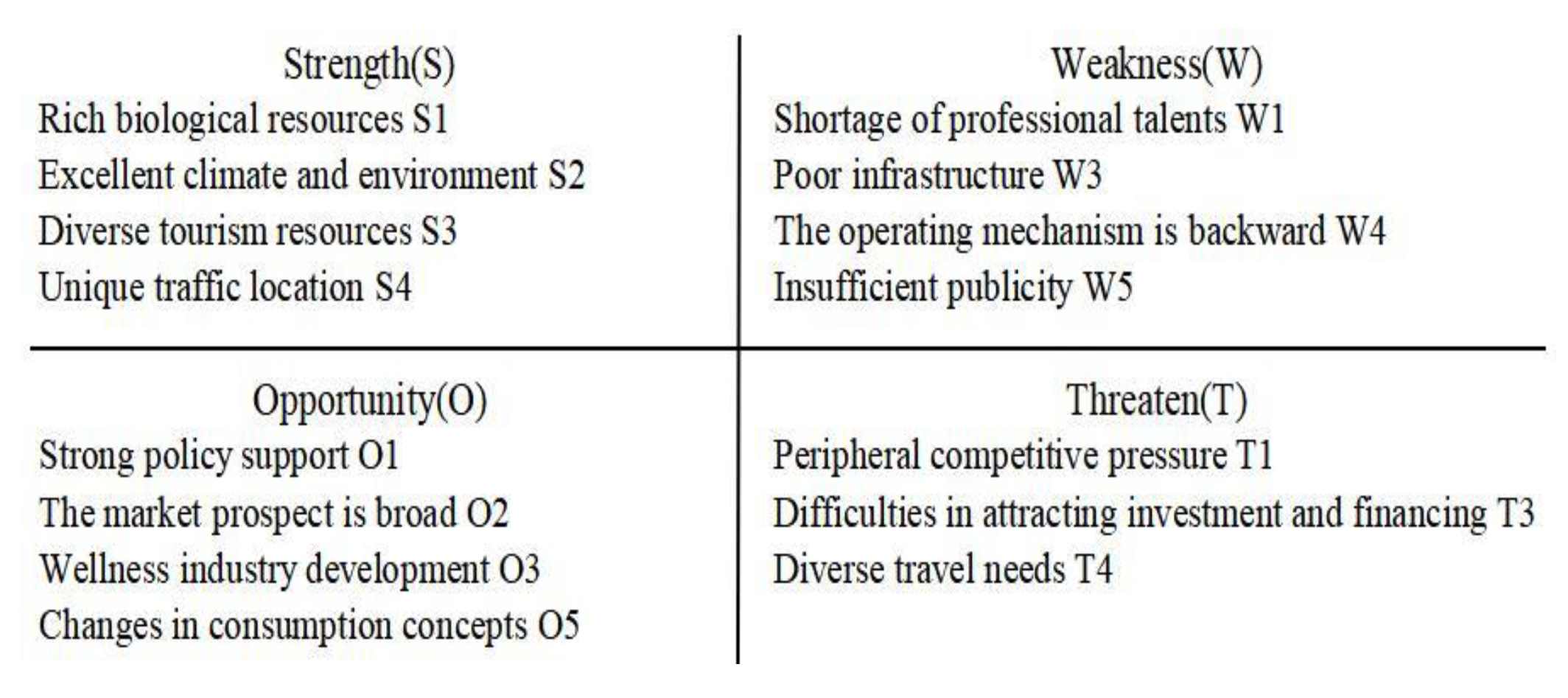
Figure 2.
Sustainable Development Strategic Evaluation Index System of Forest WT.
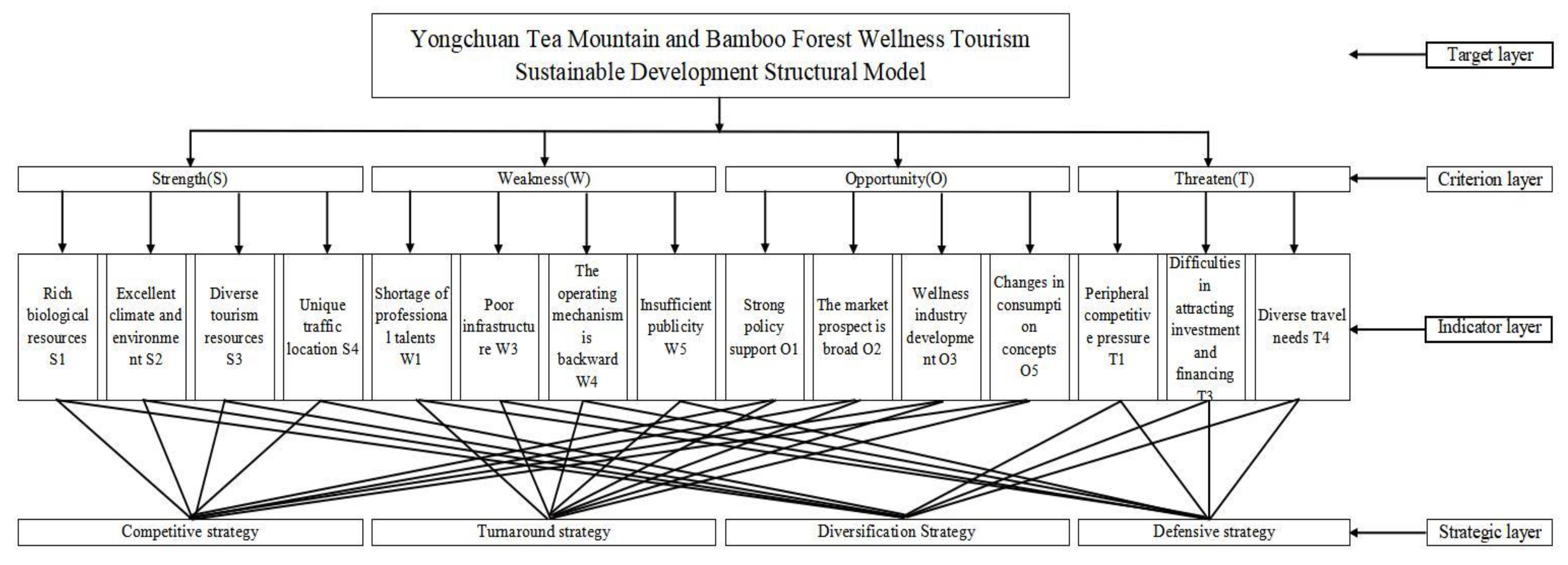
Figure 3.
Sustainable development strategic matrix of forest wellness tourism.
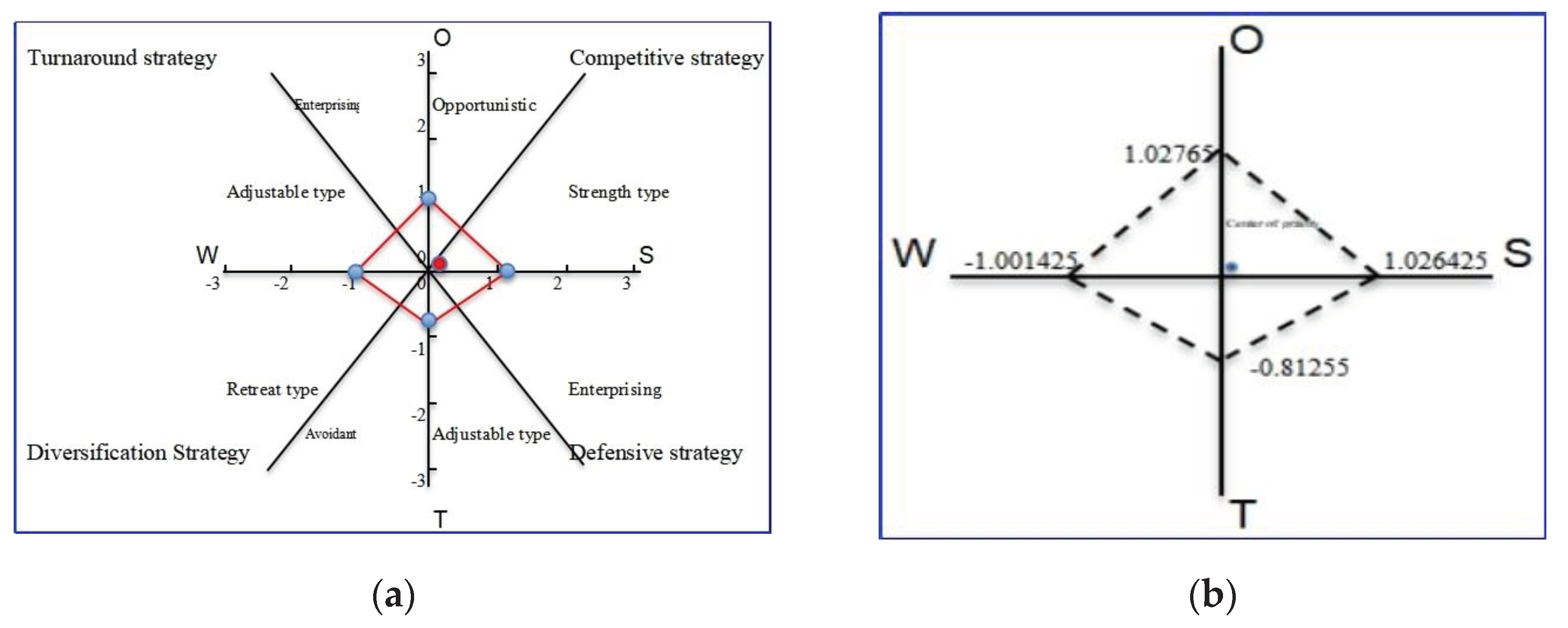
Table 1.
The index system of sustainable development factors.
| Target layer | Criterion layer | Indicator layer |
| Sustainable development of Chongqing Tea Mountain and Bamboo Forest National Park | Strength(S) | S1. Rich biological resources |
| S2. Excellent climate and environment S3. Diverse tourism resources S4. Unique traffic location S5. Colorful national culture S6. Good policy environment S7. Diverse local characteristics S8. Stable customer market | ||
| Weakness(W) | W1. Shortage of professional talents W2. Limited development level W3. Poor infrastructure W4. Backward operating mechanism W5. Insufficient publicity W6. Insufficient industrial integration W7. Low concept awareness W8. Lack of technical support |
|
| Opportunity(O) | O1. Strong policy support | |
| O2. Broad market prospect O3. Wellness industry development O4. Industry transformation and upgrading O5. Consumption concepts Changes | ||
| Threaten(T) | T1. Peripheral competitive pressure T2. Technology introduction Difficult T3. Investment and financing Difficult T4. Diverse travel needs T5. Ecological protection |
Table 5.
Combination weight and weighted scores of evaluation index system.
| Target Layer | Criterion Layer | Weight within Group | Indicator Layer | Weight within Group | Combination Weight | Factor Score | Weight Score | |
|---|---|---|---|---|---|---|---|---|
| Sustainable development Structural Model of Chongqing Tea Mountain and Bamboo Forest National Park |
Strength | 0.4605 | S1 | 0.4903 | 0.1226 | 4 | 0.4903 | |
| S2 | 0.2381 | 0.0595 | 5 | 0.2976 | ||||
| S3 S4 |
0.1392 0.1324 |
0.0348 0.0331 |
4 3 |
0.1392 0.0993 |
||||
| Weakness | 0.1366 | W1 W3 W4 W5 |
0.6341 0.1858 0.0924 0.0877 |
0.1585 0.0465 0.0321 0.0219 |
-4 -5 -3 -3 |
-0.6341 -0.2323 -0.0693 -0.0658 |
||
| Opportunity | 0.3285 | O1 O2 O3 O5 |
0.5046 0.2386 0.1280 0.1288 |
0.1262 0.0597 0.0320 0.0322 |
4 5 3 4 |
0.5046 0.2983 0.0960 0.11288 |
||
| Threaten | 0.0744 | T1 | 0.4689 | 0.1172 | -3 | -0.3517 | ||
| T3 T4 |
0.2502 0.2809 |
0.0626 0.0702 |
-4 -3 |
-0.2502 -0.2107 |
Table 7.
Combination weight and weighted scores of evaluation index system.
| Characteristic | Factors | WeightCoefficient | Aggressive portfolio strategy | |||||
|---|---|---|---|---|---|---|---|---|
| SO1 | SO2 | SO3 | ||||||
| ES | TES | ES | TES | ES | TES | |||
| Strength | S1 S2 S3 S4 |
0.06878 0.06633 0.06388 0.07123 |
4 4 4 3 |
0.27512 0.26532 0.25552 0.21369 |
4 3 2 2 |
0.27512 0.19899 0.12776 0.14246 |
2 3 4 4 |
0.13756 0.19899 0.25552 0.28492 |
| Weakness | W1 W3 W4 W5 |
0.06633 0.06265 0.07 0.06143 |
1 2 2 2 |
0.06633 0.1253 0.13616 0.12286 |
3 2 3 3 |
0.19899 0.1253 0.20424 0.18429 |
1 3 2 2 |
0.06633 0.18795 0.13616 0.12286 |
| Opportunity | O1 O2 O3 O5 |
0.07 0.06388 0.06283 0.06843 |
4 3 3 3 |
0.26672 0.19164 0.18849 0.20529 |
3 4 4 3 |
0.20004 0.25552 0.25132 0.20529 |
3 2 2 4 |
0.20004 0.12776 0.12566 0.27372 |
| Threaten | T1 T3 T4 |
0.07 0.07 0.07 |
3 2 2 |
0.21735 0.14 0.13406 |
3 2 2 |
0.21735 0.14 0.13406 |
3 3 4 |
0.21735 0.21 0.26812 |
| Total | 2.80385 | 2.86073 | 2.81294 | |||||
Disclaimer/Publisher’s Note: The statements, opinions and data contained in all publications are solely those of the individual author(s) and contributor(s) and not of MDPI and/or the editor(s). MDPI and/or the editor(s) disclaim responsibility for any injury to people or property resulting from any ideas, methods, instructions or products referred to in the content. |
© 2024 by the authors. Licensee MDPI, Basel, Switzerland. This article is an open access article distributed under the terms and conditions of the Creative Commons Attribution (CC BY) license (http://creativecommons.org/licenses/by/4.0/).
Copyright: This open access article is published under a Creative Commons CC BY 4.0 license, which permit the free download, distribution, and reuse, provided that the author and preprint are cited in any reuse.


