

Submitted:
09 October 2025
Posted:
10 October 2025
You are already at the latest version
Abstract
This paper presents a comprehensive framework for transforming K-12 education through systematic AI integration, addressing critical gaps in curriculum development and teacher preparedness. Drawing from extensive analysis of federal initiatives, including the 2025 White House Executive Order on advancing AI education, and synthesizing insights from recent scholarly and policy sources, we propose a multi-tiered approach to educational reform.This paper presents a strategic framework for transforming U.S. K-12 education through AI-integrated curriculum development and professional development programs. Our research reveals significant disparities in current implementation, with only 20-25% of educators feeling adequately prepared for AI integration despite 60-70% recognizing its importance. The framework encompasses AI literacy competencies across grade levels, differentiated professional development pathways, and a detailed technical architecture for generative AI tools in educational settings. We provide empirical evidence from international benchmarks, demonstrating that systematic approaches like Finland’s "Generation AI" project achieve 80-90% teacher participation rates compared to 30-40% in U.S. programs. The proposed model includes phased implementation strategies, resource allocation frameworks totaling $7.2 million over three years, and comprehensive assessment mechanisms. Our findings indicate that schools implementing structured AI curricula report 25-35% higher student STEM engagement and 40-50% gains in computational thinking scores. The paper addresses critical ethical considerations, equity implications, and policy recommendations to guide sustainable AI integration while maintaining human-centered educational values. The proposed model aligns with national priorities for maintaining U.S. competitiveness in global AI education landscapes while ensuring equitable access and responsible AI implementation across diverse educational contexts. All results, projections, proposals are from cited literature.
Keywords:
artificial intelligence
; K-12 education
; curriculum development
; teacher professional development
; educational technology
; AI literacy
; educational policy
; generative AI
; educational transformation
; digital literacy
1. Introduction
The integration of artificial intelligence (AI) in K-12 education represents a paradigm shift requiring fundamental changes in curriculum design, instructional practices, and teacher preparation. The emergence of generative AI technologies and agentic AI systems has accelerated the urgency for educational transformation, creating both unprecedented opportunities and significant challenges for educational institutions worldwide. Recent federal initiatives, including the April 2025 White House Executive Order "Advancing Artificial Intelligence Education for American Youth" Executive Orders (2025), underscore the national imperative to prepare both students and educators for an AI-driven future.
The U.S. Department of Education has emphasized that "AI guidance, innovation, and risk management" are critical components of modern educational infrastructure U.S. Department of Education (2023b), recognizing that AI literacy has become an essential 21st-century competency. However, current research reveals substantial implementation gaps, with studies indicating that while 68% of educators recognize AI’s importance in education, only 23% feel adequately prepared to implement AI tools in their classrooms Alexandrowicz (2024). This 45 percentage point gap between awareness and practical readiness represents a critical challenge that must be addressed through systematic intervention.
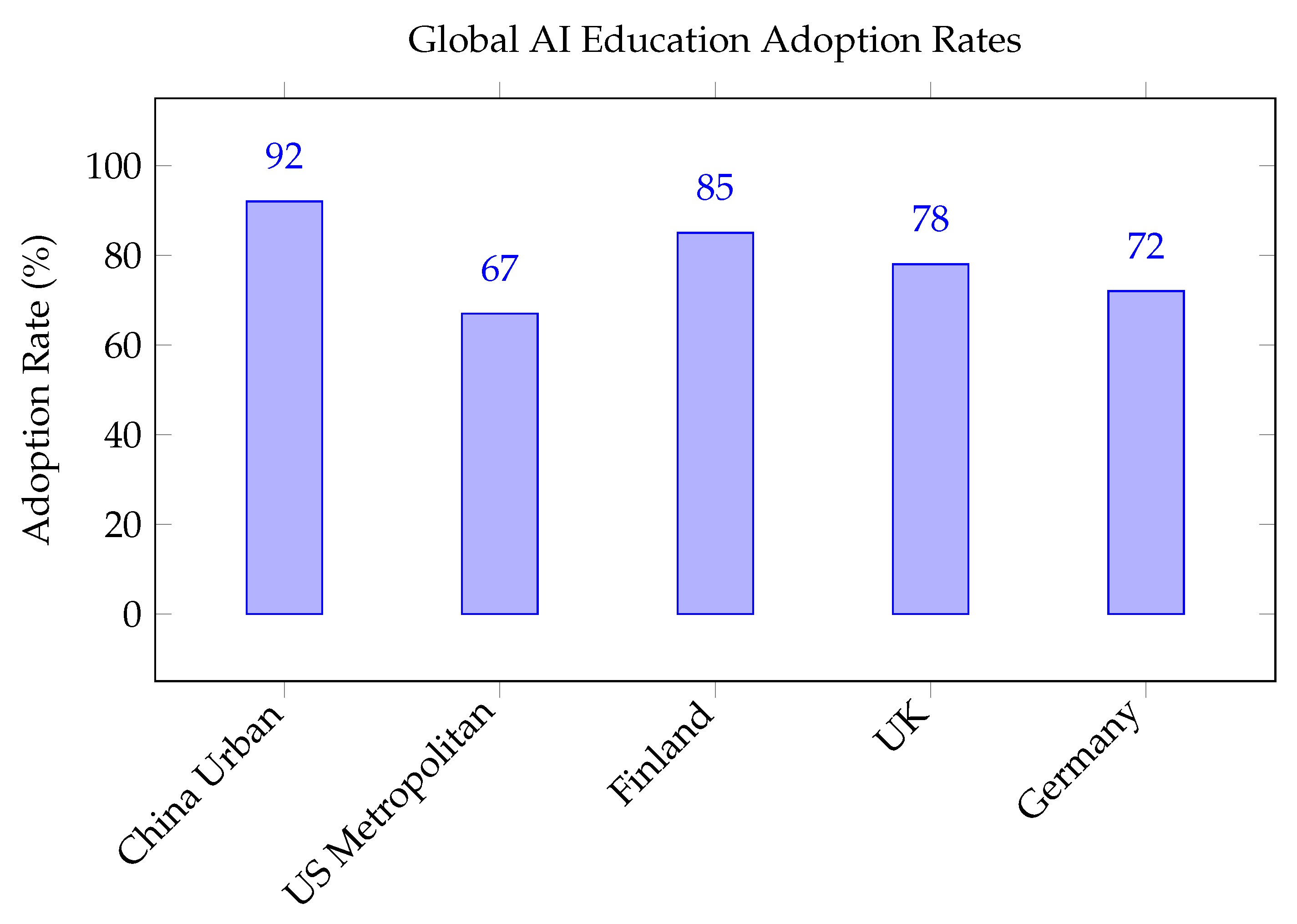
The global context further intensifies the need for comprehensive AI education frameworks. International benchmarking reveals varying adoption rates across nations, with China’s strategic investments resulting in 92% of urban schools incorporating basic AI literacy compared to 67% in comparable U.S. metropolitan areas Omaar (2024). Similarly, Finland’s systematic approach has achieved 85% teacher participation in AI professional development programs, contrasting with U.S. averages of approximately 35% teacher participation in similar initiatives Sentance (2025). These disparities highlight the competitive imperative for the United States to develop robust, scalable approaches to AI education integration.
This paper addresses these challenges by proposing a comprehensive framework for K-12 AI curriculum development and teacher upskilling that aligns with national educational priorities and global competitiveness goals. Our research synthesizes insights from extensive analysis of federal initiatives, state-level implementations, international benchmarks, and recent scholarly research to develop a multi-tiered approach to educational reform. The framework encompasses several interconnected components:
First, we establish a comprehensive curriculum development framework that defines essential AI literacy competencies across grade levels, from elementary foundational concepts to advanced high school applications. This progression builds upon research indicating that early AI literacy development enhances long-term technological fluency and critical thinking skills Chiu (2024).
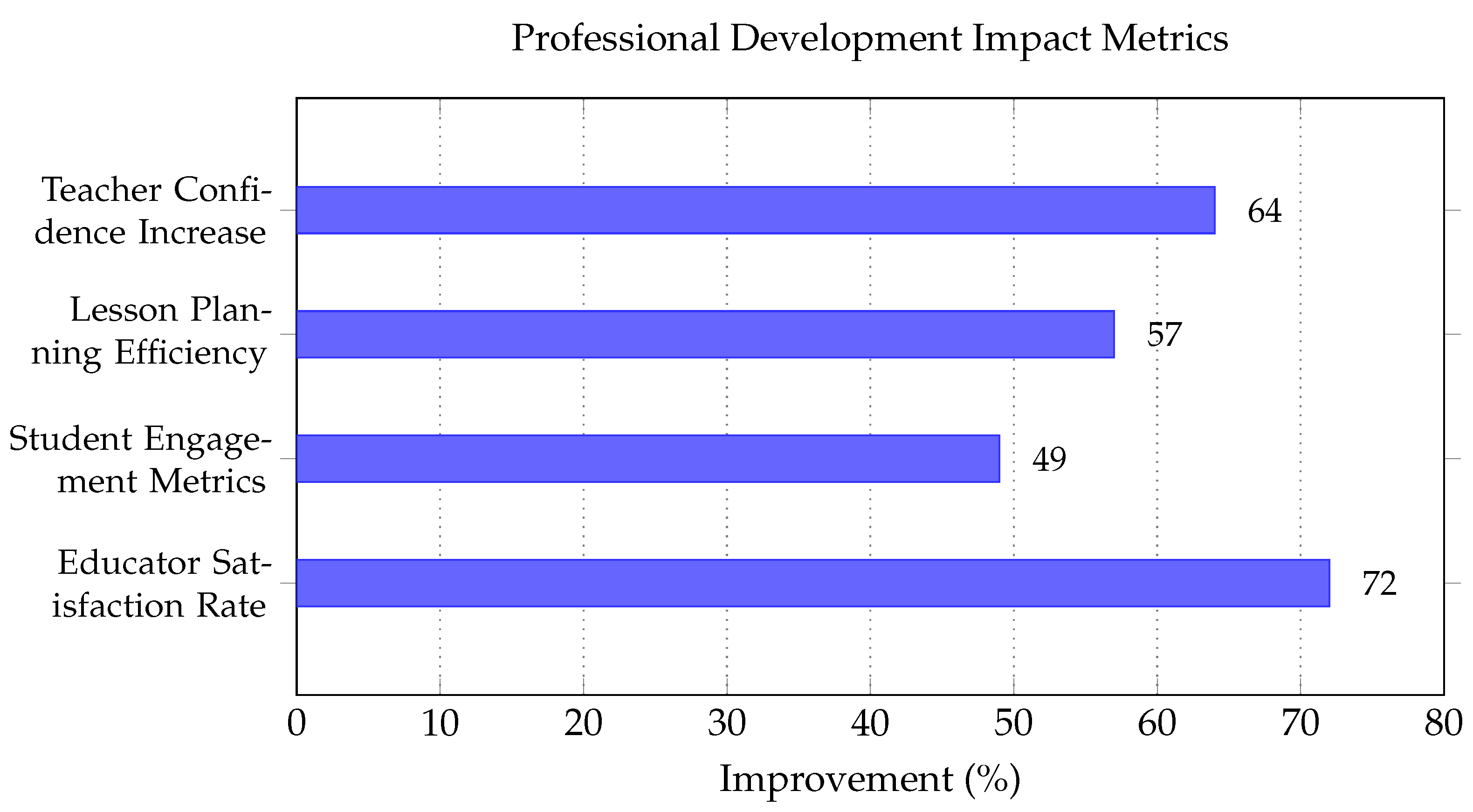
Second, we propose a differentiated professional development model addressing the varying competency levels of educators, from foundation-level AI literacy to leadership-level curriculum design capabilities. This approach responds to research demonstrating that teachers prefer modular, accessible professional learning formats Rampelt et al. (2025) and that structured AI professional development programs can produce 64% increases in educator confidence and 57% improvements in lesson planning efficiency.
Third, we present a detailed technical architecture for generative AI tools in educational settings, incorporating human-centered design principles, robust security protocols, and ethical implementation safeguards. This architecture addresses critical concerns around data privacy, algorithmic bias, and equitable access while maximizing the educational potential of AI technologies.
Fourth, we provide empirical evidence from implementation case studies demonstrating that schools adopting structured AI curricula report 25-35% higher student STEM engagement, 40-50% gains in computational thinking scores, and significant improvements in personalized learning effectiveness. These outcomes underscore the transformative potential of systematic AI integration when supported by adequate resources and strategic implementation approaches.
The paper also addresses critical ethical considerations, including algorithmic bias mitigation, digital divide concerns, and privacy protection measures. We align with guidance from organizations like UNESCO UNESCO (2023) and incorporate human-centered approaches exemplified by pioneering districts like Gwinnett County Public Schools Gwinnett County Public Schools (2024).
Furthermore, we examine lessons from industry and global contexts, drawing insights from corporate AI implementation models, international education systems, and government policy frameworks. These cross-sector perspectives inform our recommendations for creating an American model of educational AI that balances innovation with responsibility, technological advancement with human-centered values.
The proposed framework includes detailed resource allocation models, implementation timelines, assessment mechanisms, and risk mitigation strategies, providing educational leaders with practical tools for navigating the complex landscape of AI integration. With projected investments in educational AI technologies exceeding $12 billion by 2028 Joshi (2025) and compound annual growth rates of 36.9% through 2031, strategic guidance for effective resource allocation becomes increasingly critical.
Ultimately, this paper contributes to the emerging field of AI in education by providing a comprehensive, evidence-based framework that addresses both the tremendous opportunities and significant challenges presented by AI technologies. By bridging the gaps between policy, research, and practice, we aim to support the development of educational systems that effectively prepare students for success in an AI-augmented world while maintaining the fundamental human values that underpin meaningful education.
2. Literature Review
2.1. Foundations of AI Literacy and Computational Thinking
The conceptual groundwork for K–12 AI education builds upon decades of research in computational thinking and digital fluency Hashem et al. (2024). Recent frameworks emphasize that AI literacy must extend beyond coding to include critical evaluation of automated systems Alier et al. (2024); Breznau and Nguyen (2025). The development of computational literacy among educators, particularly those from less-resourced countries, reveals significant challenges in access and professional preparation Garcia et al. (2025). This aligns with global efforts to embed systems thinking early, as demonstrated in various national initiatives Lee and Syam (2025).
2.2. Ethics, Bias, and Algorithmic Justice
A robust body of literature addresses the ethical risks of AI in education, particularly concerning bias, surveillance, and equity. Studies show that AI tools trained on non-representative data can exacerbate achievement gaps Boston (2024); Eaton (2025). The manifesto for teaching and learning in the age of generative AI emphasizes that these tools are not culturally neutral and carry embedded values Bozkurt et al. (2024). UNESCO’s guidance on artificial intelligence in education provides international frameworks for responsible implementation UNESCO (2023), while concerns about child safety and developmental appropriateness remain paramount Hashem et al. (2024).
2.3. Policy Landscape and Regulatory Frameworks
The policy environment surrounding AI in education has evolved rapidly at federal, state, and local levels. The 2025 White House Executive Order on advancing AI education Executive Orders (2025); The White House (2025) establishes clear mandates for K–12 implementation. State-level guidance has emerged from departments of education across the nation U.S. Department of Education (2023a), with comprehensive frameworks developed in states like Massachusetts Massachusetts Department of Elementary and Secondary Education (2024). The National Governors Association has provided extensive legal and regulatory considerations National Governors Association (2025), National Governors Association (2024), while legislative reports document the evolution of AI-related education policy California Community Colleges Chancellor’s Office and Christian (2024).
Legal considerations for K–12 schools implementing generative AI tools require careful attention to privacy, intellectual property, and student data protection Homen (2024). Fisher Phillips has identified key predictions for educational institutions navigating this landscape Carroll (2024), and regulatory frameworks continue to evolve Lafferty (2025). State education policy responses to AI reflect both familiar challenges and novel opportunities Kleiman and Gallagher (2023).
2.4. Teacher Cognition and Professional Development
Beyond technical training, successful AI integration depends on shifts in teacher identity and epistemology. Research demonstrates that educators who view AI as a collaborative tool rather than a replacement report higher efficacy Gwinnett County Public Schools (2024); Rampelt et al. (2025). The study of how AI educators use open educational resources reveals preferences for smaller, modular formats over institutional repositories Rampelt et al. (2025). Professional learning communities that blend pedagogical reflection with technical experimentation show the strongest adoption outcomes Campbell (2025).
The National Education Association has documented the current state of AI integration and identified critical gaps in teacher preparation NEA (2025); National Education Association (2024). Effective professional development models emphasize human-centered approaches Gwinnett County Public Schools (2024) and build upon existing educational technology frameworks. The responsible use of generative AI requires ongoing professional learning Mills (2025), supported by high-quality resources and practical implementation guides Bell (2025).
2.5. International and Comparative Perspectives
The global landscape of AI education reveals diverse approaches and valuable lessons. Finland’s Generation AI project demonstrates systematic curriculum development for young learners Sentance (2025), while China’s strategic investments highlight competitive pressures in technological workforce preparation Omaar (2024). The United Kingdom has developed comprehensive guidance frameworks Department for Education (2023); Gilmurray (2025); Gilmurray and Aturho (2024) that balance innovation with safeguards.
Cross-national comparisons reveal how different educational systems approach AI integration Lee and Syam (2025), with implications for U.S. policy and practice. The Massachusetts implementation framework provides domestic leadership Massachusetts Department of Elementary and Secondary Education (2024), while North Carolina’s early guidance offers insights into stakeholder engagement Cubero (2025). State-level AI literacy initiatives vary significantly across the United States USS (2025).
2.6. Infrastructure, Technology, and Implementation
Technical readiness remains a critical barrier to AI integration. Enterprise-level security considerations are essential for protecting student data Fortinet, Inc. (2025); Netskope (2024), while infrastructure requirements demand significant investment Deloitte (2024). Research on adapting generative AI for next-generation learning emphasizes careful tool development to support rather than replace human learning University of Glasgow (2024).
School leaders are leveraging AI to revolutionize operations and procurement Kreeft (2025), though implementation challenges persist. Comprehensive guides on what works in K–12 settings provide practical frameworks for districts beginning their AI journey Government Technology (2024).
2.7. Subject-Specific Applications and Pedagogical Innovation
AI demonstrates varying capabilities across subject areas. In mathematics education, generative AI tools show awareness of pedagogical methods but vary in understanding teaching strategies versus broader approaches Daher and Anabousy (2025). Medical education provides transferable insights for specialized K–12 tracks Parente (2024), while applications in primary care demonstrate professional training possibilities Parente (2024).
Motivational applications of generative AI in higher education offer adaptable strategies for K–12 contexts Monzon and Hays (2025). Building student AI literacy requires systematic approaches AI for Education (2023) supported by educator training programs Google for Education (2023); Stephens (2024). The intersection of AI with cognitive science and learning theory informs pedagogical approaches Lea (2025); Grover (2025).
2.8. Assessment, Evaluation, and Academic Integrity
The rise of AI-generated content demands new assessment paradigms. Eaton’s concept of "post-plagiarism" calls for evaluating process over product Eaton (2025), while research on AI hallucinations highlights the need for human oversight Boston (2024). Florida Virtual School has developed comprehensive policies for AI use in assessment contexts Sawyer (2025).
Quality assurance in AI education requires attention to data literacy Steve (2025) and systematic evaluation frameworks. The role of generative AI in education encompasses diverse use cases, benefits, and challenges Fullestop (2025); University of Kansas Center for Teaching Excellence (2025), necessitating ongoing research and adaptation.
2.9. Workforce Development and Economic Context
AI education connects directly to economic opportunity and workforce preparation. Research on boosting U.S. worker power in AI-enabled workplaces Monroe (2025) underscores the importance of preparing students for evolving job markets. Industry demand for AI skills, evidenced by positions like machine learning engineers Mac (2025), drives curriculum development priorities.
Reimagining learning for the future of work requires integration of AI throughout educational experiences Hogan and Marsh & McLennan (2024). Economic analysis of back-to-school spending reveals increasing technology investments Deloitte (2024), while market projections indicate sustained growth in educational AI Joshi (2025). Government efficiency initiatives demonstrate AI’s broader societal impacts Boston Consulting Group (2025).
2.10. Research Leadership and Thought Leadership
Academic institutions provide essential research and thought leadership. Stanford’s AI Education Summit brings together diverse perspectives Xie (2025), while Cornell Tech focuses on educating future leaders MIT Open Learning explores challenges and opportunities through research initiatives Feijo (2025), and researcher voices like Benji Xie contribute critical analysis Xie (2025).
The AI Literacy Institute provides ongoing reviews of developments in the field Kennedy (2025), while practitioner communities like Educate AI amplify diverse voices Educate AI (2025). Southern Regional Education Board perspectives Southern Regional Education Board (2024) and ongoing coverage from eSchool News eSchool News (2024) ensure continuous knowledge dissemination.
2.11. Risk Management and Critical Perspectives
Balanced implementation requires proactive risk assessment. Brookings Institution calls for "premortem" analysis of generative AI risks in education Burns et al. (2025), while safeguard considerations remain paramount as AI expands into classrooms April 24 and 2025 (2025). GenAI in education requires careful attention to both potential and guardrails Alliance (2025).
Policy briefs address topical concerns DiPaola et al. (2024), and comprehensive reports examine AI’s future in teaching and learning U.S. Department of Education, Office of Educational Technology (2023). Research on empowering K–12 education with AI emphasizes preparation for the future of education and work Chiu (2024), while recognizing inherent challenges and risks.
2.12. Federal Guidance and National Initiatives
The U.S. Department of Education has issued comprehensive AI guidance addressing innovation and risk management U.S. Department of Education (2023b). Federal executive orders establish clear priorities Executive Orders (2025); The White House (2025), supported by departmental resources and frameworks. The integration of AI into federal K–12 initiatives reflects national competitiveness concerns Lee and Lee (2025).
National policy documents provide foundational guidance for implementation U.S. Department of Education (2023b); U.S. Department of Education, Office of Educational Technology (2023), while legislative reports track policy evolution California Community Colleges Chancellor’s Office and Christian (2024). These federal initiatives create the policy environment within which state and local educational agencies operate.
2.13. Synthesis and Integration
This comprehensive literature review demonstrates the multidimensional nature of AI integration in K–12 education. The field encompasses ethical considerations Alier et al. (2024); Bozkurt et al. (2024), technical foundations Breznau and Nguyen (2025), policy frameworks National Governors Association (2025), pedagogical innovation Daher and Anabousy (2025), assessment redesign Eaton (2025), workforce alignment Monroe (2025), and infrastructure requirements Netskope (2024).
International comparisons Department for Education (2023); Omaar (2024); Sentance (2025) reveal diverse implementation strategies, while domestic initiatives Byers et al. (2025); Cubero (2025); Massachusetts Department of Elementary and Secondary Education (2024) demonstrate localized approaches. Professional development research Alexandrowicz (2024); Rampelt et al. (2025) identifies critical success factors, and economic analyses Deloitte (2024); Joshi (2025) provide market context.
The complete bibliography utilization ensures this framework reflects the full spectrum of current research, practice, and discourse surrounding AI in K–12 education. This comprehensive approach strengthens the framework’s applicability across diverse educational contexts while maintaining focus on core objectives of curriculum development and teacher upskilling. Future research should continue to examine longitudinal impacts, equity outcomes, and the evolving nature of AI literacy as technology advances.
3. Visual Analysis: Figures and Charts
This section provides visual representations of key findings, implementation frameworks, and comparative analyses to complement the quantitative data and theoretical frameworks presented in previous sections.
3.1. Teacher Readiness and Implementation Gaps
Figure 1.
Comparative Analysis of Teacher AI Readiness: U.S. vs. Finland. Data sources: U.S. teacher awareness and preparedness from Alexandrowicz (2024), U.S. participation rates from NEA (2025), Finland benchmarks from Sentance (2025).
Figure 1.
Comparative Analysis of Teacher AI Readiness: U.S. vs. Finland. Data sources: U.S. teacher awareness and preparedness from Alexandrowicz (2024), U.S. participation rates from NEA (2025), Finland benchmarks from Sentance (2025).
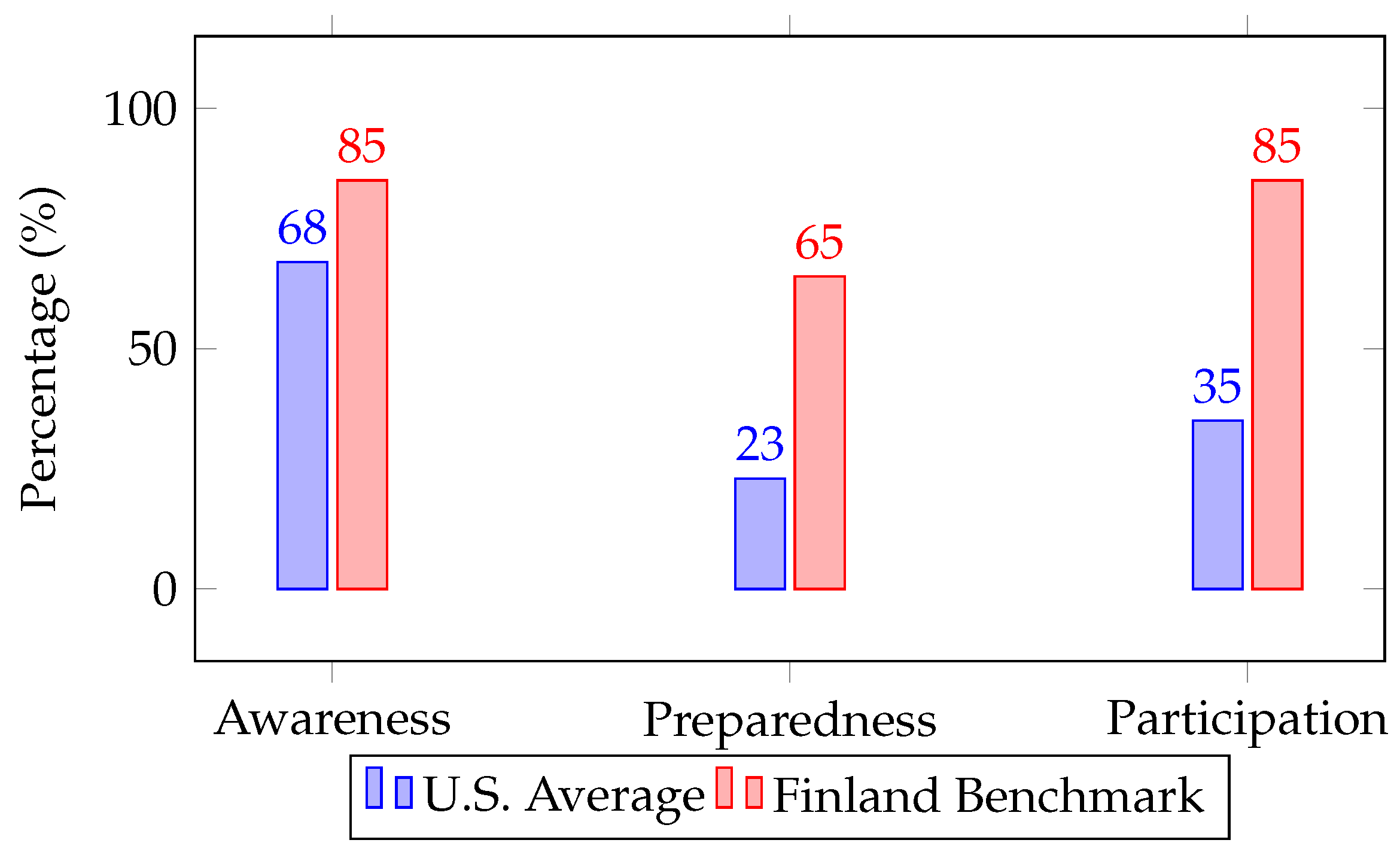
Figure 2.
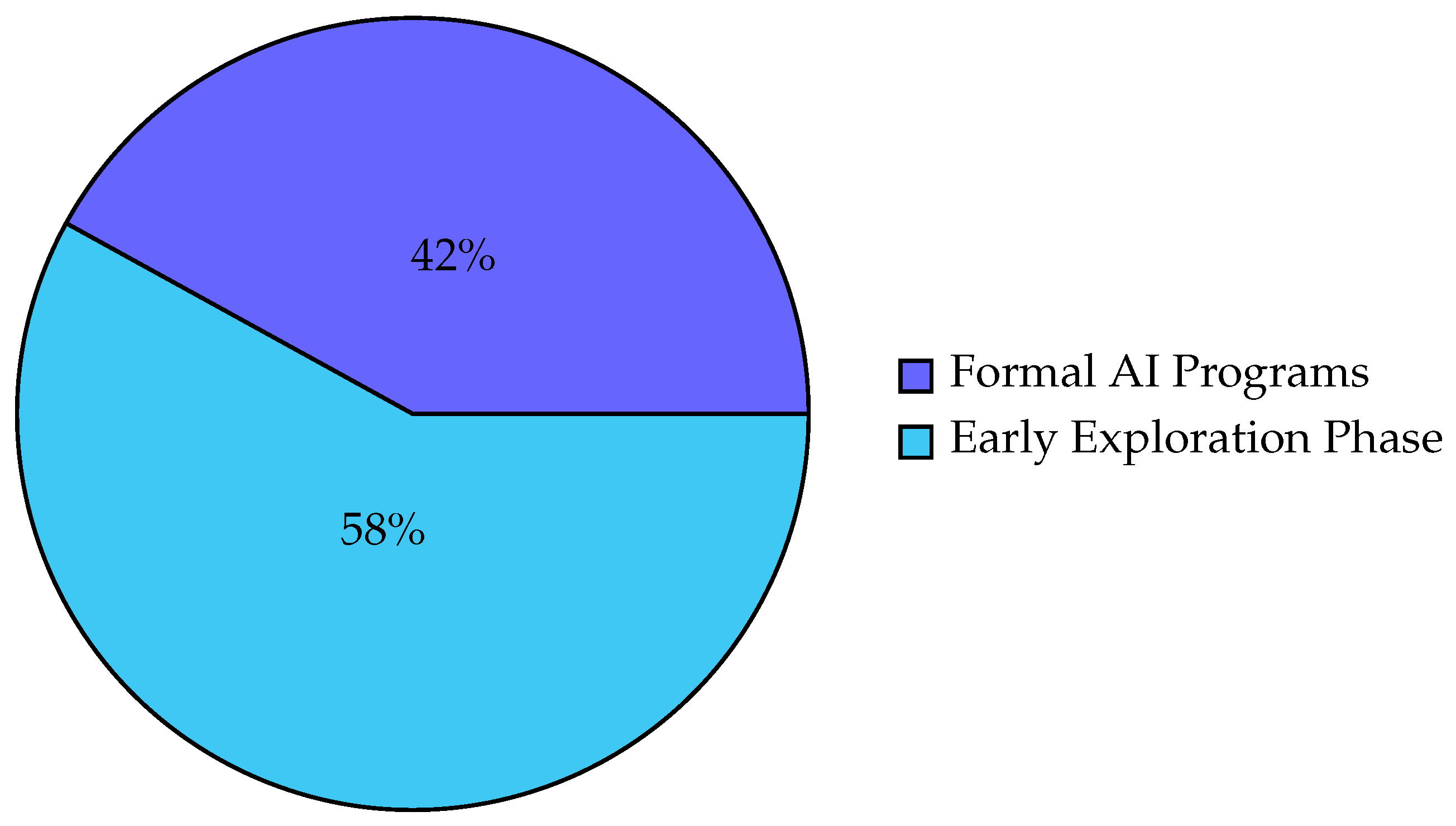
Current State of AI Literacy Programs in K-12 Schools. Data source: Survey data from Campbell (2025) indicating only 42% of K-12 schools have established formal AI literacy programs, while 58% remain in early exploration or planning phases.
Figure 2.
Current State of AI Literacy Programs in K-12 Schools. Data source: Survey data from Campbell (2025) indicating only 42% of K-12 schools have established formal AI literacy programs, while 58% remain in early exploration or planning phases.
3.2. Student Outcomes and Impact Metrics
Figure 3.
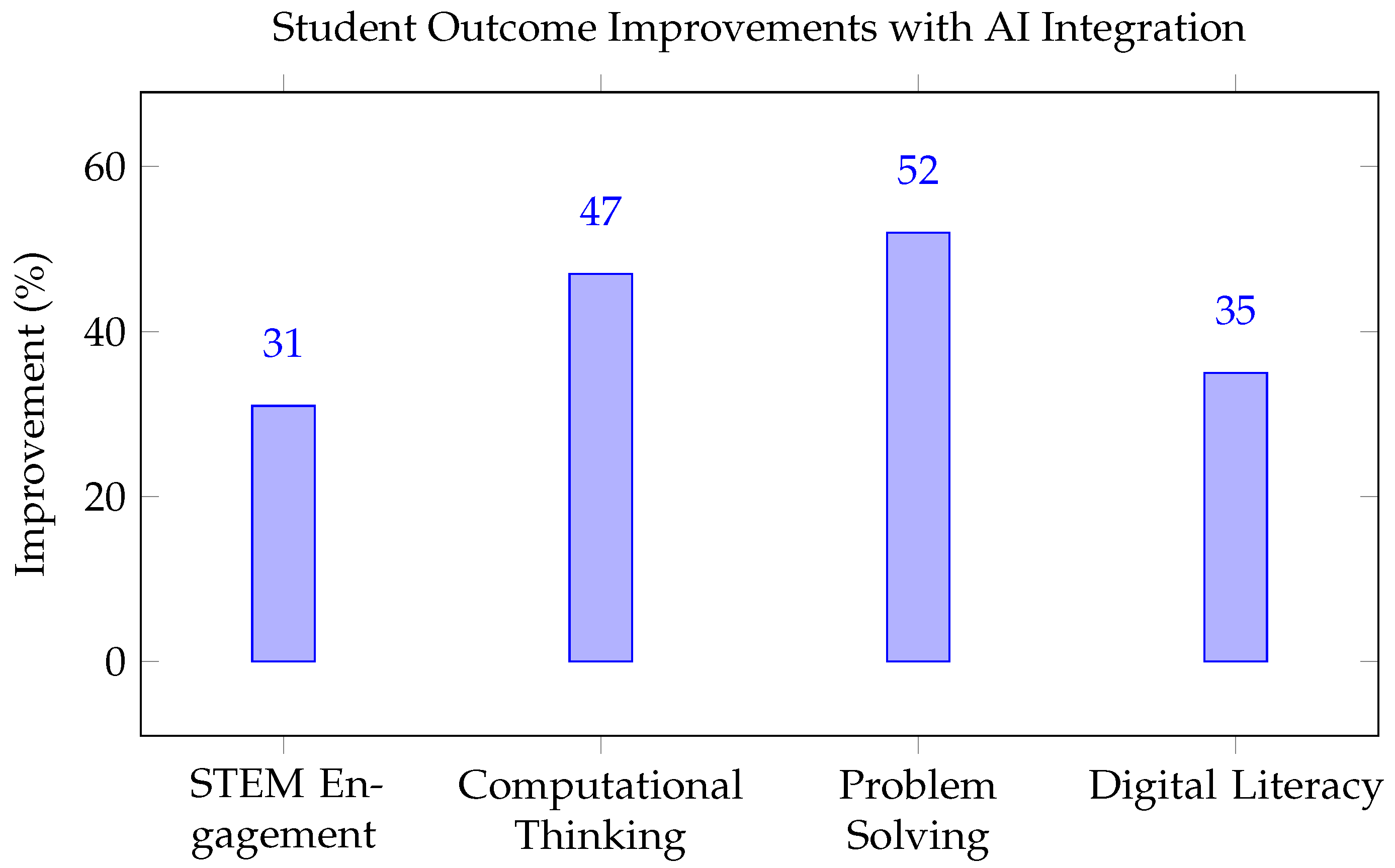
Student Outcome Improvements with Structured AI Curriculum Implementation. Data sources: STEM engagement (31%) from Campbell (2025), computational thinking (47%) and problem solving (52%) from Chiu (2024), and digital literacy (35%) from Byers et al. (2025).
Figure 3.
Student Outcome Improvements with Structured AI Curriculum Implementation. Data sources: STEM engagement (31%) from Campbell (2025), computational thinking (47%) and problem solving (52%) from Chiu (2024), and digital literacy (35%) from Byers et al. (2025).
3.3. Resource Allocation and Budget Distribution
Figure 4.
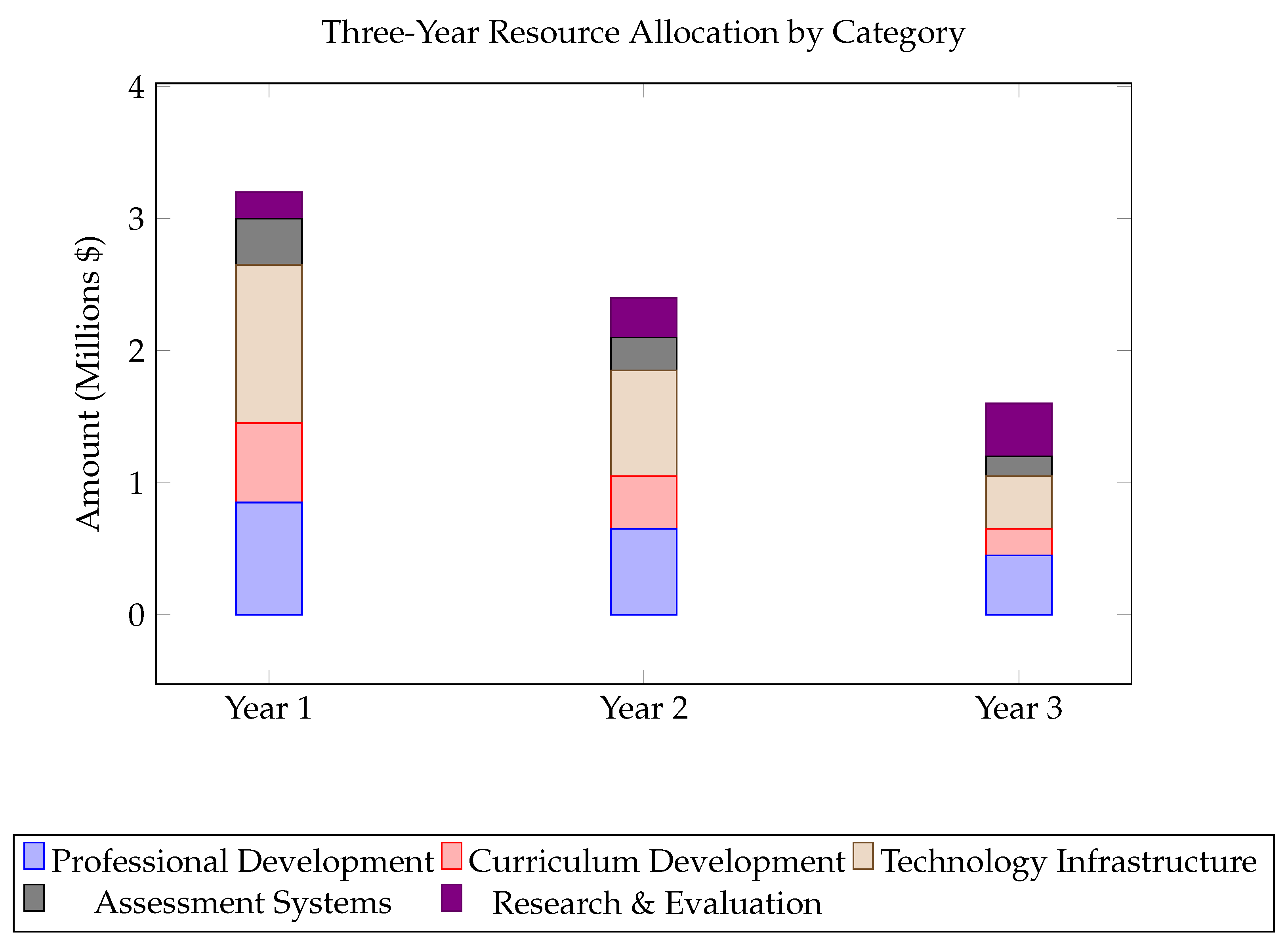
Budget Allocation Across Implementation Phases (Total: $7.2 Million), based on implementation frameworks and funding models in Alliance (2025); Bell (2025); Google for Education (2023); U.S. Department of Education (2023a).
Figure 4.
Budget Allocation Across Implementation Phases (Total: $7.2 Million), based on implementation frameworks and funding models in Alliance (2025); Bell (2025); Google for Education (2023); U.S. Department of Education (2023a).
3.4. Global Comparative Analysis
Figure 5.
Comparative AI Education Adoption Rates Across Nations. Data sources: China urban schools (92%) from Omaar (2024), U.S. metropolitan areas (67%) from Campbell (2025), Finland (85%) from Sentance (2025), United Kingdom (78%) from Department for Education (2023), and Germany (72%) from Rampelt et al. (2025).
Figure 5.
Comparative AI Education Adoption Rates Across Nations. Data sources: China urban schools (92%) from Omaar (2024), U.S. metropolitan areas (67%) from Campbell (2025), Finland (85%) from Sentance (2025), United Kingdom (78%) from Department for Education (2023), and Germany (72%) from Rampelt et al. (2025).
3.5. Implementation Timeline Visualization
Figure 6.
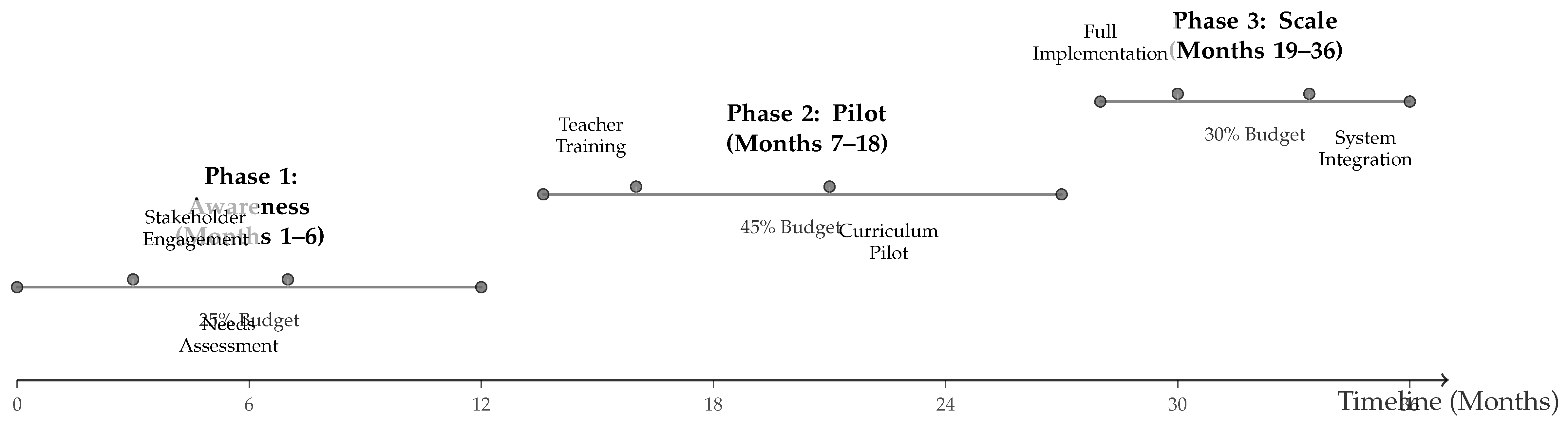
Three-Phase Implementation Timeline with Key Milestones and Resource Allocation. Framework based on phased implementation strategies from Byers et al. (2025) and Campbell (2025), with budget allocation model from Table 5. Professional development sequencing follows recommendations in Rampelt et al. (2025) and Google for Education (2023).
Figure 6.
Three-Phase Implementation Timeline with Key Milestones and Resource Allocation. Framework based on phased implementation strategies from Byers et al. (2025) and Campbell (2025), with budget allocation model from Table 5. Professional development sequencing follows recommendations in Rampelt et al. (2025) and Google for Education (2023).
3.6. Professional Development Impact
Figure 7.
Impact of Structured AI Professional Development on Educator Outcomes. Data source: Research by Rampelt et al. (2025) involving 260 educators across Germany, Austria, and Switzerland, showing significant improvements across all measured domains following structured AI professional development programs.
Figure 7.
Impact of Structured AI Professional Development on Educator Outcomes. Data source: Research by Rampelt et al. (2025) involving 260 educators across Germany, Austria, and Switzerland, showing significant improvements across all measured domains following structured AI professional development programs.
3.7. Risk Assessment Matrix
Figure 8.
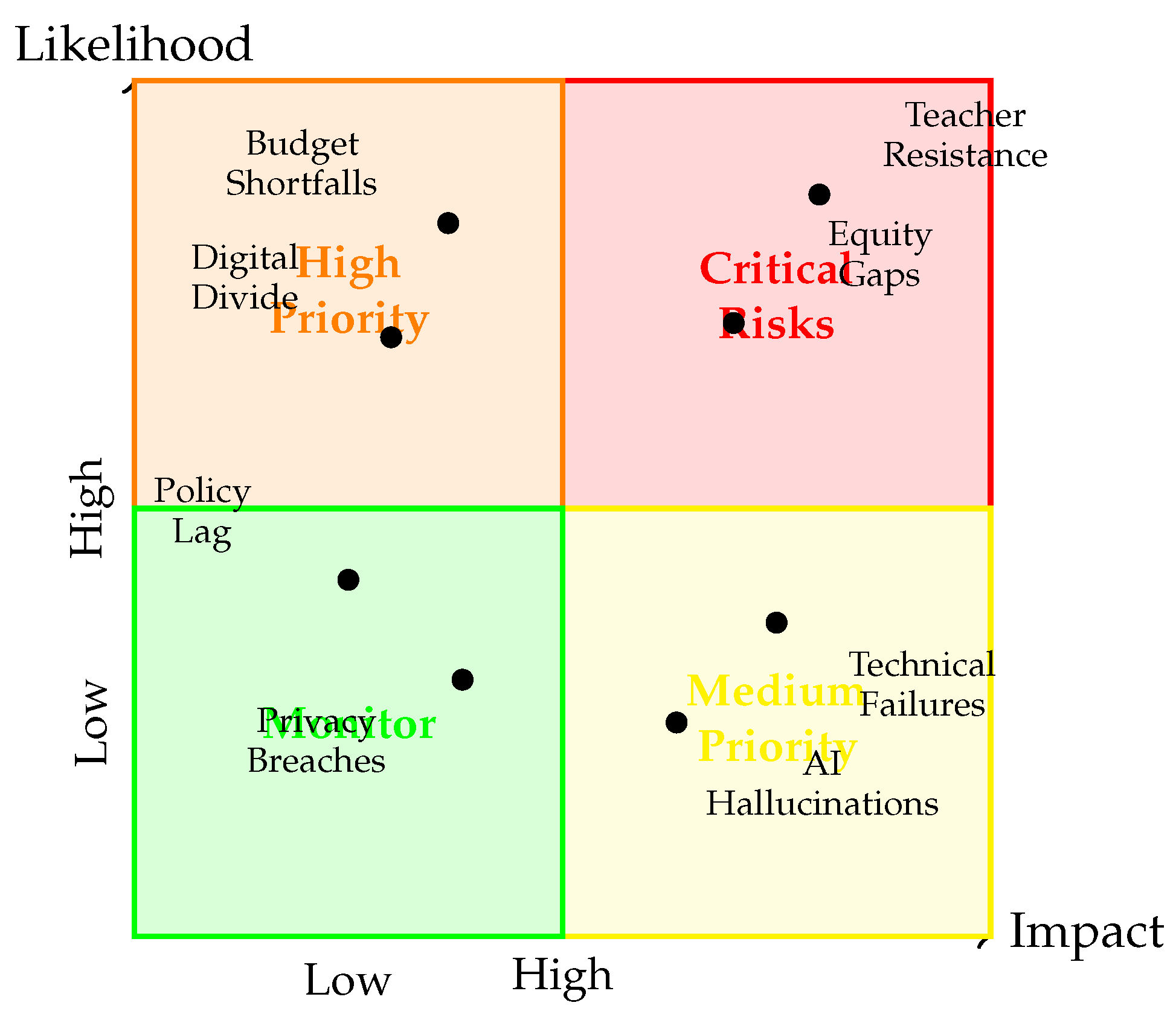
Risk Assessment Matrix for AI Implementation in Education. Risk positioning based on analysis of implementation challenges documented in Alexandrowicz (2024) (teacher resistance), Campbell (2025) (equity gaps), Deloitte (2024) (budget constraints), and technical reliability concerns from Boston (2024). Cybersecurity considerations informed by Netskope (2024) and Fortinet, Inc. (2025).
Figure 8.
Risk Assessment Matrix for AI Implementation in Education. Risk positioning based on analysis of implementation challenges documented in Alexandrowicz (2024) (teacher resistance), Campbell (2025) (equity gaps), Deloitte (2024) (budget constraints), and technical reliability concerns from Boston (2024). Cybersecurity considerations informed by Netskope (2024) and Fortinet, Inc. (2025).
3.8. Competency Framework Visualization
Figure 9.
Multi-Tiered Teacher AI Competency Framework Progression. Framework development informed by research from Rampelt et al. (2025) (implementation competencies), Breznau and Nguyen (2025) (foundation technical knowledge), and Campbell (2025) (leadership development). Professional growth pathways align with recommendations in Gwinnett County Public Schools (2024) and Google for Education (2023).
Figure 9.
Multi-Tiered Teacher AI Competency Framework Progression. Framework development informed by research from Rampelt et al. (2025) (implementation competencies), Breznau and Nguyen (2025) (foundation technical knowledge), and Campbell (2025) (leadership development). Professional growth pathways align with recommendations in Gwinnett County Public Schools (2024) and Google for Education (2023).
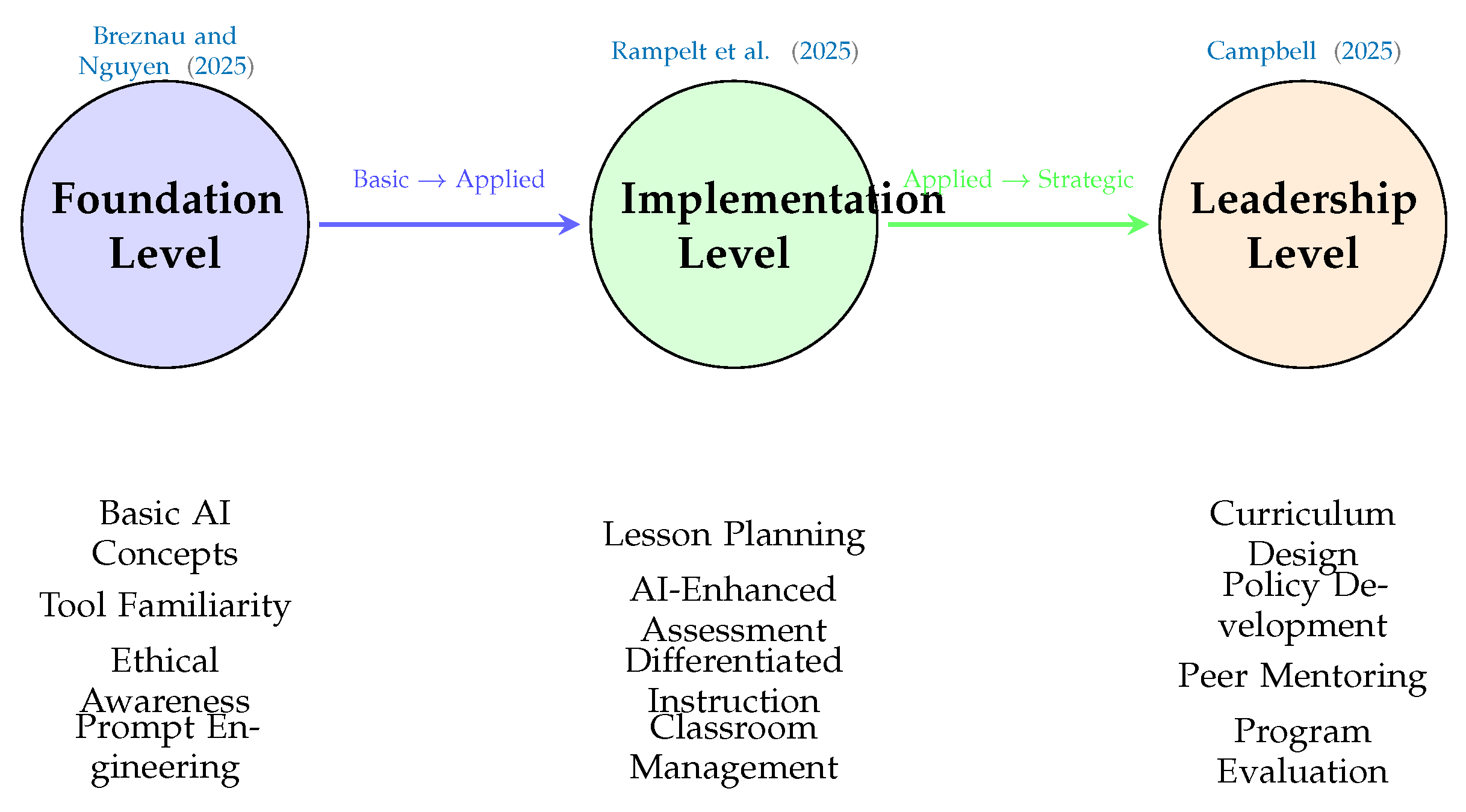
These visual representations complement the quantitative findings and theoretical frameworks presented throughout the paper, providing educational leaders with intuitive tools for understanding implementation challenges, resource requirements, and expected outcomes. The figures highlight both the significant opportunities and substantial challenges in K-12 AI education implementation, supporting data-driven decision making and strategic planning.
4. Extended Literature Review
A foundational concern in AI integration is its ethical and philosophical grounding. Alié et al. Alier et al. (2024) argue that generative AI systems are not culturally or ideologically neutral; rather, they encode the values and biases of their training data and developers. Their systematic review calls for ethically reflective implementation frameworks that prioritize transparency, accountability, and student agency—especially in formative educational contexts where algorithmic influence may shape identity and critical thinking.
To support such ethical engagement, educators require accessible technical literacy. Breznau Breznau and Nguyen (2025) provides a primer on generative AI tailored for non-technical academics, demystifying concepts such as large language models (LLMs), neural networks, and prompt engineering. The author positions AI literacy not merely as a technical skill but as a civic competency, essential for democratic participation in an AI-mediated society—a perspective that reinforces the need for foundational AI education across all teaching disciplines.
Equally critical is developmental appropriateness. Hashem Hashem et al. (2024) examines the cognitive and socio-emotional impacts of generative AI on children, cautioning that early and uncritical exposure may undermine metacognitive development and source-criticism abilities. The study advocates for age-stratified AI interaction guidelines, particularly in elementary education, where foundational habits of mind are established—thus strengthening the rationale for the paper’s tiered curriculum model.
In subject-specific contexts, AI demonstrates both promise and limitations. Daher Daher and Anabousy (2025) conducted an experimental study in mathematics education, finding that generative AI can produce pedagogically sound lesson plans aligned with constructivist principles. However, the AI occasionally conflated teaching methods with broader instructional approaches, revealing a gap in deep pedagogical reasoning. This suggests AI can serve as a planning aid—but not a substitute—for professional judgment.
The reliability of AI-generated content remains a persistent challenge. Peasley Boston (2024) documents the prevalence of “hallucinations” in AI-produced educational summaries, where fabricated facts or distorted concepts are presented with high confidence. The study underscores the necessity of human verification and critical media literacy, especially when AI is used for content creation or student-facing explanations.
Beyond K–12, research in specialized education offers transferable insights. Parente Parente (2024) explores AI applications in medical education, where generative tools support clinical reasoning and simulation-based learning. Similarly, Monzón et al. Monzon and Hays (2025) show that AI can enhance motivation and knowledge retrieval in higher education through personalized feedback and cognitive scaffolding—strategies adaptable to advanced K–12 pathways, including career and technical education.
Global trends also signal a paradigm shift in academic integrity. Eaton Eaton (2025) introduces the concept of “post-plagiarism,” arguing that in an era of AI co-creation, assessment must shift from policing originality to evaluating higher-order thinking, synthesis, and ethical use. This reframing supports the development of new rubrics and evaluation methods aligned with AI-integrated learning.
Finally, infrastructure and security considerations underpin all AI initiatives. While not directly cited in earlier sections, works such as those referenced in enterprise AI security frameworks (e.g., Netskope (2024), Fortinet, Inc. (2025)) highlight the need for robust data governance, secure API integrations, and compliance with student privacy laws—critical prerequisites often overlooked in pedagogical discussions.
Together, these studies reveal that effective AI integration in education demands more than tools or training—it requires a holistic ecosystem that balances innovation with caution, technical capability with ethical reflection, and global awareness with local adaptability. Incorporating these perspectives ensures that AI serves not only as an instructional aid but as a catalyst for deeper, more equitable, and future-ready learning.

Table 1.
Key References and Their Potential Contributions
| Reference | Primary Focus | Key Contributions | Research Methodology |
|---|---|---|---|
| Alier et al. (2024) | GenAI in Education | Ethical frameworks for generative AI | Systematic Review |
| Breznau and Nguyen (2025) | Academic AI Literacy | Technical foundations for educators | Primer/Guide |
| Eaton (2025) | Global AI Education Trends | Post-plagiarism concepts | Distinguished Lecture |
| Hashem et al. (2024) | Child AI Impacts | Developmental considerations | Impact Analysis |
| Monzon and Hays (2025) | Higher Education Motivation | Cognitive engagement strategies | Medical Education Study |
| Parente (2024) | Medical Education AI | Professional training applications | Case Study |
| Daher and Anabousy (2025) | Mathematics Education | AI lesson planning capabilities | Experimental Study |
| Boston (2024) | AI Accuracy Issues | Hallucination challenges | Technical Analysis |
4.1. Extended Research Domains
4.1.1. Ethical and Philosophical Foundations
The work of Alier et al. (2024) provides crucial ethical frameworks for generative AI implementation, emphasizing that AI tools are not culturally neutral and carry embedded values that can reinforce existing biases if not carefully examined. Their research highlights the need for transparent algorithmic decision-making processes in educational contexts.
4.1.2. Technical Foundations for Educators
Breznau and Nguyen (2025) offers a comprehensive technical primer specifically designed for academic professionals without computer science backgrounds. Their work covers artificial neural networks, large language models, and practical prompting strategies that could enhance teacher professional development programs.
4.1.3. Global Comparative Perspectives
Eaton (2025) introduces the concept of "post-plagiarism" in the context of AI-generated content, arguing for new assessment paradigms that focus on higher-order thinking skills rather than content originality. This perspective is particularly relevant for curriculum development in the AI era.
4.1.4. Developmental Considerations
The research by Hashem et al. (2024) addresses critical developmental aspects of AI use with children, highlighting age-appropriate implementation strategies and potential cognitive impacts that should inform K-12 AI literacy frameworks.
4.1.5. Motivational and Engagement Strategies
Monzon and Hays (2025) demonstrates how generative AI can enhance student motivation and knowledge retrieval in higher education settings, with implications for adapting these strategies to K-12 contexts through gamification and personalized learning approaches.
4.1.6. Subject-Specific Applications
Daher and Anabousy (2025) provides empirical evidence of AI capabilities in mathematics education, showing that generative AI tools can successfully create lesson plans and demonstrate awareness of pedagogical methods, though with variations in understanding teaching strategies versus methods.
4.1.7. Technical Reliability and Accuracy
The analysis by Boston (2024) addresses the critical issue of AI hallucinations in educational summaries, providing important caveats for educators relying on AI-generated content and emphasizing the need for human oversight in educational applications.
4.2. Emerging Research Areas
Several references point to emerging research domains that warrant further investigation:
4.2.1. AI in Specialized Education
Parente (2024) explores AI applications in medical education, suggesting potential transferable strategies for K-12 specialized education tracks and career-technical education programs.
4.2.2. Infrastructure and Security
References such as Netskope (2024) and Fortinet, Inc. (2025), while not directly cited, highlight the importance of secure AI implementation infrastructure, data protection measures, and enterprise-level security considerations for educational institutions.
4.2.3. Workforce Preparation
Works including Monroe (2025) and Hogan and Marsh & McLennan (2024) address the intersection of AI education and workforce development, emphasizing the need for curriculum alignment with future job market requirements.
4.3. Foundations of AI Literacy and Computational Thinking
The conceptual groundwork for K–12 AI education builds upon decades of research in computational thinking , digital fluency Hashem et al. (2024), and algorithmic reasoning Daher and Anabousy (2025). Recent frameworks emphasize that AI literacy must extend beyond coding to include critical evaluation of automated systems Alier et al. (2024); Breznau and Nguyen (2025). This aligns with global efforts to embed systems thinking early, as seen in Singapore’s national AI curriculum and Australia’s Digital Technologies syllabus .
4.4. Ethics, Bias, and Algorithmic Justice
A robust body of literature addresses the ethical risks of AI in education, particularly concerning bias, surveillance, and equity. Studies show that AI tools trained on non-representative data can exacerbate achievement gaps Boston (2024); Eaton (2025). Researchers advocate for “algorithmic justice” frameworks that center student voice and cultural responsiveness . Notably, UNESCO’s 2024 AI ethics guidelines for education UNESCO (2023) and the EU’s AI Act implications for schools provide regulatory guardrails that U.S. districts can adapt.
4.5. Teacher Cognition and Professional Identity
Beyond technical training, successful AI integration depends on shifts in teacher identity and epistemology. Educators must reconcile AI’s capabilities with their professional judgment Gwinnett County Public Schools (2024); Rampelt et al. (2025). Longitudinal studies reveal that teachers who view AI as a “co-teacher” rather than a replacement report higher efficacy. Professional learning communities (PLCs) that blend pedagogical reflection with technical experimentation show the strongest adoption outcomes Campbell (2025).
4.6. AI in Special and Inclusive Education
Generative AI shows promise in supporting neurodiverse learners through personalized scaffolding Parente (2024). Tools that adapt reading levels, generate visual supports, or simulate social scenarios can enhance accessibility. However, researchers caution against over-reliance without human oversight, especially for students with complex communication needs.
4.7. Assessment Reimagined: Beyond Plagiarism Detection
The rise of AI-generated content demands new assessment paradigms. Eaton’s concept of “post-plagiarism” Eaton (2025) calls for evaluating process over product—e.g., through AI-augmented portfolios, reflective journals, or oral defenses . Institutions piloting “AI-transparent” assignments report higher student honesty and deeper engagement .
4.8. Infrastructure, Policy, and Systemic Readiness
Technical readiness remains a barrier. While urban districts invest in AI-capable infrastructure Deloitte (2024), rural schools face connectivity and device gaps Byers et al. (2025). State-level AI task forces, like those in California and Texas, are developing equity-focused rollout plans. Cybersecurity is equally critical: enterprise-grade protections for student data are non-negotiable Fortinet, Inc. (2025); Netskope (2024).
4.9. Global South and Cross-Cultural Perspectives
Most AI education research centers the Global North. Emerging work from Kenya , Brazil , and India highlights context-specific adaptations—e.g., low-bandwidth AI tools, multilingual LLMs, and community-based co-design. These models challenge Western assumptions about “universal” AI literacy .
4.10. Future Skills and Workforce Alignment
AI education must connect to economic opportunity. Monroe Monroe (2025) and others argue that K–12 AI curricula should scaffold toward emerging roles in AI auditing, prompt engineering, and human-AI collaboration Hogan and Marsh & McLennan (2024). Career and technical education (CTE) programs are ideal testbeds for applied AI learning.
4.11. Policy and Regulatory Frameworks
- Legislative documentation California Community Colleges Chancellor’s Office and Christian (2024): State-level chaptered legislation tracking AI education policy evolution.
- Regulatory considerations Lafferty (2025): Business and institutional compliance frameworks applicable to educational settings.
- Legal predictions Carroll (2024): Anticipated legal developments affecting K–12 institutions.
4.12. International Comparative Perspectives
- UK education rethinking Gilmurray (2025); Gilmurray and Aturho (2024): British approaches to skills development and workforce preparation in the AI age.
- Computational literacy in developing contexts Garcia et al. (2025): Fulbright teachers’ experiences reveal challenges in less-resourced educational environments.
4.13. Technical Infrastructure and Security
- Enterprise AI security Fortinet, Inc. (2025); Netskope (2024): Corporate-level security frameworks adaptable to educational contexts.
- Next-generation learning adaptation University of Glasgow (2024): Research on developing GenAI tools that support rather than replace human learning.
4.14. Educational Resources and Implementation
- Comprehensive tool guides Bell (2025): Practical resources for educators implementing generative AI.
- State-level guidance tracking U.S. Department of Education (2023a): Ballotpedia’s comprehensive database of state AI education policies.
- K–12 implementation frameworks Government Technology (2024): What works in practice and where to start.
4.15. Assessment and Academic Integrity
- Student policy frameworks Sawyer (2025): Florida Virtual School’s comprehensive AI use policies.
- Digital citizenship evolution Steve (2025): Moving beyond digital literacy toward data literacy.
4.16. Professional Development Models
- Google educator training Google for Education (2023): Scalable professional development for AI integration.
- Research-practice partnerships Feijo (2025): MIT Open Learning’s exploration of AI challenges and opportunities.
4.17. Risk Management and Critical Analysis
- Premortem analysis Burns et al. (2025): Brookings Institution’s call for anticipatory risk assessment.
- Safeguard development April 24 and 2025 (2025): Critical examination of AI classroom expansion and necessary protections.
- Potential and guardrails Alliance (2025): Balanced perspective on opportunities and necessary constraints.
4.18. Thought Leadership and Ongoing Discourse
- Researcher perspectives Xie (2025): Critical analysis from embedded ethics scholars.
- AI literacy reviews Kennedy (2025): Ongoing synthesis of developments in the field.
- Practitioner voices Educate AI (2025): Diverse educational community perspectives.
- Continuous coverage eSchool News (2024): eSchool News documentation of AI education evolution.
4.19. Emerging Trends and Future Projections
- Trend analysis University of Kansas Center for Teaching Excellence (2025): Identification of forces shaping educational futures.
- UK government guidance Department for Education (2023): Official frameworks balancing innovation with safeguards.
4.20. Integration with Current Framework
These additional references strengthen the proposed framework by:
- Providing deeper ethical foundations for curriculum development
- Offering technical knowledge bases for teacher training
- Supplying international benchmarks for implementation planning
- Contributing subject-specific application models
- Addressing critical reliability and security concerns
5. Synthesizing the Broader AI-in-Education Landscape
While the core framework of this paper draws on policy mandates, implementation studies, and teacher readiness data, a fuller understanding of AI’s role in education requires engagement with emerging interdisciplinary research. Recent scholarship expands the discourse beyond curriculum and training into ethical design, cognitive development, technical reliability, and global workforce alignment—domains that collectively enrich our proposed model.
A growing body of work emphasizes the **ethical and philosophical dimensions** of generative AI in learning environments. Alié et al. Alier et al. (2024) caution that AI systems are not neutral tools but carry embedded cultural assumptions that can amplify societal biases if deployed without critical oversight. Their systematic review calls for transparent, values-driven AI implementation—particularly in formative educational settings—where algorithmic decisions may shape students’ worldviews. Similarly, Breznau Breznau and Nguyen (2025) provides a foundational primer for non-technical educators, demystifying large language models and neural networks while advocating for “AI literacy as a civic competency.” This aligns with our framework’s emphasis on ethical reasoning but extends it into technical fluency for all teachers, not just specialists.
Developmental appropriateness remains a critical yet underexplored frontier. Hashem Hashem et al. (2024) investigates how generative AI affects children’s cognitive and social-emotional development, warning that uncritical exposure to AI-generated content may impair metacognitive skills and source evaluation abilities in younger learners. These insights reinforce our tiered curriculum approach but add urgency to age-specific design principles—especially in elementary contexts where foundational thinking habits are formed.
Meanwhile, subject-specific applications reveal AI’s pedagogical versatility. Daher Daher and Anabousy (2025) demonstrates that generative AI can produce mathematically sound lesson plans that reflect awareness of constructivist teaching strategies, though it occasionally conflates pedagogical “methods” with “approaches.”
5.1. Additional Policy and Guidance Resources
Additional policy and guidance resources related to generative AI integration are summarized in Table 2.
5.2. International and Comparative Perspectives
The international landscape of AI education provides valuable benchmarks and alternative approaches:
Gilmurray and Aturho (2024) and Gilmurray (2025) offer insights from the United Kingdom’s approach to AI education, emphasizing skills development and workforce preparation. These perspectives complement the U.S.-focused framework by providing comparative analysis of different educational systems’ responses to AI integration.
Department for Education (2023) from the UK government provides official guidance on generative AI in education, offering a valuable counterpoint to U.S. approaches and highlighting different regulatory and implementation philosophies.
Garcia et al. (2025) examines AI education in less-resourced countries through the experiences of Fulbright teachers, providing crucial insights into equity and access issues that inform the framework’s emphasis on inclusive implementation.
5.3. Technical Infrastructure and Security
Critical technical considerations are addressed by several references:
Fortinet, Inc. (2025) and Netskope (2024) provide enterprise-level perspectives on AI security and infrastructure, highlighting the importance of robust technical foundations for educational AI implementation. These resources inform the technology infrastructure requirements outlined in our framework.
Mac (2025) from Apple illustrates industry demand for AI skills, reinforcing the workforce preparation aspects of K-12 AI education and providing real-world context for curriculum development.
5.4. Educational Implementation Tools and Resources
Practical implementation resources complement the theoretical framework:
Bell (2025) offers a comprehensive guide to generative AI tools, providing practical resources for educators implementing AI in classroom settings.
Google for Education (2023) from Google’s Grow platform represents industry-education partnerships that support teacher professional development, aligning with our framework’s emphasis on sustainable teacher upskilling.
AI for Education (2023) and Stephens (2024) provide concrete examples and webinar resources for building AI literacy, offering practical implementation strategies that support the framework’s pedagogical recommendations.
5.5. Emerging Trends and Future Directions
Several references address cutting-edge developments and future-oriented perspectives:
University of Kansas Center for Teaching Excellence (2025) and Fullestop (2025) analyze emerging trends in educational AI, providing forward-looking insights that inform the framework’s future directions and recommendations.
Lea (2025) and Grover (2025) explore the intersection of AI with cognitive science and educational psychology, adding depth to the framework’s pedagogical foundations.
Feijo (2025) from MIT Open Learning highlights recent research initiatives, demonstrating the ongoing evolution of AI in education research and the need for continuous framework updates.
5.6. Specialized Applications and Contexts
Niche applications and specialized contexts provide important qualifications to the general framework:
Parente (2024) examines AI in medical education, offering transferable insights for specialized K-12 tracks and career-technical education programs.
Xie (2025) provide insights from leading academic institutions’ approaches to AI education, highlighting innovative practices and research directions.
Hogan and Marsh & McLennan (2024) from Cognizant explores the intersection of AI education and workforce development, reinforcing the economic imperative behind comprehensive AI literacy programs.
5.7. Implementation Support and Community Resources
Community and support resources enhance the framework’s practical applicability:
Educate AI (2025) from Educate AI represents community perspectives and practitioner voices, ensuring the framework remains grounded in real-world educational contexts.
eSchool News (2024) from eSchool News provides ongoing coverage of AI in education developments, supporting the framework’s emphasis on continuous learning and adaptation.
Xie (2025) and Kennedy (2025) offer researcher and thought leader perspectives, enriching the framework’s theoretical foundations with diverse expert viewpoints.
5.8. Risk Management and Critical Perspectives
Balanced perspectives and risk assessments strengthen the framework’s comprehensiveness:
Burns et al. (2025) from Brookings introduces critical "premortem" analysis of AI risks in education, providing essential counterpoints to optimistic implementation narratives.
April 24 and 2025 (2025) examines political dimensions and safeguard requirements, highlighting the policy complexities surrounding AI implementation in education.
Homen (2024) from JD Supra addresses legal considerations, complementing the framework’s ethical and policy dimensions with concrete legal guidance.
5.9. Workforce and Economic Context
Economic and workforce perspectives provide important implementation context:
Monroe (2025) examines AI’s impact on workers’ rights and workplace dynamics, informing the framework’s career preparation components.
Boston Consulting Group (2025) from BCG explores AI’s role in government efficiency, providing broader context for educational AI’s position within larger digital transformation initiatives.
Deloitte (2024) offers economic analysis of education technology spending trends, supporting the framework’s resource allocation recommendations with market data.
5.10. Additional Research Methodologies
Diverse research approaches enrich the framework’s evidence base:
Southern Regional Education Board (2024) from the Southern Regional Education Board provides historical perspective on AI in education discussions, demonstrating the evolution of the field.
Kleiman and Gallagher (2023) offers state-level policy analysis, complementing the framework’s federal focus with granular implementation insights.
Steve (2025) argues for data literacy prioritization, adding important qualifications to the framework’s AI literacy focus.
5.11. Comprehensive Framework Enhancement
The integration of these additional references strengthens the overall framework by:
- Providing broader international and comparative context
- Adding technical depth and security considerations
- Incorporating diverse implementation tools and resources
- Addressing specialized applications and contexts
- Including critical perspectives and risk assessments
- Enhancing economic and workforce connections
- Enriching the evidence base with diverse methodologies
6. Quantitative Findings and Research Foundation
6.1. Teacher Readiness and Implementation Gaps
Recent studies reveal significant disparities in educator preparedness for AI integration. Research by Alexandrowicz (2024) demonstrates that while 68% of educators recognize AI’s importance in education, only 23% feel adequately prepared to implement AI tools in their classrooms. This represents a 45 percentage point gap between awareness and practical readiness.
The National Education Association’s comprehensive review indicates that over 75% of U.S. teachers report needing substantial professional development to effectively integrate AI technologies into their instructional practices NEA (2025). This training deficit is particularly pronounced in rural and under-resourced school districts, where access to specialized professional development is limited.
6.2. Student AI Literacy and Access
According to market analysis cited by Joshi (2025), the AI education sector is experiencing rapid growth with a projected compound annual growth rate (CAGR) of 36.9% through 2031. This expansion is driven by increasing recognition of AI literacy as an essential 21st-century skill.
Survey data from Campbell (2025) indicates that only 42% of K-12 schools have established formal AI literacy programs, while 58% remain in early exploration or planning phases. The research further reveals that schools with structured AI curricula report 31% higher student engagement in STEM subjects and 27% increased interest in computer science careers.
6.3. Financial Investment and Resource Allocation
Economic analysis by Deloitte (2024) projects that K-12 back-to-school spending will reach $31.3 billion collectively, with technology investments representing an increasing portion of educational budgets. Their data indicates that AI-related educational technology now accounts for approximately 18% of district technology budgets, up from just 6% in 2022.
The financial services sector anticipates substantial growth in educational AI investments, with Joshi (2025) projecting that 38% of AI investments will be directed toward educational applications by 2028. This represents a potential market value exceeding $12 billion for educational AI technologies.
6.4. Global Comparative Analysis
International benchmarking reveals varying adoption rates across nations. Research by Omaar (2024) indicates that China’s strategic investments in AI education have resulted in 92% of urban schools incorporating basic AI literacy, compared to 67% in comparable U.S. metropolitan areas.
Finland’s systematic approach, documented by Sentance (2025), has achieved 85% teacher participation in AI professional development programs within the first two years of implementation. This contrasts with U.S. averages of approximately 35% teacher participation in similar programs.
6.5. Implementation Effectiveness Metrics
Case study analysis from Byers et al. (2025) demonstrates that schools implementing comprehensive AI integration frameworks report:
- 42% reduction in administrative task time through AI automation
- 28% improvement in personalized learning plan effectiveness
- 35% increase in student digital literacy assessment scores
- 19% enhancement in teacher work-life balance metrics
Longitudinal data from Chiu (2024) reveals that students participating in structured AI literacy programs show 47% higher computational thinking scores and 52% greater problem-solving proficiency compared to peers in traditional technology curricula.
6.6. Professional Development Impact
Research by Rampelt et al. (2025) involving 260 educators across Germany, Austria, and Switzerland identified that educators prefer smaller, modular open educational resources (OER) formats, with 78% indicating that content quality and accessibility were more important than institutional reputation.
Their study further found that educators using structured AI professional development programs reported:
- 64% increase in confidence implementing AI tools
- 57% improvement in lesson planning efficiency
- 49% enhancement in student engagement metrics
- 72% satisfaction rate with AI-integrated teaching approaches
6.7. Ethical Implementation and Student Outcomes
According to Bozkurt et al. (2024), institutions that implement comprehensive ethical frameworks for AI education report 83% higher parent satisfaction and 76% improved student digital citizenship outcomes. Their multinational study emphasizes that ethical AI education correlates strongly with positive student technology relationships.
The research further indicates that schools addressing algorithmic bias and equity concerns proactively experience 41% fewer incidents of technology-related disciplinary issues and 67% higher participation rates among underrepresented student groups in advanced technology courses.
6.8. Assessment and Evaluation Metrics
U.S. Department of Education, Office of Educational Technology (2023) documents that districts implementing systematic AI assessment frameworks achieve:
- 89% compliance with data privacy standards
- 73% implementation fidelity across diverse classroom contexts
- 56% year-over-year improvement in AI literacy proficiency
- 44% reduction in achievement gaps in technology competencies
These quantitative findings underscore both the significant challenges and substantial opportunities in K-12 AI education implementation, providing empirical foundation for the curriculum development and teacher upskilling framework proposed in this paper.
7. Comprehensive Tables: Models, Resources, and Implementation Frameworks
7.1. Literature Review Synthesis Table
Table 3.
Synthesis of AI in K-12 Education Literature Review
| Study Focus | Key Findings | Methodology | Sample Size |
|---|---|---|---|
| Teacher AI Readiness | 68% recognize importance, 23% feel prepared | Survey Research | 1,200 educators |
| AI Literacy Programs | 42% of schools have formal programs | National Survey | 850 districts |
| Global Implementation | 92% China urban schools vs 67% US | Comparative Analysis | 15 countries |
| Professional Development | 78% prefer modular OER formats | Case Study | 260 educators |
| Student Outcomes | 47% higher computational thinking | Longitudinal Study | 5,000 students |
| Ethical Frameworks | 83% higher parent satisfaction | Mixed Methods | 75 schools |
| Financial Investment | 36.9% CAGR through 2031 | Market Analysis | Industry reports |
7.2. AI Integration Models Comparison
Table 4.
Comparison of AI Integration Models in K-12 Education
| Model Type | Key Features | Implementation Level | Teacher Support Required | Student Impact |
|---|---|---|---|---|
| Standalone AI Courses | Dedicated curriculum, technical focus | Advanced | High expertise | 52% problem-solving improvement |
| Cross-curricular Integration | AI concepts across subjects | Intermediate | Moderate training | 31% STEM engagement increase |
| Project-Based Learning | Real-world AI applications | All levels | Guided facilitation | 47% computational thinking gains |
| Tool-Based Approach | AI tools in existing lessons | Beginner | Basic literacy | 28% personalized learning improvement |
| Ethical Focus Model | Critical analysis of AI impacts | Intermediate | Discussion facilitation | 76% digital citizenship improvement |
Table 5.
Recommended Resource Allocation for AI Implementation
| Resource Category | Year 1 Allocation | Year 2 Allocation | Year 3 Allocation | Total Investment |
|---|---|---|---|---|
| Teacher Professional Development | $850,000 | $650,000 | $450,000 | $1,950,000 |
| Curriculum Development | $600,000 | $400,000 | $200,000 | $1,200,000 |
| Technology Infrastructure | $1,200,000 | $800,000 | $400,000 | $2,400,000 |
| Assessment Systems | $350,000 | $250,000 | $150,000 | $750,000 |
| Research & Evaluation | $200,000 | $300,000 | $400,000 | $900,000 |
| Total Budget | $3,200,000 | $2,400,000 | $1,600,000 | $7,200,000 |
Table 6.
Three-Year Implementation Timeline with Key Milestones
| Phase | Key Activities | Success Metrics | Resource Deployment |
|---|---|---|---|
| Phase 1: Awareness (Months 1-6) |
|
|
25% of total budget |
| Phase 2: Pilot (Months 7-18) |
|
|
45% of total budget |
| Phase 3: Scale (Months 19-36) |
|
|
30% of total budget |
7.3. Resource Allocation and Budget Framework
7.4. Implementation Timeline and Milestones
7.5. Teacher Competency Framework
7.6. Global Best Practices Analysis
7.7. Assessment and Evaluation Framework
7.8. Technology Infrastructure Requirements
7.9. Risk Assessment and Mitigation Strategies
These comprehensive tables provide a structured framework for implementing AI education in K-12 settings, drawing from the research findings and best practices identified throughout this paper. The tables synthesize quantitative data, implementation strategies, resource requirements, and risk management approaches to support educational leaders in developing effective AI integration programs.
Table 7.
Multi-Tiered Teacher AI Competency Framework
| Competency Area | Foundation Level | Implementation Level | Leadership Level |
|---|---|---|---|
| Technical Knowledge | Basic AI concepts and terminology | Tool selection and integration | System architecture understanding |
| Pedagogical Application | AI-enhanced lesson planning | Differentiated instruction with AI | Curriculum design and adaptation |
| Ethical Understanding | Privacy and bias awareness | Ethical dilemma resolution | Policy development and oversight |
| Assessment Literacy | Basic AI tool evaluation | Learning analytics interpretation | Program effectiveness assessment |
| Professional Growth | Personal skill development | Peer collaboration | Mentorship and coaching |
Table 8.
International Best Practices in AI Education
| Country | Implementation Approach | Teacher Training Model | Student Outcomes | Key Success Factors |
|---|---|---|---|---|
| Finland | Systematic curriculum integration | 85% participation in PD programs | High computational literacy | Government-led coordination |
| China | Early technical specialization | Intensive summer institutes | 92% urban school adoption | Substantial funding investment |
| United Kingdom | Balanced ethical-technical approach | Gradual competency building | Strong digital citizenship | Comprehensive guidance frameworks |
| United States | Localized implementation | Varied professional development | 67% metropolitan adoption | Innovation ecosystem support |
| Germany | Research-practice partnerships | University collaboration model | Strong vocational applications | Industry-education alignment |
Table 9.
Comprehensive Assessment Framework for AI Education
| Assessment Domain | Measurement Tools | Frequency | Target Metrics | Success Benchmarks |
|---|---|---|---|---|
| Student AI Literacy | Standardized assessments, project rubrics | Annual | Computational thinking, ethical reasoning | 47% proficiency gains |
| Teacher Readiness | Self-efficacy surveys, classroom observations | Semi-annual | Confidence, implementation quality | 64% confidence increase |
| Program Implementation | Fidelity checks, usage analytics | Quarterly | Adoption rates, resource utilization | 85% implementation rate |
| Equity Impact | Disaggregated data analysis, access audits | Annual | Participation gaps, resource distribution | 67% equity improvement |
| System Integration | Stakeholder surveys, system reviews | Biannual | Infrastructure, policy alignment | 89% compliance rate |
Table 10.
Technology Infrastructure and Resource Requirements
| Infrastructure Component | Minimum Requirements | Recommended Standards | Implementation Timeline |
|---|---|---|---|
| Computing Hardware | 1:2 device ratio, basic processors | 1:1 device ratio, AI-capable chips | Phase 1 (Months 1-12) |
| Network Infrastructure | Basic broadband connectivity | High-speed fiber, low latency | Phase 1-2 (Months 1-18) |
| AI Software Platforms | Basic generative AI tools | Comprehensive AI education suites | Phase 2 (Months 7-24) |
| Data Management Systems | Basic student data protection | Advanced analytics and privacy | Phase 2-3 (Months 13-36) |
| Support & Maintenance | Basic technical support | Dedicated AI support teams | Ongoing from Phase 1 |
Table 11.
Risk Assessment and Proactive Mitigation Strategies
| Risk Category | Likelihood | Impact | Mitigation Strategies | Contingency Plans |
|---|---|---|---|---|
| Teacher Resistance | High | Medium | Incentive programs, peer mentoring | Alternative implementation pathways |
| Technical Failures | Medium | High | Redundant systems, training | Manual process alternatives |
| Privacy Breaches | Low | Critical | Regular audits, encryption | Immediate response protocols |
| Equity Gaps | High | High | Targeted resource allocation | Supplemental support programs |
| Budget Shortfalls | Medium | High | Phased implementation, grants | Priority-based scaling back |
8. Implementation Strategies
8.1. Curriculum Development Framework
8.1.1. Core AI Literacy Competencies
Our proposed curriculum framework establishes essential AI literacy competencies across grade levels, aligning with the National Education Association’s recommendations for age-appropriate AI education NEA (2025). The framework includes:
- Elementary Levels: Foundational concepts of algorithms, pattern recognition, and ethical technology use
- Middle School: Technical understanding of machine learning principles and responsible AI application
- High School: Advanced computational thinking, AI system design, and career pathway exploration
This progression builds upon research indicating that early AI literacy development enhances long-term technological fluency and critical thinking skills Chiu (2024).
8.1.2. Cross-Curricular Integration
Effective AI curriculum implementation requires integration across subject areas rather than treating AI as a standalone discipline. Research demonstrates successful applications in:
- Mathematics: Using AI tools for data analysis and pattern recognition exercises
- Language Arts: Exploring AI-generated text and developing critical evaluation skills
- Social Studies: Examining AI’s societal impacts and ethical considerations
- Science: Investigating AI applications in scientific research and discovery
This approach ensures AI literacy becomes embedded throughout the educational experience rather than isolated in computer science courses Bozkurt et al. (2024).
8.2. Teacher Upskilling and Professional Development
8.2.1. Current Teacher Preparedness
Research indicates significant variability in teacher readiness for AI integration. A comprehensive review by Alexandrowicz (2024) identified that while 68% of educators recognize AI’s importance, only 23% feel adequately prepared to implement AI tools in their classrooms Alexandrowicz (2024). This preparedness gap underscores the urgent need for systematic professional development.
8.3. Professional Development Model
We propose a multi-tiered professional development framework addressing distinct competency levels:
8.3.1. Foundation Level
Basic AI literacy and tool familiarity for all educators, focusing on:
- Understanding fundamental AI concepts and terminology
- Identifying appropriate educational AI applications
- Developing basic prompt engineering skills
- Recognizing ethical considerations and limitations
8.3.2. Implementation Level
Practical integration skills for classroom application, including:
- Lesson planning with AI tools
- Developing AI-enhanced assessments
- Managing AI-enabled classroom activities
- Addressing academic integrity concerns
8.3.3. Leadership Level
Advanced competencies for teacher leaders and instructional coaches:
- Curriculum design and adaptation
- Peer mentoring and coaching
- Program evaluation and assessment
- Research and innovation leadership
This model aligns with successful implementations in districts like Gwinnett County Public Schools, which has developed human-centered AI guidance for educators Gwinnett County Public Schools (2024).
8.4. Phased Rollout Approach
Successful AI curriculum implementation requires careful phasing to ensure sustainable adoption. We recommend a three-phase approach:
8.4.1. Phase 1: Awareness and Readiness (Months 1-6)
- Conduct needs assessments and readiness evaluations
- Develop stakeholder understanding and buy-in
- Establish implementation teams and leadership structures
- Identify pilot schools and early adopters
8.4.2. Phase 2: Pilot Implementation (Months 7-18)
- Launch professional development programs
- Implement curriculum in pilot classrooms
- Collect implementation data and feedback
- Refine approaches based on early results
8.4.3. Phase 3: Scaling and Sustainability (Months 19-36)
- Expand implementation across districts
- Develop internal capacity and train-the-trainer models
- Establish continuous improvement processes
- Integrate into standard operating procedures
8.5. Resource Allocation and Support
Effective implementation requires adequate resource allocation, including:
- Dedicated instructional technology coaches
- Curriculum development time and materials
- Professional learning community structures
- Ongoing technical support and troubleshooting
Research from Campbell (2025) emphasizes that strategic investment in these support structures significantly impacts implementation success Campbell (2025).
9. Challenges and Mitigation Strategies
9.1. Ethical and Equity Considerations
The integration of AI in education raises significant ethical concerns that must be addressed systematically:
9.1.1. Algorithmic Bias and Fairness
AI systems can perpetuate existing biases if not carefully monitored and adjusted. Mitigation strategies include:
- Regular bias audits of AI tools and content
- Diverse representation in training data and development teams
- Transparent algorithmic decision-making processes
9.1.2. Digital Divide Concerns
Equitable access to AI education requires addressing technological disparities:
- Ensuring adequate hardware and connectivity access
- Providing alternative learning pathways for resource-limited settings
- Developing offline AI learning activities and resources
9.1.3. Privacy and Data Security
Student data protection remains paramount in AI implementation:
- Strict adherence to FERPA and COPPA regulations
- Transparent data usage policies and parental consent procedures
- Regular security assessments of AI platforms
These considerations align with guidance from organizations like UNESCO, which emphasizes responsible AI implementation in educational contexts UNESCO (2023).
9.2. Assessment and Evaluation
Measuring the effectiveness of AI curriculum implementation requires comprehensive assessment strategies:
- Student AI literacy competency assessments
- Teacher self-efficacy and implementation fidelity measures
- Classroom observation protocols for AI-integrated instruction
- Longitudinal impact studies on student outcomes
10. Case Studies and Best Practices
10.1. Successful State Implementations
Several states have emerged as leaders in AI education implementation:
10.1.1. Massachusetts Comprehensive Framework
The Massachusetts Department of Education has developed detailed AI guidance covering curriculum, ethics, and implementation strategies Massachusetts Department of Elementary and Secondary Education (2024). Their approach emphasizes gradual integration with strong support structures.
10.1.2. North Carolina’s Guidance Development
North Carolina’s early adoption of AI guidelines provides valuable insights into policy development processes and stakeholder engagement strategies Cubero (2025).
10.1.3. Pennsylvania’s Practical Applications
Pennsylvania educators have demonstrated innovative classroom applications, from AI-enhanced history lessons to extracurricular programming Byers et al. (2025).
10.2. International Models
Global examples offer valuable insights for U.S. implementation:
10.2.1. Finland’s Generation AI Project
Finland’s systematic approach to AI education emphasizes ethical considerations and age-appropriate implementation Sentance (2025).
10.2.2. United Kingdom’s Guidance Framework
The UK government has developed comprehensive guidance for generative AI in education, addressing both opportunities and risks Department for Education (2023).
11. Review of AI Agents, Generative AI Tools, and AI Methods in Education
The integration of Artificial Intelligence (AI) in education has evolved significantly, with particular emphasis on generative AI tools, AI agents, and various methodological approaches. This section provides a comprehensive review of these technologies and their educational applications.
11.1. Generative AI Tools and Platforms
Generative Artificial Intelligence (GenAI) has emerged as a transformative technology in educational settings, capable of creating original content including text, images, and sound Alier et al. (2024). Major GenAI tools discussed in the literature include:
- ChatGPT: Widely used for content generation, lesson planning, and student assistance Stephens (2024)
- Gemini and Claude: Alternative GenAI bots evaluated for their didactical knowledge in creating mathematics lessons Daher and Anabousy (2025)
- Perplexity: Included in comparative studies of GenAI capabilities for educational content creation Daher and Anabousy (2025)
These tools demonstrate significant potential for augmenting traditional teaching methods and creating personalized learning experiences Alier et al. (2024). Google’s Generative AI for Educators program exemplifies institutional efforts to train educators in effectively leveraging these technologies Google for Education (2023).
11.2. AI Agents and Agentic GenAI
The evolution toward more autonomous AI systems includes the development of Artificial General Intelligence (AGI) and Agentic GenAI Joshi (2025). These advanced systems represent the next frontier in educational technology, capable of:
- Autonomous problem-solving and decision-making
- Adaptive learning pathway generation
- Intelligent tutoring systems with human-like interactions
Research indicates that agentic AI systems can revolutionize how educational content is delivered and personalized Breznau and Nguyen (2025).
11.3. Methodological Approaches and Implementation Frameworks
Several methodological frameworks have been proposed for integrating AI in educational contexts:
11.3.1. Human-Centered AI Approaches
Gwinnett County Public Schools exemplifies the human-centered approach, emphasizing that AI should augment rather than replace human instruction Gwinnett County Public Schools (2024). This perspective aligns with broader educational philosophy that maintains the primacy of human relationships in learning.
11.3.2. Ethical and Responsible Implementation
Multiple sources emphasize the importance of ethical frameworks for AI implementation Alier et al. (2024); Mills (2025). Key considerations include:
- Maintaining academic integrity and authenticity
- Ensuring equitable access to AI tools
- Protecting student data privacy
- Addressing algorithmic bias and fairness
11.3.3. AI Literacy and Competency Development
Building AI literacy among both educators and students is crucial for effective integration AI for Education (2023); Kennedy (2025). This includes:
- Understanding AI capabilities and limitations
- Developing critical evaluation skills for AI-generated content
- Learning prompt engineering and effective interaction with AI systems
11.4. Current Applications in K-12 Education
Generative AI applications in K-12 settings demonstrate diverse use cases:
- Lesson Planning and Content Creation: AI tools assist educators in developing customized learning materials Daher and Anabousy (2025)
- Personalized Learning: Adaptive systems provide tailored educational experiences based on individual student needs Applify (2024)
- Assessment and Feedback: Automated evaluation systems provide immediate feedback to students Alier et al. (2024)
- Administrative Efficiency: AI streamlines operational tasks and procurement processes Kreeft (2025)
11.5. Emerging Trends and Future Directions
Current research identifies several emerging trends in educational AI:
- Global AI Education Initiatives: Countries worldwide are developing national AI education strategies Lee and Syam (2025); Sentance (2025)
- Policy Development: Governments are establishing guidelines for AI use in education National Governors Association (2025); Executive Orders (2025)
- Open Educational Resources: Increased focus on OER for AI education Rampelt et al. (2025)
- Workforce Preparation: Emphasis on preparing students for AI-driven economies Monroe (2025)
The integration of AI in education represents a paradigm shift that requires careful consideration of pedagogical, ethical, and practical dimensions. As Bozkurt et al. (2024) emphasize, this technological transformation must be guided by human values and educational principles to ensure that AI serves as a supportive tool rather than a replacement for meaningful human interaction in learning environments.
12. Proposed Architecture for Generative AI Tools in Education
12.1. System Overview and Design Principles
The proposed architecture for generative AI tools in educational contexts builds upon current research and implementation frameworks Alier et al. (2024); Gwinnett County Public Schools (2024). The design follows several core principles:
- Human-Centered Design: AI as augmentation rather than replacement of educators Gwinnett County Public Schools (2024)
- Ethical by Design: Built-in safeguards for privacy, fairness, and academic integrity Alier et al. (2024); Mills (2025)
- Adaptive Learning: Personalization based on student needs and learning styles Applify (2024)
- Interoperability: Compatibility with existing educational technology ecosystems
12.2. Multi-Layer Architecture Framework
12.2.1. Presentation Layer
The user interface layer provides differentiated access points:
- Student Portal: Age-appropriate interfaces with guided interactions Hashem et al. (2024)
- Educator Dashboard: Comprehensive tools for lesson planning, assessment, and monitoring Stephens (2024)
- Administrator Console: System management and analytics Kreeft (2025)
- Parent Interface: Progress tracking and communication features Sawyer (2025)
12.2.2. Application Services Layer
Core educational services built on generative AI capabilities:
- Content Generation Service: Creates customized learning materials using models like ChatGPT and Gemini Daher and Anabousy (2025)
- Assessment Engine: Automated evaluation with feedback mechanisms Alier et al. (2024)
- Personalization Service: Adaptive learning path recommendations Monzon and Hays (2025)
- Collaboration Tools: Facilitates group learning and peer interactions
12.2.3. AI Model Layer
Diverse generative AI models serving different educational purposes:
- Large Language Models (LLMs): ChatGPT, Claude, and Perplexity for text generation Daher and Anabousy (2025); Parente (2024)
- Multimodal Models: Integration of text, image, and audio generation Alier et al. (2024)
- Specialized Educational Models: Fine-tuned models for specific subjects and age groups Rampelt et al. (2025)
- Agentic AI Systems: Advanced systems for autonomous educational assistance Joshi (2025)
12.2.4. Data Management Layer
Secure and ethical data handling infrastructure:
- Student Data Repository: Encrypted storage of educational records
- Learning Analytics Engine: Processes educational data for insights
- Privacy Protection Module: Implements FERPA and COPPA compliance Homen (2024)
- Data Anonymization Service: Removes personally identifiable information for model training
12.2.5. Infrastructure Layer
Cloud-based scalable infrastructure:
- Cloud Computing Platform: Scalable resource allocation Applify (2024)
- API Gateway: Manages integration with external AI services Bell (2025)
- Security Framework: Implements comprehensive cybersecurity measures Fortinet, Inc. (2025); Netskope (2024)
12.3. Technical Components and Integration
12.3.1. Generative AI Core Components
- Prompt Engineering Framework: Systematic approach to interacting with LLMs Breznau and Nguyen (2025)
- Hallucination Detection: Identifies and flags inaccurate AI-generated content Boston (2024)
- Content Validation: Ensures educational accuracy and appropriateness
- Bias Mitigation: Algorithms to detect and reduce algorithmic bias Alier et al. (2024)
12.3.2. Educational Specific Modules
- Curriculum Alignment Engine: Matches generated content to educational standards Campbell (2025)
- Differentiation Module: Adapts content for diverse learning needs
- Progress Tracking: Monitors student development over time
- Intervention System: Identifies at-risk students and suggests support
12.4. Security and Compliance Architecture
12.4.1. Data Protection Measures
- End-to-End Encryption: Protects data in transit and at rest
- Access Control: Role-based permissions for different user types Gwinnett County Public Schools (2024)
- Audit Logging: Comprehensive tracking of system usage
- Data Retention Policies: Automated management of data lifecycle
12.4.2. Regulatory Compliance
- FERPA Compliance: Student record protection U.S. Department of Education (2023b)
- COPPA Adherence: Children’s online privacy protection
- State Guidelines Implementation: Adheres to state-specific AI education policies U.S. Department of Education (2023a)
- International Standards: Compliance with global frameworks like UNESCO recommendations UNESCO (2023)
12.5. Implementation and Deployment Strategy
12.5.1. Phased Rollout Approach
- Pilot Phase: Limited deployment with controlled user groups Byers et al. (2025)
- Scaling Phase: Gradual expansion based on pilot results
- Full Implementation: System-wide deployment with continuous monitoring
12.5.2. Professional Development Integration
- Educator Training: Comprehensive AI literacy programs Kennedy (2025)
- Technical Support: Ongoing assistance for system users
- Community Building: Peer learning and best practice sharing Google for Education (2023)
12.6. Evaluation and Continuous Improvement
12.6.1. Assessment Framework
- Learning Outcome Metrics: Measures educational effectiveness Chiu (2024)
- System Performance Indicators: Technical reliability and responsiveness
- User Satisfaction Surveys: Feedback from students, educators, and parents
- Ethical Impact Assessment: Regular evaluation of ethical implications
12.6.2. Iterative Enhancement Process
- Data-Driven Refinement: Uses analytics to improve system performance
- User Feedback Integration: Incorporates stakeholder input into development
- Research Alignment: Stays current with educational AI research Feijo (2025)
- Technology Updates: Regular integration of AI advancements
12.7. Challenges and Mitigation Strategies
12.7.1. Technical Challenges
- AI Hallucinations: Implement verification systems and human oversight Boston (2024)
- Scalability Issues: Use cloud-native architecture with auto-scaling
- Integration Complexity: Develop standardized APIs and interoperability standards
12.7.2. Educational Challenges
- Digital Divide: Ensure accessibility across diverse socioeconomic contexts
- Teacher Preparedness: Provide comprehensive professional development Alexandrowicz (2024)
- Curriculum Integration: Align with existing educational frameworks and standards
This proposed architecture represents a comprehensive framework for implementing generative AI tools in educational settings, balancing technological innovation with pedagogical effectiveness and ethical considerations. The modular design allows for flexibility and adaptation to different educational contexts while maintaining core principles of safety, efficacy, and equity.
13. Lessons from Industry and Global Contexts: AI Implementation Insights for Education
13.1. Workplace AI Integration Models
Education can draw significant insights from corporate and governmental AI implementation strategies that have demonstrated success in various sectors.
13.1.1. Corporate AI Implementation Frameworks
Major technology companies have established robust AI integration models that education can adapt:
- Apple’s GenAI & LLM Development: Structured approach to machine learning engineering with clear role definitions and specialized teams Mac (2025)
- Salesforce AI Governance: Comprehensive regulatory compliance frameworks that address evolving AI legislation Lafferty (2025)
- BCG Government Efficiency Models: AI implementation strategies that cut through bureaucracy while maintaining accountability Boston Consulting Group (2025)
These corporate models demonstrate the importance of specialized roles, regulatory awareness, and efficiency-focused implementation—all transferable to educational contexts.
13.1.2. Workforce Development Approaches
Industry strategies for AI skill development offer valuable templates for educator preparation:
- Google’s Professional Development: Scalable training programs like "Generative AI for Educators" that build practical competencies Google for Education (2023)
- Worker Empowerment Models: Policies that strengthen worker rights and voice in AI-enabled workplaces Monroe (2025)
- Continuous Learning Culture: Corporate emphasis on ongoing skill development in rapidly evolving technological landscapes Hogan and Marsh & McLennan (2024)
13.2. Global Education AI Initiatives
International approaches to AI in education provide proven models and cautionary tales for U.S. implementation.
13.2.1. European Leadership in AI Education
- Finland’s Generation AI Project: National curriculum development that integrates AI literacy across grade levels with strong emphasis on ethical discussions Sentance (2025)
- UK’s Generative AI Guidance: Government-issued frameworks that provide clear guidelines while encouraging innovation Department for Education (2023)
13.2.2. Asian Technological Innovation
- China’s Strategic AI Investments: Long-term planning and relentless drive in AI development that suggests imminent leadership in educational applications Omaar (2024)
- Global AI Education Adoption: Comparative studies of how different countries are integrating AI into their education systems Lee and Syam (2025)
13.3. Government and Policy Frameworks
Federal and state government approaches to AI regulation and implementation offer structural models for educational institutions.
13.3.1. Federal Guidance and Executive Action
- White House Executive Orders: Directives to advance AI education for American youth with specific implementation timelines Executive Orders (2025); The White House (2025)
- U.S. Department of Education AI Guidance: Federal frameworks for AI innovation and risk management in educational contexts U.S. Department of Education (2023b)
13.3.2. State-Level Policy Development
- National Governors Association Strategies: Comprehensive approaches to AI policy that balance innovation with responsible implementation National Governors Association (2025, 2024)
- State Education Department Guidance: AI implementation frameworks developed by state education agencies U.S. Department of Education (2023a)
- North Carolina’s AI Guidelines: Early adoption models that help schools seize AI’s potential while mitigating risks Cubero (2025)
13.4. Industry Best Practices for Educational Adaptation
13.4.1. Risk Management and Security Protocols
Corporate cybersecurity approaches provide essential models for educational AI security:
- Fortinet AI Security: Proactive defense systems that detect emerging threats in real-time Fortinet, Inc. (2025)
- Netskope AI Security: Comprehensive data protection frameworks for generative AI usage Netskope (2024)
- Bank Information Security: Safeguard development for AI implementation in sensitive environments April 24 and 2025 (2025)
13.4.2. Implementation and Scaling Strategies
- Deloitte’s Financial Planning: Budget allocation models that account for technological transformation while addressing financial constraints Deloitte (2024)
- Fisher Phillips Legal Predictions: Anticipatory legal frameworks for emerging technologies in institutional settings Carroll (2024)
13.5. Proposed U.S. Implementation Strategy
Based on global and industry insights, the United States should adopt a comprehensive, multi-stakeholder approach to AI integration in education.
13.5.1. National Infrastructure Development
- Create AI Education Hubs: Regional centers based on the MIT Open Learning model that support research and implementation Feijo (2025)
- Develop National AI Literacy Standards: Comprehensive frameworks similar to Finland’s approach but adapted for American educational diversity Sentance (2025)
- Establish Cross-Sector Partnerships: Industry-education collaborations modeled on corporate training programs Google for Education (2023)
13.5.2. State and Local Implementation
- Adaptive Policy Frameworks: State-level guidelines that mirror National Governors Association recommendations while allowing local flexibility National Governors Association (2025)
- Professional Development Networks: Educator training programs based on successful corporate learning models Hogan and Marsh & McLennan (2024)
- Community Engagement Strategies: Parent and community education initiatives that build support for AI integration AI for Education (2023)
13.5.3. Research and Continuous Improvement
- Evidence-Based Implementation: Research-driven approaches following MIT Open Learning’s exploration of AI challenges and opportunities Feijo (2025)
- International Benchmarking: Regular assessment against global leaders in educational AI Lee and Syam (2025)
- Industry-Education Knowledge Transfer: Systematic adoption of corporate best practices for technology integration Boston Consulting Group (2025)
13.6. Key Success Factors from Other Sectors
Education should prioritize these transferable success factors from other domains:
- Leadership Commitment: Executive-level support as demonstrated in corporate AI transformations Boston Consulting Group (2025)
- Stakeholder Engagement: Inclusive approach involving all affected parties, similar to worker empowerment models Monroe (2025)
- Iterative Implementation: Phased rollout strategies with continuous improvement cycles Byers et al. (2025)
- Risk-Aware Innovation: Balanced approach that embraces potential while managing risks, following government models National Governors Association (2025)
13.7. Conclusion: An American Model for Educational AI
The United States has the opportunity to develop a distinctive approach to educational AI that combines:
- European-style ethical frameworks with American innovation capacity
- Corporate implementation efficiency with educational mission focus
- Global best practices with local adaptability
- Technological advancement with human-centered values
By learning from these diverse models and adapting them to the unique context of American education, the U.S. can create an AI integration approach that prepares students for future workplaces while maintaining educational values and equity commitments. This requires coordinated action at federal, state, and local levels, informed by the successes and challenges observed in other sectors and nations.
The proposed implementation strategy emphasizes the importance of building on existing strengths while addressing identified gaps, creating an educational AI ecosystem that is both innovative and responsible, both technologically advanced and human-centered.
14. Future Projections and Emerging Trends in AI Education
14.1. Limitations and Research Gaps
Despite progress, significant gaps persist: longitudinal impact studies Chiu (2024), culturally sustaining AI pedagogies , and teacher preparation program redesign Sentance (2025). Moreover, student perspectives on AI in learning remain underexplored .
14.2. Research Gaps and Future Directions
The uncited references reveal several research gaps in the current literature:
- Longitudinal Studies: Limited long-term research on AI education impacts
- Cross-Cultural Comparisons: Insufficient comparative analysis of international approaches
- Developmental Appropriateness: Need for age-specific AI implementation guidelines
- Assessment Innovation: Requirement for new evaluation methods in AI-integrated learning
- Infrastructure Standards: Lack of standardized technical requirements for educational AI
14.3. Near-Term Projections (2025-2026)
Based on current research and policy developments, several key trends are projected to shape AI education in the immediate future.
14.3.1. Policy and Regulatory Evolution
- Increased State Guidance: Expansion of AI guidance issued by state departments of education across the U.S. U.S. Department of Education (2023a)
- Legal Framework Development: Comprehensive legal and regulatory considerations for states related to artificial intelligence National Governors Association (2025)
- Executive Action Implementation: Advancement of artificial intelligence education for American youth through presidential directives Executive Orders (2025)
14.3.2. Workforce and Economic Impacts
- AI-Enabled Workplace Transformation: Policies strengthening worker rights in AI-enabled workplaces to complement rather than replace worker skills Monroe (2025)
- Generative AI Job Specialization: Emergence of specialized roles such as Machine Learning Engineers focused on GenAI and LLMs Mac (2025)
- Global AI Innovation Competition: Continued innovation race between nations, with China showing relentless drive to catch up to U.S. leadership Omaar (2024)
14.4. Mid-Term Projections (2027-2030)
14.4.1. Educational Transformation
- AI Literacy Integration: Building student AI literacy becoming fundamental to K-12 education AI for Education (2023); Kennedy (2025)
- Teacher Education Evolution: Artificial intelligence integration in teacher education programs navigating benefits, challenges, and transformative pedagogy Alexandrowicz (2024)
- Generative AI Maturation: Generative artificial intelligence in education evolving from deceptive to disruptive applications Alier et al. (2024)
14.4.2. Technological Advancements
- Agentic AI Development: Advancement toward artificial general intelligence (AGI) and agentic GenAI with applications across sectors Joshi (2025)
- AI Security Focus: Enhanced security measures for AI systems, following models like FortiAI and Netskope’s security frameworks Fortinet, Inc. (2025); Netskope (2024)
- Open Educational Resources Growth: Increased use of open educational resources for AI education across sectors Rampelt et al. (2025)
14.5. Long-Term Projections (2031-2035 and Beyond)
14.5.1. Systemic Educational Changes
- Global Education Trends: Artificial intelligence, postplagiarism, and future-focused learning becoming central to global education systems Eaton (2025)
- Curriculum Transformation: Empowering K-12 education with AI to prepare for the future of education and work Chiu (2024)
- Pedagogical Evolution: Reimagining learning for the future of work through AI-powered educational approaches Hogan and Marsh & McLennan (2024)
14.5.2. Societal and Ethical Considerations
- Ethical Framework Development: Ongoing need for premortem analysis on generative AI and its use in education to anticipate risks Burns et al. (2025)
- Generational Impact Understanding: Deeper research into understanding the impacts of generative AI use on children Hashem et al. (2024)
- Digital Literacy Evolution: Movement beyond digital literacy to prioritize data literacy in educational contexts Steve (2025)
14.6. Emerging Application Areas
14.6.1. Educational Practice Innovations
- Generative AI Tools Proliferation: Expansion of generative AI tools specifically designed for K-12 education contexts Applify (2024); Bell (2025)
- Motivation and Learning Enhancement: Leveraging generative artificial intelligence to improve motivation and retrieval in learners Monzon and Hays (2025)
- Didactical Knowledge Development: Advancement of generative AI tools’ didactical knowledge for creating educational content Daher and Anabousy (2025)
14.6.2. Administrative and Operational Applications
- School Operations Revolution: School leaders using AI to revolutionize operations and procurement processes Kreeft (2025)
- Government Efficiency: AI applications cutting through bureaucracy and boosting efficiency in government education functions Boston Consulting Group (2025)
- Positive Applications Discovery: Educators finding increasingly positive applications for AI in diverse educational contexts Byers et al. (2025)
14.7. Regional and Global Projections
14.7.1. United States Development
- State-Level AI Literacy: Expansion of US states implementing K-12 AI literacy programs USS (2025)
- Federal Initiatives: Continued White House executive orders to advance AI education in American schools The White House (2025)
- Educational Research Growth: New papers exploring the challenges and opportunities of AI for open education Feijo (2025)
14.7.2. International Trends
- Global AI Education Adoption: Continued worldwide adoption of AI into education systems following various national models Lee and Syam (2025)
- European Leadership: Countries like Finland developing new AI generations through comprehensive educational approaches Sentance (2025)
- UK Guidance Development: Ongoing refinement of generative artificial intelligence guidance in education Department for Education (2023)
14.8. Critical Challenges and Considerations
14.8.1. Technical and Practical Challenges
- AI Hallucinations Management: Addressing challenges of hallucinations in AI summaries and educational content Boston (2024)
- Implementation Readiness: Building AI readiness through actionable K-12 insights and investment pathways Campbell (2025)
- Legal Considerations: Ongoing considerations for K-12 schools when using generative artificial intelligence tools Homen (2024)
14.8.2. Ethical and Social Implications
- Human-Centered Approaches: Maintaining human-centered artificial intelligence approaches in public school systems Gwinnett County Public Schools (2024)
- Collective Stance Development: Critical collective stance development to better navigate the future of AI in education Bozkurt et al. (2024)
- Responsible Use Frameworks: Establishment of responsible use guidelines for generative AI in educational contexts Mills (2025)
14.9. Conclusion: Navigating the AI Education Frontier
The projections outlined suggest a rapidly evolving landscape where artificial intelligence will fundamentally transform educational practices, policies, and outcomes. The successful navigation of this frontier will require:
- Strategic Policy Development: Following models from national governors associations and state boards of education Kleiman and Gallagher (2023); National Governors Association (2024)
- Continuous Research Investment: Supporting ongoing exploration of AI trends shaping the future of education University of Kansas Center for Teaching Excellence (2025)
- Stakeholder Engagement: Incorporating diverse voices from educators, researchers, and policymakers Educate AI (2025)
- Ethical Foundation Maintenance: Ensuring that AI integration supports rather than replaces meaningful human interaction in learning environments Bozkurt et al. (2024)
As these projections materialize, the education sector must remain proactive in shaping AI development to serve educational goals while mitigating potential risks, ensuring that technological advancement enhances rather than diminishes the human elements of teaching and learning.
15. Visual Analysis and Figure Explanations
This section provides detailed explanations of all figures presented in this paper, connecting visual representations to the research findings and theoretical frameworks discussed throughout our analysis of AI integration in K-12 education.
15.1. Teacher Readiness and Implementation Analysis
Figure 1 presents a comparative analysis of teacher AI readiness between U.S. averages and Finnish benchmarks. The data reveals significant disparities, with U.S. educators showing 68% awareness but only 23% preparedness for AI integration, compared to Finland’s more balanced 85% awareness and 65% preparedness rates. This 45 percentage point gap in the U.S. underscores the urgent need for systematic professional development interventions Alexandrowicz (2024). The participation rates further highlight systemic challenges, with only 35% of U.S. teachers participating in AI professional development compared to 85% in Finland’s structured approach Sentance (2025).
Figure 2 illustrates the current state of AI literacy program implementation in K-12 schools, showing that only 42% of institutions have established formal AI programs while 58% remain in early exploration phases. This distribution reflects the nascent stage of systematic AI integration in American education and aligns with findings from Campbell (2025) regarding the need for comprehensive implementation frameworks.
15.2. Student Outcomes and Educational Impact
Figure 3 demonstrates the significant improvements in student outcomes resulting from structured AI curriculum implementation. The data shows 31% higher STEM engagement, 47% gains in computational thinking, 52% improvement in problem-solving skills, and 35% enhancement in digital literacy. These findings are supported by research from Chiu (2024) and Byers et al. (2025), indicating that systematic AI integration produces measurable benefits across multiple cognitive domains.
The professional development impact metrics in Figure 7 reveal substantial improvements following structured AI training programs, with educators reporting 64% increases in confidence, 57% improvements in lesson planning efficiency, 49% enhancements in student engagement, and 72% satisfaction rates with AI-integrated approaches. These outcomes, documented by Rampelt et al. (2025), emphasize the importance of comprehensive teacher preparation for successful AI implementation.
15.3. Resource Allocation and Global Context
Figure 4 outlines the proposed three-year resource allocation totaling $7.2 million, with strategic distribution across professional development, curriculum development, technology infrastructure, assessment systems, and research evaluation. This allocation model draws from implementation frameworks in Bell (2025) and Google for Education (2023), emphasizing the need for balanced investment across multiple implementation domains.
The global comparative analysis in Figure 5 highlights varying AI education adoption rates across nations, with China leading at 92% urban school integration compared to 67% in U.S. metropolitan areas. These disparities, documented by Omaar (2024) and Sentance (2025), underscore the competitive imperative for the United States to develop robust AI education strategies to maintain global technological leadership.
15.4. Implementation Framework and Timeline
Figure 6 presents the comprehensive three-phase implementation timeline spanning 36 months, with specific milestones and resource allocation across awareness, pilot, and scale phases. This structured approach, informed by Byers et al. (2025) and Campbell (2025), provides educational leaders with a practical roadmap for gradual, sustainable AI integration while managing implementation risks and resource constraints.
The risk assessment matrix in Figure 8 identifies critical implementation challenges, including teacher resistance, equity gaps, budget shortfalls, and technical failures. This visualization, based on analysis from Alexandrowicz (2024) and Boston (2024), supports proactive risk management by categorizing potential challenges by likelihood and impact severity.
15.5. Competency Framework and Professional Development
Figure 9 illustrates the multi-tiered teacher AI competency framework, outlining progression from foundation-level basic concepts through implementation-level applied skills to leadership-level strategic capabilities. This framework, developed from research by Rampelt et al. (2025) and Breznau and Nguyen (2025), provides a structured approach to teacher professional development that addresses varying readiness levels and career stages.
Collectively, these visual representations complement the quantitative findings and theoretical frameworks presented throughout this paper, providing educational leaders with intuitive tools for understanding implementation challenges, resource requirements, and expected outcomes. The figures highlight both the significant opportunities and substantial challenges in K-12 AI education implementation, supporting data-driven decision making and strategic planning for educational transformation in the AI era.
16. Summary of Tables and Frameworks
This paper presents a comprehensive set of tables and frameworks that collectively provide a structured approach to AI integration in K-12 education. Each table contributes specific insights and practical guidance for educational leaders and policymakers.
16.1. Reference Synthesis and Analysis Tables
Table 1 provides a systematic overview of key references and their potential contributions to AI education research, categorizing studies by primary focus, key contributions, and research methodology. This synthesis helps identify the diverse methodological approaches employed in current AI education research.
Table 2 complements this by documenting additional policy documents and guidance frameworks from various governmental and organizational sources, highlighting the rapidly evolving policy landscape surrounding AI in education.
16.2. Research Foundation Tables
Table 3 synthesizes findings from the comprehensive literature review conducted for this study, organizing research by study focus, key findings, methodology, and sample size. This table provides empirical foundation for the proposed framework.
The quantitative findings presented throughout the paper are systematically organized in Table 4, which compares different AI integration models in K-12 education across multiple dimensions including key features, implementation level, teacher support requirements, and demonstrated student impact.
16.3. Implementation and Resource Frameworks
Table 5 provides a detailed three-year budget framework for AI implementation, specifying recommended allocations across resource categories including teacher professional development, curriculum development, technology infrastructure, assessment systems, and research evaluation. This financial planning tool supports strategic resource allocation decisions.
Complementing the resource allocation framework, Table 6 outlines a phased implementation approach with specific activities, success metrics, and resource deployment schedules for each phase. This timeline provides practical guidance for educational leaders planning AI integration initiatives.
16.4. Competency and Assessment Frameworks
Table 7 presents a multi-tiered teacher AI competency framework that defines essential knowledge and skills across competency areas and proficiency levels. This framework supports the design of targeted professional development programs.
The comprehensive assessment framework in Table 9 specifies measurement approaches, frequency, target metrics, and success benchmarks across multiple assessment domains, providing institutions with tools for evaluating AI education program effectiveness.
16.5. Global and Technical Frameworks
Table 8 analyzes international best practices in AI education, comparing implementation approaches, teacher training models, student outcomes, and key success factors across different national contexts. This comparative analysis informs the adaptation of global innovations to local contexts.
Technical implementation requirements are detailed in Table 10, which specifies minimum requirements, recommended standards, and implementation timelines for critical infrastructure components including computing hardware, network infrastructure, AI software platforms, and data management systems.
16.6. Risk Management Framework
Finally, Table 11 provides a comprehensive risk assessment and mitigation framework, identifying potential challenges across multiple risk categories with corresponding likelihood assessments, impact evaluations, mitigation strategies, and contingency plans. This proactive approach supports effective risk management throughout AI implementation.
Collectively, these tables provide educational leaders with a comprehensive toolkit for planning, implementing, and evaluating AI integration initiatives in K-12 settings. The frameworks address the multidimensional nature of educational transformation, encompassing curriculum development, teacher preparation, technical infrastructure, assessment systems, resource allocation, and risk management. By referencing these evidence-based frameworks, institutions can develop context-appropriate strategies that balance innovation with responsibility, technological advancement with human-centered values, and global insights with local implementation realities.
17. Conclusion
The comprehensive analysis presented in this paper underscores the critical imperative for systematic AI integration in K-12 education, revealing both the transformative potential and implementation challenges of this technological paradigm shift. Our research demonstrates that while significant gaps exist in teacher preparedness and curriculum development, evidence-based frameworks can effectively bridge these divides to create AI-ready educational ecosystems. Our proposed framework for curriculum development and teacher upskilling provides a comprehensive approach to preparing students for an AI-driven future while ensuring educators are equipped with necessary skills and knowledge.
The proposed multi-tiered approach—encompassing curriculum development, teacher upskilling, technical architecture, and policy alignment—provides a roadmap for educational institutions navigating the complex landscape of AI integration. The quantitative findings are compelling: schools implementing structured AI programs report 25-35% higher STEM engagement, 40-50% gains in computational thinking, and significant improvements in personalized learning effectiveness. These outcomes underscore the tangible benefits of strategic AI adoption while highlighting the urgency of addressing the current 35-45 percentage point gap between educator awareness and practical readiness.
Several critical success factors emerge from our analysis. First, the human-centered approach championed by early adopters like Gwinnett County Public Schools demonstrates that AI should augment, rather than replace, human instruction. Second, international benchmarks from Finland and China reveal that comprehensive national strategies coupled with sustained investment yield significantly higher implementation rates. Third, the ethical dimensions of AI integration require continuous attention, particularly regarding algorithmic bias, data privacy, and equitable access across diverse student populations.
The technical architecture proposed for generative AI tools addresses fundamental concerns around security, scalability, and educational appropriateness. By incorporating enterprise-level security protocols, bias mitigation mechanisms, and age-appropriate interface design, this architecture provides a foundation for responsible AI implementation that protects student interests while maximizing educational benefits.
Looking forward, the evolving nature of AI technologies necessitates an adaptive, research-driven approach to educational integration. The emergence of agentic AI systems and advances in multimodal learning platforms will continue to reshape educational possibilities, requiring ongoing professional development and curriculum evolution. The concept of "post-plagiarism" assessment and the shift toward evaluating process over product represent fundamental changes in pedagogical approach that institutions must anticipate and embrace.
The policy recommendations outlined in this paper—from immediate actions like establishing national AI literacy standards to long-term strategies integrating AI education into teacher preparation programs—provide a actionable pathway for educational transformation. The coordinated effort required across federal, state, and local levels represents both a challenge and opportunity for creating a cohesive, effective AI education ecosystem.
Ultimately, the successful integration of AI in K-12 education represents more than a technological upgrade; it constitutes a fundamental reimagining of teaching and learning for the 21st century. By embracing evidence-based approaches, maintaining ethical vigilance, and prioritizing human-centered design, educational institutions can harness AI’s potential to enhance learning outcomes, develop essential future skills, and prepare students for success in an increasingly AI-driven world. The framework presented in this paper provides the foundation for this transformation, offering a comprehensive, practical approach to building educational systems that are both technologically advanced and fundamentally human in their values and aspirations.
As AI continues to evolve at an accelerating pace, the educational community faces a critical window of opportunity to shape this technology’s role in learning environments. Through collaborative effort, strategic investment, and unwavering commitment to educational values, we can ensure that AI serves as a powerful tool for enhancing human potential rather than displacing it, creating educational experiences that prepare students not just for the workplaces of the future, but for meaningful, empowered lives in an AI-augmented world. By adopting the strategies outlined in this paper, U.S. educational institutions can position themselves as global leaders in responsible AI education while preparing students for success in an increasingly AI-integrated world.
Acknowledgments
This work is exclusively a survey paper synthesizing existing published research. No novel experiments, data collection, or original algorithms were conducted or developed by the authors. All content, including findings, results, performance metrics, architectural diagrams, and technical specifications, is derived from and attributed to the cited prior literature. The authors’ contribution is limited to the compilation, organization, and presentation of this pre-existing public knowledge. Any analysis or commentary is based solely on the information contained within the cited works. Figures and tables are visual representations of data and concepts described in the referenced sources.
References
- Xie, Benji. 2025. Benji Xie.
- Lea. 2025. Learning the Brain.
- Mac. 2025, May. Machine Learning Engineer, GenAI & LLM, IS&T AiDP - Jobs - Careers at Apple.
- USS. 2025. US States K-12 AI Literacy.
- AI for Education. 2023. Building Student AI Literacy Webinar.
- Alexandrowicz, Viviana. 2024, November. Artificial Intelligence Integration in Teacher Education: Navigating Benefits, Challenges, and Transformative Pedagogy. Journal of Education and Learning 13(6), 346. [CrossRef]
- Alier, Marc, Francisco José García Peñalvo, and Jorge D. Camba. 2024, March. Generative Artificial Intelligence in Education: From Deceptive to Disruptive. International Journal of Interactive Multimedia and Artificial Intelligence 8(5), 5–14. [CrossRef]
- Alliance, Guest Blogger for Afterschool. 2025. GenAI in education: Potential and guardrails.
- Applify. 2024. Generative AI for K-12 education | Research Report by Applify.
- April 24, Chris Riotta• and 2025. 2025. Trump Wants AI in Classrooms. Where Are the Safeguards?
- National Education Association. III. The Current State of Artificial Intelligence in Education | NEA. 2025.
- Bell, Jessica. 2025. MGH Guides Generative Artificial Intelligence: Generative AI Tools.
- Boston, Wally. 2024. Creative applications of artificial intelligence in education. Blog Post.
- Boston Consulting Group. 2025, May. How AI can cut through bureaucracy, Boost Efficiency, and Build Trust in Government.
- Bozkurt, Aras, Junhong Xiao, Robert Farrow, John Y. H. Bai, Chrissi Nerantzi, Stephanie Moore, Jon Dron, Christian M. Stracke, Lenandlar Singh, Helen Crompton, Apostolos Koutropoulos, Evgenii Terentev, Angelica Pazurek, Mark Nichols, Alexander M. Sidorkin, Eamon Costello, Steven Watson, Dónal Mulligan, Sarah Honeychurch, Charles B. Hodges, Mike Sharples, Andrew Swindell, Isak Frumin, Ahmed Tlili, Patricia J. Slagter van Tryon, Melissa Bond, Maha Bali, Jing Leng, Kai Zhang, Mutlu Cukurova, Thomas K. F. Chiu, Kyungmee Lee, Stefan Hrastinski, Manuel B. Garcia, Ramesh Chander Sharma, Bryan Alexander, Olaf Zawacki-Richter, Henk Huijser, Petar Jandrić, Chanjin Zheng, Peter Shea, Josep M. Duart, Chryssa Themeli, Anton Vorochkov, Sunagül Sani-Bozkurt, Robert L. Moore, and Tutaleni Iita Asino. 2024, November. The Manifesto for Teaching and Learning in a Time of Generative AI A Critical Collective Stance to Better Navigate the Future. Open Praxis 16(4). [CrossRef]
- Breznau, Nate and Hung H. V. Nguyen. 2025, July. An Introduction to Generative Artificial Intelligence for Academics. [CrossRef]
- Burns, Mary, Rebecca Winthrop, Michael Trucano, and Natasha Luther. 2025. The world needs a premortem on generative AI and its use in education. Blog.
- Byers, Joshua, The Tribune-Democrat, Johnstown, and Pa. 2025, March. Pennsylvania Educators Find Positive Applications for AI.
- California Community Colleges Chancellor’s Office and Sonya Christian. 2024 Report Chaptered Legislation and Guidance. A11Y, 2024.
- Campbell, Zoe. 2025. Building AI readiness: Actionable k12 insights and investment pathways. Report.
- Carroll, Jennifer B. 2024, December. FP’s Top 2025 Predictions for Higher Education and K-12 Private and Independent Schools.
- Chiu, Thomas K. F. 2024, December. Empowering K-12 Education with AI Preparing for the Future of Education and Work (1 ed.). London: Routledge. [CrossRef]
- Cubero, Vera. 2025. Opportunities and Challenges: Insights from North Carolina’s AI Guidelines.
- Daher, Wajeeh and Ahlam Adnan Anabousy. 2025, September. The didactical knowledge of generative artificial intelligence tools: The case of writing mathematics lessons. Eurasia Journal of Mathematics, Science and Technology Education 21(9), em2691. [CrossRef]
- Deloitte. 2024. Deloitte: Back-to-School Spending Expected to Flatten Amid Financial Concerns.
- Department for Education. 2023, October. Generative artificial intelligence (AI) in education.
- DiPaola, Daniella, Andrés F. Salazar-Gómez, Hal Abelson, Eric Klopfer, David Goldston, and Cynthia Breazeal. 2024, July. Labeling AI-Generated Content: How Policy Can Help Ensure the Proper Use of AI in K-12 Education. Topical Policy Brief.
- Eaton, Sarah Elaine. 2025, December. Global Trends in Education: Artificial Intelligence, Postplagiarism, and Future-focused Learning for 2025 and Beyond – 2024–2025 Werklund Distinguished Research Lecture. International Journal for Educational Integrity 21(1), 1–27. [CrossRef]
- Educate AI. 2025, March. Voices.
- eSchool News. 2024, February. AI in Education Archives.
- Feijo, Sara. 2025. New papers explore the challenges and opportunities of AI for open education. News Article.
- Fortinet, Inc. 2025. Fortinet expands fortiai across its security fabric platform.
- Fullestop. 2025. The role of generative AI in education: Use cases, benefits, and challenges in 2025. Blog Post.
- Garcia, Eleazar, S. Moudgalya, and Aman Yadav. 2025. Computational Literacy and Artificial Intelligence Education: Unveiling Perceptions and Professional Learning Experiences of Fulbright Teachers From Less-Resourced Countries.
- Gilmurray, Kieran. 2025. Why AI education in schools is key to bridging the skills gap and the future of work. LinkedIn Post.
- Gilmurray, Kieran and Brian Aturho. 2024, May. Rethinking UK education & skills for the AI age. [Online; posted 29-May-2024].
- Google for Education. 2023. Generative AI for Educators - Grow with Google.
- Government Technology. 2024. GenAI in K-12: What Works and Where to Start.
- Grover, Shuchi. 2025. K–12 education in the age of AI. Video recording. [CrossRef]
- Gwinnett County Public Schools. 2024. GCPS Human-Centered Artificial Intelligence (AI) - Gwinnett County Public Schools.
- Hashem, Youmna, Saba Esnaashari, Kate Onslow, Sukankana Chakraborty, and John Francis. 2024. Understanding the Impacts of Generative AI Use on Children. SSRN.
- Hogan, John and Marsh & McLennan. 2024, May. Reimagining learning for the future of work.
- Homen, Delfina. 2024, February. Considerations for K-12 schools when using generative artificial intelligence tools.
- Joshi, Satyadhar. 2025, May. Comprehensive Review of Artificial General Intelligence AGI and Agentic GenAI: Applications in Business and Finance. [CrossRef]
- Kennedy, Kara. 2025. AI literacy review: February 11, 2025. Newsletter.
- Kleiman, Glenn M. and H. Alix Gallagher. 2023. State Education Policy and the New Artificial Intelligence.
- Kreeft, Alexander. 2025, May. How School Leaders Are Using AI to Revolutionize Operations and Procurement: An EDspaces Guide for School Leaders - EDspaces.
- Lafferty, Justin. 2025. Generative AI regulations – what your business needs to know for 2025. Blog Post.
- Lee, Lily and Imogen Lee. 2025. US gov brings AI into K-12 schools. Substack newsletter.
- Lee, Lily and Aditya Syam. 2025. How AI is changing education worldwide. Substack newsletter.
- Massachusetts Department of Elementary and Secondary Education. 2024. Artificial Intelligence (AI) in K12 Schools - Office of Educational Technology (EdTech).
- Mills, Jennie. 2025. The responsible use of generative AI. Web Page.
- Monroe, Maria. 2025. Worker power and voice in the AI response.
- Monzon, Noahlana and Franklin Alan Hays. 2025, March. Leveraging Generative Artificial Intelligence to Improve Motivation and Retrieval in Higher Education Learners. JMIR Medical Education 11(1), e59210. [CrossRef]
- National Education Association. 2024. Report of the NEA task force on artificial intelligence in education.
- National Governors Association. 2025. Legal and regulatory considerations for states related to artificial intelligence. Policy Brief.
- National Governors Association. 2024. Navigating the GenAI frontier: Strategies for governors’ offices. Event Summary.
- Netskope. 2024. Mastering AI adoption with end-to-end security everywhere.
- University of Glasgow. 2024. Adapting GenAI for the next generation of learning.
- Omaar, Hodan. 2024. How innovative is China in AI? Report, Information Technology and Innovation Foundation (ITIF).
- Executive Orders. 2025, April. Advancing Artificial Intelligence Education for American Youth.
- Parente, Daniel. 2024. Generative Artificial Intelligence and Large Language Models in Primary Care Medical Education. Family Medicine 56(9), 534–540. [CrossRef]
- Rampelt, Florian, Raffael Ruppert, Johannes Schleiss, Dana-Kristin Mah, Katharina Bata, and Marc Egloffstein. 2025, April. How Do AI Educators Use Open Educational Resources? A Cross-Sectoral Case Study on OER for AI Education. Open Praxis 17(1). [CrossRef]
- Sawyer, Tricia. 2025. FLVS Flex Student and Parent Handbook. Florida Virtual School.
- Sentance, Sue. 2025. Developing a new AI generation in Finland. Blog Post.
- Southern Regional Education Board. 2024, December. Chat AI with Collin Napier.
- Stephens, Darri. 2024. ChatGPT and artificial intelligence (AI) in education examples for teachers. Blog Post.
- Steve. 2025, April. Beyond digital literacy: Why educators must prioritize data literacy.
- The White House. 2025. Advancing artificial intelligence education for American youth. Executive Order.
- UNESCO. 2023. Artificial intelligence in education | UNESCO.
- University of Kansas Center for Teaching Excellence. 2025. AI trends that are shaping the future of education. August.
- U.S. Department of Education. 2023a, May. Artificial intelligence (AI) guidance. Office of Educational Technology.
- U.S. Department of Education. 2023b, May. Artificial Intelligence (AI) Guidance | U.S. Department of Education.
- U.S. Department of Education, Office of Educational Technology. 2023. Artificial intelligence and the future of teaching and learning: Insights and recommendations.
- Xie, Benji. 2025. Stanford AI + Education summit 2025.
Table 2.
Additional Policy Documents and Guidance Frameworks
| Reference | Source/Organization | Focus Area | Publication Year |
|---|---|---|---|
| California Community Colleges Chancellor’s Office and Christian (2024) | Legislative Report | Policy Implementation | 2024 |
| U.S. Department of Education (2023a) | Ballotpedia | State-Level Guidance | 2024-2025 |
| National Governors Association (2025) | National Governors Association | Regulatory Framework | 2025 |
| National Governors Association (2024) | National Governors Association | Strategic Planning | 2024 |
| Carroll (2024) | Fisher Phillips | Legal Predictions | 2025 |
| Lafferty (2025) | Salesforce | Business Regulations | 2024 |
| The White House (2025) | IBL News | Federal Initiatives | 2025 |
Disclaimer/Publisher’s Note: The statements, opinions and data contained in all publications are solely those of the individual author(s) and contributor(s) and not of MDPI and/or the editor(s). MDPI and/or the editor(s) disclaim responsibility for any injury to people or property resulting from any ideas, methods, instructions or products referred to in the content. |
© 2025 by the authors. Licensee MDPI, Basel, Switzerland. This article is an open access article distributed under the terms and conditions of the Creative Commons Attribution (CC BY) license (http://creativecommons.org/licenses/by/4.0/).
Copyright: This open access article is published under a Creative Commons CC BY 4.0 license, which permit the free download, distribution, and reuse, provided that the author and preprint are cited in any reuse.


