

Submitted:
07 October 2025
Posted:
08 October 2025
You are already at the latest version
Abstract
Background: Temporomandibular disorders (TMD) are associated with altered masticatory muscle function and pain. Although electromyographic parameters have been extensively studied, the rate of force development (RFD) remains an underexplored biomarker in this context. Objective: Analyze the RFD differences in women diagnosed with and without TMD. As a secondary outcome, the masseter and temporalis muscle pre-activation values were between-group compared based on the biting force onset. Additionally, neuromuscular efficiency analysis was also performed. Methods: A retrospective analysis of 62 medical records (41 with TMD, 21 controls) was conducted. Electromyographic activity and bite force were measured during three 5-second maximal biting tasks using synchronized surface electromyography (sEMG) and a laboratory-grade load cell. RFD was computed from force-time curves. Muscle preactivation was assessed based on sEMG activity immediately preceding contraction onset. Results: The TMD group showed a significantly smaller RFD (mean = 85.5 N/s) compared to controls (mean = 109.0 N/s; p = 0.03; Cohen’s d = 0.5). No significant differences were found in neuromuscular efficiency and preactivation or post-activation levels of the masseter and temporalis muscles between groups. Conclusions: RFD distinguishes women with TMD from healthy controls and may represent a sensitive biomechanical marker of neuromuscular adaptation in TMD, although confirmatory studies are needed. The absence of neuromuscular efficiency and preactivation differences suggests compensatory neuromuscular mechanisms. Further prospective studies are needed to validate these findings and explore clinical applications.
Keywords:
temporomandibular disorders
; electromyography
; preactivation
; rate of force development
1. Introduction
The temporomandibular joint (TMJ) is one of the most frequently moved joint in the human body [1,2]. TMJ is very active during functional tasks, such as chewing and speech [1,2], comprising a complex rotational-translational mandibular movement [1,3]. Movement at one side necessarily affect the opposite [3]. As the right and left TMJ move simultaneously, biomechanical issues may occur on both TMJ and its structures (cartilage, synovial membrane), resulting in musculoskeletal and neuromuscular disorders (temporomandibular disorders or TMD) [4,5].
Similar to other chronic pain conditions, TMD is more prevalent in female working-age people [5,6,7]. The prevalence ranges from 5 to 12% globally, with a multifactorial etiology [1,7]. Some of the major factors contributing to TMD incidence are the bruxism occurrenc and emotional factors, which may also contribute to orofacial and cervical muscle hyperactivity [7,8,9]. Individuals with TMD often experience reduced quality of life [3,7], limitations in chewing and communication [3,6,7].
TMD is the leading cause of orofacial pain [4,6,10], with two subgroups according to their characteristics: those with joint-related symptoms, and the muscle-related subgroup, the most frequent subtype, with symptoms on the masticatory muscles [10]. The muscular TMD has a prevalence of up to 13% in adult women [11], and is related to variations in the capacity to produce force during the processes of electrical excitation [12,13,14]. Furthermore, elevated and sustained muscle activity in the masseter may be related tissue hypoxia, pain, and fatigue [15].
Fatigue is a frequently present symptom in the TMD. Masticatory muscles affected by TMD and fatigue typically exhibited increased activation amplitude, reflecting the recruitment of extra motor units, along with a shift in the mean power frequency, which is consistent with a decline in muscle fiber conduction velocity [16,17,18], parameters measured through surface electromyography (sEMG) [16]. The sEMG is a non-invasive method based on recording the myoelectric signals to estimate the motor units’ temporospatial summation [19,20]. In this sense, sEMG is capable of measuring the electrical potential generated by muscle fibers, and is often used to assess the masticatory muscle electrophysiological behavior and function in patients with TMD [19,21,22].
Furthermore, sEMG is frequently used as a measure of response to therapeutic approaches, comparison between TMD subgroups, and a diagnostic aid [20,23,24]. In this sense, sEMG can be used as a measure of the masticatory motor adaptation [22,25]. These adaptations to a behavior or muscle state may reflect the potential for neuroplasticity of areas of the sensorimotor cortex [8,25,26]. These adaptations can be functional, but also dysfunctional, which may induce or intensify clinical manifestations such as pain [8,25,26]. In this sense, the formation of action potentials in painful contractions can be altered, as well as the electromyographic record [12,19,27].
TMD has a complex diagnostic process [28] based on biopsychosocial, functional and structural characteristics [29]. However, marked biomechanical and neuromuscular changes are expected in a chronic myogenic disorder such as TMD [30]. Some variability may occur among individuals experiencing the disorder [19,30,31], although similarities are majorly expected as the physiological response is essentially the same in specific groups [19,32]. In this sense, to objectively set the diagnostic outcome, biomarkers are often the major choice. Recent studies highlighted some biochemical targets as potential biomarkers correlated to TMD symptoms [1,29,33,34,35]. Evidence also reports some masticatory muscle functional indexes using the sEMG as a diagnostic approach [23,36]. In this sense, Nickel et al. (2024) also reports the need to develop new biomarkers to assess TMD [37]. These same authors suggested a new biomarker based on mechanobehavioral scoring, assessed through EMGs [37].
Furthermore, the sEMG has been also used to estimate the muscle excitation onset [38]. To assist motor performance, some studies reported that anticipatory mechanisms coordinate changes in basal muscle excitation previously to any voluntary movement [39,40]. In the orofacial musculature, the effector muscles are also responsible for stabilizing and controlling movements [41,42]. Several studies have investigated the sEMG amplitude and signal variations in different tasks [19,28,43], but no studies analyzed the muscle excitation timing in individuals with TMD compared to healthy individuals.
Furthermore, in patients with TMD, changes in the masticatory motors unit’s recruitment can compromise muscle functionality, although these changes being investigated due to the lack of consensus [12,13]. Neuromuscular efficiency (NME) is an index that represents the ability to generate force relative to the level of muscular excitation [44,45]. The NME is calculated by through the ratio between the amount of neural stimulus and the force generated by a muscle [46,47]. Based on the reported neuromuscular and functional changes, it would be reasonable to assume that the NME would be altered in the TMD population compared to healthy cohorts.
In this sense, it has been proposed that functional and coordinating alterations of the masticatory muscles would underlie the symptoms of TMD [25]. Recent reviews have found several TMD masticatory muscles’ functional changes compared to healthy controls [13,19,43]. Those changes appear to vary according to the task performed (rest, clenching, chewing) as well as the muscles analyzed [43]. However, the direct association between TMD and masticatory disorders is not yet a general consensus [13].
Neuromuscular excitation and the motor unit recruitment pattern are also determinants of another parameter not yet fully explored considering the masticatory muscles: the rate of force development (RFD) [48,49,50]. The RFD is calculated as the ratio between the variation in force and the time during the muscle contraction [51]. RFD is derived from force-time or torque-time curves recorded during explosive voluntary contractions [48,51,52]. Explosive strength is defined by Maffiuletti et al. (2016) as the ability to increase force or torque as quickly as possible during a rapid voluntary contraction, starting from a low contraction or resting level [51]. The RFD is used to characterize explosive strength [51,53]. Performance in sports and functional tasks are very correlated to RFD [53], as it exhibits high sensitivity in detecting acute and chronic changes in neuromuscular function eliciting distinct physiological mechanisms compared to the maximum voluntary contraction [31,49,51,54].
However, to the best of our knowledge, no studies were found verifying the masseter and temporalis muscles RFD in TMD patients. Therefore, the present study aimed to analyze the RFD differences in women diagnosed with and without TMD. As a secondary outcome, the masseter and temporalis muscle pre-activation values were between-group compared based on the biting force onset. Additionally, neuromuscular efficiency analysis was also performed and reported. The primary hypothesis is that women diagnosed with TMD would exhibit a significantly lower RFD of the masticatory muscles during maximal biting compared with healthy controls. This reduction is expected to reflect impairments in neuromuscular performance and altered motor unit recruitment related to chronic orofacial pain. The secondary hypothesis is that the NME would be significantly lower in the TMD group, indicating decreased ability to translate neural excitation into mechanical output. Finally, the tertiary hypothesis is that the pre-activation timing of the masseter and temporalis muscles would differ between women with and without TMD. Specifically, the TMD group was expected to show delayed or less synchronized pre-activation, reflecting altered anticipatory control and motor coordination.
2. Materials and Methods
2.1. Participants
This study was carried out based on a data retrospective analysis from medical records database from Musculoskeletal Research Group. These data came from a previous study at the Physiotherapy School Clinic at Governador Valadares (Minas Gerais, Brazil), conducted between January 218 and December 2018 and approved by the Federal University of Juiz de Fora (UFJF) Ethics Committee Board under the protocol number CAAE: 68457617.6.0000.5147. The present retrospective study was also approved by the same Ethics Committee under the protocol number CAAE: 81392424.3.0000.5147. The total sample consisted of 102 medical records. Those with missing or inconsistent data were excluded, resulting in a total of an actual 62 medical records to be analyzed.
In the 2018 study, the participants were recruited by public invitation through flyers and personal contacts. The Research Diagnostic Criteria for Temporomandibular Disorders (RDC/TMD-Axis I) was used for TMD diagnoses. The RDC/TMD is the internationally accepted gold standard, and its most recent version is the DC/TMD [55]. However, the lack of a validated Portuguese version of the DC/TMD during data collection led the previous authors to use the validated Portuguese version of the RDC/TMD. Only those with chronic TMD (more than 6 months of complaints) were included. All participants had myalgia according to the RDC/TMD. Inclusion criteria for both groups were having at least 28 permanent teeth and an age range of 18 to 45 years [55]. All participants reported no periodontal problems. Exclusion criteria for both groups were as follows: history of facial and/or TMJ trauma, osteoarthritis, confirmed pain attributable to migraine, headache or neck pain, chronic use (more than 6 months) of any analgesic, anti-inflammatory or psychiatric medication, acute infection or other significant disease of the teeth, ears, eyes, nose or throat and presenting any neurological or cognitive deficit [55].
2.2. Equipment
The excitation of temporal and masseter muscles during maximal isometric biting was assessed using an acquisition module with eight analog channels (Miotec™, Biomedical Devices, Porto Alegre, RS, Brazil). An A/D board performed the conversion from analog to digital signals with a 16-bit resolution input range, a sampling frequency of 2 kHz, a common rejection module greater than 100 dB, a signal–noise ratio of less than 03 μV Root Mean Square, and an impedance of 109 Ω. The collected data was windowed at 125 ms using the Miotec™ Suite Software. The sEMG signals were recorded in root mean square in μV with surface Meditrace™ (Ludlow Technical Products, Gananoque, Canada) Ag/AgCl electrodes with a diameter of 1 cm and center-to-center distance of 1 cm, applied in a transverse orientation parallel to the underlying fibers on a muscle site. A reference electrode was placed on the left lateral humeral epicondyle. The sEMG signals were amplified and filtered (Butterworth fourth-order, 20-450 Hz bandpass filter, 60 Hz notch filter). All pieces of information were recorded and processed using the software Miotec Suite™ (Miotec Biomedical Devices, Porto Alegre, RS, Brazil). Before sEMG electrode placement, the skin was cleaned with 70% alcohol, followed by an exfoliation using a specific sandpaper for the skin and a second cleaning with alcohol. The electrodes were positioned on the anterior temporal muscles and the superficial masseter on both left and right sides parallel to the muscle fibers according to a previous study [55]
2.3. Experimental Protocol
Three 5-second maximum isometric biting tasks (MIBT) were performed by each participant while biting on an adapted load cell (Miotec™, Biomedical Devices, Porto Alegre, RS, Brazil; maximum tension-compression = 200 Kgf, precision of 0.1 Kgf, maximum error of measurement = 0.33%). Five seconds were previously collected during rest to establish task onset. Each MBIT was followed by 5 minutes of rest. The participants were asked to sit comfortably (the volunteer remained seated with the trunk erect, feet on the floor, and hands resting on the thighs) while the load cell’s arms were positioned on the incisors (Figure 1). A disposable material was used to cover the load cell’s arms for each participant. The forward head posture was controlled during all procedures by positioning the load cell closer to the participants so they could bite in their natural head posture. Standardized verbal commands (“start,” “keep biting,” “stop”) were used by the same rater for all tests’ recordings. A 5-second familiarization was followed by 3 minutes of rest before the MBIT. The load cell was coupled and synchronized with the acquisition module [55].
2.4. Data Extraction
All data were extracted offline using Miotec Suite™ software (Miotec™, Biomedical Devices, Porto Alegre, RS, Brazil). Two markers were used to differentiate the explosive and isometric phase windows (Figure 2). As the load cell was synchronized with the elec-tromyography channels, the first marker was at the onset of the force. Three 1-s windows of the rest period with 1 s of separation between them were collected, and the onset of the force was defined by three times the standard deviation of the average resting intervals plus the mean itself. Three 1-s isometric stability windows with 1 s of sep-aration between them were collected, and the second marker was defined by three times the standard deviation of the average isometric stability interval minus the mean itself (Figure 2).
The dependent between-group variables were: 1. Peak load (the maximum force out-put achieved during the MIBT); 2. Mean explosive load (the mean force output during the explosive phase); 3. Mean isometric load (the mean force output during the isometric phase); 4. The sEMG (right and left masseter and temporalis muscles); 5. Right and left neuromuscular efficiency (neuromuscular efficiency was defined as the ratio of the sEMG to the mean explosive force output).
2.5. Raters
An independent rater (rater 1) conducted the inclusion and exclusion process for the participants as previously described. Two additional raters (2 and 3) received extensive training before the study to perform data extraction using the Miotec software, following the windowing method previously detailed above. The prior training was essential to ensure procedure’s reliability and minimize human error during data extraction. Another independent rater (rater 4) conducted the statistical analysis.
2.6. Statistical Analysis
Descriptive data were presented as mean and standard deviation. Normality and homogeneity were assessed using the Shapiro-Wilk and Levene tests, respectively. Based on the results of the normality of the RFD data, between-group comparisons (with and without TMD) were performed using the Student’s t-test for independent samples for bite force and the Mann-Whitney test for independent samples for muscle excitation. The responsiveness of the predictive measures was assessed by the chi-square test (X2) to establish the association between the pre- and post-activation assessments in individuals with and without TMD. Additionally, Cramér’s V was used to measure the strength of association between categorical variables. For the analysis of neuromuscular efficiency, considering the results of data normality, comparisons between the groups were conducted using the Mann-Whitney test. Statistical significance was defined as p < 0.05. Cohen’s d was used to verify the effect size of the interventions between the groups, qualitatively classified < 0.2: trivial effect; 0.2 -0.5: small effect; 0.5 - 0.8: medium effect, ≥ 0.8: large effect. The analysis was performed using JAMOVI software (The JAMOVI project, version 2.3.21, retrieved from: http://www.jamovi.org).
3. Results
The RFD descriptive data are summarized as follows: The group with TMD (n = 41) showed a mean RFD of 85,5 N/s, with value standard deviation 38.8 N/s. In contrast, the group without TMD (n = 21) showed a mean of 109 N/s, with value standard deviation 45.2 N/s (Figure 1).
Figure 1.
Mean and standard deviation values of groups with and without TMD.
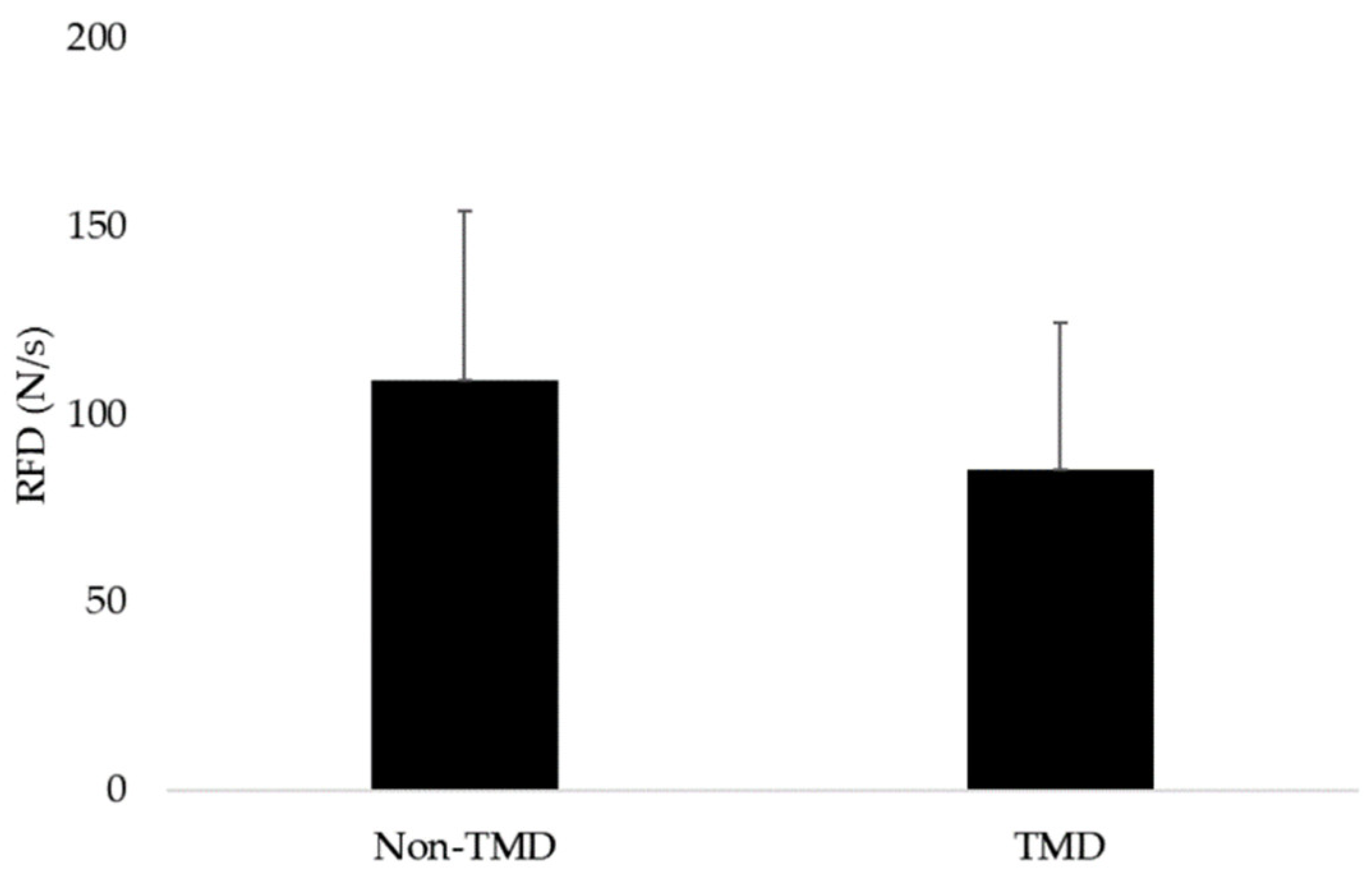
The t-test for independent samples revealed a significant difference in the RFD between the groups with and without TMD (p = 0.03), with a Cohen’s d of 0.5, indicating a moderate effect size, with the confidence interval excluding zero (95% CI: 0.0067 to 1.12).
In the pre-activation and NME analyses, two missing data were found in RT and one missing data in RM. In the descriptive analysis of neuromuscular efficiency, data are summarized as follows: The group without TMD showed a median of 0.04 %.N-1, (range: 0.02–0.26 %.N-1) for LM, 0.05 %.N-1, (range: 0.01–0.10 %.N-1) for RM, 0.05 %.N-1, (range: 0.01–0.38 %.N-1) for LT, and 0.08, (range: 0.02–0.32 %.N-1) for RT. In contrast, the group with TMD showed a median 0.04 %.N-1, (range: 0.01–0.60 %.N-1) for LM, 0.04 %.N-1, (range: 0.01–0.33 %.N-1) for RM, 0.07 %.N-1, with a range from 0.01 to 0.77 %.N-1 for LT, and 0.08 %.N-1, with a range from 0.01 to 0.61 %.N-1 for RT. The Mann-Whitney test, no between-group NME differences were found for LM (p= 0.50), RM (p= 0.59), LT (p= 0.53), or RT (p= 0.73) during the explosive force period.
Finally, no between-group differences were found for electromyographic pre- and post-activation and regular activation, as shown in Table 1.
4. Discussion
The results suggest that the RFD analysis showed a significant between-group difference, with the TMD group showing lower values, with a moderate effect size. No between-group differences were observed for pre and post-activation for any analyzed muscle (LM, RM, LT, RT). Furthermore, contingency table analyses and chi-square tests did not reveal any significant association between the presence of TMD and muscle activation patterns. No between-group differences were observed for NME for any muscle (LM, RM, LT, RT).
Several methods have been described to diagnose TMD, but accuracy has always been an issue [19,23,56]. In this context, functional masticatory muscle indexes emerge as promising markers to support the accurate TMD characterization, although confirmatory studies are still needed [23,36]. RFD has been suggested as a marker to characterize some neuromuscular conditions, such as neuromuscular fatigue [49]. RFD is modulated by neural mechanisms, depending on the reaction of motor units at the beginning of contraction [49,50]. In this sense, the increase in muscle activation in the initial phase of contraction is notably important to provoke a rapid force production [48,50,51]. Furthermore, reviews report that RFD may represent a more efficient concept in identifying dysfunctions or functional adaptations in the neuromuscular system [31,49,51], similar to those produced by muscle damage or pain [57,58], when compared to maximum voluntary strength [49,51], supporting the current analysis in the context of TMD.
Additionally, compared to the maximum voluntary contraction force parameter, RFD was more strongly correlated to the functional tasks [51,59]. It is known that individuals with TMD may exhibit impaired masticatory neuromuscular function [13,60,61], which, based on neurophysiology, could be reflected in RFD. Therefore, assuming this parameter may be also altered in individuals with TMD would be reasonable. However, to our knowledge, this is the first study to investigate RFD in a muscular TMD sample. In this sense, reviewing the literature, Rodríguez-Rosell et al. (2018) discussed the physiological factors correlated to RFD, and reported that even in homogeneous groups, rapid force production differs between individuals, suggesting that the mechanisms involved in explosive contractions may vary significantly [31]. This variability appears to occur due to variations in the speed at which the nervous system recruits motor units, a parameter known as the motor unit recruitment rate [48,50,62]. Furthermore, the firing rate of motor neurons is also appearing as one of the mechanisms responsible for modulating RFD [48]. However, several RFD of obtaining and analysis methods are also related to a notable variability in their values [31,51].
However, it is often expected that in the presence of pain, RFD will be reduced [57]. Despite the absence of studies that investigated this parameter in individuals with TMD, it is possible to infer its decrease from other contexts in which there is also the presence of pain and RFD reduction. In this sense, a study investigated the effects of acute induced pain on maximal force production and RFD of the quadriceps during isometric muscle activation. [57]. The authors determined the RFD as the average slope of the curve, and its analysis was carried out in segmented time intervals. [57]. In contrast, the current study differed methodologically by analyzing RFD over only one total time interval. The authors observed both a reduction in RFD and a reduction in the rate of increase in EMG. Furthermore, the impact of pain on RFD differed between time periods, which may be attributed to the close relationship between initial force development (<75 ms) and the maximum motor unit discharge rate [48], which may be reduced during tasks involving acute nociceptive activation [57]. In the current study, RFD was also shown to be reduced in the symptomatic group; however, given the methodological and anatomical differences, comparisons are limited.
Another cross-sectional study compared RFD in women with patellofemoral pain and physically active healthy women. RFD was calculated as the slope of the torque-time curve, measuring the time-normalized torque variation. RFD and maximal torque were reduced in the pain group, with RFD showing greater deficits compared to strength. However, when analyzing muscle thickness of hip abductors and extensors, no significant differences were observed between the groups. The authors concluded that changes in RFD should not be explained by muscle thickness or the relative amount of contractile tissue, but rather by mechanisms involving neuromuscular changes [63].
In situations where time to develop strength is limited, explosive strength is essential [64]. the precise movements during chewing are related to masseter’s ability to develop force, even quickly [65,66]. Explosive force is characterized by RFD [51]. However, several factors within the neuromuscular system influence RFD [51]. In the context of TMD, pain [18,19,67] and muscle imbalance [13,61,68] are prominent characteristics, which may be associated with the RFD reduction observed in the symptomatic group. In this sense, the influence of pain on masticatory muscle activity was previously described according to different theories and models of pain explanation [69,70]. According to Peck et al. (2008), the Vicious Cycle Theory suggests that pain leads to muscle hyperactivity, which in turn causes more pain. However, this theory presents little solid evidence, giving rise to the Pain Adaptation Model, which predicts inhibition of agonist muscles and increased activity of antagonists. However, this model was also considered insufficient to elucidate the complexity of the relationship between pain and motor activity [70].
Subsequently, with the aim of proposing an alternative to theories that proposed only excitation or inhibition muscular, Minami et al. (2013) investigated masseter muscle activity under induced pain conditions and observed a complex reorganization of the electromyographic activity under induced pain conditions and observed a complex reorganization of the electromyographic activity [27], including both inhibition and recruitment of new motor units, as well as varied changes in the firing rate of active units [27]. These changes may reflect a motor control strategy to that the force produced is not significantly impacted during pain [27]. These findings are consistent with previous descriptions, which also report changes in the angle of force during pain [71]. Furthermore, Sohn et al. (2000) previously demonstrated a decrease in the firing rate of masseter motor units at low and moderate force levels, although isometric force and recruitment threshold remained constant during induced pain in masseter [72].
However, these studies use experimental models of acute pain induction [27,73], which involve mechanisms distinct from those of chronic pain and do not take into account psychosocial factors such as stress and anxiety [73], changes in behavior or damage to musculoskeletal integrity [57], frequently present in chronic TMD [74]. Furthermore, chronic pain mechanisms can modulate pain sensitivity, contributing to bruxism and greater masticatory tension [75,76]. In this sense, the psychosocial state can affect neuromuscular function, and in the long term induce changes in muscle morphology [75]. In this sense, using an animal model of chronic stress, Pereira et al. (2019) found histopathological changes in the masseter, including irregular changes in the diameters of muscle fibers, as well as irregularity in their contours [77]. Ispir et al. (2022) used ultrasound to verify the variation in masseter thickness and its relationship with parafunctional habits. [78]. The authors did not observe significant differences attributed to these habits, although they found great variability between individuals according to vertical facial morphology [78]. Furthermore, a recent study observed greater median stiffness in the masseter during contraction performed by individuals with myofascial pain and TMD compared to healthy controls [79]. However, the effects of muscle architecture and muscle stiffness on RFD are still unclear, although increases in area and volume may be related to a greater absolute rate of strength increase [51].
In addition to rapid muscle activation mediated by neural factors, RFD also has muscular determinants, such as muscle fiber type and composition [31,51,80]. The characteristics of motor units are manifested through a heterogeneous composition of muscle fibers and myosin proteins. These characteristics are remarkably important for the chewing process [28,65,66]. Fast fatigable fibers are activated for tasks that require high strength, accompanied by speed [65]. However, the simultaneous presence of different myosin isoforms is associated with greater variability both contractile strength and speed [65,66]. This unique composition allows the muscle to modulate its contraction force to optimize total energy expenditure, distinguishing it from other skeletal muscles [65,66].
Furthermore, several studies demonstrate that the masticatory muscles of individuals with TMD present reduced oxygen extraction [15,81,82,83]. This change may be due to parafunctions such as sustained clenching or overloading during chewing, which is responsible for interrupting blood flow, contributing to a more anaerobic environment. [15,81,82]. This hypoxic condition can favor the accumulation of metabolites such as lactate and H+ [84], impacting energy production [81,82]. This situation can impair masticatory muscle control, in addition to requiring greater metabolic and energy demand for functional activities, which may be accompanied by fatigue, pain [81,82] and hyperalgesia. [84]. Furthermore, the nervous system opts for muscle recruitment strategies that provide the best mechanical advantage with the least energy expenditure [71]. However, when contractions are painful, this recruitment may become less efficient in preventing further harmful stimuli [71]. Although the present study did not measure masticatory muscle oxygenation, based on this pathophysiology, it would be rational to propose that the NME would be altered in participants with TMD. Despite this, the present study did not find significant differences in the NME of participants with chronic TMD.
Often, the NME index is obtained through the relationship between the quantity of neural stimuli and the muscular force generated [45,46], through sEMG and dynamometry [45]. In this sense, the index can assume motor functioning, from neural command to its relative force production [45,85]. In the literature related to TMD, the terminology neuromuscular efficiency index is not easily found, although similar variations such as muscular efficiency [13,55] and functional efficiency [12,13] are extensively described. Furthermore, several studies that investigated neuromuscular changes in TMD analyzed concepts similar to those present in the index [12,19,86]. In this sense, a study found a positive correlation between maximum bite force and EMG activity of the masseter and temporalis in people with TMD, however, they found no significant differences in sEMG activity for any of the muscles analyzed between the TMD and control groups [12]. Furthermore, findings such as reduction in electromyographic signal during sustained maximum squeezing [19] our reduction in maximal force [86] could lead to a reduction in neuromuscular efficiency. However, based on the EMG/force relationship, it would also be reasonable to propose an increase in electrical activity, possibly related to motor compensation strategies [12], accompanied or not by an increase in the force produced, could reflect an apparently normal index.
Furthermore, methodological variations regarding data collection and analysis are also observed in the index [44,45,46,47]. Likewise, procedures for measuring masticatory efficiency are also diverse [13], although most studies agree that individuals with TMD have impaired orofacial motor functions [13,25]. In this sense, it is also possible that the time period for extracting sEMG and strength data may have influenced the capture of metabolic and neuromuscular changes reflected in the NME, which demonstrates the need for new studies that assessment the NME index in individuals with TMD compared to healthy cohorts.
The effective production of mandibular movement occurs through the coordinated activation of the masticatory muscles [41,87]. Furthermore, together with the other structures of the stomatognathic system, these muscles act on the dynamic stability of the TMJ. [41,42]. In this sense, sensorimotor integration is responsible for the refined control of masticatory muscle activation [86]. However, nociceptive stimuli can modulate this function [86,88]. The literature reports that, between the moment of onset of muscle excitation and the beginning of force production, there is a physiological electromechanical delay [88]. However, in painful conditions, muscle excitation may develop late [88]. Although studies assessing muscle timing in individuals with TMD are scarce, several studies demonstrate changes in parameters such as force production and control [86], magnitude of muscle activation [19,28], symmetry and muscle coordination indices [25,28]. Based on this, it would be reasonable that the timing of muscle activation would be altered in the presence of TMD. Although the current study did not find significant differences in this variable, other studies reinforce the hypothesis of changes in muscle timing in the presence of pain associated or not with the absence of muscle integrity [89,90,91].
Furthermore, despite the absence of significant differences in muscle timing between groups, RFD showed reduced values in the TMD group. Dieterich et al. (2017) analyzed the temporal relationship between estimates of the onset of muscle activation and physical movement, recorded by sEMG and ultrasound, respectively [88]. One of the findings was that a higher rate of torque development correlates with a significant reduction in regional variation of EMG onset, as well as a reduction in the time intervals between EMG onset and movement onset [88].
Some limitations must be addressed. First, as a retrospective design, it relies on pre-existing data, which precludes direct control over variables that may not have been initially recorded. Additionally, the Portuguese version of the RDC/TMD, rather than the more recent DC/TMD version, represents another limitation. While the RDC/TMD is widely recognized, the current diagnostic standard is the DC/TMD, and its use would have been preferable for consistency with contemporary diagnostic criteria. The sample consisted solely of individuals aged 18 to 45 with at least 28 permanent teeth. This limitation restricts the generalization of the findings to other age groups or individuals with varying dental characteristics. As a result, it may introduce selection bias and reduce the study’s external validity. Furthermore, the absence of studies that analyzed the same variables was a factor that limited the comparisons made.
5. Conclusions
This study sought to identify RFD as a significant differentiator between women with and without TMD, to provide a novel biomechanical insight into the neuromuscular alterations associated with the disorder. Although significant differences were found, future research should validate these findings in diverse populations and explore their diagnostic applications. Furthermore, new studies conducted with different collection and analysis methodologies must be carried out in order to confirm or refute the other findings.
Author Contributions
Conceptualization, B.R.B., K.R.d.R.F., M.d.C.S.M., A.W.C.B., and M.C.S.A.B.; methodology, B.R.B., K.R.d.R.F., M.d.C.S.M., A.W.C.B. and M.C.S.A.B.; formal analysis, K.R.d.R.F., A.W.C.B. and G.L.G.; investigation, B.R.B., K.R.d.R.F., M.d.C.S.M., T.C.O., A.C.L., A.F.E., M.E.C.d.S., G.A.G., M.C.S.A.B. and A.W.C.B.; resources, K.R.d.R.F., B.R.B. and A.W.C.B.; data curation, K.R.d.R.F., B.R.B. and A.W.C.B.; writing—original draft preparation, A.W.C.B.; writing—review and editing, A.W.C.B. All authors have read and agreed to the published version of the manuscript.
Funding
Throughout this study, the principal investigator received financial support from the Research Support Foundation of the State of Minas Gerais (FAPEMIG), with contribution from Coordination for the Improvement of Higher Education Personnel (CAPES) and the National Council for Scientific and Technological Development (CNPq).
Institutional Review Board Statement
Ethics Committee of the Federal University of Juiz de Fora (number 81392424.3.0000.5147).
Informed Consent Statement
Written informed consent has been obtained from all participants to publish this paper.
Data Availability Statement
Dataset is fully available at the Mendeley Data Repository (doi: 10.17632/65cmtpd77y.1).
Conflicts of Interest
The authors reported no conflict of interest.
References
- Abbass, M.M.S.; Rady, D.; El Moshy, S.; Ahmed Radwan, I.; Wadan, A.H.S.; Dörfer, C.E.; El-Sayed, K.M.F. The Temporomandibular Joint and the Human Body: A New Perspective on Cross Talk. Dent J (Basel) 2024, 12. [Google Scholar] [CrossRef]
- Thirunavukarasu, A.J.; Ferro, A.; Sardesai, A.; Biyani, G.; Dubb, S.S.; Brassett, C.; Hamilton, D.L. Temporomandibular Joint Anatomy: Ultrasonographic Appearances and Sexual Dimorphism. Clinical Anatomy 2021, 34, 1043–1049. [Google Scholar] [CrossRef] [PubMed]
- Camacho, G.B.; Waldemarin, R. de A.; Barbin, E.L. Temporomandibular Disorder in Adults: Retrospective Study. Brazilian Journal Of Pain 2021, 4. [Google Scholar] [CrossRef]
- Herrera-Valencia, A.; Ruiz-Muñoz, M.; Martin-Martin, J.; Cuesta-Vargas, A.; González-Sánchez, M. Efficacy of Manual Therapy in Temporomandibular Joint Disorders and Its Medium-and Long-Term Effects on Pain and Maximum Mouth Opening: A Systematic Review and Meta-Analysis. J Clin Med 2020, 9, 1–14. [Google Scholar] [CrossRef]
- Whyte, A.; Phoon Nguyen, A.; Boeddinghaus, R.; Balasubramaniam, R. Imaging of Temporomandibular Disorder and Its Mimics. J Med Imaging Radiat Oncol 2021, 65, 70–78. [Google Scholar] [CrossRef]
- Vallin, S.; Liv, P.; Häggman-Henrikson, B.; Visscher, C.M.; Lobbezoo, F.; Lövgren, A. Temporomandibular Disorder Pain Is Associated with Increased Sick Leave and Reduced Health Related Quality of Life. European Journal of Pain (United Kingdom) 2024, 28. [Google Scholar] [CrossRef]
- Qamar, Z.; Alghamdi, A.M.S.; Haydarah, N.K. Bin; Balateef, A.A.; Alamoudi, A.A.; Abumismar, M.A.; Shivakumar, S.; Cicciù, M.; Minervini, G. Impact of Temporomandibular Disorders on Oral Health-Related Quality of Life: A Systematic Review and Meta-Analysis. J Oral Rehabil 2023, 50, 706–714. [Google Scholar] [CrossRef]
- Fassicollo, C.E.; Garcia, D.M.; Machado, B.C.Z.; de Felício, C.M. Changes in Jaw and Neck Muscle Coactivation and Coordination in Patients with Chronic Painful TMD Disk Displacement with Reduction during Chewing. Physiol Behav 2021, 230. [Google Scholar] [CrossRef]
- Ferrillo, M.; Migliario, M.; Marotta, N.; Fortunato, F.; Bindi, M.; Pezzotti, F.; Ammendolia, A.; Giudice, A.; Foglio Bonda, P.L.; de Sire, A. Temporomandibular Disorders and Neck Pain in Primary Headache Patients: A Retrospective Machine Learning Study. Acta Odontol Scand 2023, 81, 151–157. [Google Scholar] [CrossRef]
- Valesan, L.F.; Da-Cas, C.D.; Réus, J.C.; Denardin, A.C.S.; Garanhani, R.R.; Bonotto, D.; Januzzi, E.; de Souza, B.D.M. Prevalence of Temporomandibular Joint Disorders: A Systematic Review and Meta-Analysis. Clin Oral Investig 2021, 25, 441–453. [Google Scholar] [CrossRef]
- Bednarczyk, V.; Proulx, F.; Paez, A. The Effectiveness of Cervical Rehabilitation Interventions for Pain in Adults with Myogenic Temporomandibular Disorders: A Systematic Review and Meta-Analysis. J Oral Rehabil 2024, 51, 1091–1107. [Google Scholar] [CrossRef]
- Silva Andresen Strini, P.J.; Silva Andresen Strini, P.J.; De Souza Barbosa, T.; Duarte Gavião, M.B. Assessment of Thickness and Function of Masticatory and Cervical Muscles in Adults with and without Temporomandibular Disorders. Arch Oral Biol 2013, 58, 1100–1108. [Google Scholar] [CrossRef] [PubMed]
- Marcelino, V.; De Rovere, S.; Paço, M.; Gonçalves, M.; Marcelino, S.; Guimarães, A.S.; Pinho, T. Masticatory Function in Individuals with Temporomandibular Disorders: A Systematic Review and Meta-Analysis. Life 2023, 13. [Google Scholar] [CrossRef]
- Liu, Z.J.; Yamagata, K.; Kasahara, Y.; Ito, G. Electromyographic Examination of Jaw Muscles in Relation to Symptoms and Occlusion of Patients with Temporomandibular Joint Disorders. J Oral Rehabil 1999, 26, 33–47. [Google Scholar] [CrossRef]
- Suzuki, S.; Castrillon, E.E.; Arima, T.; Kitagawa, Y.; Svensson, P. Blood Oxygenation of Masseter Muscle during Sustained Elevated Muscle Activity in Healthy Participants. J Oral Rehabil 2016, 43, 900–910. [Google Scholar] [CrossRef]
- Xu, L.; Fan, S.; Cai, B.; Fang, Z.; Jiang, X. Influence of Sustained Submaximal Clenching Fatigue Test on Electromyographic Activity and Maximum Voluntary Bite Forces in Healthy Subjects and Patients with Temporomandibular Disorders. J Oral Rehabil 2017, 44, 340–346. [Google Scholar] [CrossRef]
- Gay, T.; Maton, B.; Rendell, J.; Majourau, A. Characteristics of Muscle Fatigue in Patients with Myofascial Pain-Dysfunction Syndrome. Arch Oral Biol 1994, 39, 847–852. [Google Scholar] [CrossRef]
- Machado, M.B.; Nitsch, G.S.; Pitta, N.C.; Oliveira, A.S. de Tempo de Ativação Muscular Em Portadoras de Disfunção Temporomandibular Durante a Mastigação. Audiology - Communication Research 2014, 19, 202–207. [Google Scholar] [CrossRef]
- Szyszka-Sommerfeld, L.; Sycińska-Dziarnowska, M.; Spagnuolo, G.; Woźniak, K. Surface Electromyography in the Assessment of Masticatory Muscle Activity in Patients with Pain-Related Temporomandibular Disorders: A Systematic Review. Front Neurol 2023, 14. [Google Scholar] [CrossRef]
- Dorosz, T.; Mańko, A.; Ginszt, M. Use of Surface Electromyography to Evaluate Effects of Therapeutic Methods on Masticatory Muscle Activity in Patients with Temporomandibular Disorders: A Narrative Review. J Clin Med 2024, 13. [Google Scholar] [CrossRef]
- Shousha, T.; Alayat, M.; Moustafa, I. Effects of Low-Level Laser Therapy versus Soft Occlusive Splints on Mouth Opening and Surface Electromyography in Females with Temporomandibular Dysfunction: A Randomized-Controlled Study. PLoS One 2021, 16. [Google Scholar] [CrossRef] [PubMed]
- Ferreira, M.C.; Porto de Toledo, I.; Dutra, K.L.; Stefani, F.M.; Porporatti, A.L.; Flores-Mir, C.; De Luca Canto, G. Association between Chewing Dysfunctions and Temporomandibular Disorders: A Systematic Review. J Oral Rehabil 2018, 45, 819–835. [Google Scholar] [CrossRef] [PubMed]
- Moxley, B.; Stevens, W.; Sneed, J.; Pearl, C. Novel Diagnostic and Therapeutic Approaches to Temporomandibular Dysfunction: A Narrative Review. Life 2023, 13. [Google Scholar] [CrossRef]
- Dinsdale, A.; Liang, Z.; Thomas, L.; Treleaven, J. Are Jaw Range of Motion, Muscle Function and Proprioception Impaired in Adults with Persistent Temporomandibular Disorders? A Systematic Review and Meta-Analysis. J Oral Rehabil 2020, 47, 1448–1478. [Google Scholar] [CrossRef] [PubMed]
- Ferreira, C.L.P.; Machado, B.C.Z.; Borges, C.G.P.; Rodrigues Da Silva, M.A.M.; Sforza, C.; De Felício, C.M. Impaired Orofacial Motor Functions on Chronic Temporomandibular Disorders. Journal of Electromyography and Kinesiology 2014, 24, 565–571. [Google Scholar] [CrossRef]
- Avivi-Arber, L.; Martin, R.; Lee, J.C.; Sessle, B.J. Face Sensorimotor Cortex and Its Neuroplasticity Related to Orofacial Sensorimotor Functions. Arch Oral Biol 2011, 56, 1440–1465. [Google Scholar] [CrossRef]
- Minami, I.; Akhter, R.; Albersen, I.; Burger, C.; Whittle, T.; Lobbezoo, F.; Peck, C.C.; Murray, G.M. Masseter Motor Unit Recruitment Is Altered in Experimental Jaw Muscle Pain. J Dent Res 2013, 92, 143–148. [Google Scholar] [CrossRef]
- Tartaglia, G.M.; Lodetti, G.; Paiva, G.; Felicio, C.M. De; Sforza, C. Surface Electromyographic Assessment of Patients with Long Lasting Temporomandibular Joint Disorder Pain. Journal of Electromyography and Kinesiology 2011, 21, 659–664. [Google Scholar] [CrossRef]
- Zwiri, A.; Al-Hatamleh, M.A.I.; Ahmad, W.M.A.W.; Asif, J.A.; Khoo, S.P.; Husein, A.; Ab-Ghani, Z.; Kassim, N.K. Biomarkers for Temporomandibular Disorders: Current Status and Future Directions. Diagnostics 2020, 10. [Google Scholar] [CrossRef]
- Pitta, N.C.; Nitsch, G.S.; Machado, M.B.; de Oliveira, A.S. Activation Time Analysis and Electromyographic Fatigue in Patients with Temporomandibular Disorders during Clenching. Journal of Electromyography and Kinesiology 2015, 25, 653–657. [Google Scholar] [CrossRef]
- Rodríguez-Rosell, D.; Pareja-Blanco, F.; Aagaard, P.; González-Badillo, J.J. Physiological and Methodological Aspects of Rate of Force Development Assessment in Human Skeletal Muscle. Clin Physiol Funct Imaging 2018, 38, 743–762. [Google Scholar] [CrossRef] [PubMed]
- Khawaja, S.N.; Mccall, W.; Dunford, R.; Nickel, J.C.; Iwasaki, L.R.; Crow, H.C.; Gonzalez, Y. Infield Masticatory Muscle Activity in Subjects with Pain-Related Temporomandibular Disorders Diagnoses. Orthod Craniofac Res 2015, 18, 137–145. [Google Scholar] [CrossRef] [PubMed]
- Alam, M.K.; Zaman, M.U.; Alqhtani, N.R.; Alqahtani, A.S.; Alqahtani, F.; Cicciù, M.; Minervini, G. Salivary Biomarkers and Temporomandibular Disorders: A Systematic Review Conducted According to PRISMA Guidelines and the Cochrane Handbook for Systematic Reviews of Interventions. J Oral Rehabil 2024, 51, 416–426. [Google Scholar] [CrossRef] [PubMed]
- Ernberg, M. The Role of Molecular Pain Biomarkers in Temporomandibular Joint Internal Derangement. J Oral Rehabil 2017, 44, 481–491. [Google Scholar] [CrossRef]
- Soares, J.M.; Carneiro, B.D.; Pozza, D.H. The Role of Biomarkers in Temporomandibular Disorders: A Systematic Review. International Journal of Molecular Sciences 2025, Vol. 26, Page 5971 2025, 26, 5971. [Google Scholar] [CrossRef]
- Ginszt, M.; Zieliński, G. Novel Functional Indices of Masticatory Muscle Activity. J Clin Med 2021, 10. [Google Scholar] [CrossRef]
- Nickel, J.C.; Gonzalez, Y.M.; Liu, Y.; Liu, H.; Gallo, L.M.; Iwasaki, L.R. Mechanics- and Behavior-Related Temporomandibular Joint Differences. J Dent Res 2024, 103, 1083–1090. [Google Scholar] [CrossRef]
- Carvalho, C.R.; Fernández, J.M.; del-Ama, A.J.; Oliveira Barroso, F.; Moreno, J.C. Review of Electromyography Onset Detection Methods for Real-Time Control of Robotic Exoskeletons. J Neuroeng Rehabil 2023, 20. [Google Scholar] [CrossRef]
- Farinelli, V.; Bolzoni, F.; Marchese, S.M.; Esposti, R.; Cavallari, P. A Novel Viewpoint on the Anticipatory Postural Adjustments During Gait Initiation. Front Hum Neurosci 2021, 15. [Google Scholar] [CrossRef]
- Pereira, S.; Silva, C.C.; Ferreira, S.; Silva, C.; Oliveira, N.; Santos, R.; Vilas-Boas, J.P.; Correia, M. V. Anticipatory Postural Adjustments during Sitting Reach Movement in Post-Stroke Subjects. Journal of Electromyography and Kinesiology 2014, 24, 165–171. [Google Scholar] [CrossRef]
- Kuntamukkula, S.; Sinha, R.; Tiwari, P.K.; Paul, D. Dynamic Stability Assessment of the Temporomandibular Joint as a Sequela of Open Reduction and Internal Fixation of Unilateral Condylar Fracture. Journal of Oral and Maxillofacial Surgery 2018, 76, 2598–2609. [Google Scholar] [CrossRef]
- Basit, H.; Eovaldi, B.J.; Siccardi, M.A. Anatomy, Head and Neck, Mastication Muscles. StatPearls 2023. [Google Scholar]
- Dinsdale, A.; Liang, Z.; Thomas, L.; Treleaven, J. Is Jaw Muscle Activity Impaired in Adults with Persistent Temporomandibular Disorders? A Systematic Review and Meta-Analysis. J Oral Rehabil 2021, 48, 487–516. [Google Scholar] [CrossRef] [PubMed]
- Panhan, A.C.; Gonçalves, M.; Eltz, G.D.; Villalba, M.M.; Cardozo, A.C.; Bérzin, F. Neuromuscular Efficiency of the Multifidus Muscle in Pilates Practitioners and Non-Practitioners. Complement Ther Med 2018, 40, 61–63. [Google Scholar] [CrossRef] [PubMed]
- Paula, J.P. de; Navega, M.T.; Spinoso, D.H. Neuromuscular Efficiency of the Quadriceps in Women with and without Patellofemoral Pain. Fisioterapia e Pesquisa 2023, 30. [Google Scholar] [CrossRef]
- Aragão, F.A.; Schäfer, G.S.; De Albuquerque, C.E.; Fonseca Vituri, R.; Mícolis De Azevedo, F.; Ricardo, G.; Bertolini, F. Neuromuscular Efficiency of the Vastus Lateralis and Biceps Femoris Muscles in Individuals with Anterior Cruciate Ligament Injuries. Rev Bras Ortop (Sao Paulo) 2015, 50, 180–185. [Google Scholar] [CrossRef]
- Tesch, P.A.; Dudley, G.A.; Duvoisin, M.R.; Hather, B.M.; Harris, R.T. Force and EMG Signal Patterns during Repeated Bouts of Concentric or Eccentric Muscle Actions. Acta Physiol Scand 1990, 138, 263–271. [Google Scholar] [CrossRef]
- Del Vecchio, A. Neuromechanics of the Rate of Force Development. Exerc Sport Sci Rev 2023, 51, 34–42. [Google Scholar] [CrossRef]
- D’Emanuele, S.; Maffiuletti, N.A.; Tarperi, C.; Rainoldi, A.; Schena, F.; Boccia, G. Rate of Force Development as an Indicator of Neuromuscular Fatigue: A Scoping Review. Front Hum Neurosci 2021, 15. [Google Scholar] [CrossRef]
- Del Vecchio, A.; Negro, F.; Holobar, A.; Casolo, A.; Folland, J.P.; Felici, F.; Farina, D. You Are as Fast as Your Motor Neurons: Speed of Recruitment and Maximal Discharge of Motor Neurons Determine the Maximal Rate of Force Development in Humans. Journal of Physiology 2019, 597, 2445–2456. [Google Scholar] [CrossRef]
- Maffiuletti, N.A.; Aagaard, P.; Blazevich, A.J.; Folland, J.; Tillin, N.; Duchateau, J. Rate of Force Development: Physiological and Methodological Considerations. Eur J Appl Physiol 2016, 116, 1091–1116. [Google Scholar] [CrossRef]
- Lis, D.M.; Jordan, M.; Lipuma, T.; Smith, T.; Schaal, K.; Baar, K. Collagen and Vitamin C Supplementation Increases Lower Limb Rate of Force Development. Int J Sport Nutr Exerc Metab 2022, 32, 65–73. [Google Scholar] [CrossRef] [PubMed]
- Kozinc, Ž.; Smajla, D.; Šarabon, N. The Rate of Force Development Scaling Factor: A Review of Underlying Factors, Assessment Methods and Potential for Practical Applications. Eur J Appl Physiol 2022, 122, 861–873. [Google Scholar] [CrossRef] [PubMed]
- Del Vecchio, X.A.; Negro, X.F.; Falla, D.; Bazzucchi, I.; Farina, X.D.; Felici, F.; Vecchio, D.A. Higher Muscle Fiber Conduction Velocity and Early Rate of Torque Development in Chronically Strength-Trained Individuals. J Appl Physiol 2018, 125, 1218–1226. [Google Scholar] [CrossRef]
- Barbosa, M.A.; Tahara, A.K.; Ferreira, I.C.; Intelangelo, L.; Barbosa, A.C. Effects of 8 Weeks of Masticatory Muscles Focused Endurance Exercises on Women with Oro-Facial Pain and Temporomandibular Disorders: A Placebo Randomised Controlled Trial. J Oral Rehabil 2019, 46, 885–894. [Google Scholar] [CrossRef]
- Berni, K.C. dos S.; Dibai-Filho, A.V.; Pires, P.F.; Rodrigues-Bigaton, D. Accuracy of the Surface Electromyography RMS Processing for the Diagnosis of Myogenous Temporomandibular Disorder. Journal of Electromyography and Kinesiology 2015, 25, 596–602. [Google Scholar] [CrossRef]
- Rice, D.A.; Mannion, J.; Lewis, G.N.; McNair, P.J.; Fort, L. Experimental Knee Pain Impairs Joint Torque and Rate of Force Development in Isometric and Isokinetic Muscle Activation. Eur J Appl Physiol 2019, 119, 2065–2073. [Google Scholar] [CrossRef]
- Peñailillo, L.; Blazevich, A.; Numazawa, H.; Nosaka, K. Rate of Force Development as a Measure of Muscle Damage. Scand J Med Sci Sports 2015, 25, 417–427. [Google Scholar] [CrossRef]
- Maffiuletti, N.A.; Bizzini, M.; Widler, K.; Munzinger, U. Asymmetry in Quadriceps Rate of Force Development as a Functional Outcome Measure in TKA. Clin Orthop Relat Res 2009, 468, 191. [Google Scholar] [CrossRef]
- Asquini, G.; Pisacane, G.; Maselli, F.; Galeoto, G.; Mourad, F.; Bizzarri, P.; Balli, E.; Bagnoli, C.; Manzari, A.; Pernici, M.; et al. Effectiveness of Resistance Training of Masticatory Muscles for Patients with Temporomandibular Disorders: Protocol for a Systematic Review. BMJ Open 2024, 14, e083133. [Google Scholar] [CrossRef]
- Mapelli, A.; Zanandréa Machado, B.C.; Giglio, L.D.; Sforza, C.; De Felício, C.M. Reorganization of Muscle Activity in Patients with Chronic Temporomandibular Disorders. Arch Oral Biol 2016, 72, 164–171. [Google Scholar] [CrossRef]
- Folland, J.P.; Buckthorpe, M.W.; Hannah, R. Human Capacity for Explosive Force Production: Neural and Contractile Determinants. Scand J Med Sci Sports 2014, 24, 894–906. [Google Scholar] [CrossRef] [PubMed]
- Nunes, G.S.; Barton, C.J.; Serrão, F.V. Hip Rate of Force Development and Strength Are Impaired in Females with Patellofemoral Pain without Signs of Altered Gluteus Medius and Maximus Morphology. J Sci Med Sport 2018, 21, 123–128. [Google Scholar] [CrossRef] [PubMed]
- Balshaw, T.G.; Massey, G.J.; Maden-Wilkinson, T.M.; Lanza, M.B.; Folland, J.P. Effect of Long-Term Maximum Strength Training on Explosive Strength, Neural, and Contractile Properties. Scand J Med Sci Sports 2022, 32, 685–697. [Google Scholar] [CrossRef] [PubMed]
- Isola, G.; Anastasi, G.P.; Matarese, G.; Williams, R.C.; Cutroneo, G.; Bracco, P.; Piancino, M.G. Functional and Molecular Outcomes of the Human Masticatory Muscles. Oral Dis 2018, 24, 1428–1441. [Google Scholar] [CrossRef]
- Korfage, J.A.M.; Brugman, P.; Van Eijden, T.M.G.J. Intermuscular and Intramuscular Differences in Myosin Heavy Chain Composition of the Human Masticatory Muscles. J Neurol Sci 2000, 178, 95–106. [Google Scholar] [CrossRef]
- Desai, A.P.; Roy, S.K.; Semi, R.S.; Balasundaram, T. Efficacy of Low-Level Laser Therapy in Management of Temporomandibular Joint Pain: A Double Blind and Placebo Controlled Trial. J Maxillofac Oral Surg 2022, 21, 948–956. [Google Scholar] [CrossRef]
- Zieliński, G.; Byś, A.; Szkutnik, J.; Majcher, P.; Ginszt, M. Electromyographic Patterns of Masticatory Muscles in Relation to Active Myofascial Trigger Points of the Upper Trapezius and Temporomandibular Disorders. Diagnostics 2021, 11. [Google Scholar] [CrossRef]
- Lund, J.P.; Donga, R.; Widmer, C.G.; Stohler, C.S. The Pain-Adaptation Model: A Discussion of the Relationship between Chronic Musculoskeletal Pain and Motor Activity. Can J Physiol Pharmacol 1991, 69, 683–694. [Google Scholar] [CrossRef]
- Peck, C.C.; Murray, G.M.; Gerzina, T.M. How Does Pain Affect Jaw Muscle Activity? The Integrated Pain Adaptation Model. Aust Dent J 2008, 53, 201–207. [Google Scholar] [CrossRef]
- Tucker, K.J.; Hodges, P.W. Changes in Motor Unit Recruitment Strategy during Pain Alters Force Direction. European Journal of Pain 2010, 14, 932–938. [Google Scholar] [CrossRef] [PubMed]
- Kyun Sohn, M.; Graven-Nielsen, T.; Arendt-Nielsen, L.; Svensson, P. INHIBITION OF MOTOR UNIT FIRING DURING EXPERIMENTAL MUSCLE PAIN IN HUMANS; 2000; Vol. 23;
- Martinez-Valdes, E.; Negro, F.; Farina, D.; Falla, D. Divergent Response of Low- versus High-Threshold Motor Units to Experimental Muscle Pain. Journal of Physiology 2020, 598, 2093–2108. [Google Scholar] [CrossRef] [PubMed]
- Dubner, R.; Slade, G.D.; Ohrbach, R.; Greenspan, J.D.; Fillingim, R.B.; Bair, E.; Sanders, A.E.; Diatchenko, L.; Meloto, C.B.; Smith, S.; et al. Painful Temporomandibular Disorder: Decade of Discovery from OPPERA Studies. J Dent Res 2016, 95, 1084–1092. [Google Scholar] [CrossRef]
- Öçal, M.Ç.; Baybars, S.C.; Talu, M.H. The Relationship Between Anxiety and Masseter Muscle in Temporomandibular Disorders: An Ultrasonographic Assessment. Journal of Clinical Ultrasound 2025. [Google Scholar] [CrossRef]
- Fillingim, R.B.; Slade, G.D.; Greenspan, J.D.; Dubner, R.; Maixner, W.; Bair, E.; Ohrbach, R. Long-Term Changes in Biopsychosocial Characteristics Related to Temporomandibular Disorder: Findings from the OPPERA Study. Pain 2018, 159, 2403. [Google Scholar] [CrossRef]
- Pereira, Y.C.L.; Nascimento, G.C.; Iyomasa, D.M.; Fernández, R.A.R.; Calzzani, R.A.; Leite-Panissi, C.R.A.; Novaes, P.D.; Iyomasa, M.M. Exodontia-Induced Muscular Hypofunction by Itself or Associated to Chronic Stress Impairs Masseter Muscle Morphology and Its Mitochondrial Function. Microsc Res Tech 2019, 82, 530–537. [Google Scholar] [CrossRef]
- Ispir, N.G.; Toraman, M. The Relationship of Masseter Muscle Thickness with Face Morphology and Parafunctional Habits: An Ultrasound Study. Dentomaxillofacial Radiology 2022, 51. [Google Scholar] [CrossRef]
- Akkoca, F.; Ozyurek, S.; Ilhan, G.; Koyuncu, E.; Ozdede, M. Role of the Masseter, Anterior Temporalis, and Sternocleidomastoid Muscles in Myofascial Temporomandibular Disorder Pain: Evaluation of Thickness and Stiffness by Ultrasonography. Oral Radiol 2025, 41, 363–371. [Google Scholar] [CrossRef]
- Andersen, L.L.; Andersen, J.L.; Zebis, M.K.; Aagaard, P. Early and Late Rate of Force Development: Differential Adaptive Responses to Resistance Training? Scand J Med Sci Sports 2010, 20, e162–e169. [Google Scholar] [CrossRef]
- Ferreira, C.L.P.; Bellistri, G.; Montagna, S.; de Felício, C.M.; Sforza, C. Patients with Myogenic Temporomandibular Disorders Have Reduced Oxygen Extraction in the Masseter Muscle. Clin Oral Investig 2017, 21, 1509–1518. [Google Scholar] [CrossRef]
- Niszezak, C.M.; Sonza, A.; Garrett, A.; Santos, G.M. Muscle Oxygenation and Pain in Different Types of Temporomandibular Disorders. Clin Oral Investig 2024, 28. [Google Scholar] [CrossRef] [PubMed]
- Puel, A.N.; da Silva Paes, A.G.; Macedo, C.; Miranda, L.S.; Graciosa, M.; Sonza, A. Peripheral Muscle Oxygenation and Symptoms of Stress in Adolescents with and without Temporomandibular Disorder. Clin Oral Investig 2023, 27, 1509–1517. [Google Scholar] [CrossRef]
- Anthierens, A.; Thevenon, A.; Olivier, N.; Mucci, P. Paraspinal Muscle Oxygenation and Mechanical Efficiency Are Reduced in Individuals with Chronic Low Back Pain. Sci Rep 2024, 14, 4943. [Google Scholar] [CrossRef]
- Hughes, D.C.; Ellefsen, S.; Baar, K. Adaptations to Endurance and Strength Training. Cold Spring Harb Perspect Med 2018, 8, a029769. [Google Scholar] [CrossRef]
- Testa, M.; Geri, T.; Pitance, L.; Lentz, P.; Gizzi, L.; Erlenwein, J.; Petkze, F.; Falla, D. Alterations in Jaw Clenching Force Control in People with Myogenic Temporomandibular Disorders. Journal of Electromyography and Kinesiology 2018, 43, 111–117. [Google Scholar] [CrossRef]
- Iturriaga, V.; Bornhardt, T.; Velasquez, N. Temporomandibular Joint: Review of Anatomy and Clinical Implications. Dent Clin North Am 2023, 67, 199–209. [Google Scholar] [CrossRef]
- Dieterich, A. V.; Botter, A.; Vieira, T.M.; Peolsson, A.; Petzke, F.; Davey, P.; Falla, D. Spatial Variation and Inconsistency between Estimates of Onset of Muscle Activation from EMG and Ultrasound. Sci Rep 2017, 7, 1–11. [Google Scholar] [CrossRef]
- Frost, L.R.; Brown, S.H.M. Muscle Activation Timing and Balance Response in Chronic Lower Back Pain Patients with Associated Radiculopathy. Clinical Biomechanics 2016, 32, 124–130. [Google Scholar] [CrossRef]
- Hodges, P.W.; Moseley, G.L.; Gabrielsson, A.; Gandevia, S.C. Experimental Muscle Pain Changes Feedforward Postural Responses of the Trunk Muscles. Exp Brain Res 2003, 151, 262–271. [Google Scholar] [CrossRef]
- López-González, L.; Falla, D.; Lázaro-Navas, I.; Lorenzo-Sánchez-aguilera, C.; Rodríguez-Costa, I.; Pecos-Martín, D.; Gallego-Izquierdo, T. Effects of Dry Needling on Neuromuscular Control of Ankle Stabilizer Muscles and Center of Pressure Displacement in Basketball Players with Chronic Ankle Instability: A Single-Blinded Randomized Controlled Trial. International Journal of Environmental Research and Public Health 2021, Vol. 18, Page 2092 2021, 18, 2092. [Google Scholar] [CrossRef]
Figure 1.
Adapted load cell. (A) laboratory-grade load cell; (B) adapted arms.
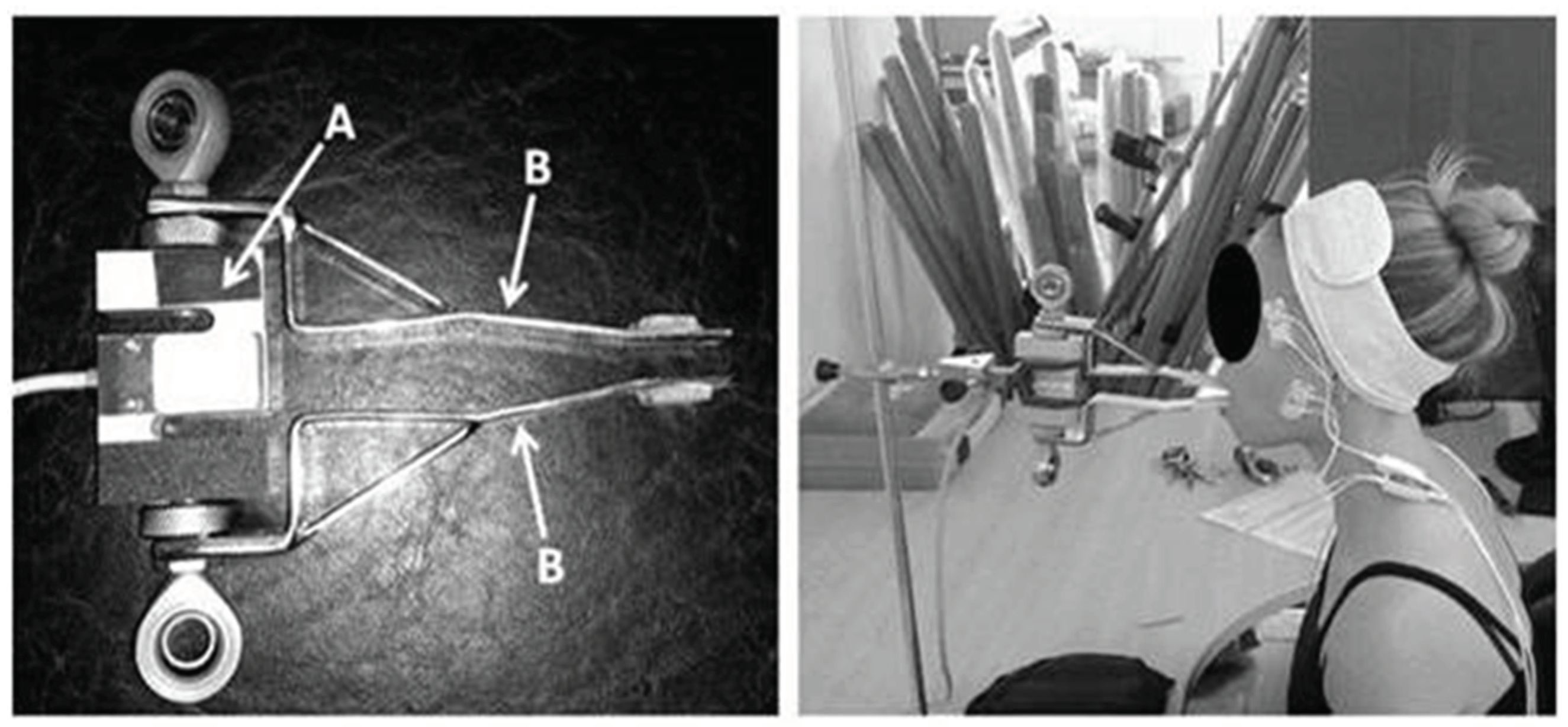
Figure 2.
Force and sEMG data extraction. EP = explosive force.
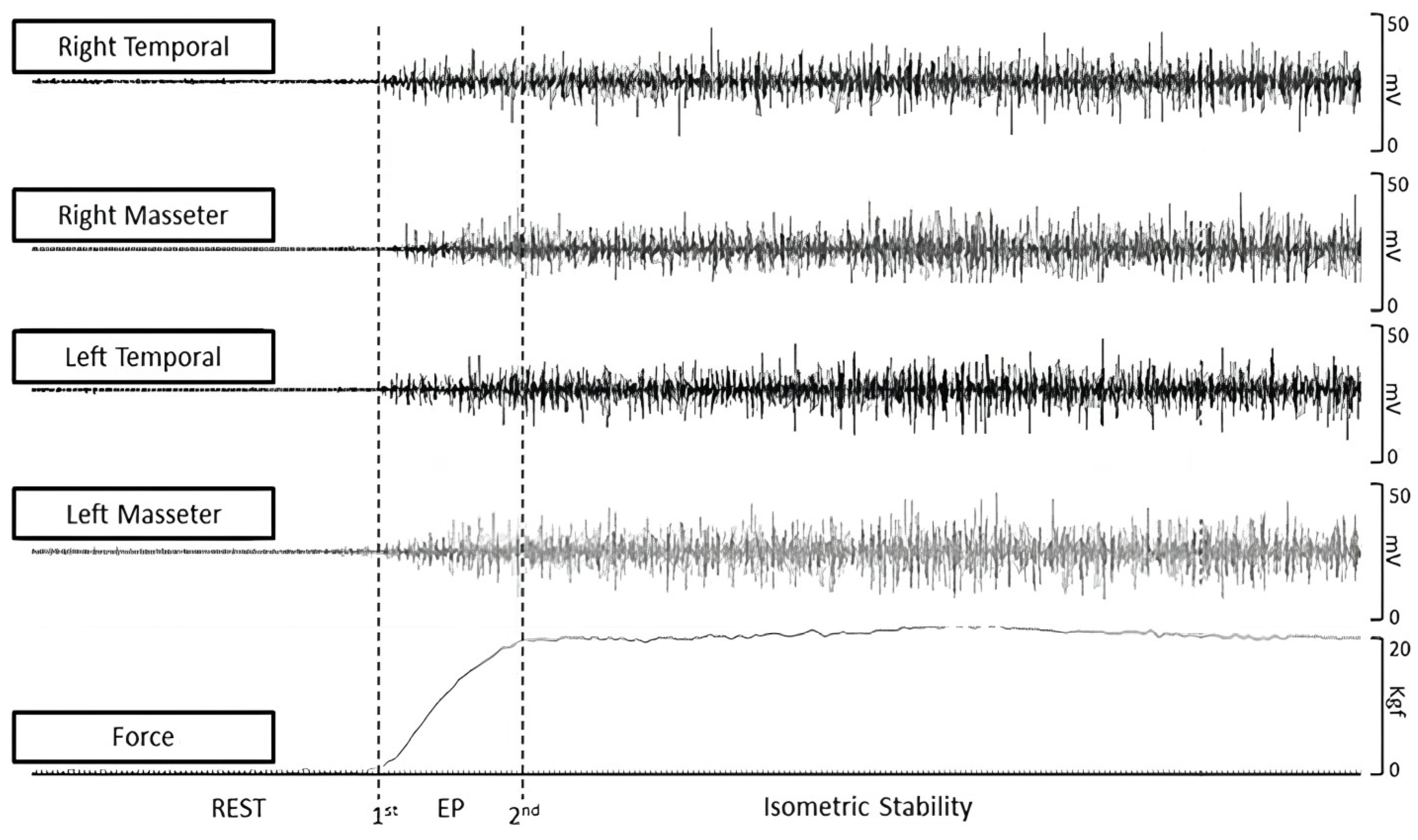

Table 1.
Pre- and post-activation and normal activation results.
| Muscle | Group | Pre-activation n (%) |
Post-Activation n (%) |
Normal Activation n (%) |
p | Cramér’s V |
|---|---|---|---|---|---|---|
| LM | With TMD | 7 (58.3%) | 16 (59.3%) | 18 (78.3%) | 0.30 | 0.19 |
| Without TMD | 5 (41.7%) | 11 (40.7%) | 5 (21.7%) | |||
| RM | With TMD | 8 (61.5%) | 17 (65.4%) | 15 (68.2%) | 0.92 | 0.05 |
| Without TMD | 5 (38.5%) | 9 (34.6%) | 7 (31.8%) | |||
| LT | With TMD | 10 (76.9%) | 15 (65.2%) | 16 (61.5%) | 0.62 | 0.12 |
| Without TMD | 3 (23.1%) | 8 (34.8%) | 10 (38.5%) | |||
| RT | With TMD | 8 (80.0%) | 14 (58.3%) | 17 (65.4%) | 0.48 | 0.15 |
| Without TMD | 2 (20.0%) | 10 (41.7%) | 9 (34.6%) |
Legend: LM= Left masseter, RM= Right masseter, LT= Left temporal, RT= Right temporal.
Disclaimer/Publisher’s Note: The statements, opinions and data contained in all publications are solely those of the individual author(s) and contributor(s) and not of MDPI and/or the editor(s). MDPI and/or the editor(s) disclaim responsibility for any injury to people or property resulting from any ideas, methods, instructions or products referred to in the content. |
© 2025 by the authors. Licensee MDPI, Basel, Switzerland. This article is an open access article distributed under the terms and conditions of the Creative Commons Attribution (CC BY) license (http://creativecommons.org/licenses/by/4.0/).
Copyright: This open access article is published under a Creative Commons CC BY 4.0 license, which permit the free download, distribution, and reuse, provided that the author and preprint are cited in any reuse.


