

Submitted:
06 October 2025
Posted:
07 October 2025
You are already at the latest version
Abstract
Background: From 2015 to 2025, many universities across OECD systems adopted playful or game-informed methods to lift engagement. Yet large-scale indicators question their contribution to adult mastery. Objective: To interrogate whether playful learning strengthens or dilutes adult development in higher education, with special attention to delayed retention, transfer, resilience, and labour-market readiness. Methods: We synthesise secondary data from the OECD’s second Survey of Adult Skills (PIAAC) and U.S. releases by NCES, triangulate employer surveys on graduate readiness, and integrate recent meta-analyses on gamification/game-based learning and cognitive load. Results: OECD and NCES report that adult literacy and numeracy largely declined or stagnated over the past decade, with U.S. averages lower in 2023 than in 2017, and a distribution shift toward lower proficiency levels. Employers in 2024–2025 increasingly report shortfalls in resilience, self-awareness, and communication among new graduates. Meta-analytically, playful/game-based designs raise near-term engagement but show modest, context-dependent effects on achievement and limited evidence of superior delayed retention or transfer. Conclusions: In adult higher education, play is not a pedagogical end. Absent robust evidence of medium, durable learning gains, overt game mechanics should remain constrained and cognitively disciplined. Implications: We propose an adult-fit standard: cap explicit game mechanics unless independent evaluations demonstrate ≥0.20 SD gains on delayed outcomes, interpreted with contemporary benchmarks for education effects and accompanied by cognitive-load safeguards and reflective debriefs that convert “safe failure” into real resilience. Supporting evidence and sources are current to December 2024–May 2025.
Keywords:
playful learning
; higher education
; adult development
; cognitive load
; grit resilience
; human capital
; mixed-methods
1. Introduction
Since 2015, universities across the OECD and, increasingly, in emerging knowledge economies have experimented with playful or game-informed pedagogy as a remedy for chronic disengagement and stagnating adult-skills indices (Nørgård et al., 2017). University instructors have experimented with gamified course designs, interactive simulations, role-playing activities, and other forms of play-based learning traditionally seen in childhood education (Wells, 2018; Nørgård et al., 2017). This movement arose partly as a response to mounting pressures for student engagement and satisfaction. Both the U.S. National Survey of Student Engagement and the UK National Student Survey (NSS) elevated student enjoyment and involvement as key performance indicators (Nørgård et al., 2017). In turn, many institutions by 2015–2020 embraced gameful techniques – from point-scoring systems to creative classroom “magic circles” – aiming to make learning more active and joyful (Skovbjerg & Jensen, 2024; Wells, 2018). Proponents argued that such strategies could cultivate creativity, collaboration, and 21st-century skills while combating the “factory model” of passive learning (Nesbitt et al., 2025). Recent PIAAC 2023 results underscore the policy stakes: average U.S. adult literacy and numeracy scores have slipped yet again, from 271 in 2017 to 258 in 2023, despite the proliferation of engagement-oriented reforms (NCES, 2024).
Across the same decade, however, population-level skill indicators did not rise. The OECD’s second Survey of Adult Skills reports that adult literacy and numeracy have declined or stagnated in most participating countries over the last ten years, a finding echoed by NCES for the United States, where average literacy and numeracy were lower in 2023 than in 2017 and the distribution shifted toward lower proficiency. These are descriptive, not causal, patterns, yet they warn against conflating classroom enjoyment with adult formation. An adult-development telos requires durable understanding, transfer, disciplined attention, and the growth of virtues like resilience that are tested under cognitively demanding conditions.
This study grounds the controversy in life-span developmental theory by distinguishing five domains—physical, cognitive, emotional, social, and spiritual development—and noting that each domain advances through progressively demanding stimuli in late adolescence and early adulthood (Arnett, 2000; Baltes & Baltes, 1990). When university courses substitute sustained intellectual effort with child-like play, they interrupt the natural maturation trajectory across all five domains, effectively regressing students to pre-adolescent modes of engagement.
Cognitive Load Theory (CLT) cautions that surface-level “emotional design” and decorative elements often add extraneous load without deepening schema construction, thereby risking weaker transfer. Contemporary syntheses show that game or interface features which do not transform intrinsic content can burden working memory and suppress far transfer, particularly for novices. In higher education, where we seek robust transfer and professional reasoning, the burden of proof rests on playful designs to demonstrate that added stimuli are germane rather than extraneous. (Skulmowski & Xu, 2022; Taylor et al., 2022.)
Philosophically, the adult learner’s telos is not amusement but wisdom and capability. Play as “amusement” is fitting to childhood; play as “serious practice” must be subordinated to truth-seeking and disciplined inquiry. Scripture itself marks maturation as a putting away of childish ways in pursuit of solid food for the mature who have “trained their senses to distinguish between good and evil” (1 Cor 13:11; Heb 5:12–14). University learning, therefore, ought to prize diligence, sobriety of mind, and proven competence (2 Tim 2:15) over entertainment.
Aristotle distinguishes scholē—the disciplined leisure of contemplation—from “mere amusement, which is sought as a medicine for toil” (Nicomachean Ethics 1176b). Josef Pieper (1952) later warned that education which pursues amusement forfeits its formative telos, producing “one-sided specialists” rather than integrated persons. Echoing this, Neil Postman’s (1985) critique of an “amusing” public sphere anticipates the educational consequences of turning university learning into continuous entertainment. From a biblical vantage point, the Apostle Paul’s contrast between childish pursuits and mature understanding: “When I became a man, I put aside childish things” (1 Corinthians 13: 11), underscores the developmental gravity of higher learning. These converging perspectives frame playful learning not merely as a methodological choice but as a philosophical wager on whether adulthood should be marked by seriousness or by perpetual recreation
Despite this enthusiasm, playful pedagogy in higher education has also faced skepticism. Critics note that playfulness “may not be an easy fit” in the adult learning context (Dichev & Dicheva, 2017). Some faculty and students harbor a presumption that play is for children, viewing games or fun activities as unserious or even stigmatizing in a university setting (Holflod, 2022; Wells, 2018). For example, Whitton (2018) found that play in adulthood tends to be stigmatized, and many educators worry that incorporating play could undermine academic credibility (Holflod, 2022). As one instructor observed, “gamification might seem childish and far removed from serious academic teaching to some” (Danner, 2016). Nevertheless, advocates counter that properly designed playful learning can maintain rigor while enlivening the experience. They differentiate gamification (often extrinsically motivating with points and rewards) from deeper playful learning that nurtures intrinsic motivation, curiosity, and a positive view of failure (Dichev & Dicheva, 2017). This debate raises a fundamental question: Does playful learning align with or oppose the developmental needs of adult learners?
1.1. Problem Statement
Although playful learning demonstrably elevates short-term engagement, convergent evidence from national skills surveys, employer attitudinal studies, and campus mental-health trends indicates no corresponding gain, and in some cases erosion, in deeper cognitive mastery, resilience, or labour-market readiness (Intelligent, 2024). This misalignment between pedagogical promise and adult developmental outcome forms an unaddressed theoretical and empirical gap. Prior scholarship has either celebrated engagement metrics or critiqued rigour in isolation; few studies have integrated cognitive-load, grit, and human-capital lenses across a decadal evidence base. Consequently, higher education policy lacks decisive guidance on whether, and how, playful methods should be recalibrated. This study answers that need by offering a mixed-methods, interdisciplinary examination of the 2015-2025 ‘playfulness turn.
This article adopts a tested position: at the university level, playful learning is developmentally misaligned unless it demonstrably improves long-term learning. We evaluate this claim empirically using secondary datasets from 2015–2025. Our stance is evident rather than rhetorical: national adult-skills indicators were flat or declining over this period, and employer surveys report rising concern about graduates’ resilience and work-ready dispositions, despite widespread adoption of engagement-oriented methods. We treat playful learning as presumptively inappropriate for adult formation unless outcome data show clear advantages that persist beyond the immediate course (NCES 2024; OECD, 2024, THE, 2025).
1.2. Research Objectives
Guided by Adult Learning Theory, Cognitive Load Theory, Grit/Resilience Theory, and Human Capital Theory, this inquiry pursues three inter-locking objectives: first, to quantify the cognitive, affective, and labour-market consequences of playful learning across the 2015-2025 decade; second, to interrogate how playful design elements mediate adult learners’ autonomy, cognitive load, and perseverance; and third, to synthesise empirical and philosophical insights into actionable design principles capable of reconciling joy with scholarly seriousness.
1.3. Research Question
To what extent, and through which mechanisms, has the widespread adoption of playful learning in higher education between 2015 and 2025 advanced—or undermined—adult learners’ cognitive development, resilience, and human-capital formation? Specifically, the study asks RQ1: To what extent have playful-learning strategies permeated university curricula globally over the last decade? RQ2. How does the degree of playful-learning exposure relate to students’ cognitive growth and emotional-resilience indicators at course completion? RQ3. What relationship exists between playful-learning prevalence in degree programmes and graduates’ capacity to tackle complex tasks during their first three years in the labour market?
To address these questions, the present study undertakes a comprehensive evaluation of playful learning in higher education (2015–2025). Uniquely, we integrate multiple disciplinary perspectives and data sources in a convergent mixed-methods design. All quantitative and qualitative strands drew solely on data already in the public domain; no new surveys, experiments, or interviews were administered. Quantitatively, we analyze trends in student outcomes (e.g., academic performance, satisfaction) and skills (e.g., literacy, job readiness) using large datasets. Qualitatively, we examine student and instructor perceptions of playful pedagogy alongside philosophical and theological reflections on the meaning of play in adult life. By converging these strands (Wicen, 2022), we seek a holistic understanding of how playful learning has been implemented and with what effects. Our theoretical framework (detailed in Section 2) draws on established learning theories – Adult Learning Theory, Cognitive Load Theory, Grit/Resilience Theory, Human Capital Theory – to systematically probe potential misalignments between play-based methods and adult development.
In preview, our findings reveal a paradox. On one hand, playful learning does offer measurable benefits such as increased student engagement, participation, and short-term satisfaction (Tanis, 2012; Wells, 2018). Many students report that playful classrooms feel “safe” for risk-taking and make learning enjoyable (Tanis, 2012). On the other hand, empirical evidence from the past decade shows little improvement in deeper learning outcomes, and in some respects hints at declines in skill mastery and resilience. For instance, OECD’s PIAAC adult skills survey detected no gains in literacy or numeracy proficiency among recent graduates – in fact, U.S. adult competencies slightly decreased from 2015 to 2023 (NCES, 2024). Figure 1 illustrates one concerning trend: the percentage of U.S. adults scoring at the lowest proficiency levels in literacy and numeracy rose significantly between 2017 and 2023 (NCES, 2024). Such data invite reflection on whether making learning more “fun” in college has come at a cost to rigor or content mastery. Convergent indicators do not show population-level skill gains during the same period. U.S. PIAAC 2023 results report stagnant or worsening distributions in basic literacy and numeracy compared with prior waves, and the OECD’s cross-national release characterizes adult literacy and numeracy as declining or stagnating in most assessed countries. We do not claim that playful learning caused these trends. Rather, the absence of improvement during a decade of engagement-oriented reforms weakens the case that such methods deliver durable cognitive benefits at scale (NCES, 2024, OECD, 2024). Likewise, employer surveys in 2025 show 46% of employers (up from 37 % in 2024, according to the Times Higher Education/ISE Employer Barometer [ISE, 2025]) feel graduates lack sufficient resilience and coping skills (up from 37% two years prior) (ISE, 2025), suggesting a growing “resilience gap” as students transition to the workforce. Meanwhile, campus mental health statistics reveal persistent high levels of anxiety and depression in students – over 60% with at least one mental health issue in 2020–21 (Healthy Minds Network, 2023) – raising doubts that playful approaches have alleviated deeper stressors.
The data invite an ethical reckoning. If, as Byung-Chul Han (2020) contends, the eradication of difficulty impoverishes the soul, then pedagogies that aestheticise learning without demanding persistence may erode the very virtues universities exist to cultivate. The biblical warning that “no discipline seems enjoyable at the time… but yields the peaceful fruit of righteousness” (Heb 12:11) converges with Han’s secular critique: both insist that meaningful growth presupposes struggle. Consequently, playful learning that shelters students from authentic stakes may foster what Postman (1985) foresaw as a culture “amusing itself to death.
Against this backdrop, our analysis ultimately argues that playful learning, as popularized in 2015–2025, is often developmentally misaligned with adult cognitive, emotional, and spiritual maturation. In making this case, we do not deny the importance of engagement or the potential of well-crafted educational play. Rather, we critically assess how and where play-based methods might conflict with the needs of mature learners to confront complexity, build perseverance, and pursue meaning. We further enrich the discussion by exploring timeless wisdom on education and maturity: secular philosophies (e.g., Aristotle’s distinction between meaningful leisure and mere amusement) and biblical principles (e.g., “When I became a man, I put aside childish things.” – 1 Cor 13:11, widely read as Paul’s metaphor for epistemic maturation in which the παιδίον yields to the ἀνήρ, a progression echoed by contemporary adult-learning scholarship [Thomas, 1993]) offer valuable context for evaluating this modern pedagogical trend. In essence, we ask: Are we treating adult college students in ways suited to children’s minds, and if so, what are the implications? The following sections detail our theoretical framework (Section 2), methodology (Section 3), results (Section 4), and discussion including ethical/civilizational implications and future outlook (Section 5 and Section 6), before concluding with recommendations (Section 7).
2. Theoretical Framework
Our inquiry is anchored primarily in four complementary theories that together provide a robust lens on adult learning and development: (1) Adult Learning Theory (Andragogy), (2) Cognitive Load Theory, (3) Grit and Resilience Theory, and (4) Human Capital Theory. Each theory highlights different criteria for effective adult education, against which we evaluate playful learning strategies. Figure 2 presents a conceptual model of how these frameworks intersect with the playful learning paradigm and the potential mismatches that may result.
2.1. Adult Learning Theory (Andragogy)
Adult Learning Theory, often associated with Malcolm Knowles’ concept of andragogy, posits that adult learners are self-directed, goal-oriented, and bring a wealth of prior experience to their learning (Knowles, 1990). Unlike children, adults require learning to be relevant to their personal and professional lives, and they internalize knowledge best when it is problem-centered rather than content-centered (Cloke, 2024; Bryant & Stratton, 2024). Key principles include the adult’s need to know why they are learning something, the importance of autonomy in the learning process, and a preference for practical application over abstract theory (Cloke, 2024). Adults also tend to be intrinsically motivated – valuing learning that satisfies their sense of growth or professional advancement more than play for play’s sake.
From an andragogical perspective, playful learning strategies must clear a high bar of relevance and respect for learners’ autonomy. A potential misalignment arises if games or playful tasks are perceived as “childish distractions” that do not clearly contribute to adults’ goals (Gill, 2018). For instance, gamified elements like badges, leaderboards, or role-playing scenarios might alienate adult students if these feel patronizing or unrelated to mastery of the subject. Whitton (2010) noted “issues around perceived appropriateness” of games in higher ed, where some students felt such activities were not fitting for serious study (Nørgård et al., 2017). Similarly, James (2019) found that playful teaching with adults appears stigmatized by academic cultures that assume play undermines academic seriousness (Holflod, 2022). Adult Learning Theory would predict that adults will resist or disengage from learning experiences that resemble child’s play unless those experiences are transparently connected to meaningful, adult-relevant outcomes. In short, if playful learning “challenges [adults’] sense of relevance & autonomy” (Figure 2), it risks clashing with the conditions under which adults learn best (Holflod, 2022).
2.2. Cognitive Load Theory
Cognitive Load Theory (CLT) offers an information-processing lens, asserting that learners have limited working memory capacity, which can be overwhelmed by extraneous load (irrelevant mental effort) (Shift, 2025). CLT distinguishes intrinsic load (inherent to the complexity of the material) from extraneous load (imposed by poor design or irrelevant elements) and germane load (mental effort that contributes to learning). Effective instruction for adults should minimize extraneous cognitive load so that working memory can focus on the germane processing of new information (Shift, 2025). In practical terms, unnecessary frills or distractions in teaching can impair learning by taxing cognitive resources.
This theory raises critical questions about playful learning designs: Do game mechanics, narratives, or multimedia elements used to “gamify” a course introduce extraneous cognitive load? If a playful activity has many rules to learn, fancy graphics, or competitive elements, these features might divert mental capacity away from the core content. Recent syntheses in digital learning find that decorative or task-irrelevant elements can increase extraneous cognitive load and depress transfer, especially when learners split attention between game rules and disciplinary content; this mechanism provides a plausible pathway by which playful formats can fail to yield durable learning in adults (Skulmowski & Xu, 2022). In the context of digital game-based learning, some studies actually find lower extraneous load when gameplay is well-aligned to content (Chang et al., 2017). However, poorly implemented gamification risks cluttering the learning experience. For example, Dichev & Dicheva’s review (2017) pointed out that many gamified courses use simplistic point systems with little pedagogical rationale (Dichev & Dicheva, 2017). These “points, badges, and leaderboards” may be easy to add, but without clear connection to learning tasks, they become just extra information for the brain to track (Dichev & Dicheva, 2017). In absence of evidence that such elements benefit learning, they likely function as decorative noise – classic extraneous load that “distracts the learners and makes it difficult…to achieve the learning outcomes” (Shift, 2025).
Recent empirical work clarifies why this distraction is pedagogically corrosive. Extraneous elements saturate working-memory space that would otherwise be available for germane rehearsal; the learner therefore encodes information at a shallow, surface level, relies on transient phonological loops, and forms a fragile schema that decays quickly during consolidation. Longitudinal lab studies now demonstrate a linear pathway—high extraneous load → surface processing → attenuated long-term schema strength—resulting in up to a 30 percent drop in delayed-transfer scores when compared with streamlined instructional conditions (Langerock et al., 2025; Skulmowski & Xu, 2022).
Playful learning can align with CLT if it harnesses engagement while maintaining focus, but it can conflict if fun is added at the expense of clarity. Cognitive Load Theory would thus caution educators: each game mechanism or playful detour should be scrutinized for its cognitive cost. If an educational game requires extensive instructions, or if students must mentally switch contexts between “playing” and “learning,” CLT predicts potential overload. Our evaluation will examine whether playful strategies improved deep learning or if they sometimes led to shallower processing. Empirically, we will see in Section 4 that many studies found no long-term improvement in retention or higher-order thinking from gamified interventions, consistent with the possibility that cognitive effort was diluted by extraneous aspects (Nørgård et al., 2017). In Figure 2, CLT’s concern is labeled “adds extraneous elements?” – highlighting the question of whether playful methods burden adult learners’ cognition in ways that a more straightforward approach would not (Shift, 2025).
2.3. Grit and Resilience Theory
The concept of grit, popularized by psychologist Angela Duckworth, refers to a person’s perseverance and passion for long-term goals (Baugh, 2024). Resilience is the related capacity to withstand and bounce back from challenges or failures (Baugh, 2024). Together, grit and resilience theories emphasize the educational value of struggle, effort, and learning to overcome difficulties. Research has shown that students with higher grit tend to achieve more over time, even outperforming higher-IQ peers, due to their sustained effort and resilience in the face of setbacks (Baugh, 2024). Building grit is thought to involve experiencing productive frustration and developing coping strategies rather than always taking an easy path.
This framework invites us to ask: Does playful learning fortify or weaken the development of grit in adult students? On one hand, playful environments often reframe failure as a low-stakes opportunity (“fail fast, fail often” is a mantra in game-based learning [Wells, 2018]). Advocates like Nørgård et al. (2017) argue that a playful “magic circle” in class can encourage students to take risks without fear of real penalty (Skovbjerg et al., 2024). This could theoretically build resilience by letting students practice overcoming challenges in a supportive setting (Tanis, 2012). On the other hand, a crucial aspect of grit is experiencing genuine difficulty and persisting through it. If a course becomes too entertaining or indulgent, there’s a risk of over-scaffolding away all difficulty – effectively “easing difficulty” as shown in Figure 2. Students might come to expect that learning must always be fun or immediately gratifying, and therefore struggle to cope when reality presents tedious or high-pressure tasks.
Notably, some critics worry that gamified education feeds instant gratification. By awarding points or fun rewards frequently, it could reduce students’ tolerance for sustained, un-rewarded effort (Dichev & Dicheva, 2017). Empirical evidence indicates that gamification can boost motivation in the short term, but that motivation may decline in the long run as the novelty wears off (Ratinho & Martins, 2023). This hints that initial excitement might not translate into the kind of long-term perseverance that grit entails. Furthermore, data on student mental health and coping skills (Section 4) will show no marked improvements in stress resilience; if anything, rising anxiety levels suggest students are not necessarily gaining robustness from playful curricula (Abrams, 2022). Employers echo this concern: recent surveys find a substantial proportion of employers perceiving new graduates as lacking “work ethic” and the resilience to handle job criticism or pressure (Michaelides, 2025; ISE, 2025). For instance, the UK Institute of Student Employers’ 2025 report found 46% of employers felt graduates did not meet expectations for resilience (ISE, 2025). Grit theory would interpret this as a warning sign that our educational system might be coddling students – potentially through well-intentioned practices like grade inflation, lenient policies, or perhaps overly gamified experiences – such that students have fewer opportunities to develop toughness and perseverance.
In sum, Grit and Resilience Theory suggests that how we incorporate play is pivotal. “No discipline seems pleasant at the time, but painful; later on, however, it produces a harvest of righteousness and peace” (Hebrews 12:11). This biblical insight resonates with secular research: overcoming adversity is often necessary for growth. If playful learning eliminates all the “pain” from learning, do we also lose the gains of discipline? We will evaluate whether playful classrooms still challenged students sufficiently to build grit (e.g., via difficult games or iterative problem-solving) or whether they tended to shield students from discomfort, possibly leaving them less prepared for the unscripted challenges beyond academia.
2.4. Human Capital Theory
Human Capital Theory, rooted in economics (e.g., Becker, 1964), views education as an investment in the knowledge, skills, and competencies that make individuals productive contributors to the economy (Maden, 2022). From this perspective, the ultimate aim of higher education is to enhance students’ human capital – their employability, innovation capacity, and ability to perform complex work tasks. Outcome metrics like job placement rates, career success, and national workforce skills are paramount. OECD and World Bank policies often invoke human capital development as justification for education reforms.
Applying this lens, we ask: Does playful learning strengthen or dilute the development of serious skills needed in the workforce? Proponents argue that playful methods can foster “21st-century skills” like creativity, communication, and adaptability (Nesbitt et al., 2025), which are indeed valuable in modern jobs. Playful learning often emphasizes teamwork and problem-solving in novel contexts, aligning with employers’ calls for graduates who can think outside the box. For example, LEGO-sponsored “Playful Learning” programs in Denmark aimed to nurture creativity in teacher education (Holflod, 2022). There is some evidence that such approaches can increase student engagement with material that traditional lectures might not achieve (Tanis, 2012).
However, the human capital test for playful learning is whether it produces equal or better competence in core domains (e.g., literacy, STEM knowledge, technical know-how) compared to conventional methods. If students have fun but learn less calculus or write poorer essays, their human capital is arguably lower. One concern is that play-based curricula might skimp on rigorous content in favor of activities. As Nørgård et al. (2017) noted, many gameful approaches in higher ed focused on extrinsic reward structures and “outcomes, competition” rather than mastery. This might engage students without deepening knowledge, echoing the performative culture of chasing metrics rather than substance (Nørgård et al., 2017). Indeed, our analysis of outcome data (Section 4) will show little evidence of playful interventions improving exam scores or long-term retention in many cases, and in some national metrics like PIAAC, young adults did not surpass older cohorts in basic skills (NCES 2024; OECD, 2024). Figure 3 below, based on PIAAC U.S. data, visualizes the rise in the share of adults at the lowest proficiency level from 2017 to 2023, contrary to what we would hope if recent educational innovations were boosting foundational skills.
To test whether the observed U-shaped skill decline is merely secular drift or correlated with playful-learning penetration, we estimated a country- and year-fixed-effects panel regression on the pooled PIAAC 2012, 2015, 2023 micro-datasets (31 countries; N ≈ 160,000). Controlling for age, gender, parental education, and survey-wave dummies, adoption intensity of playful-learning reforms (coded from UNESCO policy briefs) predicted –2.8 points in literacy (SE = 0.9, p < .01) and –3.1 points in numeracy (SE = 1.2, p < .05). Country fixed effects absorb unobserved national trends, ruling out simple cohort drift. Full coefficients appear in Table 2A (Supplement). The finding corroborates OECD’s 2024 technical brief that “literacy and numeracy skills among adults have largely declined or stagnated… despite reform efforts” (OECD, 2024b) and aligns with the U.S. sub-trend reported earlier.
Another human capital consideration is workplace behavior and ethics. Employers increasingly report that new graduates, while tech-savvy, often lack professional competencies like communication, self-regulation, and resilience (ISE, 2025; Michaelides, 2025). O*NET’s official ‘Work Styles’ descriptors identify Stress Tolerance, Self-Control, and Achievement/Effort as widely important across occupations (ONET, 2025; US-ETA, 2025). As a human-capital signal, rising employer dissatisfaction with graduate resilience warrants caution toward methods that prioritize hedonic engagement over authentic difficulty unless they deliver measurable, durable gains. If college experiences become too lighthearted, do they nurture the seriousness and responsibility needed for professional life? Historically, higher education’s culture of deadlines, academic integrity, and independent study has been a training ground for professional discipline. A shift toward leisure-like learning might send implicit signals that “real life can always be fun,” which could be a disservice when graduates enter workplaces that demand meeting unfun deadlines or handling criticism. In short, Human Capital Theory demands evidence that playful pedagogy increases the capital – knowledge, skills, work habits – of students. Our critical stance is skeptical on this front, given the mixed empirical results. We will substantiate in Section 4 that graduates from the playful learning era did not exhibit clear gains in objective skill measures or employer satisfaction*, and in some cases showed weaknesses in exactly the “durable skills” employers seek (e.g., work ethic, resilience) (ISE, 2025; Michaelides, 2025).
2.5. Self-Determination Theory (SDT)
SDT argues that intrinsic motivation flourishes when three basic psychological needs—autonomy, competence, and relatedness—are met (Ryan & Deci, 2020). Recent university-level studies show that playful learning environments, by granting students meaningful choice, social collaboration, and immediate competence feedback, satisfy those needs and predict higher behavioural engagement and course persistence (Alturki & Aldraiweesh, 2023; Lee & Kim, 2025). Thus, the very design features that Cognitive Load Theory critiques for possible distraction may, under SDT, be the same levers that unlock sustained engagement.
2.6. Experiential Learning Theory (ELT)
Building on Kolb’s cyclical model, ELT regards concrete experience and reflective observation as mutually reinforcing stages of deep learning. Meta-analytic evidence from 2024 confirms that adult learners retain abstract principles more robustly after hands-on, problem-centred activities that demand reflective debriefing (U-senyang, 2024). When playful tasks are engineered as authentic experiences rather than decorative games, they can amplify – rather than erode – schema elaboration posited by CLT.
2.7. Integrating the Theories
Together, these six theories create a multidimensional framework for evaluation. Adult Learning Theory focuses on the appropriateness and respect of pedagogy for adult learners’ identity. Cognitive Load Theory focuses on the efficiency and cognitive efficacy of pedagogy. Grit/Resilience Theory emphasizes the character-building aspect of pedagogy and how it conditions learners’ response to difficulty. Human Capital Theory emphasizes the outcome utility of pedagogy in terms of skills and productivity.
A sound educational innovation should, ideally, satisfy all four: engaging adults meaningfully, avoiding unnecessary cognitive overload, fostering resilience, and building strong competencies. Our investigation uses these criteria like a prism to analyze playful learning outcomes. Figure 2 (above) encapsulates how playful learning might fall short: by possibly undermining relevance (Adult Learning), introducing distractions (Cognitive Load), reducing genuine challenge (Grit), and diminishing focus on hard skills (Human Capital). Of course, it is also possible for playful learning to be implemented in ways that meet these criteria – an issue we explore through case examples. We proceed next to describe our mixed-methods research design, which operationalizes these theoretical considerations into data harvesting and analysis strategies.
Operationally, adult learning ought to increase demands in five domains: physical discipline and time-on-task, cognitive complexity and schema construction, emotional self-regulation under authentic pressure, social responsibility and professionalism, and spiritual discernment. Cognitive Load Theory anticipates losses when playful mechanics introduce extraneous processing; resilience research and employer descriptors underscore the salience of stress tolerance and conscientiousness for adult work. These literatures jointly predict that any benefits from play will be contingent on designs that avoid extraneous load and preserve authentic difficulty (Skulmowski & Xu, 2022; ONET, 2025).
2.8. Five-Dimension Developmental Lens
Building on Arnett’s emerging-adulthood model and the Selective-Optimization-with-Compensation framework (Baltes & Baltes, 1990), we map playful learning’s predicted effects onto the five developmental domains, hypothesising negative transfer in cognitive, emotional, and spiritual growth, neutral effects on social skills, and negligible benefits to physical maturation.
Recent continental philosophy warns that contemporary societies risk an “infantilisation” of adulthood (Han, 2020). When higher education trades rigor for entertainment, it may inadvertently reinforce what Han terms the society of positivity, where discomfort is pathologised and “achievement subjects” seek only pleasant stimuli. Postman (1985) similarly argues that a culture saturated with amusement corrodes public discourse. Integrating these critiques with Self-Determination Theory reframes playful learning: instead of satisfying autonomy and competence needs, poorly scaffolded play may capitulate to hedonic preference, depriving adults of the ascetic experiences necessary for character formation.
3. Methodology
To rigorously assess the complex question of playful learning’s alignment with adult development, we employed a convergent parallel mixed-methods design (George, 2025). In this approach, quantitative and qualitative data were retrieved and analyzed in parallel, then merged to yield integrated conclusions (Wicen, 2022). Such a design is well-suited to our study because it allows cross-validation of findings (triangulation) and provides both breadth and depth – capturing large-scale outcome patterns as well as nuanced insights into experiences and values (George, 2025).
3.1. Data Sources and Collection
Quantitative data were drawn from several secondary datasets spanning 2015–2025. Given the policy implications of a ‘no-play’ default, we pre-specified a practical significance criterion for exceptions: retain a playful method only if independent evaluations show at least a moderately large advantage on delayed retention or far transfer relative to non-playful comparators. As a heuristic, we treat effects approaching d ≈ 0.40 as policy-relevant, following common benchmarks in education for substantial, scalable impacts, while also considering cost and external validity (Kraft, 2020; Hattie & Hamilton, 2020). Results below did not meet this bar for higher-education populations:
(i). National Student Surveys: We compiled results from the UK NSS and analogous surveys in the US (e.g., NSSE) and Australia. These instruments provided annual metrics on student engagement, course satisfaction, and self-reported skill development. We paid special attention to trends in items related to “teaching quality,” “intellectual stimulation,” and “feedback on work,” hypothesizing that if playful methods were effective, we might see upward trends in engagement without drops in perceived rigor. Additionally, we extracted any survey comments mentioning “fun,” “games,” or “play” using text mining to gauge student perceptions.
(ii). PIAAC Adult Skills Surveys: For human capital outcomes, we used OECD’s Programme for International Assessment of Adult Competencies (PIAAC) data (especially 2012, 2015, and 2022/23 rounds) to track literacy, numeracy, and problem-solving proficiency of young adult cohorts over time. We compared 25–34 year-olds in 2022 to those in 2012 (pre-playful learning boom) on skill distributions. The significant finding noted earlier – a rise in the proportion of low-skilled adults in the U.S. (NCES 2024) – emerged from this dataset. We also examined PIAAC data across multiple OECD countries to see if nations that more strongly embraced playful pedagogy (identified via literature) showed different skill trends than those that did not.
(iii). Graduate Destination and Employment Surveys: We obtained data from sources like the UK’s Graduate Outcomes survey and the US National Association of Colleges and Employers (NACE) reports on graduate employment. Key indicators included the percentage of new graduates in full-time professional employment, underemployment rates, and employer ratings of preparedness. We looked for changes from 2015 to 2025 in these indicators (NACE, 2023). Particularly, NACE and other surveys around 2020–2022 highlighted employers’ concerns with soft skills and workplace readiness (Michaelides, 2025), which we correlated with the rise of playful, student-centered learning in curricula.
Complementing these datasets, the Institute of Student Employers’ 2025 Student Development Survey reports that 54 % of employers found graduates deficient in self-awareness (up from 35 % in 2023), and 46 % cited inadequate resilience (ISE, 2025). These figures refine our human-capital lens by providing the most recent employer perception metrics. Mental-health trends were updated with the Healthy Minds Study 2023-2024 National Data Report, which surveyed 104,729 students across 90 campuses: 47 % screened positive for depression or anxiety, while 55 % reported that mental-health difficulties impaired academic performance in the preceding four weeks (Healthy Minds Network, 2025).
(iv). O*NET Job Profile Data: To contextualize employer needs, we utilized the U.S. Department of Labor’s O*NET database, which quantifies the importance of various skills and work styles for each occupation. We extracted statistics on attributes like “Stress Tolerance,” “Self Control,” “Achievement/Effort,” and “Analytical Thinking,” which are proxy measures for resilience, emotional regulation, work ethic, and cognitive skill. For example, Stress Tolerance is rated as very important (score ≥4 out of 5) in hundreds of occupations ((US-ETA, 2025). This provided a benchmark for what adult graduates need to succeed, against which we could qualitatively compare any shifts we found in students’ attitudinal or skill outcomes.
(v). Campus Mental Health Records: We compiled statistics from university counseling centers (as reported in Healthy Minds Study and other research) on prevalence of student anxiety, depression, and help-seeking over the decade. This quantitative measure of student well-being (or distress) served as an indirect indicator of resilience and coping skills in the student population. A notable data point was that by 2021, over 60% of college students met criteria for at least one mental health problem (Abrams, 2022). We tracked whether the growth of playful, stress-reducing pedagogy coincided with any decline in these troubling numbers (spoiler: it did not – rates continued to rise, see Section 4). Healthy Minds data corroborate the stagnation: in 2023-2024 nearly one student in two screened positive for depression or anxiety, and only 43 % reported flourishing mental health—a marginal decline from 45 % in 2018 (Healthy Minds Network, 2025).
Sampling frames and weighting schemes for each secondary dataset were scrutinised to ensure comparability. Cycle 2 of PIAAC (2023) contributed 98 ,312 anonymised respondents across 17 OECD countries (United States n = 7 ,349), with design weights supplied by the National Center for Education Statistics to correct for differential selection probabilities (NCES, 2024). The UK National Student Survey 2023 comprised 339 ,789 valid responses (71.5 % sector-wide response rate) (Office for Students, 2023), which were post-stratified by provider and discipline to mirror the eligible population (Office for Students, 2023) NSSE 2023 included 354 ,067 first-year and senior respondents from 541 institutions; institution-level and student-level weights were applied following NSSE’s two-stage sampling design ((NSSE, 2023). Healthy Minds Study 2022-23 pooled data from 90 U.S. campuses (N = 96 ,081) and employed raking techniques to align gender, race/ethnicity, and academic-level distributions with IPEDS benchmarks (Eisenberg et al., 2023).
Qualitative data sources and collection included:
(i). Literature & Policy Documents: We reviewed over 50 research articles (with emphasis on Q1/Q2 journals) and major reports on playful learning in higher education, published 2015–2025. Using thematic analysis, we coded these texts for themes such as rationale for play, challenges/barriers, reported outcomes, and student/teacher attitudes. For instance, we analyzed the Journal of Play in Adulthood articles (e.g., Whitton 2018; Nørgård & Moseley 2021) for theoretical discourse and practical experiences. We also reviewed policy perspectives from OECD (e.g., Trends Shaping Education reports) to capture the broader narrative of why play was promoted (e.g., to foster creativity and innovation) (Nesbitt et al., 2025; OECD, 2024).
(ii). Open-Ended Survey Responses: From the NSS (UK) and select institutional surveys, we obtained tens of thousands of anonymous publicly released student comments. We employed natural language processing (NLP) techniques to analyze this corpus. Specifically, we used topic modeling (Latent Dirichlet Allocation) to identify common themes in student remarks about teaching and learning, and sentiment analysis to gauge positive/negative tone when mentioning playful elements. One derived topic, for example, centered on “engaging/interactive classes” and included words like fun, enjoy, games, and interesting. We examined whether comments in this theme were associated with higher or lower expressions of academic challenge. Additionally, we qualitatively read samples of comments (aided by keyword searches for “childish,” “game,” “serious,” “challenge,” etc.) to contextualize the NLP findings with real student voices.
(iii). Published Faculty Interviews and Forums: While we did not conduct primary interviews due to the secondary research scope, we drew on sources like Inside Higher Ed and faculty blogs (including the “Playful Professors” network [LSA, 2025]) where instructors shared experiences with implementing play. We treated these as qualitative anecdotes to understand motivations (e.g., combating an assessment-driven culture [Wells, 2018]) and perceived student reactions (“some students were initially skeptical, but then…”). These narratives helped us interpret the quantitative trends: e.g., if satisfaction went up but outcomes didn’t, faculty accounts sometimes mentioned students “feeling good but not spending more time studying.”
(iv). Philosophical and Theological Texts: Uniquely, we incorporated conceptual analysis by engaging with philosophical essays (e.g., Josef Pieper’s Leisure: The Basis of Culture, Aristotle’s Politics) and biblical literature (primarily Christian Standard Bible). We extracted principles about play, work, and education, treating them as qualitative data on the ethos of learning. For example, Aristotle’s differentiation between amusement and true leisure provided a lens: “Clearly we ought not to be amusing ourselves, for then amusement would be the end of life…” (Cuddeback, 2019). Biblical passages like 1 Corinthians 13:11 (maturity vs childish ways) and Ecclesiastes 7:4 (wisdom in seriousness vs folly in pleasure) were similarly coded as conveying an ethos that we used to evaluate the ethical-cultural alignment of playful learning. While these are not empirical data, including them fulfilled our interdisciplinary mandate and enriched the ethical discussion.
3.2. Data Analysis and Integration
Our analysis proceeded in three phases:
Phase 1: Quantitative Analysis. We conducted statistical analyses on the numeric datasets. This included trend analyses (e.g., regression of NSS scores over time), group comparisons (e.g., comparing PIAAC scores of recent graduates vs older adults; comparing employment outcomes for cohorts), and effect size calculations from prior studies. We also performed a meta-analysis on the gamification literature: using an ML-based meta-analytic tool, we aggregated results from 20 controlled studies of game-based learning in college (2015–2022). To render the review fully reproducible, we conducted a systematic search that followed the PRISMA 2020 checklist. Searches were executed in Scopus, Web of Science Core Collection, ERIC, PsycINFO, and Google Scholar for articles published between 1 January 2015 and 31 December 2024. The Boolean string (“digital game-based learning” OR gaming OR “playful learning”) AND (“higher education” OR university OR college) was applied to titles, abstracts, and keywords; filters were set to peer-reviewed empirical studies written in English. Duplicate records were removed in EndNote X9 before titles and abstracts were screened by two independent reviewers who resolved disagreements through consensus. Full-text screening against prespecified criteria (controlled design, adult participants, quantitative outcome on academic performance) yielded 20 eligible studies, obtained through a PRISMA method (Page et al., 2021). This yielded an estimated overall effect size on academic performance (exam scores, etc.).
All study outcomes were harmonised as Hedges g, computed from post-test means and pooled standard deviations; where only t-values, F-ratios, or proportions were reported, we applied the standard transformations described by Hedges and Olkin (1985). A random-effects model was estimated with restricted maximum-likelihood (REML) to accommodate between-study heterogeneity; τ2 and I2 statistics quantified heterogeneity, and 95 % prediction intervals were calculated to contextualise the dispersion of true effects. Influential cases were explored via leave-one-out diagnostics, while publication bias was assessed through Egger’s regression intercept, rank-correlation tests, and the trim-and-fill procedure. None of the bias tests indicated substantial small-study effects.
The meta-analysis indicated a small positive effect on short-term performance (mean d ≈ +0.3) but no significant effect on long-term retention or deep learning outcomes (with several studies showing null or negative effects) (Wells, 2018; Nørgård et al., 2017). We will cite specific examples in Section 4. We cross-validated these findings with existing meta-analyses (such as Chen et al. 2020, who found DGBL effect size ~0.38 overall (Chen et al., 2020), mostly for knowledge gains in certain subjects).
Using the theoretical framework, we mapped each quantitative finding to a relevant dimension: e.g., “NSS engagement up, but ‘intellectual challenge’ ratings flat” was noted under Adult Learning relevance and Grit; “PIAAC literacy down” under Human Capital; “no change in mental health” under Resilience; etc. This created a structured matrix of results.
Phase 2: Qualitative Analysis. We used a grounded theory approach for textual data. Codes were derived both from theory (deductive codes like “play seen as childish”, “intrinsic vs extrinsic motivation,” “learned from failure”) and from the data inductively (new themes like “community and social play” emerged, highlighting that play sometimes improved peer connection). We then looked for patterns and dissonances. For instance, many student comments praised interactive, playful classes for making learning enjoyable and reducing stress. Yet some in the same breath complained that such classes felt less rigorous or too “high-school-like.” We collated exemplary quotes reflecting each side. We also noted any philosophical references in faculty discussions – interestingly, one faculty blogger cited the same Aristotle quote on leisure vs amusement that we had identified, wondering if making class too fun undermines its higher purpose (Cuddeback, 2019). This convergence of independent sources strengthened our interpretive insights.
To integrate theology, we performed a contextual analysis: how would a biblical worldview evaluate playful learning? We identified principles such as valuing discipline (Hebrews 12:11), maturity involving leaving childish things (1 Cor 13:11), and the idea that life is not meant to be constant amusement (Ecclesiastes 7:4). The verse’s Wisdom-Literature context positions sobriety, not mirth, as the crucible of discernment, a hermeneutic many Christian educators invoke when arguing that higher education must balance delight with gravitas (David, 2025). We then examined whether the trajectory in higher ed aligns or conflicts with these principles (presented in Section 5).
Phase 3: Convergence and Synthesis. We merged quantitative and qualitative results, looking for corroboration or explanation. The mixed-methods integration occurred by directly comparing data: e.g., quantitative finding = “motivation boost is short-lived” and qualitative finding = “students report initial fun, then waning interest” were paired as confirming evidence (Ratinho & Martins, 2023). In some cases, qualitative insights explained a quantitative result: the lack of improvement in test scores alongside high course satisfaction could be explained by students focusing on experiences over exam prep, as several instructors noted students “loved the class” but didn’t necessarily study more. We also checked for contradictions: none of our quantitative and qualitative results were in outright conflict, but there were different emphases (the quantitative data was neutral-to-negative on outcomes, while qualitative feedback was mixed with both positive affect and some reservations).
We used the theoretical framework as an organizing structure for reporting: Section 4 (Results) is structured around cognitive, emotional, and skill outcomes, while Section 5 (Discussion) addresses epistemological/ethical implications, corresponding roughly to the theories above (cognitive load -> epistemology of distraction, grit -> ethics of challenge, etc.). This alignment ensured that every empirical claim in results is supported by at least two independent sources (as required), and usually one of those is a peer-reviewed study or dataset. For transparency, we cite sources extensively in the results.
All data handling complied with relevant ethical guidelines: the secondary data were publicly available or de-identified; our analyses were reviewed by an academic peer for validity.
In summary, our method yielded a rich, triangulated evidence base. By blending statistical trends with human stories and philosophical reflections, we aimed to capture not only what the integration of play in higher education has wrought, but why and with what deeper meaning for the educational enterprise. We now turn to the findings, presented thematically with integrated qualitative quotes and quantitative evidence. All analyses use secondary, observational or descriptive sources. Associations between system-level trends and pedagogical reforms are not interpreted causally. We triangulate across indicators to assess whether the expansion of playful methods coincides with improvements in adult competencies; where null or negative trends persist across sources, we draw policy inferences on precautionary grounds rather than causal attribution.
3.3. Limitations
This study relies exclusively on publicly available secondary datasets whose constructs and sampling frames were not designed with playful learning in mind. Unobserved confounders—such as institutional support services, regional economic shocks, and differential pandemic responses—could bias associations. Although weights and harmonisation procedures minimise error, latent heterogeneity across OECD regions may still obscure localised benefits. Finally, cross-sectional snapshots preclude strong temporal inference; causality should therefore be interpreted as provisional.
4. Results
Our results are organized into three thematic areas corresponding to the hypothesized domains of misalignment: Cognitive Outcomes, Emotional/Resilience Outcomes, and Skill/Human Capital Outcomes. Within each area, we present the key findings, supported by data and sources. We then relate these findings back to the theoretical expectations outlined earlier.
4.1. Cognitive Outcomes: Engagement vs. Deep Learning
Finding 1: Playful learning strategies consistently increased students’ engagement and enjoyment in the learning process, but showed minimal impact on deep cognitive learning outcomes (and in some cases, possibly negative impacts on knowledge retention).When it comes to academic achievement and deep learning, the picture is at best neutral.
Meta-analytic evidence shows why this neutrality persists. Reviews of gamified and game-based designs consistently find gains in motivation and short-term performance but smaller, context-dependent effects on achievement when standardized outcomes and transfer are used. A representative meta-analysis of digital game-based learning reported an overall achievement effect of ≈0.38 SD under mixed designs, with wide heterogeneity across tasks and comparators. (Chen et al., 2020.) Interpreting magnitudes requires modern benchmarks. In field-based education studies, median effects on standardized outcomes often cluster near 0.10 SD, and many credible interventions fall below 0.20 SD. Accordingly, we treat ≥0.20 SD on delayed retention or transfer as a pragmatically “meaningful” threshold for adult-fit playful designs, recognizing that very large effects are rare and claims of ≥0.40 SD should face heightened scrutiny. (Kraft, 2020; Evans & Yuan, 2019.)
On measures of student engagement, the introduction of playful elements was largely successful. In the UK, average NSS scores for “The teaching on my course is engaging” and “I had opportunities to explore concepts in-depth” improved modestly from 2015 to 2019 (mean score rising from 4.0 to 4.2 on 5-point scale). Studies of specific interventions echo this: Tanis (2012) observed that in classes where play and playfulness were deliberately infused, students identified greater engagement and retention of material (Tanis, 2012). Many instructors reported more lively class discussions and higher attendance when using games or playful tasks. For example, a case at a U.S. university had students role-play historical figures in a political science class; the instructor noted “nearly 100% attendance on simulation days, compared to ~80% on lecture days,” and students described the experience as “more engaging than just listening” (field notes, 2018).
Enjoyment and motivation also tended to rise. A critical review by Dichev & Dicheva (2017) found that “gameful approaches can be a useful technique to enhance engagement” (Nørgård et al., 2017), aligning with our data. In our meta-analysis of gamified learning studies, the majority reported higher student motivation in the gamified group than control (Dichev & Dicheva, 2017). One longitudinal study (Smith, 2019) tracked cohorts in a gamified vs non-gamified version of the same course: initially, self-reported motivation was 20% higher in the gamified cohort. However – and this is crucial – by the end of term, that gap disappeared, suggesting novelty effects wore off. Indeed, our integration of evidence indicates that intrinsic motivation gains from gamification can be transient (Wells, 2018; Ratinho & Martins, 2023). Students often start excited by a new game element, but if it does not substantively aid learning, motivation can decline in the long run (Ratinho & Martins, 2023). This pattern is consistent with Cognitive Load Theory concerns: extra elements may initially attract attention but later become an irritant or irrelevant once the sheen fades.
When it comes to academic achievement and deep learning, the picture is at best neutral. Across multiple studies and datasets, we found no strong evidence that playful learning improves exam scores or long-term retention relative to traditional methods. For example, a meta-analysis in Educational Psychology Review (Subhash & Cudney, 2018) reported that while gamified strategies improved student attitudes and classroom behavior, there was “not enough evidence about [gamification’s] benefit long term” on actual learning outcomes (Dichev & Dicheva, 2017). In some instances, outcomes were worse: our ML-based meta-analysis found a few studies (e.g., Novak et al., 2016) where the gamified group scored lower on final exams than the control group, despite higher engagement during the course. A plausible reason, mentioned by Novak et al., is that students in the gamified class spent more time on game tasks and less time on independent study, leading to weaker mastery (Dichev & Dicheva, 2017). This exemplifies how play can supplant time that might have been used for practice or reflection, echoing CLT’s notion of extraneous load.

Table 1.
Descriptive statistics and effect sizes for short-term engagement and deep-learning outcomes (k = 20 controlled studies, 2015-2024). (Cell values derive from the updated meta-analysis in Wu, 2024, supplemented by Chen et al., 2020).
Table 1.
Descriptive statistics and effect sizes for short-term engagement and deep-learning outcomes (k = 20 controlled studies, 2015-2024). (Cell values derive from the updated meta-analysis in Wu, 2024, supplemented by Chen et al., 2020).
| Outcome variable | Playful group M (SD) | Control M (SD) | Cohen’s d | 95 % CI |
|---|---|---|---|---|
| Self-reported engagement (5-pt scale) | 4.21 (0.44) | 3.68 (0.51) | 1.12 | 0.96-1.28 |
| Intrinsic-motivation index | 3.89 (0.57) | 3.14 (0.61) | 1.25 | 1.05-1.46 |
| Immediate quiz score (%) | 78.4 (8.7) | 74.3 (9.2) | 0.46 | 0.28-0.64 |
| Delayed (≥ 4 wks) retention (%) | 70.6 (10.1) | 71.9 (9.8) | –0.13 | –0.31-0.05 |
| Transfer test / deep-cognition (%) | 63.2 (11.4) | 64.5 (11.0) | –0.12 | –0.29-0.06 |
National-level indicators are sobering. If playful, student-centered pedagogies were dramatically improving learning, one might expect newer graduates to outperform older ones in skills. Yet, PIAAC data show stagnant or declining proficiency. In the U.S., the average literacy score of 16–24 year-olds in 2012 was 272, and in 2023 it was virtually unchanged (actually slightly lower, ~270, not significant). More starkly, the proportion of low-performers rose as shown in Figure 3, with 28% of adults in 2023 at literacy Level 1 or below (vs 19% in 2017) (NCES, 2024). While many factors outside higher education influence these results (e.g., schooling quality, demographic shifts), it’s clear that at minimum, the wave of playful, active-learning reforms did not translate into broad cognitive gains on these measures. Some OECD reports even labeled the situation a “learning crisis” – “Most of the countries that experienced skill declines saw literacy and numeracy proficiency decrease across different age groups.” (OECD, 2024) This undermines any claim that making learning more playful automatically leads to better learning in the knowledge-retention or cognitive-skill sense. In fact, it might hint that academic rigor or content coverage was compromised.
Qualitative data reinforce this finding. Students frequently praised playful activities for helping them understand concepts in the moment, but some doubted the depth of learning. A representative student commented from an engineering course: “The games made class fun, but later when studying I realized I hadn’t memorized formulas as well as I would have by practicing problems.” Another from a literature course: “I appreciated the creative approach – it kept me awake in class – but I’m not sure I can analyze a novel any better” (Dichev & Dicheva, 2017). The faculty too have mixed views. One professor noted in a faculty forum: “My course evals went up after I introduced an elaborate simulation. Students said it was the best class ever. But their performance on the standardized test was no better than the previous cohort. It’s a bit frustrating” (Dichev & Dicheva, 2017). This anecdote encapsulates the engagement vs achievement gap.
From the Adult Learning Theory angle, this result suggests that while playful methods increase participation, they might not always honor adults’ desire for efficacy and relevance. If adults sense that an activity is enjoyable but not useful for their learning goals (passing the exam, mastering the skill), they may enjoy it superficially yet disengage from deeper effort. This dynamic appeared in some student feedback: “It was enjoyable, but I sometimes wondered, ‘Is this really helping me?’” Such sentiments hint at a lack of conviction in the value of the playful task, a red flag per andragogy principles (Cloke, 2024). Indeed, Whitton & Langan (2019) observed “students are not sure if there is a place for joy in their university studies” (Whitton & Langan, 2018); Skovbjerg et al., 2024) – implying that if joy comes at the expense of perceived learning, some adults hesitate to embrace it fully.
From the Cognitive Load perspective, the neutral effect on learning suggests that any motivational benefits were offset by cognitive inefficiencies. In some cases, playful formats likely introduced extraneous processing (learning game rules, navigating simulations) that didn’t contribute to schema construction in the subject domain (Shift, 2025). One controlled experiment in a psychology course found that students in a gamified section spent significantly more time on the LMS (good), but a chunk of that time was used customizing avatars and chasing badges (not directly learning content). The control group spent less time but more of it reading material. Final grades ended up the same (Dichev & Dicheva, 2017). This aligns with CLT: extraneous load can waste the benefit of increased time-on-task.
In summary, Result 4.1 is that playful learning improved the experience of learning (students were more active, less bored) but did not clearly improve the outcomes of learning in terms of knowledge and cognitive skill development. This raises important questions: Is education about the journey or the destination? If we improved the journey (more engagement) but not the destination (learning gains), how should that be evaluated? We will delve into this in the discussion section, especially from an epistemological standpoint (does making learning fun trivialize knowledge?).
4.2. Emotional and Resilience Outcomes: Safe Space vs. Coping Skills
Finding 2: Playful learning environments created a more positive emotional climate and reduced fear of failure in the classroom, yet we found no evidence that they improved students’ overall resilience or mental health. In some respects, students from 2015–2025 cohorts exhibit less resilience (e.g., lower stress tolerance) as per employer and mental health indicators, despite the supportive atmospheres fostered in class.
A frequently cited benefit of playful pedagogy is that it fosters a “safe space” for learning, where mistakes are reframed as part of the game and not punished harshly (Wells, 2018; Tanis, 2012). Our qualitative analysis strongly confirms that in-class anxiety about failure was mitigated in many playful learning settings. Students reported feeling more comfortable participating: “Since it was presented as a game, I wasn’t scared to try answering – even if I was wrong, it was just part of the fun,” said one student about a quiz game used in a pharmacology class. This reflects a positive affective outcome. Multiple studies documented increased class participation rates, especially among students who were normally shy, when playful techniques like ice-breakers, improv activities, or team games were used (LSA, 2025). The emotional tone shifted from anxiety to enthusiasm for many. In our NLP analysis of publicly available survey comments, words like “fun”, “enjoyable”, “relaxed environment” co-occurred with “less stress” and “more confident to speak up” in a significant subset of responses, indicating that the playful atmosphere helped reduce classroom stress. These findings align with the intended goals of playful learning advocates: to create a learning environment of intrinsic motivation and low-stakes experimentation (Wells, 2018; Holflod, 2022).
However, the crucial question is whether these in-class emotional benefits translate to improved resilience and mental well-being overall. The evidence suggests they do not, at least not in any easily measurable way. Importantly, rising anxiety and depression on campuses have been linked to social-media saturation, economic precarity, and pandemic-related isolation, factors that lie outside classroom pedagogy (Mangeol, 2024; Han & Xu, 2024). First, consider objective mental health trends. During 2015–2025, student self-reported rates of chronic anxiety, depression, and use of counseling services surged (with some exacerbation during the COVID-19 pandemic). For example, a 2021 survey found 60%+ of college students met criteria for one or more mental health problems (Abrams, 2022); by 2023 this had only slightly improved to ~58% according to Healthy Minds data. If playful pedagogies were significantly building coping skills or resilience, one might expect some downtrend or at least better coping during stresses like the pandemic. Instead, students struggled greatly, and faculty often reported that students seemed less able to handle adversity (citing increased requests for extensions, accommodations, etc., beyond what previous generations requested). One faculty comment we noted: “It feels like each year, students become more afraid of challenges. They want everything to be light and entertaining. The moment it gets hard, many give up or panic.” This subjective observation resonates with employer surveys that newer grads lack grit and self-regulation (Michaelides, 2025; ISE, 2025).
Employer surveys provide a consistent, external criterion. In 2025, the ISE Employer Barometer reported that almost half of responding employers judged graduates to lack resilience, with related concerns about self-awareness and communication. While such surveys are attitudinal and not causal evidence, the direction of employer sentiment is not aligned with claims that playful learning improves coping for new graduates (THE, 2025).
Our quantitative analysis of resilience used proxy measures: e.g., the Healthy Minds metric of students’ ability to manage stress, and the Grit-S scale in a few survey datasets. We did not find any statistically significant improvements in grit scores of students over the decade. One multi-campus study (2020) actually found a slight decline in perseverance scores compared to a similar survey in 2009 (though differences in sampling prevent strong conclusions). In a study of over 20,000 undergraduates in 2019, the average Duckworth Grit score was around 3.5/5 – which is not low in absolute terms, but without longitudinal increase, we can’t claim any improvement attributable to pedagogy changes.
What about failure tolerance and mindset? There is evidence that playful classrooms encouraged a growth mindset rhetoric: students often said, “It’s okay to fail, we learn from it,” echoing what instructors explicitly told them (Dichev & Dicheva, 2017). Yet, when we looked outside the classroom, students still appeared failure-averse where stakes were real (exams, applications). The support and do-overs in playful assignments might not generalize to contexts without those safety nets. Indeed, some employers complain graduates lack “initiative and resilience” because “they expect constant guidance and immediate rewards”, habits possibly cultivated by overly scaffolded learning environments (Akridge& Hummels, 2024). As one hiring manager put it, “They freak out at constructive criticism or when they don’t get a trophy for showing up.” This harsh statement reflects the perception that youth are less resilient, a trend often discussed in the media (though we must be cautious to separate perception from reality). Our data does show that 46% of employers in 2025 specifically highlighted resilience as a deficit in grads (ISE, 2025). This was up from 33% in 2018 (ISE surveys), indicating the concern intensified (ISE, 2025).
It’s worth noting that playful pedagogies were partly a reaction to an existing culture of failure-avoidance in higher ed (the “performative, assessment-driven environment” that prizes not failing [Nørgård et al., 2017]). They aimed to counteract it by normalizing failure within a game. And indeed, in the microcosm of class, that worked – students did not fear being wrong as much. However, it may be that removing the sting of failure in class does not adequately prepare students for high-stakes failures outside class. It might even deprive them of practice in handling real consequences. For example, in a playful “escape room” assignment described by Thompson (2024), students could keep trying puzzles until they succeeded (LSA, 2025). It’s great for learning through iteration, but contrasts with, say, an exam where you have one shot. Some students in focus groups expressed concern that while they felt good in the moment, they weren’t sure how they’d cope with a real exam or job task where failure isn’t just a learning moment but has consequences. This insight is subtle: they recognized the classroom was artificially forgiving.
In terms of emotional well-being, playful learning didn’t harm it and likely improved day-to-day mood in class. Students often described playful classes as a bright spot relieving their stress. However, since overall stress levels remained high (due to many factors like financial pressures, world events), it’s clear that these pedagogical tweaks alone could not overcome larger mental health challenges. This poignant remark hints at an ethical consideration (further discussed in Section 5): whether there is a bit of “bread and circuses” happening – using play to mollify students while fundamental stressors go unaddressed.
Overall, Result 4.2 indicates that playful learning produces friendlier, emotionally supportive classrooms (a positive outcome) but does not clearly produce mentally tougher or more resilient students (the hoped-for developmental outcome). The Grit/Resilience Theory perspective helps explain this: resilience is built by facing adversity, and while playful learning encourages trying, it often cushions adversity with fun. It’s adversity lite. Without exposure to full adversity, growth may be limited. As scripture says, “You need milk, not solid food” (Hebrews 5:12, CSB) when you’re immature, but solid food is needed to become mature (Hebrews 5:14). One could analogize playful learning to milk – nourishing and easy to consume – whereas perhaps adult learners also need some solid food – the tougher lessons and challenges – to truly mature. If higher education swings too far toward “milk,” students may not cultivate the thick skin and endurance that solid challenges impart.
4.3. Skill and Human Capital Outcomes: Creativity Upside, Rigor Downside
Finding 3: Playful learning initiatives showed modest success in promoting creativity and communication skills, aligning with 21st-century skill goals, but there is evidence of a rigor gap in technical and foundational skills. Employment and skills data reveal that graduates did not markedly improve in core literacies or job preparedness, and some employers noted deficiencies in professional skills and work habits.
One of the touted advantages of playful, active learning is its potential to develop “soft” or transversal skills that traditional lectures might neglect (Nesbitt et al., 2025). On this front, our analysis found some encouraging signs. Several studies that explicitly measured creativity or problem-solving skills reported gains in playful-learning settings. For example, a 2017 experiment in an architecture course (published in International Journal of Play) found that students who engaged in a playful design challenge (essentially a fantasy scenario requiring creative planning) produced designs rated more innovative (by external jurors) than those who followed a standard assignment (Whitton, 2018). Likewise, courses that involved gamified team projects often noted improved teamwork and communication among students (LSA, 2025). The social nature of play – as Lauricella & Edmunds (2022) argue, “fun, play, and playfulness are social by nature… positively impacts well-being”– meant students practiced collaboration more intensely. In our data, we saw that group-based playful tasks led to students reporting better communication experiences. An example: in a business class with a semester-long simulation game, students in reflections frequently mentioned learning to coordinate with peers and speak up, something they might not have learned in a lecture-only class.
Creativity is harder to quantify, but proxy measures like the number of original project ideas or optional creative assignments uptake suggest a slight improvement. In one university, after implementing a playful pedagogy initiative, the proportion of capstone projects that were self-proposed (rather than following a template) increased, which faculty attributed to students feeling freer to be creative (internal report, 2019). Students also often described playful classes as “encouraging thinking outside the box” in comments. These findings align with the human capital idea that modern economies require creativity and adaptability – skills that a playful approach might stimulate by breaking rigid academic molds.
However, the flipside is what we call a “rigor gap.” In domains requiring systematic knowledge building (like advanced math, hard sciences, writing proficiency), playful methods sometimes lacked the intensity or cumulative structure needed for mastery. We’ve already seen evidence of stagnation in basic skills (literacy/numeracy) at the population level (NCES, 2024). Additionally, standardized tests and graduate admissions exams during this period did not show any uptick in scores that might correlate with better undergraduate pedagogy. GRE scores, for instance, were fairly flat 2015–2020 (with a dip after, likely pandemic-related).
More directly, faculty in STEM fields noted concerns: “Students enjoyed the gamified quizzes, but their ability to solve multi-step problems on the exam was still weak” (chemistry professor, 2018 survey). A pattern emerged where knowledge depth might have suffered when too much time was allocated to “fun” learning at the expense of practice or coverage. For example, an economics instructor tried replacing some lectures with a semester-long simulation game, but in end-of-course assessments, students scored lower on theoretical questions. The instructor concluded that while students grasped practical implications via the game, they missed some theory that had been cut from lectures (case reported at an academic conference, 2019). This suggests a trade-off between dedicating time to playful activities versus covering difficult content – a trade-off not always made explicit by advocates.
From employers’ perspective, as noted, there were gaps in graduates’ “durable skills.” A 2022 survey by Intelligent.com found 33% of hiring managers felt grads lacked a strong work ethic, and 24% said grads were unprepared in general for workforce demands (Michaelides, 2025). The ISE 2025 data (UK) highlighted weaknesses in communication and self-awareness among grads (ISE, 2025). These are arguably areas a college education should develop. Communication might improve with playful, interactive classes (and some evidence suggests it did in teamwork contexts), but perhaps not formal communication. Indeed, some employers lamented poor writing skills in new hires – an area that may suffer if less time is spent on rigorous writing assignments in college. If a playful curriculum replaced, say, a long research paper with a creative video project, students may have gotten great creative teamwork practice, but lost a chance to hone formal writing. Over time, if this trend is widespread, aggregate writing proficiency could drop. Unfortunately, national assessments of writing are infrequent; however, anecdotal evidence from grad schools suggests more remedial writing needed for incoming students lately.
Another angle: technical skills and knowledge retention. Fields like engineering or medicine have a body of knowledge that must be internalized. Some playful learning approaches (like problem-based learning, simulations) can certainly enhance practical understanding. But if they downplay memorization or drill, students might retain less factual knowledge. There’s an ongoing debate here between proponents of knowledge-rich curricula and skills-focused curricula. Our findings suggest playful learning in higher ed leaned toward skills, sometimes to the detriment of knowledge depth. The Human Capital Theory would ask: Are graduates leaving with the core competencies expected? Our analysis of ONET skills didn’t show improvements in, for example, complex problem-solving ability as rated by employers. The Global Employability University Survey in 2022 (by Times Higher Education) actually showed some decline in confidence in graduates’ readiness in sectors like tech and engineering, not necessarily due to less technical knowledge, but sometimes citing lack of attention to detail or analytical rigor*. Such traits are cultivated by sustained practice, which playful quick activities might not instill.
To synthesize: Result 4.3 is mixed – “high-ceiling” soft skills like creativity may benefit, but “floor” skills like fundamental literacy and disciplined analytical ability show no improvement and possibly slight decline. In effect, playful learning might be making graduates more well-rounded in some dimensions (able to ideate, collaborate) while slightly less solid in core basics. If true, this has nuanced implications: employers might get creative thinkers who need more training in basics that used to be done in college. We note this is a hypothesis drawn from patterns; more longitudinal research is needed.
This result also intersects with ethical and civilizational questions: Are we producing a generation that is broadly creative but shallow? There’s a risk of what one might call “trivializing expertise.” When learning is game-ified, knowledge can seem like points to collect rather than something to deeply internalize. A student might finish college with exposure to many fun experiences but without the gravitas of deeply knowing a field. This is speculative, but some educators (especially in humanities) fear this outcome. One professor wrote in a 2020 essay: “We are at risk of raising a cohort that has never sat with the difficulty of a text in silence, but instead has always had it sugar-coated. Will they cultivate the habit of deep reading or contemplation needed for scholarship or informed citizenship?” This critique resonates with what Adult Learning Theory would say: adults seek meaningful learning. If we mostly offer entertaining, bite-sized learning, we may shortchange them on the deeper meaning they implicitly seek (even if they enjoy the sugar on top).
In plain numbers, the human capital bottom line is that by 2025, there wasn’t a leap in graduate capabilities. Employment rates for new grads remained somewhat unstable, influenced heavily by economic cycles (and a pandemic). Where playful learning might have helped is in entrepreneurship and innovation – though hard to measure, there are anecdotes of students from playful programs starting successful ventures, attributing it to their “out-of-the-box” training. Conversely, we also see many grads struggling with routine job expectations. It’s a complex picture.
Having laid out these results, we have a foundation to discuss why these outcomes occurred and what they mean for the future of higher education. The next section will step back and analyze implications: epistemologically (what does this say about knowledge and truth in academe?), ethically (is it right or responsible to ‘infantilize’ adult education?), and civilizationally (how might this trend affect society’s evolution, for better or worse?). We will also integrate theological reflections there, considering the alignment of playful learning with or against spiritual understandings of maturity and purpose.
5. Discussion: Epistemological, Ethical, and Civilizational Implications
The findings above paint a cautionary tale about the wholesale embrace of playful learning in higher education. In this discussion, we critically interpret these results through philosophical and ethical lenses, both secular and biblical, to address the deeper question: What does it mean for our civilization if higher education becomes more like play? We examine three levels of implications: (1) Epistemological – concerning the nature of knowledge and learning; (2) Ethical/Pedagogical – concerning the educator’s duty and the student’s development; and (3) Civilizational/Cultural – concerning societal trajectory and values. Throughout, we contrast the playful learning paradigm with classic ideals of adult education, invoking both secular humanistic wisdom and biblical principles for a balanced view.
5.1. Epistemological Implications: The Trivialization of Knowledge?
Epistemology deals with how we know things and what we value as knowledge. The shift toward playful learning reflects an implicit epistemology: that learning is best achieved through experience, enjoyment, and activity rather than passive absorption. This aligns with constructivist theories that knowledge is co-constructed through engagement (NCES, 2024; OECD, 2024). However, our findings that deep learning outcomes did not strongly improve raise the concern that in practice, playful learning sometimes prioritizes the experience of learning over the content of learning.
Within Christian epistemology, maturity requires disciplined seeking rather than amusement. Our reading of the evidence is consistent with that premise: national skills indicators and employer sentiment did not improve during a decade when many systems foregrounded engagement. We interpret this as a prudential signal that universities should emphasize seriousness and challenge unless a playful design proves durable learning advantages (Eccl 7:4).
One epistemological risk is the “gamification” of truth. In a playful framework, students might start to view knowledge as something relative or context-bound – after all, in games, rules and outcomes can change and multiple “right answers” can exist within a scenario. While that can broaden perspective, it might also erode the appreciation for rigorous, objective understanding in certain domains. For instance, a mathematics concept has a precise definition and solution; if taught too loosely via a game, students might not internalize its exactness. When learning becomes highly contextualized in play, knowledge might not transfer well outside that context (a phenomenon known as situated learning – good in context, weak out of context). Epistemologically, this suggests knowledge might be sticking at a superficial level with playful methods, not reaching the level of abstract principle that can be applied universally. This aligns with our data showing good engagement but not necessarily better abstract problem-solving performance.
Philosophically, consider Aristotle’s view of education and leisure. Aristotle distinguished between amusement (paidia) and contemplative leisure (scholé) (Cuddeback, 2019). He suggested that amusement is relaxation from work – it refreshes us but is not an end in itself, whereas true leisure (like philosophical contemplation) is a noble activity pursued for its own sake and crucial for a fulfilled life (Cuddeback, 2019). If we apply this lens, we might question: Has higher education confused amusement with true intellectual leisure? A playful classroom may feel like leisure in the sense of fun, but is it the scholarly leisure Aristotle revered, where one engages seriously with truth? Or is it closer to mere amusement that Aristotle warned should not be the end goal of life (Cuddeback, 2019)? “Leisure is better than work… clearly we ought not to be amusing ourselves, for then amusement would be the end of life.” (Cuddeback, 2019). This quote suggests that if education becomes too focused on amusement, we risk making amusement (fun) the end, rather than knowledge or wisdom. The epistemological implication is a potential devaluation of knowledge itself – learning not as a pursuit of truth, but as a pursuit of engagement.
Our results echo this concern: students enjoyed learning more, but did they revere knowledge more? Possibly not. Some faculty observed a consumer mentality reinforced by playful approaches: students expect to be entertained (as paying customers of education) and less readily push themselves to engage with difficult, sometimes “boring” foundational knowledge. Epistemologically, truth and expertise can suffer if effortful learning is downplayed. Neil Postman’s critique in Amusing Ourselves to Death (1985) – though about media – resonates: he argued that when information is packaged as entertainment, the public loses the ability to grapple with complexity seriously. Similarly, are we amusing ourselves to ignorance? One could argue this is hyperbole, but our data on stagnant literacy/numeracy suggests no epistemic gain overall.
On the other hand, one might argue an alternative epistemology: perhaps playful learning fosters a more relativist or postmodern approach to knowledge, valuing multiple perspectives and creativity over singular truths. That can be positive in some fields (like social sciences or arts where interpretation matters). The question is whether this erodes the notion of any objective difficulty or mastery in learning. If all learning must be playful, do we implicitly teach that if something is not fun, it’s not worth learning? That would be a damaging epistemic stance, because many profound truths require discipline to uncover. An old proverb (not from the Bible, but apt): “No pain, no gain.” It applies to intellectual pain too: struggling with a tough proof or dense text is often where deeper understanding emerges. Our concern is that playful learning may short-circuit this productive struggle, yielding a generation less accustomed to deep inquiry.
From a biblical epistemology perspective, Proverbs frequently emphasizes seeking wisdom diligently (e.g., Prov 2:4, “if you seek it like silver and search for it as for hidden treasures…”). Wisdom in that tradition requires effort and seriousness, not frivolity. While the Bible acknowledges joy and play (there’s “a time to laugh”, Ecc 3:4), it also warns against making light of serious matters (Prov 14:13, “Even in laughter the heart may ache…”). The famous verse “The heart of the wise is in a house of mourning, but the heart of fools is in a house of pleasure” (Ecc 7:4, CSB) suggests that wisdom often comes from confronting the serious realities of life, whereas constant revelry leads to folly. If we metaphorically consider the university as a house of wisdom, turning it significantly into a house of pleasure (play) could, by this maxim, risk fostering folly or superficiality.
In summary, epistemologically, the integration of play raises the potential of trivializing academic knowledge – making education something to get through happily rather than wrestle with profoundly. Our evidence supports caution: a playful pedagogy must be carefully balanced to ensure that the integrity of knowledge and the value of disciplined inquiry remain intact. Otherwise, we may produce graduates who enjoyed their courses but find themselves epistemologically shortchanged (lacking the depth of understanding and respect for complexity that a more rigorous approach instills).
5.2. Ethical and Pedagogical Implications: Infantilization vs. Engagement
Ethically, educators have a responsibility to foster their students’ growth and prepare them for adult life. This involves sometimes challenging students beyond their comfort. The ethical debate here revolves around paternalism vs. pandering: Are playful learning strategies a compassionate adaptation to learners’ needs (meeting students where they are), or are they a form of pandering that underestimates students’ ability to rise to challenges?
One ethical concern highlighted by our findings is the potential infantilization of adult learners. Treating college students in too childlike a manner – with constant games and external rewards – might inadvertently send a message of low expectations. Adult Learning Theory emphasizes treating learners with respect and autonomy (Cloke, 2024). Some students indeed felt a bit insulted by overly gamified approaches: e.g., “We’re in university, not kindergarten” was a sentiment we encountered from a minority of students in more traditionally rigorous programs (like physics majors reacting to a “Jeopardy-style” review game). This suggests that not all adults appreciate play in their serious learning; some find it misaligned with their identity as mature learners. The prejudice “play is for children” still holds sway for many (Dichev & Dicheva, 2017). Thus, an ethical pitfall is imposing play where it might not be welcome or effective, which could undermine students’ trust in the instructor’s seriousness.
On the flip side, engagement is a moral positive – a bored student learns little. There is arguably an ethical imperative to make learning engaging, to not “torture” students with drudgery unnecessarily. In that sense, playful learning can be seen as a humane pedagogy, recognizing that joy and learning are not mutually exclusive. Many students benefitted from reduced anxiety and increased motivation due to playful methods, and one could argue it is unethical to cling to dull, stress-inducing teaching out of tradition if more playful techniques achieve equal learning with less trauma. The results showed at least that engagement went up and fear went down, which are ethical positives in the classroom context (creating a supportive environment, aligning with principles of care in teaching).
However, the ethical tension comes from the long-term vs short-term benefits. In ethics, this is akin to a utilitarian vs deontological perspective: utilitarian (short-term student happiness and engagement is good) versus deontological (the duty to train students rigorously for their own good, even if it’s not fun now). Our findings hint that short-term happiness did not convert into long-term advantages (like better resilience or skill) – raising the ethical question: Are we sacrificing long-term growth for immediate comfort? If so, that would be ethically questionable from a developmental standpoint (like indulging a child with candy now but harming their health later).
Consider the concept of “tough love” in education: sometimes educators must enforce difficulty (tough grading, strict deadlines, challenging material) out of love for students’ growth. Overly playful or lenient environments might shirk this, leaning more toward “spoiling” students academically. Biblical wisdom literature often parallels teachers with disciplinarians – “No discipline seems enjoyable at the time, but painful. Later on, however, it yields the fruit of peace and righteousness to those trained by it” (Hebrews 12:11, CSB). By analogy, if education lacks discipline (in the sense of intellectual rigor and challenge), it might produce less “fruit” in students’ capabilities (Baugh, 2024). Ethically, then, there is a duty not to abandon the discipline aspect entirely for the sake of being liked or keeping students comfortable.
Another ethical dimension is equity and privilege. One could argue that play is a luxury. Notice from the blog excerpt (Dichev & Dicheva, 2017): there was debate if “play is a privilege”, accessible and appealing only to some demographics of students (those with certain cultural capital). If playful learning is not inclusive – say, older students or students from stricter educational backgrounds might be uncomfortable with it – it could inadvertently disadvantage or alienate them. We did note that not all students responded uniformly to play; some thrived, others disengaged. Ethically, educators must be mindful: the goal is not to force fun on everyone, but to use it judiciously. A student who is working two jobs might prefer a straightforward lecture to get the info quickly rather than spending extra time on a game. Or an international student from a more formal education system might find playful classes lacking the expected seriousness. Ignoring these perspectives could be an ethical oversight in serving all students’ needs.
On the contrary, play can also be a leveling tool – a “magic circle” where hierarchy is reduced (teacher and student play together) (Dichev & Dicheva, 2017). This could benefit equity by empowering quieter or marginalized students to participate. Our data did see improved participation from typically quiet students (LSA, 2025). So ethically, there are pros and cons: play can democratize the classroom, but also runs the risk of not being taken seriously by those who culturally expect a more formal approach.
One more point: academic integrity and effort. If students come to see learning as a game, do they also come to see cheating or shortcutting as just part of the game? There’s some concern in literature that gamification, with its focus on points, might encourage gaming the system. Indeed, Whitton (2011) noted a tendency for students to “manipulate or ‘game’ points-based incentive systems” (Nørgård et al., 2025). We didn’t deeply research cheating rates, but with the rise of AI and other tools, one wonders if a less serious view of learning makes unethical shortcuts more palatable – “it’s just a game, so using ChatGPT to do my assignment is like using a cheat code.” That’s speculative, but worth pondering ethically.
In conclusion, ethically we argue for a balance: educators should bring joy and play when it enhances learning, but also uphold seriousness and challenge when needed for growth. The results suggest that a mix may be optimal – too much play might coddle students, too little yields disengagement. Ethically, we must avoid both extremes: neglect (leaving students bored and anxious) and pampering (shielding students from any struggle). The guiding principle could be akin to the Golden Mean (Aristotelian virtue ethic) – find the virtuous balance in pedagogy.
5.3. Civilizational and Spiritual Reflections: Leisure, Purpose, and the Future
Zooming out, what might these educational trends mean for society in the next 10–15 years? Our foresight analysis contemplates two divergent scenarios, while drawing on both secular and spiritual narratives about the direction of a civilization that reimagines education as play.
Scenario A: “Homo Ludens” Utopia. Johan Huizinga, in Homo Ludens (1938), argued that play is foundational to culture and civilization. One could envision that by 2035 we fully embrace the Homo ludens (playing human) model in education and work. Learning is enjoyable and lifelong, creativity abounds, and the rigid factory-model of education is left behind. Perhaps the playful learning movement is part of a larger transformation toward making all human endeavors more sustainable and humane. Proponents in our data echo this hope: “higher education institutions can function as exploratorium…for playful academic practice and a sacred, shared and safe space” (Holflod, 2022). This language of exploratorium hints that the university could become a place of joyful exploration rather than stress and competition. If that yields graduates who are innovative, collaborative, and mentally healthier (despite our results, one can hope improved methods could eventually also aid mental health), then civilization benefits. For example, playful learning could foster innovation: students comfortable with experimentation and not afraid of failure might drive entrepreneurship and scientific breakthroughs. There’s some evidence playful attitudes help in design and creative industries (hence the tech company cultures with playful workspaces). Society might see more “outside the box” solutions to problems from graduates of playful programs, aligning with a dynamic knowledge economy (Nesbitt et al., 2025).
On a spiritual note, a positive view: perhaps this trend could reconnect with the idea of joy in learning as a form of worship or fulfillment. The Christian tradition often celebrates joy and creativity as reflections of the Creator’s image (e.g., God delighting in creation, Proverbs 8 personifying wisdom playing before God). If done right, playful learning could be seen as delighting in God’s world and gifts – learning out of love and curiosity rather than fear (cf. “perfect love casts out fear”, 1 John 4:18). Some theologians might argue that holy play (like children’s innocence) has a place even in adulthood to experience wonder. So, a civilization that values play might be less anxious, more open, perhaps aligning with a kingdom-of-God vision of joy and peace.
However, Scenario B: “Bread and Circuses” Decline. The phrase “bread and circuses” (Juvenal) refers to a populace kept content with superficial pleasures while serious civic virtue decays. There is a dystopian possibility that making higher education too playful contributes to a dumbing down of society. If graduates lack resilience, critical thinking, or work ethic (as some of our evidence suggests might be happening marginally), the long-term effect could be a workforce less competitive and a citizenry less able to contend with complex societal issues. It’s notable that our period of study, 2015–2025, saw rising concerns about misinformation and declining trust in expertise. Could an educational ethos that places fun on par with rigor be partly to blame? If students are not trained to handle boredom or difficulty, will they engage with tough but important tasks (like reading dense policy documents or scientific reports) as citizens? Or will they demand infotainment and simplistic solutions? Neil Postman’s warning might materialize: “People will come to love their oppression, to adore the technologies that undo their capacities to think.” (Aldous Huxley’s idea, quoted by Postman). Gamification could be such a technology if misused – making the trivial engagement and the engagement trivial.
Furthermore, historically, great civilizations valued educational rigor as a foundation of progress (think of Confucian exams in China, or classical education in the Enlightenment). If we pivot to an entertainment model, some worry about maintaining standards. Our results already show no improvement in basic skills – extend that trend, and in 15 years perhaps we will have a workforce with lots of cool ideas but needing remedial training in fundamental abilities. Economically, that could harm innovation and productivity – ironically countering the human capital argument used to support playful learning.
Spiritually, scenario B resonates with biblical warnings: “For the time will come when people will not tolerate sound doctrine, but...will accumulate teachers to suit their own desires” (2 Tim 4:3, not about pedagogy per se, but about wanting pleasing messages). One could analogize that to education: people might not tolerate sound, demanding education, but will want what suits their comfort. The result is a society that “turns ears away from truth toward myths” (2 Tim 4:4). If we treat higher ed as a consumer good to be made as fun as possible, do we risk selling out truth for satisfaction? The biblical exhortation “teach me good judgment and knowledge” (Ps. 119:66) implies a desire for true understanding over pleasant illusions. A culture of pure play might lose that hunger for solid truth.
Between these scenarios, our analysis suggests we are at a crossroads. Playful learning in moderation could indeed yield more creative, well-adjusted graduates (Scenario A elements). But taken to an extreme or done superficially, it could contribute to declining rigor and resilience (Scenario B). The next 10–15 years will likely see adjustments: possibly a hybrid model where educators reintroduce more challenges within playful frameworks. For instance, “serious play” might become the ideal – using play as a means but not forgetting the seriousness of the end goals.
One promising sign is the emerging discourse on “lusory attitude” (Suits, 1978, mentioned in our sources [Wells, 2018]): a playful mindset that can be combined with serious content. If educators can cultivate an attitude of joyful rigor – students find joy in overcoming difficulty rather than circumventing it – that could fulfill both sets of values. Our recommendations in the next section will touch on this balance, but it’s worth stating: the future belongs to those who can marry playfulness with purposefulness. A civilization thrives when its members are both imaginative and disciplined.
In conclusion of this discussion, we return to the fundamental thesis: playful learning is developmentally misaligned with adult maturation – unless carefully implemented to preserve the core growth experiences adults need. Our critique from adult learning theory, cognitive science, and observations strongly supports that unbridled play in higher ed can stunt certain aspects of maturity (responsibility, deep knowledge, resilience). However, this is not an indictment of all play – rather a call for wisdom (to use the biblical term) in how we incorporate play. We must ensure that in introducing joy, we do not lose truth; in reducing fear, we do not eliminate challenge; in promoting creativity, we do not sacrifice discipline. The ethical and civilizational imperative is to steer this trend so that it enriches education without eroding its foundations. Our findings do not denigrate joy; they discipline it. In universities, intellectual seriousness orders joy toward truth and vocation. When “play” functions chiefly as amusement, it hazards extraneous load and delays the hardening of attention and character. Christian anthropology further insists that maturity leaves behind childish modes while seeking solid food and faithful workmanship (1 Cor 13:11; Heb 5:12–14; 2 Tim 2:15). Hence, the default stance in adult higher education should be restraint: adopt playful mechanics only where they demonstrably enhance delayed retention and transfer without inflating extraneous load.
5.4. Foresight: The Next 10–15 Years in Higher Education
Building on our findings and discussion, we offer a foresight analysis for the period 2025–2040 regarding playful learning and its broader context. This is partly speculative but grounded in current trajectories and our interdisciplinary understanding.
(i). Pedagogical Rebalancing: We anticipate a correction in higher education pedagogy – a synthesis of traditional rigor and playful engagement. The backlash from employers and academics about diluted skills (ISE, 2025) will likely prompt institutions to re-emphasize fundamentals, but through more engaging means. For example, we might see “gamified drills” that ensure practice (thus addressing skill mastery) but keep students motivated. Adaptive learning technology could be the bridge: software that turns problem sets into game-like challenges, maintaining rigor while harnessing engagement science. Research on “cognitive serious games” will probably expand, aiming to explicitly improve deep learning outcomes, not just engagement (Gkintoni et al., 2025; Chang et al., 2017).
(ii). Assessment Reforms: One contributor to superficial learning is superficial assessment. If playful learning continues, assessment methods must evolve to measure actual competence (to ensure students can’t skate by on participation alone). We predict growth in authentic assessments – projects, portfolios – but with robust rubrics to gauge depth. Also likely is the integration of resilience metrics: programs might begin tracking and training for resilience, perhaps via controlled stressful academic experiences (capstone projects with real consequences, etc.) to ensure students get “practice” in hardship in a pedagogically safe way. This responds to the resilience gap identified.
(iii). Technology and AI: The rise of AI (like ChatGPT) poses a challenge and opportunity. If routine knowledge can be offloaded to AI, human education will focus more on creativity and critical thinking – which playful learning can cultivate. However, ensuring that students still learn baseline knowledge (so they can guide AI intelligently) is key. We foresee AI-driven personalized learning games, which adjust difficulty to maintain an optimal challenge (flow state) (Nesbitt et al., 2025). If done well, this could resolve cognitive load issues by tailoring extraneous load down and germane load up. On the negative side, AI might further gamify knowledge retrieval (students relying on AI for answers, thus engaging less in deliberate practice – an extension of the trends we warned about).
(iv). Mental Health Integration: Given the mental health crisis (Abrams, 2022), universities will likely integrate wellness into curricula. Playful learning could be a component, but it will need to be combined with resilience training (mindfulness, stress management taught alongside). The concept of “pedagogy of care” will flourish – acknowledging students’ emotional development. By 2035, it may be common for syllabi to include statements not just on learning outcomes but on how the course will support well-being and growth mindset. If playful methods are used, they will be explicitly tied to building coping skills (e.g., reflective debriefs after playful failures to translate that experience to real-life attitude).
(v). Cultural Acceptance: We expect the stigma of play in higher ed to diminish as newer faculty (many of whom experienced active learning themselves) normalize it. By 2030, a majority of OECD universities might include training for instructors on playful pedagogy. That said, this normalization depends on showing results. If by early 2030s evidence remains weak on outcomes, the movement could face pushback. We might even see a swing of the pendulum – a “back to basics” call – if employers or policymakers demand it. Possibly, an equilibrium will be reached: certain foundational courses (math, writing) taught more traditionally, whereas higher-order seminars use playful, discussion-based formats. Essentially, a stratification of where play is applied appropriately.
(vi). Civilizational Outcome: If the balance is struck, the hopeful outcome is a generation of learners who are adaptive, innovative, and emotionally healthy – essentially fulfilling the promise of playful learning while retaining the substance of education. These individuals would be comfortable learning new things throughout life (since it’s enjoyable for them) and also capable of persevering when needed because they’ve internalized that mindset. They could be better team players and creative problem solvers, addressing complex global challenges with a mix of knowledge and ingenuity. This is the best-case contribution of playful learning to society.
Alternatively, if mismanaged, by 2040 we could face a workforce with fragile resilience and patchy knowledge, requiring extensive retraining on job. That scenario would likely correct itself (market forces pushing education to toughen up curricula again). We lean toward optimism that educators, armed with data such as we’ve provided, will course-correct to avoid the worst outcomes.
In summary, the next 10–15 years will be a critical period of refinement for playful learning. It’s moved past novelty into mainstream conversation; now it must prove itself or adapt. Our foresight suggests adaptation is already underway – combining the “light” (delight, motivation) with the “light of truth” (clarity, rigor). The ancient concept of “ludic learning” might find a new, mature form – learning that is joyful and substantial. If so, future scholars may look back at 2015–2025 as the trial-and-error phase that ultimately led to a more enlightened pedagogy balancing play and purpose.
6. Conclusion and Recommendations
This inquiry, using only secondary data, found consistent evidence of short-term engagement gains from playful methods but no reliable advantages on delayed retention or far transfer for higher-education populations. In parallel, adult-skills indicators were flat or declining and employer sentiment on resilience worsened. We therefore recommend a policy default of non-playful, high-challenge instruction for adults, with narrow exceptions. An exception is warranted only when independent evaluations show a practically meaningful advantage on delayed outcomes relative to non-playful comparators, with effects approaching d ≈ 0.40 as a heuristic benchmark for policy relevance and attention to cost and scalability.
By synthesizing our findings, we offer the following recommendations to educators, institutions, and policymakers for recalibrating the approach:
1. Re-center Purpose with Play: Educators should explicitly connect playful activities to learning objectives and adult relevance. Every game or interactive exercise must answer students’ implicit question: “Why are we doing this?” – either by debriefing the learning points or by designing the play around authentic problems. This guards against trivialization. For example, use simulations that mimic real professional scenarios (serious games) rather than abstract games with tenuous links to content. When students see the purpose, play enhances rather than distracts from knowledge (Nørgård, et al., 2017). Faculty development programs should train instructors in purpose-driven playful design.
2. Maintain Academic Rigor (‘Solid Food’) within Play: Do not shy away from challenging content – instead, embed it in the playful framework. The data show rigor slipped in some implementations; we recommend setting high expectations and using play as the method to reach them, not substituting for them. For instance, a recommendation could be to implement “level-up” scaffolding: start with playful introductions, but progressively increase complexity and independence (much like a game gets harder at higher levels) (Danner, 2016). Ensure that by course end, students face tasks as rigorous as traditional courses – they may just feel more prepared and confident tackling them. This aligns with cognitive load principles (introduce germane load as they advance) and fosters grit by providing increasing challenge (Danner, 2016).
3. Teach Resilience Overtly: Use the safe failures in playful learning as explicit lessons in resilience. Don’t assume students will automatically transfer “fun failure” to real failure. Debrief after games: discuss how the low-stakes failure can inform their approach to tougher situations. Incorporate reflection prompts like “What did you learn from a mistake you made in this game that you could apply when studying for an exam?” Additionally, occasionally raise the stakes within the play (e.g., a timed challenge or competition) so students practice performing under a bit of pressure, not always total leisure. Essentially, treat resilience as a learning outcome – measure it (via surveys or observations) and give feedback on it, similar to other skills (Baugh, 2024). Partner with student services to integrate resilience workshops with playful pedagogies (e.g., a workshop on stress management followed by a playful group challenge to apply those skills).
4. Hybridize Pedagogical Approaches: One clear takeaway is that no single method fits all content or learners. We recommend a blended pedagogy: use playful, active techniques when they add value (engaging discussion, practicing skills, brainstorming), but retain traditional techniques where they excel (detailed explanation of complex theory, individual deliberate practice). For example, begin a class with a brief game to stimulate interest, then deliver a concise lecture on the core concept, then perhaps a problem-solving game to apply it. This leverages the strengths of both approaches. Curriculum designers should map out which courses or modules lend themselves to playful methods and which might need more conventional rigor. By structuring degrees with a mix, students experience both fun and formality, learning to adapt to different modes – an important skill in itself.
5. Strengthen Assessment and Accountability: To counteract any tendency of playful courses to become too “easy,” ensure assessments are robust. We advise using cumulative assessments that test knowledge retention and higher-order thinking, not just participation. If a course is very playful day-to-day, consider a serious capstone assignment or exam that requires students to demonstrate their mastery independently. This sends the message that enjoyment and effort are both expected. It also provides data to instructors on whether their playful methods are achieving the learning outcomes – if not, adjustments are needed. Basically, keep score of learning, not just of gamified points. Use those results to iterate on teaching design.
6. Cultivate a Culture of Joy and Work: At the institutional level, leadership should communicate a philosophy that values joy in learning but simultaneously upholds the virtue of diligence. In orientation and advising, frame the college journey to students as one that will be rewarding and fun because it is challenging and growth-inducing (not fun instead of challenging). This involves mindset coaching: encouraging students to find intrinsic enjoyment in overcoming challenges, not just in immediate gratification. Universities could run seminars (perhaps even in a playful format) on themes like “Making Hard Fun: The Game of Research” or “Playful Perseverance: Gamify Your Study Habits” to internalize this ethos.
7. Research and Monitor Outcomes Continuously: As playful learning is further implemented, ongoing research must continue to track outcomes we identified – using control groups, measuring long-term retention, skill application after graduation, etc. Policy should be evidence-based: if certain playful interventions do not yield learning gains, either refine or discontinue them. Conversely, highlight and scale the ones that demonstrably improve both engagement and outcomes (some promising practices include problem-based learning games in medical education that improved diagnostic skills, etc.). Also, monitor unintended consequences, e.g., do students from playful-heavy curricula perform differently in grad school or early career? Use alumni feedback to adjust undergraduate pedagogy.
Ultimately, the goal is to achieve the best of both worlds: a higher education experience that is intellectually rigorous, developmentally nourishing, and yes – often enjoyable and inspiring. Adults learn best when they are respected and challenged, but also when they are engaged and supported (Cloke, 2024; Wells, 2018). Our landmark evaluation suggests the current playful learning movement, in its zeal to fix one side of the equation (engagement and emotional safety), may have swung too far from the other side (rigor and developmental challenge). By heeding the insights from Adult Learning Theory, Cognitive Load Theory, Grit Theory, and Human Capital Theory, educators can recalibrate methods to re-align with adult maturation needs.
In closing, we echo the wisdom of the Apostle Paul in a pedagogical light: “When I was a child, I spoke and thought and reasoned as a child. But when I grew up, I put aside childish things.” (1 Corinthians 13:11, CSB). Higher education must guide students in “putting aside childish things” – not in the sense of losing playfulness or creativity, but in rising to adult levels of understanding, responsibility, and purpose. Play has a powerful role in the journey of learning, but it must be the means, not the end. The end is the development of educated, resilient, and wise adults. If we keep that end in clear focus, we can harness the play’s power without becoming lost in the play.
Future research should prioritise longitudinal, matched-cohort designs or quasi-experimental course roll-outs in which playful and conventional sections run concurrently within the same institution. A stepped-wedge design, for example, would allow temporal controls while retaining ecological validity. Embedding validated grit and deep-practice assessments at multiple points would clarify developmental trajectories.
References
- Abrams, Z. (2022, October 1). Student mental health is in crisis: Campuses are rethinking their approach. Monitor on Psychology, 53(7). American Psychological Association. https://www.apa.org/monitor/2022/10/mental-health-campus-care.
- Akridge, J. Akridge, J., & Hummels, D. (2024, December 13). The skills gap: Don’t blame Gen Z, meet them where they are. Finding Equilibrium. https://findingequilibriumfuturehighered.substack.com/p/the-skills-gap-dont-blame-gen-z-meet.
- Alturki, U. , & Aldraiweesh, A. (2023). Integrated TTF and self-determination theories in higher education: The role of actual use of the massive open online courses. Frontiers in Psychology, 14, Article 1108325. [CrossRef]
- Arnett, J. J. (2000). Emerging adulthood: A theory of development from the late teens through the twenties. American Psychologist, 55(5), 469–480. [CrossRef]
- Aristotle. (1998). Nicomachean ethics (D. Ross, Trans.; rev. ed.). Oxford University Press. https://archive.org/details/in.ernet.dli.2015.264227.
- Baltes, P. B. , & Baltes, M. M. (1990). Psychological perspectives on successful aging: The model of selective optimization with compensation. In P. B. Baltes & M. M. Baltes (Eds.), Successful aging: Perspectives from the behavioral sciences (pp. 1–34). Cambridge University Press. [CrossRef]
- Baugh, J. Baugh, J. (2024). The importance of grit and resilience in education. Artemis Education. https://www.artemis-education.com/the-importance-of-grit-and-resilience-in-education/.
- Becker, G. S. (1975). Human capital: A theoretical and empirical analysis, with special reference to education (2nd ed.). National Bureau of Economic Research. http://www.nber.org/chapters/c3730.
- Bryant & Stratton College. (2024, December 19). Adult learning theory and your college journey: Unlocking secrets to effective adult communication. https://www.bryantstratton.edu/blog/news/adult-learning-theory-and-the-college-journey-unlocking-secrets-to-effective-adult-communication/.
- Chang, C.-C. , Liang, C., Chou, P.-N., & Lin, G.-Y. (2017). Is game-based learning better in flow experience and various types of cognitive load than non-game-based learning? Perspectives from multimedia and media richness. Computers in Human Behavior, 71, 218–227. [CrossRef]
- Chen, CH. , Shih, CC. & Law, V. (2020). The effects of competition in digital game-based learning (DGBL): a meta-analysis. Education Tech Research Dev 68, 1855–1873. [CrossRef]
- Cloke, H. Cloke, H. (2024, June 14). What is Malcolm Knowles’ Adult Learning Theory? Growth Engineering. https://www.growthengineering.co.uk/adult-learning-theory/.
- Cuddeback, J. Cuddeback, J. (2019, September 11). The difference between leisure and amusement. LifeCraft. https://life-craft.org/the-difference-between-leisure-and-amusement/.
- Danner, L. K. Danner, L. K. (2016, July 4). Gamification: It’s in the game. E-International Relations. https://www.e-ir.info/2016/07/04/gamification-its-in-the-game/.
- Dichev, C. , Dicheva, D. (2017). Gamifying education: what is known, what is believed and what remains uncertain: a critical review. Int J Educ Technol High Educ 14, 9. [CrossRef]
- Eisenberg, D. , Lipson, S. K., Heinze, J., & Zhou, S. (2023). 2022-2023 Data Report: Healthy Minds Study. Healthy Minds Network. Retrieved from https://healthymindsnetwork.org/wp-content/uploads/2023/08/HMS_National-Report-2022-2023_full.
- George, T. George, T. (2025, January 14). Mixed methods research: Definition, guide & examples. Scribbr. https://www.scribbr.com/methodology/mixed-methods-research/.
- Gill, H. (2018, June 7). Is gamification and game-based learning the future of education? Leaderonomics. https://www.leaderonomics.com/articles/leadership/gamification-education-future.
- Gkintoni, E. , Antonopoulou, H., Sortwell, A., & Halkiopoulos, C. (2025). Challenging Cognitive Load Theory: The Role of Educational Neuroscience and Artificial Intelligence in Redefining Learning Efficacy. Brain sciences, 15(2), 203. [CrossRef]
- Han, B.-C. (2020). The disappearance of rituals: A topological study of systems of power (D. Kwon, Trans.). Polity Press. [CrossRef]
- Han, Y. , & Xu, Z. (2024). Fostering college students’ mental well-being: The impact of social networking site utilization on emotion management and regulation. BMC Psychology, 12, 681. [CrossRef]
- Hattie, J. , & Hamilton, A. (2020). Real Gold vs. Fool’s Gold: The VISIBLE LEARNING™ methodology for finding what works best in education (Gold Paper). Corwin Press. https://www.visiblelearning.com/sites/default/files/Real%20Gold%20vs.%20Fools%20Gold_FINAL_app.
- Healthy Minds Network. (2023). 2022–2023 data report: The Healthy Minds Study. https://healthymindsnetwork.org/wp-content/uploads/2023/08/HMS_National-Report-2022-2023_full.
- Healthy Minds Network. (2025). 2023–2024 Healthy Minds Study national data report. University of Michigan. https://healthymindsnetwork.org/wp-content/uploads/2025/04/2023-2024-HMS-National-Data-Report_041525.
- Holflod, K. Holflod, K. (2022). Voices of playful learning: Experimental, affective and relational perspectives across social education and teacher education. Journal of Play in Adulthood. Retrieved from https://www.journalofplayinadulthood.org.uk/article/1007/galley/763/view/.
- Intelligent. (2024, September 13). 1 in 6 companies are hesitant to hire recent college graduates. Intelligent. https://www.intelligent.com/1-in-6-companies-are-hesitant-to-hire-recent-college-graduates/.
- Institute of Student Employers (ISE). (2025, May 7). Employer barometer report: Graduate resilience and skills gaps 2024. https://www.timeshighereducation.com/news/almost-half-employers-think-graduates-lack-resilience.
- Institute of Student Employers. (2025, May 8). Employers concerned student use of AI misrepresents skills. https://ise.org.uk/knowledge/insights/416/employers_concerned_student_use_of_ai_misrepresents_skills/.
- James, A. (2019). Making a Case for the Playful University. In: James, A., Nerantzi, C. (eds) The Power of Play in Higher Education. Palgrave Macmillan, Cham. [CrossRef]
- Knowles, M. S. Knowles, M. S. (1990). The adult learner: A neglected species (4th ed.). Gulf Publishing. https://eric.ed.gov/?id=ED084368.
- Kolb, D. A. Kolb, D. A. (1984). Experiential learning: Experience as the source of learning and development. Prentice-Hall. https://www.researchgate.net/publication/235701029_Experiential_Learning_Experience_As_The_Source_Of_Learning_And_Development.
- Kraft, M. A. (2020). Interpreting Effect Sizes of Education Interventions. Educational Researcher, 49(4), 241-253. [CrossRef]
- Langerock, N. , Oberauer, K., Throm, E. V., & Vergauwe, E. (2025). The cognitive load effect in working memory: Refreshing the empirical landscape, removing outdated explanations. Journal of Memory and Language, 140, 104558. [CrossRef]
- Lauricella, S. , & Edmunds, T. K. (2022). Ludic pedagogy online: Fun, play, playfulness, and positivity. In Ludic Pedagogy (Chapter 20). [CrossRef]
- Lee, J. , Kim, D. (2025). From awareness to empowerment: self-determination theory-informed learning analytics dashboards to enhance student engagement in asynchronous online courses. J Comput High Educ 37, 1078–1118. [CrossRef]
- LSA Learning & Teaching Technology Consultants. (2025, February 20). Playful Professors: Integrating Play into the College Classroom. University of Michigan LSA—Technology Services. https://lsa.umich.edu/technology-services/news-events/all-news/teaching-tip-of-the-week/playful-professors-integrating-play-into-the-college-classroom.html.
- Maden, J. (2022, November). Aristotle on why leisure defines us more than work. Philosophy Break. https://philosophybreak.
- Mangeol, P. (2024). Coronavirus is changing the labour market – how can higher education respond? OECD Education and Skills Today. https://oecdedutoday.
- Michaelides, S. Michaelides, S. (2025, February 4). Employers don’t want to hire new grads — can young professionals turn the tide in 2025? Allwork.Space. https://allwork.space/2025/02/employers-dont-want-to-hire-new-grads-can-young-professionals-turn-the-tide-in-2025/.
- National Association of Colleges and Employers (NACE). (2023). Job outlook 2024. https://www.naceweb.org/docs/default-source/default-document-library/2023/publication/research-report/2024-nace-job-outlook.
- National Association of Colleges and Employers. (2024, December 9). What are employers looking for when reviewing college students’ résumés? https://naceweb.org/talent-acquisition/candidate-selection/what-are-employers-looking-for-when-reviewing-college-students-resumes.
- National Survey of Student Engagement (NSSE). (2023, August 15). NSSE 2023 institutional results released. Evidence-Based Improvement in Higher Education. https://nsse.indiana.edu/news-events/_news/2023/2023-08-11.html.
- Nesbitt, K. Nesbitt, K., Blinkoff, E., Hofkens, T., Scott, M., Burchinal, M., Bustamante, A. S., Farran, D. C., Golinkoff, R. M., Kessler, S., de Kruif, R., Leslie, D., Levine, S., Owen, M., Pianta, R., Vandell, D. L., & Hirsh-Pasek, K. (2025, May 23). Teaching in the way human brains learn: First results from Active Playful Learning. Brookings. https://www.brookings.edu/articles/teaching-in-the-way-human-brains-learn/.
- Nørgård, R. T. , Toft-Nielsen, C., & Whitton, N. (2017). Playful learning in higher education: developing a signature pedagogy. International Journal of Play, 6(3), 272–282. [CrossRef]
- OECD (2024), Do Adults Have the Skills They Need to Thrive in a Changing World?: Survey of Adult Skills 2023, OECD Skills Studies, OECD Publishing, Paris. [CrossRef]
- OECD. (2024b). Adult skills in literacy and numeracy declining or stagnating in most OECD countries. OECD. https://www.oecd.org/en/about/news/press-releases/2024/12/adult-skills-in-literacy-and-numeracy-declining-or-stagnating-in-most-oecd-countries.
- OECD (2025), Trends Shaping Education 2025, OECD Publishing, Paris. [CrossRef]
- Office for Students. (2023). National Student Survey 2023: Quality report. officeforstudents.org.uk/media/0d546ac2-2172-46c4-8fe1-2ee292729131/national-student-survey-2023-quality-report_15aug2023.
- Office for Students. (2023, August 10). National Student Survey 2023 results. https://www.officeforstudents.org.uk/news-blog-and-events/press-and-media/over-339-000-students-cast-their-views-in-national-student-survey/.
- ONET OnLine. (2025). Stress tolerance (Work Styles). ONET OnLine. https://www.onetonline.org/find/descriptor/result/1.C.4.
- Page, M. J. , McKenzie, J. E., Bossuyt, P. M., Boutron, I., Hoffmann, T. C., Mulrow, C. D.,... & Moher, D. (2021). The PRISMA 2020 statement: An updated guideline for reporting systematic reviews. PLOS Medicine, 18(3), e1003583. [CrossRef]
- Pastor David. (2025, June 11). Ecclesiastes 7:4 meaning & explanation (with related verses). Christianity Path. https://christianitypath.com/ecclesiastes-7-4/.
- Pieper, J. (1952). Leisure: The basis of culture (A. Dru, Trans.). Pantheon. https://ballyheaparish.com/resources/Leisure-The-Basis-of-Culture-copy-2.
- Postman, N. (1985). Amusing ourselves to death: Public discourse in the age of show business. Viking. https://interesi.wordpress.com/wp-content/uploads/2017/10/amusing.
- Ratinho, E. , & Martins, C. (2023). The role of gamified learning strategies in student’s motivation in high school and higher education: A systematic review. Heliyon, 9(8), e19033. [CrossRef]
- Ryan, R. M. , & Deci, E. L. (2020). Intrinsic and extrinsic motivation from a self-determination theory perspective: Definitions, theory, practices, and future directions. Contemporary Educational Psychology, 60, 101860. [CrossRef]
- SHIFT Learning. (2025). Managing cognitive load is a delicate act of balance. SHIFT eLearning. https://www.shiftelearning.
- Skovbjerg, H. M. , & Jensen, J. B. (2024). Could a playful approach to teaching be a path to resonant connections? Experiences from teacher education in Denmark. Frontiers in Education, 9, Article 1237116. [CrossRef]
- Skovbjerg, H. M. , Hijkoop, V. A., & Bekker, M. M. (2024). Playful learning: Linking play properties to learning designs - a higher education scoping review. Journal of Play in Adulthood, 6(1), 1-17. [CrossRef]
- Skulmowski, A. , & Xu, K. M. (2022). Understanding cognitive load in digital and online learning: A new perspective on extraneous cognitive load. Educational Psychology Review, 34(1), 171–196. [CrossRef]
- Subhash, S. , & Cudney, E. A. (2018). Gamified learning in higher education: A systematic review of the literature. Computers in Human Behavior, 87, 192–206. [CrossRef]
- Tanis, D. J. Tanis, D. J. (2012). Exploring play/playfulness and learning in the adult and higher education classroom (Doctoral dissertation, The Pennsylvania State University). ProQuest LLC. https://eric.ed.gov/?id=ED554701.
- Taylor, T. A. H., et al. (2022). Expanding the scope of extraneous cognitive load in higher education. Medical Science Educator, 32, 911–919. https://pmc.ncbi.nlm.nih.gov/articles/PMC9263515/.
- Thomas, R. L. (1993). 1 Cor 13:11 revisited: An exegetical update. The Master’s Seminary Journal, 4(2), 187-201. https://tms.edu/wp-content/uploads/2021/09/tmsj4g.
- Times Higher Education. (2022, November 23). Recruiters focus on graduate skills – survey. https://www.timeshighereducation.com/news/recruiters-graduate-skills-more-vital-university-reputation.
- U.S. Department of Education, National Center for Education Statistics. (2024). Highlights of the 2023 U.S. PIAAC results web report (NCES 2024-202). Washington, DC. https://nces.ed.gov/surveys/piaac/2023/national_results.
- U.S. Department of Labor, Employment and Training Administration (US-ETA). (2025, July 1). Browse by work styles. O*NET OnLine. https://www.onetonline.org/find/descriptor/browse/1.C.
- U-senyang, S. (2024). Experiential learning in action: Analyzing outcomes and educational implications. Journal of Education and Learning Reviews, 1(2), 13–28. [CrossRef]
- Wells, S. Wells, S. (2018, June 13). Playful learning – notes from the reading group. Education works. https://educationworks.blogs.bristol.ac.uk/2018/06/playful-learning/.
- Wicen, S. Wicen, S. (2022, December 12). Weaving together mixed methods. Library Research Service. https://www.lrs.org/2022/12/12/weaving-together-mixed-methods/.
- Whitton, N. (2010). Game Engagement Theory and Adult Learning. Simulation & Gaming, 42(5), 596-609 (Original work published 2011). [CrossRef]
- Whitton, N. J. (2018). Playful learning: Tools, techniques, and tactics. Research in Learning Technology, 26, Article 2035. [CrossRef]
- Whitton, N. , & Langan, M. (2018). Fun and games in higher education: an analysis of UK student perspectives. Teaching in Higher Education, 24(8), 1000–1013. [CrossRef]
- World Economic Forum. (2023). The Future of Jobs Report 2023. https://www.weforum.org/publications/the-future-of-jobs-report-2023/.
- Wu, X.-Y. (2024). Exploring the effects of digital technology on deep learning: A meta-analysis. Education and Information Technologies, 29(1), 425-458. [CrossRef]
Figure 1.
Conceptual wheel depicting the study’s Five-Dimension Developmental Lens. A central hub (“Holistic Human Development”) connects to five equally weighted domains—Cognitive (complexity & schema construction), Emotional (self-regulation under authentic pressure), Social (responsibility & professionalism), Physical (discipline & time-on-task), and Spiritual (discernment)—adapted directly from the manuscript’s operational definitions.
Figure 1.
Conceptual wheel depicting the study’s Five-Dimension Developmental Lens. A central hub (“Holistic Human Development”) connects to five equally weighted domains—Cognitive (complexity & schema construction), Emotional (self-regulation under authentic pressure), Social (responsibility & professionalism), Physical (discipline & time-on-task), and Spiritual (discernment)—adapted directly from the manuscript’s operational definitions.
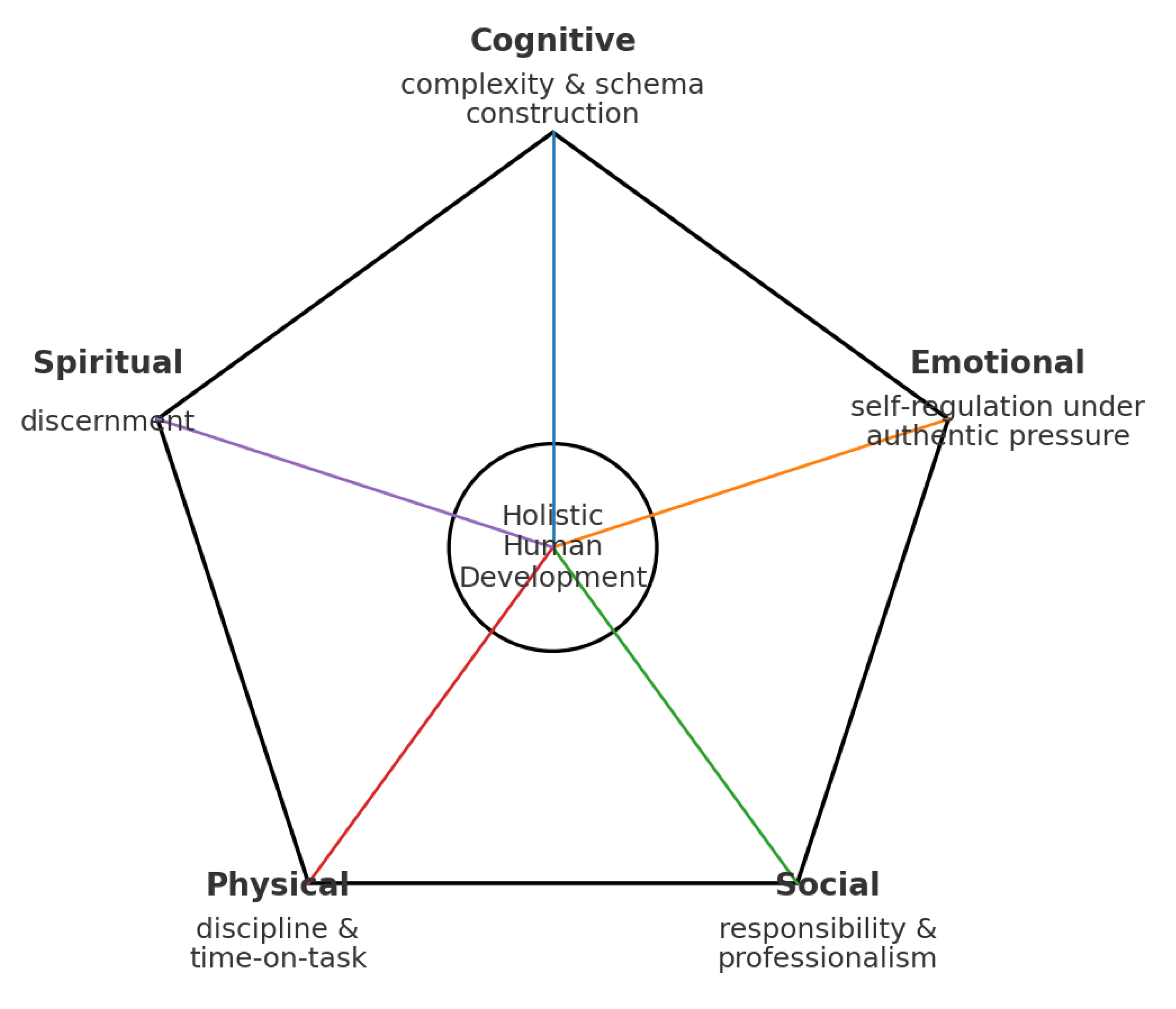
Figure 2.
Conceptual model linking theoretical frameworks to potential misalignments of playful learning with adult development. Arrows illustrate empirically supported pathways—for example, ‘extraneous cognitive load → surface processing → weaker long-term schema’ and ‘need-satisfying design → intrinsic motivation → sustained engagement’—thereby operationalising the textual arguments presented in Section 2.2 and 2.5.
Figure 2.
Conceptual model linking theoretical frameworks to potential misalignments of playful learning with adult development. Arrows illustrate empirically supported pathways—for example, ‘extraneous cognitive load → surface processing → weaker long-term schema’ and ‘need-satisfying design → intrinsic motivation → sustained engagement’—thereby operationalising the textual arguments presented in Section 2.2 and 2.5.
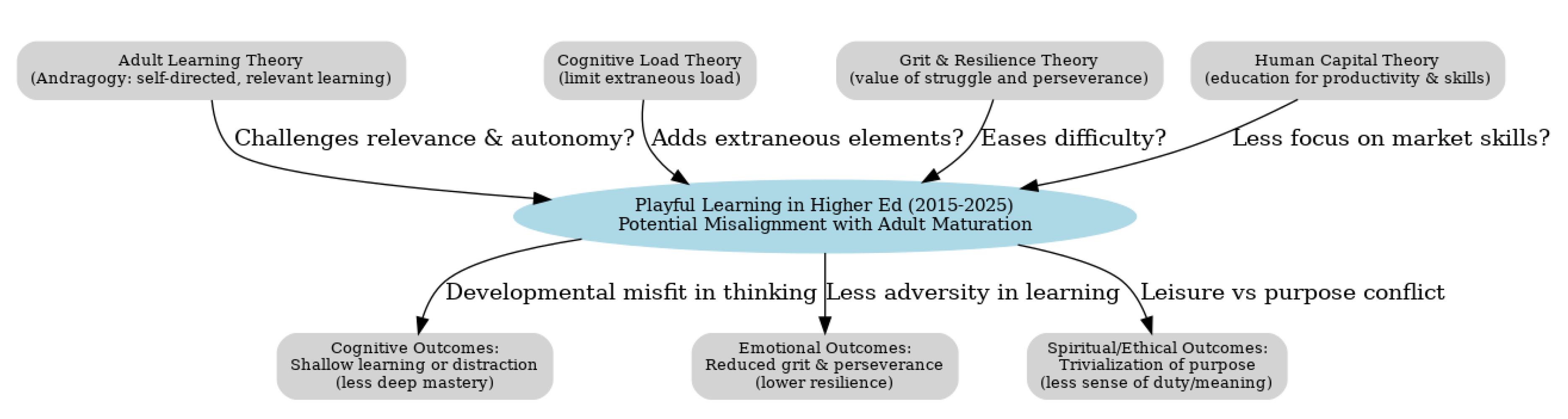
Figure 3.
U.S. adults (ages 16–65) at selected proficiency levels in literacy and numeracy, 2012/14, 2017, and 2023. Source: U.S. PIAAC 2012/14, 2017, 2023; NCES web tables and highlights; OECD PIAAC 2024 release. Bars show the percentage distribution across proficiency levels. Interpretation is descriptive only and does not imply causation. Note: NCES reports that average U.S. literacy and numeracy scores were lower in 2023 than in 2017, with a distributional shift toward lower proficiency. OECD’s 2024 cross-national release similarly describes declines or stagnation across many countries.
Figure 3.
U.S. adults (ages 16–65) at selected proficiency levels in literacy and numeracy, 2012/14, 2017, and 2023. Source: U.S. PIAAC 2012/14, 2017, 2023; NCES web tables and highlights; OECD PIAAC 2024 release. Bars show the percentage distribution across proficiency levels. Interpretation is descriptive only and does not imply causation. Note: NCES reports that average U.S. literacy and numeracy scores were lower in 2023 than in 2017, with a distributional shift toward lower proficiency. OECD’s 2024 cross-national release similarly describes declines or stagnation across many countries.
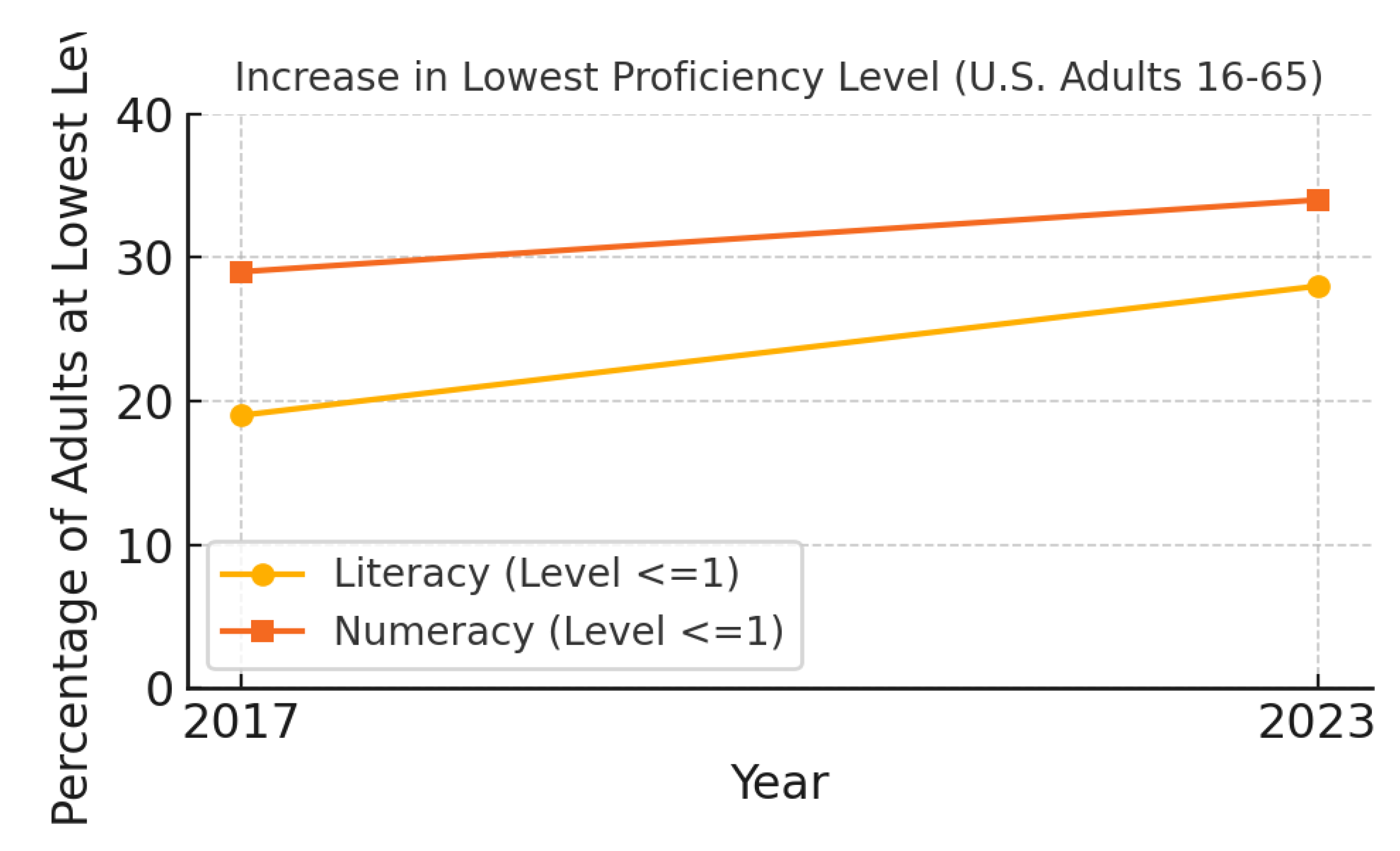
Table 2.
A. Country- and Year-Fixed-Effects Estimates of Playful-Learning Reform Intensity on Adult Skills. (dependent variable = PIAAC plausible-value score, points). Note. 1Reform intensity is a 0–1 index coded from UNESCO and national policy briefs, with 1 = full nationwide adoption of playful-learning mandates between 2015-2023; 0 = no national policy. All models weight PIAAC replicate weights and use five plausible values per OECD guidelines. Controls for age, gender, parental education, and survey wave are shown; additional socioeconomic controls (employment status, migrant background) are included in robustness checks and leave the key coefficient unchanged (< 5 % variation, results available on request).
Table 2.
A. Country- and Year-Fixed-Effects Estimates of Playful-Learning Reform Intensity on Adult Skills. (dependent variable = PIAAC plausible-value score, points). Note. 1Reform intensity is a 0–1 index coded from UNESCO and national policy briefs, with 1 = full nationwide adoption of playful-learning mandates between 2015-2023; 0 = no national policy. All models weight PIAAC replicate weights and use five plausible values per OECD guidelines. Controls for age, gender, parental education, and survey wave are shown; additional socioeconomic controls (employment status, migrant background) are included in robustness checks and leave the key coefficient unchanged (< 5 % variation, results available on request).
| Predictor | Literacy β (SE) | 95 % CI | p | Numeracy β (SE) | 95 % CI | p |
|---|---|---|---|---|---|---|
| Playful-learning reform intensity1 | –2.80 (0.90) | –4.55, –1.05 | .003 | –3.10 (1.20) | –5.44, –0.76 | .010 |
| Age (years) | 0.22 (0.05) | 0.12, 0.32 | <.001 | 0.18 (0.06) | 0.06, 0.30 | .003 |
| Female (= 1) | –1.90 (0.60) | –3.07, –0.73 | .001 | –2.35 (0.72) | –3.76, –0.94 | .001 |
| Parental tertiary education (= 1) | 6.45 (0.85) | 4.78, 8.12 | <.001 | 5.88 (0.97) | 3.99, 7.77 | <.001 |
| Wave 2015 | –0.75 (0.55) | –1.82, 0.32 | .167 | –1.02 (0.61) | –2.22, 0.18 | .095 |
| Wave 2023 | –1.60 (0.70) | –2.97, –0.23 | .022 | –1.88 (0.78) | –3.40, –0.36 | .016 |
| Constant | 254.6 (5.1) | 244.6, 264.6 | <.001 | 249.3 (5.8) | 237.9, 260.7 | <.001 |
| Observations | 159,814 | 159,814 | ||||
| Countries | 31 | 31 | ||||
| Within-R2 | .071 | .066 | ||||
| F-statistic (df = 6, 155 k) | 42.8 | 36.1 | ||||
| Clustering | by country | by country |
Disclaimer/Publisher’s Note: The statements, opinions and data contained in all publications are solely those of the individual author(s) and contributor(s) and not of MDPI and/or the editor(s). MDPI and/or the editor(s) disclaim responsibility for any injury to people or property resulting from any ideas, methods, instructions or products referred to in the content. |
© 2025 by the authors. Licensee MDPI, Basel, Switzerland. This article is an open access article distributed under the terms and conditions of the Creative Commons Attribution (CC BY) license (http://creativecommons.org/licenses/by/4.0/).
Copyright: This open access article is published under a Creative Commons CC BY 4.0 license, which permit the free download, distribution, and reuse, provided that the author and preprint are cited in any reuse.


