

Submitted:
05 October 2025
Posted:
06 October 2025
You are already at the latest version
Abstract
Digital transformation and sustainability are increasingly interconnected yet often studied in isolation. This paper introduces the Digital Sustainability Sequencing (DSS) framework, a mid-level model that guides organizations in aligning digital tools with sustainability goals through flexible, non-linear pathways. Based on a systematic review of 155 peer-reviewed articles and 30 analytical memos, supported by bibliometric mapping, DSS identifies three interrelated phases: (1) Digital Infrastructures for Operational Efficiency (DSS1), (2) Intelligent Integration for Sustainable Value (DSS2), and (3) Regenerative Ecosystem Models (DSS3). Each phase is characterized by enabling technologies, organizational routines, boundary conditions, and ethical dilemmas, synthesized through the DSS-E rubric: transparency, inclusivity, and accountability. Unlike traditional maturity models, DSS emphasizes path dependency and reversibility, capturing leapfrogging, stagnation, and regression. The framework offers testable propositions linking adoption logics, capability formation, and ecosystem orchestration. For managers and policymakers, DSS serves as a diagnostic tool to assess digital readiness, avoid efficiency-only lock-ins, and design inclusive governance. Overall, DSS bridges micro-level adoption with macro-level sustainability transitions, providing actionable insights for regenerative business strategies.
Keywords:
digital transformation
; sustainability
; sequencing
; ethical governance
; platform ecosystems
; dynamic capabilities
1. Introduction
Digital transformation and sustainability have become key priorities for businesses and governments, shaping research, management strategies, and public policies. Technologies like AI, IoT, blockchain, and big data are now widely used to tackle sustainability challenges by enhancing energy efficiency, facilitating circular economy strategies, and improving supply chain transparency. For instance, AI optimizes demand forecasting and resource allocation [1], while blockchain and IoT improve real-time traceability [2,3]. Collectively, these capabilities are positioned as enablers of the United Nations Sustainable Development Goals (SDGs) [4,5]. However, the relationship between digital technology and sustainability is neither linear nor challenging. Unintended consequences, such as increased energy consumption, electronic waste, algorithmic bias, and new forms of inequality, underscore the ambivalence of digitalization [6,7]. Governance dilemmas persist as precautionary and laissez-faire approaches contend with calls for adaptive regulation (Linkov et al., 2018). The COVID-19 pandemic made this clearer: digital tools helped keep services running, but many regions struggled due to poor infrastructure and low digital literacy [8]. Even in developed countries, digitalization raises ethical issues, including surveillance risks tied to transparency technologies [9].
Research from different fields shows just how complex the link between digitalization and sustainability really is. Operations management tends to focus on making processes more efficient, information systems look at how digitally mature organizations are and how they evolve, while environmental economics concentrates on reducing energy use and emissions [10,11,12]. These views are useful, but they’re often disconnected, making it hard to build strategies that truly combine digital innovation with sustainability goals. That’s why we need frameworks that reflect how digital capabilities grow over time, often in uneven, unpredictable ways. Digitalization isn’t a fixed stage to reach; it’s a dynamic journey where companies and ecosystems can move forward, get stuck, mix approaches, or even fall back. Yet many existing models oversimplify this by using rigid maturity scales that ignore uncertainty, reversibility, and the role of feedback.
To fill this gap, the study introduces the Digital Sustainability Sequencing (DSS) framework. Based on a thorough review of 155 peer-reviewed articles and 30 analytical memos, DSS outlines three connected phases: (1) building digital infrastructure, which involves core technologies and data systems; (2) integrating intelligent capabilities, where tools like AI, big data, and servitization help create sustainable value; and (3) regenerating ecosystems, which focuses on collaboration, stakeholder involvement, and circular business models. Unlike traditional models that assume a straight path of progress, DSS recognizes that development can be non-linear, with organizations leapfrogging stages, mixing approaches, or even moving backward.
This study contributes in three keyways. Theoretically, it offers a mid-level framework that connects technology adoption, capability building, and ecosystem transformation through a sequencing lens. Methodologically, it brings together fragmented research using a structured review and bibliometric analysis. Practically, it gives managers, consultants, and policymakers a tool to assess digital readiness, anticipate different development paths, and plan for long-term sustainable change. By viewing digitalization as a socially embedded process, not just a technical upgrade, DSS provides a more realistic understanding of how digital tools can both support and complicate sustainability efforts.
2. Literature Background
2.1. Sustainability and Digitalization: A Converging but Ambivalent Agenda
The growing overlap between sustainability and digitalization has become a major topic in academic research. Technologies like AI, IoT, blockchain, and big data are now widely used to support sustainability goals such as cutting energy and water use in farming and manufacturing, improving logistics, and enabling circular economy models. Studies show that IoT sensors help monitor resources, AI improves supply chain decisions, and combining blockchain with IoT builds trust and traceability across industries [13,14,15]. Beyond operational efficiency, these technologies pave the way for regenerative practices, closed-loop systems and collaborative business models.
However, this optimistic narrative is complicated by the enduring contradictions. Digitalization also introduces new challenges, including increased energy consumption, electronic waste, algorithmic bias, and widening inequality [16,17]. Governance issues are particularly significant, especially concerning data sovereignty, centralization versus decentralization, and ethical design of digital systems [18]. Context is crucial: while some firms and regions leverage digital tools to expedite sustainability transitions, others face infrastructural deficits, skill shortages or institutional inertia [19,20]. These tensions indicate that digitalization is not inherently sustainable but rather a socially embedded process whose outcomes are contingent on capabilities, infrastructure, and governance arrangements [21].
2.2. Fragmentation in the Current Literature
Although the field of digital sustainability is rapidly expanding, the existing literature remains fragmented, hindering the development of cumulative theories and practical guidance. One stream of research focuses narrowly on specific technologies, yielding insights into the application of blockchain in food traceability or artificial intelligence in predictive maintenance. However, this focus often overlooks the systemic integration of these technologies across various tools and sectors [22,23]. Another research domain investigates the adoption of digital sustainability at various maturity levels. Small and medium-sized enterprises (SMEs) in emerging economies encounter challenges such as funding gaps, inadequate digital literacy, and low absorptive capacity [24,25], whereas advanced firms in industrialized settings leverage platform ecosystems to implement servitization and circular economy strategies [26]. This divergence complicates the generalization process.
The theoretical contributions are similarly diverse, yet fragmented. Industry 4.0 maturity models focus on staged readiness, servitization emphasizes the reconfiguration of value chains, and circular economy approaches highlight the importance of closed-loop systems. While each offers valuable insights, they are limited in scope. Emerging paradigms, such as Industry 5.0 and Society 5.0, redirect attention towards human-centric and systemic perspectives [12,27], although their empirical impact remains limited. On top of that, the methods used like SEM, fsQCA, multicriteria decision-making, and bibliometric analysis shed light on different aspects but don’t come together in a unified way. As a result, it’s still unclear how organizations move between stages, what capabilities help them progress, and what causes them to stall or fall back.
2.3. Positioning the DSS Framework
The Digital Sustainability Sequencing (DSS) framework tackles these challenges by bringing together insights from 155 peer-reviewed studies and 30 analytical memos. Instead of viewing digital sustainability as a final destination, DSS sees it as an evolving journey made up of three interconnected phases:
- DSS1 – Infrastructure Development focuses on building the basic digital foundations, like data systems and IoT networks.
- DSS2 – Capability Integration is about using advanced tools, such as AI, big data, and servitization, to create sustainable value.
- DSS3 – Ecosystem Regeneration shifts the focus to collaboration, stakeholder involvement, and circular business models that aim for regenerative outcomes.
Unlike traditional maturity models that assume a step-by-step path, DSS recognizes that progress can be non-linear. Organizations may move forward, combine phases, or even go backward. This makes DSS both a practical roadmap and a diagnostic tool for understanding how companies and systems evolve toward sustainability.
2.3.1. Comparison with Organizational Maturity and Industry 4.0 Models
Traditional maturity models, based on readiness–development–maturity logics, tend to prioritize efficiency and adopt a firm-centric perspective. While servitization broadens this view to encompass value chain transformation, it still tends to underemphasize systemic interactions [28,29]. The DSS framework takes a different approach. It goes beyond linear progress and includes feedback loops, the possibility of moving backward, and goals focused on regeneration. Instead of fixed stages, DSS offers a flexible sequence that connects technologies, organizational practices, and governance into a unified path (see Table 1).
2.3.2. DSS in Contrast to Systemic Transition Frameworks: MLP, ACT, and Beyond
Systemic frameworks, such as the Multilevel Perspective (MLP) and Adaptive Cycle Theory (ACT), effectively capture socio-technical transitions and resilience dynamics. Nevertheless, these frameworks are characterized by a high degree of abstraction and a macro-oriented focus, which limits their diagnostic utility for firms and managers [30,31]. The DSS framework fills this gap by working at the meso level connecting what happens inside organizations with the dynamics of the wider ecosystem. It helps explain real-world patterns like overlapping phases, reversals, and hybrid strategies that companies often use in practice (see Table 2).
Recent frameworks, such as Industry 5.0, Society 5.0, and Circular Transition Indicators, offer valuable normative and measurement perspectives. However, they fall short in addressing sequencing and the relevant governance mechanisms. For example, the logistics and industrial applications within Industry 5.0 require detailed modeling and optimization strategies, such as integrating reverse logistics, to drive the broader goals of a circular economy [32]. In case of Society 5.0, although it lays a foundational model for future societal frameworks, detailed governance mechanisms and advanced collaborative systems remain underexplored [33]. The Digital Sustainability Sequencing (DSS) addresses these gaps by embedding these elements into an adaptive progression and explicitly integrating ethical governance through the DSS-E rubric (Table 3). While systemic frameworks like MLP and ACT inform transition dynamics, the DSS complements them by offering meso-level diagnostics that can be incorporated into foresight practices, such as scenario planning and cross-impact analysis.
2.4. Theoretical Integration and Boundaries
To avoid becoming just a mix of disconnected ideas, the Digital Sustainability Sequencing (DSS) framework is designed as a coherent and integrative model. It carefully brings together key concepts from well-established theories:
- For DSS1, the Technology–Organization–Environment (TOE) framework explains how organizations adopt new technologies.
- For DSS2, the Resource-Based View and Dynamic Capabilities show how companies build and use digital skills to create sustainable value.
- For DSS3, Platform Theory helps understand how ecosystems are coordinated and how different actors work together.
In addition, broader theories like the Multilevel Perspective (MLP) and Actor-Network Theory (ACT) offer insights into how systems evolve, which DSS translates into practical tools for organizations.
What makes DSS unique is its ability to connect these ideas into a flexible sequence starting with adoption, moving through capability building, and ending with ecosystem regeneration. Ethical governance (DSS-E) plays a key role throughout, acting as a dynamic capability that shapes whether and how organizations move between phases. In this way, DSS goes beyond the limits of traditional maturity models and abstract transition theories, offering a practical and structured way to understand and guide digital sustainability efforts.
3. Methodology
3.1. Search Strategy and Selection Protocol
To better understand how digital transformation and sustainability intersect, we carried out a structured literature review covering the period from January 2015 to January 2024, a decade marked by a surge in publications on digital sustainability. We searched two major databases, Scopus and Web of Science, using a combination of keywords like “digital transformation,” “sustainability,” “circular economy,” “regenerative business,” and “Industry 4.0.”
We limited our review to peer-reviewed journal articles written in English and available in full text. Editorials, conference abstracts, duplicates, and articles with limited relevance were excluded. While this approach helped ensure consistency, it also meant we left out grey literature, regional publications, and non-English sources, a limitation we acknowledge and discuss later in Section 7.
Following PRISMA guidelines (see Figure 1), we started with 400 records. After screening, 175 remained, and we ultimately selected 155 for detailed analysis (Appendix A). From these, we chose 30 highly influential articles for deeper examination based on their citation impact, methodological depth, and relevance to the digital–sustainability link. We stopped at 30 because the themes began repeating, indicating that we had reached saturation and further additions wouldn’t add new insights (Appendix B).
3.2. Coding Strategy and Analytical Memos
The synthesis employed an abductive methodology that iterated between inductive coding and theoretical framing. A comprehensive review of each of the 155 articles was conducted, and qualitative codes were assigned to encapsulate five dimensions: (1) enabling technologies, (2) sustainability outcomes, (3) organizational capabilities, (4) theoretical grounding, and (5) alignment with the DSS phases. A preliminary codebook was piloted on 20 articles, iteratively refined, and subsequently applied systematically.
Articles were categorized according to DSS phases: DSS1, infrastructure; DSS2, capability integration; and DSS3, ecosystem regeneration. Borderline cases were meticulously adjudicated. For example, Chin et al. (2022), initially coded as DSS1 (blockchain traceability), was reassigned to DSS3 because of its focus on collaborative value creation. Intercoder reliability checks were conducted to ensure credibility. A second researcher independently coded 30 articles, and discrepancies were resolved through consensus. An additional reliability check on 24 randomly stratified cases yielded a Cohen’s κ of 0.82, indicating a substantial agreement [34].
Analytical memos were produced for the 30 core articles, summarizing their objectives, methods, findings, and implications. These memos were not arbitrary summaries, but structured analytical tools used to abstract higher-order themes and to derive theoretical propositions. Their number was capped at 30 to maintain analytic depth while ensuring representativeness across the corpus.
The final tally of 155 articles indicates thematic saturation, suggesting that any further additions merely echoed existing patterns without introducing new conceptual variations. By ensuring that additional articles or data points do not offer new conceptual variations, researchers can efficiently allocate their resources and focus on a deeper analysis of existing data, thereby enhancing the quality and depth of their research findings. This approach is consistent with the interdisciplinary nature of sustainability transitions, which often requires contributions from diverse fields to comprehensively address complex challenges [35,36].
3.3. Bibliometric Enrichment
To complement manual coding and reduce potential subjectivity, we conducted a bibliometric analysis of the 155 peer-reviewed articles included in the corpus. The analysis was performed in R (v.4.5.0, macOS arm64) using the Bibliometrix package (v.4.2.1), which is supported by igraph and ggraph for visualization. The resulting keyword co-occurrence network is visualized in Figure 2, which illustrates the three clusters corresponding to DSS1, DSS2, and DSS3.
The pipeline consisted of three steps.
-
Keyword co-occurrence network. Using the biblioNetwork() function, we constructed a co-occurrence matrix of the authors’ keywords. The resulting network was clustered using the Louvain algorithm, which revealed three distinct thematic groups corresponding to the DSS phases:
- DSS1 – Infrastructural foundations (IoT, RFID, blockchain traceability, ERP).
- DSS2 – Intelligent integration (AI, big data, predictive analytics, servitization).
- DSS3 – Ecosystem regeneration (platforms, circular economy, co-creation).
- Thematic mapping. Through the thematicMap() function, we produced a strategic diagram positioning clusters along the axes of centrality (relevance across the field) and density (internal cohesion) (Figure 3). This mapping corroborated the interpretive coding: DSS1 themes appeared as well-established but less dynamic, DSS2 themes as emerging motor topics, and DSS3 as high-centrality but still underdeveloped in density, signaling future growth potential.
-
Sensitivity testing. To check the robustness, we split the dataset into two subsets:
- High-citation articles (above the median citation count).
- Low-citation articles (below the median citation count).
The thematic distribution across DSS1, DSS2, and DSS3 was consistent in both groups, with no structural divergence. This indicates that the DSS framework is not an artifact of highly cited works but reflects stable field-wide patterns.

Table 4.
Distribution of Articles across DSS Phases (Full Corpus vs. Citation Subsets).
| DSS Phase | Full Corpus (N) | Full Corpus (%) | High-Citation (N) | Low-Citation (N) | High-Citation (%) | Low-Citation (%) |
|---|---|---|---|---|---|---|
| DSS1 Infrastructure | 63 | 40.6 | 37 | 26 | 47.4 | 33.8 |
| DSS2 Intelligence | 64 | 41.3 | 25 | 39 | 32.1 | 50.6 |
| DSS3 Ecosystem | 28 | 18.1 | 16 | 12 | 20.5 | 15.6 |
Note. Sensitivity test comparing high- vs. low-citation subsets; proportions of DSS1/DSS2/DSS3 remain stable, supporting robustness. Source. Authors’ bibliometric split-sample analysis in R (Section 2.3: sensitivity testing).
The stability of the proportions across the high- and low-citation subsets confirmed the robustness of the three-phase structure.
For transparency, Appendix C provides a minimal reproducible script. By triangulating manual coding with bibliometric mapping and validating it through sensitivity testing, the analysis consolidates DSS1–DSS2–DSS3 as stable thematic clusters and strengthens the empirical grounding of the DSS framework.
3.4. Methodological Rationale
The methodological design adheres to the standards for conceptual research on sustainability transitions [37,38]. Its strength lies in the combination of qualitative depth with quantitative triangulation. Manual coding and memoing preserved theoretical nuances, while bibliometric mapping added transparency and replicability.
We also ran intercoder reliability checks to make sure the coding was consistent. However, there are still some limitations, such as relying only on English-language sources and not using machine learning tools for validation. Future research could improve on this by including non-English and grey literature, and by using text-mining techniques like topic modeling or semantic clustering to make the process even more robust and reproducible.
4. Theoretical Development: Digital Sustainability Sequencing (DSS)
Based on a thorough review of 155 peer-reviewed articles and 30 analytical memos, we developed the Digital Sustainability Sequencing (DSS) framework, a conceptual model that explains how organizations connect digital transformation with sustainability goals through flexible and evolving paths.
Unlike traditional maturity models that assume a straight, one-way progression, DSS recognizes that development can be unpredictable. Organizations may move forward, fall back, combine phases, or skip steps entirely. This makes DSS a useful tool both for understanding how companies evolve and for helping them plan strategies that lead to regenerative, long-term outcomes (see Figure 4).
To ground this conceptualization empirically, the framework was built inductively from analytical memos that distilled the key insights from high-impact articles. Table 5 presents representative examples that demonstrate how diverse methodologies and contexts converge in the three DSS phases.
4.1. DSS1: Digital Infrastructures for Operational Efficiency
The first phase (DSS1) establishes the technological foundations that allow organizations to generate and manage real-time data. Typical enablers include Internet of Things (IoT) sensors, radio frequency identification (RFID) tags, blockchain traceability systems, and enterprise resource planning (ERP). These technologies have been introduced primarily to improve operational efficiency, reduce waste, and ensure compliance with environmental regulations. Theoretically, DSS1 is anchored in the Technology–Organization–Environment (TOE) framework [39] and the Diffusion of Innovation (DoI) theory [40]. However, unlike classic adoption models that emphasize efficiency or competitive motives, DSS1 explicitly links infrastructural adoption to sustainability imperatives.
Empirical studies have reinforced this link. IoT-enabled monitoring systems have reduced emissions and optimized resource use in manufacturing [41], and blockchain technologies have enhanced transparency in agri-food chains [42]. However, the degree to which DSS1 translates into sustainability outcomes is mediated by institutional pressures from regulation to investor and consumer expectations that either push infrastructure towards sustainability or keep them efficiency-oriented.
Barriers are particularly acute for SMEs, which often face limited funding, fragmented systems, and low digital literacy levels. Conversely, strong regulations, leadership commitment, and ESG disclosure obligations act as accelerators.
Proposition 1: Organizations operating in stronger regulatory and institutional environments are more likely to align their digital infrastructure with sustainability goals. In contrast, those in weaker contexts may adopt technology mainly for efficiency, without broader sustainability impact.
4.2. DSS2: Intelligent Integration for Sustainable Value Creation
The second phase (DSS2) represents a shift from infrastructure enablement to the strategic incorporation of advanced capabilities into organizational routines. Here, artificial intelligence, machine learning, predictive analytics, and big data are no longer peripheral tools but are embedded in decision-making processes, driving sustainable value creation. This phase is theoretically grounded in the Resource-Based View (RBV) [43] and Dynamic Capabilities Theory [44]. DSS2 highlights that digital assets alone do not guarantee sustainability impact; value emerges when organizations develop sensing, seizing, and reconfiguring routines to leverage these assets. Stakeholder Theory further enriches this perspective by showing how intelligent integration responds to the diverse and often conflicting expectations of consumers, regulators, and communities.
Evidence illustrates how DSS2 capabilities can generate competitive and sustainability advantages: big data enhances resilience and lowers emissions [45], whereas analytics integrated with circular economy principles enable material recovery and waste minimization [46]. Nonetheless, risks remain substantial: algorithmic bias, lack of explainability, and workforce resistance to analytics-driven processes can compromise sustainability ambitions.
Boundary conditions are critical. DSS2 thrives in data-intensive, resource-rich environments (e.g., MNCs in manufacturing or logistics) but is less accessible to SMEs lacking interoperability, governance, and digital skills.
Proposition 2: Advanced digital capabilities only lead to sustainable value when they’re supported by strong organizational routines and active stakeholder engagement, not just by adopting the technology itself.
4.3. DSS3: Platform Ecosystems and Regenerative Business Models
The third phase (DSS3) redefined digital sustainability as a collective, ecosystem-level endeavor. Firms orchestrate platforms, build complementarities, and establish multi-actor governance structures that pursue regenerative outcomes, that is, net positive environmental and social impacts. The phase builds upon Platform Theory [47], Ecosystem Innovation [48], and Value Co-Creation [49], extending them into the domain of sustainability transitions. DSS3 resonates with Industry 5.0 principles of resilience, inclusivity, and human-centricity, positioning platforms as enablers of systemic regeneration and sustainability.
Empirical evidence highlights this potential effect. Amsaterdam Smart City platforms integrate mobility, waste, and energy systems using digital twins and IoT. Blockchain-enabled ecosystems in agriculture [50] support regenerative farming and fair value distribution. Simultaneously, DSS3 exposes the risks of monopolistic capture, governance asymmetries, and digital exclusion.
Proposition 3: Platform ecosystems can deliver regenerative outcomes but only if they include fair governance and mechanisms for redistributing value, preventing monopolistic control.
To consolidate the conceptual scope, Table 6 maps the core theories, concepts and boundary conditions that distinguish DSS1–DSS3.
4.4. Boundary Conditions and Theoretical Mapping
Not all organizations move through the DSS phases in the same way. Their path depends on factors like company size, geographic location, and industry sector.
For example, SMEs often skip directly to DSS3 by innovating in niche areas, but they may struggle with DSS2 due to limited access to analytics and data capabilities. In contrast, multinational corporations (MNCs) tend to build strong DSS2 capabilities but may find it harder to shift toward ecosystem-level collaboration in DSS3. Geography also plays a role. In developed economies, companies usually build solid DSS1 and DSS2 infrastructures but can get stuck due to institutional inertia. Meanwhile, emerging economies often leapfrog DSS2 and go straight to DSS3 by using mobile and decentralized technologies like mobile banking or microgrids. Sector matters too. Manufacturing firms tend to focus on DSS1 and DSS2, using tools like industrial IoT and predictive maintenance. Service-based organizations, on the other hand, are more likely to emphasize DSS3, using platforms for sharing economy models and co-creation.
Proposition 4: The way organizations move through DSS phases depends on their size, sector, and institutional context. There’s no single path, just multiple possible trajectories.
4.5. Transitions, Non-Linearity, and Feedback Loops
A key idea in the DSS framework is that progress isn’t always linear. Organizations don’t necessarily move smoothly from one phase to the next. Instead, they might:
- Regress, for example by pausing AI adoption due to ethical concerns.
- Hybridize, using DSS1 infrastructure while also experimenting with DSS3 platforms.
- Leapfrog, skipping DSS2 entirely-something often seen in emerging economies.
This flexible view aligns with resilience theory (Folke, 2016) and complex adaptive systems thinking. Sometimes, the more data an organization collects, the harder it becomes to change course-due to learning curves or network effects. These “increasing returns” can trap firms in DSS1.
On the flip side, external shocks-like climate disasters, new regulations, or social movements-can push organizations to jump ahead, especially if they already have platform-based tools in place. DSS doesn’t assume a single path. Instead, it sees three possible “equilibria” or stable states:
- A DSS1 lock-in, focused on efficiency.
- A DSS2 equilibrium, driven by analytics.
- A DSS3 regenerative state, built on collaboration and ecosystem thinking.
Proposition 5: Organizations can follow nonlinear paths-regressing, hybridizing, or leapfrogging and still move toward digital sustainability.
Proposition 6: The more data and network effects an organization has, the harder it is to move from DSS1 to DSS2.
Proposition 7: External shocks make it more likely for organizations to leap directly from DSS2 to DSS3-especially when platform tools are already in place.
4.6. Ethical Governance Across DSS Phases (DSS-E Rubric)
Each phase of the DSS framework is associated with distinct ethical challenges. In DSS1, concerns revolved around data privacy, surveillance risks, and digital equity. DSS2 introduces dilemmas linked to algorithmic bias, autonomy, and transparency issues. In DSS3, the stakes rise further, with issues such as platform monopolies, governance asymmetries, and digital exclusion. Building on Digital Ethics principles [51,52], we propose the DSS-E rubric, which assesses ethical preparedness across three dimensions: transparency, inclusivity, and accountability. Further development of the DSS framework requires the systematic integration of behavioral and participatory governance dimensions. Key organizational factors, including leadership commitment, digital literacy, and stakeholder engagement, critically influence progression through the DSS phases. The explanatory capacity and prescriptive utility of DSS will be strengthened by embedding frameworks from behavioral decision science and participatory design [53,54]. For the DSS-E rubric, we propose operationalizing participatory governance through explicit metrics, such as stakeholder engagement indices, transparency in decision-making processes, and measures of equitable representation in platform governance. Incorporating these metrics ensures not only diagnostic accuracy but also the practical advancement of inclusive, resilient transitions towards digital sustainability [52,53,54].
Our review of 155 articles shows varying degrees of alignment: DSS1 demonstrates relatively strong compliance with operational transparency; DSS2 exhibits partial integration, especially regarding algorithmic fairness; and DSS3 faces the most significant governance concerns, particularly related to power asymmetries and exclusion.
We reconceptualize DSS-E not as a supplementary add-on but as a dynamic capability of ethical governance that shapes sequencing between phases. In DSS1, privacy-by-design and equitable access strengthen trust in data and stakeholder acceptance, thereby enabling a smoother transition to DSS2. In DSS2, explainability, auditability, and human-in-the-loop practices reduce algorithmic risks and lower the resistance to data-driven decision-making. In DSS3, participatory governance, fair value distribution and grievance mechanisms anchor legitimacy and counteract monopolistic drift. Thus, the DSS-E actively alters the probabilities of progression, regression, or leapfrogging across phases.
Proposition 8: Ethical governance is a dynamic capability that shapes both the legitimacy and success of digital sustainability transitions.
Proposition 9: Strong ethical foundations in DSS1 improve the chances of a smooth transition to DSS2.
Proposition 10: In DSS2, explainable AI helps ensure that analytics lead to real sustainability outcomes.
Proposition 11: In DSS3, inclusive governance helps balance platform power and supports regenerative goals.
Table 7.
DSS-E Rubric: Ethical Risks and Governance Needs.
| Phase | Ethical Risk | Governance Needs | Illustrative Indicators |
|---|---|---|---|
| DSS1 | Data privacy, surveillance, digital divide | Privacy-by-design, equitable access | ESG compliance, GDPR alignment |
| DSS2 | Algorithmic bias, loss of human oversight | Explainable AI, auditability, transparency | Bias audits, algorithmic fairness standards |
| DSS3 | Platform monopolies, exclusion, power asymmetries | Inclusive governance, accountability, redistribution mechanisms | Multi-stakeholder governance, platform equity |
Note. Phase-specific ethical risks, governance needs, and illustrative indicators (privacy-by-design, explainability, inclusive platform governance). Source. Authors’ rubric based on digital ethics literature (e.g., Floridi, Stahl) and the reviewed corpus.
4.7. Summary of DSS Phases
This section brings together the key elements of the three DSS phases Infrastructure (DSS1), Intelligence (DSS2), and Ecosystem (DSS3) to show how they differ and connect (Table 8). The comparison includes the technologies used, the theories behind each phase, the strategic focus for managers, and the ethical risks that need to be addressed.
This summary helps managers, researchers, and policymakers understand how each phase contributes to digital sustainability, and what challenges they might face along the way.
5. Discussion
The Digital Sustainability Sequencing (DSS) framework advances scholarship at the nexus of digital transformation and sustainability by conceptualizing digitalization not as a static maturity ladder but as an adaptive, cumulative, and path-dependent process. Unlike linear models that equate progress with the incremental adoption of technologies, the DSS underscores that sustainability outcomes hinge on sequencing, timing, and governance. Organizations move through three interdependent phases: infrastructure (DSS1), intelligent integration (DSS2), and ecosystem regeneration (DSS3); however, their pathways are often nonlinear, shaped by institutional pressures, ethical dilemmas, and external shocks. By embedding reversibility, hybridization, and leapfrogging into its logic, the DSS provides a more realistic account of how digital sustainability unfolds across firms and ecosystems. It acknowledges that organizations may remain locked into efficiency-focused infrastructures (DSS1), accelerate intelligence-driven processes (DSS2), or bypass intermediate stages altogether to experiment with platform-based regeneration (DSS3). In doing so, DSS moves beyond the limitations of maturity models (too linear) and transition theories (too abstract), positioning itself as a meso-level diagnostic framework that links organizational practices to systemic outcomes.
5.1. Evolutionary Logic of DSS
The DSS model delineates digital sustainability as an evolutionary progression that is neither deterministic nor uniform in nature. Progression through DSS1–DSS3 depends on capability thresholds, leadership orientation, and institutional context. For instance, a manufacturing SME may adopt IoT infrastructure under regulatory pressure (DSS1) but struggle to transition to analytics (DSS2) due to skill shortages. In contrast, a fintech start-up in an emerging economy may bypass DSS2 entirely and adopt platform logics from inception (DSS3) to leverage latecomer advantages.
This evolutionary perspective reflects the broader resilience theory [55], where change is cyclical, adaptive, and often crisis-driven. It also incorporates complex adaptive systems thinking, whereby local organizational rules (KPIs, procurement standards, data-sharing policies) generate emergent macro-patterns (platform dominance, digital exclusion), which, in turn, reshape micro-level incentives.
Thus, DSS conceptualizes sustainability transitions not as linear escalators but as dynamic feedback loops producing multiple equilibria: efficiency lock-in (DSS1), analytics-dominant equilibrium (DSS2), or regenerative ecosystems (DSS3).
5.2. Theoretical Contributions
The DSS contributes in three ways. First, it introduces a sequenced integrative model that synthesizes insights from information systems, sustainability transition, and organizational theory. By situating adoption, capability development, and ecosystem orchestration within a unified framework, the DSS reduces the fragmentation that currently hampers the field.
Second, DSS explicitly connects theoretical paradigms to each stage. DSS1 utilizes the Technology–Organization–Environment (TOE) framework and Diffusion of Innovation (DoI), but it expands these by linking infrastructural adoption to sustainability imperatives. DSS2 is based on the Resource-Based View (RBV) and Dynamic Capabilities, illustrating how digital resources gain value only when they are integrated into sensing, seizing, and reconfiguring practices that align with stakeholder demands. DSS3 incorporates Platform Theory, Ecosystem Innovation, and Value Co-Creation, extending these into the sustainability realm through ideas like inclusive governance, regenerative logic, and value redistribution.
Third, DSS demonstrates the evolution of methodological lenses across the phases. DSS1 has been studied through exploratory adoption surveys and case-based research. DSS2 has attracted quantitative studies employing PLS-SEM, ESG-linked KPIs and big data analytics. DSS3 is emerging as a domain for systems modeling, network analysis, and blockchain-enabled governance. Thus, the DSS not only theorizes sequencing but also guides methodological pluralism.
5.3. Applied Illustration and Sectoral Adaptation
The DSS framework is illustrated by the case of Van Wijhe Verf, a Dutch SME in the paint industry. In DSS1, the firm invested in renewable energy infrastructure and blockchain-enabled traceability to ensure compliance and operational transparency. In DSS2, it expanded into bio-based paint innovation and partnered with universities to leverage data-driven research and development (R&D). Finally, DSS3 entered collaborative circular initiatives with NGOs, positioning itself within regenerative ecosystems.
This case demonstrates two critical insights: (i) SMEs can traverse DSS phases, not only large multinationals, provided that institutional and ecosystem support is available, and (ii) DSS phases can be sectorally adapted. In manufacturing, DSS2 capabilities, such as predictive downtime reduction and circular supply chain analytics, are essential. In services, DSS3 governance mechanisms (e.g., ethical personalization and participatory platforms) become central. Thus, DSS is both scalable across firm sizes and flexible across sectors, which enhances its external validity.
5.4. Managerial Implications
For practitioners, the DSS functions as both a diagnostic and strategic tool.
- In DSS1, managers should prioritize infrastructure readiness, data quality and employee digital literacy. Early misalignments, such as adopting IoT solely for compliance without linking it to sustainability, can trap firms in efficiency lock-ins.
- In DSS2, the emphasis shifts to embedding ESG indicators into analytics, building organizational routines for ethical AI, and promoting cross-functional collaborations. Here, the risk lies in algorithmic opacity and organizational resistance to data-driven change.
- In DSS3, managers must orchestrate platforms, ensure inclusive governance, and design regenerative business models. Success depends on balancing innovation with safeguards against monopolistic drifts and digital exclusion.
From a policy perspective, DSS enables differentiated interventions: subsidies and literacy programs for DSS1 firms, incentives for ethical AI in DSS2 organizations, and collaborative funding and regulatory frameworks for DSS3 ecosystems.
5.5. Real-World Illustrations of DSS Phases
Five sectoral examples enhance the empirical credibility of the DSS (Table 9). H&M (fashion) highlights the dangers of incomplete advancement: although RFID and blockchain traceability (DSS1) and AI-driven demand forecasting (DSS2) boost efficiency, the lack of DSS3 ecosystem governance poses reputational risks of greenwashing. Carrefour (retail) showcases the strength of DSS2 in optimizing logistics but reveals limited cross-sector partnerships, illustrating how analytics can enhance efficiency without achieving systemic transformation. Amsterdam Smart City exemplifies DSS3 through the use of digital twins and citizen engagement platforms, supported by robust policy orchestration. IKEA demonstrates the shift from DSS2 (product-as-a-service models and blockchain-enabled lifecycle tracking) to DSS3 (circular platforms and sharing economy initiatives). WASP (3D printing in construction) represents regenerative innovation by employing open-source platforms and renewable materials to transform housing ecosystems. Alongside the Van Wijhe case, these examples demonstrate that the DSS captures both convergence (common enabling technologies) and divergence (sectoral trajectories), thereby increasing its explanatory depth and comparative utility.
5.6. Theoretical Integration (Micro–Meso–Macro)
Finally, DSS contributes by positioning itself as a meso-level framework that bridges micro-level adoption theories with macro-level transition perspectives.
- At the micro-level, TOE and DoI explain infrastructural adoption decisions (DSS1), driven by perceptions of usefulness, compatibility, and institutional pressures.
- At the meso level, RBV and Dynamic Capabilities explain how organizations transform digital assets into sustainable routines (DSS2) through routinized learning and stakeholder integration.
- At the macro level, transition theories (e.g., socio-technical regimes) and platform innovation perspectives explain DSS3, where firms co-evolve with partners, orchestrate complementarities, and redistribute values.
The originality of the DSS lies in specifying sequencing mechanisms across levels: capability accumulation and architectural embedding (DSS1→DSS2), boundary expansion and complementor alignment (DSS2→DSS3), and ethical legitimacy (DSS-E) as a dynamic capability influencing progression or regression. Rather than a linear staircase, the DSS envisions multiple adaptive pathways governed by feedback loops, crises, and governance choices.
6. Conclusions
This study introduces the Digital Sustainability Sequencing (DSS) framework as a conceptual model that explains how organizations progressively align digital transformation with sustainability imperatives. The framework identifies three cumulative but nonlinear phases: DSS1 – Digital Infrastructure for Operational Efficiency, where foundational technologies and data infrastructures are deployed; DSS2 – Intelligent Capability Integration for Sustainable Value Creation, where advanced analytics, AI, and servitization become embedded into organizational routines; and DSS3 – Platform-Based Regenerative Ecosystems, where firms transition into collaborative, multi-actor systems oriented towards circularity, inclusivity, and systemic regeneration.
The dual contribution of the DSS is both theoretical and practical. Theoretically, it bridges fragmented research streams across information systems, sustainability transition, and organizational studies. By emphasizing sequencing, feedback loops, and hybrid pathways, it offers a nuanced alternative to static maturity models. Practically, DSS provides firms, consultants, and policymakers with a diagnostic and foresight tool to evaluate digital sustainability readiness, prioritize investments, and design policy instruments aligned with the UN-SDGs, European Green Deal, and Industry 5.0.
Unlike prior approaches that treat digital adoption as linear or technology-driven, the DSS foregrounds the temporal and evolutionary dynamics of the alignment between digitalization and sustainability. It emphasizes that not only which technologies are adopted matters, but also when, how, and under what governance conditions they are integrated. This sequencing logic helps organizations and policymakers avoid premature investments, reduce the risk of efficiency-only lock-ins, and foster systemic transformations with regenerative outcomes.
Future research should follow three complementary paths. First, empirical validation is critical in this regard. Longitudinal case studies, cross-industry surveys, and econometric modeling (e.g., panel SEM, fuzzy-set qualitative comparative analysis, event history analysis) are needed to test propositions and capture diverse pathways. Second, theoretical enrichment is necessary: integrating institutional theory, complexity science, and behavioral perspectives would sharpen explanations of leapfrogging, regression, and governance asymmetries. Third, cross-cluster analysis is required: future studies should investigate how crises, regulations, and social pressures accelerate or disrupt sequencing and how hybrid or recursive trajectories challenge maturity logics.
Thus, the DSS positions itself as both a conceptual foundation and practical compass for guiding digital sustainability transitions across industries, sectors, and regions.
7. Limitations and Future Research Pathways
Despite its contributions, the DSS remains an emerging framework with several limitations that open promising research avenues:
- Scope of the literature review. The review synthesized 155 peer-reviewed articles, but the selection criteria privileged English-language journals. This underrepresents gray literature, regional studies, and non-English scholarship, potentially biasing insights. Broader evidence bases would enhance both generalizability and policy relevance of the findings.
- Coding and synthesis approaches. The analysis relied primarily on manual coding and analytical memos. Although intercoder checks were conducted, the absence of automated text mining or advanced reliability testing limits methodological transparency. Future work could combine NVivo, MAXQDA, or machine learning techniques to ensure replicability and reduce interpretive bias.
- Conceptual rather than empirical validation is required. Currently, DSS is theory-driven. While its phases reflect recurrent patterns in the literature, empirical testing through comparative case studies, econometric panel analysis, or sectoral simulations is essential to confirm its robustness and refine its boundaries.
- Assumptions of sequencing. Although DSS integrates nonlinearity, its staged logic may still underplay recursive, fragmented, or leapfrogging dynamics in disruptive contexts. Future research should deepen the integration of resilience theory, path dependency, and adaptive cycle models.
- Contextual variation. Political, cultural, and institutional asymmetries were addressed only partially. Comparative studies across developed vs. emerging economies, SMEs vs. MNCs, and public vs. private governance would enhance applicability and reveal divergent trajectories.
- Behavioral and organizational dimensions. Leadership styles, employee digital literacy, and participatory governance were not systematically integrated, although they may critically mediate adoption. Incorporating human-centered and behavioral perspectives would enrich the explanatory power.
- Ethical governance (DSS-E). Although proposed as an extension, DSS-E requires further elaboration. Embedding fairness, inclusivity, and environmental justice as dynamic capabilities across all phases strengthens both diagnostic and prescriptive relevance.
To facilitate large-scale empirical applications, a set of preliminary phase-specific indicators is proposed:
- DSS1: IoT and RFID penetration rates, levels of ESG compliance adoption, and proportion of real-time monitoring systems deployed
- DSS2: Share of AI-assisted decision processes, degree of integration of explainable AI (XAI) in operations, and percentage of sustainability KPIs embedded within analytics frameworks
- DSS3: Openness index of platform APIs, prevalence of multi-actor governance mechanisms, and ratios indicating value redistribution among ecosystem participants.
These indicators provide actionable metrics for benchmarking and comparative analyses across firms, sectors, and regions, as advocated by Matarazzo et al. (2021), Prasad et al. (2024), and Solana-González et al. (2021).
Future validation requires rigorous and diverse designs:
- Panel multi-sector studies (EU/CEE): to test propositions using panel SEM or multilevel models. DSS-E can be operationalized via governance audits (privacy-by-design, explainability-by-design), while platform centrality can be measured using network metrics.
- fsQCA of trajectories: to identify configurational pathways of capabilities and ethical governance rules leading to distinct DSS outcomes, showing equifinal solutions.
- Event history analysis: to trace critical incidents (e.g., crises, regulatory shocks) that trigger transitions between DSS phases.
By specifying indicators and aligning them with empirical designs, the DSS evolves into a falsifiable, operationalizable, and comparative framework. This will enhance scientific robustness, enable cross-country benchmarking, and empower both scholars and practitioners to evaluate digital sustainability transitions with precision.
Author Contributions
Conceptualization, B.N. and L.Z.; methodology, B.N.; formal analysis, B.N.; investigation, B.N.; resources, L.Z.; data curation, B.N.; writing—original draft preparation, B.N.; writing—review and editing, B.N. and L.Z.; visualization, B.N.; supervision, L.Z.; project administration, B.N.. All authors have read and agreed to the published version of the manuscript.
Funding
This research received no external funding.
Institutional Review Board Statement
Not applicable.
Informed Consent Statement
Not applicable.
Data Availability Statement
We encourage all authors of articles published in MDPI journals to share their research data. In this section, please provide details regarding where data supporting reported results can be found, including links to publicly archived datasets analyzed or generated during the study. Where no new data were created, or where data is unavailable due to privacy or ethical restrictions, a statement is still required. Suggested Data Availability Statements are available in section “MDPI Research Data Policies” at https://www.mdpi.com/ethics.
Acknowledgments
Not applicable.
Conflicts of Interest
The authors declare no conflicts of interest.
Appendix A
List of Included Articles in the DSS Framework
| No. | Authors | Title | Year | Source title | DOI |
| 1 | Dwivedi Y.K.; Kshetri N.; Hughes L.; Slade E.L.; Jeyaraj A.; Kar A.K.; Baabdullah A.M.; Koohang A.; Raghavan V.; Ahuja M.; Albanna H.; Albashrawi M.A.; Al-Busaidi A.S.; Balakrishnan J.; Barlette Y.; Basu S.; Bose I.; Brooks L.; Buhalis D.; Carter L.; Chowdhury S.; Crick T.; Cunningham S.W.; Davies G.H.; Davison R.M.; Dé R.; Dennehy D.; Duan Y.; Dubey R.; Dwivedi R.; Edwards J.S.; Flavián C.; Gauld R.; Grover V.; Hu M.-C.; Janssen M.; Jones P.; Junglas I.; Khorana S.; Kraus S.; Larsen K.R.; Latreille P.; Laumer S.; Malik F.T.; Mardani A.; Mariani M.; Mithas S.; Mogaji E.; Nord J.H.; O’Connor S.; Okumus F.; Pagani M.; Pandey N.; Papagiannidis S.; Pappas I.O.; Pathak N.; Pries-Heje J.; Raman R.; Rana N.P.; Rehm S.-V.; Ribeiro-Navarrete S.; Richter A.; Rowe F.; Sarker S.; Stahl B.C.; Tiwari M.K.; van der Aalst W.; Venkatesh V.; Viglia G.; Wade M.; Walton P.; Wirtz J.; Wright R. | “So what if ChatGPT wrote it?” Multidisciplinary perspectives on opportunities, challenges and implications of generative conversational AI for research, practice and policy | 2023 | International Journal of Information Management | 10.1016/j.ijinfomgt.2023.102642 |
| 2 | Ren S.; Zhang Y.; Liu Y.; Sakao T.; Huisingh D.; Almeida C.M.V.B. | A comprehensive review of big data analytics throughout product lifecycle to support sustainable smart manufacturing: A framework, challenges and future research directions | 2019 | Journal of Cleaner Production | 10.1016/j.jclepro.2018.11.025 |
| 3 | Ibn-Mohammed T.; Mustapha K.B.; Godsell J.; Adamu Z.; Babatunde K.A.; Akintade D.D.; Acquaye A.; Fujii H.; Ndiaye M.M.; Yamoah F.A.; Koh S.C.L. | A critical review of the impacts of COVID-19 on the global economy and ecosystems and opportunities for circular economy strategies | 2021 | Resources, Conservation and Recycling | 10.1016/j.resconrec.2020.105169 |
| 4 | Liu, QL; Trevisan, AH; Yang, MY; Mascarenhas, J | A framework of digital technologies for the circular economy: Digital functions and mechanisms | 2022 | BUSINESS STRATEGY AND THE ENVIRONMENT | 10.1002/bse.3015 |
| 5 | Yadav G.; Luthra S.; Jakhar S.K.; Mangla S.K.; Rai D.P. | A framework to overcome sustainable supply chain challenges through solution measures of industry 4.0 and circular economy: An automotive case | 2020 | Journal of Cleaner Production | 10.1016/j.jclepro.2020.120112 |
| 6 | Freudenreich B.; Lüdeke-Freund F.; Schaltegger S. | A Stakeholder Theory Perspective on Business Models: Value Creation for Sustainability | 2020 | Journal of Business Ethics | 10.1007/s10551-019-04112-z |
| 7 | Hanelt A.; Bohnsack R.; Marz D.; Antunes Marante C. | A Systematic Review of the Literature on Digital Transformation: Insights and Implications for Strategy and Organizational Change | 2021 | Journal of Management Studies | 10.1111/joms.12639 |
| 8 | Govindan K.; Hasanagic M. | A systematic review on drivers, barriers, and practices towards circular economy: a supply chain perspective | 2018 | International Journal of Production Research | 10.1080/00207543.2017.1402141 |
| 9 | Cenamor J.; Rönnberg Sjödin D.; Parida V. | Adopting a platform approach in servitization: Leveraging the value of digitalization | 2017 | International Journal of Production Economics | 10.1016/j.ijpe.2016.12.033 |
| 10 | Wunderlich, P; Veit, DJ; Sarker, S | ADOPTION OF SUSTAINABLE TECHNOLOGIES: A MIXED-METHODS STUDY OF GERMAN HOUSEHOLDS | 2019 | MIS QUARTERLY | 10.25300/MISQ/2019/12112 |
| 11 | Ehlers, MH; Huber, R; Finger, R | Agricultural policy in the era of digitalisation | 2021 | FOOD POLICY | 10.1016/j.foodpol.2020.102019 |
| 12 | Belhadi, A; Kamble, S; Gunasekaran, A; Mani, V | Analyzing the mediating role of organizational ambidexterity and digital business transformation on industry 4.0 capabilities and sustainable supply chain performance | 2022 | SUPPLY CHAIN MANAGEMENT-AN INTERNATIONAL JOURNAL | 10.1108/SCM-04-2021-0152 |
| 13 | Mukherjee, AA; Singh, RK; Mishra, R; Bag, S | Application of blockchain technology for sustainability development in agricultural supply chain: justification framework | 2022 | OPERATIONS MANAGEMENT RESEARCH | 10.1007/s12063-021-00180-5 |
| 14 | Di Vaio A.; Palladino R.; Hassan R.; Escobar O. | Artificial intelligence and business models in the sustainable development goals perspective: A systematic literature review | 2020 | Journal of Business Research | 10.1016/j.jbusres.2020.08.019 |
| 15 | Goralski, MA; Tan, TK | Artificial intelligence and sustainable development | 2020 | INTERNATIONAL JOURNAL OF MANAGEMENT EDUCATION | 10.1016/j.ijme.2019.100330 |
| 16 | Toorajipour R.; Sohrabpour V.; Nazarpour A.; Oghazi P.; Fischl M. | Artificial intelligence in supply chain management: A systematic literature review | 2021 | Journal of Business Research | 10.1016/j.jbusres.2020.09.009 |
| 17 | Vrontis D.; Christofi M.; Pereira V.; Tarba S.; Makrides A.; Trichina E. | Artificial intelligence, robotics, advanced technologies and human resource management: a systematic review | 2022 | International Journal of Human Resource Management | 10.1080/09585192.2020.1871398 |
| 18 | Rosa P.; Sassanelli C.; Urbinati A.; Chiaroni D.; Terzi S. | Assessing relations between Circular Economy and Industry 4.0: a systematic literature review | 2020 | International Journal of Production Research | 10.1080/00207543.2019.1680896 |
| 19 | Culot G.; Nassimbeni G.; Orzes G.; Sartor M. | Behind the definition of Industry 4.0: Analysis and open questions | 2020 | International Journal of Production Economics | 10.1016/j.ijpe.2020.107617 |
| 20 | Dubey R.; Gunasekaran A.; Childe S.J.; Bryde D.J.; Giannakis M.; Foropon C.; Roubaud D.; Hazen B.T. | Big data analytics and artificial intelligence pathway to operational performance under the effects of entrepreneurial orientation and environmental dynamism: A study of manufacturing organisations | 2020 | International Journal of Production Economics | 10.1016/j.ijpe.2019.107599 |
| 21 | Raut, RD; Mangla, SK; Narwane, VS; Dora, M; Liu, MQ | Big Data Analytics as a mediator in Lean, Agile, Resilient, and Green (LARG) practices effects on sustainable supply chains | 2021 | TRANSPORTATION RESEARCH PART E-LOGISTICS AND TRANSPORTATION REVIEW | 10.1016/j.tre.2020.102170 |
| 22 | Ferraris A.; Mazzoleni A.; Devalle A.; Couturier J. | Big data analytics capabilities and knowledge management: impact on firm performance | 2019 | Management Decision | 10.1108/MD-07-2018-0825 |
| 23 | Awan, U; Shamim, S; Khan, Z; Zia, NU; Shariq, SM; Khan, MN | Big data analytics capability and decision-making: The role of data-driven insight on circular economy performance | 2021 | TECHNOLOGICAL FORECASTING AND SOCIAL CHANGE | 10.1016/j.techfore.2021.120766 |
| 24 | Coble, KH; Mishra, AK; Ferrell, S; Griffin, T | Big Data in Agriculture: A Challenge for the Future | 2018 | APPLIED ECONOMIC PERSPECTIVES AND POLICY | 10.1093/aepp/ppx056 |
| 25 | Queiroz M.M.; Fosso Wamba S. | Blockchain adoption challenges in supply chain: An empirical investigation of the main drivers in India and the USA | 2019 | International Journal of Information Management | 10.1016/j.ijinfomgt.2018.11.021 |
| 26 | Frizzo-Barker J.; Chow-White P.A.; Adams P.R.; Mentanko J.; Ha D.; Green S. | Blockchain as a disruptive technology for business: A systematic review | 2020 | International Journal of Information Management | 10.1016/j.ijinfomgt.2019.10.014 |
| 27 | Friedman, N; Ormiston, J | Blockchain as a sustainability-oriented innovation?: Opportunities for and resistance to Blockchain technology as a driver of sustainability in global food supply chains | 2022 | TECHNOLOGICAL FORECASTING AND SOCIAL CHANGE | 10.1016/j.techfore.2021.121403 |
| 28 | Hughes L.; Dwivedi Y.K.; Misra S.K.; Rana N.P.; Raghavan V.; Akella V. | Blockchain research, practice and policy: Applications, benefits, limitations, emerging research themes and research agenda | 2019 | International Journal of Information Management | 10.1016/j.ijinfomgt.2019.02.005 |
| 29 | Upadhyay A.; Mukhuty S.; Kumar V.; Kazancoglu Y. | Blockchain technology and the circular economy: Implications for sustainability and social responsibility | 2021 | Journal of Cleaner Production | 10.1016/j.jclepro.2021.126130 |
| 30 | Kouhizadeh M.; Saberi S.; Sarkis J. | Blockchain technology and the sustainable supply chain: Theoretically exploring adoption barriers | 2021 | International Journal of Production Economics | 10.1016/j.ijpe.2020.107831 |
| 31 | Centobelli P.; Cerchione R.; Vecchio P.D.; Oropallo E.; Secundo G. | Blockchain technology for bridging trust, traceability and transparency in circular supply chain | 2022 | Information and Management | 10.1016/j.im.2021.103508 |
| 32 | Cole, R; Stevenson, M; Aitken, J | Blockchain technology: implications for operations and supply chain management | 2019 | SUPPLY CHAIN MANAGEMENT-AN INTERNATIONAL JOURNAL | 10.1108/SCM-09-2018-0309 |
| 33 | Rogerson, M; Parry, GC | Blockchain: case studies in food supply chain visibility | 2020 | SUPPLY CHAIN MANAGEMENT-AN INTERNATIONAL JOURNAL | 10.1108/SCM-08-2019-0300 |
| 34 | Coreynen W.; Matthyssens P.; Van Bockhaven W. | Boosting servitization through digitization: Pathways and dynamic resource configurations for manufacturers | 2017 | Industrial Marketing Management | 10.1016/j.indmarman.2016.04.012 |
| 35 | Andreassen, TW; Lervik-Olsen, L; Snyder, H; Van Riel, ACR; Sweeney, JC; Van Vaerenbergh, Y | Business model innovation and value-creation: the triadic way | 2018 | JOURNAL OF SERVICE MANAGEMENT | 10.1108/JOSM-05-2018-0125 |
| 36 | Dubey, R; Gunasekaran, A; Childe, SJ; Papadopoulos, T; Luo, ZW; Wamba, SF; Roubaud, D | Can big data and predictive analytics improve social and environmental sustainability? | 2019 | TECHNOLOGICAL FORECASTING AND SOCIAL CHANGE | 10.1016/j.techfore.2017.06.020 |
| 37 | Peng Y.; Tao C. | Can digital transformation promote enterprise performance? —From the perspective of public policy and innovation | 2022 | Journal of Innovation and Knowledge | 10.1016/j.jik.2022.100198 |
| 38 | Gupta, S; Chen, HZ; Hazen, BT; Kaur, S; Gonzalez, EDRS | Circular economy and big data analytics: A stakeholder perspective | 2019 | TECHNOLOGICAL FORECASTING AND SOCIAL CHANGE | 10.1016/j.techfore.2018.06.030 |
| 39 | Chaudhuri, A; Subramanian, N; Dora, M | Circular economy and digital capabilities of SMEs for providing value to customers: Combined resource-based view and ambidexterity perspective | 2022 | JOURNAL OF BUSINESS RESEARCH | 10.1016/j.jbusres.2021.12.039 |
| 40 | Pinheiro, MAP; Jugend, D; Jabbour, ABLD; Jabbour, CJC; Latan, H | Circular economy-based new products and company performance: The role of stakeholders and Industry 4.0 technologies | 2022 | BUSINESS STRATEGY AND THE ENVIRONMENT | 10.1002/bse.2905 |
| 41 | Dwivedi Y.K.; Hughes L.; Kar A.K.; Baabdullah A.M.; Grover P.; Abbas R.; Andreini D.; Abumoghli I.; Barlette Y.; Bunker D.; Chandra Kruse L.; Constantiou I.; Davison R.M.; De R.; Dubey R.; Fenby-Taylor H.; Gupta B.; He W.; Kodama M.; Mäntymäki M.; Metri B.; Michael K.; Olaisen J.; Panteli N.; Pekkola S.; Nishant R.; Raman R.; Rana N.P.; Rowe F.; Sarker S.; Scholtz B.; Sein M.; Shah J.D.; Teo T.S.H.; Tiwari M.K.; Vendelø M.T.; Wade M. | Climate change and COP26: Are digital technologies and information management part of the problem or the solution? An editorial reflection and call to action | 2022 | International Journal of Information Management | 10.1016/j.ijinfomgt.2021.102456 |
| 42 | Kraus S.; Rehman S.U.; García F.J.S. | Corporate social responsibility and environmental performance: The mediating role of environmental strategy and green innovation | 2020 | Technological Forecasting and Social Change | 10.1016/j.techfore.2020.120262 |
| 43 | Wang, CX; Zhang, QP; Zhang, W | Corporate social responsibility, Green supply chain management and firm performance: The moderating role of big-data analytics capability | 2020 | RESEARCH IN TRANSPORTATION BUSINESS AND MANAGEMENT | 10.1016/j.rtbm.2020.100557 |
| 44 | Ghobakhloo, M; Fathi, M | Corporate survival in Industry 4.0 era: the enabling role of lean-digitized manufacturing | 2020 | JOURNAL OF MANUFACTURING TECHNOLOGY MANAGEMENT | 10.1108/JMTM-11-2018-0417 |
| 45 | Alkaraan, F; Albitar, K; Hussainey, K; Venkatesh, VG | Corporate transformation toward Industry 4.0 and financial performance: The influence of environmental, social, and governance (ESG) | 2022 | TECHNOLOGICAL FORECASTING AND SOCIAL CHANGE | 10.1016/j.techfore.2021.121423 |
| 46 | Amankwah-Amoah J.; Khan Z.; Wood G.; Knight G. | COVID-19 and digitalization: The great acceleration | 2021 | Journal of Business Research | 10.1016/j.jbusres.2021.08.011 |
| 47 | Chowdhury P.; Paul S.K.; Kaisar S.; Moktadir M.A. | COVID-19 pandemic related supply chain studies: A systematic review | 2021 | Transportation Research Part E: Logistics and Transportation Review | 10.1016/j.tre.2021.102271 |
| 48 | Kunz, W; Aksoy, L; Bart, Y; Heinonen, K; Kabadayi, S; Ordenes, FV; Sigala, M; Diaz, D; Theodoulidis, B | Customer engagement in a Big Data world | 2017 | JOURNAL OF SERVICES MARKETING | 10.1108/JSM-10-2016-0352 |
| 49 | Gil-Gomez, H; Guerola-Navarro, V; Oltra-Badenes, R; Lozano-Quilis, JA | Customer relationship management: digital transformation and sustainable business model innovation | 2020 | ECONOMIC RESEARCH-EKONOMSKA ISTRAZIVANJA | 10.1080/1331677X.2019.1676283 |
| 50 | Min, S; Zacharia, ZG; Smith, CD | Defining Supply Chain Management: In the Past, Present, and Future | 2019 | JOURNAL OF BUSINESS LOGISTICS | 10.1111/jbl.12201 |
| 51 | Centobelli P.; Cerchione R.; Chiaroni D.; Del Vecchio P.; Urbinati A. | Designing business models in circular economy: A systematic literature review and research agenda | 2020 | Business Strategy and the Environment | 10.1002/bse.2466 |
| 52 | Elia G.; Margherita A.; Passiante G. | Digital entrepreneurship ecosystem: How digital technologies and collective intelligence are reshaping the entrepreneurial process | 2020 | Technological Forecasting and Social Change | 10.1016/j.techfore.2019.119791 |
| 53 | Paiola, M; Schiavone, F; Grandinetti, R; Chen, JS | Digital servitization and sustainability through networking: Some evidences from IoT-based business models | 2021 | JOURNAL OF BUSINESS RESEARCH | 10.1016/j.jbusres.2021.04.047 |
| 54 | Kohtamäki M.; Parida V.; Oghazi P.; Gebauer H.; Baines T. | Digital servitization business models in ecosystems: A theory of the firm | 2019 | Journal of Business Research | 10.1016/j.jbusres.2019.06.027 |
| 55 | Paschou T.; Rapaccini M.; Adrodegari F.; Saccani N. | Digital servitization in manufacturing: A systematic literature review and research agenda | 2020 | Industrial Marketing Management | 10.1016/j.indmarman.2020.02.012 |
| 56 | Ivanov, D; Dolgui, A; Das, A; Sokolov, B | Digital Supply Chain Twins: Managing the Ripple Effect, Resilience, and Disruption Risks by Data-Driven Optimization, Simulation, and Visibility | 2019 | HANDBOOK OF RIPPLE EFFECTS IN THE SUPPLY CHAIN | 10.1007/978-3-030-14302-2_15 |
| 57 | George G.; Merrill R.K.; Schillebeeckx S.J.D. | Digital Sustainability and Entrepreneurship: How Digital Innovations Are Helping Tackle Climate Change and Sustainable Development | 2021 | Entrepreneurship: Theory and Practice | 10.1177/1042258719899425 |
| 58 | Khan, SAR; Zia-ul-haq, HM; Umar, M; Yu, Z | Digital technology and circular economy practices: An strategy to improve organizational performance | 2021 | BUSINESS STRATEGY AND DEVELOPMENT | 10.1002/bsd2.176 |
| 59 | Khan, SAR; Piprani, AZ; Yu, Z | Digital technology and circular economy practices: future of supply chains | 2022 | OPERATIONS MANAGEMENT RESEARCH | 10.1007/s12063-021-00247-3 |
| 60 | Chen, PY; Hao, YY | Digital transformation and corporate environmental performance: The moderating role of board characteristics | 2022 | CORPORATE SOCIAL RESPONSIBILITY AND ENVIRONMENTAL MANAGEMENT | 10.1002/csr.2324 |
| 61 | Matarazzo M.; Penco L.; Profumo G.; Quaglia R. | Digital transformation and customer value creation in Made in Italy SMEs: A dynamic capabilities perspective | 2021 | Journal of Business Research | 10.1016/j.jbusres.2020.10.033 |
| 62 | Kraus S.; Durst S.; Ferreira J.J.; Veiga P.; Kailer N.; Weinmann A. | Digital transformation in business and management research: An overview of the current status quo | 2022 | International Journal of Information Management | 10.1016/j.ijinfomgt.2021.102466 |
| 63 | Kraus S.; Schiavone F.; Pluzhnikova A.; Invernizzi A.C. | Digital transformation in healthcare: Analyzing the current state-of-research | 2021 | Journal of Business Research | 10.1016/j.jbusres.2020.10.030 |
| 64 | Heilig, L; Lalla-Ruiz, E; Voss, S | Digital transformation in maritime ports: analysis and a game theoretic framework | 2017 | NETNOMICS | 10.1007/s11066-017-9122-x |
| 65 | Dutta, G; Kumar, R; Sindhwani, R; Singh, RK | Digital transformation priorities of India’s discrete manufacturing SMEs - a conceptual study in perspective of Industry 4.0 | 2020 | COMPETITIVENESS REVIEW | 10.1108/CR-03-2019-0031 |
| 66 | George, G; Schillebeeckx, SJD | Digital transformation, sustainability, and purpose in the multinational enterprise | 2022 | JOURNAL OF WORLD BUSINESS | 10.1016/j.jwb.2022.101326 |
| 67 | Kamble, SS; Gunasekaran, A; Parekh, H; Mani, V; Belhadi, A; Sharma, R | Digital twin for sustainable manufacturing supply chains: Current trends, future perspectives, and an implementation framework | 2022 | TECHNOLOGICAL FORECASTING AND SOCIAL CHANGE | 10.1016/j.techfore.2021.121448 |
| 68 | Rachinger M.; Rauter R.; Müller C.; Vorraber W.; Schirgi E. | Digitalization and its influence on business model innovation | 2019 | Journal of Manufacturing Technology Management | 10.1108/JMTM-01-2018-0020 |
| 69 | Chari, A; Niedenzu, D; Despeisse, M; Machado, CG; Azevedo, JD; Boavida-Dias, R; Johansson, B | Dynamic capabilities for circular manufacturing supply chains-Exploring the role of Industry 4.0 and resilience | 2022 | BUSINESS STRATEGY AND THE ENVIRONMENT | 10.1002/bse.3040 |
| 70 | Bag, S; Dhamija, P; Bryde, DJ; Singh, RK | Effect of eco-innovation on green supply chain management, circular economy capability, and performance of small and medium enterprises | 2022 | JOURNAL OF BUSINESS RESEARCH | 10.1016/j.jbusres.2021.12.011 |
| 71 | Jiang, YY; Wen, J | Effects of COVID-19 on hotel marketing and management: a perspective article | 2020 | INTERNATIONAL JOURNAL OF CONTEMPORARY HOSPITALITY MANAGEMENT | 10.1108/IJCHM-03-2020-0237 |
| 72 | Agyabeng-Mensah, Y; Ahenkorah, E; Afum, E; Agyemang, AN; Agnikpe, C; Rogers, F | Examining the influence of internal green supply chain practices, green human resource management and supply chain environmental cooperation on firm performance | 2020 | SUPPLY CHAIN MANAGEMENT-AN INTERNATIONAL JOURNAL | 10.1108/SCM-11-2019-0405 |
| 73 | Bag, S; Gupta, S; Luo, ZW | Examining the role of logistics 4.0 enabled dynamic capabilities on firm performance | 2020 | INTERNATIONAL JOURNAL OF LOGISTICS MANAGEMENT | 10.1108/IJLM-11-2019-0311 |
| 74 | Shahzad M.; Qu Y.; Zafar A.U.; Rehman S.U.; Islam T. | Exploring the influence of knowledge management process on corporate sustainable performance through green innovation | 2020 | Journal of Knowledge Management | 10.1108/JKM-11-2019-0624 |
| 75 | Foss N.J.; Saebi T. | Fifteen Years of Research on Business Model Innovation: How Far Have We Come, and Where Should We Go? | 2017 | Journal of Management | 10.1177/0149206316675927 |
| 76 | Müller J.M.; Buliga O.; Voigt K.-I. | Fortune favors the prepared: How SMEs approach business model innovations in Industry 4.0 | 2018 | Technological Forecasting and Social Change | 10.1016/j.techfore.2017.12.019 |
| 77 | El-Kassar A.-N.; Singh S.K. | Green innovation and organizational performance: The influence of big data and the moderating role of management commitment and HR practices | 2019 | Technological Forecasting and Social Change | 10.1016/j.techfore.2017.12.016 |
| 78 | Zameer, H; Wang, Y; Yasmeen, H; Mubarak, S | Green innovation as a mediator in the impact of business analytics and environmental orientation on green competitive advantage | 2022 | MANAGEMENT DECISION | 10.1108/MD-01-2020-0065 |
| 79 | Broccardo, L; Zicari, A; Jabeen, F; Bhatti, ZA | How digitalization supports a sustainable business model: A literature review | 2023 | TECHNOLOGICAL FORECASTING AND SOCIAL CHANGE | 10.1016/j.techfore.2022.122146 |
| 80 | Cenamor J.; Parida V.; Wincent J. | How entrepreneurial SMEs compete through digital platforms: The roles of digital platform capability, network capability and ambidexterity | 2019 | Journal of Business Research | 10.1016/j.jbusres.2019.03.035 |
| 81 | Li, K; Kim, DJ; Lang, KR; Kauffman, RJ; Naldi, M | How should we understand the digital economy in Asia? Critical assessment and research agenda | 2020 | ELECTRONIC COMMERCE RESEARCH AND APPLICATIONS | 10.1016/j.elerap.2020.101004 |
| 82 | Zhu, SN; Song, JH; Hazen, BT; Lee, K; Cegielski, C | How supply chain analytics enables operational supply chain transparency: An organizational information processing theory perspective | 2018 | INTERNATIONAL JOURNAL OF PHYSICAL DISTRIBUTION & LOGISTICS MANAGEMENT | 10.1108/IJPDLM-11-2017-0341 |
| 83 | Priyono A.; Moin A.; Putri V.N.A.O. | Identifying digital transformation paths in the business model of smes during the covid-19 pandemic | 2020 | Journal of Open Innovation: Technology, Market, and Complexity | 10.3390/joitmc6040104 |
| 84 | Jeble, S; Dubey, R; Childe, SJ; Papadopoulos, T; Roubaud, D; Prakash, A | Impact of big data and predictive analytics capability on supply chain sustainability | 2018 | INTERNATIONAL JOURNAL OF LOGISTICS MANAGEMENT | 10.1108/IJLM-05-2017-0134 |
| 85 | Radicic, D; Petkovic, S | Impact of digitalization on technological innovations in small and medium-sized enterprises (SMEs) | 2023 | TECHNOLOGICAL FORECASTING AND SOCIAL CHANGE | 10.1016/j.techfore.2023.122474 |
| 86 | Khan, SAR; Razzaq, A; Yu, Z; Miller, S | Industry 4.0 and circular economy practices: A new era business strategies for environmental sustainability | 2021 | BUSINESS STRATEGY AND THE ENVIRONMENT | 10.1002/bse.2853 |
| 87 | Di Maria, E; De Marchi, V; Galeazzo, A | Industry 4.0 technologies and circular economy: The mediating role of supply chain integration | 2022 | BUSINESS STRATEGY AND THE ENVIRONMENT | 10.1002/bse.2940 |
| 88 | Bai C.; Dallasega P.; Orzes G.; Sarkis J. | Industry 4.0 technologies assessment: A sustainability perspective | 2020 | International Journal of Production Economics | 10.1016/j.ijpe.2020.107776 |
| 89 | Rajput, S; Singh, SP | Industry 4.0-challenges to implement circular economy | 2021 | BENCHMARKING-AN INTERNATIONAL JOURNAL | 10.1108/BIJ-12-2018-0430 |
| 90 | Irfan M.; Razzaq A.; Sharif A.; Yang X. | Influence mechanism between green finance and green innovation: Exploring regional policy intervention effects in China | 2022 | Technological Forecasting and Social Change | 10.1016/j.techfore.2022.121882 |
| 91 | Denicolai, S; Zucchella, A; Magnani, G | Internationalization, digitalization, and sustainability: Are SMEs ready? A survey on synergies and substituting effects among growth paths | 2021 | TECHNOLOGICAL FORECASTING AND SOCIAL CHANGE | 10.1016/j.techfore.2021.120650 |
| 92 | Cui, YF; Liu, W; Rani, P; Alrasheedi, M | Internet of Things (IoT) adoption barriers for the circular economy using Pythagorean fuzzy SWARA-CoCoSo decision-making approach in the manufacturing sector | 2021 | TECHNOLOGICAL FORECASTING AND SOCIAL CHANGE | 10.1016/j.techfore.2021.120951 |
| 93 | Chin, T; Shi, Y; Singh, SK; Agbanyo, GK; Ferraris, A | Leveraging blockchain technology for green innovation in ecosystem-based business models: A dynamic capability of values appropriation | 2022 | TECHNOLOGICAL FORECASTING AND SOCIAL CHANGE | 10.1016/j.techfore.2022.121908 |
| 94 | Pizzi S.; Caputo A.; Corvino A.; Venturelli A. | Management research and the UN sustainable development goals (SDGs): A bibliometric investigation and systematic review | 2020 | Journal of Cleaner Production | 10.1016/j.jclepro.2020.124033 |
| 95 | Eckhardt G.M.; Houston M.B.; Jiang B.; Lamberton C.; Rindfleisch A.; Zervas G. | Marketing in the Sharing Economy | 2019 | Journal of Marketing | 10.1177/0022242919861929 |
| 96 | Dwivedi Y.K.; Hughes L.; Baabdullah A.M.; Ribeiro-Navarrete S.; Giannakis M.; Al-Debei M.M.; Dennehy D.; Metri B.; Buhalis D.; Cheung C.M.K.; Conboy K.; Doyle R.; Dubey R.; Dutot V.; Felix R.; Goyal D.P.; Gustafsson A.; Hinsch C.; Jebabli I.; Janssen M.; Kim Y.-G.; Kim J.; Koos S.; Kreps D.; Kshetri N.; Kumar V.; Ooi K.-B.; Papagiannidis S.; Pappas I.O.; Polyviou A.; Park S.-M.; Pandey N.; Queiroz M.M.; Raman R.; Rauschnabel P.A.; Shirish A.; Sigala M.; Spanaki K.; Wei-Han Tan G.; Tiwari M.K.; Viglia G.; Wamba S.F. | Metaverse beyond the hype: Multidisciplinary perspectives on emerging challenges, opportunities, and agenda for research, practice and policy | 2022 | International Journal of Information Management | 10.1016/j.ijinfomgt.2022.102542 |
| 97 | Constantiou I.D.; Kallinikos J. | New games, new rules: Big data and the changing context of strategy | 2015 | Journal of Information Technology | 10.1057/jit.2014.17 |
| 98 | Gomber P.; Kauffman R.J.; Parker C.; Weber B.W. | On the Fintech Revolution: Interpreting the Forces of Innovation, Disruption, and Transformation in Financial Services | 2018 | Journal of Management Information Systems | 10.1080/07421222.2018.1440766 |
| 99 | Ghosh, A; Edwards, DJ; Hosseini, MR | Patterns and trends in Internet of Things (IoT) research: future applications in the construction industry | 2021 | ENGINEERING CONSTRUCTION AND ARCHITECTURAL MANAGEMENT | 10.1108/ECAM-04-2020-0271 |
| 100 | Spring, M; Araujo, L | Product biographies in servitization and the circular economy | 2017 | INDUSTRIAL MARKETING MANAGEMENT | 10.1016/j.indmarman.2016.07.001 |
| 101 | Acquier A.; Daudigeos T.; Pinkse J. | Promises and paradoxes of the sharing economy: An organizing framework | 2017 | Technological Forecasting and Social Change | 10.1016/j.techfore.2017.07.006 |
| 102 | Fernando Y.; Chiappetta Jabbour C.J.; Wah W.-X. | Pursuing green growth in technology firms through the connections between environmental innovation and sustainable business performance: Does service capability matter? | 2019 | Resources, Conservation and Recycling | 10.1016/j.resconrec.2018.09.031 |
| 103 | Kim, Y; Kim, CK; Lee, DK; Lee, HW; Andrada, RT | Quantifying nature-based tourism in protected areas in developing countries by using social big data | 2019 | TOURISM MANAGEMENT | 10.1016/j.tourman.2018.12.005 |
| 104 | Ullah, F; Qayyum, S; Thaheem, MJ; Al-Turjman, F; Sepasgozar, SME | Risk management in sustainable smart cities governance: A TOE framework | 2021 | TECHNOLOGICAL FORECASTING AND SOCIAL CHANGE | 10.1016/j.techfore.2021.120743 |
| 105 | Sivarajah, U; Irani, Z; Gupta, S; Mahroof, K | Role of big data and social media analytics for business to business sustainability: A participatory web context | 2020 | INDUSTRIAL MARKETING MANAGEMENT | 10.1016/j.indmarman.2019.04.005 |
| 106 | Bag, S; Pretorius, JHC; Gupta, S; Dwivedi, YK | Role of institutional pressures and resources in the adoption of big data analytics powered artificial intelligence, sustainable manufacturing practices and circular economy capabilities | 2021 | TECHNOLOGICAL FORECASTING AND SOCIAL CHANGE | 10.1016/j.techfore.2020.120420 |
| 107 | Lusch R.F.; Nambisan S. | Service innovation: A service-dominant logic perspective | 2015 | MIS Quarterly: Management Information Systems | 10.25300/MISQ/2015/39.1.07 |
| 108 | Frank A.G.; Mendes G.H.S.; Ayala N.F.; Ghezzi A. | Servitization and Industry 4.0 convergence in the digital transformation of product firms: A business model innovation perspective | 2019 | Technological Forecasting and Social Change | 10.1016/j.techfore.2019.01.014 |
| 109 | Dwivedi Y.K.; Ismagilova E.; Hughes D.L.; Carlson J.; Filieri R.; Jacobson J.; Jain V.; Karjaluoto H.; Kefi H.; Krishen A.S.; Kumar V.; Rahman M.M.; Raman R.; Rauschnabel P.A.; Rowley J.; Salo J.; Tran G.A.; Wang Y. | Setting the future of digital and social media marketing research: Perspectives and research propositions | 2021 | International Journal of Information Management | 10.1016/j.ijinfomgt.2020.102168 |
| 110 | Cheng M. | Sharing economy: A review and agenda for future research | 2016 | International Journal of Hospitality Management | 10.1016/j.ijhm.2016.06.003 |
| 111 | Angelidou M. | Smart cities: A conjuncture of four forces | 2015 | Cities | 10.1016/j.cities.2015.05.004 |
| 112 | Sjödin, DR; Parida, V; Leksell, M; Petrovic, A | Smart Factory Implementation and Process Innovation A Preliminary Maturity Model for Leveraging Digitalization in Manufacturing | 2018 | RESEARCH-TECHNOLOGY MANAGEMENT | 10.1080/08956308.2018.1471277 |
| 113 | Büchi G.; Cugno M.; Castagnoli R. | Smart factory performance and Industry 4.0 | 2020 | Technological Forecasting and Social Change | 10.1016/j.techfore.2019.119790 |
| 114 | Lerman, LV; Benitez, GB; Müller, JM; de Sousa, PR; Frank, AG | Smart green supply chain management: a configurational approach to enhance green performance through digital transformation | 2022 | SUPPLY CHAIN MANAGEMENT-AN INTERNATIONAL JOURNAL | 10.1108/SCM-02-2022-0059 |
| 115 | Buhalis, DT; O’Connor, P; Leung, R | Smart hospitality: from smart cities and smart tourism towards agile business ecosystems in networked destinations | 2023 | INTERNATIONAL JOURNAL OF CONTEMPORARY HOSPITALITY MANAGEMENT | 10.1108/IJCHM-04-2022-0497 |
| 116 | Knudsen, ES; Lien, LB; Timmermans, B; Belik, I; Pandey, S | Stability in turbulent times? The effect of digitalization on the sustainability of competitive advantage | 2021 | JOURNAL OF BUSINESS RESEARCH | 10.1016/j.jbusres.2021.02.008 |
| 117 | Dubey, R; Gunasekaran, A; Childe, SJ; Papadopoulos, T; Helo, P | Supplier relationship management for circular economy Influence of external pressures and top management commitment | 2019 | MANAGEMENT DECISION | 10.1108/MD-04-2018-0396 |
| 118 | Del Giudice, M; Chierici, R; Mazzucchelli, A; Fiano, F | Supply chain management in the era of circular economy: the moderating effect of big data | 2021 | INTERNATIONAL JOURNAL OF LOGISTICS MANAGEMENT | 10.1108/IJLM-03-2020-0119 |
| 119 | Sarkis, J | Supply chain sustainability: learning from the COVID-19 pandemic | 2021 | INTERNATIONAL JOURNAL OF OPERATIONS & PRODUCTION MANAGEMENT | 10.1108/IJOPM-08-2020-0568 |
| 120 | Kiel D.; Müller J.M.; Arnold C.; Voigt K.-I. | Sustainable industrial value creation: Benefits and challenges of industry 4.0 | 2017 | International Journal of Innovation Management | 10.1142/S1363919617400151 |
| 121 | Machado C.G.; Winroth M.P.; Ribeiro da Silva E.H.D. | Sustainable manufacturing in Industry 4.0: an emerging research agenda | 2020 | International Journal of Production Research | 10.1080/00207543.2019.1652777 |
| 122 | Nam, T | Technology usage, expected job sustainability, and perceived job insecurity | 2019 | TECHNOLOGICAL FORECASTING AND SOCIAL CHANGE | 10.1016/j.techfore.2018.08.017 |
| 123 | Yang, MY; Fu, MT; Zhang, ZH | The adoption of digital technologies in supply chains: Drivers, process and impact | 2021 | TECHNOLOGICAL FORECASTING AND SOCIAL CHANGE | 10.1016/j.techfore.2021.120795 |
| 124 | De Reuver M.; Sørensen C.; Basole R.C. | The digital platform: A research agenda | 2018 | Journal of Information Technology | 10.1057/s41265-016-0033-3 |
| 125 | Li F. | The digital transformation of business models in the creative industries: A holistic framework and emerging trends | 2020 | Technovation | 10.1016/j.technovation.2017.12.004 |
| 126 | Yin Y.; Stecke K.E.; Li D. | The evolution of production systems from Industry 2.0 through Industry 4.0 | 2018 | International Journal of Production Research | 10.1080/00207543.2017.1403664 |
| 127 | Morrar, R; Arman, H; Mousa, S | The Fourth Industrial Revolution (Industry 4.0): A Social Innovation Perspective | 2017 | TECHNOLOGY INNOVATION MANAGEMENT REVIEW | 10.22215/timreview/1117 |
| 128 | Carayannis, EG; Morawska-Jancelewicz, J | The Futures of Europe: Society 5.0 and Industry 5.0 as Driving Forces of Future Universities | 2022 | JOURNAL OF THE KNOWLEDGE ECONOMY | 10.1007/s13132-021-00854-2 |
| 129 | Ruhlandt R.W.S. | The governance of smart cities: A systematic literature review | 2018 | Cities | 10.1016/j.cities.2018.02.014 |
| 130 | Benzidia S.; Makaoui N.; Bentahar O. | The impact of big data analytics and artificial intelligence on green supply chain process integration and hospital environmental performance | 2021 | Technological Forecasting and Social Change | 10.1016/j.techfore.2020.120557 |
| 131 | Nayal, K; Raut, RD; Yadav, VS; Priyadarshinee, P; Narkhede, BE | The impact of sustainable development strategy on sustainable supply chain firm performance in the digital transformation era | 2022 | BUSINESS STRATEGY AND THE ENVIRONMENT | 10.1002/bse.2921 |
| 132 | Ng I.C.L.; Wakenshaw S.Y.L. | The Internet-of-Things: Review and research directions | 2017 | International Journal of Research in Marketing | 10.1016/j.ijresmar.2016.11.003 |
| 133 | Kohtamäki M.; Parida V.; Patel P.C.; Gebauer H. | The relationship between digitalization and servitization: The role of servitization in capturing the financial potential of digitalization | 2020 | Technological Forecasting and Social Change | 10.1016/j.techfore.2019.119804 |
| 134 | Khan, SAR; Yu, Z; Sarwat, S; Godil, DI; Amin, S; Shujaat, S | The role of block chain technology in circular economy practices to improve organisational performance | 2022 | INTERNATIONAL JOURNAL OF LOGISTICS-RESEARCH AND APPLICATIONS | 10.1080/13675567.2021.1872512 |
| 135 | Bag, S; Rahinan, MS | The role of capabilities in shaping sustainable supply chain flexibility and enhancing circular economy-target performance: an empirical study | 2023 | SUPPLY CHAIN MANAGEMENT-AN INTERNATIONAL JOURNAL | 10.1108/SCM-05-2021-0246 |
| 136 | Kathan, W; Matzler, K; Veider, V | The sharing economy: Your business model’s friend or foe? | 2016 | BUSINESS HORIZONS | 10.1016/j.bushor.2016.06.006 |
| 137 | Kristoffersen E.; Blomsma F.; Mikalef P.; Li J. | The smart circular economy: A digital-enabled circular strategies framework for manufacturing companies | 2020 | Journal of Business Research | 10.1016/j.jbusres.2020.07.044 |
| 138 | Sarker S.; Chatterjee S.; Xiao X.; Elbanna A. | The sociotechnical axis of cohesion for the IS discipline: Its historical legacy and its continued relevance | 2019 | MIS Quarterly: Management Information Systems | 10.25300/MISQ/2019/13747 |
| 139 | Joyce A.; Paquin R.L. | The triple layered business model canvas: A tool to design more sustainable business models | 2016 | Journal of Cleaner Production | 10.1016/j.jclepro.2016.06.067 |
| 140 | Papadopoulos T.; Baltas K.N.; Balta M.E. | The use of digital technologies by small and medium enterprises during COVID-19: Implications for theory and practice | 2020 | International Journal of Information Management | 10.1016/j.ijinfomgt.2020.102192 |
| 141 | Opresnik D.; Taisch M. | The value of big data in servitization | 2015 | International Journal of Production Economics | 10.1016/j.ijpe.2014.12.036 |
| 142 | Cai, YZ; Etzkowitz, H | Theorizing the Triple Helix model: Past, present, and future | 2021 | TRIPLE HELIX | 10.1163/21971927-bja10003 |
| 143 | Wurth B.; Stam E.; Spigel B. | Toward an Entrepreneurial Ecosystem Research Program | 2022 | Entrepreneurship: Theory and Practice | 10.1177/1042258721998948 |
| 144 | Patwa, N; Sivarajah, U; Seetharaman, A; Sarkar, S; Maiti, K; Hingorani, K | Towards a circular economy: An emerging economies context | 2021 | JOURNAL OF BUSINESS RESEARCH | 10.1016/j.jbusres.2020.05.015 |
| 145 | Urbinati A.; Chiaroni D.; Chiesa V. | Towards a new taxonomy of circular economy business models | 2017 | Journal of Cleaner Production | 10.1016/j.jclepro.2017.09.047 |
| 146 | Biswas, D; Jalali, H; Ansaripoor, AH; De Giovanni, P | Traceability vs. sustainability in supply chains: The implications of blockchain | 2023 | EUROPEAN JOURNAL OF OPERATIONAL RESEARCH | 10.1016/j.ejor.2022.05.034 |
| 147 | Cuypers, IRP; Hennart, JF; Silverman, BS; Ertug, G | TRANSACTION COST THEORY: PAST PROGRESS, CURRENT CHALLENGES, AND SUGGESTIONS FOR THE FUTURE | 2021 | ACADEMY OF MANAGEMENT ANNALS | 10.5465/annals.2019.0051 |
| 148 | Yigitcanlar T.; Kamruzzaman M.; Buys L.; Ioppolo G.; Sabatini-Marques J.; da Costa E.M.; Yun J.J. | Understanding ‘smart cities’: Intertwining development drivers with desired outcomes in a multidimensional framework | 2018 | Cities | 10.1016/j.cities.2018.04.003 |
| 149 | Täuscher K.; Laudien S.M. | Understanding platform business models: A mixed methods study of marketplaces | 2018 | European Management Journal | 10.1016/j.emj.2017.06.005 |
| 150 | Appio F.P.; Lima M.; Paroutis S. | Understanding Smart Cities: Innovation ecosystems, technological advancements, and societal challenges | 2019 | Technological Forecasting and Social Change | 10.1016/j.techfore.2018.12.018 |
| 151 | Jabbour, CJC; Jabbour, ABLD; Sarkis, J; Godinho, M | Unlocking the circular economy through new business models based on large-scale data: An integrative framework and research agenda | 2019 | TECHNOLOGICAL FORECASTING AND SOCIAL CHANGE | 10.1016/j.techfore.2017.09.010 |
| 152 | Chowdhury S.; Dey P.; Joel-Edgar S.; Bhattacharya S.; Rodriguez-Espindola O.; Abadie A.; Truong L. | Unlocking the value of artificial intelligence in human resource management through AI capability framework | 2023 | Human Resource Management Review | 10.1016/j.hrmr.2022.100899 |
| 153 | Gomes L.A.D.V.; Facin A.L.F.; Salerno M.S.; Ikenami R.K. | Unpacking the innovation ecosystem construct: Evolution, gaps and trends | 2018 | Technological Forecasting and Social Change | 10.1016/j.techfore.2016.11.009 |
| 154 | Kumar, S; Sureka, R; Lim, WM; Mangla, SK; Goyal, N | What do we know about business strategy and environmental research? Insights from Business Strategy and the Environment | 2021 | BUSINESS STRATEGY AND THE ENVIRONMENT | 10.1002/bse.2813 |
| 155 | de Sousa Jabbour A.B.L.; Jabbour C.J.C.; Foropon C.; Filho M.G. | When titans meet – Can industry 4.0 revolutionise the environmentally-sustainable manufacturing wave? The role of critical success factors | 2018 | Technological Forecasting and Social Change | 10.1016/j.techfore.2018.01.017 |
Appendix B
Analytical Memos
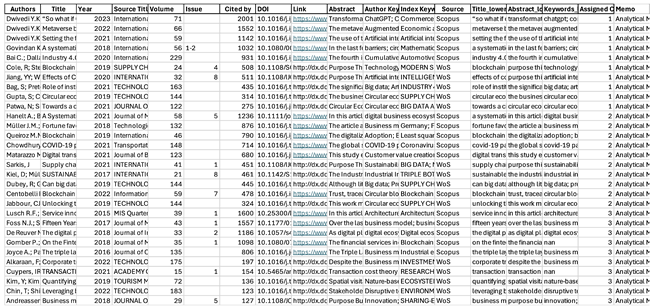
Appendix C
Minimal Reproducible Script for Bibliometric Analysis in R
To enhance transparency and reproducibility, we provide below the minimal R script used for the bibliometric analysis reported in Section 3.3 (Bibliometric Enrichment). The script was implemented on macOS (R 4.5.0, arm64 build) using the bibliometrix, dplyr, tidyr, igraph, ggraph, and ggplot2 packages. Input data consisted of a CSV file exported from Scopus and Web of Science (merged metadata of 155 peer-reviewed articles).
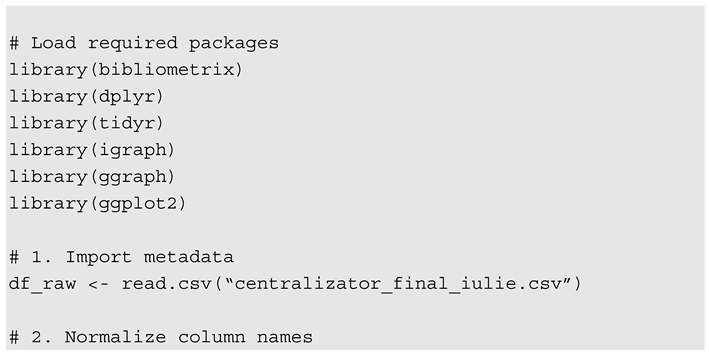
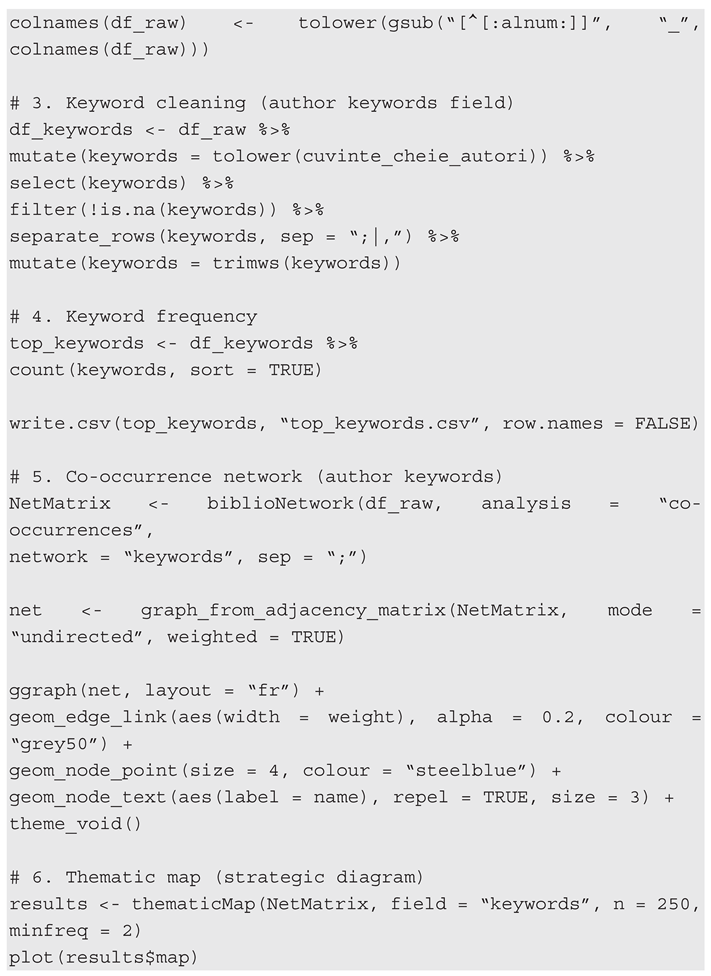
Notes: The full dataset of 155 articles (Appendix A) is required to replicate results. The script generates (i) keyword frequencies (Table, “top_keywords.csv”), (ii) a keyword co-occurrence network (Figure 3), and (iii) a thematic map (Figure 4). Parameters n = 250 and minfreq = 2 were chosen after sensitivity testing; no structural divergence was observed between high- and low-citation subsets.
References
- Lau, R.Y.K.; Zhang, W.; Xu, W. Parallel Aspect--Oriented Sentiment Analysis for Sales Forecasting with Big Data. Production and Operations Management 2018, 27, 1775–1794. [CrossRef]
- Nasih, S.; Gadi, T.; Arezki, S. Blockchain Technology for Tracking and Tracing Containers: Model and Conception. Data and Metadata 2024, 3, 373. [CrossRef]
- Talpur, S.; Khan, N.; Abbas, A.; Ali, J.; Irum, S. Improving Opportunities in Supply Chain Processes Using the Internet of Things and Blockchain Technology. International Journal of Interactive Mobile Technologies (iJIM) 2023, 17, 23–38. [CrossRef]
- Herrero, M.; Parodi, A.; Smith, P.; Clark, M.; Pradhan, P.; Fanzo, J.; Pikaar, I.; Jarvis, A.; Nelson, R.; Rockström, J.; et al. Articulating the Effect of Food Systems Innovation on the Sustainable Development Goals. The Lancet Planetary Health 2020, 5, e50–e62. [CrossRef]
- Vărzaru, A.A. Unveiling Digital Transformation: A Catalyst for Enhancing Food Security and Achieving Sustainable Development Goals at the European Union Level. Foods 2024, 13, 1226. [CrossRef]
- Dionisio, M.; Paula, F.; Pellanda, P.C.; De Souza Junior, S.J. The Role of Digital Social Innovations to Address SDGs: A Systematic Review. Environment, Development and Sustainability 2023, 26, 5709–5734. [CrossRef]
- Van Der Velden, M. Digitalisation and the UN Sustainable Development Goals: What Role for Design. Interaction Design and Architecture(s) 2018, 160–174. [CrossRef]
- Bakibinga-Gaswaga, E.; Bakibinga, S.; Bakibinga, D.B.M.; Bakibinga, P. Digital Technologies in the COVID-19 Responses in Sub-Saharan Africa: Policies, Problems and Promises. Pan Afr Med J 2020, 35. [CrossRef]
- Berg, L.; Farbenblum, B.; Kintominas, A. Addressing Exploitation in Supply Chains: Is Technology a Game Changer for Worker Voice? ATR 2020, 47–66. [CrossRef]
- Costa, H.C.S.; Pereira, J.R.L.A.; Pereria Neto, A.T.; Carneiro, F.L.D.L.; Da Silva Júnior, H.B.; Pereira, M.A. Optimizing Industrial Data Analysis: The Convergence of Business Intelligence and Dynamic Simulations in Chemical Process Management. Revista de Gestão Social e Ambiental 2023, 18, e04475. [CrossRef]
- Nadkarni, S.; Prügl, R. Digital Transformation: A Review, Synthesis and Opportunities for Future Research. Management Review Quarterly 2020, 71, 233–341. [CrossRef]
- Ramírez-Márquez, C.; Ponce-Ortega, J.M.; Posadas-Paredes, T.; Raya-Tapia, A.Y. Natural Resource Optimization and Sustainability in Society 5.0: A Comprehensive Review. Resources 2024, 13, 19. [CrossRef]
- Chen, W.; Osorio, C.; Men, Y.; Fuster, N.; Juan, A.A. Artificial Intelligence in Logistics Optimization with Sustainable Criteria: A Review. Sustainability 2024, 16, 9145. [CrossRef]
- Damoska Sekuloska, J.; Erceg, A. Blockchain Technology toward Creating a Smart Local Food Supply Chain. Computers 2022, 11, 95. [CrossRef]
- Pullo, S.; Pareschi, R.; Salzano, F.; Piantadosi, V.; Carlini, R. Integrating IOTA’s Tangle with the Internet of Things for Sustainable Agriculture: A Proof-of-Concept Study on Rice Cultivation. Informatics 2023, 11, 3. [CrossRef]
- Hafeez, M.; Yuan, C.; Khelfaoui, I.; Sultan Musaad O, A.; Waqas Akbar, M.; Jie, L. Evaluating the Energy Consumption Inequalities in the One Belt and One Road Region: Implications for the Environment. Energies 2019, 12, 1358. [CrossRef]
- Rydzewski, P. Digital Inequality and Sustainable Development. PROBL EKOROZW 2025, 20, 96–108. [CrossRef]
- Martens, K.; Zscheischler, J. The Digital Transformation of the Agricultural Value Chain: Discourses on Opportunities, Challenges and Controversial Perspectives on Governance Approaches. Sustainability 2022, 14, 3905. [CrossRef]
- Hao, B.; Cai, Z.; Feng, Y.; Ye, J. Explicit and Tacit Synergies between Alliance Firms and Radical Innovation: The Moderating Roles of Interfirm Technological Diversity and Environmental Technological Dynamism. R&D Management 2019, 50, 432–446. [CrossRef]
- Hernández, V.; Revilla, A.; Rodríguez, A. Digital Data--driven Technologies and the Environmental Sustainability of Micro, Small, and Medium Enterprises: Does Size Matter? Business Strategy and the Environment 2024, 33, 5563–5582. [CrossRef]
- Arnold, N. Accountability in Transnational Governance: The Partial Organization of Voluntary Sustainability Standards in Long--term Account--giving. Regulation & Governance 2022, 16, 375–391. [CrossRef]
- Prasad, G.; Arunav, H.; Dwight, S.; Ghosh, M.B.; Jayadev, A.; Nair, D.I. Advancing Sustainable Practices in Additive Manufacturing: A Comprehensive Review on Material Waste Recyclability. Sustainability 2024, 16, 10246. [CrossRef]
- Tura, N.; Ojanen, V. Sustainability-Oriented Innovations in Smart Cities: A Systematic Review and Emerging Themes. Cities 2022, 126, 103716. [CrossRef]
- Díaz-Arancibia, J.; Hochstetter-Diez, J.; Bustamante-Mora, A.; Sepúlveda-Cuevas, S.; Albayay, I.; Arango-López, J. Navigating Digital Transformation and Technology Adoption: A Literature Review from Small and Medium-Sized Enterprises in Developing Countries. Sustainability 2024, 16, 5946. [CrossRef]
- Faiz, F.; Le, V.; Masli, E.K. Determinants of Digital Technology Adoption in Innovative SMEs. Journal of Innovation & Knowledge 2024, 9, 100610. [CrossRef]
- Rocha, C.; Quandt, C.; Cruzara, G.; Deschamps, F.; Philbin, S. Collaborations for Digital Transformation: Case Studies of Industry 4.0 in Brazil. IEEE Transactions on Engineering Management 2023, 70, 2404–2418. [CrossRef]
- Ghobakhloo, M.; Iranmanesh, M.; Morales, M.E.; Nilashi, M.; Amran, A. Actions and Approaches for Enabling Industry 5.0--driven Sustainable Industrial Transformation: A Strategy Roadmap. Corporate Social Responsibility and Environmental Management 2022, 30, 1473–1494. [CrossRef]
- Colon, C.; Hochrainer-Stigler, S. Systemic Risks in Supply Chains: A Need for System-Level Governance. SCM 2023, 28, 682–694. [CrossRef]
- Pizzichini, L.; Temperini, V.; Caboni, F.; Papa, A. The Role of Digital Knowledge Servitization in Supply Chain Management. IJPDLM 2023, 53, 589–611. [CrossRef]
- Ahmadov, T.; Durst, S.; Gerstlberger, W.; Kraut, E. SMEs on the Way to a Circular Economy: Insights from a Multi-Perspective Review. Manag Rev Q 2025, 75, 289–322. [CrossRef]
- El Bilali, H. The Multi-Level Perspective in Research on Sustainability Transitions in Agriculture and Food Systems: A Systematic Review. Agriculture 2019, 9, 74. [CrossRef]
- Dabo, A.-A.A.; Hosseinian-Far, A. An Integrated Methodology for Enhancing Reverse Logistics Flows and Networks in Industry 5.0. Logistics 2023, 7, 97. [CrossRef]
- Autsadee, Y.; Jeevan, J.; Bin Othman, M.R.; Mohd Salleh, N.H.B. Maritime Society 5.0: A Global Transition on Human Economy and Civilisation for Maritime Sustainability. Australian Journal of Maritime & Ocean Affairs 2025, 17, 1–26. [CrossRef]
- Landis, J.R.; Koch, G.G. The Measurement of Observer Agreement for Categorical Data. Biometrics 1977, 33, 159–174.
- Kuokkanen, A.; Yazar, M. Cities in Sustainability Transitions: Comparing Helsinki and Istanbul. Sustainability 2018, 10, 1421. [CrossRef]
- Naeem, M.; Ozuem, W.; Howell, K.; Ranfagni, S. Demystification and Actualisation of Data Saturation in Qualitative Research Through Thematic Analysis. International Journal of Qualitative Methods 2024, 23, 16094069241229777. [CrossRef]
- MacInnis, D.J. A Framework for Conceptual Contributions in Marketing. Journal of Marketing 2011, 75, 136–154. [CrossRef]
- Podsakoff, P.M.; MacKenzie, S.B.; Podsakoff, N.P. Recommendations for Creating Better Concept Definitions in the Organizational, Behavioral, and Social Sciences. Organizational Research Methods 2016, 19, 159–203. [CrossRef]
- Tornatzky, L.G. The Processes of Technological Innovation; Lexington, Mass. : Lexington Books, 1990; ISBN 978-0-669-20348-6.
- Rogers, E.M. Diffusion of Innovations, 5th Edition; Simon and Schuster, 2003; ISBN 978-0-7432-5823-4.
- Cui, M., YF; Liu, W; Rani, P; Alrasheedi Internet of Things (IoT) Adoption Barriers for the Circular Economy Using Pythagorean Fuzzy SWARA-CoCoSo Decision-Making Approach in the Manufacturing Sector. TECHNOLOGICAL FORECASTING AND SOCIAL CHANGE 2021. [CrossRef]
- Cole, J., R; Stevenson, M; Aitken Blockchain Technology: Implications for Operations and Supply Chain Management. SUPPLY CHAIN MANAGEMENT-AN INTERNATIONAL JOURNAL 2019. [CrossRef]
- Barney, J. Firm Resources and Sustained Competitive Advantage. Journal of Management 1991, 17, 99–120. [CrossRef]
- Teece, D.J.; Pisano, G.; Shuen, A. Dynamic Capabilities and Strategic Management. Strategic Management Journal 1997, 18, 509–533.
- Dubey, D., R; Gunasekaran, A; Childe, SJ; Papadopoulos, T; Luo, ZW; Wamba, SF; Roubaud Can Big Data and Predictive Analytics Improve Social and Environmental Sustainability? TECHNOLOGICAL FORECASTING AND SOCIAL CHANGE 2019. [CrossRef]
- De Sousa Jabbour, A.B.L.; Jabbour, C.J.C.; Foropon, C.; Godinho Filho, M. When Titans Meet – Can Industry 4.0 Revolutionise the Environmentally-Sustainable Manufacturing Wave? The Role of Critical Success Factors. Technological Forecasting and Social Change 2018, 132, 18–25. [CrossRef]
- Parker, G.; Van Alstyne, M.; Jiang, X. Platform Ecosystems: How Developers Invert the Firm. MIS Quarterly 2017, 41, 255–266.
- Jacobides, M.G.; Cennamo, C.; Gawer, A. Towards a Theory of Ecosystems. Strategic Management Journal 2018, 39, 2255–2276. [CrossRef]
- Prahalad, C.K.; Ramaswamy, V. Co-Creation Experiences: The next Practice in Value Creation. Journal of Interactive Marketing 2004, 18, 5–14. [CrossRef]
- Chin, T.; Shi, Y.; Singh, S.K.; Agbanyo, G.K.; Ferraris, A. Leveraging Blockchain Technology for Green Innovation in Ecosystem-Based Business Models: A Dynamic Capability of Values Appropriation. Technological Forecasting and Social Change 2022, 183.
- Floridi, L.; Cath, C.; Taddeo, M. Digital Ethics: Its Nature and Scope. In The 2018 Yearbook of the Digital Ethics Lab; Öhman, C., Watson, D., Eds.; Digital Ethics Lab Yearbook; Springer International Publishing: Cham, 2019; pp. 9–17 ISBN 978-3-030-17151-3.
- Stahl, B.C. Artificial Intelligence for a Better Future: An Ecosystem Perspective on the Ethics of AI and Emerging Digital Technologies; SpringerBriefs in Research and Innovation Governance; Springer International Publishing: Cham, 2021; ISBN 978-3-030-69977-2.
- R.L, J.A.; P. The Triple Layered Business Model Canvas: A Tool to Design More Sustainable Business Models. Journal of Cleaner Production 2016. [CrossRef]
- Mainardes, E.; Alves, H.; Raposo, M. Stakeholder Theory: Issues to Resolve. Management Decision 2011, 49, 226–252. [CrossRef]
- Folke, C. Resilience (Republished). E&S 2016, 21, art44. [CrossRef]
Figure 1.
PRISMA flow diagram of article selection process. Note. Screening protocol for the structured review (January 2015–January 2024). Filters: peer-reviewed journal articles, English, full text; duplicates, and marginal items excluded. The counts are shown at each stage. Source. Authors’ adaptation of PRISMA 2020, based on Scopus and Web of Science searches reported in the manuscript. Data: final corpus of 155 articles.
Figure 1.
PRISMA flow diagram of article selection process. Note. Screening protocol for the structured review (January 2015–January 2024). Filters: peer-reviewed journal articles, English, full text; duplicates, and marginal items excluded. The counts are shown at each stage. Source. Authors’ adaptation of PRISMA 2020, based on Scopus and Web of Science searches reported in the manuscript. Data: final corpus of 155 articles.
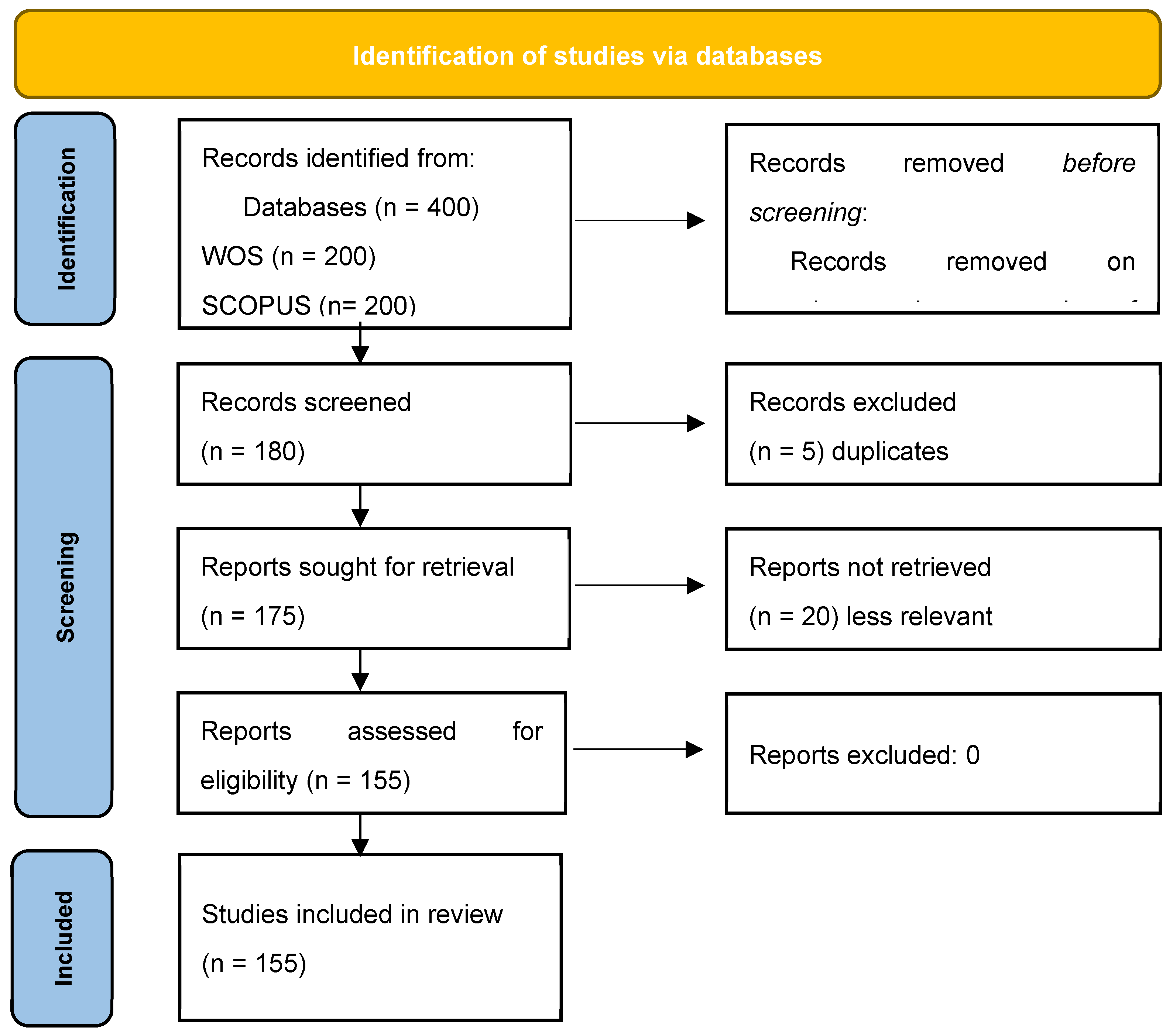
Figure 2.
Keyword co-occurrence network. Note. Authors’ keywords co-occurrence network clustered with Louvain to reveal three thematic groups aligned with DSS1–DSS3. Edges reflect co-occurrence frequency, and node size reflects keyword frequency. Source. Bibliometric analysis in R (bibliometrix v4.2.1; igraph), using the review corpus (N=155). Parameters documented in Section 2.3.
Figure 2.
Keyword co-occurrence network. Note. Authors’ keywords co-occurrence network clustered with Louvain to reveal three thematic groups aligned with DSS1–DSS3. Edges reflect co-occurrence frequency, and node size reflects keyword frequency. Source. Bibliometric analysis in R (bibliometrix v4.2.1; igraph), using the review corpus (N=155). Parameters documented in Section 2.3.
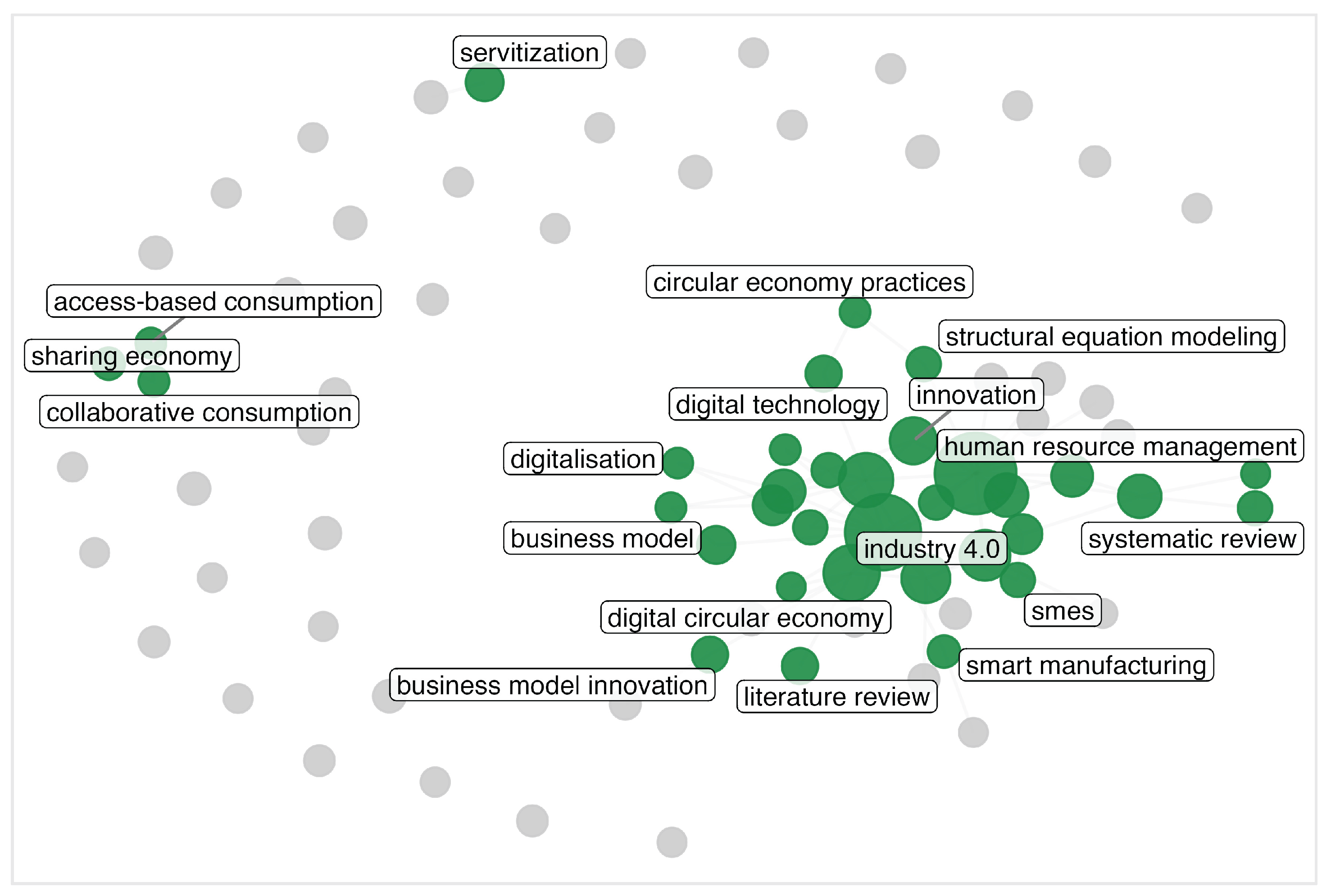
Figure 3.
Thematic map of DSS-related clusters. Note. Strategic diagram positioning clusters by centrality (external link strength) and density (internal cohesion). Quadrants: Motor, Niche, Basic/Transversal, Emerging/Declining. Labels correspond to the two highest-frequency terms per cluster. Source. Computed in R from the authors’ co-occurrence matrix; Louvain clustering; centrality/density derived from weighted internal/external links.
Figure 3.
Thematic map of DSS-related clusters. Note. Strategic diagram positioning clusters by centrality (external link strength) and density (internal cohesion). Quadrants: Motor, Niche, Basic/Transversal, Emerging/Declining. Labels correspond to the two highest-frequency terms per cluster. Source. Computed in R from the authors’ co-occurrence matrix; Louvain clustering; centrality/density derived from weighted internal/external links.
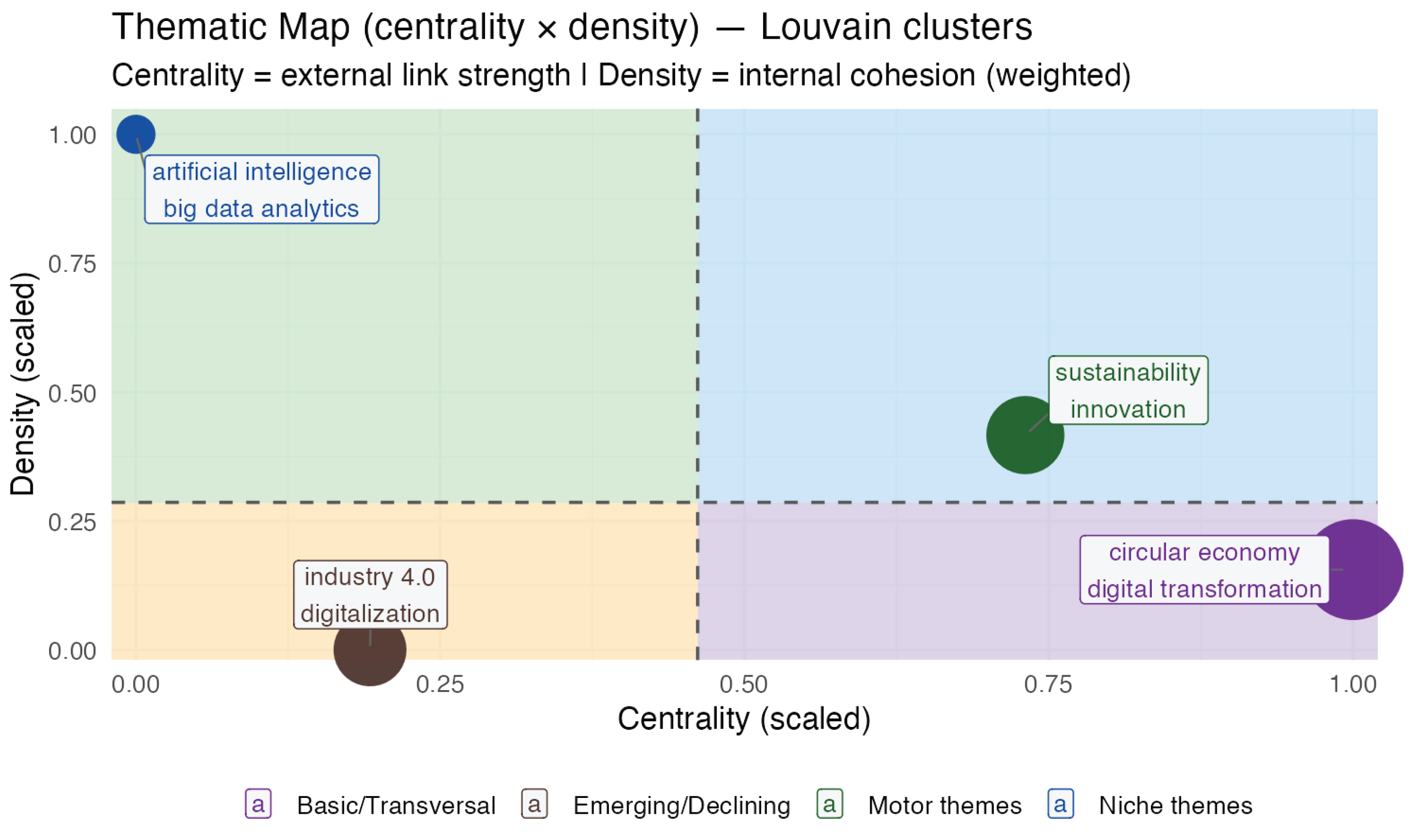
Figure 4.
Digital Sustainability Sequencing (DSS) Framework. Note. Conceptual model with three phases (DSS1 infrastructure; DSS2 intelligent integration; DSS3 regenerative ecosystems) and nonlinear transitions (hybridization, regression, leapfrogging). Source. Authors’ elaboration from the structured synthesis (155 articles, 30 analytical memos).
Figure 4.
Digital Sustainability Sequencing (DSS) Framework. Note. Conceptual model with three phases (DSS1 infrastructure; DSS2 intelligent integration; DSS3 regenerative ecosystems) and nonlinear transitions (hybridization, regression, leapfrogging). Source. Authors’ elaboration from the structured synthesis (155 articles, 30 analytical memos).
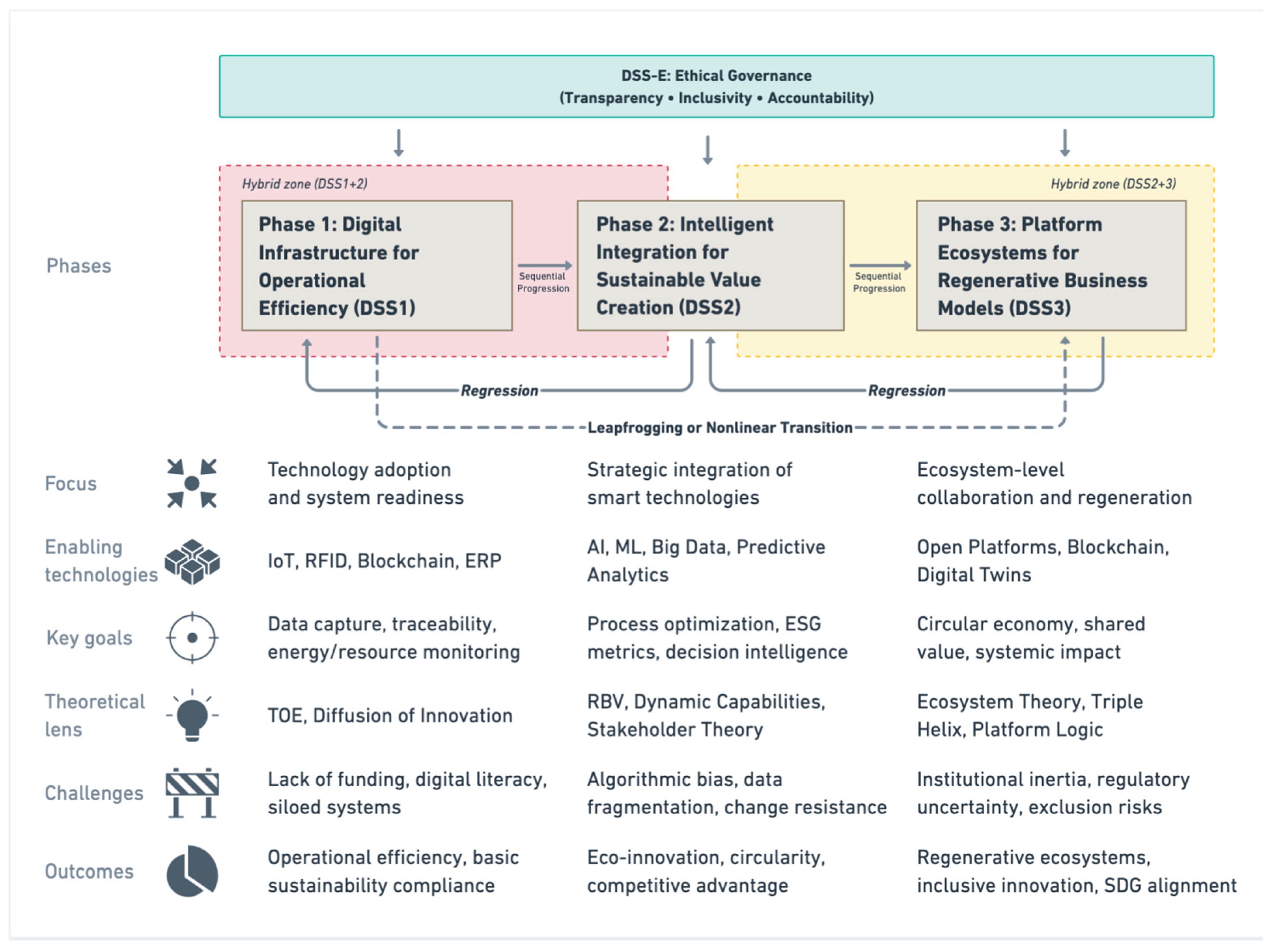
Table 1.
DSS vs. Conventional Digital Maturity and Servitization Models.
| Dimension | Conventional Maturity / Servitization Models | DSS Framework |
|---|---|---|
| Progression Logic | Linear, stepwise (readiness → development → maturity) | Adaptive sequencing: non-linear, hybrid, leapfrogging possible |
| Focus | Firm-level efficiency and digital readiness | Sustainability-driven transformation across firm and ecosystem levels |
| Scope | Technology adoption and process integration | Technologies + organizational routines + sustainability governance |
| End Goal | Operational maturity or servitized value chains | Regenerative ecosystems and systemic sustainability impacts |
| Limitation | Neglects feedback loops, regressions, and cross-level dynamics | Explicitly theorizes reversibility, path-dependence, and systemic alignment |
Note. Conceptual contrasts on progression logic, focus, scope, end goal, and limitations. Source. Authors’ synthesis of maturity/servitization literature cited in Section 2.3.1.
Table 2.
DSS vs. Transition and Resilience Theories (MLP, ACT).
| Dimension | Multi-Level Perspective (MLP) | Adaptive Cycle Theory (ACT) | DSS Framework |
|---|---|---|---|
| Unit of Analysis | Socio-technical regimes, niches, landscapes | Ecosystems and ecological resilience | Firms and ecosystems (meso-level) |
| Dynamics | Evolutionary, multi-level co-evolution | Cyclical (growth → conservation → release → reorganization) | Sequenced but adaptive progression (DSS1–DSS3) |
| Strengths | Explains systemic lock-ins and transitions | Captures resilience and cycles of change | Offers diagnostic phases at organizational/sectoral level |
| Limitations | Abstract, macro-level, limited managerial guidance | Ecosystem-centric, little on firms/tech adoption | Provides applied, firm-centered pathway aligned with sustainability transitions |
Note. Comparative mapping of the unit of analysis, dynamics, strengths, and limitations across frameworks. Source. Authors’ synthesis drawing on transition/resilience scholarship discussed in Section 2.3.2.
Table 3.
DSS vs. recent framework (Industry 5.0, Society 5.0, CE-Indicators).
| Criterion | DSS | Industry 5.0 | Society 5.0 | Circular Transition Indicators |
|---|---|---|---|---|
| Purpose | Regenerative, ecosystem-oriented | Human-centric, resilient | Digitally enabled societal well-being | Measurement of circularity |
| Logic | Sequential, adaptive, non-linear | Normative vision | Macro-societal vision | Metric toolkit |
| Unit of analysis | Firm + ecosystem (meso level) | Industry/policy | Society | Project/organization |
| Mechanisms | Capabilities + ethical governance | Human–machine co-creation | Digital–societal integration | KPIs/indicators |
| DSS novelty | Links adoption → capabilities → platforms → regeneration, with DSS-E as a transition switch | Complementary | Complementary | Integrates KPIs as inputs in DSS2–DSS3 |
Note. Positioning DSS against normative/macrosocietal and indicator-focused approaches highlights complementarities and DSS novelty (DSS-E switch). Source. Authors’ synthesis of the recent frameworks reviewed in Section 2.3.2.
Table 5.
Illustrative Analytical Memos Supporting DSS Phases.
| DSS Phase | Example Study | Methodology | Key Insight | Cluster Fit |
|---|---|---|---|---|
| DSS1 – Infrastructure | Cole et al. (2019) | Case study (blockchain in supply chains) | Blockchain enhances traceability and compliance | DSS1 |
| DSS1 – Infrastructure | Cui et al. (2021) | Survey (IoT in manufacturing) | IoT adoption critical for tech readiness | DSS1 |
| DSS2 – Intelligence | Dubey et al. (2019) | PLS-SEM | Big data improves resilience and reduces emissions | DSS2 |
| DSS2 – Intelligence | Jabbour et al. (2019) | Case study | Linking circular economy and analytics | DSS2 |
| DSS3 – Ecosystem | De Reuver et al. (2018) | Conceptual analysis | Platforms enable cross-sector collaboration | DSS3 |
| DSS3 – Ecosystem | Chin et al. (2022) | Case study (blockchain ecosystems) | Blockchain supports regenerative innovation | DSS3 |
Note. Examples (study, method, key insight) used to ground each DSS phase in the literature. Source. Authors’ analytical memos on 30 high-impact papers from the corpus (Appendix B).
Table 6.
Theoretical Anchors of DSS Phases.
| DSS Phase | Core Theories | Key Concepts | Boundary Conditions |
|---|---|---|---|
| DSS1: Infrastructure | TOE; Diffusion of Innovation | Technology adoption, operational transparency | SMEs, regulation-driven adoption |
| DSS2: Intelligence | RBV; Dynamic Capabilities; Stakeholder Theory | Sensing, seizing, reconfiguring; stakeholder engagement | MNCs, data-intensive sectors |
| DSS3: Ecosystem | Platform Theory; Ecosystem Innovation; Triple Helix; Value Co-Creation | Platform orchestration, regenerative logic | Emerging economies, collaborative sectors (services, agriculture) |
Note. Core theories, key concepts, and boundary conditions for DSS1–DSS3. Source. Authors’ integration of TOE/DoI, RBV/Dynamic Capabilities/Stakeholder Theory, and Platform/Ecosystem/Triple Helix literature.
Table 8.
Comparative Synthesis of DSS Phases.
| Dimension | DSS1 – Infrastructure | DSS2 – Intelligence | DSS3 – Ecosystem |
|---|---|---|---|
| Core Technologies | IoT, RFID, blockchain, ERP | AI, ML, big data, predictive analytics | Platforms, digital twins, open APIs, blockchain ecosystems |
| Theoretical Anchor | TOE, DoI | RBV, Dynamic Capabilities, Stakeholder Theory | Platform Theory, Ecosystem Innovation, Triple Helix |
| Strategic Lever | Efficiency, compliance, monitoring | Data-driven decision-making, eco-innovation, resilience | Co-creation, circularity, systemic regeneration |
| Ethical Risk | Surveillance, inequitable access | Bias, opacity, automation risks | Monopolistic capture, exclusion |
| Boundary Conditions | SMEs; regulation-driven adoption | MNCs; data-intensive sectors | Emerging economies; cross-sectoral collaboration |
Note. Technologies, theoretical anchors, managerial levers, ethical risks, and boundary conditions by phase. Source. Authors’ synthesis from the structured review and memos.
Table 9.
Real-World Illustrations and DSS Mapping.
| Case / Sector | DSS Phase(s) | Key Digital Technologies | Sustainability Focus | Managerial / Policy Insights |
|---|---|---|---|---|
| H&M (Fashion) | DSS1 → DSS2 | RFID, blockchain traceability, AI for demand forecasting | Supply chain transparency, circular fashion pilots | Scaling traceability critical; greenwashing risk without DSS3 |
| Carrefour (Retail) | DSS2 | Big data analytics, AI logistics, IoT sensors | Energy efficiency, waste reduction | Strong in DSS2, but ecosystem partnerships limited |
| Amsterdam Smart City | DSS3 | IoT networks, digital twins, open platforms | Circular city, mobility efficiency, citizen engagement | Government as orchestrator; DSS3 enabled by policy frameworks |
| IKEA (Housing / Furniture) | DSS2 → DSS3 | PaaS, platform design tools, blockchain | Circular lifecycle, sharing economy | Requires ecosystem governance and consumer acceptance |
| WASP (3D Printing) | DSS3 | 3D printing, open-source platforms, renewable inputs | Eco-housing, material reduction | Demonstrates regenerative potential via cross-sector innovation |
| Van Wijhe Verf (SME, Paints) | DSS1 → DSS3 | Blockchain, bio-based R&D, renewable energy | Bio-based paints, biodiversity, partnerships | Shows SME scalability and replicability for traditional industries |
Note. Sectoral exemplars mapped to DSS phases; technologies, sustainability focus, and managerial/policy insights. Illustrative, not exhaustive. Source. Authors’ case synthesis from public sources cited in the manuscript discussion and references.
Disclaimer/Publisher’s Note: The statements, opinions and data contained in all publications are solely those of the individual author(s) and contributor(s) and not of MDPI and/or the editor(s). MDPI and/or the editor(s) disclaim responsibility for any injury to people or property resulting from any ideas, methods, instructions or products referred to in the content. |
© 2025 by the authors. Licensee MDPI, Basel, Switzerland. This article is an open access article distributed under the terms and conditions of the Creative Commons Attribution (CC BY) license (http://creativecommons.org/licenses/by/4.0/).
Copyright: This open access article is published under a Creative Commons CC BY 4.0 license, which permit the free download, distribution, and reuse, provided that the author and preprint are cited in any reuse.


