

Submitted:
09 June 2025
Posted:
10 June 2025
You are already at the latest version
Abstract
The escalating climate crisis and global disruptions have prompted a critical re-evaluation of operations management within manufacturing and supply systems. This conceptual article addresses the theoretical and strategic gap in aligning resilience and sustainability by proposing an Integrated Sustainable Operational Strategy (ISOS) framework. Drawing on systems theory, circular economy principles, and sustainability science, the framework synthesizes multiple operational domains—circularity, localization, digital adaptation, and workforce flexibility—across macro (policy), meso (organizational), and micro (process) levels. Rather than offering descriptive best practices, this study constructs a conceptual model that explains the interdependencies and trade-offs among strategic operational responses in the Anthropocene era. Supported by multi-level logic and a synthesis of domain constructs, the model provides a foundation for empirical investigation and strategic planning. Key propositions for future research are developed, focusing on causal relationships and boundary conditions. The article advances theory by redefining operational excellence through regenerative logic and adaptive capacity, responding directly to SDG 9 (industry innovation), SDG 12 (responsible consumption and production), and SDG 13 (climate action). This integrative framework offers both theoretical insight and practical guidance for transforming operations into catalysts of sustainable transition.
Keywords:
sustainable operations
; resilience
; circular economy
; localization strategy
; digital adaptation
; supply chain strategy
; operational innovation
; SDGs
; conceptual framework
; sustainability transitions
1. Introduction
1.1. Global Sustainability Crisis and Manufacturing Realignment
The twenty-first century has been marked by unprecedented environmental, social, and economic turbulence, with the climate emergency, geopolitical disruptions, and pandemics converging to test the foundational assumptions of modern operational systems. For the manufacturing sector—a major contributor to global resource consumption and greenhouse gas emissions—these challenges are not peripheral, but existential. The industrial sector is responsible for nearly 20% of global CO₂ emissions, and remains deeply intertwined with intensive material extraction, high water consumption, and substantial waste generation, posing significant challenges for sustainability transitions [1]. As such, manufacturing organizations are increasingly called to play a leading role in addressing sustainability imperatives, particularly in alignment with global agendas such as the United Nations Sustainable Development Goals (SDGs), especially SDG 9 (Industry, Innovation, and Infrastructure), SDG 12 (Responsible Consumption and Production), and SDG 13 (Climate Action) (United Nations, 2015; Wang et al., 2023).
While some firms have taken initial steps—through carbon reduction targets, green certifications, or CSR reporting—these responses often remain fragmented, superficial, or reactive. What is needed is a systemic realignment of operational strategy, one that embeds sustainability at the design core of manufacturing processes, supply networks, and value creation models. This realignment demands that operations managers shift from traditional performance paradigms focused solely on cost and efficiency toward integrative logics that prioritize resilience, circularity, and long-term ecological viability [4,5].
1.2. From Efficiency to Resistance-Sustainability Nexus
Historically, operations management has been dominated by principles of lean thinking, just-in-time production, and process optimization—frameworks that have delivered remarkable gains in efficiency and profitability. However, such models were developed under the assumption of stable environments, predictable demand, and global logistics reliability, assumptions that no longer hold in a volatile, uncertain, complex, and ambiguous (VUCA) world [6]. Events such as the COVID-19 pandemic, geopolitical trade frictions, and climate-induced disruptions have exposed the vulnerability of hyper-efficient but brittle operational systems [7].
In this context, the emerging discourse highlights a pressing need to move beyond efficiency as the singular logic of operational success. Instead, organizations must balance short-term efficiency with long-term resilience and sustainability. Resilience, in this sense, refers not only to the ability to recover from disruptions but to adapt, reconfigure, and evolve in response to systemic shocks [8,9]. Sustainability, meanwhile, expands the scope of operational performance to include ecological integrity, social responsibility, and intergenerational justice [10,11].
The intersection of these two paradigms—resilience and sustainability—offers a new frontier for rethinking operations strategy. Yet, integrating these paradigms into coherent operational practice remains an unresolved challenge. How can organizations design operations that are both agile and circular? How can digital technologies enhance environmental transparency without compromising speed and responsiveness? How can local sourcing be scaled without eroding competitiveness? These are questions that current operational frameworks often fail to address in an integrated manner.
1.3. Conceptual Gaps: Fragmented Integration in OM Theories
Despite increasing scholarly attention to sustainability in operations, the literature remains fragmented across disparate streams—green supply chain management, circular economy models, lean-green integration, Industry 4.0, and disaster resilience—each offering valuable insights but rarely coalescing into a unified strategic framework [12,13]. Moreover, much of the existing research emphasizes empirical findings, tool-based applications, or sector-specific case studies, while lacking the theoretical synthesis needed to guide cross-contextual understanding and strategic decision-making.
This fragmentation is problematic in three ways. First, it inhibits the development of generalizable operational models that are scalable across industries. Second, it creates disjunctures between environmental goals and operational capabilities, leading to trade-offs rather than synergies. Third, it limits the ability of scholars and practitioners to navigate the multi-level dynamics of sustainability transitions, which involve interactions between organizational routines, technological infrastructures, institutional logics, and global systems [14].
Notably, while lean manufacturing has evolved to incorporate some aspects of environmental thinking, the emphasis remains on incremental improvements rather than transformational shifts in design logic. Similarly, digital transformation efforts (AI, IoT, blockchain) often prioritize visibility and control rather than systemic sustainability. There is, therefore, a conceptual void in operational literature—a need for a theory-informed, integrative model that bridges circularity, localization, and digital resilience as mutually reinforcing pillars of sustainable operations.
1.4. Global Sustainability Crisis and Manufacturing Realignment
This paper responds to the above gaps by proposing a conceptual framework for sustainable operations strategy that synthesizes three interdependent strategic domains:
- ▪
- Circularity – embedding regenerative and closed-loop principles into production and logistics.
- ▪
- Localization – promoting regionalized, proximity-based sourcing and production to enhance adaptability and reduce emissions.
- ▪
- Digital Resilience – utilizing real-time data, predictive analytics, and smart systems to enhance sustainability performance under uncertainty.
By weaving together these domains, the paper introduces the Integrated Sustainable Operational Strategy (ISOS)framework—an original theoretical model that repositions operations not just as process enablers, but as architects of sustainability transitions.
The main contributions of this paper are as follows:
- ▪
- It advances a multi-level conceptual framework linking operational design, technological enablers, and sustainability outcomes.
- ▪
- It integrates fragmented theories into a cohesive strategic-operational architecture grounded in systems thinking and sustainability science.
- ▪
- It proposes research propositions for empirical testing, thereby supporting future theory building and cross-disciplinary scholarship.
- ▪
- It aligns directly with the Aims and Scope of Sustainability (MDPI) by addressing technical, environmental, and organizational dimensions of sustainable development through a systems-based operational lens.
1.5. Paper Structure
To achieve the objectives above, this conceptual article is structured as follows:
- ▪
- Section 2 reviews and synthesizes relevant theoretical foundations across sustainability transitions, circular operations, localization strategies, digital enablers, and systems thinking.
- ▪
- Section 3 develops the Integrated Sustainable Operational Strategy (ISOS) framework, detailing its conceptual logic, dimensions, and boundaries.
- ▪
- Section 4 elaborates strategic operational domains and discusses their interdependency, drawing implications for design, management, and organizational performance.
- ▪
- Section 5 presents a theoretical discussion, highlighting contributions to operations management, sustainability science, and strategic transformation.
- ▪
- Section 6 offers a research agenda with propositions for empirical validation and cross-sectoral exploration.
- ▪
- Section 7 concludes the paper with final reflections on the future of sustainable operations in the Anthropocene economy.
Through this structure, the paper aims to stimulate conceptual advancement, guide strategic reorientation, and contribute to global sustainability through transformative operational thinking.
2. Theoretical Foundations
2.1. Sustainability Transition in Operation Management
The evolution of operations management (OM) from a discipline focused solely on efficiency and cost optimization to one increasingly concerned with long-term ecological viability represents a foundational shift in both theory and practice. This transformation reflects broader global dynamics, where organizations are no longer judged merely by their output metrics but by their contribution—or failure—to address systemic challenges such as climate change, resource depletion, and social inequity [15].
The concept of sustainability transitions, originating in sustainability science and socio-technical systems theory, provides a critical lens for understanding this evolution. At its core, sustainability transitions refer to long-term, multi-dimensional, and fundamental transformations in the way societal systems—such as energy, mobility, or production—are structured and governed to achieve ecological integrity, economic prosperity, and social justice [16,17]. Applied to the domain of OM, this framework challenges static, linear models of value creation and invites a rethinking of operations as adaptive, embedded, and co-evolutionary processes within complex ecosystems [18].
Three theoretical streams are especially relevant in advancing a sustainability-oriented perspective in OM: sustainability science, systems theory, and the circular economy.
First, sustainability science emphasizes the need for transdisciplinary approaches that integrate environmental, economic, and social knowledge domains to generate actionable solutions for real-world problems [19]. It calls for a reconfiguration of operational thinking from a narrow focus on firm-level efficiency to a broader concern with systemic impacts, interdependencies, and long-term consequences. In this view, manufacturing firms are not isolated entities but nodes in socio-ecological systems whose decisions ripple across supply networks, communities, and ecosystems [20].
Second, systems theory offers essential tools for modeling these complexities. Originating from cybernetics and general systems thinking, this theory views organizations as open, dynamic systems characterized by feedback loops, emergent properties, and interdependent subsystems [21]. When applied to operations, systems theory helps shift attention from isolated process improvements to system-level coherence, adaptability, and resilience. It also encourages the integration of externalities—such as emissions, resource depletion, or social inequality—into operational decision-making through dynamic performance models [22,23,24].
Third, the circular economy provides a normative and practical framework for operational redesign. Unlike traditional linear models (take–make–dispose), circularity emphasizes resource regeneration, waste minimization, and closed-loop systems, aligning well with both sustainability goals and systems thinking principles [25]. Operationalizing circularity requires not only new tools (e.g., life cycle assessment, reverse logistics) but also new mental models that prioritize material stewardship, design-for-reuse, and long-term value retention over throughput maximization.
While each of these perspectives offers distinct contributions, their real power lies in synthesis. A sustainability transitions lens enables OM scholars and practitioners to integrate the normative agenda of sustainability science, the structural insights of systems theory, and the practical mechanisms of the circular economy into a unified operational transformation logic. This logic reframes operations not as sites of cost engineering, but as strategic leverage points for sustainability-driven innovation and systems-level change [26].
In the sections that follow, we further elaborate how this integrative approach sets the foundation for a new model of sustainable operations—one that merges circular design, localization strategies, and digital resilience as co-constitutive elements of transformation.
2.2. Circular Economy: Systemic Capability and Regenerative Logic
The circular economy (CE) has emerged as a transformative paradigm that challenges the foundational assumptions of the linear industrial model that has historically guided operations management. In contrast to the “take–make–dispose” logic of linearity, the CE framework promotes a regenerative system in which resource flows are optimized, waste is minimized, and value is retained across multiple lifecycles [27,28]. This paradigm is not merely about recycling or eco-efficiency; it is fundamentally about rethinking production and consumption systems to align with planetary boundaries and long-term sustainability goals.
Within operations management, the implications of CE are profound. CE demands that operations move beyond efficiency optimization toward the development of systemic capabilities—the ability to design, manage, and evolve operational processes that sustain material loops, extend product life, and decouple economic performance from resource depletion [29,30]. These capabilities require integrating environmental intelligence across the value chain, from upstream design and procurement to downstream recovery and remanufacturing [31].
Theoretically, CE is deeply aligned with systems theory and ecological economics, both of which emphasize the interdependence between technical systems and natural ecosystems. From this perspective, operational decisions cannot be divorced from their environmental context. Every process, product, and service generates material and energetic consequences that must be accounted for across space and time [32]. CE thus demands that firms embed life-cycle thinking into core operational design, supported by tools such as Life Cycle Assessment (LCA), material flow analysis, and product-service systems (PSS) [33,34].
Moreover, CE contributes to the resilience discourse in OM by introducing redundancy and adaptability into supply systems—not as inefficiencies, but as design principles. For instance, reverse logistics systems, modular product architecture, and secondary raw material markets enhance system robustness and reduce exposure to external shocks, such as raw material price volatility or regulatory disruption [35,36]. These regenerative loops transform waste into assets and position operational flexibility as a sustainability enabler.
Operationalizing CE, however, is not merely a matter of tool adoption; it necessitates a shift in value logic and performance metrics. Conventional key performance indicators (KPIs) such as cycle time or cost per unit must be complemented—or even replaced—by metrics like resource productivity, circularity ratio, and material retention index [37]. This reframing repositions operational excellence from being solely process-centric to being systems-integrated and sustainability-aligned.
Furthermore, CE enables strategic differentiation. Firms that embed circularity into their operations can simultaneously meet environmental regulations, reduce long-term costs, and respond to growing consumer and investor demands for sustainability. Yet, the transition to CE is uneven and often constrained by path dependencies, capability gaps, and fragmented policy support [38,39]. Therefore, conceptual clarity and strategic integration are critical.
In sum, the circular economy represents not just an add-on to existing operations but a paradigm shift that redefines what it means to operate sustainably. It reframes operations as a regenerative function, contributing to value beyond the firm—ecologically, socially, and economically. When paired with localization and digitalization, CE becomes a core pillar in constructing future-ready operational systems, as elaborated in subsequent sections.
2.3. Localized Operations and Regional Resilience Framework
The hyper-globalization of supply chains over recent decades has enabled operational efficiencies through scale, specialization, and labor arbitrage. However, the fragility of this model has been starkly exposed by recent global shocks—including the COVID-19 pandemic, geopolitical conflicts, and climate-related disruptions—which disrupted logistics flows, increased lead times, and destabilized material access across critical sectors [40,41]. These events have catalyzed a strategic shift toward localized operations, which emphasize proximity, adaptability, and regional self-reliance as pillars of operational resilience.
Localization in operations refers to the spatial reconfiguration of production, sourcing, and distribution closer to end markets. While often viewed as a logistical response to risk, localization in the sustainability context serves a dual purpose: it reduces environmental externalities (such as transport-related emissions) and enhances social embeddedness by strengthening regional supply ecosystems and labor markets [42]. This aligns directly with SDG 12 (Responsible Consumption and Production) and SDG 13 (Climate Action) by curbing carbon-intensive global logistics and supporting context-sensitive resource flows.
From a systems theory perspective, localized operations enhance resilience by embedding redundancy and diversityinto supply networks—two attributes critical for absorbing shocks and enabling rapid reconfiguration [43]. Centralized, just-in-time models prioritize efficiency at the cost of adaptability, while distributed and decentralized systems enable buffering, agility, and real-time responsiveness to disruptions [44]. This is particularly important in volatile environments where uncertainty is the norm, not the exception.
Theoretically, localized operations also align with ecological resilience thinking, which emphasizes the ability of a system to absorb disturbances while maintaining its core function, structure, and feedback mechanisms [45]. In this light, regionalized operations not only restore control over logistical pathways but also foster institutional and cultural alignment with local stakeholders, regulations, and environmental standards. This enhances legitimacy and responsiveness—two dimensions increasingly critical in sustainability-oriented governance.
Moreover, localization intersects with the circular economy by enabling tighter material loops, reducing reverse logistics complexity, and supporting symbiotic industrial ecosystems [46,47]. For example, by sourcing regionally, firms can collaborate with nearby recyclers, remanufacturers, and service providers, thereby creating closed-loop systems that are logistically viable and economically competitive. This synergy reinforces the place-based logic of circular and sustainable operations.
Operationalizing localized resilience, however, requires more than geographical realignment. It demands new operational architectures, including modular production systems, flexible supplier configurations, and digital coordination platforms [48]. Governance structures must also adapt, shifting from centralized command to distributed decision-making supported by real-time data and local intelligence.
Despite its promise, localization is not without trade-offs. Firms may face higher unit costs, reduced economies of scale, or limited supplier capacity in certain regions. Hence, localization must be evaluated not as a binary choice but as part of a strategic portfolio of resilience strategies. The goal is not total de-globalization but strategic regionalization that enhances sustainability and agility without forfeiting competitiveness [49].
In summary, localized operations represent a reimagining of operational strategy through the lens of resilience and sustainability. They shift the locus of value from global optimization to regional robustness, embedding adaptability and sustainability into the geography of operations. When integrated with circularity and digital infrastructure, localization becomes a cornerstone in building future-proof, sustainability-aligned operational systems.
2.4. Digital Transformation as an Enabler of Sustainability Adaption
Digital transformation has emerged as a critical enabler of adaptive and sustainable operations in the face of accelerating complexity, uncertainty, and environmental degradation. While historically viewed as a tool for enhancing productivity and control, digital technologies today are increasingly recognized for their potential to embed sustainability into the core of operational strategy [50]. This redefinition positions digital transformation not as a neutral process innovation, but as a strategic catalyst for sustainability transitions in operations management.
At the heart of this transformation is the integration of Industry 4.0 technologies—including the Internet of Things (IoT), artificial intelligence (AI), blockchain, and cloud computing—into operational systems. These technologies enable real-time data collection, predictive analytics, and automated decision-making, which collectively enhance visibility, traceability, and responsiveness across supply chains [51,52,53]. From a sustainability standpoint, these capabilities are foundational to tracking emissions, monitoring resource use, identifying inefficiencies, and enforcing environmental compliance across complex value networks.
For instance, IoT-enabled sensors can measure energy and water consumption at the machine level, while AI algorithms can optimize process parameters to minimize waste and maximize eco-efficiency [54,55]. Blockchain can record the provenance of materials and enforce accountability in environmental and social standards across suppliers, while cloud platforms enable transparency and coordination among distributed operational actors [56]. These mechanisms create dynamic feedback loops that align with the principles of systems theory and sustainability science by enabling continuous learning, adaptation, and impact mitigation.
Conceptually, digital transformation supports operational resilience by enhancing agility, foresight, and control. Predictive maintenance systems reduce unplanned downtime and material waste, while digital twins simulate production environments to evaluate sustainability scenarios before implementation [57,58]. In volatile contexts—such as natural disasters, pandemics, or regulatory shifts—digital infrastructure enables rapid reconfiguration of operations with minimal environmental disruption, reinforcing adaptive capacity as a sustainability asset.
Furthermore, digitalization strengthens the implementation of circular economy principles. Real-time product tracking supports reverse logistics and extended producer responsibility, while smart sorting systems enhance recycling quality and throughput. Advanced analytics help identify opportunities for material substitution, product remanufacturing, or service-based business models that reduce physical throughput and environmental burden [59,60]. This demonstrates the synergistic relationship between digital and circular logics, where technology operationalizes sustainability through data-driven precision and coordination.
However, the sustainability of digital transformation itself must not be overlooked. The deployment of digital infrastructure entails energy consumption, e-waste generation, and potential social displacement [61,62]. Therefore, its implementation must be guided by ecological design principles, including energy-efficient computation, green data centers, and inclusive technology governance. Digital sustainability is not only about what technologies are used, but howand why they are deployed in alignment with broader sustainability objectives.
In synthesis, digital transformation represents a strategic enabler of sustainability adaptation in operations management. It embeds intelligence, connectivity, and traceability into production systems, facilitating the convergence of efficiency, resilience, and environmental stewardship. When integrated with circular and localized strategies, digital capabilities transform operations from reactive functions into proactive agents of sustainability transitions, supporting the realization of SDG 9, SDG 12, and SDG 13 in practice.
2.5. System Thinking and Triple Bottom Line Convergence
As organizations confront increasingly complex sustainability demands, linear and siloed approaches to operations management are proving inadequate. A fundamental shift is needed—from optimizing isolated functions to designing and managing operations as components of interdependent, adaptive systems. This shift is rooted in systems thinking, which emphasizes feedback loops, emergent behavior, and holistic understanding across ecological, economic, and social domains [63,64]. Systems thinking provides the analytical scaffolding to connect operational decisions with sustainability outcomes at multiple levels.
In this context, the Triple Bottom Line (TBL) framework—encompassing People, Planet, and Profit—offers a comprehensive structure for evaluating operational performance. Traditional operations metrics (e.g., cost per unit, cycle time, output per hour) must be rebalanced with indicators of environmental impact (e.g., carbon footprint, resource intensity) and social outcomes (e.g., labor standards, community well-being) [65]. The integration of TBL with systems thinking encourages a multi-dimensional assessment of operational effectiveness, moving beyond short-term efficiencies to long-term systemic value.
Crucially, the intersection of circularity, localized resilience, and digital transformation forms a triadic foundation for operational sustainability. Each of these domains addresses a distinct dimension of the TBL:
- ▪
- Circularity supports Planet through closed-loop material flows and regenerative design.
- ▪
- Localization supports People by enhancing social embeddedness, labor inclusion, and regional equity.
- ▪
- Digital transformation supports Profit by enhancing efficiency, agility, and risk-informed decision-making.
When synergized through a systems lens, these domains do not function as isolated initiatives but as mutually reinforcing strategies. For example, digital tools enable visibility for circular tracking and localized coordination; localized networks facilitate reverse logistics for circular systems; and circular thinking introduces resilience in localized operations by reducing reliance on virgin materials and global inputs [66,67,68].
To visualize this systemic integration, Figure 1 presents a Venn diagram depicting the convergence of these three strategic domains. The overlapping center illustrates the strategic sweet spot: a zone where operational systems are simultaneously circular, resilient, and digitally adaptive, aligning directly with the TBL and broader sustainability transitions.
The Venn diagram illustrates the strategic integration of three core sustainability domains. Circularity emphasizes resource efficiency, regeneration, and closed-loop systems; Localization highlights proximity sourcing, regional value chains, and local autonomy; and Digital Adaptation incorporates Industry 4.0, real-time data, and smart technologies. Their intersection forms the Sustainable Operational Core—a conceptual space where resilient, adaptive, and ecologically aligned operations converge.
The strategic implication of this convergence is clear: sustainability in operations is not a matter of optimizing one domain in isolation, but designing for integration across complexity. This systemic perspective enables firms to anticipate interdependencies, navigate trade-offs, and unlock innovation pathways that single-domain approaches might obscure [69,70,71].
Ultimately, systems thinking reinforces the idea that sustainable operations are not linear extensions of conventional models but adaptive, regenerative, and context-responsive architectures. By embracing the intersection of circular, localized, and digital strategies, organizations can build operational systems that are not only high-performing but also resilient, ethical, and future-fit—a necessity in the Anthropocene economy.
3. Conceptual Framework and Design Logic
3.1. Research Design as Conceptual Contribution
This paper is intentionally developed as a conceptual and theoretical contribution, not as an empirical study. Its primary aim is to synthesize fragmented theoretical streams in operations management, sustainability science, and systems theory into a cohesive integrative framework that addresses the complex realities of sustainable operations in the post-crisis era. Such an approach aligns with the tradition of conceptual scholarship that seeks to advance theory development through creative recombination, meta-synthesis, and model construction [72].
In the spirit of non-empirical inquiry, the research design adopted here is not built upon field data collection or statistical validation, but rather follows a logic-based, theory-building approach. Drawing from methodologies common in strategic management and organizational theory development, the design process proceeds through three deliberate stages:
- ▪
- Theory Consolidation: We identify and extract core constructs from the extant literature across sustainability transitions, circular economy, digital operations, and localized resilience. These constructs are not treated as fixed variables but as evolving, context-dependent logics that reflect contemporary shifts in operations.
- ▪
- Thematic Integration: We map conceptual linkages and interdependencies across these domains, highlighting how each contributes unique yet complementary dimensions to sustainable operations. This step moves beyond isolated best practices to uncover systemic patterns and overlaps that enable higher-order synthesis.
- ▪
- Framework Articulation: We develop the Integrated Sustainable Operational Strategy (ISOS) model as a conceptual architecture that captures the dynamic convergence of three strategic domains: Circularity, Localization, and Digital Adaptation.
This structured and rigorous approach enables the construction of a middle-range theory—a framework that is abstract enough to be generalizable across settings, but grounded enough to be actionable within real-world operational contexts [73,74]. It responds directly to calls for deeper theoretical engagement in sustainability-oriented operations research, particularly through modeling causal logics, identifying conceptual boundaries, and illuminating trade-offs across competing operational priorities.
Importantly, the framework developed here is not intended as a predictive model for hypothesis testing, but as a generative platform for scholarly dialogue, strategic reflection, and future empirical investigation. It offers propositions about how operational systems might be designed to achieve sustainability transitions, especially in conditions characterized by volatility, environmental stress, and institutional complexity.
By explicitly avoiding empirical generalization, this study adheres to a central tenet of conceptual theory-building: the emphasis on conceptual clarity, integrative coherence, and explanatory utility over data-driven correlation [75,76]. This distinction is especially critical given the increasing number of empirical manuscripts that are inappropriately submitted to journals seeking theoretical advancement, leading to desk-rejections due to misalignment in contribution type [77].
Thus, this section serves to clarify the purpose and epistemological stance of the study: a conceptually driven exploration of sustainable operational design, grounded in cross-disciplinary literature and intended to advance both academic theory and practical insight. In doing so, it adheres to the expectations for conceptual contributions in sustainability scholarship—emphasizing theoretical synthesis, analytical coherence, and actionable implications for system-wide design.
3.2. Logic of Framework Construction: Antecendents, Drivers, Outcomes
The development of the Integrated Sustainable Operational Strategy (ISOS) framework follows a theory-driven logic that connects antecedent conditions, strategic design drivers, and intended sustainability outcomes. Rather than relying on empirical fieldwork, this construction is grounded in meta-synthesis of cross-disciplinary theoretical insights from sustainability science, system dynamics, organizational resilience, and operations strategy [78,79].
Antecedents: Structural Pressures and Transformational Imperatives
At the foundational level, the ISOS framework responds to macro-level antecedents that disrupt traditional operational logics:
- ▪
- ▪
- Global supply chain fragility, exposed during recent crises (e.g., COVID-19), has revealed the brittleness of long-distance efficiency-driven systems [82].
- ▪
These antecedents serve not as variables to be measured, but as contextual conditions shaping the boundaries and urgency of strategic design.
Strategic Design Drivers: Conceptual Mechanisms for Operational Transformation
The ISOS framework introduces three interlocking strategic design drivers, each derived from dominant but often isolated streams of theory:
- ▪
- ▪
- ▪
These design drivers interact not linearly but synergistically—their convergence enables a transformation from reactive to anticipatory operational logics.
Intended Outcomes: Triple Bottom Line Sustainability
The synthesis logic concludes by projecting a set of intended outcomes that align with the Triple Bottom Line (TBL) and the SDGs:
- ▪
- Environmental: Reduction of waste, emissions, and resource extraction through closed-loop systems and real-time energy optimization.
- ▪
- Social: Empowerment of local actors, workforce upskilling, and regional equity through localized operations and adaptive technologies.
- ▪
- Economic: Enhanced value creation, cost resilience, and innovation through regenerative processes and smart operations.
Importantly, these outcomes are not claims of empirical performance but propositional outputs—hypothetical consequences of the ISOS design that can guide future empirical validation and policy reflection [91].
Conceptual Integration and Boundary Logic
By explicitly structuring the ISOS framework into Antecedents → Strategic Drivers → Outcomes, the model offers a mid-level conceptual architecture that is:
- ▪
- Generalizable across sectors and geographies;
- ▪
- Specific enough to guide operational redesign initiatives; and
- ▪
- Flexible to incorporate emerging technologies and contextual shifts.
This theoretical orientation reflects a commitment to model-driven thinking rather than data-driven deduction. It also meets the expectations of journals like Sustainability, which emphasize cross-disciplinary synthesis and actionable theory relevant to the SDGs and global policy frameworks.
In sum, this section articulates the internal logic of the ISOS framework: a structured theoretical model that integrates multiple bodies of literature into a coherent, future-facing strategy for sustainable operations. It positions the framework as a tool for strategic sense-making and conceptual advancement, not a prescriptive formula to be statistically validated—a critical distinction for conceptual article acceptance in top-tier journals.
3.3. Key Constructs Definitions and Boundaries
To enhance the conceptual clarity of the Integrated Sustainable Operational Strategy (ISOS) framework, this section defines the key constructs underpinning the model and delineates their theoretical boundaries. In line with the nature of theory-building articles, this section does not rely on operational definitions for empirical testing but instead presents analytical definitions derived from a cross-synthesis of theoretical traditions [92,93].
Circularity. Definition: Circularity refers to the regenerative operational logic that minimizes waste, optimizes resource loops, and extends product lifecycles through design innovation, reuse, and recycling.
Theoretical Foundations: It draws upon circular economy principles [94], cradle-to-cradle design [95], and industrial symbiosis .
Boundary Clarification: Unlike general sustainability strategies, circularity here is treated as a closed-loop production logic, distinct from linear or semi-linear eco-efficiency approaches. It excludes incremental green practices that fail to alter material flow fundamentally.
Localization. Definition: Localization encompasses the spatial and institutional reconfiguration of operations to favor proximity sourcing, community-based production, and regionally embedded value chains.
Theoretical Foundations: Anchored in regional resilience theory [96,97], place-based economic development [98,99], and adaptive governance [100,101], localization serves as a systemic counterweight to globalized fragility.
Boundary Clarification: It is not synonymous with decentralization alone. Localization here implies a strategic realignment of operations with locational identity, autonomy, and embeddedness, distinguishing it from offshoring or outsourcing flexibility.
Digital Adaptation. Definition: Digital adaptation is the process of embedding intelligent technologies—such as IoT, AI, and cyber-physical systems—into operational decision-making to enable real-time responsiveness, predictive analytics, and systemic efficiency.
Theoretical Foundations: Informed by Industry 4.0 discourse [102,103], sociotechnical systems theory [104,105], and digital sustainability [106,107], this construct highlights the role of tech-enabled agility.
Boundary Clarification: It is important to distinguish adaptive digital transformation from mere automation. The former refers to capacity for context-sensitive reconfiguration, rather than simply deploying digital tools.
Sustainable Operational Core (SOC)
Definition: The SOC is the emergent, integrative space formed by the intersection of circularity, localization, and digital adaptation, resulting in operational models that are regenerative, regionally resilient, and technologically adaptive.
Theoretical Foundations: SOC as a construct is derived conceptually by combining the principles of the triple bottom line [108], systems thinking [109,110], and sustainability transitions [111,112].
Boundary Clarification: The SOC is not a prescriptive blueprint but a conceptual attractor—an ideal-type model that can guide organizational innovation toward sustainability. It is deliberately abstract to allow for contextualization across industries and geographies.
This conceptual architecture avoids reducing constructs to field-contingent operationalizations. Instead, it defines each as a theoretically grounded mechanism synthesized from relevant disciplinary traditions. This approach aligns with conceptual scholarship by offering theoretical clarity and interdisciplinary integration, consistent with the aims of Sustainability to advance rigorous, forward-looking research in sustainability transitions.
3.4. Proposed Multi-Level Model: Macro (Policy) – Meso (Operations) – Micro (Processes)
To integrate the core constructs of the Integrated Sustainable Operational Strategy (ISOS) into a coherent conceptual architecture, this section introduces a multi-level model that reflects how strategic sustainability in operations is shaped across different levels of decision and action. This structure reinforces the systemic nature of sustainable operations—anchored in external pressures, internally driven by strategic logic, and enacted through operational routines and outcomes. The model is intentionally designed for theory development, not empirical testing, and is thus structured to highlight causal pathways, relational interdependence, and conceptual coherence across levels [113].
At the macro level, the model identifies policy, institutional, and ecological antecedents as the triggering conditions that compel organizations to rethink and realign their operational systems. These include environmental regulations, climate risks, global supply volatility, and stakeholder expectations for ESG compliance [114]. These antecedents are not within the direct control of operations managers, but they form the structural context in which all sustainability strategies are conceived.
The meso level represents the operational core of the ISOS model. Here, three interdependent strategy drivers—Circularity, Localization, and Digital Adaptation—are conceptualized as the mechanisms through which firms can respond to macro-level pressures. These drivers are not tactics or practices but design logics that guide operational transformation. At their intersection lies the Sustainable Operational Core (SOC), a conceptual space where regenerative, regionally resilient, and technologically adaptive operations converge. This level embodies the strategic heart of the ISOS framework.
Finally, at the micro level, the model identifies outcomes in alignment with the Triple Bottom Line (TBL): environmental (e.g., waste reduction, emissions minimization), social (e.g., inclusive labor, local empowerment), and economic (e.g., long-term efficiency, innovation capacity). These outcomes do not result from any one driver alone but emerge from the interaction and integration of the three strategic domains, reinforcing the systems thinking foundation of the model [115].
This conceptual structure is visualized in Figure 2, which illustrates the top-down and bottom-up dynamics between antecedents, drivers, and outcomes across macro, meso, and micro layers.
The Integrated Sustainable Operational Strategy (ISOS) Model illustrates how macro-level antecedents (e.g., regulatory, environmental, institutional pressures) inform meso-level strategic design drivers—Circularity, Localization, and Digital Adaptation—which converge at the Sustainable Operational Core. These, in turn, influence micro-level outcomes across environmental, social, and economic dimensions, reflecting the Triple Bottom Line. The model presents a systems-based logic for operational sustainability aligned with policy context and performance goals.
By structuring the ISOS model across these three levels, the framework avoids reductionist tendencies in operational theory and instead presents a multi-scalar, systems-integrative model that is both flexible and conceptually robust. Rather than prescribing one-size-fits-all practices, it offers a conceptual map for organizations to design and evaluate sustainable operational strategies within their own contextual realities. This theoretical clarity is essential for moving the discourse beyond fragmented sustainability tools toward a strategic and scalable transformation agenda—a key objective for conceptual contributions in sustainability and operations management literature [116].
4. Integrated Operational Strategies for Circular and Adaptive Sustainability
4.1. Operationalizing Circularity: Closed-Loop Design and Reverse Logistics
Circularity in operations is not merely an environmental imperative but a strategic redesign of value creation and capture. By embedding closed-loop systems such as remanufacturing, design-for-disassembly, and reverse logistics, organizations shift from linear throughput models to regenerative and cyclical flows. These practices serve not only to reduce resource consumption and waste but also to unlock new revenue streams and operational efficiencies [117].
Strategically, circular operations must be evaluated through their causal mechanisms—how do these interventions alter cost structures, compliance trajectories, or innovation pipelines? For instance, in the automotive industry, remanufacturing reduces dependency on virgin materials while supporting modularity in product design, enabling scalability in innovation. In consumer electronics, take-back schemes for e-waste open avenues for secondary market exploitation and reduce compliance risk under growing global e-waste regulations [118].
This strategic framing is presented in Table 1, which summarizes key circular strategies across five high-impact industries along with their underlying strategic functions.
Rather than treating circularity as a set of isolated sustainability tactics, this perspective emphasizes systemic interdependence—where the success of circular operations depends on the alignment of upstream design decisions, midstream logistics capabilities, and downstream market acceptability. Reverse logistics, for instance, cannot be optimized without digital tracking systems and regulatory alignment, which illustrates the tight coupling between operational architecture and institutional scaffolding [119,120].
In sum, operationalizing circularity demands a shift in mindset—from “waste reduction” to “value regeneration.” This paradigm elevates sustainability from peripheral compliance to a core strategic logic embedded in design, sourcing, production, and distribution decisions
4.2. Localization Strategies: Risk Buffer, Emission Control, and Proximity Value
In an era of escalating geopolitical volatility, energy insecurity, and climate disruption, localization has re-emerged not just as an operational tactic but as a strategic imperative. Unlike the traditional efficiency-maximizing global supply chains, localized operations embed redundancy, proximity, and regional accountability as core enablers of resilience and sustainability [121].
The strategic logic of localization operates on three intertwined dimensions:
- ▪
- Risk Buffering: Regional sourcing and nearshoring mitigate supply disruption risks triggered by pandemics, political embargoes, or extreme climate events. By decentralizing production, firms reduce dependence on long-haul logistics and fragile cross-border flows [122].
- ▪
- Emission Control: Reducing transportation distances directly supports Scope 3 emission reduction targets. Local operations also enhance traceability and facilitate alignment with local environmental regulations [123].
- ▪
- Proximity Value: Embedding operations closer to the market enables real-time demand responsiveness, cultural customization, and community engagement, which are increasingly critical for brand differentiation in sustainability-conscious markets.
These strategic dimensions function interdependently. For instance, nearshoring a food production unit to a drought-prone area might reduce emissions but increase climate risk—thus, localized operations must be matched with context-specific resilience capabilities.
To synthesize these strategic interplays, we propose the Local Resilience-Enabling Capabilities Framework, visualized in Figure 3 below.
A diagram illustrating the integration of risk buffering, emission control, and proximity value, supported by regional logistics infrastructure, regulatory coherence, and cultural embeddedness.
This framework underscores that localization is not a return to protectionism or fragmentation, but a contextual adaptation strategy. It enables organizations to maintain operational continuity and environmental accountability while building embeddedness within local ecosystems. In doing so, localization becomes a transformative lever, not only for survival but also for long-term competitive advantage in the sustainability transition [124].
4.3. Digital Resilience: Real-Time Decisioning and Predictive Monitoring
In the face of increasing volatility, digitalization has evolved from an operational convenience into a strategic necessity for resilience and sustainability. No longer limited to automation or efficiency, digital tools now underpin how organizations sense, respond, and adapt to systemic disruptions—transforming operations into intelligent, anticipatory systems. This shift is encapsulated in the idea of digital resilience, where firms leverage data, algorithms, and connected technologies to build agility, traceability, and robustness into their operations [125].
Three key technologies—Internet of Things (IoT), Artificial Intelligence (AI), and blockchain—form the digital backbone of this resilience logic, each contributing distinct yet complementary capabilities:
IoT: Sensory Infrastructure for Operational Visibility
IoT serves as the sensory infrastructure of modern operations, embedding connected sensors and devices throughout the supply chain—from production lines to delivery fleets. Strategically, this enables real-time monitoring of energy consumption, equipment health, temperature fluctuations, inventory movements, and more [126]. This real-time visibility facilitates dynamic adjustments that reduce waste, prevent downtime, and pre-empt environmental violations.
IoT also strengthens reverse logistics and closed-loop systems by tracking the movement of used goods, enabling efficient product take-back, recycling, or remanufacturing—thus reinforcing circular strategies outlined in Section 4.1.
AI: Cognitive Engine for Predictive and Adaptive Control
Artificial intelligence adds analytical intelligence to operational data, enabling predictive maintenance, demand forecasting, and anomaly detection. Strategically, AI transforms passive data into proactive decisioning, allowing operations managers to simulate scenarios, allocate resources dynamically, and respond to fluctuations before disruptions occur [127].
In the context of sustainability, AI can be trained to optimize multi-objective targets—minimizing emissions while maximizing service levels or balancing resource efficiency with cost stability. In volatile contexts, such adaptability is critical to resilience.
Blockchain: Trust Infrastructure for Transparency and Traceability
Blockchain introduces a decentralized and immutable ledger, which secures data integrity and enhances traceability across actors. In sustainable operations, this technology is particularly valuable in tracking product provenance, enforcing ethical sourcing, and providing audit-proof verification of environmental claims [128,129,130].
Strategically, blockchain enables collaborative resilience in multi-stakeholder networks by removing information asymmetries, which is especially vital for localized and circular ecosystems that rely on coordinated recovery, reprocessing, and redistribution.
These digital technologies do not operate in isolation; their strategic value emerges from integration. For example, IoT-generated data becomes actionable when processed by AI, and blockchain secures the credibility of that processed data in multi-party contexts. Together, they establish an intelligent infrastructure that supports continuous learning and rapid reconfiguration—hallmarks of resilient operations.
This digital backbone enhances the Triple Bottom Line: reducing environmental impact through optimized resource use, increasing social trust through transparent governance, and delivering economic benefits through cost avoidance and operational uptime [131,132].
In synthesis, digital resilience redefines the role of technology from a support function to a strategic design pillar. It enables operations to become not just faster, but smarter, cleaner, and more socially accountable—capabilities that are indispensable for navigating and shaping the uncertain terrain of sustainable development.
4.4. Workforce and Process Flexibility for Adaptive Sustainability
While technological enablers and structural reconfiguration provide the backbone of resilient operations, human adaptability and process fluidity remain the most critical and often underestimated levers for sustainable transformation. In the context of sustainability transitions, flexibility is not simply a tactical response to variability—it is a strategic capability that enables systems to absorb shocks, reorient priorities, and evolve continuously across economic, environmental, and social dimensions [133].
Workforce Flexibility as a Strategic Sustainability Lever
Workforce flexibility refers to the capability of employees to shift roles, acquire new skills, and make context-sensitive decisions under changing operational and environmental conditions. Strategically, a flexible workforce contributes to sustainability through:
- ▪
- Operational continuity during crises (e.g., reassigning production staff to support logistics during supply shocks).
- ▪
- ▪
- Social sustainability, as investment in reskilling, autonomy, and well-being enhances employee retention and organizational citizenship behavior aligned with sustainability goals.
This form of flexibility complements digital transformation efforts: AI and IoT may offer data, but it is human workers who often interpret ambiguous signals, make ethical trade-offs, and redesign workflows under pressure. Thus, human-machine complementarity becomes essential to resilient sustainability [136].
Process Flexibility: Reconfigurable Systems for Sustainable Adaptation
Process flexibility refers to the capacity of operational systems to adjust inputs, outputs, and workflows in response to internal or external variability. This includes the ability to:
- ▪
- Switch between different product types or production volumes with minimal downtime.
- ▪
- Adapt to alternative materials or energy sources in case of shortages or regulatory constraints.
- ▪
Strategically, flexible processes enable low-carbon innovation, waste minimization, and dynamic compliance alignment. For example, a food manufacturer with modular batch processing can respond to seasonal crop fluctuations without overproducing or generating excess waste. In the apparel sector, localized microfactories with digital cutting enable on-demand production that reduces inventory and emissions simultaneously.
Interdependence and Strategic Integration
The strategic impact of workforce and process flexibility is maximized when embedded into the broader ISOS framework:
- ▪
- Circular strategies benefit from workers skilled in reuse, disassembly, and remanufacturing, as well as processes that support batch reconfiguration for secondary materials.
- ▪
- Localization is more resilient when local teams are cross-functional and when small-scale production systems are designed for modularity and reallocation.
- ▪
- Digital systems enable flexibility by providing real-time intelligence, but require human adaptability to act on insights with ethical and environmental sensitivity.
In this way, flexibility functions not merely as an operational trait but as a systemic connector that enables convergence across strategy domains.
4.5. Synthesis: Interdependency and Trade-Off Management
The three strategic domains—Circularity, Localization, and Digital Adaptation—do not operate in isolation. Rather, their interconnections form a complex adaptive system in which trade-offs and synergies must be continually managed to achieve sustainable operational performance. Understanding the causal logic and dynamic interplay among these strategies is essential for organizations aiming to move beyond compliance toward strategic sustainability leadership [139].
Strategic Interdependency Across Domains
Each domain contributes distinct capabilities, but their real value emerges through interaction:
- ▪
- Circularity and Digital Adaptation: The success of circular operations (e.g., reverse logistics, remanufacturing) often hinges on digital traceability (e.g., IoT-enabled product passports), which allows firms to track materials and anticipate reuse opportunities. AI-driven demand forecasting also reduces overproduction, reinforcing circular outcomes [140,141].
- ▪
- Localization and Circularity: Regional sourcing supports circular goals by reducing transportation emissionsand simplifying reverse material flows. Moreover, local knowledge enables context-sensitive circular practices such as community-based recycling and industrial symbiosis [142].
- ▪
- Digital Adaptation and Localization: Digital systems enable real-time local monitoring, allowing agile responses to regional disruptions (e.g., weather events, labor shortages). Cloud platforms and distributed ledgers enhance coordination across decentralized hubs, sustaining performance while maintaining regional autonomy [143,144].
These synergies form the basis for adaptive sustainability—an organizational ability to dynamically balance economic efficiency, environmental stewardship, and social equity through strategic configuration of interconnected capabilities.
Navigating Trade-offs: Strategic Tensions and Resolutions
With interdependency comes inevitable trade-offs. Key tensions include:
- ▪
- Efficiency vs. Redundancy: Localization may require distributed facilities, which adds cost and may conflict with lean principles. However, this trade-off is strategically justified under conditions of systemic risk (e.g., supply chain disruptions), where redundancy acts as a buffer [145].
- ▪
- ▪
- Standardization vs. Customization: Circularity benefits from modular design and standardization, while localization demands contextual customization. Strategic design must therefore support configurable systems—standardized at the core but customizable at the edge [148].
Rather than eliminating trade-offs, the goal is to design operational strategies that make tensions manageable through transparency, dynamic prioritization, and stakeholder alignment.
Systemic Perspective for Strategic Alignment
Managing interdependencies and trade-offs requires a systems-thinking orientation that considers both short- and long-term implications across the triple bottom line. Organizations must invest in:
- ▪
- Cross-functional governance mechanisms to coordinate sustainability decisions across departments and geographies.
- ▪
- Strategic metrics and dashboards that reveal trade-off consequences in real-time.
- ▪
The ISOS model, as visualized in Figure 2, supports this systemic logic by structurally aligning macro-level conditions with meso-level drivers and micro-level outcomes, reinforcing the idea that sustainability is not a fixed state, but a managed process of trade-off negotiation and capability recombination.
5. Conclusion and Future Directions
5.1. Redefining Operational Excellence in the Anthropocene
The notion of operational excellence has traditionally been defined through the lens of efficiency, consistency, and waste reduction, often benchmarked by lean metrics, productivity ratios, and cost-per-unit indicators. However, the Anthropocene—an era defined by unprecedented human impact on planetary systems—demands a radical rethinking of this paradigm. Efficiency alone no longer suffices as a guiding logic when supply chains are disrupted by climate volatility, ecological degradation, and social instability [151].
This article argues for a shift toward “sustainability-integrated operational excellence”—an expanded conceptualization that embeds resilience, adaptability, and regenerative value into the heart of operational strategy. The Integrated Sustainable Operational Strategy (ISOS) model proposed here provides a multi-dimensional framework to address this transformation.
Integrating Global and Local Operational Logics
One of the central theoretical contributions of this framework is its multi-scalar architecture. Rather than viewing sustainability as a top-down compliance initiative or a local CSR tactic, the ISOS model aligns macro (policy and global governance), meso (organizational operations), and micro (process-level practices) into a coherent system [152,153]. This nesting of scales enables firms to:
- ▪
- Translate global sustainability standards (e.g., SDGs, COP commitments) into locally actionable operational practices.
- ▪
- Customize circular and digital strategies according to regional infrastructure, regulatory regimes, and cultural dynamics.
- ▪
- Harmonize decision-making across geographies without sacrificing contextual sensitivity.
This approach resolves a key tension in sustainability literature: the disconnect between global ambitions and local capabilities, providing a framework that is both normative and executable.
Bridging Technological and Organizational Dimensions
Operational excellence in the Anthropocene also requires bridging the gap between technological enablement and organizational transformation. The model avoids a deterministic view of Industry 4.0 by positioning technologies such as AI, IoT, and blockchain not as ends in themselves, but as strategic enablers of:
- ▪
- Circular logistics through traceability and predictive analytics.
- ▪
- Resilience through digital twins and real-time monitoring.
- ▪
- Governance innovation, such as smart contracts for sustainable procurement.
This perspective situates technology within a socio-technical system, where outcomes depend on how tools are integrated with human decision-making, institutional structures, and ethical values [154,155]. The ISOS framework thus encourages a deliberate, embedded use of digital tools to reinforce sustainability goals, not bypass them.
Balancing Economic, Social, and Ecological Value
Perhaps the most transformative contribution of the framework lies in its insistence on redefining value itself. Traditional operational models prioritize economic outputs, with social and ecological impacts treated as externalities. By contrast, the ISOS model draws from triple bottom line logic to make these dimensions strategic assets:
- ▪
- Circularity generates economic efficiency while reducing environmental load.
- ▪
- Localization strengthens community resilience and shortens value loops.
- ▪
- Digital adaptation enhances transparency, trust, and accountability across stakeholders.
By articulating how these pillars intersect and reinforce one another (see Figure 1), the model moves beyond sustainability as risk mitigation toward sustainability as value creation. It aligns with the emerging discourse in operations management that argues for integrated, stakeholder-inclusive performance systems [156].
Reframing Excellence as Adaptive Capacity
Finally, this conceptualization reframes excellence not as static optimization, but as adaptive capacity—the ability to sense, interpret, and respond to environmental and market shifts in ways that regenerate organizational and ecological resources. This echoes the logic of systems resilience, but contextualizes it within operational decision-making. The model encourages firms to:
- ▪
- Build redundancy where fragility is high (e.g., local sourcing buffers against geopolitical shocks).
- ▪
- Enable modularity and configurability in processes and products (e.g., circular design).
- ▪
- Prioritize learning and realignment, supported by real-time data and feedback loops.
Thus, excellence becomes not the absence of error or waste, but the presence of strategic flexibility, cross-functional coherence, and stakeholder legitimacy.
5.2. Theoretical Implications for Sustainability Science and Operations Management
The Integrated Sustainable Operational Strategy (ISOS) model contributes to both sustainability science and operations management (OM) by addressing several theoretical limitations and proposing a unifying conceptual logic. In particular, this framework responds to the fragmented discourse that has often treated sustainability, resilience, and operational excellence as separate or even competing paradigms [157,158]. By integrating them into a coherent and multi-level structure, the model offers three core theoretical contributions:
- 1.
- Cross-Scalar Integration: From Global Norms to Local Capabilities
Traditional models in OM have largely focused on firm-level optimization, while sustainability science has emphasized global systems change and ecological thresholds. This disconnect creates a conceptual vacuum where organizations lack tools to operationalize global goals at local or regional levels. The ISOS model addresses this by offering a nested architecture—linking:
- ▪
- Macro-level imperatives (e.g., SDG 9 on infrastructure, SDG 12 on responsible production, and SDG 13 on climate action),
- ▪
- Meso-level organizational strategies (e.g., circular redesign, localization, digital transformation),
- ▪
- Micro-level process capabilities (e.g., predictive monitoring, flexible workflows).
This triadic structure enables theoretical alignment between planetary boundaries and operational boundaries [159], grounding sustainability science in the concrete language and practice of OM.
- 2.
- Bridging Technological and Organizational Paradigms
Much of the literature on Industry 4.0 and digital transformation has emphasized the technical dimension of change, often in isolation from organizational behavior, governance, and values. The ISOS framework reconceptualizes digital tools not merely as efficiency levers but as adaptive enablers embedded in socio-technical systems. In doing so, it bridges:
- ▪
- Technological capabilities (e.g., IoT for real-time traceability),
- ▪
- Organizational routines (e.g., cross-functional decision-making),
- ▪
- Cultural and ethical dimensions (e.g., transparency, trust-building).
This perspective aligns with recent sustainability literature that calls for holistic system innovation rather than piecemeal technical fixes [160,161]. It reinforces the need for organizational ambidexterity—the ability to balance technological innovation with human-centered governance structures.
- 3.
- Reconceptualizing Operational Value: From Efficiency to Regeneration
The ISOS model challenges the monodimensional view of value that has long dominated OM. By integrating the Triple Bottom Line (TBL)—economic, social, and ecological value—into operational decision-making, the framework advances a regenerative logic. Rather than treating sustainability as a constraint, it proposes:
- ▪
- Circularity as a value amplifier,
- ▪
- Localization as a resilience multiplier,
- ▪
- Digitalization as a transparency and coordination enabler.
This holistic reconceptualization adds to the literature by positioning sustainability not as an outcome, but as an organizing logic—an upstream determinant of strategy, not a downstream result [160,162].
Implications for Theory-Building in Operations Management
The ISOS model is not only a practical framework but a theoretical scaffolding that enables OM scholars to:
- ▪
- Develop multi-level constructs that cut across traditional functional boundaries (e.g., supply chain, product design, HR).
- ▪
- Formulate dynamic capabilities-based theories that incorporate environmental uncertainty, not just market turbulence.
- ▪
- Advance systems-based operational theories grounded in complexity science and interdependence.
It thus invites OM researchers to redefine the unit of analysis—from firm-level efficiency to systemic value flows and ecological embeddedness.
Implications for Sustainability Science
From the perspective of sustainability science, this model contributes by:
- ▪
- Translating abstract sustainability goals into actionable design logics.
- ▪
- Offering a framework for operational experimentation within sustainability transitions.
- ▪
- Encouraging the study of institutional and technical co-evolution—how infrastructure, governance, and operations co-shape one another.
This cross-pollination with OM enriches sustainability theory by emphasizing that transitions are not only political or behavioral but also deeply operational.
5.3. Managerial and Policy Implications: Strategic Integration over Silos
The Integrated Sustainable Operational Strategy (ISOS) model offers a set of pragmatic insights for both managers and policymakers, particularly in breaking down the persistent silos that inhibit coordinated sustainability action. In practice, many organizations pursue circularity, localization, or digital transformation as isolated initiatives—each managed by different departments, funded by separate budgets, and evaluated with disconnected KPIs. This fragmentation undermines the very objective of systemic sustainability.
The ISOS framework addresses this gap by offering a multi-dimensional integration logic that connects:
- ▪
- Global policy agendas with local operational realities,
- ▪
- Technological architectures with organizational routines, and
- ▪
- Short-term efficiency gains with long-term regenerative value creation.
- 1.
- For Managers: Operationalizing Integration at the Strategic Core
For business leaders, the ISOS model acts as a blueprint for strategic alignment across functions. Rather than positioning sustainability as a peripheral concern or a CSR initiative, the model embeds it into the core operational logicthrough the following managerial levers:
- ▪
- Cross-functional Governance: By linking operations, supply chain, IT, HR, and sustainability teams under one decision-making logic, the model encourages collective ownership and strategic agility [163].
- ▪
- Investment Prioritization: The model helps identify high-leverage investment areas where circular practices, digital enablers, and localized resilience reinforce one another—for instance, investing in blockchain for reverse logistics or using predictive analytics to localize inventory buffers.
- ▪
- Integrated Metrics: Moving beyond siloed KPIs (e.g., cost reduction vs. carbon footprint), ISOS promotes triple bottom line metrics that allow trade-off balancing and strategic coherence [164].
This approach empowers managers to navigate uncertainty, meet regulatory expectations, and build competitive advantage by embedding adaptability and sustainability as dual pillars of operational excellence.
- 2.
- For Policymakers: Enabling Systemic Transitions Beyond Compliance
The ISOS model also offers guidance for policymakers seeking to translate global sustainability goals into enforceable and supportive frameworks at national and regional levels. It encourages them to:
- ▪
- Design Interconnected Incentives: Rather than supporting isolated initiatives (e.g., tax breaks for digitalization or subsidies for recycling), policies should foster integrated innovation ecosystems that link sustainability goals to digital and regional development strategies.
- ▪
- Develop Regional Platforms: Public–private partnerships that enable data sharing, reverse logistics infrastructure, and localized renewable energy systems can act as system-level enablers of the ISOS model [165].
- ▪
- Support Capability Building: Policymakers should invest in workforce reskilling, circular economy education, and local supplier development to build adaptive capacity within regions—thereby reinforcing the meso- and micro-layers of the ISOS framework.
In this sense, the model shifts the policy lens from compliance-driven governance toward capability-enabling regulation, where systems-level change is not imposed top-down but co-constructed with industry actors.
- 3.
- Shared Imperative: Breaking the Trade-off Mentality
Perhaps the most important implication across both managerial and policy domains is the need to move beyond the outdated mindset of “trade-offs”—where economic, ecological, and social goals are seen as inherently conflicting. The ISOS framework shows that through strategic design and operational synchronization, it is possible to:
- ▪
- Achieve cost efficiency through circular design,
- ▪
- Reduce risk and emissions via localized supply strategies,
- ▪
- Increase agility and transparency through digital enablers.
This integrative logic reframes sustainability as a platform for innovation and resilience, not a burden of compliance or cost. It realigns actors across value chains, governance levels, and stakeholder domains toward shared systemic outcomes.
In short, the ISOS model invites managers and policymakers alike to become architects of coherence—moving from siloed interventions to strategic alignment, from incremental improvements to transformational integration, and from fragmented KPIs to systemic value creation. Such integrative thinking is not only essential for achieving the SDGs but also for building organizational and societal resilience in the face of compounding global disruptions.
5.4. Limitations of Current Framework and Boundary Conditions
While the Integrated Sustainable Operational Strategy (ISOS) model offers a novel synthesis across multiple dimensions—spanning global-local scales, technological and organizational mechanisms, and economic-social-ecological values—it is essential to recognize the framework’s limitations and define its boundary conditions with conceptual clarity. This transparency not only enhances theoretical rigor but also guides appropriate application and future extensions.
- (1)
- Theoretical Scope and Abstraction Level
The ISOS model is a conceptual integration rather than an empirical generalization. Its purpose is not to quantify direct causal relationships, but to provide a structured synthesis that brings together fragmented constructs from operations management, sustainability science, and systems theory [166]. As such, the model operates at a high level of abstraction, which may limit its immediate operationalizability without contextual adaptation. Organizations seeking to implement the model will need to translate it into actionable strategies tailored to their specific industry, geography, and maturity level.
- (2)
- Sectoral and Institutional Variability
The framework assumes a level of institutional readiness and policy support that may not exist uniformly across regions. In developing economies with weak regulatory infrastructures or fragmented supply chains, key enablers such as reverse logistics systems, data infrastructures, and policy coherence may be insufficiently developed [167,168]. Consequently, the model’s applicability could be constrained in such contexts unless supported by complementary public–private capacity-building initiatives.
Similarly, sectoral dynamics vary considerably: what works in automotive manufacturing may not directly transfer to textiles or food systems. The model must therefore be seen as sector-agnostic in structure, but sector-sensitive in application.
- (3)
- Interdependency Management and Trade-off Complexity
While the ISOS framework emphasizes the strategic interdependency between circularity, localization, and digitalization, the model does not prescribe a universal method for managing the conflicting goals and temporal misalignments that inevitably emerge. For example:
Digital transformation initiatives often demand centralized data architectures, while localization favors decentralized decision-making.
Circular designs may require longer time horizons for ROI, which conflicts with short-term financial performance metrics.
The model illuminates these tensions but does not resolve them through a specific decision-making tool or algorithm. Hence, it serves better as a guiding logic than a deterministic blueprint.
- (4)
- Sustainability Value Interpretation
The ISOS model adopts a triple bottom line approach, aligning with global SDGs and embedding social, ecological, and economic values into operational thinking. However, the interpretation of “sustainability value” remains contextual and contested—what constitutes “sustainable” may differ across stakeholder groups (e.g., shareholders, communities, regulators) and across time horizons (short-term gains vs. long-term system viability) [169].
This plurality of meaning, while enriching, also introduces normative ambiguity that may hinder consensus in strategic decision-making. Future work should consider integrating stakeholder engagement mechanisms into the operational governance structures proposed by ISOS.
- (5)
- Need for Empirical Grounding and Evolution
Lastly, although this article deliberately avoids empirical data collection—as it seeks to contribute to the conceptual domain of theory-building—the model’s validity and utility ultimately depend on empirical interrogation, contextual validation, and iterative refinement. Its current form reflects a synthesis of literature and theory; the next stage must involve comparative case analyses, system dynamics modeling, or action research to explore how the ISOS framework behaves in complex operational environments.
In summary, while the ISOS model provides a robust conceptual map for rethinking sustainable operations, its limitations include the need for contextual adaptation, stakeholder alignment, interdependency navigation, and future empirical enrichment. Recognizing these boundary conditions enhances both its credibility and usability, ensuring it is applied not as a rigid doctrine but as a flexible strategic compass guiding transitions toward resilient and regenerative operations in the Anthropocene.
6. Future Research Agenda
6.1. Hypotheses for Empirical Validation
Although the present article develops a conceptual model through theoretical synthesis, its practical utility and theoretical robustness will benefit significantly from empirical validation. Future research can operationalize the constructs proposed in the ISOS model using quantitative or mixed-method approaches to examine the mediating mechanisms, moderating conditions, and causal pathways across contexts.
To support this endeavor, we outline a set of clear, theory-driven propositions that are suitable for empirical testing across diverse sectors and geographies. These propositions are grounded in the interdependencies mapped in our conceptual framework and reflect current priorities in sustainable operations, as emphasized by both academic and policy communities.
Table 2 below outlines these propositions and the suggested empirical strategies for each, facilitating future work that bridges the gap between theory and practice.
These propositions serve as entry points for future empirical studies, offering a structured and scalable research agenda for scholars in sustainability, operations management, and systems thinking. They also ensure that the conceptual advancement offered in this paper does not remain abstract, but instead catalyzes evidence-based exploration and continuous refinement of the ISOS framework.
6.2. Methodological Paths: Case-Based Modelling, Simulation, System Dynamics
Beyond statistical validation of propositions, the complex interdependencies embedded in the Integrated Sustainable Operational Strategy (ISOS) model invite methodological pluralism—especially methods capable of capturing dynamic, multi-scalar, and nonlinear patterns. To deepen and operationalize this conceptual contribution, we propose three complementary methodological directions:
- (1)
- Case-Based Modelling for Contextualization
Proposition:
P6. Contextual configurations (e.g., policy environment, supply chain maturity, cultural alignment) significantly influence the operationalization of the ISOS framework in different sectors.
- ▪
- Rationale: Sustainable strategies are embedded in institutional and cultural contexts. A one-size-fits-all model may misrepresent critical contingencies.
- ▪
- Approach: In-depth comparative case studies across sectors (e.g., manufacturing, agri-food, energy) using methods such as fuzzy set Qualitative Comparative Analysis (fsQCA) can uncover multiple equifinal pathways to sustainability.
- ▪
- Expected Output: Typologies of implementation strategies across organizational archetypes and regions.
- (2)
- Simulation-Based Design for Scenario Testing
Proposition:
P7. The interaction between digital adaptation and localization strategies can produce nonlinear outcomes under different disruption scenarios (e.g., supply shocks, climate events).
- ▪
- Rationale: Traditional linear models cannot adequately capture feedback loops, delays, and nonlinearity inherent in sustainability transitions.
- ▪
- Approach: Employ agent-based modeling (ABM) or discrete event simulation (DES) to test the ISOS framework under multiple hypothetical scenarios, such as climate regulations or demand surges.
- ▪
- Expected Output: Identification of leverage points, thresholds, and system bottlenecks under varying operational configurations.
- (3)
- System Dynamics for Macro-Meso Integration
Proposition:
P8. Long-term sustainability performance depends on the feedback effects between macro-level policy incentives, meso-level operational redesign, and micro-level process innovation.
- ▪
- Rationale: The ISOS model posits sustainability as a systemic property that evolves over time, not a static KPI.
- ▪
- Approach: System dynamics modeling enables simulation of time-delayed policy effects, resource loops, and behavioral responses across levels.
- ▪
- Expected Output: Dynamic maps of policy-operational alignment and potential unintended consequences from siloed interventions.
By integrating these methodological paths, researchers can avoid the limitations of cross-sectional designs and engage with real-world complexity. More importantly, these approaches ensure that the theoretical synthesis presented in this paper translates into actionable, adaptive insights for practitioners, policymakers, and sustainability scholars.
6.3. Multi-Stakeholder and Cross-Sector Testing
The operationalization of the ISOS framework demands validation not only across industrial contexts but also across stakeholder ecosystems. Sustainability in operations is not confined to the firm boundary; it is co-produced by suppliers, regulators, customers, and communities. To this end, we propose empirical directions that incorporate cross-sectoral heterogeneity and stakeholder interdependence.
Proposition P9.
The effectiveness of integrated sustainable operational strategies varies significantly across sectors due to differences in regulatory pressure, resource dependency, and stakeholder salience.
- ▪
- Justification: Sectors such as food processing, automotive manufacturing, and renewable energy differ in their carbon intensity, supply chain complexity, and public scrutiny. These contextual features shape both strategic intent and implementation feasibility.
- ▪
- Approach: Sector-stratified comparative studies using structured surveys or stakeholder interviews can assess how the ISOS dimensions (circularity, localization, digitalization, flexibility) manifest in practice.
- ▪
- Goal: Identify sector-specific leverage points and common failure modes to improve generalizability of the framework.
Proposition P10.
Stakeholder alignment (e.g., between firms, governments, civil society, and end-users) mediates the translation of sustainable operational design into measurable outcomes.
- ▪
- Justification: The systemic nature of sustainability requires collaboration beyond firm-centric initiatives. Misalignment between operational goals and stakeholder expectations often leads to implementation gaps or resistance.
- ▪
- Approach: Conduct multi-stakeholder workshops, participatory modeling, or co-design action research to assess how various actors perceive, support, or block components of the ISOS model.
- ▪
- Goal: Surface friction points and synergy zones among stakeholders to inform more inclusive and adaptive implementation strategies.
Proposition P11.
Geographical localization of sustainable operational strategies yields better outcomes when aligned with local governance capacity, cultural norms, and resource endowments.
- ▪
- Justification: Localization is not simply spatial; it is relational and institutional. Local capabilities and legitimacy shape whether sustainability strategies can be embedded effectively.
- ▪
- Approach: Use regional case clusters (e.g., industrial parks, eco-zones) to compare performance trajectories of ISOS adopters under differing local contexts.
- ▪
- Goal: Develop a geo-contextualized implementation map that links local enablers with strategic outcomes.
Together, these propositions offer empirical roadmaps to evaluate the transferability, inclusivity, and contextual integrity of the ISOS framework. For the sustainability field, this shift toward cross-sectoral and multi-actor integration provides not only practical validation but also opens avenues for theoretical refinement grounded in systemic interdependencies.
7. Conclusion
7.1. Summary of Contributions
This article presents an integrative and future-oriented conceptual framework—Integrated Sustainable Operational Strategy (ISOS)—that redefines the operational function through the lenses of resilience, circularity, localization, and digital adaptation. By bridging insights from sustainability science, systems theory, and operations management, the paper contributes a synthesized model that addresses longstanding fragmentation in operational sustainability discourse.
Our model makes three distinct contributions. First, it reframes operational excellence not merely as efficiency maximization but as multi-capital value creation, encompassing environmental regeneration, social cohesion, and adaptive capacity. Second, it theorizes the multi-level configuration of sustainable strategies across macro (policy), meso (organizational), and micro (process) levels. Third, it provides a scalable and transferable structure to guide both empirical investigation and practical design in diverse contexts.
7.2. Strategic Relevance and Future Orientation
The urgency of climate change (SDG 13), the need for responsible consumption and production (SDG 12), and the call for innovation in infrastructure and industry (SDG 9) form the global mandate that this framework seeks to answer. Unlike fragmented approaches, ISOS offers a strategic convergence zone where firms, policymakers, and stakeholders can co-align their efforts. It recognizes that sustainability is not a fixed target but a dynamic, negotiated, and context-dependent pursuit.
Looking forward, the model invites future empirical studies, particularly those that examine causal mechanisms, implementation trade-offs, and sectoral adaptations. It also opens the door for policy innovation, such as new metrics, regulatory designs, and incentive schemes that recognize multi-dimensional operational performance.
7.3. Final Reflection: Operational Innovation for Sustainability Transitions
In the face of complex global disruptions, operations must evolve beyond the paradigms of stability, standardization, and cost efficiency. The proposed ISOS framework encourages a paradigm shift where operational innovation becomes central to sustainability transitions—not merely reactive to crises, but proactively shaping regenerative futures.
This work does not claim to offer a universal solution. Rather, it aspires to catalyze critical reflection and strategic experimentation within the field. Sustainability is a shared responsibility, and operations—when intelligently reimagined—can be one of its most powerful drivers.
Author Contributions
For research articles with several authors, a short paragraph specifying their individual contributions must be provided. The following statements should be used “Conceptualization, A.S. and S.P.; methodology, S.P.; software, A.D.; validation, A.S., S.P. and A.D.; formal analysis, S.P.; investigation, A.S.; resources, A.D.; data curation, A.D.; writing—original draft preparation, A.S.; writing—review and editing, S.P.; visualization, S.P.; supervision, A.S.; project administration, A.D.; funding acquisition, A.S. All authors have read and agreed to the published version of the manuscript.”
Funding
This research received no external funding. The Article Processing Charge (APC) was self-funded by the authors.
Data Availability Statement
No new data were created or analyzed in this study. Data sharing is not applicable to this article.
Conflicts of Interest
The authors declare no conflicts of interest. The funders had no role in the design of the study; in the collection, analyses, or interpretation of data; in the writing of the manuscript; or in the decision to publish the results.
Abbreviations
The following abbreviations are used in this manuscript:
| SDG | Sustainable Development Goals |
| OM | Operations Management |
| CE | Circular Economy |
| TBL | Triple Bottom Line |
| ISOS | Integrated Sustainable Operational Strategy |
| IoT | Internet of Things |
| AI | Artificial Intelligence |
| ESG | Environmental, Social, and Governance |
| SMEs | Small and Medium Enterprises |
| SCM | Supply Chain Management |
| ICT | Information and Communication Technology |
| LCA | Life Cycle Assessment |
References
- Iea, “Tracking Clean Energy Progress 2023,” https://www.iea.org/reports/tracking-clean-energy-progress-2023?utm_source=chatgpt.com.
- United Nations, “Transforming our world: the 2030 Agenda for Sustainable Development,” https://sdgs.un.org/2030agenda.
- Wang, D.; Li, J.; Meng, W.; Liao, Z.; Yang, S.; Hong, X.; Zhou, H.; Yang, Y.; Li, G. A near-zero carbon emission methanol production through CO2 hydrogenation integrated with renewable hydrogen: Process analysis, modification and evaluation. J. Clean. Prod. 2023, 412. [Google Scholar] [CrossRef]
- Siamionava, K.; Mitra, S.; Westerman, G. Aligning With Metrics: Differential Impact of IT and Organizational Metrics on Cognitive Coordination in Top Management Teams. Prod. Oper. Manag. 2024, 33, 1875–1894. [Google Scholar] [CrossRef]
- Su, W.; Lu, J. Short-term resilience assessment of the global liner shipping network: A case study of COVID-19. Ocean Coast. Manag. 2025, 262. [Google Scholar] [CrossRef]
- Li, B. A dynamic model of the supply chain resilience cycle: concept mapping using the Cynefin framework. Oper. Manag. Res. 2024, 17, 1553–1562. [Google Scholar] [CrossRef]
- Abba, K.; Ring, A.; Lloyd, P.; de Cuevas, R.A.; Hassan, S.; Goodall, M.; Clarke, P.; Hanna, K.; Ahmed, S.; Allen, G.; et al. Community groups, organisations, and employers respond to the challenges of the Covid-19 pandemic: A story of resilience and continued vulnerability. BMC Public Heal. 2025, 25, 1–16. [Google Scholar] [CrossRef]
- Angeler, D.G.; Eyre, H.A.; Berk, M.; Allen, C.R.; Hynes, W.; Linkov, I. Adaptation, Transformation and Resilience in Healthcare Comment on "Government Actions and Their Relation to Resilience in Healthcare During the COVID-19 Pandemic in New South Wales, Australia and Ontario, Canada". Int. J. Heal. Policy Manag. 2022, 11, 1949–1952. [Google Scholar] [CrossRef] [PubMed]
- Hynes, W.; Kirman, A.; Latini, C.; Luzzati, D. A SYSTEMIC APPROACH TO ECONOMIC RESILIENCE. 2023. [CrossRef]
- W. Yang and Y.-S. Hwang, “The Effect of Corporate Social Responsibility and an Emphasis on the Sustainability of the Environment on Small and Medium-Sized Businesses’ Ecological Sustainability: The Role of Green Capabilities as a Mediator,” Journal of Ecohumanism, vol. 3, no. 7, pp. 1555– 1568, 2024. [CrossRef]
- Faeni, D.P.; Oktaviani, R.F.; Riyadh, H.A.; Faeni, R.P.; Beshr, B.A.H. Green Human Resource Management (GHRM) and Corporate Social Responsibility (CSR) in Reducing Carbon Emissions for Sustainable Practices. Environ. Qual. Manag. 2025, 34. [Google Scholar] [CrossRef]
- De Giovanni, P.; Folgiero, P. Strategies for the Circular EconomyCircular districts and networks. 2023. [CrossRef]
- Chaudhuri, R.; Singh, B.; Agrawal, A.K.; Chatterjee, S.; Gupta, S.; Mangla, S.K. A TOE-DCV approach to green supply chain adoption for sustainable operations in the semiconductor industry. Int. J. Prod. Econ. 2024, 275. [Google Scholar] [CrossRef]
- López-García, D.; Zerbian, T.; Cuevas, S.; Moragues-Faus, A.M. Blurred powers, multiple agencies, and discontinuous temporalities. A multi-level perspective on bottom-up innovation in agri-food policies. Environ. Innov. Soc. Transitions 2025, 57. [Google Scholar] [CrossRef]
- Feng, T.; Qamruzzaman; Sharmin, S. S.; Karim, S. Bridging Environmental Sustainability and Organizational Performance: The Role of Green Supply Chain Management in the Manufacturing Industry. Sustainability 2024, 16, 5918. [Google Scholar] [CrossRef]
- Boukharta, O.F.; Sauvée, L.; Pena-Fabri, F.; Chico-Santamarta, L.; Navas-Gracia, L.M. Disentangling metropolis-city relationships in the governance of sustainability transitions: An in-depth exploration of the case of Rouen, France. Cities 2025, 163. [Google Scholar] [CrossRef]
- Khatoon, T. Policy coherence of low-emission transport transition in the Global South: The case of Dhaka City, Bangladesh. Environ. Innov. Soc. Transitions 2025, 56. [Google Scholar] [CrossRef]
- Koç, E. Developing Dynamic and Sustainable Supply Chains to Achieve Sustainable Development Goals; IGI Global: Hershey, PA, United States, 2025. [Google Scholar]
- Newell, R.; Lister, N.; Dale, A.; Careri, S. Wildlife crossing database platform: A transdisciplinary approach to developing a tool for landscape connectivity planning and public engagement. Wildl. Soc. Bull. 2025. [Google Scholar] [CrossRef]
- Gupta, P.; Sharma, Y.; Chauhan, A.; Parewa, B.; Rai, P.; Naik, N. Investigation of green supply chain management practices and sustainability in Indian manufacturing enterprises using a structural equation modelling approach. Sci. Rep. 2025, 15, 1–20. [Google Scholar] [CrossRef] [PubMed]
- Nerland, R.; Solbu, G.; Hansen, K.; Nilsen, H.R. Transforming local governance: using system leverage points to conceptualize sustainability transformations. Sustain. Sci. 2025, 20, 691–706. [Google Scholar] [CrossRef]
- Li, H.; Wu, Y.; Xin, B.; Xu, M.; Wu, S. Optimal carbon–neutral strategies in the healthcare system: A three-stage Stackelberg game model. Transp. Res. Part E: Logist. Transp. Rev. 2025, 198. [Google Scholar] [CrossRef]
- Li, H.; Wu, Y.; Xin, B.; Xu, M.; Wu, S. Optimal operational and carbon neutrality strategies for private hospitals: A multi-objective approach considering patient flow. Transp. Res. Part E: Logist. Transp. Rev. 2025, 198. [Google Scholar] [CrossRef]
- S. Chen, X. S. Chen, X. Liang, Y. Liu, X. Li, X. Jin, and Z. Du, “Customized large-scale model for human-AI collaborative operation and maintenance management of building energy systems,” Appl Energy, vol. 2025. [Google Scholar] [CrossRef]
- Campoli, J.S.; Kodama, T.K.; Nagano, M.S.; Burnquist, H.L. Advancing Circular Economy: G20 Nations’ Path Towards 12th Sustainable Development Goal. Circ. Econ. Sustain. 2024, 5, 1–24. [Google Scholar] [CrossRef]
- Ivanov, D.; Tu, Y. Supply chain viability in the post-COVID era. Omega 2025, 137. [Google Scholar] [CrossRef]
- Tiara, A.R.; Tjahjono, B.; Beltran, M.; Rayns, F.; Longhurst, P. Leveraging Resource Management and Duality Theories to Strengthen Circular Economy Practices in the Waste-to-Energy Industry. Bus. Strat. Environ. 2025, 34, 4642–4660. [Google Scholar] [CrossRef]
- Kruczek, M.; Jąderko-Skubis, K.; Markowska, M.; Zgórska, A.; Białowąs, M. Circularity potential identification for new bio-materials using material flow analysis. Sci. Total. Environ. 2025, 982, 179649. [Google Scholar] [CrossRef] [PubMed]
- Kazancoglu, Y.; Pala, M.O.; Sezer, M.D.; Luthra, S.; Kumar, A. Drivers of implementing Big Data Analytics in food supply chains for transition to a circular economy and sustainable operations management. J. Enterp. Inf. Manag. 2021, 38, 219–242. [Google Scholar] [CrossRef]
- Mehmood, K.; Kautish, P.; Rashid; Joshi, Y. ; Iftikhar, Y. Digitalization in the circular economy: Synergistic impact of big data analytics, green internet of things, and ambidextrous green innovation. J. Clean. Prod. 2025, 509. [Google Scholar] [CrossRef]
- Mazzolai, B.; Laschi, C.; Margheri, L. Environmental Intelligence and Ecorobotics: Toward Environmental Sustainability. Annu. Rev. Control. Robot. Auton. Syst. 2025, 8, 25–47. [Google Scholar] [CrossRef]
- Ravasio, P. Corporate Governance and Corporate Responsibility: The Importance of Values, Leadership, and Accountability, in Driving the Textile Industry Towards a Sustainable Future. 2020. [CrossRef]
- Valdivia, S.; Backes, J.G.; Traverso, M.; Sonnemann, G.; Cucurachi, S.; Guinée, J.B.; Schaubroeck, T.; Finkbeiner, M.; Leroy-Parmentier, N.; Ugaya, C.; et al. Principles for the application of life cycle sustainability assessment. Int. J. Life Cycle Assess. 2021, 26, 1900–1905. [Google Scholar] [CrossRef]
- Zeilerbauer, L.; Fischer, J.; Fazeni-Fraisl, K.; Mager, M.; Lindorfer, J.; Paulik, C. Life cycle assessment of mechanical recycling of low-density polyethylene into film products – towards the need for life cycle thinking in product design. Resour. Conserv. Recycl. 2024, 209. [Google Scholar] [CrossRef]
- Rogers, Z.S.; Davletshin, M.; Rogers, D.S.; Chen, H.; Korde, R.Y.; Greve, C. Unveiling the Structure of Reverse Supply Networks: An Empirical Exploration. J. Bus. Logist. 2025, 46. [Google Scholar] [CrossRef]
- Kang, K.; Tan, B.Q. Multi-echelon reverse logistics network design in the context of circular economy: a Hong Kong case study. Humanit. Soc. Sci. Commun. 2025, 12, 1–15. [Google Scholar] [CrossRef]
- Dimitrov, L.; Saraceni, A. Ranking model to measure energy efficiency for warehouse operations sustainability. J. Clean. Prod. 2023, 428. [Google Scholar] [CrossRef]
- Ahenkan, A.; Boon, E.; Nordjo, E.; Akalibey, S. Advancing the transition to circular economy in Ghana: Prospects and challenges. Environ. Dev. 2025, 55. [Google Scholar] [CrossRef]
- Pfeffer, D.; Reike, D.; Bening, C.R. Analyzing policy mixes for the circular economy transition: The case of recycled plastics in electronics. Environ. Innov. Soc. Transitions 2025, 56. [Google Scholar] [CrossRef]
- Kayani, S.A.; Warsi, S.S. Exploring the Synergy between Sustainability and Resilience in Supply Chains under Stochastic Demand Conditions and Network Disruptions. Results Eng. 2025. [Google Scholar] [CrossRef]
- Jantadej, K.; Kotcharin, S. Navigating liquidity in turbulent waters: The impact of global supply chain pressures on maritime working capital management strategies. Res. Transp. Econ. 2025, 112. [Google Scholar] [CrossRef]
- Lin, X.; Qian, J.; Chen, J.; Yu, Q.; You, L.; Chen, Q.; Li, J.; Xiao, P.; Jiang, J. Potential decarbonization for balancing local and non-local perishable food supply in megacities. Resour. Environ. Sustain. 2025, 20. [Google Scholar] [CrossRef]
- Karlström, M.; Colpier, U.; Josefsson, A.; Lantz, M.; Lindgren, M. Requested policy to Support Market Transition – Experiences from a Swedish Electrified Logistics System Demonstrator, vol. Part F383. 2025. [CrossRef]
- Yavari, M.; Mihankhah, S.; Jozani, S.M. Assessing cap-and-trade regulation's impact on dual-channel green supply chains under disruption. J. Clean. Prod. 2024, 478. [Google Scholar] [CrossRef]
- Huang, H.; Zhang, W.; Zhen, Z.; Shi, H.; Zhao, M. Network invulnerability modeling of daily necessity supply based on cascading failure considering emergencies and dynamic demands. Int. J. Appl. Earth Obs. Geoinformation 2024, 134. [Google Scholar] [CrossRef]
- Carissimi, M.C.; Bin Hameed, H.; Creazza, A. Circular economy: The future nexus for sustainable and resilient supply chains? Sustain. Futur. 2024, 8. [Google Scholar] [CrossRef]
- X. Liu et al., “Research on the circular economy model of co-disposal of county-level domestic waste and rural solid waste | 县域生活垃圾协同处置农村固废循环经济模式研究,” Journal of Environmental Engineering Technology, vol. 15, no. 2, pp. 2025. [CrossRef]
- Moayedfar, S.; Mohebbi, H.; Pour, N.M.; Sharifi, A.; Zeng, Z. Developing a localized resilience assessment framework for historical districts: A case study of Yazd, Iran. PLOS ONE 2025, 20, e0317088. [Google Scholar] [CrossRef]
- Sellami, I.; Amin, H.; Ozturk, O.; Zaman, A.; Sever, S.D.; Tok, E. Digital, localised and human-centred design makerspaces: nurturing skills, values and global citizenship for sustainability. Discov. Educ. 2025, 4, 1–17. [Google Scholar] [CrossRef]
- Orošnjak, M.; Brkljač, N.; Ristić, K. Fostering cleaner production through the adoption of sustainable maintenance: An umbrella review with a questionnaire-based survey analysis. Clean. Prod. Lett. 2025, 8. [Google Scholar] [CrossRef]
- Serrano-Torres, G.J.; López-Naranjo, A.L.; Larrea-Cuadrado, P.L.; Mazón-Fierro, G. Transformation of the Dairy Supply Chain Through Artificial Intelligence: A Systematic Review. Sustainability 2025, 17, 982. [Google Scholar] [CrossRef]
- Meenal, H.; Reddy, C.K.K.; Atthar, S.; Lippert, K. Revolutionizing sustainable supply chain management in healthcare via AIoMT. 2025. [CrossRef]
- Singh, K.A.; Patra, F.; Ghosh, T.; Mahnot, N.K.; Dutta, H.; Duary, R.K. Advancing Food Systems with Industry 5.0: A Systematic Review of Smart Technologies, Sustainability, and Resource Optimization. Sustain. Futur. 2025. [Google Scholar] [CrossRef]
- Elmazi, K.; Elmazi, D.; Lerga, J. Digital Twin-driven federated learning and reinforcement learning-based offloading for energy-efficient distributed intelligence in IoT networks. Internet Things 2025, 32. [Google Scholar] [CrossRef]
- Vaidya, S.; Jethava, G. Elevating manufacturing excellence with multilevel optimization in smart factory cloud computing using hybrid model. Clust. Comput. 2025, 28. [Google Scholar] [CrossRef]
- R. Alshaikh, V. R. Alshaikh, V. Ahmed, and Z. Bahroun, “BLOCKCHAIN TECHNOLOGY FOR TRACEABILITY OF HAZARDOUS MATERIAL IN SEAPORTS,” in Proceedings of International Conference on Computers and Industrial Engineering CIE, 2023, pp. 1366–1375.
- Abdessadak, A.; Ghennioui, H.; Thirion-Moreau, N.; Elbhiri, B.; Abraim, M.; Merzouk, S. Digital twin technology and artificial intelligence in energy transition: A comprehensive systematic review of applications. Energy Rep. 2025, 13, 5196–5218. [Google Scholar] [CrossRef]
- Sabuncu, Ö.; Bilgehan, B. Human-Centric IoT-Driven Digital Twins in Predictive Maintenance for Optimizing Industry 5.0. J. Metaverse 2025, 5, 64–72. [Google Scholar] [CrossRef]
- Zacharaki, A.; Vafeiadis, T.; Kolokas, N.; Vaxevani, A.; Xu, Y.; Peschl, M.; Ioannidis, D.; Tzovaras, D. RECLAIM: Toward a New Era of Refurbishment and Remanufacturing of Industrial Equipment. Front. Artif. Intell. 2021, 3. [Google Scholar] [CrossRef]
- Sjödin, D.; Parida, V.; Kohtamäki, M. Artificial intelligence enabling circular business model innovation in digital servitization: Conceptualizing dynamic capabilities, AI capacities, business models and effects. Technol. Forecast. Soc. Chang. 2023, 197. [Google Scholar] [CrossRef]
- Mavlutova, I.; Spilbergs, A.; Romanova, I.; Kuzmina, J.; Fomins, A.; Verdenhofs, A.; Natrins, A. The role of green digital investments in promoting sustainable development goals and green energy consumption. J. Open Innov. Technol. Mark. Complex. 2025, 11. [Google Scholar] [CrossRef]
- Kaitouni, S.I.; Romani, Z.; Jamil, A.; Ahachad, M. Zero Carbon Urban Buildings (ZCUBs) in the era of climate change, digital transformation and energy transition: a scoping review from 2000 to 2024. Build. Environ. 2025. [Google Scholar] [CrossRef]
- Kumar, A.; Lam, S.S.W.; Chan, S.L.; Xu, Y.; Ge, Y.; Gui, G.K.T.; Tan, H.K. Strategizing towards the future hospital: a systems thinking approach. Heal. Res. Policy Syst. 2025, 23, 1–12. [Google Scholar] [CrossRef] [PubMed]
- McAvoy, S.; Toth-Peter, A.; Jagdish, N.; Nguyen, B.H.; Arnott, A.; Nissen, L. Timely access to specialist outpatient care: can applying systems thinking unblock our waiting lists? BMC Heal. Serv. Res. 2025, 25, 1–11. [Google Scholar] [CrossRef] [PubMed]
- Weber, R.; Munz, J.; Braun, J.; Frank, M. Site-specific N-application in small-scale arable farming in Germany—Evaluation of trade-offs and synergies of ecological and economic parameters based on a case study. Discov. Sustain. 2025, 6, 1–18. [Google Scholar] [CrossRef]
- Maurya, N.; Saraswat, E.; Kabia, A.; Sharma, R. “The Role of IoT in Circular Business Models: Opportunities and Challenges for Sustainable Innovation,” in Proceedings of International Conference on Contemporary Computing and Informatics Ic3i 2024, 2024, pp. 584–589. [CrossRef]
- Kumar, S.; Singh, D. “Smart Cities Waste Minimization, Remanufacturing, Reuse, and Recycling Solutions Using IoT and ML,” in Proceedings International Conference on Computing Power and Communication Technologies Ic2pct 2024, 2024, pp. 1546–1552. [CrossRef]
- Moorthy, K.S.; Balakrishnan, G.; Kumar, S.S.; Raja, L.; Vijayalakshmi, A. Embracing circular economy principles for sustainable green supply chain management in manufacturing industries. 2024. [CrossRef]
- Fasolino, N.G.; Pellegrini, E.; Raggi, M.; Viaggi, D. Dynamics in action: Exploring economic impacts of drought through a systemic approach. J. Environ. Manag. 2025, 380, 125111. [Google Scholar] [CrossRef]
- D. Collste et al., “Polycrisis patterns: applying system archetypes to crisis interactions,”. Global Sustainability 2025, 8. [CrossRef]
- Botwright, S.; Teerawattananon, Y.; Yongphiphatwong, N.; Phannajit, J.; Chavarina, K.K.; Sutawong, J.; Nguyen, L.K.N. Understanding healthcare demand and supply through causal loop diagrams and system archetypes: policy implications for kidney replacement therapy in Thailand. BMC Med. 2025, 23, 1–20. [Google Scholar] [CrossRef]
- Moreno, J.T.M. Aesthetic Leadership in Nursing: A Theoretical Proposal for Rehumanizing Care Delivery. Nurs. Inq. 2025, 32, e70034. [Google Scholar] [CrossRef]
- Schlüter, M.; Wijermans, N.; González-Mon, B.; Lindkvist, E.; Orach, K.; Prawitz, H.; Martin, R.; Martínez-Peña, R.; Pellowe, K.E.; Sanga, U. Navigating the space between empirics and theory – Empirically stylized modelling for theorising social-ecological phenomena. Environ. Model. Softw. 2025, 189. [Google Scholar] [CrossRef]
- Newman, A.; Lewis, A.; Coles, R. Emancipatory entrepreneurship in postcolonial economies: The clash of institutional systems in the Kejetia marketplace. J. Bus. Ventur. 2025, 40. [Google Scholar] [CrossRef]
- Headen, I. Structural Racism, Geographies of Opportunity, and Maternal Health Inequities: A Dynamic Conceptual Framework. J. Racial Ethn. Heal. Disparities 2025, 1–18. [Google Scholar] [CrossRef] [PubMed]
- Krishnan, M.; Krishnan, S. Investigating resistance to IT projects: a conceptual model from a meta-synthesis approach. Inf. Technol. People, 2024; ahead-of-p. [Google Scholar] [CrossRef]
- Gopal, A.; Chen, P.-Y.; Oh, W.; Xu, S.X.; Sarker, S. On Crafting Effective Theoretical Contributions for Empirical Papers in Economics of Information Systems: Some Editorial Reflections. Inf. Syst. Res. 2024, 35, 917–935. [Google Scholar] [CrossRef]
- Y. Hamidavi Nasab, H. Y. Hamidavi Nasab, H. Zandhessami, M. Amiri, A. Keyghobadi, and K. Fathi Hafshejani, “Identifying Effective Factors of Organizational Resilience: A Meta-Synthesis Study,” International Journal of Research in Industrial Engineering, vol. 12, no. 2, pp. 177–196. 2023. [Google Scholar] [CrossRef]
- Werrel, M.; Klar, M.; Aurich, J.C. Circularity assessment of product-service systems using system dynamics modeling. Sustain. Prod. Consum. 2024, 52, 124–135. [Google Scholar] [CrossRef]
- Murali, D.; M, S.; Martin, H.; Raman, R. Aligning net zero carbon-built environments with sustainable development goals: Topic modelling approach to integrating technologies and policies. Build. Environ. 2025, 281. [Google Scholar] [CrossRef]
- B. Li, M. M. Rahman, N. Haneklaus, S. Li, and Y. Zhou, “Green transition initiatives to reduce environmental degradation: Adaptation, mitigation and synergistic effects,”. Environ Impact Assess Rev, 2025; 115. [CrossRef]
- Cao, W.; Wang, X. Brittleness Evolution Model of the Supply Chain Network Based on Adaptive Agent Graph Theory under the COVID-19 Pandemic. Sustainability 2022, 14, 12211. [Google Scholar] [CrossRef]
- Sideri, L. The relationship between corporate environmental, social, governance issues and corporate sustainability in the financial sector: A managerial perspective. Bus. Strat. Dev. 2023, 6, 530–541. [Google Scholar] [CrossRef]
- Octavio, M.F.R.; Setiawan, D.; Aryani, Y.A.; Arifin, T. The relationship between corporate governance and sustainability performance: the moderating role of public attention. Asian Rev. Account. 2025; ahead-of-p. [Google Scholar] [CrossRef]
- Ogunmakinde, O.E.; Sher, W.; Egbelakin, T. Circular economy pillars: a semi-systematic review. Clean Technol. Environ. Policy 2021, 23, 899–914. [Google Scholar] [CrossRef]
- Zhao, J.; Yang, Y.; Kobir, H.; Faludi, J.; Zhao, F. Driving additive manufacturing towards circular economy: State-of-the-art and future research directions. J. Manuf. Process. 2024, 124, 621–637. [Google Scholar] [CrossRef]
- Carissimi, M.C.; Bin Hameed, H.; Creazza, A. Circular economy: The future nexus for sustainable and resilient supply chains? Sustain. Futur. 2024, 8. [Google Scholar] [CrossRef]
- Monteiro, J.; Barata, J. Digital twin-enabled regional food supply chain: A review and research agenda. J. Ind. Inf. Integr. 2025, 45. [Google Scholar] [CrossRef]
- Larrakoetxea, N.G.; Uquijo, B.S.; López, I.P.; Barruetabeña, J.G.; Bringas, P.G. Enhancing Real-Time Processing in Industry 4.0 Through the Paradigm of Edge Computing. Mathematics 2024, 13, 29. [Google Scholar] [CrossRef]
- Choi, H.; Jeong, J. Domain-Specific Manufacturing Analytics Framework: An Integrated Architecture with Retrieval-Augmented Generation and Ollama-Based Models for Manufacturing Execution Systems Environments. Processes 2025, 13, 670. [Google Scholar] [CrossRef]
- Hess, A. Theories of Society in Historical Context(s): Enlisting Intellectual and Conceptual History. Society 2025. [Google Scholar] [CrossRef]
- K. Jia, J. K. Jia, J. Zhao, and H. Fu, “Dealing with Challenges of Uncertainty: Theoretical Definition of Agile Governance on Algorithms | 应对不确定性挑战:算法敏捷治理的理论界定,” Documentation Information and Knowledge, vol. 40, no. 1, pp. 35–44. 2023. [Google Scholar] [CrossRef]
- Zaccari, V.; Mancini, F.; Rogier, G. State of the art of the literature on definitions of self-criticism: a meta-review. Front. Psychiatry 2024, 15, 1239696. [Google Scholar] [CrossRef] [PubMed]
- Purushothaman, R.; Alamelu, R.; Selvabaskar, S.; Sudha, M. Theories, techniques and strategies of sustainable circular economy: a systematic literature review. Discov. Sustain. 2025, 6, 1–26. [Google Scholar] [CrossRef]
- Voorthuis, J.; Gijbels, C. A Fair Accord: Cradle to Cradle as a Design Theory Measured against John Rawls’ Theory of Justice and Immanuel Kant’s Categorical Imperative. Sustainability 2010, 2, 371–382. [Google Scholar] [CrossRef]
- Regional Resilience: Theoretical Basics of the Question. Econ. Policy 2018, 13, 164–187. [CrossRef]
- Faulkner, J.-P.; Murphy, E.; Scott, M. Developing a holistic ‘vulnerability-resilience’ model for local and regional development. Eur. Plan. Stud. 2020, 28, 2330–2347. [Google Scholar] [CrossRef]
- E. Medeiros, “Strategic-Based Regional Development: Towards a theory of everything for regional development?,” European Journal of Spatial Development, vol. 19, no. 5, pp. 2022; 26. [CrossRef]
- Trejo-Nieto, A. Reconsidering development in left-behind places and a critical discussion of place-based strategies. Geogr. Ann. Ser. B, Hum. Geogr. 2025; 1–17. [Google Scholar] [CrossRef]
- Van Assche, K.; Gruezmacher, M.; Beunen, R. Shock and Conflict in Social-Ecological Systems: Implications for Environmental Governance. Sustainability 2022, 14, 610. [Google Scholar] [CrossRef]
- Gonçalves, C.; Pinho, P. In search of coastal landscape governance: a review of its conceptualisation, operationalisation and research needs. Sustain. Sci. 2022, 17, 2093–2111. [Google Scholar] [CrossRef]
- Alarcón, S.; Alarcon, C. Questioning the Concepts of the Fourth Industrial Revolution and Industry 4.0 When Describing Modernization as a Sequential Framework. Sustainability 2025, 17, 4531. [Google Scholar] [CrossRef]
- Ghosh, S.; Hughes, M.; Hughes, P.; Hodgkinson, I. Digital twin, digital thread, and digital mindset in enabling digital transformation: A socio-technical systems perspective. Technovation 2025, 144. [Google Scholar] [CrossRef]
- Davis, M.C.; Challenger, R.; Jayewardene, D.N.; Clegg, C.W. Advancing socio-technical systems thinking: A call for bravery. Appl. Ergon. 2014, 45, 171–180. [Google Scholar] [CrossRef]
- Yu, X.; Xu, S.; Ashton, M. Antecedents and outcomes of artificial intelligence adoption and application in the workplace: the socio-technical system theory perspective. Inf. Technol. People 2022, 36, 454–474. [Google Scholar] [CrossRef]
- Stuermer, M.; Abu-Tayeh, G.; Myrach, T. Digital sustainability: basic conditions for sustainable digital artifacts and their ecosystems. Sustain. Sci. 2016, 12, 247–262. [Google Scholar] [CrossRef] [PubMed]
- Wang, Y.; Yu, Y.; Khan, A. Digital sustainability: Dimension exploration and scale development. Acta Psychol. 2025, 256, 105028. [Google Scholar] [CrossRef]
- Aboelmaged, M.; Hashem, G. Absorptive capacity and green innovation adoption in SMEs: The mediating effects of sustainable organisational capabilities. J. Clean. Prod. 2019, 220, 853–863. [Google Scholar] [CrossRef]
- Schaffernicht, M.F.G.; López-Astorga, M.; Rojas-Barahona, C.A.; Castillo, R.D. Employing a Mental Model Framework to Explore Systems Thinking. Syst. Res. Behav. Sci. 2024. [Google Scholar] [CrossRef]
- Qudrat-Ullah, H. Navigating Complexity; Springer Nature: Dordrecht, GX, Netherlands, 2025. [Google Scholar]
- F. W. Geels, Advanced introduction to sustainability transitions. 2024.
- Geels, F.W.; Locatelli, G. Broadening project studies to address sustainability transitions: Conceptual suggestions and crossovers with socio-technical transitions research. Int. J. Proj. Manag. 2024, 42. [Google Scholar] [CrossRef]
- Gumbi, L.; Twinomurinzi, H. SMME readiness framework for smart manufacturing adoption using critical realism: Knowledge and construction phase. J. Innov. Knowl. 2025, 10. [Google Scholar] [CrossRef]
- Regmi, R.; Zhang, Z.; Zhang, H. Entrepreneurship strategy, natural resources management and sustainable performance: A study of an emerging market. Resour. Policy 2023, 86. [Google Scholar] [CrossRef]
- Colloff, M.J.; Butler, J.R.; Burke, N.; Morley, J.; van Kerkhoff, L.; Hilly, Z.; Makini-Purcell, R.B.; Namo, J.; Barua, R.; Michie, K.; et al. Cyclones and skinny dolphins: adaptation pathways for Pacific communities under rapid global change. Clim. Dev. 2024, 16, 697–711. [Google Scholar] [CrossRef]
- Fontaine, G.; Mooney, M.; Porat-Dahlerbruch, J.; Cahir, K.; Ellen, M.; Spinewine, A.; Taylor, N.; Laritz, R.; Bourbeau-Allard, È.; Grimshaw, J.M. Advancing the selection of implementation science theories, models, and frameworks: a scoping review and the development of the SELECT-IT meta-framework. Implement. Sci. 2025, 20, 1–24. [Google Scholar] [CrossRef]
- Prashad, A.; Rogers, H.; Srivastava, M. Pay-per-use business models as a driver for additive manufacturing adoption: supply chain implications. Supply Chain Forum: Int. J. 2025; 1–22. [Google Scholar] [CrossRef]
- Gunasekara, L.; Robb, D.J. Optimisation of retailer take-back of low and medium-value products for a circular economy. Comput. Ind. Eng. 2024, 201. [Google Scholar] [CrossRef]
- Dasaklis, T.K.; Casino, F.; Patsakis, C. A traceability and auditing framework for electronic equipment reverse logistics based on blockchain: the case of mobile phones. 2020 11th International Conference on Information, Intelligence, Systems and Applications (IISA). LOCATION OF CONFERENCE, GreeceDATE OF CONFERENCE; pp. 1–7.
- Rodríguez, I.C.; Pérez, A.E.; Boudaoud, H. A multi-objective model for sustainable reverse logistics design for end-of-life tires under a regulatory framework: A Chilean case study. 2023 3rd International Conference on Electrical, Computer, Communications and Mechatronics Engineering (ICECCME). LOCATION OF CONFERENCE, SpainDATE OF CONFERENCE; pp. 1–6.
- Kosek, W.; Woźniak, W.; Chamier-Gliszczynski, N.; Staniuk, W. Offshore Wind Farm Supply Chains and Regional Development: The Role of Ports in Economic and Logistical Growth in the Central Baltic Region. Energies 2025, 18, 2599. [Google Scholar] [CrossRef]
- Faber, M.; Kilic, K.; Kozliakov, G.; Marin, D. Global value chains in a world of uncertainty and automation. J. Int. Econ. 2025, 155. [Google Scholar] [CrossRef]
- Hsu, P.-H.; Liang, H.; Matos, P. Leviathan Inc. and Corporate Environmental Engagement. Manag. Sci. 2023, 69, 7719–7758. [Google Scholar] [CrossRef]
- Okeke, A.; Onyemere, I. Sustainable supply chain practices as catalyst for energy poverty alleviation in developing countries: a necessary condition analysis. Discov. Sustain. 2025, 6. [Google Scholar] [CrossRef]
- Senarak, C. Toward sustainability and digital resilience: A circular economy cybersecurity framework for seaports. Clean. Logist. Supply Chain 2025, 15. [Google Scholar] [CrossRef]
- Khasawneh, H.J.; Al Asbahi, R.; Alzariqi, A.W.; Al Qada, D.R.; Bujuk, A.; Nawfal, M.A.; Tareen, M. Industrial IoT-based submetering solution for real-time energy monitoring. Discov. Internet Things 2025, 5, 1–16. [Google Scholar] [CrossRef]
- Chaudhary, H.; Sharma, G.; Nishad, D.K.; Khalid, S. Advanced queueing and scheduling techniques in cloud computing using AI-based model order reduction. Discov. Comput. 2025, 28. [Google Scholar] [CrossRef]
- Liao, C.; Lu, Q.; Ghamat, S.; Cai, H.H. Blockchain adoption and coordination strategies for green supply chains considering consumer privacy concern. Eur. J. Oper. Res. 2024, 323, 525–539. [Google Scholar] [CrossRef]
- Priyan, S. An optimization-based analytics model for sustainable and blockchain-enabled supply chains in uncertain environments. Supply Chain Anal. 2025, 10. [Google Scholar] [CrossRef]
- Cromwell, J.; Turkson, C.; Dora, M.; Yamoah, F.A. Digital technologies for traceability and transparency in the global fish supply chains: A systematic review and future directions. Mar. Policy 2025, 178. [Google Scholar] [CrossRef]
- Li, T.; Zhu, J.; Luo, J.; Yi, C.; Zhu, B. Breaking Triopoly to Achieve Sustainable Smart Digital Infrastructure Based on Open-Source Diffusion Using Government–Platform–User Evolutionary Game. Sustainability 2023, 15, 14412. [Google Scholar] [CrossRef]
- Rane, S.B.; Abhyankar, G.J.; Kirkire, M.S.; Agrawal, R. Modeling barriers to adoption of digitization in supply chains using FTOPSIS and its impact on sustainability TBL. Benchmarking: Int. J. 2023; 332–368ahead-of-p. [Google Scholar] [CrossRef]
- Chari, A.; et al. , “Swedish manufacturing practices towards a sustainability transition in industry 4. 0: A resilience perspective, 2021., ” in Proceedings of the ASME 2021 16th International Manufacturing Science and Engineering Conference Msec 2021. [Google Scholar] [CrossRef]
- Sharma, S.K.; Hans, R. From Code to Sustainability: The Impact of Computer Science in Advancing Sustainable Development; 2025; Volume 2. [Google Scholar] [CrossRef]
- G. Marzi and M. Balzano, “Artificial intelligence and the reconfiguration of NPD Teams: Adaptability and skill differentiation in sustainable product innovation,” Technovation, vol. 2025. [CrossRef]
- Tolmeijer, S.; Christen, M.; Kandul, S.; Kneer, M.; Bernstein, A. “Capable but Amoral? Comparing AI and Human Expert Collaboration in Ethical Decision Making,” in Conference on Human Factors in Computing Systems Proceedings, 2022. [CrossRef]
- Wang, D.; Li, Y.; Yang, Y.; Liao, Z.; Hong, X.; Liu, S. Process reconfiguration for the production of 1, 4-butanediol integrating coal with off-grid renewable electricity. Int. J. Hydrogen Energy 2025, 102, 1295–1305. [Google Scholar] [CrossRef]
- Xie, J.; Wu, B.; Liao, Z.; Hong, X.; Zhang, D.; Yang, Y.; Zhou, H.; Wang, D. Reconfiguration of acid gas removal process matching the integration of coal chemical industry with green hydrogen. Sep. Purif. Technol. 2024, 357. [Google Scholar] [CrossRef]
- Wang, M.; Ouyang, K.; Jing, P. Dynamic interplay of energy uncertainty, supply chain disruption, and digital transformation on China's renewable energy stocks. Energy Econ. 2024, 141. [Google Scholar] [CrossRef]
- He, M.; Wang, H.; Thwin, M. A machine learning technique for optimizing load demand prediction within air conditioning systems utilizing GRU/IASO model. Sci. Rep. 2025, 15, 1–19. [Google Scholar] [CrossRef]
- Quan, J.; Peng, Y.; Su, L. Logistics demand prediction using fuzzy support vector regression machine based on Adam optimization. Humanit. Soc. Sci. Commun. 2025, 12, 1–13. [Google Scholar] [CrossRef]
- Schwenck, C.; Pfendtner-Heise, J.; von Wehrden, H. Unveiling local knowledge: a case study on inner development and sustainable transformation in rural areas. Discov. Sustain. 2025, 6, 1–24. [Google Scholar] [CrossRef]
- Wei, J.; Zhang, X.; Liu, Y.; Jiang, Y. Blockchain-based information sharing and supply and demand matching cloud platform for automotive manufacturing supply chain. Ind. Manag. Data Syst. 2024, 125, 687–710. [Google Scholar] [CrossRef]
- Matrouk, K.M.; Rasappan, P.; Bhutani, P.; Mittal, S.; Nisha, A.S.A.; Konduru, R.M. Development of Heuristic Strategy With Hybrid Encryption for Energy Efficient and Secure Data Storage Scheme in Blockchain-Based Mobile Edge Computing. Trans. Emerg. Telecommun. Technol. 2025, 36. [Google Scholar] [CrossRef]
- Keskin, K. Arms Spending and War Casualties: Understanding the Strategic Trade-Offs in Warfare. Def. Peace Econ. 2024, 1–15. [Google Scholar] [CrossRef]
- Bhatt, U.; Sargeant, H. When Should Algorithms Resign? A Proposal for AI Governance. Computer 2024, 57, 99–103. [Google Scholar] [CrossRef]
- Scantamburlo, T.; Baumann, J.; Heitz, C. On prediction-modelers and decision-makers: why fairness requires more than a fair prediction model. AI Soc. 2024, 40, 353–369. [Google Scholar] [CrossRef] [PubMed]
- Van der Bijl-Brouwer, M.; Price, R.A. An adaptive and strategic human-centred design approach to shaping pandemic design education that promotes wellbeing. Strat. Des. Res. J. 2021, 14, 102–113. [Google Scholar] [CrossRef]
- Yu, K.; Li, Z. Multi-scenario analysis of green water resource efficiency under carbon emission constraints in the Chengdu-Chongqing urban agglomeration, China: A system dynamics approach. Ecol. Indic. 2025, 171. [Google Scholar] [CrossRef]
- Xiong, Y.; Wang, Y.; Zhang, Y.; Chen, J.; Wu, M. Production, investment and financial plan for a "natural gas+" integrated energy enterprise: An assessment using system dynamics and multi-objective optimization model. Energy Rep. 2025, 13, 1859–1874. [Google Scholar] [CrossRef]
- Massagony, A.; Pandit, R.; White, B. Political economy of energy policy in Indonesia towards net zero emissions by 2060. Energy Sustain. Dev. 2025, 88. [Google Scholar] [CrossRef]
- Tamasiga, P.; Onyeaka, H.; Bakwena, M.; Ouassou, E.H. Beyond compliance: evaluating the role of environmental, social and governance disclosures in enhancing firm value and performance. SN Bus. Econ. 2024, 4, 1–38. [Google Scholar] [CrossRef]
- Caringal-Go, J.F.; Villaluz, V.C.; Teng-Calleja, M.; Años-Ordoña, A.K.; Ocampo, J. Beyond CSR – Building a Culture of Sustainability in Philippine Organizations. Int. Perspect. Psychol. 2025. [Google Scholar] [CrossRef]
- Janböcke, S.; Zajitschek, S. Anticipation Next: System-Sensitive Technology Development and Integration in Work Contexts. Information 2021, 12, 269. [Google Scholar] [CrossRef]
- Wautelet, Y.; Rouget, X. Circulise, a model-driven framework to build and align socio-technical systems for the twin transition: Fanyatu’s case of sustainability in reforestation. Expert Syst. Appl. 2024, 262. [Google Scholar] [CrossRef]
- Gaspar, M.; Juliao, J. “Impacts of Industry 4.0 on Operations Management: Challenges for Operations Strategy,” in ACM International Conference Proceeding Series, 2021, pp. 57–61. [CrossRef]
- Kumarasamy, R.; Sankaranarayanan, B.; Ali, S.M.; Priyanka, R. Improving organizational performance: leveraging the synergy between Industry 4.0 and Lean Six Sigma to build resilient manufacturing operations. OPSEARCH 2025, 1–30. [Google Scholar] [CrossRef]
- Boumsisse, I.; Benhadou, M.; Haddout, A. Study of the impact of Industry 5.0 technologies on operational excellence: Insights into agility, innovation, and sustainability. Int. J. Innov. Res. Sci. Stud. 2025, 8, 1322–1333. [Google Scholar] [CrossRef]
- Japa, R.S.L.; Tostado-Véliz, M.; Ogáyar, B.; Jurado, F. A tri-level model for optimal management of active distribution networks enabling two-layer local markets. Appl. Energy 2024, 380. [Google Scholar] [CrossRef]
- Wamsler, C.; Osberg, G. Transformative climate policy mainstreaming – engaging the political and the personal. Glob. Sustain. 2022, 5, e13. [Google Scholar] [CrossRef]
- Meyer, J.M.; Hassler, M. Re-Thinking Knowledge in Community-Supported Agriculture to Achieve Transformational Change towards Sustainability. Sustainability 2023, 15, 13388. [Google Scholar] [CrossRef]
- Barış, B.; Marselis, S.; Ros, G.; van Doorn, A.; Erisman, J. Towards sustainable agriculture: A blueprint for European KPI-based farm-level assessment. Ecol. Indic. 2025, 175. [Google Scholar] [CrossRef]
- Zarghami, S.A. The Role of Integrated Governance Principles in the Fight Against Corruption: A Configurational Analysis. Public Adm. Dev. 2025, 45, 96–111. [Google Scholar] [CrossRef]
- Liu, B.; Yang, Z.; Xue, B.; Zhao, D.; Sun, X.; Wang, W. Formalizing an integrated metric system measuring performance of urban sustainability: Evidence from China. Sustain. Cities Soc. 2022, 79. [Google Scholar] [CrossRef]
- Mu, R.; Cui, T. Facilitating inter-municipal collaboration through mandated collaborative platform: evidence from regional environmental protection in China. Public Manag. Rev. 2023, 26, 1684–1705. [Google Scholar] [CrossRef]
- Ferràs-Hernández, X.; Nylund, P.A.; Brem, A. The Emergence of Dominant Designs in Artificial Intelligence. Calif. Manag. Rev. 2023, 65, 73–91. [Google Scholar] [CrossRef]
- Bambi, P.D.R.; Batatana, M.L.D.; Appiah, M.; Tetteh, D. Governance, institutions, and climate change resilience in Sub-Saharan Africa: assessing the threshold effects. Front. Environ. Sci. 2024, 12, 1352344. [Google Scholar] [CrossRef]
- Pittri, H.; Godawatte, G.A.G.R.; Esangbedo, O.P.; Antwi-Afari, P.; Bao, Z. Exploring Barriers to the Adoption of Digital Technologies for Circular Economy Practices in the Construction Industry in Developing Countries: A Case of Ghana. Buildings 2025, 15, 1090. [Google Scholar] [CrossRef]
- Y. Sun, Z. Y. Sun, Z. San, C. Xu, and H. Davey, “The Nexus of Managerial Myopia and Transparency in ESG Information: Evidence From the Textual Analysis of ESG Disclosures,” Corp Soc Responsib Environ Manag, May 2025. [CrossRef]
Figure 1.
Intersection of Circularity, Localized Resilience, and Digital Adaptation in Sustainable Operations.
Figure 1.
Intersection of Circularity, Localized Resilience, and Digital Adaptation in Sustainable Operations.
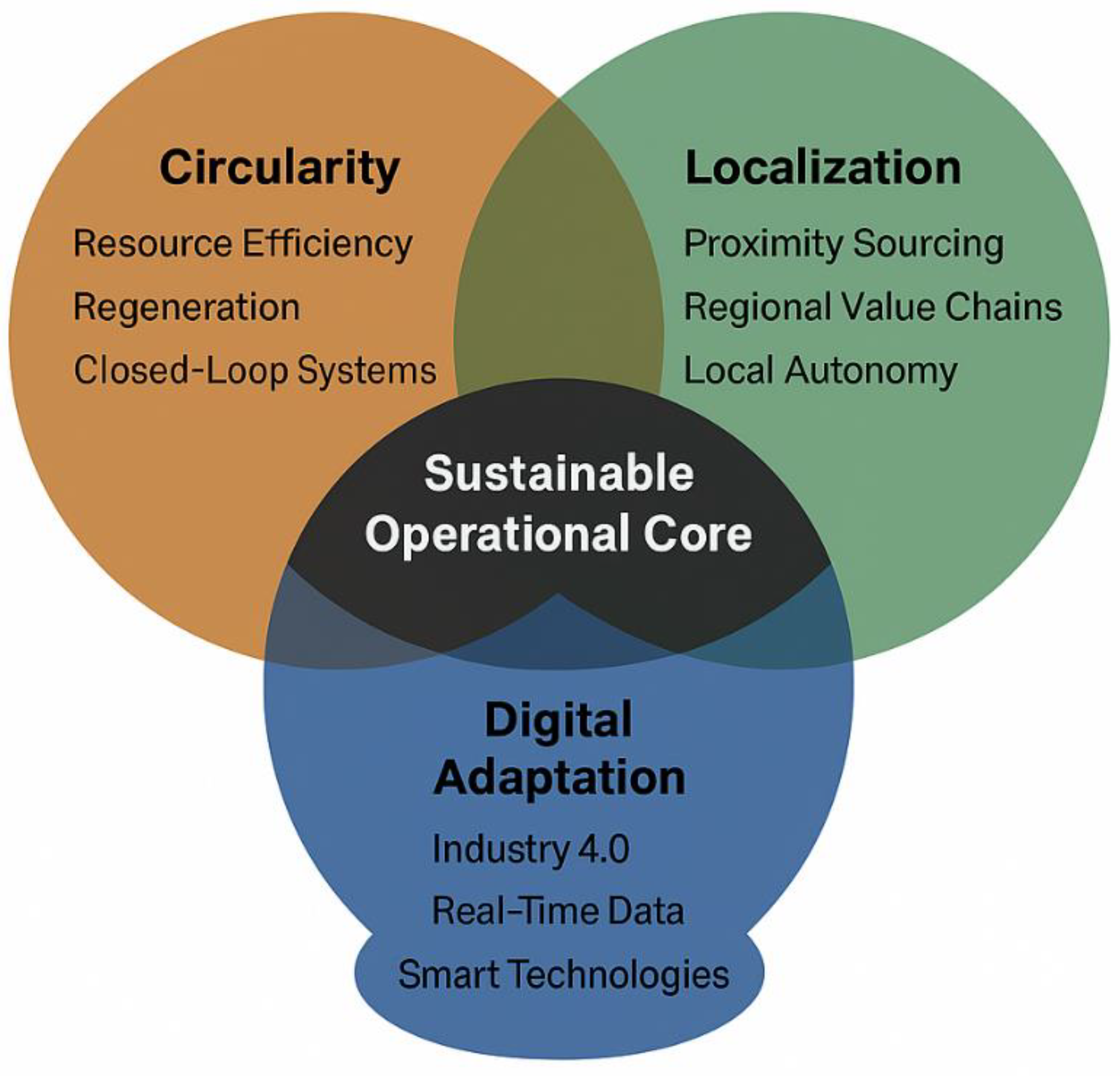
Figure 2.
Proposed Multi-Level Model: Macro (Policy) – Meso (Operations) – Micro (Processes).
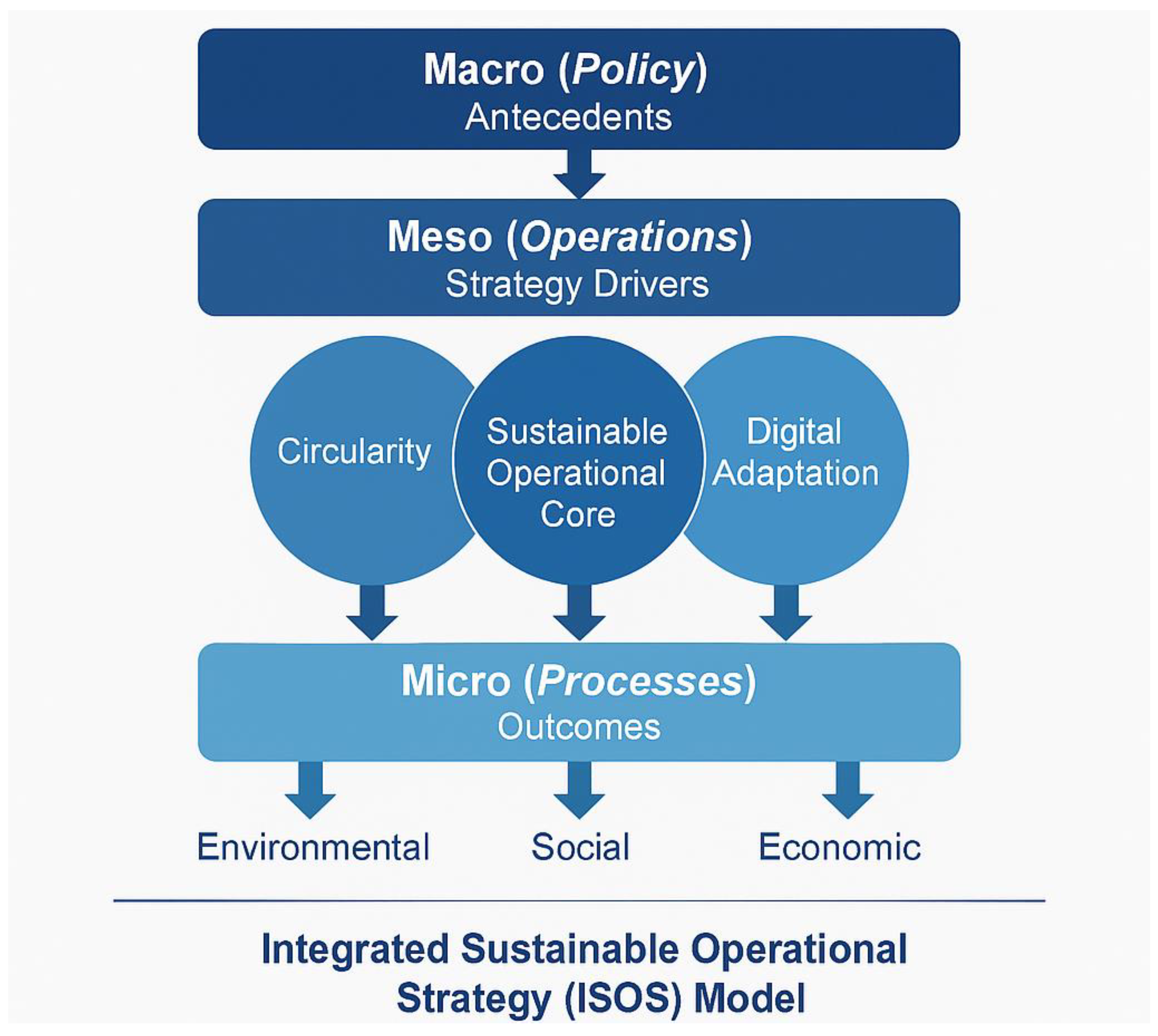
Figure 3.
Local Resilience-Enabling Capabilities Framework.
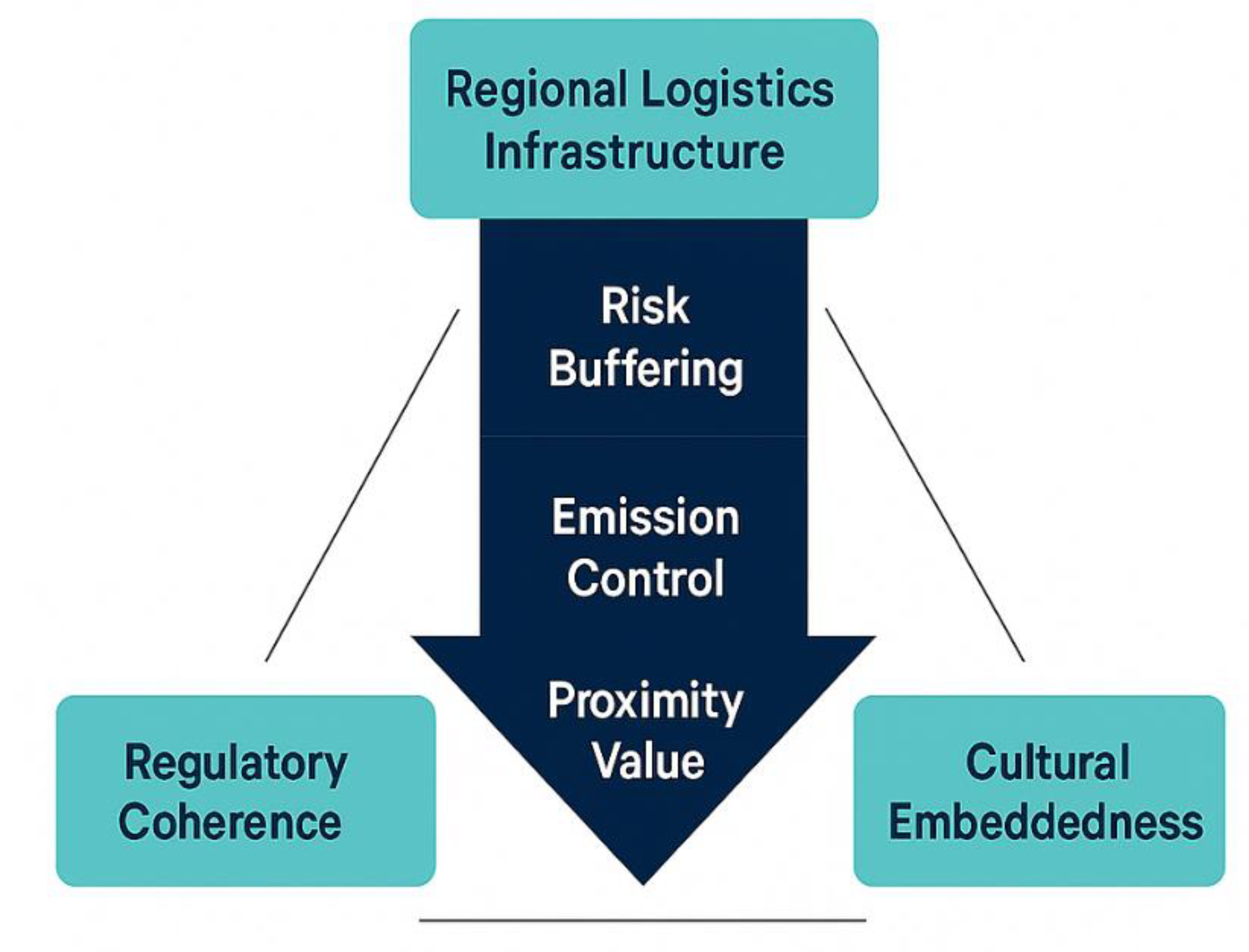

Table 1.
Strategic Practices for Circular Operations across Industries.
| Industry Sector | Circular Strategy Focus | Strategic Function |
| Automotive | Remanufacturing & Parts Recovery | Reduces raw material demand; supports modular product innovation |
| Consumer Electronics | Design for Disassembly & E-Waste Take-Back | Minimizes toxic landfill impact; enables secondary market channels |
| Apparel & Fashion | Recycled Materials & Product-as-a-Service | Builds brand legitimacy; enables recurring revenue models |
| Food & Beverage | Bio-packaging & Organic Waste Loops | Reduces landfill fees; appeals to green-conscious consumers |
| Pharmaceuticals | Reverse Distribution & Expiry Management | Improves inventory efficiency; aligns with health safety compliance |
Table 2.
Propositions and Suggested Empirical Approaches.
| Proposition | Underlying Logic | Suggested Empirical Design |
| P1. The integration of circularity practices positively affects sustainable operational performance, mediated by reverse logistics capabilities. | Closed-loop design requires enabling logistics structures to realize sustainability outcomes. | Structural Equation Modeling (SEM); mediation analysis. |
| P2. The effectiveness of localization strategies in enhancing resilience is moderated by the level of institutional coordination at the regional level. | Policy coherence and regional governance influence localization’s impact. | Multi-group regression analysis; hierarchical linear modeling. |
| P3. The relationship between digital adaptation and sustainability performance is mediated by real-time data utilization. | The impact of IoT and AI on operations depends on effective data decisioning. | Mediation test using PROCESS macro or PLS-SEM. |
| P4. Workforce flexibility strengthens the relationship between circularity and operational adaptability. | Human agility enhances the responsiveness of circular systems to disruption. | Moderation analysis; interaction terms in regression. |
| P5. Simultaneous pursuit of circularity, localization, and digitalization leads to superior sustainability outcomes, moderated by organizational integration capacity. | Synergistic strategies require internal capability to manage trade-offs. | Moderated mediation or configurational analysis (e.g., fsQCA). |
Disclaimer/Publisher’s Note: The statements, opinions and data contained in all publications are solely those of the individual author(s) and contributor(s) and not of MDPI and/or the editor(s). MDPI and/or the editor(s) disclaim responsibility for any injury to people or property resulting from any ideas, methods, instructions or products referred to in the content. |
© 2025 by the authors. Licensee MDPI, Basel, Switzerland. This article is an open access article distributed under the terms and conditions of the Creative Commons Attribution (CC BY) license (http://creativecommons.org/licenses/by/4.0/).
Copyright: This open access article is published under a Creative Commons CC BY 4.0 license, which permit the free download, distribution, and reuse, provided that the author and preprint are cited in any reuse.


