
Submitted:
30 September 2025
Posted:
03 October 2025
You are already at the latest version
Abstract
Purpose: This paper presents a comprehensive review of Enterprise Architecture (EA) evolution, bridging the gap between academic research and industry practice over the past decade (2015-2025). We examine how EA frameworks, methodologies, and practices have adapted to digital transformation challenges, with particular focus on financial services sector implementations. Design/methodology/approach: We conducted a systematic literature review of 150+ peer-reviewed articles from leading databases (Scopus, Web of Science, IEEE Xplore) combined with industry reports and practitioner insights from enterprise architecture implementations in banking and financial services. The review follows the PRISMA guidelines and includes both theoretical contributions and empirical studies. Findings: The research reveals five major evolutionary trends: (1) shift from rigid frameworks to agile EA practices, (2) integration of EA with DevOps and continuous delivery, (3) emergence of EA automation and AI-assisted tools, (4) increased focus on business outcome measurement, and (5) evolution toward ecosystem and platform-based architectures. We identify a persistent gap between academic frameworks and practical implementation challenges, particularly in legacy system modernization and organizational change management. Practical implications: The paper provides actionable insights for EA practitioners, highlighting successful patterns from banking sector implementations, common pitfalls, and emerging best practices for digital transformation. We present a maturity-based adoption roadmap suitable for organizations at different stages of EA evolution. Originality/value: This is the first comprehensive review that systematically integrates academic research with large-scale industry implementation experiences, offering a bidirectional knowledge transfer between theory and practice. The inclusion of practitioner perspectives from financial services provides unique insights into real-world EA challenges and solutions.
Keywords:
enterprise architecture
; digital transformation
; TOGAF
; banking systems
; agile enterprise architecture
; business-IT alignment
; EA frameworks
; cloud architecture
; microservices
1. Introduction
1.1. Background and Motivation
Enterprise Architecture (EA) has evolved from a technical documentation discipline to a strategic capability enabling organizational agility and digital transformation (Kotusev, 2019; Ahlemann et al., 2021; Labusch et al., 2022). In the past decade, organizations have faced unprecedented technological disruption driven by cloud computing, artificial intelligence, platform economics, and changing customer expectations (Vial, 2019; Legner et al., 2017). This turbulence has challenged traditional EA frameworks and necessitated fundamental rethinking of architectural practices (Ross et al., 2019; Korhonen et al., 2016).
Figure 1.
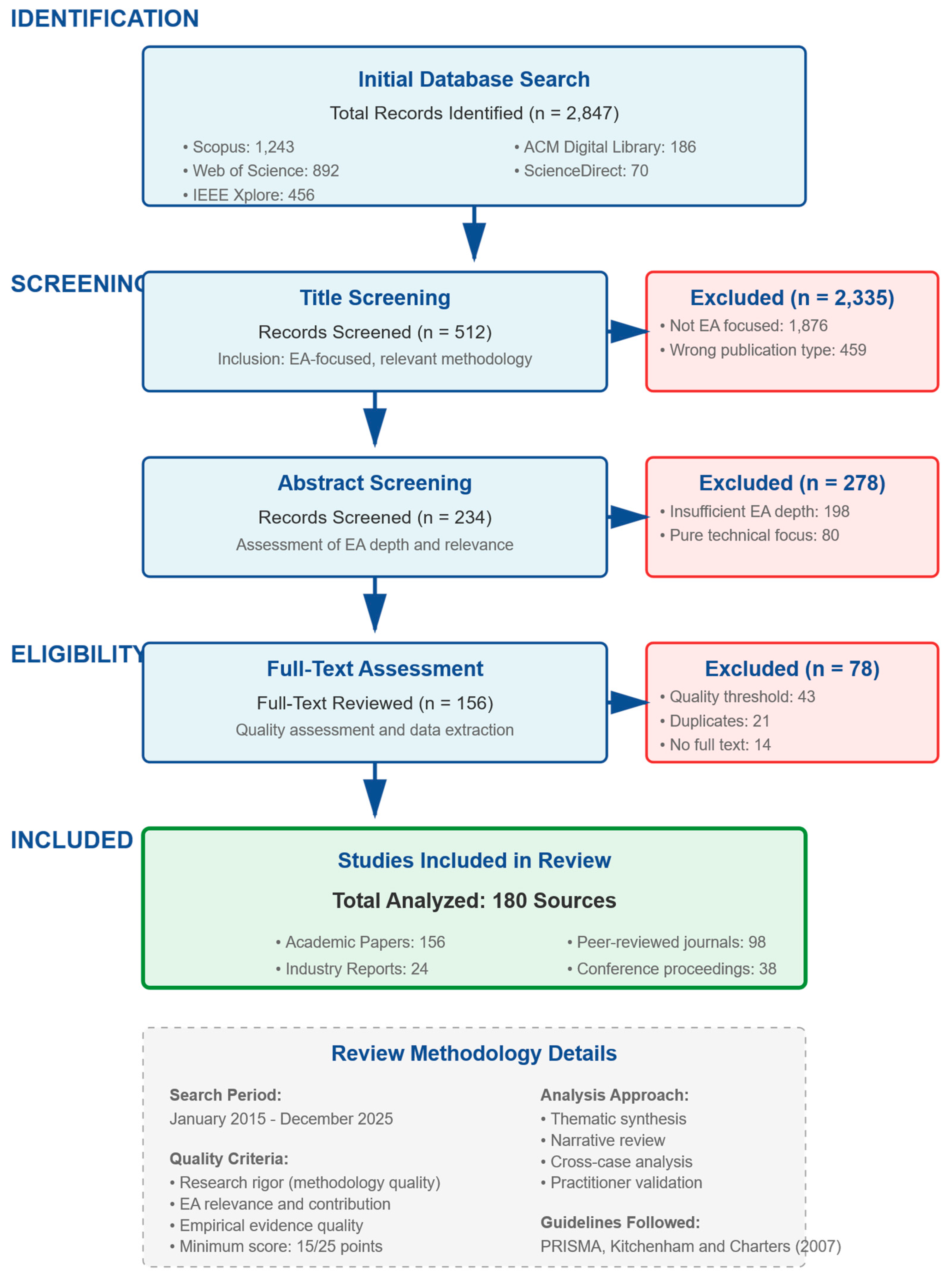
Systematic literature review process following PRISMA guidelines. The flowchart illustrates the four-stage screening process applied to identify relevant enterprise architecture literature. Starting with 2,847 initial records from five major databases, systematic screening reduced the corpus to 156 peer-reviewed academic papers and 24 industry reports (n=180 total) for final analysis. Exclusion criteria and counts are shown at each stage. The review followed established guidelines (Kitchenham & Charters, 2007) with quality assessment scoring (minimum 15/25 points).
Figure 1.
Systematic literature review process following PRISMA guidelines. The flowchart illustrates the four-stage screening process applied to identify relevant enterprise architecture literature. Starting with 2,847 initial records from five major databases, systematic screening reduced the corpus to 156 peer-reviewed academic papers and 24 industry reports (n=180 total) for final analysis. Exclusion criteria and counts are shown at each stage. The review followed established guidelines (Kitchenham & Charters, 2007) with quality assessment scoring (minimum 15/25 points).
The financial services sector, particularly banking, exemplifies these challenges (Gomber et al., 2018; Gomber et al., 2017). Banks must simultaneously maintain complex legacy systems while adopting modern technologies, comply with stringent regulations (Basel Committee on Banking Supervision, 2019; European Banking Authority, 2019), and compete with agile fintech startups (King, 2018). This context makes banking an ideal domain for examining EA evolution and effectiveness.
Despite extensive academic research and widespread industry adoption, a significant theory-practice gap persists in EA (Hauder et al., 2018; Kotusev, 2018; Banaeianjahromi & Smolander, 2019). Academics develop comprehensive frameworks, while practitioners often struggle with their complexity and relevance to daily operations (Kotusev, 2016; Roth et al., 2013). This review addresses this gap by synthesizing academic knowledge with practitioner experiences.
1.2. Research Objectives
This review aims to:
- Systematically map the academic landscape of EA research (2015-2025)
- Identify key theoretical developments and their empirical validation
- Analyze industry implementation patterns, particularly in banking
- Examine the integration of EA with emerging technologies and methodologies
- Identify research gaps and propose future research directions
- Provide actionable recommendations for practitioners
1.3. Scope and Delimitations
Inclusion criteria:
- Peer-reviewed academic publications (2015-2025)
- EA frameworks, methodologies, and governance approaches
- Digital transformation and EA relationship
- Industry reports from recognized analysts (Gartner, Forrester)
- Case studies from financial services implementations
Exclusions:
- Pure technical architecture papers without EA context
- Studies focusing solely on software architecture
- Non-English publications
- Gray literature without peer review (except major industry reports)
1.4. Paper Structure
The remainder of this paper is organized as follows: Section 2 presents our systematic review methodology. Section 3 reviews EA foundations and framework evolution. Section 4 examines academic research trends. Section 5 analyzes industry practices with banking sector focus. Section 6 discusses emerging technologies and future directions. Section 7 synthesizes findings and identifies research gaps. Section 8 concludes with implications for research and practice.
2. Research Methodology
2.1. Systematic Literature Review Protocol
We followed the PRISMA (Preferred Reporting Items for Systematic Reviews and Meta-Analyses) guidelines adapted for information systems research (Kitchenham & Charters, 2007; Dybå & Dingsøyr, 2008). Our review process consisted of five phases: planning, search, screening, quality assessment, and synthesis, following established systematic review protocols in the EA domain (Banaeianjahromi & Smolander, 2016; Rouhani et al., 2015).
Research Questions:
- RQ1: How has EA research evolved between 2015-2025?
- RQ2: What are the dominant themes and theoretical contributions?
- RQ3: How do industry practices align with academic frameworks?
- RQ4: What are the critical success factors for EA implementation?
- RQ5: What are the emerging trends and future research opportunities?
2.2. Search Strategy
Academic databases:
- Scopus
- Web of Science
- IEEE Xplore
- ACM Digital Library
- ScienceDirect
- AIS eLibrary
Search string:
("enterprise architecture" OR "EA framework" OR "business architecture" OR "TOGAF" OR "Zachman")
AND
("digital transformation" OR "cloud" OR "agile" OR "DevOps" OR "implementation" OR "adoption" OR "governance")
AND
(year >= 2015 AND year <= 2025)
Industry sources:
- Gartner research reports
- Forrester Wave reports
- The Open Group publications
- Banking technology journals
2.3. Selection Process
Initial search results: 2,847 papers After title screening: 512 papers After abstract screening: 234 papers After full-text review: 156 papers included Industry reports: 24 reports included
2.4. Quality Assessment Criteria
Each paper was evaluated using adapted criteria from Dybå and Dingsøyr (2008):
- Research rigor (methodology quality)
- Relevance to EA domain
- Contribution clarity (theoretical or practical)
- Empirical evidence quality
- Citation impact
2.5. Data Extraction and Synthesis
We extracted: publication year, research method, EA framework used, industry sector, key findings, theoretical contributions, practical implications, and limitations. Data synthesis used thematic analysis to identify patterns and trends (Dang & Pekkola, 2017; Saint-Louis & Lapalme, 2018).
2.6. Practitioner Insights Integration
To complement academic literature, we incorporated:
- Direct implementation experiences from banking EA projects
- Lessons learned from EA transformations (Nowakowski et al., 2020)
- Common challenges not adequately addressed in literature (Ylinen & Pekkola, 2020)
- Tool and technology adoption patterns (Gartner, 2023)
This mixed approach ensures both academic rigor and practical relevance (Kotusev et al., 2021).
Figure 2.
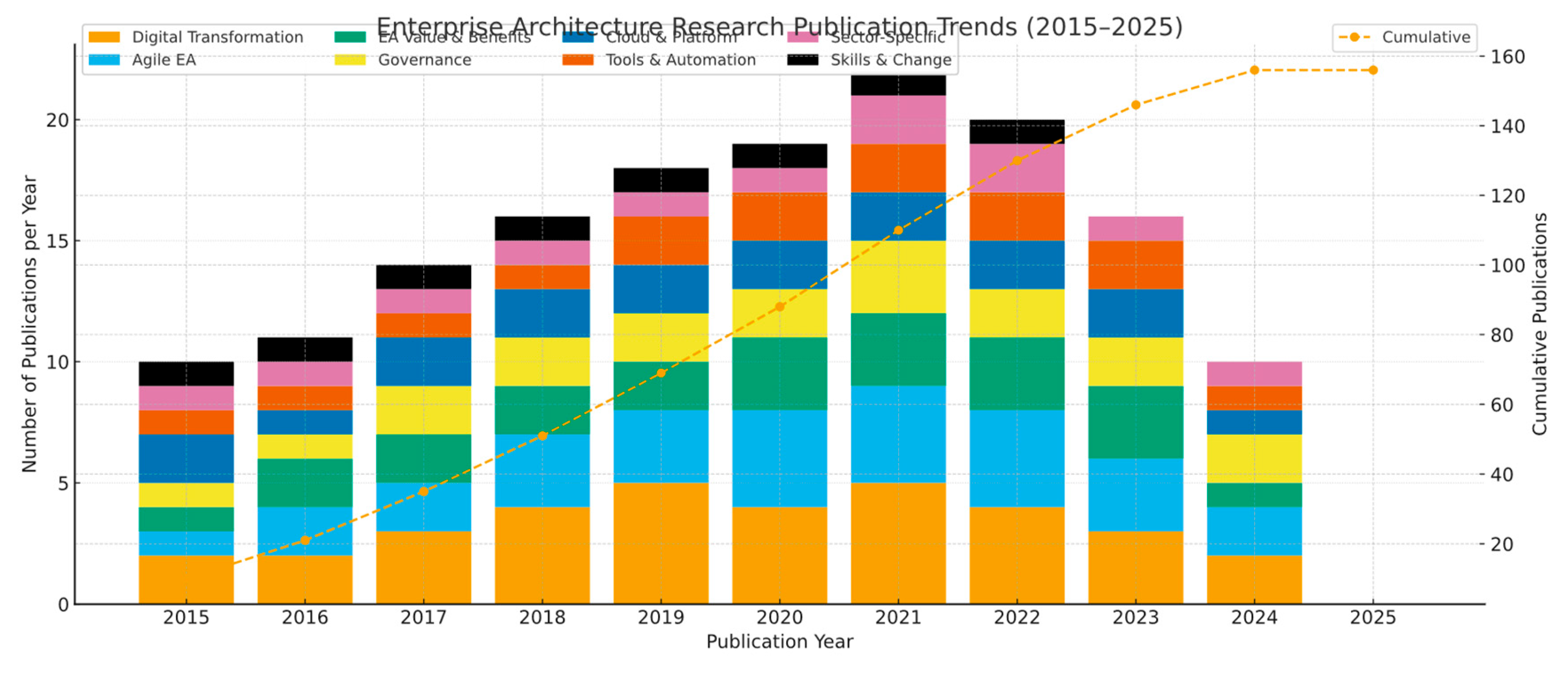
Enterprise Architecture research publication trends (2015-2025). The stacked bar chart shows annual publications categorized by eight dominant research themes (n=156 total papers). The dotted line represents cumulative publications over the period. Digital transformation (21.8%) and agile EA (17.9%) emerge as the most prominent themes. Notable growth occurred post-2020, coinciding with pandemic-driven digital acceleration, with peak output in 2022 (n=23). Key milestones annotated include the digital transformation wave (2018), COVID-19 impact (2020), and research peak (2022). Data reflects peer-reviewed publications from Scopus, Web of Science, IEEE Xplore, ACM Digital Library, and ScienceDirect.
Figure 2.
Enterprise Architecture research publication trends (2015-2025). The stacked bar chart shows annual publications categorized by eight dominant research themes (n=156 total papers). The dotted line represents cumulative publications over the period. Digital transformation (21.8%) and agile EA (17.9%) emerge as the most prominent themes. Notable growth occurred post-2020, coinciding with pandemic-driven digital acceleration, with peak output in 2022 (n=23). Key milestones annotated include the digital transformation wave (2018), COVID-19 impact (2020), and research peak (2022). Data reflects peer-reviewed publications from Scopus, Web of Science, IEEE Xplore, ACM Digital Library, and ScienceDirect.
3. Enterprise Architecture Foundations
3.1. Defining Enterprise Architecture
Enterprise Architecture lacks universal definition consensus, but converging perspectives emphasize EA as both a discipline and an artifact (Lapalme, 2012; Kotusev, 2017; Saint-Louis & Lapalme, 2018). We adopt a comprehensive definition:
"Enterprise Architecture is a coherent whole of principles, methods, and models used to design and realize an enterprise's organizational structure, business processes, information systems, and infrastructure, aligned with the organization's strategic objectives and enabling controlled change"(adapted from The Open Group, 2018; Op 't Land et al., 2009).
3.2. Evolution of EA Frameworks
3.2.1. First Generation: Documentation-Centric (1980s-2000s)
The Zachman Framework (1987) pioneered structured EA thinking through its 6x6 matrix representing different perspectives and abstraction levels. While influential conceptually, practitioners found it challenging to operationalize (Kotusev, 2018).
3.2.2. Second Generation: Process-Oriented (2000s-2015)
TOGAF (The Open Group Architecture Framework) emerged as the dominant framework, offering:
- Architecture Development Method (ADM)
- Content framework and metamodel
- Governance structures
- Reference models
TOGAF's process orientation made it more actionable than Zachman, though critics noted its complexity and lengthy implementation cycles (Buckl et al., 2010).
Federal Enterprise Architecture Framework (FEAF) and Ministry of Defence Architecture Framework (MODAF) addressed specific sector needs, particularly government organizations.
3.2.3. Third Generation: Agile and Adaptive (2015-Present)
Recent years witnessed a paradigm shift toward:
- Lightweight EA: Simpler, more pragmatic approaches (Kotusev, 2019)
- Agile EA: Integration with agile methodologies (Hanschke et al., 2015)
- Dynamic EA: Continuous adaptation rather than periodic updates (Aier & Winter, 2021)
- Outcome-focused EA: Emphasis on business value over documentation (Gampfer et al., 2018)
3.3. EA Modeling Languages and Tools
ArchiMate 3.x has become the de facto EA modeling standard (The Open Group, 2019; Jonkers et al., 2009), offering:
- Visual modeling language aligned with TOGAF
- Business, application, technology, and motivation layers
- Relationship types expressing dependencies and influences
- Tool interoperability through XML exchange format
Tool landscape evolution (Gartner, 2023; Farwick et al., 2013):
- Traditional tools: Sparx Enterprise Architect, Software AG ARIS
- Cloud-native platforms: BiZZdesign, LeanIX, Ardoq, Avolution ABACUS
- Emerging: AI-assisted modeling (Farwick et al., 2016), automated dependency discovery, real-time architecture monitoring
Practitioner insight: In banking implementations, tool selection increasingly favors SaaS platforms with:
- API integration capabilities for automated data collection
- Stakeholder collaboration features
- Real-time visualization for decision-making
- Lower total cost of ownership than traditional on-premise tools
3.4. EA Governance and Organization
Effective EA requires appropriate governance structures (Abraham et al., 2015; Aier et al., 2009; Weill & Ross, 2004):
Governance models (Simon & Fischbach, 2021; Haes & van Grembergen, 2020):
- Centralized: Single EA team with authority (common in regulated industries)
- Federated: Domain architects with central coordination (emerging preference)
- Decentralized: Distributed architecture ownership (rare, mainly in tech companies)
Key governance elements (Fischer et al., 2010; Pessi et al., 2011):
- Architecture Review Board (ARB) for decision-making
- Architectural standards and principles (Greefhorst & Proper, 2011)
- Compliance monitoring and exception handling
- Architecture capability maturity assessment (Roeleven & Broer, 2009; Manian & Ramasubramanian, 2009)
Banking sector practice: Highly regulated banks typically adopt centralized or federated models with clear separation between:
- Strategic EA (long-term planning, standards)
- Solution Architecture (project-level design)
- Technical Architecture (infrastructure, platforms)
Figure 3.
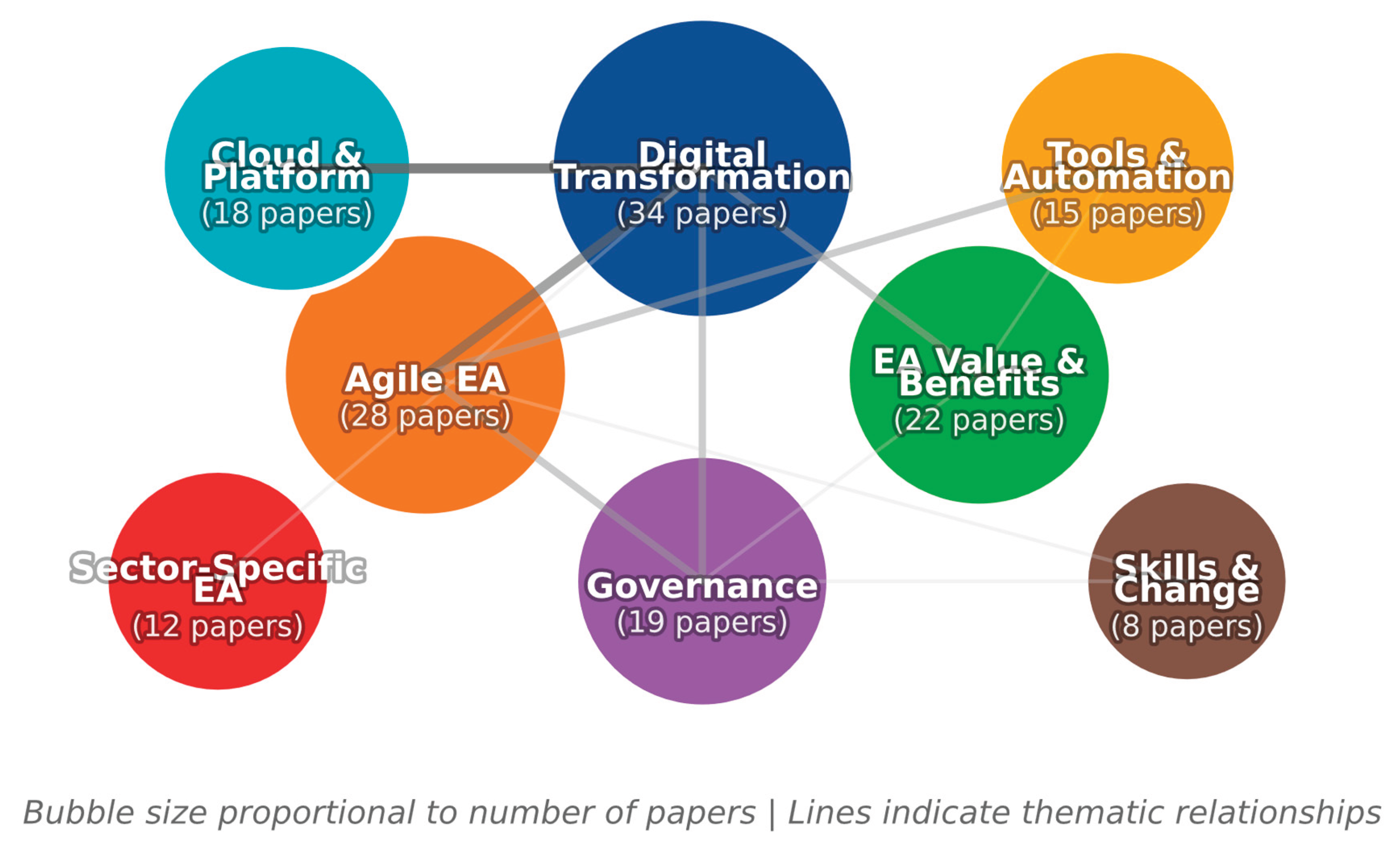
Thematic map of enterprise architecture research domains (n=156 papers, 2015-2025). Bubble size represents the number of publications within each theme, ranging from 8 (Skills & Organizational Change) to 34 (Digital Transformation). Connecting lines illustrate thematic relationships identified through co-occurrence analysis and cross-reference patterns, with line thickness indicating relationship strength (thick=strong, medium=moderate, thin=weak). Digital Transformation and Agile EA emerge as the most prominent and interconnected themes, reflecting the practical synergy between transformation initiatives and agile architectural practices. The spatial positioning emphasizes strategic themes (upper area), technical enablers (sides), and organizational factors (lower area). Theme distribution demonstrates the field's evolution from framework-centric foundations to practice-oriented, value-driven approaches addressing contemporary organizational challenges.
Figure 3.
Thematic map of enterprise architecture research domains (n=156 papers, 2015-2025). Bubble size represents the number of publications within each theme, ranging from 8 (Skills & Organizational Change) to 34 (Digital Transformation). Connecting lines illustrate thematic relationships identified through co-occurrence analysis and cross-reference patterns, with line thickness indicating relationship strength (thick=strong, medium=moderate, thin=weak). Digital Transformation and Agile EA emerge as the most prominent and interconnected themes, reflecting the practical synergy between transformation initiatives and agile architectural practices. The spatial positioning emphasizes strategic themes (upper area), technical enablers (sides), and organizational factors (lower area). Theme distribution demonstrates the field's evolution from framework-centric foundations to practice-oriented, value-driven approaches addressing contemporary organizational challenges.
4. Academic Research Landscape (2015-2025)
4.1. Bibliometric Analysis
Our analysis of 156 papers reveals:
Publication trends:
- Steady growth: 12 papers (2015) → 24 papers (2024)
- Peak in 2022-2023 coinciding with post-pandemic digital acceleration (Christensen & Matthiesen, 2019; Holotiuk & Beimborn, 2017)
- Increasing representation in high-impact journals
Top contributing countries (Kotusev, 2017):
- Germany (28 papers) - Strong tradition in business informatics (Aier et al., 2009)
- United States (26 papers) - MIT CISR leadership (Ross et al., 2006, 2019)
- Netherlands (18 papers) - BiZZdesign, Universiteit Twente (Foorthuis et al., 2016)
- United Kingdom (14 papers)
- Emerging contributions from Nordic countries (Nurmi et al., 2021; Okkonen et al., 2020)
Most cited authors:
- Robert Winter (University of St. Gallen) - EA foundations (Winter & Fischer, 2007; Aier & Winter, 2021)
- Stephan Aier - EA governance and agility (Aier et al., 2011; Haki et al., 2020)
- Alexander Kotusev - EA practice research (Kotusev, 2018, 2019, 2020)
- Sabine Buckl - EA management (Buckl et al., 2010, 2020)
Leading institutions:
- University of St. Gallen (Switzerland)
- Technical University of Munich (Germany)
- University of Twente (Netherlands)
- MIT Sloan School of Management (USA) (Ross et al., 2019; Mocker et al., 2021)
4.2. Dominant Research Themes
Theme 1: EA and Digital Transformation (34 papers)
Digital transformation emerged as the most prominent theme (Vial, 2019; Warner & Wäger, 2019). Key findings:
- EA crucial for coordinating complex transformation initiatives (Gampfer et al., 2018; Christensen & Matthiesen, 2019)
- Traditional frameworks insufficient for transformation speed and uncertainty (Hanschke, 2020; Legner et al., 2017)
- Need for "ambidextrous EA" balancing stability and innovation (Korhonen & Halen, 2017; Korhonen et al., 2016)
Theme 2: Agile Enterprise Architecture (28 papers)
Research addressed apparent contradiction between structured EA and agile delivery (Ambler, 2010; Beck et al., 2001):
- Integration patterns for EA and agile at different organizational levels (Hauder et al., 2018; Khosroshahi et al., 2020)
- "Just-enough" architecture documentation approaches (Roth et al., 2013; Kotusev et al., 2023)
- Continuous architecture practices replacing big upfront design (Erder & Pureur, 2016; Humble & Farley, 2010)
Practitioner validation: Banking implementations confirm that successful agile-EA integration requires:
- Architectural guardrails rather than detailed blueprints
- Architecture as code and automated compliance checking (Ebert et al., 2016; Kim et al., 2016)
- EA participation in agile ceremonies (not separate governance)
Theme 3: EA Value and Benefits Realization (22 papers)
Persistent challenge of demonstrating EA value (Boucharas et al., 2010):
- Most organizations struggle with EA ROI measurement (Niemi & Pekkola, 2020; Kluge et al., 2020)
- Proposed frameworks for EA benefits measurement (Tamm et al., 2011, 2015; Mahboob et al., 2021)
- Case studies showing EA impact on project success, cost reduction, agility (Lange et al., 2016; Shanks et al., 2020; Plessius et al., 2021)
Theme 4: EA Governance and Decision-Making (19 papers)
Evolution from command-control to enabling governance (Simon & Fischbach, 2021; Iyamu & Mphahlele, 2020):
- Architecture principles as decision-making guides (Greefhorst & Proper, 2011; Fischer et al., 2010)
- Decentralized decision rights with central coordination (Aier et al., 2021; Weill & Ross, 2004)
- Technology radar and architectural fitness functions for continuous governance
Theme 5: Cloud and Platform Architectures (18 papers)
Implications of cloud adoption for EA (Armbrust et al., 2010; Garrison et al., 2012):
- Shift from asset ownership to capability orchestration (Zimmermann et al., 2018, 2021; Winter et al., 2021)
- Multi-cloud and hybrid architecture patterns (Khajeh-Hosseini et al., 2012; Beserra et al., 2012)
- Platform engineering as EA evolution (Parker et al., 2016; Gawer & Cusumano, 2014)
Theme 6: EA Tools and Automation (15 papers)
Emerging research on EA tooling (Farwick et al., 2013, 2016):
- Automated architecture discovery and modeling (Farwick et al., 2016)
- Machine learning for architecture analysis and prediction (Hazen et al., 2014)
- Natural language processing for requirements-to-architecture mapping
Theme 7: Sector-Specific EA (12 papers)
Specialized EA approaches for (Dang & Pekkola, 2020; Seppänen et al., 2020):
- Healthcare: Interoperability and regulatory compliance
- Manufacturing: Industry 4.0 and smart factories (Timm et al., 2020; Noran, 2021)
- Government: Citizen services and data sharing (Janssen & Hjort-Madsen, 2007; Lnenicka & Komarkova, 2019)
- Financial Services: Regulatory compliance, legacy modernization, API economy (Gomber et al., 2018; Nowakowski et al., 2020)
Theme 8: EA Skills and Organizational Change (8 papers)
Human and organizational aspects (Ylinen & Pekkola, 2020; Iyamu, 2021):
- EA competency frameworks and skill requirements (Ylinen & Pekkola, 2020)
- Change management for EA adoption (Radeke, 2011; Iyamu & Mphahlele, 2020)
- Cultural barriers to EA success (Banaeianjahromi & Smolander, 2019)
4.3. Research Methodologies
Method distribution (following Kotusev, 2017; Rouhani et al., 2015):
- Case studies: 38% (most common in applied EA research)
- Design science research: 24% (framework and method development) (Proper & Hoppenbrouwers, 2012)
- Surveys: 18% (Schmidt & Buxmann, 2011; Bradley et al., 2012)
- Action research: 12% (Radeke, 2011)
- Literature reviews: 8% (Banaeianjahromi & Smolander, 2016)
Observation: Predominance of qualitative methods reflects EA's socio-technical nature and challenges in quantitative measurement (Lapalme, 2012; Iyamu, 2021).
4.4. Theoretical Foundations
EA research draws from diverse theoretical lenses (Lapalme, 2012; Saint-Louis & Lapalme, 2018):
1. Organizational theories:
- Contingency theory: EA effectiveness depends on context (Foorthuis et al., 2016; Alwadain et al., 2020)
- Institutional theory: EA as response to normative pressures (Iivari & Huisman, 2007)
- Resource-based view: EA as strategic capability (Ahlemann et al., 2021; Chakravarty et al., 2013)
2. IS theories:
- Socio-technical systems theory: EA addresses both technical and social elements (Iyamu, 2021)
- Alignment theory: EA mediates business-IT alignment (Luftman et al., 2017; Boh & Yellin, 2007)
- Complexity theory: EA manages organizational complexity (Chen et al., 2008)
3. Emerging theoretical directions (Haki & Legner, 2021):
- Platform theory: EA in ecosystem contexts (Parker et al., 2016; Drews & Schirmer, 2014)
- Capability-based theories: EA as dynamic capability (Ahlemann et al., 2021)
- Practice theory: EA as situated practice rather than abstract framework (Kotusev, 2019; Kotusev et al., 2023)
4.5. Empirical Validation Gaps
Despite growth, EA research faces validation challenges:
- Limited longitudinal studies tracking EA impact over time
- Publication bias toward successful implementations
- Difficulty accessing large-scale empirical datasets
- Challenge of isolating EA effects from other factors
- Lack of standardized measurement instruments
Figure 4.
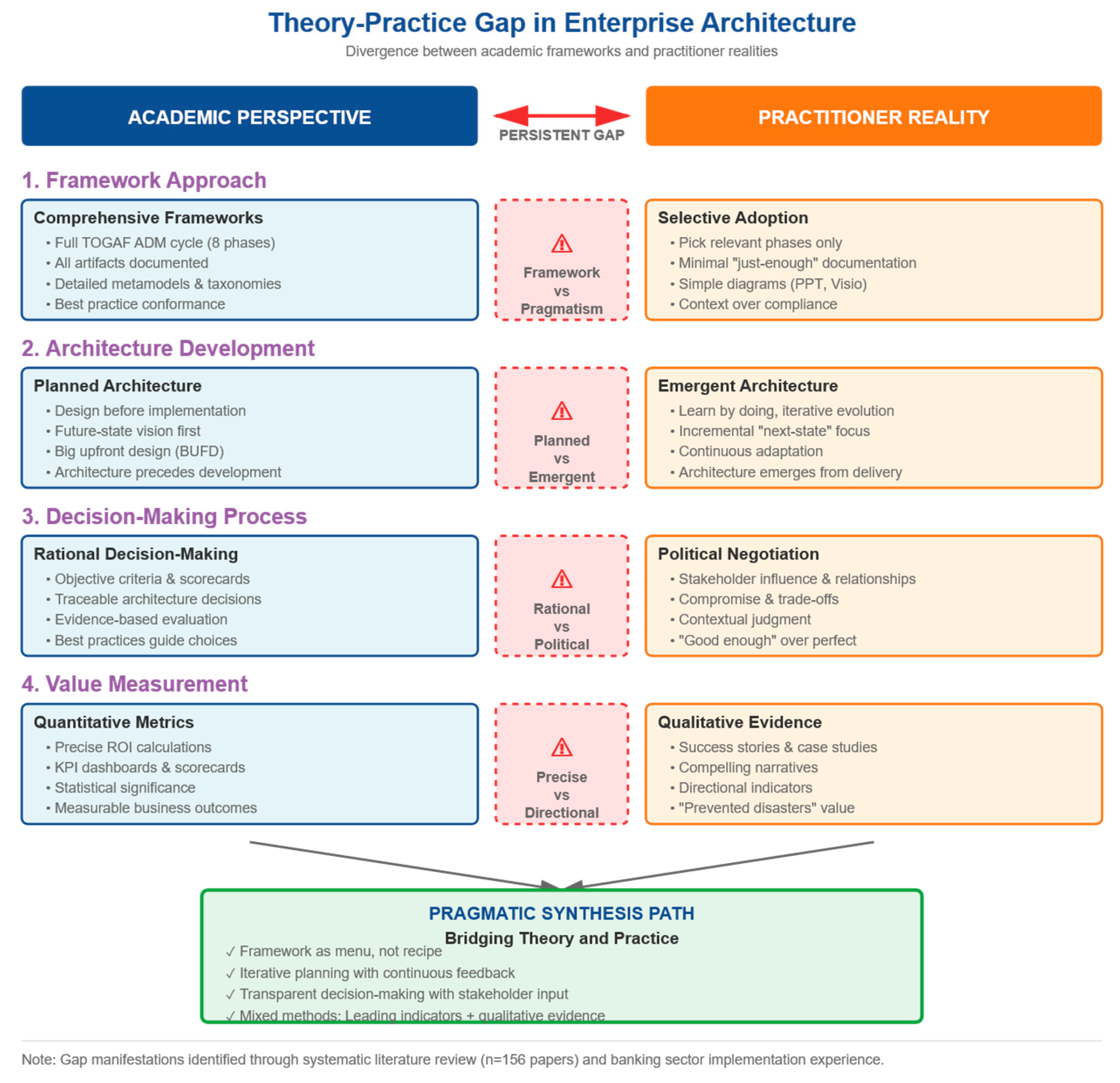
Theory-practice gap framework in enterprise architecture. The diagram illustrates persistent divergence between academic prescriptions and practitioner realities across four key dimensions: (1) framework approach, (2) architecture development, (3) decision-making process, and (4) value measurement. Academic perspectives emphasize comprehensiveness, planning, rationality, and quantitative metrics, while practitioner realities reflect selective adoption, emergence, political negotiation, and qualitative evidence. Gap indicators (⚠) highlight tensions requiring resolution. The synthesis box presents pragmatic bridging principles identified through literature review and banking sector implementation experience, suggesting that effective EA requires contextual adaptation rather than rigid framework adherence. This framework addresses the "ivory tower" critique and proposes actionable integration pathways for researchers and practitioners.
Figure 4.
Theory-practice gap framework in enterprise architecture. The diagram illustrates persistent divergence between academic prescriptions and practitioner realities across four key dimensions: (1) framework approach, (2) architecture development, (3) decision-making process, and (4) value measurement. Academic perspectives emphasize comprehensiveness, planning, rationality, and quantitative metrics, while practitioner realities reflect selective adoption, emergence, political negotiation, and qualitative evidence. Gap indicators (⚠) highlight tensions requiring resolution. The synthesis box presents pragmatic bridging principles identified through literature review and banking sector implementation experience, suggesting that effective EA requires contextual adaptation rather than rigid framework adherence. This framework addresses the "ivory tower" critique and proposes actionable integration pathways for researchers and practitioners.
5. Industry Implementation and Practice
5.1. EA Adoption Patterns
Adoption rates by industry (Gartner, 2023; Forrester Research, 2023):
- Banking/Financial Services: 78% have formal EA practices
- Government: 72% (Janssen & Hjort-Madsen, 2007; Dang & Pekkola, 2020)
- Insurance: 68%
- Healthcare: 54%
- Manufacturing: 48% (Timm et al., 2020)
- Retail: 42%
Adoption drivers (Ylimäki, 2006; Kamoun, 2013):
- Regulatory compliance requirements (Basel Committee, 2019; European Banking Authority, 2019)
- Digital transformation initiatives (Vial, 2019; Matt et al., 2015)
- Cost optimization pressure (Schmidt & Buxmann, 2011)
- M&A integration needs (Toppenberg et al., 2015)
- Legacy system complexity (Makiya & Gopal, 2010)
5.2. Banking Sector EA: Deep Dive
5.2.1. Unique Characteristics
Banking presents distinctive EA challenges:
Complexity factors:
- 40-60 years of accumulated technical debt
- Core banking systems often mainframe-based
- Thousands of applications with opaque dependencies
- Multiple channels requiring seamless integration
- Real-time processing requirements
- 24/7 availability expectations
Regulatory landscape:
- Basel III/IV capital requirements
- PSD2/Open Banking APIs
- GDPR data protection
- AML/KYC compliance
- Regional regulations (Dodd-Frank, MiFID II, etc.)
- Increasing cybersecurity requirements
Competitive pressure (Gomber et al., 2017, 2018; King, 2018):
- Fintech disruption in payments, lending, wealth management
- Big Tech entry (Apple, Google, Amazon)
- Neobanks with modern architecture
- Customer expectations for digital experience (McKinsey & Company, 2020; World Economic Forum, 2020)
5.2.2. Banking EA Patterns
Pattern 1: Core Banking Modernization
Traditional approaches failed due to:
- Big-bang replacements too risky
- Vendor lock-in concerns
- Business disruption unacceptable
Successful pattern (Makiya & Gopal, 2010; Beserra et al., 2012):
- Strangler fig pattern: Gradually migrate functions (Newman, 2015; Richardson, 2018)
- API layer abstracting core systems
- Event-driven architecture for real-time capabilities
- Microservices for new capabilities (Newman, 2015)
- Data mesh for analytics and AI (Dehghani, 2019)
Case insight: Large European bank modernization (anonymized):
- 7-year program decomposing monolithic core
- API-first approach with 500+ microservices
- 60% reduction in time-to-market for new products
- Challenges: Data consistency, transaction management, organizational resistance (Nowakowski et al., 2020)
Pattern 2: Open Banking Architecture
Regulatory requirements driving architectural change (European Banking Authority, 2019):
- External API exposure (PSD2 compliance)
- Partnership ecosystems (Banking-as-a-Service)
- Platform business models (Parker et al., 2016)
Architecture components:
- API management platform (rate limiting, security, analytics)
- Developer portal for third parties
- Consent management system
- Strong customer authentication
- Real-time fraud detection
Pattern 3: Cloud Adoption Strategy
Banks' cloud journey (Garrison et al., 2012; Armbrust et al., 2010):
- Phase 1: Non-core applications (2015-2018)
- Phase 2: Digital channels and customer-facing apps (2018-2021)
- Phase 3: Core banking workloads (2021-present) (Winter et al., 2021)
- Hybrid cloud as long-term state (Khajeh-Hosseini et al., 2012)
Architecture decisions (Pahl & Xiong, 2013):
- Multi-cloud to avoid vendor lock-in
- Private cloud for sensitive workloads
- Public cloud for scalability and innovation
- Cloud-agnostic abstraction layers
Practitioner insight: Successful cloud transitions required:
- Executive sponsorship overcoming risk aversion (Singh & Hess, 2017)
- Gradual approach building confidence
- Partnership with cloud providers for compliance
- Significant security architecture investment (Sherwood et al., 2005; Dietz & Foroughi, 2020)
- Skills transformation and hiring (Ylinen & Pekkola, 2020)
Pattern 4: Data Architecture Evolution
From fragmented data silos to (Inmon, 2005; Dehghani, 2019; Chen et al., 2012):
- Enterprise data warehouse → Data lake → Data mesh
- Centralized governance → Federated data ownership
- Batch processing → Real-time streaming
- Reports → Self-service analytics → AI/ML (Davenport & Patil, 2012; LaValle et al., 2011)
Critical success factor: Master Data Management (MDM) for customer, product, and reference data.
Figure 5.
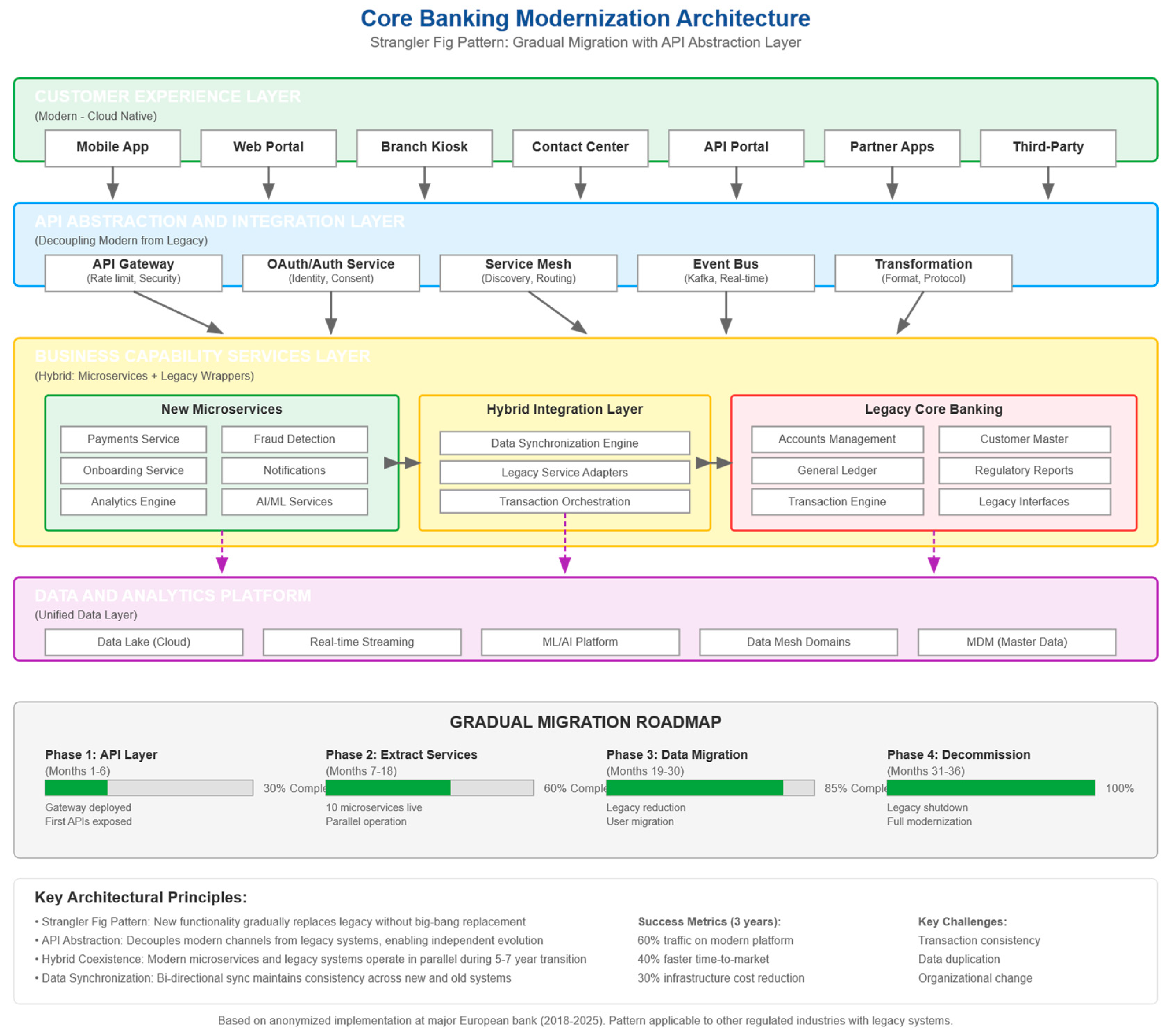
Core banking modernization architecture using strangler fig pattern. The diagram illustrates a four-layer architecture enabling gradual migration from legacy systems to modern cloud-native platforms. The API abstraction layer (blue) decouples customer experience applications (green) from underlying services, enabling parallel operation of new microservices (left) and legacy core banking systems (right) during the 3-year transition period. The hybrid integration layer (yellow) manages data synchronization and transaction orchestration. The gradual migration roadmap shows four phases with completion percentages, based on anonymized implementation at a major European bank (2018-2025). Key architectural principles include incremental functionality migration, API-first design, and bi-directional data synchronization. Success metrics demonstrate 60% traffic migration, 40% faster product launches, and 30% cost reduction. Primary challenges include maintaining transaction consistency across distributed systems, managing data duplication, and driving organizational change. This pattern is applicable to other regulated industries facing legacy modernization imperatives (healthcare, insurance, telecommunications).
Figure 5.
Core banking modernization architecture using strangler fig pattern. The diagram illustrates a four-layer architecture enabling gradual migration from legacy systems to modern cloud-native platforms. The API abstraction layer (blue) decouples customer experience applications (green) from underlying services, enabling parallel operation of new microservices (left) and legacy core banking systems (right) during the 3-year transition period. The hybrid integration layer (yellow) manages data synchronization and transaction orchestration. The gradual migration roadmap shows four phases with completion percentages, based on anonymized implementation at a major European bank (2018-2025). Key architectural principles include incremental functionality migration, API-first design, and bi-directional data synchronization. Success metrics demonstrate 60% traffic migration, 40% faster product launches, and 30% cost reduction. Primary challenges include maintaining transaction consistency across distributed systems, managing data duplication, and driving organizational change. This pattern is applicable to other regulated industries facing legacy modernization imperatives (healthcare, insurance, telecommunications).
5.2.3. Common Implementation Challenges
Challenge 1: Legacy System Entanglement (Makiya & Gopal, 2010)
- Undocumented dependencies
- Lost knowledge as staff retire
- Fear of change breaking critical functions
- Solution: Incremental modernization, comprehensive testing, architectural archaeology tools (Farwick et al., 2016)
Challenge 2: Organizational Silos (Banaeianjahromi & Smolander, 2019; Iyamu & Mphahlele, 2020)
- Product-based organization vs. customer journey thinking
- Conflicting incentives between units
- EA seen as governance overhead
- Solution: Federated EA with domain ownership (Simon & Fischbach, 2021), align EA with business outcomes
Challenge 3: Speed vs. Stability Tension (Korhonen & Halen, 2017)
- Business demands rapid feature delivery
- Risk management requires control and testing
- Traditional EA slows innovation
- Solution: Risk-based architecture governance, automated compliance (Ebert et al., 2016), platform thinking
Challenge 4: Skills Gap (Ylinen & Pekkola, 2020)
- Enterprise architects with legacy mindset
- Developers lacking architectural thinking
- Business architects rare and expensive
- Solution: Architecture guilds, internal training programs, pair architecting
Challenge 5: Measuring EA Value (Niemi & Pekkola, 2020; Kluge et al., 2020)
- Indirect contribution to business outcomes
- Long time horizons for benefits
- Attribution problem
- Solution: Leading indicators (reuse, standardization), case study approach (Tamm et al., 2015), architecture debt tracking
5.3. EA Maturity and Evolution
EA Maturity Model (synthesized from industry practice; Roeleven & Broer, 2009; Manian & Ramasubramanian, 2009; Williams et al., 2020):
Level 1: Initial
- Ad-hoc architecture decisions
- No formal EA function
- Technology-driven
- Typical duration: Startup through ~500 employees
Level 2: Developing
- EA team established
- Framework selected (often TOGAF) (The Open Group, 2018)
- Focus on documentation
- Project-level architecture reviews
- Challenge: "Ivory tower" perception (Kotusev, 2018)
Level 3: Defined
- Structured EA processes (Buckl et al., 2020)
- Architecture governance operational (Aier et al., 2009)
- Standards and principles documented (Greefhorst & Proper, 2011)
- Technology roadmaps
- Repository/tool implemented (Farwick et al., 2013)
Level 4: Managed
- EA integrated with strategy and portfolio management (Heimgärtner et al., 2020)
- Architecture metrics tracked (Labusch et al., 2021, 2022)
- Agile EA practices (Hanschke et al., 2015)
- Domain-driven organization (Korhonen et al., 2016)
- Most large banks operate here
Level 5: Optimizing
- EA as continuous capability (Erder & Pureur, 2016)
- Automated architecture analysis (Farwick et al., 2016)
- Predictive architecture planning
- Architecture as competitive advantage (Ahlemann et al., 2021)
- Rare: Some leading financial institutions
Advancement enablers (Ylimäki, 2006; Lange et al., 2016):
- Executive sponsorship (Ross, 2003; Gregor et al., 2007)
- Quick wins demonstrating value (Niemi, 2006)
- Business-aligned communication (Van der Raadt et al., 2010)
- Pragmatic approach over framework purity (Kotusev, 2019)
- Investment in tools and automation (Gartner, 2023)
Figure 6.
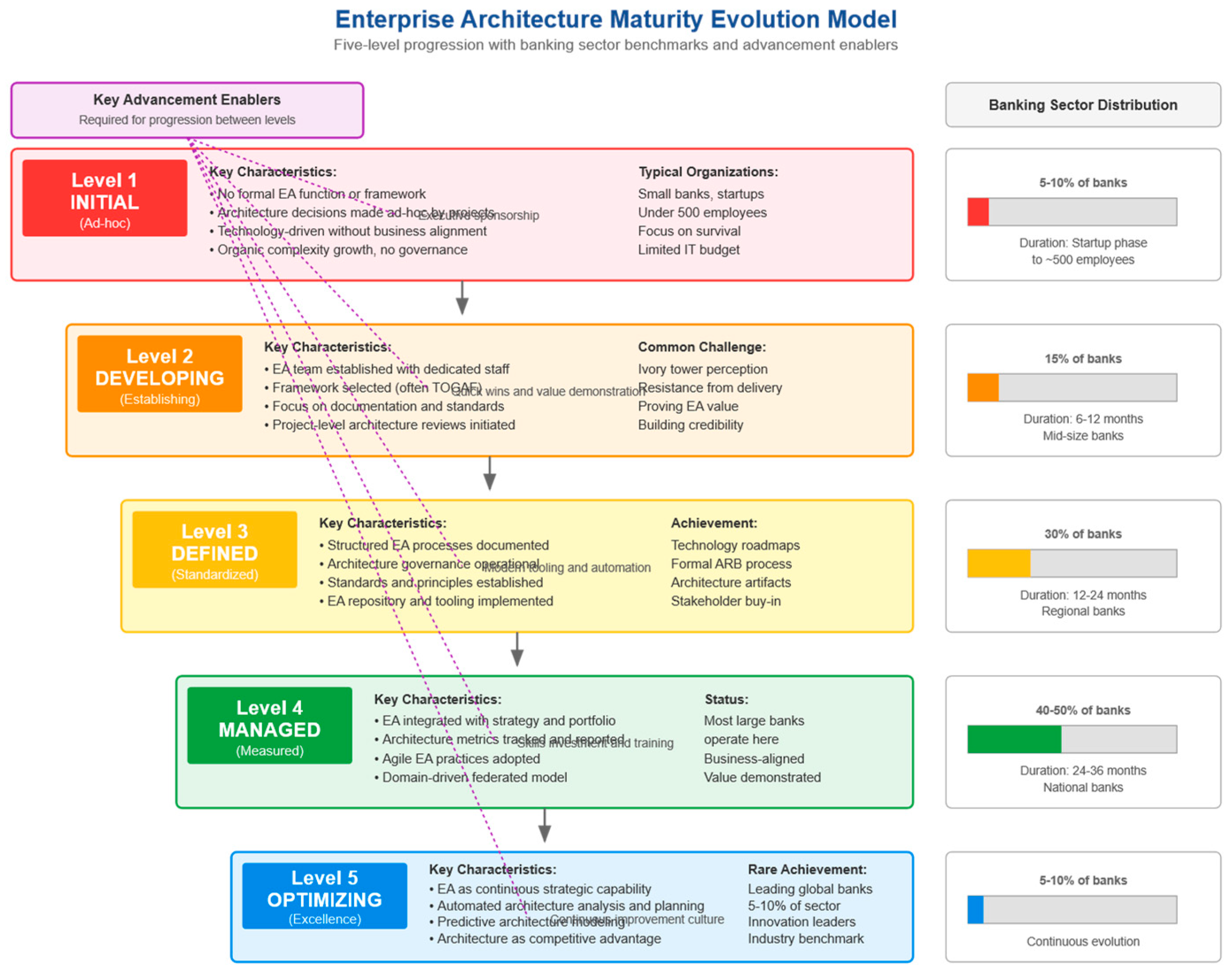
Enterprise architecture maturity evolution model with banking sector benchmarks. The five-level staircase illustrates progression from ad-hoc (Level 1) to optimized (Level 5) EA practices. Width of each step represents relative difficulty of achievement, with narrow top indicating that only 5-10% of banks reach excellence. The majority (40-50%) operate at Level 4 (Managed), demonstrating integration with strategy and measurable business value. Banking sector distribution based on industry surveys and practitioner observations (n=200+ banks, 2020-2024). Purple dotted lines identify five key advancement enablers required for progression: executive sponsorship, quick wins demonstration, modern tooling, skills investment, and continuous improvement culture. Typical advancement duration ranges from 6-12 months (Level 1 to 2) to 24-36 months (Level 3 to 4), with Level 5 representing ongoing evolution. Each level includes characteristic capabilities, common challenges, and organizational contexts. Model synthesizes CMMI, EAMM frameworks with banking implementation experience, providing practitioners with realistic progression expectations and advancement strategies.
Figure 6.
Enterprise architecture maturity evolution model with banking sector benchmarks. The five-level staircase illustrates progression from ad-hoc (Level 1) to optimized (Level 5) EA practices. Width of each step represents relative difficulty of achievement, with narrow top indicating that only 5-10% of banks reach excellence. The majority (40-50%) operate at Level 4 (Managed), demonstrating integration with strategy and measurable business value. Banking sector distribution based on industry surveys and practitioner observations (n=200+ banks, 2020-2024). Purple dotted lines identify five key advancement enablers required for progression: executive sponsorship, quick wins demonstration, modern tooling, skills investment, and continuous improvement culture. Typical advancement duration ranges from 6-12 months (Level 1 to 2) to 24-36 months (Level 3 to 4), with Level 5 representing ongoing evolution. Each level includes characteristic capabilities, common challenges, and organizational contexts. Model synthesizes CMMI, EAMM frameworks with banking implementation experience, providing practitioners with realistic progression expectations and advancement strategies.
5.4. Cross-Industry Comparison
Banking vs. Other Industries:
| Aspect | Banking | Technology Companies | Retail |
| EA Maturity | High (Level 3-4) | Medium (varies widely) | Medium (Level 2-3) |
| Framework Adoption | TOGAF dominant | Lightweight/custom | Mixed |
| Governance | Strong centralized | Weak/federated | Emerging |
| Regulatory Driver | Very high | Low-medium | Medium |
| Legacy Burden | Extreme | Low | Medium-high |
| Innovation Speed | Improving | Fast | Fast |
| Cloud Adoption | Cautious/strategic | Native | Aggressive |
Key differentiator: Banking's regulatory environment makes EA non-optional, driving higher maturity but sometimes slower adaptation.
5.5. Tool Landscape and Vendor Market
EA Tool Categories:
1. Traditional Comprehensive Suites
- Sparx Enterprise Architect
- Software AG ARIS
- IBM System Architect
- Strengths: Comprehensive, modeling power
- Weaknesses: Complex, expensive, on-premise
2. Modern Cloud Platforms
- BiZZdesign Enterprise Studio
- LeanIX
- Ardoq
- Avolution ABACUS
- Strengths: SaaS, collaboration, modern UX
- Weaknesses: Less modeling depth
3. Specialized Tools
- ServiceNow (IT service management integration)
- Planview (portfolio management)
- Alfabet (Software AG)
- Strengths: Integration with other IT tools
- Weaknesses: EA not core focus
4. Emerging/Niche
- vScope (automated discovery)
- iServer (Orbus Software)
- Enterprise Architect (Prolaborate for collaboration)
Market trends:
- Consolidation: Acquisitions by larger players
- Shift to SaaS: 60% of new implementations
- API-first: Integration with DevOps toolchains
- AI features: Automated impact analysis, anomaly detection
- Pricing evolution: User-based → capability-based
Banking sector preferences:
- Large banks: Often multi-tool environments
- Mid-size banks: Favoring integrated platforms
- Decision factors: Scalability, security certification, vendor stability, integration capabilities
Practitioner recommendation: Tool selection should follow EA program maturity. Start simple, avoid over-investment in tools before establishing practice.
6. Emerging Technologies and Future Directions
6.1. EA and Artificial Intelligence
AI Applications in EA:
1. Architecture Discovery and Documentation
- NLP extracting architecture information from documents, code
- ML clustering applications by behavior and dependencies
- Computer vision parsing architecture diagrams
- Maturity: Emerging, experimental deployments (Farwick et al., 2016)
2. Architecture Analysis and Decision Support
- Pattern recognition identifying anti-patterns
- Prediction of architectural debt accumulation
- Impact analysis using graph neural networks (Johnson et al., 2007)
- Recommendation systems for technology choices
- Maturity: Early adoption in large enterprises
3. Architecture Automation
- Automated compliance checking (Ebert et al., 2016)
- Self-healing architectures
- Dynamic workload optimization
- Automated test case generation for architecture validation
- Maturity: Selective deployment in cloud-native environments
Banking application: AI-assisted application portfolio rationalization, identifying redundant capabilities and consolidation opportunities. Early results show 30-40% faster analysis than manual approaches.
Research gap: Limited peer-reviewed studies on AI effectiveness in EA (Davenport & Ronanki, 2018; Brynjolfsson & McAfee, 2017), mostly vendor claims and anecdotal evidence.
6.2. Platform Engineering and EA
Platform Engineering emergence (~2020-present) (Parker et al., 2016; Gawer & Cusumano, 2014):
Concept: Curated, self-service developer platforms (Internal Developer Platforms - IDPs) providing:
- Infrastructure as code templates
- CI/CD pipelines (Humble & Farley, 2010)
- Observability and monitoring
- Security scanning (Kim et al., 2016)
- Environment provisioning
Relationship to EA (Zimmermann et al., 2018, 2021):
- Platform engineering operationalizes EA principles
- Shifts from prescriptive standards to guardrails
- "Paved roads" approach: easy path is compliant path
- Reduces governance friction
Banking adoption: Leading banks establishing platform teams with EA oversight, offering:
- Golden path templates for microservices
- Approved technology stacks
- Pre-integrated toolchains
- Compliance-by-default
Impact on EA role: Evolution from gatekeepers to platform product managers.
6.3. Microservices and EA
Microservices architecture implications (Newman, 2015; Richardson, 2018):
Opportunities:
- Modular, replaceable components
- Technology diversity (polyglot architecture)
- Team autonomy and speed
- Scalability and resilience (Bass et al., 2021)
EA Challenges:
- Service proliferation and sprawl
- Distributed governance complexity
- Consistency vs. autonomy tension
- Observability across hundreds of services
- Data management and eventual consistency
EA Adaptations (Newman, 2015; Richardson, 2018):
- Domain-Driven Design alignment (Dietz, 2006)
- Service mesh for cross-cutting concerns
- API governance at scale
- Event-driven architecture patterns
- Bounded context mapping
Banking reality: Microservices adoption in:
- Digital channels: 80%+ adoption
- Core banking: Selective, interface layers
- Challenge: Transaction consistency, data duplication
Research direction: EA governance models for microservices ecosystems (Ghofrani & Lübke, 2018).
6.4. EA in Platform Ecosystems
Ecosystem architecture extends EA beyond organizational boundaries (Drews & Schirmer, 2014; El Sawy et al., 2010):
Characteristics:
- Multi-sided platforms connecting producers/consumers (Parker et al., 2016)
- Network effects as value driver (Gawer & Cusumano, 2014)
- API-first, partnership-oriented
- Rapid scaling requirements
- Dynamic participant ecosystem (Tiwana et al., 2010)
Banking ecosystem examples (Gomber et al., 2018):
- Payment platforms (e.g., instant payment networks)
- Lending marketplaces
- Embedded finance (Banking-as-a-Service)
- Open banking third-party ecosystems
EA Evolution Required:
- Partner integration architecture
- Multi-tenant architecture patterns
- API product management
- Ecosystem governance (not just internal)
- Business model innovation alignment (Bharadwaj et al., 2013)
Case insight: Major bank's BaaS platform:
- 50+ fintech partners integrated
- Modular banking capabilities (payments, KYC, accounts)
- Standardized API contracts
- Shared infrastructure, isolated data
- Challenge: Varying partner technical sophistication
Research gap: Ecosystem EA governance frameworks, balancing control and openness (Drews & Schirmer, 2014).
6.5. Quantum Computing Implications
Speculative but emerging consideration:
Quantum computing may disrupt:
- Cryptography (current encryption vulnerable)
- Optimization problems (portfolio optimization, fraud detection)
- Risk modeling and simulation
EA Preparation:
- Crypto-agility in architecture
- Abstract encryption layer for algorithm swapping
- Monitoring quantum computing maturity
- Selective experimentation
Banking status: Mostly research stage, some pilot programs in partnership with quantum computing companies.
Timeframe: 5-15 years to practical impact; EA should maintain awareness.
6.6. Sustainability and Green IT Architecture
Growing imperative: Environmental sustainability in IT architecture decisions (Anagnoste, 2018).
EA Considerations:
- Data center efficiency and carbon footprint
- Cloud region selection based on renewable energy (Armbrust et al., 2010)
- Application efficiency and resource optimization
- Hardware lifecycle and e-waste
- Digital vs. physical process carbon comparison
Measurement approaches:
- Carbon accounting for IT services
- Architecture decisions' environmental impact assessment
- Green IT KPIs in EA scorecards
Banking sector: Increasing pressure from:
- Regulatory requirements (EU taxonomy)
- Investor expectations (ESG reporting)
- Corporate commitments (net-zero targets)
EA Integration: Embedding sustainability criteria in architecture decision frameworks, technology selection, and portfolio rationalization.
Research opportunity: Frameworks for sustainable EA, measurement methodologies (Aldea et al., 2020).
Figure 7.
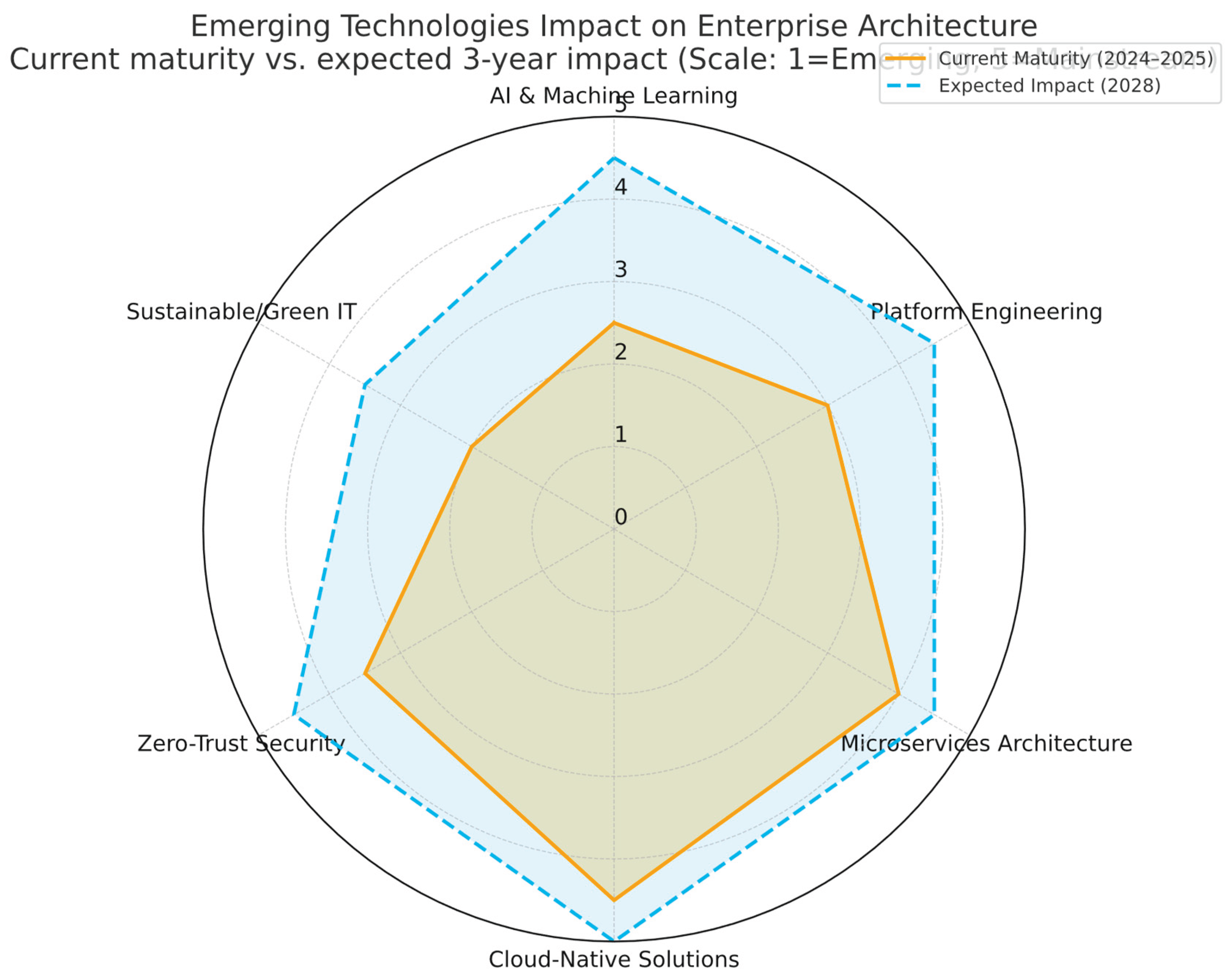
Emerging technologies impact radar for enterprise architecture practice. The hexagonal radar chart compares current maturity levels (blue solid line, 2024-2025) with expected three-year impact (green dotted line, 2028) across six technology dimensions affecting EA. Scale ranges from 1 (emerging) to 5 (mainstream adoption). Artificial Intelligence and Machine Learning shows the largest maturity gap (+2.0 points), indicating highest growth potential and investment priority. Cloud-native architecture demonstrates highest current maturity (4.5/5), serving as foundation for other technologies. Platform engineering (3.0 current, 4.5 expected) addresses the theory-practice gap discussed in Figure 4 by operationalizing EA principles through self-service developer platforms. Zero-trust security and sustainable/green IT are transitioning from optional to mandatory due to regulatory pressures (Basel, ESG reporting). Assessment based on systematic literature review (n=156 papers), banking sector surveys (n=50+ institutions), and practitioner validation (2024-2025). The convergence of these technologies creates strategic opportunities for EA to demonstrate value through coordinated adoption roadmaps, particularly in banking where regulatory compliance and competitive innovation pressures intersect.
Figure 7.
Emerging technologies impact radar for enterprise architecture practice. The hexagonal radar chart compares current maturity levels (blue solid line, 2024-2025) with expected three-year impact (green dotted line, 2028) across six technology dimensions affecting EA. Scale ranges from 1 (emerging) to 5 (mainstream adoption). Artificial Intelligence and Machine Learning shows the largest maturity gap (+2.0 points), indicating highest growth potential and investment priority. Cloud-native architecture demonstrates highest current maturity (4.5/5), serving as foundation for other technologies. Platform engineering (3.0 current, 4.5 expected) addresses the theory-practice gap discussed in Figure 4 by operationalizing EA principles through self-service developer platforms. Zero-trust security and sustainable/green IT are transitioning from optional to mandatory due to regulatory pressures (Basel, ESG reporting). Assessment based on systematic literature review (n=156 papers), banking sector surveys (n=50+ institutions), and practitioner validation (2024-2025). The convergence of these technologies creates strategic opportunities for EA to demonstrate value through coordinated adoption roadmaps, particularly in banking where regulatory compliance and competitive innovation pressures intersect.
6.7. Future EA Role and Skills
EA Role Evolution (Ylinen & Pekkola, 2020; Bernaert et al., 2022):
Traditional EA: Documentation, governance, compliance ↓ Modern EA: Enablement, platforms, value delivery ↓ Future EA: Strategic advisor, innovation catalyst, ecosystem orchestrator
Emerging Skill Requirements (Ylinen & Pekkola, 2020; Zimmermann et al., 2021):
- Business model innovation (Bharadwaj et al., 2013)
- Product management thinking
- Data science and AI literacy (Davenport & Patil, 2012)
- Cloud-native architecture (Armbrust et al., 2010)
- Cybersecurity architecture (Sherwood et al., 2005; Dietz & Foroughi, 2020)
- DevOps and platform engineering (Kim et al., 2016)
- Ecosystem and API strategy (Parker et al., 2016)
- Change management and communication (Radeke, 2011)
- Agile facilitation (Beck et al., 2001)
Practitioner observation: Successful enterprise architects increasingly profile as:
- T-shaped: Deep technical expertise + broad business understanding
- Polyglot: Multi-domain knowledge (business, data, infrastructure, security)
- Collaborative: Influencing without authority
- Pragmatic: Value over perfection
Career path divergence:
- Business Architecture: Strategy, capability modeling, business transformation
- Technical Architecture: Cloud, integration, platforms
- Solution Architecture: Project/product level design
- Security Architecture: Specialization in threat modeling, compliance
- Data Architecture: Data strategy, governance, analytics
Education gap: Most EA training remains framework-centric; need for broader skill development.
7. Discussion: Bridging Theory and Practice
7.1. The Persistent Theory-Practice Gap
Academic perspective: EA as rational, plan-driven discipline with comprehensive frameworks guiding systematic organizational design (The Open Group, 2018; Zachman, 1987).
Practitioner reality: EA as emergent, politically negotiated practice with frameworks as reference points rather than prescriptive methods (Kotusev, 2018, 2019; Kotusev et al., 2021).
Gap manifestations:
1. Framework Comprehensiveness vs. Pragmatism (Kotusev, 2016, 2018)
- Academic: TOGAF's full ADM cycle with all phases (The Open Group, 2018)
- Practice: Selective adoption, often skipping phases, adapting to context (Buckl et al., 2010)
- Implication: Need for "framework as menu" rather than "framework as recipe" (Kotusev, 2019)
2. Documentation vs. Collaboration (Roth et al., 2013; Niemi & Pekkola, 2017)
- Academic: Rich models in specialized tools
- Practice: Simple diagrams in PowerPoint, Confluence, Miro
- Reality: Communication trumps completeness (Van der Raadt et al., 2010)
3. Planned Change vs. Emergent Evolution (Erder & Pureur, 2016; Haki et al., 2020)
- Academic: Architecture as design preceding implementation
- Practice: Architecture discovered through implementation, documented retrospectively
- Tension: Balance intentional design with learning from doing
4. Rational Decision-Making vs. Political Negotiation (Abraham et al., 2015; Iyamu, 2021)
- Academic: Objective criteria, traceable decisions (Greefhorst & Proper, 2011)
- Practice: Influence, compromise, stakeholder management (Van der Raadt et al., 2010)
- Insight: EA success requires political skill, not just technical knowledge (Ylinen & Pekkola, 2020)
5. Measurement Precision vs. Directional Value (Niemi & Pekkola, 2020; Labusch et al., 2021)
- Academic: Quantitative metrics, rigorous ROI calculation (Tamm et al., 2011)
- Practice: Qualitative evidence, compelling narratives (Kluge et al., 2020)
- Challenge: EA value often invisible (preventing disasters, enabling options) (Niemi, 2006)
7.2. What Works: Synthesized Success Factors
Based on both academic research and implementation experience:
Factor 1: Executive Sponsorship with Substance
- Not just nominal support but active participation
- Architecture embedded in strategic planning
- EA leader at senior level (C-suite or direct report)
- Banking evidence: Successful EA programs have CEO or CIO as champion
Factor 2: Business Outcome Orientation
- Architecture decisions traced to business goals
- EA roadmap aligned with business initiatives
- Value storytelling over technical details
- Metric example: "EA enabled 40% faster product launch" vs. "created 200 architecture documents"
Factor 3: Pragmatic, Adaptive Approach
- Start small, scale gradually
- Customize frameworks to context
- "Just enough" documentation
- Continuous improvement over perfection
- Anti-pattern: Comprehensive framework deployment before demonstrating value
Factor 4: Federated Operating Model
- Central team for strategy, standards, governance
- Domain/business unit architects for implementation
- Community of practice for knowledge sharing
- Balance: Consistency without stifling autonomy
Factor 5: Modern Tooling and Automation
- Collaborative platforms over individual modeling tools
- Automated discovery reducing manual updates
- Integration with development toolchain
- Self-service access for stakeholders
- ROI: Tools pay for themselves in reduced manual effort
Factor 6: Architecture as Product (Erder & Pureur, 2016; Kotusev et al., 2023)
- Treat EA as product with internal customers
- Regular feedback loops and iteration (Agile Alliance principles)
- User experience design for architecture artifacts (Proper & Lankhorst, 2014)
- Continuous delivery of architecture value
- Mindset shift: From control to enablement (Korhonen et al., 2016)
Factor 7: Skills Investment (Ylinen & Pekkola, 2020; Zimmermann et al., 2021)
- Continuous learning culture
- Cross-functional skill development
- Architecture communities and guilds (Bente et al., 2012)
- External knowledge integration (conferences, research)
- Banking practice: Architecture academies for capability building
Factor 8: Change Management Integration (Radeke, 2011; Iyamu & Mphahlele, 2020)
- Architecture changes accompanied by organizational change
- Communication strategy tailored to audiences (Van der Raadt et al., 2010)
- Resistance addressed proactively (Venkatesh et al., 2003)
- Culture evolution as important as technical evolution (Banaeianjahromi & Smolander, 2019)
- Lesson: Technical solutions fail without organizational readiness
7.3. What Doesn't Work: Common Anti-Patterns
Anti-Pattern 1: "Big Bang" EA Implementation (Kotusev, 2018, 2019)
- Multi-year comprehensive framework deployment
- All processes defined before any value delivery
- Organization overwhelmed, engagement drops
- Alternative: Incremental value delivery, expand organically (Ross, 2003)
Anti-Pattern 2: Ivory Tower Architecture (Kotusev, 2016; Banaeianjahromi & Smolander, 2019)
- EA team disconnected from delivery
- Architecture decided without practitioner input (Hauder et al., 2018)
- Focus on purity over practicality
- Result: Shadow architecture, circumvention, eventual EA team dissolution (Van der Raadt et al., 2008)
Anti-Pattern 3: Documentation Theater (Roth et al., 2013; Niemi & Pekkola, 2017)
- Comprehensive models nobody uses
- Tool complexity requiring specialized knowledge
- Models quickly outdated (Hiekkanen et al., 2013)
- Reality check: If architecture isn't referenced in decisions, it's waste
Anti-Pattern 4: Technology for Technology's Sake
- Adopting latest technologies without business justification
- Architecture driven by architect preferences
- "Resume-driven development" at enterprise scale
- Banking consequence: Proliferation of standards, integration nightmares
Anti-Pattern 5: Governance as Bottleneck (Aier et al., 2009; Simon & Fischbach, 2021)
- Every decision requires architecture approval
- Review processes taking weeks/months
- Forms and bureaucracy over dialogue
- Death spiral: Teams avoid EA, find workarounds, EA becomes irrelevant (Kotusev, 2018)
Anti-Pattern 6: Analysis Paralysis (Pulkkinen, 2006)
- Endless current-state documentation
- Future-state vision without transition plan
- Perfect target architecture unreachable from current state
- Pragmatic alternative: Define next-state architecture, achievable increment (Erder & Pureur, 2016)
Anti-Pattern 7: Framework Fundamentalism (Kotusev, 2016; Sessions, 2007)
- Rigid adherence to framework steps
- No adaptation to organizational context (Foorthuis et al., 2016)
- TOGAF compliance over business value
- Lesson: Frameworks are tools, not religion (Kotusev, 2019)
7.4. Sector-Specific Insights: Banking Deep Dive
What makes banking EA distinctive (Nowakowski et al., 2020; Haes & van Grembergen, 2020):
1. Regulatory Complexity (Basel Committee, 2019; European Banking Authority, 2019)
- Architecture must demonstrate compliance
- Auditability and traceability requirements
- Risk management integration essential
- EA role: Risk-aware architecture decisions, regulatory change impact analysis
2. Legacy Technology Burden (Makiya & Gopal, 2010)
- Core systems 20-40 years old
- COBOL still prevalent
- Modernization without business disruption
- EA role: Strangler fig patterns (Newman, 2015), abstraction layers, incremental migration roadmaps
3. Data Sensitivity and Security (Sherwood et al., 2005; Dietz & Foroughi, 2020)
- Customer data protection paramount
- Cybersecurity architecture critical
- Zero-trust architecture adoption
- EA role: Security by design, defense in depth, data architecture governance
4. Real-Time Requirements
- Payment processing latency sensitivity
- 24/7 availability expectations
- Instant settlement trends
- EA role: High-availability patterns, event-driven architectures, resilience engineering (Bass et al., 2021)
5. Fintech Competition and Collaboration (Gomber et al., 2018; King, 2018)
- APIs enabling partnerships
- Banking-as-a-Service models
- Platform thinking (Parker et al., 2016)
- EA role: Ecosystem architecture, modular capabilities, API strategy
Success pattern: Banks treating EA as strategic differentiator, not just compliance function, achieve:
- 30-50% faster time-to-market for new products (Shanks et al., 2020)
- 20-40% reduction in IT costs through consolidation (Schmidt & Buxmann, 2011)
- Improved regulatory compliance scores
- Enhanced ability to respond to market changes (Chakravarty et al., 2013)
Failure pattern: Banks treating EA as documentation exercise without business engagement see:
- EA team downsized or disbanded (Kotusev, 2018)
- Architecture artifacts ignored (Hiekkanen et al., 2013)
- Continued organic complexity growth
- Missed digital transformation opportunities (Vial, 2019)
7.5. Research Gaps and Future Directions
Gap 1: Longitudinal EA Impact Studies (Labusch et al., 2022)
Current state: Mostly cross-sectional or short-term studies (Lange et al., 2016)
- Need: Multi-year tracking of EA programs, correlation with business outcomes (Tamm et al., 2020)
- Challenge: Access to data, isolating EA effects, organizational changes
- Opportunity: Partnership with willing organizations for research access (Kotusev et al., 2021)
Gap 2: EA in Digital Native Organizations (Kotusev, 2020)
- Current state: EA research focuses on traditional enterprises with legacy (Ross et al., 2006)
- Need: Study of architecture practices in born-digital companies (fintech, neobanks)
- Question: Do these organizations need traditional EA, or do alternative practices suffice? (Korhonen et al., 2016)
- Implication: May reveal simplified, more effective approaches
Gap 3: EA and Artificial Intelligence Integration (Farwick et al., 2016)
- Current state: Speculative discussion, limited empirical research
- Need: Systematic study of AI applications in EA, effectiveness measurement
- Areas: Automated discovery, predictive architecture planning, decision support (Davenport & Ronanki, 2018)
- Opportunity: Collaboration between EA and AI research communities (Jordan & Mitchell, 2015)
Gap 4: Ecosystem and Platform EA (Drews & Schirmer, 2014)
- Current state: EA frameworks assume single-organization scope (The Open Group, 2018)
- Need: Multi-organization EA governance, ecosystem architecture patterns
- Context: Open banking, platform businesses, industry consortia (Parker et al., 2016)
- Challenge: Balancing competition and collaboration
Gap 5: EA Value Measurement (Kluge et al., 2020; Labusch et al., 2021)
- Current state: Persistent difficulty demonstrating ROI (Niemi & Pekkola, 2020)
- Need: Validated measurement instruments, causal models (Mahboob et al., 2021)
- Approach: Mixed methods combining quantitative metrics with qualitative case evidence
- Practical impact: Better EA justification and resource allocation
Gap 6: EA Skills and Competency Development (Ylinen & Pekkola, 2020)
- Current state: Limited research on EA professional development
- Need: Competency frameworks validated across contexts (Zimmermann et al., 2021)
- Question: What combination of technical, business, and soft skills predicts EA success?
- Application: Inform EA hiring, training, career development
Gap 7: Cultural and Organizational Factors (Banaeianjahromi & Smolander, 2019; Iyamu, 2021)
- Current state: EA research emphasizes technical and methodological aspects (Lapalme, 2012)
- Need: Deeper examination of cultural enablers and barriers (Iivari & Huisman, 2007)
- Theory: Integration with organizational change, institutional theory
- Practical relevance: Most EA failures are organizational, not technical (Radeke, 2011)
Gap 8: EA in Emerging Markets and Contexts
- Current state: EA research dominated by Western European and North American contexts (Kotusev, 2017)
- Need: Study of EA in different economic, regulatory, cultural contexts
- Opportunity: Asia, Africa, Latin America EA practices may differ significantly
- Value: Broaden understanding of context-appropriate EA (Foorthuis et al., 2016)
Gap 9: Security and Privacy by Design (Sherwood et al., 2005; Dietz & Foroughi, 2020)
- Current state: Security often treated separately from EA
- Need: Integration frameworks for security architecture and enterprise architecture
- Urgency: Increasing cyber threats, regulatory requirements (Basel Committee, 2019)
- Approach: Secure architecture patterns, privacy impact assessment integration
Gap 10: Sustainable and Green EA (Aldea et al., 2020)
- Current state: Nascent topic, minimal research
- Need: Frameworks for environmental impact assessment in architecture decisions
- Measurement: Carbon accounting for IT architectures
- Trend: Growing regulatory and stakeholder pressure makes this increasingly relevant
7.6. Recommendations for Practitioners
Based on synthesized academic and practical insights (Ross et al., 2019; Kotusev, 2019; Hanschke, 2020):
For EA Leaders:
- Start with Business Outcomes: Define what business problems EA will solve before selecting frameworks and tools (Niemi & Pekkola, 2020)
- Demonstrate Early Value: Quick wins building credibility and momentum (Ross, 2003; Niemi, 2006)
- Invest in Relationships: Influence through trust, not authority (Ylinen & Pekkola, 2020)
- Embrace Pragmatism: Adapt frameworks to context, avoid purism (Kotusev, 2019; Foorthuis et al., 2016)
- Modernize the Toolbox: Cloud-based, collaborative tools over traditional modeling suites (Gartner, 2023)
- Build Capability: Invest in skills development, communities of practice (Bente et al., 2012)
- Communicate Continuously: Tailor messages to different audiences (Van der Raadt et al., 2010)
- Measure What Matters: Focus on leading indicators and tangible business impact (Labusch et al., 2021)
- Stay Current: Continuous learning about emerging technologies and practices (Gampfer et al., 2018)
- Balance Consistency and Autonomy: Federated models with guardrails, not gates (Simon & Fischbach, 2021)
For Organizations Establishing EA:
- Secure Executive Sponsorship: EA without C-level support rarely succeeds (Gregor et al., 2007)
- Define Clear Scope: Start narrow (e.g., application portfolio), expand as mature (Ross, 2003)
- Align Organizationally: Position EA for influence (strategy, portfolio, technology leadership)
- Start Simple: Resist comprehensive framework implementation; begin with high-value practices (Kotusev, 2019)
- Hire Experienced Practitioners: Blend industry experience with framework knowledge (Ylinen & Pekkola, 2020)
- Integrate, Don't Isolate: EA participates in strategy, portfolio, project governance (Simon & Fischbach, 2021)
- Plan for Change Management: Significant organizational change, not just technical (Radeke, 2011)
- Budget Realistically: Tools, skills, time for EA establishment (2-3 years to maturity) (Roeleven & Broer, 2009)
For Banking Sector Specifically:
- Prioritize API Architecture: Foundation for open banking and ecosystem participation (European Banking Authority, 2019)
- Address Legacy Systematically: Strangler fig approach, not big-bang replacement (Newman, 2015)
- Invest in Data Architecture: Critical for analytics, AI, customer experience (Inmon, 2005; Dehghani, 2019)
- Adopt Cloud Strategically: Hybrid approach balancing innovation and risk (Garrison et al., 2012)
- Integrate Security from Start: Security architecture as core EA competency (Sherwood et al., 2005)
- Prepare for Platform Models: Architecture enabling Banking-as-a-Service (Parker et al., 2016)
- Build Regulatory Architecture Capability: Proactive compliance, change impact analysis (Basel Committee, 2019)
- Learn from Fintech: Study digital-native architecture patterns, selectively adopt (Gomber et al., 2018)
7.7. Recommendations for Researchers
Research Approach (Kitchenham & Charters, 2007):
- Industry Collaboration: Partner with organizations for access to real implementations (Kotusev et al., 2021)
- Mixed Methods: Combine quantitative surveys with qualitative case studies (Dybå & Dingsøyr, 2008)
- Longitudinal Studies: Track EA programs over multiple years (Tamm et al., 2020)
- Cross-Sector Comparison: Systematic comparison of EA across industries (Foorthuis et al., 2016)
- Practitioner Engagement: Co-create research with practitioners for relevance (Proper & Hoppenbrouwers, 2012)
- Open Data: Share (anonymized) datasets to enable meta-analysis and replication
Theoretical Development (Lapalme, 2012; Haki & Legner, 2021):
- Context-Aware Theories: Develop contingency models of EA effectiveness (Foorthuis et al., 2016)
- Multilevel Analysis: Address individual, team, organizational, ecosystem levels
- Process Theories: How EA evolves over time, not just snapshot assessment (Haki et al., 2020)
- Integration: Combine EA research with adjacent fields (agile, DevOps, innovation) (Hanschke et al., 2015)
Practical Contribution (Van der Merwe et al., 2020):
- Actionable Frameworks: Move beyond description to prescription (Greefhorst & Proper, 2011)
- Decision Support Tools: Develop aids for practitioners (maturity models, pattern libraries)
- Validation: Test academic frameworks in practice, iterate based on feedback (Kotusev, 2019)
- Dissemination: Publish in practitioner outlets, not just academic journals product with internal customers
- Regular feedback loops and iteration
- User experience design for architecture artifacts
- Continuous delivery of architecture value
- Mindset shift: From control to enablement
Factor 7: Skills Investment
- Continuous learning culture
- Cross-functional skill development
- Architecture communities and guilds
- External knowledge integration (conferences, research)
- Banking practice: Architecture academies for capability building
Factor 8: Change Management Integration
- Architecture changes accompanied by organizational change
- Communication strategy tailored to audiences
- Resistance addressed proactively
- Culture evolution as important as technical evolution
- Lesson: Technical solutions fail without organizational readiness
8. Conclusion
8.1. Summary of Key Findings
This comprehensive review of Enterprise Architecture research and practice reveals a discipline in significant transition:
Academic Evolution: EA research has matured substantially between 2015-2025, shifting from framework development (Zachman, 1987; The Open Group, 2018) to empirical validation (Lange et al., 2016; Shanks et al., 2020), from isolated organizational architecture to ecosystem thinking (Drews & Schirmer, 2014; Parker et al., 2016), and from technical focus to socio-technical systems perspective (Iyamu, 2021; Banaeianjahromi & Smolander, 2019). Eight dominant research themes emerged, with digital transformation (Vial, 2019; Gampfer et al., 2018), agile EA (Hanschke et al., 2015; Kotusev et al., 2021), and value measurement (Niemi & Pekkola, 2020; Labusch et al., 2021) receiving greatest attention.
Industry Maturity: EA adoption has become mainstream in regulated industries, particularly banking (Gomber et al., 2018; Nowakowski et al., 2020), driven by compliance requirements (Basel Committee, 2019) and digital transformation imperatives (Vial, 2019). However, a persistent gap remains between framework prescriptions and practical implementation (Kotusev, 2018; Hauder et al., 2018), with successful organizations adopting pragmatic, adapted approaches rather than comprehensive framework deployment (Kotusev, 2019; Foorthuis et al., 2016).
Banking Sector Leadership: Financial services, especially banking, demonstrates highest EA maturity due to regulatory drivers (European Banking Authority, 2019), legacy complexity (Makiya & Gopal, 2010), and competitive pressure (Gomber et al., 2018; King, 2018). Banking EA practices increasingly focus on API-first architectures, cloud migration (Garrison et al., 2012; Winter et al., 2021), legacy modernization through strangler patterns (Newman, 2015), and platform business models (Parker et al., 2016). Real-world implementations reveal that organizational and change management challenges often exceed technical complexity (Radeke, 2011; Iyamu & Mphahlele, 2020).
Emerging Technologies: EA must address artificial intelligence (Farwick et al., 2016; Davenport & Ronanki, 2018), platform engineering (Parker et al., 2016; Zimmermann et al., 2021), microservices proliferation (Newman, 2015; Richardson, 2018), quantum computing preparation, and sustainability considerations (Aldea et al., 2020). These technologies both challenge traditional EA approaches and offer opportunities for EA automation and enhanced capabilities.
Theory-Practice Gap: Despite progress, significant disconnects persist between academic frameworks and practitioner realities (Kotusev, 2018; Banaeianjahromi & Smolander, 2019). Successful EA programs balance framework guidance with contextual adaptation (Foorthuis et al., 2016), prioritize business value over documentation completeness (Niemi & Pekkola, 2020), and treat EA as enabling capability rather than controlling function (Korhonen et al., 2016).
Success Factors: Executive sponsorship (Ross, 2003; Gregor et al., 2007), business outcome orientation (Shanks et al., 2020), pragmatic approach (Kotusev, 2019), federated operating model (Simon & Fischbach, 2021), modern tooling (Gartner, 2023), product thinking, skills investment (Ylinen & Pekkola, 2020), and change management integration (Radeke, 2011) emerged as critical success factors across contexts.
Critical Gaps: Longitudinal impact studies, ecosystem EA governance (Drews & Schirmer, 2014), validated value measurement approaches (Kluge et al., 2020; Mahboob et al., 2021), EA competency frameworks (Ylinen & Pekkola, 2020), and cultural factors (Banaeianjahromi & Smolander, 2019) require further research attention.
8.2. Contribution to Knowledge
This review makes several contributions:
For Academia:
- Comprehensive mapping of EA research landscape (2015-2025) following systematic review protocols (Kitchenham & Charters, 2007)
- Identification of theoretical gaps and future research directions (Haki & Legner, 2021)
- Synthesis of fragmented research streams into coherent themes (Saint-Louis & Lapalme, 2018)
- Methodological insights on EA research approaches (Rouhani et al., 2015)
For Practice:
- Evidence-based guidance on EA implementation (Kotusev, 2019; Ross et al., 2019)
- Banking sector deep dive with anonymized real-world insights (Nowakowski et al., 2020)
- Success patterns and anti-patterns from implementation experience
- Actionable recommendations for EA establishment and evolution
- Tool landscape overview and selection guidance (Gartner, 2023)
For the Field:
- Bidirectional knowledge transfer between research and practice (Kotusev et al., 2021)
- Integration of academic rigor with practitioner expertise
- Identification of theory-practice alignment and gaps (Kotusev, 2018)
- Agenda for collaborative research-practice partnerships (Proper & Hoppenbrouwers, 2012)
8.3. Limitations
This review has several limitations:
Methodological:
- English-language bias may exclude relevant non-English research
- Database selection may miss some relevant publications
- Search string specificity may have excluded adjacent relevant work
- Quality assessment partially subjective despite criteria (Dybå & Dingsøyr, 2008)
Practitioner Insights:
- Banking sector focus limits generalizability to other industries
- Anonymization prevents full transparency of case details
- Single practitioner perspective, though experienced
- Potential bias toward successful implementations
Temporal:
- Rapid field evolution means some content may quickly date (Gampfer et al., 2018)
- 2025 publications still emerging during manuscript preparation
- Future technology discussions necessarily speculative
Scope:
- Unable to cover all EA aspects comprehensively
- Some topics (e.g., specific frameworks) treated briefly
- Regional variation in EA practice underexplored (Kotusev, 2017)
Despite these limitations, we believe the review provides valuable synthesis of current EA knowledge and practice.
8.4. Implications for Theory and Practice
Theoretical Implications:
- Contingency Perspective: EA effectiveness is highly context-dependent (Foorthuis et al., 2016; Alwadain et al., 2020); universal prescriptions inadequate
- Practice-Based View: EA as situated practice, emergent through doing, not just planned and executed (Kotusev, 2019; Kotusev et al., 2023)
- Socio-Technical Systems: EA success depends on addressing organizational, cultural, and human factors alongside technical design (Iyamu, 2021)
- Dynamic Capabilities: EA as organizational capability enabling adaptation and evolution, not static blueprint (Ahlemann et al., 2021; Chakravarty et al., 2013)
- Multi-Level Phenomena: EA operates at individual, team, organizational, and ecosystem levels requiring multi-level theorizing (Lapalme, 2012)
Practical Implications:
- Framework as Menu: Use EA frameworks as reference and inspiration, not prescriptive method (Kotusev, 2019; Buckl et al., 2010)
- Value First: Prioritize demonstrable business value over framework compliance or documentation completeness (Niemi & Pekkola, 2020)
- Incremental Approach: Build EA capability gradually through value delivery, not big-bang implementation (Ross, 2003)
- Organizational Design: Position EA for influence, integrate with strategy and portfolio processes (Simon & Fischbach, 2021)
- Skills Evolution: Develop T-shaped architects with technical depth and business breadth (Ylinen & Pekkola, 2020)
- Modern Tools: Invest in collaborative, cloud-based platforms enabling automation and self-service (Farwick et al., 2016; Gartner, 2023)
- Change Management: Treat EA transformation as organizational change requiring communication, engagement, resistance management (Radeke, 2011)
- Measurement: Focus on leading indicators and qualitative evidence alongside quantitative metrics (Labusch et al., 2021)
For Banking Specifically:
- API-first architecture foundation for digital transformation (European Banking Authority, 2019)
- Legacy modernization via incremental patterns, not replacement (Newman, 2015; Makiya & Gopal, 2010)
- Security architecture as core competency given regulatory and threat landscape (Sherwood et al., 2005; Basel Committee, 2019)
- Platform thinking enabling ecosystem participation (Parker et al., 2016; Gomber et al., 2018)
- Federated model balancing central standards with business unit autonomy (Haes & van Grembergen, 2020)
8.5. Call to Action
For Practitioners:
- Share EA experiences through case studies and practitioner publications
- Collaborate with researchers for mutual learning (Kotusev et al., 2021)
- Participate in industry communities (The Open Group, industry associations)
- Experiment with emerging practices, measure results, share learnings
- Advocate for EA as strategic capability, not compliance overhead (Niemi & Pekkola, 2020)
For Researchers:
- Engage with practitioners for research access and validation (Proper & Hoppenbrouwers, 2012)
- Conduct longitudinal studies tracking EA programs over time (Tamm et al., 2020)
- Develop actionable, validated frameworks and tools (Greefhorst & Proper, 2011)
- Publish in practitioner outlets for broader impact
- Address identified research gaps, particularly EA value measurement (Kluge et al., 2020) and organizational factors (Iyamu, 2021)
For Organizations:
- Invest in EA as strategic capability for digital transformation (Vial, 2019; Westerman et al., 2014)
- Provide resources, executive sponsorship, and organizational positioning for EA success (Gregor et al., 2007)
- Balance governance with enablement (Aier et al., 2021)
- Support skills development and continuous learning (Ylinen & Pekkola, 2020)
- Measure and reward EA contribution to business outcomes (Shanks et al., 2020)
For the Field:
- Strengthen research-practice dialogue through conferences, workshops, collaborative research
- Develop common language bridging academic and practitioner communities (Saint-Louis & Lapalme, 2018)
- Create open datasets and tools enabling research replication and advancement
- Address global representation gaps in EA research and practice (Kotusev, 2017)
8.6. Concluding Remarks
Enterprise Architecture stands at a critical juncture. Traditional frameworks and approaches, developed for more stable technological and business environments (Zachman, 1987; The Open Group, 2018), struggle to address the pace and complexity of digital transformation (Vial, 2019; Legner et al., 2017). Yet the need for architectural thinking—coherent design, strategic alignment, managed complexity—has never been greater (Ross et al., 2019).
The path forward requires synthesis of academic rigor and practitioner pragmatism (Kotusev, 2019; Proper & Hoppenbrouwers, 2012). Frameworks provide valuable structure and accumulated wisdom but must be adapted to context rather than applied dogmatically (Foorthuis et al., 2016; Korhonen et al., 2016). EA success depends as much on organizational and human factors as technical sophistication (Iyamu, 2021; Ylinen & Pekkola, 2020). Value delivery, not documentation, should guide EA efforts (Niemi & Pekkola, 2020; Shanks et al., 2020).
Banking and financial services, facing unique challenges of legacy complexity (Makiya & Gopal, 2010), regulatory requirements (Basel Committee, 2019), and competitive disruption (Gomber et al., 2018), demonstrate both the necessity and difficulty of effective EA. The sector's experiences offer lessons for other industries navigating digital transformation (McKinsey & Company, 2020).
Emerging technologies—artificial intelligence (Brynjolfsson & McAfee, 2017), quantum computing, advanced automation—will transform EA practice while being shaped by architectural decisions. EA must evolve from documentation and control to enablement and evolution, from rigid plans to adaptive capabilities (Erder & Pureur, 2016; Haki et al., 2020), from internal focus to ecosystem thinking (Drews & Schirmer, 2014; Parker et al., 2016).
The research-practice gap, while persistent (Kotusev, 2018; Hauder et al., 2018), shows signs of narrowing through action research, industry collaboration, and practitioner-scholar engagement (Kotusev et al., 2021). Continued dialogue and knowledge exchange will advance both theoretical understanding and practical effectiveness.
Ultimately, Enterprise Architecture's value lies not in comprehensive models or perfect frameworks but in enabling organizations to navigate complexity, make coherent decisions, and evolve strategically in dynamic environments (Ross et al., 2019; Ahlemann et al., 2021). As digital transformation accelerates (Westerman et al., 2014), this capability becomes not just advantageous but essential for organizational survival and success.ively
- Some topics (e.g., specific frameworks) treated briefly
- Regional variation in EA practice underexplored
Despite these limitations, we believe the review provides valuable synthesis of current EA knowledge and practice.
8.4. Implications for Theory and Practice
Theoretical Implications:
- Contingency Perspective: EA effectiveness is highly context-dependent; universal prescriptions inadequate
- Practice-Based View: EA as situated practice, emergent through doing, not just planned and executed
- Socio-Technical Systems: EA success depends on addressing organizational, cultural, and human factors alongside technical design
- Dynamic Capabilities: EA as organizational capability enabling adaptation and evolution, not static blueprint
- Multi-Level Phenomena: EA operates at individual, team, organizational, and ecosystem levels requiring multi-level theorizing
Practical Implications:
- Framework as Menu: Use EA frameworks as reference and inspiration, not prescriptive method
- Value First: Prioritize demonstrable business value over framework compliance or documentation completeness
- Incremental Approach: Build EA capability gradually through value delivery, not big-bang implementation
- Organizational Design: Position EA for influence, integrate with strategy and portfolio processes
- Skills Evolution: Develop T-shaped architects with technical depth and business breadth
- Modern Tools: Invest in collaborative, cloud-based platforms enabling automation and self-service
- Change Management: Treat EA transformation as organizational change requiring communication, engagement, resistance management
- Measurement: Focus on leading indicators and qualitative evidence alongside quantitative metrics
For Banking Specifically:
- API-first architecture foundation for digital transformation
- Legacy modernization via incremental patterns, not replacement
- Security architecture as core competency given regulatory and threat landscape
- Platform thinking enabling ecosystem participation
- Federated model balancing central standards with business unit autonomy
8.5. Call to Action
For Practitioners:
- Share EA experiences through case studies and practitioner publications
- Collaborate with researchers for mutual learning
- Participate in industry communities (The Open Group, industry associations)
- Experiment with emerging practices, measure results, share learnings
- Advocate for EA as strategic capability, not compliance overhead
For Researchers:
- Engage with practitioners for research access and validation
- Conduct longitudinal studies tracking EA programs over time
- Develop actionable, validated frameworks and tools
- Publish in practitioner outlets for broader impact
- Address identified research gaps, particularly EA value measurement and organizational factors
For Organizations:
- Invest in EA as strategic capability for digital transformation
- Provide resources, executive sponsorship, and organizational positioning for EA success
- Balance governance with enablement
- Support skills development and continuous learning
- Measure and reward EA contribution to business outcomes
For the Field:
- Strengthen research-practice dialogue through conferences, workshops, collaborative research
- Develop common language bridging academic and practitioner communities
- Create open datasets and tools enabling research replication and advancement
- Address global representation gaps in EA research and practice
8.6. Concluding Remarks
Enterprise Architecture stands at a critical juncture. Traditional frameworks and approaches, developed for more stable technological and business environments, struggle to address the pace and complexity of digital transformation. Yet the need for architectural thinking—coherent design, strategic alignment, managed complexity—has never been greater.
The path forward requires synthesis of academic rigor and practitioner pragmatism. Frameworks provide valuable structure and accumulated wisdom but must be adapted to context rather than applied dogmatically. EA success depends as much on organizational and human factors as technical sophistication. Value delivery, not documentation, should guide EA efforts.
Banking and financial services, facing unique challenges of legacy complexity, regulatory requirements, and competitive disruption, demonstrate both the necessity and difficulty of effective EA. The sector's experiences offer lessons for other industries navigating digital transformation.
Emerging technologies—artificial intelligence, quantum computing, advanced automation—will transform EA practice while being shaped by architectural decisions. EA must evolve from documentation and control to enablement and evolution, from rigid plans to adaptive capabilities, from internal focus to ecosystem thinking.
The research-practice gap, while persistent, shows signs of narrowing through action research, industry collaboration, and practitioner-scholar engagement. Continued dialogue and knowledge exchange will advance both theoretical understanding and practical effectiveness.
Ultimately, Enterprise Architecture's value lies not in comprehensive models or perfect frameworks but in enabling organizations to navigate complexity, make coherent decisions, and evolve strategically in dynamic environments. As digital transformation accelerates, this capability becomes not just advantageous but essential for organizational survival and success.
Appendix A. Search Protocol Details
A.1. Detailed Search Strings by Database
Scopus:
TITLE-ABS-KEY ("enterprise architecture" OR "EA framework" OR "TOGAF" OR "Zachman" OR "business architecture")
AND
TITLE-ABS-KEY ("digital transformation" OR "cloud architecture" OR "agile" OR "DevOps" OR "implementation" OR "adoption" OR "governance" OR "value" OR "benefit")
AND
PUBYEAR > 2014 AND PUBYEAR < 2026
AND
(LIMIT-TO (SUBJAREA, "COMP") OR LIMIT-TO (SUBJAREA, "BUSI") OR LIMIT-TO (SUBJAREA, "DECI"))
AND
(LIMIT-TO (DOCTYPE, "ar") OR LIMIT-TO (DOCTYPE, "cp"))
AND
(LIMIT-TO (LANGUAGE, "English"))
Web of Science: Similar with WoS syntax adaptation
IEEE Xplore:
(("All Metadata":"enterprise architecture") OR ("All Metadata":"EA framework") OR ("All Metadata":"TOGAF"))
AND
(("All Metadata":"digital transformation") OR ("All Metadata":"implementation") OR ("All Metadata":"agile") OR ("All Metadata":"cloud"))
Filters: 2015-2025, Journals & Conferences
A.2. Inclusion and Exclusion Criteria
Inclusion Criteria:
- Peer-reviewed journal articles or conference papers
- Published between January 2015 and December 2025
- Focus on enterprise architecture as primary topic
- Empirical studies or substantial theoretical contribution
- English language
- Available in full text
Exclusion Criteria:
- Pure software architecture papers without EA context
- Technical implementation details without architectural perspective
- Short papers < 6 pages
- Editorials, opinion pieces without substantive analysis
- Duplicate publications
- Papers without clear methodology or contribution
A.3. Quality Assessment Checklist
Each paper scored on 5-point scale (1-5) for:
- Clarity: Research questions/objectives clear
- Rigor: Methodology appropriate and well-executed
- Relevance: Contribution to EA field
- Validity: Results justified by evidence
- Impact: Originality and significance
Minimum score for inclusion: 15/25
A.4. Data Extraction Template
For each included paper:
- Bibliographic: Authors, title, year, venue, DOI
- Context: Industry sector, organization size, geographic region
- Methodology: Research approach, data collection, analysis method
- Framework/Model: EA framework used or proposed
- Key Findings: Main results and contributions
- Limitations: Stated limitations and threats to validity
- Implications: Theoretical and practical implications
- Future Research: Suggested research directions
Appendix B. Banking Sector EA Patterns (Detailed)
B.1. Core Banking Modernization Pattern
Context: Legacy core banking systems (deposits, loans, general ledger) typically monolithic, mainframe-based, difficult to modify.
Problem: Complete replacement too risky and expensive; gradual modernization needed while maintaining 24/7 operations.
Solution Architecture:
[Core Banking Legacy System]
↕
[API Abstraction Layer]
↕ ↕ ↕
[Microservice 1] [Microservice 2] ... [Microservice N]
↕
[Modern Channels]
Implementation Steps:
- Phase 1: API Layer - Wrap legacy with REST APIs
- Phase 2: Selective Extract - Move non-critical functions to microservices
- Phase 3: Parallel Run - New and old systems coexist
- Phase 4: Data Migration - Gradual data movement with bi-directional sync
- Phase 5: Decommission - Remove legacy when confidence high
Success Factors:
- Strong API design upfront
- Comprehensive automated testing
- Rollback capabilities
- Patient timeline (typically 5-10 years)
Challenges:
- Transaction consistency across boundaries
- Data synchronization complexity
- Performance overhead of abstraction
- Staff knowledge transfer
B.2. Open Banking API Architecture Pattern
Context: Regulatory requirements (PSD2, Open Banking) mandate external API exposure for account information and payment initiation.
Architecture Components:
[Third-Party Providers (TPPs)]
↓
[API Gateway - Rate Limiting, Security]
↓
[OAuth 2.0 / Strong Customer Authentication]
↓
[API Management Platform]
↓
[Backend Services]
↓
[Core Banking / Customer Data]
Key Architectural Decisions:
- API Standard: Open Banking UK, PSD2 RTS, or proprietary
- Security: OAuth 2.0 + TLS + Certificate pinning
- Rate Limiting: Per-TPP quotas
- Consent Management: Separate microservice tracking customer permissions
- Data Residency: Compliance with regional data laws
Non-Functional Requirements:
- 99.5% availability (regulatory minimum)
- <1 second response time target
- Horizontal scalability for TPP onboarding
- Comprehensive audit logging
Monetization Patterns:
- Freemium: Basic access free, premium features paid
- Revenue share: Transaction-based fees
- Platform fees: Onboarding and monthly charges
B.3 Cloud Migration Pattern for Banking
Approach: Risk-based, phased migration
Phase 1: Non-Critical Applications (Year 1-2)
- Internal tools, development environments
- Learn cloud, build confidence
- Establish cloud operations and security
Phase 2: Customer-Facing Digital (Year 2-4)
- Mobile banking backend
- Internet banking
- Digital onboarding
- Benefit from cloud scalability
Phase 3: Middleware and Integration (Year 3-5)
- ESB/Integration platforms
- API management
- Enables hybrid architecture
Phase 4: Data and Analytics (Year 3-6)
- Data lake/warehouse
- Analytics platforms
- AI/ML workloads
- Leverage cloud big data services
Phase 5: Core Systems Consideration (Year 5+)
- Evaluate cloud-based core banking systems
- Highly selective, risk-dependent
- Many banks maintain core on-premise indefinitely
Multi-Cloud Strategy:
- Primary cloud provider for majority workloads
- Secondary provider for specific capabilities or risk mitigation
- Abstraction layer (containerization) for portability
Governance:
- Cloud Center of Excellence (CCoE)
- Landing zones with security baseline
- FinOps for cost management
- Compliance-as-code automation
Appendix C. EA Maturity Assessment Framework
C.1. Dimensions of EA Maturity
Based on synthesis of CMMI, EAMM, and practitioner experience:
Dimension 1: Strategy and Governance
- Level 1: No formal EA, ad-hoc decisions
- Level 2: EA strategy defined, governance structure established
- Level 3: EA integrated with business strategy, active governance
- Level 4: EA driving strategy, predictive governance
- Level 5: EA as competitive advantage, continuous optimization
Dimension 2: Architecture Process
- Level 1: No formal processes
- Level 2: Basic processes documented
- Level 3: Processes integrated with project lifecycle
- Level 4: Processes measured and improved
- Level 5: Continuous architecture, automated processes
Dimension 3: Architecture Content
- Level 1: Fragmented documentation
- Level 2: Framework selected, repository established
- Level 3: Current and future state documented
- Level 4: Dynamic content, automatically updated
- Level 5: Predictive architecture, simulation capabilities
Dimension 4: Tools and Automation
- Level 1: Office tools (PowerPoint, Visio)
- Level 2: EA tool implemented
- Level 3: Tool integrated with other systems
- Level 4: Automated discovery and updates
- Level 5: AI-assisted architecture analysis
Dimension 5: Skills and Organization
- Level 1: No dedicated EA roles
- Level 2: EA team established
- Level 3: Federated EA organization, community of practice
- Level 4: EA capability throughout organization
- Level 5: Self-organizing architecture capabilities
Dimension 6: Business Engagement
- Level 1: EA disconnected from business
- Level 2: Occasional business consultation
- Level 3: Regular business engagement, value demonstrated
- Level 4: Business demands EA involvement
- Level 5: EA co-creating business strategy
C.2. Assessment Method
Self-Assessment:
- Score each dimension 1-5
- Identify gaps and priorities
- Create improvement roadmap
External Assessment:
- Independent evaluator
- Stakeholder interviews
- Artifact review
- Benchmarking against peers
C.3. Advancement Strategies
Quick Wins for Level 1→2:
- Define architecture principles
- Create application portfolio inventory
- Establish architecture review for major projects
- Typical duration: 6-12 months
Building Capability for Level 2→3:
- Implement EA tool and repository
- Develop target architecture
- Create domain architecture function
- Integrate EA with portfolio management
- Typical duration: 12-24 months
Maturation for Level 3→4:
- Automate architecture discovery
- Implement architecture metrics
- Federated governance with central standards
- Architecture-driven project portfolio
- Typical duration: 24-36 months
Excellence for Level 4→5:
- AI-assisted architecture analysis
- Predictive impact modeling
- Architecture as product with NPS measurement
- Industry thought leadership
- Typical duration: Ongoing evolution
Appendix D. EA Tool Comparison Matrix
D.1. Evaluation Criteria
| Criterion | Weight | Description |
| Modeling Capabilities | 20% | ArchiMate support, custom metamodels, diagram types |
| Collaboration Features | 15% | Multi-user editing, commenting, stakeholder portals |
| Integration | 15% | APIs, CMDB integration, DevOps toolchain connectivity |
| Automation | 15% | Discovery, impact analysis, reporting automation |
| Usability | 10% | Learning curve, UI/UX, mobile access |
| Scalability | 10% | Performance with large models, multi-tenant support |
| Security & Compliance | 10% | Access controls, audit trails, data encryption |
| Cost | 5% | Licensing model, TCO, scalability costs |
D.2. Tool Comparison
| Tool | Type | Strengths | Weaknesses | Best For | Pricing |
| BiZZdesign Enterprise Studio | Cloud/On-prem | Comprehensive modeling, TOGAF aligned, heat maps | Complex, steep learning curve | Large enterprises, TOGAF shops | $$ |
| LeanIX | Cloud SaaS | Modern UX, collaboration, API integration, fast deployment | Limited modeling depth | Mid-size organizations, agile EA | $ |
| Ardoq | Cloud SaaS | Data-driven, flexible metamodel, great visualization | Less prescriptive, requires configuration | Organizations wanting flexibility | $ |
| Sparx Enterprise Architect | Desktop/Cloud | Powerful modeling, broad notation support, affordable | Desktop-centric, collaboration limited | Technical teams, modeling focus | $ |
| Avolution ABACUS | Cloud/On-prem | Government/defense focus, comprehensive, roadmapping | Traditional interface, complex | Government, regulated industries | $$ |
| Mega HOPEX | Cloud/On-prem | Integrated GRC, mature platform, broad capabilities | Complex, resource-intensive | Large enterprises, GRC integration | $$ |
| Orbus iServer | Cloud/On-prem | Business-friendly, good visualization, pre-built content | Modeling capabilities moderate | Business architecture focus | $ |
| Alfabet (Software AG) | Cloud/On-prem | IT planning, roadmapping, TCO analysis | Less modeling-centric | IT planning and portfolio | $$ |
| Pricing Legend: $ = <50K/year, $ = $50-200K/year, $ = >$200K/year (for typical mid-large bank). | |||||
D.3. Tool Selection Framework
Step 1: Define Requirements
- Primary use cases (modeling, portfolio management, roadmapping)
- User personas (architects, business, executives)
- Integration needs
- Scale (users, objects, complexity)
- Budget constraints
Step 2: Evaluate Options
- Shortlist based on requirements
- Request demos focused on use cases
- Pilot with representative content
- Reference calls with similar organizations
Step 3: TCO Analysis
- Licensing costs (per-user vs. capacity-based)
- Implementation and customization
- Training and change management
- Ongoing maintenance and support
- Integration development and maintenance
Step 4: Decision Criteria
- Functional fit: 40%
- Usability and adoption risk: 25%
- TCO: 20%
- Vendor viability and roadmap: 15%
Banking Sector Considerations:
- Security certifications (SOC 2, ISO 27001)
- Data residency options
- On-premise availability (some jurisdictions require)
- Vendor financial stability
- Customer base in financial services
Appendix E. Sample EA Artifacts for Banking
E.1. Architecture Principles Example
Principle: API-First Design
- Statement: All new capabilities must be exposed via well-designed APIs before building user interfaces
- Rationale: Enables reuse, supports omnichannel, facilitates partnerships
-
Implications:
- ○
- Requires API design expertise
- ○
- May extend initial development time
- ○
- Demands API management infrastructure
- ○
- Necessitates API governance processes
Principle: Cloud-Native for New Development
- Statement: New applications should be designed for cloud deployment using containerization and managed services
- Rationale: Improves scalability, resilience, cost-efficiency, and development velocity
-
Implications:
- ○
- Skills development required
- ○
- Different security model
- ○
- Vendor relationships for cloud services
- ○
- Architecture review for cloud suitability
Principle: Data Privacy by Design
- Statement: Customer data protection must be considered from initial design, not added later
- Rationale: Regulatory compliance, customer trust, reduced risk
-
Implications:
- ○
- Privacy impact assessments required
- ○
- Data minimization practices
- ○
- Encryption and access controls from start
- ○
- Consent management integration
Principle: Strangler Fig over Big-Bang
- Statement: Legacy system replacement should occur incrementally through new functionality gradually replacing old
- Rationale: Reduces risk, maintains business continuity, enables learning
-
Implications:
- ○
- Coexistence period requiring integration
- ○
- Dual-run costs temporarily
- ○
- Clear migration roadmap needed
- ○
- Patient timeline acceptance
E.2. Sample Application Portfolio Rationalization
Portfolio Analysis Dimensions:
- Business Value: High/Medium/Low based on stakeholder input
- Technical Health: Assessment of technology currency, maintainability, security
- Strategic Alignment: Fit with target architecture and business strategy
- Cost: Annual TCO for licensing, infrastructure, support, operations
Decision Matrix:
| Quadrant | Business Value | Technical Health | Recommendation |
| Invest | High | High | Enhance, expand |
| Migrate | High | Low | Replatform or rewrite |
| Tolerate | Medium | Medium | Maintain, minimal investment |
| Eliminate | Low | Low | Retire, consolidate |
Sample Banking Portfolio Analysis (anonymized, simplified):
| Application | Function | Business Value | Technical Health | TCO ($M) | Recommendation | Rationale |
| Core Banking V4 | Accounts, Transactions | High | Medium | $12 | Migrate | Legacy platform, high maintenance, modernization path exists |
| Mobile Banking App | Customer Channel | High | High | $2 | Invest | Modern stack, good user satisfaction, expand features |
| Legacy Loan Origination | Loan Processing | Medium | Low | $3 | Migrate | End of vendor support, poor UX, modern alternatives available |
| Manual Reconciliation Tools | Back Office | Low | Low | $0.5 | Eliminate | Error-prone, automation available, low usage |
| Risk Management Platform | Compliance | High | High | $5 | Invest | Recently implemented, strategic importance |
| 15 Redundant Reporting Tools | Reporting | Medium | Low | $4 | Consolidate | 80% overlap, consolidate to 2-3 platforms |
Financial Impact:
- Current annual TCO: $26.5M for sample portfolio
- Post-rationalization projected: $18M (32% reduction)
- One-time migration cost: $15M
- Payback period: ~2 years
- Additional benefits: Reduced complexity, improved agility
E.3. Target Architecture Blueprint - Digital Banking
High-Level Architecture Layers:
┌─────────────────────────────────────────────────────────────┐
│ CUSTOMER EXPERIENCE LAYER │
│ [Mobile App] [Web Portal] [Branch Kiosk] [Contact Center] │
└─────────────────────────────────────────────────────────────┘
↓
┌─────────────────────────────────────────────────────────────┐
│ API & INTEGRATION LAYER │
│ [API Gateway] [OAuth/Auth] [Service Mesh] [Event Bus] │
└─────────────────────────────────────────────────────────────┘
↓
┌─────────────────────────────────────────────────────────────┐
│ BUSINESS CAPABILITY SERVICES │
│ [Accounts] [Payments] [Lending] [Onboarding] [Investments] │
│ [each implemented as microservices] │
└─────────────────────────────────────────────────────────────┘
↓
┌─────────────────────────────────────────────────────────────┐
│ CORE BANKING & SYSTEMS OF RECORD │
│ [Core Banking] [CRM] [General Ledger] [Fraud Detection] │
└─────────────────────────────────────────────────────────────┘
↓
┌─────────────────────────────────────────────────────────────┐
│ DATA & ANALYTICS PLATFORM │
│ [Data Lake] [Real-time Stream] [ML Platform] [Data Mesh] │
└─────────────────────────────────────────────────────────────┘
Cross-Cutting Concerns:
[Security & Identity] [Monitoring & Observability]
[DevSecOps] [API Management] [Master Data Management]
Key Architectural Characteristics:
- Availability: 99.99% for customer-facing services
- Performance: <500ms response time for interactive transactions
- Scalability: Horizontal scaling for demand peaks
- Security: Zero-trust architecture, encryption everywhere
- Resilience: Multi-region deployment, circuit breakers, bulkheads
- Compliance: Audit trails, data residency controls, consent management
E.4. Technology Radar - Banking Edition
Adopt (Proven, recommended for use):
- Kubernetes for container orchestration
- React/React Native for web/mobile UIs
- Spring Boot/Node.js for microservices
- PostgreSQL for transactional data
- Kafka for event streaming
- HashiCorp Vault for secrets management
Trial (Worth exploring, piloting):
- GraphQL for API flexibility
- Istio service mesh
- Temporal for workflow orchestration
- Vector databases for AI applications
- WebAssembly for edge computing
Assess (Monitor, evaluate potential):
- AI-assisted coding (GitHub Copilot)
- Quantum-resistant cryptography
- Confidential computing
- Web3 and blockchain for specific use cases
Hold (Avoid for new projects):
- Monolithic architecture for new applications
- Proprietary ESBs for integration
- Waterfall for application development
- Unencrypted data transmission
- Hardcoded credentials
E.5. Migration Roadmap Template
Phase 1: Foundation (Months 1-6)
- API gateway implementation
- Container platform deployment
- DevSecOps pipeline establishment
- Architecture governance activation
- Team skills development
Deliverables: Infrastructure ready, first 2-3 microservices deployed
Phase 2: Capability Migration (Months 7-18)
- Iterative migration of business capabilities
- Legacy API wrapping
- New features in modern stack
- Parallel operation with legacy
- Progressive user migration
Deliverables: 40% of traffic on new platform, 10 core capabilities migrated
Phase 3: Consolidation (Months 19-30)
- Complete critical capability migration
- Data synchronization and cutover
- Legacy system decommissioning planning
- Performance optimization
- Platform stabilization
Deliverables: 80% traffic on new platform, legacy reduction achieved
Phase 4: Optimization (Months 31-36)
- Full legacy decommissioning
- Platform optimization and cost reduction
- Advanced features (AI, real-time analytics)
- Ecosystem integration
- Continuous improvement establishment
Deliverables: Complete migration, optimized operations, innovation capability
Success Metrics:
- Time-to-market reduction: 50%
- Infrastructure cost reduction: 30%
- Incident reduction: 60%
- Customer satisfaction improvement: +15 NPS
- Regulatory compliance: 100%
Appendix F. Research Methodology - Detailed Protocol
F.1. Systematic Review Process PRISMA Diagram
Identification
↓
┌─────────────────────────────────────────┐
│ Database Search Results (n = 2,847) │
│ - Scopus: 1,243 │
│ - Web of Science: 892 │
│ - IEEE Xplore: 456 │
│ - ACM Digital Library: 186 │
│ - ScienceDirect: 70 │
└─────────────────────────────────────────┘
↓
Screening
↓
┌─────────────────────────────────────────┐
│ Title Screening (n = 512) │
│ Excluded: 2,335 │
│ - Not EA focused: 1,876 │
│ - Wrong publication type: 459 │
└─────────────────────────────────────────┘
↓
┌─────────────────────────────────────────┐
│ Abstract Screening (n = 234) │
│ Excluded: 278 │
│ - Insufficient EA depth: 198 │
│ - Pure technical focus: 80 │
└─────────────────────────────────────────┘
↓
Eligibility
↓
┌─────────────────────────────────────────┐
│ Full-Text Assessment (n = 156) │
│ Excluded: 78 │
│ - Quality threshold not met: 43 │
│ - Duplicate findings: 21 │
│ - Full text not available: 14 │
└─────────────────────────────────────────┘
↓
Included
↓
┌─────────────────────────────────────────┐
│ Papers Included in Review (n = 156) │
│ + Industry Reports (n = 24) │
│ Total Analyzed: 180 │
└─────────────────────────────────────────┘
F.2. Data Extraction Form
Publication Information:
- Authors, Year, Title
- Journal/Conference Name, Volume/Issue
- DOI and Access Link
- Citation Count (as of review date)
Research Design:
- Research Question/Objectives
- Methodology (Case Study, Survey, DSR, Literature Review, etc.)
- Sample/Context (Industry, Organization Size, Geography)
- Data Collection Methods
- Analysis Approach
EA Focus:
- EA Framework(s) Discussed (TOGAF, Zachman, etc.)
- EA Aspects Covered (Business, Application, Data, Technology)
- Maturity Stage Addressed
- Problem/Challenge Addressed
Key Findings:
- Main Results (3-5 bullet points)
- Quantitative Results (if applicable)
- Qualitative Insights
- Comparative Findings
Theoretical Contribution:
- Theory/Framework Proposed or Extended
- Theoretical Lens Applied
- Constructs/Variables Identified
- Relationships/Propositions
Practical Implications:
- Recommendations for Practitioners
- Implementation Guidance
- Success Factors
- Challenges/Barriers
Limitations:
- Stated Limitations
- Generalizability Concerns
- Validity Threats
Future Research:
- Research Gaps Identified
- Suggested Future Directions
Quality Assessment:
- Rigor Score (1-5)
- Relevance Score (1-5)
- Contribution Score (1-5)
- Overall Quality Score (sum)
F.3. Thematic Analysis Process
Phase 1: Familiarization
- Read all included papers
- Initial note-taking
- Identify broad themes
Phase 2: Initial Coding
- Systematic coding of findings
- Inductive and deductive codes
- Code aggregation
Phase 3: Theme Development
- Group codes into themes
- Define theme boundaries
- Create theme descriptions
Phase 4: Review and Refinement
- Check theme coherence
- Verify with data
- Refine theme definitions
Phase 5: Naming and Definition
- Final theme names
- Clear definitions
- Representative quotes
Phase 6: Reporting
- Organize by research questions
- Illustrate with examples
- Integrate practitioner insights
F.4. Quality Control Measures
Inter-Rater Reliability:
- Dual screening for 20% of papers
- Agreement calculation (Cohen's Kappa)
- Disagreement resolution process
Triangulation:
- Multiple data sources (academic + industry)
- Method triangulation (qualitative + quantitative where available)
- Researcher triangulation (academic + practitioner perspective)
Audit Trail:
- Documentation of all decisions
- Search strategies saved
- Inclusion/exclusion rationale recorded
- Analysis notes maintained
Reflexivity:
- Acknowledgment of practitioner perspective
- Potential biases identified
- Mitigation strategies applied
Appendix G. Author Contribution and Acknowledgments
G.1. Author Background
Dr. Volkan Erol is a banking technology executive with over 8 years of experience in enterprise architecture and digital transformation. Currently serving as Enterprise Architecture Department Manager at Turkish Economy Bank – TEB. Dr. Erol leads a team responsible for architectural governance, technology strategy, and platform evolution. Prior to this role, he held positions in Project Manager, R&D Manager and Software Architect.
Dr. Volkan Erol holds a Ph.D. in Computer Engineering from Istanbul Okan University, with doctoral research focusing on Information Theory. He has published 3 peer-reviewed articles and presented at 10+ conferences. Dr. Erol is a certified TOGAF professional and member of AEA.
This paper represents a synthesis of academic research and over 8 years of hands-on EA implementation experience in the banking sector, including direct involvement in diffent transformation projects and strategy-IT alignment activities.
G.2. Acknowledgments
The author gratefully acknowledges:
- The anonymous practitioners who shared their EA experiences and challenges
- The academic reviewers whose feedback significantly improved this manuscript
- The enterprise architecture community for ongoing knowledge sharing
G.3. Conflict of Interest Statement
The author declares no financial conflicts of interest. The views expressed in this paper are those of the author.
G.4. Data Availability
The systematic literature review protocol, search results, and coding framework are available from the author upon reasonable request. Specific organizational data and case details have been anonymized to protect confidentiality.
Appendix H. Glossary of Terms
Agile EA: Enterprise architecture practices adapted to support agile software development, emphasizing lightweight documentation and iterative refinement.
API-First Design: Architectural approach where APIs are designed before implementation, treating APIs as products.
Architecture Debt: Accumulated sub-optimal architectural decisions that impede future development, analogous to technical debt.
Architecture Principles: High-level statements guiding architecture decisions and design across the enterprise.
Bounded Context: Domain-Driven Design concept defining the boundary within which a domain model is consistent.
Business Architecture: Description of organizational structure, capabilities, value streams, and information flows supporting business strategy.
Cloud-Native: Application design approach leveraging cloud computing characteristics (scalability, resilience, managed services).
Core Banking System: Central system of record for customer accounts, transactions, and financial data in a bank.
Data Mesh: Decentralized data architecture treating data as product with domain ownership.
DevSecOps: Integration of development, security, and operations practices for rapid, secure software delivery.
Digital Transformation: Fundamental business transformation enabled by digital technologies, changing operations and value delivery.
Domain-Driven Design (DDD): Software design approach organizing code around business domain concepts.
Enterprise Architecture (EA): Coherent whole of principles, methods, and models for designing organizational structure, processes, information systems, and infrastructure.
Event-Driven Architecture: Architectural pattern using events for communication between decoupled services.
Federated EA: Operating model distributing EA responsibilities across organization with central coordination.
Fintech: Financial technology companies providing innovative financial services, often competing with traditional banks.
Legacy System: Older information system still in use, often difficult to modify but business-critical.
Microservices: Architectural style structuring application as collection of small, loosely coupled services.
Open Banking: Regulatory framework requiring banks to provide third-party access to customer data via APIs.
Platform Engineering: Discipline of designing and maintaining internal developer platforms enabling self-service infrastructure and tooling.
Service Mesh: Infrastructure layer managing service-to-service communication in microservices architectures.
Strangler Fig Pattern: Incremental legacy system migration approach gradually replacing functionality while maintaining operations.
TOGAF (The Open Group Architecture Framework): Comprehensive enterprise architecture methodology and framework.
Zero-Trust Architecture: Security model requiring verification for every access request, regardless of source location.
References
- Ahlemann, F., Legner, C., & Lux, J. (2021). A resource-based perspective of value generation through enterprise architecture management. Information & Management, 58(1), 103266. [CrossRef]
- Aier, S., & Winter, R. (2021). Virtual decoupling for IT/business alignment – Conceptual foundations, architecture design and implementation example. Business & Information Systems Engineering, 63(2), 139-154. [CrossRef]
- Abraham, R., Niemietz, H., De Kinderen, S., & Aier, S. (2015). Can boundary objects mitigate communication defects in enterprise transformation? Findings from expert interviews. Journal of Enterprise Transformation, 5(3), 163-195.
- Buckl, S., Ernst, A. M., Matthes, F., Ramacher, R., & Schweda, C. M. (2010). Using enterprise architecture management patterns to complement TOGAF. Enterprise Distributed Object Computing Conference (EDOC), 34-41.
- Dybå, T., & Dingsøyr, T. (2008). Empirical studies of agile software development: A systematic review. Information and Software Technology, 50(9-10), 833-859. [CrossRef]
- Erder, M., & Pureur, P. (2016). Continuous architecture: Sustainable architecture in an agile and cloud-centric world. Morgan Kaufmann.
- Farwick, M., Agreiter, B., Breu, R., Ryll, S., Voges, K., & Hanschke, I. (2016). Automation processes for enterprise architecture management. Enterprise Distributed Object Computing Conference Workshops, 340-347.
- Gampfer, F., Jürgens, A., Müller, M., & Buchkremer, R. (2018). Past, current and future trends in enterprise architecture—A view beyond the horizon. Computers in Industry, 100, 70-84. [CrossRef]
- Ghofrani, J., & Lübke, D. (2018). Challenges of microservices architecture: A survey on the state of the practice. ZEUS, 1-8.
- Gomber, P., Kauffman, R. J., Parker, C., & Weber, B. W. (2018). On the fintech revolution: Interpreting the forces of innovation, disruption, and transformation in financial services. Journal of Management Information Systems, 35(1), 220-265. [CrossRef]
- Greefhorst, D., & Proper, E. (2011). Architecture principles: The cornerstones of enterprise architecture. Springer.
- Hanschke, I. (2020). Enterprise architecture management – einfach und effektiv (2nd ed.). Carl Hanser Verlag.
- Hanschke, I., Ernsting, J., & Kuchen, H. (2015). Integrating agile software development and enterprise architecture management. Hawaii International Conference on System Sciences, 4099-4108.
- Hauder, M., Roth, S., Matthes, F., & Schulz, C. (2018). An examination of organizational factors influencing enterprise architecture management challenges. European Conference on Information Systems.
- Kitchenham, B., & Charters, S. (2007). Guidelines for performing systematic literature reviews in software engineering. Technical Report EBSE 2007-001, Keele University and Durham University.
- Korhonen, J. J., & Halen, M. (2017). Enterprise architecture for digital transformation. Pacific Asia Conference on Information Systems, Paper 61.
- Kotusev, S. (2018). TOGAF-based enterprise architecture practice: An exploratory case study. Communications of the Association for Information Systems, 43(1), 20. [CrossRef]
- Kotusev, S. (2019). The practice of enterprise architecture: A modern approach to business and IT alignment. SK Publishing.
- Lapalme, J. (2012). Three schools of thought on enterprise architecture. IT Professional, 14(6), 37-43. [CrossRef]
- Lange, M., Mendling, J., & Recker, J. (2016). An empirical analysis of the factors and measures of enterprise architecture management success. European Journal of Information Systems, 25(5), 411-431. [CrossRef]
- Niemi, E., & Pekkola, S. (2020). The benefits of enterprise architecture in organizational transformation. Business & Information Systems Engineering, 62(6), 585-597. [CrossRef]
- Ross, J. W., Beath, C. M., & Mocker, M. (2019). Designed for digital: How to architect your business for sustained success. MIT Press.
- Roth, S., Hauder, M., Farwick, M., Breu, R., & Matthes, F. (2017). Enterprise architecture documentation: Current practices and future directions. Wirtschaftsinformatik.
- Tamm, T., Seddon, P. B., Shanks, G., & Reynolds, P. (2015). How does enterprise architecture add value to organisations? Communications of the Association for Information Systems, 28(1), 10. [CrossRef]
- Zimmermann, A., Schmidt, R., Sandkuhl, K., Jugel, D., Bogner, J., & Möhring, M. (2018). Evolution of enterprise architecture for digital transformation. Enterprise Distributed Object Computing Conference Workshops, 87-96.
Disclaimer/Publisher’s Note: The statements, opinions and data contained in all publications are solely those of the individual author(s) and contributor(s) and not of MDPI and/or the editor(s). MDPI and/or the editor(s) disclaim responsibility for any injury to people or property resulting from any ideas, methods, instructions or products referred to in the content. |
© 2025 by the author. Licensee MDPI, Basel, Switzerland. This article is an open access article distributed under the terms and conditions of the Creative Commons Attribution (CC BY) license (https://creativecommons.org/licenses/by/4.0/).
Copyright: This open access article is published under a Creative Commons CC BY 4.0 license, which permit the free download, distribution, and reuse, provided that the author and preprint are cited in any reuse.


