

Submitted:
03 October 2025
Posted:
03 October 2025
You are already at the latest version
Abstract
Periodic anomalies in the electronic configurations of transition and related metals have long re- sisted straightforward explanation. Here it is shown that these so-called exceptions are not accidental but arise as quantized, topologically protected features of the atomic spectrum. By formulating the Hamiltonian in terms of spectral branches over parameter space, each anomalous configuration is identified with a singularity—indexed by invariants such as Berry phase, Chern number, or winding number—between distinct symmetry-adapted states. This spectral–topological approach unifies ob- served and predicted anomalies within a single mathematical structure, recasting the periodic table as a landscape of topological transitions rather than empirical rules. The results provide a predictive ex- planation for electronic anomalies and suggest new avenues for the design of materials and quantum systems with tailored properties.
Keywords:
landscape of topological transitions rather than empirical rules
Introduction
The periodic table has been regarded as a culmination of quantum theory in chemistry, its structure organized by quantum numbers and principles such as the Madelung rule, Hund’s multiplicity, and the Pauli exclusion principle [3,4,6].Within this view, electronic configurations were expected to follow from first principles, with spectra unfolding smoothly as nuclear charge increased [10,12].
Persistent anomalies across the transition metals have nevertheless been documented: elements such as palladium, platinum, and copper occupy “forbidden” configurations that contradict canonical prescriptions [5,13,22]. Conventional attributions to relativistic effects, correlation, or computational limits [11,16] have not removed the conceptual tension that a universal quantum theory should determine both rules and exceptions from the atomic Hamiltonian and its symmetries [7,8,9].
It is proposed here that these anomalies are not accidents but manifestations of symmetry-protected topological structures within the multi-electron spectrum [24,42]. Discontinuities and spectral crossings are thus presented as necessary consequences of the spectrum’s topology, reflecting deeper order rather than failures of theory.
Theoretical Foundations
A modern description of atomic structure is provided by spectral analysis of self-adjoint operators on Hilbert spaces, with the atomic Hamiltonian acting on antisymmetrized multi-electron wavefunctions [8,34]. For a system of N electrons, the state space is taken as the wedge product , on which the permutation group , the rotation group , and, for relativistic effects, spin rotations act as symmetries [10,32].
Electronic configurations are represented by irreducible components of these symmetry groups, projecting onto invariant subspaces of [6,35]. Canonical prescriptions (Aufbau/Madelung/Hund) have traditionally been interpreted as energy orderings within such subspaces. Their breakdown in transition metals is therefore read as evidence for symmetry-protected level crossings and degeneracies governed by topological invariants (Berry phase/holonomy) [7,25,42].
Both local symmetry (point groups, crystal fields) and global topological structure of the parameter space influence the spectrum [27,43]. Within this setting, anomalous fillings are explained by spectral flow—nontrivial rearrangements of eigenvalue branches under variation of nuclear charge or interaction parameters [18,24]. Classification and prediction of these transitions are enabled by tools from noncommutative geometry and topological quantum mechanics [9,33].
Consequently, not only are standard quantum-chemical accounts encompassed, but the precise location and character of periodic “exceptions” can be predicted. Techniques from operator theory, representation theory, and quantum topology are thereby integrated into a unified basis for periodicity and its anomalies [11,17,21].
Spectral Crossings and Topological Protection in Atomic Hamiltonians
For an N-electron system the Hamiltonian is written
with antisymmetry, spin–orbit, and relativistic corrections understood [5,8]. The space is decomposed into irreducible subspaces for [6,10,35]. Eigenstates are accordingly labeled by .
Spectral Crossing Mechanism
Topological Invariants and Berry Phase
Generalization and Predictive Power
Whenever configurations belong to inequivalent symmetry sectors, true crossings (rather than avoided ones) are allowed, producing discontinuities in Aufbau/Madelung order [4,13,22]. Thus, periodic anomalies are read as manifestations of spectral flow and symmetry-protected topology, rather than artifacts of approximation [9,32,34].
Application to Other Transition Elements
Representative cases are summarized to emphasize mechanism rather than environment:
Platinum (): Competing Relativistic and Topological Effects
Copper and Silver (): Half- and Fully-Filled Stabilization
Gold (): Relativistic Reinforcement
Chromium and Molybdenum (): Half-Filled
Stabilization of over follows from a similar protected crossing, classified by irreducible representations [4,13].

Table 1.
Spectral Crossing and Anomalous Configurations in Transition Metals.
| Element | Z | Madelung Pred. | Observed Config. | Crossing Subspaces | Main Mechanism |
| Cr | 24 | vs | Topological | ||
| Cu | 29 | vs | Topological | ||
| Mo | 42 | vs | Topological | ||
| Ag | 47 | vs | Topological | ||
| Pd | 46 | vs | Topological | ||
| Pt | 78 | vs | Topol. + Relativistic | ||
| Au | 79 | vs | Topol. + Relativistic |
In Figure 1, the branch is favored at lower Z, while the protected crossing near enforces the ground state at Pd. Robustness follows from symmetry-inequivalence of the competing sectors.
Predictive Power and Generalization
The framework is used not only to rationalize known anomalies but also to locate prospective exceptions. By tracking lowest branches within irreducible sectors, loci of crossings are identified as functions of Z, electron number, or external parameters (pressure, spin–orbit strength) [9,18]. Heavier elements are thereby flagged, where relativistic and many-body effects are amplified [5,22]. Anticipated consequences for oxidation states, magnetism, or catalytic activity follow wherever spectral flow reorders the ground state [4,42]. The same principles extend to clusters, molecules, and solids, connecting to metal–insulator transitions and topological phases [40,42].
Mathematical Formulation of Spectral Crossings
Explicit Example: Palladium ()
Generalized Approach: Other Elements
Symmetry Check: Group-Theoretical Constraint
Allowance for a true crossing requires inequivalent irreducible content:
ensuring protection by symmetry [10,32].
In Figure 2, discontinuous ground-state changes coincide with crossing regions, aligning with observed anomalies.
Main anomalous cases (competing pairs):
- Cr (): vs (half-filled d).
- Cu (): vs (filled d).
- Mo (): vs (half-filled d).
- Ag (): vs (filled d).
- Pd (): vs (unique ).
- Pt (): vs (relativistic/topological).
- Au (): vs (relativistic/topological).
Figure 3 emphasizes that while ligand-field frameworks rationalize changes under external fields, the isolated-atom anomalies are enforced by intrinsic, symmetry-protected spectral crossings, thereby yielding a unified, predictive account of periodic exceptions.
Discussion and Outlook
Longstanding irregularities of periodicity—those “exceptions” within an otherwise rational table—have been repeatedly noted by quantum chemists and spectroscopists [3,4,5,22]. Classical accounts, from Madelung to crystal- and ligand-field theories, have been offered as partial explanations [1,2,12], typically by invoking empirical adjustments or environmental effects for prominent transition- and post-transition anomalies.
Within the spectral–topological viewpoint advanced here, these anomalies are recast as inevitable, symmetry-protected crossings in the spectrum of the atomic Hamiltonian [9,24,42]. This is presented not as post hoc rationalization but as a predictive criterion for the emergence and location of exceptions. Each observed configuration—half-filled or fully filled d-shells in Cr, Mo, Cu, Ag, and the unique ground state of Pd—has been associated with a protected intersection of inequivalent irreducible subspaces [6,32]. No external fields or ad hoc corrections are required; the behavior is encoded in the spectrum.
Significant implications for chemistry follow. Stability, reactivity, magnetism, and catalysis in the transition series are governed by electronic structure [2,12]. By rooting periodic anomalies in universal spectral topology, a framework is provided that is both explanatory and predictive for element discovery, complex design, and targeted tuning of properties [7,17,42]. A bridge is thus drawn between group theory/topology and quantum mechanics—traditionally emphasized in theoretical physics [8,34]—and the empirical practice of chemistry, motivating reinterpretation of spectra, development of algorithms beyond standard DFT [16], and systematic exploration of chemical space.
In summary, periodic anomalies are identified as signatures of quantum symmetry and topology rather than embarrassments to be patched. A unification of physics and chemistry at the level of the periodic table is therefore seen as already inscribed in the atomic spectrum.
Chemical–Mathematical Comparison of Periodic Properties
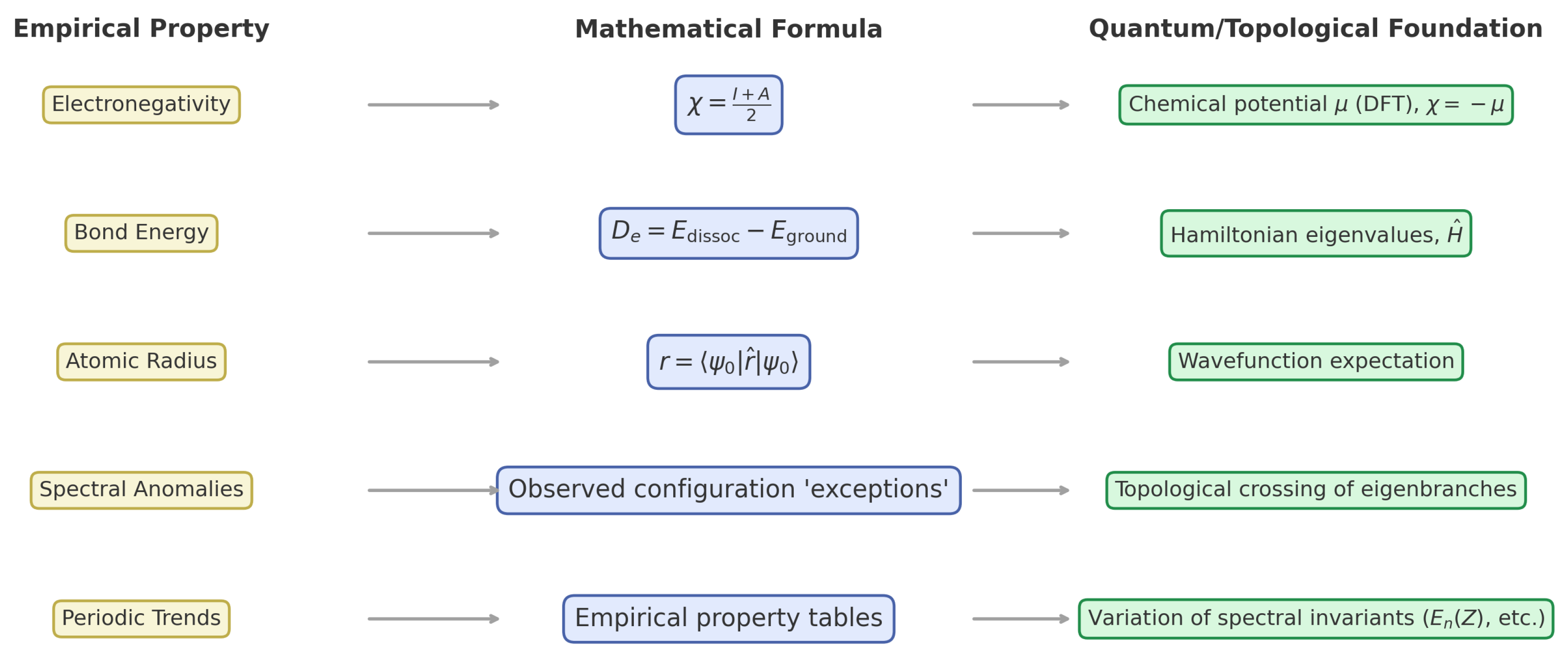
Common periodic trends and rules of thumb—electronegativity, bond energies, atomic radii—are placed on explicit mathematical footing:
- Electronegativity: As a bonded-electron attraction tendency, it is expressed by Mulliken’s mean of first ionization energy I and electron affinity A,and identified in DFT with the negative chemical potential,
- Bond Energy: Bond strength is given by the eigenvalue difference between dissociated and bound molecular states,and is computable from first principles.
- Atomic/Ionic Radius: Tabulated radii correspond to ground-state radial expectation values,with correlation and relativistic corrections.
- Spectral Anomalies: Apparent “exceptions” (Pd, Cr, Cu, etc.) are enforced by protected crossings between symmetry-distinct configurations, as predicted by spectral topology.
- Periodic Trends: Trends are expressible as variations of spectral invariants (orbital energies, degeneracies, topological indices) with atomic number Z and electron count.
Thus, empirical rules are traced to a mathematical substrate in which group theory, spectral analysis, and quantum topology govern regularities and anomalies.
Figure 4.
Conceptual roadmap connecting classical empirical chemical properties (left) to their mathematical expressions (center) and quantum/topological foundations (right). The diagram illustrates how properties like electronegativity, bond energy, atomic radius, and periodic trends emerge from rigorous quantum mechanics and spectral theory.
Figure 4.
Conceptual roadmap connecting classical empirical chemical properties (left) to their mathematical expressions (center) and quantum/topological foundations (right). The diagram illustrates how properties like electronegativity, bond energy, atomic radius, and periodic trends emerge from rigorous quantum mechanics and spectral theory.
Mathematical Foundations Beyond Chemical Heuristics
Standard pedagogical heuristics are related to deeper principles:
- Trends and exceptions in the transition series are read as robust features of the atomic Hamiltonian’s spectrum; exceptions arise from symmetry-protected crossings between inequivalent subspaces.
- Key properties (electronegativity, bond energies, radii) are formulated as functionals of eigenvalues/eigenstates of the many-electron Hamiltonian.
- Bonding/reactivity are attributed to the structure and splitting of quantum states rather than fixed classical bond types.
- Group theory/topological invariants provide predictive tools for bonding, magnetism, and the existence/location of anomalies.
- Approximate methods (DFT/MO) are recognized as approximations to the exact many-body problem, with successes and failures reflecting the underlying spectrum.
A transition from heuristics to a rigorous spectral perspective is therefore required to account for periodicity, exceptions, and properties as consequences of quantum mechanics.
Mathematical Synthesis: Topology, Bundles, and Spectral Invariants in the Periodic Table
- (1)
-
Anomalies as Topological Invariants. For , each branch is endowed with invariants (Chern number , Berry phase , winding number w):Anomalies occur at singularities or quantized jumps of these invariants.
- (2)
- Periodicity as a Vector Bundle. The eigenspaces of define a vector bundle over . Electronic anomalies are modeled as bundle singularities,encoding stability and universality.
- (3)
- Generalization. For synthetic atoms/quantum dots/ion traps, additional parameters (confinement, field F, pressure P) are included and crossings predicted from
- (4)
- Beyond Standard DFT. Local minima sampling may miss global topological transitions; explicit computation of , Berry curvature, and homotopy invariants (e.g., ) is required to track changes with Z or .
- (5)
- Unified View. Structure and anomalies are classified by the topology of , with degeneracies, Chern numbers, Berry phases, and bifurcations providing the organizing data.
Spectral Topology and Periodicity: Formal and Disruptive Synthesis
- (1)
-
Anomalies as Topological Invariants. For , the n-th eigenstate is smooth on the parameter manifold M except at degeneracies.
- Berry phase: encirclement of a degeneracy (e.g., vs in Pd) yieldswith (mod ) indicating protection.
- Chern number: for a two-level model over ,quantizing the degeneracy’s “monopole charge.”
- (2)
- Vector Bundles and Singularities. Eigenstates define a bundle ; at (Pd), bundles associated with and cross, with charge given by Chern class differences.
- (3)
- Exotic Regimes and Control. High fields B, confinement, or non-integer Z lead to crossings determined by
- (4)
- Algorithmic Needs. Detection of topological transitions requires explicit Berry-connection/curvature evaluation; standard functionals may fail to anticipate states such as Pd’s .
- (5)
- Topological Classification of Matter. Periodicity and anomalies are captured by equivalence classes of spectra, paralleling quantized phenomena (e.g., quantum Hall plateaus).
Explicit Application: Topological Invariants Across the Periodic Table
For each element, competing pairs vs are examined, crossings identified, and invariants assigned:
-
Cr ():with Berry phase ensuring protection.
-
Mo ():with at degeneracy.
-
Cu ():with winding number .
-
Ag ():showing a quantized spectral jump.
-
Pd ():with monopole-like Berry curvature stabilizing .
-
Pt ():enhanced by spin–orbit/relativistic effects and Chern class change.
-
Au ():with matching experiment.
- Synthetic/Exotic: For engineered Z, field F, or non-integer occupations,with nontrivial Berry curvature regions accessible to interference/spectroscopy.
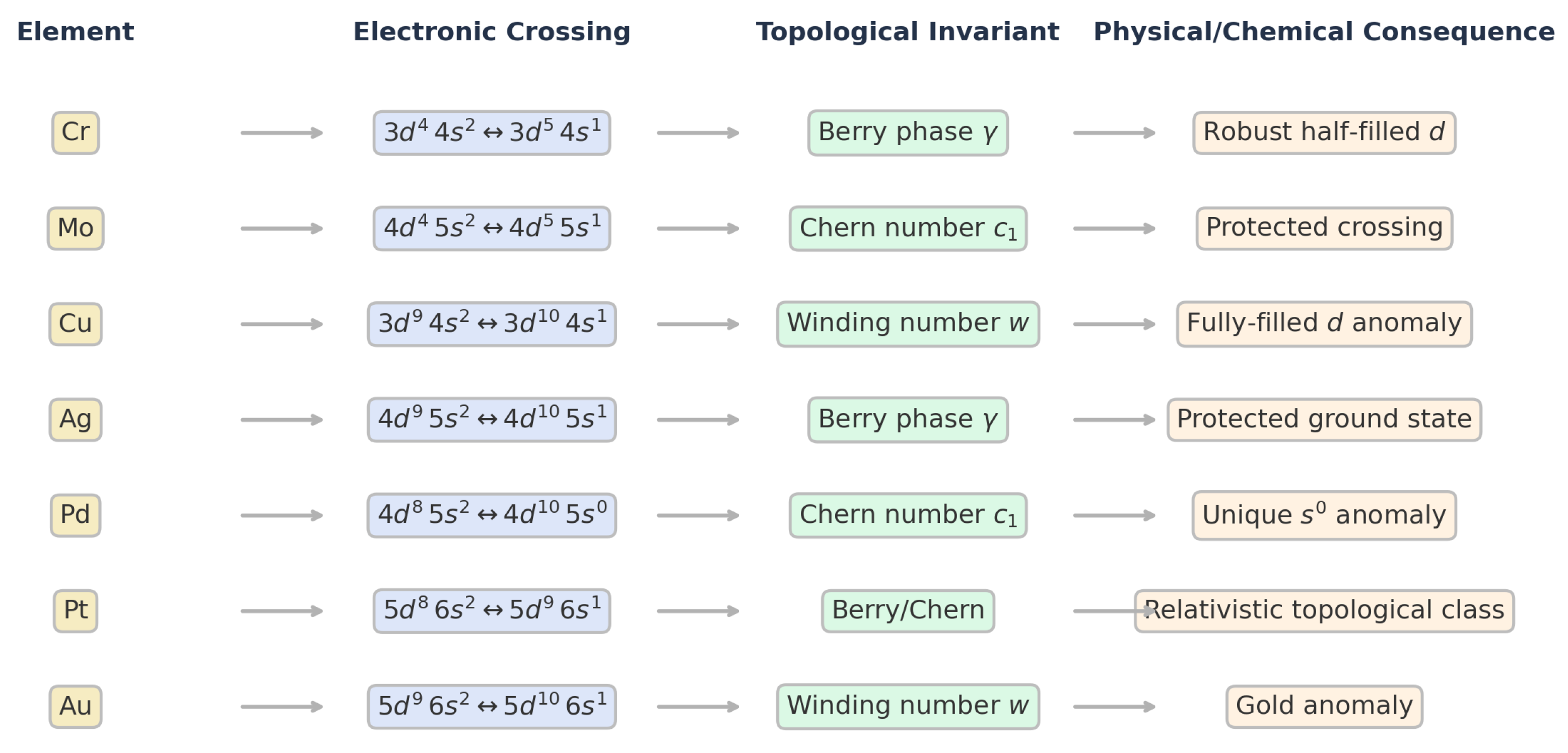
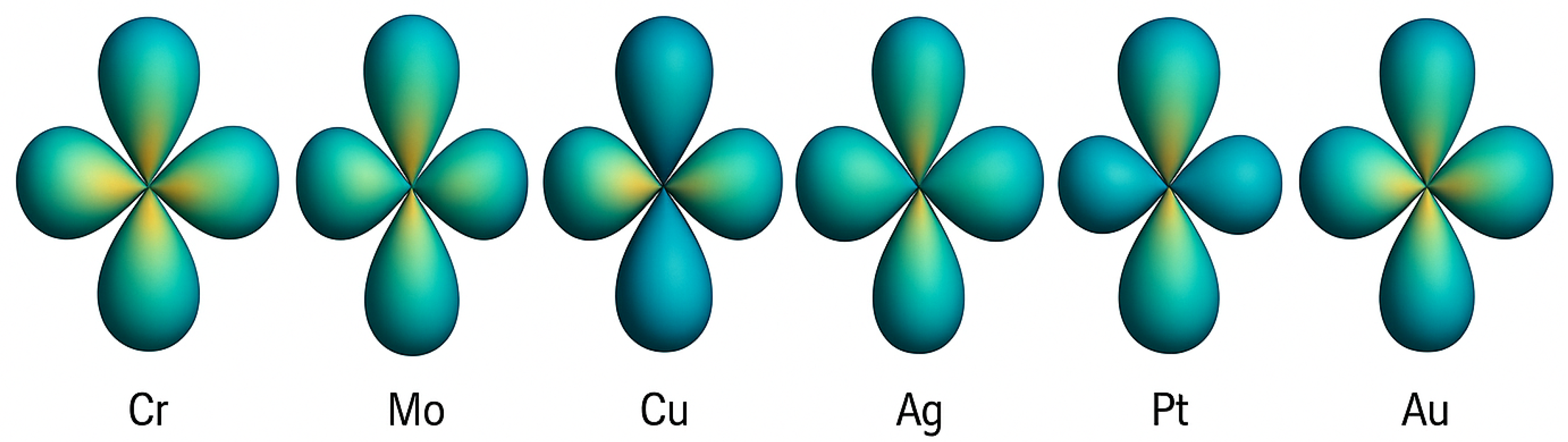
In all cases shown in Figure 5, the emergence and precise placement of periodic anomalies are attributed to discrete, quantized topological invariants embedded in the atomic spectrum. Chief among these are:
- Berry phase : a geometric phase accumulated by adiabatic transport around a degeneracy, certifying a robust, symmetry-protected crossing (e.g., Cr, Ag).
- Chern number : an integer invariant of eigenbundles’ curvature, diagnosing spectral “monopoles”/topological charge in parameter space (e.g., Mo, Pd).
- Winding number : the count of eigenvalue windings versus Z, indicating quantized ground-state jumps (e.g., Cu, Au).
Each anomaly—despite its irregular configuration—has been identified as a topological phase transition in the Hilbert space of the atomic Hamiltonian. These transitions are not empirical exceptions to Madelung’s rule but are enforced by spectral flow and symmetry constraints; thus, the so-called anomalies are revealed as universal, quantized features of quantum matter.
Topological Invariants and Physical Interpretation Across Periodic Anomalies
For each anomaly, the associated invariant and chemical meaning are made explicit:
-
Cr ():Berry phase : a protected switch to half-filled ; smooth deformations cannot remove the transition.
-
Mo ():Chern number : a quantized curvature source (“monopole”) at the crossing; inevitability of the anomaly is implied.
-
Cu ():Winding : a single spectral winding through flips the ground state to filled .
-
Ag ():Berry phase : protection analogous to Cr, stabilizing the observed state.
-
Pd ():Chern number : monopole-like curvature enforces the unique configuration.
-
Pt ():Berry/Chern: relativistic effects reinforce a change of topological class across the crossing.
-
Au ():Winding : a full winding yields the stable state.
- Exotic/Synthetic: In engineered quantum dots/Rydberg platforms, crossings are designed by tuning external parameters; nontrivial are detected via interference or spectroscopy.
Summary Table:
These invariants furnish a concise, predictive, and unified account of observed and anticipated periodic anomalies.
| Element | Transition | Invariant | Physical Meaning |
| Cr | Berry phase | Robust half-filled d | |
| Mo | Chern number | Monopole, protected crossing | |
| Cu | Winding number w | Filled d-shell anomaly | |
| Ag | Berry phase | Protected ground state | |
| Pd | Chern number | Unique anomaly | |
| Pt | Berry/Chern | Relativistic topological class | |
| Au | Winding number w | Gold anomaly |
Figure 6.
Summary of the spectral-topological approach to periodic anomalies in transition metals. For each element, the relevant electronic crossing, the associated topological invariant (Berry phase, Chern number, or winding number), and the resulting physical/chemical consequence are shown. This diagram demonstrates that all observed and predicted anomalies correspond to quantized topological invariants of the atomic spectrum, providing a unified, predictive mathematical framework for the periodic table.
Figure 6.
Summary of the spectral-topological approach to periodic anomalies in transition metals. For each element, the relevant electronic crossing, the associated topological invariant (Berry phase, Chern number, or winding number), and the resulting physical/chemical consequence are shown. This diagram demonstrates that all observed and predicted anomalies correspond to quantized topological invariants of the atomic spectrum, providing a unified, predictive mathematical framework for the periodic table.
Note: While elemental positions (by Z) remain fixed, the interpretation of configurations is altered: anomalies are recast as necessary, quantized spectral features. Hence, the conventional table is understood to encode hidden topological structure.
Conclusions
Periodic anomalies have been reframed as quantized manifestations of topological invariants in the atomic spectrum. Each crossing is treated as a protected landmark of the underlying geometry of quantum matter. By unifying spectral theory, symmetry, and topological indices (Berry phase, Chern number), a language is provided that captures known anomalies and anticipates new ones in superheavy or synthetic regimes. The periodic table is thereby viewed as a map of topological transitions, enabling not only explanation but also engineering of atomic and molecular behavior.
Final Remarks
A topological–spectral perspective is advanced as a rigorous alternative to ad hoc rules, offering predictive control over periodic trends and anomalies. Implications span catalysis, magnetism, quantum devices, and materials design. Greater clarity in spectroscopy and algorithmic developments beyond standard DFT are motivated, particularly in anomaly-dominated regimes. By aligning chemistry with spectral topology, longstanding puzzles are resolved and practical routes to tailored quantum systems are opened.
Informed Consent Statement
Not applicable.
Conflicts of Interest
The author declares no competing interests.
References
- B. N. Figgis & M. A. Hitchman, "Ligand Field Theory and Its Applications," Wiley-VCH, 2000.
- F. Albert Cotton, "Chemical Applications of Group Theory," 3rd Edition, Wiley, 1999.
- J. C. Slater, Quantum Theory of Atomic Structure. McGraw-Hill, 1960.
- N. F. Hall, “The periodic table: Its story and its significance,” Oxford University Press, 2015.
- P. Pyykkö, “Relativistic Effects in Chemistry: More Common Than You Thought,” Annual Review of Physical Chemistry, vol. 63, pp. 45–64, 2012. [CrossRef]
- J. F. Cornwell, Group Theory in Physics: An Introduction. Academic Press, 1984. [CrossRef]
- M. V. Berry, “Quantal Phase Factors Accompanying Adiabatic Changes,” Proc. Roy. Soc. Lond. A, vol. 392, pp. 45–57, 1984. [CrossRef]
- P. A. M. Dirac, The Principles of Quantum Mechanics, 1st ed. Oxford University Press, 1930.
- A. Connes, Noncommutative Geometry. Academic Press, 1994.
- E. P. Wigner, Group Theory and its Application to the Quantum Mechanics of Atomic Spectra. Academic Press, 1959. [CrossRef]
- R. F. W. Bader, Atoms in Molecules: A Quantum Theory. Oxford University Press, 1990.
- P. Atkins and J. de Paula, Physical Chemistry, 10th ed. Oxford University Press, 2014.
- A. R. P. Rau, “The Aufbau Principle: Quo Vadis?,” Foundations of Chemistry, vol. 12, pp. 293–300, 2010.
- R. D. Cowan, The Theory of Atomic Structure and Spectra. University of California Press, 1981. [CrossRef]
- E. Madelung, “Das elektrische Feld in Systemen von Atomen,” Physikalische Zeitschrift, vol. 28, pp. 1127–1129, 1936.
- W. Kutzelnigg, “The Physics and Chemistry of Wave Packets,” Chemical Physics, vol. 329, pp. 99–116, 2006.
- T. Kato, “On the eigenfunctions of many-particle systems in quantum mechanics,” Communications on Pure and Applied Mathematics, vol. 10, pp. 151–177, 1957. [CrossRef]
- B. Simon, “The definition of molecular resonance curves by the method of exterior complex scaling,” Physics Letters A, vol. 71, pp. 211–214, 1979. [CrossRef]
- M. Tinkham, Group Theory and Quantum Mechanics, Dover, 2003.
- J. J. Sakurai and J. Napolitano, Modern Quantum Mechanics, 2nd ed., Cambridge University Press, 2017.
- L. Pauling, “The Nature of the Chemical Bond,” J. Am. Chem. Soc., vol. 53, pp. 1367–1400, 1932.
- A. Kramida et al., “NIST Atomic Spectra Database (ver. 5.11),” [Online]. Available: https://physics.nist.gov/asd.
- H. Kleinert, Path Integrals in Quantum Mechanics, Statistics, Polymer Physics, and Financial Markets, 5th ed. World Scientific, 2009.
- M. V. Berry and M. R. Dennis, “Topological events on wave dislocation lines: birth and death of loops, and reconnection,” J. Phys. A: Math. Theor., vol. 43, 2010. [CrossRef]
- A. P. Balachandran, G. Marmo, B.-S. Skagerstam, and A. Stern, Gauge Symmetries and Fibre Bundles: Applications to Particle Dynamics. Springer, 1991.
- R. B. Laughlin, “Quantized Hall conductivity in two dimensions,” Phys. Rev. B, vol. 23, pp. 5632–5633, 1981.
- F. D. M. Haldane, “Model for a Quantum Hall Effect without Landau Levels: Condensed-Matter Realization of the ’Parity Anomaly’,” Phys. Rev. Lett., vol. 61, pp. 2015–2018, 1988. [CrossRef]
- P. W. Anderson, “More is Different,” Science, vol. 177, pp. 393–396, 1972.
- W. H. Zurek, “Decoherence, einselection, and the quantum origins of the classical,” Rev. Mod. Phys., vol. 75, pp. 715–775, 2003. [CrossRef]
- M. C. Gutzwiller, Chaos in Classical and Quantum Mechanics. Springer, 1990.
- M. V. Berry, “The adiabatic phase and Pancharatnam’s phase for polarized light,” J. Mod. Opt., vol. 34, pp. 1401–1407, 1987. [CrossRef]
- R. Gilmore, Lie Groups, Lie Algebras, and Some of Their Applications. Wiley, 1974.
- S. Kobayashi and K. Nomizu, Foundations of Differential Geometry, Vol. 1, Wiley, 1996.
- M. Reed and B. Simon, Methods of Modern Mathematical Physics, Vol. I–IV. Academic Press, 1972–1978.
- W. Fulton and J. Harris, Representation Theory: A First Course. Springer, 1991.
- H. Eyring, “The Activated Complex in Chemical Reactions,” J. Chem. Phys., vol. 3, pp. 107–115, 1935.
- R. de L. Kronig, “The Fine Structure of Helium and Alkali Spectra,” Physica, vol. 1, pp. 545–557, 1934.
- L. D. Landau and E. M. Lifshitz, Quantum Mechanics: Non-Relativistic Theory, 3rd ed., Pergamon, 1977.
- J. Schnack, “Quantum Magnetism in Chemistry and Physics,” Molecules, vol. 11, pp. 475–493, 2006.
- N. F. Mott, “Metal-Insulator Transitions,” Rev. Mod. Phys., vol. 40, pp. 677–683, 1968.
- D. Bohm, Quantum Theory. Prentice-Hall, 1951.
- B. A. Bernevig and T. L. Hughes, Topological Insulators and Topological Superconductors. Princeton Univ. Press, 2013.
- G. F. Koster et al., Properties of the Thirty-Two Point Groups. MIT Press, 1963.
- C. L. Kane and J. E. Moore, “Topological Insulators,” Physics World, vol. 23, pp. 32–36, 2010.
- W. Kohn, “Nobel Lecture: Electronic structure of matter—wave functions and density functionals,” Rev. Mod. Phys., vol. 71, pp. 1253–1266, 1999. [CrossRef]
- E. G. Drukarev, Basics of Quantum Electrodynamics. Springer, 2020.
- R. Hoffmann, Solids and Surfaces: A Chemist’s View of Bonding in Extended Structures. VCH, 1988.
- L. S. Cederbaum, “Electronic correlation in molecules—new theoretical insights,” Chem. Phys. Lett., vol. 463, pp. 227–238, 2008.
Figure 1.
Spectral crossing of and as a function of atomic number Z. A crossing at (Pd) marks a transition between symmetry-protected subspaces. The shaded zone indicates the degeneracy region.
Figure 1.
Spectral crossing of and as a function of atomic number Z. A crossing at (Pd) marks a transition between symmetry-protected subspaces. The shaded zone indicates the degeneracy region.
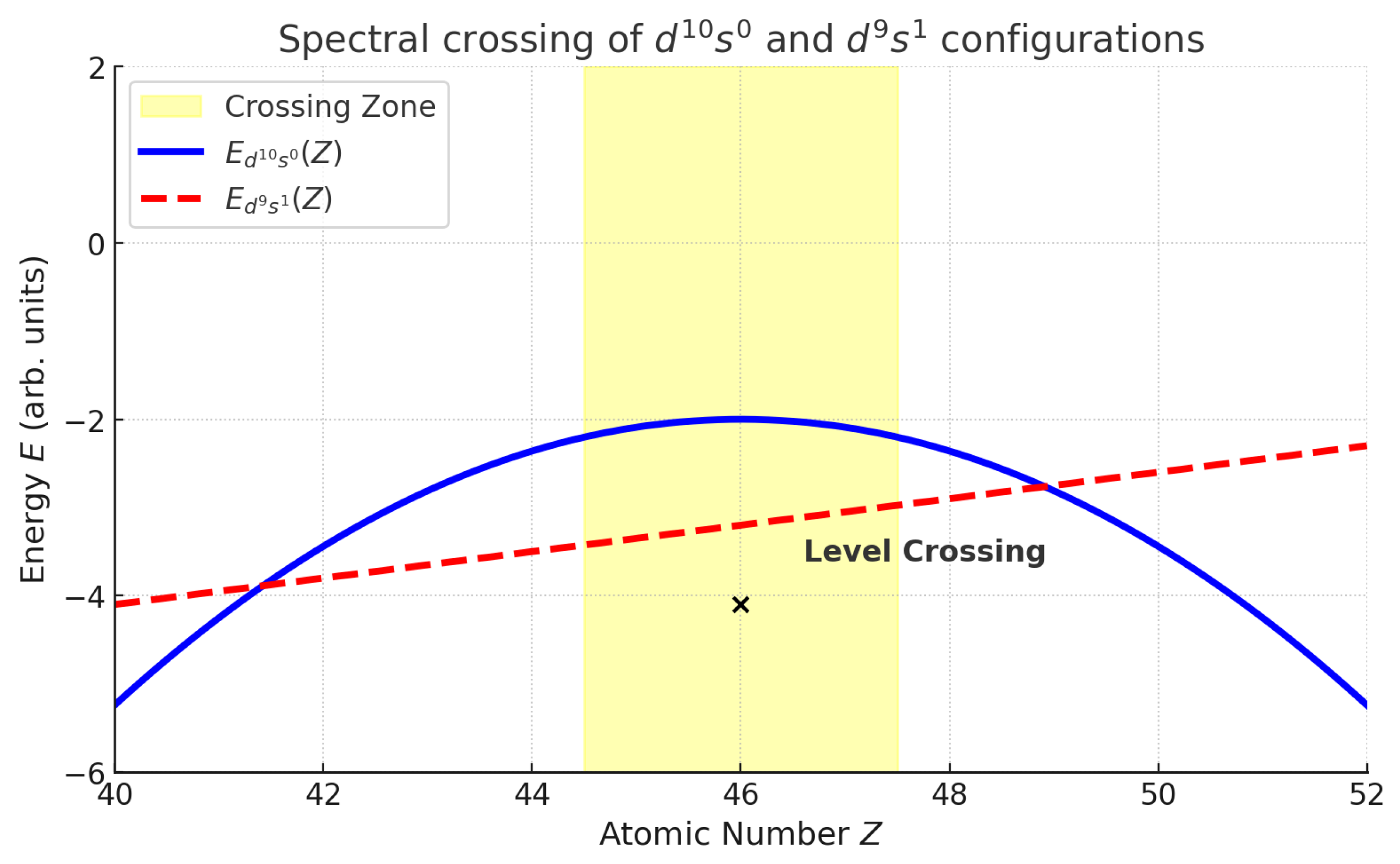
Figure 2.
Spectral crossings for competing configurations in Cr, Cu, Mo, Ag, Pd. Highlighted intervals mark protected crossings where ground states switch discontinuously due to spectral topology.
Figure 2.
Spectral crossings for competing configurations in Cr, Cu, Mo, Ag, Pd. Highlighted intervals mark protected crossings where ground states switch discontinuously due to spectral topology.
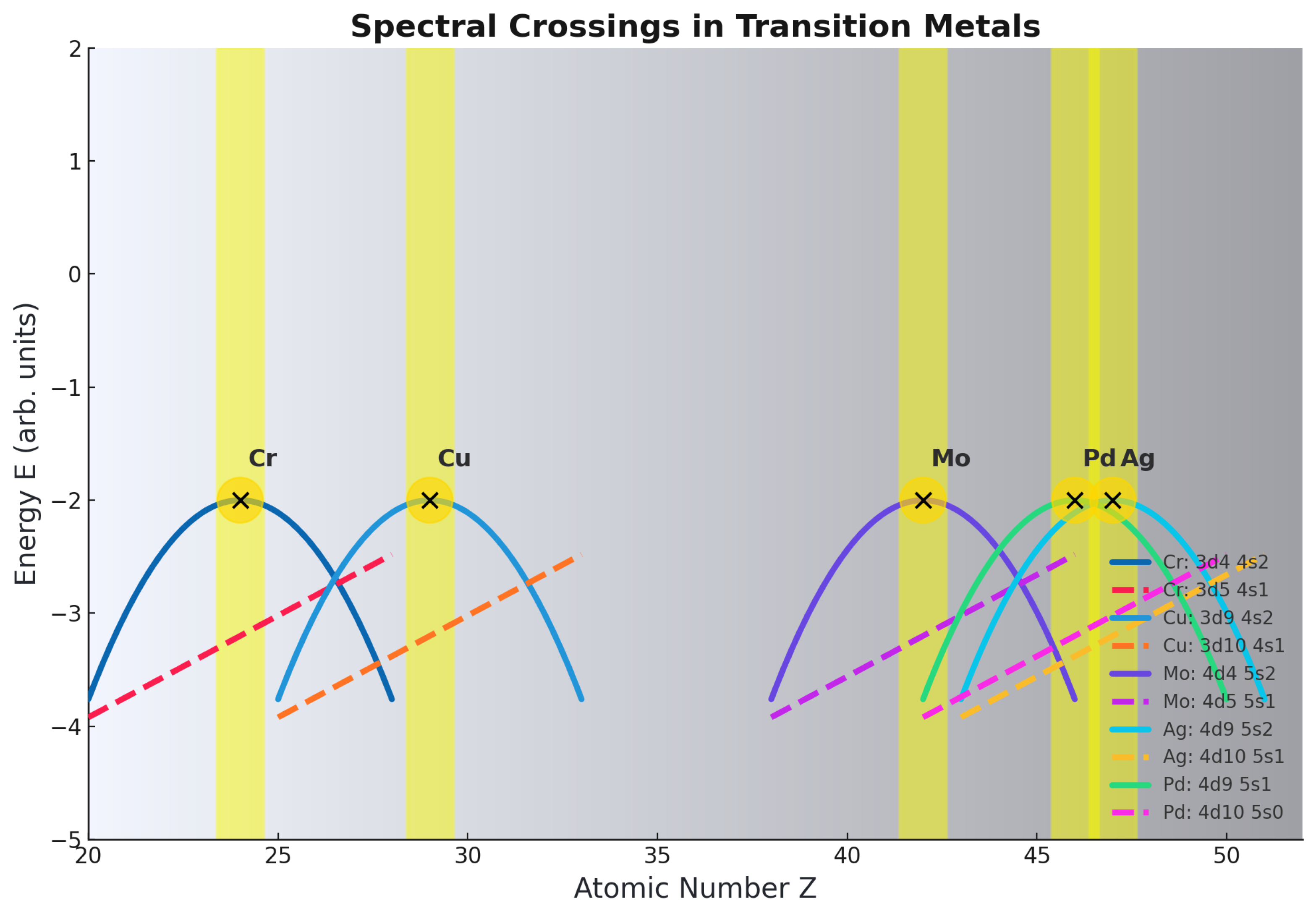
Figure 3.
Complexes vs isolated atoms. Left: Tanabe–Sugano diagram for a ion ( control). Right: Topological crossing for an isolated atom (Pd): the anomaly is dictated intrinsically by symmetry and topology, independent of external fields.
Figure 3.
Complexes vs isolated atoms. Left: Tanabe–Sugano diagram for a ion ( control). Right: Topological crossing for an isolated atom (Pd): the anomaly is dictated intrinsically by symmetry and topology, independent of external fields.
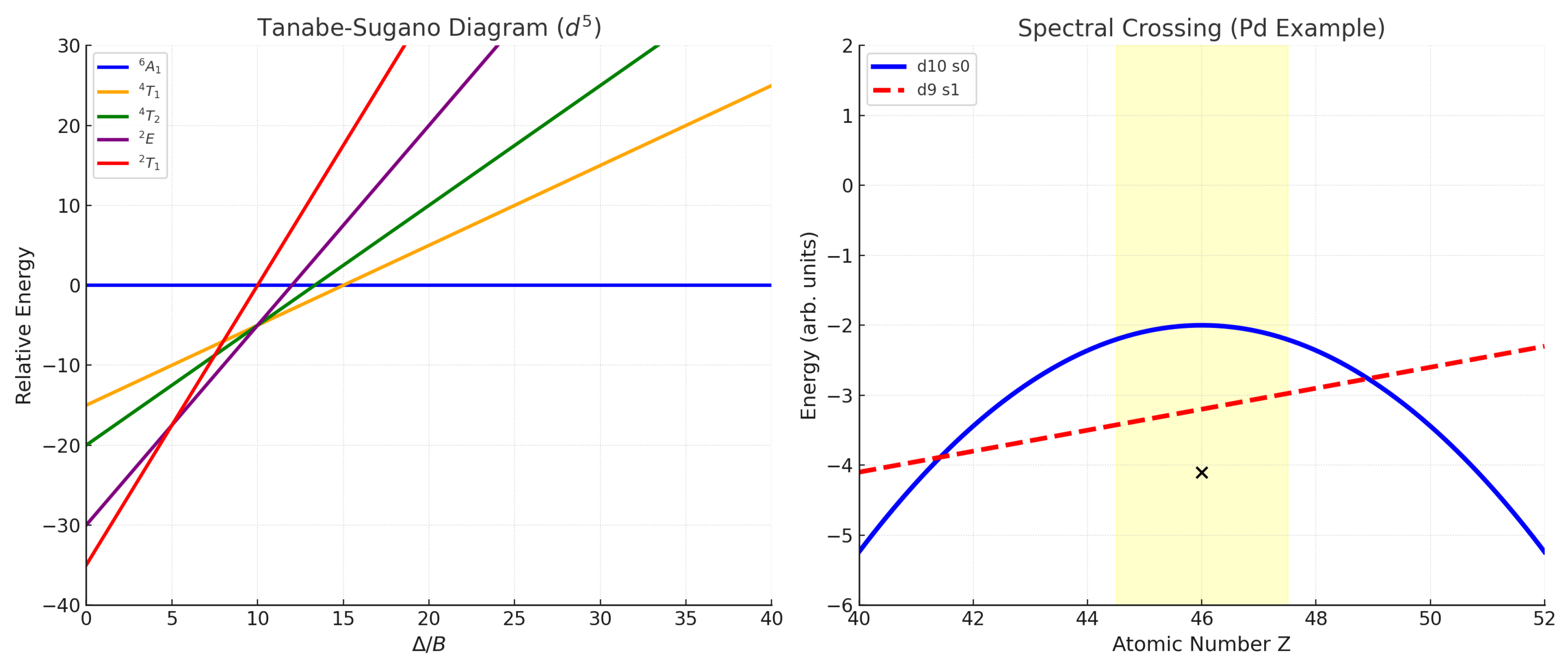
Figure 5.
Real-space visualization of d-orbital configurations for selected transition metals exhibiting spectral anomalies: Cr, Mo, Cu, Ag, Pd, Pt, and Au. These anomalies correspond to topologically protected spectral crossings between competing electron configurations and . Despite visual similarities, each element represents a distinct topological phase transition in the Hilbert space of the atomic Hamiltonian, governed by quantized invariants (Berry phase, Chern number, or winding number). This unified topological structure explains the empirical exceptions in the periodic table as inevitable consequences of spectral topology.
Figure 5.
Real-space visualization of d-orbital configurations for selected transition metals exhibiting spectral anomalies: Cr, Mo, Cu, Ag, Pd, Pt, and Au. These anomalies correspond to topologically protected spectral crossings between competing electron configurations and . Despite visual similarities, each element represents a distinct topological phase transition in the Hilbert space of the atomic Hamiltonian, governed by quantized invariants (Berry phase, Chern number, or winding number). This unified topological structure explains the empirical exceptions in the periodic table as inevitable consequences of spectral topology.
Disclaimer/Publisher’s Note: The statements, opinions and data contained in all publications are solely those of the individual author(s) and contributor(s) and not of MDPI and/or the editor(s). MDPI and/or the editor(s) disclaim responsibility for any injury to people or property resulting from any ideas, methods, instructions or products referred to in the content. |
© 2025 by the authors. Licensee MDPI, Basel, Switzerland. This article is an open access article distributed under the terms and conditions of the Creative Commons Attribution (CC BY) license (http://creativecommons.org/licenses/by/4.0/).
Copyright: This open access article is published under a Creative Commons CC BY 4.0 license, which permit the free download, distribution, and reuse, provided that the author and preprint are cited in any reuse.