

Submitted:
02 October 2025
Posted:
04 October 2025
You are already at the latest version
Abstract
One key objective of astrobiology is to investigate and discover if other planetary bodies are habitable. The determination of whether an environment is habitable to known life requires measuring liquid water, CHNOPS elements, other nutrients, and energy supplies. Here we investigate the potential for a single instrument capable of sampling these key indicators: a ’Total Habitability Instrument’. The proposed instrument would be capable of deployment in diverse environments and provide an integrated set of measurements that together allow for the assessment of the habitability of a given environment. We explore existing and potential technological developments that would enable the construction of such an instrument, with a focus on soft systems, that are inspired from nature in their design, and microfluidics. This paper considers a multidisciplinary approach to the design and sensing requirements of a total habitability instrument that would be capable of gathering and processing samples and be deployable by both robotic and human explorers on all planetary bodies, allowing for the mapping of habitability over large areas of our Solar System and beyond.
Keywords:
bioinspired sensing
; soft robotics
; habitability
; astrobiology
1. Introduction
Habitability is core to astrobiology. Although exact definitions can vary, habitability is a measure of the potential of an environment to sustain life. Providing an environment is capable of supporting one or more forms of life, it falls under the definition of the habitable space, and therefore all biology must exist within this space. One of the key interests of astrobiology is the extent of habitable space in the universe and whether such spaces contain life [1,2,3]. A number of requirements must be met for an environment to be habitable. For known life these are: the presence of water, an energy source, the presence of key elements for macromolecular construction, along with physical and chemical conditions that allow for growth or reproduction.
The key to assessing habitability is the ability to identify, analyse, and quantify these fundamental indicators, which depends on reliable remote sensing technology. Often, the requirement for in-situ measurements is high levels of automation and robust transmission of results. Coupled with the high cost of accessing environments of interest, this poses a set of unique and demanding requirements on instrument design. Nature has evolved to enable each species to adapt and operate in a variety of different extreme and dynamic environments. When considering the use of robotic systems, system compliance can be crucial for their integration into these environments. Hard robots are regularly ‘non-collaborative’ and can require predictable situations and accuracy. However, due to the design and control of soft robotics, they are inherently compliant. Such systems could provide solution to the required instrument design. In addressing this challenge, astrobiologists are aided by novel sensing technology provided by advances in related fields such as microfluidics, biomedical devices, soft systems, and environmental sciences. Development in micro- and nano- fabrication, new sensing modalities, along with the discovery of new materials, has led to exponential improvements in sensing capability [4]. Currently, there are many sensors to detect an equally diverse range of chemical analytes [4]. However, sensor research can often be conducted across disparate disciplines. Considering the importance of sensing to astrobiological research, there is a need to collect and examine the state of the art in sensing technology with a view to habitability. We review the state-of-the-art in detecting the components of habitability to explore the prospects of a ’Total Habitability Instrument’ (THI), that would allow for the detection and mapping of habitability in different planetary environments.
2. Habitability in Aqueous Environments
The discussion in this review is limited to Life "As We Know It" (LAKI) which covers several aspects from the origin of life, evolution of prokaryotes to eukaryotes including bacteria, and algae and fungi [5]. Hypotheses about the existence of unfamiliar life with exotic biochemistries not represented in known life are interesting; however, with no empirical evidence for such biochemistries what constitutes a habitable space can only be scientifically defined by a known point of reference. For all known life, the presence of liquid water is necessary as a solvent for the electrochemical reactions which sustain life and is taken as the baseline assumption for deriving sensor requirements.
2.1. Water Bulk Properties
The amount of thermodynamically available water, measured as water activity (aw), is a limiting factor for all life. While most microbes and fungi are not active at aw < 0.91 and aw < 0.7 respectively, organisms have been observed at much lower water activities [6]. The theoretical limit on water activity for all domains of life has been proposed to be around 0.6, however, cell division has since been observed at aw = 0.585. Water activity illustrates that the line between habitable and uninhabitable is very fine; therefore, sensors must have suitably high resolution and accuracy to determine these critical interface conditions.
2.2. Ionic Environment
In addition to water activity, ionic strength, which is a measure of the charge density in a solution, can limit the water activity, and therefore the habitability of an environment.
The presence of ions is necessary for life on Earth. Major cations Mg2+, Na+, Ca2+, and K+ have varying, but essential functions in microbial life. For example, potassium is an abundant monovalent cation that plays a major role in the cell, such as regulation of osmotic pressure and pH control [7]. Chaotropic (disordering) salts such as MgCl2 have a limiting effect on biology by working to denature biological macromolecules [8]. High concentrations of chaotropic species have been found to be a limiting factor for life both in terrestrial subsurface environments [9], and in simulated Martian brines [10]. Thus, measurements of ions can not only confirm the presence of bioessential ions, but also provide an assessment of the chemical limits to life. One particular ion of importance, which can define the diversity of life in an environment, is the concentration of H+ ions (H3O+). H+ ion measurements are defined as the ‘potential of hydrogen’(pH) scale. Both extremes of the pH scale can present challenges to biology. Although no environment on Earth is known where extremes of pH alone are a barrier to life, pH can affect the diversity of potential life and, by influencing the chemical state of other ions, indirectly establish boundaries for habitability. Low pH denatures proteins and is hostile to a wide range of organisms. However, microorganisms known as acidophiles have been found to reproduce in solutions with pH values below neutral [11]. These include fungi, eukaryotes, and archaea [12]. At the other extreme, alkali conditions host alkaliphiles which are found in naturally occurring soda lakes, with pH of 13. [13]. Therefore, it is not only the presence of certain chemicals important to life that determines habitability, but also the concentration. A sensor for habitability must be able to detect and quantify a wide range of necessary ions. Extreme pH values, as well as environments with high ionic strength, can detrimentally affect the performance of many sensors. These effects must be taken into account in sensor design.
2.3. CHNOPS
The elements of "CHNOPS": carbon (C), hydrogen (H), nitrogen (N), oxygen (O), phosphorus (P) and sulfur (S) are common to all known life [3,4] and the requirements for habitability. As both hydrogen and oxygen are the constituent elements of water, and molecular oxygen acts as an electron acceptor for many biological redox reactions [14]. CHNOPS elements can be present as compounds (e.g. phosphorus in calcium phosphate); however, where a liquid exists they may be in dissolved ionic form. Microbes can access these elements from solid form, by, for example, acidification of their local microenvironment [15]. In this review we focus on habitability detection in aqueous environments and therefore the detection of these elements in ionic state. Due to their ubiquity and importance to known life, the CHNOPS elements have been, alongside liquid water, the subject of the greatest interest in space missions within the Solar System [4].
2.4. Energy
A suitable energy source is a necessary requirement for habitability [16]. Microbial life in Earth’s deep biosphere provides evidence of metabolism in relatively energy-starved conditions [17]. Redox reactions are universal in the supply of useful energy within the organism to maintain its own chemical reactions [18]. There exists a wide diversity of available redox processes available to known life [19]. Requirement: the system must be able to identify and quantify the most likely of these redox elements and compounds present in an environment.
2.5. Physical Extremes to Life: Temperature
Life must operate within other physical and chemical boundaries suitable for biological processes. One of these conditions are the boundaries set by the temperature limitations. The availability of liquid water places a firm limit on temperature under certain pressures and ionic concentrations. The physical phase space for the existence of liquid brine extends well beyond those of pure water. At the lower end, the possible existence of liquid perchlorate brines on Mars at temperatures down to −65◦C [20], while the phase diagram of water shows that liquid water can exist at temperatures of 300◦C at 10MPa. The limits of habitable temperature are likely to be constrained to a much tighter range. To date, the
highest temperature at which growth has been observed is 122◦C [21], while the lowest for growth and metabolic activity are −15◦C and −25◦C respectively [22]. Sensing technologies for temperature are well established, and have been thoroughly reviewed [23]. Research continues on temperature sensors with specific applications [24] and materials [25,26]; however, accurate, inexpensive, low power, and highly miniaturised sensors are widely commercially available.
2.6. Polyextremes
Environments rarely exhibit only a single extreme. Environments with high ionic strength often exist at high- or low-temperature extremes, for example, Siberian cryopegs [27], or hyperacidic, hypersaline, and high-temperature regions of Dallol hot springs [28,29]. These multiple chemical and physical extremes, known as polyextremes, often influence biology in complex ways. For example, while chaotropic solutes have been found to be detrimental to life, in combination with low-temperature extremes, they have been found to increase the window for habitability [30]. Other studies of polyextremophiles have been conducted in the Red Sea brines [31], deep sea hydrothermal vents [32] and the Salar de Huasco basin in Chile [33]. These represent distinct examples in the limits of habitability. A review by Harrison et al. notes the influence of the polyextremes of temperature, pH, salinity, and pressure on growth of prokaryotic strains [34]. It is important that habitability detection takes into account these multiple extreme conditions. In order to map any potential habitable environment, there should be capability to determine where it lies in the phase space of habitability.
3. Sensing in Aqueous Environments
A sensing system that detects all, or most of the important parameters for habitability, can be termed a Total Habitability Instrument (THI). Its function would be to determine whether an environment is habitable, and if so, where in the habitability phase space it lies. A THI would not only be a fully integrated array of different sensing modalities. Inspiration can be drawn from adjacent fields such as environmental science, where research in the development of micro-total analysis systems (μTAS) [35,36]. Much of the current research on μTAS in astrobiology is focussed on organics and the search for biomarkers [37,38,39,40].
The following section examines technologies for the measurement of each habitability condition, comparing novel methods to established instruments to provide an overview of the key features required to sense the parameters, while highlighting examples of sensors with potential use in a THI.
3.1. Water bulk properties
Prior to the deployment of a THI, water may well have been detected by remote sensing technologies [41,42]. Earth based infrared spectroscopy [43], images from the Voyager spacecraft [44], and Doppler and high-resolution images from Galileo [45,46] provide some of the evidence for subsurface oceans on Europa. Data suggesting the existence of subglacial water bodies on Enceladus is provided by Cassini’s flyby and analysis of large plumes of liquid water with its on-board Ion and Neutral Mass Spectrometer (INMS) [47,48]. These technologies inform about the bulk presence of water, the THI should be capable of investigating habitability of these diverse aqueous environments.
3.2. Water Activity
Water activity in liquid samples is conventionally measured by enclosing the liquid within a fixed volume and measuring the relative humidity in the gas phase once vapour liquid equilibrium is reached. Sensors measure relative humidity using a wide range of techniques, transduction methods and materials, each with trade-offs in cost, operating range, and sensitivity [49,50,51]. Water activity can also be measured optically, using materials with properties sensitive to changes in equilibrium relative humidity (ERH). Notably, optical grating fibres, coated with a hygroscopic material such as polymers [52,53], gelatine [54], or graphene-oxides [55], have been explored as effective sensors. Advantages of these sensors over traditional capacitive/resistive humidity sensors provide improved tolerance to harsh conditions and insusceptibility to electromagnetic interference [56]. In selecting an appropriate technology for measuring habitability, several factors must be considered. The working range of an ideal sensor would allow accurate water activity measurements between 0.5 > aw > 1, which would account for the full habitable space, as well as extending comfortably beyond the threshold. However, as aw approaches 1, it is no longer a barrier to habitability for most life. Thus, accuracy throughout the ideal range is less important than that at the interface, which occurs around 0.9 and 0.7 for microbes and fungi respectively [6]. As discussed previously, the line between habitable and uninhabitable spaces is very fine. A difference of +0.1 aw is biologically significant, especially at the interface of the water activity limit, and would considerably alter the ability of an environment to sustain life. Any sensor must therefore have the appropriate resolution and precision to characterise an environment firmly in the habitability phase space. Water activity measurements using conventional methods are well established and bring with them advantages of robust and reliable measurement. However, certain features pose challenges for integration with other sensing modes and miniaturisation. The need for measurement in the gas phase within an enclosed volume necessitates a space separate from other sensors, which may require direct contact, or submersion, within the liquid itself. Whilst technologies exist that can measure within the liquid phase, they have commonly been developed for dual use in another sector. Therefore, further research must be conducted to make them suitable for studying habitability on celestial bodies. An example of this is a microelectromechanical system (MEMS)-based tensiometer. This method uses thin-film fabricated strain gauges to measure changes in tension on the surface of a micro-cavity of liquid water, which in turn is determined by the water activity via the water potential [57]. Measurements in the liquid phase are achieved by packaging the sensor with a hydrophobic material, which maintains a small air gap between the sensor and the liquid in the environment. Use of this type of hydrophobic material could potentially reduce the measurement volume of other sensing methods. Despite successful efforts in lowering the threshold [58], tensiometry remains an unsuitable method for studying habitability due to its restricted range below aw = 0.9. Such a sensor would be able to report water activity measurements at 0.1 increments, and ideally at higher resolution than this (down to 0.01 unit increments).
3.3. Ionic Strength
The ionic strength is the total ionic content of a solution. This is commonly measured by the electrical conductivity, which is positively related to the ionic strength of a solution. If a voltage is applied to electrodes in a solution, the conductivity can be measured by the resulting current flow. The geometry and separation between the electrodes determine the cell constant which is related to the measured conductance:
where C is the conductance [S], k is the cell constant [m−1], and σ the specific conductivity [S m−1].
σ = kC
The specific conductivity is often used as it accounts for the cell constant, which varies depending on the instrument used.
Conductivity probes have found various uses within environmental monitoring [59], and are widely used by oceanographers as a measure of salinity. Thin film microfabrication techniques are used to make planar conductivity sensors [60], which allows them to be easily integrated with other sensing modalities. Microfabricated conductivity sensors have been integrated with temperature and pressure sensors for depth sensing [61,62], as well as pH for multi-parameter sensing in water systems [63]. Novel electrode design and geometry have been reported to produce sensors with higher precision and accuracy for a wider, higher conductivity range [64].
In studying habitability, carbon conductivity probes were used in the Phoenix Lander’s on-board wet chemistry lab [65]. A conductivity temperature probe has also been designed for use and tested in the hot springs of Yellowstone National Park [66].
Conductivity electrodes are a mature technology and are already in established use for sensing salinity in oceanography and environmental studies. Planar sensors are easily integrated with many of the other sensors discussed here, as well as microfluidic sample delivery/processing capabilities. This makes them a highly attractive candidate for use in a habitability sensor.
3.4. Ionic Environment
As well as defining limits to life through water activity and ionic strength, ions may come in the form of CHNOPS elements, micro-nutrients such as transition metals (Fe, Cu etc), and the special case of H+ ions that define the pH. In addition, the major cations Na+, K+, Mg2+, Ca2+, along with anion Cl−, have been found to be essential for many biological processes [67]. Trace ions such as Zn2+ and Cu2+ also play important, occasionally interchangeable, roles in biology. Therefore, a key consideration in the design of a THI is the characterisation of the ionic environment of a solution. Two broad categories of electrochemical sensing can be employed to achieve this, potentiometric, and redox sensing. In the case of potentiometric, ions of inert species are analyzed by measuring an ionic activity-dependent boundary potential relative to a reference electrode in solution. In this case, no electrochemical reaction occurs, and the solution remains largely unchanged. In the case of redox sensing, techniques such as voltammetry or amperommetry can be used, where an electrochemical reaction is induced, usually through electrodes in contact with the solution. These methods are commonly used for sensing species with a lower redox potential, such as Fe and Cu.
Ionic species that encompass the major bioessential ions, such as the group I and II metals, are largely sensed using potentiometric methods (Table 1), and species which make up the trace essential ions, and act as redox pairs for biological redox reactions, can be sensed using voltammetry or amperometry.
3.4.1. Potentiometric Sensors
The two most common forms of potentiometric sensors are ion-selective electrodes (ISEs) and a class of Field-Effect Transistors (FETs) known as ion selective FETs (ISFETs). Though their underlying transduction principle is different, both make use of an ion selective membrane (ISM) to sense ionic activity. Glass membrane electrodes for sensing pH are also potentiometric sensors, with membranes made of glass which respond to pH in solution which function in a similar method as other ISEs, Table 2 shows a comparison of sensing methods. An ISE consists of an ion selective membrane (ISM) connected to an electrode, commonly through a liquid junction or a solid contact. When measured against a reference electrode in the same solution at temperature T, the resulting potential difference E is described by the Nernst equation.
where E0 is a potential constant, z is the atomic charge of the ion, and R and F are the gas and Faraday constants, respectively. The Nernst equation results in a well-defined relationship between the measured potential and the ion activity, which slopes 59 mV/z per decade at a constant temperature. Sensitivity for specific ions is achieved by selecting the ionophore to be doped in the ISM. There are a wide range of ionophores for sensing various ions of interest [68,69,70]. A traditional ISE contains a liquid internal filling solution, which stabilises the interfacial potential at the electrode and membrane boundaries by ion-electron exchanges. This stabilising action is necessary for reliable sensing; however, the liquid filling solution presents several issues. Evaporation or leaching from the sensor increases the required level of maintenance. Additionally, liquid cavities can be challenging to miniaturise; thus, the filling solution becomes a barrier to miniaturisation. There has since been a significant drive to replace it with a solid material with the same stabilising effect, with a common term for these electrodes being solid contact ion selective electrodes [68].
E = E0 + (RT/zF) ln ai
The earliest solid contact ISE were simply Ag/AgCl wires coated with an ion selective membrane [71]. Termed “coated wire electrodes”, these sensors suffered significant drift in short time periods, due to the lack of an internal reference and the eventual formation of a water layer. Efforts have been made to stabilise the interfacial boundary potential through the use of various conducting polymer membranes, as a replacement for the well-defined ion-electron exchanges enabled by the filling solution [72,73,74].
An alternative approach has been adopted that uses materials with a large double-layer capacitance and high hydrophobicity as ion-to-electron transducers. The large capacitance allows for fast transfer of electrons, while the hydrophobicity inhibits the formation of the aforementioned water layer. These include platinum nanoparticles [75,76], graphene [77], and various carbon nanomaterials [78,79]. Carbon materials have also been used in ISEs for measurements at high pressures [80].
The dynamic range of ISE is limited by the saturation of ionophore sites in the upper limit, and by the movement of ions from the membrane to solution in the lower limit. For example, the lower detection limit of ISEs have been reported to be down to 10−10 M in a Ca2+ electrode [81]. As such, ISEs are prevalent in biomedical sensing [82], where their low limit of detection and scope of miniaturization are critical. They are also attractive for in situ environmental monitoring of water bodies due to their small size and low power consumption [83]. In studying habitability, the most notable example of use of ISEs to date was on board the Phoenix Lander’s wet chemistry lab, which featured a suite of electrodes [65], measuring a wide range of ions present in the Martian regolith. This is an early example of integrated electrochemical sensors for measuring ionic environments in extraterrestrial settings, and lays the groundwork as further research is conducted on developing next generation ISE arrays [84].
The development and improvement of miniaturised ISEs is a well-established and highly active field of study, and there exist a wide variety of innovations and designs [68,85,86]. ISEs would therefore be a viable technology for the ionic sensing requirements with a Total Habitability Instrument.
An alternative sensing method to the ISE is the ISFET, which uses the properties of the conventional FET as the underlying transduction method [87]. These sensors are modified metal oxide semiconductor FETs (MOSFETs) commonly used in electronics, where an ion selective membrane potential measured against a reference electrode provides the gate voltage, in turn producing a current proportional to the activity of the species. Utilising Complementary metal–oxide–semiconductor (CMOS) processes developed for the semiconductor industry, the underlying FETs of the ISFETs can be mass manufactured with reduced associated costs. pH sensing may be achieved fully through the CMOS process [88], though post-processing is necessary for sensitivity to other ions.
As such, pH sensing has become one of the most common applications of this technology.
ISFETs have the advantage of being chemical sensors already integrated with electronic elements, making them particularly useful in environments with heavy background noise, for example, in medical biosensors [89]. ISFETs are much smaller than traditional ISE with liquid inner fillings, and are easily integrated into 2D planar arrays of sensors with individual addressability, allowing applications such as ion-imaging with high spatial resolution [90,91]. This capability makes ISFETs suitable candidate for multi-ion sensor chips in a THI, with novel sensor design [92].
However, certain challenges must be addressed for robust deployment of ISFET sensors. ISFET responses have been reported to show variation with temperature, as temperature affects both the mobility of charge carriers and the threshold voltage in the device [93]. Additionally, ISFETs exhibit significant current drift over time, which is not easily compensated for as it is a function of the size and shape of the sensor [94], as well as the pH, ionic environment, and temperature of the sensing solution [95]. Addressing this issue remains an active field of study, with proposed solutions ranging from external temperature compensation circuits [96] to machine learning [97]. The challenges, applications of ISFETS are reviewed by Bergveld et al [98], and more recently by Moser et al [99].
3.4.2. pH Sensing
As an important factor across a wide range of fields and disciplines, pH sensors were some of the earliest electrochemical sensors to be developed. First reported in literature in 1909 [100], the glass pH electrode remains one of the most widely used electrochemical sensors to date. Interest in improved spatial resolution in sampling has driven the development of microelectrodes [101]; however, these designs are brittle and have a limited set of applications. This issue, along with other challenges faced by traditional glass-membrane electrodes, has largely been addressed with advances in materials sciences and microfabrication techniques. Notably, the ISFET, introduced in section 3.2.1 was an early innovation in this field. Use of ISFET-based pH sensors has been particularly successful in systems for monitoring seawater [102], with comparable accuracy, improved response time, and lower power consumption to the glass-membrane benchmark [103]. Currently, there are a wide selection of these sensors available commercially, with some showing promising signs for stability and reliability, even when deployed at considerable depths and durations [104].
However, some studies have shown that some commercial ISFETs do not provide adequate capabilities when benchmarked against spectrophotometric methods, citing issues with calibration as a main reason for the shortcomings [105].
These sensors are optimised for sensing in seawater, however habitable environments can be found across the full pH range. While the most common ISFET applications do not require sensing in the more extreme pH ranges, common metal oxide coatings can be designed for good pH response from pH 1 to 13 [106], and changes to the sensing material can produce sensors with even wider range [107].
In addition to ISFET based sensors, ISE based on pH sensitive metal oxide films constitute a distinct design class of potentiometric sensor [108]. The most common of these is iridium oxide (IrOx), notable for its high stability and speed of response. IrOx-based pH microelectrodes were initially fabricated in the 1970s, however since then technology has allowed the fabrication of planar electrodes [109,110], which are more readily integrated with other ion sensors [63,111].
3.4.3. CHNOPS Elements
Mass spectrometers (MS) have been the instrument of choice for analysis of mineral and atmospheric composition, and therefore, determination of CHNOPS content. Mass spectrometers have been a staple of scientific space exploration, with instruments being flown on the Apollo [112], Viking [113], Curiosity [114], and Cassini-Huygens [115,116] missions. MS will continue to be deployed, for example in the ExoMars [117], Jupiter Icy Moons Explorer (JUICE) [118], and Europa Clipper [119] missions.
Next generation instruments such as the Orbitrap [120], have been tested for use in relevant astrobiology analogues, and are candidates for flights on future missions [121]. There are, however, limitations to this technology. Miniaturisation is inhibited by their complex operating principle, requiring several stages of sample preparation and manipulation. By the same principle, MS remains expensive, particularly for extra-terrestrial applications, as each instrument is often custom built for each specific mission [122]. In addition, MS is a destructive technique, and requires the extraction and vaporisation of samples [123].
To address some of these issues, optical spectroscopy techniques have been pioneered to complement MS capabilities. The Mars Chemistry and Complex (ChemCam) spectrometer was the first of its kind to be used in an extra-terrestrial setting [124]. The instrument used laser induced breakdown (LIBS) of minerals to determine their composition to locate areas of interest to extract and analysis samples using the rover’s instruments. LIBS provides a novel way of analysing chemical composition of targeted soils or rocks, the quality and repeatability of the results are affected by the terrain and soil conditions as a result of physical matrix effects due to varying properties like thermal conductivity. These physical and chemical matrix effects cause difficulties with quantitative LIBS analysis. Moreover, the diverse areas in which LIBS is used can require varying conditions of ablation techniques. Therefore, it is useful to research the effect of different soil characteristics on the ablation process. Research by Donaldson et al, presented finite element modelling simulation-based investigation on soil quality analysis using LIBS to gain insight into soil breakdown process, laser coupling and sample temperature [125]. Yan et al, conducted research to assess the effects of sample pretreatment on the measurement of nitrogen in soil using a mobile LIBS system with a Nd:YAG laser [126].
Raman spectroscopy has long been a candidate for mission instrumentation [127,128]. Examples of Raman instruments have been deployed for in situ measurements of seabeds and sediments [129]. These interfaces are interesting regions for habitability, as mineral water interactions provide much of the chemical requirements for habitability. Beyond this, Raman spectrometers have also been designed for life detection [130].
ESA’s ExoMars rover features a Raman spectrometer for analysis of powdered samples extracted by the rover’s drills [131]. Following initial analysis, selected samples analysed by the instrument will continued to be analysed through the Mars Organic Molecule Analyser (MOMA) mass spectrometer for further analysis. It is designed for in-situ analysis of organics from the Martian regolith, to identify a wide range of organic molecules including amines, amino acids, aldehydes, ketones, organic acids, thiols and polycyclic aromatic hydrocarbons (PAHs) with sub-part-per-billion sensitivity [132].
NASA’s Mars 2020 missions perseverance rover features two Raman spectrometers, coupled with LIBS in the SHERLOC [133] and SuperCam [134] instruments for analysis of minerals as candidates for sample return.
In comparison to mass spectroscopy, remote Raman instruments are able to survey extensively and operate at long range. Combination with optical imaging provides spatial reference to areas under analysis, and a greater capacity for miniaturisation frees payload capacity and lowers launch cost. However, these instruments remain limited in size reduction by the need for optical components. Raman spectroscopy is also less efficient in optically transparent samples; therefore analysis of clear liquid or gaseous samples requires significant design modification [135]. Furthermore, although Raman spectroscopy can be used to identify certain minerals, it is not always possible to use this method to identify the full range of ions/CHNOPS elements or quantify their abundance.
In aqueous environments and samples, other methods have the potential to occupy sensing niches that are more challenging for the mentioned instruments to access. Research has been conducted on the possibility of detecting and analysing organic molecules using capillary electrophoresis (CE). The proposed Enceladus Organics Analyser (EOA) instrument couples CE with laser-induced fluorescence (LIF) for ultrasensitive (300 zeptomoles in 1 nL samples) detection of a wide range of organic molecules [40]. CE has several advantages for the analysis of organic compounds. Coupled with LIF, CE methods have the lowest limit of detection amongst the methods discussed in this section. Extraction of analytes from solids is achieved non-destructively, using liquid extraction. Of particular interest to this paper, samples are taken in the liquid phase allowing direct extraction from an aqueous environment. Furthermore, CE has a high potential for miniaturisation, demonstrated in the manufacture of a low-cost (ca. $500), miniaturised LIF device [136].
In determining inorganic CHNOPS composition, research in environmental sciences offer analogous technologies that can be applied to the field of astrobiological analysis. Current research trends towards in-situ, autonomous, and miniaturised sensors [137,138]. In this application, CE is again a focus of interest. CE with conductometric detection was used to determine total dissolved inorganic carbon in autonomous measurement devices [139,140]. CE can also be coupled with colorimetry [141], and amperommetry [142] for the detection of a variety of inorganic analytes.
In addition, and complementary to CE, a wide array of electrochemical transduction methods for inorganic compounds exists [143]. Advantages of microfabrication coupled with drastically reduced cost of mass-production and implementation offers these sensors the potential to access spatial and temporal niches that other sensing modes are not able to offer.
3.4.4. Energy–Redox Couples
Electrodes can be used to induce redox reactions to sense ion concentration. Ionic species have an electrical potential under which they can undergo part of a redox reaction. By applying this potential across electrodes in solution, a transfer of electrons between the electroactive species and the electrode occurs, resulting in a flow of electrical current proportional to the concentration of the ionic species at the electrode surface. Techniques which apply a varying potential are termed voltammetry, while those which apply a constant potential are termed amperommetry.
In relation to astrobiology, these methods are particularly useful for detection of species important to chemolithotrophic redox couples such as Mn(II) [144], with nanomolar lower limits of detection. Table 3 shows examples of amperommetric or voltametric techniques applied to electrode designs to sense chemicals used in some chemolithotrophic and chemoorganotrophic processes. We note that many half-reactions useful to life in the form of ionic species have already been included in the discussion of sensing modalities as they are either CHNOPS elements or are important in defining bulk ionic conditions in fluids.
Of these, oxygen is a common electron acceptor in chemolithotrophic redox reactions, although in many extraterrestrial environments it will not be relevant as they are generally anoxic. Perhaps the most widely used dissolved oxygen sensor to date is the Clark sensor.
Named after one of its pioneers [145], the sensor was originally developed for monitoring oxygen levels in blood. Improvements in material and design have allowed this form of sensor to be used in environments with greater levels of interfering species [146]. This has in turn paved the way for wide-scale adoption of use in environmental monitoring, notably in the case for habitability studies their deployment with a suite of other sensors for studying the microenvironment of a shallow water hydrothermal vent [147]. Advances in microfabrication techniques have allowed for reliable and inexpensive manufacture of planar microelectrodes [148,149]. This makes integration with other sensors possible [149], as well as with microfluidic sample delivery and containment systems [150,151].
4. Deployment - Integration with Soft Robots 474
This review has highlighted some of the potential challenges of deploying the necessary sensors proposed for a THI into a space environment. Following this, consideration should be given to the challenges associated with the design and requirements for the locomotion platforms. Considering the extreme environment of space; extreme temperature ranges, high-energy radiation and varying and unpredictable terrain, these conditions present significant challenges to the operation and motion of space systems. Often, when we want habitability measurements, we want to gain them in situ in places that are potentially extreme and dynamic habitats. These can be difficult to access locations, such as the inside of rocks, underneath substrates and within the liquid fractures of ice packs etc. Soft robotics lends itself to addressing the challenges associated with the task of deploying a total habitability sensor within local physical conditions that require flexibility, dexterity and the ability to deploy instruments in confined spaces. Soft robotics, a field of research that is enormously multidisciplinary and uses alternative materials, such as soft materials, fluids and biological components, that can operate with centralised control architectures [152,153]. A field that is adopting new way of designing and integrating smart machines using soft materials and one that currently at the forefront of space exploration research.
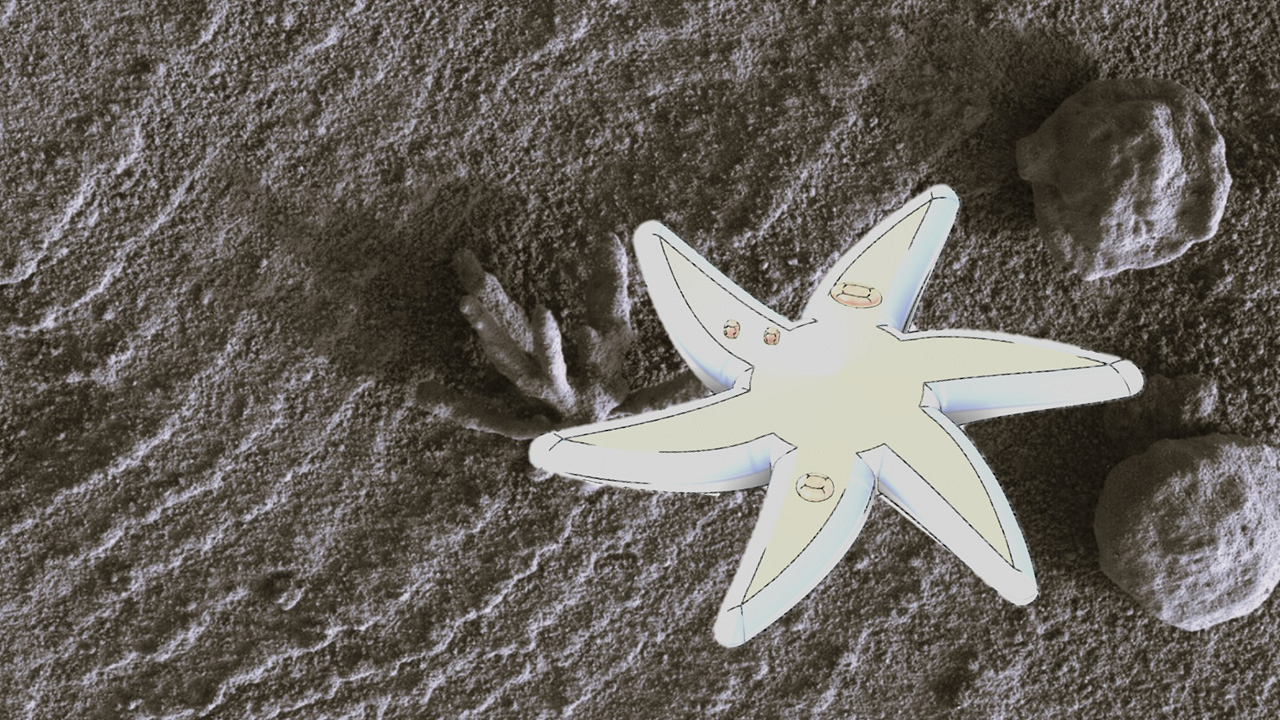
Soft robotics often take inspiration from natural biological systems, such as invertebrate organisms, for construction and control. The animal kingdom has evolved to enable each species to adapt and operate to a variety of different dynamic and unstructured environments [154]. Hard robots are regularly ‘non-collaborative’and can require predictable situations and accuracy. However, due to the design and control of soft robotics they are inherently compliant and uniquely suited to extreme environments [155,156]. Compliance has advantages in many situations, including the requirement for gentle yet resilient and effective grippers for delicate objects or for use in dynamic and unstructured or extreme environments to perform various complex tasks. For example, when controlled by microfluidics soft robotics become resilient to radiation [157]. Nature and its animals continuously demonstrate effective interactions with the surroundings through features such as configurability, compliance and softness [154,158], this is particularly true with animals that live in or around sand. An excellent example of this is the sandfish [159]. However, a robot moving through air or water will move fundamentally different, for instance, in soil or a granular medium such as sand. The physics of movement in terradynamic locomotion are not the same as water or air as the resistive drag forces are significantly greater and the object in motion can be diverted from course by granular lift force [160,161,162]. A soft robot is able to conform to its surroundings due to its flexibility; however, the challenge is to design flexible actuation that is capable of high forces, which replicate the muscles in an animal’s body [163,164]. To be able to apply intentional forces to the individual task the robot requires stiffness [165], the solution to this challenge could lie in nature and how soft or, relatively, delicate animals provide this required stiffness to move through similar terrains, offering novel locomotion approaches [166,167]. Soft robotic systems have also drawn inspiration from creatures in nature that burrow [168,169], such as the razor clam [170], to use in the extreme environment of the offshore industry. Figure 1 illustrates a rendition of the proposed THI with integrated sensors. The rendition intentionally depicts a bio-inspired form and with the use of soft materials highlights how the system could exhibit adaptability across dynamic terrain. Mack et al. have drawn inspiration from the physiology of a spider to develop a lightweight robotic system with significantly reduced energy requirements to address key challenges in extraterrestrial exploration associated with efficiency, controllability, and actuation efficiency [171].
Soft robotics has made significant scientific research progress in recent years. Research has investigated solutions to engineering challenges through investigation of mimicking highly versatile locomotion of invertebrate organisms. However, there is significant research currently being conducted to understand embedding multiple sensing technologies into these soft materials [172,173,174,175,176,177]. Research that involves expertise in advanced materials, flexible electronics and fabrication methods. Advances in soft robotic locomotion and sensing integration coupled with recent developments in soft additive manufacturing technologies [152,171,178], the development and deployment of soft robotic platforms with integrated microfluidics for sensing provides promising potential.
5. A Total Habitability Instrument – Summary, Conclusions, and Conjecture
Based on the review of current sensing technologies and progress in the study of habitability, we make the case for research towards the development of a Total Habitability Instrument (THI). Established instruments such as MS remain expensive and difficult to miniaturise, thus limiting their range of deployment. Smaller instruments that expand this range such as LIBS and Raman spectrometry are already used to complement MS capabilities with remote sensing and access to a different suite of analytes. Taking this trend further, we propose that a miniaturised total habitability system would be able to provide both novel and auxiliary data for future exploration.
Drawing inspiration from the design of μTAS to include integrated microfluidics and electrochemical sensing for "backbone" habitability parameters, coupled with a distinct component for water activity measurements. Microfluidics (lab-on-a-chip) is attracting attention for its potential in environmental research, as it allows for more precise and manipulation of samples from the microscale to the nanoscale [179,180,181]. Some devices are integrated with Surface Enhanced Raman Spectroscopy (SERS) [Emonds-Al]. Key objectives are to identify and analyse potential redox couples, and understanding water activity, temperature, ionic strength, and the availability of important ionic species.
Ideally, such an instrument would be a single integrated, low power, palmtop instrument, with the potential for low-cost, to be deployed alongside larger systems, or implemented alone in separate missions. The device would be autonomous, taking measurements and relaying data with minimal or no input from humans on the ground. It could be coupled with more significant sample extraction techniques, for example, similar to those proposed in the MOA instrument, to enable extraction from solid samples [37].
Such a device has the potential to be deployed in large numbers, integrated into simple soft robots. This integration could provide in-depth habitability over a geographical spread larger than a rover mission. The instruments could also occupy locations where continuous monitoring would enable an in-depth picture of temporal habitability. Multi-ion sensing chips consisting of microfabricated electrochemical sensors would allow for a certain "plug and play" capability, where one chip would be sensing for the major essential ions, while detection for the most likely redox couples could be added or subtracted depending on the likelihood of their occurrence. As there are multiple parameters of interest, such a habitability instrument will include sensors with a high degree of integration capability. In this regard, thin film microfabrication techniques would allow for a great number of these sensing modalities to be combined on a single, small transducing chip. Examples of this type of integration can be seen in, among other fields, sensing for environmental monitoring [62]. Sensing for conductivity and redox couples using micro- and nanoelectrodes, and ion selective electrodes, along with resistance devices for temperature sensing, could all be integrated on a single sensing chip. This would bring with it the key advantages of small size and weight, as well as the capability for multiple redundancies at little extra cost.
These could be integrated with sample delivery options, making use of microfluidics to sample small volumes of liquid from the environment of interest [182]. Due to the nature of these sensing modalities, they would require only small volumes of liquid to perform analysis, and as non-destructive analysis methods, they would not produce any waste material.
Some of the electrochemical sensors exhibit a narrower dynamic range, especially towards samples with higher concentrations of ions. This could be addressed by including some capability for sample processing, for example dilution with deionised water. As much of the work to date has been focussed on improving the lower limit of detection for these sensors, the capabilities of sensors to detect trace elements could compensate the dilution.
Delivery of these sensors would depend on the environment in which they were placed. Interaction at the interfaces between water and rock release key elements into the wider liquid environment. This makes these areas a target for habitability studies, both for internal ocean worlds, and for our own oceans [183]. Deep sea exploration technology could be utilised in the case of internal ocean worlds such as Enceladus or Titan [184]. Many of these sensors will be affected by temperature and pressure. This could be compensated by pre-calibration and inclusion of pressure sensors alongside the habitability sensor (as temperature would already be a parameter of interest). Making measurements in labs to characterise sensor responses at different temperatures and pressures will help to characterise their response once deployed. Many of the ion sensors also suffer from other sources of interference, such as interfering ions or pH for many ISEs. The effects of these could in turn be minimised or factored out by the inclusion of several other ISEs to determine the presence and concentration of the interfering ions. This would greatly increase the reliability of a Total Habitability Instrument. In this paper, key species to be measured and potential sensing modalities for a THI have identified. From the diversity of measurements required within extreme environments, and from the advances made in soft robotic manufacturing, locomotion and embedded systems, integration of a THI with a remotely deployed by a soft robotic system would enable adaptable and diverse sensing opportunities.
Author Contributions
Conceptualization, Yuchen Shang, Charles Cockell and Karen Donaldson; writing—original draft preparation, Karen Donaldson, Jonah Mack and Yuchen Shang; writing— Charles Cockell, supervision, Charles Cockell; project administration, Charles Cockell; funding acquisition, Charles Cockell. All authors have read and agreed to the published version of the manuscript.
Funding
This research was funded by the EPSRC CDT in Intelligent Sensing and Measurement Grant Number EP/L016753/1.
Conflicts of Interest
The authors declare no conflicts of interest. The funders had no role in the design of the study; in the collection, analyses, or interpretation of data; in the writing of the manuscript; or in the decision to publish the results.
Abbreviations
The following abbreviations are used in this manuscript:
CE Capillary electrophoresis
CHEMCAM Chemistry and camera complex
CHNOPS Carbon, Hydrogen, Nitrogen, Oxygen, Phosphorous, sulfur
CMOS Complementary metal oxide semiconductor
EOA Enceladus organics analyser
ERH Equilibirum relative humidity
FETS field effect transistor
INMS Ion and neutral mass spectrometer
ISFETS Ion selective membrane field effect transistors
ISE Ion selective electrodes
ISM Ion selective membrane
IrOx Iridium Oxide
JUICE Jupiter icy moons explorer
LAKI Life as we know it
LIBS Laser indcued breakdown
LIF Laser induced fluorescence
MEMS Microelectromechanical system
MOMA Mars organic molecule analyser
MOSFET Metal oxide semicondcutor FET
MS Mass spectrometer
PAHs Polycyclic aromatic hydrocarbons
SERS Surface enchanced raman spectroscopy
THI Total habitability instrument
References
- Hoehler, T. An energy balance concept for habitability. Astrobiology 2007, 7, 824–838. [Google Scholar] [CrossRef] [PubMed]
- Lammer, H.; Bredeh´’oft, J.; Coustenis, A.; Khodachenko, M.; Kaltenegger, L.; Grasset, O.; Prieur, D.; Raulin, F.; Ehrenfreund, P.; Yamauchi, M.; et al. What makes a planet habitable? Astronomy and Astrophysics Review 2009, 17, 181–249. [Google Scholar] [CrossRef]
- Cockell, C.; Bush, T.; Bryce, C.; Direito, S.; Fox-Powell, M.; Harrison, J.; Lammer, H.; Landen-mark, H.; Martin-Torres, J.; Nicholson, N.; et al. Habitability: A Review. Astrobiology 2016, 16, 89–117. [Google Scholar] [CrossRef]
- Wackett, L.; Dodge, A.; Ellis, L. Microbial Genomics and the Periodic Table. Applied and Environmental Microbiology 2004, 70, 647–655. [Google Scholar] [CrossRef]
- Seckbach, J. Life as We Know It; Springer: Dordrecht, 2006. [Google Scholar]
- Lebre, P.; De Maayer, P.; Cowan, D. Xerotolerant bacteria: surviving through a dry spell. Nature Reviews Microbiology 2017, 15, 285–296. [Google Scholar] [CrossRef]
- Epstein, W. The Roles and Regulation of Potassium in Bacteria. Progress in Nucleic Acid Research and Molecular Biology 2003, 75, 293–320. [Google Scholar]
- Hallsworth, J.; Yakimov, M.; Golyshin, P.; Gillion, J.; D’Auria, G.; de Lima Alves, F.; La Cono, V.; Genovese, M.; McKew, B.; Hayes, S.; et al. Limits of life in MgCl2-containing environments: chaotropicity defines the window. Environmental Microbiology 2007, 9, 801–813. [Google Scholar] [CrossRef]
- Payler, S.; Biddle, J.; Lollar, B.; Fox-Powell, M.; Edwards, T.; Ngwenya, B.; Paling, S.; Cockell, C. An ionic limit to life in the deep subsurface. Frontiers in Microbiology 2019, 10, 426. [Google Scholar] [CrossRef]
- Fox-Powell, M.; Hallsworth, J.; Cousins, C.; Cockell, C. Ionic Strength Is a Barrier to the Habitability of Mars. Astrobiology 2016, 16, 427–442. [Google Scholar] [CrossRef]
- Baker-Austin, C.; Dopson, M. Life in acid: pH homeostasis in acidophiles. Trends in Microbiology 2007, 15, 165–171. [Google Scholar] [CrossRef]
- Pikuta, E.V.; Hoover, R.; Tang, J. Microbial Extremophiles at the Limits of Life. Critical Reviews in Microbiology 2007, 33, 183–209. [Google Scholar] [CrossRef]
- Duckworth, A.; Grant, W.; Jones, B.; Van Steenbergen, R. Phylogenetic diversity of soda lake alkaliphiles. FEMS Microbiology Ecology 1996, 19, 181–191. [Google Scholar] [CrossRef]
- Kim, B.; Gadd, G. Bacterial Physiology and Metabolism; Cambridge, 2008. 15. Gadd, G. Metals, minerals and microbes: Geomicrobiology and bioremediation. Microbiology 2010, 156, 609–643. [Google Scholar]
- Shock, E.; Holland, M. Quantitative habitability. Astrobiology 2007, 7, 839–851. [Google Scholar] [CrossRef] [PubMed]
- Hoehler, T.; Jorgensen, B. Microbial life under extreme energy limitation. Nature Reviews Microbiology 2013, 11, 83–94. [Google Scholar] [CrossRef] [PubMed]
- Jelen, B.; Giovannelli, D.; Falkowski, P. The Role of Microbial Electron Transfer in the Coevolution of the Biosphere and Geosphere. Annual Review of Microbiology 2016, 70, 45–62. [Google Scholar] [CrossRef]
- Buettner, G.; Wagner, B.; Rodgers, V. Quantitative Redox Biology: An Approach to Understand the Role of Reactive Species in Defining the Cellular Redox Environment. Cell Biochemistry and Biophysics 2013, 67, 477–483. [Google Scholar] [CrossRef]
- Chevrier, V.; Rivera-Valentin, E. Formation of recurring slope lineae by liquid brines on present day Mars. Geophysical Research Letters 2012, 39, L21202. [Google Scholar] [CrossRef]
- Takai, K.; Nakamura, K.; Toki, T.; Tsunogai, U.; Miyazaki, M.; Miyazaki, J.; Hirayama, H.; Nakagawa, S.; Nunoura, T.; Horikoshi, K. Cell proliferation at 122◦C and isotopically heavy CH4 production by a hyperthermophilic methanogen under high-pressure cultivation. Proceedings of the National Academy of Sciences of the United States of America 2008, 105, 10949–10954. [Google Scholar] [CrossRef]
- Mykytczuk, N.; Foote, S.; Omelon, C.; Southam, G.; Greer, C.; Whyte, L. Bacterial growth at -15◦C; molecular insights from the permafrost bacterium Planococcus halocryophilus Or1. ISME Journal 2013, 7, 1211–1226. [Google Scholar] [CrossRef]
- Childs, P.; Greenwood, J.; Long, C. Review of temperature measurement. Review of Scientific Instruments 2000, 71, 2959–2978. [Google Scholar] [CrossRef]
- Sim, J.; Hyun, J.; Doh, I.; Ahn, B.; Kim, Y. Thin-film resistance temperature detector array for the measurement of temperature distribution inside a phantom. Metrologia 2018, 55, L5. [Google Scholar] [CrossRef]
- Mahadeva, S.; Yun, S.; Kim, J. Flexible humidity and temperature sensor based on cellulosepolypyrrole nanocomposite. Sensors and Actuators, A: Physical 2011, 165, 194–199. [Google Scholar] [CrossRef]
- Blasdel, N.; Wujcik, E.; Carletta, J.; Lee, K.; Monty, C. Fabric nanocomposite resistance temperature detector. IEEE Sensors Journal 2015, 15, 300–306. [Google Scholar] [CrossRef]
- Gilichinsky, D.; Rivkina, E.; Shcherbakova, V.; Laurinavichuis, K.; Tiedje, J. Supercooled water brines within permafrost - An unknown ecological niche for microorganisms: A model for astrobiology. Astrobiology 2003, 3, 331–341. [Google Scholar] [CrossRef]
- Belilla, J.; Moreira, D.; Jardillier, L.; Reboul, G.; Benzerara, K.; Lopez-Garcia, J.; Bertolino, P.; Lopez-Archilla, A.; Lopez-Garcia, P. Hyperdiverse archaea near life limits at the polyextreme geothermal Dallol area. Nature Ecology and Evolution 2019, 3, 1552–1561. [Google Scholar] [CrossRef]
- Carrizo, D.; Sanchez-Garcia, L.; Rodriguez, N.; Gomez, F. Lipid Biomarker and Carbon Stable Isotope Survey on the Dallol Hydrothermal System in Ethiopia. Astrobiology 2019, 19, 1474–1489. [Google Scholar] [CrossRef]
- Chin, J.; Megaw, J.; Magill, C.; Nowotarski, K.; Williams, J.; Bhaganna, P.; Linton, M.; Patterson, M.; Underwood, G.; Mswaka, A.; et al. Solutes determine the temperature windows for microbial survival and growth. Proceedings of the National Academy of Sciences of the United States of America 2010, 107, 7835–7840. [Google Scholar] [CrossRef]
- Ngugi, D.; Blom, J.; Stepanauskas, R.; Stingl, U. Diversification and niche adaptations of Nitrospina-like bacteria in the polyextreme interfaces of Red Sea brines. ISME Journal 2016, 10, 1383–1399. [Google Scholar] [CrossRef]
- Dick, G. The microbiomes of deep-sea hydrothermal vents: distributed globally, shaped locally. Nature Reviews Microbiology 2019, 17, 271–283. [Google Scholar] [CrossRef]
- Perez, V.; Dorador, C.; Molina, V.; Yanez, C.; Hengst, M. Rhodobacter sp. Rb3, an aerobic anoxygenic phototroph which thrives in the polyextreme ecosystem of the Salar de Huasco, in the Chilean Altiplano. Antonie van Leeuwenhoek, International Journal of General and Molecular Microbiology 2018, 111, 1449–1465. [Google Scholar] [CrossRef]
- Harrison, J.P.; Dobinson, L.; Freeman, K.; McKenzie, R.; Wyllie, D.; Nixon, S.L.; Cockell, C.S. Aerobically respiring prokaryotic strains exhibit a broader temperature–pH–salinity space for cell division than anaerobically respiring and fermentative strains. Journal of the Royal Society Interface 2015, 12, 20150658. [Google Scholar] [CrossRef] [PubMed]
- Reyes, D.; Iossifidis, D.; Auroux, P.; Manz, A. Micro total analysis systems. 1. Introduction, theory, and technology. Analytical Chemistry 2002, 74, 2623–2636. [Google Scholar] [CrossRef] [PubMed]
- Guijt, R.; Manz, A. Miniaturised total chemical-analysis systems (μTAS) that periodically convert chemical into electronic information. Sensors and Actuators, B: Chemical 2018, 273, 1334–1345. [Google Scholar] [CrossRef]
- Skelley, A.; Scherer, J.; Aubrey, A.; Grover, W.; Ivester, R.; Ehrenfreund, P.; Grunthaner, F.; Bada, J.; Mathies, R. Development and evaluation of a microdevice for amino acid biomarker detection and analysis on Mars. Proceedings of the National Academy of Sciences of the United States of America 2005, 102, 1041–1046. [Google Scholar] [CrossRef]
- Nascetti, A.; Caputo, D.; Scipinotti, R.; de Cesare, G. Technologies for autonomous integrated lab-on-chip systems for space missions. Acta Astronautica 2016, 128, 401–408. [Google Scholar] [CrossRef]
- Nascetti, A.; Mirasoli, M.; Marchegiani, E.; Zangheri, M.; Costantini, F.; Porchetta, A.; Iannascoli, L.; Lovecchio, N.; Caputo, D.; de Cesare, G.; et al. Integrated chemiluminescence-based lab-on- chip for detection of life markers in extraterrestrial environments. Biosensors and Bioelectronics 2019, 123, 195–203. [Google Scholar] [CrossRef]
- Mathies, R.; Razu, M.; Kim, J.; Stockton, A.; Turin, P.; Butterworth, A. Feasibility of Detecting Bioorganic Compounds in Enceladus Plumes with the Enceladus Organic Analyzer. Astrobiology 2017, 17, 902–912. [Google Scholar] [CrossRef]
- Romero-Wolf, A.; Vance, S.; Maiwald, F.; Heggy, E.; Ries, P.; Liewer, K. A passive probe for subsurface oceans and liquid water in Jupiter’s icy moons. Icarus 2015, 248, 463–477. [Google Scholar] [CrossRef]
- Bruzzone, L.; Plaut, J.; Alberti, G.; Blankenship, D.; Bovolo, F.; Campbell, B.; Castelletti, D.; Gim, Y.; Ilisei, A.; Kofman, W.; et al. Jupiter ICY moon explorer (JUICE): Advances in the design of the radar for Icy Moons (RIME). In Proceedings of the International Geoscience and Remote Sensing Symposium (IGARSS), Milan, Italy; 2015. [Google Scholar] [CrossRef]
- Moroz, V.I. Infrared spectrophotometry of the Moon and the Galilean satellites of Jupiter. Soviet Astronomy 1966, 9, 999. [Google Scholar]
- Smith, B.; Soderblom, L.; Johnson, T.V.; Ingersoll, A.; Collins, S.; Shoemaker, E.; Hunt, G.; Masursky, H.; Carr, M.; Davies, M.; et al. The Jupiter system through the eyes of Voyager 1. Science 1979, 204, 951–972. [Google Scholar] [CrossRef]
- Anderson, J.; Lau, E.; Sjogren, W.; Schubert, G.; Moore, W. Europa’s differentiated internal structure: Inferences from two Galileo encounters. Science 1997, 276, 1236–1239. [Google Scholar] [CrossRef] [PubMed]
- Carr, M.; Belton, M.; Chapman, C.; Davies, M.; Geissler, P.; Greenberg, R.; McEwen, A.; Tufts, B.; Greeley, R.; Sullivan, R.; et al. Evidence for a subsurface ocean on Europa. Nature 1998, 391, 363–365. [Google Scholar] [CrossRef] [PubMed]
- Waite, J.; Lewis, W.; Kasprzak, W.; Anicich, V.; Block, B.; Cravens, T.; Fletcher, G.; Ip, W.H.; Luhmann, J.; McNutt, R.; et al. The Cassini ion and neutral mass spectrometer (INMS) investigation. Space Science Reviews 2004, 114, 113–231. [Google Scholar] [CrossRef]
- Porco, C.; Helfenstein, P.; Thomas, P.; Ingersoll, A.; Wisdom, J.; West, R.; Neukum, G.; Denk, T.; Wagner, R.; Roatsch, T.; et al. Cassini observes the active south pole of enceladus. Science 2006, 311, 1393–1401. [Google Scholar] [CrossRef]
- Farahani, H.; Wagiran, R.; Hamidon, M. Humidity Sensors Principle, Mechanism, and Fabrication Technologies: A Comprehensive Review. Sensors 2014, 14, 7881–7939. [Google Scholar] [CrossRef]
- Blank, T.; Eksperiandova, L.; Belikov, K. Recent trends of ceramic humidity sensors development: A review. Sensors and Actuators, B: Chemical 2016, 228, 416–442. [Google Scholar] [CrossRef]
- Najeeb, M.; Ahmad, Z.; Shakoor, R. Organic Thin-Film Capacitive and Resistive Humidity Sensors: A Focus Review. Advanced Materials Interfaces 2018, 5, 1800969. [Google Scholar] [CrossRef]
- Bai, M.; Seitz, W. A fiber optic sensor for water in organic solvents based on polymer swelling. Talanta 1994, 41, 993–999. [Google Scholar] [CrossRef]
- Zhang, W.; Webb, D. Polymer optical fiber grating as water activity sensor. Micro-structured and Specialty Optical Fibres III 2014, 9128, 91280F. [Google Scholar]
- Blyth, J.; Millington, R.; Mayes, A.; Frears, E.; Lowe, C. Holographic Sensor forWater in Solvents. Analytical Chemistry 1996, 68, 1089–1094. [Google Scholar] [CrossRef]
- Wang, Y.; Shen, C.; Lou, W.; Shentu, F.; Zhong, C.; Dong, X.; Tong, L. Fiber optic relative humidity sensor based on the tilted fiber Bragg grating coated with graphene oxide. Applied Physics Letters 2016, 109, 031107. [Google Scholar] [CrossRef]
- Lo Presti, D.; Massaroni, C.; Schena, E. Optical Fiber Gratings for Humidity Measurements: A Review. IEEE Sensors Journal 2018, 18, 9065–9074. [Google Scholar] [CrossRef]
- Black, W.; Santiago, M.; Zhu, S.; Stroock, A. Ex Situ and In Situ Measurement of Water Activity with a MEMS Tensiometer. Analytical Chemistry 2019, 92, 716–723. [Google Scholar] [CrossRef] [PubMed]
- Pagay, V.; Santiago, M.; Sessoms, D.; Huber, E.; Vincent, O.; Pharkya, A.; Corso, T.; Lakso, A.; Stroock, A. A microtensiometer capable of measuring water potentials below -10 MPa. Lab on a Chip 2014, 14, 2806–2817. [Google Scholar] [CrossRef]
- Jaffrezic-Renault, N.; Dzyadevych, S.V. Conductometric microbiosensors for environmental monitoring. Sensors 2008, 8, 2569–2588. [Google Scholar] [CrossRef]
- Sheppard, N.; Tucker, R.; Wu, C. Electrical Conductivity Measurements Using Microfabricated Interdigitated Electrodes. Anal. Chem 1993, 65, 1199–1202. [Google Scholar] [CrossRef]
- Mortensen, D.; Birkelund, K.; Hansen, O.; Thomsen, E.V.; Hyldg, A. Autonomous multi-sensor micro-system for measurement of ocean water salinity. Sensors and Actuators A: Physical 2008, 147, 474–484. [Google Scholar]
- Jonsson, J.; Smedfors, K.; Nyholm, L.; Thornell, G. Towards Chip-Based Salinity Measurements for Small Submersibles and Biologgers. International Journal of Oceanography 2013, 2013, 1–11. [Google Scholar] [CrossRef]
- Zhou, B.; Bian, C.; Tong, J.; Xia, S. Fabrication of a miniature multi-parameter sensor chip for water quality assessment. Sensors 2017, 17, 1–14. [Google Scholar] [CrossRef]
- Huang, X.; Mowlem, M.; Pascal, R.; Chamberlain, K.; Banks, C.; Morgan, H. A miniature high precision conductivity and temperature sensor system for ocean monitoring. IEEE Sensors Journal 2010, 11, 3246–3252. [Google Scholar] [CrossRef]
- Kounaves, S.; Hecht, M.; West, S.; Morookian, J.; Young, S.; Quinn, R.; Grunthaner, P.; Wen, X.; Weilert, M.; Cable, C.; et al. The MECA wet chemistry laboratory on the 2007 Phoenix Mars Scout Lander. Journal of Geophysical Research E: Planets 2009, 114, 1–20. [Google Scholar] [CrossRef]
- Oiler, J.; Shock, E.; Hartnett, H.; Dombard, A.; Yu, H. Harsh environment sensor array-enabled hot spring mapping. IEEE Sensors Journal 2014, 14, 3418–3425. [Google Scholar] [CrossRef]
- Fraustp da Silva, J.; Williams, R. The biological chemistry of the elements: the inorganic chemistry of life; Clarendon: Oxford, UK, 1997. [Google Scholar]
- B´’uhlmann, P.; Chen, L.D. Ion-selective electrodes with ionophore-doped sensing membranes. In Supramolecular Chemistry: From Molecules to Nanomaterials; 2012. [Google Scholar]
- Jackson, D.; Nelson, P. Preparation and properties of some ion selective membranes: A review. Journal of Molecular Structure 2019, 1182, 241–259. [Google Scholar] [CrossRef]
- Bakker, E.; Pretsch, E.; Ceresa, A. Selectivity of Potentiometric Ion Sensors. E. Anal. Chem 1994, 66, 3021–3030. [Google Scholar] [CrossRef]
- Cattrall, R.; Hamilton, I. Coated-Wire Ion-Selective Electrodes. Analytical Chemistry 1984, 43, 1905–1906. [Google Scholar] [CrossRef]
- Bobacka, J. Potential stability of all-solid-state ion-selective electrodes using conducting polymers as ion-to-electron transducers. Analytical Chemistry 1999, 71, 4932–4937. [Google Scholar] [CrossRef]
- Bobacka, J.; Ivaska, A.; Lewenstam, A. Potentiometric Ion Sensors Based on Conducting Polymers. Electroanalysis 2003, 15, 366–374. [Google Scholar] [CrossRef]
- Hupa, E.; Vanamo, U.; Bobacka, J. Novel Ion-to-Electron Transduction Principle for Solid Contact ISEs. Electroanalysis 2015, 27, 591–594. [Google Scholar] [CrossRef]
- Jaworska, E.; Kisiel, A.; Maksymiuk, K.; Michalska, A. Lowering the Resistivity of Polyacrylate Ion-Selective Membranes by Platinum Nanoparticles Addition. Analytical Chemistry 2011, 83, 438–445. [Google Scholar] [CrossRef]
- Li, J.; Yin, T.; Qin, W. An effective solid contact for an all-solid-state polymeric membrane Cd2+ selective electrode: Three-dimensional porous graphene-mesoporous platinum nanoparticle composite. Sensors and Actuators, B: Chemical 2017, 239, 438–446. [Google Scholar] [CrossRef]
- Boeva, Z.; Lindfors, T. Few-layer graphene and polyaniline composite as ion-to-electron transducer in silicone rubber solid-contact ion-selective electrodes. Sensors and Actuators, B: Chemical 2015, 224, 624–631. [Google Scholar] [CrossRef]
- Crespo, G.; Macho, S.; Rius, F. Ion-selective electrodes using carbon nanotubes as ion-to-electron transducers. Analytical Chemistry 2008, 80, 1316–1322. [Google Scholar] [CrossRef] [PubMed]
- Hu, J.; Zou, X.; Stein, A.; B´’uhlmann, P. Ion-selective electrodes with colloid-imprinted mesoporous carbon as solid contact. Analytical Chemistry 2014, 86, 7111–7118. [Google Scholar] [CrossRef]
- Weber, A.; O’Neil, G.; Kounaves, S. Solid Contact Ion-Selective Electrodes for in Situ Measurements at High Pressure. Analytical Chemistry 2017, 89, 4803–4807. [Google Scholar] [CrossRef]
- Peshkova, M.; Sokalski, T.; Mikhelson, K.; Lewenstam, A. Obtaining Nernstian Response of a Ca2+ -Selective Electrode in a Broad Concentration Range by Tuned Galvanostatic Polarization. Analytical Chemistry 2008, 80, 9181–9187. [Google Scholar] [CrossRef]
- Van de Velde, L.d.E.; Olthuis, W. Solid contact potassium selective electrodes for biomedical applications – a review. Talanta 2016, 160, 56–65. [Google Scholar] [CrossRef]
- Crespo, G. Recent Advances in Ion-selective membrane electrodes for in situ environmental water analysis. Electrochimica Acta 2017, 245, 1023–1034. [Google Scholar] [CrossRef]
- Jaramillo, E.; Noell, A. Development of Miniature Solid Contact Ion Selective Electrodes for in situ Instrumentation. Electroanalysis 2020. [Google Scholar] [CrossRef]
- Bobacka, J.; Ivaska, A.; Lewenstam, A. Potentiometric Ion Sensors. Chemical Reviews 2008, 108, 329–351. [Google Scholar] [CrossRef]
- Bieg, C.; Fuchsberger, K.; Stelzle, M. Introduction to polymer-based solid-contact ion-selective electrodes—basic concepts, practical considerations, and current research topics. Analytical and Bioanalytical Chemistry 2017, 409, 45–61. [Google Scholar] [CrossRef]
- Bergveld, P. Short Communications: Development of an Ion-Sensitive Solid-State Device for Neurophysiological Measurements. IEEE Transactions on Biomedical Engineering 1970, BME 17, 70–71. [Google Scholar] [CrossRef] [PubMed]
- Bausells, J.; Carrabina, J.; Errachid, A.; Merlos, A. Ion-sensitive field-effect transistors fabricated in a commercial CMOS technology. Sensors and Actuators, B: Chemical 1999, 57, 56–62. [Google Scholar] [CrossRef]
- Ouremchi, M.; Boutahiri, A.E.; Farah, F.; Khadiri, K.E.; Qjidaa, H.; Lakhassassi, A.; Tahiri, A. Integrated ph-sensor for medical application in 180nm CMOS technology. In Proceedings of the 4th International Conference on Smart and Sustainable Technologies (SpliTech), Split, Croatia; 2019. [Google Scholar] [CrossRef]
- Moser, N.; Leong, C.; Hu, Y.; Boutelle, M.; Georgiou, P. An ion imaging ISFET array for Potassium and Sodium detection. In Proceedings of the IEEE International Symposium on Circuits and Systems (ISCAS), Montreal, QC; 2016. [Google Scholar]
- Hu, Y.; Moser, N.; Georgiou, P. A 32 x 32 ISFET Chemical Sensing Array with Integrated Trapped Charge and Gain Compensation. IEEE Sensors Journal 2017, 17, 5276–5284. [Google Scholar] [CrossRef]
- Zhang, J.R.; Ionescu, A. All CMOS Integrated 3D-Extended Metal Gate ISFETs for pH and Multi-Ion (Na + , K + , Ca 2 +) sensing. IEEE International Electron Devices Meeting (IEDM), San Francisco, CA; 2019. [Google Scholar]
- Niigata, K.; Narano, K.; Maeda, Y.; Ao, J. Temperature dependence of sensing characteristics of a pH sensor fabricated on AlGaN/GaN heterostructure. Japanese Journal of Applied Physics 2014, 53, 11RD01. [Google Scholar] [CrossRef]
- Sohbati, M.; Toumazou, C. Dimension and shape effects on the ISFET performance. IEEE Sensors Journal 2015, 15, 1670–1679. [Google Scholar] [CrossRef]
- Sardarinejad, A.; Maurya, D.; Khaled, M.; Alameh, K. Temperature effects on the performance of RuO2 thin-film pH sensor. Sensors and Actuators, A: Physical 2015, 233, 414–421. [Google Scholar] [CrossRef]
- Gaddour, A.; Dghais, W.; Hamdi, B.; Ben Ali, M. Temperature Compensation Circuit for ISFET Sensor. Journal of Low Power Electronics and Applications 2020, 10, 2. [Google Scholar] [CrossRef]
- Bhardwaj, R.; Sinha, S.; Sahu, N.; Majumder, S.; Narang, P.; Mukhiya, R. Modeling and simulation of temperature drift for ISFET-based pH sensor and its compensation through machine learning techniques. International Journal of Circuit Theory and Applications 2019, 47, 954–970. [Google Scholar] [CrossRef]
- Bergveld, P. Thirty years of ISFETOLOGY: What happened in the past 30 years and what may happen in the next 30 years. Sensors and Actuators, B: Chemical 2003, 88, 1–20. [Google Scholar] [CrossRef]
- Moser, N.; Lande, T.; Toumazou, C.; Georgiou, P. ISFETs in CMOS and Emergent Trends in Instrumentation: A Review. IEEE Sensors Journal 2016, 16, 6496–6514. [Google Scholar] [CrossRef]
- Haber, F.; Hlemensiewicz, Z. Uber elektrische phasengrenzkr´’afte. Zeitschrift f´’ur physikalische Chemie 1909, 67, 385–431. [Google Scholar] [CrossRef]
- Pucacco, L.; Carter, N. A glass-membrane pH microelectrode. Analytical Biochemistry 1976, 73, 501–512. [Google Scholar] [CrossRef] [PubMed]
- McLaughlin, K.; Dickson, A.; Weisberg, S.; Coale, K.; Elrod, V.; Hunter, C.; Johnson, K.; Kram, S.; Kudela, R.; Martz, T.; et al. An evaluation of ISFET sensors for coastal pH monitoring applications. Regional Studies in Marine Science 2017, 12, 11–18. [Google Scholar] [CrossRef]
- Zorrilla, L.; Calvo, J. Monitoring system for ISFET and glass electrode behavior comparison. IEEE XXIV International Conference on Electronics, Electrical Engineering and Computing (INTERCON), Cusco, Peru.
- Johnson, K.; Jannasch, H.; Coletti, L.; Elrod, V.; Martz, T.; Takeshita, Y.; Carlson, R.; Connery, J. Deep-Sea DuraFET: A Pressure Tolerant pH Sensor Designed for Global Sensor Networks. Analytical Chemistry 2016, 88, 3249–3256. [Google Scholar] [CrossRef]
- McLaughlin, K.; Nezlin, N.; Weisberg, S.; Dickson, A.; Booth, J.; Cash, C.; Feit, A.; Gully, J.; Johnson, S.; Latker, A.; et al. An evaluation of potentiometric pH sensors in coastal monitoring applications. Limnology and Oceanography: Methods 2017, 15, 679–689. [Google Scholar] [CrossRef]
- Wu, Y.-C.; Lin, C.H. Mass-produced polyethylene-terephthalate film coated with tantalum pentoxide for pH measurement under ISFET detection configuration. Microsystem Technologies 2017, 23, 293–298. [Google Scholar] [CrossRef]
- Voigt, H.; Schitthelm, F.; Lange, T.; Kullick, T.; Ferretti, R. Diamond-like carbon-gate pH-ISFET. Sensors and Actuators, B: Chemical 1997, 44, 441–445. [Google Scholar] [CrossRef]
- Qin, Y.; Kwon, H.; Howlader, M.; Deen, M. Microfabricated electrochemical pH and free chlorine sensors for water quality monitoring: Recent advances and research challenges. RSC Advances 2015, 5, 69086–69109. [Google Scholar] [CrossRef]
- Marzouk, S.; Ufer, S.; Buck, R.; Johnson, T.; Dunlap, L.; Cascio, W. Electrodeposited iridium oxide pH electrode for measurement of extracellular myocardial acidosis during acute ischemia. Analytical Chemistry 1998, 70, 5054–5061. [Google Scholar] [CrossRef]
- Ges, I.; Ivanov, B.; Schaffer, D.; Lima, E.; Werdich, A.; Baudenbacher, F. Thin-film IrOx pH microelectrode for microfluidic-based microsystems. Biosensors and Bioelectronics 2005, 21, 248–256. [Google Scholar] [CrossRef] [PubMed]
- Yang, X.; Chiao, J. Integrated pH and Sodium Sensor Array Based on Iridium Oxide Film. IEEE SENSORS, New Delhi 2018.
- Hoffman, J.H.; Hodges Jr, R.R.; Evans, D.E. Lunar orbital mass spectrometer experiment. In Proceedings of the Lunar and Planetary Science Conference Proceedings; 1972; Vol. 3, p. 2205. [Google Scholar]
- Rushneck, D.; Diaz, A.V.; Howarth, D.; Rampacek, J.; Olson, K.; Dencker, W.; Smith, P.; McDavid, L.; Tomassian, A.; Harris, M.; et al. Viking gas chromatograph-mass spectrometer. Review of Scientific Instruments 1978, 49, 817–834. [Google Scholar] [CrossRef] [PubMed]
- Mahaffy, P.; Webster, C.; Cabane, M.; Conrad, P.; Coll, P.; Atreya, S.; Arvey, R.; Barciniak, M.; Benna, M.; Bleacher, L.; et al. The sample analysis at mars investigation and instrument suite. Space Science Reviews 2012, 170, 401–478. [Google Scholar] [CrossRef]
- Kasprzak, W.; Niemann, H.; Harpold, D.; Richards, J.; Manning, H.; Patrick, E.; Mahaffy, P. Cassini orbiter ion and neutral mass spectrometer instrument. Proceedings of SPIE - The International Society for Optical Engineering 1996, 2803, 129–140. [Google Scholar]
- Niemann, H.; Atreya, S.; Demick, J.; Gautier, D.; Haberman, J.; Harpold, D.; Kasprzak, W.; Lunine, J.; Owen, T.; Raulin, F. Composition of Titan’s lower atmosphere and simple surface volatiles as measured by the Cassini-Huygens probe gas chromatograph mass spectrometer experiment. Journal of Geophysical Research 2010, 115, E12006. [Google Scholar] [CrossRef]
- Vago, J.; Westall, F.; Teams, P.I.; S, L.; Coates, A.; Jaumann, R.; Korablev, O.; Ciarletti, V.; Mitrofanov, I.; Josset, J.L.; et al. Habitability on Early Mars and the Search for Biosignatures with the ExoMars Rover. Astrobiology 2017, 17, 471–510. [Google Scholar] [CrossRef]
- Grasset, O.; Dougherty, M.; Coustenis, A.; Bunce, E.; Erd, C.; Titov, D.; Blanc, M.; Coates, A.; Drossart, P.; Fletcher, L.; et al. JUpiter ICy moons Explorer (JUICE): An ESA mission to orbit Ganymede and to characterise the Jupiter system. Planetary and Space Science 2013, 78, 1–21. [Google Scholar] [CrossRef]
- Howell, S.; Pappalardo, R. NASA’s Europa Clipper—a mission to a potentially habitable ocean world. Nature Communications 2020, 11, 9–12. [Google Scholar] [CrossRef]
- Denisov, E.; Damoc, E.; Lange, O.; Makarov, A. Orbitrap mass spectrometry with resolving powers above 1,000,000. International Journal of Mass Spectrometry 2012, 325–327, 80–85. [Google Scholar] [CrossRef]
- Arevalo, R.; Selliez, L.; Briois, C.; Carrasco, N.; Thirkell, L.; Cherville, B.; Colin, F.; Gaubicher, B.; Farcy, B.; Li, X.; et al. An Orbitrap-based laser desorption/ablation mass spectrometer designed for spaceflight. Rapid Communications in Mass Spectrometry 2018, 32, 1875–1886. [Google Scholar] [CrossRef]
- Arevalo, R.; Ni, Z.; Danell, R. Mass spectrometry and planetary exploration: A brief review and future projection. Journal of Mass Spectrometry 2020. [Google Scholar] [CrossRef]
- de Hoffmann, E. Mass Spectrometry. In Kirk-Othmer Encyclopedia of Chemical Technology; John Wiley Sons, Inc.: Hoboken, NJ, USA, 2005. [Google Scholar]
- Maurice, S.; Wiens, R.; Saccoccio, M.; Barraclough, B.; Gasnault, O.; Forni, O.; Mangold, N.; Baratoux, D.; Bender, S.; Berger, G.; et al. The ChemCam instrument suite on the Mars Science Laboratory (MSL) rover: Science objectives and mast unit description. Space Science Reviews 2012, 170, 95–166. [Google Scholar] [CrossRef]
- Donaldson, K.; Yan, X. A first simulation of soil-laser interaction investigation for soil characteristic analysis. Geoderma 2019, 337, 701–709. [Google Scholar] [CrossRef]
- Yan, X.T.; Donaldson, K.; Davidson, C.M.; Gao, Y.; Wu, H.; Houston, A.M.; Kisdi, A. Effects of sample pretreatment and particle size on the determination of nitrogen in soil by portable LIBS and potential use on robotic-borne remote Martian and agricultural soil analysis systems. RSC Adv. 2018, 8. [Google Scholar] [CrossRef]
- Ellery, A.; Wynn-williams, D. Why Raman Spectroscopy on Mars?—A Case of the Right Tool for the Right Job. Astrobiology 2003, 3, 565–580. [Google Scholar] [CrossRef]
- Angel, S.; Gomer, N.; Sharma, S.; McKay, C.; Ames, N. Remote Raman spectroscopy for planetary exploration: A review. Applied Spectroscopy 2012, 66, 137–150. [Google Scholar] [CrossRef]
- Zhang, X.; Brewer, P. In situ Raman-based measurements of high dissolved methane concentrations in hydrate-rich ocean sediments. Geophysical Research Letters 2019, 38. [Google Scholar] [CrossRef]
- Misra, A.; Acosta-Maeda, T.; Sandford, M.; Gasda, P.; Porter, J.; Sharma, S.; Lucey, P.; Garmire, D.; Zhou, J.; Oyama, T.; et al. Standoff Biofinder: powerful search for life instrument for planetary exploration 2018. [CrossRef]
- Edwards, H.; Hutchinson, I.; Ingley, R. The ExoMars Raman spectrometer and the identification of biogeological spectroscopic signatures using a flight-like prototype. Analytical and Bioanalytical Chemistry 2012, 404, 1723–1731. [Google Scholar] [CrossRef]
- Goesmann, F.; Brinckerhoff, W.; Raulin, F.; Goetz, W.; Danell, R.; Getty, S.; Siljestr´’om, S.; Misbach, H.; Steininger, H.; Arevalo, R.; et al. The Mars Organic Molecule Analyzer (MOMA) Instrument: Characterization of Organic Material in Martian Sediments. Astrobiology 2017, 17, 655–685. [Google Scholar] [CrossRef]
- Beegle, L.; Bhartia, R.; White, M.; Deflores, L.; Abbey, W.; Wu, Y.; Cameron, B.; Moore, J.; Fries, M.; Burton, A.; et al. SHERLOC: Scanning habitable environments with Raman luminescence for organics chemicals. In Proceedings of the 2015 IEEE Aerospace Conference, Big Sky, MT, USA; 2015. [Google Scholar] [CrossRef]
- Perez, R.; Newell, R.; Robinson, S.; Ca´’is, P.; Maurice, S.; Wiens, R.; Pares, L.; Bernardi, P.; Reess, J.M.; McCabe, K. The supercam instrument on the NASA Mars 2020 mission: optical design and performance. In Proceedings of the International Conference on Space Optics—ICSO 2016, Biarritz, France; 2017. [Google Scholar] [CrossRef]
- Jones, R.R.; Zhang, L. Raman Techniques: Fundamentals and Frontiers. Nanoscale Res Lett 2019, 14, 231. [Google Scholar] [CrossRef]
- Pan, J.; Fang, P.; Fang, X.; Hu, T.; Fang, J.; Fang, Q. A low-cost palmtop high-speed capillary electrophoresis bioanalyzer with laser induced fluorescence detection. Scientific Reports 2018, 8, 1–11. [Google Scholar] [CrossRef]
- Nightingale, A.; Beaton, A.; Mowlem, M. Trends in microfluidic systems for in situ chemical analysis of natural waters. Sensors and Actuators, B: Chemical 2015, 221, 1398–1405. 138. Daniel, A.; La´’es, A.; Barus, C.; Beaton, A.; Blandfort, D.; Guigues, N.; Knockaert, M.; Munaron, D.; Salter, I.; Woodward, E.; et al. Toward a Harmonization for Using in situ Nutrient Sensors in the Marine Environment. Frontiers in Marine Science 2020, 6, 773.
- Bresnahan, P.; Martz, T. Gas Diffusion Cell Geometry for a Microfluidic Dissolved Inorganic Carbon Analyzer. IEEE Sensors Journal 2018, 18, 2211–2217. [Google Scholar] [CrossRef]
- Tweedie, M.; Sun, D.; Gajula, D.; Ward, B.; Maguire, P. The analysis of dissolved inorganic carbon in liquid using a microfluidic conductivity sensor with membrane separation of CO2. Microfluidics and Nanofluidics 2020, 24, 1–11. [Google Scholar] [CrossRef] [PubMed]
- Beaton, A.; Cardwell, C.; Thomas, R.; Sieben, V.; Legiret, F.E.; Waugh, E.; Statham, P.; Mowlem, M.; Morgan, H. Lab-on-Chip Measurement of Nitrate and Nitrite for In Situ Analysis of Natural Waters. Environ. Sci. Technol 2012, 46, 58. [Google Scholar] [CrossRef] [PubMed]
- Petroni, J.; Lucca, B.; Ferreira, V. Simple approach for the fabrication of screen-printed carbon based electrode for amperometric detection on microchip electrophoresis. Analytica Chimica Acta 2017, 954, 88–96. [Google Scholar] [CrossRef] [PubMed]
- Chen, X.; Zhou, G.; Mao, S.; Chen, J. Rapid detection of nutrients with electronic sensors: A review. Environmental Science: Nano 2018, 5, 837–862. [Google Scholar] [CrossRef]
- Gibbon-Walsh, K.; Sala´’un, P.; van den Berg, C. Determination of manganese and zinc in coastal waters by anodic stripping voltammetry with a vibrating gold microwire electrode. Environmental Chemistry 2011, 8, 475. [Google Scholar] [CrossRef]
- Clark, L.; Wolf, R.; Granger, D.; Taylor, Z. Continuous recording of blood oxygen tensions by polarography. Journal of applied physiology 1953, 6, 189–193. [Google Scholar] [CrossRef]
- Revsbech, N. An oxygen microsensor with a guard cathode. Limnology and Oceanography 1989, 34, 474–478. [Google Scholar] [CrossRef]
- Wenzh´’ofer, F.; Holby, O.; Glud, R.; Nielsen, H.; Gundersen, J. In situ microsensor studies of a shallow water hydrothermal vent at Milos, Greece. Marine Chemistry 2000, 69, 43–54. [Google Scholar] [CrossRef]
- Suzuki, H.; Sugama, A.; Kojima, N. Miniature Clark-type oxygen electrode with a three-electrode configuration. Sensors and Actuators: B. Chemical 1990, 2, 297–303. [Google Scholar] [CrossRef]
- Suzuki, H. Microfabrication of chemical sensors and biosensors for environmental monitoring. Materials Science and Engineering C 2000, 12, 55–61. [Google Scholar] [CrossRef]
- Wu, C.C.; Matsue, T. Fabrication of miniature Clark oxygen sensor integrated with microstructure. Sensors and Actuators, B: Chemical 2005, 110, 342–329. [Google Scholar] [CrossRef]
- Han, J.; Kim, S.; Choi, J.; Kang, S.; Pak, Y.; Pak, J. Development of multi-well-based electrochemical dissolved oxygen sensor array. Sensors and Actuators, B: Chemical 2020, 306, 127465. [Google Scholar] [CrossRef]
- Gepner, M.; Mack, J.; Stokes, A.A. A standardized platform for translational advances in fluidic soft systems. Device 2025. [Google Scholar] [CrossRef]
- Takeshi, K.; Daichi, K. Decentralized Control Mechanism for Determination of Moving Direction in Brittle StarsWith Penta-Radially Symmetric Body. Frontiers in Neurorobotics 2019, 13. [Google Scholar]
- Kaipa, K.; Onal, C.; Jovanovic, V.; Djuric, A.; Luo, M.; Bowers, M.; Popovic, M. Bioinspired 1000 Robotics. Biomechatronics 2019, 1001. [Google Scholar]
- Kulkarni, M.; Edward, S.; Golecki, T.; Kaehr, B.; Golecki, H. Soft robots built for extreme 1002 environments. Soft Sci. 2025, 5, 12. [Google Scholar] [CrossRef]
- Zhang, Y. Progress, challenges, and prospects of soft robotics for space applications. Advanced Intelligent Systems 2023, 5. [Google Scholar] [CrossRef]
- Mahon, S.T.; Buchoux, A.; Sayed, M.E.; Teng, L.; Stokes, A.A. Soft Robots for Extreme Environments: Removing Electronic Control. In Proceedings of the 2019 2nd IEEE International Conference on Soft Robotics (RoboSoft), Seoul, Korea (South); 2019; pp. 782–787. [Google Scholar]
- Speck, T.; Poppinga, S.; Speck, O.; Tauber, F. Bio-inspired life-like motile materials systems: Changing the boundaries between living and technical systems in the Anthropocene. The Anthropocene Review 2021, 9. [Google Scholar] [CrossRef]
- Vihar, B.; Hanisch, F.; Baumgartner, W. Neutral glycans from sandfish skin can reduce friction of polymers. J. R. Soc. Interface 2016, 13, 20160103. [Google Scholar] [CrossRef] [PubMed]
- Naclerio, N.; Karsai, A.; Murray-Cooper, M.; Ozkan-Aydin, Y.; Aydin, E.; Goldman, D.; Hawkes, E. Controlling subterranean forces enables a fast, steerable, burrowing soft robot. Sci Robot. 2021, 6. [Google Scholar] [CrossRef] [PubMed]
- Guillard, F.; Forterre, Y.; Pouliquen, O. Lift forces in granular media. Physics of Fluids 2014, 26. [Google Scholar] [CrossRef]
- Maladen, R.D.; Ding, Y.; Umbanhowar, P.B.; Kamor, A.; Goldman, D.I. Mechanical models of sandfish locomotion reveal principles of high-performance subsurface sandswimming. J. R. Soc. Interface 2011, 8, 1332–1345. [Google Scholar] [CrossRef]
- Chopra, S.; Vasile, D.; Gravish, N. Toward Robotic Sensing and Swimming in Granular Environments using Underactuated Appendages. Adv. Intell. Syst. 2023, 5, 2200404. [Google Scholar] [CrossRef]
- Sandoval, J.A.; Jadhav, S.; Tolley, M.T. Reversible adhesion to rough surfaces both in and out of water, inspired by the clingfish suction disc. Bioinspir. Biomim. 2019, 14, 066016. [Google Scholar] [CrossRef]
- Kim, S.; Laschi, C.; Trimmer, B. Soft robotics: a bioinspired evolution in robotics. Trends Biotechnol 2013, 31, 287–294. [Google Scholar] [CrossRef]
- Foster-Hall, W.; Harvey, D.; Akmeliawati, R. Soft Robotics for Space Applications: Towards a Family of Locomotion Platforms. In Proceedings of the 2024 IEEE 7th International Conference on Soft Robotics (RoboSoft), San Diego, CA, USA; 2024; pp. 698–704. [Google Scholar]
- Taylor, D.; Dirks, J.H. Shape optimization in exoskeletons and endoskeletons: a biomechanics analysis. J. R. Soc. Interface 2012, 9, 3480–3489. [Google Scholar] [CrossRef]
- FRAGA, M.C.; VEGA, C.S. How does rapid burial work? New insights from experiments with echinoderms. Adv. Intell. Syst. 2024, 67. [Google Scholar]
- Heydari, S.; Johnson, S.; Kanso, E. Sea star inspired crawling and bouncing. J. R. Soc.Interface 2020, 17. [Google Scholar] [CrossRef]
- Monica Isava, A.G.W.V. Razor clam-inspired burrowing in dry soil. International Journal of Non-Linear Mechanics 2016, 81, 30–39. [Google Scholar] [CrossRef]
- Mack, J.; Gepner, M.; Giorgio-Serchi, F.; Stokes, A.A. An Optimised Spider-Inspired Soft Actuator for Extraterrestrial Exploration. Biomimetics 2025, 10, 455. [Google Scholar] [CrossRef]
- Hu, D. Stretchable e-skin and transformer enable high-resolution morphological reconstruction for soft robots. Nat Mach Intell 2023, 5, 261–272. [Google Scholar] [CrossRef]
- Hegde, C.; Su, J. Sensing in Soft Robotics. ACS Nano 2023, 17, 16. [Google Scholar] [CrossRef]
- Qu, J.; Cui, G. Advanced Flexible Sensing Technologies for Soft Robots. Advanced functional materials 2024, 34, 29. [Google Scholar] [CrossRef]
- Zhou, X. Flexible and Stretchable Carbon-Based Sensors and Actuators for Soft Robots. Nanomaterials 2023, 13. [Google Scholar] [CrossRef] [PubMed]
- Kim, H.; Kim, D. Advances and perspectives in fiber-based electronic devices for next-generation soft systems. npj Flex Electron 2025, 9, 84. [Google Scholar] [CrossRef]
- Chapa, S.; Wang, H. Soft touchless sensors and touchless sensing for soft robots. Frontiers in Robotics and AI 2024, 11. [Google Scholar]
- Nemitz, M. Pellet Printing for Soft Devices.
- Dou, J.; Yang, Y.; Baljit, S.; Bin, M.; Zhijiang, L.; Jianming, X.; Yan, H. Discussion: Embracing microfluidics to advance environmental science and technology. Science of The Total Environment 2024, 937. [Google Scholar] [CrossRef]
- Pouyanfar, N.; Harofte, S.; Soltani, M.; Siavashy, S.; Asadian, E.; Ghorbani-Bidkorbeh, F.; Kecili, R.; Hussain, C. Artificial intelligence-based microfluidic platforms for the sensitive detection of environmental pollutants: Recent advances and prospects. Trends in Environmental Analytical Chemistry 2022, 34. [Google Scholar] [CrossRef]
- Mesquita, P.; Liyuan, G.; Yang, L. Low-cost microfluidics: Towards affordable environmental monitoring and assessment. Frontiers in Lab on a Chip Technologies 2022, 1. [Google Scholar] [CrossRef]
- Liao, Z.; Wang, J.; Zhang, P.; Zhang, Y.; Miao, Y.; Gao, S.; Deng, Y.; Geng, L. Recent advances in microfluidic chip integrated electronic biosensors for multiplexed detection. Biosensors and Bioelectronics 2018, 121, 272–280. [Google Scholar] [CrossRef] [PubMed]
- Hendrix, A.; Hurford, T.; Barge, L.; Bland, M.; Bowman, J.; Brinckerhoff, W.; Buratti, B.; Cable, M.; Castillo-Rogez, J.; Collins, G.; et al. The NASA Roadmap to Ocean Worlds. Astrobiology 2019, 19, 1–27. [Google Scholar] [CrossRef] [PubMed]
- Aguzzi, J.; Flexas, M.; Fl´’ogel, S.; Lo Iacono, C.; Tangherlini, M.; Costa, C.; Marini, S.; Bahamon, N.; Martini, S.; Fanelli, E.; et al. Exo-Ocean Exploration with Deep-Sea Sensor and Platform Technologies. Astrobiology 2020, 20, 897–915. [Google Scholar] [CrossRef]
- Bartoszewicz, B.; Da˛browska, S.; Lewenstam, A.; Migdalski, J. Calibration free solid contact electrodes with two PVC based membranes. Sensors and Actuators, B: Chemical 2018, 274, 268–273. [Google Scholar] [CrossRef]
- Mosayebzadeh, Z.; Ansari, R.; Arvand, M. Preparation of a solid-state ion-selective electrode based on polypyrrole conducting polymer for magnesium ion. Journal of the Iranian Chemical Society 2014, 11, 447–456. [Google Scholar] [CrossRef]
- Wang, L.; Cheng, Y.; Lamb, D.; Lesniewski, P.; Chen, Z.; Megharaj, M.; Naidu, R. Novel recalibration methodologies for ion-selective electrode arrays in the multi-ion interference scenario. Journal of Chemometrics 2017, 31, e2870. [Google Scholar] [CrossRef]
- Park, J.; Salmi, M.; Wan Salim, W.; Rademacher, A.; Wickizer, B.; Schooley, A.; Benton, J.; Cantero, A.; Argote, P.; Ren, M.; et al. An autonomous lab on a chip for space flight calibration of gravity-induced transcellular calcium polarization in single-cell fern spores. Lab on a Chip 2017, 17, 1095–1103. [Google Scholar] [CrossRef]
- Wang, Q.; Zhang, J.M.; Li, S. Minreview: Recent advances in the development of gaseous and dissolved oxygen sensors. Instrumentation Science Technology 2019, 47, 19–50. [Google Scholar] [CrossRef]
- Zakharova, E.A.; Compton, R. Direct Voltammetric Determination of Total Iron with a Gold Microelectrode Ensemble. Electroanalysis 2012, 24, 2061–2069. [Google Scholar] [CrossRef]
- Stozhko, N.; Inzhevatova, O.V.; Kolyadina, L. Determination of Iron in Natural and Drinking Waters by Stripping Voltammetry. Zhurnal Analiticheskoi Khimii 2005, 60, 747–752. [Google Scholar] [CrossRef]
- Badea, M.; Amine, A.; Palleschi, G.; Moscone, D.; Volpe, G.; Curulli, A. New electrochemical sensors for detection of nitrites and nitrates. Journal of Electroanalytical Chemistry 2001, 509, 66–72. [Google Scholar] [CrossRef]
- Gartia, M.; Braunschweig, B.; Chang, T.; Moinzadeh, P.; Minsker, B.; Agha, G.; Wieckowski, A.; Keefer, L.; Liu, G. The microelectronic wireless nitrate sensor network for environmental water monitoring. Journal of Environmental Monitoring 2012, 14, 3068–3075. [Google Scholar] [CrossRef]
- Luther, G.; Brendel, P.; Lewis, B.; Sundby, B.; Lefrancois, L.; Silverberg, N.; Nuzzio, D. Simultaneous measurement of O2, Mn, Fe, I-, and S(-II) in marine pore waters with a solid-state voltammetric microelectrode. Limnology and Oceanography 1998, 43, 325–333. [Google Scholar] [CrossRef]
- Kokkinos, C.; Economou, A. Microfabricated chip integrating a bismuth microelectrode array for the determination of trace cobalt(II) by adsorptive cathodic stripping voltammetry. Sensors and Actuators, B: Chemical 2016, 229, 362–369. [Google Scholar] [CrossRef]
- Jena, B.; Raj, C. Gold nanoelectrode ensembles for the simultaneous electrochemical detection of ultratrace arsenic, mercury, and copper. Analytical Chemistry 2008, 80, 4836–4844. [Google Scholar] [CrossRef]
- Punrat, E.; Chuanuwatanakul, S.; Kaneta, T.; Motomizu, S.; Chailapakul, O. Method development for the determination of arsenic by sequential injection/anodic stripping voltammetry using long-lasting gold-modified screen-printed carbon electrode. Talanta 2013, 116, 1018–1025. [Google Scholar] [CrossRef]
Figure 1.
Artistic rendition of a soft robotic Total Habitability Instrument (THI) measurement system for planetary exploration. Capable of measuring conditions for habitability such as ions, water CHNOPS.
Figure 1.
Artistic rendition of a soft robotic Total Habitability Instrument (THI) measurement system for planetary exploration. Capable of measuring conditions for habitability such as ions, water CHNOPS.
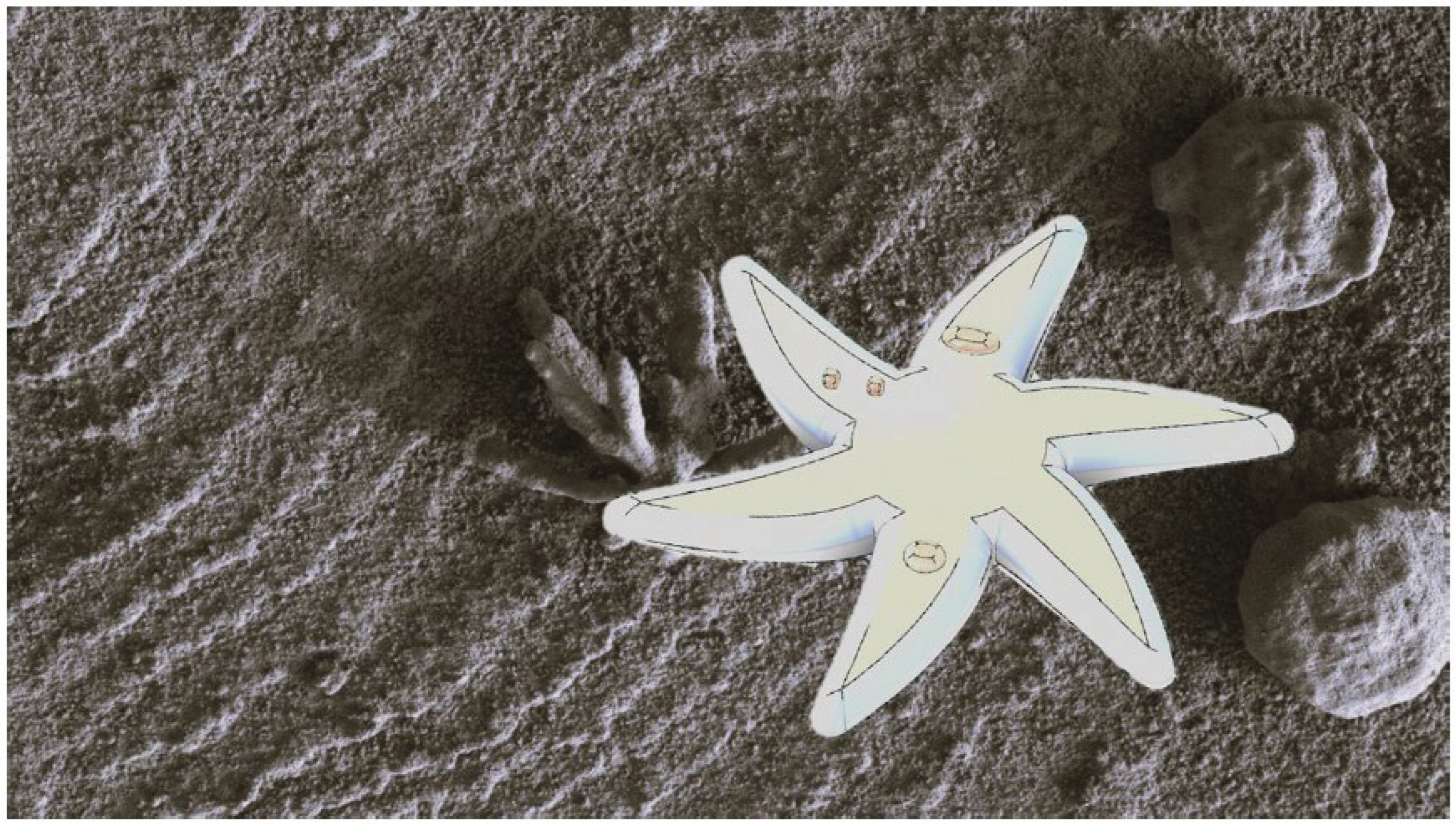

Table 1.
Bioessential ions and examples of sensing options.
| Ion | Examples of biological functions | Examples of sensor |
|---|---|---|
| Na+ | Osmotic balance, maintaining electrolytic balances, stability of molecules and structures | ISE with silver nanoparticles as solid contact [185] ISFET array [92] |
| K+ | Osmotic balance, maintaining electrolytic balances, stability of molecules and structures | ISE with silver nanoparticles as solid contact [185] ISE with microporous carbon as solid contact [80] ISFET array [92] |
| Mg2+ | Stability of molecules and structures, Essential cation pair for anions, e.g. phosphates |
Solid contact pencil graphite electrodes with polypyrrole conducting polymer as solid contact [186] Carbon paste solid contact electrodes [187] |
| Ca2+ | Outer cell membranes and coats, in prokaryotes, wider array of differing functions in advanced eukaryotes and multicellular organisms. | ISE array for cubesat experiment [188] ISFET array [92] |
| Cl- | Osmotic balance, maintaining electrolytic balances, stability of molecules and structures | Amperommetric electrochemical sensors [108], and citations therein ISE with silver nanoparticles as solid contact [185] |
Table 2.
Comparison of sensing methods.
| Sensing technology | Sensing target | Technology development | Minimum size | Integration capability |
|---|---|---|---|---|
| Glass electrodes | pH, some cations | Established | Order of ~10 cm, plus readout instrument | Low |
| Liquid junction polymer membrane ISE | Major cations, eg K+, Mg2+, Ca2+ | Established | Order of ~10 cm, plus readout instrument | Low |
| Solid contact ISE | Major ions, eg K+, Mg2+, Ca2+ | Some commercial availability, highly active research | Order of 10-100 microns, miniaturised readout instrumentation | High |
| ISFET | Major cations, eg K+, Mg2+, Ca2+ pH | Commercial availability, highly active research | Order of <10 microns, Miniaturised readout instrumentation |
High |
Table 3.
examples of electrochemical sensors for biologically relevant redox processes.
| Chemical | Biological redox process | Examples of electrochemical sensor (reference) |
|---|---|---|
| H2 | Methanogenesis, H2 oxidation | Gold and ceramic based electrodes for measurement at high temperature and pressure [189] |
| CO2 | Methanogenisis | Potentiometric measurements with ion selective electrodes |
| O2 | Several chemolithotrophic and chemoorganotrophic processes | Clark type sensors [190], and citations therein. |
| Fe(III) | Fe reduction | Gold modified carbon microelectrode ensemble [191] Thick film modified graphite electrode [192] |
| H2S | Oxidation of reduced S- species | Gold and ceramic based electrodes for measurement at high temperature and pressure [189] Carbon nanotube modified glassy electrodes [193] |
| NO2- | Nitrite oxidation, anoxic ammonium oxidation | Cellulose modified platinum electrodes [194] |
| NO3- | Nitrate reduction | Cellulose modified platinum electrodes [194] Silver microelectrode with miniaturised sensing system [195] |
| Fe(II) | Fe oxidation | Au/Hg microelectrodes [196] Gold modified carbon microelectrode ensemble [195] |
| Co | Trace metal oxidations, trace metal reductions | Bismuth microelectrode array [197] |
| As | Trace metal oxidations, trace metal reductions | Gold nanoelectrode ensembles [198] Gold modified carbon screen printed electrodes [199] |
| Mn | Trace metal oxidations, trace metal reductions | Voltammetric microelectrodes [196] Vibrating gold microwires [144] |
Disclaimer/Publisher’s Note: The statements, opinions and data contained in all publications are solely those of the individual author(s) and contributor(s) and not of MDPI and/or the editor(s). MDPI and/or the editor(s) disclaim responsibility for any injury to people or property resulting from any ideas, methods, instructions or products referred to in the content. |
© 2025 by the authors. Licensee MDPI, Basel, Switzerland. This article is an open access article distributed under the terms and conditions of the Creative Commons Attribution (CC BY) license (http://creativecommons.org/licenses/by/4.0/).
Copyright: This open access article is published under a Creative Commons CC BY 4.0 license, which permit the free download, distribution, and reuse, provided that the author and preprint are cited in any reuse.